Laksamee Putnam
Research & instruction Librarian
lputnam@towson.edu
10/12/2015
First…
 Laksamee Putnam
 lputnam@towson.edu
 Cook Library Reference:
 410.704.2462.
 IM/email
 Phone: 410.704.3746.
 Twitter: @CookLibraryofTU
 Albert S. Cook facebook profile!
 Slides: http://bit.ly/envs601fa2015
Agenda
 Bad Science – Discussion
 Investigating Databases, Journals, and Articles
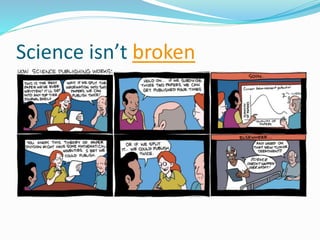
Science isn’t broken
Subject Specific Databases
 Which databases are you familiar with?
 Remember to check the ENVS Subject Gateway
 Which words find the best results? Synonyms?
 Is there an advanced search?
 Can you access full text?
 What features of the databases are useful? (time limit,
peer reviewed option, citations etc.)
Investigating Journals
 Small groups will investigate author submission
requirements for their assigned journal
 Use the worksheet as a guideline
 Small groups will report/discuss their findings in 15
minutes
 Use this website to start investigating your journal:
https://www.journalguide.com/
Investigating Journals
 Environmental Science & Technology
 Chemical Geology
 Water, Air and Soil Pollution
 Advances in Water Resources
 Ecological Applications
Investigating Articles
 Does the library subscribe to your journal?
 Download a research article published in 2013 from
your journal
Investigating Articles
 Does your article follow the structure guidelines
required by the journal?
 How many references does your article list?
Investigating Articles
 Find you article in Google Scholar
 Find your article in Scopus
 How many times has your article been cited?
For your future research
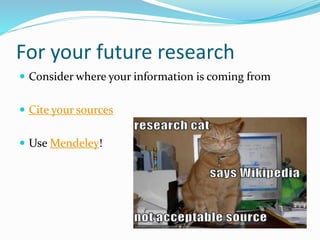
 Consider where your information is coming from
 Cite your sources
 Use Mendeley!
Questions?
 Laksamee Putnam
 lputnam@towson.edu

Envs601 fall2015

  • 1.
    Laksamee Putnam Research &instruction Librarian lputnam@towson.edu 10/12/2015
  • 2.
    First…  Laksamee Putnam lputnam@towson.edu  Cook Library Reference:  410.704.2462.  IM/email  Phone: 410.704.3746.  Twitter: @CookLibraryofTU  Albert S. Cook facebook profile!  Slides: http://bit.ly/envs601fa2015
  • 3.
    Agenda  Bad Science– Discussion  Investigating Databases, Journals, and Articles
  • 4.
  • 5.
    Subject Specific Databases Which databases are you familiar with?  Remember to check the ENVS Subject Gateway  Which words find the best results? Synonyms?  Is there an advanced search?  Can you access full text?  What features of the databases are useful? (time limit, peer reviewed option, citations etc.)
  • 6.
    Investigating Journals  Smallgroups will investigate author submission requirements for their assigned journal  Use the worksheet as a guideline  Small groups will report/discuss their findings in 15 minutes  Use this website to start investigating your journal: https://www.journalguide.com/
  • 7.
    Investigating Journals  EnvironmentalScience & Technology  Chemical Geology  Water, Air and Soil Pollution  Advances in Water Resources  Ecological Applications
  • 8.
    Investigating Articles  Doesthe library subscribe to your journal?  Download a research article published in 2013 from your journal
  • 9.
    Investigating Articles  Doesyour article follow the structure guidelines required by the journal?  How many references does your article list?
  • 10.
    Investigating Articles  Findyou article in Google Scholar  Find your article in Scopus  How many times has your article been cited?
  • 11.
    For your futureresearch  Consider where your information is coming from  Cite your sources  Use Mendeley!
  • 12.

Editor's Notes

  • #5 http://www.smbc-comics.com/?id=1624 Open access info graph: http://www.sciencemag.org/site/special/scicomm/infographic.jpg Who’s afraid of peer review? Science :http://www.sciencemag.org/content/342/6154/60.full Science News cycle: http://www.phdcomics.com/comics.php?f=1174 Battling bad science. http://www.ted.com/talks/ben_goldacre_battling_bad_science.html Discussion Questions: What struck you in this article? What did you find the most interesting? What is your definition of science? How does the media effect science? So, is science broken? What could be done to fix some of these problems?