Information
Concepts
What is an Information System?
a. Data
b. Information
c. System
Environmental Information Systems 11
Compare Data vs. Information
 Data
 The raw facts/
measurements/
observations
 Numbers, words,
pictures
 Has meaning only to
an expert analyst
 Information
 Data is organized or
processed to give
meaning
 Value is added to a
product
 Knowledge-economy
12
Environmental Information Systems
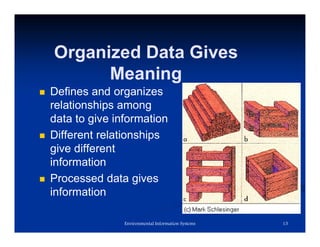
Organized Data Gives
Meaning
 Defines and organizes
relationships among
data to give information
 Different relationships
give different
information
 Processed data gives
information
Environmental Information Systems 13
Why Process Data?
 To achieve a defined outcome
 We must carry out a set of logically related
tasks
 To create a meaningful result from raw
data
 We must compare/measure against
something else which has meaning to us
14
Environmental Information Systems
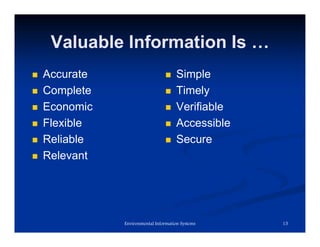
Valuable Information Is …
 Accurate
 Complete
 Economic
 Flexible
 Reliable
 Relevant
 Simple
 Timely
 Verifiable
 Accessible
 Secure
15
Environmental Information Systems
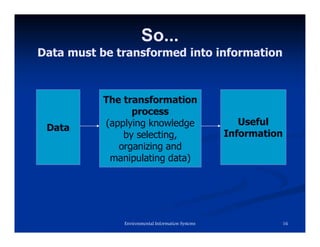
So...
Data must be transformed into information
16
Environmental Information Systems
Data
The transformation
process
(applying knowledge
by selecting,
organizing and
manipulating data)
Useful
Information
The Information
System
A method to transform data into
information
Its components and boundaries
Environmental Information Systems 17
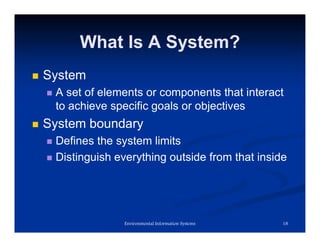
What Is A System?
 System
 A set of elements or components that interact
to achieve specific goals or objectives
 System boundary
 Defines the system limits
 Distinguish everything outside from that inside
18
Environmental Information Systems
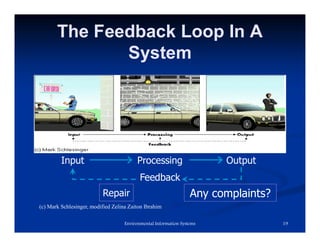
The Feedback Loop In A
System
19
Environmental Information Systems
Input Output
Processing
Feedback
Any complaints?
Repair
(c) Mark Schlesinger, modified Zelina Zaiton Ibrahim
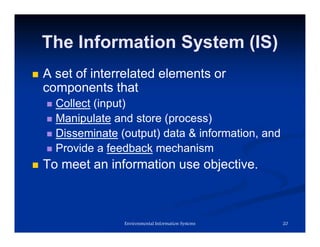
The Information System (IS)
 A set of interrelated elements or
components that
 Collect (input)
 Manipulate and store (process)
 Disseminate (output) data & information, and
 Provide a feedback mechanism
 To meet an information use objective.
20
Environmental Information Systems
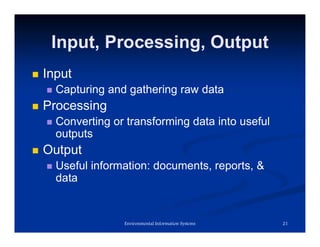
Input, Processing, Output
 Input
 Capturing and gathering raw data
 Processing
 Converting or transforming data into useful
outputs
 Output
 Useful information: documents, reports, &
data
21
Environmental Information Systems
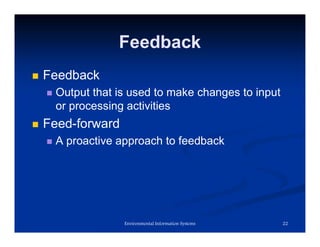
Feedback
 Feedback
 Output that is used to make changes to input
or processing activities
 Feed-forward
 A proactive approach to feedback
22
Environmental Information Systems
Computer-based Information
Systems
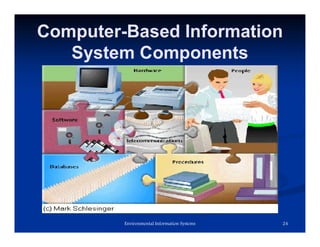
 Composed of hardware, software, data,
telecommunications, people, and
procedures to collect, manipulate, store,
and process data into information
 Part of an operation’s technology
infrastructure
23
Environmental Information Systems
Computer-Based Information
System Components
24
Environmental Information Systems
Why Study
Information
Systems?
The telecommunications age
Environmental Information Systems 25
Computer and Information
Systems Literacy
 Computer literacy
 Knowledge of computer systems and
equipment and the ways they function
 Information systems literacy
 Knowledge of how data and information are
used by individuals and organizations
26
Environmental Information Systems
The Changing World
 Computers & information systems are
constantly changing the way organizations
conduct their operations
 The value of information is directly linked
to how it helps decision makers achieve
the organization’s goals
27
Environmental Information Systems
Internet and telecommunications
technology promotes multimedia
information exchange
 Examples?
28
Environmental Information Systems
Correct or
Wrong
information?
Information Systems
Principles
 The goal of
information systems
architecture is to
enable the
organization to
achieve its business
goals
 Environmental
Information Systems
enable the
organization to
achieve its
environmental
business goals
29
Environmental Information Systems
Summary
 Data must be processed into meaningful
and useful information
 Information systems collect, manipulate
and store, disseminates data &
information, and provides a feedback
mechanism to enable the organization to
achieve its business goals
30
Environmental Information Systems
ANY QUESTIONS?
2017 ZZ Ibrahim 31
Environmental Information Systems
Environmental Management

EnvironmentalInformationSystems-Intro.pdf

  • 1.
    Information Concepts What is anInformation System? a. Data b. Information c. System Environmental Information Systems 11
  • 2.
    Compare Data vs.Information  Data  The raw facts/ measurements/ observations  Numbers, words, pictures  Has meaning only to an expert analyst  Information  Data is organized or processed to give meaning  Value is added to a product  Knowledge-economy 12 Environmental Information Systems
  • 3.
    Organized Data Gives Meaning Defines and organizes relationships among data to give information  Different relationships give different information  Processed data gives information Environmental Information Systems 13
  • 4.
    Why Process Data? To achieve a defined outcome  We must carry out a set of logically related tasks  To create a meaningful result from raw data  We must compare/measure against something else which has meaning to us 14 Environmental Information Systems
  • 5.
    Valuable Information Is…  Accurate  Complete  Economic  Flexible  Reliable  Relevant  Simple  Timely  Verifiable  Accessible  Secure 15 Environmental Information Systems
  • 6.
    So... Data must betransformed into information 16 Environmental Information Systems Data The transformation process (applying knowledge by selecting, organizing and manipulating data) Useful Information
  • 7.
    The Information System A methodto transform data into information Its components and boundaries Environmental Information Systems 17
  • 8.
    What Is ASystem?  System  A set of elements or components that interact to achieve specific goals or objectives  System boundary  Defines the system limits  Distinguish everything outside from that inside 18 Environmental Information Systems
  • 9.
    The Feedback LoopIn A System 19 Environmental Information Systems Input Output Processing Feedback Any complaints? Repair (c) Mark Schlesinger, modified Zelina Zaiton Ibrahim
  • 10.
    The Information System(IS)  A set of interrelated elements or components that  Collect (input)  Manipulate and store (process)  Disseminate (output) data & information, and  Provide a feedback mechanism  To meet an information use objective. 20 Environmental Information Systems
  • 11.
    Input, Processing, Output Input  Capturing and gathering raw data  Processing  Converting or transforming data into useful outputs  Output  Useful information: documents, reports, & data 21 Environmental Information Systems
  • 12.
    Feedback  Feedback  Outputthat is used to make changes to input or processing activities  Feed-forward  A proactive approach to feedback 22 Environmental Information Systems
  • 13.
    Computer-based Information Systems  Composedof hardware, software, data, telecommunications, people, and procedures to collect, manipulate, store, and process data into information  Part of an operation’s technology infrastructure 23 Environmental Information Systems
  • 14.
  • 15.
    Why Study Information Systems? The telecommunicationsage Environmental Information Systems 25
  • 16.
    Computer and Information SystemsLiteracy  Computer literacy  Knowledge of computer systems and equipment and the ways they function  Information systems literacy  Knowledge of how data and information are used by individuals and organizations 26 Environmental Information Systems
  • 17.
    The Changing World Computers & information systems are constantly changing the way organizations conduct their operations  The value of information is directly linked to how it helps decision makers achieve the organization’s goals 27 Environmental Information Systems
  • 18.
    Internet and telecommunications technologypromotes multimedia information exchange  Examples? 28 Environmental Information Systems Correct or Wrong information?
  • 19.
    Information Systems Principles  Thegoal of information systems architecture is to enable the organization to achieve its business goals  Environmental Information Systems enable the organization to achieve its environmental business goals 29 Environmental Information Systems
  • 20.
    Summary  Data mustbe processed into meaningful and useful information  Information systems collect, manipulate and store, disseminates data & information, and provides a feedback mechanism to enable the organization to achieve its business goals 30 Environmental Information Systems
  • 21.
    ANY QUESTIONS? 2017 ZZIbrahim 31 Environmental Information Systems Environmental Management