Environmental Health (ENV 537)
                                             TUESDAY/THURSDAY
                                                 10:05-11:20
                                                    A156


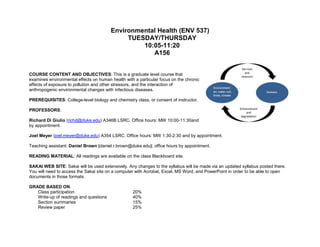
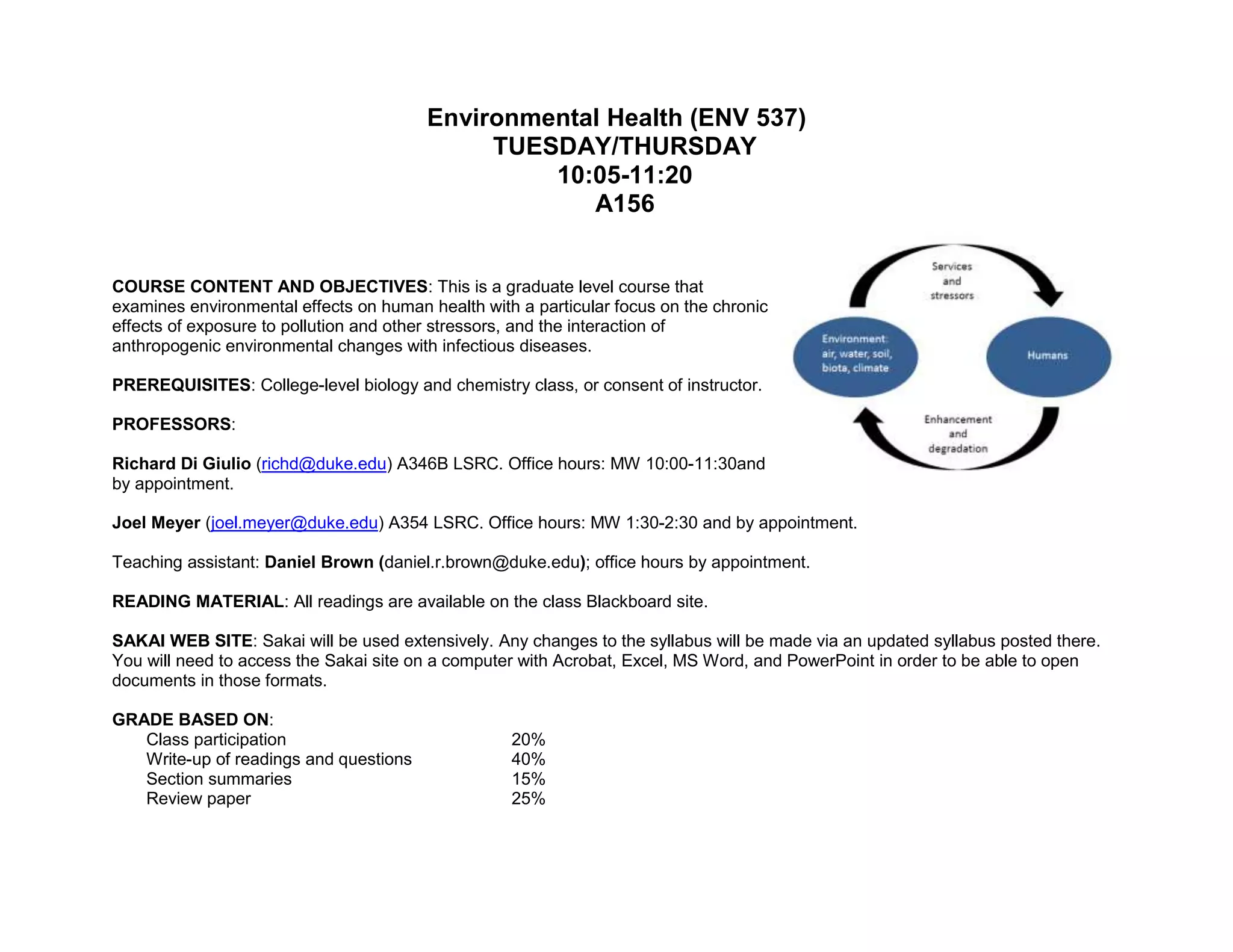
COURSE CONTENT AND OBJECTIVES: This is a graduate level course that
examines environmental effects on human health with a particular focus on the chronic
effects of exposure to pollution and other stressors, and the interaction of
anthropogenic environmental changes with infectious diseases.

PREREQUISITES: College-level biology and chemistry class, or consent of instructor.

PROFESSORS:

Richard Di Giulio (richd@duke.edu) A346B LSRC. Office hours: MW 10:00-11:30and
by appointment.

Joel Meyer (joel.meyer@duke.edu) A354 LSRC. Office hours: MW 1:30-2:30 and by appointment.

Teaching assistant: Daniel Brown (daniel.r.brown@duke.edu); office hours by appointment.

READING MATERIAL: All readings are available on the class Blackboard site.

SAKAI WEB SITE: Sakai will be used extensively. Any changes to the syllabus will be made via an updated syllabus posted there.
You will need to access the Sakai site on a computer with Acrobat, Excel, MS Word, and PowerPoint in order to be able to open
documents in those formats.

GRADE BASED ON:
   Class participation                             20%
   Write-up of readings and questions              40%
   Section summaries                               15%
   Review paper                                    25%
This class includes many lectures by experts in their fields. To ensure that you get the most out of the lectures, and to encourage you
to practice the skill of preparing well for high-level scientific talks, a significant portion of your grade is based on class participation
and preparation for lectures. To this end, you will turn in a 1-page (single-spaced, not including citations) write-up prior to 5 of the
course’s lectures. The content of this write-up may vary slightly from class to class, but in general will contain a synopsis of the
readings, an overview of the field, a brief summary of recent research by the speaker (the last two items may require that you do
some searching on your own, beyond the assigned readings), and a list of at least 3 questions that you would like to ask the speaker.
Assignments for these write-ups will be discussed on the first day of class (January 10). We have asked speakers to aim for 45
minutes of presentation to allow for significant time for interactions and questions; depending in the speaker’s style, those questions
may be asked during the lecture or after.To encourage you to synthesize and retain information from the class, you will also turn in a
short (1.5-2 page) summary of each major section (Reproductive/Developmental, Cardiopulmonary, Neurological, Infectious,
Cancer). This will be due one week after the last lecture of that section. Also, because of this format, attendance is part of your
participation grade. If an unusual circumstance prevents your attendance, please let us know.

ACTIVITIES/GROUPS OF INTEREST:The RTP area is rich in opportunities for meetings and lectures on topics related to this class.
These are excellent opportunities to catch up on cutting-edge research and meet local scientists. Among the seminar series and
meetings you should be aware of are:
      Duke’s ITEHP seminar series: Fridays 12:00-1:30 A247 LSRC http://toxicology.geneimprint.com/about/
      GEMS meeting: TBA http://www.gems-nc.org/Meetings.html
      NCSOT meeting: Feb 21http://www.toxicology.org/isot/rc/nc/meetings.asp
      CSETAC meeting: TBA https://sites.google.com/site/csetac/
      Duke Global Health Institute calendar: http://globalhealth.duke.edu/news-events/
      NC One Health Collaborative: http://nconehealthcollaborative.weebly.com/index.html

NICHOLAS SCHOOL HONOR CODE: All activities of Nicholas School students, including those in this course, are governed by the
Duke Community Standard (honor code; additional background available at: http://www.integrity.duke.edu/ugrad/index.html):

Duke University is a community dedicated to scholarship, leadership, and service and to the principles of honesty, fairness, respect,
and accountability. Citizens of this community commit to reflect upon and uphold these principles in all academic and non-academic
endeavors, and to protect and promote a culture of integrity.

To uphold the Duke Community Standard:

       I will not lie, cheat, or steal in my academic endeavors;
       I will conduct myself honorably in all my endeavors; and
       I will act if the Standard is compromised.
CALENDAR:

Note that this calendar may be altered as necessary. The general Duke Academic Calendar is accessible at:

http://registrar.duke.edu/academic-calendar-2012-2013

Readings to be skimmed and that may serve to reinforce ideas or as useful references are marked with an asterisk*; others are
required.

Date             Module                Class topic and contact email                              Reading
Jan 10           Introduction          Conceptual overview and logistics                          Rappaport and Smith, 2010
Di Giulio and
Meyer
Jan 15           Special topic:        Exposure to and effects of persistent organic pollutants   Keller et al., 2012
Jenn Keller      Wildlife exposures    in sea turtles
(NOAA)                                 jennifer.keller@noaa.gov
Jan 17           Cancer                Cancer: overview and role of the environment               President’s Report on Cancer; Smart 2011
Robert Smart                           rcsmart@ncsu.edu
(NCSU)
Jan 22           Cancer                Cancer in wildlife                                         McAloose and Newton 2009
David Hinton                           dhinton@duke.edu
(NSOE)
Jan 24           Cancer                The Colors of Chromium from Essential Element to           Nickens et al., 2010
Patierno                               Occupational Carcinogen: a complicated conundrum of
(DUMC)                                 a complex carcinogen
                                       steven.patierno@duke.edu
Jan 29           Infectious Diseases   Policy and economic issues of malaria control              Sachs and Malaney 2002; Kramer et al.,
Randy Kramer                           kramer@duke.edu                                            2009; Wiley and Gostin, 2009
(NSOE/DGHI)
Feb 31           Infectious Diseases   Global burden of infectious disease                        Khasnis and Nettleman, 2005; Caulfied et al.,
William Pan                            william.pan@duke.edu                                       2004; San Martin et al., 2010; WHO 2009
(NSOE/DGHI)                                                                                       Chapters 1&2
Feb 5            Infectious Diseases   Introduction and overview of environmental impacts on      Infectious disease co-evolution chapter;
Christopher                            infectious disease worldwide                               Lafferty 2009; Jones et al., 2008; Shurman
Woods                                  woods004@mc.duke.edu                                       2010; Semenza and Benne 2009*
(DUMC/DGHI)
Feb 7 Jennifer   Special topic:        Environmental effects on immune function                   Kaminski et al., 2007 (pp 485-503 required);
Wheeler          Immune function       jennifer.wheeler@duke.edu                                  Stevens et al., 2009
(DUMC)
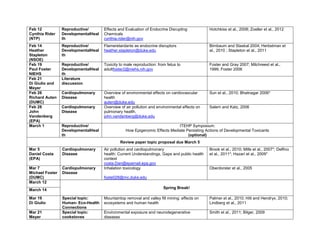
Feb 12           Reproductive/       Effects and Evaluation of Endocrine Disrupting           Hotchkiss et al., 2008; Zoeller et al., 2012
Cynthia Rider    DevelopmentalHeal   Chemicals
(NTP)            th                  cynthia.rider@nih.gov
Feb 14           Reproductive/       Flameretardants as endocrine disruptors                  Birnbaum and Staskal 2004; Herbstman et
Heather          DevelopmentalHeal   heather.stapleton@duke.edu                               al., 2010 ; Stapleton et al., 2011
Stapleton        th
(NSOE)
Feb 19           Reproductive/       Toxicity to male reproduction: from fetus to             Foster and Gray 2007; Milchreest et al.,
Paul Foster      DevelopmentalHeal   adultfoster2@niehs.nih.gov                               1999; Foster 2006
NIEHS            th
Feb 21           Literature
Di Giulio and    discussion
Meyer
Feb 26           Cardiopulmonary     Overview of environmental effects on cardiovascular      Sun et al., 2010; Bhatnagar 2006*
Richard Auten    Disease             health
(DUMC)                               auten@duke.edu
Feb 28           Cardiopulmonary     Overview of air pollution and environmental effects on   Salem and Katz, 2006
John             Disease             pulmonary health.
Vandenberg                           john.vandenberg@duke.edu
(EPA)
March 1          Reproductive/                                              ITEHP Symposium:
                 DevelopmentalHeal               How Epigenomic Effects Mediate Persisting Actions of Developmental Toxicants
                 th                                                              (optional)
                                              Review paper topic proposal due March 5
Mar 5            Cardiopulmonary     Air pollution and cardiopulmonary                        Brook et al., 2010; Mills et al., 2007*; Delfino
Daniel Costa     Disease             health: Current Understandings, Gaps and public health   et al., 2011*; Hazari et al., 2009*
(EPA)                                context
                                     costa.Dan@epamail.epa.gov
Mar 7            Cardiopulmonary     Inhalation toxicology                                    Oberdorster et al., 2005
Michael Foster   Disease
(DUMC)                               foste028@mc.duke.edu
March 12
                                                                       Spring Break!
March 14

Mar 19           Special topic:      Mountaintop removal and valley fill mining: effects on   Palmer et al., 2010; Hitt and Hendryx, 2010;
Di Giulio        Human- Eco-Health   ecosystems and human health                              Lindberg et al., 2011
                 Connections
Mar 21           Special topic:      Environmental exposure and neurodegenerative             Smith et al., 2011; Bilger, 2009
Meyer            cookstoves          diseases
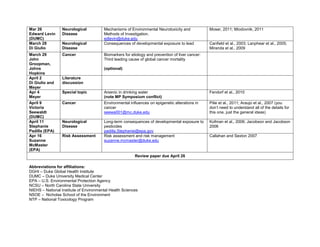
Mar 26           Neurological           Mechanisms of Environmental Neurotoxicity and             Moser, 2011; Miodovnik, 2011
Edward Levin     Disease                Methods of Investigation.
(DUMC)                                  edlevin@duke.edu
March 28         Neurological           Consequences of developmental exposure to lead            Canfield et al., 2003; Lanphear et al., 2005;
Di Giulio        Disease                                                                          Miranda et al., 2009
March 29         Cancer                 Biomarkers for etiology and prevention of liver cancer:
John                                    Third leading cause of global cancer mortality
Groopman,
Johns                                   (optional)
Hopkins
April 2          Literature
Di Giulio and    discussion
Meyer
Apr 4            Special topic          Arsenic in drinking water                                 Fendorf et al., 2010
Meyer                                   (note MP Symposium conflict)
April 9          Cancer                 Environmental influences on epigenetic alterations in     Pilie et al., 2011; Araujo et al., 2007 (you
Victoria                                cancer                                                    don’t need to understand all of the details for
Seewaldt                                seewa001@mc.duke.edu                                      this one, just the general ideas)
(DUMC)
April 11         Neurological           Long-term consequences of developmental exposure to       Kofman et al., 2006; Jacobson and Jacobson
Stephanie        Disease                pesticides                                                2006
Padilla (EPA)                           padilla.Stephanie@epa.gov
Apr 16           Risk Assessment        Risk assessment and risk management                       Callahan and Sexton 2007
Suzanne                                 suzanne.mcmaster@duke.edu
McMaster
(EPA)
                                                         Review paper due April 26

Abbreviations for affiliations:
DGHI – Duke Global Health Institute
DUMC – Duke University Medical Center
EPA – U.S. Environmental Protection Agency
NCSU – North Carolina State University
NIEHS – National Institute of Environmental Health Sciences
NSOE – Nicholas School of the Environment
NTP – National Toxicology Program

Environmental Health

  • 1.
    Environmental Health (ENV537) TUESDAY/THURSDAY 10:05-11:20 A156 COURSE CONTENT AND OBJECTIVES: This is a graduate level course that examines environmental effects on human health with a particular focus on the chronic effects of exposure to pollution and other stressors, and the interaction of anthropogenic environmental changes with infectious diseases. PREREQUISITES: College-level biology and chemistry class, or consent of instructor. PROFESSORS: Richard Di Giulio (richd@duke.edu) A346B LSRC. Office hours: MW 10:00-11:30and by appointment. Joel Meyer (joel.meyer@duke.edu) A354 LSRC. Office hours: MW 1:30-2:30 and by appointment. Teaching assistant: Daniel Brown (daniel.r.brown@duke.edu); office hours by appointment. READING MATERIAL: All readings are available on the class Blackboard site. SAKAI WEB SITE: Sakai will be used extensively. Any changes to the syllabus will be made via an updated syllabus posted there. You will need to access the Sakai site on a computer with Acrobat, Excel, MS Word, and PowerPoint in order to be able to open documents in those formats. GRADE BASED ON: Class participation 20% Write-up of readings and questions 40% Section summaries 15% Review paper 25%
  • 2.
    This class includesmany lectures by experts in their fields. To ensure that you get the most out of the lectures, and to encourage you to practice the skill of preparing well for high-level scientific talks, a significant portion of your grade is based on class participation and preparation for lectures. To this end, you will turn in a 1-page (single-spaced, not including citations) write-up prior to 5 of the course’s lectures. The content of this write-up may vary slightly from class to class, but in general will contain a synopsis of the readings, an overview of the field, a brief summary of recent research by the speaker (the last two items may require that you do some searching on your own, beyond the assigned readings), and a list of at least 3 questions that you would like to ask the speaker. Assignments for these write-ups will be discussed on the first day of class (January 10). We have asked speakers to aim for 45 minutes of presentation to allow for significant time for interactions and questions; depending in the speaker’s style, those questions may be asked during the lecture or after.To encourage you to synthesize and retain information from the class, you will also turn in a short (1.5-2 page) summary of each major section (Reproductive/Developmental, Cardiopulmonary, Neurological, Infectious, Cancer). This will be due one week after the last lecture of that section. Also, because of this format, attendance is part of your participation grade. If an unusual circumstance prevents your attendance, please let us know. ACTIVITIES/GROUPS OF INTEREST:The RTP area is rich in opportunities for meetings and lectures on topics related to this class. These are excellent opportunities to catch up on cutting-edge research and meet local scientists. Among the seminar series and meetings you should be aware of are: Duke’s ITEHP seminar series: Fridays 12:00-1:30 A247 LSRC http://toxicology.geneimprint.com/about/ GEMS meeting: TBA http://www.gems-nc.org/Meetings.html NCSOT meeting: Feb 21http://www.toxicology.org/isot/rc/nc/meetings.asp CSETAC meeting: TBA https://sites.google.com/site/csetac/ Duke Global Health Institute calendar: http://globalhealth.duke.edu/news-events/ NC One Health Collaborative: http://nconehealthcollaborative.weebly.com/index.html NICHOLAS SCHOOL HONOR CODE: All activities of Nicholas School students, including those in this course, are governed by the Duke Community Standard (honor code; additional background available at: http://www.integrity.duke.edu/ugrad/index.html): Duke University is a community dedicated to scholarship, leadership, and service and to the principles of honesty, fairness, respect, and accountability. Citizens of this community commit to reflect upon and uphold these principles in all academic and non-academic endeavors, and to protect and promote a culture of integrity. To uphold the Duke Community Standard: I will not lie, cheat, or steal in my academic endeavors; I will conduct myself honorably in all my endeavors; and I will act if the Standard is compromised.
  • 3.
    CALENDAR: Note that thiscalendar may be altered as necessary. The general Duke Academic Calendar is accessible at: http://registrar.duke.edu/academic-calendar-2012-2013 Readings to be skimmed and that may serve to reinforce ideas or as useful references are marked with an asterisk*; others are required. Date Module Class topic and contact email Reading Jan 10 Introduction Conceptual overview and logistics Rappaport and Smith, 2010 Di Giulio and Meyer Jan 15 Special topic: Exposure to and effects of persistent organic pollutants Keller et al., 2012 Jenn Keller Wildlife exposures in sea turtles (NOAA) jennifer.keller@noaa.gov Jan 17 Cancer Cancer: overview and role of the environment President’s Report on Cancer; Smart 2011 Robert Smart rcsmart@ncsu.edu (NCSU) Jan 22 Cancer Cancer in wildlife McAloose and Newton 2009 David Hinton dhinton@duke.edu (NSOE) Jan 24 Cancer The Colors of Chromium from Essential Element to Nickens et al., 2010 Patierno Occupational Carcinogen: a complicated conundrum of (DUMC) a complex carcinogen steven.patierno@duke.edu Jan 29 Infectious Diseases Policy and economic issues of malaria control Sachs and Malaney 2002; Kramer et al., Randy Kramer kramer@duke.edu 2009; Wiley and Gostin, 2009 (NSOE/DGHI) Feb 31 Infectious Diseases Global burden of infectious disease Khasnis and Nettleman, 2005; Caulfied et al., William Pan william.pan@duke.edu 2004; San Martin et al., 2010; WHO 2009 (NSOE/DGHI) Chapters 1&2 Feb 5 Infectious Diseases Introduction and overview of environmental impacts on Infectious disease co-evolution chapter; Christopher infectious disease worldwide Lafferty 2009; Jones et al., 2008; Shurman Woods woods004@mc.duke.edu 2010; Semenza and Benne 2009* (DUMC/DGHI) Feb 7 Jennifer Special topic: Environmental effects on immune function Kaminski et al., 2007 (pp 485-503 required); Wheeler Immune function jennifer.wheeler@duke.edu Stevens et al., 2009 (DUMC)
  • 4.
    Feb 12 Reproductive/ Effects and Evaluation of Endocrine Disrupting Hotchkiss et al., 2008; Zoeller et al., 2012 Cynthia Rider DevelopmentalHeal Chemicals (NTP) th cynthia.rider@nih.gov Feb 14 Reproductive/ Flameretardants as endocrine disruptors Birnbaum and Staskal 2004; Herbstman et Heather DevelopmentalHeal heather.stapleton@duke.edu al., 2010 ; Stapleton et al., 2011 Stapleton th (NSOE) Feb 19 Reproductive/ Toxicity to male reproduction: from fetus to Foster and Gray 2007; Milchreest et al., Paul Foster DevelopmentalHeal adultfoster2@niehs.nih.gov 1999; Foster 2006 NIEHS th Feb 21 Literature Di Giulio and discussion Meyer Feb 26 Cardiopulmonary Overview of environmental effects on cardiovascular Sun et al., 2010; Bhatnagar 2006* Richard Auten Disease health (DUMC) auten@duke.edu Feb 28 Cardiopulmonary Overview of air pollution and environmental effects on Salem and Katz, 2006 John Disease pulmonary health. Vandenberg john.vandenberg@duke.edu (EPA) March 1 Reproductive/ ITEHP Symposium: DevelopmentalHeal How Epigenomic Effects Mediate Persisting Actions of Developmental Toxicants th (optional) Review paper topic proposal due March 5 Mar 5 Cardiopulmonary Air pollution and cardiopulmonary Brook et al., 2010; Mills et al., 2007*; Delfino Daniel Costa Disease health: Current Understandings, Gaps and public health et al., 2011*; Hazari et al., 2009* (EPA) context costa.Dan@epamail.epa.gov Mar 7 Cardiopulmonary Inhalation toxicology Oberdorster et al., 2005 Michael Foster Disease (DUMC) foste028@mc.duke.edu March 12 Spring Break! March 14 Mar 19 Special topic: Mountaintop removal and valley fill mining: effects on Palmer et al., 2010; Hitt and Hendryx, 2010; Di Giulio Human- Eco-Health ecosystems and human health Lindberg et al., 2011 Connections Mar 21 Special topic: Environmental exposure and neurodegenerative Smith et al., 2011; Bilger, 2009 Meyer cookstoves diseases
  • 5.
    Mar 26 Neurological Mechanisms of Environmental Neurotoxicity and Moser, 2011; Miodovnik, 2011 Edward Levin Disease Methods of Investigation. (DUMC) edlevin@duke.edu March 28 Neurological Consequences of developmental exposure to lead Canfield et al., 2003; Lanphear et al., 2005; Di Giulio Disease Miranda et al., 2009 March 29 Cancer Biomarkers for etiology and prevention of liver cancer: John Third leading cause of global cancer mortality Groopman, Johns (optional) Hopkins April 2 Literature Di Giulio and discussion Meyer Apr 4 Special topic Arsenic in drinking water Fendorf et al., 2010 Meyer (note MP Symposium conflict) April 9 Cancer Environmental influences on epigenetic alterations in Pilie et al., 2011; Araujo et al., 2007 (you Victoria cancer don’t need to understand all of the details for Seewaldt seewa001@mc.duke.edu this one, just the general ideas) (DUMC) April 11 Neurological Long-term consequences of developmental exposure to Kofman et al., 2006; Jacobson and Jacobson Stephanie Disease pesticides 2006 Padilla (EPA) padilla.Stephanie@epa.gov Apr 16 Risk Assessment Risk assessment and risk management Callahan and Sexton 2007 Suzanne suzanne.mcmaster@duke.edu McMaster (EPA) Review paper due April 26 Abbreviations for affiliations: DGHI – Duke Global Health Institute DUMC – Duke University Medical Center EPA – U.S. Environmental Protection Agency NCSU – North Carolina State University NIEHS – National Institute of Environmental Health Sciences NSOE – Nicholas School of the Environment NTP – National Toxicology Program