ENVIRONMENTAL ENGINEERING
ENVIRONMENT (BIOPHYSICAL)
-The biotic and abiotic surrounding of an organism, or population,
and includes particularly the factors that have an influence in
their survival, development and evolution.
3.
ENVIRONMENTAL ENGINEERING
Biotic –living component of a community. Plants, animals, fungi
and bacteria are all biotic or living factors
Abiotic – nonliving factors that affect living organisms.
Environmental factors such as habitat (pond, lake, ocean, desert,
mountain) or weather such as temperature, cloud cover, rain,
snow, hurricanes, climate regime etc. are abiotic factors.
4.
Environmental Science
- studyof natural processes
- interdisciplinary study that seeks to describe the
immediate solution to environmental problems and its
management.
What is an engineer?
- Problem solver, specifically, one who uses science to solve
real world problems.
SO, what about an environmental engineer?
- Solves environmental problems using scientific tools
- to improve the natural environment (air, water, and/or
land resources), to provide healthy water, air, and land for
human habitation and for other organisms, and to remediate
polluted sites.
5.
Environmental quality
- refersto a set of properties and characteristics of the
environment as they impact human beings and living
organisms residing in it.
-It is also a measure of the suitability of the environment
relative to the requirements and needs of its residents.
-clean water, air, land
- availability of natural resources
6.
ENVIRONMENTAL ENGINEERING HISTORYAND BACKGROUND
• Sanitary engineering emerged as a separate engineering field
within civil engineering in the mid 1800's as the importance of
drinking water treatment and wastewater treatment became
recognized. Sanitary engineering, which had an emphasis on
water supply, water treatment, and wastewater collection and
treatment for many years, is the precursor of the present day
field of environmental engineering. Public concern about
environmental quality issues like air pollution and water
pollution emerged in the middle third of the 20th century,
leading to development of environmental engineering as a
separate discipline that deals with air pollution control,
hazardous waste management and industrial hygiene as well
as the traditional sanitary engineering fields of water supply
and waste water treatment.
7.
The rapidly growingfields of green building and designing for
sustainability have called on the skills of environmental
engineers.
8.
ROLES OF ENVIRONMENTALENGINEERS
1)Collaborate with environmental scientists,
planners, hazardous waste technicians, engineers,
and other specialists, and experts in law and
business to address environmental problems.
4) Assess the
existingor
potential
environmental
impact of land
use projects on
air, water, and
land.
12.
5)Develop site-specific healthand safety
protocols, such as spill contingency plans and
methods for loading and transporting waste.
13.
6) Design systems,processes, and equipment for
control, management, and remediation of
water, air, and soil quality
14.
7) Develop andpresent environmental
compliance training or orientation sessions
15.
8) Serve onteams conducting multimedia inspections
at complex facilities, providing assistance with
planning, quality assurance, safety inspection
protocols, and sampling.
9) Monitor progress of environmental improvement
programs.
10) Provide administrative support for projects by
collecting data, providing project documentation,
training staff, and performing other general
administrative duties.
16.
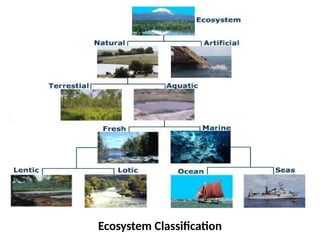
ECOSYSTEM
ECOSYSTEM
- a communityof organisms interacting with
each other and with their environment such
that energy is exchanged and system-level
processes, such as the cycling of elements
emerge.
17.
ECOSYSTEM
ECOSYSTEM
- Ecosystems includeliving organisms, the dead
organic matter produced by them, the abiotic
environment within which the organisms live
and exchange elements (soil, water,
atmosphere), and the interactions between
these components
18.
ECOSYSTEM
ECOSYSTEM
- Ecosystems embodythe concept that living
organisms continually interact with each other and
with the environment to produce complex systems
with emergent properties, such that "the whole is
greater than the sum of its parts" and "everything is
connected“
21.
Ecology—the scientific studyof interactions between
different organisms and between organisms
and their environment or surroundings
Organism - anyunicellular or multicellular form
exhibiting all of the characteristics of life, an
individual.
•The lowest level of organization
24.
POPULATION
- one specieingin the
same place at the same time
that interbreed / fertile
offspring
Compete for resources
(food, mates, shelter, etc.)
25.
Community - severalinteracting
populations that inhabit a common
environment and are interdependent.
26.
Ecosystem - populationsin a community
and the abiotic factors with which they
interact (ex. marine, terrestrial)
27.
Biosphere - lifesupporting portions of
Earth composed of air, land, fresh water,
and salt water.
•The highest level of organization
28.
Habitat vs. Niche
Niche- the role a species plays in a
community; its total way of life
Habitat- the place in which an organism
lives out its life
29.
Example of niche
Theecological niche of a sunflower growing in
the backyard includes absorbing light, water and
nutrients (for photosynthesis), providing shelter
and food for other organisms (e.g. bees, ants,
etc.), and giving off oxygen into the atmosphere.
30.
The ecological nicheof an organism depends not only on
where it lives but also on what it does. By analogy, it may
be said that the habitat is the organism’s “address”, and
the niche is its “profession”, biologically speaking.
Worm’s Niche
“Address”—Soil, Ground, etc.
“Profession”– Mix-up soil
31.
Habitat vs. Niche
Aniche is determined by the
tolerance limitations of an organism,
or a limiting factor.
Limiting factor- any biotic or abiotic
factor that restricts the existence of
organisms in a specific environment.
32.
Examples of limitingfactors -
•Amount of water
•Amount of food
•Temperature
•Amount of space
•Availability of mates
Feeding Interactions
A. Energyflows through an ecosystem in one direction—
from the sun or inorganic compounds to autotrophs
(producers) and then to heterotrophs (consumers)
35.
Producers
- Make theirown food.
- Use light (photosynthesis)and chemical energy
to make food
- Also called autotrophs
1. Plants
2. plant-like protists (algae)
3. Bacteria
36.
Photosynthesis—use light energyto convert carbon
dioxide and water into oxygen and carbohydrates
(Remember: 6CO2 + 6H2O 6O2 + C6H12O6)
Chemosynthesis—performed by bacteria, use chemical
energy to produce carbohydrates
Light Energy
Sunlight is the
main energy
source for life on
earth
37.
Consumers
- Organisms thatrely on other organisms for
their energy and food supply
- Also called heterotrophs
B. FUNCTIONS OFECOSYSTEM
1) Production – creation of new, organic matter. The synthesis and
storage of organic molecules during the growth and reproduction
of photosynthetic organisms.
Photosynthesis reaction :
CO2 + H2O -------> CH2O + O2 (light and enzymes)
done by phototrophs
• Chemosynthesis – inorganic substances (CO2 and H2) are
converted to (CH4) organic substances in the absence of
sunlight
done by chemotrophs which are specialized bacteria
41.
2) Consumption –process in which a substance is completely
destroyed, used up, or incorporated or transformed into
something else. It acts as a regulator for production and
decomposition
42.
3) Respiration –process of unleashing bound energy for
utilization
CH2O + O2 -----> CO2 + H2O + released energy
43.
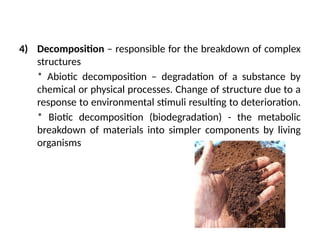
4) Decomposition –responsible for the breakdown of complex
structures
* Abiotic decomposition – degradation of a substance by
chemical or physical processes. Change of structure due to a
response to environmental stimuli resulting to deterioration.
* Biotic decomposition (biodegradation) - the metabolic
breakdown of materials into simpler components by living
organisms
44.
C. Food Chain—seriesof steps in which organisms transfer
energy by eating and being eaten
1. Arrows go in the direction of how energy is
transferred
2. Start with producer and end with top consumer
or carnivore
Ex: grass cricket frog raccoon
45.
Classification of FoodChain
a) Grazing food chain – starts from plants to grazing
herbivores to carnivores
b) Detritus food chain – starts from dead organic matter
to microorganisms such as bacteria, fungi, etc.
D. Food Web—networkof food chains within an ecosystem
Which of the organisms above is the producer?
Which of the organisms above is the top consumer?
Hawks
Weasels Raccoon
s
Mice
Grass
Grass
Hawks
48.
E. Trophic Levels—eachstep in a food chain or food web
1. Level 1—Producers (autotrophs)
2. Level 2—Primary Consumers (herbivores)
3. Level 3—Secondary Consumers
(carnivores or omnivores)
4. Level 4—Tertiary Consumers
(carnivore—usually top carnivore)
49.
F. Ecological Pyramids
-Diagram that shows the relative amount of energy or
organisms contained within each trophic level of a food
chain or web
50.
Organisms in atrophic level use
the available energy for life
processes (such as growth,
photosynthesis, cellular
respiration, metabolism, etc.)and
release some energy as heat.
Remember: Every chemical
process that happens in your body
releases heat as a byproduct (ex:
burning calories).
Energy Pyramid shows relative amount of energy available at
each trophic level
51.
100%
10%
1%
0.1%
Rule of 10—onlyabout
10% of the available energy
within a trophic level is
transferred to the next
higher trophic level
52.
Biomass Pyramid—represents theamount of living organic
matter at each trophic level.
The amount of living
organic matter decreases
as the trophic level
increases.
There are more producers
than consumers.
53.
Community Inter-actions
Ecological Interactionsbetween organisms
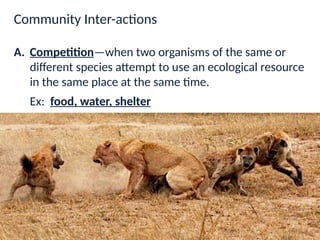
A. Competition—when two organisms of the same or
different species attempt to use an ecological resource
in the same place at the same time.
Ex: food, water, shelter
Until Americans introducedgray squirrels into parts of
England in the early 20th century, red squirrels had been
the only species of squirrel in the country. The gray
squirrels were larger and bred faster and successfully
competed for resources. Within a couple years of overlap
in an area, the red squirrels disappeared.
56.
B. Predation—one organismcaptures and feeds on
another organism
1. Predator—one that does the killing
2. Prey—one that is the food
57.
C. Symbiosis—any relationshipin which two
species live closely together
1. Mutualism—both species benefit (WIN-WIN)
a. Ex: insects and flowers
58.
2. Commensalism—one memberof the association
benefits and the other is neither helped nor
harmed. (WIN-0)
Example: barnacles on a whale
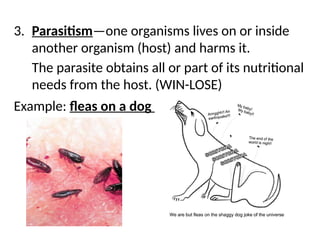
3. Parasitism—one organismslives on or inside
another organism (host) and harms it.
The parasite obtains all or part of its nutritional
needs from the host. (WIN-LOSE)
Example: fleas on a dog
61.
Parasitism
Wasp eggs onback of
caterpillar.
Mosquito biting a
human.
Sea lampreys feed on
fluids of other fish.
62.
2 Kinds ofParasites
1) Ectoparasites – live on
the bodies of the
host (ex. molds, flies,
lice)
2) Endoparasites – live
inside the bodies of the
host (ex. Tapeworms,
bacteria, fungi)
OTHER BASIC ECOLOGICALPRINCIPLES
1) Diversity - variety of habitats, living communities, and
ecological processes in the living world. It also refers to the
extent that an ecosystem possesses different species.
65.
2) Distribution -the frequency of occurrence or the natural
geographic range or place where species occur
* Immigration - used to describe the process by which a person
moves into a country for the purpose of establishing residency. In
such a case, the individual is not a native of the country which he
immigrates to
* Emigration - process by which a person leaves his place or
country of residency, to relocate elsewhere. In this case, the
individual moving is referred to as an emigrant
(Immigration is movement to a country; emigration is movement
from a country)
* Migration – parent term of the aforementioned terms
67.
3) Population
Density -the
number of
individuals of a
population per
unit of living
space (say,
number of trees
per hectare of
land)
68.
4) Dominance -the degree to which a specie is more
numerous than its competitors in an ecological
community, or makes up more of the biomass. Most
ecological communities are defined by their
dominant species
* Keystone species - species that have a
disproportionately large effect on its environment
relative to its abundance. Such species play a critical
role in maintaining the structure of an ecological
community, affecting many other organisms in an
ecosystem and helping to determine the types and
numbers of various other species in the community.
The most important specie
70.
POPULATION PRINCIPLES ANDISSUES
Characteristics:
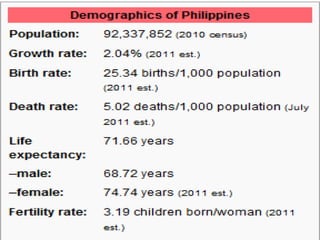
1) Natality - the birthrate, which is the ratio of total live births
to total population in a particular area over a specified period
of time; expressed as childbirths per 1000 people (or
population) per year. It may also refer to the inherent ability
of a population to increase
2) Mortality - the ratio of deaths in an area to the population of
that area; expressed per 1000 per year
* Morbidity - an incidence of ill health. It is measured in
various ways, often by the probability that a randomly
selected individual in a population at some date and location
would become seriously ill in some period of time
71.
3) Sex ratio- the ratio of males to females in a population. The
sex ratio varies according to the age profile of the population.
It is generally divided into four:
* primary sex ratio — ratio at fertilization
* secondary sex ratio — ratio at birth
* tertiary sex ratio — ratio in sexually active organisms
* quaternary sex ratio — ratio in post-reproductive
organisms
(Measuring these is a problem since there are no clear
boundaries between them.)
4) Age Distribution - the proportionate numbers of persons in
successive age categories in a given population
74.
POPULATION ISSUES
1) Newcharacteristics because of immigration
2) Spread of diseases
3) Poverty
4) Environmental stress
5) Security issues
6) Health and Nutrition
Etc…..
75.
SUCCESSION
- The orderlyprocess of community development that involves
changes in species, structure, and community
- It results from the modification of the physical environment
by the community
• Primary succession occurs in essentially lifeless areas—
regions in which the soil is incapable of sustaining life as a
result of such factors as lava flows, newly formed sand dunes,
or rocks left from a retreating glacier
* lichens – pioneering specie in primary succession,
aids in pedogenesis (the formation of soil)
76.
SUCCESSION
• Secondary successionoccurs in areas where a
community that previously existed has been
removed; it is typified by smaller-scale disturbances
that do not eliminate all life and nutrients from the
environment
* climax community – a community in a final
stage of succession. Self – perpetuating and in
equilibrium with the physical habitat.
MATERIAL CYCLES
- Sometimescalled nutrient cycles, material cycles
describe the flow of matter from the nonliving to
the living world and back again. As this happens,
matter can be stored, transformed into different
molecules, transferred from organism to organism,
and returned to its initial configuration. The
implications of material cycles are profound. There
is essentially a finite amount of matter on Earth
(with some input from meteors and other
astronomical objects)
- Examples include the carbon cycle, nitrogen cycle,
oxygen cycle, phosphorus cycle, sulfur cycle etc.
Carbon movesfrom the atmosphere to plants.
In the atmosphere, carbon is attached to oxygen in a gas called
carbon dioxide (CO2). With the help of the Sun, through the
process of photosynthesis, carbon dioxide is pulled from the air to
make plant food from carbon.
Carbon moves from plants to animals.
Through food chains, the carbon that is in plants moves to the
animals that eat them. Animals that eat other animals get the
carbon from their food too.
Carbon moves from plants and animals to the ground.
When plants and animals die, their bodies, wood and leaves decay
bringing the carbon into the ground. Some becomes buried miles
underground and will become fossil fuels in millions and millions
of years.
83.
Carbon movesfrom living things to the atmosphere.
Each time you exhale, you are releasing carbon dioxide gas (CO2) into the
atmosphere. Animals and plants get rid of carbon dioxide gas through a
process called respiration.
Carbon moves from fossil fuels to the atmosphere when fuels are
burned.
When humans burn fossil fuels to power factories, power plants, cars and
trucks, most of the carbon quickly enters the atmosphere as carbon
dioxide gas. Each year, five and a half billion tons of carbon is released by
burning fossil fuels. That’s the weight of 100 million adult African
elephants! Of the huge amount of carbon that is released from fuels, 3.3
billion tons enters the atmosphere and most of the rest becomes
dissolved in seawater.
Carbon moves from the atmosphere to the oceans.
The oceans, and other bodies of water, soak up some carbon from the
atmosphere.
• The nitrogencycle is the process by
which nitrogen is converted between its
various chemical forms.
• Important processes in the nitrogen cycle
include fixation, ammonification, nitrification,
and denitrification.
87.
a) Nitrogen Fixation
•Atmospheric nitrogen must be processed, or
"fixed" to be used by plants.
• There are four ways to convert N2 (atmospheric
nitrogen gas) into more chemically reactive
forms:
1) Biological fixation: some symbiotic bacteria and
some free-living bacteria are able to fix nitrogen
as organic nitrogen.
88.
2) Industrial N-fixation:Under great pressure, at a
temperature of 600 C, and with the use of an iron
catalyst, hydrogen and atmospheric nitrogen can be
combined to form ammonia
3) Combustion of fossil fuels: automobile engines and
thermal power plants, which release various nitrogen
oxides (NOx)
4) Other processes: In addition, the formation of NO
from N2 and O2 due to photons and especially
lightning, can fix nitrogen
89.
b) Ammonification
• Whena plant or animal dies, or an animal
expels waste, the initial form of nitrogen
is organic. Bacteria, or fungi in some cases,
convert the organic nitrogen within the
remains back into ammonium , a process
called ammonification or mineralization.
90.
c) Nitrification
• Thisis the biological oxidation of ammonium. This
is done in two steps, first from the nitrite form then
to the nitrate form. Two specific chemoautotrophic
bacterial genera are involved, using inorganic
carbon as their source for cellular carbon.
Nitrosomonas Nitrobacter
NH4
+
+ O2 NO2
-
+ O2 NO3
-
Ammonium Nitrite Nitrate
91.
b) Denitrification
• Thisis the biological reduction of nitrate to
nitrogen gas. This can proceed through several
steps in the biochemical pathway, with the
ultimate production of nitrogen gas. A fairly
broad range of hetrotrophic bacteria are
involved in the process, requiring an organic
carbon source for energy.
NO3
-
+ org. carbon NO2
-
+ org. carbon N2 + CO2 + H2O
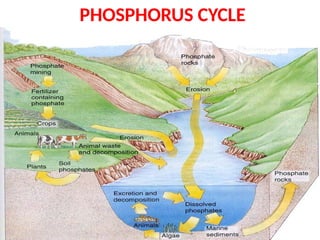
Most of theworld’s phosphorus is “locked up” in rocks–
it can only be released by weathering
Weathering - refers to a group of processes by which
surface rock disintegrates into smaller particles or
dissolve into water due to the impact of the atmosphere
and hydrosphere. The weathering processes often are
slow (hundred to thousands of years).
• Weathering processes are divided into three categories:
– physical weathering – abrasion, thermal expansion and
contraction, wetting and drying etc
– chemical weathering – hydrolysis, oxidation - reduction
– biological weathering - lichen
94.
A lot ofthe phosphorus that runs off into the ocean also
gets “buried” into the ocean floor because it
precipitates into solid form and settles to the bottom as
sediment. . Only the occasional upwellings in the ocean
can recycle phosphorus back to the top of the ocean.
**Note that birds are one of the few manners of
carrying phosphorus back to land because they eat fish
(that eat phosphorus-rich phytoplankton) and then
excrete the phosphorus back onto land
• The top 4 reservoirs for Phosphorus are:
1. sediment (lithosphere) 2. soil (lithosphere) 3.
oceans 4. mineable rock (lithosphere)
Sulfur isproduced naturally as a result of volcanic eruptions and through
emissions from hot springs. It enters the atmosphere primarily in the
form of sulfur dioxide, then remains in the atmosphere in that form or,
after reacting with water, in the form of sulfuric acid.
Sulfur is carried back to Earth's surface as acid deposition when it rains
or snows
On Earth's surface, sulfur dioxide and sulfuric acid react with metals to
form sulfates and sulfides. The element is also incorporated by plants in
a form known as organic sulfur. Certain amino acids, the compounds
from which proteins are made, contain sulfur. Organic sulfur from plants
is eventually passed on to animals that eat those plants. It is, in turn,
converted from plant proteins to animal proteins.
When plants and animals die, sulfur is returned to the soil where it is
converted by microorganisms into hydrogen sulfide. Hydrogen sulfide gas
is then returned to the atmosphere, where it is oxidized to sulfuric acid
Editor's Notes
#22 Just like with classification, ecology is hierarchal. Each level builds on itself and they fit together like nesting boxes.
#23 The lowest level is the individual. The organism. Here we see a salmon and a bear as examples of organisms. REMINDER: organisms die, species go extinct
#24 The next level is a population. A population consists of a single species living together and breeding. Give me an example of a population. Ex. large mouth bass living in Lake Meade. Beetles living under the same log. Here we have salmon spwning and two bears fishing.
#25 Next level is a community which is several populations living together and depending on each other. What does interdependent mean? An example of a community is shown here with the bear and the salmon. They both live in a common environment and the bear needs the fish for food? How does the salmon need the bear?
#27 Lets review. Organisms make up populations, populations make up communities, communities and abiotic factors make up ecosystems, and all of the ecosystems make up the biosphere. From one to many and each depending on the other.
#28 Although several species may share a habitat they each have their own niche. A niche is a very narrow range where a species fits within a habitat.
#31 Although several species may share a habitat they each have their own niche. A niche is a very narrow range where a species fits within a habitat.
#32 Although several species may share a habitat they each have their own niche. A niche is a very narrow range where a species fits within a habitat.





















![Ecosystem and it's characters [Recovered] 12.pptx](https://cdn.slidesharecdn.com/ss_thumbnails/ecosystemrecovered12-241213040441-dc7a3f7a-thumbnail.jpg?width=640&height=640&fit=bounds)


