This role play description is licensed under a Creative Commons Attribution-Noncommercial-Share Alike 2.5 Australia License


       ROUNDTABLE DISCUSSION: ENVIRONMENTAL
                 DECISION MAKING
ABSTRACT                                                                                     KEYWORDS
The RTD activity is designed to facilitate understanding about environmental                 Roundtable; Consensus
decision making. Students explore a particular issue from multiple perspectives by           building; Environmental
interacting both online and face-to-face with their peers about a topic in assigned          Decision Making
“stakeholder” roles. Students gain an appreciation about the complexity of the issue
being examined as they are exposed to different viewpoints about the topic other             CONTACT
than their own. The activity has application in any situation involving a group of           Elizabeth Devonshire
stakeholders who are meeting to discuss a ‘real life’ issue, with the aim of reaching        University of Sydney
consensus about the best course of action.                                                   ldevonsh@med.usyd.edu.au


DESCRIPTION
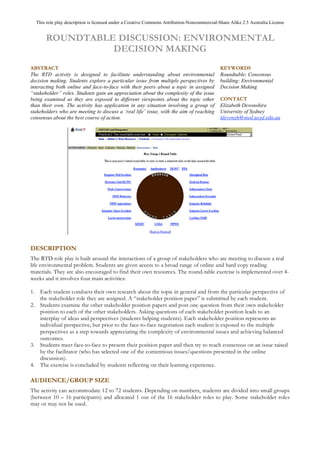
The RTD role play is built around the interactions of a group of stakeholders who are meeting to discuss a real
life environmental problem. Students are given access to a broad range of online and hard copy reading
materials. They are also encouraged to find their own resources. The round-table exercise is implemented over 4-
weeks and it involves four main activities:

1. Each student conducts their own research about the topic in general and from the particular perspective of
   the stakeholder role they are assigned. A “stakeholder position paper” is submitted by each student.
2. Students examine the other stakeholder position papers and post one question from their own stakeholder
   position to each of the other stakeholders. Asking questions of each stakeholder position leads to an
   interplay of ideas and perspectives (students helping students). Each stakeholder position represents an
   individual perspective, but prior to the face-to-face negotiation each student is exposed to the multiple
   perspectives as a step towards appreciating the complexity of environmental issues and achieving balanced
   outcomes.
3. Students meet face-to-face to present their position paper and then try to reach consensus on an issue raised
   by the facilitator (who has selected one of the contentious issues/questions presented in the online
   discussion).
4. The exercise is concluded by students reflecting on their learning experience.

AUDIENCE/GROUP SIZE
The activity can accommodate 12 to 72 students. Depending on numbers, students are divided into small groups
(between 10 – 16 participants) and allocated 1 out of the 16 stakeholder roles to play. Some stakeholder roles
may or may not be used.
TIME AND SETTING
The activity is conducted over a 4 week timeframe in a 3rd year undergraduate unit of study. All aspects of the
role play (briefing, ‘in role’ participant interaction, debriefing) occur in an online context.

LEARNING OPPORTUNITIES
The activity provides opportunities for the development of specific and generic outcomes:
• Gain appreciation of the intricacies of (environmental) decision making
• Gain insights into the perspectives of other stakeholders and the importance of a participatory approach tro
   environmental decision making
• Develop conflict resolution and negotiation skills
• Integrate and synthesise a range of information resources

RESOURCES
Formal literature (journal articles via electronic reserve in the library); Web-based material (Government reports
and discussion papers); Grey literature (unpublished reports, scoping papers etc with direct information on the
case study itself); Lecture material and background briefing and information papers, plus a debriefing summary
provided on WebCT.

ASSESSMENT
•     5% is awarded for round-table exercise itself, based on position paper and questions to other stakeholders.
•     15% is awarded for an essay based on round-table scenario. This essay integrates lectures, reading, and the
      round table exercise itself.
•     An exam question is also closely linked to the exercise, asking students to address one of the primary themes
      of contemporary approaches to water resources management that emerges through the module.

LEARNING ACTIVITIES

STAGE 1                   Roundtable Discussion BRIEFING
                          Face to face
                           Activity Briefing (face to face)                                                                              Week 1
                           Allocation of Stakeholder Role

STAGE 2                   Roundtable Discussion ACTION
                          Online and independent study
                           Developing Stakeholder Position                                                                               Week 1-3
                           Reviewing other stakeholder positions
                          Face to face
                           Environmental Meeting                                                                                         Week 4
STAGE 3                   Roundtable Discussion DEBRIEFING
                          Face to face                                                                                                    Week 4
                           Review and debrief
                          Independent study
                           Reflective report                                                                                             Week 5

REUSABILITY
The roundtable discussion activity (RTD) is reusable in a variety of learning contexts involving consensus
decision making.

REFERENCES
Brierley, G., Hillman, M., Devonshire, E. & Funnell, L. (2002). Description of Round Table Exercise: Environmental Decision-Making about Water Resources in Physical
Geography. Retrieved Nov 22, 2004, from Learning Designs Web site: http://www.learningdesigns.uow.edu.au/exemplars/info/LD26/index.html
Brierley, G., Hillman, M., & Devonshire, E. (2002b). Learning to Participate: Responding to Changes in Australian Land and Water Management Policy
and Practice. Australian Journal of Environmental Education. 18: 7-13.

Environmental decision making-roundtable

  • 1.
    This role playdescription is licensed under a Creative Commons Attribution-Noncommercial-Share Alike 2.5 Australia License ROUNDTABLE DISCUSSION: ENVIRONMENTAL DECISION MAKING ABSTRACT KEYWORDS The RTD activity is designed to facilitate understanding about environmental Roundtable; Consensus decision making. Students explore a particular issue from multiple perspectives by building; Environmental interacting both online and face-to-face with their peers about a topic in assigned Decision Making “stakeholder” roles. Students gain an appreciation about the complexity of the issue being examined as they are exposed to different viewpoints about the topic other CONTACT than their own. The activity has application in any situation involving a group of Elizabeth Devonshire stakeholders who are meeting to discuss a ‘real life’ issue, with the aim of reaching University of Sydney consensus about the best course of action. ldevonsh@med.usyd.edu.au DESCRIPTION The RTD role play is built around the interactions of a group of stakeholders who are meeting to discuss a real life environmental problem. Students are given access to a broad range of online and hard copy reading materials. They are also encouraged to find their own resources. The round-table exercise is implemented over 4- weeks and it involves four main activities: 1. Each student conducts their own research about the topic in general and from the particular perspective of the stakeholder role they are assigned. A “stakeholder position paper” is submitted by each student. 2. Students examine the other stakeholder position papers and post one question from their own stakeholder position to each of the other stakeholders. Asking questions of each stakeholder position leads to an interplay of ideas and perspectives (students helping students). Each stakeholder position represents an individual perspective, but prior to the face-to-face negotiation each student is exposed to the multiple perspectives as a step towards appreciating the complexity of environmental issues and achieving balanced outcomes. 3. Students meet face-to-face to present their position paper and then try to reach consensus on an issue raised by the facilitator (who has selected one of the contentious issues/questions presented in the online discussion). 4. The exercise is concluded by students reflecting on their learning experience. AUDIENCE/GROUP SIZE The activity can accommodate 12 to 72 students. Depending on numbers, students are divided into small groups (between 10 – 16 participants) and allocated 1 out of the 16 stakeholder roles to play. Some stakeholder roles may or may not be used.
  • 2.
    TIME AND SETTING Theactivity is conducted over a 4 week timeframe in a 3rd year undergraduate unit of study. All aspects of the role play (briefing, ‘in role’ participant interaction, debriefing) occur in an online context. LEARNING OPPORTUNITIES The activity provides opportunities for the development of specific and generic outcomes: • Gain appreciation of the intricacies of (environmental) decision making • Gain insights into the perspectives of other stakeholders and the importance of a participatory approach tro environmental decision making • Develop conflict resolution and negotiation skills • Integrate and synthesise a range of information resources RESOURCES Formal literature (journal articles via electronic reserve in the library); Web-based material (Government reports and discussion papers); Grey literature (unpublished reports, scoping papers etc with direct information on the case study itself); Lecture material and background briefing and information papers, plus a debriefing summary provided on WebCT. ASSESSMENT • 5% is awarded for round-table exercise itself, based on position paper and questions to other stakeholders. • 15% is awarded for an essay based on round-table scenario. This essay integrates lectures, reading, and the round table exercise itself. • An exam question is also closely linked to the exercise, asking students to address one of the primary themes of contemporary approaches to water resources management that emerges through the module. LEARNING ACTIVITIES STAGE 1 Roundtable Discussion BRIEFING Face to face  Activity Briefing (face to face) Week 1  Allocation of Stakeholder Role STAGE 2 Roundtable Discussion ACTION Online and independent study  Developing Stakeholder Position Week 1-3  Reviewing other stakeholder positions Face to face  Environmental Meeting Week 4 STAGE 3 Roundtable Discussion DEBRIEFING Face to face Week 4  Review and debrief Independent study  Reflective report Week 5 REUSABILITY The roundtable discussion activity (RTD) is reusable in a variety of learning contexts involving consensus decision making. REFERENCES Brierley, G., Hillman, M., Devonshire, E. & Funnell, L. (2002). Description of Round Table Exercise: Environmental Decision-Making about Water Resources in Physical Geography. Retrieved Nov 22, 2004, from Learning Designs Web site: http://www.learningdesigns.uow.edu.au/exemplars/info/LD26/index.html Brierley, G., Hillman, M., & Devonshire, E. (2002b). Learning to Participate: Responding to Changes in Australian Land and Water Management Policy and Practice. Australian Journal of Environmental Education. 18: 7-13.