Biofuels: Advantages, Applications, and
Recent Research Approaches
 Name: Arnesh Ghosh
 UID: 25MBT10013
 Subject: Environmental Biotechnology
 Submitted to: Dr. Swati Sharma
2
-:Contents:-
A. Fossil Fuels: A General Overview.
B. Introduction to Biofuels.
C. Classification.
D. Advantages of Biofuels.
E. Applications.
F. Environmental Benefits.
G. Global Market & Policy Drivers.
H. Recent Research Approaches.
I. Biological Innovations.
J. Challenges & Limitations.
K. Future Outlook.
L. Case Studies.
M. Conclusion.
N. References.
3
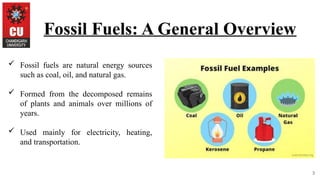
Fossil Fuels: A General Overview
 Fossil fuels are natural energy sources
such as coal, oil, and natural gas.
 Formed from the decomposed remains
of plants and animals over millions of
years.
 Used mainly for electricity, heating,
and transportation.
4
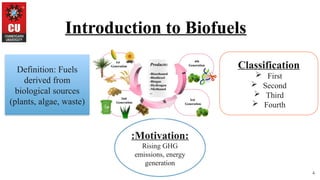
Introduction to Biofuels
Definition: Fuels
derived from
biological sources
(plants, algae, waste)
:Motivation:
Rising GHG
emissions, energy
generation
Classification
 First
 Second
 Third
 Fourth
5
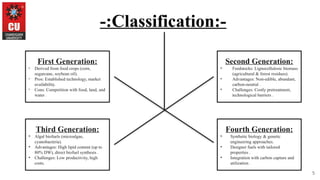
-:Classification:-
First Generation:
• Derived from food crops (corn,
sugarcane, soybean oil).
• Pros: Established technology, market
availability.
• Cons: Competition with food, land, and
water .
Second Generation:
• Feedstocks: Lignocellulosic biomass
(agricultural & forest residues).
• Advantages: Non-edible, abundant,
carbon-neutral .
• Challenges: Costly pretreatment,
technological barriers .
Third Generation:
• Algal biofuels (microalgae,
cyanobacteria).
• Advantages: High lipid content (up to
80% DW), direct biofuel synthesis .
• Challenges: Low productivity, high
costs.
Fourth Generation:
• Synthetic biology & genetic
engineering approaches.
• Designer fuels with tailored
properties .
• Integration with carbon capture and
utilization .
6
Advantages of Biofuels
1. Renewable and carbon-neutral/negative potential.
2. Reduces dependence on fossil fuels.
3. Can utilize agricultural residues, marginal land crops.
4. Creates rural jobs and energy independence.
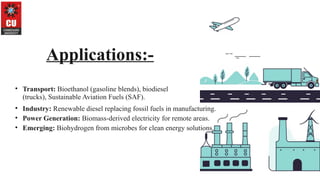
Applications:-
• Transport: Bioethanol (gasoline blends), biodiesel
(trucks), Sustainable Aviation Fuels (SAF).
• Industry: Renewable diesel replacing fossil fuels in manufacturing.
• Power Generation: Biomass-derived electricity for remote areas.
• Emerging: Biohydrogen from microbes for clean energy solutions.
8
-:Environmental Benefits:-
Reduction in greenhouse gas emissions (589.3 million
tons avoided by 2015) .
Improved air quality compared to petroleum fuels.
Potential for waste valorization (plastic & food waste
conversion).
Transportation: Bioethanol, biodiesel for vehicles and
aviation .
Aerospace: Tailored biofuels with high isomeric carbon
numbers.
Electricity/Heating: Combustion of biomass and biogas.
9
-:Global Market & Policy Drivers:-
 U.S.: 15.7 billion gallons ethanol (2019) .
 EU: 75% biodiesel share due to land and GMO
restrictions .
 Government mandates: Energy Policy Act (2005),
EISA (2007) .
10
-:Recent Research Approaches:-
 Crop engineering: Enhancing CO fixation and biomass yield
₂
 Microbial Engineered bacteria for lignin degradation .
 Electrochemical fixation: Using electricity + microbes for fuel
production .
 Plastic waste to fuels: PET degradation via microbial enzymes
11
-:Biological Innovations:-
 Consolidated bioprocessing (CBP) of biomass .
 Gene stacking for improved sugar yield in crops .
 Molecular farming: Coupling fuel + therapeutic
production in crops.
12
-:Challenges & Limitations:-
High production costs compared to fossil fuels .
Land use competition & biodiversity concerns.
Need for carbon tax or stronger policy incentives .
13
Case Study 1: Algae-based
Biofuel (U.S. Navy and Boeing)
Why Algae ?
 High lipid yield, CO capture,
₂
no competition with food
crops.
 Can grow on non-arable land
with wastewater.
Insights:-
 NREL (2025): 50–70% GHG reductions
possible.
 Comparative analyses rank algae SAF
above crop-based fuels for sustainability.
 Key bottlenecks: cultivation, harvesting
costs, and scale-up.
14
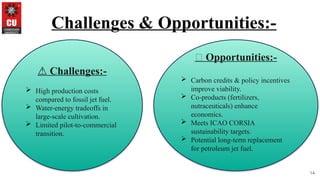
Challenges & Opportunities:-
⚠️Challenges:-
 High production costs
compared to fossil jet fuel.
 Water-energy tradeoffs in
large-scale cultivation.
 Limited pilot-to-commercial
transition.
🚀 Opportunities:-
 Carbon credits & policy incentives
improve viability.
 Co-products (fertilizers,
nutraceuticals) enhance
economics.
 Meets ICAO CORSIA
sustainability targets.
 Potential long-term replacement
for petroleum jet fuel.
15
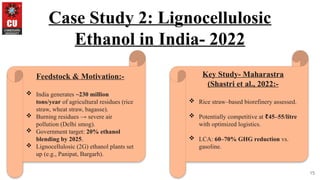
Case Study 2: Lignocellulosic
Ethanol in India- 2022
Feedstock & Motivation:-
 India generates ~230 million
tons/year of agricultural residues (rice
straw, wheat straw, bagasse).
 Burning residues → severe air
pollution (Delhi smog).
 Government target: 20% ethanol
blending by 2025.
 Lignocellulosic (2G) ethanol plants set
up (e.g., Panipat, Bargarh).
Key Study- Maharastra
(Shastri et al., 2022:-
 Rice straw–based biorefinery assessed.
 Potentially competitive at 45–55/litre
₹
with optimized logistics.
 LCA: 60–70% GHG reduction vs.
gasoline.
16
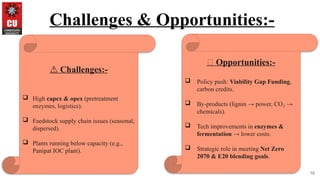
Challenges & Opportunities:-
⚠️Challenges:-
 High capex & opex (pretreatment
enzymes, logistics).
 Feedstock supply chain issues (seasonal,
dispersed).
 Plants running below capacity (e.g.,
Panipat IOC plant).
🚀 Opportunities:-
 Policy push: Viability Gap Funding,
carbon credits.
 By-products (lignin → power, CO →
₂
chemicals).
 Tech improvements in enzymes &
fermentation → lower costs.
 Strategic role in meeting Net Zero
2070 & E20 blending goals.
17
Case Study 3: Algae-Wastewater
Coupled System (China, 2021)
Research: Algae cultivated in wastewater, simultaneously
cleaning water and producing lipids.
Outcome: Generated biodiesel feedstock while treating
pollutants.
Impact: Demonstrates a circular economy approach with
dual benefits.
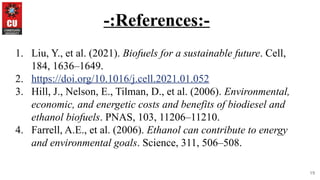
Conclusion
Biofuels reduce emissions, enhance
energy security, and support
economic growth. Continued R&D,
policy support, and international
collaboration are essential for a
cleaner tomorrow.
Let’s embrace innovation and sustainability for a
cleaner tomorrow.
19
-:References:-
1. Liu, Y., et al. (2021). Biofuels for a sustainable future. Cell,
184, 1636–1649.
2. https://doi.org/10.1016/j.cell.2021.01.052
3. Hill, J., Nelson, E., Tilman, D., et al. (2006). Environmental,
economic, and energetic costs and benefits of biodiesel and
ethanol biofuels. PNAS, 103, 11206–11210.
4. Farrell, A.E., et al. (2006). Ethanol can contribute to energy
and environmental goals. Science, 311, 506–508.
THANK YOU

Environmental Biotechnology PPT (1).pptx

  • 1.
    Biofuels: Advantages, Applications,and Recent Research Approaches  Name: Arnesh Ghosh  UID: 25MBT10013  Subject: Environmental Biotechnology  Submitted to: Dr. Swati Sharma
  • 2.
    2 -:Contents:- A. Fossil Fuels:A General Overview. B. Introduction to Biofuels. C. Classification. D. Advantages of Biofuels. E. Applications. F. Environmental Benefits. G. Global Market & Policy Drivers. H. Recent Research Approaches. I. Biological Innovations. J. Challenges & Limitations. K. Future Outlook. L. Case Studies. M. Conclusion. N. References.
  • 3.
    3 Fossil Fuels: AGeneral Overview  Fossil fuels are natural energy sources such as coal, oil, and natural gas.  Formed from the decomposed remains of plants and animals over millions of years.  Used mainly for electricity, heating, and transportation.
  • 4.
    4 Introduction to Biofuels Definition:Fuels derived from biological sources (plants, algae, waste) :Motivation: Rising GHG emissions, energy generation Classification  First  Second  Third  Fourth
  • 5.
    5 -:Classification:- First Generation: • Derivedfrom food crops (corn, sugarcane, soybean oil). • Pros: Established technology, market availability. • Cons: Competition with food, land, and water . Second Generation: • Feedstocks: Lignocellulosic biomass (agricultural & forest residues). • Advantages: Non-edible, abundant, carbon-neutral . • Challenges: Costly pretreatment, technological barriers . Third Generation: • Algal biofuels (microalgae, cyanobacteria). • Advantages: High lipid content (up to 80% DW), direct biofuel synthesis . • Challenges: Low productivity, high costs. Fourth Generation: • Synthetic biology & genetic engineering approaches. • Designer fuels with tailored properties . • Integration with carbon capture and utilization .
  • 6.
    6 Advantages of Biofuels 1.Renewable and carbon-neutral/negative potential. 2. Reduces dependence on fossil fuels. 3. Can utilize agricultural residues, marginal land crops. 4. Creates rural jobs and energy independence.
  • 7.
    Applications:- • Transport: Bioethanol(gasoline blends), biodiesel (trucks), Sustainable Aviation Fuels (SAF). • Industry: Renewable diesel replacing fossil fuels in manufacturing. • Power Generation: Biomass-derived electricity for remote areas. • Emerging: Biohydrogen from microbes for clean energy solutions.
  • 8.
    8 -:Environmental Benefits:- Reduction ingreenhouse gas emissions (589.3 million tons avoided by 2015) . Improved air quality compared to petroleum fuels. Potential for waste valorization (plastic & food waste conversion). Transportation: Bioethanol, biodiesel for vehicles and aviation . Aerospace: Tailored biofuels with high isomeric carbon numbers. Electricity/Heating: Combustion of biomass and biogas.
  • 9.
    9 -:Global Market &Policy Drivers:-  U.S.: 15.7 billion gallons ethanol (2019) .  EU: 75% biodiesel share due to land and GMO restrictions .  Government mandates: Energy Policy Act (2005), EISA (2007) .
  • 10.
    10 -:Recent Research Approaches:- Crop engineering: Enhancing CO fixation and biomass yield ₂  Microbial Engineered bacteria for lignin degradation .  Electrochemical fixation: Using electricity + microbes for fuel production .  Plastic waste to fuels: PET degradation via microbial enzymes
  • 11.
    11 -:Biological Innovations:-  Consolidatedbioprocessing (CBP) of biomass .  Gene stacking for improved sugar yield in crops .  Molecular farming: Coupling fuel + therapeutic production in crops.
  • 12.
    12 -:Challenges & Limitations:- Highproduction costs compared to fossil fuels . Land use competition & biodiversity concerns. Need for carbon tax or stronger policy incentives .
  • 13.
    13 Case Study 1:Algae-based Biofuel (U.S. Navy and Boeing) Why Algae ?  High lipid yield, CO capture, ₂ no competition with food crops.  Can grow on non-arable land with wastewater. Insights:-  NREL (2025): 50–70% GHG reductions possible.  Comparative analyses rank algae SAF above crop-based fuels for sustainability.  Key bottlenecks: cultivation, harvesting costs, and scale-up.
  • 14.
    14 Challenges & Opportunities:- ⚠️Challenges:- High production costs compared to fossil jet fuel.  Water-energy tradeoffs in large-scale cultivation.  Limited pilot-to-commercial transition. 🚀 Opportunities:-  Carbon credits & policy incentives improve viability.  Co-products (fertilizers, nutraceuticals) enhance economics.  Meets ICAO CORSIA sustainability targets.  Potential long-term replacement for petroleum jet fuel.
  • 15.
    15 Case Study 2:Lignocellulosic Ethanol in India- 2022 Feedstock & Motivation:-  India generates ~230 million tons/year of agricultural residues (rice straw, wheat straw, bagasse).  Burning residues → severe air pollution (Delhi smog).  Government target: 20% ethanol blending by 2025.  Lignocellulosic (2G) ethanol plants set up (e.g., Panipat, Bargarh). Key Study- Maharastra (Shastri et al., 2022:-  Rice straw–based biorefinery assessed.  Potentially competitive at 45–55/litre ₹ with optimized logistics.  LCA: 60–70% GHG reduction vs. gasoline.
  • 16.
    16 Challenges & Opportunities:- ⚠️Challenges:- High capex & opex (pretreatment enzymes, logistics).  Feedstock supply chain issues (seasonal, dispersed).  Plants running below capacity (e.g., Panipat IOC plant). 🚀 Opportunities:-  Policy push: Viability Gap Funding, carbon credits.  By-products (lignin → power, CO → ₂ chemicals).  Tech improvements in enzymes & fermentation → lower costs.  Strategic role in meeting Net Zero 2070 & E20 blending goals.
  • 17.
    17 Case Study 3:Algae-Wastewater Coupled System (China, 2021) Research: Algae cultivated in wastewater, simultaneously cleaning water and producing lipids. Outcome: Generated biodiesel feedstock while treating pollutants. Impact: Demonstrates a circular economy approach with dual benefits.
  • 18.
    Conclusion Biofuels reduce emissions,enhance energy security, and support economic growth. Continued R&D, policy support, and international collaboration are essential for a cleaner tomorrow. Let’s embrace innovation and sustainability for a cleaner tomorrow.
  • 19.
    19 -:References:- 1. Liu, Y.,et al. (2021). Biofuels for a sustainable future. Cell, 184, 1636–1649. 2. https://doi.org/10.1016/j.cell.2021.01.052 3. Hill, J., Nelson, E., Tilman, D., et al. (2006). Environmental, economic, and energetic costs and benefits of biodiesel and ethanol biofuels. PNAS, 103, 11206–11210. 4. Farrell, A.E., et al. (2006). Ethanol can contribute to energy and environmental goals. Science, 311, 506–508.
  • 20.