

ENVIRONMENTAL AND SOCIAL RISK
DUE DILIGENCE IN THE FINANCIAL SECTOR
current approaches and practices
May 2013
Report commissioned by the Netherlands in support of the Proactive Agenda
of the OECD Working Party on Responsible Business Conduct
Environmental and Social Risk Due Diligence in the Financial Sector / 1Sustainable Finance Advisory
Table of contents
About the report and acknowledgements	 page 2
Glossary of terms	 page 3
Executive summary	 page 6
1. 		 Background	 page 8
2. 		 Mapping exercise: approach	 page 12
2.1. 	 Methodology	 13
2.2. 	 Financial institutions and services	 17
2.3. 	 International frameworks, principles, standards and guidelines	 20
3. 		 Mapping exercise: findings on environmental and social risk due diligence 	 page 22
3.1. 	 Findings on frameworks and principles	 23
3.2. 	 Findings on standards and guidelines	 24
3.3. 	 Environmental and social risk due diligence processes and implementation	 34
3.4. 	 Human rights risk due diligence	 43
4. 		 Mapping exercise: findings on the OECD Guidelines and financial institution leverage 	 page 48
4.1. 	 The OECD Guidelines	 49
4.2. 	 FI leverage	 53
5. 		 Summary of findings	 page 75
6. 		 Appendices	 page 78
Appendix A: Project Advisory Group Members 	 78
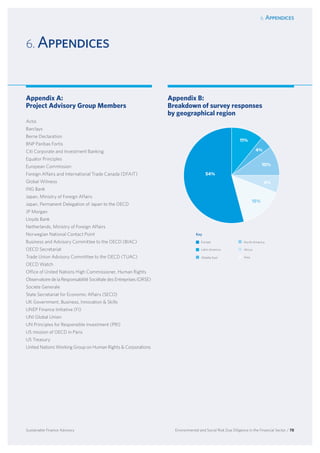
Appendix B: Breakdown of survey responses by geographical region	 78
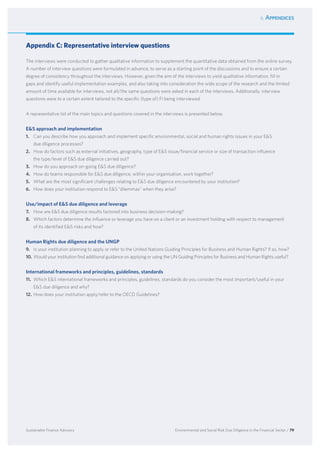
Appendix C: Representative interview questions	 79
Appendix D: References for Table 4: General characteristics of financial services	 80
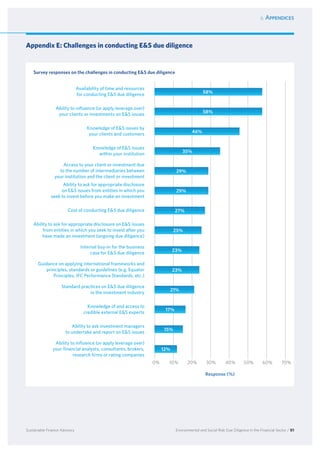
Appendix E: Challenges in conducting E&S due diligence	 81
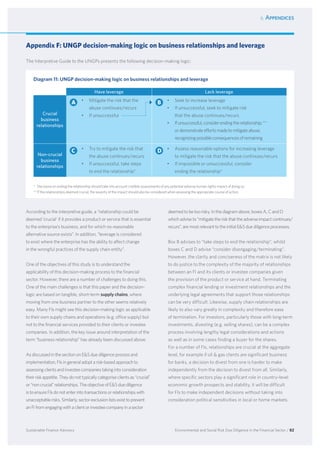
Appendix F: UNGP decision-making logic on business relationships and leverage	 82
7. 		 References	 page 83
Cover: © iStockphoto.com/TBritton
Glossary of terms
Environmental and Social Risk Due Diligence in the Financial Sector / 2Sustainable Finance Advisory
About the report and
acknowledgements
The Dutch Ministry of Foreign Affairs commissioned
this report on behalf of the OECD Working Party on
Responsible Business Conduct as a first step in a dialogue
on what the OECD Guidelines for Multinational Enterprises
mean for the day-to-day practice of the financial sector.
In particular, this project report seeks to identify financial
institutions’ current environmental and social due diligence
practices, perception and application of the concept of
supply chain responsibility as embedded in the OECD
Guidelines for Multinational Enterprises. The Ministry hopes
that this study will help to inform stakeholders and other
parties interested in the dialogue on responsible business
conduct in the financial sector.
The study started in September 2012. Financial institution
surveys were completed in January and interviews in
March 2013. The report was finalised in May 2013 and
has been made publicly available through various channels
in June 2013.
The report draws on primary survey and interview data
from global financial institutions supplemented by desktop
research. Fifty-two surveys and 29 interviews were completed.
To maintain data confidentiality of study participants,
all information provided is used anonymously and at the
aggregate level in the report.
This report was authored by Sustainable Finance Advisory
(SFA) under the supervision of the Dutch Ministry of Foreign
Affairs, the project Advisory Group and the OECD Secretariat.
The findings are based on research conducted by SFA and
should not be interpreted as representing the views of either
the Dutch Ministry of Foreign Affairs, individual Advisory
Group members or of the OECD.
We would like to thank the Dutch Ministry of Foreign
Affairs, the Advisory Group and the OECD Secretariat for
their on-going support as well as the financial institutions
that participated in the study. Without their valuable
contributions this quality and quantity of research would
not have been possible.
Sustainable Finance Advisory operates at the interface between
finance, business and society to deliver solutions that help its
clients make business decisions that are economically profitable,
environmentally sound and socially relevant. Our network
of consultants provides sustainability services to financial
institutions around the globe including training and facilitation,
delivering environmental and social risk management systems,
sustainability leadership development and driving sector-level
interventions. We would like to thank the entire SFA team for their
contributions to this project and report (see back page of report).
Key Contacts
Professor Dr. Roel Nieuwenkamp
Chair of the OECD Working Party on
Responsible Business Conduct
Email: roel.Nieuwenkamp@oecd.org
Mr. Tabe van Hoolwerff
Senior Legal Advisor
Economic Governance and International Trade Policy
Netherlands Ministry of Foreign Affairs
Email: tabe-van.hoolwerff@minbuza.nl
Carey Bohjanen
CEO/Managing Director
Sustainable Finance Advisory
Email: carey@sustainablefinanceadvisory.com
Chintal Barot
Project Director
Sustainable Finance Advisory
Email: chintal@sustainablefinanceadvisory.com
OECD Guidelines
for Multinational
Enterprises
Glossary of terms
Environmental and Social Risk Due Diligence in the Financial Sector / 3Sustainable Finance Advisory
Glossary of terms
Adhering countries	
The OECD and non-OECD countries whose governments have
adhered to the OECD Declaration on International Investment
and Multinational Enterprises and related Decision. As of
23 May 2012 adhering governments are those of all 34 OECD
members, as well as Argentina, Brazil, Colombia, Egypt, Latvia,
Lithuania, Morocco, Peru, Romania and Tunisia.
Adverse impact
For the purposes of this report, it refers to an environmental
and/or social impact where it actually happens, such as
pollution of a waterway or displacement of local community
members from land.
Advisory Group (AG)
The project Advisory Group (AG) established to provide
oversight and guidance throughout this report process.
Members consist of representatives from the OECD,
OECD countries, financial institutions (FI), Industry
Initiatives and NGOs. See Appendix A.
Asset
Any resource owned or controlled by an individual, corporation or
country that has economic value. It includes physical assets such
as facilities, property or equipment as well as accounts receivable.
Asset-Based Finance
For the purposes of this report, a method of funding specific
projects typically secured by the project assets, including the
revenue-producing contracts (e.g. project finance, structured
finance). The lender looks primarily at the revenues generated
by the project (accounts receivable) as the source of repayment
and as security for the exposure. This type of financing
is usually for large, complex and expensive installations
(e.g. power plants, mines or transportation infrastructure).
Asset Manager
FI that manages clients’ investments. It invests on the clients’
behalf and offers them a range of complementary financial
services. Its clients are often large funds, such as pension
funds, and wealthy individuals.
Business relationship
According to the OECD, the term “business relationship”
includes relationships with:
•	 Business partners;
•	 Entities in the supply chain; and
•	 Any other non-State or State entities directly linked
to its business operations, products or services.
Capital Markets services
Long-term debt and equity capital transactions (e.g. securities
underwriting such as bonds issuance, initial public offerings or
IPOs) and related advisory services.
Client
Entity to which a financial institution provides investments,
lending or other types of financial services and products.
Commercial bank
An FI which accepts deposits and provides a variety
of financial services to companies and individuals such
as loans, payment services, investments, insurance and
financial planning. The term also includes wholesale banks
and corporate banks.
Cooperative bank	
Commercial bank that belongs to its members, who are
at the same time the owners and the customers of their bank.
Corporate Lending	
Lending by FIs to companies (e.g. term loans, working capital
facilities, overdraft facilities).
Development bank
A bank owned and directed by member-governments,
which lend to regional or national development projects.
A development bank located in adhering countries typically
lends to financial institutions in developing countries and
large-scale development projects.
Glossary of terms
Environmental and Social Risk Due Diligence in the Financial Sector / 4Sustainable Finance Advisory
Risk-based due diligence
In the context of the OECD Guidelines for Multinational
Enterprises, the process through which enterprises can
identify, prevent, mitigate and account for how they address
their actual and potential adverse impacts as an integral part
of business decision-making and risk management systems.
In the context of an FI’s risk management, generally refers
to the review and analysis of risks undertaken prior to making
a decision relating to lending, investing or the provision
of other financial services to a client.
Equity
The amount that shareholders own, in the form of common or
preferred stock, in a publicly quoted or privately owned company.
E&S issues
For the purposes of this report, it refers to the environmental
and social matters covered by the OECD Guidelines in the
chapters on Human Rights, Employment and Industrial Relations
and on Environment, which are within the scope of this report.
Additionally, it is used in this report to refer to any
potential or actual impact to the physical, natural or
cultural environment, or on the surrounding community
and/or e.g. workers of a company.
Export Credit Agency (ECA)	
Export Credit Agencies (ECAs) provide financing services such
as guarantees, loans and insurance to domestic companies to
promote international trade. The primary objective of ECAs is
to remove the risk and uncertainty of payments to exporters.
Exposure	
The amount that an FI may lose in an investment or loan.
Financial Institution (FI)
Banking, investment and insurance institutions that provide
lending, investment, insurance or other financial products
and services.
Financial services
Products and services offered by FIs such as loans,
payment services, asset management and insurance.
OECD Guidelines
The OECD Guidelines for Multinational Enterprises, 2011
edition. They provide voluntary principles and standards for
responsible business conduct consistent with applicable laws
and internationally recognised standards. However,
the countries adhering to the OECD Guidelines make
a binding commitment to implement them. They contain
recommendations made to multinational enterprises operating
in or from adhering countries.
Initial Public Offering (IPO)
The first sale of a company’s shares to the public, leading
to a stock market listing (known as a flotation in the UK).
Investee company
Listed and/or private entities in which FIs hold shares.
Investment services
For the purposes of this report, managing funds and making
investments (listed and private equity, fixed income and
other non-listed assets) on FIs’ own behalf or on behalf
of institutional investors (e.g. asset management on behalf
of pension funds).
Investment bank
An FI that focuses on raising capital for clients and on
investment services to individual and institutional investors.
An investment bank does not accept deposits.
Leverage
In the context of the OECD Guidelines, leverage is considered
to exist where the enterprise has the ability to effect change
in the wrongful practices of the entity that causes the
adverse impacts.
Multinational Enterprise (MNE)
We use the term in the sense of the OECD Guidelines.
The OECD Guidelines find that a precise definition
of multinational enterprises is not required. These enterprises
operate in all sectors of the economy and usually comprise
companies or other entities established in more than
one country. Ownership may be private, State or mixed.
The OECD Guidelines are addressed to all the entities
within the multinational enterprise (parent companies
and/or local entities).
Glossary of terms
Environmental and Social Risk Due Diligence in the Financial Sector / 5Sustainable Finance Advisory
National Contact Point (NCP)
OECD National Contact Points (NCPs) are agencies
established by adhering governments to promote and
implement the OECD Guidelines. The NCPs assist enterprises
and their stakeholders to take appropriate measures to further
the implementation of the OECD Guidelines. They also provide
a mediation and conciliation platform for resolving practical
issues that may arise.
Pension Fund
A fund established to facilitate and organise the investment
of employees’ retirement funds. They are meant to generate
stable growth over the long term and control relatively large
amounts of capital.
Private equity
Stock in a privately held company.
Private equity company
FI that specialises in investments in companies that are not
publicly traded. Private equity companies acquire a controlling
or substantial minority position in a company and then seek
to maximise the value of that investment.
Reinsurance
The insurance that is purchased by an insurance company
from one or more other insurance companies, as a means
of risk management.
UNGPs
The United Nations Guiding Principles on Business and
Human Rights.
Syndication
A method of financing where several FIs finance or
underwrite together a particular transaction or project,
to limit their exposure. The financing is structured, arranged,
and administered by one or several commercial banks
or investment banks known as lead arrangers.
Working capital facilities
Lending to provide operational liquidity to a company.
Executive summary
Environmental and Social Risk Due Diligence in the Financial Sector / 6Sustainable Finance Advisory
Executive Summary
Context
At the OECD 50th Anniversary Ministerial Meeting
held in May 2011, in Paris, former US Secretary of State,
Ms. Hillary Rodham Clinton presided over the 2011 OECD
Ministerial Council Meeting during which the update of the
OECD Guidelines for Multinational Enterprises (the OECD
Guidelines) by the 34 OECD and 101
non-OECD adhering
governments was agreed upon.
The OECD Guidelines are recommendations addressed to
enterprises operating in a global context covering all major
areas of business ethics, notably labour, human rights,
anti-corruption, the environment, tax and competition.
The OECD Guidelines are supported by a unique
implementation mechanism where adhering governments
agree to establish National Contact Points (NCPs) for the
promotion of the OECD Guidelines and the provision of
assistance to parties when questions arise with respect to
the observance of the OECD Guidelines in “specific instances”
(or complaints).
The update included a new human rights chapter consistent
with the UN Guiding Principles for Business and Human Rights
and the expectation that enterprises should undertake due
diligence in order to avoid being involved in adverse impacts
on matters covered by the OECD Guidelines, including in their
supply chains and business relationships, and to address such
impacts when they occur.
As the 2011 update confirmed that the OECD Guidelines apply
to all sectors, including the financial sector, they do not provide
more detailed guidance on the application of the OECD
Guidelines to financial institutions (FIs) or any other specific
sector. However, specifically the extended OECD Guidelines’
recommendation to
“Seek to prevent or mitigate an adverse impact where they
have not contributed to that impact, when the impact is
nevertheless directly linked to their operations, products or
services by a business relationship”
raises specific challenges regarding the proper observance of
the OECD Guidelines by the financial sector.
Discussions between FIs and their stakeholders including
from civil society revealed different understandings and
interpretations of how the OECD Guidelines can be and are
being observed by the financial sector, particularly the new
provisions on due diligence and human rights. A sense of
urgency to tackle this divergence of views is expressed by
the NCPs, dealing with specific instances raised against FIs
by stakeholders for allegations of non-observance of the
OECD Guidelines. Where a company and its stakeholders
fail to reach agreement on the issues raised, NCPs can make
statements about what would constitute proper observance of
the OECD Guidelines in the specific instance.
The 2011 update established a “proactive agenda” of the
OECD Investment Committee to foster multi-stakeholder
discussion on emerging issues of responsible business conduct
as covered by the OECD Guidelines and develop additional
tools or guidance as appropriate. One of the first Proactive
Agenda items raised was the need to better understand what
proper observance of the OECD Guidelines by the financial
1	Argentina, Brazil, Colombia, Egypt, Latvia, Lithuania, Morocco, Peru, Romania and Tunisia. Together these 43 adhering countries account for around 85 per cent of
world foreign direct investment (FDI) outflows [see FDI in Figures: www.oecd.org/investment/statistics.
Executive summary
Environmental and Social Risk Due Diligence in the Financial Sector / 7Sustainable Finance Advisory
sector entails and determine whether the development of
practical tools for implementing the existing recommendations
would be a useful next step.
In order to take a first step towards meeting this objective,
the Dutch Ministry of Foreign Affairs on behalf of the
OECD Working Party on Responsible Business Conduct
commissioned this study to map the current approaches and
practices of FIs on risk-based environmental and social (ES)
due diligence.
This study surveyed over 50 FIs globally and interviewed
30 FIs in order to map:
•	 The different approaches to risk-based ES due diligence
in the context of providing different financial services; and
•	 The level of leverage of an FI, perceived or otherwise,
to prevent or mitigate adverse ES impacts of business
partners to which they may be linked through the provision
of financial services.
Key findings from the FIs’ surveys and interviews
Based on the survey and interview information, this study
identified the following key findings:
1.	 Different business models of FIs and the specific mix
of financial products and services they provide drive
different ES due diligence approaches.
2.	 FIs systematically prioritise ES due diligence for
transactions and investments according to the level
of potential ES risk involved.
3.	 Awareness and implementation of the UN Guiding
Principles for Business and Human Rights are variable
both in adhering and non-adhering countries, with many
FIs at the early stages of understanding the implications
for their institutions.
4.	 Some FIs refer to the OECD Guidelines in their ES
policies, but few use them in their implementation of ES
due diligence as they are seen as too “generic”. Many cite
a lack of clarity on:
a.	 Terminology which is open to interpretation; and
b.	 The role and process of the NCPs.
5.	 FIs’ perceived level of leverage or influence over client/
investee company behaviour on ES issues varies, even
within same product or service group.
©GiannaGouldingwww.giannagoulding.com
Environmental and Social Risk Due Diligence in the Financial Sector / 8Sustainable Finance Advisory
1. Background
Environmental and Social Risk Due Diligence in the Financial Sector / 8Sustainable Finance Advisory
©iStockphoto.com/kontrast-fotodesign
1. Background
Environmental and Social Risk Due Diligence in the Financial Sector / 9Sustainable Finance Advisory
1.1.	Context
The OECD Guidelines for Multinational Enterprises
The OECD Guidelines are far-reaching recommendations for
responsible business conduct that are binding for governments
of adhering countries and provide non-binding (voluntary)
principles and standards for multinational enterprises
(e.g. enterprises operating in a global context).2
The OECD
Guidelines require adhering governments to establish National
Contact Points (NCPs) that promote the OECD Guidelines
and provide a mediation and conciliation platform for resolving
practical issues that may arise in “specific instances”.3
Where
parties are unable to resolve their issues, NCPs can make
public statements on the (non-) observance of the OECD
Guidelines in the specific instance. This unique grievance
mechanism distinguishes the OECD Guidelines from other
similar standards.
Adhering countries comprise of 34 OECD members as well
as 10 non-OECD countries: Argentina, Brazil, Colombia,
Egypt, Latvia, Lithuania, Morocco, Peru, Romania and Tunisia4
(Adhering Countries).
The OECD Guidelines provide non-binding (voluntary)
principles and standards for responsible business conduct
for enterprises in a global context consistent with applicable
laws and internationally recognised standards. The
OECD Guidelines are the only multilaterally agreed and
comprehensive code of responsible business conduct that
governments have committed to promoting.5
The OECD
Guidelines comprise of 11 chapters covering a broad range of
issues related to:
•	 Concepts and Principles;
•	 General Policies;
•	 Disclosure;
•	 Human Rights;
•	 Employment and Industrial Relations;
•	 Environment;
•	 Combating Bribery, Bribe Solicitation and Extortion;
•	 Consumer Interests;
•	 Science and Technology;
•	 Competition; and
•	 Taxation.
Enterprises are recommended to conduct due diligence
as described in the OECD Guidelines’ chapter on General
Policies to ensure that they meet the recommendations
of the substantive chapters. It should be noted that this
recommendation does not, however, apply to the OECD
Guidelines’ chapters on Science and Technology, Competition
and Taxation.6
The 2011 update of the OECD Guidelines
To ensure that the OECD Guidelines continue to be a “leading
international instrument for promoting responsible business
conduct”, the OECD Guidelines were last updated in 2011
to reflect, inter alia, the latest developments relating to
human rights as embodied by the United Nations Guiding
Principles on Business and Human Rights (UNGPs).7
The
update included a new human rights chapter which consistent
with the UNGPs, recommends enterprises to undertake due
diligence in order to avoid being involved in adverse impacts
on matters covered by the OECD Guidelines, including in
their supply chains and business relationships. To address
such impacts when they occur, the improvement of the NCP
process and the adoption of a proactive agenda was discussed.
The OECD Guidelines reflect the overarching principle of the
UNGPs that:
“The responsibility of business enterprises to respect human
rights applies to all enterprises regardless of their size,
sector, operational context, ownership and structure.
Nevertheless, the scale and complexity of the means
through which enterprises meet that responsibility may
vary according to these factors and with the severity of the
enterprise’s adverse human rights impacts.”8
2	 The OECD Guidelines, Part 1, Preface, Paragraph 1, page 13.
3 	 The OECD Guidelines, Foreword, Paragraph 3, page 3.
4 	 http://www.oecd.org/daf/inv/investment-policy/oecddeclarationanddecisions.htm
5 	 The OECD Guidelines, Foreword, Paragraph 1, page 3.
6 	 The OECD Guidelines, Part 1, Chapter II, Commentary 14, page 24.
7 	 The United Nations Human Rights Council endorsed the UNGPs in June 2011.
8 	 Guiding Principles on Business and Human Rights: Implementing the United Nations “Protect, Respect and Remedy” Framework, principle 14. Page 15.
1. Background
Environmental and Social Risk Due Diligence in the Financial Sector / 10Sustainable Finance Advisory
The proactive agenda
Under the 2011 OECD Guidelines, the OECD Investment
Committee should pursue “a proactive agenda that promotes
the effective observance by enterprises of the principles and
standards contained in the OECD Guidelines”.9
The OECD
Working Party on Responsible Business Conduct, a subsidiary
of the OECD Investment Committee, carries out the practical
work of the Proactive Agenda. For that reason, this report will
refer to the Working Party on Responsible Business Conduct
throughout. NCPs should:
•	 Consider new developments and emerging practices
concerning responsible business conduct;
•	 Support the positive contributions enterprises can make to
economic, social and environmental progress; and
•	 Participate where appropriate in collaborative initiatives to
identify and respond to risks of adverse impacts associated
with particular products, regions, sectors or industries.10
Challenges related to the application of the OECD Guidelines
The 2011 Update confirmed that the OECD Guidelines apply to
all sectors, including the financial sector. However, due to time
constraints, further guidance on the application of the OECD
Guidelines to FIs was not included in the update.
As a result of the “generic” nature of the OECD Guidelines and
the recent update, discussions between various stakeholder
groups including adhering countries, NCPs, FIs and civil society
revealed conflicting views as to how the OECD Guidelines apply
to the financial sector. Furthermore, given the complexity of the
financial sector itself, as well as the complexity of responsible
business conduct in relation to issues such as human rights,
varying levels of understanding and various views exist amongst
these stakeholders with regard to:
•	 Different types of FIs;
•	 Different types of financial services;
•	 Current risk-based ES due diligence conducted by
different FIs;
•	 The perceived level of influence an FI could have on its
clients/investee companies to prevent or mitigate adverse
impacts to which they are linked through the provision of
financial services; and
•	 How specific instances raised by stakeholders against
FIs and/or their clients/investee companies should be
handled by NCP processes.
Divergences in understanding and opinions amongst
stakeholders are further compounded by a “definitional divide”
found in the differences in terminology used by the: (1) OECD
Guidelines; (2) UNGPs; and (3) the financial sector.
Within this context, specific challenges exist as to the
interpretation of how the OECD Guidelines’ provision to
“seek to prevent or mitigate an adverse impact where they
have not contributed to that impact, when the impact is
nevertheless directly linked to their operations, products
or services by a business relationship”11
applies to FIs and the financial products and services
they provide.
In addition, the areas characterised by the least clarity
and greatest differences in opinions between stakeholders
are related to the chapters on Human Rights, Employment
and Industrial Relations and Environment. In summary,
there is a potential disconnect between the principles
of responsible business conduct as set out in the OECD
Guidelines and their interpretation by different stakeholders,
as well as in terms of how they apply to the actual practices
of the financial sector.
Why this mapping exercise was undertaken
In order to inform discussions on how the OECD Guidelines
apply to the financial sector, this mapping exercise was
undertaken to better understand the actual practices of FIs
in the area of risk-based ES due diligence including:
•	 The nature of various financial services and products
and how that relates to the recommendation under
the OECD Guidelines that enterprises should seek
to prevent or mitigate adverse impacts which are
linked to their operations, products or services by a
business relationship;
•	 Existing practices of FIs on risk-based ES due diligence; and
9	 The OECD Guidelines, Part 2, Chapter II, Commentary 8, page 69.
10 	The OECD Guidelines, Part 2, Commentary on the Implementation Procedures, Commentary 18, page 81.
11 	 The OECD Guidelines, Part 1, Chapter II, Commentary 12, page 20.
1. Background
Environmental and Social Risk Due Diligence in the Financial Sector / 11Sustainable Finance Advisory
•	 The perceived level of leverage/influence over a client or
investee company to prevent or mitigate the adverse
impacts to which an FI may be linked through the
provision of particular financial services.
Subsequently, this mapping exercise may be used by the
OECD Working Party on Responsible Business Conduct
as a basis for future discussions and actions to promote the
OECD Guidelines within the financial sector.
1.2. Elements in scope of this project
This project maps the ways in which the financial sector
perceives and manages ES risks associated with their
activities and relationships beyond legal requirements,
within but not limited to the context of the OECD Guidelines.
The research contemplates the approach of FIs to identify
and manage ES risks associated with activities of clients
or investee companies, to which FIs are directly linked12
via
the provision of financial services and products, as set out
in the OECD Guidelines.13
The scope of the research was limited to the following
chapters of the OECD Guidelines:
•	 Chapter IV. Human Rights;
•	 Chapter V. Employment and Industrial Relations; and
•	 Chapter VI. Environment.
Consistent with current practice of the majority of FI participants
in this study, we will refer to these three issues as environmental
and social (ES) issues. We use the term ES issues to refer to
any potential or actual impact to the physical, natural or cultural
environment, or on the surrounding community and/or, for
example, workers.. It should be noted that while human rights can
fall under either environmental or social issues, depending on the
circumstances, employment and industrial relations issues always
falls under the umbrella of “social” issues.
INCLUDED IN THE SCOPE OF THIS RESEARCH
IS A MAPPING OF:
•	 Different types of FIs;
•	 Different types of financial services;
•	 Relevant industry initiatives and standards that have
emerged (e.g. UN Guiding Principles on Business and Human
Rights, UN-backed Principles for Responsible Investment,
IFC Performance Standards, Equator Principles);
•	 Existing risk-based ES due diligence processes and
implementation in relation to different financial services;
•	 Human rights risk due diligence processes and
implementation; and
•	 The perceived level of leverage or influence of an FI to
prevent or mitigate adverse impacts to which they are
linked through the provision of financial services.
Case studies and practical examples are included throughout
the report where appropriate to support the analysis.
1.3. Elements out of scope of this project
This project is not intended to provide a normative overview of
the ways in which the OECD Guidelines apply to the financial
sector, nor does it aim to create any new recommendations
additional to those contained in the OECD Guidelines. Rather,
the approach is to explore and map how FIs manage ES
risks whether in application of the OECD Guidelines and/
or other internationally agreed standards and/or local laws.
Furthermore, issues of compliance with national anti-money
laundering or consumer protection laws, while within the
purview of the OECD Guidelines, are beyond the scope of
this research.14
Lastly, the research does not cover the recommendation in the
OECD Guidelines that multinational enterprises including FIs
avoid causing or contributing to adverse impacts through their
own operations (e.g. activities involving facilities, branches,
assets or employees).
12	 The OECD Guidelines, Part 1, Chapter II, Commentary 12, page 20.
13 	 The study makes reference to the General Policies chapter of the OECD Guidelines, which sets out general principles. See the OECD Guidelines, Part 1, Chapter II,
page 19–26.
14 	Nonetheless, the focus of this research should not be seen as a stand-alone exercise as all chapters are interlinked. Further studies could explore such dependencies
not only among the chapters but also between different OECD working groups.
1. Background
Environmental and Social Risk Due Diligence in the Financial Sector / 12Sustainable Finance Advisory Environmental and Social Risk Due Diligence in the Financial Sector / 12Sustainable Finance Advisory
2. Mapping exercise: approach
©iStockphoto.com/Brasil2
2. Mapping exercise: approach
Environmental and Social Risk Due Diligence in the Financial Sector / 13Sustainable Finance Advisory
OECD adhering countries
	Non-adhering countries
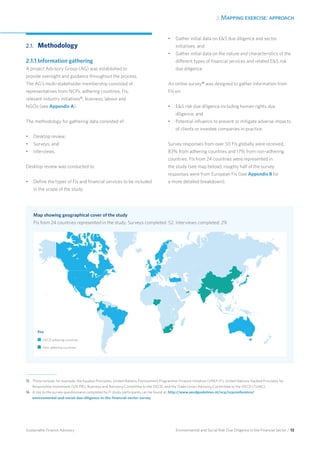
Map showing geographical cover of the study
FIs from 24 countries represented in the study. Surveys completed: 52. Interviews completed: 29.
2.1.	Methodology
2.1.1 Information gathering
A project Advisory Group (AG) was established to
provide oversight and guidance throughout the process.
The AG’s multi-stakeholder membership consisted of
representatives from NCPs, adhering countries, FIs,
relevant industry initiatives15
, business, labour and
NGOs (see Appendix A).
The methodology for gathering data consisted of:
•	 Desktop review;
•	 Surveys; and
•	 Interviews.
Desktop review was conducted to:
•	 Define the types of FIs and financial services to be included
in the scope of the study;
•	 Gather initial data on ES due diligence and sector
initiatives; and
•	 Gather initial data on the nature and characteristics of the
different types of financial services and related ES risk
due diligence.
An online survey16
was designed to gather information from
FIs on:
•	 ES risk due diligence including human rights due
diligence; and
•	 Potential influence to prevent or mitigate adverse impacts
of clients or investee companies in practice.
Survey responses from over 50 FIs globally were received,
83% from adhering countries and 17% from non-adhering
countries. FIs from 24 countries were represented in
the study (see map below); roughly half of the survey
responses were from European FIs (see Appendix B for
a more detailed breakdown).
15	 These include, for example, the Equator Principles, United Nations Environment Programme-Finance Initiative (UNEP-FI), United Nations-backed Principles for
Responsible Investment (UN PRI), Business and Advisory Committee to the OECD, and the Trade Union Advisory Committee to the OECD (TUAC).
16 	A link to the survey questionnaire completed by FI study participants can be found at: http://www.oecdguidelines.nl/ncp/ncpconference/
environmental-and-social-due-diligence-in-the-financial-sector-survey.
Key
2. Mapping exercise: approach
Environmental and Social Risk Due Diligence in the Financial Sector / 14Sustainable Finance Advisory
Interviews were conducted to gather qualitative information
to supplement quantitative survey data. The 29 FIs
interviewed are from adhering and non-adhering countries
and representative of the different types of FIs identified as
relevant for the purposes of this study. Where possible we
attempted to quantify findings from interviews, however due
to the nature of the interview process, we were not able to
do this in all cases. Although we used a standard interview
question template to guide the interviews (see Appendix C
for representative interview questions), the discussions varied
considerably depending on the FI, their business model, their
survey responses, or where the FI had further understanding/
experience or specific implementation examples to share. In
some cases, we have used terms such as “most”, “some” and
“a few” to describe anecdotally interview data where it was
not possible to specify the exact number of FIs which provided
particular views or information. A more flexible, tailored
approach yielded better information as compared to limiting
our interview process to asking the same set of questions of
each FI.
In most cases, FI study participants were from the
Environment and Social Risk, Responsible Investment,
Sustainability teams or other equivalent function within their
respective organisations. Approximately 50% of survey
respondents held senior level positions such as the head of the
department/function, directors or assistant directors, whilst
the others comprised of mid-management or environmental/
social specialists. Where an FI participated in both the survey
and the interview processes responses were typically provided
by the same individual(s).
2.1.2 Clarifications on terminology
In this section we clarify the key terms we use in this report.
These should not be interpreted as normative, but rather
to ensure a consistent use of terms which otherwise may
be readily subject to interpretation in different ways by
different stakeholders. The report is intended to be
accessible to a wide range of readers beyond FIs;
a glossary of terms has been included for ease of
reference (see Glossary of Terms).
•	 Risk-based due diligence in the context of the
OECD Guidelines is:
“the process through which enterprises
can identify, prevent, mitigate and account for how
they address their actual and potential adverse impacts
as an integral part of business decision-making and risk
management systems.”
•	 For FIs the approach to risk-based due diligence generally
refers to the review and analysis of ES risks undertaken
prior to making a decision relating to lending, investing or the
provision of other financial services to a client. However, this
does not exclude per se processes in place to address adverse
impacts, which arise after a decision has been approved to
provide specific products or services. Throughout the report
we will refer specifically to ES risk due diligence.
•	 Investment and insurance companies tend to refer
to environmental, social and governance (“ESG”) practices.
However, for ease of reference and consistency, we will
use the same “ES” terminology for all FIs (i.e. “ES due
diligence” would also include ESG due diligence).
•	 For the purposes of this study, adverse impacts refer
to environmental and/or social impacts where it actually
happens. These are not to be confused with other types
of adverse/negative impacts that might occur as a
consequence of the adverse impacts on the ground, such
as financial or reputation impacts on the client/investee
company or the FIs.17
•	 It should be noted that ES issues as they have been defined
for the purposes of this report (i.e. any potential or actual
impact to the physical, natural or cultural environment, or
on the surrounding community and/or e.g. workers) vary
in the degree of severity, as defined for example, in the
categorisation approach under the Equator Principles.
•	 We will use the term client to mean the entity to which
the FI is providing financial services; and investee
company to mean the entity in which an FI is making
an investment. We will use the term client or investee
company throughout to refer to both situations.
•	 We use the term business/commercial teams to refer
to the front office teams, client relationship managers,
fund managers and other commercial deal teams in an FI.
•	 For the purposes of this project, five types of financial
services are defined as per Table 1 below:
17 	 The OECD Guidelines refer to “Avoid causing or contributing to adverse impacts on matters covered by the OECD Guidelines” of which environmental and social
matters are in the scope of this report. They do not however define in detail the term “adverse impacts” and hence a definition is provided for clarity on the use of the
term throughout this report.
2. Mapping exercise: approach
Environmental and Social Risk Due Diligence in the Financial Sector / 15Sustainable Finance Advisory
It is recognised that the financial services described above are
high level and the nature and complexity of services within
each group can vary significantly. Furthermore, there are other
financial services out of scope of this project, that cannot
be clustered under the above groups but which could be
subject to ES due diligence.
•	 We will use the term “financial institutions” (each, an
FI, or collectively, FIs). The types of financial institutions
listed in Table 2 below participated in, and were the agreed
subject of, the study.
Table 1: Definition of financial services
Type of financial service
Asset-Based Finance
A method of funding specific projects typically secured by the project assets, including the revenue-producing contracts
(e.g. project finance, structured finance). The lender looks primarily at the revenues generated by the project (accounts receivable)
as the source of repayment and as security for the exposure. This type of financing is usually for large, complex and expensive
installations (e.g. power plants, mines or transportation infrastructure).
Capital Markets
Debt and equity capital transactions [i.e. securities underwriting (bonds issuance, initial public offerings (IPOs)] and related
advisory services.
Corporate Lending
Lending to companies (e.g. term loans, working capital facilities, overdraft facilities), other than Asset-Based Finance.
Insurance
For the purposes of this project, Insurance services cover only insurance services for companies and not for private individuals.
Investment
Investments (listed and private equity, fixed income and other non-listed assets) on an FI’s own behalf or on behalf of institutional
investors (e.g. asset management on behalf of pension funds).
©iStockphoto.com/DeanMitchell
2. Mapping exercise: approach
Environmental and Social Risk Due Diligence in the Financial Sector / 16Sustainable Finance Advisory
2.1.3 Limitations of the study
The following limitations of the study should be noted:
•	 Types of FI: It was agreed that the study would not be able
to cover the entire spectrum of FIs that exist. It was also
recognised that given their size, number and geographic
spread, banks would likely form the largest group, and that
smaller sample sizes would be possible for other FI types
(e.g. asset managers, private equity companies, etc.);
•	 Sample Size: the sample size of FI types other than banks
was small meaning that the findings for these FIs are
illustrative, rather than representative;
•	 Retail banks: retail banks were excluded due to the
decision to focus on financial services provided
to corporate clients or investee companies;
•	 Market leaders: in order to identify emerging good
practice the sample largely included market “leaders”
in the area of risk-based ES due diligence and ES risk
management more generally. They may therefore not
necessarily be representative of their peer group;
•	 Constituency: the scope of the study did not provide
for opportunity to conduct surveys and/or interviews
with other relevant actors, hence the survey and interview
findings reflect information from, and the views of, FIs
only. The report does reflect feedback from the multi-
stakeholder project Advisory Group comprising of NCPs,
labour, NGOs and industry associations; and
•	 Geographical representativeness: While over 150 FIs
from all regions of the world were invited to participate
in the survey, approximately 50% of respondents were
FIs headquartered in Europe, hence the findings are not
representative of all geographies.18
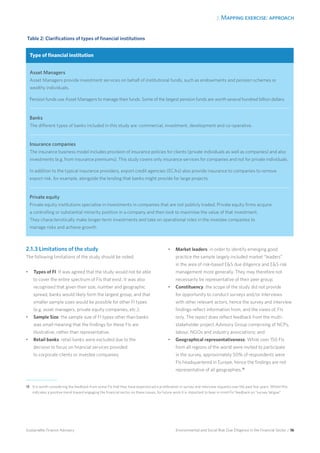
Table 2: Clarifications of types of financial institutions
Type of financial institution
Asset Managers
Asset Managers provide investment services on behalf of institutional funds, such as endowments and pension schemes or
wealthy individuals.
Pension funds use Asset Managers to manage their funds. Some of the largest pension funds are worth several hundred billion dollars.
Banks
The different types of banks included in this study are: commercial, investment, development and co-operative.
Insurance companies
The insurance business model includes provision of insurance policies for clients (private individuals as well as companies) and also
investments (e.g. from insurance premiums). This study covers only insurance services for companies and not for private individuals.
In addition to the typical insurance providers, export credit agencies (ECAs) also provide insurance to companies to remove
export risk, for example, alongside the lending that banks might provide for large projects.
Private equity
Private equity institutions specialise in investments in companies that are not publicly traded. Private equity firms acquire
a controlling or substantial minority position in a company and then look to maximise the value of that investment.
They characteristically make longer-term investments and take on operational roles in the investee companies to
manage risks and achieve growth.
18 	It is worth considering the feedback from some FIs that they have experienced a proliferation in survey and interview requests over the past few years. Whilst this
indicates a positive trend toward engaging the financial sector on these issues, for future work it is important to bear in mind FIs’ feedback on “survey fatigue”.
2. Mapping exercise: approach
Environmental and Social Risk Due Diligence in the Financial Sector / 17Sustainable Finance Advisory
2.2. Financial institutions and services
This section of the report presents the following:
•	 An overview of the types of FIs included in the study; and
•	 An overview of the financial services and products
provided by these FIs.
2.2.1 Types of Financial Institutions
There are broadly four different types of FIs included in this study:
1.	 Asset Managers;
2.	 Banks;
3.	 Insurance companies; and
4.	 Private equity institutions.
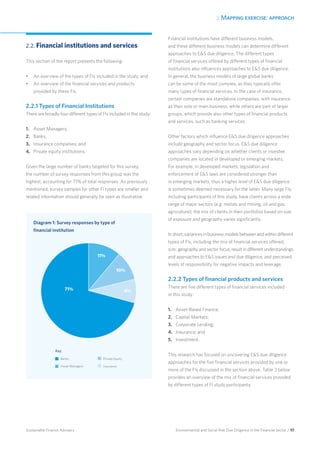
Given the large number of banks targeted for this survey,
the number of survey responses from this group was the
highest, accounting for 71% of total responses. As previously
mentioned, survey samples for other FI types are smaller and
related information should generally be seen as illustrative.
Financial institutions have different business models,
and these different business models can determine different
approaches to ES due diligence. The different types
of financial services offered by different types of financial
institutions also influences approaches to ES due diligence.
In general, the business models of large global banks
can be some of the most complex, as they typically offer
many types of financial services. In the case of insurance,
certain companies are standalone companies, with insurance
as their sole or main business, while others are part of larger
groups, which provide also other types of financial products
and services, such as banking services.
Other factors which influence ES due diligence approaches
include geography and sector focus. ES due diligence
approaches vary depending on whether clients or investee
companies are located in developed or emerging markets.
For example, in developed markets, legislation and
enforcement of ES laws are considered stronger than
in emerging markets, thus a higher level of ES due diligence
is sometimes deemed necessary for the latter. Many large FIs,
including participants of this study, have clients across a wide
range of major sectors (e.g. metals and mining, oil and gas,
agriculture); the mix of clients in their portfolios based on size
of exposure and geography varies significantly.
In short, variances in business models between and within different
types of FIs, including the mix of financial services offered,
size, geography and sector focus, result in different understandings
and approaches to ES issues and due diligence, and perceived
levels of responsibility for negative impacts and leverage.
2.2.2 Types of financial products and services
There are five different types of financial services included
in this study:
1.	 Asset-Based Finance;
2.	 Capital Markets;
3.	 Corporate Lending;
4.	 Insurance; and
5.	 Investment.
This research has focused on uncovering ES due diligence
approaches for the five financial services provided by one or
more of the FIs discussed in the section above. Table 3 below
provides an overview of the mix of financial services provided
by different types of FI study participants:
Key
Banks
	Asset Managers
	Private Equity
	Insurance
71%
11%
10%
8%
Diagram 1: Survey responses by type of
financial institution
2. Mapping exercise: approach
Environmental and Social Risk Due Diligence in the Financial Sector / 18Sustainable Finance Advisory
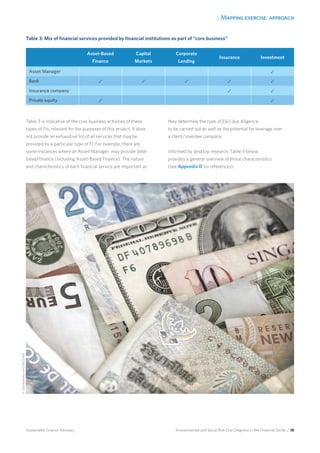
Table 3 is indicative of the core business activities of these
types of FIs, relevant for the purposes of this project. It does
not provide an exhaustive list of all services that may be
provided by a particular type of FI. For example, there are
some instances where an Asset Manager may provide debt-
based finance (including Asset-Based Finance). The nature
and characteristics of each financial service are important as
they determine the type of ES due diligence
to be carried out as well as the potential for leverage over
a client/investee company.
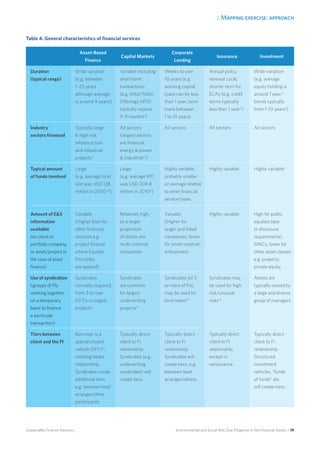
Informed by desktop research, Table 4 below
provides a general overview of those characteristics
(see Appendix D for references).
Table 3: Mix of financial services provided by financial institutions as part of “core business”
Asset-Based
Finance
Capital
Markets
Corporate
Lending
Insurance Investment
Asset Manager ✓
Bank ✓ ✓ ✓ ✓ ✓
Insurance company ✓ ✓
Private equity ✓ ✓
©iStockphoto.com/MCCAIG
2. Mapping exercise: approach
Environmental and Social Risk Due Diligence in the Financial Sector / 19Sustainable Finance Advisory
Asset-Based
Finance
Capital Markets
Corporate
Lending
Insurance Investment
Duration
(typical range)
Wide variation
(e.g. between
1–25 years
although average
is around 9 yearsi
)
Variable including
short-term
transactions
(e.g. Initial Public
Offerings (IPO)
typically require
3–9 monthsii
)
Weeks to over
10 years (e.g.
working capital
loans can be less
than 1 year; term
loans between
1 to 10 years)
Annual policy
renewal cycle;
shorter term for
ECAs (e.g. credit
terms typically
less than 1 yeariii
)
Wide variation
(e.g. average
equity holding is
around 1 year,iv
bonds typically
from 1–10 yearsv
)
Industry
sectors financed
Typically large
 high risk
infrastructure
and industrial
projectsvi
All sectors
(largest sectors
are financial,
energy  power
 industrialvii
)
All sectors All sectors All sectors
Typical amount
of funds involved
Large
(e.g. average fund
size was USD 128
million in 2000viii
)
Large
(e.g. average IPO
was USD 204.8
million in 2010ix
)
Highly variable;
probably smaller
on average relative
to other financial
service types.
Highly variable Highly variablex
Amount of ES
information
available
(on client or
portfolio company,
or asset/project in
the case of asset
finance)
Variable
(Higher than for
other financial
services e.g.
project finance
where Equator
Principles
are applied)
Relatively high,
as a larger
proportion
of clients are
multi-national
companies
Variable
(Higher for
larger and listed
companies, lower
for small-medium
enterprises)
Highly variable High for public
equities (due
to disclosure
requirements),
MNCs, lower for
other asset classes
e.g. property,
private equity
Use of syndication
(groups of FIs
working together
on a temporary
basis to finance
a particular
transaction)
Syndicates
normally required,
from 3 to over
50 FIs in largest
projectsxi
Syndicates
are common
for largest
underwriting
projectsxii
Syndicates (of 3
or more of FIs)
may be used for
term loansxiii
Syndicates may
be used for high
risk/unusual
risksxiv
Assets are
typically owned by
a large and diverse
group of managers
Tiers between
client and the FI
Borrower is a
special project
vehicle (SPV)xv
,
creating tiered
relationship.
Syndicates create
additional tiers,
e.g. between lead
arranger/other
participants.
Typically direct
client to FI
relationship
Syndicates (e.g.
underwriting
syndicates) will
create tiers.
Typically direct
client to FI
relationship.
Syndicates will
create tiers, e.g.
between lead
arranger/others.
Typically direct
client to FI
relationship,
except in
reinsurance.
Typically direct
client to FI
relationship.
Structured
investment
vehicles, “funds
of funds” etc.
will create tiers.
Table 4: General characteristics of financial services
2. Mapping exercise: approach
Environmental and Social Risk Due Diligence in the Financial Sector / 20Sustainable Finance Advisory
As seen from Table 4 above, each financial service type is
unique, and wide variances exist in the characteristics between
and within each type (e.g. the duration of Corporate Lending
transactions can last from just a few weeks to over 10 years).
Nonetheless, some broad generalisations can be made:
•	 Asset-Based Finance (particularly project finance) and
Capital Markets are the types of financial services which
most typically involve large volumes of funds, and relatedly,
both are areas where syndication is most common;
•	 Asset-Based Finance is unique in its orientation towards
particular sectors associated with a large ES footprint,
including greenfield developments (e.g. on sites which
were not altered by previous developments)
such as infrastructure and industrial projects;
•	 Insurance, Corporate Lending and Investment, while each has
unique characteristics (e.g. duration), they are alike in serving
a wide range of client/investee companies, of various sizes
and in various sectors. They are also similar in typically
(although not exclusively) involving a direct relationship
between one client or investee company and one FI.
These types of characterisations or factors will be important
later in the analysis when considering ES due diligence
practices and potential for leverage or influence over clients/
investee companies.
2.3. International frameworks, principles,
standards and guidelines
2.3.1 Introduction
There are numerous frameworks, principles, standards and
guidelines, which the financial sector already uses to identify
and/or assess ES risks. In our survey we grouped:
•	 International frameworks and principles that FIs can
refer to in their ES due diligence policies or position
statements; and
•	 Practical standards and guidelines that FIs can embed in their
policies and/or implement in their ES due diligence processes.
This grouping is useful in assessing a range of different
external initiatives which are commonly referenced by FIs
and, in particular, helps to understand how they relate to ES
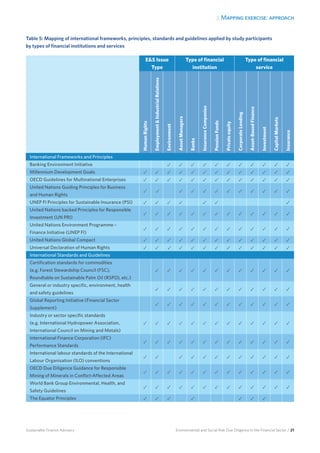
due diligence approaches. Table 5 below maps international
frameworks, principles, frameworks and standards used by the
surveyed FIs in relation to different types of financial services.
©CareyBohjanen
2. Mapping exercise: approach
Environmental and Social Risk Due Diligence in the Financial Sector / 21Sustainable Finance Advisory
Table 5: Mapping of international frameworks, principles, standards and guidelines applied by study participants
by types of financial institutions and services
ES Issue
Type
Type of financial
institution
Type of financial
service
HumanRights
EmploymentIndustrialRelations
Environment
AssetManagers
Banks
InsuranceCompanies
PensionFunds
Privateequity
CorporateLending
Asset-BasedFinance
Investment
CapitalMarkets
Insurance
International Frameworks and Principles
Banking Environment Initiative ✓ ✓ ✓ ✓ ✓ ✓ ✓ ✓ ✓ ✓ ✓
Millennium Development Goals ✓ ✓ ✓ ✓ ✓ ✓ ✓ ✓ ✓ ✓ ✓ ✓ ✓
OECD Guidelines for Multinational Enterprises ✓ ✓ ✓ ✓ ✓ ✓ ✓ ✓ ✓ ✓ ✓ ✓ ✓
United Nations Guiding Principles for Business
and Human Rights
✓ ✓ ✓ ✓ ✓ ✓ ✓ ✓ ✓ ✓ ✓ ✓
UNEP FI Principles for Sustainable Insurance (PSI) ✓ ✓ ✓ ✓ ✓ ✓ ✓
United Nations backed Principles for Responsible
Investment (UN PRI)
✓ ✓ ✓ ✓ ✓ ✓ ✓ ✓ ✓ ✓ ✓ ✓ ✓
United Nations Environment Programme –
Finance Initiative (UNEP FI)
✓ ✓ ✓ ✓ ✓ ✓ ✓ ✓ ✓ ✓ ✓ ✓ ✓
United Nations Global Compact ✓ ✓ ✓ ✓ ✓ ✓ ✓ ✓ ✓ ✓ ✓ ✓ ✓
Universal Declaration of Human Rights ✓ ✓ ✓ ✓ ✓ ✓ ✓ ✓ ✓ ✓ ✓ ✓ ✓
International Standards and Guidelines
Certification standards for commodities
(e.g. Forest Stewardship Council (FSC),
Roundtable on Sustainable Palm Oil (RSPO), etc.)
✓ ✓ ✓ ✓ ✓ ✓ ✓ ✓ ✓ ✓ ✓ ✓
General or industry specific, environment, health
and safety guidelines
✓ ✓ ✓ ✓ ✓ ✓ ✓ ✓ ✓ ✓ ✓ ✓
Global Reporting Initiative (Financial Sector
Supplement)
✓ ✓ ✓ ✓ ✓ ✓ ✓ ✓ ✓ ✓ ✓ ✓
Industry or sector specific standards
(e.g. International Hydropower Association,
International Council on Mining and Metals)
✓ ✓ ✓ ✓ ✓ ✓ ✓ ✓ ✓ ✓ ✓ ✓ ✓
International Finance Corporation (IFC)
Performance Standards
✓ ✓ ✓ ✓ ✓ ✓ ✓ ✓ ✓ ✓ ✓ ✓ ✓
International labour standards of the International
Labour Organisation (ILO) conventions
✓ ✓ ✓ ✓ ✓ ✓ ✓ ✓ ✓ ✓ ✓ ✓
OECD Due Diligence Guidance for Responsible
Mining of Minerals in Conflict-Affected Areas
✓ ✓ ✓ ✓ ✓ ✓ ✓ ✓ ✓ ✓ ✓ ✓ ✓
World Bank Group Environmental, Health, and
Safety Guidelines
✓ ✓ ✓ ✓ ✓ ✓ ✓ ✓ ✓ ✓ ✓ ✓ ✓
The Equator Principles ✓ ✓ ✓ ✓ ✓ ✓ ✓
Environmental and Social Risk Due Diligence in the Financial Sector / 22Sustainable Finance Advisory Environmental and Social Risk Due Diligence in the Financial Sector / 22Sustainable Finance Advisory
3. Mapping exercise:
findings on environmental
and social risk due diligence
©iStockphoto.com/oneclearvision
3. Mapping exercise: findings on environmental and social risk due diligence
Environmental and Social Risk Due Diligence in the Financial Sector / 23Sustainable Finance Advisory
3.1.	Findings on Frameworks
and Principles
According to survey data, the frameworks and principles
which FIs refer to the most in their ES policies or position
statements are:
•	 UNEP Finance Initiative (UNEP FI);
•	 United Nations Global Compact (UNGC);
•	 Universal Declaration of Human Rights (UNDHR);
•	 United Nations backed Principles for Responsible
Investment (UNPRI)20
; and
•	 United Nations Guiding Principles for Business and
Human Rights (UNGPs).
3.1.2 Findings on the United Nations Guiding
Principles on Business and Human Rights
Whilst 60% of survey respondents are “aware”21
of the
UNGPs, during interviews there was a very mixed response
in relation to their understanding and use of the UNGPs
to identify and/or assess human rights issues. A further
discussion on this topic is included in Section 3.4. Those
FIs that indicated they were not familiar with the UNGPs are
located in countries that adhere to the OECD Guidelines as well
as countries that do not:
•	 Adhering countries: Australia, Denmark, France, Germany,
Japan, Mexico, Netherlands, Turkey, UK, USA, Brazil; and
•	 Non-adhering countries: Ecuador, Nigeria, South Africa
and UAE.
This finding suggests that awareness-raising activities
on the UNGPs have not yet reached a number of FIs
both in adhering and non-adhering countries. It is worth
noting that a few FIs did not have specific plans to take
specific action pursuant to the UNGPs, as for example,
they already covered human rights aspects within existing
due diligence processes.
Of the FIs that are familiar with the UNGPs, in general, most
are at the early stages of understanding the implications for
their institutions. FIs familiar with the framework are:
•	 Developing their own institutional approach (e.g. policy);
•	 Developing a policy approach in collaboration with other
partners; or
•	 Already covering aspects of the framework within
existing policies and processes.
The Thun Group is an example of a recent initiative amongst
banks to support implementation of the UNGPs and better
understand how they can be applied to banking business.22
20	The UN PRI convenes working groups and facilitates debate on investment-related financial services provided by FIs such as private equity companies and Asset
Managers. Its membership has grown, from a few dozen since it was launched in 2006 to over a thousand in 2012. Some FIs indicated it would be a good platform to
build on existing discussions on ES due diligence related to Investment services.
21 	Information presented is related to a separate survey question that specifically asked FIs whether they were “aware” of the UNGPs.
22 	The Group is currently completing its work on a discussion document that focuses on Guiding Principles 16–21 (relating to the corporate responsibility to respect
human rights) and suggests an approach to the assessment and the scope and depth of due diligence which may be undertaken.” Thun Group of Banks Response to a
question at the UN Forum on Business and Human Rights, December 2012.
“We deal with human rights issues through our
policy on corporate responsibility. There are no
plans, in the near future, to adopt the mentioned
frameworks [UNGP]. Brazil has several laws on
human rights and we follow all procedures to
guarantee their enforcement.”
Bank
“For us the recent developments in human
rights [UNGPs] will mean significant changes,
particularly as our [EU] home country is taking
a leading role to include them in the financial
sector. It does not mean much change for our
policies, communications of these and what we
aspire to do. However, it does mean significant
changes for implementation and consistency of
implementation across geographies and sectors.“
Bank
3. Mapping exercise: findings on environmental and social risk due diligence
Environmental and Social Risk Due Diligence in the Financial Sector / 24Sustainable Finance Advisory
A number of FIs interviewed identified benefits of the
UNGPs including:
•	 Client engagement: The UNGPs are perceived as a useful
tool for engaging clients as they provide concepts and
a framework for discussion.
•	 Provides a common framework for the human rights
policy of individual FIs: The UNGPs are viewed as helpful
in providing internationally endorsed/recognised principles
for a human rights policy of an individual FI. For FIs that
already have a human rights policy, the framework provides
a useful reference.
•	 Provides clear guidance for FI clients or investee
companies: The UNGPs are seen as providing a clear
framework for client or investee companies to manage
human rights issues in, for example, their supply chains.
Many of the FIs interviewed are reviewing the UNGPs in
relation to existing ES policies and due diligence processes,
for example, by conducting a “gap analysis”.
3.2. 	Findings on standards and guidelines
The standards and guidelines most commonly embedded
in policies and/or implemented in ES due diligence processes
as identified by survey respondents are:
•	 General or client’s/investee’s industry-specific
environment, health and safety guidelines (73%);
•	 IFC Performance Standards (71%);
•	 Equator Principles (EP) (54%);
•	 International labour standards of the International Labour
Organisation (ILO) conventions (52%); and
•	 World Bank Group Environmental, Health, and Safety
Guidelines (50%).
3.2.1 The Equator Principles and IFC
Performance Standards
Since the launch of the Equator Principles for project finance
10 years ago, they have become widely accepted as good
practice for project finance transactions over USD 10 million.
Adopters use the EPs in their ES due diligence processes.
Whilst the EPs are designed for project finance transactions,
some FIs also use them as reference for other financial services
such as structured finance. A number of FIs interviewed cited
the Equator Principles and IFC Performance Standards as very
useful to their ES risk due diligence processes.
The Equator Principles have recently been updated to
reflect emerging good practice and the latest updates to
the IFC Performance Standards. One of the key changes is
to extend the coverage of the principles to include, inter alia,
project-related corporate loans that meet criteria including,
for example, a total aggregate loan amount of at least
USD100 million and a loan tenor of at least two years.23
“For us it is important to have an internationally
agreed framework and authority such as the
UNGPs, particularly in discussions with client/
investee companies in developing countries
where human rights may not be incorporated
into law.”
Asset Manager
23 	Equator Principles: Frequently asked questions on the EPIII update (http://www.equator-principles.com/resources/EPIII_FAQs.pdf).
SURVEY SAYS...
FIs view the IFC Performance Standards as:
•	 Internationally recognised and accepted both
in adhering and non-adhering countries;
•	 Practical;
•	 Easier to implement within ES due diligence
processes; and
•	 More straighforward to compare to national laws
especially in non-adhering countries in relation to
implementation of ES due diligence.
3. Mapping exercise: findings on environmental and social risk due diligence
Environmental and Social Risk Due Diligence in the Financial Sector / 25Sustainable Finance Advisory
3.2.2 Sector-Specific Guidelines
FIs interviewed mentioned the use of sector-specific guidelines
(e.g. Forestry Stewardship Council, Roundtable on Sustainable
Palm Oil, International Hydropower Association Sustainability
Assessment Protocol) as a useful benchmark for assessing the
ES performance of their clients or investee companies.
Some interviewed FIs have sector-specific position statements,
which refer to these sector-specific guidelines, and some also
engage directly with industry associations to understand best
practice, and consider it good practice for their clients to do
the same.
3.2.3 The OECD Guidelines
The findings of the survey show that the awareness and use
of the OECD Guidelines by FIs was low: only 13 out of 52
survey respondents apply or refer to the OECD Guidelines
in the context of ES risk due diligence. The findings are
discussed in-depth in Section 4.1.
3.2.4 Comments on the findings
Overall, whilst FIs may refer to many frameworks, principles,
guidelines and standards in practice very few can be/
are directly applied in the implementation of ES risk due
diligence across different types of financial services. Unless
such standards are directly relevant to the financial sector and
provide a framework which assists FIs in assessing underlying
ES risks, their uptake by the sector is low.
3.3. 	Findings on environmental and
social risk due diligence processes
and implementation
3.3.1 Introduction
ES due diligence is an important tool for FIs to identify,
assess, categorise and manage potential ES risks or issues
associated with a project, transaction, client or investee
company, ideally before such risks or issues become adverse
impacts. For the purposes of this study, it is important
to understand when and how FIs undertake ES due diligence,
so that it potentially gives an indication of whether FIs can
subsequently manage any identified ES risks by influencing
client or investee company behaviour. The sections below
map in detail ES due diligence approaches and their
implementation by FIs for different financial services.
These findings combine data obtained from the surveys
and information acquired from the interviews conducted
with the FIs.
3.3.2 Findings on approaches to risk-based
ES due diligence
FIs have different approaches to addressing the ES risks
to which they may potentially be linked through the provision
of financial products and services.
SURVEY SAYS…
26 out of 52 FIs embed sector-specific guidelines or
standards in their policies and/or implement them in
their ES due diligence processes
29 out of 52 FIs have sector or industry-specific
policies and/or position statements (e.g. Energy,
Defence, Pharmaceuticals, Consumer Products, etc.).
KEY POINT
One of the most important drivers for conducting
ES due diligence is the FIs’ aim of having a risk
management approach that is suited to the risk
profile of their engagements.
3. Mapping exercise: findings on environmental and social risk due diligence
Environmental and Social Risk Due Diligence in the Financial Sector / 26Sustainable Finance Advisory
Type of ES issue
Sector
External initiative, standard, guidelines or internal policy
Geography (involving governance or post
conflict areas or trans-boundary impacts)
Type of financial service
Size of transaction/deal or counterparty
(e.g. escalation criteria or approval thresholds)
0% 20% 40% 60% 80% 100%
Factors which influence the approach
to ES risk due diligence
According to FI study participants, a number of factors
influence the way an FI approaches ES risks, including , but
not limited to, the:
•	 FI’s business model;
•	 Types of financial services offered (including their typical
duration, amounts involved and number of tiers between
the FI and the client/investee company);
•	 Industry sectors of the client/investment portfolio;
•	 Types of ES issues related to the FI’s portfolio and the
potential to cause adverse impacts;
•	 Geographic scope of the FI’s business;
•	 Applicable industry initiatives and legal frameworks;
•	 Cultural aspects (internal and external); and
•	 External pressures from civil society.
As mentioned in Section 2.2.1 the business models of FIs are
very different, varying not only from one type of FI to another,
but also within the same category of FIs. They differ in:
•	 Nature of the FIs’ businesses (e.g. business strategy);
•	 Scope (e.g. development FIs, commercial FIs);
•	 Size (e.g. number of clients/investments, of employees,
of group entities);
•	 Shareholders’ structures (e.g. state owned, privately
owned, cooperative FIs); and
•	 Organisational structures.
Each of the foregoing influence the way ES risk management
is structured.
At the transaction level, a number of factors determine
or “trigger” whether, or what level of, ES due diligence
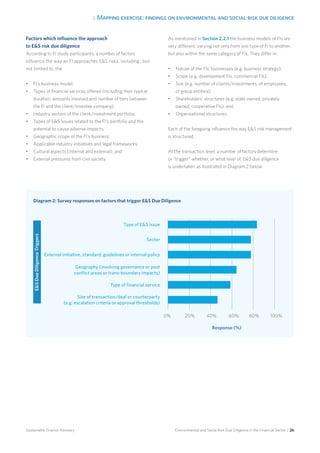
is undertaken as illustrated in Diagram 2 below:
Diagram 2: Survey responses on factors that trigger ES Due Diligence
Response (%)
ESDueDiligenceTriggers
3. Mapping exercise: findings on environmental and social risk due diligence
Environmental and Social Risk Due Diligence in the Financial Sector / 27Sustainable Finance Advisory
The types of ES issues emerge as the factor with most
influence (selected by 85% of the FIs surveyed), followed by
the industry sectors of the client/investee company and the
applicable industry initiatives (both selected by 77% of the FIs).
Based on the survey results, the main environmental and social
issues that “trigger” and/or influence the type or level of ES
due diligence undertaken by the FIs are outlined below.
ENVIRONMENTAL ISSUES:
•	 Pollution (e.g. contamination of air, land or water);
•	 Deforestation;
•	 Loss of biodiversity and natural habitats;
•	 Greenhouse gas emissions and climate change
impacts; and
•	 Depletion of natural resources.
SOCIAL ISSUES:
•	 Child labour;
•	 Occupational health and safety;
•	 Working conditions;
•	 Forced and compulsory labour; and
•	 Community health, safety and security.
Based on our research, ES due diligence practices also vary
according to the commercial importance of specific industry
sectors to an FI. For example, banks which lend extensively to
certain sectors (e.g. agriculture) will focus more on ES issues
pertinent to this sector and ES due diligence approaches will
be tailored accordingly.
The interviews with the FIs showed that cultural aspects,
both external [in relation to the country where the FI operates
(e.g. different perceptions of the importance of economic
priorities versus ES issues can potentially lead to differing
ES due diligence practices between developed and emerging
economies)] and internal (within an FI’s own organisation),
also influence ES due diligence approaches.
Another factor that may influence an FI’s ES due diligence
approach is external pressure from civil society. In some cases
such pressure from civil society has triggered or facilitated
the development of certain ES risk practices or policies,
such as human rights policies.
During the interviews some of the FIs recognised that
after an initial “reactive” approach to ES due diligence,
FIs should ideally progress their ES due diligence practices
and approach in a more “proactive” manner over time.
It was also observed by a few FIs that after committing
to various external initiatives/standards, the focus of some
companies (not only FIs) can be on external reporting
to appease and react to stakeholder demands, rather than
focusing on actual ES risk management.
“A fundamental shift in the mind-set of Indian
financial institutions is needed to re-balance the
focus from commercial growth only, towards
environmental and social issues. This is an issue
commonly found in other emerging economies.”
Bank
“Currently too many companies drive ES due
diligence and report on ES issues and impacts
from the perspective of the external stakeholders
rather than using the data collected to drive
internal improvements in ES areas.”
Private equity company
3. Mapping exercise: findings on environmental and social risk due diligence
Environmental and Social Risk Due Diligence in the Financial Sector / 28Sustainable Finance Advisory
Types of approaches to ES risk due diligence
Some FI study participants have established a centralised
approach to ES due diligence, where the ES risk
policies, experts and decision-making authorities
are situated at the central/head office level of the
organisation. In such cases there is one point of
contact for ES issues, usually an independent
ES risk management team that reviews all relevant
financing/investing proposals.
Other FI study participants have adopted a decentralised
approach, where the various business divisions bear the
responsibility for conducting the ES due diligence for their
portfolios. In these cases, ES risk policies are developed
at business division level and the ES risk experts are located
in the business/commercial teams.
There are also FIs that have a more limited approach to ES
due diligence, where ES issues are dealt with on a case-
by-case basis, within the regular credit/investment decision
processes. In these cases, ES issues will typically only
be considered in the larger transactions or deals.
A number of FI study participants have adopted a systematic
approach to ES risk due diligence, as reflected in the
implementation example below.
Some of the FI study participants with well-established ES
due diligence and risk management practices are increasingly
of the view that engaging on ES issues is also an opportunity
to “create value” and deepen client relationships.
IMPLEMENTATION EXAMPLE 1:
Systematic approach to ES risk due diligence
Characteristics of a systematic approach to ES risk
due diligence:
•	 ES risk aspects are embedded into existing risk
frameworks and are an integral part of determining
the FI’s risk profile or appetite;
•	 An integrated, mainstreamed approach is in place
(e.g. ES risks are considered across the whole
range of financial services and by a number of
different functions);
•	 A framework of policies, processes, systems and
tools is used for consistent implementation; and
•	 Where relevant, ES risk due diligence takes place not
only at the transaction level, but also outside the deal
flows (e.g. some FIs screen for potential ES issues
before engaging with new clients, during Know Your
Customer (KYC) processes) and at portfolio level.
IMPLEMENTATION EXAMPLE 2:
ES risk management framework
One FI’s ES risk management framework is structured
in a three level pyramid:
Level 1 – Strategic level involvement in certain ES
initiatives, where the FI is able to make strategic
interventions (e.g. participation in extractive industries
initiatives, supporting academic research, participation
in industry-led presentations and workshops on
specific ES topics);
Level 2 – Tactical level, where the FI conducts
portfolio reviews and engages with clients outside the
transaction flow; and
Level 3 – Operational transactional level, where the
FI conducts transaction and client level reviews and
engages with clients within the context of a specific
transaction or business engagement.
On-going top-down and bottom-up communication
among the levels provides the basis for well-established
and implemented ES risk management strategies.
Strategic
level
Tactical level
Operational transactional level
ES risk management
framework pyramid
3. Mapping exercise: findings on environmental and social risk due diligence
Environmental and Social Risk Due Diligence in the Financial Sector / 29Sustainable Finance Advisory
ES risk policies
All the FIs surveyed confirmed having an official policy or
position statement on ES issues.
86% of the surveyed FIs have a general sustainability/
reputation risk/responsible investing policy that covers all
business activities, accompanied by policies that cover specific
industry sectors and ES issues.
ES risk policies can be categorised according to their scope into:
•	 Sector-based policies, which provide the framework
for ES due diligence when engaging with companies
in specific industry sectors (e.g. energy/oil  gas, metals
 mining or agriculture); and
•	 Issue-based policies, which provide the framework for
ES due diligence on specific environmental or social
topics across industries (e.g. human rights, climate change,
water, biodiversity, or country “no go” zones).
Sector-based policies range from straightforward exclusion
lists, which identify certain industry sectors as outside
the business scope of the FI (e.g. defence industry),
to comprehensive policies that articulate the circumstances
in which financial services and/or products can be provided
to companies in industries deemed to be sensitive for
ES reasons.
69% of the surveyed FIs also have a process, tool or methodology
for categorising industry sectors by the level of ES risk (e.g.
high, medium, low). The sectors most frequently associated with
the highest level of ES risk and thus most likely to be subject
to specific ES policies are energy/oil and gas, metals and
mining, and aerospace/defence services. Industry-based
policies typically cover both the ES aspects relevant to that
specific sector.
Issue-based policies are often applicable outside of an ES
risk management or investment framework, given that they
also can define the rules applicable to the FI’s direct operations
(e.g. policies dealing with the FI’s direct environmental impacts
or with supply chain issues). Nineteen of the 52 surveyed FIs
have a standalone issue-specific policy or position statement
on human rights, 18 have a geography/country specific policy
or position statement including “No Go” zones, and 25 have
other issue-specific policies and/or statements (e.g. on climate
change, biodiversity, water).
ES risk due diligence processes/implementation
In most cases (83% of the FIs surveyed), ES due diligence
processes are aligned with credit/investment approval processes.
FIs find that the assessment of ES issues at the very early
stage in a potential new transaction/investment is essential
to successfully managing ES risks.
Where needed, specific procedures, governance structures,
processesandtoolsaredevelopedforconductingESduediligence
(e.g. applicable decision-making processes and escalation criteria/
procedures, ES issue screening templates/questionnaires).
During the interviews it was determined that some FIs identify
upfront, certain sectors, countries and/or companies that have
significant ES issues that the FIs would not finance/invest in
due to ES considerations. These may be specified in separate
exclusion lists, or can be part of ES sector/issue based policies,
credit/reputation risk policies (such as risk appetite policies)
or compliance/KYC policies. The restrictions can include,
for example, companies in sectors such as defence, gambling,
tobacco, nuclear power or transactions involving countries under
United Nations and/or European Union sanctions or embargoes
(e.g. Iran and North Korea are under UN arms embargoes).
KEY POINT
FIs see prioritisation as necessary when
conducting ES due diligence, due to the
complexity of their business models (e.g. the
universal banks) and also due to the high
volumes of transactions/clients.
SURVEY SAYS…
50% have ES due diligence processes integrated
into all systems
6% do not have ES due diligence processes
integrated into any standard systems
57% incorporate ES screening criteria into their
KYC/new client on boarding processes and systems
3. Mapping exercise: findings on environmental and social risk due diligence
Environmental and Social Risk Due Diligence in the Financial Sector / 30Sustainable Finance Advisory
Many of the FI study participants use specific tools to screen
new transactions and identify those with higher ES risks,
which subsequently require further investigation. The result
of such screening is typically a categorisation of the risk
involved by the proposed transactions into high/medium/low
ES risk. Some of the FIs use traffic light colours to reflect the
level of ES risk (e.g. red for high, yellow/amber for medium,
and green for low ES risk).
Each FI uses its own methods and considerations to determine
the level of ES risk involved by a proposed transaction.
When FIs identify particular ES issues through the initial
screening process that translate into medium or high
ES risks for the FIs, it is only then that further ES due
diligence is conducted. In this way, ES due diligence and risk
management approaches are designed to be commensurate
with the potential level of ES risk. There is no “one size fits
all” approach to ES due diligence.
The following diagram provides an illustrative example of an ES
due diligence and decision-making process flow for a financial
service proposal, based on qualitative interview information.
Some FIs formalise such due diligence processes in their internal
policies/procedures, while for others it can be mostly an informal
process. FIs might have some or all of these elements in place.
IMPLEMENTATION EXAMPLE 3:
A Pension Fund’s Exclusion Lists
Our exclusion list includes the following sectors
in which we do not wish to invest:
•	 Tobacco;
•	 Alcohol (although we do have some flexibility
to include companies which derive a small
percentage of their profits from the sale of alcohol)
•	 Gambling;
•	 Firearms;
•	 Nuclear power (certain funds we invest in might
include nuclear power companies, however, we only
invest if they also invest in renewable energy); and
•	 Weapons (as described in further detail below).
Weapons exclusions
In 2006 we conducted an extensive review on the
changing conduct of warfare in the 21st century,
covering the International Humanitarian Law (IHL)
and the Treaty on Conventional Armed Forces in
Europe. The aim was to review our existing weapons
exclusion policy that articulated we would not invest
in companies that were “significantly involved” in the
design, manufacture and sale of weapons. Based on
this review we adapted our existing policy of 20 years
to be: 1) much more explicit on the types of companies
we exclude; and 2) based on internationally accepted
normative standards. As a result, in addition to the IHL
exclusions, we also exclude companies that produce:
•	 Nuclear weapons, cluster bombs and landmines;
•	 Inherently offensive rather than defensive weapons.
However, we are able to invest in companies that
comply with internationally accepted standards.
STUDY FINDING...
Factors that can determine ES risk levels
include but are not limited to:
•	 Industry sector;
•	 Nature of the goods financed;
•	 ES performance of the client/
investment company;
•	 Country where the client/investment
company or the project is located;
•	 Amount of funds involved; and
•	 ES issues raised by stakeholders.
3. Mapping exercise: findings on environmental and social risk due diligence
Environmental and Social Risk Due Diligence in the Financial Sector / 31Sustainable Finance Advisory
When FIs consider financing/investing in companies with
identified ES risks, many FIs request that the companies
improve their ES performance, whether prior to the financing
(as a “condition precedent”), or during the financing. In the
latter cases, ES requirements/conditions are included in the
financing documentation and regular monitoring of progress
(on-going due diligence) is necessary.
ES risk due diligence governance structure
A number of functions within an FI can be involved
in performing the ES due diligence, such as:
•	 Business/commercial teams (e.g. front officers,
client relationship managers, fund managers,
commercial deal teams);
•	 ES risk management teams24
;
•	 Risk management teams;
•	 Compliance teams; and
•	 Credit Committees/Reputation Risk Committees.
Depending on the centralised/decentralised model used for
ES due diligence, ES risk management teams are set up at
either central/head office level in the organisation (e.g. as part
of the central risk management structures) or in the business
divisions (e.g. with the business/commercial teams).25
83%
of the surveyed FIs have ES risk management teams.
Our research indicates that business/commercial teams are
typically responsible for gathering information and identifying
transactions with higher ES risks. ES risk management
teams are involved in performing further ES due diligence
and providing ES risk advice/recommendations. If dialogue
on ES issues with the company is deemed necessary,
the front office teams will typically conduct it with support
from the ES risk management teams. The ultimate
responsibility for managing ES risks can rest either with
ES risk management teams or with the business teams.
24 	The teams of ES risk specialists within FIs have various names e.g. ES Risk Management, ESG, Governance  Sustainable Investment, Sustainable Development
 Social and Environmental Responsibility, Responsible Investment. Because this study focuses on risk-based ES due diligence, we refer to them throughout the
report as “ES risk management” teams.
25 	Some FIs have separate Corporate Social Responsibility teams responsible for developing certain issue-based policies (e.g. on human rights), engaging with external
stakeholders on ES issues and/or for reporting on sustainability topics.
IMPLEMENTATION EXAMPLE 4:
ES Due Diligence and Decision-Making Process Flow
Proposed
financial
service
ES risk
negative
screening
ES risk
categorisation
Proceed,
without further
escalation, ES
risk mitigation
measures might
be required
Declined if ES
risk can not be
mitigated
Business/
commercial
teams
Business/
commercial
or ES risk
management
or compliance
teams
Business/
commercial
and/or ES risk
management
and/or
compliance
teams
Further ES
due diligence
performed,
specific ES
policies  tools
apply
Proceed with
ES risk
mitigating
measures
Regular
progress
checks
Not pursued
following
informal
processes
Declined if on
exclusion lists
Lower ES
risk proposals
ES risk
management
teams
Credit
Committees/
Reputation Risk
Committees
Business/
commercial
and/or ES risk
management
teams
Proceed, no
further ES
due diligence
required
Escalation
to higher
decision-making
authorities
Key
ES risk due diligence process
	ES risk due diligence decisions
	ES risk due diligence decisions
	ES risk categorisation
	ES risk categorisation
	Business governance structure
	Ongoing ES risk due diligence
Higher ES
risk proposals
3. Mapping exercise: findings on environmental and social risk due diligence
Environmental and Social Risk Due Diligence in the Financial Sector / 32Sustainable Finance Advisory
STUDY FINDING...
ES risk management teams are typically
responsible for:
•	 ES policy making (including support for their
implementation);
•	 Acting as an in-house consultant on ES issues;
•	 Providing the necessary internal trainings on
ES issues; and
•	 External engagement (e.g. participation in
industry initiatives).
Where deemed necessary, higher risk transactions
are escalated to higher decision-making authorities such
as Credit Risk Committees or Reputation Risk Committees.
When the financing/investment is approved with conditions
(i.e. when the client/investee company must comply with
specific ES requirements), the ES risk managers are usually
involved in the periodic reviews. When financing/investment
is approved without conditions, the responsibility for
monitoring the company for any relevant ES changes belongs
to the relationship/investment managers. The history and/or
nature of the relationship with a company are very important
factors in progressing discussions on ES issues.
In some of the FIs the compliance function is also involved in
the ES due diligence process; in such cases the compliance
function acts as an extension of the ES risk management teams.
Given that most FIs have a limited number of in-house ES risk
managers, FI interviews revealed that informal networks have
proven valuable in ensuring more robust ES due diligence
practices. The ES risk management teams provide training
to other functions within the organisation (e.g. to local risk
managers), who become part of an informal network that
supports ES due diligence undertakings.
Some FIs with international operations have stated that having
key people in the regions who support ES due diligence
implementation has been helpful in making sure that ES due
diligence practices become integrated into local practices,
context and organisational culture.
3.3.4 Findings on specific ES risk due diligence
for each type of financial service
ES due diligence processes differ not only for the various
types of FIs, but also for various types of financial services.
IMPLEMENTATION EXAMPLE 5:
Bank ES risk management team seen as
a business partner
Over time, the ES risk management and commercial
teams have developed stronger relationships. In some
regions/product areas the situation has changed from
one of reactive responses, and sometimes challenges
between commercial versus ES risk objectives, to one
where both teams are using ES due diligence to identify
business opportunities. The ES risk management team
is now seen more as a business partner.
©iStockphoto.com/Yuri_Arcurs
3. Mapping exercise: findings on environmental and social risk due diligence
Environmental and Social Risk Due Diligence in the Financial Sector / 33Sustainable Finance Advisory
Diagram 3 offers an overview of the proportion
of surveyed FIs who conduct ES risk due diligence for
each category of financial services.
Corporate Lending
Corporate Lending facilities are typically provided
by commercial banks.
All surveyed FIs that provide Corporate Lending facilities
to large companies conduct related ES due diligence.
Currently there are no internationally agreed standards
on ES due diligence for this type of financial services.
The recent extension to the scope of the Equator Principles
to include project finance-related corporate and bridge loans
would be applicable only to a very small part of an FI’s
(EP adopter) lending portfolio.
The different types of Corporate Lending can be
distinguished as:
•	 General lending facilities (e.g. working capital, overdraft)
that do not have an underlying asset26
; and
•	 Lending facilities that have an underlying asset, but which
do not qualify as Asset-Based Finance as defined for the
purposes of this report (e.g. loans related to forestry or
agricultural plantations, trade finance for ES sensitive
equipment, mortgage loans for property development).
Insurance
Capital Markets
Investment
Asset based finance
Corporate Lending Credit
0% 20% 40% 60% 80% 100%
% of Respondents providing these Financial Services
that undertake ES Due Diligence
Diagram 3: Survey responses on ES Due Diligence Undertaken by Financial Service Type
KEY POINT
ES due diligence for Corporate Lending is
conducted at a higher level, compared to, for
example, Asset-Based Finance, where a more
in-depth ES due diligence at the financed asset,
project or site level is possible. FIs studied cite
several factors, including the characteristics of
the financial services and the availability/non-
availability of specific ES impact assessments
and reports.
26 	Physical assets such as a plant, property or equipment.
FinancialServiceType
3. Mapping exercise: findings on environmental and social risk due diligence
Environmental and Social Risk Due Diligence in the Financial Sector / 34Sustainable Finance Advisory
For the general lending facilities that do not have an underlying
asset, ES due diligence is limited to a company ES risk
assessment, usually based on publicly available information.
Implementation Example 6 below is consistent with a client
risk assessment in accordance with the IFC Performance
Standards (Performance Standard 1).
Some FIs use external service providers that create ES risk profiles
and databases of companies based on available public information.
For lending facilities that have an underlying asset, an ES
screening of the respective asset is performed in addition
to the company ES risk assessment. As mentioned, such
screening/assessment is conducted at a more general level
than for Asset-Based Finance.
Some of the surveyed FIs specify in their respective credit
policies which industries they lend or do not lend to (exclusion
lists) and/or identify sectors with higher ES risk.
Other FI study participants state the ES due diligence
requirements for Corporate Lending in specific sector policies.
Such sector policies set out minimum ES requirements for
a company to be eligible for financing and typically
all companies are assessed against these requirements.
In developing sector policies, FIs often categorise companies
to reflect their level of ES performance when benchmarked
against respective industry best or good practice standards
(e.g. compliant/near compliant/non-compliant).
For some FIs studied, depending on the ES risk categorisation
of the proposed financing (i.e. high, medium or low), further
ES due diligence and engagement with the company and/
or escalation to a higher decision-making authority might be
required. Where financing is approved with conditions, specific
covenants may be included in the loan documentation and
monitoring of progress takes place at regular intervals.
Asset-Based Finance
All 35 surveyed FIs who provide Asset-Based Financing27
have ES due diligence requirements for such transactions.
In some cases FIs assess structured finance transactions
using the same or similar standards that they apply for
project finance.
Given that this type of financing is provided for a particular
asset, for FI interview participants providing Asset-Based
Finance, the ES due diligence process typically includes:
•	 An ES risk assessment of the asset; and
•	 An ES risk assessment of the company.
Based on our study results, an initial review of the transaction
is almost always conducted by the front office teams, resulting
KEY POINT
ES due diligence approaches for project finance
above certain applicable thresholds (such as the
USD 10 million total project finance capital costs
thresholds for Equator Principles transactions)
are fairly similar for the FIs who apply the Equator
Principles, the IFC Performance Standards or
other comparable standards.
27 	For the purposes of this report, “Asset-Based Finance” is defined as a method of funding specific projects typically secured by the project assets, including the
revenue-producing contracts (e.g. project finance, structured finance).
IMPLEMENTATION EXAMPLE 6:
A Bank’s Company ES risk assessment
When we conduct ES risk assessment at a company
level, we take into consideration the following aspects:
•	 The commitment of the company to manage ES
issues (e.g. the company’s policies on ES issues
and its commitment to uphold international ES
standards);
•	 The capacity of the company to manage ES issues
(e.g. the company’s ES management systems); and
•	 The track record of the company in managing ES
issues (e.g. whether there are NGO campaigns,
fines or lawsuits against the company related to
ES matters).
3. Mapping exercise: findings on environmental and social risk due diligence
Environmental and Social Risk Due Diligence in the Financial Sector / 35Sustainable Finance Advisory
in an ES categorisation of the project based on the magnitude
of its potential impacts and risks. Implementation Example
7 below is consistent with the World Bank/IFC approach
to categorisation of projects and representative of practices
of a growing number of FIs.
The level of subsequent ES due diligence is based on the
project categorisation. Further ES due diligence is carried
out for Category A and B projects and for projects located
in low-income OECD countries. No further ES due diligence
is required for Category C projects.
For most FI study participants, Category A projects usually
require sign-off from higher decision-making authorities
within the FI (e.g. Group Risk Committee).
Investment
Thirty-four out of the 36 FIs surveyed which
provide investment services conduct related ES
due diligence.28
The United Nations-backed Principles for Responsible Investment
constitutes a voluntary international framework which signatory
FIs use to incorporate ES and governance issues into their
decision-making and ownership practices. A number of the
FI study participants are signatories of the UNPRI.
Investment-focused FI study participants have developed
general responsible investment policies that require integration
of ES factors into their investment decision processes.
Some FIs apply the responsible investment policies to all asset
classes, not only to “green” (e.g. environmentally friendly
or ethically screened) assets.
Some FIs studied have also developed issue-based policies
that, for example, include commitments to international best
practice in the areas of climate change, health and safety
or social issues.
There are a number of FIs who do not have specific
ES policies, but rather use recognised standards
to encourage best practice.
There are three main types of investments,
depending on the asset class:
•	 Equity investments: private equity and listed
equity investments;
•	 Fixed income investments (e.g. government or
corporate bonds); and
•	 Investments in other non-listed assets (e.g.
investments in real estate or sustainable energy
funds, investments in commodities).
28 	Investment companies usually conduct Environmental, Social and Governance (“ESG”) due diligence. Given that this report is focusing on the environmental and
social issues, for the purposes of this report we will use the same terminology as for the other types of FIs i.e. “ES due diligence”.
IMPLEMENTATION EXAMPLE 7:
A Bank’s ES risk categorisation for Asset-Based
Finance transactions
Our ES risk categorisation for Asset-Based
Finance transactions is aligned to the World Bank/
IFC categorisation. Accordingly, projects can be
categorised as:
•	 Category A (high ES risk) – Projects with potential
significant adverse social or environmental impacts
that are diverse, irreversible or unprecedented;
•	 Category B (medium ES risk) – Projects with
potential limited adverse social or environmental
impacts that are few in number, generally site-
specific, largely reversible and readily addressed
through mitigation measures; and
•	 Category C (low ES risk) – Projects with minimal
or no social or environmental impacts.
KEY POINT
Investment FIs use different strategies for
managing related ES risk, adapted for each
asset class, similar to that applied by FIs for
Corporate Lending.
3. Mapping exercise: findings on environmental and social risk due diligence
Environmental and Social Risk Due Diligence in the Financial Sector / 36Sustainable Finance Advisory
For example, when assessing ES risks for an infrastructure
fund, which has an underlying asset, the FIs can assess the
asset (e.g. toll road) itself. However, for investments in private
equity funds, where there are no underlying assets, FIs can
only assess the capacity of the fund manager to assess the
ES risks of the investee company.
The ES due diligence processes for investments by the
interviewed FIs typically consist of a combination of some
or all of the following:
A. Negative screening
Through negative screening, FIs check the potential investee
company against exclusion lists. For example, companies
in certain industry sectors (e.g. defence, tobacco or online
gambling) or which have significant ES issues that do not
improve over time (e.g. human rights issues) may be excluded
from investment.
B. ES Risk Assessment
ES risk assessment of investee companies is an integral
part of the appraisal process, often conducted at the
beginning of the deal origination. It can be conducted from
two perspectives:
•	 In order to identify whether there are particular ES risks
related to the investee companies that would become
part of general funds (in such cases the focus of the ES
assessment is on companies in high ES risk sectors);
and/or
•	 In order to identify top ES performers that would be
included in ethical/sustainable funds.
Many of the interviewed FIs use ES risk tools to identify
the level of potential risk involved by proposed investments.
Most potential investments are run through such ES risk
tools. The result of this screening is usually a categorisation
of the proposed investments as high/medium/low ES risk.
The assessment of high ES risk engagements is often
conducted in-house, while the assessment of medium
and low risk engagements may be outsourced. Some FIs
require ES sign-offs for all the assets managed in-house.
For medium-risk engagements, some FIs only require ES
information during one phase of the investment, for example,
in the monitoring phase.
C. Investment decision and mitigating measures
When making an investment decision, FIs take into account
the ES risk rating resulting from the above-mentioned
screening process, and also the investee company’s
willingness to work on ES issues.
Where needed, FIs include the ES risk mitigating
requirements in the financing documentation and specific
ES action plans are agreed with the investee company.
D. Monitoring
Periodic reviews, usually yearly, take place in order to monitor
the company’s progress in fulfilling ES requirements.
If needed, a new/corrected ES action plan is agreed for the
next period.
During the monitoring phase, further ES due diligence
is conducted through engagement and voting activities.
Engagement
FI study participants engage in in-depth dialogues on ES issues
with certain companies from their investment portfolio and use
international standards and frameworks (such as the UN Global
Compact principles) to stimulate best practice. The engagement
can be part of an on-going dialogue or can be triggered by voting
decisions and related matters. According to the FIs interviewed,
the choice for engagement is made based on several factors,
including the type and size of the FI’s holding, the type of ES
issues and whether other investors are involved. Some FIs
mentioned that they have predefined topics for engagement,
covering a wide range of ES and governance risks.
Voting
For FIs studied, voting comprises the activities of FIs as active
owners through participation in the General Meetings
of Shareholders. Investment FIs interviewed have voting
policies/standards and principles on corporate governance
that underpin their voting decisions at the companies in which
KEY POINT
The history and nature of the relationship
with a company are very important factors in
progressing discussions on ES topics.
3. Mapping exercise: findings on environmental and social risk due diligence
Environmental and Social Risk Due Diligence in the Financial Sector / 37Sustainable Finance Advisory
they invest. Voting decisions are primarily based on investment
considerations. The majority of agenda items are non-ES
related, however, in some cases FIs use this opportunity to
engage the investee companies and raise concerns on ES
issues, explain their expectations and invite comments.
E. ES assessment before divesting
Some FIs conduct ES assessments in all stages of an
investment: pre-investment (negative screening and ES risk
assessment), post-investment (monitoring), and also at the
exit stage, when the FIs decide to divest. ES assessment
of the investee company at the exit stage aims to ensure that
the investment satisfies certain ES standards, in order to find
a buyer for the investment.
Capital Markets
Fifteen out of 20 of the FIs surveyed which provide Capital
Markets products and services, require some degree of ES
due diligence.
Currently there are no internationally agreed standards
on ES due diligence for this type of financial services.
Based on the FI study participant responses, the ES due
diligence approach for Capital Markets transactions (e.g.
bonds issuance, IPOs) generally distinguishes between:
•	 Transactions that do not have an underlying asset; and
•	 Transactions that have an underlying asset.
For the transactions that do not have an underlying asset,
FIs can only perform an ES risk assessment of the company.
In such cases, FIs assess the company’s approach to ES
issues, similar to the ES due diligence conducted for general
lending facilities (as described above in the section on
“Corporate Lending”). Such ES risk assessment typically
takes into consideration the commitment, capacity and track
record of the company to manage ES issues.
For the transactions that have an underlying asset, FIs can
perform an ES risk assessment of the company, as well
as an ES risk assessment of the asset.
In such cases, FI study participants often follow a similar
approach as for the Asset-Based Finance transactions,
as mentioned in the section on “Asset-Based Finance” above.
This includes an initial ES categorisation aligned to the IFC
categorisation approach and subsequent different levels
of ES due diligence depending on the category (A, B or C).
In general, FIs opined that it can be much more difficult to
assess and manage ES risks in Capital Markets transactions
with consistency, due to the tight timeframes and to issues
related to disclosure and transparency.
IMPLEMENTATION EXAMPLE 8:
A private equity company’s engagement
with investee companies on ES issues
post-investment
ES due diligence is performed as part of our
investment appraisal process and can identify:
•	 “Red flags”, which are high risk ES issues that
need to be addressed by the investee company
before we disburse the investment, in legal terms
a “condition precedent”; and/or
•	 “Areas for improvement”, which are medium/low
risk ES issues that need to be addressed by the
investee company post-investment. These areas of
improvement are built into a corrective action plan
for the following 6, 12 or 18 months.
An important aspect for increasing the chances of
achieving ES improvements is incorporating
ES requirements into legal documentation.
Post-investment, we periodically review correction
plans and progress made by investee companies in
fulfilling ES requirements. Where applicable, we
agree on new correction plans for the next period.
Once ES management systems are in place, they
have to be able to prove they have improved the
respective ES issues.
KEY POINT
ES due diligence approaches and processes for
Capital Markets are seen as least defined and
with the greatest degree of variability between FIs.
3. Mapping exercise: findings on environmental and social risk due diligence
Environmental and Social Risk Due Diligence in the Financial Sector / 38Sustainable Finance Advisory
For example, the level of transparency for an Initial Public Offering
(IPO) depends on where the transaction is listed and whether the
respective stock exchange has ES standards for listing or not.
Hong Kong listings are, for example, more transparent on ES
issues than the UK ones, given that the Hong Kong Stock Exchange
has ES standards for listings. In such circumstances FIs find it
difficult to maintain a uniform approach to ES due diligence.
Insurance
Twelve out of the 18 FIs surveyed and interviewed who offer
insurance products and services conduct ES due diligence
to some extent.
The United Nations Principles for Sustainable Insurance (PSI)
that were launched in June 2012 constitute a set of voluntary
global principles for the insurance industry to address
environmental, social and governance risks and opportunities.
Seven out of the 18 FIs surveyed and interviewed who provide
insurance products and services are signatories of the PSI.
Insurance study participants have different approaches
to ES due diligence depending on the type of activity:
A.	 Investment/asset management activities (sometimes
	 referred to as “responsible investment”); and
B.	 Insurance activities (sometimes referred to as
	 “responsible/sustainable insurance”).
For the investment/asset management activities, insurance
companies conduct the same type of ES due diligence to that of
investment companies, as described in the section
on “Investment” above, particularly in the pre-investment
stage (e.g. negative screening and ES risk assessment).
ES risk management for insurance activities is currently
less defined. Some insurance study participants conduct
some level of ES due diligence, however, this is not
necessarily formalised.
This study covers only ES risk due diligence related to
insurance products and services provided to companies28
and not to private individuals.29
From an ES risk management perspective, insurance products
and services can be classified into two main categories:
•	 Direct or primary insurance, which involves the insurance
contract/policy concluded between the insurance
company and the company that receives financial
protection or reimbursement against losses; and
•	 Reinsurance, which involves the insurance purchased by
an insurance company from one or more other insurance
companies, as a means of risk management, often to cover
“peak” risks.30
With regard to reinsurance, it is relevant to make the
distinction between:
•	 Facultative reinsurance, in which a particular risk
is reinsured from a primary insurance company; and
•	 Treaty reinsurance, in which a group of policies or risk
categories are covered together.
For direct/primary insurance and facultative reinsurance,
the (re)insurer knows the concrete risks and companies
it insures. Consequently, ES due diligence for such insurance
products and services can be considered.
For the treaty reinsurance, the individual risks (whether ES
or other types of individual risks) and individual companies are
usually not known. Consequently, these cannot be evaluated
by the reinsurer.
A few of the leading insurance companies that participated
in our study explained that they initially started to conduct
ES due diligence for their investment activities. During the
course of our research, we found that ES due diligence for
insurance activities has a predominantly ethical/reputation risk
perspective rather than a financial risk perspective. Depending
on the object/activity being insured in many cases, insurance
companies would not, for example, be impacted by the ES
performance of their clients, due to the fact that they do not
finance them.31
In these cases, insurance companies mainly
run the risk of non-payment of insurance premiums, which are
far less significant than an investment loss.
28 	Such as insurance for public liability, professional and management liability, employment practices liability, commercial property or insurance for individuals offered
as a package to corporate clients for their employees.
29 	Such as life, property or casualty insurances provided directly to private individuals.
30 	See the definition on page 20 of the UNEP FI publication, “The global state of sustainable insurance”.
31 	Certain insurance companies/groups may also provide financing in the form of loans (such as mortgage loans), however, not as a core business. Our research focused on
mapping ES due diligence practices for the core insurance products and services, and consequently does not cover aspects related to financing by insurance companies.
3. Mapping exercise: findings on environmental and social risk due diligence
Environmental and Social Risk Due Diligence in the Financial Sector / 39Sustainable Finance Advisory
According to some of the insurance companies we
interviewed, ES issues are not factored per se into insurance
decisions because they are rarely quantifiable and there is
a lack of sufficient research on the potential impacts to the
insurance company arising as a result of the ES issues of
its clients.
FIs typically assess certain ES aspects related to their
clients’ businesses when these are relevant for the risk insured.
For example, a client’s health and safety measures may
be assessed in order to determine the risk of fire,
or to take another example, the quality of a client’s
environmental management system may be checked for
environmental liability insurance. Following such due diligence,
the companies that do not have appropriate health and safety
measures or environmental management systems are either
not insured or incur higher insurance premiums.
Some examples of ES risk management practices specified
by the interviewed insurance companies include:
•	 Setting up a group-wide committee to define sensitive
business issues and the insurance company’s approach
to managing them. For one insurance company, the
committee was commissioned by the Board, consistent
with the company’s Corporate Responsibility Strategy.
Alternatively, some FIs have Reputation Risk/Risk
Compliance Committees that can issue recommendations
on sensitive issues. In some cases, if the business does
not agree with the recommendations, the cases can be
escalated to the Managing Board.
•	 Where specific ES policies do not exist, one of the
interviewed insurance companies uses exclusion lists and
underwriting guidelines, which exclude certain high ES risk
sectors. These are complemented by a list of medium ES
risk sectors, where potential transactions are escalated to
group level for further assessment and decision.
•	 Implementation of a product approval policy, which
requires screening of products for responsible/
irresponsible businesses. Such screening includes
potentially controversial product features including indirect
encouraging of irresponsible customer behaviour,
mis-selling, as well as product accessibility concerns.
•	 Exclusion of business relationships involving sanctioned
countries and countries identified as having high levels
of corruption or political risk, or tax haven jurisdictions.
More recently, in connection with the introduction of the
PSI, certain insurance companies have started to look
at the broader ES issues associated with their clients and
are seeking to approach ES risk management in a more
formalised way.
Some of the interviewed insurance FIs mentioned that they are
now developing their approach to risk management to be more
holistic, to include a wider range of risks, such as reputational
risk, and to integrate ES risk considerations into existing
client risk profiling activities.
Interviewed insurance companies indicated that adequately
managing ES risks “makes good business sense”, as it helps
avoid potential underwriting losses and damages to the
company’s reputation. While the correlation is not currently
supported by hard data, underwriters often retrieve evidence
that clients that are well managed from an ES standpoint will
represent a better risk profile overall. This proxy is sometimes
referred to as the “halo effect”.
Very few of the interviewed insurance companies have
a formalised approach to assess the sustainability risk
of their insurance transactions.
KEY POINT
When FIs conduct ES risk due diligence for their
insurance activities, it is mostly correlated to the
specific insurance product.
©iStockphoto.com/Sparky2000
3. Mapping exercise: findings on environmental and social risk due diligence
Environmental and Social Risk Due Diligence in the Financial Sector / 40Sustainable Finance Advisory
A specific feature of the insurance sector is the involvement
of insurance brokers. The insurance brokers search for
the lowest-priced (re)insurance cover, in what is currently
a very competitive market. Consequently, their ability to
include additional ES due diligence requirements is seen as
very limited. In addition, even where an insurance company
does not accept a transaction directly (e.g. based on ES
considerations), the transaction may be covered by another
insurance company and included in its portfolio indirectly,
through reinsurance.
3.3.5 Findings on challenges of conducting
ES due diligence
FI study participants acknowledged that they face numerous
challenges in their implementation of ES due diligence
approaches. Some of the interviewed FIs cited challenges
in consistent implementation of ES approaches across
geographies or business lines. Other interviewed FIs
highlighted that even when they have all the right ES policies
in place and screen their clients on ES issues, this still does
not mean that problems will not occur on the ground.
Table 6 below reflects a compilation of the main
challenges identified by the FI study participants through
the online survey (see Appendix E for additional data) and
the interview process.32
IMPLEMENTATION EXAMPLE 9:
ES risk management framework for an
insurance company
We have a Sustainability Risk Framework in place to
manage the sustainability risk in our core business,
which applies to our investment and insurance activities.
The framework includes specific policies for a number of
sensitive sectors and issues, including defence industry,
oil and gas, mining, dams, animal testing, forestry and
logging, nuclear weapons proliferation, human rights and
environmental protection. Each of the policies contains
a set of pre-defined criteria for screening business
transactions, which could also lead to the exclusion of
certain companies/countries from our business.
If potential sustainability issues are identified through
the screening process, further due diligence is
conducted in order to identify potential ES risks and
establish whether the principles expressed in our
policies are complied with. The due diligence process
results in a recommendation to:
•	 Proceed;
•	 Proceed with certain conditions; or
•	 Abstain from the respective transaction.
If there is disagreement about the recommendation, the
case can be escalated to the next management level.
KEY POINT
FIs encounter a multitude of challenges when
conducting ES due diligence.
32 	The challenges are listed in alphabetical order. Any one of the challenges can be significant depending on the specific circumstances.
©iStockphoto.com/DJMattaar
3. Mapping exercise: findings on environmental and social risk due diligence
Environmental and Social Risk Due Diligence in the Financial Sector / 41Sustainable Finance Advisory
FI ES due diligence challenges Description
1. Ability to influence companies on
ES issues
The challenges in influencing clients/investee companies are described
in Section 4.2.
2. Availability of time and resources
for conducting ES due diligence
•	 Limited availability of ES specialists, internal and external;
•	 Cost of conducting ES due diligence, for the FI and for the clients/
investee companies;
•	 Time restrictions due to the high volume of transactions; and/or
•	 Time restrictions due to FIs’ involvement at the later stages of joint
financings/participations.
3. Challenges with consistent
implementation within an FI
ES due diligence implementation varies within the FIs’ organisations; the further
away from headquarters, the more challenging it is to apply the same level of ES
due diligence.
4. Client/investee company’s willingness
to improve ES performance
In many cases there is resistance from companies to implement international
ES standards that they do not find justified in the local context. In developing
countries, some companies believe that such requirements may place them at a
competitive disadvantage to other local companies.
5. Differences in ES approaches
between countries
The larger FIs typically have clients in adhering and non-adhering countries.
In adhering countries, ES due diligence is considered “straight-forward” due to
adequate legislation on ES issues and its enforcement. In non-adhering countries
(developing and emerging markets), the nature and enforcement of national laws
pertaining to ES issues may be variable.
Different priorities (i.e. economic versus ES) lead to different approaches to
ES issues between developed and emerging markets countries. This results in
challenges in enforcing OECD standards in developing countries, where it is seen
as a potential competitive disadvantage compared to applying local law.
6. Differences in ES approaches
between investors
Some investors do not ask ES questions, which creates an uneven playing field
and makes it difficult for other FIs to have ES requirements in joint financings/
investments. Even within the same category of FIs that do assess ES issues,
the approach can be very different.
7. Due diligence on social issues It is more difficult to conduct due diligence on social issues compared to
environmental issues. Environmental issues can be more quantitative/objective
(e.g. measuring greenhouse gas emissions) whereas social issues can be more
qualitative/subjective in nature.
Table 6: ES due diligence challenges faced by study participants
3. Mapping exercise: findings on environmental and social risk due diligence
Environmental and Social Risk Due Diligence in the Financial Sector / 42Sustainable Finance Advisory
FI ES due diligence challenges Description
8. Knowledge of ES issues of client/
investee companies
Smaller companies and companies in developing countries often have limited
knowledge of ES issues and of international ES standards. For such companies,
translation of international ES standards from high-level policy to suitable,
practical and pragmatic approaches remains low.
9. Knowledge of ES issues within the
FIs’ organisations
Training is a challenge with large FIs, particularly training employees who are
geographically the furthest from the central offices. It can take time to change
mind-sets in the international/remote offices of an FI. As a consequence, ES due
diligence processes are often less developed in the more remote group entities.
10. Lack of available ES information •	 In emerging markets ES information is not easily available or is available only
in the local language;
•	 Smaller companies often do not publish ES information/reports, many of
them do not even have websites;
•	 FIs rely on publicly available information in order to determine the level of
potential ES risk. There may not be much information available (e.g. because
it is a small company, or information is published in a foreign language),
however, this does not necessarily mean there are no ES issues;
•	 Limited access to information in many Capital Markets deals due to extensive
involvement of law firms (e.g. for prospectus documentation, which results in
resistance from the companies to share information about (ES) risks).
11. Limited access to the company due to
intermediaries
This occurs for example in syndicated loans, where only the lead arrangers may
have access to the company, or in investments in funds set up by other FIs.
12. Limitations in terms of exiting a
relationship
The possibility of exiting a financing relationship may, in some cases, be limited
due to the characteristics of financial services. For example, in many private equity
investments exiting entails finding another FI willing to buy-out the participation
(e.g. another bank to re-finance the company or another investment company to
buy the equity participation). Similarly, FIs have limited possibilities to exit longer
term lending relationships once the funds have been disbursed.
13. Stakeholders have different interests
and FIs are situated in the middle
It can be difficult for FIs to manage stakeholders, as stakeholders may not share
the same focus or interests.
For example, a project can have certain impacts on biodiversity, but contributes
to the alleviation of poverty; a biodiversity-focused NGO might have concerns
about the project whereas other stakeholder groups, including the local
government, might determine that the benefits of the project outweigh the
biodiversity concerns.
3. Mapping exercise: findings on environmental and social risk due diligence
Environmental and Social Risk Due Diligence in the Financial Sector / 43Sustainable Finance Advisory
3.4. 	Findings on human rights risk
due diligence
3.4.1 Introduction
As discussed in Section 1, one of the key changes of the 2011
update of the OECD Guidelines was the introduction of a new
Human Rights Chapter (IV) based on the UNGPs “pillar two”33
,
the corporate responsibility to respect human rights. The text
box below includes specific provisions of the UNGPs relating
to the corporate responsibility to respect human rights.
In addition to the provisions above the UNGPs suggest that:
“Human rights due diligence can be included within broader
enterprise risk management systems, provided that it goes
beyond simply identifying and managing material risks to
the company itself, to include risks to rights-holders.”
This is important because it requires a shift from risks to the
company (i.e. the FI) to risks to rights-holders, which some FIs
highlighted as a potential challenge in relation to their current
risk management practices.
According to the Interpretive Guide on the Corporate
Responsibility to Respect Human Rights by the UN Human
Rights Office of the High Commissioner, the decision by the
UN Human Rights Council to endorse the UNGPs:
“[...] established the Guiding Principles as the global
standard of practice that is now expected of all States
and businesses with regard to business and human rights.
While they do not by themselves constitute a legally
binding document, the Guiding Principles elaborate on the
implications of existing standards and practices for States
and businesses, and include points covered variously in
international and domestic law.” 34
The above provisions have resulted in much discussion
about what is required of FIs, in particular related to the four
components of human rights due diligence recommended
in the UNGPs:
1.	 Policy35
on human rights;
2	 Impact assessments to understand how existing and
	 proposed activities may affect human rights;
3.	 Integration of human rights policy throughout the
	 company (e.g. business strategy, product development,
	 leadership, training); and
4.	 Tracking and reporting regular updates of human rights
	 impact and performance.
Under the corporate responsibility to respect
human rights, Guiding Principle 13 of the UNGPs
states that the responsibility to respect human
rights requires that business enterprises:
“Seek to prevent or mitigate adverse human rights
impacts that are directly linked to their operations,
products or services by their business relationships,
even if they have not contributed to those impacts.”
Guiding Principle 14 states:
“The responsibility of business enterprises to
respect human rights applies to all enterprises
regardless of their size, sector, operational context,
ownership and structure. Nevertheless, the scale
and complexity of the means through which
enterprises meet that responsibility may vary
according to these factors and with the severity of
the enterprise’s adverse human rights impacts.”
Guiding Principle 15 states:
“In order to meet their responsibility to respect
human rights, business enterprises should have in
place policies and processes appropriate to their
size and circumstances.”
33	The UNGPs encompass three principles or ”pillars” on the roles that states and business enterprises have in relation to upholding human rights: 1) The state duty to protect
human rights; 2) The corporate responsibility to respect human rights; and 3) Access to remedy. For the purposes of this study, we will focus on the second pillar only.
34 	The Corporate Responsibility to Respect Human Rights, An Interpretive Guide, page 1.
35 	The UNGPs also elaborate that business enterprises should express their commitment to meet this responsibility through a statement of policy that: 1) Is approved at
the most senior level of the business enterprise; 2) Is informed by relevant internal and/or external expertise; 3) Stipulates the enterprise’s human rights expectations of
personnel, business partners and other parties directly linked to its operations, products or services; 4) Is publicly available and communicated internally and externally to all
personnel, business partners and other relevant parties; and 5) Is reflected in operational policies and procedures necessary to embed it throughout the business enterprise.
3. Mapping exercise: findings on environmental and social risk due diligence
Environmental and Social Risk Due Diligence in the Financial Sector / 44Sustainable Finance Advisory
3.4.2 Findings on approaches to risk-based
human rights due diligence by FIs
As outlined in Section 3.3., FIs have very different approaches
to ES due diligence. Based on our findings, current
approaches to human rights risk due diligence are typically
consistent with the overall ES due diligence approach
adopted by a particular FI. The ES due diligence practices
described in Section 3.3. also apply to human rights due
diligence. The FI interview process identified examples
of emerging good practice in integrating human rights
considerations into ES due diligence processes, such as:
•	 By country: Including human rights aspects in country
risk profiles;
•	 By client: Assessing the ability of the client to mitigate
risks (e.g. through assessing ES performance relating
to commitment, capacity, and track record); and
•	 By policy: Including human rights aspects within sector
policies or in a separate human rights policy.
In general, for all types of human rights adverse impacts, the
UNGPs and the OECD Guidelines indicate that a “basic human
rights due diligence process” consists of the four components
mentioned in Section 3.4.1 above and as set out in the Table
7 below.36
The table provides commentary from FI study
participants on these four components. It should be noted,
however, that the general view of FIs studied is that these are
more easily understood and applicable for clients or investee
companies than they are for FIs.
36 	Guiding Principles on Business and Human Rights: Implementing the United Nations “Protect, Respect and Remedy” Framework, principles 16–21, pages 16–24.
INSTITUTE FOR HUMAN RIGHTS
AND BUSINESS (IHRB) REPORT
A recent IHRB report provides guidance to investors
on incorporating human rights into their ES due
diligence processes:
“Investors also have a responsibility to respect
human rights and should also formally and
systematically integrate human rights into their
own due diligence processes. This includes
mainstream investors as well as responsible
investors, as minority and majority shareholders
and across all asset classes.”
Investing the Rights Way: A Guide for Investors on
Business and Human Rights, Institute for Human
Rights and Business, 2013.
SURVEY SAYS…
90% of survey respondents that have a policy/
position statement on human rights said it is
integrated into and/or coordinated with ES
risk policies.
©CareyBohjanen
3. Mapping exercise: findings on environmental and social risk due diligence
Environmental and Social Risk Due Diligence in the Financial Sector / 45Sustainable Finance Advisory
Component of the UNGPs
Component typically
used/applied? Comments
1. Policy on human rights Yes •	 56% of survey respondents have a policy/position
statement on human rights and an additional 29% consider
human rights issues in their ES due diligence processes
(85% of total survey respondents).
•	 Of those that have a human rights policy, 50% have had
the policy in place for over 5 years.
•	 The most important “trigger” to develop a human rights
policy was “recognition of the importance of human rights
in business activities”.
•	 4 survey respondents cited the UNGPs as a “trigger” to
develop a policy.
2. Impact assessments to
understand how existing
and proposed activities
may affect human rights
Mixed responses – some FIs
indicated yes and some no
to survey questions on use/
applicability
Human rights aspects are covered within overall ES risk
assessment, particularly if risks are identified. FIs typically
perform due diligence only in transactions where human rights
have been identified as an issue, as part of an overall ES
screening process. For certain transactions such as Asset-
Based Finance, FIs assess human rights issues through the
Equator Principles and the IFC Performance Standards.
3.  Integration of human
rights policy throughout
the company (e.g.
business strategy,
product development,
leadership, training)
Mixed response – some FIs
indicated yes and some no
to survey questions on use/
applicability
•	 87% of survey respondents that have a policy/position
statement on human rights said it is part of their main
risk management framework (e.g. credit risk processes,
approval processes, investment decision criteria, etc.)
The data above is based on two separate yes/no questions for
each point, therefore responses are not mutually exclusive and
one FI could respond “yes” to both questions.
4. Tracking and reporting
regular updates of human
rights impact
and performance
Mixed response – some FIs
indicated yes and some no
to survey questions on use/
applicability
•	 Different legal and regulatory rules apply to different types
of FIs, with respect to the possible level of transparency
(e.g. the banking secrecy rules). Disclosure of information
on companies with which banks and other FIs engage on
human rights issues is sometimes subject to rules on client
confidentiality.
•	 FIs interviewed mentioned challenges in “on-going” due
diligence, due to resource and time constraints and in
the absence of a strong business case (e.g. if financial
requirements are met by the client).
Table 7: Commentary from study participants on the four components of the UNGPs
3. Mapping exercise: findings on environmental and social risk due diligence
Environmental and Social Risk Due Diligence in the Financial Sector / 46Sustainable Finance Advisory
3.4.3 Findings on challenges faced by FIs on
human rights issues and the UNGPs
When interviewed, a number of FIs articulated specific
challenges relating to human rights issues and the UNGPs
as summarised in Table 8 below. It should be noted that these
are only the general views of the FIs captured in the interviews
and are not a reflection or interpretation of the UNGPs or
specific text of the UNGPs.
FI challenges on human rights
issues and the UNGPs Description of challenge
1. Implementing the UNGPs Many FIs find it difficult to implement the UNGPs in relation to the different
financial services. Additionally, FIs interviewed on this topic cited a lack of
practical tools, guidance and case studies to support implementation in due
diligence processes.
FIs feel it is important to distinguish between human rights due diligence for new
transactions or clients vis-à-vis existing transactions; ES risk triggers and access
to information will vary accordingly.
2. Integrating the UNGPs within existing
ES due diligence processes
Some FIs expressed that they need more clarity on whether it is sufficient to
address human rights issues as an extension of their existing ES due diligence,
or whether it is necessary to undertake other steps related to human rights
due diligence.
3. Lack of clarity on definitions
used in the UNGPs
Interview findings indicate there is a lack of clarity on many definitions, in relation
to the financial sector, for example, “business relationships” and “business
partners”. Setting aside the question marks raised by FIs about the nature of
“business relationships” (see Section 4.1.4), FIs view themselves to be indirectly
linked to an adverse human rights impact through the financial services they
provide to their clients. For example, an FI which (co)finances a company for the
construction of a mine typically views its linkage to the potential adverse ES
impacts related to building the mine as indirect.
4. Lack of clarity on the role of
FIs versus clients
Some FIs interviewed cited a lack of clarity on the role of FIs versus the role of their
clients in assessing, identifying and managing human rights issues, particularly
given expectations of different stakeholders.
5. Lack of clarity on the role of
clients versus governments
In countries where laws and enforcement of human rights are weak, some FIs
mentioned it can be difficult to conduct due diligence. The role of clients versus
governments is not always clear, particularly when there are joint ventures
between both.
Table 8: Challenges faced by study participants on human rights due diligence and the UNGP
3. Mapping exercise: findings on environmental and social risk due diligence
Environmental and Social Risk Due Diligence in the Financial Sector / 47Sustainable Finance Advisory
FI challenges on human rights
issues and the UNGPs Description of challenge
6. The UNGPs are viewed as indirectly
relevant to FIs
A number of FIs interviewed consider that they are indirectly linked to human
rights issues through the provision of financial services to their clients.
Some FIs highlighted that they are not the ultimate drivers for the ES
performance of their clients. A number of FIs are generally of the view that
it is their responsibility to engage with clients to understand how their clients are
managing human rights issues, as it is related to sound business risk management.
7. How clients or investee companies
implement the UNGPs
A lack of transparency on how clients apply the UNGPs makes it harder to
assess their performance within ES due diligence processes of FIs. Some FIs
articulated in the interviews that they would like to better understand: (a) how
their clients or investee companies are dealing with the UNGPs; (b) how they
can support their clients or investee companies; and (c) to what level and extent
it is appropriate to ask for a comprehensive human rights due diligence from their
clients or investee companies.
8. Application of the UNGPs by
governments in emerging markets
A number of FIs from emerging markets pointed out that the “UNGPs need
to be ratified by their governments for it to be useful”. One of the Indian FIs
interviewed mentioned there is currently no driver or mechanism for FIs
in India to apply the UNGPs.
9. Access to human rights experts The UNGPs advise enterprises to draw on independent human rights expertise.
However, a significant challenge identified by FIs is the lack of access (perceived
or otherwise) to consultants with knowledge and expertise on specific human
rights issues.
The challenges indicate that even where FIs comply with the
four components of the UNGPs discussed above (e.g. have
human rights policies in place and integrate these throughout
the company), the execution or implementation may be
variable across different business teams or geographies.
“We worked with the International Finance
Corporation in Sub-Saharan Africa on human
rights issues. We categorised sectors in which
we were active as high, medium and low risk.
However, for high-risk sectors it is difficult to
know how a client is involved in adverse impacts
(e.g. child labour). In one specific incident we
applied pressure on the state, but without much
result. As some issues are state specific it is hard
to do due diligence.”
Bank
37 During the FI interview the use of the term “ratified” here was not meant in the legal sense, but more to describe the uptake and implementation by the government.
Environmental and Social Risk Due Diligence in the Financial Sector / 48Sustainable Finance Advisory Environmental and Social Risk Due Diligence in the Financial Sector / 48Sustainable Finance Advisory
4. Mapping exercise:
findings on the oecd guidelines
and financial institution leverage
©ChintalBarot
4. Mapping exercise: findings on the oecd guidelines and financial institution leverage
Environmental and Social Risk Due Diligence in the Financial Sector / 49Sustainable Finance Advisory
4.1. 	The OECD Guidelines
4.1.1 Introduction
Whilst the OECD Guidelines apply to enterprises including
FIs operating in or from adhering countries in respect to their
direct operations, it is not clear how the OECD Guidelines
apply to such FIs in the specific context of the financial
services they provide. The FIs themselves are unclear as to
what their response to the OECD Guidelines should be and
NCPs have recently also highlighted the need for clarity on the
applicability of the OECD Guidelines to the financial sector
when claims involving FIs have been raised.38
Whilst the FI study sample is limited in size and may not
be representative of the entirety of the financial sector, this
report nevertheless seeks to provide some insight as to the
challenges FIs may face in applying the OECD Guidelines and
raises some important questions for future consideration by
the OECD Working Party for Responsible Business Conduct.
As mentioned previously the OECD Guidelines stipulate
enterprises should:
“Seek to prevent or mitigate an adverse impact where they
have not contributed to that impact, when the impact is
nevertheless directly linked to their operations, products
or services by a business relationship”.39
This provision applies to all ES matters covered by the OECD
Guidelines, including human rights.40
The applicability of this
provision to the financial sector is re-iterated by the Norwegian
NCP in its initial assessment of a recent instance raised against
a Norwegian FI:
“The NCP finds that the relevant provisions for further
examination are the updated Guidelines Chapter II (General
Policies) section A paragraph 12 and Chapter III (Human
Rights). The consideration of this specific instance…provides
an opportunity to examine how the Guidelines apply to
investors and the financial sector in more concrete terms”.41
The role of the NCPs is to further the effectiveness of the
OECD Guidelines and procedural guidance on this is described
in Part 2 of the OECD Guidelines.42
4.1.2 Findings from FI study participants in
adhering countries
Of the FI study participants located in countries that adhere
to the OECD Guidelines, there was one consistent view
expressed: that whilst the OECD Guidelines are known to
them, due to their “generic” nature, the OECD Guidelines are
not typically used to assess ES risks or implement ES
due diligence. Thirteen out of 52 survey respondents apply
or refer to the OECD Guidelines in the context of ES risk
due diligence. Six out of 52 survey respondents ask whether
their clients/investee companies apply or refer to the OECD
Guidelines in assessing ES risks.43
The surveys further revealed that FIs that use the OECD
Guidelines typically refer to them in order to “frame” questions
on ES issues in discussions with clients or investee companies.
These FIs might also refer to the OECD Guidelines in ES
policies or position statements, but the OECD Guidelines are
typically not used in any other documents or processes related
to ES due diligence. It should be noted that this does not mean
that FIs do not have ES due diligence policies/processes in
place; as evidenced in Section 3.3. the leading FIs have had
policies and processes in place for several years.
In the interviews, many FIs described the OECD Guidelines
as “generic”, particularly in comparison to more “practical”
standards such as the IFC Performance Standards
(see Table 5 mapping international frameworks, principles,
frameworks and standards to FIs and financial services
in Section 2.3.). FIs mentioned that the IFC Performance
38 	As noted, for example, by the UK NCP in the Initial Assessment for the “Complaint from a civil society organisation against a UK bank (C) in respect of a business
relationship with a company in Russia” dated 10 January 2013: “The UK complaints also raise some general issues about applying the OECD Guidelines in the
financial sector, and the UK NCP will ask the OECD to consider these in the context of its current work in this area.”
39 	The OECD Guidelines, Chapter II, Paragraph 12, page 20.
40 	The OECD Guidelines include similar provisions specifically in relation to the human rights impacts in Chapter IV Human Rights, paragraph 3 and Commentary on
Human Rights paragraph 43.
41 	OECD Specific Instance NBIM Initial Assessment, http://www.regjeringen.no/upload/UD/Vedlegg/csr/Kontaktpunktet/121126-INITIAL-ASSESSMENT-NBIM.pdf.
42 	The OECD Guidelines, page 68 and 71 onwards.
43 	Some FIs survey participants suggested that it is more practical to check participation in initiatives such as UNGC.
4. Mapping exercise: findings on the oecd guidelines and financial institution leverage
Environmental and Social Risk Due Diligence in the Financial Sector / 50Sustainable Finance Advisory
Standards can be included as part of specific ES due diligence
requirements in their risk management processes, as they are
sufficiently detailed.
Some FIs pointed out that the OECD Guidelines appear to be
more relevant to the sector activities of their clients or investee
companies (e.g. consumer goods, mining and metals) than
to the financial sector. Based on interview information,
some of the reasons for the limited use of the OECD
Guidelines by FIs include:
•	 Lack of clarity on terminology resulting in a lack of
common understanding of the role of FIs in the context
of the OECD Guidelines (see Section 4.1.4);
•	 Limited capacity of FIs to identify, assess and reach
a conclusion on human rights issues given their complexity
(as discussed in Section 3.4.3);
•	 Lack of clarity as to what FIs can expect from NCPs
and on what an FI’s approach should be when a specific
instance has been registered with an NCP relating
to a client or investee company (see text box); and
•	 Lack of clarity on expectations of stakeholders
(such as NGOs) and their use of NCP processes.
One result of the 2011 update of the OECD Guidelines
to reflect the UNGPs, is that they have, according to some
FI study participants, created a “sense of urgency on human
rights”, which has encouraged some FIs to focus more on this
area. A number of FI survey participants headquartered in
adhering-countries are now reviewing their ES approaches in
light of the updated OECD Guidelines to maintain consistency
with good practices. A few interviewed FIs mentioned that
there are a growing number of questions about whether
or not FIs in adhering countries face a competitive
disadvantage when operating in non-adhering countries.
Furthermore, FIs expressed a lack of clarity on how NCPs
interpret the OECD Guidelines and the potential variances of
NCP approaches that each adhering country will establish under
their own regulatory environments. FIs feel a need for increased
transparency on the criteria used by the NCP for the eligibility
of a claim and the steps prior to making the claim publically
available. It was suggested by some FI study participants
that NCPs could also focus on facilitating dialogue among
the parties involved in a claim and establish clear timelines
for resolutions. A concern raised by some FI interviewees is
that failure to establish a common understanding of these
parameters can translate to a competitive disadvantage for FIs
that operate in more robust NCP environments.
A number of FI study participants view the number of cases
in which they can influence an ES impact as rare (and in most
cases in combination with other FIs). Hence, the suggestion
from such FIs is that where an FI provides financial services
to clients or investee companies that result in a complaint,
NCPs that have established a mechanism to safeguard the
application of the OECD Guidelines and in particular human
rights issues should focus on the process and governance
of ES due diligence undertaken by the FI.
Greater clarity needed on the National Contact
Point (NCP) process
“There were a few situations, mainly related
to commodity financing, where under the
Guidelines formal specific instances had been
lodged with the NCP in relation to some clients.
In one example, a cotton trading company,
a client of the bank, was sourcing cotton through
Uzbekistan. The bank was aware about the
formal complaints, however, we were not clear
on: 1) the process of the OECD Guidelines; 2)
the nature and basis of the complaint; 3) the
power of the OECD Guidelines in “policing” the
companies; and 4) what the decision of the NCP
would mean in relation to the decision the bank
would take regarding the client.”
Bank
4. Mapping exercise: findings on the oecd guidelines and financial institution leverage
Environmental and Social Risk Due Diligence in the Financial Sector / 51Sustainable Finance Advisory
4.1.3 Findings from FI study participants in non-
adhering countries with which the OECD seeks
“enhanced engagement”
This section discusses our findings about the difference in
application of, or approach to, the OECD Guidelines based
on survey responses and interviews with FIs in countries that
adhere to the OECD Guidelines versus non-adhering countries
with which the OECD seeks “enhanced engagement”.
In non-adhering countries, FI study participants felt that it is
generally not meaningful to refer clients or investee companies
to the OECD Guidelines, citing a lack of familiarity with the
OECD Guidelines. Interviews with FIs in China, India and
South Africa, countries with which the OECD seeks “enhanced
engagement,”44
uncovered the following views:
•	 The priority and focus is on national regulations over
international guidelines such as the OECD Guidelines; and
•	 Challenges of applying the OECD Guidelines in
countries such as India where ES due diligence and risk
management practices in the financial sector are still in
nascent stages.
Rather than focusing on the applicability of the OECD
Guidelines in non-adhering countries, FI study participants
from these countries suggest seeking opportunities for
collaboration. This could include, for example, collaboration
between FIs headquartered in adhering and non-adhering
countries as well as FIs headquartered in adhering countries
with operations in non-adhering countries, to share
good practices in approaches to ES due diligence and
risk management.
4.1.4 Findings from FI study participants on the
interpretation of the OECD Guidelines
Our research has identified that, for a number of FIs it is
unclear as to how the provisions above apply to the financial
sector. According to some FI study participants, the lack
of clarity can in some cases be attributed to:
•	 Differences in terminology used by the OECD Guidelines
and the UNGPs compared to terminology used by the
financial sector; and
•	 The fact that the OECD Guidelines were not written
specifically for FIs and thus do not contemplate the
differences in the business model of FIs as compared
to other types of multi-national enterprises.
To further illustrate this, the sections below discuss FI
interpretations relating to:
•	 Business relationships;
•	 Direct (and indirect) links to adverse impacts; and
•	 Leverage.
As mentioned above, a small number of FIs refer to the
OECD Guidelines in the context of ES risk due diligence
(13 out of 52 survey respondents). The three terms above
were discussed with an even smaller number of FIs; those that
have considered the OECD Guidelines provisions in detail.
The discussion below should therefore be seen as illustrative
and not fully representative of the views of all FI study
participants or the financial sector. Despite the small sample
size, the findings might nevertheless provide useful insights as
to the challenges faced by FIs in observing the OECD Guidelines.
“The Indian banking sector is highly regulated
and competitive. As one of the few players with
an ES policy we may be at a disadvantage in
situations where our competitors do not have a
specific ES policy and may fund a project
purely on its financial merit. The low level of
ES risk sensitivity within the banking sector
poses significant challenge to implementing
the OECD Guidelines.”
Bank
44 	http://www.oecd.org/general/theoecdsrelationswithitskeypartners.htm
4. Mapping exercise: findings on the oecd guidelines and financial institution leverage
Environmental and Social Risk Due Diligence in the Financial Sector / 52Sustainable Finance Advisory
Business relationships: definitions from the
OECD Guidelines and UNGPs
According to the OECD Guidelines, the term
“business relationship”45
includes relationships with:
•	 Business partners;
•	 Entities in the supply chain; and
•	 Any other non-State46
or State entities directly linked
to its business operations, products or services.
The OECD Guidelines further refer to “business partners”
as including (but not limited to) suppliers or sub-contractors47
.
The Interpretive Guide on the Corporate Responsibility
to Respect Human Rights defines business relationships
as follows:
“Business relationships refer to those relationships a business
enterprise has with business partners, entities in its value chain and
any other non-State or State entity directly linked to its business
operations, products or services. They include indirect business
relationships in its value chain, beyond the first tier, and minority
as well as majority shareholding positions in joint ventures.” 48
The Interpretive Guide gives an example of where an enterprise
is directly linked to to an adverse impact by its operations,
products or services by its business relationships, but where
the enterprise itself may not have contributed to it as:
“Providing financial loans to an enterprise for business activities
that, in breach of agreed standards, result in the eviction
of communities”.49
Business relationships: views from FIs
Our research found that how the OECD Guidelines and
FIs define “business relationships” can differ, which has
implications for some FIs with regard to their interpretation
of how the OECD Guidelines apply to them.
A number of FI study participants do not perceive the term
“business partners”, particularly when described to include
suppliers or sub-contractors, to comprise their clients or
investee companies. In practice, some FIs refer to “business
partners” to include other entities with whom the FI has a type
of partnership, such as other FIs with whom they develop a joint
financial product. Other international standards used by the FIs
such as the United Nations Principles for Sustainable Insurance
(UN PSI) also make a distinction between the FIs’ (in this case,
insurance companies’) clients versus business partners, which
are seen as two separate categories.50
Thus the term “business
partners” can be interpreted in a number of ways that, in the
absence of a definition of the term under the OECD Guidelines,
could lead an FI to conclude that clients or investee companies
are not “business partners” under the OECD Guidelines.
When considering “entities in the supply chain”, a number
of FI interviewees indicated that they generally understand
this term to include their suppliers (e.g. entities involved in the
procurement of goods and services for the FI, such as suppliers
of IT services, stationary or electricity), but that their supply
chains would not include their clients or investee companies.
Some participant FIs could thus conclude that clients or
investee companies are not “entities in their supply chains”.
Depending on interpretation, clients or investee companies
could arguably fall under the term “any other non-State or State
entities directly linked to its [the FI’s] business operations,
products or services”. However, the survey and interview
process yielded no evidence to support this as an interpretation
considered or supported by any of the FI study participants.
According to some FI study participants, if clients or investee
companies do not fall under either one of the three categories,
it could be argued that they are not entities with whom FIs have
“business relationships” as defined under the OECD Guidelines.
The OECD community, however, takes the position that
investments already fell within the remit of the OECD Guidelines
under the 2000 version of the OECD Guidelines. Further, now
that this remit has been broadened with the 2011 Update of the
OECD Guidelines, their view is that a number of products and
services beyond investments lead to a relationship between
an FI and a third party that will be considered as one of the
business partners under the OECD Guidelines.
45 	The OECD Guidelines, Chapter II, Commentary 14, page 23.
46	 In the context of the OECD Guidelines, these are adhering states.
47 	 The OECD Guidelines, Chapter II, Commentary 13, page 20.
48 	The Corporate Responsibility to Respect Human Rights, An Interpretive Guide, Key Concepts, page 5.
49 	The Corporate Responsibility to Respect Human Rights, An Interpretive Guide, Box 2, page 17.
50 	United Nations Principles for Sustainable Insurance, Principle 2: “We will work together with our clients and business partners to raise awareness of environmental,
social and governance issues, manage risk and develop solutions”.
4. Mapping exercise: findings on the oecd guidelines and financial institution leverage
Environmental and Social Risk Due Diligence in the Financial Sector / 53Sustainable Finance Advisory
Direct links to adverse impacts: views from FIs
To re-iterate, the OECD Guidelines recommend
enterprises should:
“Seek to prevent or mitigate an adverse impact where they
have not contributed to that impact, when the impact is
nevertheless directly linked to their operations, products
or services by a business relationship.”
Whether an FI has a “business relationship” with an enterprise
could in turn determine whether or not the FI is “directly
linked” to an adverse impact. Some FIs interviewed would
posit that if no business relationship is established, then an
FI cannot be directly linked to an adverse impact as defined
by the OECD Guidelines. Assuming there is a business
relationship, the factors that determine whether an FI is
directly linked to an adverse impact are also viewed by
some FIs studied as subject to interpretation.
For example, a number of the FI study participants use the
terms “direct impacts” to refer to the ES impacts of their
own operations such as the environmental impacts of their
offices. FIs mention that these “direct impacts” would typically
be handled by procurement teams. On the other hand, these
FIs indicated that “indirect impacts” would refer to the ES
impacts of their clients or investee companies and would be
handled by a combination of risk management functions and/
or business/commercial teams. These FI interviewees thus
perceive the link to adverse impacts caused or contributed
to by their clients or investee companies as indirect. Some
of these FIs maintained that consistent with this logic, this
provision of the OECD Guidelines is not applicable to the
particular financial services provided by them, as their link
to adverse impacts is indirect.
It is useful to note that some FIs interviewed would support
the interpretation that private equity investments and certain
Asset-Based Finance transactions, in particular project
finance, could in some cases create a direct link to the
potential adverse impacts caused by their clients/investee
companies. Consequently, they would view all other financial
services (e.g. general banking facilities, asset management
services) as creating an indirect link to adverse impacts.
It is also worth noting that some study participants mentioned
that even within the same organisation or entity, an FI could
in this way be both directly and indirectly linked through
provision of different financial services.
The OECD Guidelines only refer to “impacts […] directly
linked” and do not have specific requirements for mitigating
adverse impacts that could be viewed as indirectly linked
to an FI. According to the FIs interviewed, this further adds
to the lack of clarity about how the OECD Guidelines apply
to the provision of financial products and services by FIs.
Leverage: views from FIs
When FIs consider the term leverage in the context of the
OECD Guidelines, the view from the majority of the FIs
interviewed is that given the nature of most of their financial
products/services, they have limited leverage over their
clients/investee companies in terms of the ability to effect
change in the wrongful practices that would cause harm
leading to adverse impacts. The exceptions would be certain
private equity investments and certain Asset-Based Finance
or project finance transactions. Beyond these exceptions,
some of the FI study participants mentioned that there may
be certain circumstances when they do have some leverage
(at least as it is defined by the OECD Guidelines) over a client
or investee company. The factors that determine when FIs
may have leverage over their clients/investee companies are
discussed in Section 4.2.
One FI engaged as part of the study process pointed out that
FIs may use the term leverage to refer to maximising financial
gains and losses by, for example, borrowing money or buying
fixed assets. Therefore when referring to leverage in the
context of the financial sector, it could create yet another layer
of confusion in the “definitional divide” mentioned earlier.
4.2. 	FI leverage
4.2.1 Introduction
This section discusses the findings of the study on leverage
over a client or investee company, notwithstanding that the
challenges relating to the interpretation of this term is an
important finding of this study (as discussed in Section 4.1.).
4. Mapping exercise: findings on the oecd guidelines and financial institution leverage
Environmental and Social Risk Due Diligence in the Financial Sector / 54Sustainable Finance Advisory
According to the OECD Guidelines’ Commentary on General
Policies, meeting the expectation in the provisions discussed
in Section 4.1.1 above would entail an enterprise (in this case
an FI), acting alone or in co-operation with other entities
(e.g. other FIs), as appropriate, to use its leverage to influence
the entity causing the adverse impact (i.e. client or investee
company) to prevent or mitigate that impact.51
Further, according to the OECD Guidelines:
“leverage is considered to exist where the enterprise has
the ability to effect change in the wrongful practices of the
entity that causes the harm”.52
With regard to the topic of leverage, the UNGPs state:
“If the business enterprise has leverage to prevent or mitigate
the adverse impact, it should exercise it. And if it lacks leverage
there may be ways for the enterprise to increase it. Leverage
may be increased by, for example, offering capacity-building or
other incentives to the related entity, or collaborating with other
actors. There are situations in which the enterprise lacks the
leverage to prevent or mitigate adverse impacts and is unable to
increase its leverage. Here, the enterprise should consider ending
the relationship, taking into account credible assessments of
potential adverse human rights impacts of doing so.”
A discussion on the decision-making logic presented
by the UNGPs on adverse impacts, business relationships
and leverage is in Appendix F.
4.2.2 Findings from FIs on the level of leverage
over a client or investee company
Overall, this study found no clear parameters that consistently
determine the leverage of an FI to influence a client
or investee company causing the adverse impact to prevent
or mitigate that impact. A few FIs even indicated they
believe they have no ability to influence a client or investee
company and instead focus on upfront screening processes,
using exclusion lists to ensure they do not engage with
companies which do not meet their ES requirements.
Based on interview information, the only types of FIs that
indicated they could have leverage as defined in the context
of the OECD Guidelines, are private equity companies and FIs
involved in some cases of Asset-Based Finance. For example,
where a private equity company has a majority stake in an
investee company, it has access to directly engage/influence
the management or the Board of Directors on ES issues
as part of the general approach to restructure/transform
the company.
Some banks that participated in the study mentioned that from
the mix of different financial services they provide, the only
instance in which it could be successfully posited that their
link to the adverse impact is direct is in some cases of Asset-
Based Finance. For example, in project finance transactions,
a bank or group of FIs might be funding a single asset, so any
adverse impacts related to that asset could be directly linked to
the FI. The view from the study participants was that the FI could
therefore potentially have some leverage to prevent or mitigate
the adverse impact but study findings show that is dependent on
a number of different factors (see box on page 55).
For financial services such as Corporate Lending, Capital
Markets and Investment (except in some cases private equity)
FIs studied view their link to the adverse impact as indirect.
For example, if a bank is providing a general purpose corporate
loan to an oil and gas company which is associated with
human rights violations, the bank would maintain that the
provision of the service (i.e. the loan) does not create
a direct link to the human rights violations of the oil and gas
company and that it would also be difficult to attribute the use
of the funds directly to the violations. Thus, in the view of some
FI study participants, whilst the bank might be able to engage
the oil and gas company management team to potentially
influence the company’s general ES approach (e.g. ES
policies and processes), the ability to influence the company’s
“We have an opportunity to drive ES
performance, but not necessarily the
responsibility. Our fund managers would
definitely not agree with the “responsibility”.
Asset Manager
51 	 The OECD Guidelines, Chapter II, Commentary 20, page 24.
52 	 The OECD Guidelines, Chapter II, Commentary 19, page 24
4. Mapping exercise: findings on the oecd guidelines and financial institution leverage
Environmental and Social Risk Due Diligence in the Financial Sector / 55Sustainable Finance Advisory
performance and behaviour, including its possible subsidiaries,
would be limited (i.e. related to the adverse impact) and not
necessarily within the remit of the OECD Guidelines or UNGPs.
Where FIs did indicate they have some level of influence
or leverage, even with the same type of FI and for the same
type of financial service, our research found that the level
of influence or leverage can vary significantly. This study has
attempted to identify some of the more common qualitative
and quantitative factors which, according to the FIs surveyed
and interviewed, could determine the level of leverage
or influence an FI might have in relation to the provision
of financial services, described in the box below.
4.2.3 Findings on leverage or influence
associated with different financial services
This section discusses the nature of FIs’ leverage
in relation to different financial services, taking into account
a number of variables such as clients, geographies and
sectors. The discussion focuses on specific situations
in which FIs might have some degree or points of leverage
in relation to the characteristic of the financial service.
Our study found that the level of leverage or influence of FIs
differs not only by the nature of the FI’s business and the
type of financial service or investment, but even within one
type of financial service. For example: (1) some FIs feel they
potentially have a greater level of influence over their clients’
ES performance in Capital Markets transactions whilst
other FIs were of the view that they had little to no influence
in Capital Markets transactions; and (2) an FI may feel it can
have influence over one client’s ES performance on a Capital
Markets transaction and yet the same type of transaction
with a different client will yield little to no influence for that
FI over its client’s ES performance depending on the nature
of the relationship with the client. Therefore, it could be
concluded that the potential level of influence of an FI over its
client/investee company’s ES performance is variable and
dependent on a wide range of variable factors as listed above.
Diagram 4 below reflects the averaged responses of FIs
on certain factors that could potentially determine the level
of influence for the different financial services they provide.
Some of the common factors that
determine the level of leverage/influence
associated with a particular financial
service include:
•	 Amount of funds involved, size of holding,
proportion of total amount involved;
•	 Duration or tenor (e.g. of investment, loan, project);
•	 Nature and strength of relationship (e.g. historical
relationship with existing client, ownership stake);
•	 Potential for poor ES approach to negatively
impact client/investee company performance
or shareholder value;
•	 Potential for poor ES performance of client
or investee company to negatively impact
your institution (e.g. reputational risk, credit or
investment risk);
•	 Potential of the client or investment to be publicly
linked to adverse impacts; and
•	 Where multiple financiers are involved, proportion
of parties with or without similar ES objectives
(e.g. through syndications, shared ownership).
©CareyBohjanen
4. Mapping exercise: findings on the oecd guidelines and financial institution leverage
Environmental and Social Risk Due Diligence in the Financial Sector / 56Sustainable Finance Advisory
The diagram shows that FIs rate several factors as equally
important in determining some degree of leverage or influence
over clients or investee companies. In general, based on the
research data, the most important factors across most of the
financial services are:
•	 Potential for poor ES approach to negatively impact client
or investee company performance or shareholder value;
•	 Nature and strength of relationship (between the FI and
client or investee company);
•	 Potential of the client or investee company to be publicly
linked to adverse impacts; and
•	 Potential for poor ES performance to negatively impact the FI.
Additionally, during the interviews many FIs highlighted
the importance of the nature and strength of relationship
in determining the level of influence. It was generally
felt that the stronger the relationship with the client
or investee company, the greater the ability to have some
degree of influence over its management of ES issues.
According to the views of the FI study participants,
a relationship can be deemed stronger as a result of:
•	 A better understanding of the client or investee companies’
business by the FI; and
•	 Enhanced engagement and dialogue between the FI and
management of the client or investee company; and
•	 Historical relationship between the FI and client.
The factors with the most variability in importance between
different financial services in determining a degree of leverage
or influence were amount of funds involved and duration.
They were generally not seen as important compared to the three
factors discussed above. The amount of funds involved is seen
as more important for Insurance and Investment services, but is
of much less importance for Capital Markets services. Duration
is the least important factor overall, but is more important for
Asset-Based Finance than other financial service types. Duration
might be considered by some FIs studied as more important to
project finance transactions, for example, given the long-term
nature of large projects typically relating to infrastructure and oil
and gas. In such cases such FIs would posit that it is important
to assess ES risks which might potentially impact cash flows
or the repayment of loans over a longer duration.
Table 9 below expands on each of the factors rated in the
diagram above:
DIAGRAM 4:
Importance of factors in determining influence over clients/investee companies to manage ES risks
(where 1 is less important and 5 very important).
A
B
C
DE
F
G
5.0
4.0
3.0
2.0
1.0
A.	 Amount of funds involved etc.
B.	 Duration
C.	 Nature and strength of relationship
D.	 Potential for poor ES approach to negatively impact
company performance
E.	 Potential for poor ES performance to negatively
impact your institution
F.	 Potential of the client or investment to be publicly
linked to adverse impacts
G.	 Proportion of other financiers with similar ES objectives
Corporate Lending and Credit
Asset-Based Finance
Investment
Capital markets
Insurance
4. Mapping exercise: findings on the oecd guidelines and financial institution leverage
Environmental and Social Risk Due Diligence in the Financial Sector / 57Sustainable Finance Advisory
Factor Comments
Amount of funds involved, size of holding,
proportion of total amount involved, etc.
Generally, the amount of funds involved is not as important a determinant of the
level of influence, as compared to some of the other factors. It is a more relevant
factor for Insurance and Investment services, but is of much less importance for
Capital Markets services.
Duration or tenor
(e.g. of investment, loan, project)
Whilst duration is the least important factor overall, it does have more relevance
for Asset-Based Finance and Corporate Lending than other financial services.
Nature and strength of relationship
(e.g. historical relationship with
existing client, ownership stake)
The nature and strength of relationship is often cited as one of the determinants
that provides the opportunity for most influence. It is important for all financial
service types.
In addition to the description of the strength of relationship between an FI and
client or investee company above, the following factors can also influence the
nature and strength of a relationship:
•	 Share of financing: the portion of the client’s financing needs which are met
by a single FI;
•	 Duration of relationship: the time period over which an FI has provided
services (e.g. for existing long-term relationships, a common understanding
and level of respect can increase the level of influence); and
•	 Reputational exposure: as a result of sole financing to a particular client
or investment in a company.
Potential for poor ES approach to
negatively impact client/investee company
performance or shareholder value
This is the factor with the highest average rating across the five financial services
so generally FIs consider this to be one of the most important determinants
of influence. However, this does vary across the different types of financial
services, for example, it is less important for Corporate Lending compared to
Capital Markets (discussed below). However, as mentioned above even for Capital
Markets the view on the level of leverage varies quite significantly between FIs.
Potential for poor ES performance of
client or investee company to negatively
impact your institution (e.g. reputational
risk, credit or investment risk, etc.)
This is generally seen as one of the important factors for Investment, Capital
Markets, Corporate Lending and Asset-Based Finance. In situations where, for
example, the investee company is at risk or is breaching national laws on ES
issues, an FI might have influence over management on legal grounds. However,
the level of influence is dependent on the willingness of the investee company
to understand and rectify the issue. In this case the level of influence is greatest
if appropriate covenants (e.g. related to adherence to national ES laws or specific
ES requirements) are included in the investment contracts.
Table 9: Feedback from study participants on factors that influence the level of leverage over a client or investee company
4. Mapping exercise: findings on the oecd guidelines and financial institution leverage
Environmental and Social Risk Due Diligence in the Financial Sector / 58Sustainable Finance Advisory
Factor Comments
Potential of the client or investment to be
publicly linked to adverse impacts
This varies on a case-by-case basis. In very specific circumstances, and to a certain
degree, public campaigns against clients or investee companies can potentially
increase the level of influence. However, the evidence for this is only anecdotal.
It is one of the most important factors for Corporate Lending, and Asset-Based
Finance. For Asset-Based Finance and Corporate Lending involving an asset,
FIs might view public campaigns on adverse impacts related to the project
as a significant risk to its success (e.g. operational issues leading to non or delayed
repayment of loans). If the risk is deemed too high to continue without it being
mitigated the FI might have some influence over the client to take corrective action
(e.g. community engagement). However, the level of influence will depend on the
size of funding provided by the FI and its relative importance to the overall project
if in syndication.
Where multiple financiers are involved,
proportion of parties with or without
similar ES objectives (e.g. through
syndications, shared ownership)
This factor is particularly important for Asset-Based Finance. For this financial
service the greatest influence is likely to be had when an FI is the only or majority
lender to a client, in a non-competitive environment. If multiple financiers are
involved in a transaction the influence an FI can have depends on:
•	 Their role in the syndication (lead versus participant and majority versus
minority stake); and
•	 Number of parties with a similar approach to ES issues.
As a lead arranger the level of influence is typically higher than as a participant. If an FI
is not a lead arranger, but a participant, then the level of influence is highly dependent
on the number of parties that place importance on ES issues and due diligence.
The principles discussed above can also apply to syndications involving other
financial services such as:
•	 Investment: for example, if a private equity company or asset manager
as a minority shareholder is able to collaborate with other minority/majority
shareholders on ES issues; and
•	 Capital Markets: for example, if a Bank arranging an IPO has the same ES
requirements/questions as the stock exchange.
Other factors which determine
the level of influence
For some FIs in non-adhering countries, legal and regulatory requirements are the
most important determinants of influence.
The level of influence can be higher within the financing/investment approval
process than outside such process, where it is more difficult to mandate, for
example, human rights due diligence.
The level of influence depends on the timing of due diligence; it is much higher
upfront than at the later stages when on-going due diligence takes place.
4. Mapping exercise: findings on the oecd guidelines and financial institution leverage
Environmental and Social Risk Due Diligence in the Financial Sector / 59Sustainable Finance Advisory
Based on our study findings, for Asset-Based Finance, one of
the most important factors determining leverage or influence
over a client is the proportion of other financiers with similar
ES objectives. For example, in large-scale project finance
transactions, where multiple financiers are involved, an FI
may have influence if there are a number of FIs with similar
ES requirements involved. In addition, our interview process
revealed that an FI may potentially have a higher influence if:
•	 The FI is the lead financier or arranger; and/or
•	 The FI is involved early on in the process; and/or
•	 Loan covenants are included in financing documentation.
Many FI study participants view loan covenants as the most
effective way to apply influence over clients in terms of
mitigating risks that could occur after initial loan disbursement.
As mentioned previously, in some transactions involving
a single asset (e.g. project finance), FIs indicate this is where
they could have leverage to influence the client or investee
company causing the adverse impact to prevent or mitigate
that impact.
The potential for poor ES approach to negatively impact
company performance was also mentioned by FI study
participants as an important determinant of influence; an FI
may, for example, be able to influence a company if there is
a risk of non-payment of a loan due to ES issues associated
with the asset being financed.
DIAGRAM 5 – Asset-Based Finance:
Importance of factors in determining influence over clients/investee companies
to manage ES risks (where 1 is less important and 5 very important).
A
B
C
DE
F
G
5.0
4.0
3.0
2.0
1.0
A.	 Amount of funds involved etc.
B.	 Duration
C.	 Nature and strength of relationship
D.	 Potential for poor ES approach to negatively impact
company performance
E.	 Potential for poor ES performance to negatively
impact your institution
F.	 Potential of the client or investment to be publicly
linked to adverse impacts
G.	 Proportion of other financiers with similar ES objectives
4. Mapping exercise: findings on the oecd guidelines and financial institution leverage
Environmental and Social Risk Due Diligence in the Financial Sector / 60Sustainable Finance Advisory
For Capital Markets, our study found that one of the most
important factors determining influence over a client is
the potential for poor ES approach to negatively impact
company performance. For example, it was discussed
during the interviews that if an FI is providing services
to a company on an IPO, and the IPO is at risk of a lower
valuation as a result of poor ES performance, the FI could
highlight the risk to the CEO of the company as part of an
on-going strategic dialogue related to the IPO. In such cases
an FI might have some level of influence in being able to put
forward a business case to the CEO or other management
(as the decision-makers) to improve the ES performance
of the company. However, it was felt that the success of this
endeavour would be dependent on the willingness of the CEO
or other management to engage and proactively respond to
suggestions from the FI.
According to the bank FIs interviewed, in Capital Market
transactions it can, however, be difficult to assess the potential
for poor ES approach to negatively impact company
performance partly due to significant variability in the
disclosure and transparency requirements of different stock
exchanges. Limited information about ES issues may, as an
example given by FI interviewees, make it difficult to engage
the client, even where the FI knows there are potential ES
risk issues that may require further management. Thus, it
could be argued that the level of influence for Capital Markets
transactions varies considerably.
The research data revealed that one of the least important
factors of influence is duration, given the short timeframes
of Capital Market transactions (e.g. IPOs, which typically last
6–9 months).
DIAGRAM 6 – Capital Markets:
Importance of factors in determining influence over clients/investee companies
to manage ES risks (where 1 is less important and 5 very important).
A
B
C
DE
F
G
5.0
4.0
3.0
2.0
1.0
A.	 Amount of funds involved etc.
B.	 Duration
C.	 Nature and strength of relationship
D.	 Potential for poor ES approach to negatively impact
company performance
E.	 Potential for poor ES performance to negatively
impact your institution
F.	 Potential of the client or investment to be publicly
linked to adverse impacts
G.	 Proportion of other financiers with similar ES objectives
4. Mapping exercise: findings on the oecd guidelines and financial institution leverage
Environmental and Social Risk Due Diligence in the Financial Sector / 61Sustainable Finance Advisory
For Corporate Lending, our research indicates that one of the
most important factors determining influence over a client,
is nature and strength of relationship with the client. This was
viewed as particularly important by FI study participants as ES
due diligence undertaken may be limited to a company ES
risk assessment. According to FIs interviewed, the strength
of relationship between an FI and its client becomes important:
•	 To understand their ES performance; and
•	 To engage in discussions with the client to manage ES
risks if they are identified.
An FI might thus have more influence over a client
if a relationship is deemed strong, as described in the
Table 9 on factors above..
Interestingly, and in contrast to the other financial services,
some FIs providing Corporate Lending indicated that the
potential for poor ES approach to negatively impact company
performance may be variable in determining potential level
of influence. For example, company shares can fluctuate
according to overall company performance, market conditions,
etc. However, we were told in the interviews that despite such
fluctuations of the share value, in general the larger clients are
often able to repay loans from other company assets. Where
clients are more able to meet their financial obligations, the
view of the FIs interviewed was that FIs might have a limited
level of influence.
DIAGRAM 7 – Corporate Lending:
Importance of factors in determining influence over clients/investee companies
to manage ES risks (where 1 is less important and 5 very important).
A.	 Amount of funds involved etc.
B.	 Duration
C.	 Nature and strength of relationship
D.	 Potential for poor ES approach to negatively impact
company performance
E.	 Potential for poor ES performance to negatively
impact your institution
F.	 Potential of the client or investment to be publicly
linked to adverse impacts
G.	 Proportion of other financiers with similar ES objectives
A
B
C
DE
F
G
5.0
4.0
3.0
2.0
1.0
4. Mapping exercise: findings on the oecd guidelines and financial institution leverage
Environmental and Social Risk Due Diligence in the Financial Sector / 62Sustainable Finance Advisory
For Investments, the most important factor in our study that
determines influence over an investee company for Investment
services, is the potential for poor ES approach to negatively
impact company performance. In general, our research found
that for investors such as pension fund managers, asset
managers and private equity companies, the ability to influence
also depends on the type of investment. For example:
•	 For investments in non-listed assets such as infrastructure,
the ability to influence can be higher than for investments
in funds;
•	 For investments in funds, the ability to influence is limited,
unless other investors are like-minded. Despite the ability
to put resolutions to the Board of the company, the ability
to sway investors can be limited.
Private Equity
The highest potential of having leverage or influence appears
to be held by private equity companies, which can have
significant opportunity to influence the ES performance
of investee companies. According to FI study participants,
private equity companies are in a special position to influence
investee companies given:
•	 Their (often majority) stakes in the companies;
•	 Closeness to the management of investee companies; and
•	 Their long-term involvement in the company.
Private equity companies can implement ES risk policies
in portfolio companies as part of a wider risk management
strategy. This ability to promote good ES practices remains
as long as the private equity company is the majority or largest
shareholder. Even as a significant minority shareholder,
it was suggested by private equity FI study participants that
there is an ability to instigate change when working with other
shareholders who share the same ES objectives.
However, private equity companies highlight that even
when they do have significant influence, the process for
achieving change can be a lengthy and resource intensive
process. They further emphasise that exiting an investment is
often very difficult due to several factors: (1) the rate of return on
the investment (as agreed with shareholders) can be difficult to
achieve; (2) claiming back the initial investment can be difficult;
(3) making judgement on whether it is the “right thing to do”
can be complicated involving several different considerations;
and (4) exiting entails finding another FI willing to buy-out
the participation. The Implementation Example 11 below
demonstrates the importance of integrating ES requirements
into legal documentation for the cases where a decision to exit
the investment is made.
DIAGRAM 8 – Investment:
Importance of factors in determining influence over clients/investee companies
to manage ES risks (where 1 is less important and 5 very important).
A
B
C
DE
F
G
5.0
4.0
3.0
2.0
1.0
A.	 Amount of funds involved etc.
B.	 Duration
C.	 Nature and strength of relationship
D.	 Potential for poor ES approach to negatively impact
company performance
E.	 Potential for poor ES performance to negatively
impact your institution
F.	 Potential of the client or investment to be publicly
linked to adverse impacts
G.	 Proportion of other financiers with similar ES objectives
4. Mapping exercise: findings on the oecd guidelines and financial institution leverage
Environmental and Social Risk Due Diligence in the Financial Sector / 63Sustainable Finance Advisory
Where ES requirements are not included in legal documents,
private equity companies mentioned the need to identify other
actions such as influencing management by, for example,
using their position as a member of the Board. Private equity
companies can advise management including the CEO
to address ES issues (e.g. payment of minimum wages).
Other mechanisms such as introducing ES key performance
indicators (KPIs) to assess management performance (e.g. CEO
bonus linked to ES criteria) were also viewed by private equity
study participants as useful levers to apply influence.
Asset Managers including pension funds
For asset managers, our research indicates that the potential
level of influence is dependent on the size of the investment
holding in the investee company. Asset managers with larger
or majority investment holdings may potentially have a higher
level of influence. As minority investors, some asset managers
rely on other/majority investors to try to influence the investee
company to manage ES issues, whilst some collaborate with
like-minded investors. We were told during the interviews
that much depends, however, on the attitude of management
of investee companies. Even for minority holdings, where
management is receptive to ES advice, asset managers can
have some level of influence.
IMPLEMENTATION EXAMPLE 11:
ES legal covenants used by a private equity
company when exiting from an investee company
Based on prior experience we now integrate ES
requirements into legal documentation with our
investee companies. In a recent case this was
essential in allowing us to exit the company that
was in breach of local ES laws.
The investee company is situated next to a river,
which over the course of the investment had its status
changed to “drinking water” by the local authorities.
As a result the factory would need to invest
approximately ¤1 million to treat its waste water
to meet the stricter requirements for water disposal
into the river. The CEO of the investee company did
not agree with the decision of the local authorities
and found the situation unfair and an infringement
of his company’s rights. Despite several appeals
to the CEO no action was taken to comply with the
new requirements. We called a default under the
investment contract and based on the ES covenants,
managed to recover our full investment.
“To influence a local company operating in an
emerging economy it’s important to use case
studies from other comparative geographies
rather than western ideas”.
Private equity company
©iStockphoto.com/Mlenny
4. Mapping exercise: findings on the oecd guidelines and financial institution leverage
Environmental and Social Risk Due Diligence in the Financial Sector / 64Sustainable Finance Advisory
Through the provision of Insurance products and services,
insurance companies do not finance their clients. Therefore,
according to the insurance FI study participants, they perceive
their potential influence over clients as very low. They further
mentioned that it is not common for insurers to engage with
companies on ES issues, unless these are specifically related
to a risk or set of risks to be insured.
For the situations in which a certain level of influence can
be exercised, based on our survey results, the nature and
strength of relationship is considered the most important
factor in determining the insurance companies’ influence over
their clients. The duration of the insurance product is seen
as the least important factor; insurance contracts are usually
concluded and renewed for periods of one year.
The insurance companies interviewed indicated that the ability
to influence clients is further limited by the participation
of insurance brokers. As mentioned in Section 4.2.3 above,
in very competitive market circumstances, the ability to include
additional ES due diligence requirements is seen as very
limited. Only where insurance companies have established good
and trusted relationships with brokers are they able to engage
the brokers to start considering ES issues.
4.2.4 Case Studies at the Transaction Level
The following case studies are based on recent transactions of FI
study participants and consider the issue of leverage or influence
of an FI across a range of financial services and geographies.
For each case, the “indicative level of influence” (higher, lower
or mixed) is based on the “factors that determine leverage/
influence” (duration, amount, nature of relationship, etc.) as were
referenced in the interviews. In a number of cases, a few key
factors emerge as having the most bearing on the ability of the FI
to influence a client’s/investee company’s behaviour, sometimes
with surprising results. The case studies further illustrate the
variability in outcomes, including situations where indicative levels
of influence should be high and yet the FI was unable to affect the
client company’s behaviour or outcome.
It should be noted that the case studies present a specific
situation involving particular types of FIs and clients/investee
companies. They provide a snapshot of the situation
at a specific point in time, which may or may not have
changed at a later stage. They also represent the views
of FIs which provided input but do not represent the views
of all FIs involved in the specific transaction. For these reasons,
the case studies should be viewed as illustrative only and not
a normative representation of any particular type of FI
or financial service.
DIAGRAM 9:
Insurance – Importance of factors in determining influence over clients/investee companies to manage
ES risks (where 1 is less important and 5 very important).
A
B
C
DE
F
G
5.0
4.0
3.0
2.0
1.0
A.	 Amount of funds involved etc.
B.	 Duration
C.	 Nature and strength of relationship
D.	 Potential for poor ES approach to negatively impact
company performance
E.	 Potential for poor ES performance to negatively
impact your institution
F.	 Potential of the client or investment to be publicly
linked to adverse impacts
G.	 Proportion of other financiers with similar ES objectives
4. Mapping exercise: findings on the oecd guidelines and financial institution leverage
Environmental and Social Risk Due Diligence in the Financial Sector / 65Sustainable Finance Advisory
Description
Investment bank providing IPO underwriting for a Hong Kong listing of Asian mining company’s
African assets. Poor labour and health, safety and environment (HSE) practices at African
operations attract NGO campaign, prompting Hong Kong Stock Exchange (HKSE) to ask further
ES questions before allowing the listing to proceed. Bank seeks to engage the management
of the Asian mining company on identified ES issues.
CASE STUDY: Transaction 1
Financial Product/Service
Initial Public Offering (IPO)
(Capital Markets)
Country or Region Africa
Factors that could determine the level of
influence for this transaction:
Indicative Level
of influence
A Amount of funds involved, size of holding,
proportion of total amount involved
$$$$
B Duration or tenor (e.g. of investment, loan, project) Short-term, IPO underwriting
C Nature and strength of relationship (e.g. historical
relationship with existing client, ownership stake)
Initially weak
D Potential for poor ES approach to negatively
impact client/investee company performance or
shareholder value
NGO campaign against
company for its labour and HSE
practices at African assets
E Potential for poor ES performance of client or
investee company to negatively impact your institution
(e.g. reputational risk, credit or investment risk)
May affect ability to launch
IPO successfully and impact
potential investor appetite
F Potential of the client or investment to be
publicly linked to adverse impacts
As above
G Where multiple financiers are involved, proportion
of parties with or without similar ES objectives
(e.g. through syndications, shared ownership)
Multiple banks involved, but
only one bank engaged on ES
issues
Outcome
The bank suggested that the company engage an independent
labour consultant, who went onsite and proposed an
Action Plan to address identified ES issues. The company
disclosed work done to address labour and HSE issues in IPO
prospectus. The IPO went forward and the company CEO
praised the bank for its support.
Analysis	
The fact that there were multiple banks involved did not
contribute to the level of influence the bank was able to exert
with the client company. Rather it was the combination of the
HKSE warning about poor labour and HSE practices and the
NGO campaigns that pushed the company to focus attention
on ES issues. In addition, an initially weak relationship was
converted into a very strong relationship when the bank was
able to successfully support the company in resolving its ES
issues, thus giving HKSE the comfort it sought prior to listing.
Key factors
•	 The bank was able to convert a weak relationship into
a strong relationship by supporting the mining company’s
efforts to improve its ES performance
•	 The bank was the only bank to actively support the
company in addressing ES issues whilst the other banks
remained passive
[HKSE listing requirements include ES issues, whereas not all
stock exchanges do]
Higher 	
Mixed
Lower
A
B
C
DE
F
G
4. Mapping exercise: findings on the oecd guidelines and financial institution leverage
Environmental and Social Risk Due Diligence in the Financial Sector / 66Sustainable Finance Advisory
Description
Bank provides corporate loan to large Asian mining company with poor human rights track record.
CASE STUDY: Transaction 2
Financial Product/Service
Term Loan
(Corporate Lending)
Country or Region Asia
Factors that could determine the level of
influence for this transaction:
Indicative Level
of influence
A Amount of funds involved, size of holding,
proportion of total amount involved
$$$$
B Duration or tenor (e.g. of investment, loan, project) Medium Term
C Nature and strength of relationship (e.g. historical
relationship with existing client, ownership stake)
Poor relationship to start with
client unwilling to listen to
banks; with increased pressure
from civil society and banks,
the company became more
receptive to banks
D Potential for poor ES approach to negatively
impact client/investee company performance or
shareholder value
Multiple NGOs and campaigns;
increased sensitivity over
company asset
E Potential for poor ES performance of client or
investee company to negatively impact your institution
(e.g. reputational risk, credit or investment risk)
Reputation risk to all financiers
F Potential of the client or investment to be
publicly linked to adverse impacts
Yes, as above
G Where multiple financiers are involved, proportion
of parties with or without similar ES objectives
(e.g. through syndications, shared ownership)
Multiple banks involved
Outcome
The company has made significant strides to improve
its approach and positioning on sustainability.
Analysis	
In what started out as a weak relationship, the banks were
able to develop a stronger relationship over time by actively
engaging the client to make the case as to why failure to
address ES issues would negatively impact the company’s
bottom line (as well as access to international capital). Banks
working collaboratively were able to influence the client’s
understanding of ES risks and relevant standards resulting
in the client hiring a sustainability officer and developing ES
commitments at a policy/corporate level.
Key factors
•	 Weak relationship with a company unwilling to consider
ES standards was converted into a stronger relationship
with a company more willing to implement ES standards
•	 Banks worked together to encourage better ES
performance at the company level
Higher 	
Mixed
Lower
A
B
C
DE
F
G
4. Mapping exercise: findings on the oecd guidelines and financial institution leverage
Environmental and Social Risk Due Diligence in the Financial Sector / 67Sustainable Finance Advisory
Description
Several banks involved with capital raising efforts of a large Asian technology manufacturing
company with poor labour standards and working conditions. The company has made some
recent commitments to improve labour conditions due to high-profile supply chain influence from
a prominent off-taker of goods.
CASE STUDY: Transaction 3
Financial Product/Service
Medium Term Note
Programme(CapitalMarkets)
Country or Region Asia
Factors that could determine the level of
influence for this transaction:
Indicative Level
of influence
A Amount of funds involved, size of holding,
proportion of total amount involved
$$$$
B Duration or tenor (e.g. of investment, loan, project) Medium Term
C Nature and strength of relationship (e.g. historical
relationship with existing client, ownership stake)
Weak relationship with
company resistant to
international standards/change
D Potential for poor ES approach to negatively
impact client/investee company performance or
shareholder value
Poor labour standards
and working conditions at
factories and facilities publicly
acknowledged internationally
(high) but little pressure at
country level (low)
E Potential for poor ES performance of client or
investee company to negatively impact your institution
(e.g. reputational risk, credit or investment risk)
Potential reputation risk to all
financiers (high), but nature of
transaction meant lower likelihood
of impacts to the FIs (low)
F Potential of the client or investment to be
publicly linked to adverse impacts
Poor labour standards
and working conditions at
factories and facilities publicly
acknowledged internationally
(high) but little pressure at
country level (low)
G Where multiple financiers are involved, proportion
of parties with or without similar ES objectives
(e.g. through syndications, shared ownership).
Multiple banks involved but
only one bank requesting
information on ES standards
Higher 	
Mixed
Lower
A
B
C
DE
F
G
Outcome
One bank requested information about labour standards and
was excluded from the transaction.
Analysis	
Given the complexities of the local operating environment and
due to the nature of the financial product, of the multiple banks
involved, only one undertook any level of ES due diligence.
The company cut the bank out of the transaction without any
further engagement or discussion on the issues and the deal
went ahead. In this case, the bank had no leverage over the
client even though there were several other international
banks involved.
Key factors
•	 A weak relationship with a client unwilling to engage
or consider ES issues
•	 Presence of several banks did not improve leverage
as they were not actively undertaking any form of ES
due diligence or risk assessment
4. Mapping exercise: findings on the oecd guidelines and financial institution leverage
Environmental and Social Risk Due Diligence in the Financial Sector / 68Sustainable Finance Advisory
Description
Investment through a fund of a London Stock Exchange listed oil and gas company. Company
given license to survey oil and gas potential in a World Heritage Site. ES team in Asset Manager
is made aware of the 2% shareholding the fund and seeks to engage company.
CASE STUDY: Transaction 4
Financial Product/Service
Investment
(Asset Management)
Country or Region Africa
Factors that could determine the level of
influence for this transaction:
Indicative Level
of influence
A Amount of funds involved, size of holding,
proportion of total amount involved
$
B Duration or tenor (e.g. of investment, loan, project) Depends on client (investor)
desire to hold investment
C Nature and strength of relationship (e.g. historical
relationship with existing client, ownership stake)
Weak relationship with
company resistant to
international standards/change
D Potential for poor ES approach to negatively
impact client/investee company performance or
shareholder value
Negative attention on company
and potential impacts on World
Heritage Site
E Potential for poor ES performance of client or
investee company to negatively impact your institution
(e.g. reputational risk, credit or investment risk)
Potential reputation risk to all
financiers (high), but actual
stake in company small (low)
F Potential of the client or investment to be
publicly linked to adverse impacts
Negative attention on company
and potential impacts on World
Heritage Site
G Where multiple financiers are involved, proportion
of parties with or without similar ES objectives
(e.g. through syndications, shared ownership).
Multiple asset managers
involved
Outcome
Asset Manager still holds 2% investment. Ability to exit
shareholding limited due to investor fiduciary duty.
NGO campaign against the Asset Manager likely.
Analysis	
Other asset managers with larger shareholdings sought
to engage management, but could not affect outcome.
In addition to the Asset Manager’s inability to exit, the ability
to influence outcome was limited due to small amount of
shareholding and attitude of company.
Key factors
•	 Weak relationship with the investee company
•	 Even though multiple asset managers involved,
fiduciary duty limitations meant they had no influence
over the investee company’s ES performance
Higher 	
Mixed
Lower
A
B
C
DE
F
G
4. Mapping exercise: findings on the oecd guidelines and financial institution leverage
Environmental and Social Risk Due Diligence in the Financial Sector / 69Sustainable Finance Advisory
Description
Oil and gas pipeline project involving sensitive river crossings and endangered species which attracted
NGO attention and multiple campaigns. Financiers brought in once project construction already 80%
complete and adverse impacts had already occurred; no baseline study had been done at the outset.
CASE STUDY: Transaction 5
Financial Product/Service
Project Finance
Country or Region Asia
Factors that could determine the level of
influence for this transaction:
Indicative Level
of influence
A Amount of funds involved, size of holding,
proportion of total amount involved
$$$$$
B Duration or tenor (e.g. of investment, loan, project) Long-term – 15+ years
C Nature and strength of relationship (e.g. historical
relationship with existing client, ownership stake)
Good relationship with
international MNE (high);
poor relationship with local
shareholder (low)
D Potential for poor ES approach to negatively
impact client/investee company performance or
shareholder value
Multiple NGOs and campaigns;
project already 80% complete
and impacts already occurred
E Potential for poor ES performance of client or
investee company to negatively impact your institution
(e.g. reputational risk, credit or investment risk)
Reputation risk to all financiers
F Potential of the client or investment to be
publicly linked to adverse impacts
Multiple NGOs and campaigns;
project already 80% complete
and impacts already occurred
G Where multiple financiers are involved, proportion
of parties with or without similar ES objectives
(e.g. through syndications, shared ownership).
Initially many banks in syndication
working together to influence
ES outcomes (high), but in face
of client resistance and stage of
project completion the banks
pulled out; leaving remaining FIs
with less leverage and ability to
affect outcomes (low)
Outcome
Several banks in the syndication tried to influence client and
project outcomes but as the project was largely complete the
damage had been done; the banks pulled out of the project.
The project went ahead and eventually some banks joined later.
Analysis	
On the face of the project, most of the factors that determine
leverage were high. However, in reality the banks had very little
ability to influence the client or the outcome of the project.
This was largely a timing issue (i.e. project 80% complete
when banks brought in). Had the banks been brought in
earlier and had requested appropriate ES due diligence, the
outcome may have been different.
Key factors
1.	 Weak relationship with local operator unwilling
to consider ES standards
2.	 Banks in syndication with differing views/positions on
ES approach
[Additional factor: Project impacts already realised]
Higher 	
Mixed
Lower
A
B
C
DE
F
G
4. Mapping exercise: findings on the oecd guidelines and financial institution leverage
Environmental and Social Risk Due Diligence in the Financial Sector / 70Sustainable Finance Advisory
Description
Investment bank providing international bond issue for an Asian company. Some concerns about
environmental issues prompt lead bank to request further ES disclosures in the bond offering
circular. Company initially resistant.
CASE STUDY: Transaction 6
Financial Product/Service
Bond issue (Capital Markets)
Country or Region Asia
Factors that could determine the level of
influence for this transaction:
Indicative Level
of influence
A Amount of funds involved, size of holding,
proportion of total amount involved
$$$$ (several USD billion)
B Duration or tenor (e.g. of investment, loan, project) Short-term
C Nature and strength of relationship (e.g. historical
relationship with existing client, ownership stake)
Strong
D Potential for poor ES approach to negatively
impact client/investee company performance or
shareholder value
Significant attention on
environmental issues
E Potential for poor ES performance of client or
investee company to negatively impact your institution
(e.g. reputational risk, credit or investment risk)
May affect: (1) ability to launch
deal successfully; and (2)
potential investor appetite
F Potential of the client or investment to be
publicly linked to adverse impacts
As above
G Where multiple financiers are involved, proportion
of parties with or without similar ES objectives
(e.g. through syndications, shared ownership).
Other three bond underwriters
supported lead bank approach
and disclosure requirements
Outcome
The company agreed to commit to disclose material ES
issues in bond offering circular.
Analysis	
The company was resistant to change and the request
to improve ES disclosures. However, the other three bond
underwriters supported the lead bank in its approach and
disclosure requirements. As it was the company’s first
international bond issue, it listened to the banks.
Key factors
•	 The bank was able to ask for further ES disclosures
because it had the support of the other three bond
underwriters involved in the transaction.
•	 The bank was viewed as credible because of its
understanding of the client’s sector and key ES issues.
Higher 	
Mixed
Lower
A
B
C
DE
F
G
4. Mapping exercise: findings on the oecd guidelines and financial institution leverage
Environmental and Social Risk Due Diligence in the Financial Sector / 71Sustainable Finance Advisory
Description
Junior London Stock Exchange (LSE) listed mining company sought to move to main board of LSE
and sought bank’s advice. Bank advised the company that improved ES performance would help
enhance its case.
CASE STUDY: Transaction 7
Financial Product/Service
Corporate Broker, Advice
(Capital Markets)
Country or Region Africa
Factors that could determine the level of
influence for this transaction:
Indicative Level
of influence
A Amount of funds involved, size of holding,
proportion of total amount involved
$
B Duration or tenor (e.g. of investment, loan, project) Short-term
C Nature and strength of relationship (e.g. historical
relationship with existing client, ownership stake)
Strong
D Potential for poor ES approach to negatively
impact client/investee company performance or
shareholder value
Small operations, no NGO
attention
E Potential for poor ES performance of client or
investee company to negatively impact your institution
(e.g. reputational risk, credit or investment risk)
Small operations, no NGO
attention
F Potential of the client or investment to be
publicly linked to adverse impacts
Small operations, no NGO
attention
G Where multiple financiers are involved, proportion
of parties with or without similar ES objectives
(e.g. through syndications, shared ownership).
Only one bank involved
Outcome
The company is currently in process of setting up ISO
management systems, policy and reporting on ES
performance; now understands need to have strong
narrative around ES performance for main board.
Analysis	
The company trusted the bank as its corporate broker and was
thus open to the bank’s advice that improved ES performance
would enhance its case to move to the LSE main board.
Key factors
•	 Strong relationship with the client meant that the bank
was able to encourage the company to improve its ES
approach and performance.
Higher 	
Mixed
Lower
A
B
C
DE
F
G
4. Mapping exercise: findings on the oecd guidelines and financial institution leverage
Environmental and Social Risk Due Diligence in the Financial Sector / 72Sustainable Finance Advisory
Description
As part of its strategy to raise funds and enhance its reputation, the company sought to be
included in the Dow Jones Sustainability Index (DJSI) and to release its first sustainability report.
The company approached bank for support and advice.
CASE STUDY: Transaction 8
Financial Product/Service
Corporate Broking
Mandate (Capital Markets)
Country or Region Asia
Factors that could determine the level of
influence for this transaction:
Indicative Level
of influence
A Amount of funds involved, size of holding,
proportion of total amount involved
$
B Duration or tenor (e.g. of investment, loan, project) Short-term
C Nature and strength of relationship (e.g. historical
relationship with existing client, ownership stake)
Strong
D Potential for poor ES approach to negatively
impact client/investee company performance or
shareholder value
Good operator
E Potential for poor ES performance of client or
investee company to negatively impact your institution
(e.g. reputational risk, credit or investment risk)
Good operator
F Potential of the client or investment to be
publicly linked to adverse impacts
Good operator
G Where multiple financiers are involved, proportion
of parties with or without similar ES objectives
(e.g. through syndications, shared ownership).
Only one bank involved
Outcome
Based on the quality of the support and advice given to
the company by the bank on the development of its first
sustainability report as well preparation for potential inclusion
on the DJSI, the company appointed the bank as its corporate
broker. In return, the company’s commitment to ES issues
made the engagement easier.
Analysis	
In this case, the sustainability team of the bank helped
to enhance the relationship with the client and led to additional
revenues and opportunities for the bank.
Key factors
•	 A strong, trusted relationship with a client willing to engage
on ES issues
Higher 	
Mixed
Lower
A
B
C
DE
F
G
4. Mapping exercise: findings on the oecd guidelines and financial institution leverage
Environmental and Social Risk Due Diligence in the Financial Sector / 73Sustainable Finance Advisory
Description
Russian company receiving negative media attention for its ES track record seeks bond issue.
When asked by the bank to include ES disclosures in the bond memorandum, the Company resists.
CASE STUDY: Transaction 9
Financial Product/Service
Bond Issue (Capital Markets)
Country or Region Russia
Factors that could determine the level of
influence for this transaction:
Indicative Level
of influence
A Amount of funds involved, size of holding,
proportion of total amount involved
$$$$ (1 EUR billion)
B Duration or tenor (e.g. of investment, loan, project) Short-term
C Nature and strength of relationship (e.g. historical
relationship with existing client, ownership stake)
Weak relationship with
company resistant to ES
standards or disclosures
D Potential for poor ES approach to negatively
impact client/investee company performance or
shareholder value
Poor performance has led to high
reputational risk score, significant
negative media attention
E Potential for poor ES performance of client or
investee company to negatively impact your institution
(e.g. reputational risk, credit or investment risk)
Poor performance has led to high
reputational risk score, significant
negative media attention
F Potential of the client or investment to be
publicly linked to adverse impacts
Poor performance has led to high
reputational risk score, significant
negative media attention
G Where multiple financiers are involved, proportion
of parties with or without similar ES objectives
(e.g. through syndications, shared ownership).
Only bank asking for ES
disclosures; IPO banks had not
pushed company on ES issues
Outcome
Despite bank requesting additional ES disclosures and
seeking to engage the company, the company provided limited
disclosure in its bond memorandum. The company only
reports on material issues (i.e. based on cost) and does
not consider ES accidents, spills or deaths to be material.
Analysis	
Because other banks had not previously challenged or pushed
the company on ES issues at the time of its IPO, the bank had
limited ability to influence the company.
Key factors
•	 Weak relationship with the company
•	 The bank had no influence over the company’s
ES performance as it was the only bank asking
for ES disclosures
Higher 	
Mixed
Lower
A
B
C
DE
F
G
4. Mapping exercise: findings on the oecd guidelines and financial institution leverage
Environmental and Social Risk Due Diligence in the Financial Sector / 74Sustainable Finance Advisory
Description
A utility company sought underwriting for an IPO. The bank requested additional ES disclosures
and mention of climate change as a potential business challenge or risk. The company was not willing
to disclose that climate change was a potential issue (particularly regulatory risk) for its business.
CASE STUDY: Transaction 10
Financial Product/Service
Initial Public Offering
(Capital Markets)
Country or Region SE Asia
Factors that could determine the level of
influence for this transaction:
Indicative Level
of influence
A Amount of funds involved, size of holding,
proportion of total amount involved
$$$$
B Duration or tenor (e.g. of investment, loan, project) Short-term; IPO underwriting
C Nature and strength of relationship (e.g. historical
relationship with existing client, ownership stake)
Weak relationship with client
D Potential for poor ES approach to negatively
impact client/investee company performance or
shareholder value
SE Asian institutional investors
not asking questions about
climate change
E Potential for poor ES performance of client or
investee company to negatively impact your institution
(e.g. reputational risk, credit or investment risk)
Bank had already been criticised
for IPO of European coal-fired
power company
F Potential of the client or investment to be
publicly linked to adverse impacts
SE Asian institutional investors
not asking questions about
climate change
G Where multiple financiers are involved, proportion
of parties with or without similar ES objectives
(e.g. through syndications, shared ownership).
Only two banks asking
questions about ES
performance and climate
change issues. Local bank not
pushing ES issues at all.
Outcome
The bank was only able to get limited disclosure in the
Company’s IPO prospectus.
Analysis	
Due to lack of precedent in country and investor apathy toward
climate change, the bank’s ability to influence the client
or outcome was limited. While it was helpful that there was one
other international bank making similar requests, the local banks
were not pushing ES or climate change issues at all.
Key factors
•	 Weak relationship with unwilling client
•	 Local operating environment – institutional investors
not asking questions about climate change
Higher 	
Mixed
Lower
A
B
C
DE
F
G
As noted previously, there is a great deal of variability not just in the factors that may determine leverage or influence but in the outcomes
as well. Whilst there are a number of parameters or factors that can generally help assess whether or not FIs could have leverage or
influence over their clients or investee companies, whether or not FIs actually have leverage or influence can be case-specific.
5. Summary of findings
Environmental and Social Risk Due Diligence in the Financial Sector / 75Sustainable Finance Advisory Environmental and Social Risk Due Diligence in the Financial Sector / 75Sustainable Finance Advisory
5. Summary of findings
©iStockphoto.com/Pgiam
5. Summary of findings
Environmental and Social Risk Due Diligence in the Financial Sector / 76Sustainable Finance Advisory
Based on the need for further clarification, this study has
sought to map:
•	 The different approaches of FIs to risk-based ES due diligence
in the context of providing different financial services; and
•	 The level of leverage of an FI, perceived or otherwise,
to prevent or mitigate adverse ES impacts to which they
may be linked through the provision of financial services.
The key findings presented below are not intended to present
a view on how the OECD Guidelines should be applied by FIs
nor apply these findings to the financial sector as a whole.
Rather, the key findings seek to inform stakeholder discussions
under the umbrella of the Proactive Agenda of the OECD
Working Party on Responsible Business Conduct, on clarifying
the practical meaning of observance of the OECD Guidelines
by the financial sector and future work in this area.
1. Different business models of FIs and the specific mix
of financial products and services they provide drive
different ES due diligence approaches
A number of factors influence the way an FI approaches and
manages ES risks, including the types of financial services
offered, industry sectors of its clients or investee companies,
and the geographic scope of its business. This study finds
that one of the most important drivers for determining
an FI’s risk-based ES due diligence approach is having
a risk management approach that is suited to the risk profile
of their engagements. In addition:
•	 ES due diligence for financial services such as Corporate
Lending is often limited to a company level ES risk
assessment. In comparison, for Asset-Based Finance,
a more in-depth ES due diligence is possible at the
financed asset, project or site level.
•	 ES due diligence approaches and processes for Capital
Markets and Insurance are seen by FIs as least defined
and with the greatest degree of variability between
FIs. In general, FIs find it much more difficult to assess
and manage ES risks in Capital Markets transactions,
due to the tight timeframes and to issues related to
disclosure and transparency.
•	 FIs cite a number of challenges when conducting ES due
diligence, some of which include availability of time and
resources for conducting ES due diligence.
•	 ES due diligence practices between developed and
emerging economies can vary significantly. In some
emerging economies, FIs indicate a tension between
economic/commercial priorities versus ES considerations.
2. FIs seek to systematically prioritise ES due diligence
for transactions and investments according to the level
of potential ES risk involved
FIs regard prioritisation as necessary when conducting ES
due diligence, due to the complexity of their business models
(e.g. the universal banks) and also due to the high volumes of
transactions/clients. Only when FIs identify particular ES risk
through an initial screening process, is further ES due diligence
conducted. In this way, ES due diligence and risk management
approaches are designed to be commensurate with the potential
level of ES risk. Some FIs cite on-going due diligence for existing
clients and transactions as significantly challenging in the context
of human rights as, for example, perception of impacts to right
holders can and will vary over time. Moreover, access to client
documentation and information is often more challenging once
financial contractual agreements have been signed.
3. Awareness and implementation of the United Nations
Guiding Principles on Business and Human Rights is variable
There are mixed levels of awareness of the UNGPs from FIs
both in adhering and non-adhering countries. Of the FIs which
participated in the study that are familiar with the UNGPs,
in general, most are at the early stages of understanding
the implications for their institutions and many find its
interpretation for their business challenging. FIs that have
reviewed the UNGPs express a lack of clarity on how the scope
and terminology of the UNGPs applies to their institutions.
4. Most FIs do not apply the OECD Guidelines
citing them as “too generic”
Of the FI study participants, some refer to the OECD
Guidelines in their ES policies, but few use them in the
implementation of ES due diligence as they are seen as too
generic. It should be noted that this does not mean that FIs
do not have ES due diligence policies/processes in place.
Many FIs cite a lack of clarity on terminology, for example,
“business relationships” and “business partners”, “direct” links
to adverse impacts, leaves them open to interpretation and
creates confusion amongst stakeholders particularly
5. Summary of findings
Environmental and Social Risk Due Diligence in the Financial Sector / 77Sustainable Finance Advisory
in relation to the perceived levels of leverage/influence of an FI
over a client or investee company. FIs also cite a lack of clarity
on what they can expect from NCPs and on what the FI’s
approach should be when a specific instance has been filed
with an NCP relating to a client or investee company.
FIs headquartered in non-adhering countries were of the view
that the priority, and often challenge, in their countries of
operation is implementation of national laws. They do not view
the OECD Guidelines as readily relevant or easily applicable
within their national contexts. They highlight that if national
laws are followed, then companies (e.g. clients or investee
companies) would automatically be in compliance with the
OECD Guidelines and other international standards.
5. Leverage or influence over client behaviour on ES
issues varies, even within same product or service group
Stakeholder differences exist in the perceived level of leverage
of an FI over the client or investee company causing the adverse
impact to prevent or mitigate that impact. Overall, this study
finds no clear parameters that could consistently determine
the potential level of leverage/influence an FI may have over
a client or investee company with respect to its management
of identified ES issues. The level of leverage/influence is
generally seen by FIs as situation-specific and varies according
to the type of financial service, sector and other factors.
Some banks that participated in the study mentioned that
from the mix of different financial services they provide, the
only instance in which they perceive their link to the adverse
impact to be direct is in some cases of Asset-Based Finance. For
financial services such as Corporate Lending, Capital Markets,
Insurance and Investment (except in some cases of private
equity), FIs view their link to the adverse impact as indirect and
consequently their leverage or influence to be limited. Where
FIs did indicate they have some level of leverage/influence,
even with the same type of FI and for the same type of financial
service, the level of leverage/influence can vary significantly,
and depends on a number of different factors (e.g. strength of
relationship with the client/investee company).
©iStockphoto.com/georgeclerk
6. Appendices
Environmental and Social Risk Due Diligence in the Financial Sector / 78Sustainable Finance Advisory
Key
Europe
	Latin America
	Middle East
	North America
	Africa
	Asia
6. Appendices
Appendix A:
Project Advisory Group Members
Actis
Barclays
Berne Declaration
BNP Paribas Fortis
Citi Corporate and Investment Banking
Equator Principles
European Commission
Foreign Affairs and International Trade Canada (DFAIT)
Global Witness
ING Bank
Japan, Ministry of Foreign Affairs
Japan, Permanent Delegation of Japan to the OECD
JP Morgan
Lloyds Bank
Netherlands, Ministry of Foreign Affairs
Norwegian National Contact Point
Business and Advisory Committee to the OECD (BIAC)
OECD Secretariat
Trade Union Advisory Committee to the OECD (TUAC)
OECD Watch
Office of United Nations High Commissioner, Human Rights
Observatoire de la Responsabilité Sociétale des Entreprises (ORSE)
Societe Generale
State Secretariat for Economic Affairs (SECO)
UK Government, Business, Innovation  Skills
UNEP Finance Initiative (FI)
UNI Global Union
UN Principles for Responsible Investment (PRI)
US mission of OECD in Paris
US Treasury
United Nations Working Group on Human Rights  Corporations
Appendix B:
Breakdown of survey responses
by geographical region
54%
11%
4%
10%
6%
15%
6. Appendices
Environmental and Social Risk Due Diligence in the Financial Sector / 79Sustainable Finance Advisory
Appendix C: Representative interview questions
The interviews were conducted to gather qualitative information to supplement the quantitative data obtained from the online survey.
A number of interview questions were formulated in advance, to serve as a starting point of the discussions and to ensure a certain
degree of consistency throughout the interviews. However, given the aim of the interviews to yield qualitative information, fill in
gaps and identify useful implementation examples, and also taking into consideration the wide scope of the research and the limited
amount of time available for interviews, not all/the same questions were asked in each of the interviews. Additionally, interview
questions were to a certain extent tailored to the specific (type of) FI being interviewed.
A representative list of the main topics and questions covered in the interviews is presented below.
ES approach and implementation
1.	 Can you describe how you approach and implement specific environmental, social and human rights issues in your ES
due diligence processes?
2.	 How do factors such as external initiatives, geography, type of ES issue/financial service or size of transaction influence
the type/level of ES due diligence carried out?
3.	 How do you approach on-going ES due diligence?
4.	 How do teams responsible for ES due diligence, within your organisation, work together?
5.	 What are the most significant challenges relating to ES due diligence encountered by your institution?
6.	 How does your institution respond to ES “dilemmas” when they arise?
Use/impact of ES due diligence and leverage
7.	 How are ES due diligence results factored into business decision-making?
8.	 Which factors determine the influence or leverage you have on a client or an investment holding with respect to management
of its identified ES risks and how?
Human Rights due diligence and the UNGP
9.	 Is your institution planning to apply or refer to the United Nations Guiding Principles for Business and Human Rights? If so, how?
10.	Would your institution find additional guidance on applying or using the UN Guiding Principles for Business and Human Rights useful?
International frameworks and principles, guidelines, standards
11.	 Which ES international frameworks and principles, guidelines, standards do you consider the most important/useful in your
ES due diligence and why?
12.	How does your institution apply/refer to the OECD Guidelines?
6. Appendices
Environmental and Social Risk Due Diligence in the Financial Sector / 80Sustainable Finance Advisory
Appendix D: References for Table 4: General characteristics of financial services
i.	 “The average maturity of PF loans [is] 8.6 years”: Stefanie Kleimeier  William L. Megginson, 2000. “Are Project Finance Loans
Different From Other Syndicated Credits?,” Journal of Applied Corporate Finance, Morgan Stanley, vol. 13(1), pages 75–87.
http://arno.unimaas.nl/show.cgi?fid=11829
ii.	 E.g. “When there is a flurry of IPO activity, the approval process slows down. The time can be as little as a few months to as
much as six months.“ http://usatoday30.usatoday.com/money/perfi/columnist/krantz/2006-02-13-ipo-how-long_x.htm.
“It will often take between six and nine months for a private company to go public”
http://www.streetdirectory.com/travel_guide/18694/corporate_matters/going_public_how_long_does_it_take.html
iii.	 http://www.ukexportfinance.gov.uk/about-us/introduction-to-ecgd
iv.	 Speech by Andrew G Haldane, Bank of England, 2 September 2010.
http://www.bankofengland.co.uk/publications/Documents/speeches/2010/speech445.pdf
v.	 ‘Global Asset Management 2012’, Boston Consulting Group
http://www.parisfundindustry.com/wp-content/uploads/2012/10/Global_Asset_Management_2012_tcm80-114834.pdf
vi.	 http://www.oecd.org/gov/budgetingandpublicexpenditures/49945473.pdf
vii.	 FT/Thompson Reuters: http://markets.ft.com/investmentBanking/dealMap.asp
viii.	 Kleimeier (2000), ibid.
ix.	 http://www.ey.com/Publication/vwLUAssets/Global_IPO_trends_2012/$FILE/Global_IPO_trends_2012.pdf
x.	 Upper limits can be estimated in the USD billions. For example, to choose the largest shareholding in the largest listed company
as an example of a potential upper limit, at the time of writing Fidelity Contrafund owned 12,213,558 shares in Apple Corp, at
USD527.45 per share (USD6bn total).
xi.	 Syndicates may be very large – e.g. Qatargas 2 project involved 57 financers.
http://www.exxonmobil.com/Corporate/energy_production_lng_qatar.aspx
xii.	 “An underwriter syndicate is usually formed when an issue is too large for a single firm to handle.”
http://www.investopedia.com/terms/u/underwriter-syndicate.asp#axzz2HCCa7zIq
xiii.	 SP Loan Market Guide, September 2011 https://www.lcdcomps.com/d/pdf/LoanMarketGuide.pdf
xiv.	 “Syndicate – a group of companies or underwriters who join together to insure very high-valued property or high-hazard liability
exposures. Insurance exchanges, such as Lloyd’s of London, use syndicates to write insurance.” IMRI Risk and Insurance.
http://www.irmi.com/online/insurance-glossary/terms/s/syndicate.aspx
xv.	 http://www.hsbcnet.com/gbm/attachments/products-services/financing/project-finance.pdf
6. Appendices
Environmental and Social Risk Due Diligence in the Financial Sector / 81Sustainable Finance Advisory
Appendix E: Challenges in conducting ES due diligence
Availability of time and resources
for conducting ES due diligence
Ability to influence (or apply leverage over)
your clients or investments on ES issues
Knowledge of ES issues by
your clients and customers
Knowledge of ES issues
within your institution
Access to your client or investment due
to the number of intermediaries between
your institution and the client or investment
Ability to ask for appropriate disclosure
on ES issues from entities in which you
seek to invest before you make an investment
Cost of conducting ES due diligence
Ability to ask for appropriate disclosure on ES issues
from entities in which you seek to invest after you
have made an investment (ongoing due diligence)
Internal buy-in for the business
case for ES due diligence
Guidance on applying international frameworks and
principles, standards or guidelines (e.g. Equator
Principles, IFC Performance Standards, etc.)
Standard practices on ES due diligence
in the investment industry
Knowledge of and access to
credible external ES experts
Ability to ask investment managers
to undertake and report on ES issues
Ability to influence (or apply leverage over)
your financial analysts, consultants, brokers,
research firms or rating companies
Survey responses on the challenges in conducting ES due diligence
Response (%)
0% 	 10% 	 20% 	 30% 	 40% 	 50% 	 60% 	 70%
58%
58%
46%
35%
29%
29%
27%
25%
23%
23%
21%
17%
15%
12%
6. Appendices
Environmental and Social Risk Due Diligence in the Financial Sector / 82Sustainable Finance Advisory
Appendix F: UNGP decision-making logic on business relationships and leverage
The Interpretive Guide to the UNGPs presents the following decision-making logic:
	 Diagram 11: UNGP decision-making logic on business relationships and leverage
According to the interpretive guide, a “relationship could be
deemed ‘crucial’ if it provides a product or service that is essential
to the enterprise’s business, and for which no reasonable
alternative source exists”. In addition, “leverage is considered
to exist where the enterprise has the ability to affect change
in the wrongful practices of the supply chain entity”.
One of the objectives of this study is to understand the
applicability of this decision-making process to the financial
sector. However, there are a number of challenges to doing this.
One of the main challenges is that this paper and the decision-
logic are based on tangible, short-term supply chains, where
moving from one business partner to the other seems relatively
easy. Many FIs might see this decision-making logic as applicable
to their own supply chains and operations (e.g. office supply) but
not to the financial services provided to their clients or investee
companies. In addition, the key issue around interpretation of the
term “business relationship” has already been discussed above.
AsdiscussedinthesectiononESdue diligence processand
implementation,FIsingeneral adopt arisk-basedapproachto
assessingclientsandinvestee companiestakinginto consideration
theirriskappetite.Theydo not typicallycategorise clientsas“crucial”
or“noncrucial”relationships. The objective ofESdue diligence
istoensureFIsdonotenter into transactionsorrelationshipswith
unacceptablerisks.Similarly, sector exclusionlistsexist to prevent
anFIfromengagingwith aclient or investee companyinasector
deemedtobetoorisky.Inthediagramabove,boxesA,CandD
whichadviseto“mitigatetheriskthattheadverseimpactcontinues/
recurs”,aremostrelevanttotheinitialESduediligenceprocesses.
Box B advises to “take steps to end the relationship”, whilst
boxes C and D advise “consider disengaging/terminating”.
However, the clarity and conciseness of the matrix is not likely
to do justice to the complexity of the majority of relationships
between an FI and its clients or investee companies given
the provision of the product or service at hand. Terminating
complex financial lending or investment relationships and the
underlying legal agreements that support those relationships
can be very difficult. Likewise, supply chain relationships are
likely to also vary greatly in complexity and therefore ease
of termination. For investors, particularly those with long-term
investments, divesting (e.g. selling shares), can be a complex
process involving lengthy legal considerations and actions
as well as in some cases finding a buyer for the shares.
For a number of FIs, relationships are crucial at the aggregate
level, for example if oil  gas clients are significant business
for banks, a decision to divest from one is harder to make
independently from the decision to divest from all. Similarly,
where specific sectors play a significant role in country-level
economic growth prospects and stability, it will be difficult
for FIs to make independent decisions without taking into
consideration political sensitivities in local or home markets.
•	 Seek to increase leverage
•	 If unsuccessful, seek to mitigate risk
that the abuse continues/recurs
•	 Ifunsuccessful,considerendingtherelationship;**
ordemonstrateeffortsmadetomitigateabuse,
recognizingpossibleconsequencesofremaining
•	 Mitigate the risk that the
abuse continues/recurs
•	 If unsuccessful
•	 Try to mitigate the risk that
the abuse continues/recurs
•	 If unsuccessful, take steps
to end the relationship*
•	 Assess reasonable options for increasing leverage
to mitigate the risk that the abuse continues/recurs
•	 If impossible or unsuccessful, consider
ending the relationship*
Have leverage
Crucial
business
relationships
Non-crucial
business
relationships
Lack leverage
* Decisions on ending the relationship should take into account credible assessments of any potential adverse human rights impact of doing so.
** If the relationshipis deemed crucial, the severity of the impact should also be considered when assessing the appropriate course of action.
7. References
Environmental and Social Risk Due Diligence in the Financial Sector / 83Sustainable Finance Advisory
7. References
Human Rights Council (2008), ‘Protect, Respect and Remedy: a Framework for Business and Human Rights’, Report of the Special
Representative of the Secretary-General on the issue of human rights and transnational corporations and other business enterprises,
John Ruggie.
International Finance Corporation (2012), ‘Performance Standards on Environmental and Social Sustainability’ Published by the IFC.
Institute for Business and Human Rights (2013), ‘Investing the Rights Way: A Guide for Investors on Business and Human Rights’,
Published by the IHRB.
OECD National Contact Point Norway (2012), ‘Initial Assessment 27 November 2012, Lok Shakti Abhiyan, Korean Trans National
Corporations Watch, Fair Green and Global Alliance and Forum for Environment and Development vs Posco (South Korea), ABP/
APG (Netherlands) and NBIM (Norway)’, Published by the Norwegian NCP.
OECD National Contact Point UK (2013), ‘Complaint from a civil society organisation against a UK bank (C) in respect
of a business relationship with a company in Russia’, Published by the UK NCP.
OECD (2011), ‘OECD Guidelines for Multinational Enterprises’, OECD Publishing.
OECD (2011), ‘OECD Guidelines for Multinational Enterprises: Specific Instances Considered by National Contact Points’,
OECD Publishing.
OECD (2010), ‘The Corporate Responsibility to Respect Human Rights in Supply Chains, 10th OECD Roundtable on Corporate
Responsibility’ Discussion Paper.
OECD Watch (2010), ‘Assessing the contribution of the OECD Guidelines for Multinational Enterprises to responsible business
conduct’, Published by OECD Watch.
Observatoire de la Responsabilite Societale des Enterprises (2013), ‘Lignes directrices pour les services financiers dans le secteur
de l’énergie’, Published by ORSE.
Principles for Responsible Investment (2011), ‘Responsible investment in private equity: a guide for limited partners’, Published by PRI.
PwC and Principles for Responsible Investment (2012), ‘The Integration of Environmental, Social and Governance Issues in
Mergers and Acquisitions Transactions: Trade Buyers Survey Results’ Published by PwC.
The Equator Principles (2006), ‘The Equator Principles: A financial industry benchmark for determining, assessing and managing
social and environmental risk in project financing’, Published by the Equator Principles.
Thun Group of Banks (2012), ‘Thun Group of Banks, Response to a question at the UN forum on Business and Human Rights,
December 2012’, Zurich.
7. References
Environmental and Social Risk Due Diligence in the Financial Sector / 84Sustainable Finance Advisory
TUAC (2012), ‘The OECD Guidelines for Multinational Enterprises: Recommendations for Responsible Business Conduct in
a Global Context, Trade Union Guide’, TUAC.
UNEP Finance Initiative (2012), ‘Principles for Sustainable Insurance’, Published by UNEP FI.
UNEP Finance Initiative (2011), ‘Guide to Banking and Sustainability’. Published by UNEP FI.
UNEP Finance Initiative (2009), ‘The global state of sustainable insurance: Understanding and integrating
environmental, social and governance factors in insurance’, Published by UNEP FI.
United Nations General Assembly (2011), ‘Human Rights Council, Seventeenth Session, Agenda item 3, Promotion and protection
of all human rights, civil, political, economic, social and cultural rights, including the right to development, Resolution adopted by
the Human Rights Council’, United Nations, New York and Geneva.
United Nations Human Rights Office of the High Commissioner (2012), ‘The Corporate Responsibility to Respect Human Rights:
An Interpretive Guide’, United Nations, New York and Geneva.
United Nations Human Rights Office of the High Commissioner (2011), ‘Guiding Principles on Business and Human Rights:
Implementing the United Nations “Protect, Respect and Remedy” Framework’, United Nations, New York and Geneva.
NB: In addition to the aforementioned references, a significant amount of material pertaining to the FI study participants (such as ES policies, Sustainability reports,
press articles, etc.) was reviewed. However, to maintain the anonymity of the study participants and protect the confidentiality of the content, such materials are not
listed herein.
Disclaimer
The information contained in this report is meant for the purposes of information only and is not intended to be professional advice, nor is it intended to be
relied upon in making an investment or other decision. This report is provided with the understanding that the authors and publishers are not providing advice
on legal, economic, investment or other professional issues and services. The Dutch Ministry of Foreign Affairs or Sustainable Finance Advisory are not
responsible for the content of websites and information resources that may be referenced in the report. The access provided to these sites or the provision of
such information resources does not constitute an endorsement by the Dutch Ministry of Foreign Affairs or Sustainable Finance Advisory of the information
contained therein. Unless expressly stated otherwise, the opinions, recommendations, findings, interpretations and conclusions expressed in this report are
those of the various contributors to the report and do not necessarily represent the views of the Dutch Ministry of Foreign Affairs or Sustainable Finance
Advisory. The inclusion of company examples does not in any way constitute an endorsement of these organisations by the Dutch Ministry of Foreign Affairs
or Sustainable Finance Advisory. While we have endeavoured to ensure that the information contained in this report has been obtained from reliable and
up-to-date sources, the changing nature of statistics, laws, rules and regulations may result in delays, omissions or inaccuracies in information contained in
this report. Neither the Dutch Ministry of Foreign Affairs or Sustainable Finance Advisory is responsible for any errors or omissions, or for any decision made
or action taken based on information contained in this report or for any loss or damage arising from or caused by such decision or action. All information in
this report is provided “as-is”, with no guarantee of completeness, accuracy, timeliness or of the results obtained from the use of this information, and without
warranty of any kind, expressed or implied.
The Sustainable Finance Advisory Team
Boundes Sustainability
Limited
Interviews
ESG Communications
Design
Financeability
Data analysis 
survey development
Gianna Goulding
Data analysis, desktop
research  images
Swe Thant
Desktop research  survey
development
Report authors
Chintal Barot
Carey Bohjanen
Magdalena Stroe
Contributing consultants

#Environmental and social #risk due diligence in the #financial sector. #Banks

  • 1.
    ENVIRONMENTAL AND SOCIALRISK DUE DILIGENCE IN THE FINANCIAL SECTOR current approaches and practices May 2013 Report commissioned by the Netherlands in support of the Proactive Agenda of the OECD Working Party on Responsible Business Conduct
  • 2.
    Environmental and SocialRisk Due Diligence in the Financial Sector / 1Sustainable Finance Advisory Table of contents About the report and acknowledgements page 2 Glossary of terms page 3 Executive summary page 6 1. Background page 8 2. Mapping exercise: approach page 12 2.1. Methodology 13 2.2. Financial institutions and services 17 2.3. International frameworks, principles, standards and guidelines 20 3. Mapping exercise: findings on environmental and social risk due diligence page 22 3.1. Findings on frameworks and principles 23 3.2. Findings on standards and guidelines 24 3.3. Environmental and social risk due diligence processes and implementation 34 3.4. Human rights risk due diligence 43 4. Mapping exercise: findings on the OECD Guidelines and financial institution leverage page 48 4.1. The OECD Guidelines 49 4.2. FI leverage 53 5. Summary of findings page 75 6. Appendices page 78 Appendix A: Project Advisory Group Members 78 Appendix B: Breakdown of survey responses by geographical region 78 Appendix C: Representative interview questions 79 Appendix D: References for Table 4: General characteristics of financial services 80 Appendix E: Challenges in conducting E&S due diligence 81 Appendix F: UNGP decision-making logic on business relationships and leverage 82 7. References page 83 Cover: © iStockphoto.com/TBritton
  • 3.
    Glossary of terms Environmentaland Social Risk Due Diligence in the Financial Sector / 2Sustainable Finance Advisory About the report and acknowledgements The Dutch Ministry of Foreign Affairs commissioned this report on behalf of the OECD Working Party on Responsible Business Conduct as a first step in a dialogue on what the OECD Guidelines for Multinational Enterprises mean for the day-to-day practice of the financial sector. In particular, this project report seeks to identify financial institutions’ current environmental and social due diligence practices, perception and application of the concept of supply chain responsibility as embedded in the OECD Guidelines for Multinational Enterprises. The Ministry hopes that this study will help to inform stakeholders and other parties interested in the dialogue on responsible business conduct in the financial sector. The study started in September 2012. Financial institution surveys were completed in January and interviews in March 2013. The report was finalised in May 2013 and has been made publicly available through various channels in June 2013. The report draws on primary survey and interview data from global financial institutions supplemented by desktop research. Fifty-two surveys and 29 interviews were completed. To maintain data confidentiality of study participants, all information provided is used anonymously and at the aggregate level in the report. This report was authored by Sustainable Finance Advisory (SFA) under the supervision of the Dutch Ministry of Foreign Affairs, the project Advisory Group and the OECD Secretariat. The findings are based on research conducted by SFA and should not be interpreted as representing the views of either the Dutch Ministry of Foreign Affairs, individual Advisory Group members or of the OECD. We would like to thank the Dutch Ministry of Foreign Affairs, the Advisory Group and the OECD Secretariat for their on-going support as well as the financial institutions that participated in the study. Without their valuable contributions this quality and quantity of research would not have been possible. Sustainable Finance Advisory operates at the interface between finance, business and society to deliver solutions that help its clients make business decisions that are economically profitable, environmentally sound and socially relevant. Our network of consultants provides sustainability services to financial institutions around the globe including training and facilitation, delivering environmental and social risk management systems, sustainability leadership development and driving sector-level interventions. We would like to thank the entire SFA team for their contributions to this project and report (see back page of report). Key Contacts Professor Dr. Roel Nieuwenkamp Chair of the OECD Working Party on Responsible Business Conduct Email: roel.Nieuwenkamp@oecd.org Mr. Tabe van Hoolwerff Senior Legal Advisor Economic Governance and International Trade Policy Netherlands Ministry of Foreign Affairs Email: tabe-van.hoolwerff@minbuza.nl Carey Bohjanen CEO/Managing Director Sustainable Finance Advisory Email: carey@sustainablefinanceadvisory.com Chintal Barot Project Director Sustainable Finance Advisory Email: chintal@sustainablefinanceadvisory.com OECD Guidelines for Multinational Enterprises
  • 4.
    Glossary of terms Environmentaland Social Risk Due Diligence in the Financial Sector / 3Sustainable Finance Advisory Glossary of terms Adhering countries The OECD and non-OECD countries whose governments have adhered to the OECD Declaration on International Investment and Multinational Enterprises and related Decision. As of 23 May 2012 adhering governments are those of all 34 OECD members, as well as Argentina, Brazil, Colombia, Egypt, Latvia, Lithuania, Morocco, Peru, Romania and Tunisia. Adverse impact For the purposes of this report, it refers to an environmental and/or social impact where it actually happens, such as pollution of a waterway or displacement of local community members from land. Advisory Group (AG) The project Advisory Group (AG) established to provide oversight and guidance throughout this report process. Members consist of representatives from the OECD, OECD countries, financial institutions (FI), Industry Initiatives and NGOs. See Appendix A. Asset Any resource owned or controlled by an individual, corporation or country that has economic value. It includes physical assets such as facilities, property or equipment as well as accounts receivable. Asset-Based Finance For the purposes of this report, a method of funding specific projects typically secured by the project assets, including the revenue-producing contracts (e.g. project finance, structured finance). The lender looks primarily at the revenues generated by the project (accounts receivable) as the source of repayment and as security for the exposure. This type of financing is usually for large, complex and expensive installations (e.g. power plants, mines or transportation infrastructure). Asset Manager FI that manages clients’ investments. It invests on the clients’ behalf and offers them a range of complementary financial services. Its clients are often large funds, such as pension funds, and wealthy individuals. Business relationship According to the OECD, the term “business relationship” includes relationships with: • Business partners; • Entities in the supply chain; and • Any other non-State or State entities directly linked to its business operations, products or services. Capital Markets services Long-term debt and equity capital transactions (e.g. securities underwriting such as bonds issuance, initial public offerings or IPOs) and related advisory services. Client Entity to which a financial institution provides investments, lending or other types of financial services and products. Commercial bank An FI which accepts deposits and provides a variety of financial services to companies and individuals such as loans, payment services, investments, insurance and financial planning. The term also includes wholesale banks and corporate banks. Cooperative bank Commercial bank that belongs to its members, who are at the same time the owners and the customers of their bank. Corporate Lending Lending by FIs to companies (e.g. term loans, working capital facilities, overdraft facilities). Development bank A bank owned and directed by member-governments, which lend to regional or national development projects. A development bank located in adhering countries typically lends to financial institutions in developing countries and large-scale development projects.
  • 5.
    Glossary of terms Environmentaland Social Risk Due Diligence in the Financial Sector / 4Sustainable Finance Advisory Risk-based due diligence In the context of the OECD Guidelines for Multinational Enterprises, the process through which enterprises can identify, prevent, mitigate and account for how they address their actual and potential adverse impacts as an integral part of business decision-making and risk management systems. In the context of an FI’s risk management, generally refers to the review and analysis of risks undertaken prior to making a decision relating to lending, investing or the provision of other financial services to a client. Equity The amount that shareholders own, in the form of common or preferred stock, in a publicly quoted or privately owned company. E&S issues For the purposes of this report, it refers to the environmental and social matters covered by the OECD Guidelines in the chapters on Human Rights, Employment and Industrial Relations and on Environment, which are within the scope of this report. Additionally, it is used in this report to refer to any potential or actual impact to the physical, natural or cultural environment, or on the surrounding community and/or e.g. workers of a company. Export Credit Agency (ECA) Export Credit Agencies (ECAs) provide financing services such as guarantees, loans and insurance to domestic companies to promote international trade. The primary objective of ECAs is to remove the risk and uncertainty of payments to exporters. Exposure The amount that an FI may lose in an investment or loan. Financial Institution (FI) Banking, investment and insurance institutions that provide lending, investment, insurance or other financial products and services. Financial services Products and services offered by FIs such as loans, payment services, asset management and insurance. OECD Guidelines The OECD Guidelines for Multinational Enterprises, 2011 edition. They provide voluntary principles and standards for responsible business conduct consistent with applicable laws and internationally recognised standards. However, the countries adhering to the OECD Guidelines make a binding commitment to implement them. They contain recommendations made to multinational enterprises operating in or from adhering countries. Initial Public Offering (IPO) The first sale of a company’s shares to the public, leading to a stock market listing (known as a flotation in the UK). Investee company Listed and/or private entities in which FIs hold shares. Investment services For the purposes of this report, managing funds and making investments (listed and private equity, fixed income and other non-listed assets) on FIs’ own behalf or on behalf of institutional investors (e.g. asset management on behalf of pension funds). Investment bank An FI that focuses on raising capital for clients and on investment services to individual and institutional investors. An investment bank does not accept deposits. Leverage In the context of the OECD Guidelines, leverage is considered to exist where the enterprise has the ability to effect change in the wrongful practices of the entity that causes the adverse impacts. Multinational Enterprise (MNE) We use the term in the sense of the OECD Guidelines. The OECD Guidelines find that a precise definition of multinational enterprises is not required. These enterprises operate in all sectors of the economy and usually comprise companies or other entities established in more than one country. Ownership may be private, State or mixed. The OECD Guidelines are addressed to all the entities within the multinational enterprise (parent companies and/or local entities).
  • 6.
    Glossary of terms Environmentaland Social Risk Due Diligence in the Financial Sector / 5Sustainable Finance Advisory National Contact Point (NCP) OECD National Contact Points (NCPs) are agencies established by adhering governments to promote and implement the OECD Guidelines. The NCPs assist enterprises and their stakeholders to take appropriate measures to further the implementation of the OECD Guidelines. They also provide a mediation and conciliation platform for resolving practical issues that may arise. Pension Fund A fund established to facilitate and organise the investment of employees’ retirement funds. They are meant to generate stable growth over the long term and control relatively large amounts of capital. Private equity Stock in a privately held company. Private equity company FI that specialises in investments in companies that are not publicly traded. Private equity companies acquire a controlling or substantial minority position in a company and then seek to maximise the value of that investment. Reinsurance The insurance that is purchased by an insurance company from one or more other insurance companies, as a means of risk management. UNGPs The United Nations Guiding Principles on Business and Human Rights. Syndication A method of financing where several FIs finance or underwrite together a particular transaction or project, to limit their exposure. The financing is structured, arranged, and administered by one or several commercial banks or investment banks known as lead arrangers. Working capital facilities Lending to provide operational liquidity to a company.
  • 7.
    Executive summary Environmental andSocial Risk Due Diligence in the Financial Sector / 6Sustainable Finance Advisory Executive Summary Context At the OECD 50th Anniversary Ministerial Meeting held in May 2011, in Paris, former US Secretary of State, Ms. Hillary Rodham Clinton presided over the 2011 OECD Ministerial Council Meeting during which the update of the OECD Guidelines for Multinational Enterprises (the OECD Guidelines) by the 34 OECD and 101 non-OECD adhering governments was agreed upon. The OECD Guidelines are recommendations addressed to enterprises operating in a global context covering all major areas of business ethics, notably labour, human rights, anti-corruption, the environment, tax and competition. The OECD Guidelines are supported by a unique implementation mechanism where adhering governments agree to establish National Contact Points (NCPs) for the promotion of the OECD Guidelines and the provision of assistance to parties when questions arise with respect to the observance of the OECD Guidelines in “specific instances” (or complaints). The update included a new human rights chapter consistent with the UN Guiding Principles for Business and Human Rights and the expectation that enterprises should undertake due diligence in order to avoid being involved in adverse impacts on matters covered by the OECD Guidelines, including in their supply chains and business relationships, and to address such impacts when they occur. As the 2011 update confirmed that the OECD Guidelines apply to all sectors, including the financial sector, they do not provide more detailed guidance on the application of the OECD Guidelines to financial institutions (FIs) or any other specific sector. However, specifically the extended OECD Guidelines’ recommendation to “Seek to prevent or mitigate an adverse impact where they have not contributed to that impact, when the impact is nevertheless directly linked to their operations, products or services by a business relationship” raises specific challenges regarding the proper observance of the OECD Guidelines by the financial sector. Discussions between FIs and their stakeholders including from civil society revealed different understandings and interpretations of how the OECD Guidelines can be and are being observed by the financial sector, particularly the new provisions on due diligence and human rights. A sense of urgency to tackle this divergence of views is expressed by the NCPs, dealing with specific instances raised against FIs by stakeholders for allegations of non-observance of the OECD Guidelines. Where a company and its stakeholders fail to reach agreement on the issues raised, NCPs can make statements about what would constitute proper observance of the OECD Guidelines in the specific instance. The 2011 update established a “proactive agenda” of the OECD Investment Committee to foster multi-stakeholder discussion on emerging issues of responsible business conduct as covered by the OECD Guidelines and develop additional tools or guidance as appropriate. One of the first Proactive Agenda items raised was the need to better understand what proper observance of the OECD Guidelines by the financial 1 Argentina, Brazil, Colombia, Egypt, Latvia, Lithuania, Morocco, Peru, Romania and Tunisia. Together these 43 adhering countries account for around 85 per cent of world foreign direct investment (FDI) outflows [see FDI in Figures: www.oecd.org/investment/statistics.
  • 8.
    Executive summary Environmental andSocial Risk Due Diligence in the Financial Sector / 7Sustainable Finance Advisory sector entails and determine whether the development of practical tools for implementing the existing recommendations would be a useful next step. In order to take a first step towards meeting this objective, the Dutch Ministry of Foreign Affairs on behalf of the OECD Working Party on Responsible Business Conduct commissioned this study to map the current approaches and practices of FIs on risk-based environmental and social (ES) due diligence. This study surveyed over 50 FIs globally and interviewed 30 FIs in order to map: • The different approaches to risk-based ES due diligence in the context of providing different financial services; and • The level of leverage of an FI, perceived or otherwise, to prevent or mitigate adverse ES impacts of business partners to which they may be linked through the provision of financial services. Key findings from the FIs’ surveys and interviews Based on the survey and interview information, this study identified the following key findings: 1. Different business models of FIs and the specific mix of financial products and services they provide drive different ES due diligence approaches. 2. FIs systematically prioritise ES due diligence for transactions and investments according to the level of potential ES risk involved. 3. Awareness and implementation of the UN Guiding Principles for Business and Human Rights are variable both in adhering and non-adhering countries, with many FIs at the early stages of understanding the implications for their institutions. 4. Some FIs refer to the OECD Guidelines in their ES policies, but few use them in their implementation of ES due diligence as they are seen as too “generic”. Many cite a lack of clarity on: a. Terminology which is open to interpretation; and b. The role and process of the NCPs. 5. FIs’ perceived level of leverage or influence over client/ investee company behaviour on ES issues varies, even within same product or service group. ©GiannaGouldingwww.giannagoulding.com
  • 9.
    Environmental and SocialRisk Due Diligence in the Financial Sector / 8Sustainable Finance Advisory 1. Background Environmental and Social Risk Due Diligence in the Financial Sector / 8Sustainable Finance Advisory ©iStockphoto.com/kontrast-fotodesign
  • 10.
    1. Background Environmental andSocial Risk Due Diligence in the Financial Sector / 9Sustainable Finance Advisory 1.1. Context The OECD Guidelines for Multinational Enterprises The OECD Guidelines are far-reaching recommendations for responsible business conduct that are binding for governments of adhering countries and provide non-binding (voluntary) principles and standards for multinational enterprises (e.g. enterprises operating in a global context).2 The OECD Guidelines require adhering governments to establish National Contact Points (NCPs) that promote the OECD Guidelines and provide a mediation and conciliation platform for resolving practical issues that may arise in “specific instances”.3 Where parties are unable to resolve their issues, NCPs can make public statements on the (non-) observance of the OECD Guidelines in the specific instance. This unique grievance mechanism distinguishes the OECD Guidelines from other similar standards. Adhering countries comprise of 34 OECD members as well as 10 non-OECD countries: Argentina, Brazil, Colombia, Egypt, Latvia, Lithuania, Morocco, Peru, Romania and Tunisia4 (Adhering Countries). The OECD Guidelines provide non-binding (voluntary) principles and standards for responsible business conduct for enterprises in a global context consistent with applicable laws and internationally recognised standards. The OECD Guidelines are the only multilaterally agreed and comprehensive code of responsible business conduct that governments have committed to promoting.5 The OECD Guidelines comprise of 11 chapters covering a broad range of issues related to: • Concepts and Principles; • General Policies; • Disclosure; • Human Rights; • Employment and Industrial Relations; • Environment; • Combating Bribery, Bribe Solicitation and Extortion; • Consumer Interests; • Science and Technology; • Competition; and • Taxation. Enterprises are recommended to conduct due diligence as described in the OECD Guidelines’ chapter on General Policies to ensure that they meet the recommendations of the substantive chapters. It should be noted that this recommendation does not, however, apply to the OECD Guidelines’ chapters on Science and Technology, Competition and Taxation.6 The 2011 update of the OECD Guidelines To ensure that the OECD Guidelines continue to be a “leading international instrument for promoting responsible business conduct”, the OECD Guidelines were last updated in 2011 to reflect, inter alia, the latest developments relating to human rights as embodied by the United Nations Guiding Principles on Business and Human Rights (UNGPs).7 The update included a new human rights chapter which consistent with the UNGPs, recommends enterprises to undertake due diligence in order to avoid being involved in adverse impacts on matters covered by the OECD Guidelines, including in their supply chains and business relationships. To address such impacts when they occur, the improvement of the NCP process and the adoption of a proactive agenda was discussed. The OECD Guidelines reflect the overarching principle of the UNGPs that: “The responsibility of business enterprises to respect human rights applies to all enterprises regardless of their size, sector, operational context, ownership and structure. Nevertheless, the scale and complexity of the means through which enterprises meet that responsibility may vary according to these factors and with the severity of the enterprise’s adverse human rights impacts.”8 2 The OECD Guidelines, Part 1, Preface, Paragraph 1, page 13. 3 The OECD Guidelines, Foreword, Paragraph 3, page 3. 4 http://www.oecd.org/daf/inv/investment-policy/oecddeclarationanddecisions.htm 5 The OECD Guidelines, Foreword, Paragraph 1, page 3. 6 The OECD Guidelines, Part 1, Chapter II, Commentary 14, page 24. 7 The United Nations Human Rights Council endorsed the UNGPs in June 2011. 8 Guiding Principles on Business and Human Rights: Implementing the United Nations “Protect, Respect and Remedy” Framework, principle 14. Page 15.
  • 11.
    1. Background Environmental andSocial Risk Due Diligence in the Financial Sector / 10Sustainable Finance Advisory The proactive agenda Under the 2011 OECD Guidelines, the OECD Investment Committee should pursue “a proactive agenda that promotes the effective observance by enterprises of the principles and standards contained in the OECD Guidelines”.9 The OECD Working Party on Responsible Business Conduct, a subsidiary of the OECD Investment Committee, carries out the practical work of the Proactive Agenda. For that reason, this report will refer to the Working Party on Responsible Business Conduct throughout. NCPs should: • Consider new developments and emerging practices concerning responsible business conduct; • Support the positive contributions enterprises can make to economic, social and environmental progress; and • Participate where appropriate in collaborative initiatives to identify and respond to risks of adverse impacts associated with particular products, regions, sectors or industries.10 Challenges related to the application of the OECD Guidelines The 2011 Update confirmed that the OECD Guidelines apply to all sectors, including the financial sector. However, due to time constraints, further guidance on the application of the OECD Guidelines to FIs was not included in the update. As a result of the “generic” nature of the OECD Guidelines and the recent update, discussions between various stakeholder groups including adhering countries, NCPs, FIs and civil society revealed conflicting views as to how the OECD Guidelines apply to the financial sector. Furthermore, given the complexity of the financial sector itself, as well as the complexity of responsible business conduct in relation to issues such as human rights, varying levels of understanding and various views exist amongst these stakeholders with regard to: • Different types of FIs; • Different types of financial services; • Current risk-based ES due diligence conducted by different FIs; • The perceived level of influence an FI could have on its clients/investee companies to prevent or mitigate adverse impacts to which they are linked through the provision of financial services; and • How specific instances raised by stakeholders against FIs and/or their clients/investee companies should be handled by NCP processes. Divergences in understanding and opinions amongst stakeholders are further compounded by a “definitional divide” found in the differences in terminology used by the: (1) OECD Guidelines; (2) UNGPs; and (3) the financial sector. Within this context, specific challenges exist as to the interpretation of how the OECD Guidelines’ provision to “seek to prevent or mitigate an adverse impact where they have not contributed to that impact, when the impact is nevertheless directly linked to their operations, products or services by a business relationship”11 applies to FIs and the financial products and services they provide. In addition, the areas characterised by the least clarity and greatest differences in opinions between stakeholders are related to the chapters on Human Rights, Employment and Industrial Relations and Environment. In summary, there is a potential disconnect between the principles of responsible business conduct as set out in the OECD Guidelines and their interpretation by different stakeholders, as well as in terms of how they apply to the actual practices of the financial sector. Why this mapping exercise was undertaken In order to inform discussions on how the OECD Guidelines apply to the financial sector, this mapping exercise was undertaken to better understand the actual practices of FIs in the area of risk-based ES due diligence including: • The nature of various financial services and products and how that relates to the recommendation under the OECD Guidelines that enterprises should seek to prevent or mitigate adverse impacts which are linked to their operations, products or services by a business relationship; • Existing practices of FIs on risk-based ES due diligence; and 9 The OECD Guidelines, Part 2, Chapter II, Commentary 8, page 69. 10 The OECD Guidelines, Part 2, Commentary on the Implementation Procedures, Commentary 18, page 81. 11 The OECD Guidelines, Part 1, Chapter II, Commentary 12, page 20.
  • 12.
    1. Background Environmental andSocial Risk Due Diligence in the Financial Sector / 11Sustainable Finance Advisory • The perceived level of leverage/influence over a client or investee company to prevent or mitigate the adverse impacts to which an FI may be linked through the provision of particular financial services. Subsequently, this mapping exercise may be used by the OECD Working Party on Responsible Business Conduct as a basis for future discussions and actions to promote the OECD Guidelines within the financial sector. 1.2. Elements in scope of this project This project maps the ways in which the financial sector perceives and manages ES risks associated with their activities and relationships beyond legal requirements, within but not limited to the context of the OECD Guidelines. The research contemplates the approach of FIs to identify and manage ES risks associated with activities of clients or investee companies, to which FIs are directly linked12 via the provision of financial services and products, as set out in the OECD Guidelines.13 The scope of the research was limited to the following chapters of the OECD Guidelines: • Chapter IV. Human Rights; • Chapter V. Employment and Industrial Relations; and • Chapter VI. Environment. Consistent with current practice of the majority of FI participants in this study, we will refer to these three issues as environmental and social (ES) issues. We use the term ES issues to refer to any potential or actual impact to the physical, natural or cultural environment, or on the surrounding community and/or, for example, workers.. It should be noted that while human rights can fall under either environmental or social issues, depending on the circumstances, employment and industrial relations issues always falls under the umbrella of “social” issues. INCLUDED IN THE SCOPE OF THIS RESEARCH IS A MAPPING OF: • Different types of FIs; • Different types of financial services; • Relevant industry initiatives and standards that have emerged (e.g. UN Guiding Principles on Business and Human Rights, UN-backed Principles for Responsible Investment, IFC Performance Standards, Equator Principles); • Existing risk-based ES due diligence processes and implementation in relation to different financial services; • Human rights risk due diligence processes and implementation; and • The perceived level of leverage or influence of an FI to prevent or mitigate adverse impacts to which they are linked through the provision of financial services. Case studies and practical examples are included throughout the report where appropriate to support the analysis. 1.3. Elements out of scope of this project This project is not intended to provide a normative overview of the ways in which the OECD Guidelines apply to the financial sector, nor does it aim to create any new recommendations additional to those contained in the OECD Guidelines. Rather, the approach is to explore and map how FIs manage ES risks whether in application of the OECD Guidelines and/ or other internationally agreed standards and/or local laws. Furthermore, issues of compliance with national anti-money laundering or consumer protection laws, while within the purview of the OECD Guidelines, are beyond the scope of this research.14 Lastly, the research does not cover the recommendation in the OECD Guidelines that multinational enterprises including FIs avoid causing or contributing to adverse impacts through their own operations (e.g. activities involving facilities, branches, assets or employees). 12 The OECD Guidelines, Part 1, Chapter II, Commentary 12, page 20. 13 The study makes reference to the General Policies chapter of the OECD Guidelines, which sets out general principles. See the OECD Guidelines, Part 1, Chapter II, page 19–26. 14 Nonetheless, the focus of this research should not be seen as a stand-alone exercise as all chapters are interlinked. Further studies could explore such dependencies not only among the chapters but also between different OECD working groups.
  • 13.
    1. Background Environmental andSocial Risk Due Diligence in the Financial Sector / 12Sustainable Finance Advisory Environmental and Social Risk Due Diligence in the Financial Sector / 12Sustainable Finance Advisory 2. Mapping exercise: approach ©iStockphoto.com/Brasil2
  • 14.
    2. Mapping exercise:approach Environmental and Social Risk Due Diligence in the Financial Sector / 13Sustainable Finance Advisory OECD adhering countries Non-adhering countries Map showing geographical cover of the study FIs from 24 countries represented in the study. Surveys completed: 52. Interviews completed: 29. 2.1. Methodology 2.1.1 Information gathering A project Advisory Group (AG) was established to provide oversight and guidance throughout the process. The AG’s multi-stakeholder membership consisted of representatives from NCPs, adhering countries, FIs, relevant industry initiatives15 , business, labour and NGOs (see Appendix A). The methodology for gathering data consisted of: • Desktop review; • Surveys; and • Interviews. Desktop review was conducted to: • Define the types of FIs and financial services to be included in the scope of the study; • Gather initial data on ES due diligence and sector initiatives; and • Gather initial data on the nature and characteristics of the different types of financial services and related ES risk due diligence. An online survey16 was designed to gather information from FIs on: • ES risk due diligence including human rights due diligence; and • Potential influence to prevent or mitigate adverse impacts of clients or investee companies in practice. Survey responses from over 50 FIs globally were received, 83% from adhering countries and 17% from non-adhering countries. FIs from 24 countries were represented in the study (see map below); roughly half of the survey responses were from European FIs (see Appendix B for a more detailed breakdown). 15 These include, for example, the Equator Principles, United Nations Environment Programme-Finance Initiative (UNEP-FI), United Nations-backed Principles for Responsible Investment (UN PRI), Business and Advisory Committee to the OECD, and the Trade Union Advisory Committee to the OECD (TUAC). 16 A link to the survey questionnaire completed by FI study participants can be found at: http://www.oecdguidelines.nl/ncp/ncpconference/ environmental-and-social-due-diligence-in-the-financial-sector-survey. Key
  • 15.
    2. Mapping exercise:approach Environmental and Social Risk Due Diligence in the Financial Sector / 14Sustainable Finance Advisory Interviews were conducted to gather qualitative information to supplement quantitative survey data. The 29 FIs interviewed are from adhering and non-adhering countries and representative of the different types of FIs identified as relevant for the purposes of this study. Where possible we attempted to quantify findings from interviews, however due to the nature of the interview process, we were not able to do this in all cases. Although we used a standard interview question template to guide the interviews (see Appendix C for representative interview questions), the discussions varied considerably depending on the FI, their business model, their survey responses, or where the FI had further understanding/ experience or specific implementation examples to share. In some cases, we have used terms such as “most”, “some” and “a few” to describe anecdotally interview data where it was not possible to specify the exact number of FIs which provided particular views or information. A more flexible, tailored approach yielded better information as compared to limiting our interview process to asking the same set of questions of each FI. In most cases, FI study participants were from the Environment and Social Risk, Responsible Investment, Sustainability teams or other equivalent function within their respective organisations. Approximately 50% of survey respondents held senior level positions such as the head of the department/function, directors or assistant directors, whilst the others comprised of mid-management or environmental/ social specialists. Where an FI participated in both the survey and the interview processes responses were typically provided by the same individual(s). 2.1.2 Clarifications on terminology In this section we clarify the key terms we use in this report. These should not be interpreted as normative, but rather to ensure a consistent use of terms which otherwise may be readily subject to interpretation in different ways by different stakeholders. The report is intended to be accessible to a wide range of readers beyond FIs; a glossary of terms has been included for ease of reference (see Glossary of Terms). • Risk-based due diligence in the context of the OECD Guidelines is: “the process through which enterprises can identify, prevent, mitigate and account for how they address their actual and potential adverse impacts as an integral part of business decision-making and risk management systems.” • For FIs the approach to risk-based due diligence generally refers to the review and analysis of ES risks undertaken prior to making a decision relating to lending, investing or the provision of other financial services to a client. However, this does not exclude per se processes in place to address adverse impacts, which arise after a decision has been approved to provide specific products or services. Throughout the report we will refer specifically to ES risk due diligence. • Investment and insurance companies tend to refer to environmental, social and governance (“ESG”) practices. However, for ease of reference and consistency, we will use the same “ES” terminology for all FIs (i.e. “ES due diligence” would also include ESG due diligence). • For the purposes of this study, adverse impacts refer to environmental and/or social impacts where it actually happens. These are not to be confused with other types of adverse/negative impacts that might occur as a consequence of the adverse impacts on the ground, such as financial or reputation impacts on the client/investee company or the FIs.17 • It should be noted that ES issues as they have been defined for the purposes of this report (i.e. any potential or actual impact to the physical, natural or cultural environment, or on the surrounding community and/or e.g. workers) vary in the degree of severity, as defined for example, in the categorisation approach under the Equator Principles. • We will use the term client to mean the entity to which the FI is providing financial services; and investee company to mean the entity in which an FI is making an investment. We will use the term client or investee company throughout to refer to both situations. • We use the term business/commercial teams to refer to the front office teams, client relationship managers, fund managers and other commercial deal teams in an FI. • For the purposes of this project, five types of financial services are defined as per Table 1 below: 17 The OECD Guidelines refer to “Avoid causing or contributing to adverse impacts on matters covered by the OECD Guidelines” of which environmental and social matters are in the scope of this report. They do not however define in detail the term “adverse impacts” and hence a definition is provided for clarity on the use of the term throughout this report.
  • 16.
    2. Mapping exercise:approach Environmental and Social Risk Due Diligence in the Financial Sector / 15Sustainable Finance Advisory It is recognised that the financial services described above are high level and the nature and complexity of services within each group can vary significantly. Furthermore, there are other financial services out of scope of this project, that cannot be clustered under the above groups but which could be subject to ES due diligence. • We will use the term “financial institutions” (each, an FI, or collectively, FIs). The types of financial institutions listed in Table 2 below participated in, and were the agreed subject of, the study. Table 1: Definition of financial services Type of financial service Asset-Based Finance A method of funding specific projects typically secured by the project assets, including the revenue-producing contracts (e.g. project finance, structured finance). The lender looks primarily at the revenues generated by the project (accounts receivable) as the source of repayment and as security for the exposure. This type of financing is usually for large, complex and expensive installations (e.g. power plants, mines or transportation infrastructure). Capital Markets Debt and equity capital transactions [i.e. securities underwriting (bonds issuance, initial public offerings (IPOs)] and related advisory services. Corporate Lending Lending to companies (e.g. term loans, working capital facilities, overdraft facilities), other than Asset-Based Finance. Insurance For the purposes of this project, Insurance services cover only insurance services for companies and not for private individuals. Investment Investments (listed and private equity, fixed income and other non-listed assets) on an FI’s own behalf or on behalf of institutional investors (e.g. asset management on behalf of pension funds). ©iStockphoto.com/DeanMitchell
  • 17.
    2. Mapping exercise:approach Environmental and Social Risk Due Diligence in the Financial Sector / 16Sustainable Finance Advisory 2.1.3 Limitations of the study The following limitations of the study should be noted: • Types of FI: It was agreed that the study would not be able to cover the entire spectrum of FIs that exist. It was also recognised that given their size, number and geographic spread, banks would likely form the largest group, and that smaller sample sizes would be possible for other FI types (e.g. asset managers, private equity companies, etc.); • Sample Size: the sample size of FI types other than banks was small meaning that the findings for these FIs are illustrative, rather than representative; • Retail banks: retail banks were excluded due to the decision to focus on financial services provided to corporate clients or investee companies; • Market leaders: in order to identify emerging good practice the sample largely included market “leaders” in the area of risk-based ES due diligence and ES risk management more generally. They may therefore not necessarily be representative of their peer group; • Constituency: the scope of the study did not provide for opportunity to conduct surveys and/or interviews with other relevant actors, hence the survey and interview findings reflect information from, and the views of, FIs only. The report does reflect feedback from the multi- stakeholder project Advisory Group comprising of NCPs, labour, NGOs and industry associations; and • Geographical representativeness: While over 150 FIs from all regions of the world were invited to participate in the survey, approximately 50% of respondents were FIs headquartered in Europe, hence the findings are not representative of all geographies.18 Table 2: Clarifications of types of financial institutions Type of financial institution Asset Managers Asset Managers provide investment services on behalf of institutional funds, such as endowments and pension schemes or wealthy individuals. Pension funds use Asset Managers to manage their funds. Some of the largest pension funds are worth several hundred billion dollars. Banks The different types of banks included in this study are: commercial, investment, development and co-operative. Insurance companies The insurance business model includes provision of insurance policies for clients (private individuals as well as companies) and also investments (e.g. from insurance premiums). This study covers only insurance services for companies and not for private individuals. In addition to the typical insurance providers, export credit agencies (ECAs) also provide insurance to companies to remove export risk, for example, alongside the lending that banks might provide for large projects. Private equity Private equity institutions specialise in investments in companies that are not publicly traded. Private equity firms acquire a controlling or substantial minority position in a company and then look to maximise the value of that investment. They characteristically make longer-term investments and take on operational roles in the investee companies to manage risks and achieve growth. 18 It is worth considering the feedback from some FIs that they have experienced a proliferation in survey and interview requests over the past few years. Whilst this indicates a positive trend toward engaging the financial sector on these issues, for future work it is important to bear in mind FIs’ feedback on “survey fatigue”.
  • 18.
    2. Mapping exercise:approach Environmental and Social Risk Due Diligence in the Financial Sector / 17Sustainable Finance Advisory 2.2. Financial institutions and services This section of the report presents the following: • An overview of the types of FIs included in the study; and • An overview of the financial services and products provided by these FIs. 2.2.1 Types of Financial Institutions There are broadly four different types of FIs included in this study: 1. Asset Managers; 2. Banks; 3. Insurance companies; and 4. Private equity institutions. Given the large number of banks targeted for this survey, the number of survey responses from this group was the highest, accounting for 71% of total responses. As previously mentioned, survey samples for other FI types are smaller and related information should generally be seen as illustrative. Financial institutions have different business models, and these different business models can determine different approaches to ES due diligence. The different types of financial services offered by different types of financial institutions also influences approaches to ES due diligence. In general, the business models of large global banks can be some of the most complex, as they typically offer many types of financial services. In the case of insurance, certain companies are standalone companies, with insurance as their sole or main business, while others are part of larger groups, which provide also other types of financial products and services, such as banking services. Other factors which influence ES due diligence approaches include geography and sector focus. ES due diligence approaches vary depending on whether clients or investee companies are located in developed or emerging markets. For example, in developed markets, legislation and enforcement of ES laws are considered stronger than in emerging markets, thus a higher level of ES due diligence is sometimes deemed necessary for the latter. Many large FIs, including participants of this study, have clients across a wide range of major sectors (e.g. metals and mining, oil and gas, agriculture); the mix of clients in their portfolios based on size of exposure and geography varies significantly. In short, variances in business models between and within different types of FIs, including the mix of financial services offered, size, geography and sector focus, result in different understandings and approaches to ES issues and due diligence, and perceived levels of responsibility for negative impacts and leverage. 2.2.2 Types of financial products and services There are five different types of financial services included in this study: 1. Asset-Based Finance; 2. Capital Markets; 3. Corporate Lending; 4. Insurance; and 5. Investment. This research has focused on uncovering ES due diligence approaches for the five financial services provided by one or more of the FIs discussed in the section above. Table 3 below provides an overview of the mix of financial services provided by different types of FI study participants: Key Banks Asset Managers Private Equity Insurance 71% 11% 10% 8% Diagram 1: Survey responses by type of financial institution
  • 19.
    2. Mapping exercise:approach Environmental and Social Risk Due Diligence in the Financial Sector / 18Sustainable Finance Advisory Table 3 is indicative of the core business activities of these types of FIs, relevant for the purposes of this project. It does not provide an exhaustive list of all services that may be provided by a particular type of FI. For example, there are some instances where an Asset Manager may provide debt- based finance (including Asset-Based Finance). The nature and characteristics of each financial service are important as they determine the type of ES due diligence to be carried out as well as the potential for leverage over a client/investee company. Informed by desktop research, Table 4 below provides a general overview of those characteristics (see Appendix D for references). Table 3: Mix of financial services provided by financial institutions as part of “core business” Asset-Based Finance Capital Markets Corporate Lending Insurance Investment Asset Manager ✓ Bank ✓ ✓ ✓ ✓ ✓ Insurance company ✓ ✓ Private equity ✓ ✓ ©iStockphoto.com/MCCAIG
  • 20.
    2. Mapping exercise:approach Environmental and Social Risk Due Diligence in the Financial Sector / 19Sustainable Finance Advisory Asset-Based Finance Capital Markets Corporate Lending Insurance Investment Duration (typical range) Wide variation (e.g. between 1–25 years although average is around 9 yearsi ) Variable including short-term transactions (e.g. Initial Public Offerings (IPO) typically require 3–9 monthsii ) Weeks to over 10 years (e.g. working capital loans can be less than 1 year; term loans between 1 to 10 years) Annual policy renewal cycle; shorter term for ECAs (e.g. credit terms typically less than 1 yeariii ) Wide variation (e.g. average equity holding is around 1 year,iv bonds typically from 1–10 yearsv ) Industry sectors financed Typically large high risk infrastructure and industrial projectsvi All sectors (largest sectors are financial, energy power industrialvii ) All sectors All sectors All sectors Typical amount of funds involved Large (e.g. average fund size was USD 128 million in 2000viii ) Large (e.g. average IPO was USD 204.8 million in 2010ix ) Highly variable; probably smaller on average relative to other financial service types. Highly variable Highly variablex Amount of ES information available (on client or portfolio company, or asset/project in the case of asset finance) Variable (Higher than for other financial services e.g. project finance where Equator Principles are applied) Relatively high, as a larger proportion of clients are multi-national companies Variable (Higher for larger and listed companies, lower for small-medium enterprises) Highly variable High for public equities (due to disclosure requirements), MNCs, lower for other asset classes e.g. property, private equity Use of syndication (groups of FIs working together on a temporary basis to finance a particular transaction) Syndicates normally required, from 3 to over 50 FIs in largest projectsxi Syndicates are common for largest underwriting projectsxii Syndicates (of 3 or more of FIs) may be used for term loansxiii Syndicates may be used for high risk/unusual risksxiv Assets are typically owned by a large and diverse group of managers Tiers between client and the FI Borrower is a special project vehicle (SPV)xv , creating tiered relationship. Syndicates create additional tiers, e.g. between lead arranger/other participants. Typically direct client to FI relationship Syndicates (e.g. underwriting syndicates) will create tiers. Typically direct client to FI relationship. Syndicates will create tiers, e.g. between lead arranger/others. Typically direct client to FI relationship, except in reinsurance. Typically direct client to FI relationship. Structured investment vehicles, “funds of funds” etc. will create tiers. Table 4: General characteristics of financial services
  • 21.
    2. Mapping exercise:approach Environmental and Social Risk Due Diligence in the Financial Sector / 20Sustainable Finance Advisory As seen from Table 4 above, each financial service type is unique, and wide variances exist in the characteristics between and within each type (e.g. the duration of Corporate Lending transactions can last from just a few weeks to over 10 years). Nonetheless, some broad generalisations can be made: • Asset-Based Finance (particularly project finance) and Capital Markets are the types of financial services which most typically involve large volumes of funds, and relatedly, both are areas where syndication is most common; • Asset-Based Finance is unique in its orientation towards particular sectors associated with a large ES footprint, including greenfield developments (e.g. on sites which were not altered by previous developments) such as infrastructure and industrial projects; • Insurance, Corporate Lending and Investment, while each has unique characteristics (e.g. duration), they are alike in serving a wide range of client/investee companies, of various sizes and in various sectors. They are also similar in typically (although not exclusively) involving a direct relationship between one client or investee company and one FI. These types of characterisations or factors will be important later in the analysis when considering ES due diligence practices and potential for leverage or influence over clients/ investee companies. 2.3. International frameworks, principles, standards and guidelines 2.3.1 Introduction There are numerous frameworks, principles, standards and guidelines, which the financial sector already uses to identify and/or assess ES risks. In our survey we grouped: • International frameworks and principles that FIs can refer to in their ES due diligence policies or position statements; and • Practical standards and guidelines that FIs can embed in their policies and/or implement in their ES due diligence processes. This grouping is useful in assessing a range of different external initiatives which are commonly referenced by FIs and, in particular, helps to understand how they relate to ES due diligence approaches. Table 5 below maps international frameworks, principles, frameworks and standards used by the surveyed FIs in relation to different types of financial services. ©CareyBohjanen
  • 22.
    2. Mapping exercise:approach Environmental and Social Risk Due Diligence in the Financial Sector / 21Sustainable Finance Advisory Table 5: Mapping of international frameworks, principles, standards and guidelines applied by study participants by types of financial institutions and services ES Issue Type Type of financial institution Type of financial service HumanRights EmploymentIndustrialRelations Environment AssetManagers Banks InsuranceCompanies PensionFunds Privateequity CorporateLending Asset-BasedFinance Investment CapitalMarkets Insurance International Frameworks and Principles Banking Environment Initiative ✓ ✓ ✓ ✓ ✓ ✓ ✓ ✓ ✓ ✓ ✓ Millennium Development Goals ✓ ✓ ✓ ✓ ✓ ✓ ✓ ✓ ✓ ✓ ✓ ✓ ✓ OECD Guidelines for Multinational Enterprises ✓ ✓ ✓ ✓ ✓ ✓ ✓ ✓ ✓ ✓ ✓ ✓ ✓ United Nations Guiding Principles for Business and Human Rights ✓ ✓ ✓ ✓ ✓ ✓ ✓ ✓ ✓ ✓ ✓ ✓ UNEP FI Principles for Sustainable Insurance (PSI) ✓ ✓ ✓ ✓ ✓ ✓ ✓ United Nations backed Principles for Responsible Investment (UN PRI) ✓ ✓ ✓ ✓ ✓ ✓ ✓ ✓ ✓ ✓ ✓ ✓ ✓ United Nations Environment Programme – Finance Initiative (UNEP FI) ✓ ✓ ✓ ✓ ✓ ✓ ✓ ✓ ✓ ✓ ✓ ✓ ✓ United Nations Global Compact ✓ ✓ ✓ ✓ ✓ ✓ ✓ ✓ ✓ ✓ ✓ ✓ ✓ Universal Declaration of Human Rights ✓ ✓ ✓ ✓ ✓ ✓ ✓ ✓ ✓ ✓ ✓ ✓ ✓ International Standards and Guidelines Certification standards for commodities (e.g. Forest Stewardship Council (FSC), Roundtable on Sustainable Palm Oil (RSPO), etc.) ✓ ✓ ✓ ✓ ✓ ✓ ✓ ✓ ✓ ✓ ✓ ✓ General or industry specific, environment, health and safety guidelines ✓ ✓ ✓ ✓ ✓ ✓ ✓ ✓ ✓ ✓ ✓ ✓ Global Reporting Initiative (Financial Sector Supplement) ✓ ✓ ✓ ✓ ✓ ✓ ✓ ✓ ✓ ✓ ✓ ✓ Industry or sector specific standards (e.g. International Hydropower Association, International Council on Mining and Metals) ✓ ✓ ✓ ✓ ✓ ✓ ✓ ✓ ✓ ✓ ✓ ✓ ✓ International Finance Corporation (IFC) Performance Standards ✓ ✓ ✓ ✓ ✓ ✓ ✓ ✓ ✓ ✓ ✓ ✓ ✓ International labour standards of the International Labour Organisation (ILO) conventions ✓ ✓ ✓ ✓ ✓ ✓ ✓ ✓ ✓ ✓ ✓ ✓ OECD Due Diligence Guidance for Responsible Mining of Minerals in Conflict-Affected Areas ✓ ✓ ✓ ✓ ✓ ✓ ✓ ✓ ✓ ✓ ✓ ✓ ✓ World Bank Group Environmental, Health, and Safety Guidelines ✓ ✓ ✓ ✓ ✓ ✓ ✓ ✓ ✓ ✓ ✓ ✓ ✓ The Equator Principles ✓ ✓ ✓ ✓ ✓ ✓ ✓
  • 23.
    Environmental and SocialRisk Due Diligence in the Financial Sector / 22Sustainable Finance Advisory Environmental and Social Risk Due Diligence in the Financial Sector / 22Sustainable Finance Advisory 3. Mapping exercise: findings on environmental and social risk due diligence ©iStockphoto.com/oneclearvision
  • 24.
    3. Mapping exercise:findings on environmental and social risk due diligence Environmental and Social Risk Due Diligence in the Financial Sector / 23Sustainable Finance Advisory 3.1. Findings on Frameworks and Principles According to survey data, the frameworks and principles which FIs refer to the most in their ES policies or position statements are: • UNEP Finance Initiative (UNEP FI); • United Nations Global Compact (UNGC); • Universal Declaration of Human Rights (UNDHR); • United Nations backed Principles for Responsible Investment (UNPRI)20 ; and • United Nations Guiding Principles for Business and Human Rights (UNGPs). 3.1.2 Findings on the United Nations Guiding Principles on Business and Human Rights Whilst 60% of survey respondents are “aware”21 of the UNGPs, during interviews there was a very mixed response in relation to their understanding and use of the UNGPs to identify and/or assess human rights issues. A further discussion on this topic is included in Section 3.4. Those FIs that indicated they were not familiar with the UNGPs are located in countries that adhere to the OECD Guidelines as well as countries that do not: • Adhering countries: Australia, Denmark, France, Germany, Japan, Mexico, Netherlands, Turkey, UK, USA, Brazil; and • Non-adhering countries: Ecuador, Nigeria, South Africa and UAE. This finding suggests that awareness-raising activities on the UNGPs have not yet reached a number of FIs both in adhering and non-adhering countries. It is worth noting that a few FIs did not have specific plans to take specific action pursuant to the UNGPs, as for example, they already covered human rights aspects within existing due diligence processes. Of the FIs that are familiar with the UNGPs, in general, most are at the early stages of understanding the implications for their institutions. FIs familiar with the framework are: • Developing their own institutional approach (e.g. policy); • Developing a policy approach in collaboration with other partners; or • Already covering aspects of the framework within existing policies and processes. The Thun Group is an example of a recent initiative amongst banks to support implementation of the UNGPs and better understand how they can be applied to banking business.22 20 The UN PRI convenes working groups and facilitates debate on investment-related financial services provided by FIs such as private equity companies and Asset Managers. Its membership has grown, from a few dozen since it was launched in 2006 to over a thousand in 2012. Some FIs indicated it would be a good platform to build on existing discussions on ES due diligence related to Investment services. 21 Information presented is related to a separate survey question that specifically asked FIs whether they were “aware” of the UNGPs. 22 The Group is currently completing its work on a discussion document that focuses on Guiding Principles 16–21 (relating to the corporate responsibility to respect human rights) and suggests an approach to the assessment and the scope and depth of due diligence which may be undertaken.” Thun Group of Banks Response to a question at the UN Forum on Business and Human Rights, December 2012. “We deal with human rights issues through our policy on corporate responsibility. There are no plans, in the near future, to adopt the mentioned frameworks [UNGP]. Brazil has several laws on human rights and we follow all procedures to guarantee their enforcement.” Bank “For us the recent developments in human rights [UNGPs] will mean significant changes, particularly as our [EU] home country is taking a leading role to include them in the financial sector. It does not mean much change for our policies, communications of these and what we aspire to do. However, it does mean significant changes for implementation and consistency of implementation across geographies and sectors.“ Bank
  • 25.
    3. Mapping exercise:findings on environmental and social risk due diligence Environmental and Social Risk Due Diligence in the Financial Sector / 24Sustainable Finance Advisory A number of FIs interviewed identified benefits of the UNGPs including: • Client engagement: The UNGPs are perceived as a useful tool for engaging clients as they provide concepts and a framework for discussion. • Provides a common framework for the human rights policy of individual FIs: The UNGPs are viewed as helpful in providing internationally endorsed/recognised principles for a human rights policy of an individual FI. For FIs that already have a human rights policy, the framework provides a useful reference. • Provides clear guidance for FI clients or investee companies: The UNGPs are seen as providing a clear framework for client or investee companies to manage human rights issues in, for example, their supply chains. Many of the FIs interviewed are reviewing the UNGPs in relation to existing ES policies and due diligence processes, for example, by conducting a “gap analysis”. 3.2. Findings on standards and guidelines The standards and guidelines most commonly embedded in policies and/or implemented in ES due diligence processes as identified by survey respondents are: • General or client’s/investee’s industry-specific environment, health and safety guidelines (73%); • IFC Performance Standards (71%); • Equator Principles (EP) (54%); • International labour standards of the International Labour Organisation (ILO) conventions (52%); and • World Bank Group Environmental, Health, and Safety Guidelines (50%). 3.2.1 The Equator Principles and IFC Performance Standards Since the launch of the Equator Principles for project finance 10 years ago, they have become widely accepted as good practice for project finance transactions over USD 10 million. Adopters use the EPs in their ES due diligence processes. Whilst the EPs are designed for project finance transactions, some FIs also use them as reference for other financial services such as structured finance. A number of FIs interviewed cited the Equator Principles and IFC Performance Standards as very useful to their ES risk due diligence processes. The Equator Principles have recently been updated to reflect emerging good practice and the latest updates to the IFC Performance Standards. One of the key changes is to extend the coverage of the principles to include, inter alia, project-related corporate loans that meet criteria including, for example, a total aggregate loan amount of at least USD100 million and a loan tenor of at least two years.23 “For us it is important to have an internationally agreed framework and authority such as the UNGPs, particularly in discussions with client/ investee companies in developing countries where human rights may not be incorporated into law.” Asset Manager 23 Equator Principles: Frequently asked questions on the EPIII update (http://www.equator-principles.com/resources/EPIII_FAQs.pdf). SURVEY SAYS... FIs view the IFC Performance Standards as: • Internationally recognised and accepted both in adhering and non-adhering countries; • Practical; • Easier to implement within ES due diligence processes; and • More straighforward to compare to national laws especially in non-adhering countries in relation to implementation of ES due diligence.
  • 26.
    3. Mapping exercise:findings on environmental and social risk due diligence Environmental and Social Risk Due Diligence in the Financial Sector / 25Sustainable Finance Advisory 3.2.2 Sector-Specific Guidelines FIs interviewed mentioned the use of sector-specific guidelines (e.g. Forestry Stewardship Council, Roundtable on Sustainable Palm Oil, International Hydropower Association Sustainability Assessment Protocol) as a useful benchmark for assessing the ES performance of their clients or investee companies. Some interviewed FIs have sector-specific position statements, which refer to these sector-specific guidelines, and some also engage directly with industry associations to understand best practice, and consider it good practice for their clients to do the same. 3.2.3 The OECD Guidelines The findings of the survey show that the awareness and use of the OECD Guidelines by FIs was low: only 13 out of 52 survey respondents apply or refer to the OECD Guidelines in the context of ES risk due diligence. The findings are discussed in-depth in Section 4.1. 3.2.4 Comments on the findings Overall, whilst FIs may refer to many frameworks, principles, guidelines and standards in practice very few can be/ are directly applied in the implementation of ES risk due diligence across different types of financial services. Unless such standards are directly relevant to the financial sector and provide a framework which assists FIs in assessing underlying ES risks, their uptake by the sector is low. 3.3. Findings on environmental and social risk due diligence processes and implementation 3.3.1 Introduction ES due diligence is an important tool for FIs to identify, assess, categorise and manage potential ES risks or issues associated with a project, transaction, client or investee company, ideally before such risks or issues become adverse impacts. For the purposes of this study, it is important to understand when and how FIs undertake ES due diligence, so that it potentially gives an indication of whether FIs can subsequently manage any identified ES risks by influencing client or investee company behaviour. The sections below map in detail ES due diligence approaches and their implementation by FIs for different financial services. These findings combine data obtained from the surveys and information acquired from the interviews conducted with the FIs. 3.3.2 Findings on approaches to risk-based ES due diligence FIs have different approaches to addressing the ES risks to which they may potentially be linked through the provision of financial products and services. SURVEY SAYS… 26 out of 52 FIs embed sector-specific guidelines or standards in their policies and/or implement them in their ES due diligence processes 29 out of 52 FIs have sector or industry-specific policies and/or position statements (e.g. Energy, Defence, Pharmaceuticals, Consumer Products, etc.). KEY POINT One of the most important drivers for conducting ES due diligence is the FIs’ aim of having a risk management approach that is suited to the risk profile of their engagements.
  • 27.
    3. Mapping exercise:findings on environmental and social risk due diligence Environmental and Social Risk Due Diligence in the Financial Sector / 26Sustainable Finance Advisory Type of ES issue Sector External initiative, standard, guidelines or internal policy Geography (involving governance or post conflict areas or trans-boundary impacts) Type of financial service Size of transaction/deal or counterparty (e.g. escalation criteria or approval thresholds) 0% 20% 40% 60% 80% 100% Factors which influence the approach to ES risk due diligence According to FI study participants, a number of factors influence the way an FI approaches ES risks, including , but not limited to, the: • FI’s business model; • Types of financial services offered (including their typical duration, amounts involved and number of tiers between the FI and the client/investee company); • Industry sectors of the client/investment portfolio; • Types of ES issues related to the FI’s portfolio and the potential to cause adverse impacts; • Geographic scope of the FI’s business; • Applicable industry initiatives and legal frameworks; • Cultural aspects (internal and external); and • External pressures from civil society. As mentioned in Section 2.2.1 the business models of FIs are very different, varying not only from one type of FI to another, but also within the same category of FIs. They differ in: • Nature of the FIs’ businesses (e.g. business strategy); • Scope (e.g. development FIs, commercial FIs); • Size (e.g. number of clients/investments, of employees, of group entities); • Shareholders’ structures (e.g. state owned, privately owned, cooperative FIs); and • Organisational structures. Each of the foregoing influence the way ES risk management is structured. At the transaction level, a number of factors determine or “trigger” whether, or what level of, ES due diligence is undertaken as illustrated in Diagram 2 below: Diagram 2: Survey responses on factors that trigger ES Due Diligence Response (%) ESDueDiligenceTriggers
  • 28.
    3. Mapping exercise:findings on environmental and social risk due diligence Environmental and Social Risk Due Diligence in the Financial Sector / 27Sustainable Finance Advisory The types of ES issues emerge as the factor with most influence (selected by 85% of the FIs surveyed), followed by the industry sectors of the client/investee company and the applicable industry initiatives (both selected by 77% of the FIs). Based on the survey results, the main environmental and social issues that “trigger” and/or influence the type or level of ES due diligence undertaken by the FIs are outlined below. ENVIRONMENTAL ISSUES: • Pollution (e.g. contamination of air, land or water); • Deforestation; • Loss of biodiversity and natural habitats; • Greenhouse gas emissions and climate change impacts; and • Depletion of natural resources. SOCIAL ISSUES: • Child labour; • Occupational health and safety; • Working conditions; • Forced and compulsory labour; and • Community health, safety and security. Based on our research, ES due diligence practices also vary according to the commercial importance of specific industry sectors to an FI. For example, banks which lend extensively to certain sectors (e.g. agriculture) will focus more on ES issues pertinent to this sector and ES due diligence approaches will be tailored accordingly. The interviews with the FIs showed that cultural aspects, both external [in relation to the country where the FI operates (e.g. different perceptions of the importance of economic priorities versus ES issues can potentially lead to differing ES due diligence practices between developed and emerging economies)] and internal (within an FI’s own organisation), also influence ES due diligence approaches. Another factor that may influence an FI’s ES due diligence approach is external pressure from civil society. In some cases such pressure from civil society has triggered or facilitated the development of certain ES risk practices or policies, such as human rights policies. During the interviews some of the FIs recognised that after an initial “reactive” approach to ES due diligence, FIs should ideally progress their ES due diligence practices and approach in a more “proactive” manner over time. It was also observed by a few FIs that after committing to various external initiatives/standards, the focus of some companies (not only FIs) can be on external reporting to appease and react to stakeholder demands, rather than focusing on actual ES risk management. “A fundamental shift in the mind-set of Indian financial institutions is needed to re-balance the focus from commercial growth only, towards environmental and social issues. This is an issue commonly found in other emerging economies.” Bank “Currently too many companies drive ES due diligence and report on ES issues and impacts from the perspective of the external stakeholders rather than using the data collected to drive internal improvements in ES areas.” Private equity company
  • 29.
    3. Mapping exercise:findings on environmental and social risk due diligence Environmental and Social Risk Due Diligence in the Financial Sector / 28Sustainable Finance Advisory Types of approaches to ES risk due diligence Some FI study participants have established a centralised approach to ES due diligence, where the ES risk policies, experts and decision-making authorities are situated at the central/head office level of the organisation. In such cases there is one point of contact for ES issues, usually an independent ES risk management team that reviews all relevant financing/investing proposals. Other FI study participants have adopted a decentralised approach, where the various business divisions bear the responsibility for conducting the ES due diligence for their portfolios. In these cases, ES risk policies are developed at business division level and the ES risk experts are located in the business/commercial teams. There are also FIs that have a more limited approach to ES due diligence, where ES issues are dealt with on a case- by-case basis, within the regular credit/investment decision processes. In these cases, ES issues will typically only be considered in the larger transactions or deals. A number of FI study participants have adopted a systematic approach to ES risk due diligence, as reflected in the implementation example below. Some of the FI study participants with well-established ES due diligence and risk management practices are increasingly of the view that engaging on ES issues is also an opportunity to “create value” and deepen client relationships. IMPLEMENTATION EXAMPLE 1: Systematic approach to ES risk due diligence Characteristics of a systematic approach to ES risk due diligence: • ES risk aspects are embedded into existing risk frameworks and are an integral part of determining the FI’s risk profile or appetite; • An integrated, mainstreamed approach is in place (e.g. ES risks are considered across the whole range of financial services and by a number of different functions); • A framework of policies, processes, systems and tools is used for consistent implementation; and • Where relevant, ES risk due diligence takes place not only at the transaction level, but also outside the deal flows (e.g. some FIs screen for potential ES issues before engaging with new clients, during Know Your Customer (KYC) processes) and at portfolio level. IMPLEMENTATION EXAMPLE 2: ES risk management framework One FI’s ES risk management framework is structured in a three level pyramid: Level 1 – Strategic level involvement in certain ES initiatives, where the FI is able to make strategic interventions (e.g. participation in extractive industries initiatives, supporting academic research, participation in industry-led presentations and workshops on specific ES topics); Level 2 – Tactical level, where the FI conducts portfolio reviews and engages with clients outside the transaction flow; and Level 3 – Operational transactional level, where the FI conducts transaction and client level reviews and engages with clients within the context of a specific transaction or business engagement. On-going top-down and bottom-up communication among the levels provides the basis for well-established and implemented ES risk management strategies. Strategic level Tactical level Operational transactional level ES risk management framework pyramid
  • 30.
    3. Mapping exercise:findings on environmental and social risk due diligence Environmental and Social Risk Due Diligence in the Financial Sector / 29Sustainable Finance Advisory ES risk policies All the FIs surveyed confirmed having an official policy or position statement on ES issues. 86% of the surveyed FIs have a general sustainability/ reputation risk/responsible investing policy that covers all business activities, accompanied by policies that cover specific industry sectors and ES issues. ES risk policies can be categorised according to their scope into: • Sector-based policies, which provide the framework for ES due diligence when engaging with companies in specific industry sectors (e.g. energy/oil gas, metals mining or agriculture); and • Issue-based policies, which provide the framework for ES due diligence on specific environmental or social topics across industries (e.g. human rights, climate change, water, biodiversity, or country “no go” zones). Sector-based policies range from straightforward exclusion lists, which identify certain industry sectors as outside the business scope of the FI (e.g. defence industry), to comprehensive policies that articulate the circumstances in which financial services and/or products can be provided to companies in industries deemed to be sensitive for ES reasons. 69% of the surveyed FIs also have a process, tool or methodology for categorising industry sectors by the level of ES risk (e.g. high, medium, low). The sectors most frequently associated with the highest level of ES risk and thus most likely to be subject to specific ES policies are energy/oil and gas, metals and mining, and aerospace/defence services. Industry-based policies typically cover both the ES aspects relevant to that specific sector. Issue-based policies are often applicable outside of an ES risk management or investment framework, given that they also can define the rules applicable to the FI’s direct operations (e.g. policies dealing with the FI’s direct environmental impacts or with supply chain issues). Nineteen of the 52 surveyed FIs have a standalone issue-specific policy or position statement on human rights, 18 have a geography/country specific policy or position statement including “No Go” zones, and 25 have other issue-specific policies and/or statements (e.g. on climate change, biodiversity, water). ES risk due diligence processes/implementation In most cases (83% of the FIs surveyed), ES due diligence processes are aligned with credit/investment approval processes. FIs find that the assessment of ES issues at the very early stage in a potential new transaction/investment is essential to successfully managing ES risks. Where needed, specific procedures, governance structures, processesandtoolsaredevelopedforconductingESduediligence (e.g. applicable decision-making processes and escalation criteria/ procedures, ES issue screening templates/questionnaires). During the interviews it was determined that some FIs identify upfront, certain sectors, countries and/or companies that have significant ES issues that the FIs would not finance/invest in due to ES considerations. These may be specified in separate exclusion lists, or can be part of ES sector/issue based policies, credit/reputation risk policies (such as risk appetite policies) or compliance/KYC policies. The restrictions can include, for example, companies in sectors such as defence, gambling, tobacco, nuclear power or transactions involving countries under United Nations and/or European Union sanctions or embargoes (e.g. Iran and North Korea are under UN arms embargoes). KEY POINT FIs see prioritisation as necessary when conducting ES due diligence, due to the complexity of their business models (e.g. the universal banks) and also due to the high volumes of transactions/clients. SURVEY SAYS… 50% have ES due diligence processes integrated into all systems 6% do not have ES due diligence processes integrated into any standard systems 57% incorporate ES screening criteria into their KYC/new client on boarding processes and systems
  • 31.
    3. Mapping exercise:findings on environmental and social risk due diligence Environmental and Social Risk Due Diligence in the Financial Sector / 30Sustainable Finance Advisory Many of the FI study participants use specific tools to screen new transactions and identify those with higher ES risks, which subsequently require further investigation. The result of such screening is typically a categorisation of the risk involved by the proposed transactions into high/medium/low ES risk. Some of the FIs use traffic light colours to reflect the level of ES risk (e.g. red for high, yellow/amber for medium, and green for low ES risk). Each FI uses its own methods and considerations to determine the level of ES risk involved by a proposed transaction. When FIs identify particular ES issues through the initial screening process that translate into medium or high ES risks for the FIs, it is only then that further ES due diligence is conducted. In this way, ES due diligence and risk management approaches are designed to be commensurate with the potential level of ES risk. There is no “one size fits all” approach to ES due diligence. The following diagram provides an illustrative example of an ES due diligence and decision-making process flow for a financial service proposal, based on qualitative interview information. Some FIs formalise such due diligence processes in their internal policies/procedures, while for others it can be mostly an informal process. FIs might have some or all of these elements in place. IMPLEMENTATION EXAMPLE 3: A Pension Fund’s Exclusion Lists Our exclusion list includes the following sectors in which we do not wish to invest: • Tobacco; • Alcohol (although we do have some flexibility to include companies which derive a small percentage of their profits from the sale of alcohol) • Gambling; • Firearms; • Nuclear power (certain funds we invest in might include nuclear power companies, however, we only invest if they also invest in renewable energy); and • Weapons (as described in further detail below). Weapons exclusions In 2006 we conducted an extensive review on the changing conduct of warfare in the 21st century, covering the International Humanitarian Law (IHL) and the Treaty on Conventional Armed Forces in Europe. The aim was to review our existing weapons exclusion policy that articulated we would not invest in companies that were “significantly involved” in the design, manufacture and sale of weapons. Based on this review we adapted our existing policy of 20 years to be: 1) much more explicit on the types of companies we exclude; and 2) based on internationally accepted normative standards. As a result, in addition to the IHL exclusions, we also exclude companies that produce: • Nuclear weapons, cluster bombs and landmines; • Inherently offensive rather than defensive weapons. However, we are able to invest in companies that comply with internationally accepted standards. STUDY FINDING... Factors that can determine ES risk levels include but are not limited to: • Industry sector; • Nature of the goods financed; • ES performance of the client/ investment company; • Country where the client/investment company or the project is located; • Amount of funds involved; and • ES issues raised by stakeholders.
  • 32.
    3. Mapping exercise:findings on environmental and social risk due diligence Environmental and Social Risk Due Diligence in the Financial Sector / 31Sustainable Finance Advisory When FIs consider financing/investing in companies with identified ES risks, many FIs request that the companies improve their ES performance, whether prior to the financing (as a “condition precedent”), or during the financing. In the latter cases, ES requirements/conditions are included in the financing documentation and regular monitoring of progress (on-going due diligence) is necessary. ES risk due diligence governance structure A number of functions within an FI can be involved in performing the ES due diligence, such as: • Business/commercial teams (e.g. front officers, client relationship managers, fund managers, commercial deal teams); • ES risk management teams24 ; • Risk management teams; • Compliance teams; and • Credit Committees/Reputation Risk Committees. Depending on the centralised/decentralised model used for ES due diligence, ES risk management teams are set up at either central/head office level in the organisation (e.g. as part of the central risk management structures) or in the business divisions (e.g. with the business/commercial teams).25 83% of the surveyed FIs have ES risk management teams. Our research indicates that business/commercial teams are typically responsible for gathering information and identifying transactions with higher ES risks. ES risk management teams are involved in performing further ES due diligence and providing ES risk advice/recommendations. If dialogue on ES issues with the company is deemed necessary, the front office teams will typically conduct it with support from the ES risk management teams. The ultimate responsibility for managing ES risks can rest either with ES risk management teams or with the business teams. 24 The teams of ES risk specialists within FIs have various names e.g. ES Risk Management, ESG, Governance Sustainable Investment, Sustainable Development Social and Environmental Responsibility, Responsible Investment. Because this study focuses on risk-based ES due diligence, we refer to them throughout the report as “ES risk management” teams. 25 Some FIs have separate Corporate Social Responsibility teams responsible for developing certain issue-based policies (e.g. on human rights), engaging with external stakeholders on ES issues and/or for reporting on sustainability topics. IMPLEMENTATION EXAMPLE 4: ES Due Diligence and Decision-Making Process Flow Proposed financial service ES risk negative screening ES risk categorisation Proceed, without further escalation, ES risk mitigation measures might be required Declined if ES risk can not be mitigated Business/ commercial teams Business/ commercial or ES risk management or compliance teams Business/ commercial and/or ES risk management and/or compliance teams Further ES due diligence performed, specific ES policies tools apply Proceed with ES risk mitigating measures Regular progress checks Not pursued following informal processes Declined if on exclusion lists Lower ES risk proposals ES risk management teams Credit Committees/ Reputation Risk Committees Business/ commercial and/or ES risk management teams Proceed, no further ES due diligence required Escalation to higher decision-making authorities Key ES risk due diligence process ES risk due diligence decisions ES risk due diligence decisions ES risk categorisation ES risk categorisation Business governance structure Ongoing ES risk due diligence Higher ES risk proposals
  • 33.
    3. Mapping exercise:findings on environmental and social risk due diligence Environmental and Social Risk Due Diligence in the Financial Sector / 32Sustainable Finance Advisory STUDY FINDING... ES risk management teams are typically responsible for: • ES policy making (including support for their implementation); • Acting as an in-house consultant on ES issues; • Providing the necessary internal trainings on ES issues; and • External engagement (e.g. participation in industry initiatives). Where deemed necessary, higher risk transactions are escalated to higher decision-making authorities such as Credit Risk Committees or Reputation Risk Committees. When the financing/investment is approved with conditions (i.e. when the client/investee company must comply with specific ES requirements), the ES risk managers are usually involved in the periodic reviews. When financing/investment is approved without conditions, the responsibility for monitoring the company for any relevant ES changes belongs to the relationship/investment managers. The history and/or nature of the relationship with a company are very important factors in progressing discussions on ES issues. In some of the FIs the compliance function is also involved in the ES due diligence process; in such cases the compliance function acts as an extension of the ES risk management teams. Given that most FIs have a limited number of in-house ES risk managers, FI interviews revealed that informal networks have proven valuable in ensuring more robust ES due diligence practices. The ES risk management teams provide training to other functions within the organisation (e.g. to local risk managers), who become part of an informal network that supports ES due diligence undertakings. Some FIs with international operations have stated that having key people in the regions who support ES due diligence implementation has been helpful in making sure that ES due diligence practices become integrated into local practices, context and organisational culture. 3.3.4 Findings on specific ES risk due diligence for each type of financial service ES due diligence processes differ not only for the various types of FIs, but also for various types of financial services. IMPLEMENTATION EXAMPLE 5: Bank ES risk management team seen as a business partner Over time, the ES risk management and commercial teams have developed stronger relationships. In some regions/product areas the situation has changed from one of reactive responses, and sometimes challenges between commercial versus ES risk objectives, to one where both teams are using ES due diligence to identify business opportunities. The ES risk management team is now seen more as a business partner. ©iStockphoto.com/Yuri_Arcurs
  • 34.
    3. Mapping exercise:findings on environmental and social risk due diligence Environmental and Social Risk Due Diligence in the Financial Sector / 33Sustainable Finance Advisory Diagram 3 offers an overview of the proportion of surveyed FIs who conduct ES risk due diligence for each category of financial services. Corporate Lending Corporate Lending facilities are typically provided by commercial banks. All surveyed FIs that provide Corporate Lending facilities to large companies conduct related ES due diligence. Currently there are no internationally agreed standards on ES due diligence for this type of financial services. The recent extension to the scope of the Equator Principles to include project finance-related corporate and bridge loans would be applicable only to a very small part of an FI’s (EP adopter) lending portfolio. The different types of Corporate Lending can be distinguished as: • General lending facilities (e.g. working capital, overdraft) that do not have an underlying asset26 ; and • Lending facilities that have an underlying asset, but which do not qualify as Asset-Based Finance as defined for the purposes of this report (e.g. loans related to forestry or agricultural plantations, trade finance for ES sensitive equipment, mortgage loans for property development). Insurance Capital Markets Investment Asset based finance Corporate Lending Credit 0% 20% 40% 60% 80% 100% % of Respondents providing these Financial Services that undertake ES Due Diligence Diagram 3: Survey responses on ES Due Diligence Undertaken by Financial Service Type KEY POINT ES due diligence for Corporate Lending is conducted at a higher level, compared to, for example, Asset-Based Finance, where a more in-depth ES due diligence at the financed asset, project or site level is possible. FIs studied cite several factors, including the characteristics of the financial services and the availability/non- availability of specific ES impact assessments and reports. 26 Physical assets such as a plant, property or equipment. FinancialServiceType
  • 35.
    3. Mapping exercise:findings on environmental and social risk due diligence Environmental and Social Risk Due Diligence in the Financial Sector / 34Sustainable Finance Advisory For the general lending facilities that do not have an underlying asset, ES due diligence is limited to a company ES risk assessment, usually based on publicly available information. Implementation Example 6 below is consistent with a client risk assessment in accordance with the IFC Performance Standards (Performance Standard 1). Some FIs use external service providers that create ES risk profiles and databases of companies based on available public information. For lending facilities that have an underlying asset, an ES screening of the respective asset is performed in addition to the company ES risk assessment. As mentioned, such screening/assessment is conducted at a more general level than for Asset-Based Finance. Some of the surveyed FIs specify in their respective credit policies which industries they lend or do not lend to (exclusion lists) and/or identify sectors with higher ES risk. Other FI study participants state the ES due diligence requirements for Corporate Lending in specific sector policies. Such sector policies set out minimum ES requirements for a company to be eligible for financing and typically all companies are assessed against these requirements. In developing sector policies, FIs often categorise companies to reflect their level of ES performance when benchmarked against respective industry best or good practice standards (e.g. compliant/near compliant/non-compliant). For some FIs studied, depending on the ES risk categorisation of the proposed financing (i.e. high, medium or low), further ES due diligence and engagement with the company and/ or escalation to a higher decision-making authority might be required. Where financing is approved with conditions, specific covenants may be included in the loan documentation and monitoring of progress takes place at regular intervals. Asset-Based Finance All 35 surveyed FIs who provide Asset-Based Financing27 have ES due diligence requirements for such transactions. In some cases FIs assess structured finance transactions using the same or similar standards that they apply for project finance. Given that this type of financing is provided for a particular asset, for FI interview participants providing Asset-Based Finance, the ES due diligence process typically includes: • An ES risk assessment of the asset; and • An ES risk assessment of the company. Based on our study results, an initial review of the transaction is almost always conducted by the front office teams, resulting KEY POINT ES due diligence approaches for project finance above certain applicable thresholds (such as the USD 10 million total project finance capital costs thresholds for Equator Principles transactions) are fairly similar for the FIs who apply the Equator Principles, the IFC Performance Standards or other comparable standards. 27 For the purposes of this report, “Asset-Based Finance” is defined as a method of funding specific projects typically secured by the project assets, including the revenue-producing contracts (e.g. project finance, structured finance). IMPLEMENTATION EXAMPLE 6: A Bank’s Company ES risk assessment When we conduct ES risk assessment at a company level, we take into consideration the following aspects: • The commitment of the company to manage ES issues (e.g. the company’s policies on ES issues and its commitment to uphold international ES standards); • The capacity of the company to manage ES issues (e.g. the company’s ES management systems); and • The track record of the company in managing ES issues (e.g. whether there are NGO campaigns, fines or lawsuits against the company related to ES matters).
  • 36.
    3. Mapping exercise:findings on environmental and social risk due diligence Environmental and Social Risk Due Diligence in the Financial Sector / 35Sustainable Finance Advisory in an ES categorisation of the project based on the magnitude of its potential impacts and risks. Implementation Example 7 below is consistent with the World Bank/IFC approach to categorisation of projects and representative of practices of a growing number of FIs. The level of subsequent ES due diligence is based on the project categorisation. Further ES due diligence is carried out for Category A and B projects and for projects located in low-income OECD countries. No further ES due diligence is required for Category C projects. For most FI study participants, Category A projects usually require sign-off from higher decision-making authorities within the FI (e.g. Group Risk Committee). Investment Thirty-four out of the 36 FIs surveyed which provide investment services conduct related ES due diligence.28 The United Nations-backed Principles for Responsible Investment constitutes a voluntary international framework which signatory FIs use to incorporate ES and governance issues into their decision-making and ownership practices. A number of the FI study participants are signatories of the UNPRI. Investment-focused FI study participants have developed general responsible investment policies that require integration of ES factors into their investment decision processes. Some FIs apply the responsible investment policies to all asset classes, not only to “green” (e.g. environmentally friendly or ethically screened) assets. Some FIs studied have also developed issue-based policies that, for example, include commitments to international best practice in the areas of climate change, health and safety or social issues. There are a number of FIs who do not have specific ES policies, but rather use recognised standards to encourage best practice. There are three main types of investments, depending on the asset class: • Equity investments: private equity and listed equity investments; • Fixed income investments (e.g. government or corporate bonds); and • Investments in other non-listed assets (e.g. investments in real estate or sustainable energy funds, investments in commodities). 28 Investment companies usually conduct Environmental, Social and Governance (“ESG”) due diligence. Given that this report is focusing on the environmental and social issues, for the purposes of this report we will use the same terminology as for the other types of FIs i.e. “ES due diligence”. IMPLEMENTATION EXAMPLE 7: A Bank’s ES risk categorisation for Asset-Based Finance transactions Our ES risk categorisation for Asset-Based Finance transactions is aligned to the World Bank/ IFC categorisation. Accordingly, projects can be categorised as: • Category A (high ES risk) – Projects with potential significant adverse social or environmental impacts that are diverse, irreversible or unprecedented; • Category B (medium ES risk) – Projects with potential limited adverse social or environmental impacts that are few in number, generally site- specific, largely reversible and readily addressed through mitigation measures; and • Category C (low ES risk) – Projects with minimal or no social or environmental impacts. KEY POINT Investment FIs use different strategies for managing related ES risk, adapted for each asset class, similar to that applied by FIs for Corporate Lending.
  • 37.
    3. Mapping exercise:findings on environmental and social risk due diligence Environmental and Social Risk Due Diligence in the Financial Sector / 36Sustainable Finance Advisory For example, when assessing ES risks for an infrastructure fund, which has an underlying asset, the FIs can assess the asset (e.g. toll road) itself. However, for investments in private equity funds, where there are no underlying assets, FIs can only assess the capacity of the fund manager to assess the ES risks of the investee company. The ES due diligence processes for investments by the interviewed FIs typically consist of a combination of some or all of the following: A. Negative screening Through negative screening, FIs check the potential investee company against exclusion lists. For example, companies in certain industry sectors (e.g. defence, tobacco or online gambling) or which have significant ES issues that do not improve over time (e.g. human rights issues) may be excluded from investment. B. ES Risk Assessment ES risk assessment of investee companies is an integral part of the appraisal process, often conducted at the beginning of the deal origination. It can be conducted from two perspectives: • In order to identify whether there are particular ES risks related to the investee companies that would become part of general funds (in such cases the focus of the ES assessment is on companies in high ES risk sectors); and/or • In order to identify top ES performers that would be included in ethical/sustainable funds. Many of the interviewed FIs use ES risk tools to identify the level of potential risk involved by proposed investments. Most potential investments are run through such ES risk tools. The result of this screening is usually a categorisation of the proposed investments as high/medium/low ES risk. The assessment of high ES risk engagements is often conducted in-house, while the assessment of medium and low risk engagements may be outsourced. Some FIs require ES sign-offs for all the assets managed in-house. For medium-risk engagements, some FIs only require ES information during one phase of the investment, for example, in the monitoring phase. C. Investment decision and mitigating measures When making an investment decision, FIs take into account the ES risk rating resulting from the above-mentioned screening process, and also the investee company’s willingness to work on ES issues. Where needed, FIs include the ES risk mitigating requirements in the financing documentation and specific ES action plans are agreed with the investee company. D. Monitoring Periodic reviews, usually yearly, take place in order to monitor the company’s progress in fulfilling ES requirements. If needed, a new/corrected ES action plan is agreed for the next period. During the monitoring phase, further ES due diligence is conducted through engagement and voting activities. Engagement FI study participants engage in in-depth dialogues on ES issues with certain companies from their investment portfolio and use international standards and frameworks (such as the UN Global Compact principles) to stimulate best practice. The engagement can be part of an on-going dialogue or can be triggered by voting decisions and related matters. According to the FIs interviewed, the choice for engagement is made based on several factors, including the type and size of the FI’s holding, the type of ES issues and whether other investors are involved. Some FIs mentioned that they have predefined topics for engagement, covering a wide range of ES and governance risks. Voting For FIs studied, voting comprises the activities of FIs as active owners through participation in the General Meetings of Shareholders. Investment FIs interviewed have voting policies/standards and principles on corporate governance that underpin their voting decisions at the companies in which KEY POINT The history and nature of the relationship with a company are very important factors in progressing discussions on ES topics.
  • 38.
    3. Mapping exercise:findings on environmental and social risk due diligence Environmental and Social Risk Due Diligence in the Financial Sector / 37Sustainable Finance Advisory they invest. Voting decisions are primarily based on investment considerations. The majority of agenda items are non-ES related, however, in some cases FIs use this opportunity to engage the investee companies and raise concerns on ES issues, explain their expectations and invite comments. E. ES assessment before divesting Some FIs conduct ES assessments in all stages of an investment: pre-investment (negative screening and ES risk assessment), post-investment (monitoring), and also at the exit stage, when the FIs decide to divest. ES assessment of the investee company at the exit stage aims to ensure that the investment satisfies certain ES standards, in order to find a buyer for the investment. Capital Markets Fifteen out of 20 of the FIs surveyed which provide Capital Markets products and services, require some degree of ES due diligence. Currently there are no internationally agreed standards on ES due diligence for this type of financial services. Based on the FI study participant responses, the ES due diligence approach for Capital Markets transactions (e.g. bonds issuance, IPOs) generally distinguishes between: • Transactions that do not have an underlying asset; and • Transactions that have an underlying asset. For the transactions that do not have an underlying asset, FIs can only perform an ES risk assessment of the company. In such cases, FIs assess the company’s approach to ES issues, similar to the ES due diligence conducted for general lending facilities (as described above in the section on “Corporate Lending”). Such ES risk assessment typically takes into consideration the commitment, capacity and track record of the company to manage ES issues. For the transactions that have an underlying asset, FIs can perform an ES risk assessment of the company, as well as an ES risk assessment of the asset. In such cases, FI study participants often follow a similar approach as for the Asset-Based Finance transactions, as mentioned in the section on “Asset-Based Finance” above. This includes an initial ES categorisation aligned to the IFC categorisation approach and subsequent different levels of ES due diligence depending on the category (A, B or C). In general, FIs opined that it can be much more difficult to assess and manage ES risks in Capital Markets transactions with consistency, due to the tight timeframes and to issues related to disclosure and transparency. IMPLEMENTATION EXAMPLE 8: A private equity company’s engagement with investee companies on ES issues post-investment ES due diligence is performed as part of our investment appraisal process and can identify: • “Red flags”, which are high risk ES issues that need to be addressed by the investee company before we disburse the investment, in legal terms a “condition precedent”; and/or • “Areas for improvement”, which are medium/low risk ES issues that need to be addressed by the investee company post-investment. These areas of improvement are built into a corrective action plan for the following 6, 12 or 18 months. An important aspect for increasing the chances of achieving ES improvements is incorporating ES requirements into legal documentation. Post-investment, we periodically review correction plans and progress made by investee companies in fulfilling ES requirements. Where applicable, we agree on new correction plans for the next period. Once ES management systems are in place, they have to be able to prove they have improved the respective ES issues. KEY POINT ES due diligence approaches and processes for Capital Markets are seen as least defined and with the greatest degree of variability between FIs.
  • 39.
    3. Mapping exercise:findings on environmental and social risk due diligence Environmental and Social Risk Due Diligence in the Financial Sector / 38Sustainable Finance Advisory For example, the level of transparency for an Initial Public Offering (IPO) depends on where the transaction is listed and whether the respective stock exchange has ES standards for listing or not. Hong Kong listings are, for example, more transparent on ES issues than the UK ones, given that the Hong Kong Stock Exchange has ES standards for listings. In such circumstances FIs find it difficult to maintain a uniform approach to ES due diligence. Insurance Twelve out of the 18 FIs surveyed and interviewed who offer insurance products and services conduct ES due diligence to some extent. The United Nations Principles for Sustainable Insurance (PSI) that were launched in June 2012 constitute a set of voluntary global principles for the insurance industry to address environmental, social and governance risks and opportunities. Seven out of the 18 FIs surveyed and interviewed who provide insurance products and services are signatories of the PSI. Insurance study participants have different approaches to ES due diligence depending on the type of activity: A. Investment/asset management activities (sometimes referred to as “responsible investment”); and B. Insurance activities (sometimes referred to as “responsible/sustainable insurance”). For the investment/asset management activities, insurance companies conduct the same type of ES due diligence to that of investment companies, as described in the section on “Investment” above, particularly in the pre-investment stage (e.g. negative screening and ES risk assessment). ES risk management for insurance activities is currently less defined. Some insurance study participants conduct some level of ES due diligence, however, this is not necessarily formalised. This study covers only ES risk due diligence related to insurance products and services provided to companies28 and not to private individuals.29 From an ES risk management perspective, insurance products and services can be classified into two main categories: • Direct or primary insurance, which involves the insurance contract/policy concluded between the insurance company and the company that receives financial protection or reimbursement against losses; and • Reinsurance, which involves the insurance purchased by an insurance company from one or more other insurance companies, as a means of risk management, often to cover “peak” risks.30 With regard to reinsurance, it is relevant to make the distinction between: • Facultative reinsurance, in which a particular risk is reinsured from a primary insurance company; and • Treaty reinsurance, in which a group of policies or risk categories are covered together. For direct/primary insurance and facultative reinsurance, the (re)insurer knows the concrete risks and companies it insures. Consequently, ES due diligence for such insurance products and services can be considered. For the treaty reinsurance, the individual risks (whether ES or other types of individual risks) and individual companies are usually not known. Consequently, these cannot be evaluated by the reinsurer. A few of the leading insurance companies that participated in our study explained that they initially started to conduct ES due diligence for their investment activities. During the course of our research, we found that ES due diligence for insurance activities has a predominantly ethical/reputation risk perspective rather than a financial risk perspective. Depending on the object/activity being insured in many cases, insurance companies would not, for example, be impacted by the ES performance of their clients, due to the fact that they do not finance them.31 In these cases, insurance companies mainly run the risk of non-payment of insurance premiums, which are far less significant than an investment loss. 28 Such as insurance for public liability, professional and management liability, employment practices liability, commercial property or insurance for individuals offered as a package to corporate clients for their employees. 29 Such as life, property or casualty insurances provided directly to private individuals. 30 See the definition on page 20 of the UNEP FI publication, “The global state of sustainable insurance”. 31 Certain insurance companies/groups may also provide financing in the form of loans (such as mortgage loans), however, not as a core business. Our research focused on mapping ES due diligence practices for the core insurance products and services, and consequently does not cover aspects related to financing by insurance companies.
  • 40.
    3. Mapping exercise:findings on environmental and social risk due diligence Environmental and Social Risk Due Diligence in the Financial Sector / 39Sustainable Finance Advisory According to some of the insurance companies we interviewed, ES issues are not factored per se into insurance decisions because they are rarely quantifiable and there is a lack of sufficient research on the potential impacts to the insurance company arising as a result of the ES issues of its clients. FIs typically assess certain ES aspects related to their clients’ businesses when these are relevant for the risk insured. For example, a client’s health and safety measures may be assessed in order to determine the risk of fire, or to take another example, the quality of a client’s environmental management system may be checked for environmental liability insurance. Following such due diligence, the companies that do not have appropriate health and safety measures or environmental management systems are either not insured or incur higher insurance premiums. Some examples of ES risk management practices specified by the interviewed insurance companies include: • Setting up a group-wide committee to define sensitive business issues and the insurance company’s approach to managing them. For one insurance company, the committee was commissioned by the Board, consistent with the company’s Corporate Responsibility Strategy. Alternatively, some FIs have Reputation Risk/Risk Compliance Committees that can issue recommendations on sensitive issues. In some cases, if the business does not agree with the recommendations, the cases can be escalated to the Managing Board. • Where specific ES policies do not exist, one of the interviewed insurance companies uses exclusion lists and underwriting guidelines, which exclude certain high ES risk sectors. These are complemented by a list of medium ES risk sectors, where potential transactions are escalated to group level for further assessment and decision. • Implementation of a product approval policy, which requires screening of products for responsible/ irresponsible businesses. Such screening includes potentially controversial product features including indirect encouraging of irresponsible customer behaviour, mis-selling, as well as product accessibility concerns. • Exclusion of business relationships involving sanctioned countries and countries identified as having high levels of corruption or political risk, or tax haven jurisdictions. More recently, in connection with the introduction of the PSI, certain insurance companies have started to look at the broader ES issues associated with their clients and are seeking to approach ES risk management in a more formalised way. Some of the interviewed insurance FIs mentioned that they are now developing their approach to risk management to be more holistic, to include a wider range of risks, such as reputational risk, and to integrate ES risk considerations into existing client risk profiling activities. Interviewed insurance companies indicated that adequately managing ES risks “makes good business sense”, as it helps avoid potential underwriting losses and damages to the company’s reputation. While the correlation is not currently supported by hard data, underwriters often retrieve evidence that clients that are well managed from an ES standpoint will represent a better risk profile overall. This proxy is sometimes referred to as the “halo effect”. Very few of the interviewed insurance companies have a formalised approach to assess the sustainability risk of their insurance transactions. KEY POINT When FIs conduct ES risk due diligence for their insurance activities, it is mostly correlated to the specific insurance product. ©iStockphoto.com/Sparky2000
  • 41.
    3. Mapping exercise:findings on environmental and social risk due diligence Environmental and Social Risk Due Diligence in the Financial Sector / 40Sustainable Finance Advisory A specific feature of the insurance sector is the involvement of insurance brokers. The insurance brokers search for the lowest-priced (re)insurance cover, in what is currently a very competitive market. Consequently, their ability to include additional ES due diligence requirements is seen as very limited. In addition, even where an insurance company does not accept a transaction directly (e.g. based on ES considerations), the transaction may be covered by another insurance company and included in its portfolio indirectly, through reinsurance. 3.3.5 Findings on challenges of conducting ES due diligence FI study participants acknowledged that they face numerous challenges in their implementation of ES due diligence approaches. Some of the interviewed FIs cited challenges in consistent implementation of ES approaches across geographies or business lines. Other interviewed FIs highlighted that even when they have all the right ES policies in place and screen their clients on ES issues, this still does not mean that problems will not occur on the ground. Table 6 below reflects a compilation of the main challenges identified by the FI study participants through the online survey (see Appendix E for additional data) and the interview process.32 IMPLEMENTATION EXAMPLE 9: ES risk management framework for an insurance company We have a Sustainability Risk Framework in place to manage the sustainability risk in our core business, which applies to our investment and insurance activities. The framework includes specific policies for a number of sensitive sectors and issues, including defence industry, oil and gas, mining, dams, animal testing, forestry and logging, nuclear weapons proliferation, human rights and environmental protection. Each of the policies contains a set of pre-defined criteria for screening business transactions, which could also lead to the exclusion of certain companies/countries from our business. If potential sustainability issues are identified through the screening process, further due diligence is conducted in order to identify potential ES risks and establish whether the principles expressed in our policies are complied with. The due diligence process results in a recommendation to: • Proceed; • Proceed with certain conditions; or • Abstain from the respective transaction. If there is disagreement about the recommendation, the case can be escalated to the next management level. KEY POINT FIs encounter a multitude of challenges when conducting ES due diligence. 32 The challenges are listed in alphabetical order. Any one of the challenges can be significant depending on the specific circumstances. ©iStockphoto.com/DJMattaar
  • 42.
    3. Mapping exercise:findings on environmental and social risk due diligence Environmental and Social Risk Due Diligence in the Financial Sector / 41Sustainable Finance Advisory FI ES due diligence challenges Description 1. Ability to influence companies on ES issues The challenges in influencing clients/investee companies are described in Section 4.2. 2. Availability of time and resources for conducting ES due diligence • Limited availability of ES specialists, internal and external; • Cost of conducting ES due diligence, for the FI and for the clients/ investee companies; • Time restrictions due to the high volume of transactions; and/or • Time restrictions due to FIs’ involvement at the later stages of joint financings/participations. 3. Challenges with consistent implementation within an FI ES due diligence implementation varies within the FIs’ organisations; the further away from headquarters, the more challenging it is to apply the same level of ES due diligence. 4. Client/investee company’s willingness to improve ES performance In many cases there is resistance from companies to implement international ES standards that they do not find justified in the local context. In developing countries, some companies believe that such requirements may place them at a competitive disadvantage to other local companies. 5. Differences in ES approaches between countries The larger FIs typically have clients in adhering and non-adhering countries. In adhering countries, ES due diligence is considered “straight-forward” due to adequate legislation on ES issues and its enforcement. In non-adhering countries (developing and emerging markets), the nature and enforcement of national laws pertaining to ES issues may be variable. Different priorities (i.e. economic versus ES) lead to different approaches to ES issues between developed and emerging markets countries. This results in challenges in enforcing OECD standards in developing countries, where it is seen as a potential competitive disadvantage compared to applying local law. 6. Differences in ES approaches between investors Some investors do not ask ES questions, which creates an uneven playing field and makes it difficult for other FIs to have ES requirements in joint financings/ investments. Even within the same category of FIs that do assess ES issues, the approach can be very different. 7. Due diligence on social issues It is more difficult to conduct due diligence on social issues compared to environmental issues. Environmental issues can be more quantitative/objective (e.g. measuring greenhouse gas emissions) whereas social issues can be more qualitative/subjective in nature. Table 6: ES due diligence challenges faced by study participants
  • 43.
    3. Mapping exercise:findings on environmental and social risk due diligence Environmental and Social Risk Due Diligence in the Financial Sector / 42Sustainable Finance Advisory FI ES due diligence challenges Description 8. Knowledge of ES issues of client/ investee companies Smaller companies and companies in developing countries often have limited knowledge of ES issues and of international ES standards. For such companies, translation of international ES standards from high-level policy to suitable, practical and pragmatic approaches remains low. 9. Knowledge of ES issues within the FIs’ organisations Training is a challenge with large FIs, particularly training employees who are geographically the furthest from the central offices. It can take time to change mind-sets in the international/remote offices of an FI. As a consequence, ES due diligence processes are often less developed in the more remote group entities. 10. Lack of available ES information • In emerging markets ES information is not easily available or is available only in the local language; • Smaller companies often do not publish ES information/reports, many of them do not even have websites; • FIs rely on publicly available information in order to determine the level of potential ES risk. There may not be much information available (e.g. because it is a small company, or information is published in a foreign language), however, this does not necessarily mean there are no ES issues; • Limited access to information in many Capital Markets deals due to extensive involvement of law firms (e.g. for prospectus documentation, which results in resistance from the companies to share information about (ES) risks). 11. Limited access to the company due to intermediaries This occurs for example in syndicated loans, where only the lead arrangers may have access to the company, or in investments in funds set up by other FIs. 12. Limitations in terms of exiting a relationship The possibility of exiting a financing relationship may, in some cases, be limited due to the characteristics of financial services. For example, in many private equity investments exiting entails finding another FI willing to buy-out the participation (e.g. another bank to re-finance the company or another investment company to buy the equity participation). Similarly, FIs have limited possibilities to exit longer term lending relationships once the funds have been disbursed. 13. Stakeholders have different interests and FIs are situated in the middle It can be difficult for FIs to manage stakeholders, as stakeholders may not share the same focus or interests. For example, a project can have certain impacts on biodiversity, but contributes to the alleviation of poverty; a biodiversity-focused NGO might have concerns about the project whereas other stakeholder groups, including the local government, might determine that the benefits of the project outweigh the biodiversity concerns.
  • 44.
    3. Mapping exercise:findings on environmental and social risk due diligence Environmental and Social Risk Due Diligence in the Financial Sector / 43Sustainable Finance Advisory 3.4. Findings on human rights risk due diligence 3.4.1 Introduction As discussed in Section 1, one of the key changes of the 2011 update of the OECD Guidelines was the introduction of a new Human Rights Chapter (IV) based on the UNGPs “pillar two”33 , the corporate responsibility to respect human rights. The text box below includes specific provisions of the UNGPs relating to the corporate responsibility to respect human rights. In addition to the provisions above the UNGPs suggest that: “Human rights due diligence can be included within broader enterprise risk management systems, provided that it goes beyond simply identifying and managing material risks to the company itself, to include risks to rights-holders.” This is important because it requires a shift from risks to the company (i.e. the FI) to risks to rights-holders, which some FIs highlighted as a potential challenge in relation to their current risk management practices. According to the Interpretive Guide on the Corporate Responsibility to Respect Human Rights by the UN Human Rights Office of the High Commissioner, the decision by the UN Human Rights Council to endorse the UNGPs: “[...] established the Guiding Principles as the global standard of practice that is now expected of all States and businesses with regard to business and human rights. While they do not by themselves constitute a legally binding document, the Guiding Principles elaborate on the implications of existing standards and practices for States and businesses, and include points covered variously in international and domestic law.” 34 The above provisions have resulted in much discussion about what is required of FIs, in particular related to the four components of human rights due diligence recommended in the UNGPs: 1. Policy35 on human rights; 2 Impact assessments to understand how existing and proposed activities may affect human rights; 3. Integration of human rights policy throughout the company (e.g. business strategy, product development, leadership, training); and 4. Tracking and reporting regular updates of human rights impact and performance. Under the corporate responsibility to respect human rights, Guiding Principle 13 of the UNGPs states that the responsibility to respect human rights requires that business enterprises: “Seek to prevent or mitigate adverse human rights impacts that are directly linked to their operations, products or services by their business relationships, even if they have not contributed to those impacts.” Guiding Principle 14 states: “The responsibility of business enterprises to respect human rights applies to all enterprises regardless of their size, sector, operational context, ownership and structure. Nevertheless, the scale and complexity of the means through which enterprises meet that responsibility may vary according to these factors and with the severity of the enterprise’s adverse human rights impacts.” Guiding Principle 15 states: “In order to meet their responsibility to respect human rights, business enterprises should have in place policies and processes appropriate to their size and circumstances.” 33 The UNGPs encompass three principles or ”pillars” on the roles that states and business enterprises have in relation to upholding human rights: 1) The state duty to protect human rights; 2) The corporate responsibility to respect human rights; and 3) Access to remedy. For the purposes of this study, we will focus on the second pillar only. 34 The Corporate Responsibility to Respect Human Rights, An Interpretive Guide, page 1. 35 The UNGPs also elaborate that business enterprises should express their commitment to meet this responsibility through a statement of policy that: 1) Is approved at the most senior level of the business enterprise; 2) Is informed by relevant internal and/or external expertise; 3) Stipulates the enterprise’s human rights expectations of personnel, business partners and other parties directly linked to its operations, products or services; 4) Is publicly available and communicated internally and externally to all personnel, business partners and other relevant parties; and 5) Is reflected in operational policies and procedures necessary to embed it throughout the business enterprise.
  • 45.
    3. Mapping exercise:findings on environmental and social risk due diligence Environmental and Social Risk Due Diligence in the Financial Sector / 44Sustainable Finance Advisory 3.4.2 Findings on approaches to risk-based human rights due diligence by FIs As outlined in Section 3.3., FIs have very different approaches to ES due diligence. Based on our findings, current approaches to human rights risk due diligence are typically consistent with the overall ES due diligence approach adopted by a particular FI. The ES due diligence practices described in Section 3.3. also apply to human rights due diligence. The FI interview process identified examples of emerging good practice in integrating human rights considerations into ES due diligence processes, such as: • By country: Including human rights aspects in country risk profiles; • By client: Assessing the ability of the client to mitigate risks (e.g. through assessing ES performance relating to commitment, capacity, and track record); and • By policy: Including human rights aspects within sector policies or in a separate human rights policy. In general, for all types of human rights adverse impacts, the UNGPs and the OECD Guidelines indicate that a “basic human rights due diligence process” consists of the four components mentioned in Section 3.4.1 above and as set out in the Table 7 below.36 The table provides commentary from FI study participants on these four components. It should be noted, however, that the general view of FIs studied is that these are more easily understood and applicable for clients or investee companies than they are for FIs. 36 Guiding Principles on Business and Human Rights: Implementing the United Nations “Protect, Respect and Remedy” Framework, principles 16–21, pages 16–24. INSTITUTE FOR HUMAN RIGHTS AND BUSINESS (IHRB) REPORT A recent IHRB report provides guidance to investors on incorporating human rights into their ES due diligence processes: “Investors also have a responsibility to respect human rights and should also formally and systematically integrate human rights into their own due diligence processes. This includes mainstream investors as well as responsible investors, as minority and majority shareholders and across all asset classes.” Investing the Rights Way: A Guide for Investors on Business and Human Rights, Institute for Human Rights and Business, 2013. SURVEY SAYS… 90% of survey respondents that have a policy/ position statement on human rights said it is integrated into and/or coordinated with ES risk policies. ©CareyBohjanen
  • 46.
    3. Mapping exercise:findings on environmental and social risk due diligence Environmental and Social Risk Due Diligence in the Financial Sector / 45Sustainable Finance Advisory Component of the UNGPs Component typically used/applied? Comments 1. Policy on human rights Yes • 56% of survey respondents have a policy/position statement on human rights and an additional 29% consider human rights issues in their ES due diligence processes (85% of total survey respondents). • Of those that have a human rights policy, 50% have had the policy in place for over 5 years. • The most important “trigger” to develop a human rights policy was “recognition of the importance of human rights in business activities”. • 4 survey respondents cited the UNGPs as a “trigger” to develop a policy. 2. Impact assessments to understand how existing and proposed activities may affect human rights Mixed responses – some FIs indicated yes and some no to survey questions on use/ applicability Human rights aspects are covered within overall ES risk assessment, particularly if risks are identified. FIs typically perform due diligence only in transactions where human rights have been identified as an issue, as part of an overall ES screening process. For certain transactions such as Asset- Based Finance, FIs assess human rights issues through the Equator Principles and the IFC Performance Standards. 3. Integration of human rights policy throughout the company (e.g. business strategy, product development, leadership, training) Mixed response – some FIs indicated yes and some no to survey questions on use/ applicability • 87% of survey respondents that have a policy/position statement on human rights said it is part of their main risk management framework (e.g. credit risk processes, approval processes, investment decision criteria, etc.) The data above is based on two separate yes/no questions for each point, therefore responses are not mutually exclusive and one FI could respond “yes” to both questions. 4. Tracking and reporting regular updates of human rights impact and performance Mixed response – some FIs indicated yes and some no to survey questions on use/ applicability • Different legal and regulatory rules apply to different types of FIs, with respect to the possible level of transparency (e.g. the banking secrecy rules). Disclosure of information on companies with which banks and other FIs engage on human rights issues is sometimes subject to rules on client confidentiality. • FIs interviewed mentioned challenges in “on-going” due diligence, due to resource and time constraints and in the absence of a strong business case (e.g. if financial requirements are met by the client). Table 7: Commentary from study participants on the four components of the UNGPs
  • 47.
    3. Mapping exercise:findings on environmental and social risk due diligence Environmental and Social Risk Due Diligence in the Financial Sector / 46Sustainable Finance Advisory 3.4.3 Findings on challenges faced by FIs on human rights issues and the UNGPs When interviewed, a number of FIs articulated specific challenges relating to human rights issues and the UNGPs as summarised in Table 8 below. It should be noted that these are only the general views of the FIs captured in the interviews and are not a reflection or interpretation of the UNGPs or specific text of the UNGPs. FI challenges on human rights issues and the UNGPs Description of challenge 1. Implementing the UNGPs Many FIs find it difficult to implement the UNGPs in relation to the different financial services. Additionally, FIs interviewed on this topic cited a lack of practical tools, guidance and case studies to support implementation in due diligence processes. FIs feel it is important to distinguish between human rights due diligence for new transactions or clients vis-à-vis existing transactions; ES risk triggers and access to information will vary accordingly. 2. Integrating the UNGPs within existing ES due diligence processes Some FIs expressed that they need more clarity on whether it is sufficient to address human rights issues as an extension of their existing ES due diligence, or whether it is necessary to undertake other steps related to human rights due diligence. 3. Lack of clarity on definitions used in the UNGPs Interview findings indicate there is a lack of clarity on many definitions, in relation to the financial sector, for example, “business relationships” and “business partners”. Setting aside the question marks raised by FIs about the nature of “business relationships” (see Section 4.1.4), FIs view themselves to be indirectly linked to an adverse human rights impact through the financial services they provide to their clients. For example, an FI which (co)finances a company for the construction of a mine typically views its linkage to the potential adverse ES impacts related to building the mine as indirect. 4. Lack of clarity on the role of FIs versus clients Some FIs interviewed cited a lack of clarity on the role of FIs versus the role of their clients in assessing, identifying and managing human rights issues, particularly given expectations of different stakeholders. 5. Lack of clarity on the role of clients versus governments In countries where laws and enforcement of human rights are weak, some FIs mentioned it can be difficult to conduct due diligence. The role of clients versus governments is not always clear, particularly when there are joint ventures between both. Table 8: Challenges faced by study participants on human rights due diligence and the UNGP
  • 48.
    3. Mapping exercise:findings on environmental and social risk due diligence Environmental and Social Risk Due Diligence in the Financial Sector / 47Sustainable Finance Advisory FI challenges on human rights issues and the UNGPs Description of challenge 6. The UNGPs are viewed as indirectly relevant to FIs A number of FIs interviewed consider that they are indirectly linked to human rights issues through the provision of financial services to their clients. Some FIs highlighted that they are not the ultimate drivers for the ES performance of their clients. A number of FIs are generally of the view that it is their responsibility to engage with clients to understand how their clients are managing human rights issues, as it is related to sound business risk management. 7. How clients or investee companies implement the UNGPs A lack of transparency on how clients apply the UNGPs makes it harder to assess their performance within ES due diligence processes of FIs. Some FIs articulated in the interviews that they would like to better understand: (a) how their clients or investee companies are dealing with the UNGPs; (b) how they can support their clients or investee companies; and (c) to what level and extent it is appropriate to ask for a comprehensive human rights due diligence from their clients or investee companies. 8. Application of the UNGPs by governments in emerging markets A number of FIs from emerging markets pointed out that the “UNGPs need to be ratified by their governments for it to be useful”. One of the Indian FIs interviewed mentioned there is currently no driver or mechanism for FIs in India to apply the UNGPs. 9. Access to human rights experts The UNGPs advise enterprises to draw on independent human rights expertise. However, a significant challenge identified by FIs is the lack of access (perceived or otherwise) to consultants with knowledge and expertise on specific human rights issues. The challenges indicate that even where FIs comply with the four components of the UNGPs discussed above (e.g. have human rights policies in place and integrate these throughout the company), the execution or implementation may be variable across different business teams or geographies. “We worked with the International Finance Corporation in Sub-Saharan Africa on human rights issues. We categorised sectors in which we were active as high, medium and low risk. However, for high-risk sectors it is difficult to know how a client is involved in adverse impacts (e.g. child labour). In one specific incident we applied pressure on the state, but without much result. As some issues are state specific it is hard to do due diligence.” Bank 37 During the FI interview the use of the term “ratified” here was not meant in the legal sense, but more to describe the uptake and implementation by the government.
  • 49.
    Environmental and SocialRisk Due Diligence in the Financial Sector / 48Sustainable Finance Advisory Environmental and Social Risk Due Diligence in the Financial Sector / 48Sustainable Finance Advisory 4. Mapping exercise: findings on the oecd guidelines and financial institution leverage ©ChintalBarot
  • 50.
    4. Mapping exercise:findings on the oecd guidelines and financial institution leverage Environmental and Social Risk Due Diligence in the Financial Sector / 49Sustainable Finance Advisory 4.1. The OECD Guidelines 4.1.1 Introduction Whilst the OECD Guidelines apply to enterprises including FIs operating in or from adhering countries in respect to their direct operations, it is not clear how the OECD Guidelines apply to such FIs in the specific context of the financial services they provide. The FIs themselves are unclear as to what their response to the OECD Guidelines should be and NCPs have recently also highlighted the need for clarity on the applicability of the OECD Guidelines to the financial sector when claims involving FIs have been raised.38 Whilst the FI study sample is limited in size and may not be representative of the entirety of the financial sector, this report nevertheless seeks to provide some insight as to the challenges FIs may face in applying the OECD Guidelines and raises some important questions for future consideration by the OECD Working Party for Responsible Business Conduct. As mentioned previously the OECD Guidelines stipulate enterprises should: “Seek to prevent or mitigate an adverse impact where they have not contributed to that impact, when the impact is nevertheless directly linked to their operations, products or services by a business relationship”.39 This provision applies to all ES matters covered by the OECD Guidelines, including human rights.40 The applicability of this provision to the financial sector is re-iterated by the Norwegian NCP in its initial assessment of a recent instance raised against a Norwegian FI: “The NCP finds that the relevant provisions for further examination are the updated Guidelines Chapter II (General Policies) section A paragraph 12 and Chapter III (Human Rights). The consideration of this specific instance…provides an opportunity to examine how the Guidelines apply to investors and the financial sector in more concrete terms”.41 The role of the NCPs is to further the effectiveness of the OECD Guidelines and procedural guidance on this is described in Part 2 of the OECD Guidelines.42 4.1.2 Findings from FI study participants in adhering countries Of the FI study participants located in countries that adhere to the OECD Guidelines, there was one consistent view expressed: that whilst the OECD Guidelines are known to them, due to their “generic” nature, the OECD Guidelines are not typically used to assess ES risks or implement ES due diligence. Thirteen out of 52 survey respondents apply or refer to the OECD Guidelines in the context of ES risk due diligence. Six out of 52 survey respondents ask whether their clients/investee companies apply or refer to the OECD Guidelines in assessing ES risks.43 The surveys further revealed that FIs that use the OECD Guidelines typically refer to them in order to “frame” questions on ES issues in discussions with clients or investee companies. These FIs might also refer to the OECD Guidelines in ES policies or position statements, but the OECD Guidelines are typically not used in any other documents or processes related to ES due diligence. It should be noted that this does not mean that FIs do not have ES due diligence policies/processes in place; as evidenced in Section 3.3. the leading FIs have had policies and processes in place for several years. In the interviews, many FIs described the OECD Guidelines as “generic”, particularly in comparison to more “practical” standards such as the IFC Performance Standards (see Table 5 mapping international frameworks, principles, frameworks and standards to FIs and financial services in Section 2.3.). FIs mentioned that the IFC Performance 38 As noted, for example, by the UK NCP in the Initial Assessment for the “Complaint from a civil society organisation against a UK bank (C) in respect of a business relationship with a company in Russia” dated 10 January 2013: “The UK complaints also raise some general issues about applying the OECD Guidelines in the financial sector, and the UK NCP will ask the OECD to consider these in the context of its current work in this area.” 39 The OECD Guidelines, Chapter II, Paragraph 12, page 20. 40 The OECD Guidelines include similar provisions specifically in relation to the human rights impacts in Chapter IV Human Rights, paragraph 3 and Commentary on Human Rights paragraph 43. 41 OECD Specific Instance NBIM Initial Assessment, http://www.regjeringen.no/upload/UD/Vedlegg/csr/Kontaktpunktet/121126-INITIAL-ASSESSMENT-NBIM.pdf. 42 The OECD Guidelines, page 68 and 71 onwards. 43 Some FIs survey participants suggested that it is more practical to check participation in initiatives such as UNGC.
  • 51.
    4. Mapping exercise:findings on the oecd guidelines and financial institution leverage Environmental and Social Risk Due Diligence in the Financial Sector / 50Sustainable Finance Advisory Standards can be included as part of specific ES due diligence requirements in their risk management processes, as they are sufficiently detailed. Some FIs pointed out that the OECD Guidelines appear to be more relevant to the sector activities of their clients or investee companies (e.g. consumer goods, mining and metals) than to the financial sector. Based on interview information, some of the reasons for the limited use of the OECD Guidelines by FIs include: • Lack of clarity on terminology resulting in a lack of common understanding of the role of FIs in the context of the OECD Guidelines (see Section 4.1.4); • Limited capacity of FIs to identify, assess and reach a conclusion on human rights issues given their complexity (as discussed in Section 3.4.3); • Lack of clarity as to what FIs can expect from NCPs and on what an FI’s approach should be when a specific instance has been registered with an NCP relating to a client or investee company (see text box); and • Lack of clarity on expectations of stakeholders (such as NGOs) and their use of NCP processes. One result of the 2011 update of the OECD Guidelines to reflect the UNGPs, is that they have, according to some FI study participants, created a “sense of urgency on human rights”, which has encouraged some FIs to focus more on this area. A number of FI survey participants headquartered in adhering-countries are now reviewing their ES approaches in light of the updated OECD Guidelines to maintain consistency with good practices. A few interviewed FIs mentioned that there are a growing number of questions about whether or not FIs in adhering countries face a competitive disadvantage when operating in non-adhering countries. Furthermore, FIs expressed a lack of clarity on how NCPs interpret the OECD Guidelines and the potential variances of NCP approaches that each adhering country will establish under their own regulatory environments. FIs feel a need for increased transparency on the criteria used by the NCP for the eligibility of a claim and the steps prior to making the claim publically available. It was suggested by some FI study participants that NCPs could also focus on facilitating dialogue among the parties involved in a claim and establish clear timelines for resolutions. A concern raised by some FI interviewees is that failure to establish a common understanding of these parameters can translate to a competitive disadvantage for FIs that operate in more robust NCP environments. A number of FI study participants view the number of cases in which they can influence an ES impact as rare (and in most cases in combination with other FIs). Hence, the suggestion from such FIs is that where an FI provides financial services to clients or investee companies that result in a complaint, NCPs that have established a mechanism to safeguard the application of the OECD Guidelines and in particular human rights issues should focus on the process and governance of ES due diligence undertaken by the FI. Greater clarity needed on the National Contact Point (NCP) process “There were a few situations, mainly related to commodity financing, where under the Guidelines formal specific instances had been lodged with the NCP in relation to some clients. In one example, a cotton trading company, a client of the bank, was sourcing cotton through Uzbekistan. The bank was aware about the formal complaints, however, we were not clear on: 1) the process of the OECD Guidelines; 2) the nature and basis of the complaint; 3) the power of the OECD Guidelines in “policing” the companies; and 4) what the decision of the NCP would mean in relation to the decision the bank would take regarding the client.” Bank
  • 52.
    4. Mapping exercise:findings on the oecd guidelines and financial institution leverage Environmental and Social Risk Due Diligence in the Financial Sector / 51Sustainable Finance Advisory 4.1.3 Findings from FI study participants in non- adhering countries with which the OECD seeks “enhanced engagement” This section discusses our findings about the difference in application of, or approach to, the OECD Guidelines based on survey responses and interviews with FIs in countries that adhere to the OECD Guidelines versus non-adhering countries with which the OECD seeks “enhanced engagement”. In non-adhering countries, FI study participants felt that it is generally not meaningful to refer clients or investee companies to the OECD Guidelines, citing a lack of familiarity with the OECD Guidelines. Interviews with FIs in China, India and South Africa, countries with which the OECD seeks “enhanced engagement,”44 uncovered the following views: • The priority and focus is on national regulations over international guidelines such as the OECD Guidelines; and • Challenges of applying the OECD Guidelines in countries such as India where ES due diligence and risk management practices in the financial sector are still in nascent stages. Rather than focusing on the applicability of the OECD Guidelines in non-adhering countries, FI study participants from these countries suggest seeking opportunities for collaboration. This could include, for example, collaboration between FIs headquartered in adhering and non-adhering countries as well as FIs headquartered in adhering countries with operations in non-adhering countries, to share good practices in approaches to ES due diligence and risk management. 4.1.4 Findings from FI study participants on the interpretation of the OECD Guidelines Our research has identified that, for a number of FIs it is unclear as to how the provisions above apply to the financial sector. According to some FI study participants, the lack of clarity can in some cases be attributed to: • Differences in terminology used by the OECD Guidelines and the UNGPs compared to terminology used by the financial sector; and • The fact that the OECD Guidelines were not written specifically for FIs and thus do not contemplate the differences in the business model of FIs as compared to other types of multi-national enterprises. To further illustrate this, the sections below discuss FI interpretations relating to: • Business relationships; • Direct (and indirect) links to adverse impacts; and • Leverage. As mentioned above, a small number of FIs refer to the OECD Guidelines in the context of ES risk due diligence (13 out of 52 survey respondents). The three terms above were discussed with an even smaller number of FIs; those that have considered the OECD Guidelines provisions in detail. The discussion below should therefore be seen as illustrative and not fully representative of the views of all FI study participants or the financial sector. Despite the small sample size, the findings might nevertheless provide useful insights as to the challenges faced by FIs in observing the OECD Guidelines. “The Indian banking sector is highly regulated and competitive. As one of the few players with an ES policy we may be at a disadvantage in situations where our competitors do not have a specific ES policy and may fund a project purely on its financial merit. The low level of ES risk sensitivity within the banking sector poses significant challenge to implementing the OECD Guidelines.” Bank 44 http://www.oecd.org/general/theoecdsrelationswithitskeypartners.htm
  • 53.
    4. Mapping exercise:findings on the oecd guidelines and financial institution leverage Environmental and Social Risk Due Diligence in the Financial Sector / 52Sustainable Finance Advisory Business relationships: definitions from the OECD Guidelines and UNGPs According to the OECD Guidelines, the term “business relationship”45 includes relationships with: • Business partners; • Entities in the supply chain; and • Any other non-State46 or State entities directly linked to its business operations, products or services. The OECD Guidelines further refer to “business partners” as including (but not limited to) suppliers or sub-contractors47 . The Interpretive Guide on the Corporate Responsibility to Respect Human Rights defines business relationships as follows: “Business relationships refer to those relationships a business enterprise has with business partners, entities in its value chain and any other non-State or State entity directly linked to its business operations, products or services. They include indirect business relationships in its value chain, beyond the first tier, and minority as well as majority shareholding positions in joint ventures.” 48 The Interpretive Guide gives an example of where an enterprise is directly linked to to an adverse impact by its operations, products or services by its business relationships, but where the enterprise itself may not have contributed to it as: “Providing financial loans to an enterprise for business activities that, in breach of agreed standards, result in the eviction of communities”.49 Business relationships: views from FIs Our research found that how the OECD Guidelines and FIs define “business relationships” can differ, which has implications for some FIs with regard to their interpretation of how the OECD Guidelines apply to them. A number of FI study participants do not perceive the term “business partners”, particularly when described to include suppliers or sub-contractors, to comprise their clients or investee companies. In practice, some FIs refer to “business partners” to include other entities with whom the FI has a type of partnership, such as other FIs with whom they develop a joint financial product. Other international standards used by the FIs such as the United Nations Principles for Sustainable Insurance (UN PSI) also make a distinction between the FIs’ (in this case, insurance companies’) clients versus business partners, which are seen as two separate categories.50 Thus the term “business partners” can be interpreted in a number of ways that, in the absence of a definition of the term under the OECD Guidelines, could lead an FI to conclude that clients or investee companies are not “business partners” under the OECD Guidelines. When considering “entities in the supply chain”, a number of FI interviewees indicated that they generally understand this term to include their suppliers (e.g. entities involved in the procurement of goods and services for the FI, such as suppliers of IT services, stationary or electricity), but that their supply chains would not include their clients or investee companies. Some participant FIs could thus conclude that clients or investee companies are not “entities in their supply chains”. Depending on interpretation, clients or investee companies could arguably fall under the term “any other non-State or State entities directly linked to its [the FI’s] business operations, products or services”. However, the survey and interview process yielded no evidence to support this as an interpretation considered or supported by any of the FI study participants. According to some FI study participants, if clients or investee companies do not fall under either one of the three categories, it could be argued that they are not entities with whom FIs have “business relationships” as defined under the OECD Guidelines. The OECD community, however, takes the position that investments already fell within the remit of the OECD Guidelines under the 2000 version of the OECD Guidelines. Further, now that this remit has been broadened with the 2011 Update of the OECD Guidelines, their view is that a number of products and services beyond investments lead to a relationship between an FI and a third party that will be considered as one of the business partners under the OECD Guidelines. 45 The OECD Guidelines, Chapter II, Commentary 14, page 23. 46 In the context of the OECD Guidelines, these are adhering states. 47 The OECD Guidelines, Chapter II, Commentary 13, page 20. 48 The Corporate Responsibility to Respect Human Rights, An Interpretive Guide, Key Concepts, page 5. 49 The Corporate Responsibility to Respect Human Rights, An Interpretive Guide, Box 2, page 17. 50 United Nations Principles for Sustainable Insurance, Principle 2: “We will work together with our clients and business partners to raise awareness of environmental, social and governance issues, manage risk and develop solutions”.
  • 54.
    4. Mapping exercise:findings on the oecd guidelines and financial institution leverage Environmental and Social Risk Due Diligence in the Financial Sector / 53Sustainable Finance Advisory Direct links to adverse impacts: views from FIs To re-iterate, the OECD Guidelines recommend enterprises should: “Seek to prevent or mitigate an adverse impact where they have not contributed to that impact, when the impact is nevertheless directly linked to their operations, products or services by a business relationship.” Whether an FI has a “business relationship” with an enterprise could in turn determine whether or not the FI is “directly linked” to an adverse impact. Some FIs interviewed would posit that if no business relationship is established, then an FI cannot be directly linked to an adverse impact as defined by the OECD Guidelines. Assuming there is a business relationship, the factors that determine whether an FI is directly linked to an adverse impact are also viewed by some FIs studied as subject to interpretation. For example, a number of the FI study participants use the terms “direct impacts” to refer to the ES impacts of their own operations such as the environmental impacts of their offices. FIs mention that these “direct impacts” would typically be handled by procurement teams. On the other hand, these FIs indicated that “indirect impacts” would refer to the ES impacts of their clients or investee companies and would be handled by a combination of risk management functions and/ or business/commercial teams. These FI interviewees thus perceive the link to adverse impacts caused or contributed to by their clients or investee companies as indirect. Some of these FIs maintained that consistent with this logic, this provision of the OECD Guidelines is not applicable to the particular financial services provided by them, as their link to adverse impacts is indirect. It is useful to note that some FIs interviewed would support the interpretation that private equity investments and certain Asset-Based Finance transactions, in particular project finance, could in some cases create a direct link to the potential adverse impacts caused by their clients/investee companies. Consequently, they would view all other financial services (e.g. general banking facilities, asset management services) as creating an indirect link to adverse impacts. It is also worth noting that some study participants mentioned that even within the same organisation or entity, an FI could in this way be both directly and indirectly linked through provision of different financial services. The OECD Guidelines only refer to “impacts […] directly linked” and do not have specific requirements for mitigating adverse impacts that could be viewed as indirectly linked to an FI. According to the FIs interviewed, this further adds to the lack of clarity about how the OECD Guidelines apply to the provision of financial products and services by FIs. Leverage: views from FIs When FIs consider the term leverage in the context of the OECD Guidelines, the view from the majority of the FIs interviewed is that given the nature of most of their financial products/services, they have limited leverage over their clients/investee companies in terms of the ability to effect change in the wrongful practices that would cause harm leading to adverse impacts. The exceptions would be certain private equity investments and certain Asset-Based Finance or project finance transactions. Beyond these exceptions, some of the FI study participants mentioned that there may be certain circumstances when they do have some leverage (at least as it is defined by the OECD Guidelines) over a client or investee company. The factors that determine when FIs may have leverage over their clients/investee companies are discussed in Section 4.2. One FI engaged as part of the study process pointed out that FIs may use the term leverage to refer to maximising financial gains and losses by, for example, borrowing money or buying fixed assets. Therefore when referring to leverage in the context of the financial sector, it could create yet another layer of confusion in the “definitional divide” mentioned earlier. 4.2. FI leverage 4.2.1 Introduction This section discusses the findings of the study on leverage over a client or investee company, notwithstanding that the challenges relating to the interpretation of this term is an important finding of this study (as discussed in Section 4.1.).
  • 55.
    4. Mapping exercise:findings on the oecd guidelines and financial institution leverage Environmental and Social Risk Due Diligence in the Financial Sector / 54Sustainable Finance Advisory According to the OECD Guidelines’ Commentary on General Policies, meeting the expectation in the provisions discussed in Section 4.1.1 above would entail an enterprise (in this case an FI), acting alone or in co-operation with other entities (e.g. other FIs), as appropriate, to use its leverage to influence the entity causing the adverse impact (i.e. client or investee company) to prevent or mitigate that impact.51 Further, according to the OECD Guidelines: “leverage is considered to exist where the enterprise has the ability to effect change in the wrongful practices of the entity that causes the harm”.52 With regard to the topic of leverage, the UNGPs state: “If the business enterprise has leverage to prevent or mitigate the adverse impact, it should exercise it. And if it lacks leverage there may be ways for the enterprise to increase it. Leverage may be increased by, for example, offering capacity-building or other incentives to the related entity, or collaborating with other actors. There are situations in which the enterprise lacks the leverage to prevent or mitigate adverse impacts and is unable to increase its leverage. Here, the enterprise should consider ending the relationship, taking into account credible assessments of potential adverse human rights impacts of doing so.” A discussion on the decision-making logic presented by the UNGPs on adverse impacts, business relationships and leverage is in Appendix F. 4.2.2 Findings from FIs on the level of leverage over a client or investee company Overall, this study found no clear parameters that consistently determine the leverage of an FI to influence a client or investee company causing the adverse impact to prevent or mitigate that impact. A few FIs even indicated they believe they have no ability to influence a client or investee company and instead focus on upfront screening processes, using exclusion lists to ensure they do not engage with companies which do not meet their ES requirements. Based on interview information, the only types of FIs that indicated they could have leverage as defined in the context of the OECD Guidelines, are private equity companies and FIs involved in some cases of Asset-Based Finance. For example, where a private equity company has a majority stake in an investee company, it has access to directly engage/influence the management or the Board of Directors on ES issues as part of the general approach to restructure/transform the company. Some banks that participated in the study mentioned that from the mix of different financial services they provide, the only instance in which it could be successfully posited that their link to the adverse impact is direct is in some cases of Asset- Based Finance. For example, in project finance transactions, a bank or group of FIs might be funding a single asset, so any adverse impacts related to that asset could be directly linked to the FI. The view from the study participants was that the FI could therefore potentially have some leverage to prevent or mitigate the adverse impact but study findings show that is dependent on a number of different factors (see box on page 55). For financial services such as Corporate Lending, Capital Markets and Investment (except in some cases private equity) FIs studied view their link to the adverse impact as indirect. For example, if a bank is providing a general purpose corporate loan to an oil and gas company which is associated with human rights violations, the bank would maintain that the provision of the service (i.e. the loan) does not create a direct link to the human rights violations of the oil and gas company and that it would also be difficult to attribute the use of the funds directly to the violations. Thus, in the view of some FI study participants, whilst the bank might be able to engage the oil and gas company management team to potentially influence the company’s general ES approach (e.g. ES policies and processes), the ability to influence the company’s “We have an opportunity to drive ES performance, but not necessarily the responsibility. Our fund managers would definitely not agree with the “responsibility”. Asset Manager 51 The OECD Guidelines, Chapter II, Commentary 20, page 24. 52 The OECD Guidelines, Chapter II, Commentary 19, page 24
  • 56.
    4. Mapping exercise:findings on the oecd guidelines and financial institution leverage Environmental and Social Risk Due Diligence in the Financial Sector / 55Sustainable Finance Advisory performance and behaviour, including its possible subsidiaries, would be limited (i.e. related to the adverse impact) and not necessarily within the remit of the OECD Guidelines or UNGPs. Where FIs did indicate they have some level of influence or leverage, even with the same type of FI and for the same type of financial service, our research found that the level of influence or leverage can vary significantly. This study has attempted to identify some of the more common qualitative and quantitative factors which, according to the FIs surveyed and interviewed, could determine the level of leverage or influence an FI might have in relation to the provision of financial services, described in the box below. 4.2.3 Findings on leverage or influence associated with different financial services This section discusses the nature of FIs’ leverage in relation to different financial services, taking into account a number of variables such as clients, geographies and sectors. The discussion focuses on specific situations in which FIs might have some degree or points of leverage in relation to the characteristic of the financial service. Our study found that the level of leverage or influence of FIs differs not only by the nature of the FI’s business and the type of financial service or investment, but even within one type of financial service. For example: (1) some FIs feel they potentially have a greater level of influence over their clients’ ES performance in Capital Markets transactions whilst other FIs were of the view that they had little to no influence in Capital Markets transactions; and (2) an FI may feel it can have influence over one client’s ES performance on a Capital Markets transaction and yet the same type of transaction with a different client will yield little to no influence for that FI over its client’s ES performance depending on the nature of the relationship with the client. Therefore, it could be concluded that the potential level of influence of an FI over its client/investee company’s ES performance is variable and dependent on a wide range of variable factors as listed above. Diagram 4 below reflects the averaged responses of FIs on certain factors that could potentially determine the level of influence for the different financial services they provide. Some of the common factors that determine the level of leverage/influence associated with a particular financial service include: • Amount of funds involved, size of holding, proportion of total amount involved; • Duration or tenor (e.g. of investment, loan, project); • Nature and strength of relationship (e.g. historical relationship with existing client, ownership stake); • Potential for poor ES approach to negatively impact client/investee company performance or shareholder value; • Potential for poor ES performance of client or investee company to negatively impact your institution (e.g. reputational risk, credit or investment risk); • Potential of the client or investment to be publicly linked to adverse impacts; and • Where multiple financiers are involved, proportion of parties with or without similar ES objectives (e.g. through syndications, shared ownership). ©CareyBohjanen
  • 57.
    4. Mapping exercise:findings on the oecd guidelines and financial institution leverage Environmental and Social Risk Due Diligence in the Financial Sector / 56Sustainable Finance Advisory The diagram shows that FIs rate several factors as equally important in determining some degree of leverage or influence over clients or investee companies. In general, based on the research data, the most important factors across most of the financial services are: • Potential for poor ES approach to negatively impact client or investee company performance or shareholder value; • Nature and strength of relationship (between the FI and client or investee company); • Potential of the client or investee company to be publicly linked to adverse impacts; and • Potential for poor ES performance to negatively impact the FI. Additionally, during the interviews many FIs highlighted the importance of the nature and strength of relationship in determining the level of influence. It was generally felt that the stronger the relationship with the client or investee company, the greater the ability to have some degree of influence over its management of ES issues. According to the views of the FI study participants, a relationship can be deemed stronger as a result of: • A better understanding of the client or investee companies’ business by the FI; and • Enhanced engagement and dialogue between the FI and management of the client or investee company; and • Historical relationship between the FI and client. The factors with the most variability in importance between different financial services in determining a degree of leverage or influence were amount of funds involved and duration. They were generally not seen as important compared to the three factors discussed above. The amount of funds involved is seen as more important for Insurance and Investment services, but is of much less importance for Capital Markets services. Duration is the least important factor overall, but is more important for Asset-Based Finance than other financial service types. Duration might be considered by some FIs studied as more important to project finance transactions, for example, given the long-term nature of large projects typically relating to infrastructure and oil and gas. In such cases such FIs would posit that it is important to assess ES risks which might potentially impact cash flows or the repayment of loans over a longer duration. Table 9 below expands on each of the factors rated in the diagram above: DIAGRAM 4: Importance of factors in determining influence over clients/investee companies to manage ES risks (where 1 is less important and 5 very important). A B C DE F G 5.0 4.0 3.0 2.0 1.0 A. Amount of funds involved etc. B. Duration C. Nature and strength of relationship D. Potential for poor ES approach to negatively impact company performance E. Potential for poor ES performance to negatively impact your institution F. Potential of the client or investment to be publicly linked to adverse impacts G. Proportion of other financiers with similar ES objectives Corporate Lending and Credit Asset-Based Finance Investment Capital markets Insurance
  • 58.
    4. Mapping exercise:findings on the oecd guidelines and financial institution leverage Environmental and Social Risk Due Diligence in the Financial Sector / 57Sustainable Finance Advisory Factor Comments Amount of funds involved, size of holding, proportion of total amount involved, etc. Generally, the amount of funds involved is not as important a determinant of the level of influence, as compared to some of the other factors. It is a more relevant factor for Insurance and Investment services, but is of much less importance for Capital Markets services. Duration or tenor (e.g. of investment, loan, project) Whilst duration is the least important factor overall, it does have more relevance for Asset-Based Finance and Corporate Lending than other financial services. Nature and strength of relationship (e.g. historical relationship with existing client, ownership stake) The nature and strength of relationship is often cited as one of the determinants that provides the opportunity for most influence. It is important for all financial service types. In addition to the description of the strength of relationship between an FI and client or investee company above, the following factors can also influence the nature and strength of a relationship: • Share of financing: the portion of the client’s financing needs which are met by a single FI; • Duration of relationship: the time period over which an FI has provided services (e.g. for existing long-term relationships, a common understanding and level of respect can increase the level of influence); and • Reputational exposure: as a result of sole financing to a particular client or investment in a company. Potential for poor ES approach to negatively impact client/investee company performance or shareholder value This is the factor with the highest average rating across the five financial services so generally FIs consider this to be one of the most important determinants of influence. However, this does vary across the different types of financial services, for example, it is less important for Corporate Lending compared to Capital Markets (discussed below). However, as mentioned above even for Capital Markets the view on the level of leverage varies quite significantly between FIs. Potential for poor ES performance of client or investee company to negatively impact your institution (e.g. reputational risk, credit or investment risk, etc.) This is generally seen as one of the important factors for Investment, Capital Markets, Corporate Lending and Asset-Based Finance. In situations where, for example, the investee company is at risk or is breaching national laws on ES issues, an FI might have influence over management on legal grounds. However, the level of influence is dependent on the willingness of the investee company to understand and rectify the issue. In this case the level of influence is greatest if appropriate covenants (e.g. related to adherence to national ES laws or specific ES requirements) are included in the investment contracts. Table 9: Feedback from study participants on factors that influence the level of leverage over a client or investee company
  • 59.
    4. Mapping exercise:findings on the oecd guidelines and financial institution leverage Environmental and Social Risk Due Diligence in the Financial Sector / 58Sustainable Finance Advisory Factor Comments Potential of the client or investment to be publicly linked to adverse impacts This varies on a case-by-case basis. In very specific circumstances, and to a certain degree, public campaigns against clients or investee companies can potentially increase the level of influence. However, the evidence for this is only anecdotal. It is one of the most important factors for Corporate Lending, and Asset-Based Finance. For Asset-Based Finance and Corporate Lending involving an asset, FIs might view public campaigns on adverse impacts related to the project as a significant risk to its success (e.g. operational issues leading to non or delayed repayment of loans). If the risk is deemed too high to continue without it being mitigated the FI might have some influence over the client to take corrective action (e.g. community engagement). However, the level of influence will depend on the size of funding provided by the FI and its relative importance to the overall project if in syndication. Where multiple financiers are involved, proportion of parties with or without similar ES objectives (e.g. through syndications, shared ownership) This factor is particularly important for Asset-Based Finance. For this financial service the greatest influence is likely to be had when an FI is the only or majority lender to a client, in a non-competitive environment. If multiple financiers are involved in a transaction the influence an FI can have depends on: • Their role in the syndication (lead versus participant and majority versus minority stake); and • Number of parties with a similar approach to ES issues. As a lead arranger the level of influence is typically higher than as a participant. If an FI is not a lead arranger, but a participant, then the level of influence is highly dependent on the number of parties that place importance on ES issues and due diligence. The principles discussed above can also apply to syndications involving other financial services such as: • Investment: for example, if a private equity company or asset manager as a minority shareholder is able to collaborate with other minority/majority shareholders on ES issues; and • Capital Markets: for example, if a Bank arranging an IPO has the same ES requirements/questions as the stock exchange. Other factors which determine the level of influence For some FIs in non-adhering countries, legal and regulatory requirements are the most important determinants of influence. The level of influence can be higher within the financing/investment approval process than outside such process, where it is more difficult to mandate, for example, human rights due diligence. The level of influence depends on the timing of due diligence; it is much higher upfront than at the later stages when on-going due diligence takes place.
  • 60.
    4. Mapping exercise:findings on the oecd guidelines and financial institution leverage Environmental and Social Risk Due Diligence in the Financial Sector / 59Sustainable Finance Advisory Based on our study findings, for Asset-Based Finance, one of the most important factors determining leverage or influence over a client is the proportion of other financiers with similar ES objectives. For example, in large-scale project finance transactions, where multiple financiers are involved, an FI may have influence if there are a number of FIs with similar ES requirements involved. In addition, our interview process revealed that an FI may potentially have a higher influence if: • The FI is the lead financier or arranger; and/or • The FI is involved early on in the process; and/or • Loan covenants are included in financing documentation. Many FI study participants view loan covenants as the most effective way to apply influence over clients in terms of mitigating risks that could occur after initial loan disbursement. As mentioned previously, in some transactions involving a single asset (e.g. project finance), FIs indicate this is where they could have leverage to influence the client or investee company causing the adverse impact to prevent or mitigate that impact. The potential for poor ES approach to negatively impact company performance was also mentioned by FI study participants as an important determinant of influence; an FI may, for example, be able to influence a company if there is a risk of non-payment of a loan due to ES issues associated with the asset being financed. DIAGRAM 5 – Asset-Based Finance: Importance of factors in determining influence over clients/investee companies to manage ES risks (where 1 is less important and 5 very important). A B C DE F G 5.0 4.0 3.0 2.0 1.0 A. Amount of funds involved etc. B. Duration C. Nature and strength of relationship D. Potential for poor ES approach to negatively impact company performance E. Potential for poor ES performance to negatively impact your institution F. Potential of the client or investment to be publicly linked to adverse impacts G. Proportion of other financiers with similar ES objectives
  • 61.
    4. Mapping exercise:findings on the oecd guidelines and financial institution leverage Environmental and Social Risk Due Diligence in the Financial Sector / 60Sustainable Finance Advisory For Capital Markets, our study found that one of the most important factors determining influence over a client is the potential for poor ES approach to negatively impact company performance. For example, it was discussed during the interviews that if an FI is providing services to a company on an IPO, and the IPO is at risk of a lower valuation as a result of poor ES performance, the FI could highlight the risk to the CEO of the company as part of an on-going strategic dialogue related to the IPO. In such cases an FI might have some level of influence in being able to put forward a business case to the CEO or other management (as the decision-makers) to improve the ES performance of the company. However, it was felt that the success of this endeavour would be dependent on the willingness of the CEO or other management to engage and proactively respond to suggestions from the FI. According to the bank FIs interviewed, in Capital Market transactions it can, however, be difficult to assess the potential for poor ES approach to negatively impact company performance partly due to significant variability in the disclosure and transparency requirements of different stock exchanges. Limited information about ES issues may, as an example given by FI interviewees, make it difficult to engage the client, even where the FI knows there are potential ES risk issues that may require further management. Thus, it could be argued that the level of influence for Capital Markets transactions varies considerably. The research data revealed that one of the least important factors of influence is duration, given the short timeframes of Capital Market transactions (e.g. IPOs, which typically last 6–9 months). DIAGRAM 6 – Capital Markets: Importance of factors in determining influence over clients/investee companies to manage ES risks (where 1 is less important and 5 very important). A B C DE F G 5.0 4.0 3.0 2.0 1.0 A. Amount of funds involved etc. B. Duration C. Nature and strength of relationship D. Potential for poor ES approach to negatively impact company performance E. Potential for poor ES performance to negatively impact your institution F. Potential of the client or investment to be publicly linked to adverse impacts G. Proportion of other financiers with similar ES objectives
  • 62.
    4. Mapping exercise:findings on the oecd guidelines and financial institution leverage Environmental and Social Risk Due Diligence in the Financial Sector / 61Sustainable Finance Advisory For Corporate Lending, our research indicates that one of the most important factors determining influence over a client, is nature and strength of relationship with the client. This was viewed as particularly important by FI study participants as ES due diligence undertaken may be limited to a company ES risk assessment. According to FIs interviewed, the strength of relationship between an FI and its client becomes important: • To understand their ES performance; and • To engage in discussions with the client to manage ES risks if they are identified. An FI might thus have more influence over a client if a relationship is deemed strong, as described in the Table 9 on factors above.. Interestingly, and in contrast to the other financial services, some FIs providing Corporate Lending indicated that the potential for poor ES approach to negatively impact company performance may be variable in determining potential level of influence. For example, company shares can fluctuate according to overall company performance, market conditions, etc. However, we were told in the interviews that despite such fluctuations of the share value, in general the larger clients are often able to repay loans from other company assets. Where clients are more able to meet their financial obligations, the view of the FIs interviewed was that FIs might have a limited level of influence. DIAGRAM 7 – Corporate Lending: Importance of factors in determining influence over clients/investee companies to manage ES risks (where 1 is less important and 5 very important). A. Amount of funds involved etc. B. Duration C. Nature and strength of relationship D. Potential for poor ES approach to negatively impact company performance E. Potential for poor ES performance to negatively impact your institution F. Potential of the client or investment to be publicly linked to adverse impacts G. Proportion of other financiers with similar ES objectives A B C DE F G 5.0 4.0 3.0 2.0 1.0
  • 63.
    4. Mapping exercise:findings on the oecd guidelines and financial institution leverage Environmental and Social Risk Due Diligence in the Financial Sector / 62Sustainable Finance Advisory For Investments, the most important factor in our study that determines influence over an investee company for Investment services, is the potential for poor ES approach to negatively impact company performance. In general, our research found that for investors such as pension fund managers, asset managers and private equity companies, the ability to influence also depends on the type of investment. For example: • For investments in non-listed assets such as infrastructure, the ability to influence can be higher than for investments in funds; • For investments in funds, the ability to influence is limited, unless other investors are like-minded. Despite the ability to put resolutions to the Board of the company, the ability to sway investors can be limited. Private Equity The highest potential of having leverage or influence appears to be held by private equity companies, which can have significant opportunity to influence the ES performance of investee companies. According to FI study participants, private equity companies are in a special position to influence investee companies given: • Their (often majority) stakes in the companies; • Closeness to the management of investee companies; and • Their long-term involvement in the company. Private equity companies can implement ES risk policies in portfolio companies as part of a wider risk management strategy. This ability to promote good ES practices remains as long as the private equity company is the majority or largest shareholder. Even as a significant minority shareholder, it was suggested by private equity FI study participants that there is an ability to instigate change when working with other shareholders who share the same ES objectives. However, private equity companies highlight that even when they do have significant influence, the process for achieving change can be a lengthy and resource intensive process. They further emphasise that exiting an investment is often very difficult due to several factors: (1) the rate of return on the investment (as agreed with shareholders) can be difficult to achieve; (2) claiming back the initial investment can be difficult; (3) making judgement on whether it is the “right thing to do” can be complicated involving several different considerations; and (4) exiting entails finding another FI willing to buy-out the participation. The Implementation Example 11 below demonstrates the importance of integrating ES requirements into legal documentation for the cases where a decision to exit the investment is made. DIAGRAM 8 – Investment: Importance of factors in determining influence over clients/investee companies to manage ES risks (where 1 is less important and 5 very important). A B C DE F G 5.0 4.0 3.0 2.0 1.0 A. Amount of funds involved etc. B. Duration C. Nature and strength of relationship D. Potential for poor ES approach to negatively impact company performance E. Potential for poor ES performance to negatively impact your institution F. Potential of the client or investment to be publicly linked to adverse impacts G. Proportion of other financiers with similar ES objectives
  • 64.
    4. Mapping exercise:findings on the oecd guidelines and financial institution leverage Environmental and Social Risk Due Diligence in the Financial Sector / 63Sustainable Finance Advisory Where ES requirements are not included in legal documents, private equity companies mentioned the need to identify other actions such as influencing management by, for example, using their position as a member of the Board. Private equity companies can advise management including the CEO to address ES issues (e.g. payment of minimum wages). Other mechanisms such as introducing ES key performance indicators (KPIs) to assess management performance (e.g. CEO bonus linked to ES criteria) were also viewed by private equity study participants as useful levers to apply influence. Asset Managers including pension funds For asset managers, our research indicates that the potential level of influence is dependent on the size of the investment holding in the investee company. Asset managers with larger or majority investment holdings may potentially have a higher level of influence. As minority investors, some asset managers rely on other/majority investors to try to influence the investee company to manage ES issues, whilst some collaborate with like-minded investors. We were told during the interviews that much depends, however, on the attitude of management of investee companies. Even for minority holdings, where management is receptive to ES advice, asset managers can have some level of influence. IMPLEMENTATION EXAMPLE 11: ES legal covenants used by a private equity company when exiting from an investee company Based on prior experience we now integrate ES requirements into legal documentation with our investee companies. In a recent case this was essential in allowing us to exit the company that was in breach of local ES laws. The investee company is situated next to a river, which over the course of the investment had its status changed to “drinking water” by the local authorities. As a result the factory would need to invest approximately ¤1 million to treat its waste water to meet the stricter requirements for water disposal into the river. The CEO of the investee company did not agree with the decision of the local authorities and found the situation unfair and an infringement of his company’s rights. Despite several appeals to the CEO no action was taken to comply with the new requirements. We called a default under the investment contract and based on the ES covenants, managed to recover our full investment. “To influence a local company operating in an emerging economy it’s important to use case studies from other comparative geographies rather than western ideas”. Private equity company ©iStockphoto.com/Mlenny
  • 65.
    4. Mapping exercise:findings on the oecd guidelines and financial institution leverage Environmental and Social Risk Due Diligence in the Financial Sector / 64Sustainable Finance Advisory Through the provision of Insurance products and services, insurance companies do not finance their clients. Therefore, according to the insurance FI study participants, they perceive their potential influence over clients as very low. They further mentioned that it is not common for insurers to engage with companies on ES issues, unless these are specifically related to a risk or set of risks to be insured. For the situations in which a certain level of influence can be exercised, based on our survey results, the nature and strength of relationship is considered the most important factor in determining the insurance companies’ influence over their clients. The duration of the insurance product is seen as the least important factor; insurance contracts are usually concluded and renewed for periods of one year. The insurance companies interviewed indicated that the ability to influence clients is further limited by the participation of insurance brokers. As mentioned in Section 4.2.3 above, in very competitive market circumstances, the ability to include additional ES due diligence requirements is seen as very limited. Only where insurance companies have established good and trusted relationships with brokers are they able to engage the brokers to start considering ES issues. 4.2.4 Case Studies at the Transaction Level The following case studies are based on recent transactions of FI study participants and consider the issue of leverage or influence of an FI across a range of financial services and geographies. For each case, the “indicative level of influence” (higher, lower or mixed) is based on the “factors that determine leverage/ influence” (duration, amount, nature of relationship, etc.) as were referenced in the interviews. In a number of cases, a few key factors emerge as having the most bearing on the ability of the FI to influence a client’s/investee company’s behaviour, sometimes with surprising results. The case studies further illustrate the variability in outcomes, including situations where indicative levels of influence should be high and yet the FI was unable to affect the client company’s behaviour or outcome. It should be noted that the case studies present a specific situation involving particular types of FIs and clients/investee companies. They provide a snapshot of the situation at a specific point in time, which may or may not have changed at a later stage. They also represent the views of FIs which provided input but do not represent the views of all FIs involved in the specific transaction. For these reasons, the case studies should be viewed as illustrative only and not a normative representation of any particular type of FI or financial service. DIAGRAM 9: Insurance – Importance of factors in determining influence over clients/investee companies to manage ES risks (where 1 is less important and 5 very important). A B C DE F G 5.0 4.0 3.0 2.0 1.0 A. Amount of funds involved etc. B. Duration C. Nature and strength of relationship D. Potential for poor ES approach to negatively impact company performance E. Potential for poor ES performance to negatively impact your institution F. Potential of the client or investment to be publicly linked to adverse impacts G. Proportion of other financiers with similar ES objectives
  • 66.
    4. Mapping exercise:findings on the oecd guidelines and financial institution leverage Environmental and Social Risk Due Diligence in the Financial Sector / 65Sustainable Finance Advisory Description Investment bank providing IPO underwriting for a Hong Kong listing of Asian mining company’s African assets. Poor labour and health, safety and environment (HSE) practices at African operations attract NGO campaign, prompting Hong Kong Stock Exchange (HKSE) to ask further ES questions before allowing the listing to proceed. Bank seeks to engage the management of the Asian mining company on identified ES issues. CASE STUDY: Transaction 1 Financial Product/Service Initial Public Offering (IPO) (Capital Markets) Country or Region Africa Factors that could determine the level of influence for this transaction: Indicative Level of influence A Amount of funds involved, size of holding, proportion of total amount involved $$$$ B Duration or tenor (e.g. of investment, loan, project) Short-term, IPO underwriting C Nature and strength of relationship (e.g. historical relationship with existing client, ownership stake) Initially weak D Potential for poor ES approach to negatively impact client/investee company performance or shareholder value NGO campaign against company for its labour and HSE practices at African assets E Potential for poor ES performance of client or investee company to negatively impact your institution (e.g. reputational risk, credit or investment risk) May affect ability to launch IPO successfully and impact potential investor appetite F Potential of the client or investment to be publicly linked to adverse impacts As above G Where multiple financiers are involved, proportion of parties with or without similar ES objectives (e.g. through syndications, shared ownership) Multiple banks involved, but only one bank engaged on ES issues Outcome The bank suggested that the company engage an independent labour consultant, who went onsite and proposed an Action Plan to address identified ES issues. The company disclosed work done to address labour and HSE issues in IPO prospectus. The IPO went forward and the company CEO praised the bank for its support. Analysis The fact that there were multiple banks involved did not contribute to the level of influence the bank was able to exert with the client company. Rather it was the combination of the HKSE warning about poor labour and HSE practices and the NGO campaigns that pushed the company to focus attention on ES issues. In addition, an initially weak relationship was converted into a very strong relationship when the bank was able to successfully support the company in resolving its ES issues, thus giving HKSE the comfort it sought prior to listing. Key factors • The bank was able to convert a weak relationship into a strong relationship by supporting the mining company’s efforts to improve its ES performance • The bank was the only bank to actively support the company in addressing ES issues whilst the other banks remained passive [HKSE listing requirements include ES issues, whereas not all stock exchanges do] Higher Mixed Lower A B C DE F G
  • 67.
    4. Mapping exercise:findings on the oecd guidelines and financial institution leverage Environmental and Social Risk Due Diligence in the Financial Sector / 66Sustainable Finance Advisory Description Bank provides corporate loan to large Asian mining company with poor human rights track record. CASE STUDY: Transaction 2 Financial Product/Service Term Loan (Corporate Lending) Country or Region Asia Factors that could determine the level of influence for this transaction: Indicative Level of influence A Amount of funds involved, size of holding, proportion of total amount involved $$$$ B Duration or tenor (e.g. of investment, loan, project) Medium Term C Nature and strength of relationship (e.g. historical relationship with existing client, ownership stake) Poor relationship to start with client unwilling to listen to banks; with increased pressure from civil society and banks, the company became more receptive to banks D Potential for poor ES approach to negatively impact client/investee company performance or shareholder value Multiple NGOs and campaigns; increased sensitivity over company asset E Potential for poor ES performance of client or investee company to negatively impact your institution (e.g. reputational risk, credit or investment risk) Reputation risk to all financiers F Potential of the client or investment to be publicly linked to adverse impacts Yes, as above G Where multiple financiers are involved, proportion of parties with or without similar ES objectives (e.g. through syndications, shared ownership) Multiple banks involved Outcome The company has made significant strides to improve its approach and positioning on sustainability. Analysis In what started out as a weak relationship, the banks were able to develop a stronger relationship over time by actively engaging the client to make the case as to why failure to address ES issues would negatively impact the company’s bottom line (as well as access to international capital). Banks working collaboratively were able to influence the client’s understanding of ES risks and relevant standards resulting in the client hiring a sustainability officer and developing ES commitments at a policy/corporate level. Key factors • Weak relationship with a company unwilling to consider ES standards was converted into a stronger relationship with a company more willing to implement ES standards • Banks worked together to encourage better ES performance at the company level Higher Mixed Lower A B C DE F G
  • 68.
    4. Mapping exercise:findings on the oecd guidelines and financial institution leverage Environmental and Social Risk Due Diligence in the Financial Sector / 67Sustainable Finance Advisory Description Several banks involved with capital raising efforts of a large Asian technology manufacturing company with poor labour standards and working conditions. The company has made some recent commitments to improve labour conditions due to high-profile supply chain influence from a prominent off-taker of goods. CASE STUDY: Transaction 3 Financial Product/Service Medium Term Note Programme(CapitalMarkets) Country or Region Asia Factors that could determine the level of influence for this transaction: Indicative Level of influence A Amount of funds involved, size of holding, proportion of total amount involved $$$$ B Duration or tenor (e.g. of investment, loan, project) Medium Term C Nature and strength of relationship (e.g. historical relationship with existing client, ownership stake) Weak relationship with company resistant to international standards/change D Potential for poor ES approach to negatively impact client/investee company performance or shareholder value Poor labour standards and working conditions at factories and facilities publicly acknowledged internationally (high) but little pressure at country level (low) E Potential for poor ES performance of client or investee company to negatively impact your institution (e.g. reputational risk, credit or investment risk) Potential reputation risk to all financiers (high), but nature of transaction meant lower likelihood of impacts to the FIs (low) F Potential of the client or investment to be publicly linked to adverse impacts Poor labour standards and working conditions at factories and facilities publicly acknowledged internationally (high) but little pressure at country level (low) G Where multiple financiers are involved, proportion of parties with or without similar ES objectives (e.g. through syndications, shared ownership). Multiple banks involved but only one bank requesting information on ES standards Higher Mixed Lower A B C DE F G Outcome One bank requested information about labour standards and was excluded from the transaction. Analysis Given the complexities of the local operating environment and due to the nature of the financial product, of the multiple banks involved, only one undertook any level of ES due diligence. The company cut the bank out of the transaction without any further engagement or discussion on the issues and the deal went ahead. In this case, the bank had no leverage over the client even though there were several other international banks involved. Key factors • A weak relationship with a client unwilling to engage or consider ES issues • Presence of several banks did not improve leverage as they were not actively undertaking any form of ES due diligence or risk assessment
  • 69.
    4. Mapping exercise:findings on the oecd guidelines and financial institution leverage Environmental and Social Risk Due Diligence in the Financial Sector / 68Sustainable Finance Advisory Description Investment through a fund of a London Stock Exchange listed oil and gas company. Company given license to survey oil and gas potential in a World Heritage Site. ES team in Asset Manager is made aware of the 2% shareholding the fund and seeks to engage company. CASE STUDY: Transaction 4 Financial Product/Service Investment (Asset Management) Country or Region Africa Factors that could determine the level of influence for this transaction: Indicative Level of influence A Amount of funds involved, size of holding, proportion of total amount involved $ B Duration or tenor (e.g. of investment, loan, project) Depends on client (investor) desire to hold investment C Nature and strength of relationship (e.g. historical relationship with existing client, ownership stake) Weak relationship with company resistant to international standards/change D Potential for poor ES approach to negatively impact client/investee company performance or shareholder value Negative attention on company and potential impacts on World Heritage Site E Potential for poor ES performance of client or investee company to negatively impact your institution (e.g. reputational risk, credit or investment risk) Potential reputation risk to all financiers (high), but actual stake in company small (low) F Potential of the client or investment to be publicly linked to adverse impacts Negative attention on company and potential impacts on World Heritage Site G Where multiple financiers are involved, proportion of parties with or without similar ES objectives (e.g. through syndications, shared ownership). Multiple asset managers involved Outcome Asset Manager still holds 2% investment. Ability to exit shareholding limited due to investor fiduciary duty. NGO campaign against the Asset Manager likely. Analysis Other asset managers with larger shareholdings sought to engage management, but could not affect outcome. In addition to the Asset Manager’s inability to exit, the ability to influence outcome was limited due to small amount of shareholding and attitude of company. Key factors • Weak relationship with the investee company • Even though multiple asset managers involved, fiduciary duty limitations meant they had no influence over the investee company’s ES performance Higher Mixed Lower A B C DE F G
  • 70.
    4. Mapping exercise:findings on the oecd guidelines and financial institution leverage Environmental and Social Risk Due Diligence in the Financial Sector / 69Sustainable Finance Advisory Description Oil and gas pipeline project involving sensitive river crossings and endangered species which attracted NGO attention and multiple campaigns. Financiers brought in once project construction already 80% complete and adverse impacts had already occurred; no baseline study had been done at the outset. CASE STUDY: Transaction 5 Financial Product/Service Project Finance Country or Region Asia Factors that could determine the level of influence for this transaction: Indicative Level of influence A Amount of funds involved, size of holding, proportion of total amount involved $$$$$ B Duration or tenor (e.g. of investment, loan, project) Long-term – 15+ years C Nature and strength of relationship (e.g. historical relationship with existing client, ownership stake) Good relationship with international MNE (high); poor relationship with local shareholder (low) D Potential for poor ES approach to negatively impact client/investee company performance or shareholder value Multiple NGOs and campaigns; project already 80% complete and impacts already occurred E Potential for poor ES performance of client or investee company to negatively impact your institution (e.g. reputational risk, credit or investment risk) Reputation risk to all financiers F Potential of the client or investment to be publicly linked to adverse impacts Multiple NGOs and campaigns; project already 80% complete and impacts already occurred G Where multiple financiers are involved, proportion of parties with or without similar ES objectives (e.g. through syndications, shared ownership). Initially many banks in syndication working together to influence ES outcomes (high), but in face of client resistance and stage of project completion the banks pulled out; leaving remaining FIs with less leverage and ability to affect outcomes (low) Outcome Several banks in the syndication tried to influence client and project outcomes but as the project was largely complete the damage had been done; the banks pulled out of the project. The project went ahead and eventually some banks joined later. Analysis On the face of the project, most of the factors that determine leverage were high. However, in reality the banks had very little ability to influence the client or the outcome of the project. This was largely a timing issue (i.e. project 80% complete when banks brought in). Had the banks been brought in earlier and had requested appropriate ES due diligence, the outcome may have been different. Key factors 1. Weak relationship with local operator unwilling to consider ES standards 2. Banks in syndication with differing views/positions on ES approach [Additional factor: Project impacts already realised] Higher Mixed Lower A B C DE F G
  • 71.
    4. Mapping exercise:findings on the oecd guidelines and financial institution leverage Environmental and Social Risk Due Diligence in the Financial Sector / 70Sustainable Finance Advisory Description Investment bank providing international bond issue for an Asian company. Some concerns about environmental issues prompt lead bank to request further ES disclosures in the bond offering circular. Company initially resistant. CASE STUDY: Transaction 6 Financial Product/Service Bond issue (Capital Markets) Country or Region Asia Factors that could determine the level of influence for this transaction: Indicative Level of influence A Amount of funds involved, size of holding, proportion of total amount involved $$$$ (several USD billion) B Duration or tenor (e.g. of investment, loan, project) Short-term C Nature and strength of relationship (e.g. historical relationship with existing client, ownership stake) Strong D Potential for poor ES approach to negatively impact client/investee company performance or shareholder value Significant attention on environmental issues E Potential for poor ES performance of client or investee company to negatively impact your institution (e.g. reputational risk, credit or investment risk) May affect: (1) ability to launch deal successfully; and (2) potential investor appetite F Potential of the client or investment to be publicly linked to adverse impacts As above G Where multiple financiers are involved, proportion of parties with or without similar ES objectives (e.g. through syndications, shared ownership). Other three bond underwriters supported lead bank approach and disclosure requirements Outcome The company agreed to commit to disclose material ES issues in bond offering circular. Analysis The company was resistant to change and the request to improve ES disclosures. However, the other three bond underwriters supported the lead bank in its approach and disclosure requirements. As it was the company’s first international bond issue, it listened to the banks. Key factors • The bank was able to ask for further ES disclosures because it had the support of the other three bond underwriters involved in the transaction. • The bank was viewed as credible because of its understanding of the client’s sector and key ES issues. Higher Mixed Lower A B C DE F G
  • 72.
    4. Mapping exercise:findings on the oecd guidelines and financial institution leverage Environmental and Social Risk Due Diligence in the Financial Sector / 71Sustainable Finance Advisory Description Junior London Stock Exchange (LSE) listed mining company sought to move to main board of LSE and sought bank’s advice. Bank advised the company that improved ES performance would help enhance its case. CASE STUDY: Transaction 7 Financial Product/Service Corporate Broker, Advice (Capital Markets) Country or Region Africa Factors that could determine the level of influence for this transaction: Indicative Level of influence A Amount of funds involved, size of holding, proportion of total amount involved $ B Duration or tenor (e.g. of investment, loan, project) Short-term C Nature and strength of relationship (e.g. historical relationship with existing client, ownership stake) Strong D Potential for poor ES approach to negatively impact client/investee company performance or shareholder value Small operations, no NGO attention E Potential for poor ES performance of client or investee company to negatively impact your institution (e.g. reputational risk, credit or investment risk) Small operations, no NGO attention F Potential of the client or investment to be publicly linked to adverse impacts Small operations, no NGO attention G Where multiple financiers are involved, proportion of parties with or without similar ES objectives (e.g. through syndications, shared ownership). Only one bank involved Outcome The company is currently in process of setting up ISO management systems, policy and reporting on ES performance; now understands need to have strong narrative around ES performance for main board. Analysis The company trusted the bank as its corporate broker and was thus open to the bank’s advice that improved ES performance would enhance its case to move to the LSE main board. Key factors • Strong relationship with the client meant that the bank was able to encourage the company to improve its ES approach and performance. Higher Mixed Lower A B C DE F G
  • 73.
    4. Mapping exercise:findings on the oecd guidelines and financial institution leverage Environmental and Social Risk Due Diligence in the Financial Sector / 72Sustainable Finance Advisory Description As part of its strategy to raise funds and enhance its reputation, the company sought to be included in the Dow Jones Sustainability Index (DJSI) and to release its first sustainability report. The company approached bank for support and advice. CASE STUDY: Transaction 8 Financial Product/Service Corporate Broking Mandate (Capital Markets) Country or Region Asia Factors that could determine the level of influence for this transaction: Indicative Level of influence A Amount of funds involved, size of holding, proportion of total amount involved $ B Duration or tenor (e.g. of investment, loan, project) Short-term C Nature and strength of relationship (e.g. historical relationship with existing client, ownership stake) Strong D Potential for poor ES approach to negatively impact client/investee company performance or shareholder value Good operator E Potential for poor ES performance of client or investee company to negatively impact your institution (e.g. reputational risk, credit or investment risk) Good operator F Potential of the client or investment to be publicly linked to adverse impacts Good operator G Where multiple financiers are involved, proportion of parties with or without similar ES objectives (e.g. through syndications, shared ownership). Only one bank involved Outcome Based on the quality of the support and advice given to the company by the bank on the development of its first sustainability report as well preparation for potential inclusion on the DJSI, the company appointed the bank as its corporate broker. In return, the company’s commitment to ES issues made the engagement easier. Analysis In this case, the sustainability team of the bank helped to enhance the relationship with the client and led to additional revenues and opportunities for the bank. Key factors • A strong, trusted relationship with a client willing to engage on ES issues Higher Mixed Lower A B C DE F G
  • 74.
    4. Mapping exercise:findings on the oecd guidelines and financial institution leverage Environmental and Social Risk Due Diligence in the Financial Sector / 73Sustainable Finance Advisory Description Russian company receiving negative media attention for its ES track record seeks bond issue. When asked by the bank to include ES disclosures in the bond memorandum, the Company resists. CASE STUDY: Transaction 9 Financial Product/Service Bond Issue (Capital Markets) Country or Region Russia Factors that could determine the level of influence for this transaction: Indicative Level of influence A Amount of funds involved, size of holding, proportion of total amount involved $$$$ (1 EUR billion) B Duration or tenor (e.g. of investment, loan, project) Short-term C Nature and strength of relationship (e.g. historical relationship with existing client, ownership stake) Weak relationship with company resistant to ES standards or disclosures D Potential for poor ES approach to negatively impact client/investee company performance or shareholder value Poor performance has led to high reputational risk score, significant negative media attention E Potential for poor ES performance of client or investee company to negatively impact your institution (e.g. reputational risk, credit or investment risk) Poor performance has led to high reputational risk score, significant negative media attention F Potential of the client or investment to be publicly linked to adverse impacts Poor performance has led to high reputational risk score, significant negative media attention G Where multiple financiers are involved, proportion of parties with or without similar ES objectives (e.g. through syndications, shared ownership). Only bank asking for ES disclosures; IPO banks had not pushed company on ES issues Outcome Despite bank requesting additional ES disclosures and seeking to engage the company, the company provided limited disclosure in its bond memorandum. The company only reports on material issues (i.e. based on cost) and does not consider ES accidents, spills or deaths to be material. Analysis Because other banks had not previously challenged or pushed the company on ES issues at the time of its IPO, the bank had limited ability to influence the company. Key factors • Weak relationship with the company • The bank had no influence over the company’s ES performance as it was the only bank asking for ES disclosures Higher Mixed Lower A B C DE F G
  • 75.
    4. Mapping exercise:findings on the oecd guidelines and financial institution leverage Environmental and Social Risk Due Diligence in the Financial Sector / 74Sustainable Finance Advisory Description A utility company sought underwriting for an IPO. The bank requested additional ES disclosures and mention of climate change as a potential business challenge or risk. The company was not willing to disclose that climate change was a potential issue (particularly regulatory risk) for its business. CASE STUDY: Transaction 10 Financial Product/Service Initial Public Offering (Capital Markets) Country or Region SE Asia Factors that could determine the level of influence for this transaction: Indicative Level of influence A Amount of funds involved, size of holding, proportion of total amount involved $$$$ B Duration or tenor (e.g. of investment, loan, project) Short-term; IPO underwriting C Nature and strength of relationship (e.g. historical relationship with existing client, ownership stake) Weak relationship with client D Potential for poor ES approach to negatively impact client/investee company performance or shareholder value SE Asian institutional investors not asking questions about climate change E Potential for poor ES performance of client or investee company to negatively impact your institution (e.g. reputational risk, credit or investment risk) Bank had already been criticised for IPO of European coal-fired power company F Potential of the client or investment to be publicly linked to adverse impacts SE Asian institutional investors not asking questions about climate change G Where multiple financiers are involved, proportion of parties with or without similar ES objectives (e.g. through syndications, shared ownership). Only two banks asking questions about ES performance and climate change issues. Local bank not pushing ES issues at all. Outcome The bank was only able to get limited disclosure in the Company’s IPO prospectus. Analysis Due to lack of precedent in country and investor apathy toward climate change, the bank’s ability to influence the client or outcome was limited. While it was helpful that there was one other international bank making similar requests, the local banks were not pushing ES or climate change issues at all. Key factors • Weak relationship with unwilling client • Local operating environment – institutional investors not asking questions about climate change Higher Mixed Lower A B C DE F G As noted previously, there is a great deal of variability not just in the factors that may determine leverage or influence but in the outcomes as well. Whilst there are a number of parameters or factors that can generally help assess whether or not FIs could have leverage or influence over their clients or investee companies, whether or not FIs actually have leverage or influence can be case-specific.
  • 76.
    5. Summary offindings Environmental and Social Risk Due Diligence in the Financial Sector / 75Sustainable Finance Advisory Environmental and Social Risk Due Diligence in the Financial Sector / 75Sustainable Finance Advisory 5. Summary of findings ©iStockphoto.com/Pgiam
  • 77.
    5. Summary offindings Environmental and Social Risk Due Diligence in the Financial Sector / 76Sustainable Finance Advisory Based on the need for further clarification, this study has sought to map: • The different approaches of FIs to risk-based ES due diligence in the context of providing different financial services; and • The level of leverage of an FI, perceived or otherwise, to prevent or mitigate adverse ES impacts to which they may be linked through the provision of financial services. The key findings presented below are not intended to present a view on how the OECD Guidelines should be applied by FIs nor apply these findings to the financial sector as a whole. Rather, the key findings seek to inform stakeholder discussions under the umbrella of the Proactive Agenda of the OECD Working Party on Responsible Business Conduct, on clarifying the practical meaning of observance of the OECD Guidelines by the financial sector and future work in this area. 1. Different business models of FIs and the specific mix of financial products and services they provide drive different ES due diligence approaches A number of factors influence the way an FI approaches and manages ES risks, including the types of financial services offered, industry sectors of its clients or investee companies, and the geographic scope of its business. This study finds that one of the most important drivers for determining an FI’s risk-based ES due diligence approach is having a risk management approach that is suited to the risk profile of their engagements. In addition: • ES due diligence for financial services such as Corporate Lending is often limited to a company level ES risk assessment. In comparison, for Asset-Based Finance, a more in-depth ES due diligence is possible at the financed asset, project or site level. • ES due diligence approaches and processes for Capital Markets and Insurance are seen by FIs as least defined and with the greatest degree of variability between FIs. In general, FIs find it much more difficult to assess and manage ES risks in Capital Markets transactions, due to the tight timeframes and to issues related to disclosure and transparency. • FIs cite a number of challenges when conducting ES due diligence, some of which include availability of time and resources for conducting ES due diligence. • ES due diligence practices between developed and emerging economies can vary significantly. In some emerging economies, FIs indicate a tension between economic/commercial priorities versus ES considerations. 2. FIs seek to systematically prioritise ES due diligence for transactions and investments according to the level of potential ES risk involved FIs regard prioritisation as necessary when conducting ES due diligence, due to the complexity of their business models (e.g. the universal banks) and also due to the high volumes of transactions/clients. Only when FIs identify particular ES risk through an initial screening process, is further ES due diligence conducted. In this way, ES due diligence and risk management approaches are designed to be commensurate with the potential level of ES risk. Some FIs cite on-going due diligence for existing clients and transactions as significantly challenging in the context of human rights as, for example, perception of impacts to right holders can and will vary over time. Moreover, access to client documentation and information is often more challenging once financial contractual agreements have been signed. 3. Awareness and implementation of the United Nations Guiding Principles on Business and Human Rights is variable There are mixed levels of awareness of the UNGPs from FIs both in adhering and non-adhering countries. Of the FIs which participated in the study that are familiar with the UNGPs, in general, most are at the early stages of understanding the implications for their institutions and many find its interpretation for their business challenging. FIs that have reviewed the UNGPs express a lack of clarity on how the scope and terminology of the UNGPs applies to their institutions. 4. Most FIs do not apply the OECD Guidelines citing them as “too generic” Of the FI study participants, some refer to the OECD Guidelines in their ES policies, but few use them in the implementation of ES due diligence as they are seen as too generic. It should be noted that this does not mean that FIs do not have ES due diligence policies/processes in place. Many FIs cite a lack of clarity on terminology, for example, “business relationships” and “business partners”, “direct” links to adverse impacts, leaves them open to interpretation and creates confusion amongst stakeholders particularly
  • 78.
    5. Summary offindings Environmental and Social Risk Due Diligence in the Financial Sector / 77Sustainable Finance Advisory in relation to the perceived levels of leverage/influence of an FI over a client or investee company. FIs also cite a lack of clarity on what they can expect from NCPs and on what the FI’s approach should be when a specific instance has been filed with an NCP relating to a client or investee company. FIs headquartered in non-adhering countries were of the view that the priority, and often challenge, in their countries of operation is implementation of national laws. They do not view the OECD Guidelines as readily relevant or easily applicable within their national contexts. They highlight that if national laws are followed, then companies (e.g. clients or investee companies) would automatically be in compliance with the OECD Guidelines and other international standards. 5. Leverage or influence over client behaviour on ES issues varies, even within same product or service group Stakeholder differences exist in the perceived level of leverage of an FI over the client or investee company causing the adverse impact to prevent or mitigate that impact. Overall, this study finds no clear parameters that could consistently determine the potential level of leverage/influence an FI may have over a client or investee company with respect to its management of identified ES issues. The level of leverage/influence is generally seen by FIs as situation-specific and varies according to the type of financial service, sector and other factors. Some banks that participated in the study mentioned that from the mix of different financial services they provide, the only instance in which they perceive their link to the adverse impact to be direct is in some cases of Asset-Based Finance. For financial services such as Corporate Lending, Capital Markets, Insurance and Investment (except in some cases of private equity), FIs view their link to the adverse impact as indirect and consequently their leverage or influence to be limited. Where FIs did indicate they have some level of leverage/influence, even with the same type of FI and for the same type of financial service, the level of leverage/influence can vary significantly, and depends on a number of different factors (e.g. strength of relationship with the client/investee company). ©iStockphoto.com/georgeclerk
  • 79.
    6. Appendices Environmental andSocial Risk Due Diligence in the Financial Sector / 78Sustainable Finance Advisory Key Europe Latin America Middle East North America Africa Asia 6. Appendices Appendix A: Project Advisory Group Members Actis Barclays Berne Declaration BNP Paribas Fortis Citi Corporate and Investment Banking Equator Principles European Commission Foreign Affairs and International Trade Canada (DFAIT) Global Witness ING Bank Japan, Ministry of Foreign Affairs Japan, Permanent Delegation of Japan to the OECD JP Morgan Lloyds Bank Netherlands, Ministry of Foreign Affairs Norwegian National Contact Point Business and Advisory Committee to the OECD (BIAC) OECD Secretariat Trade Union Advisory Committee to the OECD (TUAC) OECD Watch Office of United Nations High Commissioner, Human Rights Observatoire de la Responsabilité Sociétale des Entreprises (ORSE) Societe Generale State Secretariat for Economic Affairs (SECO) UK Government, Business, Innovation Skills UNEP Finance Initiative (FI) UNI Global Union UN Principles for Responsible Investment (PRI) US mission of OECD in Paris US Treasury United Nations Working Group on Human Rights Corporations Appendix B: Breakdown of survey responses by geographical region 54% 11% 4% 10% 6% 15%
  • 80.
    6. Appendices Environmental andSocial Risk Due Diligence in the Financial Sector / 79Sustainable Finance Advisory Appendix C: Representative interview questions The interviews were conducted to gather qualitative information to supplement the quantitative data obtained from the online survey. A number of interview questions were formulated in advance, to serve as a starting point of the discussions and to ensure a certain degree of consistency throughout the interviews. However, given the aim of the interviews to yield qualitative information, fill in gaps and identify useful implementation examples, and also taking into consideration the wide scope of the research and the limited amount of time available for interviews, not all/the same questions were asked in each of the interviews. Additionally, interview questions were to a certain extent tailored to the specific (type of) FI being interviewed. A representative list of the main topics and questions covered in the interviews is presented below. ES approach and implementation 1. Can you describe how you approach and implement specific environmental, social and human rights issues in your ES due diligence processes? 2. How do factors such as external initiatives, geography, type of ES issue/financial service or size of transaction influence the type/level of ES due diligence carried out? 3. How do you approach on-going ES due diligence? 4. How do teams responsible for ES due diligence, within your organisation, work together? 5. What are the most significant challenges relating to ES due diligence encountered by your institution? 6. How does your institution respond to ES “dilemmas” when they arise? Use/impact of ES due diligence and leverage 7. How are ES due diligence results factored into business decision-making? 8. Which factors determine the influence or leverage you have on a client or an investment holding with respect to management of its identified ES risks and how? Human Rights due diligence and the UNGP 9. Is your institution planning to apply or refer to the United Nations Guiding Principles for Business and Human Rights? If so, how? 10. Would your institution find additional guidance on applying or using the UN Guiding Principles for Business and Human Rights useful? International frameworks and principles, guidelines, standards 11. Which ES international frameworks and principles, guidelines, standards do you consider the most important/useful in your ES due diligence and why? 12. How does your institution apply/refer to the OECD Guidelines?
  • 81.
    6. Appendices Environmental andSocial Risk Due Diligence in the Financial Sector / 80Sustainable Finance Advisory Appendix D: References for Table 4: General characteristics of financial services i. “The average maturity of PF loans [is] 8.6 years”: Stefanie Kleimeier William L. Megginson, 2000. “Are Project Finance Loans Different From Other Syndicated Credits?,” Journal of Applied Corporate Finance, Morgan Stanley, vol. 13(1), pages 75–87. http://arno.unimaas.nl/show.cgi?fid=11829 ii. E.g. “When there is a flurry of IPO activity, the approval process slows down. The time can be as little as a few months to as much as six months.“ http://usatoday30.usatoday.com/money/perfi/columnist/krantz/2006-02-13-ipo-how-long_x.htm. “It will often take between six and nine months for a private company to go public” http://www.streetdirectory.com/travel_guide/18694/corporate_matters/going_public_how_long_does_it_take.html iii. http://www.ukexportfinance.gov.uk/about-us/introduction-to-ecgd iv. Speech by Andrew G Haldane, Bank of England, 2 September 2010. http://www.bankofengland.co.uk/publications/Documents/speeches/2010/speech445.pdf v. ‘Global Asset Management 2012’, Boston Consulting Group http://www.parisfundindustry.com/wp-content/uploads/2012/10/Global_Asset_Management_2012_tcm80-114834.pdf vi. http://www.oecd.org/gov/budgetingandpublicexpenditures/49945473.pdf vii. FT/Thompson Reuters: http://markets.ft.com/investmentBanking/dealMap.asp viii. Kleimeier (2000), ibid. ix. http://www.ey.com/Publication/vwLUAssets/Global_IPO_trends_2012/$FILE/Global_IPO_trends_2012.pdf x. Upper limits can be estimated in the USD billions. For example, to choose the largest shareholding in the largest listed company as an example of a potential upper limit, at the time of writing Fidelity Contrafund owned 12,213,558 shares in Apple Corp, at USD527.45 per share (USD6bn total). xi. Syndicates may be very large – e.g. Qatargas 2 project involved 57 financers. http://www.exxonmobil.com/Corporate/energy_production_lng_qatar.aspx xii. “An underwriter syndicate is usually formed when an issue is too large for a single firm to handle.” http://www.investopedia.com/terms/u/underwriter-syndicate.asp#axzz2HCCa7zIq xiii. SP Loan Market Guide, September 2011 https://www.lcdcomps.com/d/pdf/LoanMarketGuide.pdf xiv. “Syndicate – a group of companies or underwriters who join together to insure very high-valued property or high-hazard liability exposures. Insurance exchanges, such as Lloyd’s of London, use syndicates to write insurance.” IMRI Risk and Insurance. http://www.irmi.com/online/insurance-glossary/terms/s/syndicate.aspx xv. http://www.hsbcnet.com/gbm/attachments/products-services/financing/project-finance.pdf
  • 82.
    6. Appendices Environmental andSocial Risk Due Diligence in the Financial Sector / 81Sustainable Finance Advisory Appendix E: Challenges in conducting ES due diligence Availability of time and resources for conducting ES due diligence Ability to influence (or apply leverage over) your clients or investments on ES issues Knowledge of ES issues by your clients and customers Knowledge of ES issues within your institution Access to your client or investment due to the number of intermediaries between your institution and the client or investment Ability to ask for appropriate disclosure on ES issues from entities in which you seek to invest before you make an investment Cost of conducting ES due diligence Ability to ask for appropriate disclosure on ES issues from entities in which you seek to invest after you have made an investment (ongoing due diligence) Internal buy-in for the business case for ES due diligence Guidance on applying international frameworks and principles, standards or guidelines (e.g. Equator Principles, IFC Performance Standards, etc.) Standard practices on ES due diligence in the investment industry Knowledge of and access to credible external ES experts Ability to ask investment managers to undertake and report on ES issues Ability to influence (or apply leverage over) your financial analysts, consultants, brokers, research firms or rating companies Survey responses on the challenges in conducting ES due diligence Response (%) 0% 10% 20% 30% 40% 50% 60% 70% 58% 58% 46% 35% 29% 29% 27% 25% 23% 23% 21% 17% 15% 12%
  • 83.
    6. Appendices Environmental andSocial Risk Due Diligence in the Financial Sector / 82Sustainable Finance Advisory Appendix F: UNGP decision-making logic on business relationships and leverage The Interpretive Guide to the UNGPs presents the following decision-making logic: Diagram 11: UNGP decision-making logic on business relationships and leverage According to the interpretive guide, a “relationship could be deemed ‘crucial’ if it provides a product or service that is essential to the enterprise’s business, and for which no reasonable alternative source exists”. In addition, “leverage is considered to exist where the enterprise has the ability to affect change in the wrongful practices of the supply chain entity”. One of the objectives of this study is to understand the applicability of this decision-making process to the financial sector. However, there are a number of challenges to doing this. One of the main challenges is that this paper and the decision- logic are based on tangible, short-term supply chains, where moving from one business partner to the other seems relatively easy. Many FIs might see this decision-making logic as applicable to their own supply chains and operations (e.g. office supply) but not to the financial services provided to their clients or investee companies. In addition, the key issue around interpretation of the term “business relationship” has already been discussed above. AsdiscussedinthesectiononESdue diligence processand implementation,FIsingeneral adopt arisk-basedapproachto assessingclientsandinvestee companiestakinginto consideration theirriskappetite.Theydo not typicallycategorise clientsas“crucial” or“noncrucial”relationships. The objective ofESdue diligence istoensureFIsdonotenter into transactionsorrelationshipswith unacceptablerisks.Similarly, sector exclusionlistsexist to prevent anFIfromengagingwith aclient or investee companyinasector deemedtobetoorisky.Inthediagramabove,boxesA,CandD whichadviseto“mitigatetheriskthattheadverseimpactcontinues/ recurs”,aremostrelevanttotheinitialESduediligenceprocesses. Box B advises to “take steps to end the relationship”, whilst boxes C and D advise “consider disengaging/terminating”. However, the clarity and conciseness of the matrix is not likely to do justice to the complexity of the majority of relationships between an FI and its clients or investee companies given the provision of the product or service at hand. Terminating complex financial lending or investment relationships and the underlying legal agreements that support those relationships can be very difficult. Likewise, supply chain relationships are likely to also vary greatly in complexity and therefore ease of termination. For investors, particularly those with long-term investments, divesting (e.g. selling shares), can be a complex process involving lengthy legal considerations and actions as well as in some cases finding a buyer for the shares. For a number of FIs, relationships are crucial at the aggregate level, for example if oil gas clients are significant business for banks, a decision to divest from one is harder to make independently from the decision to divest from all. Similarly, where specific sectors play a significant role in country-level economic growth prospects and stability, it will be difficult for FIs to make independent decisions without taking into consideration political sensitivities in local or home markets. • Seek to increase leverage • If unsuccessful, seek to mitigate risk that the abuse continues/recurs • Ifunsuccessful,considerendingtherelationship;** ordemonstrateeffortsmadetomitigateabuse, recognizingpossibleconsequencesofremaining • Mitigate the risk that the abuse continues/recurs • If unsuccessful • Try to mitigate the risk that the abuse continues/recurs • If unsuccessful, take steps to end the relationship* • Assess reasonable options for increasing leverage to mitigate the risk that the abuse continues/recurs • If impossible or unsuccessful, consider ending the relationship* Have leverage Crucial business relationships Non-crucial business relationships Lack leverage * Decisions on ending the relationship should take into account credible assessments of any potential adverse human rights impact of doing so. ** If the relationshipis deemed crucial, the severity of the impact should also be considered when assessing the appropriate course of action.
  • 84.
    7. References Environmental andSocial Risk Due Diligence in the Financial Sector / 83Sustainable Finance Advisory 7. References Human Rights Council (2008), ‘Protect, Respect and Remedy: a Framework for Business and Human Rights’, Report of the Special Representative of the Secretary-General on the issue of human rights and transnational corporations and other business enterprises, John Ruggie. International Finance Corporation (2012), ‘Performance Standards on Environmental and Social Sustainability’ Published by the IFC. Institute for Business and Human Rights (2013), ‘Investing the Rights Way: A Guide for Investors on Business and Human Rights’, Published by the IHRB. OECD National Contact Point Norway (2012), ‘Initial Assessment 27 November 2012, Lok Shakti Abhiyan, Korean Trans National Corporations Watch, Fair Green and Global Alliance and Forum for Environment and Development vs Posco (South Korea), ABP/ APG (Netherlands) and NBIM (Norway)’, Published by the Norwegian NCP. OECD National Contact Point UK (2013), ‘Complaint from a civil society organisation against a UK bank (C) in respect of a business relationship with a company in Russia’, Published by the UK NCP. OECD (2011), ‘OECD Guidelines for Multinational Enterprises’, OECD Publishing. OECD (2011), ‘OECD Guidelines for Multinational Enterprises: Specific Instances Considered by National Contact Points’, OECD Publishing. OECD (2010), ‘The Corporate Responsibility to Respect Human Rights in Supply Chains, 10th OECD Roundtable on Corporate Responsibility’ Discussion Paper. OECD Watch (2010), ‘Assessing the contribution of the OECD Guidelines for Multinational Enterprises to responsible business conduct’, Published by OECD Watch. Observatoire de la Responsabilite Societale des Enterprises (2013), ‘Lignes directrices pour les services financiers dans le secteur de l’énergie’, Published by ORSE. Principles for Responsible Investment (2011), ‘Responsible investment in private equity: a guide for limited partners’, Published by PRI. PwC and Principles for Responsible Investment (2012), ‘The Integration of Environmental, Social and Governance Issues in Mergers and Acquisitions Transactions: Trade Buyers Survey Results’ Published by PwC. The Equator Principles (2006), ‘The Equator Principles: A financial industry benchmark for determining, assessing and managing social and environmental risk in project financing’, Published by the Equator Principles. Thun Group of Banks (2012), ‘Thun Group of Banks, Response to a question at the UN forum on Business and Human Rights, December 2012’, Zurich.
  • 85.
    7. References Environmental andSocial Risk Due Diligence in the Financial Sector / 84Sustainable Finance Advisory TUAC (2012), ‘The OECD Guidelines for Multinational Enterprises: Recommendations for Responsible Business Conduct in a Global Context, Trade Union Guide’, TUAC. UNEP Finance Initiative (2012), ‘Principles for Sustainable Insurance’, Published by UNEP FI. UNEP Finance Initiative (2011), ‘Guide to Banking and Sustainability’. Published by UNEP FI. UNEP Finance Initiative (2009), ‘The global state of sustainable insurance: Understanding and integrating environmental, social and governance factors in insurance’, Published by UNEP FI. United Nations General Assembly (2011), ‘Human Rights Council, Seventeenth Session, Agenda item 3, Promotion and protection of all human rights, civil, political, economic, social and cultural rights, including the right to development, Resolution adopted by the Human Rights Council’, United Nations, New York and Geneva. United Nations Human Rights Office of the High Commissioner (2012), ‘The Corporate Responsibility to Respect Human Rights: An Interpretive Guide’, United Nations, New York and Geneva. United Nations Human Rights Office of the High Commissioner (2011), ‘Guiding Principles on Business and Human Rights: Implementing the United Nations “Protect, Respect and Remedy” Framework’, United Nations, New York and Geneva. NB: In addition to the aforementioned references, a significant amount of material pertaining to the FI study participants (such as ES policies, Sustainability reports, press articles, etc.) was reviewed. However, to maintain the anonymity of the study participants and protect the confidentiality of the content, such materials are not listed herein.
  • 86.
    Disclaimer The information containedin this report is meant for the purposes of information only and is not intended to be professional advice, nor is it intended to be relied upon in making an investment or other decision. This report is provided with the understanding that the authors and publishers are not providing advice on legal, economic, investment or other professional issues and services. The Dutch Ministry of Foreign Affairs or Sustainable Finance Advisory are not responsible for the content of websites and information resources that may be referenced in the report. The access provided to these sites or the provision of such information resources does not constitute an endorsement by the Dutch Ministry of Foreign Affairs or Sustainable Finance Advisory of the information contained therein. Unless expressly stated otherwise, the opinions, recommendations, findings, interpretations and conclusions expressed in this report are those of the various contributors to the report and do not necessarily represent the views of the Dutch Ministry of Foreign Affairs or Sustainable Finance Advisory. The inclusion of company examples does not in any way constitute an endorsement of these organisations by the Dutch Ministry of Foreign Affairs or Sustainable Finance Advisory. While we have endeavoured to ensure that the information contained in this report has been obtained from reliable and up-to-date sources, the changing nature of statistics, laws, rules and regulations may result in delays, omissions or inaccuracies in information contained in this report. Neither the Dutch Ministry of Foreign Affairs or Sustainable Finance Advisory is responsible for any errors or omissions, or for any decision made or action taken based on information contained in this report or for any loss or damage arising from or caused by such decision or action. All information in this report is provided “as-is”, with no guarantee of completeness, accuracy, timeliness or of the results obtained from the use of this information, and without warranty of any kind, expressed or implied. The Sustainable Finance Advisory Team Boundes Sustainability Limited Interviews ESG Communications Design Financeability Data analysis survey development Gianna Goulding Data analysis, desktop research images Swe Thant Desktop research survey development Report authors Chintal Barot Carey Bohjanen Magdalena Stroe Contributing consultants