Humans in the Environment
Tweet: 140 characters is nowhere near enough to describe how
much impact people have on the environment! #gogreen
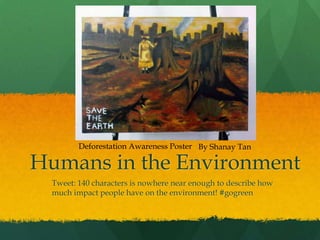
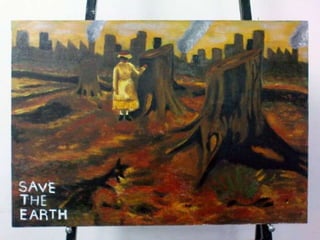
Deforestation Awareness Poster By Shanay Tan
Introduction
https://www.youtube.com/watch?v=5cXntJFWv5U
Moral of the story
UNLESS someone like you
cares a whole awful lot,
nothing is going to get better.
It’s not.
- Dr. Seuss
Research Focus
 Focus: How people are perceived in the environment
 Shallow Culture
 Visual arts
 Deep Culture
 Concept of beauty
 Relationship to animals
 Concept of cleanliness
 Concept of past and future
Research Questions
 How does our concept of beauty in the environment
change as human society developments progress
through the environment?
 How has human involvement changed the
environment’s condition from the past, and if this
continues, where will it be in the future?
Research thesis
 We view the environment as art. But when people
come into the environment and use its recourses for
their benefit, it is viewed as destruction.
Research Results
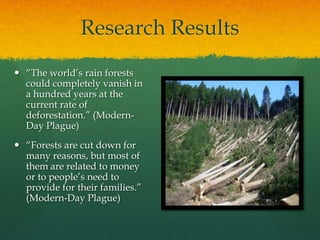
 “The world’s rain forests
could completely vanish in
a hundred years at the
current rate of
deforestation.” (Modern-
Day Plague)
 “Forests are cut down for
many reasons, but most of
them are related to money
or to people’s need to
provide for their families.”
(Modern-Day Plague)
More Results
 “In the past 150 years, various
activities have pumped enough
carbon dioxide into the
atmosphere to raise its levels
higher than they have been for
hundreds of thousands of
years.” (Air Pollution)
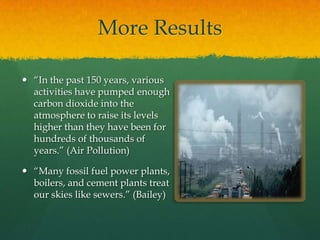
 “Many fossil fuel power plants,
boilers, and cement plants treat
our skies like sewers.” (Bailey)
More Results
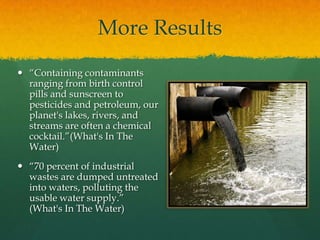
 “Containing contaminants
ranging from birth control
pills and sunscreen to
pesticides and petroleum, our
planet's lakes, rivers, and
streams are often a chemical
cocktail.”(What's In The
Water)
 “70 percent of industrial
wastes are dumped untreated
into waters, polluting the
usable water supply.”
(What's In The Water)
Art piece
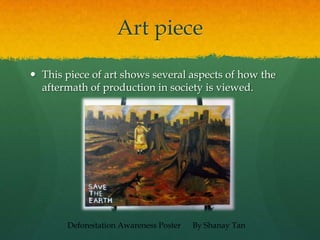
 This piece of art shows several aspects of how the
aftermath of production in society is viewed.
Deforestation Awareness Poster By Shanay Tan
Art Analysis
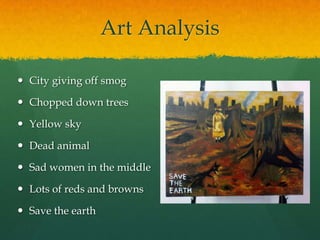
 City giving off smog
 Chopped down trees
 Yellow sky
 Dead animal
 Sad women in the middle
 Lots of reds and browns
 Save the earth
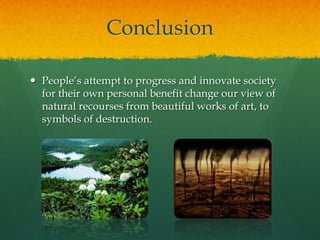
Conclusion
 People’s attempt to progress and innovate society
for their own personal benefit change our view of
natural recourses from beautiful works of art, to
symbols of destruction.
Work Cited
 "Modern-Day Plague." Deforestation. National Geographic, n.d. Web. 6 Apr 2014.
<http://environment.nationalgeographic.com/environment/global-
warming/deforestation-overview/
 "Air Pollution." Environment. National Geographic, n.d. Web. 6 Apr 2014.
<http://environment.nationalgeographic.com/environment/global-warming/pollution-
overview/
 Bailey, Diane. "Gasping for Air." Environmental Issues. Natural Resources Defense
Council, 20 7 2011. Web. 6 Apr 2014.
<http://www.nrdc.org/health/airpollutionhealthimpacts.asp>.
 "Find Out What's In The Water." Water Pollution. National Geographic, n.d. Web.
6 Apr 2014.
<http://environment.nationalgeographic.com/environment/freshwater/pollution/

Environment art

  • 1.
    Humans in theEnvironment Tweet: 140 characters is nowhere near enough to describe how much impact people have on the environment! #gogreen Deforestation Awareness Poster By Shanay Tan
  • 2.
  • 3.
    Moral of thestory UNLESS someone like you cares a whole awful lot, nothing is going to get better. It’s not. - Dr. Seuss
  • 4.
    Research Focus  Focus:How people are perceived in the environment  Shallow Culture  Visual arts  Deep Culture  Concept of beauty  Relationship to animals  Concept of cleanliness  Concept of past and future
  • 5.
    Research Questions  Howdoes our concept of beauty in the environment change as human society developments progress through the environment?  How has human involvement changed the environment’s condition from the past, and if this continues, where will it be in the future?
  • 6.
    Research thesis  Weview the environment as art. But when people come into the environment and use its recourses for their benefit, it is viewed as destruction.
  • 7.
    Research Results  “Theworld’s rain forests could completely vanish in a hundred years at the current rate of deforestation.” (Modern- Day Plague)  “Forests are cut down for many reasons, but most of them are related to money or to people’s need to provide for their families.” (Modern-Day Plague)
  • 8.
    More Results  “Inthe past 150 years, various activities have pumped enough carbon dioxide into the atmosphere to raise its levels higher than they have been for hundreds of thousands of years.” (Air Pollution)  “Many fossil fuel power plants, boilers, and cement plants treat our skies like sewers.” (Bailey)
  • 9.
    More Results  “Containingcontaminants ranging from birth control pills and sunscreen to pesticides and petroleum, our planet's lakes, rivers, and streams are often a chemical cocktail.”(What's In The Water)  “70 percent of industrial wastes are dumped untreated into waters, polluting the usable water supply.” (What's In The Water)
  • 10.
    Art piece  Thispiece of art shows several aspects of how the aftermath of production in society is viewed. Deforestation Awareness Poster By Shanay Tan
  • 12.
    Art Analysis  Citygiving off smog  Chopped down trees  Yellow sky  Dead animal  Sad women in the middle  Lots of reds and browns  Save the earth
  • 13.
    Conclusion  People’s attemptto progress and innovate society for their own personal benefit change our view of natural recourses from beautiful works of art, to symbols of destruction.
  • 14.
    Work Cited  "Modern-DayPlague." Deforestation. National Geographic, n.d. Web. 6 Apr 2014. <http://environment.nationalgeographic.com/environment/global- warming/deforestation-overview/  "Air Pollution." Environment. National Geographic, n.d. Web. 6 Apr 2014. <http://environment.nationalgeographic.com/environment/global-warming/pollution- overview/  Bailey, Diane. "Gasping for Air." Environmental Issues. Natural Resources Defense Council, 20 7 2011. Web. 6 Apr 2014. <http://www.nrdc.org/health/airpollutionhealthimpacts.asp>.  "Find Out What's In The Water." Water Pollution. National Geographic, n.d. Web. 6 Apr 2014. <http://environment.nationalgeographic.com/environment/freshwater/pollution/