Entity
Relationship
Diagram
Data Modeling
dataprojecthub
Created By : Vishnu
Agenda
What is ER diagram?
Why Entity Relationship is
important?
Components of an Entity
Relationship diagram
Create Entity Relationship
Diagram in SSMS
Data model vs Entity
Relationship diagram
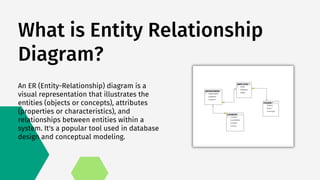
An ER (Entity-Relationship) diagram is a
visual representation that illustrates the
entities (objects or concepts), attributes
(properties or characteristics), and
relationships between entities within a
system. It's a popular tool used in database
design and conceptual modeling.
What is Entity Relationship
Diagram?
Why Entity
Relationship is
important?
Database Design
They allow designers to conceptualize the entities within the system, their
attributes, and the relationships between them. This understanding is fundamental
in creating a well-organized, efficient database structure.
Identifying Relationships
ERDs help in identifying and defining the relationships between entities (such as
one-to-one, one-to-many, many-to-many). Understanding these relationships is
essential for maintaining data integrity.
Normalization
Normalization is a technique used to reduce data redundancy and improve data
integrity. ERDs aid in identifying dependencies and normalizing the database
structure.
Planning and Scalability
ERDs help in planning for scalability and future modifications. Designers can
anticipate potential changes and adapt the database structure accordingly.
Components of
Entity Relationship
Diagram
Entity
Objects or concepts in a system that are represented by rectangles in the diagram.
Attributes
Attributes represent properties or characteristics of entities and are depicted
within the entity boxes.
Relationships
Relationships describe how entities are related to each other. They are
represented by lines connecting the entities and typically labeled to define the
nature of the relationship (e.g., one-to-one, one-to-many, many-to-many).
Cardinality
Cardinality in ER diagrams indicates the number of instances of one entity that can
be associated with the number of instances of another entity through a
relationship. It defines the participation of entities in a relationship (such as one-
to-one, one-to-many, or many-to-many).
Create Entity Relationship
Diagram in SSMS
@dataprojecthub
Data model vs Entity
Relationship diagram
ERD is a visual representation of the data model, but they are not precisely the
same thing.
Data model is a more comprehensive concept. It refers to an abstract model that
organizes elements of data and how they relate to each other and the real world.
A data model can be represented in various forms, such as:
Conceptual Data Model: A high-level, abstract representation of the overall
structure and relationships of data. It focuses on entities and their
relationships.
Logical Data Model: This model defines the structure of the data elements,
their relationships, and constraints in detail.
Physical Data Model: This model represents the actual implementation of the
database on a specific database management system, including details like
data types, indexing, keys, and other physical implementation aspects.

Entity Relation Diagram (ERD) | Data Modeling | Data Analytics | DBMS

  • 1.
  • 2.
    Agenda What is ERdiagram? Why Entity Relationship is important? Components of an Entity Relationship diagram Create Entity Relationship Diagram in SSMS Data model vs Entity Relationship diagram
  • 3.
    An ER (Entity-Relationship)diagram is a visual representation that illustrates the entities (objects or concepts), attributes (properties or characteristics), and relationships between entities within a system. It's a popular tool used in database design and conceptual modeling. What is Entity Relationship Diagram?
  • 4.
    Why Entity Relationship is important? DatabaseDesign They allow designers to conceptualize the entities within the system, their attributes, and the relationships between them. This understanding is fundamental in creating a well-organized, efficient database structure. Identifying Relationships ERDs help in identifying and defining the relationships between entities (such as one-to-one, one-to-many, many-to-many). Understanding these relationships is essential for maintaining data integrity. Normalization Normalization is a technique used to reduce data redundancy and improve data integrity. ERDs aid in identifying dependencies and normalizing the database structure. Planning and Scalability ERDs help in planning for scalability and future modifications. Designers can anticipate potential changes and adapt the database structure accordingly.
  • 5.
    Components of Entity Relationship Diagram Entity Objectsor concepts in a system that are represented by rectangles in the diagram. Attributes Attributes represent properties or characteristics of entities and are depicted within the entity boxes. Relationships Relationships describe how entities are related to each other. They are represented by lines connecting the entities and typically labeled to define the nature of the relationship (e.g., one-to-one, one-to-many, many-to-many). Cardinality Cardinality in ER diagrams indicates the number of instances of one entity that can be associated with the number of instances of another entity through a relationship. It defines the participation of entities in a relationship (such as one- to-one, one-to-many, or many-to-many).
  • 6.
    Create Entity Relationship Diagramin SSMS @dataprojecthub
  • 7.
    Data model vsEntity Relationship diagram ERD is a visual representation of the data model, but they are not precisely the same thing. Data model is a more comprehensive concept. It refers to an abstract model that organizes elements of data and how they relate to each other and the real world. A data model can be represented in various forms, such as: Conceptual Data Model: A high-level, abstract representation of the overall structure and relationships of data. It focuses on entities and their relationships. Logical Data Model: This model defines the structure of the data elements, their relationships, and constraints in detail. Physical Data Model: This model represents the actual implementation of the database on a specific database management system, including details like data types, indexing, keys, and other physical implementation aspects.