Entity Component Systems
Yos Riady
yos.io
goo.gl/ECeFOI
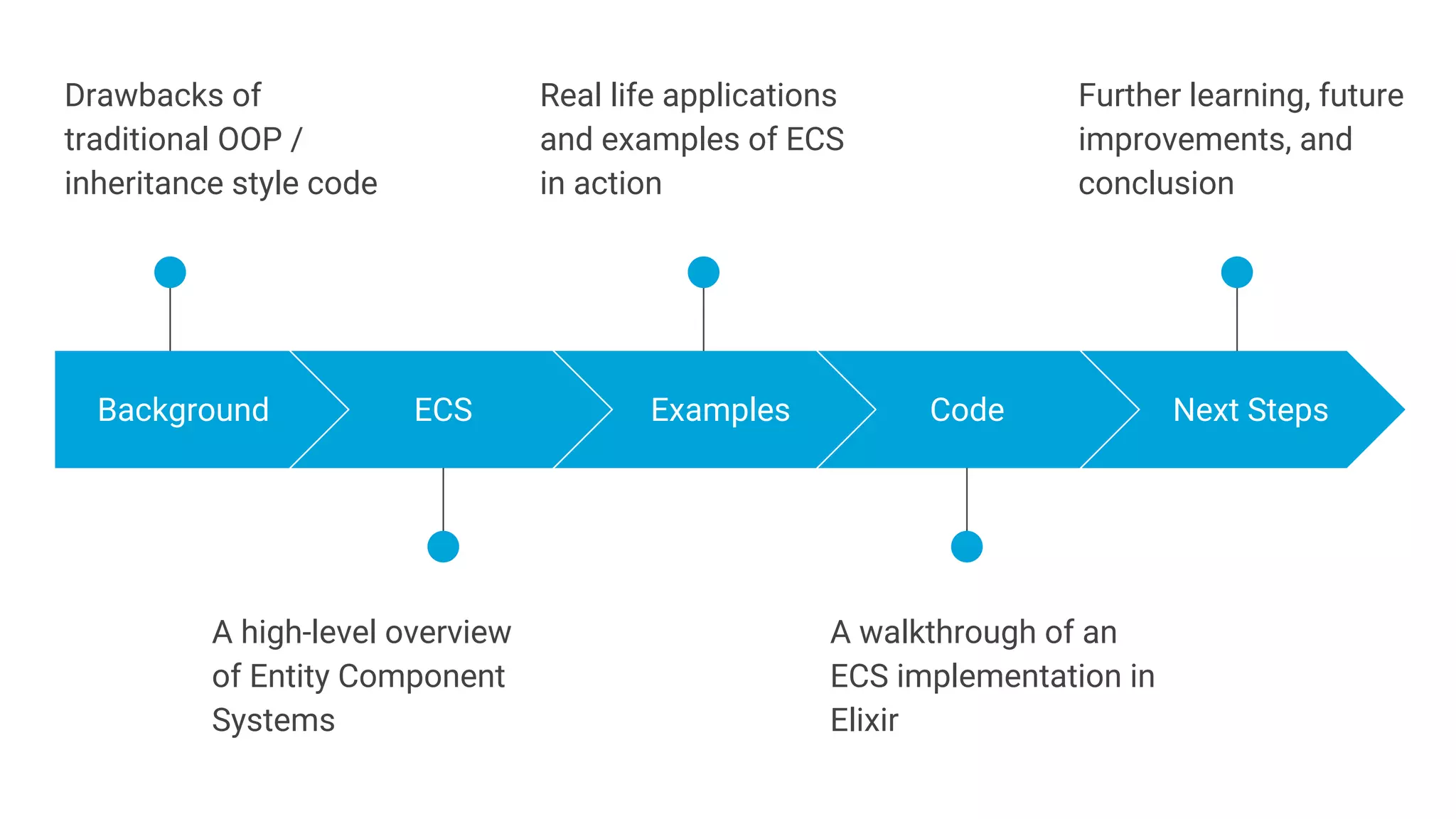
A walkthrough of an
ECS implementation in
Elixir
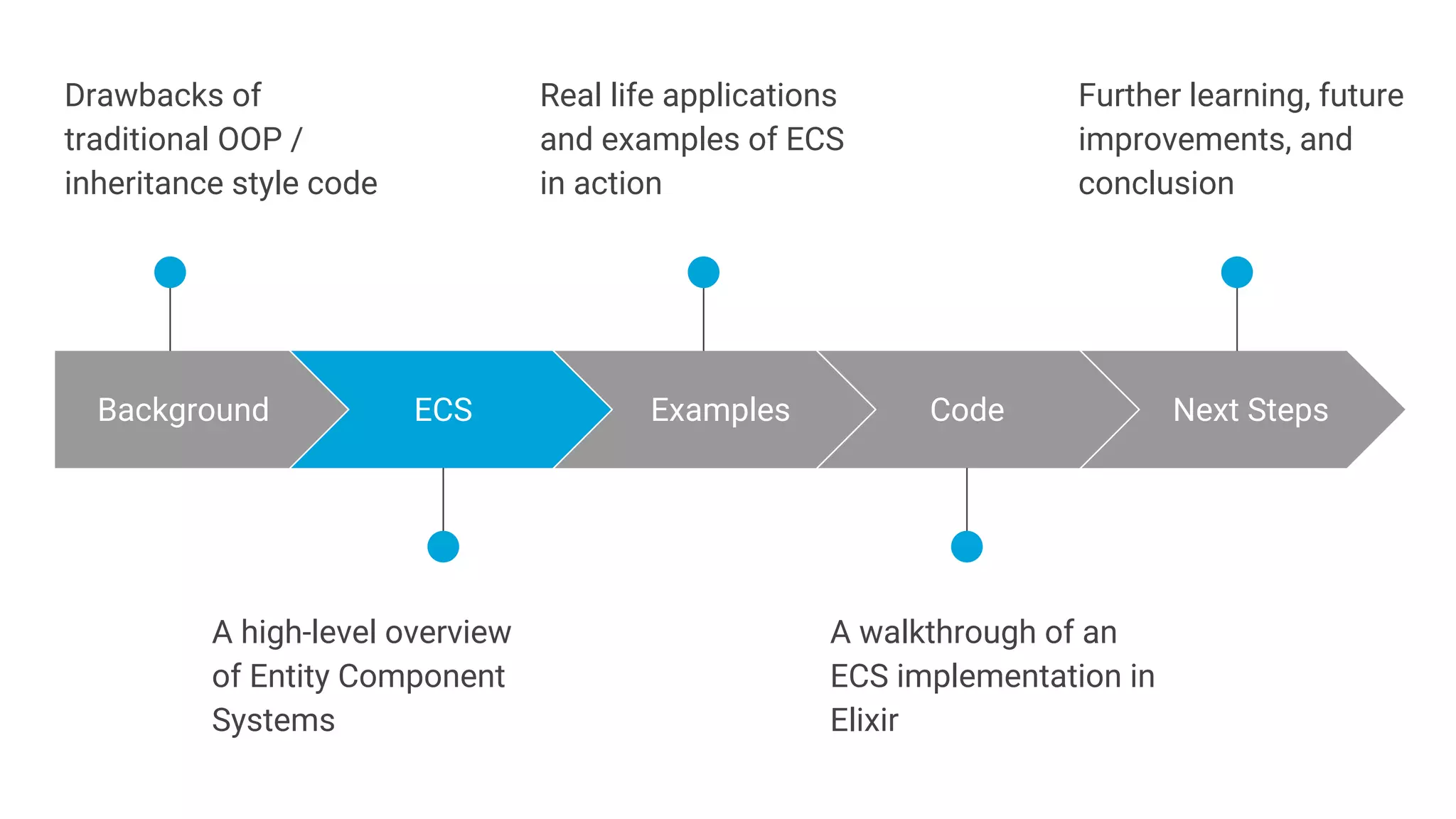
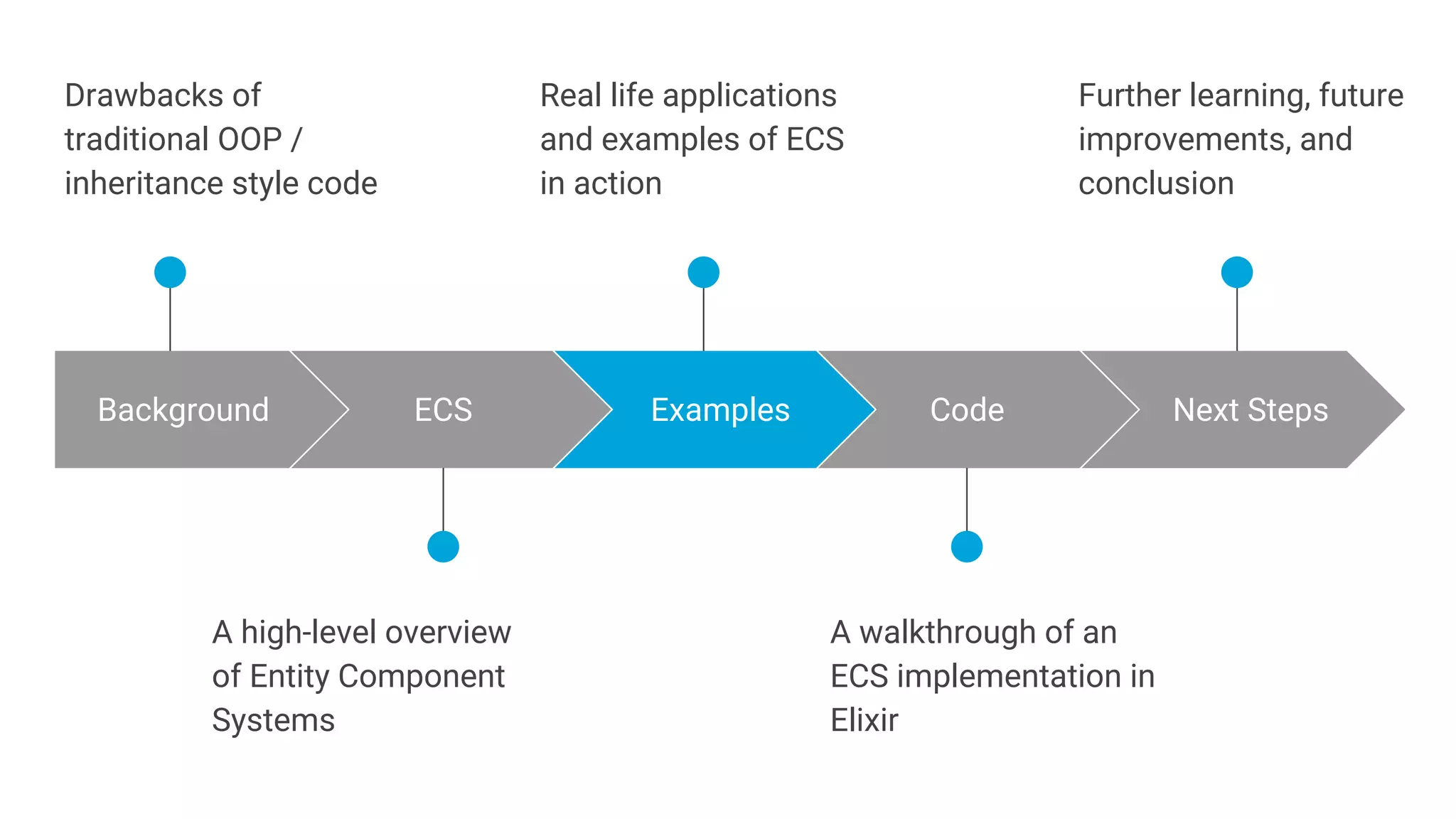
A high-level overview
of Entity Component
Systems
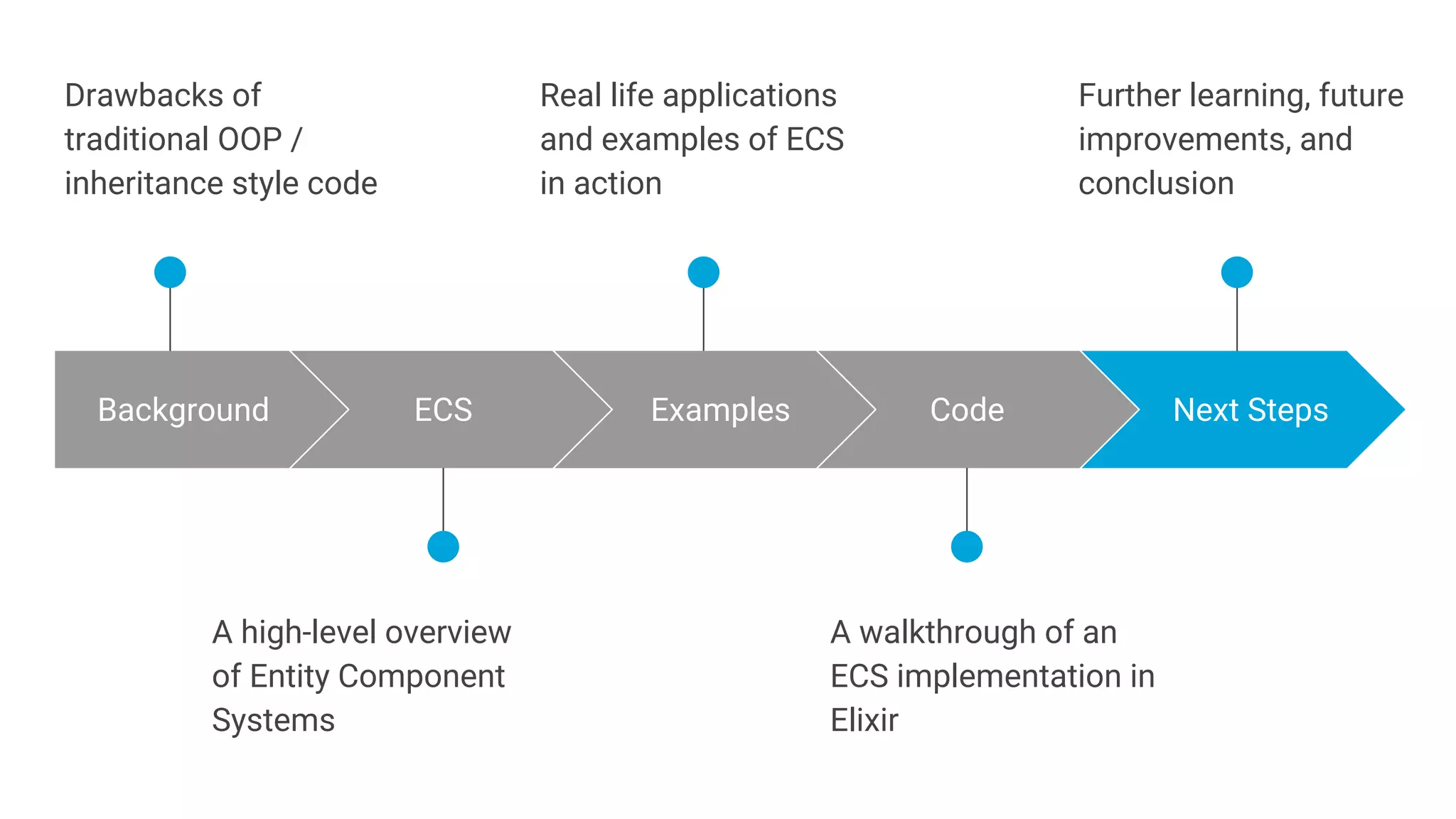
Background
Drawbacks of
traditional OOP /
inheritance style code
ECS Examples Code Next Steps
Real life applications
and examples of ECS
in action
Further learning, future
improvements, and
conclusion
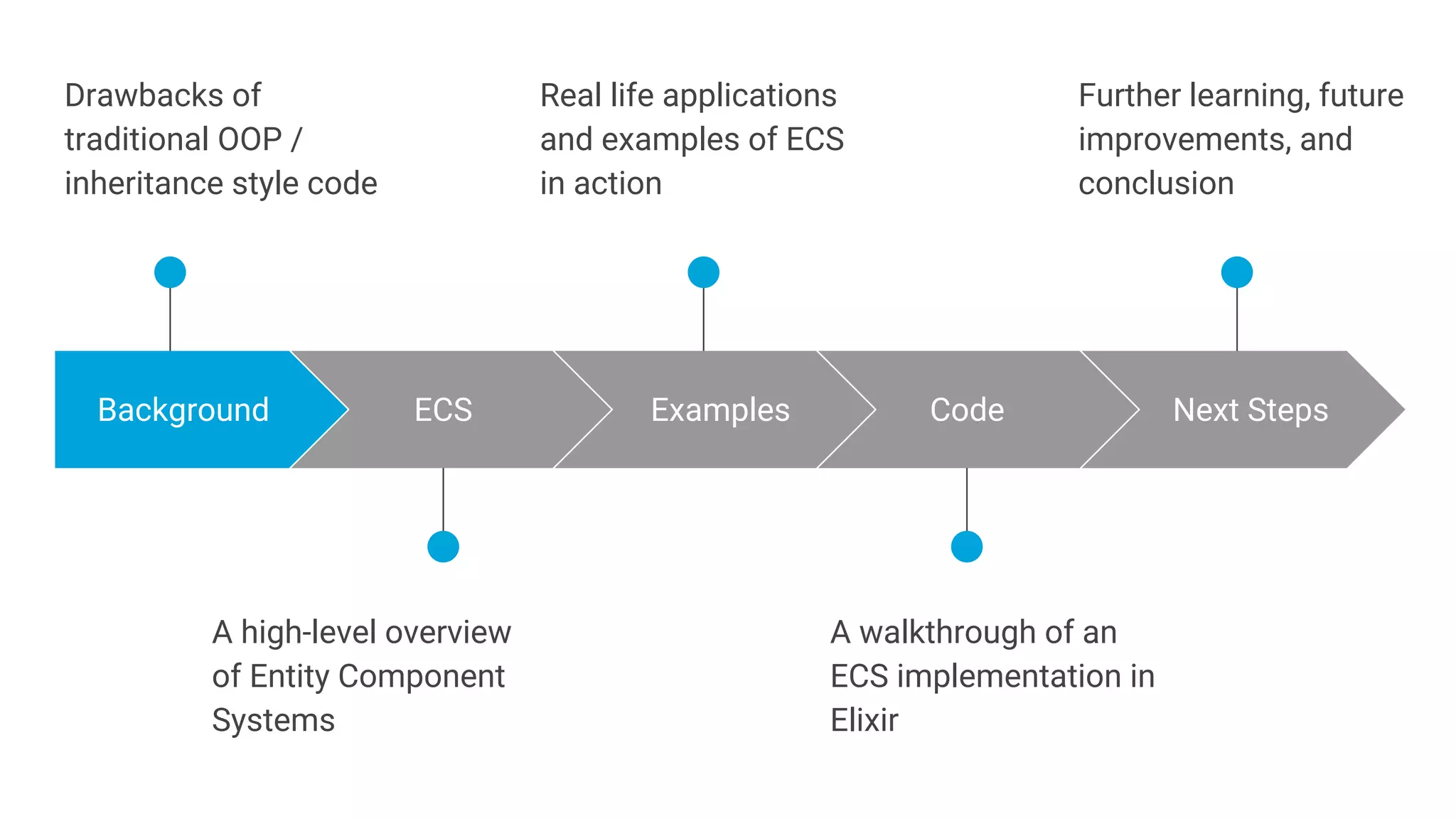
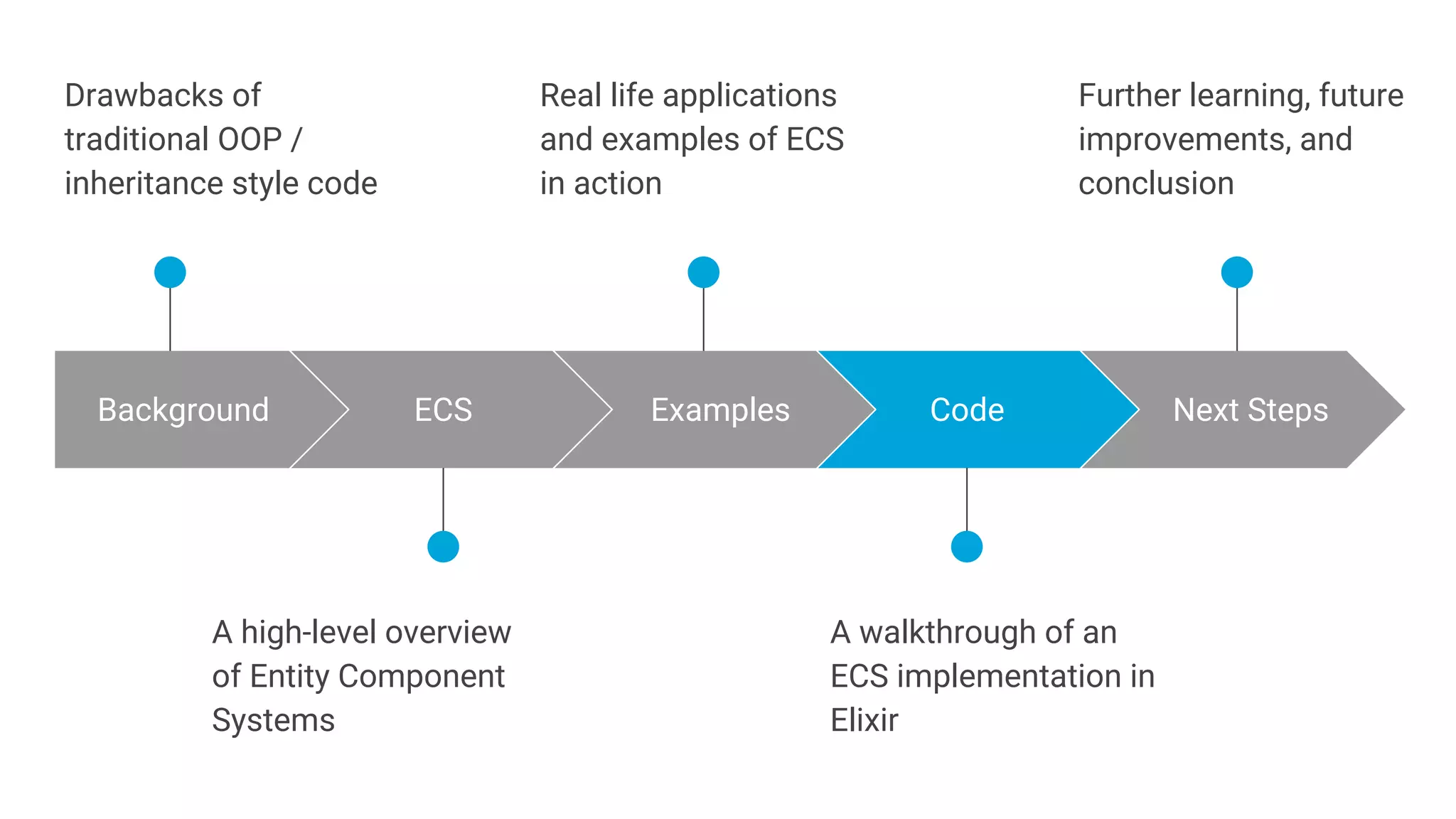
A walkthrough of an
ECS implementation in
Elixir
A high-level overview
of Entity Component
Systems
Background
Drawbacks of
traditional OOP /
inheritance style code
ECS Examples Code Next Steps
Real life applications
and examples of ECS
in action
Further learning, future
improvements, and
conclusion
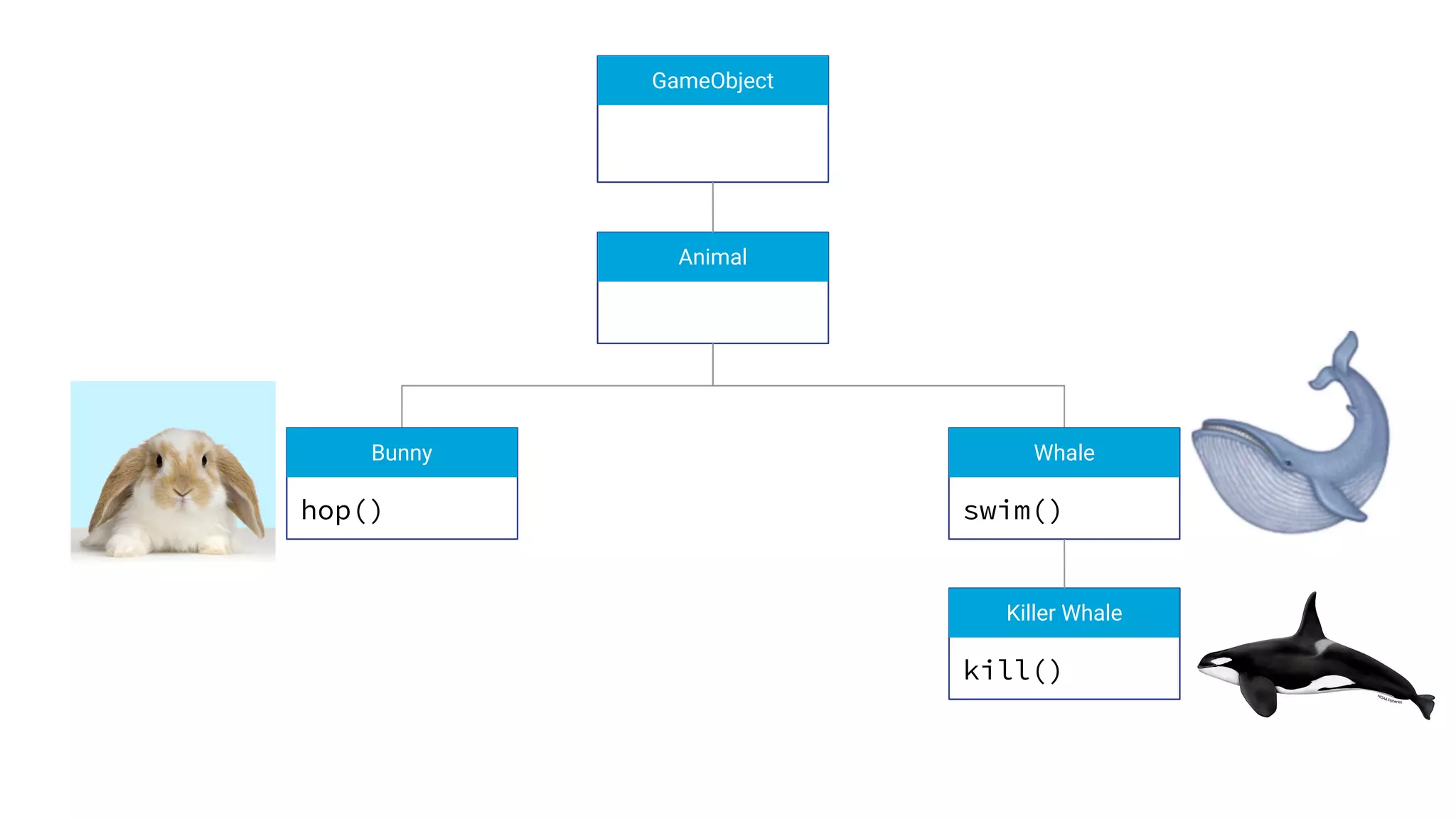
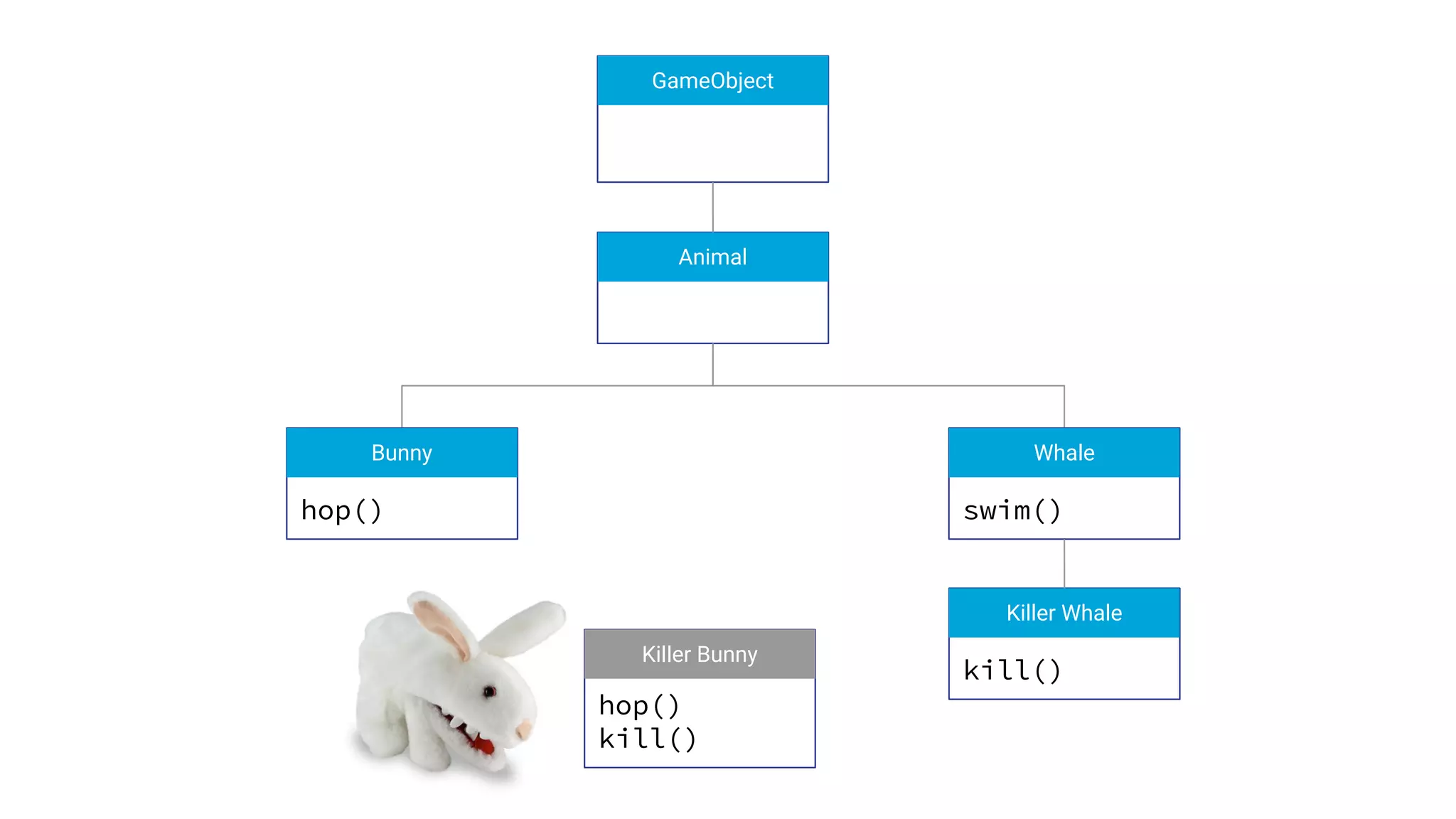
Animal
hop()
Bunny
swim()
Whale
GameObject
kill()
Killer Whale
Animal
hop()
Bunny
swim()
Whale
hop()
kill()
Killer Bunny
GameObject
kill()
Killer Whale
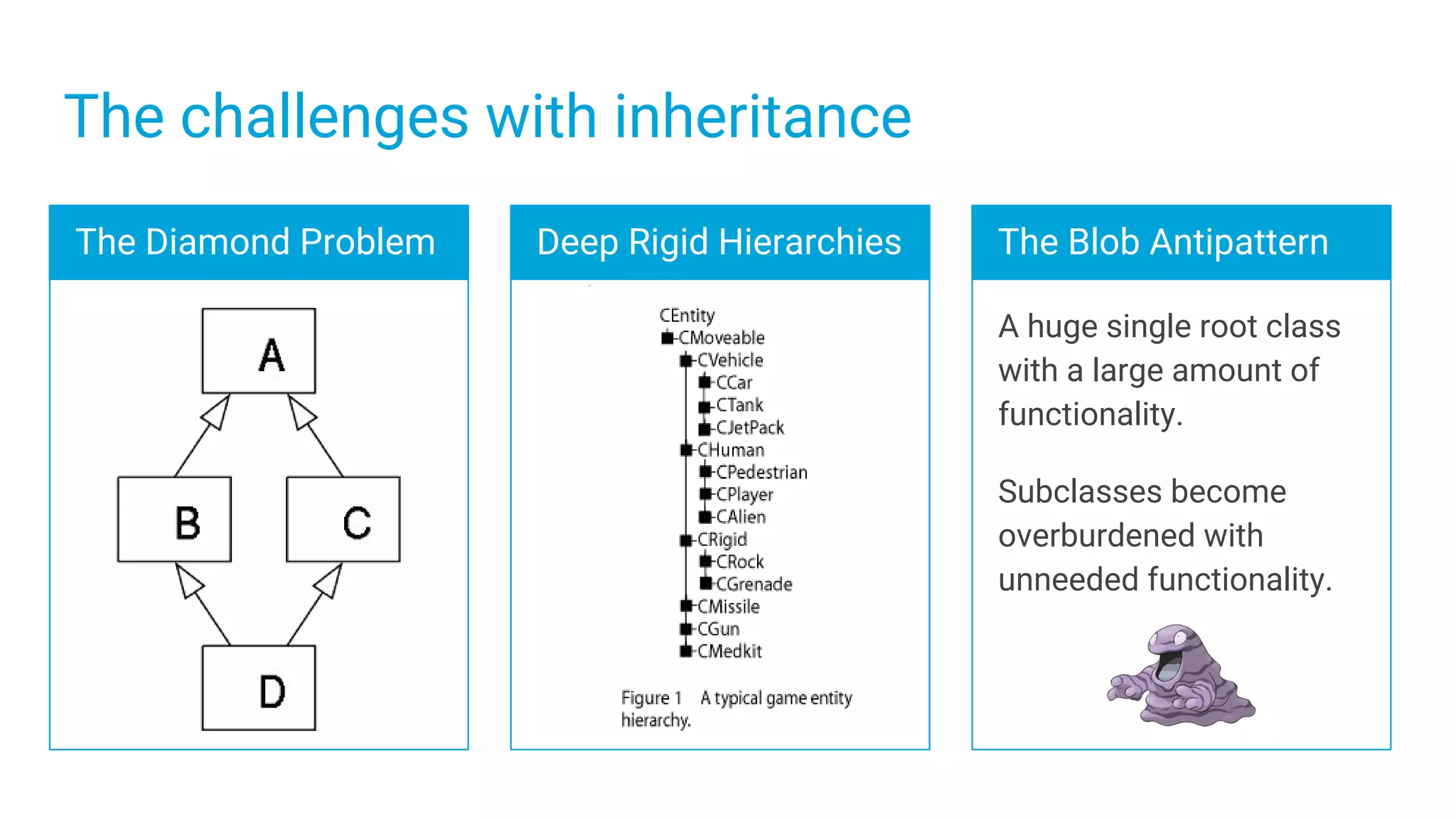
The challenges with inheritance
The Blob Antipattern
A huge single root class
with a large amount of
functionality.
Subclasses become
overburdened with
unneeded functionality.
Deep Rigid HierarchiesThe Diamond Problem
A walkthrough of an
ECS implementation in
Elixir
A high-level overview
of Entity Component
Systems
Background
Drawbacks of
traditional OOP /
inheritance style code
ECS Examples Code Next Steps
Real life applications
and examples of ECS
in action
Further learning, future
improvements, and
conclusion
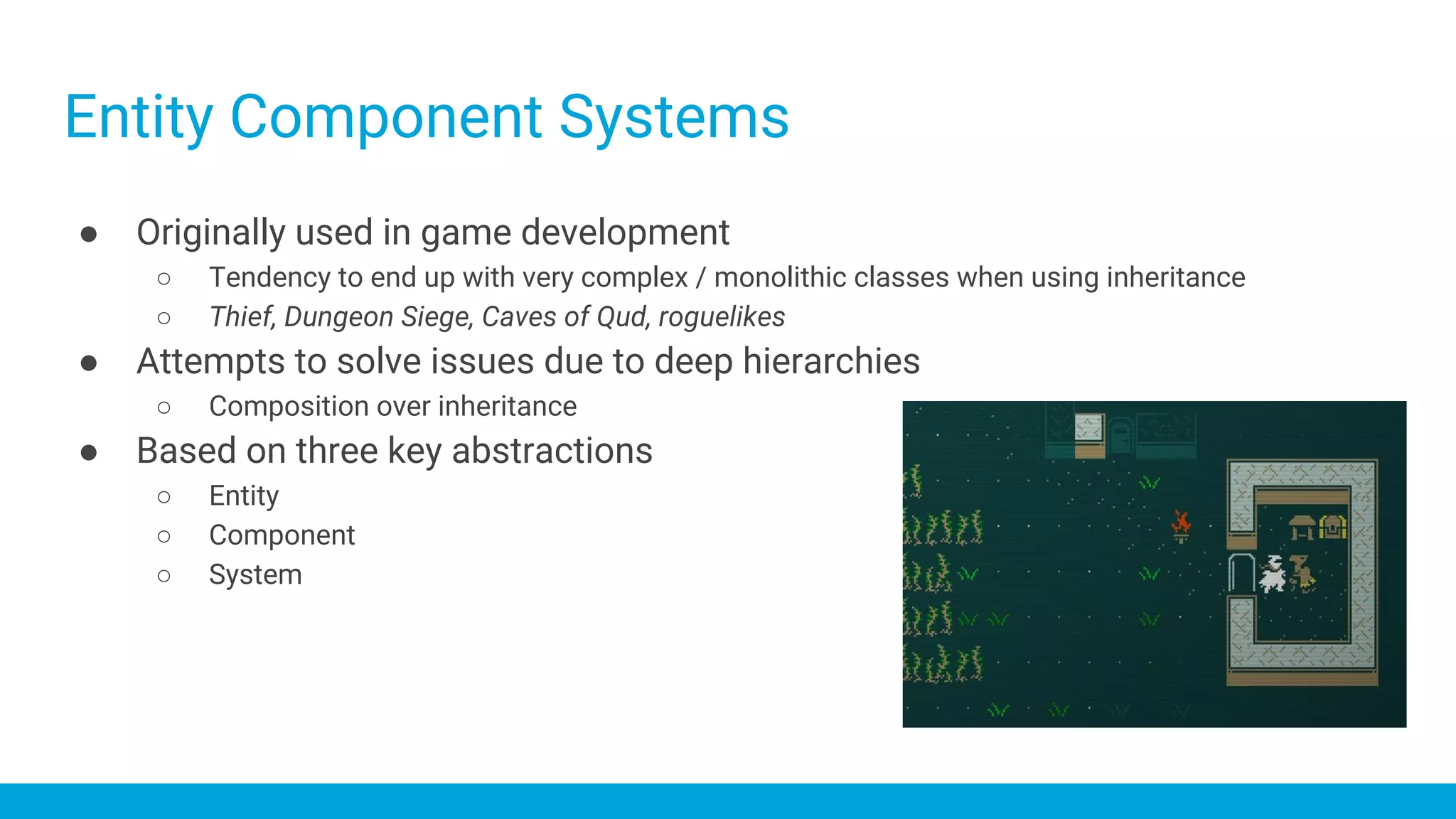
Entity Component Systems
● Originally used in game development
○ Tendency to end up with very complex / monolithic classes when using inheritance
○ Thief, Dungeon Siege, Caves of Qud, roguelikes
● Attempts to solve issues due to deep hierarchies
○ Composition over inheritance
● Based on three key abstractions
○ Entity
○ Component
○ System
Entity Component Systems
Component
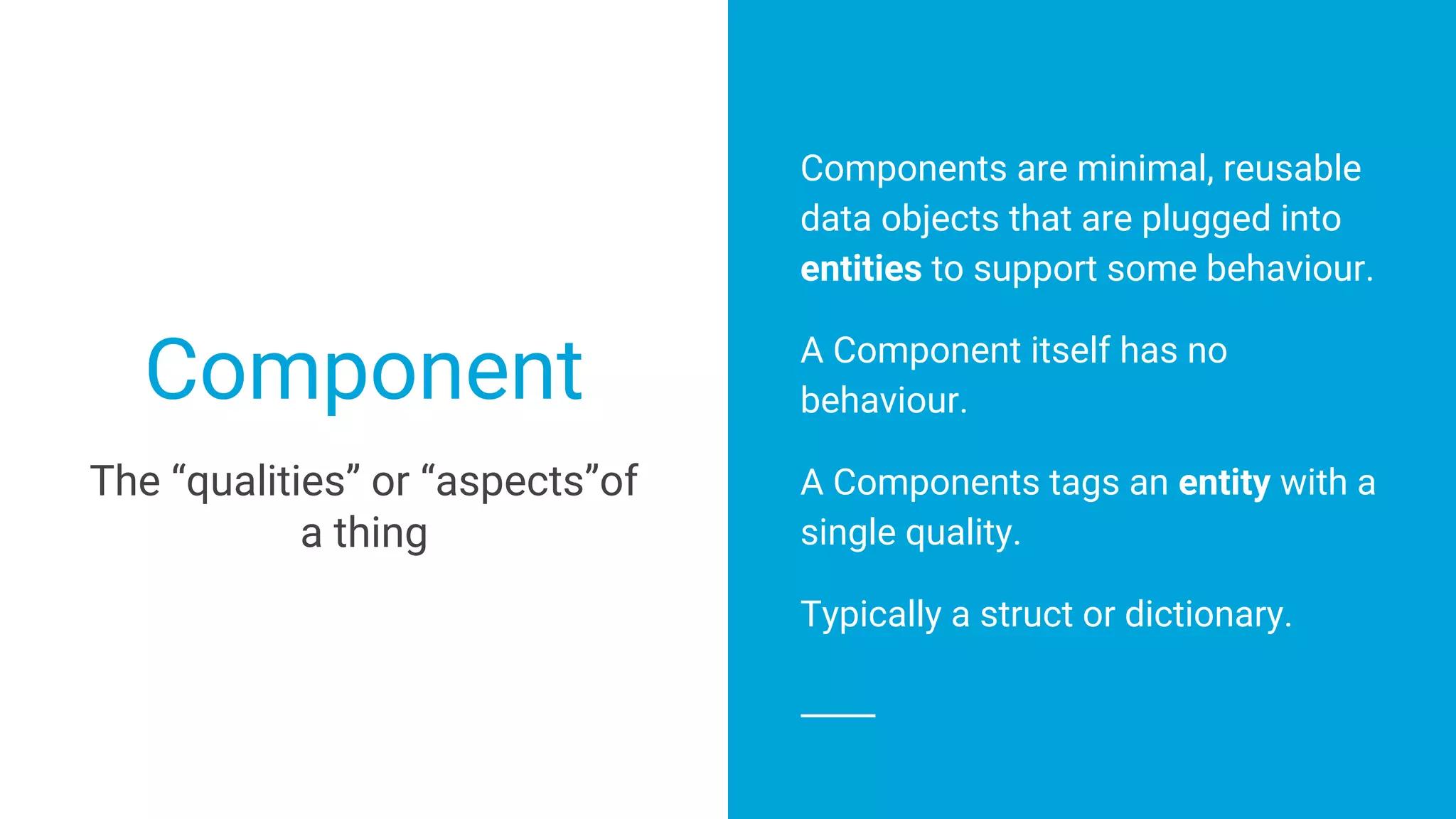
Components are minimal, reusable
data objects that are plugged into
entities to support some behaviour.
A Component itself has no
behaviour.
A Components tags an entity with a
single quality.
Typically a struct or dictionary.
The “qualities” or “aspects”of
a thing
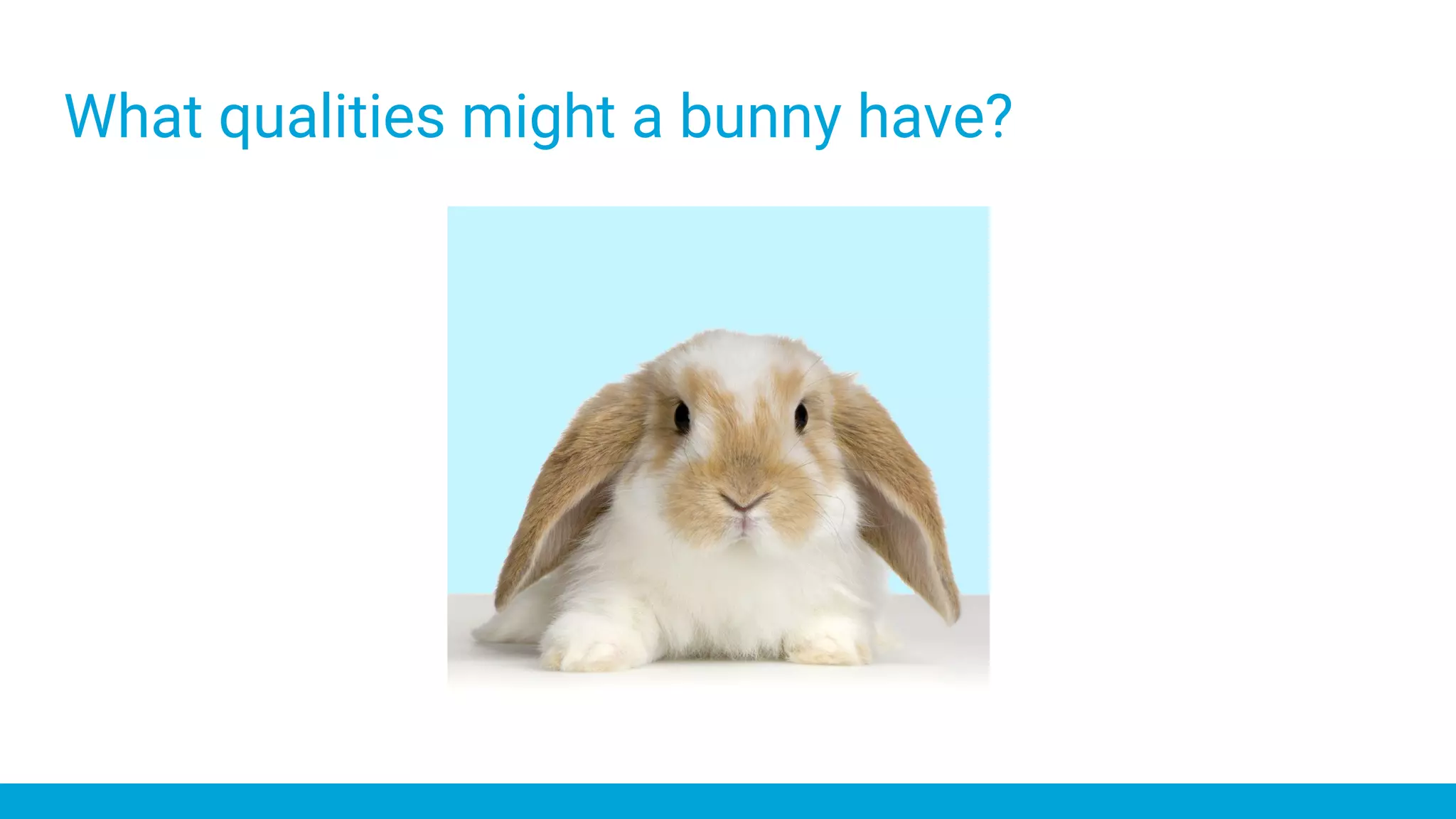
What qualities might a bunny have?
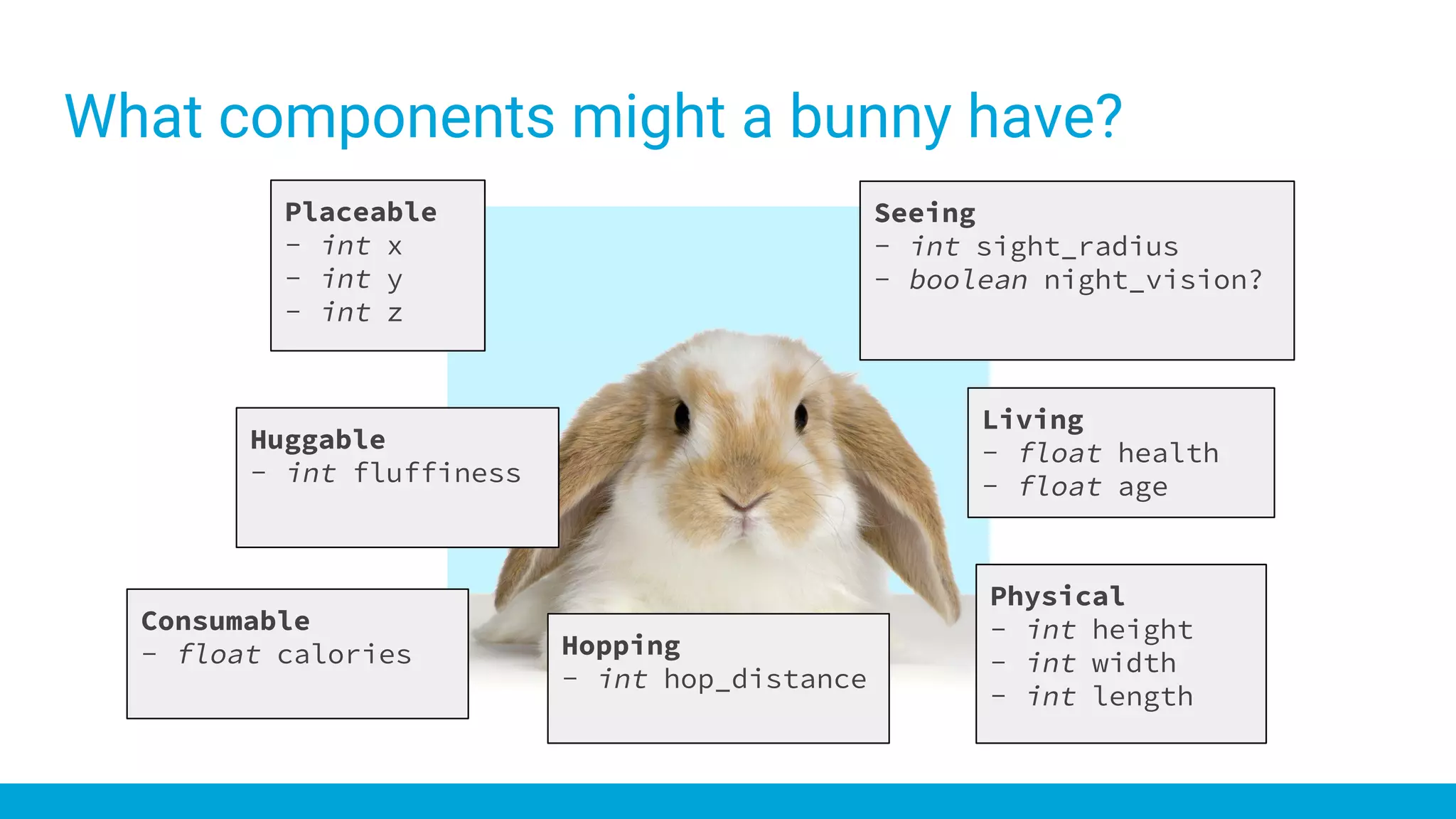
What components might a bunny have?
Placeable
- int x
- int y
- int z
Huggable
- int fluffiness
Consumable
- float calories
Seeing
- int sight_radius
- boolean night_vision?
Living
- float health
- float age
Hopping
- int hop_distance
Physical
- int height
- int width
- int length
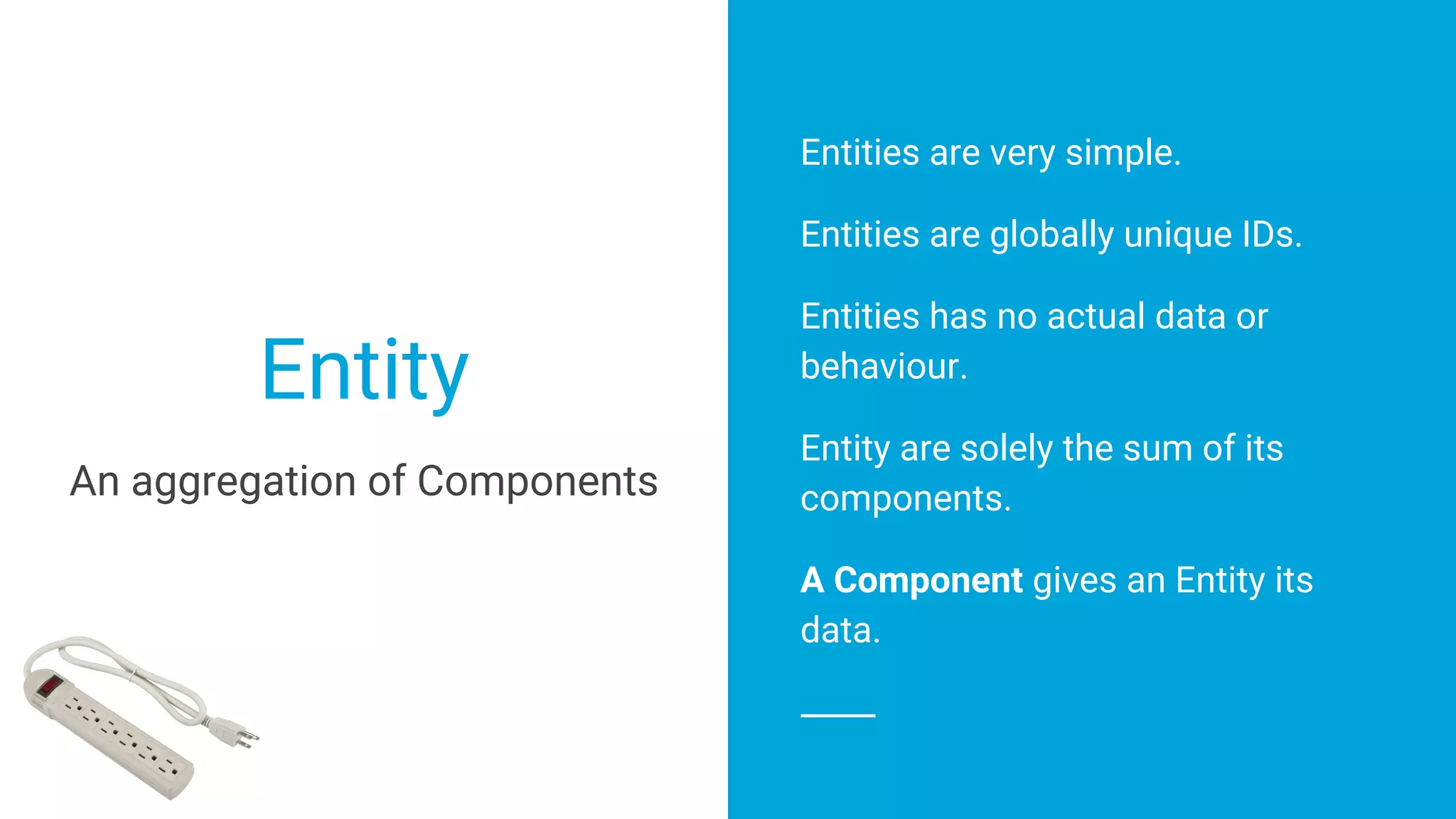
Entities are very simple.
Entities are globally unique IDs.
Entities has no actual data or
behaviour.
Entity are solely the sum of its
components.
A Component gives an Entity its
data.
Entity
An aggregation of Components
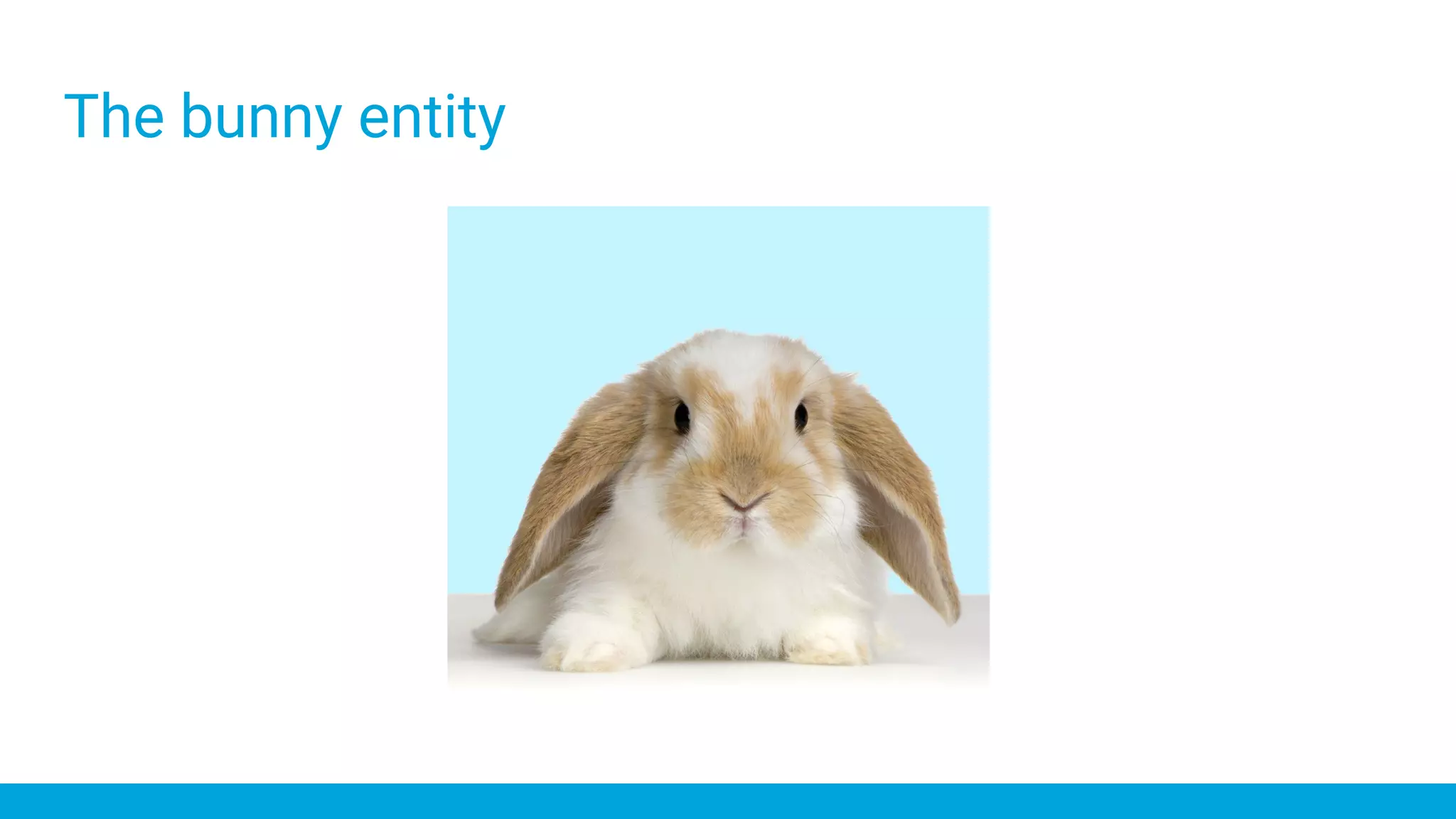
The bunny entity
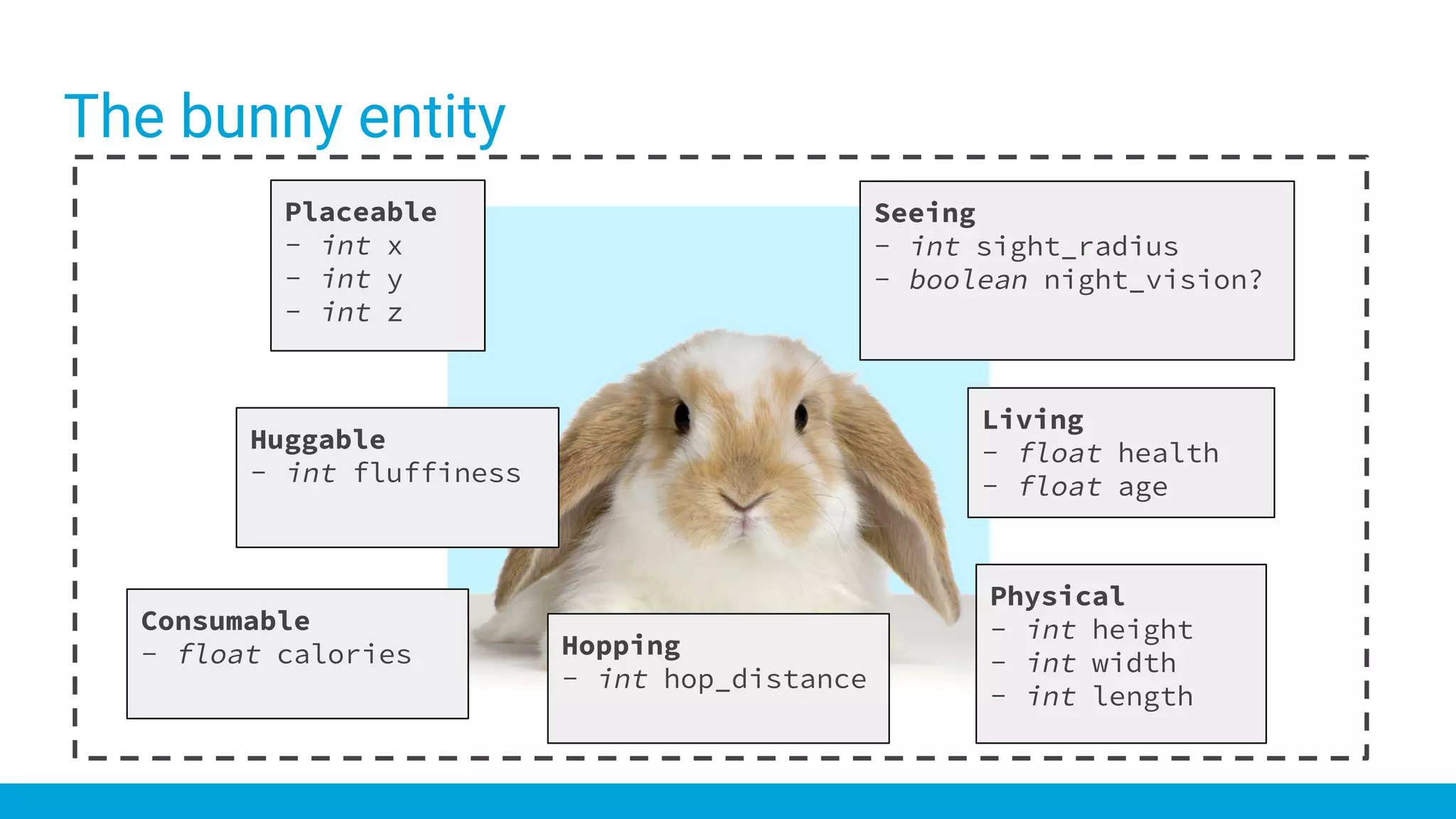
The bunny entity
Placeable
- int x
- int y
- int z
Huggable
- int fluffiness
Consumable
- float calories
Seeing
- int sight_radius
- boolean night_vision?
Living
- float health
- float age
Hopping
- int hop_distance
Physical
- int height
- int width
- int length
The carrot entity
Placeable
- int x
- int y
- int z
Consumable
- float calories
Physical
- int height
- int width
- int length
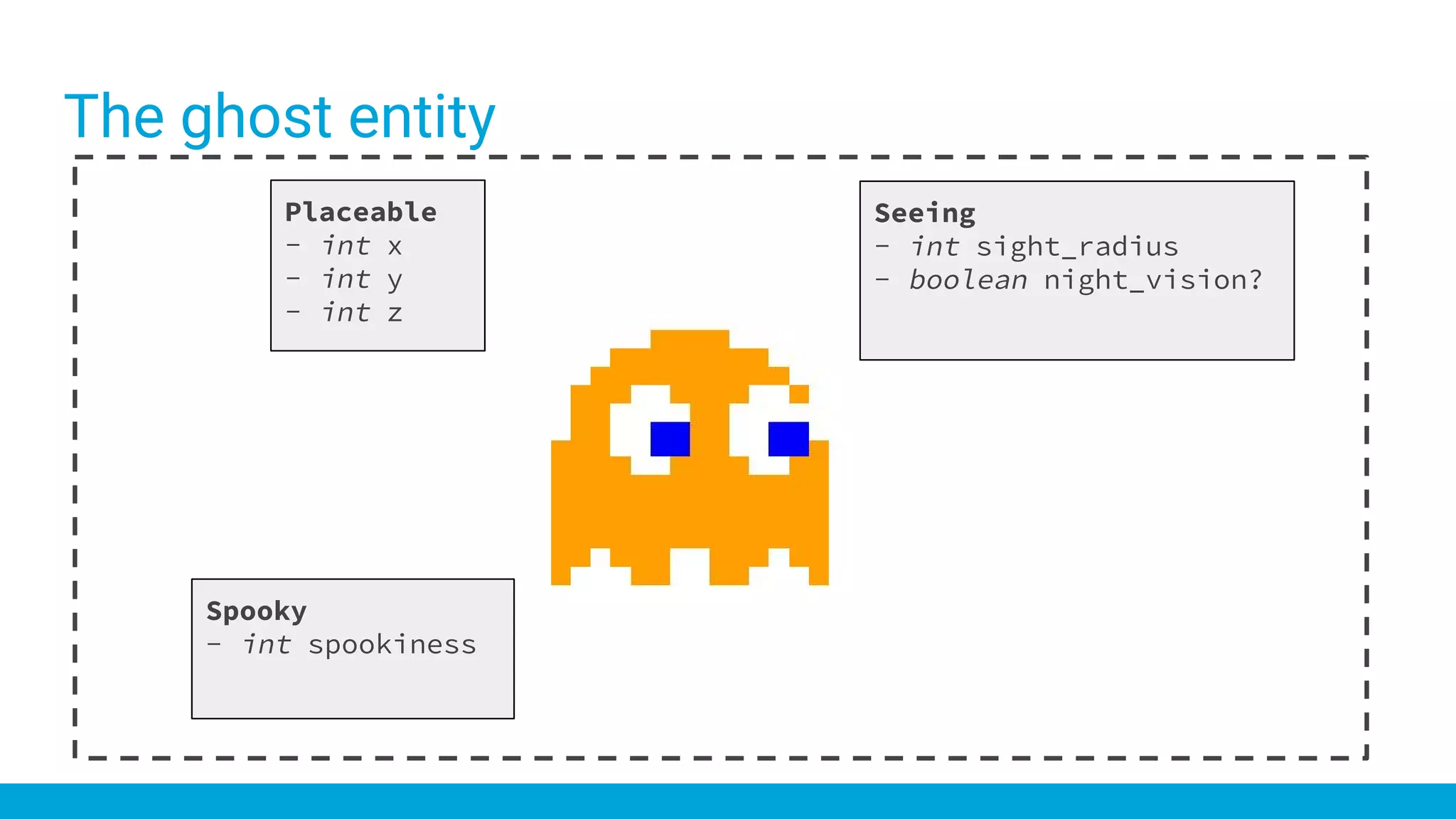
The ghost entity
Placeable
- int x
- int y
- int z
Spooky
- int spookiness
Seeing
- int sight_radius
- boolean night_vision?
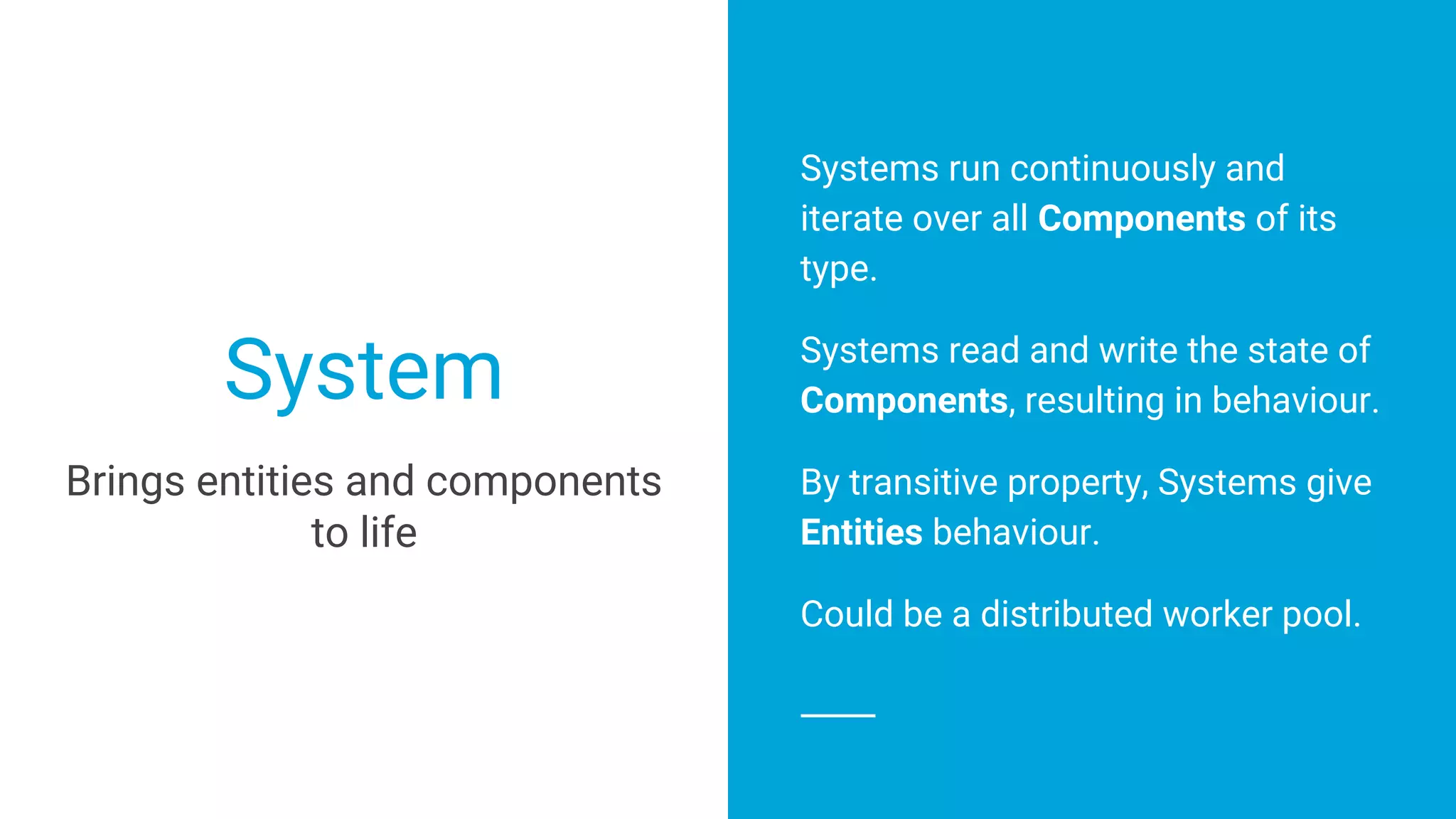
Systems run continuously and
iterate over all Components of its
type.
Systems read and write the state of
Components, resulting in behaviour.
By transitive property, Systems give
Entities behaviour.
Could be a distributed worker pool.
System
Brings entities and components
to life
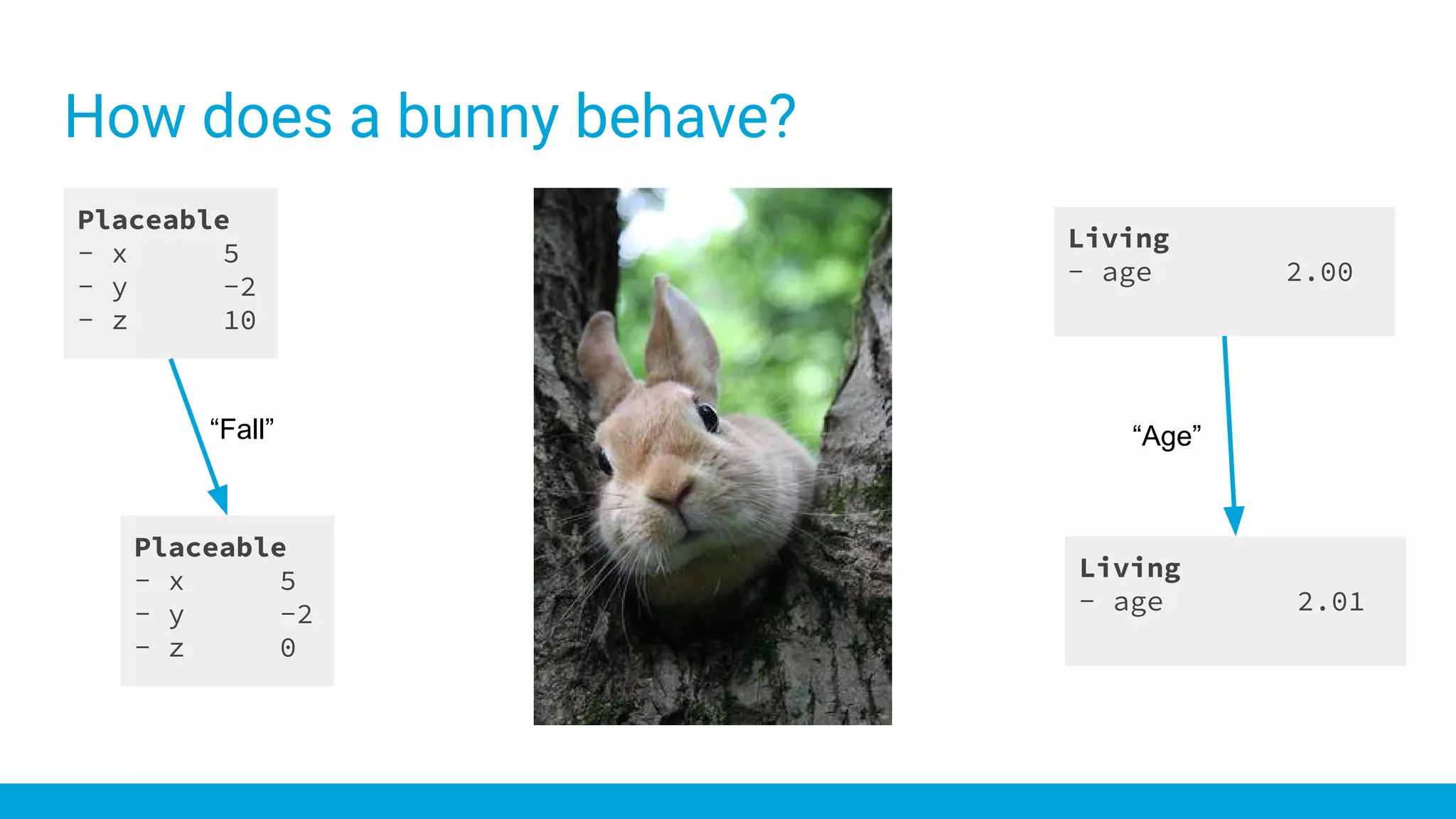
How does a bunny behave?
Placeable
- x 5
- y -2
- z 10
Living
- age 2.00
Placeable
- x 5
- y -2
- z 0
Living
- age 2.01
“Fall” “Age”
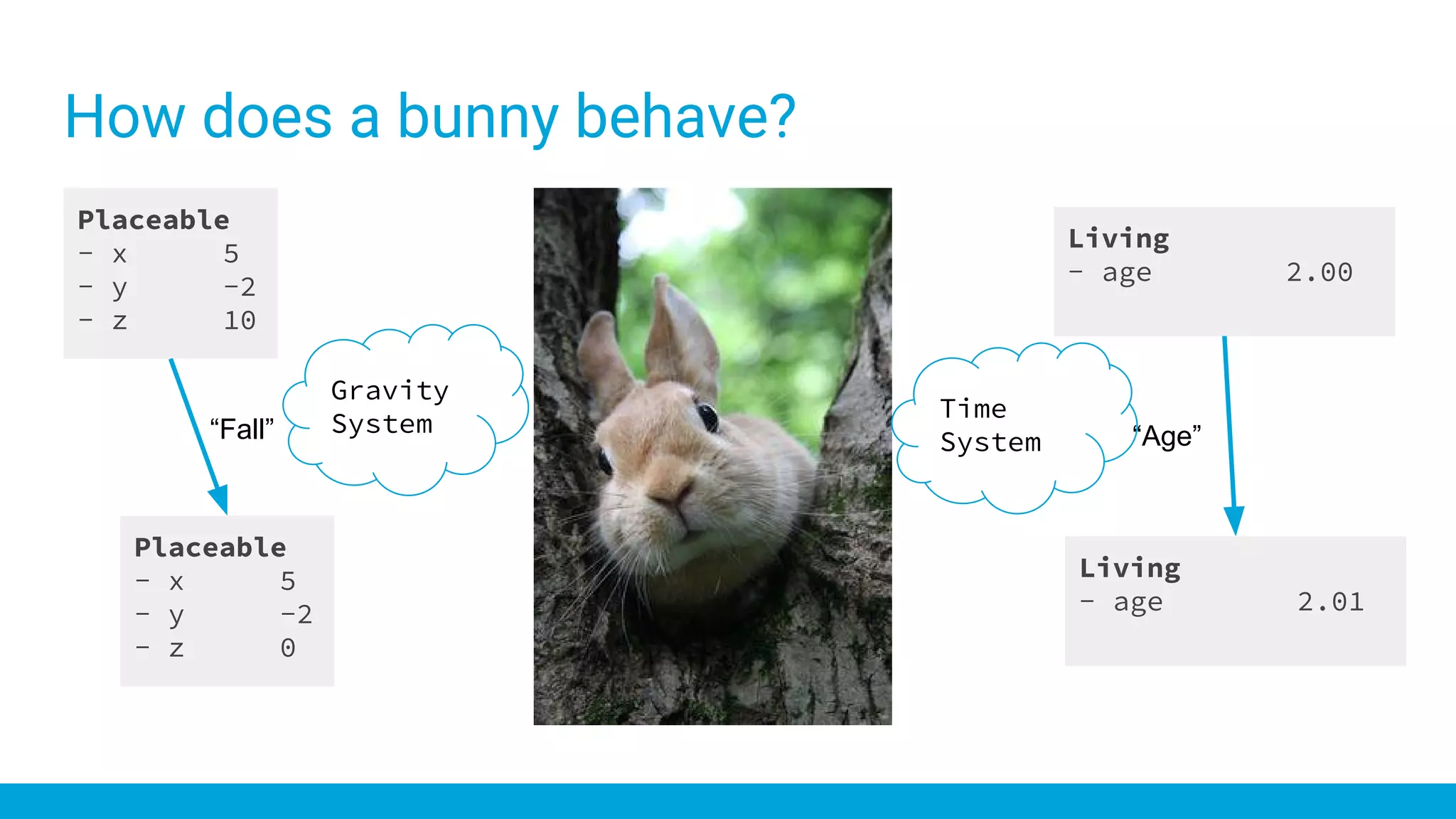
How does a bunny behave?
Placeable
- x 5
- y -2
- z 10
Living
- age 2.00
Placeable
- x 5
- y -2
- z 0
Living
- age 2.01
“Fall” “Age”
Gravity
System
Time
System
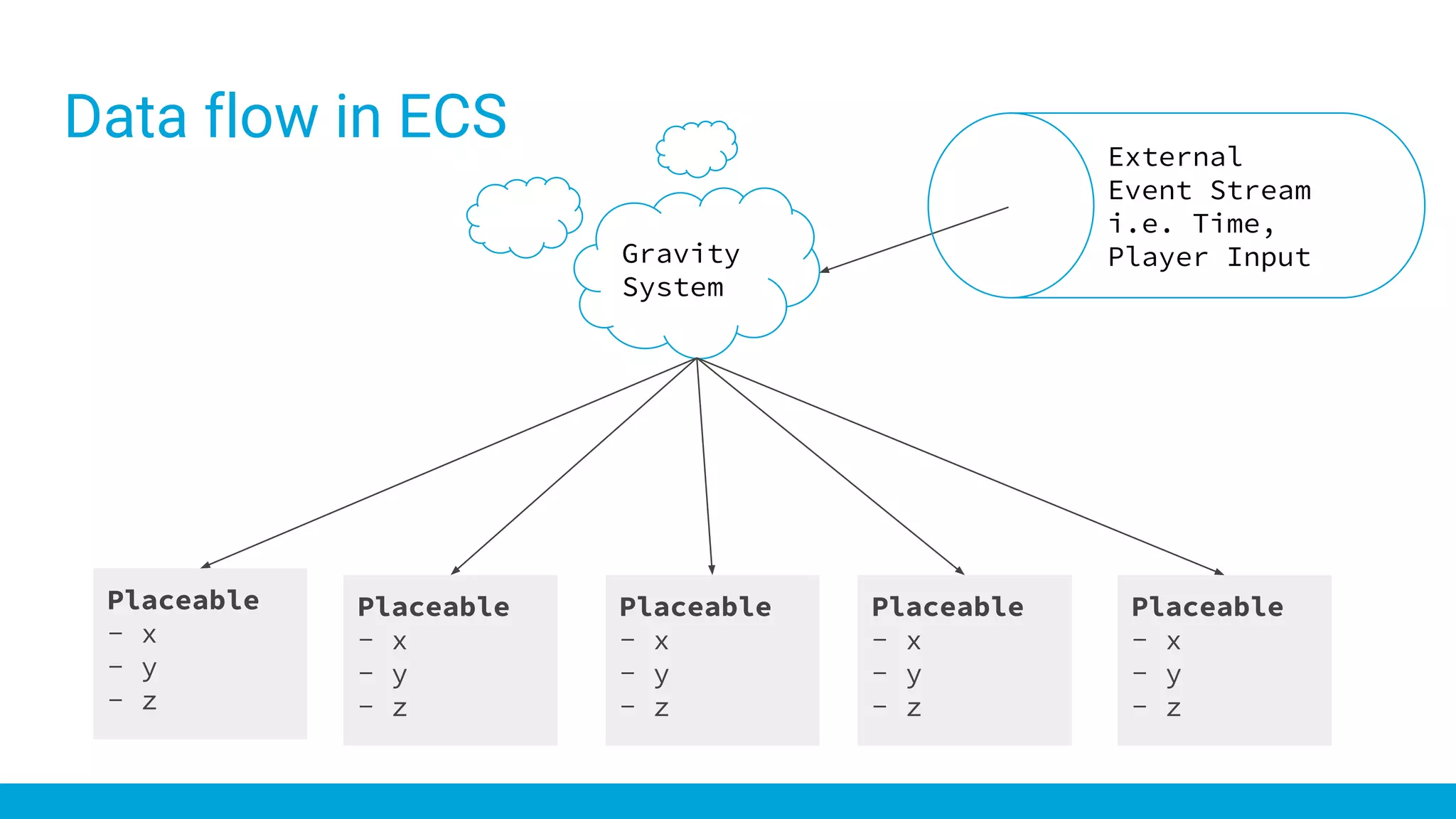
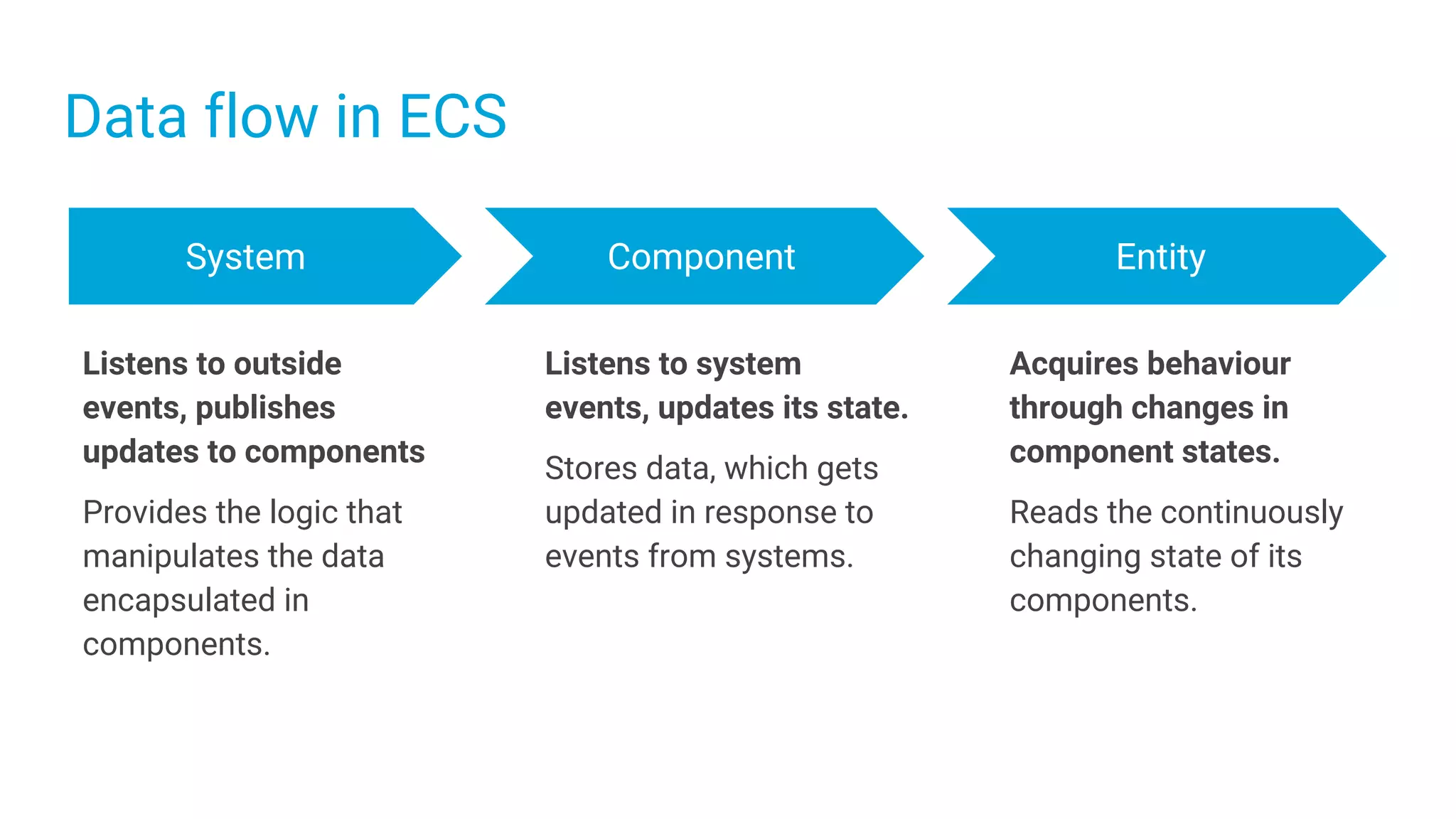
Data flow in ECS
Gravity
System
Placeable
- x
- y
- z
Placeable
- x
- y
- z
Placeable
- x
- y
- z
Placeable
- x
- y
- z
Placeable
- x
- y
- z
External
Event Stream
i.e. Time,
Player Input
Acquires behaviour
through changes in
component states.
Reads the continuously
changing state of its
components.
Listens to system
events, updates its state.
Stores data, which gets
updated in response to
events from systems.
Listens to outside
events, publishes
updates to components
Provides the logic that
manipulates the data
encapsulated in
components.
Data flow in ECS
System Component Entity
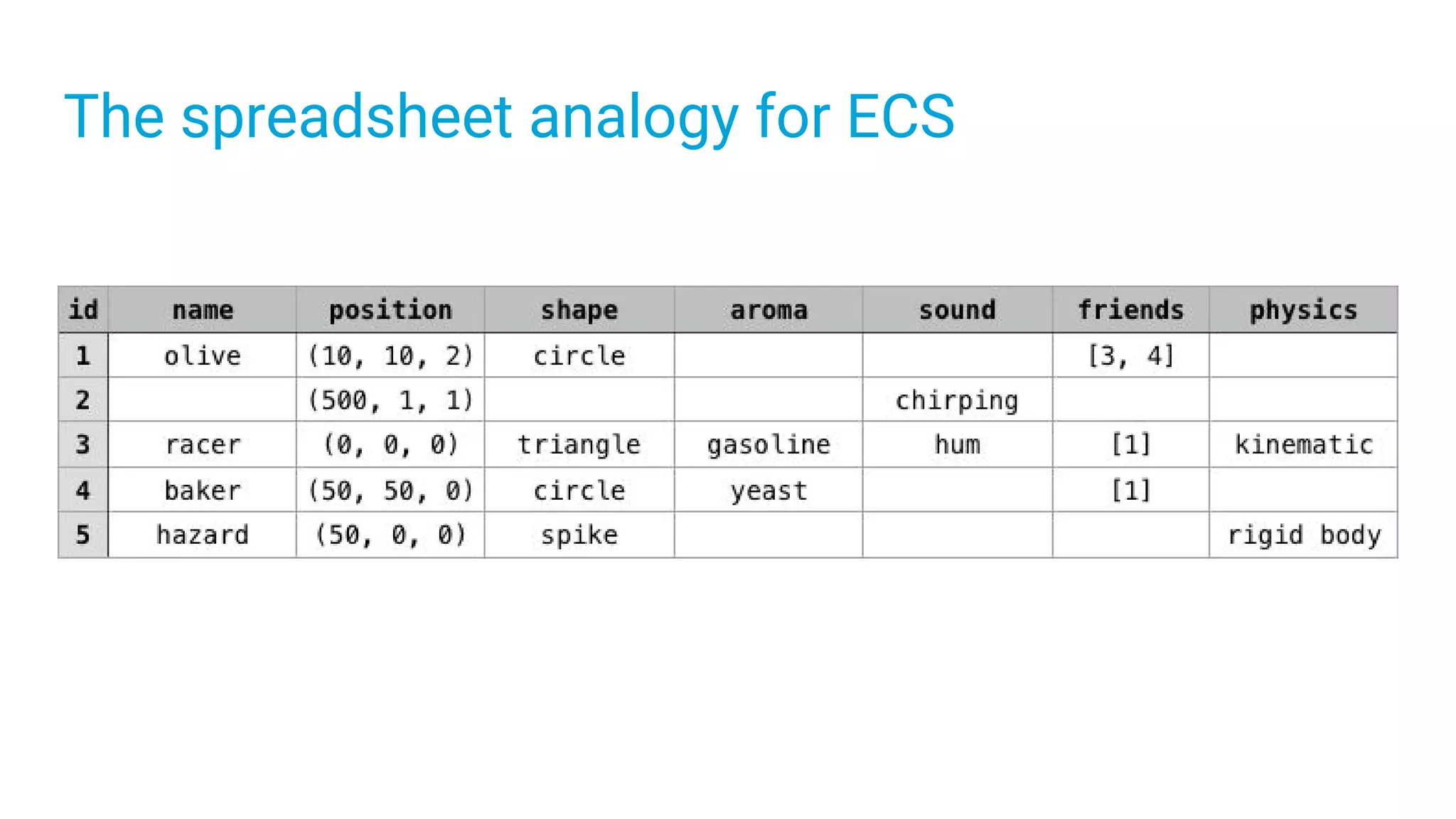
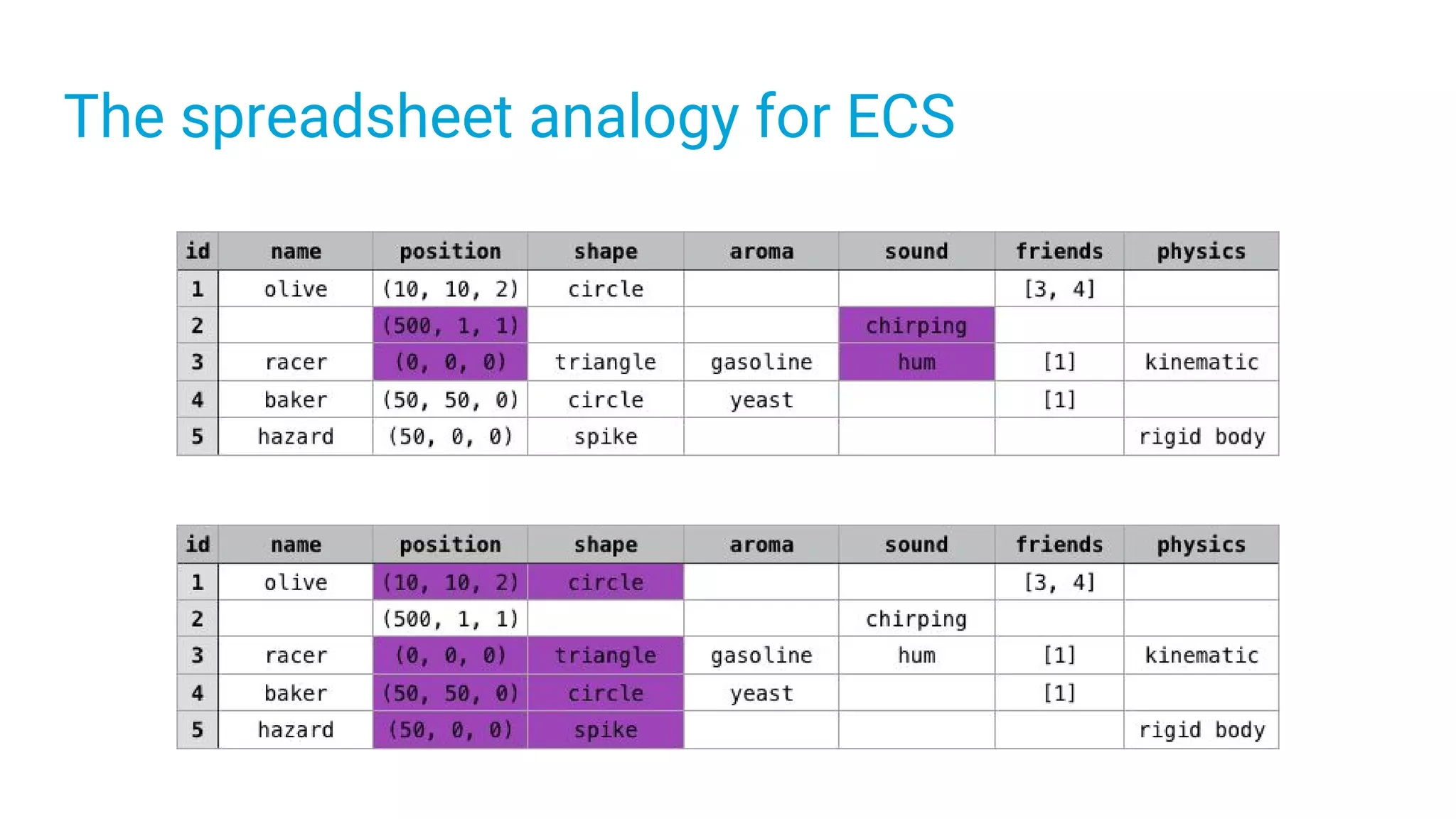
The spreadsheet analogy for ECS
● Good decoupling, helps divide your monolithic classes
● Clear separation of responsibility
○ Encourages small interfaces
○ Entity.build([PlayerInputComponent])
● Easy reuse and composability
○ Entity.build([FlyingComponent])
○ Entity.build([FlyingComponent, SeeingComponent])
● Straightforward unit testing and mocking
○ Substitute components with mocked components at runtime
● Separates data from functions that act on it
● Runtime object definition
● Parallelizable
Advantages of ECS
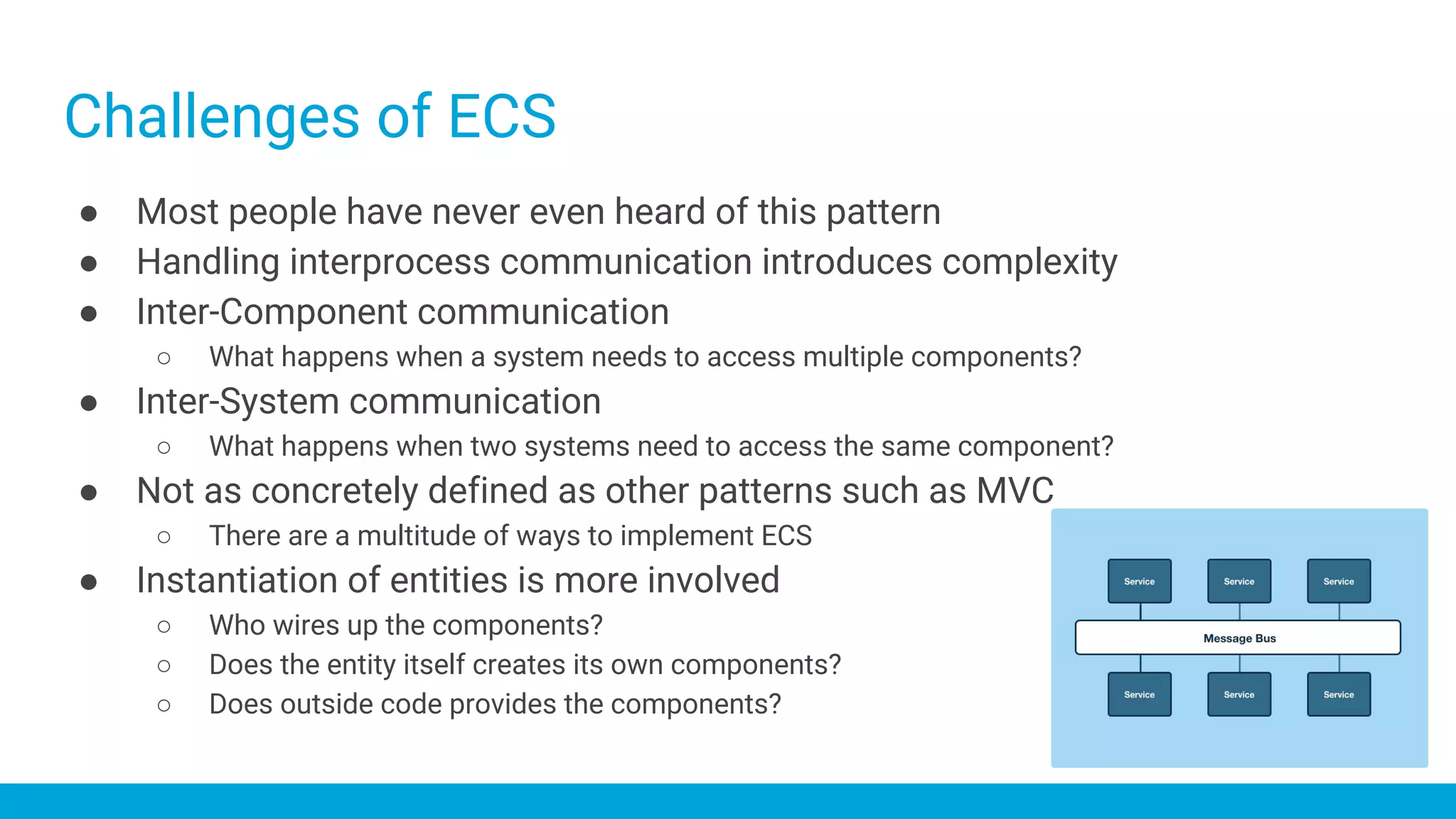
● Most people have never even heard of this pattern
● Handling interprocess communication introduces complexity
● Inter-Component communication
○ What happens when a system needs to access multiple components?
● Inter-System communication
○ What happens when two systems need to access the same component?
● Not as concretely defined as other patterns such as MVC
○ There are a multitude of ways to implement ECS
● Instantiation of entities is more involved
○ Who wires up the components?
○ Does the entity itself creates its own components?
○ Does outside code provides the components?
Challenges of ECS
A walkthrough of an
ECS implementation in
Elixir
A high-level overview
of Entity Component
Systems
Background
Drawbacks of
traditional OOP /
inheritance style code
ECS Examples Code Next Steps
Real life applications
and examples of ECS
in action
Further learning, future
improvements, and
conclusion
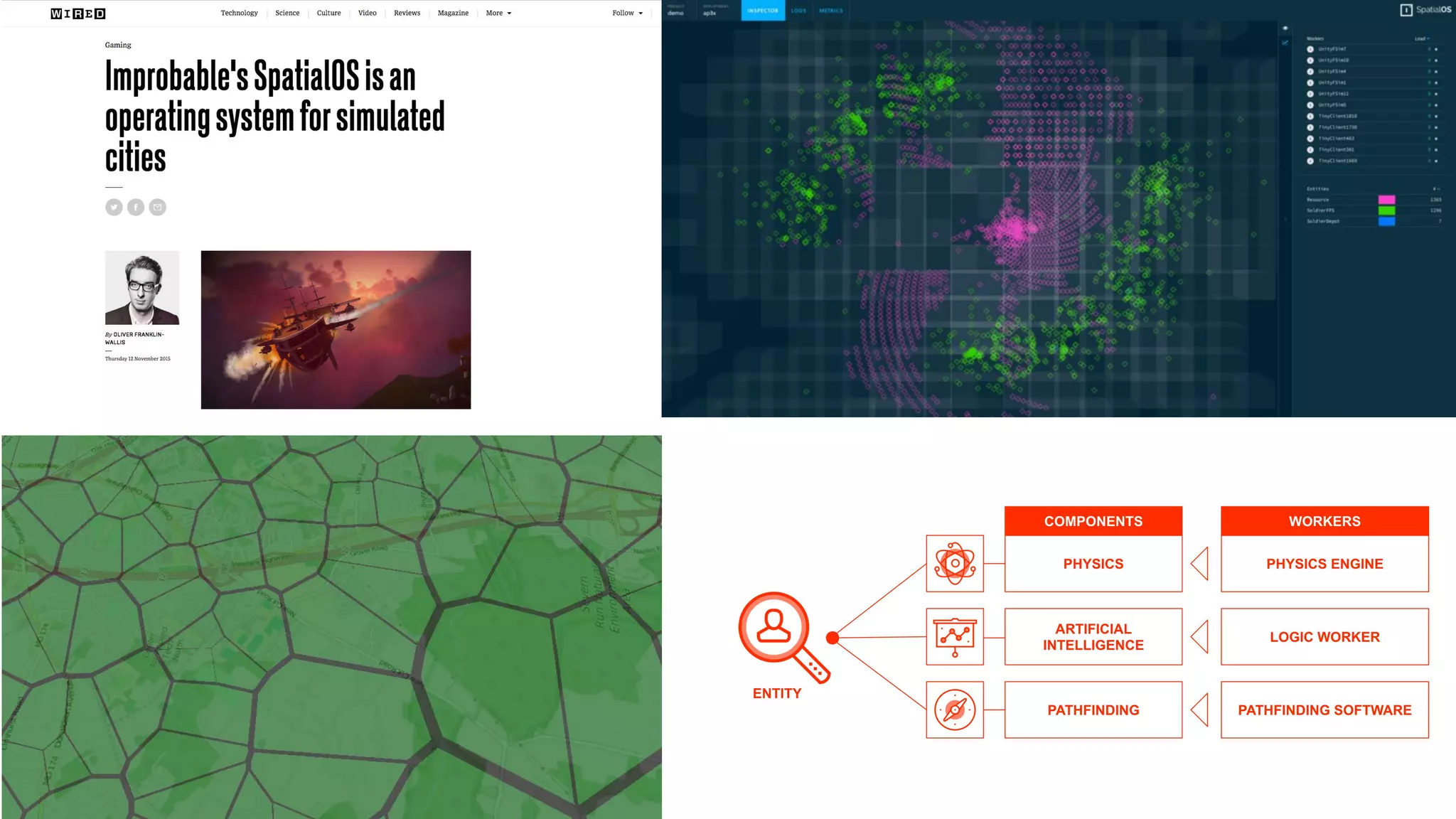
ECS in the Real World
A walkthrough of an
ECS implementation in
Elixir
A high-level overview
of Entity Component
Systems
Background
Drawbacks of
traditional OOP /
inheritance style code
ECS Examples Code Next Steps
Real life applications
and examples of ECS
in action
Further learning, future
improvements, and
conclusion
Entity Component Systems
in Elixir
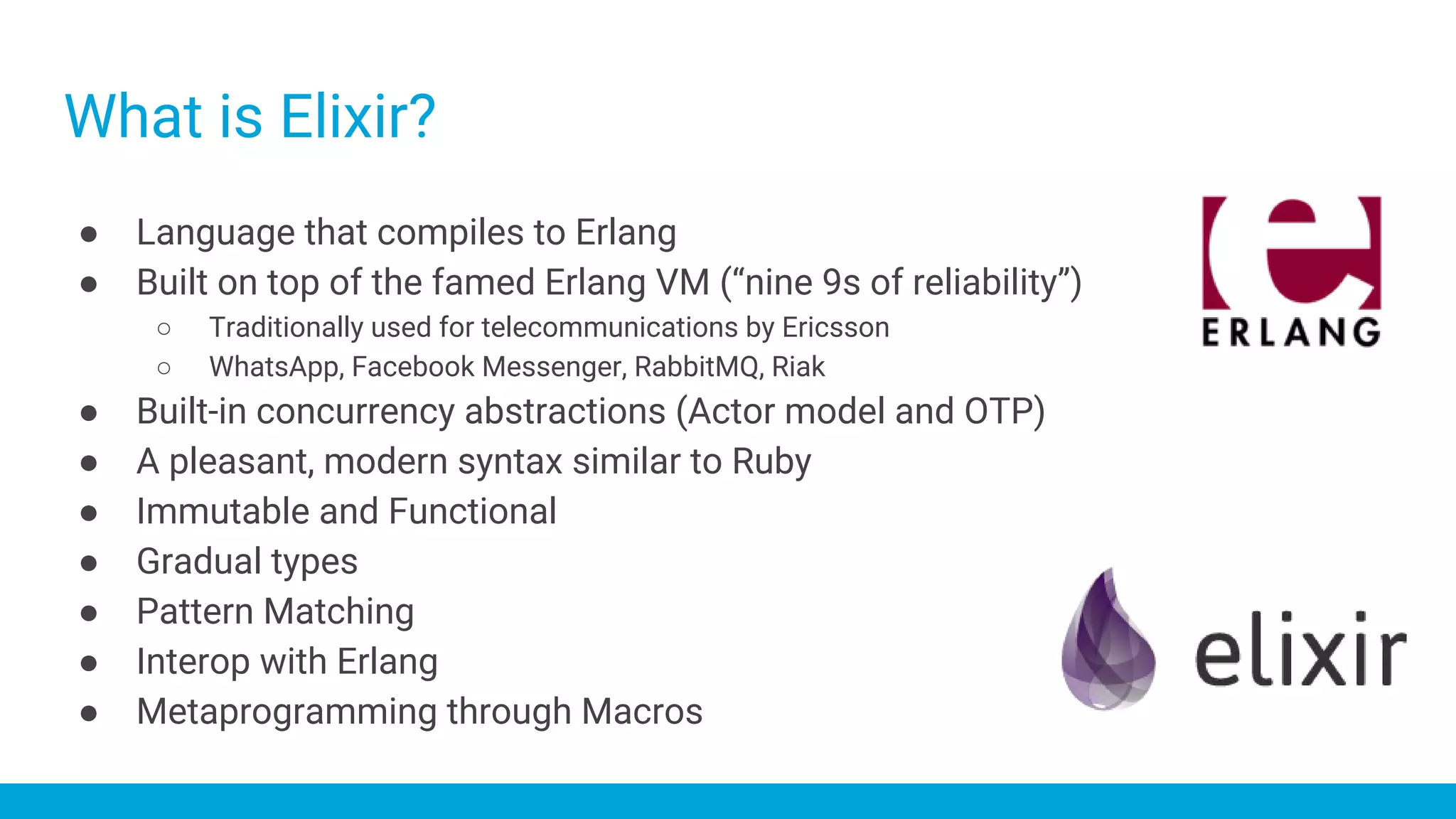
What is Elixir?
● Language that compiles to Erlang
● Built on top of the famed Erlang VM (“nine 9s of reliability”)
○ Traditionally used for telecommunications by Ericsson
○ WhatsApp, Facebook Messenger, RabbitMQ, Riak
● Built-in concurrency abstractions (Actor model and OTP)
● A pleasant, modern syntax similar to Ruby
● Immutable and Functional
● Gradual types
● Pattern Matching
● Interop with Erlang
● Metaprogramming through Macros
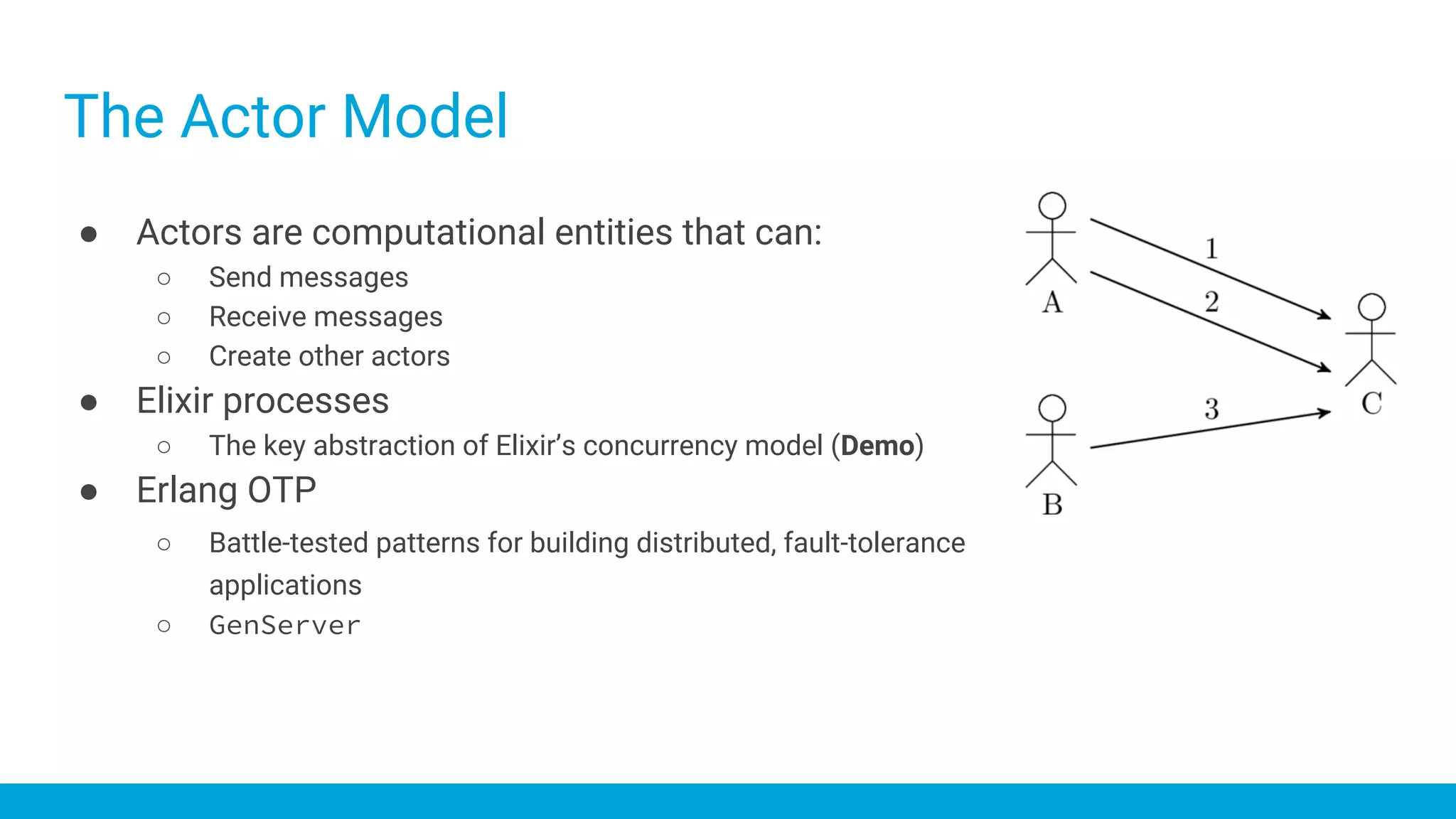
The Actor Model
● Actors are computational entities that can:
○ Send messages
○ Receive messages
○ Create other actors
● Elixir processes
○ The key abstraction of Elixir’s concurrency model (Demo)
● Erlang OTP
○ Battle-tested patterns for building distributed, fault-tolerance
applications
○ GenServer
Component
A struct containing state attributes
System
A GenServer
Entity
A struct with string id and a collection of
Component PIDs
An ECS implementation in Elixir
Demo
A walkthrough of an
ECS implementation in
Elixir
A high-level overview
of Entity Component
Systems
Background
Drawbacks of
traditional OOP /
inheritance style code
ECS Examples Code Next Steps
Real life applications
and examples of ECS
in action
Further learning, future
improvements, and
conclusion
Next Steps
ECS is an overlooked architectural pattern that overcomes some of the drawbacks
of OOP-style inheritance, and is a great fit for distributed systems.
Branching out into unfamiliar domains is a fruitful source of new ideas and
patterns to write better software.
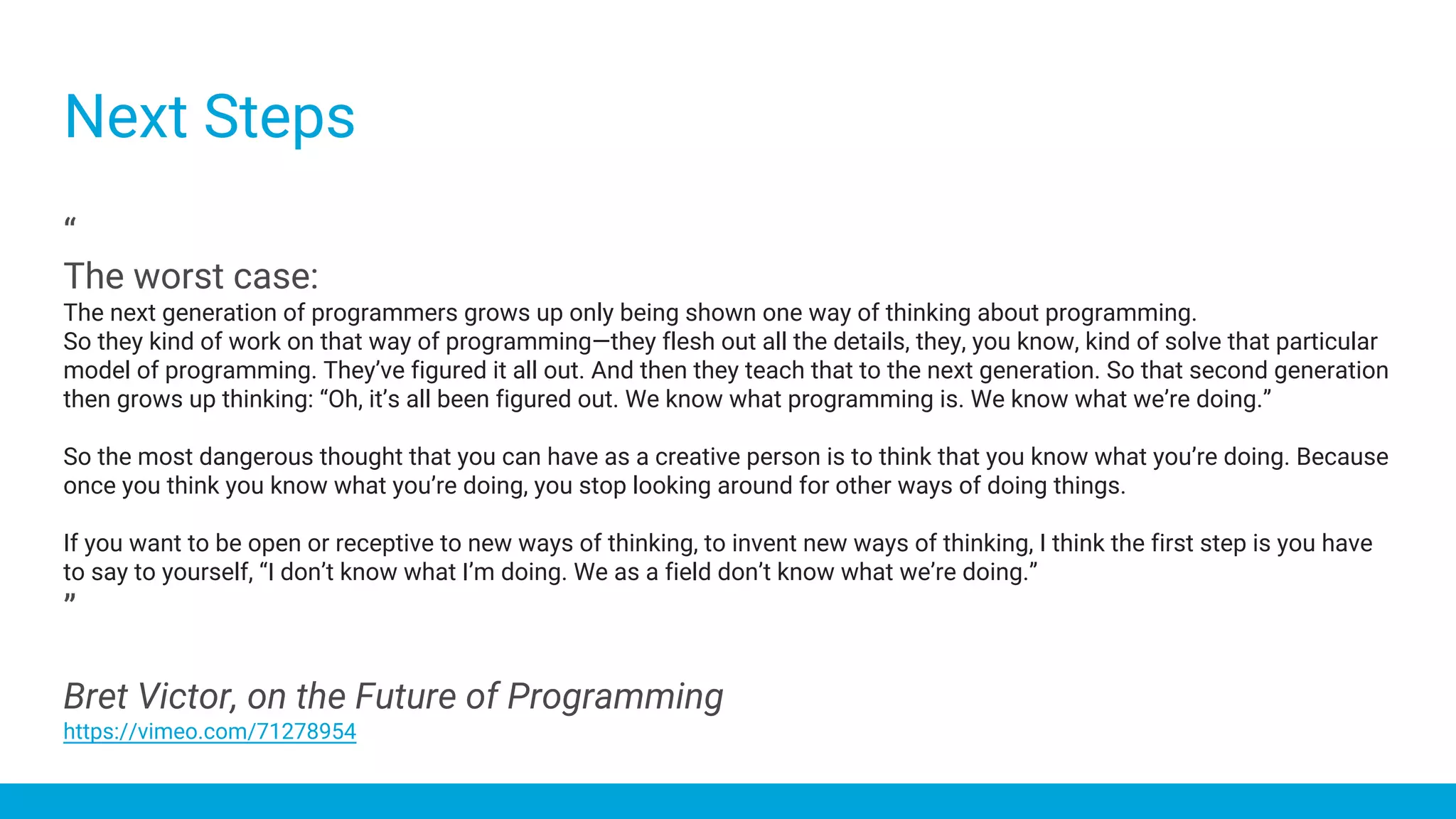
“
The worst case:
The next generation of programmers grows up only being shown one way of thinking about programming.
So they kind of work on that way of programming—they flesh out all the details, they, you know, kind of solve that particular
model of programming. They’ve figured it all out. And then they teach that to the next generation. So that second generation
then grows up thinking: “Oh, it’s all been figured out. We know what programming is. We know what we’re doing.”
So the most dangerous thought that you can have as a creative person is to think that you know what you’re doing. Because
once you think you know what you’re doing, you stop looking around for other ways of doing things.
If you want to be open or receptive to new ways of thinking, to invent new ways of thinking, I think the first step is you have
to say to yourself, “I don’t know what I’m doing. We as a field don’t know what we’re doing.”
”
Bret Victor, on the Future of Programming
https://vimeo.com/71278954
Next Steps
Thanks
Yos Riady
yos.io

Entity Component Systems

  • 1.
    Entity Component Systems YosRiady yos.io goo.gl/ECeFOI
  • 2.
    A walkthrough ofan ECS implementation in Elixir A high-level overview of Entity Component Systems Background Drawbacks of traditional OOP / inheritance style code ECS Examples Code Next Steps Real life applications and examples of ECS in action Further learning, future improvements, and conclusion
  • 3.
    A walkthrough ofan ECS implementation in Elixir A high-level overview of Entity Component Systems Background Drawbacks of traditional OOP / inheritance style code ECS Examples Code Next Steps Real life applications and examples of ECS in action Further learning, future improvements, and conclusion
  • 4.
  • 5.
  • 6.
    The challenges withinheritance The Blob Antipattern A huge single root class with a large amount of functionality. Subclasses become overburdened with unneeded functionality. Deep Rigid HierarchiesThe Diamond Problem
  • 7.
    A walkthrough ofan ECS implementation in Elixir A high-level overview of Entity Component Systems Background Drawbacks of traditional OOP / inheritance style code ECS Examples Code Next Steps Real life applications and examples of ECS in action Further learning, future improvements, and conclusion
  • 8.
    Entity Component Systems ●Originally used in game development ○ Tendency to end up with very complex / monolithic classes when using inheritance ○ Thief, Dungeon Siege, Caves of Qud, roguelikes ● Attempts to solve issues due to deep hierarchies ○ Composition over inheritance ● Based on three key abstractions ○ Entity ○ Component ○ System
  • 9.
  • 10.
    Component Components are minimal,reusable data objects that are plugged into entities to support some behaviour. A Component itself has no behaviour. A Components tags an entity with a single quality. Typically a struct or dictionary. The “qualities” or “aspects”of a thing
  • 11.
    What qualities mighta bunny have?
  • 12.
    What components mighta bunny have? Placeable - int x - int y - int z Huggable - int fluffiness Consumable - float calories Seeing - int sight_radius - boolean night_vision? Living - float health - float age Hopping - int hop_distance Physical - int height - int width - int length
  • 13.
    Entities are verysimple. Entities are globally unique IDs. Entities has no actual data or behaviour. Entity are solely the sum of its components. A Component gives an Entity its data. Entity An aggregation of Components
  • 14.
  • 15.
    The bunny entity Placeable -int x - int y - int z Huggable - int fluffiness Consumable - float calories Seeing - int sight_radius - boolean night_vision? Living - float health - float age Hopping - int hop_distance Physical - int height - int width - int length
  • 16.
    The carrot entity Placeable -int x - int y - int z Consumable - float calories Physical - int height - int width - int length
  • 17.
    The ghost entity Placeable -int x - int y - int z Spooky - int spookiness Seeing - int sight_radius - boolean night_vision?
  • 18.
    Systems run continuouslyand iterate over all Components of its type. Systems read and write the state of Components, resulting in behaviour. By transitive property, Systems give Entities behaviour. Could be a distributed worker pool. System Brings entities and components to life
  • 19.
    How does abunny behave? Placeable - x 5 - y -2 - z 10 Living - age 2.00 Placeable - x 5 - y -2 - z 0 Living - age 2.01 “Fall” “Age”
  • 20.
    How does abunny behave? Placeable - x 5 - y -2 - z 10 Living - age 2.00 Placeable - x 5 - y -2 - z 0 Living - age 2.01 “Fall” “Age” Gravity System Time System
  • 21.
    Data flow inECS Gravity System Placeable - x - y - z Placeable - x - y - z Placeable - x - y - z Placeable - x - y - z Placeable - x - y - z External Event Stream i.e. Time, Player Input
  • 22.
    Acquires behaviour through changesin component states. Reads the continuously changing state of its components. Listens to system events, updates its state. Stores data, which gets updated in response to events from systems. Listens to outside events, publishes updates to components Provides the logic that manipulates the data encapsulated in components. Data flow in ECS System Component Entity
  • 23.
  • 24.
  • 25.
    ● Good decoupling,helps divide your monolithic classes ● Clear separation of responsibility ○ Encourages small interfaces ○ Entity.build([PlayerInputComponent]) ● Easy reuse and composability ○ Entity.build([FlyingComponent]) ○ Entity.build([FlyingComponent, SeeingComponent]) ● Straightforward unit testing and mocking ○ Substitute components with mocked components at runtime ● Separates data from functions that act on it ● Runtime object definition ● Parallelizable Advantages of ECS
  • 26.
    ● Most peoplehave never even heard of this pattern ● Handling interprocess communication introduces complexity ● Inter-Component communication ○ What happens when a system needs to access multiple components? ● Inter-System communication ○ What happens when two systems need to access the same component? ● Not as concretely defined as other patterns such as MVC ○ There are a multitude of ways to implement ECS ● Instantiation of entities is more involved ○ Who wires up the components? ○ Does the entity itself creates its own components? ○ Does outside code provides the components? Challenges of ECS
  • 27.
    A walkthrough ofan ECS implementation in Elixir A high-level overview of Entity Component Systems Background Drawbacks of traditional OOP / inheritance style code ECS Examples Code Next Steps Real life applications and examples of ECS in action Further learning, future improvements, and conclusion
  • 28.
    ECS in theReal World
  • 30.
    A walkthrough ofan ECS implementation in Elixir A high-level overview of Entity Component Systems Background Drawbacks of traditional OOP / inheritance style code ECS Examples Code Next Steps Real life applications and examples of ECS in action Further learning, future improvements, and conclusion
  • 31.
  • 32.
    What is Elixir? ●Language that compiles to Erlang ● Built on top of the famed Erlang VM (“nine 9s of reliability”) ○ Traditionally used for telecommunications by Ericsson ○ WhatsApp, Facebook Messenger, RabbitMQ, Riak ● Built-in concurrency abstractions (Actor model and OTP) ● A pleasant, modern syntax similar to Ruby ● Immutable and Functional ● Gradual types ● Pattern Matching ● Interop with Erlang ● Metaprogramming through Macros
  • 33.
    The Actor Model ●Actors are computational entities that can: ○ Send messages ○ Receive messages ○ Create other actors ● Elixir processes ○ The key abstraction of Elixir’s concurrency model (Demo) ● Erlang OTP ○ Battle-tested patterns for building distributed, fault-tolerance applications ○ GenServer
  • 34.
    Component A struct containingstate attributes System A GenServer Entity A struct with string id and a collection of Component PIDs An ECS implementation in Elixir
  • 35.
  • 36.
    A walkthrough ofan ECS implementation in Elixir A high-level overview of Entity Component Systems Background Drawbacks of traditional OOP / inheritance style code ECS Examples Code Next Steps Real life applications and examples of ECS in action Further learning, future improvements, and conclusion
  • 37.
    Next Steps ECS isan overlooked architectural pattern that overcomes some of the drawbacks of OOP-style inheritance, and is a great fit for distributed systems. Branching out into unfamiliar domains is a fruitful source of new ideas and patterns to write better software.
  • 39.
    “ The worst case: Thenext generation of programmers grows up only being shown one way of thinking about programming. So they kind of work on that way of programming—they flesh out all the details, they, you know, kind of solve that particular model of programming. They’ve figured it all out. And then they teach that to the next generation. So that second generation then grows up thinking: “Oh, it’s all been figured out. We know what programming is. We know what we’re doing.” So the most dangerous thought that you can have as a creative person is to think that you know what you’re doing. Because once you think you know what you’re doing, you stop looking around for other ways of doing things. If you want to be open or receptive to new ways of thinking, to invent new ways of thinking, I think the first step is you have to say to yourself, “I don’t know what I’m doing. We as a field don’t know what we’re doing.” ” Bret Victor, on the Future of Programming https://vimeo.com/71278954 Next Steps
  • 40.