Entity Component System
Lunch & Learn 2015-01-21
What is ECS?
ECS is a pattern that makes a distinction between
entities, components and systems.
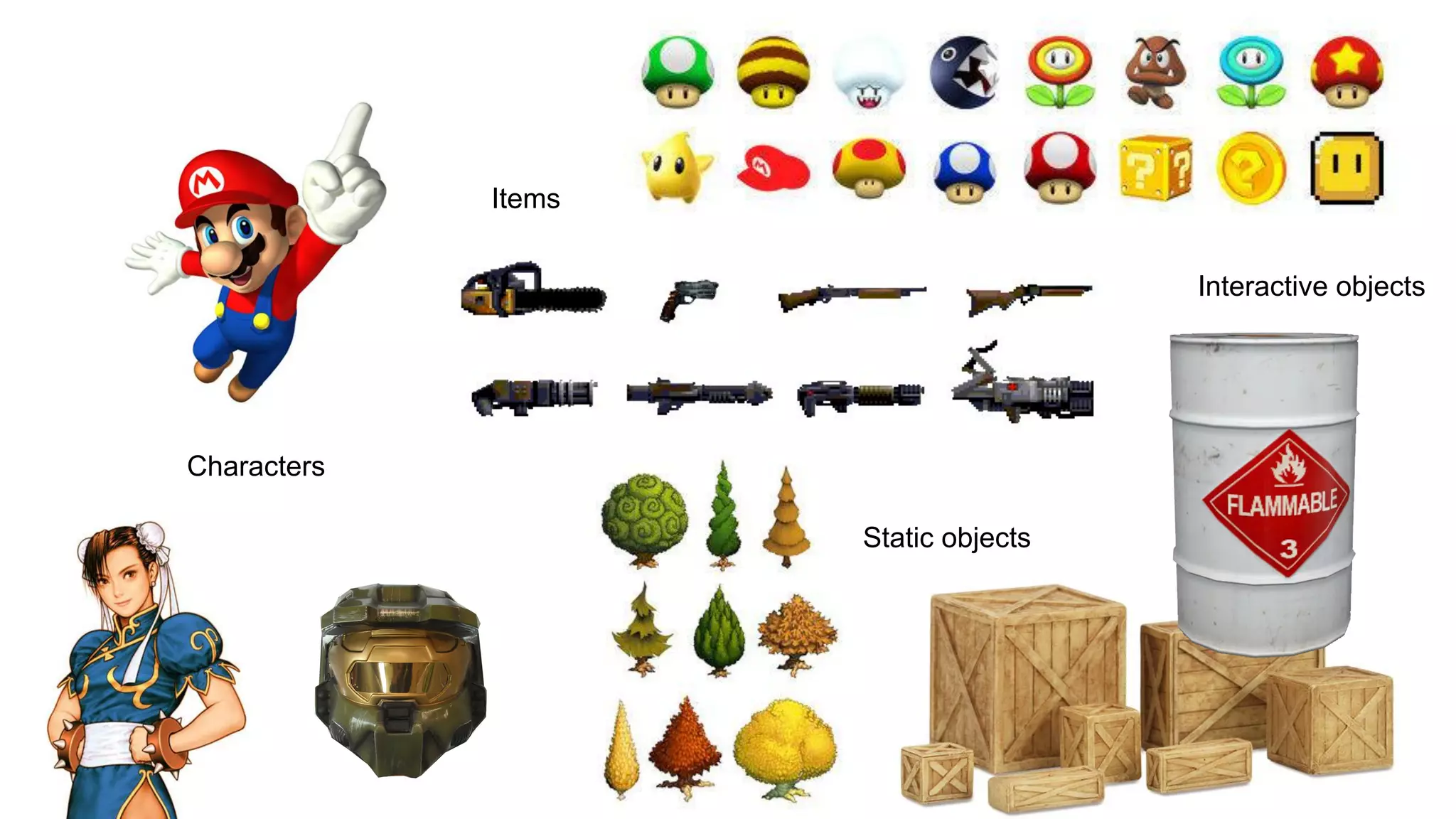
An entity is a discrete object representing an actor in a
simulated space. Realize first that we are simulating a
universe - the game’s universe. All the visible, tangible
‘things’ in the universe can be represented as entities.

Entity
Characters
Items
Interactive objects
Static objects
Can you think of some more examples?
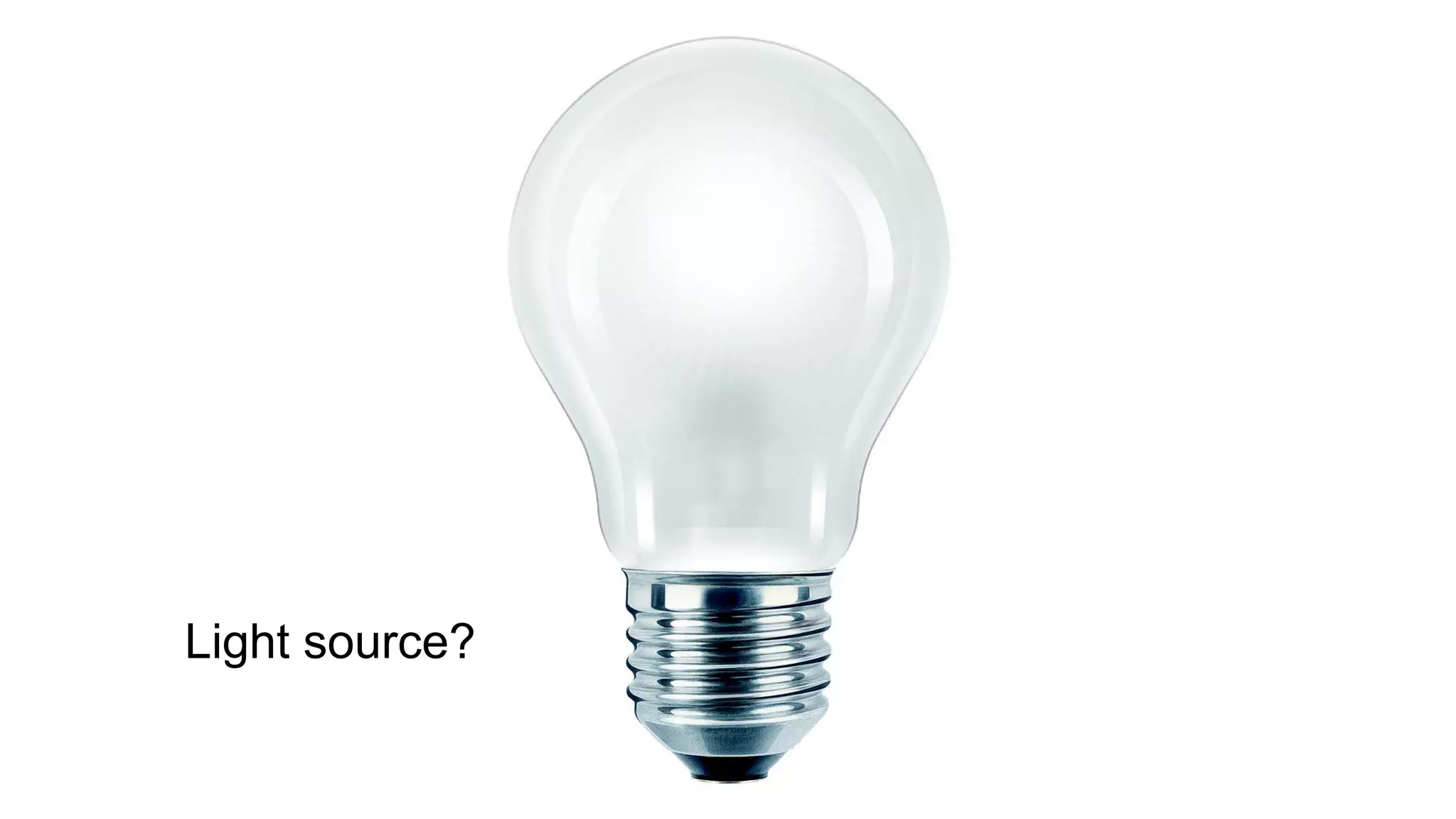
Light source?
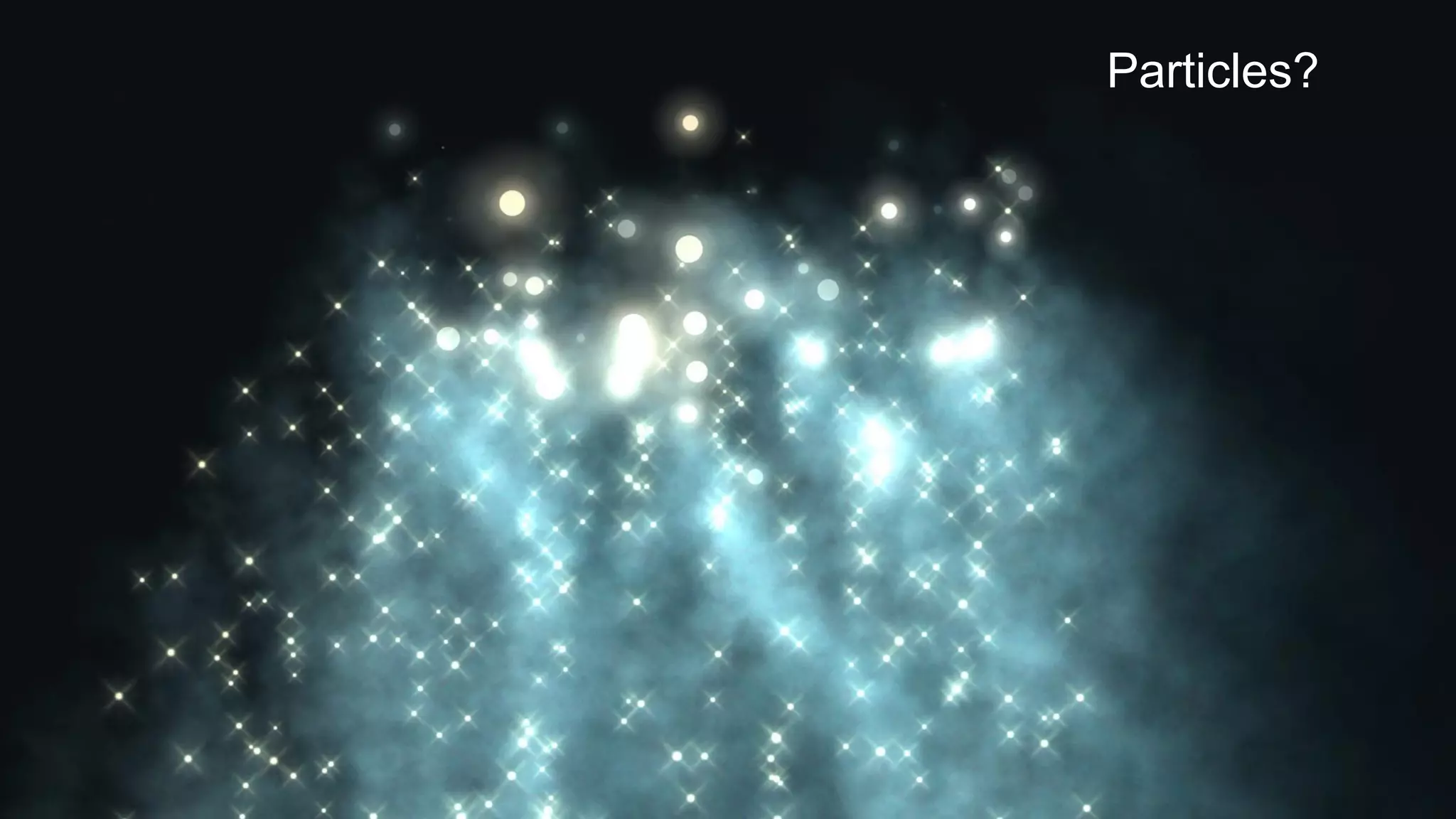
Particles?
A component describes a singular behavior ascribed to an
entity. The name of a component should ideally communicate
what behavior the entity will exhibit, even to someone who
isn’t familiar with the implementation.
Component
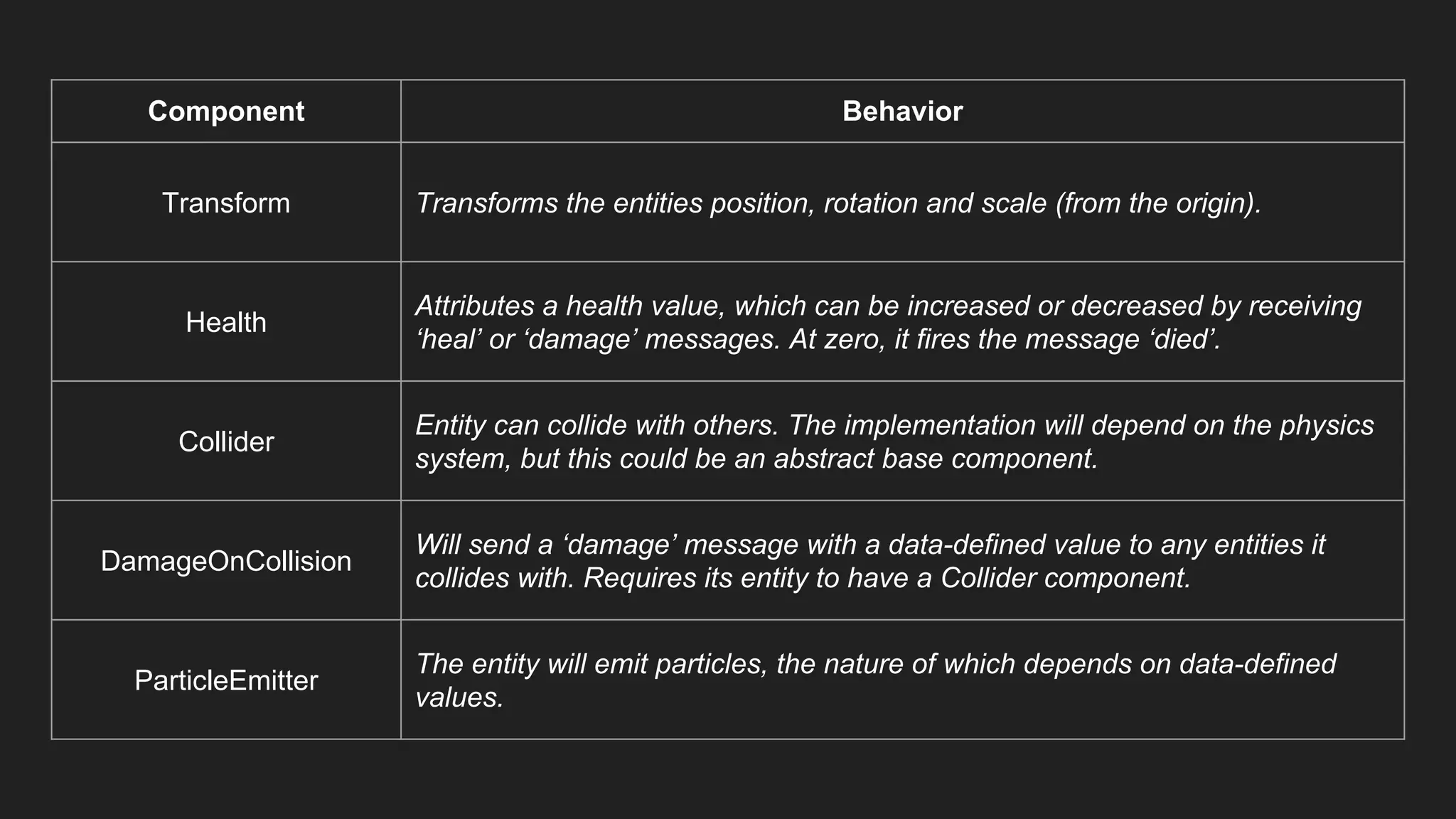
Component Behavior
Transform Transforms the entities position, rotation and scale (from the origin).
Health
Attributes a health value, which can be increased or decreased by receiving
‘heal’ or ‘damage’ messages. At zero, it fires the message ‘died’.
Collider
Entity can collide with others. The implementation will depend on the physics
system, but this could be an abstract base component.
DamageOnCollision
Will send a ‘damage’ message with a data-defined value to any entities it
collides with. Requires its entity to have a Collider component.
ParticleEmitter
The entity will emit particles, the nature of which depends on data-defined
values.
Systems iterate over lists of components to perform low level
functions such as rendering graphics, performing physics
calculations, or pathfinding. Not every component needs to
be managed by a system. Components should use systems
to offload computationally difficult or shared workloads.
System
If a system is totally unrelated to gameplay it
might actually be a service.
Renderer
Finder
Parser
Builder
Loader
Calculator
Publisher
Manager
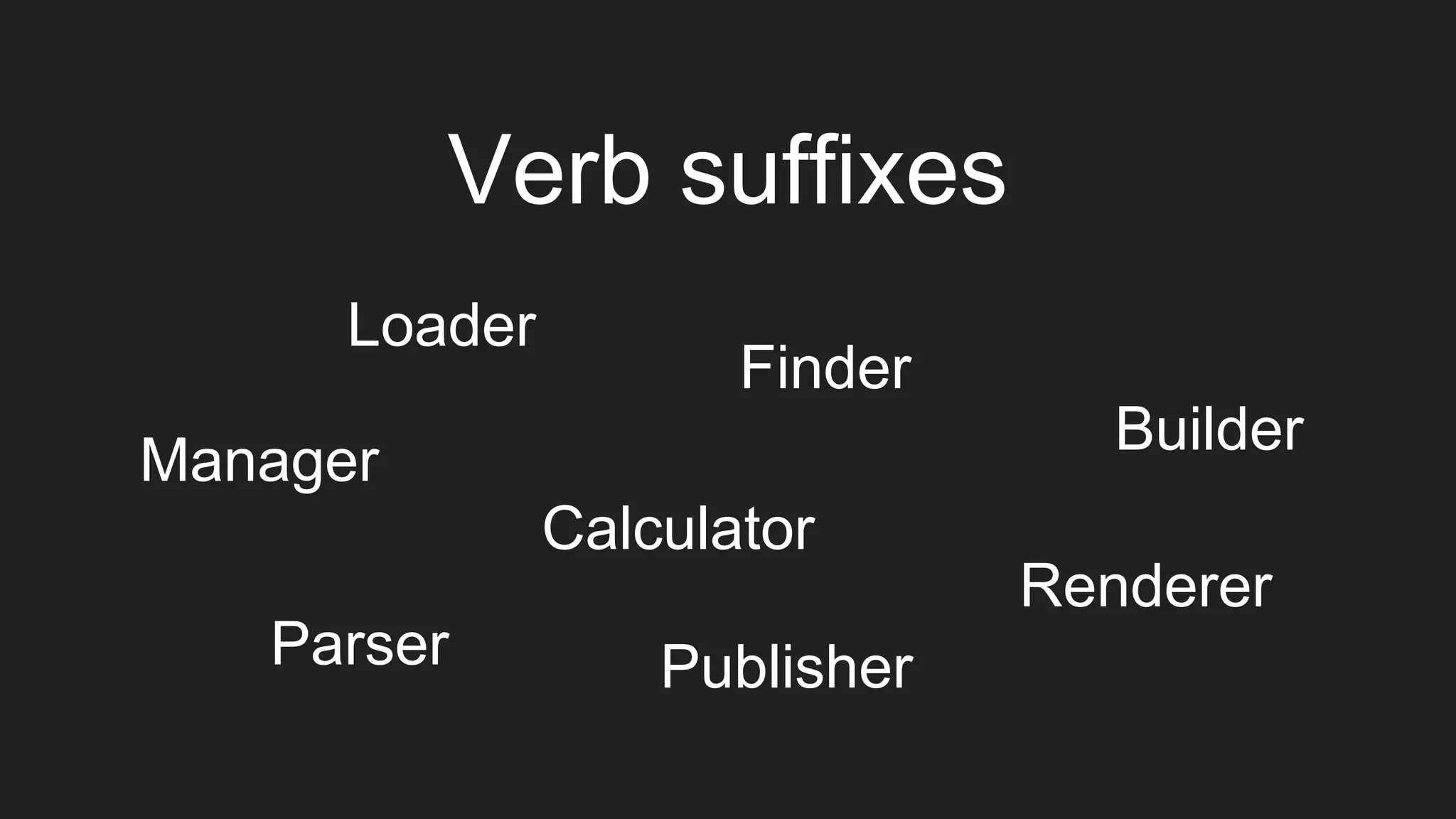
Verb suffixes
Why are we using ECS?
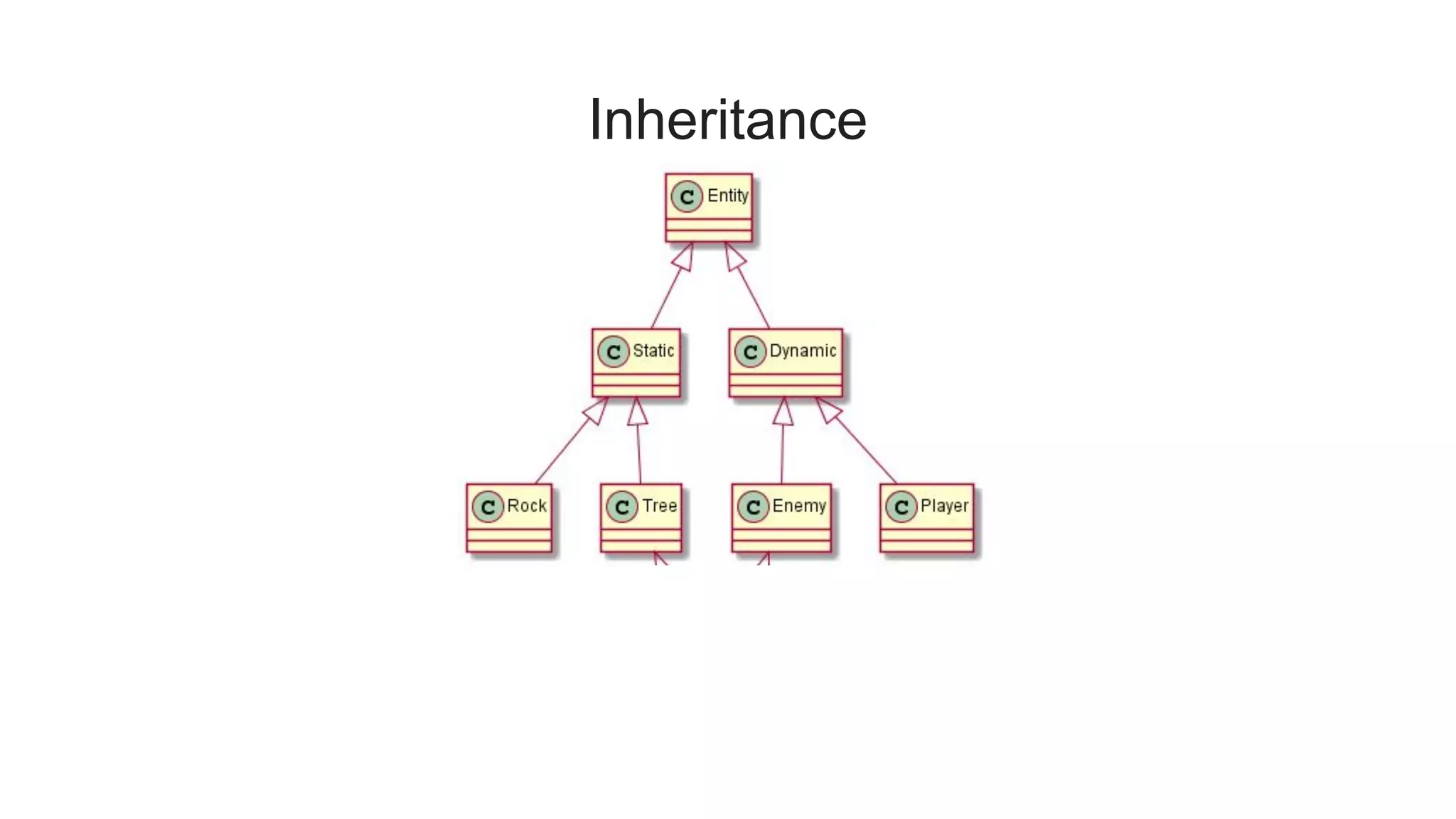
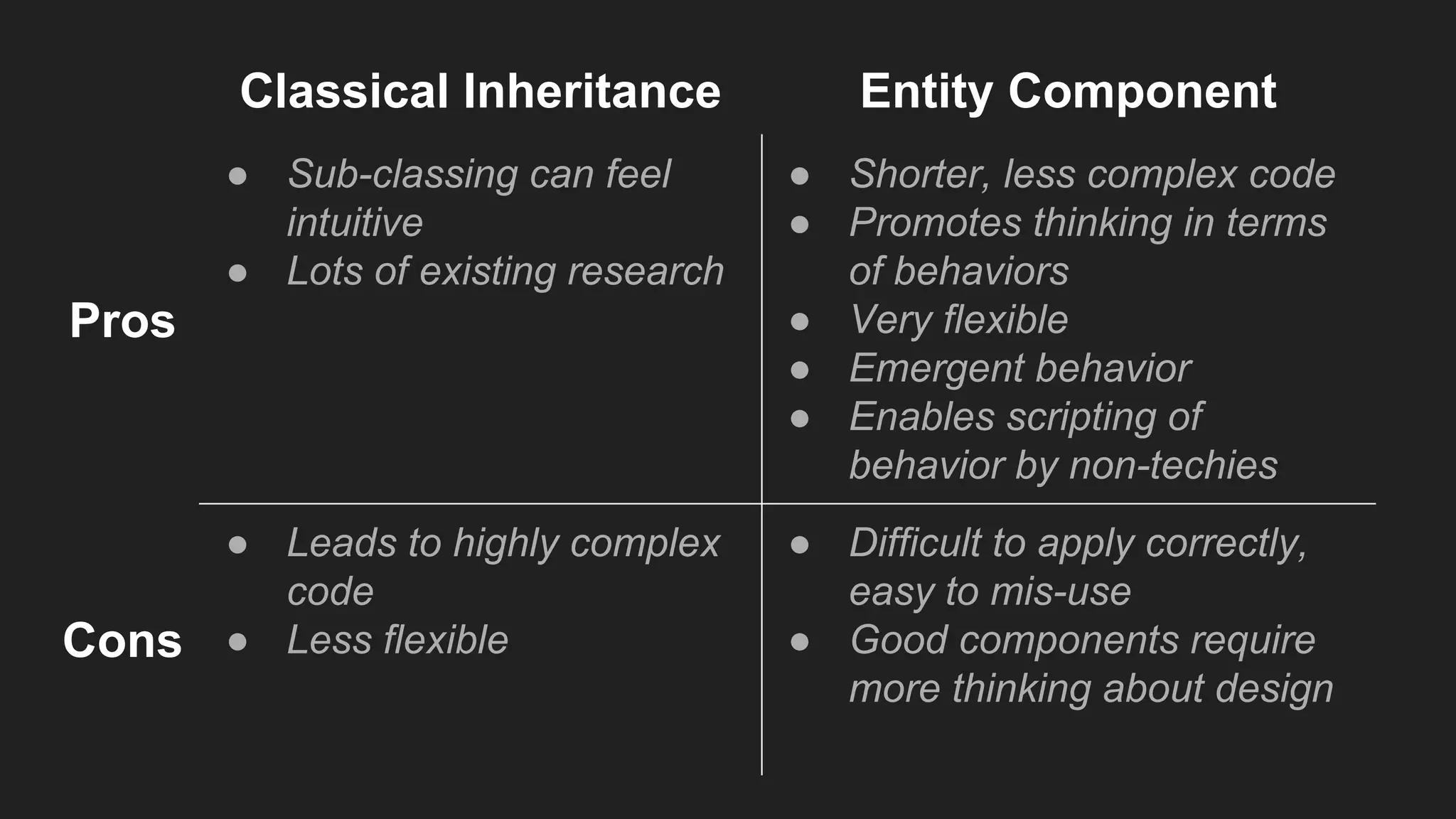
Inheritance
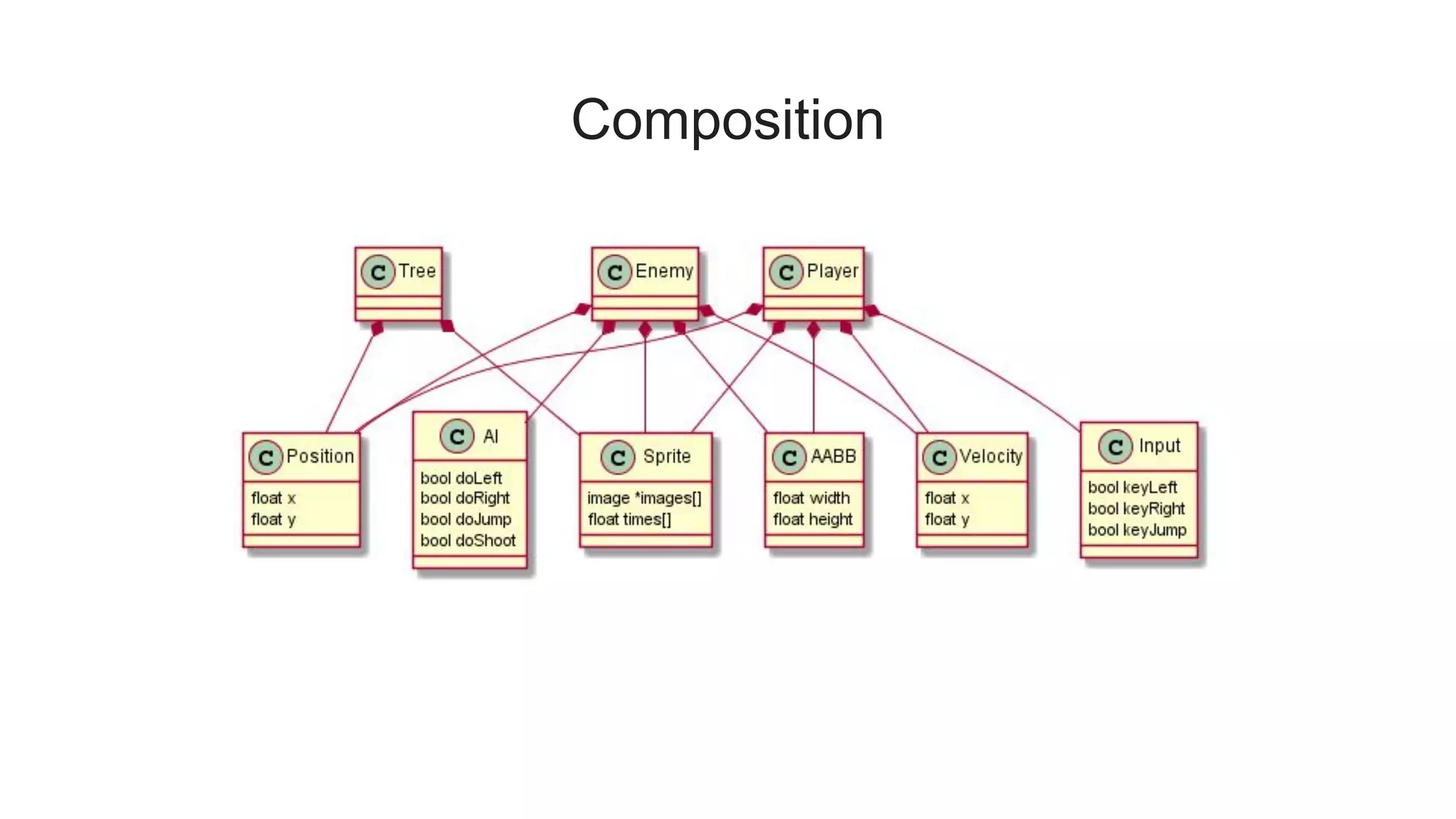
Composition
Classical Inheritance Entity Component
Pros
● Sub-classing can feel
intuitive
● Lots of existing research
● Shorter, less complex code
● Promotes thinking in terms
of behaviors
● Very flexible
● Emergent behavior
● Enables scripting of
behavior by non-techies
Cons
● Leads to highly complex
code
● Less flexible
● Difficult to apply correctly,
easy to mis-use
● Good components require
more thinking about design
Disclaimer
ECS is not the be-all end-all solution to game
programming.
How should we use ECS?
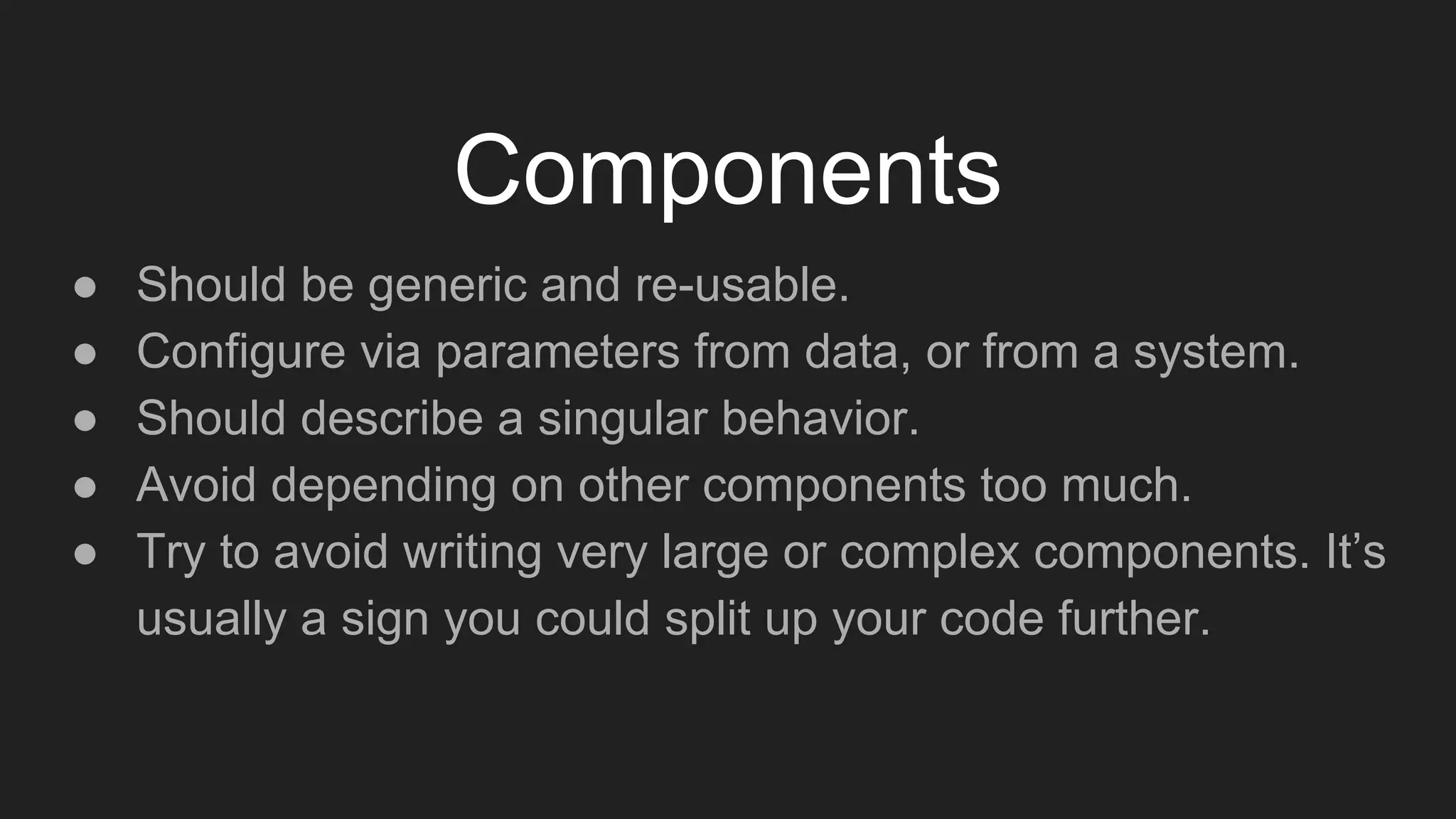
Components
● Should be generic and re-usable.
● Configure via parameters from data, or from a system.
● Should describe a singular behavior.
● Avoid depending on other components too much.
● Try to avoid writing very large or complex components. It’s
usually a sign you could split up your code further.
Think in terms of behavior
What do I want my entity to do? What is that
behavior called? Can I simplify it?
Generic versus Specific
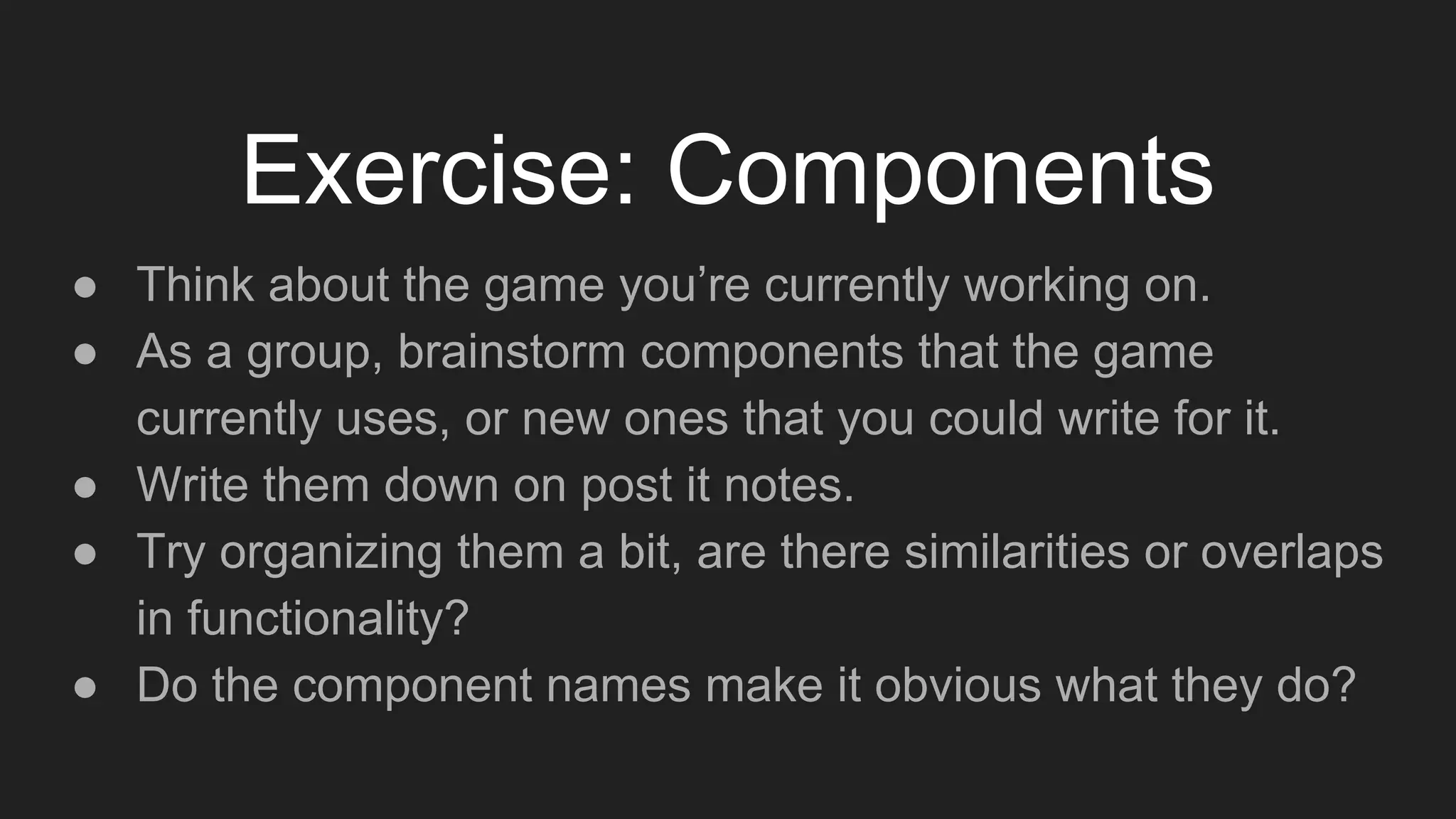
Exercise: Components
● Think about the game you’re currently working on.
● As a group, brainstorm components that the game
currently uses, or new ones that you could write for it.
● Write them down on post it notes.
● Try organizing them a bit, are there similarities or overlaps
in functionality?
● Do the component names make it obvious what they do?
Decouple components
using messages
Messages
● Should be generic and re-usable.
● Pass useful information as parameters.
● Whenever you need to react to an event, first look if a
suitable message is being sent.
● Don’t use messages if a component has a hard
dependency that can only be solved by one specific kind
of component, just use a reference in that case.
Generic versus Specific
Exercise: Messages
● Brainstorm messages that your components might send
or receive.
● Write them down on post it notes.
● Can you show which components send which messages?
● Are all messages sent by components?
● Do the message names make it obvious what data or
event they are conveying?
Always remember the SRP
Single Responsibility Principle
Thanks for listening!
Questions?

Entity Component System

  • 1.
  • 2.
  • 3.
    ECS is apattern that makes a distinction between entities, components and systems.
  • 4.
    An entity isa discrete object representing an actor in a simulated space. Realize first that we are simulating a universe - the game’s universe. All the visible, tangible ‘things’ in the universe can be represented as entities. Entity
  • 5.
  • 6.
    Can you thinkof some more examples?
  • 7.
  • 8.
  • 9.
    A component describesa singular behavior ascribed to an entity. The name of a component should ideally communicate what behavior the entity will exhibit, even to someone who isn’t familiar with the implementation. Component
  • 10.
    Component Behavior Transform Transformsthe entities position, rotation and scale (from the origin). Health Attributes a health value, which can be increased or decreased by receiving ‘heal’ or ‘damage’ messages. At zero, it fires the message ‘died’. Collider Entity can collide with others. The implementation will depend on the physics system, but this could be an abstract base component. DamageOnCollision Will send a ‘damage’ message with a data-defined value to any entities it collides with. Requires its entity to have a Collider component. ParticleEmitter The entity will emit particles, the nature of which depends on data-defined values.
  • 11.
    Systems iterate overlists of components to perform low level functions such as rendering graphics, performing physics calculations, or pathfinding. Not every component needs to be managed by a system. Components should use systems to offload computationally difficult or shared workloads. System
  • 12.
    If a systemis totally unrelated to gameplay it might actually be a service.
  • 13.
  • 14.
    Why are weusing ECS?
  • 15.
  • 16.
  • 17.
    Classical Inheritance EntityComponent Pros ● Sub-classing can feel intuitive ● Lots of existing research ● Shorter, less complex code ● Promotes thinking in terms of behaviors ● Very flexible ● Emergent behavior ● Enables scripting of behavior by non-techies Cons ● Leads to highly complex code ● Less flexible ● Difficult to apply correctly, easy to mis-use ● Good components require more thinking about design
  • 18.
    Disclaimer ECS is notthe be-all end-all solution to game programming.
  • 19.
    How should weuse ECS?
  • 20.
    Components ● Should begeneric and re-usable. ● Configure via parameters from data, or from a system. ● Should describe a singular behavior. ● Avoid depending on other components too much. ● Try to avoid writing very large or complex components. It’s usually a sign you could split up your code further.
  • 21.
    Think in termsof behavior What do I want my entity to do? What is that behavior called? Can I simplify it?
  • 22.
  • 23.
    Exercise: Components ● Thinkabout the game you’re currently working on. ● As a group, brainstorm components that the game currently uses, or new ones that you could write for it. ● Write them down on post it notes. ● Try organizing them a bit, are there similarities or overlaps in functionality? ● Do the component names make it obvious what they do?
  • 24.
  • 25.
    Messages ● Should begeneric and re-usable. ● Pass useful information as parameters. ● Whenever you need to react to an event, first look if a suitable message is being sent. ● Don’t use messages if a component has a hard dependency that can only be solved by one specific kind of component, just use a reference in that case.
  • 26.
  • 27.
    Exercise: Messages ● Brainstormmessages that your components might send or receive. ● Write them down on post it notes. ● Can you show which components send which messages? ● Are all messages sent by components? ● Do the message names make it obvious what data or event they are conveying?
  • 28.
    Always remember theSRP Single Responsibility Principle
  • 29.
  • 30.