Greater University Circle Wealth
      Building Initiative
 Daniel Budish
 Department of Economic Development
 City of Cleveland
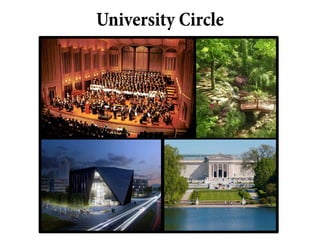
University Circle
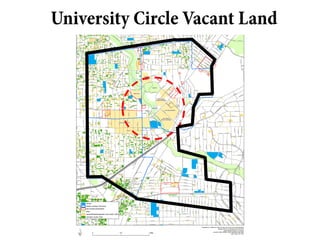
University VACANT LAND
           Circle Vacant Land
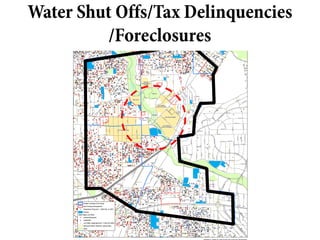
Water Shut Offs/Tax Delinquencies
              /Foreclosures
  WATER SHUT OFFS / TAX DELIQUENCIES / FORECLOSURES
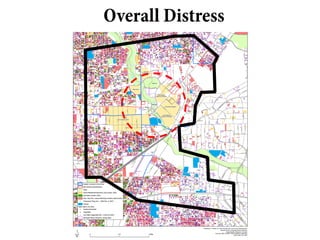
Overall Distress
 NEIGHBORHOODS AT RISK
Mission
• The Greater University Circle Initiative
  (GUCI) demonstrates how an older industrial
  city can build upon its assets to transform
  neighborhoods, create jobs, and address
  poverty. Transcending physical development
  to embrace a communal vision in which wealth
  is shared and no one is left out.
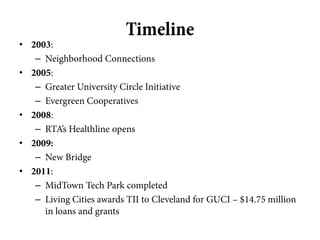
Timeline
• 2003:
   – Neighborhood Connections
• 2005:
   – Greater University Circle Initiative
   – Evergreen Cooperatives
• 2008:
   – RTA’s Healthline opens
• 2009:
   – New Bridge
• 2011:
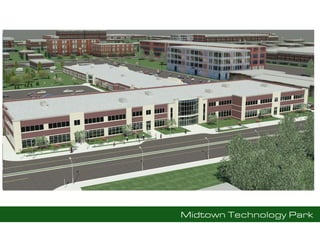
   – MidTown Tech Park completed
   – Living Cities awards TII to Cleveland for GUCI – $14.75 million
     in loans and grants
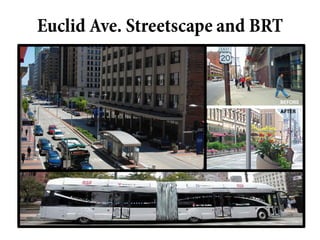
Euclid Ave. Streetscape and BRT
Timeline
• 2003:
   – Neighborhood Connections
• 2005:
   – Greater University Circle Initiative
   – Evergreen Cooperatives
• 2008:
   – RTA’s Healthline opens
• 2009:
   – New Bridge
• 2011:
   – MidTown Tech Park completed
   – Living Cities awards TII to Cleveland for GUCI – $14.75 million
     in loans and grants
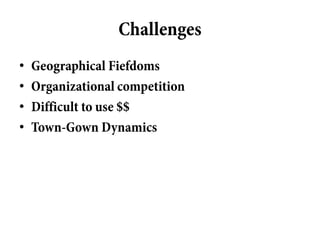
Challenges
•   Geographical Fiefdoms
•   Organizational competition
•   Difficult to use $$
•   Town-Gown Dynamics
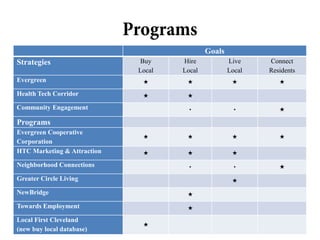
Programs
                                              Goals
Strategies                     Buy    Hire            Live    Connect
                              Local   Local           Local   Residents
Evergreen                                                     
Health Tech Corridor                  
Community Engagement                                           
Programs
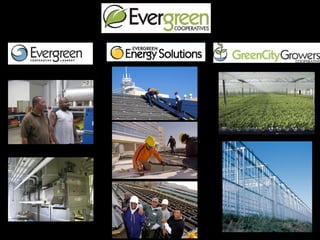
Evergreen Cooperative
                                                              
Corporation
HTC Marketing & Attraction                           
Neighborhood Connections                                       
Greater Circle Living                                  
NewBridge                              
Towards Employment                     
Local First Cleveland
                               
(new buy local database)
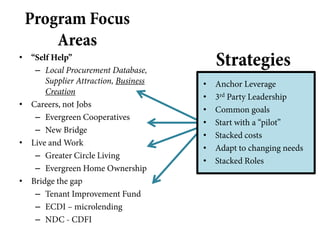
Program Focus
     Areas
• “Self Help”
   – Local Procurement Database,
                                          Strategies
      Supplier Attraction, Business   •   Anchor Leverage
      Creation
                                      •   3rd Party Leadership
• Careers, not Jobs
                                      •   Common goals
   – Evergreen Cooperatives
                                      •   Start with a “pilot”
   – New Bridge
                                      •   Stacked costs
• Live and Work
                                      •   Adapt to changing needs
   – Greater Circle Living
                                      •   Stacked Roles
   – Evergreen Home Ownership
• Bridge the gap
   – Tenant Improvement Fund
   – ECDI – microlending
   – NDC - CDFI
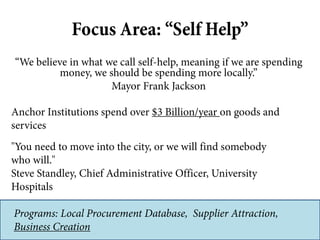
Focus Area: “Self Help”
“We believe in what we call self-help, meaning if we are spending
         money, we should be spending more locally.”
                     Mayor Frank Jackson

Anchor Institutions spend over $3 Billion/year on goods and
services
"You need to move into the city, or we will find somebody
who will."
Steve Standley, Chief Administrative Officer, University
Hospitals

Programs: Local Procurement Database, Supplier Attraction,
Business Creation
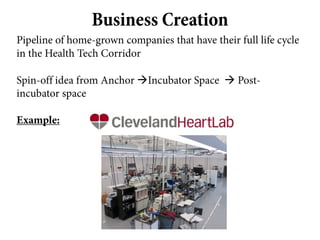
Business Creation
Pipeline of home-grown companies that have their full life cycle
in the Health Tech Corridor

Spin-off idea from Anchor Incubator Space  Post-
incubator space

Example:
Business Creation: Challenges
Study by Angelou Economics identified a lack of tenant-ready
space. Cited a solution as crucial to keep young, growing
companies in the area.

•Banks have preleasing requirements - won’t fund spec space
•Tech companies are fast growing they cannot commit to
prelease – they need space immediately
•These companies are not credit worthy
•Construction costs>Rents

Solutions – tenant improvement fund, Public subsidies for core
& shell
EVERGREEN PRINCIPLES
   Co-ownership by co-op workers and other important
    “stakeholders”
   Triple bottom line: community, environment, profit
   Great majority of our workforce hired from GUC
    neighborhoods
   Linked to the supply chain of area anchor institutions
   Family supporting living wage & no-cost health care benefits
   Distribution of earnings into capital accounts (wealth
    building)
   Career ladders for workers
   Corporate culture of ownership, participation, transparency
    and accountability
   Individual co-ops are part of a larger structure that ties them
    together into a coordinated and integrated network (ECC)
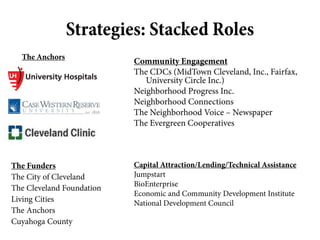
Strategies: Stacked Roles
  The Anchors
                           Community Engagement
                           The CDCs (MidTown Cleveland, Inc., Fairfax,
                              University Circle Inc.)
                           Neighborhood Progress Inc.
                           Neighborhood Connections
                           The Neighborhood Voice – Newspaper
                           The Evergreen Cooperatives


The Funders                Capital Attraction/Lending/Technical Assistance
The City of Cleveland      Jumpstart
                           BioEnterprise
The Cleveland Foundation
                           Economic and Community Development Institute
Living Cities              National Development Council
The Anchors
Cuyahoga County
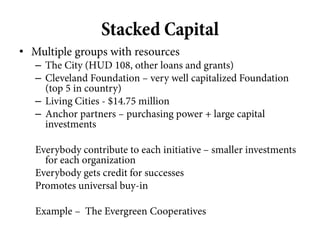
Stacked Capital
• Multiple groups with resources
   – The City (HUD 108, other loans and grants)
   – Cleveland Foundation – very well capitalized Foundation
     (top 5 in country)
   – Living Cities - $14.75 million
   – Anchor partners – purchasing power + large capital
     investments

   Everybody contribute to each initiative – smaller investments
     for each organization
   Everybody gets credit for successes
   Promotes universal buy-in

   Example – The Evergreen Cooperatives
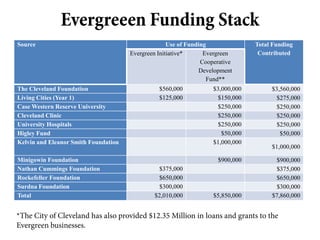
Evergreeen Funding Stack
Source                                              Use of Funding               Total Funding
                                      Evergreen Initiative*      Evergreen        Contributed
                                                                Cooperative
                                                               Development
                                                                  Fund**
The Cleveland Foundation                        $560,000            $3,000,000        $3,560,000
Living Cities (Year 1)                          $125,000             $150,000          $275,000
Case Western Reserve University                                      $250,000          $250,000
Cleveland Clinic                                                      $250,000          $250,000
University Hospitals                                                  $250,000          $250,000
Higley Fund                                                            $50,000           $50,000
Kelvin and Eleanor Smith Foundation                                 $1,000,000
                                                                                      $1,000,000

Minigowin Foundation                                                 $900,000          $900,000
Nathan Cummings Foundation                     $375,000                                $375,000
Rockefeller Foundation                         $650,000                                $650,000
Surdna Foundation                              $300,000                                $300,000
Total                                         $2,010,000            $5,850,000        $7,860,000


*The City of Cleveland has also provided $12.35 Million in loans and grants to the
Evergreen businesses.
Strategy – 3rd Party Leadership
• Partnership with national Living Cities
  legitimizes local efforts
• The Cleveland Foundation can act as the great
  convener

  Significance:
  Focus of Resources – Cleveland Wards
  Bringing everybody (including competitors) to the
    table
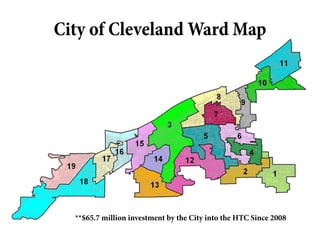
City of Cleveland Ward Map


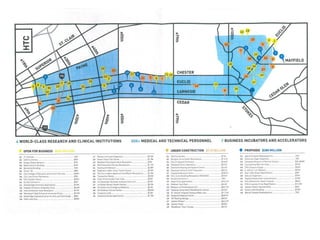
  **$65.7 million investment by the City into the HTC Since 2008
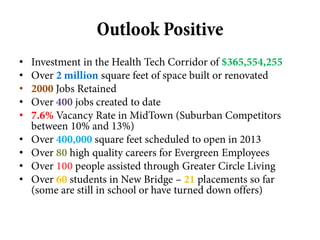
Outlook Positive
•   Investment in the Health Tech Corridor of $365,554,255
•   Over 2 million square feet of space built or renovated
•   2000 Jobs Retained
•   Over 400 jobs created to date
•   7.6% Vacancy Rate in MidTown (Suburban Competitors
    between 10% and 13%)
•   Over 400,000 square feet scheduled to open in 2013
•   Over 80 high quality careers for Evergreen Employees
•   Over 100 people assisted through Greater Circle Living
•   Over 60 students in New Bridge – 21 placements so far
    (some are still in school or have turned down offers)

Cleveland Health Tech Corridor- Enterprise Community Presentation

  • 1.
    Greater University CircleWealth Building Initiative Daniel Budish Department of Economic Development City of Cleveland
  • 2.
  • 3.
    University VACANT LAND Circle Vacant Land
  • 4.
    Water Shut Offs/TaxDelinquencies /Foreclosures WATER SHUT OFFS / TAX DELIQUENCIES / FORECLOSURES
  • 5.
  • 6.
    Mission • The GreaterUniversity Circle Initiative (GUCI) demonstrates how an older industrial city can build upon its assets to transform neighborhoods, create jobs, and address poverty. Transcending physical development to embrace a communal vision in which wealth is shared and no one is left out.
  • 7.
    Timeline • 2003: – Neighborhood Connections • 2005: – Greater University Circle Initiative – Evergreen Cooperatives • 2008: – RTA’s Healthline opens • 2009: – New Bridge • 2011: – MidTown Tech Park completed – Living Cities awards TII to Cleveland for GUCI – $14.75 million in loans and grants
  • 8.
  • 9.
    Timeline • 2003: – Neighborhood Connections • 2005: – Greater University Circle Initiative – Evergreen Cooperatives • 2008: – RTA’s Healthline opens • 2009: – New Bridge • 2011: – MidTown Tech Park completed – Living Cities awards TII to Cleveland for GUCI – $14.75 million in loans and grants
  • 11.
    Challenges • Geographical Fiefdoms • Organizational competition • Difficult to use $$ • Town-Gown Dynamics
  • 12.
    Programs Goals Strategies Buy Hire Live Connect Local Local Local Residents Evergreen     Health Tech Corridor   Community Engagement    Programs Evergreen Cooperative     Corporation HTC Marketing & Attraction    Neighborhood Connections    Greater Circle Living  NewBridge  Towards Employment  Local First Cleveland  (new buy local database)
  • 13.
    Program Focus Areas • “Self Help” – Local Procurement Database, Strategies Supplier Attraction, Business • Anchor Leverage Creation • 3rd Party Leadership • Careers, not Jobs • Common goals – Evergreen Cooperatives • Start with a “pilot” – New Bridge • Stacked costs • Live and Work • Adapt to changing needs – Greater Circle Living • Stacked Roles – Evergreen Home Ownership • Bridge the gap – Tenant Improvement Fund – ECDI – microlending – NDC - CDFI
  • 14.
    Focus Area: “SelfHelp” “We believe in what we call self-help, meaning if we are spending money, we should be spending more locally.” Mayor Frank Jackson Anchor Institutions spend over $3 Billion/year on goods and services "You need to move into the city, or we will find somebody who will." Steve Standley, Chief Administrative Officer, University Hospitals Programs: Local Procurement Database, Supplier Attraction, Business Creation
  • 15.
    Business Creation Pipeline ofhome-grown companies that have their full life cycle in the Health Tech Corridor Spin-off idea from Anchor Incubator Space  Post- incubator space Example:
  • 17.
    Business Creation: Challenges Studyby Angelou Economics identified a lack of tenant-ready space. Cited a solution as crucial to keep young, growing companies in the area. •Banks have preleasing requirements - won’t fund spec space •Tech companies are fast growing they cannot commit to prelease – they need space immediately •These companies are not credit worthy •Construction costs>Rents Solutions – tenant improvement fund, Public subsidies for core & shell
  • 19.
    EVERGREEN PRINCIPLES  Co-ownership by co-op workers and other important “stakeholders”  Triple bottom line: community, environment, profit  Great majority of our workforce hired from GUC neighborhoods  Linked to the supply chain of area anchor institutions  Family supporting living wage & no-cost health care benefits  Distribution of earnings into capital accounts (wealth building)  Career ladders for workers  Corporate culture of ownership, participation, transparency and accountability  Individual co-ops are part of a larger structure that ties them together into a coordinated and integrated network (ECC)
  • 20.
    Strategies: Stacked Roles The Anchors Community Engagement The CDCs (MidTown Cleveland, Inc., Fairfax, University Circle Inc.) Neighborhood Progress Inc. Neighborhood Connections The Neighborhood Voice – Newspaper The Evergreen Cooperatives The Funders Capital Attraction/Lending/Technical Assistance The City of Cleveland Jumpstart BioEnterprise The Cleveland Foundation Economic and Community Development Institute Living Cities National Development Council The Anchors Cuyahoga County
  • 21.
    Stacked Capital • Multiplegroups with resources – The City (HUD 108, other loans and grants) – Cleveland Foundation – very well capitalized Foundation (top 5 in country) – Living Cities - $14.75 million – Anchor partners – purchasing power + large capital investments Everybody contribute to each initiative – smaller investments for each organization Everybody gets credit for successes Promotes universal buy-in Example – The Evergreen Cooperatives
  • 22.
    Evergreeen Funding Stack Source Use of Funding Total Funding Evergreen Initiative* Evergreen Contributed Cooperative Development Fund** The Cleveland Foundation $560,000 $3,000,000 $3,560,000 Living Cities (Year 1) $125,000 $150,000 $275,000 Case Western Reserve University $250,000 $250,000 Cleveland Clinic $250,000 $250,000 University Hospitals $250,000 $250,000 Higley Fund $50,000 $50,000 Kelvin and Eleanor Smith Foundation $1,000,000 $1,000,000 Minigowin Foundation $900,000 $900,000 Nathan Cummings Foundation $375,000 $375,000 Rockefeller Foundation $650,000 $650,000 Surdna Foundation $300,000 $300,000 Total $2,010,000 $5,850,000 $7,860,000 *The City of Cleveland has also provided $12.35 Million in loans and grants to the Evergreen businesses.
  • 23.
    Strategy – 3rdParty Leadership • Partnership with national Living Cities legitimizes local efforts • The Cleveland Foundation can act as the great convener Significance: Focus of Resources – Cleveland Wards Bringing everybody (including competitors) to the table
  • 24.
    City of ClevelandWard Map **$65.7 million investment by the City into the HTC Since 2008
  • 25.
    Outlook Positive • Investment in the Health Tech Corridor of $365,554,255 • Over 2 million square feet of space built or renovated • 2000 Jobs Retained • Over 400 jobs created to date • 7.6% Vacancy Rate in MidTown (Suburban Competitors between 10% and 13%) • Over 400,000 square feet scheduled to open in 2013 • Over 80 high quality careers for Evergreen Employees • Over 100 people assisted through Greater Circle Living • Over 60 students in New Bridge – 21 placements so far (some are still in school or have turned down offers)