ENTER 2015 Research Track Slide Number 1
The Rise of eTourism for
Development
Alessandro Inversini*, Isabella Rega*, Isabella Nunes
Pereira** and Roberto Bartholo**
*Bournemouth University, UK
**Universidade Federal do Rio de Janeiro, Brasil
ainversini@bournemouth.ac.uk, irega@bournemouth.ac.uk,
inunesp@gmail.com, bartholo.roberto@gmail.com
http://www.bournemouth.ac.uk, http://www.ufrj.br
ENTER 2015 Research Track Slide Number 2
Tourism and Development
• Tourism is considered as potential strategic factor for
economic growth (Sinclair and Stabler, 2002).
• Tourism has a general positive impact on the
development of rural economies (Cánoves and Blanco, 2004)
• Tourism generates new businesses, improves
infrastructures and services, fosters preservation of the
natural environment/ landscapes and helps with
economic diversification (Herrero and San Martín, 2012; Wang and
Pfister, 2008).
ENTER 2015 Research Track Slide Number 3
Tourism vs Development
Leopard Beach Resort - Kenya
ENTER 2015 Research Track Slide Number 4
Tourism vs Development
Rocinha Cable Car– Rio De Janeiro
ENTER 2015 Research Track Slide Number 5
Hostel Rocinha – Rio De Janeiro
ENTER 2015 Research Track Slide Number 6
Tourism and Development
• Tourism is an economic driving force in many developing
countries as it substantially contributes to the GDPs of
many emerging economies (Sireyjol, 2010).
– from the roughly 9% in Ethiopia or Senegal
– to 25% in Mauritius
BUT what is the real contribution of tourism to
development and especially to socio-economic
development?
ENTER 2015 Research Track Slide Number 7
ENTER 2015 Research Track Slide Number 8
Tourism and Development
• Tourism has a controversial effect on natural
resources and hosting communities’ exploitation (e.g.
Deller, 2010)
• Tourism can generate a general exploitation of the
working poor by the rich (e.g. Marcouiller, 1997)
ENTER 2015 Research Track Slide Number 9
Tourism and Development
Tourism in developing and emerging countries is often seen as
an imperialist and post-colonial phenomenon
(Nash, 1989; Pastran, 2014)
ENTER 2015 Research Track Slide Number 10
ENTER 2015 Research Track Slide Number 11
How this vision can be challenged?
ENTER 2015 Research Track Slide Number 12
Issues at Stake
The nature of the Tourism Industry
Community Based Tourism
SMTEs as unit for Socio Economic Development
ENTER 2015 Research Track Slide Number 13
ICT + Tourism
ICT + Development
Information and Communication Technologies
ENTER 2015 Research Track Slide Number 14
eT4D conceptualization
ENTER 2015 Research Track Slide Number 15
Tourism and Development
• Exploitative tourism was historically challenged (Krippendorf,
1987) and alternative forms thus arose with a renewed focus
on local sustainability and community development.
• growing demand for products and services that are more
sustainable, pro-poor, and less harmful to local environments
and communities (Callanan & Thomas, 2005).
• Community Based Tourism (Murphy 1985; Simpson, 2008) that
is a bottom up approach to involve community in the creation
and execution of tourism products (Sebele, 2010).
ENTER 2015 Research Track Slide Number 16
Tourism and ICT
• The advent of the internet produced a paradigm shift in
the industry thanks to the convergence among
informatics, communication, and multimedia (Buhalis
2003).
• The access to these peripheral areas is often problematic
both physically and electronically (Hall and Page 2006).
• SMTEs needs to develop their “virtual size” thus
marketing and selling their services to the global markets
(Spencer et al., 2012).
ENTER 2015 Research Track Slide Number 17
Development and ICT
• Information and Communication for Development is a
relatively new field of study (Unwin, 2009; Heeks, 2010)
• The underpinning is that access to digital technology can
promote social and economic development (Rega et al.,
2013).
• Micro-small and medium size enterprises as unit of
analysis (Heeks, 2010), in order to understand the role of
ICT in development (Kleine and Unwin, 2009).
ENTER 2015 Research Track Slide Number 18
eTourism 4 Development
• The Community Base Tourism perspective (Murphy, 1985;
Simpson, 2008; Sebele 2010) where tourism is driven by the
local community with a bottom up approach leading to socio-
economic development (Lea, 1988);
• The disruptive rise of ICTs and the internet in the field of
tourism and its the impact on the marketing (Buhalis, 2003) and
selling power (Law 2009) of the travel and tourism operators;
• The increasing importance of technologies within development
studies field (ICT4D – Unwin 2009), which are operating as a
paradigm shift also at micro and small firm level (Heeks 2010).
ENTER 2015 Research Track Slide Number 19
Case Study: Rocinha
ENTER 2015 Research Track Slide Number 20
ENTER 2015 Research Track Slide Number 21
ENTER 2015 Research Track Slide Number 22
Rocinha - The Community Perspective
ENTER 2015 Research Track Slide Number 23
Case Study Research Questions
• RQ1: to what extent Small and Medium
Tourism Enterprises are enhancing the
socio-economic conditions of local
communities?
• RQ2: what is the importance of tourism
technologies in disadvantaged settings?
ENTER 2015 Research Track Slide Number 24
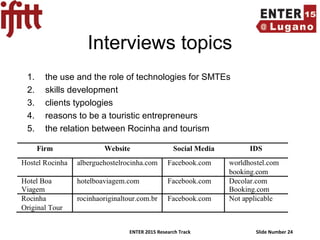
Interviews topics
1. the use and the role of technologies for SMTEs
2. skills development
3. clients typologies
4. reasons to be a touristic entrepreneurs
5. the relation between Rocinha and tourism
ENTER 2015 Research Track Slide Number 25
The impact of tourism on Rocinha
“The choice of tourism was a matter of social justice more than driven by
personal motivations. […] I saw that the exploitation of external entities
[i.e. travel agencies] was not converted in a social return for the slum,
and this made me decide [for tourism] (Rocinha Original Tour).
Main Impacts
•employment of new people
•using products bought locally
•tourists spend their money
Most importantly tourism is helping in fostering relation between
tourists, the environment and the local community
ENTER 2015 Research Track Slide Number 26
The impact of tourism on Rocinha
“Clients love it [Rocinha], they post in facebook that they love it
because they feel at home. […] In Rocinha tourists love these
things, the culture, the place, our welcoming attitude […]and
tourists when arrive here feel welcomed by the local people.[…]
Here is plenty of human warmth.” (Hostel Rocinha)
“[Tourism] is good for the local economy, but also because you
can meet people from other countries. You, without travelling
outside the country, are meeting and knowing a bit of each person
[coming], of each place in the world, and this is interesting.” (Hostel
Rocinha)
ENTER 2015 Research Track Slide Number 27
Web Presence and Digital Literacy
“This business could not work without internet. There is
no way. Clients would not climb the steps and come
until here. Without internet, we would have only 1 or 2
guests, but not the majority of them. Without internet the
conditions to have this place would not exist.” (Hostel
Rocinha)
“I think there is no way of doing this job without internet.
There is no way, how people would know that this hotel
exist? It wouldn’t be possible.” (Hotel Boa Viagem 2)
ENTER 2015 Research Track Slide Number 28
So…
• Tourism can be considered also a socio-economic
driving force
• Digital technologies can be helpful to make CBT firms
visible.
• eT4D can become a new research field
– Technology adoption
– Professional Use & disintermediation
– Professional training
– […]

The Rise of eTourism for Development

  • 1.
    ENTER 2015 ResearchTrack Slide Number 1 The Rise of eTourism for Development Alessandro Inversini*, Isabella Rega*, Isabella Nunes Pereira** and Roberto Bartholo** *Bournemouth University, UK **Universidade Federal do Rio de Janeiro, Brasil ainversini@bournemouth.ac.uk, irega@bournemouth.ac.uk, inunesp@gmail.com, bartholo.roberto@gmail.com http://www.bournemouth.ac.uk, http://www.ufrj.br
  • 2.
    ENTER 2015 ResearchTrack Slide Number 2 Tourism and Development • Tourism is considered as potential strategic factor for economic growth (Sinclair and Stabler, 2002). • Tourism has a general positive impact on the development of rural economies (Cánoves and Blanco, 2004) • Tourism generates new businesses, improves infrastructures and services, fosters preservation of the natural environment/ landscapes and helps with economic diversification (Herrero and San Martín, 2012; Wang and Pfister, 2008).
  • 3.
    ENTER 2015 ResearchTrack Slide Number 3 Tourism vs Development Leopard Beach Resort - Kenya
  • 4.
    ENTER 2015 ResearchTrack Slide Number 4 Tourism vs Development Rocinha Cable Car– Rio De Janeiro
  • 5.
    ENTER 2015 ResearchTrack Slide Number 5 Hostel Rocinha – Rio De Janeiro
  • 6.
    ENTER 2015 ResearchTrack Slide Number 6 Tourism and Development • Tourism is an economic driving force in many developing countries as it substantially contributes to the GDPs of many emerging economies (Sireyjol, 2010). – from the roughly 9% in Ethiopia or Senegal – to 25% in Mauritius BUT what is the real contribution of tourism to development and especially to socio-economic development?
  • 7.
    ENTER 2015 ResearchTrack Slide Number 7
  • 8.
    ENTER 2015 ResearchTrack Slide Number 8 Tourism and Development • Tourism has a controversial effect on natural resources and hosting communities’ exploitation (e.g. Deller, 2010) • Tourism can generate a general exploitation of the working poor by the rich (e.g. Marcouiller, 1997)
  • 9.
    ENTER 2015 ResearchTrack Slide Number 9 Tourism and Development Tourism in developing and emerging countries is often seen as an imperialist and post-colonial phenomenon (Nash, 1989; Pastran, 2014)
  • 10.
    ENTER 2015 ResearchTrack Slide Number 10
  • 11.
    ENTER 2015 ResearchTrack Slide Number 11 How this vision can be challenged?
  • 12.
    ENTER 2015 ResearchTrack Slide Number 12 Issues at Stake The nature of the Tourism Industry Community Based Tourism SMTEs as unit for Socio Economic Development
  • 13.
    ENTER 2015 ResearchTrack Slide Number 13 ICT + Tourism ICT + Development Information and Communication Technologies
  • 14.
    ENTER 2015 ResearchTrack Slide Number 14 eT4D conceptualization
  • 15.
    ENTER 2015 ResearchTrack Slide Number 15 Tourism and Development • Exploitative tourism was historically challenged (Krippendorf, 1987) and alternative forms thus arose with a renewed focus on local sustainability and community development. • growing demand for products and services that are more sustainable, pro-poor, and less harmful to local environments and communities (Callanan & Thomas, 2005). • Community Based Tourism (Murphy 1985; Simpson, 2008) that is a bottom up approach to involve community in the creation and execution of tourism products (Sebele, 2010).
  • 16.
    ENTER 2015 ResearchTrack Slide Number 16 Tourism and ICT • The advent of the internet produced a paradigm shift in the industry thanks to the convergence among informatics, communication, and multimedia (Buhalis 2003). • The access to these peripheral areas is often problematic both physically and electronically (Hall and Page 2006). • SMTEs needs to develop their “virtual size” thus marketing and selling their services to the global markets (Spencer et al., 2012).
  • 17.
    ENTER 2015 ResearchTrack Slide Number 17 Development and ICT • Information and Communication for Development is a relatively new field of study (Unwin, 2009; Heeks, 2010) • The underpinning is that access to digital technology can promote social and economic development (Rega et al., 2013). • Micro-small and medium size enterprises as unit of analysis (Heeks, 2010), in order to understand the role of ICT in development (Kleine and Unwin, 2009).
  • 18.
    ENTER 2015 ResearchTrack Slide Number 18 eTourism 4 Development • The Community Base Tourism perspective (Murphy, 1985; Simpson, 2008; Sebele 2010) where tourism is driven by the local community with a bottom up approach leading to socio- economic development (Lea, 1988); • The disruptive rise of ICTs and the internet in the field of tourism and its the impact on the marketing (Buhalis, 2003) and selling power (Law 2009) of the travel and tourism operators; • The increasing importance of technologies within development studies field (ICT4D – Unwin 2009), which are operating as a paradigm shift also at micro and small firm level (Heeks 2010).
  • 19.
    ENTER 2015 ResearchTrack Slide Number 19 Case Study: Rocinha
  • 20.
    ENTER 2015 ResearchTrack Slide Number 20
  • 21.
    ENTER 2015 ResearchTrack Slide Number 21
  • 22.
    ENTER 2015 ResearchTrack Slide Number 22 Rocinha - The Community Perspective
  • 23.
    ENTER 2015 ResearchTrack Slide Number 23 Case Study Research Questions • RQ1: to what extent Small and Medium Tourism Enterprises are enhancing the socio-economic conditions of local communities? • RQ2: what is the importance of tourism technologies in disadvantaged settings?
  • 24.
    ENTER 2015 ResearchTrack Slide Number 24 Interviews topics 1. the use and the role of technologies for SMTEs 2. skills development 3. clients typologies 4. reasons to be a touristic entrepreneurs 5. the relation between Rocinha and tourism
  • 25.
    ENTER 2015 ResearchTrack Slide Number 25 The impact of tourism on Rocinha “The choice of tourism was a matter of social justice more than driven by personal motivations. […] I saw that the exploitation of external entities [i.e. travel agencies] was not converted in a social return for the slum, and this made me decide [for tourism] (Rocinha Original Tour). Main Impacts •employment of new people •using products bought locally •tourists spend their money Most importantly tourism is helping in fostering relation between tourists, the environment and the local community
  • 26.
    ENTER 2015 ResearchTrack Slide Number 26 The impact of tourism on Rocinha “Clients love it [Rocinha], they post in facebook that they love it because they feel at home. […] In Rocinha tourists love these things, the culture, the place, our welcoming attitude […]and tourists when arrive here feel welcomed by the local people.[…] Here is plenty of human warmth.” (Hostel Rocinha) “[Tourism] is good for the local economy, but also because you can meet people from other countries. You, without travelling outside the country, are meeting and knowing a bit of each person [coming], of each place in the world, and this is interesting.” (Hostel Rocinha)
  • 27.
    ENTER 2015 ResearchTrack Slide Number 27 Web Presence and Digital Literacy “This business could not work without internet. There is no way. Clients would not climb the steps and come until here. Without internet, we would have only 1 or 2 guests, but not the majority of them. Without internet the conditions to have this place would not exist.” (Hostel Rocinha) “I think there is no way of doing this job without internet. There is no way, how people would know that this hotel exist? It wouldn’t be possible.” (Hotel Boa Viagem 2)
  • 28.
    ENTER 2015 ResearchTrack Slide Number 28 So… • Tourism can be considered also a socio-economic driving force • Digital technologies can be helpful to make CBT firms visible. • eT4D can become a new research field – Technology adoption – Professional Use & disintermediation – Professional training – […]

Editor's Notes

  • #20 This case study builds also upon the body of knowledge about slum tourism (Davis 2006). Slum tourism can be described as slum tourism guided tourist tours through the poorer quarters in the cities of the global south (Rolfes 2010). Slum tourism is seen as ‘negative sightseeing or poverty tourism’ (Meschkank, 2011) Despite this negative image, slum tourism has been able to emerge and establish itself in several cities of the global south (Dyson 2012) and also in Brazilian favelas (Frisch, 2012) like Rocinha. Rocinha is built on a steep hillside overlooking Rio de Janeiro. Compared to other slums, Rocinha has a better developed infrastructure and hundreds of businesses such as banks, medicine stores, bus lines, cable television. In November 2011, a security operation was undertaken where hundreds of police and military patrolled the streets of Rocinha to crackdown on rampant criminality. Since then Rocinha has been classified as ‘pacified slum’ with the government taking control of the neighbourhood. Recently few Rocinha’s entrepreneurs started to respond to the growing tourism demand by creating hostels, hotels and a series of small tourism firms. The case of Rocinha become very popular in the months before the Football World Cup 2014 held in Brazil. Several newspapers (e.g. The Guardian, 2014; New York Times, 2014) around the world reported the growing demand for tourism accommodation in Rio de Janeiro for the world cup.