Tourism Destination Web Monitor:
Beyond Web Analytics
Aurkene Alzua-Sorzabal, Jon Kepa Gerrikagoitia, Fidel
Rebón
CICtourGUNE, Spain

ENTER 2014 Research Track

Slide Number 1
Agenda
• Introduction
– Problem
– Previous research

• The DWM System
• Conclusions and future work

ENTER 2014 Research Track

Slide Number 2
Introduction
• The present time has been recognized as a technologymediated world, with computing and communication
entities interacting among themselves, as well as with
users.
• In this technology-rich scenario, real-world components
interact with cyberspace thus driving towards what some
scholars have called the Cyber-Physical World (CPW)
convergence (Conti et al., 2012).
• Information flows from the physical to the cyber world,
and vice versa, adapting the converged world to human
behaviour and social dynamics.
ENTER 2014 Research Track

Slide Number 3
Introduction
• How to transfer information and knowledge from the
cyber world toward the physical one is not obvious.
• This opens up the field for the creation of innovative
research and advanced services to better understand and
interact with the surrounding physical world as well as the
social activities.

ENTER 2014 Research Track

Slide Number 4
Introduction
• The importance of Internet as mass media in the field of tourism is
that it constitutes an important channel of marketing institutions and
business network of the tourist destinations, providing huge volumes
of information available to potential tourists (Buhalis & Law, 2008).
• The new technology-mediated environment not only provides
destinations a new means of promotion and enhancement of tourist
activities but also, new means of learning about the tourist
preferences.
• Advance solutions, tolls and metrics, play a very important role in this
process of developing a deep understanding of the present and
future visitor.

ENTER 2014 Research Track

Slide Number 5
Introduction
• Beyond traditional web analytics, destination´s
stakeholders are needed of innovations to support the
intelligent monitoring of the visitors, in order to
anticipate and improve their performance. DMO
(Destination Management Organization) must find out to
whom, to what, to how and to when to refer to the visitor
• Technologies into Business Intelligence based on Internet
provides the opportunity to anticipate and estimate
consumer habits on a changing environment (AlzuaSorzabal, Gerrikagoitia, & Torres-Manzanera, 2013)

ENTER 2014 Research Track

Slide Number 6
Introduction
Previous research
•The DMOs invest many resources: time, effort and money
in order to have a presence on the internet; but very few of
them are studying the subsequent processes of
management, maintenance, improvement and exploitation
of this appearance (Wang & Fesenmaier, 2006)
•Currently three approaches can be recognized: Web Usage
Mining, Web Content Mining and Web Structure Mining
(Agarwal, Bharat Bhushan Dhall, 2010; Wang, Abraham, &
Smith, 2005; Peterson, 2006)
ENTER 2014 Research Track

Slide Number 7
Introduction
• Web Usage Mining techniques are based on the process
of discovering patterns of usage on web data (Iváncsy &
Vajk, 2006; Plaza, 2011; Arbelaitz et al., 2013)
• Web Content Mining techniques define processes that try
to discover useful information from the content of web
pages (Srivastava, Desikan, & Kumar, 2005). Special
attention to Web Multimedia Techniques (Ocaña, Martos,
& Vicente, 2002)
• Web Structure Mining techniques are focused on inferring
knowledge from websites through the "links" that they
host (Piazzi, Baggio, Neidhardt, & Werthner, 2011)
ENTER 2014 Research Track

Slide Number 8
The DWM System
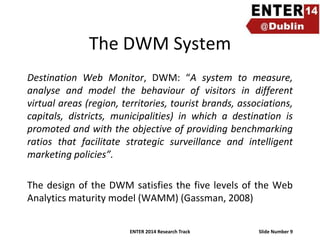
Destination Web Monitor, DWM: “A system to measure,
analyse and model the behaviour of visitors in different
virtual areas (region, territories, tourist brands, associations,
capitals, districts, municipalities) in which a destination is
promoted and with the objective of providing benchmarking
ratios that facilitate strategic surveillance and intelligent
marketing policies”.
The design of the DWM satisfies the five levels of the Web
Analytics maturity model (WAMM) (Gassman, 2008)
ENTER 2014 Research Track

Slide Number 9
The DWM System
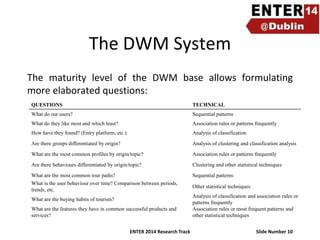
The maturity level of the DWM base allows formulating
more elaborated questions:
QUESTIONS

TECHNICAL

What do our users?

Sequential patterns

What do they like most and which least?

Association rules or patterns frequently

How have they found? (Entry platform, etc.)

Analysis of classification

Are there groups differentiated by origin?

Analysis of clustering and classification analysis

What are the most common profiles by origin/topic?

Association rules or patterns frequently

Are there behaviours differentiated by origin/topic?

Clustering and other statistical techniques

What are the most common tour paths?
What is the user behaviour over time? Comparison between periods,
trends, etc.

Sequential patterns

What are the buying habits of tourists?
What are the features they have in common successful products and
services?
ENTER 2014 Research Track

Other statistical techniques
Analysis of classification and association rules or
patterns frequently
Association rules or most frequent patterns and
other statistical techniques
Slide Number 10
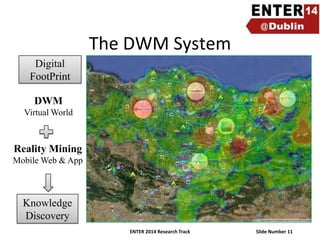
The DWM System
Digital
FootPrint
DWM
Virtual World

Reality Mining
Mobile Web & App

Knowledge
Discovery
ENTER 2014 Research Track

Slide Number 11
Conclusions and future work
• The DWM as a platform for competitive intelligence
improved online marketing strategies. The DMO´s
decision making will be supported by evidences on the
effect of marketing strategies as far as on attracting new
customers, increase the degree of loyalty of the visitors,
launching programs to encourage the spontaneous
recommendations (Gretzel, 2011).
• Future efforts in the investigating of the architectures and
the algorithms that exploit the data within DWM

ENTER 2014 Research Track

Slide Number 12

Tourism Destination Web Monitor: Beyond Web Analytics

  • 1.
    Tourism Destination WebMonitor: Beyond Web Analytics Aurkene Alzua-Sorzabal, Jon Kepa Gerrikagoitia, Fidel Rebón CICtourGUNE, Spain ENTER 2014 Research Track Slide Number 1
  • 2.
    Agenda • Introduction – Problem –Previous research • The DWM System • Conclusions and future work ENTER 2014 Research Track Slide Number 2
  • 3.
    Introduction • The presenttime has been recognized as a technologymediated world, with computing and communication entities interacting among themselves, as well as with users. • In this technology-rich scenario, real-world components interact with cyberspace thus driving towards what some scholars have called the Cyber-Physical World (CPW) convergence (Conti et al., 2012). • Information flows from the physical to the cyber world, and vice versa, adapting the converged world to human behaviour and social dynamics. ENTER 2014 Research Track Slide Number 3
  • 4.
    Introduction • How totransfer information and knowledge from the cyber world toward the physical one is not obvious. • This opens up the field for the creation of innovative research and advanced services to better understand and interact with the surrounding physical world as well as the social activities. ENTER 2014 Research Track Slide Number 4
  • 5.
    Introduction • The importanceof Internet as mass media in the field of tourism is that it constitutes an important channel of marketing institutions and business network of the tourist destinations, providing huge volumes of information available to potential tourists (Buhalis & Law, 2008). • The new technology-mediated environment not only provides destinations a new means of promotion and enhancement of tourist activities but also, new means of learning about the tourist preferences. • Advance solutions, tolls and metrics, play a very important role in this process of developing a deep understanding of the present and future visitor. ENTER 2014 Research Track Slide Number 5
  • 6.
    Introduction • Beyond traditionalweb analytics, destination´s stakeholders are needed of innovations to support the intelligent monitoring of the visitors, in order to anticipate and improve their performance. DMO (Destination Management Organization) must find out to whom, to what, to how and to when to refer to the visitor • Technologies into Business Intelligence based on Internet provides the opportunity to anticipate and estimate consumer habits on a changing environment (AlzuaSorzabal, Gerrikagoitia, & Torres-Manzanera, 2013) ENTER 2014 Research Track Slide Number 6
  • 7.
    Introduction Previous research •The DMOsinvest many resources: time, effort and money in order to have a presence on the internet; but very few of them are studying the subsequent processes of management, maintenance, improvement and exploitation of this appearance (Wang & Fesenmaier, 2006) •Currently three approaches can be recognized: Web Usage Mining, Web Content Mining and Web Structure Mining (Agarwal, Bharat Bhushan Dhall, 2010; Wang, Abraham, & Smith, 2005; Peterson, 2006) ENTER 2014 Research Track Slide Number 7
  • 8.
    Introduction • Web UsageMining techniques are based on the process of discovering patterns of usage on web data (Iváncsy & Vajk, 2006; Plaza, 2011; Arbelaitz et al., 2013) • Web Content Mining techniques define processes that try to discover useful information from the content of web pages (Srivastava, Desikan, & Kumar, 2005). Special attention to Web Multimedia Techniques (Ocaña, Martos, & Vicente, 2002) • Web Structure Mining techniques are focused on inferring knowledge from websites through the "links" that they host (Piazzi, Baggio, Neidhardt, & Werthner, 2011) ENTER 2014 Research Track Slide Number 8
  • 9.
    The DWM System DestinationWeb Monitor, DWM: “A system to measure, analyse and model the behaviour of visitors in different virtual areas (region, territories, tourist brands, associations, capitals, districts, municipalities) in which a destination is promoted and with the objective of providing benchmarking ratios that facilitate strategic surveillance and intelligent marketing policies”. The design of the DWM satisfies the five levels of the Web Analytics maturity model (WAMM) (Gassman, 2008) ENTER 2014 Research Track Slide Number 9
  • 10.
    The DWM System Thematurity level of the DWM base allows formulating more elaborated questions: QUESTIONS TECHNICAL What do our users? Sequential patterns What do they like most and which least? Association rules or patterns frequently How have they found? (Entry platform, etc.) Analysis of classification Are there groups differentiated by origin? Analysis of clustering and classification analysis What are the most common profiles by origin/topic? Association rules or patterns frequently Are there behaviours differentiated by origin/topic? Clustering and other statistical techniques What are the most common tour paths? What is the user behaviour over time? Comparison between periods, trends, etc. Sequential patterns What are the buying habits of tourists? What are the features they have in common successful products and services? ENTER 2014 Research Track Other statistical techniques Analysis of classification and association rules or patterns frequently Association rules or most frequent patterns and other statistical techniques Slide Number 10
  • 11.
    The DWM System Digital FootPrint DWM VirtualWorld Reality Mining Mobile Web & App Knowledge Discovery ENTER 2014 Research Track Slide Number 11
  • 12.
    Conclusions and futurework • The DWM as a platform for competitive intelligence improved online marketing strategies. The DMO´s decision making will be supported by evidences on the effect of marketing strategies as far as on attracting new customers, increase the degree of loyalty of the visitors, launching programs to encourage the spontaneous recommendations (Gretzel, 2011). • Future efforts in the investigating of the architectures and the algorithms that exploit the data within DWM ENTER 2014 Research Track Slide Number 12