By Vinnichenko Nastya
Email- staysu94@mail.ru
Reports.
«PROFESSIONAL!»
(28 June 2009 - Moscow)
«Whole Hollywood applauded Morricone with
tears in the eyes»
(27 February 2007 - Oscar)
«Maestro Morricone donates hurricane of
emotions and three encores»
(December 2013 - Sofia)
«The Mozart of film music»
(10 November 2003 - Londra, Royal Albert Hall )
Outline.
1. Biography
2. Soundtracks
3. Titles
4. Awards
5. Influence and modern references
6. Conclusion
7. References/Sources
Biography.
 was born on November 10, 1928, in Rome
 Mario Morricone, his father, taught him
how to read music and play a few
instruments
 at the age of nine he entered the National
Academy of Santa Cecilia
 at the age of 12 he entered the
conservatory
 in 1954 he entered Conservatory of Santa
Cecilia, obtaining a final 9,5/10 mark in his
Diploma in Composition
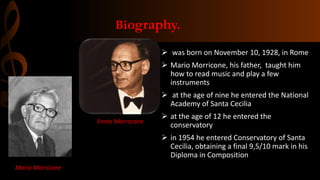
Ennio Morrocone
Mario Morricone
Biography. Career.
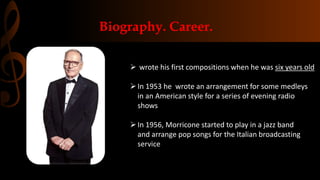
 wrote his first compositions when he was six years old
In 1953 he wrote an arrangement for some medleys
in an American style for a series of evening radio
shows
In 1956, Morricone started to play in a jazz band
and arrange pop songs for the Italian broadcasting
service
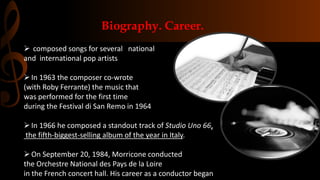
 composed songs for several national
and international pop artists
In 1963 the composer co-wrote
(with Roby Ferrante) the music that
was performed for the first time
during the Festival di San Remo in 1964
In 1966 he composed a standout track of Studio Uno 66,
the fifth-biggest-selling album of the year in Italy.
On September 20, 1984, Morricone conducted
the Orchestre National des Pays de la Loire
in the French concert hall. His career as a conductor began
Biography. Career.
Biography.
Gruppo di Improvvisazione di Nuova Consonanza (G.I.N.C).
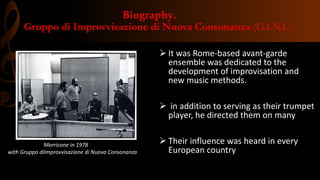
 It was Rome-based avant-garde
ensemble was dedicated to the
development of improvisation and
new music methods.
 in addition to serving as their trumpet
player, he directed them on many
 Their influence was heard in every
European country
Morricone in 1978
with Gruppo diImprovvisazione di Nuova Consonanza
Biography. Orchestra.
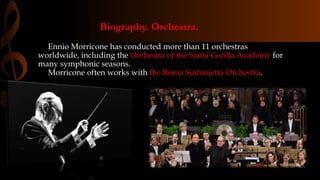
Ennio Morricone has conducted more than 11 orchestras
worldwide, including the Orchestra of the Santa Cecilia Academy for
many symphonic seasons.
Morricone often works with the Roma Sinfonietta Orchestra.
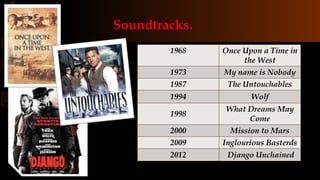
Soundtracks.
1968 Once Upon a Time in
the West
1973 My name is Nobody
1987 The Untouchables
1994 Wolf
1998
What Dreams May
Come
2000 Mission to Mars
2009 Inglourious Basterds
2012 Django Unchained
Titles.
1994 Received the Lifetime Achievement
award by the Society for Preservation
of Film Music
1995 the President of the Italian Republic
gave him the title of Commendatore
dell'Ordine al Merito della Repubblica
Italiana.
1996 Morricone became Academician of
Santa Cecilia
2002 Morricone received an Honorary
Degree from the Seconda Università di
Roma.
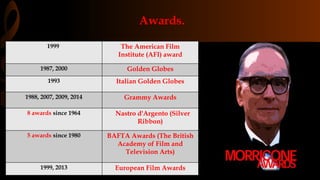
Awards.
1999 The American Film
Institute (AFI) award
1987, 2000 Golden Globes
1993 Italian Golden Globes
1988, 2007, 2009, 2014 Grammy Awards
8 awards since 1964 Nastro d'Argento (Silver
Ribbon)
5 awards since 1980 BAFTA Awards (The British
Academy of Film and
Television Arts)
1999, 2013 European Film Awards
Awards.
Ennio Morricone was nominated to
Academy award, also known as
Oscar, for 6 times.
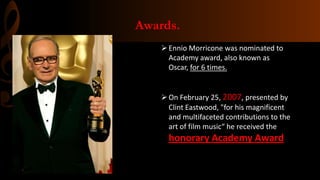
On February 25, 2007, presented by
Clint Eastwood, "for his magnificent
and multifaceted contributions to the
art of film music“ he received the
honorary Academy Award
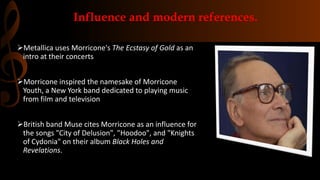
Influence and modern references.
Metallica uses Morricone's The Ecstasy of Gold as an
intro at their concerts
Morricone inspired the namesake of Morricone
Youth, a New York band dedicated to playing music
from film and television
British band Muse cites Morricone as an influence for
the songs "City of Delusion", "Hoodoo", and "Knights
of Cydonia" on their album Black Holes and
Revelations.
Conclusion.
 Since his childhood, Morricone was fond of composing music
 He graduated from more two music conservatories
 He started his career playing in bands, but continued
developing his talent being a conductor of eleven orchestras
 Hundreds of soundtracks to different films were composed by
him
 He received many awards, among which there is the Oscar
References.
1. http://www.enniomorricone.it/ne
ws.php
2. http://ennio-morricone.com
3. http://www.kapak.co.uk/ennio-
morricone

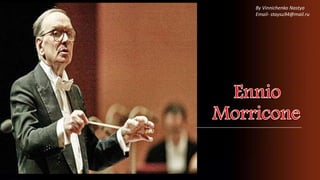
Ennio morricone

  • 1.
  • 2.
    Reports. «PROFESSIONAL!» (28 June 2009- Moscow) «Whole Hollywood applauded Morricone with tears in the eyes» (27 February 2007 - Oscar) «Maestro Morricone donates hurricane of emotions and three encores» (December 2013 - Sofia) «The Mozart of film music» (10 November 2003 - Londra, Royal Albert Hall )
  • 3.
    Outline. 1. Biography 2. Soundtracks 3.Titles 4. Awards 5. Influence and modern references 6. Conclusion 7. References/Sources
  • 4.
    Biography.  was bornon November 10, 1928, in Rome  Mario Morricone, his father, taught him how to read music and play a few instruments  at the age of nine he entered the National Academy of Santa Cecilia  at the age of 12 he entered the conservatory  in 1954 he entered Conservatory of Santa Cecilia, obtaining a final 9,5/10 mark in his Diploma in Composition Ennio Morrocone Mario Morricone
  • 5.
    Biography. Career.  wrotehis first compositions when he was six years old In 1953 he wrote an arrangement for some medleys in an American style for a series of evening radio shows In 1956, Morricone started to play in a jazz band and arrange pop songs for the Italian broadcasting service
  • 6.
     composed songsfor several national and international pop artists In 1963 the composer co-wrote (with Roby Ferrante) the music that was performed for the first time during the Festival di San Remo in 1964 In 1966 he composed a standout track of Studio Uno 66, the fifth-biggest-selling album of the year in Italy. On September 20, 1984, Morricone conducted the Orchestre National des Pays de la Loire in the French concert hall. His career as a conductor began Biography. Career.
  • 7.
    Biography. Gruppo di Improvvisazionedi Nuova Consonanza (G.I.N.C).  It was Rome-based avant-garde ensemble was dedicated to the development of improvisation and new music methods.  in addition to serving as their trumpet player, he directed them on many  Their influence was heard in every European country Morricone in 1978 with Gruppo diImprovvisazione di Nuova Consonanza
  • 8.
    Biography. Orchestra. Ennio Morriconehas conducted more than 11 orchestras worldwide, including the Orchestra of the Santa Cecilia Academy for many symphonic seasons. Morricone often works with the Roma Sinfonietta Orchestra.
  • 9.
    Soundtracks. 1968 Once Upona Time in the West 1973 My name is Nobody 1987 The Untouchables 1994 Wolf 1998 What Dreams May Come 2000 Mission to Mars 2009 Inglourious Basterds 2012 Django Unchained
  • 10.
    Titles. 1994 Received theLifetime Achievement award by the Society for Preservation of Film Music 1995 the President of the Italian Republic gave him the title of Commendatore dell'Ordine al Merito della Repubblica Italiana. 1996 Morricone became Academician of Santa Cecilia 2002 Morricone received an Honorary Degree from the Seconda Università di Roma.
  • 11.
    Awards. 1999 The AmericanFilm Institute (AFI) award 1987, 2000 Golden Globes 1993 Italian Golden Globes 1988, 2007, 2009, 2014 Grammy Awards 8 awards since 1964 Nastro d'Argento (Silver Ribbon) 5 awards since 1980 BAFTA Awards (The British Academy of Film and Television Arts) 1999, 2013 European Film Awards
  • 12.
    Awards. Ennio Morricone wasnominated to Academy award, also known as Oscar, for 6 times. On February 25, 2007, presented by Clint Eastwood, "for his magnificent and multifaceted contributions to the art of film music“ he received the honorary Academy Award
  • 13.
    Influence and modernreferences. Metallica uses Morricone's The Ecstasy of Gold as an intro at their concerts Morricone inspired the namesake of Morricone Youth, a New York band dedicated to playing music from film and television British band Muse cites Morricone as an influence for the songs "City of Delusion", "Hoodoo", and "Knights of Cydonia" on their album Black Holes and Revelations.
  • 14.
    Conclusion.  Since hischildhood, Morricone was fond of composing music  He graduated from more two music conservatories  He started his career playing in bands, but continued developing his talent being a conductor of eleven orchestras  Hundreds of soundtracks to different films were composed by him  He received many awards, among which there is the Oscar
  • 15.