Model-View-Template (MVT)
Architecture in Django
Why a Web framework is used?
A software framework is a standard platform for rapid application
development, while a web framework like Django offers generic
functionality for web applications, APIs, and services. Web
frameworks offer out-of-the-box support, efficient session
management, and integration with templating tools for dynamic
content rendering.
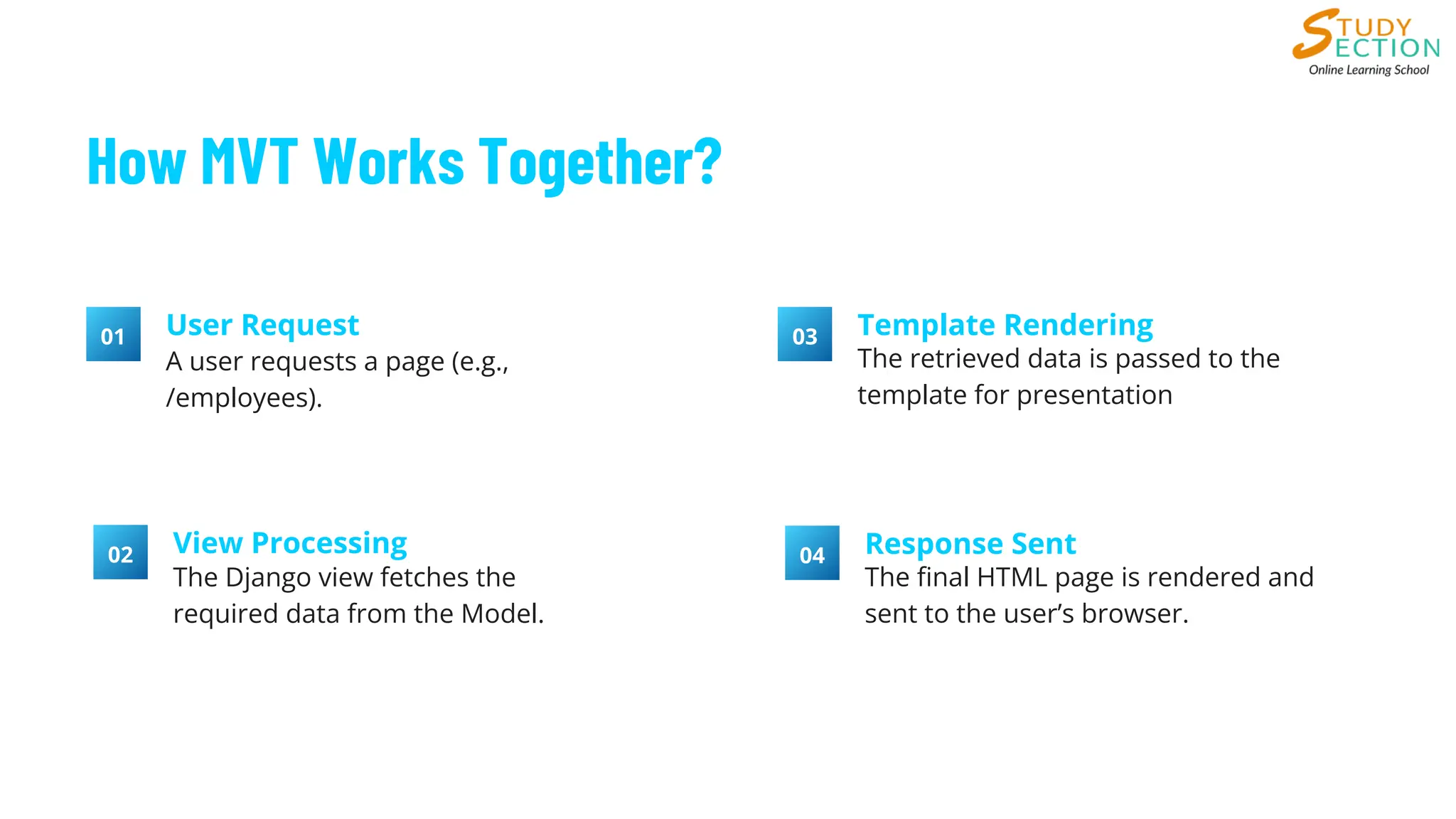
How MVT Works Together?
A user requests a page (e.g.,
/employees).
01 User Request
The Django view fetches the
required data from the Model.
02 View Processing
The retrieved data is passed to the
template for presentation
03 Template Rendering
The final HTML page is rendered and
sent to the user’s browser.
04 Response Sent
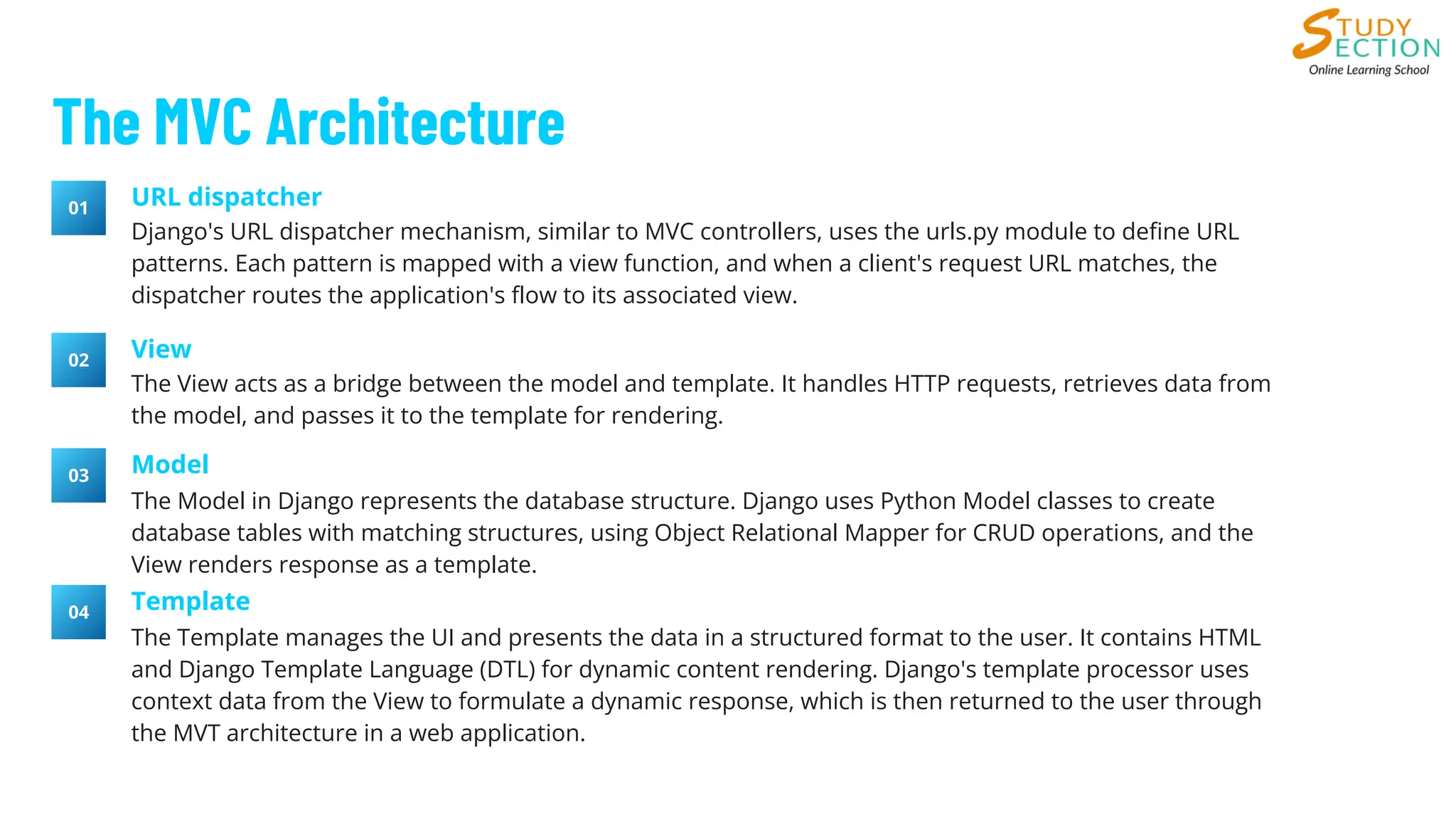
The MVC Architecture
Django's URL dispatcher mechanism, similar to MVC controllers, uses the urls.py module to define URL
patterns. Each pattern is mapped with a view function, and when a client's request URL matches, the
dispatcher routes the application's flow to its associated view.
01 URL dispatcher
The View acts as a bridge between the model and template. It handles HTTP requests, retrieves data from
the model, and passes it to the template for rendering.
02 View
The Model in Django represents the database structure. Django uses Python Model classes to create
database tables with matching structures, using Object Relational Mapper for CRUD operations, and the
View renders response as a template.
03 Model
The Template manages the UI and presents the data in a structured format to the user. It contains HTML
and Django Template Language (DTL) for dynamic content rendering. Django's template processor uses
context data from the View to formulate a dynamic response, which is then returned to the user through
the MVT architecture in a web application.
04 Template
Visit our Website
www.studysection.com
https://studysection.com/blog/
Follow our Blogs on
FOLLOW US
FOLLOW US
FOLLOW US

Model-View-Template (MVT) Architecture in Django

  • 1.
  • 2.
    Why a Webframework is used? A software framework is a standard platform for rapid application development, while a web framework like Django offers generic functionality for web applications, APIs, and services. Web frameworks offer out-of-the-box support, efficient session management, and integration with templating tools for dynamic content rendering.
  • 3.
    How MVT WorksTogether? A user requests a page (e.g., /employees). 01 User Request The Django view fetches the required data from the Model. 02 View Processing The retrieved data is passed to the template for presentation 03 Template Rendering The final HTML page is rendered and sent to the user’s browser. 04 Response Sent
  • 4.
    The MVC Architecture Django'sURL dispatcher mechanism, similar to MVC controllers, uses the urls.py module to define URL patterns. Each pattern is mapped with a view function, and when a client's request URL matches, the dispatcher routes the application's flow to its associated view. 01 URL dispatcher The View acts as a bridge between the model and template. It handles HTTP requests, retrieves data from the model, and passes it to the template for rendering. 02 View The Model in Django represents the database structure. Django uses Python Model classes to create database tables with matching structures, using Object Relational Mapper for CRUD operations, and the View renders response as a template. 03 Model The Template manages the UI and presents the data in a structured format to the user. It contains HTML and Django Template Language (DTL) for dynamic content rendering. Django's template processor uses context data from the View to formulate a dynamic response, which is then returned to the user through the MVT architecture in a web application. 04 Template
  • 5.