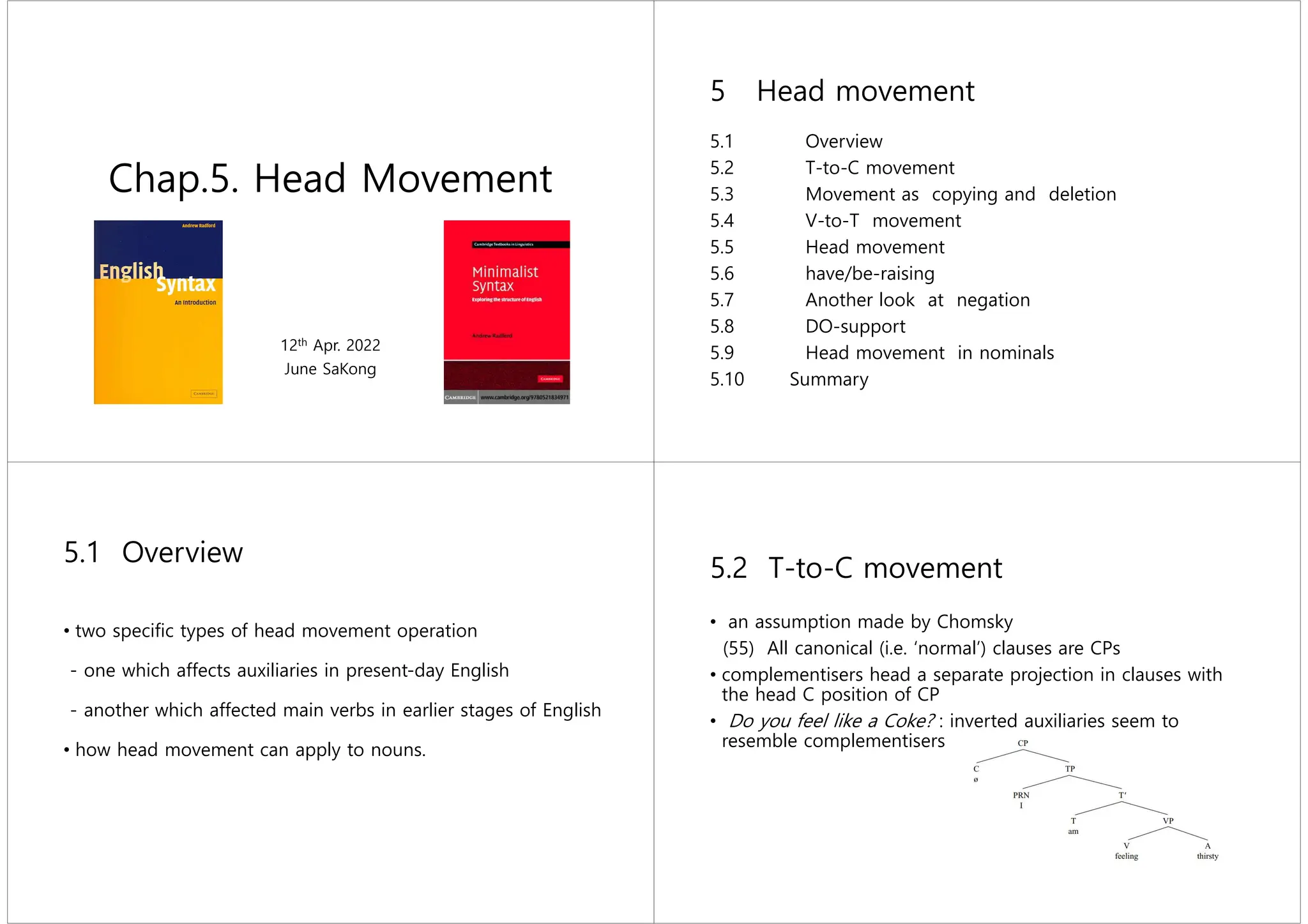
Chap.5. Head Movement
12th Apr. 2022
June SaKong
5 Head movement
5.1 Overview
5.2 T-to-C movement
5.3 Movement as copying and deletion
5.4 V-to-T movement
5.5 Head movement
5.6 have/be-raising
5.7 Another look at negation
5.8 DO-support
5.9 Head movement in nominals
5.10 Summary
5.1 Overview
• two specific types of head movement operation
- one which affects auxiliaries in present-day English
- another which affected main verbs in earlier stages of English
• how head movement can apply to nouns.
5.2 T-to-C movement
• an assumption made by Chomsky
(55) All canonical (i.e. ‘normal’) clauses are CPs
• complementisers head a separate projection in clauses with
the head C position of CP
• Do you feel like a Coke? : inverted auxiliaries seem to
resemble complementisers
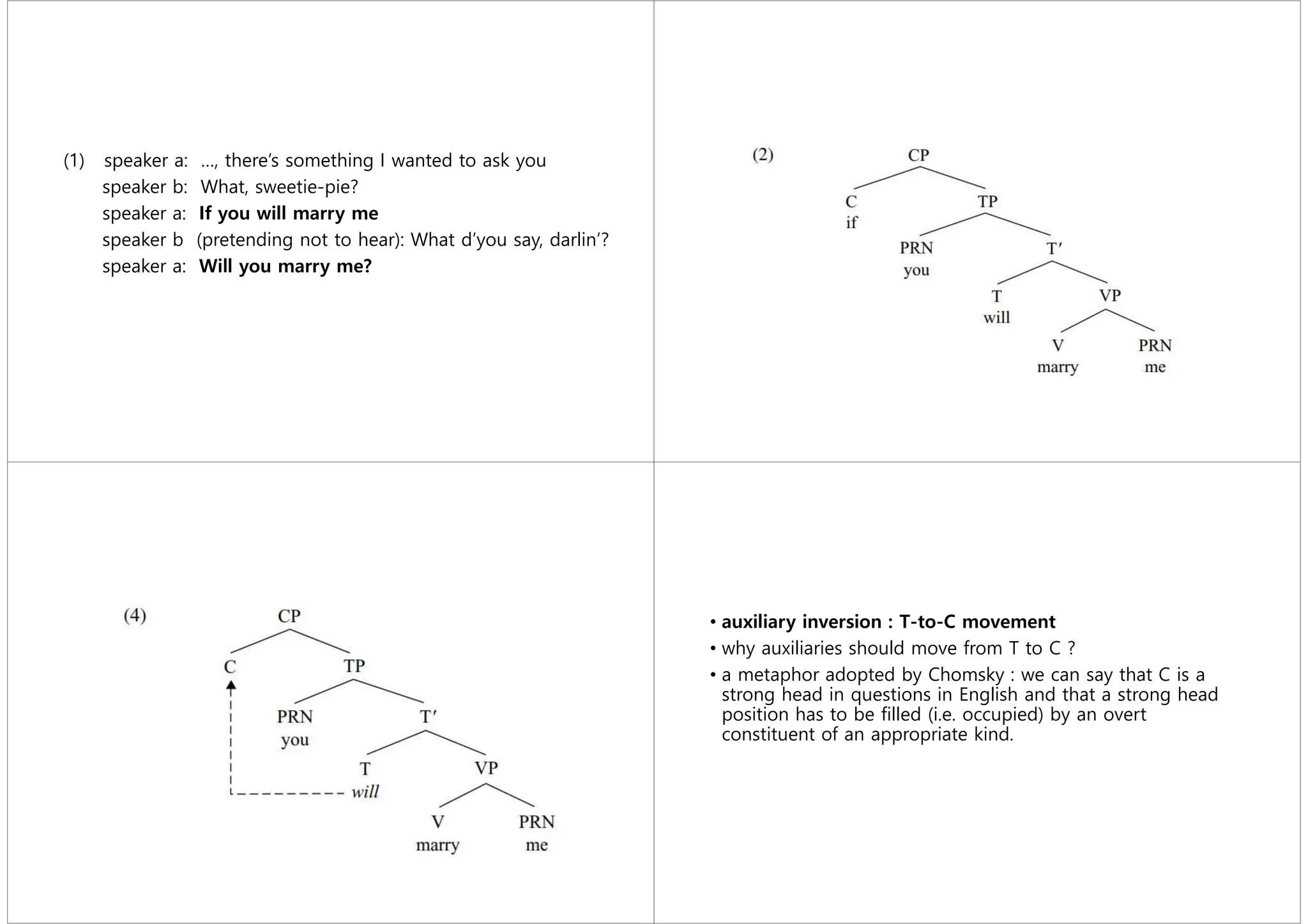
(1) speaker a: …, there’s something I wanted to ask you
speaker b: What, sweetie-pie?
speaker a: If you will marry me
speaker b (pretending not to hear): What d’you say, darlin’?
speaker a: Will you marry me?
• auxiliary inversion : T-to-C movement
• why auxiliaries should move from T to C ?
• a metaphor adopted by Chomsky : we can say that C is a
strong head in questions in English and that a strong head
position has to be filled (i.e. occupied) by an overt
constituent of an appropriate kind.
5.3 Movement as copying and deletion
(8) Headedness Principle
Every syntactic structure is a projection of a head word
(9) Binarity Principle
Every syntactic structure is binary-branching
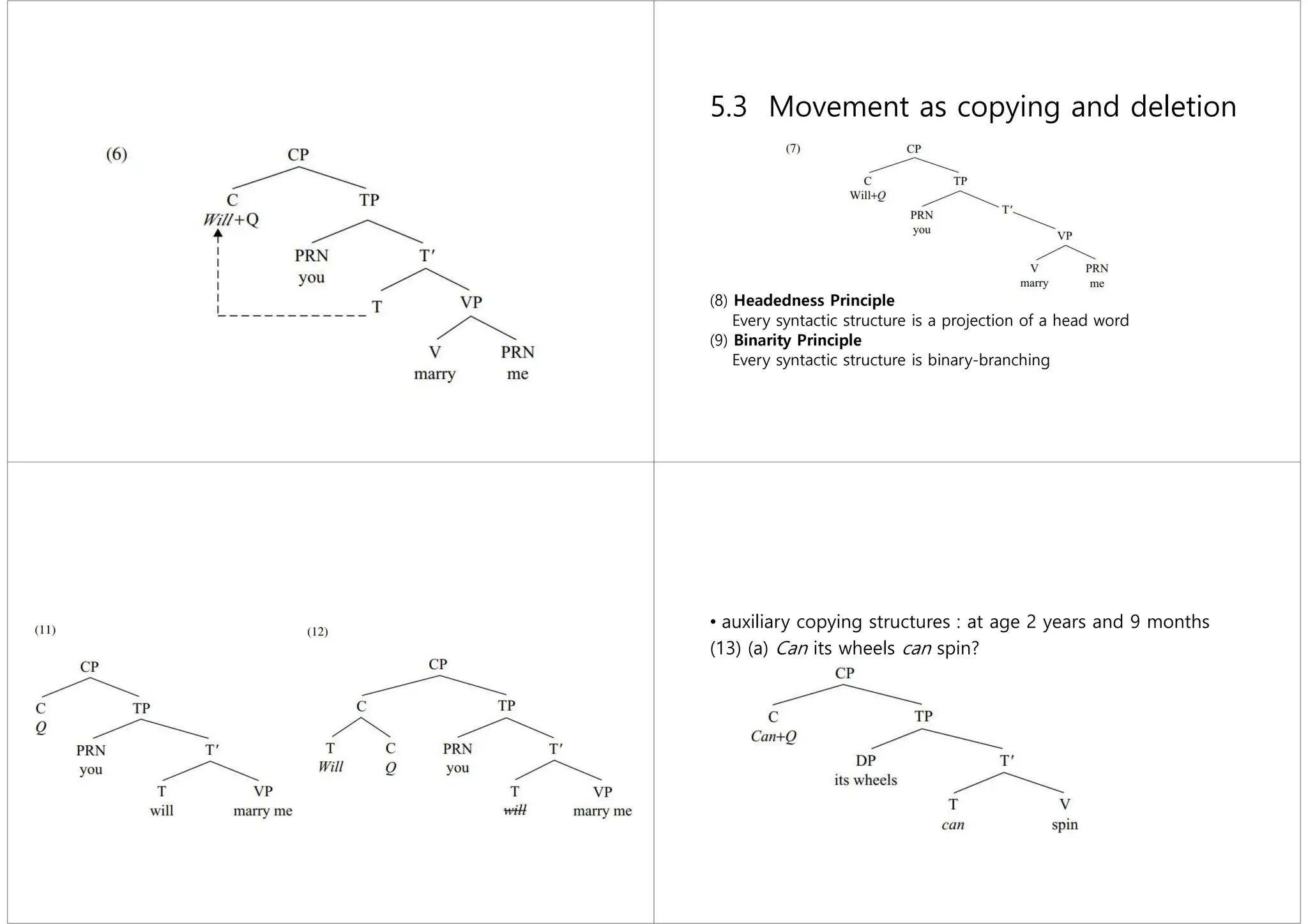
• auxiliary copying structures : at age 2 years and 9 months
(13) (a) Can its wheels can spin?
(b) Did the kitchen light did flash?
(c) Is the steam is hot?
(d) Was that was Anna?
• a movement operation like auxiliary inversion as a composite
operation involving the two separate operations of copy-
merge and copy-deletion
• with the evidence from child grammars, we also have
evidence from adult grammars in support of the claim that a
moved auxiliary leaves behind a null copy
(16) [CP [C Should+Q] [TP they [T should] have called the police]]
5.4 V-to-T movement
• V-to-T movement : was productive in Elizabethan English (i.e.
the English used during the reign of Queen Elizabeth I, when
Shakespeare was writing), but is no longer productive in
present-day English
(18) (a) Thou hast not left the value of a cord
(Gratiano, The Merchant of Venice, 4.i)
(19) (a) Have I not heard the sea rage like an angry boar?
(Petruchio, The Taming of the Shrew, I.ii)
• (21) (a) I care not for her
(Thurio, The Two Gentlemen of Verona, V.iv)
• why the verb care should move from V to T?
• Using Chomsky’s strength metaphor, we can suppose that a
finite T is strong in Elizabethan English and so must be filled:
this means that in a sentence in which the T position is not
filled by an auxiliary, the verb moves from V to T in order to
fill the strong T position.
• T in present-day English contains a weak Tns affix (more
specifically, an affix with a weak V-feature), and a weak tense
affix cannot trigger movement of a verb from V to T
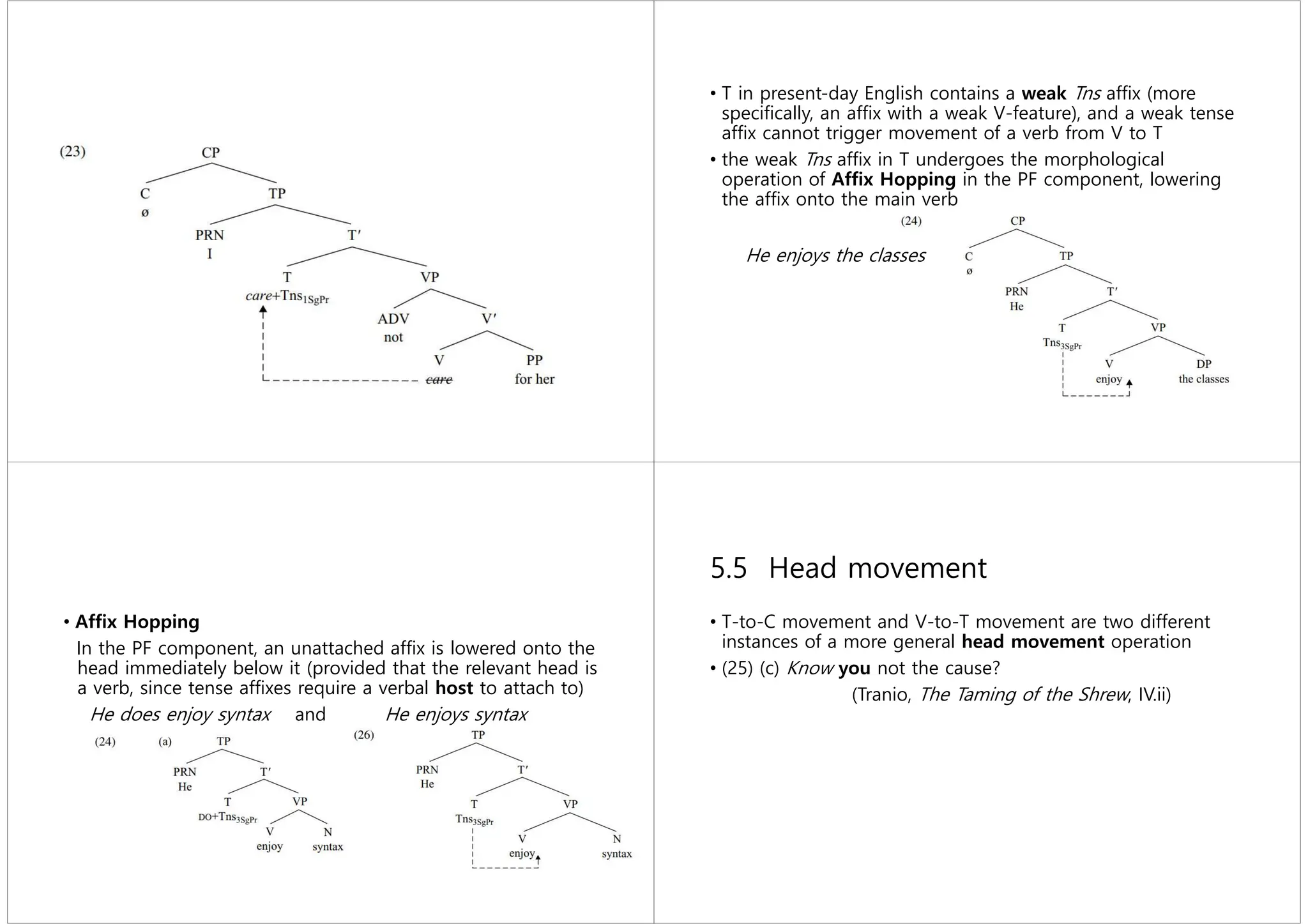
• the weak Tns affix in T undergoes the morphological
operation of Affix Hopping in the PF component, lowering
the affix onto the main verb
He enjoys the classes
• Affix Hopping
In the PF component, an unattached affix is lowered onto the
head immediately below it (provided that the relevant head is
a verb, since tense affixes require a verbal host to attach to)
He does enjoy syntax and He enjoys syntax
5.5 Head movement
• T-to-C movement and V-to-T movement are two different
instances of a more general head movement operation
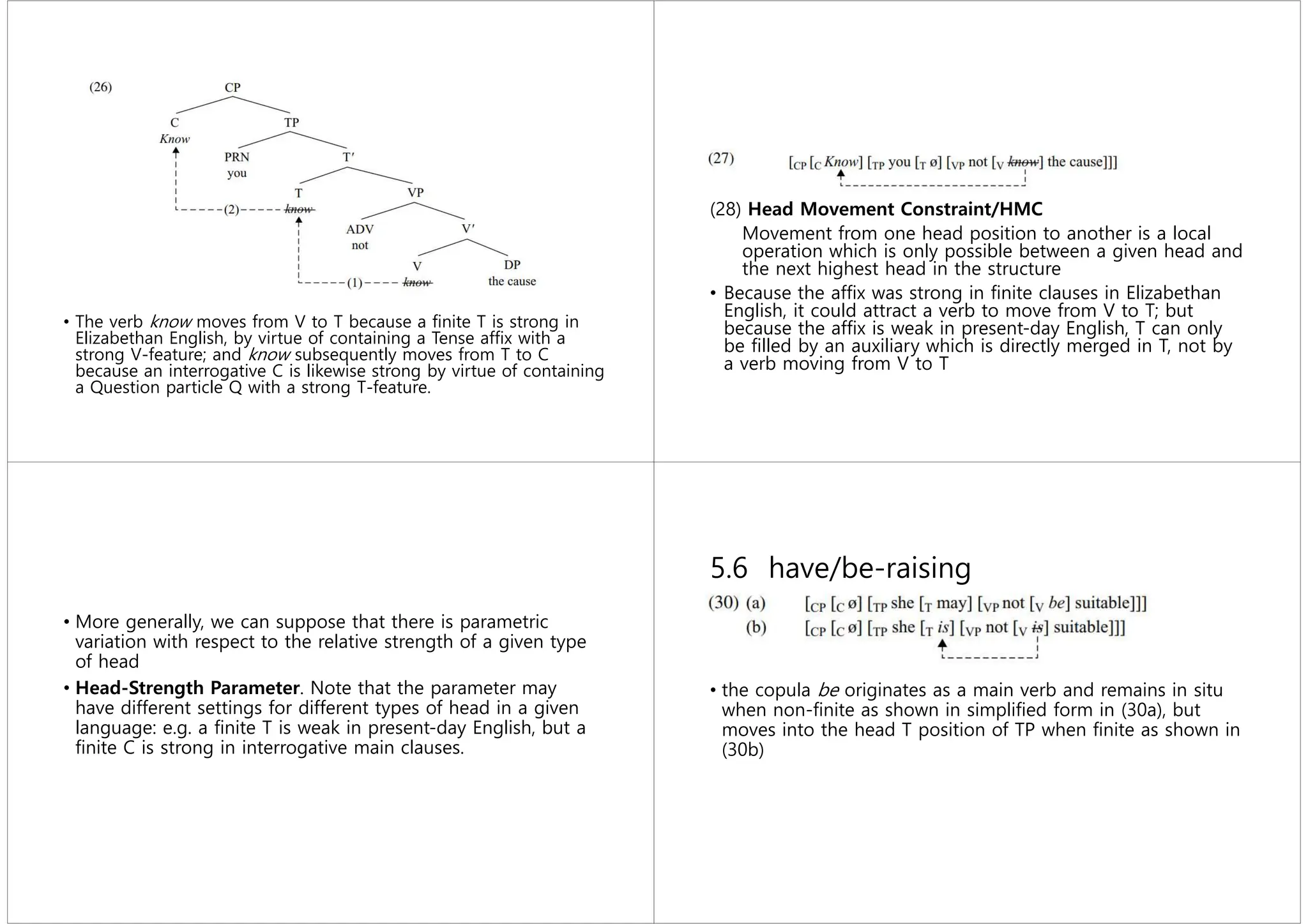
• (25) (c) Know you not the cause?
(Tranio, The Taming of the Shrew, IV.ii)
• The verb know moves from V to T because a finite T is strong in
Elizabethan English, by virtue of containing a Tense affix with a
strong V-feature; and know subsequently moves from T to C
because an interrogative C is likewise strong by virtue of containing
a Question particle Q with a strong T-feature.
(28) Head Movement Constraint/HMC
Movement from one head position to another is a local
operation which is only possible between a given head and
the next highest head in the structure
• Because the affix was strong in finite clauses in Elizabethan
English, it could attract a verb to move from V to T; but
because the affix is weak in present-day English, T can only
be filled by an auxiliary which is directly merged in T, not by
a verb moving from V to T
• More generally, we can suppose that there is parametric
variation with respect to the relative strength of a given type
of head
• Head-Strength Parameter. Note that the parameter may
have different settings for different types of head in a given
language: e.g. a finite T is weak in present-day English, but a
finite C is strong in interrogative main clauses.
5.6 have/be-raising
• the copula be originates as a main verb and remains in situ
when non-finite as shown in simplified form in (30a), but
moves into the head T position of TP when finite as shown in
(30b)
• present-day English would have a BE-raising operation
moving finite forms of BE from the head V position in VP (or
the head AUX position in AUXP) into the head T position in
TP (an idea which dates back to Klima 1964). This would
mean that present-day English retains a last vestige of
raising-to-T.
• What do HAVE and BE have in common which differentiates
them from other verbs? An answer given by many traditional
grammars is that they have little if any inherent lexical
content (and for this reason are sometimes called light
verbs), and in this respect they resemble auxiliaries. Adopting
this intuition, we can say that a finite T in present-day English
can trigger movement of an auxiliary verb like HAVE/BE to T
(but not movement of a lexical verb to T).
5.7 Another look at negation
• in earlier varieties of English, sentences containing not also
contained the negative particle ne (with ne arguably serving
as the head NEG constituent of NEGP and not as its specifier).
This can be illustrated by the following Middle English
example taken from Chaucer’s Wife of Bath’s Tale
(35) A lord in his houshold ne hath nat every vessel al of gold
(lines 99–100)
‘A lord in his household does not have all his vessels made
entirely of gold’
• (37) [TP A lord . . . [T ne+hath+Tns][NEGP nat [NEG ne+hath] [VP [V
hath]every vessel al of gold]]]
• attaching to the negative prefix ne to form the complex head
ne+hath, the resulting complex head ne+hath then attaches
to a present-tense affix Tns in T, merger of the TP in (37) with
a null declarative complementiser will derive the CP structure
• By Shakespeare’s time, ne had dropped out of use, leaving
the head NEG position of NEGP null. Positing that not in
Elizabethan English is the specifier of a NEGP headed by a
null NEG constituent opens up the possibility that V moves
through NEG into T
(39) [CP [C ø] [TP I[T Tns][NEGP not [NEG ø] [VP [V care] for her]]]]
(40) Earliness Principle
Operations must apply as early as possible in a derivation
(43) Strict Cyclicity Principle/SCP
At a stage of derivation where a given projection HP is
being cycled/processed, only operations affecting the head
H of HP and some other constituent of HP can apply
5.8 DO-support
(44) I do not care for her
(46) [TP I[T DO+Tns][NEGP not [NEG ø] [VP [V care] for her]]]
(47) When the PF component processes a structure whose
head H contains an (undeleted) verbal affix which is not
attached to a verb
(i) if H has a complement headed by an overt verb, the affix
is lowered onto the relevant verb [= Affix Hopping]
(ii) if not (i.e. if H does not have a complement headed by
an overt verb), the expletive (i.e. semantically contentless)
verb DO is attached to the Tense affix [= DO-support]
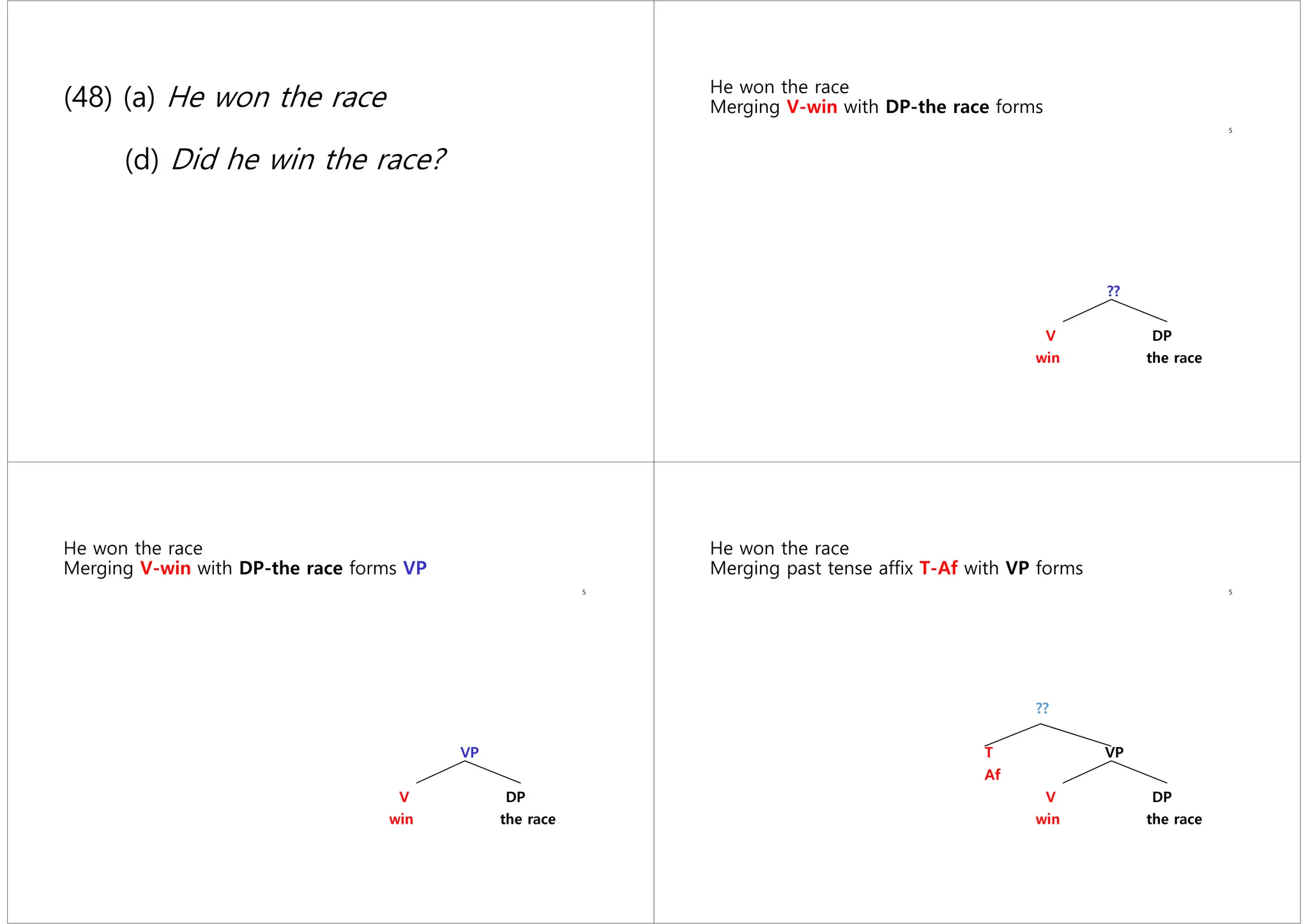
(48) (a) He won the race
(d) Did he win the race?
He won the race
Merging V-win with DP-the race forms
5
??
V DP
win the race
He won the race
Merging V-win with DP-the race forms VP
5
VP
V DP
win the race
He won the race
Merging past tense affix T-Af with VP forms
5
??
T VP
Af
V DP
win the race
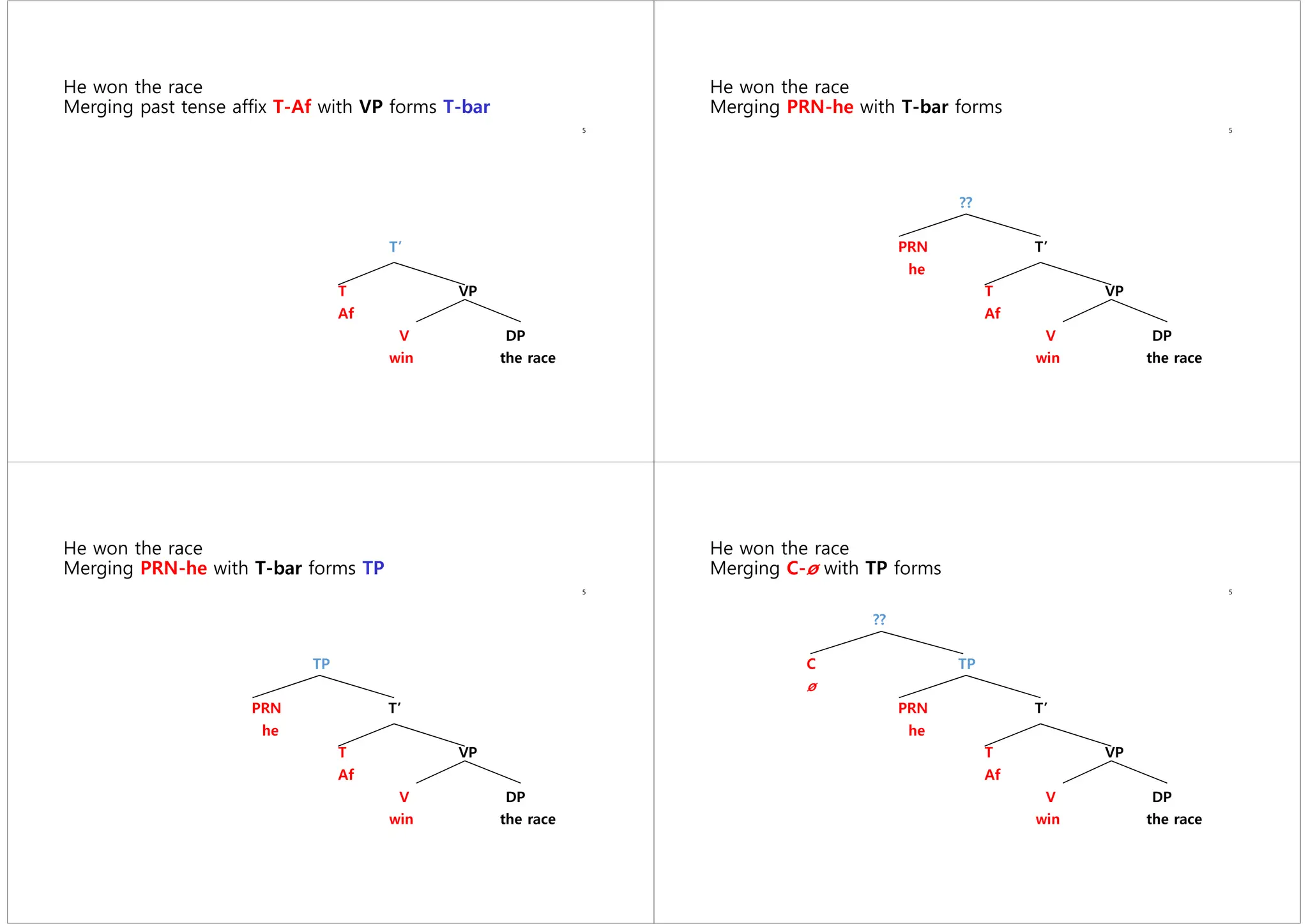
He won the race
Merging past tense affix T-Af with VP forms T-bar
5
T’
T VP
Af
V DP
win the race
He won the race
Merging PRN-he with T-bar forms
5
??
PRN T’
he
T VP
Af
V DP
win the race
He won the race
Merging PRN-he with T-bar forms TP
5
TP
PRN T’
he
T VP
Af
V DP
win the race
He won the race
Merging C-ø with TP forms
5
??
C TP
ø
PRN T’
he
T VP
Af
V DP
win the race
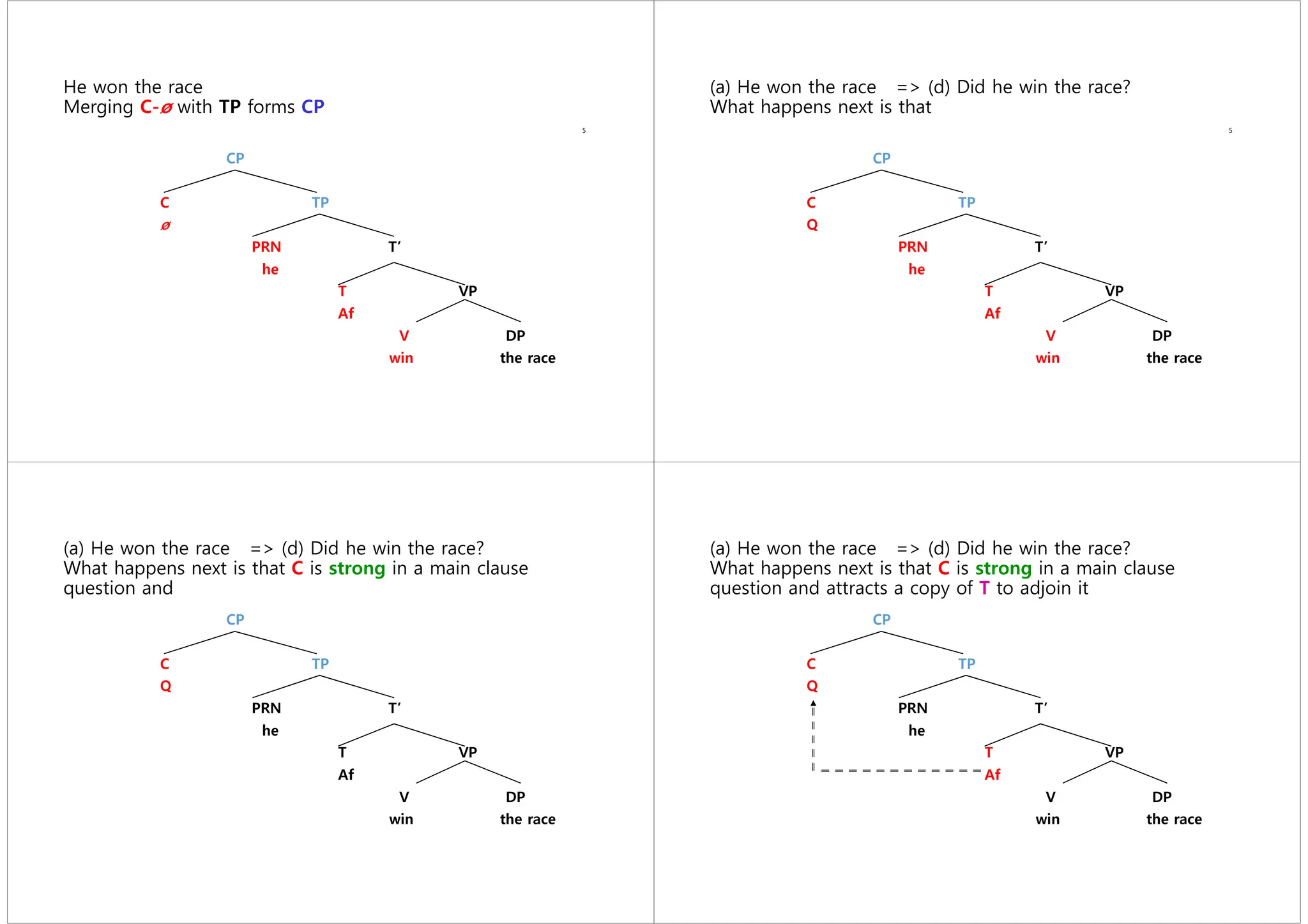
He won the race
Merging C-ø with TP forms CP
5
CP
C TP
ø
PRN T’
he
T VP
Af
V DP
win the race
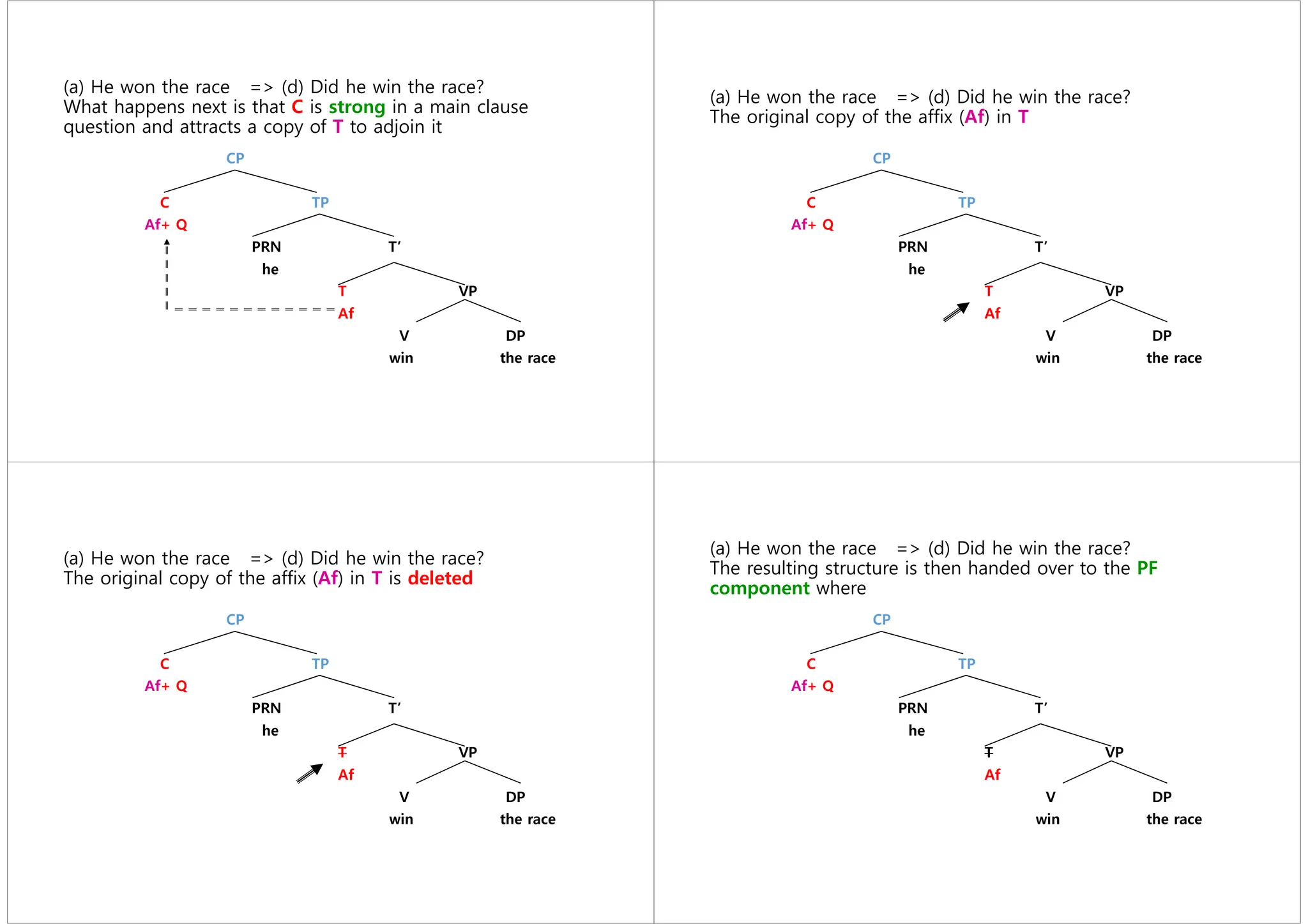
(a) He won the race => (d) Did he win the race?
What happens next is that
5
CP
C TP
Q
PRN T’
he
T VP
Af
V DP
win the race
(a) He won the race => (d) Did he win the race?
What happens next is that C is strong in a main clause
question and
CP
C TP
Q
PRN T’
he
T VP
Af
V DP
win the race
(a) He won the race => (d) Did he win the race?
What happens next is that C is strong in a main clause
question and attracts a copy of T to adjoin it
CP
C TP
Q
PRN T’
he
T VP
Af
V DP
win the race
(a) He won the race => (d) Did he win the race?
What happens next is that C is strong in a main clause
question and attracts a copy of T to adjoin it
CP
C TP
Af+ Q
PRN T’
he
T VP
Af
V DP
win the race
(a) He won the race => (d) Did he win the race?
The original copy of the affix (Af) in T
CP
C TP
Af+ Q
PRN T’
he
T VP
Af
V DP
win the race
(a) He won the race => (d) Did he win the race?
The original copy of the affix (Af) in T is deleted
CP
C TP
Af+ Q
PRN T’
he
T VP
Af
V DP
win the race
(a) He won the race => (d) Did he win the race?
The resulting structure is then handed over to the PF
component where
CP
C TP
Af+ Q
PRN T’
he
T VP
Af
V DP
win the race
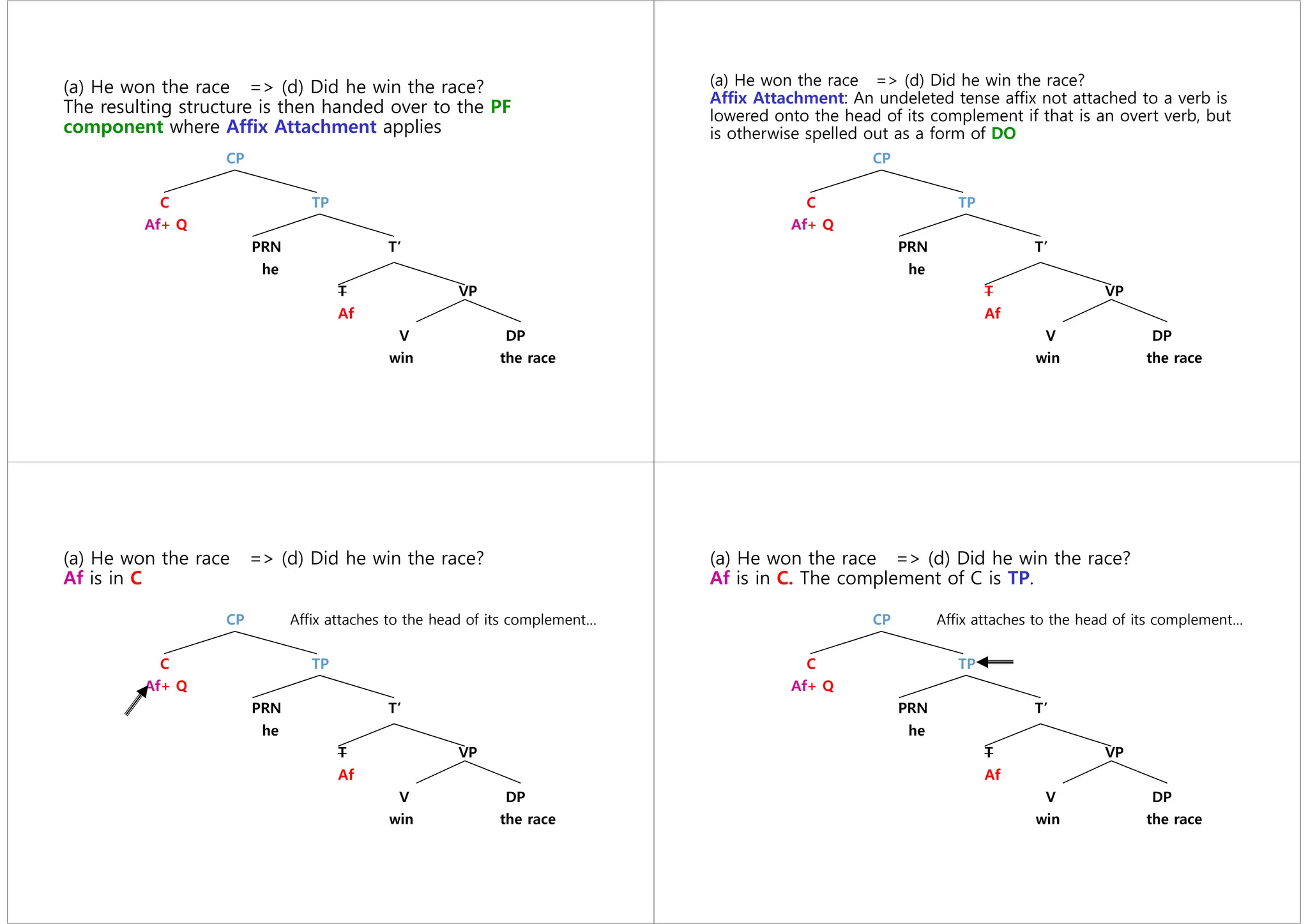
(a) He won the race => (d) Did he win the race?
The resulting structure is then handed over to the PF
component where Affix Attachment applies
CP
C TP
Af+ Q
PRN T’
he
T VP
Af
V DP
win the race
(a) He won the race => (d) Did he win the race?
Affix Attachment: An undeleted tense affix not attached to a verb is
lowered onto the head of its complement if that is an overt verb, but
is otherwise spelled out as a form of DO
CP
C TP
Af+ Q
PRN T’
he
T VP
Af
V DP
win the race
(a) He won the race => (d) Did he win the race?
Af is in C
CP Affix attaches to the head of its complement…
C TP
Af+ Q
PRN T’
he
T VP
Af
V DP
win the race
(a) He won the race => (d) Did he win the race?
Af is in C. The complement of C is TP.
CP Affix attaches to the head of its complement…
C TP
Af+ Q
PRN T’
he
T VP
Af
V DP
win the race
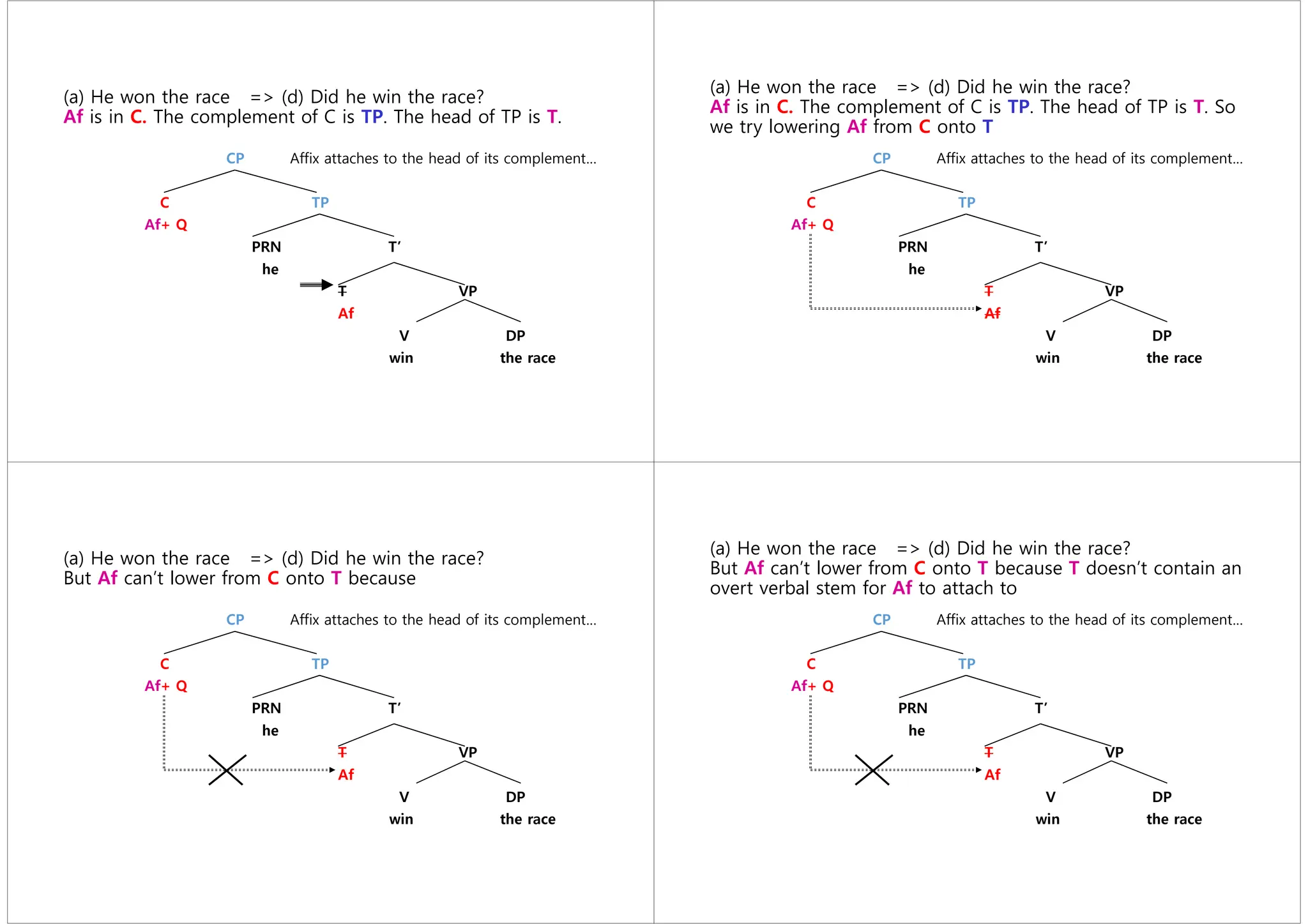
(a) He won the race => (d) Did he win the race?
Af is in C. The complement of C is TP. The head of TP is T.
CP Affix attaches to the head of its complement…
C TP
Af+ Q
PRN T’
he
T VP
Af
V DP
win the race
(a) He won the race => (d) Did he win the race?
Af is in C. The complement of C is TP. The head of TP is T. So
we try lowering Af from C onto T
CP Affix attaches to the head of its complement…
C TP
Af+ Q
PRN T’
he
T VP
Af
V DP
win the race
(a) He won the race => (d) Did he win the race?
But Af can’t lower from C onto T because
CP Affix attaches to the head of its complement…
C TP
Af+ Q
PRN T’
he
T VP
Af
V DP
win the race
(a) He won the race => (d) Did he win the race?
But Af can’t lower from C onto T because T doesn’t contain an
overt verbal stem for Af to attach to
CP Affix attaches to the head of its complement…
C TP
Af+ Q
PRN T’
he
T VP
Af
V DP
win the race
(a) He won the race => (d) Did he win the race?
Nor can Af lower directly onto V win because this would
violate the Head Movement Constraint
CP
C TP
Af+ Q
PRN T’
he
T VP
Af
V DP
win the race
(a) He won the race => (d) Did he win the race?
Because it can’t find a verbal host by lowering onto T or V, Af
is instead spelled out as an appropriate form of DO
CP Affix attaches to the head of its complement…
C TP
Af+ Q
PRN T’
he
T VP
Af
V DP
win the race
(a) He won the race => (d) Did he win the race?
Because it can’t find a verbal host by lowering onto T or V, Af
is instead spelled out as an appropriate form of DO
CP Did he win the race?
C TP
Did + Q
PRN T’
he
T VP
Af
V DP
win the race
• Didn’t he win the race?
(54) [CP [C Q] [TP he [T Tns+n’t][NEGP n’t [NEG ø] [VP [V win] the
race]]]]
(55) [CP [C Tns+n’t+Q] [TP he [T Tns+n’t][NEGP n’t [NEG ø] [VP [V win]
the race]]]]
5.9 Head movement in nominals
(57) (a) the Italian invasion of Albania
(b) l’invasione italiana dell’ Albania [Italian counterpart]
the invasion Italian of the Albania
(59) la grande invasione italiana dell’ Albania
the great invasion Italian of the Albania
(= ‘the great Italian invasion of Albania’)
(61) (b) a thing immortal [Chaucer’s Troilus and Criseyde]
some nice thing => some thing nice => something nice
(62) (b) bøkene hans om syntaks [Norwegian]
books+the his about syntax
• head movement may apply in nominal as well as clausal
structures
5.10 Summary
• C in main-clause questions is strong/affixal and attracts T
to adjoin to it (= ‘Aux Inversion’)
5.10 Summary
• C in main-clause questions is strong/affixal and attracts T
to adjoin to it (= ‘Aux Inversion’)
• Movement involves copying and deletion:
5.10 Summary
• C in main-clause questions is strong/affixal and attracts T
to adjoin to it (= ‘Aux Inversion’)
• Movement involves copying and deletion:
I [T can] help
5.10 Summary
• C in main-clause questions is strong/affixal and attracts T
to adjoin to it (= ‘Aux Inversion’)
• Movement involves copying and deletion:
I [T can] help > [C Can] I [T can] help
5.10 Summary
• C in main-clause questions is strong/affixal and attracts T
to adjoin to it (= ‘Aux Inversion’)
• Movement involves copying and deletion:
I [T can] help > [C Can] I [T can] help > [C Can] I [T --] help?
5.10 Summary
• C in main-clause questions is strong/affixal and attracts T
to adjoin to it (= ‘Aux Inversion’)
• Movement involves copying and deletion:
I [T can] help > [C Can] I [T can] help > [C Can] I [T --] help?
• In Elizabethan English, finite T could attract V to T:
5.10 Summary
• C in main-clause questions is strong/affixal and attracts T
to adjoin to it (= ‘Aux Inversion’)
• Movement involves copying and deletion:
I [T can] help > [C Can] I [T can] help > [C Can] I [T --] help?
• In Elizabethan English, finite T could attract V to T:
Thou [T dost] not [V love] me
5.10 Summary
• C in main-clause questions is strong/affixal and attracts T
to adjoin to it (= ‘Aux Inversion’)
• Movement involves copying and deletion:
I [T can] help > [C Can] I [T can] help > [C Can] I [T --] help?
• In Elizabethan English, finite T could attract V to T:
Thou [T dost] not [V love] me > Thou [T lovest] not [V --] me
5.10 Summary
• C in main-clause questions is strong/affixal and attracts T
to adjoin to it (= ‘Aux Inversion’)
• Movement involves copying and deletion:
I [T can] help > [C Can] I [T can] help > [C Can] I [T --] help?
• In Elizabethan English, finite T could attract V to T:
Thou [T dost] not [V love] me > Thou [T lovest] not [V --] me
• In Present-Day English, finite T is too weak to attract V to
move to T
5.10 Summary
• C in main-clause questions is strong/affixal and attracts T
to adjoin to it (= ‘Aux Inversion’)
• Movement involves copying and deletion:
I [T can] help > [C Can] I [T can] help > [C Can] I [T --] help?
• In Elizabethan English, finite T could attract V to T:
Thou [T dost] not [V love] me > Thou [T lovest] not [V --] me
• In Present-Day English, finite T is too weak to attract V to
move to T (but can attract AUX)
•
5.10 Summary
• C in main-clause questions is strong/affixal and attracts T
to adjoin to it (= ‘Aux Inversion’)
• Movement involves copying and deletion:
I [T can] help > [C Can] I [T can] help > [C Can] I [T --] help?
• In Elizabethan English, finite T could attract V to T:
Thou [T dost] not [V love] me > Thou [T lovest] not [V --] me
• In Present-Day English, finite T is too weak to attract V to
move to T (but can attract AUX)
• A tense affix attaches to the head of its complement, if
that is an overt verb stem: if not, the affix is spelled out as
a form of DO
5.10 Summary
• C in main-clause questions is strong/affixal and attracts T to
adjoin to it (= ‘Aux Inversion’)
• Movement involves copying and deletion:
I [T can] help > [C Can] I [T can] help > [C Can] I [T --] help?
• In Elizabethan English, finite T could attract V to T:
Thou [T dost] not [V love] me > Thou [T lovest] not [V --] me
• In Present-Day English, finite T is too weak to attract V to move
to T (but can attract AUX)
• A tense affix attaches to the head of its complement, if that is
an overt verb stem: if not, the affix is spelled out as a form of
DO
• Movement obeys Head Movement Constraint and Strict Cyclicity
Principle

English_Syntax_2004_Chap5_Head_Movement.pdf

  • 1.
    Chap.5. Head Movement 12thApr. 2022 June SaKong 5 Head movement 5.1 Overview 5.2 T-to-C movement 5.3 Movement as copying and deletion 5.4 V-to-T movement 5.5 Head movement 5.6 have/be-raising 5.7 Another look at negation 5.8 DO-support 5.9 Head movement in nominals 5.10 Summary 5.1 Overview • two specific types of head movement operation - one which affects auxiliaries in present-day English - another which affected main verbs in earlier stages of English • how head movement can apply to nouns. 5.2 T-to-C movement • an assumption made by Chomsky (55) All canonical (i.e. ‘normal’) clauses are CPs • complementisers head a separate projection in clauses with the head C position of CP • Do you feel like a Coke? : inverted auxiliaries seem to resemble complementisers
  • 2.
    (1) speaker a:…, there’s something I wanted to ask you speaker b: What, sweetie-pie? speaker a: If you will marry me speaker b (pretending not to hear): What d’you say, darlin’? speaker a: Will you marry me? • auxiliary inversion : T-to-C movement • why auxiliaries should move from T to C ? • a metaphor adopted by Chomsky : we can say that C is a strong head in questions in English and that a strong head position has to be filled (i.e. occupied) by an overt constituent of an appropriate kind.
  • 3.
    5.3 Movement ascopying and deletion (8) Headedness Principle Every syntactic structure is a projection of a head word (9) Binarity Principle Every syntactic structure is binary-branching • auxiliary copying structures : at age 2 years and 9 months (13) (a) Can its wheels can spin? (b) Did the kitchen light did flash? (c) Is the steam is hot? (d) Was that was Anna?
  • 4.
    • a movementoperation like auxiliary inversion as a composite operation involving the two separate operations of copy- merge and copy-deletion • with the evidence from child grammars, we also have evidence from adult grammars in support of the claim that a moved auxiliary leaves behind a null copy (16) [CP [C Should+Q] [TP they [T should] have called the police]] 5.4 V-to-T movement • V-to-T movement : was productive in Elizabethan English (i.e. the English used during the reign of Queen Elizabeth I, when Shakespeare was writing), but is no longer productive in present-day English (18) (a) Thou hast not left the value of a cord (Gratiano, The Merchant of Venice, 4.i) (19) (a) Have I not heard the sea rage like an angry boar? (Petruchio, The Taming of the Shrew, I.ii) • (21) (a) I care not for her (Thurio, The Two Gentlemen of Verona, V.iv) • why the verb care should move from V to T? • Using Chomsky’s strength metaphor, we can suppose that a finite T is strong in Elizabethan English and so must be filled: this means that in a sentence in which the T position is not filled by an auxiliary, the verb moves from V to T in order to fill the strong T position.
  • 5.
    • T inpresent-day English contains a weak Tns affix (more specifically, an affix with a weak V-feature), and a weak tense affix cannot trigger movement of a verb from V to T • the weak Tns affix in T undergoes the morphological operation of Affix Hopping in the PF component, lowering the affix onto the main verb He enjoys the classes • Affix Hopping In the PF component, an unattached affix is lowered onto the head immediately below it (provided that the relevant head is a verb, since tense affixes require a verbal host to attach to) He does enjoy syntax and He enjoys syntax 5.5 Head movement • T-to-C movement and V-to-T movement are two different instances of a more general head movement operation • (25) (c) Know you not the cause? (Tranio, The Taming of the Shrew, IV.ii)
  • 6.
    • The verbknow moves from V to T because a finite T is strong in Elizabethan English, by virtue of containing a Tense affix with a strong V-feature; and know subsequently moves from T to C because an interrogative C is likewise strong by virtue of containing a Question particle Q with a strong T-feature. (28) Head Movement Constraint/HMC Movement from one head position to another is a local operation which is only possible between a given head and the next highest head in the structure • Because the affix was strong in finite clauses in Elizabethan English, it could attract a verb to move from V to T; but because the affix is weak in present-day English, T can only be filled by an auxiliary which is directly merged in T, not by a verb moving from V to T • More generally, we can suppose that there is parametric variation with respect to the relative strength of a given type of head • Head-Strength Parameter. Note that the parameter may have different settings for different types of head in a given language: e.g. a finite T is weak in present-day English, but a finite C is strong in interrogative main clauses. 5.6 have/be-raising • the copula be originates as a main verb and remains in situ when non-finite as shown in simplified form in (30a), but moves into the head T position of TP when finite as shown in (30b)
  • 7.
    • present-day Englishwould have a BE-raising operation moving finite forms of BE from the head V position in VP (or the head AUX position in AUXP) into the head T position in TP (an idea which dates back to Klima 1964). This would mean that present-day English retains a last vestige of raising-to-T. • What do HAVE and BE have in common which differentiates them from other verbs? An answer given by many traditional grammars is that they have little if any inherent lexical content (and for this reason are sometimes called light verbs), and in this respect they resemble auxiliaries. Adopting this intuition, we can say that a finite T in present-day English can trigger movement of an auxiliary verb like HAVE/BE to T (but not movement of a lexical verb to T). 5.7 Another look at negation • in earlier varieties of English, sentences containing not also contained the negative particle ne (with ne arguably serving as the head NEG constituent of NEGP and not as its specifier). This can be illustrated by the following Middle English example taken from Chaucer’s Wife of Bath’s Tale (35) A lord in his houshold ne hath nat every vessel al of gold (lines 99–100) ‘A lord in his household does not have all his vessels made entirely of gold’ • (37) [TP A lord . . . [T ne+hath+Tns][NEGP nat [NEG ne+hath] [VP [V hath]every vessel al of gold]]] • attaching to the negative prefix ne to form the complex head ne+hath, the resulting complex head ne+hath then attaches to a present-tense affix Tns in T, merger of the TP in (37) with a null declarative complementiser will derive the CP structure • By Shakespeare’s time, ne had dropped out of use, leaving the head NEG position of NEGP null. Positing that not in Elizabethan English is the specifier of a NEGP headed by a null NEG constituent opens up the possibility that V moves through NEG into T
  • 8.
    (39) [CP [Cø] [TP I[T Tns][NEGP not [NEG ø] [VP [V care] for her]]]] (40) Earliness Principle Operations must apply as early as possible in a derivation (43) Strict Cyclicity Principle/SCP At a stage of derivation where a given projection HP is being cycled/processed, only operations affecting the head H of HP and some other constituent of HP can apply 5.8 DO-support (44) I do not care for her (46) [TP I[T DO+Tns][NEGP not [NEG ø] [VP [V care] for her]]] (47) When the PF component processes a structure whose head H contains an (undeleted) verbal affix which is not attached to a verb (i) if H has a complement headed by an overt verb, the affix is lowered onto the relevant verb [= Affix Hopping] (ii) if not (i.e. if H does not have a complement headed by an overt verb), the expletive (i.e. semantically contentless) verb DO is attached to the Tense affix [= DO-support]
  • 9.
    (48) (a) Hewon the race (d) Did he win the race? He won the race Merging V-win with DP-the race forms 5 ?? V DP win the race He won the race Merging V-win with DP-the race forms VP 5 VP V DP win the race He won the race Merging past tense affix T-Af with VP forms 5 ?? T VP Af V DP win the race
  • 10.
    He won therace Merging past tense affix T-Af with VP forms T-bar 5 T’ T VP Af V DP win the race He won the race Merging PRN-he with T-bar forms 5 ?? PRN T’ he T VP Af V DP win the race He won the race Merging PRN-he with T-bar forms TP 5 TP PRN T’ he T VP Af V DP win the race He won the race Merging C-ø with TP forms 5 ?? C TP ø PRN T’ he T VP Af V DP win the race
  • 11.
    He won therace Merging C-ø with TP forms CP 5 CP C TP ø PRN T’ he T VP Af V DP win the race (a) He won the race => (d) Did he win the race? What happens next is that 5 CP C TP Q PRN T’ he T VP Af V DP win the race (a) He won the race => (d) Did he win the race? What happens next is that C is strong in a main clause question and CP C TP Q PRN T’ he T VP Af V DP win the race (a) He won the race => (d) Did he win the race? What happens next is that C is strong in a main clause question and attracts a copy of T to adjoin it CP C TP Q PRN T’ he T VP Af V DP win the race
  • 12.
    (a) He wonthe race => (d) Did he win the race? What happens next is that C is strong in a main clause question and attracts a copy of T to adjoin it CP C TP Af+ Q PRN T’ he T VP Af V DP win the race (a) He won the race => (d) Did he win the race? The original copy of the affix (Af) in T CP C TP Af+ Q PRN T’ he T VP Af V DP win the race (a) He won the race => (d) Did he win the race? The original copy of the affix (Af) in T is deleted CP C TP Af+ Q PRN T’ he T VP Af V DP win the race (a) He won the race => (d) Did he win the race? The resulting structure is then handed over to the PF component where CP C TP Af+ Q PRN T’ he T VP Af V DP win the race
  • 13.
    (a) He wonthe race => (d) Did he win the race? The resulting structure is then handed over to the PF component where Affix Attachment applies CP C TP Af+ Q PRN T’ he T VP Af V DP win the race (a) He won the race => (d) Did he win the race? Affix Attachment: An undeleted tense affix not attached to a verb is lowered onto the head of its complement if that is an overt verb, but is otherwise spelled out as a form of DO CP C TP Af+ Q PRN T’ he T VP Af V DP win the race (a) He won the race => (d) Did he win the race? Af is in C CP Affix attaches to the head of its complement… C TP Af+ Q PRN T’ he T VP Af V DP win the race (a) He won the race => (d) Did he win the race? Af is in C. The complement of C is TP. CP Affix attaches to the head of its complement… C TP Af+ Q PRN T’ he T VP Af V DP win the race
  • 14.
    (a) He wonthe race => (d) Did he win the race? Af is in C. The complement of C is TP. The head of TP is T. CP Affix attaches to the head of its complement… C TP Af+ Q PRN T’ he T VP Af V DP win the race (a) He won the race => (d) Did he win the race? Af is in C. The complement of C is TP. The head of TP is T. So we try lowering Af from C onto T CP Affix attaches to the head of its complement… C TP Af+ Q PRN T’ he T VP Af V DP win the race (a) He won the race => (d) Did he win the race? But Af can’t lower from C onto T because CP Affix attaches to the head of its complement… C TP Af+ Q PRN T’ he T VP Af V DP win the race (a) He won the race => (d) Did he win the race? But Af can’t lower from C onto T because T doesn’t contain an overt verbal stem for Af to attach to CP Affix attaches to the head of its complement… C TP Af+ Q PRN T’ he T VP Af V DP win the race
  • 15.
    (a) He wonthe race => (d) Did he win the race? Nor can Af lower directly onto V win because this would violate the Head Movement Constraint CP C TP Af+ Q PRN T’ he T VP Af V DP win the race (a) He won the race => (d) Did he win the race? Because it can’t find a verbal host by lowering onto T or V, Af is instead spelled out as an appropriate form of DO CP Affix attaches to the head of its complement… C TP Af+ Q PRN T’ he T VP Af V DP win the race (a) He won the race => (d) Did he win the race? Because it can’t find a verbal host by lowering onto T or V, Af is instead spelled out as an appropriate form of DO CP Did he win the race? C TP Did + Q PRN T’ he T VP Af V DP win the race • Didn’t he win the race? (54) [CP [C Q] [TP he [T Tns+n’t][NEGP n’t [NEG ø] [VP [V win] the race]]]] (55) [CP [C Tns+n’t+Q] [TP he [T Tns+n’t][NEGP n’t [NEG ø] [VP [V win] the race]]]]
  • 16.
    5.9 Head movementin nominals (57) (a) the Italian invasion of Albania (b) l’invasione italiana dell’ Albania [Italian counterpart] the invasion Italian of the Albania (59) la grande invasione italiana dell’ Albania the great invasion Italian of the Albania (= ‘the great Italian invasion of Albania’) (61) (b) a thing immortal [Chaucer’s Troilus and Criseyde] some nice thing => some thing nice => something nice (62) (b) bøkene hans om syntaks [Norwegian] books+the his about syntax • head movement may apply in nominal as well as clausal structures 5.10 Summary • C in main-clause questions is strong/affixal and attracts T to adjoin to it (= ‘Aux Inversion’)
  • 17.
    5.10 Summary • Cin main-clause questions is strong/affixal and attracts T to adjoin to it (= ‘Aux Inversion’) • Movement involves copying and deletion: 5.10 Summary • C in main-clause questions is strong/affixal and attracts T to adjoin to it (= ‘Aux Inversion’) • Movement involves copying and deletion: I [T can] help 5.10 Summary • C in main-clause questions is strong/affixal and attracts T to adjoin to it (= ‘Aux Inversion’) • Movement involves copying and deletion: I [T can] help > [C Can] I [T can] help 5.10 Summary • C in main-clause questions is strong/affixal and attracts T to adjoin to it (= ‘Aux Inversion’) • Movement involves copying and deletion: I [T can] help > [C Can] I [T can] help > [C Can] I [T --] help?
  • 18.
    5.10 Summary • Cin main-clause questions is strong/affixal and attracts T to adjoin to it (= ‘Aux Inversion’) • Movement involves copying and deletion: I [T can] help > [C Can] I [T can] help > [C Can] I [T --] help? • In Elizabethan English, finite T could attract V to T: 5.10 Summary • C in main-clause questions is strong/affixal and attracts T to adjoin to it (= ‘Aux Inversion’) • Movement involves copying and deletion: I [T can] help > [C Can] I [T can] help > [C Can] I [T --] help? • In Elizabethan English, finite T could attract V to T: Thou [T dost] not [V love] me 5.10 Summary • C in main-clause questions is strong/affixal and attracts T to adjoin to it (= ‘Aux Inversion’) • Movement involves copying and deletion: I [T can] help > [C Can] I [T can] help > [C Can] I [T --] help? • In Elizabethan English, finite T could attract V to T: Thou [T dost] not [V love] me > Thou [T lovest] not [V --] me 5.10 Summary • C in main-clause questions is strong/affixal and attracts T to adjoin to it (= ‘Aux Inversion’) • Movement involves copying and deletion: I [T can] help > [C Can] I [T can] help > [C Can] I [T --] help? • In Elizabethan English, finite T could attract V to T: Thou [T dost] not [V love] me > Thou [T lovest] not [V --] me • In Present-Day English, finite T is too weak to attract V to move to T
  • 19.
    5.10 Summary • Cin main-clause questions is strong/affixal and attracts T to adjoin to it (= ‘Aux Inversion’) • Movement involves copying and deletion: I [T can] help > [C Can] I [T can] help > [C Can] I [T --] help? • In Elizabethan English, finite T could attract V to T: Thou [T dost] not [V love] me > Thou [T lovest] not [V --] me • In Present-Day English, finite T is too weak to attract V to move to T (but can attract AUX) • 5.10 Summary • C in main-clause questions is strong/affixal and attracts T to adjoin to it (= ‘Aux Inversion’) • Movement involves copying and deletion: I [T can] help > [C Can] I [T can] help > [C Can] I [T --] help? • In Elizabethan English, finite T could attract V to T: Thou [T dost] not [V love] me > Thou [T lovest] not [V --] me • In Present-Day English, finite T is too weak to attract V to move to T (but can attract AUX) • A tense affix attaches to the head of its complement, if that is an overt verb stem: if not, the affix is spelled out as a form of DO 5.10 Summary • C in main-clause questions is strong/affixal and attracts T to adjoin to it (= ‘Aux Inversion’) • Movement involves copying and deletion: I [T can] help > [C Can] I [T can] help > [C Can] I [T --] help? • In Elizabethan English, finite T could attract V to T: Thou [T dost] not [V love] me > Thou [T lovest] not [V --] me • In Present-Day English, finite T is too weak to attract V to move to T (but can attract AUX) • A tense affix attaches to the head of its complement, if that is an overt verb stem: if not, the affix is spelled out as a form of DO • Movement obeys Head Movement Constraint and Strict Cyclicity Principle