sch.gov.qa 1
Outstanding health projects,
stemming from an integrated vision...
Health is a diverse and integral matter. Hospitals, medical centers and facilities are not enough on
their own to achieve the goals set out by the Supreme Council of Health; our focus therefore is now on
awarenessandpromotionofhealthylifestylesinthecommunity,thebiggestidealtoensuresustainable
health.
In accordance to our vision, Supreme Council of Health has recently launched the innovative Qatar
Dietary Guidelines, setting a precedent in the entire Gulf region.
The Qatar Dietary Guidelines provide valuable insights and guidance for healthy eating; it shows –
with pictures and in-depth information – the foods we should consume to enhance healthy lifestyles, as
well as the specific amounts of each food group. It also further includes the necessary advice on food
that should be avoided.
In addition, Qatar Dietary Guidelines, which are considered as an important part of the Qatar
National Nutrition and Physical Activity Action Plan for 2011-2016, provides general advice on food-
related health lifestyle.
Moreover, the most important aspect of this innovative project, in which tremendous efforts were
exertedandspecializedteamsworkedtoaccomplishitinsuchadistinctiveway,isthescopeofsuccess
inimplementationaswellasthesatisfactionofthecommunitytoadoptahealthylifestyleandbalanced
diet, a fundamental attribute for achieving our goals and ensuring that everyone is benefitting from
wellness as a whole.
Furthermore, we cannot overlook the importance of medical research’s role in promoting the
health of the population in a factual and scientific capacity. Proudly the recent inauguration of the
Qatar Biobank is a milestone in medical research. This innovative establishment will further enhance
our contributions in this field and will assist in knowledgeable answers and information on health issues
amongst the Qatari population.
Our Health Projects, which are diversified in many areas, are being implemented and completed in
accordance with an integrated vision set by the Qatar National Vision 2030. This vision will develop an
integrated health care system that assists in a long and healthy life for current and future generations.
Hamad Jassim M A Al-Hammar
Editor-in-Chief
Manager of Public Relations
WELCOME
2
CONTENTS
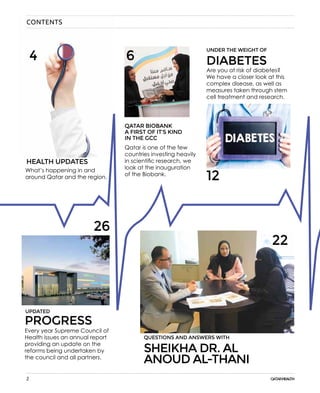
HEALTH UPDATES
QATAR BIOBANK
A FIRST OF IT’S KIND
IN THE GCC
4
What’s happening in and
around Qatar and the region.
Qatar is one of the few
countries investing heavily
in scientific research, we
look at the inauguration
of the Biobank.
DIABETES
PROGRESS
UNDER THE WEIGHT OF
UPDATED
Are you at risk of diabetes?
We have a closer look at this
complex disease, as well as
measures taken through stem
cell treatment and research.
Every year Supreme Council of
Health issues an annual report
providing an update on the
reforms being undertaken by
the council and all partners.
6
12
SHEIKHA DR. AL
ANOUD AL-THANI
QUESTIONS AND ANSWERS WITH
22
HGH Trauma and Emergency Expansion, Doha, 2018
HGH Expansion of Pediatric Emergency Centre Al Sadd
HGH Trauma and Emergency Expansion, Doha, 2018 HMC HGH Trauma and Emergency Expansion, Doha, 2018
HMC HGH Trauma and Emergency Expansion, Doha, 2018
26
sch.gov.qa 3sch.gov.qa
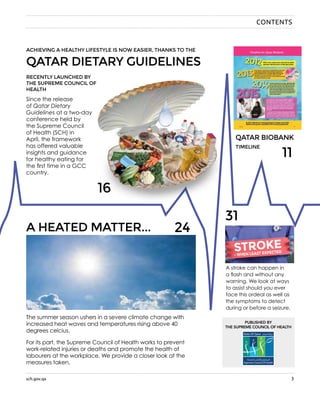
QATAR BIOBANK
QATAR DIETARY GUIDELINES
ACHIEVING A HEALTHY LIFESTYLE IS NOW EASIER, THANKS TO THE
RECENTLY LAUNCHED BY
THE SUPREME COUNCIL OF
HEALTH
Since the release
of Qatar Dietary
Guidelines at a two-day
conference held by
the Supreme Council
of Health (SCH) in
April, the framework
has offered valuable
insights and guidance
for healthy eating for
the first time in a GCC
country.
TIMELINE
A HEATED MATTER...
The summer season ushers in a severe climate change with
increased heat waves and temperatures rising above 40
degrees celcius.
For its part, the Supreme Council of Health works to prevent
work-related injuries or deaths and promote the health of
labourers at the workplace. We provide a closer look at the
measures taken.
24
31
11
CONTENTS
16
A stroke can happen in
a flash and without any
warning. We look at ways
to assist should you ever
face this ordeal as well as
the symptoms to detect
during or before a seizure.
- WHEN LEAST EXPECTEDSTROKE
4
HEALTH UPDATES
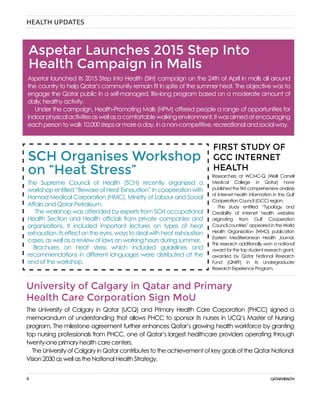
Aspetar Launches 2015 Step Into
Health Campaign in Malls
SCH Organises Workshop
on “Heat Stress”
Aspetar launched its 2015 Step Into Health (SIH) campaign on the 24th of April in malls all around
the country to help Qatar’s community remain fit in spite of the summer heat. The objective was to
engage the Qatar public in a self-managed, life-long program based on a moderate amount of
daily, healthy activity.
	 Under the campaign, Health-Promoting Malls (HPM) offered people a range of opportunities for
indoorphysicalactivitiesaswellasacomfortablewalkingenvironment.Itwasaimedatencouraging
each person to walk 10,000 steps or more a day, in a non-competitive, recreational and social way.
The Supreme Council of Health (SCH) recently organized a
workshopentitled“BewareofHeatExhaustion”incooperationwith
Hamad Medical Corporation (HMC), Ministry of Labour and Social
Affairs and Qatar Petroleum.
	 The workshop was attended by experts from SCH occupational
Health Section and Health officials from private companies and
organizations. It included important lectures on types of heat
exhaustion,itseffectontheeyes,waystodealwithheatexhaustion
cases, as well as a review of laws on working hours during summer.
Brochures on heat stress which included guidelines and
recommendations in different languages were distributed at the
end of the workshop.
University of Calgary in Qatar and Primary
Health Care Corporation Sign MoU
The University of Calgary in Qatar (UCQ) and Primary Health Care Corporation (PHCC) signed a
memorandum of understanding that allows PHCC to sponsor its nurses in UCQ’s Master of Nursing
program. The milestone agreement further enhances Qatar’s growing health workforce by granting
top nursing professionals from PHCC, one of Qatar’s largest healthcare providers operating through
twenty-one primary health care centers.
The University of Calgary in Qatar contributes to the achievement of key goals of the Qatar National
Vision 2030 as well as the National Health Strategy.
Researchers at WCMC-Q (Weill Cornell
Medical College in Qatar) have
published the first comprehensive analysis
of Internet health information in the Gulf
Cooperation Council (GCC) region.
The study entitled “Typology and
Credibility of internet health websites
originating from Gulf Cooperation
Council countries” appeared in the World
Health Organization (WHO) publication
Eastern Mediterranean Health Journal.
This research additionally won a national
award for the top student research grant,
awarded by Qatar National Research
Fund (QNRF) in its Undergraduate
Research Experience Program.
FIRST STUDY OF
GCC INTERNET
HEALTH
sch.gov.qa 5
HEALTH UPDATES
NEW Electronic System
in COMMUNICABLE
DISEASE
SURVEILLANCE
HMC 1ST ADVANCED
TRAUMA RESEARCH
WORKSHOP
The Supreme Council of Health (SCH) has
recently announced that a new electronic
systemfortheearlydetectionofcommunicable
diseases,thefirstofitskindintheMiddleEast,will
be launched next year.
Dr. Hamad Eid al-Rumaihi, head of the
Communicable Diseases Control Department
SCH, pointed out that the system would
be comprehensive, focusing on various
environmental risks, whether biological,
chemical, or radioactive, to help in a speedy
detection and containment of any potential
diseases.
Dr. al-Rumaihi said that work had started to
prepare a draft list of guidelines and directives
of the system in co-operation with all the
participating entities.
Hamad Medical Corporation (HMC) conducted the first ever Advanced Trauma
Research Workshop (ATRW) in Qatar, bringing together international experts
and local trauma healthcare professionals and providing a unique platform to
engage in discussions and highlight best practices in trauma research. The four-
day intensive workshop convened as many as ninety healthcare professionals,
including trauma surgeons, specialists, nurses, pharmacists, residents and
fellows. The main aim of the workshop was to provide participants a thorough
understanding of how to perform high-quality clinical research that will inform
injury prevention programs.
During the workshop, delegates were able to benefit from dynamic lectures,
presentations and focused discussions covering topics such as clinical research,
statistical concepts, and considerations for designing effective clinical trials,
basic and advanced concepts of data analysis, diagnostic tests and ethics in
research.
Mother and Child Cohort Study
The Supreme Council of Health (SCH) plans to study the link between exposure
to environmental, biological and lifestyle hazards and their impact on the health
of mother and child which will be conducted by SCH’s Biomedical Research
Department and has been titled the Birth “Cohort” study.
	 This long term study will examine gestational diabetes in mothers, metabolic
syndrome and postpartum depression, breastfeeding and nutrition, lifestyle traits
including physical activity, sleep and timing of activities and psychosocial activities.
Child health outcome will include, preterm births, low weight at birth, obesity and
metabolic-related disorders, neuro-development, immune system, asthma and
allergies.
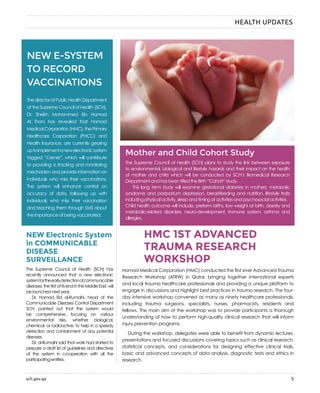
NEW E-SYSTEM
TO RECORD
VACCINATIONS
ThedirectorofPublicHealthDepartment
at the Supreme Council of Health (SCH),
Dr. Sheikh Mohammed Bin Hamad
Al Thani has revealed that Hamad
Medical Corporation (HMC), the Primary
Healthcare Corporation (PHCC) and
Health Insurance, are currently gearing
uptoimplementanewelectronicsystem
tagged “Cerner”, which will contribute
to providing a tracking and monitoring
mechanism and provide information on
individuals who miss their vaccinations.
The system will enhance control on
accuracy of data, following up with
individuals who miss their vaccination
and reaching them through SMS about
the importance of being vaccinated.
6
QATAR BIOBANK
QATAR BIOBANK
SETTING A PRECEDENT,
THE FIRST OF ITS KIND
6
sch.gov.qa 7
THE STATE OF QATAR IS AMONG THE FEW RARE
COUNTRIES INVESTING HEAVILY IN SCIENTIFIC
RESEARCH. 2.8% OF QATAR’S ANNUAL GDP IS
ALLOCATED FOR FUNDING AND IS PROMOTING
RESEARCH AND DEVELOPMENT, THIS HAS LED TO
THE BIRTH OF QATAR BIOBANK (QBB).
sch.gov.qa 7
8
QATAR BIOBANK
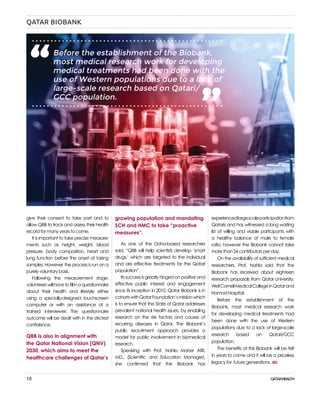
QatarBiobank–thefirstintheGCCregion,
ispartofQatar’seffortstowardsgrooming
knowledge and assisting with health
problems facing the country’s citizens.
This is done through the employment of
scientific research, for the sole purpose
of providing a population study, to better
understand of the causes of prevalent
illnesses. Ultimately the goal is to provide a
more tailored healthcare for
all residents.
Located inside a new state-of-the-art
facilityatHamadbinKhalifaMedicalCity,
Qatar Biobank (QBB) is a podium that
will make vital health research possible
throughitscollectionofurine,blood,saliva
and other human liquids’ samples and
information on health and lifestyle from
long-standing members of the Qatari
population. QBB, Qatar’s long-term
medical health initiative, was fashioned
to give Qatari people better chances of
avoiding serious illnesses, and to promote
better health for future generations.
QBBwascreatedbyQatarFoundation
andtheSupremeCouncilofHealth(SCH)
in collaboration with Hamad Medical
Corporation (MHC) and with the expert
support of scientists from Imperial College
London.
Through its collection of samples
and information on health and lifestyle,
researchers will be able to understand
whysomepeopleintheQataripopulation
develop certain diseases and why others
do not.
Small samples of blood, urine and
salivaarecollectedfromeachparticipant
during the assessment, which will allow a
QBB not only aims at giving Qatari
nationals and residents greater chances
of avoiding serious illnesses, but it also aims
at safeguarding and promoting better
health for future generations.
Accredited medical researchers
will have access to the information
and samples provided by volunteers
and participants. Information about
participants is to be treated as con-
fidential. Likewise, the data from the
findings are strictly privileged and will only
be shared if the participant allows this.
Thosewhoarewillingtoparticipatemust
be at least eighteen years old and either
Qatari nationals or long-term residents
who have lived in Qatar for at least fifteen
years. Currently, there is no upper age
limit but the programme planners say that
they will extend the invitation to younger
generations below eighteen.
Participants will attend a three-hour
assessment session after which they will
wide range of different tests. The samples will
be processed and stored at QBB’s laboratory.
Each sample is divided into several smaller
sections to prepare for on overall freezing
process. Processing includes preserving
the white cells in such a way that they can
be grown, and thus provide more genetic
material in the future.
The QBB resource will become increasingly
valuable for medical research over the years,
sothesesamplesmaybekeptformanyyears.
During this time, parts of the samples will be
usedbyresearchers.Attheendoftheirnatural
life, all the remaining samples will be securely
destroyed.
Over the next few years, research enabled
by QBB will show how the health of the
Qatari population is affected by their lifestyle,
environment and genes. Therefore, QBB will
help improve prevention and treatment of
diabetes, heart disease, cancer, obesity and
other life-threatening and incurable diseases
that affect communities in Qatar.
Biobanking is one of the great
healthcare opportunities of our
time. The Qatar Biobank has quickly
established itself as the most
ambitious of its kind in the region.
The data from our noble volunteers
will be used to help understand
how lifestyle, environment and
genes affect health locally, and
will play a critical role in helping
develop treatments and preventing
disease for the health of future
generations.
“
“
Dr. Hanan Al Kuwari, Chairperson at Qatar Biobank
Board of Trustees
sch.gov.qa 9
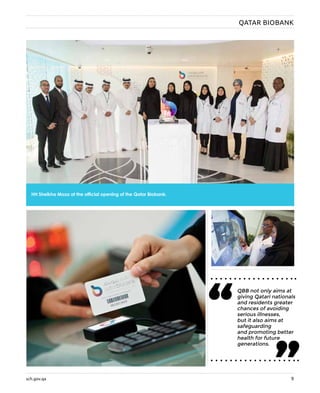
HH Sheikha Moza at the official opening of the Qatar Biobank.
QATAR BIOBANK
QBB not only aims at
giving Qatari nationals
and residents greater
chances of avoiding
serious illnesses,
but it also aims at
safeguarding
and promoting better
health for future
generations.
“ “PHOTOCREDIT:HHOPL
10
QATAR BIOBANK
give their consent to take part and to
allow QBB to track and assess their health
record for many years to come.
It is important to take precise measure-
ments such as height, weight, blood
pressure, body composition, heart and
lung function before the onset of taking
samples. However, the process is run on a
purely voluntary basis.
Following the measurement stage,
volunteerswillhavetofillinaquestionnaire
about their health and lifestyle either
using a specially-designed touchscreen
computer or with an assistance of a
trained interviewer. The questionnaire
outcome will be dealt with in the strictest
confidence.
QBB is also in alignment with
the Qatar National Vision (QNV)
2030, which aims to meet the
healthcare challenges of Qatar’s
experiencedlargescaleparticipationfrom
Qataris and has witnessed a long waiting
list of willing and viable participants with
a healthy balance of male to female
ratio; however the Biobank cannot take
more than 24 contributors per day.
On the availability of sufficient medical
researchers, Prof. Nahla said that the
Biobank has received about eighteen
research proposals from Qatar University,
WeilCornellMedicalCollegeinQatarand
Hamad Hospital.
Before the establishment of the
Biobank, most medical research work
for developing medical treatments had
been done with the use of Western
populations due to a lack of large-scale
research based on Qatari/GCC
population.
The benefits of this Biobank will be felt
in years to come and it will be a priceless
legacy for future generations.
growing population and mandating
SCH and HMC to take “proactive
measures”.
As one of the Doha-based researchers
said, “QBB will help scientists develop ‘smart
drugs,’ which are targeted to the individual
and are effective treatments for the Qatari
population”.
Its success is greatly hinged on positive and
effective public interest and engagement
since its inception in 2010. Qatar Biobank is in
cohortswithQatarFoundation’smissionwhich
is to ensure that the State of Qatar addresses
prevalent national health issues, by enabling
research on the risk factors and causes of
recurring diseases in Qatar. The Biobank’s
public recruitment approach provides a
model for public involvement in biomedical
research.
Speaking with Prof. Nahla Maher Afifi,
MD., (Scientific and Education Manager),
she confirmed that the Biobank has
Before the establishment of the Biobank,
most medical research work for developing
medical treatments had been done with the
use of Western populations due to a lack of
large-scale research based on Qatari/
GCC population.
“ “
sch.gov.qa 11
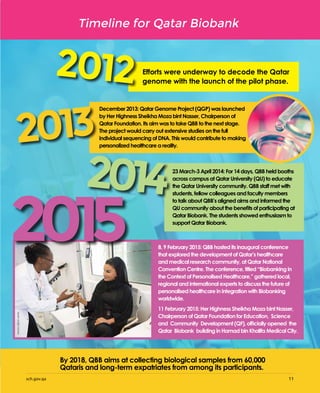
December 2013: Qatar Genome Project (QGP) was launched
by Her Highness Sheikha Moza bint Nasser, Chairperson of
Qatar Foundation. Its aim was to take QBB to the next stage.
The project would carry out extensive studies on the full
individual sequencing of DNA. This would contribute to making
personalized healthcare a reality.
23 March-3 April 2014: For 14 days, QBB held booths
across campus at Qatar University (QU) to educate
the Qatar University community. QBB staff met with
students, fellow colleagues and faculty members
to talk about QBB’s aligned aims and informed the
QU community about the benefits of participating at
Qatar Biobank. The students showed enthusiasm to
support Qatar Biobank.
Timeline for Qatar Biobank
Efforts were underway to decode the Qatar
genome with the launch of the pilot phase.
2012
2013
2014
By 2018, QBB aims at collecting biological samples from 60,000
Qataris and long-term expatriates from among its participants.
8, 9 February 2015: QBB hosted its inaugural conference
that explored the development of Qatar’s healthcare
and medical research community, at Qatar National
Convention Centre. The conference, titled “Biobanking in
the Context of Personalised Healthcare,” gathered local,
regional and international experts to discuss the future of
personalised healthcare in integration with Biobanking
worldwide.
11 February 2015: Her Highness Sheikha Moza bint Nasser,
Chairperson of Qatar Foundation for Education, Science
and Community Development (QF), officially opened the
Qatar Biobank building in Hamad bin Khalifa Medical City.
2015
sch.gov.qa 11
PHOTOCREDIT:HHOPL
12
THE WAY FORWARD
SPOTLIGHT ON DIABETES
UNDER THE
WEIGHT OF
DIABETES -
12
sch.gov.qa 13
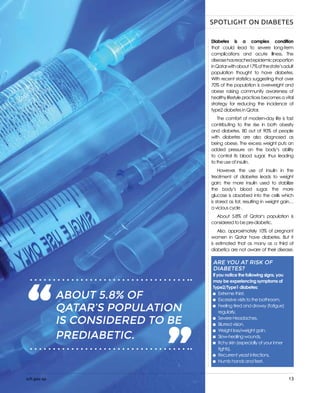
Diabetes is a complex condition
that could lead to severe long-term
complications and acute illness. The
diseasehasreachedepidemicproportion
inQatarwithabout17%ofthestate’sadult
population thought to have diabetes.
With recent statistics suggesting that over
70% of the population is overweight and
obese	raising community awareness of
healthy lifestyle practices becomes a vital
strategy for reducing the incidence of
type2 diabetes in Qatar.
The comfort of modern-day life is fast
contributing to the rise in both obesity
and diabetes, 80 out of 90% of people
with diabetes are also diagnosed as
being obese. The excess weight puts an
added pressure on the body’s ability
to control its blood sugar, thus leading
to the use of insulin.
However, the use of insulin in the
treatment of diabetes leads to weight
gain; the more insulin used to stabilize
the body’s blood sugar, the more
glucose is absorbed into the cells which
is stored as fat, resulting in weight gain…
a vicious cycle .
About 5.8% of Qatar’s population is
considered to be pre-diabetic.
Also, approximately 10% of pregnant
women in Qatar have diabetes. But it
is estimated that as many as a third of
diabetics are not aware of their disease.
“ “ABOUT 11% OF QATAR’S
POPULATION IS
CONSIDERED TO BE
PREDIABETIC.
ARE YOU AT RISK OF
DIABETES?
If you notice the following signs, you
may be experiencing symptoms of
Type2/Type1 diabetes:
	 Extreme thirst,
	 Excessive visits to the bathroom,
	 Feeling tired and drowsy (fatigue)
	regularly,
	 Severe Headaches,
	 Blurred vision,
	 Weight loss/weight gain,
	 Slow-healing wounds,
	 Itchy skin (especially of your inner 		
tights),
	 Recurrent yeast infections,
	 Numb hands and feet.
“ “ABOUT 5.8% OF
QATAR’S POPULATION
IS CONSIDERED TO BE
PREDIABETIC.
sch.gov.qa
SPOTLIGHT ON DIABETES
14
...type2 diabetes is
typically a disease with
slow progression, and
its early stages are
usually symptom free.
“ “
DO YOU KNOW YOUR HbA1C/A1C?
The Qatar Diabetes Association advises that if
youhavebeendiagnosedwiththecondition,
you must know your HbA1C or A1C.
A1C tells you the average level of glucose
(sugar) in your blood over the past three
months and it is reported as a percentage
(for example 7%).
Knowing your A1C tells you about your
risk for complications of diabetes, such as
blindness, kidney disease and amputations,
heart attacks and stroke.
Your risk of complications heightens
whenever you have high A1C.
DIABETES CARE CENTRES
In a bid to match the increase in diabetic
cases, a world-class treatment center that
will provide Qatar’s diabetic population
with improved patient care and access
to specialized services through a multi-
disciplinary approach was opened at the
Hamad General Hospital in 2013.
The center also houses research teams
who will be studying evidence-based
strategiesforthetreatmentandprevention
of diabetes and its complications.
The State of Qatar’s world-class
treatment center, The National Centre for
Diabetes Treatment that provides Qatar’s
diabeticpopulationwithimprovedpatient
care and access to specialized services
through a multi-disciplinary approach,
was opened in 2013.The diabetes center
is located on the second floor of the
outpatient department, a first in a chain
of diabetic care centers across HMC
hospitals that will serve as a one-stop shop
in which patients can speak with specialist
doctors and nutrition experts, renew
prescriptions and learn about how to
managetheircondition.Thefacilityboasts
of a range of services, including foot care,
counselling,bloodinvestigationandinsulin
pump therapy. A second center has
been opened in Al Wakrah Hospital, and
the openning of the third one in Al Khor
hopsital is on its way.
Prediabetes occurs as a result of a
buildup of sugar in the blood and leads
to type2 diabetes which is a direct effect
of your body’s blood sugar staying too
high for too long.
A fasting blood sugar level less than
100mg/dL (5.6mmo1/L) is considered
normal; 100 to 125mg/dL is prediabetic;
126mg/dL or higher means you have full
blown diabetes (Type 2/Type1).
If your blood sugar levels are always
above target level, you stand a risk of
damaging your blood vessels and nerves
(Neuropathy) and this could lead to a
buildupofPlaquewhichincreasesyourrisk
of coronary heart disease, heart attack or
even stroke.
HEALTH RISKS ASSOCIATED
WITH DIABETES
The seriousness of the health impact is
often not appreciated, this is because
type2 diabetes is typically a disease with
slow progression, and its early stages are
usually symptom free.
Diabetes is not as dramatic as cancer
orheartdisease,butitsrepercussionsinthe
longer term are extremely serious.
	 Diabetes doubles the risk of coronary
	 heart disease in men, and quadruples
	 it among women.
	 Stroke in people with diabetes is three
	 times higher than in people without
	diabetes.
	 Diabetes is the leading cause of end
	 stage renal disease.
	 Diabetic retinopathy accounts for 5
	 percent of all cases of blindness
	globally.
	 Someonewithdiabetesisatmorethan
	 25timesgreaterriskoflimbamputation
	 than someone without diabetes.
Asaresultofthesecomplications,diabetes
can reduce a person’s life expectancy
by up to 10 years, and according to the
International Diabetes Federation (IDF)
there were around 5 million deaths in
2014 as a result of diabetes and its related
diseases. Nearly half of these deaths were
of people aged under 60.
SPOTLIGHT ON DIABETES
sch.gov.qa 15
REDUCE YOUR RISKS OF DEVELOPING
DIABETES
Think Milk - a 2010 study from Harvard
found that those who drink more milk
havea60%chanceofreducingtheriskof
developing type2 diabetes.
Tea Party - Recent research shows that
a daily consumption of chamomile tea
reduces complications of diabetes.
Juice your Aloe Vera - an Indian University
(Majodol) in 1996, discovered that Aloe
Vera possessed anti-diabetic effects.
Coffee Breaks - drinking several cups of
black coffee a day can reduce your
overallriskofdevelopingdiabetesby30%,
according to a new research.
Loose the Weight - Losing weight through
a healthy diet and exercise reduces the
risk of diabetes.
Just Move - reduced activity fuels your risk
of type2 diabetes. A brisk 30-minute walk
cuts your risk of developing the condition
by 30%.
STEM CELLS - THE FUTURE OF DIABETES
TREATMENT
In 2014, researchers at Qatar Biomedical
Research Institute (QBRI) achieved an
important scientific breakthrough in
diabetes research via the development
of specialized Stem Cells.
The research showed that stem cells
could be used in the secretion of insulin
and help control blood sugar. People
living with diabetes generally have a
high blood sugar level due to the inability of
the pancreas to produce sufficient insulin.
This is a major milestone for Qatar in its
quest for becoming world leaders in diabetic
research.
QBRI was established in 2012 as a
member of Qatar Foundation Research
and Development, concentrating on
developing plans for research and treatment
methodologies for diabetes and cancer in
the first five years of its operation.
The stem cell research was ongoing
at both the clinical laboratories in Weill
Cornell Medical College in Qatar
and Qatar Science and Technology
Park. This stem cell treatment will be the
first of its kind in therapies for diabetes.
It is believed that this research will
lead the initiative for the treatment of
many other diseases with stem cells.
Stem cell treatment would eventually
eliminate the need for insulin injections
commonly administered to diabetic
patients, after the final certification
of results. It would make medication
obsolete as well. Stem cells to be used
in the treatment of diabetes can be
acquired from the patient’s blood or from
any external donor.
With diabetes being a major
challenging disease in the Qatari
population, stem cells and regenerative
medicine offer hope to many afflicted
individuals.
Stem cell treatment would
eventually eliminate the need for
insulin injections...“ “
SPOTLIGHT ON DIABETES
16
QATAR DIETARY GUIDELINES
IN ACHIEVING A
HEALTHY LIFESTYLE
A MILESTONE
SINCE THE RELEASE OF THE QATAR DIETARY GUIDELINES AT A
TWO-DAY CONFERENCE HELD BY THE SUPREME COUNCIL OF
HEALTH (SCH) IN APRIL 2015, THE FRAMEWORK HAS OFFERED
VALUABLE INSIGHTS AND GUIDANCE FOR HEALTHY EATING FOR
THE FIRST TIME IN A GCC COUNTRY. WE DISCUSS DIFFERENT
ASPECTS AND TIPS OF THE GUIDELINES TO ACHIEVE AN OVERALL
HEALTHY LIFESTYLE.
16
sch.gov.qa 17sch.gov.qa 17
18
As part of the National Health Strategy
of reducing morbidity and mortality
attributable to “chronic non-com-
municable diseases (NCDs) in the State
of Qatar,” the Dietary Guidelines aims at
reducing rates of obesity and overweight,
increasing rates of physical activity, and
enhancing nutritional status. Moreover,
the development of the Guidelines
supports and fosters healthy lifestyle
patterns to accomplish the objectives
of health, nutrition and physical activity
within fundamental building blocks.
Since the 1992 International
Conference on Nutrition in Rome, Italy,
the Food and Agriculture Organization
(FAO) and the World Health Organization
(WHO) adopted the term of Dietary
Guidelines through the determination of
the lifestyle patterns that are associated
with diet-related diseases. They can be
a useful tool in educating the public in
healthy eating and prevention of diet-
related chronic diseases. This conference
recommended that individual countries
should develop simple Dietary Guidelines
that are based on their specific public
health concerns and relevant to people
of different ages, lifestyles, and cultures.
The concept of food-based Dietary
Guidelines has come to light and was
promoted by the SCH. These Guidelines
take into consideration the sociocultural
status and nutritional problems in Qatar.
Qatar has undergone a rapid
change in its socio-economic situation,
food consumption patterns, lifestyle
and health status during the past three
decades, what took place thanks in part
to the sharp increase in income levels.
Conversely, communicable diseases
have almost diminished and diet-related
chronic diseases have become the main
health problems.
DEVELOPING METHODS FOR DIETARY
GUIDELINES IN QATAR
Qatar faces great challenges to prevent
and control several nutritional problems
and diet-related chronic diseases. Two
types of nutritional and health problems
occur: those associated with change in
lifestyle, such as obesity, cardiovascular
disease, diabetes, hypertension, cancer,
dental caries, and osteoporosis and those
associated with nutrient deficiencies, such
as iron deficiency anemia and deficiencies
of vitamin D and calcium. In addition, food-
borne diseases are a problem of concern in
these countries. Therefore, the need for simple
Dietary Guidelines to address the burden of
these diseases is urgent, especially as some
of them contribute to more than 50% of total
mortality in the GCC region.
In addition to the changes in food
consumption patterns, other changes in
lifestyle, are also apparent and include
smoking and a decrease in physical activity.
Theincreaseinsedentarylifestylesismainlydue
to the abundant use of cars, dependency on
housemaids for home management, as well
as due to spending a long time watching
televisionandusingtheInternet,particularlyby
children, teenagers, and young people.
Inadditiontoaddressingtheprevention
and control of the main nutritional
problems and diet-related diseases in
Qatar, the Guidelines are based on
affordable and available foods, which
are commonly consumed by the
public, focusing on traditional foods. It
also consider the cultural and religious
background of the population in Qatar
given that Islamic law is applicable here.
It promotes a healthy lifestyle, especially
the importance of physical activity and
it is being based on current scientific and
health information.
There has been a drastic change in
food consumption patterns in Qatar and
the region. This change includes both
quantitative and qualitative change
in diet. The structure of diet has shifted
QATAR DIETARY GUIDELINES
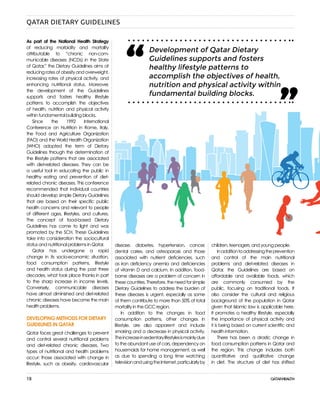
Development of Qatar Dietary
Guidelines supports and fosters
healthy lifestyle patterns to
accomplish the objectives of health,
nutrition and physical activity within
fundamental building blocks.
“ “
sch.gov.qa 19
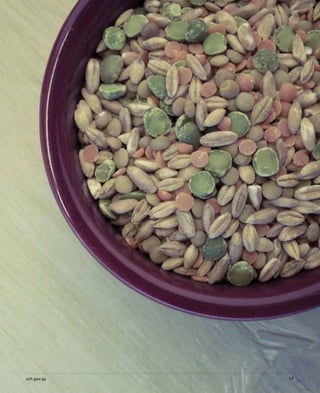
“ “Legumes are a rich
source of protein, some
vitamins, and minerals,
and dietary fiber.
towards high-energy-density meals with
more fat and added sugar in foods,
more saturated fat (mostly from animal
origin) and lower intake of complex
carbohydrates, dietary fiber, fruit, and
vegetables. For example, the total per
capita energy intake exceeds 3000 kcal
in all Arab Gulf countries, and the fat
represents 25–35% of total energy.
Food rich in salt is highly consumed in
theregion.Thehighuseoftablesalt,spices,
and pickles, in addition to the salinity of
water are contributing factors for the
high intake of sodium in these countries.
Among children and adolescents, the
high consumption of fast foods and
French fries is playing a great role in the
increasing intake of sodium among these
age groups. High intake of foods rich in
added sugar, particularly among children
and adolescents, has been reported by
many studies in the region.
Although Qatar enjoys a sunny en-
vironment all year long, vitamin D deficiency
is one of the main public health problems.
Studies in Qatar revealed that 69% (an
example),ofchildrenbelowsixteenyearshad
vitamin D deficiency.
The change in dietary habits, lifestyle,
and life expectancy in Qatar and the
region has led to a remarkable change in
disease trends. Diet-related chronic diseases
such as cardiovascular disease (CVD),
diabetes mellitus, hypertension, obesity,
cancer, dental caries, and osteoporosis
have become the main health problems.
Additionally, overweight and obesity have
become epidemic among all age groups
in Qatar, responsible for increased morbidity.
Inactivity, high consumption of high-energy-
density foods and long duration of watching
television or using the Internet were reported
as contributing factors for high prevalence of
obesity.
Food-borne diseases in Qatar and
the region are mainly caused by
bacteria, specifically salmonellosis,
Hepatitis A, shigellosis, and poisoning with
staphylococcus.
The Guidelines advise about eating a
variety of different foods on a daily basis.
The human body needs more than 40
nutrients to maintain good health and
prevent disease. Therefore, increasing the
variety of foods consumed is important to
ensure an adequacy to intake of these
nutrients in our meals, breakfast, lunch,
supper, and snacks.
The Guidelines also advise that fruit
and vegetables should comprise a
basic part of the daily diet to maintain
a healthy body. They also contend that
meat, fish, and poultry are the main
source of dietary balanced protein and
are rich in essential nutrients, especially
iron, zinc, and other vitamins. Many of
the expatriates, frequently suffer from
anemia, mainly iron deficiency anemia.
... 69% of children below
16 years had vitamin D
deficiency.“
“
QATAR DIETARY GUIDELINES
20
Meat,fish,andchickenaregoodsources
of good absorbable iron. At the same
time, red meat consumption should be
restricted and putting a limit to the intake
of processed meat products that are
rich in fat and salt such as sausages and
mortadella should be exercised.
Legumes are a rich source of protein,
some vitamins, minerals, and dietary
fiber. Legumes include, among others,
beans, lentils, cowpeas, kidney beans,
lupine, green peas, and soybeans. On
the other hand, unsalted and unroasted
nutssuchaswalnuts,hazelnuts,almonds,
and pine nuts, as well as seeds such as
watermelon seeds, muskmelon, and
sunflower are very rich sources of energy
for their high fat content.
The Guidelines advises everyone to
try to concentrate on foods based on
whole grains especially bread, biscuits,
and other bakery products. Cereal-
based foods such as cakes, biscuits, and
pastries, which can have high levels of
added fats and sugars are not included
in this recommendation and should be
regarded as occasional treats only.
Milkanddairyproducts,whichcontain
many essential nutrients, are important
for the body and for its development. The
Guidelines say that dairy products are the
best source of calcium, which is vital to
strengthen bones and for a healthy nervous
system.
The consumption of milk and dairy
products is important for building a healthy
body, particularly during childhood and
adolescence. For those who are allergic
to milk or who are intolerant to lactose,
low-fat yogurt or cheese, and other non-
dairy products like hummus or broccoli are
suitable substitute for milk.
Many foods and traditional dishes
consumed in Qatar and the region are
known for their considerable high fat
content. Fat provides energy, essential
fatty acids are necessary for development
and fat helps in the absorption of certain
vitamins. Nevertheless, moderate intakes
of fat should always be maintained by
selecting healthy food like olive oil instead of
butter or margarine.
Overconsumption of food rich in sugar
leads to an increase in energy intake, which
contributestoanincreaseinyourweight.Inthe
same vein, the Guidelines suggest that teeth
becleanedimmediatelyaftereatingsuch
foods especially among children in Qatar.
ManyQataritraditionaldishes,canned,
and fast foods contain high amounts
of salt. Studies show that an over-intake
of sodium is associated with high blood
pressure, strokes, and contributes to
heart attacks, heart failure, and kidney
failure. The Guidelines recommend that
the amount of salt does not exceed 5 g
per day. To achieve low intake of salt,
peopleshouldconsumefreshfoods,foods
normally processed without salt, and add
low salt or avoid addition of salt to food.
The Dietary Guidelines advises about
frequent intakes of water (8-12 glasses
a day) and other liquids as water is an
essential nutrient for life. It accounts for
more than 60% of our bodies and plays
important roles in digestion, absorption,
andtransportationofnutrientsinthebody,
aswellasforeliminationofwasteproducts
and thermoregulation.
The quantity of water consumed may
differ from one person to another. Factors
like body size, weather, physical activity,
and individual differences have an effect
on the body’s need for fluids. However,
intake of fluids containing added sugar
A study by Dr. Barbara
Ann Seed, former
Nutrition Policies and
Programs Coordinator
at SCH, highlighted the
SCH’s commitment to
“educating the population
about the relevance
and importance of
these principles and
establishing champions
to advocate for them”.
Many foods and
traditional dishes
consumed in Qatar and
the region are known for
their considerable high
fat content.
“ “
QATAR DIETARY GUIDELINES
sch.gov.qa 21
should be avoided as much as possible.
Obesity has become an epidemic in
Qatar and the region during the last two
decades. The more weight a person has
the more the chances of developing
hypertension, cardiovascular disease,
hyper-cholesterolemia, and certain
kinds of cancers, osteoarthritis and other
respiratory problems.
The major health objective of the
Dietary Guidelines therefore is to maintain
a weight that sustains a healthy life and
prevent extra weight gain. The way to
achieve a healthy body weight is to
balance intake of food and drinks with
physical activity.
The findings of the Guidelines show
that inactivity is one of the main factors
contributingtohighprevalenceofobesity
in Qatar that children and adolescents
have become less active. These findings
correspond with studies in Arab Gulf
countries indicating that a serious decline
in physical activity especially among
women and adults. Making physical
activity a part of our daily routine and
maintenanceofoptimumweightaretwo
importantissuesforgoodhealthandboth
can benefit your health in different ways.
The current Dietary Guidelines are
useful guides for the Qatari community
to promote healthy eating and lifestyle
to reduce the incidence of nutrition-
related diseases among residents and
nationals. The SCH pledges to revise these
Guidelines periodically (every 3 to 5 years)
with the change of scientific evidence
and research regarding the risk factors for
nutrition-related diseases.
RESEARCH ON DIETARY GUIDELINES
In a research paper titled “Sustainability in the
QatarnationalDietaryGuidelines,amongthe
first to incorporate sustainability principles,”
Dr. Barbara Ann Seed, former Nutrition
Policies and Programs Coordinator at SCH,
concluded that the SCH and the dietary
Guidelines “task force” would determine how
the population in Qatar would embrace the
principles found in the Guidelines. The study
also highlighted the SCH’s commitment
to “educating the population about the
relevanceandimportanceoftheseprinciples
and establishing champions to advocate for
them”. It is noteworthy that Dr. Seed’s paper
aimed to “present one of the first national
Dietary Guidelines that incorporate food
sustainability principles into its public health
recommendations”.
sch.gov.qa
QATAR DIETARY GUIDELINES
22
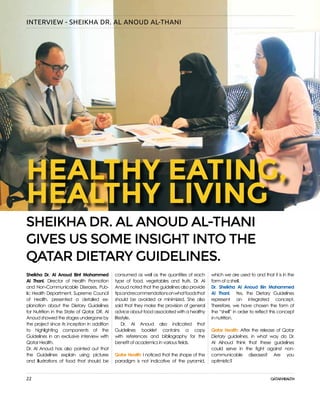
INTERVIEW - SHEIKHA DR. AL ANOUD AL-THANI
Sheikha Dr. Al Anoud Bint Mohammed
Al Thani, Director of Health Promotion
and Non-Communicable Diseases, Pub-
lic Health Department, Supreme Council
of Health, presented a detailed ex-
planation about the Dietary Guidelines
for Nutrition in the State of Qatar. DR. Al
Anoud showed the stages undergone by
the project since its inception in addition
to highlighting components of the
Guidelines in an exclusive interview with
Qatar Health.
Dr. Al Anoud has also pointed out that
the Guidelines explain using pictures
and illustrations of food that should be
which we are used to and that it is in the
form of a shell.
Dr. Sheikha Al Anoud Bin Mohammed
Al Thani: Yes, the Dietary Guidelines
represent an integrated concept.
Therefore, we have chosen the form of
the “shell” in order to reflect this concept
in nutrition.
Qatar Health: After the release of Qatar
Dietary guidelines, in what way do Dr.
Al Alnoud think that these guidelines
could serve in the fight against non-
communicable diseases? Are you
optimistic?
consumed as well as the quantities of each
type of food, vegetables and fruits. Dr. Al
Anoud noted that the guidelines also provide
tipsandrecommendationsonwhatfoodsthat
should be avoided or minimized. She also
said that they make the provision of general
advice about food associated with a healthy
lifestyle.
Dr. Al Anoud also indicated that
Guidelines booklet contains a copy
with references and bibliography for the
benefit of academics in various fields.
Qatar Health: I noticed that the shape of the
paradigm is not indicative of the pyramid,
SHEIKHA DR. AL ANOUD AL-THANI
GIVES US SOME INSIGHT INTO THE
QATAR DIETARY GUIDELINES.
HEALTHY EATING,
HEALTHY LIVING
sch.gov.qa 23
Dr. Sheikha Al Anoud Bin Mohammed
Al Thani: Yes, I am very optimistic about
the successful application of these
Guidelines. The guidelines are an
important part of the Qatar National
Nutrition and Physical Activity Action
Plan for 2011-2016. We have adopted
nutrition studies in Europe and the Gulf
States. Additionally, we have adopted
the World Health Organization Regional
Office for the Eastern Mediterranean
Guide.
Exhibiting behaviours that are
consistent with the Dietary Guidelines
helps in reducing risk factors for non-
communicable chronic diseases, such
as cardiovascular disease, diabetes and
cancer.
The Dietary Guidelines booklet in-
cludes tips and recommendations
about the importance of eating
healthy foods of the six food groups and
maintaining a healthy weight, in addition
to reducing foods that are high in
sugar, salt and fat. Regular physical
activity, consuming sufficient amounts of
water, ensuring the safety, cleanliness of
ways to prepare foods, healthy eating
and environmental conservation are all
under the umbrella of the Qatar Dietary
Guidelines.
Qatar Health: Dr. Al Anoud supervised the
2012surveyonChronicDiseaseRiskFactor
Surveillance;couldyougivemeanoteon
the report? Is it annual? In other words, do
you think Qatar needs an update?
Dr. Sheikha Al Anoud Bin Mohammed Al
Thani: The world health survey results in the
There are also other non-Qatari surveys
such as the survey on food consumption.
Such surveys are due every five years. The
next survey will be conducted in 2016-
2017.
Qatar Health “It’s an epidemic in Qatar,”
you explained regarding the implication
of diabetes and its association with non-
communicable diseases “among the
five major causes of death in Qatar”.
You also said, “Injuries are the first cause
of mortality, then chronic cardiac
disease, then cancer, then endocrine
diseases, especially diabetes”. Have you
noted any improvements in people’s
awareness since then?
Dr. Sheikha Al Anoud Bin Mohammed
Al Thani: Of course, we have improved
the awareness of individuals, Qataris
and non-Qataris, regarding diabetes.
However, some individuals lacked the
extent and method of preventing this
disease. The Qatar Dietary Guidelines
were built on Aspetar’s Sports Guidelines,
among several others. The Qatar Dietary
Guidelinesalsocontaintheirowndirectory
for exercise.
Qatar Health: Dr. Al Anoud delivered a
speech - “An Overview of the Qatar
DietaryGuidelines”duringtheconference
on Qatar Dietary Guidelines held on 8-9
April, what is your conclusion regarding
the guidelines mechanism and modus
operandi?
Dr. Sheikha Al Anoud Bin Mohammed
Al Thani: The Qatar Dietary Guidelines
represent an integrated mechanism
and a clear plan during a year,
which includes workshops, media
coverage, question-and-answer sessions,
and test samples and questionnaires and
surveys in the gathering places such as
mosques.
The Qatar Dietary Guidelines have
been taught to university students and
integrated in their curricula. With the
launch of the first faculty of medicine
Qatar Dietary Guidelines will have the
greatest impact in the community.
State of Qatar, held in 2006 in collaboration
with the World Health Organization,
showed that more than two-thirds of adults
(67.8%) are either overweight or obese
and more than half (56%) do not have the
recommended levels of physical activity
by the World Health Organization (WHO). It
should be at a rate of 150 minutes per week
of moderate physical activity. Additionally,
81.7% of respondents in this health survey
do not consume the recommended
amounts of fruits and vegetables, and
11% use tobacco daily of various types.
All these factors are the main risk factors
for non-communicable diseases (NCDs).
The survey results also showed that
10% of the sample also had high blood
pressure and a blood lab tests showed that
10% of the sample have ill glucose pre-
diabetes. Therefore, we need valid data
for the formulation of health policy and
monitor the tendency of these diseases in the
community.
Statistics showed in 2008 in the State of
Qatar that the main causes of death are
external causes of death, which include
accidents and injuries at work, which claim
the lives of twenty people per 100,000 of
population, followed by diseases of the
circulatory system, causing 19.4 deaths per
100,000 of the population. Different types
of tumours are the third leading cause of
death and kill 12.0 people per 100,000 of the
population.
We have tested the messages at the
beginning of the National Health Strategy in
2011 on Qataris between the ages of 18-64.
Data and samples were collected in a very
structured way using Personal Digital Assistants
(PDA) for the first time in the Gulf.
I am very optimistic about the
successful application of these
Guidelines. The guidelines are an
important part of the Qatar National
Nutrition and Physical Activity
Action Plan.
“ “
INTERVIEW - SHEIKHA DR. AL ANOUD AL-THANI
24
HEAT STROKE: CHALLENGES AND THE FUTURE
A HEATED
MATTER...
THE SUMMER SEASON USHERS IN A SEVERE CLIMATE CHANGE WITH
INCREASED HEAT WAVES AND TEMPERATURES RISING ABOVE 40
DEGREES CELCIUS.
24
sch.gov.qa 25
is administered. It advises that anyone
suspected with this condition should not
be sent home or left unattended unless
that action has been approved by a
doctor.
OTHER SUPREME COUNCIL OF HEALTH
INITIATIVES:
1. The SCH issues full color illustrated
brochures and multilingual pamphlets
in many languages such as Urdu
and English in addition to Arabic,
to promote drinking water habits at
frequent intervals.
2. Wet-bulb globe temperature (WBGT),
a composite temperature is applied
by a wide array of industrial hygienists,
athletes, the military and other
institutions to estimate the effect of
temperature, humidity, and infrared
radiation (usually sunlight) on humans,
which determines appropriate
exposure levels to high temperatures.
It is derived from the following formula:
WBGT = 0.7T+ 0.2T+ 0.1Td g w
Where:
	 Tw = Natural wet-bulb temperature
	 (combined with dry-bulb temperature
	 indicates humidity)
	 Tg = Globe thermometer temperature
	 (measured with a globe thermometer,
	 also known as a black globe
	thermometer)
	 Td = Dry-bulb temperature (actual air
	 temperature)
Indoors, or when solar radiation is
negligible, the following formula is often
used:
WBGT = 0.7T+ 0.3Tgw
Medically, Heat Stroke occurs when the
body temperature is greater than 40
Celsius degrees leading to complications
involving the central nervous system,
resulting from exposure to high
temperatures. This condition progresses
from heat-related illnesses such as heat
cramps, heat syncope (fainting), heat
exhaustion.Amajorcauseofthecondition
is the prolonged exposure to high
temperatures coupled with dehydration,
leading to a breakdown of the body’s
temperature control system due to loss of
minerals and body fluids.
The main symptoms of heat stress
exhaustion as those that include heavy
sweating and rapid pulse conditions
caused by an overheated body
Heat stress disorders also cover the
following symptoms; heat cramps, heat
rash, heat stroke, and heat exhaustion.
Signs of heat exhaustion may develop
suddenly or overtime, especially with
prolonged periods of working under high
humidity or rigorous exercise.
POSSIBLE HEAT EXHAUSTION
SYMPTOMS MAY INCLUDE THE
FOLLOWING:
	 Heavy sweating,
	 Moistandcoolskinwithgoosepimples
	 when in the heat,
	 Weak, rapid pulse,
	 Faintness,
	 Fatigue; dizziness,
	 Low blood pressure upon standing,
	 Muscle cramps,
	 Headache,
	 Nausea.
TREATMENT OF HEAT EXHAUSTION
Casualties of heat exhaustion should
swiftly be administered first-aid.
The SCH also advises the following:
1. 	 Call 999,
2. 	Help the casualty to cool off by;
	 Moving the patient to a cool place,
	 Drink cool water,
	 Remove unnecessary clothing or just
loosen the victim’s clothes,
Shower or sponge with cool water.
The SCH also defines heat stroke as a
condition whereby the body can no longer
cool itself and the body temperature rises to
critical levels
Other primary signs and symptoms of heat
stroke may include the following:
	 Confusion,
	 Irrational behavior,
	 Loss of consciousness,
	 Convulsions,
	 Lack of sweating,
	 Hot, dry, reddened skin,
	 Abnormally high body temperature for
	 example 41 degrees celsius.
TREATMENT OF HEAT STROKE
For anyone showing signs/symptoms of heat
stroke, the SCH advises the following:
1.	 Call 999,
2.	 Provide immediate, aggressive, general
cooling;
• Immerse victim in a tub of cool water,
• Place in cool shower,
• Spray with cool water from a hose,
• Wrap the affected person in cool wet sheets
and fan rapidly,
3.	 Transport victim to hospital,
4.	 Do not give anything orally to an
unconscious victim.
The Supreme Council of Health warns that
heat stroke can be fatal even after first aid
HEAT STROKE: CHALLENGES AND THE FUTURE
26
SUPREME COUNCIL OF HEALTH REPORT 2014
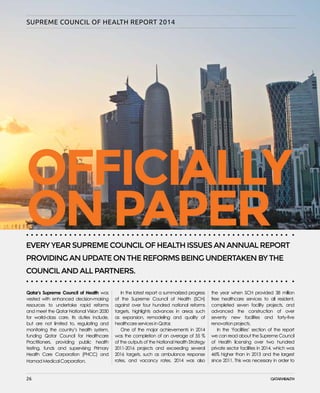
Qatar’s Supreme Council of Health was
vested with enhanced decision-making
resources to undertake rapid reforms
and meet the Qatar National Vision 2030
for world-class care. Its duties include,
but are not limited to, regulating and
monitoring the country’s health system,
funding Qatar Council for Healthcare
Practitioners, providing public health
testing, funds and supervising Primary
Health Care Corporation (PHCC) and
Hamad Medical Corporation.
In the latest report a summarized progress
of the Supreme Council of Health (SCH)
against over four hundred national reforms
targets, highlights advances in areas such
as expansion, remodeling and quality of
healthcare services in Qatar.
One of the major achievements in 2014
was the completion of an average of 55 %
of the outputs of the National Health Strategy
2011-2016 projects and exceeding several
2016 targets, such as ambulance response
rates, and vacancy rates. 2014 was also
the year when SCH provided 38 million
free healthcare services to all resident,
completed seven facility projects, and
advanced the construction of over
seventy new facilities and forty-five
renovation projects.
In the ‘Facilities’ section of the report
we can read about the Supreme Council
of Health licensing over two hundred
private sector facilities in 2014, which was
46% higher than in 2013 and the largest
since 2011. This was necessary in order to
EVERY YEAR SUPREME COUNCIL OF HEALTH ISSUES AN ANNUAL REPORT
PROVIDING AN UPDATE ON THE REFORMS BEING UNDERTAKEN BY THE
COUNCIL AND ALL PARTNERS.
OFFICIALLY
ONPAPER
26
sch.gov.qa 27
bridge the gap highlighted in the Qatar
Healthcare Facilities Master Plan 2013-
2033andencouragehealthycompetition
for improved healthcare outcome. SCH
also informs about renovations being
completed for five healthcare facilities in
2014 and opening of two others, among
which was the Interim Translational
Research Institute, which comprises
research and consulting suites, DNA
extraction,cellculturallabsandgenomics,
proteomics and generic wet labs.
As per the information included in the
‘Workforce’ section of the 2014 report, the
SCH updated and expanded its National
Healthcare Workforce Plan (NHS 4.1)
where Qatarization continued to be the
focusofrecruitmentandretentionleading
towards an SCH Qatarization plan, which
is expected in 2015 (NHS 5.14). Qatari
physicians were sponsored by the Primary
Health Care Corporation for specialized
fellowship and the nursing leaders were
provided with a leadership program.
Also, according to the report, the Supreme
Council of Health launched the new National
HealthInsuranceScheme(NHS6.3),aheadof
schedule for stage 2 of the National Health
Insurance Scheme (Seha), which extended
membership to all nationals for a broad set of
services at both public and private providers.
Under Seha, the government funds the
cost of care for nationals and co-funds with
employers the cost of care for non-nationals.
Another feature of the SCH 2014 report
stated that a tender for a five-year preventive
health strategy, preventive health
evaluation system and review of the
current preventive health governance
structure was issued as the SCH is
strengthening its preventive health
governance to coordinate and evaluate
national activities (NHS 3.1).
Owingtothecurrentrealityofthe risein
obesityanddiabetesintheStateofQatar,
nutrition and physical activity have been
the focal points for achieving a decrease
in the prevalence of obesity, of which the
SCH seeks to reduce by 3% by 2016 and
prevent Non Communicable Diseases
(NCDs). As a result, it expanded the “We
Are Healthy Kids” awareness program,
reaching 10,280 students, a 47% annual
increase and conducted training for two
hundred fifty nurses in over one hundred
twenty schools (NHS 3.2).
The report further recorded that the
Primary Healthcare Corporation piloted
a new antenatal care model in six health
centers, including a new package of
care, disease screening and guidelines.
It developed bilingual education
materials,includingforbreastfeeding,and
completedthepostnatalserviceredesign
(NPHCS 37,41). It introduced 6 new
screening guidelines on developmental
delays,autismspectrumdisorder,anemia,
hip dislocation, vision and hearing
problems (NPHCS 42). It also provided
pharmaceutical safety training to staff at
allhealthcenters,includingonmedication
reconciliation and patient allergy checks.
Podiatry services and more staff
were added to the specialized
Multidisciplinary Diabetes Centre in
Hamad General Hospital, which provides
a comprehensive range of diabetes
An annual platform for safety
innovation, Qatar Patient Safety
Week, was held by the SCH where
it launched the WHO Patient Safety
Friendly Hospital Initiative to promote
international safety standards...
“ “
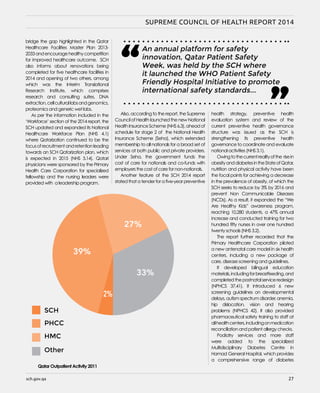
Qatar Outpatient Activity 2011
SUPREME COUNCIL OF HEALTH REPORT 2014
sch.gov.qa 27
39%
27%
33%
2%
áë°ü∏d≈∏YC’G¢ù
á«dhC’Gá«ë°üdGájÉYôdGá°
á«Ñ£dGóªMá°
i
SCH
PHCC
HMC
Other
39%
27%
33%
2%
28
SUPREME COUNCIL OF HEALTH REPORT 2014
care services set up to manage the
condition and its complications, making
diabetes management convenient
for patients, followed by the Hamad
Medical Corporation (HMC) Qatar’s first
symposium on childhood diabetes.
The ‘Hospital Care’ section of the
reports states that 2014 witnessed a 20%
increaseinthenumberofpeoplecoming
forward to register as organ donors, and
a 50% increase in the number of organ
transplant.
Furthermore the ‘Treatment Abroad’
categoryupdatesonthenewnationalpolicies
and an electronic application process being
developed by Supreme Council of Health,
which will be piloted in HMC and SCH in early
2015 for those seeking healthcare abroad.
The SCH’s focus on safety and reliability of
practitioners were reflected in almost two
thousand verifications of already licensed
practitionersconductedbytheQatarCouncil
of Healthcare Practitioners (QCHP) last
year; it completed procedures for applying
continuing education requirements during
re-licensing to upgrade practitioner skill sets
(NHS 5.2).
As part of Supreme Council of
Health efforts towards improving the
quality of care, which constitutes the
third reform area, the SCH conducted
more than three hundred facility
inspections, 34% more than in 2013 and
successfully supported private hospitals
in obtaining international accreditation
(NHS 5.3).
An annual platform for safety
innovation, Qatar Patient Safety Week,
was held by the SCH where it launched
28
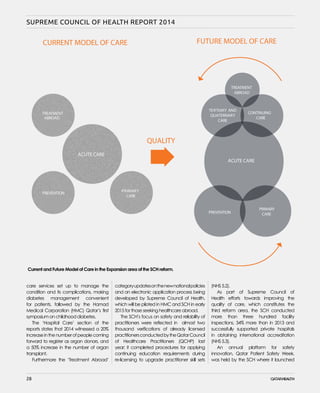
Current and Future Model of Care in the Expansion area of the SCH reform.
sch.gov.qa 29
the World Health Organizaation (WHO)
Patient Safety Friendly Hospital Initiative
to promote international safety standards
(NHS 2.1). 2015 will herald the region’s first
annual conference of The International
Society for Quality in Healthcare, a
leading standard assurance organization,
for discussions and solutions to safety
challenges.
As part of the involvement strategy
the SCH increased publications, events,
media interviews, press releases and
external event sponsorship by 36%, it also
launched a website which received
the highest accessibility ranking by the
Qatar Assistive Technology Centre, an
independent organization for connecting
people with disabilities to information
technology, also, the launch of the
Government Health Communication
Centre project which is a new portal for
patient feedback, received 210% more
feedback than it did in 2013.
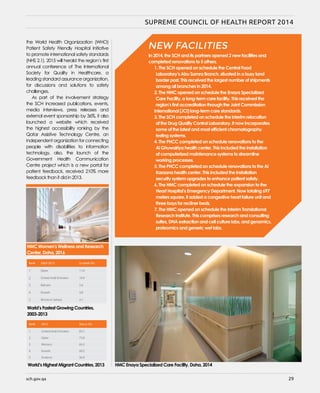
World’s Fastest Growing Countries,
2003-2013
World’s Highest Migrant Countries, 2013
In 2014, the SCH and its partners opened 2 new facilities and
completed renovations to 5 others.
1. The SCH opened on schedule the Central Food
	 Laboratory’s Abu Samra Branch, situated in a busy land
	 border post. This received the largest number of shipments
	 among all branches in 2014.
2. The HMC opened on schedule the Enaya Specialized
	 Care Facility, a long-term care facility. This received the
	 region’s first accreditation through the Joint Commission
International (JCI) long-term care standards.
3. The SCH completed on schedule the interim relocation
	 of the Drug Quality Control Laboratory. It now incorporates
	 some of the latest and most efficient chromatography
	 testing systems.
4. The PHCC completed on schedule renovations to the
	 Al Ghuwairiya health center. This included the installation
	 of computerized maintenance systems to streamline
	 working processes.
5. The PHCC completed on schedule renovations to the Al
	 Karaana health center. This included the installation
	 security system upgrades to enhance patient safety.
6. The HMC completed on schedule the expansion to the
	 Heart Hospital’s Emergency Department. Now totaling 697
	 meters square, it added a congestive heart failure unit and
	 three bays for recliner beds.
7. The HMC opened on schedule the Interim Translational
	 Research Institute. This comprises research and consulting
	 suites, DNA extraction and cell culture labs, and genomics,
	 proteomics and generic wet labs.
NEW FACILITIES
HMC Translational Research Institute, Doha, 2014
HMC Enaya Specialized Care Facility, Doha, 2014
HMC Women’s Wellness and Research Center, Doha, 2016 SCH naufar Center, Al Rayyan, 2016HMC Women’s Wellness and Research
Center, Doha, 2016
sch.gov.qa 29
SUPREME COUNCIL OF HEALTH REPORT 2014
30
SUPREME COUNCIL OF HEALTH REPORT 2014
Guidelines for the ethical research
in genomic medicine and policies
for accessing data and biological
samples stored at Qatar Biobank were
completed in 2014 by the SCH (NHS 2.4,
7.1). It also began the development of
the National e-Health Strategy to fully
digitize the health economy, this will
establish robust information technology
and develop novel national e-health
standards.
In order to promote efficiency
and improve the national workforce
productivity, the Qatar Council for
Healthcare Practitioners launched
E-Jaza, a national system for the
electronic entry of sick leaves, against
standardized codes and standard
establish a Qatar National Screening
Committee to give clear guidelines
on screening, training and support of
community pharmacists so they can play
a role in cancer awareness, prevention
and early detention, among other things.
Finally the report highlighted that
under the Qatar National Mental Health
Strategy 2013-2018, they pledged
to; make mental health information
resources widely available, provide a
coordinated multi-sectoral approach
to mental health development and
planning, ensuring mental health re-
search evidence translates into
improvements in clinical practice and
patient outcomes.
leave allowances for each diagnosis,
which will regulate and simplify sick leave
issuance and minimize fraud. To motivate
staff, the SCH doubled scholarships and
developed performance incentives and
inducted 63% more new employees than
the previous year to quickly familiarize them
with workloads in order to maximize the
productivity of human resources (NHS 5.1).
Expansion of facilities in remote and
growing areas are underway by the SCH
and its partners so as to ensure equitable
geographic access.
The National Cancer Strategy 2011-2016
made a number of recommendations
which includes; education sessions on
cancer at schools; begin building a new
cancer hospital within the next five years;
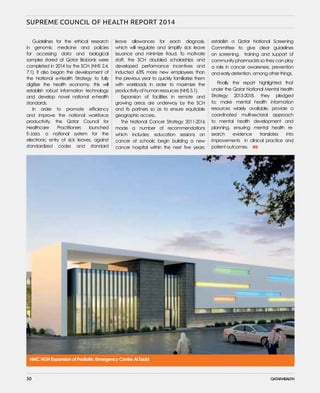
Emergency Expansion, Doha, 2018
Pediatric Emergency Centre Al Sadd
HMC HGH Trauma and Emergency Expansion, Doha, 2018
HMC HGH Expansion of Pediatric Emergency Centre Al Sadd
3030
sch.gov.qa 31
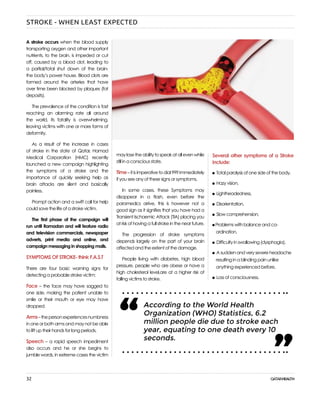
STROKE
- When least expected
A stroke can happen in flash and without any
warning. We look at ways to assist should you
ever face this ordeal as well as the symptoms to
detect during or before a seizure.
STROKE - WHEN LEAST EXPECTED
sch.gov.qa 31
32
maylosetheabilitytospeakatallevenwhile
still in a conscious state.
Time–itisimperativetodial999immediately
if you see any of these signs or symptoms.
In some cases, these Symptoms may
disappear in a flash, even before the
paramedics arrive, this is however not a
good sign as it signifies that you have had a
Transient Ischaemic Attack (TIA) placing you
at risk of having a full stroke in the near future.
The progression of stroke symptoms
depends largely on the part of your brain
affected and the extent of the damage.
People living with diabetes, high blood
pressure, people who are obese or have a
high cholesterol level,are at a higher risk of
falling victims to stroke.
A stroke occurs when the blood supply
transporting oxygen and other important
nutrients, to the brain, is impeded or cut
off, caused by a blood clot, leading to
a partial/total shut down of the brain-
the body’s power house. Blood clots are
formed around the arteries that have
over time been blocked by plaques (fat
deposits).
The prevalence of the condition is fast
reaching an alarming rate all around
the world, its fatality is overwhelming,
leaving victims with one or more forms of
deformity.
As a result of the increase in cases
of stroke in the state of Qatar, Hamad
Medical Corporation (HMC) recently
launched a new campaign highlighting
the symptoms of a stroke and the
importance of quickly seeking help as
brain attacks are silent and basically
painless.
Prompt action and a swift call for help
could save the life of a stroke victim.
The first phase of the campaign will
run until Ramadan and will feature radio
and television commercials, newspaper
adverts, print media and online, and
campaign messaging in shopping malls.
SYMPTOMS OF STROKE- think F.A.S.T
There are four basic warning signs for
detecting a probable stroke victim:
Face – the face may have sagged to
one side, making the patient unable to
smile or their mouth or eye may have
dropped.
Arms–thepersonexperiencesnumbness
in one or both arms and may not be able
to lift up their hands for long periods.
Speech – a rapid speech impediment
also occurs and he or she begins to
jumble words, in extreme cases the victim
According to the World Health
Organization (WHO) Statistics, 6.2
million people die due to stroke each
year, equating to one death every 10
seconds.
“ “
Several other symptoms of a Stroke
include:
Total paralysis of one side of the body,
Hazy vision,
Lightheadedness,
Disorientation,
Slow comprehension,
Problems with balance and co-
ordination,
Difficulty in swallowing (dysphagia),
A sudden and very severe headache
resulting in a blinding pain unlike
anything experienced before,
Loss of consciousness.
STROKE - WHEN LEAST EXPECTED
sch.gov.qa 33
STROKE - WHEN LEAST EXPECTED
33sch.gov.qa
34
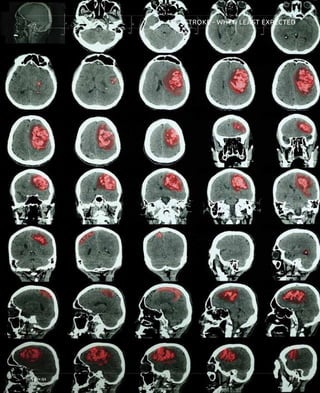
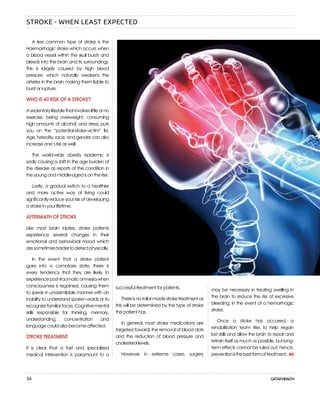
A less common type of stroke is the
Haemorrhagic stroke which occurs when
a blood vessel within the skull bursts and
bleeds into the brain and its surroundings.
This is largely caused by high blood
pressure, which naturally weakens the
arteries in the brain making them liable to
burst or rupture.
WHO IS AT RISK OF A STROKE?
Asedentarylifestylethatinvolveslittleorno
exercise, being overweight, consuming
high amounts of alcohol, and stress, puts
you on the “potential-stroke-victim” list.
Age, heredity, race, and gender can also
increase one’s risk as well.
The world-wide obesity epidemic is
sadly causing a shift in the age burden of
the disease as reports of the condition in
the young and middle-aged is on the rise.
Lastly, a gradual switch to a healthier
and more active way of living could
significantlyreduceyourriskofdeveloping
a stroke in your lifetime.
AFTERMATH OF STROKE
Like most brain injuries, stroke patients
experience several changes in their
emotional and behavioral mood which
aresometimeshardertodetectphysically.
In the event that a stroke patient
goes into a comatose state, there is
every tendency that they are likely to
experiencepost-traumaticamnesiawhen
consciousness is regained, causing them
to speak in unassimilable manner with an
inability to understand spoken words or to
recognizefamiliarfaces.Cognitivemental
skills responsible for thinking, memory,
understanding, concentration and
language could also become affected.
STROKE TREATMENT
It is clear that a fast and specialized
medical intervention is paramount to a
successful treatment for patients.
Thereisnotailor-madestroketreatmentas
this will be determined by the type of stroke
the patient has.
In general, most stroke medications are
targeted towards the removal of blood clots
and the reduction of blood pressure and
cholesterol levels.
However, in extreme cases, surgery
may be necessary in treating swelling in
the brain to reduce the risk of excessive
bleeding, in the event of a hemorrhagic
stroke.
Once a stroke has occurred, a
rehabilitation team tries to help regain
lost skills and allow the brain to repair and
retrain itself as much as possible, but long-
term effects cannot be ruled out; hence,
preventionisthebestformoftreatment.
STROKE - WHEN LEAST EXPECTED

ENGLISH_03_06_BURO

  • 1.
    sch.gov.qa 1 Outstanding healthprojects, stemming from an integrated vision... Health is a diverse and integral matter. Hospitals, medical centers and facilities are not enough on their own to achieve the goals set out by the Supreme Council of Health; our focus therefore is now on awarenessandpromotionofhealthylifestylesinthecommunity,thebiggestidealtoensuresustainable health. In accordance to our vision, Supreme Council of Health has recently launched the innovative Qatar Dietary Guidelines, setting a precedent in the entire Gulf region. The Qatar Dietary Guidelines provide valuable insights and guidance for healthy eating; it shows – with pictures and in-depth information – the foods we should consume to enhance healthy lifestyles, as well as the specific amounts of each food group. It also further includes the necessary advice on food that should be avoided. In addition, Qatar Dietary Guidelines, which are considered as an important part of the Qatar National Nutrition and Physical Activity Action Plan for 2011-2016, provides general advice on food- related health lifestyle. Moreover, the most important aspect of this innovative project, in which tremendous efforts were exertedandspecializedteamsworkedtoaccomplishitinsuchadistinctiveway,isthescopeofsuccess inimplementationaswellasthesatisfactionofthecommunitytoadoptahealthylifestyleandbalanced diet, a fundamental attribute for achieving our goals and ensuring that everyone is benefitting from wellness as a whole. Furthermore, we cannot overlook the importance of medical research’s role in promoting the health of the population in a factual and scientific capacity. Proudly the recent inauguration of the Qatar Biobank is a milestone in medical research. This innovative establishment will further enhance our contributions in this field and will assist in knowledgeable answers and information on health issues amongst the Qatari population. Our Health Projects, which are diversified in many areas, are being implemented and completed in accordance with an integrated vision set by the Qatar National Vision 2030. This vision will develop an integrated health care system that assists in a long and healthy life for current and future generations. Hamad Jassim M A Al-Hammar Editor-in-Chief Manager of Public Relations WELCOME
  • 2.
    2 CONTENTS HEALTH UPDATES QATAR BIOBANK AFIRST OF IT’S KIND IN THE GCC 4 What’s happening in and around Qatar and the region. Qatar is one of the few countries investing heavily in scientific research, we look at the inauguration of the Biobank. DIABETES PROGRESS UNDER THE WEIGHT OF UPDATED Are you at risk of diabetes? We have a closer look at this complex disease, as well as measures taken through stem cell treatment and research. Every year Supreme Council of Health issues an annual report providing an update on the reforms being undertaken by the council and all partners. 6 12 SHEIKHA DR. AL ANOUD AL-THANI QUESTIONS AND ANSWERS WITH 22 HGH Trauma and Emergency Expansion, Doha, 2018 HGH Expansion of Pediatric Emergency Centre Al Sadd HGH Trauma and Emergency Expansion, Doha, 2018 HMC HGH Trauma and Emergency Expansion, Doha, 2018 HMC HGH Trauma and Emergency Expansion, Doha, 2018 26
  • 3.
    sch.gov.qa 3sch.gov.qa QATAR BIOBANK QATARDIETARY GUIDELINES ACHIEVING A HEALTHY LIFESTYLE IS NOW EASIER, THANKS TO THE RECENTLY LAUNCHED BY THE SUPREME COUNCIL OF HEALTH Since the release of Qatar Dietary Guidelines at a two-day conference held by the Supreme Council of Health (SCH) in April, the framework has offered valuable insights and guidance for healthy eating for the first time in a GCC country. TIMELINE A HEATED MATTER... The summer season ushers in a severe climate change with increased heat waves and temperatures rising above 40 degrees celcius. For its part, the Supreme Council of Health works to prevent work-related injuries or deaths and promote the health of labourers at the workplace. We provide a closer look at the measures taken. 24 31 11 CONTENTS 16 A stroke can happen in a flash and without any warning. We look at ways to assist should you ever face this ordeal as well as the symptoms to detect during or before a seizure. - WHEN LEAST EXPECTEDSTROKE
  • 4.
    4 HEALTH UPDATES Aspetar Launches2015 Step Into Health Campaign in Malls SCH Organises Workshop on “Heat Stress” Aspetar launched its 2015 Step Into Health (SIH) campaign on the 24th of April in malls all around the country to help Qatar’s community remain fit in spite of the summer heat. The objective was to engage the Qatar public in a self-managed, life-long program based on a moderate amount of daily, healthy activity. Under the campaign, Health-Promoting Malls (HPM) offered people a range of opportunities for indoorphysicalactivitiesaswellasacomfortablewalkingenvironment.Itwasaimedatencouraging each person to walk 10,000 steps or more a day, in a non-competitive, recreational and social way. The Supreme Council of Health (SCH) recently organized a workshopentitled“BewareofHeatExhaustion”incooperationwith Hamad Medical Corporation (HMC), Ministry of Labour and Social Affairs and Qatar Petroleum. The workshop was attended by experts from SCH occupational Health Section and Health officials from private companies and organizations. It included important lectures on types of heat exhaustion,itseffectontheeyes,waystodealwithheatexhaustion cases, as well as a review of laws on working hours during summer. Brochures on heat stress which included guidelines and recommendations in different languages were distributed at the end of the workshop. University of Calgary in Qatar and Primary Health Care Corporation Sign MoU The University of Calgary in Qatar (UCQ) and Primary Health Care Corporation (PHCC) signed a memorandum of understanding that allows PHCC to sponsor its nurses in UCQ’s Master of Nursing program. The milestone agreement further enhances Qatar’s growing health workforce by granting top nursing professionals from PHCC, one of Qatar’s largest healthcare providers operating through twenty-one primary health care centers. The University of Calgary in Qatar contributes to the achievement of key goals of the Qatar National Vision 2030 as well as the National Health Strategy. Researchers at WCMC-Q (Weill Cornell Medical College in Qatar) have published the first comprehensive analysis of Internet health information in the Gulf Cooperation Council (GCC) region. The study entitled “Typology and Credibility of internet health websites originating from Gulf Cooperation Council countries” appeared in the World Health Organization (WHO) publication Eastern Mediterranean Health Journal. This research additionally won a national award for the top student research grant, awarded by Qatar National Research Fund (QNRF) in its Undergraduate Research Experience Program. FIRST STUDY OF GCC INTERNET HEALTH
  • 5.
    sch.gov.qa 5 HEALTH UPDATES NEWElectronic System in COMMUNICABLE DISEASE SURVEILLANCE HMC 1ST ADVANCED TRAUMA RESEARCH WORKSHOP The Supreme Council of Health (SCH) has recently announced that a new electronic systemfortheearlydetectionofcommunicable diseases,thefirstofitskindintheMiddleEast,will be launched next year. Dr. Hamad Eid al-Rumaihi, head of the Communicable Diseases Control Department SCH, pointed out that the system would be comprehensive, focusing on various environmental risks, whether biological, chemical, or radioactive, to help in a speedy detection and containment of any potential diseases. Dr. al-Rumaihi said that work had started to prepare a draft list of guidelines and directives of the system in co-operation with all the participating entities. Hamad Medical Corporation (HMC) conducted the first ever Advanced Trauma Research Workshop (ATRW) in Qatar, bringing together international experts and local trauma healthcare professionals and providing a unique platform to engage in discussions and highlight best practices in trauma research. The four- day intensive workshop convened as many as ninety healthcare professionals, including trauma surgeons, specialists, nurses, pharmacists, residents and fellows. The main aim of the workshop was to provide participants a thorough understanding of how to perform high-quality clinical research that will inform injury prevention programs. During the workshop, delegates were able to benefit from dynamic lectures, presentations and focused discussions covering topics such as clinical research, statistical concepts, and considerations for designing effective clinical trials, basic and advanced concepts of data analysis, diagnostic tests and ethics in research. Mother and Child Cohort Study The Supreme Council of Health (SCH) plans to study the link between exposure to environmental, biological and lifestyle hazards and their impact on the health of mother and child which will be conducted by SCH’s Biomedical Research Department and has been titled the Birth “Cohort” study. This long term study will examine gestational diabetes in mothers, metabolic syndrome and postpartum depression, breastfeeding and nutrition, lifestyle traits including physical activity, sleep and timing of activities and psychosocial activities. Child health outcome will include, preterm births, low weight at birth, obesity and metabolic-related disorders, neuro-development, immune system, asthma and allergies. NEW E-SYSTEM TO RECORD VACCINATIONS ThedirectorofPublicHealthDepartment at the Supreme Council of Health (SCH), Dr. Sheikh Mohammed Bin Hamad Al Thani has revealed that Hamad Medical Corporation (HMC), the Primary Healthcare Corporation (PHCC) and Health Insurance, are currently gearing uptoimplementanewelectronicsystem tagged “Cerner”, which will contribute to providing a tracking and monitoring mechanism and provide information on individuals who miss their vaccinations. The system will enhance control on accuracy of data, following up with individuals who miss their vaccination and reaching them through SMS about the importance of being vaccinated.
  • 6.
    6 QATAR BIOBANK QATAR BIOBANK SETTINGA PRECEDENT, THE FIRST OF ITS KIND 6
  • 7.
    sch.gov.qa 7 THE STATEOF QATAR IS AMONG THE FEW RARE COUNTRIES INVESTING HEAVILY IN SCIENTIFIC RESEARCH. 2.8% OF QATAR’S ANNUAL GDP IS ALLOCATED FOR FUNDING AND IS PROMOTING RESEARCH AND DEVELOPMENT, THIS HAS LED TO THE BIRTH OF QATAR BIOBANK (QBB). sch.gov.qa 7
  • 8.
    8 QATAR BIOBANK QatarBiobank–thefirstintheGCCregion, ispartofQatar’seffortstowardsgrooming knowledge andassisting with health problems facing the country’s citizens. This is done through the employment of scientific research, for the sole purpose of providing a population study, to better understand of the causes of prevalent illnesses. Ultimately the goal is to provide a more tailored healthcare for all residents. Located inside a new state-of-the-art facilityatHamadbinKhalifaMedicalCity, Qatar Biobank (QBB) is a podium that will make vital health research possible throughitscollectionofurine,blood,saliva and other human liquids’ samples and information on health and lifestyle from long-standing members of the Qatari population. QBB, Qatar’s long-term medical health initiative, was fashioned to give Qatari people better chances of avoiding serious illnesses, and to promote better health for future generations. QBBwascreatedbyQatarFoundation andtheSupremeCouncilofHealth(SCH) in collaboration with Hamad Medical Corporation (MHC) and with the expert support of scientists from Imperial College London. Through its collection of samples and information on health and lifestyle, researchers will be able to understand whysomepeopleintheQataripopulation develop certain diseases and why others do not. Small samples of blood, urine and salivaarecollectedfromeachparticipant during the assessment, which will allow a QBB not only aims at giving Qatari nationals and residents greater chances of avoiding serious illnesses, but it also aims at safeguarding and promoting better health for future generations. Accredited medical researchers will have access to the information and samples provided by volunteers and participants. Information about participants is to be treated as con- fidential. Likewise, the data from the findings are strictly privileged and will only be shared if the participant allows this. Thosewhoarewillingtoparticipatemust be at least eighteen years old and either Qatari nationals or long-term residents who have lived in Qatar for at least fifteen years. Currently, there is no upper age limit but the programme planners say that they will extend the invitation to younger generations below eighteen. Participants will attend a three-hour assessment session after which they will wide range of different tests. The samples will be processed and stored at QBB’s laboratory. Each sample is divided into several smaller sections to prepare for on overall freezing process. Processing includes preserving the white cells in such a way that they can be grown, and thus provide more genetic material in the future. The QBB resource will become increasingly valuable for medical research over the years, sothesesamplesmaybekeptformanyyears. During this time, parts of the samples will be usedbyresearchers.Attheendoftheirnatural life, all the remaining samples will be securely destroyed. Over the next few years, research enabled by QBB will show how the health of the Qatari population is affected by their lifestyle, environment and genes. Therefore, QBB will help improve prevention and treatment of diabetes, heart disease, cancer, obesity and other life-threatening and incurable diseases that affect communities in Qatar. Biobanking is one of the great healthcare opportunities of our time. The Qatar Biobank has quickly established itself as the most ambitious of its kind in the region. The data from our noble volunteers will be used to help understand how lifestyle, environment and genes affect health locally, and will play a critical role in helping develop treatments and preventing disease for the health of future generations. “ “ Dr. Hanan Al Kuwari, Chairperson at Qatar Biobank Board of Trustees
  • 9.
    sch.gov.qa 9 HH SheikhaMoza at the official opening of the Qatar Biobank. QATAR BIOBANK QBB not only aims at giving Qatari nationals and residents greater chances of avoiding serious illnesses, but it also aims at safeguarding and promoting better health for future generations. “ “PHOTOCREDIT:HHOPL
  • 10.
    10 QATAR BIOBANK give theirconsent to take part and to allow QBB to track and assess their health record for many years to come. It is important to take precise measure- ments such as height, weight, blood pressure, body composition, heart and lung function before the onset of taking samples. However, the process is run on a purely voluntary basis. Following the measurement stage, volunteerswillhavetofillinaquestionnaire about their health and lifestyle either using a specially-designed touchscreen computer or with an assistance of a trained interviewer. The questionnaire outcome will be dealt with in the strictest confidence. QBB is also in alignment with the Qatar National Vision (QNV) 2030, which aims to meet the healthcare challenges of Qatar’s experiencedlargescaleparticipationfrom Qataris and has witnessed a long waiting list of willing and viable participants with a healthy balance of male to female ratio; however the Biobank cannot take more than 24 contributors per day. On the availability of sufficient medical researchers, Prof. Nahla said that the Biobank has received about eighteen research proposals from Qatar University, WeilCornellMedicalCollegeinQatarand Hamad Hospital. Before the establishment of the Biobank, most medical research work for developing medical treatments had been done with the use of Western populations due to a lack of large-scale research based on Qatari/GCC population. The benefits of this Biobank will be felt in years to come and it will be a priceless legacy for future generations. growing population and mandating SCH and HMC to take “proactive measures”. As one of the Doha-based researchers said, “QBB will help scientists develop ‘smart drugs,’ which are targeted to the individual and are effective treatments for the Qatari population”. Its success is greatly hinged on positive and effective public interest and engagement since its inception in 2010. Qatar Biobank is in cohortswithQatarFoundation’smissionwhich is to ensure that the State of Qatar addresses prevalent national health issues, by enabling research on the risk factors and causes of recurring diseases in Qatar. The Biobank’s public recruitment approach provides a model for public involvement in biomedical research. Speaking with Prof. Nahla Maher Afifi, MD., (Scientific and Education Manager), she confirmed that the Biobank has Before the establishment of the Biobank, most medical research work for developing medical treatments had been done with the use of Western populations due to a lack of large-scale research based on Qatari/ GCC population. “ “
  • 11.
    sch.gov.qa 11 December 2013:Qatar Genome Project (QGP) was launched by Her Highness Sheikha Moza bint Nasser, Chairperson of Qatar Foundation. Its aim was to take QBB to the next stage. The project would carry out extensive studies on the full individual sequencing of DNA. This would contribute to making personalized healthcare a reality. 23 March-3 April 2014: For 14 days, QBB held booths across campus at Qatar University (QU) to educate the Qatar University community. QBB staff met with students, fellow colleagues and faculty members to talk about QBB’s aligned aims and informed the QU community about the benefits of participating at Qatar Biobank. The students showed enthusiasm to support Qatar Biobank. Timeline for Qatar Biobank Efforts were underway to decode the Qatar genome with the launch of the pilot phase. 2012 2013 2014 By 2018, QBB aims at collecting biological samples from 60,000 Qataris and long-term expatriates from among its participants. 8, 9 February 2015: QBB hosted its inaugural conference that explored the development of Qatar’s healthcare and medical research community, at Qatar National Convention Centre. The conference, titled “Biobanking in the Context of Personalised Healthcare,” gathered local, regional and international experts to discuss the future of personalised healthcare in integration with Biobanking worldwide. 11 February 2015: Her Highness Sheikha Moza bint Nasser, Chairperson of Qatar Foundation for Education, Science and Community Development (QF), officially opened the Qatar Biobank building in Hamad bin Khalifa Medical City. 2015 sch.gov.qa 11 PHOTOCREDIT:HHOPL
  • 12.
    12 THE WAY FORWARD SPOTLIGHTON DIABETES UNDER THE WEIGHT OF DIABETES - 12
  • 13.
    sch.gov.qa 13 Diabetes isa complex condition that could lead to severe long-term complications and acute illness. The diseasehasreachedepidemicproportion inQatarwithabout17%ofthestate’sadult population thought to have diabetes. With recent statistics suggesting that over 70% of the population is overweight and obese raising community awareness of healthy lifestyle practices becomes a vital strategy for reducing the incidence of type2 diabetes in Qatar. The comfort of modern-day life is fast contributing to the rise in both obesity and diabetes, 80 out of 90% of people with diabetes are also diagnosed as being obese. The excess weight puts an added pressure on the body’s ability to control its blood sugar, thus leading to the use of insulin. However, the use of insulin in the treatment of diabetes leads to weight gain; the more insulin used to stabilize the body’s blood sugar, the more glucose is absorbed into the cells which is stored as fat, resulting in weight gain… a vicious cycle . About 5.8% of Qatar’s population is considered to be pre-diabetic. Also, approximately 10% of pregnant women in Qatar have diabetes. But it is estimated that as many as a third of diabetics are not aware of their disease. “ “ABOUT 11% OF QATAR’S POPULATION IS CONSIDERED TO BE PREDIABETIC. ARE YOU AT RISK OF DIABETES? If you notice the following signs, you may be experiencing symptoms of Type2/Type1 diabetes: Extreme thirst, Excessive visits to the bathroom, Feeling tired and drowsy (fatigue) regularly, Severe Headaches, Blurred vision, Weight loss/weight gain, Slow-healing wounds, Itchy skin (especially of your inner tights), Recurrent yeast infections, Numb hands and feet. “ “ABOUT 5.8% OF QATAR’S POPULATION IS CONSIDERED TO BE PREDIABETIC. sch.gov.qa SPOTLIGHT ON DIABETES
  • 14.
    14 ...type2 diabetes is typicallya disease with slow progression, and its early stages are usually symptom free. “ “ DO YOU KNOW YOUR HbA1C/A1C? The Qatar Diabetes Association advises that if youhavebeendiagnosedwiththecondition, you must know your HbA1C or A1C. A1C tells you the average level of glucose (sugar) in your blood over the past three months and it is reported as a percentage (for example 7%). Knowing your A1C tells you about your risk for complications of diabetes, such as blindness, kidney disease and amputations, heart attacks and stroke. Your risk of complications heightens whenever you have high A1C. DIABETES CARE CENTRES In a bid to match the increase in diabetic cases, a world-class treatment center that will provide Qatar’s diabetic population with improved patient care and access to specialized services through a multi- disciplinary approach was opened at the Hamad General Hospital in 2013. The center also houses research teams who will be studying evidence-based strategiesforthetreatmentandprevention of diabetes and its complications. The State of Qatar’s world-class treatment center, The National Centre for Diabetes Treatment that provides Qatar’s diabeticpopulationwithimprovedpatient care and access to specialized services through a multi-disciplinary approach, was opened in 2013.The diabetes center is located on the second floor of the outpatient department, a first in a chain of diabetic care centers across HMC hospitals that will serve as a one-stop shop in which patients can speak with specialist doctors and nutrition experts, renew prescriptions and learn about how to managetheircondition.Thefacilityboasts of a range of services, including foot care, counselling,bloodinvestigationandinsulin pump therapy. A second center has been opened in Al Wakrah Hospital, and the openning of the third one in Al Khor hopsital is on its way. Prediabetes occurs as a result of a buildup of sugar in the blood and leads to type2 diabetes which is a direct effect of your body’s blood sugar staying too high for too long. A fasting blood sugar level less than 100mg/dL (5.6mmo1/L) is considered normal; 100 to 125mg/dL is prediabetic; 126mg/dL or higher means you have full blown diabetes (Type 2/Type1). If your blood sugar levels are always above target level, you stand a risk of damaging your blood vessels and nerves (Neuropathy) and this could lead to a buildupofPlaquewhichincreasesyourrisk of coronary heart disease, heart attack or even stroke. HEALTH RISKS ASSOCIATED WITH DIABETES The seriousness of the health impact is often not appreciated, this is because type2 diabetes is typically a disease with slow progression, and its early stages are usually symptom free. Diabetes is not as dramatic as cancer orheartdisease,butitsrepercussionsinthe longer term are extremely serious. Diabetes doubles the risk of coronary heart disease in men, and quadruples it among women. Stroke in people with diabetes is three times higher than in people without diabetes. Diabetes is the leading cause of end stage renal disease. Diabetic retinopathy accounts for 5 percent of all cases of blindness globally. Someonewithdiabetesisatmorethan 25timesgreaterriskoflimbamputation than someone without diabetes. Asaresultofthesecomplications,diabetes can reduce a person’s life expectancy by up to 10 years, and according to the International Diabetes Federation (IDF) there were around 5 million deaths in 2014 as a result of diabetes and its related diseases. Nearly half of these deaths were of people aged under 60. SPOTLIGHT ON DIABETES
  • 15.
    sch.gov.qa 15 REDUCE YOURRISKS OF DEVELOPING DIABETES Think Milk - a 2010 study from Harvard found that those who drink more milk havea60%chanceofreducingtheriskof developing type2 diabetes. Tea Party - Recent research shows that a daily consumption of chamomile tea reduces complications of diabetes. Juice your Aloe Vera - an Indian University (Majodol) in 1996, discovered that Aloe Vera possessed anti-diabetic effects. Coffee Breaks - drinking several cups of black coffee a day can reduce your overallriskofdevelopingdiabetesby30%, according to a new research. Loose the Weight - Losing weight through a healthy diet and exercise reduces the risk of diabetes. Just Move - reduced activity fuels your risk of type2 diabetes. A brisk 30-minute walk cuts your risk of developing the condition by 30%. STEM CELLS - THE FUTURE OF DIABETES TREATMENT In 2014, researchers at Qatar Biomedical Research Institute (QBRI) achieved an important scientific breakthrough in diabetes research via the development of specialized Stem Cells. The research showed that stem cells could be used in the secretion of insulin and help control blood sugar. People living with diabetes generally have a high blood sugar level due to the inability of the pancreas to produce sufficient insulin. This is a major milestone for Qatar in its quest for becoming world leaders in diabetic research. QBRI was established in 2012 as a member of Qatar Foundation Research and Development, concentrating on developing plans for research and treatment methodologies for diabetes and cancer in the first five years of its operation. The stem cell research was ongoing at both the clinical laboratories in Weill Cornell Medical College in Qatar and Qatar Science and Technology Park. This stem cell treatment will be the first of its kind in therapies for diabetes. It is believed that this research will lead the initiative for the treatment of many other diseases with stem cells. Stem cell treatment would eventually eliminate the need for insulin injections commonly administered to diabetic patients, after the final certification of results. It would make medication obsolete as well. Stem cells to be used in the treatment of diabetes can be acquired from the patient’s blood or from any external donor. With diabetes being a major challenging disease in the Qatari population, stem cells and regenerative medicine offer hope to many afflicted individuals. Stem cell treatment would eventually eliminate the need for insulin injections...“ “ SPOTLIGHT ON DIABETES
  • 16.
    16 QATAR DIETARY GUIDELINES INACHIEVING A HEALTHY LIFESTYLE A MILESTONE SINCE THE RELEASE OF THE QATAR DIETARY GUIDELINES AT A TWO-DAY CONFERENCE HELD BY THE SUPREME COUNCIL OF HEALTH (SCH) IN APRIL 2015, THE FRAMEWORK HAS OFFERED VALUABLE INSIGHTS AND GUIDANCE FOR HEALTHY EATING FOR THE FIRST TIME IN A GCC COUNTRY. WE DISCUSS DIFFERENT ASPECTS AND TIPS OF THE GUIDELINES TO ACHIEVE AN OVERALL HEALTHY LIFESTYLE. 16
  • 17.
  • 18.
    18 As part ofthe National Health Strategy of reducing morbidity and mortality attributable to “chronic non-com- municable diseases (NCDs) in the State of Qatar,” the Dietary Guidelines aims at reducing rates of obesity and overweight, increasing rates of physical activity, and enhancing nutritional status. Moreover, the development of the Guidelines supports and fosters healthy lifestyle patterns to accomplish the objectives of health, nutrition and physical activity within fundamental building blocks. Since the 1992 International Conference on Nutrition in Rome, Italy, the Food and Agriculture Organization (FAO) and the World Health Organization (WHO) adopted the term of Dietary Guidelines through the determination of the lifestyle patterns that are associated with diet-related diseases. They can be a useful tool in educating the public in healthy eating and prevention of diet- related chronic diseases. This conference recommended that individual countries should develop simple Dietary Guidelines that are based on their specific public health concerns and relevant to people of different ages, lifestyles, and cultures. The concept of food-based Dietary Guidelines has come to light and was promoted by the SCH. These Guidelines take into consideration the sociocultural status and nutritional problems in Qatar. Qatar has undergone a rapid change in its socio-economic situation, food consumption patterns, lifestyle and health status during the past three decades, what took place thanks in part to the sharp increase in income levels. Conversely, communicable diseases have almost diminished and diet-related chronic diseases have become the main health problems. DEVELOPING METHODS FOR DIETARY GUIDELINES IN QATAR Qatar faces great challenges to prevent and control several nutritional problems and diet-related chronic diseases. Two types of nutritional and health problems occur: those associated with change in lifestyle, such as obesity, cardiovascular disease, diabetes, hypertension, cancer, dental caries, and osteoporosis and those associated with nutrient deficiencies, such as iron deficiency anemia and deficiencies of vitamin D and calcium. In addition, food- borne diseases are a problem of concern in these countries. Therefore, the need for simple Dietary Guidelines to address the burden of these diseases is urgent, especially as some of them contribute to more than 50% of total mortality in the GCC region. In addition to the changes in food consumption patterns, other changes in lifestyle, are also apparent and include smoking and a decrease in physical activity. Theincreaseinsedentarylifestylesismainlydue to the abundant use of cars, dependency on housemaids for home management, as well as due to spending a long time watching televisionandusingtheInternet,particularlyby children, teenagers, and young people. Inadditiontoaddressingtheprevention and control of the main nutritional problems and diet-related diseases in Qatar, the Guidelines are based on affordable and available foods, which are commonly consumed by the public, focusing on traditional foods. It also consider the cultural and religious background of the population in Qatar given that Islamic law is applicable here. It promotes a healthy lifestyle, especially the importance of physical activity and it is being based on current scientific and health information. There has been a drastic change in food consumption patterns in Qatar and the region. This change includes both quantitative and qualitative change in diet. The structure of diet has shifted QATAR DIETARY GUIDELINES Development of Qatar Dietary Guidelines supports and fosters healthy lifestyle patterns to accomplish the objectives of health, nutrition and physical activity within fundamental building blocks. “ “
  • 19.
    sch.gov.qa 19 “ “Legumesare a rich source of protein, some vitamins, and minerals, and dietary fiber. towards high-energy-density meals with more fat and added sugar in foods, more saturated fat (mostly from animal origin) and lower intake of complex carbohydrates, dietary fiber, fruit, and vegetables. For example, the total per capita energy intake exceeds 3000 kcal in all Arab Gulf countries, and the fat represents 25–35% of total energy. Food rich in salt is highly consumed in theregion.Thehighuseoftablesalt,spices, and pickles, in addition to the salinity of water are contributing factors for the high intake of sodium in these countries. Among children and adolescents, the high consumption of fast foods and French fries is playing a great role in the increasing intake of sodium among these age groups. High intake of foods rich in added sugar, particularly among children and adolescents, has been reported by many studies in the region. Although Qatar enjoys a sunny en- vironment all year long, vitamin D deficiency is one of the main public health problems. Studies in Qatar revealed that 69% (an example),ofchildrenbelowsixteenyearshad vitamin D deficiency. The change in dietary habits, lifestyle, and life expectancy in Qatar and the region has led to a remarkable change in disease trends. Diet-related chronic diseases such as cardiovascular disease (CVD), diabetes mellitus, hypertension, obesity, cancer, dental caries, and osteoporosis have become the main health problems. Additionally, overweight and obesity have become epidemic among all age groups in Qatar, responsible for increased morbidity. Inactivity, high consumption of high-energy- density foods and long duration of watching television or using the Internet were reported as contributing factors for high prevalence of obesity. Food-borne diseases in Qatar and the region are mainly caused by bacteria, specifically salmonellosis, Hepatitis A, shigellosis, and poisoning with staphylococcus. The Guidelines advise about eating a variety of different foods on a daily basis. The human body needs more than 40 nutrients to maintain good health and prevent disease. Therefore, increasing the variety of foods consumed is important to ensure an adequacy to intake of these nutrients in our meals, breakfast, lunch, supper, and snacks. The Guidelines also advise that fruit and vegetables should comprise a basic part of the daily diet to maintain a healthy body. They also contend that meat, fish, and poultry are the main source of dietary balanced protein and are rich in essential nutrients, especially iron, zinc, and other vitamins. Many of the expatriates, frequently suffer from anemia, mainly iron deficiency anemia. ... 69% of children below 16 years had vitamin D deficiency.“ “ QATAR DIETARY GUIDELINES
  • 20.
    20 Meat,fish,andchickenaregoodsources of good absorbableiron. At the same time, red meat consumption should be restricted and putting a limit to the intake of processed meat products that are rich in fat and salt such as sausages and mortadella should be exercised. Legumes are a rich source of protein, some vitamins, minerals, and dietary fiber. Legumes include, among others, beans, lentils, cowpeas, kidney beans, lupine, green peas, and soybeans. On the other hand, unsalted and unroasted nutssuchaswalnuts,hazelnuts,almonds, and pine nuts, as well as seeds such as watermelon seeds, muskmelon, and sunflower are very rich sources of energy for their high fat content. The Guidelines advises everyone to try to concentrate on foods based on whole grains especially bread, biscuits, and other bakery products. Cereal- based foods such as cakes, biscuits, and pastries, which can have high levels of added fats and sugars are not included in this recommendation and should be regarded as occasional treats only. Milkanddairyproducts,whichcontain many essential nutrients, are important for the body and for its development. The Guidelines say that dairy products are the best source of calcium, which is vital to strengthen bones and for a healthy nervous system. The consumption of milk and dairy products is important for building a healthy body, particularly during childhood and adolescence. For those who are allergic to milk or who are intolerant to lactose, low-fat yogurt or cheese, and other non- dairy products like hummus or broccoli are suitable substitute for milk. Many foods and traditional dishes consumed in Qatar and the region are known for their considerable high fat content. Fat provides energy, essential fatty acids are necessary for development and fat helps in the absorption of certain vitamins. Nevertheless, moderate intakes of fat should always be maintained by selecting healthy food like olive oil instead of butter or margarine. Overconsumption of food rich in sugar leads to an increase in energy intake, which contributestoanincreaseinyourweight.Inthe same vein, the Guidelines suggest that teeth becleanedimmediatelyaftereatingsuch foods especially among children in Qatar. ManyQataritraditionaldishes,canned, and fast foods contain high amounts of salt. Studies show that an over-intake of sodium is associated with high blood pressure, strokes, and contributes to heart attacks, heart failure, and kidney failure. The Guidelines recommend that the amount of salt does not exceed 5 g per day. To achieve low intake of salt, peopleshouldconsumefreshfoods,foods normally processed without salt, and add low salt or avoid addition of salt to food. The Dietary Guidelines advises about frequent intakes of water (8-12 glasses a day) and other liquids as water is an essential nutrient for life. It accounts for more than 60% of our bodies and plays important roles in digestion, absorption, andtransportationofnutrientsinthebody, aswellasforeliminationofwasteproducts and thermoregulation. The quantity of water consumed may differ from one person to another. Factors like body size, weather, physical activity, and individual differences have an effect on the body’s need for fluids. However, intake of fluids containing added sugar A study by Dr. Barbara Ann Seed, former Nutrition Policies and Programs Coordinator at SCH, highlighted the SCH’s commitment to “educating the population about the relevance and importance of these principles and establishing champions to advocate for them”. Many foods and traditional dishes consumed in Qatar and the region are known for their considerable high fat content. “ “ QATAR DIETARY GUIDELINES
  • 21.
    sch.gov.qa 21 should beavoided as much as possible. Obesity has become an epidemic in Qatar and the region during the last two decades. The more weight a person has the more the chances of developing hypertension, cardiovascular disease, hyper-cholesterolemia, and certain kinds of cancers, osteoarthritis and other respiratory problems. The major health objective of the Dietary Guidelines therefore is to maintain a weight that sustains a healthy life and prevent extra weight gain. The way to achieve a healthy body weight is to balance intake of food and drinks with physical activity. The findings of the Guidelines show that inactivity is one of the main factors contributingtohighprevalenceofobesity in Qatar that children and adolescents have become less active. These findings correspond with studies in Arab Gulf countries indicating that a serious decline in physical activity especially among women and adults. Making physical activity a part of our daily routine and maintenanceofoptimumweightaretwo importantissuesforgoodhealthandboth can benefit your health in different ways. The current Dietary Guidelines are useful guides for the Qatari community to promote healthy eating and lifestyle to reduce the incidence of nutrition- related diseases among residents and nationals. The SCH pledges to revise these Guidelines periodically (every 3 to 5 years) with the change of scientific evidence and research regarding the risk factors for nutrition-related diseases. RESEARCH ON DIETARY GUIDELINES In a research paper titled “Sustainability in the QatarnationalDietaryGuidelines,amongthe first to incorporate sustainability principles,” Dr. Barbara Ann Seed, former Nutrition Policies and Programs Coordinator at SCH, concluded that the SCH and the dietary Guidelines “task force” would determine how the population in Qatar would embrace the principles found in the Guidelines. The study also highlighted the SCH’s commitment to “educating the population about the relevanceandimportanceoftheseprinciples and establishing champions to advocate for them”. It is noteworthy that Dr. Seed’s paper aimed to “present one of the first national Dietary Guidelines that incorporate food sustainability principles into its public health recommendations”. sch.gov.qa QATAR DIETARY GUIDELINES
  • 22.
    22 INTERVIEW - SHEIKHADR. AL ANOUD AL-THANI Sheikha Dr. Al Anoud Bint Mohammed Al Thani, Director of Health Promotion and Non-Communicable Diseases, Pub- lic Health Department, Supreme Council of Health, presented a detailed ex- planation about the Dietary Guidelines for Nutrition in the State of Qatar. DR. Al Anoud showed the stages undergone by the project since its inception in addition to highlighting components of the Guidelines in an exclusive interview with Qatar Health. Dr. Al Anoud has also pointed out that the Guidelines explain using pictures and illustrations of food that should be which we are used to and that it is in the form of a shell. Dr. Sheikha Al Anoud Bin Mohammed Al Thani: Yes, the Dietary Guidelines represent an integrated concept. Therefore, we have chosen the form of the “shell” in order to reflect this concept in nutrition. Qatar Health: After the release of Qatar Dietary guidelines, in what way do Dr. Al Alnoud think that these guidelines could serve in the fight against non- communicable diseases? Are you optimistic? consumed as well as the quantities of each type of food, vegetables and fruits. Dr. Al Anoud noted that the guidelines also provide tipsandrecommendationsonwhatfoodsthat should be avoided or minimized. She also said that they make the provision of general advice about food associated with a healthy lifestyle. Dr. Al Anoud also indicated that Guidelines booklet contains a copy with references and bibliography for the benefit of academics in various fields. Qatar Health: I noticed that the shape of the paradigm is not indicative of the pyramid, SHEIKHA DR. AL ANOUD AL-THANI GIVES US SOME INSIGHT INTO THE QATAR DIETARY GUIDELINES. HEALTHY EATING, HEALTHY LIVING
  • 23.
    sch.gov.qa 23 Dr. SheikhaAl Anoud Bin Mohammed Al Thani: Yes, I am very optimistic about the successful application of these Guidelines. The guidelines are an important part of the Qatar National Nutrition and Physical Activity Action Plan for 2011-2016. We have adopted nutrition studies in Europe and the Gulf States. Additionally, we have adopted the World Health Organization Regional Office for the Eastern Mediterranean Guide. Exhibiting behaviours that are consistent with the Dietary Guidelines helps in reducing risk factors for non- communicable chronic diseases, such as cardiovascular disease, diabetes and cancer. The Dietary Guidelines booklet in- cludes tips and recommendations about the importance of eating healthy foods of the six food groups and maintaining a healthy weight, in addition to reducing foods that are high in sugar, salt and fat. Regular physical activity, consuming sufficient amounts of water, ensuring the safety, cleanliness of ways to prepare foods, healthy eating and environmental conservation are all under the umbrella of the Qatar Dietary Guidelines. Qatar Health: Dr. Al Anoud supervised the 2012surveyonChronicDiseaseRiskFactor Surveillance;couldyougivemeanoteon the report? Is it annual? In other words, do you think Qatar needs an update? Dr. Sheikha Al Anoud Bin Mohammed Al Thani: The world health survey results in the There are also other non-Qatari surveys such as the survey on food consumption. Such surveys are due every five years. The next survey will be conducted in 2016- 2017. Qatar Health “It’s an epidemic in Qatar,” you explained regarding the implication of diabetes and its association with non- communicable diseases “among the five major causes of death in Qatar”. You also said, “Injuries are the first cause of mortality, then chronic cardiac disease, then cancer, then endocrine diseases, especially diabetes”. Have you noted any improvements in people’s awareness since then? Dr. Sheikha Al Anoud Bin Mohammed Al Thani: Of course, we have improved the awareness of individuals, Qataris and non-Qataris, regarding diabetes. However, some individuals lacked the extent and method of preventing this disease. The Qatar Dietary Guidelines were built on Aspetar’s Sports Guidelines, among several others. The Qatar Dietary Guidelinesalsocontaintheirowndirectory for exercise. Qatar Health: Dr. Al Anoud delivered a speech - “An Overview of the Qatar DietaryGuidelines”duringtheconference on Qatar Dietary Guidelines held on 8-9 April, what is your conclusion regarding the guidelines mechanism and modus operandi? Dr. Sheikha Al Anoud Bin Mohammed Al Thani: The Qatar Dietary Guidelines represent an integrated mechanism and a clear plan during a year, which includes workshops, media coverage, question-and-answer sessions, and test samples and questionnaires and surveys in the gathering places such as mosques. The Qatar Dietary Guidelines have been taught to university students and integrated in their curricula. With the launch of the first faculty of medicine Qatar Dietary Guidelines will have the greatest impact in the community. State of Qatar, held in 2006 in collaboration with the World Health Organization, showed that more than two-thirds of adults (67.8%) are either overweight or obese and more than half (56%) do not have the recommended levels of physical activity by the World Health Organization (WHO). It should be at a rate of 150 minutes per week of moderate physical activity. Additionally, 81.7% of respondents in this health survey do not consume the recommended amounts of fruits and vegetables, and 11% use tobacco daily of various types. All these factors are the main risk factors for non-communicable diseases (NCDs). The survey results also showed that 10% of the sample also had high blood pressure and a blood lab tests showed that 10% of the sample have ill glucose pre- diabetes. Therefore, we need valid data for the formulation of health policy and monitor the tendency of these diseases in the community. Statistics showed in 2008 in the State of Qatar that the main causes of death are external causes of death, which include accidents and injuries at work, which claim the lives of twenty people per 100,000 of population, followed by diseases of the circulatory system, causing 19.4 deaths per 100,000 of the population. Different types of tumours are the third leading cause of death and kill 12.0 people per 100,000 of the population. We have tested the messages at the beginning of the National Health Strategy in 2011 on Qataris between the ages of 18-64. Data and samples were collected in a very structured way using Personal Digital Assistants (PDA) for the first time in the Gulf. I am very optimistic about the successful application of these Guidelines. The guidelines are an important part of the Qatar National Nutrition and Physical Activity Action Plan. “ “ INTERVIEW - SHEIKHA DR. AL ANOUD AL-THANI
  • 24.
    24 HEAT STROKE: CHALLENGESAND THE FUTURE A HEATED MATTER... THE SUMMER SEASON USHERS IN A SEVERE CLIMATE CHANGE WITH INCREASED HEAT WAVES AND TEMPERATURES RISING ABOVE 40 DEGREES CELCIUS. 24
  • 25.
    sch.gov.qa 25 is administered.It advises that anyone suspected with this condition should not be sent home or left unattended unless that action has been approved by a doctor. OTHER SUPREME COUNCIL OF HEALTH INITIATIVES: 1. The SCH issues full color illustrated brochures and multilingual pamphlets in many languages such as Urdu and English in addition to Arabic, to promote drinking water habits at frequent intervals. 2. Wet-bulb globe temperature (WBGT), a composite temperature is applied by a wide array of industrial hygienists, athletes, the military and other institutions to estimate the effect of temperature, humidity, and infrared radiation (usually sunlight) on humans, which determines appropriate exposure levels to high temperatures. It is derived from the following formula: WBGT = 0.7T+ 0.2T+ 0.1Td g w Where: Tw = Natural wet-bulb temperature (combined with dry-bulb temperature indicates humidity) Tg = Globe thermometer temperature (measured with a globe thermometer, also known as a black globe thermometer) Td = Dry-bulb temperature (actual air temperature) Indoors, or when solar radiation is negligible, the following formula is often used: WBGT = 0.7T+ 0.3Tgw Medically, Heat Stroke occurs when the body temperature is greater than 40 Celsius degrees leading to complications involving the central nervous system, resulting from exposure to high temperatures. This condition progresses from heat-related illnesses such as heat cramps, heat syncope (fainting), heat exhaustion.Amajorcauseofthecondition is the prolonged exposure to high temperatures coupled with dehydration, leading to a breakdown of the body’s temperature control system due to loss of minerals and body fluids. The main symptoms of heat stress exhaustion as those that include heavy sweating and rapid pulse conditions caused by an overheated body Heat stress disorders also cover the following symptoms; heat cramps, heat rash, heat stroke, and heat exhaustion. Signs of heat exhaustion may develop suddenly or overtime, especially with prolonged periods of working under high humidity or rigorous exercise. POSSIBLE HEAT EXHAUSTION SYMPTOMS MAY INCLUDE THE FOLLOWING: Heavy sweating, Moistandcoolskinwithgoosepimples when in the heat, Weak, rapid pulse, Faintness, Fatigue; dizziness, Low blood pressure upon standing, Muscle cramps, Headache, Nausea. TREATMENT OF HEAT EXHAUSTION Casualties of heat exhaustion should swiftly be administered first-aid. The SCH also advises the following: 1. Call 999, 2. Help the casualty to cool off by; Moving the patient to a cool place, Drink cool water, Remove unnecessary clothing or just loosen the victim’s clothes, Shower or sponge with cool water. The SCH also defines heat stroke as a condition whereby the body can no longer cool itself and the body temperature rises to critical levels Other primary signs and symptoms of heat stroke may include the following: Confusion, Irrational behavior, Loss of consciousness, Convulsions, Lack of sweating, Hot, dry, reddened skin, Abnormally high body temperature for example 41 degrees celsius. TREATMENT OF HEAT STROKE For anyone showing signs/symptoms of heat stroke, the SCH advises the following: 1. Call 999, 2. Provide immediate, aggressive, general cooling; • Immerse victim in a tub of cool water, • Place in cool shower, • Spray with cool water from a hose, • Wrap the affected person in cool wet sheets and fan rapidly, 3. Transport victim to hospital, 4. Do not give anything orally to an unconscious victim. The Supreme Council of Health warns that heat stroke can be fatal even after first aid HEAT STROKE: CHALLENGES AND THE FUTURE
  • 26.
    26 SUPREME COUNCIL OFHEALTH REPORT 2014 Qatar’s Supreme Council of Health was vested with enhanced decision-making resources to undertake rapid reforms and meet the Qatar National Vision 2030 for world-class care. Its duties include, but are not limited to, regulating and monitoring the country’s health system, funding Qatar Council for Healthcare Practitioners, providing public health testing, funds and supervising Primary Health Care Corporation (PHCC) and Hamad Medical Corporation. In the latest report a summarized progress of the Supreme Council of Health (SCH) against over four hundred national reforms targets, highlights advances in areas such as expansion, remodeling and quality of healthcare services in Qatar. One of the major achievements in 2014 was the completion of an average of 55 % of the outputs of the National Health Strategy 2011-2016 projects and exceeding several 2016 targets, such as ambulance response rates, and vacancy rates. 2014 was also the year when SCH provided 38 million free healthcare services to all resident, completed seven facility projects, and advanced the construction of over seventy new facilities and forty-five renovation projects. In the ‘Facilities’ section of the report we can read about the Supreme Council of Health licensing over two hundred private sector facilities in 2014, which was 46% higher than in 2013 and the largest since 2011. This was necessary in order to EVERY YEAR SUPREME COUNCIL OF HEALTH ISSUES AN ANNUAL REPORT PROVIDING AN UPDATE ON THE REFORMS BEING UNDERTAKEN BY THE COUNCIL AND ALL PARTNERS. OFFICIALLY ONPAPER 26
  • 27.
    sch.gov.qa 27 bridge thegap highlighted in the Qatar Healthcare Facilities Master Plan 2013- 2033andencouragehealthycompetition for improved healthcare outcome. SCH also informs about renovations being completed for five healthcare facilities in 2014 and opening of two others, among which was the Interim Translational Research Institute, which comprises research and consulting suites, DNA extraction,cellculturallabsandgenomics, proteomics and generic wet labs. As per the information included in the ‘Workforce’ section of the 2014 report, the SCH updated and expanded its National Healthcare Workforce Plan (NHS 4.1) where Qatarization continued to be the focusofrecruitmentandretentionleading towards an SCH Qatarization plan, which is expected in 2015 (NHS 5.14). Qatari physicians were sponsored by the Primary Health Care Corporation for specialized fellowship and the nursing leaders were provided with a leadership program. Also, according to the report, the Supreme Council of Health launched the new National HealthInsuranceScheme(NHS6.3),aheadof schedule for stage 2 of the National Health Insurance Scheme (Seha), which extended membership to all nationals for a broad set of services at both public and private providers. Under Seha, the government funds the cost of care for nationals and co-funds with employers the cost of care for non-nationals. Another feature of the SCH 2014 report stated that a tender for a five-year preventive health strategy, preventive health evaluation system and review of the current preventive health governance structure was issued as the SCH is strengthening its preventive health governance to coordinate and evaluate national activities (NHS 3.1). Owingtothecurrentrealityofthe risein obesityanddiabetesintheStateofQatar, nutrition and physical activity have been the focal points for achieving a decrease in the prevalence of obesity, of which the SCH seeks to reduce by 3% by 2016 and prevent Non Communicable Diseases (NCDs). As a result, it expanded the “We Are Healthy Kids” awareness program, reaching 10,280 students, a 47% annual increase and conducted training for two hundred fifty nurses in over one hundred twenty schools (NHS 3.2). The report further recorded that the Primary Healthcare Corporation piloted a new antenatal care model in six health centers, including a new package of care, disease screening and guidelines. It developed bilingual education materials,includingforbreastfeeding,and completedthepostnatalserviceredesign (NPHCS 37,41). It introduced 6 new screening guidelines on developmental delays,autismspectrumdisorder,anemia, hip dislocation, vision and hearing problems (NPHCS 42). It also provided pharmaceutical safety training to staff at allhealthcenters,includingonmedication reconciliation and patient allergy checks. Podiatry services and more staff were added to the specialized Multidisciplinary Diabetes Centre in Hamad General Hospital, which provides a comprehensive range of diabetes An annual platform for safety innovation, Qatar Patient Safety Week, was held by the SCH where it launched the WHO Patient Safety Friendly Hospital Initiative to promote international safety standards... “ “ Qatar Outpatient Activity 2011 SUPREME COUNCIL OF HEALTH REPORT 2014 sch.gov.qa 27 39% 27% 33% 2% áë°ü∏d≈∏YC’G¢ù á«dhC’Gá«ë°üdGájÉYôdGá° á«Ñ£dGóªMá° i SCH PHCC HMC Other 39% 27% 33% 2%
  • 28.
    28 SUPREME COUNCIL OFHEALTH REPORT 2014 care services set up to manage the condition and its complications, making diabetes management convenient for patients, followed by the Hamad Medical Corporation (HMC) Qatar’s first symposium on childhood diabetes. The ‘Hospital Care’ section of the reports states that 2014 witnessed a 20% increaseinthenumberofpeoplecoming forward to register as organ donors, and a 50% increase in the number of organ transplant. Furthermore the ‘Treatment Abroad’ categoryupdatesonthenewnationalpolicies and an electronic application process being developed by Supreme Council of Health, which will be piloted in HMC and SCH in early 2015 for those seeking healthcare abroad. The SCH’s focus on safety and reliability of practitioners were reflected in almost two thousand verifications of already licensed practitionersconductedbytheQatarCouncil of Healthcare Practitioners (QCHP) last year; it completed procedures for applying continuing education requirements during re-licensing to upgrade practitioner skill sets (NHS 5.2). As part of Supreme Council of Health efforts towards improving the quality of care, which constitutes the third reform area, the SCH conducted more than three hundred facility inspections, 34% more than in 2013 and successfully supported private hospitals in obtaining international accreditation (NHS 5.3). An annual platform for safety innovation, Qatar Patient Safety Week, was held by the SCH where it launched 28 Current and Future Model of Care in the Expansion area of the SCH reform.
  • 29.
    sch.gov.qa 29 the WorldHealth Organizaation (WHO) Patient Safety Friendly Hospital Initiative to promote international safety standards (NHS 2.1). 2015 will herald the region’s first annual conference of The International Society for Quality in Healthcare, a leading standard assurance organization, for discussions and solutions to safety challenges. As part of the involvement strategy the SCH increased publications, events, media interviews, press releases and external event sponsorship by 36%, it also launched a website which received the highest accessibility ranking by the Qatar Assistive Technology Centre, an independent organization for connecting people with disabilities to information technology, also, the launch of the Government Health Communication Centre project which is a new portal for patient feedback, received 210% more feedback than it did in 2013. World’s Fastest Growing Countries, 2003-2013 World’s Highest Migrant Countries, 2013 In 2014, the SCH and its partners opened 2 new facilities and completed renovations to 5 others. 1. The SCH opened on schedule the Central Food Laboratory’s Abu Samra Branch, situated in a busy land border post. This received the largest number of shipments among all branches in 2014. 2. The HMC opened on schedule the Enaya Specialized Care Facility, a long-term care facility. This received the region’s first accreditation through the Joint Commission International (JCI) long-term care standards. 3. The SCH completed on schedule the interim relocation of the Drug Quality Control Laboratory. It now incorporates some of the latest and most efficient chromatography testing systems. 4. The PHCC completed on schedule renovations to the Al Ghuwairiya health center. This included the installation of computerized maintenance systems to streamline working processes. 5. The PHCC completed on schedule renovations to the Al Karaana health center. This included the installation security system upgrades to enhance patient safety. 6. The HMC completed on schedule the expansion to the Heart Hospital’s Emergency Department. Now totaling 697 meters square, it added a congestive heart failure unit and three bays for recliner beds. 7. The HMC opened on schedule the Interim Translational Research Institute. This comprises research and consulting suites, DNA extraction and cell culture labs, and genomics, proteomics and generic wet labs. NEW FACILITIES HMC Translational Research Institute, Doha, 2014 HMC Enaya Specialized Care Facility, Doha, 2014 HMC Enaya Specialized Care Facility, Doha, 2014 HMC Enaya Specialized Care Facility, Doha, 2014 HMC Women’s Wellness and Research Center, Doha, 2016 SCH naufar Center, Al Rayyan, 2016HMC Women’s Wellness and Research Center, Doha, 2016 sch.gov.qa 29 SUPREME COUNCIL OF HEALTH REPORT 2014
  • 30.
    30 SUPREME COUNCIL OFHEALTH REPORT 2014 Guidelines for the ethical research in genomic medicine and policies for accessing data and biological samples stored at Qatar Biobank were completed in 2014 by the SCH (NHS 2.4, 7.1). It also began the development of the National e-Health Strategy to fully digitize the health economy, this will establish robust information technology and develop novel national e-health standards. In order to promote efficiency and improve the national workforce productivity, the Qatar Council for Healthcare Practitioners launched E-Jaza, a national system for the electronic entry of sick leaves, against standardized codes and standard establish a Qatar National Screening Committee to give clear guidelines on screening, training and support of community pharmacists so they can play a role in cancer awareness, prevention and early detention, among other things. Finally the report highlighted that under the Qatar National Mental Health Strategy 2013-2018, they pledged to; make mental health information resources widely available, provide a coordinated multi-sectoral approach to mental health development and planning, ensuring mental health re- search evidence translates into improvements in clinical practice and patient outcomes. leave allowances for each diagnosis, which will regulate and simplify sick leave issuance and minimize fraud. To motivate staff, the SCH doubled scholarships and developed performance incentives and inducted 63% more new employees than the previous year to quickly familiarize them with workloads in order to maximize the productivity of human resources (NHS 5.1). Expansion of facilities in remote and growing areas are underway by the SCH and its partners so as to ensure equitable geographic access. The National Cancer Strategy 2011-2016 made a number of recommendations which includes; education sessions on cancer at schools; begin building a new cancer hospital within the next five years; Emergency Expansion, Doha, 2018 Pediatric Emergency Centre Al Sadd HMC HGH Trauma and Emergency Expansion, Doha, 2018 HMC HGH Expansion of Pediatric Emergency Centre Al Sadd 3030
  • 31.
    sch.gov.qa 31 STROKE - Whenleast expected A stroke can happen in flash and without any warning. We look at ways to assist should you ever face this ordeal as well as the symptoms to detect during or before a seizure. STROKE - WHEN LEAST EXPECTED sch.gov.qa 31
  • 32.
    32 maylosetheabilitytospeakatallevenwhile still in aconscious state. Time–itisimperativetodial999immediately if you see any of these signs or symptoms. In some cases, these Symptoms may disappear in a flash, even before the paramedics arrive, this is however not a good sign as it signifies that you have had a Transient Ischaemic Attack (TIA) placing you at risk of having a full stroke in the near future. The progression of stroke symptoms depends largely on the part of your brain affected and the extent of the damage. People living with diabetes, high blood pressure, people who are obese or have a high cholesterol level,are at a higher risk of falling victims to stroke. A stroke occurs when the blood supply transporting oxygen and other important nutrients, to the brain, is impeded or cut off, caused by a blood clot, leading to a partial/total shut down of the brain- the body’s power house. Blood clots are formed around the arteries that have over time been blocked by plaques (fat deposits). The prevalence of the condition is fast reaching an alarming rate all around the world, its fatality is overwhelming, leaving victims with one or more forms of deformity. As a result of the increase in cases of stroke in the state of Qatar, Hamad Medical Corporation (HMC) recently launched a new campaign highlighting the symptoms of a stroke and the importance of quickly seeking help as brain attacks are silent and basically painless. Prompt action and a swift call for help could save the life of a stroke victim. The first phase of the campaign will run until Ramadan and will feature radio and television commercials, newspaper adverts, print media and online, and campaign messaging in shopping malls. SYMPTOMS OF STROKE- think F.A.S.T There are four basic warning signs for detecting a probable stroke victim: Face – the face may have sagged to one side, making the patient unable to smile or their mouth or eye may have dropped. Arms–thepersonexperiencesnumbness in one or both arms and may not be able to lift up their hands for long periods. Speech – a rapid speech impediment also occurs and he or she begins to jumble words, in extreme cases the victim According to the World Health Organization (WHO) Statistics, 6.2 million people die due to stroke each year, equating to one death every 10 seconds. “ “ Several other symptoms of a Stroke include: Total paralysis of one side of the body, Hazy vision, Lightheadedness, Disorientation, Slow comprehension, Problems with balance and co- ordination, Difficulty in swallowing (dysphagia), A sudden and very severe headache resulting in a blinding pain unlike anything experienced before, Loss of consciousness. STROKE - WHEN LEAST EXPECTED
  • 33.
    sch.gov.qa 33 STROKE -WHEN LEAST EXPECTED 33sch.gov.qa
  • 34.
    34 A less commontype of stroke is the Haemorrhagic stroke which occurs when a blood vessel within the skull bursts and bleeds into the brain and its surroundings. This is largely caused by high blood pressure, which naturally weakens the arteries in the brain making them liable to burst or rupture. WHO IS AT RISK OF A STROKE? Asedentarylifestylethatinvolveslittleorno exercise, being overweight, consuming high amounts of alcohol, and stress, puts you on the “potential-stroke-victim” list. Age, heredity, race, and gender can also increase one’s risk as well. The world-wide obesity epidemic is sadly causing a shift in the age burden of the disease as reports of the condition in the young and middle-aged is on the rise. Lastly, a gradual switch to a healthier and more active way of living could significantlyreduceyourriskofdeveloping a stroke in your lifetime. AFTERMATH OF STROKE Like most brain injuries, stroke patients experience several changes in their emotional and behavioral mood which aresometimeshardertodetectphysically. In the event that a stroke patient goes into a comatose state, there is every tendency that they are likely to experiencepost-traumaticamnesiawhen consciousness is regained, causing them to speak in unassimilable manner with an inability to understand spoken words or to recognizefamiliarfaces.Cognitivemental skills responsible for thinking, memory, understanding, concentration and language could also become affected. STROKE TREATMENT It is clear that a fast and specialized medical intervention is paramount to a successful treatment for patients. Thereisnotailor-madestroketreatmentas this will be determined by the type of stroke the patient has. In general, most stroke medications are targeted towards the removal of blood clots and the reduction of blood pressure and cholesterol levels. However, in extreme cases, surgery may be necessary in treating swelling in the brain to reduce the risk of excessive bleeding, in the event of a hemorrhagic stroke. Once a stroke has occurred, a rehabilitation team tries to help regain lost skills and allow the brain to repair and retrain itself as much as possible, but long- term effects cannot be ruled out; hence, preventionisthebestformoftreatment. STROKE - WHEN LEAST EXPECTED