IMPROVING STUDENTS’ ENGLISH LANGUAGE
AT L.I.U.:
A PRACTICAL APPROACH

HANADI MIRZA
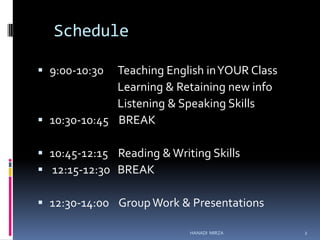
Schedule
 9:00-10:30

Teaching English in YOUR Class
Learning & Retaining new info
Listening & Speaking Skills
 10:30-10:45 BREAK
 10:45-12:15 Reading & Writing Skills
 12:15-12:30 BREAK
 12:30-14:00 Group Work & Presentations
HANADI MIRZA

2
I.

How do you TEACH English
In YOUR Classroom?

Skills

Course book
Workbook
Syllabus

HANADI MIRZA

3
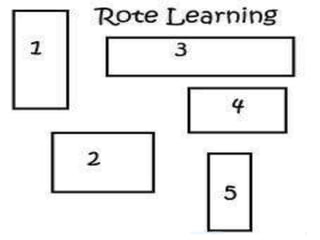
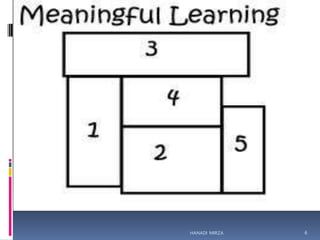
II. How Do Students

- LEARN English?
- RETAIN New Info?

HANADI MIRZA

4
HANADI MIRZA

5


HANADI MIRZA

6
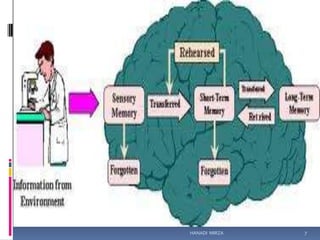
Human Memory

HANADI MIRZA

7
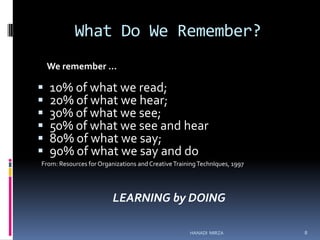
What Do We Remember?
We remember …








10% of what we read;
20% of what we hear;
30% of what we see;
50% of what we see and hear
80% of what we say;
90% of what we say and do

From: Resources for Organizations and Creative Training TechnIques, 1997

LEARNING by DOING
HANADI MIRZA

8
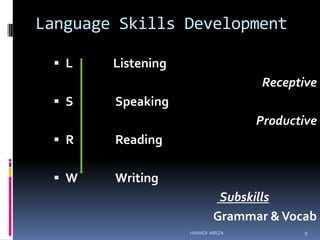
Language Skills Development
 L

Listening

Receptive
 S

Speaking
Productive

 R

Reading

 W

Writing

Subskills
Grammar & Vocab
HANADI MIRZA

9
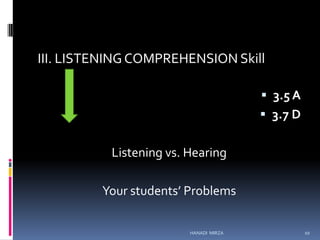
III. LISTENING COMPREHENSION Skill
 3.5 A
 3.7 D

Listening vs. Hearing

Your students’ Problems
HANADI MIRZA

10
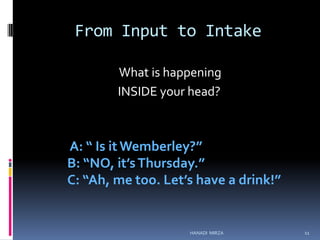
From Input to Intake
What is happening
INSIDE your head?

A: “ Is it Wemberley?”
B: “NO, it’s Thursday.”
C: “Ah, me too. Let’s have a drink!”

HANADI MIRZA

11
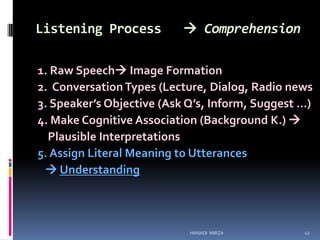
Listening Process

 Comprehension

1. Raw Speech Image Formation
2. Conversation Types (Lecture, Dialog, Radio news
3. Speaker’s Objective (Ask Q’s, Inform, Suggest …)
4. Make Cognitive Association (Background K.) 
Plausible Interpretations
5. Assign Literal Meaning to Utterances
 Understanding

HANADI MIRZA

12
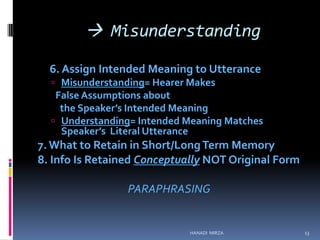
 Misunderstanding
6. Assign Intended Meaning to Utterance
 Misunderstanding= Hearer Makes

False Assumptions about
the Speaker’s Intended Meaning
 Understanding= Intended Meaning Matches
Speaker’s Literal Utterance

7. What to Retain in Short/Long Term Memory
8. Info Is Retained Conceptually NOT Original Form
PARAPHRASING

HANADI MIRZA

13
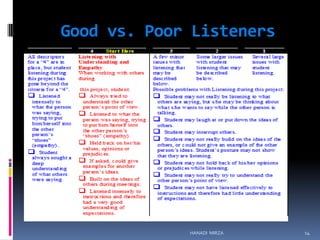
Good vs. Poor Listeners

HANADI MIRZA

14
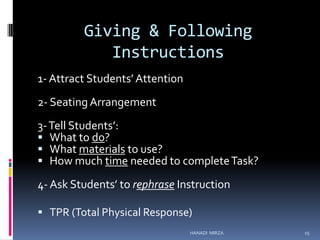
Giving & Following
Instructions
1- Attract Students’ Attention

2- Seating Arrangement
3- Tell Students’:
 What to do?
 What materials to use?
 How much time needed to complete Task?
4- Ask Students’ to rephrase Instruction
 TPR (Total Physical Response)
HANADI MIRZA

15
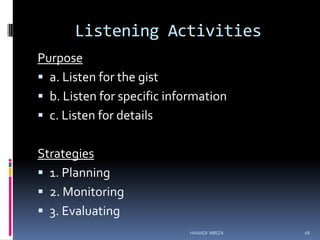
Listening Activities
Purpose
 a. Listen for the gist
 b. Listen for specific information
 c. Listen for details
Strategies
 1. Planning
 2. Monitoring
 3. Evaluating
HANADI MIRZA

16
Thematic Vocabulary
1- Meaning IN Context:
Word / Definition / Synonym / Antonym
Graded readers are written in narrative form.

2- Application:
 Word Formation
 Speaking
 Writing
HANADI MIRZA

17
Listening
 3.3 D / 3.8 A
 3.6 B

IV. SPEAKING Skill
What do we say?
Why Speak?
Your Students’ Problems
HANADI MIRZA

18
Spoken Language
- Monolog = lecture radio news,…
- Dialog = interpersonal or transactional
Fluency versus Accuracy
 Fluency: NOT speed
 ability to express one’s ideas logically

 Accuracy: NO Grammar OR

Pronunciation mistakes
HANADI MIRZA

19
Correcting Pronunciation
 Simplified Phonetics









[ə] = (euh) sound
Answer
[an sər]
Respond
job
[djob ]
Schedule
[sked jouwəl] Time table
People
[py pəl]
persons
Suggest
[sag djèst]
Jounralist
[djər nalist]
Work in pairs [wərk in pèrz]
Question
[kwest shən]
HANADI MIRZA

20
Correcting Grammar Mistakes
 Revisit a point in grammar
Eg. He? She? Or It?
Ex 1: Use pictures of different people, animals,
things, places, ….:
Ex. 2: Tom is a little boy. _____ goes to school
everyday, and _____ likes to study with his
friend Carl. His sister plays the piano and
_____likes to play with her little dog. _____ is
her favorite friend.
Ex. 3: Monolog or Dialog  Integrate grammar
HANADI MIRZA

21
Speaking Activities
Role Play, Presentation, Guessing Game, Project
 Familiarize SS with the evaluation criteria to lower

their level of anxiety and provide enough practice
 to improve fluency and
 to internalize grammatical rules and increase
accuracy.

 Help SS to Develop Good Conversation Skills (be

polite, take turns, ,…)

 Improve SS pronunciation using simplified phonetics
HANADI MIRZA

22
Input NEEDED for Authentic
Speaking Activities

a.
b.
c.

Listen to:
Monolog/dialog
Music
Sounds


a.
b.
c.

Use Sight:
Watch a Video
Look at Picture/Drawing
Read a text
HANADI MIRZA

23
 Listening
 3.12
 Speaking

 V. READING COMPREHENSION Skill

 Why do we read?
 Reading vs. Reading Comprehension
 Reading Aloud vs. Silent Reading
 Your Students’ Problems
HANADI MIRZA

24
Reading Comprehension =
Meaning Making
PURPOSE:
- Read for the Gist (main idea)
- Read for Specific Info
- Read for Details (intensive / inferential Reading)
 Develop Schemata for CV Reading / Other types
Reading Strategies:
- Praraphrasing
- Questioning
- Clarifying
- Summarizing

| Reading Skills:
a) Skimming
b) Scanning

HANADI MIRZA

25
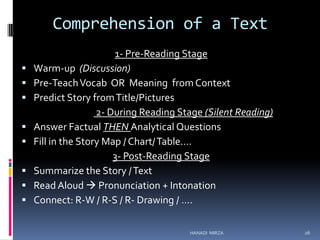
Comprehension of a Text









1- Pre-Reading Stage
Warm-up (Discussion)
Pre-Teach Vocab OR Meaning from Context
Predict Story from Title/Pictures
2- During Reading Stage (Silent Reading)
Answer Factual THEN Analytical Questions
Fill in the Story Map / Chart/ Table….
3- Post-Reading Stage
Summarize the Story / Text
Read Aloud  Pronunciation + Intonation
Connect: R-W / R-S / R- Drawing / ….
HANADI MIRZA

26
Reading Aloud
 Simplified Phonetics
Past Tense of Regular Verbs

 (-ed)  [- id] , [-t] , or [-d] ? WANTED -DECIDED
 [-t] & [-d] + [-id] / Vd + [-d] / vl + [-t]
ASKED - PLAYED
 Created , Needed / Proved / Fixed

Plural Form of Nouns
 (-s)  [-z] or [-s] or [-əz] ? MAPS- BOTTLES - CHURCHES
 vd + [-z] / vl + [-s] / -ch, -sh, -ss, -x + [-əz]
 Boys, girls / cats, lin ks / classes, foxes

HANADI MIRZA

27
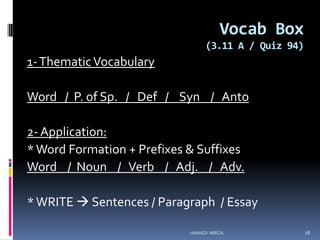
Vocab Box
(3.11 A / Quiz 94)

1- Thematic Vocabulary
Word / P. of Sp. / Def / Syn / Anto
2- Application:
* Word Formation + Prefixes & Suffixes
Word / Noun / Verb / Adj. / Adv.
* WRITE  Sentences / Paragraph / Essay
HANADI MIRZA

28
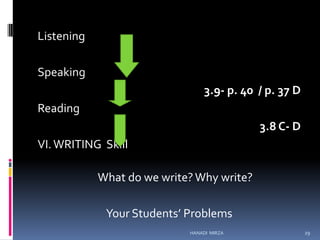
Listening
Speaking

3.9- p. 40 / p. 37 D
Reading
3.8 C- D

VI. WRITING Skill
What do we write? Why write?
Your Students’ Problems
HANADI MIRZA

29
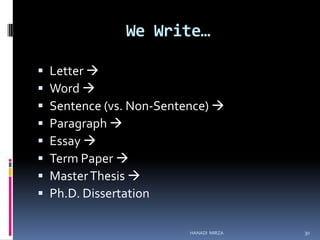
We Write…









Letter 
Word 
Sentence (vs. Non-Sentence) 
Paragraph 
Essay 
Term Paper 
Master Thesis 
Ph.D. Dissertation
HANADI MIRZA

30
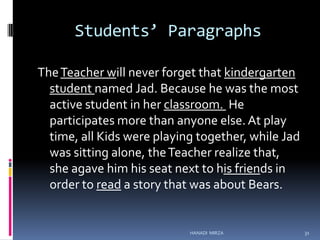
Students’ Paragraphs
The Teacher will never forget that kindergarten
student named Jad. Because he was the most
active student in her classroom. He
participates more than anyone else. At play
time, all Kids were playing together, while Jad
was sitting alone, the Teacher realize that,
she agave him his seat next to his friends in
order to read a story that was about Bears.

HANADI MIRZA

31
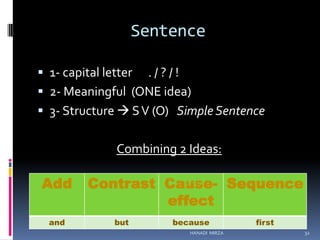
Sentence
 1- capital letter

./?/!
 2- Meaningful (ONE idea)
 3- Structure  S V (O) Simple Sentence
Combining 2 Ideas:

Add
and

Contrast Cause- Sequence
effect
but

because
HANADI MIRZA

first
32
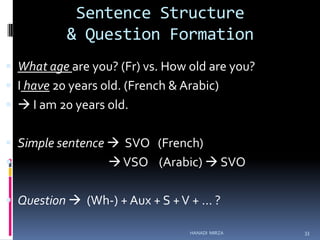
Sentence Structure
& Question Formation
 What age are you? (Fr) vs. How old are you?

 I have 20 years old. (French & Arabic)
  I am 20 years old.

 Simple sentence  SVO (French)


 VSO (Arabic)  SVO

 Question  (Wh-) + Aux + S + V + … ?
HANADI MIRZA

33
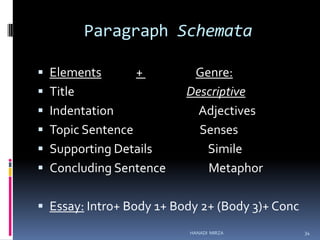
Paragraph Schemata
 Elements

+

 Title

 Indentation
 Topic Sentence
 Supporting Details

 Concluding Sentence

Genre:
Descriptive
Adjectives
Senses
Simile
Metaphor

 Essay: Intro+ Body 1+ Body 2+ (Body 3)+ Conc
HANADI MIRZA

34
Model Paragraph
My perfect sl hchool would be much like the
one I went to; however, several improvements
could be made. There could be a better pupilteacher relationship, especially between older
teachers and pupils. Pupils should be once again
given some kind of incentives to do well both at
academic and sports activities. Discipline would
be strict but punishment would only be
administered in severe cases. School would still be
compulsory.
HANADI MIRZA

35
Problems with Writing Tasks
 Poor Writing Topics (summer vacations)
 NO Schemata for Paragraph or Essay

- ID of Paragraph = Topic Sentence
- ID of Essay = Thesis Statement

HANADI MIRZA

36
Writing Topics
* Students usually wait for the summer vacations to rest
and have fun. Some go to the beach. Others spend their
time in the mountains or even travel abroad.
Write a paragraph in which you describe a new place you
visited. How was it? What did you do there?
(Graphic Organizer)

 Write a 4-paragraph essay in which you argue

with or against the law of banning smoking in
public places in Lebanon.
HANADI MIRZA

37
Other Problems with Writing
 Grammar NOT integrated IN Writing

(Habits in the present  Simple present)
 Poor explanation of Spelling rules in Elem
(hid – hide / cut – cute / mad – made)
 Memorizing words visually
(Dictation= NO Use of Listening to Write)
* Memorizing sentences/paragraphs for
(official) exams  destroy writing process
HANADI MIRZA

38
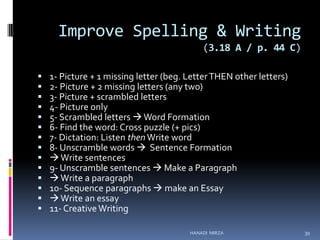
Improve Spelling & Writing
(3.18 A / p. 44 C)















1- Picture + 1 missing letter (beg. Letter THEN other letters)
2- Picture + 2 missing letters (any two)
3- Picture + scrambled letters
4- Picture only
5- Scrambled letters  Word Formation
6- Find the word: Cross puzzle (+ pics)
7- Dictation: Listen then Write word
8- Unscramble words  Sentence Formation
 Write sentences
9- Unscramble sentences  Make a Paragraph
 Write a paragraph
10- Sequence paragraphs  make an Essay
 Write an essay
11- Creative Writing
HANADI MIRZA

39
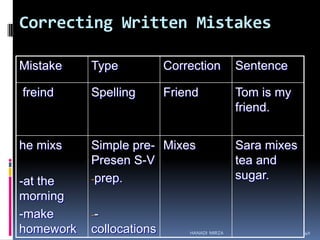
Correcting Written Mistakes
Mistake

Type

Correction

Sentence

freind

Spelling

Friend

Tom is my
friend.

he mixs

Simple pre- Mixes
Presen S-V
-prep.

-at the
morning
-make
homework

Sara mixes
tea and
sugar.

--

collocations

HANADI MIRZA

40
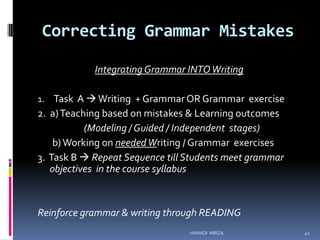
Correcting Grammar Mistakes
Integrating Grammar INTO Writing
1. Task A  Writing + Grammar OR Grammar exercise

2. a) Teaching based on mistakes & Learning outcomes
(Modeling / Guided / Independent stages)
b) Working on needed Writing / Grammar exercises
3. Task B  Repeat Sequence till Students meet grammar
objectives in the course syllabus

Reinforce grammar & writing through READING
HANADI MIRZA

41
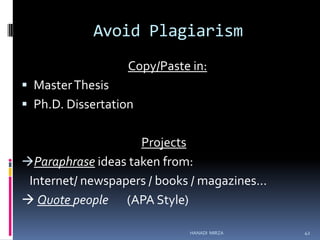
Avoid Plagiarism
Copy/Paste in:
 Master Thesis
 Ph.D. Dissertation

Projects
Paraphrase ideas taken from:
Internet/ newspapers / books / magazines...
 Quote people (APA Style)
HANADI MIRZA

42
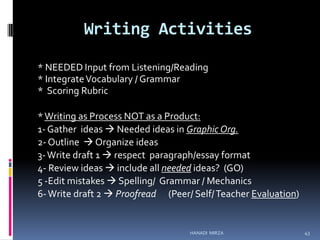
Writing Activities
* NEEDED Input from Listening/Reading
* Integrate Vocabulary / Grammar
* Scoring Rubric
* Writing as Process NOT as a Product:
1- Gather ideas  Needed ideas in Graphic Org.
2- Outline  Organize ideas
3- Write draft 1  respect paragraph/essay format
4- Review ideas  include all needed ideas? (GO)
5 -Edit mistakes  Spelling/ Grammar / Mechanics
6- Write draft 2  Proofread (Peer/ Self/ Teacher Evaluation)

HANADI MIRZA

43
VII. Group Work &
Presentation
Micro- Teaching (10 minutes)






Listening Activity
Speaking Activity (vocab )
Reading Activity (+ 2 vocab)
Writing Activity (grammar)
Reinforce grammar & Writing through
Reading
HANADI MIRZA

44
Hanadi MIRZA
* hanadym@hotmail.com
* www.hanadimirza.blogspot.com
M
IATEFL BESIG blogroll:
* Teacher Training Blog – Hanadi Mirza
HANADI MIRZA

45

English Language Workshop- Dec. 2013

  • 1.
    IMPROVING STUDENTS’ ENGLISHLANGUAGE AT L.I.U.: A PRACTICAL APPROACH HANADI MIRZA
  • 2.
    Schedule  9:00-10:30 Teaching Englishin YOUR Class Learning & Retaining new info Listening & Speaking Skills  10:30-10:45 BREAK  10:45-12:15 Reading & Writing Skills  12:15-12:30 BREAK  12:30-14:00 Group Work & Presentations HANADI MIRZA 2
  • 3.
    I. How do youTEACH English In YOUR Classroom? Skills Course book Workbook Syllabus HANADI MIRZA 3
  • 4.
    II. How DoStudents - LEARN English? - RETAIN New Info? HANADI MIRZA 4
  • 5.
  • 6.
  • 7.
  • 8.
    What Do WeRemember? We remember …       10% of what we read; 20% of what we hear; 30% of what we see; 50% of what we see and hear 80% of what we say; 90% of what we say and do From: Resources for Organizations and Creative Training TechnIques, 1997 LEARNING by DOING HANADI MIRZA 8
  • 9.
    Language Skills Development L Listening Receptive  S Speaking Productive  R Reading  W Writing Subskills Grammar & Vocab HANADI MIRZA 9
  • 10.
    III. LISTENING COMPREHENSIONSkill  3.5 A  3.7 D Listening vs. Hearing Your students’ Problems HANADI MIRZA 10
  • 11.
    From Input toIntake What is happening INSIDE your head? A: “ Is it Wemberley?” B: “NO, it’s Thursday.” C: “Ah, me too. Let’s have a drink!” HANADI MIRZA 11
  • 12.
    Listening Process  Comprehension 1.Raw Speech Image Formation 2. Conversation Types (Lecture, Dialog, Radio news 3. Speaker’s Objective (Ask Q’s, Inform, Suggest …) 4. Make Cognitive Association (Background K.)  Plausible Interpretations 5. Assign Literal Meaning to Utterances  Understanding HANADI MIRZA 12
  • 13.
     Misunderstanding 6. AssignIntended Meaning to Utterance  Misunderstanding= Hearer Makes False Assumptions about the Speaker’s Intended Meaning  Understanding= Intended Meaning Matches Speaker’s Literal Utterance 7. What to Retain in Short/Long Term Memory 8. Info Is Retained Conceptually NOT Original Form PARAPHRASING HANADI MIRZA 13
  • 14.
    Good vs. PoorListeners HANADI MIRZA 14
  • 15.
    Giving & Following Instructions 1-Attract Students’ Attention 2- Seating Arrangement 3- Tell Students’:  What to do?  What materials to use?  How much time needed to complete Task? 4- Ask Students’ to rephrase Instruction  TPR (Total Physical Response) HANADI MIRZA 15
  • 16.
    Listening Activities Purpose  a.Listen for the gist  b. Listen for specific information  c. Listen for details Strategies  1. Planning  2. Monitoring  3. Evaluating HANADI MIRZA 16
  • 17.
    Thematic Vocabulary 1- MeaningIN Context: Word / Definition / Synonym / Antonym Graded readers are written in narrative form. 2- Application:  Word Formation  Speaking  Writing HANADI MIRZA 17
  • 18.
    Listening  3.3 D/ 3.8 A  3.6 B IV. SPEAKING Skill What do we say? Why Speak? Your Students’ Problems HANADI MIRZA 18
  • 19.
    Spoken Language - Monolog= lecture radio news,… - Dialog = interpersonal or transactional Fluency versus Accuracy  Fluency: NOT speed  ability to express one’s ideas logically  Accuracy: NO Grammar OR Pronunciation mistakes HANADI MIRZA 19
  • 20.
    Correcting Pronunciation  SimplifiedPhonetics         [ə] = (euh) sound Answer [an sər] Respond job [djob ] Schedule [sked jouwəl] Time table People [py pəl] persons Suggest [sag djèst] Jounralist [djər nalist] Work in pairs [wərk in pèrz] Question [kwest shən] HANADI MIRZA 20
  • 21.
    Correcting Grammar Mistakes Revisit a point in grammar Eg. He? She? Or It? Ex 1: Use pictures of different people, animals, things, places, ….: Ex. 2: Tom is a little boy. _____ goes to school everyday, and _____ likes to study with his friend Carl. His sister plays the piano and _____likes to play with her little dog. _____ is her favorite friend. Ex. 3: Monolog or Dialog  Integrate grammar HANADI MIRZA 21
  • 22.
    Speaking Activities Role Play,Presentation, Guessing Game, Project  Familiarize SS with the evaluation criteria to lower their level of anxiety and provide enough practice  to improve fluency and  to internalize grammatical rules and increase accuracy.  Help SS to Develop Good Conversation Skills (be polite, take turns, ,…)  Improve SS pronunciation using simplified phonetics HANADI MIRZA 22
  • 23.
    Input NEEDED forAuthentic Speaking Activities  a. b. c. Listen to: Monolog/dialog Music Sounds  a. b. c. Use Sight: Watch a Video Look at Picture/Drawing Read a text HANADI MIRZA 23
  • 24.
     Listening  3.12 Speaking  V. READING COMPREHENSION Skill  Why do we read?  Reading vs. Reading Comprehension  Reading Aloud vs. Silent Reading  Your Students’ Problems HANADI MIRZA 24
  • 25.
    Reading Comprehension = MeaningMaking PURPOSE: - Read for the Gist (main idea) - Read for Specific Info - Read for Details (intensive / inferential Reading)  Develop Schemata for CV Reading / Other types Reading Strategies: - Praraphrasing - Questioning - Clarifying - Summarizing | Reading Skills: a) Skimming b) Scanning HANADI MIRZA 25
  • 26.
    Comprehension of aText         1- Pre-Reading Stage Warm-up (Discussion) Pre-Teach Vocab OR Meaning from Context Predict Story from Title/Pictures 2- During Reading Stage (Silent Reading) Answer Factual THEN Analytical Questions Fill in the Story Map / Chart/ Table…. 3- Post-Reading Stage Summarize the Story / Text Read Aloud  Pronunciation + Intonation Connect: R-W / R-S / R- Drawing / …. HANADI MIRZA 26
  • 27.
    Reading Aloud  SimplifiedPhonetics Past Tense of Regular Verbs  (-ed)  [- id] , [-t] , or [-d] ? WANTED -DECIDED  [-t] & [-d] + [-id] / Vd + [-d] / vl + [-t] ASKED - PLAYED  Created , Needed / Proved / Fixed Plural Form of Nouns  (-s)  [-z] or [-s] or [-əz] ? MAPS- BOTTLES - CHURCHES  vd + [-z] / vl + [-s] / -ch, -sh, -ss, -x + [-əz]  Boys, girls / cats, lin ks / classes, foxes  HANADI MIRZA 27
  • 28.
    Vocab Box (3.11 A/ Quiz 94) 1- Thematic Vocabulary Word / P. of Sp. / Def / Syn / Anto 2- Application: * Word Formation + Prefixes & Suffixes Word / Noun / Verb / Adj. / Adv. * WRITE  Sentences / Paragraph / Essay HANADI MIRZA 28
  • 29.
    Listening Speaking 3.9- p. 40/ p. 37 D Reading 3.8 C- D VI. WRITING Skill What do we write? Why write? Your Students’ Problems HANADI MIRZA 29
  • 30.
    We Write…         Letter  Word Sentence (vs. Non-Sentence)  Paragraph  Essay  Term Paper  Master Thesis  Ph.D. Dissertation HANADI MIRZA 30
  • 31.
    Students’ Paragraphs The Teacherwill never forget that kindergarten student named Jad. Because he was the most active student in her classroom. He participates more than anyone else. At play time, all Kids were playing together, while Jad was sitting alone, the Teacher realize that, she agave him his seat next to his friends in order to read a story that was about Bears. HANADI MIRZA 31
  • 32.
    Sentence  1- capitalletter ./?/!  2- Meaningful (ONE idea)  3- Structure  S V (O) Simple Sentence Combining 2 Ideas: Add and Contrast Cause- Sequence effect but because HANADI MIRZA first 32
  • 33.
    Sentence Structure & QuestionFormation  What age are you? (Fr) vs. How old are you?  I have 20 years old. (French & Arabic)   I am 20 years old.  Simple sentence  SVO (French)   VSO (Arabic)  SVO  Question  (Wh-) + Aux + S + V + … ? HANADI MIRZA 33
  • 34.
    Paragraph Schemata  Elements + Title  Indentation  Topic Sentence  Supporting Details  Concluding Sentence Genre: Descriptive Adjectives Senses Simile Metaphor  Essay: Intro+ Body 1+ Body 2+ (Body 3)+ Conc HANADI MIRZA 34
  • 35.
    Model Paragraph My perfectsl hchool would be much like the one I went to; however, several improvements could be made. There could be a better pupilteacher relationship, especially between older teachers and pupils. Pupils should be once again given some kind of incentives to do well both at academic and sports activities. Discipline would be strict but punishment would only be administered in severe cases. School would still be compulsory. HANADI MIRZA 35
  • 36.
    Problems with WritingTasks  Poor Writing Topics (summer vacations)  NO Schemata for Paragraph or Essay - ID of Paragraph = Topic Sentence - ID of Essay = Thesis Statement HANADI MIRZA 36
  • 37.
    Writing Topics * Studentsusually wait for the summer vacations to rest and have fun. Some go to the beach. Others spend their time in the mountains or even travel abroad. Write a paragraph in which you describe a new place you visited. How was it? What did you do there? (Graphic Organizer)  Write a 4-paragraph essay in which you argue with or against the law of banning smoking in public places in Lebanon. HANADI MIRZA 37
  • 38.
    Other Problems withWriting  Grammar NOT integrated IN Writing (Habits in the present  Simple present)  Poor explanation of Spelling rules in Elem (hid – hide / cut – cute / mad – made)  Memorizing words visually (Dictation= NO Use of Listening to Write) * Memorizing sentences/paragraphs for (official) exams  destroy writing process HANADI MIRZA 38
  • 39.
    Improve Spelling &Writing (3.18 A / p. 44 C)               1- Picture + 1 missing letter (beg. Letter THEN other letters) 2- Picture + 2 missing letters (any two) 3- Picture + scrambled letters 4- Picture only 5- Scrambled letters  Word Formation 6- Find the word: Cross puzzle (+ pics) 7- Dictation: Listen then Write word 8- Unscramble words  Sentence Formation  Write sentences 9- Unscramble sentences  Make a Paragraph  Write a paragraph 10- Sequence paragraphs  make an Essay  Write an essay 11- Creative Writing HANADI MIRZA 39
  • 40.
    Correcting Written Mistakes Mistake Type Correction Sentence freind Spelling Friend Tomis my friend. he mixs Simple pre- Mixes Presen S-V -prep. -at the morning -make homework Sara mixes tea and sugar. -- collocations HANADI MIRZA 40
  • 41.
    Correcting Grammar Mistakes IntegratingGrammar INTO Writing 1. Task A  Writing + Grammar OR Grammar exercise 2. a) Teaching based on mistakes & Learning outcomes (Modeling / Guided / Independent stages) b) Working on needed Writing / Grammar exercises 3. Task B  Repeat Sequence till Students meet grammar objectives in the course syllabus Reinforce grammar & writing through READING HANADI MIRZA 41
  • 42.
    Avoid Plagiarism Copy/Paste in: Master Thesis  Ph.D. Dissertation Projects Paraphrase ideas taken from: Internet/ newspapers / books / magazines...  Quote people (APA Style) HANADI MIRZA 42
  • 43.
    Writing Activities * NEEDEDInput from Listening/Reading * Integrate Vocabulary / Grammar * Scoring Rubric * Writing as Process NOT as a Product: 1- Gather ideas  Needed ideas in Graphic Org. 2- Outline  Organize ideas 3- Write draft 1  respect paragraph/essay format 4- Review ideas  include all needed ideas? (GO) 5 -Edit mistakes  Spelling/ Grammar / Mechanics 6- Write draft 2  Proofread (Peer/ Self/ Teacher Evaluation) HANADI MIRZA 43
  • 44.
    VII. Group Work& Presentation Micro- Teaching (10 minutes)      Listening Activity Speaking Activity (vocab ) Reading Activity (+ 2 vocab) Writing Activity (grammar) Reinforce grammar & Writing through Reading HANADI MIRZA 44
  • 45.
    Hanadi MIRZA * hanadym@hotmail.com *www.hanadimirza.blogspot.com M IATEFL BESIG blogroll: * Teacher Training Blog – Hanadi Mirza HANADI MIRZA 45