Developing
  Lear ner s’

READING Skill
    (K-12)

     Hanadi Mirza
   Hanadi Mirza
      hanadym@hotmail.com
Problems with MY Readers
 Nat   [b]         Tap [k] (KG 3)
 Sunday = Day of the Sun (Gr. 3)
 Major vs. minor characters        (Bacc II)
 The boys having bags are in class. Having
  is singular or plural? (univ. 1st yr)
 Graded readers are written in narrative
  style. (univ. 2nd/3rd yr)    * Copy/Paste
 Social /Fair / Bear / VocaPulary (univ.)
                  Hanadi Mirza
                   hanadym@hotmail.com
Part I - Overview on How to Teach Reading
 in KGs, Elementary, and Cycles 3 8 4
     (A comparative Approach)

Part II - Group Work: sharing problems
 teachers face with their readers and
 suggesting solutions

                 Hanadi Mirza
                  hanadym@hotmail.com
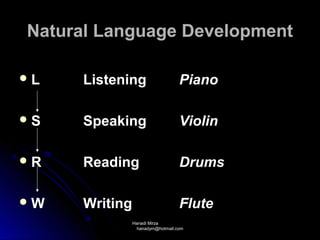
Natural Language Development

L   Listening               Piano

S   Speaking                Violin

R   Reading                 Drums

W   Writing                 Flute
           Hanadi Mirza
            hanadym@hotmail.com
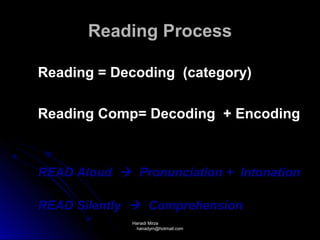
Reading Process

Reading = Decoding (category)

Reading Comp= Decoding + Encoding


READ Aloud  Pronunciation + Intonation

READ Silently  Comprehension
              Hanadi Mirza
               hanadym@hotmail.com
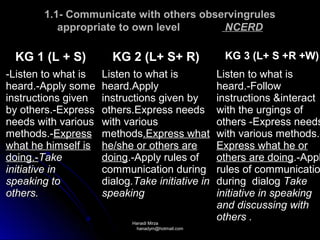
1.1- Communicate with others observingrules
          appropriate to own level      NCERD

 KG 1 (L + S)          KG 2 (L+ S+ R)               KG 3 (L+ S +R +W)
-Listen to what is   Listen to what is             Listen to what is
heard.-Apply some    heard.Apply                   heard.-Follow
instructions given   instructions given by         instructions &interact
by others.-Express   others.Express needs          with the urgings of
needs with various   with various                  others -Express needs
methods.-Express     methods.Express what          with various methods.-
                                                                  methods.
what he himself is   he/she or others are          Express what he or
doing.-Take          doing.-Apply rules of         others are doing.-Appl
initiative in        communication during          rules of communicatio
speaking to          dialog.Take initiative in     during dialog Take
others.              speaking                      initiative in speaking
                                                   and discussing with
                            Hanadi Mirza
                                                   others .
                             hanadym@hotmail.com
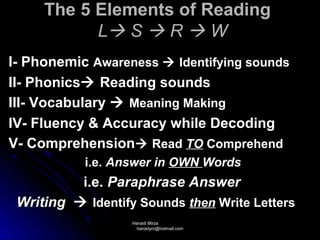
The 5 Elements of Reading
           L S  R  W
I- Phonemic Awareness  Identifying sounds
II- Phonics Reading sounds
III- Vocabulary  Meaning Making
IV- Fluency & Accuracy while Decoding
V- Comprehension Read TO Comprehend
           i.e. Answer in OWN Words
          i.e. Paraphrase Answer
 Writing  Identify Sounds then Write Letters
                   Hanadi Mirza
                    hanadym@hotmail.com
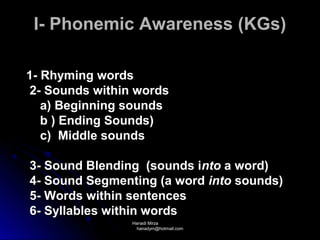
I- Phonemic Awareness (KGs)

1- Rhyming words
 2- Sounds within words
   a) Beginning sounds
   b ) Ending Sounds)
   c) Middle sounds

3- Sound Blending (sounds into a word)
4- Sound Segmenting (a word into sounds)
5- Words within sentences
6- Syllables within words
                 Hanadi Mirza
                  hanadym@hotmail.com
II- Phonics (KG2 & KG3)

SOUND of a letter NOT Writing

 Process of translating written words into speech
 Letter Reading NOT Writing


   - Sound blending
   - Word Building
   - Connect sounds to word

                     Hanadi Mirza
                      hanadym@hotmail.com
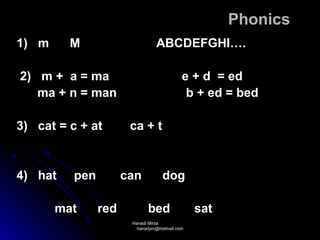
Phonics
1) m     M                     ABCDEFGHI….

2) m + a = ma                            e + d = ed
   ma + n = man                           b + ed = bed

3) cat = c + at       ca + t


4) hat   pen         can         dog

       mat     red          bed              sat
                      Hanadi Mirza
                       hanadym@hotmail.com
3- Vocabulary (KGs)
            Learn 2000-4000 new words per grade level
             Pre-teach Vocab

 1- Meaning of q word:
 - Using Meaning prompts
 - Using Visual prompts (Pictures & Realia)
- Acting out a Word
- Using Multiple Prompts
 - Using Relations between words: synonyms, antonym, prefixes,
    roots …


2 – Application
- Guessing Games / Acting out
- Put a word in a meaningfulHanadi Mirza
                             sentence
                              hanadym@hotmail.com
Pre-Teach Vocab (Cycles 1 & 2)
 1- Meaning from Context Clues:
    Definition / Synonym / Antonym (Part of Speech)
    Word Formation using Prefixes & Suffixes
    Dictionary Skills – Spelling Rules - Dictation


 2- Application/Review:
    Guessing Games using Pictures / Realia
    Acting out the word / Cross Puzzle Words
    Put a word in a meaningful sentence (Cycle 1)
    Write a (narrative) paragraph using the following
      5 words: … (Cycle 2)
                       Hanadi Mirza
                        hanadym@hotmail.com
Vocabulary (Cycles 3 & 4)
        During Reading
1- Meaning IN Context:
 Find a word/expression in the text that means …

     using the context clues of the text itself

2- Application:
 Write a persuasive essay arguing with or against
  the law of banning smoking in public places in
  Lebanon. (Lexis & Spelling)
                    Hanadi Mirza
                     hanadym@hotmail.com
IV- Fluency & Accuracy
            while Decoding

           (follow with finger / ruler)

My dog is in the red box. (KG)


Four people are waiting in front of the police
  stations. (Cycle 2)

                   Hanadi Mirza
                    hanadym@hotmail.com
Poor Pronunciation
      NO Comprehension

 Using Simplified Phonetics
People [pypl]        police [polys]
food [fooood]        purpose [p ərps]


       Schwa [ ə ]  [euh] sound


 BBC / CNN / Online Phonetics / Google...
               Hanadi Mirza
                hanadym@hotmail.com
Spelling vs Pronunciation
   Psychology (ps--)             [saykolə djy]
    Pneumonia (pn--)             [nəmonia]
   Climbing, comb, lamb, bomb (--mb)  [klayming], [kom], [lèm],
    [bám]
   Calm, Palm (--l m)           [kám] , [pám]
   Folk , Folktale (-- l k)      [fok] , [fokteyl]
   Vegetable                     [ve dj təbl]
    Comfortable                  [kámftəbl]
   Government (nm)                [gavərmənt]
   Suggest, Suggestion            [sag djəst], [sagdjəstshən]
   People, Apple                        [pypəl], [ápəl]
   Sensual , Sensuality           [sənshəwəl] , [sənshəwality]
   Nation, Nationality           [neyshən], [nashənality]
   Social , Beautiful         [soshəl] , [byurəfəl]
   Original but Originally        [oridjinəl] but [oridjənly]
   Actually                       [aktshəly]
   Say but Says               [sey] but [sèz]
                            Hanadi Mirza
                             hanadym@hotmail.com
Spelling vs. Pronunciation (continued)
   Determine but Mine               [ditərmən] but [mayn]
   Examine→                         [əgzámin]
   Seduce but Seduction             [sidýous] but [sidakshən]
   Appreciate                       [aprishiyeyt]
   Result, Adult →                 [rizált] , [ədált]
   World, Work, Word, War          [wərld], [wərk], [wərd], [wor]
   July, Major                     [djoulay] , [meydjər]
   Children, Church                [tshildrən], [tshərtsh]
   Pleasure , Pleasurable bur Leisure [plejər] , [plejrəbl] / [lyjər]
   Write/Written, Hide/Hidden  [rayt] / [ritən] , [hayd] /[hidən]
   Teacher                         [tytshər]
   Doctor, Dollars                [daktər] , [dálərz]
   Cat, Cup, Color: (c)  [k]      [Kat] , [Kap] , [kalər]
   Circus, Ceremony: (c)  [s] [sərkəs] , [sərəmony]
   Gallery, Go, Gut: (g)  [g]     [galəry] , [go] , [gat]
   Giraffe, Generous: (g)  [dj] [djiraf] , [djənərəs]

                                Hanadi Mirza
                                 hanadym@hotmail.com
(continued)
   The + any letter EXCEPT (a/e/i/o/u) →[o‫ ]ﺫ‬never [za]
   Although , Thunder, Thumb→                 [ol‫ ﺫ‬o] , [thándər] , [thám]
   Thank You                                  [thánk] Never [sank] You
   The +a pple/ e lephant/ i sland/ o range/ u mbrella→ [‫ ] ﺫﻱ‬never [o‫ ]ﺫ‬nor
    [zi]
   The + eu ropean, u nited                   the+[you] (as 1st sound) [o ‫ ]ﺫ‬NOT
    [za]
   Use                                        the [yous] but I/you [youz]
   Process but processes →                   [prósəs] but [prosəsyz]
   Woman but women →                                     [woumən] but [wymin]
   Police , Policeman                         [polys] .[polysmən]
   Symptom→ (--m p)                           [simtəm]
   Wanted / Added / Promised / Grinned 
    [wantid] , [ádid] , [promist] , [grind]
   Battles, Flags / Groups, Mats Kisses, Churches,—>
    [bátəlz] , [flágz] / [groups] , [máts] / [kisəz] , [tshərtshəz]

                                 Hanadi Mirza
                                  hanadym@hotmail.com
VOICED & VOICELESS
                   SOUNDS
    Past Tense of Regular Verbs
   (-ed)  [- id] , [-t] , or [-d] ?
    [-t] & [-d] + [-id] / Vd + [-d] / vl + [-t]
     Created , Needed / Proved / Fixed


      Plural Form of Nouns
   (-s)  [-z] or [-s] or [-əz] ?
     vd + [-z] / vl + [-s] / -ch, -sh, -ss, -x + [- əz]
   Boys, girls / cats, lin ks / classes, foxes



                            Hanadi Mirza
                             hanadym@hotmail.com
V- Reading Comprehension
Read for a PURPOSE:
- Read for the Gist (main idea)
- Read for Specific Info
- Read for Details (intensive / inferential Reading)

 Develop Schemata for Story Reading / Other Genres

Reading Strategies:        | Reading Skills:
- Predicting                 a) Skimming
- Questioning                b) Scanning
- Clarifying
- Summarizing          Hanadi Mirza
                        hanadym@hotmail.com
Reading Comprehension (KGs)

1) Cover page
 a- Title/Picture / Author /Illustrator (Graphic
  Organizer)
 b- Predict story from Title & Picture
 2) Picture Walk using Reading Strategies
 3) Retell story using Pictures
 4) Decode words with the help of pictures
 5) Using Reading Strategies to check
  students’ comprehension of the written text
 6) Summarize the story using pictures to
  check comprehension of the story itself
                    Hanadi Mirza
                     hanadym@hotmail.com
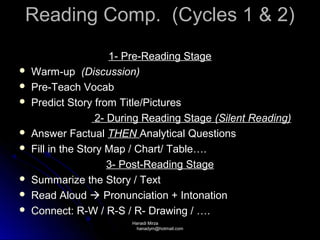
Reading Comp. (Cycles 1 & 2)
                       1- Pre-Reading Stage
   Warm-up (Discussion)
   Pre-Teach Vocab
   Predict Story from Title/Pictures
                    2- During Reading Stage (Silent Reading)
   Answer Factual THEN Analytical Questions
   Fill in the Story Map / Chart/ Table….
                       3- Post-Reading Stage
   Summarize the Story / Text
   Read Aloud  Pronunciation + Intonation
   Connect: R-W / R-S / R- Drawing / ….
                         Hanadi Mirza
                          hanadym@hotmail.com
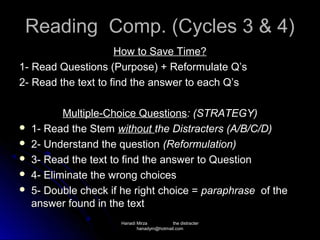
Reading Comp. (Cycles 3 & 4)
                     How to Save Time?
1- Read Questions (Purpose) + Reformulate Q’s
2- Read the text to find the answer to each Q’s

           Multiple-Choice Questions: (STRATEGY)
   1- Read the Stem without the Distracters (A/B/C/D)
   2- Understand the question (Reformulation)
   3- Read the text to find the answer to Question
   4- Eliminate the wrong choices
   5- Double check if he right choice = paraphrase of the
    answer found in the text
                      Hanadi Mirza         the distracter
                             hanadym@hotmail.com
Make a Difference
  In Your Readers’ Future


       Hanadi Mirza
  hanadym@hotmail.com
www.hanadimirza.blogspot.com
      www.atel-lb.org
          Hanadi Mirza
           hanadym@hotmail.com

Dvp read skill k-12(

  • 1.
    Developing Learner s’ READING Skill (K-12) Hanadi Mirza Hanadi Mirza hanadym@hotmail.com
  • 2.
    Problems with MYReaders  Nat [b] Tap [k] (KG 3)  Sunday = Day of the Sun (Gr. 3)  Major vs. minor characters (Bacc II)  The boys having bags are in class. Having is singular or plural? (univ. 1st yr)  Graded readers are written in narrative style. (univ. 2nd/3rd yr) * Copy/Paste  Social /Fair / Bear / VocaPulary (univ.) Hanadi Mirza hanadym@hotmail.com
  • 3.
    Part I -Overview on How to Teach Reading in KGs, Elementary, and Cycles 3 8 4 (A comparative Approach) Part II - Group Work: sharing problems teachers face with their readers and suggesting solutions Hanadi Mirza hanadym@hotmail.com
  • 4.
    Natural Language Development L Listening Piano S Speaking Violin R Reading Drums W Writing Flute Hanadi Mirza hanadym@hotmail.com
  • 5.
    Reading Process Reading =Decoding (category) Reading Comp= Decoding + Encoding READ Aloud  Pronunciation + Intonation READ Silently  Comprehension Hanadi Mirza hanadym@hotmail.com
  • 6.
    1.1- Communicate withothers observingrules appropriate to own level NCERD KG 1 (L + S) KG 2 (L+ S+ R) KG 3 (L+ S +R +W) -Listen to what is Listen to what is Listen to what is heard.-Apply some heard.Apply heard.-Follow instructions given instructions given by instructions &interact by others.-Express others.Express needs with the urgings of needs with various with various others -Express needs methods.-Express methods.Express what with various methods.- methods. what he himself is he/she or others are Express what he or doing.-Take doing.-Apply rules of others are doing.-Appl initiative in communication during rules of communicatio speaking to dialog.Take initiative in during dialog Take others. speaking initiative in speaking and discussing with Hanadi Mirza others . hanadym@hotmail.com
  • 7.
    The 5 Elementsof Reading L S  R  W I- Phonemic Awareness  Identifying sounds II- Phonics Reading sounds III- Vocabulary  Meaning Making IV- Fluency & Accuracy while Decoding V- Comprehension Read TO Comprehend i.e. Answer in OWN Words i.e. Paraphrase Answer Writing  Identify Sounds then Write Letters Hanadi Mirza hanadym@hotmail.com
  • 8.
    I- Phonemic Awareness(KGs) 1- Rhyming words 2- Sounds within words a) Beginning sounds b ) Ending Sounds) c) Middle sounds 3- Sound Blending (sounds into a word) 4- Sound Segmenting (a word into sounds) 5- Words within sentences 6- Syllables within words Hanadi Mirza hanadym@hotmail.com
  • 9.
    II- Phonics (KG2& KG3) SOUND of a letter NOT Writing  Process of translating written words into speech  Letter Reading NOT Writing  - Sound blending  - Word Building  - Connect sounds to word Hanadi Mirza hanadym@hotmail.com
  • 10.
    Phonics 1) m M ABCDEFGHI…. 2) m + a = ma e + d = ed ma + n = man b + ed = bed 3) cat = c + at ca + t 4) hat pen can dog mat red bed sat Hanadi Mirza hanadym@hotmail.com
  • 11.
    3- Vocabulary (KGs) Learn 2000-4000 new words per grade level  Pre-teach Vocab 1- Meaning of q word: - Using Meaning prompts - Using Visual prompts (Pictures & Realia) - Acting out a Word - Using Multiple Prompts - Using Relations between words: synonyms, antonym, prefixes, roots … 2 – Application - Guessing Games / Acting out - Put a word in a meaningfulHanadi Mirza sentence hanadym@hotmail.com
  • 12.
    Pre-Teach Vocab (Cycles1 & 2) 1- Meaning from Context Clues:  Definition / Synonym / Antonym (Part of Speech)  Word Formation using Prefixes & Suffixes  Dictionary Skills – Spelling Rules - Dictation 2- Application/Review:  Guessing Games using Pictures / Realia  Acting out the word / Cross Puzzle Words  Put a word in a meaningful sentence (Cycle 1)  Write a (narrative) paragraph using the following 5 words: … (Cycle 2) Hanadi Mirza hanadym@hotmail.com
  • 13.
    Vocabulary (Cycles 3& 4)  During Reading 1- Meaning IN Context:  Find a word/expression in the text that means … using the context clues of the text itself 2- Application:  Write a persuasive essay arguing with or against the law of banning smoking in public places in Lebanon. (Lexis & Spelling) Hanadi Mirza hanadym@hotmail.com
  • 14.
    IV- Fluency &Accuracy while Decoding (follow with finger / ruler) My dog is in the red box. (KG) Four people are waiting in front of the police stations. (Cycle 2) Hanadi Mirza hanadym@hotmail.com
  • 15.
    Poor Pronunciation  NO Comprehension Using Simplified Phonetics People [pypl] police [polys] food [fooood] purpose [p ərps] Schwa [ ə ]  [euh] sound BBC / CNN / Online Phonetics / Google... Hanadi Mirza hanadym@hotmail.com
  • 16.
    Spelling vs Pronunciation  Psychology (ps--) [saykolə djy]  Pneumonia (pn--) [nəmonia]  Climbing, comb, lamb, bomb (--mb)  [klayming], [kom], [lèm], [bám]  Calm, Palm (--l m) [kám] , [pám]  Folk , Folktale (-- l k)  [fok] , [fokteyl]  Vegetable [ve dj təbl]  Comfortable [kámftəbl]  Government (nm) [gavərmənt]  Suggest, Suggestion [sag djəst], [sagdjəstshən]  People, Apple [pypəl], [ápəl]  Sensual , Sensuality [sənshəwəl] , [sənshəwality]  Nation, Nationality [neyshən], [nashənality]  Social , Beautiful [soshəl] , [byurəfəl]  Original but Originally [oridjinəl] but [oridjənly]  Actually [aktshəly]  Say but Says [sey] but [sèz] Hanadi Mirza hanadym@hotmail.com
  • 17.
    Spelling vs. Pronunciation(continued)  Determine but Mine [ditərmən] but [mayn]  Examine→ [əgzámin]  Seduce but Seduction [sidýous] but [sidakshən]  Appreciate [aprishiyeyt]  Result, Adult → [rizált] , [ədált]  World, Work, Word, War [wərld], [wərk], [wərd], [wor]  July, Major [djoulay] , [meydjər]  Children, Church [tshildrən], [tshərtsh]  Pleasure , Pleasurable bur Leisure [plejər] , [plejrəbl] / [lyjər]  Write/Written, Hide/Hidden  [rayt] / [ritən] , [hayd] /[hidən]  Teacher [tytshər]  Doctor, Dollars [daktər] , [dálərz]  Cat, Cup, Color: (c)  [k] [Kat] , [Kap] , [kalər]  Circus, Ceremony: (c)  [s] [sərkəs] , [sərəmony]  Gallery, Go, Gut: (g)  [g] [galəry] , [go] , [gat]  Giraffe, Generous: (g)  [dj] [djiraf] , [djənərəs] Hanadi Mirza hanadym@hotmail.com
  • 18.
    (continued)  The + any letter EXCEPT (a/e/i/o/u) →[o‫ ]ﺫ‬never [za]  Although , Thunder, Thumb→ [ol‫ ﺫ‬o] , [thándər] , [thám]  Thank You [thánk] Never [sank] You  The +a pple/ e lephant/ i sland/ o range/ u mbrella→ [‫ ] ﺫﻱ‬never [o‫ ]ﺫ‬nor [zi]  The + eu ropean, u nited the+[you] (as 1st sound) [o ‫ ]ﺫ‬NOT [za]  Use the [yous] but I/you [youz]  Process but processes → [prósəs] but [prosəsyz]  Woman but women → [woumən] but [wymin]  Police , Policeman [polys] .[polysmən]  Symptom→ (--m p) [simtəm]  Wanted / Added / Promised / Grinned  [wantid] , [ádid] , [promist] , [grind]  Battles, Flags / Groups, Mats Kisses, Churches,—> [bátəlz] , [flágz] / [groups] , [máts] / [kisəz] , [tshərtshəz] Hanadi Mirza hanadym@hotmail.com
  • 19.
    VOICED & VOICELESS SOUNDS Past Tense of Regular Verbs  (-ed)  [- id] , [-t] , or [-d] ?  [-t] & [-d] + [-id] / Vd + [-d] / vl + [-t]  Created , Needed / Proved / Fixed Plural Form of Nouns  (-s)  [-z] or [-s] or [-əz] ?  vd + [-z] / vl + [-s] / -ch, -sh, -ss, -x + [- əz]  Boys, girls / cats, lin ks / classes, foxes  Hanadi Mirza hanadym@hotmail.com
  • 20.
    V- Reading Comprehension Readfor a PURPOSE: - Read for the Gist (main idea) - Read for Specific Info - Read for Details (intensive / inferential Reading)  Develop Schemata for Story Reading / Other Genres Reading Strategies: | Reading Skills: - Predicting a) Skimming - Questioning b) Scanning - Clarifying - Summarizing Hanadi Mirza hanadym@hotmail.com
  • 21.
    Reading Comprehension (KGs) 1)Cover page  a- Title/Picture / Author /Illustrator (Graphic Organizer)  b- Predict story from Title & Picture  2) Picture Walk using Reading Strategies  3) Retell story using Pictures  4) Decode words with the help of pictures  5) Using Reading Strategies to check students’ comprehension of the written text  6) Summarize the story using pictures to check comprehension of the story itself Hanadi Mirza hanadym@hotmail.com
  • 22.
    Reading Comp. (Cycles1 & 2) 1- Pre-Reading Stage  Warm-up (Discussion)  Pre-Teach Vocab  Predict Story from Title/Pictures 2- During Reading Stage (Silent Reading)  Answer Factual THEN Analytical Questions  Fill in the Story Map / Chart/ Table…. 3- Post-Reading Stage  Summarize the Story / Text  Read Aloud  Pronunciation + Intonation  Connect: R-W / R-S / R- Drawing / …. Hanadi Mirza hanadym@hotmail.com
  • 23.
    Reading Comp. (Cycles3 & 4) How to Save Time? 1- Read Questions (Purpose) + Reformulate Q’s 2- Read the text to find the answer to each Q’s Multiple-Choice Questions: (STRATEGY)  1- Read the Stem without the Distracters (A/B/C/D)  2- Understand the question (Reformulation)  3- Read the text to find the answer to Question  4- Eliminate the wrong choices  5- Double check if he right choice = paraphrase of the answer found in the text Hanadi Mirza the distracter hanadym@hotmail.com
  • 24.
    Make a Difference In Your Readers’ Future Hanadi Mirza hanadym@hotmail.com www.hanadimirza.blogspot.com www.atel-lb.org Hanadi Mirza hanadym@hotmail.com