ENGLISH TODAY
Today, English is a common
lingua franca across the
globe. According to some
estimates, almost 80
percent of English speakers
in the world are non-native
speakers.
Where is it used?
Apart from serving as a useful heuristic in Europe,
where a Spaniard, a Frenchmen, and a German
might all carry on a conversation in English,
English as a lingua franca (ELF) plays an important
role in former Anglophone colonies such as India,
Pakistan, Nigeria, Uganda, and Zimbabwe, among
many others.
How is it used?
ELF differs from Standard English in a number of ways. Several
documented overarching similarities are variances in article usage (or
no article usage at all), variances in preposition usage, and novel use
of morphemes (such as importancy and smoothfully). Many instances
of ELF also incorporate across-the-board third-person singular usage
(such as “He go to the store.”), using “who” and “which”
interchangeably, and a lack of gerunds. Verbally, noted differences
include the omission of some consonants and addition of extra
vowels, as well as a general tendency towards efficient
communication over grammatically normative English.
Criticisms:
While ELF is a widespread and useful mode of communication for
many, some scholars and linguists have criticized its proliferation as a
form of linguistic imperialism. This term became popular in 1992 with
the publication of Robert Phillipson’s influential book of the same
name. In it, Phillipson argues that English has long been a tool of
submission and cultural domination of colonies. Contemporary critics
of ELF cite the problems associated with studying a language in a
disorganized, unstructured way. Speakers of ELF may eventually speak
both their native language and English imperfectly, leading to issues
with effective communication. In spite of these criticisms, ELF
continues to flourish in many countries, oftentimes enriching the
language with colorful aphorisms and unique turns of phrase.
Which Countries Speak English?
According to the British government, the
countries with a majority of native English
speakers are as follows: Antigua and Barbuda,
Australia, the Bahamas, Barbados, Belize,
Canada, Dominica, Grenada, Guyana, Ireland,
Jamaica, New Zealand, Saint Kitts and Nevis,
Saint Lucia, Saint Vincent and the Grenadines,
Trinidad and Tobago, the United Kingdom and
the United States of America.
The list of countries where English is legally an official
language is actually much longer: Antigua and Barbuda, the
Bahamas, Barbados, Belize, Botswana, Burundi, Cameroon,
Canada, the Cook Islands, Dominica, Eswatini, the Federated
States of Micronesia, Fiji, The Gambia, Ghana, Grenada,
Guyana, India, Ireland, Jamaica, Kenya, Kiribati, Lesotho,
Liberia, Malawi, Malta, the Marshall Islands, Mauritius, Namibia,
Nauru, Nigeria, Niue, Pakistan, Palau, Papua New Guinea, the
Philippines, Rwanda, Saint Kitts and Nevis, Saint Lucia, Saint
Vincent and the Grenadines, Samoa, Seychelles, Sierra Leone,
Singapore, the Solomon Islands, South Africa, South Sudan,
Sudan, Tanzania, Tonga, Trinidad and Tobago, Tuvalu, Uganda,
Vanuatu, Zambia and Zimbabwe.
How Many People In The World Speak
English?
Out of the world’s approximately 7.8
billion inhabitants, 1.35 billion speak English. The
majority aren’t native English speakers, however. About
360 million people speak English as their first language.
The most common first language is Chinese, followed
distantly by Spanish and then, in third, comes English. In
addition to being widely spoken, English is by far
the most commonly studied foreign language in the
Samuel Johnson’s straightforward identification of
English as the language of England hardly begins to
capture the diversity and complexity of the
language’s use in the twenty-first century; English today is spoken by
approximately 450 million people all over the world. But the language
used by its many speakers varies, in pronunciation, spelling, grammar,
and vocabulary, to such an extent that it seems necessary to ask
whether these people can all be considered to be speaking English.
Even more people speak English as a second language, with figures
varying from 1 billion to 1.5 billion people, and with considerably
greater levels of linguistic divergence. Are all these people speaking
the same language, or are we witnessing the emergence of new
Englishes?
Since more than half of the world’s native
English speakers live in the USA, we might
wonder whether the balance of power has
shifted such that to speak ‘English’ today is
to speak General American rather than
Standard British English. Does English no
longer ‘belong to England’, as Dr Johnson
confidently claimed, but rather to the USA,
or to everyone who wishes to employ it?
ENGLISH IN THE NEW WORLD
As English developed in North America, it was
subject to contact with the languages of other
settlers and with those languages of the
Native Americans. Inevitably, these other
languages had an influence on how American
English developed. And as American English
progressed into the eighteenth and nineteenth
centuries, it became a powerful vehicle for the
expression of national identity.
LOANWORDS IN AMERICAN ENGLISH
Contact with other languages inevitably led to the
borrowing of words into the varieties of English
spoken by the colonists. A selection of loanwords
(drawn from Marckwardt 1980 ) includes
vocabulary taken from the following languages:
FRENCH
pumpkin , brioche , chowder , praline , caribou ,
gopher , bayou , crevasse , flume , levee ,
rapids , cent , dime
SPANISH
alfalfa, marijuana, mesquite, cockroach, coyote, mustang, chaparral,
lasso, ranch, rodeo, stampede, enchilada, frijole, taco, tequila,
tortilla, poncho, sombrero, canyon, sierra
DUTCH
coleslaw, cookie, waffle, caboose, sleigh, stoop (meaning
‘porch’) boss, Yankee, dumb (meaning ‘stupid’)
GERMAN
delicatessen, hamburger, pumpernickel, sauerkraut, schnitzel,
pretzel
As English continued to develop during the nineteenth
century in America, so too did the attitudes towards its
usage. Early Modern period in England, attempts were
made by such literary luminaries as Jonathan Swift to
‘fix’ the English language; that is, to formulate a system
of rules for so- called ‘correct’ usage. At the beginning of
the nineteenth century, the American lexicographer
Noah Webster took an opposing view to Swift and his
companions and was more interested in radically
changing the language rather than preserving it in the
way that Swift and others had proposed.
Webster’s main concern was with the
spelling system of English and his efforts to
reform this sprang from his concern that
there was an increasing divide between the
spoken and written forms of the language
(Simpson 1986 : 58). In his Compendious
Dictionary of the English Language,
Webster expressed his views as follows:
Every man of common reading
knows that a living language must
necessarily suffer gradual changes
in its current words, in the
signification of many words, and in
pronunciation. The unavoidable
consequence then of fixing the
orthography of a living language, is
to destroy the use of the alphabet.
This effect has, in a degree, already taken place in
our language; and letters, the most useful invention
that ever blessed mankind, have lost and continue to
lose a part of their value, by no longer being the
representatives of the sounds originally annexed to
them. Strange as it may seem, the fact is undeniable,
that the present doctrin [sic] that no change must be
made in writing words, is destroying the benefits of
an alphabet, and reducing our language to the
barbarism of Chinese characters in stead of letters.
(Webster 1806: vi, quoted in Simpson 1986: 58)
Webster was clearly a man with strong opinions
(and, it must be said, some wrong ones,
including his extreme and somewhat erroneous
view of the Chinese writing system). But his
desire for reform was political as much as
linguistic. He saw his efforts as contributing to
the development of a growing American
national identity, and the lengths to which he
went are testament to how important language
can be in expressing identity and personality.
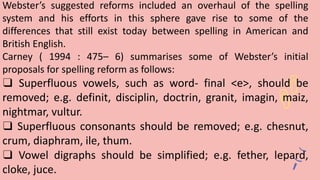
Webster’s suggested reforms included an overhaul of the spelling
system and his efforts in this sphere gave rise to some of the
differences that still exist today between spelling in American and
British English.
Carney ( 1994 : 475– 6) summarises some of Webster’s initial
proposals for spelling reform as follows:
❑ Superfluous vowels, such as word- final <e>, should be
removed; e.g. definit, disciplin, doctrin, granit, imagin, maiz,
nightmar, vultur.
❑ Superfluous consonants should be removed; e.g. chesnut,
crum, diaphram, ile, thum.
❑ Vowel digraphs should be simplified; e.g. fether, lepard,
cloke, juce.
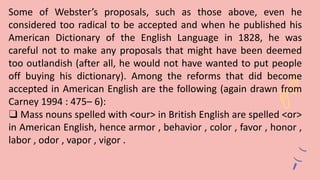
Some of Webster’s proposals, such as those above, even he
considered too radical to be accepted and when he published his
American Dictionary of the English Language in 1828, he was
careful not to make any proposals that might have been deemed
too outlandish (after all, he would not have wanted to put people
off buying his dictionary). Among the reforms that did become
accepted in American English are the following (again drawn from
Carney 1994 : 475– 6):
❑ Mass nouns spelled with <our> in British English are spelled <or>
in American English, hence armor , behavior , color , favor , honor ,
labor , odor , vapor , vigor .
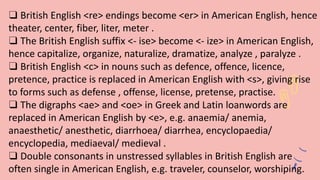
❑ British English <re> endings become <er> in American English, hence
theater, center, fiber, liter, meter .
❑ The British English suffix <- ise> become <- ize> in American English,
hence capitalize, organize, naturalize, dramatize, analyze , paralyze .
❑ British English <c> in nouns such as defence, offence, licence,
pretence, practice is replaced in American English with <s>, giving rise
to forms such as defense , offense, license, pretense, practise.
❑ The digraphs <ae> and <oe> in Greek and Latin loanwords are
replaced in American English by <e>, e.g. anaemia/ anemia,
anaesthetic/ anesthetic, diarrhoea/ diarrhea, encyclopaedia/
encyclopedia, mediaeval/ medieval .
❑ Double consonants in unstressed syllables in British English are
often single in American English, e.g. traveler, counselor, worshiping.
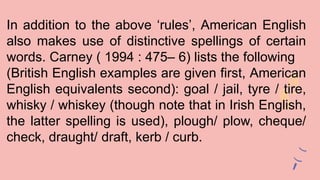
In addition to the above ‘rules’, American English
also makes use of distinctive spellings of certain
words. Carney ( 1994 : 475– 6) lists the following
(British English examples are given first, American
English equivalents second): goal / jail, tyre / tire,
whisky / whiskey (though note that in Irish English,
the latter spelling is used), plough/ plow, cheque/
check, draught/ draft, kerb / curb.
What is your opinion of Webster’s spelling
reforms? What advantages can you see to his
simplified spelling system and what
disadvantages? With regard to the future
development of English, what potential problems
can you see with attempting to reform spelling?
(Th about the relationship between sound and
spelling, and also the various different ‘users’ of
English.)
When English first began to spread beyond the shores of the
British Isles the movement was very much one way. English
went out into the world and developed in many different ways
(see B7 ). But now that there are so many international varieties
of English in existence, it no longer makes sense to think of the
development of English as being a one- way process. It is no
longer the case that all varieties of English are developments of
British English. Some varieties of English, for example, have
developed from American English, thus their connection with
British English is indirect at most.
Unknown words from Australian English?
Lexical differences are one of the most obvious distinguishing
characteristics of varieties of English. But to what extent are
such differences really barriers to communication?
• to chunder to vomit
• crook ill, angry
• a dag an eccentric person
• a drongo a fool
• to rubbish to pour scorn on
• a sheila a girl
• to front up t o arrive, present oneself somewhere
• to bot to cadge, borrow
Canadian English does not follow American English in all such
cases; British English preferences are found in words like news,
which is pronounced ‘nyoos’ rather than ‘noos’, and in the
pronunciation of anti-, where American English has ‘antai’.
While Canadian English follows American English in much of its
vocabulary, compare gas (British English petrol), sidewalk
(BrEng pavement), trunk (BrEng boot), it preserves English
words such as tap (American English faucet), cutlery (American
silverware), and serviette (American napkin). Canadian English
spelling tends to follow British conventions, as in honour,
colour, centre, and theatre, although some individual words,
like curb and tire, follow the American practice.
https://www.altalang.com/beyond-words/how-is-english-used-as-a-lingua-franca-today/

english today.pptx

  • 1.
  • 2.
    Today, English isa common lingua franca across the globe. According to some estimates, almost 80 percent of English speakers in the world are non-native speakers.
  • 3.
    Where is itused? Apart from serving as a useful heuristic in Europe, where a Spaniard, a Frenchmen, and a German might all carry on a conversation in English, English as a lingua franca (ELF) plays an important role in former Anglophone colonies such as India, Pakistan, Nigeria, Uganda, and Zimbabwe, among many others.
  • 4.
    How is itused? ELF differs from Standard English in a number of ways. Several documented overarching similarities are variances in article usage (or no article usage at all), variances in preposition usage, and novel use of morphemes (such as importancy and smoothfully). Many instances of ELF also incorporate across-the-board third-person singular usage (such as “He go to the store.”), using “who” and “which” interchangeably, and a lack of gerunds. Verbally, noted differences include the omission of some consonants and addition of extra vowels, as well as a general tendency towards efficient communication over grammatically normative English.
  • 5.
    Criticisms: While ELF isa widespread and useful mode of communication for many, some scholars and linguists have criticized its proliferation as a form of linguistic imperialism. This term became popular in 1992 with the publication of Robert Phillipson’s influential book of the same name. In it, Phillipson argues that English has long been a tool of submission and cultural domination of colonies. Contemporary critics of ELF cite the problems associated with studying a language in a disorganized, unstructured way. Speakers of ELF may eventually speak both their native language and English imperfectly, leading to issues with effective communication. In spite of these criticisms, ELF continues to flourish in many countries, oftentimes enriching the language with colorful aphorisms and unique turns of phrase.
  • 6.
    Which Countries SpeakEnglish? According to the British government, the countries with a majority of native English speakers are as follows: Antigua and Barbuda, Australia, the Bahamas, Barbados, Belize, Canada, Dominica, Grenada, Guyana, Ireland, Jamaica, New Zealand, Saint Kitts and Nevis, Saint Lucia, Saint Vincent and the Grenadines, Trinidad and Tobago, the United Kingdom and the United States of America.
  • 7.
    The list ofcountries where English is legally an official language is actually much longer: Antigua and Barbuda, the Bahamas, Barbados, Belize, Botswana, Burundi, Cameroon, Canada, the Cook Islands, Dominica, Eswatini, the Federated States of Micronesia, Fiji, The Gambia, Ghana, Grenada, Guyana, India, Ireland, Jamaica, Kenya, Kiribati, Lesotho, Liberia, Malawi, Malta, the Marshall Islands, Mauritius, Namibia, Nauru, Nigeria, Niue, Pakistan, Palau, Papua New Guinea, the Philippines, Rwanda, Saint Kitts and Nevis, Saint Lucia, Saint Vincent and the Grenadines, Samoa, Seychelles, Sierra Leone, Singapore, the Solomon Islands, South Africa, South Sudan, Sudan, Tanzania, Tonga, Trinidad and Tobago, Tuvalu, Uganda, Vanuatu, Zambia and Zimbabwe.
  • 8.
    How Many PeopleIn The World Speak English? Out of the world’s approximately 7.8 billion inhabitants, 1.35 billion speak English. The majority aren’t native English speakers, however. About 360 million people speak English as their first language. The most common first language is Chinese, followed distantly by Spanish and then, in third, comes English. In addition to being widely spoken, English is by far the most commonly studied foreign language in the
  • 9.
    Samuel Johnson’s straightforwardidentification of English as the language of England hardly begins to capture the diversity and complexity of the language’s use in the twenty-first century; English today is spoken by approximately 450 million people all over the world. But the language used by its many speakers varies, in pronunciation, spelling, grammar, and vocabulary, to such an extent that it seems necessary to ask whether these people can all be considered to be speaking English. Even more people speak English as a second language, with figures varying from 1 billion to 1.5 billion people, and with considerably greater levels of linguistic divergence. Are all these people speaking the same language, or are we witnessing the emergence of new Englishes?
  • 10.
    Since more thanhalf of the world’s native English speakers live in the USA, we might wonder whether the balance of power has shifted such that to speak ‘English’ today is to speak General American rather than Standard British English. Does English no longer ‘belong to England’, as Dr Johnson confidently claimed, but rather to the USA, or to everyone who wishes to employ it?
  • 11.
    ENGLISH IN THENEW WORLD As English developed in North America, it was subject to contact with the languages of other settlers and with those languages of the Native Americans. Inevitably, these other languages had an influence on how American English developed. And as American English progressed into the eighteenth and nineteenth centuries, it became a powerful vehicle for the expression of national identity.
  • 12.
    LOANWORDS IN AMERICANENGLISH Contact with other languages inevitably led to the borrowing of words into the varieties of English spoken by the colonists. A selection of loanwords (drawn from Marckwardt 1980 ) includes vocabulary taken from the following languages: FRENCH pumpkin , brioche , chowder , praline , caribou , gopher , bayou , crevasse , flume , levee , rapids , cent , dime
  • 13.
    SPANISH alfalfa, marijuana, mesquite,cockroach, coyote, mustang, chaparral, lasso, ranch, rodeo, stampede, enchilada, frijole, taco, tequila, tortilla, poncho, sombrero, canyon, sierra DUTCH coleslaw, cookie, waffle, caboose, sleigh, stoop (meaning ‘porch’) boss, Yankee, dumb (meaning ‘stupid’) GERMAN delicatessen, hamburger, pumpernickel, sauerkraut, schnitzel, pretzel
  • 14.
    As English continuedto develop during the nineteenth century in America, so too did the attitudes towards its usage. Early Modern period in England, attempts were made by such literary luminaries as Jonathan Swift to ‘fix’ the English language; that is, to formulate a system of rules for so- called ‘correct’ usage. At the beginning of the nineteenth century, the American lexicographer Noah Webster took an opposing view to Swift and his companions and was more interested in radically changing the language rather than preserving it in the way that Swift and others had proposed.
  • 15.
    Webster’s main concernwas with the spelling system of English and his efforts to reform this sprang from his concern that there was an increasing divide between the spoken and written forms of the language (Simpson 1986 : 58). In his Compendious Dictionary of the English Language, Webster expressed his views as follows:
  • 16.
    Every man ofcommon reading knows that a living language must necessarily suffer gradual changes in its current words, in the signification of many words, and in pronunciation. The unavoidable consequence then of fixing the orthography of a living language, is to destroy the use of the alphabet.
  • 17.
    This effect has,in a degree, already taken place in our language; and letters, the most useful invention that ever blessed mankind, have lost and continue to lose a part of their value, by no longer being the representatives of the sounds originally annexed to them. Strange as it may seem, the fact is undeniable, that the present doctrin [sic] that no change must be made in writing words, is destroying the benefits of an alphabet, and reducing our language to the barbarism of Chinese characters in stead of letters.
  • 18.
    (Webster 1806: vi,quoted in Simpson 1986: 58) Webster was clearly a man with strong opinions (and, it must be said, some wrong ones, including his extreme and somewhat erroneous view of the Chinese writing system). But his desire for reform was political as much as linguistic. He saw his efforts as contributing to the development of a growing American national identity, and the lengths to which he went are testament to how important language can be in expressing identity and personality.
  • 19.
    Webster’s suggested reformsincluded an overhaul of the spelling system and his efforts in this sphere gave rise to some of the differences that still exist today between spelling in American and British English. Carney ( 1994 : 475– 6) summarises some of Webster’s initial proposals for spelling reform as follows: ❑ Superfluous vowels, such as word- final <e>, should be removed; e.g. definit, disciplin, doctrin, granit, imagin, maiz, nightmar, vultur. ❑ Superfluous consonants should be removed; e.g. chesnut, crum, diaphram, ile, thum. ❑ Vowel digraphs should be simplified; e.g. fether, lepard, cloke, juce.
  • 20.
    Some of Webster’sproposals, such as those above, even he considered too radical to be accepted and when he published his American Dictionary of the English Language in 1828, he was careful not to make any proposals that might have been deemed too outlandish (after all, he would not have wanted to put people off buying his dictionary). Among the reforms that did become accepted in American English are the following (again drawn from Carney 1994 : 475– 6): ❑ Mass nouns spelled with <our> in British English are spelled <or> in American English, hence armor , behavior , color , favor , honor , labor , odor , vapor , vigor .
  • 21.
    ❑ British English<re> endings become <er> in American English, hence theater, center, fiber, liter, meter . ❑ The British English suffix <- ise> become <- ize> in American English, hence capitalize, organize, naturalize, dramatize, analyze , paralyze . ❑ British English <c> in nouns such as defence, offence, licence, pretence, practice is replaced in American English with <s>, giving rise to forms such as defense , offense, license, pretense, practise. ❑ The digraphs <ae> and <oe> in Greek and Latin loanwords are replaced in American English by <e>, e.g. anaemia/ anemia, anaesthetic/ anesthetic, diarrhoea/ diarrhea, encyclopaedia/ encyclopedia, mediaeval/ medieval . ❑ Double consonants in unstressed syllables in British English are often single in American English, e.g. traveler, counselor, worshiping.
  • 22.
    In addition tothe above ‘rules’, American English also makes use of distinctive spellings of certain words. Carney ( 1994 : 475– 6) lists the following (British English examples are given first, American English equivalents second): goal / jail, tyre / tire, whisky / whiskey (though note that in Irish English, the latter spelling is used), plough/ plow, cheque/ check, draught/ draft, kerb / curb.
  • 23.
    What is youropinion of Webster’s spelling reforms? What advantages can you see to his simplified spelling system and what disadvantages? With regard to the future development of English, what potential problems can you see with attempting to reform spelling? (Th about the relationship between sound and spelling, and also the various different ‘users’ of English.)
  • 24.
    When English firstbegan to spread beyond the shores of the British Isles the movement was very much one way. English went out into the world and developed in many different ways (see B7 ). But now that there are so many international varieties of English in existence, it no longer makes sense to think of the development of English as being a one- way process. It is no longer the case that all varieties of English are developments of British English. Some varieties of English, for example, have developed from American English, thus their connection with British English is indirect at most.
  • 25.
    Unknown words fromAustralian English? Lexical differences are one of the most obvious distinguishing characteristics of varieties of English. But to what extent are such differences really barriers to communication? • to chunder to vomit • crook ill, angry • a dag an eccentric person • a drongo a fool • to rubbish to pour scorn on • a sheila a girl • to front up t o arrive, present oneself somewhere • to bot to cadge, borrow
  • 26.
    Canadian English doesnot follow American English in all such cases; British English preferences are found in words like news, which is pronounced ‘nyoos’ rather than ‘noos’, and in the pronunciation of anti-, where American English has ‘antai’. While Canadian English follows American English in much of its vocabulary, compare gas (British English petrol), sidewalk (BrEng pavement), trunk (BrEng boot), it preserves English words such as tap (American English faucet), cutlery (American silverware), and serviette (American napkin). Canadian English spelling tends to follow British conventions, as in honour, colour, centre, and theatre, although some individual words, like curb and tire, follow the American practice.
  • 27.