ENGLISH PRESENTATION
TOPIC – ESSENTIALS OF WRITING
-BY ICHHA SINGH
[MECHANICAL]
2ND SEMESTER
 Audience Awareness: Consider who will be reading your writing and adapt your
language, tone, and style to suit their needs, interests, and level of understanding.
 Structure: Organize your writing into a coherent structure, including an introduction, body,
and conclusion. Each part should flow logically and support the overall purpose of your
piece.
 Grammar and Mechanics: Maintain proper grammar, punctuation, and spelling to
enhance readability and credibility. Proofread your work carefully to catch errors and
ensure correctness.
 Conciseness: Express your ideas succinctly and avoid unnecessary repetition or
wordiness. Aim to convey your message using the fewest words possible without
sacrificing clarity or depth.
 Voice and Tone: Develop a consistent voice and tone that aligns with your purpose
and audience. Whether formal, informal, persuasive, or informative, your tone should
be appropriate for the context.
 Engagement: Capture the reader's attention and maintain their interest throughout
your writing. Use vivid descriptions, anecdotes, examples, and other literary devices
to engage your audience.
 Revision and Editing: Review and revise your writing to refine your ideas, improve
clarity, and polish your prose. Editing involves checking for errors, refining language,
and ensuring coherence.
 Originality: Strive to express your ideas in a unique and original way, avoiding
plagiarism and clichés. Injecting your personality, perspective, and creativity into your
writing can make it more engaging and memorable.
 IMPORTANCE OF ESSENTIALS OF WRITING
 Reasons Why Writing Skills Are Important
1. Enhances clarity in business communication, ensuring that ideas and
proposals are effectively presented.
2. Improves professional image by showcasing well-structured and organized
business documents.
3. Facilitates collaboration and teamwork by promoting clear and concise
communication among colleagues.
4. Boosts career prospects, as strong writing skills are highly valued in the
workplace.
5. Increases credibility and authority in academic research and publications.
6. Fosters effective communication in personal and professional settings,
reducing misunderstandings.
 5 Cs of Writing
 The "5 Cs of Writing" is a framework that highlights five key elements essential for
effective writing. These elements are:
 Clarity:
 Use simple and direct language: Choose words and phrases that are easy to understand
and avoid jargon or overly complex terminology unless necessary.
 Organize your ideas logically: Present your thoughts in a clear and orderly manner, using
headings, subheadings, and transitions to guide the reader through your writing.
 Provide context: Help your readers understand the background and context of your topic
by providing relevant information and explanations.
 Use examples and illustrations: Concrete examples and visual aids can clarify abstract
concepts and make your writing more accessible to readers.
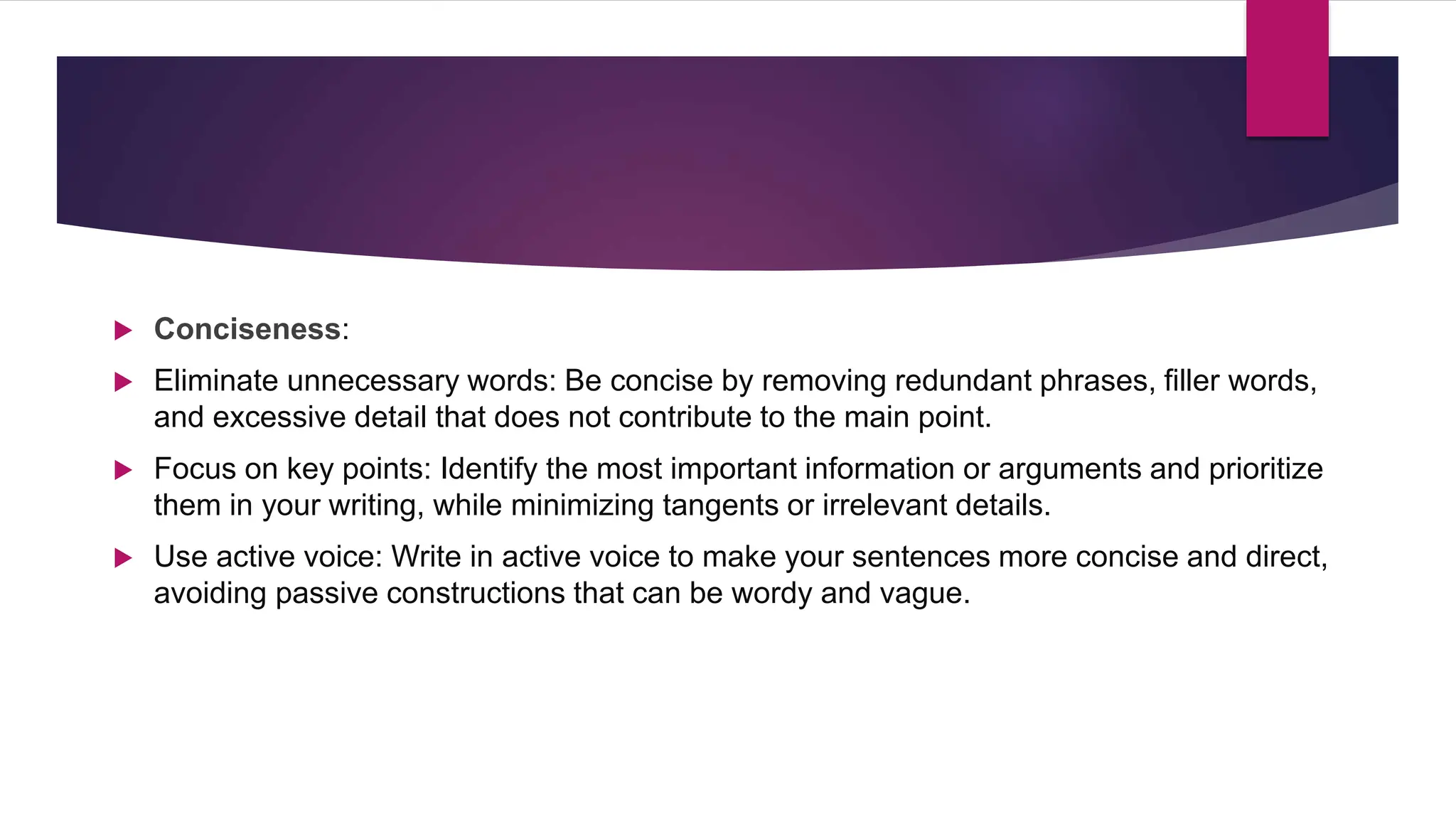
 Conciseness:
 Eliminate unnecessary words: Be concise by removing redundant phrases, filler words,
and excessive detail that does not contribute to the main point.
 Focus on key points: Identify the most important information or arguments and prioritize
them in your writing, while minimizing tangents or irrelevant details.
 Use active voice: Write in active voice to make your sentences more concise and direct,
avoiding passive constructions that can be wordy and vague.
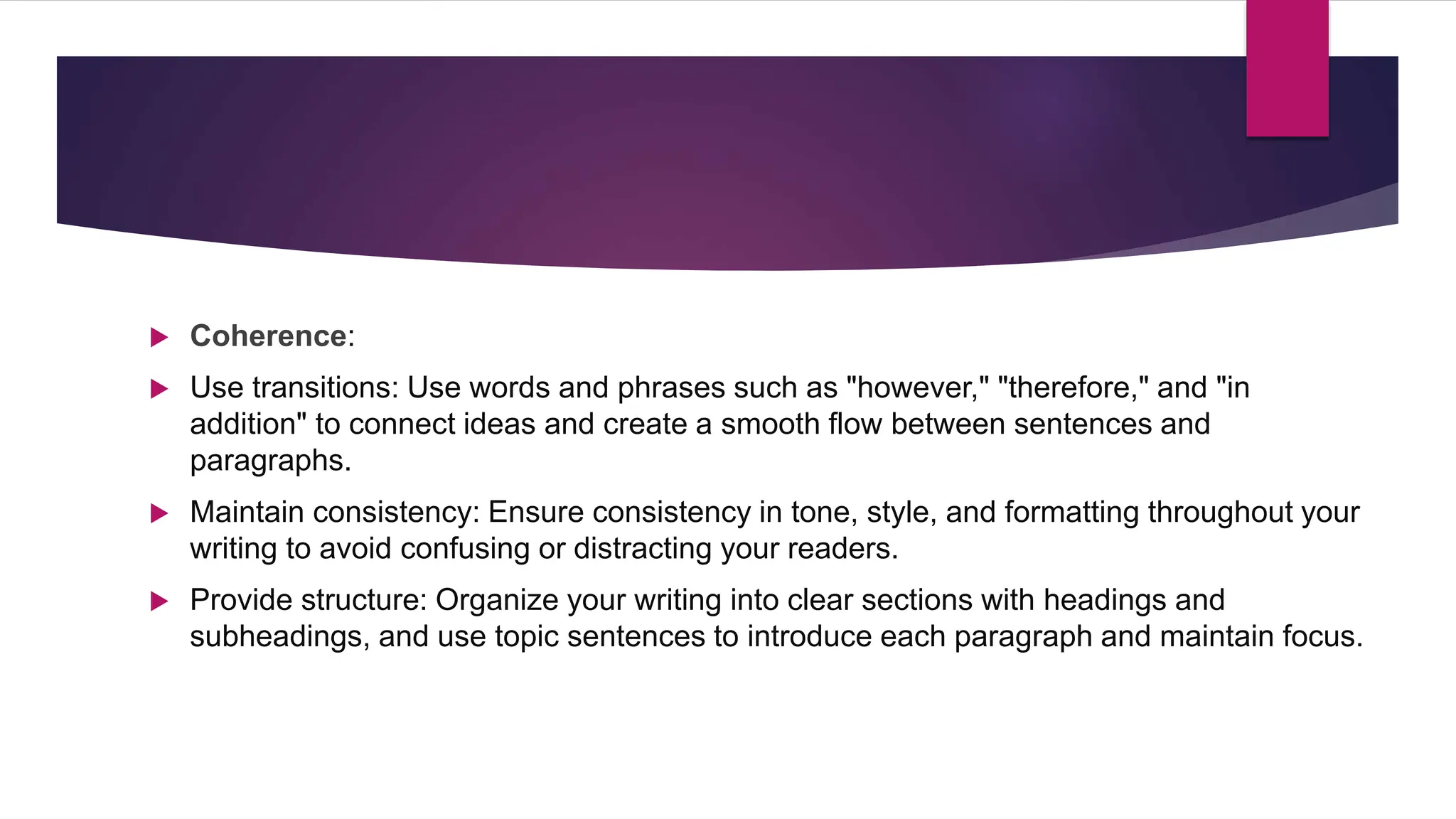
 Coherence:
 Use transitions: Use words and phrases such as "however," "therefore," and "in
addition" to connect ideas and create a smooth flow between sentences and
paragraphs.
 Maintain consistency: Ensure consistency in tone, style, and formatting throughout your
writing to avoid confusing or distracting your readers.
 Provide structure: Organize your writing into clear sections with headings and
subheadings, and use topic sentences to introduce each paragraph and maintain focus.
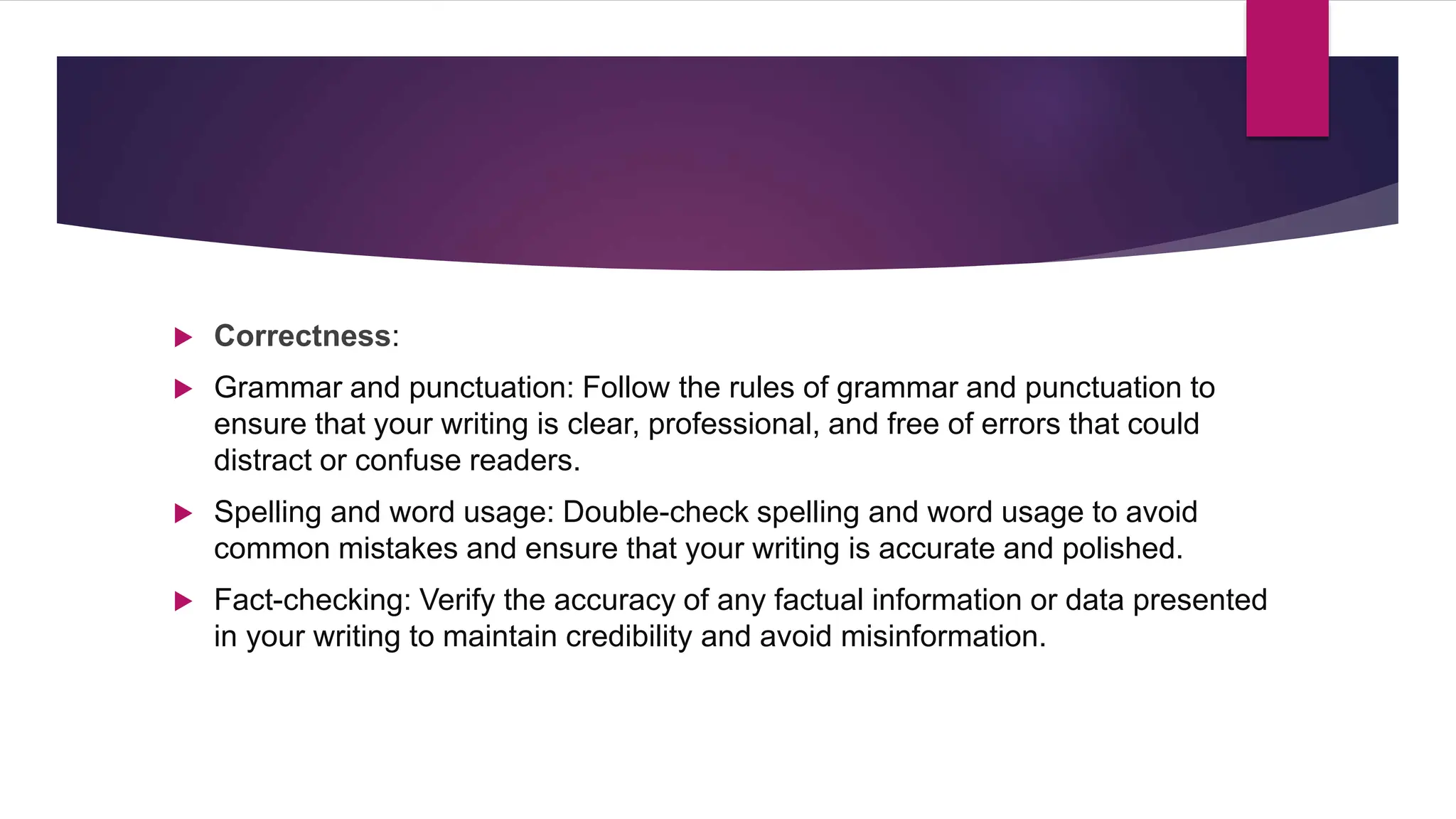
 Correctness:
 Grammar and punctuation: Follow the rules of grammar and punctuation to
ensure that your writing is clear, professional, and free of errors that could
distract or confuse readers.
 Spelling and word usage: Double-check spelling and word usage to avoid
common mistakes and ensure that your writing is accurate and polished.
 Fact-checking: Verify the accuracy of any factual information or data presented
in your writing to maintain credibility and avoid misinformation.
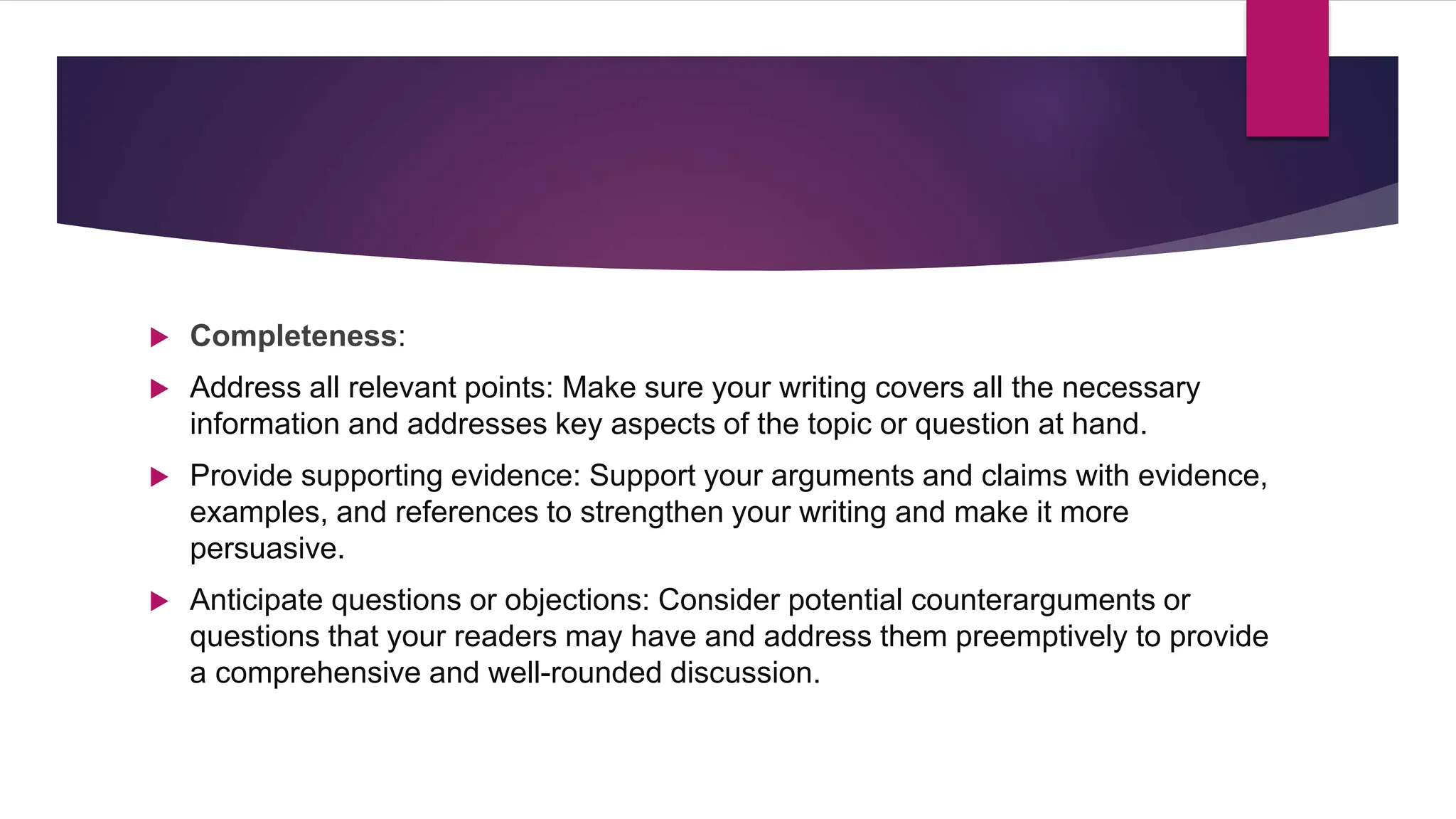
 Completeness:
 Address all relevant points: Make sure your writing covers all the necessary
information and addresses key aspects of the topic or question at hand.
 Provide supporting evidence: Support your arguments and claims with evidence,
examples, and references to strengthen your writing and make it more
persuasive.
 Anticipate questions or objections: Consider potential counterarguments or
questions that your readers may have and address them preemptively to provide
a comprehensive and well-rounded discussion.
 By paying attention to these aspects of writing, you can improve the
effectiveness, clarity, and impact of your writing, whether you're crafting an
academic essay, a business report, a creative story, or any other type of text.
THANK YOU!

ENGLISH PRESENTATION.pptx its a presentation on english grammar

  • 1.
    ENGLISH PRESENTATION TOPIC –ESSENTIALS OF WRITING -BY ICHHA SINGH [MECHANICAL] 2ND SEMESTER
  • 2.
     Audience Awareness:Consider who will be reading your writing and adapt your language, tone, and style to suit their needs, interests, and level of understanding.  Structure: Organize your writing into a coherent structure, including an introduction, body, and conclusion. Each part should flow logically and support the overall purpose of your piece.  Grammar and Mechanics: Maintain proper grammar, punctuation, and spelling to enhance readability and credibility. Proofread your work carefully to catch errors and ensure correctness.  Conciseness: Express your ideas succinctly and avoid unnecessary repetition or wordiness. Aim to convey your message using the fewest words possible without sacrificing clarity or depth.
  • 3.
     Voice andTone: Develop a consistent voice and tone that aligns with your purpose and audience. Whether formal, informal, persuasive, or informative, your tone should be appropriate for the context.  Engagement: Capture the reader's attention and maintain their interest throughout your writing. Use vivid descriptions, anecdotes, examples, and other literary devices to engage your audience.  Revision and Editing: Review and revise your writing to refine your ideas, improve clarity, and polish your prose. Editing involves checking for errors, refining language, and ensuring coherence.  Originality: Strive to express your ideas in a unique and original way, avoiding plagiarism and clichés. Injecting your personality, perspective, and creativity into your writing can make it more engaging and memorable.
  • 4.
     IMPORTANCE OFESSENTIALS OF WRITING  Reasons Why Writing Skills Are Important 1. Enhances clarity in business communication, ensuring that ideas and proposals are effectively presented. 2. Improves professional image by showcasing well-structured and organized business documents. 3. Facilitates collaboration and teamwork by promoting clear and concise communication among colleagues. 4. Boosts career prospects, as strong writing skills are highly valued in the workplace. 5. Increases credibility and authority in academic research and publications. 6. Fosters effective communication in personal and professional settings, reducing misunderstandings.
  • 5.
     5 Csof Writing  The "5 Cs of Writing" is a framework that highlights five key elements essential for effective writing. These elements are:  Clarity:  Use simple and direct language: Choose words and phrases that are easy to understand and avoid jargon or overly complex terminology unless necessary.  Organize your ideas logically: Present your thoughts in a clear and orderly manner, using headings, subheadings, and transitions to guide the reader through your writing.  Provide context: Help your readers understand the background and context of your topic by providing relevant information and explanations.  Use examples and illustrations: Concrete examples and visual aids can clarify abstract concepts and make your writing more accessible to readers.
  • 6.
     Conciseness:  Eliminateunnecessary words: Be concise by removing redundant phrases, filler words, and excessive detail that does not contribute to the main point.  Focus on key points: Identify the most important information or arguments and prioritize them in your writing, while minimizing tangents or irrelevant details.  Use active voice: Write in active voice to make your sentences more concise and direct, avoiding passive constructions that can be wordy and vague.
  • 7.
     Coherence:  Usetransitions: Use words and phrases such as "however," "therefore," and "in addition" to connect ideas and create a smooth flow between sentences and paragraphs.  Maintain consistency: Ensure consistency in tone, style, and formatting throughout your writing to avoid confusing or distracting your readers.  Provide structure: Organize your writing into clear sections with headings and subheadings, and use topic sentences to introduce each paragraph and maintain focus.
  • 8.
     Correctness:  Grammarand punctuation: Follow the rules of grammar and punctuation to ensure that your writing is clear, professional, and free of errors that could distract or confuse readers.  Spelling and word usage: Double-check spelling and word usage to avoid common mistakes and ensure that your writing is accurate and polished.  Fact-checking: Verify the accuracy of any factual information or data presented in your writing to maintain credibility and avoid misinformation.
  • 9.
     Completeness:  Addressall relevant points: Make sure your writing covers all the necessary information and addresses key aspects of the topic or question at hand.  Provide supporting evidence: Support your arguments and claims with evidence, examples, and references to strengthen your writing and make it more persuasive.  Anticipate questions or objections: Consider potential counterarguments or questions that your readers may have and address them preemptively to provide a comprehensive and well-rounded discussion.
  • 10.
     By payingattention to these aspects of writing, you can improve the effectiveness, clarity, and impact of your writing, whether you're crafting an academic essay, a business report, a creative story, or any other type of text.
  • 11.