English Language
Investigation
Investigating the language in children’s annuals, 1972-2006
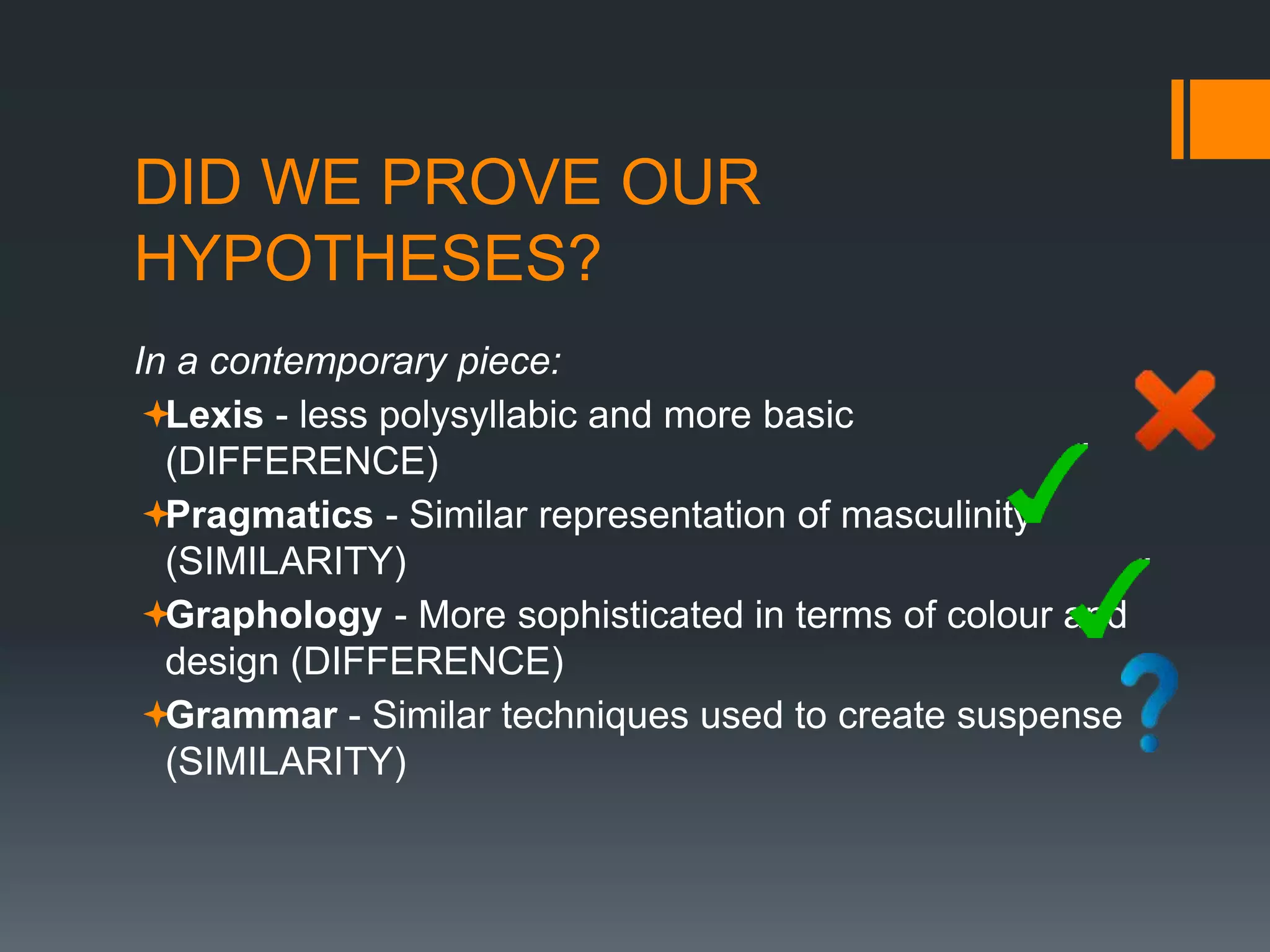
HYPOTHESES
In a contemporary piece:
Lexis - less polysyllabic and more basic
(DIFFERENCE)
Pragmatics - Similar representation of masculinity
(SIMILARITY)
Graphology - More sophisticated in terms of colour and
design (DIFFERENCE)
Grammar - Similar techniques used to create suspense
(SIMILARITY)
METHODOLOGY
3
4
TEXT A: The Hotspur
Book for Boys, 1972
TEXT B: Power
Rangers Dino-Thunder
Annual 2006
2 pages analysed 4 pages analysed
OUR CHOICES
Appropriate length
Similar target audience
Relatively easy to obtain
5
WHY THESE ANNUALS?
OUR REJECTIONS
The Jolly Book Annual, 1923
The School Friend Annual, 1960
Go Diego Go! Annual, 2010
Project Gutenberg archives
‘The Children’s Bookshop’ website
(http://antiqbook.co.uk/boox/thechi/)
RESULTS
6
LEXIS AND SEMANTICS
The contemporary annual uses neologisms; none
are present in the 1972 annual
LEXIS AND SEMANTICS
Text A uses certain words that we considered to be
less common nowadays
LEXIS AND SEMANTICS
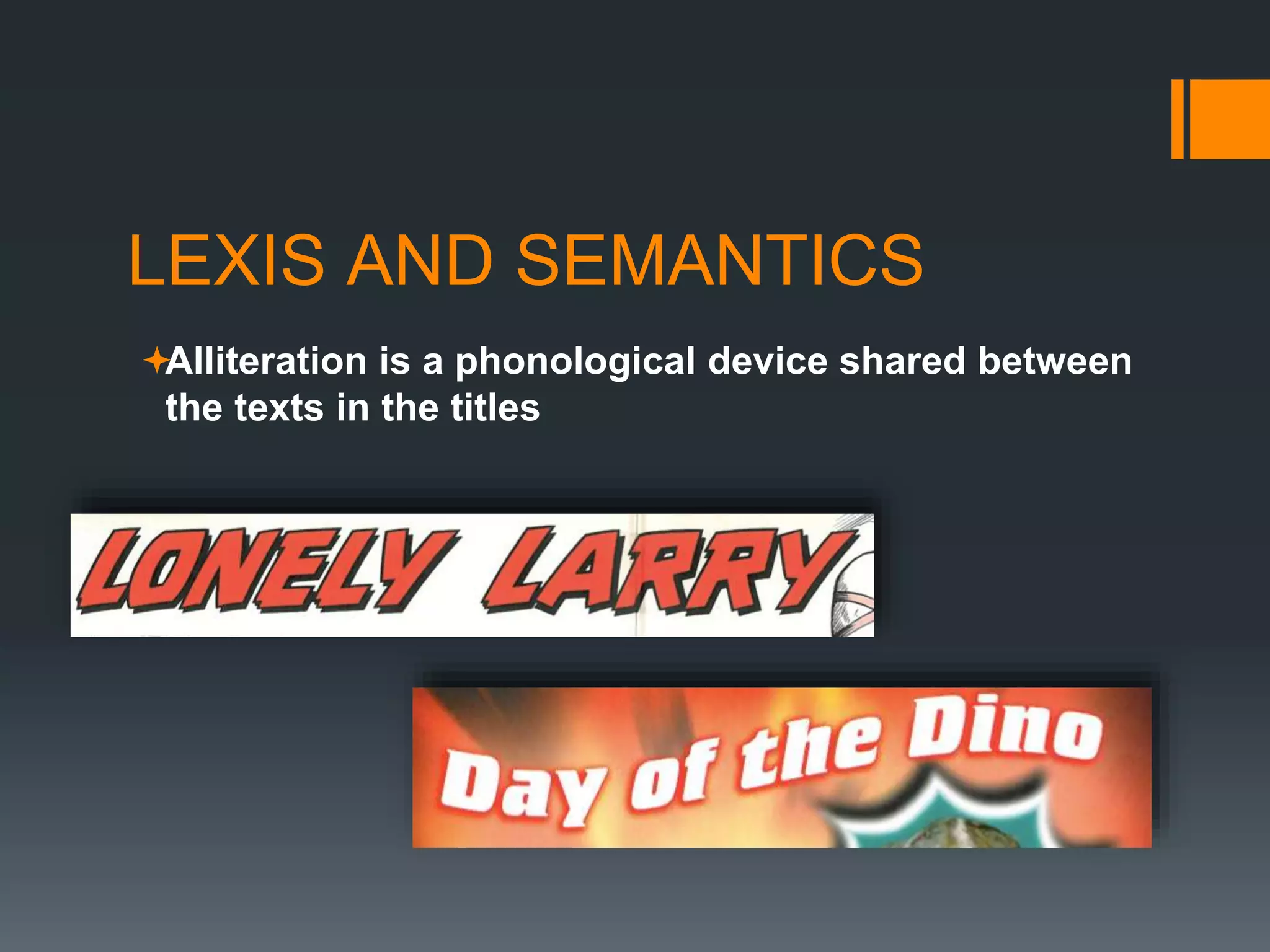
Alliteration is a phonological device shared between
the texts in the titles
GRAMMAR
Both texts use a similar number of dynamic verbs,
however Text A clearly uses more
TEXT A: 47.5% of verbs (19/40)
TEXT B: 33.96% of verbs (18/53)
COMPLEXITY OF LANGUAGE
Average syllable length
Average number of words per sentence
Flesch-Kincaid Reading Age
Flesch ease test
TEXT A: 1.35 TEXT B: 1.46
TEXT A: 14.42 TEXT B: 13.97
TEXT A: 10-11 TEXT B: 12-13
TEXT A: 78.35% TEXT B: 68.89%
GRAPHOLOGY
Both texts utilise pictures of the protagonist in
action
GRAPHOLOGY
The style of the images in both texts is very
different
Hand-drawn
Monochromatic
Photographic
images
multi-coloured
Computerised graphics
DISCOURSE STRUCTURE
Both texts adopt the same narrative structure:
equilibrium, disequilibrium new equilibrium
Text A Text B
Equilibrium/ab
stract
“The boy's muscles rippled in the golden
rays of the early morning sun. The wind
off the Pacific Ocean ruffled his hair,
rattling the palm leaves in front of his
hillside cave house near the middle of the
island”
“On a wooded island, in a maze of
dark underground tunnels”
Disequilibrium/
complicating
action
“Rounding the headland were three big
war canoes full of grotesquely - decorated
warriors whose spears flashed in the
sun.”
“When the beasts finally caught up
with Tommy, they surrounded him,
then attacked…Things were looking
bad”
New
equilibrium/res
olution
“They tried again next morning, then they
gave up. By noon the three canoes were
drawing away from Larry’s island.”
“Tommy smiled a grim smile of
satisfaction. He had escaped, and it
was the Tyranodrones who had met
their fate.”
DISCOURSE STRUCTURE
Text A is much denser than text B
TEXT A has 1,032 words over 2
pages
TEXT B has an average of 214
words over 2 pages
PRAGMATICS
Masculinity is represented in a similar way in both
texts
Text A Text B
Isolated from
other
humans/alone
in plight
Living as a "castaway" No other human is
mentioned; only Tommy
Strong and
heroic;
successful in
the face of
diversity
Larry survived when his
“ship sank” and is “lifting
weights most athletes
would have hesitated to
tackle”
“Tommy…leapt off the edge
of the cliff…he had escaped”
CONCLUSIONS
17
LANGUAGE CHANGE OVER
TIME: OUR OVERALL FINDINGS
What has changed? What has not changed?
• Lexis has become more
complex over time
• Texts have become less
dense
• Graphology has become more
sophisticated
• More neologisms are used
today
• Words that seem uncommon
may not have gone out of use
today
• Representation of masculinity
• Phonological and grammatical
techniques
• The narrative discourse
structure
DID WE PROVE OUR
HYPOTHESES?
In a contemporary piece:
Lexis - less polysyllabic and more basic
(DIFFERENCE)
Pragmatics - Similar representation of masculinity
(SIMILARITY)
Graphology - More sophisticated in terms of colour and
design (DIFFERENCE)
Grammar - Similar techniques used to create suspense
(SIMILARITY)
FURTHER CONCLUSIONS
Different style of language in Text B
Both texts adopt the same discourse structure
EVALUATION
21
SUCCESSES
Searching for texts in charity shops
Using a range of different quantitative analytical methods
Consistency between texts used
We researched a large number of different potential texts
FAILINGS AND
IMPROVEMENTS
Searching for text sources online
Should have analysed a larger range of texts
Should have had more consistency between the texts
analysed
Should have ensured we investigated every one of our
hypotheses
SHOULD YOU
INVESTIGATE
THIS?
23
BIBLIOGRAPHY
Power Rangers Dino-Thunder Annual 2006 (Publisher, etc.)
The Hotspur Book for Boys 1972 (Publisher, etc.)
https://books.google.com/ngrams (Ngrams)
http://www.online-
utility.org/english/readability_test_and_improve.jsp (Online
Utility)
https://www.gutenberg.org (Project Gutenberg)
http://countwordsworth.com/blog/average-sentence-lengths-
of-famous-novels-and-authors/

English language investigation final

  • 1.
    English Language Investigation Investigating thelanguage in children’s annuals, 1972-2006
  • 2.
    HYPOTHESES In a contemporarypiece: Lexis - less polysyllabic and more basic (DIFFERENCE) Pragmatics - Similar representation of masculinity (SIMILARITY) Graphology - More sophisticated in terms of colour and design (DIFFERENCE) Grammar - Similar techniques used to create suspense (SIMILARITY)
  • 3.
  • 4.
    4 TEXT A: TheHotspur Book for Boys, 1972 TEXT B: Power Rangers Dino-Thunder Annual 2006 2 pages analysed 4 pages analysed OUR CHOICES
  • 5.
    Appropriate length Similar targetaudience Relatively easy to obtain 5 WHY THESE ANNUALS? OUR REJECTIONS The Jolly Book Annual, 1923 The School Friend Annual, 1960 Go Diego Go! Annual, 2010 Project Gutenberg archives ‘The Children’s Bookshop’ website (http://antiqbook.co.uk/boox/thechi/)
  • 6.
  • 7.
    LEXIS AND SEMANTICS Thecontemporary annual uses neologisms; none are present in the 1972 annual
  • 8.
    LEXIS AND SEMANTICS TextA uses certain words that we considered to be less common nowadays
  • 9.
    LEXIS AND SEMANTICS Alliterationis a phonological device shared between the texts in the titles
  • 10.
    GRAMMAR Both texts usea similar number of dynamic verbs, however Text A clearly uses more TEXT A: 47.5% of verbs (19/40) TEXT B: 33.96% of verbs (18/53)
  • 11.
    COMPLEXITY OF LANGUAGE Averagesyllable length Average number of words per sentence Flesch-Kincaid Reading Age Flesch ease test TEXT A: 1.35 TEXT B: 1.46 TEXT A: 14.42 TEXT B: 13.97 TEXT A: 10-11 TEXT B: 12-13 TEXT A: 78.35% TEXT B: 68.89%
  • 12.
    GRAPHOLOGY Both texts utilisepictures of the protagonist in action
  • 13.
    GRAPHOLOGY The style ofthe images in both texts is very different Hand-drawn Monochromatic Photographic images multi-coloured Computerised graphics
  • 14.
    DISCOURSE STRUCTURE Both textsadopt the same narrative structure: equilibrium, disequilibrium new equilibrium Text A Text B Equilibrium/ab stract “The boy's muscles rippled in the golden rays of the early morning sun. The wind off the Pacific Ocean ruffled his hair, rattling the palm leaves in front of his hillside cave house near the middle of the island” “On a wooded island, in a maze of dark underground tunnels” Disequilibrium/ complicating action “Rounding the headland were three big war canoes full of grotesquely - decorated warriors whose spears flashed in the sun.” “When the beasts finally caught up with Tommy, they surrounded him, then attacked…Things were looking bad” New equilibrium/res olution “They tried again next morning, then they gave up. By noon the three canoes were drawing away from Larry’s island.” “Tommy smiled a grim smile of satisfaction. He had escaped, and it was the Tyranodrones who had met their fate.”
  • 15.
    DISCOURSE STRUCTURE Text Ais much denser than text B TEXT A has 1,032 words over 2 pages TEXT B has an average of 214 words over 2 pages
  • 16.
    PRAGMATICS Masculinity is representedin a similar way in both texts Text A Text B Isolated from other humans/alone in plight Living as a "castaway" No other human is mentioned; only Tommy Strong and heroic; successful in the face of diversity Larry survived when his “ship sank” and is “lifting weights most athletes would have hesitated to tackle” “Tommy…leapt off the edge of the cliff…he had escaped”
  • 17.
  • 18.
    LANGUAGE CHANGE OVER TIME:OUR OVERALL FINDINGS What has changed? What has not changed? • Lexis has become more complex over time • Texts have become less dense • Graphology has become more sophisticated • More neologisms are used today • Words that seem uncommon may not have gone out of use today • Representation of masculinity • Phonological and grammatical techniques • The narrative discourse structure
  • 19.
    DID WE PROVEOUR HYPOTHESES? In a contemporary piece: Lexis - less polysyllabic and more basic (DIFFERENCE) Pragmatics - Similar representation of masculinity (SIMILARITY) Graphology - More sophisticated in terms of colour and design (DIFFERENCE) Grammar - Similar techniques used to create suspense (SIMILARITY)
  • 20.
    FURTHER CONCLUSIONS Different styleof language in Text B Both texts adopt the same discourse structure
  • 21.
  • 22.
    SUCCESSES Searching for textsin charity shops Using a range of different quantitative analytical methods Consistency between texts used We researched a large number of different potential texts FAILINGS AND IMPROVEMENTS Searching for text sources online Should have analysed a larger range of texts Should have had more consistency between the texts analysed Should have ensured we investigated every one of our hypotheses
  • 23.
  • 24.
    BIBLIOGRAPHY Power Rangers Dino-ThunderAnnual 2006 (Publisher, etc.) The Hotspur Book for Boys 1972 (Publisher, etc.) https://books.google.com/ngrams (Ngrams) http://www.online- utility.org/english/readability_test_and_improve.jsp (Online Utility) https://www.gutenberg.org (Project Gutenberg) http://countwordsworth.com/blog/average-sentence-lengths- of-famous-novels-and-authors/