Traditions are about the past and innovation is about
the future, and it has been argued that we need to let
go of traditions for the sake of progress. To what
extent do you agree or disagree with this? What role
should traditions have in our lives?
Some people prefer to spend their holidays in
resorts where everything is organized for them
and they take little interest in the country they
are visiting. Others prefer to travel around the
country and to see how the people live, to get to
know their customs and traditions and cuisine.
Write an essay on which type of foreign travel you
think is best for both the tourist and the local
community.
Some say cultural traditions are destroyed
when they are used as money-making
attractions for tourists. Others say this is
the only way to save such traditions.
Discuss both views and give your opinion.
These days, young people know less
about their culture and traditions. What
are the reasons for this? Is this a positive
or negative development?
People who go to live in other
countries, should follow the
customs and traditions of the
new country.
If someone asks you.
Can you describe the
traditions of your country.
How would you do it?
Describe a tradition in your country.
You should say
What is it?
Who takes part in it?
What activities there are?
And explain how you feel about it?
A.
Language everywhere changes over time; it has to. A central reason
that necessitates modification is to allow for developments in our
world to be expressed. For example, the technological revolution alone
has been responsible for the addition of a plethora of words to our
vocabulary: hard drive, software, modem to name just a few. The
Japanese writing script katakana, which was originally introduced in
the 9th century as a means by which Buddhist monks could correctly
interpret Chinese pronunciations, is now most commonly used to
embrace foreign words for which there is no original Japanese
character; pizza or hamburger for example. Likewise, the western
world’s exposure to and familiarity with foreign cultures now means
that words such as sushi, nan bread, and kebab, for example, are used
by diners regularly.
B.
However, the expansion of our vocabulary is just one element
involved in how and why language evolves. Given the variation of
dialects or regional accents present in most language systems, it is
clear that an individual’s interpretation of what is correct and
commonly used will vary quite dramatically since this perception
is based upon a combination of factors including the age,
educational level and region of the country a person is from. As we
go about our daily lives and interact with others from different
backgrounds and experiences, the language we hear is often taken
on board and incorporated into how we communicate ourselves.
Many phrases with American origins are now commonplace in
British English for example, due to the frequency with which they
are heard on television and in the movies.
C.
Changes in language are often driven by the young and many such changes are
commonly considered by older people to be a disintegration of standards rather than
an evolution and an improvement. Let’s consider an Americanism commonly used by
youngsters in all pans of the English speaking world. Used as an alternative to “Tom
said…” it is now commonplace to hear “Tom goes, the pay rise was unacceptable.” or,
“Tom was all, the pay rise was unacceptable.”; much to the horror of many
traditionalists. However, this modification could also be considered to be adding to
and not detracting from our ability to communicate effectively. To illustrate, let’s
consider the original phrase “Tom said”; it is used solely to show the listener that we
are reporting the words of Tom, while the modern variation, “Tom goes” has the same
meaning. However, if the speaker chooses instead to use the latter phrase, “Tom was
all”, they are also able to convey the message that Tom had an emotional reaction to
the situation they are reporting, therefore a much more effective method of
communicating information has been created, some may say. However, should the
now commonly used texting abbreviations such as ‘gr8t’ (great) and ‘l8r’ (later) become
permanent replacements of the original words, it is likely that even the most liberal
amongst us would be horrified.
D.
Variations on the language are usually more readily accepted into
informal language before being absorbed for use in formal
writing. Examples of words that we now commonly use, but were
once considered incorrect, are ‘pea’ and ‘hopefully’. Let’s take
pea; it derived from the word ‘pease’, which is an uncountable
noun that has the same form regardless of whether one or more
pease were being spoken about. However, this was commonly
overlooked and misunderstood, and through error, the singular
form of the vegetable became ‘pea’. More recently ‘hopefully’ was
considered by many to be an inappropriate alternative to ‘I hope’;
at best only accepted in informal use. The word hopefully is now’
fully acceptable in both informal speech and formal writing.
E.
Some people believe that traditional usages of language are always more
superior and refined than modern variations even when the reasons behind the
rule were dubious in the first place. For example, it was once seriously frowned
upon to split an infinitive in a sentence and even today it is considered
grammatically incorrect to do so. To demonstrate, let’s consider the following
sentence: ‘The examiner asked me to quietly leave the room’; this was considered
incorrect as the word ‘quietly’ splits the infinitive of the verb ‘to leave’. The
origins of this rule hail back to the 17th century when scholars believed that the
English language should be adapted to follow the rules of Latin; then considered
the perfect language. Since splitting infinitives in Latin is impossible, it was
decided that splitting infinitives in English, even though possible, was not
acceptable, Given those initial motivations behind the rule were questionable
and the clarity of the meaning of the sentence is not compromised in the
‘incorrect’ form, it could be argued that this grammar rule is a prime example of
an unnecessary sanction which is likely to be abandoned in the future.
F.
As language evolves, changes in grammar structures that would
confuse the actual meaning of the sentences are unlikely; however,
the meanings of words are often modified or altered beyond
recognition by different generations and can be easily
misinterpreted by other social groups. Take, for example, the
modern version of the word ‘bad’ meaning ‘great’ when used in
contemporary slang. Many slang words remain dated in the era in
which they are developed, for example, words like ‘to beef,
meaning to complain (introduced in the 1920s) are not only dated
but may not even be understood in a modern context, while others
such as ‘guy’ become absorbed into mainstream language. Who
knows what future generations will add to the ever-changing
environment of communication?
01.
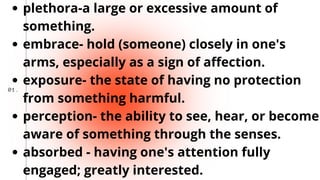
plethora-a large or excessive amount of
something.
embrace- hold (someone) closely in one's
arms, especially as a sign of affection.
exposure- the state of having no protection
from something harmful.
perception- the ability to see, hear, or become
aware of something through the senses.
absorbed - having one's attention fully
engaged; greatly interested.
LIST OF HEADINGS
i Historical acceptance of change
ii The Generation Gap
iii Influences on speech
iv Ancient writing in Asia
v
vi Slang expected in the future
vii Questioning logic
viii Lifespan of vocabulary
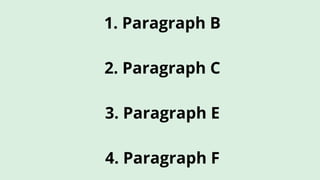
1. Paragraph B
2. Paragraph C
3. Paragraph E
4. Paragraph F
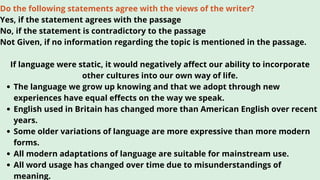
The language we grow up knowing and that we adopt through new
experiences have equal effects on the way we speak.
English used in Britain has changed more than American English over recent
years.
Some older variations of language are more expressive than more modern
forms.
All modern adaptations of language are suitable for mainstream use.
All word usage has changed over time due to misunderstandings of
meaning.
Do the following statements agree with the views of the writer?
Yes, if the statement agrees with the passage
No, if the statement is contradictory to the passage
Not Given, if no information regarding the topic is mentioned in the passage.
If language were static, it would negatively affect our ability to incorporate
other cultures into our own way of life.
Oceans or mountains
the most captivating painting or
artwork you’ve ever seen
What is your favorite thing about
your personality
Do you remember the first novel
you ever read? If so, what was it?
What is a language you love to
listen to even if you don’t speak or
understand it?
What’s your favorite comfort
food?
Second group
Third group
If you could have a fictional superhero for a best
friend, who would it be?
What color would you choose to describe
yourself?
Where is one place you’d love to travel to again?
What tasks make you feel like your best self?
Where do you feel most centered and happy?
What do you love most about your home?
Logical
tasks
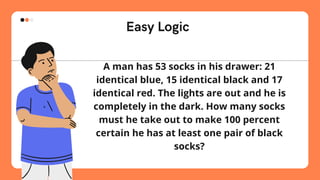
Easy Logic
A man has 53 socks in his drawer: 21
identical blue, 15 identical black and 17
identical red. The lights are out and he is
completely in the dark. How many socks
must he take out to make 100 percent
certain he has at least one pair of black
socks?
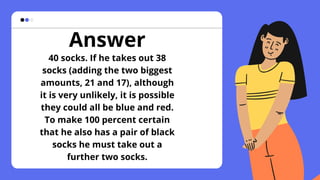
Answer
40 socks. If he takes out 38
socks (adding the two biggest
amounts, 21 and 17), although
it is very unlikely, it is possible
they could all be blue and red.
To make 100 percent certain
that he also has a pair of black
socks he must take out a
further two socks.
A girl meets a lion and unicorn in the
forest. The lion lies every Monday,
Tuesday and Wednesday and the other
days he speaks the truth. The unicorn
lies on Thursdays, Fridays and Saturdays,
and the other days of the week he
speaks the truth. “Yesterday I was lying,”
the lion told the girl. “So was I,” said the
unicorn. What day is it?
Lying or telling the truth
logic puzzle
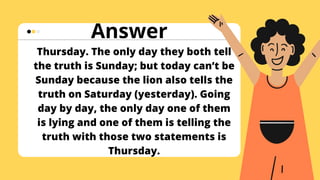
Thursday. The only day they both tell
the truth is Sunday; but today can’t be
Sunday because the lion also tells the
truth on Saturday (yesterday). Going
day by day, the only day one of them
is lying and one of them is telling the
truth with those two statements is
Thursday.
Answer
Hard Logic Puzzle
A teacher writes six words on a board: “cat
dog has max dim tag.” She gives three
students, Albert, Bernard and Cheryl each a
piece of paper with one letter from one of
the words. Then she asks, “Albert, do you
know the word?” Albert immediately replies
yes. She asks, “Bernard, do you know the
word?” He thinks for a moment and replies
yes. Then she asks Cheryl the same
question. She thinks and then replies yes.
What is the word?
Dog. Albert knows right away because he
has one of the unique letters that only
appear once in all the words: c o h s x i. So,
we know the word is not “tag.” All of these
unique letters appear in different words,
except for “h” and “s” in “has,” and Bernard
can figure out what the word is from the
unique letters that are left: t, g, h, s. This
eliminates “max” and “dim.” Cheryl can
then narrow it down the same way.
Because there is only one unique letter
left, the letter “d,” the word must be “dog.”
Answer

Traditions and language.pdf

  • 2.
    Traditions are aboutthe past and innovation is about the future, and it has been argued that we need to let go of traditions for the sake of progress. To what extent do you agree or disagree with this? What role should traditions have in our lives?
  • 3.
    Some people preferto spend their holidays in resorts where everything is organized for them and they take little interest in the country they are visiting. Others prefer to travel around the country and to see how the people live, to get to know their customs and traditions and cuisine. Write an essay on which type of foreign travel you think is best for both the tourist and the local community.
  • 4.
    Some say culturaltraditions are destroyed when they are used as money-making attractions for tourists. Others say this is the only way to save such traditions. Discuss both views and give your opinion.
  • 5.
    These days, youngpeople know less about their culture and traditions. What are the reasons for this? Is this a positive or negative development?
  • 6.
    People who goto live in other countries, should follow the customs and traditions of the new country.
  • 8.
    If someone asksyou. Can you describe the traditions of your country. How would you do it?
  • 9.
    Describe a traditionin your country. You should say What is it? Who takes part in it? What activities there are? And explain how you feel about it?
  • 10.
    A. Language everywhere changesover time; it has to. A central reason that necessitates modification is to allow for developments in our world to be expressed. For example, the technological revolution alone has been responsible for the addition of a plethora of words to our vocabulary: hard drive, software, modem to name just a few. The Japanese writing script katakana, which was originally introduced in the 9th century as a means by which Buddhist monks could correctly interpret Chinese pronunciations, is now most commonly used to embrace foreign words for which there is no original Japanese character; pizza or hamburger for example. Likewise, the western world’s exposure to and familiarity with foreign cultures now means that words such as sushi, nan bread, and kebab, for example, are used by diners regularly.
  • 11.
    B. However, the expansionof our vocabulary is just one element involved in how and why language evolves. Given the variation of dialects or regional accents present in most language systems, it is clear that an individual’s interpretation of what is correct and commonly used will vary quite dramatically since this perception is based upon a combination of factors including the age, educational level and region of the country a person is from. As we go about our daily lives and interact with others from different backgrounds and experiences, the language we hear is often taken on board and incorporated into how we communicate ourselves. Many phrases with American origins are now commonplace in British English for example, due to the frequency with which they are heard on television and in the movies.
  • 12.
    C. Changes in languageare often driven by the young and many such changes are commonly considered by older people to be a disintegration of standards rather than an evolution and an improvement. Let’s consider an Americanism commonly used by youngsters in all pans of the English speaking world. Used as an alternative to “Tom said…” it is now commonplace to hear “Tom goes, the pay rise was unacceptable.” or, “Tom was all, the pay rise was unacceptable.”; much to the horror of many traditionalists. However, this modification could also be considered to be adding to and not detracting from our ability to communicate effectively. To illustrate, let’s consider the original phrase “Tom said”; it is used solely to show the listener that we are reporting the words of Tom, while the modern variation, “Tom goes” has the same meaning. However, if the speaker chooses instead to use the latter phrase, “Tom was all”, they are also able to convey the message that Tom had an emotional reaction to the situation they are reporting, therefore a much more effective method of communicating information has been created, some may say. However, should the now commonly used texting abbreviations such as ‘gr8t’ (great) and ‘l8r’ (later) become permanent replacements of the original words, it is likely that even the most liberal amongst us would be horrified.
  • 13.
    D. Variations on thelanguage are usually more readily accepted into informal language before being absorbed for use in formal writing. Examples of words that we now commonly use, but were once considered incorrect, are ‘pea’ and ‘hopefully’. Let’s take pea; it derived from the word ‘pease’, which is an uncountable noun that has the same form regardless of whether one or more pease were being spoken about. However, this was commonly overlooked and misunderstood, and through error, the singular form of the vegetable became ‘pea’. More recently ‘hopefully’ was considered by many to be an inappropriate alternative to ‘I hope’; at best only accepted in informal use. The word hopefully is now’ fully acceptable in both informal speech and formal writing.
  • 14.
    E. Some people believethat traditional usages of language are always more superior and refined than modern variations even when the reasons behind the rule were dubious in the first place. For example, it was once seriously frowned upon to split an infinitive in a sentence and even today it is considered grammatically incorrect to do so. To demonstrate, let’s consider the following sentence: ‘The examiner asked me to quietly leave the room’; this was considered incorrect as the word ‘quietly’ splits the infinitive of the verb ‘to leave’. The origins of this rule hail back to the 17th century when scholars believed that the English language should be adapted to follow the rules of Latin; then considered the perfect language. Since splitting infinitives in Latin is impossible, it was decided that splitting infinitives in English, even though possible, was not acceptable, Given those initial motivations behind the rule were questionable and the clarity of the meaning of the sentence is not compromised in the ‘incorrect’ form, it could be argued that this grammar rule is a prime example of an unnecessary sanction which is likely to be abandoned in the future.
  • 15.
    F. As language evolves,changes in grammar structures that would confuse the actual meaning of the sentences are unlikely; however, the meanings of words are often modified or altered beyond recognition by different generations and can be easily misinterpreted by other social groups. Take, for example, the modern version of the word ‘bad’ meaning ‘great’ when used in contemporary slang. Many slang words remain dated in the era in which they are developed, for example, words like ‘to beef, meaning to complain (introduced in the 1920s) are not only dated but may not even be understood in a modern context, while others such as ‘guy’ become absorbed into mainstream language. Who knows what future generations will add to the ever-changing environment of communication?
  • 16.
    01. plethora-a large orexcessive amount of something. embrace- hold (someone) closely in one's arms, especially as a sign of affection. exposure- the state of having no protection from something harmful. perception- the ability to see, hear, or become aware of something through the senses. absorbed - having one's attention fully engaged; greatly interested.
  • 17.
    LIST OF HEADINGS iHistorical acceptance of change ii The Generation Gap iii Influences on speech iv Ancient writing in Asia v vi Slang expected in the future vii Questioning logic viii Lifespan of vocabulary
  • 18.
    1. Paragraph B 2.Paragraph C 3. Paragraph E 4. Paragraph F
  • 19.
    The language wegrow up knowing and that we adopt through new experiences have equal effects on the way we speak. English used in Britain has changed more than American English over recent years. Some older variations of language are more expressive than more modern forms. All modern adaptations of language are suitable for mainstream use. All word usage has changed over time due to misunderstandings of meaning. Do the following statements agree with the views of the writer? Yes, if the statement agrees with the passage No, if the statement is contradictory to the passage Not Given, if no information regarding the topic is mentioned in the passage. If language were static, it would negatively affect our ability to incorporate other cultures into our own way of life.
  • 23.
    Oceans or mountains themost captivating painting or artwork you’ve ever seen What is your favorite thing about your personality Do you remember the first novel you ever read? If so, what was it? What is a language you love to listen to even if you don’t speak or understand it? What’s your favorite comfort food? Second group
  • 24.
    Third group If youcould have a fictional superhero for a best friend, who would it be? What color would you choose to describe yourself? Where is one place you’d love to travel to again? What tasks make you feel like your best self? Where do you feel most centered and happy? What do you love most about your home?
  • 27.
  • 28.
    Easy Logic A manhas 53 socks in his drawer: 21 identical blue, 15 identical black and 17 identical red. The lights are out and he is completely in the dark. How many socks must he take out to make 100 percent certain he has at least one pair of black socks?
  • 29.
    Answer 40 socks. Ifhe takes out 38 socks (adding the two biggest amounts, 21 and 17), although it is very unlikely, it is possible they could all be blue and red. To make 100 percent certain that he also has a pair of black socks he must take out a further two socks.
  • 30.
    A girl meetsa lion and unicorn in the forest. The lion lies every Monday, Tuesday and Wednesday and the other days he speaks the truth. The unicorn lies on Thursdays, Fridays and Saturdays, and the other days of the week he speaks the truth. “Yesterday I was lying,” the lion told the girl. “So was I,” said the unicorn. What day is it? Lying or telling the truth logic puzzle
  • 31.
    Thursday. The onlyday they both tell the truth is Sunday; but today can’t be Sunday because the lion also tells the truth on Saturday (yesterday). Going day by day, the only day one of them is lying and one of them is telling the truth with those two statements is Thursday. Answer
  • 32.
    Hard Logic Puzzle Ateacher writes six words on a board: “cat dog has max dim tag.” She gives three students, Albert, Bernard and Cheryl each a piece of paper with one letter from one of the words. Then she asks, “Albert, do you know the word?” Albert immediately replies yes. She asks, “Bernard, do you know the word?” He thinks for a moment and replies yes. Then she asks Cheryl the same question. She thinks and then replies yes. What is the word?
  • 33.
    Dog. Albert knowsright away because he has one of the unique letters that only appear once in all the words: c o h s x i. So, we know the word is not “tag.” All of these unique letters appear in different words, except for “h” and “s” in “has,” and Bernard can figure out what the word is from the unique letters that are left: t, g, h, s. This eliminates “max” and “dim.” Cheryl can then narrow it down the same way. Because there is only one unique letter left, the letter “d,” the word must be “dog.” Answer