• Behaviorism: drills
Thematerial was stretched. When it was 50 cm
long, the stretching was stopped.
The material was stretched until it was 50 cm long.
(from Basic English for Science by Peter
Donovan, OUP, I978)
Theories of learning through
ESP
3.
• Mentalism: Chomsky:The generalisation idea :
unworkable, could not explain how from a finite range of experience,
the human mind was able to cope with an infinite range of possible
situations. His conclusion :thinking
MUST BE RULE-GOVERNED:
• Cognitive code: learner: active processor
of information. Teaching technique:
problem-solving task.
•
• SKILLS-CENTERED
• LatinAmerica- texts not available in the
mother tongue.
• ESP courses to teach sts read in English
Approaches to ESP courses
6.
• LEARNING-CENTERED
• Principle:learning is determined by the
learner.
• Concern is to maximize learning
Approaches to ESP courses
7.
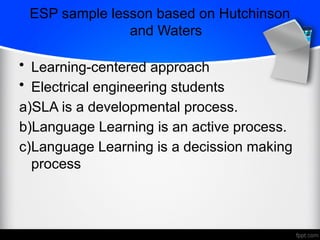
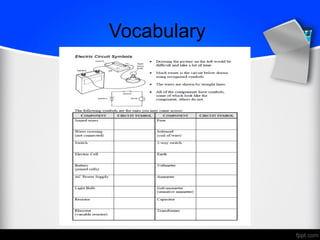
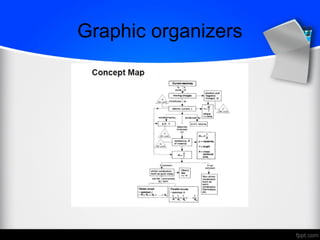
ESP sample lessonbased on Hutchinson
and Waters
• Learning-centered approach
• Electrical engineering students
a)SLA is a developmental process.
b)Language Learning is an active process.
c)Language Learning is a decission making
process
References
•
•
• Belcher, DianeD. (2004). Trends in teaching English for specific purposes. Annual Review of Applied Linguistics,
24, 165-186.
• Brunton, M.(2009). An account of ESP – with possible future directions. English for Specific Purposes Issue 3
(24), Volume 8. Retrieved June 20, 2013, from
http://www.esp-world.info/Articles_24/An%20account%20of%20ESP.pdf
• Gatehouse, K. (2001, October). Key Issues in English for Specific Purposes (ESP) Curriculum Development. The
Internet TESL Journal, Vol. VII, No. 10. Retrieved June, 24, 2013, from
http://iteslj.org/Articles/Gatehouse-ESP.html
• Hutchinson, T. & Waters, A. (1987). English for specific purposes: A learning-centered
• approach. Cambridge, Cambridge University Press.
• Longman Dictionary of Language Teaching and Applied Linguistics, Fourth edition published in Great Britain in
2010.
• Paltridge, B., & Startfield, S. (Eds). (2013). The Handbook of English for Specific Purposes.UK: Wiley-Blackwell.
• Shrivastava, A. (2009). English for specific purposes: its meaning and importance in Present Indian scenario. ESP
World, Issue 1 (22), Volume 8. Retrieved June 20, 2013, from
http://www.esp-world.info/Articles_38/ESP_in_India_Ravindra_Tasildar.pdf
• Swales, John. (1992). Language for specific purposes. In W. Bright (Ed.), International encyclopedia of linguistics
(Vol. 2, p. 300). New York, Oxford: Oxford University Press.




![[ESP] Definitions, Characteristics, and Principles of English for Specific Pu...](https://cdn.slidesharecdn.com/ss_thumbnails/module1unit1espmutiahnovi-150530223136-lva1-app6891-thumbnail.jpg?width=640&height=640&fit=bounds)


