DAILY
LESSON
LOG
SY 2022-
2023
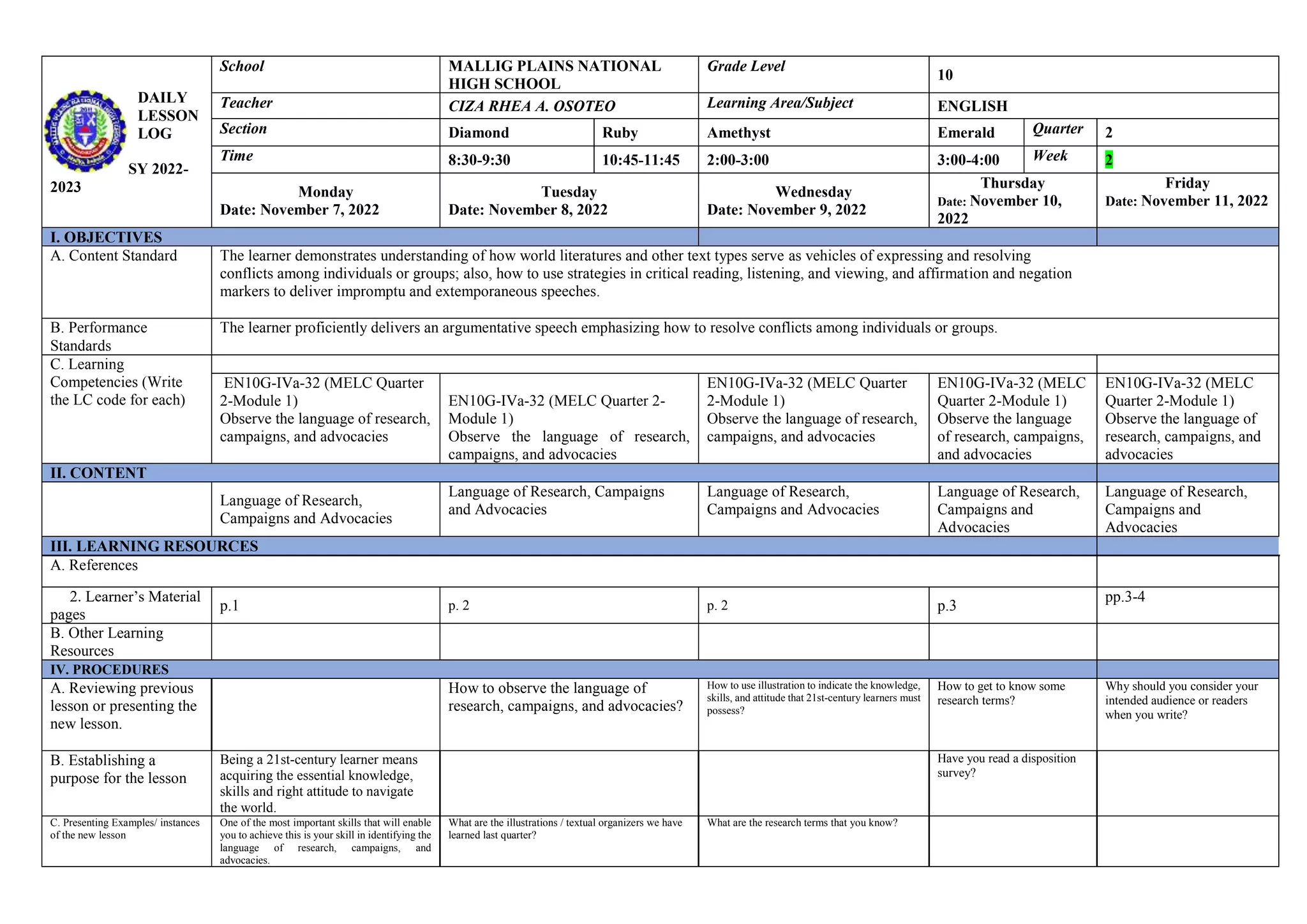
School MALLIG PLAINS NATIONAL
HIGH SCHOOL
Grade Level
10
Teacher CIZA RHEA A. OSOTEO Learning Area/Subject ENGLISH
Section Diamond Ruby Amethyst Emerald Quarter 2
Time 8:30-9:30 10:45-11:45 2:00-3:00 3:00-4:00 Week 2
Monday
Date: November 7, 2022
Tuesday
Date: November 8, 2022
Wednesday
Date: November 9, 2022
Thursday
Date: November 10,
2022
Friday
Date: November 11, 2022
I. OBJECTIVES
A. Content Standard The learner demonstrates understanding of how world literatures and other text types serve as vehicles of expressing and resolving
conflicts among individuals or groups; also, how to use strategies in critical reading, listening, and viewing, and affirmation and negation
markers to deliver impromptu and extemporaneous speeches.
B. Performance
Standards
The learner proficiently delivers an argumentative speech emphasizing how to resolve conflicts among individuals or groups.
C. Learning
Competencies (Write
the LC code for each)
EN10G-IVa-32 (MELC Quarter
2-Module 1)
Observe the language of research,
campaigns, and advocacies
EN10G-IVa-32 (MELC Quarter 2-
Module 1)
Observe the language of research,
campaigns, and advocacies
EN10G-IVa-32 (MELC Quarter
2-Module 1)
Observe the language of research,
campaigns, and advocacies
EN10G-IVa-32 (MELC
Quarter 2-Module 1)
Observe the language
of research, campaigns,
and advocacies
EN10G-IVa-32 (MELC
Quarter 2-Module 1)
Observe the language of
research, campaigns, and
advocacies
II. CONTENT
Language of Research,
Campaigns and Advocacies
Language of Research, Campaigns
and Advocacies
Language of Research,
Campaigns and Advocacies
Language of Research,
Campaigns and
Advocacies
Language of Research,
Campaigns and
Advocacies
III. LEARNING RESOURCES
A. References
2. Learner’s Material
pages
p.1 p. 2 p. 2 p.3
pp.3-4
B. Other Learning
Resources
IV. PROCEDURES
A. Reviewing previous
lesson or presenting the
new lesson.
How to observe the language of
research, campaigns, and advocacies?
How to use illustration to indicate the knowledge,
skills, and attitude that 21st-century learners must
possess?
How to get to know some
research terms?
Why should you consider your
intended audience or readers
when you write?
B. Establishing a
purpose for the lesson
Being a 21st-century learner means
acquiring the essential knowledge,
skills and right attitude to navigate
the world.
Have you read a disposition
survey?
C. Presenting Examples/ instances
of the new lesson
One of the most important skills that will enable
you to achieve this is your skill in identifying the
language of research, campaigns, and
advocacies.
What are the illustrations / textual organizers we have
learned last quarter?
What are the research terms that you know?
D. Discussing new concepts and
practicing new skills #1
E. Discussing new concepts and
practicing new skills #2
What comes to your mind when you hear
language of research?
How illustrations help in organizing your thoughts
about a certain idea?
What is research? Reading of the Questions to
answer:
1.Based on your responses, what is
your view of the writing process?
2.Is writing a solitary or social
affair?
3.Why should you consider your
intended audience or readers when
you write?
F. Developing mastery
(Leads to Formative Assessment
3)
Sharing of ideas about language of research.
Sharing of ideas about illustrations in organizing your
thoughts about a certain idea
G. Finding practical applications
of concepts and skills in daily
living
(Integration)
How to observe the language of research,
campaigns, and advocacies with honesty and
punctuality?
How to observe the language of research, campaigns,
and advocacies with honesty and punctuality?
How to observe the language of research,
campaigns, and advocacies with honesty and
punctuality?
Why should you consider honesty
in answering a disposition survey?
What you have learned about
academic honesty?
H. Making generalizations and
abstractions about the lesson
How to observe the language of research,
campaigns, and advocacies?
How to use illustration to indicate the knowledge, skills,
and attitude that 21st-century learners must possess?
How to get to know some research terms? Why should you consider your
intended audience or readers when
you write?
I. Evaluating learning
Task 1. Learning in the 21st Century
Being a 21st-century learner means acquiring
the essential knowledge, skills and right attitude
to navigate the world. One of the most
important skills that will enable you to achieve
this is your skill in identifying the language of
research, campaigns, and advocacies.
HE BOX portion to answer this question:
In what way can identifying the language of
research, campaigns and advocacies help you
achieve 21st-century skills?
Page 2
Task 2. Portrait of 21st-Century Leaners
Use the illustration below to indicate the knowledge,
skills, and attitude that 21st-century learners must
possess.
Page 2
Task 3. Make and Match
Get to know some research terms. Match the
descriptions in Column A with the corresponding
section names listed in Column B.
Page 2
Task 4. Let’s Write!
A. Getting Ready to
Write. Before you set out to write
your draft, answer the writing
disposition survey found below.
Place a check mark on the response
that best describes how you
generally feel toward writing. To
what extent do you agree or
disagree with the following
statements?
1-Strongly Disagree 2-Disagree
3- Neither agree or disagree
4-Agree
5-Strongly Agree
B. Cite it Right! Review
what you have learned about
academic honesty. Read the
statements below and write A if the
act shows academic honesty and P if
otherwise.
J. Additional activities for
application or remediation
V. REMARKS
VI. REFLECTION
Prepared by: Checked by:
CIZA RHEA A. OSOTEO, PhD RL EVELYN M. TAGULAO, MAEd
Teacher III Teacher In-Charge

English 10 Nov. 7-11.docx

  • 1.
    DAILY LESSON LOG SY 2022- 2023 School MALLIGPLAINS NATIONAL HIGH SCHOOL Grade Level 10 Teacher CIZA RHEA A. OSOTEO Learning Area/Subject ENGLISH Section Diamond Ruby Amethyst Emerald Quarter 2 Time 8:30-9:30 10:45-11:45 2:00-3:00 3:00-4:00 Week 2 Monday Date: November 7, 2022 Tuesday Date: November 8, 2022 Wednesday Date: November 9, 2022 Thursday Date: November 10, 2022 Friday Date: November 11, 2022 I. OBJECTIVES A. Content Standard The learner demonstrates understanding of how world literatures and other text types serve as vehicles of expressing and resolving conflicts among individuals or groups; also, how to use strategies in critical reading, listening, and viewing, and affirmation and negation markers to deliver impromptu and extemporaneous speeches. B. Performance Standards The learner proficiently delivers an argumentative speech emphasizing how to resolve conflicts among individuals or groups. C. Learning Competencies (Write the LC code for each) EN10G-IVa-32 (MELC Quarter 2-Module 1) Observe the language of research, campaigns, and advocacies EN10G-IVa-32 (MELC Quarter 2- Module 1) Observe the language of research, campaigns, and advocacies EN10G-IVa-32 (MELC Quarter 2-Module 1) Observe the language of research, campaigns, and advocacies EN10G-IVa-32 (MELC Quarter 2-Module 1) Observe the language of research, campaigns, and advocacies EN10G-IVa-32 (MELC Quarter 2-Module 1) Observe the language of research, campaigns, and advocacies II. CONTENT Language of Research, Campaigns and Advocacies Language of Research, Campaigns and Advocacies Language of Research, Campaigns and Advocacies Language of Research, Campaigns and Advocacies Language of Research, Campaigns and Advocacies III. LEARNING RESOURCES A. References 2. Learner’s Material pages p.1 p. 2 p. 2 p.3 pp.3-4 B. Other Learning Resources IV. PROCEDURES A. Reviewing previous lesson or presenting the new lesson. How to observe the language of research, campaigns, and advocacies? How to use illustration to indicate the knowledge, skills, and attitude that 21st-century learners must possess? How to get to know some research terms? Why should you consider your intended audience or readers when you write? B. Establishing a purpose for the lesson Being a 21st-century learner means acquiring the essential knowledge, skills and right attitude to navigate the world. Have you read a disposition survey? C. Presenting Examples/ instances of the new lesson One of the most important skills that will enable you to achieve this is your skill in identifying the language of research, campaigns, and advocacies. What are the illustrations / textual organizers we have learned last quarter? What are the research terms that you know?
  • 2.
    D. Discussing newconcepts and practicing new skills #1 E. Discussing new concepts and practicing new skills #2 What comes to your mind when you hear language of research? How illustrations help in organizing your thoughts about a certain idea? What is research? Reading of the Questions to answer: 1.Based on your responses, what is your view of the writing process? 2.Is writing a solitary or social affair? 3.Why should you consider your intended audience or readers when you write? F. Developing mastery (Leads to Formative Assessment 3) Sharing of ideas about language of research. Sharing of ideas about illustrations in organizing your thoughts about a certain idea G. Finding practical applications of concepts and skills in daily living (Integration) How to observe the language of research, campaigns, and advocacies with honesty and punctuality? How to observe the language of research, campaigns, and advocacies with honesty and punctuality? How to observe the language of research, campaigns, and advocacies with honesty and punctuality? Why should you consider honesty in answering a disposition survey? What you have learned about academic honesty? H. Making generalizations and abstractions about the lesson How to observe the language of research, campaigns, and advocacies? How to use illustration to indicate the knowledge, skills, and attitude that 21st-century learners must possess? How to get to know some research terms? Why should you consider your intended audience or readers when you write? I. Evaluating learning Task 1. Learning in the 21st Century Being a 21st-century learner means acquiring the essential knowledge, skills and right attitude to navigate the world. One of the most important skills that will enable you to achieve this is your skill in identifying the language of research, campaigns, and advocacies. HE BOX portion to answer this question: In what way can identifying the language of research, campaigns and advocacies help you achieve 21st-century skills? Page 2 Task 2. Portrait of 21st-Century Leaners Use the illustration below to indicate the knowledge, skills, and attitude that 21st-century learners must possess. Page 2 Task 3. Make and Match Get to know some research terms. Match the descriptions in Column A with the corresponding section names listed in Column B. Page 2 Task 4. Let’s Write! A. Getting Ready to Write. Before you set out to write your draft, answer the writing disposition survey found below. Place a check mark on the response that best describes how you generally feel toward writing. To what extent do you agree or disagree with the following statements? 1-Strongly Disagree 2-Disagree 3- Neither agree or disagree 4-Agree 5-Strongly Agree B. Cite it Right! Review what you have learned about academic honesty. Read the statements below and write A if the act shows academic honesty and P if otherwise. J. Additional activities for application or remediation V. REMARKS VI. REFLECTION Prepared by: Checked by: CIZA RHEA A. OSOTEO, PhD RL EVELYN M. TAGULAO, MAEd Teacher III Teacher In-Charge