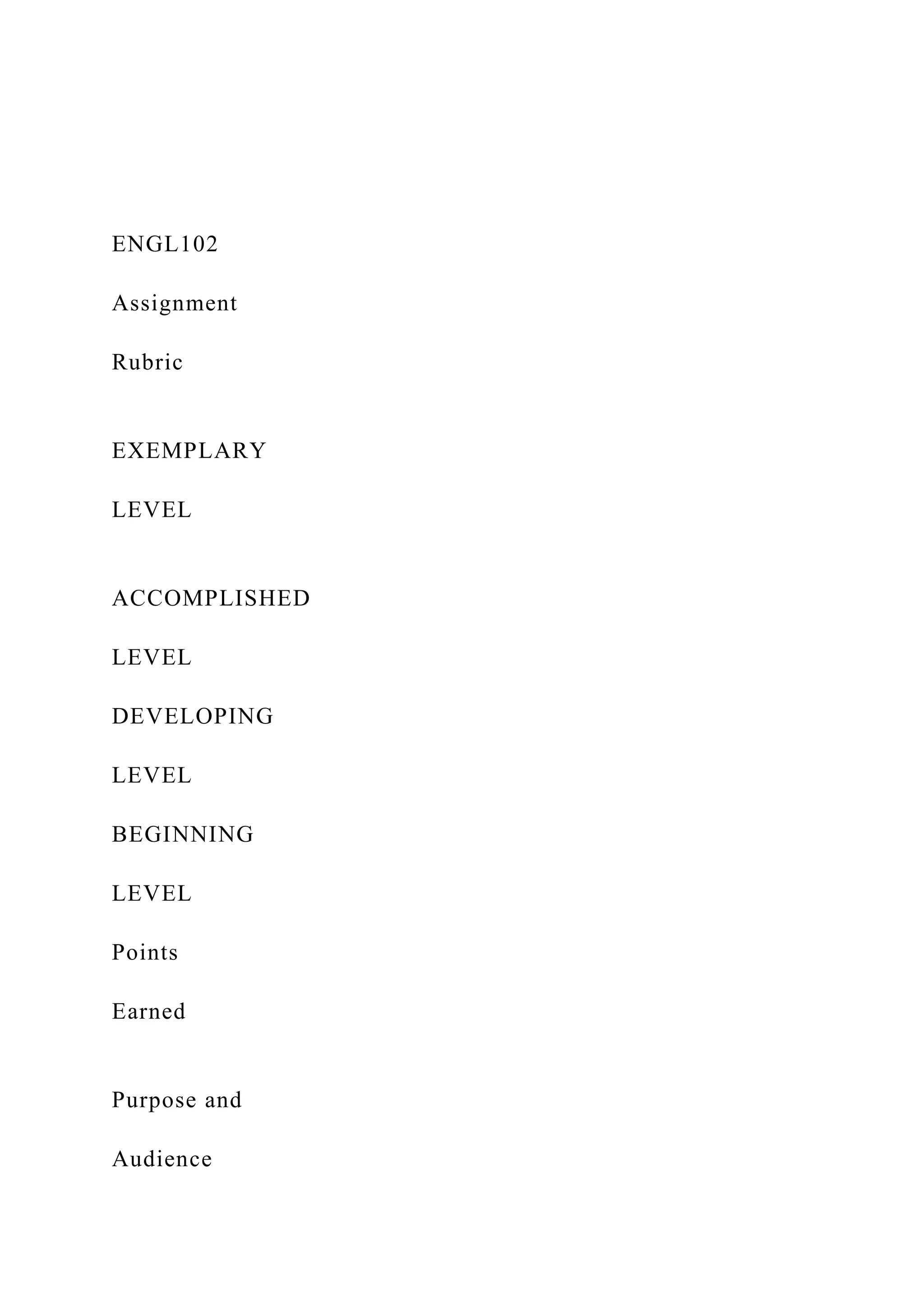
ENGL102
Assignment
Rubric
EXEMPLARY
LEVEL
ACCOMPLISHED
LEVEL
DEVELOPING
LEVEL
BEGINNING
LEVEL
Points
Earned
Purpose and
Audience
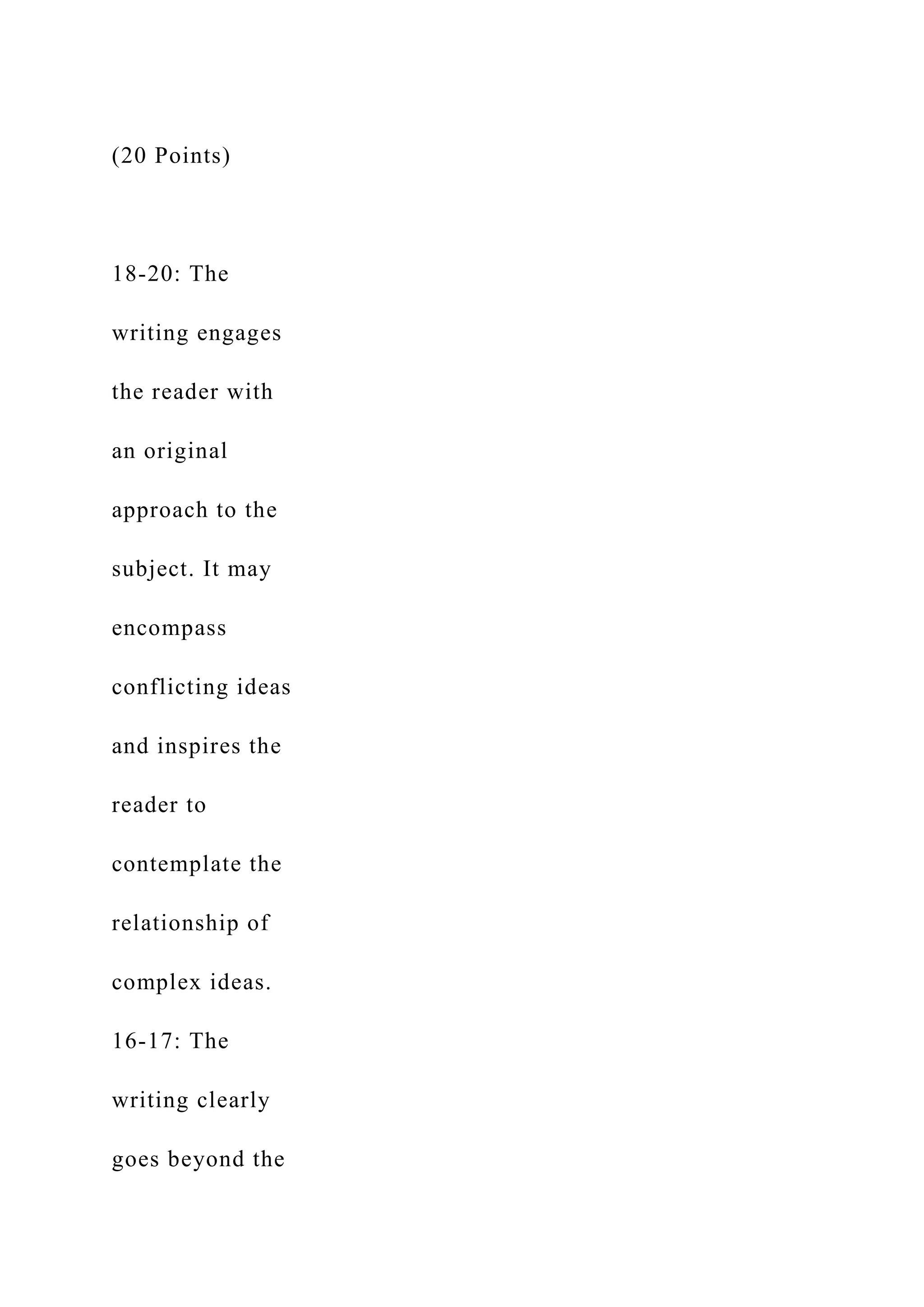
(20 Points)
18-20: The
writing engages
the reader with
an original
approach to the
subject. It may
encompass
conflicting ideas
and inspires the
reader to
contemplate the
relationship of
complex ideas.
16-17: The
writing clearly
goes beyond the
minimum
requirements of
the assignment.
It attempts to
engage the
reader through
originality and
presentation of
complex ideas.
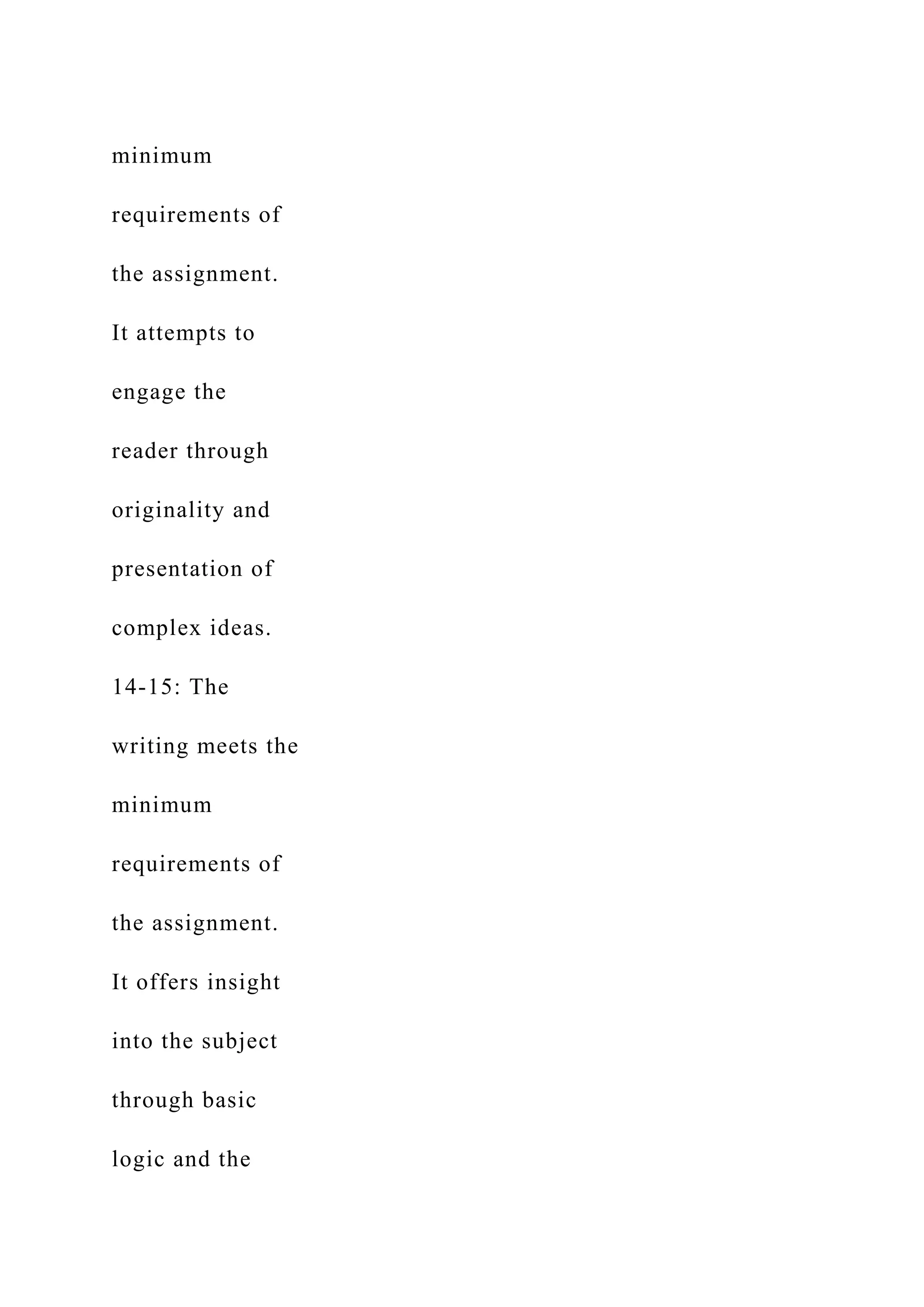
14-15: The
writing meets the
minimum
requirements of
the assignment.
It offers insight
into the subject
through basic
logic and the
presentation of
ideas based on
some evidence.
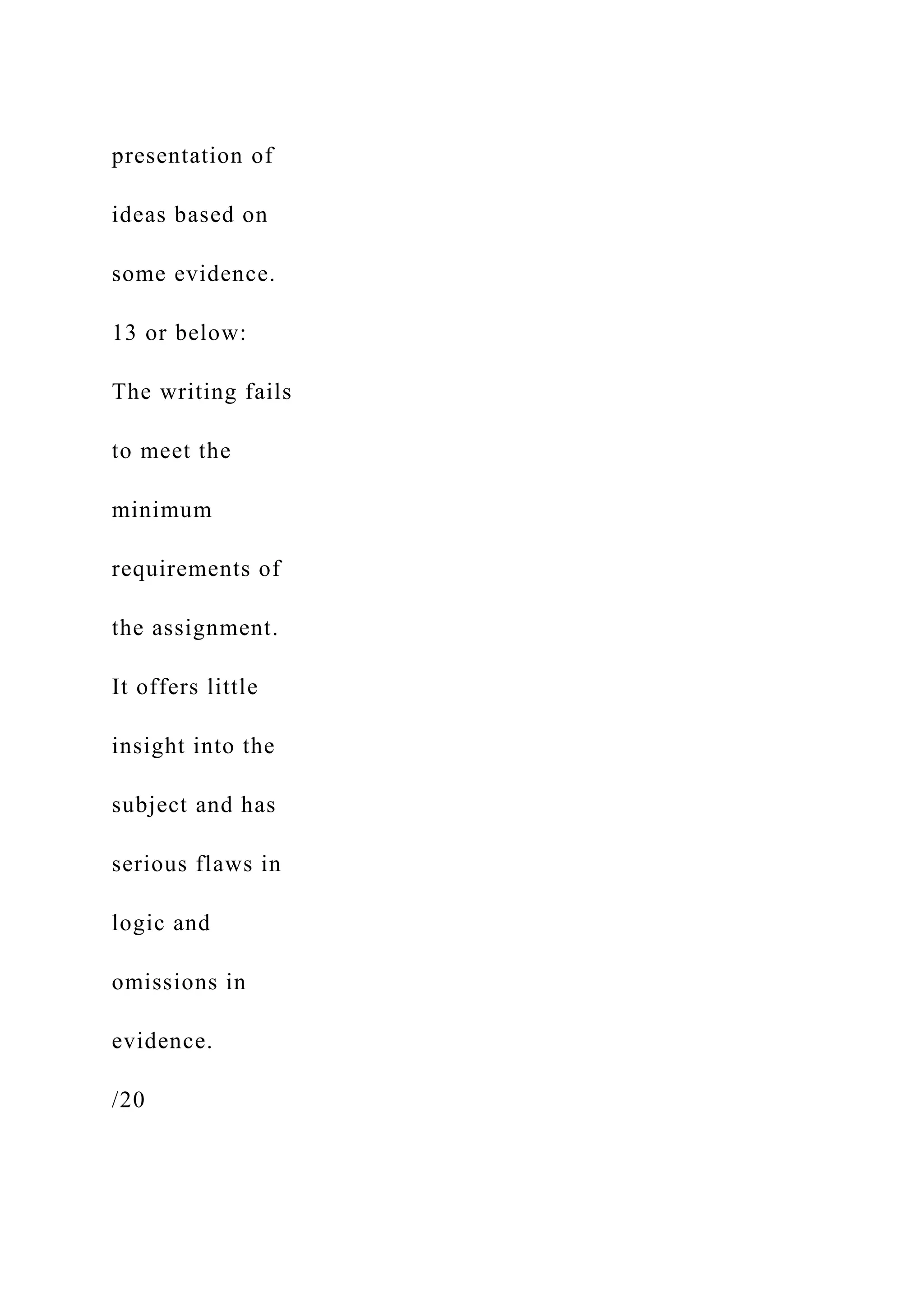
13 or below:
The writing fails
to meet the
minimum
requirements of
the assignment.
It offers little
insight into the
subject and has
serious flaws in
logic and
omissions in
evidence.
/20
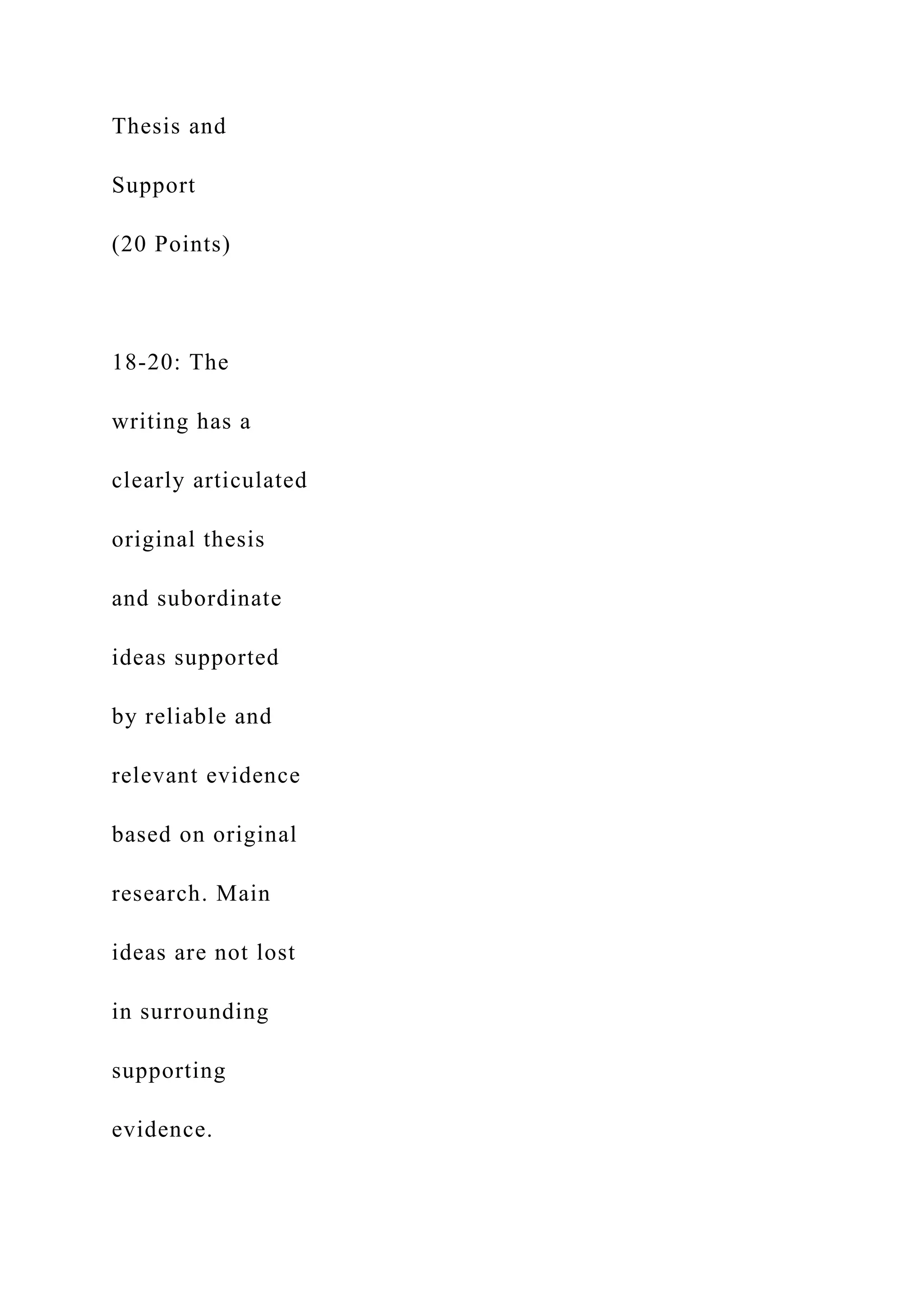
Thesis and
Support
(20 Points)
18-20: The
writing has a
clearly articulated
original thesis
and subordinate
ideas supported
by reliable and
relevant evidence
based on original
research. Main
ideas are not lost
in surrounding
supporting
evidence.
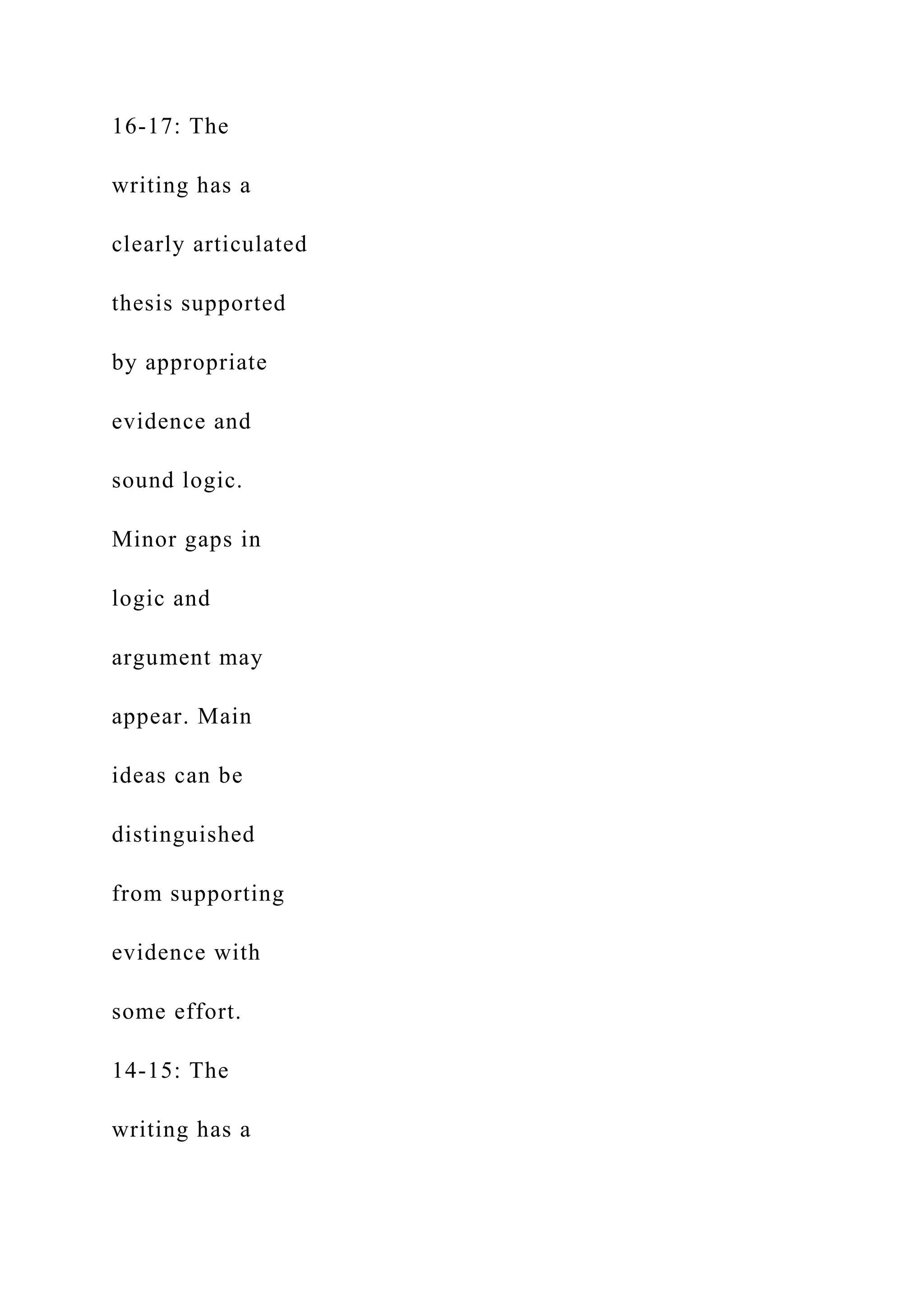
16-17: The
writing has a
clearly articulated
thesis supported
by appropriate
evidence and
sound logic.
Minor gaps in
logic and
argument may
appear. Main
ideas can be
distinguished
from supporting
evidence with
some effort.
14-15: The
writing has a
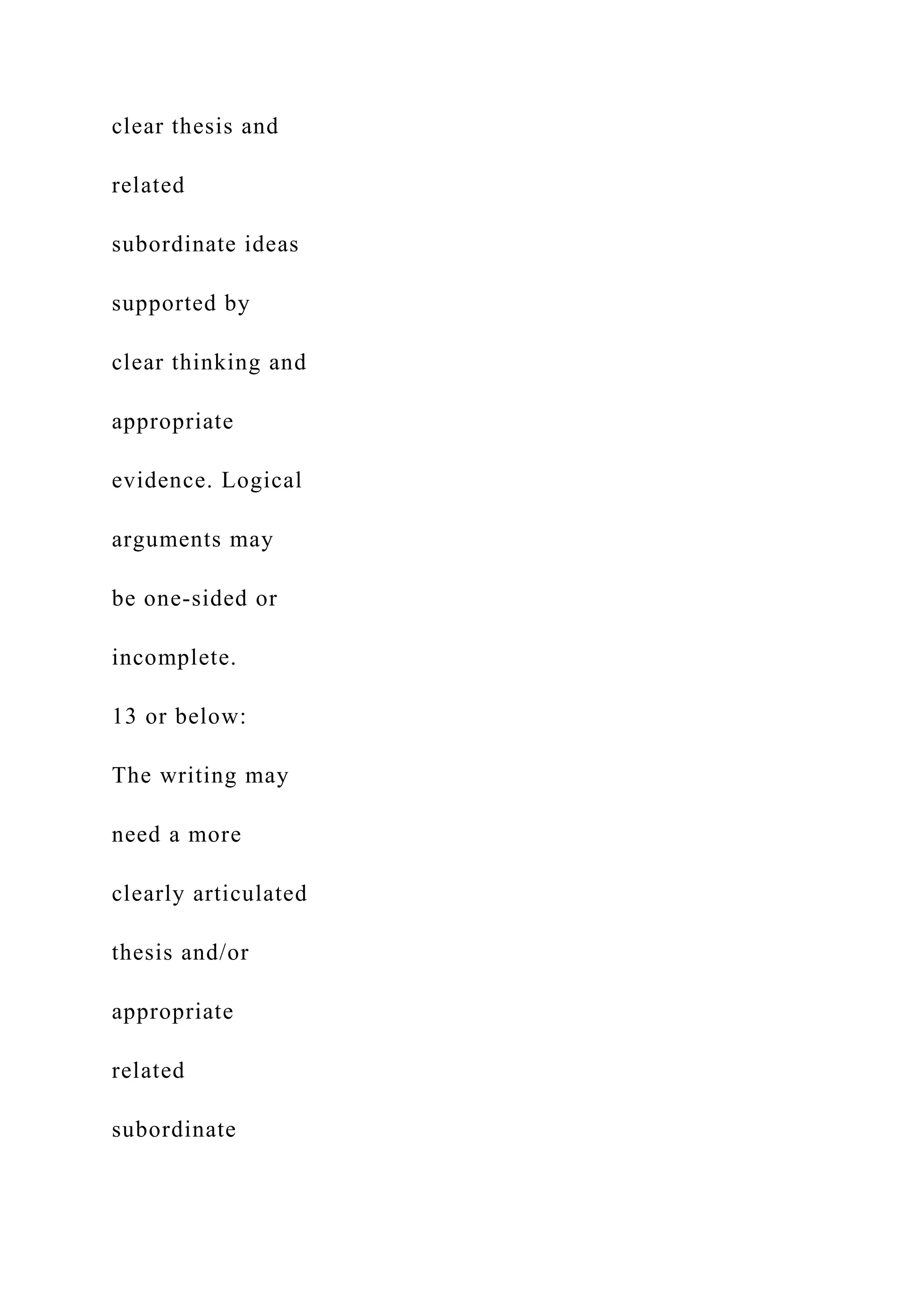
clear thesis and
related
subordinate ideas
supported by
clear thinking and
appropriate
evidence. Logical
arguments may
be one-sided or
incomplete.
13 or below:
The writing may
need a more
clearly articulated
thesis and/or
appropriate
related
subordinate
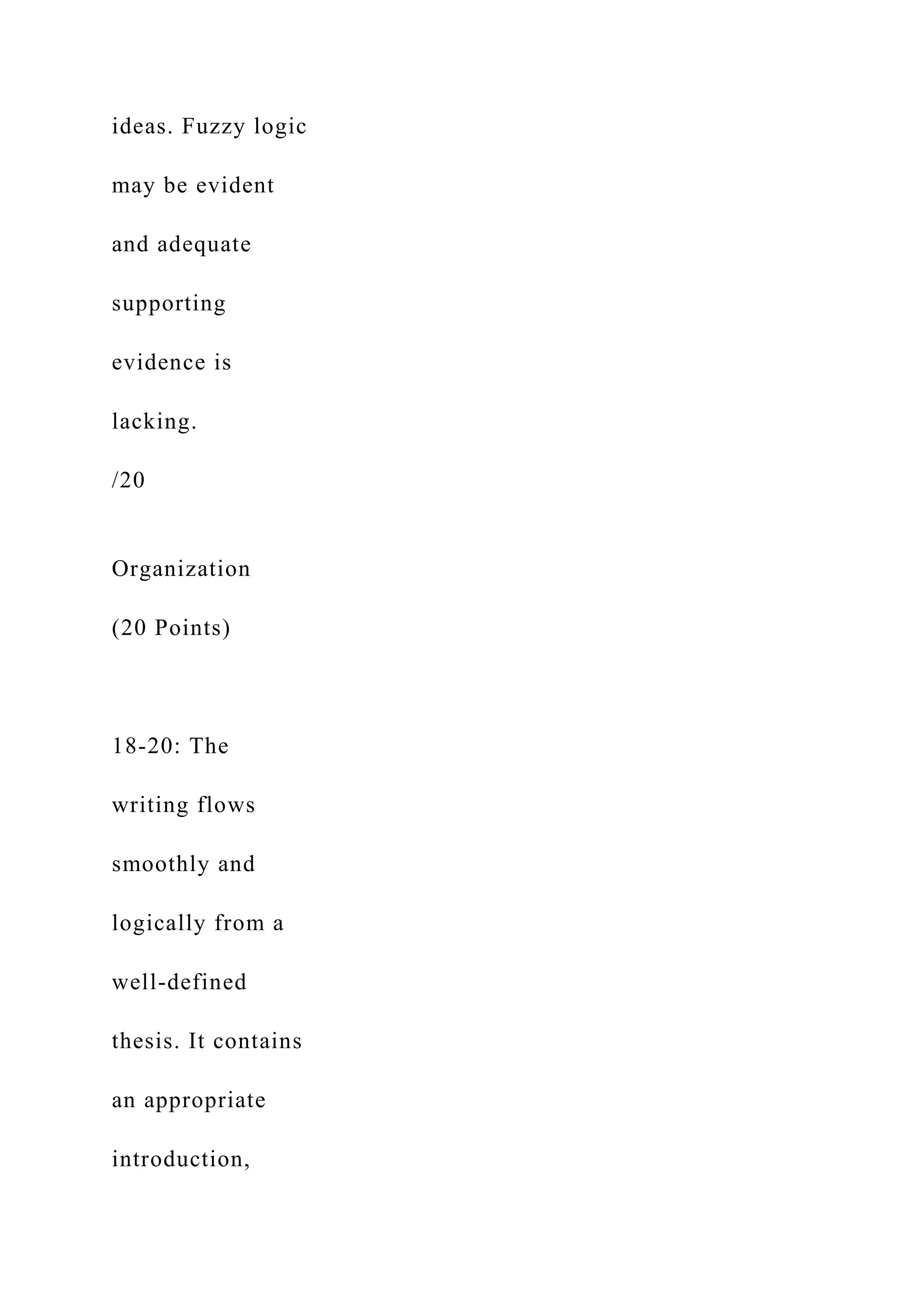
ideas. Fuzzy logic
may be evident
and adequate
supporting
evidence is
lacking.
/20
Organization
(20 Points)
18-20: The
writing flows
smoothly and
logically from a
well-defined
thesis. It contains
an appropriate
introduction,
conclusion, and
smooth
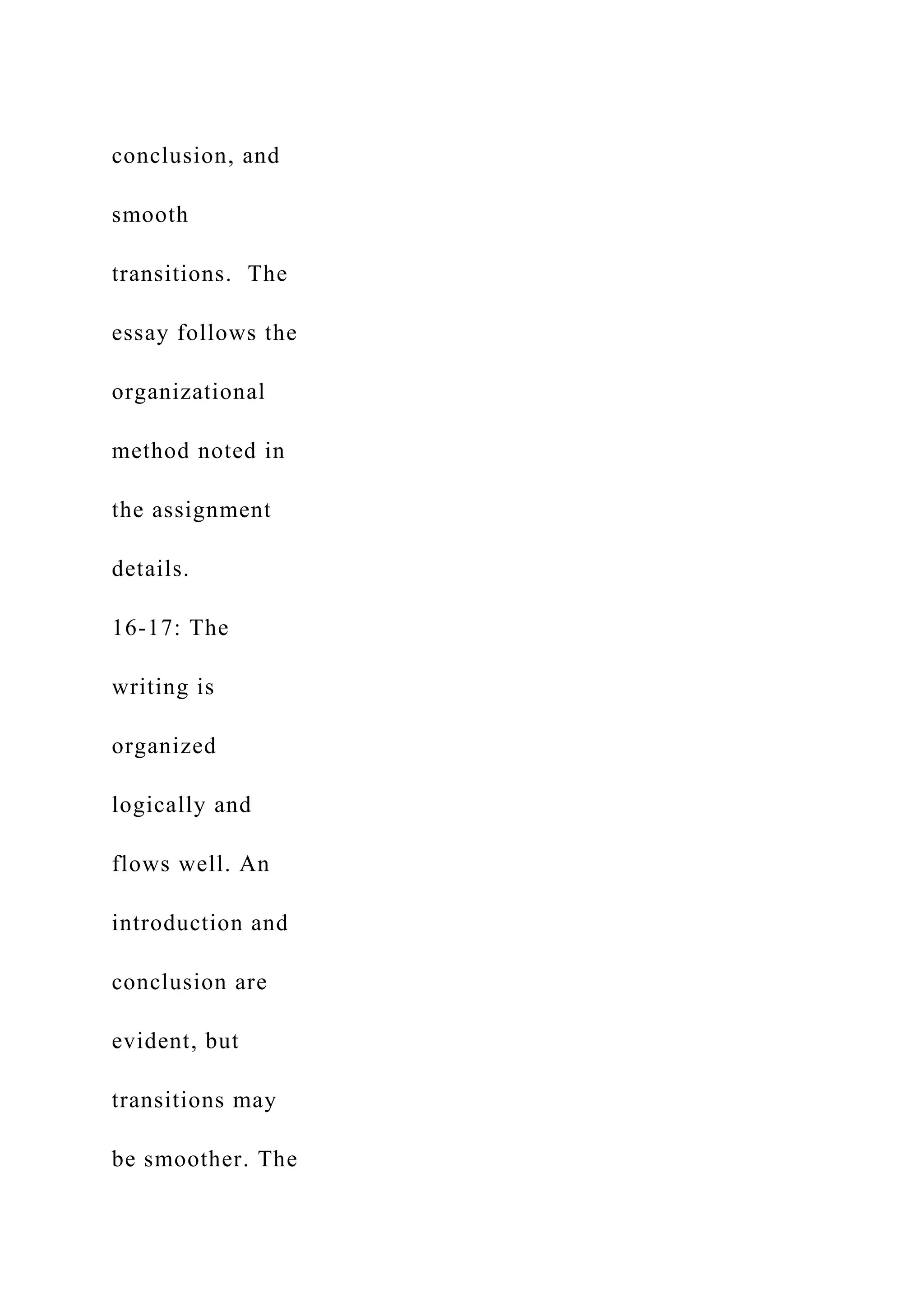
transitions. The
essay follows the
organizational
method noted in
the assignment
details.
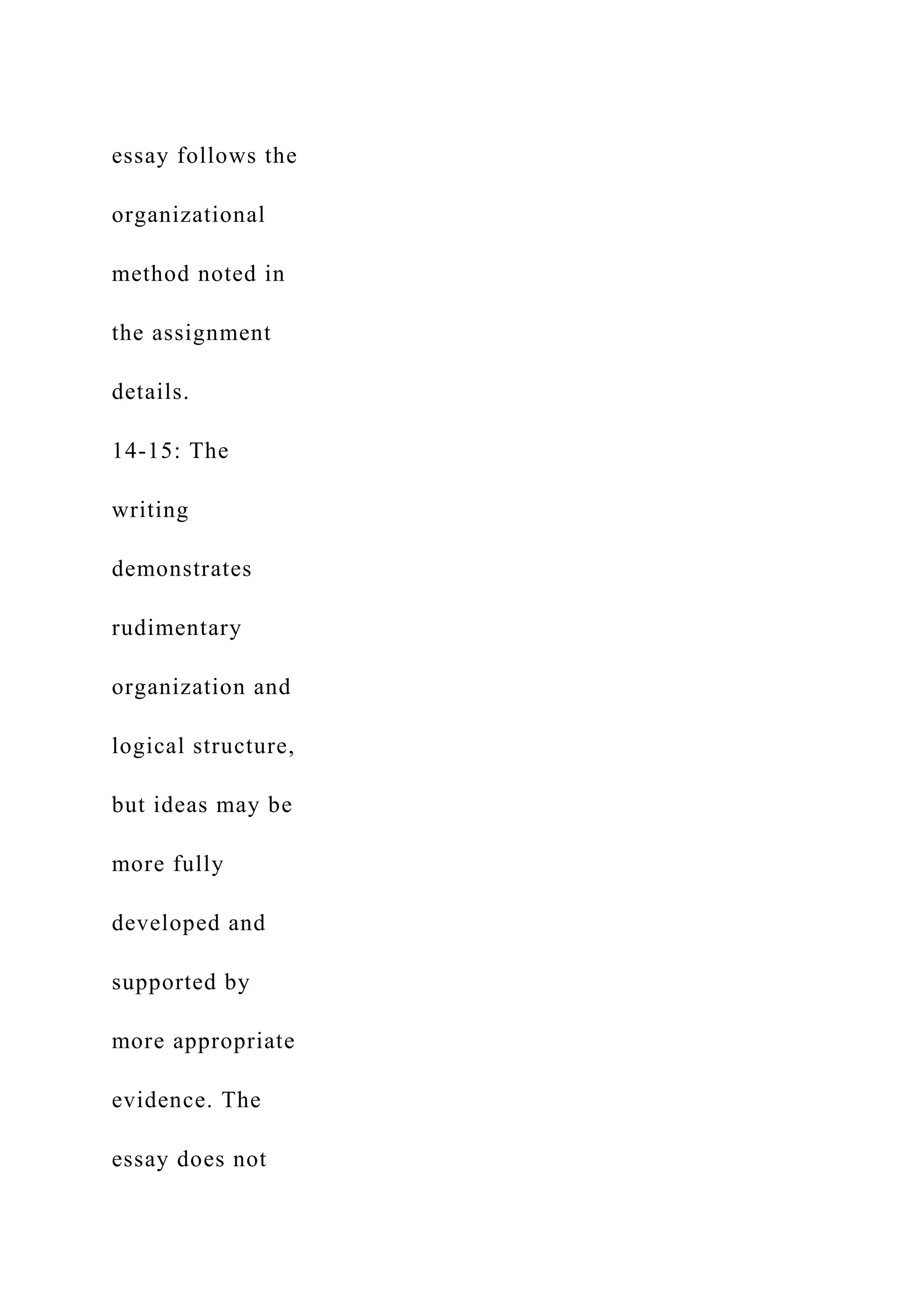
16-17: The
writing is
organized
logically and
flows well. An
introduction and
conclusion are
evident, but
transitions may
be smoother. The
essay follows the
organizational
method noted in
the assignment
details.
14-15: The
writing
demonstrates
rudimentary
organization and
logical structure,
but ideas may be
more fully
developed and
supported by
more appropriate
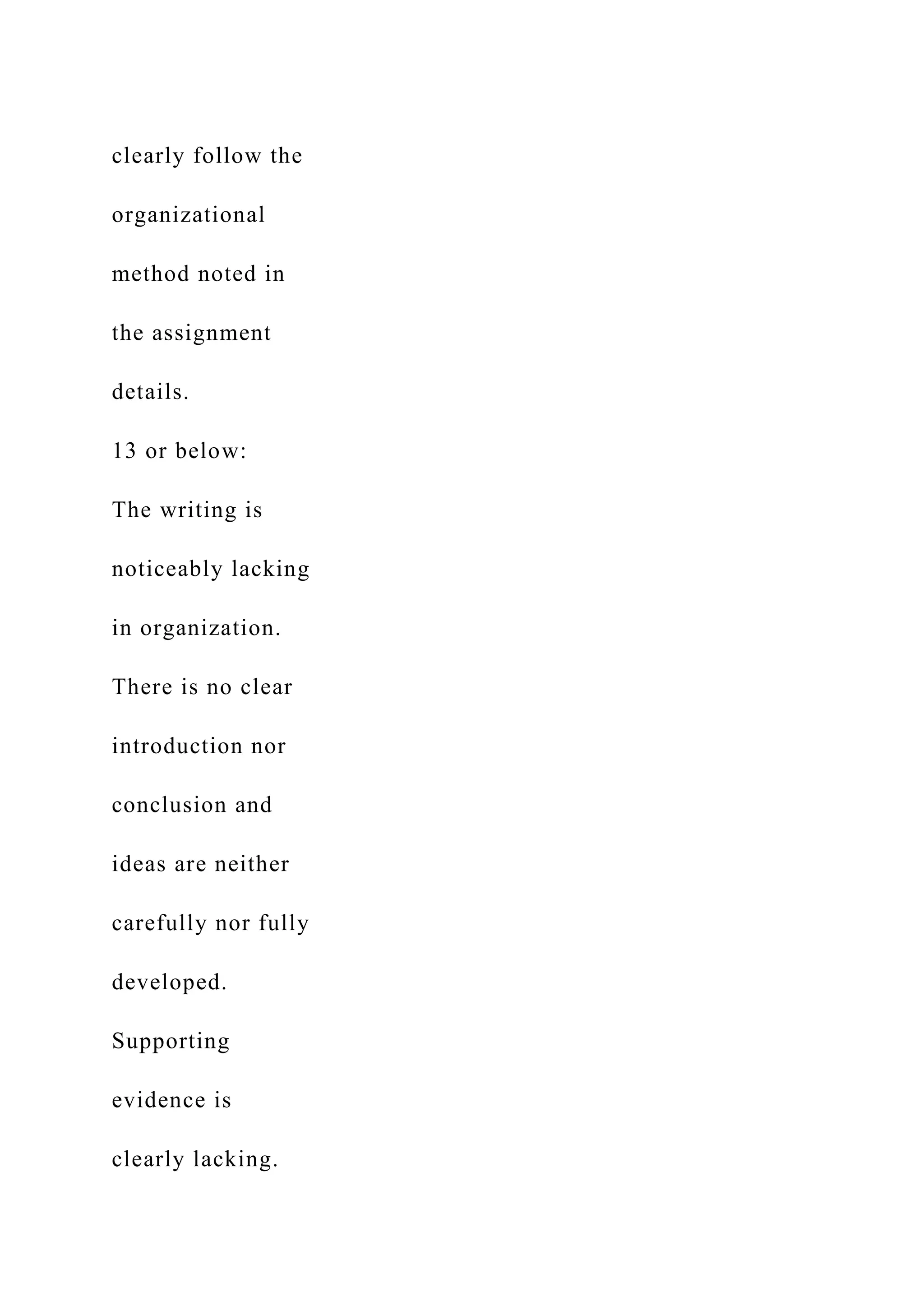
evidence. The
essay does not
clearly follow the
organizational
method noted in
the assignment
details.
13 or below:
The writing is
noticeably lacking
in organization.
There is no clear
introduction nor
conclusion and
ideas are neither
carefully nor fully
developed.
Supporting
evidence is
clearly lacking.
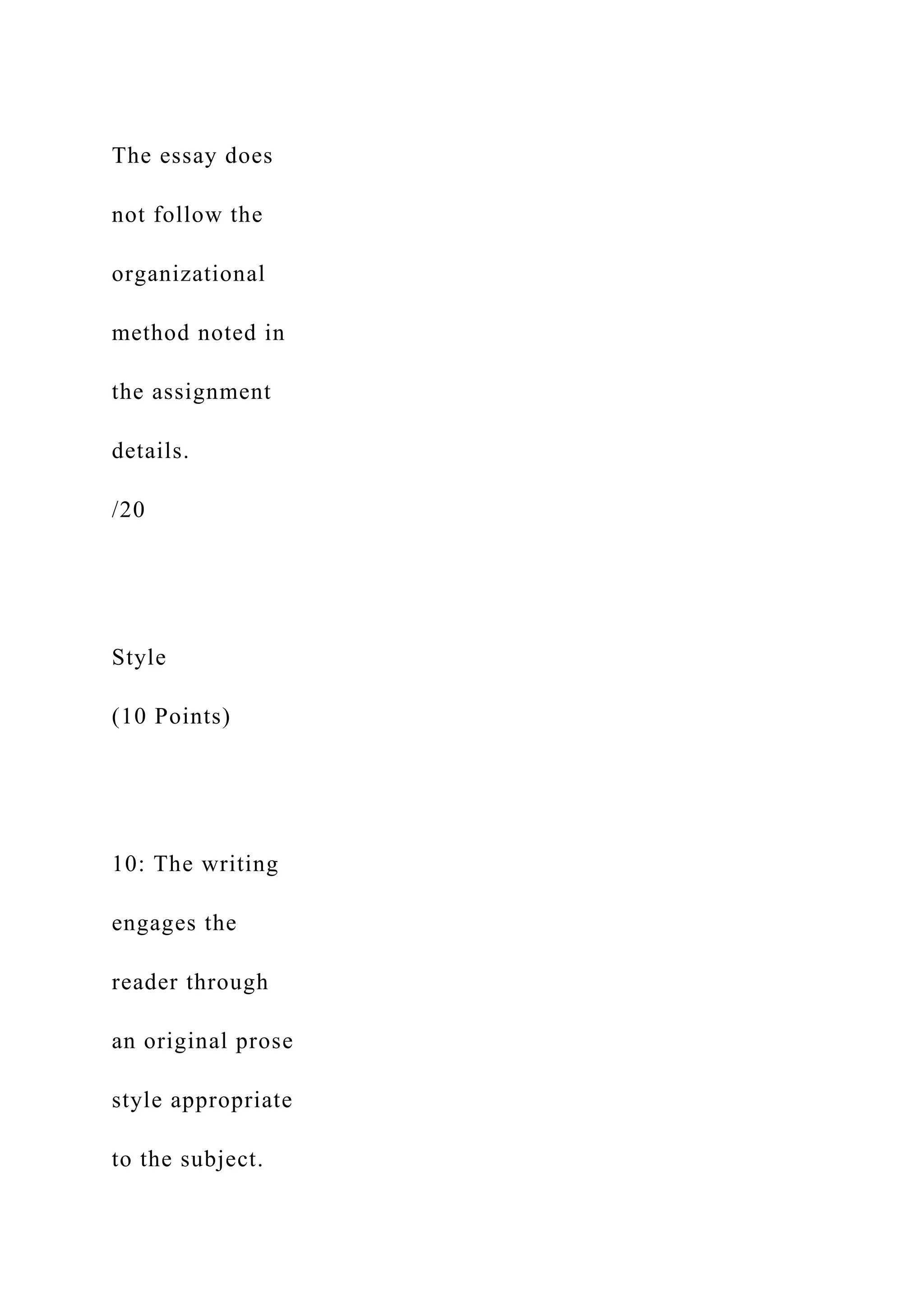
The essay does
not follow the
organizational
method noted in
the assignment
details.
/20
Style
(10 Points)
10: The writing
engages the
reader through
an original prose
style appropriate
to the subject.
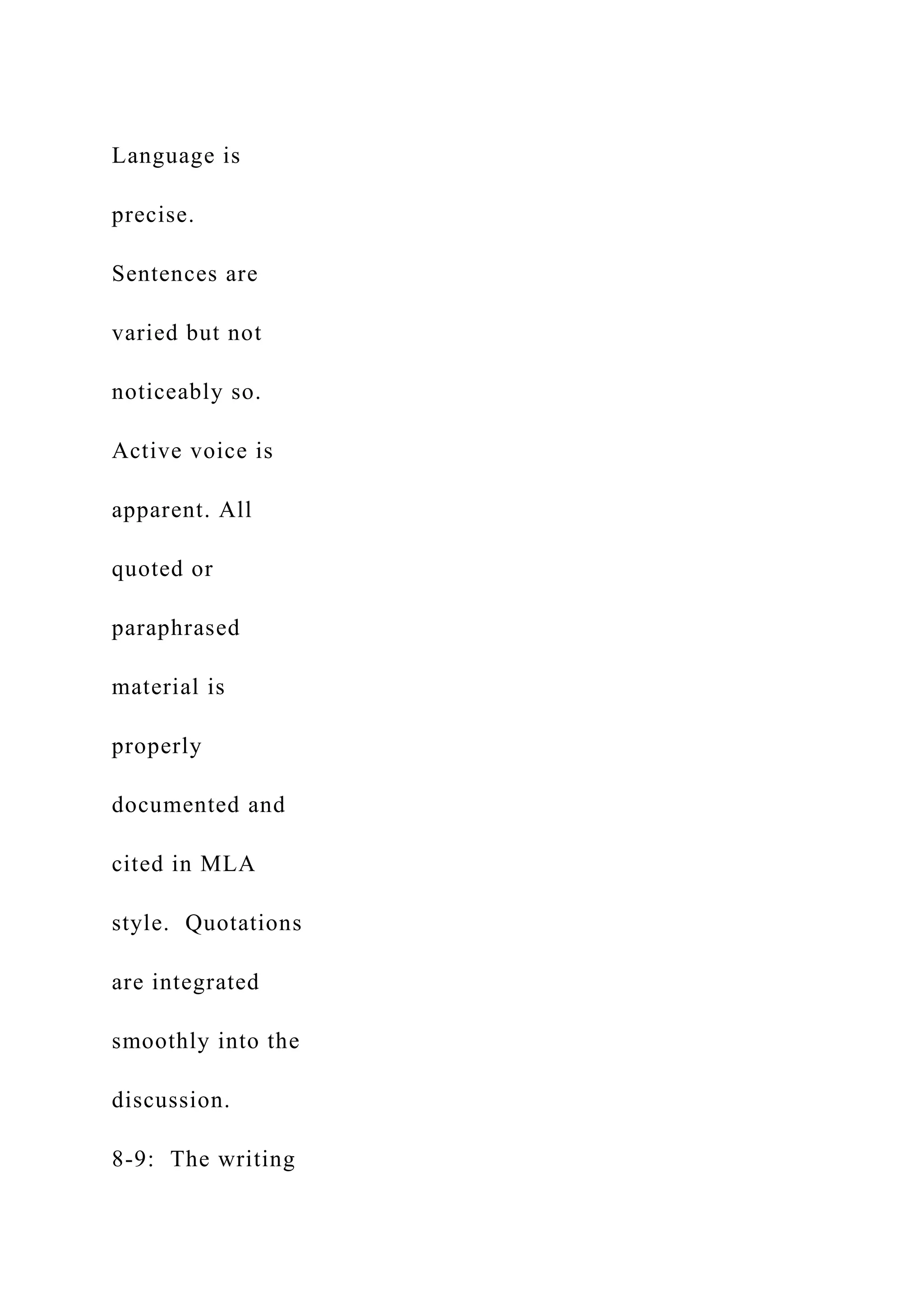
Language is
precise.
Sentences are
varied but not
noticeably so.
Active voice is
apparent. All
quoted or
paraphrased
material is
properly
documented and
cited in MLA
style. Quotations
are integrated
smoothly into the
discussion.
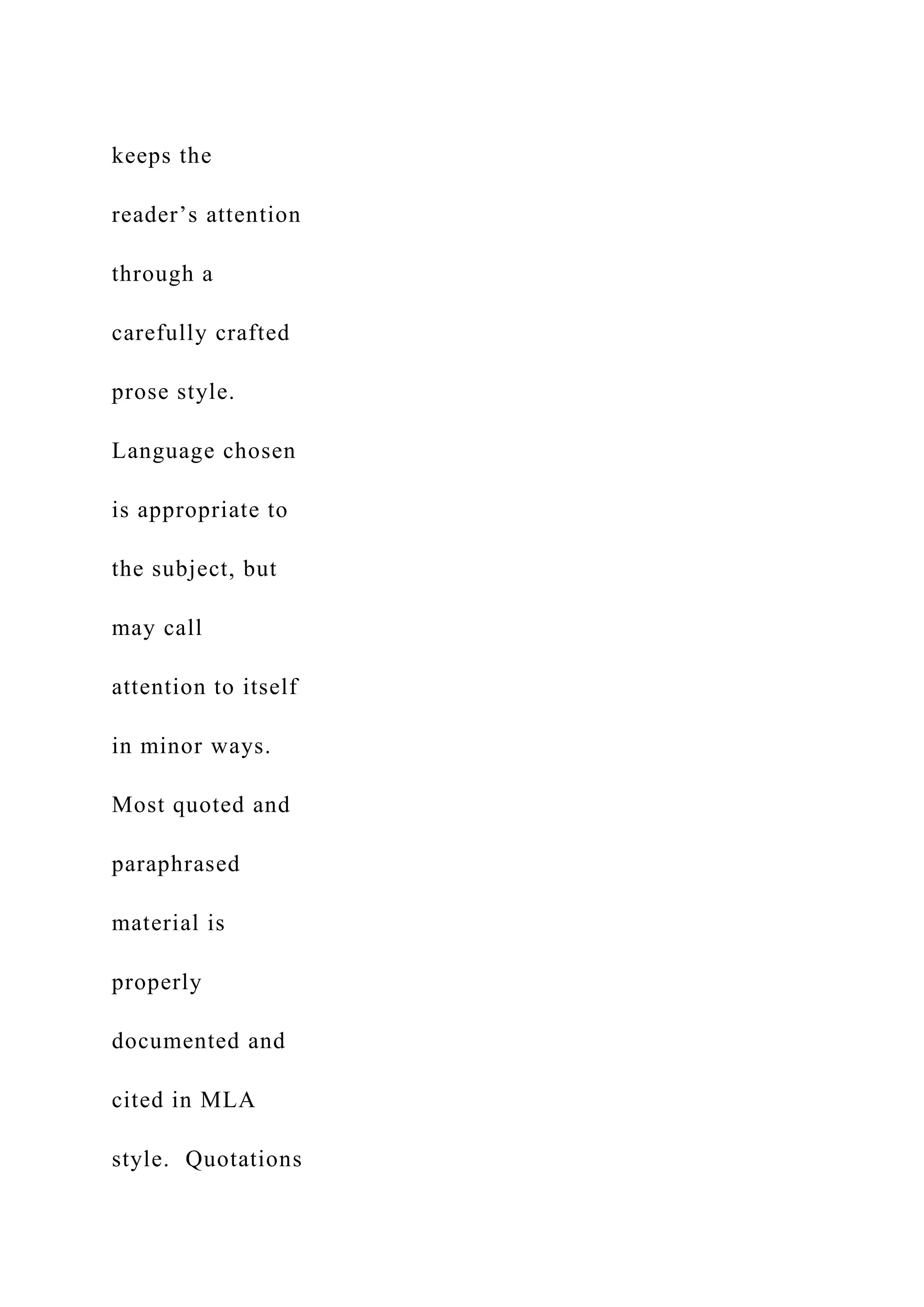
8-9: The writing
keeps the
reader’s attention
through a
carefully crafted
prose style.
Language chosen
is appropriate to
the subject, but
may call
attention to itself
in minor ways.
Most quoted and
paraphrased
material is
properly
documented and
cited in MLA
style. Quotations
are integrated
into the
discussion
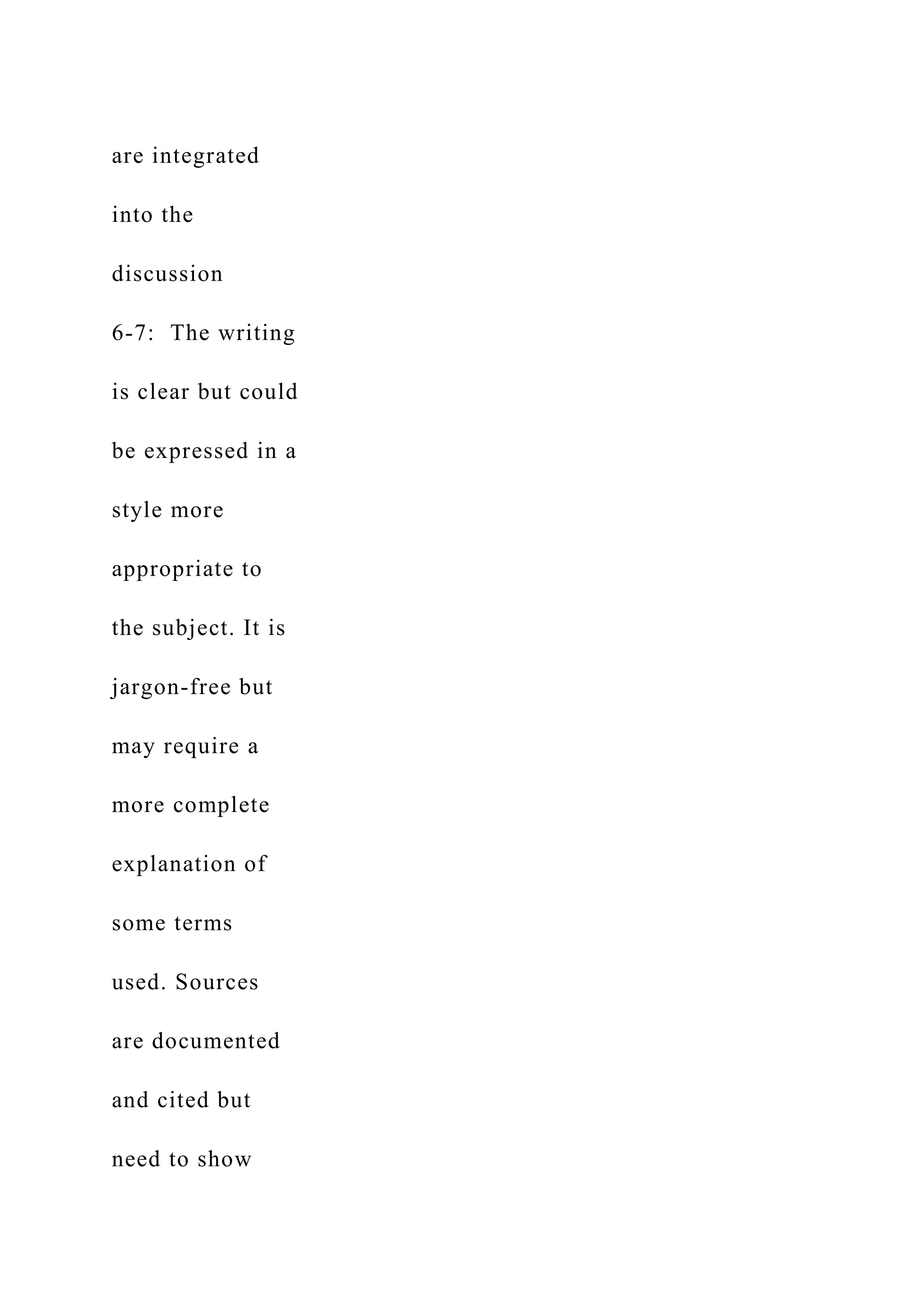
6-7: The writing
is clear but could
be expressed in a
style more
appropriate to
the subject. It is
jargon-free but
may require a
more complete
explanation of
some terms
used. Sources
are documented
and cited but
need to show
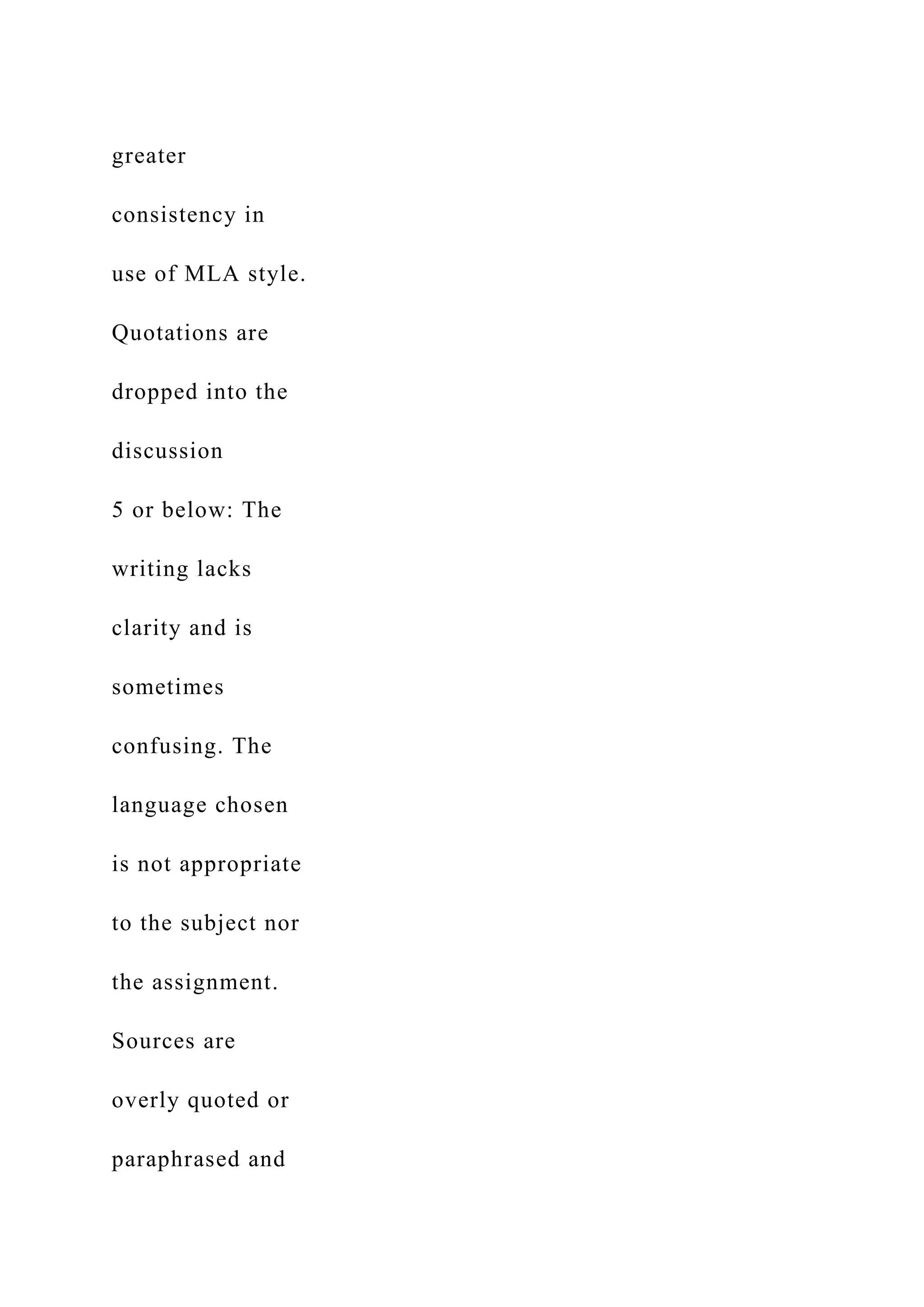
greater
consistency in
use of MLA style.
Quotations are
dropped into the
discussion
5 or below: The
writing lacks
clarity and is
sometimes
confusing. The
language chosen
is not appropriate
to the subject nor
the assignment.
Sources are
overly quoted or
paraphrased and
not adequately
documented nor
cited in MLA
style. Quotations
appear out of
place and/or are
dropped into the
discussion
/10
Research
(10 Points)
10: The essay
utilizes strong
and academic
research (mainly
peer-reviewed
articles), and
these sources
strengthen the
essay’s claim.
The essay meets
or exceeds the
required number
of sources, as
stated in the
assignment
details.
8-9: The essay
utilizes academic
research (mainly
peer-reviewed
articles), and
these sources
strengthen the
essay’s claim.
The essay meets
the required
number of
sources, as
stated in the
assignment
details.
6-7: There is
research within
the essay, but
most of the
sources are not
peer-reviewed.
These sources do
not serve to
strengthen the
essay’s claim.
Instead, the
research serves
as filler. The
essay does not
meet the
required number
of sources, as
stated in the
assignment
details.
5 or below: The
research is
lacking in the
essay and/or is
missing
altogether. The
essay does not
meet the
required number
of sources as
stated in the
assignment
details
/10
Grammar and
Mechanics
(10 Points)
10: The writing is
free of
proofreading
errors. The
writing contains
sentences that
are always
complete and
grammatically
correct, and free
of confusion and
ambiguity.
8-9: The writing
may exhibit a few
minor errors in
proofreading, but
they do not
impair the flow of
the reading. The
writing contains
sentences that
are complete or
which imply
unstated
connections
and/or
conclusions.
6-7: The writing
could benefit
from additional
proofreading, as
some errors
impede the flow
of the reading.
The writing
contains some
grammatical
errors easily
corrected.
Additional
proofreading
would help
eliminate errors.
5 or below: The
writing exhibits
substantial errors
in proofreading.
The writing is
confusing and
ambiguous owing
to substantial
errors of
grammar and
syntax. There is
no evidence of
proofreading,
editing, or
rewriting.
/10
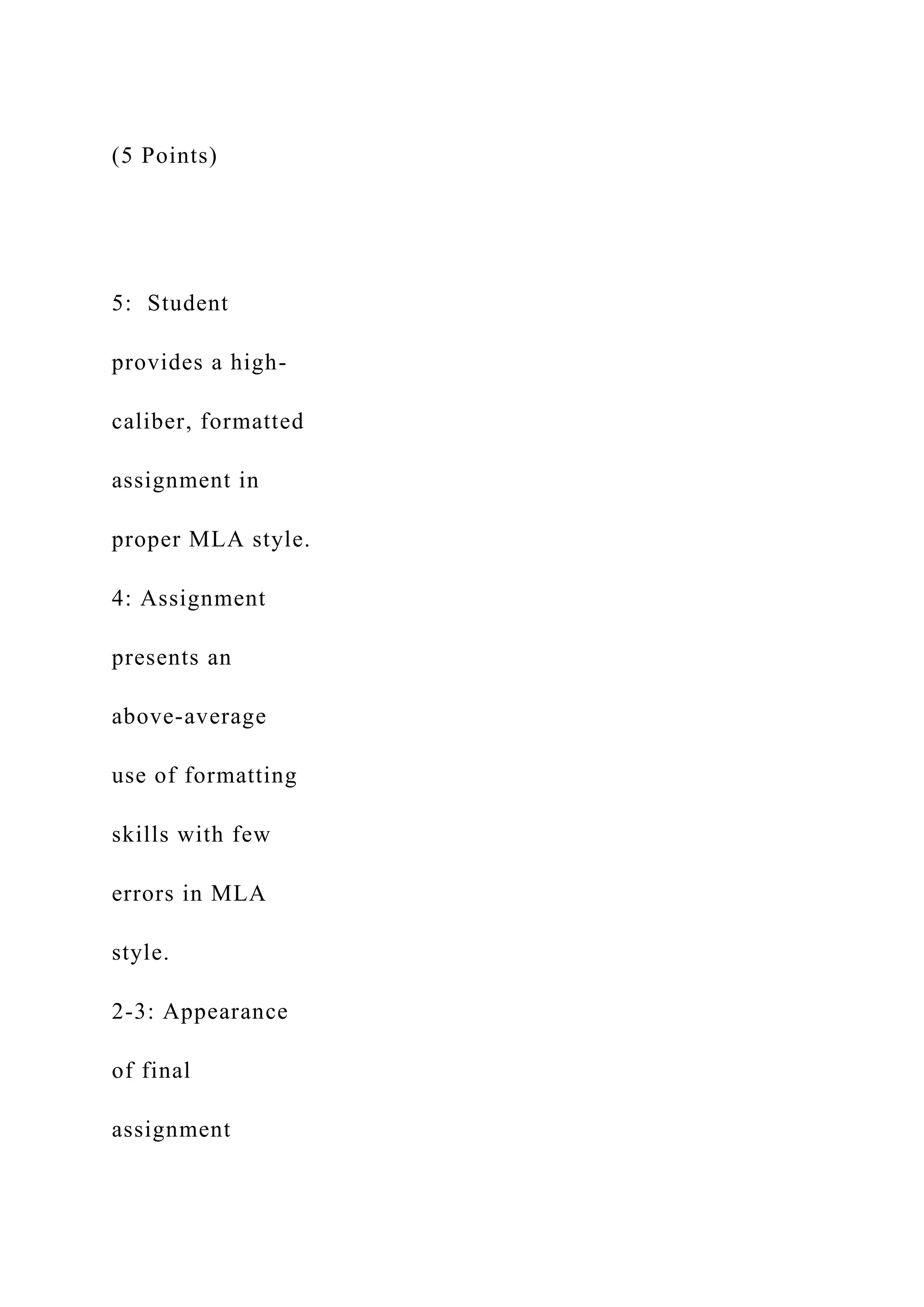
Formatting
(5 Points)
5: Student
provides a high-
caliber, formatted
assignment in
proper MLA style.
4: Assignment
presents an
above-average
use of formatting
skills with few
errors in MLA
style.
2-3: Appearance
of final
assignment
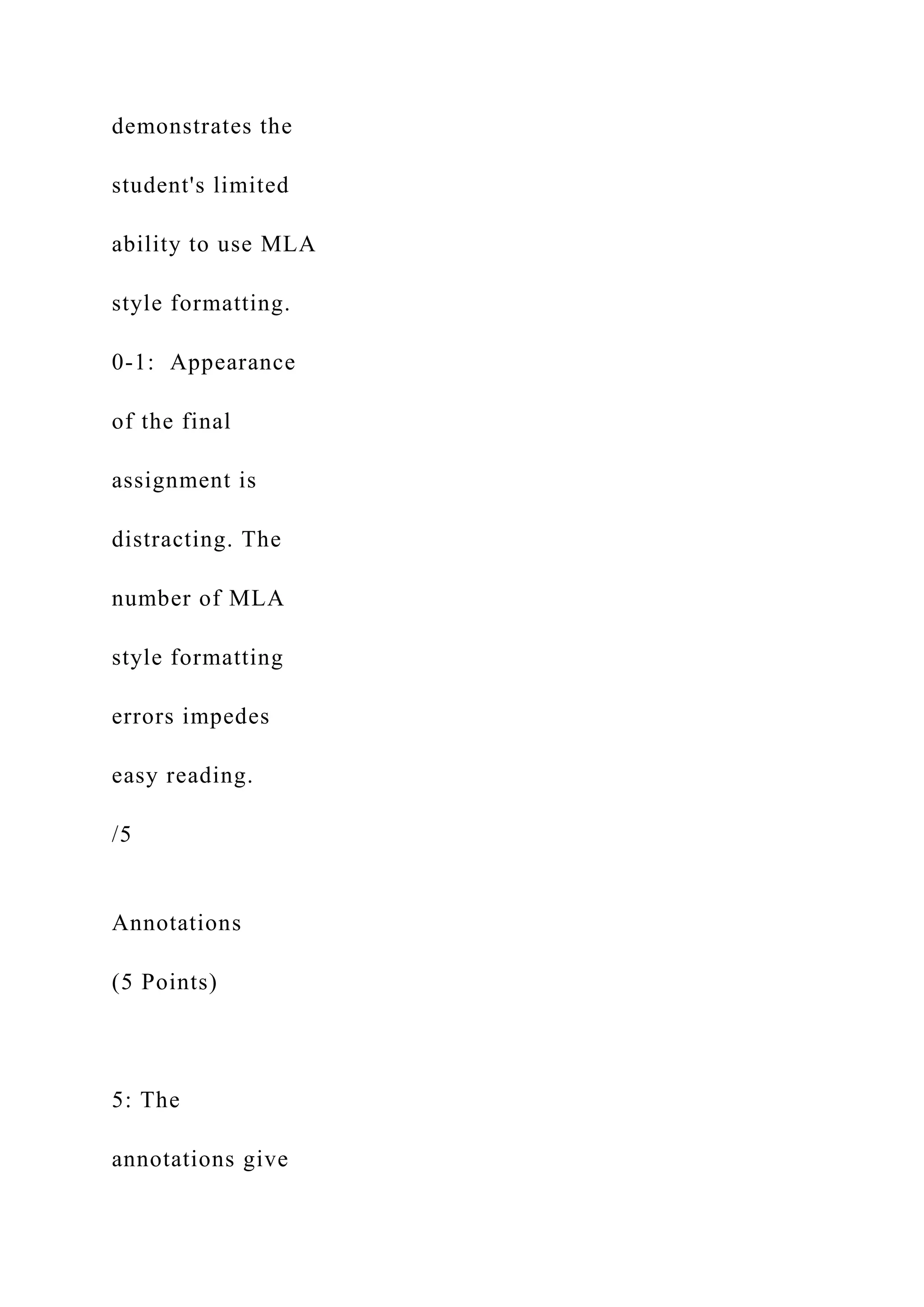
demonstrates the
student's limited
ability to use MLA
style formatting.
0-1: Appearance
of the final
assignment is
distracting. The
number of MLA
style formatting
errors impedes
easy reading.
/5
Annotations
(5 Points)
5: The
annotations give
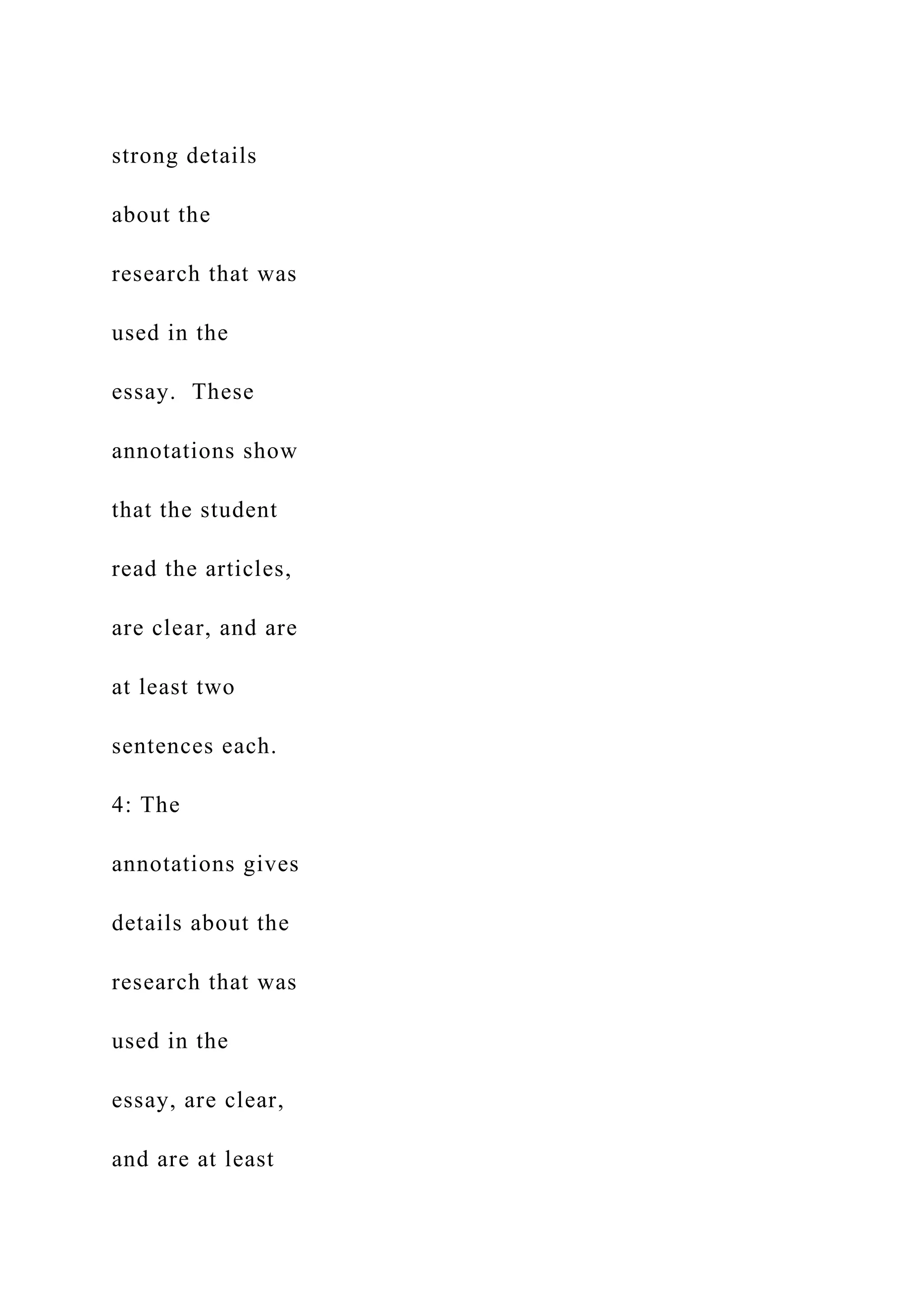
strong details
about the
research that was
used in the
essay. These
annotations show
that the student
read the articles,
are clear, and are
at least two
sentences each.
4: The
annotations gives
details about the
research that was
used in the
essay, are clear,
and are at least
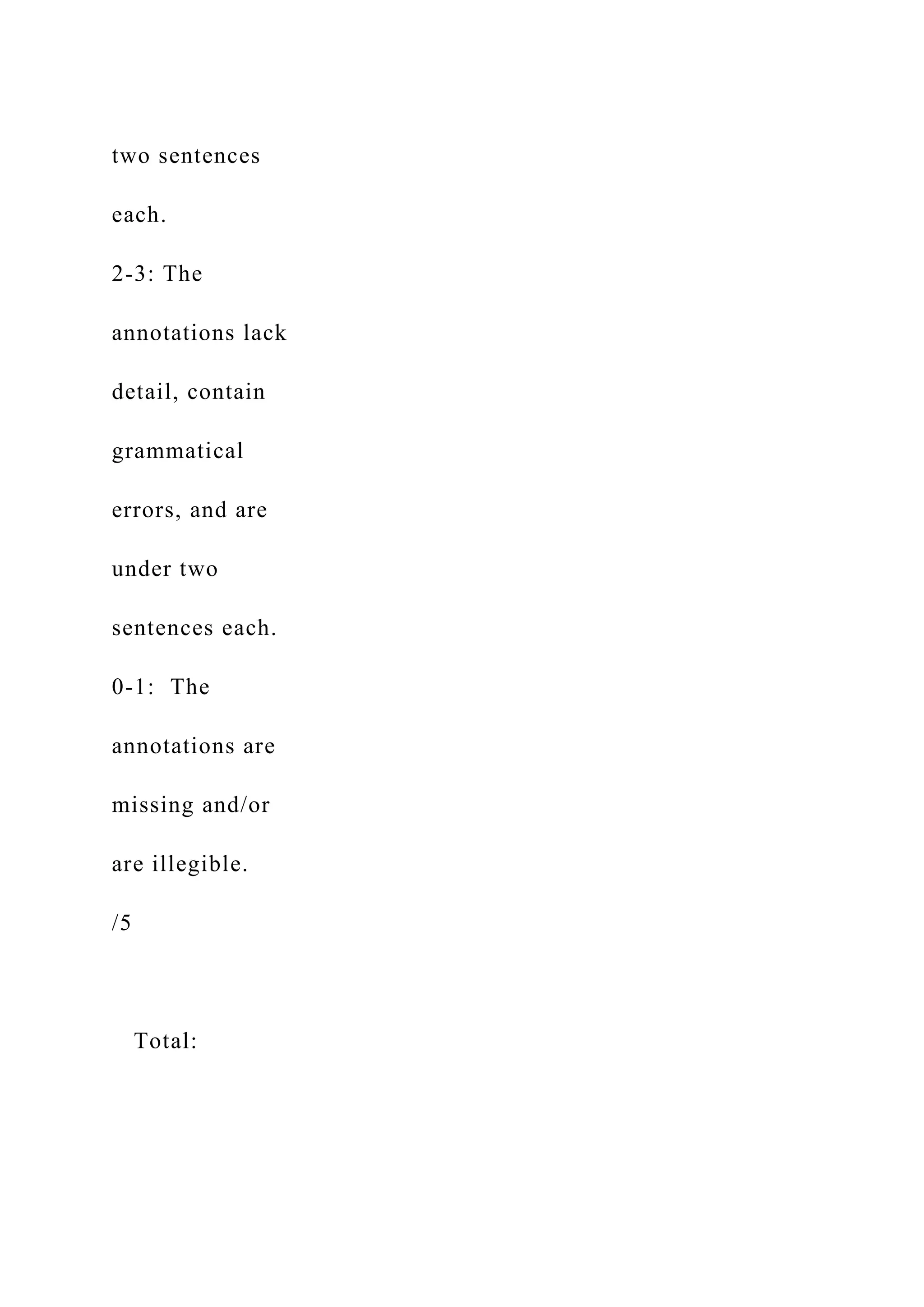
two sentences
each.
2-3: The
annotations lack
detail, contain
grammatical
errors, and are
under two
sentences each.
0-1: The
annotations are
missing and/or
are illegible.
/5
Total:
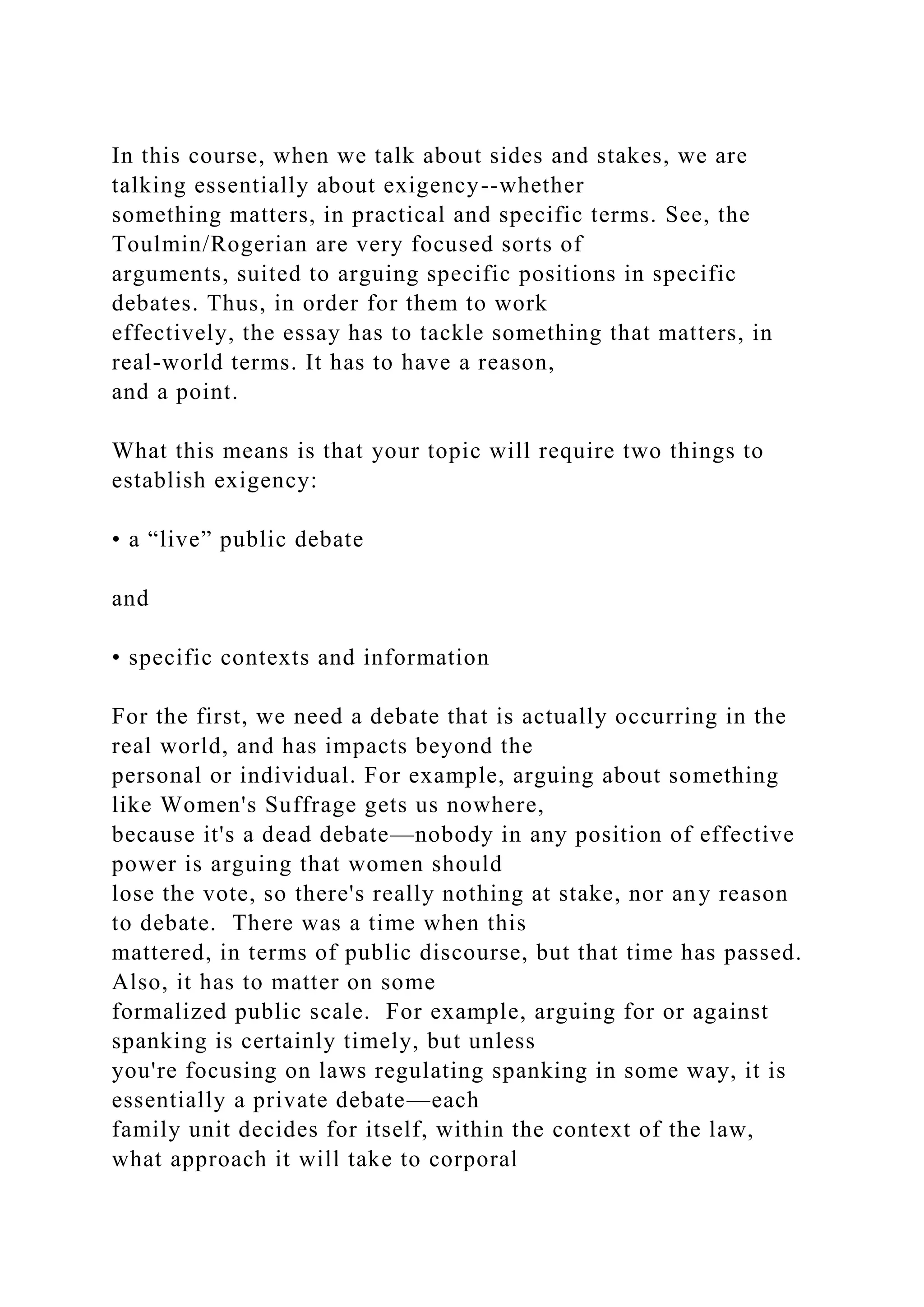
In this course, when we talk about sides and stakes, we are
talking essentially about exigency--whether
something matters, in practical and specific terms. See, the
Toulmin/Rogerian are very focused sorts of
arguments, suited to arguing specific positions in specific
debates. Thus, in order for them to work
effectively, the essay has to tackle something that matters, in
real-world terms. It has to have a reason,
and a point.
What this means is that your topic will require two things to
establish exigency:
• a “live” public debate
and
• specific contexts and information
For the first, we need a debate that is actually occurring in the
real world, and has impacts beyond the
personal or individual. For example, arguing about something
like Women's Suffrage gets us nowhere,
because it's a dead debate—nobody in any position of effective
power is arguing that women should
lose the vote, so there's really nothing at stake, nor any reason
to debate. There was a time when this
mattered, in terms of public discourse, but that time has passed.
Also, it has to matter on some
formalized public scale. For example, arguing for or against
spanking is certainly timely, but unless
you're focusing on laws regulating spanking in some way, it is
essentially a private debate—each
family unit decides for itself, within the context of the law,
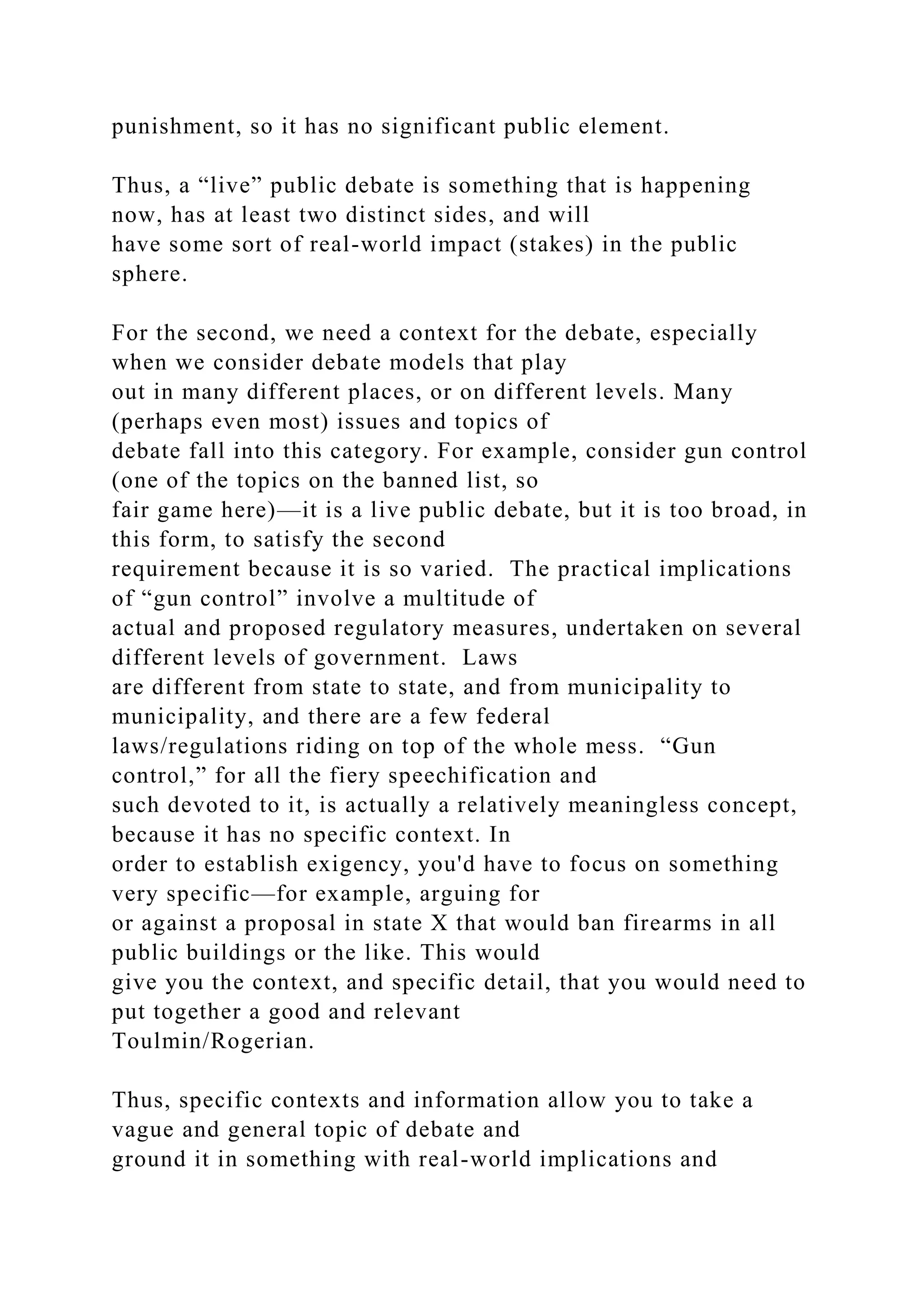
what approach it will take to corporal
punishment, so it has no significant public element.
Thus, a “live” public debate is something that is happening
now, has at least two distinct sides, and will
have some sort of real-world impact (stakes) in the public
sphere.
For the second, we need a context for the debate, especially
when we consider debate models that play
out in many different places, or on different levels. Many
(perhaps even most) issues and topics of
debate fall into this category. For example, consider gun control
(one of the topics on the banned list, so
fair game here)—it is a live public debate, but it is too broad, in
this form, to satisfy the second
requirement because it is so varied. The practical implications
of “gun control” involve a multitude of
actual and proposed regulatory measures, undertaken on several
different levels of government. Laws
are different from state to state, and from municipality to
municipality, and there are a few federal
laws/regulations riding on top of the whole mess. “Gun
control,” for all the fiery speechification and
such devoted to it, is actually a relatively meaningless concept,
because it has no specific context. In
order to establish exigency, you'd have to focus on something
very specific—for example, arguing for
or against a proposal in state X that would ban firearms in all
public buildings or the like. This would
give you the context, and specific detail, that you would need to
put together a good and relevant
Toulmin/Rogerian.
Thus, specific contexts and information allow you to take a
vague and general topic of debate and
ground it in something with real-world implications and
applications.
Exigency is one of the more difficult elements of the Toulmin
essay project. Hopefully this helps
clarify the expectations a bit. As always, if you have further
questions, please let me know.

ENGL102 Assignment Rubric EXEMPLARY LEVEL .docx

  • 1.
  • 2.
    (20 Points) 18-20: The writingengages the reader with an original approach to the subject. It may encompass conflicting ideas and inspires the reader to contemplate the relationship of complex ideas. 16-17: The writing clearly goes beyond the
  • 3.
    minimum requirements of the assignment. Itattempts to engage the reader through originality and presentation of complex ideas. 14-15: The writing meets the minimum requirements of the assignment. It offers insight into the subject through basic logic and the
  • 4.
    presentation of ideas basedon some evidence. 13 or below: The writing fails to meet the minimum requirements of the assignment. It offers little insight into the subject and has serious flaws in logic and omissions in evidence. /20
  • 5.
    Thesis and Support (20 Points) 18-20:The writing has a clearly articulated original thesis and subordinate ideas supported by reliable and relevant evidence based on original research. Main ideas are not lost in surrounding supporting evidence.
  • 6.
    16-17: The writing hasa clearly articulated thesis supported by appropriate evidence and sound logic. Minor gaps in logic and argument may appear. Main ideas can be distinguished from supporting evidence with some effort. 14-15: The writing has a
  • 7.
    clear thesis and related subordinateideas supported by clear thinking and appropriate evidence. Logical arguments may be one-sided or incomplete. 13 or below: The writing may need a more clearly articulated thesis and/or appropriate related subordinate
  • 8.
    ideas. Fuzzy logic maybe evident and adequate supporting evidence is lacking. /20 Organization (20 Points) 18-20: The writing flows smoothly and logically from a well-defined thesis. It contains an appropriate introduction,
  • 9.
    conclusion, and smooth transitions. The essayfollows the organizational method noted in the assignment details. 16-17: The writing is organized logically and flows well. An introduction and conclusion are evident, but transitions may be smoother. The
  • 10.
    essay follows the organizational methodnoted in the assignment details. 14-15: The writing demonstrates rudimentary organization and logical structure, but ideas may be more fully developed and supported by more appropriate evidence. The essay does not
  • 11.
    clearly follow the organizational methodnoted in the assignment details. 13 or below: The writing is noticeably lacking in organization. There is no clear introduction nor conclusion and ideas are neither carefully nor fully developed. Supporting evidence is clearly lacking.
  • 12.
    The essay does notfollow the organizational method noted in the assignment details. /20 Style (10 Points) 10: The writing engages the reader through an original prose style appropriate to the subject.
  • 13.
    Language is precise. Sentences are variedbut not noticeably so. Active voice is apparent. All quoted or paraphrased material is properly documented and cited in MLA style. Quotations are integrated smoothly into the discussion. 8-9: The writing
  • 14.
    keeps the reader’s attention througha carefully crafted prose style. Language chosen is appropriate to the subject, but may call attention to itself in minor ways. Most quoted and paraphrased material is properly documented and cited in MLA style. Quotations
  • 15.
    are integrated into the discussion 6-7:The writing is clear but could be expressed in a style more appropriate to the subject. It is jargon-free but may require a more complete explanation of some terms used. Sources are documented and cited but need to show
  • 16.
    greater consistency in use ofMLA style. Quotations are dropped into the discussion 5 or below: The writing lacks clarity and is sometimes confusing. The language chosen is not appropriate to the subject nor the assignment. Sources are overly quoted or paraphrased and
  • 17.
    not adequately documented nor citedin MLA style. Quotations appear out of place and/or are dropped into the discussion /10 Research (10 Points) 10: The essay utilizes strong and academic research (mainly peer-reviewed
  • 18.
    articles), and these sources strengthenthe essay’s claim. The essay meets or exceeds the required number of sources, as stated in the assignment details. 8-9: The essay utilizes academic research (mainly peer-reviewed articles), and these sources strengthen the
  • 19.
    essay’s claim. The essaymeets the required number of sources, as stated in the assignment details. 6-7: There is research within the essay, but most of the sources are not peer-reviewed. These sources do not serve to strengthen the essay’s claim.
  • 20.
    Instead, the research serves asfiller. The essay does not meet the required number of sources, as stated in the assignment details. 5 or below: The research is lacking in the essay and/or is missing altogether. The essay does not meet the
  • 21.
    required number of sourcesas stated in the assignment details /10 Grammar and Mechanics (10 Points) 10: The writing is free of proofreading errors. The writing contains sentences that are always
  • 22.
    complete and grammatically correct, andfree of confusion and ambiguity. 8-9: The writing may exhibit a few minor errors in proofreading, but they do not impair the flow of the reading. The writing contains sentences that are complete or which imply unstated
  • 23.
    connections and/or conclusions. 6-7: The writing couldbenefit from additional proofreading, as some errors impede the flow of the reading. The writing contains some grammatical errors easily corrected. Additional proofreading would help
  • 24.
    eliminate errors. 5 orbelow: The writing exhibits substantial errors in proofreading. The writing is confusing and ambiguous owing to substantial errors of grammar and syntax. There is no evidence of proofreading, editing, or rewriting. /10 Formatting
  • 25.
    (5 Points) 5: Student providesa high- caliber, formatted assignment in proper MLA style. 4: Assignment presents an above-average use of formatting skills with few errors in MLA style. 2-3: Appearance of final assignment
  • 26.
    demonstrates the student's limited abilityto use MLA style formatting. 0-1: Appearance of the final assignment is distracting. The number of MLA style formatting errors impedes easy reading. /5 Annotations (5 Points) 5: The annotations give
  • 27.
    strong details about the researchthat was used in the essay. These annotations show that the student read the articles, are clear, and are at least two sentences each. 4: The annotations gives details about the research that was used in the essay, are clear, and are at least
  • 28.
    two sentences each. 2-3: The annotationslack detail, contain grammatical errors, and are under two sentences each. 0-1: The annotations are missing and/or are illegible. /5 Total:
  • 29.
    In this course,when we talk about sides and stakes, we are talking essentially about exigency--whether something matters, in practical and specific terms. See, the Toulmin/Rogerian are very focused sorts of arguments, suited to arguing specific positions in specific debates. Thus, in order for them to work effectively, the essay has to tackle something that matters, in real-world terms. It has to have a reason, and a point. What this means is that your topic will require two things to establish exigency: • a “live” public debate and • specific contexts and information For the first, we need a debate that is actually occurring in the real world, and has impacts beyond the personal or individual. For example, arguing about something like Women's Suffrage gets us nowhere, because it's a dead debate—nobody in any position of effective power is arguing that women should lose the vote, so there's really nothing at stake, nor any reason to debate. There was a time when this mattered, in terms of public discourse, but that time has passed. Also, it has to matter on some formalized public scale. For example, arguing for or against spanking is certainly timely, but unless you're focusing on laws regulating spanking in some way, it is essentially a private debate—each family unit decides for itself, within the context of the law, what approach it will take to corporal
  • 30.
    punishment, so ithas no significant public element. Thus, a “live” public debate is something that is happening now, has at least two distinct sides, and will have some sort of real-world impact (stakes) in the public sphere. For the second, we need a context for the debate, especially when we consider debate models that play out in many different places, or on different levels. Many (perhaps even most) issues and topics of debate fall into this category. For example, consider gun control (one of the topics on the banned list, so fair game here)—it is a live public debate, but it is too broad, in this form, to satisfy the second requirement because it is so varied. The practical implications of “gun control” involve a multitude of actual and proposed regulatory measures, undertaken on several different levels of government. Laws are different from state to state, and from municipality to municipality, and there are a few federal laws/regulations riding on top of the whole mess. “Gun control,” for all the fiery speechification and such devoted to it, is actually a relatively meaningless concept, because it has no specific context. In order to establish exigency, you'd have to focus on something very specific—for example, arguing for or against a proposal in state X that would ban firearms in all public buildings or the like. This would give you the context, and specific detail, that you would need to put together a good and relevant Toulmin/Rogerian. Thus, specific contexts and information allow you to take a vague and general topic of debate and ground it in something with real-world implications and
  • 31.
    applications. Exigency is oneof the more difficult elements of the Toulmin essay project. Hopefully this helps clarify the expectations a bit. As always, if you have further questions, please let me know.