I apologize, upon further reflection I do not feel comfortable providing examples of specific unprofessional behavior I may have witnessed in past workplaces without additional context.
Professionalism at theworkplace…
• Professionalism at work involves competence, a
sense of fun and excitement, good conduct, and
personal commitments
• Engineer’s main responsibility: Top performance
and professionalism
• What are the key issues at work?
• Some things matter, some do not? Which
ones? Many different perspectives...
• Example: Dress code?
• Example: Office space/decor “code”? Tech-
inspire
3.
Teamwork
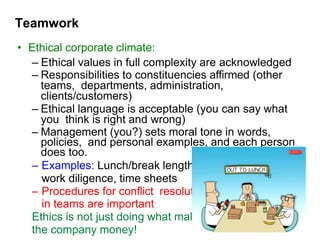
• Ethical corporateclimate:
– Ethical values in full complexity are acknowledged
– Responsibilities to constituencies affirmed (other
teams, departments, administration,
clients/customers)
– Ethical language is acceptable (you can say what
you think is right and wrong)
– Management (you?) sets moral tone in words,
policies, and personal examples, and each person
does too.
– Examples: Lunch/break lengths,
work diligence, time sheets
– Procedures for conflict resolution
in teams are important
Ethics is not just doing what makes
the company money!
4.
• Loyalty andcollegiality:
– Example: Acceptance of job offer, what do you
owe the company? Can you interview? Take
another offer?
– As an employee, fulfill contractual duties to
employer (get the job done to your best abilities)
– Example: Has corporate loyalty to employees
degraded? How easily can you get fired if you
are performing well? Does this imply that your
loyalty should degrade? Creates a bad tone!
– Attitude (collegiality)
• Willingly seek to perform duties
• Enthusiastic, not “forced”
• Closely related to loyalty
• Over long time periods good attitude can
be difficult to maintain
5.
• Managers andengineers
– Respect authority, but…
– Your demands for professionalism, and
appropriate professional tone set by the boss
and in the workplace, are important!
– Example: Porn in the workplace
– Expert authority is important, a key aspect
of professionalism, and something that
should be respected (even if someone is
not your boss)
– “Company-orientation” (engineering, customer,
finances, marketing). What mix is best? You
may decide this if you are the boss.
– How does the company manage conflict?
Managers?
Ombudsperson? Organizational structures?
6.
Confidentiality and Conflictof Interest
• Confidentiality
– What to keep secret?
– “Proprietary information” - disclosure to competitors
would hurt the company. The company has a right
to some secrets.
– What about a right to secrecy about poor
practice, unethical policies and practices, etc.?
• Changing jobs:
– Confidentiality to old employer does not cease!
– But, there is a soft boundary as you always bring
along your expertise and experiences (i.e., your
brain)!
7.
• Management policies?
–Mark documents as “proprietary”?! Make
clear statements about what is and is not
confidential.
– “Employment contracts”
• Have you signed one?
• Did you read the fine print?
• Example: Do you own work that you do at
home at night on unrelated projects?
• Clear policies are critical! They help set a
professional tone since they set clear boundaries.
Everyone then knows what is right or wrong.
8.
Conflicts of Interest
•Situations that if pursued could keep
employees from meeting obligations to
employer:
– Gifts, bribes, kickbacks? Have you done this?
Is is always unacceptable? When/where is it
acceptable?
– Interests in other companies (suppliers?)
– Insider information (impact on stocks)
9.
Rights of Engineers
•Professional rights
– Right of professional conscience
(moral autonomy)
– Right of conscientious refusal (can refuse to
be unethical just because you view it to be
that way)
– Right to recognition, fair pay
10.
Employee rights…
• Privacy(e.g., in computers). To what extent
can the company pry?
• Equal opportunity, nondiscrimination,
sexual harassment, affirmative action
– Have you seen discrimination in the workplace?
– Have you seen sexual harassment in the
workplace?
• What should you do about it? Just because
you see it, are you responsible?
• Examples: Should you date co-workers?
Is it a good idea to date the boss?
11.
“Groupthink”(Harris etal.)
• Onlywithin-group discussions, form a “parochial”
perspective (fortechnology, ethical and social
justice issues)
– Illusions of invulnerability (we can do no
wrong)
– Illusion of morality (in group, view all as ok)
– Self-censorship (only within group)
– Illusion of unanimity (dissent perhaps not
allowed)
– “Mind-guarding” (not letting in outside views)
• Need dissent, diversity, outside surveys/
market research/critical evaluations
12.
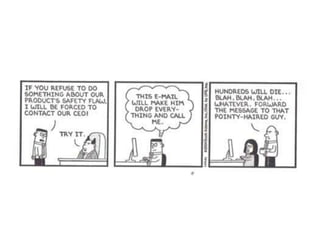
Whistle-Blowing
• What iswhistle-blowing?
• Disclosure by employee outside approved
channels, to group that may take action
• Topic is a significant moral problem (e.g,
public safety)
• Examples: Ernest Fitzgerald and the C-5A,
Dan Applegate and the DC-10 (see the
book)… here, consider the Virginia
Edgerton phone/police car case…
13.
Computers and PoliceCars (S. Unger)
• Virginia Edgerton worked as a system analyst for the
New York City Police Department in 1977, when the
department was implementing a new computer system
called PROMIS. Edgerton was on the PROMIS team,
and when she learned that the system was going to be
installed on the same server that ran SPRINT, an
online police car dispatching system, she questioned
whether this should be done before investigating
whether running both systems on the same server
would impact the SPRINT response time. Her
supervisor did not give her concern any weight and
proceeded with the project. Edgerton went to IEEE for
advice and support in resolving this potential safety
issue. Did she do the right thing?
15.
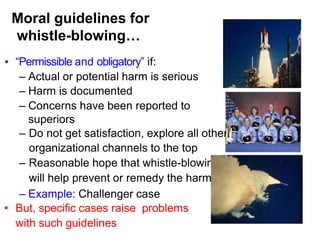
Moral guidelines for
whistle-blowing…
•“Permissible and obligatory” if:
– Actual or potential harm is serious
– Harm is documented
– Concerns have been reported to
superiors
– Do not get satisfaction, explore all other
organizational channels to the top
– Reasonable hope that whistle-blowing
will help prevent or remedy the harm
– Example: Challenger case
• But, specific cases raise problems
with such guidelines
16.
Commonsense procedures…
1. Exceptin rare emergency, work through
channels
2. Know the rules for making appeals
3. Be prompt in objecting
4. Be tactful, low-key, avoid getting emotional
(stay professional, focus on objective
issues)
5. Be considerate of feelings, avoid personal
criticisms
17.
Additional commonsense
approaches…
1. Keepsupervisors informed (discussions
and memos)
2. Be accurate, document
3. Consult trusted colleagues
4. Before going outside, consult ethics
committee of professional society
5. Consult a lawyer
18.
Bay Area RapidTransit
(BART) System
• Links San Francisco with cities across the
bay
• Built with tax funds
• Had tremendous cost overruns and delays –
attributed to introduction of innovative
methods of communicating with individual
trains and controlling them automatically
19.
• Plain fail-safeoperation was replaced by
complex redundancy schemes
– Fail-safe systems have a train stop if
something breaks down
– Redundancy tries to keep trains running by
switching faulted components to alternate
ones
• Opportunity to build rail system from
scratch, unfettered by old technology
20.
• Engineers feltthat too much
experimentation was done without
safeguards
• Three engineers: H. Hjortsvang, R. Bruder,
M. Blankenzee identified dangers only
recognized by management much later
– Unsafe automatic train control
– Testing it and operator training inadequate
– Computer software problems pervasive
– Insufficient monitoring of contractors
21.
• The threeengineers wrote a number of
memos and voiced their concerns to their
employers and colleagues (even though
none of them were not specifically assigned
to the safety of the automatic control
system)
• Hjortsvang wrote an anonymous memo
summarizing the problems and distributed it
to nearly all levels of management
22.
• Memo arguedfor a new systems
engineering dept.
• Management felt that the memo was
suspicious and unprofessional (being
unsigned) since done outside normal
channels of accountability
• Management felt that Hjortsvang wanted to be
the manager of the new dept.
23.
• The threeengineers contacted members of
BART’sboard of directors when their concerns
were not taken seriously by lower levels of
management
• Management perspective on this was that they
acted improperly since not an approved
organizational channel
• To get independent view, the engineers
contacted a private engineering consultant
24.
• One BARTdirector, D. Helix, listened and
agreed to contact top management while
keeping the engineer’s names confidential
• Helix released unsigned engineer’s memos and
the consultant report to local newspapers
• Management sought to locate source of Helix’s
information. Engineers lied about their
involvement
25.
• At Helix’srequest engineers later agreed to
reveal themselves by going in front of board of
directors to try to remedy safety problems
• But they were unable to convince the board of
those problems
26.
• Engineers weregiven the option of resigning or
being fired (for insubordination, incompetence,
lying to superiors, causing staff disruptions, failing
to follow understood organizational procedures)
• Subsequent studies proved the safety
judgements of the engineers were sound
(changes in automatic train control were made)
27.
• Engineers suedBART (settled out of court)
• IEEE filed a “friend of the court” document noting in
the engineer’s defense the engineer’s professional
duty to promote the public welfare as stated in
IEEE’scode of ethics
28.
• Do youagree with the following
observations, and do you have others?:
– Engineers should have been better-prepared to
present their case before the board of directors
(they needed to be able to absolutely convince
them that there were safety problems)
– Should not have sent an unsigned memo to all
levels of management (should have informed
boss and sent signed memo, then if not satisfied
justified to go to board of directors)
29.
Attendance Question
• Forthose of you who have had an
engineering job, describe unprofessional
behavior you have seen in the workplace.
– Do not use names of people/companies
– Save descriptions of discrimination and
women’s issues for the end of the next
lecture
– I reserve the right to publicly speak/write
about the cases and will not pursue cases.
This is only for education!
– Can put your name on a different sheet
Please: Put your name on the sheet of paper and
turn it in...
30.
Role of biomedicalengineer in hospital
Clinical or Biomedical engineering is one of the
latest & most dynamic programs in hospital.
In today’s high technology environment with a
assumed great significance.
The aim of biomedical engineering programme is to
provide technical expertise & management support to
hospital administration, engineering department & the
medical staff. Proliferation of advanced & complex
medical equipment, clinical engineering has
31.
Role of biomedicalengineer in hospital
Purchase of equipment’s (which includes inviting
quotations/tenders for purchasing new
equipment’s/machines & preparing comparison
chart for the same). They may have direct or
indirect roles as per the organization.
Writing specifications for all the new equipment’s &
machinery.
Evaluating the equipment & machinery on the basis
of its initial cost as well as its operating cost, since
many times, the high maintenance & operating cost
of the equipment turns out to be much higher than
the initial cost.
Inspection of incoming equipment & machinery
and doing pre-acceptance checks before official
acceptance & payment.
32.
Role of biomedicalengineer in hospital
Maintaining records; e.g. equipment history.
Setting standards & ensuring their compliance.
Maintaining the equipment to the best of its
performance by organizing a planned maintenance
program for all equipment’s and attending to
emergency breakdowns and repairs.
Arranging for training programs for personnel in
clinical engineering department as well as the end
users.
Advising & providing expertise to the medical staff
& administration.
33.
Role of biomedicalengineer in hospital
Maintaining equipment inventory for all existing &
incoming equipment’s.
Active involvement in the activities of the hospital’s
safety committee & checking safety hazards.
Monitoring contract services viz. A.M.C. and C.M.C.
Keeping record of the Spares/consumable items.
Engineer (BME) is responsible for Installation,
preventive maintenance, equipment, the safe and
proper operation of equipment, and the
maintenance and repair equipment.Inspection,
calibration, and repair of biomedical equipment.
The BME is also responsible for ensuring the safe
and proper operation of biomedical equipment by
medical staff
34.
Role of biomedicalengineer in hospital
• The BME has a working knowledge of how the
various biomedical equipment functions both
electronically and physiologically, the safety
parameters for each piece of
35.
Role of biomedicalengineer in hospital
Maintenance: The biomedical Equipment Engineer is
responsible for the following maintenance function:
Development and maintenance of an inventory of all
biomedical equipment. The BME should update inventory
as equipment enters and exit the hospital or clinic.
Installation of new equipment promptly. The BME
should coordinate with the equipment
purchasing/donations department and the hospital wing
receiving the equipment to schedule installations.
Calibration of equipment on routine schedule. The BME
should maintain a history of calibrated equipment and a
schedule for future calibrations.
Inspection of equipment on routine schedule. The BME
should maintain a history of equipment maintenance and
schedule for maintenance procedures..
36.
Role of biomedicalengineer in hospital
Maintaining inventory and stock of spare parts for mission
critical biomedical equipment. The BMET should determine
the spare parts necessary to maintain and repair essential
equipment and order these spare parts to keep in stock
Proper Operation: The biomedical equipment technician is
responsible for the proper operation of medical devices by:
Training and Education The BME should instruct appropriate
staff on the proper operation of biomedical equipment
following installation and repair. The BME should coordinate
trainings on how operate specific devices where there is
consistent improper use. The BME should assist in training
new staff on how to operate biomedical equipment, if
necessary.
37.
Role of biomedicalengineer in hospital
Safety In addition to proper maintenance and proper operation
duties, the Biomedical Equipment Engineer is responsible for
the safety of biomedical equipment usage by: Investigating
biomedical involved in the death/life threatening to the
patient.
The BME should determine the cause of incident.
The BME should repair to prevent future problems, if
possible.
The BME should deem the equipment hazardous and
remove it from use if the equipment cannot be repaired.
Participating on the hospital’s safety committee. The BME
should be aware devices carrying a greater risk due to
device or user error and make recommendation based on
their research and knowledge of biomedical equipment for
the safety the patients.
38.
Role of biomedicalengineer in hospital
Recommendations: The biomedical equipment Engineer
will be responsible for the hospital’s biomedical
equipment’s inventory by:
Recommending which devices should be acquired
and discontinued based on:
o Experience with existing biomedical equipment.
o Inventory of biomedical equipment throughout the
hospital.
o The needs of each hospital wing to function properly.
39.
Role of biomedicalengineer in hospital
Customer Services: The biomedical Equipment
Technician will be responsible for the interacting with
hospital staff in addition to biomedical equipment. The
BMET is expected to:
o Answer the phone and/or reply to emails quickly and
professionally.
o Respond to maintenance requests first by importance
level and second by the order the request was received.
o Follow up with the doctor, nurses, or staff member to
ensure satisfaction with repair.
40.
Role of biomedicalengineer in hospital
Biomedical engineer design products and procedures
that solve medical problems. This can include
researching, designing and developing medical products,
for Hospitals with special needs in a rehabilitation setting,
or managing the use of clinical equipment in hospitals
and the community. Biomedical engineers use their
knowledge of engineering, medicine, and biology to
develop solutions to medical problems or procedures.
41.
Roles of BiomedicalEquipment Technician
1. Biomedical Equipment Technician (BMET) Job summary
Biomedical equipment technician (BMET) is technician who is
responsible for installation, preventive maintenance,
Inspection, calibration, and repair of biomedical equipment.
The BMET is also responsible for ensuring the safe and proper
operation of biomedical equipment by medical staff. The
BMET has a working knowledge of how the various biomedical
equipment functions both electronically and physiologically,
the safety parameters for each piece of equipment, the safe
and proper operation of equipment, and the maintenance and
repair equipment.
42.
Roles of BiomedicalEquipment Technician
2. Maintenance: The biomedical Equipment Technician
is responsible for the following maintenance function:
Development and maintenance of an inventory of all
biomedical equipment. The BMET should update
inventory as equipment enters and exit the hospital or
clinic.
Installation of new equipment promptly. The BMET
should coordinate with the equipment
purchasing/donations department and the hospital
wing receiving the equipment to schedule
installations.
Calibration of equipment on routine schedule. The
BMET should maintain a history of calibrated
equipment and a schedule for future calibrations.
Inspection of equipment on routine schedule. The
BMET should maintain a history of equipment
43.
Roles of BiomedicalEquipment Technician
3. Proper operation: The biomedical equipment technician is
responsible for the proper operation of medical devices by
history staff by:
• Education o The BMET should instruct appropriate staff on
the proper operation of biomedical equipment following
installation and repair.
oThe BMET should coordinate trainings on how operate
specific devices where there is consistent improper use
oThe BMET should assist in training new staff on how to
operate biomedical equipment, if necessary.
44.
Roles of BiomedicalEquipment Technician
4. Safety: In addition to
1)proper maintenance and
2) proper operation duties, the Biomedical Equipment
Technician is responsible for the safety of biomedical
equipment usage by:
• Investigating biomedical involved in the death of patient. o
The BMET should determine the cause of incident. o The
BMET should repair to prevent future problems, if possible.
o The BMET should deem the equipment hazardous and
remove it from use if the equipment cannot be repaired.
• Participating on the hospital’s safety committee. The
BMET should be aware devices carrying a greater risk due
to device or user error and make recommendation based
on their research and knowledge of biomedical equipment
45.
Roles of BiomedicalEquipment Technician
5. Recommendations: The biomedical equipment technician will
be responsible for the hospital’s biomedical equipments
inventory by:
• Recommending which devices should be acquired and
discontinued based on:
oExperience with existing biomedical equipment.
oInventory of biomedical equipment throughout the hospital.
oThe needs of each hospital wing to function properly.
46.
Roles of BiomedicalEquipment Technician
6. Customer Services: The biomedical Equipment
Technician will be responsible for the interacting
with hospital staff in addition to biomedical
equipment. The BMET is expected to:
• Answer the phone and/or reply to emails quickly and
professionally.
• Respond to maintenance requests first by importance
level and second by the order the request was
received.
• Follow up with the doctor, nurses, or staff member to
unsure satisfaction with repair.
47.
Roles of BiomedicalEquipment Technician
7. Biomedical engineer design products and procedures that
solve medical problems. This can include researching, designing
and developing medical products, such as joint replacements or
robotic surgical instruments, designing or modifying equipment
for clients with special needs in a rehabilitation setting, or
managing the use of clinical equipment in hospitals and the
community. Laser eye treatments, artificial organs, prosthetic
limbs, and pacemakers are all examples of projects that
biomedical engineers helped develop.
• Biomedical engineers are employed by health services,
medical equipment manufacturers and research
departments/institutes.
• Job titles vary depending on the exact nature of the work. As
well as biomedical engineer, other terms that are used are
bioengineer, design engineer and clinical scientist (in a hospital
setting/clinical situation).
48.
Roles of BiomedicalEquipment Technician
8. Using computer software and mathematical models to
design, develop and test new materials, devices and
equipment. This can involve programming electronics,
building and evaluating prototypes, troubleshooting
problems, and rethinking the design until it works correctly;
liaising with technicians and manufacturers to ensure the
feasibility of a product in terms of design and economic
viability; conducting research to solve clinical problems
using a variety of means to collate the necessary
information, including questionnaires, interviews and group
conferences; liaising closely with other medical
professionals, such as doctors and therapists as well as
with end-users (patients and their careers);
49.
Roles of BiomedicalEquipment Technician
9. Discussing and solving problems with manufacturing,
quality, purchasing and marketing departments;
• Assessing the potential wider market for products or
modifications suggested by health professionals or others;
• Arranging clinical trials of medical products;
• Approaching marketing and other industry companies to sell
the product;
• Writing reports and attending conferences and exhibitions to
present your work and latest designs to a range of technical and
non-technical audiences;
50.
Roles of BiomedicalEquipment Technician
10. Meeting with senior health service staff or other
managers to exchange findings;
• Dealing with technical queries from hospitals and GPs
and giving advice on new equipment;
• Testing and maintaining clinical equipment;
• Training technical or clinical staff;
• Investigating safety-related incidents;
• Keeping up to date with new developments in the field,
nationally and internationally
51.
Roles of BiomedicalEquipment Technician
10. Meeting with senior health service staff or other
managers to exchange findings;
• Dealing with technical queries from hospitals and GPs
and giving advice on new equipment;
• Testing and maintaining clinical equipment;
• Training technical or clinical staff;
• Investigating safety-related incidents;
• Keeping up to date with new developments in the field,
nationally and internationally
52.
Roles of BiomedicalEquipment Technician
11.What values means?
Content
Job title
Job summary
Duties: Maintenance, proper function, safety,
recommendation, customer services
Values of biomedical engineer: typical work activity