Visit https://ebookfinal.com to download the full version and
explore more ebooks
Engineers Data Book Fourth Edition Clifford
Matthews
_____ Click the link below to download _____
https://ebookfinal.com/download/engineers-data-book-
fourth-edition-clifford-matthews/
Explore and download more ebooks at ebookfinal.com
Here are some suggested products you might be interested in.
Click the link to download
Engineers Guide to Pressure Equipment The Pocket Reference
1st Edition Clifford Matthews
https://ebookfinal.com/download/engineers-guide-to-pressure-equipment-
the-pocket-reference-1st-edition-clifford-matthews/
The Little Data Book 2008 Little Green Data Book 2008th
Edition World Bank
https://ebookfinal.com/download/the-little-data-book-2008-little-
green-data-book-2008th-edition-world-bank/
Essential MATLAB for Engineers and Scientists Fourth
Edition Brian Hahn
https://ebookfinal.com/download/essential-matlab-for-engineers-and-
scientists-fourth-edition-brian-hahn/
Materials for Engineers and Technicians Fourth Edition R.
A. Higgins
https://ebookfinal.com/download/materials-for-engineers-and-
technicians-fourth-edition-r-a-higgins/
A Quick Guide to API 570 Certified Pipework Inspector
Syllabus Example Questions and Worked Answers 1st Edition
Clifford Matthews
https://ebookfinal.com/download/a-quick-guide-to-api-570-certified-
pipework-inspector-syllabus-example-questions-and-worked-answers-1st-
edition-clifford-matthews/
Data Structures and Algorithm Analysis in Java 3rd Edition
Dr. Clifford A. Shaffer
https://ebookfinal.com/download/data-structures-and-algorithm-
analysis-in-java-3rd-edition-dr-clifford-a-shaffer/
A Quick Guide to API 510 Certified Pressure Vessel
Inspector Syllabus Example Questions and Worked Answers
1st Edition Clifford Matthews
https://ebookfinal.com/download/a-quick-guide-to-api-510-certified-
pressure-vessel-inspector-syllabus-example-questions-and-worked-
answers-1st-edition-clifford-matthews/
Project and Cost Engineers Handbook Fourth Edition Cost
Engineering Kenneth K. Humphreys
https://ebookfinal.com/download/project-and-cost-engineers-handbook-
fourth-edition-cost-engineering-kenneth-k-humphreys/
The Little Data Book 2007 World Bank
https://ebookfinal.com/download/the-little-data-book-2007-world-bank/
Engineers Data Book Fourth Edition Clifford Matthews
Digital Instant Download
Author(s): Clifford Matthews
ISBN(s): 9781119976226, 1119976227
Edition: 4
File Details: PDF, 3.63 MB
Year: 2012
Language: english
Engineers’
Data Book
Engineers’
Data Book
Fourth Edition
Clifford Matthews
BSc, MBA, CEng, FIMechE
First published 1998
Second edition published 2000
Third edition published 2004
This edition first published 2012
Ó 2012, John Wiley & Sons, Ltd.
Registered office
John Wiley & Sons Ltd, The Atrium, Southern Gate, Chichester, West Sussex,
PO19 8SQ, United Kingdom
For details of our global editorial offices, for customer services and for information
about how to apply for permission to reuse the copyright material in this
book please see our website at www.wiley.com.
The right of the author to be identified as the author of this work has been
asserted in accordance with the Copyright, Designs and Patents Act 1988.
All rights reserved. No part of this publication may be reproduced, stored in
a retrieval system, or transmitted, in any form or by any means, electronic,
mechanical, photocopying, recording or otherwise, except as permitted by the
UK Copyright, Designs and Patents Act 1988, without the prior permission of
the publisher.
Wiley also publishes its books in a variety of electronic formats. Some content that
appears in print may not be available in electronic books.
Designations used by companies to distinguish their products are often claimed as
trademarks. All brand names and product names used in this book are trade names,
service marks, trademarks or registered trademarks of their respective owners. The
publisher is not associated with any product or vendor mentioned in this book.
This publication is designed to provide accurate and authoritative information in
regard to the subject matter covered. It is sold on the understanding that the
publisher is not engaged in rendering professional services. If professional advice
or other expert assistance is required, the services of a competent professional
should be sought.
Figures 16.1–16.6 published here with acknowledgement to original source
Health and Safety in Welding and Allied Processes, Fourth edition, Woodhead
Publishing Limited, Abington, Cambridge, UK.
Library of Congress Cataloging-in-Publication Data
Matthews, Clifford.
Engineers’ data book / Clifford Matthews. – 4th ed.
p. cm.
Includes bibliographical references and index.
ISBN 978-1-119-97622-6 (cloth)
1. Mechanical engineering—Handbooks, manuals, etc. I. Title.
TJ151.M3924 2012
621.020
1–dc23 2011043947
A catalogue record for this book is available from the British Library.
Set in 9/11pt, Times by Thomson Digital, Noida, India
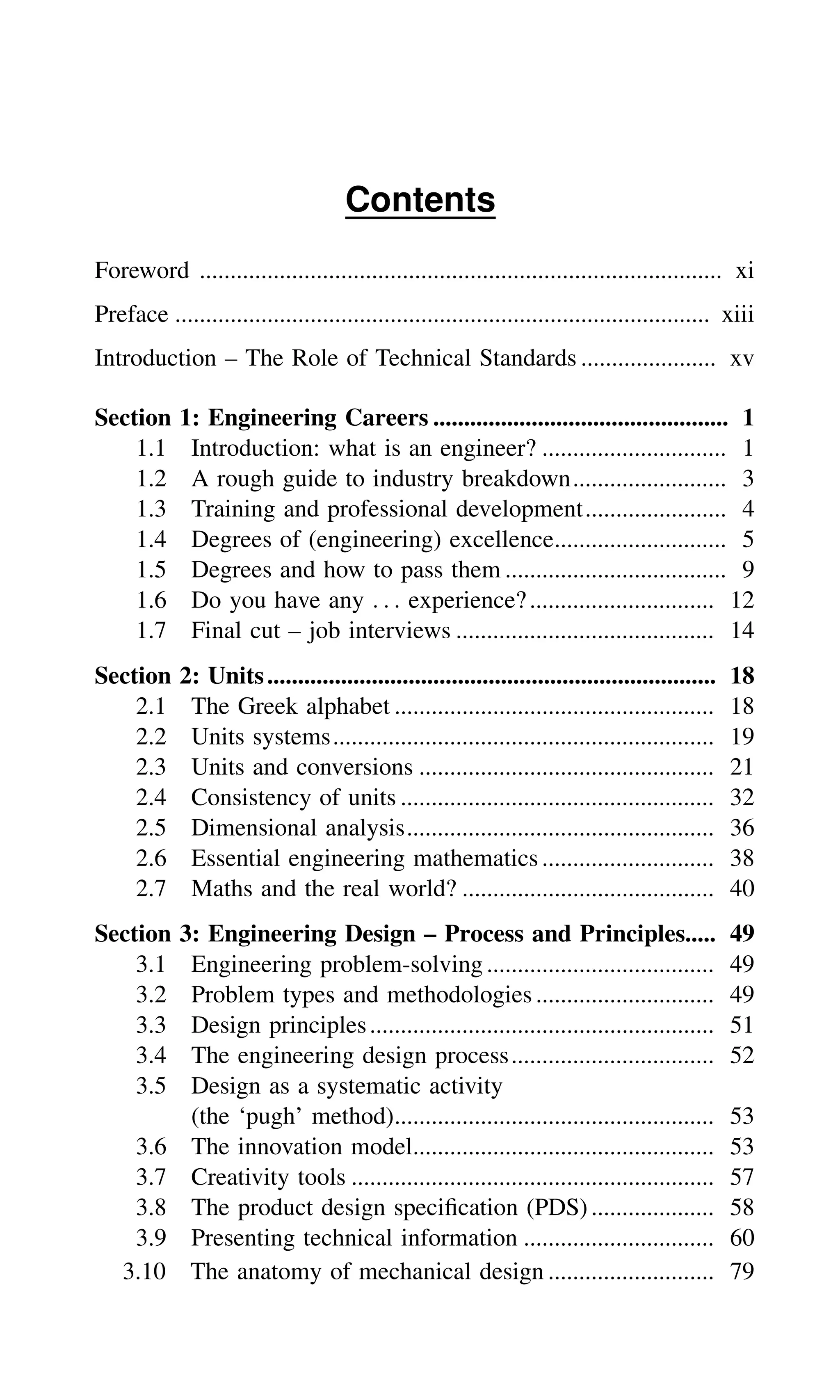
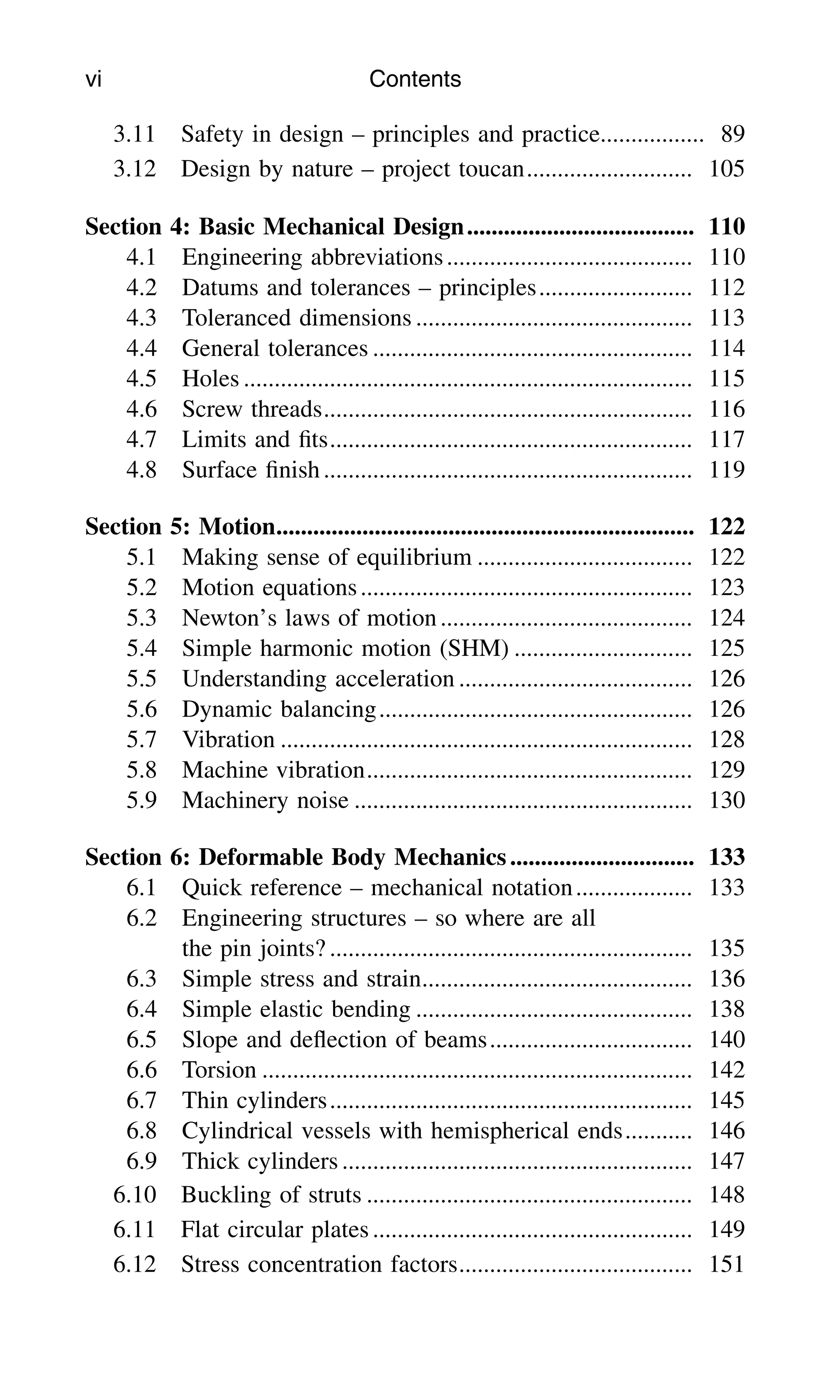
Contents
Foreword ..................................................................................... xi
Preface ....................................................................................... xiii
Introduction – The Role of Technical Standards ...................... xv
Section 1: Engineering Careers ................................................ 1
1.1 Introduction: what is an engineer? .............................. 1
1.2 A rough guide to industry breakdown......................... 3
1.3 Training and professional development....................... 4
1.4 Degrees of (engineering) excellence............................ 5
1.5 Degrees and how to pass them .................................... 9
1.6 Do you have any . . . experience?.............................. 12
1.7 Final cut – job interviews .......................................... 14
Section 2: Units......................................................................... 18
2.1 The Greek alphabet .................................................... 18
2.2 Units systems.............................................................. 19
2.3 Units and conversions ................................................ 21
2.4 Consistency of units ................................................... 32
2.5 Dimensional analysis.................................................. 36
2.6 Essential engineering mathematics ............................ 38
2.7 Maths and the real world? ......................................... 40
Section 3: Engineering Design – Process and Principles..... 49
3.1 Engineering problem-solving..................................... 49
3.2 Problem types and methodologies............................. 49
3.3 Design principles........................................................ 51
3.4 The engineering design process................................. 52
3.5 Design as a systematic activity
(the ‘pugh’ method).................................................... 53
3.6 The innovation model................................................. 53
3.7 Creativity tools ........................................................... 57
3.8 The product design specification (PDS).................... 58
3.9 Presenting technical information ............................... 60
3.10 The anatomy of mechanical design ........................... 79
3.11 Safety in design – principles and practice................. 89
3.12 Design by nature – project toucan........................... 105
Section 4: Basic Mechanical Design..................................... 110
4.1 Engineering abbreviations........................................ 110
4.2 Datums and tolerances – principles......................... 112
4.3 Toleranced dimensions ............................................. 113
4.4 General tolerances .................................................... 114
4.5 Holes ......................................................................... 115
4.6 Screw threads............................................................ 116
4.7 Limits and fits........................................................... 117
4.8 Surface finish............................................................ 119
Section 5: Motion.................................................................... 122
5.1 Making sense of equilibrium ................................... 122
5.2 Motion equations...................................................... 123
5.3 Newton’s laws of motion......................................... 124
5.4 Simple harmonic motion (SHM) ............................. 125
5.5 Understanding acceleration ...................................... 126
5.6 Dynamic balancing................................................... 126
5.7 Vibration ................................................................... 128
5.8 Machine vibration..................................................... 129
5.9 Machinery noise ....................................................... 130
Section 6: Deformable Body Mechanics.............................. 133
6.1 Quick reference – mechanical notation................... 133
6.2 Engineering structures – so where are all
the pin joints? ........................................................... 135
6.3 Simple stress and strain............................................ 136
6.4 Simple elastic bending ............................................. 138
6.5 Slope and deflection of beams................................. 140
6.6 Torsion ...................................................................... 142
6.7 Thin cylinders........................................................... 145
6.8 Cylindrical vessels with hemispherical ends........... 146
6.9 Thick cylinders ......................................................... 147
6.10 Buckling of struts ..................................................... 148
6.11 Flat circular plates.................................................... 149
6.12 Stress concentration factors...................................... 151
vi Contents
Section 7: Material Failure ................................................... 155
7.1 How materials fail.................................................... 155
7.2 LEFM method .......................................................... 156
7.3 Multi-axis stress states ............................................. 157
7.4 Fatigue....................................................................... 158
7.5 Factors of safety ....................................................... 161
7.6 United states practice ............................................... 161
7.7 Ultimate jigsaw – what everything is made of ....... 162
Section 8: Thermodynamics and Cycles.............................. 166
8.1 Quick reference: symbols – thermodynamics ......... 166
8.2 Basic thermodynamic laws ...................................... 167
8.3 Entropy...................................................................... 169
8.4 Enthalpy.................................................................... 169
8.5 Other definitions ....................................................... 170
8.6 Cycles........................................................................ 170
8.7 The steam cycle........................................................ 172
8.8 Properties of steam................................................... 172
8.9 Reference information.............................................. 175
8.10 The gas turbine (GT) cycle...................................... 175
Section 9: Basic Fluid Mechanics and Aerodynamics ....... 178
9.1 Basic properties ........................................................ 178
9.2 Flow equations.......................................................... 180
9.3 Flow regimes ............................................................ 186
9.4 Boundary layers........................................................ 189
9.5 Isentropic flow .......................................................... 191
9.6 Compressible one-dimensional flow........................ 191
9.7 Normal shock waves ................................................ 192
9.8 Axisymmetric flows.................................................. 195
9.9 Drag coefficients....................................................... 195
9.10 General airfoil theory ............................................... 197
9.11 Airfoil coefficients.................................................... 198
9.12 Pressure distributions................................................ 200
9.13 Aerodynamic centre.................................................. 200
9.14 Centre of pressure..................................................... 201
9.15 Supersonic conditions............................................... 202
9.16 Wing loading: semi-ellipse assumption................... 204
Contents vii
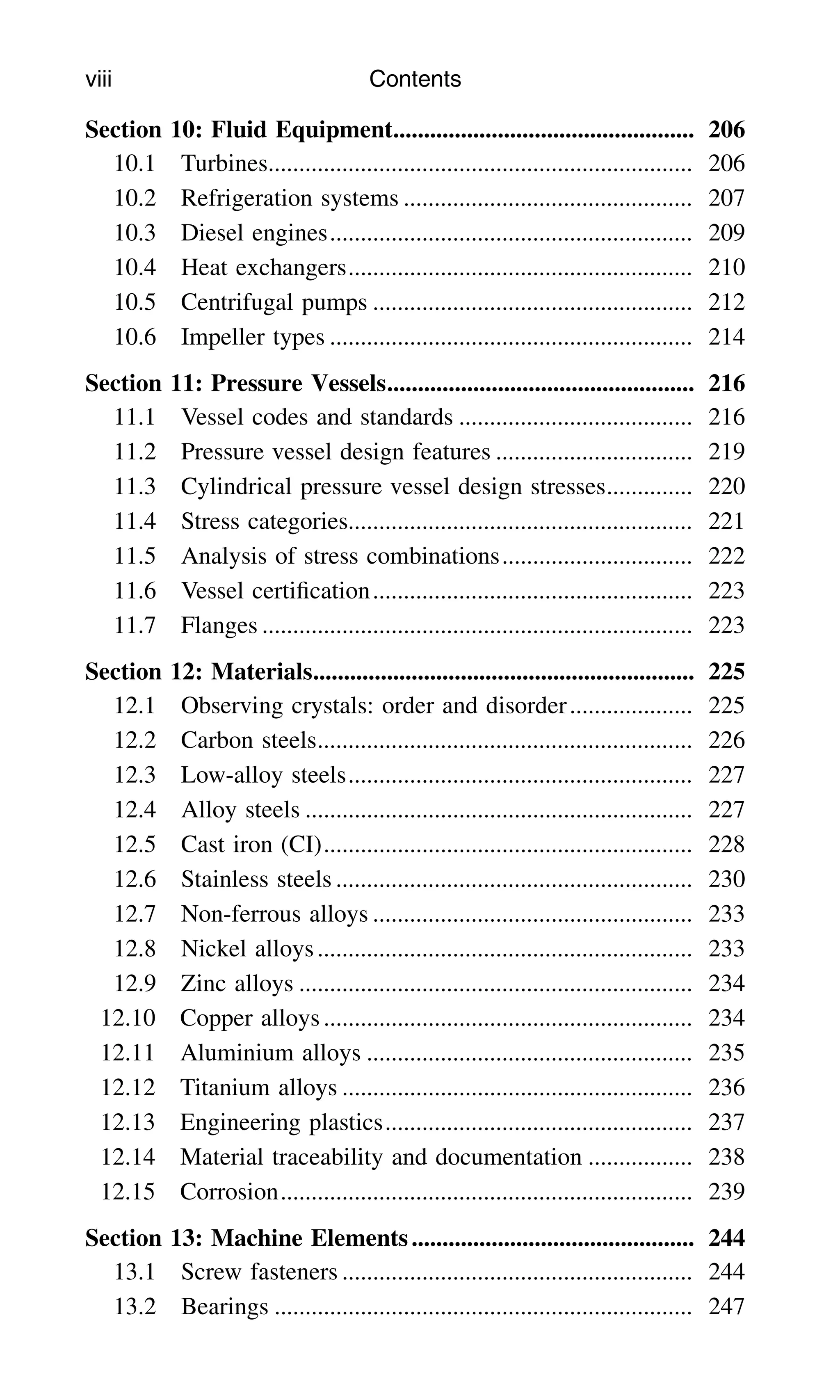
Section 10: Fluid Equipment................................................. 206
10.1 Turbines..................................................................... 206
10.2 Refrigeration systems ............................................... 207
10.3 Diesel engines........................................................... 209
10.4 Heat exchangers........................................................ 210
10.5 Centrifugal pumps .................................................... 212
10.6 Impeller types ........................................................... 214
Section 11: Pressure Vessels.................................................. 216
11.1 Vessel codes and standards ...................................... 216
11.2 Pressure vessel design features ................................ 219
11.3 Cylindrical pressure vessel design stresses.............. 220
11.4 Stress categories........................................................ 221
11.5 Analysis of stress combinations............................... 222
11.6 Vessel certification.................................................... 223
11.7 Flanges ...................................................................... 223
Section 12: Materials.............................................................. 225
12.1 Observing crystals: order and disorder.................... 225
12.2 Carbon steels............................................................. 226
12.3 Low-alloy steels........................................................ 227
12.4 Alloy steels ............................................................... 227
12.5 Cast iron (CI)............................................................ 228
12.6 Stainless steels .......................................................... 230
12.7 Non-ferrous alloys .................................................... 233
12.8 Nickel alloys............................................................. 233
12.9 Zinc alloys ................................................................ 234
12.10 Copper alloys............................................................ 234
12.11 Aluminium alloys ..................................................... 235
12.12 Titanium alloys ......................................................... 236
12.13 Engineering plastics.................................................. 237
12.14 Material traceability and documentation ................. 238
12.15 Corrosion................................................................... 239
Section 13: Machine Elements.............................................. 244
13.1 Screw fasteners ......................................................... 244
13.2 Bearings .................................................................... 247
viii Contents
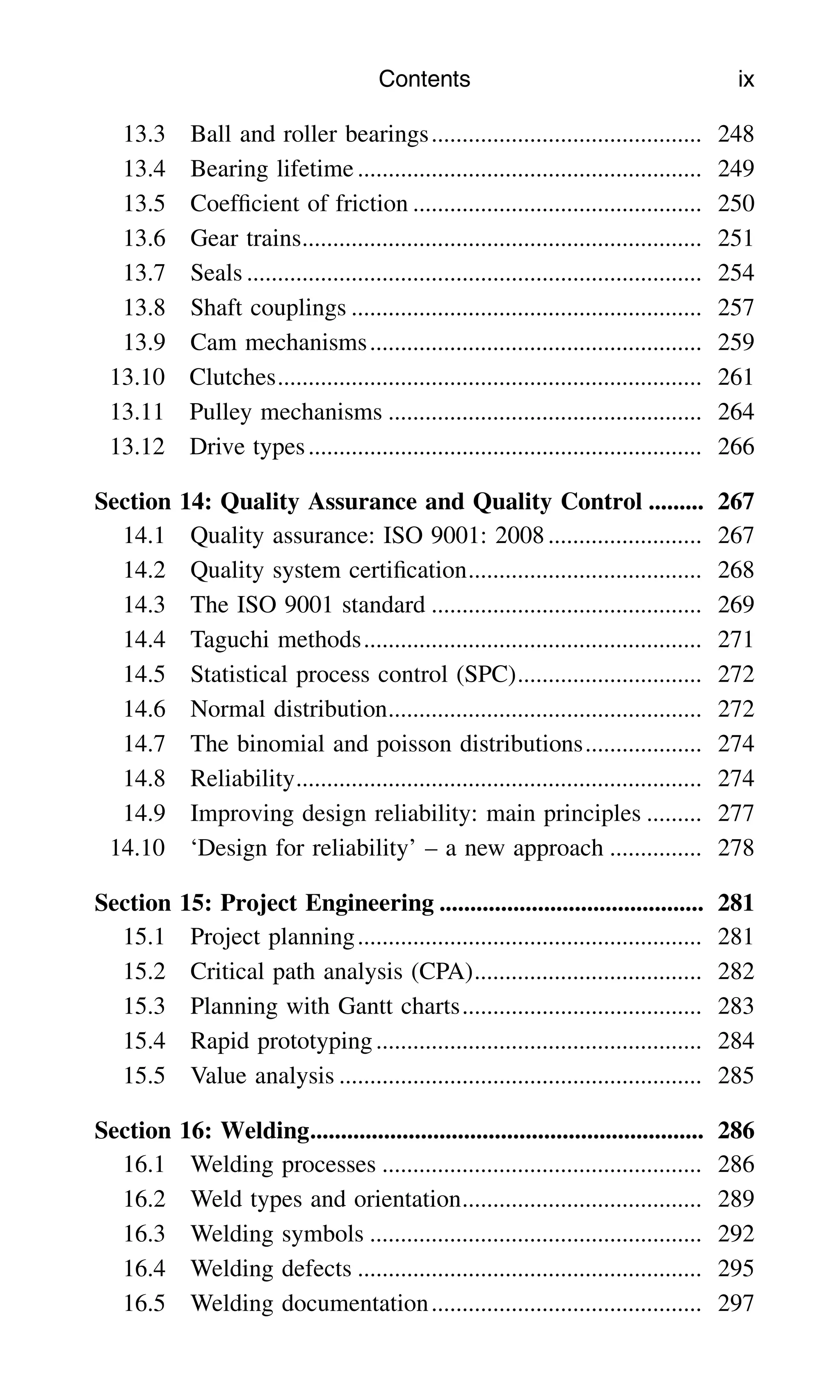
13.3 Ball and roller bearings............................................ 248
13.4 Bearing lifetime........................................................ 249
13.5 Coefficient of friction ............................................... 250
13.6 Gear trains................................................................. 251
13.7 Seals .......................................................................... 254
13.8 Shaft couplings ......................................................... 257
13.9 Cam mechanisms...................................................... 259
13.10 Clutches..................................................................... 261
13.11 Pulley mechanisms ................................................... 264
13.12 Drive types................................................................ 266
Section 14: Quality Assurance and Quality Control ......... 267
14.1 Quality assurance: ISO 9001: 2008......................... 267
14.2 Quality system certification...................................... 268
14.3 The ISO 9001 standard ............................................ 269
14.4 Taguchi methods....................................................... 271
14.5 Statistical process control (SPC).............................. 272
14.6 Normal distribution................................................... 272
14.7 The binomial and poisson distributions................... 274
14.8 Reliability.................................................................. 274
14.9 Improving design reliability: main principles ......... 277
14.10 ‘Design for reliability’ – a new approach ............... 278
Section 15: Project Engineering ........................................... 281
15.1 Project planning........................................................ 281
15.2 Critical path analysis (CPA)..................................... 282
15.3 Planning with Gantt charts....................................... 283
15.4 Rapid prototyping..................................................... 284
15.5 Value analysis ........................................................... 285
Section 16: Welding................................................................ 286
16.1 Welding processes .................................................... 286
16.2 Weld types and orientation....................................... 289
16.3 Welding symbols ...................................................... 292
16.4 Welding defects ........................................................ 295
16.5 Welding documentation............................................ 297
Contents ix
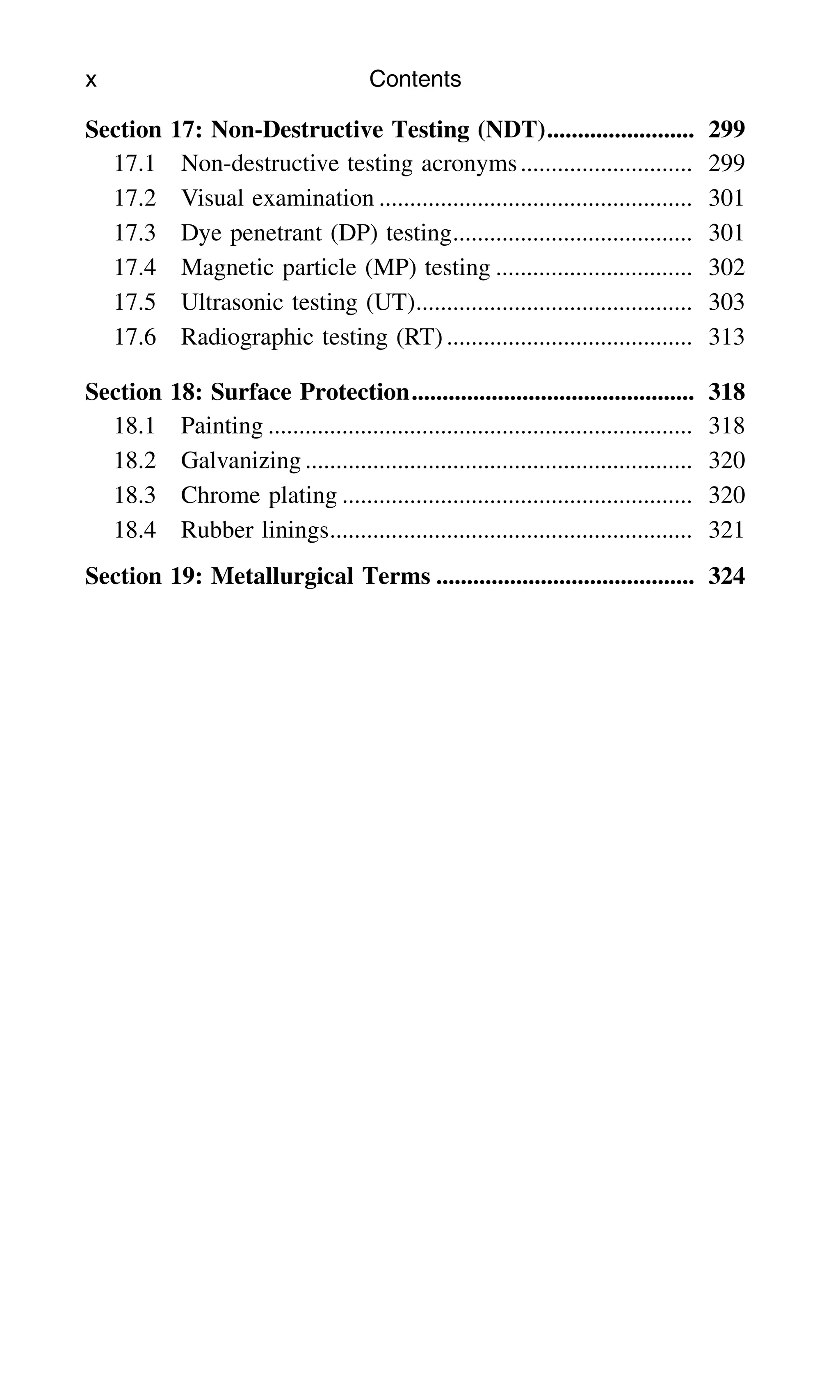
Section 17: Non-Destructive Testing (NDT)........................ 299
17.1 Non-destructive testing acronyms............................ 299
17.2 Visual examination ................................................... 301
17.3 Dye penetrant (DP) testing....................................... 301
17.4 Magnetic particle (MP) testing ................................ 302
17.5 Ultrasonic testing (UT)............................................. 303
17.6 Radiographic testing (RT) ........................................ 313
Section 18: Surface Protection.............................................. 318
18.1 Painting ..................................................................... 318
18.2 Galvanizing ............................................................... 320
18.3 Chrome plating ......................................................... 320
18.4 Rubber linings........................................................... 321
Section 19: Metallurgical Terms .......................................... 324
x Contents
Foreword
This book is an essential tool to help you as you embark on your
career in mechanical engineering, providing a wide range of
useful information you will need during your studies, and later
as a professional engineer.
The Institution of Mechanical Engineers (IMechE) is your
dedicated partner throughout your career and we are committed
to supporting you through your studies to graduation and
beyond. Home to 98,000 engineering professionals working in
the heart of the country’s most important and dynamic indus-
tries, we will ensure that you have the skills, knowledge, support
and development advice you need at every stage of your career.
Because we set the standard for professional excellence in
mechanical engineering our members are recognised for their
professional competence and enjoy enhanced career opportu-
nities as a result. To achieve this recognition of your skills and to
manage your career development, it is important that you
maintain your membership of IMechE and take advantage of
the opportunities available to help you fulfil your potential.
As an Affiliate member, during your studies you will benefit
from career advice and support as well as regular information
about engineering and how to get involved in your local IMechE
community. By becoming a member, you also have access to
Career Developer, our suite of online reporting tools, enabling
you to record your professional experience as soon as you start
your industrial placement.
Upon graduation you can apply to become an Associate
Member of IMechE and begin the journey towards professional
registration. With appropriate work experience and support
from IMechE to develop your skills and knowledge, you can
apply for registration as an Incorporated or Chartered Engineer.
Your membership of IMechE will bring ongoing support for
your continued professional development, through a range of
member resources, events and activities. Engineers need to
continue their professional development to keep their skills
fresh and progressive, so we will help you stay up to date,
broaden your knowledge and deepen your understanding of your
chosen industry.
We hope that your relationship with IMechE will be a lifelong
one that supports you throughout your career. As you join this
exciting and essential profession, we wish you luck and look
forward to helping you stay ahead in an increasingly varied,
dynamic and rewarding industry.
xii Foreword
Preface
This significantly updated 2012 edition of the Engineers’Data
Book replaces the three successful previous editions published
in 1998, 2000 and 2004. Since the data book’s inception,
feedback from engineers and students has indicated that, despite
the proliferation of technical information in published and
electronic format, there is still a need for a source of core
mechanical engineering information in a readily available form.
The 2012 data book has increased in content by approximately
60 percent compared to the first edition. As well as an increase
in the coverage of basic units, data, and engineering rules, the
content has gradually been extended to cover vital aspects of
structural integrity and reliability of engineering components:
these are important current issues in the engineering business.
Finally,itisimportantthatthecontentofthisdatabookcontinues
to reflect the information that is needed and used by student and
experienced engineers. If you have any suggestions for future
content(orindeedobservationsorcommentontheexistingcontent)
please let me know on: enquiries@matthews-training.co.uk
Clifford Matthews
Introduction
The Role of Technical Standards
What role do published technical standards play in mechanical
engineering? Standards have been part of the engineering scene
since the early days of the industrial revolution when they were
introduced to try to solve the problem of sub-standard products.
In these early days they were influential in increasing
the availability (and reducing the price) of basic iron and
steel products.
What has happened since then? Standards bodies have pro-
liferated, working more or less independently, but all subject to
the same engineering laws and practical constraints. They have
developed slightly different ways of looking at technical pro-
blems, which is not such a bad thing – the engineering world
would be less of an interesting place if everyone saw things in
precisely the same way. Varied though they may be, published
standards represent good practice. Their ideas are tried and
tested, rather than being loose – and they operate across the
spectrum of engineering practice, from design and manufacture
to testing and operation.
The current trend in Europe is towards harmonization of
national standards into the Euronorm (EN) family. Whether you
see this as rationalization or simply amalgamation is not
important – the harmonized standards will have significance
for the mutual acceptability of engineering goods between
companies and countries. Some recent ‘standards’, such as the
Machinery Directive and Pressure Vessel Directive have real
statutory significance, and are starting to change the way that
mechanical engineers do things. They may be written by
committees, but they are not without teeth.
Since the first edition of the Data Book, the number of EN
harmonized engineering standards has increased significantly.
However, their influence is still to be felt in many areas.
Engineering companies that have been used to working to
existing British and US standards can be reluctant to change,
with the result that many companies still prefer to work to
superseded standards. In some disciplines (pressure equipmen-
tis a good example) the amount of equipment being manufac-
tured to the new EN standards is quite small. Things are
changing, but slowly.
Technical standards continue to be an important model for
technical conformity in all fields. They affect just about every
mechanical engineering product from pipelines to paperclips.
From the practical viewpoint it is worth considering that,
without standards, the design and manufacture of even the most
basic engineering design would have to be started from scratch.
xvi Introduction
Section 1
Engineering Careers
1.1 Introduction: what is an engineer?
You can hear, and read, long opinionated, but largely inconclu-
sive, arguments as to what the title ‘engineer’ actually means.
For every view that the title should be limited to those with a
certain level of qualifications, or have attained a prescribed level
of Institution membership, there is a contrary view that says it
should relate equally to those who can prove a level of practical
or craft skill, or demonstrate so many years of vocational
experience.
Unlike some countries, where the designation is better de-
fined, the situation in the UK remains liberal and self-regulated.
In many industries the titles ‘engineer’ and ‘technician’ are used
freely and interchangeably, without causing too much chaos.
Older, more traditional industries often have more a definitive
intenal understanding of what the titles mean to them. This owes
as much, or more, to their own hierarchical structure and
heritage, however, as to any technical interpretation they really
ascribe to the terms. This older view of the world, whether you
are called ‘technician’ or ‘engineer’, paints to them a picture of
whether or not you sit in an office or get your hands dirty, what
you wear, and how much you get paid.
Looking back in time to the start of it all, it becomes clear that
job titles and delineations are much more artificial than they
appear. The earliest engineers conceived the ideas, designed
their innovative steam engines, bridges and ships, raised the
funds, and did many of the jobs themselves. This was born of
necessity, because there were no ready-trained technicians
waiting to take on the engineers’ concepts and turn them into
reality. Once under way, however, industry matured quite
quickly and separate job roles soon started to crystallize out,
Engineers’ Data Book, Fourth Edition. Clifford Matthews.
Ó 2012 John Wiley & Sons, Ltd. Published 2012 by John Wiley & Sons, Ltd.
driven by people’s preference to concentrate on things that they
naturally did best.
Over the last 100 years or so, with increased maturity of the
industrial society, the division of labour has continued, each
engineering specialism soon fragmenting into several subspe-
cialisms of its own, and so on. This is why the argument as to
what exactly delineates an engineer from a technician has
no real answer, and probably never will have. It is simply too
difficult to draw a line in the sand, within such a large and varied
continuum of skills, on which everyone will agree.
Assuming that you have no wish to spend the next forty or so
years worrying about a question to which you know there is no
answer, here is another way to look at it. Think of engineers and
technicians as all being part of the wide spectrum of engineer-
ing. A spectrum has no gaps between its colours, each one leads
seamlessly on to the next. Now think what it would look like
viewed in black and white rather than colour – they are now all
the same colour (grey) differentiated from each other only by
the depth of their shade of grey.
What if the shades of grey represented technical difficulty?
The light grey shades would represent job roles that are easier to
learn, with the dark ones being progressively more difficult.
Difficulty might also be associated not only with the technical
depth of the subject or role but also with the time it would take to
learn to do it well. At no point in this continuum from white
(easy) to black (difficult) could we draw a definitive line
dividing ‘light’ from ‘dark’, all we can say is that the spectrum
consists of varying degrees of lightness and darkness and that
every shade forms part of the complete picture. So this is our
conclusion:
. Generic job titles such as ‘engineer’ and ‘technician’ cannot,
realistically, be accurately defined – they are simply parts of
the continuous spectrum of job roles in the engineering
industry. However . . .
. One way to view the difference in roles is to consider how
difficult each one is, and how long it would take to master
it (properly!).
2 Engineers’ Data Book
1.2 A rough guide to industry breakdown
There are many hundreds of different industry types, roles, job
descriptions and specialisms in the world of mechanical engi-
neering, all of which are spread over a multitude of different
industry sectors. There are various systems that attempt to
categorize these into standard industry classifications (SICs)
using code numbers or letters, but they are complicated and do
not always fit well with each other.
Simplistically, you can think of the engineering industry, and
the job roles within it, as a matrix. To keep this matrix to any sort
of manageable size means that it needs to be generalized –
providing an overall picture rather than a detailed or compre-
hensive analysis.
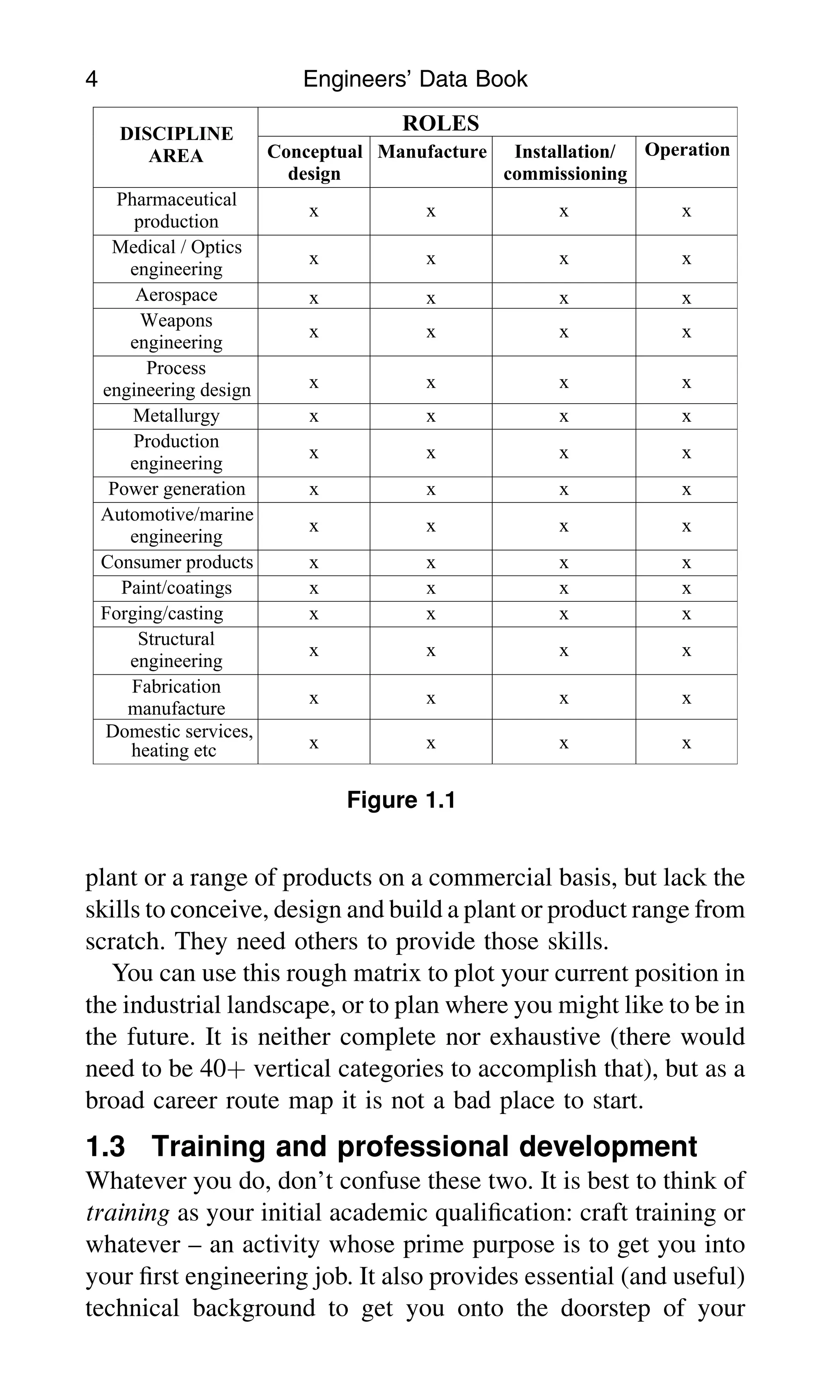
Figure 1.1 shows the matrix. The more basic industries lie
near the bottom, rising to the increasingly complex and tech-
nologically advanced ones towards the top. Although pure
science elements exist at all these levels they become more
prevalent (and are used in greater detail) in those industries near
the top of the matrix. There is no implication of value or worth to
industry in the position of any entry in the vertical scale, it is just
a crude grading based on the overall complexity and resultant
difficulty of the subject. The horizontal axis of the matrix is
different. This shows the basic allocation of job roles which is
equally applicable to all the industry sectors in the vertical scale.
There may be a few differences, but the basic breakdown is
much the same for all. The horizontal axis is based on a
chronological (time) scale, running left to right. Unlike the
vertical axis, the differences in complexity and difficulty are less
well spread across the horizontal axis. Product conception and
design fit naturally together as a discrete skill-set, but the others
are fairly well separated out, representing discrete and identifi-
able job roles.
The left-hand end – conception and design – suits those
people with high levels of innovation and conceptual skills.
They can spot an idea, visualizing its final function and form,
but lack a full set of skills suited to turning it into hard
engineering reality. At the right-hand end, plant operators and
technicians have the business and practical skills to operate a
Engineering Careers 3
plant or a range of products on a commercial basis, but lack the
skills to conceive, design and build a plant or product range from
scratch. They need others to provide those skills.
You can use this rough matrix to plot your current position in
the industrial landscape, or to plan where you might like to be in
the future. It is neither complete nor exhaustive (there would
need to be 40þ vertical categories to accomplish that), but as a
broad career route map it is not a bad place to start.
1.3 Training and professional development
Whatever you do, don’t confuse these two. It is best to think of
training as your initial academic qualification: craft training or
whatever – an activity whose prime purpose is to get you into
your first engineering job. It also provides essential (and useful)
technical background to get you onto the doorstep of your
DISCIPLINE
AREA
ROLES
Conceptual
design
Installation/
Manufacture
commissioning
Operation
Pharmaceutical
production
x
x
x
x
Medical / Optics
engineering
x
x
x
x
x
x
x
x
Aerospace
Weapons
engineering
x
x
x
x
Process
engineering design x
x
x
x
x
x
x
x
Metallurgy
Production
engineering
x
x
x
x
x
x
x
x
Power generation
Automotive/marine
engineering
x
x
x
x
x
x
x
x
Consumer products
x
x
x
x
Paint/coatings
x
x
x
x
Forging/casting
Structural
engineering
x
x
x
x
Fabrication
manufacture
x
x
x
x
Domestic services,
heating etc x
x
x
x
Figure 1.1
4 Engineers’ Data Book
subject, but does not yet provide you with any of the full skill
sets you need to move forward. This training is a benchmark,
slotted into the system to differentiate between those who have it
and those who do not.
Professional development is the next step. This is any training
activity that has a specific job-related objective or purpose. It is
often mistakenly seen as comprising mid-career courses in
generalized disciplines such as marketing, finance, QA, project
management skills and similar. Such-temptingly-named courses
are really not what it is about. Whilst they may look and sound
good, they lack cutting edge in differentiating those people with
real ability in the core skills of the industry from those who do
not. They are too general, too short, and woefully lacking in core
skills, technical content and bite.
Productive professional development must be centred on the
core skills of your particular industry. To possess the quality of
being able to differentiate between its participants, productive
professional development has to be structured to have a pass or
fail criteria, with a pass mark high enough (and overall pass rate
low enough) to buy it credibility and give it some teeth.
Thebesttimetostartproductiveprofessionaldevelopmentisas
soon as possible after your initial training is complete. For best
effect try to run it in parallel with a role that gains you practical
hands-onexperienceofthedisciplineinwhichyouareemployed.
This will force the productive and professional elements to
complement each other, multiplying the effect of them both.
Coupled with sound initial training and a bit of hands-on experi-
ence, the way in which you choose to pursue professional
development activities in the early career years seems to be
one of the clear factors in determining those who progress
quickly up the technical jobs hierarchy and those who do not.
1.4 Degrees of (engineering) excellence
You have probably decided that getting a degree is a good idea –
or why would you be reading this book? The reason why any
high-level qualification is required is always a good talking
point. Opinions differ about why it is necessary, and what is the
point of it all.
Engineering Careers 5
The time-honoured explanation you will be given is that it is
all about training your mind. Engagement in the apparently
endless carousel of mathematical examples, laboratory reports,
descriptions and discussions will train your grey cells to address
similar, even unrelated, problems in your future career – and all
will be well.
This is interesting but, of course, untrue. Your mind is now as
trained as it will ever be. It is at the pinnacle of its absorptive,
innovative and recuperative powers – loaded, primed and ready
to go. You are sitting at the end of 400,000 to 500,000 years of
human development, a continuum of innovation, forward think-
ing and trial-and-error that turned the world from stone age
caves and forests to what you see today. Most of the steps and
discoveries were made by people under the age of 25, without
any qualifications at all – which is a very recent development.
If we set the above aside as an illusion disproven by history,
we find that the need for an engineering degree today is based on
four main criteria. Consider them of equal weight: complemen-
tary criteria that naturally exist as part of a set, and each of
which has little resonance or effectiveness without the assis-
tance of the others.
1.4.1 A degree is a benchmark
As a benchmark for industry, degrees work reasonably well
without being spectacular. Industries seem to like benchmarks,
as it gives them something to aim for, or against which they can
measure their success. Engineering companies use them as part
of their recruitment policy, giving them some idea of whom to
invite to interviews.
One of the strange properties of benchmarks is that they
cannot be usefully produced by the part of organization that sees
the benefit in using them. The profit-making parts of any
engineering business (consisting of those people and groups
that actually know how things work) are far too busy trying to
extract profit from the market – whilst supporting the rest of the
organization and its hangers-on – to get involved in recruitment
policy, skill-sets or this week’s current incarnation of the
education system. The result is that recruitment policy and
6 Engineers’ Data Book
practices are administered by those on the edge of an organiza-
tion rather than at its profit-making core. This fosters the
practice of grabbing at plausible-sounding requirements that
can be put in recruitment adverts, and slid into the candidate
assessment procedure.
The actual detailed content of degree courses can (and do)
remain a bit of mystery to many recruiters. The content of most
benchmark qualifications are set in academia rather than by the
‘customer’ organizations because, as we know, they are simply
too busy. Some comfort is offered by various third-party ac-
creditations of degree courses and this, accompanied by a few
subjective recollections of the reputation and specialisms of
some educational institutions and courses, is usually good
enough. The end result is that an engineering degree becomes
a prerequisite for entering the recruitment and interview process
of any engineering company.
1.4.2 A degree is a filter
This one works for you. The time and effort required to achieve
an engineering degree gives you the opportunity to see if you
like the subject. If it proves to be unsuitable for you, then it’s
best to find out sooner rather than later, to prevent your career
becoming a necessary daily chore. If you decide that it is
something you would like to do, then you will gain:
. The opportunity to make engineering your career.
. Access to the answers to the vast array of engineering ques-
tions that 99% of the general population can’t answer.
. A guarantee (well, almost) of long-term employability – if
you are any good. This may, or may not, offer good financial
reward depending on which area of the subject you end up in.
There are a few stratospheric salaries in engineering, a lot of
good ones and some where you would earn as much driving a
taxi. Your eventual destination will be decided by the sum
total of your ability, willingness to seek knowledge, and the
choices you make along the way.
The degree process filter acts as a long filter, rather than a
particularly severe or fine one – but it works quite well.
Engineering Careers 7
1.4.3 A degree is a first step in the career race
Career progression is nothing more than a race against the
clock. As you progress, the winning post either gets closer or
recedes into the unobtainable distance, depending on where you
have set it.
In any race, the first step is not the winning post. Sadly, you
cannot enter anyracewithout a first step, so the sooner you take it
thebetter.Thinkofthisfirststepasamechanisticprocess,withthe
objective being its completion, rather than demonstrating a
shining example of success. A degree is a sound first step, but
it is not the winning post, which is where the prizes are awarded.
1.4.4 A degree gives you knowledge feedstock
The biggest advantage of an engineering degree is the knowl-
edge feedstock it provides. It may be surrounded by the usual
doubtful skills of management, sales, communication, and the
like, but strip these away and it is an almost perfectly technical
subject. You cannot progress without a critical mass of this
technical information, much of which is packaged in the
engineering degree syllabus.
Which degree is the best?
This matters less than you think. The number of engineering
degrees available in the UK alone now runs into hundreds, each
one comprising different combinations and permutations of
pure or applied subjects and claiming to be shorter, more
effective, or more (or less) intensive than the others.
Relax. With a few exceptions – all this creation is largely
artificial. It proliferates from the needs of educational establish-
ments to increase their numbers of student ‘customers’ rather
than from the segmented technical needs of the industries they
ultimately serve. At this level, all engineering has a fairly stable
core of mathematics, chemistry and physics: equations, con-
cepts and techniques that describe the engineering-related parts
of the natural world. The multiple variation of degree subject
combinations are nothing more than different patterns of the
DNA of the subject, not different DNA.
The pattern of technical subjects learned will really only
become useful to you when you are in about Year 4 of your
8 Engineers’ Data Book
post-graduatecareer.Beforethis,inYears1,2and3,thepatternof
knowledge ‘feedstock’ amassed during your degree course will
feature in only about 5% of the things in which you are involved.
The rest will, forthe moment, be forgotten. Sadly,it is impossible
to know in advance exactly which 5% of your initial knowledge
upload you will need, so you more or less have to learn it all.
In about Year 4 of a post-graduation career, everything
changes. Only about 20% of graduates will still be with their
initial role or employer and the demand will now almost
certainly be for a completely different pattern of knowledge
than the 5% you used when you first started. The new pattern of
knowledge required will now start to present itself to you. The
percentage of the core engineering subjects you use will start to
rise, and any synthetic combinations of syllabus content of your
original degree will quickly lose its significance. This will be
followed in close pursuit by the title of your degree, its
artificially created specialisms, and the name of the hallowed
institution from whence it came.
Now the race is on.
1.5 Degrees and how to pass them
Passing a degree is more or less a mechanistic procedure.
Assuming that you have been preprogrammed with the neces-
sary basic education, and are blessed with an average-to-good
mental processing ability, passing a degree comprises a fixed
equation of 5% flair and natural ability, 5% chance, and 90%
predictable, mechanistic procedure. Engineering degrees are no
exception to this – in fact they fit the formula better than most.
Here is the procedure:
. Step 1: Decide your target, C, B or A.
. Step 2: Get the syllabus, so that you know what’s coming.
. Step 3: Weed out the syllabus so that you can manage it.
. Step 4: Establish a learning method.
. Step 5: Follow your learning method, tailored to the C, B or A
decision target you have set.
This five-step methodology has always worked well, and its
effectiveness is actually increasing owing to the recent prolif-
Engineering Careers 9
eration of degree courses and increases in undergraduate num-
bers. It is helped along by the increasing contemporary assump-
tion that most candidates should succeed, surrounded by a
sparkling array of assessment structures, grades and subgrades.
Here is Step 1 (the most important one) in a little more detail.
Decide your target: C, B or A
Which of these three targets you choose will set the agenda for
all the time you spend on your degree course. They are equally
applicable to full or part time courses – they relate purely to the
target you set yourself, and are therefore independent of the
name, content or length of the course. One of the inherent
properties of these targets is that if that you don’t consciously
choose one of the three, one will always choose itself for you,
attaching itself to you without your knowledge. It is therefore
best to choose one for yourself, so that you know what it is, and
can fit in with it.
Target C
If you choose target C you have decided to do just enough to
pass all the parts of the syllabus that you need to get your degree.
Grade is not important to you, and you are happy to rely on a bit
of luck to, hopefully, get better than you deserve. In submitting
reports, dissertations and projects, and sitting exams, you are
happy with recital rather than real understanding – indeed you
may not know the difference. There is no need to feel isolated if
you have chosen target C (or if it has chosen you) because about
50% of your fellow undergraduates will do exactly the same.
Target B
Target B undergraduates are target C ones in urbane disguise.
Whilst fundamentally sharing the target C views, they have
identified that the business of passing qualifications must
have some error margin floating around. Aiming just to pass
could mean that with a bit of bad luck, unplanned absence or
misreading of exam questions, it might just be possible to fall
victim to this error margin, and fail. Opinions differ on how big
this error margin actually is, but intuitively it falls somewhere
between 5 and 15%.
10 Engineers’ Data Book
Target B undergraduates aim to try that little bit harder, to
ensure that they place themselves firmly in the pass zone,
cleanly above the error band. They intend to do this mainly in
the continuous assessment or project work elements of the
degree course – hoping that the examined parts (which are just
that bit harder) will look after themselves. To help their chances
in the continuous assessment modules, target B undergraduates
tacitly accept that they will need to bring a little structure and
organization to their work. This, however, will be largely
reactive – they will do it when chased, or when they think they
have to. On balance they are still (knowingly or unknowingly)
being managed by the degree syllabus that is thrust upon them,
occasionally being surprised when it goes too fast, too slow or
when it suddenly expands to a depth that catches them out.
When it does, they will discuss this apparent unfairness with
some of the 35% of undergraduates who have chosen the same
target B path.
Target A
Target A is not necessarily about getting the top marks in the
class, grade Aþ or Aþþ with gold and platinum star. These
awards, say the 15% target A group, are for the birds – merely a
crude and ephemeral illusion of early-career grandeur, rather
than success in itself.
The real secret of target A lies in the predictability it brings to
the whole affair. Target A undergraduates analyse the content,
structure and timing of the course in advance. In this way, as
they progress through the months and years of the course, they
always know what is coming next, and can put the past and
forthcoming parts of the syllabus in the context of the final
examinations. Later parts of the syllabus come as no surprise
and three notable things play a big part in this:
. Full familiarity with the basic ‘ball skills’ of the course
subjects. To hit target A requires complete mastery of basic
maths routines and its differentiation and integration methods
until they become second nature. Recognizing mathematical
formats and equation types is a requirement of many degree
subjects so this will pay itself back in benefits many times.
Engineering Careers 11
Once you have achieved this mastery you will find yourself
attracted to classroom and homework examples that contain
them, rather than imaginatively avoiding them – which is
what the target B and C groups do.
. Asking ‘why?’ and ‘what else can I find out?’. The target
A philosophy does not end with doing the ten questions or
examples you are given on any particular subject. Think of
this as being about two-thirds of the journey – when you’ve
done them, make an active attempt to find some different
examples (harder, not easier ones), and do them as well. For
qualitative, or description information and concepts, then ask
why? two or three times, and search until you find the answer.
You are constantly making things hard for yourself – but that
is the environment of target A.
. Planning and time management is the bedrock of target
A territory. You need to get the course syllabus in advance,
see how long each part takes, make plans for doing it, learning
it, revising it, sorting out your problems with it and then
anticipating the way that its content will be slid into the
examinations. None of this is random – it is all planned in
advance so that ultimately there are no surprises. You are
managing it, rather than it managing you.
Summary: Your choice of target
Seen from a distance, there is no single more important part of
passing an engineering degree course than the target C, B or A,
that you choose. Throughout the course it will determine;
. What you do
. How you do it
. When you do it
. How much effort you put in
. Whether you pass or fail – and what grade you get
1.6 Do you have any . . . experience?
Nature has thoughtfully provided you with a mental processing
power. Your degree will give you the named folders in which to
store the next four decades of accumulated data. All you need
now is the universal tool for sifting the wide datastream that will
12 Engineers’ Data Book
be heading in your direction, from which you have to separate
out the relevant information from the unnecessary, the illusion
and the noise.
This tool is called experience. Whilst it may not be the only
tool in the box, it has an impressive record of success. Almost
everything gets easier with experience – seemingly insurmount-
able problems become straightforward, once you have seen the
solution before. Intractable barriers turn to straw in the sunlit
field of hindsight and straight-thinking gradually replaces the
previous patterns of circle and spirals that, you have painfully
discovered, lead nowhere.
As with all things of value, experience has a scarcity about it.
To graduates it is elusive. All employers would like it, quizzing
you to see if you have it, as you wonder exactly where you are
supposed to have got it from. To employers, it is a scarce
resource – graduates with experience, particularly relevant
experience, are rare enough to foster competition amongst
employers for their services. It would be even better if these
graduates came prepacked ready for use, their experience
having been thoughtfully provided by the time and expense of
someone else.
To get round this situation, you need to get hold of this
experience quickly. As experience is basically about you ab-
sorbing relevant parts of the datastream, the secret is to ensure
that you embark on a process of accelerated data transfer. This
won’t happen by itself, you need to consciously make it happen.
Forget the clock and calendar as a frame of reference, because
accelerated data (experience) time is not real time. Real time is
far too slow. Graduates who process the datastream in real time
are controlled by the datastream, rather than exerting their will
upon it – and the following risks lie in wait.
. In four years, you may have not necessarily accumulated four
years of experience data transfer – only four months of
transfer, repeated 12 times. You have achieved an experience
efficiency of one-twelfth, or 8.3%.
. You have processed 12  4 month datastreams which,
although aesthetically and technically different, actually only
Engineering Careers 13
trigger the same experience ‘locks’. The result is much the
same. Congratulations: 8.3%.
Note that the above has little to do with your mental processing
power (to solve problems, write specifications, understand
drawings or whatever). Everyone is a bit different at that but
these differences have little effect compared to the results if the
correct (experience) datastream does not arrive at you in the
first place.
To summarize – The key thing is to accelerate the (experience)
datastream that you are exposed to. Once it is there, your brain
will process it for you without you needing to try very hard.
How to accelerate your input datastream
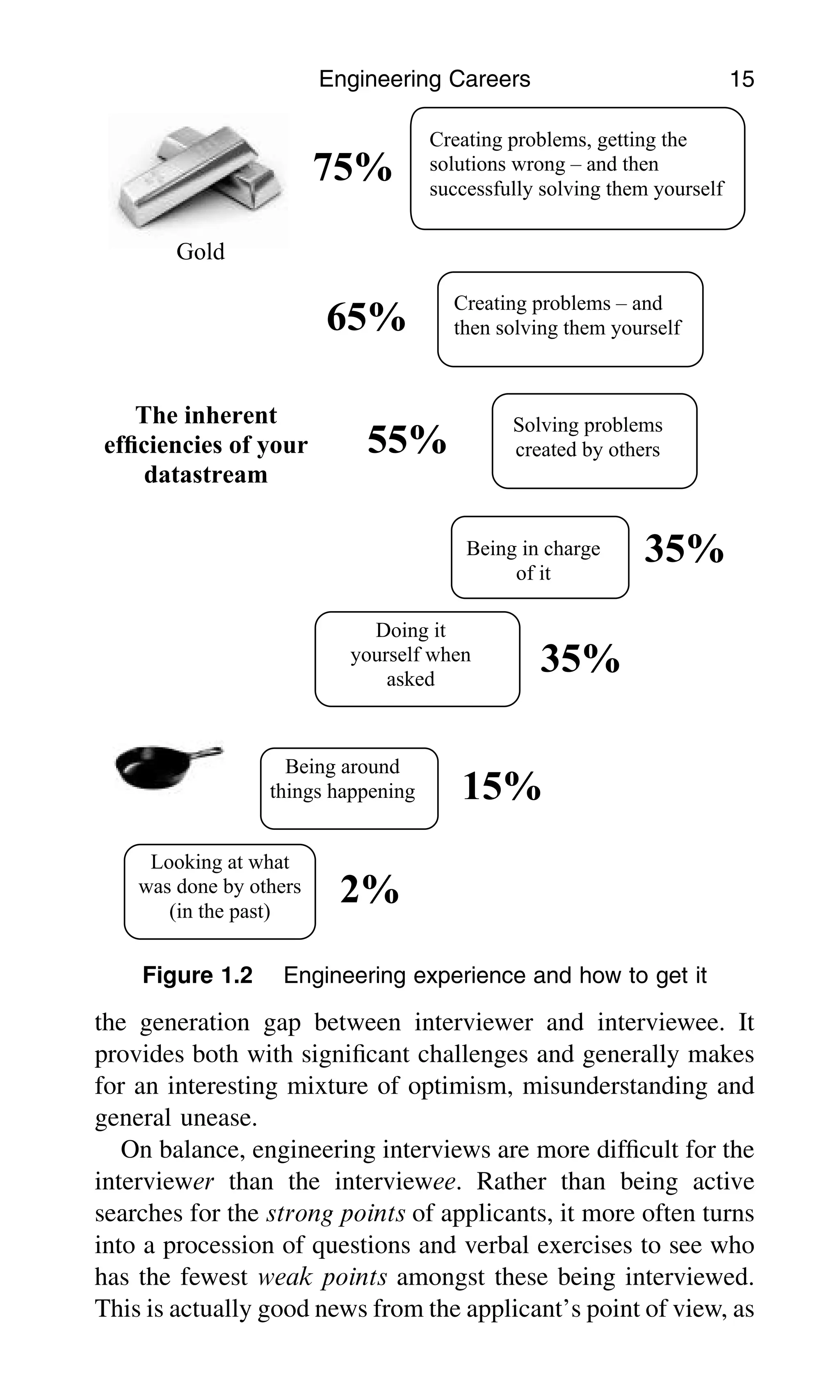
Choose your poison from the recipe in Fig. 1.2. The list shows
the datastream (experience) efficiency that each of the entries
will give you. None has an efficiency greater than 100%, so you
can’t accelerate calendar time chronologically, but anything
over about 40% will place you above the average, and you will
effectively exceed real time.
Conversely, if you rely on activities below 40%, then your
experience clock slows below real time and you will fall behind.
Unfortunately, the activities offering the greatest experience
return are always the least comfortable, and have an unerring
ability to hide away until you look for them. Comfort resides at
the bottom left of the list, waiting to catch you.
How long is this list valid for?
It remains in force, unchanged, for your whole career, if your
care to read it. By about 10 years after graduation however, you
will have chosen your place on the list and are caught. You will
find it just about impossible to move up the list, no matter how
hard you try.
1.7 Final cut – job interviews
Job interviews are, by their nature, awkward affairs. As a bit of
office theatre they are difficult to better, with multiple facets
depending on whether you are looking at it from the viewpoint
of employer or applicant. Running the whole show is, of course,
14 Engineers’ Data Book
the generation gap between interviewer and interviewee. It
provides both with significant challenges and generally makes
for an interesting mixture of optimism, misunderstanding and
general unease.
On balance, engineering interviews are more difficult for the
interviewer than the interviewee. Rather than being active
searches for the strong points of applicants, it more often turns
into a procession of questions and verbal exercises to see who
has the fewest weak points amongst these being interviewed.
This is actually good news from the applicant’s point of view, as
Being around
things happening
Doing it
yourself when
asked
Looking at what
was done by others
(in the past)
Being in charge
of it
Solving problems
created by others
Creating problems – and
then solving them yourself
Creating problems, getting the
solutions wrong – and then
successfully solving them yourself
2%
15%
35%
35%
55%
65%
75%
Gold
The inherent
efficiencies of your
datastream
Figure 1.2 Engineering experience and how to get it
Engineering Careers 15
these perceived weak points are smaller in number than strong
points ever can be and are, within a fairly small tolerance band,
almost perfectly predictable. Here they are;
. Limited technical knowledge? The headline purpose of an
engineering job interview is generally to find out whether
an applicant’s technical knowledge base reflects an aptitude
for, and an interest in, the subject of engineering, or whether
all they can do is recite in parrot fashion what they remember
from their assembled college courses. About 70% of appli-
cants fit into the second category, and are easy to spot.
. Lack of interest in practical skills? Don’t confuse this with
being questioned on your physical experience of practical
skills – that will be quite clear from your age and the activities
shown on your CV. The issue is your interest in the practical
aspects. You can fall foul of this one by talking too much
about computer skills and spreadsheets – because familiarity
with these is not in short supply.
. Browser dependency? Nothing is better than this at chiselling
the interview generation gap into a form that won’t help you.
In the ageing eyes of your interviewers the answers to
technical questions are not found in the depths of Gurglepedia
or any other epic destinations of your browser. They may of
course be wrong, but they are running your interview.
. Dependence and indecisiveness? Interviewers are perma-
nently twitchy about applicants who seem to have plenty of
technical knowledge but would rather let someone else make
all the decisions for them. Reasons for this range from not
wishing to be seen to get something wrong, to saving face, to
an overall attitude of indecision and procrastination upon
which some people base their life. Neither provides very good
value for money from an employer’s point of view. If, perish
the thought, your interviewer also suffers from even a little of
this, he or she will strangely not welcome seeing it in you.
That’s just how it works.
This, therefore, is the formula: if you can formulate an interview
technique to get round these perceived weak points first, you can
16 Engineers’ Data Book
then get on with the easier business of letting your strong points
shine through.
To help you, our website provides further guidance on the
answers to more specific interview questions. Try the quizzes
and take a look at the sample answers that employers are looking
for. They all work.
www.matthews-training.co.uk/interviews
When prompted, use the password: Matthewsdatabook2012.
Engineering Careers 17
Section 2
Units
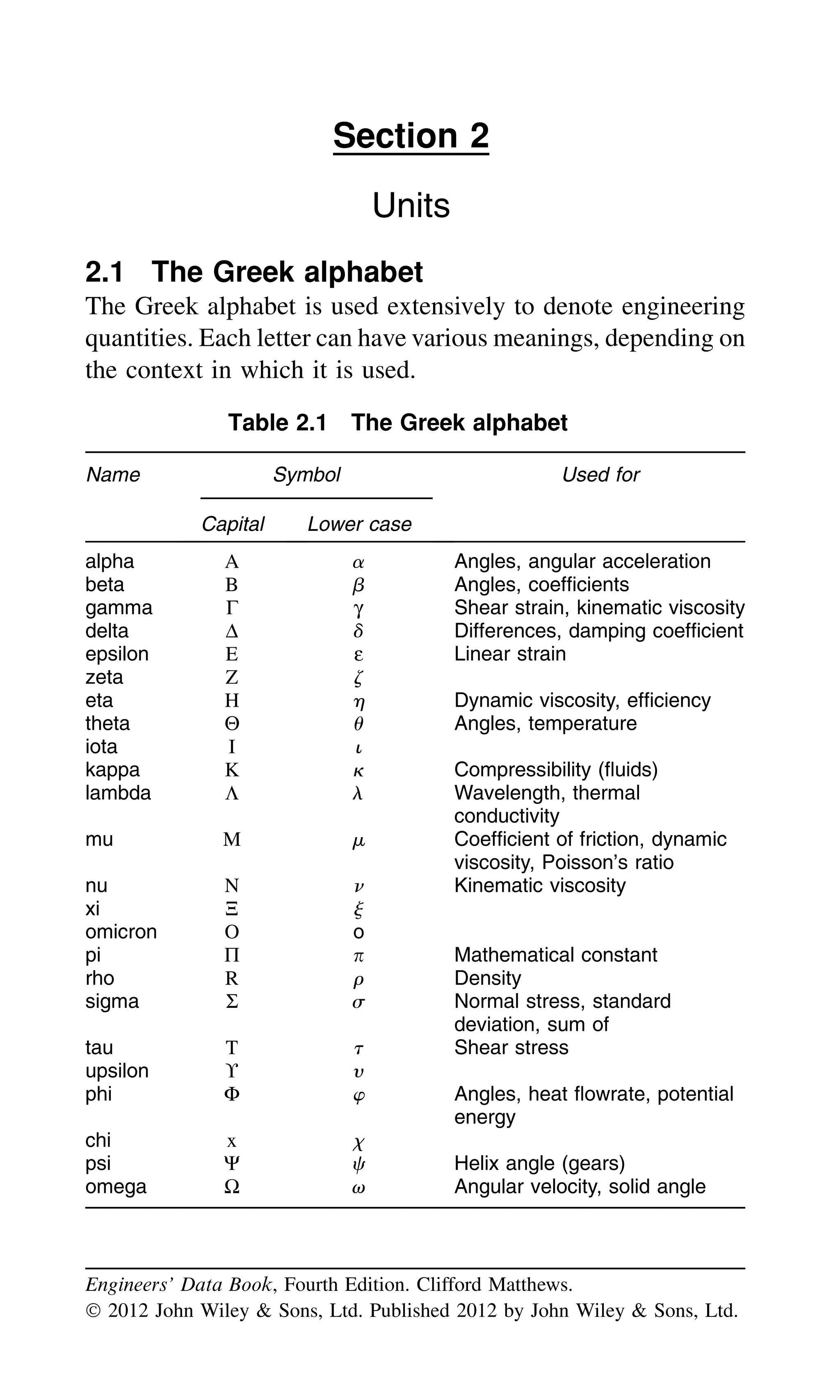
2.1 The Greek alphabet
The Greek alphabet is used extensively to denote engineering
quantities. Each letter can have various meanings, depending on
the context in which it is used.
Table 2.1 The Greek alphabet
Name Symbol Used for
Capital Lower case
alpha A a Angles, angular acceleration
beta B b Angles, coefficients
gamma G g Shear strain, kinematic viscosity
delta D d Differences, damping coefficient
epsilon E e Linear strain
zeta Z z
eta H h Dynamic viscosity, efficiency
theta Q u Angles, temperature
iota I i
kappa K k Compressibility (fluids)
lambda L l Wavelength, thermal
conductivity
mu M m Coefficient of friction, dynamic
viscosity, Poisson’s ratio
nu N n Kinematic viscosity
xi X j
omicron O o
pi P p Mathematical constant
rho R r Density
sigma S s Normal stress, standard
deviation, sum of
tau T t Shear stress
upsilon ¡ y
phi F w Angles, heat flowrate, potential
energy
chi x x
psi Y c Helix angle (gears)
omega W v Angular velocity, solid angle
Engineers’ Data Book, Fourth Edition. Clifford Matthews.
 2012 John Wiley  Sons, Ltd. Published 2012 by John Wiley  Sons, Ltd.
2.2 Units systems
Unfortunately, the world of mechanical engineering has not
yet achieved uniformity in the system of units it uses. The
oldest system is that of British Imperial units – still used in
many parts of the world, including the USA. The CGS (or
MKS) system is a metric system, still used in some European
countries, but is gradually being superseded by the Systeme
International (SI) system. Whilst the SI system is understood
(more or less) universally, you will still encounter units from
the others.
2.2.1 The SI system
The strength of the SI system is its coherence. There are four
mechanical and two electrical base units, from which all other
quantities are derived. The mechanical ones are:
Length: metre (m)
Mass: kilogram (kg)
Time: second (s)
Temperature: Kelvin (K)
Remember, other units are derived from these; e.g. the Newton
(N) is defined as N ¼ kg m/s2
.
2.2.2 SI prefixes
As a rule, prefixes are applied to the basic SI unit, except for
weight, where the prefix is used with the unit gram (g), not the
basic SI unit kilogram (kg). Prefixes are not used for units of
angular measurement (degrees, radians), time (seconds), or
temperature (
C or K).
Prefixes should be chosen in such a way that the numerical
value of a unit lies between 0.1 and 1000.
For example 28 kN rather than 2.8  104
N
1.25 mm rather than 0.00125 m
9.3 kPa rather than 9300 Pa
Units 19
2.2.3 Conversions
Units often need to be converted. The least confusing way to do
this is by expressing equality:
For example: to convert 600 mm H2O to Pascals (Pa)
Using 1 mm H2O ¼ 9.80665 Pa
Add denominators as
1 mm H2O
600 mm H2O
¼
9:80665 Pa
xPa
Solve for x
x Pa ¼
600  9:80665
1
¼ 5883:99 Pa
Hence 600 mm H2O ¼ 5883.99 Pa
Setting out calculations in this way can help avoid confusion,
particularly when they involve large numbers and/or several
sequential stages of conversion.
Table 2.2 SI prefixes
Multiplication factor Prefix Symbol
1 000 000 000 000 000 000 000 000 ¼ 1024
yotta Y
1 000 000 000 000 000 000 000 ¼ 1021
zetta Z
1 000 000 000 000 000 000 ¼ 1018
exa E
1 000 000 000 000 000 ¼ 1015
peta P
1 000 000 000 000 ¼ 1012
tera T
1 000 000 000 ¼ 109
giga G
1 000 000 ¼ 106
mega M
1 000 ¼ 103
kilo k
100 ¼ 102
hecto h
10 ¼ 101
deka da
0.1 ¼ 101
deci d
0.01 ¼ 102
centi c
0.001 ¼ 103
milli m
0.000 001 ¼ 106
micro m
0.000 000 001 ¼ 109
nano n
0.000 000 000 001 ¼ 1012
pico p
0.000 000 000 000 001 ¼ 1015
femto f
0.000 000 000 000 000 001 ¼ 1018
atto a
0.000 000 000 000 000 000 001 ¼ 1021
zepto z
0.000 000 000 000 000 000 000 001 ¼ 1024
yocto y
20 Engineers’ Data Book
2.3 Units and conversions
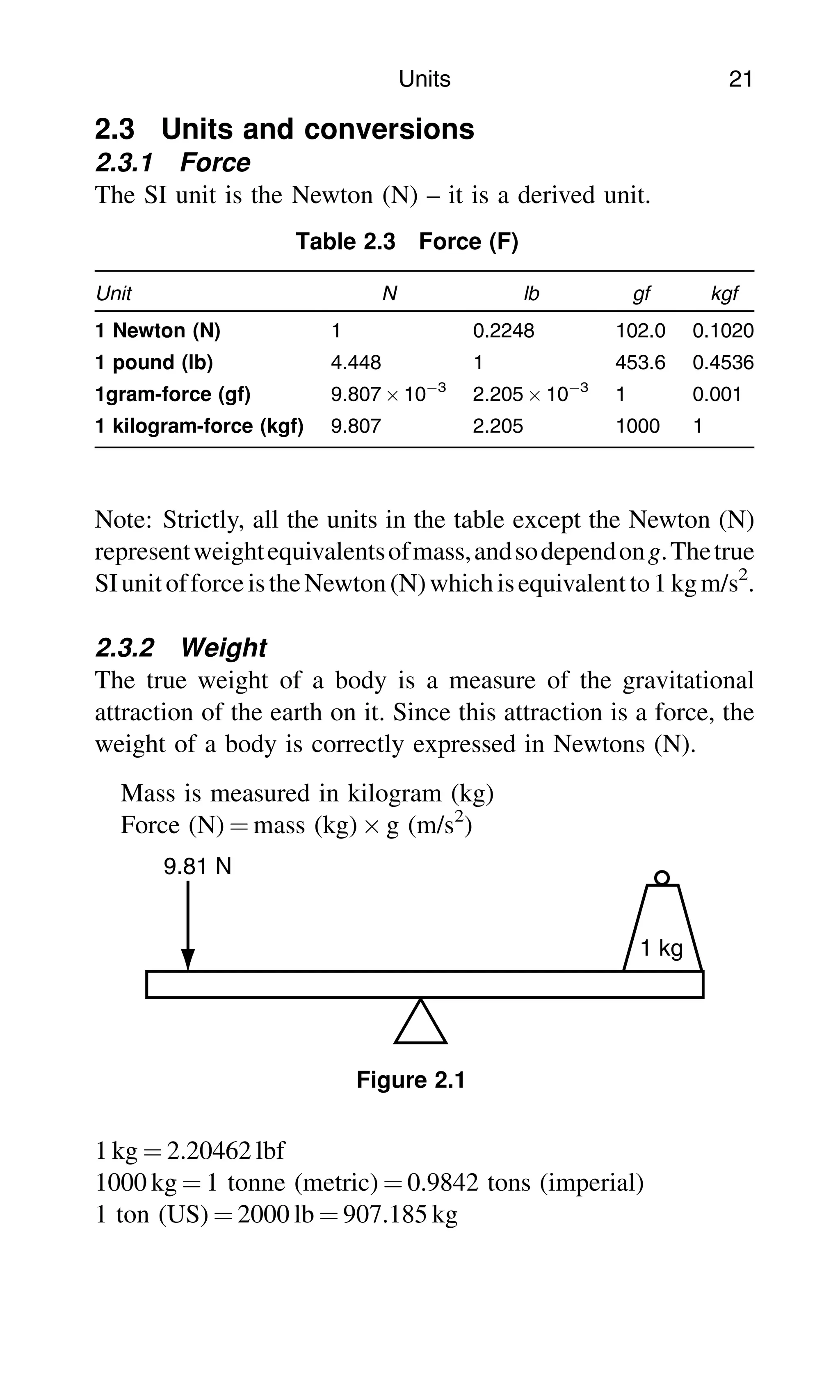
2.3.1 Force
The SI unit is the Newton (N) – it is a derived unit.
Note: Strictly, all the units in the table except the Newton (N)
representweightequivalentsofmass,andsodependong.Thetrue
SIunitofforceistheNewton(N)whichisequivalentto1 kgm/s2
.
2.3.2 Weight
The true weight of a body is a measure of the gravitational
attraction of the earth on it. Since this attraction is a force, the
weight of a body is correctly expressed in Newtons (N).
Mass is measured in kilogram (kg)
Force (N) ¼ mass (kg)  g (m/s2
)
1 kg ¼ 2.20462 lbf
1000 kg ¼ 1 tonne (metric) ¼ 0.9842 tons (imperial)
1 ton (US) ¼ 2000 lb ¼ 907.185 kg
Table 2.3 Force (F)
Unit N lb gf kgf
1 Newton (N) 1 0.2248 102.0 0.1020
1 pound (lb) 4.448 1 453.6 0.4536
1gram-force (gf) 9.807  103
2.205  103
1 0.001
1 kilogram-force (kgf) 9.807 2.205 1000 1
1 kg
9.81 N
Figure 2.1
Units 21
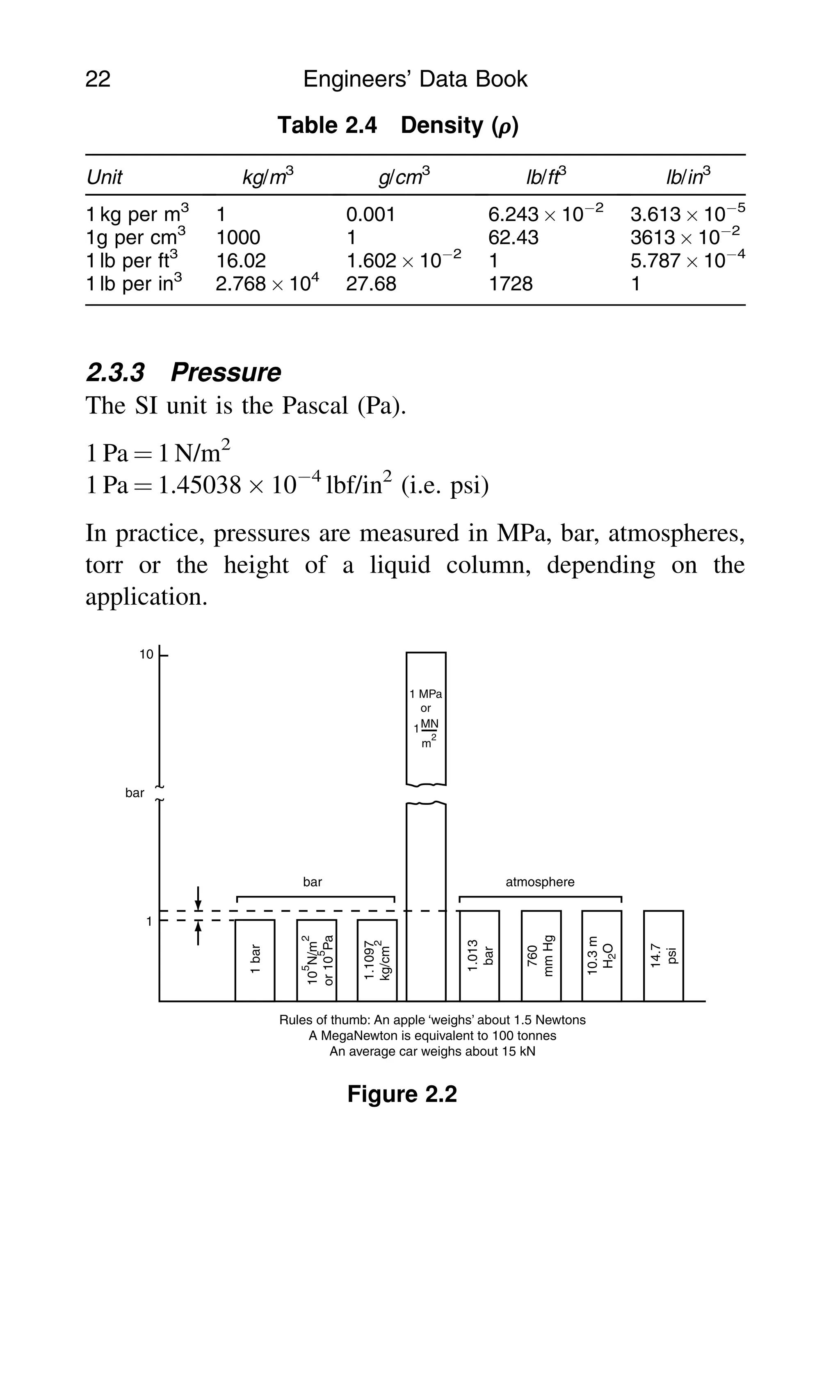
2.3.3 Pressure
The SI unit is the Pascal (Pa).
1 Pa ¼ 1 N/m2
1 Pa ¼ 1.45038  104
lbf/in2
(i.e. psi)
In practice, pressures are measured in MPa, bar, atmospheres,
torr or the height of a liquid column, depending on the
application.
Table 2.4 Density (r)
Unit kg/m3
g/cm3
lb/ft3
lb/in3
1 kg per m3
1 0.001 6.243  102
3.613  105
1g per cm3
1000 1 62.43 3613  102
1 lb per ft3
16.02 1.602  102
1 5.787  104
1 lb per in3
2.768  104
27.68 1728 1
bar
1
bar
10
5
N/m
2
or
10
5
Pa
1.1097
kg/cm
2
1.013
bar
760
mm
Hg
10.3
m
H
2
O
14.7
psi
bar
atmosphere
Rules of thumb: An apple ‘weighs’ about 1.5 Newtons
A MegaNewton is equivalent to 100 tonnes
An average car weighs about 15 kN
10
1
Figure 2.2
22 Engineers’ Data Book
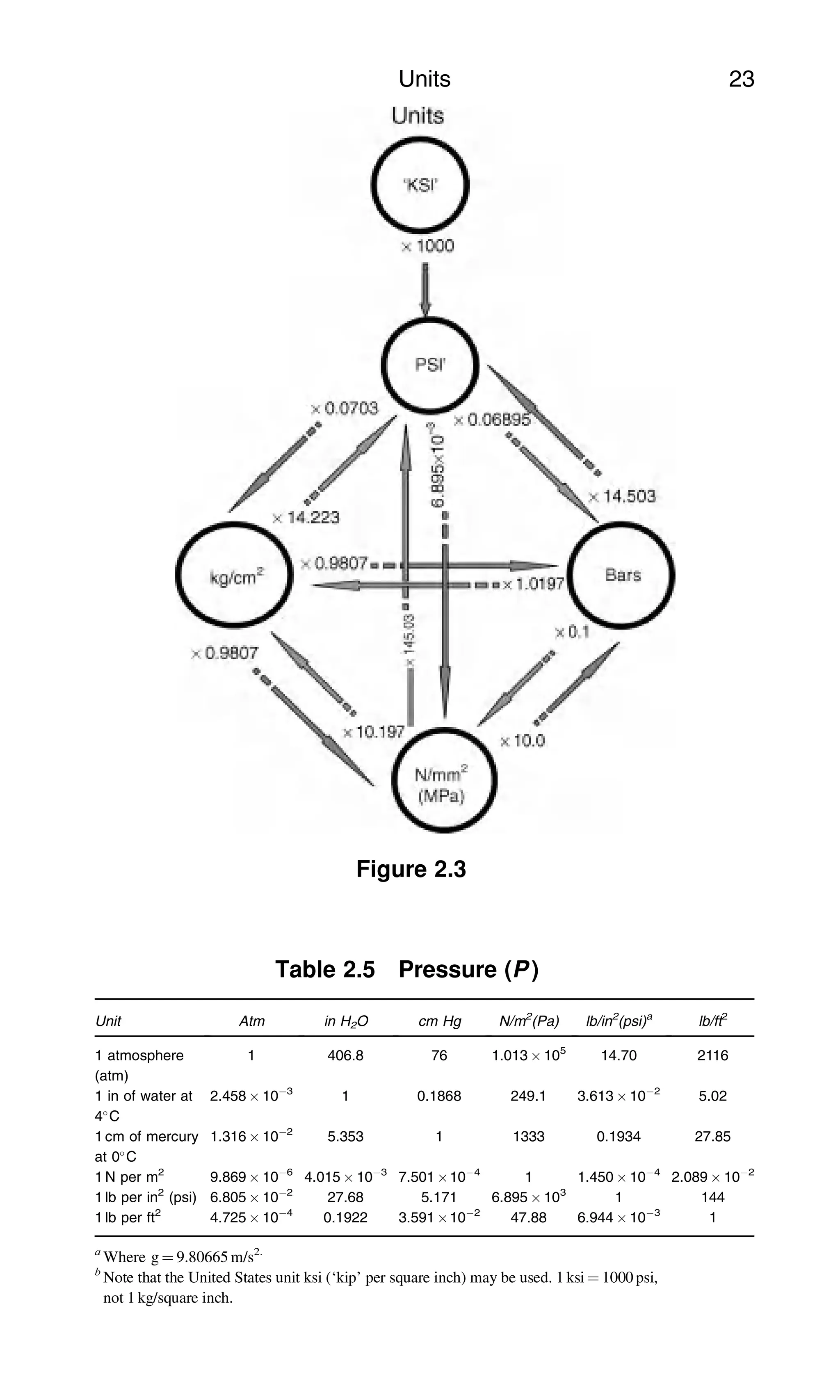
Figure 2.3
Table 2.5 Pressure (P )
Unit Atm in H2O cm Hg N/m2
(Pa) lb/in2
(psi)a
lb/ft2
1 atmosphere
(atm)
1 406.8 76 1.013  105
14.70 2116
1 in of water at
4
C
2.458  103
1 0.1868 249.1 3.613  102
5.02
1 cm of mercury
at 0
C
1.316  102
5.353 1 1333 0.1934 27.85
1 N per m2
9.869  106
4.015  103
7.501 104
1 1.450  104
2.089  102
1 lb per in2
(psi) 6.805  102
27.68 5.171 6.895  103
1 144
1 lb per ft2
4.725  104
0.1922 3.591 102
47.88 6.944  103
1
a
Where g ¼ 9.80665 m/s2.
b
Note that the United States unit ksi (‘kip’ per square inch) may be used. 1 ksi ¼ 1000 psi,
not 1 kg/square inch.
Units 23
And for liquid columns:
1 mm Hg ¼ 13.59 mm H2O ¼ 133.3224 Pa ¼ 1.333224 mbar
1 mm H2O ¼ 9.80665 Pa
1 torr ¼ 133.3224 Pa
For conversion of liquid column pressures; 1 in ¼ 25.4 mm.
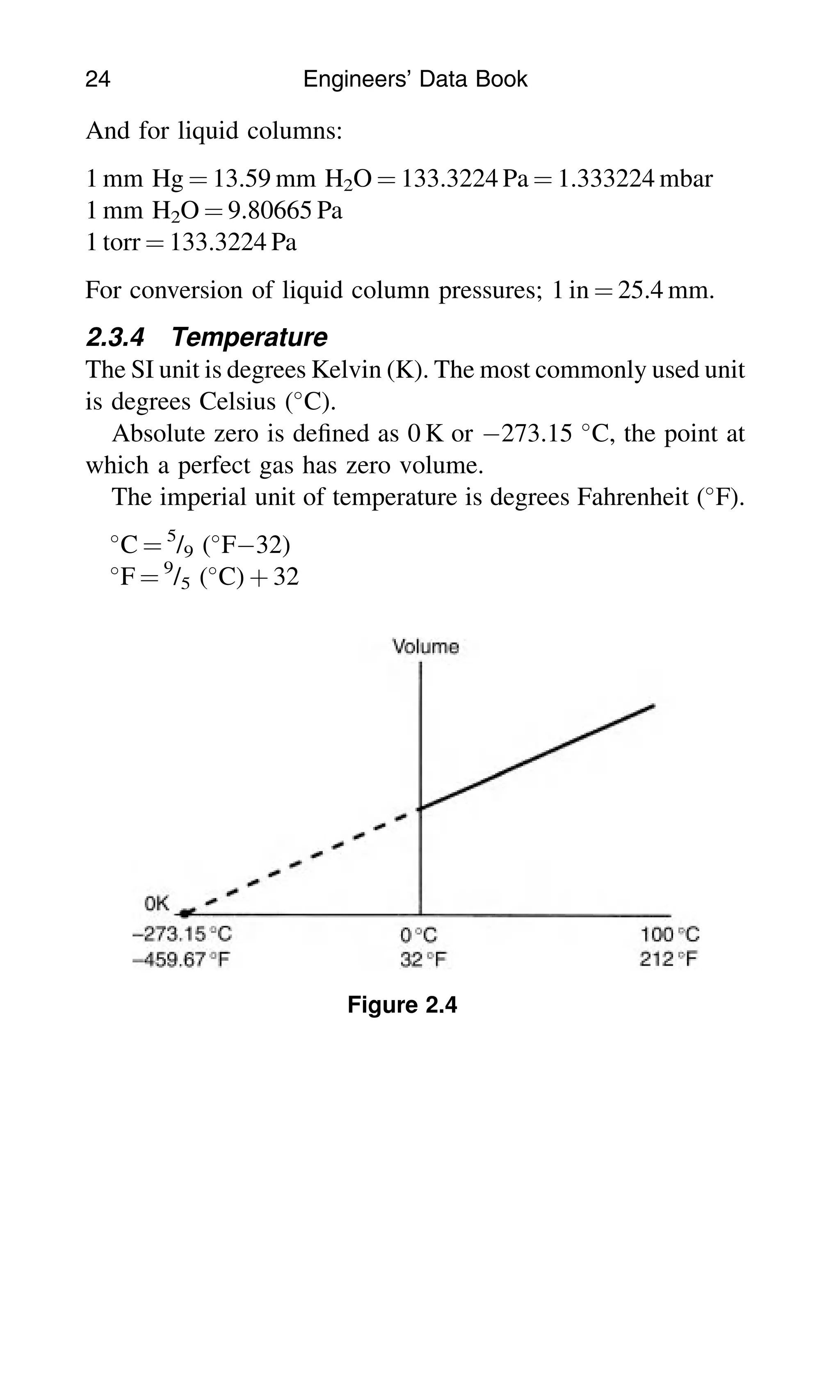
2.3.4 Temperature
The SI unit is degrees Kelvin (K). The most commonly used unit
is degrees Celsius (
C).
Absolute zero is defined as 0 K or 273.15 
C, the point at
which a perfect gas has zero volume.
The imperial unit of temperature is degrees Fahrenheit (
F).

C ¼ 5
/9 (
F32)

F ¼ 9
/5 (
C) þ 32
Figure 2.4
24 Engineers’ Data Book
Figure 2.5
Units 25
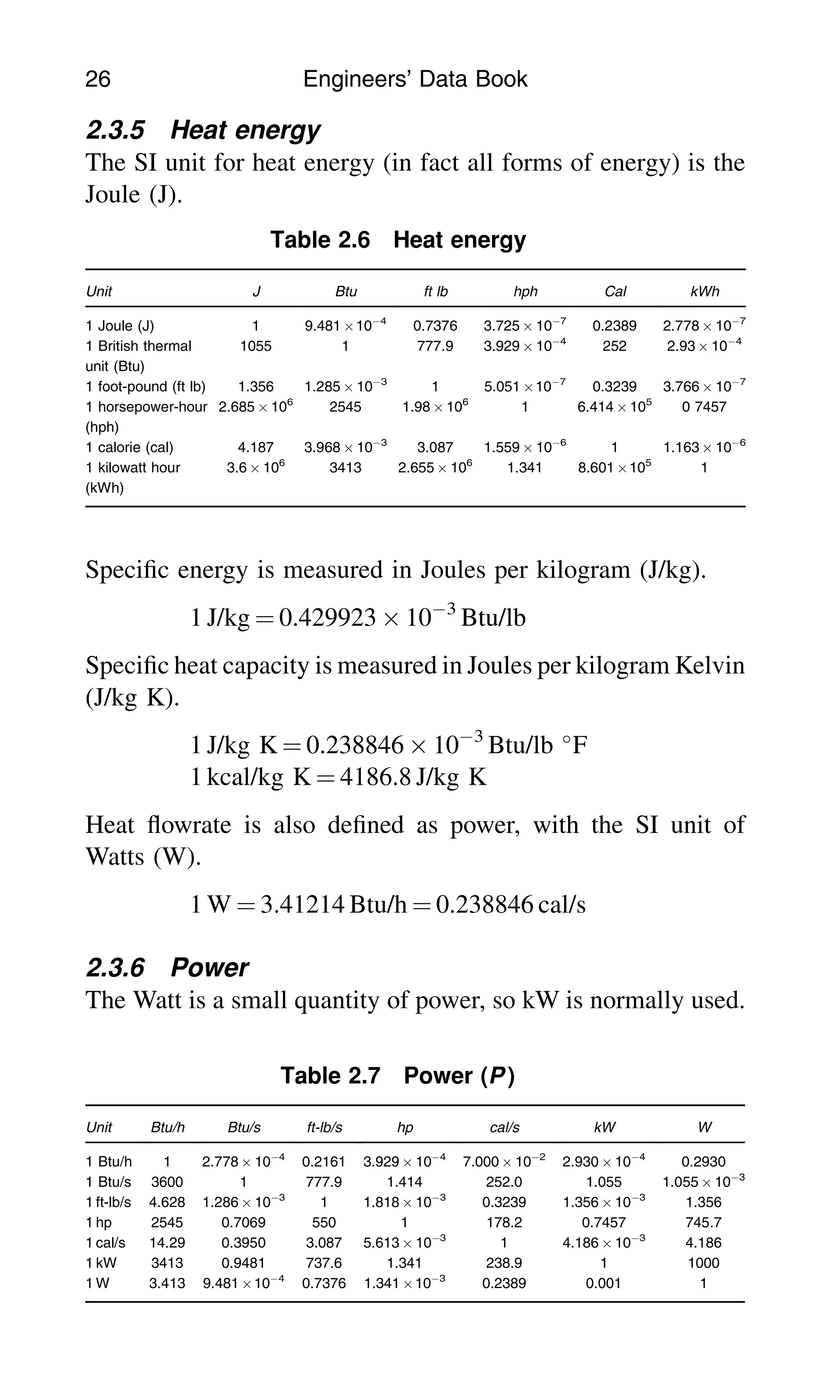
2.3.5 Heat energy
The SI unit for heat energy (in fact all forms of energy) is the
Joule (J).
Specific energy is measured in Joules per kilogram (J/kg).
1 J/kg ¼ 0.429923  103
Btu/lb
Specific heat capacity is measured in Joules per kilogram Kelvin
(J/kg K).
1 J/kg K ¼ 0.238846  103
Btu/lb 
F
1 kcal/kg K ¼ 4186.8 J/kg K
Heat flowrate is also defined as power, with the SI unit of
Watts (W).
1 W ¼ 3.41214 Btu/h ¼ 0.238846 cal/s
2.3.6 Power
The Watt is a small quantity of power, so kW is normally used.
Table 2.7 Power (P )
Unit Btu/h Btu/s ft-lb/s hp cal/s kW W
1 Btu/h 1 2.778  104
0.2161 3.929  104
7.000  102
2.930  104
0.2930
1 Btu/s 3600 1 777.9 1.414 252.0 1.055 1.055  103
1 ft-lb/s 4.628 1.286  103
1 1.818  103
0.3239 1.356  103
1.356
1 hp 2545 0.7069 550 1 178.2 0.7457 745.7
1 cal/s 14.29 0.3950 3.087 5.613  103
1 4.186  103
4.186
1 kW 3413 0.9481 737.6 1.341 238.9 1 1000
1 W 3.413 9.481 104
0.7376 1.341 103
0.2389 0.001 1
Table 2.6 Heat energy
Unit J Btu ft lb hph Cal kWh
1 Joule (J) 1 9.481 104
0.7376 3.725  107
0.2389 2.778  107
1 British thermal
unit (Btu)
1055 1 777.9 3.929  104
252 2.93  104
1 foot-pound (ft lb) 1.356 1.285  103
1 5.051 107
0.3239 3.766  107
1 horsepower-hour
(hph)
2.685  106
2545 1.98  106
1 6.414  105
0 7457
1 calorie (cal) 4.187 3.968  103
3.087 1.559  106
1 1.163  106
1 kilowatt hour
(kWh)
3.6  106
3413 2.655  106
1.341 8.601 105
1
26 Engineers’ Data Book
Exploring the Variety of Random
Documents with Different Content
been made, is an academic rather than a real one, and one of
modern invention rather than one existing in the Middle Ages. That
there were complaints occasionally may be allowed. Still, not only
were they rare, but in the episcopal registers it may be seen that, in
the few instances where they came before the bishop, they were
declared to be groundless. They generally arose out of the
Visitations when the vicar had been ordered to repair the chancel of
his church, or procure some choir-books, or to do some other work
for which by law the incumbent was held responsible. The vicar
pleaded as his excuse for the dilapidation, or for his inability to do
the work required, that the impropriator should be made to do all this,
as he took so much of the tithe away from the place. It is rarely
indeed that such a claim was considered reasonable, and for the
most part the reply was that this had been considered at the time of
the original impropriation, and that sufficient had been allowed to the
vicar to carry out these legal obligations, and that all things had been
made fitting and all repairs seen to before the vicarage had been
established.
The grounds upon which impropriation made by lawful authority was
justified in the Middle Ages were, apparently, that originally tithe had
been paid to the bishop of the diocese for the general good of the
entire district. By his administration of these diocesan funds he was
enabled to assist good works of every kind at his discretion. When in
process of time the parish became a sub-unit of administration, the
local tithe passed into the administration of the local parson; but
never without the dormant notion, not only of episcopal control, but
fundamentally of ultimate episcopal authority over it. Up to the
Reformation it was taught that tithe really ought to be divided into
four parts: one part to go to the bishop, if he needed it; one to the
ministers; one to the poor; and the fourth part for the repair of the
church fabric. The notion that it was the great landowners who in the
first instance endowed the parish churches with tithes, and
subsequently took them, or a portion of them, away and gave them
to religious houses and colleges, is for the most part quite imaginary.
Tithe was, as already pointed out, the recognition of God’s supreme
authority over the world, and a public acknowledgment that all things
came from His hands, and the idea, which is a product of modern
notions, that it was a charge made upon the land for the benefit of
religion, is wholly alien to the spirit of pre-Reformation days. The
very fact that this does not explain the existence of personal tithes,
shows that the giving of tithes generally did not depend upon the
generosity of any landowner or lord of the manor.
Neither was the tithe ever regarded as the absolute property of the
incumbent. Besides his recognised duty in regard to the repairs of
the chancel, the poor were regarded as having legal claims upon
what was received by him. What seems to us a somewhat strange
custom was occasionally practised in the fourteenth and fifteenth
centuries. This was the farming out of tithes by the rectors, or, in
other words, raising money upon their expected receipts. For this the
sanction of the bishop had previously to be obtained, and any
pledging of the tithe for more than the current year was illegal.
Beyond this, where a rector or prelate put his benefice out to farm,
according to the law, he was bound to get four of his parishioners,
approved by the bishop, to be surety for the faithful payment of the
full portion (pinguis portio) of the tithe due to the poor of the parish. “I
hold,” however, says the canonist Lyndwood, that this is not
necessary “in the case of a rector or prelate, who, after farming out
his tithes lawfully, continues to live in his benefice, unless he is
suspected of not intending to succour those in poverty.”
The duty of paying lawful tithes was constantly inculcated by synodal
decrees, by bishops’ letters, and from the pulpit. Thus John Myrc, in
his Instructions for Parish Priests, tells them—
“Teche hem also welle and greythe
How they schell paye here teythe
Of all thynge that doth hem newe
They shuld teythe welle and trewe
After the custome of that cuntraye
Every mon hys teythynge schale pay.”
The author, however, says that he has no need to speak much of
that matter, as priests will see to it that their tithes are paid in due
time; and in a Sarum Manuale it is found set down that by law “men
of religion, freres, and all other,” who “go about and preache Goddes
worde,” are commanded to preach eight times in the year upon the
nature of tithes and on the obligation of paying them to the parish
priests. That this duty was recognised, and that on the whole it was
cheerfully complied with in the Middle Ages, would appear to be
certain. It is, moreover, no less apparent that these payments were
regarded, not in the light of a charge upon the land, but of a genuine
acknowledgment to God of His supreme governance of the world,
that all things were His, and that in His hands were the ends of the
earth. The general spirit in which the obligation was regarded may
be seen in the wills of the period, where the testators not only
desired that all lawful tithes might be paid from their estates, but very
generally left benefactions to their parish churches “for tithes
forgotten.”
CHAPTER II
THE PARISH CHURCH
The “parish” is described by Bishop Hobhouse as the community
dwelling in an area defined by the Church, organised for Church
purposes, and subject to Church authority. “Within this area,” he
says, “every resident was a parishioner, and, as such, owed his duty
of worship and contribution to one stated church, and his duty of
confession and submission to the official guidance of a stated pastor,
entitled his Rector, or to the Rectors deputy, entitled Vicar.”
The centre of every mediæval parish, then, was its church. It was, as
it were, the mainspring of the machinery of parochial life, which
cannot be understood without a full knowledge of its position in
regard to the people generally, and of all that it was to the inhabitants
of a district in pre-Reformation days.
For our present purposes, we need not, of course, concern
ourselves with trying to solve the vexed question as to who it was
that first built the parochial churches. About this there is, and
probably will remain, much obscurity. In the first instance, in
England, very possibly, they were the creation of some nobles or rich
landlords, who desired to secure the services of religion for the
people dwelling upon their estates, as tenants, servants, or serfs,
and who, having obtained from the bishop of the district his leave to
set up an oratory or church, obtained the ministration of a priest.
Whatever the origin, it is certain that long before the fourteenth or
fifteenth centuries the parish church had practically come to be the
property of the parishioners generally in a very definite manner, and,
with certain exceptions, to which reference will presently be made,
upon the inhabitants of a parochial district as a corporation lay the
duty of repairing and rebuilding the fabric, of beautifying the edifice,
of maintaining the services, and of seeing generally to its well-being.
This they did as a matter of well-recognised obligation and duty; but
obviously also as a matter which afforded them much satisfaction
and pleasure.
The fabric of the church consisted of the nave, with its chapels and
aisles, when it had any, and the chancel, which included the choir
and presbytery. In England, at least, there was a well-recognised
and very general distinction between the chancel and the nave. The
former was sometimes called the “parson’s freehold,” and to him
belonged the entire care of his “chancel,” and the duty of keeping it
in repair. In fact, it was not disputed that one part of the tithe
received by the priest from the parish was intended to furnish him
with ample means for fulfilling this duty, and in the event of death
removing an incumbent, where there were dilapidations in the
chancel, which had not been seen to by him, his successor could,
and frequently did, claim compensation from the heirs of the
deceased.
The synodal directions given with regard to the care and repair of the
chancels are definite. “In parish churches,” says one of 1350, taken
as an example, “the chancel is to be found and maintained fittingly in
all things by the Rector.” Bishop Brantyngham, of Exeter, issued a
“declaration” as to the custom in his diocese as laid down by his
predecessor, Bishop Quevil. In this he says that—
“the work of constructing and repairing the chancels of all
mother churches belongs to the rectors of the parishes;
but that of the naves pertains to the parishioners, without
regard to any contrary custom. In the case of chapels,
which have their distinct parochial district, the entire duty
of maintenance belongs to the parishioners of the chapel,
as it is for their convenience such chapels are built, and,
moreover, they may be obliged to assist, in case of need,
the mother church.”
This was the ordinary rule in England, as we see from the gloss on
the Constitutions of Cardinal Othoboni, where Lyndwood calls it “the
common custom in England that the parishioners repair the nave of
the church where they sit,” and that if the rector has the fourth part of
the tithe, which was intended for the repairs of the church, he should
by law see to all the repairs. “By praiseworthy custom,” in England,
however, the author adds, the repair of the chancel only is an
obligation of the rector, although he cannot entirely free himself of all
responsibility for the rest of the church. Sometimes, however, as the
canonist notes, as, for example, in some London churches and
elsewhere, the care of the chancel is also a matter for the
parishioners, and the parson, although taking “the fourth part of the
tithe” intended to meet the general expenses of church repairs, is yet
held to be free of the obligation.
Sometimes, as may be seen in the visitations of parochial churches,
difficulties arose about the precise obligation of parson and people
as to the repair even of the chancel. In the Register of Bishop
Stapledon, for instance, at the inquiry held in 1301, at St. Mary
Church, the parishioners represented that, up to the time of the then
vicar, they had been accustomed to repair the chancel, and because
of this the tithe on all store cattle had not been demanded of them.
The new vicar had made them pay this, but yet had not done the
repairs to the chancel, and wanted them to continue to do so. So,
too, during Bishop Grandisson’s episcopate, the question whether
the parishioners paid the “decimas instauri” was the determining
reason as to whether they should be compelled to repair the
chancels or not.
In regard to the care of the fabric the case of appropriated churches
was somewhat peculiar. The corporation to which the living was
impropriated held the position of rector, the cure being administered
by a vicar appointed by it and licensed by the bishop, just as in the
case of a nomination to any benefice by a patron. As a rule the
religious house, college, or official holding the impropriated tithes,
got rid of the rectorial obligation of seeing to the maintenance of the
chancel, by arranging with the bishop that the vicar should have
sufficient regular income to cover all the expenses of dilapidations. In
this case the usual practice was that, upon first becoming lawfully
possessed of the appropriated tithe, the corporation was bound by
the bishop, as one condition of his assent, to place the chancel in
thorough repair and to see that everything, which the rector had
been bound by custom to provide, was in good order. After this had
been done, it was calculated, and indeed arranged, that out of the
income of the vicar these could be maintained in good order. The
arrangement, however, was subject to revision by the bishop, and
although in practice the original agreement was usually upheld, there
are to be found examples of the holders of impropriated tithes being
compelled by the ecclesiastical authority to contribute to the repairs
of chancels, etc., and even to undertake the entire work, where the
means of the vicars were obviously inadequate to do what was
necessary.
Some examples of this will illustrate the matter more completely than
any statement of the practice. In 1296, Bishop Thomas de Bytton, of
Exeter, was called upon to adjudicate upon this question in regard to
the vicarage of Morwenstowe, the greater tithes of which had been
previously appropriated to the Hospital of St. John at Bridgewater by
Bishop Peter Quevil, with the consent of his canons. The grant had
been made with the provision that fitting support should be allowed
for the vicarage, the amount to be determined and arranged by the
bishop and his successors. This, Bishop de Bytton did, in fact,
determine by the document referred to. The vicar, according to this
settlement, by reason of his vicarage, was to take certain tithes,
which, amongst others, were to include that of all the hay and the
mills in the whole parish, as well as the rent of certain crofts, etc. The
brethren of the Hospital were to find or renew all the ornaments and
books not provided by the parishioners, and it was agreed that
these, once being set right, must afterwards be maintained by the
vicar. He was also to see to all ordinary repairs, and even
extraordinary repairs up to the amount of the fourth part of the tithe
received by him. But “any other extraordinary expense, together with
the upkeep, repair, or rebuilding of the chancel of the church, was to
be met by the said religious brethren” of the Hospital of Bridgewater.
That this settlement was not at all exceptional could be proved by
many documents; one must suffice. When Bodmin church was
rebuilt between the years 1469 and 1472 the patrons, the Monastery
of St. Petrock, defrayed the entire expenses connected with the
chancel. On the other hand, to illustrate the usual practice, the case
of the vicarage of Launcells in Devonshire may be cited. The Abbot
and Monastery of Hartland held the appropriated tithes, and in 1382,
the chancel standing in need of great repairs, apparently amounting
almost to rebuilding, the vicar refused to carry out the injunctions of
the archdeacon forthwith to undertake the work, on the plea that this
was the duty of the Abbey of Hartland. The convent denied their
obligation, but submitted themselves in the matter to the judgment of
the bishop of the diocese. After holding an inquiry, Bishop Thomas
Brantyngham declared that the vicar received tithes for the purpose
of carrying out all repairs to the chancel, and that consequently the
monks were free from the obligation.
What the material church was to the parishioners of a mediæval
parish is well described in the synodical Constitutions of Bishop
Woodlock, of Winchester, at the beginning of the fourteenth century.
“If the Israelites,” he says, “living in the shadow of the law,
required specially dedicated places in which to worship
the Lord, with how much more reason are Christians, to
whom the loving-kindness and the humanity of the Saviour
has appeared, bound by all the means at their disposal to
obtain consecrated churches, in which day by day the Son
of God is offered in Sacrifice.”
Then after saying that churches that have not been consecrated are
to be solemnly dedicated as soon as possible, he continues—
“The anniversaries of the dedications of parish churches
are to be kept by the parishioners, and those attending
chapels in the neighbourhood not themselves dedicated.
The day and the year of the consecration, with the name
of the consecrating prelates, are to be entered in the
calendar and other books belonging to the church.”
The dedication of the church to God was the essential condition of its
endowment. According to Bracton, the dower made to the church
with church lands at its dedication, was a possession of “pure and
free alms,” in distinction “from a lay feud,” seeing that it “is with more
propriety called free, since it is dedicated as it were to God.”
“If,” says the Constitution of Cardinal Otho for the English
Church—“if under the Old Testament the Temple was
dedicated to God for the offering of dead animals, with
how much more reason should the churches of the New
Law be specially consecrated to Him when on the altars is
daily offered for us by the hands of the priest the living and
true Victim, that is, Christ, the only-begotten Son of God.”
The reverence due to churches, and things once dedicated to the
service of churches, was universal in the Middle Ages. Cloths, used
as chrism cloths at Baptism or Confirmation, were to be devoted to
ecclesiastical purposes or destroyed, and those who turned anything
thus once offered to God to any secular use were considered gravely
blameworthy. The gloss upon a Constitution of St. Edmund of
Canterbury to this effect extends this prohibition of desecration to
everything connected at any time with a church. Even the woodwork
of a building, once dedicated, was to be destroyed, unless it was
capable of being used for another ecclesiastical purpose. So too the
“cloths used on the altar, the seats, candlesticks, veils, and sacred
vestments too old to use,” were to be burnt and the ashes buried.
The parishioners, as already pointed out, were bound by law and
custom to provide for the repair of the nave of their parish church,
and for the general upkeep of the church services. There was little
need to compel them to fulfil this duty, for the churchwardens’
accounts and other documents, especially during the fifteenth
century, when we have the fullest information, show us that over the
entire length and breadth of England the people were gladly
rebuilding and beautifying their parish churches. A few examples of
this spirit may be of interest as showing what God’s house was to
the entire people in pre-Reformation days. The labours of
Prebendary Hingeston-Randolph on the diocesan registers of the
Exeter diocese enable the inquirer into parochial manners and
customs of the past to find ample material. In the register of Bishop
Stafford of Exeter (1394-1419) an account of the rebuilding of the
parish church of Broadhempston is given. The parishioners, about
a.d. 1400, petitioned the bishop to be allowed to rebuild their church:
they represented that it was in a ruinous condition and notoriously
clumsily constructed. It was their wish, they said, to build it on a
larger scale, and in a different part of the churchyard. To this the
bishop assented, on condition of their promising to complete the new
church within two years of pulling down the old, and he granted an
Indulgence to all who should contribute to “so great and pious a
work.” On the 22nd November, 1401, the work of the new church
was apparently far enough advanced for use, for a licence was
granted for one year to celebrate Divine service “in the church or
basilica newly erected and constructed in the cemetery,” and this
licence was twice renewed for the years 1402 and 1403.
The editor of the Receipts and Expenses in Building Bodmin Church,
published by the Camden Society, says that “there is scarcely a
parish in Cornwall that does not bear testimony to the energy
displayed in church restoration” in the last quarter of the fifteenth
century. He might have added that like activity is manifested at this
time in almost every quarter of England; but certainly Bodmin
furnishes us with an interesting example of the religious energy
displayed by the inhabitants of a mediæval parish. For the year
1469-70 the wardens account for £196 7s. 4½d. collected and £194
3s. 6½d. spent—large sums considering the then value of money,
and specially great when it is remembered that besides this there
were the gifts of material, such as windows, trees, etc., and that the
labour of the workmen was given without other reward than what
came from their love of the work. From the preface of the editor of
these accounts we glean some interesting particulars, all the more
interesting as we have no reason to think that Bodmin was any
exception. The accounts “exhibit a remarkable unanimity in the good
work. Every one seems to have given according to his means and up
to his means. Many who gave money gave labour also; many who
could not give money laboured as best they might, and others gave
what they could.” We have gifts of lambs, of a cow, and of a goose.
One woman, in addition to her subscription, sold her crock for 20d.;
and all found its way into the common treasury. No age or sex
seems to have kept aloof. We find an “hold woman” contributing 3s.
4½d., while the maidens in Fore Street and Bore Street gave
subscriptions in addition to the sums received from the Guild of
Virgins in the same streets. The vicar gave his year’s salary, and the
“parish people” who lived out of the town “contributed 19s.” After an
examination of the accounts, the editor attributes the working up of
the zeal of the people to the guilds, and he adds that “religious life
permeated society in the Middle Ages, particularly in the fifteenth
century, through the minor confraternities.” Of these societies it will
be necessary to write at some length later, and here it will be
sufficient to say that almost every inhabitant of Bodmin appears to
have belonged to one or more of these societies. From the long list
of voluntary subscriptions, it appears that all were eager to have a
part in the work of building up their church—a church which should
be a credit to Bodmin. All sorts and conditions of men and women
are entered as contributors on the roll of parishioners, more than 460
in number. Servants appear as well as masters and mistresses, sons
and daughters as well as their fathers and mothers.
The same sort of story is told in every set of parish accounts that we
possess—a story of popular devotion to the material fabric of the
parish church. To take another and later example: At St. Mary’s,
Cambridge, 1515, it was necessary to build a porch and a vestry,
and the people determined to make a voluntary collection for the
work each Sunday during the last six months of the year. At these,
from 6s. to 8s.—from £4 to £5 of our money—was gathered each
time, and the building was carried out under the supervision of the
churchwardens.
The evidence of mediæval wills is the same as to this very general
interest in church building. For example, Robert Dacres of Beverley,
a weaver, who died in 1498, left £16 for the making of the north aisle
of the church—the parish church in which he had worshipped—
provided the wardens began the work within a year. If they did not do
so, then the money was to be spent on ornamenting the church. So,
too, the will of Robert Pynbey, a chantrey priest of Hornby, shows
that, conjointly with another priest, he had established a chantry,
having previously built the south aisle of Hornby parish church. So,
too, in 1490, the sub-dean of York leaves many legacies to assist in
the repairs of the various churches with which he had been
connected. In the same way some of the chantry certificates of the
reign of Edward VI. reveal the fact that lands had been left to the
churchwardens to sell for the purpose of rebuilding certain parish
churches, and that they had been disposed of to that end.
It must, of course, be remembered that buildings and repairs of this
kind were not lightly undertaken by the wardens without the full
knowledge and consent of the parishioners generally. For example,
in 1512-13 it was proposed to do some extensive works at St. Mary-
at-Hill in London, and the entry in the churchwardens’ book is as
follows:—
“It is determined that they shall go in hand with the
building of the church at March next. Memorandum: that
John Allthorpe and Stephen Sondyrson have promised to
take charge and keep reckoning to pay all such workmen
as shall make the battlements of our church of brick or
stone or lead, as shall be thought best and determined by
Mr. Alderman and the parishioners, and Mr. Parson is to
assist them with his good diligence and wisdom to the
best that he can, for the same: and Thomas Monders is
chosen by the said parish to wait upon the said Stephen
and Allthorpe in their absence and at their commandment
for the furtherance of the same work.”
The obligation of all to contribute to the common work of God’s
house was well understood, and it was taught in many books of
instructions popular in those days. For example, in Dives and Pauper
the former is made to declare that “many say, God is in no lond so
well served in holy Church, nor so much worshipped in holy Church,
as He is in this lond of England. For so many fair churches, ne so
good aray in churches, ne so fair service, as many say is in none
other lond as it is in this lond.” Pauper does not deny this, but thinks
that it is perhaps done from a spirit of pomp, “to have a name and
worship thereby in the country, or for envy that one town hath
against another.” Dives, with this lead, suggests that it might be
better if the money thus spent “in high churches, in rich vestments, in
curious windows, and in great bells,” were given to the poor. But
Pauper urges that this is just what Judas thought, and declares that
it is the common business of all, rich and poor alike, to look to the
beautifying of God’s house.
THURIBLE, FOUND NEAR
PERSHORE
By law, then, according to the statute of Archbishop Peckham in
1280, which remained in force till the Reformation, the parish,
broadly speaking, was bound to find all that pertained to the services
—such as vestments, chalice, missal, processional cross, paschal
candle, etc.—and to keep the fabric and ornaments of the church
proper in repair. In 1305 Archbishop Winchelsey somewhat enlarged
the scope of the parish duties.
“For the future,” he says, “we
will and ordain that the
parishioners be bound to
provide all the following:
Legend, Antiphonal, Grayle,
Psalter, Tropary, Ordinale,
Missal, Manual, Chalice, the
best Vestment with Chasuble,
Dalmatic and Tunicle, and a
Cope for the choir with all
their belongings (that is,
amice, girdle, maniple and
stole, etc.): the frontal for the
High altar, with three cloths;
three surplices; a rochet; the
processional cross; a cross to
carry to the sick; a thurible; a
lantern; a bell to ring when the
Body of Christ is carried to the
sick; a pyx of ivory or silver for
the Body of Christ; the Lenten
veil; the Rogation Day
banner; the bells with their
cords; a bier to carry the dead
upon; the Holy Water vat; the
osculatorium for the Pax; the
paschal candlestick; a font with its lock and key; the
images in the church; the image of the patron Saint in the
chancel; the enclosure wall of the cemetery; all repairs of
the nave of the church, interior and exterior; repairs also in
regard to the images of the crucifix and of the saints and
to the glazed windows; all repairs of books and vestments,
when such restorations shall be necessary.” All other
repairs, Archbishop Winchelsey adds, “of the chancel and
of other things not the object of special custom or
agreement, pertain to the Rectors or Vicars, and have to
be done at their expense.”
PAX
It did not, however, require any very great rigour on the part of
ecclesiastical authorities to enforce this law. The various
churchwarden accounts and the church inventories prove beyond
dispute that the people of England were only too anxious to maintain
and beautify their parish churches, and that frequently between
neighbouring churches there was a holy rivalry in this labour of love.
To take some examples of this. The inventory of the parish church of
Cranbrook, in Kent, made in 1509, gives the details of all gifts and
donations, in order that the names of the donors and the particulars
of their benefactions might be remembered. The value of the
presents varies very considerably, but nothing apparently was too
small to be noted. Thus we have a monstrance of silver gilt, which
the wardens value at £20, “of Sir Robert Egelyonby’s gift.” In regard
to this donor the inventory says, “This Sir Robert was John Roberts’
priest thirty years, and he never had other service or benefice.” And
it adds, “The said John Roberts was father to Walter Roberts,
Esquire.” Again, one John Hindley “gave three copes of purple
velvet, whereof one was of velvet upon velvet, with images
broidered;” and, ad perpetuam rei memoriam, adds the inventory,
“he was grandfather of Gervase Hindley of Cushorn, and of Thomas
(Hindley) of Cranbrook Street.” And again, to take another example
of these entries, it is recorded that the “two long candlesticks before
our Lady’s altar fronted with lions, and a towel on the rood of our
Lady’s chancel,” were the gift of “old moder Hopper.”
In the same way, the churchwardens’ accounts of Leverton, a parish
situated in the county of Lincoln about 6 miles from Boston, evidence
the same voluntary effort on the part of the people to adorn their
church. In 1492 William Murr left money for work at the Great
Crucifix and to several of the altars. In 1495 a great effort was made
to procure another bell, and we find the expenses for preparing the
bell-chamber, for the carriage of the great bell, and for the hanging of
it by one William Wright, of Benington. All the parish apparently
contributed, and the parson promised 10s. 8d. towards the
expenses; but when he came to settle, it was found that some one
had paid for him. This was the above-named William Wright; and as
the clergyman’s name was John Wright, perhaps the kindly thought
which prompted the payment came from some bond of relationship.
Three years later it was determined to build the steeple, and the
parishioners were eager for the work. The owner of a neighbouring
quarry gave leave to take whatever stone was required. “A tree was
bought at Tombe Wood,” and a carpenter was engaged for the
scaffolding and timber work. The tree was sawn into boards; lime
was purchased to make the mortar, and tubs to mix it in. Later,
another tree was bought and cut up for scaffolding purposes. All was
entirely the work of the parish, and the ordering of everything was
done by the wardens the people had chosen, whilst each one took a
lively and personal interest in the common work.
In 1503 another bell was made, and a deputation of the parish went
to Boston to see it “shot.” The local blacksmith, Richard Messur,
made all the necessary “bolts and locks,” and attended
professionally to see it hung, although the chief responsibility rested
upon John Red, “bellgedor of Boston,” who had the “schotyng” of the
bell, and received £3 6s. 8d. for his work. At the same time the
parish paid for a Sanctus bell, which was made by the local plumber,
and the young men of the parish formed themselves into a school to
be taught how “to toll the bells.” In the same year a new font was
made for the church at Freeston, about three miles away, and a
committee of the parish made two journeys, one to look at the
progress of the work and another to pass and approve it.
BRACKET WITH SUSPENDED DOVE AND COVER
For some few years the expenses were normal; but in 1512 the
desire to possess more bells again came upon the parish. In the
same year the people purchased “a pair of censer chains, when the
parson was in London,” and they renewed the device “for hanging up
the Sacrament” over the altar. In 1516 the bells evidently did not ring
well, and a man was brought over from Boston to set them right. In
the same year there are entered expenses for hanging a lamp and
for making “a lectern in the choir.” The following year the north side
of the church was found to stand in need of repair, and there are
expenses for propping the wall up during the work. This year, also,
the parish purchased a new vestment and a chalice; and in 1519,
after the repairs, the bishop came to reconsecrate the church, and
the people paid his fee of 40s. for doing so. In 1525 an item of
expense is of interest: “To Isabel Frendyke for marking all the lynen
clothis: St. Thomas’ with a mark of black sylke +, and O. Lady’s with
a M.”
In 1526 there was a movement to beautify the rood-screen. An
“alybaster man,” otherwise called “Robert Brook the carver,” was
procured, and money was gathered in the town for his support, and
some who gave no money gave cheese. William Franckis, one of the
parishioners, died this year, and left a legacy of 46s. 8d. to buy
“images of alybaster to be set in ye rood-loft.” There were apparently
in all seventeen images, and “in earneste thereof” the carver was
paid a shilling on account; but when he got to work he found that he
could only do sixteen of the figures for the 46s. 8d., at 3s. 4d. each.
Apparently, however, William Franckis had provided for
contingencies; he had probably looked at the vacant niches during
the many Sundays he had knelt in front of the rood, had determined
that they must be all filled, and so had charged his wife Janet to see
to it. At any rate, the widow found the other 3s. 4d., “that every stage
might be filled.”
And so the parish life at Leverton went on without much change. The
ordinary expenses were met out of the ordinary receipts, and when
anything extraordinary was required the people were apparently ever
ready to come forward to provide it. In 1528 there is a note to say
SACRAMENTAL DOVE
that “John
Bell,
quondam
Rector,”
on his
deathbed
gave to
the
wardens
the sum
of £6 13s.
4d. to be
used
upon the
church. In
1531 a
curious
memoran
dum is
worth
recording.
It is to this
effect: on
October
22,
Richard Shepperd, the parson, called a meeting of the parish, to take
into consideration the accounts of the late wardens. The meeting
showed their entire confidence in the priest and their cordial
unanimity with him by asking him to appoint the wardens for the
following year, which he did. Also it was shown to the meeting that by
the last will of Walter Bowsche, of Leverton, three acres of land had
been left to the parish for the purpose of being sold, in order that with
the proceeds a new cope might be bought. The will was apparently
destroyed by the wardens, and the money obtained from the sale
had been spent upon the church work in which at the time they were
chiefly interested, namely, the making of bells. The parishioners
determined that they were in conscience bound to rectify this plain
breach of trust, and to make up the money for the new cope. Lastly,
in 1540, the parson, John Wright, presented the parish with a suite of
red-purple vestments, and in recording this gift the wardens note in
their account-book, “for the which you shall all specially pray for the
souls of William Wright and Elizabeth his wife,” the father and mother
of the donor, “and other relations, as well them as be alive as them
that be departed to the mercy of God, for whose lives and souls”
these vestments are given “for the honour of God, His most Blessed
Mother, our Lady St. Mary, and all His saints in heaven, and the
blessed matron St. Helen, his patron, to be used at such principal
feasts and times as it shall please the curates so long as they shall
last.”
In this way the names of benefactors and the memory of their good
deeds were ever kept alive in the minds of those who benefited by
their gifts. The parish treasury was not looked on as so much stock,
the accumulation of years, of haphazard donations without definite
history or purpose; but every article, vestment, banner, hanging,
chalice, etc., called up some affectionate memory both of the living
and the dead. On high day and feast day, when all that was best and
richest in the parochial treasury was brought forth to deck the walls
and statues and altars, the display of parish ornaments recalled to
the minds of the people assembled within its walls to worship God
the memory of good deeds done by generations of neighbours for
the decoration of their sanctuary.
“The immense treasures in the churches,” writes Dr.
Jessopp, “were the joy and boast of every man and
woman and child in England, who, day by day and week
by week, assembled to worship in the old houses of God
which they and their fathers had built, and whose every
vestment and chalice, and candlestick and banner, organ
and bells, and pictures and images, and altar and shrine,
they look upon as their own, and part of their birthright.”
It might reasonably be supposed that this was true only of the
greater churches; but this is not so. What strikes one so much in
these parish accounts of bygone days is the richness of even small,
out-of-the-way village churches. Where we would naturally be
Welcome to our website – the ideal destination for book lovers and
knowledge seekers. With a mission to inspire endlessly, we offer a
vast collection of books, ranging from classic literary works to
specialized publications, self-development books, and children's
literature. Each book is a new journey of discovery, expanding
knowledge and enriching the soul of the reade
Our website is not just a platform for buying books, but a bridge
connecting readers to the timeless values of culture and wisdom. With
an elegant, user-friendly interface and an intelligent search system,
we are committed to providing a quick and convenient shopping
experience. Additionally, our special promotions and home delivery
services ensure that you save time and fully enjoy the joy of reading.
Let us accompany you on the journey of exploring knowledge and
personal growth!
ebookfinal.com


Engineers Data Book Fourth Edition Clifford Matthews

  • 1.
    Visit https://ebookfinal.com todownload the full version and explore more ebooks Engineers Data Book Fourth Edition Clifford Matthews _____ Click the link below to download _____ https://ebookfinal.com/download/engineers-data-book- fourth-edition-clifford-matthews/ Explore and download more ebooks at ebookfinal.com
  • 2.
    Here are somesuggested products you might be interested in. Click the link to download Engineers Guide to Pressure Equipment The Pocket Reference 1st Edition Clifford Matthews https://ebookfinal.com/download/engineers-guide-to-pressure-equipment- the-pocket-reference-1st-edition-clifford-matthews/ The Little Data Book 2008 Little Green Data Book 2008th Edition World Bank https://ebookfinal.com/download/the-little-data-book-2008-little- green-data-book-2008th-edition-world-bank/ Essential MATLAB for Engineers and Scientists Fourth Edition Brian Hahn https://ebookfinal.com/download/essential-matlab-for-engineers-and- scientists-fourth-edition-brian-hahn/ Materials for Engineers and Technicians Fourth Edition R. A. Higgins https://ebookfinal.com/download/materials-for-engineers-and- technicians-fourth-edition-r-a-higgins/
  • 3.
    A Quick Guideto API 570 Certified Pipework Inspector Syllabus Example Questions and Worked Answers 1st Edition Clifford Matthews https://ebookfinal.com/download/a-quick-guide-to-api-570-certified- pipework-inspector-syllabus-example-questions-and-worked-answers-1st- edition-clifford-matthews/ Data Structures and Algorithm Analysis in Java 3rd Edition Dr. Clifford A. Shaffer https://ebookfinal.com/download/data-structures-and-algorithm- analysis-in-java-3rd-edition-dr-clifford-a-shaffer/ A Quick Guide to API 510 Certified Pressure Vessel Inspector Syllabus Example Questions and Worked Answers 1st Edition Clifford Matthews https://ebookfinal.com/download/a-quick-guide-to-api-510-certified- pressure-vessel-inspector-syllabus-example-questions-and-worked- answers-1st-edition-clifford-matthews/ Project and Cost Engineers Handbook Fourth Edition Cost Engineering Kenneth K. Humphreys https://ebookfinal.com/download/project-and-cost-engineers-handbook- fourth-edition-cost-engineering-kenneth-k-humphreys/ The Little Data Book 2007 World Bank https://ebookfinal.com/download/the-little-data-book-2007-world-bank/
  • 5.
    Engineers Data BookFourth Edition Clifford Matthews Digital Instant Download Author(s): Clifford Matthews ISBN(s): 9781119976226, 1119976227 Edition: 4 File Details: PDF, 3.63 MB Year: 2012 Language: english
  • 6.
  • 7.
    Engineers’ Data Book Fourth Edition CliffordMatthews BSc, MBA, CEng, FIMechE
  • 8.
    First published 1998 Secondedition published 2000 Third edition published 2004 This edition first published 2012 Ó 2012, John Wiley & Sons, Ltd. Registered office John Wiley & Sons Ltd, The Atrium, Southern Gate, Chichester, West Sussex, PO19 8SQ, United Kingdom For details of our global editorial offices, for customer services and for information about how to apply for permission to reuse the copyright material in this book please see our website at www.wiley.com. The right of the author to be identified as the author of this work has been asserted in accordance with the Copyright, Designs and Patents Act 1988. All rights reserved. No part of this publication may be reproduced, stored in a retrieval system, or transmitted, in any form or by any means, electronic, mechanical, photocopying, recording or otherwise, except as permitted by the UK Copyright, Designs and Patents Act 1988, without the prior permission of the publisher. Wiley also publishes its books in a variety of electronic formats. Some content that appears in print may not be available in electronic books. Designations used by companies to distinguish their products are often claimed as trademarks. All brand names and product names used in this book are trade names, service marks, trademarks or registered trademarks of their respective owners. The publisher is not associated with any product or vendor mentioned in this book. This publication is designed to provide accurate and authoritative information in regard to the subject matter covered. It is sold on the understanding that the publisher is not engaged in rendering professional services. If professional advice or other expert assistance is required, the services of a competent professional should be sought. Figures 16.1–16.6 published here with acknowledgement to original source Health and Safety in Welding and Allied Processes, Fourth edition, Woodhead Publishing Limited, Abington, Cambridge, UK. Library of Congress Cataloging-in-Publication Data Matthews, Clifford. Engineers’ data book / Clifford Matthews. – 4th ed. p. cm. Includes bibliographical references and index. ISBN 978-1-119-97622-6 (cloth) 1. Mechanical engineering—Handbooks, manuals, etc. I. Title. TJ151.M3924 2012 621.020 1–dc23 2011043947 A catalogue record for this book is available from the British Library. Set in 9/11pt, Times by Thomson Digital, Noida, India
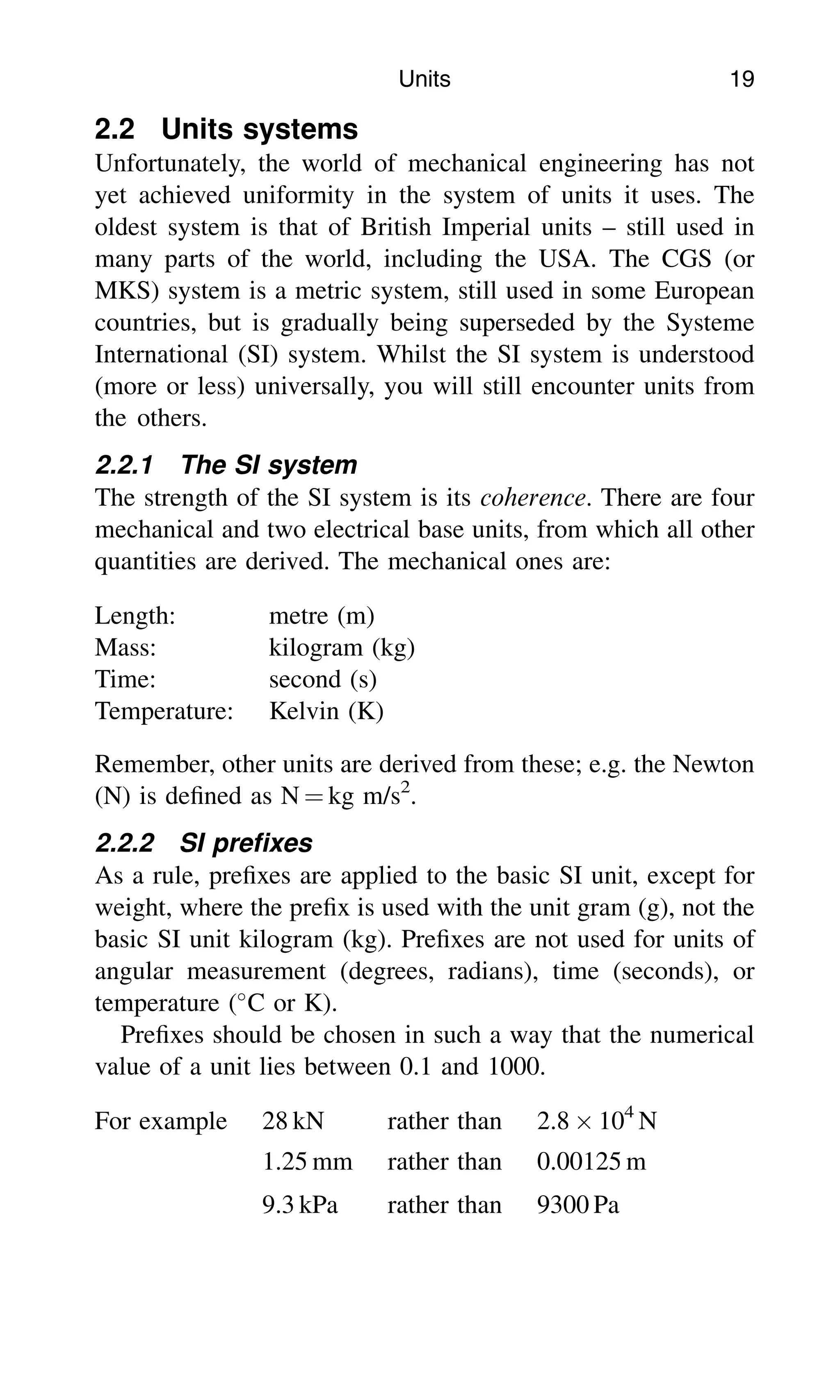
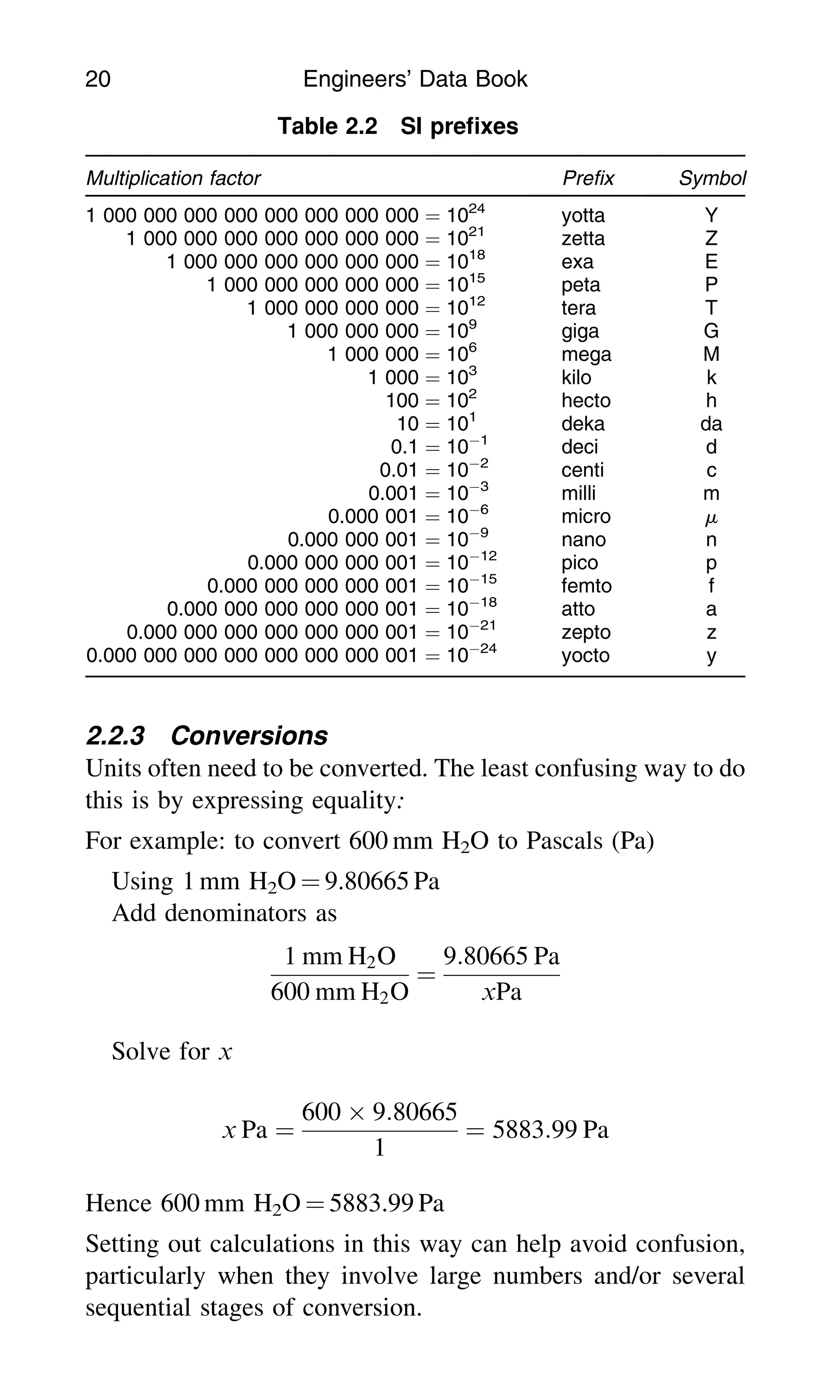
  • 9.
    Contents Foreword ..................................................................................... xi Preface....................................................................................... xiii Introduction – The Role of Technical Standards ...................... xv Section 1: Engineering Careers ................................................ 1 1.1 Introduction: what is an engineer? .............................. 1 1.2 A rough guide to industry breakdown......................... 3 1.3 Training and professional development....................... 4 1.4 Degrees of (engineering) excellence............................ 5 1.5 Degrees and how to pass them .................................... 9 1.6 Do you have any . . . experience?.............................. 12 1.7 Final cut – job interviews .......................................... 14 Section 2: Units......................................................................... 18 2.1 The Greek alphabet .................................................... 18 2.2 Units systems.............................................................. 19 2.3 Units and conversions ................................................ 21 2.4 Consistency of units ................................................... 32 2.5 Dimensional analysis.................................................. 36 2.6 Essential engineering mathematics ............................ 38 2.7 Maths and the real world? ......................................... 40 Section 3: Engineering Design – Process and Principles..... 49 3.1 Engineering problem-solving..................................... 49 3.2 Problem types and methodologies............................. 49 3.3 Design principles........................................................ 51 3.4 The engineering design process................................. 52 3.5 Design as a systematic activity (the ‘pugh’ method).................................................... 53 3.6 The innovation model................................................. 53 3.7 Creativity tools ........................................................... 57 3.8 The product design specification (PDS).................... 58 3.9 Presenting technical information ............................... 60 3.10 The anatomy of mechanical design ........................... 79
  • 10.
    3.11 Safety indesign – principles and practice................. 89 3.12 Design by nature – project toucan........................... 105 Section 4: Basic Mechanical Design..................................... 110 4.1 Engineering abbreviations........................................ 110 4.2 Datums and tolerances – principles......................... 112 4.3 Toleranced dimensions ............................................. 113 4.4 General tolerances .................................................... 114 4.5 Holes ......................................................................... 115 4.6 Screw threads............................................................ 116 4.7 Limits and fits........................................................... 117 4.8 Surface finish............................................................ 119 Section 5: Motion.................................................................... 122 5.1 Making sense of equilibrium ................................... 122 5.2 Motion equations...................................................... 123 5.3 Newton’s laws of motion......................................... 124 5.4 Simple harmonic motion (SHM) ............................. 125 5.5 Understanding acceleration ...................................... 126 5.6 Dynamic balancing................................................... 126 5.7 Vibration ................................................................... 128 5.8 Machine vibration..................................................... 129 5.9 Machinery noise ....................................................... 130 Section 6: Deformable Body Mechanics.............................. 133 6.1 Quick reference – mechanical notation................... 133 6.2 Engineering structures – so where are all the pin joints? ........................................................... 135 6.3 Simple stress and strain............................................ 136 6.4 Simple elastic bending ............................................. 138 6.5 Slope and deflection of beams................................. 140 6.6 Torsion ...................................................................... 142 6.7 Thin cylinders........................................................... 145 6.8 Cylindrical vessels with hemispherical ends........... 146 6.9 Thick cylinders ......................................................... 147 6.10 Buckling of struts ..................................................... 148 6.11 Flat circular plates.................................................... 149 6.12 Stress concentration factors...................................... 151 vi Contents
  • 11.
    Section 7: MaterialFailure ................................................... 155 7.1 How materials fail.................................................... 155 7.2 LEFM method .......................................................... 156 7.3 Multi-axis stress states ............................................. 157 7.4 Fatigue....................................................................... 158 7.5 Factors of safety ....................................................... 161 7.6 United states practice ............................................... 161 7.7 Ultimate jigsaw – what everything is made of ....... 162 Section 8: Thermodynamics and Cycles.............................. 166 8.1 Quick reference: symbols – thermodynamics ......... 166 8.2 Basic thermodynamic laws ...................................... 167 8.3 Entropy...................................................................... 169 8.4 Enthalpy.................................................................... 169 8.5 Other definitions ....................................................... 170 8.6 Cycles........................................................................ 170 8.7 The steam cycle........................................................ 172 8.8 Properties of steam................................................... 172 8.9 Reference information.............................................. 175 8.10 The gas turbine (GT) cycle...................................... 175 Section 9: Basic Fluid Mechanics and Aerodynamics ....... 178 9.1 Basic properties ........................................................ 178 9.2 Flow equations.......................................................... 180 9.3 Flow regimes ............................................................ 186 9.4 Boundary layers........................................................ 189 9.5 Isentropic flow .......................................................... 191 9.6 Compressible one-dimensional flow........................ 191 9.7 Normal shock waves ................................................ 192 9.8 Axisymmetric flows.................................................. 195 9.9 Drag coefficients....................................................... 195 9.10 General airfoil theory ............................................... 197 9.11 Airfoil coefficients.................................................... 198 9.12 Pressure distributions................................................ 200 9.13 Aerodynamic centre.................................................. 200 9.14 Centre of pressure..................................................... 201 9.15 Supersonic conditions............................................... 202 9.16 Wing loading: semi-ellipse assumption................... 204 Contents vii
  • 12.
    Section 10: FluidEquipment................................................. 206 10.1 Turbines..................................................................... 206 10.2 Refrigeration systems ............................................... 207 10.3 Diesel engines........................................................... 209 10.4 Heat exchangers........................................................ 210 10.5 Centrifugal pumps .................................................... 212 10.6 Impeller types ........................................................... 214 Section 11: Pressure Vessels.................................................. 216 11.1 Vessel codes and standards ...................................... 216 11.2 Pressure vessel design features ................................ 219 11.3 Cylindrical pressure vessel design stresses.............. 220 11.4 Stress categories........................................................ 221 11.5 Analysis of stress combinations............................... 222 11.6 Vessel certification.................................................... 223 11.7 Flanges ...................................................................... 223 Section 12: Materials.............................................................. 225 12.1 Observing crystals: order and disorder.................... 225 12.2 Carbon steels............................................................. 226 12.3 Low-alloy steels........................................................ 227 12.4 Alloy steels ............................................................... 227 12.5 Cast iron (CI)............................................................ 228 12.6 Stainless steels .......................................................... 230 12.7 Non-ferrous alloys .................................................... 233 12.8 Nickel alloys............................................................. 233 12.9 Zinc alloys ................................................................ 234 12.10 Copper alloys............................................................ 234 12.11 Aluminium alloys ..................................................... 235 12.12 Titanium alloys ......................................................... 236 12.13 Engineering plastics.................................................. 237 12.14 Material traceability and documentation ................. 238 12.15 Corrosion................................................................... 239 Section 13: Machine Elements.............................................. 244 13.1 Screw fasteners ......................................................... 244 13.2 Bearings .................................................................... 247 viii Contents
  • 13.
    13.3 Ball androller bearings............................................ 248 13.4 Bearing lifetime........................................................ 249 13.5 Coefficient of friction ............................................... 250 13.6 Gear trains................................................................. 251 13.7 Seals .......................................................................... 254 13.8 Shaft couplings ......................................................... 257 13.9 Cam mechanisms...................................................... 259 13.10 Clutches..................................................................... 261 13.11 Pulley mechanisms ................................................... 264 13.12 Drive types................................................................ 266 Section 14: Quality Assurance and Quality Control ......... 267 14.1 Quality assurance: ISO 9001: 2008......................... 267 14.2 Quality system certification...................................... 268 14.3 The ISO 9001 standard ............................................ 269 14.4 Taguchi methods....................................................... 271 14.5 Statistical process control (SPC).............................. 272 14.6 Normal distribution................................................... 272 14.7 The binomial and poisson distributions................... 274 14.8 Reliability.................................................................. 274 14.9 Improving design reliability: main principles ......... 277 14.10 ‘Design for reliability’ – a new approach ............... 278 Section 15: Project Engineering ........................................... 281 15.1 Project planning........................................................ 281 15.2 Critical path analysis (CPA)..................................... 282 15.3 Planning with Gantt charts....................................... 283 15.4 Rapid prototyping..................................................... 284 15.5 Value analysis ........................................................... 285 Section 16: Welding................................................................ 286 16.1 Welding processes .................................................... 286 16.2 Weld types and orientation....................................... 289 16.3 Welding symbols ...................................................... 292 16.4 Welding defects ........................................................ 295 16.5 Welding documentation............................................ 297 Contents ix
  • 14.
    Section 17: Non-DestructiveTesting (NDT)........................ 299 17.1 Non-destructive testing acronyms............................ 299 17.2 Visual examination ................................................... 301 17.3 Dye penetrant (DP) testing....................................... 301 17.4 Magnetic particle (MP) testing ................................ 302 17.5 Ultrasonic testing (UT)............................................. 303 17.6 Radiographic testing (RT) ........................................ 313 Section 18: Surface Protection.............................................. 318 18.1 Painting ..................................................................... 318 18.2 Galvanizing ............................................................... 320 18.3 Chrome plating ......................................................... 320 18.4 Rubber linings........................................................... 321 Section 19: Metallurgical Terms .......................................... 324 x Contents
  • 15.
    Foreword This book isan essential tool to help you as you embark on your career in mechanical engineering, providing a wide range of useful information you will need during your studies, and later as a professional engineer. The Institution of Mechanical Engineers (IMechE) is your dedicated partner throughout your career and we are committed to supporting you through your studies to graduation and beyond. Home to 98,000 engineering professionals working in the heart of the country’s most important and dynamic indus- tries, we will ensure that you have the skills, knowledge, support and development advice you need at every stage of your career. Because we set the standard for professional excellence in mechanical engineering our members are recognised for their professional competence and enjoy enhanced career opportu- nities as a result. To achieve this recognition of your skills and to manage your career development, it is important that you maintain your membership of IMechE and take advantage of the opportunities available to help you fulfil your potential. As an Affiliate member, during your studies you will benefit from career advice and support as well as regular information about engineering and how to get involved in your local IMechE community. By becoming a member, you also have access to Career Developer, our suite of online reporting tools, enabling you to record your professional experience as soon as you start your industrial placement. Upon graduation you can apply to become an Associate Member of IMechE and begin the journey towards professional registration. With appropriate work experience and support from IMechE to develop your skills and knowledge, you can apply for registration as an Incorporated or Chartered Engineer. Your membership of IMechE will bring ongoing support for your continued professional development, through a range of member resources, events and activities. Engineers need to
  • 16.
    continue their professionaldevelopment to keep their skills fresh and progressive, so we will help you stay up to date, broaden your knowledge and deepen your understanding of your chosen industry. We hope that your relationship with IMechE will be a lifelong one that supports you throughout your career. As you join this exciting and essential profession, we wish you luck and look forward to helping you stay ahead in an increasingly varied, dynamic and rewarding industry. xii Foreword
  • 17.
    Preface This significantly updated2012 edition of the Engineers’Data Book replaces the three successful previous editions published in 1998, 2000 and 2004. Since the data book’s inception, feedback from engineers and students has indicated that, despite the proliferation of technical information in published and electronic format, there is still a need for a source of core mechanical engineering information in a readily available form. The 2012 data book has increased in content by approximately 60 percent compared to the first edition. As well as an increase in the coverage of basic units, data, and engineering rules, the content has gradually been extended to cover vital aspects of structural integrity and reliability of engineering components: these are important current issues in the engineering business. Finally,itisimportantthatthecontentofthisdatabookcontinues to reflect the information that is needed and used by student and experienced engineers. If you have any suggestions for future content(orindeedobservationsorcommentontheexistingcontent) please let me know on: enquiries@matthews-training.co.uk Clifford Matthews
  • 18.
    Introduction The Role ofTechnical Standards What role do published technical standards play in mechanical engineering? Standards have been part of the engineering scene since the early days of the industrial revolution when they were introduced to try to solve the problem of sub-standard products. In these early days they were influential in increasing the availability (and reducing the price) of basic iron and steel products. What has happened since then? Standards bodies have pro- liferated, working more or less independently, but all subject to the same engineering laws and practical constraints. They have developed slightly different ways of looking at technical pro- blems, which is not such a bad thing – the engineering world would be less of an interesting place if everyone saw things in precisely the same way. Varied though they may be, published standards represent good practice. Their ideas are tried and tested, rather than being loose – and they operate across the spectrum of engineering practice, from design and manufacture to testing and operation. The current trend in Europe is towards harmonization of national standards into the Euronorm (EN) family. Whether you see this as rationalization or simply amalgamation is not important – the harmonized standards will have significance for the mutual acceptability of engineering goods between companies and countries. Some recent ‘standards’, such as the Machinery Directive and Pressure Vessel Directive have real statutory significance, and are starting to change the way that mechanical engineers do things. They may be written by committees, but they are not without teeth. Since the first edition of the Data Book, the number of EN harmonized engineering standards has increased significantly. However, their influence is still to be felt in many areas.
  • 19.
    Engineering companies thathave been used to working to existing British and US standards can be reluctant to change, with the result that many companies still prefer to work to superseded standards. In some disciplines (pressure equipmen- tis a good example) the amount of equipment being manufac- tured to the new EN standards is quite small. Things are changing, but slowly. Technical standards continue to be an important model for technical conformity in all fields. They affect just about every mechanical engineering product from pipelines to paperclips. From the practical viewpoint it is worth considering that, without standards, the design and manufacture of even the most basic engineering design would have to be started from scratch. xvi Introduction
  • 20.
    Section 1 Engineering Careers 1.1Introduction: what is an engineer? You can hear, and read, long opinionated, but largely inconclu- sive, arguments as to what the title ‘engineer’ actually means. For every view that the title should be limited to those with a certain level of qualifications, or have attained a prescribed level of Institution membership, there is a contrary view that says it should relate equally to those who can prove a level of practical or craft skill, or demonstrate so many years of vocational experience. Unlike some countries, where the designation is better de- fined, the situation in the UK remains liberal and self-regulated. In many industries the titles ‘engineer’ and ‘technician’ are used freely and interchangeably, without causing too much chaos. Older, more traditional industries often have more a definitive intenal understanding of what the titles mean to them. This owes as much, or more, to their own hierarchical structure and heritage, however, as to any technical interpretation they really ascribe to the terms. This older view of the world, whether you are called ‘technician’ or ‘engineer’, paints to them a picture of whether or not you sit in an office or get your hands dirty, what you wear, and how much you get paid. Looking back in time to the start of it all, it becomes clear that job titles and delineations are much more artificial than they appear. The earliest engineers conceived the ideas, designed their innovative steam engines, bridges and ships, raised the funds, and did many of the jobs themselves. This was born of necessity, because there were no ready-trained technicians waiting to take on the engineers’ concepts and turn them into reality. Once under way, however, industry matured quite quickly and separate job roles soon started to crystallize out, Engineers’ Data Book, Fourth Edition. Clifford Matthews. Ó 2012 John Wiley & Sons, Ltd. Published 2012 by John Wiley & Sons, Ltd.
  • 21.
    driven by people’spreference to concentrate on things that they naturally did best. Over the last 100 years or so, with increased maturity of the industrial society, the division of labour has continued, each engineering specialism soon fragmenting into several subspe- cialisms of its own, and so on. This is why the argument as to what exactly delineates an engineer from a technician has no real answer, and probably never will have. It is simply too difficult to draw a line in the sand, within such a large and varied continuum of skills, on which everyone will agree. Assuming that you have no wish to spend the next forty or so years worrying about a question to which you know there is no answer, here is another way to look at it. Think of engineers and technicians as all being part of the wide spectrum of engineer- ing. A spectrum has no gaps between its colours, each one leads seamlessly on to the next. Now think what it would look like viewed in black and white rather than colour – they are now all the same colour (grey) differentiated from each other only by the depth of their shade of grey. What if the shades of grey represented technical difficulty? The light grey shades would represent job roles that are easier to learn, with the dark ones being progressively more difficult. Difficulty might also be associated not only with the technical depth of the subject or role but also with the time it would take to learn to do it well. At no point in this continuum from white (easy) to black (difficult) could we draw a definitive line dividing ‘light’ from ‘dark’, all we can say is that the spectrum consists of varying degrees of lightness and darkness and that every shade forms part of the complete picture. So this is our conclusion: . Generic job titles such as ‘engineer’ and ‘technician’ cannot, realistically, be accurately defined – they are simply parts of the continuous spectrum of job roles in the engineering industry. However . . . . One way to view the difference in roles is to consider how difficult each one is, and how long it would take to master it (properly!). 2 Engineers’ Data Book
  • 22.
    1.2 A roughguide to industry breakdown There are many hundreds of different industry types, roles, job descriptions and specialisms in the world of mechanical engi- neering, all of which are spread over a multitude of different industry sectors. There are various systems that attempt to categorize these into standard industry classifications (SICs) using code numbers or letters, but they are complicated and do not always fit well with each other. Simplistically, you can think of the engineering industry, and the job roles within it, as a matrix. To keep this matrix to any sort of manageable size means that it needs to be generalized – providing an overall picture rather than a detailed or compre- hensive analysis. Figure 1.1 shows the matrix. The more basic industries lie near the bottom, rising to the increasingly complex and tech- nologically advanced ones towards the top. Although pure science elements exist at all these levels they become more prevalent (and are used in greater detail) in those industries near the top of the matrix. There is no implication of value or worth to industry in the position of any entry in the vertical scale, it is just a crude grading based on the overall complexity and resultant difficulty of the subject. The horizontal axis of the matrix is different. This shows the basic allocation of job roles which is equally applicable to all the industry sectors in the vertical scale. There may be a few differences, but the basic breakdown is much the same for all. The horizontal axis is based on a chronological (time) scale, running left to right. Unlike the vertical axis, the differences in complexity and difficulty are less well spread across the horizontal axis. Product conception and design fit naturally together as a discrete skill-set, but the others are fairly well separated out, representing discrete and identifi- able job roles. The left-hand end – conception and design – suits those people with high levels of innovation and conceptual skills. They can spot an idea, visualizing its final function and form, but lack a full set of skills suited to turning it into hard engineering reality. At the right-hand end, plant operators and technicians have the business and practical skills to operate a Engineering Careers 3
  • 23.
    plant or arange of products on a commercial basis, but lack the skills to conceive, design and build a plant or product range from scratch. They need others to provide those skills. You can use this rough matrix to plot your current position in the industrial landscape, or to plan where you might like to be in the future. It is neither complete nor exhaustive (there would need to be 40þ vertical categories to accomplish that), but as a broad career route map it is not a bad place to start. 1.3 Training and professional development Whatever you do, don’t confuse these two. It is best to think of training as your initial academic qualification: craft training or whatever – an activity whose prime purpose is to get you into your first engineering job. It also provides essential (and useful) technical background to get you onto the doorstep of your DISCIPLINE AREA ROLES Conceptual design Installation/ Manufacture commissioning Operation Pharmaceutical production x x x x Medical / Optics engineering x x x x x x x x Aerospace Weapons engineering x x x x Process engineering design x x x x x x x x Metallurgy Production engineering x x x x x x x x Power generation Automotive/marine engineering x x x x x x x x Consumer products x x x x Paint/coatings x x x x Forging/casting Structural engineering x x x x Fabrication manufacture x x x x Domestic services, heating etc x x x x Figure 1.1 4 Engineers’ Data Book
  • 24.
    subject, but doesnot yet provide you with any of the full skill sets you need to move forward. This training is a benchmark, slotted into the system to differentiate between those who have it and those who do not. Professional development is the next step. This is any training activity that has a specific job-related objective or purpose. It is often mistakenly seen as comprising mid-career courses in generalized disciplines such as marketing, finance, QA, project management skills and similar. Such-temptingly-named courses are really not what it is about. Whilst they may look and sound good, they lack cutting edge in differentiating those people with real ability in the core skills of the industry from those who do not. They are too general, too short, and woefully lacking in core skills, technical content and bite. Productive professional development must be centred on the core skills of your particular industry. To possess the quality of being able to differentiate between its participants, productive professional development has to be structured to have a pass or fail criteria, with a pass mark high enough (and overall pass rate low enough) to buy it credibility and give it some teeth. Thebesttimetostartproductiveprofessionaldevelopmentisas soon as possible after your initial training is complete. For best effect try to run it in parallel with a role that gains you practical hands-onexperienceofthedisciplineinwhichyouareemployed. This will force the productive and professional elements to complement each other, multiplying the effect of them both. Coupled with sound initial training and a bit of hands-on experi- ence, the way in which you choose to pursue professional development activities in the early career years seems to be one of the clear factors in determining those who progress quickly up the technical jobs hierarchy and those who do not. 1.4 Degrees of (engineering) excellence You have probably decided that getting a degree is a good idea – or why would you be reading this book? The reason why any high-level qualification is required is always a good talking point. Opinions differ about why it is necessary, and what is the point of it all. Engineering Careers 5
  • 25.
    The time-honoured explanationyou will be given is that it is all about training your mind. Engagement in the apparently endless carousel of mathematical examples, laboratory reports, descriptions and discussions will train your grey cells to address similar, even unrelated, problems in your future career – and all will be well. This is interesting but, of course, untrue. Your mind is now as trained as it will ever be. It is at the pinnacle of its absorptive, innovative and recuperative powers – loaded, primed and ready to go. You are sitting at the end of 400,000 to 500,000 years of human development, a continuum of innovation, forward think- ing and trial-and-error that turned the world from stone age caves and forests to what you see today. Most of the steps and discoveries were made by people under the age of 25, without any qualifications at all – which is a very recent development. If we set the above aside as an illusion disproven by history, we find that the need for an engineering degree today is based on four main criteria. Consider them of equal weight: complemen- tary criteria that naturally exist as part of a set, and each of which has little resonance or effectiveness without the assis- tance of the others. 1.4.1 A degree is a benchmark As a benchmark for industry, degrees work reasonably well without being spectacular. Industries seem to like benchmarks, as it gives them something to aim for, or against which they can measure their success. Engineering companies use them as part of their recruitment policy, giving them some idea of whom to invite to interviews. One of the strange properties of benchmarks is that they cannot be usefully produced by the part of organization that sees the benefit in using them. The profit-making parts of any engineering business (consisting of those people and groups that actually know how things work) are far too busy trying to extract profit from the market – whilst supporting the rest of the organization and its hangers-on – to get involved in recruitment policy, skill-sets or this week’s current incarnation of the education system. The result is that recruitment policy and 6 Engineers’ Data Book
  • 26.
    practices are administeredby those on the edge of an organiza- tion rather than at its profit-making core. This fosters the practice of grabbing at plausible-sounding requirements that can be put in recruitment adverts, and slid into the candidate assessment procedure. The actual detailed content of degree courses can (and do) remain a bit of mystery to many recruiters. The content of most benchmark qualifications are set in academia rather than by the ‘customer’ organizations because, as we know, they are simply too busy. Some comfort is offered by various third-party ac- creditations of degree courses and this, accompanied by a few subjective recollections of the reputation and specialisms of some educational institutions and courses, is usually good enough. The end result is that an engineering degree becomes a prerequisite for entering the recruitment and interview process of any engineering company. 1.4.2 A degree is a filter This one works for you. The time and effort required to achieve an engineering degree gives you the opportunity to see if you like the subject. If it proves to be unsuitable for you, then it’s best to find out sooner rather than later, to prevent your career becoming a necessary daily chore. If you decide that it is something you would like to do, then you will gain: . The opportunity to make engineering your career. . Access to the answers to the vast array of engineering ques- tions that 99% of the general population can’t answer. . A guarantee (well, almost) of long-term employability – if you are any good. This may, or may not, offer good financial reward depending on which area of the subject you end up in. There are a few stratospheric salaries in engineering, a lot of good ones and some where you would earn as much driving a taxi. Your eventual destination will be decided by the sum total of your ability, willingness to seek knowledge, and the choices you make along the way. The degree process filter acts as a long filter, rather than a particularly severe or fine one – but it works quite well. Engineering Careers 7
  • 27.
    1.4.3 A degreeis a first step in the career race Career progression is nothing more than a race against the clock. As you progress, the winning post either gets closer or recedes into the unobtainable distance, depending on where you have set it. In any race, the first step is not the winning post. Sadly, you cannot enter anyracewithout a first step, so the sooner you take it thebetter.Thinkofthisfirststepasamechanisticprocess,withthe objective being its completion, rather than demonstrating a shining example of success. A degree is a sound first step, but it is not the winning post, which is where the prizes are awarded. 1.4.4 A degree gives you knowledge feedstock The biggest advantage of an engineering degree is the knowl- edge feedstock it provides. It may be surrounded by the usual doubtful skills of management, sales, communication, and the like, but strip these away and it is an almost perfectly technical subject. You cannot progress without a critical mass of this technical information, much of which is packaged in the engineering degree syllabus. Which degree is the best? This matters less than you think. The number of engineering degrees available in the UK alone now runs into hundreds, each one comprising different combinations and permutations of pure or applied subjects and claiming to be shorter, more effective, or more (or less) intensive than the others. Relax. With a few exceptions – all this creation is largely artificial. It proliferates from the needs of educational establish- ments to increase their numbers of student ‘customers’ rather than from the segmented technical needs of the industries they ultimately serve. At this level, all engineering has a fairly stable core of mathematics, chemistry and physics: equations, con- cepts and techniques that describe the engineering-related parts of the natural world. The multiple variation of degree subject combinations are nothing more than different patterns of the DNA of the subject, not different DNA. The pattern of technical subjects learned will really only become useful to you when you are in about Year 4 of your 8 Engineers’ Data Book
  • 28.
    post-graduatecareer.Beforethis,inYears1,2and3,thepatternof knowledge ‘feedstock’ amassedduring your degree course will feature in only about 5% of the things in which you are involved. The rest will, forthe moment, be forgotten. Sadly,it is impossible to know in advance exactly which 5% of your initial knowledge upload you will need, so you more or less have to learn it all. In about Year 4 of a post-graduation career, everything changes. Only about 20% of graduates will still be with their initial role or employer and the demand will now almost certainly be for a completely different pattern of knowledge than the 5% you used when you first started. The new pattern of knowledge required will now start to present itself to you. The percentage of the core engineering subjects you use will start to rise, and any synthetic combinations of syllabus content of your original degree will quickly lose its significance. This will be followed in close pursuit by the title of your degree, its artificially created specialisms, and the name of the hallowed institution from whence it came. Now the race is on. 1.5 Degrees and how to pass them Passing a degree is more or less a mechanistic procedure. Assuming that you have been preprogrammed with the neces- sary basic education, and are blessed with an average-to-good mental processing ability, passing a degree comprises a fixed equation of 5% flair and natural ability, 5% chance, and 90% predictable, mechanistic procedure. Engineering degrees are no exception to this – in fact they fit the formula better than most. Here is the procedure: . Step 1: Decide your target, C, B or A. . Step 2: Get the syllabus, so that you know what’s coming. . Step 3: Weed out the syllabus so that you can manage it. . Step 4: Establish a learning method. . Step 5: Follow your learning method, tailored to the C, B or A decision target you have set. This five-step methodology has always worked well, and its effectiveness is actually increasing owing to the recent prolif- Engineering Careers 9
  • 29.
    eration of degreecourses and increases in undergraduate num- bers. It is helped along by the increasing contemporary assump- tion that most candidates should succeed, surrounded by a sparkling array of assessment structures, grades and subgrades. Here is Step 1 (the most important one) in a little more detail. Decide your target: C, B or A Which of these three targets you choose will set the agenda for all the time you spend on your degree course. They are equally applicable to full or part time courses – they relate purely to the target you set yourself, and are therefore independent of the name, content or length of the course. One of the inherent properties of these targets is that if that you don’t consciously choose one of the three, one will always choose itself for you, attaching itself to you without your knowledge. It is therefore best to choose one for yourself, so that you know what it is, and can fit in with it. Target C If you choose target C you have decided to do just enough to pass all the parts of the syllabus that you need to get your degree. Grade is not important to you, and you are happy to rely on a bit of luck to, hopefully, get better than you deserve. In submitting reports, dissertations and projects, and sitting exams, you are happy with recital rather than real understanding – indeed you may not know the difference. There is no need to feel isolated if you have chosen target C (or if it has chosen you) because about 50% of your fellow undergraduates will do exactly the same. Target B Target B undergraduates are target C ones in urbane disguise. Whilst fundamentally sharing the target C views, they have identified that the business of passing qualifications must have some error margin floating around. Aiming just to pass could mean that with a bit of bad luck, unplanned absence or misreading of exam questions, it might just be possible to fall victim to this error margin, and fail. Opinions differ on how big this error margin actually is, but intuitively it falls somewhere between 5 and 15%. 10 Engineers’ Data Book
  • 30.
    Target B undergraduatesaim to try that little bit harder, to ensure that they place themselves firmly in the pass zone, cleanly above the error band. They intend to do this mainly in the continuous assessment or project work elements of the degree course – hoping that the examined parts (which are just that bit harder) will look after themselves. To help their chances in the continuous assessment modules, target B undergraduates tacitly accept that they will need to bring a little structure and organization to their work. This, however, will be largely reactive – they will do it when chased, or when they think they have to. On balance they are still (knowingly or unknowingly) being managed by the degree syllabus that is thrust upon them, occasionally being surprised when it goes too fast, too slow or when it suddenly expands to a depth that catches them out. When it does, they will discuss this apparent unfairness with some of the 35% of undergraduates who have chosen the same target B path. Target A Target A is not necessarily about getting the top marks in the class, grade Aþ or Aþþ with gold and platinum star. These awards, say the 15% target A group, are for the birds – merely a crude and ephemeral illusion of early-career grandeur, rather than success in itself. The real secret of target A lies in the predictability it brings to the whole affair. Target A undergraduates analyse the content, structure and timing of the course in advance. In this way, as they progress through the months and years of the course, they always know what is coming next, and can put the past and forthcoming parts of the syllabus in the context of the final examinations. Later parts of the syllabus come as no surprise and three notable things play a big part in this: . Full familiarity with the basic ‘ball skills’ of the course subjects. To hit target A requires complete mastery of basic maths routines and its differentiation and integration methods until they become second nature. Recognizing mathematical formats and equation types is a requirement of many degree subjects so this will pay itself back in benefits many times. Engineering Careers 11
  • 31.
    Once you haveachieved this mastery you will find yourself attracted to classroom and homework examples that contain them, rather than imaginatively avoiding them – which is what the target B and C groups do. . Asking ‘why?’ and ‘what else can I find out?’. The target A philosophy does not end with doing the ten questions or examples you are given on any particular subject. Think of this as being about two-thirds of the journey – when you’ve done them, make an active attempt to find some different examples (harder, not easier ones), and do them as well. For qualitative, or description information and concepts, then ask why? two or three times, and search until you find the answer. You are constantly making things hard for yourself – but that is the environment of target A. . Planning and time management is the bedrock of target A territory. You need to get the course syllabus in advance, see how long each part takes, make plans for doing it, learning it, revising it, sorting out your problems with it and then anticipating the way that its content will be slid into the examinations. None of this is random – it is all planned in advance so that ultimately there are no surprises. You are managing it, rather than it managing you. Summary: Your choice of target Seen from a distance, there is no single more important part of passing an engineering degree course than the target C, B or A, that you choose. Throughout the course it will determine; . What you do . How you do it . When you do it . How much effort you put in . Whether you pass or fail – and what grade you get 1.6 Do you have any . . . experience? Nature has thoughtfully provided you with a mental processing power. Your degree will give you the named folders in which to store the next four decades of accumulated data. All you need now is the universal tool for sifting the wide datastream that will 12 Engineers’ Data Book
  • 32.
    be heading inyour direction, from which you have to separate out the relevant information from the unnecessary, the illusion and the noise. This tool is called experience. Whilst it may not be the only tool in the box, it has an impressive record of success. Almost everything gets easier with experience – seemingly insurmount- able problems become straightforward, once you have seen the solution before. Intractable barriers turn to straw in the sunlit field of hindsight and straight-thinking gradually replaces the previous patterns of circle and spirals that, you have painfully discovered, lead nowhere. As with all things of value, experience has a scarcity about it. To graduates it is elusive. All employers would like it, quizzing you to see if you have it, as you wonder exactly where you are supposed to have got it from. To employers, it is a scarce resource – graduates with experience, particularly relevant experience, are rare enough to foster competition amongst employers for their services. It would be even better if these graduates came prepacked ready for use, their experience having been thoughtfully provided by the time and expense of someone else. To get round this situation, you need to get hold of this experience quickly. As experience is basically about you ab- sorbing relevant parts of the datastream, the secret is to ensure that you embark on a process of accelerated data transfer. This won’t happen by itself, you need to consciously make it happen. Forget the clock and calendar as a frame of reference, because accelerated data (experience) time is not real time. Real time is far too slow. Graduates who process the datastream in real time are controlled by the datastream, rather than exerting their will upon it – and the following risks lie in wait. . In four years, you may have not necessarily accumulated four years of experience data transfer – only four months of transfer, repeated 12 times. You have achieved an experience efficiency of one-twelfth, or 8.3%. . You have processed 12 4 month datastreams which, although aesthetically and technically different, actually only Engineering Careers 13
  • 33.
    trigger the sameexperience ‘locks’. The result is much the same. Congratulations: 8.3%. Note that the above has little to do with your mental processing power (to solve problems, write specifications, understand drawings or whatever). Everyone is a bit different at that but these differences have little effect compared to the results if the correct (experience) datastream does not arrive at you in the first place. To summarize – The key thing is to accelerate the (experience) datastream that you are exposed to. Once it is there, your brain will process it for you without you needing to try very hard. How to accelerate your input datastream Choose your poison from the recipe in Fig. 1.2. The list shows the datastream (experience) efficiency that each of the entries will give you. None has an efficiency greater than 100%, so you can’t accelerate calendar time chronologically, but anything over about 40% will place you above the average, and you will effectively exceed real time. Conversely, if you rely on activities below 40%, then your experience clock slows below real time and you will fall behind. Unfortunately, the activities offering the greatest experience return are always the least comfortable, and have an unerring ability to hide away until you look for them. Comfort resides at the bottom left of the list, waiting to catch you. How long is this list valid for? It remains in force, unchanged, for your whole career, if your care to read it. By about 10 years after graduation however, you will have chosen your place on the list and are caught. You will find it just about impossible to move up the list, no matter how hard you try. 1.7 Final cut – job interviews Job interviews are, by their nature, awkward affairs. As a bit of office theatre they are difficult to better, with multiple facets depending on whether you are looking at it from the viewpoint of employer or applicant. Running the whole show is, of course, 14 Engineers’ Data Book
  • 34.
    the generation gapbetween interviewer and interviewee. It provides both with significant challenges and generally makes for an interesting mixture of optimism, misunderstanding and general unease. On balance, engineering interviews are more difficult for the interviewer than the interviewee. Rather than being active searches for the strong points of applicants, it more often turns into a procession of questions and verbal exercises to see who has the fewest weak points amongst these being interviewed. This is actually good news from the applicant’s point of view, as Being around things happening Doing it yourself when asked Looking at what was done by others (in the past) Being in charge of it Solving problems created by others Creating problems – and then solving them yourself Creating problems, getting the solutions wrong – and then successfully solving them yourself 2% 15% 35% 35% 55% 65% 75% Gold The inherent efficiencies of your datastream Figure 1.2 Engineering experience and how to get it Engineering Careers 15
  • 35.
    these perceived weakpoints are smaller in number than strong points ever can be and are, within a fairly small tolerance band, almost perfectly predictable. Here they are; . Limited technical knowledge? The headline purpose of an engineering job interview is generally to find out whether an applicant’s technical knowledge base reflects an aptitude for, and an interest in, the subject of engineering, or whether all they can do is recite in parrot fashion what they remember from their assembled college courses. About 70% of appli- cants fit into the second category, and are easy to spot. . Lack of interest in practical skills? Don’t confuse this with being questioned on your physical experience of practical skills – that will be quite clear from your age and the activities shown on your CV. The issue is your interest in the practical aspects. You can fall foul of this one by talking too much about computer skills and spreadsheets – because familiarity with these is not in short supply. . Browser dependency? Nothing is better than this at chiselling the interview generation gap into a form that won’t help you. In the ageing eyes of your interviewers the answers to technical questions are not found in the depths of Gurglepedia or any other epic destinations of your browser. They may of course be wrong, but they are running your interview. . Dependence and indecisiveness? Interviewers are perma- nently twitchy about applicants who seem to have plenty of technical knowledge but would rather let someone else make all the decisions for them. Reasons for this range from not wishing to be seen to get something wrong, to saving face, to an overall attitude of indecision and procrastination upon which some people base their life. Neither provides very good value for money from an employer’s point of view. If, perish the thought, your interviewer also suffers from even a little of this, he or she will strangely not welcome seeing it in you. That’s just how it works. This, therefore, is the formula: if you can formulate an interview technique to get round these perceived weak points first, you can 16 Engineers’ Data Book
  • 36.
    then get onwith the easier business of letting your strong points shine through. To help you, our website provides further guidance on the answers to more specific interview questions. Try the quizzes and take a look at the sample answers that employers are looking for. They all work. www.matthews-training.co.uk/interviews When prompted, use the password: Matthewsdatabook2012. Engineering Careers 17
  • 37.
    Section 2 Units 2.1 TheGreek alphabet The Greek alphabet is used extensively to denote engineering quantities. Each letter can have various meanings, depending on the context in which it is used. Table 2.1 The Greek alphabet Name Symbol Used for Capital Lower case alpha A a Angles, angular acceleration beta B b Angles, coefficients gamma G g Shear strain, kinematic viscosity delta D d Differences, damping coefficient epsilon E e Linear strain zeta Z z eta H h Dynamic viscosity, efficiency theta Q u Angles, temperature iota I i kappa K k Compressibility (fluids) lambda L l Wavelength, thermal conductivity mu M m Coefficient of friction, dynamic viscosity, Poisson’s ratio nu N n Kinematic viscosity xi X j omicron O o pi P p Mathematical constant rho R r Density sigma S s Normal stress, standard deviation, sum of tau T t Shear stress upsilon ¡ y phi F w Angles, heat flowrate, potential energy chi x x psi Y c Helix angle (gears) omega W v Angular velocity, solid angle Engineers’ Data Book, Fourth Edition. Clifford Matthews. 2012 John Wiley Sons, Ltd. Published 2012 by John Wiley Sons, Ltd.
  • 38.
    2.2 Units systems Unfortunately,the world of mechanical engineering has not yet achieved uniformity in the system of units it uses. The oldest system is that of British Imperial units – still used in many parts of the world, including the USA. The CGS (or MKS) system is a metric system, still used in some European countries, but is gradually being superseded by the Systeme International (SI) system. Whilst the SI system is understood (more or less) universally, you will still encounter units from the others. 2.2.1 The SI system The strength of the SI system is its coherence. There are four mechanical and two electrical base units, from which all other quantities are derived. The mechanical ones are: Length: metre (m) Mass: kilogram (kg) Time: second (s) Temperature: Kelvin (K) Remember, other units are derived from these; e.g. the Newton (N) is defined as N ¼ kg m/s2 . 2.2.2 SI prefixes As a rule, prefixes are applied to the basic SI unit, except for weight, where the prefix is used with the unit gram (g), not the basic SI unit kilogram (kg). Prefixes are not used for units of angular measurement (degrees, radians), time (seconds), or temperature ( C or K). Prefixes should be chosen in such a way that the numerical value of a unit lies between 0.1 and 1000. For example 28 kN rather than 2.8 104 N 1.25 mm rather than 0.00125 m 9.3 kPa rather than 9300 Pa Units 19
  • 39.
    2.2.3 Conversions Units oftenneed to be converted. The least confusing way to do this is by expressing equality: For example: to convert 600 mm H2O to Pascals (Pa) Using 1 mm H2O ¼ 9.80665 Pa Add denominators as 1 mm H2O 600 mm H2O ¼ 9:80665 Pa xPa Solve for x x Pa ¼ 600 9:80665 1 ¼ 5883:99 Pa Hence 600 mm H2O ¼ 5883.99 Pa Setting out calculations in this way can help avoid confusion, particularly when they involve large numbers and/or several sequential stages of conversion. Table 2.2 SI prefixes Multiplication factor Prefix Symbol 1 000 000 000 000 000 000 000 000 ¼ 1024 yotta Y 1 000 000 000 000 000 000 000 ¼ 1021 zetta Z 1 000 000 000 000 000 000 ¼ 1018 exa E 1 000 000 000 000 000 ¼ 1015 peta P 1 000 000 000 000 ¼ 1012 tera T 1 000 000 000 ¼ 109 giga G 1 000 000 ¼ 106 mega M 1 000 ¼ 103 kilo k 100 ¼ 102 hecto h 10 ¼ 101 deka da 0.1 ¼ 101 deci d 0.01 ¼ 102 centi c 0.001 ¼ 103 milli m 0.000 001 ¼ 106 micro m 0.000 000 001 ¼ 109 nano n 0.000 000 000 001 ¼ 1012 pico p 0.000 000 000 000 001 ¼ 1015 femto f 0.000 000 000 000 000 001 ¼ 1018 atto a 0.000 000 000 000 000 000 001 ¼ 1021 zepto z 0.000 000 000 000 000 000 000 001 ¼ 1024 yocto y 20 Engineers’ Data Book
  • 40.
    2.3 Units andconversions 2.3.1 Force The SI unit is the Newton (N) – it is a derived unit. Note: Strictly, all the units in the table except the Newton (N) representweightequivalentsofmass,andsodependong.Thetrue SIunitofforceistheNewton(N)whichisequivalentto1 kgm/s2 . 2.3.2 Weight The true weight of a body is a measure of the gravitational attraction of the earth on it. Since this attraction is a force, the weight of a body is correctly expressed in Newtons (N). Mass is measured in kilogram (kg) Force (N) ¼ mass (kg) g (m/s2 ) 1 kg ¼ 2.20462 lbf 1000 kg ¼ 1 tonne (metric) ¼ 0.9842 tons (imperial) 1 ton (US) ¼ 2000 lb ¼ 907.185 kg Table 2.3 Force (F) Unit N lb gf kgf 1 Newton (N) 1 0.2248 102.0 0.1020 1 pound (lb) 4.448 1 453.6 0.4536 1gram-force (gf) 9.807 103 2.205 103 1 0.001 1 kilogram-force (kgf) 9.807 2.205 1000 1 1 kg 9.81 N Figure 2.1 Units 21
  • 41.
    2.3.3 Pressure The SIunit is the Pascal (Pa). 1 Pa ¼ 1 N/m2 1 Pa ¼ 1.45038 104 lbf/in2 (i.e. psi) In practice, pressures are measured in MPa, bar, atmospheres, torr or the height of a liquid column, depending on the application. Table 2.4 Density (r) Unit kg/m3 g/cm3 lb/ft3 lb/in3 1 kg per m3 1 0.001 6.243 102 3.613 105 1g per cm3 1000 1 62.43 3613 102 1 lb per ft3 16.02 1.602 102 1 5.787 104 1 lb per in3 2.768 104 27.68 1728 1 bar 1 bar 10 5 N/m 2 or 10 5 Pa 1.1097 kg/cm 2 1.013 bar 760 mm Hg 10.3 m H 2 O 14.7 psi bar atmosphere Rules of thumb: An apple ‘weighs’ about 1.5 Newtons A MegaNewton is equivalent to 100 tonnes An average car weighs about 15 kN 10 1 Figure 2.2 22 Engineers’ Data Book
  • 42.
    Figure 2.3 Table 2.5Pressure (P ) Unit Atm in H2O cm Hg N/m2 (Pa) lb/in2 (psi)a lb/ft2 1 atmosphere (atm) 1 406.8 76 1.013 105 14.70 2116 1 in of water at 4 C 2.458 103 1 0.1868 249.1 3.613 102 5.02 1 cm of mercury at 0 C 1.316 102 5.353 1 1333 0.1934 27.85 1 N per m2 9.869 106 4.015 103 7.501 104 1 1.450 104 2.089 102 1 lb per in2 (psi) 6.805 102 27.68 5.171 6.895 103 1 144 1 lb per ft2 4.725 104 0.1922 3.591 102 47.88 6.944 103 1 a Where g ¼ 9.80665 m/s2. b Note that the United States unit ksi (‘kip’ per square inch) may be used. 1 ksi ¼ 1000 psi, not 1 kg/square inch. Units 23
  • 43.
    And for liquidcolumns: 1 mm Hg ¼ 13.59 mm H2O ¼ 133.3224 Pa ¼ 1.333224 mbar 1 mm H2O ¼ 9.80665 Pa 1 torr ¼ 133.3224 Pa For conversion of liquid column pressures; 1 in ¼ 25.4 mm. 2.3.4 Temperature The SI unit is degrees Kelvin (K). The most commonly used unit is degrees Celsius ( C). Absolute zero is defined as 0 K or 273.15 C, the point at which a perfect gas has zero volume. The imperial unit of temperature is degrees Fahrenheit ( F). C ¼ 5 /9 ( F32) F ¼ 9 /5 ( C) þ 32 Figure 2.4 24 Engineers’ Data Book
  • 44.
  • 45.
    2.3.5 Heat energy TheSI unit for heat energy (in fact all forms of energy) is the Joule (J). Specific energy is measured in Joules per kilogram (J/kg). 1 J/kg ¼ 0.429923 103 Btu/lb Specific heat capacity is measured in Joules per kilogram Kelvin (J/kg K). 1 J/kg K ¼ 0.238846 103 Btu/lb F 1 kcal/kg K ¼ 4186.8 J/kg K Heat flowrate is also defined as power, with the SI unit of Watts (W). 1 W ¼ 3.41214 Btu/h ¼ 0.238846 cal/s 2.3.6 Power The Watt is a small quantity of power, so kW is normally used. Table 2.7 Power (P ) Unit Btu/h Btu/s ft-lb/s hp cal/s kW W 1 Btu/h 1 2.778 104 0.2161 3.929 104 7.000 102 2.930 104 0.2930 1 Btu/s 3600 1 777.9 1.414 252.0 1.055 1.055 103 1 ft-lb/s 4.628 1.286 103 1 1.818 103 0.3239 1.356 103 1.356 1 hp 2545 0.7069 550 1 178.2 0.7457 745.7 1 cal/s 14.29 0.3950 3.087 5.613 103 1 4.186 103 4.186 1 kW 3413 0.9481 737.6 1.341 238.9 1 1000 1 W 3.413 9.481 104 0.7376 1.341 103 0.2389 0.001 1 Table 2.6 Heat energy Unit J Btu ft lb hph Cal kWh 1 Joule (J) 1 9.481 104 0.7376 3.725 107 0.2389 2.778 107 1 British thermal unit (Btu) 1055 1 777.9 3.929 104 252 2.93 104 1 foot-pound (ft lb) 1.356 1.285 103 1 5.051 107 0.3239 3.766 107 1 horsepower-hour (hph) 2.685 106 2545 1.98 106 1 6.414 105 0 7457 1 calorie (cal) 4.187 3.968 103 3.087 1.559 106 1 1.163 106 1 kilowatt hour (kWh) 3.6 106 3413 2.655 106 1.341 8.601 105 1 26 Engineers’ Data Book
  • 46.
    Exploring the Varietyof Random Documents with Different Content
  • 47.
    been made, isan academic rather than a real one, and one of modern invention rather than one existing in the Middle Ages. That there were complaints occasionally may be allowed. Still, not only were they rare, but in the episcopal registers it may be seen that, in the few instances where they came before the bishop, they were declared to be groundless. They generally arose out of the Visitations when the vicar had been ordered to repair the chancel of his church, or procure some choir-books, or to do some other work for which by law the incumbent was held responsible. The vicar pleaded as his excuse for the dilapidation, or for his inability to do the work required, that the impropriator should be made to do all this, as he took so much of the tithe away from the place. It is rarely indeed that such a claim was considered reasonable, and for the most part the reply was that this had been considered at the time of the original impropriation, and that sufficient had been allowed to the vicar to carry out these legal obligations, and that all things had been made fitting and all repairs seen to before the vicarage had been established. The grounds upon which impropriation made by lawful authority was justified in the Middle Ages were, apparently, that originally tithe had been paid to the bishop of the diocese for the general good of the entire district. By his administration of these diocesan funds he was enabled to assist good works of every kind at his discretion. When in process of time the parish became a sub-unit of administration, the local tithe passed into the administration of the local parson; but never without the dormant notion, not only of episcopal control, but fundamentally of ultimate episcopal authority over it. Up to the Reformation it was taught that tithe really ought to be divided into four parts: one part to go to the bishop, if he needed it; one to the ministers; one to the poor; and the fourth part for the repair of the church fabric. The notion that it was the great landowners who in the first instance endowed the parish churches with tithes, and subsequently took them, or a portion of them, away and gave them to religious houses and colleges, is for the most part quite imaginary. Tithe was, as already pointed out, the recognition of God’s supreme authority over the world, and a public acknowledgment that all things came from His hands, and the idea, which is a product of modern
  • 48.
    notions, that itwas a charge made upon the land for the benefit of religion, is wholly alien to the spirit of pre-Reformation days. The very fact that this does not explain the existence of personal tithes, shows that the giving of tithes generally did not depend upon the generosity of any landowner or lord of the manor. Neither was the tithe ever regarded as the absolute property of the incumbent. Besides his recognised duty in regard to the repairs of the chancel, the poor were regarded as having legal claims upon what was received by him. What seems to us a somewhat strange custom was occasionally practised in the fourteenth and fifteenth centuries. This was the farming out of tithes by the rectors, or, in other words, raising money upon their expected receipts. For this the sanction of the bishop had previously to be obtained, and any pledging of the tithe for more than the current year was illegal. Beyond this, where a rector or prelate put his benefice out to farm, according to the law, he was bound to get four of his parishioners, approved by the bishop, to be surety for the faithful payment of the full portion (pinguis portio) of the tithe due to the poor of the parish. “I hold,” however, says the canonist Lyndwood, that this is not necessary “in the case of a rector or prelate, who, after farming out his tithes lawfully, continues to live in his benefice, unless he is suspected of not intending to succour those in poverty.” The duty of paying lawful tithes was constantly inculcated by synodal decrees, by bishops’ letters, and from the pulpit. Thus John Myrc, in his Instructions for Parish Priests, tells them— “Teche hem also welle and greythe How they schell paye here teythe Of all thynge that doth hem newe They shuld teythe welle and trewe After the custome of that cuntraye Every mon hys teythynge schale pay.” The author, however, says that he has no need to speak much of that matter, as priests will see to it that their tithes are paid in due time; and in a Sarum Manuale it is found set down that by law “men
  • 49.
    of religion, freres,and all other,” who “go about and preache Goddes worde,” are commanded to preach eight times in the year upon the nature of tithes and on the obligation of paying them to the parish priests. That this duty was recognised, and that on the whole it was cheerfully complied with in the Middle Ages, would appear to be certain. It is, moreover, no less apparent that these payments were regarded, not in the light of a charge upon the land, but of a genuine acknowledgment to God of His supreme governance of the world, that all things were His, and that in His hands were the ends of the earth. The general spirit in which the obligation was regarded may be seen in the wills of the period, where the testators not only desired that all lawful tithes might be paid from their estates, but very generally left benefactions to their parish churches “for tithes forgotten.”
  • 50.
    CHAPTER II THE PARISHCHURCH The “parish” is described by Bishop Hobhouse as the community dwelling in an area defined by the Church, organised for Church purposes, and subject to Church authority. “Within this area,” he says, “every resident was a parishioner, and, as such, owed his duty of worship and contribution to one stated church, and his duty of confession and submission to the official guidance of a stated pastor, entitled his Rector, or to the Rectors deputy, entitled Vicar.” The centre of every mediæval parish, then, was its church. It was, as it were, the mainspring of the machinery of parochial life, which cannot be understood without a full knowledge of its position in regard to the people generally, and of all that it was to the inhabitants of a district in pre-Reformation days. For our present purposes, we need not, of course, concern ourselves with trying to solve the vexed question as to who it was that first built the parochial churches. About this there is, and probably will remain, much obscurity. In the first instance, in England, very possibly, they were the creation of some nobles or rich landlords, who desired to secure the services of religion for the people dwelling upon their estates, as tenants, servants, or serfs, and who, having obtained from the bishop of the district his leave to set up an oratory or church, obtained the ministration of a priest. Whatever the origin, it is certain that long before the fourteenth or fifteenth centuries the parish church had practically come to be the property of the parishioners generally in a very definite manner, and, with certain exceptions, to which reference will presently be made, upon the inhabitants of a parochial district as a corporation lay the duty of repairing and rebuilding the fabric, of beautifying the edifice, of maintaining the services, and of seeing generally to its well-being.
  • 51.
    This they didas a matter of well-recognised obligation and duty; but obviously also as a matter which afforded them much satisfaction and pleasure. The fabric of the church consisted of the nave, with its chapels and aisles, when it had any, and the chancel, which included the choir and presbytery. In England, at least, there was a well-recognised and very general distinction between the chancel and the nave. The former was sometimes called the “parson’s freehold,” and to him belonged the entire care of his “chancel,” and the duty of keeping it in repair. In fact, it was not disputed that one part of the tithe received by the priest from the parish was intended to furnish him with ample means for fulfilling this duty, and in the event of death removing an incumbent, where there were dilapidations in the chancel, which had not been seen to by him, his successor could, and frequently did, claim compensation from the heirs of the deceased. The synodal directions given with regard to the care and repair of the chancels are definite. “In parish churches,” says one of 1350, taken as an example, “the chancel is to be found and maintained fittingly in all things by the Rector.” Bishop Brantyngham, of Exeter, issued a “declaration” as to the custom in his diocese as laid down by his predecessor, Bishop Quevil. In this he says that— “the work of constructing and repairing the chancels of all mother churches belongs to the rectors of the parishes; but that of the naves pertains to the parishioners, without regard to any contrary custom. In the case of chapels, which have their distinct parochial district, the entire duty of maintenance belongs to the parishioners of the chapel, as it is for their convenience such chapels are built, and, moreover, they may be obliged to assist, in case of need, the mother church.” This was the ordinary rule in England, as we see from the gloss on the Constitutions of Cardinal Othoboni, where Lyndwood calls it “the common custom in England that the parishioners repair the nave of the church where they sit,” and that if the rector has the fourth part of
  • 52.
    the tithe, whichwas intended for the repairs of the church, he should by law see to all the repairs. “By praiseworthy custom,” in England, however, the author adds, the repair of the chancel only is an obligation of the rector, although he cannot entirely free himself of all responsibility for the rest of the church. Sometimes, however, as the canonist notes, as, for example, in some London churches and elsewhere, the care of the chancel is also a matter for the parishioners, and the parson, although taking “the fourth part of the tithe” intended to meet the general expenses of church repairs, is yet held to be free of the obligation. Sometimes, as may be seen in the visitations of parochial churches, difficulties arose about the precise obligation of parson and people as to the repair even of the chancel. In the Register of Bishop Stapledon, for instance, at the inquiry held in 1301, at St. Mary Church, the parishioners represented that, up to the time of the then vicar, they had been accustomed to repair the chancel, and because of this the tithe on all store cattle had not been demanded of them. The new vicar had made them pay this, but yet had not done the repairs to the chancel, and wanted them to continue to do so. So, too, during Bishop Grandisson’s episcopate, the question whether the parishioners paid the “decimas instauri” was the determining reason as to whether they should be compelled to repair the chancels or not. In regard to the care of the fabric the case of appropriated churches was somewhat peculiar. The corporation to which the living was impropriated held the position of rector, the cure being administered by a vicar appointed by it and licensed by the bishop, just as in the case of a nomination to any benefice by a patron. As a rule the religious house, college, or official holding the impropriated tithes, got rid of the rectorial obligation of seeing to the maintenance of the chancel, by arranging with the bishop that the vicar should have sufficient regular income to cover all the expenses of dilapidations. In this case the usual practice was that, upon first becoming lawfully possessed of the appropriated tithe, the corporation was bound by the bishop, as one condition of his assent, to place the chancel in thorough repair and to see that everything, which the rector had
  • 53.
    been bound bycustom to provide, was in good order. After this had been done, it was calculated, and indeed arranged, that out of the income of the vicar these could be maintained in good order. The arrangement, however, was subject to revision by the bishop, and although in practice the original agreement was usually upheld, there are to be found examples of the holders of impropriated tithes being compelled by the ecclesiastical authority to contribute to the repairs of chancels, etc., and even to undertake the entire work, where the means of the vicars were obviously inadequate to do what was necessary. Some examples of this will illustrate the matter more completely than any statement of the practice. In 1296, Bishop Thomas de Bytton, of Exeter, was called upon to adjudicate upon this question in regard to the vicarage of Morwenstowe, the greater tithes of which had been previously appropriated to the Hospital of St. John at Bridgewater by Bishop Peter Quevil, with the consent of his canons. The grant had been made with the provision that fitting support should be allowed for the vicarage, the amount to be determined and arranged by the bishop and his successors. This, Bishop de Bytton did, in fact, determine by the document referred to. The vicar, according to this settlement, by reason of his vicarage, was to take certain tithes, which, amongst others, were to include that of all the hay and the mills in the whole parish, as well as the rent of certain crofts, etc. The brethren of the Hospital were to find or renew all the ornaments and books not provided by the parishioners, and it was agreed that these, once being set right, must afterwards be maintained by the vicar. He was also to see to all ordinary repairs, and even extraordinary repairs up to the amount of the fourth part of the tithe received by him. But “any other extraordinary expense, together with the upkeep, repair, or rebuilding of the chancel of the church, was to be met by the said religious brethren” of the Hospital of Bridgewater. That this settlement was not at all exceptional could be proved by many documents; one must suffice. When Bodmin church was rebuilt between the years 1469 and 1472 the patrons, the Monastery of St. Petrock, defrayed the entire expenses connected with the chancel. On the other hand, to illustrate the usual practice, the case
  • 54.
    of the vicarageof Launcells in Devonshire may be cited. The Abbot and Monastery of Hartland held the appropriated tithes, and in 1382, the chancel standing in need of great repairs, apparently amounting almost to rebuilding, the vicar refused to carry out the injunctions of the archdeacon forthwith to undertake the work, on the plea that this was the duty of the Abbey of Hartland. The convent denied their obligation, but submitted themselves in the matter to the judgment of the bishop of the diocese. After holding an inquiry, Bishop Thomas Brantyngham declared that the vicar received tithes for the purpose of carrying out all repairs to the chancel, and that consequently the monks were free from the obligation. What the material church was to the parishioners of a mediæval parish is well described in the synodical Constitutions of Bishop Woodlock, of Winchester, at the beginning of the fourteenth century. “If the Israelites,” he says, “living in the shadow of the law, required specially dedicated places in which to worship the Lord, with how much more reason are Christians, to whom the loving-kindness and the humanity of the Saviour has appeared, bound by all the means at their disposal to obtain consecrated churches, in which day by day the Son of God is offered in Sacrifice.” Then after saying that churches that have not been consecrated are to be solemnly dedicated as soon as possible, he continues— “The anniversaries of the dedications of parish churches are to be kept by the parishioners, and those attending chapels in the neighbourhood not themselves dedicated. The day and the year of the consecration, with the name of the consecrating prelates, are to be entered in the calendar and other books belonging to the church.” The dedication of the church to God was the essential condition of its endowment. According to Bracton, the dower made to the church with church lands at its dedication, was a possession of “pure and free alms,” in distinction “from a lay feud,” seeing that it “is with more propriety called free, since it is dedicated as it were to God.”
  • 55.
    “If,” says theConstitution of Cardinal Otho for the English Church—“if under the Old Testament the Temple was dedicated to God for the offering of dead animals, with how much more reason should the churches of the New Law be specially consecrated to Him when on the altars is daily offered for us by the hands of the priest the living and true Victim, that is, Christ, the only-begotten Son of God.” The reverence due to churches, and things once dedicated to the service of churches, was universal in the Middle Ages. Cloths, used as chrism cloths at Baptism or Confirmation, were to be devoted to ecclesiastical purposes or destroyed, and those who turned anything thus once offered to God to any secular use were considered gravely blameworthy. The gloss upon a Constitution of St. Edmund of Canterbury to this effect extends this prohibition of desecration to everything connected at any time with a church. Even the woodwork of a building, once dedicated, was to be destroyed, unless it was capable of being used for another ecclesiastical purpose. So too the “cloths used on the altar, the seats, candlesticks, veils, and sacred vestments too old to use,” were to be burnt and the ashes buried. The parishioners, as already pointed out, were bound by law and custom to provide for the repair of the nave of their parish church, and for the general upkeep of the church services. There was little need to compel them to fulfil this duty, for the churchwardens’ accounts and other documents, especially during the fifteenth century, when we have the fullest information, show us that over the entire length and breadth of England the people were gladly rebuilding and beautifying their parish churches. A few examples of this spirit may be of interest as showing what God’s house was to the entire people in pre-Reformation days. The labours of Prebendary Hingeston-Randolph on the diocesan registers of the Exeter diocese enable the inquirer into parochial manners and customs of the past to find ample material. In the register of Bishop Stafford of Exeter (1394-1419) an account of the rebuilding of the parish church of Broadhempston is given. The parishioners, about a.d. 1400, petitioned the bishop to be allowed to rebuild their church: they represented that it was in a ruinous condition and notoriously
  • 56.
    clumsily constructed. Itwas their wish, they said, to build it on a larger scale, and in a different part of the churchyard. To this the bishop assented, on condition of their promising to complete the new church within two years of pulling down the old, and he granted an Indulgence to all who should contribute to “so great and pious a work.” On the 22nd November, 1401, the work of the new church was apparently far enough advanced for use, for a licence was granted for one year to celebrate Divine service “in the church or basilica newly erected and constructed in the cemetery,” and this licence was twice renewed for the years 1402 and 1403. The editor of the Receipts and Expenses in Building Bodmin Church, published by the Camden Society, says that “there is scarcely a parish in Cornwall that does not bear testimony to the energy displayed in church restoration” in the last quarter of the fifteenth century. He might have added that like activity is manifested at this time in almost every quarter of England; but certainly Bodmin furnishes us with an interesting example of the religious energy displayed by the inhabitants of a mediæval parish. For the year 1469-70 the wardens account for £196 7s. 4½d. collected and £194 3s. 6½d. spent—large sums considering the then value of money, and specially great when it is remembered that besides this there were the gifts of material, such as windows, trees, etc., and that the labour of the workmen was given without other reward than what came from their love of the work. From the preface of the editor of these accounts we glean some interesting particulars, all the more interesting as we have no reason to think that Bodmin was any exception. The accounts “exhibit a remarkable unanimity in the good work. Every one seems to have given according to his means and up to his means. Many who gave money gave labour also; many who could not give money laboured as best they might, and others gave what they could.” We have gifts of lambs, of a cow, and of a goose. One woman, in addition to her subscription, sold her crock for 20d.; and all found its way into the common treasury. No age or sex seems to have kept aloof. We find an “hold woman” contributing 3s. 4½d., while the maidens in Fore Street and Bore Street gave subscriptions in addition to the sums received from the Guild of Virgins in the same streets. The vicar gave his year’s salary, and the
  • 57.
    “parish people” wholived out of the town “contributed 19s.” After an examination of the accounts, the editor attributes the working up of the zeal of the people to the guilds, and he adds that “religious life permeated society in the Middle Ages, particularly in the fifteenth century, through the minor confraternities.” Of these societies it will be necessary to write at some length later, and here it will be sufficient to say that almost every inhabitant of Bodmin appears to have belonged to one or more of these societies. From the long list of voluntary subscriptions, it appears that all were eager to have a part in the work of building up their church—a church which should be a credit to Bodmin. All sorts and conditions of men and women are entered as contributors on the roll of parishioners, more than 460 in number. Servants appear as well as masters and mistresses, sons and daughters as well as their fathers and mothers. The same sort of story is told in every set of parish accounts that we possess—a story of popular devotion to the material fabric of the parish church. To take another and later example: At St. Mary’s, Cambridge, 1515, it was necessary to build a porch and a vestry, and the people determined to make a voluntary collection for the work each Sunday during the last six months of the year. At these, from 6s. to 8s.—from £4 to £5 of our money—was gathered each time, and the building was carried out under the supervision of the churchwardens. The evidence of mediæval wills is the same as to this very general interest in church building. For example, Robert Dacres of Beverley, a weaver, who died in 1498, left £16 for the making of the north aisle of the church—the parish church in which he had worshipped— provided the wardens began the work within a year. If they did not do so, then the money was to be spent on ornamenting the church. So, too, the will of Robert Pynbey, a chantrey priest of Hornby, shows that, conjointly with another priest, he had established a chantry, having previously built the south aisle of Hornby parish church. So, too, in 1490, the sub-dean of York leaves many legacies to assist in the repairs of the various churches with which he had been connected. In the same way some of the chantry certificates of the reign of Edward VI. reveal the fact that lands had been left to the
  • 58.
    churchwardens to sellfor the purpose of rebuilding certain parish churches, and that they had been disposed of to that end. It must, of course, be remembered that buildings and repairs of this kind were not lightly undertaken by the wardens without the full knowledge and consent of the parishioners generally. For example, in 1512-13 it was proposed to do some extensive works at St. Mary- at-Hill in London, and the entry in the churchwardens’ book is as follows:— “It is determined that they shall go in hand with the building of the church at March next. Memorandum: that John Allthorpe and Stephen Sondyrson have promised to take charge and keep reckoning to pay all such workmen as shall make the battlements of our church of brick or stone or lead, as shall be thought best and determined by Mr. Alderman and the parishioners, and Mr. Parson is to assist them with his good diligence and wisdom to the best that he can, for the same: and Thomas Monders is chosen by the said parish to wait upon the said Stephen and Allthorpe in their absence and at their commandment for the furtherance of the same work.” The obligation of all to contribute to the common work of God’s house was well understood, and it was taught in many books of instructions popular in those days. For example, in Dives and Pauper the former is made to declare that “many say, God is in no lond so well served in holy Church, nor so much worshipped in holy Church, as He is in this lond of England. For so many fair churches, ne so good aray in churches, ne so fair service, as many say is in none other lond as it is in this lond.” Pauper does not deny this, but thinks that it is perhaps done from a spirit of pomp, “to have a name and worship thereby in the country, or for envy that one town hath against another.” Dives, with this lead, suggests that it might be better if the money thus spent “in high churches, in rich vestments, in curious windows, and in great bells,” were given to the poor. But Pauper urges that this is just what Judas thought, and declares that it is the common business of all, rich and poor alike, to look to the beautifying of God’s house.
  • 59.
    THURIBLE, FOUND NEAR PERSHORE Bylaw, then, according to the statute of Archbishop Peckham in 1280, which remained in force till the Reformation, the parish, broadly speaking, was bound to find all that pertained to the services —such as vestments, chalice, missal, processional cross, paschal candle, etc.—and to keep the fabric and ornaments of the church proper in repair. In 1305 Archbishop Winchelsey somewhat enlarged the scope of the parish duties. “For the future,” he says, “we will and ordain that the parishioners be bound to provide all the following: Legend, Antiphonal, Grayle, Psalter, Tropary, Ordinale, Missal, Manual, Chalice, the best Vestment with Chasuble, Dalmatic and Tunicle, and a Cope for the choir with all their belongings (that is, amice, girdle, maniple and stole, etc.): the frontal for the High altar, with three cloths; three surplices; a rochet; the processional cross; a cross to carry to the sick; a thurible; a lantern; a bell to ring when the Body of Christ is carried to the sick; a pyx of ivory or silver for the Body of Christ; the Lenten veil; the Rogation Day banner; the bells with their cords; a bier to carry the dead upon; the Holy Water vat; the osculatorium for the Pax; the paschal candlestick; a font with its lock and key; the images in the church; the image of the patron Saint in the chancel; the enclosure wall of the cemetery; all repairs of the nave of the church, interior and exterior; repairs also in
  • 60.
    regard to theimages of the crucifix and of the saints and to the glazed windows; all repairs of books and vestments, when such restorations shall be necessary.” All other repairs, Archbishop Winchelsey adds, “of the chancel and of other things not the object of special custom or agreement, pertain to the Rectors or Vicars, and have to be done at their expense.” PAX It did not, however, require any very great rigour on the part of ecclesiastical authorities to enforce this law. The various churchwarden accounts and the church inventories prove beyond dispute that the people of England were only too anxious to maintain and beautify their parish churches, and that frequently between neighbouring churches there was a holy rivalry in this labour of love. To take some examples of this. The inventory of the parish church of Cranbrook, in Kent, made in 1509, gives the details of all gifts and
  • 61.
    donations, in orderthat the names of the donors and the particulars of their benefactions might be remembered. The value of the presents varies very considerably, but nothing apparently was too small to be noted. Thus we have a monstrance of silver gilt, which the wardens value at £20, “of Sir Robert Egelyonby’s gift.” In regard to this donor the inventory says, “This Sir Robert was John Roberts’ priest thirty years, and he never had other service or benefice.” And it adds, “The said John Roberts was father to Walter Roberts, Esquire.” Again, one John Hindley “gave three copes of purple velvet, whereof one was of velvet upon velvet, with images broidered;” and, ad perpetuam rei memoriam, adds the inventory, “he was grandfather of Gervase Hindley of Cushorn, and of Thomas (Hindley) of Cranbrook Street.” And again, to take another example of these entries, it is recorded that the “two long candlesticks before our Lady’s altar fronted with lions, and a towel on the rood of our Lady’s chancel,” were the gift of “old moder Hopper.” In the same way, the churchwardens’ accounts of Leverton, a parish situated in the county of Lincoln about 6 miles from Boston, evidence the same voluntary effort on the part of the people to adorn their church. In 1492 William Murr left money for work at the Great Crucifix and to several of the altars. In 1495 a great effort was made to procure another bell, and we find the expenses for preparing the bell-chamber, for the carriage of the great bell, and for the hanging of it by one William Wright, of Benington. All the parish apparently contributed, and the parson promised 10s. 8d. towards the expenses; but when he came to settle, it was found that some one had paid for him. This was the above-named William Wright; and as the clergyman’s name was John Wright, perhaps the kindly thought which prompted the payment came from some bond of relationship. Three years later it was determined to build the steeple, and the parishioners were eager for the work. The owner of a neighbouring quarry gave leave to take whatever stone was required. “A tree was bought at Tombe Wood,” and a carpenter was engaged for the scaffolding and timber work. The tree was sawn into boards; lime was purchased to make the mortar, and tubs to mix it in. Later, another tree was bought and cut up for scaffolding purposes. All was entirely the work of the parish, and the ordering of everything was
  • 62.
    done by thewardens the people had chosen, whilst each one took a lively and personal interest in the common work. In 1503 another bell was made, and a deputation of the parish went to Boston to see it “shot.” The local blacksmith, Richard Messur, made all the necessary “bolts and locks,” and attended professionally to see it hung, although the chief responsibility rested upon John Red, “bellgedor of Boston,” who had the “schotyng” of the bell, and received £3 6s. 8d. for his work. At the same time the parish paid for a Sanctus bell, which was made by the local plumber, and the young men of the parish formed themselves into a school to be taught how “to toll the bells.” In the same year a new font was made for the church at Freeston, about three miles away, and a committee of the parish made two journeys, one to look at the progress of the work and another to pass and approve it.
  • 64.
    BRACKET WITH SUSPENDEDDOVE AND COVER For some few years the expenses were normal; but in 1512 the desire to possess more bells again came upon the parish. In the same year the people purchased “a pair of censer chains, when the parson was in London,” and they renewed the device “for hanging up the Sacrament” over the altar. In 1516 the bells evidently did not ring well, and a man was brought over from Boston to set them right. In the same year there are entered expenses for hanging a lamp and for making “a lectern in the choir.” The following year the north side of the church was found to stand in need of repair, and there are expenses for propping the wall up during the work. This year, also, the parish purchased a new vestment and a chalice; and in 1519, after the repairs, the bishop came to reconsecrate the church, and the people paid his fee of 40s. for doing so. In 1525 an item of expense is of interest: “To Isabel Frendyke for marking all the lynen clothis: St. Thomas’ with a mark of black sylke +, and O. Lady’s with a M.” In 1526 there was a movement to beautify the rood-screen. An “alybaster man,” otherwise called “Robert Brook the carver,” was procured, and money was gathered in the town for his support, and some who gave no money gave cheese. William Franckis, one of the parishioners, died this year, and left a legacy of 46s. 8d. to buy “images of alybaster to be set in ye rood-loft.” There were apparently in all seventeen images, and “in earneste thereof” the carver was paid a shilling on account; but when he got to work he found that he could only do sixteen of the figures for the 46s. 8d., at 3s. 4d. each. Apparently, however, William Franckis had provided for contingencies; he had probably looked at the vacant niches during the many Sundays he had knelt in front of the rood, had determined that they must be all filled, and so had charged his wife Janet to see to it. At any rate, the widow found the other 3s. 4d., “that every stage might be filled.” And so the parish life at Leverton went on without much change. The ordinary expenses were met out of the ordinary receipts, and when anything extraordinary was required the people were apparently ever ready to come forward to provide it. In 1528 there is a note to say
  • 65.
    SACRAMENTAL DOVE that “John Bell, quondam Rector,” onhis deathbed gave to the wardens the sum of £6 13s. 4d. to be used upon the church. In 1531 a curious memoran dum is worth recording. It is to this effect: on October 22, Richard Shepperd, the parson, called a meeting of the parish, to take into consideration the accounts of the late wardens. The meeting showed their entire confidence in the priest and their cordial unanimity with him by asking him to appoint the wardens for the following year, which he did. Also it was shown to the meeting that by the last will of Walter Bowsche, of Leverton, three acres of land had been left to the parish for the purpose of being sold, in order that with the proceeds a new cope might be bought. The will was apparently destroyed by the wardens, and the money obtained from the sale had been spent upon the church work in which at the time they were chiefly interested, namely, the making of bells. The parishioners determined that they were in conscience bound to rectify this plain
  • 66.
    breach of trust,and to make up the money for the new cope. Lastly, in 1540, the parson, John Wright, presented the parish with a suite of red-purple vestments, and in recording this gift the wardens note in their account-book, “for the which you shall all specially pray for the souls of William Wright and Elizabeth his wife,” the father and mother of the donor, “and other relations, as well them as be alive as them that be departed to the mercy of God, for whose lives and souls” these vestments are given “for the honour of God, His most Blessed Mother, our Lady St. Mary, and all His saints in heaven, and the blessed matron St. Helen, his patron, to be used at such principal feasts and times as it shall please the curates so long as they shall last.” In this way the names of benefactors and the memory of their good deeds were ever kept alive in the minds of those who benefited by their gifts. The parish treasury was not looked on as so much stock, the accumulation of years, of haphazard donations without definite history or purpose; but every article, vestment, banner, hanging, chalice, etc., called up some affectionate memory both of the living and the dead. On high day and feast day, when all that was best and richest in the parochial treasury was brought forth to deck the walls and statues and altars, the display of parish ornaments recalled to the minds of the people assembled within its walls to worship God the memory of good deeds done by generations of neighbours for the decoration of their sanctuary. “The immense treasures in the churches,” writes Dr. Jessopp, “were the joy and boast of every man and woman and child in England, who, day by day and week by week, assembled to worship in the old houses of God which they and their fathers had built, and whose every vestment and chalice, and candlestick and banner, organ and bells, and pictures and images, and altar and shrine, they look upon as their own, and part of their birthright.” It might reasonably be supposed that this was true only of the greater churches; but this is not so. What strikes one so much in these parish accounts of bygone days is the richness of even small, out-of-the-way village churches. Where we would naturally be
  • 67.
    Welcome to ourwebsite – the ideal destination for book lovers and knowledge seekers. With a mission to inspire endlessly, we offer a vast collection of books, ranging from classic literary works to specialized publications, self-development books, and children's literature. Each book is a new journey of discovery, expanding knowledge and enriching the soul of the reade Our website is not just a platform for buying books, but a bridge connecting readers to the timeless values of culture and wisdom. With an elegant, user-friendly interface and an intelligent search system, we are committed to providing a quick and convenient shopping experience. Additionally, our special promotions and home delivery services ensure that you save time and fully enjoy the joy of reading. Let us accompany you on the journey of exploring knowledge and personal growth! ebookfinal.com