Standards for Engineering Design and
Manufacturing 1st Edition Richard P. Stanley
download
https://ebookgate.com/product/standards-for-engineering-design-
and-manufacturing-1st-edition-richard-p-stanley/
Get Instant Ebook Downloads – Browse at https://ebookgate.com
Get Your Digital Files Instantly: PDF, ePub, MOBI and More
Quick Digital Downloads: PDF, ePub, MOBI and Other Formats
Product Design and Factory Development The Handbook of
Manufacturing Engineering Second Edition Volume 1
Richard Crowson
https://ebookgate.com/product/product-design-and-factory-
development-the-handbook-of-manufacturing-engineering-second-
edition-volume-1-richard-crowson/
Computer Aided Design Engineering and Manufacturing
Systems Techniques and Applications Volume IV
Optimization Methods for Manufacturing 1st Edition
Cornelius T. Leondes (Editor)
https://ebookgate.com/product/computer-aided-design-engineering-
and-manufacturing-systems-techniques-and-applications-volume-iv-
optimization-methods-for-manufacturing-1st-edition-cornelius-t-
leondes-editor/
Computer Aided Design Engineering and Manufacturing
Systems Techniques and Applications Volume V The Design
of Manufacturing Systems 1st Edition Cornelius T.
Leondes (Editor)
https://ebookgate.com/product/computer-aided-design-engineering-
and-manufacturing-systems-techniques-and-applications-volume-v-
the-design-of-manufacturing-systems-1st-edition-cornelius-t-
leondes-editor/
Enumerative Combinatorics Volume 1 1, Reprinted 2002
Edition Richard P. Stanley
https://ebookgate.com/product/enumerative-combinatorics-
volume-1-1-reprinted-2002-edition-richard-p-stanley/
Active Pharmaceutical Ingredients Development
Manufacturing and Regulation Stanley H. Nusim
https://ebookgate.com/product/active-pharmaceutical-ingredients-
development-manufacturing-and-regulation-stanley-h-nusim/
Engineering Drawing and design 5th Edition David P.
Madsen- David A. Madsen
https://ebookgate.com/product/engineering-drawing-and-design-5th-
edition-david-p-madsen-david-a-madsen/
Multi Agent Systems for Concurrent Intelligent Design
and Manufacturing 1st Edition Weiming Shen (Author)
https://ebookgate.com/product/multi-agent-systems-for-concurrent-
intelligent-design-and-manufacturing-1st-edition-weiming-shen-
author/
Future Information Engineering and Manufacturing
Science 1st Edition Dawei Zheng
https://ebookgate.com/product/future-information-engineering-and-
manufacturing-science-1st-edition-dawei-zheng/
Communication practices in engineering manufacturing
and research for food and water safety 1st Edition
David Wright
https://ebookgate.com/product/communication-practices-in-
engineering-manufacturing-and-research-for-food-and-water-
safety-1st-edition-david-wright/
DK8870_half 10/11/05 11:44 AM Page 1
Standards for
Engineering Design
and Manufacturing
© 2006 by Taylor & Francis Group, LLC
MECHANICAL ENGINEERING
A Series of Textbooks and Reference Books
Founding Editor
L. L. Faulkner
Columbus Division, Battelle Memorial Institute
and Department of Mechanical Engineering
The Ohio State University
Columbus, Ohio
1. Spring Designer’s Handbook, Harold Carlson
2. Computer-Aided Graphics and Design, Daniel L. Ryan
3. Lubrication Fundamentals, J. George Wills
4. Solar Engineering for Domestic Buildings, William A. Himmelman
5. Applied Engineering Mechanics: Statics and Dynamics, G. Boothroyd
and C. Poli
6. Centrifugal Pump Clinic, Igor J. Karassik
7. Computer-Aided Kinetics for Machine Design, Daniel L. Ryan
8. Plastics Products Design Handbook, Part A: Materials
and Components; Part B: Processes and Design for Processes,
edited by Edward Miller
9. Turbomachinery: Basic Theory and Applications, Earl Logan, Jr.
10. Vibrations of Shells and Plates, Werner Soedel
11. Flat and Corrugated Diaphragm Design Handbook, Mario Di Giovanni
12. Practical Stress Analysis in Engineering Design, Alexander Blake
13. An Introduction to the Design and Behavior of Bolted Joints,
John H. Bickford
14. Optimal Engineering Design: Principles and Applications,
James N. Siddall
15. Spring Manufacturing Handbook, Harold Carlson
16. Industrial Noise Control: Fundamentals and Applications,
edited by Lewis H. Bell
17. Gears and Their Vibration: A Basic Approach to Understanding Gear Noise,
J. Derek Smith
18. Chains for Power Transmission and Material Handling:
Design and Applications Handbook, American Chain Association
19. Corrosion and Corrosion Protection Handbook, edited by
Philip A. Schweitzer
20. Gear Drive Systems: Design and Application, Peter Lynwander
21. Controlling In-Plant Airborne Contaminants: Systems Design
and Calculations, John D. Constance
22. CAD/CAM Systems Planning and Implementation, Charles S. Knox
23. Probabilistic Engineering Design: Principles and Applications,
James N. Siddall
24. Traction Drives: Selection and Application, Frederick W. Heilich III
and Eugene E. Shube
DK8870_series.qxd 10/11/05 11:50 AM Page 1
© 2006 by Taylor & Francis Group, LLC
25. Finite Element Methods: An Introduction, Ronald L. Huston
and Chris E. Passerello
26. Mechanical Fastening of Plastics: An Engineering Handbook,
Brayton Lincoln, Kenneth J. Gomes, and James F. Braden
27. Lubrication in Practice: Second Edition, edited by W. S. Robertson
28. Principles of Automated Drafting, Daniel L. Ryan
29. Practical Seal Design, edited by Leonard J. Martini
30. Engineering Documentation for CAD/CAM Applications, Charles S. Knox
31. Design Dimensioning with Computer Graphics Applications,
Jerome C. Lange
32. Mechanism Analysis: Simplified Graphical and Analytical Techniques,
Lyndon O. Barton
33. CAD/CAM Systems: Justification, Implementation, Productivity
Measurement, Edward J. Preston, George W. Crawford,
and Mark E. Coticchia
34. Steam Plant Calculations Manual, V. Ganapathy
35. Design Assurance for Engineers and Managers, John A. Burgess
36. Heat Transfer Fluids and Systems for Process and Energy Applications,
Jasbir Singh
37. Potential Flows: Computer Graphic Solutions, Robert H. Kirchhoff
38. Computer-Aided Graphics and Design: Second Edition, Daniel L. Ryan
39. Electronically Controlled Proportional Valves: Selection
and Application, Michael J. Tonyan, edited by Tobi Goldoftas
40. Pressure Gauge Handbook, AMETEK, U.S. Gauge Division,
edited by Philip W. Harland
41. Fabric Filtration for Combustion Sources: Fundamentals and Basic
Technology, R. P. Donovan
42. Design of Mechanical Joints, Alexander Blake
43. CAD/CAM Dictionary, Edward J. Preston, George W. Crawford,
and Mark E. Coticchia
44. Machinery Adhesives for Locking, Retaining, and Sealing,
Girard S. Haviland
45. Couplings and Joints: Design, Selection, and Application, Jon R. Mancuso
46. Shaft Alignment Handbook, John Piotrowski
47. BASIC Programs for Steam Plant Engineers: Boilers, Combustion,
Fluid Flow, and Heat Transfer, V. Ganapathy
48. Solving Mechanical Design Problems with Computer Graphics,
Jerome C. Lange
49. Plastics Gearing: Selection and Application, Clifford E. Adams
50. Clutches and Brakes: Design and Selection, William C. Orthwein
51. Transducers in Mechanical and Electronic Design, Harry L. Trietley
52. Metallurgical Applications of Shock-Wave and High-Strain-Rate
Phenomena, edited by Lawrence E. Murr, Karl P. Staudhammer,
and Marc A. Meyers
53. Magnesium Products Design, Robert S. Busk
54. How to Integrate CAD/CAM Systems: Management and Technology,
William D. Engelke
55. Cam Design and Manufacture: Second Edition; with cam design software
for the IBM PC and compatibles, disk included, Preben W. Jensen
56. Solid-State AC Motor Controls: Selection and Application,
Sylvester Campbell
DK8870_series.qxd 10/11/05 11:50 AM Page 2
© 2006 by Taylor & Francis Group, LLC
57. Fundamentals of Robotics, David D. Ardayfio
58. Belt Selection and Application for Engineers, edited by
Wallace D. Erickson
59. Developing Three-Dimensional CAD Software with the IBM PC,
C. Stan Wei
60. Organizing Data for CIM Applications, Charles S. Knox, with contributions
by Thomas C. Boos, Ross S. Culverhouse, and Paul F. Muchnicki
61. Computer-Aided Simulation in Railway Dynamics, by Rao V. Dukkipati
and Joseph R. Amyot
62. Fiber-Reinforced Composites: Materials, Manufacturing, and Design,
P. K. Mallick
63. Photoelectric Sensors and Controls: Selection and Application,
Scott M. Juds
64. Finite Element Analysis with Personal Computers, Edward R. Champion, Jr.
and J. Michael Ensminger
65. Ultrasonics: Fundamentals, Technology, Applications: Second Edition,
Revised and Expanded, Dale Ensminger
66. Applied Finite Element Modeling: Practical Problem Solving for Engineers,
Jeffrey M. Steele
67. Measurement and Instrumentation in Engineering: Principles and Basic
Laboratory Experiments, Francis S. Tse and Ivan E. Morse
68. Centrifugal Pump Clinic: Second Edition, Revised and Expanded,
Igor J. Karassik
69. Practical Stress Analysis in Engineering Design: Second Edition,
Revised and Expanded, Alexander Blake
70. An Introduction to the Design and Behavior of Bolted Joints:
Second Edition, Revised and Expanded, John H. Bickford
71. High Vacuum Technology: A Practical Guide, Marsbed H. Hablanian
72. Pressure Sensors: Selection and Application, Duane Tandeske
73. Zinc Handbook: Properties, Processing, and Use in Design, Frank Porter
74. Thermal Fatigue of Metals, Andrzej Weronski and Tadeusz Hejwowski
75. Classical and Modern Mechanisms for Engineers and Inventors,
Preben W. Jensen
76. Handbook of Electronic Package Design, edited by Michael Pecht
77. Shock-Wave and High-Strain-Rate Phenomena in Materials, edited by
Marc A. Meyers, Lawrence E. Murr, and Karl P. Staudhammer
78. Industrial Refrigeration: Principles, Design and Applications, P. C. Koelet
79. Applied Combustion, Eugene L. Keating
80. Engine Oils and Automotive Lubrication, edited by Wilfried J. Bartz
81. Mechanism Analysis: Simplified and Graphical Techniques, Second Edition,
Revised and Expanded, Lyndon O. Barton
82. Fundamental Fluid Mechanics for the Practicing Engineer,
James W. Murdock
83. Fiber-Reinforced Composites: Materials, Manufacturing, and Design,
Second Edition, Revised and Expanded, P. K. Mallick
84. Numerical Methods for Engineering Applications,
Edward R. Champion, Jr.
85. Turbomachinery: Basic Theory and Applications, Second Edition,
Revised and Expanded, Earl Logan, Jr.
86. Vibrations of Shells and Plates: Second Edition, Revised and Expanded,
Werner Soedel
DK8870_series.qxd 10/11/05 11:50 AM Page 3
© 2006 by Taylor & Francis Group, LLC
87. Steam Plant Calculations Manual: Second Edition, Revised and Expanded,
V. Ganapathy
88. Industrial Noise Control: Fundamentals and Applications, Second Edition,
Revised and Expanded, Lewis H. Bell and Douglas H. Bell
89. Finite Elements: Their Design and Performance, Richard H. MacNeal
90. Mechanical Properties of Polymers and Composites:
Second Edition, Revised and Expanded, Lawrence E. Nielsen
and Robert F. Landel
91. Mechanical Wear Prediction and Prevention, Raymond G. Bayer
92. Mechanical Power Transmission Components, edited by
David W. South and Jon R. Mancuso
93. Handbook of Turbomachinery, edited by Earl Logan, Jr.
94. Engineering Documentation Control Practices and Procedures,
Ray E. Monahan
95. Refractory Linings Thermomechanical Design and Applications,
Charles A. Schacht
96. Geometric Dimensioning and Tolerancing: Applications and Techniques
for Use in Design, Manufacturing,
and Inspection, James D. Meadows
97. An Introduction to the Design and Behavior of Bolted Joints: Third Edition,
Revised and Expanded, John H. Bickford
98. Shaft Alignment Handbook: Second Edition, Revised and Expanded,
John Piotrowski
99. Computer-Aided Design of Polymer-Matrix Composite Structures,
edited by Suong Van Hoa
100. Friction Science and Technology, Peter J. Blau
101. Introduction to Plastics and Composites: Mechanical Properties
and Engineering Applications, Edward Miller
102. Practical Fracture Mechanics in Design, Alexander Blake
103. Pump Characteristics and Applications, Michael W. Volk
104. Optical Principles and Technology for Engineers, James E. Stewart
105. Optimizing the Shape of Mechanical Elements and Structures,
A. A. Seireg and Jorge Rodriguez
106. Kinematics and Dynamics of Machinery, Vladimír Stejskal
and Michael Valásek
107. Shaft Seals for Dynamic Applications, Les Horve
108. Reliability-Based Mechanical Design, edited by Thomas A. Cruse
109. Mechanical Fastening, Joining, and Assembly, James A. Speck
110. Turbomachinery Fluid Dynamics and Heat Transfer, edited by Chunill Hah
111. High-Vacuum Technology: A Practical Guide, Second Edition,
Revised and Expanded, Marsbed H. Hablanian
112. Geometric Dimensioning and Tolerancing: Workbook and Answerbook,
James D. Meadows
113. Handbook of Materials Selection for Engineering Applications,
edited by G. T. Murray
114. Handbook of Thermoplastic Piping System Design, Thomas Sixsmith
and Reinhard Hanselka
115. Practical Guide to Finite Elements: A Solid Mechanics Approach,
Steven M. Lepi
116. Applied Computational Fluid Dynamics, edited by Vijay K. Garg
117. Fluid Sealing Technology, Heinz K. Muller and Bernard S. Nau
DK8870_series.qxd 10/11/05 11:50 AM Page 4
© 2006 by Taylor & Francis Group, LLC
118. Friction and Lubrication in Mechanical Design, A. A. Seireg
119. Influence Functions and Matrices, Yuri A. Melnikov
120. Mechanical Analysis of Electronic Packaging Systems,
Stephen A. McKeown
121. Couplings and Joints: Design, Selection, and Application, Second Edition,
Revised and Expanded, Jon R. Mancuso
122. Thermodynamics: Processes and Applications, Earl Logan, Jr.
123. Gear Noise and Vibration, J. Derek Smith
124. Practical Fluid Mechanics for Engineering Applications, John J. Bloomer
125. Handbook of Hydraulic Fluid Technology, edited by George E. Totten
126. Heat Exchanger Design Handbook, T. Kuppan
127. Designing for Product Sound Quality, Richard H. Lyon
128. Probability Applications in Mechanical Design, Franklin E. Fisher
and Joy R. Fisher
129. Nickel Alloys, edited by Ulrich Heubner
130. Rotating Machinery Vibration: Problem Analysis and Troubleshooting,
Maurice L. Adams, Jr.
131. Formulas for Dynamic Analysis, Ronald L. Huston and C. Q. Liu
132. Handbook of Machinery Dynamics, Lynn L. Faulkner and Earl Logan, Jr.
133. Rapid Prototyping Technology: Selection and Application,
Kenneth G. Cooper
134. Reciprocating Machinery Dynamics: Design and Analysis,
Abdulla S. Rangwala
135. Maintenance Excellence: Optimizing Equipment Life-Cycle Decisions,
edited by John D. Campbell and Andrew K. S. Jardine
136. Practical Guide to Industrial Boiler Systems, Ralph L. Vandagriff
137. Lubrication Fundamentals: Second Edition, Revised and Expanded,
D. M. Pirro and A. A. Wessol
138. Mechanical Life Cycle Handbook: Good Environmental Design
and Manufacturing, edited by Mahendra S. Hundal
139. Micromachining of Engineering Materials, edited by Joseph McGeough
140. Control Strategies for Dynamic Systems: Design and Implementation,
John H. Lumkes, Jr.
141. Practical Guide to Pressure Vessel Manufacturing, Sunil Pullarcot
142. Nondestructive Evaluation: Theory, Techniques, and Applications,
edited by Peter J. Shull
143. Diesel Engine Engineering: Thermodynamics, Dynamics, Design,
and Control, Andrei Makartchouk
144. Handbook of Machine Tool Analysis, Ioan D. Marinescu, Constantin Ispas,
and Dan Boboc
145. Implementing Concurrent Engineering in Small Companies,
Susan Carlson Skalak
146. Practical Guide to the Packaging of Electronics: Thermal and Mechanical
Design and Analysis, Ali Jamnia
147. Bearing Design in Machinery: Engineering Tribology and Lubrication,
Avraham Harnoy
148. Mechanical Reliability Improvement: Probability and Statistics for
Experimental Testing, R. E. Little
149. Industrial Boilers and Heat Recovery Steam Generators: Design,
Applications, and Calculations, V. Ganapathy
DK8870_series.qxd 10/11/05 11:50 AM Page 5
© 2006 by Taylor & Francis Group, LLC
150. The CAD Guidebook: A Basic Manual for Understanding
and Improving Computer-Aided Design, Stephen J. Schoonmaker
151. Industrial Noise Control and Acoustics, Randall F. Barron
152. Mechanical Properties of Engineered Materials, Wolé Soboyejo
153. Reliability Verification, Testing, and Analysis in Engineering Design,
Gary S. Wasserman
154. Fundamental Mechanics of Fluids: Third Edition, I. G. Currie
155. Intermediate Heat Transfer, Kau-Fui Vincent Wong
156. HVAC Water Chillers and Cooling Towers: Fundamentals, Application,
and Operation, Herbert W. Stanford III
157. Gear Noise and Vibration: Second Edition, Revised and Expanded,
J. Derek Smith
158. Handbook of Turbomachinery: Second Edition, Revised and Expanded,
edited by Earl Logan, Jr. and Ramendra Roy
159. Piping and Pipeline Engineering: Design, Construction, Maintenance,
Integrity, and Repair, George A. Antaki
160. Turbomachinery: Design and Theory, Rama S. R. Gorla
and Aijaz Ahmed Khan
161. Target Costing: Market-Driven Product Design, M. Bradford Clifton,
Henry M. B. Bird, Robert E. Albano, and Wesley P. Townsend
162. Fluidized Bed Combustion, Simeon N. Oka
163. Theory of Dimensioning: An Introduction to Parameterizing Geometric
Models, Vijay Srinivasan
164. Handbook of Mechanical Alloy Design, edited by George E. Totten,
Lin Xie, and Kiyoshi Funatani
165. Structural Analysis of Polymeric Composite Materials, Mark E. Tuttle
166. Modeling and Simulation for Material Selection and Mechanical Design,
edited by George E. Totten, Lin Xie, and Kiyoshi Funatani
167. Handbook of Pneumatic Conveying Engineering, David Mills,
Mark G. Jones, and Vijay K. Agarwal
168. Clutches and Brakes: Design and Selection, Second Edition,
William C. Orthwein
169. Fundamentals of Fluid Film Lubrication: Second Edition,
Bernard J. Hamrock, Steven R. Schmid, and Bo O. Jacobson
170. Handbook of Lead-Free Solder Technology for Microelectronic
Assemblies, edited by Karl J. Puttlitz and Kathleen A. Stalter
171. Vehicle Stability, Dean Karnopp
172. Mechanical Wear Fundamentals and Testing: Second Edition,
Revised and Expanded, Raymond G. Bayer
173. Liquid Pipeline Hydraulics, E. Shashi Menon
174. Solid Fuels Combustion and Gasification, Marcio L. de Souza-Santos
175. Mechanical Tolerance Stackup and Analysis, Bryan R. Fischer
176. Engineering Design for Wear, Raymond G. Bayer
177. Vibrations of Shells and Plates: Third Edition, Revised and Expanded,
Werner Soedel
178. Refractories Handbook, edited by Charles A. Schacht
179. Practical Engineering Failure Analysis, Hani M. Tawancy, Anwar Ul-Hamid,
and Nureddin M. Abbas
180. Mechanical Alloying and Milling, C. Suryanarayana
181. Mechanical Vibration: Analysis, Uncertainties, and Control, Second Edition,
Revised and Expanded, Haym Benaroya
DK8870_series.qxd 10/11/05 11:50 AM Page 6
© 2006 by Taylor & Francis Group, LLC
182. Design of Automatic Machinery, Stephen J. Derby
183. Practical Fracture Mechanics in Design: Second Edition,
Revised and Expanded, Arun Shukla
184. Practical Guide to Designed Experiments, Paul D. Funkenbusch
185. Gigacycle Fatigue in Mechanical Practive, Claude Bathias and Paul C. Paris
186. Selection of Engineering Materials and Adhesives, Lawrence W. Fisher
187. Boundary Methods: Elements, Contours, and Nodes, Subrata Mukherjee
and Yu Xie Mukherjee
188. Rotordynamics, Agnieszka (Agnes) Muszńyska
189. Pump Characteristics and Applications: Second Edition, Michael W. Volk
190. Reliability Engineering: Probability Models and Maintenance Methods,
Joel A. Nachlas
191. Industrial Heating: Principles, Techniques, Materials, Applications,
and Design, Yeshvant V. Deshmukh
192. Micro Electro Mechanical System Design, James J. Allen
193. Probability Models in Engineering and Science, Haym Benaroya
and Seon Han
194. Damage Mechanics, George Z. Voyiadjis and Peter I. Kattan
195. Standard Handbook of Chains: Chains for Power Transmission
and Material Handling, Second Edition, American Chain Association
and John L. Wright, Technical Consultant
196. Standards for Engineering Design and Manufacturing, Wasim A. Khan
and Abdul Raouf
197. Maintenance, Replacement, and Reliability: Theory and Applications,
Andrew K. S. Jardine and Albert H. C. Tsang
198. Finite Element Method: Applications in Solids, Structures, and Heat Transfer,
Michael R. Gosz
DK8870_series.qxd 10/11/05 11:50 AM Page 7
© 2006 by Taylor & Francis Group, LLC
DK8870_title 10/11/05 11:53 AM Page 1
Standards for
Engineering Design
and Manufacturing
Wasim A. Khan
Abdul Raouf
A CRC title, part of the Taylor & Francis imprint, a member of the
Taylor & Francis Group, the academic division of T&F Informa plc.
Boca Raton London New York
© 2006 by Taylor & Francis Group, LLC
Published in 2006 by
CRC Press
Taylor & Francis Group
6000 Broken Sound Parkway NW, Suite 300
Boca Raton, FL 33487-2742
© 2006 by Taylor & Francis Group, LLC
CRC Press is an imprint of Taylor & Francis Group
No claim to original U.S. Government works
Printed in the United States of America on acid-free paper
10 9 8 7 6 5 4 3 2 1
International Standard Book Number-10: 0-8247-5887-0 (Hardcover)
International Standard Book Number-13: 978-0-8247-5887-5 (Hardcover)
Library of Congress Card Number 2005048580
This book contains information obtained from authentic and highly regarded sources. Reprinted material is
quoted with permission, and sources are indicated. A wide variety of references are listed. Reasonable efforts
have been made to publish reliable data and information, but the author and the publisher cannot assume
responsibility for the validity of all materials or for the consequences of their use.
No part of this book may be reprinted, reproduced, transmitted, or utilized in any form by any electronic,
mechanical, or other means, now known or hereafter invented, including photocopying, microfilming, and
recording, or in any information storage or retrieval system, without written permission from the publishers.
Danvers, MA 01923, 978-750-8400. CCC is a not-for-profit organization that provides licenses and registration
for a variety of users. For organizations that have been granted a photocopy license by the CCC, a separate
system of payment has been arranged.
Trademark Notice: Product or corporate names may be trademarks or registered trademarks, and are used only
for identification and explanation without intent to infringe.
Library of Congress Cataloging-in-Publication Data
Khan, Wasim A.
Standards for engineering design and manufacturing / Ahmed Wasim Khan, Abdul Raouf.
p. cm.
Includes bibliographical references and index.
ISBN 0-8247-5887-0 (alk. paper)
1. Production management--Standards. I. Raouf. A (Abdul), 1929- II. Title.
TS156.K43 2005
658.5¢02¢18--dc22 2005048580
Visit the Taylor & Francis Web site at
and the CRC Press Web site at
Taylor & Francis Group
is the Academic Division of T&F Informa plc.
DK8870_Discl.fm Page 1 Tuesday, June 7, 2005 11:45 AM
© 2006 by Taylor & Francis Group, LLC
For permission to photocopy or use material electronically from this work, please access www.copyright.com
(http://www.copyright.com/) or contact the Copyright Clearance Center, Inc. (CCC) 222 Rosewood Drive,
http://www.taylorandfrancis.com
http://www.crcpress.com
Dedication
To M. Ahrar Khan and Shameha
Wasim A. Khan
To Dr. Razia Raouf
Abdul Raouf
DK8870_C000.fm Page xi Wednesday, November 2, 2005 11:54 AM
© 2006 by Taylor & Francis Group, LLC
Foreword
Professors Khan and Raouf have recognized the need for a book that meets the
requirements of undergraduate students, graduate students, and engineering pro-
fessionals in the cross-disciplinary aspects of mechanical engineering that relate
to computer-based design and manufacture and, in particular, focuses on the need
to provide a vehicle for cross-disciplinary integration through standards and codes
of practice. These standards relate to the configuration, connectivity, and acces-
sibility of data and information through electronic computer-based methods and
protocols. The drive is to have universally recognized standards and methods that
permit the use of data that define the selection of materials for discrete component
manufacture, the shape, size, and geometry of the product or component, and the
connectivity of individual components that form engineering assemblies.
Environmental requirements have led to consideration of material disposal and
recyclability, sometimes called total-product life care. Concepts such as modularity,
module replaceability, and in-life technical modular updates are being introduced
to achieve product technology and performance upgrades and specification exten-
sion. The concept of global manufacture, in which discrete components are
manufactured at locations around the world to take advantage of labor costs and
economies of scale, can only be implemented in the required commercial timescales
by use of electronic data transfer systems. However, their integration and their
robustness, coupled with their commercial viability, rely entirely on the use of
internationally agreed standards and commercial data-security systems.
Technology is fast changing, and the principles on which data and information
structures, communication protocols, techniques for numerical analysis in design,
and methods for computer integrated manufacture integrate through standards to
form a working and commercially secure entity must be emphasized. Thus, this
book focuses on the generic principles that underpin the formation and establish-
ment of international standards.
This book addresses the concepts associated with the ways in which new
products are conceived and realized and discusses how standards are used, to
best advantage, in this process. This book makes good use of examples both to
introduce concepts and to demonstrate their use. It is a valuable text for both
undergraduate and graduate students and for practicing engineers.
D. R. Hayhurst, Sc.D. (Cantab), FR.Eng.
Professor of Design, Manufacture, and Materials
The University of Manchester
DK8870_C000.fm Page xiii Wednesday, November 2, 2005 11:54 AM
© 2006 by Taylor & Francis Group, LLC
Preface
From the Stone Age to the twenty-first century, engineering design and manu-
facturing has advanced from the potter’s wheel to space probes. Engineering
design and manufacturing has become multidisciplinary and encompasses the
various divisions of applied sciences, including computer engineering and man-
agement science.
In ancient times nature was the sole source of wealth. Adam Smith (1723−
1790), David Ricardo (1772−1823), and John Stuart Mill (1806−1873) recognized
manufacturing as an element in the creation of wealth and introduced the concept
of “vendibility— production for the market.” Today’s enterprise globalization is
a logical step forward into a worldwide market that demands a vast range of
discrete products.
The introduction of the concept of interchangeability of parts by Eli Whitney
(1765−1825) formalized the use of specified tolerances to machined parts. This
may not have been the first event in the use of standards; however, it began a
completely new era in the standardization of engineering design and manufac-
turing tasks.
With the evolution of multidisciplinary engineering design and manufactur-
ing, the need for standardized procedures to develop discrete products has
increased manifold. This need encompasses areas such as the methodology asso-
ciated with design and manufacturing functions, the use of materials, the shape
and size of the envisaged product, and the geometry data transfer to other func-
tions in the computer-integrated manufacturing environment. To meet that need,
this book has been written to introduce undergraduate students, graduate students,
and professionals to multidisciplinary engineering design and manufacturing as
a subject that can best be practiced through the application of relevant standards.
This book describes the concepts associated with product-realization pro-
cesses in modular form by referring to elaborate case studies that cover the
multidisciplinary engineering domain. The main focus is on the use of standards.
This book is divided into five parts with eleven interrelated chapters that can be
consulted according to the requirements of the reader.
design and manufacturing. It emphasizes the change in the theoretical approaches
to engineering design and manufacturing and their implementation from the Stone
Age to the modern world. The modern aspect of design optimization and the
relation between design and manufacturing are considered. Use of standards as
a global entity is introduced.
DK8870_C000.fm Page xv Wednesday, November 2, 2005 11:54 AM
© 2006 by Taylor & Francis Group, LLC
Chapter 1 introduces the subject by exploring the history of engineering
Chapter 2 presents various methods for formalizing the information and
procedures and introduces pertinent regulatory bodies. It presents a survey of the
standards-developing organization related to engineering design and manufactur-
ing of discrete products. The list of standards-developing organizations is sup-
plemented by details on support organizations that develop standards and codes
in diverse areas such as occupational safety, fire protection, and illumination. A
section of the chapter gives details of the standard-development procedure estab-
lished by the British Standards Institution (BSI) and other standards-developing
organizations. A brief on economic benefits of standards as determined by the
German Standards Institute (DIN) is also included.
Chapter 3 presents a case study of the variant design and manufacture of
wrenches according to pertinent standards. This case study is a parametric mod-
eling exercise that makes use of CAD/CAM software. Standards used at various
stages in this case study for such functions as geometry transfer, cutter-location,
part-programming, and digital data-transmission are identified.
measurement methods, materials, operation of the product, quality, safety, reli-
ability, and product life cycle. The future of standardization in the design process
for discrete products is addressed, and, in particular, the ISO geometry standards
series is discussed.
the system approach to multidisciplinary design of discrete products. Various
loading conditions, analysis procedures, and expected exposures for the discrete
products are mentioned.
of the equipment, and measuring equipment precision. Future directions in the
standardization of manufacturing equipment are also presented. This aspect spe-
cifically addresses the current research carried out at the Manufacturing Engi-
neering Laboratory (MEL) of the National Institute of Science and Technology
(NIST) for smart machine tools.
for a discrete product. The case study extensively uses company, national, and
international standards to perform the task. Procedure sheets for individual com-
ponents, subassemblies, and the whole product are produced.
products. This chapter includes standards related to man−machine interaction,
human−computer interaction, ergonomics, and standards for various forms of
energy input and output from the product.
with consideration to ergonomics. Several standards-developing organizations are
surveyed to identify appropriate standards to design and manufacture discrete prod-
ucts with ergonomic constraints.
ufacturing activities. With the advent of digital computers and Internet technology,
DK8870_C000.fm Page xvi Wednesday, November 2, 2005 11:54 AM
© 2006 by Taylor & Francis Group, LLC
Chapter 4 reviews standards related to design methodology, design functions,
Chapter 5 is a case study that demonstrates the use of standards related to
Chapter 6 explores standards related to man−machine interaction, operation
Chapter 7 presents a case study related to the development of process plans
Chapter 8 addresses standards for the use of inherently diverse discrete
Chapter 9 provides a procedure for discrete product design and manufacture
Chapter 10 presents a review of support standards for core design and man-
modern products normally feature automation functions and are marketed elec-
tronically, along with use of other mediums. This chapter encompasses standards
related to computer interfacing, communication, software development, and e-
business procedures.
tronics application. It provides terms and conditions for digital interfacing and
control software development for a milling machine by use of appropriate
standards.
The subject area addressed in this book covers a very large domain. To keep
the book to a manageable size, several common concepts, addressed sufficiently
in other books, have been presented in condensed form, so that the core topic,
the use of standards for design and manufacturing of discrete products, remains
the focus. For other topics, related references are available in the bibliographies.
In most cases, the Web site of a related organization is provided. In some
cases, acronyms are used to identify the organization. Such acronyms and search
words used in the surveys can easily be resolved at a search engine on the World
Wide Web. The search word or the wild card selection affects the output from
an online or a CD-based search for standards. The information derived from Web
sites of standards organizations is copyrighted by those organizations and was
correct at the time of browsing.
procedures, codes, and standards. The major emphasis of this book is on stan-
dards; however, other organizations are listed because of their direct relevance to
the design and manufacturing of discrete products. One of the major objectives
of this book is to introduce the potential of utilizing the standards in engineer-
ing design and manufacturing of discrete products to acquire the benefits of
standardization.
The Appendix at the end of the book provides basic information regarding
online catalogs related to standard machine elements and standard control ele-
ments, digital libraries for standards, and the Web sites related to standards.
Comprehensive references are also provided as bibliographies at the end of each
chapter to help readers with the wealth of material available in related fields.
DK8870_C000.fm Page xvii Wednesday, November 2, 2005 11:54 AM
© 2006 by Taylor & Francis Group, LLC
Chapter 11 presents a case study that addresses the multidisciplinary mecha-
Most of the organizations surveyed (as presented in Chapter 2) develop
Acknowledgments
The authors are deeply indebted to our colleagues Mr. Ghulam Haider Mughal,
Mr. Syed Mojiz Raza, and Mr. John Corrigan for their help in designing and
producing this book. We also acknowledge the support of the students Mr. Sultan
Al-Thanayan and Mr. Haroon Naseer. The patience of our family members is
deeply appreciated.
DK8870_C000.fm Page xix Wednesday, November 2, 2005 11:54 AM
© 2006 by Taylor & Francis Group, LLC
Disclaimer
Every effort has been made to keep the contents of this book accurate in terms
of description, examples as given in case studies, intellectual rights of others, and
contents of Web sites at the time of browsing. The authors and the publisher are
not responsible for any injury, loss of life, or financial loss arising from use of
material in this book.
DK8870_C000.fm Page xxi Wednesday, November 2, 2005 11:54 AM
© 2006 by Taylor & Francis Group, LLC
Table of Contents
Part 1
Engineering Design and Manufacturing of Discrete
Products—The Scope..........................1
Chapter 1 Engineering Design and Manufacturing .........................................3
1.1 Introduction..................................................................................................3
1.2 Design Philosophy—Conventional and System Approach.........................8
1.2.1 Design Analysis.............................................................................15
1.2.2 Design for Manufacturing or Assembly .......................................17
1.2.3 Optimization in Design .................................................................18
1.2.4 The Cost Model for Design ..........................................................18
1.3 Manufacturing Philosophy—Conventional and System Approach ..........18
1.3.1 An Overview of Discrete Manufacturing Processes.....................20
1.3.2 Discrete Manufacturing Systems ..................................................21
1.3.3 Production Control ........................................................................23
1.4 Relationship between Design and Manufacturing....................................24
1.5 Multidisciplinary Aspects of Design and Manufacturing.........................26
1.6 Use of Computers in Design and Manufacturing.....................................26
1.7 Quality and Reliability in Design and Manufacturing .............................27
1.8 Design and Manufacturing for Product Life Cycle..................................28
Bibliography........................................................................................................29
Chapter 2 Standards and Standards Organizations........................................33
2.1 Formalizing Technical Information and Procedures.................................33
2.2 Development of Standards ........................................................................33
2.2.1 A Standard for Standards—BSI Perspective ................................35
2.3 Standards-Developing Organizations ........................................................37
2.3.1 The International Organization for Standardization
and Its Affiliates ............................................................................37
2.3.2 Regional Standards-Developing Organizations ............................38
2.3.3 Major National Standards-Developing Organizations..................42
2.3.4 Professional Standards Organizations Active
in Developing Standards ...............................................................44
DK8870_C000.fm Page xxiii Wednesday, November 2, 2005 11:54 AM
© 2006 by Taylor & Francis Group, LLC
2.3.5 Conformity Assessment.................................................................63
2.3.5.1 Conformity Marking ......................................................64
2.3.6 Users Groups for Standards ..........................................................65
2.3.7 Commercial Organizations for the Supply of Standards..............66
2.4 Economic Benefits of Standardization—A Brief
on a DIN Case Study ................................................................................68
2.4.1 Benefits for Business.....................................................................69
2.4.2 Benefits for the Economy As a Whole .........................................71
Bibliography........................................................................................................73
Chapter 3 Parametric Design and Manufacturing
of Hand Tools—A Case Study......................................................79
3.1 Introduction................................................................................................79
3.2 Typical Design and Manufacture Techniques...........................................80
3.3 CAD/CAM for Hand Tools.......................................................................84
3.4 Software Selection.....................................................................................85
3.5 Parametric Modeling of Wrenches............................................................85
3.6 Conclusion.................................................................................................89
Bibliography........................................................................................................90
Part 2
Standards in Engineering Design
of Discrete Products ........................91
Chapter 4 Review of Standards Related to Techniques
for Engineering Design—A Product Perspective .........................93
4.1 Introduction................................................................................................93
4.2 Engineering Design Classification ............................................................93
4.3 Three-Phase Design Process .....................................................................95
4.4 Role of Product Geometry ........................................................................97
4.5 Multidisciplinary Features in Design......................................................104
4.6 Mechanical Load Analysis ......................................................................104
4.7 The Engineering Materials......................................................................112
4.8 The Machine Elements............................................................................112
4.9 The Control Element...............................................................................114
4.10 Common Factors Related to Overall Design Process............................118
4.11 Review of Standards for Engineering Design
of Discrete Products ...............................................................................120
4.12 Standards for the Design of Discrete Products......................................121
4.13 Measurement Standards..........................................................................122
DK8870_C000.fm Page xxiv Wednesday, November 2, 2005 11:54 AM
© 2006 by Taylor & Francis Group, LLC
4.14 Standards Related to Materials...............................................................124
4.15 Standards for the Operation of the Product...........................................125
4.16 Safety Standards Related to the Product................................................125
4.17 Quality Standards Related to the Product..............................................127
4.18 Reliability Standards Related to the Product.........................................129
4.19 Standards Related to Maintainability.....................................................130
4.20 Product Life Cycle and Emerging Standards.........................................133
4.21 Future Directions in the Standardization of Design
Process for Discrete Products.................................................................134
Bibliography......................................................................................................135
Chapter 5 Discrete Product Development with Pertinent
Standards—A Case Study...........................................................137
5.1 System Engineering for Discrete Products.............................................137
5.2 Governing Equations and Standards.......................................................138
5.2.1 Combined Loading on the Power Screw—An Example............142
5.2.2 Coefficient of Performance—An Example.................................159
5.2.3 Engineering Properties and Standards ........................................163
5.3 Multidisciplinary Analysis for Discrete Products...................................163
5.4 Selection of Standard Components.........................................................166
Bibliography......................................................................................................166
Part 3
Standards in Manufacturing
of Discrete Products ......................167
Chapter 6 Review of Standards for Manufacturing—
Equipment Perspective ................................................................169
6.1 Manufacturing Processes.........................................................................169
6.2 Production Equipment.............................................................................169
6.3 Elements of Manufacturing Systems ......................................................173
6.4 Standards for Manufacturing Equipment................................................180
6.5 Standards for Design of Manufacturing Equipment...............................182
6.6 Standards Related to MMI and HCI.......................................................183
6.7 Standards Related to Operation of the Equipment.................................184
6.8 Standards Related to Measurements and Measuring
Equipment Precision................................................................................192
6.9 Use of Standards in Manufacturing Operations .....................................193
6.10 Standards Related to Quality Control ....................................................199
6.11 Safety Standards Related to Use of Equipment................................... 199
DK8870_C000.fm Page xxv Wednesday, November 2, 2005 11:54 AM
© 2006 by Taylor & Francis Group, LLC
6.12 Reliability Standards Related to the Use of Equipment........................203
6.13 Maintainability Standards Related to Use of Equipment ......................211
6.14 Waste-Disposal Standards ......................................................................213
6.15 Equipment Life Cycle Standard.............................................................214
6.16 Standards Related to Information Transfer............................................220
6.17 Standards Related to Material-Handling Equipment.............................220
6.18 Future Directions in the Standardization
of Manufacturing Equipment .................................................................222
Bibliography......................................................................................................226
Chapter 7 Process Planning for a Revolute Robot Using Pertinent
Standards—A Case Study...........................................................229
7.1 Process Planning......................................................................................229
7.2 Manufacturing Facilities and Available Resources.................................230
7.3 Use of Standards in Process Planning ....................................................230
7.4 Process Planning for a Revolute Robot ..................................................230
7.4.1 Process Planning for Parts in Subassemblies .............................231
7.4.2 Process Planning for the Subassemblies.....................................232
7.4.3 Process Planning for the Robot Assembly..................................232
Bibliography......................................................................................................332
Part 4
Standards for the Use of Discrete Products........335
Chapter 8 Review of Standards Related to the Usage
of Discrete Product—A User’s Perspective................................337
8.1 Introduction..............................................................................................337
8.2 Standards Related to Man-Machine Interface
in Discrete Products ................................................................................338
8.3 Standards Related to Human-Computer Interaction
in Discrete Products ................................................................................338
8.4 Standards Related to Ergonomics of Discrete Products.........................338
8.5 Standards Related to Output from the Discrete Products ......................346
Bibliography......................................................................................................359
Chapter 9 Application of Human Factors to Design and
Manufacturing of Discrete Products—A Case Study.................361
9.1 Introduction..............................................................................................361
9.2 Capabilities and Limitations of Users.....................................................362
9.2.1 The Auditory Modality................................................................362
DK8870_C000.fm Page xxvi Wednesday, November 2, 2005 11:54 AM
© 2006 by Taylor & Francis Group, LLC
9.2.2 The Visual Modality....................................................................362
9.2.3 Other Sensory Limitations ..........................................................362
9.3 Information-Processing Limitations........................................................362
9.3.1 Expectations.................................................................................362
9.3.2 Information Processing................................................................362
9.3.3 Emotionalism...............................................................................363
9.3.4 Boredom ......................................................................................363
9.3.5 Sensitivity to Stress .....................................................................363
9.4 Limitations of an Effector Subsystem ....................................................363
9.4.1 Body Measurement, or Anthropometry ......................................363
9.4.2 Lifting and Force Capabilities.....................................................363
9.4.3 Response-Speed Capability.........................................................363
9.4.4 Tracking Capabilities...................................................................363
9.5 Human Performance Criteria ..................................................................364
9.5.1 Workplace Design Criteria..........................................................365
9.5.2 Human Performance Assessment Criteria ..................................365
9.6 The Availability and Application of Standard Information....................365
Bibliography......................................................................................................369
Part 5
Support Standards in Design and Manufacturing
of Discrete Products ......................371
Chapter 10 Review of Support Standards for Discrete Products ................373
10.1 Automation in Discrete Products ...........................................................373
10.1.1 Information Representation, Coding,
and Exchange Standards............................................................374
10.1.2 Interface Hardware Standards....................................................374
10.1.3 Standards Related to Sensors, Transducers,
and Actuators .............................................................................374
10.1.4 Data Communication Standards ................................................377
10.1.5 Standards Related to Programming Languages ........................381
10.1.6 Software-Development Standards..............................................381
10.2 Quality Assurance...................................................................................381
10.2.1 Quality-Assurance Standards.....................................................382
10.3 Environmental Considerations................................................................386
10.3.1 Standards Related to Disassembly, Recycling,
and Disposal...............................................................................386
10.3.2 Standards Related to Environmental Impact.............................388
10.4 e-Business Related Standards.................................................................390
Bibliography......................................................................................................391
DK8870_C000.fm Page xxvii Wednesday, November 2, 2005 11:54 AM
© 2006 by Taylor & Francis Group, LLC
Chapter 11 Digital Interfacing and Control Software Development—
A Case Study ..............................................................................393
11.1 Microprocessor Interfacing for Discrete Products.................................393
11.2 Interface Circuit Design .........................................................................394
11.3 Control Software Design........................................................................395
11.3.1 Use of Application-Specific Standard
for the Development of Control Software.................................395
11.4 Microprocessor Interfacing for a Computerized
Numerical Control Milling Machine ......................................................396
11.4.1 Design of Printed Circuit Boards for Implementation
of Computerized Numerical Control
at a Milling Machine ............................................................... 398
11.4.2 Software Modules for a Computerized Numerical
Control Milling Machine...........................................................398
11.4.3 Use of Standards in Developing Control Software
and Hardware for Computerized Numerical Control
Milling Machine ........................................................................498
Bibliography......................................................................................................499
Appendix ..........................................................................................................501
A1 Digital Catalogs for Standard Mechanical Components ........................501
A2 Digital Catalogs for Standard Machine Elements ..................................501
A3 Digital Catalogs for Standard Control Elements....................................501
A4 Digital Catalogs for Engineering Materials............................................501
A5 Digital Libraries for Standards................................................................502
A6 Digital Websites Related to Standards....................................................502
DK8870_C000.fm Page xxviii Wednesday, November 2, 2005 11:54 AM
© 2006 by Taylor & Francis Group, LLC
Part 1
Engineering Design and
Manufacturing of Discrete
Products—The Scope
DK8870_Part I.fm Page 1 Monday, September 19, 2005 2:28 PM
© 2006 by Taylor & Francis Group, LLC
3
1 Engineering Design
and Manufacturing
1.1 INTRODUCTION
The term engineering is a derivation of the Latin word “ingenerate,” meaning “to
create,” or “to contrive.” Design means “to plan and execute artistically.” Design
in engineering perspective requires existence of need—genuine, revised, or gen-
erated; an analysis mechanism; and a graphical depiction of the process. To make
the object by hand or by use of machinery in large quantities from a design
produced earlier is termed “to manufacture.” A glance into the past, beyond the
Latin roots of the words, to observe various facts that took place in our history,
reveals interesting phenomena that are still common in today’s engineering design
and manufacturing.
The process of guided development began the day primitive humans started
using logic to overcome their basic problems. Understanding arose, default by
nature or established through experience: that night with or without stars follows
day; that clouds may bring rain from which some sort of protection is needed;
and that something is eaten, whether vegetation or animal. Perhaps lightning
started the first fires, and humans learned to make certain types a spark with
stones by rubbing them together. The establishment of that fact, whether planned
or accidental, made primitive humans aware that fire makes vegetation and meat
tender and makes them taste different—perhaps better. The need existed, and
observation and experimentation were the only tools.
Many superstitious factors (such as trust in magic and misunderstanding of cause
and effect) have discouraged human beings from overcoming ignorance. The more
influential factor, from primitive to modern times, has remained the need to safeguard
oneself from predators, to fulfill the basic needs of life, or to dominate a piece of
land or group of people. The need has led to progress that has continued from the
Stone Age, to the Bronze Age, to the Iron Age, and now to the modern world.
Engineering and science have remained exercises in observation and experimentation,
over a very long period of time, to satisfy the need. In the process, humans have
established laws to further the progress. The need, in all the defined or undefined
areas of engineering and sciences, does not restrict itself to any level of development;
it forges ahead, through old and new analytical, numerical, and experimental proce-
dures. The need is still the prime factor in the production of art, science, engineering,
and technology. Scientists and engineers still venture into the unknown to find long-
lasting solutions. Some of the inventions that have made lasting marks on the history
DK8870_C001.fm Page 3 Thursday, September 29, 2005 5:17 PM
© 2006 by Taylor & Francis Group, LLC
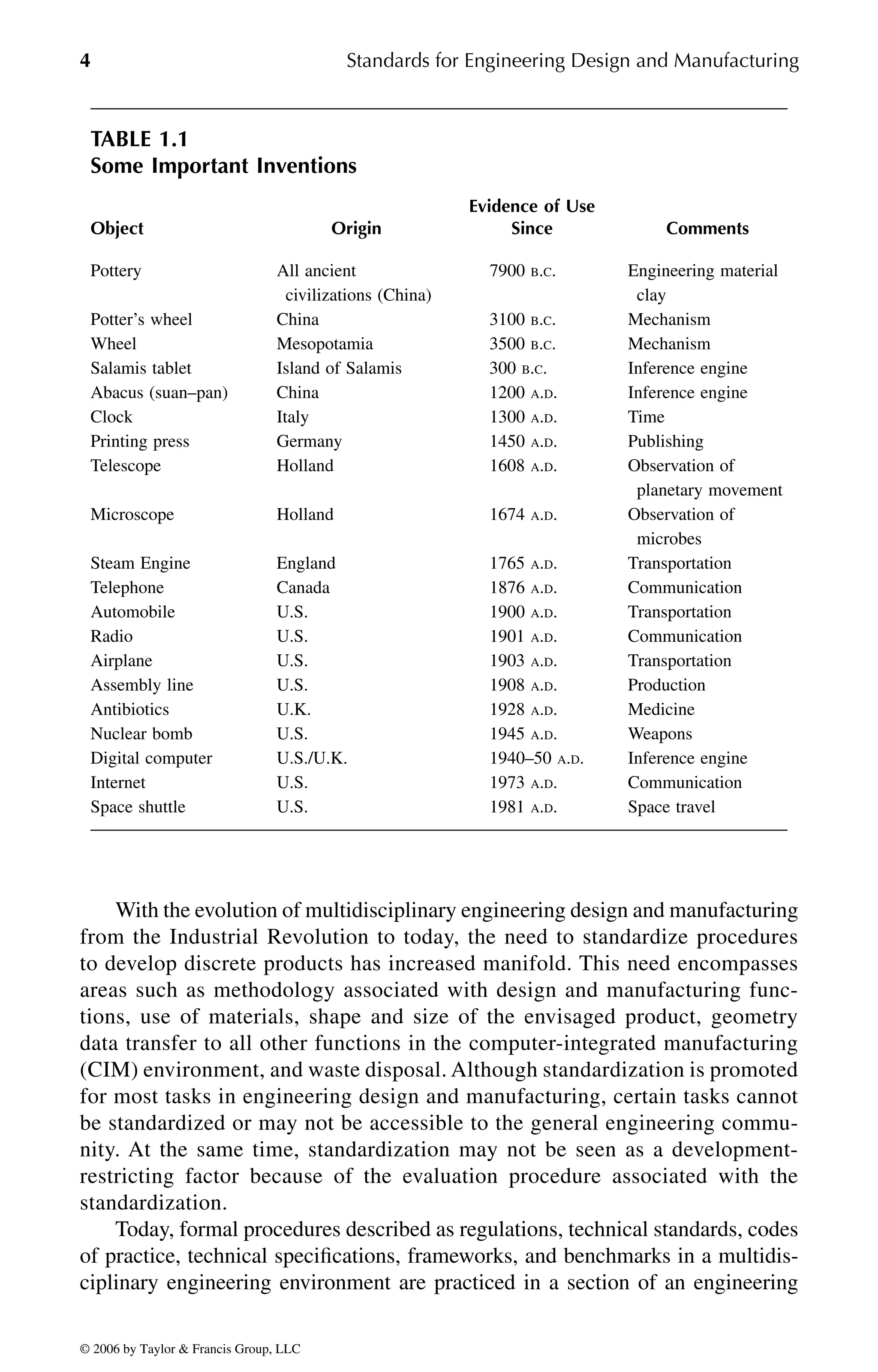
of humankind are presented in Table 1.1.
4 Standards for Engineering Design and Manufacturing
With the evolution of multidisciplinary engineering design and manufacturing
from the Industrial Revolution to today, the need to standardize procedures
to develop discrete products has increased manifold. This need encompasses
areas such as methodology associated with design and manufacturing func-
tions, use of materials, shape and size of the envisaged product, geometry
data transfer to all other functions in the computer-integrated manufacturing
(CIM) environment, and waste disposal. Although standardization is promoted
for most tasks in engineering design and manufacturing, certain tasks cannot
be standardized or may not be accessible to the general engineering commu-
nity. At the same time, standardization may not be seen as a development-
restricting factor because of the evaluation procedure associated with the
standardization.
Today, formal procedures described as regulations, technical standards, codes
of practice, technical specifications, frameworks, and benchmarks in a multidis-
ciplinary engineering environment are practiced in a section of an engineering
TABLE 1.1
Some Important Inventions
Object Origin
Evidence of Use
Since Comments
Pottery All ancient
civilizations (China)
7900 B.C. Engineering material
clay
Potter’s wheel China 3100 B.C. Mechanism
Wheel Mesopotamia 3500 B.C. Mechanism
Salamis tablet Island of Salamis 300 B.C. Inference engine
Abacus (suan–pan) China 1200 A.D. Inference engine
Clock Italy 1300 A.D. Time
Printing press Germany 1450 A.D. Publishing
Telescope Holland 1608 A.D. Observation of
planetary movement
Microscope Holland 1674 A.D. Observation of
microbes
Steam Engine England 1765 A.D. Transportation
Telephone Canada 1876 A.D. Communication
Automobile U.S. 1900 A.D. Transportation
Radio U.S. 1901 A.D. Communication
Airplane U.S. 1903 A.D. Transportation
Assembly line U.S. 1908 A.D. Production
Antibiotics U.K. 1928 A.D. Medicine
Nuclear bomb U.S. 1945 A.D. Weapons
Digital computer U.S./U.K. 1940–50 A.D. Inference engine
Internet U.S. 1973 A.D. Communication
Space shuttle U.S. 1981 A.D. Space travel
DK8870_C001.fm Page 4 Thursday, September 29, 2005 5:17 PM
© 2006 by Taylor & Francis Group, LLC
Engineering Design and Manufacturing 5
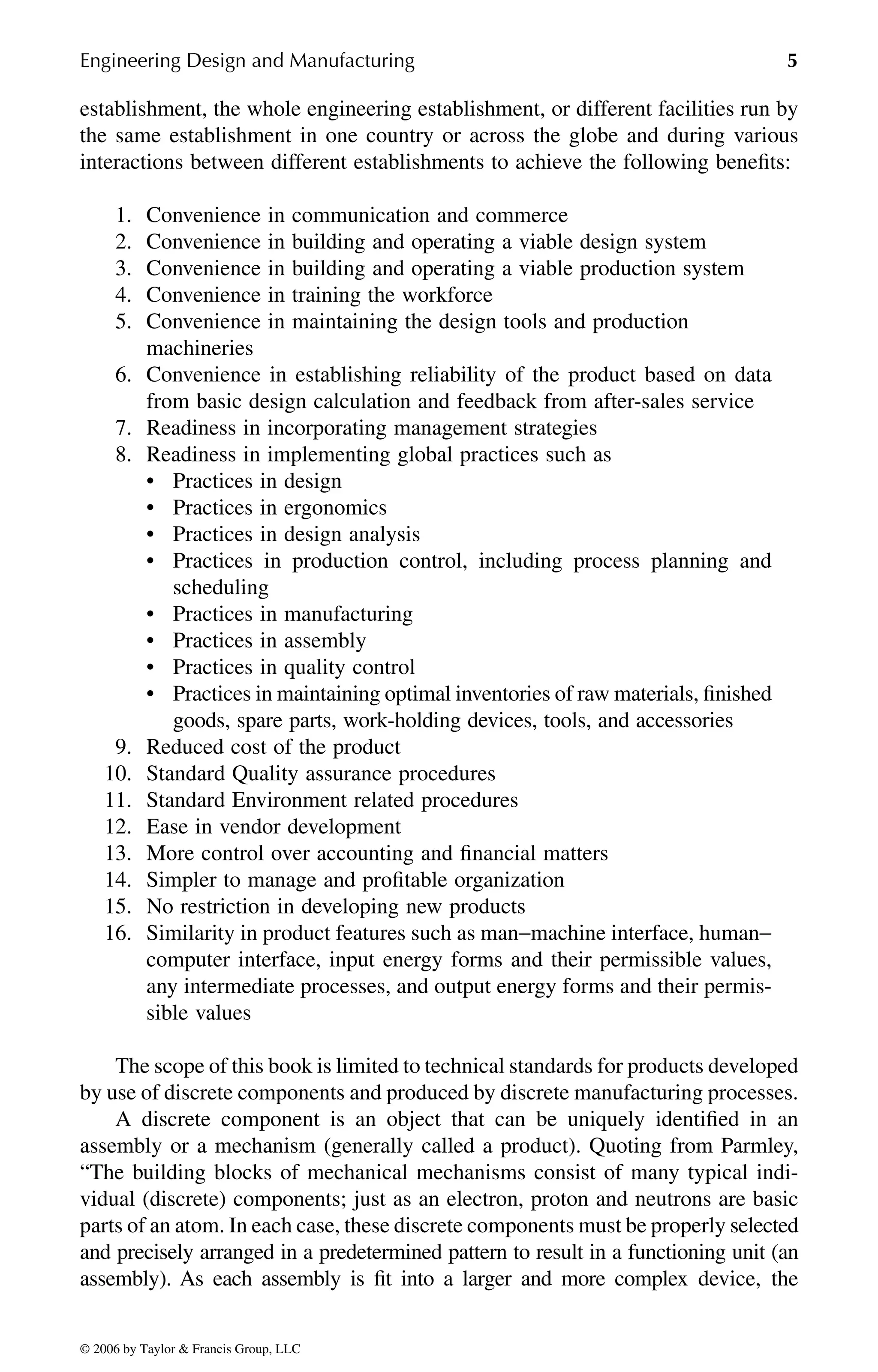
establishment, the whole engineering establishment, or different facilities run by
the same establishment in one country or across the globe and during various
interactions between different establishments to achieve the following benefits:
1. Convenience in communication and commerce
2. Convenience in building and operating a viable design system
3. Convenience in building and operating a viable production system
4. Convenience in training the workforce
5. Convenience in maintaining the design tools and production
machineries
6. Convenience in establishing reliability of the product based on data
from basic design calculation and feedback from after-sales service
7. Readiness in incorporating management strategies
8. Readiness in implementing global practices such as
• Practices in design
• Practices in ergonomics
• Practices in design analysis
• Practices in production control, including process planning and
scheduling
• Practices in manufacturing
• Practices in assembly
• Practices in quality control
• Practices in maintaining optimal inventories of raw materials, finished
goods, spare parts, work-holding devices, tools, and accessories
9. Reduced cost of the product
10. Standard Quality assurance procedures
11. Standard Environment related procedures
12. Ease in vendor development
13. More control over accounting and financial matters
14. Simpler to manage and profitable organization
15. No restriction in developing new products
16. Similarity in product features such as man−machine interface, human−
computer interface, input energy forms and their permissible values,
any intermediate processes, and output energy forms and their permis-
sible values
The scope of this book is limited to technical standards for products developed
by use of discrete components and produced by discrete manufacturing processes.
A discrete component is an object that can be uniquely identified in an
assembly or a mechanism (generally called a product). Quoting from Parmley,
“The building blocks of mechanical mechanisms consist of many typical indi-
vidual (discrete) components; just as an electron, proton and neutrons are basic
parts of an atom. In each case, these discrete components must be properly selected
and precisely arranged in a predetermined pattern to result in a functioning unit (an
assembly). As each assembly is fit into a larger and more complex device, the
DK8870_C001.fm Page 5 Thursday, September 29, 2005 5:17 PM
© 2006 by Taylor & Francis Group, LLC
6 Standards for Engineering Design and Manufacturing
individual component becomes less and less noticeable, until a malfunction
occurs.” The assembled device is referred to as a mechanism if its components
perform movements or is referred to as a structure if the components remain
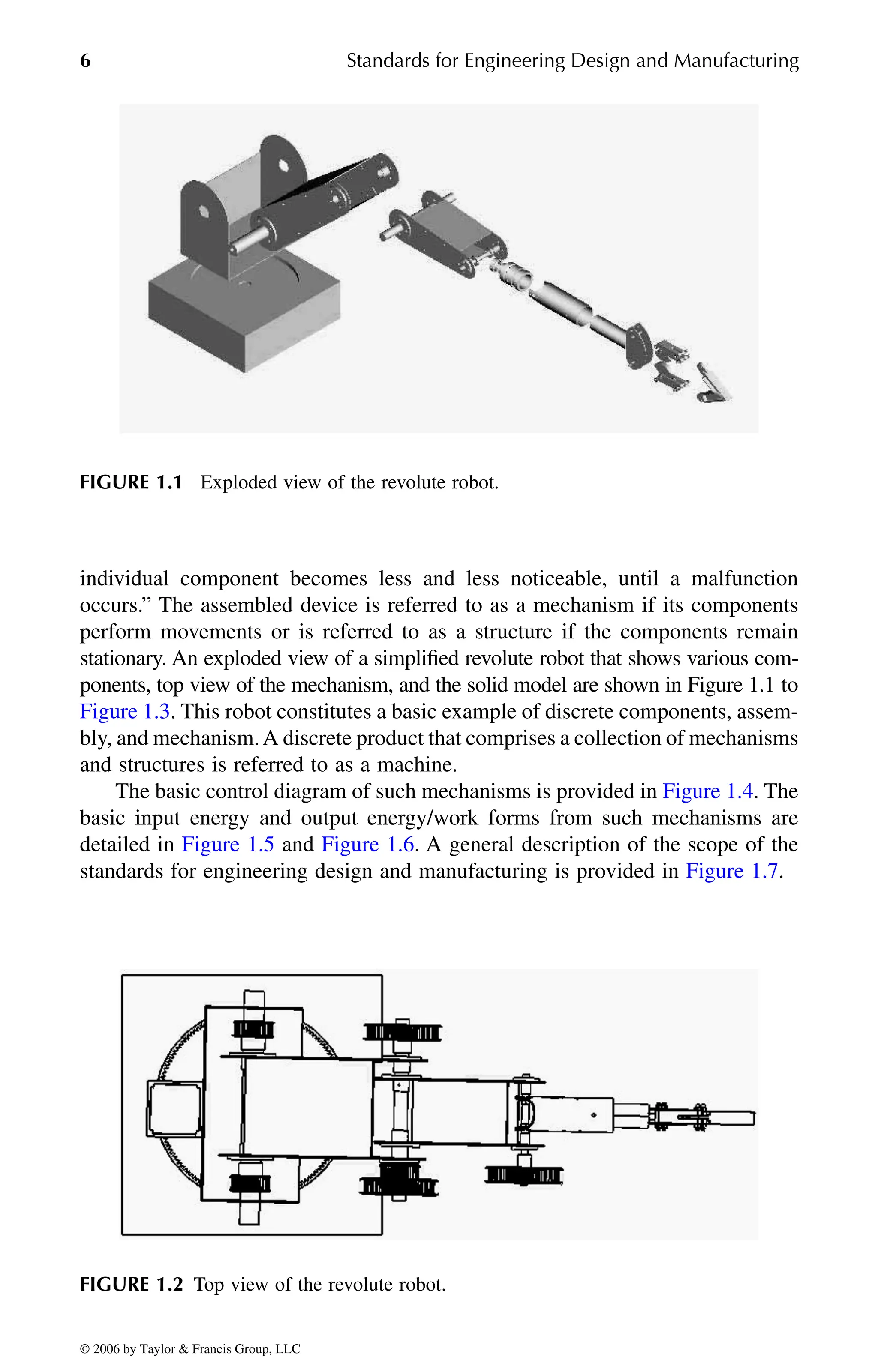
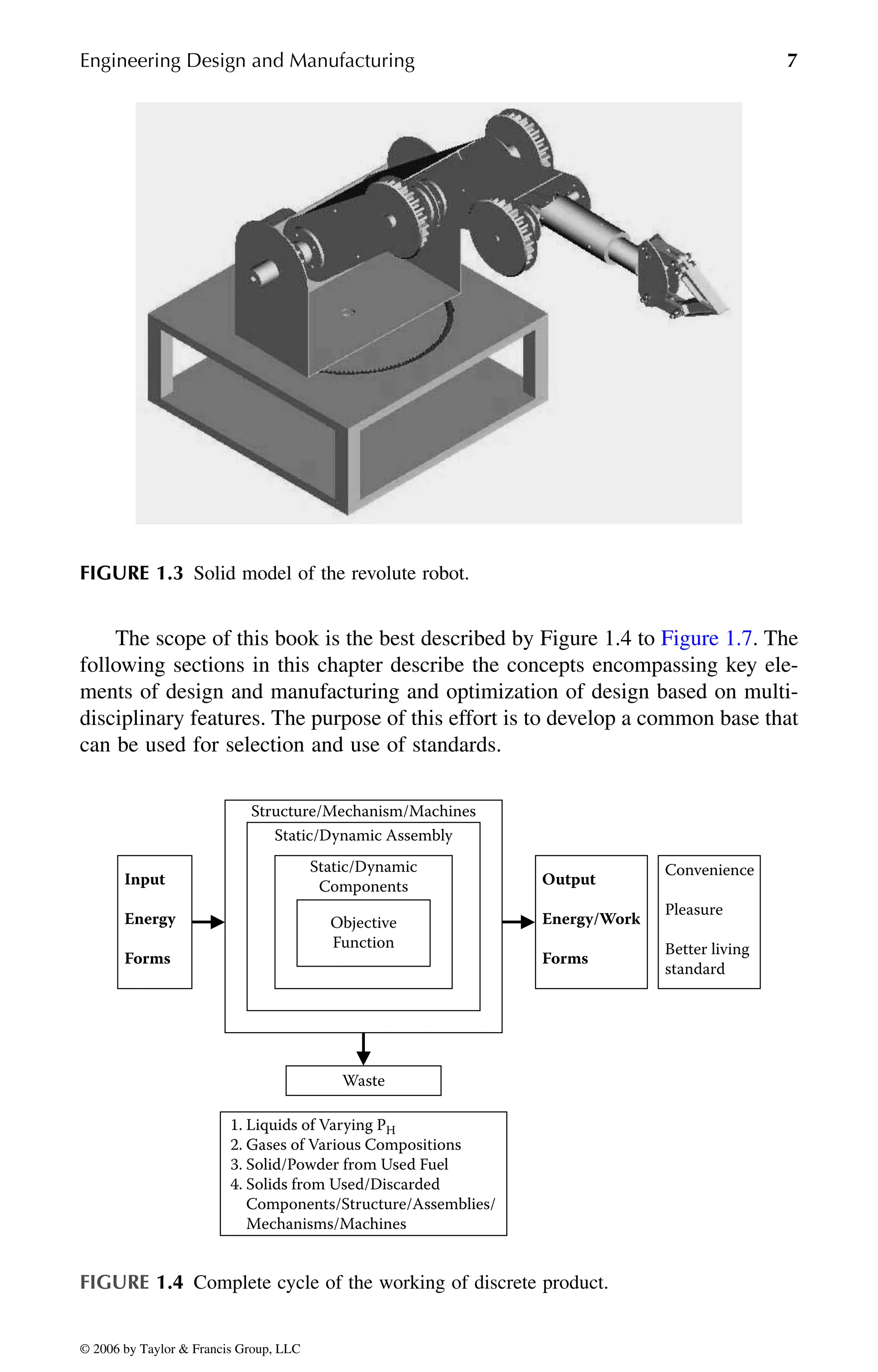
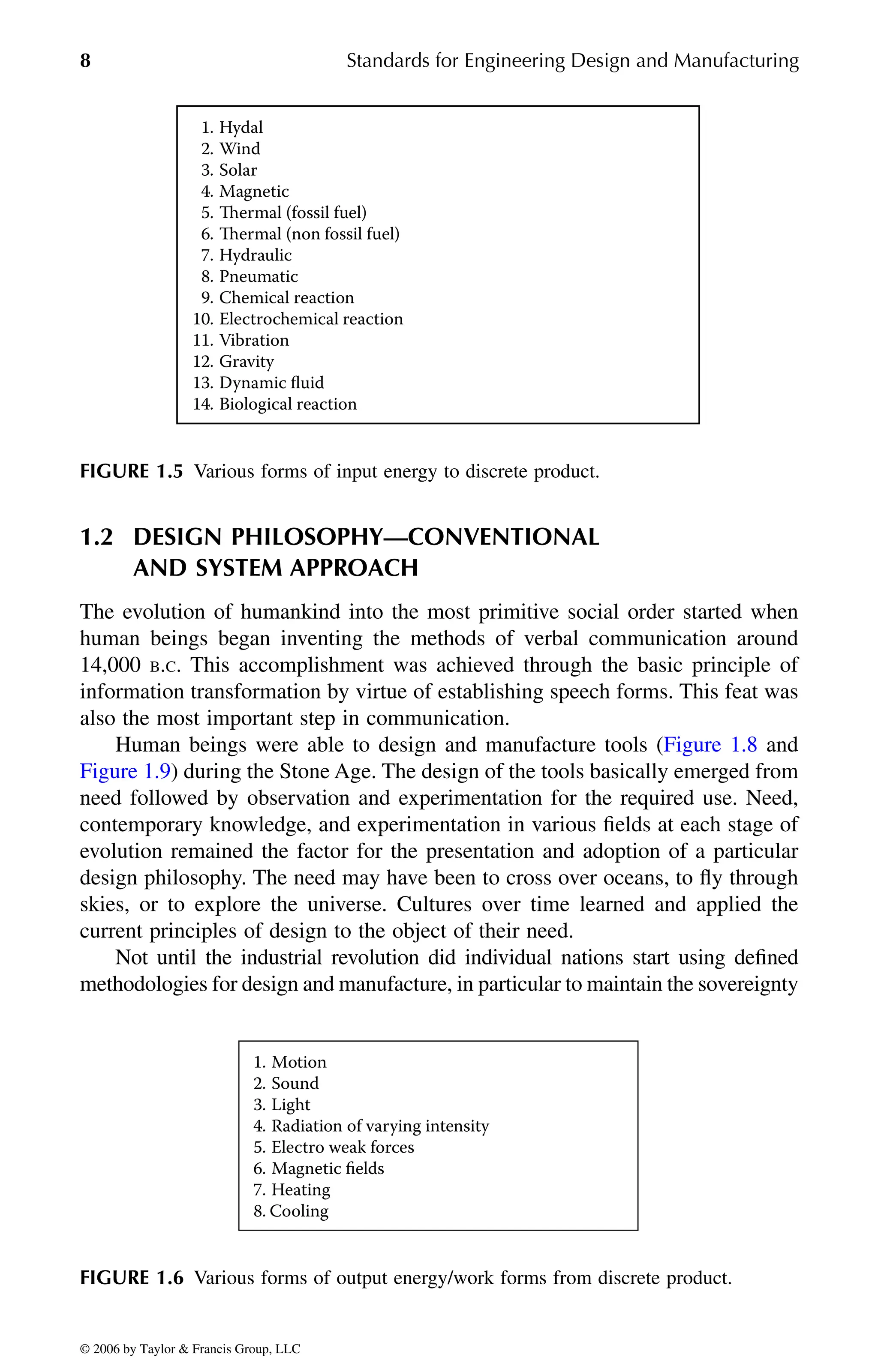
stationary. An exploded view of a simplified revolute robot that shows various com-
ponents, top view of the mechanism, and the solid model are shown in Figure 1.1 to
bly, and mechanism.A discrete product that comprises a collection of mechanisms
and structures is referred to as a machine.
basic input energy and output energy/work forms from such mechanisms are
FIGURE 1.1 Exploded view of the revolute robot.
FIGURE 1.2 Top view of the revolute robot.
DK8870_C001.fm Page 6 Thursday, September 29, 2005 5:17 PM
© 2006 by Taylor & Francis Group, LLC
Figure 1.3. This robot constitutes a basic example of discrete components, assem-
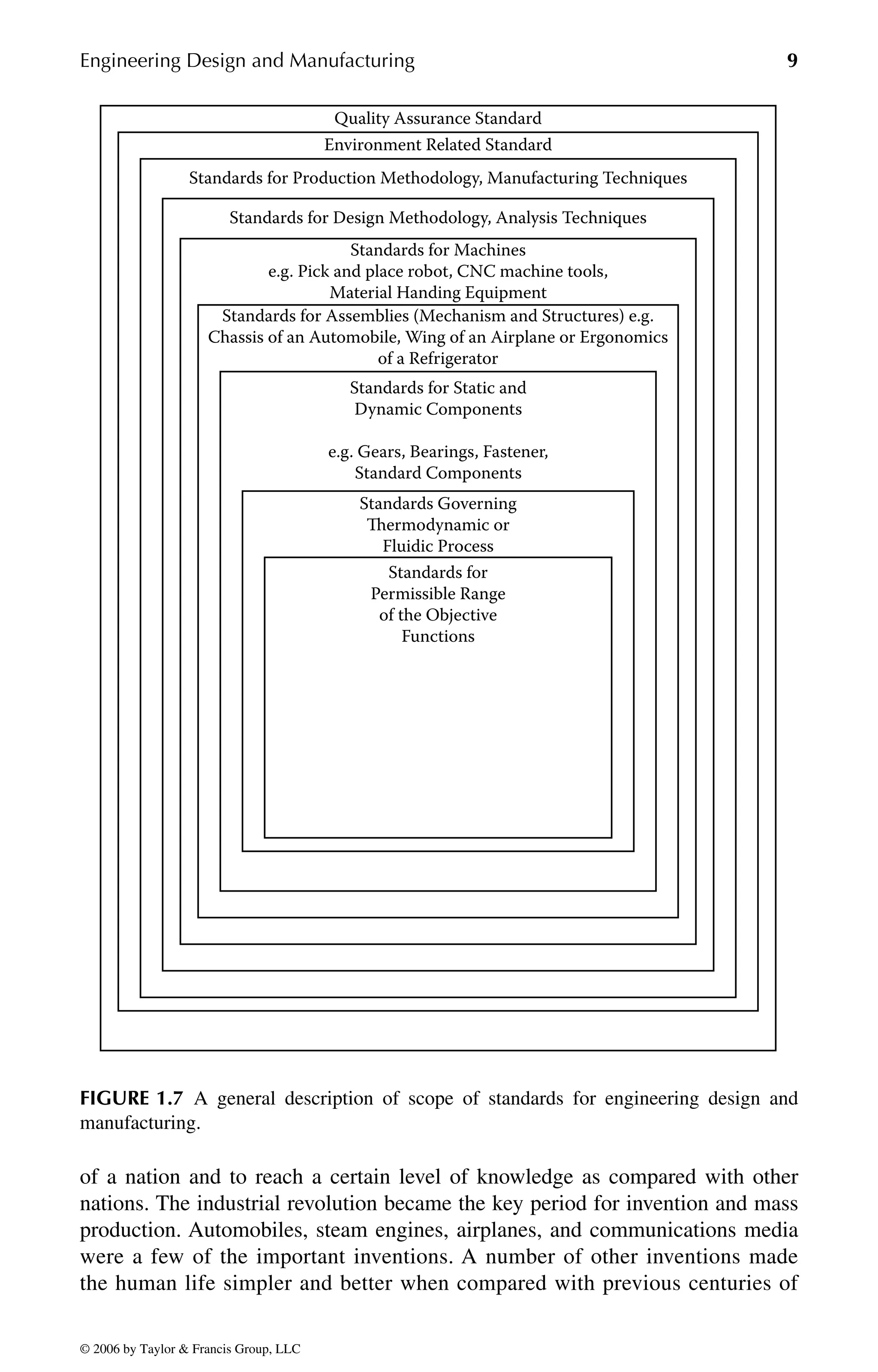
The basic control diagram of such mechanisms is provided in Figure 1.4. The
detailed in Figure 1.5 and Figure 1.6. A general description of the scope of the
standards for engineering design and manufacturing is provided in Figure 1.7.
Engineering Design and Manufacturing 7
following sections in this chapter describe the concepts encompassing key ele-
ments of design and manufacturing and optimization of design based on multi-
disciplinary features. The purpose of this effort is to develop a common base that
can be used for selection and use of standards.
FIGURE 1.3 Solid model of the revolute robot.
FIGURE 1.4 Complete cycle of the working of discrete product.
Structure/Mechanism/Machines
Static/Dynamic Assembly
Static/Dynamic
Components
Objective
Function
Output
Energy/Work
Forms
Waste
1. Liquids of Varying PH
2. Gases of Various Compositions
3. Solid/Powder from Used Fuel
4. Solids from Used/Discarded
Components/Structure/Assemblies/
Mechanisms/Machines
Input
Energy
Forms
Convenience
Pleasure
Better living
standard
DK8870_C001.fm Page 7 Thursday, September 29, 2005 5:17 PM
© 2006 by Taylor & Francis Group, LLC
The scope of this book is the best described by Figure 1.4 to Figure 1.7. The
8 Standards for Engineering Design and Manufacturing
1.2 DESIGN PHILOSOPHY—CONVENTIONAL
AND SYSTEM APPROACH
The evolution of humankind into the most primitive social order started when
human beings began inventing the methods of verbal communication around
14,000 B.C. This accomplishment was achieved through the basic principle of
information transformation by virtue of establishing speech forms. This feat was
also the most important step in communication.
need followed by observation and experimentation for the required use. Need,
contemporary knowledge, and experimentation in various fields at each stage of
evolution remained the factor for the presentation and adoption of a particular
design philosophy. The need may have been to cross over oceans, to fly through
skies, or to explore the universe. Cultures over time learned and applied the
current principles of design to the object of their need.
Not until the industrial revolution did individual nations start using defined
methodologies for design and manufacture, in particular to maintain the sovereignty
FIGURE 1.5 Various forms of input energy to discrete product.
FIGURE 1.6 Various forms of output energy/work forms from discrete product.
1. Hydal
2. Wind
3. Solar
4. Magnetic
5. Thermal (fossil fuel)
6. Thermal (non fossil fuel)
7. Hydraulic
8. Pneumatic
9. Chemical reaction
10. Electrochemical reaction
11. Vibration
12. Gravity
13. Dynamic fluid
14. Biological reaction
1. Motion
2. Sound
3. Light
4. Radiation of varying intensity
5. Electro weak forces
6. Magnetic fields
7. Heating
8. Cooling
DK8870_C001.fm Page 8 Thursday, September 29, 2005 5:17 PM
© 2006 by Taylor & Francis Group, LLC
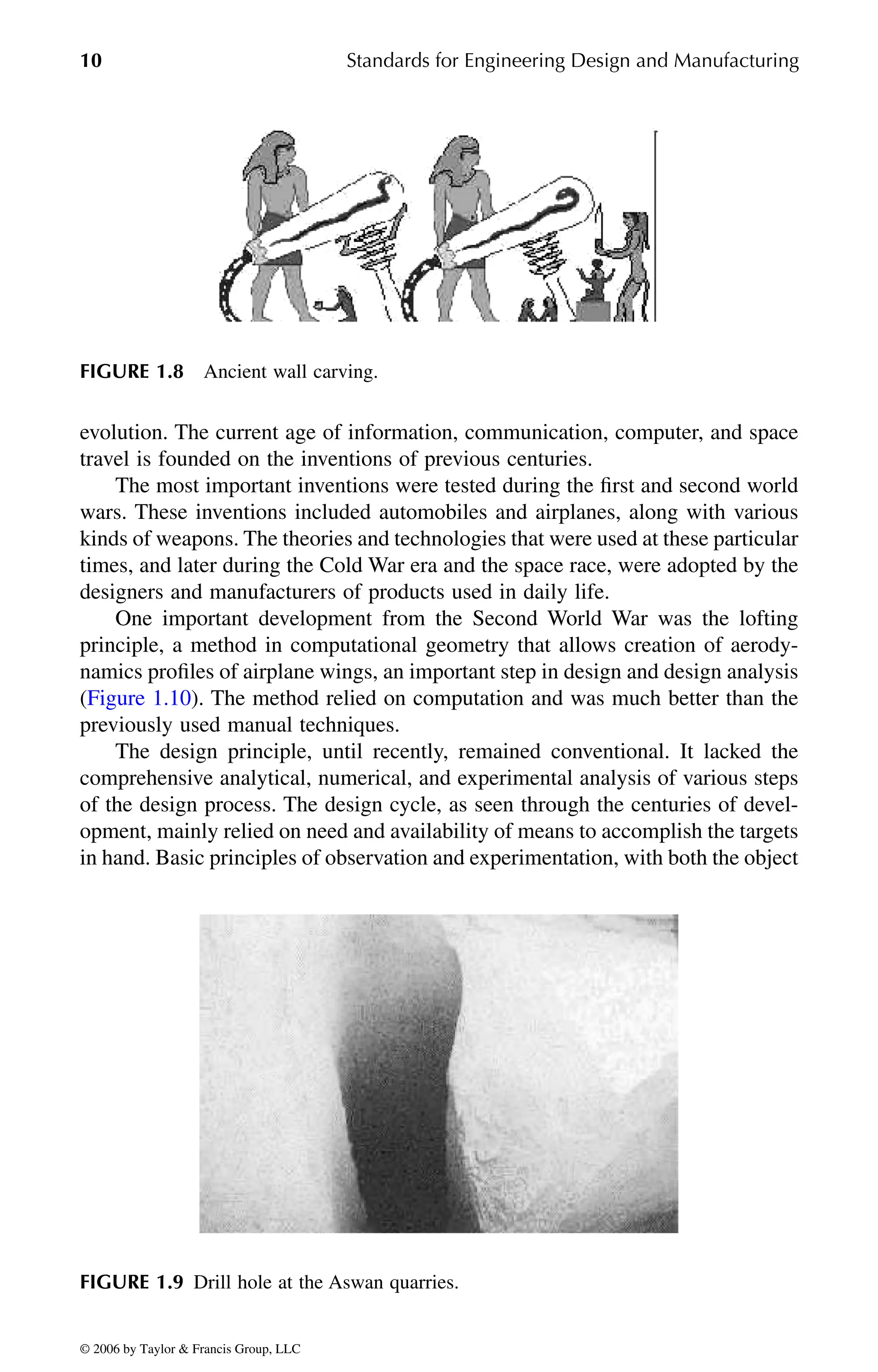
Human beings were able to design and manufacture tools (Figure 1.8 and
Figure 1.9) during the Stone Age. The design of the tools basically emerged from
Engineering Design and Manufacturing 9
of a nation and to reach a certain level of knowledge as compared with other
nations. The industrial revolution became the key period for invention and mass
production. Automobiles, steam engines, airplanes, and communications media
were a few of the important inventions. A number of other inventions made
the human life simpler and better when compared with previous centuries of
FIGURE 1.7 A general description of scope of standards for engineering design and
manufacturing.
Quality Assurance Standard
Environment Related Standard
Standards for Production Methodology, Manufacturing Techniques
Standards for Design Methodology, Analysis Techniques
Standards for Machines
e.g. Pick and place robot, CNC machine tools,
Material Handing Equipment
Standards for Assemblies (Mechanism and Structures) e.g.
Chassis of an Automobile, Wing of an Airplane or Ergonomics
of a Refrigerator
Standards for Static and
Dynamic Components
e.g. Gears, Bearings, Fastener,
Standard Components
Standards Governing
Thermodynamic or
Fluidic Process
Standards for
Permissible Range
of the Objective
Functions
DK8870_C001.fm Page 9 Thursday, September 29, 2005 5:17 PM
© 2006 by Taylor & Francis Group, LLC
10 Standards for Engineering Design and Manufacturing
evolution. The current age of information, communication, computer, and space
travel is founded on the inventions of previous centuries.
The most important inventions were tested during the first and second world
wars. These inventions included automobiles and airplanes, along with various
kinds of weapons. The theories and technologies that were used at these particular
times, and later during the Cold War era and the space race, were adopted by the
designers and manufacturers of products used in daily life.
One important development from the Second World War was the lofting
principle, a method in computational geometry that allows creation of aerody-
namics profiles of airplane wings, an important step in design and design analysis
previously used manual techniques.
The design principle, until recently, remained conventional. It lacked the
comprehensive analytical, numerical, and experimental analysis of various steps
of the design process. The design cycle, as seen through the centuries of devel-
opment, mainly relied on need and availability of means to accomplish the targets
in hand. Basic principles of observation and experimentation, with both the object
FIGURE 1.8 Ancient wall carving.
FIGURE 1.9 Drill hole at the Aswan quarries.
DK8870_C001.fm Page 10 Thursday, September 29, 2005 5:17 PM
© 2006 by Taylor & Francis Group, LLC
(Figure 1.10). The method relied on computation and was much better than the
Engineering Design and Manufacturing 11
to be designed and tools to design it, are still the need of the day. However, the
basic principles that were developed by ancient engineers in designing historical
artifacts remain in use. Clear demarcation between various functions of design
and manufacture has not been made. This demarcation may allow an increase in
the efficiency of manpower, the development of focused products, an increase in
the production rate of the object, and a decrease in the cost of production.
Planning was first applied to the design of mechanical components during
the Industrial Revolution. Although the availability of optimum tools for the
design of various objects remained restricted, the design methods have certainly
progressed over the decades since that time. Take, for example, the telephone.
The technology used for the design and manufacturing of this device varies
significantly from that used at its inception.
When we say that a conventional approach to design is being used, we mean
that contemporary tools available for the design of objects are not being used.
Instead, more primitive tools are being used and demarcation between various
design activities is not clear. Even so, the conventional approach has a sequence
that gives it the capability to produce a product design at the end. The conventional
The conventional approach to design does not distinctly divide the exercise into
identifiable steps. Over the years it had been applied to highly sensitive products.
The procedure attempts to achieve functionality by almost always using excess values
for design parameters that result in overdesign. Sometimes, when conservative values
FIGURE 1.10 Lofting by use of longitudinal lines and cross-sectional patches.
1
1
1
1
1 2
3
4 5
2
2
3
3 4 5
4
5
6
2 3 4 5
2
3
4
5
6
DK8870_C001.fm Page 11 Thursday, September 29, 2005 5:17 PM
© 2006 by Taylor & Francis Group, LLC
approach to design is presented in Figure 1.11.
12 Standards for Engineering Design and Manufacturing
are not used for design, the product may result in catastrophe. Cognitive deductions
play a more important role in design revisions with large time lapse.
System approach, an organized set of doctrines, ideas, or principles usually
intended to explain the arrangement or workings of a systematic whole, inculcated
into design practice as the logical division of subsystems, is taking place with a
knowledge base that spans centuries. At the same time, the tools available to
perform the design have become much more advanced than those used in the
conventional approach to design.
thorough analysis of need, product specification, concept design, embodiment
design, and detail design. Each step in the design cycle is subdivided in smaller
units. A principle of analysis, synthesis, and evaluation for determination of
optimal result for each task or group of tasks is devised. This principle includes
task specification, goal setting, and a time frame to achieve a particular target.
Methods of transferring information from one step to another in the design
cycle and to all other related functions through standard or other interfaces
have also been devised. The most important step is the inclusion of the use of
standards from the microtask to the macrotask level during the entire design
cycle.
Because most of the products used today have a certain level of automation,
quality assurance and the environmental aspects associated with it leads to the
adoption of multidisciplinary tasks in the design cycle. A team of engineers is
now needed to perform design tasks in a specified time frame.
Today, more knowledge has been gathered about the environment than at any
other time in history. The concept of product life cycle is becoming increasingly
important in the new millennium. Awareness of this fact does not require redef-
inition of the system approach to design, but the addition of new steps and revision
FIGURE 1.11 Conventional approach to design.
Optional
Time Scale
Need
Raw Specification
Raw Design Steps
Final Design
Raw Analysis Steps
Compulsory
DK8870_C001.fm Page 12 Thursday, September 29, 2005 5:17 PM
© 2006 by Taylor & Francis Group, LLC
The system approach to design, as presented in Figure 1.12, requires a
Engineering Design and Manufacturing 13
of certain existing aspects that will make the design cycle correspond to the needs
of the environment.
The economies associated with products that have multidisciplinary features
and designed on the basis of the products’life cycles are different from economies
developed with the conventional design cycle. A cost model for the design has
also become mandatory for the design exercise.
The system approach to design is a better form of design, whereby several
new functions are introduced. The system approach is better than the conventional
FIGURE 1.12 Contemporary system approach to design.
Quality Assurance Standards
Environment Related Standard
Technical Standards
Time Scale Natural
Need
Material
Database
Geometry
Database
Machine
Element
Database
Need
Concept Design
Marketing
Specification
Costing
Documentation
for Production
Multidisciplinary
Features
A
Embodiment
Design with
Contemporary tools
Design
Documentation
A
Contemporary
Analytical,
Numerical and
Experimental
Methods of Analysis
Detail Design with
Contemporary tools
Contemporary
Analytical,
Numerical and
Experimental
Methods of Analysis
A
Control
Elements
Database
A
Survey of Market for
Establishment of Need
DK8870_C001.fm Page 13 Thursday, September 29, 2005 5:17 PM
© 2006 by Taylor & Francis Group, LLC
14 Standards for Engineering Design and Manufacturing
approach in many ways. The distinct feature of the system approach is the gen-
eration of need in a target market. The product development function of the system
approach tries to fill in a vacuum that exists in a particular market. A second
important feature of the system approach is the extension of Eli Whitney’s (1765−
1825) concept of interchangeability. Interchangeability is achieved through the
design of modular products by use of pertinent standards. This aspect is very useful
in the basic concept of product life cycle and provides ample opportunity for use
of standard information.
If the system approach to design, along with aspects such as multidiscipline
engineering, quality consciousness, environment consciousness, and cost conscious-
then an enormous opportunity exists for the use of standards. Use of standard
information, along with the system approach to design, expedites the final result
with more certainty about the projected function, cost, and life of the product.
With the advent of computer-aided design (CAD) and computer-aided man-
ufacturing (CAM), use of databases for design and manufacturing parameters in
a particular domain, the availability of standard-component geometry in digital
format, and the availability of digital libraries of technical standards from different
FIGURE 1.13 Possible interactions for contemporary system approach to design.
Library of design tools,
design parameters and
standard component
geometry
Technical Standards
Digital Library
Quality Assurance &
Environment Related
Standards
Standards related to
Availability, Quality,
Reliability, and
Maintainability
System
Approach to
Design
Management
Strategies
Standards
Related to
Multidisciplinary
Features
Technical
Specification/Bench
Marking on Similar
Design
Knowledge Base for
Marketability and
Costing
DK8870_C001.fm Page 14 Thursday, September 29, 2005 5:17 PM
© 2006 by Taylor & Francis Group, LLC
ness is applied to the engineering domain as presented in Figure 1.4 to Figure 1.7,
organization are the trends for the future (Figure 1.13). For more details about
standards for the system approach to design of discrete products, see Chapter 4.
Engineering Design and Manufacturing 15
1.2.1 DESIGN ANALYSIS
Design analysis, a step ahead from hit-and-trial for design and manufacturing,
was incorporated into the design and manufacturing cycle to introduce more
certainty in all aspects of the life of an object, from drawing board to disposal.
The design analysis is the critical procedure that is performed to optimize design
and manufacturing parameters such as size, weight, loading, ease of manufactur-
ing, ease of assembly, reliable operation, cost, maintenance, and disposal. Because
of the multidisciplinary nature of the mechanisms (discrete products), the design
analysis may be focused on one or more of the following areas:
1. Analysis for strength
2. Analysis for bending
3. Analysis for torsion
4. Analysis for buckling
5. Analysis for contact loading
6. Analysis for combined loading
7. Analysis for cyclic loading
8. Analysis for cyclic loading at elevated temperature
9. Analysis for resonance
10. Analysis for thermal effects
11. Analysis for effects of gravity
12. Analysis for the effects of the magnetic field
13. Analysis for the effects of static and dynamic fluid
14. Analysis for the effects of liquids of various pH
15. Analysis for exposure to radiation of various intensity
16. Analysis for exposure to electroweak forces
17. Analysis for exposure to various air or gaseous environments
18. Analysis of electric circuits that power sensors, transducers, and
actuators
19. Analysis of electronics circuits used to control sensors, transducers,
and actuators
20. Analysis of control software that provides user interface to the product
21. Analysis for human factors (ergonomics)
22. Analysis for ease of manufacturability
23. Analysis for ease of assembly
24. Analysis for packaging and transportation
25. Analysis for market response
The design analysis for mechanical loading is normally performed by use of
the following techniques:
1. Analytical procedures
2. Numerical procedures
3. Experimental procedures
DK8870_C001.fm Page 15 Thursday, September 29, 2005 5:17 PM
© 2006 by Taylor & Francis Group, LLC
16 Standards for Engineering Design and Manufacturing
The analytical procedure requires synthesis of the problem and formulation of
equations that can provide, for example, force balance, mass balance, or heat balance.
Simultaneous solution of these equations provides the value of unknown parameters.
Numerical procedures are applied to design when the analytical procedure
requires further verification or no solution is possible by use of the analytical pro-
cedure. Numerical procedures apply mathematical techniques such as the finite-
element method and the boundary element method. These methods mathematically
model the approximation of the real problem and provide a solution through rigorous
computations that predict displacement of nodes and elements. The solution can be
viewed in multicolor models that give intensity of loading of relevant parameters.
Figure 1.14 shows a schematic of a finite-element model for a discrete component.
The experimental procedures include use of strain gauges, photo elasticity,
and brittle coatings. All of these procedures provide sufficient insight into the
loading of an object through use of real objects or miniature models.
Available standards and theories of failure for different design analysis param-
eters provide certainty that the envisioned design of a product will or will not
withstand the loading or exposure for the product’s projected lifetime.
Some major multidisciplinary parameters that require analysis for the envi-
sioned design are:
1. Permissible range of electric current
2. Permissible range of EMF
3. Permissible torque for actuators
FOS
Y
X
Z
G
1.000e+002
Model name: front arm
Study name: front arm plate
Plot type: Design Check - Plot1
Criterion: Max von Mises Stress
Factor of safety distribution: Min FOS = 6.6
9.221e+001
8.443e+001
7.664e+001
6.886e+001
6.107e+001
5.328e+001
4.550e+001
3.771e+001
2.993e+001
2.214e+001
1.436e+001
6.570e+000
DK8870_C001.fm Page 16 Thursday, September 29, 2005 5:17 PM
© 2006 by Taylor & Francis Group, LLC
FIGURE 1.14 Finite-element modeling (FEM) of front arm (see Figure 1.1 to Figure 1.3).
Engineering Design and Manufacturing 17
4. Requirements of man−machine interface
5. Requirements of human−computer interface
6. Suitability of information-transfer protocol
7. Suitability of geometric data-transfer protocol
8. Automation protocol requirements
9. Requirements of networking protocol
10. Use of high-level computer language in transparent interfaces
11. Selection of appropriate mechanical, electrical, and electronics com-
ponents or products
Different analytical, numerical, and experimental procedures are used to analyze
the above multidisciplinary parameters. The list of areas and parameters identified
for analysis is not exhaustive. The applicable areas or parameters are dependent on
the specific product and the features it supports.
A wealth of standard information is available from digital libraries, online
databases, and catalogs for establishing optimal values of mechanical engineering
design parameters and multidisciplinary parameters for a discrete product. The
1.2.2 DESIGN FOR MANUFACTURING OR ASSEMBLY
The contemporary system approach to design function covers the design phase
from inception of need to design for manufacture (DFM) or design for assembly
(DFA), with all the iterations for the sake of design optimization.
DFM takes into account the constraints on the available manufacturing
resources and attempts to match them with the requirements of the system approach
to design as design.All other subfunctions in design and manufacturing are adjusted
on the basis of this one-to-one relationship (Figure 1.15). Similarly, DFA takes into
account the constraints on the available assembly resources and attempts to match
them with the requirements of the system approach to design.All other subfunctions
in design and manufacturing are adjusted on the basis of this one-to-one relationship
The system approach to DFM and DFA defines subfunctions of the design
procedure by application of principles of similarity; appropriate standards; and
FIGURE 1.15 Design for manufacturing.
System Approach
to Design
Available
Manufacturing
Resources
(Including out
Sourcing)
Need
Design
Requirement
Manufacturing
Constraints
Product
DK8870_C001.fm Page 17 Thursday, September 29, 2005 5:17 PM
© 2006 by Taylor & Francis Group, LLC
(Figure 1.16).
reader is referred to details about standards in Chapter 2.
18 Standards for Engineering Design and Manufacturing
use of analytical, numerical, and experimental methods of analysis function,
drawings for the manufacture and assembly functions, and communication
between subfunctions and other function that requiring information associated
with the design function. The current tools available for DFA and DFM, along
with various other interfaces, allow visualization of product, which differs from
the conventional approach and provides ease of predicting the cost of the product.
1.2.3 OPTIMIZATION IN DESIGN
Design is repetitive by nature. Repetition may occur in the design analysis step,
for DFM, for DFA, or as an exercise in cognitive ergonomics. The repetition may
also be performed to optimize the design to meet the requirements of basic
physical properties, to conform to certain operational requirements, to meet safety
guidelines, to adjust to environmental factors, or to bring the product within
certain cost limitations. Use of computers and standard information during the
optimization phase expedites the whole process and brings more confidence to
the resulting design.
1.2.4 THE COST MODEL FOR DESIGN
Engineering design is predominantly concerned with wealth creation. Every
design can be a “design to manufacture.” This method necessitates a holistic
approach, including effective cost. It involves the use of scientific principles,
technical information, numeracy, synthesis, analysis, creativity, and decision mak-
ing. It requires the consideration of human and environmental factors with the
maximum practicable economy and efficiency. An overall cost model of design
1.3 MANUFACTURING PHILOSOPHY—
CONVENTIONAL AND SYSTEM APPROACH
The subject of manufacturing arose when humans altered the geometry of a work-
piece by rotating a tool to cut and remove pieces of material in the production of
weapons as early as 700 B.C. In the fifteenth century, the machining of metal began.
FIGURE 1.16 Design for assembly.
System Approach
to Design
Need
Available
Assembly
Resources
Design
Requirement
Assembly
Constraints
Product
DK8870_C001.fm Page 18 Thursday, September 29, 2005 5:17 PM
© 2006 by Taylor & Francis Group, LLC
is shown in Figure 1.17.
Engineering Design and Manufacturing 19
The problems faced by the manufacturer of the first potter wheel are similar
to those faced by a manufacturer today: what to produce, how to produce, and
when to produce within the available resources of the enterprise. The product
made on the manufacturer’s machines must be produced during a specified lead
time and within certain quantity restrictions. It should be marketable and produce
profit for the manufacturing enterprise.
Progression from StoneAge production methods to today’s machining centers
and flexible manufacturing systems shows that manufacturing is an important
element in the creation of wealth. The earlier processes available to convert
material into specified objects were few, so little wealth was created. This situation
FIGURE 1.17 Cost model for design.
Availability
Reliability
Maintainability
System
Integration
Prime
Cost
Energy &
Service
Cost
Maintenance
Costs
Spares &
Redundancy
Costs
Outage
Costs
Wealth
Creation
Process
Needed
System
Requirement
System
Configuration
Operational
Requirement
Redundancy
Environmental
Requirements
Safety Level
and Costs
Field
Feed
Basic
Disposal
Costs
Effective Costs
DK8870_C001.fm Page 19 Thursday, September 29, 2005 5:17 PM
© 2006 by Taylor & Francis Group, LLC
20 Standards for Engineering Design and Manufacturing
has been significantly changed by the development of new materials, new man-
ufacturing processes, and by the introduction of computerized numerical control
(CNC).
As was stated in the case of conventional approach to design, when contem-
porary tools available for manufacture of an object are not used then the approach
to manufacture is regarded as the conventional approach. However, this conven-
tional approach has a logical sequence that gives it the capability to produce the
product with required functionality.
The important interface between conventional design and manufacture
is implemented through the production planning and control subfunction.
manufacture.
The system approach to manufacture differs from the conventional approach
in terms of the organization of the manufacturing and assembly area. This
approach provides a better insight into the dynamics of manufacturing in
general and specifically results in an efficient process with higher profit margins
Production subfunctions such as process planning, short-term and long-
term scheduling, manufacturing, quality assurance, raw-material and finished-
product inventories, inventories for accessories related to a specific manufac-
turing facility, packaging and storage, and transportation can be analyzed
both quantitatively and qualitatively by use of available mathematical tech-
niques.
The role of computers for the analysis of the manufacturing parameters in
various subfunctions of the system approach to manufacturing is paramount.
The flow of information, the flow of material, and the flow of energy is
discussed in detail by Yeomans, Choudary, and Ten Hagen (1986) and Alting
(1994).
1.3.1 AN OVERVIEW OF DISCRETE MANUFACTURING PROCESSES
Manufacturing processes are physical mechanisms used to alter the shape
and form of materials. Manufacturing processes can be classified as shown
to a variety of engineering materials, which can be classified into nonmet-
als, metals, ceramics, polymers, and composites. The application of man-
ufacturing process to an individual material is influenced by number of
factors, including physical properties of the material and the lot size. A
rials, processes, and the machines that perform manufacturing operation
DK8870_C001.fm Page 20 Thursday, September 29, 2005 5:17 PM
© 2006 by Taylor & Francis Group, LLC
Figure 1.18 shows the basic structure for the conventional approach to
(Figure 1.19).
in Figure 1.20. These categories of manufacturing processes are applied
more in-depth discussion on manufacturing processes is provided in Chap-
ter 6. A wide variety of standard information is available about the mate-
(see Chapter 2).
Engineering Design and Manufacturing 21
1.3.2 DISCRETE MANUFACTURING SYSTEMS
The discrete manufacturing systems as defined by Chryssolouris (1992) are the
following:
Job shop
Project shop
Cellular system
Flow line
FIGURE 1.18 Conventional approach to manufacture.
Time Scale Information from Design Function
Rework
Rejects
Scrap
Production
Planning & Control
Manual Process Plan, Schedule based on Experience
Raw Material, Tool, Jigs, Fixture
Quality Procedure
Finished Product Inventory
Transportation
Finished Product
Conventional
Manufacturing Facility
DK8870_C001.fm Page 21 Thursday, September 29, 2005 5:17 PM
© 2006 by Taylor & Francis Group, LLC
22 Standards for Engineering Design and Manufacturing
The discrete manufacturing system uses five main elements in their construction:
A production philosophy
The physical layout for the manufacturing
A discrete method for flow of raw material and finished product in a manu-
facturing system
FIGURE 1.19 Contemporary system approach to manufacturing.
Quality Assurance Standards
Environment Related Standards
Technical Standards
Information from Design function
Time Scale
Machine
Status
Rework
Rejects
Scrap
Production Planning & Control
Materials
Parts Programs/Manufacturing Instructions
Process plans
Short and Long Term Schedules
Inventories of Manufacturing Accessories
Job
Shop
Project
Shop
Flow
Line
Cellular
Shop
Contemporary Quality Control Tools
Assembly/Mechanism/Machine (Discrete Product)
Quality Control
Recycle
Discrete Components
Waste
Disposal
Inventory of Finished Products
Transportation
A
A
DK8870_C001.fm Page 22 Thursday, September 29, 2005 5:17 PM
© 2006 by Taylor & Francis Group, LLC
Engineering Design and Manufacturing 23
A distinct method for flow of information
A method for flow of energy
1.3.3 PRODUCTION CONTROL
Hitomi (1975) defines manufacturing as comprising essentially all the tangible
operations and production as encompassing both tangible and intangible opera-
tions. The tangible operations include metal cutting, metal forming, metal deform-
ing, joining, and other mainstream processes. On the other hand, intangible
operations include services such as process planning, scheduling, and inventory
management. The production control theories presented over the past decades
consider both tangible and intangible factors to improve the efficiency of a system
and to increase the profits of an organization. Some of the parameters used in
FIGURE 1.20 Process used in discrete manufacturing (adapted with permission from
Kalpakjian and Schmid 2003).
Forming Processes
Bulk Deformation Processes
Sheet Metal Forming Processes
Metal Removal Processes
Joining and Fastening Processes
Heat Treatment Processes
Surface Treatment Processes
Fabrication of Micro-electronics and Micro-mechanical Devices
Non Conventional Machinery
DK8870_C001.fm Page 23 Thursday, September 29, 2005 5:17 PM
© 2006 by Taylor & Francis Group, LLC
Discrete manufacturing systems are described in detail in Chapter 6.
Discovering Diverse Content Through
Random Scribd Documents
symptoms of, 210.
treatment for, 210.
Diabetes insipidus, 217, 481.
causes, 217.
treatment for, 217.
Diaphragm, spasm of, 145, 504.
Disease of the heart, 143.
Division of the tendons, 457.
Division of the tendons, the necessity for, how provoked, 458.
how to perform, 459.
after-treatment required for, 460.
Do not whip a runaway horse, 19.
Dropsy of the abdomen, 178.
Dysentery, acute, 172.
chronic, 175.
Enteritis, 165, 481.
causes of, 165.
symptoms of, 167.
mode of making sure that it is present, 169.
treatment of, 170.
Excoriated angles of the mouth, 64, 481.
causes of, 64.
treatment for, 66.
Expression of a horse changed by repeated attacks of megrims,
25.
Extirpation of the eye, 59.
Eye, fungoid tumors in, 57.
Eyes, the diseases of, 42.
Face of a horse with hydrophobia, 27.
False quarter, 345, 482.
cause of, 345.
treatment for, 346.
Farcy, 282, 482.
cause of, 282.
symptoms of, 283.
Feeding a horse with chronic tetanus, 33.
Feet, their diseases, 330.
Fever in the feet, 367.
Filled legs, 239.
Fistulous parotid duct, 394, 482.
its causes, 395.
symptoms of, 396.
treatment for, 397.
Fistulous withers, 391, 483.
its causes, 391.
symptoms of, and treatment for, 392.
Flatulent colic, 199.
Foot, prick of, 354, 498
pumice, 339, 499.
Fret, 194, 505.
Fungoid tumors in the eye, 57, 483.
symptoms of, 57.
horrible alternatives left by, 58.
Gastritis, acute, 147.
chronic, 150.
Glanders, 274, 483.
cause of, 274.
symptoms of, 276.
Gleet, nasal, 91, 491.
Grease, 242, 484.
prevention of, 242.
nature of, 242.
cause of, 244.
symptoms of, 245.
treatment for, 247.
Gripes, 194, 505.
Gutta serena, 38, 485.
causes of, 38.
symptoms of, 39.
peculiarities of, 40.
effect upon the optic nerve, 40.
Harness horses most subject to megrims, 24.
Hay rack, evils of its general position, 44.
Heart, disease of, 143, 485.
Heels, cracked, 250.
Hematuria, 215, 485.
symptoms of, 215.
treatment for, 216.
Hepatitis, chronic, 158.
causes of, 158.
treatment for, 160.
Hide-bound, 231, 486.
treatment for, 232.
Highblowing, 94, 486.
Horse quickly learns to recognize the voice of its owner, 19.
How to treat a runaway horse, 19.
Hydrophobia, 27, 486.
symptoms of, 27.
treatment for, 28.
Hydrothorax, 139, 486.
symptoms of, 140.
treatment of, 141.
Incised wounds, 424.
Idiopathic tetanus, 29.
causes of, 30.
Impediment in the lachrymal duct, 61, 487.
causes of, 62.
treatment for, 62.
Inflammation of the kidneys, 204, 492.
of the bladder, 209, 480.
of the vein, 398, 496.
Influenza, 181, 487.
probable cause of, 181.
symptoms of, 182.
treatment of, 183.
Injuries, 385.
of the abdomen, 184.
to the jaw, 69, 488.
the snaffle may cause, 70.
but often does produce, 70.
treatment for, 71.
produced by London stables, 35.
Jaw, injuries to the, 69, 488.
Joints, synovial, open, 418, 494.
Kidneys, inflammation of, 204, 492.
Knees, broken, 404.
Lacerated eyelid, 60, 488.
cause of, 60.
treatment for, 61.
Lacerated tongue, 74, 488.
causes of, 77.
treatment of, 77.
Lacerated wounds, 423.
Lameness, 330.
treatment for, 330.
mode of progression when in different feet, 333.
Laminitis, acute, 367.
subacute, 375, 489.
Lampas, 67.
an imaginary disease, 67.
Larva in the skin, 233, 489.
cause of, 233.
cure for, 234.
Laryngitis, 101, 488.
cause of, 101.
symptoms of, 102.
treatment of, 102.
Lash, effect of on the eye of the horse, 43.
Laying open the sinuses of a quittor, 462.
how to accomplish, 462.
intention of, 463.
Lice, 232, 489.
Limbs, the diseases of, 286.
Liver, the diseases of, 145.
London stables, 35.
Luxation of the patella, 325, 490.
Madness, 27.
Mad staggers, 20.
Mallenders and sallenders, 249, 490.
treatment for, 249.
Mange, 220, 490.
causes of, 221.
symptoms of, 223.
treatment for, 225.
Megrims, 24, 491.
a form of epilepsy, 24.
when the attacks may appear, 24.
symptoms of, 25.
Melanosis, 259, 491.
symptoms of, 259.
treatment for, 260.
Mode of feeding a horse with chronic tetanus, 33.
Mouth, the, its accidents and diseases, 64.
excoriated angles of, 64.
roof of, may be injured by the bit, 71.
the disease of, 64.
Nasal gleet, 91, 491.
its causes, 91.
its treatment, 92.
Nasal polypus, 88, 492.
its nature, 88.
its treatment, 88.
Navicular disease, 377, 492.
seat of, 377.
causes of, 378.
symptoms of, 379.
treatment for, 382.
Nephritis, 204, 492.
causes of, 205.
symptoms of, 206.
treatment for, 207.
Nervous system, its accidents and its diseases, 17.
Neurotomy, 451.
its results, 451.
manner of performing, 452.
Nostrils, the diseases of, 84.
their accidents and their diseases, 84.
Occult spavin, 308, 493.
cause of, 309.
symptom of, 309.
treatment for, 310.
Open synovial joints, 418, 494.
primary treatment for, 418.
general treatment for, 419.
Open synovial cavities, 412, 494.
cause of, 412.
nature of, 413.
what is generally spoken of as, 415.
treatment for, 415.
Operation of no use in abscess of the brain, 20.
Operations, 434, 495.
aids to fetter the horse for, 440.
Ophthalmia, simple, 42, 503.
specific, 46, 506.
Optic nerve, the effect of gutta serena upon, 41.
Osseous deposits, 286.
Ossified cartilages, 366, 495.
Overreach, 349, 495.
treatment for, 349.
Parotid duct, fistulous, 394.
Parrot-mouth, 66, 495.
evils of, 67.
no cure for, 67.
Partial paralysis, 36, 496.
symptom of, 36.
the disease of fast horses, 37.
generally past all cure, 37.
the only hope of remedy for, 37.
Patella, luxation of, 325, 490.
Periosteotomy, 449.
the intention of, 449.
its advantages considered, 450.
Phlebitis, 398, 496.
experiment with regard to, 399.
cause of, 400.
symptoms of, 401.
treatment for, 402.
Phrenitis, 17, 496.
seldom is perceived approaching, 18.
symptoms of its approach, 18.
remedies for the early symptoms of, 18.
Physic of no use in abscess of the brain, 20.
Pleurisy, 136, 497.
symptoms of, 137.
treatment of, 138.
causes of, 139.
Pneumonia, 130, 497.
doubts concerning, 131.
symptoms of, 131.
treatment of, 132.
Poll evil, 385, 498.
its causes, 386.
symptoms of, 387.
treatment for, 388.
Polypus, nasal, 88, 492.
Prick of the foot, 354, 498.
Profuse staling, 215, 481.
Prurigo, 226, 499.
symptoms of, 226.
treatment of, 227.
Pumice foot, 339, 499.
causes of, 339.
symptoms of, 340.
treatment for, 341.
Punctured wounds, 426.
Purgative and quiet, best remedies for tetanus, 32.
Purpura hemorrhagica, 265, 499.
symptoms of, 265.
treatment for, 266.
Quarter, false, 345.
Quidding, 79.
Quiet and a strong purgative, the best remedies for tetanus, 32.
Quittor, 354, 500.
cause of, 355.
symptoms of, 355.
treatment for, 357.
sinuses of, laying open, 462.
Rack, hay, evil of its general position, 44.
Rheumatism, 312, 500.
cause of, 312.
symptoms of, 312.
treatment for, 313.
Ring-bone, 298, 500.
cause of, 298.
symptoms of, 298.
treatment for, 300.
Ring-worm, 227, 501.
symptoms of, 227.
treatment for, 228.
Roaring, 106, 501.
chronic, is a serious affair, 106.
causes and effects of, 106.
remedy for, 109.
Roof of the mouth may be injured by the bit, 71.
Rupture of œsophagus, 115, 501.
how caused, 116.
Sallenders, 249, 490.
Sandcrack, 342, 502.
causes of, 342.
symptoms of, 342.
treatment for, 343.
Scald mouth, 82, 502.
causes of, 82.
symptoms of, 83.
treatment of, 83.
Seedy toe, 346, 503.
treatment for, 347.
Shying, 42.
Simple ophthalmia, 42, 503.
nature of, 43.
causes, 43.
treatment of, 45.
symptoms of, 45.
Sinuses of a quittor, laying open, 462.
Sitfast, 240, 503.
cause of, 241.
treatment for, 241.
Skin, diseases of, 220.
Sole, bruise of, 353, 498.
Sore throat, 96, 503.
symptoms of, 97.
treatment for, 97.
Spasm of the diaphragm, 145, 504.
symptoms of, 145.
treatment of, 146.
Spasm of the urethra, 212, 504.
causes of, 212.
symptoms of, 212.
treatment for, 213.
Spasmodic colic, 194, 505.
causes of, 194.
symptoms of, 196.
treatment for, 197.
Spavin, 286, 505.
cause of, 287.
symptoms of, 288.
treatment for, 293.
how to examine for, 291.
occult, 308, 493.
Specific diseases, varieties of, 254.
Specific ophthalmia, 46, 506.
eyes supposed most subject to, 47.
small stables the cause of, 47.
symptoms of, 48.
contrasted with simple ophthalmia, 49.
treatment for, 50.
preventive for, 51.
terminations of, 51.
Splint, 294, 506.
cause of, 294.
symptoms of, 296.
treatment of, 297.
Sprain of the back sinews, 303, 507.
cause of, 303.
treatment for, 304.
Staggers, 20, 507.
treatment for, 22.
origin of, 20.
sleepy, 22.
Strain of the flexor tendon, 300, 508.
Strangles, 267, 508.
cause of, 268.
symptoms of, 268.
treatment for, 269.
a bad kind of, 272.
Stringhalt, 33, 509.
symptom of, 33.
cause of, 35.
Stomach, the, diseases of, 145.
Stricture of œsophagus, 116, 501.
its effects, 117.
Subacute laminitis, 375, 489.
W. Percival's account of, 375.
treatment for, 376.
Summary, alphabetical, 465.
Surfeit, 229, 509.
treatment for, 230.
a severe kind of, 230.
treatment for, 230.
Swollen legs, 239, 509.
symptoms of, 239.
treatment for, 240.
Synovial cavities, open, 412, 494.
joints, open, 418, 494.
Tapping the chest, 141.
Teeth, disease of, 78, 509.
symptoms of their disease, 80.
treatment of, 81.
Tendons, division of, 457.
Tetanus, 28, 510.
Thorough-pin, 319, 510.
Throat, its accidents and diseases, 96.
sore, 96, 503.
the diseases of, 96.
Thrush, 363, 510.
cause of, 363.
treatment for, 364.
Toe, seedy, 346, 503.
Toothache, 80.
Tooth, components of, 79.
Tracheotomy, 443.
how to perform, 445.
Traumatic tetanus, 29.
causes of, 29.
test for, 30.
Tread, 348, 511.
causes of, in light and heavy horses, 348.
treatment for, 348.
True cause of stringhalt, 35.
Tumors, 237, 511.
natures of, 238.
Tushes, a cause of sickness, 78.
Tympanitis, 199.
Universal spasm is tetanus, 30.
Urethra, spasm of, 504.
Urethral calculus, 215.
Urinary organs, diseases of, 204.
Vein, inflammation of the, 398, 496.
Warts, 235, 511.
kinds of, 236.
treatment for, 236.
Water, certain death, after over-gorging, 21.
Water farcy, 262, 512.
cause of, 262.
symptoms of, 263.
treatment for, 264.
Wheezing, 94, 486.
Wind-galls, 315, 512.
symptoms of, 316.
treatment for, 317.
Windy colic, 199, 512.
causes of, 199.
symptoms of, 200.
treatment for, 201.
Withers, fistulous, 391.
Worms, 190, 513.
cause of, 190.
symptoms of, 191.
treatment for, 192.
Wounds, 423, 514.
lacerated, 423.
their treatment, 427.
incised, 424.
their treatment, 428.
abraded, 425.
their treatment, 430.
punctured, 426.
their treatment, 430.
contused, 427.
their treatment, 431.
THE END.
Gazetteer of the World.
Lippincott's Pronouncing Gazetteer of the World; or,
Geographical Dictionary. Containing—
I. A Descriptive Notice, with the most recent and
authentic information respecting the countries, islands,
rivers, mountains, cities, towns, etc., in every part of the
globe.
II. The Names of all important places, etc., both in
their native and foreign languages, with the
pronunciation of the same—a feature never attempted
in any other work.
III. The classical names of all ancient places, so far
as they can be accurately ascertained from the best
authorities.
IV. It also contains a complete etymological
vocabulary of geographical names.
BY J. THOMAS, M.D., and T. BALDWIN. One volume of over 2000
imperial 8vo. pages. $6.00.
It has evidently been prepared with great labor, and, as far as I
can judge, from the best materials and sources of information.... I
have no doubt it will be found an extremely useful work, well
calculated to supply a want which must have been severely felt by
almost every class of readers.—From the Hon. EDWARD EVERETT.
Having long felt the necessity of a work of this kind, I have spent
no small amount of time in examining yours. It seems to me so
important to have a comprehensive and authentic gazetteer in all
our colleges, academies, and schools, that I am induced in this
instance to depart from my general rule in regard to giving
recommendations.... The rising generation will be greatly benefited,
both in the accuracy and extent of their information, should your
work be kept as a book of reference on the table of every professor
and teacher in the country.—From the Hon. HORACE MANN, LL.D.,
President of Antioch College.
It gives me pleasure to be able to say that I have found it, as far
as examined, not only very correct, but very full and comprehensive;
and that I consider it a desideratum alike to the scholar and the man
of business, as well as a very valuable contribution to our American
literature.—From ELIPHALET NOTT, D.D., LL.D., President of Union
College.
This is a great work, and executed with immense labor and
consummate ability.... It would be difficult to find another volume in
the English language which contains, in the same space, an equal
amount of important, well-digested, and clearly-expressed
information. I see not how the office or the counting-room, the
family or the school, can anywhere afford to do without this book.—
From Prof. C. E. STOWE, Andover Theo. Seminary.
Goodrich's Man upon the Sea.
Man upon the Sea; or, A History of Maritime Adventure,
Exploration, and Discovery, from the earliest ages to the present
time: Comprising a detailed account of remarkable voyages,
ancient as well as modern. By FRANK B. GOODRICH, author of the
"Letters of Dick Tinto," "The Court of Napoleon," etc. With
numerous illustrations, by Van Ingen & Snyder. One vol. 8vo.
$3.00.
Ponce de Leon and the Fountain of Youth.
This popular work, which had reached its second edition a few
days after publication, will always remain a favorite with the public.
It is complete, covering the whole history of maritime adventure,
and yet it gives lively details of the doings of celebrated voyagers,
from the first navigator down to the celebrated voyagers who laid
the Atlantic submarine telegraph cable. Mr. Goodrich's vivacity and
agreeableness as a narrator are exhibited not less auspiciously here
than in his celebrated "Court of Napoleon," which was recognized as
one of the most delightful of court histories. The embellishments are
very numerous, and strictly appropriate to the subject.—Home
Gazette.
Waverley Novels.
I. The Abbotsford Edition, printed on fine white paper,
with new and beautiful type, from the last English edition.
Embracing the author's latest corrections, notes, etc. Complete
in twelve volumes, demi 8vo., with illustrations.
Cloth, gilt backs $12.00.
Library style, marble edges 15.00.
Half Turkey, plain 18.00.
Half Turkey, antique 24.00.
Half Turkey, antique, fancy edges 25.00.
Full Turkey, antique, brown edges 36.00.
Full Turkey, antique, gilt edges 40.00.
II. Royal Octavo Illustrated Edition, in twelve volumes,
splendidly illustrated with over 300 engravings, comprising
landscapes, incidents, and portraits of the historical personages,
described in the volumes.
Cloth, gilt $18.00.
Sheep, library style 24.00.
Half calf or half Turkey 30.00.
III. Pictorial Edition. Twenty-four vols. duodecimo,
illustrated with over 300 steel and wood engravings.
Blue and gold $24.00.
IV. People's Edition. Complete in six vols. 8vo.
Illustrated cloth $8.00.
Sheep 10.00.
V. New and Beautifully Illustrated Edition, published in
connection with the Messrs. A. & C. Black, of Edinburgh, in
forty-eight volumes, cap 8vo. Printed on a beautiful type, fine
paper, and illustrated with over 1500 wood-cuts and steel
engravings. $1.25 per vol.
These several editions of the Waverley Novels all possess the
advantage of a good readable type, fine paper, and first-rate
printing, and are afforded at a reasonable price. The illustrations are
taken from the celebrated Abbotsford edition, (now out of print,) and
are engraved in a very fine style. It is superfluous to commend these
masterly productions of genius to the reading public. They are the
model and standard of all subsequent writers of fiction, and for
dramatic power they are unapproachable.
Bloomfield's Greek Testament.
The Greek Testament: With English Notes, critical,
philological, and exegetical, partly selected and arranged from
the best commentators, ancient and modern, but chiefly
original. The whole being especially adapted to the use of
academical students, candidates for the sacred office, and
ministers, though also intended as a manual edition for the use
of theological readers in general. By the Rev. S. T. BLOOMFIELD,
D.D., F.S.A., Vicar of Bisbrooke, Rutland. Fifth American, from
the second London edition. Two vols. 8vo. $6.00.
Book of Days.
The Book of Days: A New, Popular, and Interesting
Miscellany. Edited by ROBERT CHAMBERS. This work is published in
Parts periodically, and is designed to be completed in two, or at
the utmost three, volumes. It will consist of—
I. Matters connected with the Church Calendar,
including the Popular Festivals, Saints' Days, and other Holidays,
with illustrations of Christian antiquities in general.
II. Phenomena connected with the Seasonal
Changes.
III. Folk-lore of the United Kingdom: Namely, Popular
Notions and Observances connected with times and seasons.
IV. Notable Events, Biographies, and Anecdotes
connected with the days of the year.
V. Articles of Popular Archæology, of an entertaining
character, tending to illustrate the progress of civilization,
manners, literature, and ideas in those kingdoms.
VI. Curious, Fugitive, and Inedited Pieces.
It is the design of this work, while not discouraging the
progressive spirit of the age, to temper it with affectionate feelings
towards what is poetical and elevated, honest and of good report;
while in no way discountenancing great material interests, to evoke
an equal activity in those feelings beyond self on which depend
remoter but infinitely greater interests. The publishers wish that
these volumes should be a repertory of old fireside ideas in general,
as well as a means of improvement.
The work will be printed in a new, elegant, and readable type,
and will be illustrated with an abundance of wood engravings.
Bulwer's Works.
The Works of Sir Edward Bulwer Lytton, Bart., D.C.L. Uniform
library edition, in forty vols. 12mo., elegantly printed on tinted
paper. Cloth, $1.00 per volume; sheep, $1.25; half calf, $1.75.
The Caxton Novels.
The Caxton Family 2 vols.
My Novel 4 vols.
What will he do with it? 3 vols.
Historical Romances.
Devereux 2 vols.
The Last Days of Pompeii 2 vols.
Rienzi 2 vols.
The Siege of Granada 1 vol.
The Last of the Barons 2 vols.
Harold 2 vols.
Romances.
Pilgrims of the Rhine 1 vol.
Eugene Aram 2 vols.
Zanoni 2 vols.
Novels of Life and Manners.
Pelham 2 vols.
The Disowned 2 vols.
Paul Clifford 2 vols.
Godolphin 1 vol.
Ernest Maltravers—FIRST PART 2 vols.
Ernest Maltravers—SECOND PART, (ALICE)2 vols.
Night and Morning 2 vols.
Lucretia 2 vols.
Several of the volumes have been already published, and the
remainder will follow in rapid succession.
Each work furnished separately if desired.
Cooke's U. S. Cavalry Tactics.
Cavalry Tactics; or, Regulations for the Instruction,
Formations, and Movements of the Cavalry of the Army of the
United States. Prepared under the direction of the War
Department, and authorized and adopted by the Secretary of
War, November 1, 1861. By PHILIP ST. GEORGE COOKE, Brigadier-
General U.S.A. Two vols. 18mo. $1.50.
Vol. I. School of the Trooper, of the Platoon, and of the
Squadron.
Vol. II. Evolutions of a Regiment and of the Line.
Plants of the Holy Land.
Plants of the Holy Land, with their Fruits and Flowers.
Beautifully illustrated by original drawings, colored from nature.
By Rev. HENRY S. OSBORN, author of "Palestine, Past and
Present." One vol. 4to. Muslin, embossed, $3.00; muslin, full
gilt, $4.00; Turkey, full gilt, $5.50.
This work is intended to comprise notices of every plant
mentioned in the Scriptures, with its fruits and flowers. In this
respect we believe the work is complete—not one having been
omitted.
Prescott's Works.
Conquest of Mexico. History of the Conquest of Mexico,
with a preliminary view of the ancient Mexican civilization, and
the life of Hernando Cortez. By WM. H. PRESCOTT. Three vols.
8vo. Cloth, $6.75.
Conquest of Peru. History of the Conquest of Peru, with a
preliminary view of the civilization of the Incas. By WM. H.
PRESCOTT. Two vols. 8vo. Cloth, $4.50.
Ferdinand and Isabella. History of the Reign of Ferdinand
and Isabella the Catholic. By WM. H. PRESCOTT. Three vols. 8vo.
Cloth, $6.75.
Philip the Second. History of the Reign of Philip the
Second, King of Spain. By WM. H. PRESCOTT. Three vols. 8vo.
Cloth, $6.75.
Charles the Fifth. History of the Reign of the Emperor
Charles the Fifth. By WM. ROBERTSON, D.D. With an account of
the Emperor's life after his abdication. By WM. H. PRESCOTT.
Three vols. 8vo. Cloth, $6.75.
Prescott's Miscellanies. Biographical and Critical
Miscellanies. By WM. H. PRESCOTT. One vol. 8vo. Cloth, $2.25.
Prescott's Complete Works,in 15 vols. 8vo. Muslin, $33.75.
Do. do. do. sheep, $37.50.
Do. do. do. half calf, gilt, marble edges,$50.00.
Do. do. do. half calf, antique, " $55.00.
Do. do. do. full calf, " " $67.50.
Transcriber Notes:
Added 'Index' to Table Of Contents.
P. 10. Changed 'necesssity' to 'necessity'.
P. 36. Changed 'stinghalt' to 'stringhalt'.
P. 49. Changed 'eolor' to 'color'.
P. 54. Changed 'miscroscope' to 'microscope'.
P. 71. Changed 'the roof the mouth' to 'the roof of the mouth'.
P. 98. Changed 'aniseseed' to 'aniseed'.
P. 98. Changed 'but, spite of' to 'but, in spite of'.
P. 105. 'larnyx to rise', changed 'larnyx' to 'larynx.
P. 119. 'cause of its orign', changed 'orign' to 'origin'.
P. 123. 'of there be any want', changed to 'if there be any want'.
P. 130. 'making any impresssion', changed 'impresssion' to
'impression'.
P. 147. 'the personal appearace', changed 'appearace' to
'appearance'.
P. 163. 'acting similiarly', changed 'similiarly' to 'similarly'.
P. 177. 'Choloroform Half an ounce.', changed 'Choloroform' to
'Chloroform'.
P. 310. 'the lesson' changed to 'the lesion'.
P. 414. Image 2. 'synovial heath', changed 'heath' to 'sheath'.
P. 444. 'sugeons' changed to 'surgeons'.
Fixed various punctuation.
*** END OF THE PROJECT GUTENBERG EBOOK THE ILLUSTRATED
HORSE DOCTOR ***
Updated editions will replace the previous one—the old editions
will be renamed.
Creating the works from print editions not protected by U.S.
copyright law means that no one owns a United States
copyright in these works, so the Foundation (and you!) can copy
and distribute it in the United States without permission and
without paying copyright royalties. Special rules, set forth in the
General Terms of Use part of this license, apply to copying and
distributing Project Gutenberg™ electronic works to protect the
PROJECT GUTENBERG™ concept and trademark. Project
Gutenberg is a registered trademark, and may not be used if
you charge for an eBook, except by following the terms of the
trademark license, including paying royalties for use of the
Project Gutenberg trademark. If you do not charge anything for
copies of this eBook, complying with the trademark license is
very easy. You may use this eBook for nearly any purpose such
as creation of derivative works, reports, performances and
research. Project Gutenberg eBooks may be modified and
printed and given away—you may do practically ANYTHING in
the United States with eBooks not protected by U.S. copyright
law. Redistribution is subject to the trademark license, especially
commercial redistribution.
START: FULL LICENSE
THE FULL PROJECT GUTENBERG LICENSE
PLEASE READ THIS BEFORE YOU DISTRIBUTE OR USE THIS WORK
To protect the Project Gutenberg™ mission of promoting the
free distribution of electronic works, by using or distributing this
work (or any other work associated in any way with the phrase
“Project Gutenberg”), you agree to comply with all the terms of
the Full Project Gutenberg™ License available with this file or
online at www.gutenberg.org/license.
Section 1. General Terms of Use and
Redistributing Project Gutenberg™
electronic works
1.A. By reading or using any part of this Project Gutenberg™
electronic work, you indicate that you have read, understand,
agree to and accept all the terms of this license and intellectual
property (trademark/copyright) agreement. If you do not agree
to abide by all the terms of this agreement, you must cease
using and return or destroy all copies of Project Gutenberg™
electronic works in your possession. If you paid a fee for
obtaining a copy of or access to a Project Gutenberg™
electronic work and you do not agree to be bound by the terms
of this agreement, you may obtain a refund from the person or
entity to whom you paid the fee as set forth in paragraph 1.E.8.
1.B. “Project Gutenberg” is a registered trademark. It may only
be used on or associated in any way with an electronic work by
people who agree to be bound by the terms of this agreement.
There are a few things that you can do with most Project
Gutenberg™ electronic works even without complying with the
full terms of this agreement. See paragraph 1.C below. There
are a lot of things you can do with Project Gutenberg™
electronic works if you follow the terms of this agreement and
help preserve free future access to Project Gutenberg™
electronic works. See paragraph 1.E below.
1.C. The Project Gutenberg Literary Archive Foundation (“the
Foundation” or PGLAF), owns a compilation copyright in the
collection of Project Gutenberg™ electronic works. Nearly all the
individual works in the collection are in the public domain in the
United States. If an individual work is unprotected by copyright
law in the United States and you are located in the United
States, we do not claim a right to prevent you from copying,
distributing, performing, displaying or creating derivative works
based on the work as long as all references to Project
Gutenberg are removed. Of course, we hope that you will
support the Project Gutenberg™ mission of promoting free
access to electronic works by freely sharing Project Gutenberg™
works in compliance with the terms of this agreement for
keeping the Project Gutenberg™ name associated with the
work. You can easily comply with the terms of this agreement
by keeping this work in the same format with its attached full
Project Gutenberg™ License when you share it without charge
with others.
1.D. The copyright laws of the place where you are located also
govern what you can do with this work. Copyright laws in most
countries are in a constant state of change. If you are outside
the United States, check the laws of your country in addition to
the terms of this agreement before downloading, copying,
displaying, performing, distributing or creating derivative works
based on this work or any other Project Gutenberg™ work. The
Foundation makes no representations concerning the copyright
status of any work in any country other than the United States.
1.E. Unless you have removed all references to Project
Gutenberg:
1.E.1. The following sentence, with active links to, or other
immediate access to, the full Project Gutenberg™ License must
appear prominently whenever any copy of a Project
Gutenberg™ work (any work on which the phrase “Project
Gutenberg” appears, or with which the phrase “Project
Gutenberg” is associated) is accessed, displayed, performed,
viewed, copied or distributed:
This eBook is for the use of anyone anywhere in the United
States and most other parts of the world at no cost and
with almost no restrictions whatsoever. You may copy it,
give it away or re-use it under the terms of the Project
Gutenberg License included with this eBook or online at
www.gutenberg.org. If you are not located in the United
States, you will have to check the laws of the country
where you are located before using this eBook.
1.E.2. If an individual Project Gutenberg™ electronic work is
derived from texts not protected by U.S. copyright law (does not
contain a notice indicating that it is posted with permission of
the copyright holder), the work can be copied and distributed to
anyone in the United States without paying any fees or charges.
If you are redistributing or providing access to a work with the
phrase “Project Gutenberg” associated with or appearing on the
work, you must comply either with the requirements of
paragraphs 1.E.1 through 1.E.7 or obtain permission for the use
of the work and the Project Gutenberg™ trademark as set forth
in paragraphs 1.E.8 or 1.E.9.
1.E.3. If an individual Project Gutenberg™ electronic work is
posted with the permission of the copyright holder, your use and
distribution must comply with both paragraphs 1.E.1 through
1.E.7 and any additional terms imposed by the copyright holder.
Additional terms will be linked to the Project Gutenberg™
License for all works posted with the permission of the copyright
holder found at the beginning of this work.
1.E.4. Do not unlink or detach or remove the full Project
Gutenberg™ License terms from this work, or any files
containing a part of this work or any other work associated with
Project Gutenberg™.
1.E.5. Do not copy, display, perform, distribute or redistribute
this electronic work, or any part of this electronic work, without
prominently displaying the sentence set forth in paragraph 1.E.1
with active links or immediate access to the full terms of the
Project Gutenberg™ License.
1.E.6. You may convert to and distribute this work in any binary,
compressed, marked up, nonproprietary or proprietary form,
including any word processing or hypertext form. However, if
you provide access to or distribute copies of a Project
Gutenberg™ work in a format other than “Plain Vanilla ASCII” or
other format used in the official version posted on the official
Project Gutenberg™ website (www.gutenberg.org), you must,
at no additional cost, fee or expense to the user, provide a copy,
a means of exporting a copy, or a means of obtaining a copy
upon request, of the work in its original “Plain Vanilla ASCII” or
other form. Any alternate format must include the full Project
Gutenberg™ License as specified in paragraph 1.E.1.
1.E.7. Do not charge a fee for access to, viewing, displaying,
performing, copying or distributing any Project Gutenberg™
works unless you comply with paragraph 1.E.8 or 1.E.9.
1.E.8. You may charge a reasonable fee for copies of or
providing access to or distributing Project Gutenberg™
electronic works provided that:
• You pay a royalty fee of 20% of the gross profits you derive
from the use of Project Gutenberg™ works calculated using the
method you already use to calculate your applicable taxes. The
fee is owed to the owner of the Project Gutenberg™ trademark,
but he has agreed to donate royalties under this paragraph to
the Project Gutenberg Literary Archive Foundation. Royalty
Welcome to Our Bookstore - The Ultimate Destination for Book Lovers
Are you passionate about books and eager to explore new worlds of
knowledge? At our website, we offer a vast collection of books that
cater to every interest and age group. From classic literature to
specialized publications, self-help books, and children’s stories, we
have it all! Each book is a gateway to new adventures, helping you
expand your knowledge and nourish your soul
Experience Convenient and Enjoyable Book Shopping Our website is more
than just an online bookstore—it’s a bridge connecting readers to the
timeless values of culture and wisdom. With a sleek and user-friendly
interface and a smart search system, you can find your favorite books
quickly and easily. Enjoy special promotions, fast home delivery, and
a seamless shopping experience that saves you time and enhances your
love for reading.
Let us accompany you on the journey of exploring knowledge and
personal growth!
ebookgate.com
Standards for Engineering Design and Manufacturing 1st Edition Richard P. Stanley

  • 1.
    Standards for EngineeringDesign and Manufacturing 1st Edition Richard P. Stanley download https://ebookgate.com/product/standards-for-engineering-design- and-manufacturing-1st-edition-richard-p-stanley/ Get Instant Ebook Downloads – Browse at https://ebookgate.com
  • 2.
    Get Your DigitalFiles Instantly: PDF, ePub, MOBI and More Quick Digital Downloads: PDF, ePub, MOBI and Other Formats Product Design and Factory Development The Handbook of Manufacturing Engineering Second Edition Volume 1 Richard Crowson https://ebookgate.com/product/product-design-and-factory- development-the-handbook-of-manufacturing-engineering-second- edition-volume-1-richard-crowson/ Computer Aided Design Engineering and Manufacturing Systems Techniques and Applications Volume IV Optimization Methods for Manufacturing 1st Edition Cornelius T. Leondes (Editor) https://ebookgate.com/product/computer-aided-design-engineering- and-manufacturing-systems-techniques-and-applications-volume-iv- optimization-methods-for-manufacturing-1st-edition-cornelius-t- leondes-editor/ Computer Aided Design Engineering and Manufacturing Systems Techniques and Applications Volume V The Design of Manufacturing Systems 1st Edition Cornelius T. Leondes (Editor) https://ebookgate.com/product/computer-aided-design-engineering- and-manufacturing-systems-techniques-and-applications-volume-v- the-design-of-manufacturing-systems-1st-edition-cornelius-t- leondes-editor/ Enumerative Combinatorics Volume 1 1, Reprinted 2002 Edition Richard P. Stanley https://ebookgate.com/product/enumerative-combinatorics- volume-1-1-reprinted-2002-edition-richard-p-stanley/
  • 3.
    Active Pharmaceutical IngredientsDevelopment Manufacturing and Regulation Stanley H. Nusim https://ebookgate.com/product/active-pharmaceutical-ingredients- development-manufacturing-and-regulation-stanley-h-nusim/ Engineering Drawing and design 5th Edition David P. Madsen- David A. Madsen https://ebookgate.com/product/engineering-drawing-and-design-5th- edition-david-p-madsen-david-a-madsen/ Multi Agent Systems for Concurrent Intelligent Design and Manufacturing 1st Edition Weiming Shen (Author) https://ebookgate.com/product/multi-agent-systems-for-concurrent- intelligent-design-and-manufacturing-1st-edition-weiming-shen- author/ Future Information Engineering and Manufacturing Science 1st Edition Dawei Zheng https://ebookgate.com/product/future-information-engineering-and- manufacturing-science-1st-edition-dawei-zheng/ Communication practices in engineering manufacturing and research for food and water safety 1st Edition David Wright https://ebookgate.com/product/communication-practices-in- engineering-manufacturing-and-research-for-food-and-water- safety-1st-edition-david-wright/
  • 4.
    DK8870_half 10/11/05 11:44AM Page 1 Standards for Engineering Design and Manufacturing © 2006 by Taylor & Francis Group, LLC © 2006 by Taylor & Francis Group, LLC
  • 5.
    MECHANICAL ENGINEERING A Seriesof Textbooks and Reference Books Founding Editor L. L. Faulkner Columbus Division, Battelle Memorial Institute and Department of Mechanical Engineering The Ohio State University Columbus, Ohio 1. Spring Designer’s Handbook, Harold Carlson 2. Computer-Aided Graphics and Design, Daniel L. Ryan 3. Lubrication Fundamentals, J. George Wills 4. Solar Engineering for Domestic Buildings, William A. Himmelman 5. Applied Engineering Mechanics: Statics and Dynamics, G. Boothroyd and C. Poli 6. Centrifugal Pump Clinic, Igor J. Karassik 7. Computer-Aided Kinetics for Machine Design, Daniel L. Ryan 8. Plastics Products Design Handbook, Part A: Materials and Components; Part B: Processes and Design for Processes, edited by Edward Miller 9. Turbomachinery: Basic Theory and Applications, Earl Logan, Jr. 10. Vibrations of Shells and Plates, Werner Soedel 11. Flat and Corrugated Diaphragm Design Handbook, Mario Di Giovanni 12. Practical Stress Analysis in Engineering Design, Alexander Blake 13. An Introduction to the Design and Behavior of Bolted Joints, John H. Bickford 14. Optimal Engineering Design: Principles and Applications, James N. Siddall 15. Spring Manufacturing Handbook, Harold Carlson 16. Industrial Noise Control: Fundamentals and Applications, edited by Lewis H. Bell 17. Gears and Their Vibration: A Basic Approach to Understanding Gear Noise, J. Derek Smith 18. Chains for Power Transmission and Material Handling: Design and Applications Handbook, American Chain Association 19. Corrosion and Corrosion Protection Handbook, edited by Philip A. Schweitzer 20. Gear Drive Systems: Design and Application, Peter Lynwander 21. Controlling In-Plant Airborne Contaminants: Systems Design and Calculations, John D. Constance 22. CAD/CAM Systems Planning and Implementation, Charles S. Knox 23. Probabilistic Engineering Design: Principles and Applications, James N. Siddall 24. Traction Drives: Selection and Application, Frederick W. Heilich III and Eugene E. Shube DK8870_series.qxd 10/11/05 11:50 AM Page 1 © 2006 by Taylor & Francis Group, LLC © 2006 by Taylor & Francis Group, LLC
  • 6.
    25. Finite ElementMethods: An Introduction, Ronald L. Huston and Chris E. Passerello 26. Mechanical Fastening of Plastics: An Engineering Handbook, Brayton Lincoln, Kenneth J. Gomes, and James F. Braden 27. Lubrication in Practice: Second Edition, edited by W. S. Robertson 28. Principles of Automated Drafting, Daniel L. Ryan 29. Practical Seal Design, edited by Leonard J. Martini 30. Engineering Documentation for CAD/CAM Applications, Charles S. Knox 31. Design Dimensioning with Computer Graphics Applications, Jerome C. Lange 32. Mechanism Analysis: Simplified Graphical and Analytical Techniques, Lyndon O. Barton 33. CAD/CAM Systems: Justification, Implementation, Productivity Measurement, Edward J. Preston, George W. Crawford, and Mark E. Coticchia 34. Steam Plant Calculations Manual, V. Ganapathy 35. Design Assurance for Engineers and Managers, John A. Burgess 36. Heat Transfer Fluids and Systems for Process and Energy Applications, Jasbir Singh 37. Potential Flows: Computer Graphic Solutions, Robert H. Kirchhoff 38. Computer-Aided Graphics and Design: Second Edition, Daniel L. Ryan 39. Electronically Controlled Proportional Valves: Selection and Application, Michael J. Tonyan, edited by Tobi Goldoftas 40. Pressure Gauge Handbook, AMETEK, U.S. Gauge Division, edited by Philip W. Harland 41. Fabric Filtration for Combustion Sources: Fundamentals and Basic Technology, R. P. Donovan 42. Design of Mechanical Joints, Alexander Blake 43. CAD/CAM Dictionary, Edward J. Preston, George W. Crawford, and Mark E. Coticchia 44. Machinery Adhesives for Locking, Retaining, and Sealing, Girard S. Haviland 45. Couplings and Joints: Design, Selection, and Application, Jon R. Mancuso 46. Shaft Alignment Handbook, John Piotrowski 47. BASIC Programs for Steam Plant Engineers: Boilers, Combustion, Fluid Flow, and Heat Transfer, V. Ganapathy 48. Solving Mechanical Design Problems with Computer Graphics, Jerome C. Lange 49. Plastics Gearing: Selection and Application, Clifford E. Adams 50. Clutches and Brakes: Design and Selection, William C. Orthwein 51. Transducers in Mechanical and Electronic Design, Harry L. Trietley 52. Metallurgical Applications of Shock-Wave and High-Strain-Rate Phenomena, edited by Lawrence E. Murr, Karl P. Staudhammer, and Marc A. Meyers 53. Magnesium Products Design, Robert S. Busk 54. How to Integrate CAD/CAM Systems: Management and Technology, William D. Engelke 55. Cam Design and Manufacture: Second Edition; with cam design software for the IBM PC and compatibles, disk included, Preben W. Jensen 56. Solid-State AC Motor Controls: Selection and Application, Sylvester Campbell DK8870_series.qxd 10/11/05 11:50 AM Page 2 © 2006 by Taylor & Francis Group, LLC © 2006 by Taylor & Francis Group, LLC
  • 7.
    57. Fundamentals ofRobotics, David D. Ardayfio 58. Belt Selection and Application for Engineers, edited by Wallace D. Erickson 59. Developing Three-Dimensional CAD Software with the IBM PC, C. Stan Wei 60. Organizing Data for CIM Applications, Charles S. Knox, with contributions by Thomas C. Boos, Ross S. Culverhouse, and Paul F. Muchnicki 61. Computer-Aided Simulation in Railway Dynamics, by Rao V. Dukkipati and Joseph R. Amyot 62. Fiber-Reinforced Composites: Materials, Manufacturing, and Design, P. K. Mallick 63. Photoelectric Sensors and Controls: Selection and Application, Scott M. Juds 64. Finite Element Analysis with Personal Computers, Edward R. Champion, Jr. and J. Michael Ensminger 65. Ultrasonics: Fundamentals, Technology, Applications: Second Edition, Revised and Expanded, Dale Ensminger 66. Applied Finite Element Modeling: Practical Problem Solving for Engineers, Jeffrey M. Steele 67. Measurement and Instrumentation in Engineering: Principles and Basic Laboratory Experiments, Francis S. Tse and Ivan E. Morse 68. Centrifugal Pump Clinic: Second Edition, Revised and Expanded, Igor J. Karassik 69. Practical Stress Analysis in Engineering Design: Second Edition, Revised and Expanded, Alexander Blake 70. An Introduction to the Design and Behavior of Bolted Joints: Second Edition, Revised and Expanded, John H. Bickford 71. High Vacuum Technology: A Practical Guide, Marsbed H. Hablanian 72. Pressure Sensors: Selection and Application, Duane Tandeske 73. Zinc Handbook: Properties, Processing, and Use in Design, Frank Porter 74. Thermal Fatigue of Metals, Andrzej Weronski and Tadeusz Hejwowski 75. Classical and Modern Mechanisms for Engineers and Inventors, Preben W. Jensen 76. Handbook of Electronic Package Design, edited by Michael Pecht 77. Shock-Wave and High-Strain-Rate Phenomena in Materials, edited by Marc A. Meyers, Lawrence E. Murr, and Karl P. Staudhammer 78. Industrial Refrigeration: Principles, Design and Applications, P. C. Koelet 79. Applied Combustion, Eugene L. Keating 80. Engine Oils and Automotive Lubrication, edited by Wilfried J. Bartz 81. Mechanism Analysis: Simplified and Graphical Techniques, Second Edition, Revised and Expanded, Lyndon O. Barton 82. Fundamental Fluid Mechanics for the Practicing Engineer, James W. Murdock 83. Fiber-Reinforced Composites: Materials, Manufacturing, and Design, Second Edition, Revised and Expanded, P. K. Mallick 84. Numerical Methods for Engineering Applications, Edward R. Champion, Jr. 85. Turbomachinery: Basic Theory and Applications, Second Edition, Revised and Expanded, Earl Logan, Jr. 86. Vibrations of Shells and Plates: Second Edition, Revised and Expanded, Werner Soedel DK8870_series.qxd 10/11/05 11:50 AM Page 3 © 2006 by Taylor & Francis Group, LLC © 2006 by Taylor & Francis Group, LLC
  • 8.
    87. Steam PlantCalculations Manual: Second Edition, Revised and Expanded, V. Ganapathy 88. Industrial Noise Control: Fundamentals and Applications, Second Edition, Revised and Expanded, Lewis H. Bell and Douglas H. Bell 89. Finite Elements: Their Design and Performance, Richard H. MacNeal 90. Mechanical Properties of Polymers and Composites: Second Edition, Revised and Expanded, Lawrence E. Nielsen and Robert F. Landel 91. Mechanical Wear Prediction and Prevention, Raymond G. Bayer 92. Mechanical Power Transmission Components, edited by David W. South and Jon R. Mancuso 93. Handbook of Turbomachinery, edited by Earl Logan, Jr. 94. Engineering Documentation Control Practices and Procedures, Ray E. Monahan 95. Refractory Linings Thermomechanical Design and Applications, Charles A. Schacht 96. Geometric Dimensioning and Tolerancing: Applications and Techniques for Use in Design, Manufacturing, and Inspection, James D. Meadows 97. An Introduction to the Design and Behavior of Bolted Joints: Third Edition, Revised and Expanded, John H. Bickford 98. Shaft Alignment Handbook: Second Edition, Revised and Expanded, John Piotrowski 99. Computer-Aided Design of Polymer-Matrix Composite Structures, edited by Suong Van Hoa 100. Friction Science and Technology, Peter J. Blau 101. Introduction to Plastics and Composites: Mechanical Properties and Engineering Applications, Edward Miller 102. Practical Fracture Mechanics in Design, Alexander Blake 103. Pump Characteristics and Applications, Michael W. Volk 104. Optical Principles and Technology for Engineers, James E. Stewart 105. Optimizing the Shape of Mechanical Elements and Structures, A. A. Seireg and Jorge Rodriguez 106. Kinematics and Dynamics of Machinery, Vladimír Stejskal and Michael Valásek 107. Shaft Seals for Dynamic Applications, Les Horve 108. Reliability-Based Mechanical Design, edited by Thomas A. Cruse 109. Mechanical Fastening, Joining, and Assembly, James A. Speck 110. Turbomachinery Fluid Dynamics and Heat Transfer, edited by Chunill Hah 111. High-Vacuum Technology: A Practical Guide, Second Edition, Revised and Expanded, Marsbed H. Hablanian 112. Geometric Dimensioning and Tolerancing: Workbook and Answerbook, James D. Meadows 113. Handbook of Materials Selection for Engineering Applications, edited by G. T. Murray 114. Handbook of Thermoplastic Piping System Design, Thomas Sixsmith and Reinhard Hanselka 115. Practical Guide to Finite Elements: A Solid Mechanics Approach, Steven M. Lepi 116. Applied Computational Fluid Dynamics, edited by Vijay K. Garg 117. Fluid Sealing Technology, Heinz K. Muller and Bernard S. Nau DK8870_series.qxd 10/11/05 11:50 AM Page 4 © 2006 by Taylor & Francis Group, LLC © 2006 by Taylor & Francis Group, LLC
  • 9.
    118. Friction andLubrication in Mechanical Design, A. A. Seireg 119. Influence Functions and Matrices, Yuri A. Melnikov 120. Mechanical Analysis of Electronic Packaging Systems, Stephen A. McKeown 121. Couplings and Joints: Design, Selection, and Application, Second Edition, Revised and Expanded, Jon R. Mancuso 122. Thermodynamics: Processes and Applications, Earl Logan, Jr. 123. Gear Noise and Vibration, J. Derek Smith 124. Practical Fluid Mechanics for Engineering Applications, John J. Bloomer 125. Handbook of Hydraulic Fluid Technology, edited by George E. Totten 126. Heat Exchanger Design Handbook, T. Kuppan 127. Designing for Product Sound Quality, Richard H. Lyon 128. Probability Applications in Mechanical Design, Franklin E. Fisher and Joy R. Fisher 129. Nickel Alloys, edited by Ulrich Heubner 130. Rotating Machinery Vibration: Problem Analysis and Troubleshooting, Maurice L. Adams, Jr. 131. Formulas for Dynamic Analysis, Ronald L. Huston and C. Q. Liu 132. Handbook of Machinery Dynamics, Lynn L. Faulkner and Earl Logan, Jr. 133. Rapid Prototyping Technology: Selection and Application, Kenneth G. Cooper 134. Reciprocating Machinery Dynamics: Design and Analysis, Abdulla S. Rangwala 135. Maintenance Excellence: Optimizing Equipment Life-Cycle Decisions, edited by John D. Campbell and Andrew K. S. Jardine 136. Practical Guide to Industrial Boiler Systems, Ralph L. Vandagriff 137. Lubrication Fundamentals: Second Edition, Revised and Expanded, D. M. Pirro and A. A. Wessol 138. Mechanical Life Cycle Handbook: Good Environmental Design and Manufacturing, edited by Mahendra S. Hundal 139. Micromachining of Engineering Materials, edited by Joseph McGeough 140. Control Strategies for Dynamic Systems: Design and Implementation, John H. Lumkes, Jr. 141. Practical Guide to Pressure Vessel Manufacturing, Sunil Pullarcot 142. Nondestructive Evaluation: Theory, Techniques, and Applications, edited by Peter J. Shull 143. Diesel Engine Engineering: Thermodynamics, Dynamics, Design, and Control, Andrei Makartchouk 144. Handbook of Machine Tool Analysis, Ioan D. Marinescu, Constantin Ispas, and Dan Boboc 145. Implementing Concurrent Engineering in Small Companies, Susan Carlson Skalak 146. Practical Guide to the Packaging of Electronics: Thermal and Mechanical Design and Analysis, Ali Jamnia 147. Bearing Design in Machinery: Engineering Tribology and Lubrication, Avraham Harnoy 148. Mechanical Reliability Improvement: Probability and Statistics for Experimental Testing, R. E. Little 149. Industrial Boilers and Heat Recovery Steam Generators: Design, Applications, and Calculations, V. Ganapathy DK8870_series.qxd 10/11/05 11:50 AM Page 5 © 2006 by Taylor & Francis Group, LLC © 2006 by Taylor & Francis Group, LLC
  • 10.
    150. The CADGuidebook: A Basic Manual for Understanding and Improving Computer-Aided Design, Stephen J. Schoonmaker 151. Industrial Noise Control and Acoustics, Randall F. Barron 152. Mechanical Properties of Engineered Materials, Wolé Soboyejo 153. Reliability Verification, Testing, and Analysis in Engineering Design, Gary S. Wasserman 154. Fundamental Mechanics of Fluids: Third Edition, I. G. Currie 155. Intermediate Heat Transfer, Kau-Fui Vincent Wong 156. HVAC Water Chillers and Cooling Towers: Fundamentals, Application, and Operation, Herbert W. Stanford III 157. Gear Noise and Vibration: Second Edition, Revised and Expanded, J. Derek Smith 158. Handbook of Turbomachinery: Second Edition, Revised and Expanded, edited by Earl Logan, Jr. and Ramendra Roy 159. Piping and Pipeline Engineering: Design, Construction, Maintenance, Integrity, and Repair, George A. Antaki 160. Turbomachinery: Design and Theory, Rama S. R. Gorla and Aijaz Ahmed Khan 161. Target Costing: Market-Driven Product Design, M. Bradford Clifton, Henry M. B. Bird, Robert E. Albano, and Wesley P. Townsend 162. Fluidized Bed Combustion, Simeon N. Oka 163. Theory of Dimensioning: An Introduction to Parameterizing Geometric Models, Vijay Srinivasan 164. Handbook of Mechanical Alloy Design, edited by George E. Totten, Lin Xie, and Kiyoshi Funatani 165. Structural Analysis of Polymeric Composite Materials, Mark E. Tuttle 166. Modeling and Simulation for Material Selection and Mechanical Design, edited by George E. Totten, Lin Xie, and Kiyoshi Funatani 167. Handbook of Pneumatic Conveying Engineering, David Mills, Mark G. Jones, and Vijay K. Agarwal 168. Clutches and Brakes: Design and Selection, Second Edition, William C. Orthwein 169. Fundamentals of Fluid Film Lubrication: Second Edition, Bernard J. Hamrock, Steven R. Schmid, and Bo O. Jacobson 170. Handbook of Lead-Free Solder Technology for Microelectronic Assemblies, edited by Karl J. Puttlitz and Kathleen A. Stalter 171. Vehicle Stability, Dean Karnopp 172. Mechanical Wear Fundamentals and Testing: Second Edition, Revised and Expanded, Raymond G. Bayer 173. Liquid Pipeline Hydraulics, E. Shashi Menon 174. Solid Fuels Combustion and Gasification, Marcio L. de Souza-Santos 175. Mechanical Tolerance Stackup and Analysis, Bryan R. Fischer 176. Engineering Design for Wear, Raymond G. Bayer 177. Vibrations of Shells and Plates: Third Edition, Revised and Expanded, Werner Soedel 178. Refractories Handbook, edited by Charles A. Schacht 179. Practical Engineering Failure Analysis, Hani M. Tawancy, Anwar Ul-Hamid, and Nureddin M. Abbas 180. Mechanical Alloying and Milling, C. Suryanarayana 181. Mechanical Vibration: Analysis, Uncertainties, and Control, Second Edition, Revised and Expanded, Haym Benaroya DK8870_series.qxd 10/11/05 11:50 AM Page 6 © 2006 by Taylor & Francis Group, LLC © 2006 by Taylor & Francis Group, LLC
  • 11.
    182. Design ofAutomatic Machinery, Stephen J. Derby 183. Practical Fracture Mechanics in Design: Second Edition, Revised and Expanded, Arun Shukla 184. Practical Guide to Designed Experiments, Paul D. Funkenbusch 185. Gigacycle Fatigue in Mechanical Practive, Claude Bathias and Paul C. Paris 186. Selection of Engineering Materials and Adhesives, Lawrence W. Fisher 187. Boundary Methods: Elements, Contours, and Nodes, Subrata Mukherjee and Yu Xie Mukherjee 188. Rotordynamics, Agnieszka (Agnes) Muszńyska 189. Pump Characteristics and Applications: Second Edition, Michael W. Volk 190. Reliability Engineering: Probability Models and Maintenance Methods, Joel A. Nachlas 191. Industrial Heating: Principles, Techniques, Materials, Applications, and Design, Yeshvant V. Deshmukh 192. Micro Electro Mechanical System Design, James J. Allen 193. Probability Models in Engineering and Science, Haym Benaroya and Seon Han 194. Damage Mechanics, George Z. Voyiadjis and Peter I. Kattan 195. Standard Handbook of Chains: Chains for Power Transmission and Material Handling, Second Edition, American Chain Association and John L. Wright, Technical Consultant 196. Standards for Engineering Design and Manufacturing, Wasim A. Khan and Abdul Raouf 197. Maintenance, Replacement, and Reliability: Theory and Applications, Andrew K. S. Jardine and Albert H. C. Tsang 198. Finite Element Method: Applications in Solids, Structures, and Heat Transfer, Michael R. Gosz DK8870_series.qxd 10/11/05 11:50 AM Page 7 © 2006 by Taylor & Francis Group, LLC © 2006 by Taylor & Francis Group, LLC
  • 12.
    DK8870_title 10/11/05 11:53AM Page 1 Standards for Engineering Design and Manufacturing Wasim A. Khan Abdul Raouf A CRC title, part of the Taylor & Francis imprint, a member of the Taylor & Francis Group, the academic division of T&F Informa plc. Boca Raton London New York © 2006 by Taylor & Francis Group, LLC © 2006 by Taylor & Francis Group, LLC
  • 13.
    Published in 2006by CRC Press Taylor & Francis Group 6000 Broken Sound Parkway NW, Suite 300 Boca Raton, FL 33487-2742 © 2006 by Taylor & Francis Group, LLC CRC Press is an imprint of Taylor & Francis Group No claim to original U.S. Government works Printed in the United States of America on acid-free paper 10 9 8 7 6 5 4 3 2 1 International Standard Book Number-10: 0-8247-5887-0 (Hardcover) International Standard Book Number-13: 978-0-8247-5887-5 (Hardcover) Library of Congress Card Number 2005048580 This book contains information obtained from authentic and highly regarded sources. Reprinted material is quoted with permission, and sources are indicated. A wide variety of references are listed. Reasonable efforts have been made to publish reliable data and information, but the author and the publisher cannot assume responsibility for the validity of all materials or for the consequences of their use. No part of this book may be reprinted, reproduced, transmitted, or utilized in any form by any electronic, mechanical, or other means, now known or hereafter invented, including photocopying, microfilming, and recording, or in any information storage or retrieval system, without written permission from the publishers. Danvers, MA 01923, 978-750-8400. CCC is a not-for-profit organization that provides licenses and registration for a variety of users. For organizations that have been granted a photocopy license by the CCC, a separate system of payment has been arranged. Trademark Notice: Product or corporate names may be trademarks or registered trademarks, and are used only for identification and explanation without intent to infringe. Library of Congress Cataloging-in-Publication Data Khan, Wasim A. Standards for engineering design and manufacturing / Ahmed Wasim Khan, Abdul Raouf. p. cm. Includes bibliographical references and index. ISBN 0-8247-5887-0 (alk. paper) 1. Production management--Standards. I. Raouf. A (Abdul), 1929- II. Title. TS156.K43 2005 658.5¢02¢18--dc22 2005048580 Visit the Taylor & Francis Web site at and the CRC Press Web site at Taylor & Francis Group is the Academic Division of T&F Informa plc. DK8870_Discl.fm Page 1 Tuesday, June 7, 2005 11:45 AM © 2006 by Taylor & Francis Group, LLC © 2006 by Taylor & Francis Group, LLC For permission to photocopy or use material electronically from this work, please access www.copyright.com (http://www.copyright.com/) or contact the Copyright Clearance Center, Inc. (CCC) 222 Rosewood Drive, http://www.taylorandfrancis.com http://www.crcpress.com
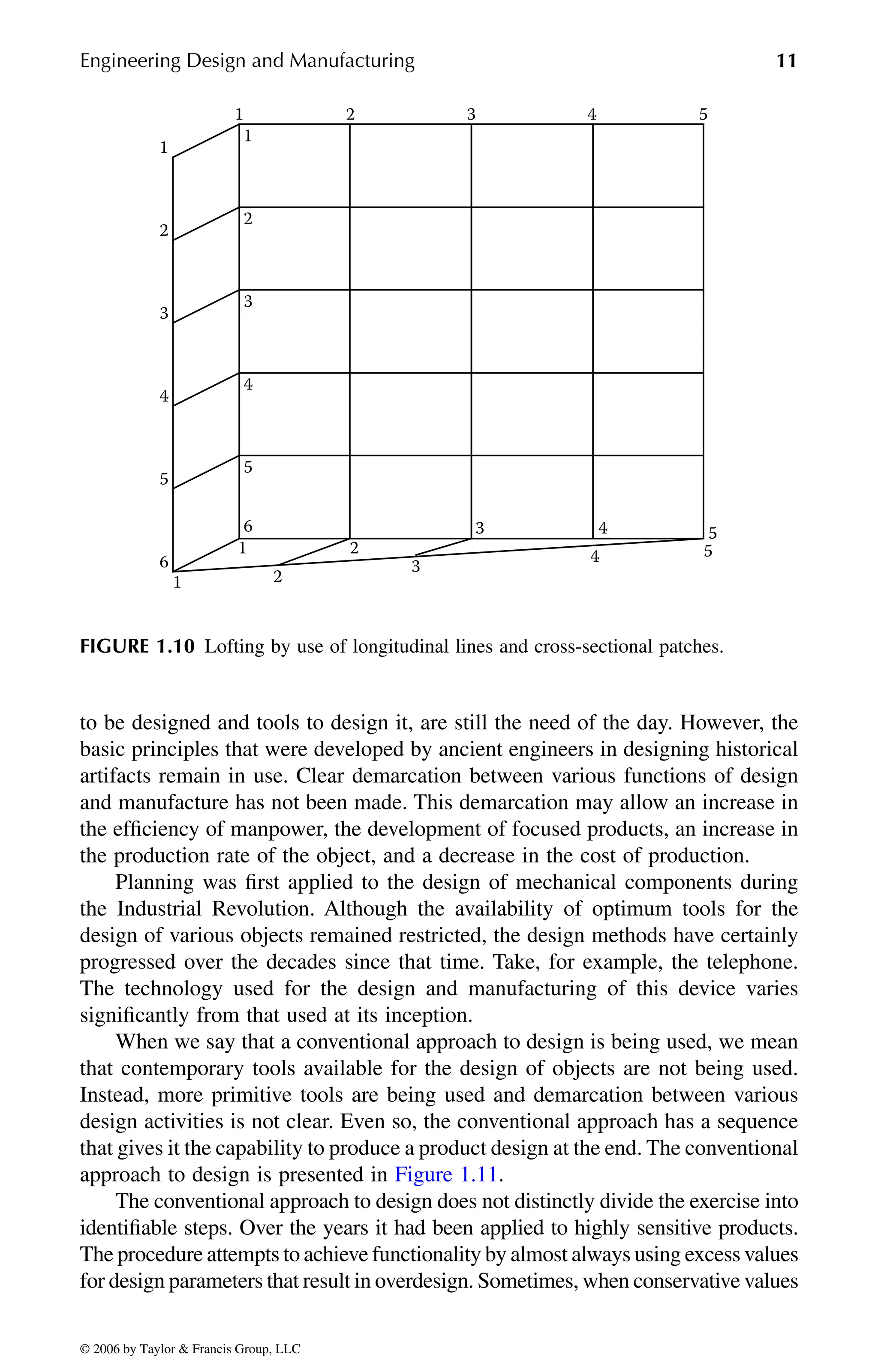
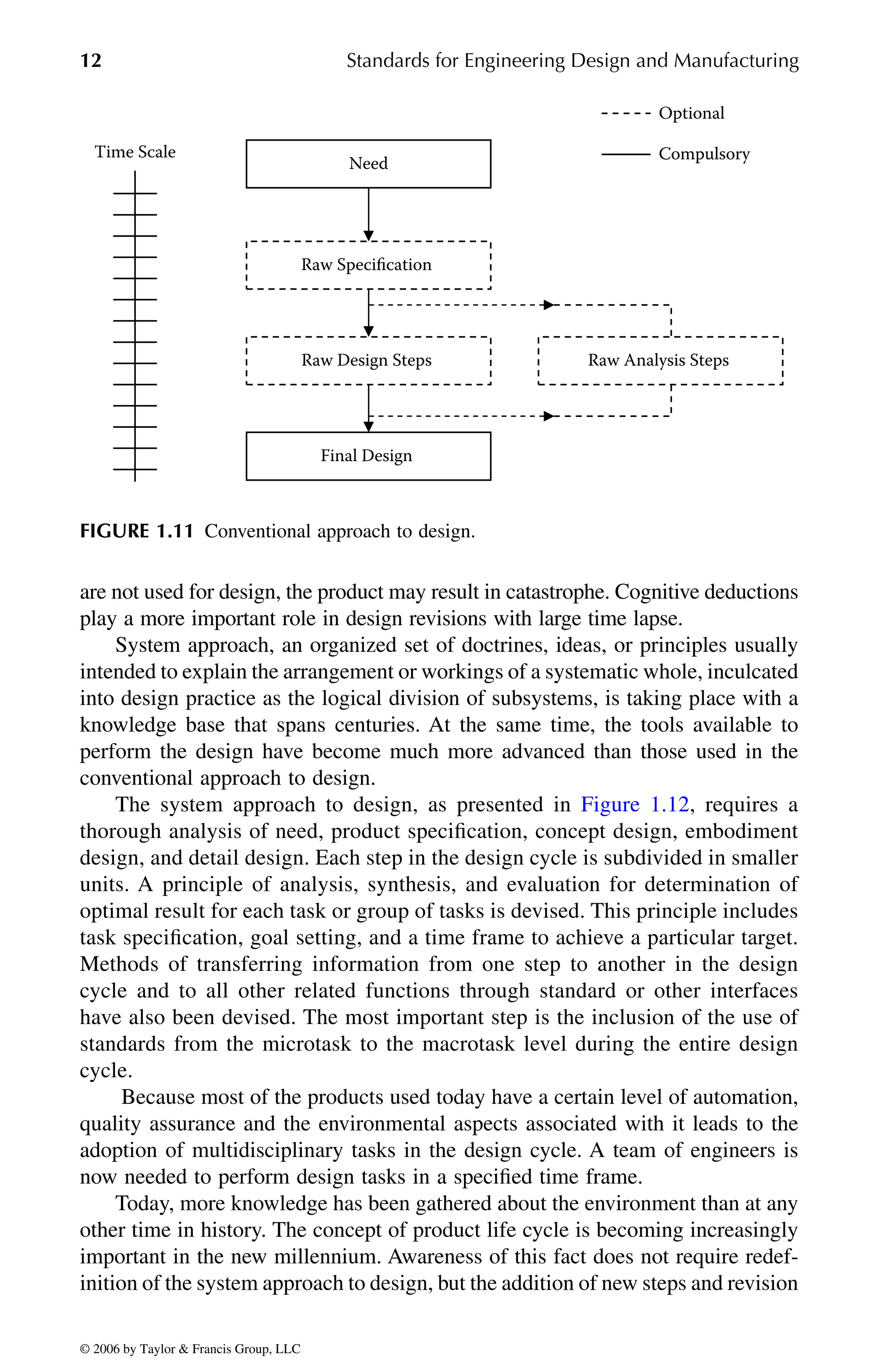
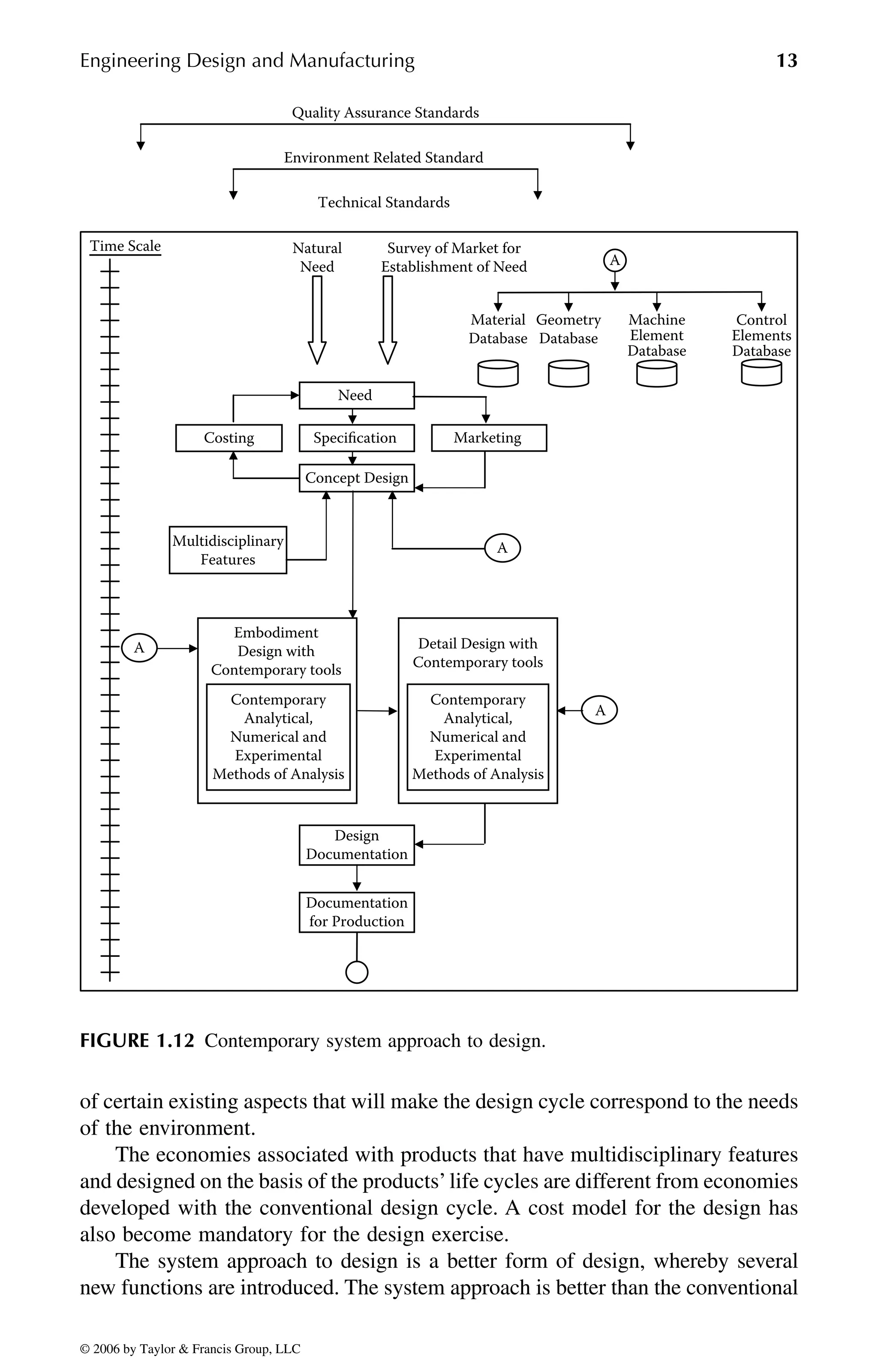
  • 14.
    Dedication To M. AhrarKhan and Shameha Wasim A. Khan To Dr. Razia Raouf Abdul Raouf DK8870_C000.fm Page xi Wednesday, November 2, 2005 11:54 AM © 2006 by Taylor & Francis Group, LLC © 2006 by Taylor & Francis Group, LLC
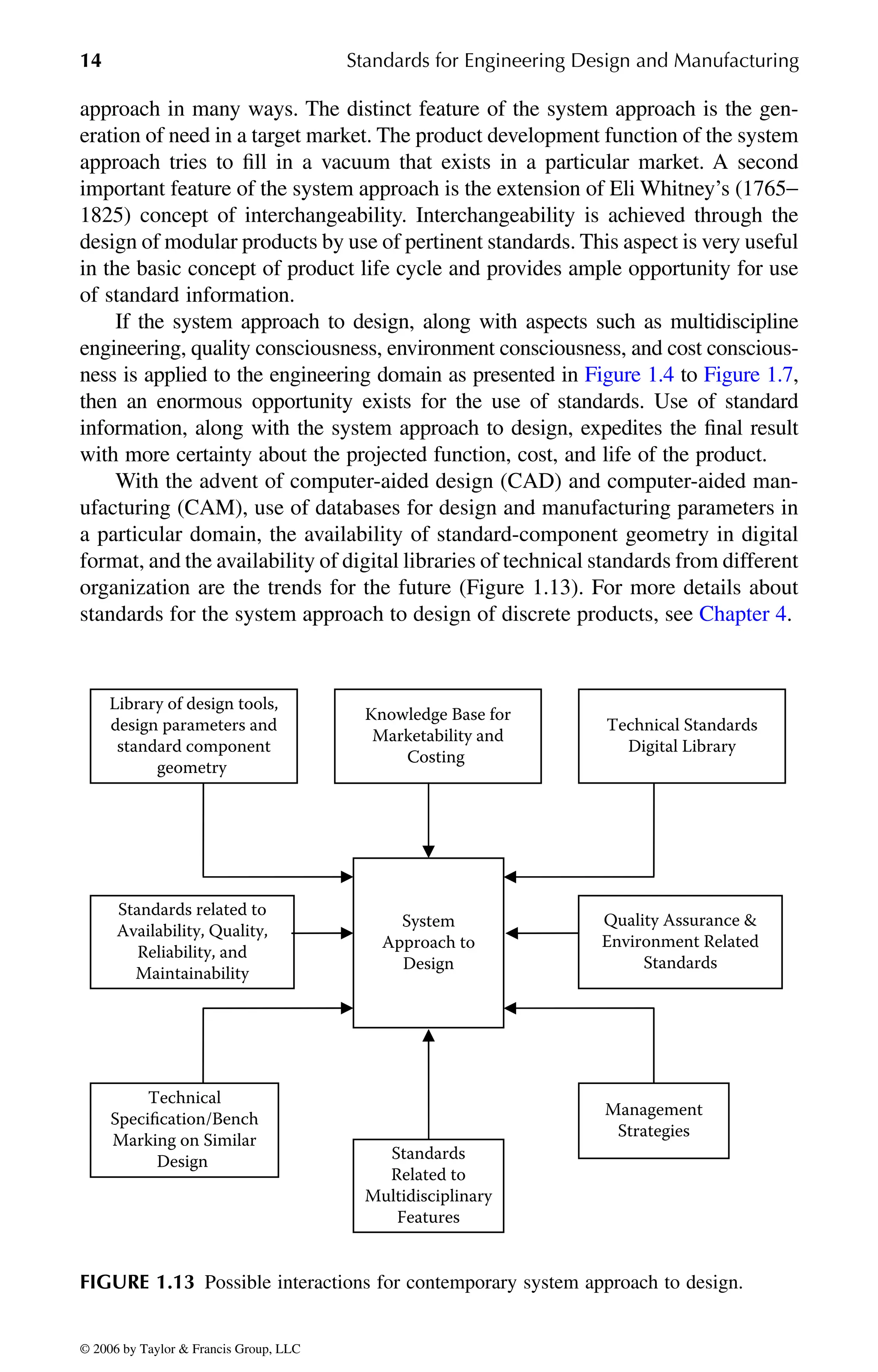
  • 15.
    Foreword Professors Khan andRaouf have recognized the need for a book that meets the requirements of undergraduate students, graduate students, and engineering pro- fessionals in the cross-disciplinary aspects of mechanical engineering that relate to computer-based design and manufacture and, in particular, focuses on the need to provide a vehicle for cross-disciplinary integration through standards and codes of practice. These standards relate to the configuration, connectivity, and acces- sibility of data and information through electronic computer-based methods and protocols. The drive is to have universally recognized standards and methods that permit the use of data that define the selection of materials for discrete component manufacture, the shape, size, and geometry of the product or component, and the connectivity of individual components that form engineering assemblies. Environmental requirements have led to consideration of material disposal and recyclability, sometimes called total-product life care. Concepts such as modularity, module replaceability, and in-life technical modular updates are being introduced to achieve product technology and performance upgrades and specification exten- sion. The concept of global manufacture, in which discrete components are manufactured at locations around the world to take advantage of labor costs and economies of scale, can only be implemented in the required commercial timescales by use of electronic data transfer systems. However, their integration and their robustness, coupled with their commercial viability, rely entirely on the use of internationally agreed standards and commercial data-security systems. Technology is fast changing, and the principles on which data and information structures, communication protocols, techniques for numerical analysis in design, and methods for computer integrated manufacture integrate through standards to form a working and commercially secure entity must be emphasized. Thus, this book focuses on the generic principles that underpin the formation and establish- ment of international standards. This book addresses the concepts associated with the ways in which new products are conceived and realized and discusses how standards are used, to best advantage, in this process. This book makes good use of examples both to introduce concepts and to demonstrate their use. It is a valuable text for both undergraduate and graduate students and for practicing engineers. D. R. Hayhurst, Sc.D. (Cantab), FR.Eng. Professor of Design, Manufacture, and Materials The University of Manchester DK8870_C000.fm Page xiii Wednesday, November 2, 2005 11:54 AM © 2006 by Taylor & Francis Group, LLC © 2006 by Taylor & Francis Group, LLC
  • 16.
    Preface From the StoneAge to the twenty-first century, engineering design and manu- facturing has advanced from the potter’s wheel to space probes. Engineering design and manufacturing has become multidisciplinary and encompasses the various divisions of applied sciences, including computer engineering and man- agement science. In ancient times nature was the sole source of wealth. Adam Smith (1723− 1790), David Ricardo (1772−1823), and John Stuart Mill (1806−1873) recognized manufacturing as an element in the creation of wealth and introduced the concept of “vendibility— production for the market.” Today’s enterprise globalization is a logical step forward into a worldwide market that demands a vast range of discrete products. The introduction of the concept of interchangeability of parts by Eli Whitney (1765−1825) formalized the use of specified tolerances to machined parts. This may not have been the first event in the use of standards; however, it began a completely new era in the standardization of engineering design and manufac- turing tasks. With the evolution of multidisciplinary engineering design and manufactur- ing, the need for standardized procedures to develop discrete products has increased manifold. This need encompasses areas such as the methodology asso- ciated with design and manufacturing functions, the use of materials, the shape and size of the envisaged product, and the geometry data transfer to other func- tions in the computer-integrated manufacturing environment. To meet that need, this book has been written to introduce undergraduate students, graduate students, and professionals to multidisciplinary engineering design and manufacturing as a subject that can best be practiced through the application of relevant standards. This book describes the concepts associated with product-realization pro- cesses in modular form by referring to elaborate case studies that cover the multidisciplinary engineering domain. The main focus is on the use of standards. This book is divided into five parts with eleven interrelated chapters that can be consulted according to the requirements of the reader. design and manufacturing. It emphasizes the change in the theoretical approaches to engineering design and manufacturing and their implementation from the Stone Age to the modern world. The modern aspect of design optimization and the relation between design and manufacturing are considered. Use of standards as a global entity is introduced. DK8870_C000.fm Page xv Wednesday, November 2, 2005 11:54 AM © 2006 by Taylor & Francis Group, LLC © 2006 by Taylor & Francis Group, LLC Chapter 1 introduces the subject by exploring the history of engineering
  • 17.
    Chapter 2 presentsvarious methods for formalizing the information and procedures and introduces pertinent regulatory bodies. It presents a survey of the standards-developing organization related to engineering design and manufactur- ing of discrete products. The list of standards-developing organizations is sup- plemented by details on support organizations that develop standards and codes in diverse areas such as occupational safety, fire protection, and illumination. A section of the chapter gives details of the standard-development procedure estab- lished by the British Standards Institution (BSI) and other standards-developing organizations. A brief on economic benefits of standards as determined by the German Standards Institute (DIN) is also included. Chapter 3 presents a case study of the variant design and manufacture of wrenches according to pertinent standards. This case study is a parametric mod- eling exercise that makes use of CAD/CAM software. Standards used at various stages in this case study for such functions as geometry transfer, cutter-location, part-programming, and digital data-transmission are identified. measurement methods, materials, operation of the product, quality, safety, reli- ability, and product life cycle. The future of standardization in the design process for discrete products is addressed, and, in particular, the ISO geometry standards series is discussed. the system approach to multidisciplinary design of discrete products. Various loading conditions, analysis procedures, and expected exposures for the discrete products are mentioned. of the equipment, and measuring equipment precision. Future directions in the standardization of manufacturing equipment are also presented. This aspect spe- cifically addresses the current research carried out at the Manufacturing Engi- neering Laboratory (MEL) of the National Institute of Science and Technology (NIST) for smart machine tools. for a discrete product. The case study extensively uses company, national, and international standards to perform the task. Procedure sheets for individual com- ponents, subassemblies, and the whole product are produced. products. This chapter includes standards related to man−machine interaction, human−computer interaction, ergonomics, and standards for various forms of energy input and output from the product. with consideration to ergonomics. Several standards-developing organizations are surveyed to identify appropriate standards to design and manufacture discrete prod- ucts with ergonomic constraints. ufacturing activities. With the advent of digital computers and Internet technology, DK8870_C000.fm Page xvi Wednesday, November 2, 2005 11:54 AM © 2006 by Taylor & Francis Group, LLC © 2006 by Taylor & Francis Group, LLC Chapter 4 reviews standards related to design methodology, design functions, Chapter 5 is a case study that demonstrates the use of standards related to Chapter 6 explores standards related to man−machine interaction, operation Chapter 7 presents a case study related to the development of process plans Chapter 8 addresses standards for the use of inherently diverse discrete Chapter 9 provides a procedure for discrete product design and manufacture Chapter 10 presents a review of support standards for core design and man-
  • 18.
    modern products normallyfeature automation functions and are marketed elec- tronically, along with use of other mediums. This chapter encompasses standards related to computer interfacing, communication, software development, and e- business procedures. tronics application. It provides terms and conditions for digital interfacing and control software development for a milling machine by use of appropriate standards. The subject area addressed in this book covers a very large domain. To keep the book to a manageable size, several common concepts, addressed sufficiently in other books, have been presented in condensed form, so that the core topic, the use of standards for design and manufacturing of discrete products, remains the focus. For other topics, related references are available in the bibliographies. In most cases, the Web site of a related organization is provided. In some cases, acronyms are used to identify the organization. Such acronyms and search words used in the surveys can easily be resolved at a search engine on the World Wide Web. The search word or the wild card selection affects the output from an online or a CD-based search for standards. The information derived from Web sites of standards organizations is copyrighted by those organizations and was correct at the time of browsing. procedures, codes, and standards. The major emphasis of this book is on stan- dards; however, other organizations are listed because of their direct relevance to the design and manufacturing of discrete products. One of the major objectives of this book is to introduce the potential of utilizing the standards in engineer- ing design and manufacturing of discrete products to acquire the benefits of standardization. The Appendix at the end of the book provides basic information regarding online catalogs related to standard machine elements and standard control ele- ments, digital libraries for standards, and the Web sites related to standards. Comprehensive references are also provided as bibliographies at the end of each chapter to help readers with the wealth of material available in related fields. DK8870_C000.fm Page xvii Wednesday, November 2, 2005 11:54 AM © 2006 by Taylor & Francis Group, LLC © 2006 by Taylor & Francis Group, LLC Chapter 11 presents a case study that addresses the multidisciplinary mecha- Most of the organizations surveyed (as presented in Chapter 2) develop
  • 19.
    Acknowledgments The authors aredeeply indebted to our colleagues Mr. Ghulam Haider Mughal, Mr. Syed Mojiz Raza, and Mr. John Corrigan for their help in designing and producing this book. We also acknowledge the support of the students Mr. Sultan Al-Thanayan and Mr. Haroon Naseer. The patience of our family members is deeply appreciated. DK8870_C000.fm Page xix Wednesday, November 2, 2005 11:54 AM © 2006 by Taylor & Francis Group, LLC © 2006 by Taylor & Francis Group, LLC
  • 20.
    Disclaimer Every effort hasbeen made to keep the contents of this book accurate in terms of description, examples as given in case studies, intellectual rights of others, and contents of Web sites at the time of browsing. The authors and the publisher are not responsible for any injury, loss of life, or financial loss arising from use of material in this book. DK8870_C000.fm Page xxi Wednesday, November 2, 2005 11:54 AM © 2006 by Taylor & Francis Group, LLC © 2006 by Taylor & Francis Group, LLC
  • 21.
    Table of Contents Part1 Engineering Design and Manufacturing of Discrete Products—The Scope..........................1 Chapter 1 Engineering Design and Manufacturing .........................................3 1.1 Introduction..................................................................................................3 1.2 Design Philosophy—Conventional and System Approach.........................8 1.2.1 Design Analysis.............................................................................15 1.2.2 Design for Manufacturing or Assembly .......................................17 1.2.3 Optimization in Design .................................................................18 1.2.4 The Cost Model for Design ..........................................................18 1.3 Manufacturing Philosophy—Conventional and System Approach ..........18 1.3.1 An Overview of Discrete Manufacturing Processes.....................20 1.3.2 Discrete Manufacturing Systems ..................................................21 1.3.3 Production Control ........................................................................23 1.4 Relationship between Design and Manufacturing....................................24 1.5 Multidisciplinary Aspects of Design and Manufacturing.........................26 1.6 Use of Computers in Design and Manufacturing.....................................26 1.7 Quality and Reliability in Design and Manufacturing .............................27 1.8 Design and Manufacturing for Product Life Cycle..................................28 Bibliography........................................................................................................29 Chapter 2 Standards and Standards Organizations........................................33 2.1 Formalizing Technical Information and Procedures.................................33 2.2 Development of Standards ........................................................................33 2.2.1 A Standard for Standards—BSI Perspective ................................35 2.3 Standards-Developing Organizations ........................................................37 2.3.1 The International Organization for Standardization and Its Affiliates ............................................................................37 2.3.2 Regional Standards-Developing Organizations ............................38 2.3.3 Major National Standards-Developing Organizations..................42 2.3.4 Professional Standards Organizations Active in Developing Standards ...............................................................44 DK8870_C000.fm Page xxiii Wednesday, November 2, 2005 11:54 AM © 2006 by Taylor & Francis Group, LLC © 2006 by Taylor & Francis Group, LLC
  • 22.
    2.3.5 Conformity Assessment.................................................................63 2.3.5.1Conformity Marking ......................................................64 2.3.6 Users Groups for Standards ..........................................................65 2.3.7 Commercial Organizations for the Supply of Standards..............66 2.4 Economic Benefits of Standardization—A Brief on a DIN Case Study ................................................................................68 2.4.1 Benefits for Business.....................................................................69 2.4.2 Benefits for the Economy As a Whole .........................................71 Bibliography........................................................................................................73 Chapter 3 Parametric Design and Manufacturing of Hand Tools—A Case Study......................................................79 3.1 Introduction................................................................................................79 3.2 Typical Design and Manufacture Techniques...........................................80 3.3 CAD/CAM for Hand Tools.......................................................................84 3.4 Software Selection.....................................................................................85 3.5 Parametric Modeling of Wrenches............................................................85 3.6 Conclusion.................................................................................................89 Bibliography........................................................................................................90 Part 2 Standards in Engineering Design of Discrete Products ........................91 Chapter 4 Review of Standards Related to Techniques for Engineering Design—A Product Perspective .........................93 4.1 Introduction................................................................................................93 4.2 Engineering Design Classification ............................................................93 4.3 Three-Phase Design Process .....................................................................95 4.4 Role of Product Geometry ........................................................................97 4.5 Multidisciplinary Features in Design......................................................104 4.6 Mechanical Load Analysis ......................................................................104 4.7 The Engineering Materials......................................................................112 4.8 The Machine Elements............................................................................112 4.9 The Control Element...............................................................................114 4.10 Common Factors Related to Overall Design Process............................118 4.11 Review of Standards for Engineering Design of Discrete Products ...............................................................................120 4.12 Standards for the Design of Discrete Products......................................121 4.13 Measurement Standards..........................................................................122 DK8870_C000.fm Page xxiv Wednesday, November 2, 2005 11:54 AM © 2006 by Taylor & Francis Group, LLC © 2006 by Taylor & Francis Group, LLC
  • 23.
    4.14 Standards Relatedto Materials...............................................................124 4.15 Standards for the Operation of the Product...........................................125 4.16 Safety Standards Related to the Product................................................125 4.17 Quality Standards Related to the Product..............................................127 4.18 Reliability Standards Related to the Product.........................................129 4.19 Standards Related to Maintainability.....................................................130 4.20 Product Life Cycle and Emerging Standards.........................................133 4.21 Future Directions in the Standardization of Design Process for Discrete Products.................................................................134 Bibliography......................................................................................................135 Chapter 5 Discrete Product Development with Pertinent Standards—A Case Study...........................................................137 5.1 System Engineering for Discrete Products.............................................137 5.2 Governing Equations and Standards.......................................................138 5.2.1 Combined Loading on the Power Screw—An Example............142 5.2.2 Coefficient of Performance—An Example.................................159 5.2.3 Engineering Properties and Standards ........................................163 5.3 Multidisciplinary Analysis for Discrete Products...................................163 5.4 Selection of Standard Components.........................................................166 Bibliography......................................................................................................166 Part 3 Standards in Manufacturing of Discrete Products ......................167 Chapter 6 Review of Standards for Manufacturing— Equipment Perspective ................................................................169 6.1 Manufacturing Processes.........................................................................169 6.2 Production Equipment.............................................................................169 6.3 Elements of Manufacturing Systems ......................................................173 6.4 Standards for Manufacturing Equipment................................................180 6.5 Standards for Design of Manufacturing Equipment...............................182 6.6 Standards Related to MMI and HCI.......................................................183 6.7 Standards Related to Operation of the Equipment.................................184 6.8 Standards Related to Measurements and Measuring Equipment Precision................................................................................192 6.9 Use of Standards in Manufacturing Operations .....................................193 6.10 Standards Related to Quality Control ....................................................199 6.11 Safety Standards Related to Use of Equipment................................... 199 DK8870_C000.fm Page xxv Wednesday, November 2, 2005 11:54 AM © 2006 by Taylor & Francis Group, LLC © 2006 by Taylor & Francis Group, LLC
  • 24.
    6.12 Reliability StandardsRelated to the Use of Equipment........................203 6.13 Maintainability Standards Related to Use of Equipment ......................211 6.14 Waste-Disposal Standards ......................................................................213 6.15 Equipment Life Cycle Standard.............................................................214 6.16 Standards Related to Information Transfer............................................220 6.17 Standards Related to Material-Handling Equipment.............................220 6.18 Future Directions in the Standardization of Manufacturing Equipment .................................................................222 Bibliography......................................................................................................226 Chapter 7 Process Planning for a Revolute Robot Using Pertinent Standards—A Case Study...........................................................229 7.1 Process Planning......................................................................................229 7.2 Manufacturing Facilities and Available Resources.................................230 7.3 Use of Standards in Process Planning ....................................................230 7.4 Process Planning for a Revolute Robot ..................................................230 7.4.1 Process Planning for Parts in Subassemblies .............................231 7.4.2 Process Planning for the Subassemblies.....................................232 7.4.3 Process Planning for the Robot Assembly..................................232 Bibliography......................................................................................................332 Part 4 Standards for the Use of Discrete Products........335 Chapter 8 Review of Standards Related to the Usage of Discrete Product—A User’s Perspective................................337 8.1 Introduction..............................................................................................337 8.2 Standards Related to Man-Machine Interface in Discrete Products ................................................................................338 8.3 Standards Related to Human-Computer Interaction in Discrete Products ................................................................................338 8.4 Standards Related to Ergonomics of Discrete Products.........................338 8.5 Standards Related to Output from the Discrete Products ......................346 Bibliography......................................................................................................359 Chapter 9 Application of Human Factors to Design and Manufacturing of Discrete Products—A Case Study.................361 9.1 Introduction..............................................................................................361 9.2 Capabilities and Limitations of Users.....................................................362 9.2.1 The Auditory Modality................................................................362 DK8870_C000.fm Page xxvi Wednesday, November 2, 2005 11:54 AM © 2006 by Taylor & Francis Group, LLC © 2006 by Taylor & Francis Group, LLC
  • 25.
    9.2.2 The VisualModality....................................................................362 9.2.3 Other Sensory Limitations ..........................................................362 9.3 Information-Processing Limitations........................................................362 9.3.1 Expectations.................................................................................362 9.3.2 Information Processing................................................................362 9.3.3 Emotionalism...............................................................................363 9.3.4 Boredom ......................................................................................363 9.3.5 Sensitivity to Stress .....................................................................363 9.4 Limitations of an Effector Subsystem ....................................................363 9.4.1 Body Measurement, or Anthropometry ......................................363 9.4.2 Lifting and Force Capabilities.....................................................363 9.4.3 Response-Speed Capability.........................................................363 9.4.4 Tracking Capabilities...................................................................363 9.5 Human Performance Criteria ..................................................................364 9.5.1 Workplace Design Criteria..........................................................365 9.5.2 Human Performance Assessment Criteria ..................................365 9.6 The Availability and Application of Standard Information....................365 Bibliography......................................................................................................369 Part 5 Support Standards in Design and Manufacturing of Discrete Products ......................371 Chapter 10 Review of Support Standards for Discrete Products ................373 10.1 Automation in Discrete Products ...........................................................373 10.1.1 Information Representation, Coding, and Exchange Standards............................................................374 10.1.2 Interface Hardware Standards....................................................374 10.1.3 Standards Related to Sensors, Transducers, and Actuators .............................................................................374 10.1.4 Data Communication Standards ................................................377 10.1.5 Standards Related to Programming Languages ........................381 10.1.6 Software-Development Standards..............................................381 10.2 Quality Assurance...................................................................................381 10.2.1 Quality-Assurance Standards.....................................................382 10.3 Environmental Considerations................................................................386 10.3.1 Standards Related to Disassembly, Recycling, and Disposal...............................................................................386 10.3.2 Standards Related to Environmental Impact.............................388 10.4 e-Business Related Standards.................................................................390 Bibliography......................................................................................................391 DK8870_C000.fm Page xxvii Wednesday, November 2, 2005 11:54 AM © 2006 by Taylor & Francis Group, LLC © 2006 by Taylor & Francis Group, LLC
  • 26.
    Chapter 11 DigitalInterfacing and Control Software Development— A Case Study ..............................................................................393 11.1 Microprocessor Interfacing for Discrete Products.................................393 11.2 Interface Circuit Design .........................................................................394 11.3 Control Software Design........................................................................395 11.3.1 Use of Application-Specific Standard for the Development of Control Software.................................395 11.4 Microprocessor Interfacing for a Computerized Numerical Control Milling Machine ......................................................396 11.4.1 Design of Printed Circuit Boards for Implementation of Computerized Numerical Control at a Milling Machine ............................................................... 398 11.4.2 Software Modules for a Computerized Numerical Control Milling Machine...........................................................398 11.4.3 Use of Standards in Developing Control Software and Hardware for Computerized Numerical Control Milling Machine ........................................................................498 Bibliography......................................................................................................499 Appendix ..........................................................................................................501 A1 Digital Catalogs for Standard Mechanical Components ........................501 A2 Digital Catalogs for Standard Machine Elements ..................................501 A3 Digital Catalogs for Standard Control Elements....................................501 A4 Digital Catalogs for Engineering Materials............................................501 A5 Digital Libraries for Standards................................................................502 A6 Digital Websites Related to Standards....................................................502 DK8870_C000.fm Page xxviii Wednesday, November 2, 2005 11:54 AM © 2006 by Taylor & Francis Group, LLC © 2006 by Taylor & Francis Group, LLC
  • 27.
    Part 1 Engineering Designand Manufacturing of Discrete Products—The Scope DK8870_Part I.fm Page 1 Monday, September 19, 2005 2:28 PM © 2006 by Taylor & Francis Group, LLC © 2006 by Taylor & Francis Group, LLC
  • 28.
    3 1 Engineering Design andManufacturing 1.1 INTRODUCTION The term engineering is a derivation of the Latin word “ingenerate,” meaning “to create,” or “to contrive.” Design means “to plan and execute artistically.” Design in engineering perspective requires existence of need—genuine, revised, or gen- erated; an analysis mechanism; and a graphical depiction of the process. To make the object by hand or by use of machinery in large quantities from a design produced earlier is termed “to manufacture.” A glance into the past, beyond the Latin roots of the words, to observe various facts that took place in our history, reveals interesting phenomena that are still common in today’s engineering design and manufacturing. The process of guided development began the day primitive humans started using logic to overcome their basic problems. Understanding arose, default by nature or established through experience: that night with or without stars follows day; that clouds may bring rain from which some sort of protection is needed; and that something is eaten, whether vegetation or animal. Perhaps lightning started the first fires, and humans learned to make certain types a spark with stones by rubbing them together. The establishment of that fact, whether planned or accidental, made primitive humans aware that fire makes vegetation and meat tender and makes them taste different—perhaps better. The need existed, and observation and experimentation were the only tools. Many superstitious factors (such as trust in magic and misunderstanding of cause and effect) have discouraged human beings from overcoming ignorance. The more influential factor, from primitive to modern times, has remained the need to safeguard oneself from predators, to fulfill the basic needs of life, or to dominate a piece of land or group of people. The need has led to progress that has continued from the Stone Age, to the Bronze Age, to the Iron Age, and now to the modern world. Engineering and science have remained exercises in observation and experimentation, over a very long period of time, to satisfy the need. In the process, humans have established laws to further the progress. The need, in all the defined or undefined areas of engineering and sciences, does not restrict itself to any level of development; it forges ahead, through old and new analytical, numerical, and experimental proce- dures. The need is still the prime factor in the production of art, science, engineering, and technology. Scientists and engineers still venture into the unknown to find long- lasting solutions. Some of the inventions that have made lasting marks on the history DK8870_C001.fm Page 3 Thursday, September 29, 2005 5:17 PM © 2006 by Taylor & Francis Group, LLC © 2006 by Taylor & Francis Group, LLC of humankind are presented in Table 1.1.
  • 29.
    4 Standards forEngineering Design and Manufacturing With the evolution of multidisciplinary engineering design and manufacturing from the Industrial Revolution to today, the need to standardize procedures to develop discrete products has increased manifold. This need encompasses areas such as methodology associated with design and manufacturing func- tions, use of materials, shape and size of the envisaged product, geometry data transfer to all other functions in the computer-integrated manufacturing (CIM) environment, and waste disposal. Although standardization is promoted for most tasks in engineering design and manufacturing, certain tasks cannot be standardized or may not be accessible to the general engineering commu- nity. At the same time, standardization may not be seen as a development- restricting factor because of the evaluation procedure associated with the standardization. Today, formal procedures described as regulations, technical standards, codes of practice, technical specifications, frameworks, and benchmarks in a multidis- ciplinary engineering environment are practiced in a section of an engineering TABLE 1.1 Some Important Inventions Object Origin Evidence of Use Since Comments Pottery All ancient civilizations (China) 7900 B.C. Engineering material clay Potter’s wheel China 3100 B.C. Mechanism Wheel Mesopotamia 3500 B.C. Mechanism Salamis tablet Island of Salamis 300 B.C. Inference engine Abacus (suan–pan) China 1200 A.D. Inference engine Clock Italy 1300 A.D. Time Printing press Germany 1450 A.D. Publishing Telescope Holland 1608 A.D. Observation of planetary movement Microscope Holland 1674 A.D. Observation of microbes Steam Engine England 1765 A.D. Transportation Telephone Canada 1876 A.D. Communication Automobile U.S. 1900 A.D. Transportation Radio U.S. 1901 A.D. Communication Airplane U.S. 1903 A.D. Transportation Assembly line U.S. 1908 A.D. Production Antibiotics U.K. 1928 A.D. Medicine Nuclear bomb U.S. 1945 A.D. Weapons Digital computer U.S./U.K. 1940–50 A.D. Inference engine Internet U.S. 1973 A.D. Communication Space shuttle U.S. 1981 A.D. Space travel DK8870_C001.fm Page 4 Thursday, September 29, 2005 5:17 PM © 2006 by Taylor & Francis Group, LLC © 2006 by Taylor & Francis Group, LLC
  • 30.
    Engineering Design andManufacturing 5 establishment, the whole engineering establishment, or different facilities run by the same establishment in one country or across the globe and during various interactions between different establishments to achieve the following benefits: 1. Convenience in communication and commerce 2. Convenience in building and operating a viable design system 3. Convenience in building and operating a viable production system 4. Convenience in training the workforce 5. Convenience in maintaining the design tools and production machineries 6. Convenience in establishing reliability of the product based on data from basic design calculation and feedback from after-sales service 7. Readiness in incorporating management strategies 8. Readiness in implementing global practices such as • Practices in design • Practices in ergonomics • Practices in design analysis • Practices in production control, including process planning and scheduling • Practices in manufacturing • Practices in assembly • Practices in quality control • Practices in maintaining optimal inventories of raw materials, finished goods, spare parts, work-holding devices, tools, and accessories 9. Reduced cost of the product 10. Standard Quality assurance procedures 11. Standard Environment related procedures 12. Ease in vendor development 13. More control over accounting and financial matters 14. Simpler to manage and profitable organization 15. No restriction in developing new products 16. Similarity in product features such as man−machine interface, human− computer interface, input energy forms and their permissible values, any intermediate processes, and output energy forms and their permis- sible values The scope of this book is limited to technical standards for products developed by use of discrete components and produced by discrete manufacturing processes. A discrete component is an object that can be uniquely identified in an assembly or a mechanism (generally called a product). Quoting from Parmley, “The building blocks of mechanical mechanisms consist of many typical indi- vidual (discrete) components; just as an electron, proton and neutrons are basic parts of an atom. In each case, these discrete components must be properly selected and precisely arranged in a predetermined pattern to result in a functioning unit (an assembly). As each assembly is fit into a larger and more complex device, the DK8870_C001.fm Page 5 Thursday, September 29, 2005 5:17 PM © 2006 by Taylor & Francis Group, LLC © 2006 by Taylor & Francis Group, LLC
  • 31.
    6 Standards forEngineering Design and Manufacturing individual component becomes less and less noticeable, until a malfunction occurs.” The assembled device is referred to as a mechanism if its components perform movements or is referred to as a structure if the components remain stationary. An exploded view of a simplified revolute robot that shows various com- ponents, top view of the mechanism, and the solid model are shown in Figure 1.1 to bly, and mechanism.A discrete product that comprises a collection of mechanisms and structures is referred to as a machine. basic input energy and output energy/work forms from such mechanisms are FIGURE 1.1 Exploded view of the revolute robot. FIGURE 1.2 Top view of the revolute robot. DK8870_C001.fm Page 6 Thursday, September 29, 2005 5:17 PM © 2006 by Taylor & Francis Group, LLC © 2006 by Taylor & Francis Group, LLC Figure 1.3. This robot constitutes a basic example of discrete components, assem- The basic control diagram of such mechanisms is provided in Figure 1.4. The detailed in Figure 1.5 and Figure 1.6. A general description of the scope of the standards for engineering design and manufacturing is provided in Figure 1.7.
  • 32.
    Engineering Design andManufacturing 7 following sections in this chapter describe the concepts encompassing key ele- ments of design and manufacturing and optimization of design based on multi- disciplinary features. The purpose of this effort is to develop a common base that can be used for selection and use of standards. FIGURE 1.3 Solid model of the revolute robot. FIGURE 1.4 Complete cycle of the working of discrete product. Structure/Mechanism/Machines Static/Dynamic Assembly Static/Dynamic Components Objective Function Output Energy/Work Forms Waste 1. Liquids of Varying PH 2. Gases of Various Compositions 3. Solid/Powder from Used Fuel 4. Solids from Used/Discarded Components/Structure/Assemblies/ Mechanisms/Machines Input Energy Forms Convenience Pleasure Better living standard DK8870_C001.fm Page 7 Thursday, September 29, 2005 5:17 PM © 2006 by Taylor & Francis Group, LLC © 2006 by Taylor & Francis Group, LLC The scope of this book is the best described by Figure 1.4 to Figure 1.7. The
  • 33.
    8 Standards forEngineering Design and Manufacturing 1.2 DESIGN PHILOSOPHY—CONVENTIONAL AND SYSTEM APPROACH The evolution of humankind into the most primitive social order started when human beings began inventing the methods of verbal communication around 14,000 B.C. This accomplishment was achieved through the basic principle of information transformation by virtue of establishing speech forms. This feat was also the most important step in communication. need followed by observation and experimentation for the required use. Need, contemporary knowledge, and experimentation in various fields at each stage of evolution remained the factor for the presentation and adoption of a particular design philosophy. The need may have been to cross over oceans, to fly through skies, or to explore the universe. Cultures over time learned and applied the current principles of design to the object of their need. Not until the industrial revolution did individual nations start using defined methodologies for design and manufacture, in particular to maintain the sovereignty FIGURE 1.5 Various forms of input energy to discrete product. FIGURE 1.6 Various forms of output energy/work forms from discrete product. 1. Hydal 2. Wind 3. Solar 4. Magnetic 5. Thermal (fossil fuel) 6. Thermal (non fossil fuel) 7. Hydraulic 8. Pneumatic 9. Chemical reaction 10. Electrochemical reaction 11. Vibration 12. Gravity 13. Dynamic fluid 14. Biological reaction 1. Motion 2. Sound 3. Light 4. Radiation of varying intensity 5. Electro weak forces 6. Magnetic fields 7. Heating 8. Cooling DK8870_C001.fm Page 8 Thursday, September 29, 2005 5:17 PM © 2006 by Taylor & Francis Group, LLC © 2006 by Taylor & Francis Group, LLC Human beings were able to design and manufacture tools (Figure 1.8 and Figure 1.9) during the Stone Age. The design of the tools basically emerged from
  • 34.
    Engineering Design andManufacturing 9 of a nation and to reach a certain level of knowledge as compared with other nations. The industrial revolution became the key period for invention and mass production. Automobiles, steam engines, airplanes, and communications media were a few of the important inventions. A number of other inventions made the human life simpler and better when compared with previous centuries of FIGURE 1.7 A general description of scope of standards for engineering design and manufacturing. Quality Assurance Standard Environment Related Standard Standards for Production Methodology, Manufacturing Techniques Standards for Design Methodology, Analysis Techniques Standards for Machines e.g. Pick and place robot, CNC machine tools, Material Handing Equipment Standards for Assemblies (Mechanism and Structures) e.g. Chassis of an Automobile, Wing of an Airplane or Ergonomics of a Refrigerator Standards for Static and Dynamic Components e.g. Gears, Bearings, Fastener, Standard Components Standards Governing Thermodynamic or Fluidic Process Standards for Permissible Range of the Objective Functions DK8870_C001.fm Page 9 Thursday, September 29, 2005 5:17 PM © 2006 by Taylor & Francis Group, LLC © 2006 by Taylor & Francis Group, LLC
  • 35.
    10 Standards forEngineering Design and Manufacturing evolution. The current age of information, communication, computer, and space travel is founded on the inventions of previous centuries. The most important inventions were tested during the first and second world wars. These inventions included automobiles and airplanes, along with various kinds of weapons. The theories and technologies that were used at these particular times, and later during the Cold War era and the space race, were adopted by the designers and manufacturers of products used in daily life. One important development from the Second World War was the lofting principle, a method in computational geometry that allows creation of aerody- namics profiles of airplane wings, an important step in design and design analysis previously used manual techniques. The design principle, until recently, remained conventional. It lacked the comprehensive analytical, numerical, and experimental analysis of various steps of the design process. The design cycle, as seen through the centuries of devel- opment, mainly relied on need and availability of means to accomplish the targets in hand. Basic principles of observation and experimentation, with both the object FIGURE 1.8 Ancient wall carving. FIGURE 1.9 Drill hole at the Aswan quarries. DK8870_C001.fm Page 10 Thursday, September 29, 2005 5:17 PM © 2006 by Taylor & Francis Group, LLC © 2006 by Taylor & Francis Group, LLC (Figure 1.10). The method relied on computation and was much better than the
  • 36.
    Engineering Design andManufacturing 11 to be designed and tools to design it, are still the need of the day. However, the basic principles that were developed by ancient engineers in designing historical artifacts remain in use. Clear demarcation between various functions of design and manufacture has not been made. This demarcation may allow an increase in the efficiency of manpower, the development of focused products, an increase in the production rate of the object, and a decrease in the cost of production. Planning was first applied to the design of mechanical components during the Industrial Revolution. Although the availability of optimum tools for the design of various objects remained restricted, the design methods have certainly progressed over the decades since that time. Take, for example, the telephone. The technology used for the design and manufacturing of this device varies significantly from that used at its inception. When we say that a conventional approach to design is being used, we mean that contemporary tools available for the design of objects are not being used. Instead, more primitive tools are being used and demarcation between various design activities is not clear. Even so, the conventional approach has a sequence that gives it the capability to produce a product design at the end. The conventional The conventional approach to design does not distinctly divide the exercise into identifiable steps. Over the years it had been applied to highly sensitive products. The procedure attempts to achieve functionality by almost always using excess values for design parameters that result in overdesign. Sometimes, when conservative values FIGURE 1.10 Lofting by use of longitudinal lines and cross-sectional patches. 1 1 1 1 1 2 3 4 5 2 2 3 3 4 5 4 5 6 2 3 4 5 2 3 4 5 6 DK8870_C001.fm Page 11 Thursday, September 29, 2005 5:17 PM © 2006 by Taylor & Francis Group, LLC © 2006 by Taylor & Francis Group, LLC approach to design is presented in Figure 1.11.
  • 37.
    12 Standards forEngineering Design and Manufacturing are not used for design, the product may result in catastrophe. Cognitive deductions play a more important role in design revisions with large time lapse. System approach, an organized set of doctrines, ideas, or principles usually intended to explain the arrangement or workings of a systematic whole, inculcated into design practice as the logical division of subsystems, is taking place with a knowledge base that spans centuries. At the same time, the tools available to perform the design have become much more advanced than those used in the conventional approach to design. thorough analysis of need, product specification, concept design, embodiment design, and detail design. Each step in the design cycle is subdivided in smaller units. A principle of analysis, synthesis, and evaluation for determination of optimal result for each task or group of tasks is devised. This principle includes task specification, goal setting, and a time frame to achieve a particular target. Methods of transferring information from one step to another in the design cycle and to all other related functions through standard or other interfaces have also been devised. The most important step is the inclusion of the use of standards from the microtask to the macrotask level during the entire design cycle. Because most of the products used today have a certain level of automation, quality assurance and the environmental aspects associated with it leads to the adoption of multidisciplinary tasks in the design cycle. A team of engineers is now needed to perform design tasks in a specified time frame. Today, more knowledge has been gathered about the environment than at any other time in history. The concept of product life cycle is becoming increasingly important in the new millennium. Awareness of this fact does not require redef- inition of the system approach to design, but the addition of new steps and revision FIGURE 1.11 Conventional approach to design. Optional Time Scale Need Raw Specification Raw Design Steps Final Design Raw Analysis Steps Compulsory DK8870_C001.fm Page 12 Thursday, September 29, 2005 5:17 PM © 2006 by Taylor & Francis Group, LLC © 2006 by Taylor & Francis Group, LLC The system approach to design, as presented in Figure 1.12, requires a
  • 38.
    Engineering Design andManufacturing 13 of certain existing aspects that will make the design cycle correspond to the needs of the environment. The economies associated with products that have multidisciplinary features and designed on the basis of the products’life cycles are different from economies developed with the conventional design cycle. A cost model for the design has also become mandatory for the design exercise. The system approach to design is a better form of design, whereby several new functions are introduced. The system approach is better than the conventional FIGURE 1.12 Contemporary system approach to design. Quality Assurance Standards Environment Related Standard Technical Standards Time Scale Natural Need Material Database Geometry Database Machine Element Database Need Concept Design Marketing Specification Costing Documentation for Production Multidisciplinary Features A Embodiment Design with Contemporary tools Design Documentation A Contemporary Analytical, Numerical and Experimental Methods of Analysis Detail Design with Contemporary tools Contemporary Analytical, Numerical and Experimental Methods of Analysis A Control Elements Database A Survey of Market for Establishment of Need DK8870_C001.fm Page 13 Thursday, September 29, 2005 5:17 PM © 2006 by Taylor & Francis Group, LLC © 2006 by Taylor & Francis Group, LLC
  • 39.
    14 Standards forEngineering Design and Manufacturing approach in many ways. The distinct feature of the system approach is the gen- eration of need in a target market. The product development function of the system approach tries to fill in a vacuum that exists in a particular market. A second important feature of the system approach is the extension of Eli Whitney’s (1765− 1825) concept of interchangeability. Interchangeability is achieved through the design of modular products by use of pertinent standards. This aspect is very useful in the basic concept of product life cycle and provides ample opportunity for use of standard information. If the system approach to design, along with aspects such as multidiscipline engineering, quality consciousness, environment consciousness, and cost conscious- then an enormous opportunity exists for the use of standards. Use of standard information, along with the system approach to design, expedites the final result with more certainty about the projected function, cost, and life of the product. With the advent of computer-aided design (CAD) and computer-aided man- ufacturing (CAM), use of databases for design and manufacturing parameters in a particular domain, the availability of standard-component geometry in digital format, and the availability of digital libraries of technical standards from different FIGURE 1.13 Possible interactions for contemporary system approach to design. Library of design tools, design parameters and standard component geometry Technical Standards Digital Library Quality Assurance & Environment Related Standards Standards related to Availability, Quality, Reliability, and Maintainability System Approach to Design Management Strategies Standards Related to Multidisciplinary Features Technical Specification/Bench Marking on Similar Design Knowledge Base for Marketability and Costing DK8870_C001.fm Page 14 Thursday, September 29, 2005 5:17 PM © 2006 by Taylor & Francis Group, LLC © 2006 by Taylor & Francis Group, LLC ness is applied to the engineering domain as presented in Figure 1.4 to Figure 1.7, organization are the trends for the future (Figure 1.13). For more details about standards for the system approach to design of discrete products, see Chapter 4.
  • 40.
    Engineering Design andManufacturing 15 1.2.1 DESIGN ANALYSIS Design analysis, a step ahead from hit-and-trial for design and manufacturing, was incorporated into the design and manufacturing cycle to introduce more certainty in all aspects of the life of an object, from drawing board to disposal. The design analysis is the critical procedure that is performed to optimize design and manufacturing parameters such as size, weight, loading, ease of manufactur- ing, ease of assembly, reliable operation, cost, maintenance, and disposal. Because of the multidisciplinary nature of the mechanisms (discrete products), the design analysis may be focused on one or more of the following areas: 1. Analysis for strength 2. Analysis for bending 3. Analysis for torsion 4. Analysis for buckling 5. Analysis for contact loading 6. Analysis for combined loading 7. Analysis for cyclic loading 8. Analysis for cyclic loading at elevated temperature 9. Analysis for resonance 10. Analysis for thermal effects 11. Analysis for effects of gravity 12. Analysis for the effects of the magnetic field 13. Analysis for the effects of static and dynamic fluid 14. Analysis for the effects of liquids of various pH 15. Analysis for exposure to radiation of various intensity 16. Analysis for exposure to electroweak forces 17. Analysis for exposure to various air or gaseous environments 18. Analysis of electric circuits that power sensors, transducers, and actuators 19. Analysis of electronics circuits used to control sensors, transducers, and actuators 20. Analysis of control software that provides user interface to the product 21. Analysis for human factors (ergonomics) 22. Analysis for ease of manufacturability 23. Analysis for ease of assembly 24. Analysis for packaging and transportation 25. Analysis for market response The design analysis for mechanical loading is normally performed by use of the following techniques: 1. Analytical procedures 2. Numerical procedures 3. Experimental procedures DK8870_C001.fm Page 15 Thursday, September 29, 2005 5:17 PM © 2006 by Taylor & Francis Group, LLC © 2006 by Taylor & Francis Group, LLC
  • 41.
    16 Standards forEngineering Design and Manufacturing The analytical procedure requires synthesis of the problem and formulation of equations that can provide, for example, force balance, mass balance, or heat balance. Simultaneous solution of these equations provides the value of unknown parameters. Numerical procedures are applied to design when the analytical procedure requires further verification or no solution is possible by use of the analytical pro- cedure. Numerical procedures apply mathematical techniques such as the finite- element method and the boundary element method. These methods mathematically model the approximation of the real problem and provide a solution through rigorous computations that predict displacement of nodes and elements. The solution can be viewed in multicolor models that give intensity of loading of relevant parameters. Figure 1.14 shows a schematic of a finite-element model for a discrete component. The experimental procedures include use of strain gauges, photo elasticity, and brittle coatings. All of these procedures provide sufficient insight into the loading of an object through use of real objects or miniature models. Available standards and theories of failure for different design analysis param- eters provide certainty that the envisioned design of a product will or will not withstand the loading or exposure for the product’s projected lifetime. Some major multidisciplinary parameters that require analysis for the envi- sioned design are: 1. Permissible range of electric current 2. Permissible range of EMF 3. Permissible torque for actuators FOS Y X Z G 1.000e+002 Model name: front arm Study name: front arm plate Plot type: Design Check - Plot1 Criterion: Max von Mises Stress Factor of safety distribution: Min FOS = 6.6 9.221e+001 8.443e+001 7.664e+001 6.886e+001 6.107e+001 5.328e+001 4.550e+001 3.771e+001 2.993e+001 2.214e+001 1.436e+001 6.570e+000 DK8870_C001.fm Page 16 Thursday, September 29, 2005 5:17 PM © 2006 by Taylor & Francis Group, LLC © 2006 by Taylor & Francis Group, LLC FIGURE 1.14 Finite-element modeling (FEM) of front arm (see Figure 1.1 to Figure 1.3).
  • 42.
    Engineering Design andManufacturing 17 4. Requirements of man−machine interface 5. Requirements of human−computer interface 6. Suitability of information-transfer protocol 7. Suitability of geometric data-transfer protocol 8. Automation protocol requirements 9. Requirements of networking protocol 10. Use of high-level computer language in transparent interfaces 11. Selection of appropriate mechanical, electrical, and electronics com- ponents or products Different analytical, numerical, and experimental procedures are used to analyze the above multidisciplinary parameters. The list of areas and parameters identified for analysis is not exhaustive. The applicable areas or parameters are dependent on the specific product and the features it supports. A wealth of standard information is available from digital libraries, online databases, and catalogs for establishing optimal values of mechanical engineering design parameters and multidisciplinary parameters for a discrete product. The 1.2.2 DESIGN FOR MANUFACTURING OR ASSEMBLY The contemporary system approach to design function covers the design phase from inception of need to design for manufacture (DFM) or design for assembly (DFA), with all the iterations for the sake of design optimization. DFM takes into account the constraints on the available manufacturing resources and attempts to match them with the requirements of the system approach to design as design.All other subfunctions in design and manufacturing are adjusted on the basis of this one-to-one relationship (Figure 1.15). Similarly, DFA takes into account the constraints on the available assembly resources and attempts to match them with the requirements of the system approach to design.All other subfunctions in design and manufacturing are adjusted on the basis of this one-to-one relationship The system approach to DFM and DFA defines subfunctions of the design procedure by application of principles of similarity; appropriate standards; and FIGURE 1.15 Design for manufacturing. System Approach to Design Available Manufacturing Resources (Including out Sourcing) Need Design Requirement Manufacturing Constraints Product DK8870_C001.fm Page 17 Thursday, September 29, 2005 5:17 PM © 2006 by Taylor & Francis Group, LLC © 2006 by Taylor & Francis Group, LLC (Figure 1.16). reader is referred to details about standards in Chapter 2.
  • 43.
    18 Standards forEngineering Design and Manufacturing use of analytical, numerical, and experimental methods of analysis function, drawings for the manufacture and assembly functions, and communication between subfunctions and other function that requiring information associated with the design function. The current tools available for DFA and DFM, along with various other interfaces, allow visualization of product, which differs from the conventional approach and provides ease of predicting the cost of the product. 1.2.3 OPTIMIZATION IN DESIGN Design is repetitive by nature. Repetition may occur in the design analysis step, for DFM, for DFA, or as an exercise in cognitive ergonomics. The repetition may also be performed to optimize the design to meet the requirements of basic physical properties, to conform to certain operational requirements, to meet safety guidelines, to adjust to environmental factors, or to bring the product within certain cost limitations. Use of computers and standard information during the optimization phase expedites the whole process and brings more confidence to the resulting design. 1.2.4 THE COST MODEL FOR DESIGN Engineering design is predominantly concerned with wealth creation. Every design can be a “design to manufacture.” This method necessitates a holistic approach, including effective cost. It involves the use of scientific principles, technical information, numeracy, synthesis, analysis, creativity, and decision mak- ing. It requires the consideration of human and environmental factors with the maximum practicable economy and efficiency. An overall cost model of design 1.3 MANUFACTURING PHILOSOPHY— CONVENTIONAL AND SYSTEM APPROACH The subject of manufacturing arose when humans altered the geometry of a work- piece by rotating a tool to cut and remove pieces of material in the production of weapons as early as 700 B.C. In the fifteenth century, the machining of metal began. FIGURE 1.16 Design for assembly. System Approach to Design Need Available Assembly Resources Design Requirement Assembly Constraints Product DK8870_C001.fm Page 18 Thursday, September 29, 2005 5:17 PM © 2006 by Taylor & Francis Group, LLC © 2006 by Taylor & Francis Group, LLC is shown in Figure 1.17.
  • 44.
    Engineering Design andManufacturing 19 The problems faced by the manufacturer of the first potter wheel are similar to those faced by a manufacturer today: what to produce, how to produce, and when to produce within the available resources of the enterprise. The product made on the manufacturer’s machines must be produced during a specified lead time and within certain quantity restrictions. It should be marketable and produce profit for the manufacturing enterprise. Progression from StoneAge production methods to today’s machining centers and flexible manufacturing systems shows that manufacturing is an important element in the creation of wealth. The earlier processes available to convert material into specified objects were few, so little wealth was created. This situation FIGURE 1.17 Cost model for design. Availability Reliability Maintainability System Integration Prime Cost Energy & Service Cost Maintenance Costs Spares & Redundancy Costs Outage Costs Wealth Creation Process Needed System Requirement System Configuration Operational Requirement Redundancy Environmental Requirements Safety Level and Costs Field Feed Basic Disposal Costs Effective Costs DK8870_C001.fm Page 19 Thursday, September 29, 2005 5:17 PM © 2006 by Taylor & Francis Group, LLC © 2006 by Taylor & Francis Group, LLC
  • 45.
    20 Standards forEngineering Design and Manufacturing has been significantly changed by the development of new materials, new man- ufacturing processes, and by the introduction of computerized numerical control (CNC). As was stated in the case of conventional approach to design, when contem- porary tools available for manufacture of an object are not used then the approach to manufacture is regarded as the conventional approach. However, this conven- tional approach has a logical sequence that gives it the capability to produce the product with required functionality. The important interface between conventional design and manufacture is implemented through the production planning and control subfunction. manufacture. The system approach to manufacture differs from the conventional approach in terms of the organization of the manufacturing and assembly area. This approach provides a better insight into the dynamics of manufacturing in general and specifically results in an efficient process with higher profit margins Production subfunctions such as process planning, short-term and long- term scheduling, manufacturing, quality assurance, raw-material and finished- product inventories, inventories for accessories related to a specific manufac- turing facility, packaging and storage, and transportation can be analyzed both quantitatively and qualitatively by use of available mathematical tech- niques. The role of computers for the analysis of the manufacturing parameters in various subfunctions of the system approach to manufacturing is paramount. The flow of information, the flow of material, and the flow of energy is discussed in detail by Yeomans, Choudary, and Ten Hagen (1986) and Alting (1994). 1.3.1 AN OVERVIEW OF DISCRETE MANUFACTURING PROCESSES Manufacturing processes are physical mechanisms used to alter the shape and form of materials. Manufacturing processes can be classified as shown to a variety of engineering materials, which can be classified into nonmet- als, metals, ceramics, polymers, and composites. The application of man- ufacturing process to an individual material is influenced by number of factors, including physical properties of the material and the lot size. A rials, processes, and the machines that perform manufacturing operation DK8870_C001.fm Page 20 Thursday, September 29, 2005 5:17 PM © 2006 by Taylor & Francis Group, LLC © 2006 by Taylor & Francis Group, LLC Figure 1.18 shows the basic structure for the conventional approach to (Figure 1.19). in Figure 1.20. These categories of manufacturing processes are applied more in-depth discussion on manufacturing processes is provided in Chap- ter 6. A wide variety of standard information is available about the mate- (see Chapter 2).
  • 46.
    Engineering Design andManufacturing 21 1.3.2 DISCRETE MANUFACTURING SYSTEMS The discrete manufacturing systems as defined by Chryssolouris (1992) are the following: Job shop Project shop Cellular system Flow line FIGURE 1.18 Conventional approach to manufacture. Time Scale Information from Design Function Rework Rejects Scrap Production Planning & Control Manual Process Plan, Schedule based on Experience Raw Material, Tool, Jigs, Fixture Quality Procedure Finished Product Inventory Transportation Finished Product Conventional Manufacturing Facility DK8870_C001.fm Page 21 Thursday, September 29, 2005 5:17 PM © 2006 by Taylor & Francis Group, LLC © 2006 by Taylor & Francis Group, LLC
  • 47.
    22 Standards forEngineering Design and Manufacturing The discrete manufacturing system uses five main elements in their construction: A production philosophy The physical layout for the manufacturing A discrete method for flow of raw material and finished product in a manu- facturing system FIGURE 1.19 Contemporary system approach to manufacturing. Quality Assurance Standards Environment Related Standards Technical Standards Information from Design function Time Scale Machine Status Rework Rejects Scrap Production Planning & Control Materials Parts Programs/Manufacturing Instructions Process plans Short and Long Term Schedules Inventories of Manufacturing Accessories Job Shop Project Shop Flow Line Cellular Shop Contemporary Quality Control Tools Assembly/Mechanism/Machine (Discrete Product) Quality Control Recycle Discrete Components Waste Disposal Inventory of Finished Products Transportation A A DK8870_C001.fm Page 22 Thursday, September 29, 2005 5:17 PM © 2006 by Taylor & Francis Group, LLC © 2006 by Taylor & Francis Group, LLC
  • 48.
    Engineering Design andManufacturing 23 A distinct method for flow of information A method for flow of energy 1.3.3 PRODUCTION CONTROL Hitomi (1975) defines manufacturing as comprising essentially all the tangible operations and production as encompassing both tangible and intangible opera- tions. The tangible operations include metal cutting, metal forming, metal deform- ing, joining, and other mainstream processes. On the other hand, intangible operations include services such as process planning, scheduling, and inventory management. The production control theories presented over the past decades consider both tangible and intangible factors to improve the efficiency of a system and to increase the profits of an organization. Some of the parameters used in FIGURE 1.20 Process used in discrete manufacturing (adapted with permission from Kalpakjian and Schmid 2003). Forming Processes Bulk Deformation Processes Sheet Metal Forming Processes Metal Removal Processes Joining and Fastening Processes Heat Treatment Processes Surface Treatment Processes Fabrication of Micro-electronics and Micro-mechanical Devices Non Conventional Machinery DK8870_C001.fm Page 23 Thursday, September 29, 2005 5:17 PM © 2006 by Taylor & Francis Group, LLC © 2006 by Taylor & Francis Group, LLC Discrete manufacturing systems are described in detail in Chapter 6.
  • 49.
    Discovering Diverse ContentThrough Random Scribd Documents
  • 50.
    symptoms of, 210. treatmentfor, 210. Diabetes insipidus, 217, 481. causes, 217. treatment for, 217. Diaphragm, spasm of, 145, 504. Disease of the heart, 143. Division of the tendons, 457. Division of the tendons, the necessity for, how provoked, 458. how to perform, 459. after-treatment required for, 460. Do not whip a runaway horse, 19. Dropsy of the abdomen, 178. Dysentery, acute, 172. chronic, 175. Enteritis, 165, 481. causes of, 165. symptoms of, 167. mode of making sure that it is present, 169. treatment of, 170. Excoriated angles of the mouth, 64, 481. causes of, 64. treatment for, 66. Expression of a horse changed by repeated attacks of megrims, 25. Extirpation of the eye, 59. Eye, fungoid tumors in, 57. Eyes, the diseases of, 42. Face of a horse with hydrophobia, 27. False quarter, 345, 482. cause of, 345. treatment for, 346. Farcy, 282, 482.
  • 51.
    cause of, 282. symptomsof, 283. Feeding a horse with chronic tetanus, 33. Feet, their diseases, 330. Fever in the feet, 367. Filled legs, 239. Fistulous parotid duct, 394, 482. its causes, 395. symptoms of, 396. treatment for, 397. Fistulous withers, 391, 483. its causes, 391. symptoms of, and treatment for, 392. Flatulent colic, 199. Foot, prick of, 354, 498 pumice, 339, 499. Fret, 194, 505. Fungoid tumors in the eye, 57, 483. symptoms of, 57. horrible alternatives left by, 58. Gastritis, acute, 147. chronic, 150. Glanders, 274, 483. cause of, 274. symptoms of, 276. Gleet, nasal, 91, 491. Grease, 242, 484. prevention of, 242. nature of, 242. cause of, 244. symptoms of, 245. treatment for, 247. Gripes, 194, 505. Gutta serena, 38, 485. causes of, 38.
  • 52.
    symptoms of, 39. peculiaritiesof, 40. effect upon the optic nerve, 40. Harness horses most subject to megrims, 24. Hay rack, evils of its general position, 44. Heart, disease of, 143, 485. Heels, cracked, 250. Hematuria, 215, 485. symptoms of, 215. treatment for, 216. Hepatitis, chronic, 158. causes of, 158. treatment for, 160. Hide-bound, 231, 486. treatment for, 232. Highblowing, 94, 486. Horse quickly learns to recognize the voice of its owner, 19. How to treat a runaway horse, 19. Hydrophobia, 27, 486. symptoms of, 27. treatment for, 28. Hydrothorax, 139, 486. symptoms of, 140. treatment of, 141. Incised wounds, 424. Idiopathic tetanus, 29. causes of, 30. Impediment in the lachrymal duct, 61, 487. causes of, 62. treatment for, 62. Inflammation of the kidneys, 204, 492. of the bladder, 209, 480. of the vein, 398, 496. Influenza, 181, 487.
  • 53.
    probable cause of,181. symptoms of, 182. treatment of, 183. Injuries, 385. of the abdomen, 184. to the jaw, 69, 488. the snaffle may cause, 70. but often does produce, 70. treatment for, 71. produced by London stables, 35. Jaw, injuries to the, 69, 488. Joints, synovial, open, 418, 494. Kidneys, inflammation of, 204, 492. Knees, broken, 404. Lacerated eyelid, 60, 488. cause of, 60. treatment for, 61. Lacerated tongue, 74, 488. causes of, 77. treatment of, 77. Lacerated wounds, 423. Lameness, 330. treatment for, 330. mode of progression when in different feet, 333. Laminitis, acute, 367. subacute, 375, 489. Lampas, 67. an imaginary disease, 67. Larva in the skin, 233, 489. cause of, 233. cure for, 234. Laryngitis, 101, 488. cause of, 101.
  • 54.
    symptoms of, 102. treatmentof, 102. Lash, effect of on the eye of the horse, 43. Laying open the sinuses of a quittor, 462. how to accomplish, 462. intention of, 463. Lice, 232, 489. Limbs, the diseases of, 286. Liver, the diseases of, 145. London stables, 35. Luxation of the patella, 325, 490. Madness, 27. Mad staggers, 20. Mallenders and sallenders, 249, 490. treatment for, 249. Mange, 220, 490. causes of, 221. symptoms of, 223. treatment for, 225. Megrims, 24, 491. a form of epilepsy, 24. when the attacks may appear, 24. symptoms of, 25. Melanosis, 259, 491. symptoms of, 259. treatment for, 260. Mode of feeding a horse with chronic tetanus, 33. Mouth, the, its accidents and diseases, 64. excoriated angles of, 64. roof of, may be injured by the bit, 71. the disease of, 64. Nasal gleet, 91, 491. its causes, 91. its treatment, 92.
  • 55.
    Nasal polypus, 88,492. its nature, 88. its treatment, 88. Navicular disease, 377, 492. seat of, 377. causes of, 378. symptoms of, 379. treatment for, 382. Nephritis, 204, 492. causes of, 205. symptoms of, 206. treatment for, 207. Nervous system, its accidents and its diseases, 17. Neurotomy, 451. its results, 451. manner of performing, 452. Nostrils, the diseases of, 84. their accidents and their diseases, 84. Occult spavin, 308, 493. cause of, 309. symptom of, 309. treatment for, 310. Open synovial joints, 418, 494. primary treatment for, 418. general treatment for, 419. Open synovial cavities, 412, 494. cause of, 412. nature of, 413. what is generally spoken of as, 415. treatment for, 415. Operation of no use in abscess of the brain, 20. Operations, 434, 495. aids to fetter the horse for, 440. Ophthalmia, simple, 42, 503. specific, 46, 506.
  • 56.
    Optic nerve, theeffect of gutta serena upon, 41. Osseous deposits, 286. Ossified cartilages, 366, 495. Overreach, 349, 495. treatment for, 349. Parotid duct, fistulous, 394. Parrot-mouth, 66, 495. evils of, 67. no cure for, 67. Partial paralysis, 36, 496. symptom of, 36. the disease of fast horses, 37. generally past all cure, 37. the only hope of remedy for, 37. Patella, luxation of, 325, 490. Periosteotomy, 449. the intention of, 449. its advantages considered, 450. Phlebitis, 398, 496. experiment with regard to, 399. cause of, 400. symptoms of, 401. treatment for, 402. Phrenitis, 17, 496. seldom is perceived approaching, 18. symptoms of its approach, 18. remedies for the early symptoms of, 18. Physic of no use in abscess of the brain, 20. Pleurisy, 136, 497. symptoms of, 137. treatment of, 138. causes of, 139. Pneumonia, 130, 497. doubts concerning, 131. symptoms of, 131.
  • 57.
    treatment of, 132. Pollevil, 385, 498. its causes, 386. symptoms of, 387. treatment for, 388. Polypus, nasal, 88, 492. Prick of the foot, 354, 498. Profuse staling, 215, 481. Prurigo, 226, 499. symptoms of, 226. treatment of, 227. Pumice foot, 339, 499. causes of, 339. symptoms of, 340. treatment for, 341. Punctured wounds, 426. Purgative and quiet, best remedies for tetanus, 32. Purpura hemorrhagica, 265, 499. symptoms of, 265. treatment for, 266. Quarter, false, 345. Quidding, 79. Quiet and a strong purgative, the best remedies for tetanus, 32. Quittor, 354, 500. cause of, 355. symptoms of, 355. treatment for, 357. sinuses of, laying open, 462. Rack, hay, evil of its general position, 44. Rheumatism, 312, 500. cause of, 312. symptoms of, 312. treatment for, 313. Ring-bone, 298, 500.
  • 58.
    cause of, 298. symptomsof, 298. treatment for, 300. Ring-worm, 227, 501. symptoms of, 227. treatment for, 228. Roaring, 106, 501. chronic, is a serious affair, 106. causes and effects of, 106. remedy for, 109. Roof of the mouth may be injured by the bit, 71. Rupture of œsophagus, 115, 501. how caused, 116. Sallenders, 249, 490. Sandcrack, 342, 502. causes of, 342. symptoms of, 342. treatment for, 343. Scald mouth, 82, 502. causes of, 82. symptoms of, 83. treatment of, 83. Seedy toe, 346, 503. treatment for, 347. Shying, 42. Simple ophthalmia, 42, 503. nature of, 43. causes, 43. treatment of, 45. symptoms of, 45. Sinuses of a quittor, laying open, 462. Sitfast, 240, 503. cause of, 241. treatment for, 241. Skin, diseases of, 220.
  • 59.
    Sole, bruise of,353, 498. Sore throat, 96, 503. symptoms of, 97. treatment for, 97. Spasm of the diaphragm, 145, 504. symptoms of, 145. treatment of, 146. Spasm of the urethra, 212, 504. causes of, 212. symptoms of, 212. treatment for, 213. Spasmodic colic, 194, 505. causes of, 194. symptoms of, 196. treatment for, 197. Spavin, 286, 505. cause of, 287. symptoms of, 288. treatment for, 293. how to examine for, 291. occult, 308, 493. Specific diseases, varieties of, 254. Specific ophthalmia, 46, 506. eyes supposed most subject to, 47. small stables the cause of, 47. symptoms of, 48. contrasted with simple ophthalmia, 49. treatment for, 50. preventive for, 51. terminations of, 51. Splint, 294, 506. cause of, 294. symptoms of, 296. treatment of, 297. Sprain of the back sinews, 303, 507. cause of, 303.
  • 60.
    treatment for, 304. Staggers,20, 507. treatment for, 22. origin of, 20. sleepy, 22. Strain of the flexor tendon, 300, 508. Strangles, 267, 508. cause of, 268. symptoms of, 268. treatment for, 269. a bad kind of, 272. Stringhalt, 33, 509. symptom of, 33. cause of, 35. Stomach, the, diseases of, 145. Stricture of œsophagus, 116, 501. its effects, 117. Subacute laminitis, 375, 489. W. Percival's account of, 375. treatment for, 376. Summary, alphabetical, 465. Surfeit, 229, 509. treatment for, 230. a severe kind of, 230. treatment for, 230. Swollen legs, 239, 509. symptoms of, 239. treatment for, 240. Synovial cavities, open, 412, 494. joints, open, 418, 494. Tapping the chest, 141. Teeth, disease of, 78, 509. symptoms of their disease, 80. treatment of, 81. Tendons, division of, 457.
  • 61.
    Tetanus, 28, 510. Thorough-pin,319, 510. Throat, its accidents and diseases, 96. sore, 96, 503. the diseases of, 96. Thrush, 363, 510. cause of, 363. treatment for, 364. Toe, seedy, 346, 503. Toothache, 80. Tooth, components of, 79. Tracheotomy, 443. how to perform, 445. Traumatic tetanus, 29. causes of, 29. test for, 30. Tread, 348, 511. causes of, in light and heavy horses, 348. treatment for, 348. True cause of stringhalt, 35. Tumors, 237, 511. natures of, 238. Tushes, a cause of sickness, 78. Tympanitis, 199. Universal spasm is tetanus, 30. Urethra, spasm of, 504. Urethral calculus, 215. Urinary organs, diseases of, 204. Vein, inflammation of the, 398, 496. Warts, 235, 511. kinds of, 236. treatment for, 236. Water, certain death, after over-gorging, 21.
  • 62.
    Water farcy, 262,512. cause of, 262. symptoms of, 263. treatment for, 264. Wheezing, 94, 486. Wind-galls, 315, 512. symptoms of, 316. treatment for, 317. Windy colic, 199, 512. causes of, 199. symptoms of, 200. treatment for, 201. Withers, fistulous, 391. Worms, 190, 513. cause of, 190. symptoms of, 191. treatment for, 192. Wounds, 423, 514. lacerated, 423. their treatment, 427. incised, 424. their treatment, 428. abraded, 425. their treatment, 430. punctured, 426. their treatment, 430. contused, 427. their treatment, 431. THE END. Gazetteer of the World.
  • 63.
    Lippincott's Pronouncing Gazetteerof the World; or, Geographical Dictionary. Containing— I. A Descriptive Notice, with the most recent and authentic information respecting the countries, islands, rivers, mountains, cities, towns, etc., in every part of the globe. II. The Names of all important places, etc., both in their native and foreign languages, with the pronunciation of the same—a feature never attempted in any other work. III. The classical names of all ancient places, so far as they can be accurately ascertained from the best authorities. IV. It also contains a complete etymological vocabulary of geographical names. BY J. THOMAS, M.D., and T. BALDWIN. One volume of over 2000 imperial 8vo. pages. $6.00. It has evidently been prepared with great labor, and, as far as I can judge, from the best materials and sources of information.... I have no doubt it will be found an extremely useful work, well calculated to supply a want which must have been severely felt by almost every class of readers.—From the Hon. EDWARD EVERETT. Having long felt the necessity of a work of this kind, I have spent no small amount of time in examining yours. It seems to me so important to have a comprehensive and authentic gazetteer in all our colleges, academies, and schools, that I am induced in this instance to depart from my general rule in regard to giving recommendations.... The rising generation will be greatly benefited, both in the accuracy and extent of their information, should your work be kept as a book of reference on the table of every professor and teacher in the country.—From the Hon. HORACE MANN, LL.D., President of Antioch College.
  • 64.
    It gives mepleasure to be able to say that I have found it, as far as examined, not only very correct, but very full and comprehensive; and that I consider it a desideratum alike to the scholar and the man of business, as well as a very valuable contribution to our American literature.—From ELIPHALET NOTT, D.D., LL.D., President of Union College. This is a great work, and executed with immense labor and consummate ability.... It would be difficult to find another volume in the English language which contains, in the same space, an equal amount of important, well-digested, and clearly-expressed information. I see not how the office or the counting-room, the family or the school, can anywhere afford to do without this book.— From Prof. C. E. STOWE, Andover Theo. Seminary. Goodrich's Man upon the Sea. Man upon the Sea; or, A History of Maritime Adventure, Exploration, and Discovery, from the earliest ages to the present time: Comprising a detailed account of remarkable voyages, ancient as well as modern. By FRANK B. GOODRICH, author of the "Letters of Dick Tinto," "The Court of Napoleon," etc. With numerous illustrations, by Van Ingen & Snyder. One vol. 8vo. $3.00.
  • 65.
    Ponce de Leonand the Fountain of Youth. This popular work, which had reached its second edition a few days after publication, will always remain a favorite with the public. It is complete, covering the whole history of maritime adventure, and yet it gives lively details of the doings of celebrated voyagers, from the first navigator down to the celebrated voyagers who laid the Atlantic submarine telegraph cable. Mr. Goodrich's vivacity and agreeableness as a narrator are exhibited not less auspiciously here than in his celebrated "Court of Napoleon," which was recognized as one of the most delightful of court histories. The embellishments are very numerous, and strictly appropriate to the subject.—Home Gazette.
  • 66.
    Waverley Novels. I. TheAbbotsford Edition, printed on fine white paper, with new and beautiful type, from the last English edition. Embracing the author's latest corrections, notes, etc. Complete in twelve volumes, demi 8vo., with illustrations. Cloth, gilt backs $12.00. Library style, marble edges 15.00. Half Turkey, plain 18.00. Half Turkey, antique 24.00. Half Turkey, antique, fancy edges 25.00. Full Turkey, antique, brown edges 36.00. Full Turkey, antique, gilt edges 40.00. II. Royal Octavo Illustrated Edition, in twelve volumes, splendidly illustrated with over 300 engravings, comprising landscapes, incidents, and portraits of the historical personages, described in the volumes. Cloth, gilt $18.00. Sheep, library style 24.00. Half calf or half Turkey 30.00. III. Pictorial Edition. Twenty-four vols. duodecimo, illustrated with over 300 steel and wood engravings. Blue and gold $24.00. IV. People's Edition. Complete in six vols. 8vo. Illustrated cloth $8.00. Sheep 10.00.
  • 67.
    V. New andBeautifully Illustrated Edition, published in connection with the Messrs. A. & C. Black, of Edinburgh, in forty-eight volumes, cap 8vo. Printed on a beautiful type, fine paper, and illustrated with over 1500 wood-cuts and steel engravings. $1.25 per vol. These several editions of the Waverley Novels all possess the advantage of a good readable type, fine paper, and first-rate printing, and are afforded at a reasonable price. The illustrations are taken from the celebrated Abbotsford edition, (now out of print,) and are engraved in a very fine style. It is superfluous to commend these masterly productions of genius to the reading public. They are the model and standard of all subsequent writers of fiction, and for dramatic power they are unapproachable. Bloomfield's Greek Testament. The Greek Testament: With English Notes, critical, philological, and exegetical, partly selected and arranged from the best commentators, ancient and modern, but chiefly original. The whole being especially adapted to the use of academical students, candidates for the sacred office, and ministers, though also intended as a manual edition for the use of theological readers in general. By the Rev. S. T. BLOOMFIELD, D.D., F.S.A., Vicar of Bisbrooke, Rutland. Fifth American, from the second London edition. Two vols. 8vo. $6.00. Book of Days. The Book of Days: A New, Popular, and Interesting Miscellany. Edited by ROBERT CHAMBERS. This work is published in
  • 68.
    Parts periodically, andis designed to be completed in two, or at the utmost three, volumes. It will consist of— I. Matters connected with the Church Calendar, including the Popular Festivals, Saints' Days, and other Holidays, with illustrations of Christian antiquities in general. II. Phenomena connected with the Seasonal Changes. III. Folk-lore of the United Kingdom: Namely, Popular Notions and Observances connected with times and seasons. IV. Notable Events, Biographies, and Anecdotes connected with the days of the year. V. Articles of Popular Archæology, of an entertaining character, tending to illustrate the progress of civilization, manners, literature, and ideas in those kingdoms. VI. Curious, Fugitive, and Inedited Pieces. It is the design of this work, while not discouraging the progressive spirit of the age, to temper it with affectionate feelings towards what is poetical and elevated, honest and of good report; while in no way discountenancing great material interests, to evoke an equal activity in those feelings beyond self on which depend remoter but infinitely greater interests. The publishers wish that these volumes should be a repertory of old fireside ideas in general, as well as a means of improvement. The work will be printed in a new, elegant, and readable type, and will be illustrated with an abundance of wood engravings. Bulwer's Works.
  • 69.
    The Works ofSir Edward Bulwer Lytton, Bart., D.C.L. Uniform library edition, in forty vols. 12mo., elegantly printed on tinted paper. Cloth, $1.00 per volume; sheep, $1.25; half calf, $1.75. The Caxton Novels. The Caxton Family 2 vols. My Novel 4 vols. What will he do with it? 3 vols. Historical Romances. Devereux 2 vols. The Last Days of Pompeii 2 vols. Rienzi 2 vols. The Siege of Granada 1 vol. The Last of the Barons 2 vols. Harold 2 vols. Romances. Pilgrims of the Rhine 1 vol. Eugene Aram 2 vols. Zanoni 2 vols. Novels of Life and Manners. Pelham 2 vols. The Disowned 2 vols. Paul Clifford 2 vols. Godolphin 1 vol. Ernest Maltravers—FIRST PART 2 vols. Ernest Maltravers—SECOND PART, (ALICE)2 vols. Night and Morning 2 vols. Lucretia 2 vols. Several of the volumes have been already published, and the remainder will follow in rapid succession. Each work furnished separately if desired.
  • 70.
    Cooke's U. S.Cavalry Tactics. Cavalry Tactics; or, Regulations for the Instruction, Formations, and Movements of the Cavalry of the Army of the United States. Prepared under the direction of the War Department, and authorized and adopted by the Secretary of War, November 1, 1861. By PHILIP ST. GEORGE COOKE, Brigadier- General U.S.A. Two vols. 18mo. $1.50. Vol. I. School of the Trooper, of the Platoon, and of the Squadron. Vol. II. Evolutions of a Regiment and of the Line. Plants of the Holy Land. Plants of the Holy Land, with their Fruits and Flowers. Beautifully illustrated by original drawings, colored from nature. By Rev. HENRY S. OSBORN, author of "Palestine, Past and Present." One vol. 4to. Muslin, embossed, $3.00; muslin, full gilt, $4.00; Turkey, full gilt, $5.50. This work is intended to comprise notices of every plant mentioned in the Scriptures, with its fruits and flowers. In this respect we believe the work is complete—not one having been omitted. Prescott's Works. Conquest of Mexico. History of the Conquest of Mexico, with a preliminary view of the ancient Mexican civilization, and
  • 71.
    the life ofHernando Cortez. By WM. H. PRESCOTT. Three vols. 8vo. Cloth, $6.75. Conquest of Peru. History of the Conquest of Peru, with a preliminary view of the civilization of the Incas. By WM. H. PRESCOTT. Two vols. 8vo. Cloth, $4.50. Ferdinand and Isabella. History of the Reign of Ferdinand and Isabella the Catholic. By WM. H. PRESCOTT. Three vols. 8vo. Cloth, $6.75. Philip the Second. History of the Reign of Philip the Second, King of Spain. By WM. H. PRESCOTT. Three vols. 8vo. Cloth, $6.75. Charles the Fifth. History of the Reign of the Emperor Charles the Fifth. By WM. ROBERTSON, D.D. With an account of the Emperor's life after his abdication. By WM. H. PRESCOTT. Three vols. 8vo. Cloth, $6.75. Prescott's Miscellanies. Biographical and Critical Miscellanies. By WM. H. PRESCOTT. One vol. 8vo. Cloth, $2.25. Prescott's Complete Works,in 15 vols. 8vo. Muslin, $33.75. Do. do. do. sheep, $37.50. Do. do. do. half calf, gilt, marble edges,$50.00. Do. do. do. half calf, antique, " $55.00. Do. do. do. full calf, " " $67.50. Transcriber Notes: Added 'Index' to Table Of Contents. P. 10. Changed 'necesssity' to 'necessity'. P. 36. Changed 'stinghalt' to 'stringhalt'. P. 49. Changed 'eolor' to 'color'. P. 54. Changed 'miscroscope' to 'microscope'.
  • 72.
    P. 71. Changed'the roof the mouth' to 'the roof of the mouth'. P. 98. Changed 'aniseseed' to 'aniseed'. P. 98. Changed 'but, spite of' to 'but, in spite of'. P. 105. 'larnyx to rise', changed 'larnyx' to 'larynx. P. 119. 'cause of its orign', changed 'orign' to 'origin'. P. 123. 'of there be any want', changed to 'if there be any want'. P. 130. 'making any impresssion', changed 'impresssion' to 'impression'. P. 147. 'the personal appearace', changed 'appearace' to 'appearance'. P. 163. 'acting similiarly', changed 'similiarly' to 'similarly'. P. 177. 'Choloroform Half an ounce.', changed 'Choloroform' to 'Chloroform'. P. 310. 'the lesson' changed to 'the lesion'. P. 414. Image 2. 'synovial heath', changed 'heath' to 'sheath'. P. 444. 'sugeons' changed to 'surgeons'. Fixed various punctuation.
  • 73.
    *** END OFTHE PROJECT GUTENBERG EBOOK THE ILLUSTRATED HORSE DOCTOR *** Updated editions will replace the previous one—the old editions will be renamed. Creating the works from print editions not protected by U.S. copyright law means that no one owns a United States copyright in these works, so the Foundation (and you!) can copy and distribute it in the United States without permission and without paying copyright royalties. Special rules, set forth in the General Terms of Use part of this license, apply to copying and distributing Project Gutenberg™ electronic works to protect the PROJECT GUTENBERG™ concept and trademark. Project Gutenberg is a registered trademark, and may not be used if you charge for an eBook, except by following the terms of the trademark license, including paying royalties for use of the Project Gutenberg trademark. If you do not charge anything for copies of this eBook, complying with the trademark license is very easy. You may use this eBook for nearly any purpose such as creation of derivative works, reports, performances and research. Project Gutenberg eBooks may be modified and printed and given away—you may do practically ANYTHING in the United States with eBooks not protected by U.S. copyright law. Redistribution is subject to the trademark license, especially commercial redistribution. START: FULL LICENSE
  • 74.
    THE FULL PROJECTGUTENBERG LICENSE
  • 75.
    PLEASE READ THISBEFORE YOU DISTRIBUTE OR USE THIS WORK To protect the Project Gutenberg™ mission of promoting the free distribution of electronic works, by using or distributing this work (or any other work associated in any way with the phrase “Project Gutenberg”), you agree to comply with all the terms of the Full Project Gutenberg™ License available with this file or online at www.gutenberg.org/license. Section 1. General Terms of Use and Redistributing Project Gutenberg™ electronic works 1.A. By reading or using any part of this Project Gutenberg™ electronic work, you indicate that you have read, understand, agree to and accept all the terms of this license and intellectual property (trademark/copyright) agreement. If you do not agree to abide by all the terms of this agreement, you must cease using and return or destroy all copies of Project Gutenberg™ electronic works in your possession. If you paid a fee for obtaining a copy of or access to a Project Gutenberg™ electronic work and you do not agree to be bound by the terms of this agreement, you may obtain a refund from the person or entity to whom you paid the fee as set forth in paragraph 1.E.8. 1.B. “Project Gutenberg” is a registered trademark. It may only be used on or associated in any way with an electronic work by people who agree to be bound by the terms of this agreement. There are a few things that you can do with most Project Gutenberg™ electronic works even without complying with the full terms of this agreement. See paragraph 1.C below. There are a lot of things you can do with Project Gutenberg™ electronic works if you follow the terms of this agreement and help preserve free future access to Project Gutenberg™ electronic works. See paragraph 1.E below.
  • 76.
    1.C. The ProjectGutenberg Literary Archive Foundation (“the Foundation” or PGLAF), owns a compilation copyright in the collection of Project Gutenberg™ electronic works. Nearly all the individual works in the collection are in the public domain in the United States. If an individual work is unprotected by copyright law in the United States and you are located in the United States, we do not claim a right to prevent you from copying, distributing, performing, displaying or creating derivative works based on the work as long as all references to Project Gutenberg are removed. Of course, we hope that you will support the Project Gutenberg™ mission of promoting free access to electronic works by freely sharing Project Gutenberg™ works in compliance with the terms of this agreement for keeping the Project Gutenberg™ name associated with the work. You can easily comply with the terms of this agreement by keeping this work in the same format with its attached full Project Gutenberg™ License when you share it without charge with others. 1.D. The copyright laws of the place where you are located also govern what you can do with this work. Copyright laws in most countries are in a constant state of change. If you are outside the United States, check the laws of your country in addition to the terms of this agreement before downloading, copying, displaying, performing, distributing or creating derivative works based on this work or any other Project Gutenberg™ work. The Foundation makes no representations concerning the copyright status of any work in any country other than the United States. 1.E. Unless you have removed all references to Project Gutenberg: 1.E.1. The following sentence, with active links to, or other immediate access to, the full Project Gutenberg™ License must appear prominently whenever any copy of a Project Gutenberg™ work (any work on which the phrase “Project
  • 77.
    Gutenberg” appears, orwith which the phrase “Project Gutenberg” is associated) is accessed, displayed, performed, viewed, copied or distributed: This eBook is for the use of anyone anywhere in the United States and most other parts of the world at no cost and with almost no restrictions whatsoever. You may copy it, give it away or re-use it under the terms of the Project Gutenberg License included with this eBook or online at www.gutenberg.org. If you are not located in the United States, you will have to check the laws of the country where you are located before using this eBook. 1.E.2. If an individual Project Gutenberg™ electronic work is derived from texts not protected by U.S. copyright law (does not contain a notice indicating that it is posted with permission of the copyright holder), the work can be copied and distributed to anyone in the United States without paying any fees or charges. If you are redistributing or providing access to a work with the phrase “Project Gutenberg” associated with or appearing on the work, you must comply either with the requirements of paragraphs 1.E.1 through 1.E.7 or obtain permission for the use of the work and the Project Gutenberg™ trademark as set forth in paragraphs 1.E.8 or 1.E.9. 1.E.3. If an individual Project Gutenberg™ electronic work is posted with the permission of the copyright holder, your use and distribution must comply with both paragraphs 1.E.1 through 1.E.7 and any additional terms imposed by the copyright holder. Additional terms will be linked to the Project Gutenberg™ License for all works posted with the permission of the copyright holder found at the beginning of this work. 1.E.4. Do not unlink or detach or remove the full Project Gutenberg™ License terms from this work, or any files
  • 78.
    containing a partof this work or any other work associated with Project Gutenberg™. 1.E.5. Do not copy, display, perform, distribute or redistribute this electronic work, or any part of this electronic work, without prominently displaying the sentence set forth in paragraph 1.E.1 with active links or immediate access to the full terms of the Project Gutenberg™ License. 1.E.6. You may convert to and distribute this work in any binary, compressed, marked up, nonproprietary or proprietary form, including any word processing or hypertext form. However, if you provide access to or distribute copies of a Project Gutenberg™ work in a format other than “Plain Vanilla ASCII” or other format used in the official version posted on the official Project Gutenberg™ website (www.gutenberg.org), you must, at no additional cost, fee or expense to the user, provide a copy, a means of exporting a copy, or a means of obtaining a copy upon request, of the work in its original “Plain Vanilla ASCII” or other form. Any alternate format must include the full Project Gutenberg™ License as specified in paragraph 1.E.1. 1.E.7. Do not charge a fee for access to, viewing, displaying, performing, copying or distributing any Project Gutenberg™ works unless you comply with paragraph 1.E.8 or 1.E.9. 1.E.8. You may charge a reasonable fee for copies of or providing access to or distributing Project Gutenberg™ electronic works provided that: • You pay a royalty fee of 20% of the gross profits you derive from the use of Project Gutenberg™ works calculated using the method you already use to calculate your applicable taxes. The fee is owed to the owner of the Project Gutenberg™ trademark, but he has agreed to donate royalties under this paragraph to the Project Gutenberg Literary Archive Foundation. Royalty
  • 79.
    Welcome to OurBookstore - The Ultimate Destination for Book Lovers Are you passionate about books and eager to explore new worlds of knowledge? At our website, we offer a vast collection of books that cater to every interest and age group. From classic literature to specialized publications, self-help books, and children’s stories, we have it all! Each book is a gateway to new adventures, helping you expand your knowledge and nourish your soul Experience Convenient and Enjoyable Book Shopping Our website is more than just an online bookstore—it’s a bridge connecting readers to the timeless values of culture and wisdom. With a sleek and user-friendly interface and a smart search system, you can find your favorite books quickly and easily. Enjoy special promotions, fast home delivery, and a seamless shopping experience that saves you time and enhances your love for reading. Let us accompany you on the journey of exploring knowledge and personal growth! ebookgate.com