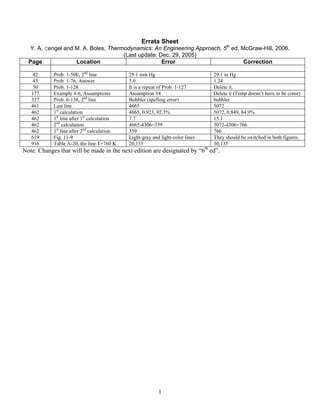
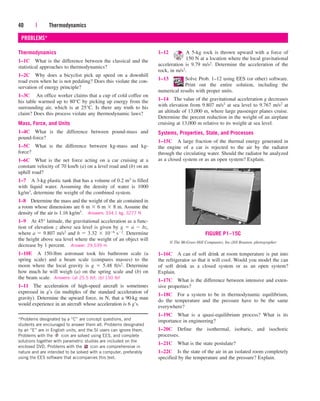
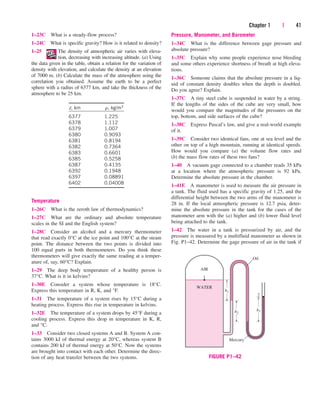
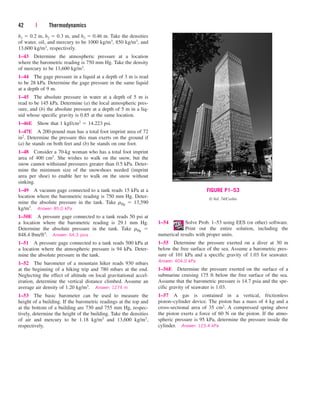
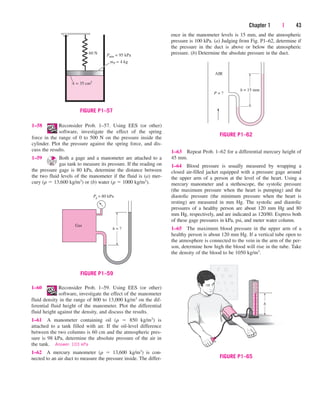
Errata Sheet
Y. A. Çengel and M. A. Boles, Thermodynamics: An Engineering Approach, 5th
ed, McGraw-Hill, 2006.
(Last update: Dec. 29, 2005)
Page Location Error Correction
42 Prob. 1-50E, 2nd
line 29.1 mm Hg 29.1 in Hg
45 Prob. 1-76, Answer 5.0 1.34
50 Prob. 1-128 It is a repeat of Prob. 1-127 Delete it.
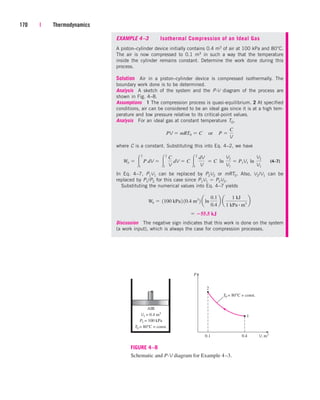
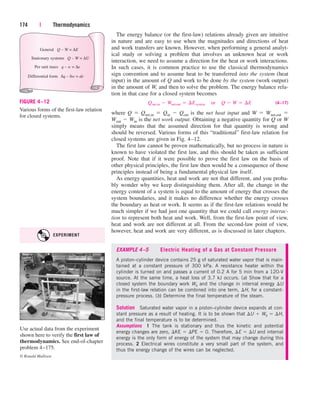
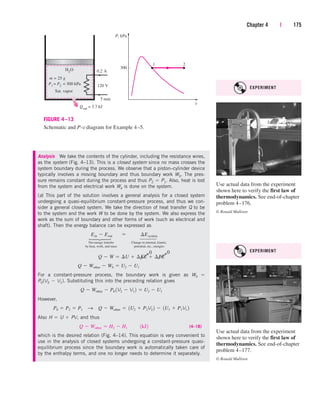
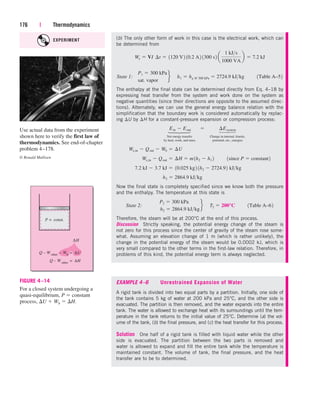
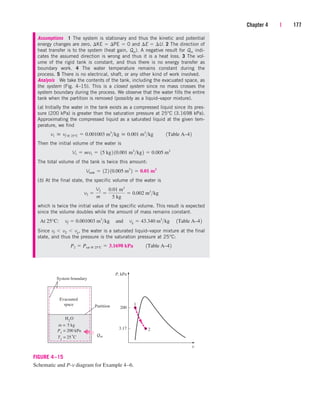
177 Example 4-6, Assumptions Assumption #4 Delete it (Temp doesn’t have to be const)
327 Prob. 6-138, 2nd
line Bobbler (spelling error) bubbler
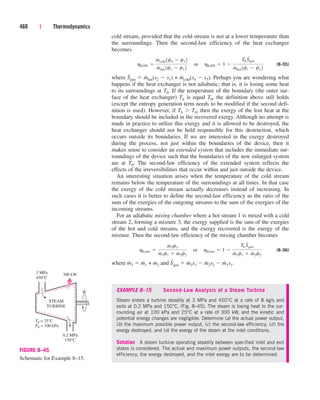
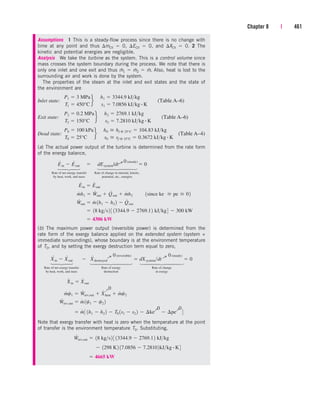
461 Last line 4665 5072
462 1st
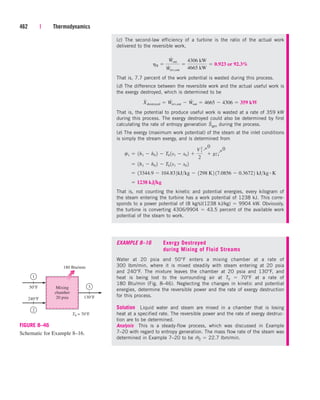
calculation 4665, 0.923, 92.3% 5072, 0.849, 84.9%
462 1st
line after 1st
calculation 7.7 15.1
462 2nd
calculation 4665-4306=359 5072-4306=766
462 1st
line after 2nd
calculation 359 766
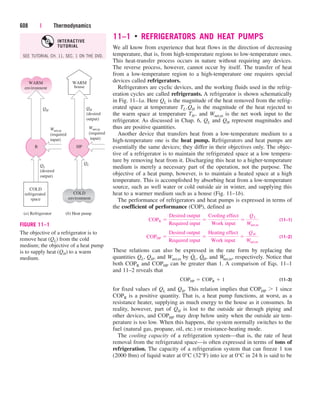
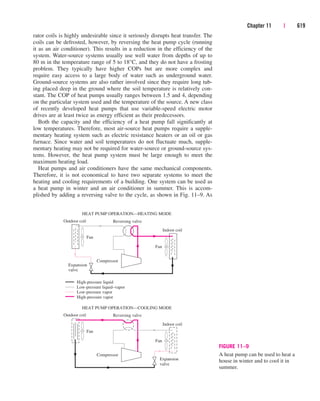
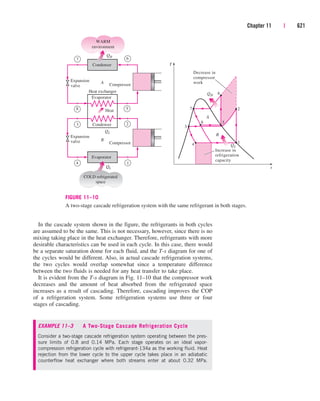
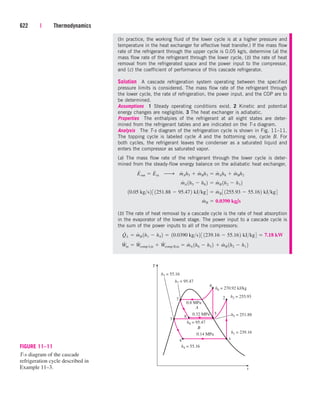
619 Fig. 11-9 Light-gray and light-color lines They should be switched in both figures.
916 Table A-20, the line T=760 K 20,135 30,135
Note: Changes that will be made in the next edition are designated by “6th
ed”.
1
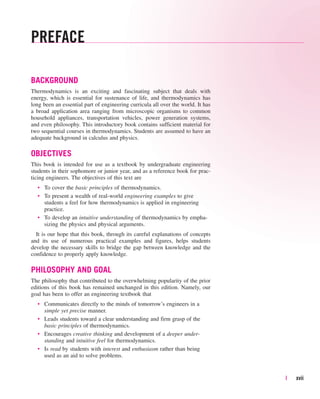
BACKGROUND
Thermodynamics is an exciting and fascinating subject that deals with
energy, which is essential for sustenance of life, and thermodynamics has
long been an essential part of engineering curricula all over the world. It has
a broad application area ranging from microscopic organisms to common
household appliances, transportation vehicles, power generation systems,
and even philosophy. This introductory book contains sufficient material for
two sequential courses in thermodynamics. Students are assumed to have an
adequate background in calculus and physics.
OBJECTIVES
This book is intended for use as a textbook by undergraduate engineering
students in their sophomore or junior year, and as a reference book for prac-
ticing engineers. The objectives of this text are
• To cover the basic principles of thermodynamics.
• To present a wealth of real-world engineering examples to give
students a feel for how thermodynamics is applied in engineering
practice.
• To develop an intuitive understanding of thermodynamics by empha-
sizing the physics and physical arguments.
It is our hope that this book, through its careful explanations of concepts
and its use of numerous practical examples and figures, helps students
develop the necessary skills to bridge the gap between knowledge and the
confidence to properly apply knowledge.
PHILOSOPHY AND GOAL
The philosophy that contributed to the overwhelming popularity of the prior
editions of this book has remained unchanged in this edition. Namely, our
goal has been to offer an engineering textbook that
• Communicates directly to the minds of tomorrow’s engineers in a
simple yet precise manner.
• Leads students toward a clear understanding and firm grasp of the
basic principles of thermodynamics.
• Encourages creative thinking and development of a deeper under-
standing and intuitive feel for thermodynamics.
• Is read by students with interest and enthusiasm rather than being
used as an aid to solve problems.
PREFACE
| xvii
cen84959_fm.qxd 4/28/05 2:45 PM Page xvii
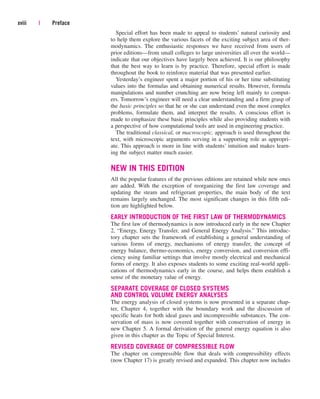
Special effort has been made to appeal to students’ natural curiosity and
to help them explore the various facets of the exciting subject area of ther-
modynamics. The enthusiastic responses we have received from users of
prior editions—from small colleges to large universities all over the world—
indicate that our objectives have largely been achieved. It is our philosophy
that the best way to learn is by practice. Therefore, special effort is made
throughout the book to reinforce material that was presented earlier.
Yesterday’s engineer spent a major portion of his or her time substituting
values into the formulas and obtaining numerical results. However, formula
manipulations and number crunching are now being left mainly to comput-
ers. Tomorrow’s engineer will need a clear understanding and a firm grasp of
the basic principles so that he or she can understand even the most complex
problems, formulate them, and interpret the results. A conscious effort is
made to emphasize these basic principles while also providing students with
a perspective of how computational tools are used in engineering practice.
The traditional classical, or macroscopic, approach is used throughout the
text, with microscopic arguments serving in a supporting role as appropri-
ate. This approach is more in line with students’ intuition and makes learn-
ing the subject matter much easier.
NEW IN THIS EDITION
All the popular features of the previous editions are retained while new ones
are added. With the exception of reorganizing the first law coverage and
updating the steam and refrigerant properties, the main body of the text
remains largely unchanged. The most significant changes in this fifth edi-
tion are highlighted below.
EARLY INTRODUCTION OF THE FIRST LAW OF THERMODYNAMICS
The first law of thermodynamics is now introduced early in the new Chapter
2, “Energy, Energy Transfer, and General Energy Analysis.” This introduc-
tory chapter sets the framework of establishing a general understanding of
various forms of energy, mechanisms of energy transfer, the concept of
energy balance, thermo-economics, energy conversion, and conversion effi-
ciency using familiar settings that involve mostly electrical and mechanical
forms of energy. It also exposes students to some exciting real-world appli-
cations of thermodynamics early in the course, and helps them establish a
sense of the monetary value of energy.
SEPARATE COVERAGE OF CLOSED SYSTEMS
AND CONTROL VOLUME ENERGY ANALYSES
The energy analysis of closed systems is now presented in a separate chap-
ter, Chapter 4, together with the boundary work and the discussion of
specific heats for both ideal gases and incompressible substances. The con-
servation of mass is now covered together with conservation of energy in
new Chapter 5. A formal derivation of the general energy equation is also
given in this chapter as the Topic of Special Interest.
REVISED COVERAGE OF COMPRESSIBLE FLOW
The chapter on compressible flow that deals with compressibility effects
(now Chapter 17) is greatly revised and expanded. This chapter now includes
xviii | Preface
cen84959_fm.qxd 4/28/05 2:45 PM Page xviii
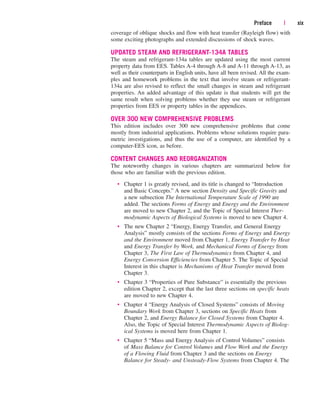
Preface | xix
coverage of oblique shocks and flow with heat transfer (Rayleigh flow) with
some exciting photographs and extended discussions of shock waves.
UPDATED STEAM AND REFRIGERANT-134A TABLES
The steam and refrigerant-134a tables are updated using the most current
property data from EES. Tables A-4 through A-8 and A-11 through A-13, as
well as their counterparts in English units, have all been revised. All the exam-
ples and homework problems in the text that involve steam or refrigerant-
134a are also revised to reflect the small changes in steam and refrigerant
properties. An added advantage of this update is that students will get the
same result when solving problems whether they use steam or refrigerant
properties from EES or property tables in the appendices.
OVER 300 NEW COMPREHENSIVE PROBLEMS
This edition includes over 300 new comprehensive problems that come
mostly from industrial applications. Problems whose solutions require para-
metric investigations, and thus the use of a computer, are identified by a
computer-EES icon, as before.
CONTENT CHANGES AND REORGANIZATION
The noteworthy changes in various chapters are summarized below for
those who are familiar with the previous edition.
• Chapter 1 is greatly revised, and its title is changed to “Introduction
and Basic Concepts.” A new section Density and Specific Gravity and
a new subsection The International Temperature Scale of 1990 are
added. The sections Forms of Energy and Energy and the Environment
are moved to new Chapter 2, and the Topic of Special Interest Ther-
modynamic Aspects of Biological Systems is moved to new Chapter 4.
• The new Chapter 2 “Energy, Energy Transfer, and General Energy
Analysis” mostly consists of the sections Forms of Energy and Energy
and the Environment moved from Chapter 1, Energy Transfer by Heat
and Energy Transfer by Work, and Mechanical Forms of Energy from
Chapter 3, The First Law of Thermodynamics from Chapter 4, and
Energy Conversion Efficiencies from Chapter 5. The Topic of Special
Interest in this chapter is Mechanisms of Heat Transfer moved from
Chapter 3.
• Chapter 3 “Properties of Pure Substance” is essentially the previous
edition Chapter 2, except that the last three sections on specific heats
are moved to new Chapter 4.
• Chapter 4 “Energy Analysis of Closed Systems” consists of Moving
Boundary Work from Chapter 3, sections on Specific Heats from
Chapter 2, and Energy Balance for Closed Systems from Chapter 4.
Also, the Topic of Special Interest Thermodynamic Aspects of Biolog-
ical Systems is moved here from Chapter 1.
• Chapter 5 “Mass and Energy Analysis of Control Volumes” consists
of Mass Balance for Control Volumes and Flow Work and the Energy
of a Flowing Fluid from Chapter 3 and the sections on Energy
Balance for Steady- and Unsteady-Flow Systems from Chapter 4. The
cen84959_fm.qxd 4/28/05 2:45 PM Page xix
Topic of Special Interest Refrigeration and Freezing of Foods is
deleted and is replaced by a formal derivation of the General Energy
Equation.
• Chapter 6 “The Second Law of Thermodynamics” is identical to the
previous edition Chapter 5, except the section Energy Conversion
Efficiencies is moved to Chapter 2.
• Chapters 7 through 15 are essentially identical to the previous edition
Chapters 6 through 14, respectively.
• Chapter 17 “Compressible Flow” is an updated version of the previ-
ous edition Chapter 16. The entire chapter is greatly revised, the sec-
tion Flow Through Actual Nozzles and Diffusers is deleted, and a new
section Duct Flow with Heat Transfer and Negligible Friction
(Rayleigh Flow) is added.
• In Appendices 1 and 2, the steam and refrigerant-134a tables (Tables
4 through 8 and 11 through 13) are entirely revised, but the table
numbers are kept the same. The tables for isentropic compressible
flow functions and the normal shock functions (Tables A-32 and
A-33) are updated and plots of functions are now included. Also,
Rayleigh flow functions are added as Table A-34. Appendix 3 Intro-
duction to EES is moved to the Student Resources DVD that comes
packaged free with the text.
• The conversion factors on the inner cover pages and the physical con-
stants are updated, and some nomenclature symbols are revised.
LEARNING TOOLS
EMPHASIS ON PHYSICS
A distinctive feature of this book is its emphasis on the physical aspects of
the subject matter in addition to mathematical representations and manipula-
tions. The authors believe that the emphasis in undergraduate education
should remain on developing a sense of underlying physical mechanisms
and a mastery of solving practical problems that an engineer is likely to face
in the real world. Developing an intuitive understanding should also make
the course a more motivating and worthwhile experience for students.
EFFECTIVE USE OF ASSOCIATION
An observant mind should have no difficulty understanding engineering sci-
ences. After all, the principles of engineering sciences are based on our
everyday experiences and experimental observations. Therefore, a physical,
intuitive approach is used throughout this text. Frequently, parallels are
drawn between the subject matter and students’ everyday experiences so
that they can relate the subject matter to what they already know. The
process of cooking, for example, serves as an excellent vehicle to demon-
strate the basic principles of thermodynamics.
SELF-INSTRUCTING
The material in the text is introduced at a level that an average student can
follow comfortably. It speaks to students, not over students. In fact, it is
self-instructive. The order of coverage is from simple to general. That is, it
xx | Preface
cen84959_fm.qxd 4/28/05 2:45 PM Page xx
starts with the simplest case and adds complexities gradually. In this way,
the basic principles are repeatedly applied to different systems, and students
master how to apply the principles instead of how to simplify a general for-
mula. Noting that the principles of sciences are based on experimental
observations, all the derivations in this text are based on physical arguments,
and thus they are easy to follow and understand.
EXTENSIVE USE OF ARTWORK
Figures are important learning tools that help students “get the picture,” and
the text makes very effective use of graphics. The fifth edition of Thermody-
namics: An Engineering Approach contains more figures and illustrations
than any other book in this category. This edition incorporates an expanded
photo program and updated art style. Figures attract attention and stimulate
curiosity and interest. Most of the figures in this text are intended to serve
as a means of emphasizing some key concepts that would otherwise go
unnoticed; some serve as page summaries. The popular cartoon feature
“Blondie” is used to make some important points in a humorous way and
also to break the ice and ease the nerves. Who says studying thermodynam-
ics can’t be fun?
LEARNING OBJECTIVES AND SUMMARIES
Each chapter begins with an overview of the material to be covered and
chapter-specific learning objectives. A summary is included at the end of
each chapter, providing a quick review of basic concepts and important rela-
tions, and pointing out the relevance of the material.
NUMEROUS WORKED-OUT EXAMPLES
WITH A SYSTEMATIC SOLUTIONS PROCEDURE
Each chapter contains several worked-out examples that clarify the material
and illustrate the use of the basic principles. An intuitive and systematic
approach is used in the solution of the example problems, while maintaining
an informal conversational style. The problem is first stated, and the objec-
tives are identified. The assumptions are then stated, together with their jus-
tifications. The properties needed to solve the problem are listed separately,
if appropriate. Numerical values are used together with their units to empha-
size that numbers without units are meaningless, and that unit manipulations
are as important as manipulating the numerical values with a calculator. The
significance of the findings is discussed following the solutions. This
approach is also used consistently in the solutions presented in the instruc-
tor’s solutions manual.
A WEALTH OF REAL-WORLD END-OF-CHAPTER PROBLEMS
The end-of-chapter problems are grouped under specific topics to make
problem selection easier for both instructors and students. Within each
group of problems are Concept Questions, indicated by “C,” to check the
students’ level of understanding of basic concepts. The problems under
Review Problems are more comprehensive in nature and are not directly tied
to any specific section of a chapter—in some cases they require review of
material learned in previous chapters. Problems designated as Design and
Essay are intended to encourage students to make engineering judgments, to
conduct independent exploration of topics of interest, and to communicate
Preface | xxi
cen84959_fm.qxd 4/28/05 2:45 PM Page xxi
their findings in a professional manner. Problems designated by an “E” are
in English units, and SI users can ignore them. Problems with the are
solved using EES, and complete solutions together with parametric studies
are included on the enclosed DVD. Problems with the are comprehen-
sive in nature and are intended to be solved with a computer, preferably
using the EES software that accompanies this text. Several economics- and
safety-related problems are incorporated throughout to enhance cost and
safety awareness among engineering students. Answers to selected problems
are listed immediately following the problem for convenience to students. In
addition, to prepare students for the Fundamentals of Engineering Exam
(that is becoming more important for the outcome-based ABET 2000 crite-
ria) and to facilitate multiple-choice tests, over 200 multiple-choice prob-
lems are included in the end-of-chapter problem sets. They are placed under
the title Fundamentals of Engineering (FE) Exam Problems for easy recog-
nition. These problems are intended to check the understanding of funda-
mentals and to help readers avoid common pitfalls.
RELAXED SIGN CONVENTION
The use of a formal sign convention for heat and work is abandoned as it
often becomes counterproductive. A physically meaningful and engaging
approach is adopted for interactions instead of a mechanical approach. Sub-
scripts “in” and “out,” rather than the plus and minus signs, are used to indi-
cate the directions of interactions.
PHYSICALLY MEANINGFUL FORMULAS
The physically meaningful forms of the balance equations rather than for-
mulas are used to foster deeper understanding and to avoid a cookbook
approach. The mass, energy, entropy, and exergy balances for any system
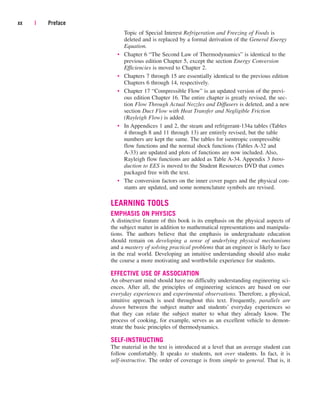
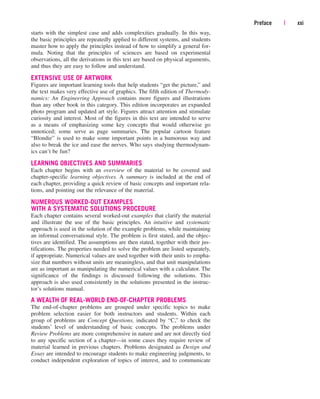
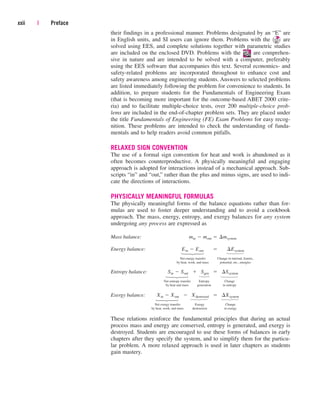
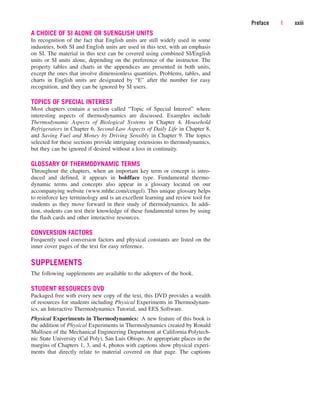
undergoing any process are expressed as
Mass balance:
Energy balance:
Net energy transfer Change in internal, kinetic,
by heat, work, and mass potential, etc., energies
Entropy balance:
Net entropy transfer Entropy Change
by heat and mass generation in entropy
Exergy balance:
Net exergy transfer Exergy Change
by heat, work, and mass destruction in exergy
These relations reinforce the fundamental principles that during an actual
process mass and energy are conserved, entropy is generated, and exergy is
destroyed. Students are encouraged to use these forms of balances in early
chapters after they specify the system, and to simplify them for the particu-
lar problem. A more relaxed approach is used in later chapters as students
gain mastery.
Xin  Xout  Xdestroyed  ¢Xsystem
Sin  Sout  Sgen  ¢Ssystem
Ein  Eout  ¢Esystem
min  mout  ¢msystem
xxii | Preface
⎫
⎪
⎬
⎪
⎭
⎫
⎪
⎬
⎪
⎭
⎫
⎬
⎭
⎫
⎪
⎬
⎪
⎭
⎫
⎪
⎬
⎪
⎭
⎫
⎪
⎬
⎪
⎭
⎫
⎪
⎬
⎪
⎭
⎫
⎪
⎬
⎪
⎭
cen84959_fm.qxd 4/28/05 2:45 PM Page xxii
A CHOICE OF SI ALONE OR SI/ENGLISH UNITS
In recognition of the fact that English units are still widely used in some
industries, both SI and English units are used in this text, with an emphasis
on SI. The material in this text can be covered using combined SI/English
units or SI units alone, depending on the preference of the instructor. The
property tables and charts in the appendices are presented in both units,
except the ones that involve dimensionless quantities. Problems, tables, and
charts in English units are designated by “E” after the number for easy
recognition, and they can be ignored by SI users.
TOPICS OF SPECIAL INTEREST
Most chapters contain a section called “Topic of Special Interest” where
interesting aspects of thermodynamics are discussed. Examples include
Thermodynamic Aspects of Biological Systems in Chapter 4, Household
Refrigerators in Chapter 6, Second-Law Aspects of Daily Life in Chapter 8,
and Saving Fuel and Money by Driving Sensibly in Chapter 9. The topics
selected for these sections provide intriguing extensions to thermodynamics,
but they can be ignored if desired without a loss in continuity.
GLOSSARY OF THERMODYNAMIC TERMS
Throughout the chapters, when an important key term or concept is intro-
duced and defined, it appears in boldface type. Fundamental thermo-
dynamic terms and concepts also appear in a glossary located on our
accompanying website (www.mhhe.com/cengel). This unique glossary helps
to reinforce key terminology and is an excellent learning and review tool for
students as they move forward in their study of thermodynamics. In addi-
tion, students can test their knowledge of these fundamental terms by using
the flash cards and other interactive resources.
CONVERSION FACTORS
Frequently used conversion factors and physical constants are listed on the
inner cover pages of the text for easy reference.
SUPPLEMENTS
The following supplements are available to the adopters of the book.
STUDENT RESOURCES DVD
Packaged free with every new copy of the text, this DVD provides a wealth
of resources for students including Physical Experiments in Thermodynam-
ics, an Interactive Thermodynamics Tutorial, and EES Software.
Physical Experiments in Thermodynamics: A new feature of this book is
the addition of Physical Experiments in Thermodynamics created by Ronald
Mullisen of the Mechanical Engineering Department at California Polytech-
nic State University (Cal Poly), San Luis Obispo. At appropriate places in the
margins of Chapters 1, 3, and 4, photos with captions show physical experi-
ments that directly relate to material covered on that page. The captions
Preface | xxiii
cen84959_fm.qxd 4/28/05 2:45 PM Page xxiii
refer the reader to end-of-chapter problems that give a brief description of
the experiments. These experiments cover thermodynamic properties, ther-
modynamic processes, and thermodynamic laws. The Student Resources
DVD contains complete coverage of the nine experiments. Each experiment
contains a video clip, a complete write-up including historical background,
and actual data (usually in an Excel file). The results are also provided on
the website that accompanies the text, and they are password protected for
instructor use. After viewing the video and reading the write-up, the student
will be ready to reduce the data and obtain results that directly connect with
material presented in the chapters. For all of the experiments the final
results are compared against published information. Most of the experi-
ments give final results that come within 10 percent or closer to these pub-
lished values.
Interactive Thermodynamics Tutorial: Also included on the Student
Resources DVD is the Interactive Thermodynamics Tutorial developed by
Ed Anderson of Texas Tech University. The revised tutorial is now tied
directly to the text with an icon to indicate when students should refer to
the tutorial to further explore specific topics such as energy balance and
isentropic processes.
Engineering Equation Solver (EES): Developed by Sanford Klein and
William Beckman from the University of Wisconsin–Madison, this software
combines equation-solving capability and engineering property data. EES
can do optimization, parametric analysis, and linear and nonlinear regres-
sion, and provides publication-quality plotting capabilities. Thermodynam-
ics and transport properties for air, water, and many other fluids are built in,
and EES allows the user to enter property data or functional relationships.
ONLINE LEARNING CENTER (OLC)
Web support is provided for the book on our Online Learning Center at
www.mhhe.com/cengel. Visit this robust site for book and supplement infor-
mation, errata, author information, and further resources for instructors and
students.
INSTRUCTOR’S RESOURCE CD-ROM
(AVAILABLE TO INSTRUCTORS ONLY)
This CD, available to instructors only, offers a wide range of classroom
preparation and presentation resources including the solutions manual in
PDF files by chapter, all text chapters and appendices as downloadable PDF
files, and all text figures in JPEG format.
COSMOS CD-ROM (COMPLETE ONLINE SOLUTIONS
MANUAL ORGANIZATION SYSTEM)
(AVAILABLE TO INSTRUCTORS ONLY)
This CD, available to instructors only, provides electronic solutions deliv-
ered via our database management tool. McGraw-Hill’s COSMOS allows
instructors to streamline the creation of assignments, quizzes, and tests by
using problems and solutions from the textbook—as well as their own cus-
tom material.
xxiv | Preface
cen84959_fm.qxd 4/28/05 2:45 PM Page xxiv
Glossary
to accompany
Thermodynamics: An Engineering Approach, 5th
edition
by Yunus A. Çengel and Michael A. Boles
Absolute entropy is entropy calculated relative to the absolute reference point
determined by the third law of thermodynamics.
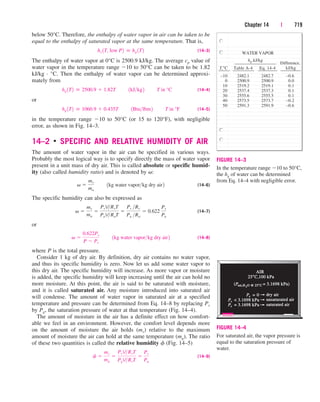
Absolute humidity (specific humidity or humidity ratio) is the mass of water vapor
present in a unit mass of dry air; that is, it is the ratio of the mass of water vapor to the
mass of dry air in atmospheric air.
Absolute pressure is the actual pressure at a given position and it is measured relative to
absolute vacuum (i.e., absolute zero pressure). Throughout this text, the pressure P will
denote absolute pressure unless specified otherwise.
Absolute temperatures are temperatures measured on the Kelvin scale or Rankine scale,
and these temperatures vary between zero and infinity.
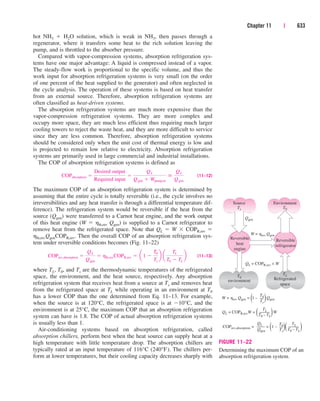
Absorption chillers are air-conditioning systems based on absorption refrigeration, and
they perform best when the heat source can supply heat at a high temperature with little
temperature drop.
Absorption refrigeration systems involve the absorption of a refrigerant by a transport
medium. The most widely used absorption refrigeration system is the ammonia–water
system, where ammonia (NH3) serves as the refrigerant and water (H2O) as the transport
medium. Absorption refrigeration systems are economically attractive when there is a
source of inexpensive heat energy at a temperature of 100 to 200°C. Some examples of
inexpensive heat energy sources include geothermal energy, solar energy, and waste heat
from cogeneration or process steam plants, and even natural gas when it is available at a
relatively low price.
Absorptivity is the fraction of the radiation energy incident on a surface that is absorbed
by the surface.
Acid rain is defined as rain or snow that washes acid-laden droplets from the air on to
the soil.
Adiabatic combustion temperature (see adiabatic flame temperature)
Adiabatic flame temperature is the maximum temperature the products of combustion
will reach in the limiting case of no heat loss to the surroundings during the combustion
process. The adiabatic flame temperature attains its maximum value when complete
combustion occurs with the theoretical amount of air.
Adiabatic process is a process during which there is no heat transfer. The word
adiabatic comes from the Greek word adiabatos, which means not to be passed.
1
Glossary
to accompany
Thermodynamics: An Engineering Approach, 5th
edition
by Yunus A. Çengel and Michael A. Boles
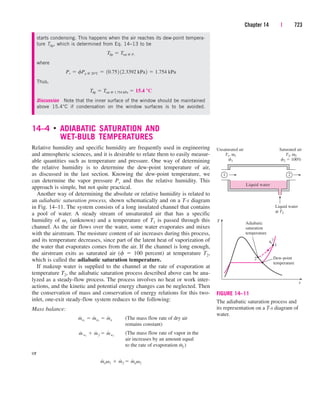
Adiabatic saturation process is the process in which a steady stream of unsaturated air
of unknown specific humidity is passed through a long insulated channel that contains a
pool of water. As the air flows over the water, some water will evaporate and mix with
the airstream. The moisture content of air will increase during this process, and its
temperature will decrease, since part of the latent heat of vaporization of the water that
evaporates will come from the air. If the channel is long enough, the airstream will exit as
saturated air (100 percent relative humidity) at the exit temperature.
Adiabatic saturation temperature is the exit temperature that air attains in the adiabatic
saturation process.
Afterburner is a section added between the turbine and the nozzle of an aircraft turbine
engine where additional fuel is injected into the oxygen-rich combustion gases leaving
the turbine. As a result of this added energy, the exhaust gases leave at a higher velocity,
providing extra thrust for short takeoffs or combat conditions.
Air conditioners are refrigerators whose refrigerated space is a room or a building
instead of the food compartment.
Air–fuel ratio AF is a frequently used quantity in the analysis of combustion processes
to quantify the amounts of fuel and air. It is usually expressed on a mass basis and is
defined as the ratio of the mass of air to the mass of fuel for a combustion process.
Air-source heat pumps use the cold outside air as the heat source in winter.
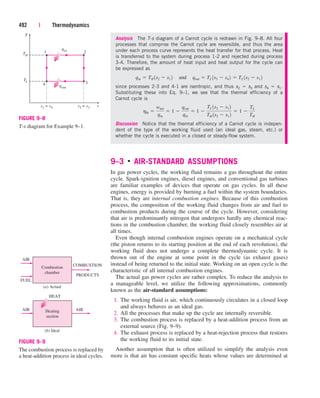
Air-standard assumptions reduce the analysis of gas power cycles to a manageable
level by utilizing the following approximations:
1. The working fluid is air, which continuously circulates in a closed loop and always
behaves as an ideal gas.
2. All the processes that make up the cycle are internally reversible.
3. The combustion process is replaced by a heat-addition process from an external
source.
4. The exhaust process is replaced by a heat rejection process that restores the
working fluid to its initial state.
Air-standard cycle is a cycle for which the air-standard assumptions are applicable.
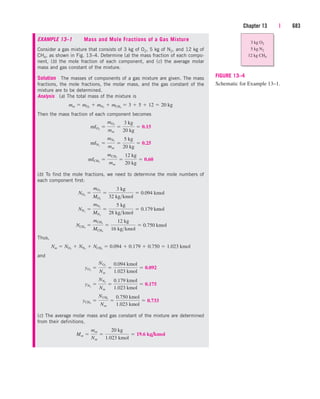
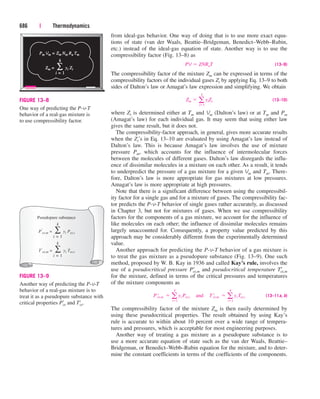
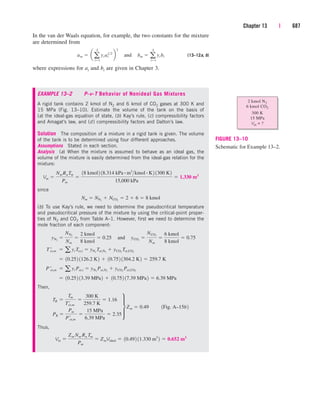
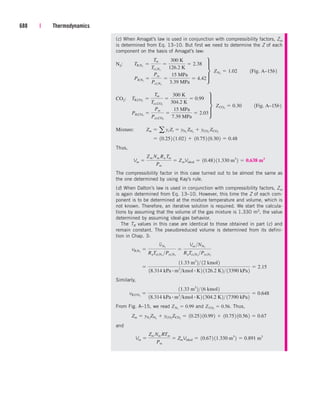
Amagat’s law of additive volumes states that the volume of a gas mixture is equal to the
sum of the volumes each gas would occupy if it existed alone at the mixture temperature
and pressure.
Annual fuel utilization efficiency AFUE is the efficiency of space heating systems of
residential and commercial buildings which accounts for the combustion efficiency as
2
Glossary
to accompany
Thermodynamics: An Engineering Approach, 5th
edition
by Yunus A. Çengel and Michael A. Boles
well as other losses such as heat losses to unheated areas and start-up and cool-down
losses.
Apparent gas constant of a mixture is the universal gas constant divided by the apparent
molar mass of the mixture.
Apparent molar mass of a mixture can be expressed as the sum of the products of the
mole fraction and molar mass of each component in the mixture.
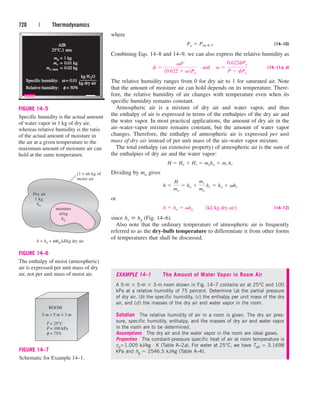
Atmospheric air is the air in the atmosphere, which normally contains some water vapor
(or moisture).
Autoignition is the premature ignition of the fuel that produces an audible noise, which
is called engine knock.
Average gas constant (see apparent gas constant)
Average molar mass (see apparent molar mass)
Average velocity is the average value of the normal velocity across an entire flow cross
section and if the velocity were the average velocity all through the cross section, the
mass flow rate would be identical to that obtained by integrating the actual velocity
profile.
Back pressure is the pressure applied at the nozzle discharge region.
Back work ratio is the ratio of the compressor work to the turbine work in gas-turbine
power plants.
Bar is the unit of pressure equal to 105
pascal.
Barometer is a device that measures the atmospheric pressure; thus, the atmospheric
pressure is often referred to as the barometric pressure.
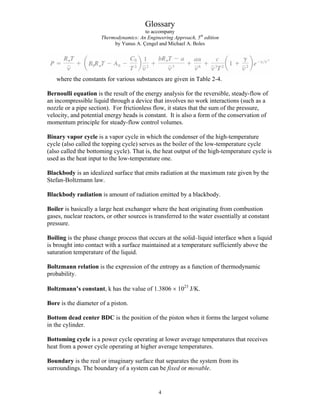
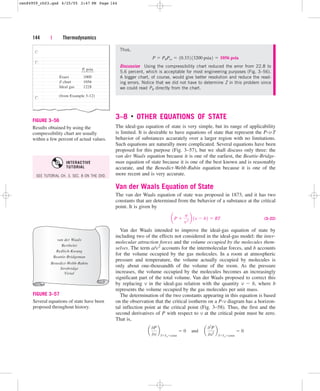
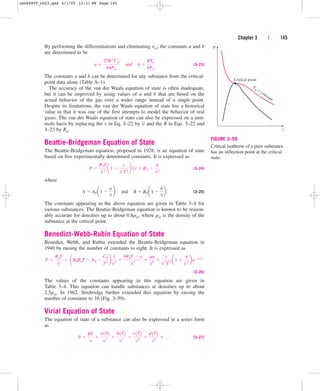
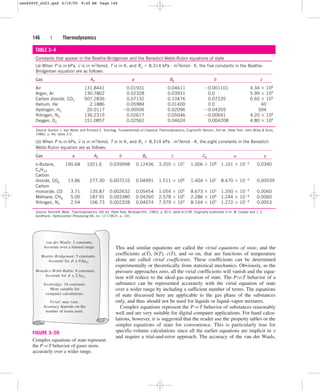
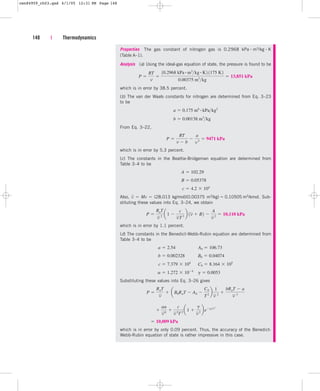
Beattie-Bridgeman equation of state is one of the best known and is a reasonably
accurate equation of state. It is given by
where the constants for various substances are found in Table 2-4.
Benedict-Webb-Rubin equation of state is one of the more recent and very accurate
equations of state. It is given by
3
Glossary
to accompany
Thermodynamics: An Engineering Approach, 5th
edition
by Yunus A. Çengel and Michael A. Boles
where the constants for various substances are given in Table 2-4.
Bernoulli equation is the result of the energy analysis for the reversible, steady-flow of
an incompressible liquid through a device that involves no work interactions (such as a
nozzle or a pipe section). For frictionless flow, it states that the sum of the pressure,
velocity, and potential energy heads is constant. It is also a form of the conservation of
momentum principle for steady-flow control volumes.
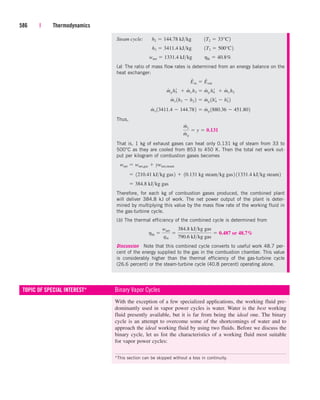
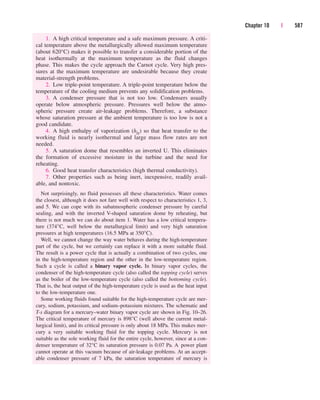
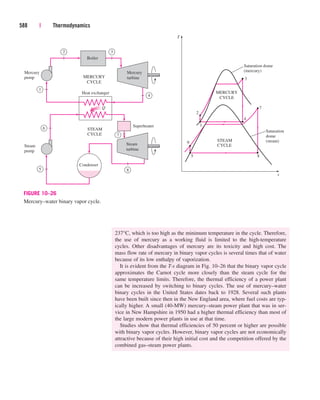
Binary vapor cycle is a vapor cycle in which the condenser of the high-temperature
cycle (also called the topping cycle) serves as the boiler of the low-temperature cycle
(also called the bottoming cycle). That is, the heat output of the high-temperature cycle is
used as the heat input to the low-temperature one.
Blackbody is an idealized surface that emits radiation at the maximum rate given by the
Stefan-Boltzmann law.
Blackbody radiation is amount of radiation emitted by a blackbody.
Boiler is basically a large heat exchanger where the heat originating from combustion
gases, nuclear reactors, or other sources is transferred to the water essentially at constant
pressure.
Boiling is the phase change process that occurs at the solid–liquid interface when a liquid
is brought into contact with a surface maintained at a temperature sufficiently above the
saturation temperature of the liquid.
Boltzmann relation is the expression of the entropy as a function of thermodynamic
probability.
Boltzmann’s constant, k has the value of 1.3806 × 10²³
J/K.
Bore is the diameter of a piston.
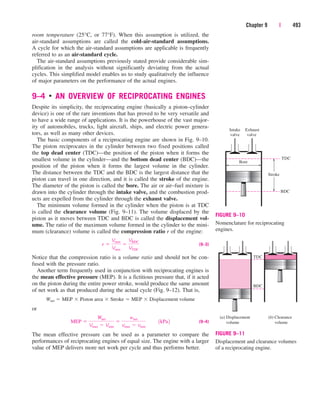
Bottom dead center BDC is the position of the piston when it forms the largest volume
in the cylinder.
Bottoming cycle is a power cycle operating at lower average temperatures that receives
heat from a power cycle operating at higher average temperatures.
Boundary is the real or imaginary surface that separates the system from its
surroundings. The boundary of a system can be fixed or movable.
4
Glossary
to accompany
Thermodynamics: An Engineering Approach, 5th
edition
by Yunus A. Çengel and Michael A. Boles
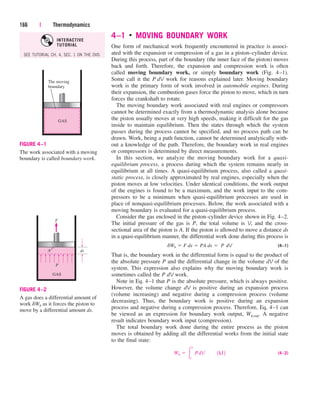
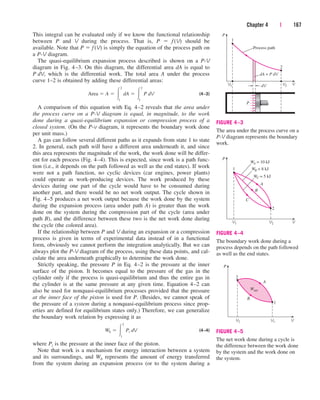
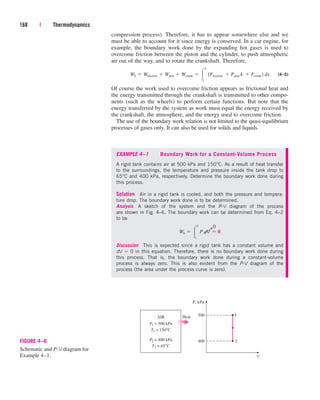
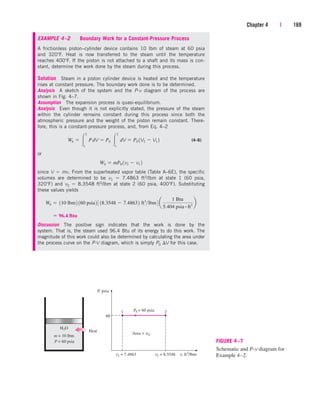
Boundary work (PdV work) is the work associated with the expansion or compression
of a gas in a piston-cylinder device. Boundary work is the area under the process curve
on a P-V diagram equal, in magnitude, to the work done during a quasi-equilibrium
expansion or compression process of a closed system.
Bourdon tube, named after the French inventor Eugene Bourdon, is a type of commonly
used mechanical pressure measurement device which consists of a hollow metal tube bent
like a hook whose end is closed and connected to a dial indicator needle.
Bow wave (see detached oblique shock)
Brayton cycle was first proposed by George Brayton around 1870. It is used for gas
turbines, which operate on an open cycle, where both the compression and expansion
processes take place in rotating machinery. The open gas-turbine cycle can be modeled as
a closed cycle by utilizing the air-standard assumptions. The combustion process is
replaced by a constant-pressure heat-addition process from an external source, and the
exhaust process is replaced by a constant-pressure heat-rejection process to the ambient
air. The ideal Brayton cycle is made up of four internally reversible processes:
1-2 Isentropic compression (in a compressor),
2-3 Constant pressure heat addition,
3-4 Isentropic expansion (in a turbine),
4-1 Constant pressure heat rejection.
Brayton cycle with regeneration is the Brayton cycle modified with a regenerator (a
counterflow heat exchanger) to allow the transfer of heat to the high pressure air leaving
the compressor from the high-temperature exhaust gas leaving the turbine.
British thermal unit BTU is the energy unit in the English system, representing the
energy needed to raise the temperature of 1 lbm of water at 68°F by 1°F.
Caloric is heat treated as a fluidlike substance, according to the caloric theory, that is a
massless, colorless, odorless, and tasteless substance that can be poured from one body
into another.
Calorie (cal) is the amount of energy in the metric system needed to raise the
temperature of 1 g of water at 15 °C by 1°C.
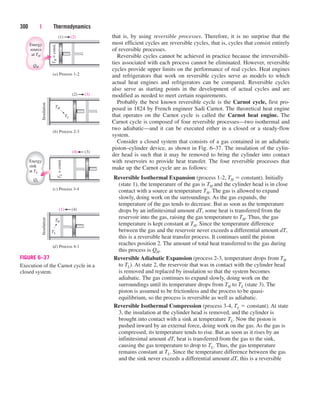
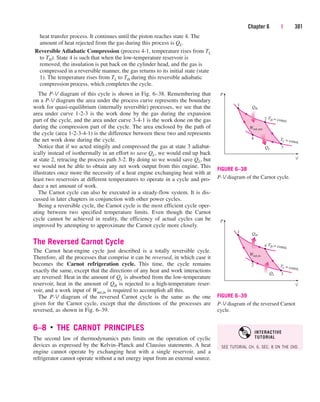
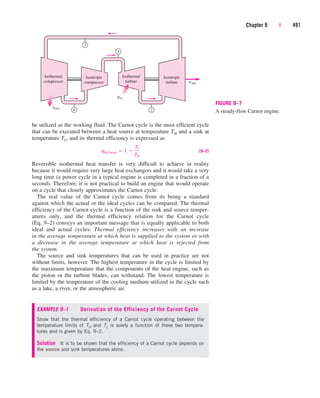
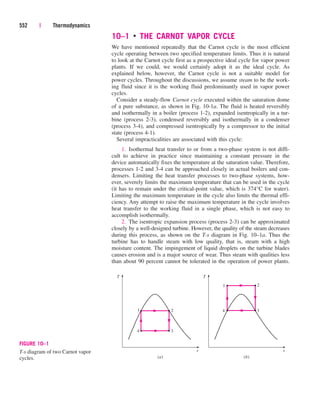
Carnot cycle was first proposed in 1824 by French engineer Sadi Carnot. It is composed
of four reversible processes—two isothermal and two adiabatic, and can be executed
either in a closed or a steady-flow system.
5
Glossary
to accompany
Thermodynamics: An Engineering Approach, 5th
edition
by Yunus A. Çengel and Michael A. Boles
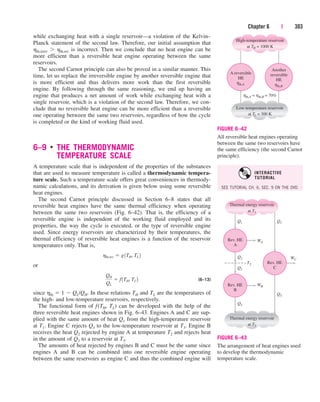
Carnot efficiency is the highest efficiency a heat engine can have when operating
between the two thermal energy reservoirs at temperatures TL and TH;
ηth, rev = 1 - TL / TH.
Carnot heat engine is the theoretical heat engine that operates on the Carnot cycle.
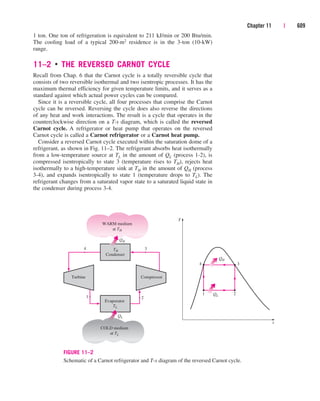
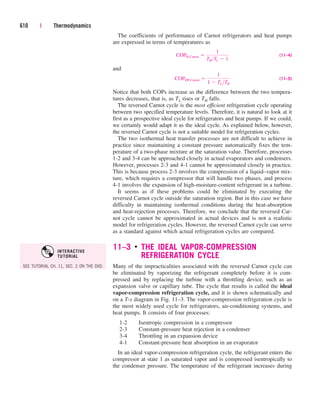
Carnot heat pump is a heat pump that operates on the reversed Carnot cycle. When
operating between the two thermal energy reservoirs at temperatures TL and TH, the
Carnot heat pump can have a coefficient of performance of COPHP, rev = 1/ (1- TL / TH) =
TH /( TH - TL).
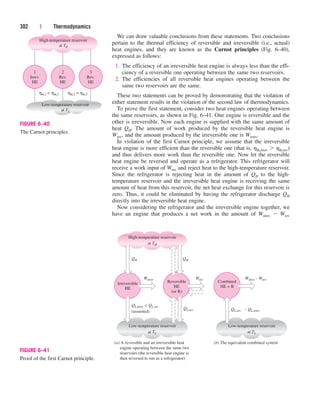
Carnot principles are two conclusions that pertain to the thermal efficiency of reversible
and irreversible (i.e., actual) heat engines and are expressed as follows:
1. The efficiency of an irreversible heat engine is always less than the efficiency of a
reversible one operating between the same two reservoirs.
2. The efficiencies of all reversible heat engines operating between the same two
reservoirs are the same.
Carnot refrigerator is a refrigerator that operates on the reversed Carnot cycle. When
operating between the two thermal energy reservoirs at temperatures TL and TH the
Carnot refrigerator can have a coefficient of performance of COPR, rev = 1/ (TH / TL - 1) =
TL /( TH - TL).
Cascade refrigeration cycles perform the refrigeration process in stages, that is, to have
two or more refrigeration cycles that operate in series.
Celsius scale (formerly called the centigrade scale; in 1948 it was renamed after the
Swedish astronomer A. Celsius, 1701–1744, who devised it) is the temperature scale used
in the SI system. On the Celsius scale, the ice and steam points are assigned the values of
0 and 100 °C, respectively.
Chemical energy is the internal energy associated with the atomic bonds in a molecule.
Chemical equilibrium is established in a system when its chemical composition does not
change with time.
Chemical equilibrium reactions are chemical reactions in which the reactants are
depleted at exactly the same rate as they are replenished from the products by the reverse
reaction. At equilibrium the reaction proceeds in both directions at the same rate.
Chemical potential is the change in the Gibbs function of the mixture in a specified
phase when a unit amount of a given component of the mixture in the same phase is
added as pressure and temperature and the amounts of all other components are held
constant. The chemical potential of a component of an ideal gas mixture depends on the
6
Glossary
to accompany
Thermodynamics: An Engineering Approach, 5th
edition
by Yunus A. Çengel and Michael A. Boles
mole fraction of the components as well as the mixture temperature and pressure, and is
independent of the identity of the other constituent gases.
Chemically correct amount of air is the stoichiometric or theoretical air, or 100 percent
theoretical air.
Choked flow occurs in a nozzle when the mass flow reaches a maximum value for the
minimum flow area. This happens when the flow properties are those required to
increase the fluid velocity to the velocity of sound at the minimum flow area location.
Choked Rayleigh flow occurs in a duct when a fluid can no longer be accelerated by
heating above sonic velocity to supersonic velocities.
Clapeyron equation, named after the French engineer and physicist E. Clapeyron
(1799–1864), relates the enthalpy change associated with a phase change (such as the
enthalpy of vaporization hfg) from knowledge of P, v, and T data alone.
Clapeyron–Clausius equation is used to determine the variation of saturation pressure
with temperature.
Classical thermodynamics is the macroscopic approach to the study of thermodynamics
that does not require knowledge of the behavior of individual particles.
Clausius inequality, first stated by the German physicist R. J. E. Clausius (1822–1888),
is expressed as the cyclic integral of δQ/T is always less than or equal to zero. This
inequality is valid for all cycles, reversible or irreversible.
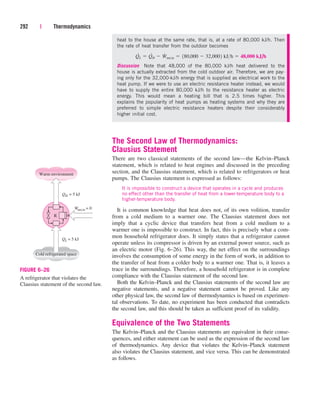
Clausius statement of the second law is expressed as follows: It is impossible to
construct a device that operates in a cycle and produces no effect other than the transfer
of heat from a lower-temperature body to a higher-temperature body.
Clearance volume is the minimum volume formed in the cylinder when the piston is at
top dead center.
Closed feedwater heater is a feedwater heater in which heat is transferred from the
extracted steam to the feedwater without any mixing taking place. The two streams are
typically not at the same pressures, since they do not mix. In an ideal closed feedwater
heater the feedwater is heated to the exit temperature of the extracted steam, which
ideally leaves the heater as a saturated liquid at the extraction pressure. In actual power
plants the feedwater leaves the heater below the exit temperature of the extracted steam
because a temperature difference of at least a few degrees is required for any effective
heat transfer to take place.
7
Glossary
to accompany
Thermodynamics: An Engineering Approach, 5th
edition
by Yunus A. Çengel and Michael A. Boles
Closed system consists of a fixed amount of mass (control mass), and no mass can cross
its boundary. But energy, in the form of heat or work, can cross the boundary.
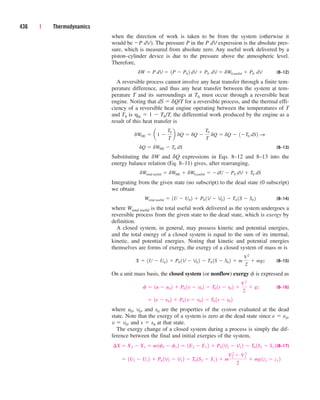
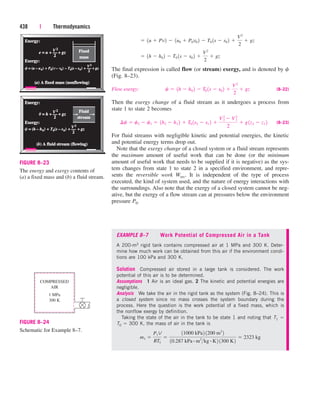
Closed system exergy (nonflow exergy) is the reversible work that could be done by a
closed system undergoing a reversible process to equilibrium with its surroundings. For a
mass m the exergy is X = (U - U0) + P0(V - V0) - T0(S - S0) + m 2
V
G
/2 + mgz. On a unit
mass basis, the exergy of a closed system is expressed as φ = (u - u0) + P0(v - v0) - T0(s -
s0) + /2 + gz where u
2
V
G
0, v0, and s0 are the properties of the system evaluated at the dead
state. Note that the exergy of a system is zero at the dead state since u = u0, v = v0, and s
= s0 at that state. The exergy change of a closed system during a process is simply the
difference between the final and initial exergies of the system.
Coefficient of performance COP is the measure of performance of refrigerators and
heat pumps. It is expressed in terms of the desired result for each device (heat absorbed
from the refrigerated space for the refrigerator or heat added to the hot space by the heat
pump) divided by the input, the energy expended to accomplish the energy transfer
(usually work input).
Cogeneration is the production of more than one useful form of energy (such as process
heat and electric power) from the same energy source.
Cold-air-standard assumption combines the air-standard assumptions with the
assumption that the air has constant specific heats whose values are determined at room
temperature (25°C, or 77°F).
Combined cycle (see combined gas–vapor cycle)
Combined efficiency (see overall efficiency)
Combined gas–vapor cycle, or just the combined cycle, is the gas-turbine (Brayton)
cycle topping a steam-turbine (Rankine) cycle, which has a higher thermal efficiency
than either of the cycles executed individually.
Combustion is a chemical reaction during which a fuel is oxidized and a large quantity
of energy is released.
Combustion air is dry air which can be approximated as 21 percent oxygen and 79
percent nitrogen by mole numbers. Therefore, each mole of oxygen entering a
combustion chamber will be accompanied by 0.79/0.21 = 3.76 mol of nitrogen. To supply
one mole of oxygen to a combustion process, 4.76 mol of combustion air are required.
8
Glossary
to accompany
Thermodynamics: An Engineering Approach, 5th
edition
by Yunus A. Çengel and Michael A. Boles
Combustion efficiency is defined as the ratio of the amount of heat released during combustion
to the heating value of the fuel burned.
Complete combustion is a combustion process in which all the carbon in the fuel burns
to CO2, all the hydrogen burns to H2O, and all the sulfur (if any) burns to SO2. That is, all
the combustible components of a fuel are burned to completion during a complete
combustion process.
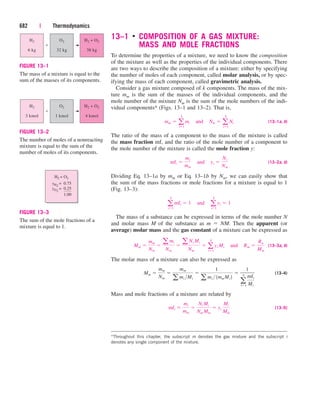
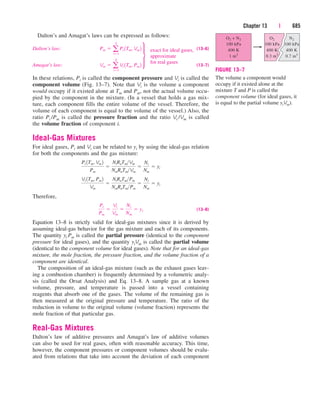
Component pressure is the pressure a component in a gas mixture would have if it
existed alone at the volume and temperature of the mixture.
Component volume is the volume a component in a gas mixture would occupy if it
existed alone at the temperature and pressure of the mixture.
Compressed liquid has a pressure greater than the saturation pressure corresponding to
the temperature.
Compressed liquid region is all compressed liquid states located in the region to the left
of the saturated liquid line and below the critical temperature line. In the absence of
compressed liquid data, a general approximation is to treat compressed liquid as saturated
liquid at the given temperature.
Compressibility factor Z is a correction factor to account for deviation from ideal-gas
behavior at a given temperature and pressure. Z = Pv/RT.
Compressing flow is a flow that produces an oblique shock.
Compression-ignition (CI) engines are reciprocating engines in which the combustion
of the air–fuel mixture is self-ignited as a result of compressing the mixture above its
self-ignition temperature.
Compression ratio r of an engine is the ratio of the maximum volume formed in the
cylinder to the minimum (clearance) volume. Notice that the compression ratio is a
volume ratio and should not be confused with the pressure ratio.
Compressor is a device that increases the pressure of a gas to very high pressures
(typical pressure ratios are greater than 3).
Condenser is a heat exchanger in which the working fluid condenses as it rejects heat to
the surroundings. For example, in the condenser of a steam power plant steam leaving
the turbine as a vapor condenses to the saturated liquid state as the result of heat transfer
to a cooling medium such as the atmosphere or water from a lake or river.
9
Glossary
to accompany
Thermodynamics: An Engineering Approach, 5th
edition
by Yunus A. Çengel and Michael A. Boles
Conduction is the transfer of energy from the more energetic particles of a substance to
the adjacent less energetic ones as a result of interaction between particles.
Conservation of energy principle states that during an interaction, energy can change
from one form to another but the total amount of energy remains constant. That is, energy
cannot be created or destroyed (see first law of thermodynamics).
Conservation of mass principle is expressed as net mass transfer to or from a control
volume during a time interval is equal to the net change (increase or decrease) in the total
mass within the control volume during the time interval.
Conservation of mass principle for combustion (or the mass balance) is the principle
used to balance chemical reaction equations. It can be stated as the total mass of each
element is conserved during a chemical reaction. The total mass of each element on the
right-hand side of the reaction equation (the products) must be equal to the total mass of
that element on the left-hand side (the reactants) even though the elements exist in
different chemical compounds in the reactants and products. Even though the mass must
be conserved, the total number of moles is not necessarily conserved during a chemical
reaction.
Constant-volume gas thermometer measures the temperature on the ideal-gas
temperature scale using a rigid vessel filled with a gas, usually hydrogen or helium, at
low pressure. The temperature of a gas of fixed volume varies linearly with pressure at
sufficiently low pressures.
Continuity equation is the conservation of mass equation as it is often referred to in
fluid mechanics.
Continuum is a view of mass as continuous, homogeneous matter with no holes. Matter
is made up of atoms that are widely spaced in the gas phase. Yet it is very convenient to
disregard the atomic nature of a substance. The continuum idealization allows us to treat
properties as point functions, and to assume the properties to vary continually in space
with no jump discontinuities. This idealization is valid as long as the size of the system
we deal with is large relative to the space between the molecules. This is the case in
practically all problems, except some specialized ones.
Control mass (see closed system)
Control surface is the boundary of a control volume, and it can be real or imaginary.
Control volume (also see open system) is any arbitrary region in space through which
mass and energy can pass across the boundary. Most control volumes have fixed
boundaries and thus do not involve any moving boundaries. A control volume may also
involve heat and work interactions just as a closed system, in addition to mass interaction.
10
Glossary
to accompany
Thermodynamics: An Engineering Approach, 5th
edition
by Yunus A. Çengel and Michael A. Boles
Convected energy (see flow work)
Convection is the mode of energy transfer between a solid surface and the adjacent fluid
that is in motion, and it involves the combined effects of conduction and fluid motion.
Convection heat transfer coefficient is the experimentally determined parameter that is
the ratio of the rate of convection heat transfer and the product of the heat transfer area
and surface to bulk fluid temperature.
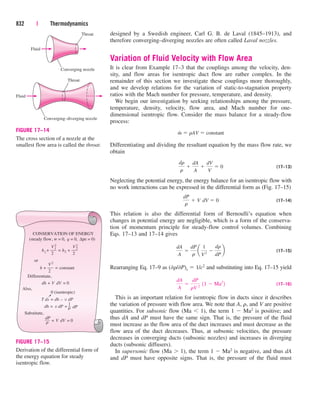
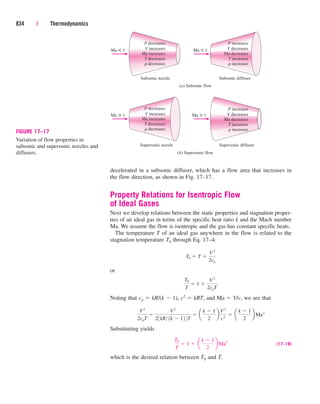
Converging–diverging nozzle, also called Laval nozzle after Carl G. B. de Laval, is a
duct in which the flow area first decreases and then increases in the direction of the flow
and is used to accelerate gases to supersonic speeds.
Cooling capacity is the rate of heat removal from the refrigerated space by a
refrigeration system.
Cooling pond is a large lake open to the atmosphere into which warm water containing
waste heat is pumped. Heat transfer from the pond surface to the atmosphere is very
slow; thus, the cooling pond requires much more surface area than that of a spray pond to
achieve the same cooling.
Criterion for chemical equilibrium is the equation set equal to zero that involves the
stoichiometric coefficients and the molar Gibbs functions of the reactants and the
products in the equilibrium reaction.
Critical point is defined as the point at which the saturated liquid and saturated vapor
states are identical.
Critical pressure Pcr is the pressure of a substance at the critical point.
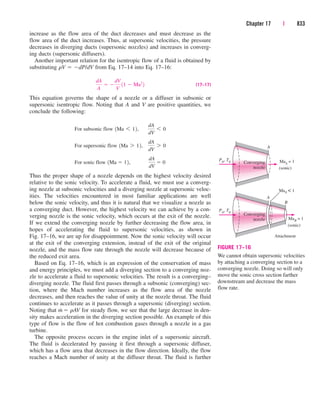
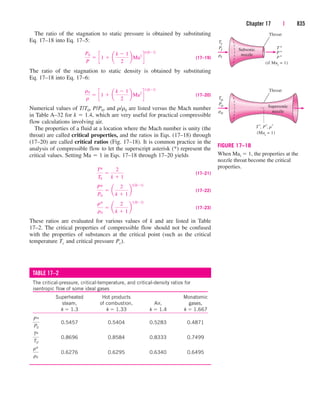
Critical properties are the properties of a fluid at a location where the Mach number is
unity.
Critical ratios are the ratios of the stagnation to static properties when the Mach number
is unity.
Critical temperature Tcr is the temperature of a substance at the critical point.
Critical volume vcr is the volume of a substance at the critical point.
Cutoff ratio rc is the ratio of the cylinder volumes after and before the combustion
process in the Diesel cycle.
11
Glossary
to accompany
Thermodynamics: An Engineering Approach, 5th
edition
by Yunus A. Çengel and Michael A. Boles
Cycle is a process, or series of processes, that allows a system to undergo state changes
and returns the system to the initial state at the end of the process. That is, for a cycle the
initial and final states are identical.
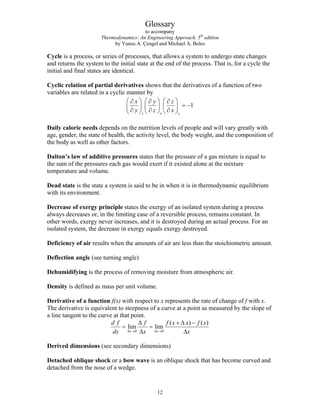
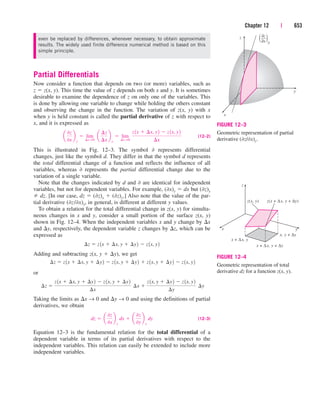
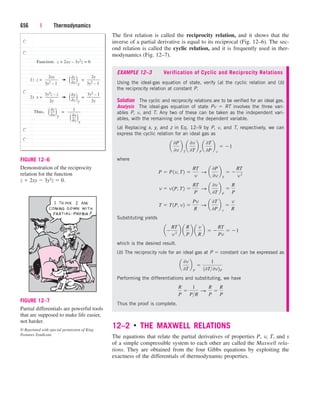
Cyclic relation of partial derivatives shows that the derivatives of a function of two
variables are related in a cyclic manner by
1
z x y
x y z
y z x
⎛ ⎞ ⎛ ⎞ ⎛ ⎞
∂ ∂ ∂
= −
⎜ ⎟ ⎜ ⎟ ⎜ ⎟
∂ ∂ ∂
⎝ ⎠ ⎝ ⎠ ⎝ ⎠
Daily calorie needs depends on the nutrition levels of people and will vary greatly with
age, gender, the state of health, the activity level, the body weight, and the composition of
the body as well as other factors.
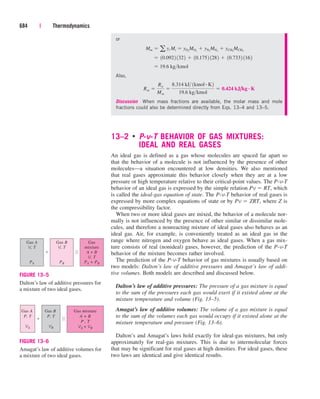
Dalton’s law of additive pressures states that the pressure of a gas mixture is equal to
the sum of the pressures each gas would exert if it existed alone at the mixture
temperature and volume.
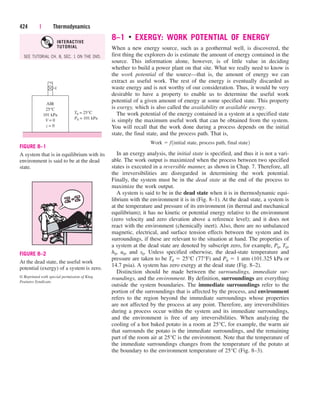
Dead state is the state a system is said to be in when it is in thermodynamic equilibrium
with its environment.
Decrease of exergy principle states the exergy of an isolated system during a process
always decreases or, in the limiting case of a reversible process, remains constant. In
other words, exergy never increases, and it is destroyed during an actual process. For an
isolated system, the decrease in exergy equals exergy destroyed.
Deficiency of air results when the amounts of air are less than the stoichiometric amount.
Deflection angle (see turning angle)
Dehumidifying is the process of removing moisture from atmospheric air.
Density is defined as mass per unit volume.
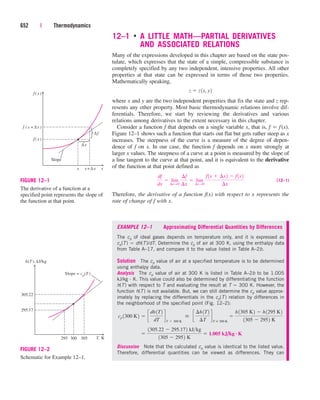
Derivative of a function f(x) with respect to x represents the rate of change of f with x.
The derivative is equivalent to steepness of a curve at a point as measured by the slope of
a line tangent to the curve at that point.
0 0
( ) (
lim lim
x x
d f f f x x f x
dx x x
Δ → Δ →
)
Δ + Δ −
= =
Δ Δ
Derived dimensions (see secondary dimensions)
Detached oblique shock or a bow wave is an oblique shock that has become curved and
detached from the nose of a wedge.
12
Glossary
to accompany
Thermodynamics: An Engineering Approach, 5th
edition
by Yunus A. Çengel and Michael A. Boles
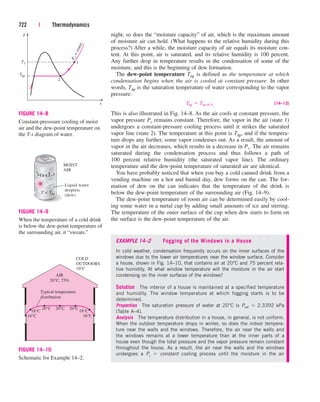
Dew-point temperature is defined as the temperature at which condensation begins
when the air is cooled at constant pressure.
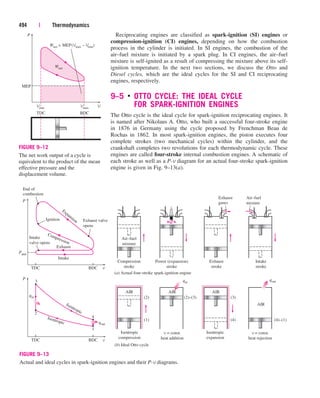
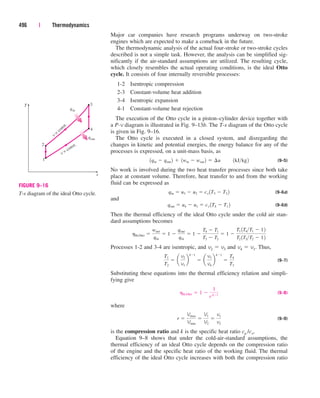
Diesel cycle is the ideal cycle for compress-ignition reciprocating engines, and was first
proposed by Rudolf Diesel in the 1890s. Using the air-standard assumptions, the cycle
consists of four internally reversible processes:
1-2 Isentropic compression,
2-3 Constant pressure heat addition,
3-4 Isentropic expansion,
4-1 Constant volume heat rejection.
Diffuser is a device that increases the pressure of a fluid by decreasing the fluid velocity.
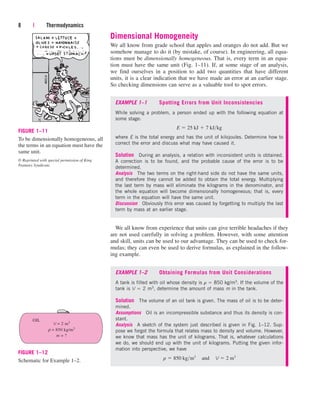
Dimensionally homogeneous means that every term in an equation must have the same
unit. To make sure that all terms in an engineering equation have the same units is the
simplest error check one can perform.
Dimensions are any physical characterizations of a quantity.
Direct-contact feedwater heater ( see open feedwater heater)
Displacement volume is the volume displaced by the piston as it moves between top
dead center and bottom dead center.
Dodecane, C12H26, is a common liquid fuel that approximates diesel fuel.
Dome is the saturation states located beneath the joined saturated liquid line and
saturated vapor line.
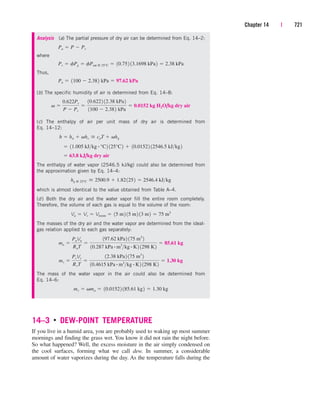
Dry air is air that contains no water vapor.
Dry-bulb temperature is the ordinary temperature of atmospheric air.
Dual cycle is the ideal cycle which models the combustion process in both gasoline and
diesel engines as a combination of two heat-transfer processes, one at constant
volume and the other at constant pressure.
Dynamic temperature is the kinetic energy per unit mass divided by the constant
pressure specific heat and corresponds to the temperature rise during the stagnation
process.
Efficiency is defined as the ratio of desired result for an event to the input required to
accomplish the event. Efficiency is one of the most frequently used terms in
13
Glossary
to accompany
Thermodynamics: An Engineering Approach, 5th
edition
by Yunus A. Çengel and Michael A. Boles
thermodynamics, and it indicates how well an energy conversion or transfer process is
accomplished.
Efficiency of a cooking appliance is defined as the ratio of the useful energy transferred
to the food to the energy consumed by the appliance.
Efficiency of a water heater is defined as the ratio of the energy delivered to the house
by hot water to the energy supplied to the water heater.
Efficiency of resistance heaters is 100 percent as they convert all the electrical energy
they consume into heat.
Electrical polarization work is the product of the generalized force taken as the electric
field strength and the generalized displacement taken as the polarization of the medium
(the sum of the electric dipole rotation moments of the molecules).
Electrical power is the rate of electrical work done as electrons in a wire move under the
effect of electromotive forces, doing work. It is the product of the potential difference
measured in volts and the current flow measured in amperes.
Electrical work is work done on a system as electrons in a wire move under the effect of
electromotive forces while crossing the system boundary.
Emissivity is a surface property that is a measure of how closely a surface approximates
a blackbody for which the emissivity equal to one.
Energy Balance is the net change (increase or decrease) in the total energy of the system
during a process is equal to the difference between the total energy entering and the total
energy leaving the system during that process.
Energy efficiency rating EER is the performance of refrigerators and air conditioners,
and is the amount of heat removed from the cooled space in Btu’s for 1 Wh (watt-hour)
of electricity consumed.
Energy transport by mass is the product of the mass of the flowing fluid and its total
energy. The rate of energy transport by mass is the product of the mass flow rate and the
total energy of the flow.
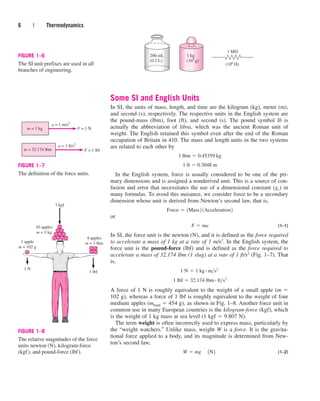
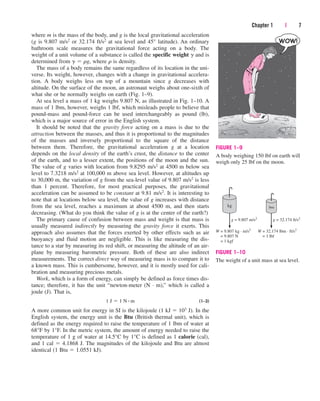
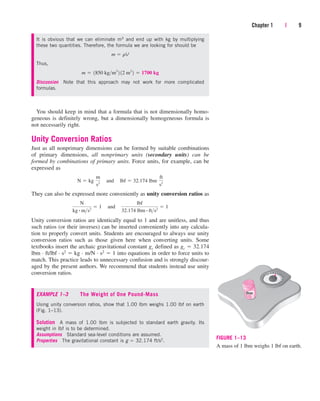
English system, which is also known as the United States Customary System (USCS),
has the respective units the pound-mass (lbm), foot (ft), and second (s). The pound
symbol lb is actually the abbreviation of libra, which was the ancient Roman unit of
weight.
14
Glossary
to accompany
Thermodynamics: An Engineering Approach, 5th
edition
by Yunus A. Çengel and Michael A. Boles
1
Enthalpy H (from the Greek word enthalpien, which means to heat) is a property and is
defined as the sum of the internal energy U and the PV product.
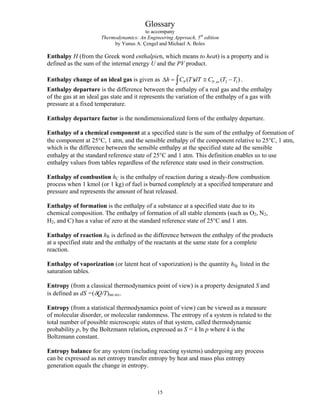
Enthalpy change of an ideal gas is given as P P, av 2
( ) ( )
h C T dT C T T
Δ = ≅ −
∫ .
Enthalpy departure is the difference between the enthalpy of a real gas and the enthalpy
of the gas at an ideal gas state and it represents the variation of the enthalpy of a gas with
pressure at a fixed temperature.
Enthalpy departure factor is the nondimensionalized form of the enthalpy departure.
Enthalpy of a chemical component at a specified state is the sum of the enthalpy of formation of
the component at 25°C, 1 atm, and the sensible enthalpy of the component relative to 25°C, 1 atm,
which is the difference between the sensible enthalpy at the specified state ad the sensible
enthalpy at the standard reference state of 25°C and 1 atm. This definition enables us to use
enthalpy values from tables regardless of the reference state used in their construction.
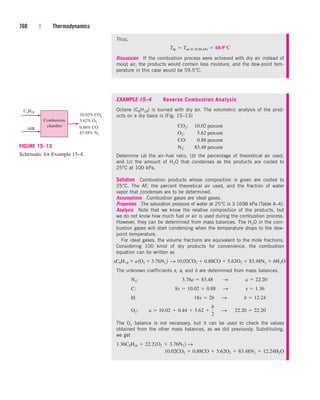
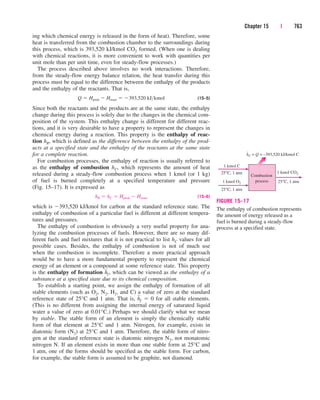
Enthalpy of combustion hC is the enthalpy of reaction during a steady-flow combustion
process when 1 kmol (or 1 kg) of fuel is burned completely at a specified temperature and
pressure and represents the amount of heat released.
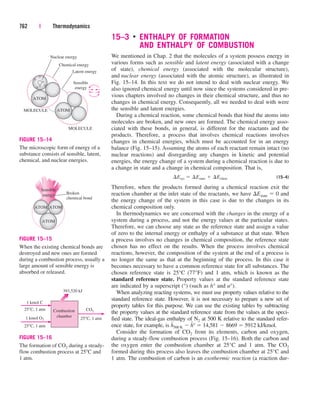
Enthalpy of formation is the enthalpy of a substance at a specified state due to its
chemical composition. The enthalpy of formation of all stable elements (such as O2, N2,
H2, and C) has a value of zero at the standard reference state of 25°C and 1 atm.
Enthalpy of reaction hR is defined as the difference between the enthalpy of the products
at a specified state and the enthalpy of the reactants at the same state for a complete
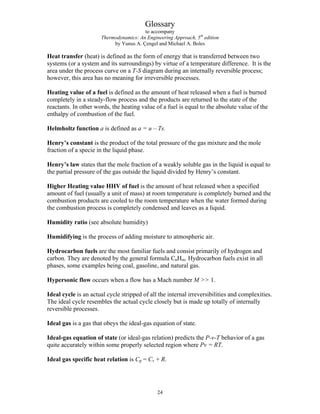
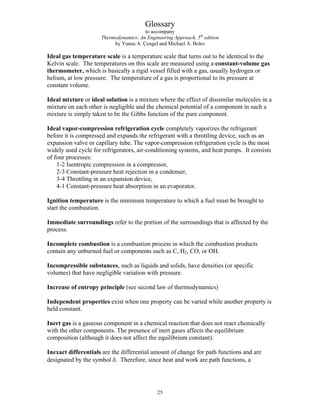
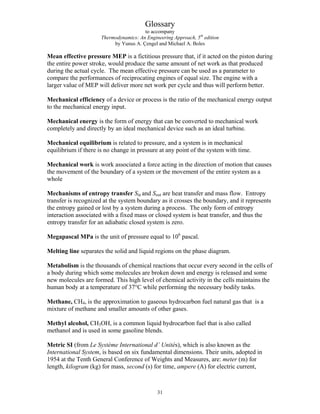
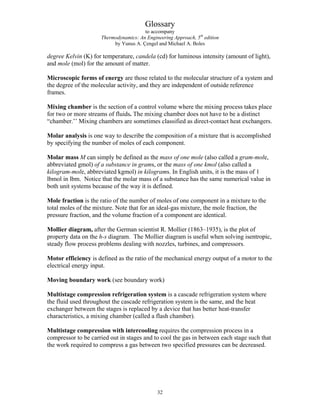
reaction.
Enthalpy of vaporization (or latent heat of vaporization) is the quantity hfg listed in the
saturation tables.
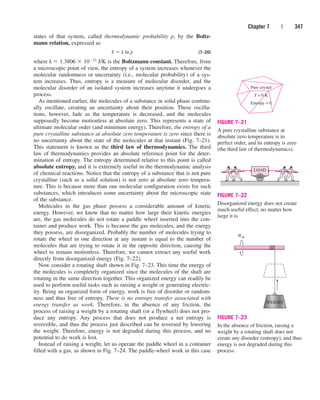
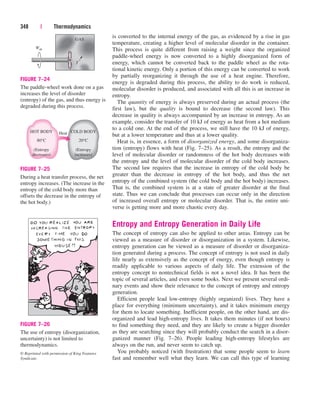
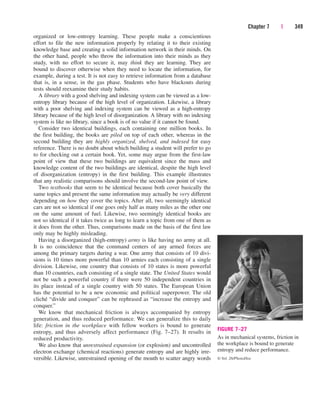
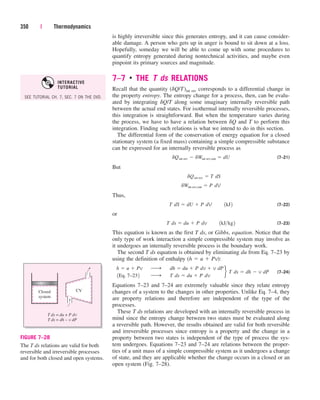
Entropy (from a classical thermodynamics point of view) is a property designated S and
is defined as dS =(δQ/T)int rev.
Entropy (from a statistical thermodynamics point of view) can be viewed as a measure
of molecular disorder, or molecular randomness. The entropy of a system is related to the
total number of possible microscopic states of that system, called thermodynamic
probability p, by the Boltzmann relation, expressed as S = k ln p where k is the
Boltzmann constant.
Entropy balance for any system (including reacting systems) undergoing any process
can be expressed as net entropy transfer entropy by heat and mass plus entropy
generation equals the change in entropy.
15
Glossary
to accompany
Thermodynamics: An Engineering Approach, 5th
edition
by Yunus A. Çengel and Michael A. Boles
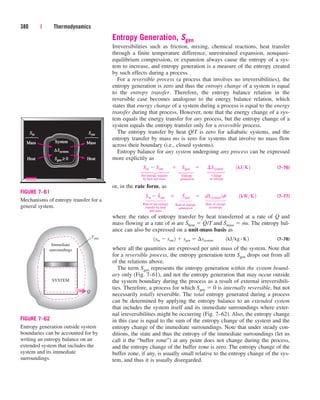
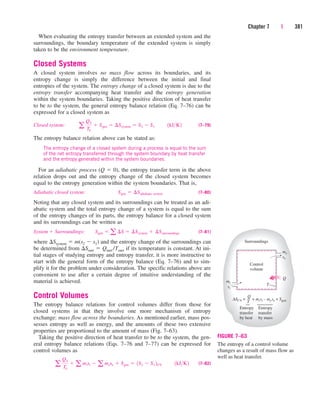
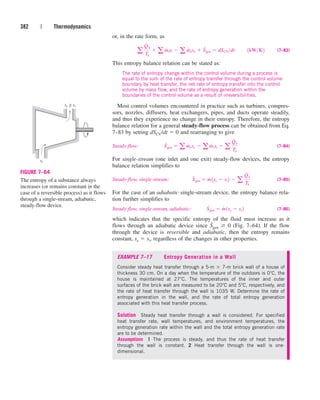
Entropy balance relation for a control volume states that the rate of entropy change
within the control volume during a process is equal to the sum of the rate of entropy
transfer through the control volume boundary by heat transfer, the net rate of entropy
transfer into the control volume by mass flow, and the rate of entropy generation within
the boundaries of the control volume as a result of irreversibilities.
Entropy balance relation in general is stated as the entropy change of a system during a
process is equal to the net entropy transfer through the system boundary and the entropy
generated within the system as a result of irreversibilities.
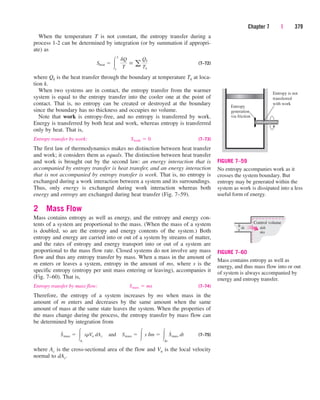
Entropy change of a closed system is due to the entropy transfer accompanying heat
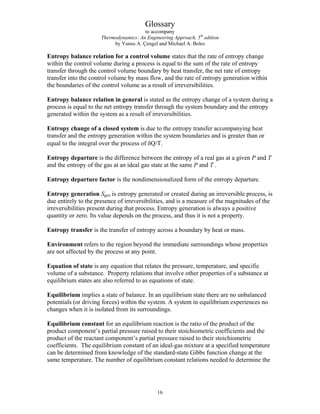
transfer and the entropy generation within the system boundaries and is greater than or
equal to the integral over the process of δQ/T.
Entropy departure is the difference between the entropy of a real gas at a given P and T
and the entropy of the gas at an ideal gas state at the same P and T .
Entropy departure factor is the nondimensionalized form of the entropy departure.
Entropy generation Sgen is entropy generated or created during an irreversible process, is
due entirely to the presence of irreversibilities, and is a measure of the magnitudes of the
irreversibilities present during that process. Entropy generation is always a positive
quantity or zero. Its value depends on the process, and thus it is not a property.
Entropy transfer is the transfer of entropy across a boundary by heat or mass.
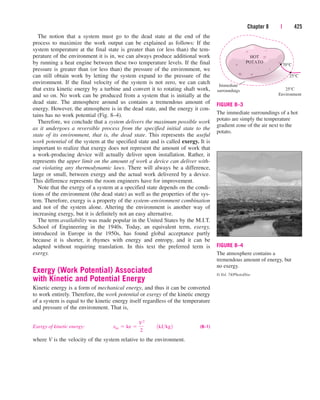
Environment refers to the region beyond the immediate surroundings whose properties
are not affected by the process at any point.
Equation of state is any equation that relates the pressure, temperature, and specific
volume of a substance. Property relations that involve other properties of a substance at
equilibrium states are also referred to as equations of state.
Equilibrium implies a state of balance. In an equilibrium state there are no unbalanced
potentials (or driving forces) within the system. A system in equilibrium experiences no
changes when it is isolated from its surroundings.
Equilibrium constant for an equilibrium reaction is the ratio of the product of the
product component’s partial pressure raised to their stoichiometric coefficients and the
product of the reactant component’s partial pressure raised to their stoichiometric
coefficients. The equilibrium constant of an ideal-gas mixture at a specified temperature
can be determined from knowledge of the standard-state Gibbs function change at the
same temperature. The number of equilibrium constant relations needed to determine the
16
Glossary
to accompany
Thermodynamics: An Engineering Approach, 5th
edition
by Yunus A. Çengel and Michael A. Boles
equilibrium composition of a reacting mixture is equal to the number of chemical species
minus the number of elements present in equilibrium.
Equivalence ratio is the ratio of the actual fuel–air ratio to the stoichiometric fuel–air
ratio.
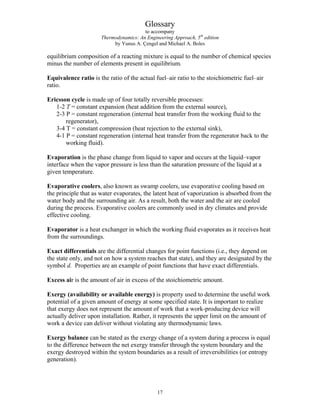
Ericsson cycle is made up of four totally reversible processes:
1-2 T = constant expansion (heat addition from the external source),
2-3 P = constant regeneration (internal heat transfer from the working fluid to the
regenerator),
3-4 T = constant compression (heat rejection to the external sink),
4-1 P = constant regeneration (internal heat transfer from the regenerator back to the
working fluid).
Evaporation is the phase change from liquid to vapor and occurs at the liquid–vapor
interface when the vapor pressure is less than the saturation pressure of the liquid at a
given temperature.
Evaporative coolers, also known as swamp coolers, use evaporative cooling based on
the principle that as water evaporates, the latent heat of vaporization is absorbed from the
water body and the surrounding air. As a result, both the water and the air are cooled
during the process. Evaporative coolers are commonly used in dry climates and provide
effective cooling.
Evaporator is a heat exchanger in which the working fluid evaporates as it receives heat
from the surroundings.
Exact differentials are the differential changes for point functions (i.e., they depend on
the state only, and not on how a system reaches that state), and they are designated by the
symbol d. Properties are an example of point functions that have exact differentials.
Excess air is the amount of air in excess of the stoichiometric amount.
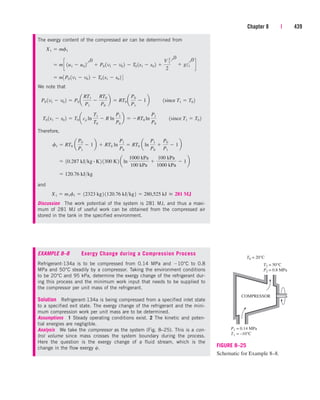
Exergy (availability or available energy) is property used to determine the useful work
potential of a given amount of energy at some specified state. It is important to realize
that exergy does not represent the amount of work that a work-producing device will
actually deliver upon installation. Rather, it represents the upper limit on the amount of
work a device can deliver without violating any thermodynamic laws.
Exergy balance can be stated as the exergy change of a system during a process is equal
to the difference between the net exergy transfer through the system boundary and the
exergy destroyed within the system boundaries as a result of irreversibilities (or entropy
generation).
17
Glossary
to accompany
Thermodynamics: An Engineering Approach, 5th
edition
by Yunus A. Çengel and Michael A. Boles
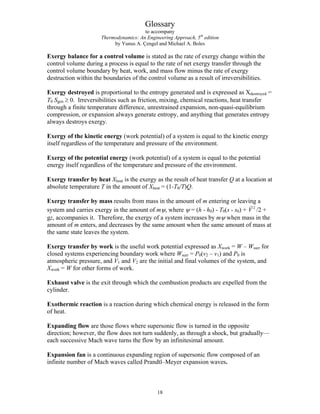
Exergy balance for a control volume is stated as the rate of exergy change within the
control volume during a process is equal to the rate of net exergy transfer through the
control volume boundary by heat, work, and mass flow minus the rate of exergy
destruction within the boundaries of the control volume as a result of irreversibilities.
Exergy destroyed is proportional to the entropy generated and is expressed as Xdestroyed =
T0 Sgen ≥ 0. Irreversibilities such as friction, mixing, chemical reactions, heat transfer
through a finite temperature difference, unrestrained expansion, non-quasi-equilibrium
compression, or expansion always generate entropy, and anything that generates entropy
always destroys exergy.
Exergy of the kinetic energy (work potential) of a system is equal to the kinetic energy
itself regardless of the temperature and pressure of the environment.
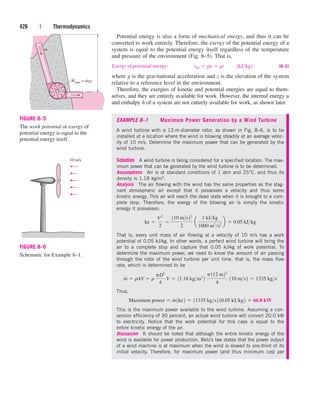
Exergy of the potential energy (work potential) of a system is equal to the potential
energy itself regardless of the temperature and pressure of the environment.
Exergy transfer by heat Xheat is the exergy as the result of heat transfer Q at a location at
absolute temperature T in the amount of Xheat = (1-T0/T)Q.
Exergy transfer by mass results from mass in the amount of m entering or leaving a
system and carries exergy in the amount of mψ, where ψ = (h - h0) - T0(s - s0) + /2 +
gz, accompanies it. Therefore, the exergy of a system increases by mψ when mass in the
amount of m enters, and decreases by the same amount when the same amount of mass at
the same state leaves the system.
2
V
G
Exergy transfer by work is the useful work potential expressed as Xwork = W – Wsurr for
closed systems experiencing boundary work where Wsurr = P0(v2 – v1) and P0 is
atmospheric pressure, and V1 and V2 are the initial and final volumes of the system, and
Xwork = W for other forms of work.
Exhaust valve is the exit through which the combustion products are expelled from the
cylinder.
Exothermic reaction is a reaction during which chemical energy is released in the form
of heat.
Expanding flow are those flows where supersonic flow is turned in the opposite
direction; however, the flow does not turn suddenly, as through a shock, but gradually—
each successive Mach wave turns the flow by an infinitesimal amount.
Expansion fan is a continuous expanding region of supersonic flow composed of an
infinite number of Mach waves called Prandtl–Meyer expansion waves.
18
Glossary
to accompany
Thermodynamics: An Engineering Approach, 5th
edition
by Yunus A. Çengel and Michael A. Boles
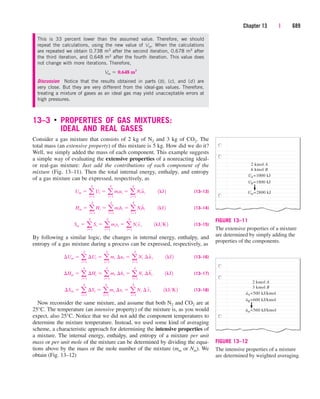
Extensive properties are those whose values depend on the size—or extent—of the
system. Mass m, volume V, and total energy E are some examples of extensive properties.
Extensive properties of a nonreacting ideal-or real-gas mixture are obtained by just
adding the contributions of each component of the mixture.
External combustion engines are engines in which the fuel is burned outside the system
boundary.
Externally reversible process has no irreversibilities to occur outside the system
boundaries during the process. Heat transfer between a reservoir and a system is an
externally reversible process if the surface of contact between the system and the
reservoir is at the temperature of the reservoir.
Fahrenheit scale (named after the German instrument maker
G. Fahrenheit, 1686–1736) is the temperature scale in the English system. On the
Fahrenheit scale, the ice and steam points are assigned 32 and 212 °F.
Fan is a device that increases the pressure of a gas slightly (typical pressure ratios are
less than 3) and is mainly used to mobilize a gas.
Fan-jet engine (see turbofan engine)
Fanno line is the locus of all states for frictionless adiabatic flow in a constant-area duct
plotted on an h-s diagram. These states have the same value of stagnation enthalpy and
mass flux (mass flow per unit area).
Feedwater heater is the device where the feedwater is heated by regeneration. This
technique is used to raise the temperature of the liquid leaving the pump (called the
feedwater) before it enters the boiler. A practical regeneration process in steam power
plants is accomplished by extracting, or “bleeding,” steam from the turbine at various
points. This steam, which could have produced more work by expanding further in the
turbine, is used to heat the feedwater instead.
First law (see first law of thermodynamics)
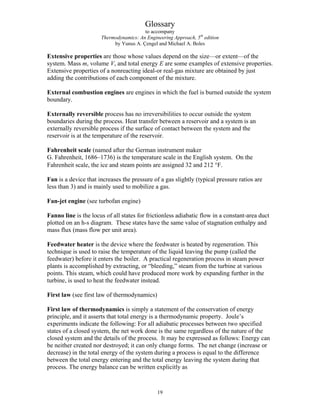
First law of thermodynamics is simply a statement of the conservation of energy
principle, and it asserts that total energy is a thermodynamic property. Joule’s
experiments indicate the following: For all adiabatic processes between two specified
states of a closed system, the net work done is the same regardless of the nature of the
closed system and the details of the process. It may be expressed as follows: Energy can
be neither created nor destroyed; it can only change forms. The net change (increase or
decrease) in the total energy of the system during a process is equal to the difference
between the total energy entering and the total energy leaving the system during that
process. The energy balance can be written explicitly as
19
Glossary
to accompany
Thermodynamics: An Engineering Approach, 5th
edition
by Yunus A. Çengel and Michael A. Boles
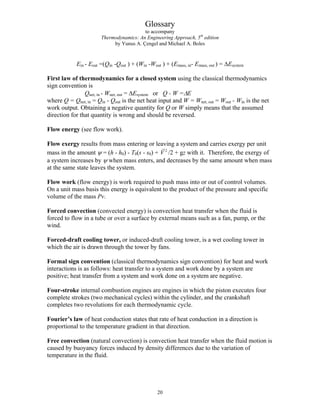
Ein - Eout =(Qin -Qout ) + (Win -Wout ) + (Emass, in- Emass, out ) = ΔEsystem
First law of thermodynamics for a closed system using the classical thermodynamics
sign convention is
Qnet, in - Wnet, out = ΔEsystem or Q - W =ΔE
where Q = Qnet, in = Qin - Qout is the net heat input and W = Wnet, out = Wout - Win is the net
work output. Obtaining a negative quantity for Q or W simply means that the assumed
direction for that quantity is wrong and should be reversed.
Flow energy (see flow work).
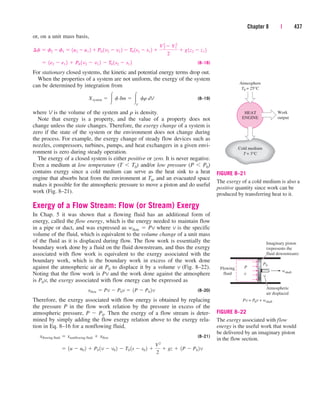
Flow exergy results from mass entering or leaving a system and carries exergy per unit
mass in the amount ψ = (h - h0) - T0(s - s0) + 2
V
G
/2 + gz with it. Therefore, the exergy of
a system increases by ψ when mass enters, and decreases by the same amount when mass
at the same state leaves the system.
Flow work (flow energy) is work required to push mass into or out of control volumes.
On a unit mass basis this energy is equivalent to the product of the pressure and specific
volume of the mass Pv.
Forced convection (convected energy) is convection heat transfer when the fluid is
forced to flow in a tube or over a surface by external means such as a fan, pump, or the
wind.
Forced-draft cooling tower, or induced-draft cooling tower, is a wet cooling tower in
which the air is drawn through the tower by fans.
Formal sign convention (classical thermodynamics sign convention) for heat and work
interactions is as follows: heat transfer to a system and work done by a system are
positive; heat transfer from a system and work done on a system are negative.
Four-stroke internal combustion engines are engines in which the piston executes four
complete strokes (two mechanical cycles) within the cylinder, and the crankshaft
completes two revolutions for each thermodynamic cycle.
Fourier’s law of heat conduction states that rate of heat conduction in a direction is
proportional to the temperature gradient in that direction.
Free convection (natural convection) is convection heat transfer when the fluid motion is
caused by buoyancy forces induced by density differences due to the variation of
temperature in the fluid.
20
Glossary
to accompany
Thermodynamics: An Engineering Approach, 5th
edition
by Yunus A. Çengel and Michael A. Boles
Friction is a familiar form of irreversibility associated with bodies in motion which
results from the force that opposes the motion developed at the interface of the two
bodies in contact when the two bodies are forced to move relative to each other.
Frosting, which occurs in humid climates when the temperature falls below 2 to 5°C, is
the major problem with air-source systems. The frost accumulation on the evaporator
coils is highly undesirable since it seriously disrupts heat transfer. The coils can be
defrosted, however, by reversing the heat pump cycle (running it as an air conditioner).
This results in a reduction in the efficiency of the system.
Fuel is any material that can be burned to release energy.
Fuel–air ratio is the reciprocal of air–fuel ratio.
Fuel cells operate on the principle of electrolytic cells in which the chemical energy of
the fuel is directly converted to electric energy, and electrons are exchanged through
conductor wires connected to a load. Fuel cells are not heat engines, and thus their
efficiencies are not limited by the Carnot efficiency. They convert chemical energy to
electric energy essentially in an isothermal manner.
Fundamental dimensions (see primary dimensions)
Gage pressure is the difference between the absolute pressure and the local atmospheric
pressure.
Gas constant R is different for each gas and is determined from R = Ru/M.
Gas phase of a substance has molecules that are far apart from each other, and a
molecular order is nonexistent. Gas molecules move about at random, continually
colliding with each other and the walls of the container they are in.
Gas power cycles are cycles where the working fluid remains a gas throughout the entire
cycle. Spark-ignition automobile engines, diesel engines, and conventional gas turbines
are familiar examples of devices that operate on gas cycles.
Gas refrigeration cycle is based on the reversed Brayton cycle where the compressor
exit gases are cooled and then expanded in a turbine to further reduce the temperature of
the working fluid. The lower-temperature fluid is used to produce the refrigeration
effect.
Generalized compressibility chart shows that by curve-fitting all the data, gases seem
to obey the principle of corresponding states reasonably well.
21
Glossary
to accompany
Thermodynamics: An Engineering Approach, 5th
edition
by Yunus A. Çengel and Michael A. Boles
Generalized enthalpy departure chart is a plot of the enthalpy departure factor as a
function of reduced pressure and reduced temperature. It is used to determine the
deviation of the enthalpy of a gas at a given P and T from the enthalpy of an ideal gas at
the same T.
Generalized entropy departure chart is a plot of the entropy departure factor as a
function of reduced pressure and reduced temperature. It is used to determine the
deviation of the entropy of a gas at a given P and T from the entropy of an ideal gas at the
same P and T.
Generator efficiency is defined as the ratio of the electrical power output to the
mechanical power input to a generator.
Geothermal heat pumps (also called ground-source heat pumps) use the ground as the
heat source.
Gibbs–Dalton law, an extension of Dalton’s law of additive pressures, states that under
the ideal-gas approximation, the properties of a gas in a mixture are not influenced by the
presence of other gases, and each gas component in the mixture behaves as if it exists
alone at the mixture temperature and mixture volume.
Gibbs function is defined as the enthalpy minus the product of the temperature and
entropy (G = H - TS).
Gibbs phase rule provides the number of independent variables associated with a
multicomponent, multiphase system.
Gravimetric analysis is one way to describe the composition of a mixture that is
accomplished by specifying the mass of each component.
Gravitational acceleration g is 9.807 m/s2
at sea level and varies by less than 1 percent
up to 30,000 m. Therefore, g can be assumed to be constant at 9.81 m/s2
.
Greenhouse effect is the heating effect causing the increase in temperature of the earth’s
atmosphere as the result of solar radiation entering the earth’s atmosphere during the day,
but heat radiated by the earth at night is blocked by gases such as carbon dioxide and
trace amounts of methane, nitrogen oxides and other gases.
Gobal climate change (see global warming).
Global warming (global climate change) is the undesirable consequence of the
greenhouse effect.
Heat (see heat transfer).
22
Glossary
to accompany
Thermodynamics: An Engineering Approach, 5th
edition
by Yunus A. Çengel and Michael A. Boles
Heat-driven systems are refrigeration systems whose energy input is based on heat
transfer from an external source. Absorption refrigeration systems are often classified as
heat-driven systems.
Heat engines are devices designed for the purpose of converting other forms of energy
(usually in the form of heat) to work. Heat engines differ considerably from one another,
but all can be characterized by the following:
1. They receive heat from a high-temperature source (solar energy, oil furnace,
nuclear reactor, etc.).
2. They convert part of this heat to work (usually in the form of a rotating shaft).
3. They reject the remaining waste heat to a low-temperature sink (the atmosphere,
rivers, etc.).
4. They operate on a cycle.
Heat exchangers are devices where two moving fluid streams exchange heat without
mixing. Heat exchangers are widely used in various industries, and they come in various
designs. The simplest form of a heat exchanger is a double-tube (also called tube-and-
shell) heat exchanger composed of two concentric pipes of different diameters. One fluid
flows in the inner pipe, and the other in the annular space between the two pipes. Heat is
transferred from the hot fluid to the cold one through the wall separating them.
Sometimes the inner tube makes a couple of turns inside the shell to increase the heat
transfer area, and thus the rate of heat transfer.
Heat pump is a cyclic device which operates on the refrigeration cycle and discharges
energy to a heated space to maintain the heated space at a high temperature. It is a cyclic
device which causes the transfer of heat from a low-temperature region to a high-
temperature region.
Heat pump coefficient of performance is the efficiency of a heat pump, denoted by
COPHP, and expressed as desired output divided by required input or COPHP = QH/Wnet,
in.
Heat rate is the expression of the conversion efficiency of power plants in the United
States and is the amount of heat supplied, in Btu’s, to generate 1 kWh of electricity. The
smaller the heat rate, the greater the efficiency.
Heat reservoir is a thermal energy reservoir since it can supply or absorb energy in the
form of heat.
Heat sink is a heat reservoir that absorbs energy in the form of heat.
Heat source is a heat reservoir that supplies energy in the form of heat.
23
Glossary
to accompany
Thermodynamics: An Engineering Approach, 5th
edition
by Yunus A. Çengel and Michael A. Boles
Heat transfer (heat) is defined as the form of energy that is transferred between two
systems (or a system and its surroundings) by virtue of a temperature difference. It is the
area under the process curve on a T-S diagram during an internally reversible process;
however, this area has no meaning for irreversible processes.
Heating value of a fuel is defined as the amount of heat released when a fuel is burned
completely in a steady-flow process and the products are returned to the state of the
reactants. In other words, the heating value of a fuel is equal to the absolute value of the
enthalpy of combustion of the fuel.
Helmholtz function a is defined as a = u – Ts.
Henry’s constant is the product of the total pressure of the gas mixture and the mole
fraction of a specie in the liquid phase.
Henry’s law states that the mole fraction of a weakly soluble gas in the liquid is equal to
the partial pressure of the gas outside the liquid divided by Henry’s constant.
Higher Heating value HHV of fuel is the amount of heat released when a specified
amount of fuel (usually a unit of mass) at room temperature is completely burned and the
combustion products are cooled to the room temperature when the water formed during
the combustion process is completely condensed and leaves as a liquid.
Humidity ratio (see absolute humidity)
Humidifying is the process of adding moisture to atmospheric air.
Hydrocarbon fuels are the most familiar fuels and consist primarily of hydrogen and
carbon. They are denoted by the general formula CnHm. Hydrocarbon fuels exist in all
phases, some examples being coal, gasoline, and natural gas.
Hypersonic flow occurs when a flow has a Mach number M  1.
Ideal cycle is an actual cycle stripped of all the internal irreversibilities and complexities.
The ideal cycle resembles the actual cycle closely but is made up totally of internally
reversible processes.
Ideal gas is a gas that obeys the ideal-gas equation of state.
Ideal-gas equation of state (or ideal-gas relation) predicts the P-v-T behavior of a gas
quite accurately within some properly selected region where Pv = RT.
Ideal gas specific heat relation is Cp = Cv + R.
24
Glossary
to accompany
Thermodynamics: An Engineering Approach, 5th
edition
by Yunus A. Çengel and Michael A. Boles
Ideal gas temperature scale is a temperature scale that turns out to be identical to the
Kelvin scale. The temperatures on this scale are measured using a constant-volume gas
thermometer, which is basically a rigid vessel filled with a gas, usually hydrogen or
helium, at low pressure. The temperature of a gas is proportional to its pressure at
constant volume.
Ideal mixture or ideal solution is a mixture where the effect of dissimilar molecules in a
mixture on each other is negligible and the chemical potential of a component in such a
mixture is simply taken to be the Gibbs function of the pure component.
Ideal vapor-compression refrigeration cycle completely vaporizes the refrigerant
before it is compressed and expands the refrigerant with a throttling device, such as an
expansion valve or capillary tube. The vapor-compression refrigeration cycle is the most
widely used cycle for refrigerators, air-conditioning systems, and heat pumps. It consists
of four processes:
1-2 Isentropic compression in a compressor,
2-3 Constant-pressure heat rejection in a condenser,
3-4 Throttling in an expansion device,
4-1 Constant-pressure heat absorption in an evaporator.
Ignition temperature is the minimum temperature to which a fuel must be brought to
start the combustion.
Immediate surroundings refer to the portion of the surroundings that is affected by the
process.
Incomplete combustion is a combustion process in which the combustion products
contain any unburned fuel or components such as C, H2, CO, or OH.
Incompressible substances, such as liquids and solids, have densities (or specific
volumes) that have negligible variation with pressure.
Increase of entropy principle (see second law of thermodynamics)
Independent properties exist when one property can be varied while another property is
held constant.
Inert gas is a gaseous component in a chemical reaction that does not react chemically
with the other components. The presence of inert gases affects the equilibrium
composition (although it does not affect the equilibrium constant).
Inexact differentials are the differential amount of change for path functions and are
designated by the symbol δ. Therefore, since heat and work are path functions, a
25
Glossary
to accompany
Thermodynamics: An Engineering Approach, 5th
edition
by Yunus A. Çengel and Michael A. Boles
1
differential amount of heat or work is represented by δQ or δW, respectively, instead of
dQ or dW.
Intake valve is an inlet through which the air or air–fuel mixture is drawn into the
cylinder.
Intensive properties are those that are independent of the size of a system, such as
temperature, pressure, and density. Intensive properties of a nonreacting ideal-or real-gas
mixture are obtained by dividing the extensive properties by the mass or the mole number
of the mixture in the gas mixture. The internal energy, enthalpy, and entropy of a gas
mixture per unit mass or per unit mole of the mixture can be determined by summing the
products of the mass fractions and the specific property or summing the products of the
mole fractions and the molar specific property. That is, the intensive properties of a gas
mixture are determined by either a mass weighted or a mole weighted average of the
properties.
Intercooling is a technique used to reduce the compression work for the gas turbine
cycle. The compression process is completed in stages while cooling the working fluid
between stages. Since the steady-flow compression work is proportional to the specific
volume of the flow, the specific volume of the working fluid should be as low as possible
during a compression process.
Internal combustion engines are engines where the energy is provided by burning a fuel
within the system boundaries.
Internal energy U of a system is the sum of all the microscopic forms of energy.
Internal energy change of an ideal gas is given as v v, av 2
( ) ( )
u C T dT C T T
Δ = ≅ −
∫ .
Internally reversible process has no irreversibilities that occur within the boundaries of
the system during the process. During an internally reversible process, a system proceeds
through a series of equilibrium states, and when the process is reversed, the system passes
through exactly the same equilibrium states while returning to its initial state.
Inversion line is the line that passes through the points of zero slope of constant-enthalpy
lines or zero Joule-Thomson coefficient on the T-P diagram. The slopes of the h =
constant lines are negative (μJT  0) at states to the right of the inversion line and positive
(μJT  0) to the left of the inversion line.
Inversion temperature is the temperature at a point where a constant-enthalpy line
intersects the inversion line.
Irreversible processes are processes which, once having taken place in a system, cannot
spontaneously reverse themselves and restore the system to its initial state.
26
Glossary
to accompany
Thermodynamics: An Engineering Approach, 5th
edition
by Yunus A. Çengel and Michael A. Boles
Irreversibilities are the factors that cause a process to be irreversible. They include
friction, unrestrained expansion, mixing of two gases, heat transfer across a finite
temperature difference, electric resistance, inelastic deformation of solids, and chemical
reactions.
Irreversibility I is any difference between the reversible work Wrev and the useful work
Wu due to the irreversibilities present during the process. Irreversibility can be viewed as
the wasted work potential or the lost opportunity to do work.
Isentropic efficiency of a compressor is defined as the ratio of the work input required
to raise the pressure of a gas to a specified value in an isentropic manner to the actual
work input.
Isentropic efficiency of a nozzle is defined as the ratio of the actual kinetic energy of the
fluid at the nozzle exit to the kinetic energy value at the exit of an isentropic nozzle for
the same inlet state and exit pressure.
Isentropic efficiency of a turbine is defined as the ratio of the actual work output of the
turbine to the work output that would be achieved if the process between the inlet state
and the exit pressure were isentropic.
Isentropic process is an internally reversible and adiabatic process. In such a process
the entropy remains constant.
Isentropic stagnation state is the stagnation state when the stagnation process is
reversible as well as adiabatic (i.e., isentropic). The entropy of a fluid remains constant
during an isentropic stagnation process.
Iso- prefix is often used to designate a process for which a particular property remains
constant.
Isobaric process is a process during which the pressure P remains constant.
Isochoric process (isometric process) is a process during which the specific volume v
remains constant.
Isolated system is a closed system in which energy is not allowed to cross the boundary.
Isometric process (see isochoric process).
Isothermal compressibility relates how volume changes when pressure changes as
temperature is held constant.
27
Glossary
to accompany
Thermodynamics: An Engineering Approach, 5th
edition
by Yunus A. Çengel and Michael A. Boles
Isothermal efficiency of a compressor is defined as the ratio of the work input to a
compressor for the reversible isothermal case and the work input to a compressor for the
actual case.
Isothermal process is a process in which the temperature is maintained constant.
Jet-propulsion cycle is the cycle used in aircraft gas turbines. The ideal jet-propulsion
cycle differs from the simple ideal Brayton cycle in that the gases are not expanded to the
ambient pressure in the turbine. Instead, they are expanded to a pressure such that the
power produced by the turbine is just sufficient to drive the compressor and the auxiliary
equipment. The gases that exit the turbine at a relatively high pressure are subsequently
accelerated in a nozzle to provide the thrust to propel the aircraft.
Joule (J) is a unit of energy and has the unit “newton-meter (N·m).”
Joule-Thomson coefficient μJT is a measure of the change in temperature with pressure
during a constant-enthalpy process.
Kay’s rule, proposed by W. B. Kay in 1936, predicts the P-v-T behavior of a gas mixture
by determining the compressibility factor for a gas mixture at the reduced pressure and
reduced temperature defined in terms of the pseudocritical pressure (the sum of the
products of the mole fraction and critical pressure of each component) and pseudocritical
temperature (the sum of the products of the mole fraction and critical temperature of each
component).
kelvin is the temperature unit of the Kelvin scale in the SI.
Kelvin-Planck statement of the second law of thermodynamics is expressed as
follows: It is impossible for any device that operates on a cycle to receive heat from a
single reservoir and produce a net amount of work. This statement can also be expressed
as no heat engine can have a thermal efficiency of 100 percent, or as for a power plant to
operate, the working fluid must exchange heat with the environment as well as the
furnace.
Kelvin scale is the thermodynamic temperature scale in the SI and is named after Lord
Kelvin (1824–1907). The temperature unit on this scale is the kelvin, which is designated
by K (not °K; the degree symbol was officially dropped from kelvin in 1967). The lowest
temperature on the Kelvin scale is 0 K.
Kilojoule (1 kJ) is 1000 joules.
Kilopascal (kPa) is the unit of pressure equal to 1000 pascal or 1000 N/m2
.
28
Glossary
to accompany
Thermodynamics: An Engineering Approach, 5th
edition
by Yunus A. Çengel and Michael A. Boles
Kinetic energy KE is energy that a system possesses as a result of its motion relative to
some reference frame. When all parts of a system move with the same velocity, the
kinetic energy is expressed as KE = m V2
/2.
Kinetic theory treats molecules as tiny balls that are in motion and thus possess kinetic
energy. Heat is then defined as the energy associated with the random motion of atoms
and molecules.
Kirchhoff’s law is defined for radiation that the emissivity and the absorptivity of a
surface are equal at the same temperature and wavelength.
Knock, or engine knock, is the audible noise occurring in the engine because of
autoignition, the premature ignition of the fuel.
Latent energy is the internal energy associated with the phase of a system.
Latent heat is the amount of energy absorbed or released during a phase-change process.
Latent heat of fusion is the amount of energy absorbed during melting and is equivalent
to the amount of energy released during freezing.
Latent heat of vaporization is the amount of energy absorbed during vaporization and is
equivalent to the energy released during condensation.
Laval nozzles (see converging–diverging nozzles)
Lighting efficacy is defined as the ratio of the amount of light output by lighting devices
in lumens of light output to the electrical energy input in W.
Liquefied petroleum gas LPG is a byproduct of natural gas processing or crude oil
refining. It consists mainly of propane (over 90 percent), and thus LPG is usually referred
to as propane. However, it also contains varying amounts of butane, propylene, and
butylenes.
Liquid phase has a molecular spacing not much different from that of the solid phase,
except the molecules are no longer at fixed positions relative to each other. In a liquid,
chunks of molecules float about each other; however, the molecules maintain an orderly
structure within each chunk and retain their original positions with respect to one another.
The distances between molecules generally experience a slight increase as a solid turns
liquid, with water being a rare exception.
Liquid–vapor saturation curve is a plot of saturation temperature Tsat versus saturation
pressure Psat.
29
Glossary
to accompany
Thermodynamics: An Engineering Approach, 5th
edition
by Yunus A. Çengel and Michael A. Boles
Lower heating value LHV of fuel is the amount of heat released when a specified
amount of fuel (usually a unit of mass) at room temperature is completely burned, and the
combustion products are cooled to the room temperature when the water formed during
the combustion process leaves as a vapor.
Mach angle is the shock angle for Mach waves and is a unique function of the Mach
number.
Mach number, named after the Austrian physicist Ernst Mach (1838–1916), is the ratio
of the actual velocity of the fluid (or an object in still air) to the speed of sound in the
same fluid at the same state.
Mach wave is the weakest possible oblique shock at a Mach number.
Macroscopic forms of energy are those a system possesses as a whole with respect to
some outside reference frame, such as kinetic and potential energies.
Magnetic work is the product of the generalized force as the magnetic field strength
and the generalized displacement as the total magnetic dipole moment.
Manometer is a device based on the principle that an elevation change of Δz of a fluid
corresponds to a pressure change of ΔP/ ρg, which suggests that a fluid column can be
used to measure pressure differences. The manometer is commonly used to measure
small and moderate pressure differences.
Mass fraction is the ratio of the mass of one component in a mixture to the total mass of
the mixture.
Mass flow rate is the amount of mass flowing through a cross section per unit time.
Mass of a system is equal to the product of its molar mass M and the mole number N.
Maximum inversion temperature is the temperature at the intersection of the P= 0 line
(ordinate) on the T-P diagram and the upper part of the inversion line.
Maxwell relations are equations that relate the partial derivatives of properties P, v, T,
and s of a simple compressible system to each other.
Mayer relation, named in honor of the German physician and physicist J. R. Mayer
(1814–1878, shows how the difference between the constant-pressure specific heat and
constant-volume specific heat is related to the specific volume, temperature, isothermal
compressibility, and volume expansivity.
30
Glossary
to accompany
Thermodynamics: An Engineering Approach, 5th
edition
by Yunus A. Çengel and Michael A. Boles
Mean effective pressure MEP is a fictitious pressure that, if it acted on the piston during
the entire power stroke, would produce the same amount of net work as that produced
during the actual cycle. The mean effective pressure can be used as a parameter to
compare the performances of reciprocating engines of equal size. The engine with a
larger value of MEP will deliver more net work per cycle and thus will perform better.
Mechanical efficiency of a device or process is the ratio of the mechanical energy output
to the mechanical energy input.
Mechanical energy is the form of energy that can be converted to mechanical work
completely and directly by an ideal mechanical device such as an ideal turbine.
Mechanical equilibrium is related to pressure, and a system is in mechanical
equilibrium if there is no change in pressure at any point of the system with time.
Mechanical work is work associated a force acting in the direction of motion that causes
the movement of the boundary of a system or the movement of the entire system as a
whole
Mechanisms of entropy transfer Sin and Sout are heat transfer and mass flow. Entropy
transfer is recognized at the system boundary as it crosses the boundary, and it represents
the entropy gained or lost by a system during a process. The only form of entropy
interaction associated with a fixed mass or closed system is heat transfer, and thus the
entropy transfer for an adiabatic closed system is zero.
Megapascal MPa is the unit of pressure equal to 106
pascal.
Melting line separates the solid and liquid regions on the phase diagram.
Metabolism is the thousands of chemical reactions that occur every second in the cells of
a body during which some molecules are broken down and energy is released and some
new molecules are formed. This high level of chemical activity in the cells maintains the
human body at a temperature of 37°C while performing the necessary bodily tasks.
Methane, CH4, is the approximation to gaseous hydrocarbon fuel natural gas that is a
mixture of methane and smaller amounts of other gases.
Methyl alcohol, CH3OH, is a common liquid hydrocarbon fuel that is also called
methanol and is used in some gasoline blends.
Metric SI (from Le Système International d’ Unités), which is also known as the
International System, is based on six fundamental dimensions. Their units, adopted in
1954 at the Tenth General Conference of Weights and Measures, are: meter (m) for
length, kilogram (kg) for mass, second (s) for time, ampere (A) for electric current,
31
Glossary
to accompany
Thermodynamics: An Engineering Approach, 5th
edition
by Yunus A. Çengel and Michael A. Boles
degree Kelvin (K) for temperature, candela (cd) for luminous intensity (amount of light),
and mole (mol) for the amount of matter.
Microscopic forms of energy are those related to the molecular structure of a system and
the degree of the molecular activity, and they are independent of outside reference
frames.
Mixing chamber is the section of a control volume where the mixing process takes place
for two or more streams of fluids. The mixing chamber does not have to be a distinct
“chamber.’’ Mixing chambers are sometimes classified as direct-contact heat exchangers.
Molar analysis is one way to describe the composition of a mixture that is accomplished
by specifying the number of moles of each component.
Molar mass M can simply be defined as the mass of one mole (also called a gram-mole,
abbreviated gmol) of a substance in grams, or the mass of one kmol (also called a
kilogram-mole, abbreviated kgmol) in kilograms. In English units, it is the mass of 1
lbmol in lbm. Notice that the molar mass of a substance has the same numerical value in
both unit systems because of the way it is defined.
Mole fraction is the ratio of the number of moles of one component in a mixture to the
total moles of the mixture. Note that for an ideal-gas mixture, the mole fraction, the
pressure fraction, and the volume fraction of a component are identical.
Mollier diagram, after the German scientist R. Mollier (1863–1935), is the plot of
property data on the h-s diagram. The Mollier diagram is useful when solving isentropic,
steady flow process problems dealing with nozzles, turbines, and compressors.
Motor efficiency is defined as the ratio of the mechanical energy output of a motor to the
electrical energy input.
Moving boundary work (see boundary work)
Multistage compression refrigeration system is a cascade refrigeration system where
the fluid used throughout the cascade refrigeration system is the same, and the heat
exchanger between the stages is replaced by a device that has better heat-transfer
characteristics, a mixing chamber (called a flash chamber).
Multistage compression with intercooling requires the compression process in a
compressor to be carried out in stages and to cool the gas in between each stage such that
the work required to compress a gas between two specified pressures can be decreased.
32
Glossary
to accompany
Thermodynamics: An Engineering Approach, 5th
edition
by Yunus A. Çengel and Michael A. Boles
Multistage expansion with reheating requires the expansion process in a turbine be
carried out in stages and reheating the gas between the stages such that the work output of
a turbine operating between two pressure levels can be increased.
Natural convection (see free convection)
Natural-draft cooling tower uses the naturally occurring density gradients between the
inside air-water vapor mixture and the outside air which create an airflow from the
bottom to the top of a wet cooling tower.
Natural gas is produced from gas wells or oil wells rich in natural gas. It is composed
mainly of methane, but it also contains small amounts of ethane, propane, hydrogen,
helium, carbon dioxide, nitrogen, hydrogen sulfate, and water vapor. It is stored either in
the gas phase at pressures of 150 to 250 atm as CNG (compressed natural gas) or in the
liquid phase at 162°C as LNG (liquefied natural gas).
Newton (N), in SI, is the force unit defined as the force required to accelerate a mass of 1
kg at a rate of 1 m/s2
.
Newton’s law of cooling defines the heat transfer by convection as the product of the
convection heat transfer coefficient, heat transfer area, and the difference between the
heat transfer surface temperature and the fluid bulk temperature away from the surface.
Nonflow system exergy (see closed system exergy)
Nonreacting gas mixture is a mixture of gases not undergoing a chemical reaction and
can be treated as a pure substance since it is usually a homogeneous mixture of different
gases.
Normal components are components that are perpendicular to the quantity in question.
Normal shock wave is a shock wave resulting in an abrupt change over a very thin
section normal to the direction of flow.
Nozzle is a device that increases the velocity of a fluid at the expense of decreasing
pressure.
Nuclear energy is the tremendous amount of energy associated with the strong bonds
within the nucleus of the atom itself.
Oblique shock is a complicated shock pattern consisting of inclined shock waves in
which some portions of an oblique shock are curved, while other portions are straight.
Octane, C8H18, is a common liquid fuel that approximates gasoline.
33
Glossary
to accompany
Thermodynamics: An Engineering Approach, 5th
edition
by Yunus A. Çengel and Michael A. Boles
Octane rating of a fuel is a measure of the engine knock resistance of a fuel.
Open (or direct-contact) feedwater heater is basically a mixing chamber, where the
steam extracted from the turbine mixes with the feedwater exiting the pump. Ideally, the
mixture leaves the heater as a saturated liquid at the heater pressure.
Open system is any arbitrary region in space through which mass and energy can pass
across the boundary.
Orsat gas analyzer is a commonly used device to analyze the composition of
combustion gases. The amounts of carbon dioxide, carbon monoxide, and oxygen are
measured on a percent by volume and are based on a dry analysis.
Osmotic pressure is the pressure difference across a semipermeable membrane that
separates fresh water from the saline water under equilibrium conditions.
Osmotic rise is the vertical distance saline water would rise when separated from the
fresh water by a membrane that is permeable to water molecules alone at equilibrium.
Otto cycle is the ideal cycle for spark-ignition reciprocating engines. It is named after
Nikolaus A. Otto, who built a successful four-stroke engine in 1876 in Germany using the
cycle proposed by Frenchman Beau de Rochas in 1862. The ideal Otto cycle, which
closely resembles the actual operating conditions, utilizes the air-standard assumptions.
It consists of four internally reversible processes:
1-2 Isentropic compression,
2-3 Constant volume heat addition,
3-4 Isentropic expansion,
4-1 Constant volume heat rejection.
Overall efficiency (combined efficiency) for a power plant is defined as the ratio of the
net electrical power output to the rate of fuel energy input and is expressed as the product
of the combustion efficiency, thermal efficiency and generator efficiency.
Package icing is the practice of using ice in product packages to remove heat and keep
the products cool during transit by taking advantage of the large latent heat of fusion of
water commonly, but its use is limited to products that are not harmed by contact with ice
and the moisture provided by the ice.
Partial derivative is the change in a function that depends on two (or more) variables,
such as z = z (x, y), when allowing one variable to change while holding the others
constant and observing the change in the function as another variable is held constant.
The variation of z(x, y) with x when y is held constant is called the partial derivative of z
with respect to x.
34
Glossary
to accompany
Thermodynamics: An Engineering Approach, 5th
edition
by Yunus A. Çengel and Michael A. Boles
0 0
( , ) ( ,
lim lim
x x
y y
z z z x x y z
x x x
Δ → Δ →
∂ Δ + Δ −
⎛ ⎞ ⎛ ⎞
= =
⎜ ⎟ ⎜ ⎟
∂ Δ Δ
⎝ ⎠ ⎝ ⎠
)
x y
Partial pressure of a component in a gas mixture is defined by Dalton’s law as the
product of the mole fraction and the mixture pressure. The partial pressure is identical to
the component pressure for ideal gas mixtures.
Partial volume of a component in a gas mixture is the product of the mole fraction and
the mixture volume. The partial volume is identical to the component volume for ideal
gas mixtures.
Pascal (Pa) is the unit of pressure defined as newtons per square meter (N/m2
).
Pascal’s law allows us to “jump” from one fluid column to the next in manometers
without worrying about pressure change as long as we don’t jump over a different fluid,
and the fluid is at rest.
Pascal’s principle, after Blaise Pascal (1623–1662), states that the consequence of the
pressure in a fluid remaining constant in the horizontal direction is that the pressure
applied to a confined fluid increases the pressure throughout by the same amount.
Path functions are functions whose magnitudes depend on the path followed during a
process as well as the end states.
Path of a process is the series of states through which a system passes during
a process.
Peltier effect is the cooling effect that occurs when a small current passes through the
junction of two dissimilar wires. This effect forms the basis for thermoelectric
refrigeration and is named in honor of Jean Charles Athanase Peltier, who discovered this
phenomenon in 1834.
Percent deficiency of air is the deficiency of air expressed as a percent of stoichiometric
air. For example, 90 percent theoretical air is equivalent to 10 percent deficiency of air.
Percent excess air or percent theoretical air is the amount of excess air usually
expressed in terms of the stoichiometric air. For example, 50 percent excess air is
equivalent to 150 percent theoretical air.
Perpetual-motion machine is any device that violates either the first or second law of
thermodynamics.
Perpetual-motion machine of the first kind PMM1 is a device that violates the first
law of thermodynamics (by creating energy).
35
Glossary
to accompany
Thermodynamics: An Engineering Approach, 5th
edition
by Yunus A. Çengel and Michael A. Boles
Perpetual-motion machine of the second kind PMM2 is a device that violates the
second law of thermodynamics.
Phase diagram is the P-T diagram of a pure substance and shows all three phases
separated from each other by the sublimation line, vaporization line, and melting line.
Phase equilibrium is the condition that the two phases of a pure substance are in
equilibrium when each phase has the same value of specific Gibbs function. Also, at the
triple point (the state at which all three phases coexist in equilibrium), the specific Gibbs
function of each one of the three phases is equal.
Phase equilibrium for liquid water that is open to the atmosphere can be expressed as
follows: The vapor pressure of the water in the air must be equal to the saturation
pressure of water at the water temperature.
Piezoelectric effect is the emergence of an electric potential in a crystalline substance
when subjected to mechanical pressure, and this phenomenon forms the basis for the
widely used strain-gage pressure transducers.
Piezoelectric transducers, also called solid-state pressure transducers, work on the
principle that an electric potential is generated in a crystalline substance when it is
subjected to mechanical pressure. This phenomenon, first discovered by brothers Pierre
and Jacques Curie in 1880, is called the piezoelectric (or press-electric) effect.
Piezoelectric pressure transducers have a much faster frequency response compared to
the diaphragm units and are very suitable for high-pressure applications, but they are
generally not as sensitive as the diaphragm-type transducers.
Polytropic process is a process in which pressure and volume are often related by
PVn
= C, where n and C are constants, during expansion and compression processes of
real gases.
Potential energy PE is the energy that a system possesses as a result of its elevation in a
gravitational field and is expressed as PE = mgz.
Pound-force lbf, in the English system, is the force unit defined as the force required to
accelerate a mass of 32.174 lbm (1 slug) at a rate of 1 ft/s2
.
Power is the work done per unit time is called and has the unit kJ/s, or kW.
Prandtl–Meyer expansion waves are the Mach waves that compose a continuous
expanding region called an expansion fan.
36
Glossary
to accompany
Thermodynamics: An Engineering Approach, 5th
edition
by Yunus A. Çengel and Michael A. Boles
Prandtl–Meyer function is the angle through which flow must expand, starting with the
function value of zero at Ma = 1, in order to reach a supersonic Mach number, Ma  1.
Pressure is defined as the force exerted by a fluid per unit area.
Pressure fraction of a gas component in a gas mixture is the ratio of the component
pressure to the mixture pressure. Note that for an ideal-gas mixture, the mole fraction, the
pressure fraction, and the volume fraction of a component are identical.
Pressure ratio is the ratio of final to initial pressures during a compression process.
Pressure transducers are made of semiconductor materials such as silicon and convert
the pressure effect to an electrical effect such as a change in voltage, resistance, or
capacitance. Pressure transducers are smaller and faster, and they are more sensitive,
reliable, and precise than their mechanical counterparts.
Primary or fundamental dimensions, such as mass m, length L, time t, and temperature
T, are the basis for the derivation of secondary dimensions.
Principle of corresponding states is the fact that compressibility factor Z for all gases is
approximately the same at the same reduced pressure and temperature.
Problem-solving technique is a step-by-step approach to problem solving discussed in
Chapter 1.
Process is any change that a system undergoes from one equilibrium state to another. To
describe a process completely, one should specify the initial and final states of the
process, as well as the path it follows, and the interactions with the surroundings.
Process heat is required energy input in the form of heat for many industrial processes.
The process heat is often obtained as heat transfer from high-pressure, high-temperature
steam. Some industries that rely heavily on process heat are chemical, pulp and paper, oil
production and refining, steel making, food processing, and textile industries.
Products are the components that exist after the reaction in a combustion process.
Property is any characteristic of a system. Some familiar properties are pressure P,
temperature T, volume V, and mass m. The list can be extended to include less familiar
ones such as viscosity, thermal conductivity, modulus of elasticity, thermal expansion
coefficient, electric resistivity, and even velocity and elevation.
Propjet engine is a turbojet engine in which the shaft work is used to drive the propeller.
37
Glossary
to accompany
Thermodynamics: An Engineering Approach, 5th
edition
by Yunus A. Çengel and Michael A. Boles
Propulsive efficiency of an aircraft turbojet engine is the ratio of the power produced to
propel the aircraft and the thermal energy of the fuel released during the combustion
process.
Propulsive power is the power developed from the thrust of the aircraft gas turbines and
is the propulsive force (thrust) times the distance this force acts on the aircraft per unit
time, that is, the thrust times the aircraft velocity.
Pseudo-reduced specific volume vR is used with the generalized compressibility chart to
determine the third property when P and v, or T and v, are given instead of P and T.
Psychrometric chart presents the properties of atmospheric air at a specified pressure
and two independent intensive properties. The psychrometric chart is a plot of absolute
humidity versus dry-bulb temperature and shows lines of constant relative humidity, wet-
bulb temperature, specific volume, and enthalpy for the atmospheric air.
Pump is a steady flow device used to increase the pressure of a liquid while compressors
increase the pressure of gases.
Pump efficiency is defined as the ratio of the mechanical energy increase of the fluid as
it flows through the pump to the mechanical energy input to the pump.
Pure substance is a substance that has a fixed chemical composition throughout.
P-v-T surface is a three-dimensional surface in space which represents the P-v-T
behavior of a substance. All states along the path of a quasi-equilibrium process lie on
the P-v-T surface since such a process must pass through equilibrium states. The single-
phase regions appear as curved surfaces on the P-v-T surface, and the two-phase regions
as surfaces perpendicular to the P-T plane.
Quality x is the ratio of the mass of vapor to the total mass of a saturated mixture. The
quality lies in the range 0 1
x
≤ ≤ .
Quality of energy is a measure of how much of the energy can be converted to work.
More of energy at high temperatures can be converted to work. Therefore, the higher the
temperature, the higher the quality of the energy.
Quasi-equilibrium process (see quasi-static process).
Quasi-static, or quasi-equilibrium, process is a process which proceeds in such a
manner that the system remains infinitesimally close to an equilibrium state at all times.
A quasi-equilibrium process can be viewed as a sufficiently slow process that allows the
system to adjust itself internally so that properties in one part of the system do not change
any faster than those at other parts.
38
Glossary
to accompany
Thermodynamics: An Engineering Approach, 5th
edition
by Yunus A. Çengel and Michael A. Boles
Radiation is the transfer of energy due to the emission of electromagnetic waves (or
photons).
Ramjet engine is a properly shaped duct with no compressor or turbine, and is
sometimes used for high-speed propulsion of missiles and aircraft. The pressure rise in
the engine is provided by the ram effect of the incoming high-speed air being rammed
against a barrier. Therefore, a ramjet engine needs to be brought to a sufficiently high
speed by an external source before it can be fired.
Rankine is the temperature unit for the Rankine scale in the English system.
Rankine cycle is the ideal cycle for vapor power plants. The ideal Rankine cycle does
not involve any internal irreversibilities and consists of the following four processes:
1-2 Isentropic compression in a pump,
2-3 Constant pressure heat addition in a boiler,
3-4 Isentropic expansion in a turbine,
4-1 Constant pressure heat rejection in a condenser.
Rankine scale, named after William Rankine (1820–1872), is the thermodynamic
temperature scale in the English system. The temperature unit on this scale is the rankine,
which is designated by R.
Raoult’s law applies to a gas-liquid mixture when a gas is highly soluble in a liquid
(such as ammonia in water) and relates the mole fractions of the species of a two-phase
mixture in the liquid and gas phases in an approximate manner.
Rarefied gas flow theory applies to a substance in which the mean free path of its
molecules is large compared to the characteristic length of the systems such that the
impact of individual molecules should be considered, and the substance cannot be
modeled as a continuum.
Rate form is the form of a quantity expressed per unit time.
Rate of heat transfer is the amount of heat transferred per unit time.
Rayleigh flow is the steady one-dimensional flow of an ideal gas with constant specific
heats through a constant–area duct with heat transfer, but with negligible friction.
Rayleigh line is the locus of all states for frictionless flow in a constant-area duct with
heat transfer plotted on an h-s diagram and results from combining the conservation of
mass and momentum equations into a single equation.
Reactants are the components that exist before the reaction in a combustion process.
39
Glossary
to accompany
Thermodynamics: An Engineering Approach, 5th
edition
by Yunus A. Çengel and Michael A. Boles
Reciprocity relation shows that the inverse of a partial derivative is equal to its
reciprocal.
( )
1
/
y y
x
z z
⎛ ⎞
∂
=
⎜ ⎟
∂ ∂ ∂
⎝ ⎠ x
Reduced pressure PR is the ratio of the pressure to the critical pressure.
Reduced temperature TR is the ratio of the temperature to the critical temperature.
Reference state is chosen to assign a value of zero for a convenient property or
properties at that state.
Refrigerant is the working fluid used in the refrigeration cycle.
Refrigerator is a cyclic device which causes the transfer of heat from a low-temperature
region to a high-temperature region. The objective of a refrigerator is to maintain the
refrigerated space at a low temperature by removing heat from it.
Refrigerator coefficient of performance is the efficiency of a refrigerator, denoted by
COPR, and expressed as desired output divided by required input or COPR = QL/Wnet, in.
Regeneration is the process of transferring energy with in a cycle from a working fluid
in a high temperature in part of the cycle to a lower temperature part of the cycle to
reduce the amount of external heat transfer required to drive the cycle.
Regenerator (see feedwater heater)
Regenerator effectiveness is the extent to which a regenerator approaches an ideal
regenerator and is defined as the ratio of the heat transfer to the compressor exit gas to
the maximum possible heat transfer to the compressor exit gas.
Reheat Rankine cycle is a modification of the Rankine cycle in which the steam is
expanded in the turbine in two stages and reheated in between. Reheating is a practical
solution to the excessive moisture problem in the lower-pressure stages of turbines, and it
is used frequently in modern steam power plants.
Reheating is a technique used to increase the expansion work for the gas turbine cycle.
The expansion process is completed in stages while reheating the working fluid between
stages. Since the steady-flow compression work is proportional to the specific volume of
the flow, the specific volume of the working fluid should be as large as possible during a
expansion process.
Relative density (see specific gravity)
40
Glossary
to accompany
Thermodynamics: An Engineering Approach, 5th
edition
by Yunus A. Çengel and Michael A. Boles
Relative humidity is the ratio of the amount of moisture (water) in atmospheric air at a
given temperature to the maximum amount the air can hold at the same temperature. The
relative humidity can be expressed as the ratio of the vapor pressure to the saturation
pressure of water at that temperature.
Relative pressure Pr is defined as the quantity exp(s°/R) and is a dimensionless quantity
that is a function of temperature only since s° depends on temperature alone. Relative
pressure is used to relate the ratio of final to initial pressure in isentropic processes of
ideal gases where variable specific heats are required.
Relative specific volume vr is defined as the quantity T/Pr and is a function of
temperature only. Pr is the relative pressure. Relative specific volume is used to relate
the ratio of final to initial volume in isentropic processes of ideal gases where variable
specific heats are required.
Reversed Carnot cycle is a reversible cycle in which all four processes that comprise the
Carnot cycle are reversed during operation. Reversing the cycle will also reverse the
directions of any heat and work interactions. The result is a cycle that operates in the
counterclockwise direction. The reversed Carnot cycle is the Carnot refrigeration cycle.
Reversible adiabatic compression is the process in which a working fluid is compressed
(decreases in volume) reversibly and adiabatically.
Reversible adiabatic expansion is the process in which a working fluid expands
(increases in volume) reversibly and adiabatically.
Reversible isothermal compression is the process in which the temperature is held
constant while a working fluid is compressed (decreases in volume) reversibly.
Reversible isothermal expansion is the process in which the temperature is held
constant while a working fluid expands (increases in volume) reversibly.
Reversible process is defined as a process that can be reversed without leaving any trace
on the surroundings. Reversible processes are idealized processes, and they can be
approached but never reached in reality.
Reversible steady-flow work is defined as the negative of the integral of the specific
volume-pressure product. The larger the specific volume the larger the reversible work
produced or consumed by the steady-flow device. Therefore, every effort should be
made to keep the specific volume of a fluid as small as possible during a compression
process to minimize the work input and as large as possible during an expansion process
to maximize the work output.
41
Glossary
to accompany
Thermodynamics: An Engineering Approach, 5th
edition
by Yunus A. Çengel and Michael A. Boles
Reversible work Wrev is defined as the maximum amount of useful work that can be
produced (or the minimum work that needs to be supplied) as a system undergoes a
process between the specified initial and final states. Reversible work is determined from
the exergy balance relations by setting the exergy destroyed equal to zero. The work W in
that case becomes the reversible work.
Rocket is a device where a solid or liquid fuel and an oxidizer react in the combustion
chamber. The high-pressure combustion gases are then expanded in a nozzle. The gases
leave the rocket at very high velocities, producing the thrust to propel the rocket.
Saturated air is air which can hold no more moisture at its state. Any moisture
introduced into saturated air will condense.
Saturated liquid is a liquid that is about to vaporize.
Saturated liquid line is the saturated liquid states connected by a line that meets the
saturated vapor line at the critical point, forming a dome.
Saturated liquid–vapor mixture (wet region) is a mixture of the liquid and vapor
phases that coexist in equilibrium.
Saturated liquid–vapor mixture region is all the states that involve both the liquid and
vapor phases in equilibrium and are located under the dome.
Saturated vapor is a vapor that is about to condense.
Saturated vapor line is the saturated vapor states connected by a line that meets the
saturated liquid line at the critical point, forming a dome.
Saturation pressure Psat is called the pressure at which a pure substance changes phase
at a given temperature.
Saturation temperature Tsat is the temperature at which a pure substance changes phase
at a given pressure.
Scramjet engine is essentially a ramjet in which air flows through at supersonic speeds
(speeds above the speed of sound).
Secondary dimensions, or derived dimensions, such as velocity, energy E, and volume
V, are expressed in terms of the primary dimensions.
Secondary units are expressed in terms of the primary units.
42
Glossary
to accompany
Thermodynamics: An Engineering Approach, 5th
edition
by Yunus A. Çengel and Michael A. Boles
Second law distinction between heat transfer and work states that an energy
interaction that is accompanied by entropy transfer is heat transfer, and an energy
interaction that is not accompanied by entropy transfer is work.
Second-law efficiency ηII is the ratio of the actual thermal efficiency to the maximum
possible (reversible) thermal efficiency under the same conditions. The second-law
efficiency of various steady-flow devices can be determined from its general definition,
ηII = (exergy recovered)/(exergy supplied). The second law efficiency measures how
well the performance of actual processes approximates the performance of the
corresponding reversible processes. This enables us to compare the performance of
different devices that are designed to do the same task on the basis of their efficiencies.
The better the design, the lower the irreversibilities and the higher the second-law
efficiency.
Second law of thermodynamics (increase of entropy principle) is expressed as the
entropy of an isolated system during a process always increases or, in the limiting case of
a reversible process, remains constant. In other words, the entropy of an isolated system
never decreases. It also asserts that energy has quality as well as quantity, and actual
processes occur in the direction of decreasing quality of energy.
Seebeck effect results when two wires made from different metals are joined at both ends
(junctions), form a closed circuit, and one of the ends is heated. As a result of the applied
heat a current flows continuously in the circuit. The Seebeck effect is named in honor of
Thomas Seebeck, who made its discovery in 1821.
Sensible energy is the portion of the internal energy of a system associated with the
kinetic energies of the molecules.
Shaft work is energy transmitted by a rotating shaft and is the related to the torque T
applied to the shaft and the number of revolutions of the shaft per unit time.
Shock angle (wave angle) is the angle at which straight oblique shocks are deflected
relative to the oncoming flow as the flow comes upon a body.
Shock wave is an abrupt change over a very thin section of flow in which the flow
transitions from supersonic to subsonic flow. This abrupt change in the flow causes a
sudden drop in velocity to subsonic levels and a sudden increase in pressure. Flow
through the shock is highly irreversible; and, thus, it cannot be approximated as
isentropic.
Simple compressible system is a system in which there is the absence of electrical,
magnetic, gravitational, motion, and surface tension effects. These effects are due to
external force fields and are negligible for most engineering problems.
43
Glossary
to accompany
Thermodynamics: An Engineering Approach, 5th
edition
by Yunus A. Çengel and Michael A. Boles
Simple cooling is the process of lowering the temperature of atmospheric air when no
moisture is removed.
Simple heating is the process of raising the temperature of atmospheric air when no
moisture is added.
Simultaneous reactions are chemical reactions that involve two or more reactions
occurring at the same time.
Sling psychrometer is a device with both a dry-bulb thermometer and a wet-bulb
temperature mounted on the frame of the device so that when it is swung through the air
both the wet-and dry-bulb temperatures can be read simultaneously.
Solid phase has molecules arranged in a three-dimensional pattern (lattice) that is
repeated throughout. Because of the small distances between molecules in a solid, the
attractive forces of molecules on each other are large and keep the molecules at fixed
positions.
Solubility represents the maximum amount of solid that can be dissolved in a liquid at a
specified temperature.
Sonic flow occurs when a flow has a Mach number M =1.
Sonic speed (see speed of sound)
Spark-ignition (SI) engines are reciprocating engines in which the combustion of the
air–fuel mixture is initiated by a spark plug.
Specific gravity, or relative density, is defined as the ratio of the density of a substance
to the density of some standard substance at a specified temperature (usually water at
4°C, for which the density is 1000 kg/m3
).
Specific heat is defined as the energy required to raise the temperature of a unit mass of a
substance by one degree. In general, this energy will depend on how the process is
executed.
Specific heat at constant pressure Cp is the energy required to raise the temperature of
the unit mass of a substance by one degree as the pressure is maintained constant. Cp is a
measure of the variation of enthalpy of a substance with temperature. Cp can be defined
as the change in the enthalpy of a substance per unit change in temperature at constant
pressure.
Specific heat at constant volume Cv is the energy required to raise the temperature of
the unit mass of a substance by one degree as the volume is maintained constant. Cv is
44
Glossary
to accompany
Thermodynamics: An Engineering Approach, 5th
edition
by Yunus A. Çengel and Michael A. Boles
related to the changes in internal energy. It would be more proper to define Cv as the
change in the internal energy of a substance per unit change in temperature at constant
volume.
Specific heat ratio k is defined as the ratio Cp/Cv.
Specific heats for solids and liquids, or incompressible substances, are equal.
Specific humidity (see absolute humidity)
Specific properties are extensive properties per unit mass. Some examples of specific
properties are specific volume (v=V/m) and specific total energy (e= E/m).
Specific volume is the reciprocal of density and is defined as the volume per unit mass.
Specific weight w is the weight of a unit volume of a substance and is determined from
the product of the local acceleration of gravity and the substance density.
Speed of sound (sonic speed) is the speed at which an infinitesimally small pressure
wave travels through a medium.
Spray pond is a pond where warm water is sprayed into the air and is cooled by the air
as it falls into the pond. Spray ponds require 25 to 50 times the area of a cooling tower
because water loss due to air drift is high.
Spring work is the work done to change the length of a spring.
Stable form of an element is the chemically stable form of that element at 25°C and 1
atm. Nitrogen, for example, exists in diatomic form (N2 ) at 25°C and 1 atm. Therefore,
the stable form of nitrogen at the standard reference state is diatomic nitrogen N2 , not
monatomic nitrogen N.
Stagnation enthalpy (total enthalpy) is the sum of the enthalpy and kinetic energy of the
flow and represents the total energy of a flowing fluid stream per unit mass. It represents
the enthalpy of a fluid when it is brought to rest adiabatically with no work. The
stagnation enthalpy equals the static enthalpy when the kinetic energy of the fluid is
negligible.
Stagnation pressure is the pressure a fluid attains when brought to rest isentropically.
For ideal gases with constant specific heats, the stagnation pressure is related to the static
pressure of the fluid through the isentropic process equation relating pressure and
temperature.
45
Glossary
to accompany
Thermodynamics: An Engineering Approach, 5th
edition
by Yunus A. Çengel and Michael A. Boles
Stagnation properties are the properties of a fluid at the stagnation state. These
properties are called stagnation temperature, stagnation pressure, stagnation density, etc.
The stagnation state and the stagnation properties are indicated by the subscript 0.
Stagnation temperature (total temperature) is the temperature an ideal gas will attain
when it is brought to rest adiabatically.
Standard reference state for the properties of chemical components is chosen as 25°C
(77°F) and 1 atm. Property values at the standard reference state are indicated by a
superscript (°) (such as h°and u°).
Standard-state Gibbs function change is the difference between the sum products of
the stoichiometric coefficients and the Gibbs function of a component at 1 atm pressure
and temperature T for the products and reactants in the stoichiometric reaction.
State is the condition of a system not undergoing any change gives a set of properties that
completely describes the condition of that system. At this point, all the properties can be
measured or calculated throughout the entire system.
State postulate specifies the number of properties required to fix the state of a system:
The state of a simple compressible system is completely specified by two independent,
intensive properties.
Static enthalpy is the ordinary enthalpy of the flow measured at the fluid state.
Stationary systems are closed systems whose velocity and elevation of the center of
gravity remain constant during a process.
Statistical thermodynamics, an approach to thermodynamics more elaborate than
classical thermodynamics, is based on the average behavior of large groups of individual
particles.
Steady implies no change with time. The opposite of steady is unsteady, or transient.
Steady-flow conservation of mass states that the total rate of mass entering a control
volume is equal to the total rate of mass leaving it.
Steady-flow devices operate for long periods of time under the same conditions.
Steady-flow process is a process during which a fluid flows through a control volume
steadily. That is, the fluid properties can change from point to point within the control
volume, but at any point, they remain constant during the entire process. During a
steady-flow process, no intensive or extensive properties within the control volume
change with time.
46
Glossary
to accompany
Thermodynamics: An Engineering Approach, 5th
edition
by Yunus A. Çengel and Michael A. Boles
Steam generator is the combination of a boiler and a heat exchanger section (the
superheater), where steam is superheated.
Steam power plant is an external-combustion engine in which steam (water) is the
working fluid. That is, combustion takes place outside the engine, and the thermal energy
released during this process is transferred to the steam as heat. A turbine in the power
plant converts some of the energy of the steam into rotating shaft work.
Stefan-Boltzmann law gives the maximum rate of radiation that can be emitted from a
surface as product of the Stefan-Boltzmann constant, surface area, and the fourth power
of the surface absolute temperature.
Stirling cycle is made up of four totally reversible processes:
1-2 T constant expansion (heat addition from the external source),
2-3 v constant regeneration (internal heat transfer from the working fluid to the
regenerator),
3-4 T constant compression (heat rejection to the external sink),
4-1 v constant regeneration (internal heat transfer from the regenerator back to the
working fluid).
Stoichiometric air is the minimum amount of air, also called theoretical air, needed for
the complete combustion of a fuel. When a fuel is completely burned with theoretical air,
no uncombined oxygen will be present in the product gases.
Stoichiometric coefficients are the mole numbers in the stoichiometric (theoretical)
reaction.
Stoichiometric combustion (theoretical combustion) is the ideal combustion process
during which a fuel is burned completely with theoretical air.
Stoichiometric (theoretical) reaction is the balanced reaction equation for a chemical
equilibrium reaction.
Stream exergy (see flow exergy)
Stroke is the distance between the top dead center and the bottom dead center and is the
largest distance that the piston can travel in one direction within a cylinder.
Strong oblique shocks are straight oblique shocks that have the larger possible values of
the shock angles for deflection angles less than the maximum deflection angle.
Subcooled liquid has a temperature less than the saturation temperature corresponding to
the pressure.
47
Glossary
to accompany
Thermodynamics: An Engineering Approach, 5th
edition
by Yunus A. Çengel and Michael A. Boles
Sublimation is the process of passing from the solid phase directly into the vapor phase.
Sublimation line separates the solid and vapor regions on the phase diagram.
Subsonic flow occurs when a flow has a Mach number M  1.
Superheated vapor is a vapor that is not about to condense (not a saturated vapor). A
superheated vapor has a temperature greater than the saturation temperature for the
pressure.
Superheated vapor region is all the superheated states located to the right of the
saturated vapor line and above the critical temperature line.
Supersaturated steam is steam that exists in the wet region without containing any
liquid. This phenomenon would exist due to the supersaturation process.
Supersaturation is the phenomenon owing to steam flowing through a nozzle with the
high velocities and exiting the nozzle in the saturated region. Since the residence time of
the steam in the nozzle is small, and there may not be sufficient time for the necessary
heat transfer and the formation of liquid droplets, the condensation of the steam may be
delayed for a little while.
Supersonic flow occurs when a flow has a Mach number M  1.
Surface tension is the force per unit length used to overcome the microscopic forces
between molecules at the liquid–air interfaces.
Surrounding is the mass or region outside the thermodynamic system.
Surroundings are everything outside the system boundaries.
Surroundings work is the work done by or against the surroundings during a process.
Swamp coolers (see evaporative coolers)
Tds relations relate the Tds product to other thermodynamic properties. The first Gibbs
relation is Tds = du + Pdv. The second Gibbs relation is Tds = dh – vdP.
Theoretical air (see stoichiometric air)
Theoretical combustion (see stoichiometric combustion)
48
Glossary
to accompany
Thermodynamics: An Engineering Approach, 5th
edition
by Yunus A. Çengel and Michael A. Boles
Therm is defined as an amount of energy produced by the combustion of natural gas and
is equal to 29.3 kWh.
Thermal conductivity is defined as a measure of the ability of a material to conduct
heat.
Thermal efficiency ηth is the ratio of the net work produced by a heat engine to the total
heat input, ηth = Wnet/Qin.
Thermal efficiency of a heat engine is the fraction of the thermal energy supplied to a
heat engine that is converted to work.
Thermal efficiency of a power plant is defined as the ratio of the shaft work output of
the turbine to the heat input to the working fluid.
Thermal energy is the sensible and latent forms of internal energy.
Thermal energy reservoir, or just a reservoir is a hypothetical body with a relatively
large thermal energy capacity (mass specific heat) that can supply or absorb finite
amounts of heat without undergoing any change in temperature.
Thermal equilibrium means that the temperature is the same throughout the entire
system.
Thermodynamic equilibrium is a condition of a system in which all the relevant types
of equilibrium are satisfied.
Thermodynamic system, or simply a system, is defined as a quantity of matter or a
region in space chosen for study.
Thermodynamic temperature scale is a temperature scale that is independent of the
properties of the substances that are used to measure temperature. This temperature scale
is called the Kelvin scale, and the temperatures on this scale are called absolute
temperatures. On the Kelvin scale, the temperature ratios depend on the ratios of heat
transfer between a reversible heat engine and the reservoirs and are independent of the
physical properties of any substance.
Thermodynamics can be defined as the science of energy. Energy can be viewed as the
ability to cause changes. The name thermodynamics stems from the Greek words therme
(heat) and dynamis (power), which is most descriptive of the early efforts to convert heat
into power. Today the same name is broadly interpreted to include all aspects of energy
and energy transformations, including power production, refrigeration, and relationships
among the properties of matter.
49
Glossary
to accompany
Thermodynamics: An Engineering Approach, 5th
edition
by Yunus A. Çengel and Michael A. Boles
Thermoelectric circuit is a circuit that incorporates both thermal and electrical effects.
Thermoelectric generator uses the Seebeck effect as the basis for thermoelectric power
generation.
Thermoelectric refrigerator is a refrigerator using electric energy to directly produce
cooling without involving any refrigerants and moving parts.
Thermo-mechanical exergy is the exergy associated with the conversion of thermal
energy to mechanical energy and disregards any mixing and chemical reactions.
Third law of thermodynamics states that the entropy of a pure crystalline substance at
absolute zero temperature is zero.
Throat is the smallest flow area of a converging-diverging nozzle.
Throttling valves are any kind of flow-restricting devices that cause a significant
pressure drop in a flowing fluid. Some familiar examples are ordinary adjustable valves,
capillary tubes, and porous plugs. Unlike turbines, they produce a pressure drop without
involving any work. The pressure drop in the fluid is often accompanied by a large drop
in temperature, and for that reason throttling devices are commonly used in refrigeration
and air-conditioning applications. The magnitude of the temperature drop (or, sometimes,
the temperature rise) during a throttling process is governed by a property called the
Joule-Thomson coefficient, which is discussed in Chapter 12.
Thrust is the unbalanced force developed in a turbojet engine that is caused by the
difference in the momentum of the low-velocity air entering the engine and the high-
velocity exhaust gases leaving the engine, and it is determined from Newton’s second
law.
Ton of refrigeration is the capacity of a refrigeration system equivalent to the energy
that can freeze 1 ton (2000 lbm) of liquid water at 0°C (32°F) into ice at 0°C in 24 h.
One ton of refrigeration is equivalent to 211 kJ/min or 200 Btu/min (12,000 Btu/h). The
cooling load of a typical 200-m2
(2153-ft2
) residence is in the 3-ton (10-kW) range.
Top dead center TDC is the position of the piston when it forms the smallest volume in
the cylinder.
Topping cycle is a power cycle operating at high average temperatures that rejects heat
to a power cycle operating at lower average temperatures.
Total differential of a dependent variable in terms of its partial derivatives with respect
to the independent variables is expressed as, for z = z (x, y),
50
Glossary
to accompany
Thermodynamics: An Engineering Approach, 5th
edition
by Yunus A. Çengel and Michael A. Boles
y x
z z
dz dx dy
x y
⎛ ⎞
∂ ∂
⎛ ⎞
= + ⎜ ⎟
⎜ ⎟
∂ ∂
⎝ ⎠ ⎝ ⎠
Total energy E of a system is the sum of the numerous forms of energy such as thermal,
mechanical, kinetic, potential, electric, magnetic, chemical, and nuclear, and their
constituents. The total energy of a system on a unit mass basis is denoted by e and is
defined as E/m.
Total energy of a flowing fluid is the sum of the enthalpy, kinetic, and potential energies
of the flowing fluid.
Total enthalpy (see stagnation enthalpy)
Total temperature (see stagnation temperature)
Totally reversible process, or simply reversible process, involves no irreversibilities
within the system or its surroundings. A totally reversible process involves no heat
transfer through a finite temperature difference, no non-quasi-equilibrium changes, and
no friction or other dissipative effects.
Transport energy (see flow work).
Transonic flow occurs when a flow has a Mach number M ≅ 1.
Trap is a device that allows condensed steam to be routed to another heater or to the
condenser. A trap allows the liquid to be throttled to a lower-pressure region but traps the
vapor. The enthalpy of steam remains constant during this throttling process.
Triple line is the locus of the conditions where all three phases of a pure substance
coexist in equilibrium. The states on the triple line of a substance have the same pressure
and temperature but different specific volumes.
Triple point of water is the state at which all three phases of water coexist in
equilibrium.
Turbine is a device that produces shaft work due to a decrease of enthalpy, kinetic, and
potential energies of a flowing fluid.
Turbine efficiency is defined as the ratio of the mechanical energy output of the turbine
to the mechanical energy decrease of the fluid flow through the turbine.
Turbine firing temperature (see turbine inlet temperature)
51
Glossary
to accompany
Thermodynamics: An Engineering Approach, 5th
edition
by Yunus A. Çengel and Michael A. Boles
Turbine inlet temperature (turbine firing temperature) is the temperature of the
working fluid at the turbine inlet. Increasing the turbine inlet temperature has been the
primary approach taken to improve gas-turbine efficiency. These increases have been
made possible by the development of new materials and the innovative cooling
techniques for the critical components such as coating the turbine blades with ceramic
layers and cooling the blades with the discharge air from the compressor or injected
steam.
Turbofan (or fan-jet) engine is the most widely used engine in aircraft propulsion. In
this engine a large fan driven by the turbine forces a considerable amount of air through a
duct (cowl) surrounding the engine. The fan exhaust leaves the duct at a higher velocity,
enhancing the total thrust of the engine significantly. A turbofan engine is based on the
principle that for the same power, a large volume of slower-moving air will produce more
thrust than a small volume of fast-moving air. The first commercial turbofan engine was
successfully tested in 1955.
Turboprop engine uses propellers powered by the aircraft turbine to produce the aircraft
propulsive power.
Turning angle (deflection angle) is the angle at which straight oblique shocks are
deflected as flow comes upon a body, like that produced when a uniform supersonic flow
impinges on a slender, two-dimensional wedge.
Two-stroke engines execute the entire cycle in just two strokes: the power stroke and the
compression stroke.
Uniform implies no change with location over a specified region.
Uniform-flow process involves the following idealization: The fluid flow at any inlet or
exit is uniform and steady, and thus the fluid properties do not change with time or
position over the cross section of an inlet or exit. If they do change with time, the fluid
properties are averaged and treated as constants for the entire process.
Units are the arbitrary magnitudes assigned to the dimensions.
Unity conversion ratios are ratios of units that are based on the definitions of the units in
question that are identically equal to 1, are unitless, and can be inserted into any
calculation to properly convert units.
Universal gas constant Ru is the same for all substances and its value is 8.314 kJ/kmol·K
and 1.986 Btu/lbmol·R.
52
Glossary
to accompany
Thermodynamics: An Engineering Approach, 5th
edition
by Yunus A. Çengel and Michael A. Boles
Unrestrained expansion of a gas is the process of the free expansion of gas,
unrestrained by a moving boundary such as the rapid expansion of air from a balloon that
has just been burst.
Unsteady-flow, or transient-flow, processes are processes that involve changes within a
control volume with time.
Useful pumping power is the rate of increase in the mechanical energy of a fluid as it
flows through a pump.
Useful work Wu is the difference between the actual work W and the surroundings work
Wsurr.
Useful work potential is the maximum possible work that a system will deliver as it
undergoes a reversible process from the specified initial state to the state of its
environment, that is, the dead state.
Utilization factor is a measure of the energy transferred to the steam in the boiler of a
steam power plant that is utilized as either process heat or electric power. Thus the
utilization factor is defined for a cogeneration plant as the ratio of the sum of the net
work output and the process heat to the total heat input.
Vacuum cooling is a way to cool a substance by reducing the pressure of the sealed
cooling chamber to the saturation pressure at the desired low temperature and evaporating
some water from the products to be cooled. The heat of vaporization during evaporation is
absorbed from the products, which lowers the product temperature.
Vacuum freezing is the application of vacuum cooling when the pressure (actually, the
vapor pressure) in the vacuum chamber is dropped below 0.6 kPa, the saturation pressure
of water at 0°C.
Vacuum pressure is the pressure below atmospheric pressure and is measured by a
vacuum gage that indicates the difference between the atmospheric pressure and the
absolute pressure.
van der Waals equation of state is one of the earliest attempts to correct the ideal gas
equation for real gas behavior. It is given by
( )( )
P
a
v
v b RT
+ − =
2
where the constants a and b are functions of the critical constants of the gas.
van’t Hoff equation is the expression of the variation of the chemical equilibrium
constant with temperature in terms of the enthalpy of reaction at temperature T.
53
Glossary
to accompany
Thermodynamics: An Engineering Approach, 5th
edition
by Yunus A. Çengel and Michael A. Boles
Vapor implies a gas that is not far from a state of condensation.
Vapor-compression refrigeration cycle is the most frequently used refrigeration cycle
and involves four main components: a compressor, a condenser, an expansion valve, and
an evaporator.
Vapor pressure is usually considered to be the partial pressure of water vapor in
atmospheric air.
Vaporization line separates the liquid and vapor regions on the phase diagram.
Venturi nozzle is a duct in which the flow area first decreases and then increases in the
direction of the flow and is used strictly for incompressible flow.
Virial equations of state is an equation of state of a substance expressed in a series form
as
P = RT/v + a(T)/v2
+ b(T)/v3
+ c(T)/v4
+ d(T)/v5
+…
where the coefficients a(T ), b(T ), c(T ), and so on, are functions of temperature alone
and are called virial coefficients.
Volume expansivity (also called the coefficient of volumetric expansion) relates how
volume changes when temperature changes when pressure is held constant.
Volume flow rate is the volume of the fluid flowing through a cross section per unit of
time.
Volume fraction of a gas component in a gas mixture is the ratio of the component
volume to the mixture volume. Note that for an ideal-gas mixture, the mole fraction, the
pressure fraction, and the volume fraction of a component are identical.
Waste heat is energy that must be dissipated to the atmosphere from a process such as
the heat transferred from condensing steam in the condenser of a steam power plant.
Wasted work potential represents irreversibility as the energy that could have been
converted to work but was not and is the lost opportunity to do work.
Water heater efficiency is defined as the ratio of the energy delivered to a house by hot
water to the energy supplied to the water heater.
Wave angle (see shock angle)
Weak oblique shocks are straight oblique shocks that have the smaller of the possible
values of the shock angles for deflection angles less than the maximum deflection angle.
54
Glossary
to accompany
Thermodynamics: An Engineering Approach, 5th
edition
by Yunus A. Çengel and Michael A. Boles
Weight is the gravitational force applied to a body, and its magnitude is determined from
Newton’s second law.
Wet-bulb temperature is temperature measured by using a thermometer whose bulb is
covered with a cotton wick saturated with water and blowing air over the wick.
Wet cooling tower is essentially a semienclosed evaporative cooler.
Wet region (see saturated liquid–vapor mixture region)
Wilson line is the locus of points where condensation will take place regardless of the
initial temperature and pressure as steam flows through a high-velocity nozzle. The
Wilson line is often approximated by the 4 percent moisture line on the h-s diagram for
steam. Therefore, steam flowing through a high-velocity nozzle is assumed to begin
condensation when the 4 percent moisture line is crossed.
Work is the energy transfer associated with a force acting through a distance.
Work transfer is the energy in the form of work that is transferred across a system
boundary.
Working fluid is the fluid to and from which heat and work is transferred while
undergoing a cycle in heat engines and other cyclic devices.
Zeroth law of thermodynamics states that if two bodies are in thermal equilibrium with
a third body, they are also in thermal equilibrium with each other. By replacing the third
body with a thermometer, the zeroth law can be restated as two bodies are in thermal
equilibrium if both have the same temperature reading even if they are not in contact.
55
Chapter 1
Introduction and Basic Concepts
1-1 Thermodynamics and Energy
Application Areas of Thermodynamics
1-2 Importance of Dimensions and Units
Some SI and English Units
Dimensional Homogeneity
Unity Conversion Ratios
1-3 Systems and Control Volumes
1-4 Properties of a System
Continuum
1-5 Density and Specific Gravity
1-6 State and Equilibrium
The State Postulate
1-7 Processes and Cycles
The Steady-Flow Process
1-8 Temperature and the Zeroth Law of Thermodynamics
Temperature Scales
The International Temperature Scale of 1990 (ITS-90)
1-9 Pressure
Variation of Pressure with Depth
1-10 The Manometer
Other Pressure Measurement Devices
1-11 The Barometer and Atmospheric Pressure
1-12 Problem-Solving Technique
Step 1: Problem Statement
Step 2: Schematic
Step 3: Assumptions and Approximations
Step 4: Physical Laws
Step 5: Properties
Step 6: Calculations
Step 7: Reasoning, Verification, and Discussion
Engineering Software Packages
A Remark on Significant Digits
Summary
References and Suggested Reading
Problems
Chapter 2
Energy Conversion and General Energy Analysis
2-1 Introduction
2-2 Forms of Energy
Some Physical Insight to Internal Energy
Mechanical Energy
More on Nuclear Energy
2-3 Energy Transfer by Heat
Historical Background on Heat
2-4 Energy Transfer by Work
Electrical Work
2-5 Mechanical Forms of Work
Shaft Work
Spring Work
Work Done on Elastic Solid Bars
Work Associated with the Stretching of a Liquid Film
Work Done to Raise or to Accelerate a Body
Nonmechanical Forms of Work
2-6 The First Law of Thermodynamics
Energy Balance
Energy Change of a System, ∆Esystem
Mechanisms of Energy Transfer, Ein and Eout
2-7 Energy Conversion Efficiencies
2-8 Energy and Environment
Ozone and Smog
Acid Rain
The Greenhouse Effect: Global Warming and Climate Change
Topic of Special Interest: Mechanisms of Heat Transfer
Summary
References and Suggested Reading
Problems
Chapter 3
Properties of Pure Substances
3-1 Pure Substance
3-2 Phases of a Pure Substance
3-3 Phase-Change Processes of Pure Substances
Compressed Liquid and Saturated Liquid
Saturated Vapor and Superheated Vapor
Saturation Temperature and Saturation Pressure
Some Consequences of Tsat and Psat Dependence
3-4 Property Diagrams for Phase-Change Processes
1 The T-v Diagram
2 The P-v Diagram
Extending the Diagrams to Include the Solid Phase
3 The P-T Diagram
The P-v-T Surface
3-5 Property Tables
Enthalpy—A Combination Property
1a Saturated Liquid and Saturated Vapor States
1b Saturated Liquid–Vapor Mixture
2 Superheated Vapor
3 Compressed Liquid
Reference State and Reference Values
3-6 The Ideal-Gas Equation of State
Is Water Vapor an Ideal Gas?
3-7 Compressibility Factor—A Measure of Deviation from Ideal-Gas
Behavior
3-8 Other Equations of State
Van der Waals Equation of State
Beattie-Bridgeman Equation of State
Benedict-Webb-Rubin Equation of State
Virial Equation of State
Topic of Special Interest
Vapor Pressure and Phase Equilibrium
Summary
References and Suggested Reading
Problems
Chapter 4
Energy Analysis of Closed Systems
4-1 Moving Boundary Work
Polytropic Process
4-2 Energy Balance for Closed Systems
4-3 Specific Heats
4-4 Internal Energy, Enthalpy, and Specific Heats of Ideal Gases
Specific Heat Relations of Ideal Gases
4-5 Internal Energy, Enthalpy, and Specific Heat of Solids and Liquids
Internal Energy Changes
Enthalpy Changes
Topic of Special Interest: Thermodynamic Aspects of Biological Systems
Summary
References and Suggested Reading
Problems
Chapter 5
Mass and Energy Analysis of Control Volumes
5-1 Conservation of Mass
Mass and Volume Flow Rates
Conservation of Mass Principle
Mass Balance for Steady-Flow Processes
Special Case: Incompressible Flow
5-2 Flow Work and the Energy of a Flowing Fluid
Total Energy of a Flowing Fluid
Energy Transport by Mass
5-3 Energy Analysis of Steady-Flow Systems
Energy Balance
5-4 Some Steady-Flow Engineering Devices
1 Nozzles and Diffusers
2 Turbines and Compressors
3 Throttling Valves
4a Mixing Chambers
4b Heat Exchangers
5 Pipe and Duct Flow
5-5 Energy Analysis of Unsteady-Flow Processes
Mass Balance
Energy Balance
Topic of Special Interest: General Energy Equation
Summary
References and Suggested Reading
Problems
Chapter 6
The Second Law of Thermodynamics
6-1 Introduction to the Second Law
6-2 Thermal Energy Reservoirs
6-3 Heat Engines
Thermal Efficiency
Can We Save Qout ?
The Second Law of Thermodynamics: Kelvin–Planck Statement
6-5 Refrigerators and Heat Pumps
Coefficient of Performance
Heat Pumps
The Second Law of Thermodynamics: Clausius Statement
Equivalence of the Two Statements
6-6 Perpetual-Motion Machines
6-7 Reversible and Irreversible Processes
Irreversibilities
Internally and Externally Reversible Processes
6-8 The Carnot Cycle
The Reversed Carnot Cycle
6-9 The Carnot Principles
6-10 The Thermodynamic Temperature Scale
6-11 The Carnot Heat Engine
The Quality of Energy
Quantity versus Quality in Daily Life
6-12 The Carnot Refrigerator and Heat Pump
Topics of Special Interest: Household Refrigerators
Summary
References and Suggested Reading
Problems
Chapter 7
Entropy
7-1 Entropy
A Special Case: Internally Reversible Isothermal Heat Transfer
Processes
7-2 The Increase of Entropy Principle
Some Remarks about Entropy
7-3 Entropy Change of Pure Substances
7-4 Isentropic Processes
7-5 Property Diagrams Involving Entropy
7-6 What Is Entropy?
Entropy and Entropy Generation in Daily Life
7-7 The T ds Relations
7-8 Entropy Change of Liquids and Solids
7-9 The Entropy Change of Ideal Gases
Constant Specific Heats (Approximate Analysis)
Variable Specific Heats (Exact Analysis)
Isentropic Processes of Ideal Gases
Constant Specific Heats (Approximate Analysis)
Variable Specific Heats (Exact Analysis)
Relative Pressure and Relative Specific Volume
7-10 Reversible Steady-Flow Work
Proof that Steady-Flow Devices Deliver the Most and Consume the Least
Work when the Process Is Reversible
7-11 Minimizing the Compressor Work
Multistage Compression with Intercooling
7-12 Isentropic Efficiencies of Steady-Flow Devices
Isentropic Efficiency of Turbines
Isentropic Efficiencies of Compressors and Pumps
Isentropic Efficiency of Nozzles
7-13 Entropy Balance
Entropy Change of a System, ∆S system
Mechanisms of Entropy Transfer, Sin and Sout
1 Heat Transfer
2 Mass Flow
Entropy Generation, Sgen
Closed Systems
Control Volumes
Entropy Generation Associated with a Heat Transfer Process
Topics of Special Interest: Reducing the Cost of Compressed Air
Summary
References and Suggested Reading
Problems
Chapter 8
Exergy: A Measure of Work Potential
8-1 Exergy: Work Potential of Energy
Exergy (Work Potential) Associated with Kinetic and Potential Energy
8-2 Reversible Work and Irreversibility
8-3 Second-Law Efficiency, ηII
8-4 Exergy Change of a System
Exergy of a Fixed Mass: Nonflow (or Closed System) Exergy
Exergy of a Flow Stream: Flow (or Stream) Exergy
8-5 Exergy Transfer by Heat, Work, and Mass
Exergy Transfer by Heat Transfer, Q
Exergy Transfer by Work, W
Exergy Transfer by Mass, m
8-6 The Decrease of Exergy Principle and Exergy Destruction
Exergy Destruction
8-7 Exergy Balance: Closed Systems
8-8 Exergy Balance: Control Volumes
Exergy Balance for Steady-Flow Systems
Reversible Work, W rev
Second-Law Efficiency of Steady-Flow Devices, ηII
Topics of Special Interest: Second-Law Aspects of Daily Life
Summary
References and Suggested Reading
Problems
Chapter 9
Gas Power Cycles
9-1 Basic Considerations in the Analysis of Power Cycles
9-2 The Carnot Cycle and Its Value in Engineering
9-3 Air-Standard Assumptions
9-4 An Overview of Reciprocating Engines
9-5 Otto Cycle: The Ideal Cycle for Spark-Ignition Engines
9-6 Diesel Cycle: The Ideal Cycle for Compression-Ignition Engines
9-7 Stirling and Ericsson Cycles
9-8 Brayton Cycle: The Ideal Cycle for Gas-Turbine Engines
Development of Gas Turbines
Deviation of Actual Gas-Turbine Cycles from Idealized Ones
9-9 The Brayton Cycle with Regeneration
9-10 The Brayton Cycle with Intercooling, Reheating, and Regeneration
9-11 Ideal Jet-Propulsion Cycles
Modifications to Turbojet Engines
9-12 Second-Law Analysis of Gas Power Cycles
Topics of Special Interest: Saving Fuel and Money by Driving Sensibly
Summary
References and Suggested Reading
Problems
Chapter 10
Vapor and Combined Power Cycles
10-1 The Carnot Vapor Cycle
10-2 Rankine Cycle: The Ideal Cycle for Vapor Power Cycles
Energy Analysis of the Ideal Rankine Cycle
10-3 Deviation of Actual Vapor Power Cycles from Idealized Ones
10-4 How Can We Increase the Efficiency of the Rankine Cycle?
Lowering the Condenser Pressure (Lowers T low,av)
Superheating the Steam to High Temperatures (Increases Thigh,av)
Increasing the Boiler Pressure (Increases Thigh,av)
10-5 The Ideal Reheat Rankine Cycle
10-6 The Ideal Regenerative Rankine Cycle
Open Feedwater Heaters
Closed Feedwater Heaters
10-7 Second-Law Analysis of Vapor Power Cycles
10-8 Cogeneration
10-9 Combined Gas–Vapor Power Cycles
Topics of Special Interest: Binary Vapor Cycles
Summary
References and Suggested Reading
Problems
Chapter 11
Refrigeration Cycles
11-1 Refrigerators and Heat Pumps
11-2 The Reversed Carnot Cycle
11-3 The Ideal Vapor-Compression Refrigeration Cycle
11-4 Actual Vapor-Compression Refrigeration Cycle
11-5 Selecting the Right Refrigerant
11-6 Heat Pump Systems
11-7 Innovative Vapor-Compression Refrigeration Systems
Cascade Refrigeration Systems
Multistage Compression Refrigeration Systems
Multipurpose Refrigeration Systems with a Single Compressor
Liquefaction of Gases
11-8 Gas Refrigeration Cycles
11-9 Absorption Refrigeration Systems
Topics of Special Interest: Thermoelectric Power Generation and Refrigeration
Systems
Summary
References and Suggested Reading
Problems
Chapter 12
Thermodynamic Property Relations
12-1 A Little Math—Partial Derivatives and Associated Relations
Partial Differentials
Partial Differential Relations
12-2 The Maxwell Relations
12-3 The Clapeyron Equation
12-4 General Relations for du, dh, ds, Cv, and Cp
Internal Energy Changes
Enthalpy Changes
Entropy Changes
Specific Heats Cv and Cp
12-5 The Joule-Thomson Coefficient
12-6 The ∆h, ∆u, and ∆s of Real Gases
Enthalpy Changes of Real Gases
Internal Energy Changes of Real Gases
Entropy Changes of Real Gases
Summary
References and Suggested Reading
Problems
Chapter 13
Gas Mixtures
13-1 Composition of a Gas Mixture: Mass and Mole Fractions
13-2 P-v-T Behavior of Gas Mixtures: Ideal and Real Gases
Ideal-Gas Mixtures
Real-Gas Mixtures
13-3 Properties of Gas Mixtures: Ideal and Real Gases
Ideal-Gas Mixtures
Real-Gas Mixtures
Topics of Special Interest: Chemical Potential and the Separation Work of
Mixtures
Ideal Gas Mixtures and Ideal Solutions
Minimum Work of Separation of Mixtures
Reversible Mixing Processes
Second-Law Efficiency
Special-Case: Separation of a Two-Component Mixture
An Application: Desalination Processes
Chapter 14
Gas–Vapor Mixtures and Air-Conditioning
14-1 Dry and Atmospheric Air
14-2 Specific and Relative Humidity of Air
14-3 Dew-Point Temperature
14-4 Adiabatic Saturation and Wet-Bulb Temperatures
14-5 The Psychrometric Chart
14-6 Human Comfort and Air-Conditioning
14-7 Air-Conditioning Processes
Simple Heating and Cooling (w = constant)
Heating with Humidification
Cooling with Dehumidification
Evaporative Cooling
Adiabatic Mixing of Airstreams
Wet Cooling Towers
Summary
References and Suggested Reading
Problems
Chapter 15
Chemical Reactions
15-1 Fuels and Combustion
15-2 Theoretical and Actual Combustion Processes
15-3 Enthalpy of Formation and Enthalpy of Combustion
15-4 First-Law Analysis of Reacting Systems
Steady-Flow Systems
Closed Systems
15-5 Adiabatic Flame Temperature
15-6 Entropy Change of Reacting Systems
15-7 Second-Law Analysis of Reacting systems
Topics of Special Interest: Fuel Cells
Summary
References and Suggested Reading
Problems
Chapter 16
Chemical and Phase Equilibrium
16-1 Criterion for Chemical Equilibrium
16-2 The Equilibrium Constant for Ideal-Gas Mixtures
16-3 Some Remarks about the KP of Ideal-Gas Mixtures
16-4 Chemical Equilibrium for Simultaneous Reactions
16-5 Variation of KP with Temperature
16-6 Phase Equilibrium
Phase Equilibrium for a Single-Component System
The Phase Rule
Phase Equilibrium for a Multicomponent System
Summary
References and Suggested Reading
Problems
Chapter 17
Compressible Flow
17-1 Stagnation Properties
17-2 Speed of Sound and Mach Number
17-3 One-Dimensional Isentropic Flow
Variation of Fluid Velocity with Flow Area
Property Relations for Isentropic Flow of Ideal Gases
17-4 Isentropic Flow through Nozzles
Converging Nozzles
Converging–Diverging Nozzles
17-5 Shock Waves and Expansion
Normal Shocks
Oblique Shocks
Prandtl–Meyer Expansion Waves
17-6 Duct Flow with Heat Transfer and Negligible Friction (Rayleigh Flow)
Property Relations for Rayleigh Flow
Choked Rayleigh Flow
17-7 Steam Nozzles
Summary
References and Suggested Reading
Problems
Appendix 1
Property Tables and Charts (SI Units)
Table A-1 Molar mass, gas constant, and critical-point properties
Table A-2 Ideal-gas specific heats of various common gases
Table A-3 Properties of common liquids, solids, and foods
Table A-4 Saturated water—Temperature table
Table A-5 Saturated water—Pressure table
Table A-6 Superheated water
Table A-7 Compressed liquid water
Table A-8 Saturated ice—water vapor
Figure A-9 T-s diagram for water
Figure A-10 Mollier diagram for water
Table A-11 Saturated refrigerant-134a—Temperature table
Table A-12 Saturated refrigerant-134a—Pressure table
Table A-13 Superheated refrigerant-134a
Figure A-14 P-h diagram for refrigerant-134a
Figure A-15 Nelson–Obert generalized compressibility chart
Table A-16 Properties of the atmosphere at high altitude
Table A-17 Ideal-gas properties of air
Table A-18 Ideal-gas properties of nitrogen, N2
Table A-19 Ideal-gas properties of oxygen, O2
Table A-20 Ideal-gas properties of carbon dioxide, CO2
Table A-21 Ideal-gas properties of carbon monoxide, CO
Table A-22 Ideal-gas properties of hydrogen, H2
Table A-23 Ideal-gas properties of water vapor, H2O
Table A-24 Ideal-gas properties of monatomic oxygen, O
Table A-25 Ideal-gas properties of hydroxyl, OH
Table A-26 Enthalpy of formation, Gibbs function of formation, and
absolute entropy at 25°C, 1 atm
Table A-27 Properties of some common fuels and hydrocarbons
Table A-28 Natural Logarithms of the equilibrium constant Kp
Figure A-29 Generalized enthalpy departure chart
Figure A-30 Generalized entropy departure chart
Figure A-31 Psychrometric chart at 1 atm total pressure
Table A-32 One-dimensional isentropic compressible-flow functions for an
ideal gas with k = 1.4
Table A-33 One-dimensional normal-shock functions for an ideal gas with k
=1.4
Table A-34 Rayleigh flow functions for an ideal gas with k = 1.4
Appendix 2
Property Tables and Charts (English Units)
Table A-1E Molar mass, gas constant, and critical-point properties
Table A-2E Ideal-gas specific heats of various common gases
Table A-3E Properties of common liquids, solids, and foods
Table A-4E Saturated water—Temperature table
Table A-5E Saturated water—Pressure table
Table A-6E Superheated water
Table A-7E Compressed liquid water
Table A-8E Saturated ice—water vapor
Figure A-9E T-s diagram for water
Figure A-10E Mollier diagram for water
Table A-11E Saturated refrigerant-134a—Temperature table
Table A-12E Saturated refrigerant-134a—Pressure table
Table A-13E Superheated refrigerant-134a
Figure A-14E P-h diagram for refrigerant-134a
Table A-15E
Table A-16E Properties of the atomosphere at high altitude
Table A-17E Ideal-gas properties of air
Table A-18E Ideal-gas properties of nitrogen, N2
Table A-19E Ideal-gas properties of oxygen, O2
Table A-20E Ideal-gas properties of carbon dioxide, CO2
Table A-21E Ideal-gas properties of carbon monoxide, CO
Table A-22E Ideal-gas properties of hydrogen, H2
Table A-23E Ideal-gas properties of water vapor, H2O
Table A-24E
Table A-25E
Table A-26E Enthalpy of formation, Gibbs function of formation, and
absolute entropy at 77°C, 1 atm
Table A-27E Properties of some common fuels and hydrocarbons
Figure A-31E Psycrometric chart at 1 atm total pressure
Chapter 1
INTRODUCTION AND BASIC CONCEPTS
| 1
Every science has a unique vocabulary associated with
it, and thermodynamics is no exception. Precise defini-
tion of basic concepts forms a sound foundation for
the development of a science and prevents possible misun-
derstandings. We start this chapter with an overview of ther-
modynamics and the unit systems, and continue with a
discussion of some basic concepts such as system, state,
state postulate, equilibrium, and process. We also discuss
temperature and temperature scales with particular emphasis
on the International Temperature Scale of 1990. We then pre-
sent pressure, which is the normal force exerted by a fluid
per unit area and discuss absolute and gage pressures, the
variation of pressure with depth, and pressure measurement
devices, such as manometers and barometers. Careful study
of these concepts is essential for a good understanding of the
topics in the following chapters. Finally, we present an intu-
itive systematic problem-solving technique that can be used
as a model in solving engineering problems.
Objectives
The objectives of Chapter 1 are to:
• Identify the unique vocabulary associated with
thermodynamics through the precise definition of basic
concepts to form a sound foundation for the development
of the principles of thermodynamics.
• Review the metric SI and the English unit systems that will
be used throughout the text.
• Explain the basic concepts of thermodynamics such
as system, state, state postulate, equilibrium, process,
and cycle.
• Review concepts of temperature, temperature scales,
pressure, and absolute and gage pressure.
• Introduce an intuitive systematic problem-solving
technique.
cen84959_ch01.qxd 3/31/05 3:38 PM Page 1
1–1 ■
THERMODYNAMICS AND ENERGY
Thermodynamics can be defined as the science of energy. Although every-
body has a feeling of what energy is, it is difficult to give a precise defini-
tion for it. Energy can be viewed as the ability to cause changes.
The name thermodynamics stems from the Greek words therme (heat) and
dynamis (power), which is most descriptive of the early efforts to convert
heat into power. Today the same name is broadly interpreted to include all
aspects of energy and energy transformations, including power generation,
refrigeration, and relationships among the properties of matter.
One of the most fundamental laws of nature is the conservation of energy
principle. It simply states that during an interaction, energy can change from
one form to another but the total amount of energy remains constant. That is,
energy cannot be created or destroyed. A rock falling off a cliff, for example,
picks up speed as a result of its potential energy being converted to kinetic
energy (Fig. 1–1). The conservation of energy principle also forms the back-
bone of the diet industry: A person who has a greater energy input (food)
than energy output (exercise) will gain weight (store energy in the form of
fat), and a person who has a smaller energy input than output will lose
weight (Fig. 1–2). The change in the energy content of a body or any other
system is equal to the difference between the energy input and the energy
output, and the energy balance is expressed as Ein  Eout  E.
The first law of thermodynamics is simply an expression of the conser-
vation of energy principle, and it asserts that energy is a thermodynamic
property. The second law of thermodynamics asserts that energy has qual-
ity as well as quantity, and actual processes occur in the direction of
decreasing quality of energy. For example, a cup of hot coffee left on a table
eventually cools, but a cup of cool coffee in the same room never gets hot
by itself (Fig. 1–3). The high-temperature energy of the coffee is degraded
(transformed into a less useful form at a lower temperature) once it is trans-
ferred to the surrounding air.
Although the principles of thermodynamics have been in existence since
the creation of the universe, thermodynamics did not emerge as a science
until the construction of the first successful atmospheric steam engines in
England by Thomas Savery in 1697 and Thomas Newcomen in 1712. These
engines were very slow and inefficient, but they opened the way for the
development of a new science.
The first and second laws of thermodynamics emerged simultaneously in
the 1850s, primarily out of the works of William Rankine, Rudolph Clau-
sius, and Lord Kelvin (formerly William Thomson). The term thermody-
namics was first used in a publication by Lord Kelvin in 1849. The first
thermodynamic textbook was written in 1859 by William Rankine, a profes-
sor at the University of Glasgow.
It is well-known that a substance consists of a large number of particles
called molecules. The properties of the substance naturally depend on the
behavior of these particles. For example, the pressure of a gas in a container
is the result of momentum transfer between the molecules and the walls of
the container. However, one does not need to know the behavior of the gas
2 | Thermodynamics
Potential
energy
Kinetic
energy
PE = 10 units
KE = 0
PE = 7 units
KE = 3 units
FIGURE 1–1
Energy cannot be created or
destroyed; it can only change forms
(the first law).
Energy out
(4 units)
Energy in
(5 units)
Energy storage
(1 unit)
FIGURE 1–2
Conservation of energy principle for
the human body.
SEE TUTORIAL CH. 1, SEC. 1 ON THE DVD.
INTERACTIVE
TUTORIAL
cen84959_ch01.qxd 4/25/05 2:29 PM Page 2
particles to determine the pressure in the container. It would be sufficient to
attach a pressure gage to the container. This macroscopic approach to the
study of thermodynamics that does not require a knowledge of the behavior
of individual particles is called classical thermodynamics. It provides a
direct and easy way to the solution of engineering problems. A more elabo-
rate approach, based on the average behavior of large groups of individual
particles, is called statistical thermodynamics. This microscopic approach
is rather involved and is used in this text only in the supporting role.
Application Areas of Thermodynamics
All activities in nature involve some interaction between energy and matter;
thus, it is hard to imagine an area that does not relate to thermodynamics in
some manner. Therefore, developing a good understanding of basic principles
of thermodynamics has long been an essential part of engineering education.
Thermodynamics is commonly encountered in many engineering systems
and other aspects of life, and one does not need to go very far to see some
application areas of it. In fact, one does not need to go anywhere. The heart
is constantly pumping blood to all parts of the human body, various energy
conversions occur in trillions of body cells, and the body heat generated is
constantly rejected to the environment. The human comfort is closely tied to
the rate of this metabolic heat rejection. We try to control this heat transfer
rate by adjusting our clothing to the environmental conditions.
Other applications of thermodynamics are right where one lives. An ordi-
nary house is, in some respects, an exhibition hall filled with wonders of
thermodynamics (Fig. 1–4). Many ordinary household utensils and appli-
ances are designed, in whole or in part, by using the principles of thermody-
namics. Some examples include the electric or gas range, the heating and
air-conditioning systems, the refrigerator, the humidifier, the pressure
cooker, the water heater, the shower, the iron, and even the computer and
the TV. On a larger scale, thermodynamics plays a major part in the design
and analysis of automotive engines, rockets, jet engines, and conventional or
nuclear power plants, solar collectors, and the design of vehicles from ordi-
nary cars to airplanes (Fig. 1–5). The energy-efficient home that you may be
living in, for example, is designed on the basis of minimizing heat loss in
winter and heat gain in summer. The size, location, and the power input of
the fan of your computer is also selected after an analysis that involves
thermodynamics.
1–2 ■
IMPORTANCE OF DIMENSIONS AND UNITS
Any physical quantity can be characterized by dimensions. The magnitudes
assigned to the dimensions are called units. Some basic dimensions such as
mass m, length L, time t, and temperature T are selected as primary or fun-
damental dimensions, while others such as velocity V, energy E, and vol-
ume V are expressed in terms of the primary dimensions and are called
secondary dimensions, or derived dimensions.
Chapter 1 | 3
Heat
Cool
environment
20°C
Hot
coffee
70°C
FIGURE 1–3
Heat flows in the direction of
decreasing temperature.
Solar
collectors
Hot
water
Heat
exchanger Pump
Shower
Cold
water
Hot water tank
FIGURE 1–4
The design of many engineering
systems, such as this solar hot water
system, involves thermodynamics.
SEE TUTORIAL CH. 1, SEC. 2 ON THE DVD.
INTERACTIVE
TUTORIAL
cen84959_ch01.qxd 4/25/05 2:29 PM Page 3
A number of unit systems have been developed over the years. Despite
strong efforts in the scientific and engineering community to unify the
world with a single unit system, two sets of units are still in common use
today: the English system, which is also known as the United States Cus-
tomary System (USCS), and the metric SI (from Le Système International d’
Unités), which is also known as the International System. The SI is a simple
and logical system based on a decimal relationship between the various
units, and it is being used for scientific and engineering work in most of the
industrialized nations, including England. The English system, however, has
no apparent systematic numerical base, and various units in this system are
related to each other rather arbitrarily (12 in  1 ft, 1 mile  5280 ft, 4 qt
 gal, etc.), which makes it confusing and difficult to learn. The United
States is the only industrialized country that has not yet fully converted to
the metric system.
The systematic efforts to develop a universally acceptable system of
units dates back to 1790 when the French National Assembly charged the
French Academy of Sciences to come up with such a unit system. An
early version of the metric system was soon developed in France, but it
4 | Thermodynamics
FIGURE 1–5
Some application areas of thermodynamics.
A/C unit, fridge, radiator: © The McGraw-Hill Companies, Inc./Jill Braaten, photographer; Plane: © Vol. 14/PhotoDisc; Humans: © Vol.
121/PhotoDisc; Power plant: © Corbis Royalty Free
The human body Air conditioning systems Airplanes
Car radiators Power plants Refrigeration systems
cen84959_ch01.qxd 3/31/05 3:38 PM Page 4
did not find universal acceptance until 1875 when The Metric Convention
Treaty was prepared and signed by 17 nations, including the United
States. In this international treaty, meter and gram were established as the
metric units for length and mass, respectively, and a General Conference
of Weights and Measures (CGPM) was established that was to meet every
six years. In 1960, the CGPM produced the SI, which was based on six
fundamental quantities, and their units were adopted in 1954 at the Tenth
General Conference of Weights and Measures: meter (m) for length, kilo-
gram (kg) for mass, second (s) for time, ampere (A) for electric current,
degree Kelvin (°K) for temperature, and candela (cd) for luminous inten-
sity (amount of light). In 1971, the CGPM added a seventh fundamental
quantity and unit: mole (mol) for the amount of matter.
Based on the notational scheme introduced in 1967, the degree symbol
was officially dropped from the absolute temperature unit, and all unit
names were to be written without capitalization even if they were derived
from proper names (Table 1–1). However, the abbreviation of a unit was to
be capitalized if the unit was derived from a proper name. For example, the
SI unit of force, which is named after Sir Isaac Newton (1647–1723), is
newton (not Newton), and it is abbreviated as N. Also, the full name of a
unit may be pluralized, but its abbreviation cannot. For example, the length
of an object can be 5 m or 5 meters, not 5 ms or 5 meter. Finally, no period
is to be used in unit abbreviations unless they appear at the end of a sen-
tence. For example, the proper abbreviation of meter is m (not m.).
The recent move toward the metric system in the United States seems to
have started in 1968 when Congress, in response to what was happening in
the rest of the world, passed a Metric Study Act. Congress continued to
promote a voluntary switch to the metric system by passing the Metric
Conversion Act in 1975. A trade bill passed by Congress in 1988 set a
September 1992 deadline for all federal agencies to convert to the metric
system. However, the deadlines were relaxed later with no clear plans for
the future.
The industries that are heavily involved in international trade (such as the
automotive, soft drink, and liquor industries) have been quick in converting to
the metric system for economic reasons (having a single worldwide design,
fewer sizes, smaller inventories, etc.). Today, nearly all the cars manufactured
in the United States are metric. Most car owners probably do not realize this
until they try an English socket wrench on a metric bolt. Most industries,
however, resisted the change, thus slowing down the conversion process.
Presently the United States is a dual-system society, and it will stay that
way until the transition to the metric system is completed. This puts an extra
burden on today’s engineering students, since they are expected to retain
their understanding of the English system while learning, thinking, and
working in terms of the SI. Given the position of the engineers in the transi-
tion period, both unit systems are used in this text, with particular emphasis
on SI units.
As pointed out, the SI is based on a decimal relationship between units.
The prefixes used to express the multiples of the various units are listed in
Table 1–2. They are standard for all units, and the student is encouraged to
memorize them because of their widespread use (Fig. 1–6).
Chapter 1 | 5
TABLE 1–1
The seven fundamental (or primary)
dimensions and their units in SI
Dimension Unit
Length meter (m)
Mass kilogram (kg)
Time second (s)
Temperature kelvin (K)
Electric current ampere (A)
Amount of light candela (cd)
Amount of matter mole (mol)
TABLE 1–2
Standard prefixes in SI units
Multiple Prefix
1012 tera, T
109 giga, G
106 mega, M
103 kilo, k
102 hecto, h
101 deka, da
101 deci, d
102 centi, c
103 milli, m
106 micro, m
109 nano, n
1012 pico, p
cen84959_ch01.qxd 3/31/05 3:38 PM Page 5
Some SI and English Units
In SI, the units of mass, length, and time are the kilogram (kg), meter (m),
and second (s), respectively. The respective units in the English system are
the pound-mass (lbm), foot (ft), and second (s). The pound symbol lb is
actually the abbreviation of libra, which was the ancient Roman unit of
weight. The English retained this symbol even after the end of the Roman
occupation of Britain in 410. The mass and length units in the two systems
are related to each other by
In the English system, force is usually considered to be one of the pri-
mary dimensions and is assigned a nonderived unit. This is a source of con-
fusion and error that necessitates the use of a dimensional constant (gc) in
many formulas. To avoid this nuisance, we consider force to be a secondary
dimension whose unit is derived from Newton’s second law, that is,
or
(1–1)
In SI, the force unit is the newton (N), and it is defined as the force required
to accelerate a mass of 1 kg at a rate of 1 m/s2. In the English system, the
force unit is the pound-force (lbf) and is defined as the force required to
accelerate a mass of 32.174 lbm (1 slug) at a rate of 1 ft/s2 (Fig. 1–7). That
is,
A force of 1 N is roughly equivalent to the weight of a small apple (m 
102 g), whereas a force of 1 lbf is roughly equivalent to the weight of four
medium apples (mtotal  454 g), as shown in Fig. 1–8. Another force unit in
common use in many European countries is the kilogram-force (kgf), which
is the weight of 1 kg mass at sea level (1 kgf  9.807 N).
The term weight is often incorrectly used to express mass, particularly by
the “weight watchers.” Unlike mass, weight W is a force. It is the gravita-
tional force applied to a body, and its magnitude is determined from New-
ton’s second law,
(1–2)
W  mg¬1N2
1 lbf  32.174 lbm # fts2
1 N  1 kg # ms2
F  ma
Force  1Mass2 1Acceleration2
1 ft  0.3048 m
1 lbm  0.45359 kg
6 | Thermodynamics
200 mL
(0.2 L)
1 kg
(103
g)
1 M
(106
)
FIGURE 1–6
The SI unit prefixes are used in all
branches of engineering.
m = 1 kg
m = 32.174 lbm
a = 1 m/s2
a = 1 ft/s2
F = 1 lbf
F = 1 N
FIGURE 1–7
The definition of the force units.
10 apples
m = 1 kg
4 apples
m = 1 lbm
1 apple
m = 102 g
1 kgf
1 lbf
1 N
FIGURE 1–8
The relative magnitudes of the force
units newton (N), kilogram-force
(kgf), and pound-force (lbf).
cen84959_ch01.qxd 3/31/05 3:38 PM Page 6
where m is the mass of the body, and g is the local gravitational acceleration
(g is 9.807 m/s2 or 32.174 ft/s2 at sea level and 45° latitude). An ordinary
bathroom scale measures the gravitational force acting on a body. The
weight of a unit volume of a substance is called the specific weight g and is
determined from g  rg, where r is density.
The mass of a body remains the same regardless of its location in the uni-
verse. Its weight, however, changes with a change in gravitational accelera-
tion. A body weighs less on top of a mountain since g decreases with
altitude. On the surface of the moon, an astronaut weighs about one-sixth of
what she or he normally weighs on earth (Fig. 1–9).
At sea level a mass of 1 kg weighs 9.807 N, as illustrated in Fig. 1–10. A
mass of 1 lbm, however, weighs 1 lbf, which misleads people to believe that
pound-mass and pound-force can be used interchangeably as pound (lb),
which is a major source of error in the English system.
It should be noted that the gravity force acting on a mass is due to the
attraction between the masses, and thus it is proportional to the magnitudes
of the masses and inversely proportional to the square of the distance
between them. Therefore, the gravitational acceleration g at a location
depends on the local density of the earth’s crust, the distance to the center
of the earth, and to a lesser extent, the positions of the moon and the sun.
The value of g varies with location from 9.8295 m/s2 at 4500 m below sea
level to 7.3218 m/s2 at 100,000 m above sea level. However, at altitudes up
to 30,000 m, the variation of g from the sea-level value of 9.807 m/s2 is less
than 1 percent. Therefore, for most practical purposes, the gravitational
acceleration can be assumed to be constant at 9.81 m/s2. It is interesting to
note that at locations below sea level, the value of g increases with distance
from the sea level, reaches a maximum at about 4500 m, and then starts
decreasing. (What do you think the value of g is at the center of the earth?)
The primary cause of confusion between mass and weight is that mass is
usually measured indirectly by measuring the gravity force it exerts. This
approach also assumes that the forces exerted by other effects such as air
buoyancy and fluid motion are negligible. This is like measuring the dis-
tance to a star by measuring its red shift, or measuring the altitude of an air-
plane by measuring barometric pressure. Both of these are also indirect
measurements. The correct direct way of measuring mass is to compare it to
a known mass. This is cumbersome, however, and it is mostly used for cali-
bration and measuring precious metals.
Work, which is a form of energy, can simply be defined as force times dis-
tance; therefore, it has the unit “newton-meter (N · m),” which is called a
joule (J). That is,
(1–3)
A more common unit for energy in SI is the kilojoule (1 kJ  103 J). In the
English system, the energy unit is the Btu (British thermal unit), which is
defined as the energy required to raise the temperature of 1 lbm of water at
68°F by 1°F. In the metric system, the amount of energy needed to raise the
temperature of 1 g of water at 14.5°C by 1°C is defined as 1 calorie (cal),
and 1 cal  4.1868 J. The magnitudes of the kilojoule and Btu are almost
identical (1 Btu  1.0551 kJ).
1 J  1 N # m
Chapter 1 | 7
FIGURE 1–9
A body weighing 150 lbf on earth will
weigh only 25 lbf on the moon.
g = 9.807 m/s2
W = 9.807 kg · m/s2
= 9.807 N
= 1 kgf
W = 32.174 lbm · ft/s2
= 1 lbf
g = 32.174 ft/s2
kg lbm
FIGURE 1–10
The weight of a unit mass at sea level.
cen84959_ch01.qxd 3/31/05 3:38 PM Page 7
Dimensional Homogeneity
We all know from grade school that apples and oranges do not add. But we
somehow manage to do it (by mistake, of course). In engineering, all equa-
tions must be dimensionally homogeneous. That is, every term in an equa-
tion must have the same unit (Fig. 1–11). If, at some stage of an analysis,
we find ourselves in a position to add two quantities that have different
units, it is a clear indication that we have made an error at an earlier stage.
So checking dimensions can serve as a valuable tool to spot errors.
8 | Thermodynamics
FIGURE 1–11
To be dimensionally homogeneous, all
the terms in an equation must have the
same unit.
© Reprinted with special permission of King
Features Syndicate.
EXAMPLE 1–1 Spotting Errors from Unit Inconsistencies
While solving a problem, a person ended up with the following equation at
some stage:
where E is the total energy and has the unit of kilojoules. Determine how to
correct the error and discuss what may have caused it.
Solution During an analysis, a relation with inconsistent units is obtained.
A correction is to be found, and the probable cause of the error is to be
determined.
Analysis The two terms on the right-hand side do not have the same units,
and therefore they cannot be added to obtain the total energy. Multiplying
the last term by mass will eliminate the kilograms in the denominator, and
the whole equation will become dimensionally homogeneous; that is, every
term in the equation will have the same unit.
Discussion Obviously this error was caused by forgetting to multiply the last
term by mass at an earlier stage.
E  25 kJ  7 kJkg
We all know from experience that units can give terrible headaches if they
are not used carefully in solving a problem. However, with some attention
and skill, units can be used to our advantage. They can be used to check for-
mulas; they can even be used to derive formulas, as explained in the follow-
ing example.
EXAMPLE 1–2 Obtaining Formulas from Unit Considerations
A tank is filled with oil whose density is r  850 kg/m3. If the volume of the
tank is V  2 m3, determine the amount of mass m in the tank.
Solution The volume of an oil tank is given. The mass of oil is to be deter-
mined.
Assumptions Oil is an incompressible substance and thus its density is con-
stant.
Analysis A sketch of the system just described is given in Fig. 1–12. Sup-
pose we forgot the formula that relates mass to density and volume. However,
we know that mass has the unit of kilograms. That is, whatever calculations
we do, we should end up with the unit of kilograms. Putting the given infor-
mation into perspective, we have
r  850 kgm3
¬and¬V  2 m3
V = 2 m3
ρ = 850 kg/m3
m = ?
OIL
FIGURE 1–12
Schematic for Example 1–2.
cen84959_ch01.qxd 3/31/05 3:38 PM Page 8
You should keep in mind that a formula that is not dimensionally homo-
geneous is definitely wrong, but a dimensionally homogeneous formula is
not necessarily right.
Unity Conversion Ratios
Just as all nonprimary dimensions can be formed by suitable combinations
of primary dimensions, all nonprimary units (secondary units) can be
formed by combinations of primary units. Force units, for example, can be
expressed as
They can also be expressed more conveniently as unity conversion ratios as
Unity conversion ratios are identically equal to 1 and are unitless, and thus
such ratios (or their inverses) can be inserted conveniently into any calcula-
tion to properly convert units. Students are encouraged to always use unity
conversion ratios such as those given here when converting units. Some
textbooks insert the archaic gravitational constant gc defined as gc  32.174
lbm · ft/lbf · s2  kg · m/N · s2  1 into equations in order to force units to
match. This practice leads to unnecessary confusion and is strongly discour-
aged by the present authors. We recommend that students instead use unity
conversion ratios.
N
kg # ms2
 1¬and¬
lbf
32.174 lbm # fts2
 1
N  kg¬
m
s2
¬and¬lbf  32.174 lbm¬
ft
s2
Chapter 1 | 9
It is obvious that we can eliminate m3 and end up with kg by multiplying
these two quantities. Therefore, the formula we are looking for should be
Thus,
Discussion Note that this approach may not work for more complicated
formulas.
m  1850 kgm3
2 12 m3
2  1700 kg
m  rV
lbm
FIGURE 1–13
A mass of 1 lbm weighs 1 lbf on earth.
EXAMPLE 1–3 The Weight of One Pound-Mass
Using unity conversion ratios, show that 1.00 lbm weighs 1.00 lbf on earth
(Fig. 1–13).
Solution A mass of 1.00 lbm is subjected to standard earth gravity. Its
weight in lbf is to be determined.
Assumptions Standard sea-level conditions are assumed.
Properties The gravitational constant is g  32.174 ft/s2.
cen84959_ch01.qxd 3/31/05 3:38 PM Page 9
When you buy a box of breakfast cereal, the printing may say “Net
weight: One pound (454 grams).” (See Fig. 1–14.) Technically, this means
that the cereal inside the box weighs 1.00 lbf on earth and has a mass of
453.6 g (0.4536 kg). Using Newton’s second law, the actual weight of the
cereal in the metric system is
1–3 ■
SYSTEMS AND CONTROL VOLUMES
A system is defined as a quantity of matter or a region in space chosen for
study. The mass or region outside the system is called the surroundings.
The real or imaginary surface that separates the system from its surround-
ings is called the boundary. These terms are illustrated in Fig. 1–15. The
boundary of a system can be fixed or movable. Note that the boundary is the
contact surface shared by both the system and the surroundings. Mathemati-
cally speaking, the boundary has zero thickness, and thus it can neither con-
tain any mass nor occupy any volume in space.
Systems may be considered to be closed or open, depending on whether a
fixed mass or a fixed volume in space is chosen for study. A closed system
(also known as a control mass) consists of a fixed amount of mass, and no
mass can cross its boundary. That is, no mass can enter or leave a closed
system, as shown in Fig. 1–16. But energy, in the form of heat or work, can
cross the boundary; and the volume of a closed system does not have to be
fixed. If, as a special case, even energy is not allowed to cross the boundary,
that system is called an isolated system.
Consider the piston-cylinder device shown in Fig. 1–17. Let us say that
we would like to find out what happens to the enclosed gas when it is
heated. Since we are focusing our attention on the gas, it is our system. The
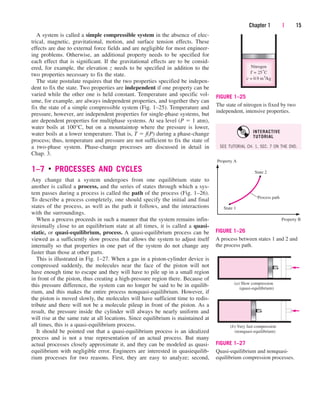
inner surfaces of the piston and the cylinder form the boundary, and since
no mass is crossing this boundary, it is a closed system. Notice that energy
may cross the boundary, and part of the boundary (the inner surface of the
piston, in this case) may move. Everything outside the gas, including the
piston and the cylinder, is the surroundings.
An open system, or a control volume, as it is often called, is a prop-
erly selected region in space. It usually encloses a device that involves
mass flow such as a compressor, turbine, or nozzle. Flow through these
W  mg  1453.6 g2 19.81 ms2
2 a
1 N
1 kg # ms2
b a
1 kg
1000 g
b  4.45 N
10 | Thermodynamics
Analysis We apply Newton’s second law to calculate the weight (force) that
corresponds to the known mass and acceleration. The weight of any object is
equal to its mass times the local value of gravitational acceleration. Thus,
Discussion Mass is the same regardless of its location. However, on some
other planet with a different value of gravitational acceleration, the weight of
1 lbm would differ from that calculated here.
W  mg  11.00 lbm2 132.174 fts2
2 a
1 lbf
32.174 lbm # fts2
b  1.00 lbf
Net weight:
One pound
(454 grams)
FIGURE 1–14
A quirk in the metric system of units.
SURROUNDINGS
BOUNDARY
SYSTEM
FIGURE 1–15
System, surroundings, and boundary.
CLOSED
SYSTEM
YES
m = constant
Energy
NO
Mass
FIGURE 1–16
Mass cannot cross the boundaries of a
closed system, but energy can.
SEE TUTORIAL CH. 1, SEC. 3 ON THE DVD.
INTERACTIVE
TUTORIAL
cen84959_ch01.qxd 4/25/05 2:29 PM Page 10
devices is best studied by selecting the region within the device as the
control volume. Both mass and energy can cross the boundary of a con-
trol volume.
A large number of engineering problems involve mass flow in and out of
a system and, therefore, are modeled as control volumes. A water heater, a
car radiator, a turbine, and a compressor all involve mass flow and should
be analyzed as control volumes (open systems) instead of as control masses
(closed systems). In general, any arbitrary region in space can be selected
as a control volume. There are no concrete rules for the selection of control
volumes, but the proper choice certainly makes the analysis much easier. If
we were to analyze the flow of air through a nozzle, for example, a good
choice for the control volume would be the region within the nozzle.
The boundaries of a control volume are called a control surface, and they
can be real or imaginary. In the case of a nozzle, the inner surface of the noz-
zle forms the real part of the boundary, and the entrance and exit areas form
the imaginary part, since there are no physical surfaces there (Fig. 1–18a).
A control volume can be fixed in size and shape, as in the case of a noz-
zle, or it may involve a moving boundary, as shown in Fig. 1–18b. Most
control volumes, however, have fixed boundaries and thus do not involve
any moving boundaries. A control volume can also involve heat and work
interactions just as a closed system, in addition to mass interaction.
As an example of an open system, consider the water heater shown in
Fig. 1–19. Let us say that we would like to determine how much heat we
must transfer to the water in the tank in order to supply a steady stream of
hot water. Since hot water will leave the tank and be replaced by cold
water, it is not convenient to choose a fixed mass as our system for the
analysis. Instead, we can concentrate our attention on the volume formed
by the interior surfaces of the tank and consider the hot and cold water
streams as mass leaving and entering the control volume. The interior sur-
faces of the tank form the control surface for this case, and mass is cross-
ing the control surface at two locations.
Chapter 1 | 11
GAS
2 kg
3 m3
GAS
2 kg
1 m3
Moving
boundary
Fixed
boundary
FIGURE 1–17
A closed system with a moving
boundary.
CV
Moving
boundary
Fixed
boundary
CV
(a nozzle)
Real boundary
(b) A control volume with fixed and
moving boundaries
(a) A control volume with real and
imaginary boundaries
Imaginary
boundary
FIGURE 1–18
A control volume can involve fixed, moving, real, and imaginary boundaries.
Control
surface
WATER
HEATER
(control
volume) Cold
water
in
Hot
water
out
FIGURE 1–19
An open system (a control volume)
with one inlet and one exit.
cen84959_ch01.qxd 3/31/05 3:38 PM Page 11
In an engineering analysis, the system under study must be defined care-
fully. In most cases, the system investigated is quite simple and obvious,
and defining the system may seem like a tedious and unnecessary task. In
other cases, however, the system under study may be rather involved, and a
proper choice of the system may greatly simplify the analysis.
1–4 ■
PROPERTIES OF A SYSTEM
Any characteristic of a system is called a property. Some familiar proper-
ties are pressure P, temperature T, volume V, and mass m. The list can be
extended to include less familiar ones such as viscosity, thermal conductiv-
ity, modulus of elasticity, thermal expansion coefficient, electric resistivity,
and even velocity and elevation.
Properties are considered to be either intensive or extensive. Intensive
properties are those that are independent of the mass of a system, such as
temperature, pressure, and density. Extensive properties are those whose
values depend on the size—or extent—of the system. Total mass, total vol-
ume, and total momentum are some examples of extensive properties. An
easy way to determine whether a property is intensive or extensive is to
divide the system into two equal parts with an imaginary partition, as shown
in Fig. 1–20. Each part will have the same value of intensive properties as
the original system, but half the value of the extensive properties.
Generally, uppercase letters are used to denote extensive properties (with
mass m being a major exception), and lowercase letters are used for intensive
properties (with pressure P and temperature T being the obvious exceptions).
Extensive properties per unit mass are called specific properties. Some
examples of specific properties are specific volume (v  V/m) and specific
total energy (e  E/m).
Continuum
Matter is made up of atoms that are widely spaced in the gas phase. Yet it is
very convenient to disregard the atomic nature of a substance and view it as
a continuous, homogeneous matter with no holes, that is, a continuum. The
continuum idealization allows us to treat properties as point functions and to
assume the properties vary continually in space with no jump discontinu-
ities. This idealization is valid as long as the size of the system we deal with
is large relative to the space between the molecules. This is the case in prac-
tically all problems, except some specialized ones. The continuum idealiza-
tion is implicit in many statements we make, such as “the density of water
in a glass is the same at any point.”
To have a sense of the distance involved at the molecular level, consider a
container filled with oxygen at atmospheric conditions. The diameter of the
oxygen molecule is about 3  1010 m and its mass is 5.3  1026 kg. Also,
the mean free path of oxygen at 1 atm pressure and 20°C is 6.3  108 m.
That is, an oxygen molecule travels, on average, a distance of 6.3  108 m
(about 200 times of its diameter) before it collides with another molecule.
Also, there are about 3  1016 molecules of oxygen in the tiny volume of
1 mm3 at 1 atm pressure and 20°C (Fig. 1–21). The continuum model is
applicable as long as the characteristic length of the system (such as its
12 | Thermodynamics
ρ
m
V
T
P
ρ
m
V
T
P
1
2
–
1
2
–
ρ
m
V
T
P
1
2
–
1
2
–
Extensive
Extensive
properties
properties
Intensive
Intensive
properties
properties
FIGURE 1–20
Criterion to differentiate intensive and
extensive properties.
VOID
1 atm, 20°C
O2
3 × 10¹⁶
molecules/mm3
FIGURE 1–21
Despite the large gaps between
molecules, a substance can be treated
as a continuum because of the very
large number of molecules even in an
extremely small volume.
SEE TUTORIAL CH. 1, SEC. 4 ON THE DVD.
INTERACTIVE
TUTORIAL
cen84959_ch01.qxd 4/25/05 2:29 PM Page 12
diameter) is much larger than the mean free path of the molecules. At very
high vacuums or very high elevations, the mean free path may become large
(for example, it is about 0.1 m for atmospheric air at an elevation of 100
km). For such cases the rarefied gas flow theory should be used, and the
impact of individual molecules should be considered. In this text we will
limit our consideration to substances that can be modeled as a continuum.
1–5 ■
DENSITY AND SPECIFIC GRAVITY
Density is defined as mass per unit volume (Fig. 1–22).
Density: (1–4)
The reciprocal of density is the specific volume v, which is defined as vol-
ume per unit mass. That is,
(1–5)
For a differential volume element of mass dm and volume dV, density can
be expressed as r  dm/dV.
The density of a substance, in general, depends on temperature and pres-
sure. The density of most gases is proportional to pressure and inversely
proportional to temperature. Liquids and solids, on the other hand, are
essentially incompressible substances, and the variation of their density
with pressure is usually negligible. At 20°C, for example, the density of
water changes from 998 kg/m3 at 1 atm to 1003 kg/m3 at 100 atm, a
change of just 0.5 percent. The density of liquids and solids depends more
strongly on temperature than it does on pressure. At 1 atm, for example,
the density of water changes from 998 kg/m3 at 20°C to 975 kg/m3 at
75°C, a change of 2.3 percent, which can still be neglected in many engi-
neering analyses.
Sometimes the density of a substance is given relative to the density of a
well-known substance. Then it is called specific gravity, or relative den-
sity, and is defined as the ratio of the density of a substance to the density of
some standard substance at a specified temperature (usually water at 4°C,
for which rH2O  1000 kg/m3). That is,
Specific gravity: (1–6)
Note that the specific gravity of a substance is a dimensionless quantity.
However, in SI units, the numerical value of the specific gravity of a sub-
stance is exactly equal to its density in g/cm3 or kg/L (or 0.001 times the
density in kg/m3) since the density of water at 4°C is 1 g/cm3  1 kg/L 
1000 kg/m3. The specific gravity of mercury at 0°C, for example, is 13.6.
Therefore, its density at 0°C is 13.6 g/cm3  13.6 kg/L  13,600 kg/m3.
The specific gravities of some substances at 0°C are given in Table 1–3.
Note that substances with specific gravities less than 1 are lighter than
water, and thus they would float on water.
SG 
r
rH2O
v 
V
m

1
r
r 
m
V
¬¬1kgm3
2
Chapter 1 | 13
Use actual data from the experiment
shown here to obtain the density of
water in the neighborhood of 4°C. See
end-of-chapter problem 1–129.
© Ronald Mullisen
V = 12 m
= 12 m3
ρ = 0.25 kg/m
= 0.25 kg/m3
m = 3 kg
= 3 kg
v =
= = 4 m
= 4 m3
/kg
/kg
1
–
ρ
FIGURE 1–22
Density is mass per unit volume;
specific volume is volume per unit
mass.
EXPERIMENT
SEE TUTORIAL CH. 1, SEC. 5 ON THE DVD.
INTERACTIVE
TUTORIAL
cen84959_ch01.qxd 4/25/05 3:34 PM Page 13
The weight of a unit volume of a substance is called specific weight and
is expressed as
Specific weight: (1–7)
where g is the gravitational acceleration.
The densities of liquids are essentially constant, and thus they can often
be approximated as being incompressible substances during most processes
without sacrificing much in accuracy.
1–6 ■
STATE AND EQUILIBRIUM
Consider a system not undergoing any change. At this point, all the proper-
ties can be measured or calculated throughout the entire system, which
gives us a set of properties that completely describes the condition, or the
state, of the system. At a given state, all the properties of a system have
fixed values. If the value of even one property changes, the state will change
to a different one. In Fig. 1–23 a system is shown at two different states.
Thermodynamics deals with equilibrium states. The word equilibrium
implies a state of balance. In an equilibrium state there are no unbalanced
potentials (or driving forces) within the system. A system in equilibrium
experiences no changes when it is isolated from its surroundings.
There are many types of equilibrium, and a system is not in thermody-
namic equilibrium unless the conditions of all the relevant types of equilib-
rium are satisfied. For example, a system is in thermal equilibrium if the
temperature is the same throughout the entire system, as shown in Fig.
1–24. That is, the system involves no temperature differential, which is the
driving force for heat flow. Mechanical equilibrium is related to pressure,
and a system is in mechanical equilibrium if there is no change in pressure
at any point of the system with time. However, the pressure may vary within
the system with elevation as a result of gravitational effects. For example,
the higher pressure at a bottom layer is balanced by the extra weight it must
carry, and, therefore, there is no imbalance of forces. The variation of pres-
sure as a result of gravity in most thermodynamic systems is relatively small
and usually disregarded. If a system involves two phases, it is in phase
equilibrium when the mass of each phase reaches an equilibrium level and
stays there. Finally, a system is in chemical equilibrium if its chemical
composition does not change with time, that is, no chemical reactions occur.
A system will not be in equilibrium unless all the relevant equilibrium crite-
ria are satisfied.
The State Postulate
As noted earlier, the state of a system is described by its properties. But we
know from experience that we do not need to specify all the properties in
order to fix a state. Once a sufficient number of properties are specified, the
rest of the properties assume certain values automatically. That is, specifying
a certain number of properties is sufficient to fix a state. The number of prop-
erties required to fix the state of a system is given by the state postulate:
The state of a simple compressible system is completely specified by two
independent, intensive properties.
gs  rg¬¬1Nm3
2
14 | Thermodynamics
TABLE 1–3
Specific gravities of some
substances at 0°C
Substance SG
Water 1.0
Blood 1.05
Seawater 1.025
Gasoline 0.7
Ethyl alcohol 0.79
Mercury 13.6
Wood 0.3–0.9
Gold 19.2
Bones 1.7–2.0
Ice 0.92
Air (at 1 atm) 0.0013
m = 2 kg
T2 = 20°C
V2 = 2.5 m3
(a) State 1
m = 2 kg
T1
= 20°C
V1
= 1.5 m3
(b) State 2
FIGURE 1–23
A system at two different states.
20°C
(a) Before (b) After
23°C
35°C 40°C
30°C
42°C
32°C 32°C
32°C 32°C
32°C
32°C
FIGURE 1–24
A closed system reaching thermal
equilibrium.
SEE TUTORIAL CH. 1, SEC. 6 ON THE DVD.
INTERACTIVE
TUTORIAL
cen84959_ch01.qxd 4/25/05 2:29 PM Page 14
A system is called a simple compressible system in the absence of elec-
trical, magnetic, gravitational, motion, and surface tension effects. These
effects are due to external force fields and are negligible for most engineer-
ing problems. Otherwise, an additional property needs to be specified for
each effect that is significant. If the gravitational effects are to be consid-
ered, for example, the elevation z needs to be specified in addition to the
two properties necessary to fix the state.
The state postulate requires that the two properties specified be indepen-
dent to fix the state. Two properties are independent if one property can be
varied while the other one is held constant. Temperature and specific vol-
ume, for example, are always independent properties, and together they can
fix the state of a simple compressible system (Fig. 1–25). Temperature and
pressure, however, are independent properties for single-phase systems, but
are dependent properties for multiphase systems. At sea level (P  1 atm),
water boils at 100°C, but on a mountaintop where the pressure is lower,
water boils at a lower temperature. That is, T  f(P) during a phase-change
process; thus, temperature and pressure are not sufficient to fix the state of
a two-phase system. Phase-change processes are discussed in detail in
Chap. 3.
1–7 ■
PROCESSES AND CYCLES
Any change that a system undergoes from one equilibrium state to
another is called a process, and the series of states through which a sys-
tem passes during a process is called the path of the process (Fig. 1–26).
To describe a process completely, one should specify the initial and final
states of the process, as well as the path it follows, and the interactions
with the surroundings.
When a process proceeds in such a manner that the system remains infin-
itesimally close to an equilibrium state at all times, it is called a quasi-
static, or quasi-equilibrium, process. A quasi-equilibrium process can be
viewed as a sufficiently slow process that allows the system to adjust itself
internally so that properties in one part of the system do not change any
faster than those at other parts.
This is illustrated in Fig. 1–27. When a gas in a piston-cylinder device is
compressed suddenly, the molecules near the face of the piston will not
have enough time to escape and they will have to pile up in a small region
in front of the piston, thus creating a high-pressure region there. Because of
this pressure difference, the system can no longer be said to be in equilib-
rium, and this makes the entire process nonquasi-equilibrium. However, if
the piston is moved slowly, the molecules will have sufficient time to redis-
tribute and there will not be a molecule pileup in front of the piston. As a
result, the pressure inside the cylinder will always be nearly uniform and
will rise at the same rate at all locations. Since equilibrium is maintained at
all times, this is a quasi-equilibrium process.
It should be pointed out that a quasi-equilibrium process is an idealized
process and is not a true representation of an actual process. But many
actual processes closely approximate it, and they can be modeled as quasi-
equilibrium with negligible error. Engineers are interested in quasiequilib-
rium processes for two reasons. First, they are easy to analyze; second,
Chapter 1 | 15
Nitrogen
T = 25°C
= 0.9 m3
/kg
v
FIGURE 1–25
The state of nitrogen is fixed by two
independent, intensive properties.
State 1
State 2
Process path
Property B
Property A
FIGURE 1–26
A process between states 1 and 2 and
the process path.
(a) Slow compression
(quasi-equilibrium)
(b) Very fast compression
(nonquasi-equilibrium)
FIGURE 1–27
Quasi-equilibrium and nonquasi-
equilibrium compression processes.
SEE TUTORIAL CH. 1, SEC. 7 ON THE DVD.
INTERACTIVE
TUTORIAL
cen84959_ch01.qxd 4/25/05 2:29 PM Page 15
work-producing devices deliver the most work when they operate on quasi-
equilibrium processes. Therefore, quasi-equilibrium processes serve as stan-
dards to which actual processes can be compared.
Process diagrams plotted by employing thermodynamic properties as
coordinates are very useful in visualizing the processes. Some common
properties that are used as coordinates are temperature T, pressure P, and
volume V (or specific volume v). Figure 1–28 shows the P-V diagram of a
compression process of a gas.
Note that the process path indicates a series of equilibrium states through
which the system passes during a process and has significance for quasi-
equilibrium processes only. For nonquasi-equilibrium processes, we are not
able to characterize the entire system by a single state, and thus we cannot
speak of a process path for a system as a whole. A nonquasi-equilibrium
process is denoted by a dashed line between the initial and final states
instead of a solid line.
The prefix iso- is often used to designate a process for which a particular
property remains constant. An isothermal process, for example, is a
process during which the temperature T remains constant; an isobaric
process is a process during which the pressure P remains constant; and an
isochoric (or isometric) process is a process during which the specific vol-
ume v remains constant.
A system is said to have undergone a cycle if it returns to its initial state
at the end of the process. That is, for a cycle the initial and final states are
identical.
The Steady-Flow Process
The terms steady and uniform are used frequently in engineering, and thus it
is important to have a clear understanding of their meanings. The term
steady implies no change with time. The opposite of steady is unsteady, or
transient. The term uniform, however, implies no change with location over
a specified region. These meanings are consistent with their everyday use
(steady girlfriend, uniform properties, etc.).
A large number of engineering devices operate for long periods of time
under the same conditions, and they are classified as steady-flow devices.
Processes involving such devices can be represented reasonably well by a
somewhat idealized process, called the steady-flow process, which can be
defined as a process during which a fluid flows through a control volume
steadily (Fig. 1–29). That is, the fluid properties can change from point to
point within the control volume, but at any fixed point they remain the same
during the entire process. Therefore, the volume V, the mass m, and the total
energy content E of the control volume remain constant during a steady-
flow process (Fig. 1–30).
Steady-flow conditions can be closely approximated by devices that are
intended for continuous operation such as turbines, pumps, boilers, con-
densers, and heat exchangers or power plants or refrigeration systems. Some
cyclic devices, such as reciprocating engines or compressors, do not satisfy
any of the conditions stated above since the flow at the inlets and the exits
will be pulsating and not steady. However, the fluid properties vary with
16 | Thermodynamics
Initial
state
Final state
Process path
2
1
P
V2
V1 V
(2)
System
(1)
FIGURE 1–28
The P-V diagram of a compression
process.
Control volume
300°C 250°C
200°C 150°C
225°C
Mass
Time: 1 PM
in
Mass
out
Control volume
300°C 250°C
200°C 150°C
225°C
Mass
Time: 3 PM
in
Mass
out
FIGURE 1–29
During a steady-flow process, fluid
properties within the control volume
may change with position but not with
time.
cen84959_ch01.qxd 3/31/05 3:38 PM Page 16
time in a periodic manner, and the flow through these devices can still be
analyzed as a steady-flow process by using time-averaged values for the
properties.
1–8 ■
TEMPERATURE AND THE ZEROTH
LAW OF THERMODYNAMICS
Although we are familiar with temperature as a measure of “hotness” or
“coldness,” it is not easy to give an exact definition for it. Based on our
physiological sensations, we express the level of temperature qualitatively
with words like freezing cold, cold, warm, hot, and red-hot. However, we
cannot assign numerical values to temperatures based on our sensations
alone. Furthermore, our senses may be misleading. A metal chair, for exam-
ple, will feel much colder than a wooden one even when both are at the
same temperature.
Fortunately, several properties of materials change with temperature in a
repeatable and predictable way, and this forms the basis for accurate tem-
perature measurement. The commonly used mercury-in-glass thermometer,
for example, is based on the expansion of mercury with temperature. Tem-
perature is also measured by using several other temperature-dependent
properties.
It is a common experience that a cup of hot coffee left on the table even-
tually cools off and a cold drink eventually warms up. That is, when a body
is brought into contact with another body that is at a different temperature,
heat is transferred from the body at higher temperature to the one at lower
temperature until both bodies attain the same temperature (Fig. 1–31). At
that point, the heat transfer stops, and the two bodies are said to have
reached thermal equilibrium. The equality of temperature is the only
requirement for thermal equilibrium.
The zeroth law of thermodynamics states that if two bodies are in ther-
mal equilibrium with a third body, they are also in thermal equilibrium with
each other. It may seem silly that such an obvious fact is called one of the
basic laws of thermodynamics. However, it cannot be concluded from the
other laws of thermodynamics, and it serves as a basis for the validity of
temperature measurement. By replacing the third body with a thermometer,
the zeroth law can be restated as two bodies are in thermal equilibrium if
both have the same temperature reading even if they are not in contact.
The zeroth law was first formulated and labeled by R. H. Fowler in 1931.
As the name suggests, its value as a fundamental physical principle was rec-
ognized more than half a century after the formulation of the first and the
second laws of thermodynamics. It was named the zeroth law since it
should have preceded the first and the second laws of thermodynamics.
Temperature Scales
Temperature scales enable us to use a common basis for temperature mea-
surements, and several have been introduced throughout history. All temper-
ature scales are based on some easily reproducible states such as the
freezing and boiling points of water, which are also called the ice point and
Chapter 1 | 17
Control
volume
Mass
in
Mass
out
mcV = const.
EcV = const.
FIGURE 1–30
Under steady-flow conditions, the
mass and energy contents of a control
volume remain constant.
150°C
IRON
20°C
COPPER
60°C
IRON
60°C
COPPER
FIGURE 1–31
Two bodies reaching thermal
equilibrium after being brought into
contact in an isolated enclosure.
SEE TUTORIAL CH. 1, SEC. 8 ON THE DVD.
INTERACTIVE
TUTORIAL
cen84959_ch01.qxd 4/25/05 2:29 PM Page 17
the steam point, respectively. A mixture of ice and water that is in equilib-
rium with air saturated with vapor at 1 atm pressure is said to be at the ice
point, and a mixture of liquid water and water vapor (with no air) in equilib-
rium at 1 atm pressure is said to be at the steam point.
The temperature scales used in the SI and in the English system today are
the Celsius scale (formerly called the centigrade scale; in 1948 it was
renamed after the Swedish astronomer A. Celsius, 1702–1744, who devised
it) and the Fahrenheit scale (named after the German instrument maker G.
Fahrenheit, 1686–1736), respectively. On the Celsius scale, the ice and
steam points were originally assigned the values of 0 and 100°C, respec-
tively. The corresponding values on the Fahrenheit scale are 32 and 212°F.
These are often referred to as two-point scales since temperature values are
assigned at two different points.
In thermodynamics, it is very desirable to have a temperature scale that
is independent of the properties of any substance or substances. Such a
temperature scale is called a thermodynamic temperature scale, which is
developed later in conjunction with the second law of thermodynamics.
The thermodynamic temperature scale in the SI is the Kelvin scale, named
after Lord Kelvin (1824–1907). The temperature unit on this scale is the
kelvin, which is designated by K (not °K; the degree symbol was officially
dropped from kelvin in 1967). The lowest temperature on the Kelvin scale
is absolute zero, or 0 K. Then it follows that only one nonzero reference
point needs to be assigned to establish the slope of this linear scale. Using
nonconventional refrigeration techniques, scientists have approached
absolute zero kelvin (they achieved 0.000000002 K in 1989).
The thermodynamic temperature scale in the English system is the Ran-
kine scale, named after William Rankine (1820–1872). The temperature
unit on this scale is the rankine, which is designated by R.
A temperature scale that turns out to be nearly identical to the Kelvin
scale is the ideal-gas temperature scale. The temperatures on this scale are
measured using a constant-volume gas thermometer, which is basically a
rigid vessel filled with a gas, usually hydrogen or helium, at low pressure.
This thermometer is based on the principle that at low pressures, the tem-
perature of a gas is proportional to its pressure at constant volume. That is,
the temperature of a gas of fixed volume varies linearly with pressure at
sufficiently low pressures. Then the relationship between the temperature
and the pressure of the gas in the vessel can be expressed as
(1–8)
where the values of the constants a and b for a gas thermometer are deter-
mined experimentally. Once a and b are known, the temperature of a
medium can be calculated from this relation by immersing the rigid vessel
of the gas thermometer into the medium and measuring the gas pressure
when thermal equilibrium is established between the medium and the gas in
the vessel whose volume is held constant.
An ideal-gas temperature scale can be developed by measuring the pres-
sures of the gas in the vessel at two reproducible points (such as the ice and
the steam points) and assigning suitable values to temperatures at those two
points. Considering that only one straight line passes through two fixed
T  a  bP
18 | Thermodynamics
cen84959_ch01.qxd 3/31/05 3:38 PM Page 18
points on a plane, these two measurements are sufficient to determine the
constants a and b in Eq. 1–8. Then the unknown temperature T of a medium
corresponding to a pressure reading P can be determined from that equation
by a simple calculation. The values of the constants will be different for
each thermometer, depending on the type and the amount of the gas in the
vessel, and the temperature values assigned at the two reference points. If
the ice and steam points are assigned the values 0°C and 100°C, respec-
tively, then the gas temperature scale will be identical to the Celsius scale.
In this case the value of the constant a (which corresponds to an absolute
pressure of zero) is determined to be 273.15°C regardless of the type and
the amount of the gas in the vessel of the gas thermometer. That is, on a
P-T diagram, all the straight lines passing through the data points in this
case will intersect the temperature axis at 273.15°C when extrapolated, as
shown in Fig. 1–32. This is the lowest temperature that can be obtained by a
gas thermometer, and thus we can obtain an absolute gas temperature scale
by assigning a value of zero to the constant a in Eq. 1–8. In that case Eq.
1–8 reduces to T  bP, and thus we need to specify the temperature at only
one point to define an absolute gas temperature scale.
It should be noted that the absolute gas temperature scale is not a thermo-
dynamic temperature scale, since it cannot be used at very low temperatures
(due to condensation) and at very high temperatures (due to dissociation and
ionization). However, absolute gas temperature is identical to the thermody-
namic temperature in the temperature range in which the gas thermometer
can be used, and thus we can view the thermodynamic temperature scale at
this point as an absolute gas temperature scale that utilizes an “ideal” or
“imaginary” gas that always acts as a low-pressure gas regardless of the
temperature. If such a gas thermometer existed, it would read zero kelvin at
absolute zero pressure, which corresponds to 273.15°C on the Celsius
scale (Fig. 1–33).
The Kelvin scale is related to the Celsius scale by
(1–9)
The Rankine scale is related to the Fahrenheit scale by
(1–10)
It is common practice to round the constant in Eq. 1–9 to 273 and that in
Eq. 1–10 to 460.
The temperature scales in the two unit systems are related by
(1–11)
(1–12)
A comparison of various temperature scales is given in Fig. 1–34.
The reference temperature chosen in the original Kelvin scale was
273.15 K (or 0°C), which is the temperature at which water freezes (or ice
melts) and water exists as a solid–liquid mixture in equilibrium under stan-
dard atmospheric pressure (the ice point). At the Tenth General Conference
on Weights and Measures in 1954, the reference point was changed to a
much more precisely reproducible point, the triple point of water (the state
at which all three phases of water coexist in equilibrium), which is
T1°F2  1.8T1°C2  32
T1R2  1.8T1K2
T1R2  T1°F2  459.67
T1K2  T1°C2  273.15
Chapter 1 | 19
Measured
data points
P
Gas A
Gas B
Gas C
Gas D
0
–273.15
Extrapolation
T(°C)
FIGURE 1–32
P versus T plots of the experimental
data obtained from a constant-volume
gas thermometer using four different
gases at different (but low) pressures.
Absolute
vacuum
V = constant
T (°C) T (K)
0
0
–273.15
P (kPa)
275
250
225
200
0
25
50
75
0
40
80
120
FIGURE 1–33
A constant-volume gas thermometer
would read 273.15°C at absolute
zero pressure.
cen84959_ch01.qxd 3/31/05 3:38 PM Page 19
assigned the value 273.16 K. The Celsius scale was also redefined at this
conference in terms of the ideal-gas temperature scale and a single fixed
point, which is again the triple point of water with an assigned value of
0.01°C. The boiling temperature of water (the steam point) was experimen-
tally determined to be again 100.00°C, and thus the new and old Celsius
scales were in good agreement.
The International Temperature
Scale of 1990 (ITS-90)
The International Temperature Scale of 1990, which supersedes the Inter-
national Practical Temperature Scale of 1968 (IPTS-68), 1948 (ITPS-48),
and 1927 (ITS-27), was adopted by the International Committee of Weights
and Measures at its meeting in 1989 at the request of the Eighteenth Gen-
eral Conference on Weights and Measures. The ITS-90 is similar to its pre-
decessors except that it is more refined with updated values of fixed
temperatures, has an extended range, and conforms more closely to the
thermodynamic temperature scale. On this scale, the unit of thermody-
namic temperature T is again the kelvin (K), defined as the fraction
1/273.16 of the thermodynamic temperature of the triple point of water,
which is sole defining fixed point of both the ITS-90 and the Kelvin scale
and is the most important thermometric fixed point used in the calibration
of thermometers to ITS-90.
The unit of Celsius temperature is the degree Celsius (°C), which is by
definition equal in magnitude to the kelvin (K). A temperature difference
may be expressed in kelvins or degrees Celsius. The ice point remains the
same at 0°C (273.15°C) in both ITS-90 and ITPS-68, but the steam point
is 99.975°C in ITS-90 (with an uncertainly of 0.005°C) whereas it was
100.000°C in IPTS-68. The change is due to precise measurements made by
gas thermometry by paying particular attention to the effect of sorption (the
impurities in a gas absorbed by the walls of the bulb at the reference tem-
perature being desorbed at higher temperatures, causing the measured gas
pressure to increase).
The ITS-90 extends upward from 0.65 K to the highest temperature prac-
tically measurable in terms of the Planck radiation law using monochro-
matic radiation. It is based on specifying definite temperature values on a
number of fixed and easily reproducible points to serve as benchmarks and
expressing the variation of temperature in a number of ranges and subranges
in functional form.
In ITS-90, the temperature scale is considered in four ranges. In the
range of 0.65 to 5 K, the temperature scale is defined in terms of the vapor
pressure—temperature relations for 3He and 4He. Between 3 and 24.5561 K
(the triple point of neon), it is defined by means of a properly calibrated
helium gas thermometer. From 13.8033 K (the triple point of hydrogen) to
1234.93 K (the freezing point of silver), it is defined by means of platinum
resistance thermometers calibrated at specified sets of defining fixed
points. Above 1234.93 K, it is defined in terms of the Planck radiation law
and a suitable defining fixed point such as the freezing point of gold
(1337.33 K).
20 | Thermodynamics
–273.15
°C
0
273.16
0.01
K
–459.67
°F
0
491.69
32.02
R
Triple
point
of water
Absolute
zero
FIGURE 1–34
Comparison of temperature scales.
cen84959_ch01.qxd 3/31/05 3:38 PM Page 20
We emphasize that the magnitudes of each division of 1 K and 1°C are
identical (Fig. 1–35). Therefore, when we are dealing with temperature dif-
ferences T, the temperature interval on both scales is the same. Raising the
temperature of a substance by 10°C is the same as raising it by 10 K. That is,
(1–13)
(1–14)
Some thermodynamic relations involve the temperature T and often the
question arises of whether it is in K or °C. If the relation involves tempera-
ture differences (such as a  bT), it makes no difference and either can be
used. However, if the relation involves temperatures only instead of temper-
ature differences (such as a  bT) then K must be used. When in doubt, it is
always safe to use K because there are virtually no situations in which the
use of K is incorrect, but there are many thermodynamic relations that will
yield an erroneous result if °C is used.
¢T1R2  ¢T1°F2
¢T1K2  ¢T1°C2
Chapter 1 | 21
1°C
1 K 1.8°F
1.8 R
FIGURE 1–35
Comparison of magnitudes of various
temperature units.
EXAMPLE 1–4 Expressing Temperature Rise in Different Units
During a heating process, the temperature of a system rises by 10°C. Express
this rise in temperature in K, °F, and R.
Solution The temperature rise of a system is to be expressed in different
units.
Analysis This problem deals with temperature changes, which are identical
in Kelvin and Celsius scales. Then,
The temperature changes in Fahrenheit and Rankine scales are also identical
and are related to the changes in Celsius and Kelvin scales through Eqs.
1–11 and 1–14:
and
Discussion Note that the units °C and K are interchangeable when dealing
with temperature differences.
¢T1°F2  ¢T1R2  18°F
¢T1R2  1.8 ¢T1K2  11.82 1102  18 R
¢T1K2  ¢T1°C2  10 K
1–9 ■
PRESSURE
Pressure is defined as a normal force exerted by a fluid per unit area. We
speak of pressure only when we deal with a gas or a liquid. The counterpart
of pressure in solids is normal stress. Since pressure is defined as force per
unit area, it has the unit of newtons per square meter (N/m2), which is called
a pascal (Pa). That is,
1 Pa  1 Nm2
SEE TUTORIAL CH. 1, SEC. 9 ON THE DVD.
INTERACTIVE
TUTORIAL
cen84959_ch01.qxd 4/25/05 2:29 PM Page 21
The pressure unit pascal is too small for pressures encountered in prac-
tice. Therefore, its multiples kilopascal (1 kPa  103 Pa) and megapascal (1
MPa  106 Pa) are commonly used. Three other pressure units commonly
used in practice, especially in Europe, are bar, standard atmosphere, and
kilogram-force per square centimeter:
Note that the pressure units bar, atm, and kgf/cm2 are almost equivalent to
each other. In the English system, the pressure unit is pound-force per square
inch (lbf/in2, or psi), and 1 atm  14.696 psi. The pressure units kgf/cm2
and lbf/in2 are also denoted by kg/cm2 and lb/in2, respectively, and they are
commonly used in tire gages. It can be shown that 1 kgf/cm2  14.223 psi.
Pressure is also used for solids as synonymous to normal stress, which is
force acting perpendicular to the surface per unit area. For example, a 150-
pound person with a total foot imprint area of 50 in2 exerts a pressure of 150
lbf/50 in2  3.0 psi on the floor (Fig. 1–36). If the person stands on one foot,
the pressure doubles. If the person gains excessive weight, he or she is likely
to encounter foot discomfort because of the increased pressure on the foot
(the size of the foot does not change with weight gain). This also explains
how a person can walk on fresh snow without sinking by wearing large
snowshoes, and how a person cuts with little effort when using a sharp knife.
The actual pressure at a given position is called the absolute pressure, and
it is measured relative to absolute vacuum (i.e., absolute zero pressure). Most
pressure-measuring devices, however, are calibrated to read zero in the atmo-
sphere (Fig. 1–37), and so they indicate the difference between the absolute
pressure and the local atmospheric pressure. This difference is called the gage
pressure. Pressures below atmospheric pressure are called vacuum pressures
and are measured by vacuum gages that indicate the difference between the
atmospheric pressure and the absolute pressure. Absolute, gage, and vacuum
pressures are all positive quantities and are related to each other by
(1–15)
(1–16)
This is illustrated in Fig. 1–38.
Like other pressure gages, the gage used to measure the air pressure in an
automobile tire reads the gage pressure. Therefore, the common reading of
32 psi (2.25 kgf/cm2) indicates a pressure of 32 psi above the atmospheric
pressure. At a location where the atmospheric pressure is 14.3 psi, for exam-
ple, the absolute pressure in the tire is 32  14.3  46.3 psi.
In thermodynamic relations and tables, absolute pressure is almost always
used. Throughout this text, the pressure P will denote absolute pressure
unless specified otherwise. Often the letters “a” (for absolute pressure) and
“g” (for gage pressure) are added to pressure units (such as psia and psig) to
clarify what is meant.
Pvac  Patm  Pabs
Pgage  Pabs  Patm
 0.9679 atm
 0.9807 bar
1 kgfcm2
 9.807 Ncm2
 9.807  104
Nm2
 9.807  104
Pa
1 atm  101,325 Pa  101.325 kPa  1.01325 bars
1 bar  105
Pa  0.1 MPa  100 kPa
22 | Thermodynamics
150 pounds
Afeet = 50 in2
P = 3 psi P = 6 psi
300 pounds
W
––––
Afeet
150 lbf
––––––
50 in2
P = n = = 3 psi
=
s
FIGURE 1–36
The normal stress (or “pressure”) on
the feet of a chubby person is much
greater than on the feet of a slim
person.
FIGURE 1–37
Some basic pressure gages.
Dresser Instruments, Dresser, Inc.
Used by permission.
cen84959_ch01.qxd 3/31/05 3:38 PM Page 22
Pressure is the compressive force per unit area, and it gives the impression
of being a vector. However, pressure at any point in a fluid is the same in all
directions. That is, it has magnitude but not a specific direction, and thus it
is a scalar quantity.
Variation of Pressure with Depth
It will come as no surprise to you that pressure in a fluid at rest does not
change in the horizontal direction. This can be shown easily by considering
a thin horizontal layer of fluid and doing a force balance in any horizontal
direction. However, this is not the case in the vertical direction in a gravity
field. Pressure in a fluid increases with depth because more fluid rests on
deeper layers, and the effect of this “extra weight” on a deeper layer is
balanced by an increase in pressure (Fig. 1–39).
Chapter 1 | 23
Absolute
vacuum
Absolute
vacuum
Pabs
Pvac
Patm
Patm
Patm
Pgage
Pabs
Pabs
= 0
FIGURE 1–38
Absolute, gage, and vacuum pressures.
EXAMPLE 1–5 Absolute Pressure of a Vacuum Chamber
A vacuum gage connected to a chamber reads 5.8 psi at a location where
the atmospheric pressure is 14.5 psi. Determine the absolute pressure in the
chamber.
Solution The gage pressure of a vacuum chamber is given. The absolute
pressure in the chamber is to be determined.
Analysis The absolute pressure is easily determined from Eq. 1–16 to be
Discussion Note that the local value of the atmospheric pressure is used
when determining the absolute pressure.
Pabs  Patm  Pvac  14.5  5.8  8.7 psi
Pgage
FIGURE 1–39
The pressure of a fluid at rest
increases with depth (as a result of
added weight).
cen84959_ch01.qxd 3/31/05 3:38 PM Page 23
To obtain a relation for the variation of pressure with depth, consider a
rectangular fluid element of height z, length x, and unit depth (into the
page) in equilibrium, as shown in Fig. 1–40. Assuming the density of the
fluid r to be constant, a force balance in the vertical z-direction gives
(1–17)
where W  mg  rg x z is the weight of the fluid element. Dividing by
x and rearranging gives
(1–18)
where gs  rg is the specific weight of the fluid. Thus, we conclude that the
pressure difference between two points in a constant density fluid is propor-
tional to the vertical distance z between the points and the density r of the
fluid. In other words, pressure in a fluid increases linearly with depth. This
is what a diver experiences when diving deeper in a lake. For a given fluid,
the vertical distance z is sometimes used as a measure of pressure, and it is
called the pressure head.
We also conclude from Eq. 1–18 that for small to moderate distances, the
variation of pressure with height is negligible for gases because of their low
density. The pressure in a tank containing a gas, for example, can be consid-
ered to be uniform since the weight of the gas is too small to make a signif-
icant difference. Also, the pressure in a room filled with air can be assumed
to be constant (Fig. 1–41).
If we take point 1 to be at the free surface of a liquid open to the atmo-
sphere (Fig. 1–42), where the pressure is the atmospheric pressure Patm, then
the pressure at a depth h from the free surface becomes
(1–19)
Liquids are essentially incompressible substances, and thus the variation
of density with depth is negligible. This is also the case for gases when the
elevation change is not very large. The variation of density of liquids or
gases with temperature can be significant, however, and may need to be
considered when high accuracy is desired. Also, at great depths such as
those encountered in oceans, the change in the density of a liquid can be
significant because of the compression by the tremendous amount of liquid
weight above.
The gravitational acceleration g varies from 9.807 m/s2 at sea level to
9.764 m/s2 at an elevation of 14,000 m where large passenger planes cruise.
This is a change of just 0.4 percent in this extreme case. Therefore, g can be
assumed to be constant with negligible error.
For fluids whose density changes significantly with elevation, a relation
for the variation of pressure with elevation can be obtained by dividing Eq.
1–17 by x z, and taking the limit as z → 0. It gives
(1–20)
The negative sign is due to our taking the positive z direction to be upward
so that dP is negative when dz is positive since pressure decreases in an
upward direction. When the variation of density with elevation is known,
dP
dz
 rg
P  Patm  rgh¬or¬Pgage  rgh
¢P  P2  P1  rg ¢z  gs ¢z
a Fz  maz  0:¬¬P2 ¢x  P1 ¢x  rg ¢x ¢z  0
24 | Thermodynamics
P2
W
P1
x
0
z
z
x


FIGURE 1–40
Free-body diagram of a rectangular
fluid element in equilibrium.
Ptop = 1 atm
AIR
(A 5-m-high room)
Pbottom = 1.006 atm
FIGURE 1–41
In a room filled with a gas, the variation
of pressure with height is negligible.
cen84959_ch01.qxd 3/31/05 3:38 PM Page 24
the pressure difference between points 1 and 2 can be determined by inte-
gration to be
(1–21)
For constant density and constant gravitational acceleration, this relation
reduces to Eq. 1–18, as expected.
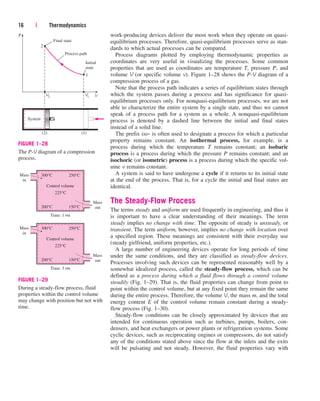
Pressure in a fluid at rest is independent of the shape or cross section of
the container. It changes with the vertical distance, but remains constant in
other directions. Therefore, the pressure is the same at all points on a hori-
zontal plane in a given fluid. The Dutch mathematician Simon Stevin
(1548–1620) published in 1586 the principle illustrated in Fig. 1–43. Note
that the pressures at points A, B, C, D, E, F, and G are the same since they
are at the same depth, and they are interconnected by the same static fluid.
However, the pressures at points H and I are not the same since these two
points cannot be interconnected by the same fluid (i.e., we cannot draw a
curve from point I to point H while remaining in the same fluid at all
times), although they are at the same depth. (Can you tell at which point the
pressure is higher?) Also, the pressure force exerted by the fluid is always
normal to the surface at the specified points.
A consequence of the pressure in a fluid remaining constant in the hori-
zontal direction is that the pressure applied to a confined fluid increases the
pressure throughout by the same amount. This is called Pascal’s law, after
Blaise Pascal (1623–1662). Pascal also knew that the force applied by a
fluid is proportional to the surface area. He realized that two hydraulic
cylinders of different areas could be connected, and the larger could be used
¢P  P2  P1   
2
1
rg dz
Chapter 1 | 25
P1 = Patm
P2 = Patm + rgh
h
1
2
FIGURE 1–42
Pressure in a liquid at rest increases
linearly with distance from the free
surface.
h
A B C D E
Water
Mercury
F G
I
H
Patm
PA = PB = PC = PD = PE = PF = PG = Patm + rgh
PH ≠ PI
FIGURE 1–43
The pressure is the same at all points on a horizontal plane in a given fluid regardless of geometry, provided that the
points are interconnected by the same fluid.
cen84959_ch01.qxd 3/31/05 3:38 PM Page 25
to exert a proportionally greater force than that applied to the smaller. “Pas-
cal’s machine” has been the source of many inventions that are a part of our
daily lives such as hydraulic brakes and lifts. This is what enables us to lift
a car easily by one arm, as shown in Fig. 1–44. Noting that P1  P2 since
both pistons are at the same level (the effect of small height differences is
negligible, especially at high pressures), the ratio of output force to input
force is determined to be
(1–22)
The area ratio A2/A1 is called the ideal mechanical advantage of the
hydraulic lift. Using a hydraulic car jack with a piston area ratio of A2/A1 
10, for example, a person can lift a 1000-kg car by applying a force of just
100 kgf ( 981 N).
1–10 ■
THE MANOMETER
We notice from Eq. 1–18 that an elevation change of z in a fluid at rest
corresponds to P/rg, which suggests that a fluid column can be used to
measure pressure differences. A device based on this principle is called a
manometer, and it is commonly used to measure small and moderate pres-
sure differences. A manometer mainly consists of a glass or plastic U-tube
containing one or more fluids such as mercury, water, alcohol, or oil. To
keep the size of the manometer to a manageable level, heavy fluids such as
mercury are used if large pressure differences are anticipated.
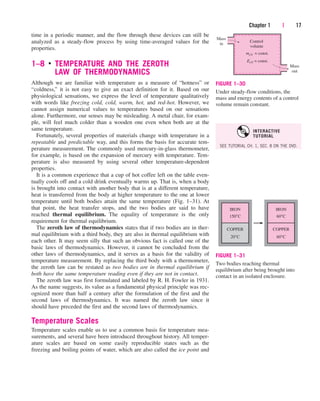
Consider the manometer shown in Fig. 1–45 that is used to measure the
pressure in the tank. Since the gravitational effects of gases are negligible, the
pressure anywhere in the tank and at position 1 has the same value. Further-
more, since pressure in a fluid does not vary in the horizontal direction within
a fluid, the pressure at point 2 is the same as the pressure at point 1, P2  P1.
The differential fluid column of height h is in static equilibrium, and it is
open to the atmosphere. Then the pressure at point 2 is determined directly
from Eq. 1–19 to be
(1–23)
where r is the density of the fluid in the tube. Note that the cross-sectional
area of the tube has no effect on the differential height h, and thus the pres-
sure exerted by the fluid. However, the diameter of the tube should be large
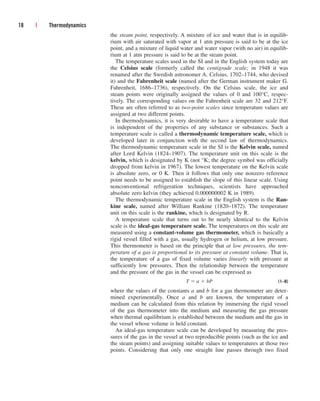
enough (more than a few millimeters) to ensure that the surface tension
effect and thus the capillary rise is negligible.
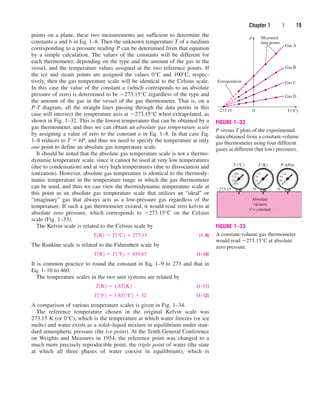
P2  Patm  rgh
P1  P2¬¬ S ¬¬
F1
A1

F2
A2
¬¬ S ¬¬
F2
F1

A2
A1
26 | Thermodynamics
F1 = P1A1
1 2
A1
P1
F2 = P2 A2
A2
P2
FIGURE 1–44
Lifting of a large weight by a small
force by the application of Pascal’s
law.
Gas
h
1 2
FIGURE 1–45
The basic manometer.
EXAMPLE 1–6 Measuring Pressure with a Manometer
A manometer is used to measure the pressure in a tank. The fluid used has
a specific gravity of 0.85, and the manometer column height is 55 cm, as
shown in Fig. 1–46. If the local atmospheric pressure is 96 kPa, determine
the absolute pressure within the tank.
SEE TUTORIAL CH. 1, SEC. 10 ON THE DVD.
INTERACTIVE
TUTORIAL
cen84959_ch01.qxd 4/25/05 2:29 PM Page 26
Many engineering problems and some manometers involve multiple immis-
cible fluids of different densities stacked on top of each other. Such systems
can be analyzed easily by remembering that (1) the pressure change across a
fluid column of height h is P  rgh, (2) pressure increases downward in a
given fluid and decreases upward (i.e., Pbottom Ptop), and (3) two points at
the same elevation in a continuous fluid at rest are at the same pressure.
The last principle, which is a result of Pascal’s law, allows us to “jump”
from one fluid column to the next in manometers without worrying about
pressure change as long as we don’t jump over a different fluid, and the
fluid is at rest. Then the pressure at any point can be determined by starting
with a point of known pressure and adding or subtracting rgh terms as we
advance toward the point of interest. For example, the pressure at the
bottom of the tank in Fig. 1–47 can be determined by starting at the free
surface where the pressure is Patm, moving downward until we reach point 1
at the bottom, and setting the result equal to P1. It gives
In the special case of all fluids having the same density, this relation reduces
to Eq. 1–23, as expected.
Manometers are particularly well-suited to measure pressure drops across
a horizontal flow section between two specified points due to the presence
of a device such as a valve or heat exchanger or any resistance to flow. This
is done by connecting the two legs of the manometer to these two points, as
shown in Fig. 1–48. The working fluid can be either a gas or a liquid whose
density is r1. The density of the manometer fluid is r2, and the differential
fluid height is h.
Patm  r1gh1  r2gh2  r3gh3  P1
Chapter 1 | 27
Solution The reading of a manometer attached to a tank and the atmo-
spheric pressure are given. The absolute pressure in the tank is to be deter-
mined.
Assumptions The fluid in the tank is a gas whose density is much lower
than the density of manometer fluid.
Properties The specific gravity of the manometer fluid is given to be 0.85.
We take the standard density of water to be 1000 kg/m3.
Analysis The density of the fluid is obtained by multiplying its specific
gravity by the density of water, which is taken to be 1000 kg/m3:
Then from Eq. 1–23,
Discussion Note that the gage pressure in the tank is 4.6 kPa.
 100.6 kPa
 96 kPa  1850 kgm3
2 19.81 ms2
2 10.55 m2 a
1 N
1 kg # ms2
b a
1 kPa
1000 Nm2
b
P  Patm  rgh
r  SG 1rH2O 2  10.852 11000 kgm3
2  850 kgm3
P
SG
= ?
h = 55 cm
= 0.85
Patm = 96 kPa
FIGURE 1–46
Schematic for Example 1–6.
Patm
1
h3
h2
h1
Fluid 2
Fluid 1
Fluid 3
FIGURE 1–47
In stacked-up fluid layers, the pressure
change across a fluid layer of density
r and height h is rgh.
a
h
r1
A B
Fluid
A flow section
or flow device
1 2
r2
FIGURE 1–48
Measuring the pressure drop across a
flow section or a flow device by a
differential manometer.
cen84959_ch01.qxd 3/31/05 3:38 PM Page 27
A relation for the pressure difference P1  P2 can be obtained by starting
at point 1 with P1, moving along the tube by adding or subtracting the rgh
terms until we reach point 2, and setting the result equal to P2:
(1–24)
Note that we jumped from point A horizontally to point B and ignored the
part underneath since the pressure at both points is the same. Simplifying,
(1–25)
Note that the distance a has no effect on the result, but must be included in
the analysis. Also, when the fluid flowing in the pipe is a gas, then r1 r2
and the relation in Eq. 1–25 simplifies to P1  P2  r2gh.
P1  P2  1r2  r1 2gh
P1  r1g1a  h2  r2gh  r1ga  P2
28 | Thermodynamics
h1
h2
h3
Oil
Mercury
WATER
AIR
1
2
FIGURE 1–49
Schematic for Example 1–7. (Drawing
not to scale.)
EXAMPLE 1–7 Measuring Pressure with a Multifluid Manometer
The water in a tank is pressurized by air, and the pressure is measured by a
multifluid manometer as shown in Fig. 1–49. The tank is located on a
mountain at an altitude of 1400 m where the atmospheric pressure is 85.6
kPa. Determine the air pressure in the tank if h1  0.1 m, h2  0.2 m, and
h3  0.35 m. Take the densities of water, oil, and mercury to be 1000
kg/m3, 850 kg/m3, and 13,600 kg/m3, respectively.
Solution The pressure in a pressurized water tank is measured by a multi-
fluid manometer. The air pressure in the tank is to be determined.
Assumption The air pressure in the tank is uniform (i.e., its variation with
elevation is negligible due to its low density), and thus we can determine the
pressure at the air–water interface.
Properties The densities of water, oil, and mercury are given to be 1000
kg/m3, 850 kg/m3, and 13,600 kg/m3, respectively.
Analysis Starting with the pressure at point 1 at the air–water interface,
moving along the tube by adding or subtracting the rgh terms until we reach
point 2, and setting the result equal to Patm since the tube is open to the
atmosphere gives
Solving for P1 and substituting,
Discussion Note that jumping horizontally from one tube to the next and
realizing that pressure remains the same in the same fluid simplifies the
analysis considerably. Also note that mercury is a toxic fluid, and mercury
manometers and thermometers are being replaced by ones with safer fluids
because of the risk of exposure to mercury vapor during an accident.
 130 kPa
¬ 1850 kgm3
2 10.2 m2 4 a
1 N
1 kg # ms2
b a
1 kPa
1000 Nm2
b
 85.6 kPa  19.81 ms2
2 3 113,600 kgm3
2 10.35m2  1000 kgm3
2 10.1 m2
 Patm  g1rmercuryh3  rwaterh1  roilh2 2
P1  Patm  rwatergh1  roilgh2  rmercurygh3
P1  rwatergh1  roilgh2  rmercurygh3  Patm
cen84959_ch01.qxd 3/31/05 3:38 PM Page 28
Other Pressure Measurement Devices
Another type of commonly used mechanical pressure measurement device
is the Bourdon tube, named after the French engineer and inventor
Eugene Bourdon (1808–1884), which consists of a hollow metal tube bent
like a hook whose end is closed and connected to a dial indicator needle
(Fig. 1–50). When the tube is open to the atmosphere, the tube is unde-
flected, and the needle on the dial at this state is calibrated to read zero
(gage pressure). When the fluid inside the tube is pressurized, the tube
stretches and moves the needle in proportion to the pressure applied.
Electronics have made their way into every aspect of life, including pres-
sure measurement devices. Modern pressure sensors, called pressure trans-
ducers, use various techniques to convert the pressure effect to an electrical
effect such as a change in voltage, resistance, or capacitance. Pressure trans-
ducers are smaller and faster, and they can be more sensitive, reliable, and
precise than their mechanical counterparts. They can measure pressures
from less than a millionth of 1 atm to several thousands of atm.
A wide variety of pressure transducers is available to measure gage,
absolute, and differential pressures in a wide range of applications. Gage
pressure transducers use the atmospheric pressure as a reference by venting
the back side of the pressure-sensing diaphragm to the atmosphere, and they
give a zero signal output at atmospheric pressure regardless of altitude. The
absolute pressure transducers are calibrated to have a zero signal output at
full vacuum. Differential pressure transducers measure the pressure differ-
ence between two locations directly instead of using two pressure transduc-
ers and taking their difference.
Strain-gage pressure transducers work by having a diaphragm deflect
between two chambers open to the pressure inputs. As the diaphragm
stretches in response to a change in pressure difference across it, the strain
gage stretches and a Wheatstone bridge circuit amplifies the output. A
capacitance transducer works similarly, but capacitance change is measured
instead of resistance change as the diaphragm stretches.
Piezoelectric transducers, also called solid-state pressure transducers,
work on the principle that an electric potential is generated in a crystalline
substance when it is subjected to mechanical pressure. This phenomenon,
first discovered by brothers Pierre and Jacques Curie in 1880, is called the
piezoelectric (or press-electric) effect. Piezoelectric pressure transducers
have a much faster frequency response compared to the diaphragm units and
are very suitable for high-pressure applications, but they are generally not as
sensitive as the diaphragm-type transducers.
1–11 ■
THE BAROMETER AND ATMOSPHERIC
PRESSURE
Atmospheric pressure is measured by a device called a barometer; thus, the
atmospheric pressure is often referred to as the barometric pressure.
The Italian Evangelista Torricelli (1608–1647) was the first to conclu-
sively prove that the atmospheric pressure can be measured by inverting a
mercury-filled tube into a mercury container that is open to the atmosphere,
Chapter 1 | 29
C-type Spiral
Twisted tube
Tube cross section
Helical
FIGURE 1–50
Various types of Bourdon tubes used
to measure pressure.
SEE TUTORIAL CH. 1, SEC. 11 ON THE DVD.
INTERACTIVE
TUTORIAL
cen84959_ch01.qxd 4/25/05 2:29 PM Page 29
as shown in Fig. 1–51. The pressure at point B is equal to the atmospheric
pressure, and the pressure at C can be taken to be zero since there is only
mercury vapor above point C and the pressure is very low relative to Patm
and can be neglected to an excellent approximation. Writing a force balance
in the vertical direction gives
(1–26)
where r is the density of mercury, g is the local gravitational acceleration,
and h is the height of the mercury column above the free surface. Note that
the length and the cross-sectional area of the tube have no effect on the
height of the fluid column of a barometer (Fig. 1–52).
A frequently used pressure unit is the standard atmosphere, which is
defined as the pressure produced by a column of mercury 760 mm in height
at 0°C (rHg  13,595 kg/m3) under standard gravitational acceleration (g 
9.807 m/s2). If water instead of mercury were used to measure the standard
atmospheric pressure, a water column of about 10.3 m would be needed.
Pressure is sometimes expressed (especially by weather forecasters) in
terms of the height of the mercury column. The standard atmospheric pres-
sure, for example, is 760 mmHg (29.92 inHg) at 0°C. The unit mmHg is
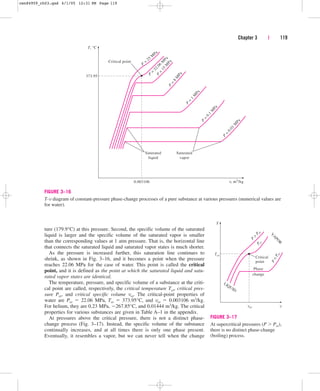
also called the torr in honor of Torricelli. Therefore, 1 atm  760 torr and 1
torr  133.3 Pa.
The standard atmospheric pressure Patm changes from 101.325 kPa at sea
level to 89.88, 79.50, 54.05, 26.5, and 5.53 kPa at altitudes of 1000, 2000,
5000, 10,000, and 20,000 meters, respectively. The standard atmospheric
pressure in Denver (elevation  1610 m), for example, is 83.4 kPa.
Remember that the atmospheric pressure at a location is simply the
weight of the air above that location per unit surface area. Therefore, it
changes not only with elevation but also with weather conditions.
The decline of atmospheric pressure with elevation has far-reaching rami-
fications in daily life. For example, cooking takes longer at high altitudes
since water boils at a lower temperature at lower atmospheric pressures.
Nose bleeding is a common experience at high altitudes since the difference
between the blood pressure and the atmospheric pressure is larger in this
case, and the delicate walls of veins in the nose are often unable to with-
stand this extra stress.
For a given temperature, the density of air is lower at high altitudes, and
thus a given volume contains less air and less oxygen. So it is no surprise
that we tire more easily and experience breathing problems at high altitudes.
To compensate for this effect, people living at higher altitudes develop more
efficient lungs. Similarly, a 2.0-L car engine will act like a 1.7-L car engine
at 1500 m altitude (unless it is turbocharged) because of the 15 percent drop
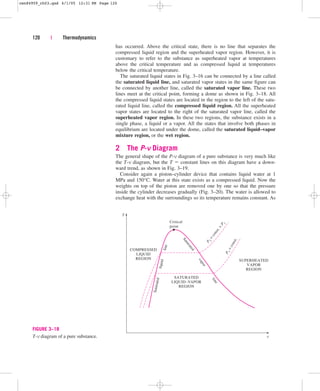
in pressure and thus 15 percent drop in the density of air (Fig. 1–53). A fan
or compressor will displace 15 percent less air at that altitude for the same
volume displacement rate. Therefore, larger cooling fans may need to be
selected for operation at high altitudes to ensure the specified mass flow
rate. The lower pressure and thus lower density also affects lift and drag:
airplanes need a longer runway at high altitudes to develop the required lift,
and they climb to very high altitudes for cruising for reduced drag and thus
better fuel efficiency.
Patm  rgh
30 | Thermodynamics
h
W rghA
=
A
h
B
Mercury
C
Patm
FIGURE 1–51
The basic barometer.
A2
A1 A3
FIGURE 1–52
The length or the cross-sectional area
of the tube has no effect on the height
of the fluid column of a barometer,
provided that the tube diameter is
large enough to avoid surface tension
(capillary) effects.
cen84959_ch01.qxd 3/31/05 3:38 PM Page 30
Chapter 1 | 31
A = 0.04 m2
P=?
Patm
= 0.97 bar
m = 60 kg
Patm
W = mg
P
FIGURE 1–54
Schematic for Example 1–9, and the
free-body diagram of the piston.
Engine Lungs
FIGURE 1–53
At high altitudes, a car engine
generates less power and a person gets
less oxygen because of the lower
density of air.
EXAMPLE 1–9 Effect of Piston Weight on Pressure in a Cylinder
The piston of a vertical piston–cylinder device containing a gas has a mass
of 60 kg and a cross-sectional area of 0.04 m2, as shown in Fig. 1–54. The
local atmospheric pressure is 0.97 bar, and the gravitational acceleration is
9.81 m/s2. (a) Determine the pressure inside the cylinder. (b) If some heat is
transferred to the gas and its volume is doubled, do you expect the pressure
inside the cylinder to change?
Solution A gas is contained in a vertical cylinder with a heavy piston. The
pressure inside the cylinder and the effect of volume change on pressure are
to be determined.
Assumptions Friction between the piston and the cylinder is negligible.
Analysis (a) The gas pressure in the piston–cylinder device depends on the
atmospheric pressure and the weight of the piston. Drawing the free-body
diagram of the piston as shown in Fig. 1–54 and balancing the vertical
forces yield
Solving for P and substituting,
(b) The volume change will have no effect on the free-body diagram drawn in
part (a), and therefore the pressure inside the cylinder will remain the same.
Discussion If the gas behaves as an ideal gas, the absolute temperature
doubles when the volume is doubled at constant pressure.
 1.12 bar
 0.97 bar 
160 kg2 19.81 ms2
2
10.04 m2
2
a
1 N
1 kg # ms2
b a
1 bar
105
Nm2
b
P  Patm 
mg
A
PA  Patm A  W
EXAMPLE 1–8 Measuring Atmospheric Pressure
with a Barometer
Determine the atmospheric pressure at a location where the barometric read-
ing is 740 mm Hg and the gravitational acceleration is g  9.81 m/s2.
Assume the temperature of mercury to be 10 C, at which its density is
13,570 kg/m3.
Solution The barometric reading at a location in height of mercury column
is given. The atmospheric pressure is to be determined.
Assumptions The temperature of mercury is 10 C.
Properties The density of mercury is given to be 13,570 kg/m3.
Analysis From Eq. 1–26, the atmospheric pressure is determined to be
Discussion Note that density changes with temperature, and thus this effect
should be considered in calculations.
 98.5 kPa
 113,570 kgm3
2 19.81 ms2
2 10.74 m2 a
1 N
1 kg # ms2
b a
1 kPa
1000 Nm2
b
Patm  rgh
cen84959_ch01.qxd 3/31/05 3:38 PM Page 31
32 | Thermodynamics
1
2
Increasing salinity
and density
Surface zone
Sun
r0 = 1040 kg/m3
H = 4 m
z
Gradient zone
Storage zone
FIGURE 1–55
Schematic for Example 1–10.
EXAMPLE 1–10 Hydrostatic Pressure in a Solar Pond
with Variable Density
Solar ponds are small artificial lakes of a few meters deep that are used to
store solar energy. The rise of heated (and thus less dense) water to the sur-
face is prevented by adding salt at the pond bottom. In a typical salt gradi-
ent solar pond, the density of water increases in the gradient zone, as shown
in Fig. 1–55, and the density can be expressed as
where r0 is the density on the water surface, z is the vertical distance mea-
sured downward from the top of the gradient zone, and H is the thickness of
the gradient zone. For H  4 m, r0  1040 kg/m3, and a thickness of 0.8
m for the surface zone, calculate the gage pressure at the bottom of the gra-
dient zone.
Solution The variation of density of saline water in the gradient zone of a
solar pond with depth is given. The gage pressure at the bottom of the gradi-
ent zone is to be determined.
Assumptions The density in the surface zone of the pond is constant.
Properties The density of brine on the surface is given to be 1040 kg/m3.
Analysis We label the top and the bottom of the gradient zone as 1 and 2,
respectively. Noting that the density of the surface zone is constant, the gage
pressure at the bottom of the surface zone (which is the top of the gradient
zone) is
since 1 kN/m2  1 kPa. The differential change in hydrostatic pressure
across a vertical distance of dz is given by
Integrating from the top of the gradient zone (point 1 where z  0) to any
location z in the gradient zone (no subscript) gives
P  P1  
z
0
rg dz¬¬S ¬¬P  P1  
z
0
r0
B
1  tan2
a
p
4
z
H
b g dz
dP  rg dz
P1  rgh1  11040 kgm3
2 19.81 ms2
2 10.8 m2 a
1 kN
1000 kg # ms2
b  8.16 kPa
r  r0
B
1  tan2
a
p
4
z
H
b
cen84959_ch01.qxd 3/31/05 3:38 PM Page 32
1–12 ■
PROBLEM-SOLVING TECHNIQUE
The first step in learning any science is to grasp the fundamentals and to gain
a sound knowledge of it. The next step is to master the fundamentals by test-
ing this knowledge. This is done by solving significant real-world problems.
Solving such problems, especially complicated ones, require a systematic
approach. By using a step-by-step approach, an engineer can reduce the solu-
tion of a complicated problem into the solution of a series of simple prob-
lems (Fig. 1–57). When you are solving a problem, we recommend that you
use the following steps zealously as applicable. This will help you avoid
some of the common pitfalls associated with problem solving.
Step 1: Problem Statement
In your own words, briefly state the problem, the key information given,
and the quantities to be found. This is to make sure that you understand the
problem and the objectives before you attempt to solve the problem.
Step 2: Schematic
Draw a realistic sketch of the physical system involved, and list the rele-
vant information on the figure. The sketch does not have to be something
elaborate, but it should resemble the actual system and show the key fea-
tures. Indicate any energy and mass interactions with the surroundings.
Listing the given information on the sketch helps one to see the entire
problem at once. Also, check for properties that remain constant during a
process (such as temperature during an isothermal process), and indicate
them on the sketch.
Chapter 1 | 33
4
3
2
3.5
2.5
1.5
1
0.5
0
0 10 20 30
P, kPa
z,
m
40 50 60
FIGURE 1–56
The variation of gage pressure with
depth in the gradient zone of the solar
pond.
SOLUTION
PROBLEM
HARD
WAY
EASY
W
AY
FIGURE 1–57
A step-by-step approach can greatly
simplify problem solving.
Performing the integration gives the variation of gage pressure in the gradi-
ent zone to be
Then the pressure at the bottom of the gradient zone (z  H  4 m)
becomes
Discussion The variation of gage pressure in the gradient zone with depth is
plotted in Fig. 1–56. The dashed line indicates the hydrostatic pressure for
the case of constant density at 1040 kg/m3 and is given for reference. Note
that the variation of pressure with depth is not linear when density varies
with depth.
 54.0 kPa 1gage2
 sinh1
atan
p
4
4
4
b a
1 kN
1000 kg # ms2
b
P2  8.16 kPa  11040 kgm3
2 19.81 ms2
2
414 m2
p
P  P1  r0g
4H
p
sinh1
atan
p
4
z
H
b
SEE TUTORIAL CH. 1, SEC. 12 ON THE DVD.
INTERACTIVE
TUTORIAL
cen84959_ch01.qxd 4/25/05 2:29 PM Page 33
Step 3: Assumptions and Approximations
State any appropriate assumptions and approximations made to simplify the
problem to make it possible to obtain a solution. Justify the questionable
assumptions. Assume reasonable values for missing quantities that are nec-
essary. For example, in the absence of specific data for atmospheric pres-
sure, it can be taken to be 1 atm. However, it should be noted in the analysis
that the atmospheric pressure decreases with increasing elevation. For exam-
ple, it drops to 0.83 atm in Denver (elevation 1610 m) (Fig. 1–58).
Step 4: Physical Laws
Apply all the relevant basic physical laws and principles (such as the con-
servation of mass), and reduce them to their simplest form by utilizing the
assumptions made. However, the region to which a physical law is applied
must be clearly identified first. For example, the increase in speed of water
flowing through a nozzle is analyzed by applying conservation of mass
between the inlet and outlet of the nozzle.
Step 5: Properties
Determine the unknown properties at known states necessary to solve the
problem from property relations or tables. List the properties separately, and
indicate their source, if applicable.
Step 6: Calculations
Substitute the known quantities into the simplified relations and perform the
calculations to determine the unknowns. Pay particular attention to the units
and unit cancellations, and remember that a dimensional quantity without a
unit is meaningless. Also, don’t give a false implication of high precision by
copying all the digits from the screen of the calculator—round the results to
an appropriate number of significant digits (see p. 38).
Step 7: Reasoning, Verification, and Discussion
Check to make sure that the results obtained are reasonable and intuitive,
and verify the validity of the questionable assumptions. Repeat the calcula-
tions that resulted in unreasonable values. For example, insulating a water
heater that uses $80 worth of natural gas a year cannot result in savings of
$200 a year (Fig. 1–59).
Also, point out the significance of the results, and discuss their implica-
tions. State the conclusions that can be drawn from the results, and any rec-
ommendations that can be made from them. Emphasize the limitations
under which the results are applicable, and caution against any possible mis-
understandings and using the results in situations where the underlying
assumptions do not apply. For example, if you determined that wrapping a
water heater with a $20 insulation jacket will reduce the energy cost by $30
a year, indicate that the insulation will pay for itself from the energy it saves
in less than a year. However, also indicate that the analysis does not con-
sider labor costs, and that this will be the case if you install the insulation
yourself.
34 | Thermodynamics
Given: Air temperature in Denver
To be found: Density of air
Missing information: Atmospheric
pressure
Assumption #1: Take P = 1 atm
(Inappropriate. Ignores effect of
altitude. Will cause more than
15% error.)
Assumption #2: Take P = 0.83 atm
(Appropriate. Ignores only minor
effects such as weather.)
FIGURE 1–58
The assumptions made while solving
an engineering problem must be
reasonable and justifiable.
Energy use:
Energy use:
Energy saved
Energy saved
by insulation:
by insulation:
IMPOSSIBLE!
IMPOSSIBLE!
$80/yr
$80/yr
$200/yr
$200/yr
FIGURE 1–59
The results obtained from an
engineering analysis must be checked
for reasonableness.
cen84959_ch01.qxd 3/31/05 3:39 PM Page 34
Keep in mind that the solutions you present to your instructors, and any
engineering analysis presented to others, is a form of communication.
Therefore neatness, organization, completeness, and visual appearance are
of utmost importance for maximum effectiveness. Besides, neatness also
serves as a great checking tool since it is very easy to spot errors and incon-
sistencies in neat work. Carelessness and skipping steps to save time often
end up costing more time and unnecessary anxiety.
The approach described here is used in the solved example problems with-
out explicitly stating each step, as well as in the Solutions Manual of this
text. For some problems, some of the steps may not be applicable or neces-
sary. For example, often it is not practical to list the properties separately.
However, we cannot overemphasize the importance of a logical and orderly
approach to problem solving. Most difficulties encountered while solving a
problem are not due to a lack of knowledge; rather, they are due to a lack of
organization. You are strongly encouraged to follow these steps in problem
solving until you develop your own approach that works best for you.
Engineering Software Packages
You may be wondering why we are about to undertake an in-depth study of
the fundamentals of another engineering science. After all, almost all such
problems we are likely to encounter in practice can be solved using one of
several sophisticated software packages readily available in the market
today. These software packages not only give the desired numerical results,
but also supply the outputs in colorful graphical form for impressive presen-
tations. It is unthinkable to practice engineering today without using some
of these packages. This tremendous computing power available to us at the
touch of a button is both a blessing and a curse. It certainly enables engi-
neers to solve problems easily and quickly, but it also opens the door for
abuses and misinformation. In the hands of poorly educated people, these
software packages are as dangerous as sophisticated powerful weapons in
the hands of poorly trained soldiers.
Thinking that a person who can use the engineering software packages
without proper training on fundamentals can practice engineering is like
thinking that a person who can use a wrench can work as a car mechanic. If
it were true that the engineering students do not need all these fundamental
courses they are taking because practically everything can be done by com-
puters quickly and easily, then it would also be true that the employers
would no longer need high-salaried engineers since any person who knows
how to use a word-processing program can also learn how to use those soft-
ware packages. However, the statistics show that the need for engineers is
on the rise, not on the decline, despite the availability of these powerful
packages.
We should always remember that all the computing power and the engi-
neering software packages available today are just tools, and tools have
meaning only in the hands of masters. Having the best word-processing pro-
gram does not make a person a good writer, but it certainly makes the job of
a good writer much easier and makes the writer more productive (Fig. 1–60).
Hand calculators did not eliminate the need to teach our children how to add
or subtract, and the sophisticated medical software packages did not take the
Chapter 1 | 35
FIGURE 1–60
An excellent word-processing
program does not make a person a
good writer; it simply makes a good
writer a more efficient writer.
© Vol. 80/PhotoDisc
cen84959_ch01.qxd 3/31/05 3:39 PM Page 35
place of medical school training. Neither will engineering software packages
replace the traditional engineering education. They will simply cause a shift
in emphasis in the courses from mathematics to physics. That is, more time
will be spent in the classroom discussing the physical aspects of the prob-
lems in greater detail, and less time on the mechanics of solution procedures.
All these marvelous and powerful tools available today put an extra bur-
den on today’s engineers. They must still have a thorough understanding of
the fundamentals, develop a “feel” of the physical phenomena, be able to
put the data into proper perspective, and make sound engineering judg-
ments, just like their predecessors. However, they must do it much better,
and much faster, using more realistic models because of the powerful tools
available today. The engineers in the past had to rely on hand calculations,
slide rules, and later hand calculators and computers. Today they rely on
software packages. The easy access to such power and the possibility of a
simple misunderstanding or misinterpretation causing great damage make it
more important today than ever to have solid training in the fundamentals of
engineering. In this text we make an extra effort to put the emphasis on
developing an intuitive and physical understanding of natural phenomena
instead of on the mathematical details of solution procedures.
Engineering Equation Solver (EES)
EES is a program that solves systems of linear or nonlinear algebraic or dif-
ferential equations numerically. It has a large library of built-in thermody-
namic property functions as well as mathematical functions, and allows the
user to supply additional property data. Unlike some software packages,
EES does not solve engineering problems; it only solves the equations sup-
plied by the user. Therefore, the user must understand the problem and for-
mulate it by applying any relevant physical laws and relations. EES saves
the user considerable time and effort by simply solving the resulting mathe-
matical equations. This makes it possible to attempt significant engineering
problems not suitable for hand calculations, and to conduct parametric stud-
ies quickly and conveniently. EES is a very powerful yet intuitive program
that is very easy to use, as shown in Examples 1–11 and 1–12. The use and
capabilities of EES are explained in Appendix 3 on the enclosed DVD.
36 | Thermodynamics
EXAMPLE 1–11 Solving a System of Equations with EES
The difference of two numbers is 4, and the sum of the squares of these two
numbers is equal to the sum of the numbers plus 20. Determine these two
numbers.
Solution Relations are given for the difference and the sum of the squares
of two numbers. They are to be determined.
Analysis We start the EES program by double-clicking on its icon, open a
new file, and type the following on the blank screen that appears:
x^2y^2  xy20
xy  4
cen84959_ch01.qxd 3/31/05 3:39 PM Page 36
Chapter 1 | 37
which is an exact mathematical expression of the problem statement with x
and y denoting the unknown numbers. The solution to this system of two
nonlinear equations with two unknowns is obtained by a single click on the
“calculator” icon on the taskbar. It gives
Discussion Note that all we did is formulate the problem as we would on
paper; EES took care of all the mathematical details of solution. Also note
that equations can be linear or nonlinear, and they can be entered in any
order with unknowns on either side. Friendly equation solvers such as EES
allow the user to concentrate on the physics of the problem without worrying
about the mathematical complexities associated with the solution of the
resulting system of equations.
x5¬and¬y1
EXAMPLE 1–12 Analyzing a Multifluid Manometer with EES
Reconsider the multifluid manometer discussed in Example 1–7 and replot-
ted in Fig. 1–61. Determine the air pressure in the tank using EES. Also
determine what the differential fluid height h3 would be for the same air
pressure if the mercury in the last column were replaced by seawater with a
density of 1030 kg/m3.
Solution The pressure in a water tank is measured by a multifluid
manometer. The air pressure in the tank and the differential fluid height h3
if mercury is replaced by seawater are to be determined using EES.
Analysis We start the EES program by double-clicking on its icon, open a
new file, and type the following on the blank screen that appears (we express
the atmospheric pressure in Pa for unit consistency):
g=9.81
Patm=85600
h1=0.1; h2=0.2; h3=0.35
rw=1000; roil=850; rm=13600
P1+rw*g*h1+roil*g*h2-rm*g*h3=Patm
Here P1 is the only unknown, and it is determined by EES to be
which is identical to the result obtained before. The height of the fluid col-
umn h3 when mercury is replaced by seawater is determined easily by
replacing “h30.35” by “P1129647” and “rm13600” by “rm1030,”
and clicking on the calculator symbol. It gives
Discussion Note that we used the screen like a paper pad and wrote down
the relevant information together with the applicable relations in an orga-
nized manner. EES did the rest. Equations can be written on separate lines
or on the same line by separating them by semicolons, and blank or com-
ment lines can be inserted for readability. EES makes it very easy to ask
“what if” questions, and to perform parametric studies, as explained in
Appendix 3 on the DVD.
EES also has the capability to check the equations for unit consistency if
units are supplied together with numerical values. Units can be specified
h3  4.62 m
P1  129647 Pa  130 kPa
h1
h2
h3
Oil
Mercury
WATER
AIR
1
2
FIGURE 1–61
Schematic for Example 1–12.
cen84959_ch01.qxd 3/31/05 3:39 PM Page 37
A Remark on Significant Digits
In engineering calculations, the information given is not known to more
than a certain number of significant digits, usually three digits. Conse-
quently, the results obtained cannot possibly be accurate to more significant
digits. Reporting results in more significant digits implies greater accuracy
than exists, and it should be avoided.
For example, consider a 3.75-L container filled with gasoline whose den-
sity is 0.845 kg/L, and try to determine its mass. Probably the first thought
that comes to your mind is to multiply the volume and density to obtain
3.16875 kg for the mass, which falsely implies that the mass determined is
accurate to six significant digits. In reality, however, the mass cannot be
more accurate than three significant digits since both the volume and the
density are accurate to three significant digits only. Therefore, the result
should be rounded to three significant digits, and the mass should be
reported to be 3.17 kg instead of what appears in the screen of the calcula-
tor. The result 3.16875 kg would be correct only if the volume and density
were given to be 3.75000 L and 0.845000 kg/L, respectively. The value 3.75
L implies that we are fairly confident that the volume is accurate within
0.01 L, and it cannot be 3.74 or 3.76 L. However, the volume can be
3.746, 3.750, 3.753, etc., since they all round to 3.75 L (Fig. 1–62). It is
more appropriate to retain all the digits during intermediate calculations,
and to do the rounding in the final step since this is what a computer will
normally do.
When solving problems, we will assume the given information to be
accurate to at least three significant digits. Therefore, if the length of a pipe
is given to be 40 m, we will assume it to be 40.0 m in order to justify using
three significant digits in the final results. You should also keep in mind that
all experimentally determined values are subject to measurement errors, and
such errors will reflect in the results obtained. For example, if the density of
a substance has an uncertainty of 2 percent, then the mass determined using
this density value will also have an uncertainty of 2 percent.
You should also be aware that we sometimes knowingly introduce small
errors in order to avoid the trouble of searching for more accurate data. For
example, when dealing with liquid water, we just use the value of 1000
kg/m3 for density, which is the density value of pure water at 0°C. Using
this value at 75°C will result in an error of 2.5 percent since the density at
this temperature is 975 kg/m3. The minerals and impurities in the water will
introduce additional error. This being the case, you should have no reserva-
tion in rounding the final results to a reasonable number of significant dig-
its. Besides, having a few percent uncertainty in the results of engineering
analysis is usually the norm, not the exception.
38 | Thermodynamics
Given:
Given:
Also,
Also, 3.75
3.75  0.845 = 3.16875
0.845 = 3.16875
Volume:
Volume:
Density:
Density:
Find:
Find:
Mass:
Mass: m =
= rV = 3.16875 kg
= 3.16875 kg
Rounding to 3 significant digits:
m = 3.17 kg
= 3.17 kg
(3 significant digits)
V = 3.75 L
= 3.75 L
r = 0.845 kg
= 0.845 kg/L
FIGURE 1–62
A result with more significant digits
than that of given data falsely implies
more accuracy.
within brackets [ ] after the specified value. When this feature is utilized,
the previous equations would take the following form:
g=9.81 [m/s^2]
Patm=85600 [Pa]
h1=0.1 [m]; h2=0.2 [m]; h3=0.35 [m]
rw=1000 [kg/m^3]; roil=850 [kg/m^3]; rm=13600 [kg/m^3]
P1+rw*g*h1+roil*g*h2-rm*g*h3=Patm
cen84959_ch01.qxd 3/31/05 3:39 PM Page 38
Chapter 1 | 39
SUMMARY
In this chapter, the basic concepts of thermodynamics are
introduced and discussed. Thermodynamics is the science that
primarily deals with energy. The first law of thermodynamics
is simply an expression of the conservation of energy princi-
ple, and it asserts that energy is a thermodynamic property.
The second law of thermodynamics asserts that energy has
quality as well as quantity, and actual processes occur in the
direction of decreasing quality of energy.
A system of fixed mass is called a closed system, or control
mass, and a system that involves mass transfer across its
boundaries is called an open system, or control volume. The
mass-dependent properties of a system are called extensive
properties and the others intensive properties. Density is mass
per unit volume, and specific volume is volume per unit mass.
A system is said to be in thermodynamic equilibrium if it
maintains thermal, mechanical, phase, and chemical equilib-
rium. Any change from one state to another is called a
process. A process with identical end states is called a cycle.
During a quasi-static or quasi-equilibrium process, the sys-
tem remains practically in equilibrium at all times. The state
of a simple, compressible system is completely specified by
two independent, intensive properties.
The zeroth law of thermodynamics states that two bodies
are in thermal equilibrium if both have the same temperature
reading even if they are not in contact.
The temperature scales used in the SI and the English sys-
tem today are the Celsius scale and the Fahrenheit scale,
respectively. They are related to absolute temperature scales by
The magnitudes of each division of 1 K and 1°C are identi-
cal, and so are the magnitudes of each division of 1 R and
1°F. Therefore,
¢T1K2  ¢T1°C2¬and¬¢T1R2  ¢T1°F2
T1R2  T1°F2  459.67
T1K2  T1°C2  273.15
1. American Society for Testing and Materials. Standards
for Metric Practice. ASTM E 380-79, January 1980.
2. A. Bejan. Advanced Engineering Thermodynamics. 2nd
ed. New York: Wiley, 1997.
3. J. A. Schooley. Thermometry. Boca Raton, FL: CRC
Press, 1986.
The normal force exerted by a fluid per unit area is
called pressure, and its unit is the pascal, 1 Pa  1 N/m2.
The pressure relative to absolute vacuum is called the
absolute pressure, and the difference between the absolute
pressure and the local atmospheric pressure is called the
gage pressure. Pressures below atmospheric pressure are
called vacuum pressures. The absolute, gage, and vacuum
pressures are related by
The pressure at a point in a fluid has the same magnitude in
all directions. The variation of pressure with elevation is
given by
where the positive z direction is taken to be upward. When
the density of the fluid is constant, the pressure difference
across a fluid layer of thickness z is
The absolute and gage pressures in a liquid open to the atmo-
sphere at a depth h from the free surface are
Small to moderate pressure differences are measured by a
manometer. The pressure in a stationary fluid remains con-
stant in the horizontal direction. Pascal’s principle states that
the pressure applied to a confined fluid increases the pressure
throughout by the same amount. The atmospheric pressure is
measured by a barometer and is given by
where h is the height of the liquid column.
Patm  rgh
P  Patm  rgh¬or¬Pgage  rgh
¢P  P2  P1  rg ¢z
dP
dz
 rg
Pvac  Patm  Pabs¬¬1for pressures below Patm 2
Pgage  Pabs  Patm¬¬1for pressures above Patm 2
REFERENCES AND SUGGESTED READINGS
cen84959_ch01.qxd 3/31/05 3:39 PM Page 39
40 | Thermodynamics
PROBLEMS*
Thermodynamics
1–1C What is the difference between the classical and the
statistical approaches to thermodynamics?
1–2C Why does a bicyclist pick up speed on a downhill
road even when he is not pedaling? Does this violate the con-
servation of energy principle?
1–3C An office worker claims that a cup of cold coffee on
his table warmed up to 80°C by picking up energy from the
surrounding air, which is at 25°C. Is there any truth to his
claim? Does this process violate any thermodynamic laws?
Mass, Force, and Units
1–4C What is the difference between pound-mass and
pound-force?
1–5C What is the difference between kg-mass and kg-
force?
1–6C What is the net force acting on a car cruising at a
constant velocity of 70 km/h (a) on a level road and (b) on an
uphill road?
1–7 A 3-kg plastic tank that has a volume of 0.2 m3 is filled
with liquid water. Assuming the density of water is 1000
kg/m3, determine the weight of the combined system.
1–8 Determine the mass and the weight of the air contained in
a room whose dimensions are 6 m  6 m  8 m. Assume the
density of the air is 1.16 kg/m3. Answers: 334.1 kg, 3277 N
1–9 At 45° latitude, the gravitational acceleration as a func-
tion of elevation z above sea level is given by g  a  bz,
where a  9.807 m/s2 and b  3.32  106 s2. Determine
the height above sea level where the weight of an object will
decrease by 1 percent. Answer: 29,539 m
1–10E A 150-lbm astronaut took his bathroom scale (a
spring scale) and a beam scale (compares masses) to the
moon where the local gravity is g  5.48 ft/s2. Determine
how much he will weigh (a) on the spring scale and (b) on
the beam scale. Answers: (a) 25.5 lbf; (b) 150 lbf
1–11 The acceleration of high-speed aircraft is sometimes
expressed in g’s (in multiples of the standard acceleration of
gravity). Determine the upward force, in N, that a 90-kg man
would experience in an aircraft whose acceleration is 6 g’s.
1–12 A 5-kg rock is thrown upward with a force of
150 N at a location where the local gravitational
acceleration is 9.79 m/s2. Determine the acceleration of the
rock, in m/s2.
1–13 Solve Prob. 1–12 using EES (or other) software.
Print out the entire solution, including the
numerical results with proper units.
1–14 The value of the gravitational acceleration g decreases
with elevation from 9.807 m/s2 at sea level to 9.767 m/s2 at
an altitude of 13,000 m, where large passenger planes cruise.
Determine the percent reduction in the weight of an airplane
cruising at 13,000 m relative to its weight at sea level.
Systems, Properties, State, and Processes
1–15C A large fraction of the thermal energy generated in
the engine of a car is rejected to the air by the radiator
through the circulating water. Should the radiator be analyzed
as a closed system or as an open system? Explain.
1–16C A can of soft drink at room temperature is put into
the refrigerator so that it will cool. Would you model the can
of soft drink as a closed system or as an open system?
Explain.
1–17C What is the difference between intensive and exten-
sive properties?
1–18C For a system to be in thermodynamic equilibrium,
do the temperature and the pressure have to be the same
everywhere?
1–19C What is a quasi-equilibrium process? What is its
importance in engineering?
1–20C Define the isothermal, isobaric, and isochoric
processes.
1–21C What is the state postulate?
1–22C Is the state of the air in an isolated room completely
specified by the temperature and the pressure? Explain.
*Problems designated by a “C” are concept questions, and
students are encouraged to answer them all. Problems designated
by an “E” are in English units, and the SI users can ignore them.
Problems with the icon are solved using EES, and complete
solutions together with parametric studies are included on the
enclosed DVD. Problems with the icon are comprehensive in
nature and are intended to be solved with a computer, preferably
using the EES software that accompanies this text.
FIGURE P1–15C
© The McGraw-Hill Companies, Inc./Jill Braaten, photographer
cen84959_ch01.qxd 3/31/05 3:39 PM Page 40
Chapter 1 | 41
1–23C What is a steady-flow process?
1–24C What is specific gravity? How is it related to density?
1–25 The density of atmospheric air varies with eleva-
tion, decreasing with increasing altitude. (a) Using
the data given in the table, obtain a relation for the variation of
density with elevation, and calculate the density at an elevation
of 7000 m. (b) Calculate the mass of the atmosphere using the
correlation you obtained. Assume the earth to be a perfect
sphere with a radius of 6377 km, and take the thickness of the
atmosphere to be 25 km.
z, km r, kg/m3
6377 1.225
6378 1.112
6379 1.007
6380 0.9093
6381 0.8194
6382 0.7364
6383 0.6601
6385 0.5258
6387 0.4135
6392 0.1948
6397 0.08891
6402 0.04008
Temperature
1–26C What is the zeroth law of thermodynamics?
1–27C What are the ordinary and absolute temperature
scales in the SI and the English system?
1–28C Consider an alcohol and a mercury thermometer
that read exactly 0°C at the ice point and 100°C at the steam
point. The distance between the two points is divided into
100 equal parts in both thermometers. Do you think these
thermometers will give exactly the same reading at a temper-
ature of, say, 60°C? Explain.
1–29 The deep body temperature of a healthy person is
37°C. What is it in kelvins?
1–30E Consider a system whose temperature is 18°C.
Express this temperature in R, K, and °F.
1–31 The temperature of a system rises by 15°C during a
heating process. Express this rise in temperature in kelvins.
1–32E The temperature of a system drops by 45°F during a
cooling process. Express this drop in temperature in K, R,
and °C.
1–33 Consider two closed systems A and B. System A con-
tains 3000 kJ of thermal energy at 20°C, whereas system B
contains 200 kJ of thermal energy at 50°C. Now the systems
are brought into contact with each other. Determine the direc-
tion of any heat transfer between the two systems.
Pressure, Manometer, and Barometer
1–34C What is the difference between gage pressure and
absolute pressure?
1–35C Explain why some people experience nose bleeding
and some others experience shortness of breath at high eleva-
tions.
1–36C Someone claims that the absolute pressure in a liq-
uid of constant density doubles when the depth is doubled.
Do you agree? Explain.
1–37C A tiny steel cube is suspended in water by a string.
If the lengths of the sides of the cube are very small, how
would you compare the magnitudes of the pressures on the
top, bottom, and side surfaces of the cube?
1–38C Express Pascal’s law, and give a real-world example
of it.
1–39C Consider two identical fans, one at sea level and the
other on top of a high mountain, running at identical speeds.
How would you compare (a) the volume flow rates and
(b) the mass flow rates of these two fans?
1–40 A vacuum gage connected to a chamber reads 35 kPa
at a location where the atmospheric pressure is 92 kPa.
Determine the absolute pressure in the chamber.
1–41E A manometer is used to measure the air pressure in
a tank. The fluid used has a specific gravity of 1.25, and the
differential height between the two arms of the manometer is
28 in. If the local atmospheric pressure is 12.7 psia, deter-
mine the absolute pressure in the tank for the cases of the
manometer arm with the (a) higher and (b) lower fluid level
being attached to the tank.
1–42 The water in a tank is pressurized by air, and the
pressure is measured by a multifluid manometer as shown in
Fig. P1–42. Determine the gage pressure of air in the tank if
h1
h2
h3
Oil
Mercury
WATER
AIR
1
2
FIGURE P1–42
cen84959_ch01.qxd 3/31/05 3:39 PM Page 41
42 | Thermodynamics
h1  0.2 m, h2  0.3 m, and h3  0.46 m. Take the densities
of water, oil, and mercury to be 1000 kg/m3, 850 kg/m3, and
13,600 kg/m3, respectively.
1–43 Determine the atmospheric pressure at a location
where the barometric reading is 750 mm Hg. Take the density
of mercury to be 13,600 kg/m3.
1–44 The gage pressure in a liquid at a depth of 3 m is read
to be 28 kPa. Determine the gage pressure in the same liquid
at a depth of 9 m.
1–45 The absolute pressure in water at a depth of 5 m is
read to be 145 kPa. Determine (a) the local atmospheric pres-
sure, and (b) the absolute pressure at a depth of 5 m in a liq-
uid whose specific gravity is 0.85 at the same location.
1–46E Show that 1 kgf/cm2  14.223 psi.
1–47E A 200-pound man has a total foot imprint area of 72
in2. Determine the pressure this man exerts on the ground if
(a) he stands on both feet and (b) he stands on one foot.
1–48 Consider a 70-kg woman who has a total foot imprint
area of 400 cm2. She wishes to walk on the snow, but the
snow cannot withstand pressures greater than 0.5 kPa. Deter-
mine the minimum size of the snowshoes needed (imprint
area per shoe) to enable her to walk on the snow without
sinking.
1–49 A vacuum gage connected to a tank reads 15 kPa at a
location where the barometric reading is 750 mm Hg. Deter-
mine the absolute pressure in the tank. Take rHg  13,590
kg/m3. Answer: 85.0 kPa
1–50E A pressure gage connected to a tank reads 50 psi at
a location where the barometric reading is 29.1 mm Hg.
Determine the absolute pressure in the tank. Take rHg 
848.4 lbm/ft3. Answer: 64.3 psia
1–51 A pressure gage connected to a tank reads 500 kPa at
a location where the atmospheric pressure is 94 kPa. Deter-
mine the absolute pressure in the tank.
1–52 The barometer of a mountain hiker reads 930 mbars
at the beginning of a hiking trip and 780 mbars at the end.
Neglecting the effect of altitude on local gravitational accel-
eration, determine the vertical distance climbed. Assume an
average air density of 1.20 kg/m3. Answer: 1274 m
1–53 The basic barometer can be used to measure the
height of a building. If the barometric readings at the top and
at the bottom of a building are 730 and 755 mm Hg, respec-
tively, determine the height of the building. Take the densities
of air and mercury to be 1.18 kg/m3 and 13,600 kg/m3,
respectively.
1–54 Solve Prob. 1–53 using EES (or other) software.
Print out the entire solution, including the
numerical results with proper units.
1–55 Determine the pressure exerted on a diver at 30 m
below the free surface of the sea. Assume a barometric pres-
sure of 101 kPa and a specific gravity of 1.03 for seawater.
Answer: 404.0 kPa
1–56E Determine the pressure exerted on the surface of a
submarine cruising 175 ft below the free surface of the sea.
Assume that the barometric pressure is 14.7 psia and the spe-
cific gravity of seawater is 1.03.
1–57 A gas is contained in a vertical, frictionless
piston–cylinder device. The piston has a mass of 4 kg and a
cross-sectional area of 35 cm2. A compressed spring above
the piston exerts a force of 60 N on the piston. If the atmo-
spheric pressure is 95 kPa, determine the pressure inside the
cylinder. Answer: 123.4 kPa
FIGURE P1–53
© Vol. 74/Corbis
cen84959_ch01.qxd 3/31/05 3:39 PM Page 42
Chapter 1 | 43
1–58 Reconsider Prob. 1–57. Using EES (or other)
software, investigate the effect of the spring
force in the range of 0 to 500 N on the pressure inside the
cylinder. Plot the pressure against the spring force, and dis-
cuss the results.
1–59 Both a gage and a manometer are attached to a
gas tank to measure its pressure. If the reading on
the pressure gage is 80 kPa, determine the distance between
the two fluid levels of the manometer if the fluid is (a) mer-
cury (r  13,600 kg/m3) or (b) water (r  1000 kg/m3).
1–60 Reconsider Prob. 1–59. Using EES (or other)
software, investigate the effect of the manometer
fluid density in the range of 800 to 13,000 kg/m3 on the dif-
ferential fluid height of the manometer. Plot the differential
fluid height against the density, and discuss the results.
1–61 A manometer containing oil (r  850 kg/m3) is
attached to a tank filled with air. If the oil-level difference
between the two columns is 60 cm and the atmospheric pres-
sure is 98 kPa, determine the absolute pressure of the air in
the tank. Answer: 103 kPa
1–62 A mercury manometer (r  13,600 kg/m3) is con-
nected to an air duct to measure the pressure inside. The differ-
ence in the manometer levels is 15 mm, and the atmospheric
pressure is 100 kPa. (a) Judging from Fig. P1–62, determine if
the pressure in the duct is above or below the atmospheric
pressure. (b) Determine the absolute pressure in the duct.
A = 35 cm2
Patm = 95 kPa
mP = 4 kg
60 N
FIGURE P1–57
Gas
h = ?
Pg = 80 kPa
FIGURE P1–59
h
FIGURE P1–65
AIR
h = 15 mm
P = ?
FIGURE P1–62
1–63 Repeat Prob. 1–62 for a differential mercury height of
45 mm.
1–64 Blood pressure is usually measured by wrapping a
closed air-filled jacket equipped with a pressure gage around
the upper arm of a person at the level of the heart. Using a
mercury manometer and a stethoscope, the systolic pressure
(the maximum pressure when the heart is pumping) and the
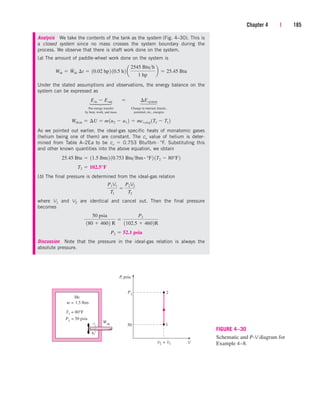
diastolic pressure (the minimum pressure when the heart is
resting) are measured in mm Hg. The systolic and diastolic
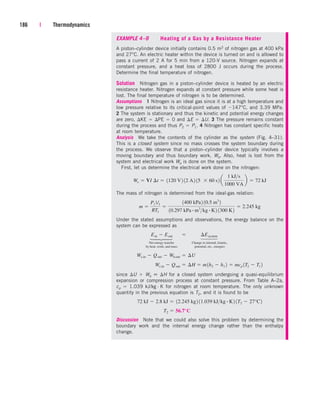
pressures of a healthy person are about 120 mm Hg and 80
mm Hg, respectively, and are indicated as 120/80. Express both
of these gage pressures in kPa, psi, and meter water column.
1–65 The maximum blood pressure in the upper arm of a
healthy person is about 120 mm Hg. If a vertical tube open to
the atmosphere is connected to the vein in the arm of the per-
son, determine how high the blood will rise in the tube. Take
the density of the blood to be 1050 kg/m3.
cen84959_ch01.qxd 3/31/05 3:39 PM Page 43
44 | Thermodynamics
1–66 Consider a 1.8-m-tall man standing vertically in water
and completely submerged in a pool. Determine the differ-
ence between the pressures acting at the head and at the toes
of this man, in kPa.
1–67 Consider a U-tube whose arms are open to the atmo-
sphere. Now water is poured into the U-tube from one arm,
and light oil (r  790 kg/m3) from the other. One arm con-
tains 70-cm-high water, while the other arm contains both
fluids with an oil-to-water height ratio of 4. Determine the
height of each fluid in that arm.
1–72E Repeat Prob. 1–71E by replacing air by oil with a
specific gravity of 0.69.
1–73 The gage pressure of the air in the tank shown in Fig.
P1–73 is measured to be 80 kPa. Determine the differential
height h of the mercury column.
70 cm
Water
Oil
FIGURE P1–67
1–68 The hydraulic lift in a car repair shop has an output
diameter of 30 cm and is to lift cars up to 2000 kg. Deter-
mine the fluid gage pressure that must be maintained in the
reservoir.
1–69 Freshwater and seawater flowing in parallel horizontal
pipelines are connected to each other by a double U-tube
manometer, as shown in Fig. P1–69. Determine the pressure
difference between the two pipelines. Take the density of sea-
water at that location to be r  1035 kg/m3. Can the air col-
umn be ignored in the analysis?
60 cm
10 cm
70 cm
40 cm
Fresh
water
Sea
water
Air
Mercury
FIGURE P1–69
1–70 Repeat Prob. 1–69 by replacing the air with oil whose
specific gravity is 0.72.
1–71E The pressure in a natural gas pipeline is measured by
the manometer shown in Fig. P1–71E with one of the arms
open to the atmosphere where the local atmospheric pressure
is 14.2 psia. Determine the absolute pressure in the pipeline.
10 in
6 in
2 in
25 in
Natural
Gas
Water
Air
Mercury
SG = 13.6
FIGURE P1–71E
Air
30 cm
75 cm
h Mercury
SG = 13.6
Water
Oil
SG = 0.72
80 kPa
FIGURE P1–73
1–74 Repeat Prob. 1–73 for a gage pressure of 40 kPa.
1–75 The top part of a water tank is divided into two com-
partments, as shown in Fig. P1–75. Now a fluid with an
50 cm
95 cm
80 cm
Unknown
liquid
WATER
FIGURE P1–75
cen84959_ch01.qxd 3/31/05 3:39 PM Page 44
Chapter 1 | 45
unknown density is poured into one side, and the water level
rises a certain amount on the other side to compensate for
this effect. Based on the final fluid heights shown on the fig-
ure, determine the density of the fluid added. Assume the
liquid does not mix with water.
1–76 Consider a double-fluid manometer attached to an air
pipe shown in Fig. P1–76. If the specific gravity of one fluid
is 13.55, determine the specific gravity of the other fluid for
the indicated absolute pressure of air. Take the atmospheric
pressure to be 100 kPa. Answer: 5.0
1–78 A multifluid container is connected to a U-tube, as
shown in Fig. P1–78. For the given specific gravities and
fluid column heights, determine the gage pressure at A. Also
determine the height of a mercury column that would create
the same pressure at A. Answers: 0.471 kPa, 0.353 cm
SG2
Air
P = 76 kPa
22 cm
40 cm
SG1 = 13.55
FIGURE P1–76
Mercury
SG = 13.56
Water
Air
Area, A1
Area, A2
Brine
pipe
SG = 1.1
FIGURE P1–77
1–77 Consider the system shown in Fig. P1–77. If a change
of 0.7 kPa in the pressure of air causes the brine–mercury
interface in the right column to drop by 5 mm in the brine
level in the right column while the pressure in the brine pipe
remains constant, determine the ratio of A2/A1.
Solving Engineering Problems and EES
1–79C What is the value of the engineering software pack-
ages in (a) engineering education and (b) engineering prac-
tice?
1–80 Determine a positive real root of this equation
using EES:
1–81 Solve this system of two equations with two
unknowns using EES:
1–82 Solve this system of three equations with three
unknowns using EES:
1–83 Solve this system of three equations with three
unknowns using EES:
x  y  z  2
x  3y0.5
 xz  2
x2
y  z  1
xy  2z  8
3x2
 2y  z  2
2x  y  z  5
3xy  y  3.5
x3
 y2
 7.75
2x3
 10x0.5
 3x  3
70 cm
Oil
SG = 0.90
Water
Glycerin
SG = 1.26
30 cm
20 cm
15 cm
90 cm
A
FIGURE P1–78
cen84959_ch01.qxd 4/19/05 11:04 AM Page 45
46 | Thermodynamics
1–84E Specific heat is defined as the amount of
energy needed to increase the temperature of a
unit mass of a substance by one degree. The specific heat of
water at room temperature is 4.18 kJ/kg  °C in SI unit
system. Using the unit conversion function capability of
EES, express the specific heat of water in (a) kJ/kg  K,
(b) Btu/lbm  F, (c) Btu/lbm  R, and (d) kCal/kg  °C units.
Answers: (a) 4.18, (b) (c) (d) 0.9984
Review Problems
1–85 A hydraulic lift is to be used to lift a 2500 kg weight
by putting a weight of 25 kg on a piston with a diameter of
10 cm. Determine the diameter of the piston on which the
weight is to be placed.
1–87 The pilot of an airplane reads the altitude 3000 m and
the absolute pressure 58 kPa when flying over a city. Calcu-
late the local atmospheric pressure in that city in kPa and in
mm Hg. Take the densities of air and mercury to be 1.15
kg/m3 and 13,600 kg/m3, respectively.
1–88 The weight of bodies may change somewhat from one
location to another as a result of the variation of the gravita-
tional acceleration g with elevation. Accounting for this vari-
ation using the relation in Prob. 1–9, determine the weight of
an 80-kg person at sea level (z  0), in Denver (z  1610 m),
and on the top of Mount Everest (z  8848 m).
1–89 A man goes to a traditional market to buy a steak for
dinner. He finds a 12-oz steak (1 lbm  16 oz) for $3.15. He
then goes to the adjacent international market and finds a
320-g steak of identical quality for $2.80. Which steak is the
better buy?
1–90 The reactive force developed by a jet engine to push
an airplane forward is called thrust, and the thrust developed
by the engine of a Boeing 777 is about 85,000 lbf. Express
this thrust in N and kgf.
1–91E The efficiency of a refrigerator increases by 3 per-
cent for each °C rise in the minimum temperature in the
device. What is the increase in the efficiency for each (a) K,
(b) °F, and (c) R rise in temperature?
1–92E The boiling temperature of water decreases by about
3°C for each 1000-m rise in altitude. What is the decrease in
the boiling temperature in (a) K, (b) °F, and (c) R for each
1000-m rise in altitude?
1–93E The average body temperature of a person rises by
about 2°C during strenuous exercise. What is the rise in the
body temperature in (a) K, (b) °F, and (c) R during strenuous
exercise?
1–94E Hyperthermia of 5°C (i.e., 5°C rise above the nor-
mal body temperature) is considered fatal. Express this fatal
level of hyperthermia in (a) K, (b) °F, and (c) R.
1–95E A house is losing heat at a rate of 4500 kJ/h per °C
temperature difference between the indoor and the outdoor
temperatures. Express the rate of heat loss from this house
per (a) K, (b) °F, and (c) R difference between the indoor and
the outdoor temperature.
F1
D2
F2
25
kg
10
cm
Weight
2500 kg
FIGURE P1–85
Altitude: 3 km
P = 58 kPa
FIGURE P1–87
WEIGHTS
GAS
FIGURE P1–86
1–86 A vertical piston–cylinder device contains a gas at a
pressure of 100 kPa. The piston has a mass of 5 kg and a diam-
eter of 12 cm. Pressure of the gas is to be increased by placing
some weights on the piston. Determine the local atmospheric
pressure and the mass of the weights that will double the pres-
sure of the gas inside the cylinder. Answers: 95.7 kPa, 115.3 kg
cen84959_ch01.qxd 3/31/05 3:39 PM Page 46
Chapter 1 | 47
1–96 The average temperature of the atmosphere in the
world is approximated as a function of altitude by the relation
where Tatm is the temperature of the atmosphere in K and z is
the altitude in km with z  0 at sea level. Determine the
average temperature of the atmosphere outside an airplane
that is cruising at an altitude of 12,000 m.
1–97 Joe Smith, an old-fashioned engineering student,
believes that the boiling point of water is best suited for use as
the reference point on temperature scales. Unhappy that the
boiling point corresponds to some odd number in the current
absolute temperature scales, he has proposed a new absolute
temperature scale that he calls the Smith scale. The temperature
unit on this scale is smith, denoted by S, and the boiling point
of water on this scale is assigned to be 1000 S. From a thermo-
dynamic point of view, discuss if it is an acceptable temperature
scale. Also, determine the ice point of water on the Smith scale
and obtain a relation between the Smith and Celsius scales.
1–98E It is well-known that cold air feels much colder in
windy weather than what the thermometer reading indicates
because of the “chilling effect” of the wind. This effect is due
to the increase in the convection heat transfer coefficient with
increasing air velocities. The equivalent wind chill tempera-
ture in °F is given by [ASHRAE, Handbook of Fundamentals
(Atlanta, GA, 1993), p. 8.15]
where V is the wind velocity in mi/h and Tambient is the ambi-
ent air temperature in °F in calm air, which is taken to be air
with light winds at speeds up to 4 mi/h. The constant 91.4°F
in the given equation is the mean skin temperature of a rest-
ing person in a comfortable environment. Windy air at tem-
perature Tambient and velocity V will feel as cold as the calm
air at temperature Tequiv. Using proper conversion factors,
obtain an equivalent relation in SI units where V is the wind
velocity in km/h and Tambient is the ambient air temperature in
°C.
Answer: Tequiv 33.0(33.0Tambient)
(0.475  0.0126V  0.240V
–
)
1–99E Reconsider Problem 1–98E. Using EES (or
other) software, plot the equivalent wind chill
temperatures in °F as a function of wind velocity in the range
of 4 to 100 mph for the ambient temperatures of 20, 40, and
60°F. Discuss the results.
1–100 An air-conditioning system requires a 20-m-long
section of 15-cm diameter duct work to be laid underwater.
¬ 10.475  0.0203V  0.3042V2
Tequiv  91.4  191.4  Tambient 2
Tatm  288.15  6.5z
Determine the upward force the water will exert on the duct.
Take the densities of air and water to be 1.3 kg/m3 and 1000
kg/m3, respectively.
1–101 Balloons are often filled with helium gas because it
weighs only about one-seventh of what air weighs under
identical conditions. The buoyancy force, which can be
expressed as Fb  rairgVballoon, will push the balloon upward.
If the balloon has a diameter of 10 m and carries two people,
70 kg each, determine the acceleration of the balloon when it
is first released. Assume the density of air is r  1.16 kg/m3,
and neglect the weight of the ropes and the cage. Answer:
16.5 m/s2
HELIUM
D = 10 m
rHe = rair
1
7
m = 140 kg
FIGURE P1–101
1–102 Reconsider Prob. 1–101. Using EES (or other)
software, investigate the effect of the number
of people carried in the balloon on acceleration. Plot the
acceleration against the number of people, and discuss the
results.
1–103 Determine the maximum amount of load, in kg,
the balloon described in Prob. 1–101 can carry. Answer:
520.5 kg
1–104E The pressure in a steam boiler is given to be
92 kgf/cm2. Express this pressure in psi, kPa, atm, and bars.
1–105 The basic barometer can be used as an altitude-
measuring device in airplanes. The ground control reports a
barometric reading of 753 mm Hg while the pilot’s reading is
690 mm Hg. Estimate the altitude of the plane from ground
level if the average air density is 1.20 kg/m3. Answer: 714 m
cen84959_ch01.qxd 3/31/05 3:39 PM Page 47
48 | Thermodynamics
1–106 The lower half of a 10-m-high cylindrical container
is filled with water (r  1000 kg/m3) and the upper half with
oil that has a specific gravity of 0.85. Determine the pressure
difference between the top and bottom of the cylinder.
Answer: 90.7 kPa
1–109 A glass tube is attached to a water pipe, as shown in
Fig. P1–109. If the water pressure at the bottom of the tube
is 115 kPa and the local atmospheric pressure is 92 kPa,
determine how high the water will rise in the tube, in m.
Take the density of water to be 1000 kg/m3.
Patm = 101 kPa
Petcock
PRESSURE
COOKER
A = 4 mm2
FIGURE P1–108
Patm = 92 kPa
h = ?
Water
FIGURE P1–109
Duct
35°
8 cm
L
Air
FIGURE P1–111
1–107 A vertical, frictionless piston–cylinder device contains
a gas at 250 kPa absolute pressure. The atmospheric pressure
outside is 100 kPa, and the piston area is 30 cm2. Determine the
mass of the piston.
1–108 A pressure cooker cooks a lot faster than an ordinary
pan by maintaining a higher pressure and temperature inside.
The lid of a pressure cooker is well sealed, and steam can
escape only through an opening in the middle of the lid. A
separate metal piece, the petcock, sits on top of this opening
and prevents steam from escaping until the pressure force
overcomes the weight of the petcock. The periodic escape of
the steam in this manner prevents any potentially dangerous
pressure buildup and keeps the pressure inside at a constant
value. Determine the mass of the petcock of a pressure
cooker whose operation pressure is 100 kPa gage and has an
opening cross-sectional area of 4 mm2. Assume an atmo-
spheric pressure of 101 kPa, and draw the free-body diagram
of the petcock. Answer: 40.8 g
1–110 The average atmospheric pressure on earth is
approximated as a function of altitude by the relation Patm 
101.325 (1  0.02256z)5.256, where Patm is the atmospheric
pressure in kPa and z is the altitude in km with z  0 at sea
level. Determine the approximate atmospheric pressures at
Atlanta (z  306 m), Denver (z  1610 m), Mexico City (z
 2309 m), and the top of Mount Everest (z  8848 m).
1–111 When measuring small pressure differences with a
manometer, often one arm of the manometer is inclined to
improve the accuracy of reading. (The pressure difference is
still proportional to the vertical distance and not the actual
length of the fluid along the tube.) The air pressure in a cir-
cular duct is to be measured using a manometer whose open
arm is inclined 35° from the horizontal, as shown in Fig.
P1–111. The density of the liquid in the manometer is 0.81
kg/L, and the vertical distance between the fluid levels in the
two arms of the manometer is 8 cm. Determine the gage
pressure of air in the duct and the length of the fluid column
in the inclined arm above the fluid level in the vertical arm.
OIL
SG = 0.85
h = 10 m
ρ = 1000 kg/m3
WATER
FIGURE P1–106
cen84959_ch01.qxd 3/31/05 3:39 PM Page 48
Chapter 1 | 49
Air
Water 30 in
Oil
FIGURE P1–112E
1–112E Consider a U-tube whose arms are open to the
atmosphere. Now equal volumes of water and light oil (r 
49.3 lbm/ft3) are poured from different arms. A person blows
from the oil side of the U-tube until the contact surface of the
two fluids moves to the bottom of the U-tube, and thus the
liquid levels in the two arms are the same. If the fluid height
in each arm is 30 in, determine the gage pressure the person
exerts on the oil by blowing.
1–115 Repeat Prob. 1–114 for a pressure gage reading of
180 kPa.
1–116E A water pipe is connected to a double-U manome-
ter as shown in Fig. P1–116E at a location where the local
atmospheric pressure is 14.2 psia. Determine the absolute
pressure at the center of the pipe.
1–117 It is well-known that the temperature of the atmo-
sphere varies with altitude. In the troposphere, which extends
to an altitude of 11 km, for example, the variation of temper-
ature can be approximated by T  T0  bz, where T0 is the
temperature at sea level, which can be taken to be 288.15 K,
and b  0.0065 K/m. The gravitational acceleration also
changes with altitude as g(z)  g0/(1  z/6,370,320)2 where
g0  9.807 m/s2 and z is the elevation from sea level in m.
Obtain a relation for the variation of pressure in the tropo-
sphere (a) by ignoring and (b) by considering the variation of
g with altitude.
1–118 The variation of pressure with density in a thick gas
layer is given by P  Crn, where C and n are constants.
Noting that the pressure change across a differential fluid
layer of thickness dz in the vertical z-direction is given as
dP   rg dz, obtain a relation for pressure as a function of
1.2 m
Patm
IV bottle
FIGURE P1–113
45 cm
10 cm
22 cm
50 cm
Mercury
SG = 13.6
Gasoline SG = 0.70
Water
Air
Oil SG = 0.79
Pgage = 370 kPa
Pipe
FIGURE P1–114
Mercury
SG = 13.6
Oil SG = 0.80
Oil SG = 0.80
Water
pipe
15 in
40 in
60 in
35 in
FIGURE P1–116E
1–113 Intravenous infusions are usually driven by gravity
by hanging the fluid bottle at sufficient height to counteract
the blood pressure in the vein and to force the fluid into the
body. The higher the bottle is raised, the higher the flow rate
of the fluid will be. (a) If it is observed that the fluid and the
blood pressures balance each other when the bottle is 1.2 m
above the arm level, determine the gage pressure of the
blood. (b) If the gage pressure of the fluid at the arm level
needs to be 20 kPa for sufficient flow rate, determine how
high the bottle must be placed. Take the density of the fluid
to be 1020 kg/m3.
1–114 A gasoline line is connected to a pressure gage
through a double-U manometer, as shown in Fig. P1–114. If
the reading of the pressure gage is 370 kPa, determine the
gage pressure of the gasoline line.
cen84959_ch01.qxd 3/31/05 3:39 PM Page 49
50 | Thermodynamics
elevation z. Take the pressure and density at z  0 to be P0
and r0, respectively.
1–119 Pressure transducers are commonly used to measure
pressure by generating analog signals usually in the range of
4 mA to 20 mA or 0 V-dc to 10 V-dc in response to applied
pressure. The system whose schematic is shown in Fig.
P1–119 can be used to calibrate pressure transducers. A rigid
container is filled with pressurized air, and pressure is mea-
sured by the manometer attached. A valve is used to regulate
the pressure in the container. Both the pressure and the elec-
tric signal are measured simultaneously for various settings,
and the results are tabulated. For the given set of measure-
ments, obtain the calibration curve in the form of P  aI 
b, where a and b are constants, and calculate the pressure that
corresponds to a signal of 10 mA.
h, mm 28.0 181.5 297.8 413.1 765.9
I, mA 4.21 5.78 6.97 8.15 11.76
h, mm 1027 1149 1362 1458 1536
I, mA 14.43 15.68 17.86 18.84 19.64
kPa. If the density of air is 1.0 kg/m3, the height of the build-
ing is
(a) 17 m (b) 20 m (c) 170 m
(d) 204 m (e) 252 m
1–122 An apple loses 4.5 kJ of heat as it cools per °C drop
in its temperature. The amount of heat loss from the apple
per °F drop in its temperature is
(a) 1.25 kJ (b) 2.50 kJ (c) 5.0 kJ
(d) 8.1 kJ (e) 4.1 kJ
1–123 Consider a 2-m deep swimming pool. The pressure
difference between the top and bottom of the pool is
(a) 12.0 kPa (b) 19.6 kPa (c) 38.1 kPa
(d) 50.8 kPa (e) 200 kPa
1–124 At sea level, the weight of 1 kg mass in SI units is
9.81 N. The weight of 1 lbm mass in English units is
(a) 1 lbf (b) 9.81 lbf (c) 32.2 lbf
(d) 0.1 lbf (e) 0.031 lbf
1–125 During a heating process, the temperature of an
object rises by 20°C. This temperature rise is equivalent to a
temperature rise of
(a) 20°F (b) 52°F (c) 36 K
(d) 36 R (e) 293 K
Design, Essay, and Experiment Problems
1–126 Write an essay on different temperature measure-
ment devices. Explain the operational principle of each
device, its advantages and disadvantages, its cost, and its
range of applicability. Which device would you recommend
for use in the following cases: taking the temperatures of
patients in a doctor’s office, monitoring the variations of tem-
perature of a car engine block at several locations, and moni-
toring the temperatures in the furnace of a power plant?
1–127 Write an essay on the various mass- and volume-
measurement devices used throughout history. Also, explain
the development of the modern units for mass and volume.
1–128 Write an essay on the various mass- and volume-
measurement devices used throughout history. Also, explain
the development of the modern units for mass and volume.
1–129 Density of Water as a Function of Temperature
Experiment
The density of water as a function of temperature is obtained
with a sensitive cylindrical float constructed from brass tub-
ing. The float is placed in a Thermos bottle filled with water
at different temperatures. From 0 to 4°C (water density is a
maximum at 4°C) the float rose about 8 mm and from 4 to
25°C the float sank about 40 mm. The analysis includes dif-
ferential and integral calculus to account for thermal expan-
sion of the float. The final results closely follow the published
density curve including the characteristic hump at 4°C. Obtain
this density curve using the video clip, the complete write-up,
and the data provided on the DVD accompanying this book.
Pressure
transducer
Valve
Pressurized
air, P
Multimeter
Rigid container
Manometer
Mercury
SG = 13.56
∆h
FIGURE P1–119
Fundamentals of Engineering (FE) Exam Problems
1–120 Consider a fish swimming 5 m below the free sur-
face of water. The increase in the pressure exerted on the fish
when it dives to a depth of 45 m below the free surface is
(a) 392 Pa (b) 9800 Pa (c) 50,000 Pa
(d) 392,000 Pa (e) 441,000 Pa
1–121 The atmospheric pressures at the top and the bottom
of a building are read by a barometer to be 96.0 and 98.0
cen84959_ch01.qxd 3/31/05 3:39 PM Page 50
Chapter 2
ENERGY, ENERGY TRANSFER, AND
GENERAL ENERGY ANALYSIS
| 51
Whether we realize it or not, energy is an important
part of most aspects of daily life. The quality of life,
and even its sustenance, depends on the availabil-
ity of energy. Therefore, it is important to have a good under-
standing of the sources of energy, the conversion of energy
from one form to another, and the ramifications of these con-
versions.
Energy exists in numerous forms such as thermal,
mechanical, electric, chemical, and nuclear. Even mass can
be considered a form of energy. Energy can be transferred to
or from a closed system (a fixed mass) in two distinct forms:
heat and work. For control volumes, energy can also be
transferred by mass flow. An energy transfer to or from a
closed system is heat if it is caused by a temperature differ-
ence. Otherwise it is work, and it is caused by a force acting
through a distance.
We start this chapter with a discussion of various forms of
energy and energy transfer by heat. We then introduce vari-
ous forms of work and discuss energy transfer by work. We
continue with developing a general intuitive expression for the
first law of thermodynamics, also known as the conservation
of energy principle, which is one of the most fundamental
principles in nature, and we then demonstrate its use. Finally,
we discuss the efficiencies of some familiar energy conver-
sion processes, and examine the impact on energy conver-
sion on the environment. Detailed treatments of the first law
of thermodynamics for closed systems and control volumes
are given in Chaps. 4 and 5, respectively.
Objectives
The objectives of Chapter 2 are to:
• Introduce the concept of energy and define its various
forms.
• Discuss the nature of internal energy.
• Define the concept of heat and the terminology associated
with energy transfer by heat.
• Discuss the three mechanisms of heat transfer: conduction,
convection, and radiation.
• Define the concept of work, including electrical work and
several forms of mechanical work.
• Introduce the first law of thermodynamics, energy balances,
and mechanisms of energy transfer to or from a system.
• Determine that a fluid flowing across a control surface of a
control volume carries energy across the control surface in
addition to any energy transfer across the control surface
that may be in the form of heat and/or work.
• Define energy conversion efficiencies.
• Discuss the implications of energy conversion on the
environment.
cen84959_ch02.qxd 3/31/05 5:02 PM Page 51
2–1 ■
INTRODUCTION
We are familiar with the conservation of energy principle, which is an
expression of the first law of thermodynamics, back from our high school
years. We are told repeatedly that energy cannot be created or destroyed
during a process; it can only change from one form to another. This seems
simple enough, but let’s test ourselves to see how well we understand and
truly believe in this principle.
Consider a room whose door and windows are tightly closed, and whose
walls are well-insulated so that heat loss or gain through the walls is negli-
gible. Now let’s place a refrigerator in the middle of the room with its door
open, and plug it into a wall outlet (Fig. 2–1). You may even use a small fan
to circulate the air in order to maintain temperature uniformity in the room.
Now, what do you think will happen to the average temperature of air in the
room? Will it be increasing or decreasing? Or will it remain constant?
Probably the first thought that comes to mind is that the average air tem-
perature in the room will decrease as the warmer room air mixes with the
air cooled by the refrigerator. Some may draw our attention to the heat gen-
erated by the motor of the refrigerator, and may argue that the average air
temperature may rise if this heating effect is greater than the cooling effect.
But they will get confused if it is stated that the motor is made of supercon-
ducting materials, and thus there is hardly any heat generation in the motor.
Heated discussion may continue with no end in sight until we remember
the conservation of energy principle that we take for granted: If we take the
entire room—including the air and the refrigerator—as the system, which is
an adiabatic closed system since the room is well-sealed and well-insulated,
the only energy interaction involved is the electrical energy crossing the sys-
tem boundary and entering the room. The conservation of energy requires
the energy content of the room to increase by an amount equal to the
amount of the electrical energy drawn by the refrigerator, which can be
measured by an ordinary electric meter. The refrigerator or its motor does
not store this energy. Therefore, this energy must now be in the room air,
and it will manifest itself as a rise in the air temperature. The temperature
rise of air can be calculated on the basis of the conservation of energy
principle using the properties of air and the amount of electrical energy con-
sumed. What do you think would happen if we had a window air condition-
ing unit instead of a refrigerator placed in the middle of this room? What if
we operated a fan in this room instead (Fig. 2–2)?
Note that energy is conserved during the process of operating the refrigera-
tor placed in a room—the electrical energy is converted into an equivalent
amount of thermal energy stored in the room air. If energy is already con-
served, then what are all those speeches on energy conservation and the mea-
sures taken to conserve energy? Actually, by “energy conservation” what is
meant is the conservation of the quality of energy, not the quantity. Electric-
ity, which is of the highest quality of energy, for example, can always be
converted to an equal amount of thermal energy (also called heat). But only
a small fraction of thermal energy, which is the lowest quality of energy, can
be converted back to electricity, as we discuss in Chap. 6. Think about the
things that you can do with the electrical energy that the refrigerator has con-
sumed, and the air in the room that is now at a higher temperature.
52 | Thermodynamics
Room
FIGURE 2–1
A refrigerator operating with its
door open in a well-sealed and
well-insulated room.
Fan
Well-sealed and
well-insulated
room
FIGURE 2–2
A fan running in a well-sealed and
well-insulated room will raise the
temperature of air in the room.
SEE TUTORIAL CH. 2, SEC. 1 ON THE DVD.
INTERACTIVE
TUTORIAL
cen84959_ch02.qxd 4/25/05 2:32 PM Page 52
Now if asked to name the energy transformations associated with the
operation of a refrigerator, we may still have a hard time answering because
all we see is electrical energy entering the refrigerator and heat dissipated
from the refrigerator to the room air. Obviously there is need to study the
various forms of energy first, and this is exactly what we do next, followed
by a study of the mechanisms of energy transfer.
2–2 ■
FORMS OF ENERGY
Energy can exist in numerous forms such as thermal, mechanical, kinetic,
potential, electric, magnetic, chemical, and nuclear, and their sum consti-
tutes the total energy E of a system. The total energy of a system on a unit
mass basis is denoted by e and is expressed as
(2–1)
Thermodynamics provides no information about the absolute value of the
total energy. It deals only with the change of the total energy, which is what
matters in engineering problems. Thus the total energy of a system can be
assigned a value of zero (E  0) at some convenient reference point. The
change in total energy of a system is independent of the reference point
selected. The decrease in the potential energy of a falling rock, for example,
depends on only the elevation difference and not the reference level
selected.
In thermodynamic analysis, it is often helpful to consider the various
forms of energy that make up the total energy of a system in two groups:
macroscopic and microscopic. The macroscopic forms of energy are those a
system possesses as a whole with respect to some outside reference frame,
such as kinetic and potential energies (Fig. 2–3). The microscopic forms of
energy are those related to the molecular structure of a system and the
degree of the molecular activity, and they are independent of outside refer-
ence frames. The sum of all the microscopic forms of energy is called the
internal energy of a system and is denoted by U.
The term energy was coined in 1807 by Thomas Young, and its use in
thermodynamics was proposed in 1852 by Lord Kelvin. The term internal
energy and its symbol U first appeared in the works of Rudolph Clausius
and William Rankine in the second half of the nineteenth century, and it
eventually replaced the alternative terms inner work, internal work, and
intrinsic energy commonly used at the time.
The macroscopic energy of a system is related to motion and the influ-
ence of some external effects such as gravity, magnetism, electricity, and
surface tension. The energy that a system possesses as a result of its motion
relative to some reference frame is called kinetic energy (KE). When all
parts of a system move with the same velocity, the kinetic energy is
expressed as
(2–2)
KE  m
V2
2
¬¬1kJ2
e 
E
m
¬¬1kJkg2
Chapter 2 | 53
FIGURE 2–3
The macroscopic energy of an object
changes with velocity and elevation.
SEE TUTORIAL CH. 2, SEC. 2 ON THE DVD.
INTERACTIVE
TUTORIAL
cen84959_ch02.qxd 4/25/05 2:32 PM Page 53
or, on a unit mass basis,
(2–3)
where V denotes the velocity of the system relative to some fixed reference
frame. The kinetic energy of a rotating solid body is given by Iv2 where I
is the moment of inertia of the body and v is the angular velocity.
The energy that a system possesses as a result of its elevation in a gravita-
tional field is called potential energy (PE) and is expressed as
(2–4)
or, on a unit mass basis,
(2–5)
where g is the gravitational acceleration and z is the elevation of the center
of gravity of a system relative to some arbitrarily selected reference level.
The magnetic, electric, and surface tension effects are significant in some
specialized cases only and are usually ignored. In the absence of such
effects, the total energy of a system consists of the kinetic, potential, and
internal energies and is expressed as
(2–6)
or, on a unit mass basis,
(2–7)
Most closed systems remain stationary during a process and thus experi-
ence no change in their kinetic and potential energies. Closed systems
whose velocity and elevation of the center of gravity remain constant during
a process are frequently referred to as stationary systems. The change in
the total energy E of a stationary system is identical to the change in its
internal energy U. In this text, a closed system is assumed to be stationary
unless stated otherwise.
Control volumes typically involve fluid flow for long periods of time, and
it is convenient to express the energy flow associated with a fluid stream in
the rate form. This is done by incorporating the mass flow rate m
.
, which is
the amount of mass flowing through a cross section per unit time. It is
related to the volume flow rate V
.
, which is the volume of a fluid flowing
through a cross section per unit time, by
Mass flow rate: (2–8)
which is analogous to m  rV. Here r is the fluid density, Ac is the cross-
sectional area of flow, and Vavg is the average flow velocity normal to Ac.
The dot over a symbol is used to indicate time rate throughout the book.
Then the energy flow rate associated with a fluid flowing at a rate of m
.
is
(Fig. 2–4)
Energy flow rate: (2–9)
which is analogous to E  me.
E
#
 m
#
e¬¬1kJs or kW2
m
#
 rV
#
 rAcVavg¬¬1kgs2
e  u  ke  pe  u 
V2
2
 gz¬¬1kJkg2
E  U  KE  PE  U  m
V2
2
 mgz¬¬1kJ2
pe  gz¬¬1kJkg2
PE  mgz¬¬1kJ2
1
2
ke 
V2
2
¬¬1kJkg2
54 | Thermodynamics
D
Steam
Vavg
Ac = pD2
/4
m = rAcVavg
E = me
•
• •
FIGURE 2–4
Mass and energy flow rates associated
with the flow of steam in a pipe of
inner diameter D with an average
velocity of Vavg.
cen84959_ch02.qxd 3/31/05 5:02 PM Page 54
Some Physical Insight to Internal Energy
Internal energy is defined earlier as the sum of all the microscopic forms of
energy of a system. It is related to the molecular structure and the degree of
molecular activity and can be viewed as the sum of the kinetic and potential
energies of the molecules.
To have a better understanding of internal energy, let us examine a system
at the molecular level. The molecules of a gas move through space with
some velocity, and thus possess some kinetic energy. This is known as the
translational energy. The atoms of polyatomic molecules rotate about an
axis, and the energy associated with this rotation is the rotational kinetic
energy. The atoms of a polyatomic molecule may also vibrate about their
common center of mass, and the energy associated with this back-and-forth
motion is the vibrational kinetic energy. For gases, the kinetic energy is
mostly due to translational and rotational motions, with vibrational motion
becoming significant at higher temperatures. The electrons in an atom rotate
about the nucleus, and thus possess rotational kinetic energy. Electrons at
outer orbits have larger kinetic energies. Electrons also spin about their
axes, and the energy associated with this motion is the spin energy. Other
particles in the nucleus of an atom also possess spin energy. The portion of
the internal energy of a system associated with the kinetic energies of the
molecules is called the sensible energy (Fig. 2–5). The average velocity and
the degree of activity of the molecules are proportional to the temperature of
the gas. Therefore, at higher temperatures, the molecules possess higher
kinetic energies, and as a result the system has a higher internal energy.
The internal energy is also associated with various binding forces between
the molecules of a substance, between the atoms within a molecule, and
between the particles within an atom and its nucleus. The forces that bind the
molecules to each other are, as one would expect, strongest in solids and
weakest in gases. If sufficient energy is added to the molecules of a solid or
liquid, the molecules overcome these molecular forces and break away, turn-
ing the substance into a gas. This is a phase-change process. Because of this
added energy, a system in the gas phase is at a higher internal energy level
than it is in the solid or the liquid phase. The internal energy associated with
the phase of a system is called the latent energy. The phase-change process
can occur without a change in the chemical composition of a system. Most
practical problems fall into this category, and one does not need to pay any
attention to the forces binding the atoms in a molecule to each other.
An atom consists of neutrons and positively charged protons bound
together by very strong nuclear forces in the nucleus, and negatively
charged electrons orbiting around it. The internal energy associated with the
atomic bonds in a molecule is called chemical energy. During a chemical
reaction, such as a combustion process, some chemical bonds are destroyed
while others are formed. As a result, the internal energy changes. The
nuclear forces are much larger than the forces that bind the electrons to the
nucleus. The tremendous amount of energy associated with the strong bonds
within the nucleus of the atom itself is called nuclear energy (Fig. 2–6).
Obviously, we need not be concerned with nuclear energy in thermodynam-
ics unless, of course, we deal with fusion or fission reactions. A chemical
reaction involves changes in the structure of the electrons of the atoms, but
a nuclear reaction involves changes in the core or nucleus. Therefore, an
Chapter 2 | 55
+
–
+
–
Molecular
translation
Molecular
rotation
Electron
translation
Molecular
vibration
Electron
spin
Nuclear
spin
FIGURE 2–5
The various forms of microscopic
energies that make up sensible energy.
Nuclear
energy
Chemical
energy
Sensible
and latent
energy
FIGURE 2–6
The internal energy of a system is the
sum of all forms of the microscopic
energies.
cen84959_ch02.qxd 3/31/05 5:02 PM Page 55
atom preserves its identity during a chemical reaction but loses it during a
nuclear reaction. Atoms may also possess electric and magnetic dipole-
moment energies when subjected to external electric and magnetic fields
due to the twisting of the magnetic dipoles produced by the small electric
currents associated with the orbiting electrons.
The forms of energy already discussed, which constitute the total energy
of a system, can be contained or stored in a system, and thus can be viewed
as the static forms of energy. The forms of energy not stored in a system
can be viewed as the dynamic forms of energy or as energy interactions.
The dynamic forms of energy are recognized at the system boundary as they
cross it, and they represent the energy gained or lost by a system during a
process. The only two forms of energy interactions associated with a closed
system are heat transfer and work. An energy interaction is heat transfer if
its driving force is a temperature difference. Otherwise it is work, as
explained in the next section. A control volume can also exchange energy
via mass transfer since any time mass is transferred into or out of a system,
the energy content of the mass is also transferred with it.
In daily life, we frequently refer to the sensible and latent forms of inter-
nal energy as heat, and we talk about heat content of bodies. In thermody-
namics, however, we usually refer to those forms of energy as thermal
energy to prevent any confusion with heat transfer.
Distinction should be made between the macroscopic kinetic energy of an
object as a whole and the microscopic kinetic energies of its molecules that
constitute the sensible internal energy of the object (Fig. 2–7). The kinetic
energy of an object is an organized form of energy associated with the
orderly motion of all molecules in one direction in a straight path or around
an axis. In contrast, the kinetic energies of the molecules are completely
random and highly disorganized. As you will see in later chapters, the orga-
nized energy is much more valuable than the disorganized energy, and a
major application area of thermodynamics is the conversion of disorganized
energy (heat) into organized energy (work). You will also see that the orga-
nized energy can be converted to disorganized energy completely, but only a
fraction of disorganized energy can be converted to organized energy by
specially built devices called heat engines (like car engines and power
plants). A similar argument can be given for the macroscopic potential
energy of an object as a whole and the microscopic potential energies of the
molecules.
More on Nuclear Energy
The best known fission reaction involves the split of the uranium atom (the
U-235 isotope) into other elements and is commonly used to generate elec-
tricity in nuclear power plants (440 of them in 2004, generating 363,000
MW worldwide), to power nuclear submarines and aircraft carriers, and
even to power spacecraft as well as building nuclear bombs.
The percentage of electricity produced by nuclear power is 78 percent in
France, 25 percent in Japan, 28 percent in Germany, and 20 percent in the
United States. The first nuclear chain reaction was achieved by Enrico
Fermi in 1942, and the first large-scale nuclear reactors were built in
1944 for the purpose of producing material for nuclear weapons. When a
56 | Thermodynamics
Water
Dam
Macroscopic kinetic energy
(turns the wheel)
Microscopic kinetic
energy of molecules
(does not turn the wheel)
FIGURE 2–7
The macroscopic kinetic energy is an
organized form of energy and is much
more useful than the disorganized
microscopic kinetic energies of the
molecules.
cen84959_ch02.qxd 3/31/05 5:02 PM Page 56
uranium-235 atom absorbs a neutron and splits during a fission process, it
produces a cesium-140 atom, a rubidium-93 atom, 3 neutrons, and 3.2 
1011 J of energy. In practical terms, the complete fission of 1 kg of ura-
nium-235 releases 6.73  1010 kJ of heat, which is more than the heat
released when 3000 tons of coal are burned. Therefore, for the same amount
of fuel, a nuclear fission reaction releases several million times more energy
than a chemical reaction. The safe disposal of used nuclear fuel, however,
remains a concern.
Nuclear energy by fusion is released when two small nuclei combine into
a larger one. The huge amount of energy radiated by the sun and the other
stars originates from such a fusion process that involves the combination of
two hydrogen atoms into a helium atom. When two heavy hydrogen (deu-
terium) nuclei combine during a fusion process, they produce a helium-3
atom, a free neutron, and 5.1  1013 J of energy (Fig. 2–8).
Fusion reactions are much more difficult to achieve in practice because of
the strong repulsion between the positively charged nuclei, called the
Coulomb repulsion. To overcome this repulsive force and to enable the
two nuclei to fuse together, the energy level of the nuclei must be raised by
heating them to about 100 million °C. But such high temperatures are found
only in the stars or in exploding atomic bombs (the A-bomb). In fact, the
uncontrolled fusion reaction in a hydrogen bomb (the H-bomb) is initiated
by a small atomic bomb. The uncontrolled fusion reaction was achieved in
the early 1950s, but all the efforts since then to achieve controlled fusion by
massive lasers, powerful magnetic fields, and electric currents to generate
power have failed.
EXAMPLE 2–1 A Car Powered by Nuclear Fuel
An average car consumes about 5 L of gasoline a day, and the capacity of
the fuel tank of a car is about 50 L. Therefore, a car needs to be refueled
once every 10 days. Also, the density of gasoline ranges from 0.68 to 0.78
kg/L, and its lower heating value is about 44,000 kJ/kg (that is, 44,000 kJ
of heat is released when 1 kg of gasoline is completely burned). Suppose all
the problems associated with the radioactivity and waste disposal of nuclear
fuels are resolved, and a car is to be powered by U-235. If a new car comes
equipped with 0.1-kg of the nuclear fuel U-235, determine if this car will
ever need refueling under average driving conditions (Fig. 2–9).
Solution A car powered by nuclear energy comes equipped with nuclear
fuel. It is to be determined if this car will ever need refueling.
Assumptions 1 Gasoline is an incompressible substance with an average den-
sity of 0.75 kg/L. 2 Nuclear fuel is completely converted to thermal energy.
Analysis The mass of gasoline used per day by the car is
Noting that the heating value of gasoline is 44,000 kJ/kg, the energy sup-
plied to the car per day is
 13.75 kgday2 144,000 kJkg2  165,000 kJday
E  1mgasoline 2 1Heating value2
mgasoline  1rV 2gasoline  10.75 kgL2 15 Lday2  3.75 kgday
Chapter 2 | 57
U-235
3.2 × 10 –11
J
3 neutrons
neutron
(a) Fission of uranium
Uranium
Ce-140
Rb-93
n
n
n
n
5.1 × 10 –13
J
neutron
(b) Fusion of hydrogen
He-3
n
H-2
H-2
FIGURE 2–8
The fission of uranium and the fusion
of hydrogen during nuclear reactions,
and the release of nuclear energy.
Nuclear
fuel
FIGURE 2–9
Schematic for Example 2–1.
cen84959_ch02.qxd 4/28/05 5:09 PM Page 57
The complete fission of 0.1 kg of uranium-235 releases
of heat, which is sufficient to meet the energy needs of the car for
which is equivalent to about 112 years. Considering that no car will last more
than 100 years, this car will never need refueling. It appears that nuclear fuel
of the size of a cherry is sufficient to power a car during its lifetime.
Discussion Note that this problem is not quite realistic since the necessary
critical mass cannot be achieved with such a small amount of fuel. Further,
all of the uranium cannot be converted in fission, again because of the criti-
cal mass problems after partial conversion.
Mechanical Energy
Many engineering systems are designed to transport a fluid from one loca-
tion to another at a specified flow rate, velocity, and elevation difference,
and the system may generate mechanical work in a turbine or it may con-
sume mechanical work in a pump or fan during this process. These systems
do not involve the conversion of nuclear, chemical, or thermal energy to
mechanical energy. Also, they do not involve any heat transfer in any signif-
icant amount, and they operate essentially at constant temperature. Such
systems can be analyzed conveniently by considering the mechanical forms
of energy only and the frictional effects that cause the mechanical energy to
be lost (i.e., to be converted to thermal energy that usually cannot be used
for any useful purpose).
The mechanical energy can be defined as the form of energy that can be
converted to mechanical work completely and directly by an ideal mechani-
cal device such as an ideal turbine. Kinetic and potential energies are the
familiar forms of mechanical energy. Thermal energy is not mechanical
energy, however, since it cannot be converted to work directly and com-
pletely (the second law of thermodynamics).
A pump transfers mechanical energy to a fluid by raising its pressure, and
a turbine extracts mechanical energy from a fluid by dropping its pressure.
Therefore, the pressure of a flowing fluid is also associated with its mechan-
ical energy. In fact, the pressure unit Pa is equivalent to Pa  N/m2  N ·
m/m3  J/m3, which is energy per unit volume, and the product Pv or its
equivalent P/r has the unit J/kg, which is energy per unit mass. Note that
pressure itself is not a form of energy. But a pressure force acting on a fluid
through a distance produces work, called flow work, in the amount of P/r
per unit mass. Flow work is expressed in terms of fluid properties, and it is
convenient to view it as part of the energy of a flowing fluid and call it flow
energy. Therefore, the mechanical energy of a flowing fluid can be
expressed on a unit mass basis as
(2–10)
emech 
P
r

V 2
2
 gz
No. of days 
Energy content of fuel
Daily energy use

6.73  109
kJ
165,000 kJday
 40,790 days
16.73  1010
kJkg2 10.1 kg2  6.73  109
kJ
58 | Thermodynamics
cen84959_ch02.qxd 3/31/05 5:02 PM Page 58
where P/r is the flow energy, V2/2 is the kinetic energy, and gz is the poten-
tial energy of the fluid, all per unit mass. It can also be expressed in rate
form as
(2–11)
where m
.
is the mass flow rate of the fluid. Then the mechanical energy
change of a fluid during incompressible (r  constant) flow becomes
(2–12)
and
(2–13)
Therefore, the mechanical energy of a fluid does not change during flow if its
pressure, density, velocity, and elevation remain constant. In the absence of any
losses, the mechanical energy change represents the mechanical work supplied
to the fluid (if emech  0) or extracted from the fluid (if emech  0).
EXAMPLE 2–2 Wind Energy
A site evaluated for a wind farm is observed to have steady winds at a speed
of 8.5 m/s (Fig. 2–10). Determine the wind energy (a) per unit mass, (b) for
a mass of 10 kg, and (c) for a flow rate of 1154 kg/s for air.
Solution A site with a specified wind speed is considered. Wind energy per
unit mass, for a specified mass, and for a given mass flow rate of air are to
be determined.
Assumptions Wind flows steadily at the specified speed.
Analysis The only harvestable form of energy of atmospheric air is the
kinetic energy, which is captured by a wind turbine.
(a) Wind energy per unit mass of air is
(b) Wind energy for an air mass of 10 kg is
(c) Wind energy for a mass flow rate of 1154 kg/s is
Discussion It can be shown that the specified mass flow rate corresponds to
a 12-m diameter flow section when the air density is 1.2 kg/m3. Therefore, a
wind turbine with a wind span diameter of 12 m has a power generation
potential of 41.7 kW. Real wind turbines convert about one-third of this
potential to electric power.
E
#
 m
#
e  11154 kgs2 136.1 Jkg2 a
1 kW
1000 Js
b  41.7 kW
E  me  110 kg2 136.1 Jkg2  361 J
e  ke 
V 2
2

18.5 ms22
2
a
1 Jkg
1 m2
s2
b  36.1 Jkg
¢E
#
mech  m
#
¢emech  m
#
a
P2  P1
r

V 2
2  V 2
1
2
 g1z2  z1 2 b¬¬1kW2
¢emech 
P2  P1
r

V2
2  V2
1
2
 g1z2  z1 2¬¬1kJkg2
E
#
mech  m
#
emech  m
#
a
P
r

V2
2
 gzb
Chapter 2 | 59
FIGURE 2–10
Potential site for a wind farm as
discussed in Example 2–2.
© Vol. 36/PhotoDisc
8.5 m/s
—
cen84959_ch02.qxd 3/31/05 5:02 PM Page 59
60 | Thermodynamics
CLOSED
SYSTEM
(m = constant)
Work
Heat
System boundary
FIGURE 2–11
Energy can cross the boundaries of a
closed system in the form of heat and
work.
Room air
25°C
No heat
transfer
Heat Heat
25°C 5°C
8 J/s 16 J/s
15°C
FIGURE 2–12
Temperature difference is the driving
force for heat transfer. The larger the
temperature difference, the higher is
the rate of heat transfer.
2–3 ■
ENERGY TRANSFER BY HEAT
Energy can cross the boundary of a closed system in two distinct forms:
heat and work (Fig. 2–11). It is important to distinguish between these two
forms of energy. Therefore, they will be discussed first, to form a sound
basis for the development of the laws of thermodynamics.
We know from experience that a can of cold soda left on a table eventu-
ally warms up and that a hot baked potato on the same table cools down.
When a body is left in a medium that is at a different temperature, energy
transfer takes place between the body and the surrounding medium until
thermal equilibrium is established, that is, the body and the medium reach
the same temperature. The direction of energy transfer is always from the
higher temperature body to the lower temperature one. Once the tempera-
ture equality is established, energy transfer stops. In the processes described
above, energy is said to be transferred in the form of heat.
Heat is defined as the form of energy that is transferred between two
systems (or a system and its surroundings) by virtue of a temperature
difference (Fig. 2–12). That is, an energy interaction is heat only if it
takes place because of a temperature difference. Then it follows that there
cannot be any heat transfer between two systems that are at the same
temperature.
Several phrases in common use today—such as heat flow, heat addition,
heat rejection, heat absorption, heat removal, heat gain, heat loss, heat
storage, heat generation, electrical heating, resistance heating, frictional
heating, gas heating, heat of reaction, liberation of heat, specific heat, sensi-
ble heat, latent heat, waste heat, body heat, process heat, heat sink, and heat
source—are not consistent with the strict thermodynamic meaning of the
term heat, which limits its use to the transfer of thermal energy during a
process. However, these phrases are deeply rooted in our vocabulary, and
they are used by both ordinary people and scientists without causing any
misunderstanding since they are usually interpreted properly instead of
being taken literally. (Besides, no acceptable alternatives exist for some of
these phrases.) For example, the phrase body heat is understood to mean
the thermal energy content of a body. Likewise, heat flow is understood
to mean the transfer of thermal energy, not the flow of a fluidlike substance
called heat, although the latter incorrect interpretation, which is based on
the caloric theory, is the origin of this phrase. Also, the transfer of heat
into a system is frequently referred to as heat addition and the transfer of
heat out of a system as heat rejection. Perhaps there are thermodynamic rea-
sons for being so reluctant to replace heat by thermal energy: It takes less
time and energy to say, write, and comprehend heat than it does thermal
energy.
Heat is energy in transition. It is recognized only as it crosses the bound-
ary of a system. Consider the hot baked potato one more time. The potato
contains energy, but this energy is heat transfer only as it passes through
the skin of the potato (the system boundary) to reach the air, as shown in
Fig. 2–13. Once in the surroundings, the transferred heat becomes part of
the internal energy of the surroundings. Thus, in thermodynamics, the term
heat simply means heat transfer.
SEE TUTORIAL CH. 2, SEC. 3 ON THE DVD.
INTERACTIVE
TUTORIAL
cen84959_ch02.qxd 4/25/05 2:32 PM Page 60
A process during which there is no heat transfer is called an adiabatic
process (Fig. 2–14). The word adiabatic comes from the Greek word
adiabatos, which means not to be passed. There are two ways a process
can be adiabatic: Either the system is well insulated so that only a negligible
amount of heat can pass through the boundary, or both the system and
the surroundings are at the same temperature and therefore there is no
driving force (temperature difference) for heat transfer. An adiabatic process
should not be confused with an isothermal process. Even though there is
no heat transfer during an adiabatic process, the energy content and thus
the temperature of a system can still be changed by other means such
as work.
As a form of energy, heat has energy units, kJ (or Btu) being the most
common one. The amount of heat transferred during the process between
two states (states 1 and 2) is denoted by Q12, or just Q. Heat transfer per
unit mass of a system is denoted q and is determined from
(2–14)
Sometimes it is desirable to know the rate of heat transfer (the amount of
heat transferred per unit time) instead of the total heat transferred over some
time interval (Fig. 2–15). The heat transfer rate is denoted Q
.
, where the
overdot stands for the time derivative, or “per unit time.” The heat transfer
rate Q
.
has the unit kJ/s, which is equivalent to kW. When Q
.
varies with
time, the amount of heat transfer during a process is determined by integrat-
ing Q
.
over the time interval of the process:
(2–15)
When Q
.
remains constant during a process, this relation reduces to
(2–16)
where t  t2  t1 is the time interval during which the process takes place.
Historical Background on Heat
Heat has always been perceived to be something that produces in us a sensa-
tion of warmth, and one would think that the nature of heat is one of the first
things understood by mankind. However, it was only in the middle of the
nineteenth century that we had a true physical understanding of the nature of
heat, thanks to the development at that time of the kinetic theory, which
treats molecules as tiny balls that are in motion and thus possess kinetic
energy. Heat is then defined as the energy associated with the random motion
of atoms and molecules. Although it was suggested in the eighteenth and
early nineteenth centuries that heat is the manifestation of motion at the
molecular level (called the live force), the prevailing view of heat until the
middle of the nineteenth century was based on the caloric theory proposed
by the French chemist Antoine Lavoisier (1744–1794) in 1789. The caloric
theory asserts that heat is a fluidlike substance called the caloric that is a
massless, colorless, odorless, and tasteless substance that can be poured from
one body into another (Fig. 2–16). When caloric was added to a body, its
Q  Q
# ¬
¢t¬¬1kJ2
Q  
t2
t1
Q
#
dt¬¬1kJ2
q 
Q
m
¬¬1kJkg2
Chapter 2 | 61
SURROUNDING
AIR
HEAT
BAKED POTATO
2 kJ
thermal
energy
2 kJ
thermal
energy
2 kJ
heat
System
boundary
FIGURE 2–13
Energy is recognized as heat transfer
only as it crosses the system boundary.
Q = 0
Insulation
ADIABATIC
SYSTEM
FIGURE 2–14
During an adiabatic process, a system
exchanges no heat with its surroundings.
Q = 30 k
= 30 kJ
m = 2 k
= 2 kg
t = 5 s
= 5 s
∆
Q = 6 kW
= 6 kW
q = 15 k
= 15 kJ/
J/kg
30 k
30 kJ
heat
heat
FIGURE 2–15
The relationships among q, Q, and Q
.
.
cen84959_ch02.qxd 3/31/05 5:02 PM Page 61
temperature increased; and when caloric was removed from a body, its tem-
perature decreased. When a body could not contain any more caloric, much
the same way as when a glass of water could not dissolve any more salt or
sugar, the body was said to be saturated with caloric. This interpretation gave
rise to the terms saturated liquid and saturated vapor that are still in use
today.
The caloric theory came under attack soon after its introduction. It main-
tained that heat is a substance that could not be created or destroyed. Yet it
was known that heat can be generated indefinitely by rubbing one’s hands
together or rubbing two pieces of wood together. In 1798, the American
Benjamin Thompson (Count Rumford) (1754–1814) showed in his papers
that heat can be generated continuously through friction. The validity of the
caloric theory was also challenged by several others. But it was the careful
experiments of the Englishman James P. Joule (1818–1889) published in
1843 that finally convinced the skeptics that heat was not a substance after
all, and thus put the caloric theory to rest. Although the caloric theory was
totally abandoned in the middle of the nineteenth century, it contributed
greatly to the development of thermodynamics and heat transfer.
Heat is transferred by three mechanisms: conduction, convection, and
radiation. Conduction is the transfer of energy from the more energetic par-
ticles of a substance to the adjacent less energetic ones as a result of interac-
tion between particles. Convection is the transfer of energy between a solid
surface and the adjacent fluid that is in motion, and it involves the combined
effects of conduction and fluid motion. Radiation is the transfer of energy
due to the emission of electromagnetic waves (or photons). An overview of
the three mechanisms of heat transfer is given at the end of this chapter as a
Topic of Special Interest.
2–4 ■
ENERGY TRANSFER BY WORK
Work, like heat, is an energy interaction between a system and its surround-
ings. As mentioned earlier, energy can cross the boundary of a closed sys-
tem in the form of heat or work. Therefore, if the energy crossing the
boundary of a closed system is not heat, it must be work. Heat is easy to
recognize: Its driving force is a temperature difference between the system
and its surroundings. Then we can simply say that an energy interaction that
is not caused by a temperature difference between a system and its sur-
roundings is work. More specifically, work is the energy transfer associated
with a force acting through a distance. A rising piston, a rotating shaft, and
an electric wire crossing the system boundaries are all associated with work
interactions.
Work is also a form of energy transferred like heat and, therefore, has
energy units such as kJ. The work done during a process between states 1
and 2 is denoted by W12, or simply W. The work done per unit mass of a
system is denoted by w and is expressed as
(2–17)
The work done per unit time is called power and is denoted W
.
(Fig. 2–17).
The unit of power is kJ/s, or kW.
w 
W
m
¬¬1kJkg2
62 | Thermodynamics
Hot
body
Cold
body
Contact
surface
Caloric
FIGURE 2–16
In the early nineteenth century, heat
was thought to be an invisible fluid
called the caloric that flowed from
warmer bodies to the cooler ones.
W = 30 k
= 30 kJ
m = 2 kg
= 2 kg
t = 5 s
= 5 s
W = 6 kW
= 6 kW
w = 15 k
= 15 kJ/k
J/kg
30 kJ
30 kJ
work
work
∆
FIGURE 2–17
The relationships among w, W, and .
W
#
SEE TUTORIAL CH. 2, SEC. 4 ON THE DVD.
INTERACTIVE
TUTORIAL
cen84959_ch02.qxd 4/25/05 2:32 PM Page 62
Heat and work are directional quantities, and thus the complete descrip-
tion of a heat or work interaction requires the specification of both the mag-
nitude and direction. One way of doing that is to adopt a sign convention.
The generally accepted formal sign convention for heat and work interac-
tions is as follows: heat transfer to a system and work done by a system are
positive; heat transfer from a system and work done on a system are nega-
tive. Another way is to use the subscripts in and out to indicate direction
(Fig. 2–18). For example, a work input of 5 kJ can be expressed as Win  5
kJ, while a heat loss of 3 kJ can be expressed as Qout  3 kJ. When the
direction of a heat or work interaction is not known, we can simply assume
a direction for the interaction (using the subscript in or out) and solve for it.
A positive result indicates the assumed direction is right. A negative result,
on the other hand, indicates that the direction of the interaction is the
opposite of the assumed direction. This is just like assuming a direction for
an unknown force when solving a statics problem, and reversing the
direction when a negative result is obtained for the force. We will use this
intuitive approach in this book as it eliminates the need to adopt a formal
sign convention and the need to carefully assign negative values to some
interactions.
Note that a quantity that is transferred to or from a system during an
interaction is not a property since the amount of such a quantity depends on
more than just the state of the system. Heat and work are energy transfer
mechanisms between a system and its surroundings, and there are many
similarities between them:
1. Both are recognized at the boundaries of a system as they cross the
boundaries. That is, both heat and work are boundary phenomena.
2. Systems possess energy, but not heat or work.
3. Both are associated with a process, not a state. Unlike properties, heat
or work has no meaning at a state.
4. Both are path functions (i.e., their magnitudes depend on the path fol-
lowed during a process as well as the end states).
Path functions have inexact differentials designated by the symbol d.
Therefore, a differential amount of heat or work is represented by dQ or
dW, respectively, instead of dQ or dW. Properties, however, are point func-
tions (i.e., they depend on the state only, and not on how a system reaches
that state), and they have exact differentials designated by the symbol d. A
small change in volume, for example, is represented by dV, and the total
volume change during a process between states 1 and 2 is
That is, the volume change during process 1–2 is always the volume at state
2 minus the volume at state 1, regardless of the path followed (Fig. 2–19).
The total work done during process 1–2, however, is

2
1
dW  W12¬¬1not ¢W2

2
1
dV  V2  V1  ¢V
Chapter 2 | 63
System
Surroundings
Qin
Qout
Win
Wout
FIGURE 2–18
Specifying the directions of heat and
work.
V
P
5 m3
2 m3
2
1
P
r
o
c
e
s
s
B
P
r
o
c
e
s
s
A
∆VA = 3 m3
; WA = 8 kJ
∆VB = 3 m3
; WB = 12 kJ
FIGURE 2–19
Properties are point functions; but heat
and work are path functions (their
magnitudes depend on the path
followed).
cen84959_ch02.qxd 3/31/05 5:02 PM Page 63
64 | Thermodynamics
(Insulation)
Room
FIGURE 2–20
Schematic for Example 2–3.
(Insulation)
OVEN
Heat
POTATO
25°C
200°C
FIGURE 2–21
Schematic for Example 2–4.
That is, the total work is obtained by following the process path and adding
the differential amounts of work (dW) done along the way. The integral of
dW is not W2  W1 (i.e., the work at state 2 minus work at state 1), which is
meaningless since work is not a property and systems do not possess work
at a state.
EXAMPLE 2–3 Burning of a Candle in an Insulated Room
A candle is burning in a well-insulated room. Taking the room (the air plus
the candle) as the system, determine (a) if there is any heat transfer during
this burning process and (b) if there is any change in the internal energy of
the system.
Solution A candle burning in a well-insulated room is considered. It is to
be determined whether there is any heat transfer and any change in internal
energy.
Analysis (a) The interior surfaces of the room form the system boundary, as
indicated by the dashed lines in Fig. 2–20. As pointed out earlier, heat is
recognized as it crosses the boundaries. Since the room is well insulated, we
have an adiabatic system and no heat will pass through the boundaries.
Therefore, Q  0 for this process.
(b) The internal energy involves energies that exist in various forms (sensible,
latent, chemical, nuclear). During the process just described, part of the
chemical energy is converted to sensible energy. Since there is no increase
or decrease in the total internal energy of the system, U  0 for this
process.
EXAMPLE 2–4 Heating of a Potato in an Oven
A potato initially at room temperature (25°C) is being baked in an oven that
is maintained at 200°C, as shown in Fig. 2–21. Is there any heat transfer
during this baking process?
Solution A potato is being baked in an oven. It is to be determined
whether there is any heat transfer during this process.
Analysis This is not a well-defined problem since the system is not speci-
fied. Let us assume that we are observing the potato, which will be our sys-
tem. Then the skin of the potato can be viewed as the system boundary. Part
of the energy in the oven will pass through the skin to the potato. Since the
driving force for this energy transfer is a temperature difference, this is a
heat transfer process.
EXAMPLE 2–5 Heating of an Oven by Work Transfer
A well-insulated electric oven is being heated through its heating element. If
the entire oven, including the heating element, is taken to be the system,
determine whether this is a heat or work interaction.
cen84959_ch02.qxd 3/31/05 5:02 PM Page 64
Chapter 2 | 65
System boundary
Electric oven
Heating element
FIGURE 2–22
Schematic for Example 2–5.
System boundary
Electric oven
Heating element
FIGURE 2–23
Schematic for Example 2–6.
Solution A well-insulated electric oven is being heated by its heating ele-
ment. It is to be determined whether this is a heat or work interaction.
Analysis For this problem, the interior surfaces of the oven form the system
boundary, as shown in Fig. 2–22. The energy content of the oven obviously
increases during this process, as evidenced by a rise in temperature. This
energy transfer to the oven is not caused by a temperature difference between
the oven and the surrounding air. Instead, it is caused by electrons crossing the
system boundary and thus doing work. Therefore, this is a work interaction.
EXAMPLE 2–6 Heating of an Oven by Heat Transfer
Answer the question in Example 2–5 if the system is taken as only the air in
the oven without the heating element.
Solution The question in Example 2–5 is to be reconsidered by taking the
system to be only the air in the oven.
Analysis This time, the system boundary will include the outer surface of
the heating element and will not cut through it, as shown in Fig. 2–23.
Therefore, no electrons will be crossing the system boundary at any point.
Instead, the energy generated in the interior of the heating element will be
transferred to the air around it as a result of the temperature difference
between the heating element and the air in the oven. Therefore, this is a
heat transfer process.
Discussion For both cases, the amount of energy transfer to the air is the
same. These two examples show that an energy transfer can be heat or work,
depending on how the system is selected.
Electrical Work
It was pointed out in Example 2–5 that electrons crossing the system boundary
do electrical work on the system. In an electric field, electrons in a wire move
under the effect of electromotive forces, doing work. When N coulombs of elec-
trical charge move through a potential difference V, the electrical work done is
which can also be expressed in the rate form as
(2–18)
where W
.
e is the electrical power and I is the number of electrical charges flow-
ing per unit time, that is, the current (Fig. 2–24). In general, both V and I vary
with time, and the electrical work done during a time interval t is expressed as
(2–19)
When both V and I remain constant during the time interval t, it reduces to
(2–20)
We  VI¬¢t¬¬1kJ2
We  
2
1
VI dt¬¬1kJ2
W
#
e  VI¬¬1W2
We  VN
V
I
R
We = VI
= I2
R
= V2
/R
FIGURE 2–24
Electrical power in terms of resistance
R, current I, and potential difference V.
cen84959_ch02.qxd 3/31/05 5:02 PM Page 65
2–5 ■
MECHANICAL FORMS OF WORK
There are several different ways of doing work, each in some way related to
a force acting through a distance (Fig. 2–25). In elementary mechanics, the
work done by a constant force F on a body displaced a distance s in the
direction of the force is given by
(2–21)
If the force F is not constant, the work done is obtained by adding (i.e.,
integrating) the differential amounts of work,
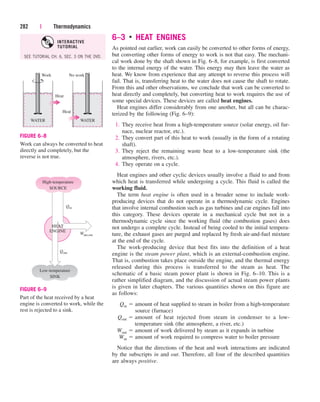
(2–22)
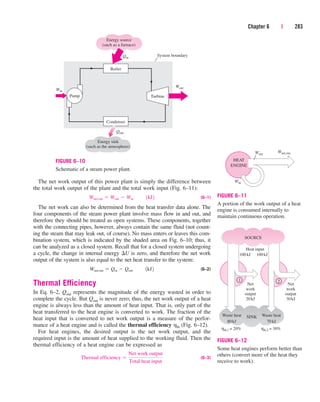
Obviously one needs to know how the force varies with displacement to
perform this integration. Equations 2–21 and 2–22 give only the magnitude
of the work. The sign is easily determined from physical considerations:
The work done on a system by an external force acting in the direction of
motion is negative, and work done by a system against an external force act-
ing in the opposite direction to motion is positive.
There are two requirements for a work interaction between a system and
its surroundings to exist: (1) there must be a force acting on the boundary,
and (2) the boundary must move. Therefore, the presence of forces on the
boundary without any displacement of the boundary does not constitute a
work interaction. Likewise, the displacement of the boundary without any
force to oppose or drive this motion (such as the expansion of a gas into an
evacuated space) is not a work interaction since no energy is transferred.
In many thermodynamic problems, mechanical work is the only form of
work involved. It is associated with the movement of the boundary of a
system or with the movement of the entire system as a whole (Fig. 2–26).
Some common forms of mechanical work are discussed next.
Shaft Work
Energy transmission with a rotating shaft is very common in engineering
practice (Fig. 2–27). Often the torque T applied to the shaft is constant,
which means that the force F applied is also constant. For a specified con-
stant torque, the work done during n revolutions is determined as follows: A
force F acting through a moment arm r generates a torque T of (Fig. 2–28)
(2–23)
This force acts through a distance s, which is related to the radius r by
(2–24)
Then the shaft work is determined from
(2–25)
The power transmitted through the shaft is the shaft work done per unit
time, which can be expressed as
(2–26)
where n
.
is the number of revolutions per unit time.
W
#
sh  2pn
#
T¬¬1kW2
Wsh  Fs  a
T
r
b 12prn2  2pnT¬¬1kJ2
s  12pr2n
T  Fr¬S ¬F 
T
r
W  
2
1
F¬ds¬¬1kJ2
W  Fs¬¬1kJ2
66 | Thermodynamics
F F
s
FIGURE 2–25
The work done is proportional to the
force applied (F) and the distance
traveled (s).
FIGURE 2–26
If there is no movement, no work is
done.
© Reprinted with special permission of King
Features Syndicate.
Engine
Boat
FIGURE 2–27
Energy transmission through rotating
shafts is commonly encountered in
practice.
SEE TUTORIAL CH. 2, SEC. 5 ON THE DVD.
INTERACTIVE
TUTORIAL
cen84959_ch02.qxd 4/25/05 2:32 PM Page 66
Chapter 2 | 67
T = 200 N • m
n = 4000 rpm
·
FIGURE 2–29
Schematic for Example 2–7.
Rest
position dx
x F
FIGURE 2–30
Elongation of a spring under the
influence of a force.
EXAMPLE 2–7 Power Transmission by the Shaft of a Car
Determine the power transmitted through the shaft of a car when the torque
applied is 200 N · m and the shaft rotates at a rate of 4000 revolutions per
minute (rpm).
Solution The torque and the rpm for a car engine are given. The power
transmitted is to be determined.
Analysis A sketch of the car is given in Fig. 2–29. The shaft power is deter-
mined directly from
Discussion Note that power transmitted by a shaft is proportional to torque
and the rotational speed.
Spring Work
It is common knowledge that when a force is applied on a spring, the length
of the spring changes (Fig. 2–30). When the length of the spring changes by
a differential amount dx under the influence of a force F, the work done is
(2–27)
To determine the total spring work, we need to know a functional relation-
ship between F and x. For linear elastic springs, the displacement x is pro-
portional to the force applied (Fig. 2–31). That is,
(2–28)
where k is the spring constant and has the unit kN/m. The displacement x is
measured from the undisturbed position of the spring (that is, x  0 when
F  0). Substituting Eq. 2–28 into Eq. 2–27 and integrating yield
(2–29)
where x1 and x2 are the initial and the final displacements of the spring,
respectively, measured from the undisturbed position of the spring.
There are many other forms of mechanical work. Next we introduce some
of them briefly.
Work Done on Elastic Solid Bars
Solids are often modeled as linear springs because under the action of a
force they contract or elongate, as shown in Fig. 2–32, and when the force
is lifted, they return to their original lengths, like a spring. This is true as
long as the force is in the elastic range, that is, not large enough to cause
permanent (plastic) deformations. Therefore, the equations given for a linear
spring can also be used for elastic solid bars. Alternately, we can determine
Wspring  1
2k1x2
2  x2
1 2¬¬1kJ2
F  kx¬¬1kN2
dWspring  F dx
 83.8 kW¬¬1or 112 hp2
W
#
sh  2pn
#
T  12p2 a4000
1
min
b 1200 N # m2 a
1 min
60 s
b a
1 kJ
1000 N # m
b
Wsh = 2πnT
r
F
n
Torque = Fr
· ·
·
FIGURE 2–28
Shaft work is proportional to the
torque applied and the number of
revolutions of the shaft.
cen84959_ch02.qxd 3/31/05 5:02 PM Page 67
the work associated with the expansion or contraction of an elastic solid bar
by replacing pressure P by its counterpart in solids, normal stress sn  F/A,
in the work expression:
(2–30)
where A is the cross-sectional area of the bar. Note that the normal stress
has pressure units.
Work Associated with the Stretching of a Liquid Film
Consider a liquid film such as soap film suspended on a wire frame
(Fig. 2–33). We know from experience that it will take some force to stretch
this film by the movable portion of the wire frame. This force is used to
overcome the microscopic forces between molecules at the liquid–air inter-
faces. These microscopic forces are perpendicular to any line in the surface,
and the force generated by these forces per unit length is called the surface
tension ss, whose unit is N/m. Therefore, the work associated with the
stretching of a film is also called surface tension work. It is determined from
(2–31)
where dA  2b dx is the change in the surface area of the film. The factor 2
is due to the fact that the film has two surfaces in contact with air. The force
acting on the movable wire as a result of surface tension effects is F  2bss
where ss is the surface tension force per unit length.
Work Done to Raise or to Accelerate a Body
When a body is raised in a gravitational field, its potential energy increases.
Likewise, when a body is accelerated, its kinetic energy increases. The con-
servation of energy principle requires that an equivalent amount of energy
must be transferred to the body being raised or accelerated. Remember that
energy can be transferred to a given mass by heat and work, and the energy
transferred in this case obviously is not heat since it is not driven by a tem-
perature difference. Therefore, it must be work. Then we conclude that
(1) the work transfer needed to raise a body is equal to the change in the
potential energy of the body, and (2) the work transfer needed to accelerate
a body is equal to the change in the kinetic energy of the body (Fig. 2–34).
Similarly, the potential or kinetic energy of a body represents the work that
can be obtained from the body as it is lowered to the reference level or
decelerated to zero velocity.
This discussion together with the consideration for friction and other
losses form the basis for determining the required power rating of motors
used to drive devices such as elevators, escalators, conveyor belts, and ski
lifts. It also plays a primary role in the design of automotive and aircraft
engines, and in the determination of the amount of hydroelectric power that
can be produced from a given water reservoir, which is simply the potential
energy of the water relative to the location of the hydraulic turbine.
Wsurface  
2
1
ss dA¬¬1kJ2
Welastic  
2
1
F dx  
2
1
sn A dx¬¬1kJ2
68 | Thermodynamics
x
F
FIGURE 2–32
Solid bars behave as springs under the
influence of a force.
dx
F
Movable
wire
Rigid wire frame
Surface of film
b
x
FIGURE 2–33
Stretching a liquid film with a
movable wire.
x1 = 1 mm
Rest
position
F1 = 300 N
x2 = 2 mm
F2 = 600 N
FIGURE 2–31
The displacement of a linear spring
doubles when the force is doubled.
cen84959_ch02.qxd 3/31/05 5:02 PM Page 68
Chapter 2 | 69
Elevator
car
Motor
FIGURE 2–34
The energy transferred to a body while
being raised is equal to the change in
its potential energy.
90 km/h
30°
m = 1200 kg
FIGURE 2–35
Schematic for Example 2–8.
m = 900 kg
0 80 km/h
FIGURE 2–36
Schematic for Example 2–9.
EXAMPLE 2–8 Power Needs of a Car to Climb a Hill
Consider a 1200-kg car cruising steadily on a level road at 90 km/h. Now
the car starts climbing a hill that is sloped 30° from the horizontal (Fig.
2–35). If the velocity of the car is to remain constant during climbing, deter-
mine the additional power that must be delivered by the engine.
Solution A car is to climb a hill while maintaining a constant velocity. The
additional power needed is to be determined.
Analysis The additional power required is simply the work that needs to be
done per unit time to raise the elevation of the car, which is equal to the
change in the potential energy of the car per unit time:
Discussion Note that the car engine will have to produce almost 200 hp of
additional power while climbing the hill if the car is to maintain its velocity.
EXAMPLE 2–9 Power Needs of a Car to Accelerate
Determine the power required to accelerate a 900-kg car shown in Fig. 2–36
from rest to a velocity of 80 km/h in 20 s on a level road.
Solution The power required to accelerate a car to a specified velocity is to
be determined.
Analysis The work needed to accelerate a body is simply the change in the
kinetic energy of the body,
The average power is determined from
Discussion This is in addition to the power required to overcome friction,
rolling resistance, and other imperfections.
Nonmechanical Forms of Work
The treatment in Section 2–5 represents a fairly comprehensive coverage of
mechanical forms of work except the moving boundary work that is covered
in Chap. 4. But some work modes encountered in practice are not mechani-
cal in nature. However, these nonmechanical work modes can be treated in a
similar manner by identifying a generalized force F acting in the direction
W
#
a 
Wa
¢t

222 kJ
20 s
 11.1 kW¬¬1or 14.9 hp2
 222 kJ
Wa  1
2m1V2
2  V2
1 2  1
2 1900 kg2 c a
80,000 m
3600 s
b
2
 02
d a
1 kJkg
1000 m2
s2
b
 147 kJs  147 kW¬¬1or 197 hp2
 11200 kg2 19.81 ms2
2 190 kmh2 1sin 30°2 a
1 ms
3.6 kmh
b a
1 kJkg
1000 m2
s2
b
W
#
g  mg¬¢z¢t  mgVvertical
cen84959_ch02.qxd 3/31/05 5:02 PM Page 69
of a generalized displacement x. Then the work associated with the differen-
tial displacement under the influence of this force is determined from dW 
F dx.
Some examples of nonmechanical work modes are electrical work,
where the generalized force is the voltage (the electrical potential) and
the generalized displacement is the electrical charge, as discussed earlier;
magnetic work, where the generalized force is the magnetic field strength
and the generalized displacement is the total magnetic dipole moment; and
electrical polarization work, where the generalized force is the electric
field strength and the generalized displacement is the polarization of the
medium (the sum of the electric dipole rotation moments of the molecules).
Detailed consideration of these and other nonmechanical work modes can
be found in specialized books on these topics.
2–6 ■
THE FIRST LAW OF THERMODYNAMICS
So far, we have considered various forms of energy such as heat Q, work W,
and total energy E individually, and no attempt is made to relate them to
each other during a process. The first law of thermodynamics, also known as
the conservation of energy principle, provides a sound basis for studying the
relationships among the various forms of energy and energy interactions.
Based on experimental observations, the first law of thermodynamics states
that energy can be neither created nor destroyed during a process; it can
only change forms. Therefore, every bit of energy should be accounted for
during a process.
We all know that a rock at some elevation possesses some potential energy,
and part of this potential energy is converted to kinetic energy as the rock falls
(Fig. 2–37). Experimental data show that the decrease in potential energy
(mg z) exactly equals the increase in kinetic energy when
the air resistance is negligible, thus confirming the conservation of energy
principle for mechanical energy.
Consider a system undergoing a series of adiabatic processes from a
specified state 1 to another specified state 2. Being adiabatic, these
processes obviously cannot involve any heat transfer, but they may involve
several kinds of work interactions. Careful measurements during these
experiments indicate the following: For all adiabatic processes between two
specified states of a closed system, the net work done is the same regardless
of the nature of the closed system and the details of the process. Consider-
ing that there are an infinite number of ways to perform work interactions
under adiabatic conditions, this statement appears to be very powerful, with
a potential for far-reaching implications. This statement, which is largely
based on the experiments of Joule in the first half of the nineteenth century,
cannot be drawn from any other known physical principle and is recognized
as a fundamental principle. This principle is called the first law of thermo-
dynamics or just the first law.
A major consequence of the first law is the existence and the definition of
the property total energy E. Considering that the net work is the same for all
adiabatic processes of a closed system between two specified states, the
value of the net work must depend on the end states of the system only, and
thus it must correspond to a change in a property of the system. This prop-
3m1V2
2  V2
1 224
70 | Thermodynamics
PE1 = 10 kJ
m
KE1 = 0
PE2 = 7 kJ
m KE2 = 3 kJ
∆ z
FIGURE 2–37
Energy cannot be created or
destroyed; it can only change forms.
SEE TUTORIAL CH. 2, SEC. 6 ON THE DVD.
INTERACTIVE
TUTORIAL
cen84959_ch02.qxd 4/25/05 2:32 PM Page 70
erty is the total energy. Note that the first law makes no reference to the
value of the total energy of a closed system at a state. It simply states that
the change in the total energy during an adiabatic process must be equal to
the net work done. Therefore, any convenient arbitrary value can be
assigned to total energy at a specified state to serve as a reference point.
Implicit in the first law statement is the conservation of energy. Although
the essence of the first law is the existence of the property total energy, the
first law is often viewed as a statement of the conservation of energy princi-
ple. Next we develop the first law or the conservation of energy relation
with the help of some familiar examples using intuitive arguments.
First, we consider some processes that involve heat transfer but no work
interactions. The potato baked in the oven is a good example for this case
(Fig. 2–38). As a result of heat transfer to the potato, the energy of the
potato will increase. If we disregard any mass transfer (moisture loss from
the potato), the increase in the total energy of the potato becomes equal to
the amount of heat transfer. That is, if 5 kJ of heat is transferred to the
potato, the energy increase of the potato will also be 5 kJ.
As another example, consider the heating of water in a pan on top of a
range (Fig. 2–39). If 15 kJ of heat is transferred to the water from the heat-
ing element and 3 kJ of it is lost from the water to the surrounding air, the
increase in energy of the water will be equal to the net heat transfer to
water, which is 12 kJ.
Now consider a well-insulated (i.e., adiabatic) room heated by an electric
heater as our system (Fig. 2–40). As a result of electrical work done, the
energy of the system will increase. Since the system is adiabatic and cannot
have any heat transfer to or from the surroundings (Q  0), the conservation
of energy principle dictates that the electrical work done on the system must
equal the increase in energy of the system.
Next, let us replace the electric heater with a paddle wheel (Fig. 2–41). As
a result of the stirring process, the energy of the system will increase.
Again, since there is no heat interaction between the system and its sur-
roundings (Q  0), the shaft work done on the system must show up as an
increase in the energy of the system.
Many of you have probably noticed that the temperature of air rises when
it is compressed (Fig. 2–42). This is because energy is transferred to the air
in the form of boundary work. In the absence of any heat transfer (Q  0),
the entire boundary work will be stored in the air as part of its total energy.
The conservation of energy principle again requires that the increase in the
energy of the system be equal to the boundary work done on the system.
We can extend these discussions to systems that involve various heat and
work interactions simultaneously. For example, if a system gains 12 kJ of
heat during a process while 6 kJ of work is done on it, the increase in the
energy of the system during that process is 18 kJ (Fig. 2–43). That is, the
change in the energy of a system during a process is simply equal to the net
energy transfer to (or from) the system.
Energy Balance
In the light of the preceding discussions, the conservation of energy princi-
ple can be expressed as follows: The net change (increase or decrease) in
the total energy of the system during a process is equal to the difference
Chapter 2 | 71
Qin = 5 kJ
POTATO
∆E = 5 kJ
FIGURE 2–38
The increase in the energy of a potato
in an oven is equal to the amount of
heat transferred to it.
∆E = Q net
= 12 kJ
Qout
= 3 kJ
Qin
= 15 kJ
FIGURE 2–39
In the absence of any work
interactions, the energy change of a
system is equal to the net heat transfer.
Win = 5 kJ
(Adiabatic)
Battery
∆E = 5 kJ
– +
FIGURE 2–40
The work (electrical) done on an
adiabatic system is equal to the
increase in the energy of the system.
cen84959_ch02.qxd 4/28/05 4:21 PM Page 71
between the total energy entering and the total energy leaving the system
during that process. That is,
or
This relation is often referred to as the energy balance and is applicable to
any kind of system undergoing any kind of process. The successful use of
this relation to solve engineering problems depends on understanding the
various forms of energy and recognizing the forms of energy transfer.
Energy Change of a System, Esystem
The determination of the energy change of a system during a process
involves the evaluation of the energy of the system at the beginning and at
the end of the process, and taking their difference. That is,
or
(2–32)
Note that energy is a property, and the value of a property does not change
unless the state of the system changes. Therefore, the energy change of a
system is zero if the state of the system does not change during the process.
Also, energy can exist in numerous forms such as internal (sensible, latent,
chemical, and nuclear), kinetic, potential, electric, and magnetic, and their
sum constitutes the total energy E of a system. In the absence of electric,
magnetic, and surface tension effects (i.e., for simple compressible sys-
tems), the change in the total energy of a system during a process is the sum
of the changes in its internal, kinetic, and potential energies and can be
expressed as
(2–33)
where
When the initial and final states are specified, the values of the specific
internal energies u1 and u2 can be determined directly from the property
tables or thermodynamic property relations.
Most systems encountered in practice are stationary, that is, they do not
involve any changes in their velocity or elevation during a process (Fig.
2–44). Thus, for stationary systems, the changes in kinetic and potential
energies are zero (that is, KE  PE  0), and the total energy change
relation in Eq. 2–33 reduces to E  U for such systems. Also, the energy
¢PE  mg1z2  z1 2
¢KE  1
2 m1V2
2  V 2
1 2
¢U  m1u2  u1 2
¢E  ¢U  ¢KE  ¢PE
¢Esystem  Efinal  Einitial  E2  E1
Energy change  Energy at final state  Energy at initial state
Ein  Eout  ¢Esystem
a
Total energy
entering the system
b  a
Total energy
leaving the system
b  a
Change in the total
energy of the system
b
72 | Thermodynamics
Wsh, in = 8 kJ
(Adiabatic)
∆E = 8 kJ
FIGURE 2–41
The work (shaft) done on an adiabatic
system is equal to the increase in the
energy of the system.
Wb,in = 10 kJ
(Adiabatic)
∆E = 10 kJ
FIGURE 2–42
The work (boundary) done on an
adiabatic system is equal to the
increase in the energy of the system.
Qout = 3 kJ
Qin = 15 kJ
∆E = (15 – 3) + 6
= 18 kJ
Wsh, in = 6 kJ
FIGURE 2–43
The energy change of a system during
a process is equal to the net work and
heat transfer between the system and
its surroundings.
cen84959_ch02.qxd 3/31/05 5:02 PM Page 72
of a system during a process will change even if only one form of its energy
changes while the other forms of energy remain unchanged.
Mechanisms of Energy Transfer, Ein and Eout
Energy can be transferred to or from a system in three forms: heat, work,
and mass flow. Energy interactions are recognized at the system boundary as
they cross it, and they represent the energy gained or lost by a system dur-
ing a process. The only two forms of energy interactions associated with a
fixed mass or closed system are heat transfer and work.
1. Heat Transfer, Q Heat transfer to a system (heat gain) increases the
energy of the molecules and thus the internal energy of the system, and
heat transfer from a system (heat loss) decreases it since the energy
transferred out as heat comes from the energy of the molecules of the
system.
2. Work Transfer, W An energy interaction that is not caused by a tem-
perature difference between a system and its surroundings is work. A
rising piston, a rotating shaft, and an electrical wire crossing the system
boundaries are all associated with work interactions. Work transfer to a
system (i.e., work done on a system) increases the energy of the system,
and work transfer from a system (i.e., work done by the system)
decreases it since the energy transferred out as work comes from the
energy contained in the system. Car engines and hydraulic, steam, or
gas turbines produce work while compressors, pumps, and mixers con-
sume work.
3. Mass Flow, m Mass flow in and out of the system serves as an addi-
tional mechanism of energy transfer. When mass enters a system, the
energy of the system increases because mass carries energy with it (in
fact, mass is energy). Likewise, when some mass leaves the system, the
energy contained within the system decreases because the leaving mass
takes out some energy with it. For example, when some hot water is
taken out of a water heater and is replaced by the same amount of cold
water, the energy content of the hot-water tank (the control volume)
decreases as a result of this mass interaction (Fig. 2–45).
Noting that energy can be transferred in the forms of heat, work, and
mass, and that the net transfer of a quantity is equal to the difference
between the amounts transferred in and out, the energy balance can be writ-
ten more explicitly as
(2–34)
where the subscripts “in” and “out” denote quantities that enter and leave
the system, respectively. All six quantities on the right side of the equation
represent “amounts,” and thus they are positive quantities. The direction of
any energy transfer is described by the subscripts “in” and “out.”
The heat transfer Q is zero for adiabatic systems, the work transfer W is
zero for systems that involve no work interactions, and the energy transport
with mass Emass is zero for systems that involve no mass flow across their
boundaries (i.e., closed systems).
Ein  Eout  1Qin  Qout 2  1Win  Wout 2  1Emass,in  Emass,out 2  ¢Esystem
Chapter 2 | 73
Stationary Systems
z1
= z 2
← ∆PE = 0
V1
= V
2
← ∆KE = 0
∆E = ∆U
FIGURE 2–44
For stationary systems, KE  PE
 0; thus E  U.
cen84959_ch02.qxd 3/31/05 5:02 PM Page 73
74 | Thermodynamics
Control
volume
Q
Mass
in
Mass
out
W
FIGURE 2–45
The energy content of a control
volume can be changed by mass flow
as well as heat and work interactions.
P
V
Qnet = Wnet
FIGURE 2–46
For a cycle E  0, thus Q  W.
Wsh, in = 100 kJ
U1
= 800 kJ
Qout = 500 kJ
U2 = ?
Fluid
FIGURE 2–47
Schematic for Example 2–10.
⎫
⎪
⎬
⎪
⎭
⎫
⎪
⎪
⎬
⎪
⎪
⎭
⎫
⎪
⎬
⎪
⎭
⎫
⎪
⎪
⎬
⎪
⎪
⎭
Energy balance for any system undergoing any kind of process can be
expressed more compactly as
(2–35)
Net energy transfer Change in internal, kinetic,
by heat, work, and mass potential, etc., energies
or, in the rate form, as
(2–36)
Rate of net energy transfer Rate of change in internal,
by heat, work, and mass kinetic, potential, etc., energies
For constant rates, the total quantities during a time interval t are related to
the quantities per unit time as
(2–37)
The energy balance can be expressed on a per unit mass basis as
(2–38)
which is obtained by dividing all the quantities in Eq. 2–35 by the mass m of
the system. Energy balance can also be expressed in the differential form as
(2–39)
For a closed system undergoing a cycle, the initial and final states are iden-
tical, and thus Esystem  E2  E1  0. Then the energy balance for a cycle
simplifies to Ein  Eout  0 or Ein  Eout. Noting that a closed system does
not involve any mass flow across its boundaries, the energy balance for a
cycle can be expressed in terms of heat and work interactions as
(2–40)
That is, the net work output during a cycle is equal to net heat input (Fig.
2–46).
EXAMPLE 2–10 Cooling of a Hot Fluid in a Tank
A rigid tank contains a hot fluid that is cooled while being stirred by a pad-
dle wheel. Initially, the internal energy of the fluid is 800 kJ. During the
cooling process, the fluid loses 500 kJ of heat, and the paddle wheel does
100 kJ of work on the fluid. Determine the final internal energy of the fluid.
Neglect the energy stored in the paddle wheel.
Solution A fluid in a rigid tank looses heat while being stirred. The final
internal energy of the fluid is to be determined.
Assumptions 1 The tank is stationary and thus the kinetic and potential
energy changes are zero, KE  PE  0. Therefore, E  U and internal
energy is the only form of the system’s energy that may change during this
process. 2 Energy stored in the paddle wheel is negligible.
Analysis Take the contents of the tank as the system (Fig. 2–47). This is a
closed system since no mass crosses the boundary during the process. We
observe that the volume of a rigid tank is constant, and thus there is no
moving boundary work. Also, heat is lost from the system and shaft work is
done on the system. Applying the energy balance on the system gives
Wnet,out  Qnet,in¬or¬W
#
net,out  Q
#
net,in¬¬1for a cycle2
dEin  dEout  dEsystem¬or¬dein  deout  desystem
ein  eout  ¢esystem¬¬1kJkg2
Q  Q
#
¢t,¬W  W
# ¬
¢t,¬and¬¢E  1dEdt2 ¢t¬¬1kJ2
E
.
in  E
.
out¬ ¬dEsystemdt¬¬1kW2
Ein  Eout¬  ¬ ¢Esystem¬¬1kJ2
cen84959_ch02.qxd 3/31/05 5:02 PM Page 74
Net energy transfer Change in internal, kinetic,
by heat, work, and mass potential, etc., energies
Therefore, the final internal energy of the system is 400 kJ.
EXAMPLE 2–11 Acceleration of Air by a Fan
A fan that consumes 20 W of electric power when operating is claimed to
discharge air from a ventilated room at a rate of 0.25 kg/s at a discharge
velocity of 8 m/s (Fig. 2–48). Determine if this claim is reasonable.
Solution A fan is claimed to increase the velocity of air to a specified value
while consuming electric power at a specified rate. The validity of this claim
is to be investigated.
Assumptions The ventilating room is relatively calm, and air velocity in it is
negligible.
Analysis First, let’s examine the energy conversions involved: The motor of
the fan converts part of the electrical power it consumes to mechanical
(shaft) power, which is used to rotate the fan blades in air. The blades are
shaped such that they impart a large fraction of the mechanical power of the
shaft to air by mobilizing it. In the limiting ideal case of no losses (no con-
version of electrical and mechanical energy to thermal energy) in steady
operation, the electric power input will be equal to the rate of increase of the
kinetic energy of air. Therefore, for a control volume that encloses the fan-
motor unit, the energy balance can be written as
Rate of net energy transfer Rate of change in internal, kinetic,
by heat, work, and mass potential, etc., energies
Solving for Vout and substituting gives the maximum air outlet velocity to be
which is less than 8 m/s. Therefore, the claim is false.
Discussion The conservation of energy principle requires the energy to be
preserved as it is converted from one form to another, and it does not allow
any energy to be created or destroyed during a process. From the first law
point of view, there is nothing wrong with the conversion of the entire electri-
cal energy into kinetic energy. Therefore, the first law has no objection to air
velocity reaching 6.3 m/s—but this is the upper limit. Any claim of higher
velocity is in violation of the first law, and thus impossible. In reality, the air
velocity will be considerably lower than 6.3 m/s because of the losses associ-
ated with the conversion of electrical energy to mechanical shaft energy, and
the conversion of mechanical shaft energy to kinetic energy or air.
Vout 
B
W
#
elect,in
2m
#
air

B
20 Js
210.25 kgs2
a
1 m2
s2
1 Jkg
b  6.3 ms
W
#
elect, in  m
#
air keout  m
#
air
V2
out
2
E
#
in  E
#
out  dEsystem  dt 0 1steady2
 0 S E
#
in  E
#
out
U2  400 kJ
100 kJ  500 kJ  U2  800 kJ
Wsh,in  Qout  ¢U  U2  U1
Ein  Eout¬  ¬ ¢Esystem
Chapter 2 | 75
Air
8 m/s Fan
FIGURE 2–48
Schematic for Example 2–11.
© Vol. 0557/PhotoDisc
→
⎫
⎪
⎪
⎪
⎪
⎬
⎪
⎪
⎪
⎪
⎭
⎫
⎪
⎪
⎬
⎪
⎪
⎭
⎫
⎪
⎬
⎪
⎭
⎫
⎪
⎬
⎪
⎭
cen84959_ch02.qxd 3/31/05 5:02 PM Page 75
EXAMPLE 2–12 Heating Effect of a Fan
A room is initially at the outdoor temperature of 25°C. Now a large fan
that consumes 200 W of electricity when running is turned on (Fig. 2–49).
The heat transfer rate between the room and the outdoor air is given as
Q
·
 UA(Ti  To) where U  6 W/m2 · °C is the overall heat transfer coefficient,
A  30 m2 is the exposed surface area of the room, and Ti and To are the
indoor and outdoor air temperatures, respectively. Determine the indoor air
temperature when steady operating conditions are established.
Solution A large fan is turned on and kept on in a room that looses heat to
the outdoors. The indoor air temperature is to be determined when steady
operation is reached.
Assumptions 1 Heat transfer through the floor is negligible. 2 There are no
other energy interactions involved.
Analysis The electricity consumed by the fan is energy input for the room,
and thus the room gains energy at a rate of 200 W. As a result, the room air
temperature tends to rise. But as the room air temperature rises, the rate of
heat loss from the room increases until the rate of heat loss equals the elec-
tric power consumption. At that point, the temperature of the room air, and
thus the energy content of the room, remains constant, and the conservation
of energy for the room becomes
Rate of net energy transfer Rate of change in internal, kinetic,
by heat, work, and mass potential, etc., energies
Substituting,
It gives
Therefore, the room air temperature will remain constant after it reaches
26.1°C.
Discussion Note that a 200-W fan heats a room just like a 200-W resis-
tance heater. In the case of a fan, the motor converts part of the electric
energy it draws to mechanical energy in the form of a rotating shaft while
the remaining part is dissipated as heat to the room air because of the motor
inefficiency (no motor converts 100 percent of the electric energy it receives
to mechanical energy, although some large motors come close with a conver-
sion efficiency of over 97 percent). Part of the mechanical energy of the
shaft is converted to kinetic energy of air through the blades, which is then
converted to thermal energy as air molecules slow down because of friction.
At the end, the entire electric energy drawn by the fan motor is converted to
thermal energy of air, which manifests itself as a rise in temperature.
EXAMPLE 2–13 Annual Lighting Cost of a Classroom
The lighting needs of a classroom are met by 30 fluorescent lamps, each
consuming 80 W of electricity (Fig. 2–50). The lights in the classroom are
kept on for 12 hours a day and 250 days a year. For a unit electricity cost of
Ti  26.1°C
200 W  16 Wm2 # °C2 130 m2
2 1Ti  25°C2
W
#
elect,in  Q
#
out  UA1Ti  To 2
E
#
in  E
#
out  dEsystem  dt 0 1steady2
 0 S E
#
in  E
#
out
76 | Thermodynamics
Fan
Room
Qout
Welect. in
•
•
FIGURE 2–49
Schematic for Example 2–12.
FIGURE 2–50
Fluorescent lamps lighting a classroom
as discussed in Example 2–13.
© Vol. 24/PhotoDisc
→
⎫
⎪
⎪
⎪
⎪
⎬
⎪
⎪
⎪
⎪
⎭
⎫
⎪
⎪
⎬
⎪
⎪
⎭
cen84959_ch02.qxd 3/31/05 5:02 PM Page 76
Chapter 2 | 77
7 cents per kWh, determine annual energy cost of lighting for this class-
room. Also, discuss the effect of lighting on the heating and air-conditioning
requirements of the room.
Solution The lighting of a classroom by fluorescent lamps is considered.
The annual electricity cost of lighting for this classroom is to be deter-
mined, and the lighting’s effect on the heating and air-conditioning require-
ments is to be discussed.
Assumptions The effect of voltage fluctuations is negligible so that each fluo-
rescent lamp consumes its rated power.
Analysis The electric power consumed by the lamps when all are on and
the number of hours they are kept on per year are
Then the amount and cost of electricity used per year become
Light is absorbed by the surfaces it strikes and is converted to thermal energy.
Disregarding the light that escapes through the windows, the entire 2.4 kW of
electric power consumed by the lamps eventually becomes part of thermal
energy of the classroom. Therefore, the lighting system in this room reduces
the heating requirements by 2.4 kW, but increases the air-conditioning load by
2.4 kW.
Discussion Note that the annual lighting cost of this classroom alone is over
$500. This shows the importance of energy conservation measures. If incan-
descent light bulbs were used instead of fluorescent tubes, the lighting costs
would be four times as much since incandescent lamps use four times as
much power for the same amount of light produced.
EXAMPLE 2–14 Conservation of Energy for an Oscillating
Steel Ball
The motion of a steel ball in a hemispherical bowl of radius h shown in Fig.
2–51 is to be analyzed. The ball is initially held at the highest location at
point A, and then it is released. Obtain relations for the conservation of
energy of the ball for the cases of frictionless and actual motions.
Solution A steel ball is released in a bowl. Relations for the energy balance
are to be obtained.
Assumptions The motion is frictionless, and thus friction between the ball,
the bowl, and the air is negligible.
Analysis When the ball is released, it accelerates under the influence of
gravity, reaches a maximum velocity (and minimum elevation) at point B at
 17200 kWhyear2 1$0.07kWh2  $504year
Lighting cost  1Lighting energy2 1Unit cost2
 12.4 kW2 13000 hyear2  7200 kWhyear
Lighting energy  1Lighting power2 1Operating hours2
Operating hours  112 hday2 1250 daysyear2  3000 hyear
 2400 W  2.4 kW
 180 Wlamp2 130 lamps2
Lighting power  1Power consumed per lamp2  1No. of lamps2
Steel
ball
z
h
A
B
1
2
C
0
FIGURE 2–51
Schematic for Example 2–14.
cen84959_ch02.qxd 4/19/05 11:24 AM Page 77
78 | Thermodynamics
FIGURE 2–52
The definition of performance is not
limited to thermodynamics only.
© Reprinted with special permission of King
Features Syndicate.
the bottom of the bowl, and moves up toward point C on the opposite side.
In the ideal case of frictionless motion, the ball will oscillate between points
A and C. The actual motion involves the conversion of the kinetic and poten-
tial energies of the ball to each other, together with overcoming resistance to
motion due to friction (doing frictional work). The general energy balance for
any system undergoing any process is
Net energy transfer Change in internal, kinetic,
by heat, work, and mass potential, etc., energies
Then the energy balance for the ball for a process from point 1 to point 2
becomes
or
since there is no energy transfer by heat or mass and no change in the internal
energy of the ball (the heat generated by frictional heating is dissipated to the
surrounding air). The frictional work term wfriction is often expressed as eloss to
represent the loss (conversion) of mechanical energy into thermal energy.
For the idealized case of frictionless motion, the last relation reduces to
where the value of the constant is C  gh. That is, when the frictional
effects are negligible, the sum of the kinetic and potential energies of the
ball remains constant.
Discussion This is certainly a more intuitive and convenient form of the
conservation of energy equation for this and other similar processes such as
the swinging motion of the pendulum of a wall clock.
2–7 ■
ENERGY CONVERSION EFFICIENCIES
Efficiency is one of the most frequently used terms in thermodynamics, and
it indicates how well an energy conversion or transfer process is accom-
plished. Efficiency is also one of the most frequently misused terms in ther-
modynamics and a source of misunderstandings. This is because efficiency
is often used without being properly defined first. Next we will clarify this
further, and define some efficiencies commonly used in practice.
Performance or efficiency, in general, can be expressed in terms of the
desired output and the required input as (Fig. 2–52)
(2–41)
If you are shopping for a water heater, a knowledgeable salesperson will
tell you that the efficiency of a conventional electric water heater is about
90 percent (Fig. 2–53). You may find this confusing, since the heating ele-
ments of electric water heaters are resistance heaters, and the efficiency of
Performance 
Desired output
Required output
V2
1
2
 gz1 
V2
2
2
 gz2¬or¬
V2
2
 gz  C  constant
V 2
1
2
 gz1 
V2
2
2
 gz2  wfriction
wfriction  1ke2  pe2 2  1ke1  pe1 2
Ein  Eout¬  ¬ ¢Esystem
⎫
⎪
⎬
⎪
⎭
⎫
⎪
⎬
⎪
⎭
SEE TUTORIAL CH. 2, SEC. 7 ON THE DVD.
INTERACTIVE
TUTORIAL
cen84959_ch02.qxd 4/25/05 2:32 PM Page 78
Chapter 2 | 79
all resistance heaters is 100 percent as they convert all the electrical energy
they consume into thermal energy. A knowledgeable salesperson will clarify
this by explaining that the heat losses from the hot-water tank to the sur-
rounding air amount to 10 percent of the electrical energy consumed, and
the efficiency of a water heater is defined as the ratio of the energy deliv-
ered to the house by hot water to the energy supplied to the water heater. A
clever salesperson may even talk you into buying a more expensive water
heater with thicker insulation that has an efficiency of 94 percent. If you are
a knowledgeable consumer and have access to natural gas, you will proba-
bly purchase a gas water heater whose efficiency is only 55 percent since a
gas unit costs about the same as an electric unit to purchase and install, but
the annual energy cost of a gas unit will be much less than that of an elec-
tric unit.
Perhaps you are wondering how the efficiency for a gas water heater is
defined, and why it is much lower than the efficiency of an electric heater.
As a general rule, the efficiency of equipment that involves the combustion
of a fuel is based on the heating value of the fuel, which is the amount of
heat released when a unit amount of fuel at room temperature is completely
burned and the combustion products are cooled to the room temperature
(Fig. 2–54). Then the performance of combustion equipment can be charac-
terized by combustion efficiency, defined as
(2–42)
A combustion efficiency of 100 percent indicates that the fuel is burned
completely and the stack gases leave the combustion chamber at room tem-
perature, and thus the amount of heat released during a combustion process
is equal to the heating value of the fuel.
Most fuels contain hydrogen, which forms water when burned, and the
heating value of a fuel will be different, depending on whether the water in
combustion products is in the liquid or vapor form. The heating value is
called the lower heating value, or LHV, when the water leaves as a vapor,
and the higher heating value, or HHV, when the water in the combustion
gases is completely condensed and thus the heat of vaporization is also
recovered. The difference between these two heating values is equal to the
product of the amount of water and the enthalpy of vaporization of water at
room temperature. For example, the lower and higher heating values of
gasoline are 44,000 kJ/kg and 47,300 kJ/kg, respectively. An efficiency def-
inition should make it clear whether it is based on the higher or lower heat-
ing value of the fuel. Efficiencies of cars and jet engines are normally based
on lower heating values since water normally leaves as a vapor in the
exhaust gases, and it is not practical to try to recuperate the heat of vapor-
ization. Efficiencies of furnaces, on the other hand, are based on higher
heating values.
The efficiency of space heating systems of residential and commercial
buildings is usually expressed in terms of the annual fuel utilization effi-
ciency, or AFUE, which accounts for the combustion efficiency as well as
other losses such as heat losses to unheated areas and start-up and cool-
down losses. The AFUE of most new heating systems is about 85 percent,
although the AFUE of some old heating systems is under 60 percent. The
hcombustion 
Q
HV

Amount of heat released during combustion
Heating value of the fuel burned
Water
heater
Type Efficiency
Gas, conventional
Gas, high-efficiency
Electric, conventional
Electric, high-efficiency
55%
62%
90%
94%
FIGURE 2–53
Typical efficiencies of conventional
and high-efficiency electric and
natural gas water heaters.
© The McGraw-Hill Companies, Inc./Jill Braaten,
photographer
Combustion
chamber
Combustion gases
25°C CO2, H2O, etc.
Air
25°C
1 kg
Gasoline
25°C
LHV = 44,000 kJ/kg
FIGURE 2–54
The definition of the heating value of
gasoline.
cen84959_ch02.qxd 3/31/05 5:02 PM Page 79
AFUE of some new high-efficiency furnaces exceeds 96 percent, but the
high cost of such furnaces cannot be justified for locations with mild to
moderate winters. Such high efficiencies are achieved by reclaiming most of
the heat in the flue gases, condensing the water vapor, and discharging the
flue gases at temperatures as low as 38°C (or 100°F) instead of about 200°C
(or 400°F) for the conventional models.
For car engines, the work output is understood to be the power delivered
by the crankshaft. But for power plants, the work output can be the mechan-
ical power at the turbine exit, or the electrical power output of the generator.
A generator is a device that converts mechanical energy to electrical
energy, and the effectiveness of a generator is characterized by the generator
efficiency, which is the ratio of the electrical power output to the mechanical
power input. The thermal efficiency of a power plant, which is of primary
interest in thermodynamics, is usually defined as the ratio of the net shaft
work output of the turbine to the heat input to the working fluid. The effects
of other factors are incorporated by defining an overall efficiency for the
power plant as the ratio of the net electrical power output to the rate of fuel
energy input. That is,
(2–43)
The overall efficiencies are about 26–30 percent for gasoline automotive
engines, 34–40 percent for diesel engines, and 40–60 percent for large
power plants.
We are all familiar with the conversion of electrical energy to light by
incandescent lightbulbs, fluorescent tubes, and high-intensity discharge
lamps. The efficiency for the conversion of electricity to light can be
defined as the ratio of the energy converted to light to the electrical energy
consumed. For example, common incandescent lightbulbs convert about 10
percent of the electrical energy they consume to light; the rest of the energy
consumed is dissipated as heat, which adds to the cooling load of the air
conditioner in summer. However, it is more common to express the effec-
tiveness of this conversion process by lighting efficacy, which is defined as
the amount of light output in lumens per W of electricity consumed.
The efficacy of different lighting systems is given in Table 2–1. Note that
a compact fluorescent lightbulb produces about four times as much light as
an incandescent lightbulb per W, and thus a 15-W fluorescent bulb can
replace a 60-W incandescent lightbulb (Fig. 2–55). Also, a compact fluores-
cent bulb lasts about 10,000 h, which is 10 times as long as an incandescent
bulb, and it plugs directly into the socket of an incandescent lamp.
Therefore, despite their higher initial cost, compact fluorescents reduce
the lighting costs considerably through reduced electricity consumption.
Sodium-filled high-intensity discharge lamps provide the most efficient
lighting, but their use is limited to outdoor use because of their yellowish
light.
We can also define efficiency for cooking appliances since they convert
electrical or chemical energy to heat for cooking. The efficiency of a cook-
ing appliance can be defined as the ratio of the useful energy transferred to
hoverall  hcombustion hthermal hgenerator 
W
#
net,electric
HHV  m
#
net
80 | Thermodynamics
TABLE 2–1
The efficacy of different lighting
systems
Efficacy,
Type of lighting lumens/W
Combustion
Candle 0.2
Incandescent
Ordinary 6–20
Halogen 16–25
Fluorescent
Ordinary 40–60
High output 70–90
Compact 50–80
High-intensity discharge
Mercury vapor 50–60
Metal halide 56–125
High-pressure sodium 100–150
Low-pressure sodium up to 200
15 W 60 W
FIGURE 2–55
A 15-W compact fluorescent lamp
provides as much light as a 60-W
incandescent lamp.
cen84959_ch02.qxd 3/31/05 5:02 PM Page 80
Chapter 2 | 81
the food to the energy consumed by the appliance (Fig. 2–56). Electric
ranges are more efficient than gas ranges, but it is much cheaper to cook
with natural gas than with electricity because of the lower unit cost of nat-
ural gas (Table 2–2).
The cooking efficiency depends on user habits as well as the individual
appliances. Convection and microwave ovens are inherently more efficient
than conventional ovens. On average, convection ovens save about one-third
and microwave ovens save about two-thirds of the energy used by conven-
tional ovens. The cooking efficiency can be increased by using the smallest
oven for baking, using a pressure cooker, using an electric slow cooker for
stews and soups, using the smallest pan that will do the job, using the
smaller heating element for small pans on electric ranges, using flat-bot-
tomed pans on electric burners to assure good contact, keeping burner drip
pans clean and shiny, defrosting frozen foods in the refrigerator before
cooking, avoiding preheating unless it is necessary, keeping the pans cov-
ered during cooking, using timers and thermometers to avoid overcooking,
using the self-cleaning feature of ovens right after cooking, and keeping
inside surfaces of microwave ovens clean.
Using energy-efficient appliances and practicing energy conservation
measures help our pocketbooks by reducing our utility bills. It also helps
the environment by reducing the amount of pollutants emitted to the atmo-
sphere during the combustion of fuel at home or at the power plants where
electricity is generated. The combustion of each therm of natural gas pro-
duces 6.4 kg of carbon dioxide, which causes global climate change; 4.7 g
of nitrogen oxides and 0.54 g of hydrocarbons, which cause smog; 2.0 g of
carbon monoxide, which is toxic; and 0.030 g of sulfur dioxide, which
causes acid rain. Each therm of natural gas saved eliminates the emission of
these pollutants while saving $0.60 for the average consumer in the United
States. Each kWh of electricity conserved saves 0.4 kg of coal and 1.0 kg of
CO2 and 15 g of SO2 from a coal power plant.
TABLE 2–2
Energy costs of cooking a casserole with different appliances*
[From A. Wilson and J. Morril, Consumer Guide to Home Energy Savings, Washington, DC:
American Council for an Energy-Efficient Economy, 1996, p. 192.]
Cooking Cooking Energy Cost of
Cooking appliance temperature time used energy
Electric oven 350F (177C) 1 h 2.0 kWh $0.16
Convection oven (elect.) 325F (163C) 45 min 1.39 kWh $0.11
Gas oven 350F (177C) 1 h 0.112 therm $0.07
Frying pan 420F (216C) 1 h 0.9 kWh $0.07
Toaster oven 425F (218C) 50 min 0.95 kWh $0.08
Electric slow cooker 200F (93C) 7 h 0.7 kWh $0.06
Microwave oven “High” 15 min 0.36 kWh $0.03
*Assumes a unit cost of $0.08/kWh for electricity and $0.60/therm for gas.
5 kW
3 kW
2 kW
Efficiency =
Energy utilized
Energy supplied to appliance
3 kWh
5 kWh
= = 0.60
FIGURE 2–56
The efficiency of a cooking appliance
represents the fraction of the energy
supplied to the appliance that is
transferred to the food.
cen84959_ch02.qxd 3/31/05 5:02 PM Page 81
EXAMPLE 2–15 Cost of Cooking with Electric and Gas Ranges
The efficiency of cooking appliances affects the internal heat gain from them
since an inefficient appliance consumes a greater amount of energy for the
same task, and the excess energy consumed shows up as heat in the living
space. The efficiency of open burners is determined to be 73 percent for
electric units and 38 percent for gas units (Fig. 2–57). Consider a 2-kW
electric burner at a location where the unit costs of electricity and natural
gas are $0.09/kWh and $0.55/therm, respectively. Determine the rate of
energy consumption by the burner and the unit cost of utilized energy for
both electric and gas burners.
Solution The operation of electric and gas ranges is considered. The rate of
energy consumption and the unit cost of utilized energy are to be deter-
mined.
Analysis The efficiency of the electric heater is given to be 73 percent.
Therefore, a burner that consumes 2 kW of electrical energy will supply
of useful energy. The unit cost of utilized energy is inversely proportional to
the efficiency, and is determined from
Noting that the efficiency of a gas burner is 38 percent, the energy input
to a gas burner that supplies utilized energy at the same rate (1.46 kW) is
since 1 kW  3412 Btu/h. Therefore, a gas burner should have a rating of at
least 13,100 Btu/h to perform as well as the electric unit.
Noting that 1 therm  29.3 kWh, the unit cost of utilized energy in the
case of a gas burner is determined to be
Discussion The cost of utilized gas is less than half of the unit cost of uti-
lized electricity. Therefore, despite its higher efficiency, cooking with an
electric burner will cost more than twice as much compared to a gas burner
in this case. This explains why cost-conscious consumers always ask for gas
appliances, and it is not wise to use electricity for heating purposes.
Efficiencies of Mechanical and Electrical Devices
The transfer of mechanical energy is usually accomplished by a rotating
shaft, and thus mechanical work is often referred to as shaft work. A pump
or a fan receives shaft work (usually from an electric motor) and transfers it
to the fluid as mechanical energy (less frictional losses). A turbine, on the
other hand, converts the mechanical energy of a fluid to shaft work. In the
absence of any irreversibilities such as friction, mechanical energy can be
 $0.049kWh
Cost of utilized energy 
Cost of energy input
Efficiency

$0.5529.3 kWh
0.38
Q
#
input, gas 
Q
#
utilized
Efficiency

1.46 kW
0.38
 3.84 kW¬¬1  13,100 Btuh2
Cost of utilized energy 
Cost of energy input
Efficiency

$0.09kWh
0.73
 $0.123kWh
Q
#
utilized  1Energy input2  1Efficiency2  12 kW2 10.732  1.46 kW
82 | Thermodynamics
Gas Range
Electric Range
73%
38%
FIGURE 2–57
Schematic of the 73 percent efficient
electric heating unit and 38 percent
efficient gas burner discussed in
Example 2–15.
cen84959_ch02.qxd 3/31/05 5:02 PM Page 82
Chapter 2 | 83
converted entirely from one mechanical form to another, and the mechani-
cal efficiency of a device or process can be defined as (Fig. 2–58)
(2–44)
A conversion efficiency of less than 100 percent indicates that conversion is
less than perfect and some losses have occurred during conversion. A
mechanical efficiency of 97 percent indicates that 3 percent of the mechanical
energy input is converted to thermal energy as a result of frictional heating,
and this will manifest itself as a slight rise in the temperature of the fluid.
In fluid systems, we are usually interested in increasing the pressure,
velocity, and/or elevation of a fluid. This is done by supplying mechanical
energy to the fluid by a pump, a fan, or a compressor (we will refer to all of
them as pumps). Or we are interested in the reverse process of extracting
mechanical energy from a fluid by a turbine and producing mechanical
power in the form of a rotating shaft that can drive a generator or any other
rotary device. The degree of perfection of the conversion process between
the mechanical work supplied or extracted and the mechanical energy of the
fluid is expressed by the pump efficiency and turbine efficiency, defined as
(2–45)
where is the rate of increase in the mechan-
ical energy of the fluid, which is equivalent to the useful pumping power
supplied to the fluid, and
(2–46)
where is the rate of decrease in the
mechanical energy of the fluid, which is equivalent to the mechanical power
extracted from the fluid by the turbine , and we use the absolute
value sign to avoid negative values for efficiencies. A pump or turbine effi-
ciency of 100 percent indicates perfect conversion between the shaft work
and the mechanical energy of the fluid, and this value can be approached
(but never attained) as the frictional effects are minimized.
Electrical energy is commonly converted to rotating mechanical energy
by electric motors to drive fans, compressors, robot arms, car starters, and
so forth. The effectiveness of this conversion process is characterized by the
motor efficiency hmotor, which is the ratio of the mechanical energy output of
the motor to the electrical energy input. The full-load motor efficiencies
range from about 35 percent for small motors to over 97 percent for large
high-efficiency motors. The difference between the electrical energy con-
sumed and the mechanical energy delivered is dissipated as waste heat.
The mechanical efficiency should not be confused with the motor effi-
ciency and the generator efficiency, which are defined as
Motor: (2–47)
hmotor 
Mechanical power output
Electric power input

W
#
shaft,out
W
#
elect,in
W
#
turbine,e
0¢E
#
mech,fluid 0  E
#
mech,in  E
#
mech,out
hturbine 
Mechanical energy output
Mechanical energy decrease of the fluid

W
#
shaft,out
0¢E
#
mech,fluid 0

W
#
turbine
W
#
turbine,e
W
#
pump,u
¢E
#
mech,fluid  E
#
mech,out  E
#
mech,in
hpump 
Mechanical energy increase of the fluid
Mechanical energy input

¢E
#
mech,fluid
W
#
shaft,in

W
#
pump,u
W
#
pump
hmech 
Mechanical energy output
Mechanical energy input

Emech,out
Emech,in
 1 
Emech,loss
Emech,in
m = 0.50 kg/s
Fan
50 W ·
1 2
= 0,
V1 = 12 m/s
= z2
z1
= P2
P1
=
=
= 0.72
hmech, fan =
∆Emech,fluid
––––––––––
Wshaft,in
(0.50 kg/s)(12 m/s)2
/2
–––––––––––––––––
50 W
·
·
mV
2
2/2
–––––––
Wshaft,in
·
·
V2
FIGURE 2–58
The mechanical efficiency of a fan is
the ratio of the kinetic energy of air at
the fan exit to the mechanical power
input.
cen84959_ch02.qxd 3/31/05 5:02 PM Page 83
84 | Thermodynamics
Generator
=
= 0.75 × 0.97
= 0.73
Turbine
turbine–gen
= 0.75
turbine = 0.97
generator
turbine generator
h h
h h h
FIGURE 2–59
The overall efficiency of a
turbine–generator is the product of the
efficiency of the turbine and the
efficiency of the generator, and
represents the fraction of the
mechanical energy of the fluid
converted to electric energy.
Generator
Turbine
1862 kW
m = 5000 kg/s
h = 50 m
·
Lake
= 0.95
generator
h
FIGURE 2–60
Schematic for Example 2–16.
and
Generator: (2–48)
A pump is usually packaged together with its motor, and a turbine with its
generator. Therefore, we are usually interested in the combined or overall
efficiency of pump–motor and turbine–generator combinations (Fig. 2–59),
which are defined as
(2–49)
and
(2–50)
All the efficiencies just defined range between 0 and 100 percent. The
lower limit of 0 percent corresponds to the conversion of the entire mechani-
cal or electric energy input to thermal energy, and the device in this case
functions like a resistance heater. The upper limit of 100 percent corresponds
to the case of perfect conversion with no friction or other irreversibilities,
and thus no conversion of mechanical or electric energy to thermal energy.
EXAMPLE 2–16 Performance of a Hydraulic Turbine–Generator
The water in a large lake is to be used to generate electricity by the installa-
tion of a hydraulic turbine–generator at a location where the depth of the
water is 50 m (Fig. 2–60). Water is to be supplied at a rate of 5000 kg/s. If
the electric power generated is measured to be 1862 kW and the generator
efficiency is 95 percent, determine (a) the overall efficiency of the turbine–
generator, (b) the mechanical efficiency of the turbine, and (c) the shaft
power supplied by the turbine to the generator.
Solution A hydraulic turbine–generator is to generate electricity from the
water of a lake. The overall efficiency, the turbine efficiency, and the turbine
shaft power are to be determined.
Assumptions 1 The elevation of the lake remains constant. 2 The mechani-
cal energy of water at the turbine exit is negligible.
Properties The density of water can be taken to be r  1000 kg/m3.
Analysis (a) We take the bottom of the lake as the reference level for conve-
nience. Then kinetic and potential energies of water are zero, and the
change in its mechanical energy per unit mass becomes
 0.491 kJkg
emech,in  emech,out 
P
r
 0  gh  19.81 ms2
2 150 m2 a
1 kJkg
1000 m2
s2
b
hturbinegen  hturbinehgenerator 
W
#
elect,out
W
#
turbine,e

W
#
elect,out
0¢E
#
mech,fluid
hpumpmotor  hpumphmotor 
W
#
pump,u
W
#
elect,in

¢E
#
mech,fluid
W
#
elect,in
hgenerator 
Electric power output
Mechanical power input

W
#
elect,out
W
#
shaft,in
cen84959_ch02.qxd 3/31/05 5:02 PM Page 84
Chapter 2 | 85
Standard Motor
60 hp
h = 89.0%
High-Efficiency Motor
60 hp
h = 93.2%
FIGURE 2–61
Schematic for Example 2–17.
Then the rate at which mechanical energy is supplied to the turbine by the
fluid and the overall efficiency become
(b) Knowing the overall and generator efficiencies, the mechanical efficiency
of the turbine is determined from
(c) The shaft power output is determined from the definition of mechanical
efficiency,
Discussion Note that the lake supplies 2455 kW of mechanical energy to
the turbine, which converts 1964 kW of it to shaft work that drives the gen-
erator, which generates 1862 kW of electric power. There are losses associ-
ated with each component.
EXAMPLE 2–17 Cost Savings Associated with High-Efficiency
Motors
A 60-hp electric motor (a motor that delivers 60 hp of shaft power at full
load) that has an efficiency of 89.0 percent is worn out and is to be
replaced by a 93.2 percent efficient high-efficiency motor (Fig. 2–61). The
motor operates 3500 hours a year at full load. Taking the unit cost of elec-
tricity to be $0.08/kWh, determine the amount of energy and money saved
as a result of installing the high-efficiency motor instead of the standard
motor. Also, determine the simple payback period if the purchase prices of
the standard and high-efficiency motors are $4520 and $5160, respectively.
Solution A worn-out standard motor is to be replaced by a high-efficiency
one. The amount of electrical energy and money saved as well as the simple
payback period are to be determined.
Assumptions The load factor of the motor remains constant at 1 (full load)
when operating.
Analysis The electric power drawn by each motor and their difference can
be expressed as
 1Rated power2 1Load factor2 11hst  1heff 2
Power savings  W
#
electric in,standard  W
#
electric in,efficient
W
#
electric in,efficient  W
#
shaftheff  1Rated power2 1Load factor2heff
W
#
electric in,standard  W
#
shafthst  1Rated power2 1Load factor2hst
W
#
shaft,out  hturbine 0¢E
#
mech,fluid 0  10.802 12455 kW2  1964 kW
hturbinegen  hturbinehgenerator S hturbine 
hturbinegen
hgenerator

0.76
0.95
 0.80
hoverall  hturbinegen 
W
#
elect,out
0¢E
#
mech,fluid 0

1862 kW
2455 kW
 0.76
0¢E
#
mech,fluid 0  m
#
1emech,in  emech,out 2  15000 kgs2 10.491 kJkg2  2455 kW
cen84959_ch02.qxd 3/31/05 5:02 PM Page 85
86 | Thermodynamics
FIGURE 2–62
Energy conversion processes are often
accompanied by environmental
pollution.
© Corbis Royalty Free
where hst is the efficiency of the standard motor, and heff is the efficiency of
the comparable high-efficiency motor. Then the annual energy and cost sav-
ings associated with the installation of the high-efficiency motor become
Also,
This gives a simple payback period of
Discussion Note that the high-efficiency motor pays for its price differential
within about one year from the electrical energy it saves. Considering that
the service life of electric motors is several years, the purchase of the higher
efficiency motor is definitely indicated in this case.
2–8 ■
ENERGY AND ENVIRONMENT
The conversion of energy from one form to another often affects the envi-
ronment and the air we breathe in many ways, and thus the study of energy
is not complete without considering its impact on the environment (Fig.
2–62). Fossil fuels such as coal, oil, and natural gas have been powering the
industrial development and the amenities of modern life that we enjoy since
the 1700s, but this has not been without any undesirable side effects. From
the soil we farm and the water we drink to the air we breathe, the environ-
ment has been paying a heavy toll for it. Pollutants emitted during the com-
bustion of fossil fuels are responsible for smog, acid rain, and global
warming and climate change. The environmental pollution has reached such
high levels that it became a serious threat to vegetation, wild life, and
human health. Air pollution has been the cause of numerous health prob-
lems including asthma and cancer. It is estimated that over 60,000 people in
the United States alone die each year due to heart and lung diseases related
to air pollution.
Hundreds of elements and compounds such as benzene and formaldehyde
are known to be emitted during the combustion of coal, oil, natural gas, and
wood in electric power plants, engines of vehicles, furnaces, and even fire-
places. Some compounds are added to liquid fuels for various reasons (such
as MTBE to raise the octane number of the fuel and also to oxygenate the
fuel in winter months to reduce urban smog). The largest source of air pol-
lution is the motor vehicles, and the pollutants released by the vehicles are
Simple payback period 
Excess initial cost
Annual cost savings

$640
$634year
 1.01 year
Excess initial cost  Purchase price differential  $5160  $4520  $640
 $634year
 17929 kWhyear2 1$0.08 kWh2
Cost savings  1Energy savings2 1Unit cost of energy2
 7929 kWhyear
 160 hp2 10.7457 kWhp2 13500 hyear2 112 110.89  10.93.22
 1Rated power2 1Operating hours2 1Load factor2 11hst  1heff 2
Energy savings  1Power savings2 1Operating hours2
SEE TUTORIAL CH. 2, SEC. 8 ON THE DVD.
INTERACTIVE
TUTORIAL
cen84959_ch02.qxd 4/25/05 2:32 PM Page 86
Chapter 2 | 87
usually grouped as hydrocarbons (HC), nitrogen oxides (NOx), and carbon
monoxide (CO) (Fig. 2–63). The HC emissions are a large component of
volatile organic compounds (VOCs) emissions, and the two terms are gener-
ally used interchangeably for motor vehicle emissions. A significant portion
of the VOC or HC emissions are caused by the evaporation of fuels during
refueling or spillage during spitback or by evaporation from gas tanks with
faulty caps that do not close tightly. The solvents, propellants, and house-
hold cleaning products that contain benzene, butane, or other HC products
are also significant sources of HC emissions.
The increase of environmental pollution at alarming rates and the rising
awareness of its dangers made it necessary to control it by legislation and
international treaties. In the United States, the Clean Air Act of 1970 (whose
passage was aided by the 14-day smog alert in Washington that year) set
limits on pollutants emitted by large plants and vehicles. These early stan-
dards focused on emissions of hydrocarbons, nitrogen oxides, and carbon
monoxide. The new cars were required to have catalytic converters in their
exhaust systems to reduce HC and CO emissions. As a side benefit, the
removal of lead from gasoline to permit the use of catalytic converters led to
a significant reduction in toxic lead emissions.
Emission limits for HC, NOx, and CO from cars have been declining
steadily since 1970. The Clean Air Act of 1990 made the requirements on
emissions even tougher, primarily for ozone, CO, nitrogen dioxide, and par-
ticulate matter (PM). As a result, today’s industrial facilities and vehicles
emit a fraction of the pollutants they used to emit a few decades ago. The
HC emissions of cars, for example, decreased from about 8 gpm (grams per
mile) in 1970 to 0.4 gpm in 1980 and about 0.1 gpm in 1999. This is a sig-
nificant reduction since many of the gaseous toxics from motor vehicles and
liquid fuels are hydrocarbons.
Children are most susceptible to the damages caused by air pollutants
since their organs are still developing. They are also exposed to more pollu-
tion since they are more active, and thus they breathe faster. People with
heart and lung problems, especially those with asthma, are most affected by
air pollutants. This becomes apparent when the air pollution levels in their
neighborhoods rise to high levels.
Ozone and Smog
If you live in a metropolitan area such as Los Angeles, you are probably
familiar with urban smog—the dark yellow or brown haze that builds up in
a large stagnant air mass and hangs over populated areas on calm hot sum-
mer days. Smog is made up mostly of ground-level ozone (O3), but it also
contains numerous other chemicals, including carbon monoxide (CO), par-
ticulate matter such as soot and dust, volatile organic compounds (VOCs)
such as benzene, butane, and other hydrocarbons. The harmful ground-level
ozone should not be confused with the useful ozone layer high in the
stratosphere that protects the earth from the sun’s harmful ultraviolet rays.
Ozone at ground level is a pollutant with several adverse health effects.
The primary source of both nitrogen oxides and hydrocarbons is the
motor vehicles. Hydrocarbons and nitrogen oxides react in the presence of
sunlight on hot calm days to form ground-level ozone, which is the primary
NOx
CO
HC
FIGURE 2–63
Motor vehicles are the largest source
of air pollution.
cen84959_ch02.qxd 3/31/05 5:02 PM Page 87
component of smog (Fig. 2–64). The smog formation usually peaks in late
afternoons when the temperatures are highest and there is plenty of sunlight.
Although ground-level smog and ozone form in urban areas with heavy traf-
fic or industry, the prevailing winds can transport them several hundred
miles to other cities. This shows that pollution knows of no boundaries, and
it is a global problem.
Ozone irritates eyes and damages the air sacs in the lungs where oxygen
and carbon dioxide are exchanged, causing eventual hardening of this soft
and spongy tissue. It also causes shortness of breath, wheezing, fatigue,
headaches, and nausea, and aggravates respiratory problems such as asthma.
Every exposure to ozone does a little damage to the lungs, just like cigarette
smoke, eventually reducing the individual’s lung capacity. Staying indoors
and minimizing physical activity during heavy smog minimizes damage.
Ozone also harms vegetation by damaging leaf tissues. To improve the air
quality in areas with the worst ozone problems, reformulated gasoline
(RFG) that contains at least 2 percent oxygen was introduced. The use of
RFG has resulted in significant reduction in the emission of ozone and other
pollutants, and its use is mandatory in many smog-prone areas.
The other serious pollutant in smog is carbon monoxide, which is a color-
less, odorless, poisonous gas. It is mostly emitted by motor vehicles, and it
can build to dangerous levels in areas with heavy congested traffic. It
deprives the body’s organs from getting enough oxygen by binding with the
red blood cells that would otherwise carry oxygen. At low levels, carbon
monoxide decreases the amount of oxygen supplied to the brain and other
organs and muscles, slows body reactions and reflexes, and impairs judg-
ment. It poses a serious threat to people with heart disease because of the
fragile condition of the circulatory system and to fetuses because of the
oxygen needs of the developing brain. At high levels, it can be fatal, as evi-
denced by numerous deaths caused by cars that are warmed up in closed
garages or by exhaust gases leaking into the cars.
Smog also contains suspended particulate matter such as dust and soot
emitted by vehicles and industrial facilities. Such particles irritate the eyes
and the lungs since they may carry compounds such as acids and metals.
Acid Rain
Fossil fuels are mixtures of various chemicals, including small amounts of
sulfur. The sulfur in the fuel reacts with oxygen to form sulfur dioxide
(SO2), which is an air pollutant. The main source of SO2 is the electric
power plants that burn high-sulfur coal. The Clean Air Act of 1970 has lim-
ited the SO2 emissions severely, which forced the plants to install SO2
scrubbers, to switch to low-sulfur coal, or to gasify the coal and recover the
sulfur. Motor vehicles also contribute to SO2 emissions since gasoline and
diesel fuel also contain small amounts of sulfur. Volcanic eruptions and hot
springs also release sulfur oxides (the cause of the rotten egg smell).
The sulfur oxides and nitric oxides react with water vapor and other
chemicals high in the atmosphere in the presence of sunlight to form sulfu-
ric and nitric acids (Fig. 2–65). The acids formed usually dissolve in the
suspended water droplets in clouds or fog. These acid-laden droplets, which
can be as acidic as lemon juice, are washed from the air on to the soil by
rain or snow. This is known as acid rain. The soil is capable of neutralizing
88 | Thermodynamics
SMOG
O3
NOx
HC
SUN
FIGURE 2–64
Ground-level ozone, which is the
primary component of smog, forms
when HC and NOx react in the
presence of sunlight in hot calm days.
FIGURE 2–65
Sulfuric acid and nitric acid are
formed when sulfur oxides and nitric
oxides react with water vapor and
other chemicals high in the
atmosphere in the presence of
sunlight.
cen84959_ch02.qxd 3/31/05 5:02 PM Page 88
Chapter 2 | 89
a certain amount of acid, but the amounts produced by the power plants
using inexpensive high-sulfur coal has exceeded this capability, and as a
result many lakes and rivers in industrial areas such as New York, Pennsyl-
vania, and Michigan have become too acidic for fish to grow. Forests in
those areas also experience a slow death due to absorbing the acids through
their leaves, needles, and roots. Even marble structures deteriorate due to
acid rain. The magnitude of the problem was not recognized until the early
1970s, and serious measures have been taken since then to reduce the sulfur
dioxide emissions drastically by installing scrubbers in plants and by desul-
furizing coal before combustion.
The Greenhouse Effect:
Global Warming and Climate Change
You have probably noticed that when you leave your car under direct sun-
light on a sunny day, the interior of the car gets much warmer than the air
outside, and you may have wondered why the car acts like a heat trap. This
is because glass at thicknesses encountered in practice transmits over 90
percent of radiation in the visible range and is practically opaque (nontrans-
parent) to radiation in the longer wavelength infrared regions. Therefore,
glass allows the solar radiation to enter freely but blocks the infrared radia-
tion emitted by the interior surfaces. This causes a rise in the interior tem-
perature as a result of the thermal energy buildup in the car. This heating
effect is known as the greenhouse effect, since it is utilized primarily in
greenhouses.
The greenhouse effect is also experienced on a larger scale on earth. The
surface of the earth, which warms up during the day as a result of the
absorption of solar energy, cools down at night by radiating part of its
energy into deep space as infrared radiation. Carbon dioxide (CO2), water
vapor, and trace amounts of some other gases such as methane and nitrogen
oxides act like a blanket and keep the earth warm at night by blocking the
heat radiated from the earth (Fig. 2–66). Therefore, they are called “green-
house gases,” with CO2 being the primary component. Water vapor is usu-
ally taken out of this list since it comes down as rain or snow as part of the
water cycle and human activities in producing water (such as the burning of
fossil fuels) do not make much difference on its concentration in the atmo-
sphere (which is mostly due to evaporation from rivers, lakes, oceans, etc.).
CO2 is different, however, in that people’s activities do make a difference in
CO2 concentration in the atmosphere.
The greenhouse effect makes life on earth possible by keeping the earth
warm (about 30°C warmer). However, excessive amounts of these gases dis-
turb the delicate balance by trapping too much energy, which causes the
average temperature of the earth to rise and the climate at some localities to
change. These undesirable consequences of the greenhouse effect are
referred to as global warming or global climate change.
The global climate change is due to the excessive use of fossil fuels such
as coal, petroleum products, and natural gas in electric power generation,
transportation, buildings, and manufacturing, and it has been a concern in
recent decades. In 1995, a total of 6.5 billion tons of carbon was released to
the atmosphere as CO2. The current concentration of CO2 in the atmosphere
Some infrared
radiation emitted
by earth is absorbed
by greenhouse
gases and
emitted back
Solar radiation
passes through
and is mostly
absorbed
by earth’s
surface
SUN
Greenhouse
gases
FIGURE 2–66
The greenhouse effect on earth.
cen84959_ch02.qxd 3/31/05 5:02 PM Page 89
is about 360 ppm (or 0.36 percent). This is 20 percent higher than the level
a century ago, and it is projected to increase to over 700 ppm by the year
2100. Under normal conditions, vegetation consumes CO2 and releases O2
during the photosynthesis process, and thus keeps the CO2 concentration in
the atmosphere in check. A mature, growing tree consumes about 12 kg of
CO2 a year and exhales enough oxygen to support a family of four. How-
ever, deforestation and the huge increase in the CO2 production in recent
decades disturbed this balance.
In a 1995 report, the world’s leading climate scientists concluded that the
earth has already warmed about 0.5°C during the last century, and they esti-
mate that the earth’s temperature will rise another 2°C by the year 2100. A
rise of this magnitude is feared to cause severe changes in weather patterns
with storms and heavy rains and flooding at some parts and drought in oth-
ers, major floods due to the melting of ice at the poles, loss of wetlands and
coastal areas due to rising sea levels, variations in water supply, changes in
the ecosystem due to the inability of some animal and plant species to
adjust to the changes, increases in epidemic diseases due to the warmer
temperatures, and adverse side effects on human health and socioeconomic
conditions in some areas.
The seriousness of these threats has moved the United Nations to estab-
lish a committee on climate change. A world summit in 1992 in Rio de
Janeiro, Brazil, attracted world attention to the problem. The agreement pre-
pared by the committee in 1992 to control greenhouse gas emissions was
signed by 162 nations. In the 1997 meeting in Kyoto (Japan), the world’s
industrialized countries adopted the Kyoto protocol and committed to
reduce their CO2 and other greenhouse gas emissions by 5 percent below
the 1990 levels by 2008 to 2012. This can be done by increasing conserva-
tion efforts and improving conversion efficiencies, while meeting new
energy demands by the use of renewable energy (such as hydroelectric,
solar, wind, and geothermal energy) rather than by fossil fuels.
The United States is the largest contributor of greenhouse gases, with over
5 tons of carbon emissions per person per year. A major source of green-
house gas emissions is transportation. Each liter of gasoline burned by a
vehicle produces about 2.5 kg of CO2 (or, each gallon of gasoline burned
produces about 20 lbm of CO2). An average car in the United States is driv-
en about 12,000 miles a year, and it consumes about 600 gallons of gaso-
line. Therefore, a car emits about 12,000 lbm of CO2 to the atmosphere a
year, which is about four times the weight of a typical car (Fig. 2–67). This
and other emissions can be reduced significantly by buying an energy-
efficient car that burns less fuel over the same distance, and by driving sen-
sibly. Saving fuel also saves money and the environment. For example,
choosing a vehicle that gets 30 rather than 20 miles per gallon will prevent
2 tons of CO2 from being released to the atmosphere every year while
reducing the fuel cost by $400 per year (under average driving conditions of
12,000 miles a year and at a fuel cost of $2.00/gal).
It is clear from these discussions that considerable amounts of pollutants
are emitted as the chemical energy in fossil fuels is converted to thermal,
mechanical, or electrical energy via combustion, and thus power plants,
motor vehicles, and even stoves take the blame for air pollution. In contrast,
no pollution is emitted as electricity is converted to thermal, chemical, or
90 | Thermodynamics
FIGURE 2–67
The average car produces several
times its weight in CO2 every year (it
is driven 12,000 miles a year,
consumes 600 gallons of gasoline, and
produces 20 lbm of CO2 per gallon).
© Vol. 39/PhotoDisc
cen84959_ch02.qxd 3/31/05 5:02 PM Page 90
Chapter 2 | 91
mechanical energy, and thus electric cars are often touted as “zero emis-
sion” vehicles and their widespread use is seen by some as the ultimate
solution to the air pollution problem. It should be remembered, however,
that the electricity used by the electric cars is generated somewhere else
mostly by burning fuel and thus emitting pollution. Therefore, each time an
electric car consumes 1 kWh of electricity, it bears the responsibility for the
pollutions emitted as 1 kWh of electricity (plus the conversion and transmis-
sion losses) is generated elsewhere. The electric cars can be claimed to be
zero emission vehicles only when the electricity they consume is generated
by emission-free renewable resources such as hydroelectric, solar, wind, and
geothermal energy (Fig. 2–68). Therefore, the use of renewable energy
should be encouraged worldwide, with incentives, as necessary, to make the
earth a better place to live in. The advancements in thermodynamics have
contributed greatly in recent decades to improve conversion efficiencies (in
some cases doubling them) and thus to reduce pollution. As individuals, we
can also help by practicing energy conservation measures and by making
energy efficiency a high priority in our purchases.
EXAMPLE 2–18 Reducing Air Pollution by Geothermal Heating
A geothermal power plant in Nevada is generating electricity using geother-
mal water extracted at 180°C, and reinjected back to the ground at 85°C. It
is proposed to utilize the reinjected brine for heating the residential and
commercial buildings in the area, and calculations show that the geothermal
heating system can save 18 million therms of natural gas a year. Determine
the amount of NOx and CO2 emissions the geothermal system will save a
year. Take the average NOx and CO2 emissions of gas furnaces to be 0.0047
kg/therm and 6.4 kg/therm, respectively.
Solution The gas heating systems in an area are being replaced by a geo-
thermal district heating system. The amounts of NOx and CO2 emissions
saved per year are to be determined.
Analysis The amounts of emissions saved per year are equivalent to the
amounts emitted by furnaces when 18 million therms of natural gas are
burned,
Discussion A typical car on the road generates about 8.5 kg of NOx and
6000 kg of CO2 a year. Therefore the environmental impact of replacing the
gas heating systems in the area by the geothermal heating system is equiva-
lent to taking 10,000 cars off the road for NOx emission and taking 20,000
cars off the road for CO2 emission. The proposed system should have a sig-
nificant effect on reducing smog in the area.
 1.2  108
kgyear
 16.4 kgtherm2 118  106
thermyear2
CO2 savings  1CO2 emission per therm2 1No. of therms per year2
 8.5  104
kgyear
 10.0047 kgtherm2 118  106
thermyear2
NOx savings  1NOx emission per therm2 1No. of therms per year2
FIGURE 2–68
Renewable energies such as wind are
called “green energy” since they emit
no pollutants or greenhouse gases.
© Corbis Royalty Free
cen84959_ch02.qxd 3/31/05 5:02 PM Page 91
Heat can be transferred in three different ways: conduction, convection, and
radiation. We will give a brief description of each mode to familiarize the
reader with the basic mechanisms of heat transfer. All modes of heat transfer
require the existence of a temperature difference, and all modes of heat
transfer are from the high-temperature medium to a lower temperature one.
Conduction is the transfer of energy from the more energetic particles of
a substance to the adjacent less energetic ones as a result of interactions
between the particles. Conduction can take place in solids, liquids, or gases.
In gases and liquids, conduction is due to the collisions of the molecules
during their random motion. In solids, it is due to the combination of vibra-
tions of molecules in a lattice and the energy transport by free electrons. A
cold canned drink in a warm room, for example, eventually warms up to the
room temperature as a result of heat transfer from the room to the drink
through the aluminum can by conduction (Fig. 2–69).
It is observed that the rate of heat conduction through a layer of con-
stant thickness x is proportional to the temperature difference T across the
layer and the area A normal to the direction of heat transfer, and is inversely
proportional to the thickness of the layer. Therefore,
(2–51)
where the constant of proportionality kt is the thermal conductivity of the
material, which is a measure of the ability of a material to conduct heat
(Table 2–3). Materials such as copper and silver, which are good electric
conductors, are also good heat conductors, and therefore have high kt values.
Materials such as rubber, wood, and styrofoam are poor conductors of heat,
and therefore have low kt values.
In the limiting case of x → 0, the equation above reduces to the differen-
tial form
(2–52)
which is known as Fourier’s law of heat conduction. It indicates that the
rate of heat conduction in a direction is proportional to the temperature gra-
dient in that direction. Heat is conducted in the direction of decreasing tem-
perature, and the temperature gradient becomes negative when temperature
decreases with increasing x. Therefore, a negative sign is added in Eq. 2–52
to make heat transfer in the positive x direction a positive quantity.
Temperature is a measure of the kinetic energies of the molecules. In a liq-
uid or gas, the kinetic energy of the molecules is due to the random motion
of the molecules as well as the vibrational and rotational motions. When two
molecules possessing different kinetic energies collide, part of the kinetic
energy of the more energetic (higher temperature) molecule is transferred to
the less energetic (lower temperature) particle, in much the same way as
when two elastic balls of the same mass at different velocities collide, part of
the kinetic energy of the faster ball is transferred to the slower one.
Q
#
cond¬¬  kt A¬
dT
dx
¬¬1W2
Q
#
cond  kt A¬
¢T
¢x
¬¬1W2
Q
#
cond
92 | Thermodynamics
TOPIC OF SPECIAL INTEREST* Mechanisms of Heat Transfer
*This section can be skipped without a loss in continuity.
COLA
T1
Heat
Wall of
aluminum
can
∆x
AIR
T2
COLA
Heat
AIR
∆T
FIGURE 2–69
Heat conduction from warm air to a
cold canned drink through the wall of
the aluminum can.
SEE TUTORIAL CH. 2, SEC. 9 ON THE DVD.
INTERACTIVE
TUTORIAL
cen84959_ch02.qxd 4/25/05 2:32 PM Page 92
In solids, heat conduction is due to two effects: the lattice vibrational waves
induced by the vibrational motions of the molecules positioned at relatively
fixed position in a periodic manner called a lattice, and the energy transported
via the free flow of electrons in the solid. The thermal conductivity of a solid
is obtained by adding the lattice and the electronic components. The thermal
conductivity of pure metals is primarily due to the electronic component,
whereas the thermal conductivity of nonmetals is primarily due to the lattice
component. The lattice component of thermal conductivity strongly depends
on the way the molecules are arranged. For example, the thermal conductivity
of diamond, which is a highly ordered crystalline solid, is much higher than
the thermal conductivities of pure metals, as can be seen from Table 2–3.
Convection is the mode of energy transfer between a solid surface and the
adjacent liquid or gas that is in motion, and it involves the combined effects
of conduction and fluid motion. The faster the fluid motion, the greater the
convection heat transfer. In the absence of any bulk fluid motion, heat trans-
fer between a solid surface and the adjacent fluid is by pure conduction. The
presence of bulk motion of the fluid enhances the heat transfer between the
solid surface and the fluid, but it also complicates the determination of heat
transfer rates.
Consider the cooling of a hot block by blowing of cool air over its top sur-
face (Fig. 2–70). Energy is first transferred to the air layer adjacent to the
surface of the block by conduction. This energy is then carried away from
the surface by convection; that is, by the combined effects of conduction
within the air, which is due to random motion of air molecules, and the bulk
or macroscopic motion of the air, which removes the heated air near the sur-
face and replaces it by the cooler air.
Convection is called forced convection if the fluid is forced to flow in a
tube or over a surface by external means such as a fan, pump, or the wind. In
contrast, convection is called free (or natural) convection if the fluid motion
is caused by buoyancy forces induced by density differences due to the vari-
ation of temperature in the fluid (Fig. 2–71). For example, in the absence of
a fan, heat transfer from the surface of the hot block in Fig. 2–70 will be by
natural convection since any motion in the air in this case will be due to the
rise of the warmer (and thus lighter) air near the surface and the fall of the
cooler (and thus heavier) air to fill its place. Heat transfer between the block
and surrounding air will be by conduction if the temperature difference
between the air and the block is not large enough to overcome the resistance
of air to move and thus to initiate natural convection currents.
Heat transfer processes that involve change of phase of a fluid are also
considered to be convection because of the fluid motion induced during the
process such as the rise of the vapor bubbles during boiling or the fall of the
liquid droplets during condensation.
The rate of heat transfer by convection is determined from Newton’s
law of cooling, expressed as
(2–53)
where h is the convection heat transfer coefficient, A is the surface area
through which heat transfer takes place, Ts is the surface temperature, and Tf
is bulk fluid temperature away from the surface. (At the surface, the fluid
temperature equals the surface temperature of the solid.)
Q
#
conv  hA1Ts  Tf 2¬¬1W2
Q
#
conv
Chapter 2 | 93
TABLE 2–3
Thermal conductivities of some
materials at room conditions
Thermal
conductivity,
Material W/m · K
Diamond 2300
Silver 429
Copper 401
Gold 317
Aluminium 237
Iron 80.2
Mercury () 8.54
Glass 1.4
Brick 0.72
Water () 0.613
Human skin 0.37
Wood (oak) 0.17
Helium (g) 0.152
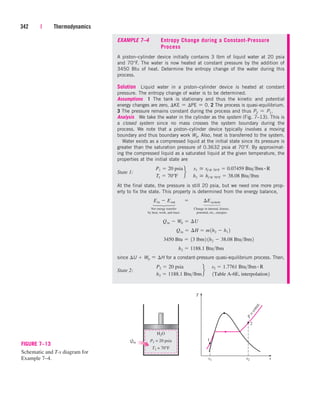
Soft rubber 0.13
Glass fiber 0.043
Air (g) 0.026
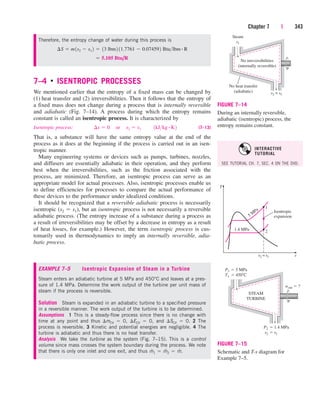
Urethane, 0.026
rigid foam
Temperature
variation
of air
AIR
FLOW
T
Velocity
variation
of air
V
Ts
A
HOT BLOCK
Qconv
Tf
FIGURE 2–70
Heat transfer from a hot surface to air
by convection.
cen84959_ch02.qxd 3/31/05 5:02 PM Page 93
The convection heat transfer coefficient h is not a property of the fluid. It
is an experimentally determined parameter whose value depends on all the
variables that influence convection such as the surface geometry, the nature
of fluid motion, the properties of the fluid, and the bulk fluid velocity. Typi-
cal values of h, in W/m2 · K, are in the range of 2–25 for the free convection
of gases, 50–1000 for the free convection of liquids, 25–250 for the forced
convection of gases, 50–20,000 for the forced convection of liquids, and
2500–100,000 for convection in boiling and condensation processes.
Radiation is the energy emitted by matter in the form of electromagnetic
waves (or photons) as a result of the changes in the electronic configurations
of the atoms or molecules. Unlike conduction and convection, the transfer of
energy by radiation does not require the presence of an intervening medium
(Fig. 2–72). In fact, energy transfer by radiation is fastest (at the speed of
light) and it suffers no attenuation in a vacuum. This is exactly how the
energy of the sun reaches the earth.
In heat transfer studies, we are interested in thermal radiation, which is the
form of radiation emitted by bodies because of their temperature. It differs
from other forms of electromagnetic radiation such as X-rays, gamma rays,
microwaves, radio waves, and television waves that are not related to temper-
ature. All bodies at a temperature above absolute zero emit thermal radiation.
Radiation is a volumetric phenomenon, and all solids, liquids, and gases
emit, absorb, or transmit radiation of varying degrees. However, radiation is
usually considered to be a surface phenomenon for solids that are opaque to
thermal radiation such as metals, wood, and rocks since the radiation emitted
by the interior regions of such material can never reach the surface, and the
radiation incident on such bodies is usually absorbed within a few microns
from the surface.
The maximum rate of radiation that can be emitted from a surface at an
absolute temperature Ts is given by the Stefan–Boltzmann law as
(2–54)
where A is the surface area and s  5.67  108 W/m2 · K4 is the
Stefan–Boltzmann constant. The idealized surface that emits radiation at
this maximum rate is called a blackbody, and the radiation emitted by a
blackbody is called blackbody radiation. The radiation emitted by all real
surfaces is less than the radiation emitted by a blackbody at the same tem-
peratures and is expressed as
(2–55)
where e is the emissivity of the surface. The property emissivity, whose
value is in the range 0 e 1, is a measure of how closely a surface
approximates a blackbody for which e  1. The emissivities of some sur-
faces are given in Table 2–4.
Another important radiation property of a surface is its absorptivity, a,
which is the fraction of the radiation energy incident on a surface that is
absorbed by the surface. Like emissivity, its value is in the range 0 a 1.
A blackbody absorbs the entire radiation incident on it. That is, a blackbody
is a perfect absorber (a  1) as well as a perfect emitter.
Q
#
emit  esAT 4
s ¬¬1W2
Q
#
emit,max  sAT 4
s ¬¬1W2
94 | Thermodynamics
Forced
convection
AIR
Natural
convection
AIR
hot egg hot egg
FIGURE 2–71
The cooling of a boiled egg by forced
and natural convection.
Fire
900°C
Air
5°C
Person
30°C
Radiation
FIGURE 2–72
Unlike conduction and convection,
heat transfer by radiation can occur
between two bodies, even when they
are separated by a medium colder than
both of them.
cen84959_ch02.qxd 3/31/05 5:02 PM Page 94
In general, both e and a of a surface depend on the temperature and the
wavelength of the radiation. Kirchhoff’s law of radiation states that the
emissivity and the absorptivity of a surface are equal at the same temperature
and wavelength. In most practical applications, the dependence of e and a on
the temperature and wavelength is ignored, and the average absorptivity of a
surface is taken to be equal to its average emissivity. The rate at which a sur-
face absorbs radiation is determined from (Fig. 2–73)
(2–56)
where is the rate at which radiation is incident on the surface and a is
the absorptivity of the surface. For opaque (nontransparent) surfaces, the por-
tion of incident radiation that is not absorbed by the surface is reflected back.
The difference between the rates of radiation emitted by the surface and the
radiation absorbed is the net radiation heat transfer. If the rate of radiation
absorption is greater than the rate of radiation emission, the surface is said to
be gaining energy by radiation. Otherwise, the surface is said to be losing
energy by radiation. In general, the determination of the net rate of heat trans-
fer by radiation between two surfaces is a complicated matter since it depends
on the properties of the surfaces, their orientation relative to each other, and
the interaction of the medium between the surfaces with radiation. However,
in the special case of a relatively small surface of emissivity e and surface
area A at absolute temperature Ts that is completely enclosed by a much
larger surface at absolute temperature Tsurr separated by a gas (such as air)
that does not intervene with radiation (i.e., the amount of radiation emitted,
absorbed, or scattered by the medium is negligible), the net rate of radiation
heat transfer between these two surfaces is determined from (Fig. 2–74)
(2–57)
In this special case, the emissivity and the surface area of the surrounding
surface do not have any effect on the net radiation heat transfer.
Q
#
rad  esA1T 4
s  T 4
surr 2¬¬1W2
Q
#
incident
Q
#
abs  aQ
#
incident¬¬1W2
Chapter 2 | 95
TABLE 2–4
Emissivity of some materials at
300 K
Material Emissivity
Aluminium foil 0.07
Anodized aluminum 0.82
Polished copper 0.03
Polished gold 0.03
Polished silver 0.02
Polished 0.17
stainless steel
Black paint 0.98
White paint 0.90
White paper 0.92–0.97
Asphalt pavement 0.85–0.93
Red brick 0.93–0.96
Human skin 0.95
Wood 0.82–0.92
Soil 0.93–0.96
Water 0.96
Vegetation 0.92–0.96
Qincident
·
Qref
= (1 – ) Qincident
· ·
α
Qabs
= Qincident
· ·
α
FIGURE 2–73
The absorption of radiation incident on
an opaque surface of absorptivity a.
FIGURE 2–74
Radiation heat transfer between a
body and the inner surfaces of a much
larger enclosure that completely
surrounds it.
Tsurr
Qrad
SMALL
BODY
LARGE
ENCLOSURE
,A,Ts
EXAMPLE 2–19 Heat Transfer from a Person
Consider a person standing in a breezy room at 20°C. Determine the total rate
of heat transfer from this person if the exposed surface area and the average
outer surface temperature of the person are 1.6 m2 and 29°C, respectively,
and the convection heat transfer coefficient is 6 W/m2 · °C (Fig. 2–75).
Solution A person is standing in a breezy room. The total rate of heat loss
from the person is to be determined.
Assumptions 1 The emissivity and heat transfer coefficient are constant and
uniform. 2 Heat conduction through the feet is negligible. 3 Heat loss by
evaporation is disregarded.
Analysis The heat transfer between the person and the air in the room will
be by convection (instead of conduction) since it is conceivable that the air
in the vicinity of the skin or clothing will warm up and rise as a result of
heat transfer from the body, initiating natural convection currents. It appears
cen84959_ch02.qxd 4/26/05 4:41 PM Page 95
that the experimentally determined value for the rate of convection heat
transfer in this case is 6 W per unit surface area (m2) per unit temperature
difference (in K or °C) between the person and the air away from the person.
Thus, the rate of convection heat transfer from the person to the air in the
room is, from Eq. 2–53,
The person will also lose heat by radiation to the surrounding wall sur-
faces. We take the temperature of the surfaces of the walls, ceiling, and
the floor to be equal to the air temperature in this case for simplicity, but
we recognize that this does not need to be the case. These surfaces may
be at a higher or lower temperature than the average temperature of the
room air, depending on the outdoor conditions and the structure of the
walls. Considering that air does not intervene with radiation and the person
is completely enclosed by the surrounding surfaces, the net rate of radia-
tion heat transfer from the person to the surrounding walls, ceiling, and
the floor is, from Eq. 2–57,
Note that we must use absolute temperatures in radiation calculations. Also
note that we used the emissivity value for the skin and clothing at room tem-
perature since the emissivity is not expected to change significantly at a
slightly higher temperature.
Then the rate of total heat transfer from the body is determined by adding
these two quantities to be
The heat transfer would be much higher if the person were not dressed since
the exposed surface temperature would be higher. Thus, an important func-
tion of the clothes is to serve as a barrier against heat transfer.
Discussion In the above calculations, heat transfer through the feet to the
floor by conduction, which is usually very small, is neglected. Heat transfer
from the skin by perspiration, which is the dominant mode of heat transfer
in hot environments, is not considered here.
Q
#
total  Q
#
conv  Q
#
rad  86.4  81.7  168.1 W
 81.7 W
 10.952 15.67  108
Wm2 # K4
2 11.6 m2
2  3 129  27324
 120  27324
4K4
Q
#
rad  esA1T 4
s  T 4
surr 2
 86.4 W
 16 Wm2 # °C2 11.6 m2
2 129  202 °C
Q
#
conv  hA1Ts  Tf 2
96 | Thermodynamics
Qrad
Room air
20°C
29°C
Qconv
Qcond
FIGURE 2–75
Heat transfer from the person
described in Example 2–19.
The sum of all forms of energy of a system is called total
energy, which consists of internal, kinetic, and potential
energy for simple compressible systems. Internal energy rep-
resents the molecular energy of a system and may exist in
sensible, latent, chemical, and nuclear forms.
Mass flow rate m
.
is defined as the amount of mass flowing
through a cross section per unit time. It is related to the vol-
ume flow rate V
.
, which is the volume of a fluid flowing
through a cross section per unit time, by
m
#
 rV
#
 rAcVavg
SUMMARY
cen84959_ch02.qxd 3/31/05 5:02 PM Page 96
Chapter 2 | 97
The energy flow rate associated with a fluid flowing at a rate
of m
.
is
which is analogous to E  me.
The mechanical energy is defined as the form of energy
that can be converted to mechanical work completely and
directly by a mechanical device such as an ideal turbine. It is
expressed on a unit mass basis and rate form as
and
where P/r is the flow energy, V2/2 is the kinetic energy, and
gz is the potential energy of the fluid per unit mass.
Energy can cross the boundaries of a closed system in the
form of heat or work. For control volumes, energy can also
be transported by mass. If the energy transfer is due to a tem-
perature difference between a closed system and its surround-
ings, it is heat; otherwise, it is work.
Work is the energy transferred as a force acts on a system
through a distance. Various forms of work are expressed as
follows:
Electrical work:
Shaft work:
Spring work:
The first law of thermodynamics is essentially an expres-
sion of the conservation of energy principle, also called the
energy balance. The general mass and energy balances for
any system undergoing any process can be expressed as
Wspring 
1
2
k1x2
2  x2
1 2
Wsh  2pnT
We  VI¢t
E
#
mech  m
#
emech  m
#
a
P
r

V 2
2
 gzb
emech 
P
r

V 2
2
 gz
E
#
 m
#
e
Net energy transfer Change in internal, kinetic,
by heat, work, and mass potential, etc., energies
It can also be expressed in the rate form as
Rate of net energy transfer Rate of change in internal,
by heat, work, and mass kinetic, potential, etc., energies
The efficiencies of various devices are defined as
The conversion of energy from one form to another is often
associated with adverse effects on the environment, and envi-
ronmental impact should be an important consideration in the
conversion and utilization of energy.
hturbine–gen  hturbinehgenerator 
W
#
elect,out
0¢E
#
mech,fluid 0
hpumpmotor  hpumphmotor 
¢E
#
mech,fluid
W
#
elect,in
hgenerator 
Electric power output
Mechanical power input

W
#
elect,out
W
#
shaft,in
hmotor 
Mechanical power output
Electric power input

W
#
shaft,out
W
#
elect,in
hturbine 
W
#
shaft,out
0¢E
#
mech,fluid 0

W
#
turbine
W
#
turbine,e
hpump 
¢E
#
mech,fluid
W
#
shaft,in

W
#
pump,u
W
#
pump
E
.
in  E
.
out¬  ¬ dEsystemdt¬¬1kW2
Ein  Eout¬  ¬ ¢Esystem¬¬1kJ2
⎫
⎪
⎬
⎪
⎭
⎫
⎪
⎪
⎬
⎪
⎪
⎭
⎫
⎪
⎬
⎪
⎭
⎫
⎪
⎪
⎬
⎪
⎪
⎭
1. ASHRAE Handbook of Fundamentals. SI version.
Atlanta, GA: American Society of Heating, Refrigerating,
and Air-Conditioning Engineers, Inc., 1993.
REFERENCES AND SUGGESTED READINGS
2. Y. A. Çengel. “An Intuitive and Unified Approach to
Teaching Thermodynamics.” ASME International
Mechanical Engineering Congress and Exposition,
Atlanta, Georgia, AES-Vol. 36, pp. 251–260, November
17–22, 1996.
cen84959_ch02.qxd 3/31/05 5:02 PM Page 97
98 | Thermodynamics
Forms of Energy
2–1C Portable electric heaters are commonly used to heat
small rooms. Explain the energy transformation involved dur-
ing this heating process.
2–2C Consider the process of heating water on top of an elec-
tric range. What are the forms of energy involved during this
process? What are the energy transformations that take place?
2–3C What is the difference between the macroscopic and
microscopic forms of energy?
2–4C What is total energy? Identify the different forms of
energy that constitute the total energy.
2–5C List the forms of energy that contribute to the internal
energy of a system.
2–6C How are heat, internal energy, and thermal energy
related to each other?
2–7C What is mechanical energy? How does it differ from
thermal energy? What are the forms of mechanical energy of
a fluid stream?
2–8 Consider a river flowing toward a lake at an average
velocity of 3 m/s at a rate of 500 m3/s at a location 90 m
above the lake surface. Determine the total mechanical
energy of the river water per unit mass and the power genera-
tion potential of the entire river at that location.
2–10 At a certain location, wind is blowing steadily at 10 m/s.
Determine the mechanical energy of air per unit mass and the
power generation potential of a wind turbine with 60-m-diame-
ter blades at that location. Take the air density to be 1.25 kg/m3.
2–11 A water jet that leaves a nozzle at 60 m/s at a flow
rate of 120 kg/s is to be used to generate power by striking
the buckets located on the perimeter of a wheel. Determine
the power generation potential of this water jet.
2–12 Two sites are being considered for wind power gener-
ation. In the first site, the wind blows steadily at 7 m/s for
3000 hours per year, whereas in the second site the wind
blows at 10 m/s for 2000 hours per year. Assuming the wind
velocity is negligible at other times for simplicity, determine
which is a better site for wind power generation. Hint: Note
that the mass flow rate of air is proportional to wind velocity.
2–13 A river flowing steadily at a rate of 240 m3/s is con-
sidered for hydroelectric power generation. It is determined
that a dam can be built to collect water and release it from an
elevation difference of 50 m to generate power. Determine
how much power can be generated from this river water after
the dam is filled.
2–14 A person gets into an elevator at the lobby level of a
hotel together with his 30-kg suitcase, and gets out at the
10th floor 35 m above. Determine the amount of energy con-
sumed by the motor of the elevator that is now stored in the
suitcase.
Energy Transfer by Heat and Work
2–15C In what forms can energy cross the boundaries of a
closed system?
2–16C When is the energy crossing the boundaries of a
closed system heat and when is it work?
2–17C What is an adiabatic process? What is an adiabatic
system?
2–18C A gas in a piston–cylinder device is compressed,
and as a result its temperature rises. Is this a heat or work
interaction?
2–19C A room is heated by an iron that is left plugged in.
Is this a heat or work interaction? Take the entire room,
including the iron, as the system.
2–20C A room is heated as a result of solar radiation com-
ing in through the windows. Is this a heat or work interaction
for the room?
2–21C An insulated room is heated by burning candles. Is
this a heat or work interaction? Take the entire room, includ-
ing the candles, as the system.
2–22C What are point and path functions? Give some
examples.
PROBLEMS*
*Problems designated by a “C” are concept questions, and students
are encouraged to answer them all. Problems designated by an “E”
are in English units, and the SI users can ignore them. Problems with
a CD-EES icon are solved using EES, and complete solutions
together with parametric studies are included on the enclosed DVD.
Problems with a computer-EES icon are comprehensive in nature,
and are intended to be solved with a computer, preferably using the
EES software that accompanies this text.
River 3 m/s
90 m
FIGURE P2–8
2–9 Electric power is to be generated by installing a
hydraulic turbine–generator at a site 120 m below the free sur-
face of a large water reservoir that can supply water at a rate of
1500 kg/s steadily. Determine the power generation potential.
cen84959_ch02.qxd 3/31/05 5:02 PM Page 98
Chapter 2 | 99
a final velocity of 30 m/s, and (c) from 35 m/s to a final
velocity of 5 m/s. Disregard friction, air drag, and rolling
resistance. Answers: (a) 98.1 kW, (b) 188 kW, (c) 21.9 kW
2–33 A damaged 1200-kg car is being towed by a truck.
Neglecting the friction, air drag, and rolling resistance, deter-
mine the extra power required (a) for constant velocity on a
level road, (b) for constant velocity of 50 km/h on a 30°
(from horizontal) uphill road, and (c) to accelerate on a level
road from stop to 90 km/h in 12 s. Answers: (a) 0, (b) 81.7
kW, (c) 31.3 kW
The First Law of Thermodynamics
2–34C For a cycle, is the net work necessarily zero? For
what kind of systems will this be the case?
2–35C On a hot summer day, a student turns his fan on
when he leaves his room in the morning. When he returns in
the evening, will the room be warmer or cooler than the
neighboring rooms? Why? Assume all the doors and win-
dows are kept closed.
2–36C What are the different mechanisms for transferring
energy to or from a control volume?
2–37 Water is being heated in a closed pan on top of a
range while being stirred by a paddle wheel. During the
process, 30 kJ of heat is transferred to the water, and 5 kJ of
heat is lost to the surrounding air. The paddle-wheel work
amounts to 500 N · m. Determine the final energy of the sys-
tem if its initial energy is 10 kJ. Answer: 35.5 kJ
2–23C What is the caloric theory? When and why was it
abandoned?
Mechanical Forms of Work
2–24C A car is accelerated from rest to 85 km/h in 10 s.
Would the energy transferred to the car be different if it were
accelerated to the same speed in 5 s?
2–25C Lifting a weight to a height of 20 m takes 20 s for
one crane and 10 s for another. Is there any difference in the
amount of work done on the weight by each crane?
2–26 Determine the energy required to accelerate an 800-
kg car from rest to 100 km/h on a level road. Answer: 309 kJ
2–27 Determine the energy required to accelerate a 1300-
kg car from 10 to 60 km/h on an uphill road with a vertical
rise of 40 m.
2–28E Determine the torque applied to the shaft of a car
that transmits 450 hp and rotates at a rate of 3000 rpm.
2–29 Determine the work required to deflect a linear spring
with a spring constant of 70 kN/m by 20 cm from its rest
position.
2–30 The engine of a 1500-kg automobile has a power rat-
ing of 75 kW. Determine the time required to accelerate this
car from rest to a speed of 100 km/h at full power on a level
road. Is your answer realistic?
2–31 A ski lift has a one-way length of 1 km and a vertical
rise of 200 m. The chairs are spaced 20 m apart, and each
chair can seat three people. The lift is operating at a steady
speed of 10 km/h. Neglecting friction and air drag and assum-
ing that the average mass of each loaded chair is 250 kg,
determine the power required to operate this ski lift. Also esti-
mate the power required to accelerate this ski lift in 5 s to its
operating speed when it is first turned on.
2–32 Determine the power required for a 2000-kg car to
climb a 100-m-long uphill road with a slope of 30° (from
horizontal) in 10 s (a) at a constant velocity, (b) from rest to
2000 kg
100 m
30°
FIGURE P2–32
2–38E A vertical piston–cylinder device contains water and
is being heated on top of a range. During the process, 65 Btu
500 N·m
30 kJ
5 kJ
FIGURE P2–37
cen84959_ch02.qxd 3/31/05 5:02 PM Page 99
100 | Thermodynamics
of heat is transferred to the water, and heat losses from the
side walls amount to 8 Btu. The piston rises as a result of
evaporation, and 5 Btu of work is done by the vapor. Deter-
mine the change in the energy of the water for this process.
Answer: 52 Btu
2–39 A classroom that normally contains 40 people is to
be air-conditioned with window air-conditioning units of 5-
kW cooling capacity. A person at rest may be assumed to
dissipate heat at a rate of about 360 kJ/h. There are 10 light-
bulbs in the room, each with a rating of 100 W. The rate of
heat transfer to the classroom through the walls and the win-
dows is estimated to be 15,000 kJ/h. If the room air is to be
maintained at a constant temperature of 21°C, determine the
number of window air-conditioning units required. Answer:
2 units
2–40 The lighting requirements of an industrial facility are
being met by 700 40-W standard fluorescent lamps. The
lamps are close to completing their service life and are to be
replaced by their 34-W high-efficiency counterparts that oper-
ate on the existing standard ballasts. The standard and high-
efficiency fluorescent lamps can be purchased in quantity at a
cost of $1.77 and $2.26 each, respectively. The facility operates
2800 hours a year, and all of the lamps are kept on during
operating hours. Taking the unit cost of electricity to be
$0.08/kWh and the ballast factor to be 1.1 (i.e., ballasts con-
sume 10 percent of the rated power of the lamps), determine
how much energy and money will be saved per year as a
result of switching to the high-efficiency fluorescent lamps.
Also, determine the simple payback period.
2–41 The lighting needs of a storage room are being met by
6 fluorescent light fixtures, each fixture containing four
lamps rated at 60 W each. All the lamps are on during operat-
ing hours of the facility, which are 6 AM to 6 PM 365 days a
year. The storage room is actually used for an average of 3 h
a day. If the price of electricity is $0.08/kWh, determine the
amount of energy and money that will be saved as a result of
installing motion sensors. Also, determine the simple pay-
back period if the purchase price of the sensor is $32 and it
takes 1 hour to install it at a cost of $40.
2–42 A university campus has 200 classrooms and 400 fac-
ulty offices. The classrooms are equipped with 12 fluorescent
tubes, each consuming 110 W, including the electricity used
by the ballasts. The faculty offices, on average, have half as
many tubes. The campus is open 240 days a year. The class-
rooms and faculty offices are not occupied an average of 4 h
a day, but the lights are kept on. If the unit cost of electricity
is $0.082/kWh, determine how much the campus will save a
year if the lights in the classrooms and faculty offices are
turned off during unoccupied periods.
2–43 Consider a room that is initially at the outdoor tem-
perature of 20°C. The room contains a 100-W lightbulb, a
110-W TV set, a 200-W refrigerator, and a 1000-W iron.
Assuming no heat transfer through the walls, determine the
rate of increase of the energy content of the room when all of
these electric devices are on.
2–44 A fan is to accelerate quiescent air to a velocity of 10
m/s at a rate of 4 m3/s. Determine the minimum power that
must be supplied to the fan. Take the density of air to be 1.18
kg/m3. Answer: 236 W
2–45E Consider a fan located in a 3 ft  3 ft square duct.
Velocities at various points at the outlet are measured, and
the average flow velocity is determined to be 22 ft/s. Taking
the air density to 0.075 lbm/ft3, estimate the minimum elec-
tric power consumption of the fan motor.
2–46 A water pump that consumes 2 kW of electric power
when operating is claimed to take in water from a lake and
pump it to a pool whose free surface is 30 m above the free
surface of the lake at a rate of 50 L/s. Determine if this claim
is reasonable.
2–47 The driving force for fluid flow is the pressure
difference, and a pump operates by raising the
pressure of a fluid (by converting the mechanical shaft work
to flow energy). A gasoline pump is measured to consume
5.2 kW of electric power when operating. If the pressure dif-
ferential between the outlet and inlet of the pump is mea-
sured to be 5 kPa and the changes in velocity and elevation
are negligible, determine the maximum possible volume flow
rate of gasoline.
2–48 The 60-W fan of a central heating system is to circu-
late air through the ducts. The analysis of the flow shows that
the fan needs to raise the pressure of air by 50 Pa to maintain
flow. The fan is located in a horizontal flow section whose
diameter is 30 cm at both the inlet and the outlet. Determine
the highest possible average flow velocity in the duct.
2–49E At winter design conditions, a house is projected to
lose heat at a rate of 60,000 Btu/h. The internal heat gain
from people, lights, and appliances is estimated to be 6000
Btu/h. If this house is to be heated by electric resistance
heaters, determine the required rated power of these heaters
in kW to maintain the house at constant temperature.
2–50 An escalator in a shopping center is designed to move
30 people, 75 kg each, at a constant speed of 0.8 m/s at 45°
slope. Determine the minimum power input needed to drive
∆P = 5 kPa
Pump
FIGURE P2–47
cen84959_ch02.qxd 4/11/05 2:21 PM Page 100
Chapter 2 | 101
2–60E The steam requirements of a manufacturing facility
are being met by a boiler whose rated heat input is 3.6  106
Btu/h. The combustion efficiency of the boiler is measured to
be 0.7 by a hand-held flue gas analyzer. After tuning up the
boiler, the combustion efficiency rises to 0.8. The boiler oper-
ates 1500 hours a year intermittently. Taking the unit cost of
energy to be $4.35/106 Btu, determine the annual energy and
cost savings as a result of tuning up the boiler.
2–61E Reconsider Prob. 2–60E. Using EES (or other)
software, study the effects of the unit cost of
energy and combustion efficiency on the annual energy used
and the cost savings. Let the efficiency vary from 0.6 to 0.9,
and the unit cost to vary from $4 to $6 per million Btu. Plot
the annual energy used and the cost savings against the effi-
ciency for unit costs of $4, $5, and $6 per million Btu, and
discuss the results.
2–62 An exercise room has eight weight-lifting machines
that have no motors and four treadmills each equipped with a
2.5-hp (shaft output) motor. The motors operate at an average
load factor of 0.7, at which their efficiency is 0.77. During
peak evening hours, all 12 pieces of exercising equipment are
used continuously, and there are also two people doing light
exercises while waiting in line for one piece of the equip-
ment. Assuming the average rate of heat dissipation from
people in an exercise room is 525 W, determine the rate of
heat gain of the exercise room from people and the equip-
ment at peak load conditions.
2–63 Consider a classroom for 55 students and one instruc-
tor, each generating heat at a rate of 100 W. Lighting is pro-
vided by 18 fluorescent lightbulbs, 40 W each, and the
ballasts consume an additional 10 percent. Determine the rate
of internal heat generation in this classroom when it is fully
occupied.
2–64 A room is cooled by circulating chilled water through
a heat exchanger located in a room. The air is circulated
through the heat exchanger by a 0.25-hp (shaft output) fan.
Typical efficiency of small electric motors driving 0.25-hp
equipment is 54 percent. Determine the rate of heat supply by
the fan–motor assembly to the room.
2–65 Electric power is to be generated by installing a
hydraulic turbine–generator at a site 70 m below the free sur-
face of a large water reservoir that can supply water at a rate
of 1500 kg/s steadily. If the mechanical power output of the
turbine is 800 kW and the electric power generation is 750
kW, determine the turbine efficiency and the combined tur-
bine–generator efficiency of this plant. Neglect losses in the
pipes.
2–66 At a certain location, wind is blowing steadily at 12
m/s. Determine the mechanical energy of air per unit mass
this escalator. What would your answer be if the escalator
velocity were to be doubled?
2–51 Consider a 1400-kg car cruising at constant speed of 70
km/h. Now the car starts to pass another car, by accelerating to
110 km/h in 5 s. Determine the additional power needed to
achieve this acceleration. What would your answer be if the
total mass of the car were only 700 kg? Answers: 77.8 kW,
38.9 kW
Energy Conversion Efficiencies
2–52C What is mechanical efficiency? What does a
mechanical efficiency of 100 percent mean for a hydraulic
turbine?
2–53C How is the combined pump–motor efficiency of a
pump and motor system defined? Can the combined
pump–motor efficiency be greater than either the pump or the
motor efficiency?
2–54C Define turbine efficiency, generator efficiency, and
combined turbine–generator efficiency.
2–55C Can the combined turbine-generator efficiency be
greater than either the turbine efficiency or the generator effi-
ciency? Explain.
2–56 Consider a 3-kW hooded electric open burner in an
area where the unit costs of electricity and natural gas are
$0.07/kWh and $1.20/therm, respectively. The efficiency of
open burners can be taken to be 73 percent for electric burn-
ers and 38 percent for gas burners. Determine the rate of
energy consumption and the unit cost of utilized energy for
both electric and gas burners.
2–57 A 75-hp (shaft output) motor that has an efficiency of
91.0 percent is worn out and is replaced by a high-efficiency
75-hp motor that has an efficiency of 95.4 percent. Determine
the reduction in the heat gain of the room due to higher effi-
ciency under full-load conditions.
2–58 A 90-hp (shaft output) electric car is powered by an
electric motor mounted in the engine compartment. If the
motor has an average efficiency of 91 percent, determine the
rate of heat supply by the motor to the engine compartment
at full load.
2–59 A 75-hp (shaft output) motor that has an efficiency
of 91.0 percent is worn out and is to be replaced by a high-
efficiency motor that has an efficiency of 95.4 percent. The
motor operates 4368 hours a year at a load factor of 0.75.
Taking the cost of electricity to be $0.08/kWh, determine the
amount of energy and money saved as a result of installing
the high-efficiency motor instead of the standard motor. Also,
determine the simple payback period if the purchase prices of
the standard and high-efficiency motors are $5449 and
$5520, respectively.
cen84959_ch02.qxd 4/20/05 5:06 PM Page 101
102 | Thermodynamics
and the power generation potential of a wind turbine with 50-
m-diameter blades at that location. Also determine the actual
electric power generation assuming an overall efficiency of
30 percent. Take the air density to be 1.25 kg/m3.
2–67 Reconsider Prob. 2–66. Using EES (or other)
software, investigate the effect of wind velocity
and the blade span diameter on wind power generation. Let
the velocity vary from 5 to 20 m/s in increments of 5 m/s,
and the diameter vary from 20 to 80 m in increments of 20
m. Tabulate the results, and discuss their significance.
2–68 A wind turbine is rotating at 15 rpm under steady
winds flowing through the turbine at a rate of 42,000 kg/s.
The tip velocity of the turbine blade is measured to be 250
km/h. If 180 kW power is produced by the turbine, determine
(a) the average velocity of the air and (b) the conversion effi-
ciency of the turbine. Take the density of air to be 1.31
kg/m3.
2–69 Water is pumped from a lake to a storage tank 20 m
above at a rate of 70 L/s while consuming 20.4 kW of elec-
tric power. Disregarding any frictional losses in the pipes and
any changes in kinetic energy, determine (a) the overall effi-
ciency of the pump–motor unit and (b) the pressure differ-
ence between the inlet and the exit of the pump.
2–72 Large wind turbines with blade span diameters of
over 100 m are available for electric power generation. Con-
sider a wind turbine with a blade span diameter of 100 m
installed at a site subjected to steady winds at 8 m/s. Taking
the overall efficiency of the wind turbine to be 32 percent and
the air density to be 1.25 kg/m3, determine the electric power
generated by this wind turbine. Also, assuming steady winds
of 8 m/s during a 24-hour period, determine the amount of
electric energy and the revenue generated per day for a unit
price of $0.06/kWh for electricity.
2–73E A water pump delivers 3 hp of shaft power when
operating. If the pressure differential between the outlet and
the inlet of the pump is measured to be 1.2 psi when the flow
rate is 8 ft3/s and the changes in velocity and elevation are
negligible, determine the mechanical efficiency of this pump.
2–74 Water is pumped from a lower reservoir to a higher
reservoir by a pump that provides 20 kW of shaft power. The
free surface of the upper reservoir is 45 m higher than that of
the lower reservoir. If the flow rate of water is measured to
be 0.03 m3/s, determine mechanical power that is converted
to thermal energy during this process due to frictional effects.
Pump
Storage tank
20 m
FIGURE P2–69
1
2
45 m
z1 = 0
0.03 m3
/s
20 kW
Pump
Control surface
FIGURE P2–74
2–70 A geothermal pump is used to pump brine whose den-
sity is 1050 kg/m3 at a rate of 0.3 m3/s from a depth of 200
m. For a pump efficiency of 74 percent, determine the
required power input to the pump. Disregard frictional losses
in the pipes, and assume the geothermal water at 200 m depth
to be exposed to the atmosphere.
2–71 Consider an electric motor with a shaft power output of
20 kW and an efficiency of 88 percent. Determine the rate at
which the motor dissipates heat to the room it is in when the
motor operates at full load. In winter, this room is normally
heated by a 2-kW resistance heater. Determine if it is neces-
sary to turn the heater on when the motor runs at full load.
2–75 A 7-hp (shaft) pump is used to raise water to an eleva-
tion of 15 m. If the mechanical efficiency of the pump is 82
percent, determine the maximum volume flow rate of water.
2–76 A hydraulic turbine has 85 m of elevation difference
available at a flow rate of 0.25 m3/s, and its overall turbine–
generator efficiency is 91 percent. Determine the electric
power output of this turbine.
2–77 An oil pump is drawing 35 kW of electric power
while pumping oil with r  860 kg/m3 at a rate of 0.1 m3/s.
The inlet and outlet diameters of the pipe are 8 cm and 12 cm,
cen84959_ch02.qxd 3/31/05 5:02 PM Page 102
Chapter 2 | 103
respectively. If the pressure rise of oil in the pump is mea-
sured to be 400 kPa and the motor efficiency is 90 percent,
determine the mechanical efficiency of the pump.
2–78E A 73-percent efficient pump with a power input of
12 hp is pumping water from a lake to a nearby pool at a rate
of 1.2 ft3/s through a constant-diameter pipe. The free surface
of the pool is 35 ft above that of the lake. Determine the
mechanical power used to overcome frictional effects in
piping. Answer: 4.0 hp
Energy and Environment
2–79C How does energy conversion affect the environ-
ment? What are the primary chemicals that pollute the air?
What is the primary source of these pollutants?
2–80C What is smog? What does it consist of? How does
ground-level ozone form? What are the adverse effects of
ozone on human health?
2–81C What is acid rain? Why is it called a “rain”? How
do the acids form in the atmosphere? What are the adverse
effects of acid rain on the environment?
2–82C What is the greenhouse effect? How does the excess
CO2 gas in the atmosphere cause the greenhouse effect?
What are the potential long-term consequences of greenhouse
effect? How can we combat this problem?
2–83C Why is carbon monoxide a dangerous air pollutant?
How does it affect human health at low and at high levels?
2–84E A Ford Taurus driven 15,000 miles a year will use
about 715 gallons of gasoline compared to a Ford Explorer
that would use 940 gallons. About 19.7 lbm of CO2, which
causes global warming, is released to the atmosphere when a
gallon of gasoline is burned. Determine the extra amount of
CO2 production a man is responsible for during a 5-year
period if he trades his Taurus for an Explorer.
2–85 When a hydrocarbon fuel is burned, almost all of the
carbon in the fuel burns completely to form CO2 (carbon
dioxide), which is the principal gas causing the greenhouse
effect and thus global climate change. On average, 0.59 kg of
CO2 is produced for each kWh of electricity generated from a
power plant that burns natural gas. A typical new household
refrigerator uses about 700 kWh of electricity per year.
Determine the amount of CO2 production that is due to the
refrigerators in a city with 200,000 households.
2–86 Repeat Prob. 2–85 assuming the electricity is pro-
duced by a power plant that burns coal. The average produc-
tion of CO2 in this case is 1.1 kg per kWh.
2–87E Consider a household that uses 11,000 kWh of elec-
tricity per year and 1500 gallons of fuel oil during a heating
season. The average amount of CO2 produced is 26.4
lbm/gallon of fuel oil and 1.54 lbm/kWh of electricity. If this
household reduces its oil and electricity usage by 15 percent
as a result of implementing some energy conservation mea-
sures, determine the reduction in the amount of CO2 emis-
sions by that household per year.
2–88 A typical car driven 12,000 miles a year emits to the
atmosphere about 11 kg per year of NOx (nitrogen oxides),
which cause smog in major population areas. Natural gas
burned in the furnace emits about 4.3 g of NOx per therm, and
the electric power plants emit about 7.1 g of NOx per kWh of
electricity produced. Consider a household that has two cars
and consumes 9000 kWh of electricity and 1200 therms of
natural gas. Determine the amount of NOx emission to the
atmosphere per year for which this household is responsible.
12 cm
Pump
∆P = 400 kPa
Motor
35 kW
8 cm
0.1 m3
/s
Oil
FIGURE P2–77
11 kg NOx
per year
FIGURE P2–88
Special Topic: Mechanisms of Heat Transfer
2–89C What are the mechanisms of heat transfer?
2–90C Does any of the energy of the sun reach the earth by
conduction or convection?
2–91C Which is a better heat conductor, diamond or silver?
2–92C How does forced convection differ from natural
convection?
2–93C Define emissivity and absorptivity. What is Kirch-
hoff’s law of radiation?
2–94C What is blackbody? How do real bodies differ from
a blackbody?
cen84959_ch02.qxd 3/31/05 5:02 PM Page 103
104 | Thermodynamics
convection heat transfer coefficient and surface emissivity on
the heat transfer rate from the ball. Let the heat transfer coef-
ficient vary from 5 to 30 W/m2 · °C. Plot the rate of heat
transfer against the convection heat transfer coefficient for
the surface emissivities of 0.1, 0.5, 0.8, and 1, and discuss the
results.
2–102 Hot air at 80°C is blown over a 2-m  4-m flat sur-
face at 30°C. If the convection heat transfer coefficient is 55
W/m2 · °C, determine the rate of heat transfer from the air to
the plate, in kW.
2–103 A 1000-W iron is left on the ironing board with its
base exposed to the air at 20°C. The convection heat transfer
coefficient between the base surface and the surrounding air
is 35 W/m2 · °C. If the base has an emissivity of 0.6 and a
surface area of 0.02 m2, determine the temperature of the
base of the iron.
2–104 A thin metal plate is insulated on the back and
exposed to solar radiation on the front surface. The exposed
surface of the plate has an absorptivity of 0.6 for solar radia-
tion. If solar radiation is incident on the plate at a rate of
20°C 5°C
Brick
wall
30 cm
FIGURE P2–95 1000-W
iron
Air
20°C
FIGURE P2–103
700 W/m 2
α = 0.6
25°C
FIGURE P2–104
2–95 The inner and outer surfaces of a 5-m  6-m brick wall
of thickness 30 cm and thermal conductivity 0.69 W/m · °C are
maintained at temperatures of 20°C and 5°C, respectively.
Determine the rate of heat transfer through the wall, in W.
2–96 The inner and outer surfaces of a 0.5-cm-thick 2-m 
2-m window glass in winter are 10°C and 3°C, respectively.
If the thermal conductivity of the glass is 0.78 W/m · °C,
determine the amount of heat loss, in kJ, through the glass
over a period of 5 h. What would your answer be if the glass
were 1-cm thick?
2–97 Reconsider Problem 2–96. Using EES (or other)
software, investigate the effect of glass thickness
on heat loss for the specified glass surface temperatures. Let
the glass thickness vary from 0.2 to 2 cm. Plot the heat loss
versus the glass thickness, and discuss the results.
2–98 An aluminum pan whose thermal conductivity is
237 W/m · °C has a flat bottom whose diameter is 20 cm
and thickness 0.4 cm. Heat is transferred steadily to boiling
water in the pan through its bottom at a rate of 500 W. If
the inner surface of the bottom of the pan is 105°C, deter-
mine the temperature of the outer surface of the bottom of
the pan.
2–99 For heat transfer purposes, a standing man can be
modeled as a 30-cm diameter, 170-cm long vertical cylinder
with both the top and bottom surfaces insulated and with the
side surface at an average temperature of 34°C. For a convec-
tion heat transfer coefficient of 15 W/m2 · °C, determine the
rate of heat loss from this man by convection in an environ-
ment at 20°C. Answer: 336 W
2–100 A 5-cm-diameter spherical ball whose surface is
maintained at a temperature of 70°C is suspended in the mid-
dle of a room at 20°C. If the convection heat transfer coeffi-
cient is 15 W/m2 · C and the emissivity of the surface is 0.8,
determine the total rate of heat transfer from the ball.
2–101 Reconsider Problem 2–100. Using EES (or
other) software, investigate the effect of the
cen84959_ch02.qxd 3/31/05 5:02 PM Page 104
Chapter 2 | 105
2–111 Two surfaces of a 2-cm-thick plate are maintained at
0°C and 100°C, respectively. If it is determined that heat is
transferred through the plate at a rate of 500 W/m2, determine
its thermal conductivity.
Review Problems
2–112 Consider a vertical elevator whose cabin has a total
mass of 800 kg when fully loaded and 150 kg when empty.
The weight of the elevator cabin is partially balanced by a
400-kg counterweight that is connected to the top of the cabin
by cables that pass through a pulley located on top of the ele-
vator well. Neglecting the weight of the cables and assuming
the guide rails and the pulleys to be frictionless, determine
(a) the power required while the fully loaded cabin is rising at
a constant speed of 1.2 m/s and (b) the power required while
the empty cabin is descending at a constant speed of 1.2 m/s.
What would your answer be to (a) if no counterweight
were used? What would your answer be to (b) if a friction force
of 800 N has developed between the cabin and the guide rails?
2–113 Consider a homeowner who is replacing his 25-year-
old natural gas furnace that has an efficiency of 55 percent.
The homeowner is considering a conventional furnace that
has an efficiency of 82 percent and costs $1600 and a high-
efficiency furnace that has an efficiency of 95 percent and
costs $2700. The homeowner would like to buy the high-
efficiency furnace if the savings from the natural gas pay for
the additional cost in less than 8 years. If the homeowner
presently pays $1200 a year for heating, determine if he
should buy the conventional or high-efficiency model.
2–114 Wind energy has been used since 4000 BC to power
sailboats, grind grain, pump water for farms, and, more recently,
generate electricity. In the United States alone, more than
6 million small windmills, most of them under 5 hp, have
been used since the 1850s to pump water. Small windmills
have been used to generate electricity since 1900, but the
development of modern wind turbines occurred only recently
in response to the energy crises in the early 1970s. The cost
of wind power has dropped an order of magnitude from about
$0.50/kWh in the early 1980s to about $0.05/kWh in
the mid-1990s, which is about the price of electricity gener-
ated at coal-fired power plants. Areas with an average wind
speed of 6 m/s (or 14 mph) are potential sites for economical
wind power generation. Commercial wind turbines generate
from 100 kW to 3.2 MW of electric power each at peak
design conditions. The blade span (or rotor) diameter of the
3.2 MW wind turbine built by Boeing Engineering is 320 ft
(97.5 m). The rotation speed of rotors of wind turbines is
usually under 40 rpm (under 20 rpm for large turbines). Alta-
mont Pass in California is the world’s largest wind farm with
15,000 modern wind turbines. This farm and two others in
California produced 2.8 billion kWh of electricity in 1991,
which is enough power to meet the electricity needs of San
Francisco.
Iced
water
0.4 cm
5°C
FIGURE P2–109
700 W/m2 and the surrounding air temperature is 25°C, deter-
mine the surface temperature of the plate when the heat loss
by convection equals the solar energy absorbed by the plate.
Assume the convection heat transfer coefficient to be
50 W/m2 · °C, and disregard heat loss by radiation.
2–105 Reconsider Problem 2–104. Using EES (or
other) software, investigate the effect of the
convection heat transfer coefficient on the surface tempera-
ture of the plate. Let the heat transfer coefficient vary from
10 to 90 W/m2 · °C. Plot the surface temperature against the
convection heat transfer coefficient, and discuss the results.
2–106 A 5-cm-external-diameter, 10-m-long hot-water pipe
at 80°C is losing heat to the surrounding air at 5°C by natural
convection with a heat transfer coefficient of 25 W/m2 · °C.
Determine the rate of heat loss from the pipe by natural con-
vection, in kW.
2–107 The outer surface of a spacecraft in space has an
emissivity of 0.8 and an absorptivity of 0.3 for solar radia-
tion. If solar radiation is incident on the spacecraft at a rate of
1000 W/m2, determine the surface temperature of the space-
craft when the radiation emitted equals the solar energy
absorbed.
2–108 Reconsider Problem 2–107. Using EES (or
other) software, investigate the effect of the
surface emissivity and absorptivity of the spacecraft on the
equilibrium surface temperature. Plot the surface temperature
against emissivity for solar absorbtivities of 0.1, 0.5, 0.8, and
1, and discuss the results.
2–109 A hollow spherical iron container whose outer diam-
eter is 20 cm and thickness is 0.4 cm is filled with iced water
at 0°C. If the outer surface temperature is 5°C, determine the
approximate rate of heat loss from the sphere, and the rate at
which ice melts in the container.
2–110 The inner and outer glasses of a 2-m  2-m double
pane window are at 18°C and 6°C, respectively. If the 1-cm
space between the two glasses is filled with still air, deter-
mine the rate of heat transfer through the window, in kW.
cen84959_ch02.qxd 4/20/05 5:06 PM Page 105
106 | Thermodynamics
In 2003, 8133 MW of new wind energy generating
capacity were installed worldwide, bringing the world’s total
wind energy capacity to 39,294 MW. The United States, Ger-
many, Denmark, and Spain account for over 75 percent of cur-
rent wind energy generating capacity worldwide. Denmark uses
wind turbines to supply 10 percent of its national electricity.
Many wind turbines currently in operation have just
two blades. This is because at tip speeds of 100 to 200 mph,
the efficiency of the two-bladed turbine approaches the theo-
retical maximum, and the increase in the efficiency by adding
a third or fourth blade is so little that they do not justify the
added cost and weight.
Consider a wind turbine with an 80-m-diameter rotor
that is rotating at 20 rpm under steady winds at an average
velocity of 30 km/h. Assuming the turbine has an efficiency
of 35 percent (i.e., it converts 35 percent of the kinetic energy
of the wind to electricity), determine (a) the power produced,
in kW; (b) the tip speed of the blade, in km/h; and (c) the
revenue generated by the wind turbine per year if the electric
power produced is sold to the utility at $0.06/kWh. Take the
density of air to be 1.20 kg/m3.
2–115 Repeat Prob. 2–114 for an average wind velocity of
25 km/h.
2–116E The energy contents, unit costs, and typical conver-
sion efficiencies of various energy sources for use in water
heaters are given as follows: 1025 Btu/ft3, $0.012/ft3, and 55
percent for natural gas; 138,700 Btu/gal, $1.15/gal, and 55
percent for heating oil; and 1 kWh/kWh, $0.084/kWh, and
90 percent for electric heaters, respectively. Determine the
lowest-cost energy source for water heaters.
2–117 A homeowner is considering these heating systems for
heating his house: Electric resistance heating with $0.09/kWh
and 1 kWh  3600 kJ, gas heating with $1.24/therm and 1
therm  105,500 kJ, and oil heating with $1.25/gal and 1 gal
of oil  138,500 kJ. Assuming efficiencies of 100 percent for
the electric furnace and 87 percent for the gas and oil furnaces,
determine the heating system with the lowest energy cost.
2–118 A typical household pays about $1200 a year on
energy bills, and the U.S. Department of Energy estimates
that 46 percent of this energy is used for heating and cooling,
15 percent for heating water, 15 percent for refrigerating and
freezing, and the remaining 24 percent for lighting, cooking,
and running other appliances. The heating and cooling costs
of a poorly insulated house can be reduced by up to 30 per-
cent by adding adequate insulation. If the cost of insulation is
$200, determine how long it will take for the insulation to
pay for itself from the energy it saves.
2–119 The U.S. Department of Energy estimates that up to 10
percent of the energy use of a house can be saved by caulking
and weatherstripping doors and windows to reduce air leaks at
a cost of about $50 for materials for an average home with 12
windows and 2 doors. Caulking and weatherstripping every
gas-heated home properly would save enough energy to heat
about 4 million homes. The savings can be increased by
installing storm windows. Determine how long it will take for
the caulking and weatherstripping to pay for itself from the
energy they save for a house whose annual energy use is $1100.
2–120 The U.S. Department of Energy estimates that
570,000 barrels of oil would be saved per day if every house-
hold in the United States lowered the thermostat setting in
winter by 6°F (3.3°C). Assuming the average heating season
to be 180 days and the cost of oil to be $40/barrel, determine
how much money would be saved per year.
2–121 Consider a TV set that consumes 120 W of electric
power when it is on and is kept on for an average of 6 hours per
day. For a unit electricity cost of 8 cents per kWh, determine
the cost of electricity this TV consumes per month (30 days).
2–122 The pump of a water distribution system is powered
by a 15-kW electric motor whose efficiency is 90 percent.
FIGURE P2–114
© Vol. 57/PhotoDisc
300 kPa
50 L/s
Pump
Motor
15 kW
hmotor = 90%
100 kPa
Water
2
1
Wpump
•
FIGURE P2–122
cen84959_ch02.qxd 4/20/05 5:06 PM Page 106
Chapter 2 | 107
The water flow rate through the pump is 50 L/s. The diame-
ters of the inlet and outlet pipes are the same, and the eleva-
tion difference across the pump is negligible. If the pressures
at the inlet and outlet of the pump are measured to be 100
kPa and 300 kPa (absolute), respectively, determine the
mechanical efficiency of the pump. Answer: 74.1 percent
2–123 In a hydroelectric power plant, 100 m3/s of water flows
from an elevation of 120 m to a turbine, where electric power is
generated. The overall efficiency of the turbine–generator is 80
percent. Disregarding frictional losses in piping, estimate the
electric power output of this plant. Answer: 94.2 MW
2–124 The demand for electric power is usually much
higher during the day than it is at night, and utility companies
often sell power at night at much lower prices to encourage
consumers to use the available power generation capacity and
to avoid building new expensive power plants that will be
used only a short time during peak periods. Utilities are also
willing to purchase power produced during the day from pri-
vate parties at a high price.
Suppose a utility company is selling electric power for
$0.03/kWh at night and is willing to pay $0.08/kWh for
power produced during the day. To take advantage of this
opportunity, an entrepreneur is considering building a large
reservoir 40 m above the lake level, pumping water from the
lake to the reservoir at night using cheap power, and letting
the water flow from the reservoir back to the lake during the
day, producing power as the pump–motor operates as a tur-
bine–generator during reverse flow. Preliminary analysis
shows that a water flow rate of 2 m3/s can be used in either
direction. The combined pump–motor and turbine–generator
efficiencies are expected to be 75 percent each. Disregarding
the frictional losses in piping and assuming the system oper-
ates for 10 h each in the pump and turbine modes during a
typical day, determine the potential revenue this pump–turbine
system can generate per year.
100 m3
/s
2
1
120 m
Generator Turbine
hturbine–gen = 80%
FIGURE P2–123
40 m
Pump–
turbine
Reservoir
Lake
FIGURE P2–124
2–125 A diesel engine with an engine volume of 4.0 L and
an engine speed of 2500 rpm operates on an air–fuel ratio of
18 kg air/kg fuel. The engine uses light diesel fuel that con-
tains 750 ppm (parts per million) of sulfur by mass. All of
this sulfur is exhausted to the environment where the sulfur is
converted to sulfurous acid (H2SO3). If the rate of the air
entering the engine is 336 kg/h, determine the mass flow rate
of sulfur in the exhaust. Also, determine the mass flow rate of
sulfurous acid added to the environment if for each kmol of
sulfur in the exhaust, one kmol sulfurous acid will be added
to the environment. The molar mass of the sulfur is 32
kg/kmol.
2–126 Leaded gasoline contains lead that ends up in the
engine exhaust. Lead is a very toxic engine emission. The use
of leaded gasoline in the United States has been unlawful for
most vehicles since the 1980s. However, leaded gasoline is
still used in some parts of the world. Consider a city with
10,000 cars using leaded gasoline. The gasoline contains 0.15
g/L of lead and 35 percent of lead is exhausted to the envi-
ronment. Assuming that an average car travels 15,000 km per
year with a gasoline consumption of 10 L/100 km, determine
the amount of lead put into the atmosphere per year in that
city. Answer: 788 kg
cen84959_ch02.qxd 3/31/05 5:02 PM Page 107
108 | Thermodynamics
2–135 A 2-kW pump is used to pump kerosene (r  0.820
kg/L) from a tank on the ground to a tank at a higher eleva-
tion. Both tanks are open to the atmosphere, and the elevation
difference between the free surfaces of the tanks is 30 m. The
maximum volume flow rate of kerosene is
(a) 8.3 L/s (b) 7.2 L/s (c) 6.8 L/s
(d) 12.1 L/s (e) 17.8 L/s
2–136 A glycerin pump is powered by a 5-kW electric
motor. The pressure differential between the outlet and the
inlet of the pump at full load is measured to be 211 kPa. If
the flow rate through the pump is 18 L/s and the changes in
elevation and the flow velocity across the pump are negligi-
ble, the overall efficiency of the pump is
(a) 69 percent (b) 72 percent (c) 76 percent
(d) 79 percent (e) 82 percent
The Following Problems Are Based on the Optional
Special Topic of Heat Transfer
2–137 A 10-cm high and 20-cm wide circuit board houses
on its surface 100 closely spaced chips, each generating heat
at a rate of 0.08 W and transferring it by convection to the
surrounding air at 40°C. Heat transfer from the back surface
of the board is negligible. If the convection heat transfer
coefficient on the surface of the board is 10 W/m2 · °C and
radiation heat transfer is negligble, the average surface tem-
perature of the chips is
(a) 80°C (b) 54°C (c) 41°C (d) 72°C
(e) 60°C
2–138 A 50-cm-long, 0.2-cm-diameter electric resistance
wire submerged in water is used to determine the boiling heat
transfer coefficient in water at 1 atm experimentally. The sur-
face temperature of the wire is measured to be 130°C when a
wattmeter indicates the electric power consumption to be 4.1
kW. Then the heat transfer coefficient is
(a) 43,500 W/m2 · °C (b) 137 W/m2 · °C
(c) 68,330 W/m2 · °C (d) 10,038 W/m2 · °C
(e) 37,540 W/m2 · °C
2–139 A 3-m2 hot black surface at 80°C is losing heat to
the surrounding air at 25°C by convection with a convection
heat transfer coefficient of 12 W/m2 · °C, and by radiation to
the surrounding surfaces at 15°C. The total rate of heat loss
from the surface is
(a) 1987 W (b) 2239 W (c) 2348 W (d) 3451 W
(e) 3811 W
2–140 Heat is transferred steadily through a 0.2-m thick 8
m  4 m wall at a rate of 1.6 kW. The inner and outer sur-
face temperatures of the wall are measured to be 15°C to
5°C. The average thermal conductivity of the wall is
(a) 0.001 W/m · °C (b) 0.5 W/m · °C (c) 1.0 W/m · °C
(d) 2.0 W/m · °C (e) 5.0 W/m · °C
Fundamentals of Engineering (FE) Exam Problems
2–127 A 2-kW electric resistance heater in a room is turned
on and kept on for 30 min. The amount of energy transferred
to the room by the heater is
(a) 1 kJ (b) 60 kJ (c) 1800 kJ (d) 3600 kJ
(e) 7200 kJ
2–128 On a hot summer day, the air in a well-sealed room
is circulated by a 0.50-hp fan driven by a 65 percent efficient
motor. (Note that the motor delivers 0.50 hp of net shaft
power to the fan.) The rate of energy supply from the fan-
motor assembly to the room is
(a) 0.769 kJ/s (b) 0.325 kJ/s (c) 0.574 kJ/s
(d) 0.373 kJ/s (e) 0.242 kJ/s
2–129 A fan is to accelerate quiescent air to a velocity to 12
m/s at a rate of 3 m3/min. If the density of air is 1.15 kg/m3,
the minimum power that must be supplied to the fan is
(a) 248 W (b) 72 W (c) 497 W (d) 216 W
(e) 162 W
2–130 A 900-kg car cruising at a constant speed of 60 km/s
is to accelerate to 100 km/h in 6 s. The additional power
needed to achieve this acceleration is
(a) 41 kW (b) 222 kW (c) 1.7 kW (d) 26 kW
(e) 37 kW
2–131 The elevator of a large building is to raise a net mass
of 400 kg at a constant speed of 12 m/s using an electric
motor. Minimum power rating of the motor should be
(a) 0 kW (b) 4.8 kW (c) 47 kW (d) 12 kW
(e) 36 kW
2–132 Electric power is to be generated in a hydroelectric
power plant that receives water at a rate of 70 m3/s from an
elevation of 65 m using a turbine–generator with an effi-
ciency of 85 percent. When frictional losses in piping are dis-
regarded, the electric power output of this plant is
(a) 3.9 MW (b) 38 MW (c) 45 MW (d) 53 MW
(e) 65 MW
2–133 A 75-hp compressor in a facility that operates at full
load for 2500 h a year is powered by an electric motor that
has an efficiency of 88 percent. If the unit cost of electricity
is $0.06/kWh, the annual electricity cost of this compressor is
(a) $7382 (b) $9900 (c) $12,780 (d) $9533
(e) $8389
2–134 Consider a refrigerator that consumes 320 W of elec-
tric power when it is running. If the refrigerator runs only
one quarter of the time and the unit cost of electricity is
$0.09/kWh, the electricity cost of this refrigerator per month
(30 days) is
(a) $3.56 (b) $5.18 (c) $8.54 (d) $9.28
(e) $20.74
cen84959_ch02.qxd 3/31/05 5:02 PM Page 108
Chapter 2 | 109
2–141 The roof of an electrically heated house is 7-m long,
10-m wide, and 0.25-m thick. It is made of a flat layer of
concrete whose thermal conductivity is 0.92 W/m · °C. Dur-
ing a certain winter night, the temperatures of the inner and
outer surfaces of the roof are measured to be 15°C and 4°C,
respectively. The average rate of heat loss through the roof
that night was
(a) 41 W (b) 177 W (c) 4894 W (d) 5567 W
(e) 2834 W
Design and Essay Problems
2–142 An average vehicle puts out nearly 20 lbm of carbon
dioxide into the atmosphere for every gallon of gasoline it
burns, and thus one thing we can do to reduce global warm-
ing is to buy a vehicle with higher fuel economy. A U.S. gov-
ernment publication states that a vehicle that gets 25 rather
than 20 miles per gallon will prevent 10 tons of carbon diox-
ide from being released over the lifetime of the vehicle. Mak-
ing reasonable assumptions, evaluate if this is a reasonable
claim or a gross exaggeration.
2–143 Solar energy reaching the earth is about 1350 W/m2
outside the earth’s atmosphere, and 950 W/m2 on earth’s sur-
face normal to the sun on a clear day. Someone is marketing
2 m  3 m photovoltaic cell panels with the claim that a sin-
gle panel can meet the electricity needs of a house. How do
you evaluate this claim? Photovoltaic cells have a conversion
efficiency of about 15 percent.
2–144 Find out the prices of heating oil, natural gas, and
electricity in your area, and determine the cost of each per
kWh of energy supplied to the house as heat. Go through
your utility bills and determine how much money you spent
for heating last January. Also determine how much your Jan-
uary heating bill would be for each of the heating systems if
you had the latest and most efficient system installed.
2–145 Prepare a report on the heating systems available in
your area for residential buildings. Discuss the advantages
and disadvantages of each system and compare their initial
and operating costs. What are the important factors in the
selection of a heating system? Give some guidelines. Identify
the conditions under which each heating system would be the
best choice in your area.
2–146 The performance of a device is defined as the ratio
of the desired output to the required input, and this definition
can be extended to nontechnical fields. For example, your
performance in this course can be viewed as the grade you
earn relative to the effort you put in. If you have been invest-
ing a lot of time in this course and your grades do not reflect
it, you are performing poorly. In that case, perhaps you
should try to find out the underlying cause and how to correct
the problem. Give three other definitions of performance
from nontechnical fields and discuss them.
2–147 Your neighbor lives in a 2500-square-foot (about 250
m2) older house heated by natural gas. The current gas heater
was installed in the early 1970s and has an efficiency (called
the Annual Fuel Utilization Efficiency rating, or AFUE) of 65
percent. It is time to replace the furnace, and the neighbor is
trying to decide between a conventional furnace that has
an efficiency of 80 percent and costs $1500 and a high-
efficiency furnace that has an efficiency of 95 percent and
costs $2500. Your neighbor offered to pay you $100 if you
help him make the right decision. Considering the weather
data, typical heating loads, and the price of natural gas in
your area, make a recommendation to your neighbor based
on a convincing economic analysis.
2–148 The roofs of many homes in the United States are
covered with photovoltaic (PV) solar cells that resemble roof
tiles, generating electricity quietly from solar energy. An arti-
cle stated that over its projected 30-year service life, a 4-kW
roof PV system in California will reduce the production of
CO2 that causes global warming by 433,000 lbm, sulfates
that cause acid rain by 2900 lbm, and nitrates that cause
smog by 1660 lbm. The article also claims that a PV roof
will save 253,000 lbm of coal, 21,000 gallons of oil, and 27
million ft3 of natural gas. Making reasonable assumptions for
incident solar radiation, efficiency, and emissions, evaluate
these claims and make corrections if necessary.
cen84959_ch02.qxd 3/31/05 5:02 PM Page 109
cen84959_ch02.qxd 3/31/05 5:02 PM Page 110
Chapter 3
PROPERTIES OF PURE SUBSTANCES
| 111
We start this chapter with the introduction of the con-
cept of a pure substance and a discussion of the
physics of phase-change processes. We then illus-
trate the various property diagrams and P-v-T surfaces of
pure substances. After demonstrating the use of the property
tables, the hypothetical substance ideal gas and the ideal-gas
equation of state are discussed. The compressibility factor,
which accounts for the deviation of real gases from ideal-gas
behavior, is introduced, and some of the best-known equa-
tions of state such as the van der Waals, Beattie-Bridgeman,
and Benedict-Webb-Rubin equations are presented.
Objectives
The objectives of Chapter 3 are to:
• Introduce the concept of a pure substance.
• Discuss the physics of phase-change processes.
• Illustrate the P-v, T-v, and P-T property diagrams and P-v-T
surfaces of pure substances.
• Demonstrate the procedures for determining
thermodynamic properties of pure substances from tables
of property data.
• Describe the hypothetical substance “ideal gas” and the
ideal-gas equation of state.
• Apply the ideal-gas equation of state in the solution of
typical problems.
• Introduce the compressibility factor, which accounts for the
deviation of real gases from ideal-gas behavior.
• Present some of the best-known equations of state.
cen84959_ch03.qxd 4/1/05 12:31 PM Page 111
3–1 ■
PURE SUBSTANCE
A substance that has a fixed chemical composition throughout is called a
pure substance. Water, nitrogen, helium, and carbon dioxide, for example,
are all pure substances.
A pure substance does not have to be of a single chemical element or
compound, however. A mixture of various chemical elements or compounds
also qualifies as a pure substance as long as the mixture is homogeneous.
Air, for example, is a mixture of several gases, but it is often considered to
be a pure substance because it has a uniform chemical composition
(Fig. 3–1). However, a mixture of oil and water is not a pure substance.
Since oil is not soluble in water, it will collect on top of the water, forming
two chemically dissimilar regions.
A mixture of two or more phases of a pure substance is still a pure sub-
stance as long as the chemical composition of all phases is the same
(Fig. 3–2). A mixture of ice and liquid water, for example, is a pure sub-
stance because both phases have the same chemical composition. A mixture
of liquid air and gaseous air, however, is not a pure substance since the
composition of liquid air is different from the composition of gaseous air,
and thus the mixture is no longer chemically homogeneous. This is due
to different components in air condensing at different temperatures at a
specified pressure.
3–2 ■
PHASES OF A PURE SUBSTANCE
We all know from experience that substances exist in different phases. At
room temperature and pressure, copper is a solid, mercury is a liquid, and
nitrogen is a gas. Under different conditions, each may appear in a different
phase. Even though there are three principal phases—solid, liquid, and
gas—a substance may have several phases within a principal phase, each
with a different molecular structure. Carbon, for example, may exist as
graphite or diamond in the solid phase. Helium has two liquid phases; iron
has three solid phases. Ice may exist at seven different phases at high pres-
sures. A phase is identified as having a distinct molecular arrangement that
is homogeneous throughout and separated from the others by easily identifi-
able boundary surfaces. The two phases of H2O in iced water represent a
good example of this.
When studying phases or phase changes in thermodynamics, one does not
need to be concerned with the molecular structure and behavior of different
phases. However, it is very helpful to have some understanding of the molec-
ular phenomena involved in each phase, and a brief discussion of phase
transformations follows.
Intermolecular bonds are strongest in solids and weakest in gases. One
reason is that molecules in solids are closely packed together, whereas in
gases they are separated by relatively large distances.
The molecules in a solid are arranged in a three-dimensional pattern (lat-
tice) that is repeated throughout (Fig. 3–3). Because of the small distances
between molecules in a solid, the attractive forces of molecules on each
other are large and keep the molecules at fixed positions (Fig. 3–4). Note
that the attractive forces between molecules turn to repulsive forces as the
112 | Thermodynamics
N2 AIR
FIGURE 3–1
Nitrogen and gaseous air are pure
substances.
VAPOR
LIQUID
LIQUID
(a) H2O (b) AIR
VAPOR
FIGURE 3–2
A mixture of liquid and gaseous water
is a pure substance, but a mixture of
liquid and gaseous air is not.
FIGURE 3–3
The molecules in a solid are kept at
their positions by the large springlike
intermolecular forces.
SEE TUTORIAL CH. 3, SEC. 1 ON THE DVD.
INTERACTIVE
TUTORIAL
SEE TUTORIAL CH. 3, SEC. 2 ON THE DVD.
INTERACTIVE
TUTORIAL
cen84959_ch03.qxd 4/25/05 2:47 PM Page 112
distance between the molecules approaches zero, thus preventing the mole-
cules from piling up on top of each other. Even though the molecules in a
solid cannot move relative to each other, they continually oscillate about
their equilibrium positions. The velocity of the molecules during these oscil-
lations depends on the temperature. At sufficiently high temperatures, the
velocity (and thus the momentum) of the molecules may reach a point
where the intermolecular forces are partially overcome and groups of mole-
cules break away (Fig. 3–5). This is the beginning of the melting process.
The molecular spacing in the liquid phase is not much different from that
of the solid phase, except the molecules are no longer at fixed positions rel-
ative to each other and they can rotate and translate freely. In a liquid, the
intermolecular forces are weaker relative to solids, but still relatively strong
compared with gases. The distances between molecules generally experi-
ence a slight increase as a solid turns liquid, with water being a notable
exception.
In the gas phase, the molecules are far apart from each other, and a molec-
ular order is nonexistent. Gas molecules move about at random, continually
colliding with each other and the walls of the container they are in. Particu-
larly at low densities, the intermolecular forces are very small, and colli-
sions are the only mode of interaction between the molecules. Molecules in
the gas phase are at a considerably higher energy level than they are in the
liquid or solid phases. Therefore, the gas must release a large amount of its
energy before it can condense or freeze.
3–3 ■
PHASE-CHANGE PROCESSES
OF PURE SUBSTANCES
There are many practical situations where two phases of a pure substance
coexist in equilibrium. Water exists as a mixture of liquid and vapor in the
boiler and the condenser of a steam power plant. The refrigerant turns from
liquid to vapor in the freezer of a refrigerator. Even though many home
owners consider the freezing of water in underground pipes as the most
Chapter 3 | 113
FIGURE 3–4
In a solid, the attractive and repulsive
forces between the molecules tend to
maintain them at relatively constant
distances from each other.
© Reprinted with special permission of King
Features Syndicate.
(a) (b) (c)
FIGURE 3–5
The arrangement of atoms in different phases: (a) molecules are at relatively fixed positions in a solid,
(b) groups of molecules move about each other in the liquid phase, and (c) molecules move about at random
in the gas phase.
SEE TUTORIAL CH. 3, SEC. 3 ON THE DVD.
INTERACTIVE
TUTORIAL
cen84959_ch03.qxd 4/26/05 4:40 PM Page 113
important phase-change process, attention in this section is focused on the
liquid and vapor phases and their mixture. As a familiar substance, water is
used to demonstrate the basic principles involved. Remember, however, that
all pure substances exhibit the same general behavior.
Compressed Liquid and Saturated Liquid
Consider a piston–cylinder device containing liquid water at 20°C and 1 atm
pressure (state 1, Fig. 3–6). Under these conditions, water exists in the liq-
uid phase, and it is called a compressed liquid, or a subcooled liquid,
meaning that it is not about to vaporize. Heat is now transferred to the water
until its temperature rises to, say, 40°C. As the temperature rises, the liquid
water expands slightly, and so its specific volume increases. To accommo-
date this expansion, the piston moves up slightly. The pressure in the cylin-
der remains constant at 1 atm during this process since it depends on the
outside barometric pressure and the weight of the piston, both of which are
constant. Water is still a compressed liquid at this state since it has not
started to vaporize.
As more heat is transferred, the temperature keeps rising until it reaches
100°C (state 2, Fig. 3–7). At this point water is still a liquid, but any heat
addition will cause some of the liquid to vaporize. That is, a phase-change
process from liquid to vapor is about to take place. A liquid that is about to
vaporize is called a saturated liquid. Therefore, state 2 is a saturated liquid
state.
Saturated Vapor and Superheated Vapor
Once boiling starts, the temperature stops rising until the liquid is com-
pletely vaporized. That is, the temperature will remain constant during the
entire phase-change process if the pressure is held constant. This can easily
be verified by placing a thermometer into boiling pure water on top of a
stove. At sea level (P  1 atm), the thermometer will always read 100°C if
the pan is uncovered or covered with a light lid. During a boiling process,
the only change we will observe is a large increase in the volume and a
steady decline in the liquid level as a result of more liquid turning to vapor.
Midway about the vaporization line (state 3, Fig. 3–8), the cylinder contains
equal amounts of liquid and vapor. As we continue transferring heat, the
vaporization process continues until the last drop of liquid is vaporized (state
4, Fig. 3–9). At this point, the entire cylinder is filled with vapor that is on the
borderline of the liquid phase. Any heat loss from this vapor will cause some
of the vapor to condense (phase change from vapor to liquid). A vapor that is
about to condense is called a saturated vapor. Therefore, state 4 is a satu-
rated vapor state. A substance at states between 2 and 4 is referred to as a sat-
urated liquid–vapor mixture since the liquid and vapor phases coexist in
equilibrium at these states.
Once the phase-change process is completed, we are back to a single-
phase region again (this time vapor), and further transfer of heat results in
an increase in both the temperature and the specific volume (Fig. 3–10). At
state 5, the temperature of the vapor is, let us say, 300°C; and if we transfer
some heat from the vapor, the temperature may drop somewhat but no con-
densation will take place as long as the temperature remains above 100°C
114 | Thermodynamics
Heat
P = 1 atm
T = 20°C
STATE 1
FIGURE 3–6
At 1 atm and 20°C, water exists in the
liquid phase (compressed liquid).
Heat
P = 1 atm
T = 100°C
STATE 2
FIGURE 3–7
At 1 atm pressure and 100°C, water
exists as a liquid that is ready to
vaporize (saturated liquid).
P = 1 atm
T = 100°C
STATE 3
Heat
Saturated
vapor
Saturated
liquid
FIGURE 3–8
As more heat is transferred, part of the
saturated liquid vaporizes (saturated
liquid–vapor mixture).
cen84959_ch03.qxd 4/1/05 12:31 PM Page 114
(for P  1 atm). A vapor that is not about to condense (i.e., not a saturated
vapor) is called a superheated vapor. Therefore, water at state 5 is a
superheated vapor. This constant-pressure phase-change process is illus-
trated on a T-v diagram in Fig. 3–11.
If the entire process described here is reversed by cooling the water while
maintaining the pressure at the same value, the water will go back to state 1,
retracing the same path, and in so doing, the amount of heat released will
exactly match the amount of heat added during the heating process.
In our daily life, water implies liquid water and steam implies water
vapor. In thermodynamics, however, both water and steam usually mean
only one thing: H2O.
Saturation Temperature and Saturation Pressure
It probably came as no surprise to you that water started to boil at 100°C.
Strictly speaking, the statement “water boils at 100°C” is incorrect. The cor-
rect statement is “water boils at 100°C at 1 atm pressure.” The only reason
water started boiling at 100°C was because we held the pressure constant at
1 atm (101.325 kPa). If the pressure inside the cylinder were raised to 500
kPa by adding weights on top of the piston, water would start boiling at
151.8°C. That is, the temperature at which water starts boiling depends on
the pressure; therefore, if the pressure is fixed, so is the boiling temperature.
At a given pressure, the temperature at which a pure substance changes
phase is called the saturation temperature Tsat. Likewise, at a given tem-
perature, the pressure at which a pure substance changes phase is called the
saturation pressure Psat. At a pressure of 101.325 kPa, Tsat is 99.97°C.
Conversely, at a temperature of 99.97°C, Psat is 101.325 kPa. (At 100.00°C,
Psat is 101.42 kPa in the ITS-90 discussed in Chap. 1.)
Saturation tables that list the saturation pressure against the tempera-
ture (or the saturation temperature against the pressure) are available for
Chapter 3 | 115
STATE 4
Heat
P = 1 atm
T = 100°C
FIGURE 3–9
At 1 atm pressure, the temperature
remains constant at 100°C until the
last drop of liquid is vaporized
(saturated vapor).
STATE 5
Heat
P = 1 atm
T = 300°C
FIGURE 3–10
As more heat is transferred, the
temperature of the vapor starts to rise
(superheated vapor).
2 Saturated
mixture 4
5
S
u
p
e
r
h
e
a
t
e
d
T, °C
300
100
20 1
v
a
p
o
r
3
C
o
m
p
r
e
s
s
e
d
l
i
q
u
i
d
P
=
1
a
t
m
v
FIGURE 3–11
T-v diagram for the heating process of water at constant pressure.
cen84959_ch03.qxd 4/1/05 12:31 PM Page 115
practically all substances. A partial listing of such a table is given in
Table 3–1 for water. This table indicates that the pressure of water changing
phase (boiling or condensing) at 25°C must be 3.17 kPa, and the pressure of
water must be maintained at 3976 kPa (about 40 atm) to have it boil at
250°C. Also, water can be frozen by dropping its pressure below 0.61 kPa.
It takes a large amount of energy to melt a solid or vaporize a liquid. The
amount of energy absorbed or released during a phase-change process is
called the latent heat. More specifically, the amount of energy absorbed
during melting is called the latent heat of fusion and is equivalent to the
amount of energy released during freezing. Similarly, the amount of energy
absorbed during vaporization is called the latent heat of vaporization and
is equivalent to the energy released during condensation. The magnitudes of
the latent heats depend on the temperature or pressure at which the phase
change occurs. At 1 atm pressure, the latent heat of fusion of water is 333.7
kJ/kg and the latent heat of vaporization is 2256.5 kJ/kg.
During a phase-change process, pressure and temperature are obviously
dependent properties, and there is a definite relation between them, that is,
Tsat  f(Psat). A plot of Tsat versus Psat, such as the one given for water in
Fig. 3–12, is called a liquid–vapor saturation curve. A curve of this kind
is characteristic of all pure substances.
It is clear from Fig. 3–12 that Tsat increases with Psat. Thus, a substance
at higher pressures boils at higher temperatures. In the kitchen, higher boil-
ing temperatures mean shorter cooking times and energy savings. A beef
stew, for example, may take 1 to 2 h to cook in a regular pan that operates
at 1 atm pressure, but only 20 min in a pressure cooker operating at 3 atm
absolute pressure (corresponding boiling temperature: 134°C).
The atmospheric pressure, and thus the boiling temperature of water,
decreases with elevation. Therefore, it takes longer to cook at higher alti-
tudes than it does at sea level (unless a pressure cooker is used). For exam-
ple, the standard atmospheric pressure at an elevation of 2000 m is 79.50
kPa, which corresponds to a boiling temperature of 93.3°C as opposed to
100°C at sea level (zero elevation). The variation of the boiling temperature
of water with altitude at standard atmospheric conditions is given in
Table 3–2. For each 1000 m increase in elevation, the boiling temperature
116 | Thermodynamics
TABLE 3–1
Saturation (boiling) pressure of
water at various temperatures
Saturation
Temperature, pressure,
T, °C Psat, kPa
10 0.26
5 0.40
0 0.61
5 0.87
10 1.23
15 1.71
20 2.34
25 3.17
30 4.25
40 7.39
50 12.35
100 101.4
150 476.2
200 1555
250 3976
300 8588
Use actual data from the experiment
shown here to obtain the latent heat
of fusion of water. See end-of-chapter
problem 3–146.
© Ronald Mullisen
400
200
0
0 200
150
100
50
600
Tsat,°C
Psat, kPa
FIGURE 3–12
The liquid–vapor saturation curve of a
pure substance (numerical values are
for water).
EXPERIMENT
cen84959_ch03.qxd 4/25/05 2:47 PM Page 116
drops by a little over 3°C. Note that the atmospheric pressure at a location,
and thus the boiling temperature, changes slightly with the weather condi-
tions. But the corresponding change in the boiling temperature is no more
than about 1°C.
Some Consequences of Tsat and Psat Dependence
We mentioned earlier that a substance at a specified pressure boils at the
saturation temperature corresponding to that pressure. This phenomenon
allows us to control the boiling temperature of a substance by simply con-
trolling the pressure, and it has numerous applications in practice. Below we
give some examples. The natural drive to achieve phase equilibrium by
allowing some liquid to evaporate is at work behind the scenes.
Consider a sealed can of liquid refrigerant-134a in a room at 25°C. If the
can has been in the room long enough, the temperature of the refrigerant in
the can is also 25°C. Now, if the lid is opened slowly and some refrigerant
is allowed to escape, the pressure in the can will start dropping until it
reaches the atmospheric pressure. If you are holding the can, you will notice
its temperature dropping rapidly, and even ice forming outside the can if the
air is humid. A thermometer inserted in the can will register 26°C when
the pressure drops to 1 atm, which is the saturation temperature of refriger-
ant-134a at that pressure. The temperature of the liquid refrigerant will
remain at 26°C until the last drop of it vaporizes.
Another aspect of this interesting physical phenomenon is that a liquid can-
not vaporize unless it absorbs energy in the amount of the latent heat of vapor-
ization, which is 217 kJ/kg for refrigerant-134a at 1 atm. Therefore, the rate of
vaporization of the refrigerant depends on the rate of heat transfer to the can:
the larger the rate of heat transfer, the higher the rate of vaporization. The rate
of heat transfer to the can and thus the rate of vaporization of the refrigerant
can be minimized by insulating the can heavily. In the limiting case of no heat
transfer, the refrigerant will remain in the can as a liquid at 26°C indefinitely.
The boiling temperature of nitrogen at atmospheric pressure is 196°C
(see Table A–3a). This means the temperature of liquid nitrogen exposed to
the atmosphere must be 196°C since some nitrogen will be evaporating.
The temperature of liquid nitrogen remains constant at 196°C until it is
depleted. For this reason, nitrogen is commonly used in low-temperature
scientific studies (such as superconductivity) and cryogenic applications to
maintain a test chamber at a constant temperature of 196°C. This is done
by placing the test chamber into a liquid nitrogen bath that is open to the
atmosphere. Any heat transfer from the environment to the test section is
absorbed by the nitrogen, which evaporates isothermally and keeps the test
chamber temperature constant at 196°C (Fig. 3–13). The entire test sec-
tion must be insulated heavily to minimize heat transfer and thus liquid
nitrogen consumption. Liquid nitrogen is also used for medical purposes to
burn off unsightly spots on the skin. This is done by soaking a cotton swap
in liquid nitrogen and wetting the target area with it. As the nitrogen evapo-
rates, it freezes the affected skin by rapidly absorbing heat from it.
A practical way of cooling leafy vegetables is vacuum cooling, which is
based on reducing the pressure of the sealed cooling chamber to the satura-
tion pressure at the desired low temperature, and evaporating some water
Chapter 3 | 117
TABLE 3–2
Variation of the standard
atmospheric pressure and the
boiling (saturation) temperature of
water with altitude
Atmospheric Boiling
Elevation, pressure, tempera-
m kPa ture, °C
0 101.33 100.0
1,000 89.55 96.5
2,000 79.50 93.3
5,000 54.05 83.3
10,000 26.50 66.3
20,000 5.53 34.7
25°C
Liquid N2
–196°C
N2 vapor
–196°C
Insulation
Test
chamber
–196°C
FIGURE 3–13
The temperature of liquid nitrogen
exposed to the atmosphere remains
constant at 196°C, and thus it
maintains the test chamber at 196°C.
cen84959_ch03.qxd 4/1/05 12:31 PM Page 117
from the products to be cooled. The heat of vaporization during evaporation
is absorbed from the products, which lowers the product temperature. The
saturation pressure of water at 0°C is 0.61 kPa, and the products can be
cooled to 0°C by lowering the pressure to this level. The cooling rate can be
increased by lowering the pressure below 0.61 kPa, but this is not desirable
because of the danger of freezing and the added cost.
In vacuum cooling, there are two distinct stages. In the first stage, the
products at ambient temperature, say at 25°C, are loaded into the chamber,
and the operation begins. The temperature in the chamber remains constant
until the saturation pressure is reached, which is 3.17 kPa at 25°C. In the
second stage that follows, saturation conditions are maintained inside at pro-
gressively lower pressures and the corresponding lower temperatures until
the desired temperature is reached (Fig. 3–14).
Vacuum cooling is usually more expensive than the conventional refriger-
ated cooling, and its use is limited to applications that result in much faster
cooling. Products with large surface area per unit mass and a high tendency
to release moisture such as lettuce and spinach are well-suited for vacuum
cooling. Products with low surface area to mass ratio are not suitable, espe-
cially those that have relatively impervious peels such as tomatoes and
cucumbers. Some products such as mushrooms and green peas can be vac-
uum cooled successfully by wetting them first.
The vacuum cooling just described becomes vacuum freezing if the vapor
pressure in the vacuum chamber is dropped below 0.61 kPa, the saturation
pressure of water at 0°C. The idea of making ice by using a vacuum pump
is nothing new. Dr. William Cullen actually made ice in Scotland in 1775 by
evacuating the air in a water tank (Fig. 3–15).
Package icing is commonly used in small-scale cooling applications to
remove heat and keep the products cool during transit by taking advantage
of the large latent heat of fusion of water, but its use is limited to products
that are not harmed by contact with ice. Also, ice provides moisture as well
as refrigeration.
3–4 ■
PROPERTY DIAGRAMS FOR PHASE-CHANGE
PROCESSES
The variations of properties during phase-change processes are best studied
and understood with the help of property diagrams. Next, we develop and
discuss the T-v, P-v, and P-T diagrams for pure substances.
1 The T-v Diagram
The phase-change process of water at 1 atm pressure was described in detail
in the last section and plotted on a T-v diagram in Fig. 3–11. Now we repeat
this process at different pressures to develop the T-v diagram.
Let us add weights on top of the piston until the pressure inside the cylin-
der reaches 1 MPa. At this pressure, water has a somewhat smaller specific
volume than it does at 1 atm pressure. As heat is transferred to the water at
this new pressure, the process follows a path that looks very much like the
process path at 1 atm pressure, as shown in Fig. 3–16, but there are some
noticeable differences. First, water starts boiling at a much higher tempera-
118 | Thermodynamics
Pressure (kPa)
End of cooling
(0°C, 0.61 kPa)
Start of cooling
(25°C, 100 kPa)
Temperature
°C
25
0
100
10
3.17
0.61
0 1
FIGURE 3–14
The variation of the temperature of
fruits and vegetables with pressure
during vacuum cooling from 25C to
0C.
Water
Ice
vapor
Evaporation
Low vapor pressure
Insulation
Air +Vapor
pressure
High
Vacuum
pump
FIGURE 3–15
In 1775, ice was made by evacuating
the air space in a water tank.
SEE TUTORIAL CH. 3, SEC. 4 ON THE DVD.
INTERACTIVE
TUTORIAL
cen84959_ch03.qxd 4/25/05 2:47 PM Page 118
ture (179.9°C) at this pressure. Second, the specific volume of the saturated
liquid is larger and the specific volume of the saturated vapor is smaller
than the corresponding values at 1 atm pressure. That is, the horizontal line
that connects the saturated liquid and saturated vapor states is much shorter.
As the pressure is increased further, this saturation line continues to
shrink, as shown in Fig. 3–16, and it becomes a point when the pressure
reaches 22.06 MPa for the case of water. This point is called the critical
point, and it is defined as the point at which the saturated liquid and satu-
rated vapor states are identical.
The temperature, pressure, and specific volume of a substance at the criti-
cal point are called, respectively, the critical temperature Tcr, critical pres-
sure Pcr, and critical specific volume vcr. The critical-point properties of
water are Pcr  22.06 MPa, Tcr  373.95°C, and vcr  0.003106 m3/kg.
For helium, they are 0.23 MPa, 267.85°C, and 0.01444 m3/kg. The critical
properties for various substances are given in Table A–1 in the appendix.
At pressures above the critical pressure, there is not a distinct phase-
change process (Fig. 3–17). Instead, the specific volume of the substance
continually increases, and at all times there is only one phase present.
Eventually, it resembles a vapor, but we can never tell when the change
Chapter 3 | 119
0.003106
373.95
v, m3
/kg
Saturated
vapor
Saturated
liquid
Critical point
T, °C
P
=
25
M
Pa
P
=
22.06
M
Pa
P
=
1
5
M
P
a
P
=
8
M
P
a
P
=
1
M
P
a
P
=
0
.
1
M
P
a
P
=
0
.
0
1
M
P
a
FIGURE 3–16
T-v diagram of constant-pressure phase-change processes of a pure substance at various pressures (numerical values are
for water).
T
LIQUID
Critical
point
P

P
c
r
P

P
c
r
P
c
r
Phase
change
Tcr
vcr
V
A
P
O
R
v
FIGURE 3–17
At supercritical pressures (P  Pcr),
there is no distinct phase-change
(boiling) process.
cen84959_ch03.qxd 4/1/05 12:31 PM Page 119
has occurred. Above the critical state, there is no line that separates the
compressed liquid region and the superheated vapor region. However, it is
customary to refer to the substance as superheated vapor at temperatures
above the critical temperature and as compressed liquid at temperatures
below the critical temperature.
The saturated liquid states in Fig. 3–16 can be connected by a line called
the saturated liquid line, and saturated vapor states in the same figure can
be connected by another line, called the saturated vapor line. These two
lines meet at the critical point, forming a dome as shown in Fig. 3–18. All
the compressed liquid states are located in the region to the left of the satu-
rated liquid line, called the compressed liquid region. All the superheated
vapor states are located to the right of the saturated vapor line, called the
superheated vapor region. In these two regions, the substance exists in a
single phase, a liquid or a vapor. All the states that involve both phases in
equilibrium are located under the dome, called the saturated liquid–vapor
mixture region, or the wet region.
2 The P-v Diagram
The general shape of the P-v diagram of a pure substance is very much like
the T-v diagram, but the T  constant lines on this diagram have a down-
ward trend, as shown in Fig. 3–19.
Consider again a piston–cylinder device that contains liquid water at 1
MPa and 150°C. Water at this state exists as a compressed liquid. Now the
weights on top of the piston are removed one by one so that the pressure
inside the cylinder decreases gradually (Fig. 3–20). The water is allowed to
exchange heat with the surroundings so its temperature remains constant. As
120 | Thermodynamics
T
Critical
point
l
i
n
e
l
i
q
u
i
d
S
a
tu
r
a
te
d
l
i
n
e
v
a
p
o
r
S
a
t
u
r
a
t
e
d
P
2
=
c
o
n
s
t
.

P
1
P
1
=
c
o
n
s
t
.
COMPRESSED
LIQUID
REGION
SATURATED
LIQUID–VAPOR
REGION
SUPERHEATED
VAPOR
REGION
v
FIGURE 3–18
T-v diagram of a pure substance.
cen84959_ch03.qxd 4/1/05 12:31 PM Page 120
Chapter 3 | 121
P
Critical
point
l
i
n
e
l
i
q
u
i
d
S
a
tu
r
a
te
d
l
i
n
e
v
a
p
o
r
S
a
t
u
r
a
t
e
d
T2 = const.  T1
T1 = const.
COMPRESSED
LIQUID
REGION
SATURATED
LIQUID–VAPOR
REGION
SUPERHEATED
VAPOR
REGION
v
FIGURE 3–19
P-v diagram of a pure substance.
the pressure decreases, the volume of the water increases slightly. When the
pressure reaches the saturation-pressure value at the specified temperature
(0.4762 MPa), the water starts to boil. During this vaporization process,
both the temperature and the pressure remain constant, but the specific vol-
ume increases. Once the last drop of liquid is vaporized, further reduction in
pressure results in a further increase in specific volume. Notice that during
the phase-change process, we did not remove any weights. Doing so would
cause the pressure and therefore the temperature to drop [since Tsat 
f (Psat)], and the process would no longer be isothermal.
When the process is repeated for other temperatures, similar paths are
obtained for the phase-change processes. Connecting the saturated liquid
and the saturated vapor states by a curve, we obtain the P-v diagram of a
pure substance, as shown in Fig. 3–19.
Extending the Diagrams to Include
the Solid Phase
The two equilibrium diagrams developed so far represent the equilibrium
states involving the liquid and the vapor phases only. However, these dia-
grams can easily be extended to include the solid phase as well as the
solid–liquid and the solid–vapor saturation regions. The basic principles dis-
cussed in conjunction with the liquid–vapor phase-change process apply
equally to the solid–liquid and solid–vapor phase-change processes. Most
substances contract during a solidification (i.e., freezing) process. Others,
like water, expand as they freeze. The P-v diagrams for both groups of sub-
stances are given in Figs. 3–21 and 3–22. These two diagrams differ only in
Heat
P = 1 MPa
T = 150°C
FIGURE 3–20
The pressure in a piston–cylinder
device can be reduced by reducing the
weight of the piston.
cen84959_ch03.qxd 4/1/05 12:31 PM Page 121
the solid–liquid saturation region. The T-v diagrams look very much like the
P-v diagrams, especially for substances that contract on freezing.
The fact that water expands upon freezing has vital consequences in
nature. If water contracted on freezing as most other substances do, the ice
formed would be heavier than the liquid water, and it would settle to the
bottom of rivers, lakes, and oceans instead of floating at the top. The sun’s
122 | Thermodynamics
P
Critical
point
LIQUID + VAPOR
VAPOR
LIQUID
SOLID
+
LIQUID
SOLID
Triple line
SOLID + VAPOR
v
FIGURE 3–21
P-v diagram of a substance that
contracts on freezing.
P
Critical
point
LIQUID + VAPOR
VAPOR
LIQUID
SOLID
+
LIQUID
SOLID
Triple line
SOLID + VAPOR
v
FIGURE 3–22
P-v diagram of a substance that
expands on freezing (such as water).
cen84959_ch03.qxd 4/1/05 12:31 PM Page 122
rays would never reach these ice layers, and the bottoms of many rivers,
lakes, and oceans would be covered with ice at times, seriously disrupting
marine life.
We are all familiar with two phases being in equilibrium, but under some
conditions all three phases of a pure substance coexist in equilibrium
(Fig. 3–23). On P-v or T-v diagrams, these triple-phase states form a line
called the triple line. The states on the triple line of a substance have the
same pressure and temperature but different specific volumes. The triple
line appears as a point on the P-T diagrams and, therefore, is often called
the triple point. The triple-point temperatures and pressures of various sub-
stances are given in Table 3–3. For water, the triple-point temperature and
pressure are 0.01°C and 0.6117 kPa, respectively. That is, all three phases of
water coexist in equilibrium only if the temperature and pressure have pre-
cisely these values. No substance can exist in the liquid phase in stable
equilibrium at pressures below the triple-point pressure. The same can
be said for temperature for substances that contract on freezing. However,
Chapter 3 | 123
VAPOR
LIQUID
SOLID
FIGURE 3–23
At triple-point pressure and
temperature, a substance exists in
three phases in equilibrium.
TABLE 3–3
Triple-point temperatures and pressures of various substances
Substance Formula Ttp, K Ptp, kPa
Acetylene C2H2 192.4 120
Ammonia NH3 195.40 6.076
Argon A 83.81 68.9
Carbon (graphite) C 3900 10,100
Carbon dioxide CO2 216.55 517
Carbon monoxide CO 68.10 15.37
Deuterium D2 18.63 17.1
Ethane C2H6 89.89 8  104
Ethylene C2H4 104.0 0.12
Helium 4 (l point) He 2.19 5.1
Hydrogen H2 13.84 7.04
Hydrogen chloride HCl 158.96 13.9
Mercury Hg 234.2 1.65  107
Methane CH4 90.68 11.7
Neon Ne 24.57 43.2
Nitric oxide NO 109.50 21.92
Nitrogen N2 63.18 12.6
Nitrous oxide N2O 182.34 87.85
Oxygen O2 54.36 0.152
Palladium Pd 1825 3.5  103
Platinum Pt 2045 2.0  104
Sulfur dioxide SO2 197.69 1.67
Titanium Ti 1941 5.3  103
Uranium hexafluoride UF6 337.17 151.7
Water H2O 273.16 0.61
Xenon Xe 161.3 81.5
Zinc Zn 692.65 0.065
Source: Data from National Bureau of Standards (U.S.) Circ., 500 (1952).
cen84959_ch03.qxd 4/1/05 12:31 PM Page 123
substances at high pressures can exist in the liquid phase at temperatures
below the triple-point temperature. For example, water cannot exist in liquid
form in equilibrium at atmospheric pressure at temperatures below 0°C, but
it can exist as a liquid at 20°C at 200 MPa pressure. Also, ice exists at
seven different solid phases at pressures above 100 MPa.
There are two ways a substance can pass from the solid to vapor phase:
either it melts first into a liquid and subsequently evaporates, or it evaporates
directly without melting first. The latter occurs at pressures below the triple-
point value, since a pure substance cannot exist in the liquid phase at those
pressures (Fig. 3–24). Passing from the solid phase directly into the vapor
phase is called sublimation. For substances that have a triple-point pres-
sure above the atmospheric pressure such as solid CO2 (dry ice), sublima-
tion is the only way to change from the solid to vapor phase at atmospheric
conditions.
3 The P-T Diagram
Figure 3–25 shows the P-T diagram of a pure substance. This diagram is
often called the phase diagram since all three phases are separated from
each other by three lines. The sublimation line separates the solid and vapor
regions, the vaporization line separates the liquid and vapor regions, and the
melting (or fusion) line separates the solid and liquid regions. These three
lines meet at the triple point, where all three phases coexist in equilibrium.
The vaporization line ends at the critical point because no distinction can be
made between liquid and vapor phases above the critical point. Substances
that expand and contract on freezing differ only in the melting line on the
P-T diagram.
124 | Thermodynamics
VAPOR
SOLID
FIGURE 3–24
At low pressures (below the triple-
point value), solids evaporate without
melting first (sublimation).
T
P
Critical
point
Triple point
Sublimation
M
e
l
t
i
n
g
M
e
l
t
i
n
g
Vaporization
LIQUID
VAPOR
Substances
that expand
on freezing
Substances
that contract
on freezing
SOLID
FIGURE 3–25
P-T diagram of pure substances.
cen84959_ch03.qxd 4/1/05 12:31 PM Page 124
The P-v-T Surface
The state of a simple compressible substance is fixed by any two indepen-
dent, intensive properties. Once the two appropriate properties are fixed, all
the other properties become dependent properties. Remembering that any
equation with two independent variables in the form z  z(x, y) represents a
surface in space, we can represent the P-v-T behavior of a substance as a
surface in space, as shown in Figs. 3–26 and 3–27. Here T and v may be
Chapter 3 | 125
Critical
point
Solid
Solid–Liquid
Solid–Vapor
Temperature
Volume
Triple line
Liquid–
Vapor
Vapor
G
a
s
Liquid
Pressure
FIGURE 3–26
P-v-T surface of a substance that
contracts on freezing.
Critical
point
Solid
Solid–Vapor
Temperature
Volume
Triple line
Liquid–
Vapor
Vapor
G
a
s
Liquid
Pressure
FIGURE 3–27
P-v-T surface of a substance that
expands on freezing (like water).
cen84959_ch03.qxd 4/1/05 12:31 PM Page 125
viewed as the independent variables (the base) and P as the dependent vari-
able (the height).
All the points on the surface represent equilibrium states. All states along
the path of a quasi-equilibrium process lie on the P-v-T surface since such a
process must pass through equilibrium states. The single-phase regions
appear as curved surfaces on the P-v-T surface, and the two-phase regions
as surfaces perpendicular to the P-T plane. This is expected since the pro-
jections of two-phase regions on the P-T plane are lines.
All the two-dimensional diagrams we have discussed so far are merely pro-
jections of this three-dimensional surface onto the appropriate planes. A P-v
diagram is just a projection of the P-v-T surface on the P-v plane, and a T-v
diagram is nothing more than the bird’s-eye view of this surface. The P-v-T
surfaces present a great deal of information at once, but in a thermodynamic
analysis it is more convenient to work with two-dimensional diagrams, such
as the P-v and T-v diagrams.
3–5 ■
PROPERTY TABLES
For most substances, the relationships among thermodynamic properties are
too complex to be expressed by simple equations. Therefore, properties are
frequently presented in the form of tables. Some thermodynamic properties
can be measured easily, but others cannot and are calculated by using the
relations between them and measurable properties. The results of these mea-
surements and calculations are presented in tables in a convenient format. In
the following discussion, the steam tables are used to demonstrate the use of
thermodynamic property tables. Property tables of other substances are used
in the same manner.
For each substance, the thermodynamic properties are listed in more than
one table. In fact, a separate table is prepared for each region of interest
such as the superheated vapor, compressed liquid, and saturated (mixture)
regions. Property tables are given in the appendix in both SI and English
units. The tables in English units carry the same number as the correspond-
ing tables in SI, followed by an identifier E. Tables A–6 and A–6E, for
example, list properties of superheated water vapor, the former in SI and the
latter in English units. Before we get into the discussion of property tables,
we define a new property called enthalpy.
Enthalpy—A Combination Property
A person looking at the tables will notice two new properties: enthalpy
h and entropy s. Entropy is a property associated with the second law of
thermodynamics, and we will not use it until it is properly defined in Chap.
7. However, it is appropriate to introduce enthalpy at this point.
In the analysis of certain types of processes, particularly in power genera-
tion and refrigeration (Fig. 3–28), we frequently encounter the combination
of properties u  Pv. For the sake of simplicity and convenience, this com-
bination is defined as a new property, enthalpy, and given the symbol h:
(3–1)
h  u  Pv¬¬1kJkg2
126 | Thermodynamics
Control
volume
u1
P1v1
u2
P2v2
FIGURE 3–28
The combination u  Pv is frequently
encountered in the analysis of control
volumes.
SEE TUTORIAL CH. 3, SEC. 5 ON THE DVD.
INTERACTIVE
TUTORIAL
cen84959_ch03.qxd 4/25/05 2:47 PM Page 126
or,
(3–2)
Both the total enthalpy H and specific enthalpy h are simply referred to
as enthalpy since the context clarifies which one is meant. Notice that
the equations given above are dimensionally homogeneous. That is, the unit
of the pressure–volume product may differ from the unit of the internal
energy by only a factor (Fig. 3–29). For example, it can be easily shown
that 1 kPa · m3  1 kJ. In some tables encountered in practice, the internal
energy u is frequently not listed, but it can always be determined from
u  h  Pv.
The widespread use of the property enthalpy is due to Professor Richard
Mollier, who recognized the importance of the group u  Pv in the analysis
of steam turbines and in the representation of the properties of steam in tab-
ular and graphical form (as in the famous Mollier chart). Mollier referred to
the group u  Pv as heat content and total heat. These terms were not quite
consistent with the modern thermodynamic terminology and were replaced
in the 1930s by the term enthalpy (from the Greek word enthalpien, which
means to heat).
1a Saturated Liquid and Saturated Vapor States
The properties of saturated liquid and saturated vapor for water are listed in
Tables A–4 and A–5. Both tables give the same information. The only dif-
ference is that in Table A–4 properties are listed under temperature and in
Table A–5 under pressure. Therefore, it is more convenient to use Table A–4
when temperature is given and Table A–5 when pressure is given. The use
of Table A–4 is illustrated in Fig. 3–30.
The subscript f is used to denote properties of a saturated liquid, and the
subscript g to denote the properties of saturated vapor. These symbols are
commonly used in thermodynamics and originated from German. Another
subscript commonly used is fg, which denotes the difference between
the saturated vapor and saturated liquid values of the same property. For
example,
The quantity hfg is called the enthalpy of vaporization (or latent heat
of vaporization). It represents the amount of energy needed to vaporize a
unit mass of saturated liquid at a given temperature or pressure. It decreases
as the temperature or pressure increases and becomes zero at the critical
point.
vfg  difference between vg and vf 1that is, vfg  vg  vf 2
vg  specific volume of saturated vapor
vf  specific volume of saturated liquid
H  U  PV¬¬1kJ2
Chapter 3 | 127
kPa · m3
kPa · m3
/kg
bar · m3
MPa · m3
psi · ft3
≡ kJ
≡ kJ/kg
≡ 100 kJ
≡ 1000 kJ
≡ 0.18505 Btu
FIGURE 3–29
The product pressure  volume has
energy units.
Specific
temperature
Specific
volume of
saturated
liquid
Corresponding
saturation
pressure
Specific
volume of
saturated
vapor
85 57.868
90 70.183
95 84.609
0.001032 2.8261
0.001036 2.3593
0.001040 1.9808
Sat.
Temp.
°C
T
Specific volume
m3
/kg
Sat.
liquid
vf
Sat.
vapor
vg
press.
kPa
Psat
FIGURE 3–30
A partial list of Table A–4.
cen84959_ch03.qxd 4/1/05 12:31 PM Page 127
128 | Thermodynamics
EXAMPLE 3–1 Pressure of Saturated Liquid in a Tank
A rigid tank contains 50 kg of saturated liquid water at 90°C. Determine the
pressure in the tank and the volume of the tank.
Solution A rigid tank contains saturated liquid water. The pressure and vol-
ume of the tank are to be determined.
Analysis The state of the saturated liquid water is shown on a T-v diagram
in Fig. 3–31. Since saturation conditions exist in the tank, the pressure
must be the saturation pressure at 90°C:
The specific volume of the saturated liquid at 90°C is
Then the total volume of the tank becomes
V  mv  150 kg2 10.001036 m3
kg2  0.0518 m3
v  vf @ 90°C  0.001036 m3
kg¬¬1Table A–42
P  Psat @ 90°C  70.183 kPa¬¬1Table A–42
EXAMPLE 3–2 Temperature of Saturated Vapor in a Cylinder
A piston–cylinder device contains 2 ft3 of saturated water vapor at 50-psia
pressure. Determine the temperature and the mass of the vapor inside the
cylinder.
Solution A cylinder contains saturated water vapor. The temperature and
the mass of vapor are to be determined.
Analysis The state of the saturated water vapor is shown on a P-v diagram
in Fig. 3–32. Since the cylinder contains saturated vapor at 50 psia, the
temperature inside must be the saturation temperature at this pressure:
The specific volume of the saturated vapor at 50 psia is
Then the mass of water vapor inside the cylinder becomes
m 
V
v

2 ft3
8.5175 ft3
lbm
 0.235 lbm
v  vg @ 50 psia  8.5175 ft3
lbm¬1Table A–5E2
T  Tsat @ 50 psia  280.99°F¬¬1Table A–5E2
EXAMPLE 3–3 Volume and Energy Change during Evaporation
A mass of 200 g of saturated liquid water is completely vaporized at a con-
stant pressure of 100 kPa. Determine (a) the volume change and (b) the
amount of energy transferred to the water.
Solution Saturated liquid water is vaporized at constant pressure. The vol-
ume change and the energy transferred are to be determined.
Analysis (a) The process described is illustrated on a P-v diagram in Fig. 3–33.
The volume change per unit mass during a vaporization process is vfg, which
P = 70.1
8
3
k
P
a
T,°C
vf v
90
Sat. liquid
T = 90°C
FIGURE 3–31
Schematic and T-v diagram for
Example 3–1.
P, psia
vg v
50
Saturated
vapor
P = 50 psia
V = 2 ft3
T = 280.99F
FIGURE 3–32
Schematic and P-V diagram for
Example 3–2.
cen84959_ch03.qxd 4/1/05 12:31 PM Page 128
1b Saturated Liquid–Vapor Mixture
During a vaporization process, a substance exists as part liquid and part
vapor. That is, it is a mixture of saturated liquid and saturated vapor
(Fig. 3–34). To analyze this mixture properly, we need to know the propor-
tions of the liquid and vapor phases in the mixture. This is done by defining
a new property called the quality x as the ratio of the mass of vapor to the
total mass of the mixture:
(3–3)
where
Quality has significance for saturated mixtures only. It has no meaning in
the compressed liquid or superheated vapor regions. Its value is between 0
and 1. The quality of a system that consists of saturated liquid is 0 (or 0
percent), and the quality of a system consisting of saturated vapor is 1 (or
100 percent). In saturated mixtures, quality can serve as one of the two
independent intensive properties needed to describe a state. Note that the
properties of the saturated liquid are the same whether it exists alone or in
a mixture with saturated vapor. During the vaporization process, only the
amount of saturated liquid changes, not its properties. The same can be said
about a saturated vapor.
A saturated mixture can be treated as a combination of two subsystems:
the saturated liquid and the saturated vapor. However, the amount of mass
for each phase is usually not known. Therefore, it is often more convenient
mtotal  mliquid  mvapor  mf  mg
x 
mvapor
mtotal
Chapter 3 | 129
P, kPa
100
vf vg v
Sat. liquid
P = 100 kPa
Sat. vapor
P = 100 kPa
FIGURE 3–33
Schematic and P-v diagram for
Example 3–3.
is the difference between vg and vf. Reading these values from Table A–5 at
100 kPa and substituting yield
Thus,
(b) The amount of energy needed to vaporize a unit mass of a substance at a
given pressure is the enthalpy of vaporization at that pressure, which is hfg 
2257.5 kJ/kg for water at 100 kPa. Thus, the amount of energy transferred is
Discussion Note that we have considered the first four decimal digits of vfg
and disregarded the rest. This is because vg has significant numbers to the
first four decimal places only, and we do not know the numbers in the other
decimal places. Copying all the digits from the calculator would mean that
we are assuming vg  1.694100, which is not necessarily the case. It could
very well be that vg  1.694138 since this number, too, would truncate to
1.6941. All the digits in our result (1.6931) are significant. But if we did
not truncate the result, we would obtain vfg  1.693057, which falsely
implies that our result is accurate to the sixth decimal place.
mhfg  10.2 kg2 12257.5 kJkg2  451.5 kJ
¢V  mvfg  10.2 kg2 11.6931 m3
kg2  0.3386 m3
vfg  vg  vf  1.6941  0.001043  1.6931 m3
kg
S
a
t
u
r
a
t
e
d
l
i
q
u
i
d
s
t
a
t
e
s
S
a
t
u
r
a
t
e
d
v
a
p
o
r
s
t
a
t
e
s
P or T
Critical point
Sat. liquid
Sat. vapor
v
FIGURE 3–34
The relative amounts of liquid and
vapor phases in a saturated mixture are
specified by the quality x.
cen84959_ch03.qxd 4/1/05 12:31 PM Page 129
to imagine that the two phases are mixed well, forming a homogeneous
mixture (Fig. 3–35). Then the properties of this “mixture” will simply be
the average properties of the saturated liquid–vapor mixture under consider-
ation. Here is how it is done.
Consider a tank that contains a saturated liquid–vapor mixture. The vol-
ume occupied by saturated liquid is Vf, and the volume occupied by satu-
rated vapor is Vg. The total volume V is the sum of the two:
Dividing by mt yields
since x  mg/mt. This relation can also be expressed as
(3–4)
where vfg  vg  vf. Solving for quality, we obtain
(3–5)
Based on this equation, quality can be related to the horizontal distances
on a P-v or T-v diagram (Fig. 3–36). At a given temperature or pressure, the
numerator of Eq. 3–5 is the distance between the actual state and the satu-
rated liquid state, and the denominator is the length of the entire horizontal
line that connects the saturated liquid and saturated vapor states. A state of
50 percent quality lies in the middle of this horizontal line.
The analysis given above can be repeated for internal energy and enthalpy
with the following results:
(3–6)
(3–7)
All the results are of the same format, and they can be summarized in a sin-
gle equation as
where y is v, u, or h. The subscript “avg” (for “average”) is usually dropped
for simplicity. The values of the average properties of the mixtures are
always between the values of the saturated liquid and the saturated vapor
properties (Fig. 3–37). That is,
Finally, all the saturated-mixture states are located under the saturation
curve, and to analyze saturated mixtures, all we need are saturated liquid
and saturated vapor data (Tables A–4 and A–5 in the case of water).
yf  yavg  yg
yavg  yf  xyfg
havg  hf  xhfg¬¬1kJkg2
uavg  uf  xufg¬¬1kJkg2
x 
vavg  vf
vfg
vavg  vf  xvfg¬¬1m3
kg2
vavg  11  x2vf  xvg
mf  mt  mg ¡ mtvavg  1mt  mg 2vf  mgvg
V  mv ¡ mtvavg  mfvf  mgvg
V  Vf  Vg
130 | Thermodynamics
vg
vf
Saturated liquid
Saturated vapor
Saturated
liquid–vapor
mixture
≡
avg
v
FIGURE 3–35
A two-phase system can be treated as a
homogeneous mixture for convenience.
P or T
vavg – vf
A B
AB
AC
x =
C
vfg
vf v
vg
vavg
FIGURE 3–36
Quality is related to the horizontal
distances on P-v and T-v diagrams.
cen84959_ch03.qxd 4/14/05 4:09 PM Page 130
Chapter 3 | 131
 
Sat. liquid
vf
Sat. liquid
vg
P or T
vf vg vg v
v
vf
FIGURE 3–37
The v value of a saturated
liquid–vapor mixture lies between the
vf and vg values at the specified T or P.
EXAMPLE 3–4 Pressure and Volume of a Saturated Mixture
A rigid tank contains 10 kg of water at 90°C. If 8 kg of the water is in the
liquid form and the rest is in the vapor form, determine (a) the pressure in
the tank and (b) the volume of the tank.
Solution A rigid tank contains saturated mixture. The pressure and the vol-
ume of the tank are to be determined.
Analysis (a) The state of the saturated liquid–vapor mixture is shown in
Fig. 3–38. Since the two phases coexist in equilibrium, we have a satu-
rated mixture, and the pressure must be the saturation pressure at the
given temperature:
(b) At 90°C, we have vf  0.001036 m3/kg and vg  2.3593 m3/kg (Table
A–4). One way of finding the volume of the tank is to determine the volume
occupied by each phase and then add them:
Another way is to first determine the quality x, then the average specific vol-
ume v, and finally the total volume:
and
Discussion The first method appears to be easier in this case since the
masses of each phase are given. In most cases, however, the masses of each
phase are not available, and the second method becomes more convenient.
V  mv  110 kg2 10.473 m3
kg2  4.73 m3
 0.473 m3
kg
 0.001036 m3
kg  10.22 3 12.3593  0.0010362 m3
kg4
v  vf  xvfg
x 
mg
mt

2 kg
10 kg
 0.2
 4.73 m3
 18 kg2 10.001036 m3
kg2  12 kg2 12.3593 m3
kg2
V  Vf  Vg  mfvf  mgvg
P  Psat @ 90°C  70.183 kPa¬¬ 1Table A–42
EXAMPLE 3–5 Properties of Saturated Liquid–Vapor Mixture
An 80-L vessel contains 4 kg of refrigerant-134a at a pressure of 160 kPa.
Determine (a) the temperature, (b) the quality, (c) the enthalpy of the refrig-
erant, and (d) the volume occupied by the vapor phase.
Solution A vessel is filled with refrigerant-134a. Some properties of the
refrigerant are to be determined.
Analysis (a) The state of the saturated liquid–vapor mixture is shown in
Fig. 3–39. At this point we do not know whether the refrigerant is in the
compressed liquid, superheated vapor, or saturated mixture region. This can
T,°C
90
T
mg
= 90°C
= 2 kg
mf = 8 kg
vf = 0.001036 vg = 2.3593 v, m3
/kg
P = 70.183
kPa
FIGURE 3–38
Schematic and T-v diagram for
Example 3–4.
cen84959_ch03.qxd 4/1/05 12:31 PM Page 131
Property tables are also available for saturated solid–vapor mixtures.
Properties of saturated ice–water vapor mixtures, for example, are listed in
Table A–8. Saturated solid–vapor mixtures can be handled just as saturated
liquid–vapor mixtures.
2 Superheated Vapor
In the region to the right of the saturated vapor line and at temperatures
above the critical point temperature, a substance exists as superheated vapor.
Since the superheated region is a single-phase region (vapor phase only),
temperature and pressure are no longer dependent properties and they can
conveniently be used as the two independent properties in the tables. The
format of the superheated vapor tables is illustrated in Fig. 3–40.
In these tables, the properties are listed against temperature for selected
pressures starting with the saturated vapor data. The saturation temperature
is given in parentheses following the pressure value.
132 | Thermodynamics
be determined by comparing a suitable property to the saturated liquid and
saturated vapor values. From the information given, we can determine the
specific volume:
At 160 kPa, we read
(Table A–12)
Obviously, vf  v  vg, and, the refrigerant is in the saturated mixture
region. Thus, the temperature must be the saturation temperature at the
specified pressure:
(b) Quality can be determined from
(c) At 160 kPa, we also read from Table A–12 that hf  31.21 kJ/kg and hfg 
209.90 kJ/kg. Then,
(d) The mass of the vapor is
and the volume occupied by the vapor phase is
The rest of the volume (2.5 L) is occupied by the liquid.
Vg  mgvg  10.628 kg2 10.12348 m3
kg2  0.0775 m3
1or 77.5 L2
mg  xmt  10.1572 14 kg2  0.628 kg
 64.2 kJkg
 31.21 kJkg  10.1572 1209.90 kJkg2
h  hf  xhfg
x 
v  vf
vfg

0.02  0.0007437
0.12348  0.0007437
 0.157
T  Tsat @ 160 kPa  15.60°C
vg  0.12348 m3
kg
vf  0.0007437 m3
kg
v 
V
m

0.080 m3
4 kg
 0.02 m3
kg
P, kPa
vf = 0.0007437
P = 160 kPa
T = 15.60C
m = 4 kg
160
vg = 0.12348
hf = 31.21 hg = 241.11 h, kJ/kg
R-134a
v, m3/kg
FIGURE 3–39
Schematic and P-v diagram for
Example 3–5.
m3
/kg
P = 0.5 MPa (151.83°C)
P = 0.1 MPa (99.61°C)
T,°C kJ/kg kJ/kg
h
u
Sat.
100
150
1300
Sat.
200
250
…
1.6941
1.6959
1.9367
7.2605
0.37483
0.42503
0.47443
…
2505.6
2506.2
2582.9
4687.2
2560.7
2643.3
2723.8
…
2675.0
2675.8
2776.6
5413.3
2748.1
2855.8
2961.0
…
v
FIGURE 3–40
A partial listing of Table A–6.
cen84959_ch03.qxd 4/11/05 12:23 PM Page 132
Compared to saturated vapor, superheated vapor is characterized by
Lower pressures (P  Psat at a given T)
Higher tempreatures (T  Tsat at a given P)
Higher specific volumes (v  vg at a given P or T)
Higher internal energies (u  ug at a given P or T)
Higher enthalpies (h  hg at a given P or T)
Chapter 3 | 133
EXAMPLE 3–6 Internal Energy of Superheated Vapor
Determine the internal energy of water at 20 psia and 400°F.
Solution The internal energy of water at a specified state is to be deter-
mined.
Analysis At 20 psia, the saturation temperature is 227.92°F. Since T 
Tsat, the water is in the superheated vapor region. Then the internal energy at
the given temperature and pressure is determined from the superheated
vapor table (Table A–6E) to be
u  1145.1 Btulbm
EXAMPLE 3–7 Temperature of Superheated Vapor
Determine the temperature of water at a state of P  0.5 MPa and h 
2890 kJ/kg.
Solution The temperature of water at a specified state is to be determined.
Analysis At 0.5 MPa, the enthalpy of saturated water vapor is hg  2748.1
kJ/kg. Since h  hg, as shown in Fig. 3–41, we again have superheated
vapor. Under 0.5 MPa in Table A–6 we read
T, °C h, kJ/kg
200 2855.8
250 2961.0
Obviously, the temperature is between 200 and 250°C. By linear interpola-
tion it is determined to be
T  216.3°C
3 Compressed Liquid
Compressed liquid tables are not as commonly available, and Table A–7 is
the only compressed liquid table in this text. The format of Table A–7 is very
much like the format of the superheated vapor tables. One reason for the lack
of compressed liquid data is the relative independence of compressed liquid
properties from pressure. Variation of properties of compressed liquid with
pressure is very mild. Increasing the pressure 100 times often causes proper-
ties to change less than 1 percent.
h
T
0
.
5
M
P
a
h  hg
hg
FIGURE 3–41
At a specified P, superheated vapor
exists at a higher h than the saturated
vapor (Example 3–7).
cen84959_ch03.qxd 4/1/05 12:31 PM Page 133
In the absence of compressed liquid data, a general approximation is to treat
compressed liquid as saturated liquid at the given temperature (Fig. 3–42).
This is because the compressed liquid properties depend on temperature
much more strongly than they do on pressure. Thus,
y ≅ yf @ T
(3–8)
for compressed liquids, where y is v, u, or h. Of these three properties, the
property whose value is most sensitive to variations in the pressure is the
enthalpy h. Although the above approximation results in negligible error in
v and u, the error in h may reach undesirable levels. However, the error in h
at low to moderate pressures and temperatures can be reduced significantly
by evaluating it from
h ≅ hf @ T  vf @ T (P  Psat @T) (3–9)
instead of taking it to be just hf. Note, however, that the approximation in
Eq. 3–9 does not yield any significant improvement at moderate to high
temperatures and pressures, and it may even backfire and result in greater
error due to overcorrection at very high temperatures and pressures (see
Kostic, Ref. 4).
In general, a compressed liquid is characterized by
Higher pressures (P  Psat at a given T)
Lower tempreatures (T  Tsat at a given P)
Lower specific volumes (v  vf at a given P or T)
Lower internal energies (u  uf at a given P or T)
Lower enthalpies (h  hf at a given P or T)
But unlike superheated vapor, the compressed liquid properties are not
much different from the corresponding saturated liquid values.
134 | Thermodynamics
Given:
Given: P
P and
and T
~
=vf @T
u uf
f @T
=
~
h hf
f @T
=
~
v
FIGURE 3–42
A compressed liquid may be
approximated as a saturated liquid at
the given temperature.
u
T, °C
5
M
P
a
T= 80°C
P= 5 MPa
80
u ≅ uf @ 80°C
FIGURE 3–43
Schematic and T-u diagram for
Example 3–8.
EXAMPLE 3–8 Approximating Compressed Liquid
as Saturated Liquid
Determine the internal energy of compressed liquid water at 80°C and 5
MPa, using (a) data from the compressed liquid table and (b) saturated liq-
uid data. What is the error involved in the second case?
Solution The exact and approximate values of the internal energy of liquid
water are to be determined.
Analysis At 80°C, the saturation pressure of water is 47.416 kPa, and since
5 MPa  Psat, we obviously have compressed liquid, as shown in Fig. 3–43.
(a) From the compressed liquid table (Table A–7)
(b) From the saturation table (Table A–4), we read
The error involved is
which is less than 1 percent.
334.97  333.82
333.82
 100  0.34%
u  uf @ 80°C  334.97 kJkg
P  5 MPa
T  80°C
f u  333.82 kJkg
cen84959_ch03.qxd 4/1/05 12:31 PM Page 134
Reference State and Reference Values
The values of u, h, and s cannot be measured directly, and they are calcu-
lated from measurable properties using the relations between thermody-
namic properties. However, those relations give the changes in properties,
not the values of properties at specified states. Therefore, we need to choose
a convenient reference state and assign a value of zero for a convenient
property or properties at that state. For water, the state of saturated liquid at
0.01°C is taken as the reference state, and the internal energy and entropy
are assigned zero values at that state. For refrigerant-134a, the state of satu-
rated liquid at 40°C is taken as the reference state, and the enthalpy and
entropy are assigned zero values at that state. Note that some properties may
have negative values as a result of the reference state chosen.
It should be mentioned that sometimes different tables list different values
for some properties at the same state as a result of using a different reference
state. However, in thermodynamics we are concerned with the changes in
properties, and the reference state chosen is of no consequence in calcula-
tions as long as we use values from a single consistent set of tables or charts.
Chapter 3 | 135
EXAMPLE 3–9 The Use of Steam Tables to Determine Properties
Determine the missing properties and the phase descriptions in the following
table for water:
T, °C P, kPa u, kJ/kg x Phase description
(a) 200 0.6
(b) 125 1600
(c) 1000 2950
(d) 75 500
(e) 850 0.0
Solution Properties and phase descriptions of water are to be determined
at various states.
Analysis (a) The quality is given to be x  0.6, which implies that 60 per-
cent of the mass is in the vapor phase and the remaining 40 percent is in
the liquid phase. Therefore, we have saturated liquid–vapor mixture at a
pressure of 200 kPa. Then the temperature must be the saturation tempera-
ture at the given pressure:
At 200 kPa, we also read from Table A–5 that uf  504.50 kJ/kg and ufg 
2024.6 kJ/kg. Then the average internal energy of the mixture is
(b) This time the temperature and the internal energy are given, but we do
not know which table to use to determine the missing properties because we
have no clue as to whether we have saturated mixture, compressed liquid,
or superheated vapor. To determine the region we are in, we first go to the
 1719.26 kJkg
 504.50 kJkg  10.62 12024.6 kJkg2
u  uf  xufg
T  Tsat @ 200 kPa  120.21°C¬¬1Table A–52
cen84959_ch03.qxd 4/1/05 12:31 PM Page 135
136 | Thermodynamics
saturation table (Table A–4) and determine the uf and ug values at the given
temperature. At 125°C, we read uf  524.83 kJ/kg and ug  2534.3 kJ/kg.
Next we compare the given u value to these uf and ug values, keeping in
mind that
In our case the given u value is 1600, which falls between the uf and ug val-
ues at 125°C. Therefore, we have saturated liquid–vapor mixture. Then the
pressure must be the saturation pressure at the given temperature:
The quality is determined from
The criteria above for determining whether we have compressed liquid,
saturated mixture, or superheated vapor can also be used when enthalpy h or
specific volume v is given instead of internal energy u, or when pressure is
given instead of temperature.
(c) This is similar to case (b), except pressure is given instead of tempera-
ture. Following the argument given above, we read the uf and ug values at the
specified pressure. At 1 MPa, we have uf  761.39 kJ/kg and ug  2582.8
kJ/kg. The specified u value is 2950 kJ/kg, which is greater than the ug value
at 1 MPa. Therefore, we have superheated vapor, and the temperature at this
state is determined from the superheated vapor table by interpolation to be
We would leave the quality column blank in this case since quality has no
meaning for a superheated vapor.
(d) In this case the temperature and pressure are given, but again we cannot
tell which table to use to determine the missing properties because we do
not know whether we have saturated mixture, compressed liquid, or super-
heated vapor. To determine the region we are in, we go to the saturation
table (Table A–5) and determine the saturation temperature value at the
given pressure. At 500 kPa, we have Tsat  151.83°C. We then compare the
given T value to this Tsat value, keeping in mind that
In our case, the given T value is 75°C, which is less than the Tsat value at
the specified pressure. Therefore, we have compressed liquid (Fig. 3–44),
and normally we would determine the internal energy value from the com-
pressed liquid table. But in this case the given pressure is much lower than
the lowest pressure value in the compressed liquid table (which is 5 MPa),
and therefore we are justified to treat the compressed liquid as saturated liq-
uid at the given temperature (not pressure):
u  uf @ 75°C  313.99 kJkg¬¬1Table A–42
if¬¬T 7 Tsat @ given P¬¬we have superheated vapor
if¬¬T  Tsat @ given P ¬¬we have saturated mixture
if¬¬T 6 Tsat @ given P¬¬we have compressed liquid
T  395.2°C¬¬1Table A–62
x 
u  uf
ufg

1600  524.83
2009.5
 0.535
P  Psat @ 125°C  232.23 kPa¬¬1Table A–42
if¬¬u 7 ug¬¬ we have superheated vapor
if¬¬uf  u  ug¬¬we have saturated mixture
if¬¬u 6 uf¬¬ we have compressed liquid
u
T, °C
P
=
5
0
0
k
P
a
75
151.83
u = uf @ 75°C
~
FIGURE 3–44
At a given P and T, a pure substance
will exist as a compressed liquid if
T  Tsat @ P.
cen84959_ch03.qxd 4/1/05 12:31 PM Page 136
3–6 ■
THE IDEAL-GAS EQUATION OF STATE
Property tables provide very accurate information about the properties, but
they are bulky and vulnerable to typographical errors. A more practical and
desirable approach would be to have some simple relations among the prop-
erties that are sufficiently general and accurate.
Any equation that relates the pressure, temperature, and specific volume
of a substance is called an equation of state. Property relations that involve
other properties of a substance at equilibrium states are also referred to as
equations of state. There are several equations of state, some simple and
others very complex. The simplest and best-known equation of state for
substances in the gas phase is the ideal-gas equation of state. This equation
predicts the P-v-T behavior of a gas quite accurately within some properly
selected region.
Gas and vapor are often used as synonymous words. The vapor phase of a
substance is customarily called a gas when it is above the critical tempera-
ture. Vapor usually implies a gas that is not far from a state of condensation.
In 1662, Robert Boyle, an Englishman, observed during his experiments
with a vacuum chamber that the pressure of gases is inversely proportional
to their volume. In 1802, J. Charles and J. Gay-Lussac, Frenchmen, experi-
mentally determined that at low pressures the volume of a gas is propor-
tional to its temperature. That is,
or
(3–10)
where the constant of proportionality R is called the gas constant. Equation
3–10 is called the ideal-gas equation of state, or simply the ideal-gas rela-
tion, and a gas that obeys this relation is called an ideal gas. In this equa-
tion, P is the absolute pressure, T is the absolute temperature, and v is the
specific volume.
The gas constant R is different for each gas (Fig. 3–45) and is determined
from
where Ru is the universal gas constant and M is the molar mass (also
R 
Ru
M
¬¬1kJkg # K or kPa # m3
kg # K2
Pv  RT
P  Ra
T
v
b
Chapter 3 | 137
We would leave the quality column blank in this case since quality has no
meaning in the compressed liquid region.
(e) The quality is given to be x  0, and thus we have saturated liquid at the
specified pressure of 850 kPa. Then the temperature must be the saturation
temperature at the given pressure, and the internal energy must have the
saturated liquid value:
u  uf @ 850 kPa  731.00 kJkg¬¬1Table A–52
T  Tsat @ 850 kPa  172.94°C
Substance
Substance
0.2870
0.2870
2.0769
2.0769
0.2081
0.2081
0.2968
0.2968
Air
Air
Helium
Helium
Argon
Argon
Nitrogen
Nitrogen
R, kJ/kg
, kJ/kg·K
FIGURE 3–45
Different substances have different gas
constants.
SEE TUTORIAL CH. 3, SEC. 6 ON THE DVD.
INTERACTIVE
TUTORIAL
cen84959_ch03.qxd 4/25/05 2:47 PM Page 137
called molecular weight) of the gas. The constant Ru is the same for all sub-
stances, and its value is
(3–11)
The molar mass M can simply be defined as the mass of one mole (also
called a gram-mole, abbreviated gmol) of a substance in grams, or the mass
of one kmol (also called a kilogram-mole, abbreviated kgmol) in kilograms.
In English units, it is the mass of 1 lbmol in lbm. Notice that the molar
mass of a substance has the same numerical value in both unit systems
because of the way it is defined. When we say the molar mass of nitrogen is
28, it simply means the mass of 1 kmol of nitrogen is 28 kg, or the mass of
1 lbmol of nitrogen is 28 lbm. That is, M  28 kg/kmol  28 lbm/lbmol.
The mass of a system is equal to the product of its molar mass M and the
mole number N:
(3–12)
The values of R and M for several substances are given in Table A–1.
The ideal-gas equation of state can be written in several different forms:
(3–13)
(3–14)
(3–15)
where is the molar specific volume, that is, the volume per unit mole (in
m3/kmol or ft3/lbmol). A bar above a property denotes values on a unit-mole
basis throughout this text (Fig. 3–46).
By writing Eq. 3–13 twice for a fixed mass and simplifying, the proper-
ties of an ideal gas at two different states are related to each other by
(3–16)
An ideal gas is an imaginary substance that obeys the relation Pv  RT
(Fig. 3–47). It has been experimentally observed that the ideal-gas relation
given closely approximates the P-v-T behavior of real gases at low densi-
ties. At low pressures and high temperatures, the density of a gas decreases,
and the gas behaves as an ideal gas under these conditions. What constitutes
low pressure and high temperature is explained later.
In the range of practical interest, many familiar gases such as air, nitro-
gen, oxygen, hydrogen, helium, argon, neon, krypton, and even heavier
gases such as carbon dioxide can be treated as ideal gases with negligible
error (often less than 1 percent). Dense gases such as water vapor in steam
power plants and refrigerant vapor in refrigerators, however, should not be
treated as ideal gases. Instead, the property tables should be used for these
substances.
P1V1
T1

P2V2
T2
v
V  Nv ¡ Pv  RuT
mR  1MN2R  NRu ¡ PV  NRuT
V  mv ¡ PV  mRT
m  MN¬¬1kg2
8.31447 kJkmol # K
8.31447 kPa # m3
kmol # K
0.0831447 bar # m3
kmol # K
1.98588 Btulbmol # R
10.7316 psia # ft3
lbmol # R
1545.37 ft # lbflbmol # R
138 | Thermodynamics
Per unit mass
v, m3
/kg
, kJ/kg
, kJ/kg
u
h
Per unit mole
v, m3
/kmol
, kJ/kmol
, kJ/kmol
u
h
FIGURE 3–46
Properties per unit mole are denoted
with a bar on the top.
FIGURE 3–47
The ideal-gas relation often is not
applicable to real gases; thus, care
should be exercised when using it.
© Reprinted with special permission of King
Features Syndicate.
789
Ru 
cen84959_ch03.qxd 4/26/05 4:40 PM Page 138
Chapter 3 | 139
6 m
5 m
4 m
AIR
P =
T =
m =
100 kPa
25°C
?
FIGURE 3–48
Schematic for Example 3–10.
EXAMPLE 3–10 Mass of Air in a Room
Determine the mass of the air in a room whose dimensions are 4 m  5 m 
6 m at 100 kPa and 25°C.
Solution The mass of air in a room is to be determined.
Analysis A sketch of the room is given in Fig. 3–48. Air at specified condi-
tions can be treated as an ideal gas. From Table A–1, the gas constant of air
is R  0.287 kPa · m3/kg · K, and the absolute temperature is T  25°C 
273  298 K. The volume of the room is
The mass of air in the room is determined from the ideal-gas relation to be
m 
PV
RT

1100 kPa2 1120 m3
2
10.287 kPa # m3
kg # K2 1298 K2
 140.3 kg
V  14 m2 15 m2 16 m2  120 m3
Is Water Vapor an Ideal Gas?
This question cannot be answered with a simple yes or no. The error
involved in treating water vapor as an ideal gas is calculated and plotted in
Fig. 3–49. It is clear from this figure that at pressures below 10 kPa, water
vapor can be treated as an ideal gas, regardless of its temperature, with neg-
ligible error (less than 0.1 percent). At higher pressures, however, the ideal-
gas assumption yields unacceptable errors, particularly in the vicinity of the
critical point and the saturated vapor line (over 100 percent). Therefore, in
air-conditioning applications, the water vapor in the air can be treated as an
ideal gas with essentially no error since the pressure of the water vapor
is very low. In steam power plant applications, however, the pressures
involved are usually very high; therefore, ideal-gas relations should not be
used.
3–7 ■
COMPRESSIBILITY FACTOR—A MEASURE
OF DEVIATION FROM IDEAL-GAS BEHAVIOR
The ideal-gas equation is very simple and thus very convenient to use. How-
ever, as illustrated in Fig. 3–49, gases deviate from ideal-gas behavior sig-
nificantly at states near the saturation region and the critical point. This
deviation from ideal-gas behavior at a given temperature and pressure can
accurately be accounted for by the introduction of a correction factor called
the compressibility factor Z defined as
(3–17)
or
(3–18)
Pv  ZRT
Z 
Pv
RT
SEE TUTORIAL CH. 3, SEC. 7 ON THE DVD.
INTERACTIVE
TUTORIAL
cen84959_ch03.qxd 4/25/05 2:47 PM Page 139
It can also be expressed as
(3–19)
where videal  RT/P. Obviously, Z  1 for ideal gases. For real gases Z can
be greater than or less than unity (Fig. 3–50). The farther away Z is from
unity, the more the gas deviates from ideal-gas behavior.
We have said that gases follow the ideal-gas equation closely at low pres-
sures and high temperatures. But what exactly constitutes low pressure or
high temperature? Is 100°C a low temperature? It definitely is for most
substances but not for air. Air (or nitrogen) can be treated as an ideal gas at
this temperature and atmospheric pressure with an error under 1 percent.
This is because nitrogen is well over its critical temperature (147°C) and
away from the saturation region. At this temperature and pressure, however,
most substances would exist in the solid phase. Therefore, the pressure or
temperature of a substance is high or low relative to its critical temperature
or pressure.
Z 
vactual
videal
140 | Thermodynamics
Z
Z = 1 Z
 1
= 1
 1
IDEAL
GAS
REAL
GASES
FIGURE 3–50
The compressibility factor is unity for
ideal gases.
v, m3
/kg
T, °C
0
100
200
300
400
500
600
100
10
1
0.1
0.01
0.001
0.0
0.0
1.6
0.0
0.0
0.5
0.0
0.0
0.2
0.0
0.0
0.1
0.0
0.0
0.1
0.0
0.0
0.5
2.4
5.0
10.8
17.3
0.8
4.1
20.8
37.1
8.8
1.3
7.4
17.6
271.0
56.2
2.6
16.7
152.7
49.5
25.7
6.0
0.0
20 MPa
10 MPa
5 MPa
1 MPa
100 kPa
10 kPa
0.8 kPa
0.1
7.6
3
0
M
P
a
I D E A L G A S
0.0
FIGURE 3–49
Percentage of error
([|vtable  videal|/vtable]  100)
involved in assuming steam to be an
ideal gas, and the region where
steam can be treated as an ideal gas
with less than 1 percent error.
cen84959_ch03.qxd 4/1/05 12:31 PM Page 140
Gases behave differently at a given temperature and pressure, but they
behave very much the same at temperatures and pressures normalized with
respect to their critical temperatures and pressures. The normalization is
done as
(3–20)
Here PR is called the reduced pressure and TR the reduced temperature.
The Z factor for all gases is approximately the same at the same reduced
pressure and temperature. This is called the principle of corresponding
states. In Fig. 3–51, the experimentally determined Z values are plotted
against PR and TR for several gases. The gases seem to obey the principle of
corresponding states reasonably well. By curve-fitting all the data, we
PR 
P
Pcr
¬and¬TR 
T
Tcr
Chapter 3 | 141
0.1
1.1
7.0
0
1.0
0.9
0.8
0.7
0.6
0.5
0.4
0.3
0.2
Z
=
P
v
RT
Legend:
Methane
Ethylene
Ethane
Propane
n-Butane
Iso-pentane
n-Heptane
Nitrogen
Carbon dioxide
Water
Average curve based on data on
hydrocarbons
6.5
6.0
5.5
5.0
4.5
4.0
3.5
3.0
2.5
2.0
1.5
1.0
0.5
TR = 2.00
TR = 1.50
TR = 1.30
TR = 1.20
TR = 1.10
TR = 1.00
Reduced pressure PR
FIGURE 3–51
Comparison of Z factors for various gases.
Source: Gour-Jen Su, “Modified Law of Corresponding States,” Ind. Eng. Chem. (international ed.) 38 (1946), p. 803.
cen84959_ch03.qxd 4/1/05 12:31 PM Page 141
obtain the generalized compressibility chart that can be used for all gases
(Fig. A–15).
The following observations can be made from the generalized compress-
ibility chart:
1. At very low pressures (PR 
 1), gases behave as an ideal gas regard-
less of temperature (Fig. 3–52),
2. At high temperatures (TR  2), ideal-gas behavior can be assumed with
good accuracy regardless of pressure (except when PR 
 1).
3. The deviation of a gas from ideal-gas behavior is greatest in the vicinity
of the critical point (Fig. 3–53).
142 | Thermodynamics
P 0 IDEAL
GAS
REAL
GAS
as
FIGURE 3–52
At very low pressures, all gases
approach ideal-gas behavior
(regardless of their temperature).
T
Nonideal-gas
behavior
Ideal-gas
behavior
Ideal-gas
behavior
v
FIGURE 3–53
Gases deviate from the ideal-gas
behavior the most in the neighborhood
of the critical point.
EXAMPLE 3–11 The Use of Generalized Charts
Determine the specific volume of refrigerant-134a at 1 MPa and 50°C, using
(a) the ideal-gas equation of state and (b) the generalized compressibility
chart. Compare the values obtained to the actual value of 0.021796 m3/kg
and determine the error involved in each case.
Solution The specific volume of refrigerant-134a is to be determined
assuming ideal- and nonideal-gas behavior.
Analysis The gas constant, the critical pressure, and the critical tempera-
ture of refrigerant-134a are determined from Table A–1 to be
(a) The specific volume of refrigerant-134a under the ideal-gas assumption
is
Therefore, treating the refrigerant-134a vapor as an ideal gas would result in
an error of (0.026325  0.021796)/0.021796  0.208, or 20.8 percent in
this case.
(b) To determine the correction factor Z from the compressibility chart, we
first need to calculate the reduced pressure and temperature:
Thus
Discussion The error in this result is less than 2 percent. Therefore, in the
absence of tabulated data, the generalized compressibility chart can be used
with confidence.
v  Zvideal  10.842 10.026325 m3
kg2  0.022113 m3
kg
PR 
P
Pcr

1 MPa
4.059 MPa
 0.246
TR 
T
Tcr

323 K
374.2 K
 0.863
∂ ¬Z  0.84
v 
RT
P

10.0815 kPa # m3kg # K2 1323 K2
1000 kPa
 0.026325 m3
kg
Tcr  374.2 K
Pcr  4.059 MPa
R  0.0815 kPa # m3
kg # K
cen84959_ch03.qxd 4/1/05 12:31 PM Page 142
When P and v, or T and v, are given instead of P and T, the generalized
compressibility chart can still be used to determine the third property, but it
would involve tedious trial and error. Therefore, it is necessary to define one
more reduced property called the pseudo-reduced specific volume vR as
(3–21)
Note that vR is defined differently from PR and TR. It is related to Tcr and Pcr
instead of vcr. Lines of constant vR are also added to the compressibility
charts, and this enables one to determine T or P without having to resort to
time-consuming iterations (Fig. 3–54).
vR 
vactual
RTcrPcr
Chapter 3 | 143
(Fig. A–15)
P
PR =
Pcr
vR =
RTcr /Pcr
Z =…
v
FIGURE 3–54
The compressibility factor can also be
determined from a knowledge of PR
and vR.
H2O
T = 600°F
v = 0.51431 ft3
/lbm
P = ?
FIGURE 3–55
Schematic for Example 3–12.
EXAMPLE 3–12 Using Generalized Charts to Determine Pressure
Determine the pressure of water vapor at 600°F and 0.51431 ft3/lbm, using
(a) the steam tables, (b) the ideal-gas equation, and (c) the generalized com-
pressibility chart.
Solution The pressure of water vapor is to be determined in three different
ways.
Analysis A sketch of the system is given in Fig. 3–55. The gas constant,
the critical pressure, and the critical temperature of steam are determined
from Table A–1E to be
(a) The pressure at the specified state is determined from Table A–6E to be
This is the experimentally determined value, and thus it is the most
accurate.
(b) The pressure of steam under the ideal-gas assumption is determined
from the ideal-gas relation to be
Therefore, treating the steam as an ideal gas would result in an error of
(1228  1000)/1000  0.228, or 22.8 percent in this case.
(c) To determine the correction factor Z from the compressibility chart (Fig.
A–15), we first need to calculate the pseudo-reduced specific volume and
the reduced temperature:
vR 
vactual
RTcrPcr

10.51431 ft3
lbm2 13200 psia2
10.5956 psia # ft3
lbm # R2 11164.8 R2
 2.372
TR 
T
Tcr

1060 R
1164.8 R
 0.91
∂ ¬PR  0.33
P 
RT
v

10.5956 psia # ft3
lbm # R2 11060 R2
0.51431 ft3
lbm
 1228 psia
v  0.51431 ft3
lbm
T  600°F
f¬P  1000 psia
Tcr  1164.8 R
Pcr  3200 psia
R  0.5956 psia # ft3
lbm # R
cen84959_ch03.qxd 4/1/05 12:31 PM Page 143
3–8 ■
OTHER EQUATIONS OF STATE
The ideal-gas equation of state is very simple, but its range of applicability
is limited. It is desirable to have equations of state that represent the P-v-T
behavior of substances accurately over a larger region with no limitations.
Such equations are naturally more complicated. Several equations have been
proposed for this purpose (Fig. 3–57), but we shall discuss only three: the
van der Waals equation because it is one of the earliest, the Beattie-Bridge-
man equation of state because it is one of the best known and is reasonably
accurate, and the Benedict-Webb-Rubin equation because it is one of the
more recent and is very accurate.
Van der Waals Equation of State
The van der Waals equation of state was proposed in 1873, and it has two
constants that are determined from the behavior of a substance at the critical
point. It is given by
(3–22)
Van der Waals intended to improve the ideal-gas equation of state by
including two of the effects not considered in the ideal-gas model: the inter-
molecular attraction forces and the volume occupied by the molecules them-
selves. The term a/v2 accounts for the intermolecular forces, and b accounts
for the volume occupied by the gas molecules. In a room at atmospheric
pressure and temperature, the volume actually occupied by molecules is
only about one-thousandth of the volume of the room. As the pressure
increases, the volume occupied by the molecules becomes an increasingly
significant part of the total volume. Van der Waals proposed to correct this
by replacing v in the ideal-gas relation with the quantity v  b, where b
represents the volume occupied by the gas molecules per unit mass.
The determination of the two constants appearing in this equation is based
on the observation that the critical isotherm on a P-v diagram has a horizon-
tal inflection point at the critical point (Fig. 3–58). Thus, the first and the
second derivatives of P with respect to v at the critical point must be zero.
That is,
a
0P
0v
b
TTcrconst
 0¬and¬a
02
P
0v2
b
TTcrconst
 0
aP 
a
v 2
b 1v  b2  RT
144 | Thermodynamics
Thus,
Discussion Using the compressibility chart reduced the error from 22.8 to
5.6 percent, which is acceptable for most engineering purposes (Fig. 3–56).
A bigger chart, of course, would give better resolution and reduce the read-
ing errors. Notice that we did not have to determine Z in this problem since
we could read PR directly from the chart.
P  PRPcr  10.332 13200 psia2  1056 psia
Z chart 1056
P, psia
Exact 1000
Ideal gas 1228
(from Example 3-12)
FIGURE 3–56
Results obtained by using the
compressibility chart are usually
within a few percent of actual values.
van der Waals
Berthelet
Redlich-Kwang
Beattie-Bridgeman
Benedict-Webb-Rubin
Strobridge
Virial
FIGURE 3–57
Several equations of state have been
proposed throughout history.
SEE TUTORIAL CH. 3, SEC. 8 ON THE DVD.
INTERACTIVE
TUTORIAL
cen84959_ch03.qxd 4/25/05 2:47 PM Page 144
By performing the differentiations and eliminating vcr, the constants a and b
are determined to be
(3–23)
The constants a and b can be determined for any substance from the critical-
point data alone (Table A–1).
The accuracy of the van der Waals equation of state is often inadequate,
but it can be improved by using values of a and b that are based on the
actual behavior of the gas over a wider range instead of a single point.
Despite its limitations, the van der Waals equation of state has a historical
value in that it was one of the first attempts to model the behavior of real
gases. The van der Waals equation of state can also be expressed on a unit-
mole basis by replacing the v in Eq. 3–22 by and the R in Eqs. 3–22 and
3–23 by Ru.
Beattie-Bridgeman Equation of State
The Beattie-Bridgeman equation, proposed in 1928, is an equation of state
based on five experimentally determined constants. It is expressed as
(3–24)
where
(3–25)
The constants appearing in the above equation are given in Table 3–4 for
various substances. The Beattie-Bridgeman equation is known to be reason-
ably accurate for densities up to about 0.8rcr, where rcr is the density of the
substance at the critical point.
Benedict-Webb-Rubin Equation of State
Benedict, Webb, and Rubin extended the Beattie-Bridgeman equation in
1940 by raising the number of constants to eight. It is expressed as
(3–26)
The values of the constants appearing in this equation are given in
Table 3–4. This equation can handle substances at densities up to about
2.5rcr. In 1962, Strobridge further extended this equation by raising the
number of constants to 16 (Fig. 3–59).
Virial Equation of State
The equation of state of a substance can also be expressed in a series form
as
(3–27)
P 
RT
v

a1T2
v2

b1T2
v3

c1T2
v4

d1T2
v5
 . . .
P 
RuT
v
 aB0RuT  A0 
C0
T2
b
1
v 2

bRuT  a
v 3

aa
v 6

c
v 3
T2
a1 
g
v 2
begv
 2
A  A0 a1 
a
v
b¬and¬B  B0 a1 
b
v
b
P 
RuT
v2
a1 
c
v T3
b 1v  B2 
A
v2
v
a 
27R2
T 2
cr
64Pcr
¬and¬b 
RTcr
8Pcr
Chapter 3 | 145
P
Critical point
T
cr = constant
v
FIGURE 3–58
Critical isotherm of a pure substance
has an inflection point at the critical
state.
cen84959_ch03.qxd 4/1/05 12:31 PM Page 145
This and similar equations are called the virial equations of state, and the
coefficients a(T), b(T), c(T), and so on, that are functions of temperature
alone are called virial coefficients. These coefficients can be determined
experimentally or theoretically from statistical mechanics. Obviously, as the
pressure approaches zero, all the virial coefficients will vanish and the equa-
tion will reduce to the ideal-gas equation of state. The P-v-T behavior of a
substance can be represented accurately with the virial equation of state
over a wider range by including a sufficient number of terms. The equations
of state discussed here are applicable to the gas phase of the substances
only, and thus should not be used for liquids or liquid–vapor mixtures.
Complex equations represent the P-v-T behavior of substances reasonably
well and are very suitable for digital computer applications. For hand calcu-
lations, however, it is suggested that the reader use the property tables or the
simpler equations of state for convenience. This is particularly true for
specific-volume calculations since all the earlier equations are implicit in v
and require a trial-and-error approach. The accuracy of the van der Waals,
146 | Thermodynamics
TABLE 3–4
Constants that appear in the Beattie-Bridgeman and the Benedict-Webb-Rubin equations of state
(a) When P is in kPa, v
– is in m3/kmol, T is in K, and Ru  8.314 kPa · m3/kmol · K, the five constants in the Beattie-
Bridgeman equation are as follows:
Gas A0 a B0 b c
Air 131.8441 0.01931 0.04611 0.001101 4.34  104
Argon, Ar 130.7802 0.02328 0.03931 0.0 5.99  104
Carbon dioxide, CO2 507.2836 0.07132 0.10476 0.07235 6.60  105
Helium, He 2.1886 0.05984 0.01400 0.0 40
Hydrogen, H2 20.0117 0.00506 0.02096 0.04359 504
Nitrogen, N2 136.2315 0.02617 0.05046 0.00691 4.20  104
Oxygen, O2 151.0857 0.02562 0.04624 0.004208 4.80  104
Source: Gordon J. Van Wylen and Richard E. Sonntag, Fundamentals of Classical Thermodynamics, English/SI Version, 3rd ed. (New York: John Wiley  Sons,
1986), p. 46, table 3.3.
(b) When P is in kPa, v
– is in m3/kmol, T is in K, and Ru  8.314 kPa · m3/kmol · K, the eight constants in the Benedict-
Webb-Rubin equation are as follows:
Gas a A0 b B0 c C0 a g
n-Butane, 190.68 1021.6 0.039998 0.12436 3.205  107 1.006  108 1.101  103 0.0340
C4H10
Carbon
dioxide, CO2 13.86 277.30 0.007210 0.04991 1.511  106 1.404  107 8.470  105 0.00539
Carbon
monoxide, CO 3.71 135.87 0.002632 0.05454 1.054  105 8.673  105 1.350  104 0.0060
Methane, CH4 5.00 187.91 0.003380 0.04260 2.578  105 2.286  106 1.244  104 0.0060
Nitrogen, N2 2.54 106.73 0.002328 0.04074 7.379  104 8.164  105 1.272  104 0.0053
Source: Kenneth Wark, Thermodynamics, 4th ed. (New York: McGraw-Hill, 1983), p. 815, table A-21M. Originally published in H. W. Cooper and J. C.
Goldfrank, Hydrocarbon Processing 46, no. 12 (1967), p. 141.
van der Waals: 2 constants.
Accurate over a limited range.
Strobridge: 16 constants.
More suitable for
computer calculations.
Virial: may vary.
Accuracy depends on the
number of terms used.
Beattie-Bridgeman: 5 constants.
Accurate for  0.8rcr.
ρ
ρ
Benedict-Webb-Rubin: 8 constants.
Accurate for  2.5rcr.
ρ
FIGURE 3–59
Complex equations of state represent
the P-v-T behavior of gases more
accurately over a wider range.
cen84959_ch03.qxd 4/19/05 9:40 AM Page 146
Beattie-Bridgeman, and Benedict-Webb-Rubin equations of state is illus-
trated in Fig. 3–60. It is apparent from this figure that the Benedict-Webb-
Rubin equation of state is usually the most accurate.
Chapter 3 | 147
v, m3
/kmol
T, K
300
200
100
0
100
10
1
0.1
0.01
20.7%
14.1%
2.1%
11.6%
6.3%
1.2%
3.2%
0.1%
1.0%
0.4%
0.1%
0.4%
0.1%
0.0%
0.2%
0.0%
0.0%
0.0%
0.0%
0.0%
0.0%
0.0%
0.0%
0.0%
5.7%
59.3%
18.7%
15.2%
74.5%
51.0%
7.9%
0.7%
5.2%
5.2%
0.6%
3.7%
3.3%
0.4%
2.5% 1.6%
0.2%
1.3%
0.8%
0.1%
0.8%
0.4%
0.1%
0.3%
100%
100%
100%
0.9%
0.1%
0.1%
0.4%
0.1%
0.1%
0
.1
M
P
a
0
.2
M
P
a
1
M
P
a
2
M
P
a
4
M
P
a
1
0
M
P
a
2
0
M
P
a
0
.
0
1
2
5
M
P
a
0.0%
0.0%
0.0%
0.0%
0.0%
0.0%
0.1%
0.0%
0.0%
0.5%
0.0%
0.0%
1.0%
0.1%
0.1%
1.9%
0.1%
0.1%
4.2%
0.1%
0.2%
4.7%
0.2%
0.2%
0.1%
0.0%
0.0%
0.1%
0.0%
0.0%
0.5%
0.0%
0.0%
0.5%
0.1%
0.0%
1.1%
0.1%
0.0%
2.3%
0.1%
0.0%
5.3%
0.1%
0.1%
3.7%
0.1%
0.4%
1.2%
0.1%
0.1%
2.8%
0.1%
0.1%
6.7%
0.7%
0.1%
2.9%
0.3%
0.7%
Van der Waals (top)
Beattie-Bridgeman (middle)
Benedict-Webb-Rubin (bottom)
FIGURE 3–60
Percentage of error involved in various equations of state for nitrogen (% error  [(|vtable  vequation|)/vtable]  100).
EXAMPLE 3–13 Different Methods of Evaluating Gas Pressure
Predict the pressure of nitrogen gas at T  175 K and v  0.00375 m3/kg
on the basis of (a) the ideal-gas equation of state, (b) the van der Waals
equation of state, (c) the Beattie-Bridgeman equation of state, and (d) the
Benedict-Webb-Rubin equation of state. Compare the values obtained to the
experimentally determined value of 10,000 kPa.
Solution The pressure of nitrogen gas is to be determined using four differ-
ent equations of state.
cen84959_ch03.qxd 4/1/05 12:31 PM Page 147
148 | Thermodynamics
Properties The gas constant of nitrogen gas is 0.2968 kPa  m3/kg  K
(Table A–1).
Analysis (a) Using the ideal-gas equation of state, the pressure is found to be
which is in error by 38.5 percent.
(b) The van der Waals constants for nitrogen are determined from Eq. 3–23
to be
From Eq. 3–22,
which is in error by 5.3 percent.
(c) The constants in the Beattie-Bridgeman equation are determined from
Table 3–4 to be
Also, v
–  Mv  (28.013 kg/mol)(0.00375 m3/kg)  0.10505 m3/kmol. Sub-
stituting these values into Eq. 3–24, we obtain
which is in error by 1.1 percent.
(d) The constants in the Benedict-Webb-Rubin equation are determined from
Table 3–4 to be
Substituting these values into Eq. 3–26 gives
which is in error by only 0.09 percent. Thus, the accuracy of the Benedict-
Webb-Rubin equation of state is rather impressive in this case.
 10,009 kPa

aa
v 6

c
v 3
T2
a1 
g
v 2
begv
2
P 
RuT
v
 aB0RuT  A0 
C0
T2
b
1
v 2

bRuT  a
v 3
g  0.0053
a  1.272  104
C0  8.164  105
c  7.379  104
B0  0.04074
b  0.002328
A0  106.73
a  2.54
P 
RuT
v 2
a1 
c
vT 3
b 1v  B2 
A
v 2
 10,110 kPa
c  4.2  104
B  0.05378
A  102.29
P 
RT
v  b

a
v 2
 9471 kPa
b  0.00138 m3
kg
a  0.175 m6 # kPakg2
P 
RT
v

10.2968 kPa # m3
kg # K2 1175 K2
0.00375 m3
kg
 13,851 kPa
cen84959_ch03.qxd 4/1/05 12:31 PM Page 148
The pressure in a gas container is due to the individual molecules striking
the wall of the container and exerting a force on it. This force is proportional
to the average velocity of the molecules and the number of molecules per
unit volume of the container (i.e., molar density). Therefore, the pressure
exerted by a gas is a strong function of the density and the temperature of the
gas. For a gas mixture, the pressure measured by a sensor such as a trans-
ducer is the sum of the pressures exerted by the individual gas species, called
the partial pressure. It can be shown (see Chap. 13) that the partial pressure
of a gas in a mixture is proportional to the number of moles (or the mole
fraction) of that gas.
Atmospheric air can be viewed as a mixture of dry air (air with zero mois-
ture content) and water vapor (also referred to as moisture), and the atmo-
spheric pressure is the sum of the pressure of dry air Pa and the pressure of
water vapor, called the vapor pressure Pv (Fig. 3–61). That is,
(3–28)
(Note that in some applications, the phrase “vapor pressure” is used to indi-
cate saturation pressure.) The vapor pressure constitutes a small fraction
(usually under 3 percent) of the atmospheric pressure since air is mostly
nitrogen and oxygen, and the water molecules constitute a small fraction
(usually under 3 percent) of the total molecules in the air. However, the
amount of water vapor in the air has a major impact on thermal comfort and
many processes such as drying.
Air can hold a certain amount of moisture only, and the ratio of the actual
amount of moisture in the air at a given temperature to the maximum amount
air can hold at that temperature is called the relative humidity f. The relative
humidity ranges from 0 for dry air to 100 percent for saturated air (air that
cannot hold any more moisture). The vapor pressure of saturated air at a given
temperature is equal to the saturation pressure of water at that temperature.
For example, the vapor pressure of saturated air at 25°C is 3.17 kPa.
The amount of moisture in the air is completely specified by the tempera-
ture and the relative humidity, and the vapor pressure is related to relative
humidity f by
(3–29)
where Psat @ T is the saturation pressure of water at the specified temperature.
For example, the vapor pressure of air at 25°C and 60 percent relative
humidity is
The desirable range of relative humidity for thermal comfort is 40 to 60 percent.
Note that the amount of moisture air can hold is proportional to the satura-
tion pressure, which increases with temperature. Therefore, air can hold
more moisture at higher temperatures. Dropping the temperature of moist air
reduces its moisture capacity and may result in the condensation of some of
the moisture in the air as suspended water droplets (fog) or as a liquid film
on cold surfaces (dew). So it is no surprise that fog and dew are common
occurrences at humid locations especially in the early morning hours when
Pv  fPsat @ 25°C  0.6  13.17 kPa2  1.90 kPa
Pv  fPsat @ T
Patm  Pa  Pv
Chapter 3 | 149
TOPIC OF SPECIAL INTEREST* Vapor Pressure and Phase Equilibrium
*This section can be skipped without a loss in continuity.
Air
Water
vapor
Patm = Pa + Pv
FIGURE 3–61
Atmospheric pressure is the sum of
the dry air pressure Pa and the vapor
pressure Pv.
cen84959_ch03.qxd 4/11/05 12:23 PM Page 149
the temperatures are the lowest. Both fog and dew disappear (evaporate) as
the air temperature rises shortly after sunrise. You also may have noticed that
electronic devices such as camcorders come with warnings against bringing
them into moist indoors when the devices are cold to avoid moisture conden-
sation on the sensitive electronics of the devices.
It is a common observation that whenever there is an imbalance of a com-
modity in a medium, nature tends to redistribute it until a “balance” or
“equality” is established. This tendency is often referred to as the driving
force, which is the mechanism behind many naturally occurring transport
phenomena such as heat transfer, fluid flow, electric current, and mass trans-
fer. If we define the amount of a commodity per unit volume as the concen-
tration of that commodity, we can say that the flow of a commodity is
always in the direction of decreasing concentration, that is, from the region
of high concentration to the region of low concentration (Fig. 3–62). The
commodity simply creeps away during redistribution, and thus the flow is a
diffusion process.
We know from experience that a wet T-shirt hanging in an open area even-
tually dries, a small amount of water left in a glass evaporates, and the after-
shave in an open bottle quickly disappears. These and many other similar
examples suggest that there is a driving force between the two phases of a
substance that forces the mass to transform from one phase to another. The
magnitude of this force depends on the relative concentrations of the two
phases. A wet T-shirt dries much faster in dry air than it would in humid air.
In fact, it does not dry at all if the relative humidity of the environment is
100 percent and thus the air is saturated. In this case, there is no transforma-
tion from the liquid phase to the vapor phase, and the two phases are in
phase equilibrium. For liquid water that is open to the atmosphere, the cri-
terion for phase equilibrium can be expressed as follows: The vapor pressure
in the air must be equal to the saturation pressure of water at the water tem-
perature. That is (Fig. 3–63),
Phase equilibrium criterion for water exposed to air: (3–30)
Therefore, if the vapor pressure in the air is less than the saturation pressure
of water at the water temperature, some liquid will evaporate. The larger the
difference between the vapor and saturation pressures, the higher the rate of
evaporation. The evaporation has a cooling effect on water, and thus reduces
its temperature. This, in turn, reduces the saturation pressure of water and thus
the rate of evaporation until some kind of quasi-steady operation is reached.
This explains why water is usually at a considerably lower temperature than
the surrounding air, especially in dry climates. It also suggests that the rate
of evaporation of water can be increased by increasing the water temperature
and thus the saturation pressure of water.
Note that the air at the water surface is always saturated because of the
direct contact with water, and thus the vapor pressure. Therefore, the vapor
pressure at the lake surface is the saturation pressure of water at the tempera-
ture of the water at the surface. If the air is not saturated, then the vapor
pressure decreases to the value in the air at some distance from the water
surface, and the difference between these two vapor pressures is the driving
force for the evaporation of water.
The natural tendency of water to evaporate in order to achieve phase equi-
librium with the water vapor in the surrounding air forms the basis for the
Pv  Psat @ T
150 | Thermodynamics
(a) Before
Water
Salt
(b) After
Salty
water
FIGURE 3–62
Whenever there is a concentration
difference of a physical quantity in a
medium, nature tends to equalize
things by forcing a flow from the high
to the low concentration region.
Water
vapor
Pv
Liquid water
T
FIGURE 3–63
When open to the atmosphere, water is
in phase equilibrium with the vapor in
the air if the vapor pressure is equal to
the saturation pressure of water.
cen84959_ch03.qxd 4/1/05 12:31 PM Page 150
operation of the evaporative coolers (also called the swamp coolers). In
such coolers, hot and dry outdoor air is forced to flow through a wet cloth
before entering a building. Some of the water evaporates by absorbing heat
from the air, and thus cooling it. Evaporative coolers are commonly used in
dry climates and provide effective cooling. They are much cheaper to run
than air conditioners since they are inexpensive to buy, and the fan of an
evaporative cooler consumes much less power than the compressor of an air
conditioner.
Boiling and evaporation are often used interchangeably to indicate phase
change from liquid to vapor. Although they refer to the same physical
process, they differ in some aspects. Evaporation occurs at the liquid–vapor
interface when the vapor pressure is less than the saturation pressure of the
liquid at a given temperature. Water in a lake at 20°C, for example, evaporates
to air at 20°C and 60 percent relative humidity since the saturation pressure
of water at 20°C is 2.34 kPa, and the vapor pressure of air at 20°C and 60
percent relative humidity is 1.4 kPa. Other examples of evaporation are the
drying of clothes, fruits, and vegetables; the evaporation of sweat to cool the
human body; and the rejection of waste heat in wet cooling towers. Note that
evaporation involves no bubble formation or bubble motion (Fig. 3–64).
Boiling, on the other hand, occurs at the solid–liquid interface when a liq-
uid is brought into contact with a surface maintained at a temperature Ts suf-
ficiently above the saturation temperature Tsat of the liquid. At 1 atm, for
example, liquid water in contact with a solid surface at 110°C boils since the
saturation temperature of water at 1 atm is 100°C. The boiling process is
characterized by the rapid motion of vapor bubbles that form at the solid–
liquid interface, detach from the surface when they reach a certain size, and
attempt to rise to the free surface of the liquid. When cooking, we do not say
water is boiling unless we see the bubbles rising to the top.
Chapter 3 | 151
FIGURE 3–64
A liquid-to-vapor phase change process is called evaporation if it occurs at a liquid–vapor interface, and boiling if it
occurs at a solid–liquid interface.
© Vol. 93/PhotoDisc
© Vol. 30/PhotoDisc
cen84959_ch03.qxd 4/1/05 12:31 PM Page 151
152 | Thermodynamics
Air
25°C
= 10%
Pv
Pv = Psat @ T
T
Lake
φ
FIGURE 3–65
Schematic for Example 3–14.
EXAMPLE 3–14 Temperature Drop of a Lake Due to Evaporation
On a summer day, the air temperature over a lake is measured to be 25°C.
Determine water temperature of the lake when phase equilibrium conditions
are established between the water in the lake and the vapor in the air for rel-
ative humidities of 10, 80, and 100 percent for the air (Fig. 3–65).
Solution Air at a specified temperature is blowing over a lake. The equilib-
rium temperatures of water for three different cases are to be determined.
Analysis The saturation pressure of water at 25°C, from Table 3–1, is 3.17
kPa. Then the vapor pressures at relative humidities of 10, 80, and 100 per-
cent are determined from Eq. 3–29 to be
The saturation temperatures corresponding to these pressures are deter-
mined from Table 3–1 (or Table A–5) by interpolation to be
Therefore, water will freeze in the first case even though the surrounding air
is hot. In the last case the water temperature will be the same as the sur-
rounding air temperature.
Discussion You are probably skeptical about the lake freezing when the air
is at 25°C, and you are right. The water temperature drops to 8°C in the
limiting case of no heat transfer to the water surface. In practice the water
temperature drops below the air temperature, but it does not drop to 8°C
because (1) it is very unlikely for the air over the lake to be so dry (a relative
humidity of just 10 percent) and (2) as the water temperature near the sur-
face drops, heat transfer from the air and the lower parts of the water body
will tend to make up for this heat loss and prevent the water temperature
from dropping too much. The water temperature stabilizes when the heat
gain from the surrounding air and the water body equals the heat loss by
evaporation, that is, when a dynamic balance is established between heat
and mass transfer instead of phase equilibrium. If you try this experiment
using a shallow layer of water in a well-insulated pan, you can actually freeze
the water if the air is very dry and relatively cool.
T1  8.0°C¬T2  21.2°C¬and¬T3  25°C
 3.17 kPa
Relative humidity  100%:¬¬Pv3  f3Psat @25°C  1.0  13.17 kPa2
 2.536 kPa
Relative humidity  80%:¬¬Pv 2  f2Psat @ 25°C  0.8  13.17 kPa2
 0.317 kPa
Relative humidity  10%:¬¬Pv1  f1Psat @ 25°C  0.1  13.17 kPa2
cen84959_ch03.qxd 4/11/05 12:23 PM Page 152
Chapter 3 | 153
A substance that has a fixed chemical composition through-
out is called a pure substance. A pure substance exists in dif-
ferent phases depending on its energy level. In the liquid
phase, a substance that is not about to vaporize is called a
compressed or subcooled liquid. In the gas phase, a substance
that is not about to condense is called a superheated vapor.
During a phase-change process, the temperature and pressure
of a pure substance are dependent properties. At a given pres-
sure, a substance changes phase at a fixed temperature, called
the saturation temperature. Likewise, at a given temperature,
the pressure at which a substance changes phase is called the
saturation pressure. During a boiling process, both the liquid
and the vapor phases coexist in equilibrium, and under this
condition the liquid is called saturated liquid and the vapor
saturated vapor.
In a saturated liquid–vapor mixture, the mass fraction of
vapor is called the quality and is expressed as
Quality may have values between 0 (saturated liquid) and 1
(saturated vapor). It has no meaning in the compressed liquid
or superheated vapor regions. In the saturated mixture region,
the average value of any intensive property y is determined
from
where f stands for saturated liquid and g for saturated vapor.
In the absence of compressed liquid data, a general approx-
imation is to treat a compressed liquid as a saturated liquid at
the given temperature,
where y stands for v, u, or h.
The state beyond which there is no distinct vaporization
process is called the critical point. At supercritical pressures,
a substance gradually and uniformly expands from the liquid
to vapor phase. All three phases of a substance coexist in
equilibrium at states along the triple line characterized by
triple-line temperature and pressure. The compressed liquid
has lower v, u, and h values than the saturated liquid at the
same T or P. Likewise, superheated vapor has higher v, u,
and h values than the saturated vapor at the same T or P.
Any relation among the pressure, temperature, and specific
volume of a substance is called an equation of state. The sim-
plest and best-known equation of state is the ideal-gas equa-
tion of state, given as
where R is the gas constant. Caution should be exercised in
using this relation since an ideal gas is a fictitious substance.
Pv  RT
y  yf @ T
y  yf  xyfg
x 
mvapor
mtotal
SUMMARY
Real gases exhibit ideal-gas behavior at relatively low pres-
sures and high temperatures.
The deviation from ideal-gas behavior can be properly
accounted for by using the compressibility factor Z, defined
as
The Z factor is approximately the same for all gases at the
same reduced temperature and reduced pressure, which are
defined as
where Pcr and Tcr are the critical pressure and temperature,
respectively. This is known as the principle of corresponding
states. When either P or T is unknown, it can be determined
from the compressibility chart with the help of the pseudo-
reduced specific volume, defined as
The P-v-T behavior of substances can be represented more
accurately by more complex equations of state. Three of the
best known are
van der Waals:
where
Beattie-Bridgeman:
where
Benedict-Webb-Rubin:
where Ru is the universal gas constant and v
– is the molar spe-
cific volume.

c
v 3
T2
a1 
g
v 2
begv
2
P 
RuT
v
 aB0RuT  A0 
C0
T 2
b
1
v 2

bRuT  a
v 3

aa
v 6
A  A0 a1 
a
v
b¬and¬B  B0 a1 
b
v
b
P 
RuT
v 2
a1 
c
v T 3
b 1v  B2 
A
v 2
a 
27R2
Tcr
2
64Pcr
¬and¬b 
RTcr
8Pcr
aP 
a
v 2
b 1v  b2  RT
vR 
vactual
RTcrPcr
TR 
T
Tcr
¬and¬PR 
P
Pcr
Z 
Pv
RT
¬or¬Z 
vactual
videal
cen84959_ch03.qxd 4/1/05 12:31 PM Page 153
154 | Thermodynamics
1. ASHRAE Handbook of Fundamentals. SI version.
Atlanta, GA: American Society of Heating, Refrigerating,
and Air-Conditioning Engineers, Inc., 1993.
2. ASHRAE Handbook of Refrigeration. SI version. Atlanta,
GA: American Society of Heating, Refrigerating, and Air-
Conditioning Engineers, Inc., 1994.
REFERENCES AND SUGGESTED READINGS
3. A. Bejan. Advanced Engineering Thermodynamics. 2nd
ed. New York: Wiley, 1997.
4. M. Kostic. Analysis of Enthalpy Approximation for
Compressed Liquid Water. IMECE 2004, ASME
Proceedings, ASME, New York, 2004.
PROBLEMS*
Pure Substances, Phase-Change Processes, Property
Diagrams
3–1C Is iced water a pure substance? Why?
3–2C What is the difference between saturated liquid and
compressed liquid?
3–3C What is the difference between saturated vapor and
superheated vapor?
3–4C Is there any difference between the intensive proper-
ties of saturated vapor at a given temperature and the vapor
of a saturated mixture at the same temperature?
3–5C Is there any difference between the intensive proper-
ties of saturated liquid at a given temperature and the liquid
of a saturated mixture at the same temperature?
3–6C Is it true that water boils at higher temperatures at
higher pressures? Explain.
3–7C If the pressure of a substance is increased during a
boiling process, will the temperature also increase or will it
remain constant? Why?
3–8C Why are the temperature and pressure dependent
properties in the saturated mixture region?
3–9C What is the difference between the critical point and
the triple point?
3–10C Is it possible to have water vapor at 10°C?
3–11C A househusband is cooking beef stew for his family
in a pan that is (a) uncovered, (b) covered with a light lid,
and (c) covered with a heavy lid. For which case will the
cooking time be the shortest? Why?
3–12C How does the boiling process at supercritical pres-
sures differ from the boiling process at subcritical pressures?
Property Tables
3–13C In what kind of pot will a given volume of water
boil at a higher temperature: a tall and narrow one or a short
and wide one? Explain.
3–14C A perfectly fitting pot and its lid often stick after
cooking, and it becomes very difficult to open the lid when
the pot cools down. Explain why this happens and what you
would do to open the lid.
3–15C It is well known that warm air in a cooler environ-
ment rises. Now consider a warm mixture of air and gasoline
on top of an open gasoline can. Do you think this gas mixture
will rise in a cooler environment?
3–16C In 1775, Dr. William Cullen made ice in Scotland
by evacuating the air in a water tank. Explain how that device
works, and discuss how the process can be made more effi-
cient.
3–17C Does the amount of heat absorbed as 1 kg of satu-
rated liquid water boils at 100°C have to be equal to the
amount of heat released as 1 kg of saturated water vapor con-
denses at 100°C?
3–18C Does the reference point selected for the properties
of a substance have any effect on thermodynamic analysis?
Why?
3–19C What is the physical significance of hfg? Can it be
obtained from a knowledge of hf and hg? How?
3–20C Is it true that it takes more energy to vaporize 1 kg
of saturated liquid water at 100°C than it would at 120°C?
3–21C What is quality? Does it have any meaning in the
superheated vapor region?
3–22C Which process requires more energy: completely
vaporizing 1 kg of saturated liquid water at 1 atm pressure or
completely vaporizing 1 kg of saturated liquid water at 8 atm
pressure?
3–23C Does hfg change with pressure? How?
*Problems designated by a “C” are concept questions, and students
are encouraged to answer them all. Problems designated by an “E”
are in English units, and the SI users can ignore them. Problems
with a CD-EES icon are solved using EES, and complete solutions
together with parametric studies are included on the enclosed DVD.
Problems with a computer-EES icon are comprehensive in nature,
and are intended to be solved with a computer, preferably using the
EES software that accompanies this text.
cen84959_ch03.qxd 4/1/05 12:31 PM Page 154
Chapter 3 | 155
3–24C Can quality be expressed as the ratio of the volume
occupied by the vapor phase to the total volume? Explain.
3–25C In the absence of compressed liquid tables, how is
the specific volume of a compressed liquid at a given P and T
determined?
3–26 Complete this table for H2O:
T, °C P, kPa v, m3/kg Phase description
50 4.16
200 Saturated vapor
250 400
110 600
3–27 Reconsider Prob. 3–26. Using EES (or other)
software, determine the missing properties of
water. Repeat the solution for refrigerant-134a, refrigerant-
22, and ammonia.
3–28E Complete this table for H2O:
T, °F P, psia u, Btu/lbm Phase description
300 782
40 Saturated liquid
500 120
400 400
3–29E Reconsider Prob. 3–28E. Using EES (or other)
software, determine the missing properties of
water. Repeat the solution for refrigerant-134a, refrigerant-
22, and ammonia.
3–30 Complete this table for H2O:
T, °C P, kPa h, kJ/kg x Phase description
200 0.7
140 1800
950 0.0
80 500
800 3162.2
3–31 Complete this table for refrigerant-134a:
T, °C P, kPa v, m3/kg Phase description
8 320
30 0.015
180 Saturated vapor
80 600
3–32 Complete this table for refrigerant-134a:
T, °C P, kPa u, kJ/kg Phase description
20 95
12 Saturated liquid
400 300
8 600
3–33E Complete this table for refrigerant-134a:
T, °F P, psia h, Btu/lbm x Phase description
80 78
15 0.6
10 70
180 129.46
110 1.0
3–34 Complete this table for H2O:
T, °C P, kPa v, m3/kg Phase description
140 0.05
550 Saturated liquid
125 750
500 0.140
3–35 Complete this table for H2O:
T, °C P, kPa u, kJ/kg Phase description
400 1450
220 Saturated vapor
190 2500
4000 3040
3–36 A 1.8-m3 rigid tank contains steam at 220°C. One-
third of the volume is in the liquid phase and the rest is in the
vapor form. Determine (a) the pressure of the steam, (b) the
quality of the saturated mixture, and (c) the density of the
mixture.
Steam
1.8 m3
220°C
FIGURE P3–36
3–37 A piston–cylinder device contains 0.85 kg of refrigerant-
134a at 10°C. The piston that is free to move has a mass of
12 kg and a diameter of 25 cm. The local atmospheric pres-
sure is 88 kPa. Now, heat is transferred to refrigerant-134a
R-134a
0.85 kg
–10°C
Q
FIGURE P3–37
cen84959_ch03.qxd 4/1/05 12:31 PM Page 155
156 | Thermodynamics
until the temperature is 15°C. Determine (a) the final pres-
sure, (b) the change in the volume of the cylinder, and (c) the
change in the enthalpy of the refrigerant-134a.
3–38E The temperature in a pressure cooker during cooking
at sea level is measured to be 250°F. Determine the absolute
pressure inside the cooker in psia and in atm. Would you
modify your answer if the place were at a higher elevation?
60 percent of the heat generated by the burner is transferred
to the water during boiling, determine the rate of evaporation
of water.
3–42 Repeat Prob. 3–41 for a location at an elevation of
1500 m where the atmospheric pressure is 84.5 kPa and thus
the boiling temperature of water is 95°C.
3–43 Water is boiled at 1 atm pressure in a 25-cm-internal-
diameter stainless steel pan on an electric range. If it is
observed that the water level in the pan drops by 10 cm in 45
min, determine the rate of heat transfer to the pan.
3–44 Repeat Prob. 3–43 for a location at 2000-m elevation
where the standard atmospheric pressure is 79.5 kPa.
3–45 Saturated steam coming off the turbine of a steam
power plant at 30°C condenses on the outside of a 3-cm-
outer-diameter, 35-m-long tube at a rate of 45 kg/h. Deter-
mine the rate of heat transfer from the steam to the cooling
water flowing through the pipe.
3–46 The average atmospheric pressure in Denver (eleva-
tion  1610 m) is 83.4 kPa. Determine the temperature at
which water in an uncovered pan boils in Denver.
Answer: 94.6°C.
3–47 Water in a 5-cm-deep pan is observed to boil at 98°C.
At what temperature will the water in a 40-cm-deep pan boil?
Assume both pans are full of water.
3–48 A cooking pan whose inner diameter is 20 cm is filled
with water and covered with a 4-kg lid. If the local atmo-
spheric pressure is 101 kPa, determine the temperature at
which the water starts boiling when it is heated.
Answer: 100.2°C
Pressure
cooker
250°F
FIGURE P3–38E
3–39E The atmospheric pressure at a location is usually spec-
ified at standard conditions, but it changes with the weather
conditions. As the weather forecasters frequently state, the
atmospheric pressure drops during stormy weather and it rises
during clear and sunny days. If the pressure difference between
the two extreme conditions is given to be 0.3 in of mercury,
determine how much the boiling temperatures of water will
vary as the weather changes from one extreme to the other.
3–40 A person cooks a meal in a 30-cm-diameter pot that is
covered with a well-fitting lid and lets the food cool to the
room temperature of 20°C. The total mass of the food and the
pot is 8 kg. Now the person tries to open the pan by lifting
the lid up. Assuming no air has leaked into the pan during
cooling, determine if the lid will open or the pan will move
up together with the lid.
3–41 Water is to be boiled at sea level in a 30-cm-diameter
stainless steel pan placed on top of a 3–kW electric burner. If
Vapor
3 kW
40%
60%
FIGURE P3–41
Patm = 101 kPa
mlid = 4 kg
H2O
FIGURE P3–48
3–49 Reconsider Prob. 3–48. Using EES (or other)
software, investigate the effect of the mass of the
lid on the boiling temperature of water in the pan. Let the
mass vary from 1 kg to 10 kg. Plot the boiling temperature
against the mass of the lid, and discuss the results.
3–50 Water is being heated in a vertical piston–cylinder
device. The piston has a mass of 20 kg and a cross-sectional
area of 100 cm2. If the local atmospheric pressure is 100 kPa,
determine the temperature at which the water starts boiling.
cen84959_ch03.qxd 4/1/05 12:31 PM Page 156
Chapter 3 | 157
3–51 A rigid tank with a volume of 2.5 m3 contains 15 kg
of saturated liquid–vapor mixture of water at 75°C. Now the
water is slowly heated. Determine the temperature at which
the liquid in the tank is completely vaporized. Also, show the
process on a T-v diagram with respect to saturation lines.
Answer: 187.0°C
3–52 A rigid vessel contains 2 kg of refrigerant-134a at 800
kPa and 120°C. Determine the volume of the vessel and the
total internal energy. Answers: 0.0753 m3, 655.7 kJ
3–53E A 5-ft3 rigid tank contains 5 lbm of water at 20 psia.
Determine (a) the temperature, (b) the total enthalpy, and (c)
the mass of each phase of water.
3–54 A 0.5-m3 vessel contains 10 kg of refrigerant-134a at
20°C. Determine (a) the pressure, (b) the total internal
energy, and (c) the volume occupied by the liquid phase.
Answers: (a) 132.82 kPa, (b) 904.2 kJ, (c) 0.00489 m3
3–55 A piston–cylinder device contains 0.1 m3 of liq-
uid water and 0.9 m3 of water vapor in equilib-
rium at 800 kPa. Heat is transferred at constant pressure until
the temperature reaches 350°C.
(a) What is the initial temperature of the water?
(b) Determine the total mass of the water.
(c) Calculate the final volume.
(d) Show the process on a P-v diagram with respect to
saturation lines.
3–58E Reconsider Prob. 3–57E. Using EES (or other)
software, investigate the effect of initial pres-
sure on the quality of water at the final state. Let the pressure
vary from 100 psi to 300 psi. Plot the quality against initial
pressure, and discuss the results. Also, show the process in
Prob. 3–57E on a T-v diagram using the property plot feature
of EES.
3–59 A piston–cylinder device initially contains 50 L of
liquid water at 40°C and 200 kPa. Heat is transferred to the
water at constant pressure until the entire liquid is vaporized.
(a) What is the mass of the water?
(b) What is the final temperature?
(c) Determine the total enthalpy change.
(d) Show the process on a T-v diagram with respect to
saturation lines.
Answers: (a) 49.61 kg, (b) 120.21°C, (c) 125,943 kJ
3–60 A 0.3-m3 rigid vessel initially contains saturated liquid–
vapor mixture of water at 150°C. The water is now heated
until it reaches the critical state. Determine the mass of the
liquid water and the volume occupied by the liquid at the ini-
tial state. Answers: 96.10 kg, 0.105 m3
3–61 Determine the specific volume, internal energy, and
enthalpy of compressed liquid water at 100°C and 15
MPa using the saturated liquid approximation. Compare these
values to the ones obtained from the compressed liquid
tables.
3–62 Reconsider Prob. 3–61. Using EES (or other)
software, determine the indicated properties of
compressed liquid, and compare them to those obtained using
the saturated liquid approximation.
3–63E A 15-ft3 rigid tank contains a saturated mixture of
refrigerant-134a at 50 psia. If the saturated liquid occupies 20
percent of the volume, determine the quality and the total
mass of the refrigerant in the tank.
3–64 A piston–cylinder device contains 0.8 kg of steam at
300°C and 1 MPa. Steam is cooled at constant pressure until
one-half of the mass condenses.
(a) Show the process on a T-v diagram.
(b) Find the final temperature.
(c) Determine the volume change.
3–65 A rigid tank contains water vapor at 250°C and an
unknown pressure. When the tank is cooled to 150°C, the
vapor starts condensing. Estimate the initial pressure in the
tank. Answer: 0.60 MPa
3–66 Water is boiled in a pan covered with a poorly fitting lid
at a specified location. Heat is supplied to the pan by a 2-kW
resistance heater. The amount of water in the pan is observed to
decrease by 1.19 kg in 30 minutes. If it is estimated that 75
percent of electricity consumed by the heater is transferred to
the water as heat, determine the local atmospheric pressure in
that location. Answer: 85.4 kPa
P = 800 kPa
H2
O
FIGURE P3–55
3–56 Reconsider Prob. 3–55. Using EES (or other)
software, investigate the effect of pressure on the
total mass of water in the tank. Let the pressure vary from 0.1
MPa to 1 MPa. Plot the total mass of water against pressure,
and discuss the results. Also, show the process in Prob. 3–55
on a P-v diagram using the property plot feature of EES.
3–57E Superheated water vapor at 180 psia and 500°F is
allowed to cool at constant volume until the temperature
drops to 250°F. At the final state, determine (a) the pressure,
(b) the quality, and (c) the enthalpy. Also, show the process
on a T-v diagram with respect to saturation lines. Answers:
(a) 29.84 psia, (b) 0.219, (c) 426.0 Btu/lbm
cen84959_ch03.qxd 4/1/05 12:31 PM Page 157
158 | Thermodynamics
3–67 A rigid tank initially contains 1.4-kg saturated liquid
water at 200°C. At this state, 25 percent of the volume is
occupied by water and the rest by air. Now heat is supplied to
the water until the tank contains saturated vapor only. Deter-
mine (a) the volume of the tank, (b) the final temperature and
pressure, and (c) the internal energy change of the water.
3–74 Reconsider Prob. 3–73. Using EES (or other)
software, investigate the effect of the balloon
diameter on the mass of helium contained in the balloon for
the pressures of (a) 100 kPa and (b) 200 kPa. Let the diame-
ter vary from 5 m to 15 m. Plot the mass of helium against
the diameter for both cases.
3–75 The pressure in an automobile tire depends on the
temperature of the air in the tire. When the air temperature is
25°C, the pressure gage reads 210 kPa. If the volume of the
tire is 0.025 m3, determine the pressure rise in the tire when
the air temperature in the tire rises to 50°C. Also, determine
the amount of air that must be bled off to restore pressure to
its original value at this temperature. Assume the atmospheric
pressure is 100 kPa.
Water
1.4 kg
200°C
Q
FIGURE P3–67
3–68 A piston–cylinder device initially contains steam at
3.5 MPa, superheated by 5°C. Now, steam loses heat to the
surroundings and the piston moves down hitting a set of stops
at which point the cylinder contains saturated liquid water.
The cooling continues until the cylinder contains water at
200°C. Determine (a) the initial temperature, (b) the enthalpy
change per unit mass of the steam by the time the piston first
hits the stops, and (c) the final pressure and the quality (if
mixture).
Steam
3.5 MPa
Q
FIGURE P3–68
AIR
V = 0.025 m3
T = 25°C
Pg = 210 kPa
FIGURE P3–75
Ideal Gas
3–69C Propane and methane are commonly used for heat-
ing in winter, and the leakage of these fuels, even for short
periods, poses a fire danger for homes. Which gas leakage do
you think poses a greater risk for fire? Explain.
3–70C Under what conditions is the ideal-gas assumption
suitable for real gases?
3–71C What is the difference between R and Ru? How are
these two related?
3–72C What is the difference between mass and molar
mass? How are these two related?
3–73 A spherical balloon with a diameter of 6 m is filled
with helium at 20°C and 200 kPa. Determine the mole num-
ber and the mass of the helium in the balloon. Answers: 9.28
kmol, 37.15 kg
3–76E The air in an automobile tire with a volume of 0.53
ft3 is at 90°F and 20 psig. Determine the amount of air that
must be added to raise the pressure to the recommended
value of 30 psig. Assume the atmospheric pressure to be 14.6
psia and the temperature and the volume to remain constant.
Answer: 0.0260 lbm
3–77 The pressure gage on a 2.5-m3 oxygen tank reads 500
kPa. Determine the amount of oxygen in the tank if the tem-
perature is 28°C and the atmospheric pressure is 97 kPa.
V = 2.5 m3
O2
T = 28˚C
P
g = 500 kPa
FIGURE P3–77
cen84959_ch03.qxd 4/1/05 12:31 PM Page 158
Chapter 3 | 159
3–78E A rigid tank contains 20 lbm of air at 20 psia and
70°F. More air is added to the tank until the pressure and
temperature rise to 35 psia and 90°F, respectively. Determine
the amount of air added to the tank. Answer: 13.73 lbm
3–79 A 400-L rigid tank contains 5 kg of air at 25°C.
Determine the reading on the pressure gage if the atmo-
spheric pressure is 97 kPa.
3–80 A 1-m3 tank containing air at 25°C and 500 kPa is
connected through a valve to another tank containing 5 kg of
air at 35°C and 200 kPa. Now the valve is opened, and the
entire system is allowed to reach thermal equilibrium with
the surroundings, which are at 20°C. Determine the volume
of the second tank and the final equilibrium pressure of air.
Answers: 2.21 m3, 284.1 kPa
Compressibility Factor
3–81C What is the physical significance of the compress-
ibility factor Z?
3–82C What is the principle of corresponding states?
3–83C How are the reduced pressure and reduced tempera-
ture defined?
3–84 Determine the specific volume of superheated water
vapor at 10 MPa and 400°C, using (a) the ideal-gas equation,
(b) the generalized compressibility chart, and (c) the steam
tables. Also determine the error involved in the first two cases.
Answers: (a) 0.03106 m3/kg, 17.6 percent; (b) 0.02609 m3/kg,
1.2 percent; (c) 0.02644 m3/kg
3–85 Reconsider Prob. 3–84. Solve the problem using
the generalized compressibility factor feature of
the EES software. Again using EES, compare the specific
volume of water for the three cases at 10 MPa over the tem-
perature range of 325 to 600°C in 25°C intervals. Plot the
percent error involved in the ideal-gas approximation against
temperature, and discuss the results.
3–86 Determine the specific volume of refrigerant-134a
vapor at 0.9 MPa and 70°C based on (a) the ideal-gas equa-
tion, (b) the generalized compressibility chart, and (c) data
from tables. Also, determine the error involved in the first
two cases.
3–87 Determine the specific volume of nitrogen gas at
10 MPa and 150 K based on (a) the ideal-gas equation and
(b) the generalized compressibility chart. Compare these results
with the experimental value of 0.002388 m3/kg, and determine
the error involved in each case. Answers: (a) 0.004452 m3/kg,
86.4 percent; (b) 0.002404 m3/kg, 0.7 percent
3–88 Determine the specific volume of superheated water
vapor at 3.5 MPa and 450°C based on (a) the ideal-gas equa-
tion, (b) the generalized compressibility chart, and (c) the
steam tables. Determine the error involved in the first two
cases.
3–89E Refrigerant-134a at 400 psia has a specific volume
of 0.13853 ft3/lbm. Determine the temperature of the refriger-
ant based on (a) the ideal-gas equation, (b) the generalized
compressibility chart, and (c) the refrigerant tables.
3–90 A 0.016773-m3 tank contains 1 kg of refrigerant-134a
at 110°C. Determine the pressure of the refrigerant, using
(a) the ideal-gas equation, (b) the generalized compressibility
chart, and (c) the refrigerant tables. Answers: (a) 1.861 MPa,
(b) 1.583 MPa, (c) 1.6 MPa
3–91 Somebody claims that oxygen gas at 160 K and
3 MPa can be treated as an ideal gas with an error of less
than 10 percent. Is this claim valid?
3–92 What is the percentage of error involved in treating
carbon dioxide at 3 MPa and 10°C as an ideal gas?
Answer: 25 percent
3–93 What is the percentage of error involved in treating
carbon dioxide at 7 MPa and 380 K as an ideal gas?
3–94 Carbon dioxide gas enters a pipe at 3 MPa and 500 K
at a rate of 2 kg/s. CO2 is cooled at constant pressure as it
flows in the pipe and the temperature CO2 drops to 450 K at
the exit. Determine the volume flow rate and the density of
carbon dioxide at the inlet and the volume flow rate at the
exit of the pipe using (a) the ideal-gas equation and (b) the
generalized compressibility chart. Also, determine (c) the
error involved in each case.
3 MPa
500 K
2 kg/s
CO2 450 K
FIGURE P3–94
Other Equations of State
3–95C What is the physical significance of the two con-
stants that appear in the van der Waals equation of state? On
what basis are they determined?
3–96 A 3.27-m3 tank contains 100 kg of nitrogen at 175 K.
Determine the pressure in the tank, using (a) the ideal-gas
equation, (b) the van der Waals equation, and (c) the Beattie-
Bridgeman equation. Compare your results with the actual
value of 1505 kPa.
3–97 A 1-m3 tank contains 2.841 kg of steam at 0.6 MPa.
Determine the temperature of the steam, using (a) the ideal-
gas equation, (b) the van der Waals equation, and (c) the
steam tables. Answers: (a) 457.6 K, (b) 465.9 K, (c) 473 K
3–98 Reconsider Prob. 3–97. Solve the problem using
EES (or other) software. Again using the EES,
compare the temperature of water for the three cases at con-
stant specific volume over the pressure range of 0.1 MPa to
cen84959_ch03.qxd 4/1/05 12:31 PM Page 159
160 | Thermodynamics
1 MPa in 0.1 MPa increments. Plot the percent error involved
in the ideal-gas approximation against pressure, and discuss
the results.
3–99E Refrigerant-134a at 100 psia has a specific volume
of 0.54022 ft3/lbm. Determine the temperature of the refriger-
ant based on (a) the ideal-gas equation, (b) the van der Waals
equation, and (c) the refrigerant tables.
3–100 Nitrogen at 150 K has a specific volume of
0.041884 m3/kg. Determine the pressure of the
nitrogen, using (a) the ideal-gas equation and (b) the Beattie-
Bridgeman equation. Compare your results to the experimen-
tal value of 1000 kPa. Answers: (a) 1063 kPa, (b) 1000.4 kPa
3–101 Reconsider Prob. 3–100. Using EES (or other)
software, compare the pressure results of the
ideal-gas and Beattie-Bridgeman equations with nitrogen data
supplied by EES. Plot temperature versus specific volume for
a pressure of 1000 kPa with respect to the saturated
liquid and saturated vapor lines of nitrogen over the range of
110 K  T  150 K.
Special Topic: Vapor Pressure and Phase Equilibrium
3–102 Consider a glass of water in a room that is at 20°C
and 60 percent relative humidity. If the water temperature is
15°C, determine the vapor pressure (a) at the free surface of
the water and (b) at a location in the room far from the glass.
3–103 During a hot summer day at the beach when the air
temperature is 30°C, someone claims the vapor pressure in
the air to be 5.2 kPa. Is this claim reasonable?
3–104 On a certain day, the temperature and relative
humidity of air over a large swimming pool are measured to
be 20°C and 40 percent, respectively. Determine the water
temperature of the pool when phase equilibrium conditions
are established between the water in the pool and the vapor in
the air.
3–105 Consider two rooms that are identical except that
one is maintained at 30°C and 40 percent relative humidity
while the other is maintained at 20°C and 70 percent relative
humidity. Noting that the amount of moisture is proportional
to the vapor pressure, determine which room contains more
moisture.
3–106E A thermos bottle is half-filled with water and is left
open to the atmospheric air at 70°F and 35 percent relative
humidity. If heat transfer to the water through the thermos
walls and the free surface is negligible, determine the temper-
ature of water when phase equilibrium is established.
3–107 During a hot summer day when the air temperature
is 35°C and the relative humidity is 70 percent, you buy a
supposedly “cold” canned drink from a store. The store
owner claims that the temperature of the drink is below 10°C.
Yet the drink does not feel so cold and you are skeptical
since you notice no condensation forming outside the can.
Can the store owner be telling the truth?
Review Problems
3–108 The combustion in a gasoline engine may be approx-
imated by a constant volume heat addition process. There
exists the air–fuel mixture in the cylinder before the combus-
tion and the combustion gases after it, and both may be
approximated as air, an ideal gas. In a gasoline engine, the
cylinder conditions are 1.8 MPa and 450°C before the com-
bustion and 1300°C after it. Determine the pressure at the
end of the combustion process. Answer: 3916 kPa
Combustion
chamber
1.8 MPa
450°C
FIGURE P3–108
3–109 A rigid tank contains an ideal gas at 300 kPa and
600 K. Now half of the gas is withdrawn from the tank and
the gas is found at 100 kPa at the end of the process.
Determine (a) the final temperature of the gas and (b) the
final pressure if no mass was withdrawn from the tank and
the same final temperature was reached at the end of the
process.
Ideal gas
300 kPa
600 K
FIGURE P3–109
3–110 Carbon-dioxide gas at 3 MPa and 500 K flows
steadily in a pipe at a rate of 0.4 kmol/s. Determine
(a) the volume and mass flow rates and the density of carbon
dioxide at this state. If CO2 is cooled at constant pressure as
3 MPa
500 K
0.4 kmol/s
CO2 450 K
FIGURE P3–110
cen84959_ch03.qxd 4/1/05 12:31 PM Page 160
Chapter 3 | 161
it flows in the pipe so that the temperature of CO2 drops to
450 K at the exit of the pipe, determine (b) the volume flow
rate at the exit of the pipe.
3–111 A piston–cylinder device initially contains 0.2 kg of
steam at 200 kPa and 300°C. Now, the steam is cooled at
constant pressure until it is at 150°C. Determine the volume
change of the cylinder during this process using the com-
pressibility factor and compare the result to the actual value.
(b) On the T-v diagram sketch the constant specific vol-
ume process through the state T  120°C, v  0.7163 m3/kg
from P1  100 kPa to P2  300 kPa. For this data set place
the temperature values at states 1 and 2 on its axis. Place the
value of the specific volume on its axis.
3–114 The gage pressure of an automobile tire is measured
to be 200 kPa before a trip and 220 kPa after the trip at a
location where the atmospheric pressure is 90 kPa. Assuming
the volume of the tire remains constant at 0.035 m3, deter-
mine the percent increase in the absolute temperature of the
air in the tire.
3–115 Although balloons have been around since 1783 when
the first balloon took to the skies in France, a real breakthrough
in ballooning occurred in 1960 with the design of the modern
hot-air balloon fueled by inexpensive propane and constructed
of lightweight nylon fabric. Over the years, ballooning has
become a sport and a hobby for many people around the world.
Unlike balloons filled with the light helium gas, hot-air balloons
are open to the atmosphere. Therefore, the pressure in the bal-
loon is always the same as the local atmospheric pressure, and
the balloon is never in danger of exploding.
Hot-air balloons range from about 15 to 25 m in diameter.
The air in the balloon cavity is heated by a propane burner
located at the top of the passenger cage. The flames from the
burner that shoot into the balloon heat the air in the balloon
cavity, raising the air temperature at the top of the balloon
from 65°C to over 120°C. The air temperature is maintained
at the desired levels by periodically firing the propane burner.
3–112 Combustion in a diesel engine may be modeled as a
constant-pressure heat addition process with air in the cylinder
before and after combustion. Consider a diesel engine with
cylinder conditions of 950 K and 75 cm3 before combustion,
and 150 cm3 after it. The engine operates with an air–fuel ratio
of 22 kg air/kg fuel (the mass of the air divided by the mass of
the fuel). Determine the temperature after the combustion
process.
Steam
0.2 kg
200 kPa
300°C
Q
FIGURE P3–111
Combustion
chamber
950 K
75 cm3
FIGURE P3–112
FIGURE P3–115
© Vol. 1/PhotoDisc
Chapter 3 | 161
3–113 On the property diagrams indicated below, sketch
(not to scale) with respect to the saturated liquid and satu-
rated vapor lines and label the following processes and states
for steam. Use arrows to indicate the direction of the process,
and label the initial and final states:
(a) On the P-v diagram sketch the constant temperature
process through the state P  300 kPa, v  0.525 m3/kg as
pressure changes from P1  200 kPa to P2  400 kPa.
Place the value of the temperature on the process curve on the
P-v diagram.
cen84959_ch03.qxd 4/1/05 12:31 PM Page 161
162 | Thermodynamics
The buoyancy force that pushes the balloon upward is propor-
tional to the density of the cooler air outside the balloon and
the volume of the balloon, and can be expressed as
where g is the gravitational acceleration. When air resistance
is negligible, the buoyancy force is opposed by (1) the weight
of the hot air in the balloon, (2) the weight of the cage,
the ropes, and the balloon material, and (3) the weight of
the people and other load in the cage. The operator of the
balloon can control the height and the vertical motion of
the balloon by firing the burner or by letting some hot air in
the balloon escape, to be replaced by cooler air. The forward
motion of the balloon is provided by the winds.
Consider a 20-m-diameter hot-air balloon that, together
with its cage, has a mass of 80 kg when empty. This balloon
is hanging still in the air at a location where the atmospheric
pressure and temperature are 90 kPa and 15°C, respectively,
while carrying three 65-kg people. Determine the average
temperature of the air in the balloon. What would your
response be if the atmospheric air temperature were 30°C?
3–116 Reconsider Prob. 3–115. Using EES (or other)
software, investigate the effect of the environ-
ment temperature on the average air temperature in the bal-
loon when the balloon is suspended in the air. Assume the
environment temperature varies from 10 to 30°C. Plot the
average air temperature in the balloon versus the environment
temperature, and discuss the results. Investigate how the
number of people carried affects the temperature of the air in
the balloon.
3–117 Consider an 18-m-diameter hot-air balloon that,
together with its cage, has a mass of 120 kg when empty. The
air in the balloon, which is now carrying two 70-kg people, is
heated by propane burners at a location where the atmospheric
pressure and temperature are 93 kPa and 12°C, respectively.
Determine the average temperature of the air in the balloon
when the balloon first starts rising. What would your response
be if the atmospheric air temperature were 25°C?
3–118E Water in a pressure cooker is observed to boil at
260°F. What is the absolute pressure in the pressure cooker,
in psia?
3–119 A rigid tank with a volume of 0.117 m3 contains
1 kg of refrigerant-134a vapor at 240 kPa. The refrigerant
is now allowed to cool. Determine the pressure when the
refrigerant first starts condensing. Also, show the process on
a P-v diagram with respect to saturation lines.
3–120 A 4-L rigid tank contains 2 kg of saturated
liquid–vapor mixture of water at 50°C. The water is now
slowly heated until it exists in a single phase. At the final
state, will the water be in the liquid phase or the vapor
phase? What would your answer be if the volume of the tank
were 400 L instead of 4 L?
FB  rcool airgVballoon
V = 4 L
H2
O
m = 2 kg
T = 50°C
FIGURE P3–120
H2
V = 0.5 m3
T = 20°C
P = 600 kPa
V = 0.5 m3
T = 30°C
P = 150 kPa
H2
FIGURE P3–122
3–121 A 10-kg mass of superheated refrigerant-134a at 1.2
MPa and 70°C is cooled at constant pressure until it exists as
a compressed liquid at 20°C.
(a) Show the process on a T-v diagram with respect to satu-
ration lines.
(b) Determine the change in volume.
(c) Find the change in total internal energy.
Answers: (b) 0.187 m3, (c) 1984 kJ
3–122 A 0.5-m3 rigid tank containing hydrogen at 20°C
and 600 kPa is connected by a valve to another 0.5-m3 rigid
tank that holds hydrogen at 30°C and 150 kPa. Now the valve
is opened and the system is allowed to reach thermal equilib-
rium with the surroundings, which are at 15°C. Determine
the final pressure in the tank.
3–123 Reconsider Prob. 3–122. Using EES (or other)
software, investigate the effect of the surround-
ings temperature on the final equilibrium pressure in the
tanks. Assume the surroundings temperature to vary from
10 to 30°C. Plot the final pressure in the tanks versus the
surroundings temperature, and discuss the results.
3–124 A 20-m3 tank contains nitrogen at 23°C and 600 kPa.
Some nitrogen is allowed to escape until the pressure in the
tank drops to 400 kPa. If the temperature at this point is
20°C, determine the amount of nitrogen that has escaped.
Answer: 44.6 kg
3–125 Steam at 400°C has a specific volume of 0.02 m3/kg.
Determine the pressure of the steam based on (a) the ideal-
gas equation, (b) the generalized compressibility chart, and
(c) the steam tables. Answers: (a) 15,529 kPa, (b) 12,576 kPa,
(c) 12,500 kPa
3–126 A tank whose volume is unknown is divided into
two parts by a partition. One side of the tank contains 0.01 m3
cen84959_ch03.qxd 4/1/05 12:31 PM Page 162
Chapter 3 | 163
of refrigerant-134a that is a saturated liquid at 0.8 MPa, while
the other side is evacuated. The partition is now removed,
and the refrigerant fills the entire tank. If the final state of the
refrigerant is 20°C and 400 kPa, determine the volume of the
tank.
3–13l A tank contains argon at 600°C and 200 kPa gage.
The argon is cooled in a process by heat transfer to the sur-
roundings such that the argon reaches a final equilibrium
state at 300°C. Determine the final gage pressure of the
argon. Assume atmospheric pressure is 100 kPa.
3–132 Complete the blank cells in the following table of
properties of steam. In the last column describe the condition
of steam as compressed liquid, saturated mixture, super-
heated vapor, or insufficient information; and, if applicable,
give the quality.
Condition description
P, kPa T, °C v, m3/kg u, kJ/kg and quality (if applicable)
200 30
270.3 130
400 1.5493
300 0.500
500 3084
3–133 Complete the blank cells in the following table of
properties of refrigerant-134a. In the last column describe the
condition of refrigerant-134a as compressed liquid, saturated
mixture, superheated vapor, or insufficient information; and,
if applicable, give the quality.
Condition description
P, kPa T, °C v, m3/kg u, kJ/kg and quality (if applicable)
320 12
1000 39.37
40 0.17794
180 0.0700
200 249
3–134 On the property diagrams indicated below, sketch
(not to scale) with respect to the saturated liquid and satu-
rated vapor lines and label the following processes and states
for refrigerant-134a. Use arrows to indicate the direction of
the process, and label the initial and final states:
(a) On the P-v diagram sketch the constant temperature
process through the state P  280 kPa, v  0.06 m3/kg as
pressure changes from P1  400 kPa to P2  200 kPa.
Place the value of the temperature on the process curve on
the P-v diagram.
(b) On the T-v diagram sketch the constant specific volume
process through the state T  20°C, v  0.02 m3/kg from
P1  1200 kPa to P2  300 kPa. For this data set place the
temperature values at states 1 and 2 on its axis. Place the
value of the specific volume on its axis.
P = 0.8 MPa
Evacuated
V = 0.01 m3
R-134a
FIGURE P3–126
Propane
Leak
FIGURE P3–128
3–127 Reconsider Prob. 3–126. Using EES (or other)
software, investigate the effect of the initial
pressure of refrigerant-134a on the volume of the tank.
Let the initial pressure vary from 0.5 to 1.5 MPa. Plot the
volume of the tank versus the initial pressure, and discuss
the results.
3–128 Liquid propane is commonly used as a fuel for heat-
ing homes, powering vehicles such as forklifts, and filling
portable picnic tanks. Consider a propane tank that initially
contains 5 L of liquid propane at the environment tempera-
ture of 20°C. If a hole develops in the connecting tube of a
propane tank and the propane starts to leak out, determine the
temperature of propane when the pressure in the tank drops
to 1 atm. Also, determine the total amount of heat transfer
from the environment to the tank to vaporize the entire
propane in the tank.
3–129 Repeat Prob. 3–128 for isobutane.
3–130 A tank contains helium at 100°C and 10 kPa gage.
The helium is heated in a process by heat transfer from the
surroundings such that the helium reaches a final equilibrium
state at 300°C. Determine the final gage pressure of the
helium. Assume atmospheric pressure is 100 kPa.
cen84959_ch03.qxd 4/1/05 12:31 PM Page 163
164 | Thermodynamics
Fundamentals of Engineering (FE) Exam Problems
3–135 A rigid tank contains 6 kg of an ideal gas at 3 atm
and 40°C. Now a valve is opened, and half of mass of the
gas is allowed to escape. If the final pressure in the tank is
2.2 atm, the final temperature in the tank is
(a) 186°C (b) 59° (c) 43°C (d) 20°C (e) 230°C
3–136 The pressure of an automobile tire is measured to be
190 kPa (gage) before a trip and 215 kPa (gage) after the trip
at a location where the atmospheric pressure is 95 kPa. If the
temperature of air in the tire before the trip is 25°C, the air
temperature after the trip is
(a) 51.1°C (b) 64.2°C (c) 27.2°C (d) 28.3°C (e) 25.0°C
3–137 A 300-m3 rigid tank is filled with saturated liquid–
vapor mixture of water at 200 kPa. If 25 percent of the mass
is liquid and 75 percent of the mass is vapor, the total mass in
the tank is
(a) 451 kg (b) 556 kg (c) 300 kg (d) 331 kg (e) 195 kg
3–138 Water is boiled at 1 atm pressure in a coffee maker
equipped with an immersion-type electric heating element.
The coffee maker initially contains 1 kg of water. Once boil-
ing started, it is observed that half of the water in the coffee
maker evaporated in 18 minutes. If the heat loss from the cof-
fee maker is negligible, the power rating of the heating ele-
ment is
(a) 0.90 kW (d) 1.05 kW
(b) 1.52 kW (e) 1.24 kW
(c) 2.09 kW
3–139 A 1-m3 rigid tank contains 10 kg of water (in any
phase or phases) at 160°C. The pressure in the tank is
(a) 738 kPa (d) 2000 MPa
(b) 618 kPa (e) 1618 kPa
(c) 370 kPa
3–140 Water is boiling at 1 atm pressure in a stainless steel
pan on an electric range. It is observed that 2 kg of liquid
water evaporates in 30 min. The rate of heat transfer to the
water is
(a) 2.51 kW (d) 0.47 kW
(b) 2.32 kW (e) 3.12 kW
(c) 2.97 kW
3–141 Water is boiled in a pan on a stove at sea level. Dur-
ing 10 min of boiling, it is observed that 200 g of water has
evaporated. Then the rate of heat transfer to the water is
(a) 0.84 kJ/min (d) 53.5 kJ/min
(b) 45.1 kJ/min (e) 225.7 kJ/min
(c) 41.8 kJ/min
3–142 A 3-m3 rigid vessel contains steam at 10 MPa and
500°C. The mass of the steam is
(a) 3.0 kg (b) 19 kg (c) 84 kg (d) 91 kg (e) 130 kg
3–143 Consider a sealed can that is filled with refrigerant-
134a. The contents of the can are at the room temperature of
25°C. Now a leak develops, and the pressure in the can drops
to the local atmospheric pressure of 90 kPa. The temperature
of the refrigerant in the can is expected to drop to (rounded to
the nearest integer)
(a) 0°C (b) 29°C (c) 16°C (d) 5°C (e) 25°C
Design, Essay, and Experiment Problems
3–144 A solid normally absorbs heat as it melts, but there
is a known exception at temperatures close to absolute zero.
Find out which solid it is and give a physical explanation
for it.
3–145 It is well known that water freezes at 0°C at atmo-
spheric pressure. The mixture of liquid water and ice at 0°C
is said to be at stable equilibrium since it cannot undergo any
changes when it is isolated from its surroundings. However,
when water is free of impurities and the inner surfaces of the
container are smooth, the temperature of water can be low-
ered to 2°C or even lower without any formation of ice at
atmospheric pressure. But at that state even a small distur-
bance can initiate the formation of ice abruptly, and the water
temperature stabilizes at 0°C following this sudden change.
The water at 2°C is said to be in a metastable state. Write
an essay on metastable states and discuss how they differ
from stable equilibrium states.
3–146 Enthalpy of Fusion for Water Experiment. The
enthalpy of fusion for water (also known as latent heat of
fusion) is obtained with an ice calorimeter that is constructed
from a copper tube with closed ends and two access ports.
Inside the calorimeter is coiled thermocouple wire that serves
as electric heater wire. The calorimeter is filled with water,
placed in a freezer and removed after the water is frozen. The
calorimeter is insulated with Styrofoam and placed in a
chamber with double walls that hold crushed ice and water
providing a 0°C air environment. Electrical power input into
the heater causes the solid ice at 0°C to melt to liquid water
at 0°C  the energy supplied for this phase-change is the
enthalpy of fusion. Obtain the enthalpy of fusion for water
using the video clip, the complete write-up, and the data pro-
vided on the DVD accompanying this book.
cen84959_ch03.qxd 4/20/05 5:07 PM Page 164
Chapter 4
ENERGY ANALYSIS OF CLOSED SYSTEMS
| 165
In Chap. 2, we considered various forms of energy and
energy transfer, and we developed a general relation for
the conservation of energy principle or energy balance.
Then in Chap. 3, we learned how to determine the thermody-
namics properties of substances. In this chapter, we apply
the energy balance relation to systems that do not involve any
mass flow across their boundaries; that is, closed systems.
We start this chapter with a discussion of the moving
boundary work or P dV work commonly encountered in recip-
rocating devices such as automotive engines and compres-
sors. We continue by applying the general energy balance
relation, which is simply expressed as Ein  Eout  Esystem, to
systems that involve pure substance. Then we define specific
heats, obtain relations for the internal energy and enthalpy of
ideal gases in terms of specific heats and temperature
changes, and perform energy balances on various systems
that involve ideal gases. We repeat this for systems that
involve solids and liquids, which are approximated as incom-
pressible substances.
Objectives
The objectives of Chapter 4 are to:
• Examine the moving boundary work or P dV work
commonly encountered in reciprocating devices such as
automotive engines and compressors.
• Identify the first law of thermodynamics as simply a
statement of the conservation of energy principle for closed
(fixed mass) systems.
• Develop the general energy balance applied to closed
systems.
• Define the specific heat at constant volume and the specific
heat at constant pressure.
• Relate the specific heats to the calculation of the changes
in internal energy and enthalpy of ideal gases.
• Describe incompressible substances and determine the
changes in their internal energy and enthalpy.
• Solve energy balance problems for closed (fixed mass)
systems that involve heat and work interactions for general
pure substances, ideal gases, and incompressible
substances.
cen84959_ch04.qxd 4/20/05 5:10 PM Page 165
4–1 
MOVING BOUNDARY WORK
One form of mechanical work frequently encountered in practice is associ-
ated with the expansion or compression of a gas in a piston–cylinder device.
During this process, part of the boundary (the inner face of the piston) moves
back and forth. Therefore, the expansion and compression work is often
called moving boundary work, or simply boundary work (Fig. 4–1).
Some call it the P dV work for reasons explained later. Moving boundary
work is the primary form of work involved in automobile engines. During
their expansion, the combustion gases force the piston to move, which in turn
forces the crankshaft to rotate.
The moving boundary work associated with real engines or compressors
cannot be determined exactly from a thermodynamic analysis alone because
the piston usually moves at very high speeds, making it difficult for the gas
inside to maintain equilibrium. Then the states through which the system
passes during the process cannot be specified, and no process path can be
drawn. Work, being a path function, cannot be determined analytically with-
out a knowledge of the path. Therefore, the boundary work in real engines
or compressors is determined by direct measurements.
In this section, we analyze the moving boundary work for a quasi-
equilibrium process, a process during which the system remains nearly in
equilibrium at all times. A quasi-equilibrium process, also called a quasi-
static process, is closely approximated by real engines, especially when the
piston moves at low velocities. Under identical conditions, the work output
of the engines is found to be a maximum, and the work input to the com-
pressors to be a minimum when quasi-equilibrium processes are used in
place of nonquasi-equilibrium processes. Below, the work associated with a
moving boundary is evaluated for a quasi-equilibrium process.
Consider the gas enclosed in the piston–cylinder device shown in Fig. 4–2.
The initial pressure of the gas is P, the total volume is V, and the cross-
sectional area of the piston is A. If the piston is allowed to move a distance ds
in a quasi-equilibrium manner, the differential work done during this process is
(4–1)
That is, the boundary work in the differential form is equal to the product of
the absolute pressure P and the differential change in the volume dV of the
system. This expression also explains why the moving boundary work is
sometimes called the P dV work.
Note in Eq. 4–1 that P is the absolute pressure, which is always positive.
However, the volume change dV is positive during an expansion process
(volume increasing) and negative during a compression process (volume
decreasing). Thus, the boundary work is positive during an expansion
process and negative during a compression process. Therefore, Eq. 4–1 can
be viewed as an expression for boundary work output, Wb,out. A negative
result indicates boundary work input (compression).
The total boundary work done during the entire process as the piston
moves is obtained by adding all the differential works from the initial state
to the final state:
(4–2)
Wb  
2
1
¬PdV¬¬1kJ2
dWb  F ds  PA ds  P¬dV
166 | Thermodynamics
boundary
The moving
GAS
FIGURE 4–1
The work associated with a moving
boundary is called boundary work.
P
GAS
A
F
ds
FIGURE 4–2
A gas does a differential amount of
work dWb as it forces the piston to
move by a differential amount ds.
SEE TUTORIAL CH. 4, SEC. 1 ON THE DVD.
INTERACTIVE
TUTORIAL
cen84959_ch04.qxd 4/25/05 3:38 PM Page 166
This integral can be evaluated only if we know the functional relationship
between P and V during the process. That is, P  f (V) should be
available. Note that P  f (V) is simply the equation of the process path on
a P-V diagram.
The quasi-equilibrium expansion process described is shown on a P-V
diagram in Fig. 4–3. On this diagram, the differential area dA is equal to
P dV, which is the differential work. The total area A under the process
curve 1–2 is obtained by adding these differential areas:
(4–3)
A comparison of this equation with Eq. 4–2 reveals that the area under
the process curve on a P-V diagram is equal, in magnitude, to the work
done during a quasi-equilibrium expansion or compression process of a
closed system. (On the P-v diagram, it represents the boundary work done
per unit mass.)
A gas can follow several different paths as it expands from state 1 to state
2. In general, each path will have a different area underneath it, and since
this area represents the magnitude of the work, the work done will be differ-
ent for each process (Fig. 4–4). This is expected, since work is a path func-
tion (i.e., it depends on the path followed as well as the end states). If work
were not a path function, no cyclic devices (car engines, power plants)
could operate as work-producing devices. The work produced by these
devices during one part of the cycle would have to be consumed during
another part, and there would be no net work output. The cycle shown in
Fig. 4–5 produces a net work output because the work done by the system
during the expansion process (area under path A) is greater than the work
done on the system during the compression part of the cycle (area under
path B), and the difference between these two is the net work done during
the cycle (the colored area).
If the relationship between P and V during an expansion or a compression
process is given in terms of experimental data instead of in a functional
form, obviously we cannot perform the integration analytically. But we can
always plot the P-V diagram of the process, using these data points, and cal-
culate the area underneath graphically to determine the work done.
Strictly speaking, the pressure P in Eq. 4–2 is the pressure at the inner
surface of the piston. It becomes equal to the pressure of the gas in the
cylinder only if the process is quasi-equilibrium and thus the entire gas in
the cylinder is at the same pressure at any given time. Equation 4–2 can
also be used for nonquasi-equilibrium processes provided that the pressure
at the inner face of the piston is used for P. (Besides, we cannot speak of
the pressure of a system during a nonquasi-equilibrium process since prop-
erties are defined for equilibrium states only.) Therefore, we can generalize
the boundary work relation by expressing it as
(4–4)
where Pi is the pressure at the inner face of the piston.
Note that work is a mechanism for energy interaction between a system
and its surroundings, and Wb represents the amount of energy transferred
from the system during an expansion process (or to the system during a
Wb  
2
1
Pi dV
Area  A  
2
1
¬
dA  
2
1
¬
P dV
Chapter 4 | 167
Process path
2
1
P
dV V
dA = P dV
P
V1 V2
FIGURE 4–3
The area under the process curve on a
P-V diagram represents the boundary
work.
V2
WA = 10 kJ
1
2
P
V
V1
A
B
C
WB = 8 kJ
WC = 5 kJ
FIGURE 4–4
The boundary work done during a
process depends on the path followed
as well as the end states.
Wnet
2
1
P
V
V2 V1
A
B
FIGURE 4–5
The net work done during a cycle is
the difference between the work done
by the system and the work done on
the system.
cen84959_ch04.qxd 4/20/05 5:10 PM Page 167
compression process). Therefore, it has to appear somewhere else and we
must be able to account for it since energy is conserved. In a car engine, for
example, the boundary work done by the expanding hot gases is used to
overcome friction between the piston and the cylinder, to push atmospheric
air out of the way, and to rotate the crankshaft. Therefore,
(4–5)
Of course the work used to overcome friction appears as frictional heat and
the energy transmitted through the crankshaft is transmitted to other compo-
nents (such as the wheels) to perform certain functions. But note that the
energy transferred by the system as work must equal the energy received by
the crankshaft, the atmosphere, and the energy used to overcome friction.
The use of the boundary work relation is not limited to the quasi-equilibrium
processes of gases only. It can also be used for solids and liquids.
Wb  Wfriction  Watm  Wcrank  
2
1
1Ffriction  Patm¬
A  Fcrank 2 dx
168 | Thermodynamics
EXAMPLE 4–1 Boundary Work for a Constant-Volume Process
A rigid tank contains air at 500 kPa and 150°C. As a result of heat transfer
to the surroundings, the temperature and pressure inside the tank drop to
65°C and 400 kPa, respectively. Determine the boundary work done during
this process.
Solution Air in a rigid tank is cooled, and both the pressure and tempera-
ture drop. The boundary work done is to be determined.
Analysis A sketch of the system and the P-V diagram of the process
are shown in Fig. 4–6. The boundary work can be determined from Eq. 4–2
to be
Discussion This is expected since a rigid tank has a constant volume and
dV  0 in this equation. Therefore, there is no boundary work done during
this process. That is, the boundary work done during a constant-volume
process is always zero. This is also evident from the P-V diagram of the
process (the area under the process curve is zero).
Wb  
2
1
P dV˛¬ 0
2
1
P, kPa
V
400
500
P1 = 500 kPa
Heat
AIR
T1 = 150°C
P2 = 400 kPa
T2 = 65°C
FIGURE 4–6
Schematic and P-V diagram for
Example 4–1.
¡
0
cen84959_ch04.qxd 4/20/05 5:10 PM Page 168
Chapter 4 | 169
EXAMPLE 4–2 Boundary Work for a Constant-Pressure Process
A frictionless piston–cylinder device contains 10 lbm of steam at 60 psia
and 320F. Heat is now transferred to the steam until the temperature
reaches 400F. If the piston is not attached to a shaft and its mass is con-
stant, determine the work done by the steam during this process.
Solution Steam in a piston cylinder device is heated and the temperature
rises at constant pressure. The boundary work done is to be determined.
Analysis A sketch of the system and the P-v diagram of the process are
shown in Fig. 4–7.
Assumption The expansion process is quasi-equilibrium.
Analysis Even though it is not explicitly stated, the pressure of the steam
within the cylinder remains constant during this process since both the
atmospheric pressure and the weight of the piston remain constant. There-
fore, this is a constant-pressure process, and, from Eq. 4–2
(4–6)
or
since V  mv. From the superheated vapor table (Table A–6E), the specific
volumes are determined to be v1  7.4863 ft3/lbm at state 1 (60 psia,
320F) and v2  8.3548 ft3/lbm at state 2 (60 psia, 400F). Substituting
these values yields
Discussion The positive sign indicates that the work is done by the
system. That is, the steam used 96.4 Btu of its energy to do this work. The
magnitude of this work could also be determined by calculating the area under
the process curve on the P-V diagram, which is simply P0 V for this case.
 96.4 Btu
Wb  110 lbm2 160 psia2 3 18.3548  7.48632 ft3
lbm4 a
1 Btu
5.404 psia # ft3
b
Wb  mP0 1v2  v1 2
Wb  
2
1
PdV  P0 
2
1
dV  P0 1V2  V1 2
P = 60 psia
2
1
P, psia
v, ft3
/lbm
60
Heat
m = 10 lbm
H2O
P0 = 60 psia
Area = wb
v2 = 8.3548
v1 = 7.4863
FIGURE 4–7
Schematic and P-v diagram for
Example 4–2.
cen84959_ch04.qxd 4/20/05 5:10 PM Page 169
170 | Thermodynamics
EXAMPLE 4–3 Isothermal Compression of an Ideal Gas
A piston–cylinder device initially contains 0.4 m3 of air at 100 kPa and 80°C.
The air is now compressed to 0.1 m3 in such a way that the temperature
inside the cylinder remains constant. Determine the work done during this
process.
Solution Air in a piston–cylinder device is compressed isothermally. The
boundary work done is to be determined.
Analysis A sketch of the system and the P-V diagram of the process are
shown in Fig. 4–8.
Assumptions 1 The compression process is quasi-equilibrium. 2 At specified
conditions, air can be considered to be an ideal gas since it is at a high tem-
perature and low pressure relative to its critical-point values.
Analysis For an ideal gas at constant temperature T0,
where C is a constant. Substituting this into Eq. 4–2, we have
(4–7)
In Eq. 4–7, P1V1 can be replaced by P2V2 or mRT0. Also, V2/V1 can be
replaced by P1/P2 for this case since P1V1  P2V2.
Substituting the numerical values into Eq. 4–7 yields
Discussion The negative sign indicates that this work is done on the system
(a work input), which is always the case for compression processes.
 55.5 kJ
Wb  1100 kPa2 10.4 m3
2 aln
0.1
0.4
b a
1 kJ
1 kPa # m3
b
Wb  
2
1
P dV  
2
1
C
V
dV  C 
2
1
dV
V
 C ln¬
V2
V1
 P1V1 ln¬
V2
V1
PV  mRT0  C¬or¬P 
C
V
2
1
P
V, m3
P1 = 100 kPa
AIR
T0 = 80°C = const.
0.4
0.1
T0 = 80°C = const.
V1 = 0.4 m3
FIGURE 4–8
Schematic and P-V diagram for Example 4–3.
cen84959_ch04.qxd 4/20/05 5:10 PM Page 170
Polytropic Process
During actual expansion and compression processes of gases, pressure and
volume are often related by PVn  C, where n and C are constants. A
process of this kind is called a polytropic process (Fig. 4–9). Below we
develop a general expression for the work done during a polytropic process.
The pressure for a polytropic process can be expressed as
(4–8)
Substituting this relation into Eq. 4–2, we obtain
(4–9)
since . For an ideal gas (PV  mRT), this equation can
also be written as
(4–10)
For the special case of n  1 the boundary work becomes
For an ideal gas this result is equivalent to the isothermal process discussed
in the previous example.
Wb  
2
1
P dV  
2
1
CV1
dV  PV lna
V2
V1
b
Wb 
mR1T2  T1 2
1  n
¬¬n  1¬¬1kJ2
C  P1V1
n
 P2V2
n
Wb  
2
1
PdV  
2
1
CV n
¬dV  C
V2
n1
 V1
n1
n  1

P2V2  P1V1
1  n
P  CV n
Chapter 4 | 171
PVn
= const.
2
1
P
V
GAS
P1
P2
V1 V2
PVn
= C = const.
P1V1 = P2V 2
n n
FIGURE 4–9
Schematic and P-V diagram for a
polytropic process.
EXAMPLE 4–4 Expansion of a Gas against a Spring
A piston–cylinder device contains 0.05 m3 of a gas initially at 200 kPa. At
this state, a linear spring that has a spring constant of 150 kN/m is touching
the piston but exerting no force on it. Now heat is transferred to the gas,
causing the piston to rise and to compress the spring until the volume inside
the cylinder doubles. If the cross-sectional area of the piston is 0.25 m2,
determine (a) the final pressure inside the cylinder, (b) the total work done by
Use actual data from the experiment
shown here to find the polytropic
exponent for expanding air. See
end-of-chapter problem 4–174.
© Ronald Mullisen
EXPERIMENT
cen84959_ch04.qxd 4/25/05 2:48 PM Page 171
172 | Thermodynamics
the gas, and (c) the fraction of this work done against the spring to
compress it.
Solution A gas in a piston–cylinder device equipped with a linear spring
expands as a result of heating. The final gas pressure, the total work done, and
the fraction of the work done to compress the spring are to be determined.
Assumptions 1 The expansion process is quasi-equilibrium. 2 The spring is
linear in the range of interest.
Analysis A sketch of the system and the P-V diagram of the process are
shown in Fig. 4–10.
(a) The enclosed volume at the final state is
Then the displacement of the piston (and of the spring) becomes
The force applied by the linear spring at the final state is
The additional pressure applied by the spring on the gas at this state is
Without the spring, the pressure of the gas would remain constant at
200 kPa while the piston is rising. But under the effect of the spring, the
pressure rises linearly from 200 kPa to
at the final state.
(b) An easy way of finding the work done is to plot the process on a
P-V diagram and find the area under the process curve. From Fig. 4–10 the
area under the process curve (a trapezoid) is determined to be
W  area 
1200  3202 kPa
2
¬3 10.1  0.052 m3
4 a
1 kJ
1 kPa # m3
b  13 kJ
200  120  320 kPa
P 
F
A

30 kN
0.25 m2
 120 kPa
F  kx  1150 kNm2 10.2 m2  30 kN
x 
¢V
A

10.1  0.052 m3
0.25 m2
 0.2 m
V2  2V1  122 10.05 m3
2  0.1 m3
P, kPa
V, m3
P1 = 200 kPa
II
0.1
0.05
V1 = 0.05 m3
I
320
200
Heat
A = 0.25 m2
k = 150 kN/m
FIGURE 4–10
Schematic and P-V diagram for
Example 4–4.
cen84959_ch04.qxd 4/20/05 5:10 PM Page 172
4–2 
ENERGY BALANCE FOR CLOSED SYSTEMS
Energy balance for any system undergoing any kind of process was
expressed as (see Chap. 2)
(4–11)
Net energy transfer Change in internal, kinetic,
by heat, work, and mass potential, etc., energies
or, in the rate form, as
(4–12)
Rate of net energy transfer Rate of change in internal,
by heat, work, and mass kinetic, potential, etc., energies
For constant rates, the total quantities during a time interval t are related to
the quantities per unit time as
(4–13)
The energy balance can be expressed on a per unit mass basis as
(4–14)
which is obtained by dividing all the quantities in Eq. 4–11 by the mass m
of the system. Energy balance can also be expressed in the differential
form as
(4–15)
For a closed system undergoing a cycle, the initial and final states are iden-
tical, and thus Esystem  E2  E1  0. Then the energy balance for a cycle
simplifies to Ein  Eout  0 or Ein  Eout. Noting that a closed system does
not involve any mass flow across its boundaries, the energy balance for a
cycle can be expressed in terms of heat and work interactions as
(4–16)
That is, the net work output during a cycle is equal to net heat input
(Fig. 4–11).
Wnet,out  Qnet,in¬or¬W
#
net,out  Q
#
net,in¬¬1for a cycle2
dEin  dEout  dEsystem¬or¬dein  deout  desystem
ein  eout  ¢esystem¬¬1kJkg2
Q  Q
#
¢t,¬W  W
#
¢t,¬and¬¢E  1dEdt2¢t¬¬1kJ2
E
.
in  E
.
out¬ ¬dEsystemdt¬¬1kW2
Ein  Eout¬  ¬ ¢Esystem¬¬1kJ2
Chapter 4 | 173
P
V
Qnet = Wnet
FIGURE 4–11
For a cycle E  0, thus Q  W.
Note that the work is done by the system.
(c) The work represented by the rectangular area (region I) is done against
the piston and the atmosphere, and the work represented by the triangular
area (region II) is done against the spring. Thus,
Discussion This result could also be obtained from
Wspring  1
2k1x2
2  x2
1 2  1
2 1150 kNm2 3 10.2 m22
 02
4 a
1 kJ
1 kN # m
b  3 kJ
Wspring  1
2 3 1320  2002 kPa4 10.05 m3
2 a
1 kJ
1 kPa # m3
b  3 kJ
⎫
⎪
⎬
⎪
⎭
⎫
⎪
⎪
⎬
⎪
⎪
⎭
⎫
⎪
⎬
⎪
⎭
⎫
⎪
⎪
⎬
⎪
⎪
⎭
SEE TUTORIAL CH. 4, SEC. 2 ON THE DVD.
INTERACTIVE
TUTORIAL
cen84959_ch04.qxd 4/25/05 3:35 PM Page 173
The energy balance (or the first-law) relations already given are intuitive
in nature and are easy to use when the magnitudes and directions of heat
and work transfers are known. However, when performing a general analyt-
ical study or solving a problem that involves an unknown heat or work
interaction, we need to assume a direction for the heat or work interactions.
In such cases, it is common practice to use the classical thermodynamics
sign convention and to assume heat to be transferred into the system (heat
input) in the amount of Q and work to be done by the system (work output)
in the amount of W, and then to solve the problem. The energy balance rela-
tion in that case for a closed system becomes
(4–17)
where Q  Qnet,in  Qin  Qout is the net heat input and W  Wnet,out 
Wout  Win is the net work output. Obtaining a negative quantity for Q or W
simply means that the assumed direction for that quantity is wrong and
should be reversed. Various forms of this “traditional” first-law relation for
closed systems are given in Fig. 4–12.
The first law cannot be proven mathematically, but no process in nature is
known to have violated the first law, and this should be taken as sufficient
proof. Note that if it were possible to prove the first law on the basis of
other physical principles, the first law then would be a consequence of those
principles instead of being a fundamental physical law itself.
As energy quantities, heat and work are not that different, and you proba-
bly wonder why we keep distinguishing them. After all, the change in the
energy content of a system is equal to the amount of energy that crosses the
system boundaries, and it makes no difference whether the energy crosses
the boundary as heat or work. It seems as if the first-law relations would be
much simpler if we had just one quantity that we could call energy interac-
tion to represent both heat and work. Well, from the first-law point of view,
heat and work are not different at all. From the second-law point of view,
however, heat and work are very different, as is discussed in later chapters.
Qnet,in  Wnet,out  ¢Esystem¬or¬Q  W  ¢E
174 | Thermodynamics
General Q – W = ∆E
Stationary systems Q – W = ∆U
Per unit mass q – w = ∆e
Differential form δq – δw = de
FIGURE 4–12
Various forms of the first-law relation
for closed systems.
Use actual data from the experiment
shown here to verify the first law of
thermodynamics. See end-of-chapter
problem 4–175.
© Ronald Mullisen
EXAMPLE 4–5 Electric Heating of a Gas at Constant Pressure
A piston–cylinder device contains 25 g of saturated water vapor that is main-
tained at a constant pressure of 300 kPa. A resistance heater within the
cylinder is turned on and passes a current of 0.2 A for 5 min from a 120-V
source. At the same time, a heat loss of 3.7 kJ occurs. (a) Show that for a
closed system the boundary work Wb and the change in internal energy U
in the first-law relation can be combined into one term, H, for a constant-
pressure process. (b) Determine the final temperature of the steam.
Solution Saturated water vapor in a piston–cylinder device expands at con-
stant pressure as a result of heating. It is to be shown that U  Wb  H,
and the final temperature is to be determined.
Assumptions 1 The tank is stationary and thus the kinetic and potential
energy changes are zero, KE  PE  0. Therefore, E  U and internal
energy is the only form of energy of the system that may change during this
process. 2 Electrical wires constitute a very small part of the system, and
thus the energy change of the wires can be neglected.
EXPERIMENT
cen84959_ch04.qxd 4/25/05 2:48 PM Page 174
Chapter 4 | 175
Use actual data from the experiment
shown here to verify the first law of
thermodynamics. See end-of-chapter
problem 4–177.
© Ronald Mullisen
Use actual data from the experiment
shown here to verify the first law of
thermodynamics. See end-of-chapter
problem 4–176.
© Ronald Mullisen
Analysis We take the contents of the cylinder, including the resistance wires,
as the system (Fig. 4–13). This is a closed system since no mass crosses the
system boundary during the process. We observe that a piston–cylinder device
typically involves a moving boundary and thus boundary work Wb. The pres-
sure remains constant during the process and thus P2  P1. Also, heat is lost
from the system and electrical work We is done on the system.
(a) This part of the solution involves a general analysis for a closed system
undergoing a quasi-equilibrium constant-pressure process, and thus we con-
sider a general closed system. We take the direction of heat transfer Q to be
to the system and the work W to be done by the system. We also express the
work as the sum of boundary and other forms of work (such as electrical and
shaft). Then the energy balance can be expressed as
Net energy transfer Change in internal, kinetic,
by heat, work, and mass potential, etc., energies
For a constant-pressure process, the boundary work is given as Wb 
P0(V2  V1). Substituting this into the preceding relation gives
However,
Also H  U  PV, and thus
(4–18)
which is the desired relation (Fig. 4–14). This equation is very convenient to
use in the analysis of closed systems undergoing a constant-pressure quasi-
equilibrium process since the boundary work is automatically taken care of
by the enthalpy terms, and one no longer needs to determine it separately.
Q  Wother  H2  H1¬¬1kJ2
P0  P2  P1¬ S ¬Q  Wother  1U2  P2V2 2  1U1  P1V1 2
Q  Wother  P0 1V2  V1 2  U2  U1
Q  Wother  Wb  U2  U1
Q  W  ¢U  ¢KE  ¢PE
Ein  Eout¬  ¬ ¢Esystem
Qout
= 3.7 kJ
H2O
5 min
120 V
0.2 A
2
P, kPa
300
1
P1 = 300 kPa
= P2
m = 25 g
Sat. vapor
v
FIGURE 4–13
Schematic and P-v diagram for Example 4–5.
¡
0
¡
0
⎫
⎪
⎬
⎪
⎭
⎫
⎪
⎬
⎪
⎭
EXPERIMENT
EXPERIMENT
cen84959_ch04.qxd 4/25/05 2:48 PM Page 175
176 | Thermodynamics
(b) The only other form of work in this case is the electrical work, which can
be determined from
State 1:
The enthalpy at the final state can be determined directly from Eq. 4–18 by
expressing heat transfer from the system and work done on the system as
negative quantities (since their directions are opposite to the assumed direc-
tions). Alternately, we can use the general energy balance relation with the
simplification that the boundary work is considered automatically by replac-
ing U by H for a constant-pressure expansion or compression process:
Net energy transfer Change in internal, kinetic,
by heat, work, and mass potential, etc., energies
Now the final state is completely specified since we know both the pressure
and the enthalpy. The temperature at this state is
State 2:
Therefore, the steam will be at 200°C at the end of this process.
Discussion Strictly speaking, the potential energy change of the steam is
not zero for this process since the center of gravity of the steam rose some-
what. Assuming an elevation change of 1 m (which is rather unlikely), the
change in the potential energy of the steam would be 0.0002 kJ, which is
very small compared to the other terms in the first-law relation. Therefore, in
problems of this kind, the potential energy term is always neglected.
P2  300 kPa
h2  2864.9 kJkg
f¬T2  200°C¬¬1Table A–62
h2  2864.9 kJkg
7.2 kJ  3.7 kJ  10.025 kg2 1h2  2724.92 kJkg
We,in  Qout  ¢H  m1h2  h1 2¬¬1since P  constant2
We,in  Qout  Wb  ¢U
Ein  Eout¬  ¬ ¢Esystem
P1  300 kPa
sat. vapor
f¬h1  hg @ 300 kPa  2724.9 kJkg¬¬1Table A–52
We  VI¢t  1120 V2 10.2 A2 1300 s2 a
1 kJs
1000 VA
b  7.2 kJ
∆H
Q – Wother
P = const.
Q – Wother
= ∆H
=
Wb ∆U
–
FIGURE 4–14
For a closed system undergoing a
quasi-equilibrium, P  constant
process, U  Wb  H.
Use actual data from the experiment
shown here to verify the first law of
thermodynamics. See end-of-chapter
problem 4–178.
© Ronald Mullisen
EXAMPLE 4–6 Unrestrained Expansion of Water
A rigid tank is divided into two equal parts by a partition. Initially, one side of
the tank contains 5 kg of water at 200 kPa and 25°C, and the other side is
evacuated. The partition is then removed, and the water expands into the entire
tank. The water is allowed to exchange heat with its surroundings until the tem-
perature in the tank returns to the initial value of 25°C. Determine (a) the vol-
ume of the tank, (b) the final pressure, and (c) the heat transfer for this process.
Solution One half of a rigid tank is filled with liquid water while the other
side is evacuated. The partition between the two parts is removed and
water is allowed to expand and fill the entire tank while the temperature is
maintained constant. The volume of tank, the final pressure, and the heat
transfer are to be to determined.
⎫
⎪
⎬
⎪
⎭
⎫
⎪
⎬
⎪
⎭
EXPERIMENT
cen84959_ch04.qxd 4/25/05 2:48 PM Page 176
Chapter 4 | 177
Evacuated
space
2
P, kPa
1
P1
= 200 kPa
3.17
T1
= 25°C
200
System boundary
Partition
m = 5 kg
H2
O
Qin
v
FIGURE 4–15
Schematic and P-v diagram for Example 4–6.
Assumptions 1 The system is stationary and thus the kinetic and potential
energy changes are zero, KE  PE  0 and E  U. 2 The direction of
heat transfer is to the system (heat gain, Qin). A negative result for Qin indi-
cates the assumed direction is wrong and thus it is a heat loss. 3 The vol-
ume of the rigid tank is constant, and thus there is no energy transfer as
boundary work. 4 The water temperature remains constant during the
process. 5 There is no electrical, shaft, or any other kind of work involved.
Analysis We take the contents of the tank, including the evacuated space, as
the system (Fig. 4–15). This is a closed system since no mass crosses the
system boundary during the process. We observe that the water fills the entire
tank when the partition is removed (possibly as a liquid–vapor mixture).
(a) Initially the water in the tank exists as a compressed liquid since its pres-
sure (200 kPa) is greater than the saturation pressure at 25°C (3.1698 kPa).
Approximating the compressed liquid as a saturated liquid at the given tem-
perature, we find
Then the initial volume of the water is
The total volume of the tank is twice this amount:
(b) At the final state, the specific volume of the water is
which is twice the initial value of the specific volume. This result is expected
since the volume doubles while the amount of mass remains constant.
Since vf  v2  vg, the water is a saturated liquid–vapor mixture at the final
state, and thus the pressure is the saturation pressure at 25°C:
P2  Psat @ 25°C  3.1698 kPa¬¬1Table A–42
At 25°C:¬vf  0.001003 m3
kg¬and¬vg  43.340 m3
kg¬1Table A–42
v2 
V2
m

0.01 m3
5 kg
 0.002 m3
kg
Vtank  122 10.005 m3
2  0.01 m3
V1  mv1  15 kg2 10.001 m3
kg2  0.005 m3
v1  vf @ 25°C  0.001003 m3
kg  0.001 m3
kg¬¬1Table A–42
cen84959_ch04.qxd 4/20/05 5:10 PM Page 177
4–3 
SPECIFIC HEATS
We know from experience that it takes different amounts of energy to raise
the temperature of identical masses of different substances by one degree.
For example, we need about 4.5 kJ of energy to raise the temperature of 1 kg
of iron from 20 to 30°C, whereas it takes about 9 times this energy (41.8 kJ
to be exact) to raise the temperature of 1 kg of liquid water by the same
amount (Fig. 4–17). Therefore, it is desirable to have a property that will
enable us to compare the energy storage capabilities of various substances.
This property is the specific heat.
The specific heat is defined as the energy required to raise the temperature
of a unit mass of a substance by one degree (Fig. 4–18). In general, this
energy depends on how the process is executed. In thermodynamics, we are
interested in two kinds of specific heats: specific heat at constant volume cv
and specific heat at constant pressure cp.
Physically, the specific heat at constant volume cv can be viewed as the
energy required to raise the temperature of the unit mass of a substance
by one degree as the volume is maintained constant. The energy required to
178 | Thermodynamics
(c) Under stated assumptions and observations, the energy balance on the
system can be expressed as
Net energy transfer Change in internal, kinetic,
by heat, work, and mass potential, etc., energies
Notice that even though the water is expanding during this process, the sys-
tem chosen involves fixed boundaries only (the dashed lines) and therefore
the moving boundary work is zero (Fig. 4–16). Then W  0 since the system
does not involve any other forms of work. (Can you reach the same conclu-
sion by choosing the water as our system?) Initially,
The quality at the final state is determined from the specific volume
information:
Then
Substituting yields
Discussion The positive sign indicates that the assumed direction is correct,
and heat is transferred to the water.
Qin  15 kg2 3 1104.88  104.832 kJkg4  0.25 kJ
 104.88 kJkg
 104.83 kJkg  12.3  105
2 12304.3 kJkg2
u2  uf  x2ufg
x2 
v2  vf
vfg

0.002  0.001
43.34  0.001
 2.3  105
u1  uf @ 25°C  104.83 kJkg
Qin  ¢U  m1u2  u1 2
Ein  Eout¬  ¬ ¢Esystem
Vacuum
P = 0
W = 0
H
Heat
2O
FIGURE 4–16
Expansion against a vacuum involves
no work and thus no energy transfer.
20 30°C
IRON
1 kg
←
4.5 kJ
20 30°C
WATER
1 kg
←
41.8 kJ
FIGURE 4–17
It takes different amounts of energy to
raise the temperature of different
substances by the same amount.
Specific heat = 5 kJ/kg ·°C
∆T = 1°C
m = 1 kg
5 kJ
FIGURE 4–18
Specific heat is the energy required to
raise the temperature of a unit mass of
a substance by one degree in a
specified way.
⎫
⎪
⎬
⎪
⎭
⎫
⎪
⎬
⎪
⎭
SEE TUTORIAL CH. 4, SEC. 3 ON THE DVD.
INTERACTIVE
TUTORIAL
cen84959_ch04.qxd 4/25/05 2:48 PM Page 178
do the same as the pressure is maintained constant is the specific heat at
constant pressure cp. This is illustrated in Fig. 4–19. The specific heat
at constant pressure cp is always greater than cv because at constant pressure
the system is allowed to expand and the energy for this expansion work
must also be supplied to the system.
Now we attempt to express the specific heats in terms of other thermody-
namic properties. First, consider a fixed mass in a stationary closed system
undergoing a constant-volume process (and thus no expansion or compression
work is involved). The conservation of energy principle ein  eout  esystem
for this process can be expressed in the differential form as
The left-hand side of this equation represents the net amount of energy
transferred to the system. From the definition of cv, this energy must be
equal to cv dT, where dT is the differential change in temperature. Thus,
or
(4–19)
Similarly, an expression for the specific heat at constant pressure cp can be
obtained by considering a constant-pressure expansion or compression
process. It yields
(4–20)
Equations 4–19 and 4–20 are the defining equations for cv and cp, and their
interpretation is given in Fig. 4–20.
Note that cv and cp are expressed in terms of other properties; thus, they
must be properties themselves. Like any other property, the specific heats of
a substance depend on the state that, in general, is specified by two indepen-
dent, intensive properties. That is, the energy required to raise the tempera-
ture of a substance by one degree is different at different temperatures and
pressures (Fig. 4–21). But this difference is usually not very large.
A few observations can be made from Eqs. 4–19 and 4–20. First, these
equations are property relations and as such are independent of the type of
processes. They are valid for any substance undergoing any process. The
only relevance cv has to a constant-volume process is that cv happens to be
the energy transferred to a system during a constant-volume process per unit
mass per unit degree rise in temperature. This is how the values of cv are
determined. This is also how the name specific heat at constant volume
originated. Likewise, the energy transferred to a system per unit mass per
unit temperature rise during a constant-pressure process happens to be equal
to cp. This is how the values of cp can be determined and also explains the
origin of the name specific heat at constant pressure.
Another observation that can be made from Eqs. 4–19 and 4–20 is that cv
is related to the changes in internal energy and cp to the changes in
enthalpy. In fact, it would be more proper to define cv as the change in the
internal energy of a substance per unit change in temperature at constant
cp  a
0h
0T
b
p
cv  a
0u
0T
b
v
cv¬d˛T  du¬¬at constant volume
dein  deout  du
Chapter 4 | 179
∆T = 1°C
cv = 3.12
kJ
m = 1 kg
3.12 kJ
V = constant
kg.°C
∆ T= 1°C
cp = 5.19
kJ
m = 1 kg
5.19 kJ
P = constant
kg.°C
(1)
(2)
FIGURE 4–19
Constant-volume and constant-
pressure specific heats cv and cp
(values given are for helium gas).
∂T v
= the change in internal energy
with temperature at
constant volume
cv =( (
∂u
∂T p
= the change in enthalpy with
temperature at constant
pressure
cp =( (
∂h
FIGURE 4–20
Formal definitions of cv and cp.
cen84959_ch04.qxd 4/20/05 5:10 PM Page 179
volume. Likewise, cp can be defined as the change in the enthalpy of a sub-
stance per unit change in temperature at constant pressure. In other words,
cv is a measure of the variation of internal energy of a substance with tem-
perature, and cp is a measure of the variation of enthalpy of a substance with
temperature.
Both the internal energy and enthalpy of a substance can be changed
by the transfer of energy in any form, with heat being only one of them.
Therefore, the term specific energy is probably more appropriate than the
term specific heat, which implies that energy is transferred (and stored) in
the form of heat.
A common unit for specific heats is kJ/kg · °C or kJ/kg · K. Notice that
these two units are identical since T(°C)  T(K), and 1°C change in
temperature is equivalent to a change of 1 K. The specific heats are some-
times given on a molar basis. They are then denoted by c
–
v and c
–
p and have
the unit kJ/kmol · °C or kJ/kmol · K.
4–4 
INTERNAL ENERGY, ENTHALPY,
AND SPECIFIC HEATS OF IDEAL GASES
We defined an ideal gas as a gas whose temperature, pressure, and specific
volume are related by
It has been demonstrated mathematically (Chap. 12) and experimentally
(Joule, 1843) that for an ideal gas the internal energy is a function of the
temperature only. That is,
(4–21)
In his classical experiment, Joule submerged two tanks connected with a
pipe and a valve in a water bath, as shown in Fig. 4–22. Initially, one tank
contained air at a high pressure and the other tank was evacuated. When
thermal equilibrium was attained, he opened the valve to let air pass from
one tank to the other until the pressures equalized. Joule observed no
change in the temperature of the water bath and assumed that no heat was
transferred to or from the air. Since there was also no work done, he con-
cluded that the internal energy of the air did not change even though the
volume and the pressure changed. Therefore, he reasoned, the internal
energy is a function of temperature only and not a function of pressure or
specific volume. (Joule later showed that for gases that deviate significantly
from ideal-gas behavior, the internal energy is not a function of temperature
alone.)
Using the definition of enthalpy and the equation of state of an ideal gas,
we have
Since R is constant and u  u(T), it follows that the enthalpy of an ideal gas
is also a function of temperature only:
(4–22)
h  h 1T2
h  u  Pv
Pv  RT
f ¬h  u  RT
u  u 1T2
Pv  RT
180 | Thermodynamics
AIR
(high pressure)
Evacuated
WATER
Thermometer
FIGURE 4–22
Schematic of the experimental
apparatus used by Joule.
300 301 K
AIR
m = 1 kg
←
0.718 kJ 0.855 kJ
AIR
m = 1 kg
1000 1001 K
←
FIGURE 4–21
The specific heat of a substance
changes with temperature.
SEE TUTORIAL CH. 4, SEC. 4 ON THE DVD.
INTERACTIVE
TUTORIAL
cen84959_ch04.qxd 4/25/05 2:48 PM Page 180
Since u and h depend only on temperature for an ideal gas, the specific
heats cv and cp also depend, at most, on temperature only. Therefore, at a
given temperature, u, h, cv, and cp of an ideal gas have fixed values regard-
less of the specific volume or pressure (Fig. 4–23). Thus, for ideal gases,
the partial derivatives in Eqs. 4–19 and 4–20 can be replaced by ordinary
derivatives. Then the differential changes in the internal energy and enthalpy
of an ideal gas can be expressed as
(4–23)
and
(4–24)
The change in internal energy or enthalpy for an ideal gas during a process
from state 1 to state 2 is determined by integrating these equations:
(4–25)
and
(4–26)
To carry out these integrations, we need to have relations for cv and cp as
functions of temperature.
At low pressures, all real gases approach ideal-gas behavior, and therefore
their specific heats depend on temperature only. The specific heats of real
gases at low pressures are called ideal-gas specific heats, or zero-pressure
specific heats, and are often denoted cp0 and cv0. Accurate analytical expres-
sions for ideal-gas specific heats, based on direct measurements or calcula-
tions from statistical behavior of molecules, are available and are given as
third-degree polynomials in the appendix (Table A–2c) for several gases. A
plot of c
–
p0(T) data for some common gases is given in Fig. 4–24.
The use of ideal-gas specific heat data is limited to low pressures, but these
data can also be used at moderately high pressures with reasonable accuracy
as long as the gas does not deviate from ideal-gas behavior significantly.
The integrations in Eqs. 4–25 and 4–26 are straightforward but rather
time-consuming and thus impractical. To avoid these laborious calculations,
u and h data for a number of gases have been tabulated over small tempera-
ture intervals. These tables are obtained by choosing an arbitrary reference
point and performing the integrations in Eqs. 4–25 and 4–26 by treating
state 1 as the reference state. In the ideal-gas tables given in the appendix,
zero kelvin is chosen as the reference state, and both the enthalpy and the
internal energy are assigned zero values at that state (Fig. 4–25). The choice
of the reference state has no effect on u or h calculations. The u and h
data are given in kJ/kg for air (Table A–17) and usually in kJ/kmol for other
gases. The unit kJ/kmol is very convenient in the thermodynamic analysis of
chemical reactions.
Some observations can be made from Fig. 4–24. First, the specific heats
of gases with complex molecules (molecules with two or more atoms) are
higher and increase with temperature. Also, the variation of specific heats
¢h  h2  h1  
2
1
cp 1T2 dT¬¬1kJkg2
¢u  u2  u1  
2
1
cv 1T2 dT¬¬1kJkg2
dh  cp 1T2 dT
du  cv 1T2 dT
Chapter 4 | 181
u =
= u(T
h =
= h(T
cv =
= cv (T
cp
=
= cp
(T
)
)
)
)
FIGURE 4–23
For ideal gases, u, h, cv, and cp vary
with temperature only.
1000
20
2000 3000
Temperature, K
Ar, He, Ne, Kr, Xe, Rn
30
40
50
60 CO2
H2O
O2
H2
Air
Cp0
kJ/kmol · K
FIGURE 4–24
Ideal-gas constant-pressure specific
heats for some gases (see Table A–2c
for cp equations).
cen84959_ch04.qxd 4/20/05 5:10 PM Page 181
with temperature is smooth and may be approximated as linear over small
temperature intervals (a few hundred degrees or less). Therefore the specific
heat functions in Eqs. 4–25 and 4–26 can be replaced by the constant average
specific heat values. Then the integrations in these equations can be per-
formed, yielding
(4–27)
and
(4–28)
The specific heat values for some common gases are listed as a function of
temperature in Table A–2b. The average specific heats cp,avg and cv,avg are
evaluated from this table at the average temperature (T1 + T2)/2, as shown in
Fig. 4–26. If the final temperature T2 is not known, the specific heats may
be evaluated at T1 or at the anticipated average temperature. Then T2 can be
determined by using these specific heat values. The value of T2 can be
refined, if necessary, by evaluating the specific heats at the new average
temperature.
Another way of determining the average specific heats is to evaluate them
at T1 and T2 and then take their average. Usually both methods give reason-
ably good results, and one is not necessarily better than the other.
Another observation that can be made from Fig. 4–24 is that the ideal-gas
specific heats of monatomic gases such as argon, neon, and helium remain
constant over the entire temperature range. Thus, u and h of monatomic
gases can easily be evaluated from Eqs. 4–27 and 4–28.
Note that the u and h relations given previously are not restricted to
any kind of process. They are valid for all processes. The presence of the
constant-volume specific heat cv in an equation should not lead one to
believe that this equation is valid for a constant-volume process only. On the
contrary, the relation u  cv,avg T is valid for any ideal gas undergoing
any process (Fig. 4–27). A similar argument can be given for cp and h.
To summarize, there are three ways to determine the internal energy and
enthalpy changes of ideal gases (Fig. 4–28):
1. By using the tabulated u and h data. This is the easiest and most accu-
rate way when tables are readily available.
2. By using the cv or cp relations as a function of temperature and per-
forming the integrations. This is very inconvenient for hand calculations
but quite desirable for computerized calculations. The results obtained
are very accurate.
3. By using average specific heats. This is very simple and certainly very
convenient when property tables are not available. The results obtained
are reasonably accurate if the temperature interval is not very large.
Specific Heat Relations of Ideal Gases
A special relationship between cp and cv for ideal gases can be obtained by
differentiating the relation h  u  RT, which yields
dh  du  R dT
h2  h1  cp,avg 1T2  T1 2¬¬1kJkg2
u2  u1  cv,avg 1T2  T1 2¬¬1kJkg2
182 | Thermodynamics
0 0 0
T, K
AIR
u, kJ/kg h, kJ/kg
. . .
. . .
. . .
. . .
300 214.07 300.19
310 221.25 310.24
FIGURE 4–25
In the preparation of ideal-gas tables,
0 K is chosen as the reference
temperature.
Actual
1
T1 Tavg T2 T
2
Approximation
cp,avg
cp
FIGURE 4–26
For small temperature intervals, the
specific heats may be assumed to vary
linearly with temperature.
cen84959_ch04.qxd 4/20/05 5:10 PM Page 182
Replacing dh by cp dT and du by cv dT and dividing the resulting expression
by dT, we obtain
(4–29)
This is an important relationship for ideal gases since it enables us to deter-
mine cv from a knowledge of cp and the gas constant R.
When the specific heats are given on a molar basis, R in the above equa-
tion should be replaced by the universal gas constant Ru (Fig. 4–29).
(4–30)
At this point, we introduce another ideal-gas property called the specific
heat ratio k, defined as
(4–31)
The specific ratio also varies with temperature, but this variation is very
mild. For monatomic gases, its value is essentially constant at 1.667. Many
diatomic gases, including air, have a specific heat ratio of about 1.4 at room
temperature.
k 
cp
cv
cp  cv  Ru¬¬1kJkmol # K2
cp  cv  R¬¬1kJkg # K2
Chapter 4 | 183
∆u = cv ∆T
T1
= 20°C
P = constant
AIR
T2 = 30°C
Q2
Q1
T1
= 20°C
V = constant
AIR
T2
= 30°C
= 7.18 kJ/kg
∆u = cv ∆T
= 7.18 kJ/kg
FIGURE 4–27
The relation u  cv T is valid for
any kind of process, constant-volume
or not.
∆u = u2 – u1 (table)
∆u =
2
1
cv (T) dT
∆u ≅ cv,avg ∆T

FIGURE 4–28
Three ways of calculating u.
EXAMPLE 4–7 Evaluation of the u of an Ideal Gas
Air at 300 K and 200 kPa is heated at constant pressure to 600 K. Determine
the change in internal energy of air per unit mass, using (a) data from the air
table (Table A–17), (b) the functional form of the specific heat (Table A–2c),
and (c) the average specific heat value (Table A–2b).
Solution The internal energy change of air is to be determined in three differ-
ent ways.
Assumptions At specified conditions, air can be considered to be an ideal
gas since it is at a high temperature and low pressure relative to its critical-
point values.
Analysis The internal energy change u of ideal gases depends on the ini-
tial and final temperatures only, and not on the type of process. Thus, the
following solution is valid for any kind of process.
(a) One way of determining the change in internal energy of air is to read the
u values at T1 and T2 from Table A–17 and take the difference:
Thus,
(b) The c
–
p(T) of air is given in Table A–2c in the form of a third-degree poly-
nomial expressed as
cp 1T2  a  bT  cT 2
 dT 3
¢u  u2  u1  1434.78  214.072 kJkg  220.71 kJkg
u2  u @ 600 K  434.78 kJkg
u1  u @ 300 K  214.07 kJkg
cen84959_ch04.qxd 4/20/05 5:10 PM Page 183
184 | Thermodynamics
where a  28.11, b  0.1967  102, c  0.4802  105, and
d   1.966  109. From Eq. 4–30,
From Eq. 4–25,
Performing the integration and substituting the values, we obtain
The change in the internal energy on a unit-mass basis is determined by
dividing this value by the molar mass of air (Table A–1):
which differs from the tabulated value by 0.8 percent.
(c) The average value of the constant-volume specific heat cv,avg is determined
from Table A–2b at the average temperature of (T1  T2)/2  450 K to be
Thus,
Discussion This answer differs from the tabulated value (220.71 kJ/kg) by
only 0.4 percent. This close agreement is not surprising since the assump-
tion that cv varies linearly with temperature is a reasonable one at tempera-
ture intervals of only a few hundred degrees. If we had used the cv value at
T1  300 K instead of at Tavg, the result would be 215.4 kJ/kg, which is in
error by about 2 percent. Errors of this magnitude are acceptable for most
engineering purposes.
 220 kJkg
¢u  cv,avg 1T2  T1 2  10.733 kJkg # K2 3 1600  3002K4
cv,avg  cv @ 450 K  0.733 kJkg # K
¢u 
¢u
M

6447 kJkmol
28.97 kgkmol
 222.5 kJkg
¢u  6447 kJkmol
¢u  
2
1
¬cv 1T2¬dT  
T2
T1
¬
3 1a  Ru 2  bT  cT 2
 dT 3
4¬
dT
cv 1T2  cp  Ru  1a  Ru 2  bT  cT 2
 dT3
EXAMPLE 4–8 Heating of a Gas in a Tank by Stirring
An insulated rigid tank initially contains 1.5 lbm of helium at 80°F and
50 psia. A paddle wheel with a power rating of 0.02 hp is operated within
the tank for 30 min. Determine (a) the final temperature and (b) the final
pressure of the helium gas.
Solution Helium gas in an insulated rigid tank is stirred by a paddle wheel.
The final temperature and pressure of helium are to be determined.
Assumptions 1 Helium is an ideal gas since it is at a very high temperature
relative to its critical-point value of 451°F. 2 Constant specific heats can be
used for helium. 3 The system is stationary and thus the kinetic and potential
energy changes are zero, KE  PE  0 and E  U. 4 The volume of
the tank is constant, and thus there is no boundary work. 5 The system is adi-
abatic and thus there is no heat transfer.
AIR at 300 K
cv = 0.718 kJ/kg · K
R = 0.287 kJ/kg . K
cp = 1.005 kJ/kg . K
{
or
cv = 20.80 kJ/kmol . K
Ru = 8.314 kJ/kmol . K
cp = 29.114 kJ/kmol . K
{
FIGURE 4–29
The cp of an ideal gas can be
determined from a knowledge of
cv and R.
cen84959_ch04.qxd 4/20/05 5:10 PM Page 184
Chapter 4 | 185
Analysis We take the contents of the tank as the system (Fig. 4–30). This is
a closed system since no mass crosses the system boundary during the
process. We observe that there is shaft work done on the system.
(a) The amount of paddle-wheel work done on the system is
Under the stated assumptions and observations, the energy balance on the
system can be expressed as
Net energy transfer Change in internal, kinetic,
by heat, work, and mass potential, etc., energies
As we pointed out earlier, the ideal-gas specific heats of monatomic gases
(helium being one of them) are constant. The cv value of helium is deter-
mined from Table A–2Ea to be cv  0.753 Btu/lbm · °F. Substituting this
and other known quantities into the above equation, we obtain
(b) The final pressure is determined from the ideal-gas relation
where V1 and V2 are identical and cancel out. Then the final pressure
becomes
Discussion Note that the pressure in the ideal-gas relation is always the
absolute pressure.
P2  52.1 psia
50 psia
180  4602 R

P2
1102.5  4602R
P1V1
T1

P2V2
T2
T2  102.5°F
25.45 Btu  11.5 lbm2 10.753 Btulbm # °F2 1T2  80°F2
Wsh,in  ¢U  m1u2  u1 2  mcv,avg 1T2  T1 2
Ein  Eout¬  ¬ ¢Esystem
Wsh  W
#
sh¢t  10.02 hp2 10.5 h2 a
2545 Btuh
1 hp
b  25.45 Btu
He
1
P, psia
P2 2
m = 1.5 lbm
50
T1 = 80°F
P1
= 50 psia
V2 = V1
Wsh
V
FIGURE 4–30
Schematic and P-V diagram for
Example 4–8.
⎫
⎪
⎬
⎪
⎭
⎫
⎪
⎬
⎪
⎭
cen84959_ch04.qxd 4/20/05 5:10 PM Page 185
186 | Thermodynamics
EXAMPLE 4–9 Heating of a Gas by a Resistance Heater
A piston–cylinder device initially contains 0.5 m3 of nitrogen gas at 400 kPa
and 27°C. An electric heater within the device is turned on and is allowed to
pass a current of 2 A for 5 min from a 120-V source. Nitrogen expands at
constant pressure, and a heat loss of 2800 J occurs during the process.
Determine the final temperature of nitrogen.
Solution Nitrogen gas in a piston–cylinder device is heated by an electric
resistance heater. Nitrogen expands at constant pressure while some heat is
lost. The final temperature of nitrogen is to be determined.
Assumptions 1 Nitrogen is an ideal gas since it is at a high temperature and
low pressure relative to its critical-point values of 147°C, and 3.39 MPa.
2 The system is stationary and thus the kinetic and potential energy changes
are zero, KE  PE  0 and E  U. 3 The pressure remains constant
during the process and thus P2  P1. 4 Nitrogen has constant specific heats
at room temperature.
Analysis We take the contents of the cylinder as the system (Fig. 4–31).
This is a closed system since no mass crosses the system boundary during
the process. We observe that a piston–cylinder device typically involves a
moving boundary and thus boundary work, Wb. Also, heat is lost from the
system and electrical work We is done on the system.
First, let us determine the electrical work done on the nitrogen:
The mass of nitrogen is determined from the ideal-gas relation:
Under the stated assumptions and observations, the energy balance on the
system can be expressed as
Net energy transfer Change in internal, kinetic,
by heat, work, and mass potential, etc., energies
since U  Wb  H for a closed system undergoing a quasi-equilibrium
expansion or compression process at constant pressure. From Table A–2a,
cp  1.039 kJ/kg · K for nitrogen at room temperature. The only unknown
quantity in the previous equation is T2, and it is found to be
Discussion Note that we could also solve this problem by determining the
boundary work and the internal energy change rather than the enthalpy
change.
T2  56.7°C
72 kJ  2.8 kJ  12.245 kg2 11.039 kJkg # K2 1T2  27°C2
We,in  Qout  ¢H  m1h2  h1 2  mcp 1T2  T1 2
We,in  Qout  Wb,out  ¢U
Ein  Eout¬  ¬ ¢Esystem
m 
P1V1
RT1

1400 kPa2 10.5 m3
2
10.297 kPa # m3
kg # K2 1300 K2
 2.245 kg
We  VI ¢t  1120 V2 12 A2 15  60 s2 a
1 kJs
1000 VA
b  72 kJ
⎫
⎪
⎬
⎪
⎭
⎫
⎪
⎬
⎪
⎭
cen84959_ch04.qxd 4/20/05 5:10 PM Page 186
Chapter 4 | 187
1
P, kPa
V, m3
2
400
2800 J
N2
120 V
2 A
P1
= 400 kPa
V1
= 0.5 m 3
0.5
P = const.
T1
= 27°C
FIGURE 4–31
Schematic and P-V diagram for Example 4–9.
EXAMPLE 4–10 Heating of a Gas at Constant Pressure
A piston–cylinder device initially contains air at 150 kPa and 27°C. At this
state, the piston is resting on a pair of stops, as shown in Fig. 4–32, and the
enclosed volume is 400 L. The mass of the piston is such that a 350-kPa
pressure is required to move it. The air is now heated until its volume has
doubled. Determine (a) the final temperature, (b) the work done by the air,
and (c) the total heat transferred to the air.
Solution Air in a piston–cylinder device with a set of stops is heated until
its volume is doubled. The final temperature, work done, and the total heat
transfer are to be determined.
Assumptions 1 Air is an ideal gas since it is at a high temperature and low
pressure relative to its critical-point values. 2 The system is stationary and
thus the kinetic and potential energy changes are zero, KE  PE  0 and
E  U. 3 The volume remains constant until the piston starts moving,
and the pressure remains constant afterwards. 4 There are no electrical,
shaft, or other forms of work involved.
Analysis We take the contents of the cylinder as the system (Fig. 4–32).
This is a closed system since no mass crosses the system boundary during
the process. We observe that a piston-cylinder device typically involves a
moving boundary and thus boundary work, Wb. Also, the boundary work is
done by the system, and heat is transferred to the system.
(a) The final temperature can be determined easily by using the ideal-gas
relation between states 1 and 3 in the following form:
T3  1400 K
P1V1
T1

P3V3
T3
¡
1150 kPa2 1V1 2
300 K

1350 kPa2 12V1 2
T3
cen84959_ch04.qxd 4/20/05 5:10 PM Page 187
188 | Thermodynamics
(b) The work done could be determined by integration, but for this case
it is much easier to find it from the area under the process curve on a P-V
diagram, shown in Fig. 4–32:
Therefore,
The work is done by the system (to raise the piston and to push the atmo-
spheric air out of the way), and thus it is work output.
(c) Under the stated assumptions and observations, the energy balance on
the system between the initial and final states (process 1–3) can be
expressed as
Net energy transfer Change in internal, kinetic,
by heat, work, and mass potential, etc., energies
The mass of the system can be determined from the ideal-gas relation:
The internal energies are determined from the air table (Table A–17) to be
Thus,
Discussion The positive sign verifies that heat is transferred to the system.
Qin  767 kJ
Qin  140 kJ  10.697 kg2 3 11113.52  214.072 kJkg4
u3  u @ 1400 K  1113.52 kJkg
u1  u @ 300 K  214.07 kJkg
m 
P1V1
RT1

1150 kPa2 10.4 m3
2
10.287 kPa # m3
kg # K2 1300 K2
 0.697 kg
Qin  Wb,out  ¢U  m1u3  u1 2
Ein  Eout¬  ¬ ¢Esystem
W13  140 kJ
A  1V2  V1 2P2  10.4 m3
2 1350 kPa2  140 m3 # kPa
3
P, kPa
V, m3
2
350
Q
AIR
P1
= 150 kPa
V1
= 400 L
0.4
T1 = 27°C
150
1
A
0.8
FIGURE 4–32
Schematic and P-V diagram for
Example 4–10.
Use actual data from the experiment
shown here to obtain the specific heat
of aluminum. See end-of-chapter
problem 4–180.
© Ronald Mullisen
Use actual data from the experiment
shown here to obtain the specific heat
of aluminum. See end-of-chapter
problem 4–179.
© Ronald Mullisen
⎫
⎪
⎬
⎪
⎭
⎫
⎪
⎬
⎪
⎭
EXPERIMENT
EXPERIMENT
cen84959_ch04.qxd 4/25/05 2:48 PM Page 188
4–5 
INTERNAL ENERGY, ENTHALPY, AND
SPECIFIC HEATS OF SOLIDS AND LIQUIDS
A substance whose specific volume (or density) is constant is called an
incompressible substance. The specific volumes of solids and liquids
essentially remain constant during a process (Fig. 4–33). Therefore, liquids
and solids can be approximated as incompressible substances without sacri-
ficing much in accuracy. The constant-volume assumption should be taken
to imply that the energy associated with the volume change is negligible
compared with other forms of energy. Otherwise, this assumption would be
ridiculous for studying the thermal stresses in solids (caused by volume
change with temperature) or analyzing liquid-in-glass thermometers.
It can be mathematically shown that (see Chap. 12) the constant-volume
and constant-pressure specific heats are identical for incompressible sub-
stances (Fig. 4–34). Therefore, for solids and liquids, the subscripts on cp
and cv can be dropped, and both specific heats can be represented by a sin-
gle symbol c. That is,
(4–32)
This result could also be deduced from the physical definitions of constant-
volume and constant-pressure specific heats. Specific heat values for several
common liquids and solids are given in Table A–3.
Internal Energy Changes
Like those of ideal gases, the specific heats of incompressible substances
depend on temperature only. Thus, the partial differentials in the defining
equation of cv can be replaced by ordinary differentials, which yield
(4–33)
The change in internal energy between states 1 and 2 is then obtained by
integration:
(4–34)
The variation of specific heat c with temperature should be known before
this integration can be carried out. For small temperature intervals, a c value
at the average temperature can be used and treated as a constant, yielding
(4–35)
Enthalpy Changes
Using the definition of enthalpy h  u  Pv and noting that v  constant,
the differential form of the enthalpy change of incompressible substances can
be determined by differentiation to be
(4–36)
Integrating,
(4–37)
¢h  ¢u  v ¢P  cavg ¢T  v ¢P¬¬1kJkg2
dh  du  v dP  P dv  du  v dP
¢u  cavg 1T2  T1 2¬¬1kJkg2
¢u  u2  u1  
2
1
c1T2 dT¬¬1kJkg2
du  cv¬˛˛dT  c1T˛ 2 dT
cp  cv  c
Chapter 4 | 189
LIQUID
vs = constant
vl = constant
SOLID
FIGURE 4–33
The specific volumes of
incompressible substances remain
constant during a process.
IRON
25°C
c = cv = cp
= 0.45 kJ/kg . °C
FIGURE 4–34
The cv and cp values of incompressible
substances are identical and are
denoted by c.
→
0
SEE TUTORIAL CH. 4, SEC. 5 ON THE DVD.
INTERACTIVE
TUTORIAL
cen84959_ch04.qxd 4/25/05 3:41 PM Page 189
For solids, the term v P is insignificant and thus h  u ≅ cavgT. For
liquids, two special cases are commonly encountered:
1. Constant-pressure processes, as in heaters (P  0): h  u ≅ cavgT
2. Constant-temperature processes, as in pumps (T  0): h  v P
For a process between states 1 and 2, the last relation can be expressed as
h2  h1  v(P2  P1). By taking state 2 to be the compressed liquid state at
a given T and P and state 1 to be the saturated liquid state at the same tem-
perature, the enthalpy of the compressed liquid can be expressed as
(4–38)
as discussed in Chap. 3. This is an improvement over the assumption that
the enthalpy of the compressed liquid could be taken as hf at the given tem-
perature (that is, h@ P
,T ≅ hf @ T). However, the contribution of the last term is
often very small, and is neglected. (Note that at high temperature and pres-
sures, Eq. 4–38 may overcorrect the enthalpy and result in a larger error
than the approximation h ≅ hf @ T.)
h@P,T  hf @ T  vf @ T 1P  Psat @ T 2
190 | Thermodynamics
EXAMPLE 4–11 Enthalpy of Compressed Liquid
Determine the enthalpy of liquid water at 100°C and 15 MPa (a) by using
compressed liquid tables, (b) by approximating it as a saturated liquid, and
(c) by using the correction given by Eq. 4–38.
Solution The enthalpy of liquid water is to be determined exactly and
approximately.
Analysis At 100°C, the saturation pressure of water is 101.42 kPa, and
since P Psat, the water exists as a compressed liquid at the specified state.
(a) From compressed liquid tables, we read
This is the exact value.
(b) Approximating the compressed liquid as a saturated liquid at 100°C, as
is commonly done, we obtain
This value is in error by about 2.6 percent.
(c) From Eq. 4–38,
Discussion Note that the correction term reduced the error from 2.6 to
about 1 percent in this case. However, this improvement in accuracy is often
not worth the extra effort involved.
 434.07 kJkg
 1419.17 kJkg2  10.001 m3
kg2 3 115,000  101.422 kPa4 a
1 kJ
1 kPa # m3
b
h@P,T  hf @ T  vf @ T 1P  Psat @ T 2
h  hf @ 100°C  419.17 kJkg
P  15 MPa
T  100°C
f¬h  430.39 kJkg¬¬1Table A–72
cen84959_ch04.qxd 4/20/05 5:10 PM Page 190
Chapter 4 | 191
EXAMPLE 4–12 Cooling of an Iron Block by Water
A 50-kg iron block at 80°C is dropped into an insulated tank that contains
0.5 m3 of liquid water at 25°C. Determine the temperature when thermal
equilibrium is reached.
Solution An iron block is dropped into water in an insulated tank. The final
temperature when thermal equilibrium is reached is to be determined.
Assumptions 1 Both water and the iron block are incompressible sub-
stances. 2 Constant specific heats at room temperature can be used for
water and the iron. 3 The system is stationary and thus the kinetic and
potential energy changes are zero, KE  PE  0 and E  U.
4 There are no electrical, shaft, or other forms of work involved. 5 The sys-
tem is well-insulated and thus there is no heat transfer.
Analysis We take the entire contents of the tank as the system (Fig. 4–35).
This is a closed system since no mass crosses the system boundary during
the process. We observe that the volume of a rigid tank is constant, and
thus there is no boundary work. The energy balance on the system can be
expressed as
Net energy transfer Change in internal, kinetic,
by heat, work, and mass potential, etc., energies
The total internal energy U is an extensive property, and therefore it can be
expressed as the sum of the internal energies of the parts of the system.
Then the total internal energy change of the system becomes
The specific volume of liquid water at or about room temperature can be
taken to be 0.001 m3/kg. Then the mass of the water is
The specific heats of iron and liquid water are determined from Table A–3 to
be ciron  0.45 kJ/kg · °C and cwater  4.18 kJ/kg · °C. Substituting these val-
ues into the energy equation, we obtain
mwater 
V
v

0.5 m3
0.001 m3kg
 500 kg
3mc1T2  T1 2 4iron  3mc1T2  T1 2 4water  0
¢Usys  ¢Uiron  ¢Uwater  0
0  ¢U
Ein  Eout¬  ¬ ¢Esystem
WATER
25°C
0.5 m 3
IRON
80°C
m = 50 kg
FIGURE 4–35
Schematic for Example 4–12.
⎫
⎪
⎬
⎪
⎭
⎫
⎪
⎬
⎪
⎭
Therefore, when thermal equilibrium is established, both the water and iron
will be at 25.6°C.
Discussion The small rise in water temperature is due to its large mass and
large specific heat.
T2  25.6°C
150 kg2 10.45 kJkg # °C2 1T2  80°C2  1500 kg2 14.18 kJkg # °C2 1T2  25°C2  0
cen84959_ch04.qxd 4/20/05 5:10 PM Page 191
EXAMPLE 4–13 Temperature Rise due to Slapping
If you ever slapped someone or got slapped yourself, you probably remember
the burning sensation. Imagine you had the unfortunate occasion of being
slapped by an angry person, which caused the temperature of the affected
area of your face to rise by 1.8°C (ouch!). Assuming the slapping hand has a
mass of 1.2 kg and about 0.150 kg of the tissue on the face and the hand
is affected by the incident, estimate the velocity of the hand just before
impact. Take the specific heat of the tissue to be 3.8 kJ/kg · °C.
Solution The face of a person is slapped. For the specified temperature
rise of the affected part, the impact velocity of the hand is to be determined.
Assumptions 1 The hand is brought to a complete stop after the impact.
2 The face takes the blow without significant movement. 3 No heat is trans-
ferred from the affected area to the surroundings, and thus the process is
adiabatic. 4 No work is done on or by the system. 5 The potential energy
change is zero, PE  0 and E  U  KE.
Analysis We analyze this incident in a professional manner without involving
any emotions. First, we identify the system, draw a sketch of it, and state
our observations about the specifics of the problem. We take the hand and
the affected portion of the face as the system (Fig. 4–36). This is a closed
system since it involves a fixed amount of mass (no mass transfer). We
observe that the kinetic energy of the hand decreases during the process, as
evidenced by a decrease in velocity from initial value to zero, while the inter-
nal energy of the affected area increases, as evidenced by an increase in the
temperature. There seems to be no significant energy transfer between the sys-
tem and its surroundings during this process.
Under the stated assumptions and observations, the energy balance on the
system can be expressed as
Net energy transfer Change in internal, kinetic,
by heat, work, and mass potential, etc., energies
That is, the decrease in the kinetic energy of the hand must be equal to the
increase in the internal energy of the affected area. Solving for the velocity
and substituting the given quantities, the impact velocity of the hand is
determined to be
Discussion Reconstruction of events such as this by making appropriate
assumptions are commonly used in forensic engineering.
 41.4 ms 1or 149 kmh2

B
210.15 kg2 13.8 kJkg # °C2 11.8°C2
1.2 kg
a
1000 m2
s2
1 kJkg
b
Vhand 
B
21mc¢T2affected tissue
mhand
0  1mc¢T2affected tissue  3m10  V2
224hand
0  ¢Uaffected tissue  ¢KEhand
Ein  Eout¬  ¬ ¢Esystem
192 | Thermodynamics
FIGURE 4–36
Schematic for Example 4–13.
⎫
⎪
⎬
⎪
⎭
⎫
⎪
⎬
⎪
⎭
cen84959_ch04.qxd 4/20/05 5:10 PM Page 192
Chapter 4 | 193
An important and exciting application area of thermodynamics is biological
systems, which are the sites of rather complex and intriguing energy transfer
and transformation processes. Biological systems are not in thermodynamic
equilibrium, and thus they are not easy to analyze. Despite their complexity,
biological systems are primarily made up of four simple elements: hydrogen,
oxygen, carbon, and nitrogen. In the human body, hydrogen accounts for
63 percent, oxygen 25.5 percent, carbon 9.5 percent, and nitrogen 1.4 percent of
all the atoms. The remaining 0.6 percent of the atoms comes from 20 other ele-
ments essential for life. By mass, about 72 percent of the human body is water.
The building blocks of living organisms are cells, which resemble miniature
factories performing functions that are vital for the survival of organisms. A
biological system can be as simple as a single cell. The human body contains
about 100 trillion cells with an average diameter of 0.01 mm. The membrane
of the cell is a semipermeable wall that allows some substances to pass
through it while excluding others.
In a typical cell, thousands of chemical reactions occur every second during
which some molecules are broken down and energy is released and some new
molecules are formed. This high level of chemical activity in the cells, which
maintains the human body at a temperature of 37°C while performing the
necessary bodily tasks, is called metabolism. In simple terms, metabolism
refers to the burning of foods such as carbohydrates, fat, and protein. The rate
of metabolism in the resting state is called the basal metabolic rate, which is
the rate of metabolism required to keep a body performing the necessary
functions (such as breathing and blood circulation) at zero external activity
level. The metabolic rate can also be interpreted as the energy consumption
rate for a body. For an average male (30 years old, 70 kg, 1.8-m2 body surface
area), the basal metabolic rate is 84 W. That is, the body dissipates energy to
the environment at a rate of 84 W, which means that the body is converting
chemical energy of the food (or of the body fat if the person has not eaten)
into thermal energy at a rate of 84 W (Fig. 4–37). The metabolic rate
increases with the level of activity, and it may exceed 10 times the basal
metabolic rate when a body is doing strenuous exercise. That is, two people
doing heavy exercising in a room may be supplying more energy to the room
than a 1-kW electrical resistance heater (Fig. 4–38). The fraction of sensible
heat varies from about 40 percent in the case of heavy work to about 70 per-
cent in the case of light work. The rest of the energy is rejected from the body
by perspiration in the form of latent heat.
The basal metabolic rate varies with sex, body size, general health conditions,
and so forth, and decreases considerably with age. This is one of the reasons
people tend to put on weight in their late twenties and thirties even though they
do not increase their food intake. The brain and the liver are the major sites of
metabolic activity. These two organs are responsible for almost 50 percent of
the basal metabolic rate of an adult human body although they constitute only
about 4 percent of the body mass. In small children, it is remarkable that about
half of the basal metabolic activity occurs in the brain alone.
TOPIC OF SPECIAL INTEREST* Thermodynamic Aspects of Biological Systems
*This section can be skipped without a loss in continuity.
FIGURE 4–37
An average person dissipates energy to
the surroundings at a rate of 84 W
when resting.
© Vol. 124/PhotoDisc
1.2 kJ/s
1 kJ/s
FIGURE 4–38
Two fast-dancing people supply more
energy to a room than a 1-kW electric
resistance heater.
cen84959_ch04.qxd 4/20/05 5:10 PM Page 193
The biological reactions in cells occur essentially at constant temperature,
pressure, and volume. The temperature of the cell tends to rise when some
chemical energy is converted to heat, but this energy is quickly transferred to
the circulatory system, which transports it to outer parts of the body and
eventually to the environment through the skin.
The muscle cells function very much like an engine, converting the chemi-
cal energy into mechanical energy (work) with a conversion efficiency of
close to 20 percent. When the body does no net work on the environment
(such as moving some furniture upstairs), the entire work is also converted to
heat. In that case, the entire chemical energy in the food released during
metabolism in the body is eventually transferred to the environment. A TV set
that consumes electricity at a rate of 300 W must reject heat to its environment
at a rate of 300 W in steady operation regardless of what goes on in the set.
That is, turning on a 300-W TV set or three 100-W light bulbs will produce
the same heating effect in a room as a 300-W resistance heater (Fig. 4–39).
This is a consequence of the conservation of energy principle, which requires
that the energy input into a system must equal the energy output when the
total energy content of a system remains constant during a process.
Food and Exercise
The energy requirements of a body are met by the food we eat. The nutrients
in the food are considered in three major groups: carbohydrates, proteins,
and fats. Carbohydrates are characterized by having hydrogen and oxygen
atoms in a 2:1 ratio in their molecules. The molecules of carbohydrates range
from very simple (as in plain sugar) to very complex or large (as in starch).
Bread and plain sugar are the major sources of carbohydrates. Proteins are
very large molecules that contain carbon, hydrogen, oxygen, and nitrogen,
and they are essential for the building and repairing of the body tissues. Pro-
teins are made up of smaller building blocks called amino acids. Complete
proteins such as meat, milk, and eggs have all the amino acids needed to
build body tissues. Plant source proteins such as those in fruits, vegetables,
and grains lack one or more amino acids, and are called incomplete proteins.
Fats are relatively small molecules that consist of carbon, hydrogen, and
oxygen. Vegetable oils and animal fats are major sources of fats. Most foods
we eat contain all three nutrition groups at varying amounts. The typical
average American diet consists of 45 percent carbohydrate, 40 percent fat,
and 15 percent protein, although it is recommended that in a healthy diet less
than 30 percent of the calories should come from fat.
The energy content of a given food is determined by burning a small sam-
ple of the food in a device called a bomb calorimeter, which is basically a
well-insulated rigid tank (Fig. 4–40). The tank contains a small combustion
chamber surrounded by water. The food is ignited and burned in the combus-
tion chamber in the presence of excess oxygen, and the energy released is
transferred to the surrounding water. The energy content of the food is calcu-
lated on the basis of the conservation of energy principle by measuring the
temperature rise of the water. The carbon in the food is converted into CO2
and hydrogen into H2O as the food burns. The same chemical reactions
occur in the body, and thus the same amount of energy is released.
Using dry (free of water) samples, the average energy contents of the three
basic food groups are determined by bomb calorimeter measurements to be
194 | Thermodynamics
A 300-W
refrigerator
A 300-W fan
Two people, each
dissipating 150 W
A 100-W computer
with a 200-W
monitor
A 300-W
resistance heater
A 300-W TV
Three light bulbs,
100 W each
Solar
energy
300 W
FIGURE 4–39
Some arrangements that supply
a room the same amount of energy as
a 300-W electric resistance heater.
Bomb
(combustion
chamber)
Food
sample
Mixer
and motor
Electrical
switch
Thermometer
Insulation
Water
FIGURE 4–40
Schematic of a bomb calorimeter used
to determine the energy content of
food samples.
cen84959_ch04.qxd 4/20/05 5:10 PM Page 194
Chapter 4 | 195
18.0 MJ/kg for carbohydrates, 22.2 MJ/kg for proteins, and 39.8 MJ/kg for
fats. These food groups are not entirely metabolized in the human body,
however. The fraction of metabolizable energy contents are 95.5 percent for
carbohydrates, 77.5 percent for proteins, and 97.7 percent for fats. That is,
the fats we eat are almost entirely metabolized in the body, but close to one
quarter of the protein we eat is discarded from the body unburned. This cor-
responds to 4.1 Calories/g for proteins and carbohydrates and 9.3 Calories/g
for fats (Fig. 4–41) commonly seen in nutrition books and on food labels.
The energy contents of the foods we normally eat are much lower than the
values above because of the large water content (water adds bulk to the food
but it cannot be metabolized or burned, and thus it has no energy value).
Most vegetables, fruits, and meats, for example, are mostly water. The aver-
age metabolizable energy contents of the three basic food groups are 4.2
MJ/kg for carbohydrates, 8.4 MJ/kg for proteins, and 33.1 MJ/kg for fats.
Note that 1 kg of natural fat contains almost 8 times the metabolizable
energy of 1 kg of natural carbohydrates. Thus, a person who fills his stomach
with fatty foods is consuming much more energy than a person who fills his
stomach with carbohydrates such as bread or rice.
The metabolizable energy content of foods is usually expressed by nutri-
tionists in terms of the capitalized Calories. One Calorie is equivalent to one
kilocalorie (1000 calories), which is equivalent to 4.1868 kJ. That is,
The calorie notation often causes confusion since it is not always followed in
the tables or articles on nutrition. When the topic is food or fitness, a calorie
normally means a kilocalorie whether it is capitalized or not.
The daily calorie needs of people vary greatly with age, gender, the state
of health, the activity level, the body weight, and the composition of the
body as well as other factors. A small person needs fewer calories than a
larger person of the same sex and age. An average man needs about 2400 to
2700 Calories a day. The daily need of an average woman varies from 1800
to 2200 Calories. The daily calorie needs are about 1600 for sedentary
women and some older adults; 2000 for sedentary men and most older
adults; 2200 for most children, teenage girls, and active women; 2800 for
teenage boys, active men, and some very active women; and above 3000 for
very active men. The average value of calorie intake is usually taken to be
2000 Calories per day. The daily calorie needs of a person can be determined
by multiplying the body weight in pounds (which is 2.205 times the
body weight in kg) by 11 for a sedentary person, 13 for a moderately active
person, 15 for a moderate exerciser or physical laborer, and 18 for an
extremely active exerciser or physical laborer. The extra calories a body
consumes are usually stored as fat, which serves as the spare energy of the
body for use when the energy intake of the body is less than the needed
amount.
Like other natural fat, 1 kg of human body fat contains about 33.1 MJ of
metabolizable energy. Therefore, a starving person (zero energy intake) who
uses up 2200 Calories (9211 kJ) a day can meet his daily energy intake
requirements by burning only 9211/33,100  0.28 kg of body fat. So it is no
surprise that people are known to survive over 100 days without eating.
(They still need to drink water, however, to replenish the water lost through
the lungs and the skin to avoid the dehydration that may occur in just a few
1 Cal 1Calorie2  1000 calories  1 kcal 1kilocalorie2  4.1868 kJ
FIGURE 4–41
Evaluating the calorie content of one
serving of chocolate chip cookies
(values are for Chips Ahoy cookies
made by Nabisco).
© Vol. 30/PhotoDisc
cen84959_ch04.qxd 4/20/05 5:10 PM Page 195
days.) Although the desire to get rid of the excess fat in a thin world may be
overwhelming at times, starvation diets are not recommended because the
body soon starts to consume its own muscle tissue in addition to fat. A
healthy diet should involve regular exercise while allowing a reasonable
amount of calorie intake.
The average metabolizable energy contents of various foods and the
energy consumption during various activities are given in Tables 4–1 and
4–2. Considering that no two hamburgers are alike, and that no two people
walk exactly the same way, there is some uncertainty in these values, as you
would expect. Therefore, you may encounter somewhat different values in
other books or magazines for the same items.
The rates of energy consumption listed in Table 4–2 during some activities
are for a 68-kg adult. The energy consumed for smaller or larger adults can
be determined using the proportionality of the metabolism rate and the body
size. For example, the rate of energy consumption by a 68-kg bicyclist is
listed in Table 4–2 to be 639 Calories/h. Then the rate of energy consump-
tion by a 50-kg bicyclist is
For a 100-kg person, it would be 940 Cal/h.
The thermodynamic analysis of the human body is rather complicated
since it involves mass transfer (during breathing, perspiring, etc.) as well as
energy transfer. As such, it should be treated as an open system. However,
the energy transfer with mass is difficult to quantify. Therefore, the human
body is often modeled as a closed system for simplicity by treating energy
transported with mass as just energy transfer. For example, eating is modeled
as the transfer of energy into the human body in the amount of the metabo-
lizable energy content of the food.
Dieting
Most diets are based on calorie counting; that is, the conservation of energy
principle: a person who consumes more calories than his or her body burns
150 kg2
639 Calh
68 kg
 470 Calh
196 | Thermodynamics
TABLE 4–1
Approximate metabolizable energy content of some common foods
(1 Calorie  4.1868 kJ 
3.968 Btu)
Food Calories Food Calories Food Calories
Apple (one, medium) 70
Baked potato (plain) 250
Baked potato with cheese 550
Bread (white, one slice) 70
Butter (one teaspoon) 35
Cheeseburger 325
Chocolate candy bar (20 g) 105
Cola (200 ml) 87
Egg (one) 80
Fish sandwich 450
French fries (regular) 250
Hamburger 275
Hot dog 300
Ice cream (100 ml,
10% fat) 110
Lettuce salad with
French dressing 150
Milk (skim, 200 ml) 76
Milk (whole, 200 ml) 136
Peach (one, medium) 65
Pie (one slice, 23 cm
diameter) 300
Pizza (large, cheese,
one slice) 350
1
–
8
1
–
8
cen84959_ch04.qxd 4/20/05 5:10 PM Page 196
will gain weight whereas a person who consumes less calories than his or her
body burns will lose weight. Yet, people who eat whatever they want when-
ever they want without gaining any weight are living proof that the calorie-
counting technique alone does not work in dieting. Obviously there is more to
dieting than keeping track of calories. It should be noted that the phrases
weight gain and weight loss are misnomers. The correct phrases should be
mass gain and mass loss. A man who goes to space loses practically all of his
weight but none of his mass. When the topic is food and fitness, weight is
understood to mean mass, and weight is expressed in mass units.
Researchers on nutrition proposed several theories on dieting. One theory
suggests that some people have very “food efficient” bodies. These people
need fewer calories than other people do for the same activity, just like a
fuel-efficient car needing less fuel for traveling a given distance. It is inter-
esting that we want our cars to be fuel efficient but we do not want the same
high efficiency for our bodies. One thing that frustrates the dieters is that the
body interprets dieting as starvation and starts using the energy reserves of
the body more stringently. Shifting from a normal 2000-Calorie daily diet to
an 800-Calorie diet without exercise is observed to lower the basal metabolic
rate by 10 to 20 percent. Although the metabolic rate returns to normal once
the dieting stops, extended periods of low-calorie dieting without adequate
exercise may result in the loss of considerable muscle tissue together with
fat. With less muscle tissue to burn calories, the metabolic rate of the body
declines and stays below normal even after a person starts eating normally.
As a result, the person regains the weight he or she has lost in the form of
fat, plus more. The basal metabolic rate remains about the same in people
who exercise while dieting.
Regular moderate exercise is part of any healthy dieting program for good
reason: it builds or preserves muscle tissue that burns calories much faster
than the fat tissue does. It is interesting that aerobic exercise continues burn-
ing calories for several hours after the workout, raising the overall metabolic
rate considerably.
Another theory suggests that people with too many fat cells developed dur-
ing childhood or adolescence are much more likely to gain weight. Some
people believe that the fat content of the bodies is controlled by the setting of
a “fat control” mechanism, much like the temperature of a house is con-
trolled by the thermostat setting.
Some people put the blame for weight problems simply on the genes. Con-
sidering that 80 percent of the children of overweight parents are also over-
weight, heredity may indeed play an important role in the way a body stores
fat. Researchers from the University of Washington and the Rockefeller Uni-
versity have identified a gene, called the RIIbeta, that seems to control the
rate of metabolism. The body tries to keep the body fat at a particular level,
called the set point, that differs from person to person (Fig. 4–42). This is
done by speeding up the metabolism and thus burning extra calories much
faster when a person tends to gain weight and by slowing down the metabo-
lism and thus burning calories at a slower rate when a person tends to lose
weight. Therefore, a person who just became slim burns fewer calories than
does a person of the same size who has always been slim. Even exercise
does not seem to change that. Then to keep the weight off, the newly slim
Chapter 4 | 197
Set
point
New
set point
Body
fat
level
FIGURE 4–42
The body tends to keep the body fat
level at a set point by speeding up
metabolism when a person splurges
and by slowing it down when the
person starves.
TABLE 4–2
Approximate energy consumption of
a 68-kg adult during some activities
(1 Calorie  4.1868 kJ 
3.968 Btu)
Activity Calories/h
Basal metabolism 72
Basketball 550
Bicycling (21 km/h) 639
Cross-country skiing
(13 km/h) 936
Driving a car 180
Eating 99
Fast dancing 600
Fast running (13 km/h) 936
Jogging (8 km/h) 540
Swimming (fast) 860
Swimming (slow) 288
Tennis (advanced) 480
Tennis (beginner) 288
Walking (7.2 km/h) 432
Watching TV 72
cen84959_ch04.qxd 4/20/05 5:10 PM Page 197
person should consume no more calories than he or she can burn. Note that
in people with high metabolic rates, the body dissipates the extra calories as
body heat instead of storing them as fat, and thus there is no violation of the
conservation of energy principle.
In some people, a genetic flaw is believed to be responsible for the
extremely low rates of metabolism. Several studies concluded that losing
weight for such people is nearly impossible. That is, obesity is a biological
phenomenon. However, even such people will not gain weight unless they eat
more than their body can burn. They just must learn to be content with little
food to remain slim, and forget about ever having a normal “eating” life. For
most people, genetics determine the range of normal weights. A person may
end up at the high or low end of that range, depending on eating and exercise
habits. This also explains why some genetically identical twins are not so iden-
tical when it comes to body weight. Hormone imbalance is also believed to
cause excessive weight gain or loss.
Based on his experience, the first author of this book has also developed a
diet called the “sensible diet.” It consists of two simple rules: eat whatever
you want whenever you want as much as you want provided that (1) you do
not eat unless you are hungry and (2) you stop eating before you get stuffed.
In other words, listen to your body and don’t impose on it. Don’t expect to
see this unscientific diet advertised anywhere since there is nothing to be
sold and thus no money to be made. Also, it is not as easy as it sounds since
food is at the center stage of most leisure activities in social life, and eating
and drinking have become synonymous with having a good time. However, it
is comforting to know that the human body is quite forgiving of occasional
impositions.
Being overweight is associated with a long list of health risks from high
blood pressure to some forms of cancer, especially for people who have a
weight-related medical condition such as diabetes, hypertension, and heart
disease. Therefore, people often wonder if their weight is in the proper
range. Well, the answer to this question is not written in stone, but if you
cannot see your toes or you can pinch your love handles more than an inch,
you don’t need an expert to tell you that you went over your range. On the
other hand, some people who are obsessed with the weight issue try to lose
more weight even though they are actually underweight. Therefore, it is use-
ful to have a scientific criterion to determine physical fitness. The range of
healthy weight for adults is usually expressed in terms of the body mass
index (BMI), defined, in SI units, as
(4–39)
where W is the weight (actually, the mass) of the person in kg and H is the
height in m. Therefore, a BMI of 25 is the upper limit for the healthy weight
and a person with a BMI of 27 is 8 percent overweight. It can be shown that
the formula above is equivalent in English units to BMI  705 W/H2 where
W is in pounds and H is in inches. The proper range of weight for adults of
various heights is given in Table 4–3 in both SI and English units.
198 | Thermodynamics
BMI 
W 1kg2
H2
1m2
2
¬with
underweight
healthy weight
overweight
BMI 6 19¬¬
19 BMI 25¬¬
BMI 7 25¬¬
TABLE 4–3
The range of healthy weight for
adults of various heights (Source:
National Institute of Health)
English Units SI Units
Healthy Healthy
Height, weight, Height, weight,
in. lbm* m kg*
58 91–119 1.45 40–53
60 97–127 1.50 43–56
62 103–136 1.55 46–60
64 111–146 1.60 49–64
66 118–156 1.65 52–68
68 125–165 1.70 55–72
70 133–175 1.75 58–77
72 140–185 1.80 62–81
74 148–195 1.85 65–86
76 156–205 1.90 69–90
*The upper and lower limits of healthy range
correspond to mass body indexes of 19 and 25,
respectively.
cen84959_ch04.qxd 4/20/05 5:10 PM Page 198
EXAMPLE 4–14 Burning Off Lunch Calories
A 90-kg man had two hamburgers, a regular serving of french fries, and a
200-ml Coke for lunch (Fig. 4–43). Determine how long it will take for him
to burn the lunch calories off (a) by watching TV and (b) by fast swimming.
What would your answers be for a 45-kg man?
Solution A man had lunch at a restaurant. The times it will take for him to
burn the lunch calories by watching TV and by fast swimming are to be
determined.
Assumptions The values in Tables 4–1 and 4–2 are applicable for food and
exercise.
Analysis (a) We take the human body as our system and treat it as a closed
system whose energy content remains unchanged during the process. Then
the conservation of energy principle requires that the energy input into the
body must be equal to the energy output. The net energy input in this case
is the metabolizable energy content of the food eaten. It is determined from
Table 4–1 to be
The rate of energy output for a 68-kg man watching TV is given in Table 4–2
to be 72 Calories/h. For a 90-kg man it becomes
Therefore, it will take
to burn the lunch calories off by watching TV.
(b) It can be shown in a similar manner that it takes only 47 min to burn the
lunch calories off by fast swimming.
Discussion The 45-kg man is half as large as the 90-kg man. Therefore,
expending the same amount of energy takes twice as long in each case:
18.6 h by watching TV and 94 min by fast swimming.
EXAMPLE 4–15 Losing Weight by Switching to Fat-Free Chips
The fake fat olestra passes through the body undigested, and thus adds zero
calorie to the diet. Although foods cooked with olestra taste pretty good, they
may cause abdominal discomfort and the long-term effects are unknown. A
1-oz (28.3-g) serving of regular potato chips has 10 g of fat and 150 Calo-
ries, whereas 1 oz of the so-called fat-free chips fried in olestra has only 75
Calories. Consider a person who eats 1 oz of regular potato chips every day at
lunch without gaining or losing any weight. Determine how much weight this
person will lose in one year if he or she switches to fat-free chips (Fig. 4–44).
¢t 
887 Cal
95.3 Calh
 9.3 h
Eout  190 kg2¬
72 Calh
68 kg
 95.3 Calh
 887 Cal
 2  275  250  87
Ein  2  Ehamburger  Efries  Ecola
Chapter 4 | 199
FIGURE 4–43
A typical lunch discussed in
Example 4–14.
© Vol. 30/PhotoDisc
FIGURE 4–44
Schematic for Example 4–15.
cen84959_ch04.qxd 4/20/05 5:10 PM Page 199
Solution A person switches from regular potato chips to fat-free ones. The
weight the person loses in one year is to be determined.
Assumptions Exercising and other eating habits remain the same.
Analysis The person who switches to the fat-free chips consumes 75 fewer
Calories a day. Then the annual reduction in calories consumed becomes
The metabolizable energy content of 1 kg of body fat is 33,100 kJ. There-
fore, assuming the deficit in the calorie intake is made up by burning body
fat, the person who switches to fat-free chips will lose
(about 7.6 pounds) of body fat that year.
mfat 
Ereduced
Energy content of fat

27,375 Cal
33,100 kJkg
a
4.1868 kJ
1 Cal
b  3.46 kg
Ereduced  175 Calday2 1365 dayyear2  27,375 Calyear
Work is the energy transferred as a force acts on a system
through a distance. The most common form of mechanical
work is the boundary work, which is the work associated
with the expansion and compression of substances. On a P-V
diagram, the area under the process curve represents the
boundary work for a quasi-equilibrium process. Various
forms of boundary work are expressed as follows:
(1) General
(2) Isobaric process
(P1  P2  P0  constant)
(3) Polytropic process
(PVn  constant)
(4) Isothernal process of an ideal gas
(PV  mRT0  constant)
The first law of thermodynamics is essentially an expression
of the conservation of energy principle, also called the energy
balance. The general energy balances for any system under-
going any process can be expressed as
Wb  P1V1 ln¬
V2
V1
 mRT0 ln¬
V2
V1
Wb 
P2V2  P1V1
1  n
¬1n  12
Wb  P0 1V2  V1 2
Wb  
2
1
¬
P dV
200 | Thermodynamics
Net energy transfer Change in internal, kinetic,
by heat, work, and mass potential, etc., energies
It can also be expressed in the rate form as
Rate of net energy transfer Rate of change in internal,
by heat, work, and mass kinetic, potential, etc., energies
Taking heat transfer to the system and work done by the
system to be positive quantities, the energy balance for a
closed system can also be expressed as
where
For a constant-pressure process, Wb  U  H. Thus,
Q  Wother  ¢H  ¢KE  ¢PE¬¬1kJ2
¢PE  mg1z2  z1 2
¢KE  1
2m1V2
2  V2
1 2
¢U  m1u2  u1 2
W  Wother  Wb
Q  W  ¢U  ¢KE  ¢PE¬¬1kJ2
E
.
in  E
.
out¬  ¬ dEsystemdt¬¬1kW2
Ein  Eout¬  ¬ ¢Esystem¬¬1kJ2
SUMMARY
⎫
⎪
⎬
⎪
⎭
⎫
⎪
⎪
⎬
⎪
⎪
⎭
⎫
⎪
⎬
⎪
⎭
⎫
⎪
⎪
⎬
⎪
⎪
⎭
cen84959_ch04.qxd 4/20/05 5:10 PM Page 200
Chapter 4 | 201
The amount of energy needed to raise the temperature of a
unit mass of a substance by one degree is called the specific
heat at constant volume cv for a constant-volume process and
the specific heat at constant pressure cp for a constant-
pressure process. They are defined as
For ideal gases u, h, cv, and cp are functions of temperature
alone. The u and h of ideal gases are expressed as
For ideal gases, cv and cp are related by
cp  cv  R¬¬1kJkg # K2
¢h  h2  h1  
2
1
¬
cp 1T2 dT  cp,avg 1T2  T1 2
¢u  u2  u1  
2
1
¬
cv 1T2 dT  cv,avg 1T2  T1 2
cv  a
0u
0T
b
v
¬and¬cp  a
0h
0T
b
p
1. ASHRAE Handbook of Fundamentals. SI version.
Atlanta, GA: American Society of Heating, Refrigerating,
and Air-Conditioning Engineers, Inc., 1993.
2. ASHRAE Handbook of Refrigeration. SI version. Atlanta,
GA: American Society of Heating, Refrigerating, and Air-
Conditioning Engineers, Inc., 1994.
where R is the gas constant. The specific heat ratio k is
defined as
For incompressible substances (liquids and solids), both the
constant-pressure and constant-volume specific heats are
identical and denoted by c:
The u and h of imcompressible substances are given by
¢h  ¢u  v¢P¬¬1kJkg2
¢u  
2
1
¬
c1T2 dT  cavg 1T2  T1 2¬¬1kJkg2
cp  cv  c¬¬1kJkg # K2
k 
cp
cv
REFERENCES AND SUGGESTED READINGS
Moving Boundary Work
4–1C On a P-v diagram, what does the area under the
process curve represent?
4–2C Is the boundary work associated with constant-vol-
ume systems always zero?
4–3C An ideal gas at a given state expands to a fixed final
volume first at constant pressure and then at constant temper-
ature. For which case is the work done greater?
4–4C Show that 1 kPa · m3  1 kJ.
4–5 A piston–cylinder device initially contains 0.07 m3 of
nitrogen gas at 130 kPa and 120°C. The nitrogen is now
expanded polytropically to a state of 100 kPa and 100°C.
Determine the boundary work done during this process.
4–6 A piston–cylinder device with a set of stops initially
contains 0.3 kg of steam at 1.0 MPa and 400°C. The location
of the stops corresponds to 60 percent of the initial volume.
Now the steam is cooled. Determine the compression work if
the final state is (a) 1.0 MPa and 250°C and (b) 500 kPa.
(c) Also determine the temperature at the final state in part (b).
PROBLEMS*
*Problems designated by a “C” are concept questions, and students
are encouraged to answer them all. Problems designated by an “E”
are in English units, and the SI users can ignore them. Problems
with a CD-EES icon are solved using EES, and complete solutions
together with parametric studies are included on the enclosed DVD.
Problems with a computer-EES icon are comprehensive in nature,
and are intended to be solved with a computer, preferably using the
EES software that accompanies this text.
Steam
0.3 kg
1 MPa
400°C
Q
FIGURE P4–6
cen84959_ch04.qxd 4/20/05 5:10 PM Page 201
4–7 A piston–cylinder device initially contains 0.07 m3 of
nitrogen gas at 130 kPa and 120°C. The nitrogen is now
expanded to a pressure of 100 kPa polytropically with a poly-
tropic exponent whose value is equal to the specific heat ratio
(called isentropic expansion). Determine the final temperature
and the boundary work done during this process.
4–8 A mass of 5 kg of saturated water vapor at 300 kPa is
heated at constant pressure until the temperature reaches
200°C. Calculate the work done by the steam during this
process. Answer: 165.9 kJ
4–9 A frictionless piston–cylinder device initially contains
200 L of saturated liquid refrigerant-134a. The piston is free
to move, and its mass is such that it maintains a pressure of
900 kPa on the refrigerant. The refrigerant is now heated
until its temperature rises to 70°C. Calculate the work done
during this process. Answer: 5571 kJ
202 | Thermodynamics
process, the pressure changes with volume according to the
relation P  aV  b, where a  1200 kPa/m3 and b 
600 kPa. Calculate the work done during this process (a) by plot-
ting the process on a P-V diagram and finding the area under the
process curve and (b) by performing the necessary integrations.
R-134a
P = const.
FIGURE P4–9
GAS
P = aV + b
FIGURE P4–14
N2
PV1.4
= const.
FIGURE P4–18
4–15E During an expansion process, the pressure of a gas
changes from 15 to 100 psia according to the relation P 
aV  b, where a  5 psia/ft3 and b is a constant. If the initial
volume of the gas is 7 ft3, calculate the work done during the
process. Answer: 181 Btu
4–16 During some actual expansion and compression
processes in piston–cylinder devices, the gases
have been observed to satisfy the relationship PVn  C,
where n and C are constants. Calculate the work done when a
gas expands from 150 kPa and 0.03 m3 to a final volume of
0.2 m3 for the case of n  1.3.
4–17 Reconsider Prob. 4–16. Using the EES (or
other) software, plot the process described in the
problem on a P-V diagram, and investigate the effect of the
polytropic exponent n on the boundary work. Let the poly-
tropic exponent vary from 1.1 to 1.6. Plot the boundary work
versus the polytropic exponent, and discuss the results.
4–18 A frictionless piston–cylinder device contains 2 kg of
nitrogen at 100 kPa and 300 K. Nitrogen is now compressed
slowly according to the relation PV1.4  constant until it
reaches a final temperature of 360 K. Calculate the work
input during this process. Answer: 89 kJ
4–10 Reconsider Prob. 4–9. Using EES (or other)
software, investigate the effect of pressure on
the work done. Let the pressure vary from 400 kPa to 1200
kPa. Plot the work done versus the pressure, and discuss the
results. Explain why the plot is not linear. Also plot the
process described in Prob. 4–9 on the P-v diagram.
4–11E A frictionless piston–cylinder device contains 16 lbm
of superheated water vapor at 40 psia and 600°F. Steam is
now cooled at constant pressure until 70 percent of it, by mass,
condenses. Determine the work done during this process.
4–12 A mass of 2.4 kg of air at 150 kPa and 12°C is con-
tained in a gas-tight, frictionless piston–cylinder device. The
air is now compressed to a final pressure of 600 kPa. During
the process, heat is transferred from the air such that the tem-
perature inside the cylinder remains constant. Calculate the
work input during this process. Answer: 272 kJ
4–13 Nitrogen at an initial state of 300 K, 150 kPa, and
0.2 m3 is compressed slowly in an isothermal process to a
final pressure of 800 kPa. Determine the work done during
this process.
4–14 A gas is compressed from an initial volume of 0.42 m3
to a final volume of 0.12 m3. During the quasi-equilibrium
cen84959_ch04.qxd 4/20/05 5:10 PM Page 202
Chapter 4 | 203
4–19 The equation of state of a gas is given as (P 
10/ 2)  RuT, where the units of and P are
m3/kmol and kPa, respectively. Now 0.5 kmol of this gas is
expanded in a quasi-equilibrium manner from 2 to 4 m3 at a
constant temperature of 300 K. Determine (a) the unit of the
quantity 10 in the equation and (b) the work done during this
isothermal expansion process.
4–20 Reconsider Prob. 4–19. Using the integration
feature of the EES software, calculate the work
done, and compare your result with the “hand-calculated”
result obtained in Prob. 4–19. Plot the process described in
the problem on a P-v diagram.
4–21 Carbon dioxide contained in a piston–cylinder device
is compressed from 0.3 to 0.1 m3. During the process,
the pressure and volume are related by P  aV2, where a 
8 kPa · m6. Calculate the work done on the carbon dioxide
during this process. Answer: 53.3 kJ
4–22E Hydrogen is contained in a piston–cylinder device
at 14.7 psia and 15 ft3. At this state, a linear spring (F ∝ x)
with a spring constant of 15,000 lbf/ft is touching the piston
but exerts no force on it. The cross-sectional area of the pis-
ton is 3 ft2. Heat is transferred to the hydrogen, causing it to
expand until its volume doubles. Determine (a) the final pres-
sure, (b) the total work done by the hydrogen, and (c) the
fraction of this work done against the spring. Also, show the
process on a P-V diagram.
4–23 A piston–cylinder device contains 50 kg of water at
250 kPa and 25°C. The cross-sectional area of the piston is
0.1 m2. Heat is now transferred to the water, causing part of it
to evaporate and expand. When the volume reaches 0.2 m3,
the piston reaches a linear spring whose spring constant is
100 kN/m. More heat is transferred to the water until the pis-
ton rises 20 cm more. Determine (a) the final pressure and
temperature and (b) the work done during this process. Also,
show the process on a P-V diagram. Answers: (a) 450 kPa,
147.9°C, (b) 44.5 kJ
v
v
v 4–24 Reconsider Prob. 4–23. Using the EES software,
investigate the effect of the spring constant on
the final pressure in the cylinder and the boundary work done.
Let the spring constant vary from 50 kN/m to 500 kN/m. Plot
the final pressure and the boundary work against the spring
constant, and discuss the results.
4–25 Determine the boundary work done by a gas during
an expansion process if the pressure and volume values at
various states are measured to be 300 kPa, 1 L; 290 kPa,
1.1 L; 270 kPa, 1.2 L; 250 kPa, 1.4 L; 220 kPa, 1.7 L; and
200 kPa, 2 L.
4–26 A piston–cylinder device initially contains 0.25 kg
of nitrogen gas at 130 kPa and 120°C. The nitrogen is
now expanded isothermally to a pressure of 100 kPa.
Determine the boundary work done during this process.
Answer: 7.65 kJ
A = 0.1 m2
H2O
m = 50 kg
FIGURE P4–23
N2
130 kPa
120°C
FIGURE P4–26
4–27 A piston–cylinder device contains 0.15 kg of air ini-
tially at 2 MPa and 350°C. The air is first expanded isother-
mally to 500 kPa, then compressed polytropically with a
polytropic exponent of 1.2 to the initial pressure, and finally
compressed at the constant pressure to the initial state. Deter-
mine the boundary work for each process and the net work of
the cycle.
Closed System Energy Analysis
4–28 A 0.5-m3 rigid tank contains refrigerant-134a initially
at 160 kPa and 40 percent quality. Heat is now transferred to
the refrigerant until the pressure reaches 700 kPa. Determine
(a) the mass of the refrigerant in the tank and (b) the amount
of heat transferred. Also, show the process on a P-v diagram
with respect to saturation lines.
4–29E A 20-ft3 rigid tank initially contains saturated refrig-
erant-134a vapor at 160 psia. As a result of heat transfer from
the refrigerant, the pressure drops to 50 psia. Show the
process on a P-v diagram with respect to saturation lines, and
determine (a) the final temperature, (b) the amount of refrig-
erant that has condensed, and (c) the heat transfer.
cen84959_ch04.qxd 4/20/05 5:10 PM Page 203
4–30 A well-insulated rigid tank contains 5 kg of a
saturated liquid–vapor mixture of water at l00 kPa. Initially,
three-quarters of the mass is in the liquid phase. An electric
resistor placed in the tank is connected to a 110-V source,
and a current of 8 A flows through the resistor when the
switch is turned on. Determine how long it will take to vapor-
ize all the liquid in the tank. Also, show the process on a T-v
diagram with respect to saturation lines.
204 | Thermodynamics
4–34 A piston–cylinder device contains 5 kg of refrigerant-
134a at 800 kPa and 70°C. The refrigerant is now cooled at
constant pressure until it exists as a liquid at 15°C. Determine
the amount of heat loss and show the process on a T-v dia-
gram with respect to saturation lines. Answer: 1173 kJ
4–35E A piston–cylinder device contains 0.5 lbm of water
initially at 120 psia and 2 ft3. Now 200 Btu of heat is trans-
ferred to the water while its pressure is held constant. Deter-
mine the final temperature of the water. Also, show the
process on a T-v diagram with respect to saturation lines.
4–36 An insulated piston–cylinder device contains 5 L of
saturated liquid water at a constant pressure of 175 kPa.
Water is stirred by a paddle wheel while a current of 8 A
flows for 45 min through a resistor placed in the water.
If one-half of the liquid is evaporated during this constant-
pressure process and the paddle-wheel work amounts to
400 kJ, determine the voltage of the source. Also, show the
process on a P-v diagram with respect to saturation lines.
Answer: 224 V
4–31 Reconsider Prob. 4–30. Using EES (or other)
software, investigate the effect of the initial
mass of water on the length of time required to completely
vaporize the liquid. Let the initial mass vary from 1 to 10 kg.
Plot the vaporization time against the initial mass, and dis-
cuss the results.
4–32 An insulated tank is divided into two parts by a parti-
tion. One part of the tank contains 2.5 kg of compressed liquid
water at 60°C and 600 kPa while the other part is evacuated.
The partition is now removed, and the water expands to fill the
entire tank. Determine the final temperature of the water and
the volume of the tank for a final pressure of 10 kPa.
Evacuated
H2O
Partition
FIGURE P4–32
H2O
We
P= constant
Wsh
FIGURE P4–36
H2O
We
V = constant
FIGURE P4–30
4–33 Reconsider Prob. 4–32. Using EES (or other)
software, investigate the effect of the initial
pressure of water on the final temperature in the tank. Let the
initial pressure vary from 100 to 600 kPa. Plot the final tem-
perature against the initial pressure, and discuss the results.
4–37 A piston–cylinder device contains steam initially at 1
MPa, 450°C, and 2.5 m3. Steam is allowed to cool at constant
pressure until it first starts condensing. Show the process on a
T-v diagram with respect to saturation lines and determine
(a) the mass of the steam, (b) the final temperature, and
(c) the amount of heat transfer.
4–38 A piston–cylinder device initially contains
steam at 200 kPa, 200°C, and 0.5 m3. At this
state, a linear spring (F x) is touching the piston but exerts
no force on it. Heat is now slowly transferred to the steam,
causing the pressure and the volume to rise to 500 kPa and
0.6 m3, respectively. Show the process on a P-v diagram with
respect to saturation lines and determine (a) the final temper-
ature, (b) the work done by the steam, and (c) the total heat
transferred. Answers: (a) 1132°C, (b) 35 kJ, (c) 808 kJ
cen84959_ch04.qxd 4/20/05 5:10 PM Page 204
Chapter 4 | 205
4–42 A 30-L electrical radiator containing heating oil is
placed in a 50-m3 room. Both the room and the oil in
the radiator are initially at 10°C. The radiator with a rating
of 1.8 kW is now turned on. At the same time, heat is lost
from the room at an average rate of 0.35 kJ/s. After some
time, the average temperature is measured to be 20°C for the
air in the room, and 50°C for the oil in the radiator. Taking
the density and the specific heat of the oil to be 950 kg/m3
and 2.2 kJ/kg  °C, respectively, determine how long the
heater is kept on. Assume the room is well-sealed so that
there are no air leaks.
200 kPa
Q
H2
O
200°C
FIGURE P4–38
TANK A
2 kg
1 MPa
300°C
TANK B
3 kg
150°C
x = 0.5
Q
FIGURE P4–41
4–39 Reconsider Prob. 4–38. Using EES (or other)
software, investigate the effect of the initial tem-
perature of steam on the final temperature, the work done,
and the total heat transfer. Let the initial temperature vary
from 150 to 250°C. Plot the final results against the initial
temperature, and discuss the results.
4–40 A piston–cylinder device initially contains 0.8 m3 of
saturated water vapor at 250 kPa. At this state, the piston is
resting on a set of stops, and the mass of the piston is such
that a pressure of 300 kPa is required to move it. Heat is now
slowly transferred to the steam until the volume doubles.
Show the process on a P-v diagram with respect to saturation
lines and determine (a) the final temperature, (b) the work
done during this process, and (c) the total heat transfer.
Answers: (a) 662°C, (b) 240 kJ, (c) 1213 kJ
4–41 Two tanks (Tank A and Tank B) are separated by a
partition. Initially Tank A contains 2-kg steam at 1 MPa and
300°C while Tank B contains 3-kg saturated liquid–vapor
mixture with a vapor mass fraction of 50 percent. Now the
partition is removed and the two sides are allowed to mix
until the mechanical and thermal equilibrium are established.
If the pressure at the final state is 300 kPa, determine (a) the
temperature and quality of the steam (if mixture) at the final
state and (b) the amount of heat lost from the tanks.
Room
10°C
Radiator
Q
FIGURE P4–42
Specific Heats, u, and h of Ideal Gases
4–43C Is the relation u  mcv,avgT restricted to constant-
volume processes only, or can it be used for any kind of
process of an ideal gas?
4–44C Is the relation h  mcp,avgT restricted to constant-
pressure processes only, or can it be used for any kind of
process of an ideal gas?
4–45C Show that for an ideal gas c
_
p  c
_
v Ru.
4–46C Is the energy required to heat air from 295 to 305 K
the same as the energy required to heat it from 345 to 355 K?
Assume the pressure remains constant in both cases.
4–47C In the relation u  mcv T, what is the correct
unit of cv — kJ/kg · °C or kJ/kg · K?
4–48C A fixed mass of an ideal gas is heated from 50 to
80°C at a constant pressure of (a) 1 atm and (b) 3 atm. For
which case do you think the energy required will be greater?
Why?
4–49C A fixed mass of an ideal gas is heated from 50 to
80°C at a constant volume of (a) 1 m3 and (b) 3 m3. For which
case do you think the energy required will be greater? Why?
4–50C A fixed mass of an ideal gas is heated from 50 to
80°C (a) at constant volume and (b) at constant pressure. For
which case do you think the energy required will be greater?
Why?
4–51 Determine the enthalpy change h of nitrogen, in
kJ/kg, as it is heated from 600 to 1000 K, using (a) the
empirical specific heat equation as a function of temperature
(Table A–2c), (b) the cp value at the average temperature
cen84959_ch04.qxd 4/20/05 5:10 PM Page 205
(Table A–2b), and (c) the cp value at room temperature (Table
A–2a).
Answers: (b) 447.8 kJ/kg, (b) 448.4 kJ/kg, (c) 415.6 kJ/kg
4–52E Determine the enthalpy change h of oxygen,
in Btu/lbm, as it is heated from 800 to 1500 R, using (a)
the empirical specific heat equation as a function of tempera-
ture (Table A–2Ec), (b) the cp value at the average tempera-
ture (Table A–2Eb), and (c) the cp value at room temperature
(Table A–2Ea).
Answers: (a) 170.1 Btu/lbm, (b) 178.5 Btu/lbm, (c) 153.3 Btu/lbm
4–53 Determine the internal energy change u of hydro-
gen, in kJ/kg, as it is heated from 200 to 800 K, using (a) the
empirical specific heat equation as a function of temperature
(Table A–2c), (b) the cv value at the average temperature
(Table A–2b), and (c) the cv value at room temperature (Table
A–2a).
Closed-System Energy Analysis: Ideal Gases
4–54C Is it possible to compress an ideal gas isothermally
in an adiabatic piston–cylinder device? Explain.
4–55E A rigid tank contains 20 lbm of air at 50 psia
and 80°F. The air is now heated until its pressure doubles.
Determine (a) the volume of the tank and (b) the amount of
heat transfer. Answers: (a) 80 ft3, (b) 1898 Btu
4–56 A 3-m3 rigid tank contains hydrogen at 250 kPa and
550 K. The gas is now cooled until its temperature drops to
350 K. Determine (a) the final pressure in the tank and
(b) the amount of heat transfer.
4–57 A 4-m  5-m  6-m room is to be heated by a base-
board resistance heater. It is desired that the resistance heater
be able to raise the air temperature in the room from 7 to 23°C
within 15 min. Assuming no heat losses from the room and an
atmospheric pressure of 100 kPa, determine the required power
of the resistance heater. Assume constant specific heats at
room temperature. Answer: 1.91 kW
4–58 A 4-m  5-m  7-m room is heated by the radiator
of a steam-heating system. The steam radiator transfers heat
206 | Thermodynamics
at a rate of 10,000 kJ/h, and a 100-W fan is used to distribute
the warm air in the room. The rate of heat loss from the room
is estimated to be about 5000 kJ/h. If the initial temperature
of the room air is 10°C, determine how long it will take for
the air temperature to rise to 20°C. Assume constant specific
heats at room temperature.
4–59 A student living in a 4-m  6-m  6-m dormitory
room turns on her 150-W fan before she leaves the room on a
summer day, hoping that the room will be cooler when she
comes back in the evening. Assuming all the doors and win-
dows are tightly closed and disregarding any heat transfer
through the walls and the windows, determine the tempera-
ture in the room when she comes back 10 h later. Use spe-
cific heat values at room temperature, and assume the room
to be at 100 kPa and 15°C in the morning when she leaves.
Answer: 58.2°C
10,000 kJ/h
Wpw
4 m × 5 m × 7 m
5000 kJ/h
ROOM
Steam
·
FIGURE P4–58
4 m × 6 m × 6 m
ROOM
Fan
FIGURE P4–59
Evacuated
IDEAL
GAS
800 kPa
50°C
FIGURE P4–61
4–60E A 10-ft3 tank contains oxygen initially at 14.7 psia
and 80°F. A paddle wheel within the tank is rotated until
the pressure inside rises to 20 psia. During the process
20 Btu of heat is lost to the surroundings. Determine the
paddle-wheel work done. Neglect the energy stored in the
paddle wheel.
4–61 An insulated rigid tank is divided into two equal parts
by a partition. Initially, one part contains 4 kg of an ideal gas
at 800 kPa and 50°C, and the other part is evacuated. The par-
tition is now removed, and the gas expands into the entire
tank. Determine the final temperature and pressure in the tank.
cen84959_ch04.qxd 4/20/05 5:10 PM Page 206
Chapter 4 | 207
4–62 A piston–cylinder device whose piston is resting on
top of a set of stops initially contains 0.5 kg of helium gas at
100 kPa and 25°C. The mass of the piston is such that 500
kPa of pressure is required to raise it. How much heat must
be transferred to the helium before the piston starts rising?
Answer: 1857 kJ
4–63 An insulated piston–cylinder device contains 100 L of
air at 400 kPa and 25°C. A paddle wheel within the cylinder
is rotated until 15 kJ of work is done on the air while the
pressure is held constant. Determine the final temperature of
the air. Neglect the energy stored in the paddle wheel.
4–64E A piston–cylinder device contains 25 ft3 of nitrogen
at 40 psia and 700°F. Nitrogen is now allowed to cool at con-
stant pressure until the temperature drops to 200°F. Using
specific heats at the average temperature, determine the
amount of heat loss.
4–65 A mass of 15 kg of air in a piston–cylinder device is
heated from 25 to 77°C by passing current through a resistance
heater inside the cylinder. The pressure inside the cylinder is
held constant at 300 kPa during the process, and a heat loss of
60 kJ occurs. Determine the electric energy supplied, in kWh.
Answer: 0.235 kWh
transfer. Let the polytropic exponent vary from 1.1 to
1.6. Plot the boundary work and the heat transfer versus the
polytropic exponent, and discuss the results.
4–69 A room is heated by a baseboard resistance heater.
When the heat losses from the room on a winter day amount
to 6500 kJ/h, the air temperature in the room remains constant
even though the heater operates continuously. Determine the
power rating of the heater, in kW.
AIR
P = constant
We Q
FIGURE P4–65
ROOM
Q
We
Tair = constant
FIGURE P4–69
4–70E A piston–cylinder device contains 3 ft3 of air at 60
psia and 150°F. Heat is transferred to the air in the amount of
40 Btu as the air expands isothermally. Determine the amount
of boundary work done during this process.
4–71 A piston–cylinder device contains 4 kg of argon at
250 kPa and 35°C. During a quasi-equilibrium, isothermal
expansion process, 15 kJ of boundary work is done by the
system, and 3 kJ of paddle-wheel work is done on the system.
Determine the heat transfer for this process.
4–72 A piston–cylinder device, whose piston is resting on a
set of stops, initially contains 3 kg of air at 200 kPa and
27°C. The mass of the piston is such that a pressure of 400
kPa is required to move it. Heat is now transferred to the air
until its volume doubles. Determine the work done by the air
and the total heat transferred to the air during this process.
Also show the process on a P-v diagram. Answers: 516 kJ,
2674 kJ
4–73 A piston–cylinder device, with a set of stops on
the top, initially contains 3 kg of air at 200 kPa
and 27°C. Heat is now transferred to the air, and the piston
rises until it hits the stops, at which point the volume is twice
the initial volume. More heat is transferred until the pressure
inside the cylinder also doubles. Determine the work done
and the amount of heat transfer for this process. Also, show
the process on a P-v diagram.
Closed-System Energy Analysis: Solids and Liquids
4–74 In a manufacturing facility, 5-cm-diameter brass balls
(r  8522 kg/m3 and cp  0.385 kJ/kg · °C) initially at 120°C
are quenched in a water bath at 50°C for a period of 2 min at
4–66 An insulated piston–cylinder device initially contains
0.3 m3 of carbon dioxide at 200 kPa and 27°C. An electric
switch is turned on, and a 110-V source supplies current to a
resistance heater inside the cylinder for a period of 10 min.
The pressure is held constant during the process, while the
volume is doubled. Determine the current that passes through
the resistance heater.
4–67 A piston–cylinder device contains 0.8 kg of nitrogen
initially at 100 kPa and 27°C. The nitrogen is now com-
pressed slowly in a polytropic process during which PV1.3 
constant until the volume is reduced by one-half. Determine
the work done and the heat transfer for this process.
4–68 Reconsider Prob. 4–67. Using EES (or
other) software, plot the process described in the
problem on a P-V diagram, and investigate the effect of
the polytropic exponent n on the boundary work and heat
cen84959_ch04.qxd 4/20/05 5:10 PM Page 207
a rate of 100 balls per minute. If the temperature of the balls
after quenching is 74°C, determine the rate at which heat
needs to be removed from the water in order to keep its tem-
perature constant at 50°C.
208 | Thermodynamics
4–78 Stainless steel ball bearings (r  8085 kg/m3 and cp 
0.480 kJ/kg · °C) having a diameter of 1.2 cm are to be
quenched in water at a rate of 800 per minute. The balls leave
the oven at a uniform temperature of 900°C and are exposed to
air at 25°C for a while before they are dropped into the water.
If the temperature of the balls drops to 850°C prior to quench-
ing, determine the rate of heat transfer from the balls to the air.
4–79 Carbon steel balls (r  7833 kg/m3 and cp  0.465
kJ/kg · °C) 8 mm in diameter are annealed by heating them
first to 900°C in a furnace, and then allowing them to cool
slowly to 100°C in ambient air at 35°C. If 2500 balls are to
be annealed per hour, determine the total rate of heat transfer
from the balls to the ambient air. Answer: 542 W
FIGURE P4–77
© Vol. 58/PhotoDisc
4–75 Repeat Prob. 4–74 for aluminum balls.
4–76E During a picnic on a hot summer day, all the cold
drinks disappeared quickly, and the only available drinks
were those at the ambient temperature of 75°F. In an effort to
cool a 12-fluid-oz drink in a can, a person grabs the can and
starts shaking it in the iced water of the chest at 32°F. Using
the properties of water for the drink, determine the mass of
ice that will melt by the time the canned drink cools to 45°F.
4–77 Consider a 1000-W iron whose base plate is made
of 0.5-cm-thick aluminum alloy 2024-T6 (r  2770 kg/m3 and
cp  875 J/kg · °C). The base plate has a surface area of 0.03
m2. Initially, the iron is in thermal equilibrium with the ambient
air at 22°C. Assuming 85 percent of the heat generated in the
resistance wires is transferred to the plate, determine the mini-
mum time needed for the plate temperature to reach 140°C.
Furnace
900°C 100°C
Steel ball
Air, 35°C
FIGURE P4–79
4–80 An electronic device dissipating 30 W has a mass of
20 g and a specific heat of 850 J/kg · °C. The device is lightly
used, and it is on for 5 min and then off for several hours,
during which it cools to the ambient temperature of 25°C.
Determine the highest possible temperature of the device at
the end of the 5-min operating period. What would your
answer be if the device were attached to a 0.2-kg aluminum
heat sink? Assume the device and the heat sink to be nearly
isothermal.
4–81 Reconsider Prob. 4–80. Using EES (or other)
software, investigate the effect of the mass of the
heat sink on the maximum device temperature. Let the mass
of heat sink vary from 0 to 1 kg. Plot the maximum tempera-
ture against the mass of heat sink, and discuss the results.
4–82 An ordinary egg can be approximated as a 5.5-cm-
diameter sphere. The egg is initially at a uniform temperature
of 8°C and is dropped into boiling water at 97°C. Taking the
properties of the egg to be r  1020 kg/m3 and cp  3.32
kJ/kg · °C, determine how much heat is transferred to the egg
by the time the average temperature of the egg rises to 80°C.
4–83E ln a production facility, 1.2-in-thick 2-ft  2-ft
square brass plates (r  532.5 lbm/ft3 and cp  0.091
Btu/lbm · °F) that are initially at a uniform temperature of
75°F are heated by passing them through an oven at 1300°F
at a rate of 300 per minute. If the plates remain in the oven
until their average temperature rises to 1000°F, determine the
rate of heat transfer to the plates in the furnace.
120°C
Brass balls
Water bath
50°C
FIGURE P4–74
cen84959_ch04.qxd 4/20/05 5:10 PM Page 208
Chapter 4 | 209
4–84 Long cylindrical steel rods (r  7833 kg/m3 and cp 
0.465 kJ/kg · °C) of 10-cm diameter are heat-treated by draw-
ing them at a velocity of 3 m/min through an oven main-
tained at 900°C. If the rods enter the oven at 30°C and leave
at a mean temperature of 700°C, determine the rate of heat
transfer to the rods in the oven.
Special Topic: Biological Systems
4–85C What is metabolism? What is basal metabolic rate?
What is the value of basal metabolic rate for an average man?
4–86C For what is the energy released during metabolism
in humans used?
4–87C Is the metabolizable energy content of a food the
same as the energy released when it is burned in a bomb
calorimeter? If not, how does it differ?
4–88C Is the number of prospective occupants an impor-
tant consideration in the design of heating and cooling sys-
tems of classrooms? Explain.
4–89C What do you think of a diet program that allows for
generous amounts of bread and rice provided that no butter or
margarine is added?
4–90 Consider two identical rooms, one with a 2-kW elec-
tric resistance heater and the other with three couples fast
dancing. In which room will the air temperature rise faster?
4–91 Consider two identical 80-kg men who are eating
identical meals and doing identical things except that one of
them jogs for 30 min every day while the other watches TV.
Determine the weight difference between the two in a
month. Answer: 1.045 kg
4–92 Consider a classroom that is losing heat to the out-
doors at a rate of 20,000 kJ/h. If there are 30 students in
class, each dissipating sensible heat at a rate of 100 W, deter-
mine if it is necessary to turn the heater in the classroom on
to prevent the room temperature from dropping.
4–93 A 68-kg woman is planning to bicycle for an hour.
If she is to meet her entire energy needs while bicycling by
eating 30-g chocolate candy bars, determine how many candy
bars she needs to take with her.
4–94 A 55-kg man gives in to temptation and eats an entire
1-L box of ice cream. How long does this man need to jog
to burn off the calories he consumed from the ice cream?
Answer: 2.52 h
4–95 Consider a man who has 20 kg of body fat when he
goes on a hunger strike. Determine how long he can survive
on his body fat alone.
4–96 Consider two identical 50-kg women, Candy and
Wendy, who are doing identical things and eating identical
food except that Candy eats her baked potato with four tea-
spoons of butter while Wendy eats hers plain every evening.
Determine the difference in the weights of Candy and Wendy
after one year. Answer: 6.5 kg
4–97 A woman who used to drink about one liter of regular
cola every day switches to diet cola (zero calorie) and starts
eating two slices of apple pie every day. Is she now consum-
ing fewer or more calories?
4–98 A 60-kg man used to have an apple every day after
dinner without losing or gaining any weight. He now eats a
200-ml serving of ice cream instead of an apple and walks 20
min every day. On this new diet, how much weight will he
lose or gain per month? Answer: 0.087-kg gain
4–99 The average specific heat of the human body is
3.6 kJ/kg · °C. If the body temperature of an 80-kg man rises
from 37°C to 39°C during strenuous exercise, determine the
increase in the thermal energy of the body as a result of this
rise in body temperature.
4–100E Alcohol provides 7 Calories per gram, but it pro-
vides no essential nutrients. A 1.5 ounce serving of 80-proof
liquor contains 100 Calories in alcohol alone. Sweet wines
and beer provide additional calories since they also contain
carbohydrates. About 75 percent of American adults drink
some sort of alcoholic beverage, which adds an average of
210 Calories a day to their diet. Determine how many pounds
less an average American adult will weigh per year if he or
she quit drinking alcoholic beverages and started drinking diet
soda.
4–101 A 12-oz serving of a regular beer contains 13 g of
alcohol and 13 g of carbohydrates, and thus 150 Calories. A
12-oz serving of a light beer contains 11 g of alcohol and 5 g
1.2 in.
Furnace, 1300°F
Brass
plate, 75°F
FIGURE P4–83E
12 oz.
150 cal
Regular
beer
Light
beer
12 oz.
100 cal
FIGURE P4–101
cen84959_ch04.qxd 4/20/05 5:10 PM Page 209
of carbohydrates, and thus 100 Calories. An average person
burns 700 Calories per hour while exercising on a treadmill.
Determine how long it will take to burn the calories from a
12-oz can of (a) regular beer and (b) light beer on a treadmill.
4–102 A 5-oz serving of a Bloody Mary contains 14 g of
alcohol and 5 g of carbohydrates, and thus 116 Calories. A
2.5-oz serving of a martini contains 22 g of alcohol and a neg-
ligible amount of carbohydrates, and thus 156 Calories. An
average person burns 600 Calories per hour while exercising
on a cross-country ski machine. Determine how long it will
take to burn the calories from one serving of (a) a Bloody
Mary and (b) a martini on this cross-country ski machine.
4–103E A 176-pound man and a 132-pound woman went
to Burger King for lunch. The man had a BK Big Fish sand-
wich (720 Cal), medium french fries (400 Cal), and a large
Coke (225 Cal). The woman had a basic hamburger (330
Cal), medium french fries (400 Cal), and a diet Coke (0 Cal).
After lunch, they start shoveling snow and burn calories at a
rate of 360 Cal/h for the woman and 480 Cal/h for the man.
Determine how long each one of them needs to shovel snow
to burn off the lunch calories.
4–104 Consider two friends who go to Burger King every
day for lunch. One of them orders a Double Whopper sand-
wich, large fries, and a large Coke (total Calories  1600)
while the other orders a Whopper Junior, small fries, and a
small Coke (total Calories  800) every day. If these two
friends are very much alike otherwise and they have the same
metabolic rate, determine the weight difference between
these two friends in a year.
4–105E A 150-pound person goes to Hardee’s for dinner
and orders a regular roast beef (270 Cal) and a big roast beef
(410 Cal) sandwich together with a 12-oz can of Pepsi (150
Cal). A 150-pound person burns 400 Calories per hour while
climbing stairs. Determine how long this person needs to
climb stairs to burn off the dinner calories.
4–106 A person eats a McDonald’s Big Mac sandwich
(530 Cal), a second person eats a Burger King Whopper
sandwich (640 Cal), and a third person eats 50 olives with
regular french fries (350 Cal) for lunch. Determine who con-
sumes the most calories. An olive contains about 5 Calories.
4–107 A 100-kg man decides to lose 5 kg without cutting
down his intake of 3000 Calories a day. Instead, he starts fast
swimming, fast dancing, jogging, and biking each for an hour
every day. He sleeps or relaxes the rest of the day. Determine
how long it will take him to lose 5 kg.
4–108E The range of healthy weight for adults is usually
expressed in terms of the body mass index (BMI), defined, in
SI units, as
BMI 
W1kg2
H2
1m2
2
210 | Thermodynamics
where W is the weight (actually, the mass) of the person in kg
and H is the height in m, and the range of healthy weight is
19 BMI 25. Convert the previous formula to English
units such that the weight is in pounds and the height in
inches. Also, calculate your own BMI, and if it is not in the
healthy range, determine how many pounds (or kg) you need
to gain or lose to be fit.
4–109 The body mass index (BMI) of a 1.7-m tall woman
who normally has 3 large slices of cheese pizza and a 400-ml
Coke for lunch is 30. She now decides to change her lunch to
2 slices of pizza and a 200-ml Coke. Assuming that the deficit
in the calorie intake is made up by burning body fat, deter-
mine how long it will take for the BMI of this person to drop
to 25. Use the data in the text for calories and take the metab-
olizable energy content of 1 kg of body fat to be 33,100 kJ.
Answer: 262 days
Review Problems
4–110 Consider a piston–cylinder device that contains 0.5
kg air. Now, heat is transferred to the air at constant pressure
and the air temperature increases by 5°C. Determine the
expansion work done during this process.
4–111 In solar-heated buildings, energy is often stored as
sensible heat in rocks, concrete, or water during the day for
use at night. To minimize the storage space, it is desirable to
use a material that can store a large amount of heat while expe-
riencing a small temperature change. A large amount of heat
can be stored essentially at constant temperature during a
phase change process, and thus materials that change phase at
about room temperature such as glaubers salt (sodium sulfate
decahydrate), which has a melting point of 32°C and a heat of
fusion of 329 kJ/L, are very suitable for this purpose. Deter-
mine how much heat can be stored in a 5-m3 storage space
using (a) glaubers salt undergoing a phase change, (b) granite
rocks with a heat capacity of 2.32 kJ/kg · °C and a tempera-
ture change of 20°C, and (c) water with a heat capacity of
4.00 kJ/kg · °C and a temperature change of 20°C.
4–112 A piston–cylinder device contains 0.8 kg of an ideal
gas. Now, the gas is cooled at constant pressure until its tem-
perature decreases by 10°C. If 16.6 kJ of compression work
Ideal gas
0.8 kg
∆T = 10°C
Q
FIGURE P4–112
cen84959_ch04.qxd 4/20/05 5:10 PM Page 210
Chapter 4 | 211
is done during this process, determine the gas constant and
the molar mass of the gas. Also, determine the constant-
volume and constant-pressure specific heats of the gas if its
specific heat ratio is 1.667.
4–113 The temperature of air changes from 0 to 10°C
while its velocity changes from zero to a final velocity, and
its elevation changes from zero to a final elevation. At which
values of final air velocity and final elevation will the internal,
kinetic, and potential energy changes be equal?
Answers: 119.8 m/s, 731.9 m
4–114 A frictionless piston–cylinder device initially contains
air at 200 kPa and 0.2 m3. At this state, a linear spring (F ∝ x)
is touching the piston but exerts no force on it. The air is
now heated to a final state of 0.5 m3 and 800 kPa. Determine
(a) the total work done by the air and (b) the work done
against the spring. Also, show the process on a P-v diagram.
Answers: (a) 150 kJ, (b) 90 kJ
the vapor phase. Heat is now transferred to the water, and the
piston, which is resting on a set of stops, starts moving when
the pressure inside reaches 300 kPa. Heat transfer continues
until the total volume increases by 20 percent. Determine
(a) the initial and final temperatures, (b) the mass of liquid
water when the piston first starts moving, and (c) the work done
during this process. Also, show the process on a P-v diagram.
4–116E A spherical balloon contains 10 lbm of air at 30
psia and 800 R. The balloon material is such that the pressure
inside is always proportional to the square of the diameter.
Determine the work done when the volume of the balloon
doubles as a result of heat transfer. Answer: 715 Btu
4–117E Reconsider Prob. 4–116E. Using the integra-
tion feature of the EES software, determine
the work done. Compare the result with your “hand-
calculated” result.
4–118 A mass of 12 kg of saturated refrigerant-134a vapor
is contained in a piston–cylinder device at 240 kPa. Now 300
kJ of heat is transferred to the refrigerant at constant pressure
while a 110-V source supplies current to a resistor within the
cylinder for 6 min. Determine the current supplied if the final
temperature is 70°C. Also, show the process on a T-v dia-
gram with respect to the saturation lines. Answer: 12.8 A
R-134a
We
Q
P = constant
FIGURE P4–118
4–115 A mass of 5 kg of saturated liquid–vapor mixture of
water is contained in a piston–cylinder device at 125 kPa. Ini-
tially, 2 kg of the water is in the liquid phase and the rest is in
m = 5 kg
H2O
FIGURE P4–115
P
1
= 200 kPa
V1 = 0.2 m3
AIR
FIGURE P4–114
4–119 A mass of 0.2 kg of saturated refrigerant-134a
is contained in a piston–cylinder device at 200 kPa. Initially,
75 percent of the mass is in the liquid phase. Now heat
is transferred to the refrigerant at constant pressure until the
cylinder contains vapor only. Show the process on a P-v
diagram with respect to saturation lines. Determine (a) the
volume occupied by the refrigerant initially, (b) the work
done, and (c) the total heat transfer.
4–120 A piston–cylinder device contains helium gas ini-
tially at 150 kPa, 20°C, and 0.5 m3. The helium is now com-
pressed in a polytropic process (PVn  constant) to 400 kPa
and 140°C. Determine the heat loss or gain during this
process. Answer: 11.2 kJ loss
cen84959_ch04.qxd 4/20/05 5:10 PM Page 211
212 | Thermodynamics
4–124 One ton (1000 kg) of liquid water at 80°C is brought
into a well-insulated and well-sealed 4-m  5-m  6-m room
initially at 22°C and 100 kPa. Assuming constant specific heats
for both air and water at room temperature, determine the final
equilibrium temperature in the room. Answer: 78.6°C
4–125 A 4-m  5-m  6-m room is to be heated by one
ton (1000 kg) of liquid water contained in a tank that is
placed in the room. The room is losing heat to the outside at
an average rate of 8000 kJ/h. The room is initially at 20°C
and 100 kPa and is maintained at an average temperature of
20°C at all times. If the hot water is to meet the heating
requirements of this room for a 24-h period, determine the
minimum temperature of the water when it is first brought
into the room. Assume constant specific heats for both air
and water at room temperature.
4–126 The energy content of a certain food is to be deter-
mined in a bomb calorimeter that contains 3 kg of water by
burning a 2-g sample of it in the presence of 100 g of air in
the reaction chamber. If the water temperature rises by 3.2°C
when equilibrium is established, determine the energy con-
tent of the food, in kJ/kg, by neglecting the thermal energy
stored in the reaction chamber and the energy supplied by the
mixer. What is a rough estimate of the error involved in
neglecting the thermal energy stored in the reaction chamber?
Answer: 20,060 kJ/kg
Pump
Water
80°C
22ºC
FIGURE P4–122
4–121 A frictionless piston–cylinder device and a rigid
tank initially contain 12 kg of an ideal gas each at the same
temperature, pressure, and volume. It is desired to raise the
temperatures of both systems by 15°C. Determine the amount
of extra heat that must be supplied to the gas in the cylinder
which is maintained at constant pressure to achieve this
result. Assume the molar mass of the gas is 25.
4–122 A passive solar house that is losing heat to the out-
doors at an average rate of 50,000 kJ/h is maintained at 22°C
at all times during a winter night for 10 h. The house is to be
heated by 50 glass containers each containing 20 L of water
that is heated to 80°C during the day by absorbing solar
energy. A thermostat-controlled 15-kW back-up electric resis-
tance heater turns on whenever necessary to keep the house at
22°C. (a) How long did the electric heating system run that
night? (b) How long would the electric heater run that night if
the house incorporated no solar heating? Answers: (a) 4.77 h,
(b) 9.26 h Reaction
chamber
∆T = 3.2°C
Food
FIGURE P4–126
4–127 A 68-kg man whose average body temperature is
39°C drinks 1 L of cold water at 3°C in an effort to cool
down. Taking the average specific heat of the human body to
be 3.6 kJ/kg · °C, determine the drop in the average body
temperature of this person under the influence of this cold
water.
4–128 A 0.2-L glass of water at 20°C is to be cooled with
ice to 5°C. Determine how much ice needs to be added to the
water, in grams, if the ice is at (a) 0°C and (b) 8°C. Also
determine how much water would be needed if the cooling is
to be done with cold water at 0°C. The melting temperature
and the heat of fusion of ice at atmospheric pressure are
He
PVn
= constant
Q
FIGURE P4–120
4–123 An 1800-W electric resistance heating element is
immersed in 40 kg of water initially at 20°C. Determine how
long it will take for this heater to raise the water temperature
to 80°C.
cen84959_ch04.qxd 4/20/05 5:10 PM Page 212
Chapter 4 | 213
0°C and 333.7 kJ/kg, respectively, and the density of water is
1 kg/L.
4–129 Reconsider Prob. 4–128. Using EES (or other)
software, investigate the effect of the initial
temperature of the ice on the final mass required. Let the ice
temperature vary from –20 to 0°C. Plot the mass of ice
against the initial temperature of ice, and discuss the results.
4–130 In order to cool 1 ton of water at 20°C in an insu-
lated tank, a person pours 80 kg of ice at 5°C into the
water. Determine the final equilibrium temperature in the
tank. The melting temperature and the heat of fusion of ice at
atmospheric pressure are 0°C and 333.7 kJ/kg, respectively.
Answer: 12.4°C
4–131 An insulated piston–cylinder device initially contains
0.01 m3 of saturated liquid–vapor mixture with a quality of
0.2 at 120°C. Now some ice at 0°C is added to the cylinder. If
the cylinder contains saturated liquid at 120°C when thermal
equilibrium is established, determine the amount of ice added.
The melting temperature and the heat of fusion of ice at
atmospheric pressure are 0°C and 333.7 kJ/kg, respectively.
4–132 The early steam engines were driven by the atmo-
spheric pressure acting on the piston fitted into a cylinder
filled with saturated steam. A vacuum was created in the
cylinder by cooling the cylinder externally with cold water,
and thus condensing the steam.
Consider a piston–cylinder device with a piston surface
area of 0.1 m2 initially filled with 0.05 m3 of saturated water
vapor at the atmospheric pressure of 100 kPa. Now cold
water is poured outside the cylinder, and the steam inside
starts condensing as a result of heat transfer to the cooling
water outside. If the piston is stuck at its initial position,
determine the friction force acting on the piston and the
amount of heat transfer when the temperature inside the
cylinder drops to 30°C.
evaporates in 25 min. Determine the power rating of the elec-
tric heating element immersed in water. Also, determine how
long it will take for this heater to raise the temperature of 1 L
of cold water from 18°C to the boiling temperature.
Cold
water
0.05 m3
100 kPa
Steam
FIGURE P4–132
Coffee
maker
1 atm
1 L
FIGURE P4–133
200 kPa
H2O
B
400 kPa
H2O
A
Q
FIGURE P4–134
4–134 Two rigid tanks are connected by a valve. Tank A
contains 0.2 m3 of water at 400 kPa and 80 percent quality.
Tank B contains 0.5 m3 of water at 200 kPa and 250°C. The
valve is now opened, and the two tanks eventually come to
the same state. Determine the pressure and the amount of
heat transfer when the system reaches thermal equilibrium
with the surroundings at 25°C. Answers: 3.17 kPa, 2170 kJ
4–135 Reconsider Prob. 4–134. Using EES (or other)
software, investigate the effect of the environ-
ment temperature on the final pressure and the heat transfer.
Let the environment temperature vary from 0 to 50°C.
Plot the final results against the environment temperature,
and discuss the results.
4–136 A rigid tank containing 0.4 m3 of air at 400 kPa and
30°C is connected by a valve to a piston–cylinder device with
zero clearance. The mass of the piston is such that a pressure
of 200 kPa is required to raise the piston. The valve is now
opened slightly, and air is allowed to flow into the cylinder
until the pressure in the tank drops to 200 kPa. During this
process, heat is exchanged with the surroundings such that
4–133 Water is boiled at sea level in a coffee maker
equipped with an immersion-type electric heating element. The
coffee maker contains 1 L of water when full. Once boiling
starts, it is observed that half of the water in the coffee maker
cen84959_ch04.qxd 4/20/05 5:10 PM Page 213
the entire air remains at 30°C at all times. Determine the heat
transfer for this process.
214 | Thermodynamics
4–139 Repeat Prob. 4–138 by assuming the piston is made
of 5 kg of copper initially at the average temperature of the
two gases on both sides. Answer: 56°C
4–140 Reconsider Prob. 4–139. Using EES (or other)
software, investigate the effect of the mass of
the copper piston on the final equilibrium temperature. Let the
mass of piston vary from 1 to 10 kg. Plot the final temperature
against the mass of piston, and discuss the results.
4–141 An insulated rigid tank initially contains 1.4-kg satu-
rated liquid water and water vapor at 200°C. At this state, 25
percent of the volume is occupied by liquid water and the rest
by vapor. Now an electric resistor placed in the tank is turned
on, and the tank is observed to contain saturated water vapor
after 20 min. Determine (a) the volume of the tank, (b) the
final temperature, and (c) the electric power rating of the
resistor. Answers: (a) 0.00648 m3, (b) 371°C, (c) 1.58 kW
10°C
4 m × 4 m × 5 m
Fan
Steam
radiator
FIGURE P4–137
4–137 A well-insulated 4-m  4-m  5-m room initially at
10°C is heated by the radiator of a steam heating system. The
radiator has a volume of 15 L and is filled with superheated
vapor at 200 kPa and 200°C. At this moment both the inlet
and the exit valves to the radiator are closed. A 120-W fan is
used to distribute the air in the room. The pressure of the
steam is observed to drop to 100 kPa after 30 min as a result
of heat transfer to the room. Assuming constant specific heats
for air at room temperature, determine the average tempera-
ture of air in 30 min. Assume the air pressure in the room
remains constant at 100 kPa.
He
1 m3
500 kPa
25°C
N2
1 m3
500 kPa
80°C
FIGURE P4–138
4–142 A vertical 12-cm diameter piston–cylinder device
contains an ideal gas at the ambient conditons of 1 bar and
24°C. Initially, the inner face of the piston is 20 cm from the
base of the cylinder. Now an external shaft connected to the
piston exerts a force corresponding to a boundary work input
of 0.1 kJ. The temperature of the gas remains constant during
the process. Determine (a) the amount of heat transfer,
(b) the final pressure in the cylinder, and (c) the distance that
the piston is displaced.
4–143 A piston–cylinder device initially contains 0.15-kg
steam at 3.5 MPa, superheated by 5°C. Now the steam loses
heat to the surroundings and the piston moves down, hitting a set
of stops at which point the cylinder contains saturated liquid
water. The cooling continues until the cylinder contains water at
200°C. Determine (a) the final pressure and the quality (if mix-
Water
1.4 kg, 200°C
We
FIGURE P4–141
AIR
T = const.
Q
FIGURE P4–136
4–138 Consider a well-insulated horizontal rigid cylinder
that is divided into two compartments by a piston that is free to
move but does not allow either gas to leak into the other side.
Initially, one side of the piston contains 1 m3 of N2 gas at 500
kPa and 80°C while the other side contains 1 m3 of He gas at
500 kPa and 25°C. Now thermal equilibrium is established in
the cylinder as a result of heat transfer through the piston.
Using constant specific heats at room temperature, determine
the final equilibrium temperature in the cylinder. What would
your answer be if the piston were not free to move?
cen84959_ch04.qxd 4/20/05 5:10 PM Page 214
Chapter 4 | 215
ture), (b) the boundary work, (c) the amount of heat transfer
when the piston first hits the stops, (d) and the total heat transfer.
explosion energy eexp is usually expressed per unit volume,
and it is obtained by dividing the quantity above by the total
V of the vessel:
where v1 is the specific volume of the fluid before the
explosion.
Show that the specific explosion energy of an ideal gas
with constant specific heat is
Also, determine the total explosion energy of 20 m3 of air at
5 MPa and 100°C when the surroundings are at 20°C.
eexp 
P1
k  1
a1 
T2
T1
b
eexp 
u1  u2
v1
Q
Steam
0.15 kg
3.5 MPa
FIGURE P4–143
4–144 An insulated rigid tank is divided into two compart-
ments of different volumes. Initially, each compartment con-
tains the same ideal gas at identical pressure but at different
temperatures and masses. The wall separating the two com-
partments is removed and the two gases are allowed to mix.
Assuming constant specific heats, find the simplest expres-
sion for the mixture temperature written in the form
where m3 and T3 are the mass and temperature of the final
mixture, respectively.
T3  f a
m1
m3
,
m2
m3
, T1, T2 b
Steam
boiler
P1
T1
P2
T2
FIGURE P4–145
SIDE 1
Mass = m1
Temperature = T1
SIDE 2
Mass = m2
Temperature = T2
FIGURE P4–144
4–145 Catastrophic explosions of steam boilers in the
1800s and early 1900s resulted in hundreds of deaths, which
prompted the development of the ASME Boiler and Pressure
Vessel Code in 1915. Considering that the pressurized fluid
in a vessel eventually reaches equilibrium with its surround-
ings shortly after the explosion, the work that a pressurized
fluid would do if allowed to expand adiabatically to the state
of the surroundings can be viewed as the explosive energy of
the pressurized fluid. Because of the very short time period
of the explosion and the apparent stability afterward, the
explosion process can be considered to be adiabatic with no
changes in kinetic and potential energies. The closed-system
conservation of energy relation in this case reduces to Wout 
m(u1 – u2). Then the explosive energy Eexp becomes
where the subscripts 1 and 2 refer to the state of the fluid
before and after the explosion, respectively. The specific
Eexp  m1u1  u2 2
4–146 Using the relations in Prob. 4–145, determine the
explosive energy of 20 m3 of steam at 10 MPa and 500°C
assuming the steam condenses and becomes a liquid at 25°C
after the explosion. To how many kilograms of TNT is this
explosive energy equivalent? The explosive energy of TNT is
about 3250 kJ/kg.
Fundamentals of Engineering (FE) Exam Problems
4–147 A room is filled with saturated steam at 100°C. Now
a 5-kg bowling ball at 25°C is brought to the room. Heat is
transferred to the ball from the steam, and the temperature of
the ball rises to 100°C while some steam condenses on the
ball as it loses heat (but it still remains at 100°C). The spe-
cific heat of the ball can be taken to be 1.8 kJ/kg · C. The
mass of steam that condensed during this process is
(a) 80 g (b) 128 g (c) 299 g (d) 351 g (e) 405 g
4–148 A frictionless piston–cylinder device and a rigid
tank contain 2 kmol of an ideal gas at the same temperature,
pressure, and volume. Now heat is transferred, and the tem-
perature of both systems is raised by 10°C. The amount of
extra heat that must be supplied to the gas in the cylinder that
is maintained at constant pressure is
(a) 0 kJ (d) 102 kJ
(b) 42 kJ (e) 166 kJ
(c) 83 kJ
cen84959_ch04.qxd 4/20/05 5:10 PM Page 215
4–149 The specific heat of a material is given in a strange
unit to be c  3.60 kJ/kg  °F. The specific heat of this mater-
ial in the SI units of kJ/kg  °C is
(a) 2.00 kJ/kg · °C (d) 4.80 kJ/kg · °C
(b) 3.20 kJ/kg · °C (e) 6.48 kJ/kg · °C
(c) 3.60 kJ/kg · °C
4–150 A 3-m3 rigid tank contains nitrogen gas at 500 kPa
and 300 K. Now heat is transferred to the nitrogen in the tank
and the pressure of nitrogen rises to 800 kPa. The work done
during this process is
(a) 500 kJ (d) 900 kJ
(b) 1500 kJ (e) 2400 kJ
(c) 0 kJ
4–151 A 0.8-m3 rigid tank contains nitrogen gas at 600 kPa
and 300 K. Now the gas is compressed isothermally to a volume
of 0.1 m3. The work done on the gas during this compression
process is
(a) 746 kJ (d) 998 kJ
(b) 0 kJ (e) 1890 kJ
(c) 420 kJ
4–152 A well-sealed room contains 60 kg of air at 200 kPa
and 25°C. Now solar energy enters the room at an average
rate of 0.8 kJ/s while a 120-W fan is turned on to circulate
the air in the room. If heat transfer through the walls is negli-
gible, the air temperature in the room in 30 min will be
(a) 25.6°C (d) 52.5°C
(b) 49.8°C (e) 63.4°C
(c) 53.4°C
4–153 A 2-kW baseboard electric resistance heater in a
vacant room is turned on and kept on for 15 min. The mass
of the air in the room is 75 kg, and the room is tightly sealed
so that no air can leak in or out. The temperature rise of air at
the end of 15 min is
(a) 8.5°C (d) 33.4°C
(b) 12.4°C (e) 54.8°C
(c) 24.0°C
4–154 A room contains 60 kg of air at 100 kPa and 15°C.
The room has a 250-W refrigerator (the refrigerator con-
sumes 250 W of electricity when running), a 120-W TV, a 1-
kW electric resistance heater, and a 50-W fan. During a cold
winter day, it is observed that the refrigerator, the TV, the fan,
and the electric resistance heater are running continuously but
the air temperature in the room remains constant. The rate of
heat loss from the room that day is
(a) 3312 kJ/h (d) 2952 kJ/h
(b) 4752 kJ/h (e) 4680 kJ/h
(c) 5112 kJ/h
4–155 A piston–cylinder device contains 5 kg of air at 400
kPa and 30°C. During a quasi-equilibium isothermal expan-
sion process, 15 kJ of boundary work is done by the system,
216 | Thermodynamics
and 3 kJ of paddle-wheel work is done on the system. The
heat transfer during this process is
(a) 12 kJ (d) 3.5 kJ
(b) 18 kJ (e) 60 kJ
(c) 2.4 kJ
4–156 A container equipped with a resistance heater and a
mixer is initially filled with 3.6 kg of saturated water vapor at
120°C. Now the heater and the mixer are turned on; the steam
is compressed, and there is heat loss to the surrounding air. At
the end of the process, the temperature and pressure of steam
in the container are measured to be 300°C and 0.5 MPa. The
net energy transfer to the steam during this process is
(a) 274 kJ (d) 988 kJ
(b) 914 kJ (e) 1291 kJ
(c) 1213 kJ
4–157 A 6-pack canned drink is to be cooled from 25°C to
3°C. The mass of each canned drink is 0.355 kg. The drinks
can be treated as water, and the energy stored in the alu-
minum can itself is negligible. The amount of heat transfer
from the 6 canned drinks is
(a) 33 kJ (d) 196 kJ
(b) 37 kJ (e) 223 kJ
(c) 47 kJ
4–158 A glass of water with a mass of 0.45 kg at 20°C is
to be cooled to 0°C by dropping ice cubes at 0°C into it. The
latent heat of fusion of ice is 334 kJ/kg, and the specific heat
of water is 4.18 kJ/kg · °C. The amount of ice that needs to
be added is
(a) 56 g (d) 224 g
(b) 113 g (e) 450 g
(c) 124 g
4–159 A 2-kW electric resistance heater submerged in 5-kg
water is turned on and kept on for 10 min. During the
process, 300 kJ of heat is lost from the water. The tempera-
ture rise of water is
(a) 0.4°C (d) 71.8°C
(b) 43.1°C (e) 180.0°C
(c) 57.4°C
4–160 3 kg of liquid water initially at 12°C is to be heated
at 95°C in a teapot equipped with a 1200-W electric heating
element inside. The specific heat of water can be taken to be
4.18 kJ/kg · °C, and the heat loss from the water during heat-
ing can be neglected. The time it takes to heat water to the
desired temperature is
(a) 4.8 min (d) 9.0 min
(b) 14.5 min (e) 18.6 min
(c) 6.7 min
4–161 An ordinary egg with a mass of 0.1 kg and a specific
heat of 3.32 kJ/kg · °C is dropped into boiling water at 95°C.
cen84959_ch04.qxd 4/20/05 5:10 PM Page 216
Chapter 4 | 217
If the initial temperature of the egg is 5°C, the maximum
amount of heat transfer to the egg is
(a) 12 kJ (d) 18 kJ
(b) 30 kJ (e) infinity
(c) 24 kJ
4–162 An apple with an average mass of 0.18 kg and aver-
age specific heat of 3.65 kJ/kg · °C is cooled from 22°C to
5°C. The amount of heat transferred from the apple is
(a) 0.85 kJ (d) 11.2 kJ
(b) 62.1 kJ (e) 7.1 kJ
(c) 17.7 kJ
4–163 The specific heat at constant pressure for an ideal gas
is given by cp  0.9  (2.7  104)T (kJ/kg · K) where T is in
kelvin. The change in the enthalpy for this ideal gas under-
going a process in which the temperature changes from 27 to
127°C is most nearly
(a) 90 kJ/kg (d) 108.9 kJ/kg
(b) 92.1 kJ/kg (e) 105.2 kJ/kg
(c) 99.5 kJ/kg
4–164 The specific heat at constant volume for an ideal gas
is given by cv  0.7  (2.7  104)T (kJ/kg · K) where T is
in kelvin. The change in the internal energy for this ideal gas
undergoing a process in which the temperature changes from
27 to 127°C is most nearly
(a) 70 kJ/kg (d) 82.1 kJ/kg
(b) 72.1 kJ/kg (e) 84.0 kJ/kg
(c) 79.5 kJ/kg
4–165 A piston–cylinder device contains an ideal gas. The
gas undergoes two successive cooling processes by rejecting
heat to the surroundings. First the gas is cooled at constant
pressure until T2  3
–
4T1. Then the piston is held stationary
while the gas is further cooled to T3  1
–
2T1, where all temper-
atures are in K.
1. The ratio of the final volume to the initial volume of the
gas is
(a) 0.25 (d) 0.75
(b) 0.50 (e) 1.0
(c) 0.67
2. The work done on the gas by the piston is
(a) RT1/4 (d) (cv  cp)T1/4
(b) cvT1/2 (e) cv (T1  T2)/2
(c) cpT1/2
3. The total heat transferred from the gas is
(a) RT1/4 (d) (cv  cp)T1/4
(b) cvT1/2 (e) cv (T1  T3)/2
(c) cpT1/2
4–166 Saturated steam vapor is contained in a piston–cylin-
der device. While heat is added to the steam, the piston is held
stationary, and the pressure and temperature become 1.2 MPa
and 700°C, respectively. Additional heat is added to the steam
until the temperature rises to 1200°C, and the piston moves to
maintain a constant pressure.
1. The initial pressure of the steam is most nearly
(a) 250 kPa (d) 1000 kPa
(b) 500 kPa (e) 1250 kPa
(c) 750 kPa
2. The work done by the steam on the piston is most nearly
(a) 230 kJ/kg (d) 2340 kJ/kg
(b) 1100 kJ/kg (e) 840 kJ/kg
(c) 2140 kJ/kg
3. The total heat transferred to the steam is most nearly
(a) 230 kJ/kg (d) 2340 kJ/kg
(b) 1100 kJ/kg (e) 840 kJ/kg
(c) 2140 kJ/kg
Design, Essay, and Experiment Problems
4–167 Using a thermometer, measure the boiling tempera-
ture of water and calculate the corresponding saturation pres-
sure. From this information, estimate the altitude of your
town and compare it with the actual altitude value.
4–168 Find out how the specific heats of gases, liquids, and
solids are determined in national laboratories. Describe the
experimental apparatus and the procedures used.
4–169 Design an experiment complete with instrumenta-
tion to determine the specific heats of a gas using a resistance
heater. Discuss how the experiment will be conducted, what
measurements need to be taken, and how the specific heats
will be determined. What are the sources of error in your sys-
tem? How can you minimize the experimental error?
4–170 Design an experiment complete with instrumenta-
tion to determine the specific heats of a liquid using a resis-
tance heater. Discuss how the experiment will be conducted,
what measurements need to be taken, and how the specific
heats will be determined. What are the sources of error in
your system? How can you minimize the experimental error?
How would you modify this system to determine the specific
heat of a solid?
4–171 You are asked to design a heating system for a
swimming pool that is 2 m deep, 25 m long, and 25 m wide.
Your client desires that the heating system be large enough to
raise the water temperature from 20 to 30°C in 3 h. The rate
of heat loss from the water to the air at the outdoor design
conditions is determined to be 960 W/m2, and the heater must
also be able to maintain the pool at 30°C at those conditions.
Heat losses to the ground are expected to be small and can be
disregarded. The heater considered is a natural gas furnace
whose efficiency is 80 percent. What heater size (in kW
input) would you recommend to your client?
4–172 It is claimed that fruits and vegetables are cooled by
6°C for each percentage point of weight loss as moisture
cen84959_ch04.qxd 4/20/05 5:10 PM Page 217
during vacuum cooling. Using calculations, demonstrate if
this claim is reasonable.
4–173 A 1982 U.S. Department of Energy article (FS
#204) states that a leak of one drip of hot water per second
can cost $1.00 per month. Making reasonable assumptions
about the drop size and the unit cost of energy, determine if
this claim is reasonable.
4–174 Polytropic Expansion of Air Experiment The expan-
sion on compression of a gas can be described by the poly-
tropic relation pv n  c, where p is pressure, v is specific
volume, c is a constant and the exponent n depends on the
thermodynamic process. In our experiment compressed air in
a steel pressure vessel is discharged to the atmosphere while
temperature and pressure measurements of the air inside the
vessel are recorded. There measurements, along with the first
law of thermodynamics, are used to produce the polytropic
exponent n for the process. Obtain the polytropic exponent n
for the process using the video clip, the complete write-up,
and the data provided on the DVD accompanying this book.
4–175 First Law of Thermodynamics—Lead Smashing
Experiment The first law of thermodynamics is verified with
a lead smashing experiment. A small piece of lead, instru-
mented with a thermocouple, is smashed with two steel cylin-
ders. The cylinders are suspended by nylon chords and swing
as pendulums from opposite directions, simultaneously strik-
ing the lead. The loss in gravitational potential energy of the
cylinders is equated to the rise in internal energy of the lead.
Verify the first law of thermodynamics using the video clip,
the complete write-up, and the data provided on the DVD
accompanying this book.
4–176 First Law of Thermodynamics—Friction Bearing
Experiment The first law of thermodynamics is verified with a
friction bearing experiment. A copper friction bearing is
attached to one end of a wood shaft that is driven in rotation
with a falling weight turning a pulley attached to the shaft.
Friction causes the bearing to heat up. Data reduction analysis
accounts for gravitational potential energy, elastic potential
energy, translational and rotational kinetic energy, internal
energy, and heat loss from the bearing. Verify the first law of
thermodynamics using the video clip, the complete write-up,
and the data provided on the DVD accompanying this book.
4–177 First Law of Thermodynamics—Copper Cold Work-
ing Experiment The first law of thermodynamics is verified
again, but this time with a copper hinge calorimeter that is
“worked” by a swinging pendulum, which causes a rise in the
hinge temperature. The loss in potential energy of the pendu-
lum is equated to the rise in internal energy of the hinge, plus
218 | Thermodynamics
the heat unavoidably transferred into the hinge clamps. Verify
the first law of thermodynamics using the video clip, the
complete write-up, and the data provided on the DVD accom-
panying this book.
4–178 First Law of Thermodynamics—Bicycle Braking
Experiment The first law of thermodynamics is verified yet
again—this time with a bicycle. A bicycle front caliper brake is
removed and replaced with a lever-mounted, copper calorime-
ter friction pad. The calorimeter friction pad rubs on the front
tire, heats up, brings the bicycle to a stop, and verifies the first
law of thermodynamics. Used in the data reduction analysis
are aerodynamics drag and rolling friction, which are obtained
using bicycle coast-down data read into a cassette audio
recorder by the bicycle rider. Verify the first law of thermody-
namics using the video clip, the complete write-up, and the
data provided on the DVD accompanying this book.
4–179 Specific Heat of Aluminum—Electric Calorimeter
Experiment The specific heat of aluminum is obtained with
an electric calorimeter. The design consists of two individual
calorimeters—each an assembly of 13 aluminum plates with
electric resistance heater wires laced in-between the plates.
The exterior surfaces of both calorimeters and the surround-
ing insulation are identical. However, the interior plates are
different—one calorimeter has solid interior plates and the
other has perforated interior plates. By initially adjusting the
electrical power into each calorimeter the temperature-versus-
time curves for each calorimeter are matched. This curve
match allows cancellation of the unknown heat loss from each
calorimeter and cancellation of the unknown heater thermal
capacity to deliver an accurate specific heat value. Obtain the
specific heat of aluminum using the video clip, the complete
write-up, and the data provided on the DVD accompanying
this book.
4–180 Specific Heat of Aluminum—Transient Cooling
Experiment The specific heat of aluminum is obtained with an
entirely different experiment than the one described in Prob.
4–179. In the present experiment a hollow, aluminum cylinder
calorimeter is fitted with a plug forming a watertight cavity.
The calorimeter is heated with a hair drier and then allowed to
cool in still air. Two tests are performed: one with water in the
cavity and one without water in the cavity. Transient tempera-
ture measurements from the two tests give different cooling
rates characterized with Trendlines in EXCEL. These Trend-
lines are used to compute the aluminum specific heat. Obtain
the specific heat of aluminum using the video clip, the com-
plete write-up, and the data provided on the DVD accompany-
ing this book.
cen84959_ch04.qxd 4/20/05 5:10 PM Page 218
Chapter 5
MASS AND ENERGY ANALYSIS
OF CONTROL VOLUMES
| 219
In Chap. 4, we applied the general energy balance relation
expressed as Ein  Eout  Esystem to closed systems. In
this chapter, we extend the energy analysis to systems
that involve mass flow across their boundaries i.e., control
volumes, with particular emphasis to steady-flow systems.
We start this chapter with the development of the general
conservation of mass relation for control volumes, and we
continue with a discussion of flow work and the energy of
fluid streams. We then apply the energy balance to systems
that involve steady-flow processes and analyze the common
steady-flow devices such as nozzles, diffusers, compressors,
turbines, throttling devices, mixing chambers, and heat
exchangers. Finally, we apply the energy balance to general
unsteady-flow processes such as the charging and discharg-
ing of vessels.
Objectives
The objectives of Chapter 5 are to:
• Develop the conservation of mass principle.
• Apply the conservation of mass principle to various systems
including steady- and unsteady-flow control volumes.
• Apply the first law of thermodynamics as the statement of
the conservation of energy principle to control volumes.
• Identify the energy carried by a fluid stream crossing a
control surface as the sum of internal energy, flow work,
kinetic energy, and potential energy of the fluid and to relate
the combination of the internal energy and the flow work to
the property enthalpy.
• Solve energy balance problems for common steady-flow
devices such as nozzles, compressors, turbines, throttling
valves, mixers, heaters, and heat exchangers.
• Apply the energy balance to general unsteady-flow
processes with particular emphasis on the uniform-flow
process as the model for commonly encountered charging
and discharging processes.
cen84959_ch05.qxd 4/25/05 3:00 PM Page 219
5–1 ■
CONSERVATION OF MASS
Conservation of mass is one of the most fundamental principles in nature.
We are all familiar with this principle, and it is not difficult to understand.
As the saying goes, You cannot have your cake and eat it too! A person does
not have to be a scientist to figure out how much vinegar-and-oil dressing is
obtained by mixing 100 g of oil with 25 g of vinegar. Even chemical equa-
tions are balanced on the basis of the conservation of mass principle. When
16 kg of oxygen reacts with 2 kg of hydrogen, 18 kg of water is formed
(Fig. 5–1). In an electrolysis process, the water separates back to 2 kg of
hydrogen and 16 kg of oxygen.
Mass, like energy, is a conserved property, and it cannot be created or
destroyed during a process. However, mass m and energy E can be converted
to each other according to the well-known formula proposed by Albert Ein-
stein (1879–1955):
(5–1)
where c is the speed of light in a vacuum, which is c  2.9979  108 m/s.
This equation suggests that the mass of a system changes when its energy
changes. However, for all energy interactions encountered in practice, with
the exception of nuclear reactions, the change in mass is extremely small
and cannot be detected by even the most sensitive devices. For example,
when 1 kg of water is formed from oxygen and hydrogen, the amount of
energy released is 15,879 kJ, which corresponds to a mass of 1.76  1010
kg. A mass of this magnitude is beyond the accuracy required by practically
all engineering calculations and thus can be disregarded.
For closed systems, the conservation of mass principle is implicitly used by
requiring that the mass of the system remain constant during a process. For
control volumes, however, mass can cross the boundaries, and so we must
keep track of the amount of mass entering and leaving the control volume.
Mass and Volume Flow Rates
The amount of mass flowing through a cross section per unit time is called
the mass flow rate and is denoted by m
.
. The dot over a symbol is used to
indicate time rate of change, as explained in Chap. 2.
A fluid usually flows into or out of a control volume through pipes or
ducts. The differential mass flow rate of fluid flowing across a small area
element dAc on a flow cross section is proportional to dAc itself, the fluid
density r, and the component of the flow velocity normal to dAc, which we
denote as Vn, and is expressed as (Fig. 5–2)
(5–2)
Note that both d and d are used to indicate differential quantities, but d is
typically used for quantities (such as heat, work, and mass transfer) that are
path functions and have inexact differentials, while d is used for quantities
(such as properties) that are point functions and have exact differentials. For
flow through an annulus of inner radius r1 and outer radius r2, for example,
but (total mass flow rate
through the annulus), not m
.
2  m
.
1. For specified values of r1 and r2, the
value of the integral of dAc is fixed (thus the names point function and exact

2
1
dm
#
 m
#
total

2
1
dAc  Ac2  Ac1  p1r2
2
 r1
2
2
dm
#
 rVn dAc
E  mc2
220 | Thermodynamics
2 kg
H2
16 kg
O2
18 kg
H2O
FIGURE 5–1
Mass is conserved even during
chemical reactions.
→
→
dAc
Vn
V
n
Control surface
FIGURE 5–2
The normal velocity Vn for a surface is
the component of velocity
perpendicular to the surface.
SEE TUTORIAL CH. 5, SEC. 1 ON THE DVD.
INTERACTIVE
TUTORIAL
cen84959_ch05.qxd 4/25/05 3:00 PM Page 220
differential), but this is not the case for the integral of dm
.
(thus the names
path function and inexact differential).
The mass flow rate through the entire cross-sectional area of a pipe or
duct is obtained by integration:
(5–3)
While Eq. 5–3 is always valid (in fact it is exact), it is not always practi-
cal for engineering analyses because of the integral. We would like instead
to express mass flow rate in terms of average values over a cross section of
the pipe. In a general compressible flow, both r and Vn vary across the pipe.
In many practical applications, however, the density is essentially uniform
over the pipe cross section, and we can take r outside the integral of Eq.
5–3. Velocity, however, is never uniform over a cross section of a pipe
because of the fluid sticking to the surface and thus having zero velocity at
the wall (the no-slip condition). Rather, the velocity varies from zero at the
walls to some maximum value at or near the centerline of the pipe. We
define the average velocity Vavg as the average value of Vn across the entire
cross section (Fig. 5–3),
Average velocity: (5–4)
where Ac is the area of the cross section normal to the flow direction. Note
that if the velocity were Vavg all through the cross section, the mass flow
rate would be identical to that obtained by integrating the actual velocity
profile. Thus for incompressible flow or even for compressible flow where
r is uniform across Ac, Eq. 5–3 becomes
(5–5)
For compressible flow, we can think of r as the bulk average density
over the cross section, and then Eq. 5–5 can still be used as a reasonable
approximation.
For simplicity, we drop the subscript on the average velocity. Unless
otherwise stated, V denotes the average velocity in the flow direction. Also,
Ac denotes the cross-sectional area normal to the flow direction.
The volume of the fluid flowing through a cross section per unit time is
called the volume flow rate V
.
(Fig. 5–4) and is given by
(5–6)
An early form of Eq. 5–6 was published in 1628 by the Italian monk
Benedetto Castelli (circa 1577–1644). Note that most fluid mechanics text-
books use Q instead of V
.
for volume flow rate. We use V
.
to avoid confusion
with heat transfer.
The mass and volume flow rates are related by
(5–7)
where v is the specific volume. This relation is analogous to m  rV 
V/v, which is the relation between the mass and the volume of a fluid in a
container.
m
#
 rV
#

V
#
v
V
#
 Ac
Vn dAc  VavgAc  VAc¬¬1m3
s2
m
#
 rVavg Ac¬¬1kgs2
Vavg 
1
Ac
Ac
Vn dAc
m
#
 Ac
dm
#
 Ac
rVn dAc¬¬1kgs2
Chapter 5 | 221
Vavg
Cross section
Ac
V = VavgAc
FIGURE 5–4
The volume flow rate is the volume of
fluid flowing through a cross section
per unit time.
Vavg
FIGURE 5–3
The average velocity Vavg is defined as
the average speed through a cross
section.
cen84959_ch05.qxd 4/25/05 3:00 PM Page 221
Conservation of Mass Principle
The conservation of mass principle for a control volume can be expressed
as: The net mass transfer to or from a control volume during a time interval
t is equal to the net change (increase or decrease) in the total mass within
the control volume during t. That is,
or
(5–8)
where mCV  mfinal  minitial is the change in the mass of the control volume
during the process (Fig. 5–5). It can also be expressed in rate form as
(5–9)
where m
.
in and m
.
out are the total rates of mass flow into and out of the control
volume, and dmCV/dt is the time rate of change of mass within the control vol-
ume boundaries. Equations 5–8 and 5–9 are often referred to as the mass bal-
ance and are applicable to any control volume undergoing any kind of process.
Consider a control volume of arbitrary shape, as shown in Fig. 5–6. The
mass of a differential volume dV within the control volume is dm  r dV.
The total mass within the control volume at any instant in time t is deter-
mined by integration to be
Total mass within the CV: (5–10)
Then the time rate of change of the amount of mass within the control vol-
ume can be expressed as
Rate of change of mass within the CV: (5–11)
For the special case of no mass crossing the control surface (i.e., the control
volume resembles a closed system), the conservation of mass principle
reduces to that of a system that can be expressed as dmCV/dt  0. This rela-
tion is valid whether the control volume is fixed, moving, or deforming.
Now consider mass flow into or out of the control volume through a differ-
ential area dA on the control surface of a fixed control volume. Let n
→
be
the outward unit vector of dA normal to dA and V
→
be the flow velocity at dA
relative to a fixed coordinate system, as shown in Fig. 5–6. In general, the
velocity may cross dA at an angle u off the normal of dA, and the mass flow
rate is proportional to the normal component of velocity V
→
n  V
→
cos u rang-
ing from a maximum outflow of V
→
for u  0 (flow is normal to dA) to a min-
imum of zero for u  90° (flow is tangent to dA) to a maximum inflow of V
→
for u  180° (flow is normal to dA but in the opposite direction). Making use
of the concept of dot product of two vectors, the magnitude of the normal
component of velocity can be expressed as
Normal component of velocity: (5–12)
The mass flow rate through dA is proportional to the fluid density r, normal
velocity Vn, and the flow area dA, and can be expressed as
Differential mass flow rate: (5–13)
dm
#
 rVn dA  r1V cos u2 dA  r1V
S
# n
S
2 dA
Vn  V cos u  V
S
# n
S
dmCV
dt

d
dt CV
r dV
mCV  CV
r dV
m
#
in  m
#
out  dmCVdt¬¬1kgs2
min  mout  ¢mCV¬¬1kg2
a
Total mass entering
the CV during ¢t
b  a
Total mass leaving
the CV during ¢t
b  a
Net change in mass
within the CV during ¢t
b
222 | Thermodynamics
Water
∆mbathtub
= min
– mout
= 20 kg
min = 50 kg
FIGURE 5–5
Conservation of mass principle for an
ordinary bathtub.
→
→
Control
volume (CV)
Control surface (CS)
dV
dm
dA
n
V
u
FIGURE 5–6
The differential control volume dV and
the differential control surface dA used
in the derivation of the conservation of
mass relation.
cen84959_ch05.qxd 4/25/05 3:00 PM Page 222
The net flow rate into or out of the control volume through the entire con-
trol surface is obtained by integrating dm
.
over the entire control surface,
Net mass flow rate: (5–14)
Note that V
→
· n
→
 V cos u is positive for u  90° (outflow) and negative for
u  90° (inflow). Therefore, the direction of flow is automatically
accounted for, and the surface integral in Eq. 5–14 directly gives the net
mass flow rate. A positive value for m
.
net indicates net outflow, and a nega-
tive value indicates a net inflow of mass.
Rearranging Eq. 5–9 as dmCV/dt  m
.
out  m
.
in  0, the conservation of
mass relation for a fixed control volume can then be expressed as
General conservation of mass: (5–15)
It states that the time rate of change of mass within the control volume plus
the net mass flow rate through the control surface is equal to zero.
Splitting the surface integral in Eq. 5–15 into two parts—one for the out-
going flow streams (positive) and one for the incoming streams (negative)—
the general conservation of mass relation can also be expressed as
(5–16)
where A represents the area for an inlet or outlet, and the summation signs
are used to emphasize that all the inlets and outlets are to be considered.
Using the definition of mass flow rate, Eq. 5–16 can also be expressed as
(5–17)
Equations 5–15 and 5–16 are also valid for moving or deforming control vol-
umes provided that the absolute velocity V
→
is replaced by the relative velocity
V
→
r , which is the fluid velocity relative to the control surface.
Mass Balance for Steady-Flow Processes
During a steady-flow process, the total amount of mass contained within a
control volume does not change with time (mCV  constant). Then the con-
servation of mass principle requires that the total amount of mass entering a
control volume equal the total amount of mass leaving it. For a garden
hose nozzle in steady operation, for example, the amount of water entering
the nozzle per unit time is equal to the amount of water leaving it per
unit time.
When dealing with steady-flow processes, we are not interested in the
amount of mass that flows in or out of a device over time; instead, we are
interested in the amount of mass flowing per unit time, that is, the mass
flow rate m
.
. The conservation of mass principle for a general steady-flow
system with multiple inlets and outlets can be expressed in rate form as
(Fig. 5–7)
Steady flow: (5–18)
a
in
m
#
 a
out
m
#
¬¬1kgs2
d
dt CV
r dV  a
in
m
#
 a
out
m
#
¬or¬
dmCV
dt
 a
in
m
#
 a
out
m
#
d
dt CV
r dV  a
out
A
rVn dA  a
in
A
rVn dA  0
d
dt CV
r dV  CS
r1V
S
# n
S
2 dA  0
m
#
net  CS
dm
#
 CS
rVn dA  CS
r1V
S
# n
S
2 dA
Chapter 5 | 223
m
CV
˙1 = 2 kg/s ṁ2 = 3 kg/s
m3 = m1 + m2 = 5 kg/s
˙ ˙ ˙
FIGURE 5–7
Conservation of mass principle for a
two-inlet–one-outlet steady-flow
system.
cen84959_ch05.qxd 4/25/05 3:00 PM Page 223
It states that the total rate of mass entering a control volume is equal to the
total rate of mass leaving it.
Many engineering devices such as nozzles, diffusers, turbines, compres-
sors, and pumps involve a single stream (only one inlet and one outlet). For
these cases, we denote the inlet state by the subscript 1 and the outlet state
by the subscript 2, and drop the summation signs. Then Eq. 5–18 reduces,
for single-stream steady-flow systems, to
Steady flow (single stream): (5–19)
Special Case: Incompressible Flow
The conservation of mass relations can be simplified even further when the
fluid is incompressible, which is usually the case for liquids. Canceling the
density from both sides of the general steady-flow relation gives
Steady, incompressible flow: (5–20)
For single-stream steady-flow systems it becomes
Steady, incompressible flow (single stream): (5–21)
It should always be kept in mind that there is no such thing as a “conserva-
tion of volume” principle. Therefore, the volume flow rates into and out of a
steady-flow device may be different. The volume flow rate at the outlet of
an air compressor is much less than that at the inlet even though the mass
flow rate of air through the compressor is constant (Fig. 5–8). This is due to
the higher density of air at the compressor exit. For steady flow of liquids,
however, the volume flow rates, as well as the mass flow rates, remain con-
stant since liquids are essentially incompressible (constant-density) sub-
stances. Water flow through the nozzle of a garden hose is an example of
the latter case.
The conservation of mass principle is based on experimental observations
and requires every bit of mass to be accounted for during a process. If you
can balance your checkbook (by keeping track of deposits and withdrawals,
or by simply observing the “conservation of money” principle), you should
have no difficulty applying the conservation of mass principle to engineering
systems.
V
#
1  V
#
2 S V1A1  V2 A2
a
in
V
#
 a
out
V
#
¬¬1m3
s2
m
#
1  m
#
2¬S ¬r1V1A1  r2V2 A2
224 | Thermodynamics
ṁ1 = 2 kg/s
Air
compressor
ṁ2 = 2 kg/s
V̇2 = 0.8 m3
/s
V̇1 = 1.4 m3
/s
FIGURE 5–8
During a steady-flow process,
volume flow rates are not necessarily
conserved although mass flow
rates are.
Nozzle
Bucket
Garden
hose
FIGURE 5–9
Schematic for Example 5–1.
EXAMPLE 5–1 Water Flow through a Garden Hose Nozzle
A garden hose attached with a nozzle is used to fill a 10-gal bucket. The
inner diameter of the hose is 2 cm, and it reduces to 0.8 cm at the nozzle
exit (Fig. 5–9). If it takes 50 s to fill the bucket with water, determine
(a) the volume and mass flow rates of water through the hose, and (b) the
average velocity of water at the nozzle exit.
Solution A garden hose is used to fill a water bucket. The volume and
mass flow rates of water and the exit velocity are to be determined.
Assumptions 1 Water is an incompressible substance. 2 Flow through the
hose is steady. 3 There is no waste of water by splashing.
cen84959_ch05.qxd 4/25/05 3:00 PM Page 224
Chapter 5 | 225
Properties We take the density of water to be 1000 kg/m3  1 kg/L.
Analysis (a) Noting that 10 gal of water are discharged in 50 s, the volume
and mass flow rates of water are
(b) The cross-sectional area of the nozzle exit is
The volume flow rate through the hose and the nozzle is constant. Then the
average velocity of water at the nozzle exit becomes
Discussion It can be shown that the average velocity in the hose is 2.4 m/s.
Therefore, the nozzle increases the water velocity by over six times.
Ve 
V
#
Ae

0.757 L/s
0.5027  104
m2
¬a
1 m3
1000 L
b  15.1 m/s
Ae  pre
2
 p10.4 cm22
 0.5027 cm2
 0.5027  104
m2
m
#
 rV
#
 11 kgL2 10.757 Ls2  0.757 kg/s
V
#

V
¢t

10 gal
50 s
a
3.7854 L
1 gal
b  0.757 L/s
Water
Air
0 Dtank
Djet
h2
h0
h
FIGURE 5–10
Schematic for Example 5–2.
EXAMPLE 5–2 Discharge of Water from a Tank
A 4-ft-high, 3-ft-diameter cylindrical water tank whose top is open to the
atmosphere is initially filled with water. Now the discharge plug near the bot-
tom of the tank is pulled out, and a water jet whose diameter is 0.5 in
streams out (Fig. 5–10). The average velocity of the jet is given by
V  where h is the height of water in the tank measured from the
center of the hole (a variable) and g is the gravitational acceleration. Deter-
mine how long it will take for the water level in the tank to drop to 2 ft from
the bottom.
Solution The plug near the bottom of a water tank is pulled out. The time
it takes for half of the water in the tank to empty is to be determined.
Assumptions 1 Water is an incompressible substance. 2 The distance
between the bottom of the tank and the center of the hole is negligible com-
pared to the total water height. 3 The gravitational acceleration is 32.2 ft/s2.
Analysis We take the volume occupied by water as the control volume. The
size of the control volume decreases in this case as the water level drops,
and thus this is a variable control volume. (We could also treat this as a
fixed control volume that consists of the interior volume of the tank by disre-
garding the air that replaces the space vacated by the water.) This is obvi-
ously an unsteady-flow problem since the properties (such as the amount of
mass) within the control volume change with time.
The conservation of mass relation for a control volume undergoing any
process is given in the rate form as
(1)
During this process no mass enters the control volume (m
.
in  0), and the
mass flow rate of discharged water can be expressed as
(2)
m
#
out  (rVA)out  r22ghAjet
m
#
in  m
#
out 
dmCV
dt
12gh,
cen84959_ch05.qxd 4/25/05 3:00 PM Page 225
5–2 ■
FLOW WORK AND THE ENERGY
OF A FLOWING FLUID
Unlike closed systems, control volumes involve mass flow across their
boundaries, and some work is required to push the mass into or out of the
control volume. This work is known as the flow work, or flow energy, and
is necessary for maintaining a continuous flow through a control volume.
To obtain a relation for flow work, consider a fluid element of volume V
as shown in Fig. 5–11. The fluid immediately upstream forces this fluid ele-
ment to enter the control volume; thus, it can be regarded as an imaginary
piston. The fluid element can be chosen to be sufficiently small so that it
has uniform properties throughout.
If the fluid pressure is P and the cross-sectional area of the fluid element
is A (Fig. 5–12), the force applied on the fluid element by the imaginary
piston is
(5–22)
F  PA
226 | Thermodynamics
where Ajet  pD2
jet/4 is the cross-sectional area of the jet, which is constant.
Noting that the density of water is constant, the mass of water in the tank at
any time is
(3)
where Atank  pD2
tank/4 is the base area of the cylindrical tank. Substituting
Eqs. 2 and 3 into the mass balance relation (Eq. 1) gives
Canceling the densities and other common terms and separating the vari-
ables give
Integrating from t  0 at which h  h0 to t  t at which h  h2 gives
Substituting, the time of discharge is
Therefore, half of the tank is emptied in 12.6 min after the discharge hole is
unplugged.
Discussion Using the same relation with h2  0 gives t  43.1 min for the
discharge of the entire amount of water in the tank. Therefore, emptying
the bottom half of the tank takes much longer than emptying the top half.
This is due to the decrease in the average discharge velocity of water with
decreasing h.
t 
24 ft  22 ft
232.2/2 ft/s2
¬ a
3  12 in
0.5 in
b
2
 757 s  12.6 min

t
0
dt  ¬
Dtank
2
Djet
2
22g

h2
h0
dh
2h
S t 
2h0  2h2
2g/2
¬a
Dtank
Djet
b
2
dt 
Dtank
2
Djet
2
dh
22gh
r22ghAjet 
d(rAtankh)
dt
→ r22gh(pDjet
2
/4) 
r(pDtank
2
/4) dh
dt
mCV  rV  rAtankh
Imaginary
piston
CV
A
V
P
m
L
F
FIGURE 5–11
Schematic for flow work.
SEE TUTORIAL CH. 5, SEC. 2 ON THE DVD.
INTERACTIVE
TUTORIAL
cen84959_ch05.qxd 4/25/05 3:00 PM Page 226
To push the entire fluid element into the control volume, this force must act
through a distance L. Thus, the work done in pushing the fluid element
across the boundary (i.e., the flow work) is
(5–23)
The flow work per unit mass is obtained by dividing both sides of this equa-
tion by the mass of the fluid element:
(5–24)
The flow work relation is the same whether the fluid is pushed into or out
of the control volume (Fig. 5–13).
It is interesting that unlike other work quantities, flow work is expressed in
terms of properties. In fact, it is the product of two properties of the fluid. For
that reason, some people view it as a combination property (like enthalpy) and
refer to it as flow energy, convected energy, or transport energy instead of
flow work. Others, however, argue rightfully that the product Pv represents
energy for flowing fluids only and does not represent any form of energy for
nonflow (closed) systems. Therefore, it should be treated as work. This con-
troversy is not likely to end, but it is comforting to know that both arguments
yield the same result for the energy balance equation. In the discussions that
follow, we consider the flow energy to be part of the energy of a flowing
fluid, since this greatly simplifies the energy analysis of control volumes.
Total Energy of a Flowing Fluid
As we discussed in Chap. 2, the total energy of a simple compressible system
consists of three parts: internal, kinetic, and potential energies (Fig. 5–14). On
a unit-mass basis, it is expressed as
(5–25)
where V is the velocity and z is the elevation of the system relative to some
external reference point.
e  u  ke  pe  u 
V 2
2
 gz¬¬1kJkg2
wflow  Pv¬¬1kJkg2
Wflow  FL  PAL  PV¬¬1kJ2
Chapter 5 | 227
A
P
F
FIGURE 5–12
In the absence of acceleration, the
force applied on a fluid by a piston is
equal to the force applied on the piston
by the fluid.
(a) Before entering
P
v
wflow
(b) After entering
CV
CV
P
v
wflow
FIGURE 5–13
Flow work is the energy needed to
push a fluid into or out of a control
volume, and it is equal to Pv.
Non
Nonflowing
lowing
fluid
fluid
e =
= u
u + +
+ + gz
gz
V2
2
Flowing
Flowing
fluid
fluid θ = P
= Pv +
+ u
u + +
+ + gz
gz
2
Internal
Internal
energy
energy
Potential
Potential
energy
energy
Kinetic
Kinetic
energy
energy
Internal
Internal
energy
energy
Potential
Potential
energy
energy
Kinetic
Kinetic
energy
energy
Flow
Flow
energy
energy
V2
FIGURE 5–14
The total energy consists of three parts
for a nonflowing fluid and four parts
for a flowing fluid.
cen84959_ch05.qxd 4/25/05 3:00 PM Page 227
The fluid entering or leaving a control volume possesses an additional
form of energy—the flow energy Pv, as already discussed. Then the total
energy of a flowing fluid on a unit-mass basis (denoted by u) becomes
(5–26)
But the combination Pv  u has been previously defined as the enthalpy h.
So the relation in Eq. 5–26 reduces to
(5–27)
By using the enthalpy instead of the internal energy to represent the
energy of a flowing fluid, one does not need to be concerned about the flow
work. The energy associated with pushing the fluid into or out of the con-
trol volume is automatically taken care of by enthalpy. In fact, this is the
main reason for defining the property enthalpy. From now on, the energy of
a fluid stream flowing into or out of a control volume is represented by Eq.
5–27, and no reference will be made to flow work or flow energy.
Energy Transport by Mass
Noting that u is total energy per unit mass, the total energy of a flowing fluid
of mass m is simply mu, provided that the properties of the mass m are uni-
form. Also, when a fluid stream with uniform properties is flowing at a mass
flow rate of m
.
, the rate of energy flow with that stream is m
.
u (Fig. 5–15).
That is,
Amount of energy transport: (5–28)
Rate of energy transport: (5–29)
When the kinetic and potential energies of a fluid stream are negligible, as
is often the case, these relations simplify to Emass  mh and E
.
mass  m
.
h.
In general, the total energy transported by mass into or out of the control
volume is not easy to determine since the properties of the mass at each
inlet or exit may be changing with time as well as over the cross section.
Thus, the only way to determine the energy transport through an opening as
a result of mass flow is to consider sufficiently small differential masses dm
that have uniform properties and to add their total energies during flow.
Again noting that u is total energy per unit mass, the total energy of a
flowing fluid of mass dm is u dm. Then the total energy transported by mass
through an inlet or exit (miui and meue) is obtained by integration. At an
inlet, for example, it becomes
(5–30)
Most flows encountered in practice can be approximated as being steady
and one-dimensional, and thus the simple relations in Eqs. 5–28 and 5–29
can be used to represent the energy transported by a fluid stream.
Ein,mass  mi
ui dmi  mi
ahi 
Vi
2
2
 gzi b dmi
E
#
mass  m
#
u  m
#
ah 
V2
2
 gzb ¬¬1kW2
Emass  mu  mah 
V2
2
 gzb ¬¬1kJ2
u  h  ke  pe  h 
V2
2
 gz¬¬1kJkg2
u  Pv  e  Pv  1u  ke  pe2
228 | Thermodynamics
ṁi,kg/s
CV
θi,kJ/kg
θi
(kW)
mi
˙
FIGURE 5–15
The product m
.
iui is the energy
transported into control volume
by mass per unit time.
cen84959_ch05.qxd 4/25/05 3:00 PM Page 228
Chapter 5 | 229
EXAMPLE 5–3 Energy Transport by Mass
Steam is leaving a 4-L pressure cooker whose operating pressure is 150 kPa
(Fig. 5–16). It is observed that the amount of liquid in the cooker has
decreased by 0.6 L in 40 min after the steady operating conditions are
established, and the cross-sectional area of the exit opening is 8 mm2.
Determine (a) the mass flow rate of the steam and the exit velocity, (b) the
total and flow energies of the steam per unit mass, and (c) the rate at which
energy leaves the cooker by steam.
Solution Steam leaves a pressure cooker at a specified pressure. The veloc-
ity, flow rate, the total and flow energies, and the rate of energy transfer by
mass are to be determined.
Assumptions 1 The flow is steady, and the initial start-up period is disre-
garded. 2 The kinetic and potential energies are negligible, and thus they are
not considered. 3 Saturation conditions exist within the cooker at all times
so that steam leaves the cooker as a saturated vapor at the cooker pressure.
Properties The properties of saturated liquid water and water vapor at 150
kPa are vf  0.001053 m3/kg, vg  1.1594 m3/kg, ug  2519.2 kJ/kg,
and hg  2693.1 kJ/kg (Table A–5).
Analysis (a) Saturation conditions exist in a pressure cooker at all times
after the steady operating conditions are established. Therefore, the liquid
has the properties of saturated liquid and the exiting steam has the properties
of saturated vapor at the operating pressure. The amount of liquid that has
evaporated, the mass flow rate of the exiting steam, and the exit velocity are
(b) Noting that h  u  Pv and that the kinetic and potential energies are
disregarded, the flow and total energies of the exiting steam are
Note that the kinetic energy in this case is ke  V 2/2  (34.3 m/s)2/2 
588 m2/s2  0.588 kJ/kg, which is small compared to enthalpy.
(c) The rate at which energy is leaving the cooker by mass is simply the
product of the mass flow rate and the total energy of the exiting steam per
unit mass,
Discussion The numerical value of the energy leaving the cooker with steam
alone does not mean much since this value depends on the reference point
selected for enthalpy (it could even be negative). The significant quantity is
the difference between the enthalpies of the exiting vapor and the liquid
inside (which is hfg) since it relates directly to the amount of energy supplied
to the cooker.
E
#
mass  m
#
u  12.37  104
kg/s2 12693.1 kJ/kg2  0.638 kJ/s  0.638 kW
u  h  ke  pe  h  2693.1 kJ/kg
eflow  Pv  h  u  2693.1  2519.2  173.9 kJ/kg
V 
m
#
rgAc

m
#
vg
Ac

12.37  104
kgs2 11.1594 m3
kg2
8  106
m2
 34.3 m/s
m
#

m
¢t

0.570 kg
40 min
 0.0142 kgmin  2.37  104
kg/s
m 
¢Vliquid
vf

0.6 L
0.001053 m3
kg
¬a
1 m3
1000 L
b  0.570 kg
150 kPa
Steam
Pressure
Cooker
FIGURE 5–16
Schematic for Example 5–3.
cen84959_ch05.qxd 4/25/05 3:00 PM Page 229
5–3 ■
ENERGY ANALYSIS OF STEADY-FLOW
SYSTEMS
A large number of engineering devices such as turbines, compressors, and
nozzles operate for long periods of time under the same conditions once the
transient start-up period is completed and steady operation is established, and
they are classified as steady-flow devices (Fig. 5–17). Processes involving
such devices can be represented reasonably well by a somewhat idealized
process, called the steady-flow process, which was defined in Chap. 1 as a
process during which a fluid flows through a control volume steadily. That is,
the fluid properties can change from point to point within the control vol-
ume, but at any point, they remain constant during the entire process.
(Remember, steady means no change with time.)
During a steady-flow process, no intensive or extensive properties within
the control volume change with time. Thus, the volume V, the mass m, and
the total energy content E of the control volume remain constant (Fig. 5–18).
As a result, the boundary work is zero for steady-flow systems (since VCV 
constant), and the total mass or energy entering the control volume must be
equal to the total mass or energy leaving it (since mCV  constant and ECV 
constant). These observations greatly simplify the analysis.
The fluid properties at an inlet or exit remain constant during a steady-
flow process. The properties may, however, be different at different inlets
and exits. They may even vary over the cross section of an inlet or an exit.
However, all properties, including the velocity and elevation, must remain
constant with time at a fixed point at an inlet or exit. It follows that the mass
flow rate of the fluid at an opening must remain constant during a steady-
flow process (Fig. 5–19). As an added simplification, the fluid properties at
an opening are usually considered to be uniform (at some average value)
over the cross section. Thus, the fluid properties at an inlet or exit may be
specified by the average single values. Also, the heat and work interactions
between a steady-flow system and its surroundings do not change with time.
Thus, the power delivered by a system and the rate of heat transfer to or
from a system remain constant during a steady-flow process.
The mass balance for a general steady-flow system was given in Sec. 5–1 as
(5–31)
The mass balance for a single-stream (one-inlet and one-outlet) steady-flow
system was given as
(5–32)
where the subscripts 1 and 2 denote the inlet and the exit states, respec-
tively, r is density, V is the average flow velocity in the flow direction, and
A is the cross-sectional area normal to flow direction.
During a steady-flow process, the total energy content of a control volume
remains constant (ECV  constant), and thus the change in the total energy
of the control volume is zero (ECV  0). Therefore, the amount of energy
entering a control volume in all forms (by heat, work, and mass) must be
equal to the amount of energy leaving it. Then the rate form of the general
energy balance reduces for a steady-flow process to
m
#
1  m
#
2¬S ¬r1V1A1  r2V2 A2
a
in
m
#
 a
out
m
#
¬¬1kgs2
230 | Thermodynamics
Control
volume
m
h1
˙1
m
h2
˙2
m
h3
˙3
FIGURE 5–19
Under steady-flow conditions, the
fluid properties at an inlet or exit
remain constant (do not change with
time).
Control
volume
Mass
in
Mass
out
mCV = constant
ECV = constant
FIGURE 5–18
Under steady-flow conditions, the
mass and energy contents of a control
volume remain constant.
FIGURE 5–17
Many engineering systems such as
power plants operate under steady
conditions.
© Vol. 57/PhotoDisc
SEE TUTORIAL CH. 5, SEC. 3 ON THE DVD.
INTERACTIVE
TUTORIAL
cen84959_ch05.qxd 4/25/05 3:00 PM Page 230
(5–33)
Rate of net energy transfer Rate of change in internal, kinetic,
by heat, work, and mass potential, etc., energies
or
Energy balance: (5–34)
Rate of net energy transfer in Rate of net energy transfer out
by heat, work, and mass by heat, work, and mass
Noting that energy can be transferred by heat, work, and mass only, the
energy balance in Eq. 5–34 for a general steady-flow system can also be
written more explicitly as
(5–35)
or
(5–36)
since the energy of a flowing fluid per unit mass is u  h  ke  pe  h 
V2/2  gz. The energy balance relation for steady-flow systems first appeared
in 1859 in a German thermodynamics book written by Gustav Zeuner.
Consider, for example, an ordinary electric hot-water heater under steady
operation, as shown in Fig. 5–20. A cold-water stream with a mass flow rate
m
.
is continuously flowing into the water heater, and a hot-water stream of
the same mass flow rate is continuously flowing out of it. The water heater
(the control volume) is losing heat to the surrounding air at a rate of Q
.
out,
and the electric heating element is supplying electrical work (heating) to the
water at a rate of W
.
in. On the basis of the conservation of energy principle,
we can say that the water stream experiences an increase in its total energy
as it flows through the water heater that is equal to the electric energy sup-
plied to the water minus the heat losses.
The energy balance relation just given is intuitive in nature and is easy to
use when the magnitudes and directions of heat and work transfers are
known. When performing a general analytical study or solving a problem
that involves an unknown heat or work interaction, however, we need to
assume a direction for the heat or work interactions. In such cases, it is com-
mon practice to assume heat to be transferred into the system (heat input) at a
rate of Q
.
, and work produced by the system (work output) at a rate of W
.
, and
then solve the problem. The first-law or energy balance relation in that case
for a general steady-flow system becomes
(5–37)
Obtaining a negative quantity for Q
.
or W
.
simply means that the assumed
direction is wrong and should be reversed. For single-stream devices, the
steady-flow energy balance equation becomes
(5–38)
Q
#
 W
#
 m
#
ch2  h1 
V2
2
 V1
2
2
 g1z2  z1 2 d
Q
#
 W
#
 a
out
m
#
ah 
V2
2
 gzb  a
in
m
#
a h 
V2
2
 gzb
Q
#
in  W
#
in  a
in
m
#
ah 
V2
2
 gzb  Q
#
out  W
#
out  a
out
m
#
ah 
V 2
2
 gzb
Q
#
in  W
#
in  a
in
m
#
u  Q
#
out  W
#
out  a
out
m
#
u
E
.
in  E
.
out 1kW2
E
#
in  E
#
out  dEsystemdt  0
Chapter 5 | 231
Q
CV
(Hot-water tank)
m = m
˙2
ṁ1
Cold
water
in
Ẇin
Electric
heating
element
˙1
˙out
Heat
loss
Hot
water
out
FIGURE 5–20
A water heater in steady operation.
0 (steady)
¡
123
for each inlet for each exit
123
⎫
⎪
⎪
⎪
⎪
⎬
⎪
⎪
⎪
⎪
⎭
⎫
⎪
⎪
⎬
⎪
⎪
⎭
⎫
⎬
⎭
⎫
⎬
⎭
123
for each exit for each inlet
123
cen84959_ch05.qxd 4/25/05 3:00 PM Page 231
Dividing Eq. 5–38 by m
.
gives the energy balance on a unit-mass basis as
(5–39)
where q  Q
.
/m
.
and w  W
.
/m
.
are the heat transfer and work done per unit
mass of the working fluid, respectively. When the fluid experiences negligi-
ble changes in its kinetic and potential energies (that is, ke  0, pe  0),
the energy balance equation is reduced further to
(5–40)
The various terms appearing in the above equations are as follows:
Q
.
 rate of heat transfer between the control volume and its
surroundings. When the control volume is losing heat (as in the case of
the water heater), Q
.
is negative. If the control volume is well insulated
(i.e., adiabatic), then Q
.
 0.
W
.
 power. For steady-flow devices, the control volume is constant; thus,
there is no boundary work involved. The work required to push mass into
and out of the control volume is also taken care of by using enthalpies for
the energy of fluid streams instead of internal energies. Then W
.
represents
the remaining forms of work done per unit time (Fig. 5–21). Many
steady-flow devices, such as turbines, compressors, and pumps, transmit
power through a shaft, and W
.
simply becomes the shaft power for those
devices. If the control surface is crossed by electric wires (as in the case
of an electric water heater), W
.
represents the electrical work done per unit
time. If neither is present, then W
.
 0.
h  h2  h1. The enthalpy change of a fluid can easily be determined by
reading the enthalpy values at the exit and inlet states from the tables. For
ideal gases, it can be approximated by h  cp,avg(T2  T1). Note that
(kg/s)(kJ/kg)  kW.
ke  (V2
2  V1
2)/2. The unit of kinetic energy is m2/s2, which is equivalent
to J/kg (Fig. 5–22). The enthalpy is usually given in kJ/kg. To add these
two quantities, the kinetic energy should be expressed in kJ/kg. This is
easily accomplished by dividing it by 1000. A velocity of 45 m/s
corresponds to a kinetic energy of only 1 kJ/kg, which is a very small
value compared with the enthalpy values encountered in practice. Thus,
the kinetic energy term at low velocities can be neglected. When a fluid
stream enters and leaves a steady-flow device at about the same velocity
(V1  V2), the change in the kinetic energy is close to zero regardless of
the velocity. Caution should be exercised at high velocities, however,
since small changes in velocities may cause significant changes in kinetic
energy (Fig. 5–23).
pe  g(z2  z1). A similar argument can be given for the potential energy
term. A potential energy change of 1 kJ/kg corresponds to an elevation
difference of 102 m. The elevation difference between the inlet and exit of
most industrial devices such as turbines and compressors is well below
this value, and the potential energy term is always neglected for these
devices. The only time the potential energy term is significant is when a
process involves pumping a fluid to high elevations and we are interested
in the required pumping power.
q  w  h2  h1
q  w  h2  h1 
V2
2
 V1
2
2
 g1z2  z1 2
232 | Thermodynamics
CV
We
˙
Wsh
˙
FIGURE 5–21
Under steady operation, shaft work
and electrical work are the only forms
of work a simple compressible system
may involve.
lbm s2
kg kg s2
kg
s2
Also,
Btu
≡
J N.m
≡ (kg m
( m
≡ m2
( (
≡ 25,037
ft2
FIGURE 5–22
The units m2/s2 and J/kg are
equivalent.
cen84959_ch05.qxd 4/25/05 3:00 PM Page 232
5–4 ■
SOME STEADY-FLOW ENGINEERING DEVICES
Many engineering devices operate essentially under the same conditions
for long periods of time. The components of a steam power plant (turbines,
compressors, heat exchangers, and pumps), for example, operate nonstop for
months before the system is shut down for maintenance (Fig. 5–24). There-
fore, these devices can be conveniently analyzed as steady-flow devices.
In this section, some common steady-flow devices are described, and the
thermodynamic aspects of the flow through them are analyzed. The conser-
vation of mass and the conservation of energy principles for these devices
are illustrated with examples.
1 Nozzles and Diffusers
Nozzles and diffusers are commonly utilized in jet engines, rockets, space-
craft, and even garden hoses. A nozzle is a device that increases the velocity
of a fluid at the expense of pressure. A diffuser is a device that increases
the pressure of a fluid by slowing it down. That is, nozzles and diffusers
perform opposite tasks. The cross-sectional area of a nozzle decreases in the
flow direction for subsonic flows and increases for supersonic flows. The
reverse is true for diffusers.
The rate of heat transfer between the fluid flowing through a nozzle or a
diffuser and the surroundings is usually very small (Q
.
 0) since the fluid has
high velocities, and thus it does not spend enough time in the device for any
significant heat transfer to take place. Nozzles and diffusers typically involve
no work (W
.
 0) and any change in potential energy is negligible (pe  0).
But nozzles and diffusers usually involve very high velocities, and as a fluid
passes through a nozzle or diffuser, it experiences large changes in its velocity
(Fig. 5–25). Therefore, the kinetic energy changes must be accounted for in
analyzing the flow through these devices (ke  0).
Chapter 5 | 233
m/s kJ/kg
200 205 1
500 502 1
0 45 1
50 67 1
100 110 1
m/s
V2
V1 ∆ke
FIGURE 5–23
At very high velocities, even small
changes in velocities can cause
significant changes in the kinetic
energy of the fluid.
5-Stage
Low Pressure
Compressor
(LPC)
LPC Bleed
Air Collector
Cold End
Drive Flange
14-Stage
High Pressure
Compressor
Combustor
Fuel System
Manifolds
2-Stage
High Pressure
Turbine
5-Stage
Low Pressure
Turbine
Hot End
Drive Flange
FIGURE 5–24
A modern land-based gas turbine used for electric power production. This is a General Electric
LM5000 turbine. It has a length of 6.2 m, it weighs 12.5 tons, and produces 55.2 MW at 3600 rpm
with steam injection.
Courtesy of GE Power Systems
SEE TUTORIAL CH. 5, SEC. 4 ON THE DVD.
INTERACTIVE
TUTORIAL
cen84959_ch05.qxd 4/25/05 3:00 PM Page 233
EXAMPLE 5–4 Deceleration of Air in a Diffuser
Air at 10°C and 80 kPa enters the diffuser of a jet engine steadily with a
velocity of 200 m/s. The inlet area of the diffuser is 0.4 m2. The air leaves
the diffuser with a velocity that is very small compared with the inlet veloc-
ity. Determine (a) the mass flow rate of the air and (b) the temperature of
the air leaving the diffuser.
Solution Air enters the diffuser of a jet engine steadily at a specified veloc-
ity. The mass flow rate of air and the temperature at the diffuser exit are to
be determined.
Assumptions 1 This is a steady-flow process since there is no change with
time at any point and thus mCV  0 and ECV  0. 2 Air is an ideal gas
since it is at a high temperature and low pressure relative to its critical-point
values. 3 The potential energy change is zero, pe  0. 4 Heat transfer is
negligible. 5 Kinetic energy at the diffuser exit is negligible. 6 There are no
work interactions.
Analysis We take the diffuser as the system (Fig. 5–26). This is a control
volume since mass crosses the system boundary during the process. We
observe that there is only one inlet and one exit and thus m
.
1  m
.
2  m
.
.
(a) To determine the mass flow rate, we need to find the specific volume
of the air first. This is determined from the ideal-gas relation at the inlet
conditions:
Then,
Since the flow is steady, the mass flow rate through the entire diffuser remains
constant at this value.
(b) Under stated assumptions and observations, the energy balance for this
steady-flow system can be expressed in the rate form as
Rate of net energy transfer Rate of change in internal, kinetic,
by heat, work, and mass potential, etc., energies
The exit velocity of a diffuser is usually small compared with the inlet
velocity (V2 
 V1); thus, the kinetic energy at the exit can be neglected.
The enthalpy of air at the diffuser inlet is determined from the air table
(Table A–17) to be
h1  h @ 283 K  283.14 kJ/kg
h2  h1 
V2
2
 V1
2
2
m
#
a h1 
V1
2
2
b  m
#
ah2 
V 2
2
2
b ¬¬1since Q
#
 0, W
#
 0, and ¢pe  02
E
#
in  E
#
out
E
#
in  E
#
out  dEsystemdt  0
m
#

1
v1
¬V1A1 
1
1.015 m3
/kg
¬1200 m/s2 10.4 m2
2  78.8 kg/s
v1 
RT1
P1

0.287 kPa # m3
/kg # K2 1283 K2
80 kPa
 1.015 m3
/kg
234 | Thermodynamics
Nozzle V1
V2
V1
V1
V1
V2
Diffuser


FIGURE 5–25
Nozzles and diffusers are shaped so
that they cause large changes in fluid
velocities and thus kinetic energies.
AIR
T2 = ?
P1 = 80 kPa
T1 = 10°C
V1 = 200 m/s
A1 = 0.4 m2
m = ?
FIGURE 5–26
Schematic for Example 5–4.
0 (steady)
¡
⎫
⎪
⎪
⎪
⎬
⎪
⎪
⎪
⎭
⎫
⎪
⎪
⎬
⎪
⎪
⎭
cen84959_ch05.qxd 4/25/05 3:00 PM Page 234
Chapter 5 | 235
STEAM
V2 = 900 ft/s
P2 = 200 psia
T1 = 700°F
P1 = 250 psia
A1 = 0.2 ft2
m = 10 lbm/s
qout = 1.2 Btu/lbm
FIGURE 5–26A
Schematic for Example 5–5.
Substituting, we get
From Table A–17, the temperature corresponding to this enthalpy value is
Discussion This result shows that the temperature of the air increases by
about 20°C as it is slowed down in the diffuser. The temperature rise of the
air is mainly due to the conversion of kinetic energy to internal energy.
EXAMPLE 5–5 Acceleration of Steam in a Nozzle
Steam at 250 psia and 700°F steadily enters a nozzle whose inlet area is
0.2 ft2. The mass flow rate of steam through the nozzle is 10 lbm/s. Steam
leaves the nozzle at 200 psia with a velocity of 900 ft/s. Heat losses from the
nozzle per unit mass of the steam are estimated to be 1.2 Btu/lbm. Determine
(a) the inlet velocity and (b) the exit temperature of the steam.
Solution Steam enters a nozzle steadily at a specified flow rate and velocity.
The inlet velocity of steam and the exit temperature are to be determined.
Assumptions 1 This is a steady-flow process since there is no change with
time at any point and thus mCV  0 and ECV  0. 2 There are no work
interactions. 3 The potential energy change is zero, pe  0.
Analysis We take the nozzle as the system (Fig. 5–26A). This is a control
volume since mass crosses the system boundary during the process. We
observe that there is only one inlet and one exit and thus m
.
1  m
.
2  m
.
.
(a) The specific volume and enthalpy of steam at the nozzle inlet are
Then,
(b) Under stated assumptions and observations, the energy balance for this
steady-flow system can be expressed in the rate form as
Rate of net energy transfer Rate of change in internal, kinetic,
by heat, work, and mass potential, etc., energies
m
#
ah1 
V1
2
2
b  Q
#
out  m
#
ah2 
V 2
2
2
b ¬¬1since W
#
 0, and ¢pe  02
E
#
in  E
#
out
E
#
in  E
#
out  dEsystemdt  0
V1  134.4 ft/s
10 lbms 
1
2.6883 ft3
lbm
¬1V1 2 10.2 ft2
2
m
#

1
v1
V1A1
P1  250 psia
T1  700°F
f¬
v1  2.6883 ft3
/lbm
h1  1371.4 Btu/lbm
¬¬1Table A–6E2
T2  303 K
 303.14 kJ/kg
h2  283.14 kJ/kg 
0  1200 m/s22
2
a
1 kJ/kg
1000 m2
/s2
b
0 (steady)
¡
⎫
⎪
⎪
⎪
⎬
⎪
⎪
⎪
⎭
⎫
⎪
⎪
⎬
⎪
⎪
⎭
cen84959_ch05.qxd 4/25/05 3:00 PM Page 235
236 | Thermodynamics
Dividing by the mass flow rate m
.
and substituting, h2 is determined to be
Then,
Discussion Note that the temperature of steam drops by 38.0°F as it flows
through the nozzle. This drop in temperature is mainly due to the conversion
of internal energy to kinetic energy. (The heat loss is too small to cause any
significant effect in this case.)
2 Turbines and Compressors
In steam, gas, or hydroelectric power plants, the device that drives the elec-
tric generator is the turbine. As the fluid passes through the turbine, work is
done against the blades, which are attached to the shaft. As a result, the
shaft rotates, and the turbine produces work.
Compressors, as well as pumps and fans, are devices used to increase the
pressure of a fluid. Work is supplied to these devices from an external
source through a rotating shaft. Therefore, compressors involve work inputs.
Even though these three devices function similarly, they do differ in the
tasks they perform. A fan increases the pressure of a gas slightly and is
mainly used to mobilize a gas. A compressor is capable of compressing the
gas to very high pressures. Pumps work very much like compressors except
that they handle liquids instead of gases.
Note that turbines produce power output whereas compressors, pumps,
and fans require power input. Heat transfer from turbines is usually negligi-
ble (Q
.
 0) since they are typically well insulated. Heat transfer is also neg-
ligible for compressors unless there is intentional cooling. Potential energy
changes are negligible for all of these devices (pe  0). The velocities
involved in these devices, with the exception of turbines and fans, are usu-
ally too low to cause any significant change in the kinetic energy (ke  0).
The fluid velocities encountered in most turbines are very high, and the
fluid experiences a significant change in its kinetic energy. However, this
change is usually very small relative to the change in enthalpy, and thus it is
often disregarded.
EXAMPLE 5–6 Compressing Air by a Compressor
Air at 100 kPa and 280 K is compressed steadily to 600 kPa and 400 K.
The mass flow rate of the air is 0.02 kg/s, and a heat loss of 16 kJ/kg occurs
during the process. Assuming the changes in kinetic and potential energies
are negligible, determine the necessary power input to the compressor.
P2  200 psia
h2  1354.4 Btu/lbm
f¬T2  662.0°F¬¬1Table A–6E2
 1354.4 Btu/lbm
 11371.4  1.22 Btu/lbm 
1900 ft/s22
 1134.4 ft/s22
2
a
1 Btu/lbm
25,037 ft2
/s2
b
h2  h1  qout 
V 2
2
 V 1
2
2
cen84959_ch05.qxd 4/25/05 3:00 PM Page 236
Chapter 5 | 237
AIR
Win = ?
˙
T2 = 400 K
qout = 16 kJ/kg
P1 = 100 kPa
P2 = 600 kPa
T1 = 280 K
m = 0.02 kg/s
˙
FIGURE 5–27
Schematic for Example 5–6.
Solution Air is compressed steadily by a compressor to a specified temper-
ature and pressure. The power input to the compressor is to be determined.
Assumptions 1 This is a steady-flow process since there is no change with
time at any point and thus mCV  0 and ECV  0. 2 Air is an ideal gas
since it is at a high temperature and low pressure relative to its critical-point
values. 3 The kinetic and potential energy changes are zero, ke  pe  0.
Analysis We take the compressor as the system (Fig. 5–27). This is a control
volume since mass crosses the system boundary during the process. We
observe that there is only one inlet and one exit and thus m
.
1  m
.
2  m
.
. Also,
heat is lost from the system and work is supplied to the system.
Under stated assumptions and observations, the energy balance for this
steady-flow system can be expressed in the rate form as
Rate of net energy transfer Rate of change in internal, kinetic,
by heat, work, and mass potential, etc., energies
The enthalpy of an ideal gas depends on temperature only, and the
enthalpies of the air at the specified temperatures are determined from the
air table (Table A–17) to be
Substituting, the power input to the compressor is determined to be
Discussion Note that the mechanical energy input to the compressor mani-
fests itself as a rise in enthalpy of air and heat loss from the compressor.
EXAMPLE 5–7 Power Generation by a Steam Turbine
The power output of an adiabatic steam turbine is 5 MW, and the inlet and
the exit conditions of the steam are as indicated in Fig. 5–28.
(a) Compare the magnitudes of h, ke, and pe.
(b) Determine the work done per unit mass of the steam flowing through
the turbine.
(c) Calculate the mass flow rate of the steam.
Solution The inlet and exit conditions of a steam turbine and its power
output are given. The changes in kinetic energy, potential energy, and
enthalpy of steam, as well as the work done per unit mass and the mass flow
rate of steam are to be determined.
Assumptions 1 This is a steady-flow process since there is no change with
time at any point and thus mCV  0 and ECV  0. 2 The system is adia-
batic and thus there is no heat transfer.
 2.74 kW
W
#
in  10.02 kg/s2 116 kJ/kg2  10.02 kg/s2 1400.98  280.132 kJ/kg
h2  h@ 400 K  400.98 kJ/kg
h1  h @ 280 K  280.13 kJ/kg
W
#
in  m
#
qout  m
#
1h2  h1 2
W
#
in  m
#
h1  Q
#
out  m
#
h2¬¬1since ¢ke  ¢pe  02
E
#
in  E
#
out
E
#
in  E
#
out  dEsystemdt  0
0 (steady)
¡
⎫
⎪
⎪
⎪
⎬
⎪
⎪
⎪
⎭
⎫
⎪
⎪
⎬
⎪
⎪
⎭
STEAM
TURBINE
Wout = 5 MW
P1 = 2 MPa
T1 = 400°C
V1 = 50 m/s
z1 = 10 m
P2 = 15 kPa
x2 = 90%
V2 = 180 m/s
z2 = 6 m
FIGURE 5–28
Schematic for Example 5–7.
cen84959_ch05.qxd 4/25/05 3:00 PM Page 237
238 | Thermodynamics
Analysis We take the turbine as the system. This is a control volume since
mass crosses the system boundary during the process. We observe that there
is only one inlet and one exit and thus m
.
1  m
.
2  m
.
. Also, work is done by
the system. The inlet and exit velocities and elevations are given, and thus
the kinetic and potential energies are to be considered.
(a) At the inlet, steam is in a superheated vapor state, and its enthalpy is
At the turbine exit, we obviously have a saturated liquid–vapor mixture at
15-kPa pressure. The enthalpy at this state is
Then
(b) The energy balance for this steady-flow system can be expressed in the
rate form as
Rate of net energy transfer Rate of change in internal, kinetic,
by heat, work, and mass potential, etc., energies
Dividing by the mass flow rate m
.
and substituting, the work done by the turbine
per unit mass of the steam is determined to be
(c) The required mass flow rate for a 5-MW power output is
Discussion Two observations can be made from these results. First, the
change in potential energy is insignificant in comparison to the changes in
enthalpy and kinetic energy. This is typical for most engineering devices.
Second, as a result of low pressure and thus high specific volume, the steam
velocity at the turbine exit can be very high. Yet the change in kinetic energy
is a small fraction of the change in enthalpy (less than 2 percent in our
case) and is therefore often neglected.
m
#

W
#
out
wout

5000 kJ/s
872.48 kJ/kg
 5.73 kg/s
 [887.39  14.95  0.04] kJ/kg  872.48 kJ/kg
wout   c 1h2  h1 2 
V 2
2
 V 1
2
2
 g1z2  z1 2 d   1¢h  ¢ke  ¢pe2
m
#
ah1 
V1
2
2
 gz1 b  W
#
out  m
#
ah2 
V2
2
2
 gz2 b ¬¬1since Q
#
 02
E
#
in  E
#
out
E
#
in  E
#
out  dEsystemdt  0
¢pe  g1z2  z1 2  19.81 ms2
2 3 16  102 m4 a
1 kJkg
1000 m2
s2
b  0.04 kJ/kg
¢ke 
V2
2  V2
1
2

1180 ms22
 150 ms22
2
¬a
1 kJkg
1000 m2
s2
b  14.95 kJ/kg
¢h  h2  h1  12361.01  3248.42 kJkg  887.39 kJ/kg
h2  hf  x2hfg  [225.94  (0.9)(2372.3)] kJ/kg  2361.01 kJ/kg
P1  2 MPa
T1  400 C
f h1  3248.4 kJ/kg (Table A–6)
0 (steady)
¡
⎫
⎪
⎪
⎪
⎬
⎪
⎪
⎪
⎭
⎫
⎪
⎪
⎬
⎪
⎪
⎭
cen84959_ch05.qxd 4/25/05 3:00 PM Page 238
3 Throttling Valves
Throttling valves are any kind of flow-restricting devices that cause a signif-
icant pressure drop in the fluid. Some familiar examples are ordinary
adjustable valves, capillary tubes, and porous plugs (Fig. 5–29). Unlike tur-
bines, they produce a pressure drop without involving any work. The pres-
sure drop in the fluid is often accompanied by a large drop in temperature,
and for that reason throttling devices are commonly used in refrigeration
and air-conditioning applications. The magnitude of the temperature drop
(or, sometimes, the temperature rise) during a throttling process is governed
by a property called the Joule-Thomson coefficient, discussed in Chap. 12.
Throttling valves are usually small devices, and the flow through them
may be assumed to be adiabatic (q  0) since there is neither sufficient time
nor large enough area for any effective heat transfer to take place. Also,
there is no work done (w  0), and the change in potential energy, if any, is
very small (pe  0). Even though the exit velocity is often considerably
higher than the inlet velocity, in many cases, the increase in kinetic energy
is insignificant (ke  0). Then the conservation of energy equation for this
single-stream steady-flow device reduces to
(5–41)
That is, enthalpy values at the inlet and exit of a throttling valve are the
same. For this reason, a throttling valve is sometimes called an isenthalpic
device. Note, however, that for throttling devices with large exposed surface
areas such as capillary tubes, heat transfer may be significant.
To gain some insight into how throttling affects fluid properties, let us
express Eq. 5–41 as follows:
or
Thus the final outcome of a throttling process depends on which of the two
quantities increases during the process. If the flow energy increases during
the process (P2v2  P1v1), it can do so at the expense of the internal energy.
As a result, internal energy decreases, which is usually accompanied by a
drop in temperature. If the product Pv decreases, the internal energy and the
temperature of a fluid will increase during a throttling process. In the case
of an ideal gas, h  h(T), and thus the temperature has to remain constant
during a throttling process (Fig. 5–30).
EXAMPLE 5–8 Expansion of Refrigerant-134a in a Refrigerator
Refrigerant-134a enters the capillary tube of a refrigerator as saturated liquid
at 0.8 MPa and is throttled to a pressure of 0.12 MPa. Determine the quality
of the refrigerant at the final state and the temperature drop during this
process.
Solution Refrigerant-134a that enters a capillary tube as saturated liquid is
throttled to a specified pressure. The exit quality of the refrigerant and the
temperature drop are to be determined.
Internal energy  Flow energy  Constant
u1  P1v1  u2  P2v2
h2  h1¬¬1kJkg2
Chapter 5 | 239
(a) An adjustable valve
(b) A porous plug
(c) A capillary tube
FIGURE 5–29
Throttling valves are devices that
cause large pressure drops in the fluid.
Throttling
valve
IDEAL
GAS
T1 T2 = T1
h2 = h1
h1
FIGURE 5–30
The temperature of an ideal gas does
not change during a throttling (h 
constant) process since h  h(T).
cen84959_ch05.qxd 4/25/05 3:00 PM Page 239
Assumptions 1 Heat transfer from the tube is negligible. 2 Kinetic energy
change of the refrigerant is negligible.
Analysis A capillary tube is a simple flow-restricting device that is commonly
used in refrigeration applications to cause a large pressure drop in the refrig-
erant. Flow through a capillary tube is a throttling process; thus, the enthalpy
of the refrigerant remains constant (Fig. 5–31).
At inlet:
At exit:
Obviously hf  h2  hg; thus, the refrigerant exists as a saturated mixture at
the exit state. The quality at this state is
Since the exit state is a saturated mixture at 0.12 MPa, the exit temperature
must be the saturation temperature at this pressure, which is 22.32°C.
Then the temperature change for this process becomes
Discussion Note that the temperature of the refrigerant drops by 53.63°C
during this throttling process. Also note that 34.0 percent of the refrigerant
vaporizes during this throttling process, and the energy needed to vaporize
this refrigerant is absorbed from the refrigerant itself.
4a Mixing Chambers
In engineering applications, mixing two streams of fluids is not a rare
occurrence. The section where the mixing process takes place is commonly
referred to as a mixing chamber. The mixing chamber does not have to be
a distinct “chamber.” An ordinary T-elbow or a Y-elbow in a shower, for
example, serves as the mixing chamber for the cold- and hot-water streams
(Fig. 5–32).
The conservation of mass principle for a mixing chamber requires that the
sum of the incoming mass flow rates equal the mass flow rate of the outgo-
ing mixture.
Mixing chambers are usually well insulated (q  0) and usually do not
involve any kind of work (w  0). Also, the kinetic and potential energies
of the fluid streams are usually negligible (ke  0, pe  0). Then all there
is left in the energy equation is the total energies of the incoming streams
and the outgoing mixture. The conservation of energy principle requires that
these two equal each other. Therefore, the conservation of energy equation
becomes analogous to the conservation of mass equation for this case.
¢T  T2  T1  122.32  31.312°C  53.63°C
x2 
h2  hf
hfg

95.47  22.49
236.97  22.49
 0.340
P2  0.12 MPa
(h2  h1)
¡ hf  22.49 kJ/kg
hg  236.97 kJ/kg
Tsat  22.32 C
P1  0.8 MPa
sat. liquid
f
T1  Tsat @ 0.8 MPa  31.31 C
h1  hf @ 0.8 MPa  95.47 kJ/kg
(Table A–12)
240 | Thermodynamics
Throttling
valve
u1 = 94.79 kJ/kg
P1v1 = 0.68 kJ/kg
(h1 = 95.47 kJ/kg)
u2 = 88.79 kJ/kg
P2v2 = 6.68 kJ/kg
(h2 = 95.47 kJ/kg)
FIGURE 5–31
During a throttling process, the
enthalpy (flow energy  internal
energy) of a fluid remains constant.
But internal and flow energies may be
converted to each other.
Hot
water
Cold
water
T-elbow
FIGURE 5–32
The T-elbow of an ordinary shower
serves as the mixing chamber for the
hot- and the cold-water streams.
cen84959_ch05.qxd 4/25/05 3:00 PM Page 240
Chapter 5 | 241
EXAMPLE 5–9 Mixing of Hot and Cold Waters in a Shower
Consider an ordinary shower where hot water at 140°F is mixed with cold
water at 50°F. If it is desired that a steady stream of warm water at 110°F
be supplied, determine the ratio of the mass flow rates of the hot to cold
water. Assume the heat losses from the mixing chamber to be negligible and
the mixing to take place at a pressure of 20 psia.
Solution In a shower, cold water is mixed with hot water at a specified
temperature. For a specified mixture temperature, the ratio of the mass flow
rates of the hot to cold water is to be determined.
Assumptions 1 This is a steady-flow process since there is no change with
time at any point and thus mCV  0 and ECV  0. 2 The kinetic and
potential energies are negligible, ke  pe  0. 3 Heat losses from the system
are negligible and thus Q
.
 0. 4 There is no work interaction involved.
Analysis We take the mixing chamber as the system (Fig. 5–33). This is a
control volume since mass crosses the system boundary during the process.
We observe that there are two inlets and one exit.
Under the stated assumptions and observations, the mass and energy bal-
ances for this steady-flow system can be expressed in the rate form as follows:
Mass balance:
Energy balance:
Rate of net energy transfer Rate of change in internal, kinetic,
by heat, work, and mass potential, etc., energies
Combining the mass and energy balances,
Dividing this equation by m
.
2 yields
where y  m
.
1/m
.
2 is the desired mass flow rate ratio.
The saturation temperature of water at 20 psia is 227.92°F. Since the tem-
peratures of all three streams are below this value (T  Tsat), the water in all
three streams exists as a compressed liquid (Fig. 5–34). A compressed liquid
can be approximated as a saturated liquid at the given temperature. Thus,
Solving for y and substituting yields
Discussion Note that the mass flow rate of the hot water must be twice the
mass flow rate of the cold water for the mixture to leave at 110°F.
y 
h3  h2
h1  h3

78.02  18.07
107.99  78.02
 2.0
h3  hf @ 110°F  78.02 Btu/lbm
h2  hf @ 50°F  18.07 Btu/lbm
h1  hf @ 140°F  107.99 Btu/lbm
yh1  h2  (y  1)h3
m
#
1h1  m
#
2h2  (m
#
1  m
#
2)h3
m
#
1h1  m
#
2h2  m
#
3h3 1since Q
#
 0, W
#
 0, ke  pe  02
E
#
in  E
#
out
E
#
in  E
#
out  dEsystemdt  0
m
#
in  m
#
out S m
#
1  m
#
2  m
#
3
m
#
in  m
#
out  dmsystemdt  0
0 (steady)
¡
0 (steady)
¡
⎫
⎪
⎪
⎪
⎬
⎪
⎪
⎪
⎭
⎫
⎪
⎪
⎬
⎪
⎪
⎭
FIGURE 5–33
Schematic for Example 5–9.
Compressed
liquid states P
=
c
o
n
s
t
.
T
Tsat
v
FIGURE 5–34
A substance exists as a compressed
liquid at temperatures below the
saturation temperatures at the given
pressure.
T1 = 140°F
T2 = 50°F T3 = 110°F
m3
·
m2
·
m1
·
P = 20 psia
Mixing
chamber
cen84959_ch05.qxd 4/25/05 3:00 PM Page 241
4b Heat Exchangers
As the name implies, heat exchangers are devices where two moving fluid
streams exchange heat without mixing. Heat exchangers are widely used in
various industries, and they come in various designs.
The simplest form of a heat exchanger is a double-tube (also called tube-
and-shell) heat exchanger, shown in Fig. 5–35. It is composed of two con-
centric pipes of different diameters. One fluid flows in the inner pipe, and
the other in the annular space between the two pipes. Heat is transferred
from the hot fluid to the cold one through the wall separating them. Some-
times the inner tube makes a couple of turns inside the shell to increase the
heat transfer area, and thus the rate of heat transfer. The mixing chambers
discussed earlier are sometimes classified as direct-contact heat exchangers.
The conservation of mass principle for a heat exchanger in steady opera-
tion requires that the sum of the inbound mass flow rates equal the sum of
the outbound mass flow rates. This principle can also be expressed as fol-
lows: Under steady operation, the mass flow rate of each fluid stream flow-
ing through a heat exchanger remains constant.
Heat exchangers typically involve no work interactions (w  0) and negli-
gible kinetic and potential energy changes (ke  0, pe  0) for each
fluid stream. The heat transfer rate associated with heat exchangers depends
on how the control volume is selected. Heat exchangers are intended for
heat transfer between two fluids within the device, and the outer shell is
usually well insulated to prevent any heat loss to the surrounding medium.
When the entire heat exchanger is selected as the control volume,
Q
.
becomes zero, since the boundary for this case lies just beneath the insu-
lation and little or no heat crosses the boundary (Fig. 5–36). If, however,
only one of the fluids is selected as the control volume, then heat will cross
this boundary as it flows from one fluid to the other and Q
.
will not be
zero. In fact, Q
.
in this case will be the rate of heat transfer between the two
fluids.
EXAMPLE 5–10 Cooling of Refrigerant-134a by Water
Refrigerant-134a is to be cooled by water in a condenser. The refrigerant
enters the condenser with a mass flow rate of 6 kg/min at 1 MPa and 70°C
and leaves at 35°C. The cooling water enters at 300 kPa and 15°C and leaves
242 | Thermodynamics
Heat
Fluid B
70°C
Heat
Fluid A
20°C
50°C
35°C
FIGURE 5–35
A heat exchanger can be as simple as
two concentric pipes.
Fluid B
Heat
Fluid A
(a) System: Entire heat
exchanger (QCV = 0)
CV boundary
CV boundary Fluid B
Heat Fluid A
(b) System: Fluid A (QCV ≠ 0)
FIGURE 5–36
The heat transfer associated with
a heat exchanger may be zero or
nonzero depending on how the control
volume is selected.
cen84959_ch05.qxd 4/25/05 3:00 PM Page 242
at 25°C. Neglecting any pressure drops, determine (a) the mass flow rate of
the cooling water required and (b) the heat transfer rate from the refrigerant to
water.
Solution Refrigerant-134a is cooled by water in a condenser. The mass flow
rate of the cooling water and the rate of heat transfer from the refrigerant to
the water are to be determined.
Assumptions 1 This is a steady-flow process since there is no change with
time at any point and thus mCV  0 and ECV  0. 2 The kinetic and
potential energies are negligible, ke  pe  0. 3 Heat losses from the system
are negligible and thus Q
.
 0. 4 There is no work interaction.
Analysis We take the entire heat exchanger as the system (Fig. 5–37). This
is a control volume since mass crosses the system boundary during the
process. In general, there are several possibilities for selecting the control
volume for multiple-stream steady-flow devices, and the proper choice
depends on the situation at hand. We observe that there are two fluid
streams (and thus two inlets and two exits) but no mixing.
(a) Under the stated assumptions and observations, the mass and energy
balances for this steady-flow system can be expressed in the rate form as
follows:
Mass balance:
for each fluid stream since there is no mixing. Thus,
Energy balance:
Rate of net energy transfer Rate of change in internal, kinetic,
by heat, work, and mass potential, etc., energies
Combining the mass and energy balances and rearranging give
Now we need to determine the enthalpies at all four states. Water exists as a
compressed liquid at both the inlet and the exit since the temperatures at
both locations are below the saturation temperature of water at 300 kPa
(133.52°C). Approximating the compressed liquid as a saturated liquid at
the given temperatures, we have
The refrigerant enters the condenser as a superheated vapor and leaves as a
compressed liquid at 35°C. From refrigerant-134a tables,
P4  1 MPa
T4  35 C
f h4  hf @ 35 C  100.87 kJ/kg (Table A–11)
P3  1 MPa
T3  70 C
f h3  303.85 kJ/kg (Table A–13)
h2  hf @ 25° C  104.83 kJ/kg
h1  hf @ 15° C  62.982 kJ/kg
m
#
w(h1  h2)  m
#
R(h4  h3)
m
#
1h1  m
#
3h3  m
#
2h2  m4
#
h4¬¬1since Q
#
 0, W
#
 0, ke  pe  02
E
#
in  E
#
out
E
#
in  E
#
out  dEsystemdt  0
m
#
3  m
#
4  m
#
R
m
#
1  m
#
2  m
#
w
m
#
in  m
#
out
Chapter 5 | 243
2
25°C
3
70°C
1MPa
R-134a
1
Water
15°C
300 kPa
4
35°C
FIGURE 5–37
Schematic for Example 5–10.
0 (steady)
¡
⎫
⎪
⎪
⎪
⎬
⎪
⎪
⎪
⎭
⎫
⎪
⎪
⎬
⎪
⎪
⎭
(Table A–4)
cen84959_ch05.qxd 4/25/05 3:01 PM Page 243
Substituting, we find
(b) To determine the heat transfer from the refrigerant to the water, we have
to choose a control volume whose boundary lies on the path of heat transfer.
We can choose the volume occupied by either fluid as our control volume.
For no particular reason, we choose the volume occupied by the water. All
the assumptions stated earlier apply, except that the heat transfer is no
longer zero. Then assuming heat to be transferred to water, the energy bal-
ance for this single-stream steady-flow system reduces to
Rate of net energy transfer Rate of change in internal, kinetic,
by heat, work, and mass potential, etc., energies
Rearranging and substituting,
Discussion Had we chosen the volume occupied by the refrigerant as the
control volume (Fig. 5–38), we would have obtained the same result for Q
.
R,out
since the heat gained by the water is equal to the heat lost by the refrigerant.
5 Pipe and Duct Flow
The transport of liquids or gases in pipes and ducts is of great importance in
many engineering applications. Flow through a pipe or a duct usually satis-
fies the steady-flow conditions and thus can be analyzed as a steady-flow
process. This, of course, excludes the transient start-up and shut-down peri-
ods. The control volume can be selected to coincide with the interior surfaces
of the portion of the pipe or the duct that we are interested in analyzing.
Under normal operating conditions, the amount of heat gained or lost by
the fluid may be very significant, particularly if the pipe or duct is long
(Fig. 5–39). Sometimes heat transfer is desirable and is the sole purpose of
the flow. Water flow through the pipes in the furnace of a power plant, the
flow of refrigerant in a freezer, and the flow in heat exchangers are some
examples of this case. At other times, heat transfer is undesirable, and the
pipes or ducts are insulated to prevent any heat loss or gain, particularly
when the temperature difference between the flowing fluid and the sur-
roundings is large. Heat transfer in this case is negligible.
If the control volume involves a heating section (electric wires), a fan, or
a pump (shaft), the work interactions should be considered (Fig. 5–40). Of
these, fan work is usually small and often neglected in energy analysis.
¬ 1218 kJ/min
Q
#
w, in  m
#
w 1h2  h1 2  129.1 kg/min2[1104.83  62.9822 kJ/kg]
Q
#
w, in  m
#
wh1  m
#
wh2
E
#
in  E
#
out
E
#
in  E
#
out  dEsystemdt  0
m
#
w  29.1 kg/min
m
#
w 162.982  104.832 kJ/kg  16 kg/min2[1100.87  303.852 kJ/kg]
244 | Thermodynamics
Q
.
.
w,in = QR,out
R-134a
Control volume
boundary
FIGURE 5–38
In a heat exchanger, the heat transfer
depends on the choice of the control
volume.
Surroundings 20°C
70°C
Hot fluid
Qout
.
FIGURE 5–39
Heat losses from a hot fluid flowing
through an uninsulated pipe or duct to
the cooler environment may be very
significant.
Control volume
Ẇe
Ẇsh
FIGURE 5–40
Pipe or duct flow may involve more
than one form of work at the same
time.
0 (steady)
¡
⎫
⎪
⎪
⎪
⎬
⎪
⎪
⎪
⎭
⎫
⎪
⎪
⎬
⎪
⎪
⎭
cen84959_ch05.qxd 4/25/05 3:01 PM Page 244
The velocities involved in pipe and duct flow are relatively low, and the
kinetic energy changes are usually insignificant. This is particularly true when
the pipe or duct diameter is constant and the heating effects are negligible.
Kinetic energy changes may be significant, however, for gas flow in ducts
with variable cross-sectional areas especially when the compressibility effects
are significant. The potential energy term may also be significant when the
fluid undergoes a considerable elevation change as it flows in a pipe or duct.
EXAMPLE 5–11 Electric Heating of Air in a House
The electric heating systems used in many houses consist of a simple duct
with resistance heaters. Air is heated as it flows over resistance wires. Con-
sider a 15-kW electric heating system. Air enters the heating section at 100
kPa and 17°C with a volume flow rate of 150 m3/min. If heat is lost from
the air in the duct to the surroundings at a rate of 200 W, determine the exit
temperature of air.
Solution The electric heating system of a house is considered. For speci-
fied electric power consumption and air flow rate, the air exit temperature is
to be determined.
Assumptions 1 This is a steady-flow process since there is no change with
time at any point and thus mCV  0 and ECV  0. 2 Air is an ideal gas
since it is at a high temperature and low pressure relative to its critical-point
values. 3 The kinetic and potential energy changes are negligible, ke 
pe  0. 4 Constant specific heats at room temperature can be used for air.
Analysis We take the heating section portion of the duct as the system
(Fig. 5–41). This is a control volume since mass crosses the system bound-
ary during the process. We observe that there is only one inlet and one exit
and thus m
.
1  m
.
2  m
.
. Also, heat is lost from the system and electrical
work is supplied to the system.
At temperatures encountered in heating and air-conditioning applications,
h can be replaced by cp T where cp  1.005 kJ/kg · °C—the value
at room temperature—with negligible error (Fig. 5–42). Then the energy
balance for this steady-flow system can be expressed in the rate form as
Rate of net energy transfer Rate of change in internal, kinetic,
by heat, work, and mass potential, etc., energies
From the ideal-gas relation, the specific volume of air at the inlet of the
duct is
The mass flow rate of the air through the duct is determined from
m
#

V
#
1
v1

150 m3
/min
0.832 m3
/kg
¬a
1 min
60 s
b  3.0 kg/s
v1 
RT1
P1

10.287 kPa # m3
/kg # K2 1290 K2
100 kPa
 0.832 m3
/kg
W
#
e,in  Q
#
out  m
#
cp 1T2  T1 2
W
#
e,in  m
#
h1  Q
#
out  m
#
h2 ¬1since ¢ke  ¢pe  02
E
#
in  E
#
out
E
#
in  E
#
out  dEsystemdt  0
Chapter 5 | 245
0 (steady)
¡
⎫
⎪
⎪
⎪
⎬
⎪
⎪
⎪
⎭
⎫
⎪
⎪
⎬
⎪
⎪
⎭
T2 = ?
Qout = 200 W
˙
We, in = 15 kW
˙
V1 = 150 m3
/min
P1 = 100 kPa
T1 = 17°C
˙
FIGURE 5–41
Schematic for Example 5–11.
AIR
–20 to 70°C
∆h = 1.005 ∆T (kJ/kg)
FIGURE 5–42
The error involved in h  cp T,
where cp  1.005 kJ/kg · °C, is less
than 0.5 percent for air in the
temperature range 20 to 70°C.
cen84959_ch05.qxd 4/25/05 3:01 PM Page 245
Substituting the known quantities, the exit temperature of the air is deter-
mined to be
Discussion Note that heat loss from the duct reduces the exit temperature
of air.
5–5 ■
ENERGY ANALYSIS OF UNSTEADY-FLOW
PROCESSES
During a steady-flow process, no changes occur within the control volume;
thus, one does not need to be concerned about what is going on within the
boundaries. Not having to worry about any changes within the control vol-
ume with time greatly simplifies the analysis.
Many processes of interest, however, involve changes within the control
volume with time. Such processes are called unsteady-flow, or transient-
flow, processes. The steady-flow relations developed earlier are obviously
not applicable to these processes. When an unsteady-flow process is ana-
lyzed, it is important to keep track of the mass and energy contents of the
control volume as well as the energy interactions across the boundary.
Some familiar unsteady-flow processes are the charging of rigid vessels
from supply lines (Fig. 5–43), discharging a fluid from a pressurized vessel,
driving a gas turbine with pressurized air stored in a large container, inflat-
ing tires or balloons, and even cooking with an ordinary pressure cooker.
Unlike steady-flow processes, unsteady-flow processes start and end over
some finite time period instead of continuing indefinitely. Therefore in this
section, we deal with changes that occur over some time interval t instead
of with the rate of changes (changes per unit time). An unsteady-flow sys-
tem, in some respects, is similar to a closed system, except that the mass
within the system boundaries does not remain constant during a process.
Another difference between steady- and unsteady-flow systems is that
steady-flow systems are fixed in space, size, and shape. Unsteady-flow
systems, however, are not (Fig. 5–44). They are usually stationary; that is,
they are fixed in space, but they may involve moving boundaries and thus
boundary work.
The mass balance for any system undergoing any process can be expressed
as (see Sec. 5–1)
(5–42)
where msystem  mfinal  minitial is the change in the mass of the system.
For control volumes, it can also be expressed more explicitly as
(5–43)
where i  inlet, e  exit, 1  initial state, and 2  final state of the control
volume. Often one or more terms in the equation above are zero. For exam-
mi  me  1m2  m1 2CV
min  mout  ¢msystem¬¬1kg2
T2  21.9°C
115 kJ/s2  10.2 kJ/s2  13 kg/s2 11.005 kJ/kg # °C2 1T2  172°C
246 | Thermodynamics
Supply line
Control
volume
CV boundary
FIGURE 5–43
Charging of a rigid tank from a supply
line is an unsteady-flow process since
it involves changes within the control
volume.
Control
volume
CV boundary
FIGURE 5–44
The shape and size of a control
volume may change during an
unsteady-flow process.
SEE TUTORIAL CH. 5, SEC. 5 ON THE DVD.
INTERACTIVE
TUTORIAL
cen84959_ch05.qxd 4/25/05 3:01 PM Page 246
ple, mi  0 if no mass enters the control volume during the process, me  0
if no mass leaves, and m1  0 if the control volume is initially evacuated.
The energy content of a control volume changes with time during an
unsteady-flow process. The magnitude of change depends on the amount of
energy transfer across the system boundaries as heat and work as well as on
the amount of energy transported into and out of the control volume by
mass during the process. When analyzing an unsteady-flow process, we
must keep track of the energy content of the control volume as well as the
energies of the incoming and outgoing flow streams.
The general energy balance was given earlier as
Energy balance: (5–44)
Net energy transfer Change in internal, kinetic,
by heat, work, and mass potential, etc., energies
The general unsteady-flow process, in general, is difficult to analyze because
the properties of the mass at the inlets and exits may change during a
process. Most unsteady-flow processes, however, can be represented reason-
ably well by the uniform-flow process, which involves the following ideal-
ization: The fluid flow at any inlet or exit is uniform and steady, and thus
the fluid properties do not change with time or position over the cross sec-
tion of an inlet or exit. If they do, they are averaged and treated as con-
stants for the entire process.
Note that unlike the steady-flow systems, the state of an unsteady-flow
system may change with time, and that the state of the mass leaving the
control volume at any instant is the same as the state of the mass in the con-
trol volume at that instant. The initial and final properties of the control vol-
ume can be determined from the knowledge of the initial and final states,
which are completely specified by two independent intensive properties for
simple compressible systems.
Then the energy balance for a uniform-flow system can be expressed
explicitly as
(5–45)
where u  h  ke  pe is the energy of a fluid stream at any inlet or exit
per unit mass, and e  u  ke  pe is the energy of the nonflowing fluid
within the control volume per unit mass. When the kinetic and potential
energy changes associated with the control volume and fluid streams are
negligible, as is usually the case, the energy balance above simplifies to
(5–46)
where Q  Qnet,in  Qin  Qout is the net heat input and W  Wnet,out  Wout
 Win is the net work output. Note that if no mass enters or leaves the con-
trol volume during a process (mi  me  0, and m1  m2  m), this equa-
tion reduces to the energy balance relation for closed systems (Fig. 5–45).
Also note that an unsteady-flow system may involve boundary work as well
as electrical and shaft work (Fig. 5–46).
Although both the steady-flow and uniform-flow processes are somewhat
idealized, many actual processes can be approximated reasonably well by
Q  W  a
out
mh  a
in
mh  1m2u2  m1u1 2system
a Qin  Win  a
in
mub  a Qout  Wout  a
out
mub  1m2e2  m1e1 2system
Ein  Eout  ¢Esystem 1kJ2
Chapter 5 | 247
⎫
⎪
⎬
⎪
⎭
⎫
⎪
⎬
⎪
⎭
Closed
system
Closed
Q
Q – W = ∆U
W
Closed
FIGURE 5–45
The energy equation of a uniform-flow
system reduces to that of a closed
system when all the inlets and exits
are closed.
Wb
Moving
boundary We
Wsh
FIGURE 5–46
A uniform-flow system may involve
electrical, shaft, and boundary work
all at once.
cen84959_ch05.qxd 4/25/05 3:01 PM Page 247
one of these with satisfactory results. The degree of satisfaction depends on
the desired accuracy and the degree of validity of the assumptions made.
EXAMPLE 5–12 Charging of a Rigid Tank by Steam
A rigid, insulated tank that is initially evacuated is connected through a
valve to a supply line that carries steam at 1 MPa and 300°C. Now the valve
is opened, and steam is allowed to flow slowly into the tank until the pres-
sure reaches 1 MPa, at which point the valve is closed. Determine the final
temperature of the steam in the tank.
Solution A valve connecting an initially evacuated tank to a steam line is
opened, and steam flows in until the pressure inside rises to the line level.
The final temperature in the tank is to be determined.
Assumptions 1 This process can be analyzed as a uniform-flow process since
the properties of the steam entering the control volume remain constant dur-
ing the entire process. 2 The kinetic and potential energies of the streams are
negligible, ke  pe  0. 3 The tank is stationary and thus its kinetic and
potential energy changes are zero; that is, KE  PE  0 and Esystem 
Usystem. 4 There are no boundary, electrical, or shaft work interactions
involved. 5 The tank is well insulated and thus there is no heat transfer.
Analysis We take the tank as the system (Fig. 5–47). This is a control volume
since mass crosses the system boundary during the process. We observe that
this is an unsteady-flow process since changes occur within the control volume.
The control volume is initially evacuated and thus m1  0 and m1u1  0.
Also, there is one inlet and no exits for mass flow.
Noting that microscopic energies of flowing and nonflowing fluids are rep-
resented by enthalpy h and internal energy u, respectively, the mass and
energy balances for this uniform-flow system can be expressed as
248 | Thermodynamics
Steam
m1 = 0
(a) Flow of steam into
an evacuated tank
P2 = 1 MPa
T2 = ?
Pi = 1 MPa
Ti = 300°C
Imaginary
piston
P2 = 1 MPa
Pi = 1 MPa (constant)
mi = m2
(b) The closed-system
equivalence
FIGURE 5–47
Schematic for Example 5–12.
cen84959_ch05.qxd 4/25/05 3:01 PM Page 248
Mass balance:
Energy balance:
Net energy transfer Change in internal, kinetic,
by heat, work, and mass potential, etc., energies
Combining the mass and energy balances gives
That is, the final internal energy of the steam in the tank is equal to the
enthalpy of the steam entering the tank. The enthalpy of the steam at the
inlet state is
which is equal to u2. Since we now know two properties at the final state, it is
fixed and the temperature at this state is determined from the same table to be
Discussion Note that the temperature of the steam in the tank has increased
by 156.1°C. This result may be surprising at first, and you may be wonder-
ing where the energy to raise the temperature of the steam came from. The
answer lies in the enthalpy term h  u  Pv. Part of the energy represented
by enthalpy is the flow energy Pv, and this flow energy is converted to sensi-
ble internal energy once the flow ceases to exist in the control volume, and it
shows up as an increase in temperature (Fig. 5–48).
Alternative solution This problem can also be solved by considering the
region within the tank and the mass that is destined to enter the tank as a
closed system, as shown in Fig. 5–47b. Since no mass crosses the bound-
aries, viewing this as a closed system is appropriate.
During the process, the steam upstream (the imaginary piston) will push
the enclosed steam in the supply line into the tank at a constant pressure of
1 MPa. Then the boundary work done during this process is
where Vi is the volume occupied by the steam before it enters the tank and
Pi is the pressure at the moving boundary (the imaginary piston face). The
energy balance for the closed system gives
Net energy transfer Change in internal, kinetic,
by heat, work, and mass potential, etc., energies
u2  ui  Pivi  hi
miPivi  m2u2  miui
Wb,in  ¢U
Ein  Eout  ¢Esystem
Wb,in   
2
1
Pi dV  Pi 1V2  V1 2  Pi 3Vtank  1Vtank  Vi 2 4  PiVi
P2  1 MPa
u2  3051.6 kJ/kg
f¬T2  456.1°C
Pi  1 MPa
Ti  300 C
f hi  3051.6 kJ/kg (Table A–6)
u2  hi
mihi  m2u2 (since W  Q  0, ke  pe  0, m1  0)
Ein  Eout  ¢Esystem
min  mout  ¢msystem¬S ¬mi  m2  m1  m2
Chapter 5 | 249
⎫
⎪
⎬
⎪
⎭
⎫
⎪
⎬
⎪
⎭
0
Q
⎫
⎪
⎬
⎪
⎭
⎫
⎪
⎬
⎪
⎭
Steam
Ti = 300°C
T2 = 456.1°C
FIGURE 5–48
The temperature of steam rises from
300 to 456.1°C as it enters a tank as a
result of flow energy being converted
to internal energy.
cen84959_ch05.qxd 4/25/05 3:01 PM Page 249
250 | Thermodynamics
m1 = 1 kg
Qin = 500 W
System
boundary
Liquid
Vapor
H2O
V = 6 L
P = 75 kPa (gage)
˙
FIGURE 5–49
Schematic for Example 5–13.
P = 175 kPa
T = Tsat@P = 116°C
FIGURE 5–50
As long as there is liquid in a pressure
cooker, the saturation conditions exist
and the temperature remains constant
at the saturation temperature.
since the initial state of the system is simply the line conditions of the
steam. This result is identical to the one obtained with the uniform-flow
analysis. Once again, the temperature rise is caused by the so-called flow
energy or flow work, which is the energy required to move the fluid during
flow.
EXAMPLE 5–13 Cooking with a Pressure Cooker
A pressure cooker is a pot that cooks food much faster than ordinary pots by
maintaining a higher pressure and temperature during cooking. The pressure
inside the pot is controlled by a pressure regulator (the petcock) that keeps
the pressure at a constant level by periodically allowing some steam to
escape, thus preventing any excess pressure buildup.
Pressure cookers, in general, maintain a gage pressure of 2 atm (or 3 atm
absolute) inside. Therefore, pressure cookers cook at a temperature of about
133°C (or 271°F) instead of 100°C (or 212°F), cutting the cooking time by
as much as 70 percent while minimizing the loss of nutrients. The newer
pressure cookers use a spring valve with several pressure settings rather than
a weight on the cover.
A certain pressure cooker has a volume of 6 L and an operating pressure
of 75 kPa gage. Initially, it contains 1 kg of water. Heat is supplied to the
pressure cooker at a rate of 500 W for 30 min after the operating pressure is
reached. Assuming an atmospheric pressure of 100 kPa, determine (a) the
temperature at which cooking takes place and (b) the amount of water left in
the pressure cooker at the end of the process.
Solution Heat is transferred to a pressure cooker at a specified rate for a
specified time period. The cooking temperature and the water remaining in
the cooker are to be determined.
Assumptions 1 This process can be analyzed as a uniform-flow process since
the properties of the steam leaving the control volume remain constant during
the entire cooking process. 2 The kinetic and potential energies of the streams
are negligible, ke  pe  0. 3 The pressure cooker is stationary and thus its
kinetic and potential energy changes are zero; that is, KE  PE  0 and
Esystem  Usystem. 4 The pressure (and thus temperature) in the pressure
cooker remains constant. 5 Steam leaves as a saturated vapor at the cooker
pressure. 6 There are no boundary, electrical, or shaft work interactions
involved. 7 Heat is transferred to the cooker at a constant rate.
Analysis We take the pressure cooker as the system (Fig. 5–49). This is a
control volume since mass crosses the system boundary during the process.
We observe that this is an unsteady-flow process since changes occur within
the control volume. Also, there is one exit and no inlets for mass flow.
(a) The absolute pressure within the cooker is
Since saturation conditions exist in the cooker at all times (Fig. 5–50), the
cooking temperature must be the saturation temperature corresponding to
this pressure. From Table A–5, it is
which is about 16°C higher than the ordinary cooking temperature.
T  Tsat @ 175 kPa  116.04°C
Pabs  Pgage  Patm  75  100  175 kPa
cen84959_ch05.qxd 4/25/05 3:01 PM Page 250
Chapter 5 | 251
(b) Noting that the microscopic energies of flowing and nonflowing fluids are
represented by enthalpy h and internal energy u, respectively, the mass and
energy balances for this uniform-flow system can be expressed as
Mass balance:
Energy balance:
Net energy transfer Change in internal, kinetic,
by heat, work, and mass potential, etc., energies
Combining the mass and energy balances gives
The amount of heat transfer during this process is found from
Steam leaves the pressure cooker as saturated vapor at 175 kPa at all times
(Fig. 5–51). Thus,
The initial internal energy is found after the quality is determined:
Thus,
and
The mass of the system at the final state is m2  V/v2. Substituting this
into the energy equation yields
There are two unknowns in this equation, u2 and v2. Thus we need to relate
them to a single unknown before we can determine these unknowns. Assum-
ing there is still some liquid water left in the cooker at the final state (i.e.,
saturation conditions exist), v2 and u2 can be expressed as
Recall that during a boiling process at constant pressure, the properties of
each phase remain constant (only the amounts change). When these expres-
sions are substituted into the above energy equation, x2 becomes the only
unknown, and it is determined to be
x2  0.009
u2  uf  x2ufg  486.82  x2 12037.72 kJ/kg
v2  vf  x2vfg  0.001  x2 11.004  0.0012 m3
/kg
Qin  am1 
V
v2
bhe  a
V
v2
¬u2  m1u1 b
U1  m1u1  (1 kg)(497 kJ/kg)  497 kJ
u1  uf  x1ufg  486.82  10.004992 12037.72 kJ/kg  497 kJ/kg
x1 
v1  vf
vfg

0.006  0.001
1.004  0.001
 0.00499
v1 
V
m1

0.006 m3
1 kg
 0.006 m3
/kg
he  hg @ 175 kPa  2700.2 kJ/kg
Qin  Q
#
in ¢t  10.5 kJ/s2 130  60 s2  900 kJ
Qin  (m1  m2)he  (m2u2  m1u1)CV
Qin  mehe  (m2u2  m1u1)CV (since W  0, ke  pe  0)
Ein  Eout  ¢Esystem
min  mout  ¢msystem S me  1m2  m1 2CV¬or¬me  1m1  m2 2CV
⎫
⎪
⎬
⎪
⎭
⎫
⎪
⎬
⎪
⎭
P
he = hg@175 kPa
Sat. vapor
Sat. liquid
Sat. vapor
FIGURE 5–51
In a pressure cooker, the enthalpy of
the exiting steam is hg @ 175 kPa
(enthalpy of the saturated vapor at the
given pressure).
cen84959_ch05.qxd 4/25/05 3:01 PM Page 251
252 | Thermodynamics
Thus,
and
Therefore, after 30 min there is 0.6 kg water (liquid  vapor) left in the
pressure cooker.
Discussion Note that almost half of the water in the pressure cooker has
evaporated during cooking.
m2 
V
v2

0.006 m3
0.01 m3
/kg
 0.6 kg
v2  0.001  10.0092 11.004  0.0012 m3
/kg  0.010 m3
/kg
One of the most fundamental laws in nature is the first law of thermody-
namics, also known as the conservation of energy principle, which pro-
vides a sound basis for studying the relationships among the various forms
of energy and energy interactions. It states that energy can be neither created
nor destroyed during a process; it can only change forms.
The energy content of a fixed quantity of mass (a closed system) can be
changed by two mechanisms: heat transfer Q and work transfer W. Then the
conservation of energy for a fixed quantity of mass can be expressed in rate
form as
(5–47)
where Q
.
 Q
.
net,in  Q
.
in  Q
.
out is the net rate of heat transfer to the system
(negative, if from the system), W
.
 W
.
net,out  W
.
out  W
.
in is the net power
output from the system in all forms (negative, if power input) and dEsys/dt is
the rate of change of the total energy content of the system. The overdot
stands for time rate. For simple compressible systems, total energy consists
of internal, kinetic, and potential energies, and it is expressed on a unit-mass
basis as
(5–48)
Note that total energy is a property, and its value does not change unless the
state of the system changes.
An energy interaction is heat if its driving force is a temperature differ-
ence, and it is work if it is associated with a force acting through a distance,
as explained in Chap. 2. A system may involve numerous forms of work, and
the total work can be expressed as
(5–49)
where Wshaft is the work transmitted by a rotating shaft, Wpressure is the work
done by the pressure forces on the control surface, Wviscous is the work done
Wtotal  Wshaft  Wpressure  Wviscous  Wother
e  u  ke  pe  u 
V 2
2
 gz
Q
#
 W
#

dEsys
dt
¬or¬Q
#
 W
#

d
dt sys
re¬dV
TOPIC OF SPECIAL INTEREST* General Energy Equation
*This section can be skipped without a loss in continuity.
cen84959_ch05.qxd 4/25/05 3:01 PM Page 252
by the normal and shear components of viscous forces on the control surface,
and Wother is the work done by other forces such as electric, magnetic, and
surface tension, which are insignificant for simple compressible systems and
are not considered in this text. We do not consider Wviscous either since it is
usually small relative to other terms in control volume analysis. But it should
be kept in mind that the work done by shear forces as the blades shear
through the fluid may need to be considered in a refined analysis of turbo-
machinery.
Work Done by Pressure Forces
Consider a gas being compressed in the piston–cylinder device shown in Fig.
5–52a. When the piston moves down a differential distance ds under the
influence of the pressure force PA, where A is the cross-sectional area of the
piston, the boundary work done on the system is dWboundary  PA ds. Divid-
ing both sides of this relation by the differential time interval dt gives the
time rate of boundary work (i.e., power),
where Vpiston  ds/dt is the piston velocity, which is the velocity of the mov-
ing boundary at the piston face.
Now consider a material chunk of fluid (a system) of arbitrary shape, which
moves with the flow and is free to deform under the influence of pressure, as
shown in Fig. 5–52b. Pressure always acts inward and normal to the surface,
and the pressure force acting on a differential area dA is P dA. Again noting
that work is force times distance and distance traveled per unit time is velocity,
the time rate at which work is done by pressure forces on this differential part
of the system is
(5–50)
since the normal component of velocity through the differential area dA is
Vn  V cos u  V
→
· n
→
. Note that n
→
is the outer normal of dA, and thus the
quantity V
→
· n
→
is positive for expansion and negative for compression. The
total rate of work done by pressure forces is obtained by integrating dW
.
pressure
over the entire surface A,
(5–51)
In light of these discussions, the net power transfer can be expressed as
(5–52)
Then the rate form of the conservation of energy relation for a closed system
becomes
(5–53)
To obtain a relation for the conservation of energy for a control volume,
we apply the Reynolds transport theorem by replacing the extensive property
B with total energy E, and its associated intensive property b with total
Q
#
net,in  W
#
shaft,net out  W
#
pressure,net out 
dEsys
dt
W
#
net,out  W
#
shaft,net out  W
#
pressure,net out  W
#
shaft,net out  A
P1V
S
# n
S
2 dA
W
#
pressure,net out  A
P1V
S
# n
S
2 dA  A
P
r
r 1V
S
# n
S
2 dA
dW
#
pressure  P dA Vn  P dA1 V
S
# n
S
2
dW
#
pressure  dW
#
boundary  PAVpiston
Chapter 5 | 253
System
System boundary, A
dV
dm
dA
P
n
u
→
V
→
(b)
(a)
ds
P
A
Vpiston
System
(gas in cylinder)
FIGURE 5–52
The pressure force acting on (a) the
moving boundary of a system in a
piston–cylinder device, and (b) the
differential surface area of a system of
arbitrary shape.
cen84959_ch05.qxd 4/25/05 3:01 PM Page 253
energy per unit mass e, which is e  u  ke  pe  u  V2/2  gz (Fig.
5–53). This yields
(5–54)
Substituting the left-hand side of Eq. 5–53 into Eq. 5–54, the general form of
the energy equation that applies to fixed, moving, or deforming control vol-
umes becomes
(5–55)
which can be stated as
Here V
→
r  V
→
 V
→
CS is the fluid velocity relative to the control surface, and
the product r(V
→
r · n
→
) dA represents the mass flow rate through area element
dA into or out of the control volume. Again noting that n
→
is the outer normal of
dA, the quantity V
→
r · n
→
and thus mass flow is positive for outflow and negative
for inflow.
Substituting the surface integral for the rate of pressure work from Eq. 5–51
into Eq. 5–55 and combining it with the surface integral on the right give
(5–56)
This is a very convenient form for the energy equation since pressure work is
now combined with the energy of the fluid crossing the control surface and
we no longer have to deal with pressure work.
The term P/r  Pv  wflow is the flow work, which is the work associated
with pushing a fluid into or out of a control volume per unit mass. Note that
the fluid velocity at a solid surface is equal to the velocity of the solid surface
because of the no-slip condition and is zero for nonmoving surfaces. As a
result, the pressure work along the portions of the control surface that coincide
with nonmoving solid surfaces is zero. Therefore, pressure work for fixed con-
trol volumes can exist only along the imaginary part of the control surface
where the fluid enters and leaves the control volume (i.e., inlets and outlets).
This equation is not in a convenient form for solving practical engineering
problems because of the integrals, and thus it is desirable to rewrite it in terms
of average velocities and mass flow rates through inlets and outlets. If P/r  e
is nearly uniform across an inlet or outlet, we can simply take it outside the
integral. Noting that is the mass flow rate across an inlet
or outlet, the rate of inflow or outflow of energy through the inlet or outlet can
be approximated as m
.
(P/r  e). Then the energy equation becomes (Fig. 5–54)
(5–57)
Q
#
net,in  W
#
shaft,net out 
d
dt CV
er dV  a
out
m
#
a
P
r
 eb  a
in
m
#
a
P
r
 eb
m
#
 Ac
r1V
S
r
# n
S
2 dAc
Q
#
net,in  W
#
shaft,net out 
d
dt CV
er dV  CS
a
P
r
 eb r1V
S
r
# n
S
2 dA
°
The net rate of energy
transfer into a CV by
heat and work transfer
¢  °
The time rate of
change of the energy
content of the CV
¢  °
The net flow rate of
energy out of the control
surface by mass flow
¢
Q
#
net,in  W
#
shaft,net out  W
#
pressure,net out 
d
dt CV
er¬dV  CS
er1V
S
r
# n
S
2 dA
dEsys
dt

d
dt CV
er¬dV  CS
er1V
S
r
# n
S
2A
254 | Thermodynamics
= +
br dV
B = E b = e b = e
dBsys
dt
V
d
dt
CV
 br( r · n ) dA
CS

= +
er dV
dEsys
dt
V
d
dt
CV
 er( r · n ) dA
CS

→
→
→
FIGURE 5–53
The conservation of energy equation is
obtained by replacing an extensive
property B in the Reynolds transport
theorem by energy E and its associated
intensive property b by e (Ref. 3).
Wshaft, net,in
mout,
energyout
energyout
⋅
min,
energyin
⋅
min,
energyin
⋅
mout,
⋅
energyout
mout,
⋅
⋅
Qnet,in
⋅
In
In
Out
Out
Out
Fixed
control
volume
FIGURE 5–54
In a typical engineering problem, the
control volume may contain many
inlets and outlets; energy flows in at
each inlet, and energy flows out at
each outlet. Energy also enters the
control volume through net heat
transfer and net shaft work.
cen84959_ch05.qxd 4/25/05 3:01 PM Page 254
where e  u  V2/2  gz is the total energy per unit mass for both the con-
trol volume and flow streams. Then,
(5–58)
or
(5–59)
where we used the definition of enthalpy h  u  Pv  u  P/r. The last
two equations are fairly general expressions of conservation of energy, but
their use is still limited to uniform flow at inlets and outlets and negligible
work due to viscous forces and other effects. Also, the subscript “net,in” stands
for “net input,” and thus any heat or work transfer is positive if to the system
and negative if from the system.
 a
in
m
#
ah 
V2
2
 gzb
Q
#
net,in  W
#
shaft,net out 
d
dt CV
er¬dV  a
out
m
#
ah 
V 2
2
 gzb
 a
in
m
#
a
P
r
 u 
V2
2
 gzb
Q
#
net,in  W
#
shaft,net out 
d
dt CV
er¬dV  a
out
m
#
a
P
r
 u 
V2
2
 gzb
Chapter 5 | 255
The conservation of mass principle states that the net mass
transfer to or from a system during a process is equal to the
net change (increase or decrease) in the total mass of the sys-
tem during that process, and is expressed as
where msystem  mfinal  minitial is the change in the mass of
the system during the process, m
.
in and m
.
out are the total rates
of mass flow into and out of the system, and dmsystem/dt is the
rate of change of mass within the system boundaries. The
relations above are also referred to as the mass balance and
are applicable to any system undergoing any kind of process.
The amount of mass flowing through a cross section per
unit time is called the mass flow rate, and is expressed as
where r  density of fluid, V  average fluid velocity nor-
mal to A, and A  cross-sectional area normal to flow direc-
tion. The volume of the fluid flowing through a cross section
per unit time is called the volume flow rate and is expressed as
The work required to push a unit mass of fluid into or out
of a control volume is called flow work or flow energy, and is
expressed as wflow  Pv. In the analysis of control volumes,
it is convenient to combine the flow energy and internal
V
#
 VA  m
#
r
m
#
 rVA
min  mout  ¢msystem¬and¬m
#
in  m
#
out  dmsystemdt
energy into enthalpy. Then the total energy of a flowing fluid
is expressed as
The total energy transported by a flowing fluid of mass m
with uniform properties is mu. The rate of energy transport
by a fluid with a mass flow rate of m
.
is m
.
u. When the kinetic
and potential energies of a fluid stream are negligible, the
amount and rate of energy transport become Emass  mh and
E
.
mass  m
.
h, respectively.
The first law of thermodynamics is essentially an expres-
sion of the conservation of energy principle, also called the
energy balance. The general mass and energy balances for
any system undergoing any process can be expressed as
Net energy transfer Changes in internal, kinetic,
by heat, work, and mass potential, etc., energies
It can also be expressed in the rate form as
Rate of net energy transfer Rate of change in internal, kinetic,
by heat, work, and mass potential, etc., energies
Thermodynamic processes involving control volumes can
be considered in two groups: steady-flow processes and
E
#
in  E
#
out  dEsystemdt
Ein  Eout  ¢Esystem
u  h  ke  pe  h 
V 2
2
 gz
SUMMARY
⎫
⎪
⎬
⎪
⎭
⎫
⎪
⎬
⎪
⎭
⎫
⎪
⎪
⎬
⎪
⎪
⎭
⎫
⎪
⎪
⎬
⎪
⎪
⎭
cen84959_ch05.qxd 4/25/05 3:01 PM Page 255
unsteady-flow processes. During a steady-flow process, the
fluid flows through the control volume steadily, experiencing
no change with time at a fixed position. The mass and energy
content of the control volume remain constant during a
steady-flow process. Taking heat transfer to the system and
work done by the system to be positive quantities, the conser-
vation of mass and energy equations for steady-flow
processes are expressed as
for each exit for each inlet
These are the most general forms of the equations for steady-
flow processes. For single-stream (one-inlet–one-exit) sys-
tems such as nozzles, diffusers, turbines, compressors, and
pumps, they simplify to
Q
#
 W
#
 m
#
ch2  h1 
V 2
2
 V 1
2
2
 g1z2  z1 2 d
m
#
1  m
#
2 S
1
v1
V1A1 
1
v2
V2A2
Q
#
 W
#
 a
out
m
#
ah 
V2
2
 gzb  a
in
m
#
ah 
V2
2
 gzb
a
in
m
#
 a
out
m
#
256 | Thermodynamics
In these relations, subscripts 1 and 2 denote the inlet and exit
states, respectively.
Most unsteady-flow processes can be modeled as a uniform-
flow process, which requires that the fluid flow at any inlet or
exit is uniform and steady, and thus the fluid properties do not
change with time or position over the cross section of an inlet
or exit. If they do, they are averaged and treated as constants
for the entire process. When kinetic and potential energy
changes associated with the control volume and the fluid
streams are negligible, the mass and energy balance relations
for a uniform-flow system are expressed as
where Q  Qnet,in  Qin  Qout is the net heat input and
W  Wnet,out  Wout  Win is the net work output.
When solving thermodynamic problems, it is recom-
mended that the general form of the energy balance
Ein  Eout  Esystem be used for all problems, and simplify
it for the particular problem instead of using the specific rela-
tions given here for different processes.
Q  W  a
out
mh  a
in
mh  1m2u2  m1u1 2system
min  mout  ¢msystem
⎫
⎪
⎪
⎪
⎬
⎪
⎪
⎪
⎭
⎫
⎪
⎪
⎪
⎬
⎪
⎪
⎪
⎭
1. ASHRAE Handbook of Fundamentals. SI version.
Atlanta, GA: American Society of Heating, Refrigerating,
and Air-Conditioning Engineers, Inc., 1993.
2. ASHRAE Handbook of Refrigeration. SI version. Atlanta,
GA: American Society of Heating, Refrigerating, and Air-
Conditioning Engineers, Inc., 1994.
3. Y. A. Çengel and J. M. Cimbala, Fluid Mechanics:
Fundamentals and Applications. New York: McGraw-
Hill, 2006.
REFERENCES AND SUGGESTED READINGS
Conservation of Mass
5–1C Name four physical quantities that are conserved and
two quantities that are not conserved during a process.
5–2C Define mass and volume flow rates. How are they
related to each other?
5–3C Does the amount of mass entering a control volume
have to be equal to the amount of mass leaving during an
unsteady-flow process?
5–4C When is the flow through a control volume steady?
5–5C Consider a device with one inlet and one outlet. If the
volume flow rates at the inlet and at the outlet are the same,
is the flow through this device necessarily steady? Why?
5–6E A garden hose attached with a nozzle is used to fill a
20-gal bucket. The inner diameter of the hose is 1 in and it
PROBLEMS*
*Problems designated by a “C” are concept questions, and students
are encouraged to answer them all. Problems designated by an “E”
are in English units, and the SI users can ignore them. Problems
with a CD-EES icon are solved using EES, and complete solutions
together with parametric studies are included on the enclosed DVD.
Problems with a computer-EES icon are comprehensive in nature,
and are intended to be solved with a computer, preferably using the
EES software that accompanies this text.
cen84959_ch05.qxd 4/25/05 3:01 PM Page 256
Chapter 5 | 257
reduces to 0.5 in at the nozzle exit. If the average velocity in
the hose is 8 ft/s, determine (a) the volume and mass flow
rates of water through the hose, (b) how long it will take to
fill the bucket with water, and (c) the average velocity of
water at the nozzle exit.
5–7 Air enters a nozzle steadily at 2.21 kg/m3 and 40 m/s and
leaves at 0.762 kg/m3 and 180 m/s. If the inlet area of the
nozzle is 90 cm2, determine (a) the mass flow rate through
the nozzle, and (b) the exit area of the nozzle. Answers:
(a) 0.796 kg/s, (b) 58 cm2
5–8 A hair dryer is basically a duct of constant diameter in
which a few layers of electric resistors are placed. A small
fan pulls the air in and forces it through the resistors where it
is heated. If the density of air is 1.20 kg/m3 at the inlet and
1.05 kg/m3 at the exit, determine the percent increase in the
velocity of air as it flows through the dryer.
5–13 A smoking lounge is to accommodate 15 heavy
smokers. The minimum fresh air requirement for smoking
lounges is specified to be 30 L/s per person (ASHRAE, Stan-
dard 62, 1989). Determine the minimum required flow rate of
fresh air that needs to be supplied to the lounge, and the
diameter of the duct if the air velocity is not to exceed 8 m/s.
1.05 kg/m3
1.20 kg/m3
FIGURE P5–8
5–9E Air whose density is 0.078 lbm/ft3 enters the duct of an
air-conditioning system at a volume flow rate of 450 ft3/min. If
the diameter of the duct is 10 in, determine the velocity of the
air at the duct inlet and the mass flow rate of air.
5–10 A 1-m3 rigid tank initially contains air whose density
is 1.18 kg/m3. The tank is connected to a high-pressure supply
line through a valve. The valve is opened, and air is allowed
to enter the tank until the density in the tank rises to 7.20
kg/m3. Determine the mass of air that has entered the tank.
Answer: 6.02 kg
5–11 The ventilating fan of the bathroom of a building has
a volume flow rate of 30 L/s and runs continuously. If the
density of air inside is 1.20 kg/m3, determine the mass of air
vented out in one day.
5–12 A desktop computer is to be cooled by a fan whose
flow rate is 0.34 m3/min. Determine the mass flow rate of air
through the fan at an elevation of 3400 m where the air density
is 0.7 kg/m3. Also, if the average velocity of air is not to
exceed 110 m/min, determine the diameter of the casing of the
fan. Answers: 0.238 kg/min, 0.063 m
Air
outlet
Exhaust
fan
Air
inlet
FIGURE P5–12
Smoking
lounge
15 smokers
Fan
FIGURE P5–13
5–14 The minimum fresh air requirement of a residential
building is specified to be 0.35 air change per hour
(ASHRAE, Standard 62, 1989). That is, 35 percent of the
entire air contained in a residence should be replaced by
fresh outdoor air every hour. If the ventilation requirement of
a 2.7-m-high, 200-m2 residence is to be met entirely by a fan,
determine the flow capacity in L/min of the fan that needs to
be installed. Also determine the diameter of the duct if the air
velocity is not to exceed 6 m/s.
cen84959_ch05.qxd 4/25/05 3:01 PM Page 257
5–15 Air enters a 28-cm diameter pipe steadily at 200 kPa
and 20°C with a velocity of 5 m/s. Air is heated as it flows,
and leaves the pipe at 180 kPa and 40°C. Determine (a) the
volume flow rate of air at the inlet, (b) the mass flow rate of
air, and (c) the velocity and volume flow rate at the exit.
258 | Thermodynamics
(b) the total and flow energies of the steam per unit mass, and
(c) the rate at which energy is leaving the cooker by steam.
5–22 Refrigerant-134a enters the compressor of a refrigera-
tion system as saturated vapor at 0.14 MPa, and leaves as
superheated vapor at 0.8 MPa and 60°C at a rate of 0.06 kg/s.
Determine the rates of energy transfers by mass into and out
of the compressor. Assume the kinetic and potential energies
to be negligible.
5–23 A house is maintained at 1 atm and 24°C, and
warm air inside a house is forced to leave the house at a rate
of 150 m3/h as a result of outdoor air at 5°C infiltrating
into the house through the cracks. Determine the rate of
net energy loss of the house due to mass transfer. Answer:
0.945 kW
5–24 Air flows steadily in a pipe at 300 kPa, 77°C, and 25
m/s at a rate of 18 kg/min. Determine (a) the diameter of the
pipe, (b) the rate of flow energy, (c) the rate of energy trans-
port by mass, and (d) also determine the error involved in
part (c) if the kinetic energy is neglected.
Steady-Flow Energy Balance:
Nozzles and Diffusers
5–25C How is a steady-flow system characterized?
5–26C Can a steady-flow system involve boundary work?
5–27C A diffuser is an adiabatic device that decreases the
kinetic energy of the fluid by slowing it down. What happens
to this lost kinetic energy?
5–28C The kinetic energy of a fluid increases as it is accel-
erated in an adiabatic nozzle. Where does this energy come
from?
5–29C Is heat transfer to or from the fluid desirable as it
flows through a nozzle? How will heat transfer affect the
fluid velocity at the nozzle exit?
5–30 Air enters an adiabatic nozzle steadily at 300 kPa,
200°C, and 30 m/s and leaves at 100 kPa and 180 m/s. The
inlet area of the nozzle is 80 cm2. Determine (a) the mass
flow rate through the nozzle, (b) the exit temperature of the
air, and (c) the exit area of the nozzle. Answers: (a) 0.5304
kg/s, (b) 184.6°C, (c) 38.7 cm2
Air
200 kPa
20°C
5 m/s
180 kPa
40°C
Q
FIGURE P5–15
5–16 Refrigerant-134a enters a 28-cm diameter pipe
steadily at 200 kPa and 20°C with a velocity of 5 m/s. The
refrigerant gains heat as it flows and leaves the pipe at 180
kPa and 40°C. Determine (a) the volume flow rate of the
refrigerant at the inlet, (b) the mass flow rate of the refriger-
ant, and (c) the velocity and volume flow rate at the exit.
5–17 Consider a 300-L storage tank of a solar water heat-
ing system initially filled with warm water at 45°C.
Warm water is withdrawn from the tank through a 2-cm
diameter hose at an average velocity of 0.5 m/s while cold
water enters the tank at 20°C at a rate of 5 L/min. Determine
the amount of water in the tank after a 20-minute period.
Assume the pressure in the tank remains constant at 1 atm.
Answer: 212 kg
300 L
45°C
Warm water
45°C
0.5 m/s
Cold water
20°C
5 L/min
FIGURE P5–17
Flow Work and Energy Transfer by Mass
5–18C What are the different mechanisms for transferring
energy to or from a control volume?
5–19C What is flow energy? Do fluids at rest possess any
flow energy?
5–20C How do the energies of a flowing fluid and a fluid
at rest compare? Name the specific forms of energy associ-
ated with each case.
5–21E Steam is leaving a pressure cooker whose operating
pressure is 30 psia. It is observed that the amount of liquid in
the cooker has decreased by 0.4 gal in 45 minutes after the
steady operating conditions are established, and the cross-
sectional area of the exit opening is 0.15 in2. Determine
(a) the mass flow rate of the steam and the exit velocity,
AIR
V1 = 30 m/s
T1
= 200°C
P1
= 300 kPa
A1 = 80 cm 2
V2 = 180 m/s
P2
= 100 kPa
FIGURE P5–30
cen84959_ch05.qxd 4/27/05 5:42 PM Page 258
Chapter 5 | 259
5–31 Reconsider Prob. 5–30. Using EES (or other)
software, investigate the effect of the inlet area
on the mass flow rate, exit temperature, and the exit area. Let
the inlet area vary from 50 cm2 to 150 cm2. Plot the final
results against the inlet area, and discuss the results.
5–32 Steam at 5 MPa and 400°C enters a nozzle steadily
with a velocity of 80 m/s, and it leaves at 2 MPa and 300°C.
The inlet area of the nozzle is 50 cm2, and heat is being lost
at a rate of 120 kJ/s. Determine (a) the mass flow rate of the
steam, (b) the exit velocity of the steam, and (c) the exit area
of the nozzle.
5–33E Air enters a nozzle steadily at 50 psia, 140°F, and
150 ft/s and leaves at 14.7 psia and 900 ft/s. The heat loss
from the nozzle is estimated to be 6.5 Btu/lbm of air flowing.
The inlet area of the nozzle is 0.1 ft2. Determine (a) the exit
temperature of air and (b) the exit area of the nozzle.
Answers: (a) 507 R, (b) 0.048 ft2
5–34 Steam at 3 MPa and 400°C enters an adiabatic
nozzle steadily with a velocity of 40 m/s
and leaves at 2.5 MPa and 300 m/s. Determine (a) the exit
temperature and (b) the ratio of the inlet to exit area A1/A2.
5–35 Air at 600 kPa and 500 K enters an adiabatic nozzle
that has an inlet-to-exit area ratio of 2:1 with a velocity of
STEAM
P1 = 3 MPa
T1 = 400°C
V1 = 40 m/s
P2 = 2.5 MPa
V2 = 300 m/s
FIGURE P5–34
120 m/s and leaves with a velocity of 380 m/s. Determine
(a) the exit temperature and (b) the exit pressure of the air.
Answers: (a) 436.5 K, (b) 330.8 kPa
5–36 Air at 80 kPa and 127°C enters an adiabatic diffuser
steadily at a rate of 6000 kg/h and leaves at 100 kPa. The
velocity of the airstream is decreased from 230 to 30 m/s as it
passes through the diffuser. Find (a) the exit temperature of
the air and (b) the exit area of the diffuser.
5–37E Air at 13 psia and 20°F enters an adiabatic diffuser
steadily with a velocity of 600 ft/s and leaves with a low
velocity at a pressure of 14.5 psia. The exit area of the diffuser
is 5 times the inlet area. Determine (a) the exit temperature
and (b) the exit velocity of the air.
5–38 Carbon dioxide enters an adiabatic nozzle steadily at
1 MPa and 500°C with a mass flow rate of 6000 kg/h and
AIR
P1 = 13 psia
T1 = 20°F
V1 = 600 ft/s
P2 = 14.5 psia
V2  V1
A2 = 5A1
FIGURE P5–37E
leaves at 100 kPa and 450 m/s. The inlet area of the nozzle is
40 cm2. Determine (a) the inlet velocity and (b) the exit tem-
perature. Answers: (a) 60.8 m/s, (b) 685.8 K
5–39 Refrigerant-134a at 700 kPa and 120°C enters an adi-
abatic nozzle steadily with a velocity of 20 m/s and leaves at
400 kPa and 30°C. Determine (a) the exit velocity and (b) the
ratio of the inlet to exit area A1/A2.
5–40 Air at 80 kPa, 27°C, and 220 m/s enters a diffuser at a
rate of 2.5 kg/s and leaves at 42°C. The exit area of the diffuser
is 400 cm2. The air is estimated to lose heat at a rate of 18 kJ/s
during this process. Determine (a) the exit velocity and (b) the
exit pressure of the air. Answers: (a) 62.0 m/s, (b) 91.1 kPa
5–41 Nitrogen gas at 60 kPa and 7°C enters an adiabatic
diffuser steadily with a velocity of 200 m/s and leaves at 85
kPa and 22°C. Determine (a) the exit velocity of the nitrogen
and (b) the ratio of the inlet to exit area A1/A2.
5–42 Reconsider Prob. 5–41. Using EES (or other)
software, investigate the effect of the inlet veloc-
ity on the exit velocity and the ratio of the inlet-to-exit area.
Let the inlet velocity vary from 180 to 260 m/s. Plot the final
results against the inlet velocity, and discuss the results.
5–43 Refrigerant-134a enters a diffuser steadily as saturated
vapor at 800 kPa with a velocity of 120 m/s, and it leaves at
900 kPa and 40°C. The refrigerant is gaining heat at a rate of
2 kJ/s as it passes through the diffuser. If the exit area is 80
percent greater than the inlet area, determine (a) the exit
velocity and (b) the mass flow rate of the refrigerant.
Answers: (a) 60.8 m/s, (b) 1.308 kg/s
5–44 Steam enters a nozzle at 400°C and 800 kPa with a
velocity of 10 m/s, and leaves at 300°C and 200 kPa while
losing heat at a rate of 25 kW. For an inlet area of 800 cm2,
determine the velocity and the volume flow rate of the steam
at the nozzle exit. Answers: 606 m/s, 2.74 m3/s
400°C
800 kPa
10 m/s
Steam
300°C
200 kPa
Q
FIGURE P5–44
cen84959_ch05.qxd 4/26/05 12:29 PM Page 259
Turbines and Compressors
5–45C Consider an adiabatic turbine operating steadily.
Does the work output of the turbine have to be equal to the
decrease in the energy of the steam flowing through it?
5–46C Consider an air compressor operating steadily. How
would you compare the volume flow rates of the air at the
compressor inlet and exit?
5–47C Will the temperature of air rise as it is compressed
by an adiabatic compressor? Why?
5–48C Somebody proposes the following system to cool a
house in the summer: Compress the regular outdoor air, let it
cool back to the outdoor temperature, pass it through a tur-
bine, and discharge the cold air leaving the turbine into the
house. From a thermodynamic point of view, is the proposed
system sound?
5–49 Steam flows steadily through an adiabatic turbine. The
inlet conditions of the steam are 10 MPa, 450°C, and 80 m/s,
and the exit conditions are 10 kPa, 92 percent quality, and 50
m/s. The mass flow rate of the steam is 12 kg/s. Determine
(a) the change in kinetic energy, (b) the power output, and
(c) the turbine inlet area. Answers: (a) 1.95 kJ/kg, (b) 10.2
MW, (c) 0.00447 m2
5–50 Reconsider Prob. 5–49. Using EES (or other)
software, investigate the effect of the turbine exit
260 | Thermodynamics
5–52E Steam flows steadily through a turbine at a rate of
45,000 lbm/h, entering at 1000 psia and 900°F and leaving at
5 psia as saturated vapor. If the power generated by the tur-
bine is 4 MW, determine the rate of heat loss from the steam.
5–53 Steam enters an adiabatic turbine at 8 MPa and 500°C
at a rate of 3 kg/s and leaves at 20 kPa. If the power output of
the turbine is 2.5 MW, determine the temperature of the
steam at the turbine exit. Neglect kinetic energy changes.
Answer: 60.1°C
5–54 Argon gas enters an adiabatic turbine steadily at 900
kPa and 450°C with a velocity of 80 m/s and leaves at 150
kPa with a velocity of 150 m/s. The inlet area of the turbine
is 60 cm2. If the power output of the turbine is 250 kW,
determine the exit temperature of the argon.
5–55E Air flows steadily through an adiabatic turbine, enter-
ing at 150 psia, 900°F, and 350 ft/s and leaving at 20 psia,
pressure on the power output of the turbine. Let the exit pres-
sure vary from 10 to 200 kPa. Plot the power output against
the exit pressure, and discuss the results.
5–51 Steam enters an adiabatic turbine at 10 MPa and
500°C and leaves at 10 kPa with a quality of 90 percent.
Neglecting the changes in kinetic and potential energies,
determine the mass flow rate required for a power output of 5
MW. Answer: 4.852 kg/s
300°F, and 700 ft/s. The inlet area of the turbine is 0.1 ft2.
Determine (a) the mass flow rate of the air and (b) the power
output of the turbine.
5–56 Refrigerant-134a enters an adiabatic compressor as
saturated vapor at 24°C and leaves at 0.8 MPa and 60°C.
The mass flow rate of the refrigerant is 1.2 kg/s. Determine
(a) the power input to the compressor and (b) the volume
flow rate of the refrigerant at the compressor inlet.
5–57 Air enters the compressor of a gas-turbine plant at
ambient conditions of 100 kPa and 25°C with a low velocity
and exits at 1 MPa and 347°C with a velocity of 90 m/s. The
compressor is cooled at a rate of 1500 kJ/min, and the power
input to the compressor is 250 kW. Determine the mass flow
rate of air through the compressor.
5–58E Air is compressed from 14.7 psia and 60°F to a pres-
sure of 150 psia while being cooled at a rate of 10 Btu/lbm by
STEAM
Wout
·
V1 = 80 m/s
T1 = 450°C
P1 = 10 MPa
V2 = 50 m/s
x2 = 0.92
= 10 kPa
P2
m = 12 kg/s
˙
FIGURE P5–49
ARGON
250 kW
T1 = 450°C
V2 = 80 m/s
P1 = 900 kPa
A1 = 60 cm2
V2 = 150 m/s
= 150 kPa
P2
FIGURE P5–54
cen84959_ch05.qxd 4/25/05 3:01 PM Page 260
Chapter 5 | 261
circulating water through the compressor casing. The volume
flow rate of the air at the inlet conditions is 5000 ft3/min, and
the power input to the compressor is 700 hp. Determine
(a) the mass flow rate of the air and (b) the temperature at the
compressor exit. Answers: (a) 6.36 lbm/s, (b) 801 R
5–59E Reconsider Prob. 5–58E. Using EES (or other)
software, investigate the effect of the rate of
cooling of the compressor on the exit temperature of air. Let
the cooling rate vary from 0 to 100 Btu/lbm. Plot the air exit
temperature against the rate of cooling, and discuss the results.
5–60 Helium is to be compressed from 120 kPa and 310 K
to 700 kPa and 430 K. A heat loss of 20 kJ/kg occurs during
the compression process. Neglecting kinetic energy changes,
determine the power input required for a mass flow rate of
90 kg/min.
5–66 Refrigerant-134a is throttled from the saturated liquid
state at 700 kPa to a pressure of 160 kPa. Determine the tem-
perature drop during this process and the final specific volume
of the refrigerant. Answers: 42.3°C, 0.0344 m3/kg
5–61 Carbon dioxide enters an adiabatic compressor at 100
kPa and 300 K at a rate of 0.5 kg/s and leaves at 600 kPa and
450 K. Neglecting kinetic energy changes, determine (a) the
volume flow rate of the carbon dioxide at the compressor
inlet and (b) the power input to the compressor.
Answers: (a) 0.28 m3/s, (b) 68.8 kW
Throttling Valves
5–62C Why are throttling devices commonly used in refrig-
eration and air-conditioning applications?
5–63C During a throttling process, the temperature of a
fluid drops from 30 to 20°C. Can this process occur adia-
batically?
5–64C Would you expect the temperature of air to drop as
it undergoes a steady-flow throttling process? Explain.
5–65C Would you expect the temperature of a liquid to
change as it is throttled? Explain.
5–67 Refrigerant-134a at 800 kPa and 25°C is throt-
tled to a temperature of 20°C. Determine the
pressure and the internal energy of the refrigerant at the final
state. Answers: 133 kPa, 80.7 kJ/kg
5–68 A well-insulated valve is used to throttle steam from 8
MPa and 500°C to 6 MPa. Determine the final temperature of
the steam. Answer: 490.1°C
5–69 Reconsider Prob. 5–68. Using EES (or other)
software, investigate the effect of the exit pres-
sure of steam on the exit temperature after throttling. Let the
exit pressure vary from 6 to 1 MPa. Plot the exit temperature
of steam against the exit pressure, and discuss the results.
5–70E Air at 200 psia and 90°F is throttled to the atmo-
spheric pressure of 14.7 psia. Determine the final temperature
of the air.
5–71 Carbon dioxide gas enters a throttling valve at 5 MPa
and 100°C and leaves at 100 kPa. Determine the temperature
change during this process if CO2 is assumed to be (a) an
ideal gas and (b) a real gas.
He
m
·
= 90 kg/min
·
Win
20 kJ/kg
P2 = 700 kPa
T2 = 430 K
P1 = 120 kPa
T1 = 310 K
FIGURE P5–60
P1 = 700 kPa
Sat. liquid
P2 = 160 kPa
R-134a
FIGURE P5–66
CO2
5 MPa
100°C
100 kPa
FIGURE P5–71
Mixing Chambers and Heat Exchangers
5–72C When two fluid streams are mixed in a mixing
chamber, can the mixture temperature be lower than the tem-
perature of both streams? Explain.
5–73C Consider a steady-flow mixing process. Under what
conditions will the energy transported into the control volume
cen84959_ch05.qxd 4/26/05 12:29 PM Page 261
262 | Thermodynamics
5–78E Water at 50°F and 50 psia is heated in a chamber by
mixing it with saturated water vapor at 50 psia. If both
streams enter the mixing chamber at the same mass flow rate,
determine the temperature and the quality of the exiting
stream. Answers: 281°F, 0.374
5–79 A stream of refrigerant-134a at 1 MPa and 12°C is
mixed with another stream at 1 MPa and 60°C. If the mass
flow rate of the cold stream is twice that of the hot one,
determine the temperature and the quality of the exit stream.
5–80 Reconsider Prob. 5–79. Using EES (or other)
software, investigate the effect of the mass flow
rate of the cold stream of R-134a on the temperature and the
quality of the exit stream. Let the ratio of the mass flow rate
of the cold stream to that of the hot stream vary from 1 to 4.
Plot the mixture temperature and quality against the cold-to-
hot mass flow rate ratio, and discuss the results.
5–81 Refrigerant-134a at 1 MPa and 90°C is to be cooled
to 1 MPa and 30°C in a condenser by air. The air enters at
100 kPa and 27°C with a volume flow rate of 600 m3/min
and leaves at 95 kPa and 60°C. Determine the mass flow rate
of the refrigerant. Answer: 100 kg/min
by the incoming streams be equal to the energy transported
out of it by the outgoing stream?
5–74C Consider a steady-flow heat exchanger involving
two different fluid streams. Under what conditions will the
amount of heat lost by one fluid be equal to the amount of
heat gained by the other?
5–75 A hot-water stream at 80°C enters a mixing chamber
with a mass flow rate of 0.5 kg/s where it is mixed with a
stream of cold water at 20°C. If it is desired that the mixture
leave the chamber at 42°C, determine the mass flow rate of the
cold-water stream. Assume all the streams are at a pressure of
250 kPa. Answer: 0.865 kg/s
5–82E Air enters the evaporator section of a window air
conditioner at 14.7 psia and 90°F with a volume flow rate of
200 ft3/min. Refrigerant-134a at 20 psia with a quality of 30
percent enters the evaporator at a rate of 4 lbm/min and
leaves as saturated vapor at the same pressure. Determine
(a) the exit temperature of the air and (b) the rate of heat
transfer from the air.
5–83 Refrigerant-134a at 700 kPa, 70°C, and 8 kg/min is
cooled by water in a condenser until it exists as a saturated
liquid at the same pressure. The cooling water enters the con-
denser at 300 kPa and 15°C and leaves at 25°C at the same
pressure. Determine the mass flow rate of the cooling water
required to cool the refrigerant. Answer: 42.0 kg/min
5–84E In a steam heating system, air is heated by
being passed over some tubes through which
steam flows steadily. Steam enters the heat exchanger at 30
psia and 400°F at a rate of 15 lbm/min and leaves at 25 psia
H2
O
T
1 =
=
80
0.5 kg/s
°C
(P = 250 kPa)
.
m
1
T3 = 42°C
T 2
= 20°C
.
m 2
FIGURE P5–75
5–76 Liquid water at 300 kPa and 20°C is heated in a
chamber by mixing it with superheated steam at 300 kPa and
300°C. Cold water enters the chamber at a rate of 1.8 kg/s. If
the mixture leaves the mixing chamber at 60°C, determine
the mass flow rate of the superheated steam required.
Answer: 0.107 kg/s
5–77 In steam power plants, open feedwater heaters are fre-
quently utilized to heat the feedwater by mixing it with steam
bled off the turbine at some intermediate stage. Consider an
open feedwater heater that operates at a pressure of 1000
kPa. Feedwater at 50°C and 1000 kPa is to be heated with
superheated steam at 200°C and 1000 kPa. In an ideal feed-
water heater, the mixture leaves the heater as saturated liquid
at the feedwater pressure. Determine the ratio of the mass
flow rates of the feedwater and the superheated vapor for this
case. Answer: 3.73
H2O
T
1 = 50°C
(P = 1000 kPa)
.
m
1
Sat.
liquid
T 2
= 200°C
.
m 2
FIGURE P5–77
R-134a
V3 = 600 m3
/min
P3 = 100 kPa
T3 = 27°C
AIR
P4 = 95 kPa
T4 = 60°C
P2 = 1 MPa
T2 = 30°C
P1 = 1 MPa
T1 = 90°C
⋅
FIGURE P5–81
cen84959_ch05.qxd 4/26/05 12:29 PM Page 262
Chapter 5 | 263
and 212°F. Air enters at 14.7 psia and 80°F and leaves at
130°F. Determine the volume flow rate of air at the inlet.
5–85 Steam enters the condenser of a steam power plant at
20 kPa and a quality of 95 percent with a mass flow rate of
20,000 kg/h. It is to be cooled by water from a nearby river
by circulating the water through the tubes within the con-
denser. To prevent thermal pollution, the river water is not
allowed to experience a temperature rise above 10°C. If the
steam is to leave the condenser as saturated liquid at 20 kPa,
determine the mass flow rate of the cooling water required.
Answer: 297.7 kg/s
5–86 Steam is to be condensed in the condenser of a steam
power plant at a temperature of 50°C with cooling water
from a nearby lake, which enters the tubes of the condenser
at 18°C at a rate of 101 kg/s and leaves at 27°C. Determine
the rate of condensation of the steam in the condenser.
Answer: 1.60 kg/s
5–87 Reconsider Prob. 5–86. Using EES (or other)
software, investigate the effect of the inlet tem-
perature of cooling water on the rate of condensation of
steam. Let the inlet temperature vary from 10 to 20°C, and
assume the exit temperature to remain constant. Plot the rate
of condensation of steam against the inlet temperature of the
cooling water, and discuss the results.
5–88 A heat exchanger is to heat water (cp  4.18 kJ/kg ·
°C) from 25 to 60°C at a rate of 0.2 kg/s. The heating is to be
accomplished by geothermal water (cp  4.31 kJ/kg · °C)
available at 140°C at a mass flow rate of 0.3 kg/s. Determine
the rate of heat transfer in the heat exchanger and the exit
temperature of geothermal water.
5–89 A heat exchanger is to cool ethylene glycol (cp 
2.56 kJ/kg · °C) flowing at a rate of 2 kg/s from 80°C to
40°C by water (cp  4.18 kJ/kg · °C) that enters at 20°C and
leaves at 55°C. Determine (a) the rate of heat transfer and (b)
the mass flow rate of water.
5–90 Reconsider Prob. 5–89. Using EES (or other)
software, investigate the effect of the inlet tem-
perature of cooling water on the mass flow rate of water. Let
the inlet temperature vary from 10 to 40°C, and assume the
exit temperature to remain constant. Plot the mass flow rate
of water against the inlet temperature, and discuss the results.
5–91 A thin-walled double-pipe counter-flow heat exchanger
is used to cool oil (cp  2.20 kJ/kg · °C) from 150 to 40°C at
a rate of 2 kg/s by water (cp  4.18 kJ/kg · °C) that enters at
22°C at a rate of 1.5 kg/s. Determine the rate of heat transfer
in the heat exchanger and the exit temperature of water.
Steam
T1 + 10°C
P4 = 20 kPa
P3 = 20 kPa
Sat. liquid
m3 = 20,000 kg/h
T1
Water
x3
= 0.95
FIGURE P5–85
50°C
Steam
50°C
Cooling
water
18°C
27°C
FIGURE P5–86
Hot oil
2 kg/s 150°C
40°C
Cold
water
1.5 kg/s
22°C
FIGURE P5–91
5–92 Cold water (cp  4.18 kJ/kg · °C) leading to a shower
enters a thin-walled double-pipe counter-flow heat exchanger
at 15°C at a rate of 0.60 kg/s and is heated to 45°C by hot
water (cp  4.19 kJ/kg · °C) that enters at 100°C at a rate of
3 kg/s. Determine the rate of heat transfer in the heat
exchanger and the exit temperature of the hot water.
5–93 Air (cp  1.005 kJ/kg · °C) is to be preheated by hot
exhaust gases in a cross-flow heat exchanger before it enters
cen84959_ch05.qxd 4/25/05 3:01 PM Page 263
the furnace. Air enters the heat exchanger at 95 kPa and 20°C
at a rate of 0.8 m3/s. The combustion gases (cp  1.10 kJ/kg ·
°C) enter at 180°C at a rate of 1.1 kg/s and leave at 95°C.
Determine the rate of heat transfer to the air and its outlet
temperature.
264 | Thermodynamics
5–97 Hot exhaust gases of an internal combustion engine
are to be used to produce saturated water vapor at 2 MPa
pressure. The exhaust gases enter the heat exchanger at
400°C at a rate of 32 kg/min while water enters at 15°C. The
heat exchanger is not well insulated, and it is estimated that
10 percent of heat given up by the exhaust gases is lost to the
surroundings. If the mass flow rate of the exhaust gases is 15
times that of the water, determine (a) the temperature of the
exhaust gases at the heat exchanger exit and (b) the rate of
heat transfer to the water. Use the constant specific heat prop-
erties of air for the exhaust gases.
5–94 A well-insulated shell-and-tube heat exchanger is
used to heat water (cp  4.18 kJ/kg · °C) in the tubes from
20 to 70°C at a rate of 4.5 kg/s. Heat is supplied by hot oil
(cp  2.30 kJ/kg · °C) that enters the shell side at 170°C at a
rate of 10 kg/s. Determine the rate of heat transfer in the heat
exchanger and the exit temperature of oil.
5–95E Steam is to be condensed on the shell side of a heat
exchanger at 85°F. Cooling water enters the tubes at 60°F at
a rate of 138 lbm/s and leaves at 73°F. Assuming the heat
exchanger to be well-insulated, determine the rate of heat
transfer in the heat exchanger and the rate of condensation of
the steam.
5–96 An air-conditioning system involves the mixing of cold
air and warm outdoor air before the mixture is routed to the
conditioned room in steady operation. Cold air enters the mix-
ing chamber at 5°C and 105 kPa at a rate of 1.25 m3/s while
warm air enters at 34°C and 105 kPa. The air leaves the room
at 24°C. The ratio of the mass flow rates of the hot to cold air
streams is 1.6. Using variable specific heats, determine (a) the
mixture temperature at the inlet of the room and (b) the rate of
heat gain of the room.
Pipe and Duct Flow
5–98 A desktop computer is to be cooled by a fan. The
electronic components of the computer consume 60 W of
power under full-load conditions. The computer is to operate
in environments at temperatures up to 45°C and at elevations
up to 3400 m where the average atmospheric pressure is
66.63 kPa. The exit temperature of air is not to exceed 60°C
to meet the reliability requirements. Also, the average veloc-
ity of air is not to exceed 110 m/min at the exit of the com-
puter case where the fan is installed to keep the noise level
down. Determine the flow rate of the fan that needs to be
installed and the diameter of the casing of the fan.
5–99 Repeat Prob. 5–98 for a computer that consumes 100
W of power.
5–100E Water enters the tubes of a cold plate at 95°F with
an average velocity of 60 ft/min and leaves at 105°F. The
diameter of the tubes is 0.25 in. Assuming 15 percent of the
heat generated is dissipated from the components to the sur-
roundings by convection and radiation, and the remaining 85
percent is removed by the cooling water, determine the
amount of heat generated by the electronic devices mounted
on the cold plate. Answer: 263 W
5–101 A sealed electronic box is to be cooled by tap water
flowing through the channels on two of its sides. It is speci-
fied that the temperature rise of the water not exceed 4°C. The
power dissipation of the box is 2 kW, which is removed
entirely by water. If the box operates 24 hours a day, 365 days
a year, determine the mass flow rate of water flowing through
the box and the amount of cooling water used per year.
5–102 Repeat Prob. 5–101 for a power dissipation of 4 kW.
Air
95 kPa
20°C
0.8 m3
/s
Exhaust gases
1.1 kg/s
95°C
FIGURE P5–93
Cold air
5°C
Warm air
34°C
Room 24°C
FIGURE P5–96
Heat
exchanger
Water
15°C
2 MPa
sat. vap.
Exh. gas
400°C
Q
FIGURE P5–97
cen84959_ch05.qxd 4/25/05 3:01 PM Page 264
Chapter 5 | 265
5–103 A long roll of 2-m-wide and 0.5-cm-thick 1-Mn man-
ganese steel plate (r  7854 kg/m3 and cp  0.434 kJ/kg · °C)
coming off a furnace at 820°C is to be quenched in an oil bath
at 45°C to a temperature of 51.1°C. If the metal sheet is mov-
ing at a steady velocity of 10 m/min, determine the required
rate of heat removal from the oil to keep its temperature con-
stant at 45°C. Answer: 4368 kW
400 Btu/h per ft length of the tube, determine the required
length of the parabolic collector to meet the hot-water
requirements of this house.
5–108 Consider a hollow-core printed circuit board 12 cm
high and 18 cm long, dissipating a total of 20 W. The width
of the air gap in the middle of the PCB is 0.25 cm. If the
cooling air enters the 12-cm-wide core at 32°C and 1 atm at a
rate of 0.8 L/s, determine the average temperature at which
the air leaves the hollow core. Answer: 53.4°C
5–109 A computer cooled by a fan contains eight PCBs,
each dissipating 10 W power. The height of the PCBs is 12
cm and the length is 18 cm. The cooling air is supplied by a
25-W fan mounted at the inlet. If the temperature rise of air
as it flows through the case of the computer is not to exceed
10°C, determine (a) the flow rate of the air that the fan needs
to deliver and (b) the fraction of the temperature rise of air
that is due to the heat generated by the fan and its motor.
Answers: (a) 0.0104 kg/s, (b) 24 percent
5–110 Hot water at 90°C enters a 15-m section of a cast
iron pipe whose inner diameter is 4 cm at an average velocity
of 0.8 m/s. The outer surface of the pipe is exposed to the
cold air at 10°C in a basement. If water leaves the basement
at 88°C, determine the rate of heat loss from the water.
5–111 Reconsider Prob. 5–110. Using EES (or other)
software, investigate the effect of the inner pipe
diameter on the rate of heat loss. Let the pipe diameter vary
from 1.5 to 7.5 cm. Plot the rate of heat loss against the
diameter, and discuss the results.
5–112 A 5-m  6-m  8-m room is to be heated by an
electric resistance heater placed in a short duct in the room.
Initially, the room is at 15°C, and the local atmospheric pres-
sure is 98 kPa. The room is losing heat steadily to the outside
at a rate of 200 kJ/min. A 200-W fan circulates the air
steadily through the duct and the electric heater at an average
5–104 Reconsider Prob. 5–103. Using EES (or other)
software, investigate the effect of the moving
velocity of the steel plate on the rate of heat transfer from the
oil bath. Let the velocity vary from 5 to 50 m/min. Plot the
rate of heat transfer against the plate velocity, and discuss the
results.
5–105 The components of an electronic system dissi-
pating 180 W are located in a 1.4-m-long hori-
zontal duct whose cross section is 20 cm  20 cm. The
components in the duct are cooled by forced air that enters
the duct at 30°C and 1 atm at a rate of 0.6 m3/min and leaves
at 40°C. Determine the rate of heat transfer from the outer
surfaces of the duct to the ambient. Answer: 63 W
10 m/min
Steel
plate
Oil bath, 45°C
Furnace
FIGURE P5–103
40°C
Natural
convection
25°C
30°C
0.6 m3/min
1.4 m
180 W
FIGURE P5–105
5–106 Repeat Prob. 5–105 for a circular horizontal duct of
diameter 10 cm.
5–107E The hot-water needs of a household are to be met
by heating water at 55°F to 180°F by a parabolic solar collec-
tor at a rate of 4 lbm/s. Water flows through a 1.25-in-diameter
thin aluminum tube whose outer surface is black-anodized in
order to maximize its solar absorption ability. The centerline
of the tube coincides with the focal line of the collector, and
a glass sleeve is placed outside the tube to minimize the heat
losses. If solar energy is transferred to water at a net rate of
Air
outlet
PCB, 10 W
Air
inlet
FIGURE P5–109
cen84959_ch05.qxd 4/26/05 12:29 PM Page 265
mass flow rate of 50 kg/min. The duct can be assumed to be
adiabatic, and there is no air leaking in or out of the room. If
it takes 15 min for the room air to reach an average tempera-
ture of 25°C, find (a) the power rating of the electric heater
and (b) the temperature rise that the air experiences each time
it passes through the heater.
5–113 A house has an electric heating system that consists
of a 300-W fan and an electric resistance heating element
placed in a duct. Air flows steadily through the duct at a rate
of 0.6 kg/s and experiences a temperature rise of 7°C. The
rate of heat loss from the air in the duct is estimated to be
300 W. Determine the power rating of the electric resistance
heating element. Answer: 4.22 kW
5–114 A hair dryer is basically a duct in which a few layers
of electric resistors are placed. A small fan pulls the air in
and forces it through the resistors where it is heated. Air
enters a 1200-W hair dryer at 100 kPa and 22°C and leaves at
47°C. The cross-sectional area of the hair dryer at the exit is
60 cm2. Neglecting the power consumed by the fan and the
heat losses through the walls of the hair dryer, determine
(a) the volume flow rate of air at the inlet and (b) the velocity
of the air at the exit. Answers: (a) 0.0404 m3/s, (b) 7.31 m/s
266 | Thermodynamics
the heater steadily at 20°C and leaves at 75°C, determine the
mass flow rate of water.
5–119 Steam enters a long, horizontal pipe with an inlet
diameter of D1  12 cm at 1 MPa and 300°C with a velocity
of 2 m/s. Farther downstream, the conditions are 800 kPa and
250°C, and the diameter is D2  10 cm. Determine (a) the
mass flow rate of the steam and (b) the rate of heat transfer.
Answers: (a) 0.0877 kg/s, (b) 8.87 kJ/s
5–120 Steam enters an insulated pipe at 200 kPa and 200°C
and leaves at 150 kPa and 150°C. The inlet-to-outlet diameter
ratio for the pipe is D1/D21.80. Determine the inlet and exit
velocities of the steam.
5–115 Reconsider Prob. 5–114. Using EES (or other)
software, investigate the effect of the exit
cross-sectional area of the hair dryer on the exit velocity.
Let the exit area vary from 25 to 75 cm2. Plot the exit veloc-
ity against the exit cross-sectional area, and discuss the
results. Include the effect of the flow kinetic energy in the
analysis.
5–116 The ducts of an air heating system pass through an
unheated area. As a result of heat losses, the temperature of
the air in the duct drops by 4°C. If the mass flow rate of air is
120 kg/min, determine the rate of heat loss from the air to the
cold environment.
5–117E Air enters the duct of an air-conditioning system at
15 psia and 50°F at a volume flow rate of 450 ft3/min. The
diameter of the duct is 10 in, and heat is transferred to the air
in the duct from the surroundings at a rate of 2 Btu/s. Deter-
mine (a) the velocity of the air at the duct inlet and (b) the
temperature of the air at the exit.
5–118 Water is heated in an insulated, constant-diameter
tube by a 7-kW electric resistance heater. If the water enters
Charging and Discharging Processes
5–121 A balloon that initially contains 50 m3 of steam at
100 kPa and 150°C is connected by a valve to a large reser-
voir that supplies steam at 150 kPa and 200°C. Now the
valve is opened, and steam is allowed to enter the balloon
until the pressure equilibrium with the steam at the supply
line is reached. The material of the balloon is such that its
volume increases linearly with pressure. Heat transfer also
takes place between the balloon and the surroundings, and
the mass of the steam in the balloon doubles at the end of the
process. Determine the final temperature and the boundary
work during this process.
T1
= 22°C
P1 = 100 kPa
T2
= 47°C
A2
= 60 cm2
W
·
e = 1200 W
FIGURE P5–114
D1
200 kPa
200°C
Steam
D2
150 kPa
150°C
FIGURE P5–120
Steam
150 kPa
200°C
Steam
50 m3
100 kPa
150°C
FIGURE P5–121
cen84959_ch05.qxd 4/25/05 3:01 PM Page 266
Chapter 5 | 267
5–122 A rigid, insulated tank that is initially evacuated is
connected through a valve to a supply line that carries steam
at 4 MPa. Now the valve is opened, and steam is allowed to
flow into the tank until the pressure reaches 4 MPa, at which
point the valve is closed. If the final temperature of the steam
in the tank is 550°C, determine the temperature of the steam
in the supply line and the flow work per unit mass of the
steam.
5–123 A vertical piston–cylinder device initially contains
0.25 m3 of air at 600 kPa and 300°C. A valve connected to
the cylinder is now opened, and air is allowed to escape until
three-quarters of the mass leave the cylinder at which point
the volume is 0.05 m3. Determine the final temperature in the
cylinder and the boundary work during this process.
5–124 A rigid, insulated tank that is initially evacuated is
connected through a valve to a supply line that carries helium
at 200 kPa and 120°C. Now the valve is opened, and helium
is allowed to flow into the tank until the pressure reaches 200
kPa, at which point the valve is closed. Determine the flow
work of the helium in the supply line and the final tempera-
ture of the helium in the tank. Answers: 816 kJ/kg, 655 K
5–126 An insulated rigid tank is initially evacuated. A valve
is opened, and atmospheric air at 95 kPa and 17°C enters
the tank until the pressure in the tank reaches 95 kPa, at
which point the valve is closed. Determine the final tempera-
ture of the air in the tank. Assume constant specific heats.
Answer: 406 K
5–127 A 2-m3 rigid tank initially contains air at 100 kPa and
22°C. The tank is connected to a supply line through a valve.
Air is flowing in the supply line at 600 kPa and 22°C. The
valve is opened, and air is allowed to enter the tank until the
pressure in the tank reaches the line pressure, at which point
the valve is closed. A thermometer placed in the tank indicates
that the air temperature at the final state is 77°C. Determine
(a) the mass of air that has entered the tank and (b) the amount
of heat transfer. Answers: (a) 9.58 kg, (b) Qout  339 kJ
Air
0.25 m3
600 kPa
300°C Air
FIGURE P5–123
Helium 200 kPa, 120°C
Initially
evacuated
FIGURE P5–124
5–128 A 0.2-m3 rigid tank initially contains refrigerant-134a
at 8°C. At this state, 70 percent of the mass is in the vapor
phase, and the rest is in the liquid phase. The tank is con-
nected by a valve to a supply line where refrigerant at 1 MPa
and 100°C flows steadily. Now the valve is opened slightly,
and the refrigerant is allowed to enter the tank. When the pres-
sure in the tank reaches 800 kPa, the entire refrigerant in the
evacuated
8 L
AIR
100 kPa
17°C
FIGURE P5–125
5–125 Consider an 8-L evacuated rigid bottle that is sur-
rounded by the atmosphere at 100 kPa and 17°C. A valve at
the neck of the bottle is now opened and the atmospheric air
is allowed to flow into the bottle. The air trapped in the bottle
eventually reaches thermal equilibrium with the atmosphere
as a result of heat transfer through the wall of the bottle. The
valve remains open during the process so that the trapped air
also reaches mechanical equilibrium with the atmosphere.
Determine the net heat transfer through the wall of the bottle
during this filling process. Answer: Qout  0.8 kJ
T1
= 22°C
V = 2 m3
P1
= 100 kPa
Pi = 600 kPa
Ti
= 22°C
Qout
FIGURE P5–127
cen84959_ch05.qxd 4/25/05 3:01 PM Page 267
tank exists in the vapor phase only. At this point the valve is
closed. Determine (a) the final temperature in the tank, (b) the
mass of refrigerant that has entered the tank, and (c) the heat
transfer between the system and the surroundings.
5–129E A 3-ft3 rigid tank initially contains saturated water
vapor at 300°F. The tank is connected by a valve to a supply
line that carries steam at 200 psia and 400°F. Now the valve
is opened, and steam is allowed to enter the tank. Heat trans-
fer takes place with the surroundings such that the tempera-
ture in the tank remains constant at 300°F at all times. The
valve is closed when it is observed that one-half of the vol-
ume of the tank is occupied by liquid water. Find (a) the final
pressure in the tank, (b) the amount of steam that has entered
the tank, and (c) the amount of heat transfer. Answers:
(a) 67.03. psia, (b) 85.74 lbm, (c ) 80,900 Btu
5–130 A vertical piston–cylinder device initially contains
0.01 m3 of steam at 200°C. The mass of the frictionless pis-
ton is such that it maintains a constant pressure of 500 kPa
inside. Now steam at 1 MPa and 350°C is allowed to enter
the cylinder from a supply line until the volume inside dou-
bles. Neglecting any heat transfer that may have taken place
during the process, determine (a) the final temperature of the
steam in the cylinder and (b) the amount of mass that has
entered. Answers: (a) 261.7°C, (b) 0.0176 kg
5–131 An insulated, vertical piston–cylinder device initially
contains 10 kg of water, 6 kg of which is in the vapor phase.
The mass of the piston is such that it maintains a constant pres-
sure of 200 kPa inside the cylinder. Now steam at 0.5 MPa and
350°C is allowed to enter the cylinder from a supply line until
all the liquid in the cylinder has vaporized. Determine (a) the
final temperature in the cylinder and (b) the mass of the steam
that has entered. Answers: (a) 120.2°C, (b) 19.07 kg
268 | Thermodynamics
observed that the tank contains saturated liquid at 1.2 MPa.
Determine (a) the mass of the refrigerant that has entered the
tank and (b) the amount of heat transfer. Answers: (a) 128.4
kg, (b) 1057 kJ
5–133 A 0.3-m3 rigid tank is filled with saturated liquid
water at 200°C. A valve at the bottom of the tank is opened,
and liquid is withdrawn from the tank. Heat is transferred to
the water such that the temperature in the tank remains con-
stant. Determine the amount of heat that must be transferred
by the time one-half of the total mass has been withdrawn.
5–134 A 0.12-m3 rigid tank contains saturated refrigerant-
134a at 800 kPa. Initially, 25 percent of the volume is occu-
pied by liquid and the rest by vapor. A valve at the bottom of
the tank is now opened, and liquid is withdrawn from the
tank. Heat is transferred to the refrigerant such that the pres-
sure inside the tank remains constant. The valve is closed
when no liquid is left in the tank and vapor starts to come
out. Determine the total heat transfer for this process.
Answer: 201.2 kJ
5–135E A 4-ft3 rigid tank contains saturated refrigerant-
134a at 100 psia. Initially, 20 percent of the volume is occu-
pied by liquid and the rest by vapor. A valve at the top of the
tank is now opened, and vapor is allowed to escape slowly
from the tank. Heat is transferred to the refrigerant such that
the pressure inside the tank remains constant. The valve is
closed when the last drop of liquid in the tank is vaporized.
Determine the total heat transfer for this process.
5–132 A 0.12-m3 rigid tank initially contains refrigerant-
134a at 1 MPa and 100 percent quality. The tank is connected
by a valve to a supply line that carries refrigerant-134a at 1.2
MPa and 36°C. Now the valve is opened, and the refrigerant
is allowed to enter the tank. The valve is closed when it is
Ti
= 350°C
m1
= 10 kg
H2O
P = 200 kPa
Pi
= 0.5 MPa
FIGURE P5–131
Qin
H2O
V = 0.3 m3
T = 200°C
Sat. liquid
me = m1
1
–
2
FIGURE P5–133
Qin
R-134a
Sat. vapor
P = 100 psia
V = 4 ft3
FIGURE P5–135E
cen84959_ch05.qxd 4/25/05 3:01 PM Page 268
Chapter 5 | 269
constant by an electric resistance heater placed in the tank.
Determine the electrical work done during this process.
5–140 A vertical piston–cylinder device initially contains
0.2 m3 of air at 20°C. The mass of the piston is such that it
maintains a constant pressure of 300 kPa inside. Now a valve
connected to the cylinder is opened, and air is allowed to
escape until the volume inside the cylinder is decreased by
one-half. Heat transfer takes place during the process so that
the temperature of the air in the cylinder remains constant.
Determine (a) the amount of air that has left the cylinder and
(b) the amount of heat transfer. Answers: (a) 0.357 kg, (b) 0
5–141 A balloon initially contains 65 m3 of helium gas at
atmospheric conditions of 100 kPa and 22°C. The balloon is
connected by a valve to a large reservoir that supplies helium
gas at 150 kPa and 25°C. Now the valve is opened, and helium
is allowed to enter the balloon until pressure equilibrium with
the helium at the supply line is reached. The material of the
balloon is such that its volume increases linearly with pressure.
If no heat transfer takes place during this process, determine
the final temperature in the balloon. Answer: 334 K
5–136 A 0.2-m3 rigid tank equipped with a pressure regula-
tor contains steam at 2 MPa and 300°C. The steam in the
tank is now heated. The regulator keeps the steam pressure
constant by letting out some steam, but the temperature
inside rises. Determine the amount of heat transferred when
the steam temperature reaches 500°C.
5–137 A 4-L pressure cooker has an operating pressure of
175 kPa. Initially, one-half of the volume is filled with liquid
and the other half with vapor. If it is desired that the pressure
cooker not run out of liquid water for 1 h, determine the
highest rate of heat transfer allowed.
5–142 An insulated vertical piston–cylinder device initially
contains 0.8 m3 of refrigerant-134a at 1.2 MPa and 120°C. A
linear spring at this point applies full force to the piston. A
valve connected to the cylinder is now opened, and refrigerant
5–138 An insulated 0.08-m3 tank contains helium at 2 MPa
and 80°C. A valve is now opened, allowing some helium to
escape. The valve is closed when one-half of the initial mass
has escaped. Determine the final temperature and pressure in
the tank. Answers: 225 K, 637 kPa
5–139E An insulated 60-ft3 rigid tank contains air at 75
psia and 120°F. A valve connected to the tank is now opened,
and air is allowed to escape until the pressure inside drops to
30 psia. The air temperature during this process is maintained
Q
·
in
V = 4 L
(P = 175 kPa)
FIGURE P5–137
We,in
AIR
V = 60 ft3
P = 75 psia
T = 120°F
FIGURE P5–139E
T1 = 22°C
Pi
= 150 kPa
Ti
= 25°C
He
P1 = 100 kPa
FIGURE P5–141
R-134a
0.8 m3
1.2 MPa
120°C
FIGURE P5–142
cen84959_ch05.qxd 4/25/05 3:01 PM Page 269
is allowed to escape. The spring unwinds as the piston moves
down, and the pressure and volume drop to 0.6 MPa and 0.5
m3 at the end of the process. Determine (a) the amount of
refrigerant that has escaped and (b) the final temperature of
the refrigerant.
5–143 A 2-m3 rigid insulated tank initially containing satu-
rated water vapor at 1 MPa is connected through a valve to a
supply line that carries steam at 400°C. Now the valve is
opened, and steam is allowed to flow slowly into the tank
until the pressure in the tank rises to 2 MPa. At this instant
the tank temperature is measured to be 300°C. Determine the
mass of the steam that has entered and the pressure of the
steam in the supply line.
270 | Thermodynamics
5–144 A piston–cylinder device initially contains 0.6 kg of
steam with a volume of 0.1 m3. The mass of the piston is
such that it maintains a constant pressure of 800 kPa. The
cylinder is connected through a valve to a supply line that
carries steam at 5 MPa and 500°C. Now the valve is opened
and steam is allowed to flow slowly into the cylinder until the
volume of the cylinder doubles and the temperature in the
cylinder reaches 250°C, at which point the valve is closed.
Determine (a) the mass of steam that has entered and (b) the
amount of heat transfer.
Review Problems
5–145 A D0  10-m-diameter tank is initially filled with
water 2 m above the center of a D  10-cm-diameter valve
near the bottom. The tank surface is open to the atmosphere,
and the tank drains through a L  100-m-long pipe con-
nected to the valve. The friction factor of the pipe is given
to be f  0.015, and the discharge velocity is expressed as
where z is the water height above the
center of the valve. Determine (a) the initial discharge veloc-
ity from the tank and (b) the time required to empty the tank.
The tank can be considered to be empty when the water level
drops to the center of the valve.
5–146 Underground water is being pumped into a pool
whose cross section is 3 m  4 m while water is discharged
through a 5-cm-diameter orifice at a constant average veloc-
ity of 5 m/s. If the water level in the pool rises at a rate of 1.5
cm/min, determine the rate at which water is supplied to the
pool, in m3/s.
5–147 The velocity of a liquid flowing in a circular pipe of
radius R varies from zero at the wall to a maximum at the
pipe center. The velocity distribution in the pipe can be repre-
sented as V(r), where r is the radial distance from the pipe
center. Based on the definition of mass flow rate m
.
, obtain a
relation for the average velocity in terms of V(r), R, and r.
5–148 Air at 4.18 kg/m3 enters a nozzle that has an inlet-to-
exit area ratio of 2:1 with a velocity of 120 m/s and leaves
with a velocity of 380 m/s. Determine the density of air at the
exit. Answer: 2.64 kg/m3
5–149 The air in a 6-m  5-m  4-m hospital room is to
be completely replaced by conditioned air every 15 min. If the
average air velocity in the circular air duct leading to the room
is not to exceed 5 m/s, determine the minimum diameter of
the duct.
5–150 A long roll of 1-m-wide and 0.5-cm-thick 1-Mn man-
ganese steel plate (r  7854 kg/m3) coming off a furnace is
to be quenched in an oil bath to a specified temperature. If the
metal sheet is moving at a steady velocity of 10 m/min, deter-
mine the mass flow rate of the steel plate through the oil bath.
V 
B
2gz
1.5  fLD
Steam
Sat. vapor
2 m3
1 MPa
400°C
FIGURE P5–143
Q
Steam
0.6 kg
0.1 m3
800 kPa
Steam
5 kPa
500°C
FIGURE P5–144
5–151E It is well established that indoor air quality (IAQ)
has a significant effect on general health and productivity of
employees at a workplace. A recent study showed that
enhancing IAQ by increasing the building ventilation from 5
cfm (cubic feet per minute) to 20 cfm increased the produc-
tivity by 0.25 percent, valued at $90 per person per year, and
decreased the respiratory illnesses by 10 percent for an aver-
age annual savings of $39 per person while increasing the
annual energy consumption by $6 and the equipment cost by
10 m/min
Steel
plate
Oil bath
Furnace
FIGURE P5–150
cen84959_ch05.qxd 4/25/05 3:01 PM Page 270
Chapter 5 | 271
about $4 per person per year (ASHRAE Journal, December
1998). For a workplace with 120 employees, determine the
net monetary benefit of installing an enhanced IAQ system to
the employer per year. Answer: $14,280/yr
5–152 Air enters a pipe at 50°C and 200 kPa and leaves at
40°C and 150 kPa. It is estimated that heat is lost from the
pipe in the amount of 3.3 kJ per kg of air flowing in the pipe.
The diameter ratio for the pipe is D1/D2  1.8. Using con-
stant specific heats for air, determine the inlet and exit veloc-
ities of the air. Answers: 28.6 m/s, 120 m/s
5–153 In a single-flash geothermal power plant, geothermal
water enters the flash chamber (a throttling valve) at 230°C as
a saturated liquid at a rate of 50 kg/s. The steam resulting from
the flashing process enters a turbine and leaves at 20 kPa with
a moisture content of 5 percent. Determine the temperature of
the steam after the flashing process and the power output from
the turbine if the pressure of the steam at the exit of the flash
chamber is (a) 1 MPa, (b) 500 kPa, (c) 100 kPa, (d) 50 kPa.
water. If the rate of heat transfer from the hot gases to water
is 74 kJ/s, determine the rate of evaporation of water.
5–156 Cold water enters a steam generator at 20°C and
leaves as saturated vapor at 150°C. Determine the fraction of
heat used in the steam generator to preheat the liquid water
from 20°C to the saturation temperature of 150°C.
5–157 Cold water enters a steam generator at 20°C and
leaves as saturated vapor at the boiler pressure. At what pres-
sure will the amount of heat needed to preheat the water to
saturation temperature be equal to the heat needed to vapor-
ize the liquid at the boiler pressure?
5–158 Saturated steam at 1 atm condenses on a vertical
plate that is maintained at 90°C by circulating cooling water
through the other side. If the rate of heat transfer by conden-
sation to the plate is 180 kJ/s, determine the rate at which the
condensate drips off the plate at the bottom.
5–154 The hot-water needs of a household are met by a 60-
L electric water heater whose heaters are rated at 1.6 kW. The
hot-water tank is initially full with hot water at 80°C. Some-
body takes a shower by mixing a constant flow of hot water
from the tank with cold water at 20°C at a rate of 0.06 kg/s.
After a shower period of 8 min, the water temperature in the
tank is measured to drop to 60°C. The heater remained on
during the shower and hot water withdrawn from the tank is
replaced by cold water at the same flow rate. Determine the
mass flow rate of hot water withdrawn from the tank during
the shower and the average temperature of mixed water used
for the shower.
5–160 Two streams of the same ideal gas having different
mass flow rates and temperatures are mixed in a steady-flow,
adiabatic mixing device. Assuming constant specific heats,
Flash
chamber
Separator
Steam
turbine
20 kPa
x = 0.95
Liquid
230°C
sat. liq.
1
2 3
4
FIGURE P5–153
20°C
Tank
T1 = 80°C
T2 = 60°C
Mixing
chamber
Tmix
20°C
0.06 kg/s
m
·
FIGURE P5–154
1 atm
Steam
90°C
m
·
FIGURE P5–158
Steam
Water
100°C
FIGURE P5–159
5–159 Water is boiled at 100°C electrically by a 3-kW
resistance wire. Determine the rate of evaporation of water.
5–155 In a gas-fired boiler, water is boiled at 150°C by hot
gases flowing through a stainless steel pipe submerged in
cen84959_ch05.qxd 4/25/05 3:01 PM Page 271
272 | Thermodynamics
find the simplest expression for the mixture temperature writ-
ten in the form
T3  f a
m
#
1
m
#
3
,
m
#
2
m
#
3
, T1, T2 b
building is located in San Francisco, California, where the
average winter temperature is 12.2°C, and is maintained at
22°C at all times. The building is heated by electricity whose
unit cost is $0.09/kWh. Determine the amount and cost of the
heat “vented out” per month in winter.
5–164 Consider a large classroom on a hot summer day
with 150 students, each dissipating 60 W of sensible heat. All
the lights, with 6.0 kW of rated power, are kept on. The room
has no external walls, and thus heat gain through the walls
and the roof is negligible. Chilled air is available at 15°C,
and the temperature of the return air is not to exceed 25°C.
Determine the required flow rate of air, in kg/s, that needs to
be supplied to the room to keep the average temperature of
the room constant. Answer: 1.49 kg/s
5–165 Chickens with an average mass of 2.2 kg and aver-
age specific heat of 3.54 kJ/kg · °C are to be cooled by
chilled water that enters a continuous-flow-type immersion
chiller at 0.5°C. Chickens are dropped into the chiller at a
uniform temperature of 15°C at a rate of 500 chickens per
hour and are cooled to an average temperature of 3°C before
they are taken out. The chiller gains heat from the surround-
ings at a rate of 200 kJ/h. Determine (a) the rate of heat
removal from the chickens, in kW, and (b) the mass flow rate
of water, in kg/s, if the temperature rise of water is not to
exceed 2°C.
5–166 Repeat Prob. 5–165 assuming heat gain of the chiller
is negligible.
5–167 In a dairy plant, milk at 4°C is pasteurized continu-
ously at 72°C at a rate of 12 L/s for 24 h a day and 365 days
a year. The milk is heated to the pasteurizing temperature by
hot water heated in a natural-gas-fired boiler that has an effi-
ciency of 82 percent. The pasteurized milk is then cooled by
cold water at 18°C before it is finally refrigerated back to
4°C. To save energy and money, the plant installs a regenera-
tor that has an effectiveness of 82 percent. If the cost of nat-
ural gas is $1.10/therm (1 therm  105,500 kJ), determine
how much energy and money the regenerator will save this
company per year.
m1, T1
Mixing device
•
m2, T2
• m3, T3
•
FIGURE P5–160
5–168E A refrigeration system is being designed to cool
eggs (r  67.4 lbm/ft3 and cp  0.80 Btu/lbm · °F) with an
average mass of 0.14 lbm from an initial temperature of 90°F
12.2°C
Bathroom
22°C
Fan
30 L/s
FIGURE P5–163
72°C
72°C
Hot milk
Regenerator
Cold
milk
4°C
Heat
(Pasteurizing
section)
FIGURE P5–167
5–161 An ideal gas expands in an adiabatic turbine from
1200 K, 600 kPa to 700 K. Determine the turbine inlet vol-
ume flow rate of the gas, in m3/s, required to produce turbine
work output at the rate of 200 kW. The average values of the
specific heats for this gas over the temperature range are cp 
1.13 kJ/kg · K and cv  0.83 kJ/kg · K. R  0.30 kJ/kg · K.
5–162 Consider two identical buildings: one in Los Ange-
les, California, where the atmospheric pressure is 101 kPa
and the other in Denver, Colorado, where the atmospheric
pressure is 83 kPa. Both buildings are maintained at 21°C,
and the infiltration rate for both buildings is 1.2 air changes
per hour (ACH). That is, the entire air in the building is
replaced completely by the outdoor air 1.2 times per hour on
a day when the outdoor temperature at both locations is
10°C. Disregarding latent heat, determine the ratio of the heat
losses by infiltration at the two cities.
5–163 The ventilating fan of the bathroom of a building has
a volume flow rate of 30 L/s and runs continuously. The
cen84959_ch05.qxd 4/25/05 3:01 PM Page 272
Chapter 5 | 273
to a final average temperature of 50°F by air at 34°F at a rate
of 10,000 eggs per hour. Determine (a) the rate of heat
removal from the eggs, in Btu/h and (b) the required volume
flow rate of air, in ft3/h, if the temperature rise of air is not to
exceed 10°F.
5–169 The heat of hydration of dough, which is 15 kJ/kg,
will raise its temperature to undesirable levels unless some
cooling mechanism is utilized. A practical way of absorbing
the heat of hydration is to use refrigerated water when knead-
ing the dough. If a recipe calls for mixing 2 kg of flour with
1 kg of water, and the temperature of the city water is 15°C,
determine the temperature to which the city water must be
cooled before mixing in order for the water to absorb the
entire heat of hydration when the water temperature rises to
15°C. Take the specific heats of the flour and the water to be
1.76 and 4.18 kJ/kg · °C, respectively. Answer: 4.2°C
perature of 350°C and are cooled to 50°C in atmospheric air
at 30°C. If the wire is extruded at a velocity of 10 m/min,
determine the rate of heat transfer from the wire to the
extrusion room.
5–173 Repeat Prob. 5–172 for a copper wire (r  8950
kg/m3 and cp  0.383 kJ/kg · °C).
5–174 Steam at 40°C condenses on the outside of a 5-m-
long, 3-cm-diameter thin horizontal copper tube by cooling
water that enters the tube at 25°C at an average velocity of 2
m/s and leaves at 35°C. Determine the rate of condensation
of steam. Answer: 0.0245 kg/s
5–175E The condenser of a steam power plant operates at a
pressure of 0.95 psia. The condenser consists of 144 horizontal
tubes arranged in a 12  12 square array. Steam condenses on
the outer surfaces of the tubes whose inner and outer diameters
are 1 in and 1.2 in, respectively. If steam is to be condensed at
a rate of 6800 lbm/h and the temperature rise of the cooling
water is limited to 8°F, determine (a) the rate of heat transfer
from the steam to the cooling water and (b) the average veloc-
ity of the cooling water through the tubes.
5–176 Saturated refrigerant-134a vapor at 34°C is to be
condensed as it flows in a 1-cm-diameter tube at a rate of 0.1
kg/min. Determine the rate of heat transfer from the refriger-
ant. What would your answer be if the condensed refrigerant
is cooled to 20°C?
5–177E The average atmospheric pressure in Spokane,
Washington (elevation  2350 ft), is 13.5 psia, and the aver-
age winter temperature is 36.5°F. The pressurization test of a
9-ft-high, 3000-ft2 older home revealed that the seasonal
average infiltration rate of the house is 2.2 air changes per
hour (ACH). That is, the entire air in the house is replaced
completely 2.2 times per hour by the outdoor air. It is sug-
gested that the infiltration rate of the house can be reduced by
half to 1.1 ACH by winterizing the doors and the windows. If
the house is heated by natural gas whose unit cost is
$1.24/therm and the heating season can be taken to be six
months, determine how much the home owner will save from
the heating costs per year by this winterization project.
Assume the house is maintained at 72°F at all times and the
efficiency of the furnace is 0.65. Also assume the latent heat
load during the heating season to be negligible.
5–178 Determine the rate of sensible heat loss from a build-
ing due to infiltration if the outdoor air at 5°C and 90 kPa
5–170 A glass bottle washing facility uses a well-agitated
hot-water bath at 55°C that is placed on the ground. The bot-
tles enter at a rate of 800 per minute at an ambient tempera-
ture of 20°C and leave at the water temperature. Each bottle
has a mass of 150 g and removes 0.2 g of water as it leaves
the bath wet. Make-up water is supplied at 15°C. Disregard-
ing any heat losses from the outer surfaces of the bath, deter-
mine the rate at which (a) water and (b) heat must be
supplied to maintain steady operation.
5–171 Repeat Prob. 5–170 for a water bath temperature of
50°C.
5–172 Long aluminum wires of diameter 3 mm (r 
2702 kg/m3 and cp  0.896 kJ/kg · °C) are extruded at a tem-
Dough
Water
15°C
Cooling
section
Flour
Dough
15 kJ/kg
Qout
FIGURE P5–169
10 m/min
350°C
Aluminum
wire
Tair = 30°C
FIGURE P5–172
35°C
Steam
40°C
Cooling
water
25°C
FIGURE P5–174
cen84959_ch05.qxd 4/25/05 3:01 PM Page 273
enters the building at a rate of 35 L/s when the indoors is
maintained at 20°C.
5–179 The maximum flow rate of standard shower heads is
about 3.5 gpm (13.3 L/min) and can be reduced to 2.75 gpm
(10.5 L/min) by switching to low-flow shower heads that are
equipped with flow controllers. Consider a family of four,
with each person taking a 5 min shower every morning. City
water at 15°C is heated to 55°C in an electric water heater
and tempered to 42°C by cold water at the T-elbow of the
shower before being routed to the shower heads. Assuming a
constant specific heat of 4.18 kJ/kg · °C for water, determine
(a) the ratio of the flow rates of the hot and cold water as
they enter the T-elbow and (b) the amount of electricity that
will be saved per year, in kWh, by replacing the standard
shower heads by the low-flow ones.
5–180 Reconsider Prob. 5–179. Using EES (or other)
software, investigate the effect of the inlet tem-
perature of cold water on the energy saved by using the low-
flow shower head. Let the inlet temperature vary from 10°C
to 20°C. Plot the electric energy savings against the water
inlet temperature, and discuss the results.
5–181 A fan is powered by a 0.5-hp motor and delivers air
at a rate of 85 m3/min. Determine the highest value for the
average velocity of air mobilized by the fan. Take the density
of air to be 1.18 kg/m3.
5–182 An air-conditioning system requires airflow at the
main supply duct at a rate of 180 m3/min. The average veloc-
ity of air in the circular duct is not to exceed 10 m/s to avoid
excessive vibration and pressure drops. Assuming the fan
converts 70 percent of the electrical energy it consumes into
kinetic energy of air, determine the size of the electric motor
needed to drive the fan and the diameter of the main duct.
Take the density of air to be 1.20 kg/m3.
274 | Thermodynamics
trapped in the bottle eventually reaches thermal equilibrium
with the atmosphere as a result of heat transfer through the
wall of the bottle. The valve remains open during the process
so that the trapped air also reaches mechanical equilibrium
with the atmosphere. Determine the net heat transfer through
the wall of the bottle during this filling process in terms of
the properties of the system and the surrounding atmosphere.
5–184 An adiabatic air compressor is to be powered by a
direct-coupled adiabatic steam turbine that is also driving a
generator. Steam enters the turbine at 12.5 MPa and 500°C at
a rate of 25 kg/s and exits at 10 kPa and a quality of 0.92. Air
enters the compressor at 98 kPa and 295 K at a rate of 10
kg/s and exits at 1 MPa and 620 K. Determine the net power
delivered to the generator by the turbine.
5–185 Water flows through a shower head steadily at a rate
of 10 L/min. An electric resistance heater placed in the water
pipe heats the water from 16 to 43°C. Taking the density of
water to be 1 kg/L, determine the electric power input to the
heater, in kW.
In an effort to conserve energy, it is proposed to pass the
drained warm water at a temperature of 39°C through a heat
exchanger to preheat the incoming cold water. If the heat
exchanger has an effectiveness of 0.50 (that is, it recovers
5–183 Consider an evacuated rigid bottle of volume V that
is surrounded by the atmosphere at pressure P0 and tempera-
ture T0. A valve at the neck of the bottle is now opened and
the atmospheric air is allowed to flow into the bottle. The air
180 m3
/min
10 m/s
FIGURE P5–182
Steam
turbine
Air
comp.
98 kPa
295 K
1 MPa
620 K
12.5 MPa
500°C
10 kPa
FIGURE P5–184
Resistance
heater
FIGURE P5–185
cen84959_ch05.qxd 4/25/05 3:01 PM Page 274
Chapter 5 | 275
gases enter the regenerator at 140 kPa and 800 K and leave at
130 kPa and 600 K. Treating the exhaust gases as air, deter-
mine (a) the exit temperature of the air and (b) the mass flow
rate of exhaust gases. Answers: (a) 775 K, (b) 14.9 kg/s
5–191 It is proposed to have a water heater that consists of
an insulated pipe of 5-cm diameter and an electric resistor
inside. Cold water at 20°C enters the heating section steadily at
a rate of 30 L/min. If water is to be heated to 55°C, determine
(a) the power rating of the resistance heater and (b) the average
velocity of the water in the pipe.
5–192 In large steam power plants, the feedwater is fre-
quently heated in a closed feedwater heater by using steam
extracted from the turbine at some stage. Steam enters the
feedwater heater at 1 MPa and 200°C and leaves as saturated
liquid at the same pressure. Feedwater enters the heater at 2.5
MPa and 50°C and leaves at 10°C below the exit temperature
of the steam. Determine the ratio of the mass flow rates of
the extracted steam and the feedwater.
5–193 A building with an internal volume of 400 m3 is to
be heated by a 30-kW electric resistance heater placed in the
duct inside the building. Initially, the air in the building is at
14°C, and the local atmospheric pressure is 95 kPa. The
building is losing heat to the surroundings at a steady rate of
450 kJ/min. Air is forced to flow through the duct and the
heater steadily by a 250-W fan, and it experiences a tempera-
ture rise of 5°C each time it passes through the duct, which
may be assumed to be adiabatic.
(a) How long will it take for the air inside the building to
reach an average temperature of 24°C?
(b) Determine the average mass flow rate of air through
the duct. Answers: (a) 146 s, (b) 6.02 kg/s
only half of the energy that can possibly be transferred from
the drained water to incoming cold water), determine the
electric power input required in this case. If the price of the
electric energy is 8.5 ¢/kWh, determine how much money is
saved during a 10-min shower as a result of installing this
heat exchanger.
5–186 Reconsider Prob. 5–185. Using EES (or other)
software, investigate the effect of the heat
exchanger effectiveness on the money saved. Let effective-
ness range from 20 to 90 percent. Plot the money saved
against the effectiveness, and discuss the results.
5–187 Steam enters a turbine steadily at 10 MPa and
550°C with a velocity of 60 m/s and leaves at
25 kPa with a quality of 95 percent. A heat loss of 30 kJ/kg
occurs during the process. The inlet area of the turbine is 150
cm2, and the exit area is 1400 cm2. Determine (a) the mass
flow rate of the steam, (b) the exit velocity, and (c) the power
output.
5–188 Reconsider Prob. 5–187. Using EES (or other)
software, investigate the effects of turbine exit
area and turbine exit pressure on the exit velocity and power
output of the turbine. Let the exit pressure vary from 10 to 50
kPa (with the same quality), and the exit area to vary from
1000 to 3000 cm2. Plot the exit velocity and the power outlet
against the exit pressure for the exit areas of 1000, 2000, and
3000 cm2, and discuss the results.
5–189E Refrigerant-134a enters an adiabatic compressor at
15 psia and 20°F with a volume flow rate of 10 ft3/s and
leaves at a pressure of 100 psia. The power input to the com-
pressor is 45 hp. Find (a) the mass flow rate of the refrigerant
and (b) the exit temperature.
5–194 An insulated vertical piston–cylinder device
initially contains 0.2 m3 of air at 200 kPa and
22°C. At this state, a linear spring touches the piston but
exerts no force on it. The cylinder is connected by a valve to
a line that supplies air at 800 kPa and 22°C. The valve is
R-134a
45 hp
P1 = 15 psia
T1 = 20°F
V
·
1 = 10 ft3
/s
P2 = 100 psia
FIGURE P5–189E
5–190 In large gas-turbine power plants, air is preheated by
the exhaust gases in a heat exchanger called the regenerator
before it enters the combustion chamber. Air enters the regen-
erator at 1 MPa and 550 K at a mass flow rate of 800 kg/min.
Heat is transferred to the air at a rate of 3200 kJ/s. Exhaust
P = 95 kPa
V = 400 m3
T1
450 kJ/min
m
We,in = 30 kW
·
·
250 W
14°C← 24°C
T2 = T1+ 5°C
FIGURE P5–193
cen84959_ch05.qxd 4/26/05 12:29 PM Page 275
opened, and air from the high-pressure line is allowed to
enter the cylinder. The valve is turned off when the pressure
inside the cylinder reaches 600 kPa. If the enclosed volume
inside the cylinder doubles during this process, determine
(a) the mass of air that entered the cylinder, and (b) the final
temperature of the air inside the cylinder.
276 | Thermodynamics
has escaped from the cylinder, and (c) the work done. Use
constant specific heats at the average temperature.
5–197 The pump of a water distribution system is powered
by a 15-kW electric motor whose efficiency is 90 percent.
The water flow rate through the pump is 50 L/s. The diame-
ters of the inlet and outlet pipes are the same, and the eleva-
tion difference across the pump is negligible. If the pressures
at the inlet and outlet of the pump are measured to be 100
kPa and 300 kPa (absolute), respectively, determine (a) the
mechanical efficiency of the pump and (b) the temperature
rise of water as it flows through the pump due to the mechan-
ical inefficiency. Answers: (a) 74.1 percent, (b) 0.017°C
5–195 A piston–cylinder device initially contains 2 kg of
refrigerant-134a at 800 kPa and 80°C. At this state, the piston
is touching on a pair of stops at the top. The mass of the pis-
ton is such that a 500-kPa pressure is required to move it. A
valve at the bottom of the tank is opened, and R-134a is
withdrawn from the cylinder. After a while, the piston is
observed to move and the valve is closed when half of the
refrigerant is withdrawn from the tank and the temperature in
the tank drops to 20°C. Determine (a) the work done and
(b) the heat transfer. Answers: (a) 11.6 kJ, (b) 60.7 kJ
5–196 A piston–cylinder device initially contains 1.2 kg of
air at 700 kPa and 200°C. At this state, the piston is touching
on a pair of stops. The mass of the piston is such that 600-
kPa pressure is required to move it. A valve at the bottom of
the tank is opened, and air is withdrawn from the cylinder. The
valve is closed when the volume of the cylinder decreases to
80 percent of the initial volume. If it is estimated that 40 kJ
of heat is lost from the cylinder, determine (a) the final tem-
perature of the air in the cylinder, (b) the amount of mass that
5–198 Steam enters a nozzle with a low velocity at 150°C
and 200 kPa, and leaves as a saturated vapor at 75 kPa. There
is a heat transfer from the nozzle to the surroundings in the
amount of 26 kJ for every kilogram of steam flowing through
the nozzle. Determine (a) the exit velocity of the steam and
(b) the mass flow rate of the steam at the nozzle entrance if
the nozzle exit area is 0.001 m2.
5–199 The turbocharger of an internal combustion engine
consists of a turbine and a compressor. Hot exhaust gases flow
through the turbine to produce work and the work output from
the turbine is used as the work input to the compressor. The
pressure of ambient air is increased as it flows through the com-
pressor before it enters the engine cylinders. Thus, the pur-
pose of a turbocharger is to increase the pressure of air so that
Ti = 22°C
AIR
P1 = 200 kPa
Pi
= 800 kPa
V1 = 0.2 m3
T1 = 22°C
FIGURE P5–194
Q
Air
1.2 kg
700 kPa
200°C
FIGURE P5–196
Wpump
⋅
Motor
15 kW
Water
300 kPa
50 L/s
hmotor = 90%
100 kPa
1
2
FIGURE P5–197
Air
Turbine
400°C
120 kPa
350°C
50°C
100 kPa
130 kPa
30°C 40°C
Compressor
Aftercooler
Cold air
Exhaust
gases
FIGURE P5–199
cen84959_ch05.qxd 4/25/05 3:01 PM Page 276
Chapter 5 | 277
more air gets into the cylinder. Consequently, more fuel can
be burned and more power can be produced by the engine.
In a turbocharger, exhaust gases enter the turbine at 400°C
and 120 kPa at a rate of 0.02 kg/s and leave at 350°C. Air
enters the compressor at 50°C and 100 kPa and leaves at 130
kPa at a rate of 0.018 kg/s. The compressor increases the air
pressure with a side effect: It also increases the air tempera-
ture, which increases the possibility of a gasoline engine to
experience an engine knock. To avoid this, an aftercooler is
placed after the compressor to cool the warm air by cold
ambient air before it enters the engine cylinders. It is esti-
mated that the aftercooler must decrease the air temperature
below 80°C if knock is to be avoided. The cold ambient air
enters the aftercooler at 30°C and leaves at 40°C. Disregard-
ing any frictional losses in the turbine and the compressor and
treating the exhaust gases as air, determine (a) the temperature
of the air at the compressor outlet and (b) the minimum vol-
ume flow rate of ambient air required to avoid knock.
Fundamentals of Engineering (FE) Exam Problems
5–200 Steam is accelerated by a nozzle steadily from a low
velocity to a velocity of 210 m/s at a rate of 3.2 kg/s. If the
temperature and pressure of the steam at the nozzle exit are
400°C and 2 MPa, the exit area of the nozzle is
(a) 24.0 cm2 (d) 152 cm2
(b) 8.4 cm2 (e) 23.0 cm2
(c) 10.2 cm2
5–201 Steam enters a diffuser steadily at 0.5 MPa, 300°C,
and 122 m/s at a rate of 3.5 kg/s. The inlet area of the dif-
fuser is
(a) 15 cm2 (d) 150 cm2
(b) 50 cm2 (e) 190 cm2
(c) 105 cm2
5–202 An adiabatic heat exchanger is used to heat cold
water at 15°C entering at a rate of 5 kg/s by hot air at 90°C
entering also at a rate of 5 kg/s. If the exit temperature of hot
air is 20°C, the exit temperature of cold water is
(a) 27°C (d) 85°C
(b) 32°C (e) 90°C
(c) 52°C
5–203 A heat exchanger is used to heat cold water at 15°C
entering at a rate of 2 kg/s by hot air at 100°C entering at a
rate of 3 kg/s. The heat exchanger is not insulated and is los-
ing heat at a rate of 40 kJ/s. If the exit temperature of hot air
is 20°C, the exit temperature of cold water is
(a) 44°C (d) 72°C
(b) 49°C (e) 95°C
(c) 39°C
5–204 An adiabatic heat exchanger is used to heat cold
water at 15°C entering at a rate of 5 kg/s by hot water at
90°C entering at a rate of 4 kg/s. If the exit temperature of
hot water is 50°C, the exit temperature of cold water is
(a) 42°C (d) 78°C
(b) 47°C (e) 90°C
(c) 55°C
5–205 In a shower, cold water at 10°C flowing at a rate of
5 kg/min is mixed with hot water at 60°C flowing at a rate of
2 kg/min. The exit temperature of the mixture is
(a) 24.3°C (d) 44.3°C
(b) 35.0°C (e) 55.2°C
(c) 40.0°C
5–206 In a heating system, cold outdoor air at 10°C flow-
ing at a rate of 6 kg/min is mixed adiabatically with heated
air at 70°C flowing at a rate of 3 kg/min. The exit tempera-
ture of the mixture is
(a) 30°C (d) 55°C
(b) 40°C (e) 85°C
(c) 45°C
5–207 Hot combustion gases (assumed to have the proper-
ties of air at room temperature) enter a gas turbine at 1 MPa
and 1500 K at a rate of 0.1 kg/s, and exit at 0.2 MPa and 900
K. If heat is lost from the turbine to the surroundings at a rate
of 15 kJ/s, the power output of the gas turbine is
(a) 15 kW (d) 60 kW
(b) 30 kW (e) 75 kW
(c) 45 kW
5–208 Steam expands in a turbine from 4 MPa and 500°C
to 0.5 MPa and 250°C at a rate of 1350 kg/h. Heat is lost
from the turbine at a rate of 25 kJ/s during the process. The
power output of the turbine is
(a) 157 kW (d) 287 kW
(b) 207 kW (e) 246 kW
(c) 182 kW
5–209 Steam is compressed by an adiabatic compressor
from 0.2 MPa and 150°C to 2.5 MPa and 250°C at a rate of
1.30 kg/s. The power input to the compressor is
(a) 144 kW (d) 717 kW
(b) 234 kW (e) 901 kW
(c) 438 kW
5–210 Refrigerant-134a is compressed by a compressor
from the saturated vapor state at 0.14 MPa to 1.2 MPa and
70°C at a rate of 0.108 kg/s. The refrigerant is cooled at a
rate of 1.10 kJ/s during compression. The power input to the
compressor is
(a) 5.54 kW (d) 7.74 kW
(b) 7.33 kW (e) 8.13 kW
(c) 6.64 kW
5–211 Refrigerant-134a expands in an adiabatic turbine
from 1.2 MPa and 100°C to 0.18 MPa and 50°C at a rate of
1.25 kg/s. The power output of the turbine is
(a) 46.3 kW (d) 89.2 kW
(b) 66.4 kW (e) 112.0 kW
(c) 72.7 kW
cen84959_ch05.qxd 4/25/05 3:01 PM Page 277
5–212 Refrigerant-134a at 1.4 MPa and 90°C is throttled to
a pressure of 0.6 MPa. The temperature of the refrigerant
after throttling is
(a) 22°C (d) 80°C
(b) 56°C (e) 90°C
(c) 82°C
5–213 Air at 20°C and 5 atm is throttled by a valve to 2
atm. If the valve is adiabatic and the change in kinetic energy
is negligible, the exit temperature of air will be
(a) 10°C (d) 20°C
(b) 14°C (e) 24°C
(c) 17°C
5–214 Steam at 1 MPa and 300°C is throttled adiabatically
to a pressure of 0.4 MPa. If the change in kinetic energy is
negligible, the specific volume of the steam after throttling is
(a) 0.358 m3/kg (d) 0.646 m3/kg
(b) 0.233 m3/kg (e) 0.655 m3/kg
(c) 0.375 m3/kg
5–215 Air is to be heated steadily by an 8-kW electric
resistance heater as it flows through an insulated duct. If the
air enters at 50°C at a rate of 2 kg/s, the exit temperature of
air is
(a) 46.0°C (d) 55.4°C
(b) 50.0°C (e) 58.0°C
(c) 54.0°C
5–216 Saturated water vapor at 50°C is to be condensed as
it flows through a tube at a rate of 0.35 kg/s. The condensate
leaves the tube as a saturated liquid at 50°C. The rate of heat
transfer from the tube is
(a) 73 kJ/s (d) 834 kJ/s
(b) 980 kJ/s (e) 907 kJ/s
(c) 2380 kJ/s
278 | Thermodynamics
Design and Essay Problems
5–217 Design a 1200-W electric hair dryer such that the air
temperature and velocity in the dryer will not exceed 50°C
and 3 m/s, respectively.
5–218 Design a scalding unit for slaughtered chickens to
loosen their feathers before they are routed to feather-picking
machines with a capacity of 1200 chickens per hour under
the following conditions:
The unit will be of an immersion type filled with hot water
at an average temperature of 53°C at all times. Chicken with
an average mass of 2.2 kg and an average temperature of
36°C will be dipped into the tank, held in the water for
1.5 min, and taken out by a slow-moving conveyor. The
chicken is expected to leave the tank 15 percent heavier as a
result of the water that sticks to its surface. The center-to-
center distance between chickens in any direction will be at
least 30 cm. The tank can be as wide as 3 m and as high as
60 cm. The water is to be circulated through and heated by a
natural gas furnace, but the temperature rise of water will not
exceed 5°C as it passes through the furnace. The water loss is
to be made up by the city water at an average temperature of
16°C. The walls and the floor of the tank are well-insulated.
The unit operates 24 h a day and 6 days a week. Assuming
reasonable values for the average properties, recommend rea-
sonable values for (a) the mass flow rate of the makeup water
that must be supplied to the tank, (b) the rate of heat transfer
from the water to the chicken, in kW, (c) the size of the heat-
ing system in kJ/h, and (d) the operating cost of the scalding
unit per month for a unit cost of $1.12/therm of natural gas.
cen84959_ch05.qxd 4/25/05 3:01 PM Page 278
Chapter 6
THE SECOND LAW OF THERMODYNAMICS
| 279
To this point, we have focused our attention on the first
law of thermodynamics, which requires that energy be
conserved during a process. In this chapter, we intro-
duce the second law of thermodynamics, which asserts that
processes occur in a certain direction and that energy has
quality as well as quantity. A process cannot take place
unless it satisfies both the first and second laws of thermody-
namics. In this chapter, the thermal energy reservoirs,
reversible and irreversible processes, heat engines, refrigera-
tors, and heat pumps are introduced first. Various statements
of the second law are followed by a discussion of perpetual-
motion machines and the thermodynamic temperature scale.
The Carnot cycle is introduced next, and the Carnot princi-
ples are discussed. Finally, the idealized Carnot heat engines,
refrigerators, and heat pumps are examined.
Objectives
The objectives of Chapter 6 are to:
• Introduce the second law of thermodynamics.
• Identify valid processes as those that satisfy both the first
and second laws of thermodynamics.
• Discuss thermal energy reservoirs, reversible and
irreversible processes, heat engines, refrigerators, and
heat pumps.
• Describe the Kelvin–Planck and Clausius statements of the
second law of thermodynamics.
• Discuss the concepts of perpetual-motion machines.
• Apply the second law of thermodynamics to cycles and
cyclic devices.
• Apply the second law to develop the absolute
thermodynamic temperature scale.
• Describe the Carnot cycle.
• Examine the Carnot principles, idealized Carnot heat
engines, refrigerators, and heat pumps.
• Determine the expressions for the thermal efficiencies and
coefficients of performance for reversible heat engines, heat
pumps, and refrigerators.
cen84959_ch06.qxd 3/31/05 3:51 PM Page 279
6–1 ■
INTRODUCTION TO THE SECOND LAW
In Chaps. 4 and 5, we applied the first law of thermodynamics, or the conser-
vation of energy principle, to processes involving closed and open systems.
As pointed out repeatedly in those chapters, energy is a conserved property,
and no process is known to have taken place in violation of the first law of
thermodynamics. Therefore, it is reasonable to conclude that a process must
satisfy the first law to occur. However, as explained here, satisfying the first
law alone does not ensure that the process will actually take place.
It is common experience that a cup of hot coffee left in a cooler room
eventually cools off (Fig. 6–1). This process satisfies the first law of thermo-
dynamics since the amount of energy lost by the coffee is equal to the
amount gained by the surrounding air. Now let us consider the reverse
process—the hot coffee getting even hotter in a cooler room as a result of
heat transfer from the room air. We all know that this process never takes
place. Yet, doing so would not violate the first law as long as the amount of
energy lost by the air is equal to the amount gained by the coffee.
As another familiar example, consider the heating of a room by the passage
of electric current through a resistor (Fig. 6–2). Again, the first law dictates
that the amount of electric energy supplied to the resistance wires be equal to
the amount of energy transferred to the room air as heat. Now let us attempt
to reverse this process. It will come as no surprise that transferring some heat
to the wires does not cause an equivalent amount of electric energy to be
generated in the wires.
Finally, consider a paddle-wheel mechanism that is operated by the fall of
a mass (Fig. 6–3). The paddle wheel rotates as the mass falls and stirs a
fluid within an insulated container. As a result, the potential energy of the
mass decreases, and the internal energy of the fluid increases in accordance
with the conservation of energy principle. However, the reverse process,
raising the mass by transferring heat from the fluid to the paddle wheel,
does not occur in nature, although doing so would not violate the first law
of thermodynamics.
It is clear from these arguments that processes proceed in a certain direc-
tion and not in the reverse direction (Fig. 6–4). The first law places no
restriction on the direction of a process, but satisfying the first law does not
ensure that the process can actually occur. This inadequacy of the first law to
identify whether a process can take place is remedied by introducing another
general principle, the second law of thermodynamics. We show later in this
chapter that the reverse processes discussed above violate the second law of
thermodynamics. This violation is easily detected with the help of a property,
called entropy, defined in Chap. 7. A process cannot occur unless it satisfies
both the first and the second laws of thermodynamics (Fig. 6–5).
There are numerous valid statements of the second law of thermodynam-
ics. Two such statements are presented and discussed later in this chapter in
relation to some engineering devices that operate on cycles.
The use of the second law of thermodynamics is not limited to identifying
the direction of processes, however. The second law also asserts that energy
has quality as well as quantity. The first law is concerned with the quantity
of energy and the transformations of energy from one form to another with
no regard to its quality. Preserving the quality of energy is a major concern
280 | Thermodynamics
Heat
HOT
COFFEE
FIGURE 6–1
A cup of hot coffee does not get hotter
in a cooler room.
Heat
I = 0
FIGURE 6–2
Transferring heat to a wire will not
generate electricity.
Heat
FIGURE 6–3
Transferring heat to a paddle wheel
will not cause it to rotate.
SEE TUTORIAL CH. 6, SEC. 1 ON THE DVD.
INTERACTIVE
TUTORIAL
cen84959_ch06.qxd 4/25/05 3:10 PM Page 280
to engineers, and the second law provides the necessary means to determine
the quality as well as the degree of degradation of energy during a process.
As discussed later in this chapter, more of high-temperature energy can be
converted to work, and thus it has a higher quality than the same amount of
energy at a lower temperature.
The second law of thermodynamics is also used in determining the
theoretical limits for the performance of commonly used engineering sys-
tems, such as heat engines and refrigerators, as well as predicting the degree
of completion of chemical reactions.
6–2 ■
THERMAL ENERGY RESERVOIRS
In the development of the second law of thermodynamics, it is very conve-
nient to have a hypothetical body with a relatively large thermal energy
capacity (mass  specific heat) that can supply or absorb finite amounts of
heat without undergoing any change in temperature. Such a body is called a
thermal energy reservoir, or just a reservoir. In practice, large bodies of
water such as oceans, lakes, and rivers as well as the atmospheric air can be
modeled accurately as thermal energy reservoirs because of their large ther-
mal energy storage capabilities or thermal masses (Fig. 6–6). The atmo-
sphere, for example, does not warm up as a result of heat losses from
residential buildings in winter. Likewise, megajoules of waste energy
dumped in large rivers by power plants do not cause any significant change
in water temperature.
A two-phase system can be modeled as a reservoir also since it can absorb
and release large quantities of heat while remaining at constant temperature.
Another familiar example of a thermal energy reservoir is the industrial fur-
nace. The temperatures of most furnaces are carefully controlled,
Engineering Thermodynamics.pdf

Engineering Thermodynamics.pdf

  • 1.
    Errata Sheet Y. A.Çengel and M. A. Boles, Thermodynamics: An Engineering Approach, 5th ed, McGraw-Hill, 2006. (Last update: Dec. 29, 2005) Page Location Error Correction 42 Prob. 1-50E, 2nd line 29.1 mm Hg 29.1 in Hg 45 Prob. 1-76, Answer 5.0 1.34 50 Prob. 1-128 It is a repeat of Prob. 1-127 Delete it. 177 Example 4-6, Assumptions Assumption #4 Delete it (Temp doesn’t have to be const) 327 Prob. 6-138, 2nd line Bobbler (spelling error) bubbler 461 Last line 4665 5072 462 1st calculation 4665, 0.923, 92.3% 5072, 0.849, 84.9% 462 1st line after 1st calculation 7.7 15.1 462 2nd calculation 4665-4306=359 5072-4306=766 462 1st line after 2nd calculation 359 766 619 Fig. 11-9 Light-gray and light-color lines They should be switched in both figures. 916 Table A-20, the line T=760 K 20,135 30,135 Note: Changes that will be made in the next edition are designated by “6th ed”. 1
  • 2.
    BACKGROUND Thermodynamics is anexciting and fascinating subject that deals with energy, which is essential for sustenance of life, and thermodynamics has long been an essential part of engineering curricula all over the world. It has a broad application area ranging from microscopic organisms to common household appliances, transportation vehicles, power generation systems, and even philosophy. This introductory book contains sufficient material for two sequential courses in thermodynamics. Students are assumed to have an adequate background in calculus and physics. OBJECTIVES This book is intended for use as a textbook by undergraduate engineering students in their sophomore or junior year, and as a reference book for prac- ticing engineers. The objectives of this text are • To cover the basic principles of thermodynamics. • To present a wealth of real-world engineering examples to give students a feel for how thermodynamics is applied in engineering practice. • To develop an intuitive understanding of thermodynamics by empha- sizing the physics and physical arguments. It is our hope that this book, through its careful explanations of concepts and its use of numerous practical examples and figures, helps students develop the necessary skills to bridge the gap between knowledge and the confidence to properly apply knowledge. PHILOSOPHY AND GOAL The philosophy that contributed to the overwhelming popularity of the prior editions of this book has remained unchanged in this edition. Namely, our goal has been to offer an engineering textbook that • Communicates directly to the minds of tomorrow’s engineers in a simple yet precise manner. • Leads students toward a clear understanding and firm grasp of the basic principles of thermodynamics. • Encourages creative thinking and development of a deeper under- standing and intuitive feel for thermodynamics. • Is read by students with interest and enthusiasm rather than being used as an aid to solve problems. PREFACE | xvii cen84959_fm.qxd 4/28/05 2:45 PM Page xvii
  • 3.
    Special effort hasbeen made to appeal to students’ natural curiosity and to help them explore the various facets of the exciting subject area of ther- modynamics. The enthusiastic responses we have received from users of prior editions—from small colleges to large universities all over the world— indicate that our objectives have largely been achieved. It is our philosophy that the best way to learn is by practice. Therefore, special effort is made throughout the book to reinforce material that was presented earlier. Yesterday’s engineer spent a major portion of his or her time substituting values into the formulas and obtaining numerical results. However, formula manipulations and number crunching are now being left mainly to comput- ers. Tomorrow’s engineer will need a clear understanding and a firm grasp of the basic principles so that he or she can understand even the most complex problems, formulate them, and interpret the results. A conscious effort is made to emphasize these basic principles while also providing students with a perspective of how computational tools are used in engineering practice. The traditional classical, or macroscopic, approach is used throughout the text, with microscopic arguments serving in a supporting role as appropri- ate. This approach is more in line with students’ intuition and makes learn- ing the subject matter much easier. NEW IN THIS EDITION All the popular features of the previous editions are retained while new ones are added. With the exception of reorganizing the first law coverage and updating the steam and refrigerant properties, the main body of the text remains largely unchanged. The most significant changes in this fifth edi- tion are highlighted below. EARLY INTRODUCTION OF THE FIRST LAW OF THERMODYNAMICS The first law of thermodynamics is now introduced early in the new Chapter 2, “Energy, Energy Transfer, and General Energy Analysis.” This introduc- tory chapter sets the framework of establishing a general understanding of various forms of energy, mechanisms of energy transfer, the concept of energy balance, thermo-economics, energy conversion, and conversion effi- ciency using familiar settings that involve mostly electrical and mechanical forms of energy. It also exposes students to some exciting real-world appli- cations of thermodynamics early in the course, and helps them establish a sense of the monetary value of energy. SEPARATE COVERAGE OF CLOSED SYSTEMS AND CONTROL VOLUME ENERGY ANALYSES The energy analysis of closed systems is now presented in a separate chap- ter, Chapter 4, together with the boundary work and the discussion of specific heats for both ideal gases and incompressible substances. The con- servation of mass is now covered together with conservation of energy in new Chapter 5. A formal derivation of the general energy equation is also given in this chapter as the Topic of Special Interest. REVISED COVERAGE OF COMPRESSIBLE FLOW The chapter on compressible flow that deals with compressibility effects (now Chapter 17) is greatly revised and expanded. This chapter now includes xviii | Preface cen84959_fm.qxd 4/28/05 2:45 PM Page xviii
  • 4.
    Preface | xix coverageof oblique shocks and flow with heat transfer (Rayleigh flow) with some exciting photographs and extended discussions of shock waves. UPDATED STEAM AND REFRIGERANT-134A TABLES The steam and refrigerant-134a tables are updated using the most current property data from EES. Tables A-4 through A-8 and A-11 through A-13, as well as their counterparts in English units, have all been revised. All the exam- ples and homework problems in the text that involve steam or refrigerant- 134a are also revised to reflect the small changes in steam and refrigerant properties. An added advantage of this update is that students will get the same result when solving problems whether they use steam or refrigerant properties from EES or property tables in the appendices. OVER 300 NEW COMPREHENSIVE PROBLEMS This edition includes over 300 new comprehensive problems that come mostly from industrial applications. Problems whose solutions require para- metric investigations, and thus the use of a computer, are identified by a computer-EES icon, as before. CONTENT CHANGES AND REORGANIZATION The noteworthy changes in various chapters are summarized below for those who are familiar with the previous edition. • Chapter 1 is greatly revised, and its title is changed to “Introduction and Basic Concepts.” A new section Density and Specific Gravity and a new subsection The International Temperature Scale of 1990 are added. The sections Forms of Energy and Energy and the Environment are moved to new Chapter 2, and the Topic of Special Interest Ther- modynamic Aspects of Biological Systems is moved to new Chapter 4. • The new Chapter 2 “Energy, Energy Transfer, and General Energy Analysis” mostly consists of the sections Forms of Energy and Energy and the Environment moved from Chapter 1, Energy Transfer by Heat and Energy Transfer by Work, and Mechanical Forms of Energy from Chapter 3, The First Law of Thermodynamics from Chapter 4, and Energy Conversion Efficiencies from Chapter 5. The Topic of Special Interest in this chapter is Mechanisms of Heat Transfer moved from Chapter 3. • Chapter 3 “Properties of Pure Substance” is essentially the previous edition Chapter 2, except that the last three sections on specific heats are moved to new Chapter 4. • Chapter 4 “Energy Analysis of Closed Systems” consists of Moving Boundary Work from Chapter 3, sections on Specific Heats from Chapter 2, and Energy Balance for Closed Systems from Chapter 4. Also, the Topic of Special Interest Thermodynamic Aspects of Biolog- ical Systems is moved here from Chapter 1. • Chapter 5 “Mass and Energy Analysis of Control Volumes” consists of Mass Balance for Control Volumes and Flow Work and the Energy of a Flowing Fluid from Chapter 3 and the sections on Energy Balance for Steady- and Unsteady-Flow Systems from Chapter 4. The cen84959_fm.qxd 4/28/05 2:45 PM Page xix
  • 5.
    Topic of SpecialInterest Refrigeration and Freezing of Foods is deleted and is replaced by a formal derivation of the General Energy Equation. • Chapter 6 “The Second Law of Thermodynamics” is identical to the previous edition Chapter 5, except the section Energy Conversion Efficiencies is moved to Chapter 2. • Chapters 7 through 15 are essentially identical to the previous edition Chapters 6 through 14, respectively. • Chapter 17 “Compressible Flow” is an updated version of the previ- ous edition Chapter 16. The entire chapter is greatly revised, the sec- tion Flow Through Actual Nozzles and Diffusers is deleted, and a new section Duct Flow with Heat Transfer and Negligible Friction (Rayleigh Flow) is added. • In Appendices 1 and 2, the steam and refrigerant-134a tables (Tables 4 through 8 and 11 through 13) are entirely revised, but the table numbers are kept the same. The tables for isentropic compressible flow functions and the normal shock functions (Tables A-32 and A-33) are updated and plots of functions are now included. Also, Rayleigh flow functions are added as Table A-34. Appendix 3 Intro- duction to EES is moved to the Student Resources DVD that comes packaged free with the text. • The conversion factors on the inner cover pages and the physical con- stants are updated, and some nomenclature symbols are revised. LEARNING TOOLS EMPHASIS ON PHYSICS A distinctive feature of this book is its emphasis on the physical aspects of the subject matter in addition to mathematical representations and manipula- tions. The authors believe that the emphasis in undergraduate education should remain on developing a sense of underlying physical mechanisms and a mastery of solving practical problems that an engineer is likely to face in the real world. Developing an intuitive understanding should also make the course a more motivating and worthwhile experience for students. EFFECTIVE USE OF ASSOCIATION An observant mind should have no difficulty understanding engineering sci- ences. After all, the principles of engineering sciences are based on our everyday experiences and experimental observations. Therefore, a physical, intuitive approach is used throughout this text. Frequently, parallels are drawn between the subject matter and students’ everyday experiences so that they can relate the subject matter to what they already know. The process of cooking, for example, serves as an excellent vehicle to demon- strate the basic principles of thermodynamics. SELF-INSTRUCTING The material in the text is introduced at a level that an average student can follow comfortably. It speaks to students, not over students. In fact, it is self-instructive. The order of coverage is from simple to general. That is, it xx | Preface cen84959_fm.qxd 4/28/05 2:45 PM Page xx
  • 6.
    starts with thesimplest case and adds complexities gradually. In this way, the basic principles are repeatedly applied to different systems, and students master how to apply the principles instead of how to simplify a general for- mula. Noting that the principles of sciences are based on experimental observations, all the derivations in this text are based on physical arguments, and thus they are easy to follow and understand. EXTENSIVE USE OF ARTWORK Figures are important learning tools that help students “get the picture,” and the text makes very effective use of graphics. The fifth edition of Thermody- namics: An Engineering Approach contains more figures and illustrations than any other book in this category. This edition incorporates an expanded photo program and updated art style. Figures attract attention and stimulate curiosity and interest. Most of the figures in this text are intended to serve as a means of emphasizing some key concepts that would otherwise go unnoticed; some serve as page summaries. The popular cartoon feature “Blondie” is used to make some important points in a humorous way and also to break the ice and ease the nerves. Who says studying thermodynam- ics can’t be fun? LEARNING OBJECTIVES AND SUMMARIES Each chapter begins with an overview of the material to be covered and chapter-specific learning objectives. A summary is included at the end of each chapter, providing a quick review of basic concepts and important rela- tions, and pointing out the relevance of the material. NUMEROUS WORKED-OUT EXAMPLES WITH A SYSTEMATIC SOLUTIONS PROCEDURE Each chapter contains several worked-out examples that clarify the material and illustrate the use of the basic principles. An intuitive and systematic approach is used in the solution of the example problems, while maintaining an informal conversational style. The problem is first stated, and the objec- tives are identified. The assumptions are then stated, together with their jus- tifications. The properties needed to solve the problem are listed separately, if appropriate. Numerical values are used together with their units to empha- size that numbers without units are meaningless, and that unit manipulations are as important as manipulating the numerical values with a calculator. The significance of the findings is discussed following the solutions. This approach is also used consistently in the solutions presented in the instruc- tor’s solutions manual. A WEALTH OF REAL-WORLD END-OF-CHAPTER PROBLEMS The end-of-chapter problems are grouped under specific topics to make problem selection easier for both instructors and students. Within each group of problems are Concept Questions, indicated by “C,” to check the students’ level of understanding of basic concepts. The problems under Review Problems are more comprehensive in nature and are not directly tied to any specific section of a chapter—in some cases they require review of material learned in previous chapters. Problems designated as Design and Essay are intended to encourage students to make engineering judgments, to conduct independent exploration of topics of interest, and to communicate Preface | xxi cen84959_fm.qxd 4/28/05 2:45 PM Page xxi
  • 7.
    their findings ina professional manner. Problems designated by an “E” are in English units, and SI users can ignore them. Problems with the are solved using EES, and complete solutions together with parametric studies are included on the enclosed DVD. Problems with the are comprehen- sive in nature and are intended to be solved with a computer, preferably using the EES software that accompanies this text. Several economics- and safety-related problems are incorporated throughout to enhance cost and safety awareness among engineering students. Answers to selected problems are listed immediately following the problem for convenience to students. In addition, to prepare students for the Fundamentals of Engineering Exam (that is becoming more important for the outcome-based ABET 2000 crite- ria) and to facilitate multiple-choice tests, over 200 multiple-choice prob- lems are included in the end-of-chapter problem sets. They are placed under the title Fundamentals of Engineering (FE) Exam Problems for easy recog- nition. These problems are intended to check the understanding of funda- mentals and to help readers avoid common pitfalls. RELAXED SIGN CONVENTION The use of a formal sign convention for heat and work is abandoned as it often becomes counterproductive. A physically meaningful and engaging approach is adopted for interactions instead of a mechanical approach. Sub- scripts “in” and “out,” rather than the plus and minus signs, are used to indi- cate the directions of interactions. PHYSICALLY MEANINGFUL FORMULAS The physically meaningful forms of the balance equations rather than for- mulas are used to foster deeper understanding and to avoid a cookbook approach. The mass, energy, entropy, and exergy balances for any system undergoing any process are expressed as Mass balance: Energy balance: Net energy transfer Change in internal, kinetic, by heat, work, and mass potential, etc., energies Entropy balance: Net entropy transfer Entropy Change by heat and mass generation in entropy Exergy balance: Net exergy transfer Exergy Change by heat, work, and mass destruction in exergy These relations reinforce the fundamental principles that during an actual process mass and energy are conserved, entropy is generated, and exergy is destroyed. Students are encouraged to use these forms of balances in early chapters after they specify the system, and to simplify them for the particu- lar problem. A more relaxed approach is used in later chapters as students gain mastery. Xin Xout Xdestroyed ¢Xsystem Sin Sout Sgen ¢Ssystem Ein Eout ¢Esystem min mout ¢msystem xxii | Preface ⎫ ⎪ ⎬ ⎪ ⎭ ⎫ ⎪ ⎬ ⎪ ⎭ ⎫ ⎬ ⎭ ⎫ ⎪ ⎬ ⎪ ⎭ ⎫ ⎪ ⎬ ⎪ ⎭ ⎫ ⎪ ⎬ ⎪ ⎭ ⎫ ⎪ ⎬ ⎪ ⎭ ⎫ ⎪ ⎬ ⎪ ⎭ cen84959_fm.qxd 4/28/05 2:45 PM Page xxii
  • 8.
    A CHOICE OFSI ALONE OR SI/ENGLISH UNITS In recognition of the fact that English units are still widely used in some industries, both SI and English units are used in this text, with an emphasis on SI. The material in this text can be covered using combined SI/English units or SI units alone, depending on the preference of the instructor. The property tables and charts in the appendices are presented in both units, except the ones that involve dimensionless quantities. Problems, tables, and charts in English units are designated by “E” after the number for easy recognition, and they can be ignored by SI users. TOPICS OF SPECIAL INTEREST Most chapters contain a section called “Topic of Special Interest” where interesting aspects of thermodynamics are discussed. Examples include Thermodynamic Aspects of Biological Systems in Chapter 4, Household Refrigerators in Chapter 6, Second-Law Aspects of Daily Life in Chapter 8, and Saving Fuel and Money by Driving Sensibly in Chapter 9. The topics selected for these sections provide intriguing extensions to thermodynamics, but they can be ignored if desired without a loss in continuity. GLOSSARY OF THERMODYNAMIC TERMS Throughout the chapters, when an important key term or concept is intro- duced and defined, it appears in boldface type. Fundamental thermo- dynamic terms and concepts also appear in a glossary located on our accompanying website (www.mhhe.com/cengel). This unique glossary helps to reinforce key terminology and is an excellent learning and review tool for students as they move forward in their study of thermodynamics. In addi- tion, students can test their knowledge of these fundamental terms by using the flash cards and other interactive resources. CONVERSION FACTORS Frequently used conversion factors and physical constants are listed on the inner cover pages of the text for easy reference. SUPPLEMENTS The following supplements are available to the adopters of the book. STUDENT RESOURCES DVD Packaged free with every new copy of the text, this DVD provides a wealth of resources for students including Physical Experiments in Thermodynam- ics, an Interactive Thermodynamics Tutorial, and EES Software. Physical Experiments in Thermodynamics: A new feature of this book is the addition of Physical Experiments in Thermodynamics created by Ronald Mullisen of the Mechanical Engineering Department at California Polytech- nic State University (Cal Poly), San Luis Obispo. At appropriate places in the margins of Chapters 1, 3, and 4, photos with captions show physical experi- ments that directly relate to material covered on that page. The captions Preface | xxiii cen84959_fm.qxd 4/28/05 2:45 PM Page xxiii
  • 9.
    refer the readerto end-of-chapter problems that give a brief description of the experiments. These experiments cover thermodynamic properties, ther- modynamic processes, and thermodynamic laws. The Student Resources DVD contains complete coverage of the nine experiments. Each experiment contains a video clip, a complete write-up including historical background, and actual data (usually in an Excel file). The results are also provided on the website that accompanies the text, and they are password protected for instructor use. After viewing the video and reading the write-up, the student will be ready to reduce the data and obtain results that directly connect with material presented in the chapters. For all of the experiments the final results are compared against published information. Most of the experi- ments give final results that come within 10 percent or closer to these pub- lished values. Interactive Thermodynamics Tutorial: Also included on the Student Resources DVD is the Interactive Thermodynamics Tutorial developed by Ed Anderson of Texas Tech University. The revised tutorial is now tied directly to the text with an icon to indicate when students should refer to the tutorial to further explore specific topics such as energy balance and isentropic processes. Engineering Equation Solver (EES): Developed by Sanford Klein and William Beckman from the University of Wisconsin–Madison, this software combines equation-solving capability and engineering property data. EES can do optimization, parametric analysis, and linear and nonlinear regres- sion, and provides publication-quality plotting capabilities. Thermodynam- ics and transport properties for air, water, and many other fluids are built in, and EES allows the user to enter property data or functional relationships. ONLINE LEARNING CENTER (OLC) Web support is provided for the book on our Online Learning Center at www.mhhe.com/cengel. Visit this robust site for book and supplement infor- mation, errata, author information, and further resources for instructors and students. INSTRUCTOR’S RESOURCE CD-ROM (AVAILABLE TO INSTRUCTORS ONLY) This CD, available to instructors only, offers a wide range of classroom preparation and presentation resources including the solutions manual in PDF files by chapter, all text chapters and appendices as downloadable PDF files, and all text figures in JPEG format. COSMOS CD-ROM (COMPLETE ONLINE SOLUTIONS MANUAL ORGANIZATION SYSTEM) (AVAILABLE TO INSTRUCTORS ONLY) This CD, available to instructors only, provides electronic solutions deliv- ered via our database management tool. McGraw-Hill’s COSMOS allows instructors to streamline the creation of assignments, quizzes, and tests by using problems and solutions from the textbook—as well as their own cus- tom material. xxiv | Preface cen84959_fm.qxd 4/28/05 2:45 PM Page xxiv
  • 10.
    Glossary to accompany Thermodynamics: AnEngineering Approach, 5th edition by Yunus A. Çengel and Michael A. Boles Absolute entropy is entropy calculated relative to the absolute reference point determined by the third law of thermodynamics. Absolute humidity (specific humidity or humidity ratio) is the mass of water vapor present in a unit mass of dry air; that is, it is the ratio of the mass of water vapor to the mass of dry air in atmospheric air. Absolute pressure is the actual pressure at a given position and it is measured relative to absolute vacuum (i.e., absolute zero pressure). Throughout this text, the pressure P will denote absolute pressure unless specified otherwise. Absolute temperatures are temperatures measured on the Kelvin scale or Rankine scale, and these temperatures vary between zero and infinity. Absorption chillers are air-conditioning systems based on absorption refrigeration, and they perform best when the heat source can supply heat at a high temperature with little temperature drop. Absorption refrigeration systems involve the absorption of a refrigerant by a transport medium. The most widely used absorption refrigeration system is the ammonia–water system, where ammonia (NH3) serves as the refrigerant and water (H2O) as the transport medium. Absorption refrigeration systems are economically attractive when there is a source of inexpensive heat energy at a temperature of 100 to 200°C. Some examples of inexpensive heat energy sources include geothermal energy, solar energy, and waste heat from cogeneration or process steam plants, and even natural gas when it is available at a relatively low price. Absorptivity is the fraction of the radiation energy incident on a surface that is absorbed by the surface. Acid rain is defined as rain or snow that washes acid-laden droplets from the air on to the soil. Adiabatic combustion temperature (see adiabatic flame temperature) Adiabatic flame temperature is the maximum temperature the products of combustion will reach in the limiting case of no heat loss to the surroundings during the combustion process. The adiabatic flame temperature attains its maximum value when complete combustion occurs with the theoretical amount of air. Adiabatic process is a process during which there is no heat transfer. The word adiabatic comes from the Greek word adiabatos, which means not to be passed. 1
  • 11.
    Glossary to accompany Thermodynamics: AnEngineering Approach, 5th edition by Yunus A. Çengel and Michael A. Boles Adiabatic saturation process is the process in which a steady stream of unsaturated air of unknown specific humidity is passed through a long insulated channel that contains a pool of water. As the air flows over the water, some water will evaporate and mix with the airstream. The moisture content of air will increase during this process, and its temperature will decrease, since part of the latent heat of vaporization of the water that evaporates will come from the air. If the channel is long enough, the airstream will exit as saturated air (100 percent relative humidity) at the exit temperature. Adiabatic saturation temperature is the exit temperature that air attains in the adiabatic saturation process. Afterburner is a section added between the turbine and the nozzle of an aircraft turbine engine where additional fuel is injected into the oxygen-rich combustion gases leaving the turbine. As a result of this added energy, the exhaust gases leave at a higher velocity, providing extra thrust for short takeoffs or combat conditions. Air conditioners are refrigerators whose refrigerated space is a room or a building instead of the food compartment. Air–fuel ratio AF is a frequently used quantity in the analysis of combustion processes to quantify the amounts of fuel and air. It is usually expressed on a mass basis and is defined as the ratio of the mass of air to the mass of fuel for a combustion process. Air-source heat pumps use the cold outside air as the heat source in winter. Air-standard assumptions reduce the analysis of gas power cycles to a manageable level by utilizing the following approximations: 1. The working fluid is air, which continuously circulates in a closed loop and always behaves as an ideal gas. 2. All the processes that make up the cycle are internally reversible. 3. The combustion process is replaced by a heat-addition process from an external source. 4. The exhaust process is replaced by a heat rejection process that restores the working fluid to its initial state. Air-standard cycle is a cycle for which the air-standard assumptions are applicable. Amagat’s law of additive volumes states that the volume of a gas mixture is equal to the sum of the volumes each gas would occupy if it existed alone at the mixture temperature and pressure. Annual fuel utilization efficiency AFUE is the efficiency of space heating systems of residential and commercial buildings which accounts for the combustion efficiency as 2
  • 12.
    Glossary to accompany Thermodynamics: AnEngineering Approach, 5th edition by Yunus A. Çengel and Michael A. Boles well as other losses such as heat losses to unheated areas and start-up and cool-down losses. Apparent gas constant of a mixture is the universal gas constant divided by the apparent molar mass of the mixture. Apparent molar mass of a mixture can be expressed as the sum of the products of the mole fraction and molar mass of each component in the mixture. Atmospheric air is the air in the atmosphere, which normally contains some water vapor (or moisture). Autoignition is the premature ignition of the fuel that produces an audible noise, which is called engine knock. Average gas constant (see apparent gas constant) Average molar mass (see apparent molar mass) Average velocity is the average value of the normal velocity across an entire flow cross section and if the velocity were the average velocity all through the cross section, the mass flow rate would be identical to that obtained by integrating the actual velocity profile. Back pressure is the pressure applied at the nozzle discharge region. Back work ratio is the ratio of the compressor work to the turbine work in gas-turbine power plants. Bar is the unit of pressure equal to 105 pascal. Barometer is a device that measures the atmospheric pressure; thus, the atmospheric pressure is often referred to as the barometric pressure. Beattie-Bridgeman equation of state is one of the best known and is a reasonably accurate equation of state. It is given by where the constants for various substances are found in Table 2-4. Benedict-Webb-Rubin equation of state is one of the more recent and very accurate equations of state. It is given by 3
  • 13.
    Glossary to accompany Thermodynamics: AnEngineering Approach, 5th edition by Yunus A. Çengel and Michael A. Boles where the constants for various substances are given in Table 2-4. Bernoulli equation is the result of the energy analysis for the reversible, steady-flow of an incompressible liquid through a device that involves no work interactions (such as a nozzle or a pipe section). For frictionless flow, it states that the sum of the pressure, velocity, and potential energy heads is constant. It is also a form of the conservation of momentum principle for steady-flow control volumes. Binary vapor cycle is a vapor cycle in which the condenser of the high-temperature cycle (also called the topping cycle) serves as the boiler of the low-temperature cycle (also called the bottoming cycle). That is, the heat output of the high-temperature cycle is used as the heat input to the low-temperature one. Blackbody is an idealized surface that emits radiation at the maximum rate given by the Stefan-Boltzmann law. Blackbody radiation is amount of radiation emitted by a blackbody. Boiler is basically a large heat exchanger where the heat originating from combustion gases, nuclear reactors, or other sources is transferred to the water essentially at constant pressure. Boiling is the phase change process that occurs at the solid–liquid interface when a liquid is brought into contact with a surface maintained at a temperature sufficiently above the saturation temperature of the liquid. Boltzmann relation is the expression of the entropy as a function of thermodynamic probability. Boltzmann’s constant, k has the value of 1.3806 × 10²³ J/K. Bore is the diameter of a piston. Bottom dead center BDC is the position of the piston when it forms the largest volume in the cylinder. Bottoming cycle is a power cycle operating at lower average temperatures that receives heat from a power cycle operating at higher average temperatures. Boundary is the real or imaginary surface that separates the system from its surroundings. The boundary of a system can be fixed or movable. 4
  • 14.
    Glossary to accompany Thermodynamics: AnEngineering Approach, 5th edition by Yunus A. Çengel and Michael A. Boles Boundary work (PdV work) is the work associated with the expansion or compression of a gas in a piston-cylinder device. Boundary work is the area under the process curve on a P-V diagram equal, in magnitude, to the work done during a quasi-equilibrium expansion or compression process of a closed system. Bourdon tube, named after the French inventor Eugene Bourdon, is a type of commonly used mechanical pressure measurement device which consists of a hollow metal tube bent like a hook whose end is closed and connected to a dial indicator needle. Bow wave (see detached oblique shock) Brayton cycle was first proposed by George Brayton around 1870. It is used for gas turbines, which operate on an open cycle, where both the compression and expansion processes take place in rotating machinery. The open gas-turbine cycle can be modeled as a closed cycle by utilizing the air-standard assumptions. The combustion process is replaced by a constant-pressure heat-addition process from an external source, and the exhaust process is replaced by a constant-pressure heat-rejection process to the ambient air. The ideal Brayton cycle is made up of four internally reversible processes: 1-2 Isentropic compression (in a compressor), 2-3 Constant pressure heat addition, 3-4 Isentropic expansion (in a turbine), 4-1 Constant pressure heat rejection. Brayton cycle with regeneration is the Brayton cycle modified with a regenerator (a counterflow heat exchanger) to allow the transfer of heat to the high pressure air leaving the compressor from the high-temperature exhaust gas leaving the turbine. British thermal unit BTU is the energy unit in the English system, representing the energy needed to raise the temperature of 1 lbm of water at 68°F by 1°F. Caloric is heat treated as a fluidlike substance, according to the caloric theory, that is a massless, colorless, odorless, and tasteless substance that can be poured from one body into another. Calorie (cal) is the amount of energy in the metric system needed to raise the temperature of 1 g of water at 15 °C by 1°C. Carnot cycle was first proposed in 1824 by French engineer Sadi Carnot. It is composed of four reversible processes—two isothermal and two adiabatic, and can be executed either in a closed or a steady-flow system. 5
  • 15.
    Glossary to accompany Thermodynamics: AnEngineering Approach, 5th edition by Yunus A. Çengel and Michael A. Boles Carnot efficiency is the highest efficiency a heat engine can have when operating between the two thermal energy reservoirs at temperatures TL and TH; ηth, rev = 1 - TL / TH. Carnot heat engine is the theoretical heat engine that operates on the Carnot cycle. Carnot heat pump is a heat pump that operates on the reversed Carnot cycle. When operating between the two thermal energy reservoirs at temperatures TL and TH, the Carnot heat pump can have a coefficient of performance of COPHP, rev = 1/ (1- TL / TH) = TH /( TH - TL). Carnot principles are two conclusions that pertain to the thermal efficiency of reversible and irreversible (i.e., actual) heat engines and are expressed as follows: 1. The efficiency of an irreversible heat engine is always less than the efficiency of a reversible one operating between the same two reservoirs. 2. The efficiencies of all reversible heat engines operating between the same two reservoirs are the same. Carnot refrigerator is a refrigerator that operates on the reversed Carnot cycle. When operating between the two thermal energy reservoirs at temperatures TL and TH the Carnot refrigerator can have a coefficient of performance of COPR, rev = 1/ (TH / TL - 1) = TL /( TH - TL). Cascade refrigeration cycles perform the refrigeration process in stages, that is, to have two or more refrigeration cycles that operate in series. Celsius scale (formerly called the centigrade scale; in 1948 it was renamed after the Swedish astronomer A. Celsius, 1701–1744, who devised it) is the temperature scale used in the SI system. On the Celsius scale, the ice and steam points are assigned the values of 0 and 100 °C, respectively. Chemical energy is the internal energy associated with the atomic bonds in a molecule. Chemical equilibrium is established in a system when its chemical composition does not change with time. Chemical equilibrium reactions are chemical reactions in which the reactants are depleted at exactly the same rate as they are replenished from the products by the reverse reaction. At equilibrium the reaction proceeds in both directions at the same rate. Chemical potential is the change in the Gibbs function of the mixture in a specified phase when a unit amount of a given component of the mixture in the same phase is added as pressure and temperature and the amounts of all other components are held constant. The chemical potential of a component of an ideal gas mixture depends on the 6
  • 16.
    Glossary to accompany Thermodynamics: AnEngineering Approach, 5th edition by Yunus A. Çengel and Michael A. Boles mole fraction of the components as well as the mixture temperature and pressure, and is independent of the identity of the other constituent gases. Chemically correct amount of air is the stoichiometric or theoretical air, or 100 percent theoretical air. Choked flow occurs in a nozzle when the mass flow reaches a maximum value for the minimum flow area. This happens when the flow properties are those required to increase the fluid velocity to the velocity of sound at the minimum flow area location. Choked Rayleigh flow occurs in a duct when a fluid can no longer be accelerated by heating above sonic velocity to supersonic velocities. Clapeyron equation, named after the French engineer and physicist E. Clapeyron (1799–1864), relates the enthalpy change associated with a phase change (such as the enthalpy of vaporization hfg) from knowledge of P, v, and T data alone. Clapeyron–Clausius equation is used to determine the variation of saturation pressure with temperature. Classical thermodynamics is the macroscopic approach to the study of thermodynamics that does not require knowledge of the behavior of individual particles. Clausius inequality, first stated by the German physicist R. J. E. Clausius (1822–1888), is expressed as the cyclic integral of δQ/T is always less than or equal to zero. This inequality is valid for all cycles, reversible or irreversible. Clausius statement of the second law is expressed as follows: It is impossible to construct a device that operates in a cycle and produces no effect other than the transfer of heat from a lower-temperature body to a higher-temperature body. Clearance volume is the minimum volume formed in the cylinder when the piston is at top dead center. Closed feedwater heater is a feedwater heater in which heat is transferred from the extracted steam to the feedwater without any mixing taking place. The two streams are typically not at the same pressures, since they do not mix. In an ideal closed feedwater heater the feedwater is heated to the exit temperature of the extracted steam, which ideally leaves the heater as a saturated liquid at the extraction pressure. In actual power plants the feedwater leaves the heater below the exit temperature of the extracted steam because a temperature difference of at least a few degrees is required for any effective heat transfer to take place. 7
  • 17.
    Glossary to accompany Thermodynamics: AnEngineering Approach, 5th edition by Yunus A. Çengel and Michael A. Boles Closed system consists of a fixed amount of mass (control mass), and no mass can cross its boundary. But energy, in the form of heat or work, can cross the boundary. Closed system exergy (nonflow exergy) is the reversible work that could be done by a closed system undergoing a reversible process to equilibrium with its surroundings. For a mass m the exergy is X = (U - U0) + P0(V - V0) - T0(S - S0) + m 2 V G /2 + mgz. On a unit mass basis, the exergy of a closed system is expressed as φ = (u - u0) + P0(v - v0) - T0(s - s0) + /2 + gz where u 2 V G 0, v0, and s0 are the properties of the system evaluated at the dead state. Note that the exergy of a system is zero at the dead state since u = u0, v = v0, and s = s0 at that state. The exergy change of a closed system during a process is simply the difference between the final and initial exergies of the system. Coefficient of performance COP is the measure of performance of refrigerators and heat pumps. It is expressed in terms of the desired result for each device (heat absorbed from the refrigerated space for the refrigerator or heat added to the hot space by the heat pump) divided by the input, the energy expended to accomplish the energy transfer (usually work input). Cogeneration is the production of more than one useful form of energy (such as process heat and electric power) from the same energy source. Cold-air-standard assumption combines the air-standard assumptions with the assumption that the air has constant specific heats whose values are determined at room temperature (25°C, or 77°F). Combined cycle (see combined gas–vapor cycle) Combined efficiency (see overall efficiency) Combined gas–vapor cycle, or just the combined cycle, is the gas-turbine (Brayton) cycle topping a steam-turbine (Rankine) cycle, which has a higher thermal efficiency than either of the cycles executed individually. Combustion is a chemical reaction during which a fuel is oxidized and a large quantity of energy is released. Combustion air is dry air which can be approximated as 21 percent oxygen and 79 percent nitrogen by mole numbers. Therefore, each mole of oxygen entering a combustion chamber will be accompanied by 0.79/0.21 = 3.76 mol of nitrogen. To supply one mole of oxygen to a combustion process, 4.76 mol of combustion air are required. 8
  • 18.
    Glossary to accompany Thermodynamics: AnEngineering Approach, 5th edition by Yunus A. Çengel and Michael A. Boles Combustion efficiency is defined as the ratio of the amount of heat released during combustion to the heating value of the fuel burned. Complete combustion is a combustion process in which all the carbon in the fuel burns to CO2, all the hydrogen burns to H2O, and all the sulfur (if any) burns to SO2. That is, all the combustible components of a fuel are burned to completion during a complete combustion process. Component pressure is the pressure a component in a gas mixture would have if it existed alone at the volume and temperature of the mixture. Component volume is the volume a component in a gas mixture would occupy if it existed alone at the temperature and pressure of the mixture. Compressed liquid has a pressure greater than the saturation pressure corresponding to the temperature. Compressed liquid region is all compressed liquid states located in the region to the left of the saturated liquid line and below the critical temperature line. In the absence of compressed liquid data, a general approximation is to treat compressed liquid as saturated liquid at the given temperature. Compressibility factor Z is a correction factor to account for deviation from ideal-gas behavior at a given temperature and pressure. Z = Pv/RT. Compressing flow is a flow that produces an oblique shock. Compression-ignition (CI) engines are reciprocating engines in which the combustion of the air–fuel mixture is self-ignited as a result of compressing the mixture above its self-ignition temperature. Compression ratio r of an engine is the ratio of the maximum volume formed in the cylinder to the minimum (clearance) volume. Notice that the compression ratio is a volume ratio and should not be confused with the pressure ratio. Compressor is a device that increases the pressure of a gas to very high pressures (typical pressure ratios are greater than 3). Condenser is a heat exchanger in which the working fluid condenses as it rejects heat to the surroundings. For example, in the condenser of a steam power plant steam leaving the turbine as a vapor condenses to the saturated liquid state as the result of heat transfer to a cooling medium such as the atmosphere or water from a lake or river. 9
  • 19.
    Glossary to accompany Thermodynamics: AnEngineering Approach, 5th edition by Yunus A. Çengel and Michael A. Boles Conduction is the transfer of energy from the more energetic particles of a substance to the adjacent less energetic ones as a result of interaction between particles. Conservation of energy principle states that during an interaction, energy can change from one form to another but the total amount of energy remains constant. That is, energy cannot be created or destroyed (see first law of thermodynamics). Conservation of mass principle is expressed as net mass transfer to or from a control volume during a time interval is equal to the net change (increase or decrease) in the total mass within the control volume during the time interval. Conservation of mass principle for combustion (or the mass balance) is the principle used to balance chemical reaction equations. It can be stated as the total mass of each element is conserved during a chemical reaction. The total mass of each element on the right-hand side of the reaction equation (the products) must be equal to the total mass of that element on the left-hand side (the reactants) even though the elements exist in different chemical compounds in the reactants and products. Even though the mass must be conserved, the total number of moles is not necessarily conserved during a chemical reaction. Constant-volume gas thermometer measures the temperature on the ideal-gas temperature scale using a rigid vessel filled with a gas, usually hydrogen or helium, at low pressure. The temperature of a gas of fixed volume varies linearly with pressure at sufficiently low pressures. Continuity equation is the conservation of mass equation as it is often referred to in fluid mechanics. Continuum is a view of mass as continuous, homogeneous matter with no holes. Matter is made up of atoms that are widely spaced in the gas phase. Yet it is very convenient to disregard the atomic nature of a substance. The continuum idealization allows us to treat properties as point functions, and to assume the properties to vary continually in space with no jump discontinuities. This idealization is valid as long as the size of the system we deal with is large relative to the space between the molecules. This is the case in practically all problems, except some specialized ones. Control mass (see closed system) Control surface is the boundary of a control volume, and it can be real or imaginary. Control volume (also see open system) is any arbitrary region in space through which mass and energy can pass across the boundary. Most control volumes have fixed boundaries and thus do not involve any moving boundaries. A control volume may also involve heat and work interactions just as a closed system, in addition to mass interaction. 10
  • 20.
    Glossary to accompany Thermodynamics: AnEngineering Approach, 5th edition by Yunus A. Çengel and Michael A. Boles Convected energy (see flow work) Convection is the mode of energy transfer between a solid surface and the adjacent fluid that is in motion, and it involves the combined effects of conduction and fluid motion. Convection heat transfer coefficient is the experimentally determined parameter that is the ratio of the rate of convection heat transfer and the product of the heat transfer area and surface to bulk fluid temperature. Converging–diverging nozzle, also called Laval nozzle after Carl G. B. de Laval, is a duct in which the flow area first decreases and then increases in the direction of the flow and is used to accelerate gases to supersonic speeds. Cooling capacity is the rate of heat removal from the refrigerated space by a refrigeration system. Cooling pond is a large lake open to the atmosphere into which warm water containing waste heat is pumped. Heat transfer from the pond surface to the atmosphere is very slow; thus, the cooling pond requires much more surface area than that of a spray pond to achieve the same cooling. Criterion for chemical equilibrium is the equation set equal to zero that involves the stoichiometric coefficients and the molar Gibbs functions of the reactants and the products in the equilibrium reaction. Critical point is defined as the point at which the saturated liquid and saturated vapor states are identical. Critical pressure Pcr is the pressure of a substance at the critical point. Critical properties are the properties of a fluid at a location where the Mach number is unity. Critical ratios are the ratios of the stagnation to static properties when the Mach number is unity. Critical temperature Tcr is the temperature of a substance at the critical point. Critical volume vcr is the volume of a substance at the critical point. Cutoff ratio rc is the ratio of the cylinder volumes after and before the combustion process in the Diesel cycle. 11
  • 21.
    Glossary to accompany Thermodynamics: AnEngineering Approach, 5th edition by Yunus A. Çengel and Michael A. Boles Cycle is a process, or series of processes, that allows a system to undergo state changes and returns the system to the initial state at the end of the process. That is, for a cycle the initial and final states are identical. Cyclic relation of partial derivatives shows that the derivatives of a function of two variables are related in a cyclic manner by 1 z x y x y z y z x ⎛ ⎞ ⎛ ⎞ ⎛ ⎞ ∂ ∂ ∂ = − ⎜ ⎟ ⎜ ⎟ ⎜ ⎟ ∂ ∂ ∂ ⎝ ⎠ ⎝ ⎠ ⎝ ⎠ Daily calorie needs depends on the nutrition levels of people and will vary greatly with age, gender, the state of health, the activity level, the body weight, and the composition of the body as well as other factors. Dalton’s law of additive pressures states that the pressure of a gas mixture is equal to the sum of the pressures each gas would exert if it existed alone at the mixture temperature and volume. Dead state is the state a system is said to be in when it is in thermodynamic equilibrium with its environment. Decrease of exergy principle states the exergy of an isolated system during a process always decreases or, in the limiting case of a reversible process, remains constant. In other words, exergy never increases, and it is destroyed during an actual process. For an isolated system, the decrease in exergy equals exergy destroyed. Deficiency of air results when the amounts of air are less than the stoichiometric amount. Deflection angle (see turning angle) Dehumidifying is the process of removing moisture from atmospheric air. Density is defined as mass per unit volume. Derivative of a function f(x) with respect to x represents the rate of change of f with x. The derivative is equivalent to steepness of a curve at a point as measured by the slope of a line tangent to the curve at that point. 0 0 ( ) ( lim lim x x d f f f x x f x dx x x Δ → Δ → ) Δ + Δ − = = Δ Δ Derived dimensions (see secondary dimensions) Detached oblique shock or a bow wave is an oblique shock that has become curved and detached from the nose of a wedge. 12
  • 22.
    Glossary to accompany Thermodynamics: AnEngineering Approach, 5th edition by Yunus A. Çengel and Michael A. Boles Dew-point temperature is defined as the temperature at which condensation begins when the air is cooled at constant pressure. Diesel cycle is the ideal cycle for compress-ignition reciprocating engines, and was first proposed by Rudolf Diesel in the 1890s. Using the air-standard assumptions, the cycle consists of four internally reversible processes: 1-2 Isentropic compression, 2-3 Constant pressure heat addition, 3-4 Isentropic expansion, 4-1 Constant volume heat rejection. Diffuser is a device that increases the pressure of a fluid by decreasing the fluid velocity. Dimensionally homogeneous means that every term in an equation must have the same unit. To make sure that all terms in an engineering equation have the same units is the simplest error check one can perform. Dimensions are any physical characterizations of a quantity. Direct-contact feedwater heater ( see open feedwater heater) Displacement volume is the volume displaced by the piston as it moves between top dead center and bottom dead center. Dodecane, C12H26, is a common liquid fuel that approximates diesel fuel. Dome is the saturation states located beneath the joined saturated liquid line and saturated vapor line. Dry air is air that contains no water vapor. Dry-bulb temperature is the ordinary temperature of atmospheric air. Dual cycle is the ideal cycle which models the combustion process in both gasoline and diesel engines as a combination of two heat-transfer processes, one at constant volume and the other at constant pressure. Dynamic temperature is the kinetic energy per unit mass divided by the constant pressure specific heat and corresponds to the temperature rise during the stagnation process. Efficiency is defined as the ratio of desired result for an event to the input required to accomplish the event. Efficiency is one of the most frequently used terms in 13
  • 23.
    Glossary to accompany Thermodynamics: AnEngineering Approach, 5th edition by Yunus A. Çengel and Michael A. Boles thermodynamics, and it indicates how well an energy conversion or transfer process is accomplished. Efficiency of a cooking appliance is defined as the ratio of the useful energy transferred to the food to the energy consumed by the appliance. Efficiency of a water heater is defined as the ratio of the energy delivered to the house by hot water to the energy supplied to the water heater. Efficiency of resistance heaters is 100 percent as they convert all the electrical energy they consume into heat. Electrical polarization work is the product of the generalized force taken as the electric field strength and the generalized displacement taken as the polarization of the medium (the sum of the electric dipole rotation moments of the molecules). Electrical power is the rate of electrical work done as electrons in a wire move under the effect of electromotive forces, doing work. It is the product of the potential difference measured in volts and the current flow measured in amperes. Electrical work is work done on a system as electrons in a wire move under the effect of electromotive forces while crossing the system boundary. Emissivity is a surface property that is a measure of how closely a surface approximates a blackbody for which the emissivity equal to one. Energy Balance is the net change (increase or decrease) in the total energy of the system during a process is equal to the difference between the total energy entering and the total energy leaving the system during that process. Energy efficiency rating EER is the performance of refrigerators and air conditioners, and is the amount of heat removed from the cooled space in Btu’s for 1 Wh (watt-hour) of electricity consumed. Energy transport by mass is the product of the mass of the flowing fluid and its total energy. The rate of energy transport by mass is the product of the mass flow rate and the total energy of the flow. English system, which is also known as the United States Customary System (USCS), has the respective units the pound-mass (lbm), foot (ft), and second (s). The pound symbol lb is actually the abbreviation of libra, which was the ancient Roman unit of weight. 14
  • 24.
    Glossary to accompany Thermodynamics: AnEngineering Approach, 5th edition by Yunus A. Çengel and Michael A. Boles 1 Enthalpy H (from the Greek word enthalpien, which means to heat) is a property and is defined as the sum of the internal energy U and the PV product. Enthalpy change of an ideal gas is given as P P, av 2 ( ) ( ) h C T dT C T T Δ = ≅ − ∫ . Enthalpy departure is the difference between the enthalpy of a real gas and the enthalpy of the gas at an ideal gas state and it represents the variation of the enthalpy of a gas with pressure at a fixed temperature. Enthalpy departure factor is the nondimensionalized form of the enthalpy departure. Enthalpy of a chemical component at a specified state is the sum of the enthalpy of formation of the component at 25°C, 1 atm, and the sensible enthalpy of the component relative to 25°C, 1 atm, which is the difference between the sensible enthalpy at the specified state ad the sensible enthalpy at the standard reference state of 25°C and 1 atm. This definition enables us to use enthalpy values from tables regardless of the reference state used in their construction. Enthalpy of combustion hC is the enthalpy of reaction during a steady-flow combustion process when 1 kmol (or 1 kg) of fuel is burned completely at a specified temperature and pressure and represents the amount of heat released. Enthalpy of formation is the enthalpy of a substance at a specified state due to its chemical composition. The enthalpy of formation of all stable elements (such as O2, N2, H2, and C) has a value of zero at the standard reference state of 25°C and 1 atm. Enthalpy of reaction hR is defined as the difference between the enthalpy of the products at a specified state and the enthalpy of the reactants at the same state for a complete reaction. Enthalpy of vaporization (or latent heat of vaporization) is the quantity hfg listed in the saturation tables. Entropy (from a classical thermodynamics point of view) is a property designated S and is defined as dS =(δQ/T)int rev. Entropy (from a statistical thermodynamics point of view) can be viewed as a measure of molecular disorder, or molecular randomness. The entropy of a system is related to the total number of possible microscopic states of that system, called thermodynamic probability p, by the Boltzmann relation, expressed as S = k ln p where k is the Boltzmann constant. Entropy balance for any system (including reacting systems) undergoing any process can be expressed as net entropy transfer entropy by heat and mass plus entropy generation equals the change in entropy. 15
  • 25.
    Glossary to accompany Thermodynamics: AnEngineering Approach, 5th edition by Yunus A. Çengel and Michael A. Boles Entropy balance relation for a control volume states that the rate of entropy change within the control volume during a process is equal to the sum of the rate of entropy transfer through the control volume boundary by heat transfer, the net rate of entropy transfer into the control volume by mass flow, and the rate of entropy generation within the boundaries of the control volume as a result of irreversibilities. Entropy balance relation in general is stated as the entropy change of a system during a process is equal to the net entropy transfer through the system boundary and the entropy generated within the system as a result of irreversibilities. Entropy change of a closed system is due to the entropy transfer accompanying heat transfer and the entropy generation within the system boundaries and is greater than or equal to the integral over the process of δQ/T. Entropy departure is the difference between the entropy of a real gas at a given P and T and the entropy of the gas at an ideal gas state at the same P and T . Entropy departure factor is the nondimensionalized form of the entropy departure. Entropy generation Sgen is entropy generated or created during an irreversible process, is due entirely to the presence of irreversibilities, and is a measure of the magnitudes of the irreversibilities present during that process. Entropy generation is always a positive quantity or zero. Its value depends on the process, and thus it is not a property. Entropy transfer is the transfer of entropy across a boundary by heat or mass. Environment refers to the region beyond the immediate surroundings whose properties are not affected by the process at any point. Equation of state is any equation that relates the pressure, temperature, and specific volume of a substance. Property relations that involve other properties of a substance at equilibrium states are also referred to as equations of state. Equilibrium implies a state of balance. In an equilibrium state there are no unbalanced potentials (or driving forces) within the system. A system in equilibrium experiences no changes when it is isolated from its surroundings. Equilibrium constant for an equilibrium reaction is the ratio of the product of the product component’s partial pressure raised to their stoichiometric coefficients and the product of the reactant component’s partial pressure raised to their stoichiometric coefficients. The equilibrium constant of an ideal-gas mixture at a specified temperature can be determined from knowledge of the standard-state Gibbs function change at the same temperature. The number of equilibrium constant relations needed to determine the 16
  • 26.
    Glossary to accompany Thermodynamics: AnEngineering Approach, 5th edition by Yunus A. Çengel and Michael A. Boles equilibrium composition of a reacting mixture is equal to the number of chemical species minus the number of elements present in equilibrium. Equivalence ratio is the ratio of the actual fuel–air ratio to the stoichiometric fuel–air ratio. Ericsson cycle is made up of four totally reversible processes: 1-2 T = constant expansion (heat addition from the external source), 2-3 P = constant regeneration (internal heat transfer from the working fluid to the regenerator), 3-4 T = constant compression (heat rejection to the external sink), 4-1 P = constant regeneration (internal heat transfer from the regenerator back to the working fluid). Evaporation is the phase change from liquid to vapor and occurs at the liquid–vapor interface when the vapor pressure is less than the saturation pressure of the liquid at a given temperature. Evaporative coolers, also known as swamp coolers, use evaporative cooling based on the principle that as water evaporates, the latent heat of vaporization is absorbed from the water body and the surrounding air. As a result, both the water and the air are cooled during the process. Evaporative coolers are commonly used in dry climates and provide effective cooling. Evaporator is a heat exchanger in which the working fluid evaporates as it receives heat from the surroundings. Exact differentials are the differential changes for point functions (i.e., they depend on the state only, and not on how a system reaches that state), and they are designated by the symbol d. Properties are an example of point functions that have exact differentials. Excess air is the amount of air in excess of the stoichiometric amount. Exergy (availability or available energy) is property used to determine the useful work potential of a given amount of energy at some specified state. It is important to realize that exergy does not represent the amount of work that a work-producing device will actually deliver upon installation. Rather, it represents the upper limit on the amount of work a device can deliver without violating any thermodynamic laws. Exergy balance can be stated as the exergy change of a system during a process is equal to the difference between the net exergy transfer through the system boundary and the exergy destroyed within the system boundaries as a result of irreversibilities (or entropy generation). 17
  • 27.
    Glossary to accompany Thermodynamics: AnEngineering Approach, 5th edition by Yunus A. Çengel and Michael A. Boles Exergy balance for a control volume is stated as the rate of exergy change within the control volume during a process is equal to the rate of net exergy transfer through the control volume boundary by heat, work, and mass flow minus the rate of exergy destruction within the boundaries of the control volume as a result of irreversibilities. Exergy destroyed is proportional to the entropy generated and is expressed as Xdestroyed = T0 Sgen ≥ 0. Irreversibilities such as friction, mixing, chemical reactions, heat transfer through a finite temperature difference, unrestrained expansion, non-quasi-equilibrium compression, or expansion always generate entropy, and anything that generates entropy always destroys exergy. Exergy of the kinetic energy (work potential) of a system is equal to the kinetic energy itself regardless of the temperature and pressure of the environment. Exergy of the potential energy (work potential) of a system is equal to the potential energy itself regardless of the temperature and pressure of the environment. Exergy transfer by heat Xheat is the exergy as the result of heat transfer Q at a location at absolute temperature T in the amount of Xheat = (1-T0/T)Q. Exergy transfer by mass results from mass in the amount of m entering or leaving a system and carries exergy in the amount of mψ, where ψ = (h - h0) - T0(s - s0) + /2 + gz, accompanies it. Therefore, the exergy of a system increases by mψ when mass in the amount of m enters, and decreases by the same amount when the same amount of mass at the same state leaves the system. 2 V G Exergy transfer by work is the useful work potential expressed as Xwork = W – Wsurr for closed systems experiencing boundary work where Wsurr = P0(v2 – v1) and P0 is atmospheric pressure, and V1 and V2 are the initial and final volumes of the system, and Xwork = W for other forms of work. Exhaust valve is the exit through which the combustion products are expelled from the cylinder. Exothermic reaction is a reaction during which chemical energy is released in the form of heat. Expanding flow are those flows where supersonic flow is turned in the opposite direction; however, the flow does not turn suddenly, as through a shock, but gradually— each successive Mach wave turns the flow by an infinitesimal amount. Expansion fan is a continuous expanding region of supersonic flow composed of an infinite number of Mach waves called Prandtl–Meyer expansion waves. 18
  • 28.
    Glossary to accompany Thermodynamics: AnEngineering Approach, 5th edition by Yunus A. Çengel and Michael A. Boles Extensive properties are those whose values depend on the size—or extent—of the system. Mass m, volume V, and total energy E are some examples of extensive properties. Extensive properties of a nonreacting ideal-or real-gas mixture are obtained by just adding the contributions of each component of the mixture. External combustion engines are engines in which the fuel is burned outside the system boundary. Externally reversible process has no irreversibilities to occur outside the system boundaries during the process. Heat transfer between a reservoir and a system is an externally reversible process if the surface of contact between the system and the reservoir is at the temperature of the reservoir. Fahrenheit scale (named after the German instrument maker G. Fahrenheit, 1686–1736) is the temperature scale in the English system. On the Fahrenheit scale, the ice and steam points are assigned 32 and 212 °F. Fan is a device that increases the pressure of a gas slightly (typical pressure ratios are less than 3) and is mainly used to mobilize a gas. Fan-jet engine (see turbofan engine) Fanno line is the locus of all states for frictionless adiabatic flow in a constant-area duct plotted on an h-s diagram. These states have the same value of stagnation enthalpy and mass flux (mass flow per unit area). Feedwater heater is the device where the feedwater is heated by regeneration. This technique is used to raise the temperature of the liquid leaving the pump (called the feedwater) before it enters the boiler. A practical regeneration process in steam power plants is accomplished by extracting, or “bleeding,” steam from the turbine at various points. This steam, which could have produced more work by expanding further in the turbine, is used to heat the feedwater instead. First law (see first law of thermodynamics) First law of thermodynamics is simply a statement of the conservation of energy principle, and it asserts that total energy is a thermodynamic property. Joule’s experiments indicate the following: For all adiabatic processes between two specified states of a closed system, the net work done is the same regardless of the nature of the closed system and the details of the process. It may be expressed as follows: Energy can be neither created nor destroyed; it can only change forms. The net change (increase or decrease) in the total energy of the system during a process is equal to the difference between the total energy entering and the total energy leaving the system during that process. The energy balance can be written explicitly as 19
  • 29.
    Glossary to accompany Thermodynamics: AnEngineering Approach, 5th edition by Yunus A. Çengel and Michael A. Boles Ein - Eout =(Qin -Qout ) + (Win -Wout ) + (Emass, in- Emass, out ) = ΔEsystem First law of thermodynamics for a closed system using the classical thermodynamics sign convention is Qnet, in - Wnet, out = ΔEsystem or Q - W =ΔE where Q = Qnet, in = Qin - Qout is the net heat input and W = Wnet, out = Wout - Win is the net work output. Obtaining a negative quantity for Q or W simply means that the assumed direction for that quantity is wrong and should be reversed. Flow energy (see flow work). Flow exergy results from mass entering or leaving a system and carries exergy per unit mass in the amount ψ = (h - h0) - T0(s - s0) + 2 V G /2 + gz with it. Therefore, the exergy of a system increases by ψ when mass enters, and decreases by the same amount when mass at the same state leaves the system. Flow work (flow energy) is work required to push mass into or out of control volumes. On a unit mass basis this energy is equivalent to the product of the pressure and specific volume of the mass Pv. Forced convection (convected energy) is convection heat transfer when the fluid is forced to flow in a tube or over a surface by external means such as a fan, pump, or the wind. Forced-draft cooling tower, or induced-draft cooling tower, is a wet cooling tower in which the air is drawn through the tower by fans. Formal sign convention (classical thermodynamics sign convention) for heat and work interactions is as follows: heat transfer to a system and work done by a system are positive; heat transfer from a system and work done on a system are negative. Four-stroke internal combustion engines are engines in which the piston executes four complete strokes (two mechanical cycles) within the cylinder, and the crankshaft completes two revolutions for each thermodynamic cycle. Fourier’s law of heat conduction states that rate of heat conduction in a direction is proportional to the temperature gradient in that direction. Free convection (natural convection) is convection heat transfer when the fluid motion is caused by buoyancy forces induced by density differences due to the variation of temperature in the fluid. 20
  • 30.
    Glossary to accompany Thermodynamics: AnEngineering Approach, 5th edition by Yunus A. Çengel and Michael A. Boles Friction is a familiar form of irreversibility associated with bodies in motion which results from the force that opposes the motion developed at the interface of the two bodies in contact when the two bodies are forced to move relative to each other. Frosting, which occurs in humid climates when the temperature falls below 2 to 5°C, is the major problem with air-source systems. The frost accumulation on the evaporator coils is highly undesirable since it seriously disrupts heat transfer. The coils can be defrosted, however, by reversing the heat pump cycle (running it as an air conditioner). This results in a reduction in the efficiency of the system. Fuel is any material that can be burned to release energy. Fuel–air ratio is the reciprocal of air–fuel ratio. Fuel cells operate on the principle of electrolytic cells in which the chemical energy of the fuel is directly converted to electric energy, and electrons are exchanged through conductor wires connected to a load. Fuel cells are not heat engines, and thus their efficiencies are not limited by the Carnot efficiency. They convert chemical energy to electric energy essentially in an isothermal manner. Fundamental dimensions (see primary dimensions) Gage pressure is the difference between the absolute pressure and the local atmospheric pressure. Gas constant R is different for each gas and is determined from R = Ru/M. Gas phase of a substance has molecules that are far apart from each other, and a molecular order is nonexistent. Gas molecules move about at random, continually colliding with each other and the walls of the container they are in. Gas power cycles are cycles where the working fluid remains a gas throughout the entire cycle. Spark-ignition automobile engines, diesel engines, and conventional gas turbines are familiar examples of devices that operate on gas cycles. Gas refrigeration cycle is based on the reversed Brayton cycle where the compressor exit gases are cooled and then expanded in a turbine to further reduce the temperature of the working fluid. The lower-temperature fluid is used to produce the refrigeration effect. Generalized compressibility chart shows that by curve-fitting all the data, gases seem to obey the principle of corresponding states reasonably well. 21
  • 31.
    Glossary to accompany Thermodynamics: AnEngineering Approach, 5th edition by Yunus A. Çengel and Michael A. Boles Generalized enthalpy departure chart is a plot of the enthalpy departure factor as a function of reduced pressure and reduced temperature. It is used to determine the deviation of the enthalpy of a gas at a given P and T from the enthalpy of an ideal gas at the same T. Generalized entropy departure chart is a plot of the entropy departure factor as a function of reduced pressure and reduced temperature. It is used to determine the deviation of the entropy of a gas at a given P and T from the entropy of an ideal gas at the same P and T. Generator efficiency is defined as the ratio of the electrical power output to the mechanical power input to a generator. Geothermal heat pumps (also called ground-source heat pumps) use the ground as the heat source. Gibbs–Dalton law, an extension of Dalton’s law of additive pressures, states that under the ideal-gas approximation, the properties of a gas in a mixture are not influenced by the presence of other gases, and each gas component in the mixture behaves as if it exists alone at the mixture temperature and mixture volume. Gibbs function is defined as the enthalpy minus the product of the temperature and entropy (G = H - TS). Gibbs phase rule provides the number of independent variables associated with a multicomponent, multiphase system. Gravimetric analysis is one way to describe the composition of a mixture that is accomplished by specifying the mass of each component. Gravitational acceleration g is 9.807 m/s2 at sea level and varies by less than 1 percent up to 30,000 m. Therefore, g can be assumed to be constant at 9.81 m/s2 . Greenhouse effect is the heating effect causing the increase in temperature of the earth’s atmosphere as the result of solar radiation entering the earth’s atmosphere during the day, but heat radiated by the earth at night is blocked by gases such as carbon dioxide and trace amounts of methane, nitrogen oxides and other gases. Gobal climate change (see global warming). Global warming (global climate change) is the undesirable consequence of the greenhouse effect. Heat (see heat transfer). 22
  • 32.
    Glossary to accompany Thermodynamics: AnEngineering Approach, 5th edition by Yunus A. Çengel and Michael A. Boles Heat-driven systems are refrigeration systems whose energy input is based on heat transfer from an external source. Absorption refrigeration systems are often classified as heat-driven systems. Heat engines are devices designed for the purpose of converting other forms of energy (usually in the form of heat) to work. Heat engines differ considerably from one another, but all can be characterized by the following: 1. They receive heat from a high-temperature source (solar energy, oil furnace, nuclear reactor, etc.). 2. They convert part of this heat to work (usually in the form of a rotating shaft). 3. They reject the remaining waste heat to a low-temperature sink (the atmosphere, rivers, etc.). 4. They operate on a cycle. Heat exchangers are devices where two moving fluid streams exchange heat without mixing. Heat exchangers are widely used in various industries, and they come in various designs. The simplest form of a heat exchanger is a double-tube (also called tube-and- shell) heat exchanger composed of two concentric pipes of different diameters. One fluid flows in the inner pipe, and the other in the annular space between the two pipes. Heat is transferred from the hot fluid to the cold one through the wall separating them. Sometimes the inner tube makes a couple of turns inside the shell to increase the heat transfer area, and thus the rate of heat transfer. Heat pump is a cyclic device which operates on the refrigeration cycle and discharges energy to a heated space to maintain the heated space at a high temperature. It is a cyclic device which causes the transfer of heat from a low-temperature region to a high- temperature region. Heat pump coefficient of performance is the efficiency of a heat pump, denoted by COPHP, and expressed as desired output divided by required input or COPHP = QH/Wnet, in. Heat rate is the expression of the conversion efficiency of power plants in the United States and is the amount of heat supplied, in Btu’s, to generate 1 kWh of electricity. The smaller the heat rate, the greater the efficiency. Heat reservoir is a thermal energy reservoir since it can supply or absorb energy in the form of heat. Heat sink is a heat reservoir that absorbs energy in the form of heat. Heat source is a heat reservoir that supplies energy in the form of heat. 23
  • 33.
    Glossary to accompany Thermodynamics: AnEngineering Approach, 5th edition by Yunus A. Çengel and Michael A. Boles Heat transfer (heat) is defined as the form of energy that is transferred between two systems (or a system and its surroundings) by virtue of a temperature difference. It is the area under the process curve on a T-S diagram during an internally reversible process; however, this area has no meaning for irreversible processes. Heating value of a fuel is defined as the amount of heat released when a fuel is burned completely in a steady-flow process and the products are returned to the state of the reactants. In other words, the heating value of a fuel is equal to the absolute value of the enthalpy of combustion of the fuel. Helmholtz function a is defined as a = u – Ts. Henry’s constant is the product of the total pressure of the gas mixture and the mole fraction of a specie in the liquid phase. Henry’s law states that the mole fraction of a weakly soluble gas in the liquid is equal to the partial pressure of the gas outside the liquid divided by Henry’s constant. Higher Heating value HHV of fuel is the amount of heat released when a specified amount of fuel (usually a unit of mass) at room temperature is completely burned and the combustion products are cooled to the room temperature when the water formed during the combustion process is completely condensed and leaves as a liquid. Humidity ratio (see absolute humidity) Humidifying is the process of adding moisture to atmospheric air. Hydrocarbon fuels are the most familiar fuels and consist primarily of hydrogen and carbon. They are denoted by the general formula CnHm. Hydrocarbon fuels exist in all phases, some examples being coal, gasoline, and natural gas. Hypersonic flow occurs when a flow has a Mach number M 1. Ideal cycle is an actual cycle stripped of all the internal irreversibilities and complexities. The ideal cycle resembles the actual cycle closely but is made up totally of internally reversible processes. Ideal gas is a gas that obeys the ideal-gas equation of state. Ideal-gas equation of state (or ideal-gas relation) predicts the P-v-T behavior of a gas quite accurately within some properly selected region where Pv = RT. Ideal gas specific heat relation is Cp = Cv + R. 24
  • 34.
    Glossary to accompany Thermodynamics: AnEngineering Approach, 5th edition by Yunus A. Çengel and Michael A. Boles Ideal gas temperature scale is a temperature scale that turns out to be identical to the Kelvin scale. The temperatures on this scale are measured using a constant-volume gas thermometer, which is basically a rigid vessel filled with a gas, usually hydrogen or helium, at low pressure. The temperature of a gas is proportional to its pressure at constant volume. Ideal mixture or ideal solution is a mixture where the effect of dissimilar molecules in a mixture on each other is negligible and the chemical potential of a component in such a mixture is simply taken to be the Gibbs function of the pure component. Ideal vapor-compression refrigeration cycle completely vaporizes the refrigerant before it is compressed and expands the refrigerant with a throttling device, such as an expansion valve or capillary tube. The vapor-compression refrigeration cycle is the most widely used cycle for refrigerators, air-conditioning systems, and heat pumps. It consists of four processes: 1-2 Isentropic compression in a compressor, 2-3 Constant-pressure heat rejection in a condenser, 3-4 Throttling in an expansion device, 4-1 Constant-pressure heat absorption in an evaporator. Ignition temperature is the minimum temperature to which a fuel must be brought to start the combustion. Immediate surroundings refer to the portion of the surroundings that is affected by the process. Incomplete combustion is a combustion process in which the combustion products contain any unburned fuel or components such as C, H2, CO, or OH. Incompressible substances, such as liquids and solids, have densities (or specific volumes) that have negligible variation with pressure. Increase of entropy principle (see second law of thermodynamics) Independent properties exist when one property can be varied while another property is held constant. Inert gas is a gaseous component in a chemical reaction that does not react chemically with the other components. The presence of inert gases affects the equilibrium composition (although it does not affect the equilibrium constant). Inexact differentials are the differential amount of change for path functions and are designated by the symbol δ. Therefore, since heat and work are path functions, a 25
  • 35.
    Glossary to accompany Thermodynamics: AnEngineering Approach, 5th edition by Yunus A. Çengel and Michael A. Boles 1 differential amount of heat or work is represented by δQ or δW, respectively, instead of dQ or dW. Intake valve is an inlet through which the air or air–fuel mixture is drawn into the cylinder. Intensive properties are those that are independent of the size of a system, such as temperature, pressure, and density. Intensive properties of a nonreacting ideal-or real-gas mixture are obtained by dividing the extensive properties by the mass or the mole number of the mixture in the gas mixture. The internal energy, enthalpy, and entropy of a gas mixture per unit mass or per unit mole of the mixture can be determined by summing the products of the mass fractions and the specific property or summing the products of the mole fractions and the molar specific property. That is, the intensive properties of a gas mixture are determined by either a mass weighted or a mole weighted average of the properties. Intercooling is a technique used to reduce the compression work for the gas turbine cycle. The compression process is completed in stages while cooling the working fluid between stages. Since the steady-flow compression work is proportional to the specific volume of the flow, the specific volume of the working fluid should be as low as possible during a compression process. Internal combustion engines are engines where the energy is provided by burning a fuel within the system boundaries. Internal energy U of a system is the sum of all the microscopic forms of energy. Internal energy change of an ideal gas is given as v v, av 2 ( ) ( ) u C T dT C T T Δ = ≅ − ∫ . Internally reversible process has no irreversibilities that occur within the boundaries of the system during the process. During an internally reversible process, a system proceeds through a series of equilibrium states, and when the process is reversed, the system passes through exactly the same equilibrium states while returning to its initial state. Inversion line is the line that passes through the points of zero slope of constant-enthalpy lines or zero Joule-Thomson coefficient on the T-P diagram. The slopes of the h = constant lines are negative (μJT 0) at states to the right of the inversion line and positive (μJT 0) to the left of the inversion line. Inversion temperature is the temperature at a point where a constant-enthalpy line intersects the inversion line. Irreversible processes are processes which, once having taken place in a system, cannot spontaneously reverse themselves and restore the system to its initial state. 26
  • 36.
    Glossary to accompany Thermodynamics: AnEngineering Approach, 5th edition by Yunus A. Çengel and Michael A. Boles Irreversibilities are the factors that cause a process to be irreversible. They include friction, unrestrained expansion, mixing of two gases, heat transfer across a finite temperature difference, electric resistance, inelastic deformation of solids, and chemical reactions. Irreversibility I is any difference between the reversible work Wrev and the useful work Wu due to the irreversibilities present during the process. Irreversibility can be viewed as the wasted work potential or the lost opportunity to do work. Isentropic efficiency of a compressor is defined as the ratio of the work input required to raise the pressure of a gas to a specified value in an isentropic manner to the actual work input. Isentropic efficiency of a nozzle is defined as the ratio of the actual kinetic energy of the fluid at the nozzle exit to the kinetic energy value at the exit of an isentropic nozzle for the same inlet state and exit pressure. Isentropic efficiency of a turbine is defined as the ratio of the actual work output of the turbine to the work output that would be achieved if the process between the inlet state and the exit pressure were isentropic. Isentropic process is an internally reversible and adiabatic process. In such a process the entropy remains constant. Isentropic stagnation state is the stagnation state when the stagnation process is reversible as well as adiabatic (i.e., isentropic). The entropy of a fluid remains constant during an isentropic stagnation process. Iso- prefix is often used to designate a process for which a particular property remains constant. Isobaric process is a process during which the pressure P remains constant. Isochoric process (isometric process) is a process during which the specific volume v remains constant. Isolated system is a closed system in which energy is not allowed to cross the boundary. Isometric process (see isochoric process). Isothermal compressibility relates how volume changes when pressure changes as temperature is held constant. 27
  • 37.
    Glossary to accompany Thermodynamics: AnEngineering Approach, 5th edition by Yunus A. Çengel and Michael A. Boles Isothermal efficiency of a compressor is defined as the ratio of the work input to a compressor for the reversible isothermal case and the work input to a compressor for the actual case. Isothermal process is a process in which the temperature is maintained constant. Jet-propulsion cycle is the cycle used in aircraft gas turbines. The ideal jet-propulsion cycle differs from the simple ideal Brayton cycle in that the gases are not expanded to the ambient pressure in the turbine. Instead, they are expanded to a pressure such that the power produced by the turbine is just sufficient to drive the compressor and the auxiliary equipment. The gases that exit the turbine at a relatively high pressure are subsequently accelerated in a nozzle to provide the thrust to propel the aircraft. Joule (J) is a unit of energy and has the unit “newton-meter (N·m).” Joule-Thomson coefficient μJT is a measure of the change in temperature with pressure during a constant-enthalpy process. Kay’s rule, proposed by W. B. Kay in 1936, predicts the P-v-T behavior of a gas mixture by determining the compressibility factor for a gas mixture at the reduced pressure and reduced temperature defined in terms of the pseudocritical pressure (the sum of the products of the mole fraction and critical pressure of each component) and pseudocritical temperature (the sum of the products of the mole fraction and critical temperature of each component). kelvin is the temperature unit of the Kelvin scale in the SI. Kelvin-Planck statement of the second law of thermodynamics is expressed as follows: It is impossible for any device that operates on a cycle to receive heat from a single reservoir and produce a net amount of work. This statement can also be expressed as no heat engine can have a thermal efficiency of 100 percent, or as for a power plant to operate, the working fluid must exchange heat with the environment as well as the furnace. Kelvin scale is the thermodynamic temperature scale in the SI and is named after Lord Kelvin (1824–1907). The temperature unit on this scale is the kelvin, which is designated by K (not °K; the degree symbol was officially dropped from kelvin in 1967). The lowest temperature on the Kelvin scale is 0 K. Kilojoule (1 kJ) is 1000 joules. Kilopascal (kPa) is the unit of pressure equal to 1000 pascal or 1000 N/m2 . 28
  • 38.
    Glossary to accompany Thermodynamics: AnEngineering Approach, 5th edition by Yunus A. Çengel and Michael A. Boles Kinetic energy KE is energy that a system possesses as a result of its motion relative to some reference frame. When all parts of a system move with the same velocity, the kinetic energy is expressed as KE = m V2 /2. Kinetic theory treats molecules as tiny balls that are in motion and thus possess kinetic energy. Heat is then defined as the energy associated with the random motion of atoms and molecules. Kirchhoff’s law is defined for radiation that the emissivity and the absorptivity of a surface are equal at the same temperature and wavelength. Knock, or engine knock, is the audible noise occurring in the engine because of autoignition, the premature ignition of the fuel. Latent energy is the internal energy associated with the phase of a system. Latent heat is the amount of energy absorbed or released during a phase-change process. Latent heat of fusion is the amount of energy absorbed during melting and is equivalent to the amount of energy released during freezing. Latent heat of vaporization is the amount of energy absorbed during vaporization and is equivalent to the energy released during condensation. Laval nozzles (see converging–diverging nozzles) Lighting efficacy is defined as the ratio of the amount of light output by lighting devices in lumens of light output to the electrical energy input in W. Liquefied petroleum gas LPG is a byproduct of natural gas processing or crude oil refining. It consists mainly of propane (over 90 percent), and thus LPG is usually referred to as propane. However, it also contains varying amounts of butane, propylene, and butylenes. Liquid phase has a molecular spacing not much different from that of the solid phase, except the molecules are no longer at fixed positions relative to each other. In a liquid, chunks of molecules float about each other; however, the molecules maintain an orderly structure within each chunk and retain their original positions with respect to one another. The distances between molecules generally experience a slight increase as a solid turns liquid, with water being a rare exception. Liquid–vapor saturation curve is a plot of saturation temperature Tsat versus saturation pressure Psat. 29
  • 39.
    Glossary to accompany Thermodynamics: AnEngineering Approach, 5th edition by Yunus A. Çengel and Michael A. Boles Lower heating value LHV of fuel is the amount of heat released when a specified amount of fuel (usually a unit of mass) at room temperature is completely burned, and the combustion products are cooled to the room temperature when the water formed during the combustion process leaves as a vapor. Mach angle is the shock angle for Mach waves and is a unique function of the Mach number. Mach number, named after the Austrian physicist Ernst Mach (1838–1916), is the ratio of the actual velocity of the fluid (or an object in still air) to the speed of sound in the same fluid at the same state. Mach wave is the weakest possible oblique shock at a Mach number. Macroscopic forms of energy are those a system possesses as a whole with respect to some outside reference frame, such as kinetic and potential energies. Magnetic work is the product of the generalized force as the magnetic field strength and the generalized displacement as the total magnetic dipole moment. Manometer is a device based on the principle that an elevation change of Δz of a fluid corresponds to a pressure change of ΔP/ ρg, which suggests that a fluid column can be used to measure pressure differences. The manometer is commonly used to measure small and moderate pressure differences. Mass fraction is the ratio of the mass of one component in a mixture to the total mass of the mixture. Mass flow rate is the amount of mass flowing through a cross section per unit time. Mass of a system is equal to the product of its molar mass M and the mole number N. Maximum inversion temperature is the temperature at the intersection of the P= 0 line (ordinate) on the T-P diagram and the upper part of the inversion line. Maxwell relations are equations that relate the partial derivatives of properties P, v, T, and s of a simple compressible system to each other. Mayer relation, named in honor of the German physician and physicist J. R. Mayer (1814–1878, shows how the difference between the constant-pressure specific heat and constant-volume specific heat is related to the specific volume, temperature, isothermal compressibility, and volume expansivity. 30
  • 40.
    Glossary to accompany Thermodynamics: AnEngineering Approach, 5th edition by Yunus A. Çengel and Michael A. Boles Mean effective pressure MEP is a fictitious pressure that, if it acted on the piston during the entire power stroke, would produce the same amount of net work as that produced during the actual cycle. The mean effective pressure can be used as a parameter to compare the performances of reciprocating engines of equal size. The engine with a larger value of MEP will deliver more net work per cycle and thus will perform better. Mechanical efficiency of a device or process is the ratio of the mechanical energy output to the mechanical energy input. Mechanical energy is the form of energy that can be converted to mechanical work completely and directly by an ideal mechanical device such as an ideal turbine. Mechanical equilibrium is related to pressure, and a system is in mechanical equilibrium if there is no change in pressure at any point of the system with time. Mechanical work is work associated a force acting in the direction of motion that causes the movement of the boundary of a system or the movement of the entire system as a whole Mechanisms of entropy transfer Sin and Sout are heat transfer and mass flow. Entropy transfer is recognized at the system boundary as it crosses the boundary, and it represents the entropy gained or lost by a system during a process. The only form of entropy interaction associated with a fixed mass or closed system is heat transfer, and thus the entropy transfer for an adiabatic closed system is zero. Megapascal MPa is the unit of pressure equal to 106 pascal. Melting line separates the solid and liquid regions on the phase diagram. Metabolism is the thousands of chemical reactions that occur every second in the cells of a body during which some molecules are broken down and energy is released and some new molecules are formed. This high level of chemical activity in the cells maintains the human body at a temperature of 37°C while performing the necessary bodily tasks. Methane, CH4, is the approximation to gaseous hydrocarbon fuel natural gas that is a mixture of methane and smaller amounts of other gases. Methyl alcohol, CH3OH, is a common liquid hydrocarbon fuel that is also called methanol and is used in some gasoline blends. Metric SI (from Le Système International d’ Unités), which is also known as the International System, is based on six fundamental dimensions. Their units, adopted in 1954 at the Tenth General Conference of Weights and Measures, are: meter (m) for length, kilogram (kg) for mass, second (s) for time, ampere (A) for electric current, 31
  • 41.
    Glossary to accompany Thermodynamics: AnEngineering Approach, 5th edition by Yunus A. Çengel and Michael A. Boles degree Kelvin (K) for temperature, candela (cd) for luminous intensity (amount of light), and mole (mol) for the amount of matter. Microscopic forms of energy are those related to the molecular structure of a system and the degree of the molecular activity, and they are independent of outside reference frames. Mixing chamber is the section of a control volume where the mixing process takes place for two or more streams of fluids. The mixing chamber does not have to be a distinct “chamber.’’ Mixing chambers are sometimes classified as direct-contact heat exchangers. Molar analysis is one way to describe the composition of a mixture that is accomplished by specifying the number of moles of each component. Molar mass M can simply be defined as the mass of one mole (also called a gram-mole, abbreviated gmol) of a substance in grams, or the mass of one kmol (also called a kilogram-mole, abbreviated kgmol) in kilograms. In English units, it is the mass of 1 lbmol in lbm. Notice that the molar mass of a substance has the same numerical value in both unit systems because of the way it is defined. Mole fraction is the ratio of the number of moles of one component in a mixture to the total moles of the mixture. Note that for an ideal-gas mixture, the mole fraction, the pressure fraction, and the volume fraction of a component are identical. Mollier diagram, after the German scientist R. Mollier (1863–1935), is the plot of property data on the h-s diagram. The Mollier diagram is useful when solving isentropic, steady flow process problems dealing with nozzles, turbines, and compressors. Motor efficiency is defined as the ratio of the mechanical energy output of a motor to the electrical energy input. Moving boundary work (see boundary work) Multistage compression refrigeration system is a cascade refrigeration system where the fluid used throughout the cascade refrigeration system is the same, and the heat exchanger between the stages is replaced by a device that has better heat-transfer characteristics, a mixing chamber (called a flash chamber). Multistage compression with intercooling requires the compression process in a compressor to be carried out in stages and to cool the gas in between each stage such that the work required to compress a gas between two specified pressures can be decreased. 32
  • 42.
    Glossary to accompany Thermodynamics: AnEngineering Approach, 5th edition by Yunus A. Çengel and Michael A. Boles Multistage expansion with reheating requires the expansion process in a turbine be carried out in stages and reheating the gas between the stages such that the work output of a turbine operating between two pressure levels can be increased. Natural convection (see free convection) Natural-draft cooling tower uses the naturally occurring density gradients between the inside air-water vapor mixture and the outside air which create an airflow from the bottom to the top of a wet cooling tower. Natural gas is produced from gas wells or oil wells rich in natural gas. It is composed mainly of methane, but it also contains small amounts of ethane, propane, hydrogen, helium, carbon dioxide, nitrogen, hydrogen sulfate, and water vapor. It is stored either in the gas phase at pressures of 150 to 250 atm as CNG (compressed natural gas) or in the liquid phase at 162°C as LNG (liquefied natural gas). Newton (N), in SI, is the force unit defined as the force required to accelerate a mass of 1 kg at a rate of 1 m/s2 . Newton’s law of cooling defines the heat transfer by convection as the product of the convection heat transfer coefficient, heat transfer area, and the difference between the heat transfer surface temperature and the fluid bulk temperature away from the surface. Nonflow system exergy (see closed system exergy) Nonreacting gas mixture is a mixture of gases not undergoing a chemical reaction and can be treated as a pure substance since it is usually a homogeneous mixture of different gases. Normal components are components that are perpendicular to the quantity in question. Normal shock wave is a shock wave resulting in an abrupt change over a very thin section normal to the direction of flow. Nozzle is a device that increases the velocity of a fluid at the expense of decreasing pressure. Nuclear energy is the tremendous amount of energy associated with the strong bonds within the nucleus of the atom itself. Oblique shock is a complicated shock pattern consisting of inclined shock waves in which some portions of an oblique shock are curved, while other portions are straight. Octane, C8H18, is a common liquid fuel that approximates gasoline. 33
  • 43.
    Glossary to accompany Thermodynamics: AnEngineering Approach, 5th edition by Yunus A. Çengel and Michael A. Boles Octane rating of a fuel is a measure of the engine knock resistance of a fuel. Open (or direct-contact) feedwater heater is basically a mixing chamber, where the steam extracted from the turbine mixes with the feedwater exiting the pump. Ideally, the mixture leaves the heater as a saturated liquid at the heater pressure. Open system is any arbitrary region in space through which mass and energy can pass across the boundary. Orsat gas analyzer is a commonly used device to analyze the composition of combustion gases. The amounts of carbon dioxide, carbon monoxide, and oxygen are measured on a percent by volume and are based on a dry analysis. Osmotic pressure is the pressure difference across a semipermeable membrane that separates fresh water from the saline water under equilibrium conditions. Osmotic rise is the vertical distance saline water would rise when separated from the fresh water by a membrane that is permeable to water molecules alone at equilibrium. Otto cycle is the ideal cycle for spark-ignition reciprocating engines. It is named after Nikolaus A. Otto, who built a successful four-stroke engine in 1876 in Germany using the cycle proposed by Frenchman Beau de Rochas in 1862. The ideal Otto cycle, which closely resembles the actual operating conditions, utilizes the air-standard assumptions. It consists of four internally reversible processes: 1-2 Isentropic compression, 2-3 Constant volume heat addition, 3-4 Isentropic expansion, 4-1 Constant volume heat rejection. Overall efficiency (combined efficiency) for a power plant is defined as the ratio of the net electrical power output to the rate of fuel energy input and is expressed as the product of the combustion efficiency, thermal efficiency and generator efficiency. Package icing is the practice of using ice in product packages to remove heat and keep the products cool during transit by taking advantage of the large latent heat of fusion of water commonly, but its use is limited to products that are not harmed by contact with ice and the moisture provided by the ice. Partial derivative is the change in a function that depends on two (or more) variables, such as z = z (x, y), when allowing one variable to change while holding the others constant and observing the change in the function as another variable is held constant. The variation of z(x, y) with x when y is held constant is called the partial derivative of z with respect to x. 34
  • 44.
    Glossary to accompany Thermodynamics: AnEngineering Approach, 5th edition by Yunus A. Çengel and Michael A. Boles 0 0 ( , ) ( , lim lim x x y y z z z x x y z x x x Δ → Δ → ∂ Δ + Δ − ⎛ ⎞ ⎛ ⎞ = = ⎜ ⎟ ⎜ ⎟ ∂ Δ Δ ⎝ ⎠ ⎝ ⎠ ) x y Partial pressure of a component in a gas mixture is defined by Dalton’s law as the product of the mole fraction and the mixture pressure. The partial pressure is identical to the component pressure for ideal gas mixtures. Partial volume of a component in a gas mixture is the product of the mole fraction and the mixture volume. The partial volume is identical to the component volume for ideal gas mixtures. Pascal (Pa) is the unit of pressure defined as newtons per square meter (N/m2 ). Pascal’s law allows us to “jump” from one fluid column to the next in manometers without worrying about pressure change as long as we don’t jump over a different fluid, and the fluid is at rest. Pascal’s principle, after Blaise Pascal (1623–1662), states that the consequence of the pressure in a fluid remaining constant in the horizontal direction is that the pressure applied to a confined fluid increases the pressure throughout by the same amount. Path functions are functions whose magnitudes depend on the path followed during a process as well as the end states. Path of a process is the series of states through which a system passes during a process. Peltier effect is the cooling effect that occurs when a small current passes through the junction of two dissimilar wires. This effect forms the basis for thermoelectric refrigeration and is named in honor of Jean Charles Athanase Peltier, who discovered this phenomenon in 1834. Percent deficiency of air is the deficiency of air expressed as a percent of stoichiometric air. For example, 90 percent theoretical air is equivalent to 10 percent deficiency of air. Percent excess air or percent theoretical air is the amount of excess air usually expressed in terms of the stoichiometric air. For example, 50 percent excess air is equivalent to 150 percent theoretical air. Perpetual-motion machine is any device that violates either the first or second law of thermodynamics. Perpetual-motion machine of the first kind PMM1 is a device that violates the first law of thermodynamics (by creating energy). 35
  • 45.
    Glossary to accompany Thermodynamics: AnEngineering Approach, 5th edition by Yunus A. Çengel and Michael A. Boles Perpetual-motion machine of the second kind PMM2 is a device that violates the second law of thermodynamics. Phase diagram is the P-T diagram of a pure substance and shows all three phases separated from each other by the sublimation line, vaporization line, and melting line. Phase equilibrium is the condition that the two phases of a pure substance are in equilibrium when each phase has the same value of specific Gibbs function. Also, at the triple point (the state at which all three phases coexist in equilibrium), the specific Gibbs function of each one of the three phases is equal. Phase equilibrium for liquid water that is open to the atmosphere can be expressed as follows: The vapor pressure of the water in the air must be equal to the saturation pressure of water at the water temperature. Piezoelectric effect is the emergence of an electric potential in a crystalline substance when subjected to mechanical pressure, and this phenomenon forms the basis for the widely used strain-gage pressure transducers. Piezoelectric transducers, also called solid-state pressure transducers, work on the principle that an electric potential is generated in a crystalline substance when it is subjected to mechanical pressure. This phenomenon, first discovered by brothers Pierre and Jacques Curie in 1880, is called the piezoelectric (or press-electric) effect. Piezoelectric pressure transducers have a much faster frequency response compared to the diaphragm units and are very suitable for high-pressure applications, but they are generally not as sensitive as the diaphragm-type transducers. Polytropic process is a process in which pressure and volume are often related by PVn = C, where n and C are constants, during expansion and compression processes of real gases. Potential energy PE is the energy that a system possesses as a result of its elevation in a gravitational field and is expressed as PE = mgz. Pound-force lbf, in the English system, is the force unit defined as the force required to accelerate a mass of 32.174 lbm (1 slug) at a rate of 1 ft/s2 . Power is the work done per unit time is called and has the unit kJ/s, or kW. Prandtl–Meyer expansion waves are the Mach waves that compose a continuous expanding region called an expansion fan. 36
  • 46.
    Glossary to accompany Thermodynamics: AnEngineering Approach, 5th edition by Yunus A. Çengel and Michael A. Boles Prandtl–Meyer function is the angle through which flow must expand, starting with the function value of zero at Ma = 1, in order to reach a supersonic Mach number, Ma 1. Pressure is defined as the force exerted by a fluid per unit area. Pressure fraction of a gas component in a gas mixture is the ratio of the component pressure to the mixture pressure. Note that for an ideal-gas mixture, the mole fraction, the pressure fraction, and the volume fraction of a component are identical. Pressure ratio is the ratio of final to initial pressures during a compression process. Pressure transducers are made of semiconductor materials such as silicon and convert the pressure effect to an electrical effect such as a change in voltage, resistance, or capacitance. Pressure transducers are smaller and faster, and they are more sensitive, reliable, and precise than their mechanical counterparts. Primary or fundamental dimensions, such as mass m, length L, time t, and temperature T, are the basis for the derivation of secondary dimensions. Principle of corresponding states is the fact that compressibility factor Z for all gases is approximately the same at the same reduced pressure and temperature. Problem-solving technique is a step-by-step approach to problem solving discussed in Chapter 1. Process is any change that a system undergoes from one equilibrium state to another. To describe a process completely, one should specify the initial and final states of the process, as well as the path it follows, and the interactions with the surroundings. Process heat is required energy input in the form of heat for many industrial processes. The process heat is often obtained as heat transfer from high-pressure, high-temperature steam. Some industries that rely heavily on process heat are chemical, pulp and paper, oil production and refining, steel making, food processing, and textile industries. Products are the components that exist after the reaction in a combustion process. Property is any characteristic of a system. Some familiar properties are pressure P, temperature T, volume V, and mass m. The list can be extended to include less familiar ones such as viscosity, thermal conductivity, modulus of elasticity, thermal expansion coefficient, electric resistivity, and even velocity and elevation. Propjet engine is a turbojet engine in which the shaft work is used to drive the propeller. 37
  • 47.
    Glossary to accompany Thermodynamics: AnEngineering Approach, 5th edition by Yunus A. Çengel and Michael A. Boles Propulsive efficiency of an aircraft turbojet engine is the ratio of the power produced to propel the aircraft and the thermal energy of the fuel released during the combustion process. Propulsive power is the power developed from the thrust of the aircraft gas turbines and is the propulsive force (thrust) times the distance this force acts on the aircraft per unit time, that is, the thrust times the aircraft velocity. Pseudo-reduced specific volume vR is used with the generalized compressibility chart to determine the third property when P and v, or T and v, are given instead of P and T. Psychrometric chart presents the properties of atmospheric air at a specified pressure and two independent intensive properties. The psychrometric chart is a plot of absolute humidity versus dry-bulb temperature and shows lines of constant relative humidity, wet- bulb temperature, specific volume, and enthalpy for the atmospheric air. Pump is a steady flow device used to increase the pressure of a liquid while compressors increase the pressure of gases. Pump efficiency is defined as the ratio of the mechanical energy increase of the fluid as it flows through the pump to the mechanical energy input to the pump. Pure substance is a substance that has a fixed chemical composition throughout. P-v-T surface is a three-dimensional surface in space which represents the P-v-T behavior of a substance. All states along the path of a quasi-equilibrium process lie on the P-v-T surface since such a process must pass through equilibrium states. The single- phase regions appear as curved surfaces on the P-v-T surface, and the two-phase regions as surfaces perpendicular to the P-T plane. Quality x is the ratio of the mass of vapor to the total mass of a saturated mixture. The quality lies in the range 0 1 x ≤ ≤ . Quality of energy is a measure of how much of the energy can be converted to work. More of energy at high temperatures can be converted to work. Therefore, the higher the temperature, the higher the quality of the energy. Quasi-equilibrium process (see quasi-static process). Quasi-static, or quasi-equilibrium, process is a process which proceeds in such a manner that the system remains infinitesimally close to an equilibrium state at all times. A quasi-equilibrium process can be viewed as a sufficiently slow process that allows the system to adjust itself internally so that properties in one part of the system do not change any faster than those at other parts. 38
  • 48.
    Glossary to accompany Thermodynamics: AnEngineering Approach, 5th edition by Yunus A. Çengel and Michael A. Boles Radiation is the transfer of energy due to the emission of electromagnetic waves (or photons). Ramjet engine is a properly shaped duct with no compressor or turbine, and is sometimes used for high-speed propulsion of missiles and aircraft. The pressure rise in the engine is provided by the ram effect of the incoming high-speed air being rammed against a barrier. Therefore, a ramjet engine needs to be brought to a sufficiently high speed by an external source before it can be fired. Rankine is the temperature unit for the Rankine scale in the English system. Rankine cycle is the ideal cycle for vapor power plants. The ideal Rankine cycle does not involve any internal irreversibilities and consists of the following four processes: 1-2 Isentropic compression in a pump, 2-3 Constant pressure heat addition in a boiler, 3-4 Isentropic expansion in a turbine, 4-1 Constant pressure heat rejection in a condenser. Rankine scale, named after William Rankine (1820–1872), is the thermodynamic temperature scale in the English system. The temperature unit on this scale is the rankine, which is designated by R. Raoult’s law applies to a gas-liquid mixture when a gas is highly soluble in a liquid (such as ammonia in water) and relates the mole fractions of the species of a two-phase mixture in the liquid and gas phases in an approximate manner. Rarefied gas flow theory applies to a substance in which the mean free path of its molecules is large compared to the characteristic length of the systems such that the impact of individual molecules should be considered, and the substance cannot be modeled as a continuum. Rate form is the form of a quantity expressed per unit time. Rate of heat transfer is the amount of heat transferred per unit time. Rayleigh flow is the steady one-dimensional flow of an ideal gas with constant specific heats through a constant–area duct with heat transfer, but with negligible friction. Rayleigh line is the locus of all states for frictionless flow in a constant-area duct with heat transfer plotted on an h-s diagram and results from combining the conservation of mass and momentum equations into a single equation. Reactants are the components that exist before the reaction in a combustion process. 39
  • 49.
    Glossary to accompany Thermodynamics: AnEngineering Approach, 5th edition by Yunus A. Çengel and Michael A. Boles Reciprocity relation shows that the inverse of a partial derivative is equal to its reciprocal. ( ) 1 / y y x z z ⎛ ⎞ ∂ = ⎜ ⎟ ∂ ∂ ∂ ⎝ ⎠ x Reduced pressure PR is the ratio of the pressure to the critical pressure. Reduced temperature TR is the ratio of the temperature to the critical temperature. Reference state is chosen to assign a value of zero for a convenient property or properties at that state. Refrigerant is the working fluid used in the refrigeration cycle. Refrigerator is a cyclic device which causes the transfer of heat from a low-temperature region to a high-temperature region. The objective of a refrigerator is to maintain the refrigerated space at a low temperature by removing heat from it. Refrigerator coefficient of performance is the efficiency of a refrigerator, denoted by COPR, and expressed as desired output divided by required input or COPR = QL/Wnet, in. Regeneration is the process of transferring energy with in a cycle from a working fluid in a high temperature in part of the cycle to a lower temperature part of the cycle to reduce the amount of external heat transfer required to drive the cycle. Regenerator (see feedwater heater) Regenerator effectiveness is the extent to which a regenerator approaches an ideal regenerator and is defined as the ratio of the heat transfer to the compressor exit gas to the maximum possible heat transfer to the compressor exit gas. Reheat Rankine cycle is a modification of the Rankine cycle in which the steam is expanded in the turbine in two stages and reheated in between. Reheating is a practical solution to the excessive moisture problem in the lower-pressure stages of turbines, and it is used frequently in modern steam power plants. Reheating is a technique used to increase the expansion work for the gas turbine cycle. The expansion process is completed in stages while reheating the working fluid between stages. Since the steady-flow compression work is proportional to the specific volume of the flow, the specific volume of the working fluid should be as large as possible during a expansion process. Relative density (see specific gravity) 40
  • 50.
    Glossary to accompany Thermodynamics: AnEngineering Approach, 5th edition by Yunus A. Çengel and Michael A. Boles Relative humidity is the ratio of the amount of moisture (water) in atmospheric air at a given temperature to the maximum amount the air can hold at the same temperature. The relative humidity can be expressed as the ratio of the vapor pressure to the saturation pressure of water at that temperature. Relative pressure Pr is defined as the quantity exp(s°/R) and is a dimensionless quantity that is a function of temperature only since s° depends on temperature alone. Relative pressure is used to relate the ratio of final to initial pressure in isentropic processes of ideal gases where variable specific heats are required. Relative specific volume vr is defined as the quantity T/Pr and is a function of temperature only. Pr is the relative pressure. Relative specific volume is used to relate the ratio of final to initial volume in isentropic processes of ideal gases where variable specific heats are required. Reversed Carnot cycle is a reversible cycle in which all four processes that comprise the Carnot cycle are reversed during operation. Reversing the cycle will also reverse the directions of any heat and work interactions. The result is a cycle that operates in the counterclockwise direction. The reversed Carnot cycle is the Carnot refrigeration cycle. Reversible adiabatic compression is the process in which a working fluid is compressed (decreases in volume) reversibly and adiabatically. Reversible adiabatic expansion is the process in which a working fluid expands (increases in volume) reversibly and adiabatically. Reversible isothermal compression is the process in which the temperature is held constant while a working fluid is compressed (decreases in volume) reversibly. Reversible isothermal expansion is the process in which the temperature is held constant while a working fluid expands (increases in volume) reversibly. Reversible process is defined as a process that can be reversed without leaving any trace on the surroundings. Reversible processes are idealized processes, and they can be approached but never reached in reality. Reversible steady-flow work is defined as the negative of the integral of the specific volume-pressure product. The larger the specific volume the larger the reversible work produced or consumed by the steady-flow device. Therefore, every effort should be made to keep the specific volume of a fluid as small as possible during a compression process to minimize the work input and as large as possible during an expansion process to maximize the work output. 41
  • 51.
    Glossary to accompany Thermodynamics: AnEngineering Approach, 5th edition by Yunus A. Çengel and Michael A. Boles Reversible work Wrev is defined as the maximum amount of useful work that can be produced (or the minimum work that needs to be supplied) as a system undergoes a process between the specified initial and final states. Reversible work is determined from the exergy balance relations by setting the exergy destroyed equal to zero. The work W in that case becomes the reversible work. Rocket is a device where a solid or liquid fuel and an oxidizer react in the combustion chamber. The high-pressure combustion gases are then expanded in a nozzle. The gases leave the rocket at very high velocities, producing the thrust to propel the rocket. Saturated air is air which can hold no more moisture at its state. Any moisture introduced into saturated air will condense. Saturated liquid is a liquid that is about to vaporize. Saturated liquid line is the saturated liquid states connected by a line that meets the saturated vapor line at the critical point, forming a dome. Saturated liquid–vapor mixture (wet region) is a mixture of the liquid and vapor phases that coexist in equilibrium. Saturated liquid–vapor mixture region is all the states that involve both the liquid and vapor phases in equilibrium and are located under the dome. Saturated vapor is a vapor that is about to condense. Saturated vapor line is the saturated vapor states connected by a line that meets the saturated liquid line at the critical point, forming a dome. Saturation pressure Psat is called the pressure at which a pure substance changes phase at a given temperature. Saturation temperature Tsat is the temperature at which a pure substance changes phase at a given pressure. Scramjet engine is essentially a ramjet in which air flows through at supersonic speeds (speeds above the speed of sound). Secondary dimensions, or derived dimensions, such as velocity, energy E, and volume V, are expressed in terms of the primary dimensions. Secondary units are expressed in terms of the primary units. 42
  • 52.
    Glossary to accompany Thermodynamics: AnEngineering Approach, 5th edition by Yunus A. Çengel and Michael A. Boles Second law distinction between heat transfer and work states that an energy interaction that is accompanied by entropy transfer is heat transfer, and an energy interaction that is not accompanied by entropy transfer is work. Second-law efficiency ηII is the ratio of the actual thermal efficiency to the maximum possible (reversible) thermal efficiency under the same conditions. The second-law efficiency of various steady-flow devices can be determined from its general definition, ηII = (exergy recovered)/(exergy supplied). The second law efficiency measures how well the performance of actual processes approximates the performance of the corresponding reversible processes. This enables us to compare the performance of different devices that are designed to do the same task on the basis of their efficiencies. The better the design, the lower the irreversibilities and the higher the second-law efficiency. Second law of thermodynamics (increase of entropy principle) is expressed as the entropy of an isolated system during a process always increases or, in the limiting case of a reversible process, remains constant. In other words, the entropy of an isolated system never decreases. It also asserts that energy has quality as well as quantity, and actual processes occur in the direction of decreasing quality of energy. Seebeck effect results when two wires made from different metals are joined at both ends (junctions), form a closed circuit, and one of the ends is heated. As a result of the applied heat a current flows continuously in the circuit. The Seebeck effect is named in honor of Thomas Seebeck, who made its discovery in 1821. Sensible energy is the portion of the internal energy of a system associated with the kinetic energies of the molecules. Shaft work is energy transmitted by a rotating shaft and is the related to the torque T applied to the shaft and the number of revolutions of the shaft per unit time. Shock angle (wave angle) is the angle at which straight oblique shocks are deflected relative to the oncoming flow as the flow comes upon a body. Shock wave is an abrupt change over a very thin section of flow in which the flow transitions from supersonic to subsonic flow. This abrupt change in the flow causes a sudden drop in velocity to subsonic levels and a sudden increase in pressure. Flow through the shock is highly irreversible; and, thus, it cannot be approximated as isentropic. Simple compressible system is a system in which there is the absence of electrical, magnetic, gravitational, motion, and surface tension effects. These effects are due to external force fields and are negligible for most engineering problems. 43
  • 53.
    Glossary to accompany Thermodynamics: AnEngineering Approach, 5th edition by Yunus A. Çengel and Michael A. Boles Simple cooling is the process of lowering the temperature of atmospheric air when no moisture is removed. Simple heating is the process of raising the temperature of atmospheric air when no moisture is added. Simultaneous reactions are chemical reactions that involve two or more reactions occurring at the same time. Sling psychrometer is a device with both a dry-bulb thermometer and a wet-bulb temperature mounted on the frame of the device so that when it is swung through the air both the wet-and dry-bulb temperatures can be read simultaneously. Solid phase has molecules arranged in a three-dimensional pattern (lattice) that is repeated throughout. Because of the small distances between molecules in a solid, the attractive forces of molecules on each other are large and keep the molecules at fixed positions. Solubility represents the maximum amount of solid that can be dissolved in a liquid at a specified temperature. Sonic flow occurs when a flow has a Mach number M =1. Sonic speed (see speed of sound) Spark-ignition (SI) engines are reciprocating engines in which the combustion of the air–fuel mixture is initiated by a spark plug. Specific gravity, or relative density, is defined as the ratio of the density of a substance to the density of some standard substance at a specified temperature (usually water at 4°C, for which the density is 1000 kg/m3 ). Specific heat is defined as the energy required to raise the temperature of a unit mass of a substance by one degree. In general, this energy will depend on how the process is executed. Specific heat at constant pressure Cp is the energy required to raise the temperature of the unit mass of a substance by one degree as the pressure is maintained constant. Cp is a measure of the variation of enthalpy of a substance with temperature. Cp can be defined as the change in the enthalpy of a substance per unit change in temperature at constant pressure. Specific heat at constant volume Cv is the energy required to raise the temperature of the unit mass of a substance by one degree as the volume is maintained constant. Cv is 44
  • 54.
    Glossary to accompany Thermodynamics: AnEngineering Approach, 5th edition by Yunus A. Çengel and Michael A. Boles related to the changes in internal energy. It would be more proper to define Cv as the change in the internal energy of a substance per unit change in temperature at constant volume. Specific heat ratio k is defined as the ratio Cp/Cv. Specific heats for solids and liquids, or incompressible substances, are equal. Specific humidity (see absolute humidity) Specific properties are extensive properties per unit mass. Some examples of specific properties are specific volume (v=V/m) and specific total energy (e= E/m). Specific volume is the reciprocal of density and is defined as the volume per unit mass. Specific weight w is the weight of a unit volume of a substance and is determined from the product of the local acceleration of gravity and the substance density. Speed of sound (sonic speed) is the speed at which an infinitesimally small pressure wave travels through a medium. Spray pond is a pond where warm water is sprayed into the air and is cooled by the air as it falls into the pond. Spray ponds require 25 to 50 times the area of a cooling tower because water loss due to air drift is high. Spring work is the work done to change the length of a spring. Stable form of an element is the chemically stable form of that element at 25°C and 1 atm. Nitrogen, for example, exists in diatomic form (N2 ) at 25°C and 1 atm. Therefore, the stable form of nitrogen at the standard reference state is diatomic nitrogen N2 , not monatomic nitrogen N. Stagnation enthalpy (total enthalpy) is the sum of the enthalpy and kinetic energy of the flow and represents the total energy of a flowing fluid stream per unit mass. It represents the enthalpy of a fluid when it is brought to rest adiabatically with no work. The stagnation enthalpy equals the static enthalpy when the kinetic energy of the fluid is negligible. Stagnation pressure is the pressure a fluid attains when brought to rest isentropically. For ideal gases with constant specific heats, the stagnation pressure is related to the static pressure of the fluid through the isentropic process equation relating pressure and temperature. 45
  • 55.
    Glossary to accompany Thermodynamics: AnEngineering Approach, 5th edition by Yunus A. Çengel and Michael A. Boles Stagnation properties are the properties of a fluid at the stagnation state. These properties are called stagnation temperature, stagnation pressure, stagnation density, etc. The stagnation state and the stagnation properties are indicated by the subscript 0. Stagnation temperature (total temperature) is the temperature an ideal gas will attain when it is brought to rest adiabatically. Standard reference state for the properties of chemical components is chosen as 25°C (77°F) and 1 atm. Property values at the standard reference state are indicated by a superscript (°) (such as h°and u°). Standard-state Gibbs function change is the difference between the sum products of the stoichiometric coefficients and the Gibbs function of a component at 1 atm pressure and temperature T for the products and reactants in the stoichiometric reaction. State is the condition of a system not undergoing any change gives a set of properties that completely describes the condition of that system. At this point, all the properties can be measured or calculated throughout the entire system. State postulate specifies the number of properties required to fix the state of a system: The state of a simple compressible system is completely specified by two independent, intensive properties. Static enthalpy is the ordinary enthalpy of the flow measured at the fluid state. Stationary systems are closed systems whose velocity and elevation of the center of gravity remain constant during a process. Statistical thermodynamics, an approach to thermodynamics more elaborate than classical thermodynamics, is based on the average behavior of large groups of individual particles. Steady implies no change with time. The opposite of steady is unsteady, or transient. Steady-flow conservation of mass states that the total rate of mass entering a control volume is equal to the total rate of mass leaving it. Steady-flow devices operate for long periods of time under the same conditions. Steady-flow process is a process during which a fluid flows through a control volume steadily. That is, the fluid properties can change from point to point within the control volume, but at any point, they remain constant during the entire process. During a steady-flow process, no intensive or extensive properties within the control volume change with time. 46
  • 56.
    Glossary to accompany Thermodynamics: AnEngineering Approach, 5th edition by Yunus A. Çengel and Michael A. Boles Steam generator is the combination of a boiler and a heat exchanger section (the superheater), where steam is superheated. Steam power plant is an external-combustion engine in which steam (water) is the working fluid. That is, combustion takes place outside the engine, and the thermal energy released during this process is transferred to the steam as heat. A turbine in the power plant converts some of the energy of the steam into rotating shaft work. Stefan-Boltzmann law gives the maximum rate of radiation that can be emitted from a surface as product of the Stefan-Boltzmann constant, surface area, and the fourth power of the surface absolute temperature. Stirling cycle is made up of four totally reversible processes: 1-2 T constant expansion (heat addition from the external source), 2-3 v constant regeneration (internal heat transfer from the working fluid to the regenerator), 3-4 T constant compression (heat rejection to the external sink), 4-1 v constant regeneration (internal heat transfer from the regenerator back to the working fluid). Stoichiometric air is the minimum amount of air, also called theoretical air, needed for the complete combustion of a fuel. When a fuel is completely burned with theoretical air, no uncombined oxygen will be present in the product gases. Stoichiometric coefficients are the mole numbers in the stoichiometric (theoretical) reaction. Stoichiometric combustion (theoretical combustion) is the ideal combustion process during which a fuel is burned completely with theoretical air. Stoichiometric (theoretical) reaction is the balanced reaction equation for a chemical equilibrium reaction. Stream exergy (see flow exergy) Stroke is the distance between the top dead center and the bottom dead center and is the largest distance that the piston can travel in one direction within a cylinder. Strong oblique shocks are straight oblique shocks that have the larger possible values of the shock angles for deflection angles less than the maximum deflection angle. Subcooled liquid has a temperature less than the saturation temperature corresponding to the pressure. 47
  • 57.
    Glossary to accompany Thermodynamics: AnEngineering Approach, 5th edition by Yunus A. Çengel and Michael A. Boles Sublimation is the process of passing from the solid phase directly into the vapor phase. Sublimation line separates the solid and vapor regions on the phase diagram. Subsonic flow occurs when a flow has a Mach number M 1. Superheated vapor is a vapor that is not about to condense (not a saturated vapor). A superheated vapor has a temperature greater than the saturation temperature for the pressure. Superheated vapor region is all the superheated states located to the right of the saturated vapor line and above the critical temperature line. Supersaturated steam is steam that exists in the wet region without containing any liquid. This phenomenon would exist due to the supersaturation process. Supersaturation is the phenomenon owing to steam flowing through a nozzle with the high velocities and exiting the nozzle in the saturated region. Since the residence time of the steam in the nozzle is small, and there may not be sufficient time for the necessary heat transfer and the formation of liquid droplets, the condensation of the steam may be delayed for a little while. Supersonic flow occurs when a flow has a Mach number M 1. Surface tension is the force per unit length used to overcome the microscopic forces between molecules at the liquid–air interfaces. Surrounding is the mass or region outside the thermodynamic system. Surroundings are everything outside the system boundaries. Surroundings work is the work done by or against the surroundings during a process. Swamp coolers (see evaporative coolers) Tds relations relate the Tds product to other thermodynamic properties. The first Gibbs relation is Tds = du + Pdv. The second Gibbs relation is Tds = dh – vdP. Theoretical air (see stoichiometric air) Theoretical combustion (see stoichiometric combustion) 48
  • 58.
    Glossary to accompany Thermodynamics: AnEngineering Approach, 5th edition by Yunus A. Çengel and Michael A. Boles Therm is defined as an amount of energy produced by the combustion of natural gas and is equal to 29.3 kWh. Thermal conductivity is defined as a measure of the ability of a material to conduct heat. Thermal efficiency ηth is the ratio of the net work produced by a heat engine to the total heat input, ηth = Wnet/Qin. Thermal efficiency of a heat engine is the fraction of the thermal energy supplied to a heat engine that is converted to work. Thermal efficiency of a power plant is defined as the ratio of the shaft work output of the turbine to the heat input to the working fluid. Thermal energy is the sensible and latent forms of internal energy. Thermal energy reservoir, or just a reservoir is a hypothetical body with a relatively large thermal energy capacity (mass specific heat) that can supply or absorb finite amounts of heat without undergoing any change in temperature. Thermal equilibrium means that the temperature is the same throughout the entire system. Thermodynamic equilibrium is a condition of a system in which all the relevant types of equilibrium are satisfied. Thermodynamic system, or simply a system, is defined as a quantity of matter or a region in space chosen for study. Thermodynamic temperature scale is a temperature scale that is independent of the properties of the substances that are used to measure temperature. This temperature scale is called the Kelvin scale, and the temperatures on this scale are called absolute temperatures. On the Kelvin scale, the temperature ratios depend on the ratios of heat transfer between a reversible heat engine and the reservoirs and are independent of the physical properties of any substance. Thermodynamics can be defined as the science of energy. Energy can be viewed as the ability to cause changes. The name thermodynamics stems from the Greek words therme (heat) and dynamis (power), which is most descriptive of the early efforts to convert heat into power. Today the same name is broadly interpreted to include all aspects of energy and energy transformations, including power production, refrigeration, and relationships among the properties of matter. 49
  • 59.
    Glossary to accompany Thermodynamics: AnEngineering Approach, 5th edition by Yunus A. Çengel and Michael A. Boles Thermoelectric circuit is a circuit that incorporates both thermal and electrical effects. Thermoelectric generator uses the Seebeck effect as the basis for thermoelectric power generation. Thermoelectric refrigerator is a refrigerator using electric energy to directly produce cooling without involving any refrigerants and moving parts. Thermo-mechanical exergy is the exergy associated with the conversion of thermal energy to mechanical energy and disregards any mixing and chemical reactions. Third law of thermodynamics states that the entropy of a pure crystalline substance at absolute zero temperature is zero. Throat is the smallest flow area of a converging-diverging nozzle. Throttling valves are any kind of flow-restricting devices that cause a significant pressure drop in a flowing fluid. Some familiar examples are ordinary adjustable valves, capillary tubes, and porous plugs. Unlike turbines, they produce a pressure drop without involving any work. The pressure drop in the fluid is often accompanied by a large drop in temperature, and for that reason throttling devices are commonly used in refrigeration and air-conditioning applications. The magnitude of the temperature drop (or, sometimes, the temperature rise) during a throttling process is governed by a property called the Joule-Thomson coefficient, which is discussed in Chapter 12. Thrust is the unbalanced force developed in a turbojet engine that is caused by the difference in the momentum of the low-velocity air entering the engine and the high- velocity exhaust gases leaving the engine, and it is determined from Newton’s second law. Ton of refrigeration is the capacity of a refrigeration system equivalent to the energy that can freeze 1 ton (2000 lbm) of liquid water at 0°C (32°F) into ice at 0°C in 24 h. One ton of refrigeration is equivalent to 211 kJ/min or 200 Btu/min (12,000 Btu/h). The cooling load of a typical 200-m2 (2153-ft2 ) residence is in the 3-ton (10-kW) range. Top dead center TDC is the position of the piston when it forms the smallest volume in the cylinder. Topping cycle is a power cycle operating at high average temperatures that rejects heat to a power cycle operating at lower average temperatures. Total differential of a dependent variable in terms of its partial derivatives with respect to the independent variables is expressed as, for z = z (x, y), 50
  • 60.
    Glossary to accompany Thermodynamics: AnEngineering Approach, 5th edition by Yunus A. Çengel and Michael A. Boles y x z z dz dx dy x y ⎛ ⎞ ∂ ∂ ⎛ ⎞ = + ⎜ ⎟ ⎜ ⎟ ∂ ∂ ⎝ ⎠ ⎝ ⎠ Total energy E of a system is the sum of the numerous forms of energy such as thermal, mechanical, kinetic, potential, electric, magnetic, chemical, and nuclear, and their constituents. The total energy of a system on a unit mass basis is denoted by e and is defined as E/m. Total energy of a flowing fluid is the sum of the enthalpy, kinetic, and potential energies of the flowing fluid. Total enthalpy (see stagnation enthalpy) Total temperature (see stagnation temperature) Totally reversible process, or simply reversible process, involves no irreversibilities within the system or its surroundings. A totally reversible process involves no heat transfer through a finite temperature difference, no non-quasi-equilibrium changes, and no friction or other dissipative effects. Transport energy (see flow work). Transonic flow occurs when a flow has a Mach number M ≅ 1. Trap is a device that allows condensed steam to be routed to another heater or to the condenser. A trap allows the liquid to be throttled to a lower-pressure region but traps the vapor. The enthalpy of steam remains constant during this throttling process. Triple line is the locus of the conditions where all three phases of a pure substance coexist in equilibrium. The states on the triple line of a substance have the same pressure and temperature but different specific volumes. Triple point of water is the state at which all three phases of water coexist in equilibrium. Turbine is a device that produces shaft work due to a decrease of enthalpy, kinetic, and potential energies of a flowing fluid. Turbine efficiency is defined as the ratio of the mechanical energy output of the turbine to the mechanical energy decrease of the fluid flow through the turbine. Turbine firing temperature (see turbine inlet temperature) 51
  • 61.
    Glossary to accompany Thermodynamics: AnEngineering Approach, 5th edition by Yunus A. Çengel and Michael A. Boles Turbine inlet temperature (turbine firing temperature) is the temperature of the working fluid at the turbine inlet. Increasing the turbine inlet temperature has been the primary approach taken to improve gas-turbine efficiency. These increases have been made possible by the development of new materials and the innovative cooling techniques for the critical components such as coating the turbine blades with ceramic layers and cooling the blades with the discharge air from the compressor or injected steam. Turbofan (or fan-jet) engine is the most widely used engine in aircraft propulsion. In this engine a large fan driven by the turbine forces a considerable amount of air through a duct (cowl) surrounding the engine. The fan exhaust leaves the duct at a higher velocity, enhancing the total thrust of the engine significantly. A turbofan engine is based on the principle that for the same power, a large volume of slower-moving air will produce more thrust than a small volume of fast-moving air. The first commercial turbofan engine was successfully tested in 1955. Turboprop engine uses propellers powered by the aircraft turbine to produce the aircraft propulsive power. Turning angle (deflection angle) is the angle at which straight oblique shocks are deflected as flow comes upon a body, like that produced when a uniform supersonic flow impinges on a slender, two-dimensional wedge. Two-stroke engines execute the entire cycle in just two strokes: the power stroke and the compression stroke. Uniform implies no change with location over a specified region. Uniform-flow process involves the following idealization: The fluid flow at any inlet or exit is uniform and steady, and thus the fluid properties do not change with time or position over the cross section of an inlet or exit. If they do change with time, the fluid properties are averaged and treated as constants for the entire process. Units are the arbitrary magnitudes assigned to the dimensions. Unity conversion ratios are ratios of units that are based on the definitions of the units in question that are identically equal to 1, are unitless, and can be inserted into any calculation to properly convert units. Universal gas constant Ru is the same for all substances and its value is 8.314 kJ/kmol·K and 1.986 Btu/lbmol·R. 52
  • 62.
    Glossary to accompany Thermodynamics: AnEngineering Approach, 5th edition by Yunus A. Çengel and Michael A. Boles Unrestrained expansion of a gas is the process of the free expansion of gas, unrestrained by a moving boundary such as the rapid expansion of air from a balloon that has just been burst. Unsteady-flow, or transient-flow, processes are processes that involve changes within a control volume with time. Useful pumping power is the rate of increase in the mechanical energy of a fluid as it flows through a pump. Useful work Wu is the difference between the actual work W and the surroundings work Wsurr. Useful work potential is the maximum possible work that a system will deliver as it undergoes a reversible process from the specified initial state to the state of its environment, that is, the dead state. Utilization factor is a measure of the energy transferred to the steam in the boiler of a steam power plant that is utilized as either process heat or electric power. Thus the utilization factor is defined for a cogeneration plant as the ratio of the sum of the net work output and the process heat to the total heat input. Vacuum cooling is a way to cool a substance by reducing the pressure of the sealed cooling chamber to the saturation pressure at the desired low temperature and evaporating some water from the products to be cooled. The heat of vaporization during evaporation is absorbed from the products, which lowers the product temperature. Vacuum freezing is the application of vacuum cooling when the pressure (actually, the vapor pressure) in the vacuum chamber is dropped below 0.6 kPa, the saturation pressure of water at 0°C. Vacuum pressure is the pressure below atmospheric pressure and is measured by a vacuum gage that indicates the difference between the atmospheric pressure and the absolute pressure. van der Waals equation of state is one of the earliest attempts to correct the ideal gas equation for real gas behavior. It is given by ( )( ) P a v v b RT + − = 2 where the constants a and b are functions of the critical constants of the gas. van’t Hoff equation is the expression of the variation of the chemical equilibrium constant with temperature in terms of the enthalpy of reaction at temperature T. 53
  • 63.
    Glossary to accompany Thermodynamics: AnEngineering Approach, 5th edition by Yunus A. Çengel and Michael A. Boles Vapor implies a gas that is not far from a state of condensation. Vapor-compression refrigeration cycle is the most frequently used refrigeration cycle and involves four main components: a compressor, a condenser, an expansion valve, and an evaporator. Vapor pressure is usually considered to be the partial pressure of water vapor in atmospheric air. Vaporization line separates the liquid and vapor regions on the phase diagram. Venturi nozzle is a duct in which the flow area first decreases and then increases in the direction of the flow and is used strictly for incompressible flow. Virial equations of state is an equation of state of a substance expressed in a series form as P = RT/v + a(T)/v2 + b(T)/v3 + c(T)/v4 + d(T)/v5 +… where the coefficients a(T ), b(T ), c(T ), and so on, are functions of temperature alone and are called virial coefficients. Volume expansivity (also called the coefficient of volumetric expansion) relates how volume changes when temperature changes when pressure is held constant. Volume flow rate is the volume of the fluid flowing through a cross section per unit of time. Volume fraction of a gas component in a gas mixture is the ratio of the component volume to the mixture volume. Note that for an ideal-gas mixture, the mole fraction, the pressure fraction, and the volume fraction of a component are identical. Waste heat is energy that must be dissipated to the atmosphere from a process such as the heat transferred from condensing steam in the condenser of a steam power plant. Wasted work potential represents irreversibility as the energy that could have been converted to work but was not and is the lost opportunity to do work. Water heater efficiency is defined as the ratio of the energy delivered to a house by hot water to the energy supplied to the water heater. Wave angle (see shock angle) Weak oblique shocks are straight oblique shocks that have the smaller of the possible values of the shock angles for deflection angles less than the maximum deflection angle. 54
  • 64.
    Glossary to accompany Thermodynamics: AnEngineering Approach, 5th edition by Yunus A. Çengel and Michael A. Boles Weight is the gravitational force applied to a body, and its magnitude is determined from Newton’s second law. Wet-bulb temperature is temperature measured by using a thermometer whose bulb is covered with a cotton wick saturated with water and blowing air over the wick. Wet cooling tower is essentially a semienclosed evaporative cooler. Wet region (see saturated liquid–vapor mixture region) Wilson line is the locus of points where condensation will take place regardless of the initial temperature and pressure as steam flows through a high-velocity nozzle. The Wilson line is often approximated by the 4 percent moisture line on the h-s diagram for steam. Therefore, steam flowing through a high-velocity nozzle is assumed to begin condensation when the 4 percent moisture line is crossed. Work is the energy transfer associated with a force acting through a distance. Work transfer is the energy in the form of work that is transferred across a system boundary. Working fluid is the fluid to and from which heat and work is transferred while undergoing a cycle in heat engines and other cyclic devices. Zeroth law of thermodynamics states that if two bodies are in thermal equilibrium with a third body, they are also in thermal equilibrium with each other. By replacing the third body with a thermometer, the zeroth law can be restated as two bodies are in thermal equilibrium if both have the same temperature reading even if they are not in contact. 55
  • 65.
    Chapter 1 Introduction andBasic Concepts 1-1 Thermodynamics and Energy Application Areas of Thermodynamics 1-2 Importance of Dimensions and Units Some SI and English Units Dimensional Homogeneity Unity Conversion Ratios 1-3 Systems and Control Volumes 1-4 Properties of a System Continuum 1-5 Density and Specific Gravity 1-6 State and Equilibrium The State Postulate 1-7 Processes and Cycles The Steady-Flow Process 1-8 Temperature and the Zeroth Law of Thermodynamics Temperature Scales The International Temperature Scale of 1990 (ITS-90) 1-9 Pressure Variation of Pressure with Depth 1-10 The Manometer Other Pressure Measurement Devices 1-11 The Barometer and Atmospheric Pressure 1-12 Problem-Solving Technique Step 1: Problem Statement Step 2: Schematic Step 3: Assumptions and Approximations Step 4: Physical Laws Step 5: Properties Step 6: Calculations Step 7: Reasoning, Verification, and Discussion Engineering Software Packages A Remark on Significant Digits Summary References and Suggested Reading Problems
  • 66.
    Chapter 2 Energy Conversionand General Energy Analysis 2-1 Introduction 2-2 Forms of Energy Some Physical Insight to Internal Energy Mechanical Energy More on Nuclear Energy 2-3 Energy Transfer by Heat Historical Background on Heat 2-4 Energy Transfer by Work Electrical Work 2-5 Mechanical Forms of Work Shaft Work Spring Work Work Done on Elastic Solid Bars Work Associated with the Stretching of a Liquid Film Work Done to Raise or to Accelerate a Body Nonmechanical Forms of Work 2-6 The First Law of Thermodynamics Energy Balance Energy Change of a System, ∆Esystem Mechanisms of Energy Transfer, Ein and Eout 2-7 Energy Conversion Efficiencies 2-8 Energy and Environment Ozone and Smog Acid Rain The Greenhouse Effect: Global Warming and Climate Change Topic of Special Interest: Mechanisms of Heat Transfer Summary References and Suggested Reading Problems Chapter 3 Properties of Pure Substances 3-1 Pure Substance
  • 67.
    3-2 Phases ofa Pure Substance 3-3 Phase-Change Processes of Pure Substances Compressed Liquid and Saturated Liquid Saturated Vapor and Superheated Vapor Saturation Temperature and Saturation Pressure Some Consequences of Tsat and Psat Dependence 3-4 Property Diagrams for Phase-Change Processes 1 The T-v Diagram 2 The P-v Diagram Extending the Diagrams to Include the Solid Phase 3 The P-T Diagram The P-v-T Surface 3-5 Property Tables Enthalpy—A Combination Property 1a Saturated Liquid and Saturated Vapor States 1b Saturated Liquid–Vapor Mixture 2 Superheated Vapor 3 Compressed Liquid Reference State and Reference Values 3-6 The Ideal-Gas Equation of State Is Water Vapor an Ideal Gas? 3-7 Compressibility Factor—A Measure of Deviation from Ideal-Gas Behavior 3-8 Other Equations of State Van der Waals Equation of State Beattie-Bridgeman Equation of State Benedict-Webb-Rubin Equation of State Virial Equation of State Topic of Special Interest Vapor Pressure and Phase Equilibrium Summary References and Suggested Reading Problems Chapter 4 Energy Analysis of Closed Systems 4-1 Moving Boundary Work Polytropic Process
  • 68.
    4-2 Energy Balancefor Closed Systems 4-3 Specific Heats 4-4 Internal Energy, Enthalpy, and Specific Heats of Ideal Gases Specific Heat Relations of Ideal Gases 4-5 Internal Energy, Enthalpy, and Specific Heat of Solids and Liquids Internal Energy Changes Enthalpy Changes Topic of Special Interest: Thermodynamic Aspects of Biological Systems Summary References and Suggested Reading Problems Chapter 5 Mass and Energy Analysis of Control Volumes 5-1 Conservation of Mass Mass and Volume Flow Rates Conservation of Mass Principle Mass Balance for Steady-Flow Processes Special Case: Incompressible Flow 5-2 Flow Work and the Energy of a Flowing Fluid Total Energy of a Flowing Fluid Energy Transport by Mass 5-3 Energy Analysis of Steady-Flow Systems Energy Balance 5-4 Some Steady-Flow Engineering Devices 1 Nozzles and Diffusers 2 Turbines and Compressors 3 Throttling Valves 4a Mixing Chambers 4b Heat Exchangers 5 Pipe and Duct Flow 5-5 Energy Analysis of Unsteady-Flow Processes Mass Balance Energy Balance Topic of Special Interest: General Energy Equation Summary References and Suggested Reading Problems
  • 69.
    Chapter 6 The SecondLaw of Thermodynamics 6-1 Introduction to the Second Law 6-2 Thermal Energy Reservoirs 6-3 Heat Engines Thermal Efficiency Can We Save Qout ? The Second Law of Thermodynamics: Kelvin–Planck Statement 6-5 Refrigerators and Heat Pumps Coefficient of Performance Heat Pumps The Second Law of Thermodynamics: Clausius Statement Equivalence of the Two Statements 6-6 Perpetual-Motion Machines 6-7 Reversible and Irreversible Processes Irreversibilities Internally and Externally Reversible Processes 6-8 The Carnot Cycle The Reversed Carnot Cycle 6-9 The Carnot Principles 6-10 The Thermodynamic Temperature Scale 6-11 The Carnot Heat Engine The Quality of Energy Quantity versus Quality in Daily Life 6-12 The Carnot Refrigerator and Heat Pump Topics of Special Interest: Household Refrigerators Summary References and Suggested Reading Problems Chapter 7 Entropy 7-1 Entropy A Special Case: Internally Reversible Isothermal Heat Transfer Processes
  • 70.
    7-2 The Increaseof Entropy Principle Some Remarks about Entropy 7-3 Entropy Change of Pure Substances 7-4 Isentropic Processes 7-5 Property Diagrams Involving Entropy 7-6 What Is Entropy? Entropy and Entropy Generation in Daily Life 7-7 The T ds Relations 7-8 Entropy Change of Liquids and Solids 7-9 The Entropy Change of Ideal Gases Constant Specific Heats (Approximate Analysis) Variable Specific Heats (Exact Analysis) Isentropic Processes of Ideal Gases Constant Specific Heats (Approximate Analysis) Variable Specific Heats (Exact Analysis) Relative Pressure and Relative Specific Volume 7-10 Reversible Steady-Flow Work Proof that Steady-Flow Devices Deliver the Most and Consume the Least Work when the Process Is Reversible 7-11 Minimizing the Compressor Work Multistage Compression with Intercooling 7-12 Isentropic Efficiencies of Steady-Flow Devices Isentropic Efficiency of Turbines Isentropic Efficiencies of Compressors and Pumps Isentropic Efficiency of Nozzles 7-13 Entropy Balance Entropy Change of a System, ∆S system Mechanisms of Entropy Transfer, Sin and Sout 1 Heat Transfer 2 Mass Flow Entropy Generation, Sgen Closed Systems Control Volumes Entropy Generation Associated with a Heat Transfer Process Topics of Special Interest: Reducing the Cost of Compressed Air Summary References and Suggested Reading Problems
  • 71.
    Chapter 8 Exergy: AMeasure of Work Potential 8-1 Exergy: Work Potential of Energy Exergy (Work Potential) Associated with Kinetic and Potential Energy 8-2 Reversible Work and Irreversibility 8-3 Second-Law Efficiency, ηII 8-4 Exergy Change of a System Exergy of a Fixed Mass: Nonflow (or Closed System) Exergy Exergy of a Flow Stream: Flow (or Stream) Exergy 8-5 Exergy Transfer by Heat, Work, and Mass Exergy Transfer by Heat Transfer, Q Exergy Transfer by Work, W Exergy Transfer by Mass, m 8-6 The Decrease of Exergy Principle and Exergy Destruction Exergy Destruction 8-7 Exergy Balance: Closed Systems 8-8 Exergy Balance: Control Volumes Exergy Balance for Steady-Flow Systems Reversible Work, W rev Second-Law Efficiency of Steady-Flow Devices, ηII Topics of Special Interest: Second-Law Aspects of Daily Life Summary References and Suggested Reading Problems Chapter 9 Gas Power Cycles 9-1 Basic Considerations in the Analysis of Power Cycles 9-2 The Carnot Cycle and Its Value in Engineering 9-3 Air-Standard Assumptions 9-4 An Overview of Reciprocating Engines 9-5 Otto Cycle: The Ideal Cycle for Spark-Ignition Engines 9-6 Diesel Cycle: The Ideal Cycle for Compression-Ignition Engines 9-7 Stirling and Ericsson Cycles 9-8 Brayton Cycle: The Ideal Cycle for Gas-Turbine Engines
  • 72.
    Development of GasTurbines Deviation of Actual Gas-Turbine Cycles from Idealized Ones 9-9 The Brayton Cycle with Regeneration 9-10 The Brayton Cycle with Intercooling, Reheating, and Regeneration 9-11 Ideal Jet-Propulsion Cycles Modifications to Turbojet Engines 9-12 Second-Law Analysis of Gas Power Cycles Topics of Special Interest: Saving Fuel and Money by Driving Sensibly Summary References and Suggested Reading Problems Chapter 10 Vapor and Combined Power Cycles 10-1 The Carnot Vapor Cycle 10-2 Rankine Cycle: The Ideal Cycle for Vapor Power Cycles Energy Analysis of the Ideal Rankine Cycle 10-3 Deviation of Actual Vapor Power Cycles from Idealized Ones 10-4 How Can We Increase the Efficiency of the Rankine Cycle? Lowering the Condenser Pressure (Lowers T low,av) Superheating the Steam to High Temperatures (Increases Thigh,av) Increasing the Boiler Pressure (Increases Thigh,av) 10-5 The Ideal Reheat Rankine Cycle 10-6 The Ideal Regenerative Rankine Cycle Open Feedwater Heaters Closed Feedwater Heaters 10-7 Second-Law Analysis of Vapor Power Cycles 10-8 Cogeneration 10-9 Combined Gas–Vapor Power Cycles Topics of Special Interest: Binary Vapor Cycles Summary References and Suggested Reading Problems Chapter 11 Refrigeration Cycles 11-1 Refrigerators and Heat Pumps
  • 73.
    11-2 The ReversedCarnot Cycle 11-3 The Ideal Vapor-Compression Refrigeration Cycle 11-4 Actual Vapor-Compression Refrigeration Cycle 11-5 Selecting the Right Refrigerant 11-6 Heat Pump Systems 11-7 Innovative Vapor-Compression Refrigeration Systems Cascade Refrigeration Systems Multistage Compression Refrigeration Systems Multipurpose Refrigeration Systems with a Single Compressor Liquefaction of Gases 11-8 Gas Refrigeration Cycles 11-9 Absorption Refrigeration Systems Topics of Special Interest: Thermoelectric Power Generation and Refrigeration Systems Summary References and Suggested Reading Problems Chapter 12 Thermodynamic Property Relations 12-1 A Little Math—Partial Derivatives and Associated Relations Partial Differentials Partial Differential Relations 12-2 The Maxwell Relations 12-3 The Clapeyron Equation 12-4 General Relations for du, dh, ds, Cv, and Cp Internal Energy Changes Enthalpy Changes Entropy Changes Specific Heats Cv and Cp 12-5 The Joule-Thomson Coefficient 12-6 The ∆h, ∆u, and ∆s of Real Gases Enthalpy Changes of Real Gases Internal Energy Changes of Real Gases Entropy Changes of Real Gases Summary References and Suggested Reading
  • 74.
    Problems Chapter 13 Gas Mixtures 13-1Composition of a Gas Mixture: Mass and Mole Fractions 13-2 P-v-T Behavior of Gas Mixtures: Ideal and Real Gases Ideal-Gas Mixtures Real-Gas Mixtures 13-3 Properties of Gas Mixtures: Ideal and Real Gases Ideal-Gas Mixtures Real-Gas Mixtures Topics of Special Interest: Chemical Potential and the Separation Work of Mixtures Ideal Gas Mixtures and Ideal Solutions Minimum Work of Separation of Mixtures Reversible Mixing Processes Second-Law Efficiency Special-Case: Separation of a Two-Component Mixture An Application: Desalination Processes Chapter 14 Gas–Vapor Mixtures and Air-Conditioning 14-1 Dry and Atmospheric Air 14-2 Specific and Relative Humidity of Air 14-3 Dew-Point Temperature 14-4 Adiabatic Saturation and Wet-Bulb Temperatures 14-5 The Psychrometric Chart 14-6 Human Comfort and Air-Conditioning 14-7 Air-Conditioning Processes Simple Heating and Cooling (w = constant) Heating with Humidification Cooling with Dehumidification Evaporative Cooling Adiabatic Mixing of Airstreams Wet Cooling Towers Summary
  • 75.
    References and SuggestedReading Problems Chapter 15 Chemical Reactions 15-1 Fuels and Combustion 15-2 Theoretical and Actual Combustion Processes 15-3 Enthalpy of Formation and Enthalpy of Combustion 15-4 First-Law Analysis of Reacting Systems Steady-Flow Systems Closed Systems 15-5 Adiabatic Flame Temperature 15-6 Entropy Change of Reacting Systems 15-7 Second-Law Analysis of Reacting systems Topics of Special Interest: Fuel Cells Summary References and Suggested Reading Problems Chapter 16 Chemical and Phase Equilibrium 16-1 Criterion for Chemical Equilibrium 16-2 The Equilibrium Constant for Ideal-Gas Mixtures 16-3 Some Remarks about the KP of Ideal-Gas Mixtures 16-4 Chemical Equilibrium for Simultaneous Reactions 16-5 Variation of KP with Temperature 16-6 Phase Equilibrium Phase Equilibrium for a Single-Component System The Phase Rule Phase Equilibrium for a Multicomponent System Summary References and Suggested Reading Problems Chapter 17 Compressible Flow
  • 76.
    17-1 Stagnation Properties 17-2Speed of Sound and Mach Number 17-3 One-Dimensional Isentropic Flow Variation of Fluid Velocity with Flow Area Property Relations for Isentropic Flow of Ideal Gases 17-4 Isentropic Flow through Nozzles Converging Nozzles Converging–Diverging Nozzles 17-5 Shock Waves and Expansion Normal Shocks Oblique Shocks Prandtl–Meyer Expansion Waves 17-6 Duct Flow with Heat Transfer and Negligible Friction (Rayleigh Flow) Property Relations for Rayleigh Flow Choked Rayleigh Flow 17-7 Steam Nozzles Summary References and Suggested Reading Problems Appendix 1 Property Tables and Charts (SI Units) Table A-1 Molar mass, gas constant, and critical-point properties Table A-2 Ideal-gas specific heats of various common gases Table A-3 Properties of common liquids, solids, and foods Table A-4 Saturated water—Temperature table Table A-5 Saturated water—Pressure table Table A-6 Superheated water Table A-7 Compressed liquid water
  • 77.
    Table A-8 Saturatedice—water vapor Figure A-9 T-s diagram for water Figure A-10 Mollier diagram for water Table A-11 Saturated refrigerant-134a—Temperature table Table A-12 Saturated refrigerant-134a—Pressure table Table A-13 Superheated refrigerant-134a Figure A-14 P-h diagram for refrigerant-134a Figure A-15 Nelson–Obert generalized compressibility chart Table A-16 Properties of the atmosphere at high altitude Table A-17 Ideal-gas properties of air Table A-18 Ideal-gas properties of nitrogen, N2 Table A-19 Ideal-gas properties of oxygen, O2 Table A-20 Ideal-gas properties of carbon dioxide, CO2 Table A-21 Ideal-gas properties of carbon monoxide, CO Table A-22 Ideal-gas properties of hydrogen, H2 Table A-23 Ideal-gas properties of water vapor, H2O Table A-24 Ideal-gas properties of monatomic oxygen, O Table A-25 Ideal-gas properties of hydroxyl, OH Table A-26 Enthalpy of formation, Gibbs function of formation, and absolute entropy at 25°C, 1 atm
  • 78.
    Table A-27 Propertiesof some common fuels and hydrocarbons Table A-28 Natural Logarithms of the equilibrium constant Kp Figure A-29 Generalized enthalpy departure chart Figure A-30 Generalized entropy departure chart Figure A-31 Psychrometric chart at 1 atm total pressure Table A-32 One-dimensional isentropic compressible-flow functions for an ideal gas with k = 1.4 Table A-33 One-dimensional normal-shock functions for an ideal gas with k =1.4 Table A-34 Rayleigh flow functions for an ideal gas with k = 1.4
  • 79.
    Appendix 2 Property Tablesand Charts (English Units) Table A-1E Molar mass, gas constant, and critical-point properties Table A-2E Ideal-gas specific heats of various common gases Table A-3E Properties of common liquids, solids, and foods Table A-4E Saturated water—Temperature table Table A-5E Saturated water—Pressure table Table A-6E Superheated water Table A-7E Compressed liquid water Table A-8E Saturated ice—water vapor Figure A-9E T-s diagram for water Figure A-10E Mollier diagram for water Table A-11E Saturated refrigerant-134a—Temperature table Table A-12E Saturated refrigerant-134a—Pressure table Table A-13E Superheated refrigerant-134a Figure A-14E P-h diagram for refrigerant-134a Table A-15E Table A-16E Properties of the atomosphere at high altitude Table A-17E Ideal-gas properties of air
  • 80.
    Table A-18E Ideal-gasproperties of nitrogen, N2 Table A-19E Ideal-gas properties of oxygen, O2 Table A-20E Ideal-gas properties of carbon dioxide, CO2 Table A-21E Ideal-gas properties of carbon monoxide, CO Table A-22E Ideal-gas properties of hydrogen, H2 Table A-23E Ideal-gas properties of water vapor, H2O Table A-24E Table A-25E Table A-26E Enthalpy of formation, Gibbs function of formation, and absolute entropy at 77°C, 1 atm Table A-27E Properties of some common fuels and hydrocarbons Figure A-31E Psycrometric chart at 1 atm total pressure
  • 81.
    Chapter 1 INTRODUCTION ANDBASIC CONCEPTS | 1 Every science has a unique vocabulary associated with it, and thermodynamics is no exception. Precise defini- tion of basic concepts forms a sound foundation for the development of a science and prevents possible misun- derstandings. We start this chapter with an overview of ther- modynamics and the unit systems, and continue with a discussion of some basic concepts such as system, state, state postulate, equilibrium, and process. We also discuss temperature and temperature scales with particular emphasis on the International Temperature Scale of 1990. We then pre- sent pressure, which is the normal force exerted by a fluid per unit area and discuss absolute and gage pressures, the variation of pressure with depth, and pressure measurement devices, such as manometers and barometers. Careful study of these concepts is essential for a good understanding of the topics in the following chapters. Finally, we present an intu- itive systematic problem-solving technique that can be used as a model in solving engineering problems. Objectives The objectives of Chapter 1 are to: • Identify the unique vocabulary associated with thermodynamics through the precise definition of basic concepts to form a sound foundation for the development of the principles of thermodynamics. • Review the metric SI and the English unit systems that will be used throughout the text. • Explain the basic concepts of thermodynamics such as system, state, state postulate, equilibrium, process, and cycle. • Review concepts of temperature, temperature scales, pressure, and absolute and gage pressure. • Introduce an intuitive systematic problem-solving technique. cen84959_ch01.qxd 3/31/05 3:38 PM Page 1
  • 82.
    1–1 ■ THERMODYNAMICS ANDENERGY Thermodynamics can be defined as the science of energy. Although every- body has a feeling of what energy is, it is difficult to give a precise defini- tion for it. Energy can be viewed as the ability to cause changes. The name thermodynamics stems from the Greek words therme (heat) and dynamis (power), which is most descriptive of the early efforts to convert heat into power. Today the same name is broadly interpreted to include all aspects of energy and energy transformations, including power generation, refrigeration, and relationships among the properties of matter. One of the most fundamental laws of nature is the conservation of energy principle. It simply states that during an interaction, energy can change from one form to another but the total amount of energy remains constant. That is, energy cannot be created or destroyed. A rock falling off a cliff, for example, picks up speed as a result of its potential energy being converted to kinetic energy (Fig. 1–1). The conservation of energy principle also forms the back- bone of the diet industry: A person who has a greater energy input (food) than energy output (exercise) will gain weight (store energy in the form of fat), and a person who has a smaller energy input than output will lose weight (Fig. 1–2). The change in the energy content of a body or any other system is equal to the difference between the energy input and the energy output, and the energy balance is expressed as Ein Eout E. The first law of thermodynamics is simply an expression of the conser- vation of energy principle, and it asserts that energy is a thermodynamic property. The second law of thermodynamics asserts that energy has qual- ity as well as quantity, and actual processes occur in the direction of decreasing quality of energy. For example, a cup of hot coffee left on a table eventually cools, but a cup of cool coffee in the same room never gets hot by itself (Fig. 1–3). The high-temperature energy of the coffee is degraded (transformed into a less useful form at a lower temperature) once it is trans- ferred to the surrounding air. Although the principles of thermodynamics have been in existence since the creation of the universe, thermodynamics did not emerge as a science until the construction of the first successful atmospheric steam engines in England by Thomas Savery in 1697 and Thomas Newcomen in 1712. These engines were very slow and inefficient, but they opened the way for the development of a new science. The first and second laws of thermodynamics emerged simultaneously in the 1850s, primarily out of the works of William Rankine, Rudolph Clau- sius, and Lord Kelvin (formerly William Thomson). The term thermody- namics was first used in a publication by Lord Kelvin in 1849. The first thermodynamic textbook was written in 1859 by William Rankine, a profes- sor at the University of Glasgow. It is well-known that a substance consists of a large number of particles called molecules. The properties of the substance naturally depend on the behavior of these particles. For example, the pressure of a gas in a container is the result of momentum transfer between the molecules and the walls of the container. However, one does not need to know the behavior of the gas 2 | Thermodynamics Potential energy Kinetic energy PE = 10 units KE = 0 PE = 7 units KE = 3 units FIGURE 1–1 Energy cannot be created or destroyed; it can only change forms (the first law). Energy out (4 units) Energy in (5 units) Energy storage (1 unit) FIGURE 1–2 Conservation of energy principle for the human body. SEE TUTORIAL CH. 1, SEC. 1 ON THE DVD. INTERACTIVE TUTORIAL cen84959_ch01.qxd 4/25/05 2:29 PM Page 2
  • 83.
    particles to determinethe pressure in the container. It would be sufficient to attach a pressure gage to the container. This macroscopic approach to the study of thermodynamics that does not require a knowledge of the behavior of individual particles is called classical thermodynamics. It provides a direct and easy way to the solution of engineering problems. A more elabo- rate approach, based on the average behavior of large groups of individual particles, is called statistical thermodynamics. This microscopic approach is rather involved and is used in this text only in the supporting role. Application Areas of Thermodynamics All activities in nature involve some interaction between energy and matter; thus, it is hard to imagine an area that does not relate to thermodynamics in some manner. Therefore, developing a good understanding of basic principles of thermodynamics has long been an essential part of engineering education. Thermodynamics is commonly encountered in many engineering systems and other aspects of life, and one does not need to go very far to see some application areas of it. In fact, one does not need to go anywhere. The heart is constantly pumping blood to all parts of the human body, various energy conversions occur in trillions of body cells, and the body heat generated is constantly rejected to the environment. The human comfort is closely tied to the rate of this metabolic heat rejection. We try to control this heat transfer rate by adjusting our clothing to the environmental conditions. Other applications of thermodynamics are right where one lives. An ordi- nary house is, in some respects, an exhibition hall filled with wonders of thermodynamics (Fig. 1–4). Many ordinary household utensils and appli- ances are designed, in whole or in part, by using the principles of thermody- namics. Some examples include the electric or gas range, the heating and air-conditioning systems, the refrigerator, the humidifier, the pressure cooker, the water heater, the shower, the iron, and even the computer and the TV. On a larger scale, thermodynamics plays a major part in the design and analysis of automotive engines, rockets, jet engines, and conventional or nuclear power plants, solar collectors, and the design of vehicles from ordi- nary cars to airplanes (Fig. 1–5). The energy-efficient home that you may be living in, for example, is designed on the basis of minimizing heat loss in winter and heat gain in summer. The size, location, and the power input of the fan of your computer is also selected after an analysis that involves thermodynamics. 1–2 ■ IMPORTANCE OF DIMENSIONS AND UNITS Any physical quantity can be characterized by dimensions. The magnitudes assigned to the dimensions are called units. Some basic dimensions such as mass m, length L, time t, and temperature T are selected as primary or fun- damental dimensions, while others such as velocity V, energy E, and vol- ume V are expressed in terms of the primary dimensions and are called secondary dimensions, or derived dimensions. Chapter 1 | 3 Heat Cool environment 20°C Hot coffee 70°C FIGURE 1–3 Heat flows in the direction of decreasing temperature. Solar collectors Hot water Heat exchanger Pump Shower Cold water Hot water tank FIGURE 1–4 The design of many engineering systems, such as this solar hot water system, involves thermodynamics. SEE TUTORIAL CH. 1, SEC. 2 ON THE DVD. INTERACTIVE TUTORIAL cen84959_ch01.qxd 4/25/05 2:29 PM Page 3
  • 84.
    A number ofunit systems have been developed over the years. Despite strong efforts in the scientific and engineering community to unify the world with a single unit system, two sets of units are still in common use today: the English system, which is also known as the United States Cus- tomary System (USCS), and the metric SI (from Le Système International d’ Unités), which is also known as the International System. The SI is a simple and logical system based on a decimal relationship between the various units, and it is being used for scientific and engineering work in most of the industrialized nations, including England. The English system, however, has no apparent systematic numerical base, and various units in this system are related to each other rather arbitrarily (12 in 1 ft, 1 mile 5280 ft, 4 qt gal, etc.), which makes it confusing and difficult to learn. The United States is the only industrialized country that has not yet fully converted to the metric system. The systematic efforts to develop a universally acceptable system of units dates back to 1790 when the French National Assembly charged the French Academy of Sciences to come up with such a unit system. An early version of the metric system was soon developed in France, but it 4 | Thermodynamics FIGURE 1–5 Some application areas of thermodynamics. A/C unit, fridge, radiator: © The McGraw-Hill Companies, Inc./Jill Braaten, photographer; Plane: © Vol. 14/PhotoDisc; Humans: © Vol. 121/PhotoDisc; Power plant: © Corbis Royalty Free The human body Air conditioning systems Airplanes Car radiators Power plants Refrigeration systems cen84959_ch01.qxd 3/31/05 3:38 PM Page 4
  • 85.
    did not finduniversal acceptance until 1875 when The Metric Convention Treaty was prepared and signed by 17 nations, including the United States. In this international treaty, meter and gram were established as the metric units for length and mass, respectively, and a General Conference of Weights and Measures (CGPM) was established that was to meet every six years. In 1960, the CGPM produced the SI, which was based on six fundamental quantities, and their units were adopted in 1954 at the Tenth General Conference of Weights and Measures: meter (m) for length, kilo- gram (kg) for mass, second (s) for time, ampere (A) for electric current, degree Kelvin (°K) for temperature, and candela (cd) for luminous inten- sity (amount of light). In 1971, the CGPM added a seventh fundamental quantity and unit: mole (mol) for the amount of matter. Based on the notational scheme introduced in 1967, the degree symbol was officially dropped from the absolute temperature unit, and all unit names were to be written without capitalization even if they were derived from proper names (Table 1–1). However, the abbreviation of a unit was to be capitalized if the unit was derived from a proper name. For example, the SI unit of force, which is named after Sir Isaac Newton (1647–1723), is newton (not Newton), and it is abbreviated as N. Also, the full name of a unit may be pluralized, but its abbreviation cannot. For example, the length of an object can be 5 m or 5 meters, not 5 ms or 5 meter. Finally, no period is to be used in unit abbreviations unless they appear at the end of a sen- tence. For example, the proper abbreviation of meter is m (not m.). The recent move toward the metric system in the United States seems to have started in 1968 when Congress, in response to what was happening in the rest of the world, passed a Metric Study Act. Congress continued to promote a voluntary switch to the metric system by passing the Metric Conversion Act in 1975. A trade bill passed by Congress in 1988 set a September 1992 deadline for all federal agencies to convert to the metric system. However, the deadlines were relaxed later with no clear plans for the future. The industries that are heavily involved in international trade (such as the automotive, soft drink, and liquor industries) have been quick in converting to the metric system for economic reasons (having a single worldwide design, fewer sizes, smaller inventories, etc.). Today, nearly all the cars manufactured in the United States are metric. Most car owners probably do not realize this until they try an English socket wrench on a metric bolt. Most industries, however, resisted the change, thus slowing down the conversion process. Presently the United States is a dual-system society, and it will stay that way until the transition to the metric system is completed. This puts an extra burden on today’s engineering students, since they are expected to retain their understanding of the English system while learning, thinking, and working in terms of the SI. Given the position of the engineers in the transi- tion period, both unit systems are used in this text, with particular emphasis on SI units. As pointed out, the SI is based on a decimal relationship between units. The prefixes used to express the multiples of the various units are listed in Table 1–2. They are standard for all units, and the student is encouraged to memorize them because of their widespread use (Fig. 1–6). Chapter 1 | 5 TABLE 1–1 The seven fundamental (or primary) dimensions and their units in SI Dimension Unit Length meter (m) Mass kilogram (kg) Time second (s) Temperature kelvin (K) Electric current ampere (A) Amount of light candela (cd) Amount of matter mole (mol) TABLE 1–2 Standard prefixes in SI units Multiple Prefix 1012 tera, T 109 giga, G 106 mega, M 103 kilo, k 102 hecto, h 101 deka, da 101 deci, d 102 centi, c 103 milli, m 106 micro, m 109 nano, n 1012 pico, p cen84959_ch01.qxd 3/31/05 3:38 PM Page 5
  • 86.
    Some SI andEnglish Units In SI, the units of mass, length, and time are the kilogram (kg), meter (m), and second (s), respectively. The respective units in the English system are the pound-mass (lbm), foot (ft), and second (s). The pound symbol lb is actually the abbreviation of libra, which was the ancient Roman unit of weight. The English retained this symbol even after the end of the Roman occupation of Britain in 410. The mass and length units in the two systems are related to each other by In the English system, force is usually considered to be one of the pri- mary dimensions and is assigned a nonderived unit. This is a source of con- fusion and error that necessitates the use of a dimensional constant (gc) in many formulas. To avoid this nuisance, we consider force to be a secondary dimension whose unit is derived from Newton’s second law, that is, or (1–1) In SI, the force unit is the newton (N), and it is defined as the force required to accelerate a mass of 1 kg at a rate of 1 m/s2. In the English system, the force unit is the pound-force (lbf) and is defined as the force required to accelerate a mass of 32.174 lbm (1 slug) at a rate of 1 ft/s2 (Fig. 1–7). That is, A force of 1 N is roughly equivalent to the weight of a small apple (m 102 g), whereas a force of 1 lbf is roughly equivalent to the weight of four medium apples (mtotal 454 g), as shown in Fig. 1–8. Another force unit in common use in many European countries is the kilogram-force (kgf), which is the weight of 1 kg mass at sea level (1 kgf 9.807 N). The term weight is often incorrectly used to express mass, particularly by the “weight watchers.” Unlike mass, weight W is a force. It is the gravita- tional force applied to a body, and its magnitude is determined from New- ton’s second law, (1–2) W mg¬1N2 1 lbf 32.174 lbm # fts2 1 N 1 kg # ms2 F ma Force 1Mass2 1Acceleration2 1 ft 0.3048 m 1 lbm 0.45359 kg 6 | Thermodynamics 200 mL (0.2 L) 1 kg (103 g) 1 M (106 ) FIGURE 1–6 The SI unit prefixes are used in all branches of engineering. m = 1 kg m = 32.174 lbm a = 1 m/s2 a = 1 ft/s2 F = 1 lbf F = 1 N FIGURE 1–7 The definition of the force units. 10 apples m = 1 kg 4 apples m = 1 lbm 1 apple m = 102 g 1 kgf 1 lbf 1 N FIGURE 1–8 The relative magnitudes of the force units newton (N), kilogram-force (kgf), and pound-force (lbf). cen84959_ch01.qxd 3/31/05 3:38 PM Page 6
  • 87.
    where m isthe mass of the body, and g is the local gravitational acceleration (g is 9.807 m/s2 or 32.174 ft/s2 at sea level and 45° latitude). An ordinary bathroom scale measures the gravitational force acting on a body. The weight of a unit volume of a substance is called the specific weight g and is determined from g rg, where r is density. The mass of a body remains the same regardless of its location in the uni- verse. Its weight, however, changes with a change in gravitational accelera- tion. A body weighs less on top of a mountain since g decreases with altitude. On the surface of the moon, an astronaut weighs about one-sixth of what she or he normally weighs on earth (Fig. 1–9). At sea level a mass of 1 kg weighs 9.807 N, as illustrated in Fig. 1–10. A mass of 1 lbm, however, weighs 1 lbf, which misleads people to believe that pound-mass and pound-force can be used interchangeably as pound (lb), which is a major source of error in the English system. It should be noted that the gravity force acting on a mass is due to the attraction between the masses, and thus it is proportional to the magnitudes of the masses and inversely proportional to the square of the distance between them. Therefore, the gravitational acceleration g at a location depends on the local density of the earth’s crust, the distance to the center of the earth, and to a lesser extent, the positions of the moon and the sun. The value of g varies with location from 9.8295 m/s2 at 4500 m below sea level to 7.3218 m/s2 at 100,000 m above sea level. However, at altitudes up to 30,000 m, the variation of g from the sea-level value of 9.807 m/s2 is less than 1 percent. Therefore, for most practical purposes, the gravitational acceleration can be assumed to be constant at 9.81 m/s2. It is interesting to note that at locations below sea level, the value of g increases with distance from the sea level, reaches a maximum at about 4500 m, and then starts decreasing. (What do you think the value of g is at the center of the earth?) The primary cause of confusion between mass and weight is that mass is usually measured indirectly by measuring the gravity force it exerts. This approach also assumes that the forces exerted by other effects such as air buoyancy and fluid motion are negligible. This is like measuring the dis- tance to a star by measuring its red shift, or measuring the altitude of an air- plane by measuring barometric pressure. Both of these are also indirect measurements. The correct direct way of measuring mass is to compare it to a known mass. This is cumbersome, however, and it is mostly used for cali- bration and measuring precious metals. Work, which is a form of energy, can simply be defined as force times dis- tance; therefore, it has the unit “newton-meter (N · m),” which is called a joule (J). That is, (1–3) A more common unit for energy in SI is the kilojoule (1 kJ 103 J). In the English system, the energy unit is the Btu (British thermal unit), which is defined as the energy required to raise the temperature of 1 lbm of water at 68°F by 1°F. In the metric system, the amount of energy needed to raise the temperature of 1 g of water at 14.5°C by 1°C is defined as 1 calorie (cal), and 1 cal 4.1868 J. The magnitudes of the kilojoule and Btu are almost identical (1 Btu 1.0551 kJ). 1 J 1 N # m Chapter 1 | 7 FIGURE 1–9 A body weighing 150 lbf on earth will weigh only 25 lbf on the moon. g = 9.807 m/s2 W = 9.807 kg · m/s2 = 9.807 N = 1 kgf W = 32.174 lbm · ft/s2 = 1 lbf g = 32.174 ft/s2 kg lbm FIGURE 1–10 The weight of a unit mass at sea level. cen84959_ch01.qxd 3/31/05 3:38 PM Page 7
  • 88.
    Dimensional Homogeneity We allknow from grade school that apples and oranges do not add. But we somehow manage to do it (by mistake, of course). In engineering, all equa- tions must be dimensionally homogeneous. That is, every term in an equa- tion must have the same unit (Fig. 1–11). If, at some stage of an analysis, we find ourselves in a position to add two quantities that have different units, it is a clear indication that we have made an error at an earlier stage. So checking dimensions can serve as a valuable tool to spot errors. 8 | Thermodynamics FIGURE 1–11 To be dimensionally homogeneous, all the terms in an equation must have the same unit. © Reprinted with special permission of King Features Syndicate. EXAMPLE 1–1 Spotting Errors from Unit Inconsistencies While solving a problem, a person ended up with the following equation at some stage: where E is the total energy and has the unit of kilojoules. Determine how to correct the error and discuss what may have caused it. Solution During an analysis, a relation with inconsistent units is obtained. A correction is to be found, and the probable cause of the error is to be determined. Analysis The two terms on the right-hand side do not have the same units, and therefore they cannot be added to obtain the total energy. Multiplying the last term by mass will eliminate the kilograms in the denominator, and the whole equation will become dimensionally homogeneous; that is, every term in the equation will have the same unit. Discussion Obviously this error was caused by forgetting to multiply the last term by mass at an earlier stage. E 25 kJ 7 kJkg We all know from experience that units can give terrible headaches if they are not used carefully in solving a problem. However, with some attention and skill, units can be used to our advantage. They can be used to check for- mulas; they can even be used to derive formulas, as explained in the follow- ing example. EXAMPLE 1–2 Obtaining Formulas from Unit Considerations A tank is filled with oil whose density is r 850 kg/m3. If the volume of the tank is V 2 m3, determine the amount of mass m in the tank. Solution The volume of an oil tank is given. The mass of oil is to be deter- mined. Assumptions Oil is an incompressible substance and thus its density is con- stant. Analysis A sketch of the system just described is given in Fig. 1–12. Sup- pose we forgot the formula that relates mass to density and volume. However, we know that mass has the unit of kilograms. That is, whatever calculations we do, we should end up with the unit of kilograms. Putting the given infor- mation into perspective, we have r 850 kgm3 ¬and¬V 2 m3 V = 2 m3 ρ = 850 kg/m3 m = ? OIL FIGURE 1–12 Schematic for Example 1–2. cen84959_ch01.qxd 3/31/05 3:38 PM Page 8
  • 89.
    You should keepin mind that a formula that is not dimensionally homo- geneous is definitely wrong, but a dimensionally homogeneous formula is not necessarily right. Unity Conversion Ratios Just as all nonprimary dimensions can be formed by suitable combinations of primary dimensions, all nonprimary units (secondary units) can be formed by combinations of primary units. Force units, for example, can be expressed as They can also be expressed more conveniently as unity conversion ratios as Unity conversion ratios are identically equal to 1 and are unitless, and thus such ratios (or their inverses) can be inserted conveniently into any calcula- tion to properly convert units. Students are encouraged to always use unity conversion ratios such as those given here when converting units. Some textbooks insert the archaic gravitational constant gc defined as gc 32.174 lbm · ft/lbf · s2 kg · m/N · s2 1 into equations in order to force units to match. This practice leads to unnecessary confusion and is strongly discour- aged by the present authors. We recommend that students instead use unity conversion ratios. N kg # ms2 1¬and¬ lbf 32.174 lbm # fts2 1 N kg¬ m s2 ¬and¬lbf 32.174 lbm¬ ft s2 Chapter 1 | 9 It is obvious that we can eliminate m3 and end up with kg by multiplying these two quantities. Therefore, the formula we are looking for should be Thus, Discussion Note that this approach may not work for more complicated formulas. m 1850 kgm3 2 12 m3 2 1700 kg m rV lbm FIGURE 1–13 A mass of 1 lbm weighs 1 lbf on earth. EXAMPLE 1–3 The Weight of One Pound-Mass Using unity conversion ratios, show that 1.00 lbm weighs 1.00 lbf on earth (Fig. 1–13). Solution A mass of 1.00 lbm is subjected to standard earth gravity. Its weight in lbf is to be determined. Assumptions Standard sea-level conditions are assumed. Properties The gravitational constant is g 32.174 ft/s2. cen84959_ch01.qxd 3/31/05 3:38 PM Page 9
  • 90.
    When you buya box of breakfast cereal, the printing may say “Net weight: One pound (454 grams).” (See Fig. 1–14.) Technically, this means that the cereal inside the box weighs 1.00 lbf on earth and has a mass of 453.6 g (0.4536 kg). Using Newton’s second law, the actual weight of the cereal in the metric system is 1–3 ■ SYSTEMS AND CONTROL VOLUMES A system is defined as a quantity of matter or a region in space chosen for study. The mass or region outside the system is called the surroundings. The real or imaginary surface that separates the system from its surround- ings is called the boundary. These terms are illustrated in Fig. 1–15. The boundary of a system can be fixed or movable. Note that the boundary is the contact surface shared by both the system and the surroundings. Mathemati- cally speaking, the boundary has zero thickness, and thus it can neither con- tain any mass nor occupy any volume in space. Systems may be considered to be closed or open, depending on whether a fixed mass or a fixed volume in space is chosen for study. A closed system (also known as a control mass) consists of a fixed amount of mass, and no mass can cross its boundary. That is, no mass can enter or leave a closed system, as shown in Fig. 1–16. But energy, in the form of heat or work, can cross the boundary; and the volume of a closed system does not have to be fixed. If, as a special case, even energy is not allowed to cross the boundary, that system is called an isolated system. Consider the piston-cylinder device shown in Fig. 1–17. Let us say that we would like to find out what happens to the enclosed gas when it is heated. Since we are focusing our attention on the gas, it is our system. The inner surfaces of the piston and the cylinder form the boundary, and since no mass is crossing this boundary, it is a closed system. Notice that energy may cross the boundary, and part of the boundary (the inner surface of the piston, in this case) may move. Everything outside the gas, including the piston and the cylinder, is the surroundings. An open system, or a control volume, as it is often called, is a prop- erly selected region in space. It usually encloses a device that involves mass flow such as a compressor, turbine, or nozzle. Flow through these W mg 1453.6 g2 19.81 ms2 2 a 1 N 1 kg # ms2 b a 1 kg 1000 g b 4.45 N 10 | Thermodynamics Analysis We apply Newton’s second law to calculate the weight (force) that corresponds to the known mass and acceleration. The weight of any object is equal to its mass times the local value of gravitational acceleration. Thus, Discussion Mass is the same regardless of its location. However, on some other planet with a different value of gravitational acceleration, the weight of 1 lbm would differ from that calculated here. W mg 11.00 lbm2 132.174 fts2 2 a 1 lbf 32.174 lbm # fts2 b 1.00 lbf Net weight: One pound (454 grams) FIGURE 1–14 A quirk in the metric system of units. SURROUNDINGS BOUNDARY SYSTEM FIGURE 1–15 System, surroundings, and boundary. CLOSED SYSTEM YES m = constant Energy NO Mass FIGURE 1–16 Mass cannot cross the boundaries of a closed system, but energy can. SEE TUTORIAL CH. 1, SEC. 3 ON THE DVD. INTERACTIVE TUTORIAL cen84959_ch01.qxd 4/25/05 2:29 PM Page 10
  • 91.
    devices is beststudied by selecting the region within the device as the control volume. Both mass and energy can cross the boundary of a con- trol volume. A large number of engineering problems involve mass flow in and out of a system and, therefore, are modeled as control volumes. A water heater, a car radiator, a turbine, and a compressor all involve mass flow and should be analyzed as control volumes (open systems) instead of as control masses (closed systems). In general, any arbitrary region in space can be selected as a control volume. There are no concrete rules for the selection of control volumes, but the proper choice certainly makes the analysis much easier. If we were to analyze the flow of air through a nozzle, for example, a good choice for the control volume would be the region within the nozzle. The boundaries of a control volume are called a control surface, and they can be real or imaginary. In the case of a nozzle, the inner surface of the noz- zle forms the real part of the boundary, and the entrance and exit areas form the imaginary part, since there are no physical surfaces there (Fig. 1–18a). A control volume can be fixed in size and shape, as in the case of a noz- zle, or it may involve a moving boundary, as shown in Fig. 1–18b. Most control volumes, however, have fixed boundaries and thus do not involve any moving boundaries. A control volume can also involve heat and work interactions just as a closed system, in addition to mass interaction. As an example of an open system, consider the water heater shown in Fig. 1–19. Let us say that we would like to determine how much heat we must transfer to the water in the tank in order to supply a steady stream of hot water. Since hot water will leave the tank and be replaced by cold water, it is not convenient to choose a fixed mass as our system for the analysis. Instead, we can concentrate our attention on the volume formed by the interior surfaces of the tank and consider the hot and cold water streams as mass leaving and entering the control volume. The interior sur- faces of the tank form the control surface for this case, and mass is cross- ing the control surface at two locations. Chapter 1 | 11 GAS 2 kg 3 m3 GAS 2 kg 1 m3 Moving boundary Fixed boundary FIGURE 1–17 A closed system with a moving boundary. CV Moving boundary Fixed boundary CV (a nozzle) Real boundary (b) A control volume with fixed and moving boundaries (a) A control volume with real and imaginary boundaries Imaginary boundary FIGURE 1–18 A control volume can involve fixed, moving, real, and imaginary boundaries. Control surface WATER HEATER (control volume) Cold water in Hot water out FIGURE 1–19 An open system (a control volume) with one inlet and one exit. cen84959_ch01.qxd 3/31/05 3:38 PM Page 11
  • 92.
    In an engineeringanalysis, the system under study must be defined care- fully. In most cases, the system investigated is quite simple and obvious, and defining the system may seem like a tedious and unnecessary task. In other cases, however, the system under study may be rather involved, and a proper choice of the system may greatly simplify the analysis. 1–4 ■ PROPERTIES OF A SYSTEM Any characteristic of a system is called a property. Some familiar proper- ties are pressure P, temperature T, volume V, and mass m. The list can be extended to include less familiar ones such as viscosity, thermal conductiv- ity, modulus of elasticity, thermal expansion coefficient, electric resistivity, and even velocity and elevation. Properties are considered to be either intensive or extensive. Intensive properties are those that are independent of the mass of a system, such as temperature, pressure, and density. Extensive properties are those whose values depend on the size—or extent—of the system. Total mass, total vol- ume, and total momentum are some examples of extensive properties. An easy way to determine whether a property is intensive or extensive is to divide the system into two equal parts with an imaginary partition, as shown in Fig. 1–20. Each part will have the same value of intensive properties as the original system, but half the value of the extensive properties. Generally, uppercase letters are used to denote extensive properties (with mass m being a major exception), and lowercase letters are used for intensive properties (with pressure P and temperature T being the obvious exceptions). Extensive properties per unit mass are called specific properties. Some examples of specific properties are specific volume (v V/m) and specific total energy (e E/m). Continuum Matter is made up of atoms that are widely spaced in the gas phase. Yet it is very convenient to disregard the atomic nature of a substance and view it as a continuous, homogeneous matter with no holes, that is, a continuum. The continuum idealization allows us to treat properties as point functions and to assume the properties vary continually in space with no jump discontinu- ities. This idealization is valid as long as the size of the system we deal with is large relative to the space between the molecules. This is the case in prac- tically all problems, except some specialized ones. The continuum idealiza- tion is implicit in many statements we make, such as “the density of water in a glass is the same at any point.” To have a sense of the distance involved at the molecular level, consider a container filled with oxygen at atmospheric conditions. The diameter of the oxygen molecule is about 3 1010 m and its mass is 5.3 1026 kg. Also, the mean free path of oxygen at 1 atm pressure and 20°C is 6.3 108 m. That is, an oxygen molecule travels, on average, a distance of 6.3 108 m (about 200 times of its diameter) before it collides with another molecule. Also, there are about 3 1016 molecules of oxygen in the tiny volume of 1 mm3 at 1 atm pressure and 20°C (Fig. 1–21). The continuum model is applicable as long as the characteristic length of the system (such as its 12 | Thermodynamics ρ m V T P ρ m V T P 1 2 – 1 2 – ρ m V T P 1 2 – 1 2 – Extensive Extensive properties properties Intensive Intensive properties properties FIGURE 1–20 Criterion to differentiate intensive and extensive properties. VOID 1 atm, 20°C O2 3 × 10¹⁶ molecules/mm3 FIGURE 1–21 Despite the large gaps between molecules, a substance can be treated as a continuum because of the very large number of molecules even in an extremely small volume. SEE TUTORIAL CH. 1, SEC. 4 ON THE DVD. INTERACTIVE TUTORIAL cen84959_ch01.qxd 4/25/05 2:29 PM Page 12
  • 93.
    diameter) is muchlarger than the mean free path of the molecules. At very high vacuums or very high elevations, the mean free path may become large (for example, it is about 0.1 m for atmospheric air at an elevation of 100 km). For such cases the rarefied gas flow theory should be used, and the impact of individual molecules should be considered. In this text we will limit our consideration to substances that can be modeled as a continuum. 1–5 ■ DENSITY AND SPECIFIC GRAVITY Density is defined as mass per unit volume (Fig. 1–22). Density: (1–4) The reciprocal of density is the specific volume v, which is defined as vol- ume per unit mass. That is, (1–5) For a differential volume element of mass dm and volume dV, density can be expressed as r dm/dV. The density of a substance, in general, depends on temperature and pres- sure. The density of most gases is proportional to pressure and inversely proportional to temperature. Liquids and solids, on the other hand, are essentially incompressible substances, and the variation of their density with pressure is usually negligible. At 20°C, for example, the density of water changes from 998 kg/m3 at 1 atm to 1003 kg/m3 at 100 atm, a change of just 0.5 percent. The density of liquids and solids depends more strongly on temperature than it does on pressure. At 1 atm, for example, the density of water changes from 998 kg/m3 at 20°C to 975 kg/m3 at 75°C, a change of 2.3 percent, which can still be neglected in many engi- neering analyses. Sometimes the density of a substance is given relative to the density of a well-known substance. Then it is called specific gravity, or relative den- sity, and is defined as the ratio of the density of a substance to the density of some standard substance at a specified temperature (usually water at 4°C, for which rH2O 1000 kg/m3). That is, Specific gravity: (1–6) Note that the specific gravity of a substance is a dimensionless quantity. However, in SI units, the numerical value of the specific gravity of a sub- stance is exactly equal to its density in g/cm3 or kg/L (or 0.001 times the density in kg/m3) since the density of water at 4°C is 1 g/cm3 1 kg/L 1000 kg/m3. The specific gravity of mercury at 0°C, for example, is 13.6. Therefore, its density at 0°C is 13.6 g/cm3 13.6 kg/L 13,600 kg/m3. The specific gravities of some substances at 0°C are given in Table 1–3. Note that substances with specific gravities less than 1 are lighter than water, and thus they would float on water. SG r rH2O v V m 1 r r m V ¬¬1kgm3 2 Chapter 1 | 13 Use actual data from the experiment shown here to obtain the density of water in the neighborhood of 4°C. See end-of-chapter problem 1–129. © Ronald Mullisen V = 12 m = 12 m3 ρ = 0.25 kg/m = 0.25 kg/m3 m = 3 kg = 3 kg v = = = 4 m = 4 m3 /kg /kg 1 – ρ FIGURE 1–22 Density is mass per unit volume; specific volume is volume per unit mass. EXPERIMENT SEE TUTORIAL CH. 1, SEC. 5 ON THE DVD. INTERACTIVE TUTORIAL cen84959_ch01.qxd 4/25/05 3:34 PM Page 13
  • 94.
    The weight ofa unit volume of a substance is called specific weight and is expressed as Specific weight: (1–7) where g is the gravitational acceleration. The densities of liquids are essentially constant, and thus they can often be approximated as being incompressible substances during most processes without sacrificing much in accuracy. 1–6 ■ STATE AND EQUILIBRIUM Consider a system not undergoing any change. At this point, all the proper- ties can be measured or calculated throughout the entire system, which gives us a set of properties that completely describes the condition, or the state, of the system. At a given state, all the properties of a system have fixed values. If the value of even one property changes, the state will change to a different one. In Fig. 1–23 a system is shown at two different states. Thermodynamics deals with equilibrium states. The word equilibrium implies a state of balance. In an equilibrium state there are no unbalanced potentials (or driving forces) within the system. A system in equilibrium experiences no changes when it is isolated from its surroundings. There are many types of equilibrium, and a system is not in thermody- namic equilibrium unless the conditions of all the relevant types of equilib- rium are satisfied. For example, a system is in thermal equilibrium if the temperature is the same throughout the entire system, as shown in Fig. 1–24. That is, the system involves no temperature differential, which is the driving force for heat flow. Mechanical equilibrium is related to pressure, and a system is in mechanical equilibrium if there is no change in pressure at any point of the system with time. However, the pressure may vary within the system with elevation as a result of gravitational effects. For example, the higher pressure at a bottom layer is balanced by the extra weight it must carry, and, therefore, there is no imbalance of forces. The variation of pres- sure as a result of gravity in most thermodynamic systems is relatively small and usually disregarded. If a system involves two phases, it is in phase equilibrium when the mass of each phase reaches an equilibrium level and stays there. Finally, a system is in chemical equilibrium if its chemical composition does not change with time, that is, no chemical reactions occur. A system will not be in equilibrium unless all the relevant equilibrium crite- ria are satisfied. The State Postulate As noted earlier, the state of a system is described by its properties. But we know from experience that we do not need to specify all the properties in order to fix a state. Once a sufficient number of properties are specified, the rest of the properties assume certain values automatically. That is, specifying a certain number of properties is sufficient to fix a state. The number of prop- erties required to fix the state of a system is given by the state postulate: The state of a simple compressible system is completely specified by two independent, intensive properties. gs rg¬¬1Nm3 2 14 | Thermodynamics TABLE 1–3 Specific gravities of some substances at 0°C Substance SG Water 1.0 Blood 1.05 Seawater 1.025 Gasoline 0.7 Ethyl alcohol 0.79 Mercury 13.6 Wood 0.3–0.9 Gold 19.2 Bones 1.7–2.0 Ice 0.92 Air (at 1 atm) 0.0013 m = 2 kg T2 = 20°C V2 = 2.5 m3 (a) State 1 m = 2 kg T1 = 20°C V1 = 1.5 m3 (b) State 2 FIGURE 1–23 A system at two different states. 20°C (a) Before (b) After 23°C 35°C 40°C 30°C 42°C 32°C 32°C 32°C 32°C 32°C 32°C FIGURE 1–24 A closed system reaching thermal equilibrium. SEE TUTORIAL CH. 1, SEC. 6 ON THE DVD. INTERACTIVE TUTORIAL cen84959_ch01.qxd 4/25/05 2:29 PM Page 14
  • 95.
    A system iscalled a simple compressible system in the absence of elec- trical, magnetic, gravitational, motion, and surface tension effects. These effects are due to external force fields and are negligible for most engineer- ing problems. Otherwise, an additional property needs to be specified for each effect that is significant. If the gravitational effects are to be consid- ered, for example, the elevation z needs to be specified in addition to the two properties necessary to fix the state. The state postulate requires that the two properties specified be indepen- dent to fix the state. Two properties are independent if one property can be varied while the other one is held constant. Temperature and specific vol- ume, for example, are always independent properties, and together they can fix the state of a simple compressible system (Fig. 1–25). Temperature and pressure, however, are independent properties for single-phase systems, but are dependent properties for multiphase systems. At sea level (P 1 atm), water boils at 100°C, but on a mountaintop where the pressure is lower, water boils at a lower temperature. That is, T f(P) during a phase-change process; thus, temperature and pressure are not sufficient to fix the state of a two-phase system. Phase-change processes are discussed in detail in Chap. 3. 1–7 ■ PROCESSES AND CYCLES Any change that a system undergoes from one equilibrium state to another is called a process, and the series of states through which a sys- tem passes during a process is called the path of the process (Fig. 1–26). To describe a process completely, one should specify the initial and final states of the process, as well as the path it follows, and the interactions with the surroundings. When a process proceeds in such a manner that the system remains infin- itesimally close to an equilibrium state at all times, it is called a quasi- static, or quasi-equilibrium, process. A quasi-equilibrium process can be viewed as a sufficiently slow process that allows the system to adjust itself internally so that properties in one part of the system do not change any faster than those at other parts. This is illustrated in Fig. 1–27. When a gas in a piston-cylinder device is compressed suddenly, the molecules near the face of the piston will not have enough time to escape and they will have to pile up in a small region in front of the piston, thus creating a high-pressure region there. Because of this pressure difference, the system can no longer be said to be in equilib- rium, and this makes the entire process nonquasi-equilibrium. However, if the piston is moved slowly, the molecules will have sufficient time to redis- tribute and there will not be a molecule pileup in front of the piston. As a result, the pressure inside the cylinder will always be nearly uniform and will rise at the same rate at all locations. Since equilibrium is maintained at all times, this is a quasi-equilibrium process. It should be pointed out that a quasi-equilibrium process is an idealized process and is not a true representation of an actual process. But many actual processes closely approximate it, and they can be modeled as quasi- equilibrium with negligible error. Engineers are interested in quasiequilib- rium processes for two reasons. First, they are easy to analyze; second, Chapter 1 | 15 Nitrogen T = 25°C = 0.9 m3 /kg v FIGURE 1–25 The state of nitrogen is fixed by two independent, intensive properties. State 1 State 2 Process path Property B Property A FIGURE 1–26 A process between states 1 and 2 and the process path. (a) Slow compression (quasi-equilibrium) (b) Very fast compression (nonquasi-equilibrium) FIGURE 1–27 Quasi-equilibrium and nonquasi- equilibrium compression processes. SEE TUTORIAL CH. 1, SEC. 7 ON THE DVD. INTERACTIVE TUTORIAL cen84959_ch01.qxd 4/25/05 2:29 PM Page 15
  • 96.
    work-producing devices deliverthe most work when they operate on quasi- equilibrium processes. Therefore, quasi-equilibrium processes serve as stan- dards to which actual processes can be compared. Process diagrams plotted by employing thermodynamic properties as coordinates are very useful in visualizing the processes. Some common properties that are used as coordinates are temperature T, pressure P, and volume V (or specific volume v). Figure 1–28 shows the P-V diagram of a compression process of a gas. Note that the process path indicates a series of equilibrium states through which the system passes during a process and has significance for quasi- equilibrium processes only. For nonquasi-equilibrium processes, we are not able to characterize the entire system by a single state, and thus we cannot speak of a process path for a system as a whole. A nonquasi-equilibrium process is denoted by a dashed line between the initial and final states instead of a solid line. The prefix iso- is often used to designate a process for which a particular property remains constant. An isothermal process, for example, is a process during which the temperature T remains constant; an isobaric process is a process during which the pressure P remains constant; and an isochoric (or isometric) process is a process during which the specific vol- ume v remains constant. A system is said to have undergone a cycle if it returns to its initial state at the end of the process. That is, for a cycle the initial and final states are identical. The Steady-Flow Process The terms steady and uniform are used frequently in engineering, and thus it is important to have a clear understanding of their meanings. The term steady implies no change with time. The opposite of steady is unsteady, or transient. The term uniform, however, implies no change with location over a specified region. These meanings are consistent with their everyday use (steady girlfriend, uniform properties, etc.). A large number of engineering devices operate for long periods of time under the same conditions, and they are classified as steady-flow devices. Processes involving such devices can be represented reasonably well by a somewhat idealized process, called the steady-flow process, which can be defined as a process during which a fluid flows through a control volume steadily (Fig. 1–29). That is, the fluid properties can change from point to point within the control volume, but at any fixed point they remain the same during the entire process. Therefore, the volume V, the mass m, and the total energy content E of the control volume remain constant during a steady- flow process (Fig. 1–30). Steady-flow conditions can be closely approximated by devices that are intended for continuous operation such as turbines, pumps, boilers, con- densers, and heat exchangers or power plants or refrigeration systems. Some cyclic devices, such as reciprocating engines or compressors, do not satisfy any of the conditions stated above since the flow at the inlets and the exits will be pulsating and not steady. However, the fluid properties vary with 16 | Thermodynamics Initial state Final state Process path 2 1 P V2 V1 V (2) System (1) FIGURE 1–28 The P-V diagram of a compression process. Control volume 300°C 250°C 200°C 150°C 225°C Mass Time: 1 PM in Mass out Control volume 300°C 250°C 200°C 150°C 225°C Mass Time: 3 PM in Mass out FIGURE 1–29 During a steady-flow process, fluid properties within the control volume may change with position but not with time. cen84959_ch01.qxd 3/31/05 3:38 PM Page 16
  • 97.
    time in aperiodic manner, and the flow through these devices can still be analyzed as a steady-flow process by using time-averaged values for the properties. 1–8 ■ TEMPERATURE AND THE ZEROTH LAW OF THERMODYNAMICS Although we are familiar with temperature as a measure of “hotness” or “coldness,” it is not easy to give an exact definition for it. Based on our physiological sensations, we express the level of temperature qualitatively with words like freezing cold, cold, warm, hot, and red-hot. However, we cannot assign numerical values to temperatures based on our sensations alone. Furthermore, our senses may be misleading. A metal chair, for exam- ple, will feel much colder than a wooden one even when both are at the same temperature. Fortunately, several properties of materials change with temperature in a repeatable and predictable way, and this forms the basis for accurate tem- perature measurement. The commonly used mercury-in-glass thermometer, for example, is based on the expansion of mercury with temperature. Tem- perature is also measured by using several other temperature-dependent properties. It is a common experience that a cup of hot coffee left on the table even- tually cools off and a cold drink eventually warms up. That is, when a body is brought into contact with another body that is at a different temperature, heat is transferred from the body at higher temperature to the one at lower temperature until both bodies attain the same temperature (Fig. 1–31). At that point, the heat transfer stops, and the two bodies are said to have reached thermal equilibrium. The equality of temperature is the only requirement for thermal equilibrium. The zeroth law of thermodynamics states that if two bodies are in ther- mal equilibrium with a third body, they are also in thermal equilibrium with each other. It may seem silly that such an obvious fact is called one of the basic laws of thermodynamics. However, it cannot be concluded from the other laws of thermodynamics, and it serves as a basis for the validity of temperature measurement. By replacing the third body with a thermometer, the zeroth law can be restated as two bodies are in thermal equilibrium if both have the same temperature reading even if they are not in contact. The zeroth law was first formulated and labeled by R. H. Fowler in 1931. As the name suggests, its value as a fundamental physical principle was rec- ognized more than half a century after the formulation of the first and the second laws of thermodynamics. It was named the zeroth law since it should have preceded the first and the second laws of thermodynamics. Temperature Scales Temperature scales enable us to use a common basis for temperature mea- surements, and several have been introduced throughout history. All temper- ature scales are based on some easily reproducible states such as the freezing and boiling points of water, which are also called the ice point and Chapter 1 | 17 Control volume Mass in Mass out mcV = const. EcV = const. FIGURE 1–30 Under steady-flow conditions, the mass and energy contents of a control volume remain constant. 150°C IRON 20°C COPPER 60°C IRON 60°C COPPER FIGURE 1–31 Two bodies reaching thermal equilibrium after being brought into contact in an isolated enclosure. SEE TUTORIAL CH. 1, SEC. 8 ON THE DVD. INTERACTIVE TUTORIAL cen84959_ch01.qxd 4/25/05 2:29 PM Page 17
  • 98.
    the steam point,respectively. A mixture of ice and water that is in equilib- rium with air saturated with vapor at 1 atm pressure is said to be at the ice point, and a mixture of liquid water and water vapor (with no air) in equilib- rium at 1 atm pressure is said to be at the steam point. The temperature scales used in the SI and in the English system today are the Celsius scale (formerly called the centigrade scale; in 1948 it was renamed after the Swedish astronomer A. Celsius, 1702–1744, who devised it) and the Fahrenheit scale (named after the German instrument maker G. Fahrenheit, 1686–1736), respectively. On the Celsius scale, the ice and steam points were originally assigned the values of 0 and 100°C, respec- tively. The corresponding values on the Fahrenheit scale are 32 and 212°F. These are often referred to as two-point scales since temperature values are assigned at two different points. In thermodynamics, it is very desirable to have a temperature scale that is independent of the properties of any substance or substances. Such a temperature scale is called a thermodynamic temperature scale, which is developed later in conjunction with the second law of thermodynamics. The thermodynamic temperature scale in the SI is the Kelvin scale, named after Lord Kelvin (1824–1907). The temperature unit on this scale is the kelvin, which is designated by K (not °K; the degree symbol was officially dropped from kelvin in 1967). The lowest temperature on the Kelvin scale is absolute zero, or 0 K. Then it follows that only one nonzero reference point needs to be assigned to establish the slope of this linear scale. Using nonconventional refrigeration techniques, scientists have approached absolute zero kelvin (they achieved 0.000000002 K in 1989). The thermodynamic temperature scale in the English system is the Ran- kine scale, named after William Rankine (1820–1872). The temperature unit on this scale is the rankine, which is designated by R. A temperature scale that turns out to be nearly identical to the Kelvin scale is the ideal-gas temperature scale. The temperatures on this scale are measured using a constant-volume gas thermometer, which is basically a rigid vessel filled with a gas, usually hydrogen or helium, at low pressure. This thermometer is based on the principle that at low pressures, the tem- perature of a gas is proportional to its pressure at constant volume. That is, the temperature of a gas of fixed volume varies linearly with pressure at sufficiently low pressures. Then the relationship between the temperature and the pressure of the gas in the vessel can be expressed as (1–8) where the values of the constants a and b for a gas thermometer are deter- mined experimentally. Once a and b are known, the temperature of a medium can be calculated from this relation by immersing the rigid vessel of the gas thermometer into the medium and measuring the gas pressure when thermal equilibrium is established between the medium and the gas in the vessel whose volume is held constant. An ideal-gas temperature scale can be developed by measuring the pres- sures of the gas in the vessel at two reproducible points (such as the ice and the steam points) and assigning suitable values to temperatures at those two points. Considering that only one straight line passes through two fixed T a bP 18 | Thermodynamics cen84959_ch01.qxd 3/31/05 3:38 PM Page 18
  • 99.
    points on aplane, these two measurements are sufficient to determine the constants a and b in Eq. 1–8. Then the unknown temperature T of a medium corresponding to a pressure reading P can be determined from that equation by a simple calculation. The values of the constants will be different for each thermometer, depending on the type and the amount of the gas in the vessel, and the temperature values assigned at the two reference points. If the ice and steam points are assigned the values 0°C and 100°C, respec- tively, then the gas temperature scale will be identical to the Celsius scale. In this case the value of the constant a (which corresponds to an absolute pressure of zero) is determined to be 273.15°C regardless of the type and the amount of the gas in the vessel of the gas thermometer. That is, on a P-T diagram, all the straight lines passing through the data points in this case will intersect the temperature axis at 273.15°C when extrapolated, as shown in Fig. 1–32. This is the lowest temperature that can be obtained by a gas thermometer, and thus we can obtain an absolute gas temperature scale by assigning a value of zero to the constant a in Eq. 1–8. In that case Eq. 1–8 reduces to T bP, and thus we need to specify the temperature at only one point to define an absolute gas temperature scale. It should be noted that the absolute gas temperature scale is not a thermo- dynamic temperature scale, since it cannot be used at very low temperatures (due to condensation) and at very high temperatures (due to dissociation and ionization). However, absolute gas temperature is identical to the thermody- namic temperature in the temperature range in which the gas thermometer can be used, and thus we can view the thermodynamic temperature scale at this point as an absolute gas temperature scale that utilizes an “ideal” or “imaginary” gas that always acts as a low-pressure gas regardless of the temperature. If such a gas thermometer existed, it would read zero kelvin at absolute zero pressure, which corresponds to 273.15°C on the Celsius scale (Fig. 1–33). The Kelvin scale is related to the Celsius scale by (1–9) The Rankine scale is related to the Fahrenheit scale by (1–10) It is common practice to round the constant in Eq. 1–9 to 273 and that in Eq. 1–10 to 460. The temperature scales in the two unit systems are related by (1–11) (1–12) A comparison of various temperature scales is given in Fig. 1–34. The reference temperature chosen in the original Kelvin scale was 273.15 K (or 0°C), which is the temperature at which water freezes (or ice melts) and water exists as a solid–liquid mixture in equilibrium under stan- dard atmospheric pressure (the ice point). At the Tenth General Conference on Weights and Measures in 1954, the reference point was changed to a much more precisely reproducible point, the triple point of water (the state at which all three phases of water coexist in equilibrium), which is T1°F2 1.8T1°C2 32 T1R2 1.8T1K2 T1R2 T1°F2 459.67 T1K2 T1°C2 273.15 Chapter 1 | 19 Measured data points P Gas A Gas B Gas C Gas D 0 –273.15 Extrapolation T(°C) FIGURE 1–32 P versus T plots of the experimental data obtained from a constant-volume gas thermometer using four different gases at different (but low) pressures. Absolute vacuum V = constant T (°C) T (K) 0 0 –273.15 P (kPa) 275 250 225 200 0 25 50 75 0 40 80 120 FIGURE 1–33 A constant-volume gas thermometer would read 273.15°C at absolute zero pressure. cen84959_ch01.qxd 3/31/05 3:38 PM Page 19
  • 100.
    assigned the value273.16 K. The Celsius scale was also redefined at this conference in terms of the ideal-gas temperature scale and a single fixed point, which is again the triple point of water with an assigned value of 0.01°C. The boiling temperature of water (the steam point) was experimen- tally determined to be again 100.00°C, and thus the new and old Celsius scales were in good agreement. The International Temperature Scale of 1990 (ITS-90) The International Temperature Scale of 1990, which supersedes the Inter- national Practical Temperature Scale of 1968 (IPTS-68), 1948 (ITPS-48), and 1927 (ITS-27), was adopted by the International Committee of Weights and Measures at its meeting in 1989 at the request of the Eighteenth Gen- eral Conference on Weights and Measures. The ITS-90 is similar to its pre- decessors except that it is more refined with updated values of fixed temperatures, has an extended range, and conforms more closely to the thermodynamic temperature scale. On this scale, the unit of thermody- namic temperature T is again the kelvin (K), defined as the fraction 1/273.16 of the thermodynamic temperature of the triple point of water, which is sole defining fixed point of both the ITS-90 and the Kelvin scale and is the most important thermometric fixed point used in the calibration of thermometers to ITS-90. The unit of Celsius temperature is the degree Celsius (°C), which is by definition equal in magnitude to the kelvin (K). A temperature difference may be expressed in kelvins or degrees Celsius. The ice point remains the same at 0°C (273.15°C) in both ITS-90 and ITPS-68, but the steam point is 99.975°C in ITS-90 (with an uncertainly of 0.005°C) whereas it was 100.000°C in IPTS-68. The change is due to precise measurements made by gas thermometry by paying particular attention to the effect of sorption (the impurities in a gas absorbed by the walls of the bulb at the reference tem- perature being desorbed at higher temperatures, causing the measured gas pressure to increase). The ITS-90 extends upward from 0.65 K to the highest temperature prac- tically measurable in terms of the Planck radiation law using monochro- matic radiation. It is based on specifying definite temperature values on a number of fixed and easily reproducible points to serve as benchmarks and expressing the variation of temperature in a number of ranges and subranges in functional form. In ITS-90, the temperature scale is considered in four ranges. In the range of 0.65 to 5 K, the temperature scale is defined in terms of the vapor pressure—temperature relations for 3He and 4He. Between 3 and 24.5561 K (the triple point of neon), it is defined by means of a properly calibrated helium gas thermometer. From 13.8033 K (the triple point of hydrogen) to 1234.93 K (the freezing point of silver), it is defined by means of platinum resistance thermometers calibrated at specified sets of defining fixed points. Above 1234.93 K, it is defined in terms of the Planck radiation law and a suitable defining fixed point such as the freezing point of gold (1337.33 K). 20 | Thermodynamics –273.15 °C 0 273.16 0.01 K –459.67 °F 0 491.69 32.02 R Triple point of water Absolute zero FIGURE 1–34 Comparison of temperature scales. cen84959_ch01.qxd 3/31/05 3:38 PM Page 20
  • 101.
    We emphasize thatthe magnitudes of each division of 1 K and 1°C are identical (Fig. 1–35). Therefore, when we are dealing with temperature dif- ferences T, the temperature interval on both scales is the same. Raising the temperature of a substance by 10°C is the same as raising it by 10 K. That is, (1–13) (1–14) Some thermodynamic relations involve the temperature T and often the question arises of whether it is in K or °C. If the relation involves tempera- ture differences (such as a bT), it makes no difference and either can be used. However, if the relation involves temperatures only instead of temper- ature differences (such as a bT) then K must be used. When in doubt, it is always safe to use K because there are virtually no situations in which the use of K is incorrect, but there are many thermodynamic relations that will yield an erroneous result if °C is used. ¢T1R2 ¢T1°F2 ¢T1K2 ¢T1°C2 Chapter 1 | 21 1°C 1 K 1.8°F 1.8 R FIGURE 1–35 Comparison of magnitudes of various temperature units. EXAMPLE 1–4 Expressing Temperature Rise in Different Units During a heating process, the temperature of a system rises by 10°C. Express this rise in temperature in K, °F, and R. Solution The temperature rise of a system is to be expressed in different units. Analysis This problem deals with temperature changes, which are identical in Kelvin and Celsius scales. Then, The temperature changes in Fahrenheit and Rankine scales are also identical and are related to the changes in Celsius and Kelvin scales through Eqs. 1–11 and 1–14: and Discussion Note that the units °C and K are interchangeable when dealing with temperature differences. ¢T1°F2 ¢T1R2 18°F ¢T1R2 1.8 ¢T1K2 11.82 1102 18 R ¢T1K2 ¢T1°C2 10 K 1–9 ■ PRESSURE Pressure is defined as a normal force exerted by a fluid per unit area. We speak of pressure only when we deal with a gas or a liquid. The counterpart of pressure in solids is normal stress. Since pressure is defined as force per unit area, it has the unit of newtons per square meter (N/m2), which is called a pascal (Pa). That is, 1 Pa 1 Nm2 SEE TUTORIAL CH. 1, SEC. 9 ON THE DVD. INTERACTIVE TUTORIAL cen84959_ch01.qxd 4/25/05 2:29 PM Page 21
  • 102.
    The pressure unitpascal is too small for pressures encountered in prac- tice. Therefore, its multiples kilopascal (1 kPa 103 Pa) and megapascal (1 MPa 106 Pa) are commonly used. Three other pressure units commonly used in practice, especially in Europe, are bar, standard atmosphere, and kilogram-force per square centimeter: Note that the pressure units bar, atm, and kgf/cm2 are almost equivalent to each other. In the English system, the pressure unit is pound-force per square inch (lbf/in2, or psi), and 1 atm 14.696 psi. The pressure units kgf/cm2 and lbf/in2 are also denoted by kg/cm2 and lb/in2, respectively, and they are commonly used in tire gages. It can be shown that 1 kgf/cm2 14.223 psi. Pressure is also used for solids as synonymous to normal stress, which is force acting perpendicular to the surface per unit area. For example, a 150- pound person with a total foot imprint area of 50 in2 exerts a pressure of 150 lbf/50 in2 3.0 psi on the floor (Fig. 1–36). If the person stands on one foot, the pressure doubles. If the person gains excessive weight, he or she is likely to encounter foot discomfort because of the increased pressure on the foot (the size of the foot does not change with weight gain). This also explains how a person can walk on fresh snow without sinking by wearing large snowshoes, and how a person cuts with little effort when using a sharp knife. The actual pressure at a given position is called the absolute pressure, and it is measured relative to absolute vacuum (i.e., absolute zero pressure). Most pressure-measuring devices, however, are calibrated to read zero in the atmo- sphere (Fig. 1–37), and so they indicate the difference between the absolute pressure and the local atmospheric pressure. This difference is called the gage pressure. Pressures below atmospheric pressure are called vacuum pressures and are measured by vacuum gages that indicate the difference between the atmospheric pressure and the absolute pressure. Absolute, gage, and vacuum pressures are all positive quantities and are related to each other by (1–15) (1–16) This is illustrated in Fig. 1–38. Like other pressure gages, the gage used to measure the air pressure in an automobile tire reads the gage pressure. Therefore, the common reading of 32 psi (2.25 kgf/cm2) indicates a pressure of 32 psi above the atmospheric pressure. At a location where the atmospheric pressure is 14.3 psi, for exam- ple, the absolute pressure in the tire is 32 14.3 46.3 psi. In thermodynamic relations and tables, absolute pressure is almost always used. Throughout this text, the pressure P will denote absolute pressure unless specified otherwise. Often the letters “a” (for absolute pressure) and “g” (for gage pressure) are added to pressure units (such as psia and psig) to clarify what is meant. Pvac Patm Pabs Pgage Pabs Patm 0.9679 atm 0.9807 bar 1 kgfcm2 9.807 Ncm2 9.807 104 Nm2 9.807 104 Pa 1 atm 101,325 Pa 101.325 kPa 1.01325 bars 1 bar 105 Pa 0.1 MPa 100 kPa 22 | Thermodynamics 150 pounds Afeet = 50 in2 P = 3 psi P = 6 psi 300 pounds W –––– Afeet 150 lbf –––––– 50 in2 P = n = = 3 psi = s FIGURE 1–36 The normal stress (or “pressure”) on the feet of a chubby person is much greater than on the feet of a slim person. FIGURE 1–37 Some basic pressure gages. Dresser Instruments, Dresser, Inc. Used by permission. cen84959_ch01.qxd 3/31/05 3:38 PM Page 22
  • 103.
    Pressure is thecompressive force per unit area, and it gives the impression of being a vector. However, pressure at any point in a fluid is the same in all directions. That is, it has magnitude but not a specific direction, and thus it is a scalar quantity. Variation of Pressure with Depth It will come as no surprise to you that pressure in a fluid at rest does not change in the horizontal direction. This can be shown easily by considering a thin horizontal layer of fluid and doing a force balance in any horizontal direction. However, this is not the case in the vertical direction in a gravity field. Pressure in a fluid increases with depth because more fluid rests on deeper layers, and the effect of this “extra weight” on a deeper layer is balanced by an increase in pressure (Fig. 1–39). Chapter 1 | 23 Absolute vacuum Absolute vacuum Pabs Pvac Patm Patm Patm Pgage Pabs Pabs = 0 FIGURE 1–38 Absolute, gage, and vacuum pressures. EXAMPLE 1–5 Absolute Pressure of a Vacuum Chamber A vacuum gage connected to a chamber reads 5.8 psi at a location where the atmospheric pressure is 14.5 psi. Determine the absolute pressure in the chamber. Solution The gage pressure of a vacuum chamber is given. The absolute pressure in the chamber is to be determined. Analysis The absolute pressure is easily determined from Eq. 1–16 to be Discussion Note that the local value of the atmospheric pressure is used when determining the absolute pressure. Pabs Patm Pvac 14.5 5.8 8.7 psi Pgage FIGURE 1–39 The pressure of a fluid at rest increases with depth (as a result of added weight). cen84959_ch01.qxd 3/31/05 3:38 PM Page 23
  • 104.
    To obtain arelation for the variation of pressure with depth, consider a rectangular fluid element of height z, length x, and unit depth (into the page) in equilibrium, as shown in Fig. 1–40. Assuming the density of the fluid r to be constant, a force balance in the vertical z-direction gives (1–17) where W mg rg x z is the weight of the fluid element. Dividing by x and rearranging gives (1–18) where gs rg is the specific weight of the fluid. Thus, we conclude that the pressure difference between two points in a constant density fluid is propor- tional to the vertical distance z between the points and the density r of the fluid. In other words, pressure in a fluid increases linearly with depth. This is what a diver experiences when diving deeper in a lake. For a given fluid, the vertical distance z is sometimes used as a measure of pressure, and it is called the pressure head. We also conclude from Eq. 1–18 that for small to moderate distances, the variation of pressure with height is negligible for gases because of their low density. The pressure in a tank containing a gas, for example, can be consid- ered to be uniform since the weight of the gas is too small to make a signif- icant difference. Also, the pressure in a room filled with air can be assumed to be constant (Fig. 1–41). If we take point 1 to be at the free surface of a liquid open to the atmo- sphere (Fig. 1–42), where the pressure is the atmospheric pressure Patm, then the pressure at a depth h from the free surface becomes (1–19) Liquids are essentially incompressible substances, and thus the variation of density with depth is negligible. This is also the case for gases when the elevation change is not very large. The variation of density of liquids or gases with temperature can be significant, however, and may need to be considered when high accuracy is desired. Also, at great depths such as those encountered in oceans, the change in the density of a liquid can be significant because of the compression by the tremendous amount of liquid weight above. The gravitational acceleration g varies from 9.807 m/s2 at sea level to 9.764 m/s2 at an elevation of 14,000 m where large passenger planes cruise. This is a change of just 0.4 percent in this extreme case. Therefore, g can be assumed to be constant with negligible error. For fluids whose density changes significantly with elevation, a relation for the variation of pressure with elevation can be obtained by dividing Eq. 1–17 by x z, and taking the limit as z → 0. It gives (1–20) The negative sign is due to our taking the positive z direction to be upward so that dP is negative when dz is positive since pressure decreases in an upward direction. When the variation of density with elevation is known, dP dz rg P Patm rgh¬or¬Pgage rgh ¢P P2 P1 rg ¢z gs ¢z a Fz maz 0:¬¬P2 ¢x P1 ¢x rg ¢x ¢z 0 24 | Thermodynamics P2 W P1 x 0 z z x FIGURE 1–40 Free-body diagram of a rectangular fluid element in equilibrium. Ptop = 1 atm AIR (A 5-m-high room) Pbottom = 1.006 atm FIGURE 1–41 In a room filled with a gas, the variation of pressure with height is negligible. cen84959_ch01.qxd 3/31/05 3:38 PM Page 24
  • 105.
    the pressure differencebetween points 1 and 2 can be determined by inte- gration to be (1–21) For constant density and constant gravitational acceleration, this relation reduces to Eq. 1–18, as expected. Pressure in a fluid at rest is independent of the shape or cross section of the container. It changes with the vertical distance, but remains constant in other directions. Therefore, the pressure is the same at all points on a hori- zontal plane in a given fluid. The Dutch mathematician Simon Stevin (1548–1620) published in 1586 the principle illustrated in Fig. 1–43. Note that the pressures at points A, B, C, D, E, F, and G are the same since they are at the same depth, and they are interconnected by the same static fluid. However, the pressures at points H and I are not the same since these two points cannot be interconnected by the same fluid (i.e., we cannot draw a curve from point I to point H while remaining in the same fluid at all times), although they are at the same depth. (Can you tell at which point the pressure is higher?) Also, the pressure force exerted by the fluid is always normal to the surface at the specified points. A consequence of the pressure in a fluid remaining constant in the hori- zontal direction is that the pressure applied to a confined fluid increases the pressure throughout by the same amount. This is called Pascal’s law, after Blaise Pascal (1623–1662). Pascal also knew that the force applied by a fluid is proportional to the surface area. He realized that two hydraulic cylinders of different areas could be connected, and the larger could be used ¢P P2 P1 2 1 rg dz Chapter 1 | 25 P1 = Patm P2 = Patm + rgh h 1 2 FIGURE 1–42 Pressure in a liquid at rest increases linearly with distance from the free surface. h A B C D E Water Mercury F G I H Patm PA = PB = PC = PD = PE = PF = PG = Patm + rgh PH ≠ PI FIGURE 1–43 The pressure is the same at all points on a horizontal plane in a given fluid regardless of geometry, provided that the points are interconnected by the same fluid. cen84959_ch01.qxd 3/31/05 3:38 PM Page 25
  • 106.
    to exert aproportionally greater force than that applied to the smaller. “Pas- cal’s machine” has been the source of many inventions that are a part of our daily lives such as hydraulic brakes and lifts. This is what enables us to lift a car easily by one arm, as shown in Fig. 1–44. Noting that P1 P2 since both pistons are at the same level (the effect of small height differences is negligible, especially at high pressures), the ratio of output force to input force is determined to be (1–22) The area ratio A2/A1 is called the ideal mechanical advantage of the hydraulic lift. Using a hydraulic car jack with a piston area ratio of A2/A1 10, for example, a person can lift a 1000-kg car by applying a force of just 100 kgf ( 981 N). 1–10 ■ THE MANOMETER We notice from Eq. 1–18 that an elevation change of z in a fluid at rest corresponds to P/rg, which suggests that a fluid column can be used to measure pressure differences. A device based on this principle is called a manometer, and it is commonly used to measure small and moderate pres- sure differences. A manometer mainly consists of a glass or plastic U-tube containing one or more fluids such as mercury, water, alcohol, or oil. To keep the size of the manometer to a manageable level, heavy fluids such as mercury are used if large pressure differences are anticipated. Consider the manometer shown in Fig. 1–45 that is used to measure the pressure in the tank. Since the gravitational effects of gases are negligible, the pressure anywhere in the tank and at position 1 has the same value. Further- more, since pressure in a fluid does not vary in the horizontal direction within a fluid, the pressure at point 2 is the same as the pressure at point 1, P2 P1. The differential fluid column of height h is in static equilibrium, and it is open to the atmosphere. Then the pressure at point 2 is determined directly from Eq. 1–19 to be (1–23) where r is the density of the fluid in the tube. Note that the cross-sectional area of the tube has no effect on the differential height h, and thus the pres- sure exerted by the fluid. However, the diameter of the tube should be large enough (more than a few millimeters) to ensure that the surface tension effect and thus the capillary rise is negligible. P2 Patm rgh P1 P2¬¬ S ¬¬ F1 A1 F2 A2 ¬¬ S ¬¬ F2 F1 A2 A1 26 | Thermodynamics F1 = P1A1 1 2 A1 P1 F2 = P2 A2 A2 P2 FIGURE 1–44 Lifting of a large weight by a small force by the application of Pascal’s law. Gas h 1 2 FIGURE 1–45 The basic manometer. EXAMPLE 1–6 Measuring Pressure with a Manometer A manometer is used to measure the pressure in a tank. The fluid used has a specific gravity of 0.85, and the manometer column height is 55 cm, as shown in Fig. 1–46. If the local atmospheric pressure is 96 kPa, determine the absolute pressure within the tank. SEE TUTORIAL CH. 1, SEC. 10 ON THE DVD. INTERACTIVE TUTORIAL cen84959_ch01.qxd 4/25/05 2:29 PM Page 26
  • 107.
    Many engineering problemsand some manometers involve multiple immis- cible fluids of different densities stacked on top of each other. Such systems can be analyzed easily by remembering that (1) the pressure change across a fluid column of height h is P rgh, (2) pressure increases downward in a given fluid and decreases upward (i.e., Pbottom Ptop), and (3) two points at the same elevation in a continuous fluid at rest are at the same pressure. The last principle, which is a result of Pascal’s law, allows us to “jump” from one fluid column to the next in manometers without worrying about pressure change as long as we don’t jump over a different fluid, and the fluid is at rest. Then the pressure at any point can be determined by starting with a point of known pressure and adding or subtracting rgh terms as we advance toward the point of interest. For example, the pressure at the bottom of the tank in Fig. 1–47 can be determined by starting at the free surface where the pressure is Patm, moving downward until we reach point 1 at the bottom, and setting the result equal to P1. It gives In the special case of all fluids having the same density, this relation reduces to Eq. 1–23, as expected. Manometers are particularly well-suited to measure pressure drops across a horizontal flow section between two specified points due to the presence of a device such as a valve or heat exchanger or any resistance to flow. This is done by connecting the two legs of the manometer to these two points, as shown in Fig. 1–48. The working fluid can be either a gas or a liquid whose density is r1. The density of the manometer fluid is r2, and the differential fluid height is h. Patm r1gh1 r2gh2 r3gh3 P1 Chapter 1 | 27 Solution The reading of a manometer attached to a tank and the atmo- spheric pressure are given. The absolute pressure in the tank is to be deter- mined. Assumptions The fluid in the tank is a gas whose density is much lower than the density of manometer fluid. Properties The specific gravity of the manometer fluid is given to be 0.85. We take the standard density of water to be 1000 kg/m3. Analysis The density of the fluid is obtained by multiplying its specific gravity by the density of water, which is taken to be 1000 kg/m3: Then from Eq. 1–23, Discussion Note that the gage pressure in the tank is 4.6 kPa. 100.6 kPa 96 kPa 1850 kgm3 2 19.81 ms2 2 10.55 m2 a 1 N 1 kg # ms2 b a 1 kPa 1000 Nm2 b P Patm rgh r SG 1rH2O 2 10.852 11000 kgm3 2 850 kgm3 P SG = ? h = 55 cm = 0.85 Patm = 96 kPa FIGURE 1–46 Schematic for Example 1–6. Patm 1 h3 h2 h1 Fluid 2 Fluid 1 Fluid 3 FIGURE 1–47 In stacked-up fluid layers, the pressure change across a fluid layer of density r and height h is rgh. a h r1 A B Fluid A flow section or flow device 1 2 r2 FIGURE 1–48 Measuring the pressure drop across a flow section or a flow device by a differential manometer. cen84959_ch01.qxd 3/31/05 3:38 PM Page 27
  • 108.
    A relation forthe pressure difference P1 P2 can be obtained by starting at point 1 with P1, moving along the tube by adding or subtracting the rgh terms until we reach point 2, and setting the result equal to P2: (1–24) Note that we jumped from point A horizontally to point B and ignored the part underneath since the pressure at both points is the same. Simplifying, (1–25) Note that the distance a has no effect on the result, but must be included in the analysis. Also, when the fluid flowing in the pipe is a gas, then r1 r2 and the relation in Eq. 1–25 simplifies to P1 P2 r2gh. P1 P2 1r2 r1 2gh P1 r1g1a h2 r2gh r1ga P2 28 | Thermodynamics h1 h2 h3 Oil Mercury WATER AIR 1 2 FIGURE 1–49 Schematic for Example 1–7. (Drawing not to scale.) EXAMPLE 1–7 Measuring Pressure with a Multifluid Manometer The water in a tank is pressurized by air, and the pressure is measured by a multifluid manometer as shown in Fig. 1–49. The tank is located on a mountain at an altitude of 1400 m where the atmospheric pressure is 85.6 kPa. Determine the air pressure in the tank if h1 0.1 m, h2 0.2 m, and h3 0.35 m. Take the densities of water, oil, and mercury to be 1000 kg/m3, 850 kg/m3, and 13,600 kg/m3, respectively. Solution The pressure in a pressurized water tank is measured by a multi- fluid manometer. The air pressure in the tank is to be determined. Assumption The air pressure in the tank is uniform (i.e., its variation with elevation is negligible due to its low density), and thus we can determine the pressure at the air–water interface. Properties The densities of water, oil, and mercury are given to be 1000 kg/m3, 850 kg/m3, and 13,600 kg/m3, respectively. Analysis Starting with the pressure at point 1 at the air–water interface, moving along the tube by adding or subtracting the rgh terms until we reach point 2, and setting the result equal to Patm since the tube is open to the atmosphere gives Solving for P1 and substituting, Discussion Note that jumping horizontally from one tube to the next and realizing that pressure remains the same in the same fluid simplifies the analysis considerably. Also note that mercury is a toxic fluid, and mercury manometers and thermometers are being replaced by ones with safer fluids because of the risk of exposure to mercury vapor during an accident. 130 kPa ¬ 1850 kgm3 2 10.2 m2 4 a 1 N 1 kg # ms2 b a 1 kPa 1000 Nm2 b 85.6 kPa 19.81 ms2 2 3 113,600 kgm3 2 10.35m2 1000 kgm3 2 10.1 m2 Patm g1rmercuryh3 rwaterh1 roilh2 2 P1 Patm rwatergh1 roilgh2 rmercurygh3 P1 rwatergh1 roilgh2 rmercurygh3 Patm cen84959_ch01.qxd 3/31/05 3:38 PM Page 28
  • 109.
    Other Pressure MeasurementDevices Another type of commonly used mechanical pressure measurement device is the Bourdon tube, named after the French engineer and inventor Eugene Bourdon (1808–1884), which consists of a hollow metal tube bent like a hook whose end is closed and connected to a dial indicator needle (Fig. 1–50). When the tube is open to the atmosphere, the tube is unde- flected, and the needle on the dial at this state is calibrated to read zero (gage pressure). When the fluid inside the tube is pressurized, the tube stretches and moves the needle in proportion to the pressure applied. Electronics have made their way into every aspect of life, including pres- sure measurement devices. Modern pressure sensors, called pressure trans- ducers, use various techniques to convert the pressure effect to an electrical effect such as a change in voltage, resistance, or capacitance. Pressure trans- ducers are smaller and faster, and they can be more sensitive, reliable, and precise than their mechanical counterparts. They can measure pressures from less than a millionth of 1 atm to several thousands of atm. A wide variety of pressure transducers is available to measure gage, absolute, and differential pressures in a wide range of applications. Gage pressure transducers use the atmospheric pressure as a reference by venting the back side of the pressure-sensing diaphragm to the atmosphere, and they give a zero signal output at atmospheric pressure regardless of altitude. The absolute pressure transducers are calibrated to have a zero signal output at full vacuum. Differential pressure transducers measure the pressure differ- ence between two locations directly instead of using two pressure transduc- ers and taking their difference. Strain-gage pressure transducers work by having a diaphragm deflect between two chambers open to the pressure inputs. As the diaphragm stretches in response to a change in pressure difference across it, the strain gage stretches and a Wheatstone bridge circuit amplifies the output. A capacitance transducer works similarly, but capacitance change is measured instead of resistance change as the diaphragm stretches. Piezoelectric transducers, also called solid-state pressure transducers, work on the principle that an electric potential is generated in a crystalline substance when it is subjected to mechanical pressure. This phenomenon, first discovered by brothers Pierre and Jacques Curie in 1880, is called the piezoelectric (or press-electric) effect. Piezoelectric pressure transducers have a much faster frequency response compared to the diaphragm units and are very suitable for high-pressure applications, but they are generally not as sensitive as the diaphragm-type transducers. 1–11 ■ THE BAROMETER AND ATMOSPHERIC PRESSURE Atmospheric pressure is measured by a device called a barometer; thus, the atmospheric pressure is often referred to as the barometric pressure. The Italian Evangelista Torricelli (1608–1647) was the first to conclu- sively prove that the atmospheric pressure can be measured by inverting a mercury-filled tube into a mercury container that is open to the atmosphere, Chapter 1 | 29 C-type Spiral Twisted tube Tube cross section Helical FIGURE 1–50 Various types of Bourdon tubes used to measure pressure. SEE TUTORIAL CH. 1, SEC. 11 ON THE DVD. INTERACTIVE TUTORIAL cen84959_ch01.qxd 4/25/05 2:29 PM Page 29
  • 110.
    as shown inFig. 1–51. The pressure at point B is equal to the atmospheric pressure, and the pressure at C can be taken to be zero since there is only mercury vapor above point C and the pressure is very low relative to Patm and can be neglected to an excellent approximation. Writing a force balance in the vertical direction gives (1–26) where r is the density of mercury, g is the local gravitational acceleration, and h is the height of the mercury column above the free surface. Note that the length and the cross-sectional area of the tube have no effect on the height of the fluid column of a barometer (Fig. 1–52). A frequently used pressure unit is the standard atmosphere, which is defined as the pressure produced by a column of mercury 760 mm in height at 0°C (rHg 13,595 kg/m3) under standard gravitational acceleration (g 9.807 m/s2). If water instead of mercury were used to measure the standard atmospheric pressure, a water column of about 10.3 m would be needed. Pressure is sometimes expressed (especially by weather forecasters) in terms of the height of the mercury column. The standard atmospheric pres- sure, for example, is 760 mmHg (29.92 inHg) at 0°C. The unit mmHg is also called the torr in honor of Torricelli. Therefore, 1 atm 760 torr and 1 torr 133.3 Pa. The standard atmospheric pressure Patm changes from 101.325 kPa at sea level to 89.88, 79.50, 54.05, 26.5, and 5.53 kPa at altitudes of 1000, 2000, 5000, 10,000, and 20,000 meters, respectively. The standard atmospheric pressure in Denver (elevation 1610 m), for example, is 83.4 kPa. Remember that the atmospheric pressure at a location is simply the weight of the air above that location per unit surface area. Therefore, it changes not only with elevation but also with weather conditions. The decline of atmospheric pressure with elevation has far-reaching rami- fications in daily life. For example, cooking takes longer at high altitudes since water boils at a lower temperature at lower atmospheric pressures. Nose bleeding is a common experience at high altitudes since the difference between the blood pressure and the atmospheric pressure is larger in this case, and the delicate walls of veins in the nose are often unable to with- stand this extra stress. For a given temperature, the density of air is lower at high altitudes, and thus a given volume contains less air and less oxygen. So it is no surprise that we tire more easily and experience breathing problems at high altitudes. To compensate for this effect, people living at higher altitudes develop more efficient lungs. Similarly, a 2.0-L car engine will act like a 1.7-L car engine at 1500 m altitude (unless it is turbocharged) because of the 15 percent drop in pressure and thus 15 percent drop in the density of air (Fig. 1–53). A fan or compressor will displace 15 percent less air at that altitude for the same volume displacement rate. Therefore, larger cooling fans may need to be selected for operation at high altitudes to ensure the specified mass flow rate. The lower pressure and thus lower density also affects lift and drag: airplanes need a longer runway at high altitudes to develop the required lift, and they climb to very high altitudes for cruising for reduced drag and thus better fuel efficiency. Patm rgh 30 | Thermodynamics h W rghA = A h B Mercury C Patm FIGURE 1–51 The basic barometer. A2 A1 A3 FIGURE 1–52 The length or the cross-sectional area of the tube has no effect on the height of the fluid column of a barometer, provided that the tube diameter is large enough to avoid surface tension (capillary) effects. cen84959_ch01.qxd 3/31/05 3:38 PM Page 30
  • 111.
    Chapter 1 |31 A = 0.04 m2 P=? Patm = 0.97 bar m = 60 kg Patm W = mg P FIGURE 1–54 Schematic for Example 1–9, and the free-body diagram of the piston. Engine Lungs FIGURE 1–53 At high altitudes, a car engine generates less power and a person gets less oxygen because of the lower density of air. EXAMPLE 1–9 Effect of Piston Weight on Pressure in a Cylinder The piston of a vertical piston–cylinder device containing a gas has a mass of 60 kg and a cross-sectional area of 0.04 m2, as shown in Fig. 1–54. The local atmospheric pressure is 0.97 bar, and the gravitational acceleration is 9.81 m/s2. (a) Determine the pressure inside the cylinder. (b) If some heat is transferred to the gas and its volume is doubled, do you expect the pressure inside the cylinder to change? Solution A gas is contained in a vertical cylinder with a heavy piston. The pressure inside the cylinder and the effect of volume change on pressure are to be determined. Assumptions Friction between the piston and the cylinder is negligible. Analysis (a) The gas pressure in the piston–cylinder device depends on the atmospheric pressure and the weight of the piston. Drawing the free-body diagram of the piston as shown in Fig. 1–54 and balancing the vertical forces yield Solving for P and substituting, (b) The volume change will have no effect on the free-body diagram drawn in part (a), and therefore the pressure inside the cylinder will remain the same. Discussion If the gas behaves as an ideal gas, the absolute temperature doubles when the volume is doubled at constant pressure. 1.12 bar 0.97 bar 160 kg2 19.81 ms2 2 10.04 m2 2 a 1 N 1 kg # ms2 b a 1 bar 105 Nm2 b P Patm mg A PA Patm A W EXAMPLE 1–8 Measuring Atmospheric Pressure with a Barometer Determine the atmospheric pressure at a location where the barometric read- ing is 740 mm Hg and the gravitational acceleration is g 9.81 m/s2. Assume the temperature of mercury to be 10 C, at which its density is 13,570 kg/m3. Solution The barometric reading at a location in height of mercury column is given. The atmospheric pressure is to be determined. Assumptions The temperature of mercury is 10 C. Properties The density of mercury is given to be 13,570 kg/m3. Analysis From Eq. 1–26, the atmospheric pressure is determined to be Discussion Note that density changes with temperature, and thus this effect should be considered in calculations. 98.5 kPa 113,570 kgm3 2 19.81 ms2 2 10.74 m2 a 1 N 1 kg # ms2 b a 1 kPa 1000 Nm2 b Patm rgh cen84959_ch01.qxd 3/31/05 3:38 PM Page 31
  • 112.
    32 | Thermodynamics 1 2 Increasingsalinity and density Surface zone Sun r0 = 1040 kg/m3 H = 4 m z Gradient zone Storage zone FIGURE 1–55 Schematic for Example 1–10. EXAMPLE 1–10 Hydrostatic Pressure in a Solar Pond with Variable Density Solar ponds are small artificial lakes of a few meters deep that are used to store solar energy. The rise of heated (and thus less dense) water to the sur- face is prevented by adding salt at the pond bottom. In a typical salt gradi- ent solar pond, the density of water increases in the gradient zone, as shown in Fig. 1–55, and the density can be expressed as where r0 is the density on the water surface, z is the vertical distance mea- sured downward from the top of the gradient zone, and H is the thickness of the gradient zone. For H 4 m, r0 1040 kg/m3, and a thickness of 0.8 m for the surface zone, calculate the gage pressure at the bottom of the gra- dient zone. Solution The variation of density of saline water in the gradient zone of a solar pond with depth is given. The gage pressure at the bottom of the gradi- ent zone is to be determined. Assumptions The density in the surface zone of the pond is constant. Properties The density of brine on the surface is given to be 1040 kg/m3. Analysis We label the top and the bottom of the gradient zone as 1 and 2, respectively. Noting that the density of the surface zone is constant, the gage pressure at the bottom of the surface zone (which is the top of the gradient zone) is since 1 kN/m2 1 kPa. The differential change in hydrostatic pressure across a vertical distance of dz is given by Integrating from the top of the gradient zone (point 1 where z 0) to any location z in the gradient zone (no subscript) gives P P1 z 0 rg dz¬¬S ¬¬P P1 z 0 r0 B 1 tan2 a p 4 z H b g dz dP rg dz P1 rgh1 11040 kgm3 2 19.81 ms2 2 10.8 m2 a 1 kN 1000 kg # ms2 b 8.16 kPa r r0 B 1 tan2 a p 4 z H b cen84959_ch01.qxd 3/31/05 3:38 PM Page 32
  • 113.
    1–12 ■ PROBLEM-SOLVING TECHNIQUE Thefirst step in learning any science is to grasp the fundamentals and to gain a sound knowledge of it. The next step is to master the fundamentals by test- ing this knowledge. This is done by solving significant real-world problems. Solving such problems, especially complicated ones, require a systematic approach. By using a step-by-step approach, an engineer can reduce the solu- tion of a complicated problem into the solution of a series of simple prob- lems (Fig. 1–57). When you are solving a problem, we recommend that you use the following steps zealously as applicable. This will help you avoid some of the common pitfalls associated with problem solving. Step 1: Problem Statement In your own words, briefly state the problem, the key information given, and the quantities to be found. This is to make sure that you understand the problem and the objectives before you attempt to solve the problem. Step 2: Schematic Draw a realistic sketch of the physical system involved, and list the rele- vant information on the figure. The sketch does not have to be something elaborate, but it should resemble the actual system and show the key fea- tures. Indicate any energy and mass interactions with the surroundings. Listing the given information on the sketch helps one to see the entire problem at once. Also, check for properties that remain constant during a process (such as temperature during an isothermal process), and indicate them on the sketch. Chapter 1 | 33 4 3 2 3.5 2.5 1.5 1 0.5 0 0 10 20 30 P, kPa z, m 40 50 60 FIGURE 1–56 The variation of gage pressure with depth in the gradient zone of the solar pond. SOLUTION PROBLEM HARD WAY EASY W AY FIGURE 1–57 A step-by-step approach can greatly simplify problem solving. Performing the integration gives the variation of gage pressure in the gradi- ent zone to be Then the pressure at the bottom of the gradient zone (z H 4 m) becomes Discussion The variation of gage pressure in the gradient zone with depth is plotted in Fig. 1–56. The dashed line indicates the hydrostatic pressure for the case of constant density at 1040 kg/m3 and is given for reference. Note that the variation of pressure with depth is not linear when density varies with depth. 54.0 kPa 1gage2 sinh1 atan p 4 4 4 b a 1 kN 1000 kg # ms2 b P2 8.16 kPa 11040 kgm3 2 19.81 ms2 2 414 m2 p P P1 r0g 4H p sinh1 atan p 4 z H b SEE TUTORIAL CH. 1, SEC. 12 ON THE DVD. INTERACTIVE TUTORIAL cen84959_ch01.qxd 4/25/05 2:29 PM Page 33
  • 114.
    Step 3: Assumptionsand Approximations State any appropriate assumptions and approximations made to simplify the problem to make it possible to obtain a solution. Justify the questionable assumptions. Assume reasonable values for missing quantities that are nec- essary. For example, in the absence of specific data for atmospheric pres- sure, it can be taken to be 1 atm. However, it should be noted in the analysis that the atmospheric pressure decreases with increasing elevation. For exam- ple, it drops to 0.83 atm in Denver (elevation 1610 m) (Fig. 1–58). Step 4: Physical Laws Apply all the relevant basic physical laws and principles (such as the con- servation of mass), and reduce them to their simplest form by utilizing the assumptions made. However, the region to which a physical law is applied must be clearly identified first. For example, the increase in speed of water flowing through a nozzle is analyzed by applying conservation of mass between the inlet and outlet of the nozzle. Step 5: Properties Determine the unknown properties at known states necessary to solve the problem from property relations or tables. List the properties separately, and indicate their source, if applicable. Step 6: Calculations Substitute the known quantities into the simplified relations and perform the calculations to determine the unknowns. Pay particular attention to the units and unit cancellations, and remember that a dimensional quantity without a unit is meaningless. Also, don’t give a false implication of high precision by copying all the digits from the screen of the calculator—round the results to an appropriate number of significant digits (see p. 38). Step 7: Reasoning, Verification, and Discussion Check to make sure that the results obtained are reasonable and intuitive, and verify the validity of the questionable assumptions. Repeat the calcula- tions that resulted in unreasonable values. For example, insulating a water heater that uses $80 worth of natural gas a year cannot result in savings of $200 a year (Fig. 1–59). Also, point out the significance of the results, and discuss their implica- tions. State the conclusions that can be drawn from the results, and any rec- ommendations that can be made from them. Emphasize the limitations under which the results are applicable, and caution against any possible mis- understandings and using the results in situations where the underlying assumptions do not apply. For example, if you determined that wrapping a water heater with a $20 insulation jacket will reduce the energy cost by $30 a year, indicate that the insulation will pay for itself from the energy it saves in less than a year. However, also indicate that the analysis does not con- sider labor costs, and that this will be the case if you install the insulation yourself. 34 | Thermodynamics Given: Air temperature in Denver To be found: Density of air Missing information: Atmospheric pressure Assumption #1: Take P = 1 atm (Inappropriate. Ignores effect of altitude. Will cause more than 15% error.) Assumption #2: Take P = 0.83 atm (Appropriate. Ignores only minor effects such as weather.) FIGURE 1–58 The assumptions made while solving an engineering problem must be reasonable and justifiable. Energy use: Energy use: Energy saved Energy saved by insulation: by insulation: IMPOSSIBLE! IMPOSSIBLE! $80/yr $80/yr $200/yr $200/yr FIGURE 1–59 The results obtained from an engineering analysis must be checked for reasonableness. cen84959_ch01.qxd 3/31/05 3:39 PM Page 34
  • 115.
    Keep in mindthat the solutions you present to your instructors, and any engineering analysis presented to others, is a form of communication. Therefore neatness, organization, completeness, and visual appearance are of utmost importance for maximum effectiveness. Besides, neatness also serves as a great checking tool since it is very easy to spot errors and incon- sistencies in neat work. Carelessness and skipping steps to save time often end up costing more time and unnecessary anxiety. The approach described here is used in the solved example problems with- out explicitly stating each step, as well as in the Solutions Manual of this text. For some problems, some of the steps may not be applicable or neces- sary. For example, often it is not practical to list the properties separately. However, we cannot overemphasize the importance of a logical and orderly approach to problem solving. Most difficulties encountered while solving a problem are not due to a lack of knowledge; rather, they are due to a lack of organization. You are strongly encouraged to follow these steps in problem solving until you develop your own approach that works best for you. Engineering Software Packages You may be wondering why we are about to undertake an in-depth study of the fundamentals of another engineering science. After all, almost all such problems we are likely to encounter in practice can be solved using one of several sophisticated software packages readily available in the market today. These software packages not only give the desired numerical results, but also supply the outputs in colorful graphical form for impressive presen- tations. It is unthinkable to practice engineering today without using some of these packages. This tremendous computing power available to us at the touch of a button is both a blessing and a curse. It certainly enables engi- neers to solve problems easily and quickly, but it also opens the door for abuses and misinformation. In the hands of poorly educated people, these software packages are as dangerous as sophisticated powerful weapons in the hands of poorly trained soldiers. Thinking that a person who can use the engineering software packages without proper training on fundamentals can practice engineering is like thinking that a person who can use a wrench can work as a car mechanic. If it were true that the engineering students do not need all these fundamental courses they are taking because practically everything can be done by com- puters quickly and easily, then it would also be true that the employers would no longer need high-salaried engineers since any person who knows how to use a word-processing program can also learn how to use those soft- ware packages. However, the statistics show that the need for engineers is on the rise, not on the decline, despite the availability of these powerful packages. We should always remember that all the computing power and the engi- neering software packages available today are just tools, and tools have meaning only in the hands of masters. Having the best word-processing pro- gram does not make a person a good writer, but it certainly makes the job of a good writer much easier and makes the writer more productive (Fig. 1–60). Hand calculators did not eliminate the need to teach our children how to add or subtract, and the sophisticated medical software packages did not take the Chapter 1 | 35 FIGURE 1–60 An excellent word-processing program does not make a person a good writer; it simply makes a good writer a more efficient writer. © Vol. 80/PhotoDisc cen84959_ch01.qxd 3/31/05 3:39 PM Page 35
  • 116.
    place of medicalschool training. Neither will engineering software packages replace the traditional engineering education. They will simply cause a shift in emphasis in the courses from mathematics to physics. That is, more time will be spent in the classroom discussing the physical aspects of the prob- lems in greater detail, and less time on the mechanics of solution procedures. All these marvelous and powerful tools available today put an extra bur- den on today’s engineers. They must still have a thorough understanding of the fundamentals, develop a “feel” of the physical phenomena, be able to put the data into proper perspective, and make sound engineering judg- ments, just like their predecessors. However, they must do it much better, and much faster, using more realistic models because of the powerful tools available today. The engineers in the past had to rely on hand calculations, slide rules, and later hand calculators and computers. Today they rely on software packages. The easy access to such power and the possibility of a simple misunderstanding or misinterpretation causing great damage make it more important today than ever to have solid training in the fundamentals of engineering. In this text we make an extra effort to put the emphasis on developing an intuitive and physical understanding of natural phenomena instead of on the mathematical details of solution procedures. Engineering Equation Solver (EES) EES is a program that solves systems of linear or nonlinear algebraic or dif- ferential equations numerically. It has a large library of built-in thermody- namic property functions as well as mathematical functions, and allows the user to supply additional property data. Unlike some software packages, EES does not solve engineering problems; it only solves the equations sup- plied by the user. Therefore, the user must understand the problem and for- mulate it by applying any relevant physical laws and relations. EES saves the user considerable time and effort by simply solving the resulting mathe- matical equations. This makes it possible to attempt significant engineering problems not suitable for hand calculations, and to conduct parametric stud- ies quickly and conveniently. EES is a very powerful yet intuitive program that is very easy to use, as shown in Examples 1–11 and 1–12. The use and capabilities of EES are explained in Appendix 3 on the enclosed DVD. 36 | Thermodynamics EXAMPLE 1–11 Solving a System of Equations with EES The difference of two numbers is 4, and the sum of the squares of these two numbers is equal to the sum of the numbers plus 20. Determine these two numbers. Solution Relations are given for the difference and the sum of the squares of two numbers. They are to be determined. Analysis We start the EES program by double-clicking on its icon, open a new file, and type the following on the blank screen that appears: x^2y^2 xy20 xy 4 cen84959_ch01.qxd 3/31/05 3:39 PM Page 36
  • 117.
    Chapter 1 |37 which is an exact mathematical expression of the problem statement with x and y denoting the unknown numbers. The solution to this system of two nonlinear equations with two unknowns is obtained by a single click on the “calculator” icon on the taskbar. It gives Discussion Note that all we did is formulate the problem as we would on paper; EES took care of all the mathematical details of solution. Also note that equations can be linear or nonlinear, and they can be entered in any order with unknowns on either side. Friendly equation solvers such as EES allow the user to concentrate on the physics of the problem without worrying about the mathematical complexities associated with the solution of the resulting system of equations. x5¬and¬y1 EXAMPLE 1–12 Analyzing a Multifluid Manometer with EES Reconsider the multifluid manometer discussed in Example 1–7 and replot- ted in Fig. 1–61. Determine the air pressure in the tank using EES. Also determine what the differential fluid height h3 would be for the same air pressure if the mercury in the last column were replaced by seawater with a density of 1030 kg/m3. Solution The pressure in a water tank is measured by a multifluid manometer. The air pressure in the tank and the differential fluid height h3 if mercury is replaced by seawater are to be determined using EES. Analysis We start the EES program by double-clicking on its icon, open a new file, and type the following on the blank screen that appears (we express the atmospheric pressure in Pa for unit consistency): g=9.81 Patm=85600 h1=0.1; h2=0.2; h3=0.35 rw=1000; roil=850; rm=13600 P1+rw*g*h1+roil*g*h2-rm*g*h3=Patm Here P1 is the only unknown, and it is determined by EES to be which is identical to the result obtained before. The height of the fluid col- umn h3 when mercury is replaced by seawater is determined easily by replacing “h30.35” by “P1129647” and “rm13600” by “rm1030,” and clicking on the calculator symbol. It gives Discussion Note that we used the screen like a paper pad and wrote down the relevant information together with the applicable relations in an orga- nized manner. EES did the rest. Equations can be written on separate lines or on the same line by separating them by semicolons, and blank or com- ment lines can be inserted for readability. EES makes it very easy to ask “what if” questions, and to perform parametric studies, as explained in Appendix 3 on the DVD. EES also has the capability to check the equations for unit consistency if units are supplied together with numerical values. Units can be specified h3 4.62 m P1 129647 Pa 130 kPa h1 h2 h3 Oil Mercury WATER AIR 1 2 FIGURE 1–61 Schematic for Example 1–12. cen84959_ch01.qxd 3/31/05 3:39 PM Page 37
  • 118.
    A Remark onSignificant Digits In engineering calculations, the information given is not known to more than a certain number of significant digits, usually three digits. Conse- quently, the results obtained cannot possibly be accurate to more significant digits. Reporting results in more significant digits implies greater accuracy than exists, and it should be avoided. For example, consider a 3.75-L container filled with gasoline whose den- sity is 0.845 kg/L, and try to determine its mass. Probably the first thought that comes to your mind is to multiply the volume and density to obtain 3.16875 kg for the mass, which falsely implies that the mass determined is accurate to six significant digits. In reality, however, the mass cannot be more accurate than three significant digits since both the volume and the density are accurate to three significant digits only. Therefore, the result should be rounded to three significant digits, and the mass should be reported to be 3.17 kg instead of what appears in the screen of the calcula- tor. The result 3.16875 kg would be correct only if the volume and density were given to be 3.75000 L and 0.845000 kg/L, respectively. The value 3.75 L implies that we are fairly confident that the volume is accurate within 0.01 L, and it cannot be 3.74 or 3.76 L. However, the volume can be 3.746, 3.750, 3.753, etc., since they all round to 3.75 L (Fig. 1–62). It is more appropriate to retain all the digits during intermediate calculations, and to do the rounding in the final step since this is what a computer will normally do. When solving problems, we will assume the given information to be accurate to at least three significant digits. Therefore, if the length of a pipe is given to be 40 m, we will assume it to be 40.0 m in order to justify using three significant digits in the final results. You should also keep in mind that all experimentally determined values are subject to measurement errors, and such errors will reflect in the results obtained. For example, if the density of a substance has an uncertainty of 2 percent, then the mass determined using this density value will also have an uncertainty of 2 percent. You should also be aware that we sometimes knowingly introduce small errors in order to avoid the trouble of searching for more accurate data. For example, when dealing with liquid water, we just use the value of 1000 kg/m3 for density, which is the density value of pure water at 0°C. Using this value at 75°C will result in an error of 2.5 percent since the density at this temperature is 975 kg/m3. The minerals and impurities in the water will introduce additional error. This being the case, you should have no reserva- tion in rounding the final results to a reasonable number of significant dig- its. Besides, having a few percent uncertainty in the results of engineering analysis is usually the norm, not the exception. 38 | Thermodynamics Given: Given: Also, Also, 3.75 3.75 0.845 = 3.16875 0.845 = 3.16875 Volume: Volume: Density: Density: Find: Find: Mass: Mass: m = = rV = 3.16875 kg = 3.16875 kg Rounding to 3 significant digits: Rounding to 3 significant digits: m = 3.17 kg = 3.17 kg (3 significant digits) (3 significant digits) V = 3.75 L = 3.75 L r = 0.845 kg = 0.845 kg/L FIGURE 1–62 A result with more significant digits than that of given data falsely implies more accuracy. within brackets [ ] after the specified value. When this feature is utilized, the previous equations would take the following form: g=9.81 [m/s^2] Patm=85600 [Pa] h1=0.1 [m]; h2=0.2 [m]; h3=0.35 [m] rw=1000 [kg/m^3]; roil=850 [kg/m^3]; rm=13600 [kg/m^3] P1+rw*g*h1+roil*g*h2-rm*g*h3=Patm cen84959_ch01.qxd 3/31/05 3:39 PM Page 38
  • 119.
    Chapter 1 |39 SUMMARY In this chapter, the basic concepts of thermodynamics are introduced and discussed. Thermodynamics is the science that primarily deals with energy. The first law of thermodynamics is simply an expression of the conservation of energy princi- ple, and it asserts that energy is a thermodynamic property. The second law of thermodynamics asserts that energy has quality as well as quantity, and actual processes occur in the direction of decreasing quality of energy. A system of fixed mass is called a closed system, or control mass, and a system that involves mass transfer across its boundaries is called an open system, or control volume. The mass-dependent properties of a system are called extensive properties and the others intensive properties. Density is mass per unit volume, and specific volume is volume per unit mass. A system is said to be in thermodynamic equilibrium if it maintains thermal, mechanical, phase, and chemical equilib- rium. Any change from one state to another is called a process. A process with identical end states is called a cycle. During a quasi-static or quasi-equilibrium process, the sys- tem remains practically in equilibrium at all times. The state of a simple, compressible system is completely specified by two independent, intensive properties. The zeroth law of thermodynamics states that two bodies are in thermal equilibrium if both have the same temperature reading even if they are not in contact. The temperature scales used in the SI and the English sys- tem today are the Celsius scale and the Fahrenheit scale, respectively. They are related to absolute temperature scales by The magnitudes of each division of 1 K and 1°C are identi- cal, and so are the magnitudes of each division of 1 R and 1°F. Therefore, ¢T1K2 ¢T1°C2¬and¬¢T1R2 ¢T1°F2 T1R2 T1°F2 459.67 T1K2 T1°C2 273.15 1. American Society for Testing and Materials. Standards for Metric Practice. ASTM E 380-79, January 1980. 2. A. Bejan. Advanced Engineering Thermodynamics. 2nd ed. New York: Wiley, 1997. 3. J. A. Schooley. Thermometry. Boca Raton, FL: CRC Press, 1986. The normal force exerted by a fluid per unit area is called pressure, and its unit is the pascal, 1 Pa 1 N/m2. The pressure relative to absolute vacuum is called the absolute pressure, and the difference between the absolute pressure and the local atmospheric pressure is called the gage pressure. Pressures below atmospheric pressure are called vacuum pressures. The absolute, gage, and vacuum pressures are related by The pressure at a point in a fluid has the same magnitude in all directions. The variation of pressure with elevation is given by where the positive z direction is taken to be upward. When the density of the fluid is constant, the pressure difference across a fluid layer of thickness z is The absolute and gage pressures in a liquid open to the atmo- sphere at a depth h from the free surface are Small to moderate pressure differences are measured by a manometer. The pressure in a stationary fluid remains con- stant in the horizontal direction. Pascal’s principle states that the pressure applied to a confined fluid increases the pressure throughout by the same amount. The atmospheric pressure is measured by a barometer and is given by where h is the height of the liquid column. Patm rgh P Patm rgh¬or¬Pgage rgh ¢P P2 P1 rg ¢z dP dz rg Pvac Patm Pabs¬¬1for pressures below Patm 2 Pgage Pabs Patm¬¬1for pressures above Patm 2 REFERENCES AND SUGGESTED READINGS cen84959_ch01.qxd 3/31/05 3:39 PM Page 39
  • 120.
    40 | Thermodynamics PROBLEMS* Thermodynamics 1–1CWhat is the difference between the classical and the statistical approaches to thermodynamics? 1–2C Why does a bicyclist pick up speed on a downhill road even when he is not pedaling? Does this violate the con- servation of energy principle? 1–3C An office worker claims that a cup of cold coffee on his table warmed up to 80°C by picking up energy from the surrounding air, which is at 25°C. Is there any truth to his claim? Does this process violate any thermodynamic laws? Mass, Force, and Units 1–4C What is the difference between pound-mass and pound-force? 1–5C What is the difference between kg-mass and kg- force? 1–6C What is the net force acting on a car cruising at a constant velocity of 70 km/h (a) on a level road and (b) on an uphill road? 1–7 A 3-kg plastic tank that has a volume of 0.2 m3 is filled with liquid water. Assuming the density of water is 1000 kg/m3, determine the weight of the combined system. 1–8 Determine the mass and the weight of the air contained in a room whose dimensions are 6 m 6 m 8 m. Assume the density of the air is 1.16 kg/m3. Answers: 334.1 kg, 3277 N 1–9 At 45° latitude, the gravitational acceleration as a func- tion of elevation z above sea level is given by g a bz, where a 9.807 m/s2 and b 3.32 106 s2. Determine the height above sea level where the weight of an object will decrease by 1 percent. Answer: 29,539 m 1–10E A 150-lbm astronaut took his bathroom scale (a spring scale) and a beam scale (compares masses) to the moon where the local gravity is g 5.48 ft/s2. Determine how much he will weigh (a) on the spring scale and (b) on the beam scale. Answers: (a) 25.5 lbf; (b) 150 lbf 1–11 The acceleration of high-speed aircraft is sometimes expressed in g’s (in multiples of the standard acceleration of gravity). Determine the upward force, in N, that a 90-kg man would experience in an aircraft whose acceleration is 6 g’s. 1–12 A 5-kg rock is thrown upward with a force of 150 N at a location where the local gravitational acceleration is 9.79 m/s2. Determine the acceleration of the rock, in m/s2. 1–13 Solve Prob. 1–12 using EES (or other) software. Print out the entire solution, including the numerical results with proper units. 1–14 The value of the gravitational acceleration g decreases with elevation from 9.807 m/s2 at sea level to 9.767 m/s2 at an altitude of 13,000 m, where large passenger planes cruise. Determine the percent reduction in the weight of an airplane cruising at 13,000 m relative to its weight at sea level. Systems, Properties, State, and Processes 1–15C A large fraction of the thermal energy generated in the engine of a car is rejected to the air by the radiator through the circulating water. Should the radiator be analyzed as a closed system or as an open system? Explain. 1–16C A can of soft drink at room temperature is put into the refrigerator so that it will cool. Would you model the can of soft drink as a closed system or as an open system? Explain. 1–17C What is the difference between intensive and exten- sive properties? 1–18C For a system to be in thermodynamic equilibrium, do the temperature and the pressure have to be the same everywhere? 1–19C What is a quasi-equilibrium process? What is its importance in engineering? 1–20C Define the isothermal, isobaric, and isochoric processes. 1–21C What is the state postulate? 1–22C Is the state of the air in an isolated room completely specified by the temperature and the pressure? Explain. *Problems designated by a “C” are concept questions, and students are encouraged to answer them all. Problems designated by an “E” are in English units, and the SI users can ignore them. Problems with the icon are solved using EES, and complete solutions together with parametric studies are included on the enclosed DVD. Problems with the icon are comprehensive in nature and are intended to be solved with a computer, preferably using the EES software that accompanies this text. FIGURE P1–15C © The McGraw-Hill Companies, Inc./Jill Braaten, photographer cen84959_ch01.qxd 3/31/05 3:39 PM Page 40
  • 121.
    Chapter 1 |41 1–23C What is a steady-flow process? 1–24C What is specific gravity? How is it related to density? 1–25 The density of atmospheric air varies with eleva- tion, decreasing with increasing altitude. (a) Using the data given in the table, obtain a relation for the variation of density with elevation, and calculate the density at an elevation of 7000 m. (b) Calculate the mass of the atmosphere using the correlation you obtained. Assume the earth to be a perfect sphere with a radius of 6377 km, and take the thickness of the atmosphere to be 25 km. z, km r, kg/m3 6377 1.225 6378 1.112 6379 1.007 6380 0.9093 6381 0.8194 6382 0.7364 6383 0.6601 6385 0.5258 6387 0.4135 6392 0.1948 6397 0.08891 6402 0.04008 Temperature 1–26C What is the zeroth law of thermodynamics? 1–27C What are the ordinary and absolute temperature scales in the SI and the English system? 1–28C Consider an alcohol and a mercury thermometer that read exactly 0°C at the ice point and 100°C at the steam point. The distance between the two points is divided into 100 equal parts in both thermometers. Do you think these thermometers will give exactly the same reading at a temper- ature of, say, 60°C? Explain. 1–29 The deep body temperature of a healthy person is 37°C. What is it in kelvins? 1–30E Consider a system whose temperature is 18°C. Express this temperature in R, K, and °F. 1–31 The temperature of a system rises by 15°C during a heating process. Express this rise in temperature in kelvins. 1–32E The temperature of a system drops by 45°F during a cooling process. Express this drop in temperature in K, R, and °C. 1–33 Consider two closed systems A and B. System A con- tains 3000 kJ of thermal energy at 20°C, whereas system B contains 200 kJ of thermal energy at 50°C. Now the systems are brought into contact with each other. Determine the direc- tion of any heat transfer between the two systems. Pressure, Manometer, and Barometer 1–34C What is the difference between gage pressure and absolute pressure? 1–35C Explain why some people experience nose bleeding and some others experience shortness of breath at high eleva- tions. 1–36C Someone claims that the absolute pressure in a liq- uid of constant density doubles when the depth is doubled. Do you agree? Explain. 1–37C A tiny steel cube is suspended in water by a string. If the lengths of the sides of the cube are very small, how would you compare the magnitudes of the pressures on the top, bottom, and side surfaces of the cube? 1–38C Express Pascal’s law, and give a real-world example of it. 1–39C Consider two identical fans, one at sea level and the other on top of a high mountain, running at identical speeds. How would you compare (a) the volume flow rates and (b) the mass flow rates of these two fans? 1–40 A vacuum gage connected to a chamber reads 35 kPa at a location where the atmospheric pressure is 92 kPa. Determine the absolute pressure in the chamber. 1–41E A manometer is used to measure the air pressure in a tank. The fluid used has a specific gravity of 1.25, and the differential height between the two arms of the manometer is 28 in. If the local atmospheric pressure is 12.7 psia, deter- mine the absolute pressure in the tank for the cases of the manometer arm with the (a) higher and (b) lower fluid level being attached to the tank. 1–42 The water in a tank is pressurized by air, and the pressure is measured by a multifluid manometer as shown in Fig. P1–42. Determine the gage pressure of air in the tank if h1 h2 h3 Oil Mercury WATER AIR 1 2 FIGURE P1–42 cen84959_ch01.qxd 3/31/05 3:39 PM Page 41
  • 122.
    42 | Thermodynamics h1 0.2 m, h2 0.3 m, and h3 0.46 m. Take the densities of water, oil, and mercury to be 1000 kg/m3, 850 kg/m3, and 13,600 kg/m3, respectively. 1–43 Determine the atmospheric pressure at a location where the barometric reading is 750 mm Hg. Take the density of mercury to be 13,600 kg/m3. 1–44 The gage pressure in a liquid at a depth of 3 m is read to be 28 kPa. Determine the gage pressure in the same liquid at a depth of 9 m. 1–45 The absolute pressure in water at a depth of 5 m is read to be 145 kPa. Determine (a) the local atmospheric pres- sure, and (b) the absolute pressure at a depth of 5 m in a liq- uid whose specific gravity is 0.85 at the same location. 1–46E Show that 1 kgf/cm2 14.223 psi. 1–47E A 200-pound man has a total foot imprint area of 72 in2. Determine the pressure this man exerts on the ground if (a) he stands on both feet and (b) he stands on one foot. 1–48 Consider a 70-kg woman who has a total foot imprint area of 400 cm2. She wishes to walk on the snow, but the snow cannot withstand pressures greater than 0.5 kPa. Deter- mine the minimum size of the snowshoes needed (imprint area per shoe) to enable her to walk on the snow without sinking. 1–49 A vacuum gage connected to a tank reads 15 kPa at a location where the barometric reading is 750 mm Hg. Deter- mine the absolute pressure in the tank. Take rHg 13,590 kg/m3. Answer: 85.0 kPa 1–50E A pressure gage connected to a tank reads 50 psi at a location where the barometric reading is 29.1 mm Hg. Determine the absolute pressure in the tank. Take rHg 848.4 lbm/ft3. Answer: 64.3 psia 1–51 A pressure gage connected to a tank reads 500 kPa at a location where the atmospheric pressure is 94 kPa. Deter- mine the absolute pressure in the tank. 1–52 The barometer of a mountain hiker reads 930 mbars at the beginning of a hiking trip and 780 mbars at the end. Neglecting the effect of altitude on local gravitational accel- eration, determine the vertical distance climbed. Assume an average air density of 1.20 kg/m3. Answer: 1274 m 1–53 The basic barometer can be used to measure the height of a building. If the barometric readings at the top and at the bottom of a building are 730 and 755 mm Hg, respec- tively, determine the height of the building. Take the densities of air and mercury to be 1.18 kg/m3 and 13,600 kg/m3, respectively. 1–54 Solve Prob. 1–53 using EES (or other) software. Print out the entire solution, including the numerical results with proper units. 1–55 Determine the pressure exerted on a diver at 30 m below the free surface of the sea. Assume a barometric pres- sure of 101 kPa and a specific gravity of 1.03 for seawater. Answer: 404.0 kPa 1–56E Determine the pressure exerted on the surface of a submarine cruising 175 ft below the free surface of the sea. Assume that the barometric pressure is 14.7 psia and the spe- cific gravity of seawater is 1.03. 1–57 A gas is contained in a vertical, frictionless piston–cylinder device. The piston has a mass of 4 kg and a cross-sectional area of 35 cm2. A compressed spring above the piston exerts a force of 60 N on the piston. If the atmo- spheric pressure is 95 kPa, determine the pressure inside the cylinder. Answer: 123.4 kPa FIGURE P1–53 © Vol. 74/Corbis cen84959_ch01.qxd 3/31/05 3:39 PM Page 42
  • 123.
    Chapter 1 |43 1–58 Reconsider Prob. 1–57. Using EES (or other) software, investigate the effect of the spring force in the range of 0 to 500 N on the pressure inside the cylinder. Plot the pressure against the spring force, and dis- cuss the results. 1–59 Both a gage and a manometer are attached to a gas tank to measure its pressure. If the reading on the pressure gage is 80 kPa, determine the distance between the two fluid levels of the manometer if the fluid is (a) mer- cury (r 13,600 kg/m3) or (b) water (r 1000 kg/m3). 1–60 Reconsider Prob. 1–59. Using EES (or other) software, investigate the effect of the manometer fluid density in the range of 800 to 13,000 kg/m3 on the dif- ferential fluid height of the manometer. Plot the differential fluid height against the density, and discuss the results. 1–61 A manometer containing oil (r 850 kg/m3) is attached to a tank filled with air. If the oil-level difference between the two columns is 60 cm and the atmospheric pres- sure is 98 kPa, determine the absolute pressure of the air in the tank. Answer: 103 kPa 1–62 A mercury manometer (r 13,600 kg/m3) is con- nected to an air duct to measure the pressure inside. The differ- ence in the manometer levels is 15 mm, and the atmospheric pressure is 100 kPa. (a) Judging from Fig. P1–62, determine if the pressure in the duct is above or below the atmospheric pressure. (b) Determine the absolute pressure in the duct. A = 35 cm2 Patm = 95 kPa mP = 4 kg 60 N FIGURE P1–57 Gas h = ? Pg = 80 kPa FIGURE P1–59 h FIGURE P1–65 AIR h = 15 mm P = ? FIGURE P1–62 1–63 Repeat Prob. 1–62 for a differential mercury height of 45 mm. 1–64 Blood pressure is usually measured by wrapping a closed air-filled jacket equipped with a pressure gage around the upper arm of a person at the level of the heart. Using a mercury manometer and a stethoscope, the systolic pressure (the maximum pressure when the heart is pumping) and the diastolic pressure (the minimum pressure when the heart is resting) are measured in mm Hg. The systolic and diastolic pressures of a healthy person are about 120 mm Hg and 80 mm Hg, respectively, and are indicated as 120/80. Express both of these gage pressures in kPa, psi, and meter water column. 1–65 The maximum blood pressure in the upper arm of a healthy person is about 120 mm Hg. If a vertical tube open to the atmosphere is connected to the vein in the arm of the per- son, determine how high the blood will rise in the tube. Take the density of the blood to be 1050 kg/m3. cen84959_ch01.qxd 3/31/05 3:39 PM Page 43
  • 124.
    44 | Thermodynamics 1–66Consider a 1.8-m-tall man standing vertically in water and completely submerged in a pool. Determine the differ- ence between the pressures acting at the head and at the toes of this man, in kPa. 1–67 Consider a U-tube whose arms are open to the atmo- sphere. Now water is poured into the U-tube from one arm, and light oil (r 790 kg/m3) from the other. One arm con- tains 70-cm-high water, while the other arm contains both fluids with an oil-to-water height ratio of 4. Determine the height of each fluid in that arm. 1–72E Repeat Prob. 1–71E by replacing air by oil with a specific gravity of 0.69. 1–73 The gage pressure of the air in the tank shown in Fig. P1–73 is measured to be 80 kPa. Determine the differential height h of the mercury column. 70 cm Water Oil FIGURE P1–67 1–68 The hydraulic lift in a car repair shop has an output diameter of 30 cm and is to lift cars up to 2000 kg. Deter- mine the fluid gage pressure that must be maintained in the reservoir. 1–69 Freshwater and seawater flowing in parallel horizontal pipelines are connected to each other by a double U-tube manometer, as shown in Fig. P1–69. Determine the pressure difference between the two pipelines. Take the density of sea- water at that location to be r 1035 kg/m3. Can the air col- umn be ignored in the analysis? 60 cm 10 cm 70 cm 40 cm Fresh water Sea water Air Mercury FIGURE P1–69 1–70 Repeat Prob. 1–69 by replacing the air with oil whose specific gravity is 0.72. 1–71E The pressure in a natural gas pipeline is measured by the manometer shown in Fig. P1–71E with one of the arms open to the atmosphere where the local atmospheric pressure is 14.2 psia. Determine the absolute pressure in the pipeline. 10 in 6 in 2 in 25 in Natural Gas Water Air Mercury SG = 13.6 FIGURE P1–71E Air 30 cm 75 cm h Mercury SG = 13.6 Water Oil SG = 0.72 80 kPa FIGURE P1–73 1–74 Repeat Prob. 1–73 for a gage pressure of 40 kPa. 1–75 The top part of a water tank is divided into two com- partments, as shown in Fig. P1–75. Now a fluid with an 50 cm 95 cm 80 cm Unknown liquid WATER FIGURE P1–75 cen84959_ch01.qxd 3/31/05 3:39 PM Page 44
  • 125.
    Chapter 1 |45 unknown density is poured into one side, and the water level rises a certain amount on the other side to compensate for this effect. Based on the final fluid heights shown on the fig- ure, determine the density of the fluid added. Assume the liquid does not mix with water. 1–76 Consider a double-fluid manometer attached to an air pipe shown in Fig. P1–76. If the specific gravity of one fluid is 13.55, determine the specific gravity of the other fluid for the indicated absolute pressure of air. Take the atmospheric pressure to be 100 kPa. Answer: 5.0 1–78 A multifluid container is connected to a U-tube, as shown in Fig. P1–78. For the given specific gravities and fluid column heights, determine the gage pressure at A. Also determine the height of a mercury column that would create the same pressure at A. Answers: 0.471 kPa, 0.353 cm SG2 Air P = 76 kPa 22 cm 40 cm SG1 = 13.55 FIGURE P1–76 Mercury SG = 13.56 Water Air Area, A1 Area, A2 Brine pipe SG = 1.1 FIGURE P1–77 1–77 Consider the system shown in Fig. P1–77. If a change of 0.7 kPa in the pressure of air causes the brine–mercury interface in the right column to drop by 5 mm in the brine level in the right column while the pressure in the brine pipe remains constant, determine the ratio of A2/A1. Solving Engineering Problems and EES 1–79C What is the value of the engineering software pack- ages in (a) engineering education and (b) engineering prac- tice? 1–80 Determine a positive real root of this equation using EES: 1–81 Solve this system of two equations with two unknowns using EES: 1–82 Solve this system of three equations with three unknowns using EES: 1–83 Solve this system of three equations with three unknowns using EES: x y z 2 x 3y0.5 xz 2 x2 y z 1 xy 2z 8 3x2 2y z 2 2x y z 5 3xy y 3.5 x3 y2 7.75 2x3 10x0.5 3x 3 70 cm Oil SG = 0.90 Water Glycerin SG = 1.26 30 cm 20 cm 15 cm 90 cm A FIGURE P1–78 cen84959_ch01.qxd 4/19/05 11:04 AM Page 45
  • 126.
    46 | Thermodynamics 1–84ESpecific heat is defined as the amount of energy needed to increase the temperature of a unit mass of a substance by one degree. The specific heat of water at room temperature is 4.18 kJ/kg °C in SI unit system. Using the unit conversion function capability of EES, express the specific heat of water in (a) kJ/kg K, (b) Btu/lbm F, (c) Btu/lbm R, and (d) kCal/kg °C units. Answers: (a) 4.18, (b) (c) (d) 0.9984 Review Problems 1–85 A hydraulic lift is to be used to lift a 2500 kg weight by putting a weight of 25 kg on a piston with a diameter of 10 cm. Determine the diameter of the piston on which the weight is to be placed. 1–87 The pilot of an airplane reads the altitude 3000 m and the absolute pressure 58 kPa when flying over a city. Calcu- late the local atmospheric pressure in that city in kPa and in mm Hg. Take the densities of air and mercury to be 1.15 kg/m3 and 13,600 kg/m3, respectively. 1–88 The weight of bodies may change somewhat from one location to another as a result of the variation of the gravita- tional acceleration g with elevation. Accounting for this vari- ation using the relation in Prob. 1–9, determine the weight of an 80-kg person at sea level (z 0), in Denver (z 1610 m), and on the top of Mount Everest (z 8848 m). 1–89 A man goes to a traditional market to buy a steak for dinner. He finds a 12-oz steak (1 lbm 16 oz) for $3.15. He then goes to the adjacent international market and finds a 320-g steak of identical quality for $2.80. Which steak is the better buy? 1–90 The reactive force developed by a jet engine to push an airplane forward is called thrust, and the thrust developed by the engine of a Boeing 777 is about 85,000 lbf. Express this thrust in N and kgf. 1–91E The efficiency of a refrigerator increases by 3 per- cent for each °C rise in the minimum temperature in the device. What is the increase in the efficiency for each (a) K, (b) °F, and (c) R rise in temperature? 1–92E The boiling temperature of water decreases by about 3°C for each 1000-m rise in altitude. What is the decrease in the boiling temperature in (a) K, (b) °F, and (c) R for each 1000-m rise in altitude? 1–93E The average body temperature of a person rises by about 2°C during strenuous exercise. What is the rise in the body temperature in (a) K, (b) °F, and (c) R during strenuous exercise? 1–94E Hyperthermia of 5°C (i.e., 5°C rise above the nor- mal body temperature) is considered fatal. Express this fatal level of hyperthermia in (a) K, (b) °F, and (c) R. 1–95E A house is losing heat at a rate of 4500 kJ/h per °C temperature difference between the indoor and the outdoor temperatures. Express the rate of heat loss from this house per (a) K, (b) °F, and (c) R difference between the indoor and the outdoor temperature. F1 D2 F2 25 kg 10 cm Weight 2500 kg FIGURE P1–85 Altitude: 3 km P = 58 kPa FIGURE P1–87 WEIGHTS GAS FIGURE P1–86 1–86 A vertical piston–cylinder device contains a gas at a pressure of 100 kPa. The piston has a mass of 5 kg and a diam- eter of 12 cm. Pressure of the gas is to be increased by placing some weights on the piston. Determine the local atmospheric pressure and the mass of the weights that will double the pres- sure of the gas inside the cylinder. Answers: 95.7 kPa, 115.3 kg cen84959_ch01.qxd 3/31/05 3:39 PM Page 46
  • 127.
    Chapter 1 |47 1–96 The average temperature of the atmosphere in the world is approximated as a function of altitude by the relation where Tatm is the temperature of the atmosphere in K and z is the altitude in km with z 0 at sea level. Determine the average temperature of the atmosphere outside an airplane that is cruising at an altitude of 12,000 m. 1–97 Joe Smith, an old-fashioned engineering student, believes that the boiling point of water is best suited for use as the reference point on temperature scales. Unhappy that the boiling point corresponds to some odd number in the current absolute temperature scales, he has proposed a new absolute temperature scale that he calls the Smith scale. The temperature unit on this scale is smith, denoted by S, and the boiling point of water on this scale is assigned to be 1000 S. From a thermo- dynamic point of view, discuss if it is an acceptable temperature scale. Also, determine the ice point of water on the Smith scale and obtain a relation between the Smith and Celsius scales. 1–98E It is well-known that cold air feels much colder in windy weather than what the thermometer reading indicates because of the “chilling effect” of the wind. This effect is due to the increase in the convection heat transfer coefficient with increasing air velocities. The equivalent wind chill tempera- ture in °F is given by [ASHRAE, Handbook of Fundamentals (Atlanta, GA, 1993), p. 8.15] where V is the wind velocity in mi/h and Tambient is the ambi- ent air temperature in °F in calm air, which is taken to be air with light winds at speeds up to 4 mi/h. The constant 91.4°F in the given equation is the mean skin temperature of a rest- ing person in a comfortable environment. Windy air at tem- perature Tambient and velocity V will feel as cold as the calm air at temperature Tequiv. Using proper conversion factors, obtain an equivalent relation in SI units where V is the wind velocity in km/h and Tambient is the ambient air temperature in °C. Answer: Tequiv 33.0(33.0Tambient) (0.475 0.0126V 0.240V – ) 1–99E Reconsider Problem 1–98E. Using EES (or other) software, plot the equivalent wind chill temperatures in °F as a function of wind velocity in the range of 4 to 100 mph for the ambient temperatures of 20, 40, and 60°F. Discuss the results. 1–100 An air-conditioning system requires a 20-m-long section of 15-cm diameter duct work to be laid underwater. ¬ 10.475 0.0203V 0.3042V2 Tequiv 91.4 191.4 Tambient 2 Tatm 288.15 6.5z Determine the upward force the water will exert on the duct. Take the densities of air and water to be 1.3 kg/m3 and 1000 kg/m3, respectively. 1–101 Balloons are often filled with helium gas because it weighs only about one-seventh of what air weighs under identical conditions. The buoyancy force, which can be expressed as Fb rairgVballoon, will push the balloon upward. If the balloon has a diameter of 10 m and carries two people, 70 kg each, determine the acceleration of the balloon when it is first released. Assume the density of air is r 1.16 kg/m3, and neglect the weight of the ropes and the cage. Answer: 16.5 m/s2 HELIUM D = 10 m rHe = rair 1 7 m = 140 kg FIGURE P1–101 1–102 Reconsider Prob. 1–101. Using EES (or other) software, investigate the effect of the number of people carried in the balloon on acceleration. Plot the acceleration against the number of people, and discuss the results. 1–103 Determine the maximum amount of load, in kg, the balloon described in Prob. 1–101 can carry. Answer: 520.5 kg 1–104E The pressure in a steam boiler is given to be 92 kgf/cm2. Express this pressure in psi, kPa, atm, and bars. 1–105 The basic barometer can be used as an altitude- measuring device in airplanes. The ground control reports a barometric reading of 753 mm Hg while the pilot’s reading is 690 mm Hg. Estimate the altitude of the plane from ground level if the average air density is 1.20 kg/m3. Answer: 714 m cen84959_ch01.qxd 3/31/05 3:39 PM Page 47
  • 128.
    48 | Thermodynamics 1–106The lower half of a 10-m-high cylindrical container is filled with water (r 1000 kg/m3) and the upper half with oil that has a specific gravity of 0.85. Determine the pressure difference between the top and bottom of the cylinder. Answer: 90.7 kPa 1–109 A glass tube is attached to a water pipe, as shown in Fig. P1–109. If the water pressure at the bottom of the tube is 115 kPa and the local atmospheric pressure is 92 kPa, determine how high the water will rise in the tube, in m. Take the density of water to be 1000 kg/m3. Patm = 101 kPa Petcock PRESSURE COOKER A = 4 mm2 FIGURE P1–108 Patm = 92 kPa h = ? Water FIGURE P1–109 Duct 35° 8 cm L Air FIGURE P1–111 1–107 A vertical, frictionless piston–cylinder device contains a gas at 250 kPa absolute pressure. The atmospheric pressure outside is 100 kPa, and the piston area is 30 cm2. Determine the mass of the piston. 1–108 A pressure cooker cooks a lot faster than an ordinary pan by maintaining a higher pressure and temperature inside. The lid of a pressure cooker is well sealed, and steam can escape only through an opening in the middle of the lid. A separate metal piece, the petcock, sits on top of this opening and prevents steam from escaping until the pressure force overcomes the weight of the petcock. The periodic escape of the steam in this manner prevents any potentially dangerous pressure buildup and keeps the pressure inside at a constant value. Determine the mass of the petcock of a pressure cooker whose operation pressure is 100 kPa gage and has an opening cross-sectional area of 4 mm2. Assume an atmo- spheric pressure of 101 kPa, and draw the free-body diagram of the petcock. Answer: 40.8 g 1–110 The average atmospheric pressure on earth is approximated as a function of altitude by the relation Patm 101.325 (1 0.02256z)5.256, where Patm is the atmospheric pressure in kPa and z is the altitude in km with z 0 at sea level. Determine the approximate atmospheric pressures at Atlanta (z 306 m), Denver (z 1610 m), Mexico City (z 2309 m), and the top of Mount Everest (z 8848 m). 1–111 When measuring small pressure differences with a manometer, often one arm of the manometer is inclined to improve the accuracy of reading. (The pressure difference is still proportional to the vertical distance and not the actual length of the fluid along the tube.) The air pressure in a cir- cular duct is to be measured using a manometer whose open arm is inclined 35° from the horizontal, as shown in Fig. P1–111. The density of the liquid in the manometer is 0.81 kg/L, and the vertical distance between the fluid levels in the two arms of the manometer is 8 cm. Determine the gage pressure of air in the duct and the length of the fluid column in the inclined arm above the fluid level in the vertical arm. OIL SG = 0.85 h = 10 m ρ = 1000 kg/m3 WATER FIGURE P1–106 cen84959_ch01.qxd 3/31/05 3:39 PM Page 48
  • 129.
    Chapter 1 |49 Air Water 30 in Oil FIGURE P1–112E 1–112E Consider a U-tube whose arms are open to the atmosphere. Now equal volumes of water and light oil (r 49.3 lbm/ft3) are poured from different arms. A person blows from the oil side of the U-tube until the contact surface of the two fluids moves to the bottom of the U-tube, and thus the liquid levels in the two arms are the same. If the fluid height in each arm is 30 in, determine the gage pressure the person exerts on the oil by blowing. 1–115 Repeat Prob. 1–114 for a pressure gage reading of 180 kPa. 1–116E A water pipe is connected to a double-U manome- ter as shown in Fig. P1–116E at a location where the local atmospheric pressure is 14.2 psia. Determine the absolute pressure at the center of the pipe. 1–117 It is well-known that the temperature of the atmo- sphere varies with altitude. In the troposphere, which extends to an altitude of 11 km, for example, the variation of temper- ature can be approximated by T T0 bz, where T0 is the temperature at sea level, which can be taken to be 288.15 K, and b 0.0065 K/m. The gravitational acceleration also changes with altitude as g(z) g0/(1 z/6,370,320)2 where g0 9.807 m/s2 and z is the elevation from sea level in m. Obtain a relation for the variation of pressure in the tropo- sphere (a) by ignoring and (b) by considering the variation of g with altitude. 1–118 The variation of pressure with density in a thick gas layer is given by P Crn, where C and n are constants. Noting that the pressure change across a differential fluid layer of thickness dz in the vertical z-direction is given as dP rg dz, obtain a relation for pressure as a function of 1.2 m Patm IV bottle FIGURE P1–113 45 cm 10 cm 22 cm 50 cm Mercury SG = 13.6 Gasoline SG = 0.70 Water Air Oil SG = 0.79 Pgage = 370 kPa Pipe FIGURE P1–114 Mercury SG = 13.6 Oil SG = 0.80 Oil SG = 0.80 Water pipe 15 in 40 in 60 in 35 in FIGURE P1–116E 1–113 Intravenous infusions are usually driven by gravity by hanging the fluid bottle at sufficient height to counteract the blood pressure in the vein and to force the fluid into the body. The higher the bottle is raised, the higher the flow rate of the fluid will be. (a) If it is observed that the fluid and the blood pressures balance each other when the bottle is 1.2 m above the arm level, determine the gage pressure of the blood. (b) If the gage pressure of the fluid at the arm level needs to be 20 kPa for sufficient flow rate, determine how high the bottle must be placed. Take the density of the fluid to be 1020 kg/m3. 1–114 A gasoline line is connected to a pressure gage through a double-U manometer, as shown in Fig. P1–114. If the reading of the pressure gage is 370 kPa, determine the gage pressure of the gasoline line. cen84959_ch01.qxd 3/31/05 3:39 PM Page 49
  • 130.
    50 | Thermodynamics elevationz. Take the pressure and density at z 0 to be P0 and r0, respectively. 1–119 Pressure transducers are commonly used to measure pressure by generating analog signals usually in the range of 4 mA to 20 mA or 0 V-dc to 10 V-dc in response to applied pressure. The system whose schematic is shown in Fig. P1–119 can be used to calibrate pressure transducers. A rigid container is filled with pressurized air, and pressure is mea- sured by the manometer attached. A valve is used to regulate the pressure in the container. Both the pressure and the elec- tric signal are measured simultaneously for various settings, and the results are tabulated. For the given set of measure- ments, obtain the calibration curve in the form of P aI b, where a and b are constants, and calculate the pressure that corresponds to a signal of 10 mA. h, mm 28.0 181.5 297.8 413.1 765.9 I, mA 4.21 5.78 6.97 8.15 11.76 h, mm 1027 1149 1362 1458 1536 I, mA 14.43 15.68 17.86 18.84 19.64 kPa. If the density of air is 1.0 kg/m3, the height of the build- ing is (a) 17 m (b) 20 m (c) 170 m (d) 204 m (e) 252 m 1–122 An apple loses 4.5 kJ of heat as it cools per °C drop in its temperature. The amount of heat loss from the apple per °F drop in its temperature is (a) 1.25 kJ (b) 2.50 kJ (c) 5.0 kJ (d) 8.1 kJ (e) 4.1 kJ 1–123 Consider a 2-m deep swimming pool. The pressure difference between the top and bottom of the pool is (a) 12.0 kPa (b) 19.6 kPa (c) 38.1 kPa (d) 50.8 kPa (e) 200 kPa 1–124 At sea level, the weight of 1 kg mass in SI units is 9.81 N. The weight of 1 lbm mass in English units is (a) 1 lbf (b) 9.81 lbf (c) 32.2 lbf (d) 0.1 lbf (e) 0.031 lbf 1–125 During a heating process, the temperature of an object rises by 20°C. This temperature rise is equivalent to a temperature rise of (a) 20°F (b) 52°F (c) 36 K (d) 36 R (e) 293 K Design, Essay, and Experiment Problems 1–126 Write an essay on different temperature measure- ment devices. Explain the operational principle of each device, its advantages and disadvantages, its cost, and its range of applicability. Which device would you recommend for use in the following cases: taking the temperatures of patients in a doctor’s office, monitoring the variations of tem- perature of a car engine block at several locations, and moni- toring the temperatures in the furnace of a power plant? 1–127 Write an essay on the various mass- and volume- measurement devices used throughout history. Also, explain the development of the modern units for mass and volume. 1–128 Write an essay on the various mass- and volume- measurement devices used throughout history. Also, explain the development of the modern units for mass and volume. 1–129 Density of Water as a Function of Temperature Experiment The density of water as a function of temperature is obtained with a sensitive cylindrical float constructed from brass tub- ing. The float is placed in a Thermos bottle filled with water at different temperatures. From 0 to 4°C (water density is a maximum at 4°C) the float rose about 8 mm and from 4 to 25°C the float sank about 40 mm. The analysis includes dif- ferential and integral calculus to account for thermal expan- sion of the float. The final results closely follow the published density curve including the characteristic hump at 4°C. Obtain this density curve using the video clip, the complete write-up, and the data provided on the DVD accompanying this book. Pressure transducer Valve Pressurized air, P Multimeter Rigid container Manometer Mercury SG = 13.56 ∆h FIGURE P1–119 Fundamentals of Engineering (FE) Exam Problems 1–120 Consider a fish swimming 5 m below the free sur- face of water. The increase in the pressure exerted on the fish when it dives to a depth of 45 m below the free surface is (a) 392 Pa (b) 9800 Pa (c) 50,000 Pa (d) 392,000 Pa (e) 441,000 Pa 1–121 The atmospheric pressures at the top and the bottom of a building are read by a barometer to be 96.0 and 98.0 cen84959_ch01.qxd 3/31/05 3:39 PM Page 50
  • 131.
    Chapter 2 ENERGY, ENERGYTRANSFER, AND GENERAL ENERGY ANALYSIS | 51 Whether we realize it or not, energy is an important part of most aspects of daily life. The quality of life, and even its sustenance, depends on the availabil- ity of energy. Therefore, it is important to have a good under- standing of the sources of energy, the conversion of energy from one form to another, and the ramifications of these con- versions. Energy exists in numerous forms such as thermal, mechanical, electric, chemical, and nuclear. Even mass can be considered a form of energy. Energy can be transferred to or from a closed system (a fixed mass) in two distinct forms: heat and work. For control volumes, energy can also be transferred by mass flow. An energy transfer to or from a closed system is heat if it is caused by a temperature differ- ence. Otherwise it is work, and it is caused by a force acting through a distance. We start this chapter with a discussion of various forms of energy and energy transfer by heat. We then introduce vari- ous forms of work and discuss energy transfer by work. We continue with developing a general intuitive expression for the first law of thermodynamics, also known as the conservation of energy principle, which is one of the most fundamental principles in nature, and we then demonstrate its use. Finally, we discuss the efficiencies of some familiar energy conver- sion processes, and examine the impact on energy conver- sion on the environment. Detailed treatments of the first law of thermodynamics for closed systems and control volumes are given in Chaps. 4 and 5, respectively. Objectives The objectives of Chapter 2 are to: • Introduce the concept of energy and define its various forms. • Discuss the nature of internal energy. • Define the concept of heat and the terminology associated with energy transfer by heat. • Discuss the three mechanisms of heat transfer: conduction, convection, and radiation. • Define the concept of work, including electrical work and several forms of mechanical work. • Introduce the first law of thermodynamics, energy balances, and mechanisms of energy transfer to or from a system. • Determine that a fluid flowing across a control surface of a control volume carries energy across the control surface in addition to any energy transfer across the control surface that may be in the form of heat and/or work. • Define energy conversion efficiencies. • Discuss the implications of energy conversion on the environment. cen84959_ch02.qxd 3/31/05 5:02 PM Page 51
  • 132.
    2–1 ■ INTRODUCTION We arefamiliar with the conservation of energy principle, which is an expression of the first law of thermodynamics, back from our high school years. We are told repeatedly that energy cannot be created or destroyed during a process; it can only change from one form to another. This seems simple enough, but let’s test ourselves to see how well we understand and truly believe in this principle. Consider a room whose door and windows are tightly closed, and whose walls are well-insulated so that heat loss or gain through the walls is negli- gible. Now let’s place a refrigerator in the middle of the room with its door open, and plug it into a wall outlet (Fig. 2–1). You may even use a small fan to circulate the air in order to maintain temperature uniformity in the room. Now, what do you think will happen to the average temperature of air in the room? Will it be increasing or decreasing? Or will it remain constant? Probably the first thought that comes to mind is that the average air tem- perature in the room will decrease as the warmer room air mixes with the air cooled by the refrigerator. Some may draw our attention to the heat gen- erated by the motor of the refrigerator, and may argue that the average air temperature may rise if this heating effect is greater than the cooling effect. But they will get confused if it is stated that the motor is made of supercon- ducting materials, and thus there is hardly any heat generation in the motor. Heated discussion may continue with no end in sight until we remember the conservation of energy principle that we take for granted: If we take the entire room—including the air and the refrigerator—as the system, which is an adiabatic closed system since the room is well-sealed and well-insulated, the only energy interaction involved is the electrical energy crossing the sys- tem boundary and entering the room. The conservation of energy requires the energy content of the room to increase by an amount equal to the amount of the electrical energy drawn by the refrigerator, which can be measured by an ordinary electric meter. The refrigerator or its motor does not store this energy. Therefore, this energy must now be in the room air, and it will manifest itself as a rise in the air temperature. The temperature rise of air can be calculated on the basis of the conservation of energy principle using the properties of air and the amount of electrical energy con- sumed. What do you think would happen if we had a window air condition- ing unit instead of a refrigerator placed in the middle of this room? What if we operated a fan in this room instead (Fig. 2–2)? Note that energy is conserved during the process of operating the refrigera- tor placed in a room—the electrical energy is converted into an equivalent amount of thermal energy stored in the room air. If energy is already con- served, then what are all those speeches on energy conservation and the mea- sures taken to conserve energy? Actually, by “energy conservation” what is meant is the conservation of the quality of energy, not the quantity. Electric- ity, which is of the highest quality of energy, for example, can always be converted to an equal amount of thermal energy (also called heat). But only a small fraction of thermal energy, which is the lowest quality of energy, can be converted back to electricity, as we discuss in Chap. 6. Think about the things that you can do with the electrical energy that the refrigerator has con- sumed, and the air in the room that is now at a higher temperature. 52 | Thermodynamics Room FIGURE 2–1 A refrigerator operating with its door open in a well-sealed and well-insulated room. Fan Well-sealed and well-insulated room FIGURE 2–2 A fan running in a well-sealed and well-insulated room will raise the temperature of air in the room. SEE TUTORIAL CH. 2, SEC. 1 ON THE DVD. INTERACTIVE TUTORIAL cen84959_ch02.qxd 4/25/05 2:32 PM Page 52
  • 133.
    Now if askedto name the energy transformations associated with the operation of a refrigerator, we may still have a hard time answering because all we see is electrical energy entering the refrigerator and heat dissipated from the refrigerator to the room air. Obviously there is need to study the various forms of energy first, and this is exactly what we do next, followed by a study of the mechanisms of energy transfer. 2–2 ■ FORMS OF ENERGY Energy can exist in numerous forms such as thermal, mechanical, kinetic, potential, electric, magnetic, chemical, and nuclear, and their sum consti- tutes the total energy E of a system. The total energy of a system on a unit mass basis is denoted by e and is expressed as (2–1) Thermodynamics provides no information about the absolute value of the total energy. It deals only with the change of the total energy, which is what matters in engineering problems. Thus the total energy of a system can be assigned a value of zero (E 0) at some convenient reference point. The change in total energy of a system is independent of the reference point selected. The decrease in the potential energy of a falling rock, for example, depends on only the elevation difference and not the reference level selected. In thermodynamic analysis, it is often helpful to consider the various forms of energy that make up the total energy of a system in two groups: macroscopic and microscopic. The macroscopic forms of energy are those a system possesses as a whole with respect to some outside reference frame, such as kinetic and potential energies (Fig. 2–3). The microscopic forms of energy are those related to the molecular structure of a system and the degree of the molecular activity, and they are independent of outside refer- ence frames. The sum of all the microscopic forms of energy is called the internal energy of a system and is denoted by U. The term energy was coined in 1807 by Thomas Young, and its use in thermodynamics was proposed in 1852 by Lord Kelvin. The term internal energy and its symbol U first appeared in the works of Rudolph Clausius and William Rankine in the second half of the nineteenth century, and it eventually replaced the alternative terms inner work, internal work, and intrinsic energy commonly used at the time. The macroscopic energy of a system is related to motion and the influ- ence of some external effects such as gravity, magnetism, electricity, and surface tension. The energy that a system possesses as a result of its motion relative to some reference frame is called kinetic energy (KE). When all parts of a system move with the same velocity, the kinetic energy is expressed as (2–2) KE m V2 2 ¬¬1kJ2 e E m ¬¬1kJkg2 Chapter 2 | 53 FIGURE 2–3 The macroscopic energy of an object changes with velocity and elevation. SEE TUTORIAL CH. 2, SEC. 2 ON THE DVD. INTERACTIVE TUTORIAL cen84959_ch02.qxd 4/25/05 2:32 PM Page 53
  • 134.
    or, on aunit mass basis, (2–3) where V denotes the velocity of the system relative to some fixed reference frame. The kinetic energy of a rotating solid body is given by Iv2 where I is the moment of inertia of the body and v is the angular velocity. The energy that a system possesses as a result of its elevation in a gravita- tional field is called potential energy (PE) and is expressed as (2–4) or, on a unit mass basis, (2–5) where g is the gravitational acceleration and z is the elevation of the center of gravity of a system relative to some arbitrarily selected reference level. The magnetic, electric, and surface tension effects are significant in some specialized cases only and are usually ignored. In the absence of such effects, the total energy of a system consists of the kinetic, potential, and internal energies and is expressed as (2–6) or, on a unit mass basis, (2–7) Most closed systems remain stationary during a process and thus experi- ence no change in their kinetic and potential energies. Closed systems whose velocity and elevation of the center of gravity remain constant during a process are frequently referred to as stationary systems. The change in the total energy E of a stationary system is identical to the change in its internal energy U. In this text, a closed system is assumed to be stationary unless stated otherwise. Control volumes typically involve fluid flow for long periods of time, and it is convenient to express the energy flow associated with a fluid stream in the rate form. This is done by incorporating the mass flow rate m . , which is the amount of mass flowing through a cross section per unit time. It is related to the volume flow rate V . , which is the volume of a fluid flowing through a cross section per unit time, by Mass flow rate: (2–8) which is analogous to m rV. Here r is the fluid density, Ac is the cross- sectional area of flow, and Vavg is the average flow velocity normal to Ac. The dot over a symbol is used to indicate time rate throughout the book. Then the energy flow rate associated with a fluid flowing at a rate of m . is (Fig. 2–4) Energy flow rate: (2–9) which is analogous to E me. E # m # e¬¬1kJs or kW2 m # rV # rAcVavg¬¬1kgs2 e u ke pe u V2 2 gz¬¬1kJkg2 E U KE PE U m V2 2 mgz¬¬1kJ2 pe gz¬¬1kJkg2 PE mgz¬¬1kJ2 1 2 ke V2 2 ¬¬1kJkg2 54 | Thermodynamics D Steam Vavg Ac = pD2 /4 m = rAcVavg E = me • • • FIGURE 2–4 Mass and energy flow rates associated with the flow of steam in a pipe of inner diameter D with an average velocity of Vavg. cen84959_ch02.qxd 3/31/05 5:02 PM Page 54
  • 135.
    Some Physical Insightto Internal Energy Internal energy is defined earlier as the sum of all the microscopic forms of energy of a system. It is related to the molecular structure and the degree of molecular activity and can be viewed as the sum of the kinetic and potential energies of the molecules. To have a better understanding of internal energy, let us examine a system at the molecular level. The molecules of a gas move through space with some velocity, and thus possess some kinetic energy. This is known as the translational energy. The atoms of polyatomic molecules rotate about an axis, and the energy associated with this rotation is the rotational kinetic energy. The atoms of a polyatomic molecule may also vibrate about their common center of mass, and the energy associated with this back-and-forth motion is the vibrational kinetic energy. For gases, the kinetic energy is mostly due to translational and rotational motions, with vibrational motion becoming significant at higher temperatures. The electrons in an atom rotate about the nucleus, and thus possess rotational kinetic energy. Electrons at outer orbits have larger kinetic energies. Electrons also spin about their axes, and the energy associated with this motion is the spin energy. Other particles in the nucleus of an atom also possess spin energy. The portion of the internal energy of a system associated with the kinetic energies of the molecules is called the sensible energy (Fig. 2–5). The average velocity and the degree of activity of the molecules are proportional to the temperature of the gas. Therefore, at higher temperatures, the molecules possess higher kinetic energies, and as a result the system has a higher internal energy. The internal energy is also associated with various binding forces between the molecules of a substance, between the atoms within a molecule, and between the particles within an atom and its nucleus. The forces that bind the molecules to each other are, as one would expect, strongest in solids and weakest in gases. If sufficient energy is added to the molecules of a solid or liquid, the molecules overcome these molecular forces and break away, turn- ing the substance into a gas. This is a phase-change process. Because of this added energy, a system in the gas phase is at a higher internal energy level than it is in the solid or the liquid phase. The internal energy associated with the phase of a system is called the latent energy. The phase-change process can occur without a change in the chemical composition of a system. Most practical problems fall into this category, and one does not need to pay any attention to the forces binding the atoms in a molecule to each other. An atom consists of neutrons and positively charged protons bound together by very strong nuclear forces in the nucleus, and negatively charged electrons orbiting around it. The internal energy associated with the atomic bonds in a molecule is called chemical energy. During a chemical reaction, such as a combustion process, some chemical bonds are destroyed while others are formed. As a result, the internal energy changes. The nuclear forces are much larger than the forces that bind the electrons to the nucleus. The tremendous amount of energy associated with the strong bonds within the nucleus of the atom itself is called nuclear energy (Fig. 2–6). Obviously, we need not be concerned with nuclear energy in thermodynam- ics unless, of course, we deal with fusion or fission reactions. A chemical reaction involves changes in the structure of the electrons of the atoms, but a nuclear reaction involves changes in the core or nucleus. Therefore, an Chapter 2 | 55 + – + – Molecular translation Molecular rotation Electron translation Molecular vibration Electron spin Nuclear spin FIGURE 2–5 The various forms of microscopic energies that make up sensible energy. Nuclear energy Chemical energy Sensible and latent energy FIGURE 2–6 The internal energy of a system is the sum of all forms of the microscopic energies. cen84959_ch02.qxd 3/31/05 5:02 PM Page 55
  • 136.
    atom preserves itsidentity during a chemical reaction but loses it during a nuclear reaction. Atoms may also possess electric and magnetic dipole- moment energies when subjected to external electric and magnetic fields due to the twisting of the magnetic dipoles produced by the small electric currents associated with the orbiting electrons. The forms of energy already discussed, which constitute the total energy of a system, can be contained or stored in a system, and thus can be viewed as the static forms of energy. The forms of energy not stored in a system can be viewed as the dynamic forms of energy or as energy interactions. The dynamic forms of energy are recognized at the system boundary as they cross it, and they represent the energy gained or lost by a system during a process. The only two forms of energy interactions associated with a closed system are heat transfer and work. An energy interaction is heat transfer if its driving force is a temperature difference. Otherwise it is work, as explained in the next section. A control volume can also exchange energy via mass transfer since any time mass is transferred into or out of a system, the energy content of the mass is also transferred with it. In daily life, we frequently refer to the sensible and latent forms of inter- nal energy as heat, and we talk about heat content of bodies. In thermody- namics, however, we usually refer to those forms of energy as thermal energy to prevent any confusion with heat transfer. Distinction should be made between the macroscopic kinetic energy of an object as a whole and the microscopic kinetic energies of its molecules that constitute the sensible internal energy of the object (Fig. 2–7). The kinetic energy of an object is an organized form of energy associated with the orderly motion of all molecules in one direction in a straight path or around an axis. In contrast, the kinetic energies of the molecules are completely random and highly disorganized. As you will see in later chapters, the orga- nized energy is much more valuable than the disorganized energy, and a major application area of thermodynamics is the conversion of disorganized energy (heat) into organized energy (work). You will also see that the orga- nized energy can be converted to disorganized energy completely, but only a fraction of disorganized energy can be converted to organized energy by specially built devices called heat engines (like car engines and power plants). A similar argument can be given for the macroscopic potential energy of an object as a whole and the microscopic potential energies of the molecules. More on Nuclear Energy The best known fission reaction involves the split of the uranium atom (the U-235 isotope) into other elements and is commonly used to generate elec- tricity in nuclear power plants (440 of them in 2004, generating 363,000 MW worldwide), to power nuclear submarines and aircraft carriers, and even to power spacecraft as well as building nuclear bombs. The percentage of electricity produced by nuclear power is 78 percent in France, 25 percent in Japan, 28 percent in Germany, and 20 percent in the United States. The first nuclear chain reaction was achieved by Enrico Fermi in 1942, and the first large-scale nuclear reactors were built in 1944 for the purpose of producing material for nuclear weapons. When a 56 | Thermodynamics Water Dam Macroscopic kinetic energy (turns the wheel) Microscopic kinetic energy of molecules (does not turn the wheel) FIGURE 2–7 The macroscopic kinetic energy is an organized form of energy and is much more useful than the disorganized microscopic kinetic energies of the molecules. cen84959_ch02.qxd 3/31/05 5:02 PM Page 56
  • 137.
    uranium-235 atom absorbsa neutron and splits during a fission process, it produces a cesium-140 atom, a rubidium-93 atom, 3 neutrons, and 3.2 1011 J of energy. In practical terms, the complete fission of 1 kg of ura- nium-235 releases 6.73 1010 kJ of heat, which is more than the heat released when 3000 tons of coal are burned. Therefore, for the same amount of fuel, a nuclear fission reaction releases several million times more energy than a chemical reaction. The safe disposal of used nuclear fuel, however, remains a concern. Nuclear energy by fusion is released when two small nuclei combine into a larger one. The huge amount of energy radiated by the sun and the other stars originates from such a fusion process that involves the combination of two hydrogen atoms into a helium atom. When two heavy hydrogen (deu- terium) nuclei combine during a fusion process, they produce a helium-3 atom, a free neutron, and 5.1 1013 J of energy (Fig. 2–8). Fusion reactions are much more difficult to achieve in practice because of the strong repulsion between the positively charged nuclei, called the Coulomb repulsion. To overcome this repulsive force and to enable the two nuclei to fuse together, the energy level of the nuclei must be raised by heating them to about 100 million °C. But such high temperatures are found only in the stars or in exploding atomic bombs (the A-bomb). In fact, the uncontrolled fusion reaction in a hydrogen bomb (the H-bomb) is initiated by a small atomic bomb. The uncontrolled fusion reaction was achieved in the early 1950s, but all the efforts since then to achieve controlled fusion by massive lasers, powerful magnetic fields, and electric currents to generate power have failed. EXAMPLE 2–1 A Car Powered by Nuclear Fuel An average car consumes about 5 L of gasoline a day, and the capacity of the fuel tank of a car is about 50 L. Therefore, a car needs to be refueled once every 10 days. Also, the density of gasoline ranges from 0.68 to 0.78 kg/L, and its lower heating value is about 44,000 kJ/kg (that is, 44,000 kJ of heat is released when 1 kg of gasoline is completely burned). Suppose all the problems associated with the radioactivity and waste disposal of nuclear fuels are resolved, and a car is to be powered by U-235. If a new car comes equipped with 0.1-kg of the nuclear fuel U-235, determine if this car will ever need refueling under average driving conditions (Fig. 2–9). Solution A car powered by nuclear energy comes equipped with nuclear fuel. It is to be determined if this car will ever need refueling. Assumptions 1 Gasoline is an incompressible substance with an average den- sity of 0.75 kg/L. 2 Nuclear fuel is completely converted to thermal energy. Analysis The mass of gasoline used per day by the car is Noting that the heating value of gasoline is 44,000 kJ/kg, the energy sup- plied to the car per day is 13.75 kgday2 144,000 kJkg2 165,000 kJday E 1mgasoline 2 1Heating value2 mgasoline 1rV 2gasoline 10.75 kgL2 15 Lday2 3.75 kgday Chapter 2 | 57 U-235 3.2 × 10 –11 J 3 neutrons neutron (a) Fission of uranium Uranium Ce-140 Rb-93 n n n n 5.1 × 10 –13 J neutron (b) Fusion of hydrogen He-3 n H-2 H-2 FIGURE 2–8 The fission of uranium and the fusion of hydrogen during nuclear reactions, and the release of nuclear energy. Nuclear fuel FIGURE 2–9 Schematic for Example 2–1. cen84959_ch02.qxd 4/28/05 5:09 PM Page 57
  • 138.
    The complete fissionof 0.1 kg of uranium-235 releases of heat, which is sufficient to meet the energy needs of the car for which is equivalent to about 112 years. Considering that no car will last more than 100 years, this car will never need refueling. It appears that nuclear fuel of the size of a cherry is sufficient to power a car during its lifetime. Discussion Note that this problem is not quite realistic since the necessary critical mass cannot be achieved with such a small amount of fuel. Further, all of the uranium cannot be converted in fission, again because of the criti- cal mass problems after partial conversion. Mechanical Energy Many engineering systems are designed to transport a fluid from one loca- tion to another at a specified flow rate, velocity, and elevation difference, and the system may generate mechanical work in a turbine or it may con- sume mechanical work in a pump or fan during this process. These systems do not involve the conversion of nuclear, chemical, or thermal energy to mechanical energy. Also, they do not involve any heat transfer in any signif- icant amount, and they operate essentially at constant temperature. Such systems can be analyzed conveniently by considering the mechanical forms of energy only and the frictional effects that cause the mechanical energy to be lost (i.e., to be converted to thermal energy that usually cannot be used for any useful purpose). The mechanical energy can be defined as the form of energy that can be converted to mechanical work completely and directly by an ideal mechani- cal device such as an ideal turbine. Kinetic and potential energies are the familiar forms of mechanical energy. Thermal energy is not mechanical energy, however, since it cannot be converted to work directly and com- pletely (the second law of thermodynamics). A pump transfers mechanical energy to a fluid by raising its pressure, and a turbine extracts mechanical energy from a fluid by dropping its pressure. Therefore, the pressure of a flowing fluid is also associated with its mechan- ical energy. In fact, the pressure unit Pa is equivalent to Pa N/m2 N · m/m3 J/m3, which is energy per unit volume, and the product Pv or its equivalent P/r has the unit J/kg, which is energy per unit mass. Note that pressure itself is not a form of energy. But a pressure force acting on a fluid through a distance produces work, called flow work, in the amount of P/r per unit mass. Flow work is expressed in terms of fluid properties, and it is convenient to view it as part of the energy of a flowing fluid and call it flow energy. Therefore, the mechanical energy of a flowing fluid can be expressed on a unit mass basis as (2–10) emech P r V 2 2 gz No. of days Energy content of fuel Daily energy use 6.73 109 kJ 165,000 kJday 40,790 days 16.73 1010 kJkg2 10.1 kg2 6.73 109 kJ 58 | Thermodynamics cen84959_ch02.qxd 3/31/05 5:02 PM Page 58
  • 139.
    where P/r isthe flow energy, V2/2 is the kinetic energy, and gz is the poten- tial energy of the fluid, all per unit mass. It can also be expressed in rate form as (2–11) where m . is the mass flow rate of the fluid. Then the mechanical energy change of a fluid during incompressible (r constant) flow becomes (2–12) and (2–13) Therefore, the mechanical energy of a fluid does not change during flow if its pressure, density, velocity, and elevation remain constant. In the absence of any losses, the mechanical energy change represents the mechanical work supplied to the fluid (if emech 0) or extracted from the fluid (if emech 0). EXAMPLE 2–2 Wind Energy A site evaluated for a wind farm is observed to have steady winds at a speed of 8.5 m/s (Fig. 2–10). Determine the wind energy (a) per unit mass, (b) for a mass of 10 kg, and (c) for a flow rate of 1154 kg/s for air. Solution A site with a specified wind speed is considered. Wind energy per unit mass, for a specified mass, and for a given mass flow rate of air are to be determined. Assumptions Wind flows steadily at the specified speed. Analysis The only harvestable form of energy of atmospheric air is the kinetic energy, which is captured by a wind turbine. (a) Wind energy per unit mass of air is (b) Wind energy for an air mass of 10 kg is (c) Wind energy for a mass flow rate of 1154 kg/s is Discussion It can be shown that the specified mass flow rate corresponds to a 12-m diameter flow section when the air density is 1.2 kg/m3. Therefore, a wind turbine with a wind span diameter of 12 m has a power generation potential of 41.7 kW. Real wind turbines convert about one-third of this potential to electric power. E # m # e 11154 kgs2 136.1 Jkg2 a 1 kW 1000 Js b 41.7 kW E me 110 kg2 136.1 Jkg2 361 J e ke V 2 2 18.5 ms22 2 a 1 Jkg 1 m2 s2 b 36.1 Jkg ¢E # mech m # ¢emech m # a P2 P1 r V 2 2 V 2 1 2 g1z2 z1 2 b¬¬1kW2 ¢emech P2 P1 r V2 2 V2 1 2 g1z2 z1 2¬¬1kJkg2 E # mech m # emech m # a P r V2 2 gzb Chapter 2 | 59 FIGURE 2–10 Potential site for a wind farm as discussed in Example 2–2. © Vol. 36/PhotoDisc 8.5 m/s — cen84959_ch02.qxd 3/31/05 5:02 PM Page 59
  • 140.
    60 | Thermodynamics CLOSED SYSTEM (m= constant) Work Heat System boundary FIGURE 2–11 Energy can cross the boundaries of a closed system in the form of heat and work. Room air 25°C No heat transfer Heat Heat 25°C 5°C 8 J/s 16 J/s 15°C FIGURE 2–12 Temperature difference is the driving force for heat transfer. The larger the temperature difference, the higher is the rate of heat transfer. 2–3 ■ ENERGY TRANSFER BY HEAT Energy can cross the boundary of a closed system in two distinct forms: heat and work (Fig. 2–11). It is important to distinguish between these two forms of energy. Therefore, they will be discussed first, to form a sound basis for the development of the laws of thermodynamics. We know from experience that a can of cold soda left on a table eventu- ally warms up and that a hot baked potato on the same table cools down. When a body is left in a medium that is at a different temperature, energy transfer takes place between the body and the surrounding medium until thermal equilibrium is established, that is, the body and the medium reach the same temperature. The direction of energy transfer is always from the higher temperature body to the lower temperature one. Once the tempera- ture equality is established, energy transfer stops. In the processes described above, energy is said to be transferred in the form of heat. Heat is defined as the form of energy that is transferred between two systems (or a system and its surroundings) by virtue of a temperature difference (Fig. 2–12). That is, an energy interaction is heat only if it takes place because of a temperature difference. Then it follows that there cannot be any heat transfer between two systems that are at the same temperature. Several phrases in common use today—such as heat flow, heat addition, heat rejection, heat absorption, heat removal, heat gain, heat loss, heat storage, heat generation, electrical heating, resistance heating, frictional heating, gas heating, heat of reaction, liberation of heat, specific heat, sensi- ble heat, latent heat, waste heat, body heat, process heat, heat sink, and heat source—are not consistent with the strict thermodynamic meaning of the term heat, which limits its use to the transfer of thermal energy during a process. However, these phrases are deeply rooted in our vocabulary, and they are used by both ordinary people and scientists without causing any misunderstanding since they are usually interpreted properly instead of being taken literally. (Besides, no acceptable alternatives exist for some of these phrases.) For example, the phrase body heat is understood to mean the thermal energy content of a body. Likewise, heat flow is understood to mean the transfer of thermal energy, not the flow of a fluidlike substance called heat, although the latter incorrect interpretation, which is based on the caloric theory, is the origin of this phrase. Also, the transfer of heat into a system is frequently referred to as heat addition and the transfer of heat out of a system as heat rejection. Perhaps there are thermodynamic rea- sons for being so reluctant to replace heat by thermal energy: It takes less time and energy to say, write, and comprehend heat than it does thermal energy. Heat is energy in transition. It is recognized only as it crosses the bound- ary of a system. Consider the hot baked potato one more time. The potato contains energy, but this energy is heat transfer only as it passes through the skin of the potato (the system boundary) to reach the air, as shown in Fig. 2–13. Once in the surroundings, the transferred heat becomes part of the internal energy of the surroundings. Thus, in thermodynamics, the term heat simply means heat transfer. SEE TUTORIAL CH. 2, SEC. 3 ON THE DVD. INTERACTIVE TUTORIAL cen84959_ch02.qxd 4/25/05 2:32 PM Page 60
  • 141.
    A process duringwhich there is no heat transfer is called an adiabatic process (Fig. 2–14). The word adiabatic comes from the Greek word adiabatos, which means not to be passed. There are two ways a process can be adiabatic: Either the system is well insulated so that only a negligible amount of heat can pass through the boundary, or both the system and the surroundings are at the same temperature and therefore there is no driving force (temperature difference) for heat transfer. An adiabatic process should not be confused with an isothermal process. Even though there is no heat transfer during an adiabatic process, the energy content and thus the temperature of a system can still be changed by other means such as work. As a form of energy, heat has energy units, kJ (or Btu) being the most common one. The amount of heat transferred during the process between two states (states 1 and 2) is denoted by Q12, or just Q. Heat transfer per unit mass of a system is denoted q and is determined from (2–14) Sometimes it is desirable to know the rate of heat transfer (the amount of heat transferred per unit time) instead of the total heat transferred over some time interval (Fig. 2–15). The heat transfer rate is denoted Q . , where the overdot stands for the time derivative, or “per unit time.” The heat transfer rate Q . has the unit kJ/s, which is equivalent to kW. When Q . varies with time, the amount of heat transfer during a process is determined by integrat- ing Q . over the time interval of the process: (2–15) When Q . remains constant during a process, this relation reduces to (2–16) where t t2 t1 is the time interval during which the process takes place. Historical Background on Heat Heat has always been perceived to be something that produces in us a sensa- tion of warmth, and one would think that the nature of heat is one of the first things understood by mankind. However, it was only in the middle of the nineteenth century that we had a true physical understanding of the nature of heat, thanks to the development at that time of the kinetic theory, which treats molecules as tiny balls that are in motion and thus possess kinetic energy. Heat is then defined as the energy associated with the random motion of atoms and molecules. Although it was suggested in the eighteenth and early nineteenth centuries that heat is the manifestation of motion at the molecular level (called the live force), the prevailing view of heat until the middle of the nineteenth century was based on the caloric theory proposed by the French chemist Antoine Lavoisier (1744–1794) in 1789. The caloric theory asserts that heat is a fluidlike substance called the caloric that is a massless, colorless, odorless, and tasteless substance that can be poured from one body into another (Fig. 2–16). When caloric was added to a body, its Q Q # ¬ ¢t¬¬1kJ2 Q t2 t1 Q # dt¬¬1kJ2 q Q m ¬¬1kJkg2 Chapter 2 | 61 SURROUNDING AIR HEAT BAKED POTATO 2 kJ thermal energy 2 kJ thermal energy 2 kJ heat System boundary FIGURE 2–13 Energy is recognized as heat transfer only as it crosses the system boundary. Q = 0 Insulation ADIABATIC SYSTEM FIGURE 2–14 During an adiabatic process, a system exchanges no heat with its surroundings. Q = 30 k = 30 kJ m = 2 k = 2 kg t = 5 s = 5 s ∆ Q = 6 kW = 6 kW q = 15 k = 15 kJ/ J/kg 30 k 30 kJ heat heat FIGURE 2–15 The relationships among q, Q, and Q . . cen84959_ch02.qxd 3/31/05 5:02 PM Page 61
  • 142.
    temperature increased; andwhen caloric was removed from a body, its tem- perature decreased. When a body could not contain any more caloric, much the same way as when a glass of water could not dissolve any more salt or sugar, the body was said to be saturated with caloric. This interpretation gave rise to the terms saturated liquid and saturated vapor that are still in use today. The caloric theory came under attack soon after its introduction. It main- tained that heat is a substance that could not be created or destroyed. Yet it was known that heat can be generated indefinitely by rubbing one’s hands together or rubbing two pieces of wood together. In 1798, the American Benjamin Thompson (Count Rumford) (1754–1814) showed in his papers that heat can be generated continuously through friction. The validity of the caloric theory was also challenged by several others. But it was the careful experiments of the Englishman James P. Joule (1818–1889) published in 1843 that finally convinced the skeptics that heat was not a substance after all, and thus put the caloric theory to rest. Although the caloric theory was totally abandoned in the middle of the nineteenth century, it contributed greatly to the development of thermodynamics and heat transfer. Heat is transferred by three mechanisms: conduction, convection, and radiation. Conduction is the transfer of energy from the more energetic par- ticles of a substance to the adjacent less energetic ones as a result of interac- tion between particles. Convection is the transfer of energy between a solid surface and the adjacent fluid that is in motion, and it involves the combined effects of conduction and fluid motion. Radiation is the transfer of energy due to the emission of electromagnetic waves (or photons). An overview of the three mechanisms of heat transfer is given at the end of this chapter as a Topic of Special Interest. 2–4 ■ ENERGY TRANSFER BY WORK Work, like heat, is an energy interaction between a system and its surround- ings. As mentioned earlier, energy can cross the boundary of a closed sys- tem in the form of heat or work. Therefore, if the energy crossing the boundary of a closed system is not heat, it must be work. Heat is easy to recognize: Its driving force is a temperature difference between the system and its surroundings. Then we can simply say that an energy interaction that is not caused by a temperature difference between a system and its sur- roundings is work. More specifically, work is the energy transfer associated with a force acting through a distance. A rising piston, a rotating shaft, and an electric wire crossing the system boundaries are all associated with work interactions. Work is also a form of energy transferred like heat and, therefore, has energy units such as kJ. The work done during a process between states 1 and 2 is denoted by W12, or simply W. The work done per unit mass of a system is denoted by w and is expressed as (2–17) The work done per unit time is called power and is denoted W . (Fig. 2–17). The unit of power is kJ/s, or kW. w W m ¬¬1kJkg2 62 | Thermodynamics Hot body Cold body Contact surface Caloric FIGURE 2–16 In the early nineteenth century, heat was thought to be an invisible fluid called the caloric that flowed from warmer bodies to the cooler ones. W = 30 k = 30 kJ m = 2 kg = 2 kg t = 5 s = 5 s W = 6 kW = 6 kW w = 15 k = 15 kJ/k J/kg 30 kJ 30 kJ work work ∆ FIGURE 2–17 The relationships among w, W, and . W # SEE TUTORIAL CH. 2, SEC. 4 ON THE DVD. INTERACTIVE TUTORIAL cen84959_ch02.qxd 4/25/05 2:32 PM Page 62
  • 143.
    Heat and workare directional quantities, and thus the complete descrip- tion of a heat or work interaction requires the specification of both the mag- nitude and direction. One way of doing that is to adopt a sign convention. The generally accepted formal sign convention for heat and work interac- tions is as follows: heat transfer to a system and work done by a system are positive; heat transfer from a system and work done on a system are nega- tive. Another way is to use the subscripts in and out to indicate direction (Fig. 2–18). For example, a work input of 5 kJ can be expressed as Win 5 kJ, while a heat loss of 3 kJ can be expressed as Qout 3 kJ. When the direction of a heat or work interaction is not known, we can simply assume a direction for the interaction (using the subscript in or out) and solve for it. A positive result indicates the assumed direction is right. A negative result, on the other hand, indicates that the direction of the interaction is the opposite of the assumed direction. This is just like assuming a direction for an unknown force when solving a statics problem, and reversing the direction when a negative result is obtained for the force. We will use this intuitive approach in this book as it eliminates the need to adopt a formal sign convention and the need to carefully assign negative values to some interactions. Note that a quantity that is transferred to or from a system during an interaction is not a property since the amount of such a quantity depends on more than just the state of the system. Heat and work are energy transfer mechanisms between a system and its surroundings, and there are many similarities between them: 1. Both are recognized at the boundaries of a system as they cross the boundaries. That is, both heat and work are boundary phenomena. 2. Systems possess energy, but not heat or work. 3. Both are associated with a process, not a state. Unlike properties, heat or work has no meaning at a state. 4. Both are path functions (i.e., their magnitudes depend on the path fol- lowed during a process as well as the end states). Path functions have inexact differentials designated by the symbol d. Therefore, a differential amount of heat or work is represented by dQ or dW, respectively, instead of dQ or dW. Properties, however, are point func- tions (i.e., they depend on the state only, and not on how a system reaches that state), and they have exact differentials designated by the symbol d. A small change in volume, for example, is represented by dV, and the total volume change during a process between states 1 and 2 is That is, the volume change during process 1–2 is always the volume at state 2 minus the volume at state 1, regardless of the path followed (Fig. 2–19). The total work done during process 1–2, however, is 2 1 dW W12¬¬1not ¢W2 2 1 dV V2 V1 ¢V Chapter 2 | 63 System Surroundings Qin Qout Win Wout FIGURE 2–18 Specifying the directions of heat and work. V P 5 m3 2 m3 2 1 P r o c e s s B P r o c e s s A ∆VA = 3 m3 ; WA = 8 kJ ∆VB = 3 m3 ; WB = 12 kJ FIGURE 2–19 Properties are point functions; but heat and work are path functions (their magnitudes depend on the path followed). cen84959_ch02.qxd 3/31/05 5:02 PM Page 63
  • 144.
    64 | Thermodynamics (Insulation) Room FIGURE2–20 Schematic for Example 2–3. (Insulation) OVEN Heat POTATO 25°C 200°C FIGURE 2–21 Schematic for Example 2–4. That is, the total work is obtained by following the process path and adding the differential amounts of work (dW) done along the way. The integral of dW is not W2 W1 (i.e., the work at state 2 minus work at state 1), which is meaningless since work is not a property and systems do not possess work at a state. EXAMPLE 2–3 Burning of a Candle in an Insulated Room A candle is burning in a well-insulated room. Taking the room (the air plus the candle) as the system, determine (a) if there is any heat transfer during this burning process and (b) if there is any change in the internal energy of the system. Solution A candle burning in a well-insulated room is considered. It is to be determined whether there is any heat transfer and any change in internal energy. Analysis (a) The interior surfaces of the room form the system boundary, as indicated by the dashed lines in Fig. 2–20. As pointed out earlier, heat is recognized as it crosses the boundaries. Since the room is well insulated, we have an adiabatic system and no heat will pass through the boundaries. Therefore, Q 0 for this process. (b) The internal energy involves energies that exist in various forms (sensible, latent, chemical, nuclear). During the process just described, part of the chemical energy is converted to sensible energy. Since there is no increase or decrease in the total internal energy of the system, U 0 for this process. EXAMPLE 2–4 Heating of a Potato in an Oven A potato initially at room temperature (25°C) is being baked in an oven that is maintained at 200°C, as shown in Fig. 2–21. Is there any heat transfer during this baking process? Solution A potato is being baked in an oven. It is to be determined whether there is any heat transfer during this process. Analysis This is not a well-defined problem since the system is not speci- fied. Let us assume that we are observing the potato, which will be our sys- tem. Then the skin of the potato can be viewed as the system boundary. Part of the energy in the oven will pass through the skin to the potato. Since the driving force for this energy transfer is a temperature difference, this is a heat transfer process. EXAMPLE 2–5 Heating of an Oven by Work Transfer A well-insulated electric oven is being heated through its heating element. If the entire oven, including the heating element, is taken to be the system, determine whether this is a heat or work interaction. cen84959_ch02.qxd 3/31/05 5:02 PM Page 64
  • 145.
    Chapter 2 |65 System boundary Electric oven Heating element FIGURE 2–22 Schematic for Example 2–5. System boundary Electric oven Heating element FIGURE 2–23 Schematic for Example 2–6. Solution A well-insulated electric oven is being heated by its heating ele- ment. It is to be determined whether this is a heat or work interaction. Analysis For this problem, the interior surfaces of the oven form the system boundary, as shown in Fig. 2–22. The energy content of the oven obviously increases during this process, as evidenced by a rise in temperature. This energy transfer to the oven is not caused by a temperature difference between the oven and the surrounding air. Instead, it is caused by electrons crossing the system boundary and thus doing work. Therefore, this is a work interaction. EXAMPLE 2–6 Heating of an Oven by Heat Transfer Answer the question in Example 2–5 if the system is taken as only the air in the oven without the heating element. Solution The question in Example 2–5 is to be reconsidered by taking the system to be only the air in the oven. Analysis This time, the system boundary will include the outer surface of the heating element and will not cut through it, as shown in Fig. 2–23. Therefore, no electrons will be crossing the system boundary at any point. Instead, the energy generated in the interior of the heating element will be transferred to the air around it as a result of the temperature difference between the heating element and the air in the oven. Therefore, this is a heat transfer process. Discussion For both cases, the amount of energy transfer to the air is the same. These two examples show that an energy transfer can be heat or work, depending on how the system is selected. Electrical Work It was pointed out in Example 2–5 that electrons crossing the system boundary do electrical work on the system. In an electric field, electrons in a wire move under the effect of electromotive forces, doing work. When N coulombs of elec- trical charge move through a potential difference V, the electrical work done is which can also be expressed in the rate form as (2–18) where W . e is the electrical power and I is the number of electrical charges flow- ing per unit time, that is, the current (Fig. 2–24). In general, both V and I vary with time, and the electrical work done during a time interval t is expressed as (2–19) When both V and I remain constant during the time interval t, it reduces to (2–20) We VI¬¢t¬¬1kJ2 We 2 1 VI dt¬¬1kJ2 W # e VI¬¬1W2 We VN V I R We = VI = I2 R = V2 /R FIGURE 2–24 Electrical power in terms of resistance R, current I, and potential difference V. cen84959_ch02.qxd 3/31/05 5:02 PM Page 65
  • 146.
    2–5 ■ MECHANICAL FORMSOF WORK There are several different ways of doing work, each in some way related to a force acting through a distance (Fig. 2–25). In elementary mechanics, the work done by a constant force F on a body displaced a distance s in the direction of the force is given by (2–21) If the force F is not constant, the work done is obtained by adding (i.e., integrating) the differential amounts of work, (2–22) Obviously one needs to know how the force varies with displacement to perform this integration. Equations 2–21 and 2–22 give only the magnitude of the work. The sign is easily determined from physical considerations: The work done on a system by an external force acting in the direction of motion is negative, and work done by a system against an external force act- ing in the opposite direction to motion is positive. There are two requirements for a work interaction between a system and its surroundings to exist: (1) there must be a force acting on the boundary, and (2) the boundary must move. Therefore, the presence of forces on the boundary without any displacement of the boundary does not constitute a work interaction. Likewise, the displacement of the boundary without any force to oppose or drive this motion (such as the expansion of a gas into an evacuated space) is not a work interaction since no energy is transferred. In many thermodynamic problems, mechanical work is the only form of work involved. It is associated with the movement of the boundary of a system or with the movement of the entire system as a whole (Fig. 2–26). Some common forms of mechanical work are discussed next. Shaft Work Energy transmission with a rotating shaft is very common in engineering practice (Fig. 2–27). Often the torque T applied to the shaft is constant, which means that the force F applied is also constant. For a specified con- stant torque, the work done during n revolutions is determined as follows: A force F acting through a moment arm r generates a torque T of (Fig. 2–28) (2–23) This force acts through a distance s, which is related to the radius r by (2–24) Then the shaft work is determined from (2–25) The power transmitted through the shaft is the shaft work done per unit time, which can be expressed as (2–26) where n . is the number of revolutions per unit time. W # sh 2pn # T¬¬1kW2 Wsh Fs a T r b 12prn2 2pnT¬¬1kJ2 s 12pr2n T Fr¬S ¬F T r W 2 1 F¬ds¬¬1kJ2 W Fs¬¬1kJ2 66 | Thermodynamics F F s FIGURE 2–25 The work done is proportional to the force applied (F) and the distance traveled (s). FIGURE 2–26 If there is no movement, no work is done. © Reprinted with special permission of King Features Syndicate. Engine Boat FIGURE 2–27 Energy transmission through rotating shafts is commonly encountered in practice. SEE TUTORIAL CH. 2, SEC. 5 ON THE DVD. INTERACTIVE TUTORIAL cen84959_ch02.qxd 4/25/05 2:32 PM Page 66
  • 147.
    Chapter 2 |67 T = 200 N • m n = 4000 rpm · FIGURE 2–29 Schematic for Example 2–7. Rest position dx x F FIGURE 2–30 Elongation of a spring under the influence of a force. EXAMPLE 2–7 Power Transmission by the Shaft of a Car Determine the power transmitted through the shaft of a car when the torque applied is 200 N · m and the shaft rotates at a rate of 4000 revolutions per minute (rpm). Solution The torque and the rpm for a car engine are given. The power transmitted is to be determined. Analysis A sketch of the car is given in Fig. 2–29. The shaft power is deter- mined directly from Discussion Note that power transmitted by a shaft is proportional to torque and the rotational speed. Spring Work It is common knowledge that when a force is applied on a spring, the length of the spring changes (Fig. 2–30). When the length of the spring changes by a differential amount dx under the influence of a force F, the work done is (2–27) To determine the total spring work, we need to know a functional relation- ship between F and x. For linear elastic springs, the displacement x is pro- portional to the force applied (Fig. 2–31). That is, (2–28) where k is the spring constant and has the unit kN/m. The displacement x is measured from the undisturbed position of the spring (that is, x 0 when F 0). Substituting Eq. 2–28 into Eq. 2–27 and integrating yield (2–29) where x1 and x2 are the initial and the final displacements of the spring, respectively, measured from the undisturbed position of the spring. There are many other forms of mechanical work. Next we introduce some of them briefly. Work Done on Elastic Solid Bars Solids are often modeled as linear springs because under the action of a force they contract or elongate, as shown in Fig. 2–32, and when the force is lifted, they return to their original lengths, like a spring. This is true as long as the force is in the elastic range, that is, not large enough to cause permanent (plastic) deformations. Therefore, the equations given for a linear spring can also be used for elastic solid bars. Alternately, we can determine Wspring 1 2k1x2 2 x2 1 2¬¬1kJ2 F kx¬¬1kN2 dWspring F dx 83.8 kW¬¬1or 112 hp2 W # sh 2pn # T 12p2 a4000 1 min b 1200 N # m2 a 1 min 60 s b a 1 kJ 1000 N # m b Wsh = 2πnT r F n Torque = Fr · · · FIGURE 2–28 Shaft work is proportional to the torque applied and the number of revolutions of the shaft. cen84959_ch02.qxd 3/31/05 5:02 PM Page 67
  • 148.
    the work associatedwith the expansion or contraction of an elastic solid bar by replacing pressure P by its counterpart in solids, normal stress sn F/A, in the work expression: (2–30) where A is the cross-sectional area of the bar. Note that the normal stress has pressure units. Work Associated with the Stretching of a Liquid Film Consider a liquid film such as soap film suspended on a wire frame (Fig. 2–33). We know from experience that it will take some force to stretch this film by the movable portion of the wire frame. This force is used to overcome the microscopic forces between molecules at the liquid–air inter- faces. These microscopic forces are perpendicular to any line in the surface, and the force generated by these forces per unit length is called the surface tension ss, whose unit is N/m. Therefore, the work associated with the stretching of a film is also called surface tension work. It is determined from (2–31) where dA 2b dx is the change in the surface area of the film. The factor 2 is due to the fact that the film has two surfaces in contact with air. The force acting on the movable wire as a result of surface tension effects is F 2bss where ss is the surface tension force per unit length. Work Done to Raise or to Accelerate a Body When a body is raised in a gravitational field, its potential energy increases. Likewise, when a body is accelerated, its kinetic energy increases. The con- servation of energy principle requires that an equivalent amount of energy must be transferred to the body being raised or accelerated. Remember that energy can be transferred to a given mass by heat and work, and the energy transferred in this case obviously is not heat since it is not driven by a tem- perature difference. Therefore, it must be work. Then we conclude that (1) the work transfer needed to raise a body is equal to the change in the potential energy of the body, and (2) the work transfer needed to accelerate a body is equal to the change in the kinetic energy of the body (Fig. 2–34). Similarly, the potential or kinetic energy of a body represents the work that can be obtained from the body as it is lowered to the reference level or decelerated to zero velocity. This discussion together with the consideration for friction and other losses form the basis for determining the required power rating of motors used to drive devices such as elevators, escalators, conveyor belts, and ski lifts. It also plays a primary role in the design of automotive and aircraft engines, and in the determination of the amount of hydroelectric power that can be produced from a given water reservoir, which is simply the potential energy of the water relative to the location of the hydraulic turbine. Wsurface 2 1 ss dA¬¬1kJ2 Welastic 2 1 F dx 2 1 sn A dx¬¬1kJ2 68 | Thermodynamics x F FIGURE 2–32 Solid bars behave as springs under the influence of a force. dx F Movable wire Rigid wire frame Surface of film b x FIGURE 2–33 Stretching a liquid film with a movable wire. x1 = 1 mm Rest position F1 = 300 N x2 = 2 mm F2 = 600 N FIGURE 2–31 The displacement of a linear spring doubles when the force is doubled. cen84959_ch02.qxd 3/31/05 5:02 PM Page 68
  • 149.
    Chapter 2 |69 Elevator car Motor FIGURE 2–34 The energy transferred to a body while being raised is equal to the change in its potential energy. 90 km/h 30° m = 1200 kg FIGURE 2–35 Schematic for Example 2–8. m = 900 kg 0 80 km/h FIGURE 2–36 Schematic for Example 2–9. EXAMPLE 2–8 Power Needs of a Car to Climb a Hill Consider a 1200-kg car cruising steadily on a level road at 90 km/h. Now the car starts climbing a hill that is sloped 30° from the horizontal (Fig. 2–35). If the velocity of the car is to remain constant during climbing, deter- mine the additional power that must be delivered by the engine. Solution A car is to climb a hill while maintaining a constant velocity. The additional power needed is to be determined. Analysis The additional power required is simply the work that needs to be done per unit time to raise the elevation of the car, which is equal to the change in the potential energy of the car per unit time: Discussion Note that the car engine will have to produce almost 200 hp of additional power while climbing the hill if the car is to maintain its velocity. EXAMPLE 2–9 Power Needs of a Car to Accelerate Determine the power required to accelerate a 900-kg car shown in Fig. 2–36 from rest to a velocity of 80 km/h in 20 s on a level road. Solution The power required to accelerate a car to a specified velocity is to be determined. Analysis The work needed to accelerate a body is simply the change in the kinetic energy of the body, The average power is determined from Discussion This is in addition to the power required to overcome friction, rolling resistance, and other imperfections. Nonmechanical Forms of Work The treatment in Section 2–5 represents a fairly comprehensive coverage of mechanical forms of work except the moving boundary work that is covered in Chap. 4. But some work modes encountered in practice are not mechani- cal in nature. However, these nonmechanical work modes can be treated in a similar manner by identifying a generalized force F acting in the direction W # a Wa ¢t 222 kJ 20 s 11.1 kW¬¬1or 14.9 hp2 222 kJ Wa 1 2m1V2 2 V2 1 2 1 2 1900 kg2 c a 80,000 m 3600 s b 2 02 d a 1 kJkg 1000 m2 s2 b 147 kJs 147 kW¬¬1or 197 hp2 11200 kg2 19.81 ms2 2 190 kmh2 1sin 30°2 a 1 ms 3.6 kmh b a 1 kJkg 1000 m2 s2 b W # g mg¬¢z¢t mgVvertical cen84959_ch02.qxd 3/31/05 5:02 PM Page 69
  • 150.
    of a generalizeddisplacement x. Then the work associated with the differen- tial displacement under the influence of this force is determined from dW F dx. Some examples of nonmechanical work modes are electrical work, where the generalized force is the voltage (the electrical potential) and the generalized displacement is the electrical charge, as discussed earlier; magnetic work, where the generalized force is the magnetic field strength and the generalized displacement is the total magnetic dipole moment; and electrical polarization work, where the generalized force is the electric field strength and the generalized displacement is the polarization of the medium (the sum of the electric dipole rotation moments of the molecules). Detailed consideration of these and other nonmechanical work modes can be found in specialized books on these topics. 2–6 ■ THE FIRST LAW OF THERMODYNAMICS So far, we have considered various forms of energy such as heat Q, work W, and total energy E individually, and no attempt is made to relate them to each other during a process. The first law of thermodynamics, also known as the conservation of energy principle, provides a sound basis for studying the relationships among the various forms of energy and energy interactions. Based on experimental observations, the first law of thermodynamics states that energy can be neither created nor destroyed during a process; it can only change forms. Therefore, every bit of energy should be accounted for during a process. We all know that a rock at some elevation possesses some potential energy, and part of this potential energy is converted to kinetic energy as the rock falls (Fig. 2–37). Experimental data show that the decrease in potential energy (mg z) exactly equals the increase in kinetic energy when the air resistance is negligible, thus confirming the conservation of energy principle for mechanical energy. Consider a system undergoing a series of adiabatic processes from a specified state 1 to another specified state 2. Being adiabatic, these processes obviously cannot involve any heat transfer, but they may involve several kinds of work interactions. Careful measurements during these experiments indicate the following: For all adiabatic processes between two specified states of a closed system, the net work done is the same regardless of the nature of the closed system and the details of the process. Consider- ing that there are an infinite number of ways to perform work interactions under adiabatic conditions, this statement appears to be very powerful, with a potential for far-reaching implications. This statement, which is largely based on the experiments of Joule in the first half of the nineteenth century, cannot be drawn from any other known physical principle and is recognized as a fundamental principle. This principle is called the first law of thermo- dynamics or just the first law. A major consequence of the first law is the existence and the definition of the property total energy E. Considering that the net work is the same for all adiabatic processes of a closed system between two specified states, the value of the net work must depend on the end states of the system only, and thus it must correspond to a change in a property of the system. This prop- 3m1V2 2 V2 1 224 70 | Thermodynamics PE1 = 10 kJ m KE1 = 0 PE2 = 7 kJ m KE2 = 3 kJ ∆ z FIGURE 2–37 Energy cannot be created or destroyed; it can only change forms. SEE TUTORIAL CH. 2, SEC. 6 ON THE DVD. INTERACTIVE TUTORIAL cen84959_ch02.qxd 4/25/05 2:32 PM Page 70
  • 151.
    erty is thetotal energy. Note that the first law makes no reference to the value of the total energy of a closed system at a state. It simply states that the change in the total energy during an adiabatic process must be equal to the net work done. Therefore, any convenient arbitrary value can be assigned to total energy at a specified state to serve as a reference point. Implicit in the first law statement is the conservation of energy. Although the essence of the first law is the existence of the property total energy, the first law is often viewed as a statement of the conservation of energy princi- ple. Next we develop the first law or the conservation of energy relation with the help of some familiar examples using intuitive arguments. First, we consider some processes that involve heat transfer but no work interactions. The potato baked in the oven is a good example for this case (Fig. 2–38). As a result of heat transfer to the potato, the energy of the potato will increase. If we disregard any mass transfer (moisture loss from the potato), the increase in the total energy of the potato becomes equal to the amount of heat transfer. That is, if 5 kJ of heat is transferred to the potato, the energy increase of the potato will also be 5 kJ. As another example, consider the heating of water in a pan on top of a range (Fig. 2–39). If 15 kJ of heat is transferred to the water from the heat- ing element and 3 kJ of it is lost from the water to the surrounding air, the increase in energy of the water will be equal to the net heat transfer to water, which is 12 kJ. Now consider a well-insulated (i.e., adiabatic) room heated by an electric heater as our system (Fig. 2–40). As a result of electrical work done, the energy of the system will increase. Since the system is adiabatic and cannot have any heat transfer to or from the surroundings (Q 0), the conservation of energy principle dictates that the electrical work done on the system must equal the increase in energy of the system. Next, let us replace the electric heater with a paddle wheel (Fig. 2–41). As a result of the stirring process, the energy of the system will increase. Again, since there is no heat interaction between the system and its sur- roundings (Q 0), the shaft work done on the system must show up as an increase in the energy of the system. Many of you have probably noticed that the temperature of air rises when it is compressed (Fig. 2–42). This is because energy is transferred to the air in the form of boundary work. In the absence of any heat transfer (Q 0), the entire boundary work will be stored in the air as part of its total energy. The conservation of energy principle again requires that the increase in the energy of the system be equal to the boundary work done on the system. We can extend these discussions to systems that involve various heat and work interactions simultaneously. For example, if a system gains 12 kJ of heat during a process while 6 kJ of work is done on it, the increase in the energy of the system during that process is 18 kJ (Fig. 2–43). That is, the change in the energy of a system during a process is simply equal to the net energy transfer to (or from) the system. Energy Balance In the light of the preceding discussions, the conservation of energy princi- ple can be expressed as follows: The net change (increase or decrease) in the total energy of the system during a process is equal to the difference Chapter 2 | 71 Qin = 5 kJ POTATO ∆E = 5 kJ FIGURE 2–38 The increase in the energy of a potato in an oven is equal to the amount of heat transferred to it. ∆E = Q net = 12 kJ Qout = 3 kJ Qin = 15 kJ FIGURE 2–39 In the absence of any work interactions, the energy change of a system is equal to the net heat transfer. Win = 5 kJ (Adiabatic) Battery ∆E = 5 kJ – + FIGURE 2–40 The work (electrical) done on an adiabatic system is equal to the increase in the energy of the system. cen84959_ch02.qxd 4/28/05 4:21 PM Page 71
  • 152.
    between the totalenergy entering and the total energy leaving the system during that process. That is, or This relation is often referred to as the energy balance and is applicable to any kind of system undergoing any kind of process. The successful use of this relation to solve engineering problems depends on understanding the various forms of energy and recognizing the forms of energy transfer. Energy Change of a System, Esystem The determination of the energy change of a system during a process involves the evaluation of the energy of the system at the beginning and at the end of the process, and taking their difference. That is, or (2–32) Note that energy is a property, and the value of a property does not change unless the state of the system changes. Therefore, the energy change of a system is zero if the state of the system does not change during the process. Also, energy can exist in numerous forms such as internal (sensible, latent, chemical, and nuclear), kinetic, potential, electric, and magnetic, and their sum constitutes the total energy E of a system. In the absence of electric, magnetic, and surface tension effects (i.e., for simple compressible sys- tems), the change in the total energy of a system during a process is the sum of the changes in its internal, kinetic, and potential energies and can be expressed as (2–33) where When the initial and final states are specified, the values of the specific internal energies u1 and u2 can be determined directly from the property tables or thermodynamic property relations. Most systems encountered in practice are stationary, that is, they do not involve any changes in their velocity or elevation during a process (Fig. 2–44). Thus, for stationary systems, the changes in kinetic and potential energies are zero (that is, KE PE 0), and the total energy change relation in Eq. 2–33 reduces to E U for such systems. Also, the energy ¢PE mg1z2 z1 2 ¢KE 1 2 m1V2 2 V 2 1 2 ¢U m1u2 u1 2 ¢E ¢U ¢KE ¢PE ¢Esystem Efinal Einitial E2 E1 Energy change Energy at final state Energy at initial state Ein Eout ¢Esystem a Total energy entering the system b a Total energy leaving the system b a Change in the total energy of the system b 72 | Thermodynamics Wsh, in = 8 kJ (Adiabatic) ∆E = 8 kJ FIGURE 2–41 The work (shaft) done on an adiabatic system is equal to the increase in the energy of the system. Wb,in = 10 kJ (Adiabatic) ∆E = 10 kJ FIGURE 2–42 The work (boundary) done on an adiabatic system is equal to the increase in the energy of the system. Qout = 3 kJ Qin = 15 kJ ∆E = (15 – 3) + 6 = 18 kJ Wsh, in = 6 kJ FIGURE 2–43 The energy change of a system during a process is equal to the net work and heat transfer between the system and its surroundings. cen84959_ch02.qxd 3/31/05 5:02 PM Page 72
  • 153.
    of a systemduring a process will change even if only one form of its energy changes while the other forms of energy remain unchanged. Mechanisms of Energy Transfer, Ein and Eout Energy can be transferred to or from a system in three forms: heat, work, and mass flow. Energy interactions are recognized at the system boundary as they cross it, and they represent the energy gained or lost by a system dur- ing a process. The only two forms of energy interactions associated with a fixed mass or closed system are heat transfer and work. 1. Heat Transfer, Q Heat transfer to a system (heat gain) increases the energy of the molecules and thus the internal energy of the system, and heat transfer from a system (heat loss) decreases it since the energy transferred out as heat comes from the energy of the molecules of the system. 2. Work Transfer, W An energy interaction that is not caused by a tem- perature difference between a system and its surroundings is work. A rising piston, a rotating shaft, and an electrical wire crossing the system boundaries are all associated with work interactions. Work transfer to a system (i.e., work done on a system) increases the energy of the system, and work transfer from a system (i.e., work done by the system) decreases it since the energy transferred out as work comes from the energy contained in the system. Car engines and hydraulic, steam, or gas turbines produce work while compressors, pumps, and mixers con- sume work. 3. Mass Flow, m Mass flow in and out of the system serves as an addi- tional mechanism of energy transfer. When mass enters a system, the energy of the system increases because mass carries energy with it (in fact, mass is energy). Likewise, when some mass leaves the system, the energy contained within the system decreases because the leaving mass takes out some energy with it. For example, when some hot water is taken out of a water heater and is replaced by the same amount of cold water, the energy content of the hot-water tank (the control volume) decreases as a result of this mass interaction (Fig. 2–45). Noting that energy can be transferred in the forms of heat, work, and mass, and that the net transfer of a quantity is equal to the difference between the amounts transferred in and out, the energy balance can be writ- ten more explicitly as (2–34) where the subscripts “in” and “out” denote quantities that enter and leave the system, respectively. All six quantities on the right side of the equation represent “amounts,” and thus they are positive quantities. The direction of any energy transfer is described by the subscripts “in” and “out.” The heat transfer Q is zero for adiabatic systems, the work transfer W is zero for systems that involve no work interactions, and the energy transport with mass Emass is zero for systems that involve no mass flow across their boundaries (i.e., closed systems). Ein Eout 1Qin Qout 2 1Win Wout 2 1Emass,in Emass,out 2 ¢Esystem Chapter 2 | 73 Stationary Systems z1 = z 2 ← ∆PE = 0 V1 = V 2 ← ∆KE = 0 ∆E = ∆U FIGURE 2–44 For stationary systems, KE PE 0; thus E U. cen84959_ch02.qxd 3/31/05 5:02 PM Page 73
  • 154.
    74 | Thermodynamics Control volume Q Mass in Mass out W FIGURE2–45 The energy content of a control volume can be changed by mass flow as well as heat and work interactions. P V Qnet = Wnet FIGURE 2–46 For a cycle E 0, thus Q W. Wsh, in = 100 kJ U1 = 800 kJ Qout = 500 kJ U2 = ? Fluid FIGURE 2–47 Schematic for Example 2–10. ⎫ ⎪ ⎬ ⎪ ⎭ ⎫ ⎪ ⎪ ⎬ ⎪ ⎪ ⎭ ⎫ ⎪ ⎬ ⎪ ⎭ ⎫ ⎪ ⎪ ⎬ ⎪ ⎪ ⎭ Energy balance for any system undergoing any kind of process can be expressed more compactly as (2–35) Net energy transfer Change in internal, kinetic, by heat, work, and mass potential, etc., energies or, in the rate form, as (2–36) Rate of net energy transfer Rate of change in internal, by heat, work, and mass kinetic, potential, etc., energies For constant rates, the total quantities during a time interval t are related to the quantities per unit time as (2–37) The energy balance can be expressed on a per unit mass basis as (2–38) which is obtained by dividing all the quantities in Eq. 2–35 by the mass m of the system. Energy balance can also be expressed in the differential form as (2–39) For a closed system undergoing a cycle, the initial and final states are iden- tical, and thus Esystem E2 E1 0. Then the energy balance for a cycle simplifies to Ein Eout 0 or Ein Eout. Noting that a closed system does not involve any mass flow across its boundaries, the energy balance for a cycle can be expressed in terms of heat and work interactions as (2–40) That is, the net work output during a cycle is equal to net heat input (Fig. 2–46). EXAMPLE 2–10 Cooling of a Hot Fluid in a Tank A rigid tank contains a hot fluid that is cooled while being stirred by a pad- dle wheel. Initially, the internal energy of the fluid is 800 kJ. During the cooling process, the fluid loses 500 kJ of heat, and the paddle wheel does 100 kJ of work on the fluid. Determine the final internal energy of the fluid. Neglect the energy stored in the paddle wheel. Solution A fluid in a rigid tank looses heat while being stirred. The final internal energy of the fluid is to be determined. Assumptions 1 The tank is stationary and thus the kinetic and potential energy changes are zero, KE PE 0. Therefore, E U and internal energy is the only form of the system’s energy that may change during this process. 2 Energy stored in the paddle wheel is negligible. Analysis Take the contents of the tank as the system (Fig. 2–47). This is a closed system since no mass crosses the boundary during the process. We observe that the volume of a rigid tank is constant, and thus there is no moving boundary work. Also, heat is lost from the system and shaft work is done on the system. Applying the energy balance on the system gives Wnet,out Qnet,in¬or¬W # net,out Q # net,in¬¬1for a cycle2 dEin dEout dEsystem¬or¬dein deout desystem ein eout ¢esystem¬¬1kJkg2 Q Q # ¢t,¬W W # ¬ ¢t,¬and¬¢E 1dEdt2 ¢t¬¬1kJ2 E . in E . out¬ ¬dEsystemdt¬¬1kW2 Ein Eout¬ ¬ ¢Esystem¬¬1kJ2 cen84959_ch02.qxd 3/31/05 5:02 PM Page 74
  • 155.
    Net energy transferChange in internal, kinetic, by heat, work, and mass potential, etc., energies Therefore, the final internal energy of the system is 400 kJ. EXAMPLE 2–11 Acceleration of Air by a Fan A fan that consumes 20 W of electric power when operating is claimed to discharge air from a ventilated room at a rate of 0.25 kg/s at a discharge velocity of 8 m/s (Fig. 2–48). Determine if this claim is reasonable. Solution A fan is claimed to increase the velocity of air to a specified value while consuming electric power at a specified rate. The validity of this claim is to be investigated. Assumptions The ventilating room is relatively calm, and air velocity in it is negligible. Analysis First, let’s examine the energy conversions involved: The motor of the fan converts part of the electrical power it consumes to mechanical (shaft) power, which is used to rotate the fan blades in air. The blades are shaped such that they impart a large fraction of the mechanical power of the shaft to air by mobilizing it. In the limiting ideal case of no losses (no con- version of electrical and mechanical energy to thermal energy) in steady operation, the electric power input will be equal to the rate of increase of the kinetic energy of air. Therefore, for a control volume that encloses the fan- motor unit, the energy balance can be written as Rate of net energy transfer Rate of change in internal, kinetic, by heat, work, and mass potential, etc., energies Solving for Vout and substituting gives the maximum air outlet velocity to be which is less than 8 m/s. Therefore, the claim is false. Discussion The conservation of energy principle requires the energy to be preserved as it is converted from one form to another, and it does not allow any energy to be created or destroyed during a process. From the first law point of view, there is nothing wrong with the conversion of the entire electri- cal energy into kinetic energy. Therefore, the first law has no objection to air velocity reaching 6.3 m/s—but this is the upper limit. Any claim of higher velocity is in violation of the first law, and thus impossible. In reality, the air velocity will be considerably lower than 6.3 m/s because of the losses associ- ated with the conversion of electrical energy to mechanical shaft energy, and the conversion of mechanical shaft energy to kinetic energy or air. Vout B W # elect,in 2m # air B 20 Js 210.25 kgs2 a 1 m2 s2 1 Jkg b 6.3 ms W # elect, in m # air keout m # air V2 out 2 E # in E # out dEsystem dt 0 1steady2 0 S E # in E # out U2 400 kJ 100 kJ 500 kJ U2 800 kJ Wsh,in Qout ¢U U2 U1 Ein Eout¬ ¬ ¢Esystem Chapter 2 | 75 Air 8 m/s Fan FIGURE 2–48 Schematic for Example 2–11. © Vol. 0557/PhotoDisc → ⎫ ⎪ ⎪ ⎪ ⎪ ⎬ ⎪ ⎪ ⎪ ⎪ ⎭ ⎫ ⎪ ⎪ ⎬ ⎪ ⎪ ⎭ ⎫ ⎪ ⎬ ⎪ ⎭ ⎫ ⎪ ⎬ ⎪ ⎭ cen84959_ch02.qxd 3/31/05 5:02 PM Page 75
  • 156.
    EXAMPLE 2–12 HeatingEffect of a Fan A room is initially at the outdoor temperature of 25°C. Now a large fan that consumes 200 W of electricity when running is turned on (Fig. 2–49). The heat transfer rate between the room and the outdoor air is given as Q · UA(Ti To) where U 6 W/m2 · °C is the overall heat transfer coefficient, A 30 m2 is the exposed surface area of the room, and Ti and To are the indoor and outdoor air temperatures, respectively. Determine the indoor air temperature when steady operating conditions are established. Solution A large fan is turned on and kept on in a room that looses heat to the outdoors. The indoor air temperature is to be determined when steady operation is reached. Assumptions 1 Heat transfer through the floor is negligible. 2 There are no other energy interactions involved. Analysis The electricity consumed by the fan is energy input for the room, and thus the room gains energy at a rate of 200 W. As a result, the room air temperature tends to rise. But as the room air temperature rises, the rate of heat loss from the room increases until the rate of heat loss equals the elec- tric power consumption. At that point, the temperature of the room air, and thus the energy content of the room, remains constant, and the conservation of energy for the room becomes Rate of net energy transfer Rate of change in internal, kinetic, by heat, work, and mass potential, etc., energies Substituting, It gives Therefore, the room air temperature will remain constant after it reaches 26.1°C. Discussion Note that a 200-W fan heats a room just like a 200-W resis- tance heater. In the case of a fan, the motor converts part of the electric energy it draws to mechanical energy in the form of a rotating shaft while the remaining part is dissipated as heat to the room air because of the motor inefficiency (no motor converts 100 percent of the electric energy it receives to mechanical energy, although some large motors come close with a conver- sion efficiency of over 97 percent). Part of the mechanical energy of the shaft is converted to kinetic energy of air through the blades, which is then converted to thermal energy as air molecules slow down because of friction. At the end, the entire electric energy drawn by the fan motor is converted to thermal energy of air, which manifests itself as a rise in temperature. EXAMPLE 2–13 Annual Lighting Cost of a Classroom The lighting needs of a classroom are met by 30 fluorescent lamps, each consuming 80 W of electricity (Fig. 2–50). The lights in the classroom are kept on for 12 hours a day and 250 days a year. For a unit electricity cost of Ti 26.1°C 200 W 16 Wm2 # °C2 130 m2 2 1Ti 25°C2 W # elect,in Q # out UA1Ti To 2 E # in E # out dEsystem dt 0 1steady2 0 S E # in E # out 76 | Thermodynamics Fan Room Qout Welect. in • • FIGURE 2–49 Schematic for Example 2–12. FIGURE 2–50 Fluorescent lamps lighting a classroom as discussed in Example 2–13. © Vol. 24/PhotoDisc → ⎫ ⎪ ⎪ ⎪ ⎪ ⎬ ⎪ ⎪ ⎪ ⎪ ⎭ ⎫ ⎪ ⎪ ⎬ ⎪ ⎪ ⎭ cen84959_ch02.qxd 3/31/05 5:02 PM Page 76
  • 157.
    Chapter 2 |77 7 cents per kWh, determine annual energy cost of lighting for this class- room. Also, discuss the effect of lighting on the heating and air-conditioning requirements of the room. Solution The lighting of a classroom by fluorescent lamps is considered. The annual electricity cost of lighting for this classroom is to be deter- mined, and the lighting’s effect on the heating and air-conditioning require- ments is to be discussed. Assumptions The effect of voltage fluctuations is negligible so that each fluo- rescent lamp consumes its rated power. Analysis The electric power consumed by the lamps when all are on and the number of hours they are kept on per year are Then the amount and cost of electricity used per year become Light is absorbed by the surfaces it strikes and is converted to thermal energy. Disregarding the light that escapes through the windows, the entire 2.4 kW of electric power consumed by the lamps eventually becomes part of thermal energy of the classroom. Therefore, the lighting system in this room reduces the heating requirements by 2.4 kW, but increases the air-conditioning load by 2.4 kW. Discussion Note that the annual lighting cost of this classroom alone is over $500. This shows the importance of energy conservation measures. If incan- descent light bulbs were used instead of fluorescent tubes, the lighting costs would be four times as much since incandescent lamps use four times as much power for the same amount of light produced. EXAMPLE 2–14 Conservation of Energy for an Oscillating Steel Ball The motion of a steel ball in a hemispherical bowl of radius h shown in Fig. 2–51 is to be analyzed. The ball is initially held at the highest location at point A, and then it is released. Obtain relations for the conservation of energy of the ball for the cases of frictionless and actual motions. Solution A steel ball is released in a bowl. Relations for the energy balance are to be obtained. Assumptions The motion is frictionless, and thus friction between the ball, the bowl, and the air is negligible. Analysis When the ball is released, it accelerates under the influence of gravity, reaches a maximum velocity (and minimum elevation) at point B at 17200 kWhyear2 1$0.07kWh2 $504year Lighting cost 1Lighting energy2 1Unit cost2 12.4 kW2 13000 hyear2 7200 kWhyear Lighting energy 1Lighting power2 1Operating hours2 Operating hours 112 hday2 1250 daysyear2 3000 hyear 2400 W 2.4 kW 180 Wlamp2 130 lamps2 Lighting power 1Power consumed per lamp2 1No. of lamps2 Steel ball z h A B 1 2 C 0 FIGURE 2–51 Schematic for Example 2–14. cen84959_ch02.qxd 4/19/05 11:24 AM Page 77
  • 158.
    78 | Thermodynamics FIGURE2–52 The definition of performance is not limited to thermodynamics only. © Reprinted with special permission of King Features Syndicate. the bottom of the bowl, and moves up toward point C on the opposite side. In the ideal case of frictionless motion, the ball will oscillate between points A and C. The actual motion involves the conversion of the kinetic and poten- tial energies of the ball to each other, together with overcoming resistance to motion due to friction (doing frictional work). The general energy balance for any system undergoing any process is Net energy transfer Change in internal, kinetic, by heat, work, and mass potential, etc., energies Then the energy balance for the ball for a process from point 1 to point 2 becomes or since there is no energy transfer by heat or mass and no change in the internal energy of the ball (the heat generated by frictional heating is dissipated to the surrounding air). The frictional work term wfriction is often expressed as eloss to represent the loss (conversion) of mechanical energy into thermal energy. For the idealized case of frictionless motion, the last relation reduces to where the value of the constant is C gh. That is, when the frictional effects are negligible, the sum of the kinetic and potential energies of the ball remains constant. Discussion This is certainly a more intuitive and convenient form of the conservation of energy equation for this and other similar processes such as the swinging motion of the pendulum of a wall clock. 2–7 ■ ENERGY CONVERSION EFFICIENCIES Efficiency is one of the most frequently used terms in thermodynamics, and it indicates how well an energy conversion or transfer process is accom- plished. Efficiency is also one of the most frequently misused terms in ther- modynamics and a source of misunderstandings. This is because efficiency is often used without being properly defined first. Next we will clarify this further, and define some efficiencies commonly used in practice. Performance or efficiency, in general, can be expressed in terms of the desired output and the required input as (Fig. 2–52) (2–41) If you are shopping for a water heater, a knowledgeable salesperson will tell you that the efficiency of a conventional electric water heater is about 90 percent (Fig. 2–53). You may find this confusing, since the heating ele- ments of electric water heaters are resistance heaters, and the efficiency of Performance Desired output Required output V2 1 2 gz1 V2 2 2 gz2¬or¬ V2 2 gz C constant V 2 1 2 gz1 V2 2 2 gz2 wfriction wfriction 1ke2 pe2 2 1ke1 pe1 2 Ein Eout¬ ¬ ¢Esystem ⎫ ⎪ ⎬ ⎪ ⎭ ⎫ ⎪ ⎬ ⎪ ⎭ SEE TUTORIAL CH. 2, SEC. 7 ON THE DVD. INTERACTIVE TUTORIAL cen84959_ch02.qxd 4/25/05 2:32 PM Page 78
  • 159.
    Chapter 2 |79 all resistance heaters is 100 percent as they convert all the electrical energy they consume into thermal energy. A knowledgeable salesperson will clarify this by explaining that the heat losses from the hot-water tank to the sur- rounding air amount to 10 percent of the electrical energy consumed, and the efficiency of a water heater is defined as the ratio of the energy deliv- ered to the house by hot water to the energy supplied to the water heater. A clever salesperson may even talk you into buying a more expensive water heater with thicker insulation that has an efficiency of 94 percent. If you are a knowledgeable consumer and have access to natural gas, you will proba- bly purchase a gas water heater whose efficiency is only 55 percent since a gas unit costs about the same as an electric unit to purchase and install, but the annual energy cost of a gas unit will be much less than that of an elec- tric unit. Perhaps you are wondering how the efficiency for a gas water heater is defined, and why it is much lower than the efficiency of an electric heater. As a general rule, the efficiency of equipment that involves the combustion of a fuel is based on the heating value of the fuel, which is the amount of heat released when a unit amount of fuel at room temperature is completely burned and the combustion products are cooled to the room temperature (Fig. 2–54). Then the performance of combustion equipment can be charac- terized by combustion efficiency, defined as (2–42) A combustion efficiency of 100 percent indicates that the fuel is burned completely and the stack gases leave the combustion chamber at room tem- perature, and thus the amount of heat released during a combustion process is equal to the heating value of the fuel. Most fuels contain hydrogen, which forms water when burned, and the heating value of a fuel will be different, depending on whether the water in combustion products is in the liquid or vapor form. The heating value is called the lower heating value, or LHV, when the water leaves as a vapor, and the higher heating value, or HHV, when the water in the combustion gases is completely condensed and thus the heat of vaporization is also recovered. The difference between these two heating values is equal to the product of the amount of water and the enthalpy of vaporization of water at room temperature. For example, the lower and higher heating values of gasoline are 44,000 kJ/kg and 47,300 kJ/kg, respectively. An efficiency def- inition should make it clear whether it is based on the higher or lower heat- ing value of the fuel. Efficiencies of cars and jet engines are normally based on lower heating values since water normally leaves as a vapor in the exhaust gases, and it is not practical to try to recuperate the heat of vapor- ization. Efficiencies of furnaces, on the other hand, are based on higher heating values. The efficiency of space heating systems of residential and commercial buildings is usually expressed in terms of the annual fuel utilization effi- ciency, or AFUE, which accounts for the combustion efficiency as well as other losses such as heat losses to unheated areas and start-up and cool- down losses. The AFUE of most new heating systems is about 85 percent, although the AFUE of some old heating systems is under 60 percent. The hcombustion Q HV Amount of heat released during combustion Heating value of the fuel burned Water heater Type Efficiency Gas, conventional Gas, high-efficiency Electric, conventional Electric, high-efficiency 55% 62% 90% 94% FIGURE 2–53 Typical efficiencies of conventional and high-efficiency electric and natural gas water heaters. © The McGraw-Hill Companies, Inc./Jill Braaten, photographer Combustion chamber Combustion gases 25°C CO2, H2O, etc. Air 25°C 1 kg Gasoline 25°C LHV = 44,000 kJ/kg FIGURE 2–54 The definition of the heating value of gasoline. cen84959_ch02.qxd 3/31/05 5:02 PM Page 79
  • 160.
    AFUE of somenew high-efficiency furnaces exceeds 96 percent, but the high cost of such furnaces cannot be justified for locations with mild to moderate winters. Such high efficiencies are achieved by reclaiming most of the heat in the flue gases, condensing the water vapor, and discharging the flue gases at temperatures as low as 38°C (or 100°F) instead of about 200°C (or 400°F) for the conventional models. For car engines, the work output is understood to be the power delivered by the crankshaft. But for power plants, the work output can be the mechan- ical power at the turbine exit, or the electrical power output of the generator. A generator is a device that converts mechanical energy to electrical energy, and the effectiveness of a generator is characterized by the generator efficiency, which is the ratio of the electrical power output to the mechanical power input. The thermal efficiency of a power plant, which is of primary interest in thermodynamics, is usually defined as the ratio of the net shaft work output of the turbine to the heat input to the working fluid. The effects of other factors are incorporated by defining an overall efficiency for the power plant as the ratio of the net electrical power output to the rate of fuel energy input. That is, (2–43) The overall efficiencies are about 26–30 percent for gasoline automotive engines, 34–40 percent for diesel engines, and 40–60 percent for large power plants. We are all familiar with the conversion of electrical energy to light by incandescent lightbulbs, fluorescent tubes, and high-intensity discharge lamps. The efficiency for the conversion of electricity to light can be defined as the ratio of the energy converted to light to the electrical energy consumed. For example, common incandescent lightbulbs convert about 10 percent of the electrical energy they consume to light; the rest of the energy consumed is dissipated as heat, which adds to the cooling load of the air conditioner in summer. However, it is more common to express the effec- tiveness of this conversion process by lighting efficacy, which is defined as the amount of light output in lumens per W of electricity consumed. The efficacy of different lighting systems is given in Table 2–1. Note that a compact fluorescent lightbulb produces about four times as much light as an incandescent lightbulb per W, and thus a 15-W fluorescent bulb can replace a 60-W incandescent lightbulb (Fig. 2–55). Also, a compact fluores- cent bulb lasts about 10,000 h, which is 10 times as long as an incandescent bulb, and it plugs directly into the socket of an incandescent lamp. Therefore, despite their higher initial cost, compact fluorescents reduce the lighting costs considerably through reduced electricity consumption. Sodium-filled high-intensity discharge lamps provide the most efficient lighting, but their use is limited to outdoor use because of their yellowish light. We can also define efficiency for cooking appliances since they convert electrical or chemical energy to heat for cooking. The efficiency of a cook- ing appliance can be defined as the ratio of the useful energy transferred to hoverall hcombustion hthermal hgenerator W # net,electric HHV m # net 80 | Thermodynamics TABLE 2–1 The efficacy of different lighting systems Efficacy, Type of lighting lumens/W Combustion Candle 0.2 Incandescent Ordinary 6–20 Halogen 16–25 Fluorescent Ordinary 40–60 High output 70–90 Compact 50–80 High-intensity discharge Mercury vapor 50–60 Metal halide 56–125 High-pressure sodium 100–150 Low-pressure sodium up to 200 15 W 60 W FIGURE 2–55 A 15-W compact fluorescent lamp provides as much light as a 60-W incandescent lamp. cen84959_ch02.qxd 3/31/05 5:02 PM Page 80
  • 161.
    Chapter 2 |81 the food to the energy consumed by the appliance (Fig. 2–56). Electric ranges are more efficient than gas ranges, but it is much cheaper to cook with natural gas than with electricity because of the lower unit cost of nat- ural gas (Table 2–2). The cooking efficiency depends on user habits as well as the individual appliances. Convection and microwave ovens are inherently more efficient than conventional ovens. On average, convection ovens save about one-third and microwave ovens save about two-thirds of the energy used by conven- tional ovens. The cooking efficiency can be increased by using the smallest oven for baking, using a pressure cooker, using an electric slow cooker for stews and soups, using the smallest pan that will do the job, using the smaller heating element for small pans on electric ranges, using flat-bot- tomed pans on electric burners to assure good contact, keeping burner drip pans clean and shiny, defrosting frozen foods in the refrigerator before cooking, avoiding preheating unless it is necessary, keeping the pans cov- ered during cooking, using timers and thermometers to avoid overcooking, using the self-cleaning feature of ovens right after cooking, and keeping inside surfaces of microwave ovens clean. Using energy-efficient appliances and practicing energy conservation measures help our pocketbooks by reducing our utility bills. It also helps the environment by reducing the amount of pollutants emitted to the atmo- sphere during the combustion of fuel at home or at the power plants where electricity is generated. The combustion of each therm of natural gas pro- duces 6.4 kg of carbon dioxide, which causes global climate change; 4.7 g of nitrogen oxides and 0.54 g of hydrocarbons, which cause smog; 2.0 g of carbon monoxide, which is toxic; and 0.030 g of sulfur dioxide, which causes acid rain. Each therm of natural gas saved eliminates the emission of these pollutants while saving $0.60 for the average consumer in the United States. Each kWh of electricity conserved saves 0.4 kg of coal and 1.0 kg of CO2 and 15 g of SO2 from a coal power plant. TABLE 2–2 Energy costs of cooking a casserole with different appliances* [From A. Wilson and J. Morril, Consumer Guide to Home Energy Savings, Washington, DC: American Council for an Energy-Efficient Economy, 1996, p. 192.] Cooking Cooking Energy Cost of Cooking appliance temperature time used energy Electric oven 350F (177C) 1 h 2.0 kWh $0.16 Convection oven (elect.) 325F (163C) 45 min 1.39 kWh $0.11 Gas oven 350F (177C) 1 h 0.112 therm $0.07 Frying pan 420F (216C) 1 h 0.9 kWh $0.07 Toaster oven 425F (218C) 50 min 0.95 kWh $0.08 Electric slow cooker 200F (93C) 7 h 0.7 kWh $0.06 Microwave oven “High” 15 min 0.36 kWh $0.03 *Assumes a unit cost of $0.08/kWh for electricity and $0.60/therm for gas. 5 kW 3 kW 2 kW Efficiency = Energy utilized Energy supplied to appliance 3 kWh 5 kWh = = 0.60 FIGURE 2–56 The efficiency of a cooking appliance represents the fraction of the energy supplied to the appliance that is transferred to the food. cen84959_ch02.qxd 3/31/05 5:02 PM Page 81
  • 162.
    EXAMPLE 2–15 Costof Cooking with Electric and Gas Ranges The efficiency of cooking appliances affects the internal heat gain from them since an inefficient appliance consumes a greater amount of energy for the same task, and the excess energy consumed shows up as heat in the living space. The efficiency of open burners is determined to be 73 percent for electric units and 38 percent for gas units (Fig. 2–57). Consider a 2-kW electric burner at a location where the unit costs of electricity and natural gas are $0.09/kWh and $0.55/therm, respectively. Determine the rate of energy consumption by the burner and the unit cost of utilized energy for both electric and gas burners. Solution The operation of electric and gas ranges is considered. The rate of energy consumption and the unit cost of utilized energy are to be deter- mined. Analysis The efficiency of the electric heater is given to be 73 percent. Therefore, a burner that consumes 2 kW of electrical energy will supply of useful energy. The unit cost of utilized energy is inversely proportional to the efficiency, and is determined from Noting that the efficiency of a gas burner is 38 percent, the energy input to a gas burner that supplies utilized energy at the same rate (1.46 kW) is since 1 kW 3412 Btu/h. Therefore, a gas burner should have a rating of at least 13,100 Btu/h to perform as well as the electric unit. Noting that 1 therm 29.3 kWh, the unit cost of utilized energy in the case of a gas burner is determined to be Discussion The cost of utilized gas is less than half of the unit cost of uti- lized electricity. Therefore, despite its higher efficiency, cooking with an electric burner will cost more than twice as much compared to a gas burner in this case. This explains why cost-conscious consumers always ask for gas appliances, and it is not wise to use electricity for heating purposes. Efficiencies of Mechanical and Electrical Devices The transfer of mechanical energy is usually accomplished by a rotating shaft, and thus mechanical work is often referred to as shaft work. A pump or a fan receives shaft work (usually from an electric motor) and transfers it to the fluid as mechanical energy (less frictional losses). A turbine, on the other hand, converts the mechanical energy of a fluid to shaft work. In the absence of any irreversibilities such as friction, mechanical energy can be $0.049kWh Cost of utilized energy Cost of energy input Efficiency $0.5529.3 kWh 0.38 Q # input, gas Q # utilized Efficiency 1.46 kW 0.38 3.84 kW¬¬1 13,100 Btuh2 Cost of utilized energy Cost of energy input Efficiency $0.09kWh 0.73 $0.123kWh Q # utilized 1Energy input2 1Efficiency2 12 kW2 10.732 1.46 kW 82 | Thermodynamics Gas Range Electric Range 73% 38% FIGURE 2–57 Schematic of the 73 percent efficient electric heating unit and 38 percent efficient gas burner discussed in Example 2–15. cen84959_ch02.qxd 3/31/05 5:02 PM Page 82
  • 163.
    Chapter 2 |83 converted entirely from one mechanical form to another, and the mechani- cal efficiency of a device or process can be defined as (Fig. 2–58) (2–44) A conversion efficiency of less than 100 percent indicates that conversion is less than perfect and some losses have occurred during conversion. A mechanical efficiency of 97 percent indicates that 3 percent of the mechanical energy input is converted to thermal energy as a result of frictional heating, and this will manifest itself as a slight rise in the temperature of the fluid. In fluid systems, we are usually interested in increasing the pressure, velocity, and/or elevation of a fluid. This is done by supplying mechanical energy to the fluid by a pump, a fan, or a compressor (we will refer to all of them as pumps). Or we are interested in the reverse process of extracting mechanical energy from a fluid by a turbine and producing mechanical power in the form of a rotating shaft that can drive a generator or any other rotary device. The degree of perfection of the conversion process between the mechanical work supplied or extracted and the mechanical energy of the fluid is expressed by the pump efficiency and turbine efficiency, defined as (2–45) where is the rate of increase in the mechan- ical energy of the fluid, which is equivalent to the useful pumping power supplied to the fluid, and (2–46) where is the rate of decrease in the mechanical energy of the fluid, which is equivalent to the mechanical power extracted from the fluid by the turbine , and we use the absolute value sign to avoid negative values for efficiencies. A pump or turbine effi- ciency of 100 percent indicates perfect conversion between the shaft work and the mechanical energy of the fluid, and this value can be approached (but never attained) as the frictional effects are minimized. Electrical energy is commonly converted to rotating mechanical energy by electric motors to drive fans, compressors, robot arms, car starters, and so forth. The effectiveness of this conversion process is characterized by the motor efficiency hmotor, which is the ratio of the mechanical energy output of the motor to the electrical energy input. The full-load motor efficiencies range from about 35 percent for small motors to over 97 percent for large high-efficiency motors. The difference between the electrical energy con- sumed and the mechanical energy delivered is dissipated as waste heat. The mechanical efficiency should not be confused with the motor effi- ciency and the generator efficiency, which are defined as Motor: (2–47) hmotor Mechanical power output Electric power input W # shaft,out W # elect,in W # turbine,e 0¢E # mech,fluid 0 E # mech,in E # mech,out hturbine Mechanical energy output Mechanical energy decrease of the fluid W # shaft,out 0¢E # mech,fluid 0 W # turbine W # turbine,e W # pump,u ¢E # mech,fluid E # mech,out E # mech,in hpump Mechanical energy increase of the fluid Mechanical energy input ¢E # mech,fluid W # shaft,in W # pump,u W # pump hmech Mechanical energy output Mechanical energy input Emech,out Emech,in 1 Emech,loss Emech,in m = 0.50 kg/s Fan 50 W · 1 2 = 0, V1 = 12 m/s = z2 z1 = P2 P1 = = = 0.72 hmech, fan = ∆Emech,fluid –––––––––– Wshaft,in (0.50 kg/s)(12 m/s)2 /2 ––––––––––––––––– 50 W · · mV 2 2/2 ––––––– Wshaft,in · · V2 FIGURE 2–58 The mechanical efficiency of a fan is the ratio of the kinetic energy of air at the fan exit to the mechanical power input. cen84959_ch02.qxd 3/31/05 5:02 PM Page 83
  • 164.
    84 | Thermodynamics Generator = =0.75 × 0.97 = 0.73 Turbine turbine–gen = 0.75 turbine = 0.97 generator turbine generator h h h h h FIGURE 2–59 The overall efficiency of a turbine–generator is the product of the efficiency of the turbine and the efficiency of the generator, and represents the fraction of the mechanical energy of the fluid converted to electric energy. Generator Turbine 1862 kW m = 5000 kg/s h = 50 m · Lake = 0.95 generator h FIGURE 2–60 Schematic for Example 2–16. and Generator: (2–48) A pump is usually packaged together with its motor, and a turbine with its generator. Therefore, we are usually interested in the combined or overall efficiency of pump–motor and turbine–generator combinations (Fig. 2–59), which are defined as (2–49) and (2–50) All the efficiencies just defined range between 0 and 100 percent. The lower limit of 0 percent corresponds to the conversion of the entire mechani- cal or electric energy input to thermal energy, and the device in this case functions like a resistance heater. The upper limit of 100 percent corresponds to the case of perfect conversion with no friction or other irreversibilities, and thus no conversion of mechanical or electric energy to thermal energy. EXAMPLE 2–16 Performance of a Hydraulic Turbine–Generator The water in a large lake is to be used to generate electricity by the installa- tion of a hydraulic turbine–generator at a location where the depth of the water is 50 m (Fig. 2–60). Water is to be supplied at a rate of 5000 kg/s. If the electric power generated is measured to be 1862 kW and the generator efficiency is 95 percent, determine (a) the overall efficiency of the turbine– generator, (b) the mechanical efficiency of the turbine, and (c) the shaft power supplied by the turbine to the generator. Solution A hydraulic turbine–generator is to generate electricity from the water of a lake. The overall efficiency, the turbine efficiency, and the turbine shaft power are to be determined. Assumptions 1 The elevation of the lake remains constant. 2 The mechani- cal energy of water at the turbine exit is negligible. Properties The density of water can be taken to be r 1000 kg/m3. Analysis (a) We take the bottom of the lake as the reference level for conve- nience. Then kinetic and potential energies of water are zero, and the change in its mechanical energy per unit mass becomes 0.491 kJkg emech,in emech,out P r 0 gh 19.81 ms2 2 150 m2 a 1 kJkg 1000 m2 s2 b hturbinegen hturbinehgenerator W # elect,out W # turbine,e W # elect,out 0¢E # mech,fluid hpumpmotor hpumphmotor W # pump,u W # elect,in ¢E # mech,fluid W # elect,in hgenerator Electric power output Mechanical power input W # elect,out W # shaft,in cen84959_ch02.qxd 3/31/05 5:02 PM Page 84
  • 165.
    Chapter 2 |85 Standard Motor 60 hp h = 89.0% High-Efficiency Motor 60 hp h = 93.2% FIGURE 2–61 Schematic for Example 2–17. Then the rate at which mechanical energy is supplied to the turbine by the fluid and the overall efficiency become (b) Knowing the overall and generator efficiencies, the mechanical efficiency of the turbine is determined from (c) The shaft power output is determined from the definition of mechanical efficiency, Discussion Note that the lake supplies 2455 kW of mechanical energy to the turbine, which converts 1964 kW of it to shaft work that drives the gen- erator, which generates 1862 kW of electric power. There are losses associ- ated with each component. EXAMPLE 2–17 Cost Savings Associated with High-Efficiency Motors A 60-hp electric motor (a motor that delivers 60 hp of shaft power at full load) that has an efficiency of 89.0 percent is worn out and is to be replaced by a 93.2 percent efficient high-efficiency motor (Fig. 2–61). The motor operates 3500 hours a year at full load. Taking the unit cost of elec- tricity to be $0.08/kWh, determine the amount of energy and money saved as a result of installing the high-efficiency motor instead of the standard motor. Also, determine the simple payback period if the purchase prices of the standard and high-efficiency motors are $4520 and $5160, respectively. Solution A worn-out standard motor is to be replaced by a high-efficiency one. The amount of electrical energy and money saved as well as the simple payback period are to be determined. Assumptions The load factor of the motor remains constant at 1 (full load) when operating. Analysis The electric power drawn by each motor and their difference can be expressed as 1Rated power2 1Load factor2 11hst 1heff 2 Power savings W # electric in,standard W # electric in,efficient W # electric in,efficient W # shaftheff 1Rated power2 1Load factor2heff W # electric in,standard W # shafthst 1Rated power2 1Load factor2hst W # shaft,out hturbine 0¢E # mech,fluid 0 10.802 12455 kW2 1964 kW hturbinegen hturbinehgenerator S hturbine hturbinegen hgenerator 0.76 0.95 0.80 hoverall hturbinegen W # elect,out 0¢E # mech,fluid 0 1862 kW 2455 kW 0.76 0¢E # mech,fluid 0 m # 1emech,in emech,out 2 15000 kgs2 10.491 kJkg2 2455 kW cen84959_ch02.qxd 3/31/05 5:02 PM Page 85
  • 166.
    86 | Thermodynamics FIGURE2–62 Energy conversion processes are often accompanied by environmental pollution. © Corbis Royalty Free where hst is the efficiency of the standard motor, and heff is the efficiency of the comparable high-efficiency motor. Then the annual energy and cost sav- ings associated with the installation of the high-efficiency motor become Also, This gives a simple payback period of Discussion Note that the high-efficiency motor pays for its price differential within about one year from the electrical energy it saves. Considering that the service life of electric motors is several years, the purchase of the higher efficiency motor is definitely indicated in this case. 2–8 ■ ENERGY AND ENVIRONMENT The conversion of energy from one form to another often affects the envi- ronment and the air we breathe in many ways, and thus the study of energy is not complete without considering its impact on the environment (Fig. 2–62). Fossil fuels such as coal, oil, and natural gas have been powering the industrial development and the amenities of modern life that we enjoy since the 1700s, but this has not been without any undesirable side effects. From the soil we farm and the water we drink to the air we breathe, the environ- ment has been paying a heavy toll for it. Pollutants emitted during the com- bustion of fossil fuels are responsible for smog, acid rain, and global warming and climate change. The environmental pollution has reached such high levels that it became a serious threat to vegetation, wild life, and human health. Air pollution has been the cause of numerous health prob- lems including asthma and cancer. It is estimated that over 60,000 people in the United States alone die each year due to heart and lung diseases related to air pollution. Hundreds of elements and compounds such as benzene and formaldehyde are known to be emitted during the combustion of coal, oil, natural gas, and wood in electric power plants, engines of vehicles, furnaces, and even fire- places. Some compounds are added to liquid fuels for various reasons (such as MTBE to raise the octane number of the fuel and also to oxygenate the fuel in winter months to reduce urban smog). The largest source of air pol- lution is the motor vehicles, and the pollutants released by the vehicles are Simple payback period Excess initial cost Annual cost savings $640 $634year 1.01 year Excess initial cost Purchase price differential $5160 $4520 $640 $634year 17929 kWhyear2 1$0.08 kWh2 Cost savings 1Energy savings2 1Unit cost of energy2 7929 kWhyear 160 hp2 10.7457 kWhp2 13500 hyear2 112 110.89 10.93.22 1Rated power2 1Operating hours2 1Load factor2 11hst 1heff 2 Energy savings 1Power savings2 1Operating hours2 SEE TUTORIAL CH. 2, SEC. 8 ON THE DVD. INTERACTIVE TUTORIAL cen84959_ch02.qxd 4/25/05 2:32 PM Page 86
  • 167.
    Chapter 2 |87 usually grouped as hydrocarbons (HC), nitrogen oxides (NOx), and carbon monoxide (CO) (Fig. 2–63). The HC emissions are a large component of volatile organic compounds (VOCs) emissions, and the two terms are gener- ally used interchangeably for motor vehicle emissions. A significant portion of the VOC or HC emissions are caused by the evaporation of fuels during refueling or spillage during spitback or by evaporation from gas tanks with faulty caps that do not close tightly. The solvents, propellants, and house- hold cleaning products that contain benzene, butane, or other HC products are also significant sources of HC emissions. The increase of environmental pollution at alarming rates and the rising awareness of its dangers made it necessary to control it by legislation and international treaties. In the United States, the Clean Air Act of 1970 (whose passage was aided by the 14-day smog alert in Washington that year) set limits on pollutants emitted by large plants and vehicles. These early stan- dards focused on emissions of hydrocarbons, nitrogen oxides, and carbon monoxide. The new cars were required to have catalytic converters in their exhaust systems to reduce HC and CO emissions. As a side benefit, the removal of lead from gasoline to permit the use of catalytic converters led to a significant reduction in toxic lead emissions. Emission limits for HC, NOx, and CO from cars have been declining steadily since 1970. The Clean Air Act of 1990 made the requirements on emissions even tougher, primarily for ozone, CO, nitrogen dioxide, and par- ticulate matter (PM). As a result, today’s industrial facilities and vehicles emit a fraction of the pollutants they used to emit a few decades ago. The HC emissions of cars, for example, decreased from about 8 gpm (grams per mile) in 1970 to 0.4 gpm in 1980 and about 0.1 gpm in 1999. This is a sig- nificant reduction since many of the gaseous toxics from motor vehicles and liquid fuels are hydrocarbons. Children are most susceptible to the damages caused by air pollutants since their organs are still developing. They are also exposed to more pollu- tion since they are more active, and thus they breathe faster. People with heart and lung problems, especially those with asthma, are most affected by air pollutants. This becomes apparent when the air pollution levels in their neighborhoods rise to high levels. Ozone and Smog If you live in a metropolitan area such as Los Angeles, you are probably familiar with urban smog—the dark yellow or brown haze that builds up in a large stagnant air mass and hangs over populated areas on calm hot sum- mer days. Smog is made up mostly of ground-level ozone (O3), but it also contains numerous other chemicals, including carbon monoxide (CO), par- ticulate matter such as soot and dust, volatile organic compounds (VOCs) such as benzene, butane, and other hydrocarbons. The harmful ground-level ozone should not be confused with the useful ozone layer high in the stratosphere that protects the earth from the sun’s harmful ultraviolet rays. Ozone at ground level is a pollutant with several adverse health effects. The primary source of both nitrogen oxides and hydrocarbons is the motor vehicles. Hydrocarbons and nitrogen oxides react in the presence of sunlight on hot calm days to form ground-level ozone, which is the primary NOx CO HC FIGURE 2–63 Motor vehicles are the largest source of air pollution. cen84959_ch02.qxd 3/31/05 5:02 PM Page 87
  • 168.
    component of smog(Fig. 2–64). The smog formation usually peaks in late afternoons when the temperatures are highest and there is plenty of sunlight. Although ground-level smog and ozone form in urban areas with heavy traf- fic or industry, the prevailing winds can transport them several hundred miles to other cities. This shows that pollution knows of no boundaries, and it is a global problem. Ozone irritates eyes and damages the air sacs in the lungs where oxygen and carbon dioxide are exchanged, causing eventual hardening of this soft and spongy tissue. It also causes shortness of breath, wheezing, fatigue, headaches, and nausea, and aggravates respiratory problems such as asthma. Every exposure to ozone does a little damage to the lungs, just like cigarette smoke, eventually reducing the individual’s lung capacity. Staying indoors and minimizing physical activity during heavy smog minimizes damage. Ozone also harms vegetation by damaging leaf tissues. To improve the air quality in areas with the worst ozone problems, reformulated gasoline (RFG) that contains at least 2 percent oxygen was introduced. The use of RFG has resulted in significant reduction in the emission of ozone and other pollutants, and its use is mandatory in many smog-prone areas. The other serious pollutant in smog is carbon monoxide, which is a color- less, odorless, poisonous gas. It is mostly emitted by motor vehicles, and it can build to dangerous levels in areas with heavy congested traffic. It deprives the body’s organs from getting enough oxygen by binding with the red blood cells that would otherwise carry oxygen. At low levels, carbon monoxide decreases the amount of oxygen supplied to the brain and other organs and muscles, slows body reactions and reflexes, and impairs judg- ment. It poses a serious threat to people with heart disease because of the fragile condition of the circulatory system and to fetuses because of the oxygen needs of the developing brain. At high levels, it can be fatal, as evi- denced by numerous deaths caused by cars that are warmed up in closed garages or by exhaust gases leaking into the cars. Smog also contains suspended particulate matter such as dust and soot emitted by vehicles and industrial facilities. Such particles irritate the eyes and the lungs since they may carry compounds such as acids and metals. Acid Rain Fossil fuels are mixtures of various chemicals, including small amounts of sulfur. The sulfur in the fuel reacts with oxygen to form sulfur dioxide (SO2), which is an air pollutant. The main source of SO2 is the electric power plants that burn high-sulfur coal. The Clean Air Act of 1970 has lim- ited the SO2 emissions severely, which forced the plants to install SO2 scrubbers, to switch to low-sulfur coal, or to gasify the coal and recover the sulfur. Motor vehicles also contribute to SO2 emissions since gasoline and diesel fuel also contain small amounts of sulfur. Volcanic eruptions and hot springs also release sulfur oxides (the cause of the rotten egg smell). The sulfur oxides and nitric oxides react with water vapor and other chemicals high in the atmosphere in the presence of sunlight to form sulfu- ric and nitric acids (Fig. 2–65). The acids formed usually dissolve in the suspended water droplets in clouds or fog. These acid-laden droplets, which can be as acidic as lemon juice, are washed from the air on to the soil by rain or snow. This is known as acid rain. The soil is capable of neutralizing 88 | Thermodynamics SMOG O3 NOx HC SUN FIGURE 2–64 Ground-level ozone, which is the primary component of smog, forms when HC and NOx react in the presence of sunlight in hot calm days. FIGURE 2–65 Sulfuric acid and nitric acid are formed when sulfur oxides and nitric oxides react with water vapor and other chemicals high in the atmosphere in the presence of sunlight. cen84959_ch02.qxd 3/31/05 5:02 PM Page 88
  • 169.
    Chapter 2 |89 a certain amount of acid, but the amounts produced by the power plants using inexpensive high-sulfur coal has exceeded this capability, and as a result many lakes and rivers in industrial areas such as New York, Pennsyl- vania, and Michigan have become too acidic for fish to grow. Forests in those areas also experience a slow death due to absorbing the acids through their leaves, needles, and roots. Even marble structures deteriorate due to acid rain. The magnitude of the problem was not recognized until the early 1970s, and serious measures have been taken since then to reduce the sulfur dioxide emissions drastically by installing scrubbers in plants and by desul- furizing coal before combustion. The Greenhouse Effect: Global Warming and Climate Change You have probably noticed that when you leave your car under direct sun- light on a sunny day, the interior of the car gets much warmer than the air outside, and you may have wondered why the car acts like a heat trap. This is because glass at thicknesses encountered in practice transmits over 90 percent of radiation in the visible range and is practically opaque (nontrans- parent) to radiation in the longer wavelength infrared regions. Therefore, glass allows the solar radiation to enter freely but blocks the infrared radia- tion emitted by the interior surfaces. This causes a rise in the interior tem- perature as a result of the thermal energy buildup in the car. This heating effect is known as the greenhouse effect, since it is utilized primarily in greenhouses. The greenhouse effect is also experienced on a larger scale on earth. The surface of the earth, which warms up during the day as a result of the absorption of solar energy, cools down at night by radiating part of its energy into deep space as infrared radiation. Carbon dioxide (CO2), water vapor, and trace amounts of some other gases such as methane and nitrogen oxides act like a blanket and keep the earth warm at night by blocking the heat radiated from the earth (Fig. 2–66). Therefore, they are called “green- house gases,” with CO2 being the primary component. Water vapor is usu- ally taken out of this list since it comes down as rain or snow as part of the water cycle and human activities in producing water (such as the burning of fossil fuels) do not make much difference on its concentration in the atmo- sphere (which is mostly due to evaporation from rivers, lakes, oceans, etc.). CO2 is different, however, in that people’s activities do make a difference in CO2 concentration in the atmosphere. The greenhouse effect makes life on earth possible by keeping the earth warm (about 30°C warmer). However, excessive amounts of these gases dis- turb the delicate balance by trapping too much energy, which causes the average temperature of the earth to rise and the climate at some localities to change. These undesirable consequences of the greenhouse effect are referred to as global warming or global climate change. The global climate change is due to the excessive use of fossil fuels such as coal, petroleum products, and natural gas in electric power generation, transportation, buildings, and manufacturing, and it has been a concern in recent decades. In 1995, a total of 6.5 billion tons of carbon was released to the atmosphere as CO2. The current concentration of CO2 in the atmosphere Some infrared radiation emitted by earth is absorbed by greenhouse gases and emitted back Solar radiation passes through and is mostly absorbed by earth’s surface SUN Greenhouse gases FIGURE 2–66 The greenhouse effect on earth. cen84959_ch02.qxd 3/31/05 5:02 PM Page 89
  • 170.
    is about 360ppm (or 0.36 percent). This is 20 percent higher than the level a century ago, and it is projected to increase to over 700 ppm by the year 2100. Under normal conditions, vegetation consumes CO2 and releases O2 during the photosynthesis process, and thus keeps the CO2 concentration in the atmosphere in check. A mature, growing tree consumes about 12 kg of CO2 a year and exhales enough oxygen to support a family of four. How- ever, deforestation and the huge increase in the CO2 production in recent decades disturbed this balance. In a 1995 report, the world’s leading climate scientists concluded that the earth has already warmed about 0.5°C during the last century, and they esti- mate that the earth’s temperature will rise another 2°C by the year 2100. A rise of this magnitude is feared to cause severe changes in weather patterns with storms and heavy rains and flooding at some parts and drought in oth- ers, major floods due to the melting of ice at the poles, loss of wetlands and coastal areas due to rising sea levels, variations in water supply, changes in the ecosystem due to the inability of some animal and plant species to adjust to the changes, increases in epidemic diseases due to the warmer temperatures, and adverse side effects on human health and socioeconomic conditions in some areas. The seriousness of these threats has moved the United Nations to estab- lish a committee on climate change. A world summit in 1992 in Rio de Janeiro, Brazil, attracted world attention to the problem. The agreement pre- pared by the committee in 1992 to control greenhouse gas emissions was signed by 162 nations. In the 1997 meeting in Kyoto (Japan), the world’s industrialized countries adopted the Kyoto protocol and committed to reduce their CO2 and other greenhouse gas emissions by 5 percent below the 1990 levels by 2008 to 2012. This can be done by increasing conserva- tion efforts and improving conversion efficiencies, while meeting new energy demands by the use of renewable energy (such as hydroelectric, solar, wind, and geothermal energy) rather than by fossil fuels. The United States is the largest contributor of greenhouse gases, with over 5 tons of carbon emissions per person per year. A major source of green- house gas emissions is transportation. Each liter of gasoline burned by a vehicle produces about 2.5 kg of CO2 (or, each gallon of gasoline burned produces about 20 lbm of CO2). An average car in the United States is driv- en about 12,000 miles a year, and it consumes about 600 gallons of gaso- line. Therefore, a car emits about 12,000 lbm of CO2 to the atmosphere a year, which is about four times the weight of a typical car (Fig. 2–67). This and other emissions can be reduced significantly by buying an energy- efficient car that burns less fuel over the same distance, and by driving sen- sibly. Saving fuel also saves money and the environment. For example, choosing a vehicle that gets 30 rather than 20 miles per gallon will prevent 2 tons of CO2 from being released to the atmosphere every year while reducing the fuel cost by $400 per year (under average driving conditions of 12,000 miles a year and at a fuel cost of $2.00/gal). It is clear from these discussions that considerable amounts of pollutants are emitted as the chemical energy in fossil fuels is converted to thermal, mechanical, or electrical energy via combustion, and thus power plants, motor vehicles, and even stoves take the blame for air pollution. In contrast, no pollution is emitted as electricity is converted to thermal, chemical, or 90 | Thermodynamics FIGURE 2–67 The average car produces several times its weight in CO2 every year (it is driven 12,000 miles a year, consumes 600 gallons of gasoline, and produces 20 lbm of CO2 per gallon). © Vol. 39/PhotoDisc cen84959_ch02.qxd 3/31/05 5:02 PM Page 90
  • 171.
    Chapter 2 |91 mechanical energy, and thus electric cars are often touted as “zero emis- sion” vehicles and their widespread use is seen by some as the ultimate solution to the air pollution problem. It should be remembered, however, that the electricity used by the electric cars is generated somewhere else mostly by burning fuel and thus emitting pollution. Therefore, each time an electric car consumes 1 kWh of electricity, it bears the responsibility for the pollutions emitted as 1 kWh of electricity (plus the conversion and transmis- sion losses) is generated elsewhere. The electric cars can be claimed to be zero emission vehicles only when the electricity they consume is generated by emission-free renewable resources such as hydroelectric, solar, wind, and geothermal energy (Fig. 2–68). Therefore, the use of renewable energy should be encouraged worldwide, with incentives, as necessary, to make the earth a better place to live in. The advancements in thermodynamics have contributed greatly in recent decades to improve conversion efficiencies (in some cases doubling them) and thus to reduce pollution. As individuals, we can also help by practicing energy conservation measures and by making energy efficiency a high priority in our purchases. EXAMPLE 2–18 Reducing Air Pollution by Geothermal Heating A geothermal power plant in Nevada is generating electricity using geother- mal water extracted at 180°C, and reinjected back to the ground at 85°C. It is proposed to utilize the reinjected brine for heating the residential and commercial buildings in the area, and calculations show that the geothermal heating system can save 18 million therms of natural gas a year. Determine the amount of NOx and CO2 emissions the geothermal system will save a year. Take the average NOx and CO2 emissions of gas furnaces to be 0.0047 kg/therm and 6.4 kg/therm, respectively. Solution The gas heating systems in an area are being replaced by a geo- thermal district heating system. The amounts of NOx and CO2 emissions saved per year are to be determined. Analysis The amounts of emissions saved per year are equivalent to the amounts emitted by furnaces when 18 million therms of natural gas are burned, Discussion A typical car on the road generates about 8.5 kg of NOx and 6000 kg of CO2 a year. Therefore the environmental impact of replacing the gas heating systems in the area by the geothermal heating system is equiva- lent to taking 10,000 cars off the road for NOx emission and taking 20,000 cars off the road for CO2 emission. The proposed system should have a sig- nificant effect on reducing smog in the area. 1.2 108 kgyear 16.4 kgtherm2 118 106 thermyear2 CO2 savings 1CO2 emission per therm2 1No. of therms per year2 8.5 104 kgyear 10.0047 kgtherm2 118 106 thermyear2 NOx savings 1NOx emission per therm2 1No. of therms per year2 FIGURE 2–68 Renewable energies such as wind are called “green energy” since they emit no pollutants or greenhouse gases. © Corbis Royalty Free cen84959_ch02.qxd 3/31/05 5:02 PM Page 91
  • 172.
    Heat can betransferred in three different ways: conduction, convection, and radiation. We will give a brief description of each mode to familiarize the reader with the basic mechanisms of heat transfer. All modes of heat transfer require the existence of a temperature difference, and all modes of heat transfer are from the high-temperature medium to a lower temperature one. Conduction is the transfer of energy from the more energetic particles of a substance to the adjacent less energetic ones as a result of interactions between the particles. Conduction can take place in solids, liquids, or gases. In gases and liquids, conduction is due to the collisions of the molecules during their random motion. In solids, it is due to the combination of vibra- tions of molecules in a lattice and the energy transport by free electrons. A cold canned drink in a warm room, for example, eventually warms up to the room temperature as a result of heat transfer from the room to the drink through the aluminum can by conduction (Fig. 2–69). It is observed that the rate of heat conduction through a layer of con- stant thickness x is proportional to the temperature difference T across the layer and the area A normal to the direction of heat transfer, and is inversely proportional to the thickness of the layer. Therefore, (2–51) where the constant of proportionality kt is the thermal conductivity of the material, which is a measure of the ability of a material to conduct heat (Table 2–3). Materials such as copper and silver, which are good electric conductors, are also good heat conductors, and therefore have high kt values. Materials such as rubber, wood, and styrofoam are poor conductors of heat, and therefore have low kt values. In the limiting case of x → 0, the equation above reduces to the differen- tial form (2–52) which is known as Fourier’s law of heat conduction. It indicates that the rate of heat conduction in a direction is proportional to the temperature gra- dient in that direction. Heat is conducted in the direction of decreasing tem- perature, and the temperature gradient becomes negative when temperature decreases with increasing x. Therefore, a negative sign is added in Eq. 2–52 to make heat transfer in the positive x direction a positive quantity. Temperature is a measure of the kinetic energies of the molecules. In a liq- uid or gas, the kinetic energy of the molecules is due to the random motion of the molecules as well as the vibrational and rotational motions. When two molecules possessing different kinetic energies collide, part of the kinetic energy of the more energetic (higher temperature) molecule is transferred to the less energetic (lower temperature) particle, in much the same way as when two elastic balls of the same mass at different velocities collide, part of the kinetic energy of the faster ball is transferred to the slower one. Q # cond¬¬ kt A¬ dT dx ¬¬1W2 Q # cond kt A¬ ¢T ¢x ¬¬1W2 Q # cond 92 | Thermodynamics TOPIC OF SPECIAL INTEREST* Mechanisms of Heat Transfer *This section can be skipped without a loss in continuity. COLA T1 Heat Wall of aluminum can ∆x AIR T2 COLA Heat AIR ∆T FIGURE 2–69 Heat conduction from warm air to a cold canned drink through the wall of the aluminum can. SEE TUTORIAL CH. 2, SEC. 9 ON THE DVD. INTERACTIVE TUTORIAL cen84959_ch02.qxd 4/25/05 2:32 PM Page 92
  • 173.
    In solids, heatconduction is due to two effects: the lattice vibrational waves induced by the vibrational motions of the molecules positioned at relatively fixed position in a periodic manner called a lattice, and the energy transported via the free flow of electrons in the solid. The thermal conductivity of a solid is obtained by adding the lattice and the electronic components. The thermal conductivity of pure metals is primarily due to the electronic component, whereas the thermal conductivity of nonmetals is primarily due to the lattice component. The lattice component of thermal conductivity strongly depends on the way the molecules are arranged. For example, the thermal conductivity of diamond, which is a highly ordered crystalline solid, is much higher than the thermal conductivities of pure metals, as can be seen from Table 2–3. Convection is the mode of energy transfer between a solid surface and the adjacent liquid or gas that is in motion, and it involves the combined effects of conduction and fluid motion. The faster the fluid motion, the greater the convection heat transfer. In the absence of any bulk fluid motion, heat trans- fer between a solid surface and the adjacent fluid is by pure conduction. The presence of bulk motion of the fluid enhances the heat transfer between the solid surface and the fluid, but it also complicates the determination of heat transfer rates. Consider the cooling of a hot block by blowing of cool air over its top sur- face (Fig. 2–70). Energy is first transferred to the air layer adjacent to the surface of the block by conduction. This energy is then carried away from the surface by convection; that is, by the combined effects of conduction within the air, which is due to random motion of air molecules, and the bulk or macroscopic motion of the air, which removes the heated air near the sur- face and replaces it by the cooler air. Convection is called forced convection if the fluid is forced to flow in a tube or over a surface by external means such as a fan, pump, or the wind. In contrast, convection is called free (or natural) convection if the fluid motion is caused by buoyancy forces induced by density differences due to the vari- ation of temperature in the fluid (Fig. 2–71). For example, in the absence of a fan, heat transfer from the surface of the hot block in Fig. 2–70 will be by natural convection since any motion in the air in this case will be due to the rise of the warmer (and thus lighter) air near the surface and the fall of the cooler (and thus heavier) air to fill its place. Heat transfer between the block and surrounding air will be by conduction if the temperature difference between the air and the block is not large enough to overcome the resistance of air to move and thus to initiate natural convection currents. Heat transfer processes that involve change of phase of a fluid are also considered to be convection because of the fluid motion induced during the process such as the rise of the vapor bubbles during boiling or the fall of the liquid droplets during condensation. The rate of heat transfer by convection is determined from Newton’s law of cooling, expressed as (2–53) where h is the convection heat transfer coefficient, A is the surface area through which heat transfer takes place, Ts is the surface temperature, and Tf is bulk fluid temperature away from the surface. (At the surface, the fluid temperature equals the surface temperature of the solid.) Q # conv hA1Ts Tf 2¬¬1W2 Q # conv Chapter 2 | 93 TABLE 2–3 Thermal conductivities of some materials at room conditions Thermal conductivity, Material W/m · K Diamond 2300 Silver 429 Copper 401 Gold 317 Aluminium 237 Iron 80.2 Mercury () 8.54 Glass 1.4 Brick 0.72 Water () 0.613 Human skin 0.37 Wood (oak) 0.17 Helium (g) 0.152 Soft rubber 0.13 Glass fiber 0.043 Air (g) 0.026 Urethane, 0.026 rigid foam Temperature variation of air AIR FLOW T Velocity variation of air V Ts A HOT BLOCK Qconv Tf FIGURE 2–70 Heat transfer from a hot surface to air by convection. cen84959_ch02.qxd 3/31/05 5:02 PM Page 93
  • 174.
    The convection heattransfer coefficient h is not a property of the fluid. It is an experimentally determined parameter whose value depends on all the variables that influence convection such as the surface geometry, the nature of fluid motion, the properties of the fluid, and the bulk fluid velocity. Typi- cal values of h, in W/m2 · K, are in the range of 2–25 for the free convection of gases, 50–1000 for the free convection of liquids, 25–250 for the forced convection of gases, 50–20,000 for the forced convection of liquids, and 2500–100,000 for convection in boiling and condensation processes. Radiation is the energy emitted by matter in the form of electromagnetic waves (or photons) as a result of the changes in the electronic configurations of the atoms or molecules. Unlike conduction and convection, the transfer of energy by radiation does not require the presence of an intervening medium (Fig. 2–72). In fact, energy transfer by radiation is fastest (at the speed of light) and it suffers no attenuation in a vacuum. This is exactly how the energy of the sun reaches the earth. In heat transfer studies, we are interested in thermal radiation, which is the form of radiation emitted by bodies because of their temperature. It differs from other forms of electromagnetic radiation such as X-rays, gamma rays, microwaves, radio waves, and television waves that are not related to temper- ature. All bodies at a temperature above absolute zero emit thermal radiation. Radiation is a volumetric phenomenon, and all solids, liquids, and gases emit, absorb, or transmit radiation of varying degrees. However, radiation is usually considered to be a surface phenomenon for solids that are opaque to thermal radiation such as metals, wood, and rocks since the radiation emitted by the interior regions of such material can never reach the surface, and the radiation incident on such bodies is usually absorbed within a few microns from the surface. The maximum rate of radiation that can be emitted from a surface at an absolute temperature Ts is given by the Stefan–Boltzmann law as (2–54) where A is the surface area and s 5.67 108 W/m2 · K4 is the Stefan–Boltzmann constant. The idealized surface that emits radiation at this maximum rate is called a blackbody, and the radiation emitted by a blackbody is called blackbody radiation. The radiation emitted by all real surfaces is less than the radiation emitted by a blackbody at the same tem- peratures and is expressed as (2–55) where e is the emissivity of the surface. The property emissivity, whose value is in the range 0 e 1, is a measure of how closely a surface approximates a blackbody for which e 1. The emissivities of some sur- faces are given in Table 2–4. Another important radiation property of a surface is its absorptivity, a, which is the fraction of the radiation energy incident on a surface that is absorbed by the surface. Like emissivity, its value is in the range 0 a 1. A blackbody absorbs the entire radiation incident on it. That is, a blackbody is a perfect absorber (a 1) as well as a perfect emitter. Q # emit esAT 4 s ¬¬1W2 Q # emit,max sAT 4 s ¬¬1W2 94 | Thermodynamics Forced convection AIR Natural convection AIR hot egg hot egg FIGURE 2–71 The cooling of a boiled egg by forced and natural convection. Fire 900°C Air 5°C Person 30°C Radiation FIGURE 2–72 Unlike conduction and convection, heat transfer by radiation can occur between two bodies, even when they are separated by a medium colder than both of them. cen84959_ch02.qxd 3/31/05 5:02 PM Page 94
  • 175.
    In general, bothe and a of a surface depend on the temperature and the wavelength of the radiation. Kirchhoff’s law of radiation states that the emissivity and the absorptivity of a surface are equal at the same temperature and wavelength. In most practical applications, the dependence of e and a on the temperature and wavelength is ignored, and the average absorptivity of a surface is taken to be equal to its average emissivity. The rate at which a sur- face absorbs radiation is determined from (Fig. 2–73) (2–56) where is the rate at which radiation is incident on the surface and a is the absorptivity of the surface. For opaque (nontransparent) surfaces, the por- tion of incident radiation that is not absorbed by the surface is reflected back. The difference between the rates of radiation emitted by the surface and the radiation absorbed is the net radiation heat transfer. If the rate of radiation absorption is greater than the rate of radiation emission, the surface is said to be gaining energy by radiation. Otherwise, the surface is said to be losing energy by radiation. In general, the determination of the net rate of heat trans- fer by radiation between two surfaces is a complicated matter since it depends on the properties of the surfaces, their orientation relative to each other, and the interaction of the medium between the surfaces with radiation. However, in the special case of a relatively small surface of emissivity e and surface area A at absolute temperature Ts that is completely enclosed by a much larger surface at absolute temperature Tsurr separated by a gas (such as air) that does not intervene with radiation (i.e., the amount of radiation emitted, absorbed, or scattered by the medium is negligible), the net rate of radiation heat transfer between these two surfaces is determined from (Fig. 2–74) (2–57) In this special case, the emissivity and the surface area of the surrounding surface do not have any effect on the net radiation heat transfer. Q # rad esA1T 4 s T 4 surr 2¬¬1W2 Q # incident Q # abs aQ # incident¬¬1W2 Chapter 2 | 95 TABLE 2–4 Emissivity of some materials at 300 K Material Emissivity Aluminium foil 0.07 Anodized aluminum 0.82 Polished copper 0.03 Polished gold 0.03 Polished silver 0.02 Polished 0.17 stainless steel Black paint 0.98 White paint 0.90 White paper 0.92–0.97 Asphalt pavement 0.85–0.93 Red brick 0.93–0.96 Human skin 0.95 Wood 0.82–0.92 Soil 0.93–0.96 Water 0.96 Vegetation 0.92–0.96 Qincident · Qref = (1 – ) Qincident · · α Qabs = Qincident · · α FIGURE 2–73 The absorption of radiation incident on an opaque surface of absorptivity a. FIGURE 2–74 Radiation heat transfer between a body and the inner surfaces of a much larger enclosure that completely surrounds it. Tsurr Qrad SMALL BODY LARGE ENCLOSURE ,A,Ts EXAMPLE 2–19 Heat Transfer from a Person Consider a person standing in a breezy room at 20°C. Determine the total rate of heat transfer from this person if the exposed surface area and the average outer surface temperature of the person are 1.6 m2 and 29°C, respectively, and the convection heat transfer coefficient is 6 W/m2 · °C (Fig. 2–75). Solution A person is standing in a breezy room. The total rate of heat loss from the person is to be determined. Assumptions 1 The emissivity and heat transfer coefficient are constant and uniform. 2 Heat conduction through the feet is negligible. 3 Heat loss by evaporation is disregarded. Analysis The heat transfer between the person and the air in the room will be by convection (instead of conduction) since it is conceivable that the air in the vicinity of the skin or clothing will warm up and rise as a result of heat transfer from the body, initiating natural convection currents. It appears cen84959_ch02.qxd 4/26/05 4:41 PM Page 95
  • 176.
    that the experimentallydetermined value for the rate of convection heat transfer in this case is 6 W per unit surface area (m2) per unit temperature difference (in K or °C) between the person and the air away from the person. Thus, the rate of convection heat transfer from the person to the air in the room is, from Eq. 2–53, The person will also lose heat by radiation to the surrounding wall sur- faces. We take the temperature of the surfaces of the walls, ceiling, and the floor to be equal to the air temperature in this case for simplicity, but we recognize that this does not need to be the case. These surfaces may be at a higher or lower temperature than the average temperature of the room air, depending on the outdoor conditions and the structure of the walls. Considering that air does not intervene with radiation and the person is completely enclosed by the surrounding surfaces, the net rate of radia- tion heat transfer from the person to the surrounding walls, ceiling, and the floor is, from Eq. 2–57, Note that we must use absolute temperatures in radiation calculations. Also note that we used the emissivity value for the skin and clothing at room tem- perature since the emissivity is not expected to change significantly at a slightly higher temperature. Then the rate of total heat transfer from the body is determined by adding these two quantities to be The heat transfer would be much higher if the person were not dressed since the exposed surface temperature would be higher. Thus, an important func- tion of the clothes is to serve as a barrier against heat transfer. Discussion In the above calculations, heat transfer through the feet to the floor by conduction, which is usually very small, is neglected. Heat transfer from the skin by perspiration, which is the dominant mode of heat transfer in hot environments, is not considered here. Q # total Q # conv Q # rad 86.4 81.7 168.1 W 81.7 W 10.952 15.67 108 Wm2 # K4 2 11.6 m2 2 3 129 27324 120 27324 4K4 Q # rad esA1T 4 s T 4 surr 2 86.4 W 16 Wm2 # °C2 11.6 m2 2 129 202 °C Q # conv hA1Ts Tf 2 96 | Thermodynamics Qrad Room air 20°C 29°C Qconv Qcond FIGURE 2–75 Heat transfer from the person described in Example 2–19. The sum of all forms of energy of a system is called total energy, which consists of internal, kinetic, and potential energy for simple compressible systems. Internal energy rep- resents the molecular energy of a system and may exist in sensible, latent, chemical, and nuclear forms. Mass flow rate m . is defined as the amount of mass flowing through a cross section per unit time. It is related to the vol- ume flow rate V . , which is the volume of a fluid flowing through a cross section per unit time, by m # rV # rAcVavg SUMMARY cen84959_ch02.qxd 3/31/05 5:02 PM Page 96
  • 177.
    Chapter 2 |97 The energy flow rate associated with a fluid flowing at a rate of m . is which is analogous to E me. The mechanical energy is defined as the form of energy that can be converted to mechanical work completely and directly by a mechanical device such as an ideal turbine. It is expressed on a unit mass basis and rate form as and where P/r is the flow energy, V2/2 is the kinetic energy, and gz is the potential energy of the fluid per unit mass. Energy can cross the boundaries of a closed system in the form of heat or work. For control volumes, energy can also be transported by mass. If the energy transfer is due to a tem- perature difference between a closed system and its surround- ings, it is heat; otherwise, it is work. Work is the energy transferred as a force acts on a system through a distance. Various forms of work are expressed as follows: Electrical work: Shaft work: Spring work: The first law of thermodynamics is essentially an expres- sion of the conservation of energy principle, also called the energy balance. The general mass and energy balances for any system undergoing any process can be expressed as Wspring 1 2 k1x2 2 x2 1 2 Wsh 2pnT We VI¬¢t E # mech m # emech m # a P r V 2 2 gzb emech P r V 2 2 gz E # m # e Net energy transfer Change in internal, kinetic, by heat, work, and mass potential, etc., energies It can also be expressed in the rate form as Rate of net energy transfer Rate of change in internal, by heat, work, and mass kinetic, potential, etc., energies The efficiencies of various devices are defined as The conversion of energy from one form to another is often associated with adverse effects on the environment, and envi- ronmental impact should be an important consideration in the conversion and utilization of energy. hturbine–gen hturbinehgenerator W # elect,out 0¢E # mech,fluid 0 hpumpmotor hpumphmotor ¢E # mech,fluid W # elect,in hgenerator Electric power output Mechanical power input W # elect,out W # shaft,in hmotor Mechanical power output Electric power input W # shaft,out W # elect,in hturbine W # shaft,out 0¢E # mech,fluid 0 W # turbine W # turbine,e hpump ¢E # mech,fluid W # shaft,in W # pump,u W # pump E . in E . out¬ ¬ dEsystemdt¬¬1kW2 Ein Eout¬ ¬ ¢Esystem¬¬1kJ2 ⎫ ⎪ ⎬ ⎪ ⎭ ⎫ ⎪ ⎪ ⎬ ⎪ ⎪ ⎭ ⎫ ⎪ ⎬ ⎪ ⎭ ⎫ ⎪ ⎪ ⎬ ⎪ ⎪ ⎭ 1. ASHRAE Handbook of Fundamentals. SI version. Atlanta, GA: American Society of Heating, Refrigerating, and Air-Conditioning Engineers, Inc., 1993. REFERENCES AND SUGGESTED READINGS 2. Y. A. Çengel. “An Intuitive and Unified Approach to Teaching Thermodynamics.” ASME International Mechanical Engineering Congress and Exposition, Atlanta, Georgia, AES-Vol. 36, pp. 251–260, November 17–22, 1996. cen84959_ch02.qxd 3/31/05 5:02 PM Page 97
  • 178.
    98 | Thermodynamics Formsof Energy 2–1C Portable electric heaters are commonly used to heat small rooms. Explain the energy transformation involved dur- ing this heating process. 2–2C Consider the process of heating water on top of an elec- tric range. What are the forms of energy involved during this process? What are the energy transformations that take place? 2–3C What is the difference between the macroscopic and microscopic forms of energy? 2–4C What is total energy? Identify the different forms of energy that constitute the total energy. 2–5C List the forms of energy that contribute to the internal energy of a system. 2–6C How are heat, internal energy, and thermal energy related to each other? 2–7C What is mechanical energy? How does it differ from thermal energy? What are the forms of mechanical energy of a fluid stream? 2–8 Consider a river flowing toward a lake at an average velocity of 3 m/s at a rate of 500 m3/s at a location 90 m above the lake surface. Determine the total mechanical energy of the river water per unit mass and the power genera- tion potential of the entire river at that location. 2–10 At a certain location, wind is blowing steadily at 10 m/s. Determine the mechanical energy of air per unit mass and the power generation potential of a wind turbine with 60-m-diame- ter blades at that location. Take the air density to be 1.25 kg/m3. 2–11 A water jet that leaves a nozzle at 60 m/s at a flow rate of 120 kg/s is to be used to generate power by striking the buckets located on the perimeter of a wheel. Determine the power generation potential of this water jet. 2–12 Two sites are being considered for wind power gener- ation. In the first site, the wind blows steadily at 7 m/s for 3000 hours per year, whereas in the second site the wind blows at 10 m/s for 2000 hours per year. Assuming the wind velocity is negligible at other times for simplicity, determine which is a better site for wind power generation. Hint: Note that the mass flow rate of air is proportional to wind velocity. 2–13 A river flowing steadily at a rate of 240 m3/s is con- sidered for hydroelectric power generation. It is determined that a dam can be built to collect water and release it from an elevation difference of 50 m to generate power. Determine how much power can be generated from this river water after the dam is filled. 2–14 A person gets into an elevator at the lobby level of a hotel together with his 30-kg suitcase, and gets out at the 10th floor 35 m above. Determine the amount of energy con- sumed by the motor of the elevator that is now stored in the suitcase. Energy Transfer by Heat and Work 2–15C In what forms can energy cross the boundaries of a closed system? 2–16C When is the energy crossing the boundaries of a closed system heat and when is it work? 2–17C What is an adiabatic process? What is an adiabatic system? 2–18C A gas in a piston–cylinder device is compressed, and as a result its temperature rises. Is this a heat or work interaction? 2–19C A room is heated by an iron that is left plugged in. Is this a heat or work interaction? Take the entire room, including the iron, as the system. 2–20C A room is heated as a result of solar radiation com- ing in through the windows. Is this a heat or work interaction for the room? 2–21C An insulated room is heated by burning candles. Is this a heat or work interaction? Take the entire room, includ- ing the candles, as the system. 2–22C What are point and path functions? Give some examples. PROBLEMS* *Problems designated by a “C” are concept questions, and students are encouraged to answer them all. Problems designated by an “E” are in English units, and the SI users can ignore them. Problems with a CD-EES icon are solved using EES, and complete solutions together with parametric studies are included on the enclosed DVD. Problems with a computer-EES icon are comprehensive in nature, and are intended to be solved with a computer, preferably using the EES software that accompanies this text. River 3 m/s 90 m FIGURE P2–8 2–9 Electric power is to be generated by installing a hydraulic turbine–generator at a site 120 m below the free sur- face of a large water reservoir that can supply water at a rate of 1500 kg/s steadily. Determine the power generation potential. cen84959_ch02.qxd 3/31/05 5:02 PM Page 98
  • 179.
    Chapter 2 |99 a final velocity of 30 m/s, and (c) from 35 m/s to a final velocity of 5 m/s. Disregard friction, air drag, and rolling resistance. Answers: (a) 98.1 kW, (b) 188 kW, (c) 21.9 kW 2–33 A damaged 1200-kg car is being towed by a truck. Neglecting the friction, air drag, and rolling resistance, deter- mine the extra power required (a) for constant velocity on a level road, (b) for constant velocity of 50 km/h on a 30° (from horizontal) uphill road, and (c) to accelerate on a level road from stop to 90 km/h in 12 s. Answers: (a) 0, (b) 81.7 kW, (c) 31.3 kW The First Law of Thermodynamics 2–34C For a cycle, is the net work necessarily zero? For what kind of systems will this be the case? 2–35C On a hot summer day, a student turns his fan on when he leaves his room in the morning. When he returns in the evening, will the room be warmer or cooler than the neighboring rooms? Why? Assume all the doors and win- dows are kept closed. 2–36C What are the different mechanisms for transferring energy to or from a control volume? 2–37 Water is being heated in a closed pan on top of a range while being stirred by a paddle wheel. During the process, 30 kJ of heat is transferred to the water, and 5 kJ of heat is lost to the surrounding air. The paddle-wheel work amounts to 500 N · m. Determine the final energy of the sys- tem if its initial energy is 10 kJ. Answer: 35.5 kJ 2–23C What is the caloric theory? When and why was it abandoned? Mechanical Forms of Work 2–24C A car is accelerated from rest to 85 km/h in 10 s. Would the energy transferred to the car be different if it were accelerated to the same speed in 5 s? 2–25C Lifting a weight to a height of 20 m takes 20 s for one crane and 10 s for another. Is there any difference in the amount of work done on the weight by each crane? 2–26 Determine the energy required to accelerate an 800- kg car from rest to 100 km/h on a level road. Answer: 309 kJ 2–27 Determine the energy required to accelerate a 1300- kg car from 10 to 60 km/h on an uphill road with a vertical rise of 40 m. 2–28E Determine the torque applied to the shaft of a car that transmits 450 hp and rotates at a rate of 3000 rpm. 2–29 Determine the work required to deflect a linear spring with a spring constant of 70 kN/m by 20 cm from its rest position. 2–30 The engine of a 1500-kg automobile has a power rat- ing of 75 kW. Determine the time required to accelerate this car from rest to a speed of 100 km/h at full power on a level road. Is your answer realistic? 2–31 A ski lift has a one-way length of 1 km and a vertical rise of 200 m. The chairs are spaced 20 m apart, and each chair can seat three people. The lift is operating at a steady speed of 10 km/h. Neglecting friction and air drag and assum- ing that the average mass of each loaded chair is 250 kg, determine the power required to operate this ski lift. Also esti- mate the power required to accelerate this ski lift in 5 s to its operating speed when it is first turned on. 2–32 Determine the power required for a 2000-kg car to climb a 100-m-long uphill road with a slope of 30° (from horizontal) in 10 s (a) at a constant velocity, (b) from rest to 2000 kg 100 m 30° FIGURE P2–32 2–38E A vertical piston–cylinder device contains water and is being heated on top of a range. During the process, 65 Btu 500 N·m 30 kJ 5 kJ FIGURE P2–37 cen84959_ch02.qxd 3/31/05 5:02 PM Page 99
  • 180.
    100 | Thermodynamics ofheat is transferred to the water, and heat losses from the side walls amount to 8 Btu. The piston rises as a result of evaporation, and 5 Btu of work is done by the vapor. Deter- mine the change in the energy of the water for this process. Answer: 52 Btu 2–39 A classroom that normally contains 40 people is to be air-conditioned with window air-conditioning units of 5- kW cooling capacity. A person at rest may be assumed to dissipate heat at a rate of about 360 kJ/h. There are 10 light- bulbs in the room, each with a rating of 100 W. The rate of heat transfer to the classroom through the walls and the win- dows is estimated to be 15,000 kJ/h. If the room air is to be maintained at a constant temperature of 21°C, determine the number of window air-conditioning units required. Answer: 2 units 2–40 The lighting requirements of an industrial facility are being met by 700 40-W standard fluorescent lamps. The lamps are close to completing their service life and are to be replaced by their 34-W high-efficiency counterparts that oper- ate on the existing standard ballasts. The standard and high- efficiency fluorescent lamps can be purchased in quantity at a cost of $1.77 and $2.26 each, respectively. The facility operates 2800 hours a year, and all of the lamps are kept on during operating hours. Taking the unit cost of electricity to be $0.08/kWh and the ballast factor to be 1.1 (i.e., ballasts con- sume 10 percent of the rated power of the lamps), determine how much energy and money will be saved per year as a result of switching to the high-efficiency fluorescent lamps. Also, determine the simple payback period. 2–41 The lighting needs of a storage room are being met by 6 fluorescent light fixtures, each fixture containing four lamps rated at 60 W each. All the lamps are on during operat- ing hours of the facility, which are 6 AM to 6 PM 365 days a year. The storage room is actually used for an average of 3 h a day. If the price of electricity is $0.08/kWh, determine the amount of energy and money that will be saved as a result of installing motion sensors. Also, determine the simple pay- back period if the purchase price of the sensor is $32 and it takes 1 hour to install it at a cost of $40. 2–42 A university campus has 200 classrooms and 400 fac- ulty offices. The classrooms are equipped with 12 fluorescent tubes, each consuming 110 W, including the electricity used by the ballasts. The faculty offices, on average, have half as many tubes. The campus is open 240 days a year. The class- rooms and faculty offices are not occupied an average of 4 h a day, but the lights are kept on. If the unit cost of electricity is $0.082/kWh, determine how much the campus will save a year if the lights in the classrooms and faculty offices are turned off during unoccupied periods. 2–43 Consider a room that is initially at the outdoor tem- perature of 20°C. The room contains a 100-W lightbulb, a 110-W TV set, a 200-W refrigerator, and a 1000-W iron. Assuming no heat transfer through the walls, determine the rate of increase of the energy content of the room when all of these electric devices are on. 2–44 A fan is to accelerate quiescent air to a velocity of 10 m/s at a rate of 4 m3/s. Determine the minimum power that must be supplied to the fan. Take the density of air to be 1.18 kg/m3. Answer: 236 W 2–45E Consider a fan located in a 3 ft 3 ft square duct. Velocities at various points at the outlet are measured, and the average flow velocity is determined to be 22 ft/s. Taking the air density to 0.075 lbm/ft3, estimate the minimum elec- tric power consumption of the fan motor. 2–46 A water pump that consumes 2 kW of electric power when operating is claimed to take in water from a lake and pump it to a pool whose free surface is 30 m above the free surface of the lake at a rate of 50 L/s. Determine if this claim is reasonable. 2–47 The driving force for fluid flow is the pressure difference, and a pump operates by raising the pressure of a fluid (by converting the mechanical shaft work to flow energy). A gasoline pump is measured to consume 5.2 kW of electric power when operating. If the pressure dif- ferential between the outlet and inlet of the pump is mea- sured to be 5 kPa and the changes in velocity and elevation are negligible, determine the maximum possible volume flow rate of gasoline. 2–48 The 60-W fan of a central heating system is to circu- late air through the ducts. The analysis of the flow shows that the fan needs to raise the pressure of air by 50 Pa to maintain flow. The fan is located in a horizontal flow section whose diameter is 30 cm at both the inlet and the outlet. Determine the highest possible average flow velocity in the duct. 2–49E At winter design conditions, a house is projected to lose heat at a rate of 60,000 Btu/h. The internal heat gain from people, lights, and appliances is estimated to be 6000 Btu/h. If this house is to be heated by electric resistance heaters, determine the required rated power of these heaters in kW to maintain the house at constant temperature. 2–50 An escalator in a shopping center is designed to move 30 people, 75 kg each, at a constant speed of 0.8 m/s at 45° slope. Determine the minimum power input needed to drive ∆P = 5 kPa Pump FIGURE P2–47 cen84959_ch02.qxd 4/11/05 2:21 PM Page 100
  • 181.
    Chapter 2 |101 2–60E The steam requirements of a manufacturing facility are being met by a boiler whose rated heat input is 3.6 106 Btu/h. The combustion efficiency of the boiler is measured to be 0.7 by a hand-held flue gas analyzer. After tuning up the boiler, the combustion efficiency rises to 0.8. The boiler oper- ates 1500 hours a year intermittently. Taking the unit cost of energy to be $4.35/106 Btu, determine the annual energy and cost savings as a result of tuning up the boiler. 2–61E Reconsider Prob. 2–60E. Using EES (or other) software, study the effects of the unit cost of energy and combustion efficiency on the annual energy used and the cost savings. Let the efficiency vary from 0.6 to 0.9, and the unit cost to vary from $4 to $6 per million Btu. Plot the annual energy used and the cost savings against the effi- ciency for unit costs of $4, $5, and $6 per million Btu, and discuss the results. 2–62 An exercise room has eight weight-lifting machines that have no motors and four treadmills each equipped with a 2.5-hp (shaft output) motor. The motors operate at an average load factor of 0.7, at which their efficiency is 0.77. During peak evening hours, all 12 pieces of exercising equipment are used continuously, and there are also two people doing light exercises while waiting in line for one piece of the equip- ment. Assuming the average rate of heat dissipation from people in an exercise room is 525 W, determine the rate of heat gain of the exercise room from people and the equip- ment at peak load conditions. 2–63 Consider a classroom for 55 students and one instruc- tor, each generating heat at a rate of 100 W. Lighting is pro- vided by 18 fluorescent lightbulbs, 40 W each, and the ballasts consume an additional 10 percent. Determine the rate of internal heat generation in this classroom when it is fully occupied. 2–64 A room is cooled by circulating chilled water through a heat exchanger located in a room. The air is circulated through the heat exchanger by a 0.25-hp (shaft output) fan. Typical efficiency of small electric motors driving 0.25-hp equipment is 54 percent. Determine the rate of heat supply by the fan–motor assembly to the room. 2–65 Electric power is to be generated by installing a hydraulic turbine–generator at a site 70 m below the free sur- face of a large water reservoir that can supply water at a rate of 1500 kg/s steadily. If the mechanical power output of the turbine is 800 kW and the electric power generation is 750 kW, determine the turbine efficiency and the combined tur- bine–generator efficiency of this plant. Neglect losses in the pipes. 2–66 At a certain location, wind is blowing steadily at 12 m/s. Determine the mechanical energy of air per unit mass this escalator. What would your answer be if the escalator velocity were to be doubled? 2–51 Consider a 1400-kg car cruising at constant speed of 70 km/h. Now the car starts to pass another car, by accelerating to 110 km/h in 5 s. Determine the additional power needed to achieve this acceleration. What would your answer be if the total mass of the car were only 700 kg? Answers: 77.8 kW, 38.9 kW Energy Conversion Efficiencies 2–52C What is mechanical efficiency? What does a mechanical efficiency of 100 percent mean for a hydraulic turbine? 2–53C How is the combined pump–motor efficiency of a pump and motor system defined? Can the combined pump–motor efficiency be greater than either the pump or the motor efficiency? 2–54C Define turbine efficiency, generator efficiency, and combined turbine–generator efficiency. 2–55C Can the combined turbine-generator efficiency be greater than either the turbine efficiency or the generator effi- ciency? Explain. 2–56 Consider a 3-kW hooded electric open burner in an area where the unit costs of electricity and natural gas are $0.07/kWh and $1.20/therm, respectively. The efficiency of open burners can be taken to be 73 percent for electric burn- ers and 38 percent for gas burners. Determine the rate of energy consumption and the unit cost of utilized energy for both electric and gas burners. 2–57 A 75-hp (shaft output) motor that has an efficiency of 91.0 percent is worn out and is replaced by a high-efficiency 75-hp motor that has an efficiency of 95.4 percent. Determine the reduction in the heat gain of the room due to higher effi- ciency under full-load conditions. 2–58 A 90-hp (shaft output) electric car is powered by an electric motor mounted in the engine compartment. If the motor has an average efficiency of 91 percent, determine the rate of heat supply by the motor to the engine compartment at full load. 2–59 A 75-hp (shaft output) motor that has an efficiency of 91.0 percent is worn out and is to be replaced by a high- efficiency motor that has an efficiency of 95.4 percent. The motor operates 4368 hours a year at a load factor of 0.75. Taking the cost of electricity to be $0.08/kWh, determine the amount of energy and money saved as a result of installing the high-efficiency motor instead of the standard motor. Also, determine the simple payback period if the purchase prices of the standard and high-efficiency motors are $5449 and $5520, respectively. cen84959_ch02.qxd 4/20/05 5:06 PM Page 101
  • 182.
    102 | Thermodynamics andthe power generation potential of a wind turbine with 50- m-diameter blades at that location. Also determine the actual electric power generation assuming an overall efficiency of 30 percent. Take the air density to be 1.25 kg/m3. 2–67 Reconsider Prob. 2–66. Using EES (or other) software, investigate the effect of wind velocity and the blade span diameter on wind power generation. Let the velocity vary from 5 to 20 m/s in increments of 5 m/s, and the diameter vary from 20 to 80 m in increments of 20 m. Tabulate the results, and discuss their significance. 2–68 A wind turbine is rotating at 15 rpm under steady winds flowing through the turbine at a rate of 42,000 kg/s. The tip velocity of the turbine blade is measured to be 250 km/h. If 180 kW power is produced by the turbine, determine (a) the average velocity of the air and (b) the conversion effi- ciency of the turbine. Take the density of air to be 1.31 kg/m3. 2–69 Water is pumped from a lake to a storage tank 20 m above at a rate of 70 L/s while consuming 20.4 kW of elec- tric power. Disregarding any frictional losses in the pipes and any changes in kinetic energy, determine (a) the overall effi- ciency of the pump–motor unit and (b) the pressure differ- ence between the inlet and the exit of the pump. 2–72 Large wind turbines with blade span diameters of over 100 m are available for electric power generation. Con- sider a wind turbine with a blade span diameter of 100 m installed at a site subjected to steady winds at 8 m/s. Taking the overall efficiency of the wind turbine to be 32 percent and the air density to be 1.25 kg/m3, determine the electric power generated by this wind turbine. Also, assuming steady winds of 8 m/s during a 24-hour period, determine the amount of electric energy and the revenue generated per day for a unit price of $0.06/kWh for electricity. 2–73E A water pump delivers 3 hp of shaft power when operating. If the pressure differential between the outlet and the inlet of the pump is measured to be 1.2 psi when the flow rate is 8 ft3/s and the changes in velocity and elevation are negligible, determine the mechanical efficiency of this pump. 2–74 Water is pumped from a lower reservoir to a higher reservoir by a pump that provides 20 kW of shaft power. The free surface of the upper reservoir is 45 m higher than that of the lower reservoir. If the flow rate of water is measured to be 0.03 m3/s, determine mechanical power that is converted to thermal energy during this process due to frictional effects. Pump Storage tank 20 m FIGURE P2–69 1 2 45 m z1 = 0 0.03 m3 /s 20 kW Pump Control surface FIGURE P2–74 2–70 A geothermal pump is used to pump brine whose den- sity is 1050 kg/m3 at a rate of 0.3 m3/s from a depth of 200 m. For a pump efficiency of 74 percent, determine the required power input to the pump. Disregard frictional losses in the pipes, and assume the geothermal water at 200 m depth to be exposed to the atmosphere. 2–71 Consider an electric motor with a shaft power output of 20 kW and an efficiency of 88 percent. Determine the rate at which the motor dissipates heat to the room it is in when the motor operates at full load. In winter, this room is normally heated by a 2-kW resistance heater. Determine if it is neces- sary to turn the heater on when the motor runs at full load. 2–75 A 7-hp (shaft) pump is used to raise water to an eleva- tion of 15 m. If the mechanical efficiency of the pump is 82 percent, determine the maximum volume flow rate of water. 2–76 A hydraulic turbine has 85 m of elevation difference available at a flow rate of 0.25 m3/s, and its overall turbine– generator efficiency is 91 percent. Determine the electric power output of this turbine. 2–77 An oil pump is drawing 35 kW of electric power while pumping oil with r 860 kg/m3 at a rate of 0.1 m3/s. The inlet and outlet diameters of the pipe are 8 cm and 12 cm, cen84959_ch02.qxd 3/31/05 5:02 PM Page 102
  • 183.
    Chapter 2 |103 respectively. If the pressure rise of oil in the pump is mea- sured to be 400 kPa and the motor efficiency is 90 percent, determine the mechanical efficiency of the pump. 2–78E A 73-percent efficient pump with a power input of 12 hp is pumping water from a lake to a nearby pool at a rate of 1.2 ft3/s through a constant-diameter pipe. The free surface of the pool is 35 ft above that of the lake. Determine the mechanical power used to overcome frictional effects in piping. Answer: 4.0 hp Energy and Environment 2–79C How does energy conversion affect the environ- ment? What are the primary chemicals that pollute the air? What is the primary source of these pollutants? 2–80C What is smog? What does it consist of? How does ground-level ozone form? What are the adverse effects of ozone on human health? 2–81C What is acid rain? Why is it called a “rain”? How do the acids form in the atmosphere? What are the adverse effects of acid rain on the environment? 2–82C What is the greenhouse effect? How does the excess CO2 gas in the atmosphere cause the greenhouse effect? What are the potential long-term consequences of greenhouse effect? How can we combat this problem? 2–83C Why is carbon monoxide a dangerous air pollutant? How does it affect human health at low and at high levels? 2–84E A Ford Taurus driven 15,000 miles a year will use about 715 gallons of gasoline compared to a Ford Explorer that would use 940 gallons. About 19.7 lbm of CO2, which causes global warming, is released to the atmosphere when a gallon of gasoline is burned. Determine the extra amount of CO2 production a man is responsible for during a 5-year period if he trades his Taurus for an Explorer. 2–85 When a hydrocarbon fuel is burned, almost all of the carbon in the fuel burns completely to form CO2 (carbon dioxide), which is the principal gas causing the greenhouse effect and thus global climate change. On average, 0.59 kg of CO2 is produced for each kWh of electricity generated from a power plant that burns natural gas. A typical new household refrigerator uses about 700 kWh of electricity per year. Determine the amount of CO2 production that is due to the refrigerators in a city with 200,000 households. 2–86 Repeat Prob. 2–85 assuming the electricity is pro- duced by a power plant that burns coal. The average produc- tion of CO2 in this case is 1.1 kg per kWh. 2–87E Consider a household that uses 11,000 kWh of elec- tricity per year and 1500 gallons of fuel oil during a heating season. The average amount of CO2 produced is 26.4 lbm/gallon of fuel oil and 1.54 lbm/kWh of electricity. If this household reduces its oil and electricity usage by 15 percent as a result of implementing some energy conservation mea- sures, determine the reduction in the amount of CO2 emis- sions by that household per year. 2–88 A typical car driven 12,000 miles a year emits to the atmosphere about 11 kg per year of NOx (nitrogen oxides), which cause smog in major population areas. Natural gas burned in the furnace emits about 4.3 g of NOx per therm, and the electric power plants emit about 7.1 g of NOx per kWh of electricity produced. Consider a household that has two cars and consumes 9000 kWh of electricity and 1200 therms of natural gas. Determine the amount of NOx emission to the atmosphere per year for which this household is responsible. 12 cm Pump ∆P = 400 kPa Motor 35 kW 8 cm 0.1 m3 /s Oil FIGURE P2–77 11 kg NOx per year FIGURE P2–88 Special Topic: Mechanisms of Heat Transfer 2–89C What are the mechanisms of heat transfer? 2–90C Does any of the energy of the sun reach the earth by conduction or convection? 2–91C Which is a better heat conductor, diamond or silver? 2–92C How does forced convection differ from natural convection? 2–93C Define emissivity and absorptivity. What is Kirch- hoff’s law of radiation? 2–94C What is blackbody? How do real bodies differ from a blackbody? cen84959_ch02.qxd 3/31/05 5:02 PM Page 103
  • 184.
    104 | Thermodynamics convectionheat transfer coefficient and surface emissivity on the heat transfer rate from the ball. Let the heat transfer coef- ficient vary from 5 to 30 W/m2 · °C. Plot the rate of heat transfer against the convection heat transfer coefficient for the surface emissivities of 0.1, 0.5, 0.8, and 1, and discuss the results. 2–102 Hot air at 80°C is blown over a 2-m 4-m flat sur- face at 30°C. If the convection heat transfer coefficient is 55 W/m2 · °C, determine the rate of heat transfer from the air to the plate, in kW. 2–103 A 1000-W iron is left on the ironing board with its base exposed to the air at 20°C. The convection heat transfer coefficient between the base surface and the surrounding air is 35 W/m2 · °C. If the base has an emissivity of 0.6 and a surface area of 0.02 m2, determine the temperature of the base of the iron. 2–104 A thin metal plate is insulated on the back and exposed to solar radiation on the front surface. The exposed surface of the plate has an absorptivity of 0.6 for solar radia- tion. If solar radiation is incident on the plate at a rate of 20°C 5°C Brick wall 30 cm FIGURE P2–95 1000-W iron Air 20°C FIGURE P2–103 700 W/m 2 α = 0.6 25°C FIGURE P2–104 2–95 The inner and outer surfaces of a 5-m 6-m brick wall of thickness 30 cm and thermal conductivity 0.69 W/m · °C are maintained at temperatures of 20°C and 5°C, respectively. Determine the rate of heat transfer through the wall, in W. 2–96 The inner and outer surfaces of a 0.5-cm-thick 2-m 2-m window glass in winter are 10°C and 3°C, respectively. If the thermal conductivity of the glass is 0.78 W/m · °C, determine the amount of heat loss, in kJ, through the glass over a period of 5 h. What would your answer be if the glass were 1-cm thick? 2–97 Reconsider Problem 2–96. Using EES (or other) software, investigate the effect of glass thickness on heat loss for the specified glass surface temperatures. Let the glass thickness vary from 0.2 to 2 cm. Plot the heat loss versus the glass thickness, and discuss the results. 2–98 An aluminum pan whose thermal conductivity is 237 W/m · °C has a flat bottom whose diameter is 20 cm and thickness 0.4 cm. Heat is transferred steadily to boiling water in the pan through its bottom at a rate of 500 W. If the inner surface of the bottom of the pan is 105°C, deter- mine the temperature of the outer surface of the bottom of the pan. 2–99 For heat transfer purposes, a standing man can be modeled as a 30-cm diameter, 170-cm long vertical cylinder with both the top and bottom surfaces insulated and with the side surface at an average temperature of 34°C. For a convec- tion heat transfer coefficient of 15 W/m2 · °C, determine the rate of heat loss from this man by convection in an environ- ment at 20°C. Answer: 336 W 2–100 A 5-cm-diameter spherical ball whose surface is maintained at a temperature of 70°C is suspended in the mid- dle of a room at 20°C. If the convection heat transfer coeffi- cient is 15 W/m2 · C and the emissivity of the surface is 0.8, determine the total rate of heat transfer from the ball. 2–101 Reconsider Problem 2–100. Using EES (or other) software, investigate the effect of the cen84959_ch02.qxd 3/31/05 5:02 PM Page 104
  • 185.
    Chapter 2 |105 2–111 Two surfaces of a 2-cm-thick plate are maintained at 0°C and 100°C, respectively. If it is determined that heat is transferred through the plate at a rate of 500 W/m2, determine its thermal conductivity. Review Problems 2–112 Consider a vertical elevator whose cabin has a total mass of 800 kg when fully loaded and 150 kg when empty. The weight of the elevator cabin is partially balanced by a 400-kg counterweight that is connected to the top of the cabin by cables that pass through a pulley located on top of the ele- vator well. Neglecting the weight of the cables and assuming the guide rails and the pulleys to be frictionless, determine (a) the power required while the fully loaded cabin is rising at a constant speed of 1.2 m/s and (b) the power required while the empty cabin is descending at a constant speed of 1.2 m/s. What would your answer be to (a) if no counterweight were used? What would your answer be to (b) if a friction force of 800 N has developed between the cabin and the guide rails? 2–113 Consider a homeowner who is replacing his 25-year- old natural gas furnace that has an efficiency of 55 percent. The homeowner is considering a conventional furnace that has an efficiency of 82 percent and costs $1600 and a high- efficiency furnace that has an efficiency of 95 percent and costs $2700. The homeowner would like to buy the high- efficiency furnace if the savings from the natural gas pay for the additional cost in less than 8 years. If the homeowner presently pays $1200 a year for heating, determine if he should buy the conventional or high-efficiency model. 2–114 Wind energy has been used since 4000 BC to power sailboats, grind grain, pump water for farms, and, more recently, generate electricity. In the United States alone, more than 6 million small windmills, most of them under 5 hp, have been used since the 1850s to pump water. Small windmills have been used to generate electricity since 1900, but the development of modern wind turbines occurred only recently in response to the energy crises in the early 1970s. The cost of wind power has dropped an order of magnitude from about $0.50/kWh in the early 1980s to about $0.05/kWh in the mid-1990s, which is about the price of electricity gener- ated at coal-fired power plants. Areas with an average wind speed of 6 m/s (or 14 mph) are potential sites for economical wind power generation. Commercial wind turbines generate from 100 kW to 3.2 MW of electric power each at peak design conditions. The blade span (or rotor) diameter of the 3.2 MW wind turbine built by Boeing Engineering is 320 ft (97.5 m). The rotation speed of rotors of wind turbines is usually under 40 rpm (under 20 rpm for large turbines). Alta- mont Pass in California is the world’s largest wind farm with 15,000 modern wind turbines. This farm and two others in California produced 2.8 billion kWh of electricity in 1991, which is enough power to meet the electricity needs of San Francisco. Iced water 0.4 cm 5°C FIGURE P2–109 700 W/m2 and the surrounding air temperature is 25°C, deter- mine the surface temperature of the plate when the heat loss by convection equals the solar energy absorbed by the plate. Assume the convection heat transfer coefficient to be 50 W/m2 · °C, and disregard heat loss by radiation. 2–105 Reconsider Problem 2–104. Using EES (or other) software, investigate the effect of the convection heat transfer coefficient on the surface tempera- ture of the plate. Let the heat transfer coefficient vary from 10 to 90 W/m2 · °C. Plot the surface temperature against the convection heat transfer coefficient, and discuss the results. 2–106 A 5-cm-external-diameter, 10-m-long hot-water pipe at 80°C is losing heat to the surrounding air at 5°C by natural convection with a heat transfer coefficient of 25 W/m2 · °C. Determine the rate of heat loss from the pipe by natural con- vection, in kW. 2–107 The outer surface of a spacecraft in space has an emissivity of 0.8 and an absorptivity of 0.3 for solar radia- tion. If solar radiation is incident on the spacecraft at a rate of 1000 W/m2, determine the surface temperature of the space- craft when the radiation emitted equals the solar energy absorbed. 2–108 Reconsider Problem 2–107. Using EES (or other) software, investigate the effect of the surface emissivity and absorptivity of the spacecraft on the equilibrium surface temperature. Plot the surface temperature against emissivity for solar absorbtivities of 0.1, 0.5, 0.8, and 1, and discuss the results. 2–109 A hollow spherical iron container whose outer diam- eter is 20 cm and thickness is 0.4 cm is filled with iced water at 0°C. If the outer surface temperature is 5°C, determine the approximate rate of heat loss from the sphere, and the rate at which ice melts in the container. 2–110 The inner and outer glasses of a 2-m 2-m double pane window are at 18°C and 6°C, respectively. If the 1-cm space between the two glasses is filled with still air, deter- mine the rate of heat transfer through the window, in kW. cen84959_ch02.qxd 4/20/05 5:06 PM Page 105
  • 186.
    106 | Thermodynamics In2003, 8133 MW of new wind energy generating capacity were installed worldwide, bringing the world’s total wind energy capacity to 39,294 MW. The United States, Ger- many, Denmark, and Spain account for over 75 percent of cur- rent wind energy generating capacity worldwide. Denmark uses wind turbines to supply 10 percent of its national electricity. Many wind turbines currently in operation have just two blades. This is because at tip speeds of 100 to 200 mph, the efficiency of the two-bladed turbine approaches the theo- retical maximum, and the increase in the efficiency by adding a third or fourth blade is so little that they do not justify the added cost and weight. Consider a wind turbine with an 80-m-diameter rotor that is rotating at 20 rpm under steady winds at an average velocity of 30 km/h. Assuming the turbine has an efficiency of 35 percent (i.e., it converts 35 percent of the kinetic energy of the wind to electricity), determine (a) the power produced, in kW; (b) the tip speed of the blade, in km/h; and (c) the revenue generated by the wind turbine per year if the electric power produced is sold to the utility at $0.06/kWh. Take the density of air to be 1.20 kg/m3. 2–115 Repeat Prob. 2–114 for an average wind velocity of 25 km/h. 2–116E The energy contents, unit costs, and typical conver- sion efficiencies of various energy sources for use in water heaters are given as follows: 1025 Btu/ft3, $0.012/ft3, and 55 percent for natural gas; 138,700 Btu/gal, $1.15/gal, and 55 percent for heating oil; and 1 kWh/kWh, $0.084/kWh, and 90 percent for electric heaters, respectively. Determine the lowest-cost energy source for water heaters. 2–117 A homeowner is considering these heating systems for heating his house: Electric resistance heating with $0.09/kWh and 1 kWh 3600 kJ, gas heating with $1.24/therm and 1 therm 105,500 kJ, and oil heating with $1.25/gal and 1 gal of oil 138,500 kJ. Assuming efficiencies of 100 percent for the electric furnace and 87 percent for the gas and oil furnaces, determine the heating system with the lowest energy cost. 2–118 A typical household pays about $1200 a year on energy bills, and the U.S. Department of Energy estimates that 46 percent of this energy is used for heating and cooling, 15 percent for heating water, 15 percent for refrigerating and freezing, and the remaining 24 percent for lighting, cooking, and running other appliances. The heating and cooling costs of a poorly insulated house can be reduced by up to 30 per- cent by adding adequate insulation. If the cost of insulation is $200, determine how long it will take for the insulation to pay for itself from the energy it saves. 2–119 The U.S. Department of Energy estimates that up to 10 percent of the energy use of a house can be saved by caulking and weatherstripping doors and windows to reduce air leaks at a cost of about $50 for materials for an average home with 12 windows and 2 doors. Caulking and weatherstripping every gas-heated home properly would save enough energy to heat about 4 million homes. The savings can be increased by installing storm windows. Determine how long it will take for the caulking and weatherstripping to pay for itself from the energy they save for a house whose annual energy use is $1100. 2–120 The U.S. Department of Energy estimates that 570,000 barrels of oil would be saved per day if every house- hold in the United States lowered the thermostat setting in winter by 6°F (3.3°C). Assuming the average heating season to be 180 days and the cost of oil to be $40/barrel, determine how much money would be saved per year. 2–121 Consider a TV set that consumes 120 W of electric power when it is on and is kept on for an average of 6 hours per day. For a unit electricity cost of 8 cents per kWh, determine the cost of electricity this TV consumes per month (30 days). 2–122 The pump of a water distribution system is powered by a 15-kW electric motor whose efficiency is 90 percent. FIGURE P2–114 © Vol. 57/PhotoDisc 300 kPa 50 L/s Pump Motor 15 kW hmotor = 90% 100 kPa Water 2 1 Wpump • FIGURE P2–122 cen84959_ch02.qxd 4/20/05 5:06 PM Page 106
  • 187.
    Chapter 2 |107 The water flow rate through the pump is 50 L/s. The diame- ters of the inlet and outlet pipes are the same, and the eleva- tion difference across the pump is negligible. If the pressures at the inlet and outlet of the pump are measured to be 100 kPa and 300 kPa (absolute), respectively, determine the mechanical efficiency of the pump. Answer: 74.1 percent 2–123 In a hydroelectric power plant, 100 m3/s of water flows from an elevation of 120 m to a turbine, where electric power is generated. The overall efficiency of the turbine–generator is 80 percent. Disregarding frictional losses in piping, estimate the electric power output of this plant. Answer: 94.2 MW 2–124 The demand for electric power is usually much higher during the day than it is at night, and utility companies often sell power at night at much lower prices to encourage consumers to use the available power generation capacity and to avoid building new expensive power plants that will be used only a short time during peak periods. Utilities are also willing to purchase power produced during the day from pri- vate parties at a high price. Suppose a utility company is selling electric power for $0.03/kWh at night and is willing to pay $0.08/kWh for power produced during the day. To take advantage of this opportunity, an entrepreneur is considering building a large reservoir 40 m above the lake level, pumping water from the lake to the reservoir at night using cheap power, and letting the water flow from the reservoir back to the lake during the day, producing power as the pump–motor operates as a tur- bine–generator during reverse flow. Preliminary analysis shows that a water flow rate of 2 m3/s can be used in either direction. The combined pump–motor and turbine–generator efficiencies are expected to be 75 percent each. Disregarding the frictional losses in piping and assuming the system oper- ates for 10 h each in the pump and turbine modes during a typical day, determine the potential revenue this pump–turbine system can generate per year. 100 m3 /s 2 1 120 m Generator Turbine hturbine–gen = 80% FIGURE P2–123 40 m Pump– turbine Reservoir Lake FIGURE P2–124 2–125 A diesel engine with an engine volume of 4.0 L and an engine speed of 2500 rpm operates on an air–fuel ratio of 18 kg air/kg fuel. The engine uses light diesel fuel that con- tains 750 ppm (parts per million) of sulfur by mass. All of this sulfur is exhausted to the environment where the sulfur is converted to sulfurous acid (H2SO3). If the rate of the air entering the engine is 336 kg/h, determine the mass flow rate of sulfur in the exhaust. Also, determine the mass flow rate of sulfurous acid added to the environment if for each kmol of sulfur in the exhaust, one kmol sulfurous acid will be added to the environment. The molar mass of the sulfur is 32 kg/kmol. 2–126 Leaded gasoline contains lead that ends up in the engine exhaust. Lead is a very toxic engine emission. The use of leaded gasoline in the United States has been unlawful for most vehicles since the 1980s. However, leaded gasoline is still used in some parts of the world. Consider a city with 10,000 cars using leaded gasoline. The gasoline contains 0.15 g/L of lead and 35 percent of lead is exhausted to the envi- ronment. Assuming that an average car travels 15,000 km per year with a gasoline consumption of 10 L/100 km, determine the amount of lead put into the atmosphere per year in that city. Answer: 788 kg cen84959_ch02.qxd 3/31/05 5:02 PM Page 107
  • 188.
    108 | Thermodynamics 2–135A 2-kW pump is used to pump kerosene (r 0.820 kg/L) from a tank on the ground to a tank at a higher eleva- tion. Both tanks are open to the atmosphere, and the elevation difference between the free surfaces of the tanks is 30 m. The maximum volume flow rate of kerosene is (a) 8.3 L/s (b) 7.2 L/s (c) 6.8 L/s (d) 12.1 L/s (e) 17.8 L/s 2–136 A glycerin pump is powered by a 5-kW electric motor. The pressure differential between the outlet and the inlet of the pump at full load is measured to be 211 kPa. If the flow rate through the pump is 18 L/s and the changes in elevation and the flow velocity across the pump are negligi- ble, the overall efficiency of the pump is (a) 69 percent (b) 72 percent (c) 76 percent (d) 79 percent (e) 82 percent The Following Problems Are Based on the Optional Special Topic of Heat Transfer 2–137 A 10-cm high and 20-cm wide circuit board houses on its surface 100 closely spaced chips, each generating heat at a rate of 0.08 W and transferring it by convection to the surrounding air at 40°C. Heat transfer from the back surface of the board is negligible. If the convection heat transfer coefficient on the surface of the board is 10 W/m2 · °C and radiation heat transfer is negligble, the average surface tem- perature of the chips is (a) 80°C (b) 54°C (c) 41°C (d) 72°C (e) 60°C 2–138 A 50-cm-long, 0.2-cm-diameter electric resistance wire submerged in water is used to determine the boiling heat transfer coefficient in water at 1 atm experimentally. The sur- face temperature of the wire is measured to be 130°C when a wattmeter indicates the electric power consumption to be 4.1 kW. Then the heat transfer coefficient is (a) 43,500 W/m2 · °C (b) 137 W/m2 · °C (c) 68,330 W/m2 · °C (d) 10,038 W/m2 · °C (e) 37,540 W/m2 · °C 2–139 A 3-m2 hot black surface at 80°C is losing heat to the surrounding air at 25°C by convection with a convection heat transfer coefficient of 12 W/m2 · °C, and by radiation to the surrounding surfaces at 15°C. The total rate of heat loss from the surface is (a) 1987 W (b) 2239 W (c) 2348 W (d) 3451 W (e) 3811 W 2–140 Heat is transferred steadily through a 0.2-m thick 8 m 4 m wall at a rate of 1.6 kW. The inner and outer sur- face temperatures of the wall are measured to be 15°C to 5°C. The average thermal conductivity of the wall is (a) 0.001 W/m · °C (b) 0.5 W/m · °C (c) 1.0 W/m · °C (d) 2.0 W/m · °C (e) 5.0 W/m · °C Fundamentals of Engineering (FE) Exam Problems 2–127 A 2-kW electric resistance heater in a room is turned on and kept on for 30 min. The amount of energy transferred to the room by the heater is (a) 1 kJ (b) 60 kJ (c) 1800 kJ (d) 3600 kJ (e) 7200 kJ 2–128 On a hot summer day, the air in a well-sealed room is circulated by a 0.50-hp fan driven by a 65 percent efficient motor. (Note that the motor delivers 0.50 hp of net shaft power to the fan.) The rate of energy supply from the fan- motor assembly to the room is (a) 0.769 kJ/s (b) 0.325 kJ/s (c) 0.574 kJ/s (d) 0.373 kJ/s (e) 0.242 kJ/s 2–129 A fan is to accelerate quiescent air to a velocity to 12 m/s at a rate of 3 m3/min. If the density of air is 1.15 kg/m3, the minimum power that must be supplied to the fan is (a) 248 W (b) 72 W (c) 497 W (d) 216 W (e) 162 W 2–130 A 900-kg car cruising at a constant speed of 60 km/s is to accelerate to 100 km/h in 6 s. The additional power needed to achieve this acceleration is (a) 41 kW (b) 222 kW (c) 1.7 kW (d) 26 kW (e) 37 kW 2–131 The elevator of a large building is to raise a net mass of 400 kg at a constant speed of 12 m/s using an electric motor. Minimum power rating of the motor should be (a) 0 kW (b) 4.8 kW (c) 47 kW (d) 12 kW (e) 36 kW 2–132 Electric power is to be generated in a hydroelectric power plant that receives water at a rate of 70 m3/s from an elevation of 65 m using a turbine–generator with an effi- ciency of 85 percent. When frictional losses in piping are dis- regarded, the electric power output of this plant is (a) 3.9 MW (b) 38 MW (c) 45 MW (d) 53 MW (e) 65 MW 2–133 A 75-hp compressor in a facility that operates at full load for 2500 h a year is powered by an electric motor that has an efficiency of 88 percent. If the unit cost of electricity is $0.06/kWh, the annual electricity cost of this compressor is (a) $7382 (b) $9900 (c) $12,780 (d) $9533 (e) $8389 2–134 Consider a refrigerator that consumes 320 W of elec- tric power when it is running. If the refrigerator runs only one quarter of the time and the unit cost of electricity is $0.09/kWh, the electricity cost of this refrigerator per month (30 days) is (a) $3.56 (b) $5.18 (c) $8.54 (d) $9.28 (e) $20.74 cen84959_ch02.qxd 3/31/05 5:02 PM Page 108
  • 189.
    Chapter 2 |109 2–141 The roof of an electrically heated house is 7-m long, 10-m wide, and 0.25-m thick. It is made of a flat layer of concrete whose thermal conductivity is 0.92 W/m · °C. Dur- ing a certain winter night, the temperatures of the inner and outer surfaces of the roof are measured to be 15°C and 4°C, respectively. The average rate of heat loss through the roof that night was (a) 41 W (b) 177 W (c) 4894 W (d) 5567 W (e) 2834 W Design and Essay Problems 2–142 An average vehicle puts out nearly 20 lbm of carbon dioxide into the atmosphere for every gallon of gasoline it burns, and thus one thing we can do to reduce global warm- ing is to buy a vehicle with higher fuel economy. A U.S. gov- ernment publication states that a vehicle that gets 25 rather than 20 miles per gallon will prevent 10 tons of carbon diox- ide from being released over the lifetime of the vehicle. Mak- ing reasonable assumptions, evaluate if this is a reasonable claim or a gross exaggeration. 2–143 Solar energy reaching the earth is about 1350 W/m2 outside the earth’s atmosphere, and 950 W/m2 on earth’s sur- face normal to the sun on a clear day. Someone is marketing 2 m 3 m photovoltaic cell panels with the claim that a sin- gle panel can meet the electricity needs of a house. How do you evaluate this claim? Photovoltaic cells have a conversion efficiency of about 15 percent. 2–144 Find out the prices of heating oil, natural gas, and electricity in your area, and determine the cost of each per kWh of energy supplied to the house as heat. Go through your utility bills and determine how much money you spent for heating last January. Also determine how much your Jan- uary heating bill would be for each of the heating systems if you had the latest and most efficient system installed. 2–145 Prepare a report on the heating systems available in your area for residential buildings. Discuss the advantages and disadvantages of each system and compare their initial and operating costs. What are the important factors in the selection of a heating system? Give some guidelines. Identify the conditions under which each heating system would be the best choice in your area. 2–146 The performance of a device is defined as the ratio of the desired output to the required input, and this definition can be extended to nontechnical fields. For example, your performance in this course can be viewed as the grade you earn relative to the effort you put in. If you have been invest- ing a lot of time in this course and your grades do not reflect it, you are performing poorly. In that case, perhaps you should try to find out the underlying cause and how to correct the problem. Give three other definitions of performance from nontechnical fields and discuss them. 2–147 Your neighbor lives in a 2500-square-foot (about 250 m2) older house heated by natural gas. The current gas heater was installed in the early 1970s and has an efficiency (called the Annual Fuel Utilization Efficiency rating, or AFUE) of 65 percent. It is time to replace the furnace, and the neighbor is trying to decide between a conventional furnace that has an efficiency of 80 percent and costs $1500 and a high- efficiency furnace that has an efficiency of 95 percent and costs $2500. Your neighbor offered to pay you $100 if you help him make the right decision. Considering the weather data, typical heating loads, and the price of natural gas in your area, make a recommendation to your neighbor based on a convincing economic analysis. 2–148 The roofs of many homes in the United States are covered with photovoltaic (PV) solar cells that resemble roof tiles, generating electricity quietly from solar energy. An arti- cle stated that over its projected 30-year service life, a 4-kW roof PV system in California will reduce the production of CO2 that causes global warming by 433,000 lbm, sulfates that cause acid rain by 2900 lbm, and nitrates that cause smog by 1660 lbm. The article also claims that a PV roof will save 253,000 lbm of coal, 21,000 gallons of oil, and 27 million ft3 of natural gas. Making reasonable assumptions for incident solar radiation, efficiency, and emissions, evaluate these claims and make corrections if necessary. cen84959_ch02.qxd 3/31/05 5:02 PM Page 109
  • 190.
  • 191.
    Chapter 3 PROPERTIES OFPURE SUBSTANCES | 111 We start this chapter with the introduction of the con- cept of a pure substance and a discussion of the physics of phase-change processes. We then illus- trate the various property diagrams and P-v-T surfaces of pure substances. After demonstrating the use of the property tables, the hypothetical substance ideal gas and the ideal-gas equation of state are discussed. The compressibility factor, which accounts for the deviation of real gases from ideal-gas behavior, is introduced, and some of the best-known equa- tions of state such as the van der Waals, Beattie-Bridgeman, and Benedict-Webb-Rubin equations are presented. Objectives The objectives of Chapter 3 are to: • Introduce the concept of a pure substance. • Discuss the physics of phase-change processes. • Illustrate the P-v, T-v, and P-T property diagrams and P-v-T surfaces of pure substances. • Demonstrate the procedures for determining thermodynamic properties of pure substances from tables of property data. • Describe the hypothetical substance “ideal gas” and the ideal-gas equation of state. • Apply the ideal-gas equation of state in the solution of typical problems. • Introduce the compressibility factor, which accounts for the deviation of real gases from ideal-gas behavior. • Present some of the best-known equations of state. cen84959_ch03.qxd 4/1/05 12:31 PM Page 111
  • 192.
    3–1 ■ PURE SUBSTANCE Asubstance that has a fixed chemical composition throughout is called a pure substance. Water, nitrogen, helium, and carbon dioxide, for example, are all pure substances. A pure substance does not have to be of a single chemical element or compound, however. A mixture of various chemical elements or compounds also qualifies as a pure substance as long as the mixture is homogeneous. Air, for example, is a mixture of several gases, but it is often considered to be a pure substance because it has a uniform chemical composition (Fig. 3–1). However, a mixture of oil and water is not a pure substance. Since oil is not soluble in water, it will collect on top of the water, forming two chemically dissimilar regions. A mixture of two or more phases of a pure substance is still a pure sub- stance as long as the chemical composition of all phases is the same (Fig. 3–2). A mixture of ice and liquid water, for example, is a pure sub- stance because both phases have the same chemical composition. A mixture of liquid air and gaseous air, however, is not a pure substance since the composition of liquid air is different from the composition of gaseous air, and thus the mixture is no longer chemically homogeneous. This is due to different components in air condensing at different temperatures at a specified pressure. 3–2 ■ PHASES OF A PURE SUBSTANCE We all know from experience that substances exist in different phases. At room temperature and pressure, copper is a solid, mercury is a liquid, and nitrogen is a gas. Under different conditions, each may appear in a different phase. Even though there are three principal phases—solid, liquid, and gas—a substance may have several phases within a principal phase, each with a different molecular structure. Carbon, for example, may exist as graphite or diamond in the solid phase. Helium has two liquid phases; iron has three solid phases. Ice may exist at seven different phases at high pres- sures. A phase is identified as having a distinct molecular arrangement that is homogeneous throughout and separated from the others by easily identifi- able boundary surfaces. The two phases of H2O in iced water represent a good example of this. When studying phases or phase changes in thermodynamics, one does not need to be concerned with the molecular structure and behavior of different phases. However, it is very helpful to have some understanding of the molec- ular phenomena involved in each phase, and a brief discussion of phase transformations follows. Intermolecular bonds are strongest in solids and weakest in gases. One reason is that molecules in solids are closely packed together, whereas in gases they are separated by relatively large distances. The molecules in a solid are arranged in a three-dimensional pattern (lat- tice) that is repeated throughout (Fig. 3–3). Because of the small distances between molecules in a solid, the attractive forces of molecules on each other are large and keep the molecules at fixed positions (Fig. 3–4). Note that the attractive forces between molecules turn to repulsive forces as the 112 | Thermodynamics N2 AIR FIGURE 3–1 Nitrogen and gaseous air are pure substances. VAPOR LIQUID LIQUID (a) H2O (b) AIR VAPOR FIGURE 3–2 A mixture of liquid and gaseous water is a pure substance, but a mixture of liquid and gaseous air is not. FIGURE 3–3 The molecules in a solid are kept at their positions by the large springlike intermolecular forces. SEE TUTORIAL CH. 3, SEC. 1 ON THE DVD. INTERACTIVE TUTORIAL SEE TUTORIAL CH. 3, SEC. 2 ON THE DVD. INTERACTIVE TUTORIAL cen84959_ch03.qxd 4/25/05 2:47 PM Page 112
  • 193.
    distance between themolecules approaches zero, thus preventing the mole- cules from piling up on top of each other. Even though the molecules in a solid cannot move relative to each other, they continually oscillate about their equilibrium positions. The velocity of the molecules during these oscil- lations depends on the temperature. At sufficiently high temperatures, the velocity (and thus the momentum) of the molecules may reach a point where the intermolecular forces are partially overcome and groups of mole- cules break away (Fig. 3–5). This is the beginning of the melting process. The molecular spacing in the liquid phase is not much different from that of the solid phase, except the molecules are no longer at fixed positions rel- ative to each other and they can rotate and translate freely. In a liquid, the intermolecular forces are weaker relative to solids, but still relatively strong compared with gases. The distances between molecules generally experi- ence a slight increase as a solid turns liquid, with water being a notable exception. In the gas phase, the molecules are far apart from each other, and a molec- ular order is nonexistent. Gas molecules move about at random, continually colliding with each other and the walls of the container they are in. Particu- larly at low densities, the intermolecular forces are very small, and colli- sions are the only mode of interaction between the molecules. Molecules in the gas phase are at a considerably higher energy level than they are in the liquid or solid phases. Therefore, the gas must release a large amount of its energy before it can condense or freeze. 3–3 ■ PHASE-CHANGE PROCESSES OF PURE SUBSTANCES There are many practical situations where two phases of a pure substance coexist in equilibrium. Water exists as a mixture of liquid and vapor in the boiler and the condenser of a steam power plant. The refrigerant turns from liquid to vapor in the freezer of a refrigerator. Even though many home owners consider the freezing of water in underground pipes as the most Chapter 3 | 113 FIGURE 3–4 In a solid, the attractive and repulsive forces between the molecules tend to maintain them at relatively constant distances from each other. © Reprinted with special permission of King Features Syndicate. (a) (b) (c) FIGURE 3–5 The arrangement of atoms in different phases: (a) molecules are at relatively fixed positions in a solid, (b) groups of molecules move about each other in the liquid phase, and (c) molecules move about at random in the gas phase. SEE TUTORIAL CH. 3, SEC. 3 ON THE DVD. INTERACTIVE TUTORIAL cen84959_ch03.qxd 4/26/05 4:40 PM Page 113
  • 194.
    important phase-change process,attention in this section is focused on the liquid and vapor phases and their mixture. As a familiar substance, water is used to demonstrate the basic principles involved. Remember, however, that all pure substances exhibit the same general behavior. Compressed Liquid and Saturated Liquid Consider a piston–cylinder device containing liquid water at 20°C and 1 atm pressure (state 1, Fig. 3–6). Under these conditions, water exists in the liq- uid phase, and it is called a compressed liquid, or a subcooled liquid, meaning that it is not about to vaporize. Heat is now transferred to the water until its temperature rises to, say, 40°C. As the temperature rises, the liquid water expands slightly, and so its specific volume increases. To accommo- date this expansion, the piston moves up slightly. The pressure in the cylin- der remains constant at 1 atm during this process since it depends on the outside barometric pressure and the weight of the piston, both of which are constant. Water is still a compressed liquid at this state since it has not started to vaporize. As more heat is transferred, the temperature keeps rising until it reaches 100°C (state 2, Fig. 3–7). At this point water is still a liquid, but any heat addition will cause some of the liquid to vaporize. That is, a phase-change process from liquid to vapor is about to take place. A liquid that is about to vaporize is called a saturated liquid. Therefore, state 2 is a saturated liquid state. Saturated Vapor and Superheated Vapor Once boiling starts, the temperature stops rising until the liquid is com- pletely vaporized. That is, the temperature will remain constant during the entire phase-change process if the pressure is held constant. This can easily be verified by placing a thermometer into boiling pure water on top of a stove. At sea level (P 1 atm), the thermometer will always read 100°C if the pan is uncovered or covered with a light lid. During a boiling process, the only change we will observe is a large increase in the volume and a steady decline in the liquid level as a result of more liquid turning to vapor. Midway about the vaporization line (state 3, Fig. 3–8), the cylinder contains equal amounts of liquid and vapor. As we continue transferring heat, the vaporization process continues until the last drop of liquid is vaporized (state 4, Fig. 3–9). At this point, the entire cylinder is filled with vapor that is on the borderline of the liquid phase. Any heat loss from this vapor will cause some of the vapor to condense (phase change from vapor to liquid). A vapor that is about to condense is called a saturated vapor. Therefore, state 4 is a satu- rated vapor state. A substance at states between 2 and 4 is referred to as a sat- urated liquid–vapor mixture since the liquid and vapor phases coexist in equilibrium at these states. Once the phase-change process is completed, we are back to a single- phase region again (this time vapor), and further transfer of heat results in an increase in both the temperature and the specific volume (Fig. 3–10). At state 5, the temperature of the vapor is, let us say, 300°C; and if we transfer some heat from the vapor, the temperature may drop somewhat but no con- densation will take place as long as the temperature remains above 100°C 114 | Thermodynamics Heat P = 1 atm T = 20°C STATE 1 FIGURE 3–6 At 1 atm and 20°C, water exists in the liquid phase (compressed liquid). Heat P = 1 atm T = 100°C STATE 2 FIGURE 3–7 At 1 atm pressure and 100°C, water exists as a liquid that is ready to vaporize (saturated liquid). P = 1 atm T = 100°C STATE 3 Heat Saturated vapor Saturated liquid FIGURE 3–8 As more heat is transferred, part of the saturated liquid vaporizes (saturated liquid–vapor mixture). cen84959_ch03.qxd 4/1/05 12:31 PM Page 114
  • 195.
    (for P 1 atm). A vapor that is not about to condense (i.e., not a saturated vapor) is called a superheated vapor. Therefore, water at state 5 is a superheated vapor. This constant-pressure phase-change process is illus- trated on a T-v diagram in Fig. 3–11. If the entire process described here is reversed by cooling the water while maintaining the pressure at the same value, the water will go back to state 1, retracing the same path, and in so doing, the amount of heat released will exactly match the amount of heat added during the heating process. In our daily life, water implies liquid water and steam implies water vapor. In thermodynamics, however, both water and steam usually mean only one thing: H2O. Saturation Temperature and Saturation Pressure It probably came as no surprise to you that water started to boil at 100°C. Strictly speaking, the statement “water boils at 100°C” is incorrect. The cor- rect statement is “water boils at 100°C at 1 atm pressure.” The only reason water started boiling at 100°C was because we held the pressure constant at 1 atm (101.325 kPa). If the pressure inside the cylinder were raised to 500 kPa by adding weights on top of the piston, water would start boiling at 151.8°C. That is, the temperature at which water starts boiling depends on the pressure; therefore, if the pressure is fixed, so is the boiling temperature. At a given pressure, the temperature at which a pure substance changes phase is called the saturation temperature Tsat. Likewise, at a given tem- perature, the pressure at which a pure substance changes phase is called the saturation pressure Psat. At a pressure of 101.325 kPa, Tsat is 99.97°C. Conversely, at a temperature of 99.97°C, Psat is 101.325 kPa. (At 100.00°C, Psat is 101.42 kPa in the ITS-90 discussed in Chap. 1.) Saturation tables that list the saturation pressure against the tempera- ture (or the saturation temperature against the pressure) are available for Chapter 3 | 115 STATE 4 Heat P = 1 atm T = 100°C FIGURE 3–9 At 1 atm pressure, the temperature remains constant at 100°C until the last drop of liquid is vaporized (saturated vapor). STATE 5 Heat P = 1 atm T = 300°C FIGURE 3–10 As more heat is transferred, the temperature of the vapor starts to rise (superheated vapor). 2 Saturated mixture 4 5 S u p e r h e a t e d T, °C 300 100 20 1 v a p o r 3 C o m p r e s s e d l i q u i d P = 1 a t m v FIGURE 3–11 T-v diagram for the heating process of water at constant pressure. cen84959_ch03.qxd 4/1/05 12:31 PM Page 115
  • 196.
    practically all substances.A partial listing of such a table is given in Table 3–1 for water. This table indicates that the pressure of water changing phase (boiling or condensing) at 25°C must be 3.17 kPa, and the pressure of water must be maintained at 3976 kPa (about 40 atm) to have it boil at 250°C. Also, water can be frozen by dropping its pressure below 0.61 kPa. It takes a large amount of energy to melt a solid or vaporize a liquid. The amount of energy absorbed or released during a phase-change process is called the latent heat. More specifically, the amount of energy absorbed during melting is called the latent heat of fusion and is equivalent to the amount of energy released during freezing. Similarly, the amount of energy absorbed during vaporization is called the latent heat of vaporization and is equivalent to the energy released during condensation. The magnitudes of the latent heats depend on the temperature or pressure at which the phase change occurs. At 1 atm pressure, the latent heat of fusion of water is 333.7 kJ/kg and the latent heat of vaporization is 2256.5 kJ/kg. During a phase-change process, pressure and temperature are obviously dependent properties, and there is a definite relation between them, that is, Tsat f(Psat). A plot of Tsat versus Psat, such as the one given for water in Fig. 3–12, is called a liquid–vapor saturation curve. A curve of this kind is characteristic of all pure substances. It is clear from Fig. 3–12 that Tsat increases with Psat. Thus, a substance at higher pressures boils at higher temperatures. In the kitchen, higher boil- ing temperatures mean shorter cooking times and energy savings. A beef stew, for example, may take 1 to 2 h to cook in a regular pan that operates at 1 atm pressure, but only 20 min in a pressure cooker operating at 3 atm absolute pressure (corresponding boiling temperature: 134°C). The atmospheric pressure, and thus the boiling temperature of water, decreases with elevation. Therefore, it takes longer to cook at higher alti- tudes than it does at sea level (unless a pressure cooker is used). For exam- ple, the standard atmospheric pressure at an elevation of 2000 m is 79.50 kPa, which corresponds to a boiling temperature of 93.3°C as opposed to 100°C at sea level (zero elevation). The variation of the boiling temperature of water with altitude at standard atmospheric conditions is given in Table 3–2. For each 1000 m increase in elevation, the boiling temperature 116 | Thermodynamics TABLE 3–1 Saturation (boiling) pressure of water at various temperatures Saturation Temperature, pressure, T, °C Psat, kPa 10 0.26 5 0.40 0 0.61 5 0.87 10 1.23 15 1.71 20 2.34 25 3.17 30 4.25 40 7.39 50 12.35 100 101.4 150 476.2 200 1555 250 3976 300 8588 Use actual data from the experiment shown here to obtain the latent heat of fusion of water. See end-of-chapter problem 3–146. © Ronald Mullisen 400 200 0 0 200 150 100 50 600 Tsat,°C Psat, kPa FIGURE 3–12 The liquid–vapor saturation curve of a pure substance (numerical values are for water). EXPERIMENT cen84959_ch03.qxd 4/25/05 2:47 PM Page 116
  • 197.
    drops by alittle over 3°C. Note that the atmospheric pressure at a location, and thus the boiling temperature, changes slightly with the weather condi- tions. But the corresponding change in the boiling temperature is no more than about 1°C. Some Consequences of Tsat and Psat Dependence We mentioned earlier that a substance at a specified pressure boils at the saturation temperature corresponding to that pressure. This phenomenon allows us to control the boiling temperature of a substance by simply con- trolling the pressure, and it has numerous applications in practice. Below we give some examples. The natural drive to achieve phase equilibrium by allowing some liquid to evaporate is at work behind the scenes. Consider a sealed can of liquid refrigerant-134a in a room at 25°C. If the can has been in the room long enough, the temperature of the refrigerant in the can is also 25°C. Now, if the lid is opened slowly and some refrigerant is allowed to escape, the pressure in the can will start dropping until it reaches the atmospheric pressure. If you are holding the can, you will notice its temperature dropping rapidly, and even ice forming outside the can if the air is humid. A thermometer inserted in the can will register 26°C when the pressure drops to 1 atm, which is the saturation temperature of refriger- ant-134a at that pressure. The temperature of the liquid refrigerant will remain at 26°C until the last drop of it vaporizes. Another aspect of this interesting physical phenomenon is that a liquid can- not vaporize unless it absorbs energy in the amount of the latent heat of vapor- ization, which is 217 kJ/kg for refrigerant-134a at 1 atm. Therefore, the rate of vaporization of the refrigerant depends on the rate of heat transfer to the can: the larger the rate of heat transfer, the higher the rate of vaporization. The rate of heat transfer to the can and thus the rate of vaporization of the refrigerant can be minimized by insulating the can heavily. In the limiting case of no heat transfer, the refrigerant will remain in the can as a liquid at 26°C indefinitely. The boiling temperature of nitrogen at atmospheric pressure is 196°C (see Table A–3a). This means the temperature of liquid nitrogen exposed to the atmosphere must be 196°C since some nitrogen will be evaporating. The temperature of liquid nitrogen remains constant at 196°C until it is depleted. For this reason, nitrogen is commonly used in low-temperature scientific studies (such as superconductivity) and cryogenic applications to maintain a test chamber at a constant temperature of 196°C. This is done by placing the test chamber into a liquid nitrogen bath that is open to the atmosphere. Any heat transfer from the environment to the test section is absorbed by the nitrogen, which evaporates isothermally and keeps the test chamber temperature constant at 196°C (Fig. 3–13). The entire test sec- tion must be insulated heavily to minimize heat transfer and thus liquid nitrogen consumption. Liquid nitrogen is also used for medical purposes to burn off unsightly spots on the skin. This is done by soaking a cotton swap in liquid nitrogen and wetting the target area with it. As the nitrogen evapo- rates, it freezes the affected skin by rapidly absorbing heat from it. A practical way of cooling leafy vegetables is vacuum cooling, which is based on reducing the pressure of the sealed cooling chamber to the satura- tion pressure at the desired low temperature, and evaporating some water Chapter 3 | 117 TABLE 3–2 Variation of the standard atmospheric pressure and the boiling (saturation) temperature of water with altitude Atmospheric Boiling Elevation, pressure, tempera- m kPa ture, °C 0 101.33 100.0 1,000 89.55 96.5 2,000 79.50 93.3 5,000 54.05 83.3 10,000 26.50 66.3 20,000 5.53 34.7 25°C Liquid N2 –196°C N2 vapor –196°C Insulation Test chamber –196°C FIGURE 3–13 The temperature of liquid nitrogen exposed to the atmosphere remains constant at 196°C, and thus it maintains the test chamber at 196°C. cen84959_ch03.qxd 4/1/05 12:31 PM Page 117
  • 198.
    from the productsto be cooled. The heat of vaporization during evaporation is absorbed from the products, which lowers the product temperature. The saturation pressure of water at 0°C is 0.61 kPa, and the products can be cooled to 0°C by lowering the pressure to this level. The cooling rate can be increased by lowering the pressure below 0.61 kPa, but this is not desirable because of the danger of freezing and the added cost. In vacuum cooling, there are two distinct stages. In the first stage, the products at ambient temperature, say at 25°C, are loaded into the chamber, and the operation begins. The temperature in the chamber remains constant until the saturation pressure is reached, which is 3.17 kPa at 25°C. In the second stage that follows, saturation conditions are maintained inside at pro- gressively lower pressures and the corresponding lower temperatures until the desired temperature is reached (Fig. 3–14). Vacuum cooling is usually more expensive than the conventional refriger- ated cooling, and its use is limited to applications that result in much faster cooling. Products with large surface area per unit mass and a high tendency to release moisture such as lettuce and spinach are well-suited for vacuum cooling. Products with low surface area to mass ratio are not suitable, espe- cially those that have relatively impervious peels such as tomatoes and cucumbers. Some products such as mushrooms and green peas can be vac- uum cooled successfully by wetting them first. The vacuum cooling just described becomes vacuum freezing if the vapor pressure in the vacuum chamber is dropped below 0.61 kPa, the saturation pressure of water at 0°C. The idea of making ice by using a vacuum pump is nothing new. Dr. William Cullen actually made ice in Scotland in 1775 by evacuating the air in a water tank (Fig. 3–15). Package icing is commonly used in small-scale cooling applications to remove heat and keep the products cool during transit by taking advantage of the large latent heat of fusion of water, but its use is limited to products that are not harmed by contact with ice. Also, ice provides moisture as well as refrigeration. 3–4 ■ PROPERTY DIAGRAMS FOR PHASE-CHANGE PROCESSES The variations of properties during phase-change processes are best studied and understood with the help of property diagrams. Next, we develop and discuss the T-v, P-v, and P-T diagrams for pure substances. 1 The T-v Diagram The phase-change process of water at 1 atm pressure was described in detail in the last section and plotted on a T-v diagram in Fig. 3–11. Now we repeat this process at different pressures to develop the T-v diagram. Let us add weights on top of the piston until the pressure inside the cylin- der reaches 1 MPa. At this pressure, water has a somewhat smaller specific volume than it does at 1 atm pressure. As heat is transferred to the water at this new pressure, the process follows a path that looks very much like the process path at 1 atm pressure, as shown in Fig. 3–16, but there are some noticeable differences. First, water starts boiling at a much higher tempera- 118 | Thermodynamics Pressure (kPa) End of cooling (0°C, 0.61 kPa) Start of cooling (25°C, 100 kPa) Temperature °C 25 0 100 10 3.17 0.61 0 1 FIGURE 3–14 The variation of the temperature of fruits and vegetables with pressure during vacuum cooling from 25C to 0C. Water Ice vapor Evaporation Low vapor pressure Insulation Air +Vapor pressure High Vacuum pump FIGURE 3–15 In 1775, ice was made by evacuating the air space in a water tank. SEE TUTORIAL CH. 3, SEC. 4 ON THE DVD. INTERACTIVE TUTORIAL cen84959_ch03.qxd 4/25/05 2:47 PM Page 118
  • 199.
    ture (179.9°C) atthis pressure. Second, the specific volume of the saturated liquid is larger and the specific volume of the saturated vapor is smaller than the corresponding values at 1 atm pressure. That is, the horizontal line that connects the saturated liquid and saturated vapor states is much shorter. As the pressure is increased further, this saturation line continues to shrink, as shown in Fig. 3–16, and it becomes a point when the pressure reaches 22.06 MPa for the case of water. This point is called the critical point, and it is defined as the point at which the saturated liquid and satu- rated vapor states are identical. The temperature, pressure, and specific volume of a substance at the criti- cal point are called, respectively, the critical temperature Tcr, critical pres- sure Pcr, and critical specific volume vcr. The critical-point properties of water are Pcr 22.06 MPa, Tcr 373.95°C, and vcr 0.003106 m3/kg. For helium, they are 0.23 MPa, 267.85°C, and 0.01444 m3/kg. The critical properties for various substances are given in Table A–1 in the appendix. At pressures above the critical pressure, there is not a distinct phase- change process (Fig. 3–17). Instead, the specific volume of the substance continually increases, and at all times there is only one phase present. Eventually, it resembles a vapor, but we can never tell when the change Chapter 3 | 119 0.003106 373.95 v, m3 /kg Saturated vapor Saturated liquid Critical point T, °C P = 25 M Pa P = 22.06 M Pa P = 1 5 M P a P = 8 M P a P = 1 M P a P = 0 . 1 M P a P = 0 . 0 1 M P a FIGURE 3–16 T-v diagram of constant-pressure phase-change processes of a pure substance at various pressures (numerical values are for water). T LIQUID Critical point P P c r P P c r P c r Phase change Tcr vcr V A P O R v FIGURE 3–17 At supercritical pressures (P Pcr), there is no distinct phase-change (boiling) process. cen84959_ch03.qxd 4/1/05 12:31 PM Page 119
  • 200.
    has occurred. Abovethe critical state, there is no line that separates the compressed liquid region and the superheated vapor region. However, it is customary to refer to the substance as superheated vapor at temperatures above the critical temperature and as compressed liquid at temperatures below the critical temperature. The saturated liquid states in Fig. 3–16 can be connected by a line called the saturated liquid line, and saturated vapor states in the same figure can be connected by another line, called the saturated vapor line. These two lines meet at the critical point, forming a dome as shown in Fig. 3–18. All the compressed liquid states are located in the region to the left of the satu- rated liquid line, called the compressed liquid region. All the superheated vapor states are located to the right of the saturated vapor line, called the superheated vapor region. In these two regions, the substance exists in a single phase, a liquid or a vapor. All the states that involve both phases in equilibrium are located under the dome, called the saturated liquid–vapor mixture region, or the wet region. 2 The P-v Diagram The general shape of the P-v diagram of a pure substance is very much like the T-v diagram, but the T constant lines on this diagram have a down- ward trend, as shown in Fig. 3–19. Consider again a piston–cylinder device that contains liquid water at 1 MPa and 150°C. Water at this state exists as a compressed liquid. Now the weights on top of the piston are removed one by one so that the pressure inside the cylinder decreases gradually (Fig. 3–20). The water is allowed to exchange heat with the surroundings so its temperature remains constant. As 120 | Thermodynamics T Critical point l i n e l i q u i d S a tu r a te d l i n e v a p o r S a t u r a t e d P 2 = c o n s t . P 1 P 1 = c o n s t . COMPRESSED LIQUID REGION SATURATED LIQUID–VAPOR REGION SUPERHEATED VAPOR REGION v FIGURE 3–18 T-v diagram of a pure substance. cen84959_ch03.qxd 4/1/05 12:31 PM Page 120
  • 201.
    Chapter 3 |121 P Critical point l i n e l i q u i d S a tu r a te d l i n e v a p o r S a t u r a t e d T2 = const. T1 T1 = const. COMPRESSED LIQUID REGION SATURATED LIQUID–VAPOR REGION SUPERHEATED VAPOR REGION v FIGURE 3–19 P-v diagram of a pure substance. the pressure decreases, the volume of the water increases slightly. When the pressure reaches the saturation-pressure value at the specified temperature (0.4762 MPa), the water starts to boil. During this vaporization process, both the temperature and the pressure remain constant, but the specific vol- ume increases. Once the last drop of liquid is vaporized, further reduction in pressure results in a further increase in specific volume. Notice that during the phase-change process, we did not remove any weights. Doing so would cause the pressure and therefore the temperature to drop [since Tsat f (Psat)], and the process would no longer be isothermal. When the process is repeated for other temperatures, similar paths are obtained for the phase-change processes. Connecting the saturated liquid and the saturated vapor states by a curve, we obtain the P-v diagram of a pure substance, as shown in Fig. 3–19. Extending the Diagrams to Include the Solid Phase The two equilibrium diagrams developed so far represent the equilibrium states involving the liquid and the vapor phases only. However, these dia- grams can easily be extended to include the solid phase as well as the solid–liquid and the solid–vapor saturation regions. The basic principles dis- cussed in conjunction with the liquid–vapor phase-change process apply equally to the solid–liquid and solid–vapor phase-change processes. Most substances contract during a solidification (i.e., freezing) process. Others, like water, expand as they freeze. The P-v diagrams for both groups of sub- stances are given in Figs. 3–21 and 3–22. These two diagrams differ only in Heat P = 1 MPa T = 150°C FIGURE 3–20 The pressure in a piston–cylinder device can be reduced by reducing the weight of the piston. cen84959_ch03.qxd 4/1/05 12:31 PM Page 121
  • 202.
    the solid–liquid saturationregion. The T-v diagrams look very much like the P-v diagrams, especially for substances that contract on freezing. The fact that water expands upon freezing has vital consequences in nature. If water contracted on freezing as most other substances do, the ice formed would be heavier than the liquid water, and it would settle to the bottom of rivers, lakes, and oceans instead of floating at the top. The sun’s 122 | Thermodynamics P Critical point LIQUID + VAPOR VAPOR LIQUID SOLID + LIQUID SOLID Triple line SOLID + VAPOR v FIGURE 3–21 P-v diagram of a substance that contracts on freezing. P Critical point LIQUID + VAPOR VAPOR LIQUID SOLID + LIQUID SOLID Triple line SOLID + VAPOR v FIGURE 3–22 P-v diagram of a substance that expands on freezing (such as water). cen84959_ch03.qxd 4/1/05 12:31 PM Page 122
  • 203.
    rays would neverreach these ice layers, and the bottoms of many rivers, lakes, and oceans would be covered with ice at times, seriously disrupting marine life. We are all familiar with two phases being in equilibrium, but under some conditions all three phases of a pure substance coexist in equilibrium (Fig. 3–23). On P-v or T-v diagrams, these triple-phase states form a line called the triple line. The states on the triple line of a substance have the same pressure and temperature but different specific volumes. The triple line appears as a point on the P-T diagrams and, therefore, is often called the triple point. The triple-point temperatures and pressures of various sub- stances are given in Table 3–3. For water, the triple-point temperature and pressure are 0.01°C and 0.6117 kPa, respectively. That is, all three phases of water coexist in equilibrium only if the temperature and pressure have pre- cisely these values. No substance can exist in the liquid phase in stable equilibrium at pressures below the triple-point pressure. The same can be said for temperature for substances that contract on freezing. However, Chapter 3 | 123 VAPOR LIQUID SOLID FIGURE 3–23 At triple-point pressure and temperature, a substance exists in three phases in equilibrium. TABLE 3–3 Triple-point temperatures and pressures of various substances Substance Formula Ttp, K Ptp, kPa Acetylene C2H2 192.4 120 Ammonia NH3 195.40 6.076 Argon A 83.81 68.9 Carbon (graphite) C 3900 10,100 Carbon dioxide CO2 216.55 517 Carbon monoxide CO 68.10 15.37 Deuterium D2 18.63 17.1 Ethane C2H6 89.89 8 104 Ethylene C2H4 104.0 0.12 Helium 4 (l point) He 2.19 5.1 Hydrogen H2 13.84 7.04 Hydrogen chloride HCl 158.96 13.9 Mercury Hg 234.2 1.65 107 Methane CH4 90.68 11.7 Neon Ne 24.57 43.2 Nitric oxide NO 109.50 21.92 Nitrogen N2 63.18 12.6 Nitrous oxide N2O 182.34 87.85 Oxygen O2 54.36 0.152 Palladium Pd 1825 3.5 103 Platinum Pt 2045 2.0 104 Sulfur dioxide SO2 197.69 1.67 Titanium Ti 1941 5.3 103 Uranium hexafluoride UF6 337.17 151.7 Water H2O 273.16 0.61 Xenon Xe 161.3 81.5 Zinc Zn 692.65 0.065 Source: Data from National Bureau of Standards (U.S.) Circ., 500 (1952). cen84959_ch03.qxd 4/1/05 12:31 PM Page 123
  • 204.
    substances at highpressures can exist in the liquid phase at temperatures below the triple-point temperature. For example, water cannot exist in liquid form in equilibrium at atmospheric pressure at temperatures below 0°C, but it can exist as a liquid at 20°C at 200 MPa pressure. Also, ice exists at seven different solid phases at pressures above 100 MPa. There are two ways a substance can pass from the solid to vapor phase: either it melts first into a liquid and subsequently evaporates, or it evaporates directly without melting first. The latter occurs at pressures below the triple- point value, since a pure substance cannot exist in the liquid phase at those pressures (Fig. 3–24). Passing from the solid phase directly into the vapor phase is called sublimation. For substances that have a triple-point pres- sure above the atmospheric pressure such as solid CO2 (dry ice), sublima- tion is the only way to change from the solid to vapor phase at atmospheric conditions. 3 The P-T Diagram Figure 3–25 shows the P-T diagram of a pure substance. This diagram is often called the phase diagram since all three phases are separated from each other by three lines. The sublimation line separates the solid and vapor regions, the vaporization line separates the liquid and vapor regions, and the melting (or fusion) line separates the solid and liquid regions. These three lines meet at the triple point, where all three phases coexist in equilibrium. The vaporization line ends at the critical point because no distinction can be made between liquid and vapor phases above the critical point. Substances that expand and contract on freezing differ only in the melting line on the P-T diagram. 124 | Thermodynamics VAPOR SOLID FIGURE 3–24 At low pressures (below the triple- point value), solids evaporate without melting first (sublimation). T P Critical point Triple point Sublimation M e l t i n g M e l t i n g Vaporization LIQUID VAPOR Substances that expand on freezing Substances that contract on freezing SOLID FIGURE 3–25 P-T diagram of pure substances. cen84959_ch03.qxd 4/1/05 12:31 PM Page 124
  • 205.
    The P-v-T Surface Thestate of a simple compressible substance is fixed by any two indepen- dent, intensive properties. Once the two appropriate properties are fixed, all the other properties become dependent properties. Remembering that any equation with two independent variables in the form z z(x, y) represents a surface in space, we can represent the P-v-T behavior of a substance as a surface in space, as shown in Figs. 3–26 and 3–27. Here T and v may be Chapter 3 | 125 Critical point Solid Solid–Liquid Solid–Vapor Temperature Volume Triple line Liquid– Vapor Vapor G a s Liquid Pressure FIGURE 3–26 P-v-T surface of a substance that contracts on freezing. Critical point Solid Solid–Vapor Temperature Volume Triple line Liquid– Vapor Vapor G a s Liquid Pressure FIGURE 3–27 P-v-T surface of a substance that expands on freezing (like water). cen84959_ch03.qxd 4/1/05 12:31 PM Page 125
  • 206.
    viewed as theindependent variables (the base) and P as the dependent vari- able (the height). All the points on the surface represent equilibrium states. All states along the path of a quasi-equilibrium process lie on the P-v-T surface since such a process must pass through equilibrium states. The single-phase regions appear as curved surfaces on the P-v-T surface, and the two-phase regions as surfaces perpendicular to the P-T plane. This is expected since the pro- jections of two-phase regions on the P-T plane are lines. All the two-dimensional diagrams we have discussed so far are merely pro- jections of this three-dimensional surface onto the appropriate planes. A P-v diagram is just a projection of the P-v-T surface on the P-v plane, and a T-v diagram is nothing more than the bird’s-eye view of this surface. The P-v-T surfaces present a great deal of information at once, but in a thermodynamic analysis it is more convenient to work with two-dimensional diagrams, such as the P-v and T-v diagrams. 3–5 ■ PROPERTY TABLES For most substances, the relationships among thermodynamic properties are too complex to be expressed by simple equations. Therefore, properties are frequently presented in the form of tables. Some thermodynamic properties can be measured easily, but others cannot and are calculated by using the relations between them and measurable properties. The results of these mea- surements and calculations are presented in tables in a convenient format. In the following discussion, the steam tables are used to demonstrate the use of thermodynamic property tables. Property tables of other substances are used in the same manner. For each substance, the thermodynamic properties are listed in more than one table. In fact, a separate table is prepared for each region of interest such as the superheated vapor, compressed liquid, and saturated (mixture) regions. Property tables are given in the appendix in both SI and English units. The tables in English units carry the same number as the correspond- ing tables in SI, followed by an identifier E. Tables A–6 and A–6E, for example, list properties of superheated water vapor, the former in SI and the latter in English units. Before we get into the discussion of property tables, we define a new property called enthalpy. Enthalpy—A Combination Property A person looking at the tables will notice two new properties: enthalpy h and entropy s. Entropy is a property associated with the second law of thermodynamics, and we will not use it until it is properly defined in Chap. 7. However, it is appropriate to introduce enthalpy at this point. In the analysis of certain types of processes, particularly in power genera- tion and refrigeration (Fig. 3–28), we frequently encounter the combination of properties u Pv. For the sake of simplicity and convenience, this com- bination is defined as a new property, enthalpy, and given the symbol h: (3–1) h u Pv¬¬1kJkg2 126 | Thermodynamics Control volume u1 P1v1 u2 P2v2 FIGURE 3–28 The combination u Pv is frequently encountered in the analysis of control volumes. SEE TUTORIAL CH. 3, SEC. 5 ON THE DVD. INTERACTIVE TUTORIAL cen84959_ch03.qxd 4/25/05 2:47 PM Page 126
  • 207.
    or, (3–2) Both the totalenthalpy H and specific enthalpy h are simply referred to as enthalpy since the context clarifies which one is meant. Notice that the equations given above are dimensionally homogeneous. That is, the unit of the pressure–volume product may differ from the unit of the internal energy by only a factor (Fig. 3–29). For example, it can be easily shown that 1 kPa · m3 1 kJ. In some tables encountered in practice, the internal energy u is frequently not listed, but it can always be determined from u h Pv. The widespread use of the property enthalpy is due to Professor Richard Mollier, who recognized the importance of the group u Pv in the analysis of steam turbines and in the representation of the properties of steam in tab- ular and graphical form (as in the famous Mollier chart). Mollier referred to the group u Pv as heat content and total heat. These terms were not quite consistent with the modern thermodynamic terminology and were replaced in the 1930s by the term enthalpy (from the Greek word enthalpien, which means to heat). 1a Saturated Liquid and Saturated Vapor States The properties of saturated liquid and saturated vapor for water are listed in Tables A–4 and A–5. Both tables give the same information. The only dif- ference is that in Table A–4 properties are listed under temperature and in Table A–5 under pressure. Therefore, it is more convenient to use Table A–4 when temperature is given and Table A–5 when pressure is given. The use of Table A–4 is illustrated in Fig. 3–30. The subscript f is used to denote properties of a saturated liquid, and the subscript g to denote the properties of saturated vapor. These symbols are commonly used in thermodynamics and originated from German. Another subscript commonly used is fg, which denotes the difference between the saturated vapor and saturated liquid values of the same property. For example, The quantity hfg is called the enthalpy of vaporization (or latent heat of vaporization). It represents the amount of energy needed to vaporize a unit mass of saturated liquid at a given temperature or pressure. It decreases as the temperature or pressure increases and becomes zero at the critical point. vfg difference between vg and vf 1that is, vfg vg vf 2 vg specific volume of saturated vapor vf specific volume of saturated liquid H U PV¬¬1kJ2 Chapter 3 | 127 kPa · m3 kPa · m3 /kg bar · m3 MPa · m3 psi · ft3 ≡ kJ ≡ kJ/kg ≡ 100 kJ ≡ 1000 kJ ≡ 0.18505 Btu FIGURE 3–29 The product pressure volume has energy units. Specific temperature Specific volume of saturated liquid Corresponding saturation pressure Specific volume of saturated vapor 85 57.868 90 70.183 95 84.609 0.001032 2.8261 0.001036 2.3593 0.001040 1.9808 Sat. Temp. °C T Specific volume m3 /kg Sat. liquid vf Sat. vapor vg press. kPa Psat FIGURE 3–30 A partial list of Table A–4. cen84959_ch03.qxd 4/1/05 12:31 PM Page 127
  • 208.
    128 | Thermodynamics EXAMPLE3–1 Pressure of Saturated Liquid in a Tank A rigid tank contains 50 kg of saturated liquid water at 90°C. Determine the pressure in the tank and the volume of the tank. Solution A rigid tank contains saturated liquid water. The pressure and vol- ume of the tank are to be determined. Analysis The state of the saturated liquid water is shown on a T-v diagram in Fig. 3–31. Since saturation conditions exist in the tank, the pressure must be the saturation pressure at 90°C: The specific volume of the saturated liquid at 90°C is Then the total volume of the tank becomes V mv 150 kg2 10.001036 m3 kg2 0.0518 m3 v vf @ 90°C 0.001036 m3 kg¬¬1Table A–42 P Psat @ 90°C 70.183 kPa¬¬1Table A–42 EXAMPLE 3–2 Temperature of Saturated Vapor in a Cylinder A piston–cylinder device contains 2 ft3 of saturated water vapor at 50-psia pressure. Determine the temperature and the mass of the vapor inside the cylinder. Solution A cylinder contains saturated water vapor. The temperature and the mass of vapor are to be determined. Analysis The state of the saturated water vapor is shown on a P-v diagram in Fig. 3–32. Since the cylinder contains saturated vapor at 50 psia, the temperature inside must be the saturation temperature at this pressure: The specific volume of the saturated vapor at 50 psia is Then the mass of water vapor inside the cylinder becomes m V v 2 ft3 8.5175 ft3 lbm 0.235 lbm v vg @ 50 psia 8.5175 ft3 lbm¬1Table A–5E2 T Tsat @ 50 psia 280.99°F¬¬1Table A–5E2 EXAMPLE 3–3 Volume and Energy Change during Evaporation A mass of 200 g of saturated liquid water is completely vaporized at a con- stant pressure of 100 kPa. Determine (a) the volume change and (b) the amount of energy transferred to the water. Solution Saturated liquid water is vaporized at constant pressure. The vol- ume change and the energy transferred are to be determined. Analysis (a) The process described is illustrated on a P-v diagram in Fig. 3–33. The volume change per unit mass during a vaporization process is vfg, which P = 70.1 8 3 k P a T,°C vf v 90 Sat. liquid T = 90°C FIGURE 3–31 Schematic and T-v diagram for Example 3–1. P, psia vg v 50 Saturated vapor P = 50 psia V = 2 ft3 T = 280.99F FIGURE 3–32 Schematic and P-V diagram for Example 3–2. cen84959_ch03.qxd 4/1/05 12:31 PM Page 128
  • 209.
    1b Saturated Liquid–VaporMixture During a vaporization process, a substance exists as part liquid and part vapor. That is, it is a mixture of saturated liquid and saturated vapor (Fig. 3–34). To analyze this mixture properly, we need to know the propor- tions of the liquid and vapor phases in the mixture. This is done by defining a new property called the quality x as the ratio of the mass of vapor to the total mass of the mixture: (3–3) where Quality has significance for saturated mixtures only. It has no meaning in the compressed liquid or superheated vapor regions. Its value is between 0 and 1. The quality of a system that consists of saturated liquid is 0 (or 0 percent), and the quality of a system consisting of saturated vapor is 1 (or 100 percent). In saturated mixtures, quality can serve as one of the two independent intensive properties needed to describe a state. Note that the properties of the saturated liquid are the same whether it exists alone or in a mixture with saturated vapor. During the vaporization process, only the amount of saturated liquid changes, not its properties. The same can be said about a saturated vapor. A saturated mixture can be treated as a combination of two subsystems: the saturated liquid and the saturated vapor. However, the amount of mass for each phase is usually not known. Therefore, it is often more convenient mtotal mliquid mvapor mf mg x mvapor mtotal Chapter 3 | 129 P, kPa 100 vf vg v Sat. liquid P = 100 kPa Sat. vapor P = 100 kPa FIGURE 3–33 Schematic and P-v diagram for Example 3–3. is the difference between vg and vf. Reading these values from Table A–5 at 100 kPa and substituting yield Thus, (b) The amount of energy needed to vaporize a unit mass of a substance at a given pressure is the enthalpy of vaporization at that pressure, which is hfg 2257.5 kJ/kg for water at 100 kPa. Thus, the amount of energy transferred is Discussion Note that we have considered the first four decimal digits of vfg and disregarded the rest. This is because vg has significant numbers to the first four decimal places only, and we do not know the numbers in the other decimal places. Copying all the digits from the calculator would mean that we are assuming vg 1.694100, which is not necessarily the case. It could very well be that vg 1.694138 since this number, too, would truncate to 1.6941. All the digits in our result (1.6931) are significant. But if we did not truncate the result, we would obtain vfg 1.693057, which falsely implies that our result is accurate to the sixth decimal place. mhfg 10.2 kg2 12257.5 kJkg2 451.5 kJ ¢V mvfg 10.2 kg2 11.6931 m3 kg2 0.3386 m3 vfg vg vf 1.6941 0.001043 1.6931 m3 kg S a t u r a t e d l i q u i d s t a t e s S a t u r a t e d v a p o r s t a t e s P or T Critical point Sat. liquid Sat. vapor v FIGURE 3–34 The relative amounts of liquid and vapor phases in a saturated mixture are specified by the quality x. cen84959_ch03.qxd 4/1/05 12:31 PM Page 129
  • 210.
    to imagine thatthe two phases are mixed well, forming a homogeneous mixture (Fig. 3–35). Then the properties of this “mixture” will simply be the average properties of the saturated liquid–vapor mixture under consider- ation. Here is how it is done. Consider a tank that contains a saturated liquid–vapor mixture. The vol- ume occupied by saturated liquid is Vf, and the volume occupied by satu- rated vapor is Vg. The total volume V is the sum of the two: Dividing by mt yields since x mg/mt. This relation can also be expressed as (3–4) where vfg vg vf. Solving for quality, we obtain (3–5) Based on this equation, quality can be related to the horizontal distances on a P-v or T-v diagram (Fig. 3–36). At a given temperature or pressure, the numerator of Eq. 3–5 is the distance between the actual state and the satu- rated liquid state, and the denominator is the length of the entire horizontal line that connects the saturated liquid and saturated vapor states. A state of 50 percent quality lies in the middle of this horizontal line. The analysis given above can be repeated for internal energy and enthalpy with the following results: (3–6) (3–7) All the results are of the same format, and they can be summarized in a sin- gle equation as where y is v, u, or h. The subscript “avg” (for “average”) is usually dropped for simplicity. The values of the average properties of the mixtures are always between the values of the saturated liquid and the saturated vapor properties (Fig. 3–37). That is, Finally, all the saturated-mixture states are located under the saturation curve, and to analyze saturated mixtures, all we need are saturated liquid and saturated vapor data (Tables A–4 and A–5 in the case of water). yf yavg yg yavg yf xyfg havg hf xhfg¬¬1kJkg2 uavg uf xufg¬¬1kJkg2 x vavg vf vfg vavg vf xvfg¬¬1m3 kg2 vavg 11 x2vf xvg mf mt mg ¡ mtvavg 1mt mg 2vf mgvg V mv ¡ mtvavg mfvf mgvg V Vf Vg 130 | Thermodynamics vg vf Saturated liquid Saturated vapor Saturated liquid–vapor mixture ≡ avg v FIGURE 3–35 A two-phase system can be treated as a homogeneous mixture for convenience. P or T vavg – vf A B AB AC x = C vfg vf v vg vavg FIGURE 3–36 Quality is related to the horizontal distances on P-v and T-v diagrams. cen84959_ch03.qxd 4/14/05 4:09 PM Page 130
  • 211.
    Chapter 3 |131 Sat. liquid vf Sat. liquid vg P or T vf vg vg v v vf FIGURE 3–37 The v value of a saturated liquid–vapor mixture lies between the vf and vg values at the specified T or P. EXAMPLE 3–4 Pressure and Volume of a Saturated Mixture A rigid tank contains 10 kg of water at 90°C. If 8 kg of the water is in the liquid form and the rest is in the vapor form, determine (a) the pressure in the tank and (b) the volume of the tank. Solution A rigid tank contains saturated mixture. The pressure and the vol- ume of the tank are to be determined. Analysis (a) The state of the saturated liquid–vapor mixture is shown in Fig. 3–38. Since the two phases coexist in equilibrium, we have a satu- rated mixture, and the pressure must be the saturation pressure at the given temperature: (b) At 90°C, we have vf 0.001036 m3/kg and vg 2.3593 m3/kg (Table A–4). One way of finding the volume of the tank is to determine the volume occupied by each phase and then add them: Another way is to first determine the quality x, then the average specific vol- ume v, and finally the total volume: and Discussion The first method appears to be easier in this case since the masses of each phase are given. In most cases, however, the masses of each phase are not available, and the second method becomes more convenient. V mv 110 kg2 10.473 m3 kg2 4.73 m3 0.473 m3 kg 0.001036 m3 kg 10.22 3 12.3593 0.0010362 m3 kg4 v vf xvfg x mg mt 2 kg 10 kg 0.2 4.73 m3 18 kg2 10.001036 m3 kg2 12 kg2 12.3593 m3 kg2 V Vf Vg mfvf mgvg P Psat @ 90°C 70.183 kPa¬¬ 1Table A–42 EXAMPLE 3–5 Properties of Saturated Liquid–Vapor Mixture An 80-L vessel contains 4 kg of refrigerant-134a at a pressure of 160 kPa. Determine (a) the temperature, (b) the quality, (c) the enthalpy of the refrig- erant, and (d) the volume occupied by the vapor phase. Solution A vessel is filled with refrigerant-134a. Some properties of the refrigerant are to be determined. Analysis (a) The state of the saturated liquid–vapor mixture is shown in Fig. 3–39. At this point we do not know whether the refrigerant is in the compressed liquid, superheated vapor, or saturated mixture region. This can T,°C 90 T mg = 90°C = 2 kg mf = 8 kg vf = 0.001036 vg = 2.3593 v, m3 /kg P = 70.183 kPa FIGURE 3–38 Schematic and T-v diagram for Example 3–4. cen84959_ch03.qxd 4/1/05 12:31 PM Page 131
  • 212.
    Property tables arealso available for saturated solid–vapor mixtures. Properties of saturated ice–water vapor mixtures, for example, are listed in Table A–8. Saturated solid–vapor mixtures can be handled just as saturated liquid–vapor mixtures. 2 Superheated Vapor In the region to the right of the saturated vapor line and at temperatures above the critical point temperature, a substance exists as superheated vapor. Since the superheated region is a single-phase region (vapor phase only), temperature and pressure are no longer dependent properties and they can conveniently be used as the two independent properties in the tables. The format of the superheated vapor tables is illustrated in Fig. 3–40. In these tables, the properties are listed against temperature for selected pressures starting with the saturated vapor data. The saturation temperature is given in parentheses following the pressure value. 132 | Thermodynamics be determined by comparing a suitable property to the saturated liquid and saturated vapor values. From the information given, we can determine the specific volume: At 160 kPa, we read (Table A–12) Obviously, vf v vg, and, the refrigerant is in the saturated mixture region. Thus, the temperature must be the saturation temperature at the specified pressure: (b) Quality can be determined from (c) At 160 kPa, we also read from Table A–12 that hf 31.21 kJ/kg and hfg 209.90 kJ/kg. Then, (d) The mass of the vapor is and the volume occupied by the vapor phase is The rest of the volume (2.5 L) is occupied by the liquid. Vg mgvg 10.628 kg2 10.12348 m3 kg2 0.0775 m3 1or 77.5 L2 mg xmt 10.1572 14 kg2 0.628 kg 64.2 kJkg 31.21 kJkg 10.1572 1209.90 kJkg2 h hf xhfg x v vf vfg 0.02 0.0007437 0.12348 0.0007437 0.157 T Tsat @ 160 kPa 15.60°C vg 0.12348 m3 kg vf 0.0007437 m3 kg v V m 0.080 m3 4 kg 0.02 m3 kg P, kPa vf = 0.0007437 P = 160 kPa T = 15.60C m = 4 kg 160 vg = 0.12348 hf = 31.21 hg = 241.11 h, kJ/kg R-134a v, m3/kg FIGURE 3–39 Schematic and P-v diagram for Example 3–5. m3 /kg P = 0.5 MPa (151.83°C) P = 0.1 MPa (99.61°C) T,°C kJ/kg kJ/kg h u Sat. 100 150 1300 Sat. 200 250 … 1.6941 1.6959 1.9367 7.2605 0.37483 0.42503 0.47443 … 2505.6 2506.2 2582.9 4687.2 2560.7 2643.3 2723.8 … 2675.0 2675.8 2776.6 5413.3 2748.1 2855.8 2961.0 … v FIGURE 3–40 A partial listing of Table A–6. cen84959_ch03.qxd 4/11/05 12:23 PM Page 132
  • 213.
    Compared to saturatedvapor, superheated vapor is characterized by Lower pressures (P Psat at a given T) Higher tempreatures (T Tsat at a given P) Higher specific volumes (v vg at a given P or T) Higher internal energies (u ug at a given P or T) Higher enthalpies (h hg at a given P or T) Chapter 3 | 133 EXAMPLE 3–6 Internal Energy of Superheated Vapor Determine the internal energy of water at 20 psia and 400°F. Solution The internal energy of water at a specified state is to be deter- mined. Analysis At 20 psia, the saturation temperature is 227.92°F. Since T Tsat, the water is in the superheated vapor region. Then the internal energy at the given temperature and pressure is determined from the superheated vapor table (Table A–6E) to be u 1145.1 Btulbm EXAMPLE 3–7 Temperature of Superheated Vapor Determine the temperature of water at a state of P 0.5 MPa and h 2890 kJ/kg. Solution The temperature of water at a specified state is to be determined. Analysis At 0.5 MPa, the enthalpy of saturated water vapor is hg 2748.1 kJ/kg. Since h hg, as shown in Fig. 3–41, we again have superheated vapor. Under 0.5 MPa in Table A–6 we read T, °C h, kJ/kg 200 2855.8 250 2961.0 Obviously, the temperature is between 200 and 250°C. By linear interpola- tion it is determined to be T 216.3°C 3 Compressed Liquid Compressed liquid tables are not as commonly available, and Table A–7 is the only compressed liquid table in this text. The format of Table A–7 is very much like the format of the superheated vapor tables. One reason for the lack of compressed liquid data is the relative independence of compressed liquid properties from pressure. Variation of properties of compressed liquid with pressure is very mild. Increasing the pressure 100 times often causes proper- ties to change less than 1 percent. h T 0 . 5 M P a h hg hg FIGURE 3–41 At a specified P, superheated vapor exists at a higher h than the saturated vapor (Example 3–7). cen84959_ch03.qxd 4/1/05 12:31 PM Page 133
  • 214.
    In the absenceof compressed liquid data, a general approximation is to treat compressed liquid as saturated liquid at the given temperature (Fig. 3–42). This is because the compressed liquid properties depend on temperature much more strongly than they do on pressure. Thus, y ≅ yf @ T (3–8) for compressed liquids, where y is v, u, or h. Of these three properties, the property whose value is most sensitive to variations in the pressure is the enthalpy h. Although the above approximation results in negligible error in v and u, the error in h may reach undesirable levels. However, the error in h at low to moderate pressures and temperatures can be reduced significantly by evaluating it from h ≅ hf @ T vf @ T (P Psat @T) (3–9) instead of taking it to be just hf. Note, however, that the approximation in Eq. 3–9 does not yield any significant improvement at moderate to high temperatures and pressures, and it may even backfire and result in greater error due to overcorrection at very high temperatures and pressures (see Kostic, Ref. 4). In general, a compressed liquid is characterized by Higher pressures (P Psat at a given T) Lower tempreatures (T Tsat at a given P) Lower specific volumes (v vf at a given P or T) Lower internal energies (u uf at a given P or T) Lower enthalpies (h hf at a given P or T) But unlike superheated vapor, the compressed liquid properties are not much different from the corresponding saturated liquid values. 134 | Thermodynamics Given: Given: P P and and T ~ =vf @T u uf f @T = ~ h hf f @T = ~ v FIGURE 3–42 A compressed liquid may be approximated as a saturated liquid at the given temperature. u T, °C 5 M P a T= 80°C P= 5 MPa 80 u ≅ uf @ 80°C FIGURE 3–43 Schematic and T-u diagram for Example 3–8. EXAMPLE 3–8 Approximating Compressed Liquid as Saturated Liquid Determine the internal energy of compressed liquid water at 80°C and 5 MPa, using (a) data from the compressed liquid table and (b) saturated liq- uid data. What is the error involved in the second case? Solution The exact and approximate values of the internal energy of liquid water are to be determined. Analysis At 80°C, the saturation pressure of water is 47.416 kPa, and since 5 MPa Psat, we obviously have compressed liquid, as shown in Fig. 3–43. (a) From the compressed liquid table (Table A–7) (b) From the saturation table (Table A–4), we read The error involved is which is less than 1 percent. 334.97 333.82 333.82 100 0.34% u uf @ 80°C 334.97 kJkg P 5 MPa T 80°C f u 333.82 kJkg cen84959_ch03.qxd 4/1/05 12:31 PM Page 134
  • 215.
    Reference State andReference Values The values of u, h, and s cannot be measured directly, and they are calcu- lated from measurable properties using the relations between thermody- namic properties. However, those relations give the changes in properties, not the values of properties at specified states. Therefore, we need to choose a convenient reference state and assign a value of zero for a convenient property or properties at that state. For water, the state of saturated liquid at 0.01°C is taken as the reference state, and the internal energy and entropy are assigned zero values at that state. For refrigerant-134a, the state of satu- rated liquid at 40°C is taken as the reference state, and the enthalpy and entropy are assigned zero values at that state. Note that some properties may have negative values as a result of the reference state chosen. It should be mentioned that sometimes different tables list different values for some properties at the same state as a result of using a different reference state. However, in thermodynamics we are concerned with the changes in properties, and the reference state chosen is of no consequence in calcula- tions as long as we use values from a single consistent set of tables or charts. Chapter 3 | 135 EXAMPLE 3–9 The Use of Steam Tables to Determine Properties Determine the missing properties and the phase descriptions in the following table for water: T, °C P, kPa u, kJ/kg x Phase description (a) 200 0.6 (b) 125 1600 (c) 1000 2950 (d) 75 500 (e) 850 0.0 Solution Properties and phase descriptions of water are to be determined at various states. Analysis (a) The quality is given to be x 0.6, which implies that 60 per- cent of the mass is in the vapor phase and the remaining 40 percent is in the liquid phase. Therefore, we have saturated liquid–vapor mixture at a pressure of 200 kPa. Then the temperature must be the saturation tempera- ture at the given pressure: At 200 kPa, we also read from Table A–5 that uf 504.50 kJ/kg and ufg 2024.6 kJ/kg. Then the average internal energy of the mixture is (b) This time the temperature and the internal energy are given, but we do not know which table to use to determine the missing properties because we have no clue as to whether we have saturated mixture, compressed liquid, or superheated vapor. To determine the region we are in, we first go to the 1719.26 kJkg 504.50 kJkg 10.62 12024.6 kJkg2 u uf xufg T Tsat @ 200 kPa 120.21°C¬¬1Table A–52 cen84959_ch03.qxd 4/1/05 12:31 PM Page 135
  • 216.
    136 | Thermodynamics saturationtable (Table A–4) and determine the uf and ug values at the given temperature. At 125°C, we read uf 524.83 kJ/kg and ug 2534.3 kJ/kg. Next we compare the given u value to these uf and ug values, keeping in mind that In our case the given u value is 1600, which falls between the uf and ug val- ues at 125°C. Therefore, we have saturated liquid–vapor mixture. Then the pressure must be the saturation pressure at the given temperature: The quality is determined from The criteria above for determining whether we have compressed liquid, saturated mixture, or superheated vapor can also be used when enthalpy h or specific volume v is given instead of internal energy u, or when pressure is given instead of temperature. (c) This is similar to case (b), except pressure is given instead of tempera- ture. Following the argument given above, we read the uf and ug values at the specified pressure. At 1 MPa, we have uf 761.39 kJ/kg and ug 2582.8 kJ/kg. The specified u value is 2950 kJ/kg, which is greater than the ug value at 1 MPa. Therefore, we have superheated vapor, and the temperature at this state is determined from the superheated vapor table by interpolation to be We would leave the quality column blank in this case since quality has no meaning for a superheated vapor. (d) In this case the temperature and pressure are given, but again we cannot tell which table to use to determine the missing properties because we do not know whether we have saturated mixture, compressed liquid, or super- heated vapor. To determine the region we are in, we go to the saturation table (Table A–5) and determine the saturation temperature value at the given pressure. At 500 kPa, we have Tsat 151.83°C. We then compare the given T value to this Tsat value, keeping in mind that In our case, the given T value is 75°C, which is less than the Tsat value at the specified pressure. Therefore, we have compressed liquid (Fig. 3–44), and normally we would determine the internal energy value from the com- pressed liquid table. But in this case the given pressure is much lower than the lowest pressure value in the compressed liquid table (which is 5 MPa), and therefore we are justified to treat the compressed liquid as saturated liq- uid at the given temperature (not pressure): u uf @ 75°C 313.99 kJkg¬¬1Table A–42 if¬¬T 7 Tsat @ given P¬¬we have superheated vapor if¬¬T Tsat @ given P ¬¬we have saturated mixture if¬¬T 6 Tsat @ given P¬¬we have compressed liquid T 395.2°C¬¬1Table A–62 x u uf ufg 1600 524.83 2009.5 0.535 P Psat @ 125°C 232.23 kPa¬¬1Table A–42 if¬¬u 7 ug¬¬ we have superheated vapor if¬¬uf u ug¬¬we have saturated mixture if¬¬u 6 uf¬¬ we have compressed liquid u T, °C P = 5 0 0 k P a 75 151.83 u = uf @ 75°C ~ FIGURE 3–44 At a given P and T, a pure substance will exist as a compressed liquid if T Tsat @ P. cen84959_ch03.qxd 4/1/05 12:31 PM Page 136
  • 217.
    3–6 ■ THE IDEAL-GASEQUATION OF STATE Property tables provide very accurate information about the properties, but they are bulky and vulnerable to typographical errors. A more practical and desirable approach would be to have some simple relations among the prop- erties that are sufficiently general and accurate. Any equation that relates the pressure, temperature, and specific volume of a substance is called an equation of state. Property relations that involve other properties of a substance at equilibrium states are also referred to as equations of state. There are several equations of state, some simple and others very complex. The simplest and best-known equation of state for substances in the gas phase is the ideal-gas equation of state. This equation predicts the P-v-T behavior of a gas quite accurately within some properly selected region. Gas and vapor are often used as synonymous words. The vapor phase of a substance is customarily called a gas when it is above the critical tempera- ture. Vapor usually implies a gas that is not far from a state of condensation. In 1662, Robert Boyle, an Englishman, observed during his experiments with a vacuum chamber that the pressure of gases is inversely proportional to their volume. In 1802, J. Charles and J. Gay-Lussac, Frenchmen, experi- mentally determined that at low pressures the volume of a gas is propor- tional to its temperature. That is, or (3–10) where the constant of proportionality R is called the gas constant. Equation 3–10 is called the ideal-gas equation of state, or simply the ideal-gas rela- tion, and a gas that obeys this relation is called an ideal gas. In this equa- tion, P is the absolute pressure, T is the absolute temperature, and v is the specific volume. The gas constant R is different for each gas (Fig. 3–45) and is determined from where Ru is the universal gas constant and M is the molar mass (also R Ru M ¬¬1kJkg # K or kPa # m3 kg # K2 Pv RT P Ra T v b Chapter 3 | 137 We would leave the quality column blank in this case since quality has no meaning in the compressed liquid region. (e) The quality is given to be x 0, and thus we have saturated liquid at the specified pressure of 850 kPa. Then the temperature must be the saturation temperature at the given pressure, and the internal energy must have the saturated liquid value: u uf @ 850 kPa 731.00 kJkg¬¬1Table A–52 T Tsat @ 850 kPa 172.94°C Substance Substance 0.2870 0.2870 2.0769 2.0769 0.2081 0.2081 0.2968 0.2968 Air Air Helium Helium Argon Argon Nitrogen Nitrogen R, kJ/kg , kJ/kg·K FIGURE 3–45 Different substances have different gas constants. SEE TUTORIAL CH. 3, SEC. 6 ON THE DVD. INTERACTIVE TUTORIAL cen84959_ch03.qxd 4/25/05 2:47 PM Page 137
  • 218.
    called molecular weight)of the gas. The constant Ru is the same for all sub- stances, and its value is (3–11) The molar mass M can simply be defined as the mass of one mole (also called a gram-mole, abbreviated gmol) of a substance in grams, or the mass of one kmol (also called a kilogram-mole, abbreviated kgmol) in kilograms. In English units, it is the mass of 1 lbmol in lbm. Notice that the molar mass of a substance has the same numerical value in both unit systems because of the way it is defined. When we say the molar mass of nitrogen is 28, it simply means the mass of 1 kmol of nitrogen is 28 kg, or the mass of 1 lbmol of nitrogen is 28 lbm. That is, M 28 kg/kmol 28 lbm/lbmol. The mass of a system is equal to the product of its molar mass M and the mole number N: (3–12) The values of R and M for several substances are given in Table A–1. The ideal-gas equation of state can be written in several different forms: (3–13) (3–14) (3–15) where is the molar specific volume, that is, the volume per unit mole (in m3/kmol or ft3/lbmol). A bar above a property denotes values on a unit-mole basis throughout this text (Fig. 3–46). By writing Eq. 3–13 twice for a fixed mass and simplifying, the proper- ties of an ideal gas at two different states are related to each other by (3–16) An ideal gas is an imaginary substance that obeys the relation Pv RT (Fig. 3–47). It has been experimentally observed that the ideal-gas relation given closely approximates the P-v-T behavior of real gases at low densi- ties. At low pressures and high temperatures, the density of a gas decreases, and the gas behaves as an ideal gas under these conditions. What constitutes low pressure and high temperature is explained later. In the range of practical interest, many familiar gases such as air, nitro- gen, oxygen, hydrogen, helium, argon, neon, krypton, and even heavier gases such as carbon dioxide can be treated as ideal gases with negligible error (often less than 1 percent). Dense gases such as water vapor in steam power plants and refrigerant vapor in refrigerators, however, should not be treated as ideal gases. Instead, the property tables should be used for these substances. P1V1 T1 P2V2 T2 v V Nv ¡ Pv RuT mR 1MN2R NRu ¡ PV NRuT V mv ¡ PV mRT m MN¬¬1kg2 8.31447 kJkmol # K 8.31447 kPa # m3 kmol # K 0.0831447 bar # m3 kmol # K 1.98588 Btulbmol # R 10.7316 psia # ft3 lbmol # R 1545.37 ft # lbflbmol # R 138 | Thermodynamics Per unit mass v, m3 /kg , kJ/kg , kJ/kg u h Per unit mole v, m3 /kmol , kJ/kmol , kJ/kmol u h FIGURE 3–46 Properties per unit mole are denoted with a bar on the top. FIGURE 3–47 The ideal-gas relation often is not applicable to real gases; thus, care should be exercised when using it. © Reprinted with special permission of King Features Syndicate. 789 Ru cen84959_ch03.qxd 4/26/05 4:40 PM Page 138
  • 219.
    Chapter 3 |139 6 m 5 m 4 m AIR P = T = m = 100 kPa 25°C ? FIGURE 3–48 Schematic for Example 3–10. EXAMPLE 3–10 Mass of Air in a Room Determine the mass of the air in a room whose dimensions are 4 m 5 m 6 m at 100 kPa and 25°C. Solution The mass of air in a room is to be determined. Analysis A sketch of the room is given in Fig. 3–48. Air at specified condi- tions can be treated as an ideal gas. From Table A–1, the gas constant of air is R 0.287 kPa · m3/kg · K, and the absolute temperature is T 25°C 273 298 K. The volume of the room is The mass of air in the room is determined from the ideal-gas relation to be m PV RT 1100 kPa2 1120 m3 2 10.287 kPa # m3 kg # K2 1298 K2 140.3 kg V 14 m2 15 m2 16 m2 120 m3 Is Water Vapor an Ideal Gas? This question cannot be answered with a simple yes or no. The error involved in treating water vapor as an ideal gas is calculated and plotted in Fig. 3–49. It is clear from this figure that at pressures below 10 kPa, water vapor can be treated as an ideal gas, regardless of its temperature, with neg- ligible error (less than 0.1 percent). At higher pressures, however, the ideal- gas assumption yields unacceptable errors, particularly in the vicinity of the critical point and the saturated vapor line (over 100 percent). Therefore, in air-conditioning applications, the water vapor in the air can be treated as an ideal gas with essentially no error since the pressure of the water vapor is very low. In steam power plant applications, however, the pressures involved are usually very high; therefore, ideal-gas relations should not be used. 3–7 ■ COMPRESSIBILITY FACTOR—A MEASURE OF DEVIATION FROM IDEAL-GAS BEHAVIOR The ideal-gas equation is very simple and thus very convenient to use. How- ever, as illustrated in Fig. 3–49, gases deviate from ideal-gas behavior sig- nificantly at states near the saturation region and the critical point. This deviation from ideal-gas behavior at a given temperature and pressure can accurately be accounted for by the introduction of a correction factor called the compressibility factor Z defined as (3–17) or (3–18) Pv ZRT Z Pv RT SEE TUTORIAL CH. 3, SEC. 7 ON THE DVD. INTERACTIVE TUTORIAL cen84959_ch03.qxd 4/25/05 2:47 PM Page 139
  • 220.
    It can alsobe expressed as (3–19) where videal RT/P. Obviously, Z 1 for ideal gases. For real gases Z can be greater than or less than unity (Fig. 3–50). The farther away Z is from unity, the more the gas deviates from ideal-gas behavior. We have said that gases follow the ideal-gas equation closely at low pres- sures and high temperatures. But what exactly constitutes low pressure or high temperature? Is 100°C a low temperature? It definitely is for most substances but not for air. Air (or nitrogen) can be treated as an ideal gas at this temperature and atmospheric pressure with an error under 1 percent. This is because nitrogen is well over its critical temperature (147°C) and away from the saturation region. At this temperature and pressure, however, most substances would exist in the solid phase. Therefore, the pressure or temperature of a substance is high or low relative to its critical temperature or pressure. Z vactual videal 140 | Thermodynamics Z Z = 1 Z 1 = 1 1 IDEAL GAS REAL GASES FIGURE 3–50 The compressibility factor is unity for ideal gases. v, m3 /kg T, °C 0 100 200 300 400 500 600 100 10 1 0.1 0.01 0.001 0.0 0.0 1.6 0.0 0.0 0.5 0.0 0.0 0.2 0.0 0.0 0.1 0.0 0.0 0.1 0.0 0.0 0.5 2.4 5.0 10.8 17.3 0.8 4.1 20.8 37.1 8.8 1.3 7.4 17.6 271.0 56.2 2.6 16.7 152.7 49.5 25.7 6.0 0.0 20 MPa 10 MPa 5 MPa 1 MPa 100 kPa 10 kPa 0.8 kPa 0.1 7.6 3 0 M P a I D E A L G A S 0.0 FIGURE 3–49 Percentage of error ([|vtable videal|/vtable] 100) involved in assuming steam to be an ideal gas, and the region where steam can be treated as an ideal gas with less than 1 percent error. cen84959_ch03.qxd 4/1/05 12:31 PM Page 140
  • 221.
    Gases behave differentlyat a given temperature and pressure, but they behave very much the same at temperatures and pressures normalized with respect to their critical temperatures and pressures. The normalization is done as (3–20) Here PR is called the reduced pressure and TR the reduced temperature. The Z factor for all gases is approximately the same at the same reduced pressure and temperature. This is called the principle of corresponding states. In Fig. 3–51, the experimentally determined Z values are plotted against PR and TR for several gases. The gases seem to obey the principle of corresponding states reasonably well. By curve-fitting all the data, we PR P Pcr ¬and¬TR T Tcr Chapter 3 | 141 0.1 1.1 7.0 0 1.0 0.9 0.8 0.7 0.6 0.5 0.4 0.3 0.2 Z = P v RT Legend: Methane Ethylene Ethane Propane n-Butane Iso-pentane n-Heptane Nitrogen Carbon dioxide Water Average curve based on data on hydrocarbons 6.5 6.0 5.5 5.0 4.5 4.0 3.5 3.0 2.5 2.0 1.5 1.0 0.5 TR = 2.00 TR = 1.50 TR = 1.30 TR = 1.20 TR = 1.10 TR = 1.00 Reduced pressure PR FIGURE 3–51 Comparison of Z factors for various gases. Source: Gour-Jen Su, “Modified Law of Corresponding States,” Ind. Eng. Chem. (international ed.) 38 (1946), p. 803. cen84959_ch03.qxd 4/1/05 12:31 PM Page 141
  • 222.
    obtain the generalizedcompressibility chart that can be used for all gases (Fig. A–15). The following observations can be made from the generalized compress- ibility chart: 1. At very low pressures (PR 1), gases behave as an ideal gas regard- less of temperature (Fig. 3–52), 2. At high temperatures (TR 2), ideal-gas behavior can be assumed with good accuracy regardless of pressure (except when PR 1). 3. The deviation of a gas from ideal-gas behavior is greatest in the vicinity of the critical point (Fig. 3–53). 142 | Thermodynamics P 0 IDEAL GAS REAL GAS as FIGURE 3–52 At very low pressures, all gases approach ideal-gas behavior (regardless of their temperature). T Nonideal-gas behavior Ideal-gas behavior Ideal-gas behavior v FIGURE 3–53 Gases deviate from the ideal-gas behavior the most in the neighborhood of the critical point. EXAMPLE 3–11 The Use of Generalized Charts Determine the specific volume of refrigerant-134a at 1 MPa and 50°C, using (a) the ideal-gas equation of state and (b) the generalized compressibility chart. Compare the values obtained to the actual value of 0.021796 m3/kg and determine the error involved in each case. Solution The specific volume of refrigerant-134a is to be determined assuming ideal- and nonideal-gas behavior. Analysis The gas constant, the critical pressure, and the critical tempera- ture of refrigerant-134a are determined from Table A–1 to be (a) The specific volume of refrigerant-134a under the ideal-gas assumption is Therefore, treating the refrigerant-134a vapor as an ideal gas would result in an error of (0.026325 0.021796)/0.021796 0.208, or 20.8 percent in this case. (b) To determine the correction factor Z from the compressibility chart, we first need to calculate the reduced pressure and temperature: Thus Discussion The error in this result is less than 2 percent. Therefore, in the absence of tabulated data, the generalized compressibility chart can be used with confidence. v Zvideal 10.842 10.026325 m3 kg2 0.022113 m3 kg PR P Pcr 1 MPa 4.059 MPa 0.246 TR T Tcr 323 K 374.2 K 0.863 ∂ ¬Z 0.84 v RT P 10.0815 kPa # m3kg # K2 1323 K2 1000 kPa 0.026325 m3 kg Tcr 374.2 K Pcr 4.059 MPa R 0.0815 kPa # m3 kg # K cen84959_ch03.qxd 4/1/05 12:31 PM Page 142
  • 223.
    When P andv, or T and v, are given instead of P and T, the generalized compressibility chart can still be used to determine the third property, but it would involve tedious trial and error. Therefore, it is necessary to define one more reduced property called the pseudo-reduced specific volume vR as (3–21) Note that vR is defined differently from PR and TR. It is related to Tcr and Pcr instead of vcr. Lines of constant vR are also added to the compressibility charts, and this enables one to determine T or P without having to resort to time-consuming iterations (Fig. 3–54). vR vactual RTcrPcr Chapter 3 | 143 (Fig. A–15) P PR = Pcr vR = RTcr /Pcr Z =… v FIGURE 3–54 The compressibility factor can also be determined from a knowledge of PR and vR. H2O T = 600°F v = 0.51431 ft3 /lbm P = ? FIGURE 3–55 Schematic for Example 3–12. EXAMPLE 3–12 Using Generalized Charts to Determine Pressure Determine the pressure of water vapor at 600°F and 0.51431 ft3/lbm, using (a) the steam tables, (b) the ideal-gas equation, and (c) the generalized com- pressibility chart. Solution The pressure of water vapor is to be determined in three different ways. Analysis A sketch of the system is given in Fig. 3–55. The gas constant, the critical pressure, and the critical temperature of steam are determined from Table A–1E to be (a) The pressure at the specified state is determined from Table A–6E to be This is the experimentally determined value, and thus it is the most accurate. (b) The pressure of steam under the ideal-gas assumption is determined from the ideal-gas relation to be Therefore, treating the steam as an ideal gas would result in an error of (1228 1000)/1000 0.228, or 22.8 percent in this case. (c) To determine the correction factor Z from the compressibility chart (Fig. A–15), we first need to calculate the pseudo-reduced specific volume and the reduced temperature: vR vactual RTcrPcr 10.51431 ft3 lbm2 13200 psia2 10.5956 psia # ft3 lbm # R2 11164.8 R2 2.372 TR T Tcr 1060 R 1164.8 R 0.91 ∂ ¬PR 0.33 P RT v 10.5956 psia # ft3 lbm # R2 11060 R2 0.51431 ft3 lbm 1228 psia v 0.51431 ft3 lbm T 600°F f¬P 1000 psia Tcr 1164.8 R Pcr 3200 psia R 0.5956 psia # ft3 lbm # R cen84959_ch03.qxd 4/1/05 12:31 PM Page 143
  • 224.
    3–8 ■ OTHER EQUATIONSOF STATE The ideal-gas equation of state is very simple, but its range of applicability is limited. It is desirable to have equations of state that represent the P-v-T behavior of substances accurately over a larger region with no limitations. Such equations are naturally more complicated. Several equations have been proposed for this purpose (Fig. 3–57), but we shall discuss only three: the van der Waals equation because it is one of the earliest, the Beattie-Bridge- man equation of state because it is one of the best known and is reasonably accurate, and the Benedict-Webb-Rubin equation because it is one of the more recent and is very accurate. Van der Waals Equation of State The van der Waals equation of state was proposed in 1873, and it has two constants that are determined from the behavior of a substance at the critical point. It is given by (3–22) Van der Waals intended to improve the ideal-gas equation of state by including two of the effects not considered in the ideal-gas model: the inter- molecular attraction forces and the volume occupied by the molecules them- selves. The term a/v2 accounts for the intermolecular forces, and b accounts for the volume occupied by the gas molecules. In a room at atmospheric pressure and temperature, the volume actually occupied by molecules is only about one-thousandth of the volume of the room. As the pressure increases, the volume occupied by the molecules becomes an increasingly significant part of the total volume. Van der Waals proposed to correct this by replacing v in the ideal-gas relation with the quantity v b, where b represents the volume occupied by the gas molecules per unit mass. The determination of the two constants appearing in this equation is based on the observation that the critical isotherm on a P-v diagram has a horizon- tal inflection point at the critical point (Fig. 3–58). Thus, the first and the second derivatives of P with respect to v at the critical point must be zero. That is, a 0P 0v b TTcrconst 0¬and¬a 02 P 0v2 b TTcrconst 0 aP a v 2 b 1v b2 RT 144 | Thermodynamics Thus, Discussion Using the compressibility chart reduced the error from 22.8 to 5.6 percent, which is acceptable for most engineering purposes (Fig. 3–56). A bigger chart, of course, would give better resolution and reduce the read- ing errors. Notice that we did not have to determine Z in this problem since we could read PR directly from the chart. P PRPcr 10.332 13200 psia2 1056 psia Z chart 1056 P, psia Exact 1000 Ideal gas 1228 (from Example 3-12) FIGURE 3–56 Results obtained by using the compressibility chart are usually within a few percent of actual values. van der Waals Berthelet Redlich-Kwang Beattie-Bridgeman Benedict-Webb-Rubin Strobridge Virial FIGURE 3–57 Several equations of state have been proposed throughout history. SEE TUTORIAL CH. 3, SEC. 8 ON THE DVD. INTERACTIVE TUTORIAL cen84959_ch03.qxd 4/25/05 2:47 PM Page 144
  • 225.
    By performing thedifferentiations and eliminating vcr, the constants a and b are determined to be (3–23) The constants a and b can be determined for any substance from the critical- point data alone (Table A–1). The accuracy of the van der Waals equation of state is often inadequate, but it can be improved by using values of a and b that are based on the actual behavior of the gas over a wider range instead of a single point. Despite its limitations, the van der Waals equation of state has a historical value in that it was one of the first attempts to model the behavior of real gases. The van der Waals equation of state can also be expressed on a unit- mole basis by replacing the v in Eq. 3–22 by and the R in Eqs. 3–22 and 3–23 by Ru. Beattie-Bridgeman Equation of State The Beattie-Bridgeman equation, proposed in 1928, is an equation of state based on five experimentally determined constants. It is expressed as (3–24) where (3–25) The constants appearing in the above equation are given in Table 3–4 for various substances. The Beattie-Bridgeman equation is known to be reason- ably accurate for densities up to about 0.8rcr, where rcr is the density of the substance at the critical point. Benedict-Webb-Rubin Equation of State Benedict, Webb, and Rubin extended the Beattie-Bridgeman equation in 1940 by raising the number of constants to eight. It is expressed as (3–26) The values of the constants appearing in this equation are given in Table 3–4. This equation can handle substances at densities up to about 2.5rcr. In 1962, Strobridge further extended this equation by raising the number of constants to 16 (Fig. 3–59). Virial Equation of State The equation of state of a substance can also be expressed in a series form as (3–27) P RT v a1T2 v2 b1T2 v3 c1T2 v4 d1T2 v5 . . . P RuT v aB0RuT A0 C0 T2 b 1 v 2 bRuT a v 3 aa v 6 c v 3 T2 a1 g v 2 begv 2 A A0 a1 a v b¬and¬B B0 a1 b v b P RuT v2 a1 c v T3 b 1v B2 A v2 v a 27R2 T 2 cr 64Pcr ¬and¬b RTcr 8Pcr Chapter 3 | 145 P Critical point T cr = constant v FIGURE 3–58 Critical isotherm of a pure substance has an inflection point at the critical state. cen84959_ch03.qxd 4/1/05 12:31 PM Page 145
  • 226.
    This and similarequations are called the virial equations of state, and the coefficients a(T), b(T), c(T), and so on, that are functions of temperature alone are called virial coefficients. These coefficients can be determined experimentally or theoretically from statistical mechanics. Obviously, as the pressure approaches zero, all the virial coefficients will vanish and the equa- tion will reduce to the ideal-gas equation of state. The P-v-T behavior of a substance can be represented accurately with the virial equation of state over a wider range by including a sufficient number of terms. The equations of state discussed here are applicable to the gas phase of the substances only, and thus should not be used for liquids or liquid–vapor mixtures. Complex equations represent the P-v-T behavior of substances reasonably well and are very suitable for digital computer applications. For hand calcu- lations, however, it is suggested that the reader use the property tables or the simpler equations of state for convenience. This is particularly true for specific-volume calculations since all the earlier equations are implicit in v and require a trial-and-error approach. The accuracy of the van der Waals, 146 | Thermodynamics TABLE 3–4 Constants that appear in the Beattie-Bridgeman and the Benedict-Webb-Rubin equations of state (a) When P is in kPa, v – is in m3/kmol, T is in K, and Ru 8.314 kPa · m3/kmol · K, the five constants in the Beattie- Bridgeman equation are as follows: Gas A0 a B0 b c Air 131.8441 0.01931 0.04611 0.001101 4.34 104 Argon, Ar 130.7802 0.02328 0.03931 0.0 5.99 104 Carbon dioxide, CO2 507.2836 0.07132 0.10476 0.07235 6.60 105 Helium, He 2.1886 0.05984 0.01400 0.0 40 Hydrogen, H2 20.0117 0.00506 0.02096 0.04359 504 Nitrogen, N2 136.2315 0.02617 0.05046 0.00691 4.20 104 Oxygen, O2 151.0857 0.02562 0.04624 0.004208 4.80 104 Source: Gordon J. Van Wylen and Richard E. Sonntag, Fundamentals of Classical Thermodynamics, English/SI Version, 3rd ed. (New York: John Wiley Sons, 1986), p. 46, table 3.3. (b) When P is in kPa, v – is in m3/kmol, T is in K, and Ru 8.314 kPa · m3/kmol · K, the eight constants in the Benedict- Webb-Rubin equation are as follows: Gas a A0 b B0 c C0 a g n-Butane, 190.68 1021.6 0.039998 0.12436 3.205 107 1.006 108 1.101 103 0.0340 C4H10 Carbon dioxide, CO2 13.86 277.30 0.007210 0.04991 1.511 106 1.404 107 8.470 105 0.00539 Carbon monoxide, CO 3.71 135.87 0.002632 0.05454 1.054 105 8.673 105 1.350 104 0.0060 Methane, CH4 5.00 187.91 0.003380 0.04260 2.578 105 2.286 106 1.244 104 0.0060 Nitrogen, N2 2.54 106.73 0.002328 0.04074 7.379 104 8.164 105 1.272 104 0.0053 Source: Kenneth Wark, Thermodynamics, 4th ed. (New York: McGraw-Hill, 1983), p. 815, table A-21M. Originally published in H. W. Cooper and J. C. Goldfrank, Hydrocarbon Processing 46, no. 12 (1967), p. 141. van der Waals: 2 constants. Accurate over a limited range. Strobridge: 16 constants. More suitable for computer calculations. Virial: may vary. Accuracy depends on the number of terms used. Beattie-Bridgeman: 5 constants. Accurate for 0.8rcr. ρ ρ Benedict-Webb-Rubin: 8 constants. Accurate for 2.5rcr. ρ FIGURE 3–59 Complex equations of state represent the P-v-T behavior of gases more accurately over a wider range. cen84959_ch03.qxd 4/19/05 9:40 AM Page 146
  • 227.
    Beattie-Bridgeman, and Benedict-Webb-Rubinequations of state is illus- trated in Fig. 3–60. It is apparent from this figure that the Benedict-Webb- Rubin equation of state is usually the most accurate. Chapter 3 | 147 v, m3 /kmol T, K 300 200 100 0 100 10 1 0.1 0.01 20.7% 14.1% 2.1% 11.6% 6.3% 1.2% 3.2% 0.1% 1.0% 0.4% 0.1% 0.4% 0.1% 0.0% 0.2% 0.0% 0.0% 0.0% 0.0% 0.0% 0.0% 0.0% 0.0% 0.0% 5.7% 59.3% 18.7% 15.2% 74.5% 51.0% 7.9% 0.7% 5.2% 5.2% 0.6% 3.7% 3.3% 0.4% 2.5% 1.6% 0.2% 1.3% 0.8% 0.1% 0.8% 0.4% 0.1% 0.3% 100% 100% 100% 0.9% 0.1% 0.1% 0.4% 0.1% 0.1% 0 .1 M P a 0 .2 M P a 1 M P a 2 M P a 4 M P a 1 0 M P a 2 0 M P a 0 . 0 1 2 5 M P a 0.0% 0.0% 0.0% 0.0% 0.0% 0.0% 0.1% 0.0% 0.0% 0.5% 0.0% 0.0% 1.0% 0.1% 0.1% 1.9% 0.1% 0.1% 4.2% 0.1% 0.2% 4.7% 0.2% 0.2% 0.1% 0.0% 0.0% 0.1% 0.0% 0.0% 0.5% 0.0% 0.0% 0.5% 0.1% 0.0% 1.1% 0.1% 0.0% 2.3% 0.1% 0.0% 5.3% 0.1% 0.1% 3.7% 0.1% 0.4% 1.2% 0.1% 0.1% 2.8% 0.1% 0.1% 6.7% 0.7% 0.1% 2.9% 0.3% 0.7% Van der Waals (top) Beattie-Bridgeman (middle) Benedict-Webb-Rubin (bottom) FIGURE 3–60 Percentage of error involved in various equations of state for nitrogen (% error [(|vtable vequation|)/vtable] 100). EXAMPLE 3–13 Different Methods of Evaluating Gas Pressure Predict the pressure of nitrogen gas at T 175 K and v 0.00375 m3/kg on the basis of (a) the ideal-gas equation of state, (b) the van der Waals equation of state, (c) the Beattie-Bridgeman equation of state, and (d) the Benedict-Webb-Rubin equation of state. Compare the values obtained to the experimentally determined value of 10,000 kPa. Solution The pressure of nitrogen gas is to be determined using four differ- ent equations of state. cen84959_ch03.qxd 4/1/05 12:31 PM Page 147
  • 228.
    148 | Thermodynamics PropertiesThe gas constant of nitrogen gas is 0.2968 kPa m3/kg K (Table A–1). Analysis (a) Using the ideal-gas equation of state, the pressure is found to be which is in error by 38.5 percent. (b) The van der Waals constants for nitrogen are determined from Eq. 3–23 to be From Eq. 3–22, which is in error by 5.3 percent. (c) The constants in the Beattie-Bridgeman equation are determined from Table 3–4 to be Also, v – Mv (28.013 kg/mol)(0.00375 m3/kg) 0.10505 m3/kmol. Sub- stituting these values into Eq. 3–24, we obtain which is in error by 1.1 percent. (d) The constants in the Benedict-Webb-Rubin equation are determined from Table 3–4 to be Substituting these values into Eq. 3–26 gives which is in error by only 0.09 percent. Thus, the accuracy of the Benedict- Webb-Rubin equation of state is rather impressive in this case. 10,009 kPa aa v 6 c v 3 T2 a1 g v 2 begv 2 P RuT v aB0RuT A0 C0 T2 b 1 v 2 bRuT a v 3 g 0.0053 a 1.272 104 C0 8.164 105 c 7.379 104 B0 0.04074 b 0.002328 A0 106.73 a 2.54 P RuT v 2 a1 c vT 3 b 1v B2 A v 2 10,110 kPa c 4.2 104 B 0.05378 A 102.29 P RT v b a v 2 9471 kPa b 0.00138 m3 kg a 0.175 m6 # kPakg2 P RT v 10.2968 kPa # m3 kg # K2 1175 K2 0.00375 m3 kg 13,851 kPa cen84959_ch03.qxd 4/1/05 12:31 PM Page 148
  • 229.
    The pressure ina gas container is due to the individual molecules striking the wall of the container and exerting a force on it. This force is proportional to the average velocity of the molecules and the number of molecules per unit volume of the container (i.e., molar density). Therefore, the pressure exerted by a gas is a strong function of the density and the temperature of the gas. For a gas mixture, the pressure measured by a sensor such as a trans- ducer is the sum of the pressures exerted by the individual gas species, called the partial pressure. It can be shown (see Chap. 13) that the partial pressure of a gas in a mixture is proportional to the number of moles (or the mole fraction) of that gas. Atmospheric air can be viewed as a mixture of dry air (air with zero mois- ture content) and water vapor (also referred to as moisture), and the atmo- spheric pressure is the sum of the pressure of dry air Pa and the pressure of water vapor, called the vapor pressure Pv (Fig. 3–61). That is, (3–28) (Note that in some applications, the phrase “vapor pressure” is used to indi- cate saturation pressure.) The vapor pressure constitutes a small fraction (usually under 3 percent) of the atmospheric pressure since air is mostly nitrogen and oxygen, and the water molecules constitute a small fraction (usually under 3 percent) of the total molecules in the air. However, the amount of water vapor in the air has a major impact on thermal comfort and many processes such as drying. Air can hold a certain amount of moisture only, and the ratio of the actual amount of moisture in the air at a given temperature to the maximum amount air can hold at that temperature is called the relative humidity f. The relative humidity ranges from 0 for dry air to 100 percent for saturated air (air that cannot hold any more moisture). The vapor pressure of saturated air at a given temperature is equal to the saturation pressure of water at that temperature. For example, the vapor pressure of saturated air at 25°C is 3.17 kPa. The amount of moisture in the air is completely specified by the tempera- ture and the relative humidity, and the vapor pressure is related to relative humidity f by (3–29) where Psat @ T is the saturation pressure of water at the specified temperature. For example, the vapor pressure of air at 25°C and 60 percent relative humidity is The desirable range of relative humidity for thermal comfort is 40 to 60 percent. Note that the amount of moisture air can hold is proportional to the satura- tion pressure, which increases with temperature. Therefore, air can hold more moisture at higher temperatures. Dropping the temperature of moist air reduces its moisture capacity and may result in the condensation of some of the moisture in the air as suspended water droplets (fog) or as a liquid film on cold surfaces (dew). So it is no surprise that fog and dew are common occurrences at humid locations especially in the early morning hours when Pv fPsat @ 25°C 0.6 13.17 kPa2 1.90 kPa Pv fPsat @ T Patm Pa Pv Chapter 3 | 149 TOPIC OF SPECIAL INTEREST* Vapor Pressure and Phase Equilibrium *This section can be skipped without a loss in continuity. Air Water vapor Patm = Pa + Pv FIGURE 3–61 Atmospheric pressure is the sum of the dry air pressure Pa and the vapor pressure Pv. cen84959_ch03.qxd 4/11/05 12:23 PM Page 149
  • 230.
    the temperatures arethe lowest. Both fog and dew disappear (evaporate) as the air temperature rises shortly after sunrise. You also may have noticed that electronic devices such as camcorders come with warnings against bringing them into moist indoors when the devices are cold to avoid moisture conden- sation on the sensitive electronics of the devices. It is a common observation that whenever there is an imbalance of a com- modity in a medium, nature tends to redistribute it until a “balance” or “equality” is established. This tendency is often referred to as the driving force, which is the mechanism behind many naturally occurring transport phenomena such as heat transfer, fluid flow, electric current, and mass trans- fer. If we define the amount of a commodity per unit volume as the concen- tration of that commodity, we can say that the flow of a commodity is always in the direction of decreasing concentration, that is, from the region of high concentration to the region of low concentration (Fig. 3–62). The commodity simply creeps away during redistribution, and thus the flow is a diffusion process. We know from experience that a wet T-shirt hanging in an open area even- tually dries, a small amount of water left in a glass evaporates, and the after- shave in an open bottle quickly disappears. These and many other similar examples suggest that there is a driving force between the two phases of a substance that forces the mass to transform from one phase to another. The magnitude of this force depends on the relative concentrations of the two phases. A wet T-shirt dries much faster in dry air than it would in humid air. In fact, it does not dry at all if the relative humidity of the environment is 100 percent and thus the air is saturated. In this case, there is no transforma- tion from the liquid phase to the vapor phase, and the two phases are in phase equilibrium. For liquid water that is open to the atmosphere, the cri- terion for phase equilibrium can be expressed as follows: The vapor pressure in the air must be equal to the saturation pressure of water at the water tem- perature. That is (Fig. 3–63), Phase equilibrium criterion for water exposed to air: (3–30) Therefore, if the vapor pressure in the air is less than the saturation pressure of water at the water temperature, some liquid will evaporate. The larger the difference between the vapor and saturation pressures, the higher the rate of evaporation. The evaporation has a cooling effect on water, and thus reduces its temperature. This, in turn, reduces the saturation pressure of water and thus the rate of evaporation until some kind of quasi-steady operation is reached. This explains why water is usually at a considerably lower temperature than the surrounding air, especially in dry climates. It also suggests that the rate of evaporation of water can be increased by increasing the water temperature and thus the saturation pressure of water. Note that the air at the water surface is always saturated because of the direct contact with water, and thus the vapor pressure. Therefore, the vapor pressure at the lake surface is the saturation pressure of water at the tempera- ture of the water at the surface. If the air is not saturated, then the vapor pressure decreases to the value in the air at some distance from the water surface, and the difference between these two vapor pressures is the driving force for the evaporation of water. The natural tendency of water to evaporate in order to achieve phase equi- librium with the water vapor in the surrounding air forms the basis for the Pv Psat @ T 150 | Thermodynamics (a) Before Water Salt (b) After Salty water FIGURE 3–62 Whenever there is a concentration difference of a physical quantity in a medium, nature tends to equalize things by forcing a flow from the high to the low concentration region. Water vapor Pv Liquid water T FIGURE 3–63 When open to the atmosphere, water is in phase equilibrium with the vapor in the air if the vapor pressure is equal to the saturation pressure of water. cen84959_ch03.qxd 4/1/05 12:31 PM Page 150
  • 231.
    operation of theevaporative coolers (also called the swamp coolers). In such coolers, hot and dry outdoor air is forced to flow through a wet cloth before entering a building. Some of the water evaporates by absorbing heat from the air, and thus cooling it. Evaporative coolers are commonly used in dry climates and provide effective cooling. They are much cheaper to run than air conditioners since they are inexpensive to buy, and the fan of an evaporative cooler consumes much less power than the compressor of an air conditioner. Boiling and evaporation are often used interchangeably to indicate phase change from liquid to vapor. Although they refer to the same physical process, they differ in some aspects. Evaporation occurs at the liquid–vapor interface when the vapor pressure is less than the saturation pressure of the liquid at a given temperature. Water in a lake at 20°C, for example, evaporates to air at 20°C and 60 percent relative humidity since the saturation pressure of water at 20°C is 2.34 kPa, and the vapor pressure of air at 20°C and 60 percent relative humidity is 1.4 kPa. Other examples of evaporation are the drying of clothes, fruits, and vegetables; the evaporation of sweat to cool the human body; and the rejection of waste heat in wet cooling towers. Note that evaporation involves no bubble formation or bubble motion (Fig. 3–64). Boiling, on the other hand, occurs at the solid–liquid interface when a liq- uid is brought into contact with a surface maintained at a temperature Ts suf- ficiently above the saturation temperature Tsat of the liquid. At 1 atm, for example, liquid water in contact with a solid surface at 110°C boils since the saturation temperature of water at 1 atm is 100°C. The boiling process is characterized by the rapid motion of vapor bubbles that form at the solid– liquid interface, detach from the surface when they reach a certain size, and attempt to rise to the free surface of the liquid. When cooking, we do not say water is boiling unless we see the bubbles rising to the top. Chapter 3 | 151 FIGURE 3–64 A liquid-to-vapor phase change process is called evaporation if it occurs at a liquid–vapor interface, and boiling if it occurs at a solid–liquid interface. © Vol. 93/PhotoDisc © Vol. 30/PhotoDisc cen84959_ch03.qxd 4/1/05 12:31 PM Page 151
  • 232.
    152 | Thermodynamics Air 25°C =10% Pv Pv = Psat @ T T Lake φ FIGURE 3–65 Schematic for Example 3–14. EXAMPLE 3–14 Temperature Drop of a Lake Due to Evaporation On a summer day, the air temperature over a lake is measured to be 25°C. Determine water temperature of the lake when phase equilibrium conditions are established between the water in the lake and the vapor in the air for rel- ative humidities of 10, 80, and 100 percent for the air (Fig. 3–65). Solution Air at a specified temperature is blowing over a lake. The equilib- rium temperatures of water for three different cases are to be determined. Analysis The saturation pressure of water at 25°C, from Table 3–1, is 3.17 kPa. Then the vapor pressures at relative humidities of 10, 80, and 100 per- cent are determined from Eq. 3–29 to be The saturation temperatures corresponding to these pressures are deter- mined from Table 3–1 (or Table A–5) by interpolation to be Therefore, water will freeze in the first case even though the surrounding air is hot. In the last case the water temperature will be the same as the sur- rounding air temperature. Discussion You are probably skeptical about the lake freezing when the air is at 25°C, and you are right. The water temperature drops to 8°C in the limiting case of no heat transfer to the water surface. In practice the water temperature drops below the air temperature, but it does not drop to 8°C because (1) it is very unlikely for the air over the lake to be so dry (a relative humidity of just 10 percent) and (2) as the water temperature near the sur- face drops, heat transfer from the air and the lower parts of the water body will tend to make up for this heat loss and prevent the water temperature from dropping too much. The water temperature stabilizes when the heat gain from the surrounding air and the water body equals the heat loss by evaporation, that is, when a dynamic balance is established between heat and mass transfer instead of phase equilibrium. If you try this experiment using a shallow layer of water in a well-insulated pan, you can actually freeze the water if the air is very dry and relatively cool. T1 8.0°C¬T2 21.2°C¬and¬T3 25°C 3.17 kPa Relative humidity 100%:¬¬Pv3 f3Psat @25°C 1.0 13.17 kPa2 2.536 kPa Relative humidity 80%:¬¬Pv 2 f2Psat @ 25°C 0.8 13.17 kPa2 0.317 kPa Relative humidity 10%:¬¬Pv1 f1Psat @ 25°C 0.1 13.17 kPa2 cen84959_ch03.qxd 4/11/05 12:23 PM Page 152
  • 233.
    Chapter 3 |153 A substance that has a fixed chemical composition through- out is called a pure substance. A pure substance exists in dif- ferent phases depending on its energy level. In the liquid phase, a substance that is not about to vaporize is called a compressed or subcooled liquid. In the gas phase, a substance that is not about to condense is called a superheated vapor. During a phase-change process, the temperature and pressure of a pure substance are dependent properties. At a given pres- sure, a substance changes phase at a fixed temperature, called the saturation temperature. Likewise, at a given temperature, the pressure at which a substance changes phase is called the saturation pressure. During a boiling process, both the liquid and the vapor phases coexist in equilibrium, and under this condition the liquid is called saturated liquid and the vapor saturated vapor. In a saturated liquid–vapor mixture, the mass fraction of vapor is called the quality and is expressed as Quality may have values between 0 (saturated liquid) and 1 (saturated vapor). It has no meaning in the compressed liquid or superheated vapor regions. In the saturated mixture region, the average value of any intensive property y is determined from where f stands for saturated liquid and g for saturated vapor. In the absence of compressed liquid data, a general approx- imation is to treat a compressed liquid as a saturated liquid at the given temperature, where y stands for v, u, or h. The state beyond which there is no distinct vaporization process is called the critical point. At supercritical pressures, a substance gradually and uniformly expands from the liquid to vapor phase. All three phases of a substance coexist in equilibrium at states along the triple line characterized by triple-line temperature and pressure. The compressed liquid has lower v, u, and h values than the saturated liquid at the same T or P. Likewise, superheated vapor has higher v, u, and h values than the saturated vapor at the same T or P. Any relation among the pressure, temperature, and specific volume of a substance is called an equation of state. The sim- plest and best-known equation of state is the ideal-gas equa- tion of state, given as where R is the gas constant. Caution should be exercised in using this relation since an ideal gas is a fictitious substance. Pv RT y yf @ T y yf xyfg x mvapor mtotal SUMMARY Real gases exhibit ideal-gas behavior at relatively low pres- sures and high temperatures. The deviation from ideal-gas behavior can be properly accounted for by using the compressibility factor Z, defined as The Z factor is approximately the same for all gases at the same reduced temperature and reduced pressure, which are defined as where Pcr and Tcr are the critical pressure and temperature, respectively. This is known as the principle of corresponding states. When either P or T is unknown, it can be determined from the compressibility chart with the help of the pseudo- reduced specific volume, defined as The P-v-T behavior of substances can be represented more accurately by more complex equations of state. Three of the best known are van der Waals: where Beattie-Bridgeman: where Benedict-Webb-Rubin: where Ru is the universal gas constant and v – is the molar spe- cific volume. c v 3 T2 a1 g v 2 begv 2 P RuT v aB0RuT A0 C0 T 2 b 1 v 2 bRuT a v 3 aa v 6 A A0 a1 a v b¬and¬B B0 a1 b v b P RuT v 2 a1 c v T 3 b 1v B2 A v 2 a 27R2 Tcr 2 64Pcr ¬and¬b RTcr 8Pcr aP a v 2 b 1v b2 RT vR vactual RTcrPcr TR T Tcr ¬and¬PR P Pcr Z Pv RT ¬or¬Z vactual videal cen84959_ch03.qxd 4/1/05 12:31 PM Page 153
  • 234.
    154 | Thermodynamics 1.ASHRAE Handbook of Fundamentals. SI version. Atlanta, GA: American Society of Heating, Refrigerating, and Air-Conditioning Engineers, Inc., 1993. 2. ASHRAE Handbook of Refrigeration. SI version. Atlanta, GA: American Society of Heating, Refrigerating, and Air- Conditioning Engineers, Inc., 1994. REFERENCES AND SUGGESTED READINGS 3. A. Bejan. Advanced Engineering Thermodynamics. 2nd ed. New York: Wiley, 1997. 4. M. Kostic. Analysis of Enthalpy Approximation for Compressed Liquid Water. IMECE 2004, ASME Proceedings, ASME, New York, 2004. PROBLEMS* Pure Substances, Phase-Change Processes, Property Diagrams 3–1C Is iced water a pure substance? Why? 3–2C What is the difference between saturated liquid and compressed liquid? 3–3C What is the difference between saturated vapor and superheated vapor? 3–4C Is there any difference between the intensive proper- ties of saturated vapor at a given temperature and the vapor of a saturated mixture at the same temperature? 3–5C Is there any difference between the intensive proper- ties of saturated liquid at a given temperature and the liquid of a saturated mixture at the same temperature? 3–6C Is it true that water boils at higher temperatures at higher pressures? Explain. 3–7C If the pressure of a substance is increased during a boiling process, will the temperature also increase or will it remain constant? Why? 3–8C Why are the temperature and pressure dependent properties in the saturated mixture region? 3–9C What is the difference between the critical point and the triple point? 3–10C Is it possible to have water vapor at 10°C? 3–11C A househusband is cooking beef stew for his family in a pan that is (a) uncovered, (b) covered with a light lid, and (c) covered with a heavy lid. For which case will the cooking time be the shortest? Why? 3–12C How does the boiling process at supercritical pres- sures differ from the boiling process at subcritical pressures? Property Tables 3–13C In what kind of pot will a given volume of water boil at a higher temperature: a tall and narrow one or a short and wide one? Explain. 3–14C A perfectly fitting pot and its lid often stick after cooking, and it becomes very difficult to open the lid when the pot cools down. Explain why this happens and what you would do to open the lid. 3–15C It is well known that warm air in a cooler environ- ment rises. Now consider a warm mixture of air and gasoline on top of an open gasoline can. Do you think this gas mixture will rise in a cooler environment? 3–16C In 1775, Dr. William Cullen made ice in Scotland by evacuating the air in a water tank. Explain how that device works, and discuss how the process can be made more effi- cient. 3–17C Does the amount of heat absorbed as 1 kg of satu- rated liquid water boils at 100°C have to be equal to the amount of heat released as 1 kg of saturated water vapor con- denses at 100°C? 3–18C Does the reference point selected for the properties of a substance have any effect on thermodynamic analysis? Why? 3–19C What is the physical significance of hfg? Can it be obtained from a knowledge of hf and hg? How? 3–20C Is it true that it takes more energy to vaporize 1 kg of saturated liquid water at 100°C than it would at 120°C? 3–21C What is quality? Does it have any meaning in the superheated vapor region? 3–22C Which process requires more energy: completely vaporizing 1 kg of saturated liquid water at 1 atm pressure or completely vaporizing 1 kg of saturated liquid water at 8 atm pressure? 3–23C Does hfg change with pressure? How? *Problems designated by a “C” are concept questions, and students are encouraged to answer them all. Problems designated by an “E” are in English units, and the SI users can ignore them. Problems with a CD-EES icon are solved using EES, and complete solutions together with parametric studies are included on the enclosed DVD. Problems with a computer-EES icon are comprehensive in nature, and are intended to be solved with a computer, preferably using the EES software that accompanies this text. cen84959_ch03.qxd 4/1/05 12:31 PM Page 154
  • 235.
    Chapter 3 |155 3–24C Can quality be expressed as the ratio of the volume occupied by the vapor phase to the total volume? Explain. 3–25C In the absence of compressed liquid tables, how is the specific volume of a compressed liquid at a given P and T determined? 3–26 Complete this table for H2O: T, °C P, kPa v, m3/kg Phase description 50 4.16 200 Saturated vapor 250 400 110 600 3–27 Reconsider Prob. 3–26. Using EES (or other) software, determine the missing properties of water. Repeat the solution for refrigerant-134a, refrigerant- 22, and ammonia. 3–28E Complete this table for H2O: T, °F P, psia u, Btu/lbm Phase description 300 782 40 Saturated liquid 500 120 400 400 3–29E Reconsider Prob. 3–28E. Using EES (or other) software, determine the missing properties of water. Repeat the solution for refrigerant-134a, refrigerant- 22, and ammonia. 3–30 Complete this table for H2O: T, °C P, kPa h, kJ/kg x Phase description 200 0.7 140 1800 950 0.0 80 500 800 3162.2 3–31 Complete this table for refrigerant-134a: T, °C P, kPa v, m3/kg Phase description 8 320 30 0.015 180 Saturated vapor 80 600 3–32 Complete this table for refrigerant-134a: T, °C P, kPa u, kJ/kg Phase description 20 95 12 Saturated liquid 400 300 8 600 3–33E Complete this table for refrigerant-134a: T, °F P, psia h, Btu/lbm x Phase description 80 78 15 0.6 10 70 180 129.46 110 1.0 3–34 Complete this table for H2O: T, °C P, kPa v, m3/kg Phase description 140 0.05 550 Saturated liquid 125 750 500 0.140 3–35 Complete this table for H2O: T, °C P, kPa u, kJ/kg Phase description 400 1450 220 Saturated vapor 190 2500 4000 3040 3–36 A 1.8-m3 rigid tank contains steam at 220°C. One- third of the volume is in the liquid phase and the rest is in the vapor form. Determine (a) the pressure of the steam, (b) the quality of the saturated mixture, and (c) the density of the mixture. Steam 1.8 m3 220°C FIGURE P3–36 3–37 A piston–cylinder device contains 0.85 kg of refrigerant- 134a at 10°C. The piston that is free to move has a mass of 12 kg and a diameter of 25 cm. The local atmospheric pres- sure is 88 kPa. Now, heat is transferred to refrigerant-134a R-134a 0.85 kg –10°C Q FIGURE P3–37 cen84959_ch03.qxd 4/1/05 12:31 PM Page 155
  • 236.
    156 | Thermodynamics untilthe temperature is 15°C. Determine (a) the final pres- sure, (b) the change in the volume of the cylinder, and (c) the change in the enthalpy of the refrigerant-134a. 3–38E The temperature in a pressure cooker during cooking at sea level is measured to be 250°F. Determine the absolute pressure inside the cooker in psia and in atm. Would you modify your answer if the place were at a higher elevation? 60 percent of the heat generated by the burner is transferred to the water during boiling, determine the rate of evaporation of water. 3–42 Repeat Prob. 3–41 for a location at an elevation of 1500 m where the atmospheric pressure is 84.5 kPa and thus the boiling temperature of water is 95°C. 3–43 Water is boiled at 1 atm pressure in a 25-cm-internal- diameter stainless steel pan on an electric range. If it is observed that the water level in the pan drops by 10 cm in 45 min, determine the rate of heat transfer to the pan. 3–44 Repeat Prob. 3–43 for a location at 2000-m elevation where the standard atmospheric pressure is 79.5 kPa. 3–45 Saturated steam coming off the turbine of a steam power plant at 30°C condenses on the outside of a 3-cm- outer-diameter, 35-m-long tube at a rate of 45 kg/h. Deter- mine the rate of heat transfer from the steam to the cooling water flowing through the pipe. 3–46 The average atmospheric pressure in Denver (eleva- tion 1610 m) is 83.4 kPa. Determine the temperature at which water in an uncovered pan boils in Denver. Answer: 94.6°C. 3–47 Water in a 5-cm-deep pan is observed to boil at 98°C. At what temperature will the water in a 40-cm-deep pan boil? Assume both pans are full of water. 3–48 A cooking pan whose inner diameter is 20 cm is filled with water and covered with a 4-kg lid. If the local atmo- spheric pressure is 101 kPa, determine the temperature at which the water starts boiling when it is heated. Answer: 100.2°C Pressure cooker 250°F FIGURE P3–38E 3–39E The atmospheric pressure at a location is usually spec- ified at standard conditions, but it changes with the weather conditions. As the weather forecasters frequently state, the atmospheric pressure drops during stormy weather and it rises during clear and sunny days. If the pressure difference between the two extreme conditions is given to be 0.3 in of mercury, determine how much the boiling temperatures of water will vary as the weather changes from one extreme to the other. 3–40 A person cooks a meal in a 30-cm-diameter pot that is covered with a well-fitting lid and lets the food cool to the room temperature of 20°C. The total mass of the food and the pot is 8 kg. Now the person tries to open the pan by lifting the lid up. Assuming no air has leaked into the pan during cooling, determine if the lid will open or the pan will move up together with the lid. 3–41 Water is to be boiled at sea level in a 30-cm-diameter stainless steel pan placed on top of a 3–kW electric burner. If Vapor 3 kW 40% 60% FIGURE P3–41 Patm = 101 kPa mlid = 4 kg H2O FIGURE P3–48 3–49 Reconsider Prob. 3–48. Using EES (or other) software, investigate the effect of the mass of the lid on the boiling temperature of water in the pan. Let the mass vary from 1 kg to 10 kg. Plot the boiling temperature against the mass of the lid, and discuss the results. 3–50 Water is being heated in a vertical piston–cylinder device. The piston has a mass of 20 kg and a cross-sectional area of 100 cm2. If the local atmospheric pressure is 100 kPa, determine the temperature at which the water starts boiling. cen84959_ch03.qxd 4/1/05 12:31 PM Page 156
  • 237.
    Chapter 3 |157 3–51 A rigid tank with a volume of 2.5 m3 contains 15 kg of saturated liquid–vapor mixture of water at 75°C. Now the water is slowly heated. Determine the temperature at which the liquid in the tank is completely vaporized. Also, show the process on a T-v diagram with respect to saturation lines. Answer: 187.0°C 3–52 A rigid vessel contains 2 kg of refrigerant-134a at 800 kPa and 120°C. Determine the volume of the vessel and the total internal energy. Answers: 0.0753 m3, 655.7 kJ 3–53E A 5-ft3 rigid tank contains 5 lbm of water at 20 psia. Determine (a) the temperature, (b) the total enthalpy, and (c) the mass of each phase of water. 3–54 A 0.5-m3 vessel contains 10 kg of refrigerant-134a at 20°C. Determine (a) the pressure, (b) the total internal energy, and (c) the volume occupied by the liquid phase. Answers: (a) 132.82 kPa, (b) 904.2 kJ, (c) 0.00489 m3 3–55 A piston–cylinder device contains 0.1 m3 of liq- uid water and 0.9 m3 of water vapor in equilib- rium at 800 kPa. Heat is transferred at constant pressure until the temperature reaches 350°C. (a) What is the initial temperature of the water? (b) Determine the total mass of the water. (c) Calculate the final volume. (d) Show the process on a P-v diagram with respect to saturation lines. 3–58E Reconsider Prob. 3–57E. Using EES (or other) software, investigate the effect of initial pres- sure on the quality of water at the final state. Let the pressure vary from 100 psi to 300 psi. Plot the quality against initial pressure, and discuss the results. Also, show the process in Prob. 3–57E on a T-v diagram using the property plot feature of EES. 3–59 A piston–cylinder device initially contains 50 L of liquid water at 40°C and 200 kPa. Heat is transferred to the water at constant pressure until the entire liquid is vaporized. (a) What is the mass of the water? (b) What is the final temperature? (c) Determine the total enthalpy change. (d) Show the process on a T-v diagram with respect to saturation lines. Answers: (a) 49.61 kg, (b) 120.21°C, (c) 125,943 kJ 3–60 A 0.3-m3 rigid vessel initially contains saturated liquid– vapor mixture of water at 150°C. The water is now heated until it reaches the critical state. Determine the mass of the liquid water and the volume occupied by the liquid at the ini- tial state. Answers: 96.10 kg, 0.105 m3 3–61 Determine the specific volume, internal energy, and enthalpy of compressed liquid water at 100°C and 15 MPa using the saturated liquid approximation. Compare these values to the ones obtained from the compressed liquid tables. 3–62 Reconsider Prob. 3–61. Using EES (or other) software, determine the indicated properties of compressed liquid, and compare them to those obtained using the saturated liquid approximation. 3–63E A 15-ft3 rigid tank contains a saturated mixture of refrigerant-134a at 50 psia. If the saturated liquid occupies 20 percent of the volume, determine the quality and the total mass of the refrigerant in the tank. 3–64 A piston–cylinder device contains 0.8 kg of steam at 300°C and 1 MPa. Steam is cooled at constant pressure until one-half of the mass condenses. (a) Show the process on a T-v diagram. (b) Find the final temperature. (c) Determine the volume change. 3–65 A rigid tank contains water vapor at 250°C and an unknown pressure. When the tank is cooled to 150°C, the vapor starts condensing. Estimate the initial pressure in the tank. Answer: 0.60 MPa 3–66 Water is boiled in a pan covered with a poorly fitting lid at a specified location. Heat is supplied to the pan by a 2-kW resistance heater. The amount of water in the pan is observed to decrease by 1.19 kg in 30 minutes. If it is estimated that 75 percent of electricity consumed by the heater is transferred to the water as heat, determine the local atmospheric pressure in that location. Answer: 85.4 kPa P = 800 kPa H2 O FIGURE P3–55 3–56 Reconsider Prob. 3–55. Using EES (or other) software, investigate the effect of pressure on the total mass of water in the tank. Let the pressure vary from 0.1 MPa to 1 MPa. Plot the total mass of water against pressure, and discuss the results. Also, show the process in Prob. 3–55 on a P-v diagram using the property plot feature of EES. 3–57E Superheated water vapor at 180 psia and 500°F is allowed to cool at constant volume until the temperature drops to 250°F. At the final state, determine (a) the pressure, (b) the quality, and (c) the enthalpy. Also, show the process on a T-v diagram with respect to saturation lines. Answers: (a) 29.84 psia, (b) 0.219, (c) 426.0 Btu/lbm cen84959_ch03.qxd 4/1/05 12:31 PM Page 157
  • 238.
    158 | Thermodynamics 3–67A rigid tank initially contains 1.4-kg saturated liquid water at 200°C. At this state, 25 percent of the volume is occupied by water and the rest by air. Now heat is supplied to the water until the tank contains saturated vapor only. Deter- mine (a) the volume of the tank, (b) the final temperature and pressure, and (c) the internal energy change of the water. 3–74 Reconsider Prob. 3–73. Using EES (or other) software, investigate the effect of the balloon diameter on the mass of helium contained in the balloon for the pressures of (a) 100 kPa and (b) 200 kPa. Let the diame- ter vary from 5 m to 15 m. Plot the mass of helium against the diameter for both cases. 3–75 The pressure in an automobile tire depends on the temperature of the air in the tire. When the air temperature is 25°C, the pressure gage reads 210 kPa. If the volume of the tire is 0.025 m3, determine the pressure rise in the tire when the air temperature in the tire rises to 50°C. Also, determine the amount of air that must be bled off to restore pressure to its original value at this temperature. Assume the atmospheric pressure is 100 kPa. Water 1.4 kg 200°C Q FIGURE P3–67 3–68 A piston–cylinder device initially contains steam at 3.5 MPa, superheated by 5°C. Now, steam loses heat to the surroundings and the piston moves down hitting a set of stops at which point the cylinder contains saturated liquid water. The cooling continues until the cylinder contains water at 200°C. Determine (a) the initial temperature, (b) the enthalpy change per unit mass of the steam by the time the piston first hits the stops, and (c) the final pressure and the quality (if mixture). Steam 3.5 MPa Q FIGURE P3–68 AIR V = 0.025 m3 T = 25°C Pg = 210 kPa FIGURE P3–75 Ideal Gas 3–69C Propane and methane are commonly used for heat- ing in winter, and the leakage of these fuels, even for short periods, poses a fire danger for homes. Which gas leakage do you think poses a greater risk for fire? Explain. 3–70C Under what conditions is the ideal-gas assumption suitable for real gases? 3–71C What is the difference between R and Ru? How are these two related? 3–72C What is the difference between mass and molar mass? How are these two related? 3–73 A spherical balloon with a diameter of 6 m is filled with helium at 20°C and 200 kPa. Determine the mole num- ber and the mass of the helium in the balloon. Answers: 9.28 kmol, 37.15 kg 3–76E The air in an automobile tire with a volume of 0.53 ft3 is at 90°F and 20 psig. Determine the amount of air that must be added to raise the pressure to the recommended value of 30 psig. Assume the atmospheric pressure to be 14.6 psia and the temperature and the volume to remain constant. Answer: 0.0260 lbm 3–77 The pressure gage on a 2.5-m3 oxygen tank reads 500 kPa. Determine the amount of oxygen in the tank if the tem- perature is 28°C and the atmospheric pressure is 97 kPa. V = 2.5 m3 O2 T = 28˚C P g = 500 kPa FIGURE P3–77 cen84959_ch03.qxd 4/1/05 12:31 PM Page 158
  • 239.
    Chapter 3 |159 3–78E A rigid tank contains 20 lbm of air at 20 psia and 70°F. More air is added to the tank until the pressure and temperature rise to 35 psia and 90°F, respectively. Determine the amount of air added to the tank. Answer: 13.73 lbm 3–79 A 400-L rigid tank contains 5 kg of air at 25°C. Determine the reading on the pressure gage if the atmo- spheric pressure is 97 kPa. 3–80 A 1-m3 tank containing air at 25°C and 500 kPa is connected through a valve to another tank containing 5 kg of air at 35°C and 200 kPa. Now the valve is opened, and the entire system is allowed to reach thermal equilibrium with the surroundings, which are at 20°C. Determine the volume of the second tank and the final equilibrium pressure of air. Answers: 2.21 m3, 284.1 kPa Compressibility Factor 3–81C What is the physical significance of the compress- ibility factor Z? 3–82C What is the principle of corresponding states? 3–83C How are the reduced pressure and reduced tempera- ture defined? 3–84 Determine the specific volume of superheated water vapor at 10 MPa and 400°C, using (a) the ideal-gas equation, (b) the generalized compressibility chart, and (c) the steam tables. Also determine the error involved in the first two cases. Answers: (a) 0.03106 m3/kg, 17.6 percent; (b) 0.02609 m3/kg, 1.2 percent; (c) 0.02644 m3/kg 3–85 Reconsider Prob. 3–84. Solve the problem using the generalized compressibility factor feature of the EES software. Again using EES, compare the specific volume of water for the three cases at 10 MPa over the tem- perature range of 325 to 600°C in 25°C intervals. Plot the percent error involved in the ideal-gas approximation against temperature, and discuss the results. 3–86 Determine the specific volume of refrigerant-134a vapor at 0.9 MPa and 70°C based on (a) the ideal-gas equa- tion, (b) the generalized compressibility chart, and (c) data from tables. Also, determine the error involved in the first two cases. 3–87 Determine the specific volume of nitrogen gas at 10 MPa and 150 K based on (a) the ideal-gas equation and (b) the generalized compressibility chart. Compare these results with the experimental value of 0.002388 m3/kg, and determine the error involved in each case. Answers: (a) 0.004452 m3/kg, 86.4 percent; (b) 0.002404 m3/kg, 0.7 percent 3–88 Determine the specific volume of superheated water vapor at 3.5 MPa and 450°C based on (a) the ideal-gas equa- tion, (b) the generalized compressibility chart, and (c) the steam tables. Determine the error involved in the first two cases. 3–89E Refrigerant-134a at 400 psia has a specific volume of 0.13853 ft3/lbm. Determine the temperature of the refriger- ant based on (a) the ideal-gas equation, (b) the generalized compressibility chart, and (c) the refrigerant tables. 3–90 A 0.016773-m3 tank contains 1 kg of refrigerant-134a at 110°C. Determine the pressure of the refrigerant, using (a) the ideal-gas equation, (b) the generalized compressibility chart, and (c) the refrigerant tables. Answers: (a) 1.861 MPa, (b) 1.583 MPa, (c) 1.6 MPa 3–91 Somebody claims that oxygen gas at 160 K and 3 MPa can be treated as an ideal gas with an error of less than 10 percent. Is this claim valid? 3–92 What is the percentage of error involved in treating carbon dioxide at 3 MPa and 10°C as an ideal gas? Answer: 25 percent 3–93 What is the percentage of error involved in treating carbon dioxide at 7 MPa and 380 K as an ideal gas? 3–94 Carbon dioxide gas enters a pipe at 3 MPa and 500 K at a rate of 2 kg/s. CO2 is cooled at constant pressure as it flows in the pipe and the temperature CO2 drops to 450 K at the exit. Determine the volume flow rate and the density of carbon dioxide at the inlet and the volume flow rate at the exit of the pipe using (a) the ideal-gas equation and (b) the generalized compressibility chart. Also, determine (c) the error involved in each case. 3 MPa 500 K 2 kg/s CO2 450 K FIGURE P3–94 Other Equations of State 3–95C What is the physical significance of the two con- stants that appear in the van der Waals equation of state? On what basis are they determined? 3–96 A 3.27-m3 tank contains 100 kg of nitrogen at 175 K. Determine the pressure in the tank, using (a) the ideal-gas equation, (b) the van der Waals equation, and (c) the Beattie- Bridgeman equation. Compare your results with the actual value of 1505 kPa. 3–97 A 1-m3 tank contains 2.841 kg of steam at 0.6 MPa. Determine the temperature of the steam, using (a) the ideal- gas equation, (b) the van der Waals equation, and (c) the steam tables. Answers: (a) 457.6 K, (b) 465.9 K, (c) 473 K 3–98 Reconsider Prob. 3–97. Solve the problem using EES (or other) software. Again using the EES, compare the temperature of water for the three cases at con- stant specific volume over the pressure range of 0.1 MPa to cen84959_ch03.qxd 4/1/05 12:31 PM Page 159
  • 240.
    160 | Thermodynamics 1MPa in 0.1 MPa increments. Plot the percent error involved in the ideal-gas approximation against pressure, and discuss the results. 3–99E Refrigerant-134a at 100 psia has a specific volume of 0.54022 ft3/lbm. Determine the temperature of the refriger- ant based on (a) the ideal-gas equation, (b) the van der Waals equation, and (c) the refrigerant tables. 3–100 Nitrogen at 150 K has a specific volume of 0.041884 m3/kg. Determine the pressure of the nitrogen, using (a) the ideal-gas equation and (b) the Beattie- Bridgeman equation. Compare your results to the experimen- tal value of 1000 kPa. Answers: (a) 1063 kPa, (b) 1000.4 kPa 3–101 Reconsider Prob. 3–100. Using EES (or other) software, compare the pressure results of the ideal-gas and Beattie-Bridgeman equations with nitrogen data supplied by EES. Plot temperature versus specific volume for a pressure of 1000 kPa with respect to the saturated liquid and saturated vapor lines of nitrogen over the range of 110 K T 150 K. Special Topic: Vapor Pressure and Phase Equilibrium 3–102 Consider a glass of water in a room that is at 20°C and 60 percent relative humidity. If the water temperature is 15°C, determine the vapor pressure (a) at the free surface of the water and (b) at a location in the room far from the glass. 3–103 During a hot summer day at the beach when the air temperature is 30°C, someone claims the vapor pressure in the air to be 5.2 kPa. Is this claim reasonable? 3–104 On a certain day, the temperature and relative humidity of air over a large swimming pool are measured to be 20°C and 40 percent, respectively. Determine the water temperature of the pool when phase equilibrium conditions are established between the water in the pool and the vapor in the air. 3–105 Consider two rooms that are identical except that one is maintained at 30°C and 40 percent relative humidity while the other is maintained at 20°C and 70 percent relative humidity. Noting that the amount of moisture is proportional to the vapor pressure, determine which room contains more moisture. 3–106E A thermos bottle is half-filled with water and is left open to the atmospheric air at 70°F and 35 percent relative humidity. If heat transfer to the water through the thermos walls and the free surface is negligible, determine the temper- ature of water when phase equilibrium is established. 3–107 During a hot summer day when the air temperature is 35°C and the relative humidity is 70 percent, you buy a supposedly “cold” canned drink from a store. The store owner claims that the temperature of the drink is below 10°C. Yet the drink does not feel so cold and you are skeptical since you notice no condensation forming outside the can. Can the store owner be telling the truth? Review Problems 3–108 The combustion in a gasoline engine may be approx- imated by a constant volume heat addition process. There exists the air–fuel mixture in the cylinder before the combus- tion and the combustion gases after it, and both may be approximated as air, an ideal gas. In a gasoline engine, the cylinder conditions are 1.8 MPa and 450°C before the com- bustion and 1300°C after it. Determine the pressure at the end of the combustion process. Answer: 3916 kPa Combustion chamber 1.8 MPa 450°C FIGURE P3–108 3–109 A rigid tank contains an ideal gas at 300 kPa and 600 K. Now half of the gas is withdrawn from the tank and the gas is found at 100 kPa at the end of the process. Determine (a) the final temperature of the gas and (b) the final pressure if no mass was withdrawn from the tank and the same final temperature was reached at the end of the process. Ideal gas 300 kPa 600 K FIGURE P3–109 3–110 Carbon-dioxide gas at 3 MPa and 500 K flows steadily in a pipe at a rate of 0.4 kmol/s. Determine (a) the volume and mass flow rates and the density of carbon dioxide at this state. If CO2 is cooled at constant pressure as 3 MPa 500 K 0.4 kmol/s CO2 450 K FIGURE P3–110 cen84959_ch03.qxd 4/1/05 12:31 PM Page 160
  • 241.
    Chapter 3 |161 it flows in the pipe so that the temperature of CO2 drops to 450 K at the exit of the pipe, determine (b) the volume flow rate at the exit of the pipe. 3–111 A piston–cylinder device initially contains 0.2 kg of steam at 200 kPa and 300°C. Now, the steam is cooled at constant pressure until it is at 150°C. Determine the volume change of the cylinder during this process using the com- pressibility factor and compare the result to the actual value. (b) On the T-v diagram sketch the constant specific vol- ume process through the state T 120°C, v 0.7163 m3/kg from P1 100 kPa to P2 300 kPa. For this data set place the temperature values at states 1 and 2 on its axis. Place the value of the specific volume on its axis. 3–114 The gage pressure of an automobile tire is measured to be 200 kPa before a trip and 220 kPa after the trip at a location where the atmospheric pressure is 90 kPa. Assuming the volume of the tire remains constant at 0.035 m3, deter- mine the percent increase in the absolute temperature of the air in the tire. 3–115 Although balloons have been around since 1783 when the first balloon took to the skies in France, a real breakthrough in ballooning occurred in 1960 with the design of the modern hot-air balloon fueled by inexpensive propane and constructed of lightweight nylon fabric. Over the years, ballooning has become a sport and a hobby for many people around the world. Unlike balloons filled with the light helium gas, hot-air balloons are open to the atmosphere. Therefore, the pressure in the bal- loon is always the same as the local atmospheric pressure, and the balloon is never in danger of exploding. Hot-air balloons range from about 15 to 25 m in diameter. The air in the balloon cavity is heated by a propane burner located at the top of the passenger cage. The flames from the burner that shoot into the balloon heat the air in the balloon cavity, raising the air temperature at the top of the balloon from 65°C to over 120°C. The air temperature is maintained at the desired levels by periodically firing the propane burner. 3–112 Combustion in a diesel engine may be modeled as a constant-pressure heat addition process with air in the cylinder before and after combustion. Consider a diesel engine with cylinder conditions of 950 K and 75 cm3 before combustion, and 150 cm3 after it. The engine operates with an air–fuel ratio of 22 kg air/kg fuel (the mass of the air divided by the mass of the fuel). Determine the temperature after the combustion process. Steam 0.2 kg 200 kPa 300°C Q FIGURE P3–111 Combustion chamber 950 K 75 cm3 FIGURE P3–112 FIGURE P3–115 © Vol. 1/PhotoDisc Chapter 3 | 161 3–113 On the property diagrams indicated below, sketch (not to scale) with respect to the saturated liquid and satu- rated vapor lines and label the following processes and states for steam. Use arrows to indicate the direction of the process, and label the initial and final states: (a) On the P-v diagram sketch the constant temperature process through the state P 300 kPa, v 0.525 m3/kg as pressure changes from P1 200 kPa to P2 400 kPa. Place the value of the temperature on the process curve on the P-v diagram. cen84959_ch03.qxd 4/1/05 12:31 PM Page 161
  • 242.
    162 | Thermodynamics Thebuoyancy force that pushes the balloon upward is propor- tional to the density of the cooler air outside the balloon and the volume of the balloon, and can be expressed as where g is the gravitational acceleration. When air resistance is negligible, the buoyancy force is opposed by (1) the weight of the hot air in the balloon, (2) the weight of the cage, the ropes, and the balloon material, and (3) the weight of the people and other load in the cage. The operator of the balloon can control the height and the vertical motion of the balloon by firing the burner or by letting some hot air in the balloon escape, to be replaced by cooler air. The forward motion of the balloon is provided by the winds. Consider a 20-m-diameter hot-air balloon that, together with its cage, has a mass of 80 kg when empty. This balloon is hanging still in the air at a location where the atmospheric pressure and temperature are 90 kPa and 15°C, respectively, while carrying three 65-kg people. Determine the average temperature of the air in the balloon. What would your response be if the atmospheric air temperature were 30°C? 3–116 Reconsider Prob. 3–115. Using EES (or other) software, investigate the effect of the environ- ment temperature on the average air temperature in the bal- loon when the balloon is suspended in the air. Assume the environment temperature varies from 10 to 30°C. Plot the average air temperature in the balloon versus the environment temperature, and discuss the results. Investigate how the number of people carried affects the temperature of the air in the balloon. 3–117 Consider an 18-m-diameter hot-air balloon that, together with its cage, has a mass of 120 kg when empty. The air in the balloon, which is now carrying two 70-kg people, is heated by propane burners at a location where the atmospheric pressure and temperature are 93 kPa and 12°C, respectively. Determine the average temperature of the air in the balloon when the balloon first starts rising. What would your response be if the atmospheric air temperature were 25°C? 3–118E Water in a pressure cooker is observed to boil at 260°F. What is the absolute pressure in the pressure cooker, in psia? 3–119 A rigid tank with a volume of 0.117 m3 contains 1 kg of refrigerant-134a vapor at 240 kPa. The refrigerant is now allowed to cool. Determine the pressure when the refrigerant first starts condensing. Also, show the process on a P-v diagram with respect to saturation lines. 3–120 A 4-L rigid tank contains 2 kg of saturated liquid–vapor mixture of water at 50°C. The water is now slowly heated until it exists in a single phase. At the final state, will the water be in the liquid phase or the vapor phase? What would your answer be if the volume of the tank were 400 L instead of 4 L? FB rcool airgVballoon V = 4 L H2 O m = 2 kg T = 50°C FIGURE P3–120 H2 V = 0.5 m3 T = 20°C P = 600 kPa V = 0.5 m3 T = 30°C P = 150 kPa H2 FIGURE P3–122 3–121 A 10-kg mass of superheated refrigerant-134a at 1.2 MPa and 70°C is cooled at constant pressure until it exists as a compressed liquid at 20°C. (a) Show the process on a T-v diagram with respect to satu- ration lines. (b) Determine the change in volume. (c) Find the change in total internal energy. Answers: (b) 0.187 m3, (c) 1984 kJ 3–122 A 0.5-m3 rigid tank containing hydrogen at 20°C and 600 kPa is connected by a valve to another 0.5-m3 rigid tank that holds hydrogen at 30°C and 150 kPa. Now the valve is opened and the system is allowed to reach thermal equilib- rium with the surroundings, which are at 15°C. Determine the final pressure in the tank. 3–123 Reconsider Prob. 3–122. Using EES (or other) software, investigate the effect of the surround- ings temperature on the final equilibrium pressure in the tanks. Assume the surroundings temperature to vary from 10 to 30°C. Plot the final pressure in the tanks versus the surroundings temperature, and discuss the results. 3–124 A 20-m3 tank contains nitrogen at 23°C and 600 kPa. Some nitrogen is allowed to escape until the pressure in the tank drops to 400 kPa. If the temperature at this point is 20°C, determine the amount of nitrogen that has escaped. Answer: 44.6 kg 3–125 Steam at 400°C has a specific volume of 0.02 m3/kg. Determine the pressure of the steam based on (a) the ideal- gas equation, (b) the generalized compressibility chart, and (c) the steam tables. Answers: (a) 15,529 kPa, (b) 12,576 kPa, (c) 12,500 kPa 3–126 A tank whose volume is unknown is divided into two parts by a partition. One side of the tank contains 0.01 m3 cen84959_ch03.qxd 4/1/05 12:31 PM Page 162
  • 243.
    Chapter 3 |163 of refrigerant-134a that is a saturated liquid at 0.8 MPa, while the other side is evacuated. The partition is now removed, and the refrigerant fills the entire tank. If the final state of the refrigerant is 20°C and 400 kPa, determine the volume of the tank. 3–13l A tank contains argon at 600°C and 200 kPa gage. The argon is cooled in a process by heat transfer to the sur- roundings such that the argon reaches a final equilibrium state at 300°C. Determine the final gage pressure of the argon. Assume atmospheric pressure is 100 kPa. 3–132 Complete the blank cells in the following table of properties of steam. In the last column describe the condition of steam as compressed liquid, saturated mixture, super- heated vapor, or insufficient information; and, if applicable, give the quality. Condition description P, kPa T, °C v, m3/kg u, kJ/kg and quality (if applicable) 200 30 270.3 130 400 1.5493 300 0.500 500 3084 3–133 Complete the blank cells in the following table of properties of refrigerant-134a. In the last column describe the condition of refrigerant-134a as compressed liquid, saturated mixture, superheated vapor, or insufficient information; and, if applicable, give the quality. Condition description P, kPa T, °C v, m3/kg u, kJ/kg and quality (if applicable) 320 12 1000 39.37 40 0.17794 180 0.0700 200 249 3–134 On the property diagrams indicated below, sketch (not to scale) with respect to the saturated liquid and satu- rated vapor lines and label the following processes and states for refrigerant-134a. Use arrows to indicate the direction of the process, and label the initial and final states: (a) On the P-v diagram sketch the constant temperature process through the state P 280 kPa, v 0.06 m3/kg as pressure changes from P1 400 kPa to P2 200 kPa. Place the value of the temperature on the process curve on the P-v diagram. (b) On the T-v diagram sketch the constant specific volume process through the state T 20°C, v 0.02 m3/kg from P1 1200 kPa to P2 300 kPa. For this data set place the temperature values at states 1 and 2 on its axis. Place the value of the specific volume on its axis. P = 0.8 MPa Evacuated V = 0.01 m3 R-134a FIGURE P3–126 Propane Leak FIGURE P3–128 3–127 Reconsider Prob. 3–126. Using EES (or other) software, investigate the effect of the initial pressure of refrigerant-134a on the volume of the tank. Let the initial pressure vary from 0.5 to 1.5 MPa. Plot the volume of the tank versus the initial pressure, and discuss the results. 3–128 Liquid propane is commonly used as a fuel for heat- ing homes, powering vehicles such as forklifts, and filling portable picnic tanks. Consider a propane tank that initially contains 5 L of liquid propane at the environment tempera- ture of 20°C. If a hole develops in the connecting tube of a propane tank and the propane starts to leak out, determine the temperature of propane when the pressure in the tank drops to 1 atm. Also, determine the total amount of heat transfer from the environment to the tank to vaporize the entire propane in the tank. 3–129 Repeat Prob. 3–128 for isobutane. 3–130 A tank contains helium at 100°C and 10 kPa gage. The helium is heated in a process by heat transfer from the surroundings such that the helium reaches a final equilibrium state at 300°C. Determine the final gage pressure of the helium. Assume atmospheric pressure is 100 kPa. cen84959_ch03.qxd 4/1/05 12:31 PM Page 163
  • 244.
    164 | Thermodynamics Fundamentalsof Engineering (FE) Exam Problems 3–135 A rigid tank contains 6 kg of an ideal gas at 3 atm and 40°C. Now a valve is opened, and half of mass of the gas is allowed to escape. If the final pressure in the tank is 2.2 atm, the final temperature in the tank is (a) 186°C (b) 59° (c) 43°C (d) 20°C (e) 230°C 3–136 The pressure of an automobile tire is measured to be 190 kPa (gage) before a trip and 215 kPa (gage) after the trip at a location where the atmospheric pressure is 95 kPa. If the temperature of air in the tire before the trip is 25°C, the air temperature after the trip is (a) 51.1°C (b) 64.2°C (c) 27.2°C (d) 28.3°C (e) 25.0°C 3–137 A 300-m3 rigid tank is filled with saturated liquid– vapor mixture of water at 200 kPa. If 25 percent of the mass is liquid and 75 percent of the mass is vapor, the total mass in the tank is (a) 451 kg (b) 556 kg (c) 300 kg (d) 331 kg (e) 195 kg 3–138 Water is boiled at 1 atm pressure in a coffee maker equipped with an immersion-type electric heating element. The coffee maker initially contains 1 kg of water. Once boil- ing started, it is observed that half of the water in the coffee maker evaporated in 18 minutes. If the heat loss from the cof- fee maker is negligible, the power rating of the heating ele- ment is (a) 0.90 kW (d) 1.05 kW (b) 1.52 kW (e) 1.24 kW (c) 2.09 kW 3–139 A 1-m3 rigid tank contains 10 kg of water (in any phase or phases) at 160°C. The pressure in the tank is (a) 738 kPa (d) 2000 MPa (b) 618 kPa (e) 1618 kPa (c) 370 kPa 3–140 Water is boiling at 1 atm pressure in a stainless steel pan on an electric range. It is observed that 2 kg of liquid water evaporates in 30 min. The rate of heat transfer to the water is (a) 2.51 kW (d) 0.47 kW (b) 2.32 kW (e) 3.12 kW (c) 2.97 kW 3–141 Water is boiled in a pan on a stove at sea level. Dur- ing 10 min of boiling, it is observed that 200 g of water has evaporated. Then the rate of heat transfer to the water is (a) 0.84 kJ/min (d) 53.5 kJ/min (b) 45.1 kJ/min (e) 225.7 kJ/min (c) 41.8 kJ/min 3–142 A 3-m3 rigid vessel contains steam at 10 MPa and 500°C. The mass of the steam is (a) 3.0 kg (b) 19 kg (c) 84 kg (d) 91 kg (e) 130 kg 3–143 Consider a sealed can that is filled with refrigerant- 134a. The contents of the can are at the room temperature of 25°C. Now a leak develops, and the pressure in the can drops to the local atmospheric pressure of 90 kPa. The temperature of the refrigerant in the can is expected to drop to (rounded to the nearest integer) (a) 0°C (b) 29°C (c) 16°C (d) 5°C (e) 25°C Design, Essay, and Experiment Problems 3–144 A solid normally absorbs heat as it melts, but there is a known exception at temperatures close to absolute zero. Find out which solid it is and give a physical explanation for it. 3–145 It is well known that water freezes at 0°C at atmo- spheric pressure. The mixture of liquid water and ice at 0°C is said to be at stable equilibrium since it cannot undergo any changes when it is isolated from its surroundings. However, when water is free of impurities and the inner surfaces of the container are smooth, the temperature of water can be low- ered to 2°C or even lower without any formation of ice at atmospheric pressure. But at that state even a small distur- bance can initiate the formation of ice abruptly, and the water temperature stabilizes at 0°C following this sudden change. The water at 2°C is said to be in a metastable state. Write an essay on metastable states and discuss how they differ from stable equilibrium states. 3–146 Enthalpy of Fusion for Water Experiment. The enthalpy of fusion for water (also known as latent heat of fusion) is obtained with an ice calorimeter that is constructed from a copper tube with closed ends and two access ports. Inside the calorimeter is coiled thermocouple wire that serves as electric heater wire. The calorimeter is filled with water, placed in a freezer and removed after the water is frozen. The calorimeter is insulated with Styrofoam and placed in a chamber with double walls that hold crushed ice and water providing a 0°C air environment. Electrical power input into the heater causes the solid ice at 0°C to melt to liquid water at 0°C the energy supplied for this phase-change is the enthalpy of fusion. Obtain the enthalpy of fusion for water using the video clip, the complete write-up, and the data pro- vided on the DVD accompanying this book. cen84959_ch03.qxd 4/20/05 5:07 PM Page 164
  • 245.
    Chapter 4 ENERGY ANALYSISOF CLOSED SYSTEMS | 165 In Chap. 2, we considered various forms of energy and energy transfer, and we developed a general relation for the conservation of energy principle or energy balance. Then in Chap. 3, we learned how to determine the thermody- namics properties of substances. In this chapter, we apply the energy balance relation to systems that do not involve any mass flow across their boundaries; that is, closed systems. We start this chapter with a discussion of the moving boundary work or P dV work commonly encountered in recip- rocating devices such as automotive engines and compres- sors. We continue by applying the general energy balance relation, which is simply expressed as Ein Eout Esystem, to systems that involve pure substance. Then we define specific heats, obtain relations for the internal energy and enthalpy of ideal gases in terms of specific heats and temperature changes, and perform energy balances on various systems that involve ideal gases. We repeat this for systems that involve solids and liquids, which are approximated as incom- pressible substances. Objectives The objectives of Chapter 4 are to: • Examine the moving boundary work or P dV work commonly encountered in reciprocating devices such as automotive engines and compressors. • Identify the first law of thermodynamics as simply a statement of the conservation of energy principle for closed (fixed mass) systems. • Develop the general energy balance applied to closed systems. • Define the specific heat at constant volume and the specific heat at constant pressure. • Relate the specific heats to the calculation of the changes in internal energy and enthalpy of ideal gases. • Describe incompressible substances and determine the changes in their internal energy and enthalpy. • Solve energy balance problems for closed (fixed mass) systems that involve heat and work interactions for general pure substances, ideal gases, and incompressible substances. cen84959_ch04.qxd 4/20/05 5:10 PM Page 165
  • 246.
    4–1 MOVING BOUNDARYWORK One form of mechanical work frequently encountered in practice is associ- ated with the expansion or compression of a gas in a piston–cylinder device. During this process, part of the boundary (the inner face of the piston) moves back and forth. Therefore, the expansion and compression work is often called moving boundary work, or simply boundary work (Fig. 4–1). Some call it the P dV work for reasons explained later. Moving boundary work is the primary form of work involved in automobile engines. During their expansion, the combustion gases force the piston to move, which in turn forces the crankshaft to rotate. The moving boundary work associated with real engines or compressors cannot be determined exactly from a thermodynamic analysis alone because the piston usually moves at very high speeds, making it difficult for the gas inside to maintain equilibrium. Then the states through which the system passes during the process cannot be specified, and no process path can be drawn. Work, being a path function, cannot be determined analytically with- out a knowledge of the path. Therefore, the boundary work in real engines or compressors is determined by direct measurements. In this section, we analyze the moving boundary work for a quasi- equilibrium process, a process during which the system remains nearly in equilibrium at all times. A quasi-equilibrium process, also called a quasi- static process, is closely approximated by real engines, especially when the piston moves at low velocities. Under identical conditions, the work output of the engines is found to be a maximum, and the work input to the com- pressors to be a minimum when quasi-equilibrium processes are used in place of nonquasi-equilibrium processes. Below, the work associated with a moving boundary is evaluated for a quasi-equilibrium process. Consider the gas enclosed in the piston–cylinder device shown in Fig. 4–2. The initial pressure of the gas is P, the total volume is V, and the cross- sectional area of the piston is A. If the piston is allowed to move a distance ds in a quasi-equilibrium manner, the differential work done during this process is (4–1) That is, the boundary work in the differential form is equal to the product of the absolute pressure P and the differential change in the volume dV of the system. This expression also explains why the moving boundary work is sometimes called the P dV work. Note in Eq. 4–1 that P is the absolute pressure, which is always positive. However, the volume change dV is positive during an expansion process (volume increasing) and negative during a compression process (volume decreasing). Thus, the boundary work is positive during an expansion process and negative during a compression process. Therefore, Eq. 4–1 can be viewed as an expression for boundary work output, Wb,out. A negative result indicates boundary work input (compression). The total boundary work done during the entire process as the piston moves is obtained by adding all the differential works from the initial state to the final state: (4–2) Wb 2 1 ¬PdV¬¬1kJ2 dWb F ds PA ds P¬dV 166 | Thermodynamics boundary The moving GAS FIGURE 4–1 The work associated with a moving boundary is called boundary work. P GAS A F ds FIGURE 4–2 A gas does a differential amount of work dWb as it forces the piston to move by a differential amount ds. SEE TUTORIAL CH. 4, SEC. 1 ON THE DVD. INTERACTIVE TUTORIAL cen84959_ch04.qxd 4/25/05 3:38 PM Page 166
  • 247.
    This integral canbe evaluated only if we know the functional relationship between P and V during the process. That is, P f (V) should be available. Note that P f (V) is simply the equation of the process path on a P-V diagram. The quasi-equilibrium expansion process described is shown on a P-V diagram in Fig. 4–3. On this diagram, the differential area dA is equal to P dV, which is the differential work. The total area A under the process curve 1–2 is obtained by adding these differential areas: (4–3) A comparison of this equation with Eq. 4–2 reveals that the area under the process curve on a P-V diagram is equal, in magnitude, to the work done during a quasi-equilibrium expansion or compression process of a closed system. (On the P-v diagram, it represents the boundary work done per unit mass.) A gas can follow several different paths as it expands from state 1 to state 2. In general, each path will have a different area underneath it, and since this area represents the magnitude of the work, the work done will be differ- ent for each process (Fig. 4–4). This is expected, since work is a path func- tion (i.e., it depends on the path followed as well as the end states). If work were not a path function, no cyclic devices (car engines, power plants) could operate as work-producing devices. The work produced by these devices during one part of the cycle would have to be consumed during another part, and there would be no net work output. The cycle shown in Fig. 4–5 produces a net work output because the work done by the system during the expansion process (area under path A) is greater than the work done on the system during the compression part of the cycle (area under path B), and the difference between these two is the net work done during the cycle (the colored area). If the relationship between P and V during an expansion or a compression process is given in terms of experimental data instead of in a functional form, obviously we cannot perform the integration analytically. But we can always plot the P-V diagram of the process, using these data points, and cal- culate the area underneath graphically to determine the work done. Strictly speaking, the pressure P in Eq. 4–2 is the pressure at the inner surface of the piston. It becomes equal to the pressure of the gas in the cylinder only if the process is quasi-equilibrium and thus the entire gas in the cylinder is at the same pressure at any given time. Equation 4–2 can also be used for nonquasi-equilibrium processes provided that the pressure at the inner face of the piston is used for P. (Besides, we cannot speak of the pressure of a system during a nonquasi-equilibrium process since prop- erties are defined for equilibrium states only.) Therefore, we can generalize the boundary work relation by expressing it as (4–4) where Pi is the pressure at the inner face of the piston. Note that work is a mechanism for energy interaction between a system and its surroundings, and Wb represents the amount of energy transferred from the system during an expansion process (or to the system during a Wb 2 1 Pi dV Area A 2 1 ¬ dA 2 1 ¬ P dV Chapter 4 | 167 Process path 2 1 P dV V dA = P dV P V1 V2 FIGURE 4–3 The area under the process curve on a P-V diagram represents the boundary work. V2 WA = 10 kJ 1 2 P V V1 A B C WB = 8 kJ WC = 5 kJ FIGURE 4–4 The boundary work done during a process depends on the path followed as well as the end states. Wnet 2 1 P V V2 V1 A B FIGURE 4–5 The net work done during a cycle is the difference between the work done by the system and the work done on the system. cen84959_ch04.qxd 4/20/05 5:10 PM Page 167
  • 248.
    compression process). Therefore,it has to appear somewhere else and we must be able to account for it since energy is conserved. In a car engine, for example, the boundary work done by the expanding hot gases is used to overcome friction between the piston and the cylinder, to push atmospheric air out of the way, and to rotate the crankshaft. Therefore, (4–5) Of course the work used to overcome friction appears as frictional heat and the energy transmitted through the crankshaft is transmitted to other compo- nents (such as the wheels) to perform certain functions. But note that the energy transferred by the system as work must equal the energy received by the crankshaft, the atmosphere, and the energy used to overcome friction. The use of the boundary work relation is not limited to the quasi-equilibrium processes of gases only. It can also be used for solids and liquids. Wb Wfriction Watm Wcrank 2 1 1Ffriction Patm¬ A Fcrank 2 dx 168 | Thermodynamics EXAMPLE 4–1 Boundary Work for a Constant-Volume Process A rigid tank contains air at 500 kPa and 150°C. As a result of heat transfer to the surroundings, the temperature and pressure inside the tank drop to 65°C and 400 kPa, respectively. Determine the boundary work done during this process. Solution Air in a rigid tank is cooled, and both the pressure and tempera- ture drop. The boundary work done is to be determined. Analysis A sketch of the system and the P-V diagram of the process are shown in Fig. 4–6. The boundary work can be determined from Eq. 4–2 to be Discussion This is expected since a rigid tank has a constant volume and dV 0 in this equation. Therefore, there is no boundary work done during this process. That is, the boundary work done during a constant-volume process is always zero. This is also evident from the P-V diagram of the process (the area under the process curve is zero). Wb 2 1 P dV˛¬ 0 2 1 P, kPa V 400 500 P1 = 500 kPa Heat AIR T1 = 150°C P2 = 400 kPa T2 = 65°C FIGURE 4–6 Schematic and P-V diagram for Example 4–1. ¡ 0 cen84959_ch04.qxd 4/20/05 5:10 PM Page 168
  • 249.
    Chapter 4 |169 EXAMPLE 4–2 Boundary Work for a Constant-Pressure Process A frictionless piston–cylinder device contains 10 lbm of steam at 60 psia and 320F. Heat is now transferred to the steam until the temperature reaches 400F. If the piston is not attached to a shaft and its mass is con- stant, determine the work done by the steam during this process. Solution Steam in a piston cylinder device is heated and the temperature rises at constant pressure. The boundary work done is to be determined. Analysis A sketch of the system and the P-v diagram of the process are shown in Fig. 4–7. Assumption The expansion process is quasi-equilibrium. Analysis Even though it is not explicitly stated, the pressure of the steam within the cylinder remains constant during this process since both the atmospheric pressure and the weight of the piston remain constant. There- fore, this is a constant-pressure process, and, from Eq. 4–2 (4–6) or since V mv. From the superheated vapor table (Table A–6E), the specific volumes are determined to be v1 7.4863 ft3/lbm at state 1 (60 psia, 320F) and v2 8.3548 ft3/lbm at state 2 (60 psia, 400F). Substituting these values yields Discussion The positive sign indicates that the work is done by the system. That is, the steam used 96.4 Btu of its energy to do this work. The magnitude of this work could also be determined by calculating the area under the process curve on the P-V diagram, which is simply P0 V for this case. 96.4 Btu Wb 110 lbm2 160 psia2 3 18.3548 7.48632 ft3 lbm4 a 1 Btu 5.404 psia # ft3 b Wb mP0 1v2 v1 2 Wb 2 1 PdV P0 2 1 dV P0 1V2 V1 2 P = 60 psia 2 1 P, psia v, ft3 /lbm 60 Heat m = 10 lbm H2O P0 = 60 psia Area = wb v2 = 8.3548 v1 = 7.4863 FIGURE 4–7 Schematic and P-v diagram for Example 4–2. cen84959_ch04.qxd 4/20/05 5:10 PM Page 169
  • 250.
    170 | Thermodynamics EXAMPLE4–3 Isothermal Compression of an Ideal Gas A piston–cylinder device initially contains 0.4 m3 of air at 100 kPa and 80°C. The air is now compressed to 0.1 m3 in such a way that the temperature inside the cylinder remains constant. Determine the work done during this process. Solution Air in a piston–cylinder device is compressed isothermally. The boundary work done is to be determined. Analysis A sketch of the system and the P-V diagram of the process are shown in Fig. 4–8. Assumptions 1 The compression process is quasi-equilibrium. 2 At specified conditions, air can be considered to be an ideal gas since it is at a high tem- perature and low pressure relative to its critical-point values. Analysis For an ideal gas at constant temperature T0, where C is a constant. Substituting this into Eq. 4–2, we have (4–7) In Eq. 4–7, P1V1 can be replaced by P2V2 or mRT0. Also, V2/V1 can be replaced by P1/P2 for this case since P1V1 P2V2. Substituting the numerical values into Eq. 4–7 yields Discussion The negative sign indicates that this work is done on the system (a work input), which is always the case for compression processes. 55.5 kJ Wb 1100 kPa2 10.4 m3 2 aln 0.1 0.4 b a 1 kJ 1 kPa # m3 b Wb 2 1 P dV 2 1 C V dV C 2 1 dV V C ln¬ V2 V1 P1V1 ln¬ V2 V1 PV mRT0 C¬or¬P C V 2 1 P V, m3 P1 = 100 kPa AIR T0 = 80°C = const. 0.4 0.1 T0 = 80°C = const. V1 = 0.4 m3 FIGURE 4–8 Schematic and P-V diagram for Example 4–3. cen84959_ch04.qxd 4/20/05 5:10 PM Page 170
  • 251.
    Polytropic Process During actualexpansion and compression processes of gases, pressure and volume are often related by PVn C, where n and C are constants. A process of this kind is called a polytropic process (Fig. 4–9). Below we develop a general expression for the work done during a polytropic process. The pressure for a polytropic process can be expressed as (4–8) Substituting this relation into Eq. 4–2, we obtain (4–9) since . For an ideal gas (PV mRT), this equation can also be written as (4–10) For the special case of n 1 the boundary work becomes For an ideal gas this result is equivalent to the isothermal process discussed in the previous example. Wb 2 1 P dV 2 1 CV1 dV PV lna V2 V1 b Wb mR1T2 T1 2 1 n ¬¬n 1¬¬1kJ2 C P1V1 n P2V2 n Wb 2 1 PdV 2 1 CV n ¬dV C V2 n1 V1 n1 n 1 P2V2 P1V1 1 n P CV n Chapter 4 | 171 PVn = const. 2 1 P V GAS P1 P2 V1 V2 PVn = C = const. P1V1 = P2V 2 n n FIGURE 4–9 Schematic and P-V diagram for a polytropic process. EXAMPLE 4–4 Expansion of a Gas against a Spring A piston–cylinder device contains 0.05 m3 of a gas initially at 200 kPa. At this state, a linear spring that has a spring constant of 150 kN/m is touching the piston but exerting no force on it. Now heat is transferred to the gas, causing the piston to rise and to compress the spring until the volume inside the cylinder doubles. If the cross-sectional area of the piston is 0.25 m2, determine (a) the final pressure inside the cylinder, (b) the total work done by Use actual data from the experiment shown here to find the polytropic exponent for expanding air. See end-of-chapter problem 4–174. © Ronald Mullisen EXPERIMENT cen84959_ch04.qxd 4/25/05 2:48 PM Page 171
  • 252.
    172 | Thermodynamics thegas, and (c) the fraction of this work done against the spring to compress it. Solution A gas in a piston–cylinder device equipped with a linear spring expands as a result of heating. The final gas pressure, the total work done, and the fraction of the work done to compress the spring are to be determined. Assumptions 1 The expansion process is quasi-equilibrium. 2 The spring is linear in the range of interest. Analysis A sketch of the system and the P-V diagram of the process are shown in Fig. 4–10. (a) The enclosed volume at the final state is Then the displacement of the piston (and of the spring) becomes The force applied by the linear spring at the final state is The additional pressure applied by the spring on the gas at this state is Without the spring, the pressure of the gas would remain constant at 200 kPa while the piston is rising. But under the effect of the spring, the pressure rises linearly from 200 kPa to at the final state. (b) An easy way of finding the work done is to plot the process on a P-V diagram and find the area under the process curve. From Fig. 4–10 the area under the process curve (a trapezoid) is determined to be W area 1200 3202 kPa 2 ¬3 10.1 0.052 m3 4 a 1 kJ 1 kPa # m3 b 13 kJ 200 120 320 kPa P F A 30 kN 0.25 m2 120 kPa F kx 1150 kNm2 10.2 m2 30 kN x ¢V A 10.1 0.052 m3 0.25 m2 0.2 m V2 2V1 122 10.05 m3 2 0.1 m3 P, kPa V, m3 P1 = 200 kPa II 0.1 0.05 V1 = 0.05 m3 I 320 200 Heat A = 0.25 m2 k = 150 kN/m FIGURE 4–10 Schematic and P-V diagram for Example 4–4. cen84959_ch04.qxd 4/20/05 5:10 PM Page 172
  • 253.
    4–2 ENERGY BALANCEFOR CLOSED SYSTEMS Energy balance for any system undergoing any kind of process was expressed as (see Chap. 2) (4–11) Net energy transfer Change in internal, kinetic, by heat, work, and mass potential, etc., energies or, in the rate form, as (4–12) Rate of net energy transfer Rate of change in internal, by heat, work, and mass kinetic, potential, etc., energies For constant rates, the total quantities during a time interval t are related to the quantities per unit time as (4–13) The energy balance can be expressed on a per unit mass basis as (4–14) which is obtained by dividing all the quantities in Eq. 4–11 by the mass m of the system. Energy balance can also be expressed in the differential form as (4–15) For a closed system undergoing a cycle, the initial and final states are iden- tical, and thus Esystem E2 E1 0. Then the energy balance for a cycle simplifies to Ein Eout 0 or Ein Eout. Noting that a closed system does not involve any mass flow across its boundaries, the energy balance for a cycle can be expressed in terms of heat and work interactions as (4–16) That is, the net work output during a cycle is equal to net heat input (Fig. 4–11). Wnet,out Qnet,in¬or¬W # net,out Q # net,in¬¬1for a cycle2 dEin dEout dEsystem¬or¬dein deout desystem ein eout ¢esystem¬¬1kJkg2 Q Q # ¢t,¬W W # ¢t,¬and¬¢E 1dEdt2¢t¬¬1kJ2 E . in E . out¬ ¬dEsystemdt¬¬1kW2 Ein Eout¬ ¬ ¢Esystem¬¬1kJ2 Chapter 4 | 173 P V Qnet = Wnet FIGURE 4–11 For a cycle E 0, thus Q W. Note that the work is done by the system. (c) The work represented by the rectangular area (region I) is done against the piston and the atmosphere, and the work represented by the triangular area (region II) is done against the spring. Thus, Discussion This result could also be obtained from Wspring 1 2k1x2 2 x2 1 2 1 2 1150 kNm2 3 10.2 m22 02 4 a 1 kJ 1 kN # m b 3 kJ Wspring 1 2 3 1320 2002 kPa4 10.05 m3 2 a 1 kJ 1 kPa # m3 b 3 kJ ⎫ ⎪ ⎬ ⎪ ⎭ ⎫ ⎪ ⎪ ⎬ ⎪ ⎪ ⎭ ⎫ ⎪ ⎬ ⎪ ⎭ ⎫ ⎪ ⎪ ⎬ ⎪ ⎪ ⎭ SEE TUTORIAL CH. 4, SEC. 2 ON THE DVD. INTERACTIVE TUTORIAL cen84959_ch04.qxd 4/25/05 3:35 PM Page 173
  • 254.
    The energy balance(or the first-law) relations already given are intuitive in nature and are easy to use when the magnitudes and directions of heat and work transfers are known. However, when performing a general analyt- ical study or solving a problem that involves an unknown heat or work interaction, we need to assume a direction for the heat or work interactions. In such cases, it is common practice to use the classical thermodynamics sign convention and to assume heat to be transferred into the system (heat input) in the amount of Q and work to be done by the system (work output) in the amount of W, and then to solve the problem. The energy balance rela- tion in that case for a closed system becomes (4–17) where Q Qnet,in Qin Qout is the net heat input and W Wnet,out Wout Win is the net work output. Obtaining a negative quantity for Q or W simply means that the assumed direction for that quantity is wrong and should be reversed. Various forms of this “traditional” first-law relation for closed systems are given in Fig. 4–12. The first law cannot be proven mathematically, but no process in nature is known to have violated the first law, and this should be taken as sufficient proof. Note that if it were possible to prove the first law on the basis of other physical principles, the first law then would be a consequence of those principles instead of being a fundamental physical law itself. As energy quantities, heat and work are not that different, and you proba- bly wonder why we keep distinguishing them. After all, the change in the energy content of a system is equal to the amount of energy that crosses the system boundaries, and it makes no difference whether the energy crosses the boundary as heat or work. It seems as if the first-law relations would be much simpler if we had just one quantity that we could call energy interac- tion to represent both heat and work. Well, from the first-law point of view, heat and work are not different at all. From the second-law point of view, however, heat and work are very different, as is discussed in later chapters. Qnet,in Wnet,out ¢Esystem¬or¬Q W ¢E 174 | Thermodynamics General Q – W = ∆E Stationary systems Q – W = ∆U Per unit mass q – w = ∆e Differential form δq – δw = de FIGURE 4–12 Various forms of the first-law relation for closed systems. Use actual data from the experiment shown here to verify the first law of thermodynamics. See end-of-chapter problem 4–175. © Ronald Mullisen EXAMPLE 4–5 Electric Heating of a Gas at Constant Pressure A piston–cylinder device contains 25 g of saturated water vapor that is main- tained at a constant pressure of 300 kPa. A resistance heater within the cylinder is turned on and passes a current of 0.2 A for 5 min from a 120-V source. At the same time, a heat loss of 3.7 kJ occurs. (a) Show that for a closed system the boundary work Wb and the change in internal energy U in the first-law relation can be combined into one term, H, for a constant- pressure process. (b) Determine the final temperature of the steam. Solution Saturated water vapor in a piston–cylinder device expands at con- stant pressure as a result of heating. It is to be shown that U Wb H, and the final temperature is to be determined. Assumptions 1 The tank is stationary and thus the kinetic and potential energy changes are zero, KE PE 0. Therefore, E U and internal energy is the only form of energy of the system that may change during this process. 2 Electrical wires constitute a very small part of the system, and thus the energy change of the wires can be neglected. EXPERIMENT cen84959_ch04.qxd 4/25/05 2:48 PM Page 174
  • 255.
    Chapter 4 |175 Use actual data from the experiment shown here to verify the first law of thermodynamics. See end-of-chapter problem 4–177. © Ronald Mullisen Use actual data from the experiment shown here to verify the first law of thermodynamics. See end-of-chapter problem 4–176. © Ronald Mullisen Analysis We take the contents of the cylinder, including the resistance wires, as the system (Fig. 4–13). This is a closed system since no mass crosses the system boundary during the process. We observe that a piston–cylinder device typically involves a moving boundary and thus boundary work Wb. The pres- sure remains constant during the process and thus P2 P1. Also, heat is lost from the system and electrical work We is done on the system. (a) This part of the solution involves a general analysis for a closed system undergoing a quasi-equilibrium constant-pressure process, and thus we con- sider a general closed system. We take the direction of heat transfer Q to be to the system and the work W to be done by the system. We also express the work as the sum of boundary and other forms of work (such as electrical and shaft). Then the energy balance can be expressed as Net energy transfer Change in internal, kinetic, by heat, work, and mass potential, etc., energies For a constant-pressure process, the boundary work is given as Wb P0(V2 V1). Substituting this into the preceding relation gives However, Also H U PV, and thus (4–18) which is the desired relation (Fig. 4–14). This equation is very convenient to use in the analysis of closed systems undergoing a constant-pressure quasi- equilibrium process since the boundary work is automatically taken care of by the enthalpy terms, and one no longer needs to determine it separately. Q Wother H2 H1¬¬1kJ2 P0 P2 P1¬ S ¬Q Wother 1U2 P2V2 2 1U1 P1V1 2 Q Wother P0 1V2 V1 2 U2 U1 Q Wother Wb U2 U1 Q W ¢U ¢KE ¢PE Ein Eout¬ ¬ ¢Esystem Qout = 3.7 kJ H2O 5 min 120 V 0.2 A 2 P, kPa 300 1 P1 = 300 kPa = P2 m = 25 g Sat. vapor v FIGURE 4–13 Schematic and P-v diagram for Example 4–5. ¡ 0 ¡ 0 ⎫ ⎪ ⎬ ⎪ ⎭ ⎫ ⎪ ⎬ ⎪ ⎭ EXPERIMENT EXPERIMENT cen84959_ch04.qxd 4/25/05 2:48 PM Page 175
  • 256.
    176 | Thermodynamics (b)The only other form of work in this case is the electrical work, which can be determined from State 1: The enthalpy at the final state can be determined directly from Eq. 4–18 by expressing heat transfer from the system and work done on the system as negative quantities (since their directions are opposite to the assumed direc- tions). Alternately, we can use the general energy balance relation with the simplification that the boundary work is considered automatically by replac- ing U by H for a constant-pressure expansion or compression process: Net energy transfer Change in internal, kinetic, by heat, work, and mass potential, etc., energies Now the final state is completely specified since we know both the pressure and the enthalpy. The temperature at this state is State 2: Therefore, the steam will be at 200°C at the end of this process. Discussion Strictly speaking, the potential energy change of the steam is not zero for this process since the center of gravity of the steam rose some- what. Assuming an elevation change of 1 m (which is rather unlikely), the change in the potential energy of the steam would be 0.0002 kJ, which is very small compared to the other terms in the first-law relation. Therefore, in problems of this kind, the potential energy term is always neglected. P2 300 kPa h2 2864.9 kJkg f¬T2 200°C¬¬1Table A–62 h2 2864.9 kJkg 7.2 kJ 3.7 kJ 10.025 kg2 1h2 2724.92 kJkg We,in Qout ¢H m1h2 h1 2¬¬1since P constant2 We,in Qout Wb ¢U Ein Eout¬ ¬ ¢Esystem P1 300 kPa sat. vapor f¬h1 hg @ 300 kPa 2724.9 kJkg¬¬1Table A–52 We VI¬¢t 1120 V2 10.2 A2 1300 s2 a 1 kJs 1000 VA b 7.2 kJ ∆H Q – Wother P = const. Q – Wother = ∆H = Wb ∆U – FIGURE 4–14 For a closed system undergoing a quasi-equilibrium, P constant process, U Wb H. Use actual data from the experiment shown here to verify the first law of thermodynamics. See end-of-chapter problem 4–178. © Ronald Mullisen EXAMPLE 4–6 Unrestrained Expansion of Water A rigid tank is divided into two equal parts by a partition. Initially, one side of the tank contains 5 kg of water at 200 kPa and 25°C, and the other side is evacuated. The partition is then removed, and the water expands into the entire tank. The water is allowed to exchange heat with its surroundings until the tem- perature in the tank returns to the initial value of 25°C. Determine (a) the vol- ume of the tank, (b) the final pressure, and (c) the heat transfer for this process. Solution One half of a rigid tank is filled with liquid water while the other side is evacuated. The partition between the two parts is removed and water is allowed to expand and fill the entire tank while the temperature is maintained constant. The volume of tank, the final pressure, and the heat transfer are to be to determined. ⎫ ⎪ ⎬ ⎪ ⎭ ⎫ ⎪ ⎬ ⎪ ⎭ EXPERIMENT cen84959_ch04.qxd 4/25/05 2:48 PM Page 176
  • 257.
    Chapter 4 |177 Evacuated space 2 P, kPa 1 P1 = 200 kPa 3.17 T1 = 25°C 200 System boundary Partition m = 5 kg H2 O Qin v FIGURE 4–15 Schematic and P-v diagram for Example 4–6. Assumptions 1 The system is stationary and thus the kinetic and potential energy changes are zero, KE PE 0 and E U. 2 The direction of heat transfer is to the system (heat gain, Qin). A negative result for Qin indi- cates the assumed direction is wrong and thus it is a heat loss. 3 The vol- ume of the rigid tank is constant, and thus there is no energy transfer as boundary work. 4 The water temperature remains constant during the process. 5 There is no electrical, shaft, or any other kind of work involved. Analysis We take the contents of the tank, including the evacuated space, as the system (Fig. 4–15). This is a closed system since no mass crosses the system boundary during the process. We observe that the water fills the entire tank when the partition is removed (possibly as a liquid–vapor mixture). (a) Initially the water in the tank exists as a compressed liquid since its pres- sure (200 kPa) is greater than the saturation pressure at 25°C (3.1698 kPa). Approximating the compressed liquid as a saturated liquid at the given tem- perature, we find Then the initial volume of the water is The total volume of the tank is twice this amount: (b) At the final state, the specific volume of the water is which is twice the initial value of the specific volume. This result is expected since the volume doubles while the amount of mass remains constant. Since vf v2 vg, the water is a saturated liquid–vapor mixture at the final state, and thus the pressure is the saturation pressure at 25°C: P2 Psat @ 25°C 3.1698 kPa¬¬1Table A–42 At 25°C:¬vf 0.001003 m3 kg¬and¬vg 43.340 m3 kg¬1Table A–42 v2 V2 m 0.01 m3 5 kg 0.002 m3 kg Vtank 122 10.005 m3 2 0.01 m3 V1 mv1 15 kg2 10.001 m3 kg2 0.005 m3 v1 vf @ 25°C 0.001003 m3 kg 0.001 m3 kg¬¬1Table A–42 cen84959_ch04.qxd 4/20/05 5:10 PM Page 177
  • 258.
    4–3 SPECIFIC HEATS Weknow from experience that it takes different amounts of energy to raise the temperature of identical masses of different substances by one degree. For example, we need about 4.5 kJ of energy to raise the temperature of 1 kg of iron from 20 to 30°C, whereas it takes about 9 times this energy (41.8 kJ to be exact) to raise the temperature of 1 kg of liquid water by the same amount (Fig. 4–17). Therefore, it is desirable to have a property that will enable us to compare the energy storage capabilities of various substances. This property is the specific heat. The specific heat is defined as the energy required to raise the temperature of a unit mass of a substance by one degree (Fig. 4–18). In general, this energy depends on how the process is executed. In thermodynamics, we are interested in two kinds of specific heats: specific heat at constant volume cv and specific heat at constant pressure cp. Physically, the specific heat at constant volume cv can be viewed as the energy required to raise the temperature of the unit mass of a substance by one degree as the volume is maintained constant. The energy required to 178 | Thermodynamics (c) Under stated assumptions and observations, the energy balance on the system can be expressed as Net energy transfer Change in internal, kinetic, by heat, work, and mass potential, etc., energies Notice that even though the water is expanding during this process, the sys- tem chosen involves fixed boundaries only (the dashed lines) and therefore the moving boundary work is zero (Fig. 4–16). Then W 0 since the system does not involve any other forms of work. (Can you reach the same conclu- sion by choosing the water as our system?) Initially, The quality at the final state is determined from the specific volume information: Then Substituting yields Discussion The positive sign indicates that the assumed direction is correct, and heat is transferred to the water. Qin 15 kg2 3 1104.88 104.832 kJkg4 0.25 kJ 104.88 kJkg 104.83 kJkg 12.3 105 2 12304.3 kJkg2 u2 uf x2ufg x2 v2 vf vfg 0.002 0.001 43.34 0.001 2.3 105 u1 uf @ 25°C 104.83 kJkg Qin ¢U m1u2 u1 2 Ein Eout¬ ¬ ¢Esystem Vacuum P = 0 W = 0 H Heat 2O FIGURE 4–16 Expansion against a vacuum involves no work and thus no energy transfer. 20 30°C IRON 1 kg ← 4.5 kJ 20 30°C WATER 1 kg ← 41.8 kJ FIGURE 4–17 It takes different amounts of energy to raise the temperature of different substances by the same amount. Specific heat = 5 kJ/kg ·°C ∆T = 1°C m = 1 kg 5 kJ FIGURE 4–18 Specific heat is the energy required to raise the temperature of a unit mass of a substance by one degree in a specified way. ⎫ ⎪ ⎬ ⎪ ⎭ ⎫ ⎪ ⎬ ⎪ ⎭ SEE TUTORIAL CH. 4, SEC. 3 ON THE DVD. INTERACTIVE TUTORIAL cen84959_ch04.qxd 4/25/05 2:48 PM Page 178
  • 259.
    do the sameas the pressure is maintained constant is the specific heat at constant pressure cp. This is illustrated in Fig. 4–19. The specific heat at constant pressure cp is always greater than cv because at constant pressure the system is allowed to expand and the energy for this expansion work must also be supplied to the system. Now we attempt to express the specific heats in terms of other thermody- namic properties. First, consider a fixed mass in a stationary closed system undergoing a constant-volume process (and thus no expansion or compression work is involved). The conservation of energy principle ein eout esystem for this process can be expressed in the differential form as The left-hand side of this equation represents the net amount of energy transferred to the system. From the definition of cv, this energy must be equal to cv dT, where dT is the differential change in temperature. Thus, or (4–19) Similarly, an expression for the specific heat at constant pressure cp can be obtained by considering a constant-pressure expansion or compression process. It yields (4–20) Equations 4–19 and 4–20 are the defining equations for cv and cp, and their interpretation is given in Fig. 4–20. Note that cv and cp are expressed in terms of other properties; thus, they must be properties themselves. Like any other property, the specific heats of a substance depend on the state that, in general, is specified by two indepen- dent, intensive properties. That is, the energy required to raise the tempera- ture of a substance by one degree is different at different temperatures and pressures (Fig. 4–21). But this difference is usually not very large. A few observations can be made from Eqs. 4–19 and 4–20. First, these equations are property relations and as such are independent of the type of processes. They are valid for any substance undergoing any process. The only relevance cv has to a constant-volume process is that cv happens to be the energy transferred to a system during a constant-volume process per unit mass per unit degree rise in temperature. This is how the values of cv are determined. This is also how the name specific heat at constant volume originated. Likewise, the energy transferred to a system per unit mass per unit temperature rise during a constant-pressure process happens to be equal to cp. This is how the values of cp can be determined and also explains the origin of the name specific heat at constant pressure. Another observation that can be made from Eqs. 4–19 and 4–20 is that cv is related to the changes in internal energy and cp to the changes in enthalpy. In fact, it would be more proper to define cv as the change in the internal energy of a substance per unit change in temperature at constant cp a 0h 0T b p cv a 0u 0T b v cv¬d˛T du¬¬at constant volume dein deout du Chapter 4 | 179 ∆T = 1°C cv = 3.12 kJ m = 1 kg 3.12 kJ V = constant kg.°C ∆ T= 1°C cp = 5.19 kJ m = 1 kg 5.19 kJ P = constant kg.°C (1) (2) FIGURE 4–19 Constant-volume and constant- pressure specific heats cv and cp (values given are for helium gas). ∂T v = the change in internal energy with temperature at constant volume cv =( ( ∂u ∂T p = the change in enthalpy with temperature at constant pressure cp =( ( ∂h FIGURE 4–20 Formal definitions of cv and cp. cen84959_ch04.qxd 4/20/05 5:10 PM Page 179
  • 260.
    volume. Likewise, cpcan be defined as the change in the enthalpy of a sub- stance per unit change in temperature at constant pressure. In other words, cv is a measure of the variation of internal energy of a substance with tem- perature, and cp is a measure of the variation of enthalpy of a substance with temperature. Both the internal energy and enthalpy of a substance can be changed by the transfer of energy in any form, with heat being only one of them. Therefore, the term specific energy is probably more appropriate than the term specific heat, which implies that energy is transferred (and stored) in the form of heat. A common unit for specific heats is kJ/kg · °C or kJ/kg · K. Notice that these two units are identical since T(°C) T(K), and 1°C change in temperature is equivalent to a change of 1 K. The specific heats are some- times given on a molar basis. They are then denoted by c – v and c – p and have the unit kJ/kmol · °C or kJ/kmol · K. 4–4 INTERNAL ENERGY, ENTHALPY, AND SPECIFIC HEATS OF IDEAL GASES We defined an ideal gas as a gas whose temperature, pressure, and specific volume are related by It has been demonstrated mathematically (Chap. 12) and experimentally (Joule, 1843) that for an ideal gas the internal energy is a function of the temperature only. That is, (4–21) In his classical experiment, Joule submerged two tanks connected with a pipe and a valve in a water bath, as shown in Fig. 4–22. Initially, one tank contained air at a high pressure and the other tank was evacuated. When thermal equilibrium was attained, he opened the valve to let air pass from one tank to the other until the pressures equalized. Joule observed no change in the temperature of the water bath and assumed that no heat was transferred to or from the air. Since there was also no work done, he con- cluded that the internal energy of the air did not change even though the volume and the pressure changed. Therefore, he reasoned, the internal energy is a function of temperature only and not a function of pressure or specific volume. (Joule later showed that for gases that deviate significantly from ideal-gas behavior, the internal energy is not a function of temperature alone.) Using the definition of enthalpy and the equation of state of an ideal gas, we have Since R is constant and u u(T), it follows that the enthalpy of an ideal gas is also a function of temperature only: (4–22) h h 1T2 h u Pv Pv RT f ¬h u RT u u 1T2 Pv RT 180 | Thermodynamics AIR (high pressure) Evacuated WATER Thermometer FIGURE 4–22 Schematic of the experimental apparatus used by Joule. 300 301 K AIR m = 1 kg ← 0.718 kJ 0.855 kJ AIR m = 1 kg 1000 1001 K ← FIGURE 4–21 The specific heat of a substance changes with temperature. SEE TUTORIAL CH. 4, SEC. 4 ON THE DVD. INTERACTIVE TUTORIAL cen84959_ch04.qxd 4/25/05 2:48 PM Page 180
  • 261.
    Since u andh depend only on temperature for an ideal gas, the specific heats cv and cp also depend, at most, on temperature only. Therefore, at a given temperature, u, h, cv, and cp of an ideal gas have fixed values regard- less of the specific volume or pressure (Fig. 4–23). Thus, for ideal gases, the partial derivatives in Eqs. 4–19 and 4–20 can be replaced by ordinary derivatives. Then the differential changes in the internal energy and enthalpy of an ideal gas can be expressed as (4–23) and (4–24) The change in internal energy or enthalpy for an ideal gas during a process from state 1 to state 2 is determined by integrating these equations: (4–25) and (4–26) To carry out these integrations, we need to have relations for cv and cp as functions of temperature. At low pressures, all real gases approach ideal-gas behavior, and therefore their specific heats depend on temperature only. The specific heats of real gases at low pressures are called ideal-gas specific heats, or zero-pressure specific heats, and are often denoted cp0 and cv0. Accurate analytical expres- sions for ideal-gas specific heats, based on direct measurements or calcula- tions from statistical behavior of molecules, are available and are given as third-degree polynomials in the appendix (Table A–2c) for several gases. A plot of c – p0(T) data for some common gases is given in Fig. 4–24. The use of ideal-gas specific heat data is limited to low pressures, but these data can also be used at moderately high pressures with reasonable accuracy as long as the gas does not deviate from ideal-gas behavior significantly. The integrations in Eqs. 4–25 and 4–26 are straightforward but rather time-consuming and thus impractical. To avoid these laborious calculations, u and h data for a number of gases have been tabulated over small tempera- ture intervals. These tables are obtained by choosing an arbitrary reference point and performing the integrations in Eqs. 4–25 and 4–26 by treating state 1 as the reference state. In the ideal-gas tables given in the appendix, zero kelvin is chosen as the reference state, and both the enthalpy and the internal energy are assigned zero values at that state (Fig. 4–25). The choice of the reference state has no effect on u or h calculations. The u and h data are given in kJ/kg for air (Table A–17) and usually in kJ/kmol for other gases. The unit kJ/kmol is very convenient in the thermodynamic analysis of chemical reactions. Some observations can be made from Fig. 4–24. First, the specific heats of gases with complex molecules (molecules with two or more atoms) are higher and increase with temperature. Also, the variation of specific heats ¢h h2 h1 2 1 cp 1T2 dT¬¬1kJkg2 ¢u u2 u1 2 1 cv 1T2 dT¬¬1kJkg2 dh cp 1T2 dT du cv 1T2 dT Chapter 4 | 181 u = = u(T h = = h(T cv = = cv (T cp = = cp (T ) ) ) ) FIGURE 4–23 For ideal gases, u, h, cv, and cp vary with temperature only. 1000 20 2000 3000 Temperature, K Ar, He, Ne, Kr, Xe, Rn 30 40 50 60 CO2 H2O O2 H2 Air Cp0 kJ/kmol · K FIGURE 4–24 Ideal-gas constant-pressure specific heats for some gases (see Table A–2c for cp equations). cen84959_ch04.qxd 4/20/05 5:10 PM Page 181
  • 262.
    with temperature issmooth and may be approximated as linear over small temperature intervals (a few hundred degrees or less). Therefore the specific heat functions in Eqs. 4–25 and 4–26 can be replaced by the constant average specific heat values. Then the integrations in these equations can be per- formed, yielding (4–27) and (4–28) The specific heat values for some common gases are listed as a function of temperature in Table A–2b. The average specific heats cp,avg and cv,avg are evaluated from this table at the average temperature (T1 + T2)/2, as shown in Fig. 4–26. If the final temperature T2 is not known, the specific heats may be evaluated at T1 or at the anticipated average temperature. Then T2 can be determined by using these specific heat values. The value of T2 can be refined, if necessary, by evaluating the specific heats at the new average temperature. Another way of determining the average specific heats is to evaluate them at T1 and T2 and then take their average. Usually both methods give reason- ably good results, and one is not necessarily better than the other. Another observation that can be made from Fig. 4–24 is that the ideal-gas specific heats of monatomic gases such as argon, neon, and helium remain constant over the entire temperature range. Thus, u and h of monatomic gases can easily be evaluated from Eqs. 4–27 and 4–28. Note that the u and h relations given previously are not restricted to any kind of process. They are valid for all processes. The presence of the constant-volume specific heat cv in an equation should not lead one to believe that this equation is valid for a constant-volume process only. On the contrary, the relation u cv,avg T is valid for any ideal gas undergoing any process (Fig. 4–27). A similar argument can be given for cp and h. To summarize, there are three ways to determine the internal energy and enthalpy changes of ideal gases (Fig. 4–28): 1. By using the tabulated u and h data. This is the easiest and most accu- rate way when tables are readily available. 2. By using the cv or cp relations as a function of temperature and per- forming the integrations. This is very inconvenient for hand calculations but quite desirable for computerized calculations. The results obtained are very accurate. 3. By using average specific heats. This is very simple and certainly very convenient when property tables are not available. The results obtained are reasonably accurate if the temperature interval is not very large. Specific Heat Relations of Ideal Gases A special relationship between cp and cv for ideal gases can be obtained by differentiating the relation h u RT, which yields dh du R dT h2 h1 cp,avg 1T2 T1 2¬¬1kJkg2 u2 u1 cv,avg 1T2 T1 2¬¬1kJkg2 182 | Thermodynamics 0 0 0 T, K AIR u, kJ/kg h, kJ/kg . . . . . . . . . . . . 300 214.07 300.19 310 221.25 310.24 FIGURE 4–25 In the preparation of ideal-gas tables, 0 K is chosen as the reference temperature. Actual 1 T1 Tavg T2 T 2 Approximation cp,avg cp FIGURE 4–26 For small temperature intervals, the specific heats may be assumed to vary linearly with temperature. cen84959_ch04.qxd 4/20/05 5:10 PM Page 182
  • 263.
    Replacing dh bycp dT and du by cv dT and dividing the resulting expression by dT, we obtain (4–29) This is an important relationship for ideal gases since it enables us to deter- mine cv from a knowledge of cp and the gas constant R. When the specific heats are given on a molar basis, R in the above equa- tion should be replaced by the universal gas constant Ru (Fig. 4–29). (4–30) At this point, we introduce another ideal-gas property called the specific heat ratio k, defined as (4–31) The specific ratio also varies with temperature, but this variation is very mild. For monatomic gases, its value is essentially constant at 1.667. Many diatomic gases, including air, have a specific heat ratio of about 1.4 at room temperature. k cp cv cp cv Ru¬¬1kJkmol # K2 cp cv R¬¬1kJkg # K2 Chapter 4 | 183 ∆u = cv ∆T T1 = 20°C P = constant AIR T2 = 30°C Q2 Q1 T1 = 20°C V = constant AIR T2 = 30°C = 7.18 kJ/kg ∆u = cv ∆T = 7.18 kJ/kg FIGURE 4–27 The relation u cv T is valid for any kind of process, constant-volume or not. ∆u = u2 – u1 (table) ∆u = 2 1 cv (T) dT ∆u ≅ cv,avg ∆T FIGURE 4–28 Three ways of calculating u. EXAMPLE 4–7 Evaluation of the u of an Ideal Gas Air at 300 K and 200 kPa is heated at constant pressure to 600 K. Determine the change in internal energy of air per unit mass, using (a) data from the air table (Table A–17), (b) the functional form of the specific heat (Table A–2c), and (c) the average specific heat value (Table A–2b). Solution The internal energy change of air is to be determined in three differ- ent ways. Assumptions At specified conditions, air can be considered to be an ideal gas since it is at a high temperature and low pressure relative to its critical- point values. Analysis The internal energy change u of ideal gases depends on the ini- tial and final temperatures only, and not on the type of process. Thus, the following solution is valid for any kind of process. (a) One way of determining the change in internal energy of air is to read the u values at T1 and T2 from Table A–17 and take the difference: Thus, (b) The c – p(T) of air is given in Table A–2c in the form of a third-degree poly- nomial expressed as cp 1T2 a bT cT 2 dT 3 ¢u u2 u1 1434.78 214.072 kJkg 220.71 kJkg u2 u @ 600 K 434.78 kJkg u1 u @ 300 K 214.07 kJkg cen84959_ch04.qxd 4/20/05 5:10 PM Page 183
  • 264.
    184 | Thermodynamics wherea 28.11, b 0.1967 102, c 0.4802 105, and d 1.966 109. From Eq. 4–30, From Eq. 4–25, Performing the integration and substituting the values, we obtain The change in the internal energy on a unit-mass basis is determined by dividing this value by the molar mass of air (Table A–1): which differs from the tabulated value by 0.8 percent. (c) The average value of the constant-volume specific heat cv,avg is determined from Table A–2b at the average temperature of (T1 T2)/2 450 K to be Thus, Discussion This answer differs from the tabulated value (220.71 kJ/kg) by only 0.4 percent. This close agreement is not surprising since the assump- tion that cv varies linearly with temperature is a reasonable one at tempera- ture intervals of only a few hundred degrees. If we had used the cv value at T1 300 K instead of at Tavg, the result would be 215.4 kJ/kg, which is in error by about 2 percent. Errors of this magnitude are acceptable for most engineering purposes. 220 kJkg ¢u cv,avg 1T2 T1 2 10.733 kJkg # K2 3 1600 3002K4 cv,avg cv @ 450 K 0.733 kJkg # K ¢u ¢u M 6447 kJkmol 28.97 kgkmol 222.5 kJkg ¢u 6447 kJkmol ¢u 2 1 ¬cv 1T2¬dT T2 T1 ¬ 3 1a Ru 2 bT cT 2 dT 3 4¬ dT cv 1T2 cp Ru 1a Ru 2 bT cT 2 dT3 EXAMPLE 4–8 Heating of a Gas in a Tank by Stirring An insulated rigid tank initially contains 1.5 lbm of helium at 80°F and 50 psia. A paddle wheel with a power rating of 0.02 hp is operated within the tank for 30 min. Determine (a) the final temperature and (b) the final pressure of the helium gas. Solution Helium gas in an insulated rigid tank is stirred by a paddle wheel. The final temperature and pressure of helium are to be determined. Assumptions 1 Helium is an ideal gas since it is at a very high temperature relative to its critical-point value of 451°F. 2 Constant specific heats can be used for helium. 3 The system is stationary and thus the kinetic and potential energy changes are zero, KE PE 0 and E U. 4 The volume of the tank is constant, and thus there is no boundary work. 5 The system is adi- abatic and thus there is no heat transfer. AIR at 300 K cv = 0.718 kJ/kg · K R = 0.287 kJ/kg . K cp = 1.005 kJ/kg . K { or cv = 20.80 kJ/kmol . K Ru = 8.314 kJ/kmol . K cp = 29.114 kJ/kmol . K { FIGURE 4–29 The cp of an ideal gas can be determined from a knowledge of cv and R. cen84959_ch04.qxd 4/20/05 5:10 PM Page 184
  • 265.
    Chapter 4 |185 Analysis We take the contents of the tank as the system (Fig. 4–30). This is a closed system since no mass crosses the system boundary during the process. We observe that there is shaft work done on the system. (a) The amount of paddle-wheel work done on the system is Under the stated assumptions and observations, the energy balance on the system can be expressed as Net energy transfer Change in internal, kinetic, by heat, work, and mass potential, etc., energies As we pointed out earlier, the ideal-gas specific heats of monatomic gases (helium being one of them) are constant. The cv value of helium is deter- mined from Table A–2Ea to be cv 0.753 Btu/lbm · °F. Substituting this and other known quantities into the above equation, we obtain (b) The final pressure is determined from the ideal-gas relation where V1 and V2 are identical and cancel out. Then the final pressure becomes Discussion Note that the pressure in the ideal-gas relation is always the absolute pressure. P2 52.1 psia 50 psia 180 4602 R P2 1102.5 4602R P1V1 T1 P2V2 T2 T2 102.5°F 25.45 Btu 11.5 lbm2 10.753 Btulbm # °F2 1T2 80°F2 Wsh,in ¢U m1u2 u1 2 mcv,avg 1T2 T1 2 Ein Eout¬ ¬ ¢Esystem Wsh W # sh¬¢t 10.02 hp2 10.5 h2 a 2545 Btuh 1 hp b 25.45 Btu He 1 P, psia P2 2 m = 1.5 lbm 50 T1 = 80°F P1 = 50 psia V2 = V1 Wsh V FIGURE 4–30 Schematic and P-V diagram for Example 4–8. ⎫ ⎪ ⎬ ⎪ ⎭ ⎫ ⎪ ⎬ ⎪ ⎭ cen84959_ch04.qxd 4/20/05 5:10 PM Page 185
  • 266.
    186 | Thermodynamics EXAMPLE4–9 Heating of a Gas by a Resistance Heater A piston–cylinder device initially contains 0.5 m3 of nitrogen gas at 400 kPa and 27°C. An electric heater within the device is turned on and is allowed to pass a current of 2 A for 5 min from a 120-V source. Nitrogen expands at constant pressure, and a heat loss of 2800 J occurs during the process. Determine the final temperature of nitrogen. Solution Nitrogen gas in a piston–cylinder device is heated by an electric resistance heater. Nitrogen expands at constant pressure while some heat is lost. The final temperature of nitrogen is to be determined. Assumptions 1 Nitrogen is an ideal gas since it is at a high temperature and low pressure relative to its critical-point values of 147°C, and 3.39 MPa. 2 The system is stationary and thus the kinetic and potential energy changes are zero, KE PE 0 and E U. 3 The pressure remains constant during the process and thus P2 P1. 4 Nitrogen has constant specific heats at room temperature. Analysis We take the contents of the cylinder as the system (Fig. 4–31). This is a closed system since no mass crosses the system boundary during the process. We observe that a piston–cylinder device typically involves a moving boundary and thus boundary work, Wb. Also, heat is lost from the system and electrical work We is done on the system. First, let us determine the electrical work done on the nitrogen: The mass of nitrogen is determined from the ideal-gas relation: Under the stated assumptions and observations, the energy balance on the system can be expressed as Net energy transfer Change in internal, kinetic, by heat, work, and mass potential, etc., energies since U Wb H for a closed system undergoing a quasi-equilibrium expansion or compression process at constant pressure. From Table A–2a, cp 1.039 kJ/kg · K for nitrogen at room temperature. The only unknown quantity in the previous equation is T2, and it is found to be Discussion Note that we could also solve this problem by determining the boundary work and the internal energy change rather than the enthalpy change. T2 56.7°C 72 kJ 2.8 kJ 12.245 kg2 11.039 kJkg # K2 1T2 27°C2 We,in Qout ¢H m1h2 h1 2 mcp 1T2 T1 2 We,in Qout Wb,out ¢U Ein Eout¬ ¬ ¢Esystem m P1V1 RT1 1400 kPa2 10.5 m3 2 10.297 kPa # m3 kg # K2 1300 K2 2.245 kg We VI ¢t 1120 V2 12 A2 15 60 s2 a 1 kJs 1000 VA b 72 kJ ⎫ ⎪ ⎬ ⎪ ⎭ ⎫ ⎪ ⎬ ⎪ ⎭ cen84959_ch04.qxd 4/20/05 5:10 PM Page 186
  • 267.
    Chapter 4 |187 1 P, kPa V, m3 2 400 2800 J N2 120 V 2 A P1 = 400 kPa V1 = 0.5 m 3 0.5 P = const. T1 = 27°C FIGURE 4–31 Schematic and P-V diagram for Example 4–9. EXAMPLE 4–10 Heating of a Gas at Constant Pressure A piston–cylinder device initially contains air at 150 kPa and 27°C. At this state, the piston is resting on a pair of stops, as shown in Fig. 4–32, and the enclosed volume is 400 L. The mass of the piston is such that a 350-kPa pressure is required to move it. The air is now heated until its volume has doubled. Determine (a) the final temperature, (b) the work done by the air, and (c) the total heat transferred to the air. Solution Air in a piston–cylinder device with a set of stops is heated until its volume is doubled. The final temperature, work done, and the total heat transfer are to be determined. Assumptions 1 Air is an ideal gas since it is at a high temperature and low pressure relative to its critical-point values. 2 The system is stationary and thus the kinetic and potential energy changes are zero, KE PE 0 and E U. 3 The volume remains constant until the piston starts moving, and the pressure remains constant afterwards. 4 There are no electrical, shaft, or other forms of work involved. Analysis We take the contents of the cylinder as the system (Fig. 4–32). This is a closed system since no mass crosses the system boundary during the process. We observe that a piston-cylinder device typically involves a moving boundary and thus boundary work, Wb. Also, the boundary work is done by the system, and heat is transferred to the system. (a) The final temperature can be determined easily by using the ideal-gas relation between states 1 and 3 in the following form: T3 1400 K P1V1 T1 P3V3 T3 ¡ 1150 kPa2 1V1 2 300 K 1350 kPa2 12V1 2 T3 cen84959_ch04.qxd 4/20/05 5:10 PM Page 187
  • 268.
    188 | Thermodynamics (b)The work done could be determined by integration, but for this case it is much easier to find it from the area under the process curve on a P-V diagram, shown in Fig. 4–32: Therefore, The work is done by the system (to raise the piston and to push the atmo- spheric air out of the way), and thus it is work output. (c) Under the stated assumptions and observations, the energy balance on the system between the initial and final states (process 1–3) can be expressed as Net energy transfer Change in internal, kinetic, by heat, work, and mass potential, etc., energies The mass of the system can be determined from the ideal-gas relation: The internal energies are determined from the air table (Table A–17) to be Thus, Discussion The positive sign verifies that heat is transferred to the system. Qin 767 kJ Qin 140 kJ 10.697 kg2 3 11113.52 214.072 kJkg4 u3 u @ 1400 K 1113.52 kJkg u1 u @ 300 K 214.07 kJkg m P1V1 RT1 1150 kPa2 10.4 m3 2 10.287 kPa # m3 kg # K2 1300 K2 0.697 kg Qin Wb,out ¢U m1u3 u1 2 Ein Eout¬ ¬ ¢Esystem W13 140 kJ A 1V2 V1 2P2 10.4 m3 2 1350 kPa2 140 m3 # kPa 3 P, kPa V, m3 2 350 Q AIR P1 = 150 kPa V1 = 400 L 0.4 T1 = 27°C 150 1 A 0.8 FIGURE 4–32 Schematic and P-V diagram for Example 4–10. Use actual data from the experiment shown here to obtain the specific heat of aluminum. See end-of-chapter problem 4–180. © Ronald Mullisen Use actual data from the experiment shown here to obtain the specific heat of aluminum. See end-of-chapter problem 4–179. © Ronald Mullisen ⎫ ⎪ ⎬ ⎪ ⎭ ⎫ ⎪ ⎬ ⎪ ⎭ EXPERIMENT EXPERIMENT cen84959_ch04.qxd 4/25/05 2:48 PM Page 188
  • 269.
    4–5 INTERNAL ENERGY,ENTHALPY, AND SPECIFIC HEATS OF SOLIDS AND LIQUIDS A substance whose specific volume (or density) is constant is called an incompressible substance. The specific volumes of solids and liquids essentially remain constant during a process (Fig. 4–33). Therefore, liquids and solids can be approximated as incompressible substances without sacri- ficing much in accuracy. The constant-volume assumption should be taken to imply that the energy associated with the volume change is negligible compared with other forms of energy. Otherwise, this assumption would be ridiculous for studying the thermal stresses in solids (caused by volume change with temperature) or analyzing liquid-in-glass thermometers. It can be mathematically shown that (see Chap. 12) the constant-volume and constant-pressure specific heats are identical for incompressible sub- stances (Fig. 4–34). Therefore, for solids and liquids, the subscripts on cp and cv can be dropped, and both specific heats can be represented by a sin- gle symbol c. That is, (4–32) This result could also be deduced from the physical definitions of constant- volume and constant-pressure specific heats. Specific heat values for several common liquids and solids are given in Table A–3. Internal Energy Changes Like those of ideal gases, the specific heats of incompressible substances depend on temperature only. Thus, the partial differentials in the defining equation of cv can be replaced by ordinary differentials, which yield (4–33) The change in internal energy between states 1 and 2 is then obtained by integration: (4–34) The variation of specific heat c with temperature should be known before this integration can be carried out. For small temperature intervals, a c value at the average temperature can be used and treated as a constant, yielding (4–35) Enthalpy Changes Using the definition of enthalpy h u Pv and noting that v constant, the differential form of the enthalpy change of incompressible substances can be determined by differentiation to be (4–36) Integrating, (4–37) ¢h ¢u v ¢P cavg ¢T v ¢P¬¬1kJkg2 dh du v dP P dv du v dP ¢u cavg 1T2 T1 2¬¬1kJkg2 ¢u u2 u1 2 1 c1T2 dT¬¬1kJkg2 du cv¬˛˛dT c1T˛ 2 dT cp cv c Chapter 4 | 189 LIQUID vs = constant vl = constant SOLID FIGURE 4–33 The specific volumes of incompressible substances remain constant during a process. IRON 25°C c = cv = cp = 0.45 kJ/kg . °C FIGURE 4–34 The cv and cp values of incompressible substances are identical and are denoted by c. → 0 SEE TUTORIAL CH. 4, SEC. 5 ON THE DVD. INTERACTIVE TUTORIAL cen84959_ch04.qxd 4/25/05 3:41 PM Page 189
  • 270.
    For solids, theterm v P is insignificant and thus h u ≅ cavgT. For liquids, two special cases are commonly encountered: 1. Constant-pressure processes, as in heaters (P 0): h u ≅ cavgT 2. Constant-temperature processes, as in pumps (T 0): h v P For a process between states 1 and 2, the last relation can be expressed as h2 h1 v(P2 P1). By taking state 2 to be the compressed liquid state at a given T and P and state 1 to be the saturated liquid state at the same tem- perature, the enthalpy of the compressed liquid can be expressed as (4–38) as discussed in Chap. 3. This is an improvement over the assumption that the enthalpy of the compressed liquid could be taken as hf at the given tem- perature (that is, h@ P ,T ≅ hf @ T). However, the contribution of the last term is often very small, and is neglected. (Note that at high temperature and pres- sures, Eq. 4–38 may overcorrect the enthalpy and result in a larger error than the approximation h ≅ hf @ T.) h@P,T hf @ T vf @ T 1P Psat @ T 2 190 | Thermodynamics EXAMPLE 4–11 Enthalpy of Compressed Liquid Determine the enthalpy of liquid water at 100°C and 15 MPa (a) by using compressed liquid tables, (b) by approximating it as a saturated liquid, and (c) by using the correction given by Eq. 4–38. Solution The enthalpy of liquid water is to be determined exactly and approximately. Analysis At 100°C, the saturation pressure of water is 101.42 kPa, and since P Psat, the water exists as a compressed liquid at the specified state. (a) From compressed liquid tables, we read This is the exact value. (b) Approximating the compressed liquid as a saturated liquid at 100°C, as is commonly done, we obtain This value is in error by about 2.6 percent. (c) From Eq. 4–38, Discussion Note that the correction term reduced the error from 2.6 to about 1 percent in this case. However, this improvement in accuracy is often not worth the extra effort involved. 434.07 kJkg 1419.17 kJkg2 10.001 m3 kg2 3 115,000 101.422 kPa4 a 1 kJ 1 kPa # m3 b h@P,T hf @ T vf @ T 1P Psat @ T 2 h hf @ 100°C 419.17 kJkg P 15 MPa T 100°C f¬h 430.39 kJkg¬¬1Table A–72 cen84959_ch04.qxd 4/20/05 5:10 PM Page 190
  • 271.
    Chapter 4 |191 EXAMPLE 4–12 Cooling of an Iron Block by Water A 50-kg iron block at 80°C is dropped into an insulated tank that contains 0.5 m3 of liquid water at 25°C. Determine the temperature when thermal equilibrium is reached. Solution An iron block is dropped into water in an insulated tank. The final temperature when thermal equilibrium is reached is to be determined. Assumptions 1 Both water and the iron block are incompressible sub- stances. 2 Constant specific heats at room temperature can be used for water and the iron. 3 The system is stationary and thus the kinetic and potential energy changes are zero, KE PE 0 and E U. 4 There are no electrical, shaft, or other forms of work involved. 5 The sys- tem is well-insulated and thus there is no heat transfer. Analysis We take the entire contents of the tank as the system (Fig. 4–35). This is a closed system since no mass crosses the system boundary during the process. We observe that the volume of a rigid tank is constant, and thus there is no boundary work. The energy balance on the system can be expressed as Net energy transfer Change in internal, kinetic, by heat, work, and mass potential, etc., energies The total internal energy U is an extensive property, and therefore it can be expressed as the sum of the internal energies of the parts of the system. Then the total internal energy change of the system becomes The specific volume of liquid water at or about room temperature can be taken to be 0.001 m3/kg. Then the mass of the water is The specific heats of iron and liquid water are determined from Table A–3 to be ciron 0.45 kJ/kg · °C and cwater 4.18 kJ/kg · °C. Substituting these val- ues into the energy equation, we obtain mwater V v 0.5 m3 0.001 m3kg 500 kg 3mc1T2 T1 2 4iron 3mc1T2 T1 2 4water 0 ¢Usys ¢Uiron ¢Uwater 0 0 ¢U Ein Eout¬ ¬ ¢Esystem WATER 25°C 0.5 m 3 IRON 80°C m = 50 kg FIGURE 4–35 Schematic for Example 4–12. ⎫ ⎪ ⎬ ⎪ ⎭ ⎫ ⎪ ⎬ ⎪ ⎭ Therefore, when thermal equilibrium is established, both the water and iron will be at 25.6°C. Discussion The small rise in water temperature is due to its large mass and large specific heat. T2 25.6°C 150 kg2 10.45 kJkg # °C2 1T2 80°C2 1500 kg2 14.18 kJkg # °C2 1T2 25°C2 0 cen84959_ch04.qxd 4/20/05 5:10 PM Page 191
  • 272.
    EXAMPLE 4–13 TemperatureRise due to Slapping If you ever slapped someone or got slapped yourself, you probably remember the burning sensation. Imagine you had the unfortunate occasion of being slapped by an angry person, which caused the temperature of the affected area of your face to rise by 1.8°C (ouch!). Assuming the slapping hand has a mass of 1.2 kg and about 0.150 kg of the tissue on the face and the hand is affected by the incident, estimate the velocity of the hand just before impact. Take the specific heat of the tissue to be 3.8 kJ/kg · °C. Solution The face of a person is slapped. For the specified temperature rise of the affected part, the impact velocity of the hand is to be determined. Assumptions 1 The hand is brought to a complete stop after the impact. 2 The face takes the blow without significant movement. 3 No heat is trans- ferred from the affected area to the surroundings, and thus the process is adiabatic. 4 No work is done on or by the system. 5 The potential energy change is zero, PE 0 and E U KE. Analysis We analyze this incident in a professional manner without involving any emotions. First, we identify the system, draw a sketch of it, and state our observations about the specifics of the problem. We take the hand and the affected portion of the face as the system (Fig. 4–36). This is a closed system since it involves a fixed amount of mass (no mass transfer). We observe that the kinetic energy of the hand decreases during the process, as evidenced by a decrease in velocity from initial value to zero, while the inter- nal energy of the affected area increases, as evidenced by an increase in the temperature. There seems to be no significant energy transfer between the sys- tem and its surroundings during this process. Under the stated assumptions and observations, the energy balance on the system can be expressed as Net energy transfer Change in internal, kinetic, by heat, work, and mass potential, etc., energies That is, the decrease in the kinetic energy of the hand must be equal to the increase in the internal energy of the affected area. Solving for the velocity and substituting the given quantities, the impact velocity of the hand is determined to be Discussion Reconstruction of events such as this by making appropriate assumptions are commonly used in forensic engineering. 41.4 ms 1or 149 kmh2 B 210.15 kg2 13.8 kJkg # °C2 11.8°C2 1.2 kg a 1000 m2 s2 1 kJkg b Vhand B 21mc¢T2affected tissue mhand 0 1mc¢T2affected tissue 3m10 V2 224hand 0 ¢Uaffected tissue ¢KEhand Ein Eout¬ ¬ ¢Esystem 192 | Thermodynamics FIGURE 4–36 Schematic for Example 4–13. ⎫ ⎪ ⎬ ⎪ ⎭ ⎫ ⎪ ⎬ ⎪ ⎭ cen84959_ch04.qxd 4/20/05 5:10 PM Page 192
  • 273.
    Chapter 4 |193 An important and exciting application area of thermodynamics is biological systems, which are the sites of rather complex and intriguing energy transfer and transformation processes. Biological systems are not in thermodynamic equilibrium, and thus they are not easy to analyze. Despite their complexity, biological systems are primarily made up of four simple elements: hydrogen, oxygen, carbon, and nitrogen. In the human body, hydrogen accounts for 63 percent, oxygen 25.5 percent, carbon 9.5 percent, and nitrogen 1.4 percent of all the atoms. The remaining 0.6 percent of the atoms comes from 20 other ele- ments essential for life. By mass, about 72 percent of the human body is water. The building blocks of living organisms are cells, which resemble miniature factories performing functions that are vital for the survival of organisms. A biological system can be as simple as a single cell. The human body contains about 100 trillion cells with an average diameter of 0.01 mm. The membrane of the cell is a semipermeable wall that allows some substances to pass through it while excluding others. In a typical cell, thousands of chemical reactions occur every second during which some molecules are broken down and energy is released and some new molecules are formed. This high level of chemical activity in the cells, which maintains the human body at a temperature of 37°C while performing the necessary bodily tasks, is called metabolism. In simple terms, metabolism refers to the burning of foods such as carbohydrates, fat, and protein. The rate of metabolism in the resting state is called the basal metabolic rate, which is the rate of metabolism required to keep a body performing the necessary functions (such as breathing and blood circulation) at zero external activity level. The metabolic rate can also be interpreted as the energy consumption rate for a body. For an average male (30 years old, 70 kg, 1.8-m2 body surface area), the basal metabolic rate is 84 W. That is, the body dissipates energy to the environment at a rate of 84 W, which means that the body is converting chemical energy of the food (or of the body fat if the person has not eaten) into thermal energy at a rate of 84 W (Fig. 4–37). The metabolic rate increases with the level of activity, and it may exceed 10 times the basal metabolic rate when a body is doing strenuous exercise. That is, two people doing heavy exercising in a room may be supplying more energy to the room than a 1-kW electrical resistance heater (Fig. 4–38). The fraction of sensible heat varies from about 40 percent in the case of heavy work to about 70 per- cent in the case of light work. The rest of the energy is rejected from the body by perspiration in the form of latent heat. The basal metabolic rate varies with sex, body size, general health conditions, and so forth, and decreases considerably with age. This is one of the reasons people tend to put on weight in their late twenties and thirties even though they do not increase their food intake. The brain and the liver are the major sites of metabolic activity. These two organs are responsible for almost 50 percent of the basal metabolic rate of an adult human body although they constitute only about 4 percent of the body mass. In small children, it is remarkable that about half of the basal metabolic activity occurs in the brain alone. TOPIC OF SPECIAL INTEREST* Thermodynamic Aspects of Biological Systems *This section can be skipped without a loss in continuity. FIGURE 4–37 An average person dissipates energy to the surroundings at a rate of 84 W when resting. © Vol. 124/PhotoDisc 1.2 kJ/s 1 kJ/s FIGURE 4–38 Two fast-dancing people supply more energy to a room than a 1-kW electric resistance heater. cen84959_ch04.qxd 4/20/05 5:10 PM Page 193
  • 274.
    The biological reactionsin cells occur essentially at constant temperature, pressure, and volume. The temperature of the cell tends to rise when some chemical energy is converted to heat, but this energy is quickly transferred to the circulatory system, which transports it to outer parts of the body and eventually to the environment through the skin. The muscle cells function very much like an engine, converting the chemi- cal energy into mechanical energy (work) with a conversion efficiency of close to 20 percent. When the body does no net work on the environment (such as moving some furniture upstairs), the entire work is also converted to heat. In that case, the entire chemical energy in the food released during metabolism in the body is eventually transferred to the environment. A TV set that consumes electricity at a rate of 300 W must reject heat to its environment at a rate of 300 W in steady operation regardless of what goes on in the set. That is, turning on a 300-W TV set or three 100-W light bulbs will produce the same heating effect in a room as a 300-W resistance heater (Fig. 4–39). This is a consequence of the conservation of energy principle, which requires that the energy input into a system must equal the energy output when the total energy content of a system remains constant during a process. Food and Exercise The energy requirements of a body are met by the food we eat. The nutrients in the food are considered in three major groups: carbohydrates, proteins, and fats. Carbohydrates are characterized by having hydrogen and oxygen atoms in a 2:1 ratio in their molecules. The molecules of carbohydrates range from very simple (as in plain sugar) to very complex or large (as in starch). Bread and plain sugar are the major sources of carbohydrates. Proteins are very large molecules that contain carbon, hydrogen, oxygen, and nitrogen, and they are essential for the building and repairing of the body tissues. Pro- teins are made up of smaller building blocks called amino acids. Complete proteins such as meat, milk, and eggs have all the amino acids needed to build body tissues. Plant source proteins such as those in fruits, vegetables, and grains lack one or more amino acids, and are called incomplete proteins. Fats are relatively small molecules that consist of carbon, hydrogen, and oxygen. Vegetable oils and animal fats are major sources of fats. Most foods we eat contain all three nutrition groups at varying amounts. The typical average American diet consists of 45 percent carbohydrate, 40 percent fat, and 15 percent protein, although it is recommended that in a healthy diet less than 30 percent of the calories should come from fat. The energy content of a given food is determined by burning a small sam- ple of the food in a device called a bomb calorimeter, which is basically a well-insulated rigid tank (Fig. 4–40). The tank contains a small combustion chamber surrounded by water. The food is ignited and burned in the combus- tion chamber in the presence of excess oxygen, and the energy released is transferred to the surrounding water. The energy content of the food is calcu- lated on the basis of the conservation of energy principle by measuring the temperature rise of the water. The carbon in the food is converted into CO2 and hydrogen into H2O as the food burns. The same chemical reactions occur in the body, and thus the same amount of energy is released. Using dry (free of water) samples, the average energy contents of the three basic food groups are determined by bomb calorimeter measurements to be 194 | Thermodynamics A 300-W refrigerator A 300-W fan Two people, each dissipating 150 W A 100-W computer with a 200-W monitor A 300-W resistance heater A 300-W TV Three light bulbs, 100 W each Solar energy 300 W FIGURE 4–39 Some arrangements that supply a room the same amount of energy as a 300-W electric resistance heater. Bomb (combustion chamber) Food sample Mixer and motor Electrical switch Thermometer Insulation Water FIGURE 4–40 Schematic of a bomb calorimeter used to determine the energy content of food samples. cen84959_ch04.qxd 4/20/05 5:10 PM Page 194
  • 275.
    Chapter 4 |195 18.0 MJ/kg for carbohydrates, 22.2 MJ/kg for proteins, and 39.8 MJ/kg for fats. These food groups are not entirely metabolized in the human body, however. The fraction of metabolizable energy contents are 95.5 percent for carbohydrates, 77.5 percent for proteins, and 97.7 percent for fats. That is, the fats we eat are almost entirely metabolized in the body, but close to one quarter of the protein we eat is discarded from the body unburned. This cor- responds to 4.1 Calories/g for proteins and carbohydrates and 9.3 Calories/g for fats (Fig. 4–41) commonly seen in nutrition books and on food labels. The energy contents of the foods we normally eat are much lower than the values above because of the large water content (water adds bulk to the food but it cannot be metabolized or burned, and thus it has no energy value). Most vegetables, fruits, and meats, for example, are mostly water. The aver- age metabolizable energy contents of the three basic food groups are 4.2 MJ/kg for carbohydrates, 8.4 MJ/kg for proteins, and 33.1 MJ/kg for fats. Note that 1 kg of natural fat contains almost 8 times the metabolizable energy of 1 kg of natural carbohydrates. Thus, a person who fills his stomach with fatty foods is consuming much more energy than a person who fills his stomach with carbohydrates such as bread or rice. The metabolizable energy content of foods is usually expressed by nutri- tionists in terms of the capitalized Calories. One Calorie is equivalent to one kilocalorie (1000 calories), which is equivalent to 4.1868 kJ. That is, The calorie notation often causes confusion since it is not always followed in the tables or articles on nutrition. When the topic is food or fitness, a calorie normally means a kilocalorie whether it is capitalized or not. The daily calorie needs of people vary greatly with age, gender, the state of health, the activity level, the body weight, and the composition of the body as well as other factors. A small person needs fewer calories than a larger person of the same sex and age. An average man needs about 2400 to 2700 Calories a day. The daily need of an average woman varies from 1800 to 2200 Calories. The daily calorie needs are about 1600 for sedentary women and some older adults; 2000 for sedentary men and most older adults; 2200 for most children, teenage girls, and active women; 2800 for teenage boys, active men, and some very active women; and above 3000 for very active men. The average value of calorie intake is usually taken to be 2000 Calories per day. The daily calorie needs of a person can be determined by multiplying the body weight in pounds (which is 2.205 times the body weight in kg) by 11 for a sedentary person, 13 for a moderately active person, 15 for a moderate exerciser or physical laborer, and 18 for an extremely active exerciser or physical laborer. The extra calories a body consumes are usually stored as fat, which serves as the spare energy of the body for use when the energy intake of the body is less than the needed amount. Like other natural fat, 1 kg of human body fat contains about 33.1 MJ of metabolizable energy. Therefore, a starving person (zero energy intake) who uses up 2200 Calories (9211 kJ) a day can meet his daily energy intake requirements by burning only 9211/33,100 0.28 kg of body fat. So it is no surprise that people are known to survive over 100 days without eating. (They still need to drink water, however, to replenish the water lost through the lungs and the skin to avoid the dehydration that may occur in just a few 1 Cal 1Calorie2 1000 calories 1 kcal 1kilocalorie2 4.1868 kJ FIGURE 4–41 Evaluating the calorie content of one serving of chocolate chip cookies (values are for Chips Ahoy cookies made by Nabisco). © Vol. 30/PhotoDisc cen84959_ch04.qxd 4/20/05 5:10 PM Page 195
  • 276.
    days.) Although thedesire to get rid of the excess fat in a thin world may be overwhelming at times, starvation diets are not recommended because the body soon starts to consume its own muscle tissue in addition to fat. A healthy diet should involve regular exercise while allowing a reasonable amount of calorie intake. The average metabolizable energy contents of various foods and the energy consumption during various activities are given in Tables 4–1 and 4–2. Considering that no two hamburgers are alike, and that no two people walk exactly the same way, there is some uncertainty in these values, as you would expect. Therefore, you may encounter somewhat different values in other books or magazines for the same items. The rates of energy consumption listed in Table 4–2 during some activities are for a 68-kg adult. The energy consumed for smaller or larger adults can be determined using the proportionality of the metabolism rate and the body size. For example, the rate of energy consumption by a 68-kg bicyclist is listed in Table 4–2 to be 639 Calories/h. Then the rate of energy consump- tion by a 50-kg bicyclist is For a 100-kg person, it would be 940 Cal/h. The thermodynamic analysis of the human body is rather complicated since it involves mass transfer (during breathing, perspiring, etc.) as well as energy transfer. As such, it should be treated as an open system. However, the energy transfer with mass is difficult to quantify. Therefore, the human body is often modeled as a closed system for simplicity by treating energy transported with mass as just energy transfer. For example, eating is modeled as the transfer of energy into the human body in the amount of the metabo- lizable energy content of the food. Dieting Most diets are based on calorie counting; that is, the conservation of energy principle: a person who consumes more calories than his or her body burns 150 kg2 639 Calh 68 kg 470 Calh 196 | Thermodynamics TABLE 4–1 Approximate metabolizable energy content of some common foods (1 Calorie 4.1868 kJ 3.968 Btu) Food Calories Food Calories Food Calories Apple (one, medium) 70 Baked potato (plain) 250 Baked potato with cheese 550 Bread (white, one slice) 70 Butter (one teaspoon) 35 Cheeseburger 325 Chocolate candy bar (20 g) 105 Cola (200 ml) 87 Egg (one) 80 Fish sandwich 450 French fries (regular) 250 Hamburger 275 Hot dog 300 Ice cream (100 ml, 10% fat) 110 Lettuce salad with French dressing 150 Milk (skim, 200 ml) 76 Milk (whole, 200 ml) 136 Peach (one, medium) 65 Pie (one slice, 23 cm diameter) 300 Pizza (large, cheese, one slice) 350 1 – 8 1 – 8 cen84959_ch04.qxd 4/20/05 5:10 PM Page 196
  • 277.
    will gain weightwhereas a person who consumes less calories than his or her body burns will lose weight. Yet, people who eat whatever they want when- ever they want without gaining any weight are living proof that the calorie- counting technique alone does not work in dieting. Obviously there is more to dieting than keeping track of calories. It should be noted that the phrases weight gain and weight loss are misnomers. The correct phrases should be mass gain and mass loss. A man who goes to space loses practically all of his weight but none of his mass. When the topic is food and fitness, weight is understood to mean mass, and weight is expressed in mass units. Researchers on nutrition proposed several theories on dieting. One theory suggests that some people have very “food efficient” bodies. These people need fewer calories than other people do for the same activity, just like a fuel-efficient car needing less fuel for traveling a given distance. It is inter- esting that we want our cars to be fuel efficient but we do not want the same high efficiency for our bodies. One thing that frustrates the dieters is that the body interprets dieting as starvation and starts using the energy reserves of the body more stringently. Shifting from a normal 2000-Calorie daily diet to an 800-Calorie diet without exercise is observed to lower the basal metabolic rate by 10 to 20 percent. Although the metabolic rate returns to normal once the dieting stops, extended periods of low-calorie dieting without adequate exercise may result in the loss of considerable muscle tissue together with fat. With less muscle tissue to burn calories, the metabolic rate of the body declines and stays below normal even after a person starts eating normally. As a result, the person regains the weight he or she has lost in the form of fat, plus more. The basal metabolic rate remains about the same in people who exercise while dieting. Regular moderate exercise is part of any healthy dieting program for good reason: it builds or preserves muscle tissue that burns calories much faster than the fat tissue does. It is interesting that aerobic exercise continues burn- ing calories for several hours after the workout, raising the overall metabolic rate considerably. Another theory suggests that people with too many fat cells developed dur- ing childhood or adolescence are much more likely to gain weight. Some people believe that the fat content of the bodies is controlled by the setting of a “fat control” mechanism, much like the temperature of a house is con- trolled by the thermostat setting. Some people put the blame for weight problems simply on the genes. Con- sidering that 80 percent of the children of overweight parents are also over- weight, heredity may indeed play an important role in the way a body stores fat. Researchers from the University of Washington and the Rockefeller Uni- versity have identified a gene, called the RIIbeta, that seems to control the rate of metabolism. The body tries to keep the body fat at a particular level, called the set point, that differs from person to person (Fig. 4–42). This is done by speeding up the metabolism and thus burning extra calories much faster when a person tends to gain weight and by slowing down the metabo- lism and thus burning calories at a slower rate when a person tends to lose weight. Therefore, a person who just became slim burns fewer calories than does a person of the same size who has always been slim. Even exercise does not seem to change that. Then to keep the weight off, the newly slim Chapter 4 | 197 Set point New set point Body fat level FIGURE 4–42 The body tends to keep the body fat level at a set point by speeding up metabolism when a person splurges and by slowing it down when the person starves. TABLE 4–2 Approximate energy consumption of a 68-kg adult during some activities (1 Calorie 4.1868 kJ 3.968 Btu) Activity Calories/h Basal metabolism 72 Basketball 550 Bicycling (21 km/h) 639 Cross-country skiing (13 km/h) 936 Driving a car 180 Eating 99 Fast dancing 600 Fast running (13 km/h) 936 Jogging (8 km/h) 540 Swimming (fast) 860 Swimming (slow) 288 Tennis (advanced) 480 Tennis (beginner) 288 Walking (7.2 km/h) 432 Watching TV 72 cen84959_ch04.qxd 4/20/05 5:10 PM Page 197
  • 278.
    person should consumeno more calories than he or she can burn. Note that in people with high metabolic rates, the body dissipates the extra calories as body heat instead of storing them as fat, and thus there is no violation of the conservation of energy principle. In some people, a genetic flaw is believed to be responsible for the extremely low rates of metabolism. Several studies concluded that losing weight for such people is nearly impossible. That is, obesity is a biological phenomenon. However, even such people will not gain weight unless they eat more than their body can burn. They just must learn to be content with little food to remain slim, and forget about ever having a normal “eating” life. For most people, genetics determine the range of normal weights. A person may end up at the high or low end of that range, depending on eating and exercise habits. This also explains why some genetically identical twins are not so iden- tical when it comes to body weight. Hormone imbalance is also believed to cause excessive weight gain or loss. Based on his experience, the first author of this book has also developed a diet called the “sensible diet.” It consists of two simple rules: eat whatever you want whenever you want as much as you want provided that (1) you do not eat unless you are hungry and (2) you stop eating before you get stuffed. In other words, listen to your body and don’t impose on it. Don’t expect to see this unscientific diet advertised anywhere since there is nothing to be sold and thus no money to be made. Also, it is not as easy as it sounds since food is at the center stage of most leisure activities in social life, and eating and drinking have become synonymous with having a good time. However, it is comforting to know that the human body is quite forgiving of occasional impositions. Being overweight is associated with a long list of health risks from high blood pressure to some forms of cancer, especially for people who have a weight-related medical condition such as diabetes, hypertension, and heart disease. Therefore, people often wonder if their weight is in the proper range. Well, the answer to this question is not written in stone, but if you cannot see your toes or you can pinch your love handles more than an inch, you don’t need an expert to tell you that you went over your range. On the other hand, some people who are obsessed with the weight issue try to lose more weight even though they are actually underweight. Therefore, it is use- ful to have a scientific criterion to determine physical fitness. The range of healthy weight for adults is usually expressed in terms of the body mass index (BMI), defined, in SI units, as (4–39) where W is the weight (actually, the mass) of the person in kg and H is the height in m. Therefore, a BMI of 25 is the upper limit for the healthy weight and a person with a BMI of 27 is 8 percent overweight. It can be shown that the formula above is equivalent in English units to BMI 705 W/H2 where W is in pounds and H is in inches. The proper range of weight for adults of various heights is given in Table 4–3 in both SI and English units. 198 | Thermodynamics BMI W 1kg2 H2 1m2 2 ¬with underweight healthy weight overweight BMI 6 19¬¬ 19 BMI 25¬¬ BMI 7 25¬¬ TABLE 4–3 The range of healthy weight for adults of various heights (Source: National Institute of Health) English Units SI Units Healthy Healthy Height, weight, Height, weight, in. lbm* m kg* 58 91–119 1.45 40–53 60 97–127 1.50 43–56 62 103–136 1.55 46–60 64 111–146 1.60 49–64 66 118–156 1.65 52–68 68 125–165 1.70 55–72 70 133–175 1.75 58–77 72 140–185 1.80 62–81 74 148–195 1.85 65–86 76 156–205 1.90 69–90 *The upper and lower limits of healthy range correspond to mass body indexes of 19 and 25, respectively. cen84959_ch04.qxd 4/20/05 5:10 PM Page 198
  • 279.
    EXAMPLE 4–14 BurningOff Lunch Calories A 90-kg man had two hamburgers, a regular serving of french fries, and a 200-ml Coke for lunch (Fig. 4–43). Determine how long it will take for him to burn the lunch calories off (a) by watching TV and (b) by fast swimming. What would your answers be for a 45-kg man? Solution A man had lunch at a restaurant. The times it will take for him to burn the lunch calories by watching TV and by fast swimming are to be determined. Assumptions The values in Tables 4–1 and 4–2 are applicable for food and exercise. Analysis (a) We take the human body as our system and treat it as a closed system whose energy content remains unchanged during the process. Then the conservation of energy principle requires that the energy input into the body must be equal to the energy output. The net energy input in this case is the metabolizable energy content of the food eaten. It is determined from Table 4–1 to be The rate of energy output for a 68-kg man watching TV is given in Table 4–2 to be 72 Calories/h. For a 90-kg man it becomes Therefore, it will take to burn the lunch calories off by watching TV. (b) It can be shown in a similar manner that it takes only 47 min to burn the lunch calories off by fast swimming. Discussion The 45-kg man is half as large as the 90-kg man. Therefore, expending the same amount of energy takes twice as long in each case: 18.6 h by watching TV and 94 min by fast swimming. EXAMPLE 4–15 Losing Weight by Switching to Fat-Free Chips The fake fat olestra passes through the body undigested, and thus adds zero calorie to the diet. Although foods cooked with olestra taste pretty good, they may cause abdominal discomfort and the long-term effects are unknown. A 1-oz (28.3-g) serving of regular potato chips has 10 g of fat and 150 Calo- ries, whereas 1 oz of the so-called fat-free chips fried in olestra has only 75 Calories. Consider a person who eats 1 oz of regular potato chips every day at lunch without gaining or losing any weight. Determine how much weight this person will lose in one year if he or she switches to fat-free chips (Fig. 4–44). ¢t 887 Cal 95.3 Calh 9.3 h Eout 190 kg2¬ 72 Calh 68 kg 95.3 Calh 887 Cal 2 275 250 87 Ein 2 Ehamburger Efries Ecola Chapter 4 | 199 FIGURE 4–43 A typical lunch discussed in Example 4–14. © Vol. 30/PhotoDisc FIGURE 4–44 Schematic for Example 4–15. cen84959_ch04.qxd 4/20/05 5:10 PM Page 199
  • 280.
    Solution A personswitches from regular potato chips to fat-free ones. The weight the person loses in one year is to be determined. Assumptions Exercising and other eating habits remain the same. Analysis The person who switches to the fat-free chips consumes 75 fewer Calories a day. Then the annual reduction in calories consumed becomes The metabolizable energy content of 1 kg of body fat is 33,100 kJ. There- fore, assuming the deficit in the calorie intake is made up by burning body fat, the person who switches to fat-free chips will lose (about 7.6 pounds) of body fat that year. mfat Ereduced Energy content of fat 27,375 Cal 33,100 kJkg a 4.1868 kJ 1 Cal b 3.46 kg Ereduced 175 Calday2 1365 dayyear2 27,375 Calyear Work is the energy transferred as a force acts on a system through a distance. The most common form of mechanical work is the boundary work, which is the work associated with the expansion and compression of substances. On a P-V diagram, the area under the process curve represents the boundary work for a quasi-equilibrium process. Various forms of boundary work are expressed as follows: (1) General (2) Isobaric process (P1 P2 P0 constant) (3) Polytropic process (PVn constant) (4) Isothernal process of an ideal gas (PV mRT0 constant) The first law of thermodynamics is essentially an expression of the conservation of energy principle, also called the energy balance. The general energy balances for any system under- going any process can be expressed as Wb P1V1 ln¬ V2 V1 mRT0 ln¬ V2 V1 Wb P2V2 P1V1 1 n ¬1n 12 Wb P0 1V2 V1 2 Wb 2 1 ¬ P dV 200 | Thermodynamics Net energy transfer Change in internal, kinetic, by heat, work, and mass potential, etc., energies It can also be expressed in the rate form as Rate of net energy transfer Rate of change in internal, by heat, work, and mass kinetic, potential, etc., energies Taking heat transfer to the system and work done by the system to be positive quantities, the energy balance for a closed system can also be expressed as where For a constant-pressure process, Wb U H. Thus, Q Wother ¢H ¢KE ¢PE¬¬1kJ2 ¢PE mg1z2 z1 2 ¢KE 1 2m1V2 2 V2 1 2 ¢U m1u2 u1 2 W Wother Wb Q W ¢U ¢KE ¢PE¬¬1kJ2 E . in E . out¬ ¬ dEsystemdt¬¬1kW2 Ein Eout¬ ¬ ¢Esystem¬¬1kJ2 SUMMARY ⎫ ⎪ ⎬ ⎪ ⎭ ⎫ ⎪ ⎪ ⎬ ⎪ ⎪ ⎭ ⎫ ⎪ ⎬ ⎪ ⎭ ⎫ ⎪ ⎪ ⎬ ⎪ ⎪ ⎭ cen84959_ch04.qxd 4/20/05 5:10 PM Page 200
  • 281.
    Chapter 4 |201 The amount of energy needed to raise the temperature of a unit mass of a substance by one degree is called the specific heat at constant volume cv for a constant-volume process and the specific heat at constant pressure cp for a constant- pressure process. They are defined as For ideal gases u, h, cv, and cp are functions of temperature alone. The u and h of ideal gases are expressed as For ideal gases, cv and cp are related by cp cv R¬¬1kJkg # K2 ¢h h2 h1 2 1 ¬ cp 1T2 dT cp,avg 1T2 T1 2 ¢u u2 u1 2 1 ¬ cv 1T2 dT cv,avg 1T2 T1 2 cv a 0u 0T b v ¬and¬cp a 0h 0T b p 1. ASHRAE Handbook of Fundamentals. SI version. Atlanta, GA: American Society of Heating, Refrigerating, and Air-Conditioning Engineers, Inc., 1993. 2. ASHRAE Handbook of Refrigeration. SI version. Atlanta, GA: American Society of Heating, Refrigerating, and Air- Conditioning Engineers, Inc., 1994. where R is the gas constant. The specific heat ratio k is defined as For incompressible substances (liquids and solids), both the constant-pressure and constant-volume specific heats are identical and denoted by c: The u and h of imcompressible substances are given by ¢h ¢u v¢P¬¬1kJkg2 ¢u 2 1 ¬ c1T2 dT cavg 1T2 T1 2¬¬1kJkg2 cp cv c¬¬1kJkg # K2 k cp cv REFERENCES AND SUGGESTED READINGS Moving Boundary Work 4–1C On a P-v diagram, what does the area under the process curve represent? 4–2C Is the boundary work associated with constant-vol- ume systems always zero? 4–3C An ideal gas at a given state expands to a fixed final volume first at constant pressure and then at constant temper- ature. For which case is the work done greater? 4–4C Show that 1 kPa · m3 1 kJ. 4–5 A piston–cylinder device initially contains 0.07 m3 of nitrogen gas at 130 kPa and 120°C. The nitrogen is now expanded polytropically to a state of 100 kPa and 100°C. Determine the boundary work done during this process. 4–6 A piston–cylinder device with a set of stops initially contains 0.3 kg of steam at 1.0 MPa and 400°C. The location of the stops corresponds to 60 percent of the initial volume. Now the steam is cooled. Determine the compression work if the final state is (a) 1.0 MPa and 250°C and (b) 500 kPa. (c) Also determine the temperature at the final state in part (b). PROBLEMS* *Problems designated by a “C” are concept questions, and students are encouraged to answer them all. Problems designated by an “E” are in English units, and the SI users can ignore them. Problems with a CD-EES icon are solved using EES, and complete solutions together with parametric studies are included on the enclosed DVD. Problems with a computer-EES icon are comprehensive in nature, and are intended to be solved with a computer, preferably using the EES software that accompanies this text. Steam 0.3 kg 1 MPa 400°C Q FIGURE P4–6 cen84959_ch04.qxd 4/20/05 5:10 PM Page 201
  • 282.
    4–7 A piston–cylinderdevice initially contains 0.07 m3 of nitrogen gas at 130 kPa and 120°C. The nitrogen is now expanded to a pressure of 100 kPa polytropically with a poly- tropic exponent whose value is equal to the specific heat ratio (called isentropic expansion). Determine the final temperature and the boundary work done during this process. 4–8 A mass of 5 kg of saturated water vapor at 300 kPa is heated at constant pressure until the temperature reaches 200°C. Calculate the work done by the steam during this process. Answer: 165.9 kJ 4–9 A frictionless piston–cylinder device initially contains 200 L of saturated liquid refrigerant-134a. The piston is free to move, and its mass is such that it maintains a pressure of 900 kPa on the refrigerant. The refrigerant is now heated until its temperature rises to 70°C. Calculate the work done during this process. Answer: 5571 kJ 202 | Thermodynamics process, the pressure changes with volume according to the relation P aV b, where a 1200 kPa/m3 and b 600 kPa. Calculate the work done during this process (a) by plot- ting the process on a P-V diagram and finding the area under the process curve and (b) by performing the necessary integrations. R-134a P = const. FIGURE P4–9 GAS P = aV + b FIGURE P4–14 N2 PV1.4 = const. FIGURE P4–18 4–15E During an expansion process, the pressure of a gas changes from 15 to 100 psia according to the relation P aV b, where a 5 psia/ft3 and b is a constant. If the initial volume of the gas is 7 ft3, calculate the work done during the process. Answer: 181 Btu 4–16 During some actual expansion and compression processes in piston–cylinder devices, the gases have been observed to satisfy the relationship PVn C, where n and C are constants. Calculate the work done when a gas expands from 150 kPa and 0.03 m3 to a final volume of 0.2 m3 for the case of n 1.3. 4–17 Reconsider Prob. 4–16. Using the EES (or other) software, plot the process described in the problem on a P-V diagram, and investigate the effect of the polytropic exponent n on the boundary work. Let the poly- tropic exponent vary from 1.1 to 1.6. Plot the boundary work versus the polytropic exponent, and discuss the results. 4–18 A frictionless piston–cylinder device contains 2 kg of nitrogen at 100 kPa and 300 K. Nitrogen is now compressed slowly according to the relation PV1.4 constant until it reaches a final temperature of 360 K. Calculate the work input during this process. Answer: 89 kJ 4–10 Reconsider Prob. 4–9. Using EES (or other) software, investigate the effect of pressure on the work done. Let the pressure vary from 400 kPa to 1200 kPa. Plot the work done versus the pressure, and discuss the results. Explain why the plot is not linear. Also plot the process described in Prob. 4–9 on the P-v diagram. 4–11E A frictionless piston–cylinder device contains 16 lbm of superheated water vapor at 40 psia and 600°F. Steam is now cooled at constant pressure until 70 percent of it, by mass, condenses. Determine the work done during this process. 4–12 A mass of 2.4 kg of air at 150 kPa and 12°C is con- tained in a gas-tight, frictionless piston–cylinder device. The air is now compressed to a final pressure of 600 kPa. During the process, heat is transferred from the air such that the tem- perature inside the cylinder remains constant. Calculate the work input during this process. Answer: 272 kJ 4–13 Nitrogen at an initial state of 300 K, 150 kPa, and 0.2 m3 is compressed slowly in an isothermal process to a final pressure of 800 kPa. Determine the work done during this process. 4–14 A gas is compressed from an initial volume of 0.42 m3 to a final volume of 0.12 m3. During the quasi-equilibrium cen84959_ch04.qxd 4/20/05 5:10 PM Page 202
  • 283.
    Chapter 4 |203 4–19 The equation of state of a gas is given as (P 10/ 2) RuT, where the units of and P are m3/kmol and kPa, respectively. Now 0.5 kmol of this gas is expanded in a quasi-equilibrium manner from 2 to 4 m3 at a constant temperature of 300 K. Determine (a) the unit of the quantity 10 in the equation and (b) the work done during this isothermal expansion process. 4–20 Reconsider Prob. 4–19. Using the integration feature of the EES software, calculate the work done, and compare your result with the “hand-calculated” result obtained in Prob. 4–19. Plot the process described in the problem on a P-v diagram. 4–21 Carbon dioxide contained in a piston–cylinder device is compressed from 0.3 to 0.1 m3. During the process, the pressure and volume are related by P aV2, where a 8 kPa · m6. Calculate the work done on the carbon dioxide during this process. Answer: 53.3 kJ 4–22E Hydrogen is contained in a piston–cylinder device at 14.7 psia and 15 ft3. At this state, a linear spring (F ∝ x) with a spring constant of 15,000 lbf/ft is touching the piston but exerts no force on it. The cross-sectional area of the pis- ton is 3 ft2. Heat is transferred to the hydrogen, causing it to expand until its volume doubles. Determine (a) the final pres- sure, (b) the total work done by the hydrogen, and (c) the fraction of this work done against the spring. Also, show the process on a P-V diagram. 4–23 A piston–cylinder device contains 50 kg of water at 250 kPa and 25°C. The cross-sectional area of the piston is 0.1 m2. Heat is now transferred to the water, causing part of it to evaporate and expand. When the volume reaches 0.2 m3, the piston reaches a linear spring whose spring constant is 100 kN/m. More heat is transferred to the water until the pis- ton rises 20 cm more. Determine (a) the final pressure and temperature and (b) the work done during this process. Also, show the process on a P-V diagram. Answers: (a) 450 kPa, 147.9°C, (b) 44.5 kJ v v v 4–24 Reconsider Prob. 4–23. Using the EES software, investigate the effect of the spring constant on the final pressure in the cylinder and the boundary work done. Let the spring constant vary from 50 kN/m to 500 kN/m. Plot the final pressure and the boundary work against the spring constant, and discuss the results. 4–25 Determine the boundary work done by a gas during an expansion process if the pressure and volume values at various states are measured to be 300 kPa, 1 L; 290 kPa, 1.1 L; 270 kPa, 1.2 L; 250 kPa, 1.4 L; 220 kPa, 1.7 L; and 200 kPa, 2 L. 4–26 A piston–cylinder device initially contains 0.25 kg of nitrogen gas at 130 kPa and 120°C. The nitrogen is now expanded isothermally to a pressure of 100 kPa. Determine the boundary work done during this process. Answer: 7.65 kJ A = 0.1 m2 H2O m = 50 kg FIGURE P4–23 N2 130 kPa 120°C FIGURE P4–26 4–27 A piston–cylinder device contains 0.15 kg of air ini- tially at 2 MPa and 350°C. The air is first expanded isother- mally to 500 kPa, then compressed polytropically with a polytropic exponent of 1.2 to the initial pressure, and finally compressed at the constant pressure to the initial state. Deter- mine the boundary work for each process and the net work of the cycle. Closed System Energy Analysis 4–28 A 0.5-m3 rigid tank contains refrigerant-134a initially at 160 kPa and 40 percent quality. Heat is now transferred to the refrigerant until the pressure reaches 700 kPa. Determine (a) the mass of the refrigerant in the tank and (b) the amount of heat transferred. Also, show the process on a P-v diagram with respect to saturation lines. 4–29E A 20-ft3 rigid tank initially contains saturated refrig- erant-134a vapor at 160 psia. As a result of heat transfer from the refrigerant, the pressure drops to 50 psia. Show the process on a P-v diagram with respect to saturation lines, and determine (a) the final temperature, (b) the amount of refrig- erant that has condensed, and (c) the heat transfer. cen84959_ch04.qxd 4/20/05 5:10 PM Page 203
  • 284.
    4–30 A well-insulatedrigid tank contains 5 kg of a saturated liquid–vapor mixture of water at l00 kPa. Initially, three-quarters of the mass is in the liquid phase. An electric resistor placed in the tank is connected to a 110-V source, and a current of 8 A flows through the resistor when the switch is turned on. Determine how long it will take to vapor- ize all the liquid in the tank. Also, show the process on a T-v diagram with respect to saturation lines. 204 | Thermodynamics 4–34 A piston–cylinder device contains 5 kg of refrigerant- 134a at 800 kPa and 70°C. The refrigerant is now cooled at constant pressure until it exists as a liquid at 15°C. Determine the amount of heat loss and show the process on a T-v dia- gram with respect to saturation lines. Answer: 1173 kJ 4–35E A piston–cylinder device contains 0.5 lbm of water initially at 120 psia and 2 ft3. Now 200 Btu of heat is trans- ferred to the water while its pressure is held constant. Deter- mine the final temperature of the water. Also, show the process on a T-v diagram with respect to saturation lines. 4–36 An insulated piston–cylinder device contains 5 L of saturated liquid water at a constant pressure of 175 kPa. Water is stirred by a paddle wheel while a current of 8 A flows for 45 min through a resistor placed in the water. If one-half of the liquid is evaporated during this constant- pressure process and the paddle-wheel work amounts to 400 kJ, determine the voltage of the source. Also, show the process on a P-v diagram with respect to saturation lines. Answer: 224 V 4–31 Reconsider Prob. 4–30. Using EES (or other) software, investigate the effect of the initial mass of water on the length of time required to completely vaporize the liquid. Let the initial mass vary from 1 to 10 kg. Plot the vaporization time against the initial mass, and dis- cuss the results. 4–32 An insulated tank is divided into two parts by a parti- tion. One part of the tank contains 2.5 kg of compressed liquid water at 60°C and 600 kPa while the other part is evacuated. The partition is now removed, and the water expands to fill the entire tank. Determine the final temperature of the water and the volume of the tank for a final pressure of 10 kPa. Evacuated H2O Partition FIGURE P4–32 H2O We P= constant Wsh FIGURE P4–36 H2O We V = constant FIGURE P4–30 4–33 Reconsider Prob. 4–32. Using EES (or other) software, investigate the effect of the initial pressure of water on the final temperature in the tank. Let the initial pressure vary from 100 to 600 kPa. Plot the final tem- perature against the initial pressure, and discuss the results. 4–37 A piston–cylinder device contains steam initially at 1 MPa, 450°C, and 2.5 m3. Steam is allowed to cool at constant pressure until it first starts condensing. Show the process on a T-v diagram with respect to saturation lines and determine (a) the mass of the steam, (b) the final temperature, and (c) the amount of heat transfer. 4–38 A piston–cylinder device initially contains steam at 200 kPa, 200°C, and 0.5 m3. At this state, a linear spring (F x) is touching the piston but exerts no force on it. Heat is now slowly transferred to the steam, causing the pressure and the volume to rise to 500 kPa and 0.6 m3, respectively. Show the process on a P-v diagram with respect to saturation lines and determine (a) the final temper- ature, (b) the work done by the steam, and (c) the total heat transferred. Answers: (a) 1132°C, (b) 35 kJ, (c) 808 kJ cen84959_ch04.qxd 4/20/05 5:10 PM Page 204
  • 285.
    Chapter 4 |205 4–42 A 30-L electrical radiator containing heating oil is placed in a 50-m3 room. Both the room and the oil in the radiator are initially at 10°C. The radiator with a rating of 1.8 kW is now turned on. At the same time, heat is lost from the room at an average rate of 0.35 kJ/s. After some time, the average temperature is measured to be 20°C for the air in the room, and 50°C for the oil in the radiator. Taking the density and the specific heat of the oil to be 950 kg/m3 and 2.2 kJ/kg °C, respectively, determine how long the heater is kept on. Assume the room is well-sealed so that there are no air leaks. 200 kPa Q H2 O 200°C FIGURE P4–38 TANK A 2 kg 1 MPa 300°C TANK B 3 kg 150°C x = 0.5 Q FIGURE P4–41 4–39 Reconsider Prob. 4–38. Using EES (or other) software, investigate the effect of the initial tem- perature of steam on the final temperature, the work done, and the total heat transfer. Let the initial temperature vary from 150 to 250°C. Plot the final results against the initial temperature, and discuss the results. 4–40 A piston–cylinder device initially contains 0.8 m3 of saturated water vapor at 250 kPa. At this state, the piston is resting on a set of stops, and the mass of the piston is such that a pressure of 300 kPa is required to move it. Heat is now slowly transferred to the steam until the volume doubles. Show the process on a P-v diagram with respect to saturation lines and determine (a) the final temperature, (b) the work done during this process, and (c) the total heat transfer. Answers: (a) 662°C, (b) 240 kJ, (c) 1213 kJ 4–41 Two tanks (Tank A and Tank B) are separated by a partition. Initially Tank A contains 2-kg steam at 1 MPa and 300°C while Tank B contains 3-kg saturated liquid–vapor mixture with a vapor mass fraction of 50 percent. Now the partition is removed and the two sides are allowed to mix until the mechanical and thermal equilibrium are established. If the pressure at the final state is 300 kPa, determine (a) the temperature and quality of the steam (if mixture) at the final state and (b) the amount of heat lost from the tanks. Room 10°C Radiator Q FIGURE P4–42 Specific Heats, u, and h of Ideal Gases 4–43C Is the relation u mcv,avgT restricted to constant- volume processes only, or can it be used for any kind of process of an ideal gas? 4–44C Is the relation h mcp,avgT restricted to constant- pressure processes only, or can it be used for any kind of process of an ideal gas? 4–45C Show that for an ideal gas c _ p c _ v Ru. 4–46C Is the energy required to heat air from 295 to 305 K the same as the energy required to heat it from 345 to 355 K? Assume the pressure remains constant in both cases. 4–47C In the relation u mcv T, what is the correct unit of cv — kJ/kg · °C or kJ/kg · K? 4–48C A fixed mass of an ideal gas is heated from 50 to 80°C at a constant pressure of (a) 1 atm and (b) 3 atm. For which case do you think the energy required will be greater? Why? 4–49C A fixed mass of an ideal gas is heated from 50 to 80°C at a constant volume of (a) 1 m3 and (b) 3 m3. For which case do you think the energy required will be greater? Why? 4–50C A fixed mass of an ideal gas is heated from 50 to 80°C (a) at constant volume and (b) at constant pressure. For which case do you think the energy required will be greater? Why? 4–51 Determine the enthalpy change h of nitrogen, in kJ/kg, as it is heated from 600 to 1000 K, using (a) the empirical specific heat equation as a function of temperature (Table A–2c), (b) the cp value at the average temperature cen84959_ch04.qxd 4/20/05 5:10 PM Page 205
  • 286.
    (Table A–2b), and(c) the cp value at room temperature (Table A–2a). Answers: (b) 447.8 kJ/kg, (b) 448.4 kJ/kg, (c) 415.6 kJ/kg 4–52E Determine the enthalpy change h of oxygen, in Btu/lbm, as it is heated from 800 to 1500 R, using (a) the empirical specific heat equation as a function of tempera- ture (Table A–2Ec), (b) the cp value at the average tempera- ture (Table A–2Eb), and (c) the cp value at room temperature (Table A–2Ea). Answers: (a) 170.1 Btu/lbm, (b) 178.5 Btu/lbm, (c) 153.3 Btu/lbm 4–53 Determine the internal energy change u of hydro- gen, in kJ/kg, as it is heated from 200 to 800 K, using (a) the empirical specific heat equation as a function of temperature (Table A–2c), (b) the cv value at the average temperature (Table A–2b), and (c) the cv value at room temperature (Table A–2a). Closed-System Energy Analysis: Ideal Gases 4–54C Is it possible to compress an ideal gas isothermally in an adiabatic piston–cylinder device? Explain. 4–55E A rigid tank contains 20 lbm of air at 50 psia and 80°F. The air is now heated until its pressure doubles. Determine (a) the volume of the tank and (b) the amount of heat transfer. Answers: (a) 80 ft3, (b) 1898 Btu 4–56 A 3-m3 rigid tank contains hydrogen at 250 kPa and 550 K. The gas is now cooled until its temperature drops to 350 K. Determine (a) the final pressure in the tank and (b) the amount of heat transfer. 4–57 A 4-m 5-m 6-m room is to be heated by a base- board resistance heater. It is desired that the resistance heater be able to raise the air temperature in the room from 7 to 23°C within 15 min. Assuming no heat losses from the room and an atmospheric pressure of 100 kPa, determine the required power of the resistance heater. Assume constant specific heats at room temperature. Answer: 1.91 kW 4–58 A 4-m 5-m 7-m room is heated by the radiator of a steam-heating system. The steam radiator transfers heat 206 | Thermodynamics at a rate of 10,000 kJ/h, and a 100-W fan is used to distribute the warm air in the room. The rate of heat loss from the room is estimated to be about 5000 kJ/h. If the initial temperature of the room air is 10°C, determine how long it will take for the air temperature to rise to 20°C. Assume constant specific heats at room temperature. 4–59 A student living in a 4-m 6-m 6-m dormitory room turns on her 150-W fan before she leaves the room on a summer day, hoping that the room will be cooler when she comes back in the evening. Assuming all the doors and win- dows are tightly closed and disregarding any heat transfer through the walls and the windows, determine the tempera- ture in the room when she comes back 10 h later. Use spe- cific heat values at room temperature, and assume the room to be at 100 kPa and 15°C in the morning when she leaves. Answer: 58.2°C 10,000 kJ/h Wpw 4 m × 5 m × 7 m 5000 kJ/h ROOM Steam · FIGURE P4–58 4 m × 6 m × 6 m ROOM Fan FIGURE P4–59 Evacuated IDEAL GAS 800 kPa 50°C FIGURE P4–61 4–60E A 10-ft3 tank contains oxygen initially at 14.7 psia and 80°F. A paddle wheel within the tank is rotated until the pressure inside rises to 20 psia. During the process 20 Btu of heat is lost to the surroundings. Determine the paddle-wheel work done. Neglect the energy stored in the paddle wheel. 4–61 An insulated rigid tank is divided into two equal parts by a partition. Initially, one part contains 4 kg of an ideal gas at 800 kPa and 50°C, and the other part is evacuated. The par- tition is now removed, and the gas expands into the entire tank. Determine the final temperature and pressure in the tank. cen84959_ch04.qxd 4/20/05 5:10 PM Page 206
  • 287.
    Chapter 4 |207 4–62 A piston–cylinder device whose piston is resting on top of a set of stops initially contains 0.5 kg of helium gas at 100 kPa and 25°C. The mass of the piston is such that 500 kPa of pressure is required to raise it. How much heat must be transferred to the helium before the piston starts rising? Answer: 1857 kJ 4–63 An insulated piston–cylinder device contains 100 L of air at 400 kPa and 25°C. A paddle wheel within the cylinder is rotated until 15 kJ of work is done on the air while the pressure is held constant. Determine the final temperature of the air. Neglect the energy stored in the paddle wheel. 4–64E A piston–cylinder device contains 25 ft3 of nitrogen at 40 psia and 700°F. Nitrogen is now allowed to cool at con- stant pressure until the temperature drops to 200°F. Using specific heats at the average temperature, determine the amount of heat loss. 4–65 A mass of 15 kg of air in a piston–cylinder device is heated from 25 to 77°C by passing current through a resistance heater inside the cylinder. The pressure inside the cylinder is held constant at 300 kPa during the process, and a heat loss of 60 kJ occurs. Determine the electric energy supplied, in kWh. Answer: 0.235 kWh transfer. Let the polytropic exponent vary from 1.1 to 1.6. Plot the boundary work and the heat transfer versus the polytropic exponent, and discuss the results. 4–69 A room is heated by a baseboard resistance heater. When the heat losses from the room on a winter day amount to 6500 kJ/h, the air temperature in the room remains constant even though the heater operates continuously. Determine the power rating of the heater, in kW. AIR P = constant We Q FIGURE P4–65 ROOM Q We Tair = constant FIGURE P4–69 4–70E A piston–cylinder device contains 3 ft3 of air at 60 psia and 150°F. Heat is transferred to the air in the amount of 40 Btu as the air expands isothermally. Determine the amount of boundary work done during this process. 4–71 A piston–cylinder device contains 4 kg of argon at 250 kPa and 35°C. During a quasi-equilibrium, isothermal expansion process, 15 kJ of boundary work is done by the system, and 3 kJ of paddle-wheel work is done on the system. Determine the heat transfer for this process. 4–72 A piston–cylinder device, whose piston is resting on a set of stops, initially contains 3 kg of air at 200 kPa and 27°C. The mass of the piston is such that a pressure of 400 kPa is required to move it. Heat is now transferred to the air until its volume doubles. Determine the work done by the air and the total heat transferred to the air during this process. Also show the process on a P-v diagram. Answers: 516 kJ, 2674 kJ 4–73 A piston–cylinder device, with a set of stops on the top, initially contains 3 kg of air at 200 kPa and 27°C. Heat is now transferred to the air, and the piston rises until it hits the stops, at which point the volume is twice the initial volume. More heat is transferred until the pressure inside the cylinder also doubles. Determine the work done and the amount of heat transfer for this process. Also, show the process on a P-v diagram. Closed-System Energy Analysis: Solids and Liquids 4–74 In a manufacturing facility, 5-cm-diameter brass balls (r 8522 kg/m3 and cp 0.385 kJ/kg · °C) initially at 120°C are quenched in a water bath at 50°C for a period of 2 min at 4–66 An insulated piston–cylinder device initially contains 0.3 m3 of carbon dioxide at 200 kPa and 27°C. An electric switch is turned on, and a 110-V source supplies current to a resistance heater inside the cylinder for a period of 10 min. The pressure is held constant during the process, while the volume is doubled. Determine the current that passes through the resistance heater. 4–67 A piston–cylinder device contains 0.8 kg of nitrogen initially at 100 kPa and 27°C. The nitrogen is now com- pressed slowly in a polytropic process during which PV1.3 constant until the volume is reduced by one-half. Determine the work done and the heat transfer for this process. 4–68 Reconsider Prob. 4–67. Using EES (or other) software, plot the process described in the problem on a P-V diagram, and investigate the effect of the polytropic exponent n on the boundary work and heat cen84959_ch04.qxd 4/20/05 5:10 PM Page 207
  • 288.
    a rate of100 balls per minute. If the temperature of the balls after quenching is 74°C, determine the rate at which heat needs to be removed from the water in order to keep its tem- perature constant at 50°C. 208 | Thermodynamics 4–78 Stainless steel ball bearings (r 8085 kg/m3 and cp 0.480 kJ/kg · °C) having a diameter of 1.2 cm are to be quenched in water at a rate of 800 per minute. The balls leave the oven at a uniform temperature of 900°C and are exposed to air at 25°C for a while before they are dropped into the water. If the temperature of the balls drops to 850°C prior to quench- ing, determine the rate of heat transfer from the balls to the air. 4–79 Carbon steel balls (r 7833 kg/m3 and cp 0.465 kJ/kg · °C) 8 mm in diameter are annealed by heating them first to 900°C in a furnace, and then allowing them to cool slowly to 100°C in ambient air at 35°C. If 2500 balls are to be annealed per hour, determine the total rate of heat transfer from the balls to the ambient air. Answer: 542 W FIGURE P4–77 © Vol. 58/PhotoDisc 4–75 Repeat Prob. 4–74 for aluminum balls. 4–76E During a picnic on a hot summer day, all the cold drinks disappeared quickly, and the only available drinks were those at the ambient temperature of 75°F. In an effort to cool a 12-fluid-oz drink in a can, a person grabs the can and starts shaking it in the iced water of the chest at 32°F. Using the properties of water for the drink, determine the mass of ice that will melt by the time the canned drink cools to 45°F. 4–77 Consider a 1000-W iron whose base plate is made of 0.5-cm-thick aluminum alloy 2024-T6 (r 2770 kg/m3 and cp 875 J/kg · °C). The base plate has a surface area of 0.03 m2. Initially, the iron is in thermal equilibrium with the ambient air at 22°C. Assuming 85 percent of the heat generated in the resistance wires is transferred to the plate, determine the mini- mum time needed for the plate temperature to reach 140°C. Furnace 900°C 100°C Steel ball Air, 35°C FIGURE P4–79 4–80 An electronic device dissipating 30 W has a mass of 20 g and a specific heat of 850 J/kg · °C. The device is lightly used, and it is on for 5 min and then off for several hours, during which it cools to the ambient temperature of 25°C. Determine the highest possible temperature of the device at the end of the 5-min operating period. What would your answer be if the device were attached to a 0.2-kg aluminum heat sink? Assume the device and the heat sink to be nearly isothermal. 4–81 Reconsider Prob. 4–80. Using EES (or other) software, investigate the effect of the mass of the heat sink on the maximum device temperature. Let the mass of heat sink vary from 0 to 1 kg. Plot the maximum tempera- ture against the mass of heat sink, and discuss the results. 4–82 An ordinary egg can be approximated as a 5.5-cm- diameter sphere. The egg is initially at a uniform temperature of 8°C and is dropped into boiling water at 97°C. Taking the properties of the egg to be r 1020 kg/m3 and cp 3.32 kJ/kg · °C, determine how much heat is transferred to the egg by the time the average temperature of the egg rises to 80°C. 4–83E ln a production facility, 1.2-in-thick 2-ft 2-ft square brass plates (r 532.5 lbm/ft3 and cp 0.091 Btu/lbm · °F) that are initially at a uniform temperature of 75°F are heated by passing them through an oven at 1300°F at a rate of 300 per minute. If the plates remain in the oven until their average temperature rises to 1000°F, determine the rate of heat transfer to the plates in the furnace. 120°C Brass balls Water bath 50°C FIGURE P4–74 cen84959_ch04.qxd 4/20/05 5:10 PM Page 208
  • 289.
    Chapter 4 |209 4–84 Long cylindrical steel rods (r 7833 kg/m3 and cp 0.465 kJ/kg · °C) of 10-cm diameter are heat-treated by draw- ing them at a velocity of 3 m/min through an oven main- tained at 900°C. If the rods enter the oven at 30°C and leave at a mean temperature of 700°C, determine the rate of heat transfer to the rods in the oven. Special Topic: Biological Systems 4–85C What is metabolism? What is basal metabolic rate? What is the value of basal metabolic rate for an average man? 4–86C For what is the energy released during metabolism in humans used? 4–87C Is the metabolizable energy content of a food the same as the energy released when it is burned in a bomb calorimeter? If not, how does it differ? 4–88C Is the number of prospective occupants an impor- tant consideration in the design of heating and cooling sys- tems of classrooms? Explain. 4–89C What do you think of a diet program that allows for generous amounts of bread and rice provided that no butter or margarine is added? 4–90 Consider two identical rooms, one with a 2-kW elec- tric resistance heater and the other with three couples fast dancing. In which room will the air temperature rise faster? 4–91 Consider two identical 80-kg men who are eating identical meals and doing identical things except that one of them jogs for 30 min every day while the other watches TV. Determine the weight difference between the two in a month. Answer: 1.045 kg 4–92 Consider a classroom that is losing heat to the out- doors at a rate of 20,000 kJ/h. If there are 30 students in class, each dissipating sensible heat at a rate of 100 W, deter- mine if it is necessary to turn the heater in the classroom on to prevent the room temperature from dropping. 4–93 A 68-kg woman is planning to bicycle for an hour. If she is to meet her entire energy needs while bicycling by eating 30-g chocolate candy bars, determine how many candy bars she needs to take with her. 4–94 A 55-kg man gives in to temptation and eats an entire 1-L box of ice cream. How long does this man need to jog to burn off the calories he consumed from the ice cream? Answer: 2.52 h 4–95 Consider a man who has 20 kg of body fat when he goes on a hunger strike. Determine how long he can survive on his body fat alone. 4–96 Consider two identical 50-kg women, Candy and Wendy, who are doing identical things and eating identical food except that Candy eats her baked potato with four tea- spoons of butter while Wendy eats hers plain every evening. Determine the difference in the weights of Candy and Wendy after one year. Answer: 6.5 kg 4–97 A woman who used to drink about one liter of regular cola every day switches to diet cola (zero calorie) and starts eating two slices of apple pie every day. Is she now consum- ing fewer or more calories? 4–98 A 60-kg man used to have an apple every day after dinner without losing or gaining any weight. He now eats a 200-ml serving of ice cream instead of an apple and walks 20 min every day. On this new diet, how much weight will he lose or gain per month? Answer: 0.087-kg gain 4–99 The average specific heat of the human body is 3.6 kJ/kg · °C. If the body temperature of an 80-kg man rises from 37°C to 39°C during strenuous exercise, determine the increase in the thermal energy of the body as a result of this rise in body temperature. 4–100E Alcohol provides 7 Calories per gram, but it pro- vides no essential nutrients. A 1.5 ounce serving of 80-proof liquor contains 100 Calories in alcohol alone. Sweet wines and beer provide additional calories since they also contain carbohydrates. About 75 percent of American adults drink some sort of alcoholic beverage, which adds an average of 210 Calories a day to their diet. Determine how many pounds less an average American adult will weigh per year if he or she quit drinking alcoholic beverages and started drinking diet soda. 4–101 A 12-oz serving of a regular beer contains 13 g of alcohol and 13 g of carbohydrates, and thus 150 Calories. A 12-oz serving of a light beer contains 11 g of alcohol and 5 g 1.2 in. Furnace, 1300°F Brass plate, 75°F FIGURE P4–83E 12 oz. 150 cal Regular beer Light beer 12 oz. 100 cal FIGURE P4–101 cen84959_ch04.qxd 4/20/05 5:10 PM Page 209
  • 290.
    of carbohydrates, andthus 100 Calories. An average person burns 700 Calories per hour while exercising on a treadmill. Determine how long it will take to burn the calories from a 12-oz can of (a) regular beer and (b) light beer on a treadmill. 4–102 A 5-oz serving of a Bloody Mary contains 14 g of alcohol and 5 g of carbohydrates, and thus 116 Calories. A 2.5-oz serving of a martini contains 22 g of alcohol and a neg- ligible amount of carbohydrates, and thus 156 Calories. An average person burns 600 Calories per hour while exercising on a cross-country ski machine. Determine how long it will take to burn the calories from one serving of (a) a Bloody Mary and (b) a martini on this cross-country ski machine. 4–103E A 176-pound man and a 132-pound woman went to Burger King for lunch. The man had a BK Big Fish sand- wich (720 Cal), medium french fries (400 Cal), and a large Coke (225 Cal). The woman had a basic hamburger (330 Cal), medium french fries (400 Cal), and a diet Coke (0 Cal). After lunch, they start shoveling snow and burn calories at a rate of 360 Cal/h for the woman and 480 Cal/h for the man. Determine how long each one of them needs to shovel snow to burn off the lunch calories. 4–104 Consider two friends who go to Burger King every day for lunch. One of them orders a Double Whopper sand- wich, large fries, and a large Coke (total Calories 1600) while the other orders a Whopper Junior, small fries, and a small Coke (total Calories 800) every day. If these two friends are very much alike otherwise and they have the same metabolic rate, determine the weight difference between these two friends in a year. 4–105E A 150-pound person goes to Hardee’s for dinner and orders a regular roast beef (270 Cal) and a big roast beef (410 Cal) sandwich together with a 12-oz can of Pepsi (150 Cal). A 150-pound person burns 400 Calories per hour while climbing stairs. Determine how long this person needs to climb stairs to burn off the dinner calories. 4–106 A person eats a McDonald’s Big Mac sandwich (530 Cal), a second person eats a Burger King Whopper sandwich (640 Cal), and a third person eats 50 olives with regular french fries (350 Cal) for lunch. Determine who con- sumes the most calories. An olive contains about 5 Calories. 4–107 A 100-kg man decides to lose 5 kg without cutting down his intake of 3000 Calories a day. Instead, he starts fast swimming, fast dancing, jogging, and biking each for an hour every day. He sleeps or relaxes the rest of the day. Determine how long it will take him to lose 5 kg. 4–108E The range of healthy weight for adults is usually expressed in terms of the body mass index (BMI), defined, in SI units, as BMI W1kg2 H2 1m2 2 210 | Thermodynamics where W is the weight (actually, the mass) of the person in kg and H is the height in m, and the range of healthy weight is 19 BMI 25. Convert the previous formula to English units such that the weight is in pounds and the height in inches. Also, calculate your own BMI, and if it is not in the healthy range, determine how many pounds (or kg) you need to gain or lose to be fit. 4–109 The body mass index (BMI) of a 1.7-m tall woman who normally has 3 large slices of cheese pizza and a 400-ml Coke for lunch is 30. She now decides to change her lunch to 2 slices of pizza and a 200-ml Coke. Assuming that the deficit in the calorie intake is made up by burning body fat, deter- mine how long it will take for the BMI of this person to drop to 25. Use the data in the text for calories and take the metab- olizable energy content of 1 kg of body fat to be 33,100 kJ. Answer: 262 days Review Problems 4–110 Consider a piston–cylinder device that contains 0.5 kg air. Now, heat is transferred to the air at constant pressure and the air temperature increases by 5°C. Determine the expansion work done during this process. 4–111 In solar-heated buildings, energy is often stored as sensible heat in rocks, concrete, or water during the day for use at night. To minimize the storage space, it is desirable to use a material that can store a large amount of heat while expe- riencing a small temperature change. A large amount of heat can be stored essentially at constant temperature during a phase change process, and thus materials that change phase at about room temperature such as glaubers salt (sodium sulfate decahydrate), which has a melting point of 32°C and a heat of fusion of 329 kJ/L, are very suitable for this purpose. Deter- mine how much heat can be stored in a 5-m3 storage space using (a) glaubers salt undergoing a phase change, (b) granite rocks with a heat capacity of 2.32 kJ/kg · °C and a tempera- ture change of 20°C, and (c) water with a heat capacity of 4.00 kJ/kg · °C and a temperature change of 20°C. 4–112 A piston–cylinder device contains 0.8 kg of an ideal gas. Now, the gas is cooled at constant pressure until its tem- perature decreases by 10°C. If 16.6 kJ of compression work Ideal gas 0.8 kg ∆T = 10°C Q FIGURE P4–112 cen84959_ch04.qxd 4/20/05 5:10 PM Page 210
  • 291.
    Chapter 4 |211 is done during this process, determine the gas constant and the molar mass of the gas. Also, determine the constant- volume and constant-pressure specific heats of the gas if its specific heat ratio is 1.667. 4–113 The temperature of air changes from 0 to 10°C while its velocity changes from zero to a final velocity, and its elevation changes from zero to a final elevation. At which values of final air velocity and final elevation will the internal, kinetic, and potential energy changes be equal? Answers: 119.8 m/s, 731.9 m 4–114 A frictionless piston–cylinder device initially contains air at 200 kPa and 0.2 m3. At this state, a linear spring (F ∝ x) is touching the piston but exerts no force on it. The air is now heated to a final state of 0.5 m3 and 800 kPa. Determine (a) the total work done by the air and (b) the work done against the spring. Also, show the process on a P-v diagram. Answers: (a) 150 kJ, (b) 90 kJ the vapor phase. Heat is now transferred to the water, and the piston, which is resting on a set of stops, starts moving when the pressure inside reaches 300 kPa. Heat transfer continues until the total volume increases by 20 percent. Determine (a) the initial and final temperatures, (b) the mass of liquid water when the piston first starts moving, and (c) the work done during this process. Also, show the process on a P-v diagram. 4–116E A spherical balloon contains 10 lbm of air at 30 psia and 800 R. The balloon material is such that the pressure inside is always proportional to the square of the diameter. Determine the work done when the volume of the balloon doubles as a result of heat transfer. Answer: 715 Btu 4–117E Reconsider Prob. 4–116E. Using the integra- tion feature of the EES software, determine the work done. Compare the result with your “hand- calculated” result. 4–118 A mass of 12 kg of saturated refrigerant-134a vapor is contained in a piston–cylinder device at 240 kPa. Now 300 kJ of heat is transferred to the refrigerant at constant pressure while a 110-V source supplies current to a resistor within the cylinder for 6 min. Determine the current supplied if the final temperature is 70°C. Also, show the process on a T-v dia- gram with respect to the saturation lines. Answer: 12.8 A R-134a We Q P = constant FIGURE P4–118 4–115 A mass of 5 kg of saturated liquid–vapor mixture of water is contained in a piston–cylinder device at 125 kPa. Ini- tially, 2 kg of the water is in the liquid phase and the rest is in m = 5 kg H2O FIGURE P4–115 P 1 = 200 kPa V1 = 0.2 m3 AIR FIGURE P4–114 4–119 A mass of 0.2 kg of saturated refrigerant-134a is contained in a piston–cylinder device at 200 kPa. Initially, 75 percent of the mass is in the liquid phase. Now heat is transferred to the refrigerant at constant pressure until the cylinder contains vapor only. Show the process on a P-v diagram with respect to saturation lines. Determine (a) the volume occupied by the refrigerant initially, (b) the work done, and (c) the total heat transfer. 4–120 A piston–cylinder device contains helium gas ini- tially at 150 kPa, 20°C, and 0.5 m3. The helium is now com- pressed in a polytropic process (PVn constant) to 400 kPa and 140°C. Determine the heat loss or gain during this process. Answer: 11.2 kJ loss cen84959_ch04.qxd 4/20/05 5:10 PM Page 211
  • 292.
    212 | Thermodynamics 4–124One ton (1000 kg) of liquid water at 80°C is brought into a well-insulated and well-sealed 4-m 5-m 6-m room initially at 22°C and 100 kPa. Assuming constant specific heats for both air and water at room temperature, determine the final equilibrium temperature in the room. Answer: 78.6°C 4–125 A 4-m 5-m 6-m room is to be heated by one ton (1000 kg) of liquid water contained in a tank that is placed in the room. The room is losing heat to the outside at an average rate of 8000 kJ/h. The room is initially at 20°C and 100 kPa and is maintained at an average temperature of 20°C at all times. If the hot water is to meet the heating requirements of this room for a 24-h period, determine the minimum temperature of the water when it is first brought into the room. Assume constant specific heats for both air and water at room temperature. 4–126 The energy content of a certain food is to be deter- mined in a bomb calorimeter that contains 3 kg of water by burning a 2-g sample of it in the presence of 100 g of air in the reaction chamber. If the water temperature rises by 3.2°C when equilibrium is established, determine the energy con- tent of the food, in kJ/kg, by neglecting the thermal energy stored in the reaction chamber and the energy supplied by the mixer. What is a rough estimate of the error involved in neglecting the thermal energy stored in the reaction chamber? Answer: 20,060 kJ/kg Pump Water 80°C 22ºC FIGURE P4–122 4–121 A frictionless piston–cylinder device and a rigid tank initially contain 12 kg of an ideal gas each at the same temperature, pressure, and volume. It is desired to raise the temperatures of both systems by 15°C. Determine the amount of extra heat that must be supplied to the gas in the cylinder which is maintained at constant pressure to achieve this result. Assume the molar mass of the gas is 25. 4–122 A passive solar house that is losing heat to the out- doors at an average rate of 50,000 kJ/h is maintained at 22°C at all times during a winter night for 10 h. The house is to be heated by 50 glass containers each containing 20 L of water that is heated to 80°C during the day by absorbing solar energy. A thermostat-controlled 15-kW back-up electric resis- tance heater turns on whenever necessary to keep the house at 22°C. (a) How long did the electric heating system run that night? (b) How long would the electric heater run that night if the house incorporated no solar heating? Answers: (a) 4.77 h, (b) 9.26 h Reaction chamber ∆T = 3.2°C Food FIGURE P4–126 4–127 A 68-kg man whose average body temperature is 39°C drinks 1 L of cold water at 3°C in an effort to cool down. Taking the average specific heat of the human body to be 3.6 kJ/kg · °C, determine the drop in the average body temperature of this person under the influence of this cold water. 4–128 A 0.2-L glass of water at 20°C is to be cooled with ice to 5°C. Determine how much ice needs to be added to the water, in grams, if the ice is at (a) 0°C and (b) 8°C. Also determine how much water would be needed if the cooling is to be done with cold water at 0°C. The melting temperature and the heat of fusion of ice at atmospheric pressure are He PVn = constant Q FIGURE P4–120 4–123 An 1800-W electric resistance heating element is immersed in 40 kg of water initially at 20°C. Determine how long it will take for this heater to raise the water temperature to 80°C. cen84959_ch04.qxd 4/20/05 5:10 PM Page 212
  • 293.
    Chapter 4 |213 0°C and 333.7 kJ/kg, respectively, and the density of water is 1 kg/L. 4–129 Reconsider Prob. 4–128. Using EES (or other) software, investigate the effect of the initial temperature of the ice on the final mass required. Let the ice temperature vary from –20 to 0°C. Plot the mass of ice against the initial temperature of ice, and discuss the results. 4–130 In order to cool 1 ton of water at 20°C in an insu- lated tank, a person pours 80 kg of ice at 5°C into the water. Determine the final equilibrium temperature in the tank. The melting temperature and the heat of fusion of ice at atmospheric pressure are 0°C and 333.7 kJ/kg, respectively. Answer: 12.4°C 4–131 An insulated piston–cylinder device initially contains 0.01 m3 of saturated liquid–vapor mixture with a quality of 0.2 at 120°C. Now some ice at 0°C is added to the cylinder. If the cylinder contains saturated liquid at 120°C when thermal equilibrium is established, determine the amount of ice added. The melting temperature and the heat of fusion of ice at atmospheric pressure are 0°C and 333.7 kJ/kg, respectively. 4–132 The early steam engines were driven by the atmo- spheric pressure acting on the piston fitted into a cylinder filled with saturated steam. A vacuum was created in the cylinder by cooling the cylinder externally with cold water, and thus condensing the steam. Consider a piston–cylinder device with a piston surface area of 0.1 m2 initially filled with 0.05 m3 of saturated water vapor at the atmospheric pressure of 100 kPa. Now cold water is poured outside the cylinder, and the steam inside starts condensing as a result of heat transfer to the cooling water outside. If the piston is stuck at its initial position, determine the friction force acting on the piston and the amount of heat transfer when the temperature inside the cylinder drops to 30°C. evaporates in 25 min. Determine the power rating of the elec- tric heating element immersed in water. Also, determine how long it will take for this heater to raise the temperature of 1 L of cold water from 18°C to the boiling temperature. Cold water 0.05 m3 100 kPa Steam FIGURE P4–132 Coffee maker 1 atm 1 L FIGURE P4–133 200 kPa H2O B 400 kPa H2O A Q FIGURE P4–134 4–134 Two rigid tanks are connected by a valve. Tank A contains 0.2 m3 of water at 400 kPa and 80 percent quality. Tank B contains 0.5 m3 of water at 200 kPa and 250°C. The valve is now opened, and the two tanks eventually come to the same state. Determine the pressure and the amount of heat transfer when the system reaches thermal equilibrium with the surroundings at 25°C. Answers: 3.17 kPa, 2170 kJ 4–135 Reconsider Prob. 4–134. Using EES (or other) software, investigate the effect of the environ- ment temperature on the final pressure and the heat transfer. Let the environment temperature vary from 0 to 50°C. Plot the final results against the environment temperature, and discuss the results. 4–136 A rigid tank containing 0.4 m3 of air at 400 kPa and 30°C is connected by a valve to a piston–cylinder device with zero clearance. The mass of the piston is such that a pressure of 200 kPa is required to raise the piston. The valve is now opened slightly, and air is allowed to flow into the cylinder until the pressure in the tank drops to 200 kPa. During this process, heat is exchanged with the surroundings such that 4–133 Water is boiled at sea level in a coffee maker equipped with an immersion-type electric heating element. The coffee maker contains 1 L of water when full. Once boiling starts, it is observed that half of the water in the coffee maker cen84959_ch04.qxd 4/20/05 5:10 PM Page 213
  • 294.
    the entire airremains at 30°C at all times. Determine the heat transfer for this process. 214 | Thermodynamics 4–139 Repeat Prob. 4–138 by assuming the piston is made of 5 kg of copper initially at the average temperature of the two gases on both sides. Answer: 56°C 4–140 Reconsider Prob. 4–139. Using EES (or other) software, investigate the effect of the mass of the copper piston on the final equilibrium temperature. Let the mass of piston vary from 1 to 10 kg. Plot the final temperature against the mass of piston, and discuss the results. 4–141 An insulated rigid tank initially contains 1.4-kg satu- rated liquid water and water vapor at 200°C. At this state, 25 percent of the volume is occupied by liquid water and the rest by vapor. Now an electric resistor placed in the tank is turned on, and the tank is observed to contain saturated water vapor after 20 min. Determine (a) the volume of the tank, (b) the final temperature, and (c) the electric power rating of the resistor. Answers: (a) 0.00648 m3, (b) 371°C, (c) 1.58 kW 10°C 4 m × 4 m × 5 m Fan Steam radiator FIGURE P4–137 4–137 A well-insulated 4-m 4-m 5-m room initially at 10°C is heated by the radiator of a steam heating system. The radiator has a volume of 15 L and is filled with superheated vapor at 200 kPa and 200°C. At this moment both the inlet and the exit valves to the radiator are closed. A 120-W fan is used to distribute the air in the room. The pressure of the steam is observed to drop to 100 kPa after 30 min as a result of heat transfer to the room. Assuming constant specific heats for air at room temperature, determine the average tempera- ture of air in 30 min. Assume the air pressure in the room remains constant at 100 kPa. He 1 m3 500 kPa 25°C N2 1 m3 500 kPa 80°C FIGURE P4–138 4–142 A vertical 12-cm diameter piston–cylinder device contains an ideal gas at the ambient conditons of 1 bar and 24°C. Initially, the inner face of the piston is 20 cm from the base of the cylinder. Now an external shaft connected to the piston exerts a force corresponding to a boundary work input of 0.1 kJ. The temperature of the gas remains constant during the process. Determine (a) the amount of heat transfer, (b) the final pressure in the cylinder, and (c) the distance that the piston is displaced. 4–143 A piston–cylinder device initially contains 0.15-kg steam at 3.5 MPa, superheated by 5°C. Now the steam loses heat to the surroundings and the piston moves down, hitting a set of stops at which point the cylinder contains saturated liquid water. The cooling continues until the cylinder contains water at 200°C. Determine (a) the final pressure and the quality (if mix- Water 1.4 kg, 200°C We FIGURE P4–141 AIR T = const. Q FIGURE P4–136 4–138 Consider a well-insulated horizontal rigid cylinder that is divided into two compartments by a piston that is free to move but does not allow either gas to leak into the other side. Initially, one side of the piston contains 1 m3 of N2 gas at 500 kPa and 80°C while the other side contains 1 m3 of He gas at 500 kPa and 25°C. Now thermal equilibrium is established in the cylinder as a result of heat transfer through the piston. Using constant specific heats at room temperature, determine the final equilibrium temperature in the cylinder. What would your answer be if the piston were not free to move? cen84959_ch04.qxd 4/20/05 5:10 PM Page 214
  • 295.
    Chapter 4 |215 ture), (b) the boundary work, (c) the amount of heat transfer when the piston first hits the stops, (d) and the total heat transfer. explosion energy eexp is usually expressed per unit volume, and it is obtained by dividing the quantity above by the total V of the vessel: where v1 is the specific volume of the fluid before the explosion. Show that the specific explosion energy of an ideal gas with constant specific heat is Also, determine the total explosion energy of 20 m3 of air at 5 MPa and 100°C when the surroundings are at 20°C. eexp P1 k 1 a1 T2 T1 b eexp u1 u2 v1 Q Steam 0.15 kg 3.5 MPa FIGURE P4–143 4–144 An insulated rigid tank is divided into two compart- ments of different volumes. Initially, each compartment con- tains the same ideal gas at identical pressure but at different temperatures and masses. The wall separating the two com- partments is removed and the two gases are allowed to mix. Assuming constant specific heats, find the simplest expres- sion for the mixture temperature written in the form where m3 and T3 are the mass and temperature of the final mixture, respectively. T3 f a m1 m3 , m2 m3 , T1, T2 b Steam boiler P1 T1 P2 T2 FIGURE P4–145 SIDE 1 Mass = m1 Temperature = T1 SIDE 2 Mass = m2 Temperature = T2 FIGURE P4–144 4–145 Catastrophic explosions of steam boilers in the 1800s and early 1900s resulted in hundreds of deaths, which prompted the development of the ASME Boiler and Pressure Vessel Code in 1915. Considering that the pressurized fluid in a vessel eventually reaches equilibrium with its surround- ings shortly after the explosion, the work that a pressurized fluid would do if allowed to expand adiabatically to the state of the surroundings can be viewed as the explosive energy of the pressurized fluid. Because of the very short time period of the explosion and the apparent stability afterward, the explosion process can be considered to be adiabatic with no changes in kinetic and potential energies. The closed-system conservation of energy relation in this case reduces to Wout m(u1 – u2). Then the explosive energy Eexp becomes where the subscripts 1 and 2 refer to the state of the fluid before and after the explosion, respectively. The specific Eexp m1u1 u2 2 4–146 Using the relations in Prob. 4–145, determine the explosive energy of 20 m3 of steam at 10 MPa and 500°C assuming the steam condenses and becomes a liquid at 25°C after the explosion. To how many kilograms of TNT is this explosive energy equivalent? The explosive energy of TNT is about 3250 kJ/kg. Fundamentals of Engineering (FE) Exam Problems 4–147 A room is filled with saturated steam at 100°C. Now a 5-kg bowling ball at 25°C is brought to the room. Heat is transferred to the ball from the steam, and the temperature of the ball rises to 100°C while some steam condenses on the ball as it loses heat (but it still remains at 100°C). The spe- cific heat of the ball can be taken to be 1.8 kJ/kg · C. The mass of steam that condensed during this process is (a) 80 g (b) 128 g (c) 299 g (d) 351 g (e) 405 g 4–148 A frictionless piston–cylinder device and a rigid tank contain 2 kmol of an ideal gas at the same temperature, pressure, and volume. Now heat is transferred, and the tem- perature of both systems is raised by 10°C. The amount of extra heat that must be supplied to the gas in the cylinder that is maintained at constant pressure is (a) 0 kJ (d) 102 kJ (b) 42 kJ (e) 166 kJ (c) 83 kJ cen84959_ch04.qxd 4/20/05 5:10 PM Page 215
  • 296.
    4–149 The specificheat of a material is given in a strange unit to be c 3.60 kJ/kg °F. The specific heat of this mater- ial in the SI units of kJ/kg °C is (a) 2.00 kJ/kg · °C (d) 4.80 kJ/kg · °C (b) 3.20 kJ/kg · °C (e) 6.48 kJ/kg · °C (c) 3.60 kJ/kg · °C 4–150 A 3-m3 rigid tank contains nitrogen gas at 500 kPa and 300 K. Now heat is transferred to the nitrogen in the tank and the pressure of nitrogen rises to 800 kPa. The work done during this process is (a) 500 kJ (d) 900 kJ (b) 1500 kJ (e) 2400 kJ (c) 0 kJ 4–151 A 0.8-m3 rigid tank contains nitrogen gas at 600 kPa and 300 K. Now the gas is compressed isothermally to a volume of 0.1 m3. The work done on the gas during this compression process is (a) 746 kJ (d) 998 kJ (b) 0 kJ (e) 1890 kJ (c) 420 kJ 4–152 A well-sealed room contains 60 kg of air at 200 kPa and 25°C. Now solar energy enters the room at an average rate of 0.8 kJ/s while a 120-W fan is turned on to circulate the air in the room. If heat transfer through the walls is negli- gible, the air temperature in the room in 30 min will be (a) 25.6°C (d) 52.5°C (b) 49.8°C (e) 63.4°C (c) 53.4°C 4–153 A 2-kW baseboard electric resistance heater in a vacant room is turned on and kept on for 15 min. The mass of the air in the room is 75 kg, and the room is tightly sealed so that no air can leak in or out. The temperature rise of air at the end of 15 min is (a) 8.5°C (d) 33.4°C (b) 12.4°C (e) 54.8°C (c) 24.0°C 4–154 A room contains 60 kg of air at 100 kPa and 15°C. The room has a 250-W refrigerator (the refrigerator con- sumes 250 W of electricity when running), a 120-W TV, a 1- kW electric resistance heater, and a 50-W fan. During a cold winter day, it is observed that the refrigerator, the TV, the fan, and the electric resistance heater are running continuously but the air temperature in the room remains constant. The rate of heat loss from the room that day is (a) 3312 kJ/h (d) 2952 kJ/h (b) 4752 kJ/h (e) 4680 kJ/h (c) 5112 kJ/h 4–155 A piston–cylinder device contains 5 kg of air at 400 kPa and 30°C. During a quasi-equilibium isothermal expan- sion process, 15 kJ of boundary work is done by the system, 216 | Thermodynamics and 3 kJ of paddle-wheel work is done on the system. The heat transfer during this process is (a) 12 kJ (d) 3.5 kJ (b) 18 kJ (e) 60 kJ (c) 2.4 kJ 4–156 A container equipped with a resistance heater and a mixer is initially filled with 3.6 kg of saturated water vapor at 120°C. Now the heater and the mixer are turned on; the steam is compressed, and there is heat loss to the surrounding air. At the end of the process, the temperature and pressure of steam in the container are measured to be 300°C and 0.5 MPa. The net energy transfer to the steam during this process is (a) 274 kJ (d) 988 kJ (b) 914 kJ (e) 1291 kJ (c) 1213 kJ 4–157 A 6-pack canned drink is to be cooled from 25°C to 3°C. The mass of each canned drink is 0.355 kg. The drinks can be treated as water, and the energy stored in the alu- minum can itself is negligible. The amount of heat transfer from the 6 canned drinks is (a) 33 kJ (d) 196 kJ (b) 37 kJ (e) 223 kJ (c) 47 kJ 4–158 A glass of water with a mass of 0.45 kg at 20°C is to be cooled to 0°C by dropping ice cubes at 0°C into it. The latent heat of fusion of ice is 334 kJ/kg, and the specific heat of water is 4.18 kJ/kg · °C. The amount of ice that needs to be added is (a) 56 g (d) 224 g (b) 113 g (e) 450 g (c) 124 g 4–159 A 2-kW electric resistance heater submerged in 5-kg water is turned on and kept on for 10 min. During the process, 300 kJ of heat is lost from the water. The tempera- ture rise of water is (a) 0.4°C (d) 71.8°C (b) 43.1°C (e) 180.0°C (c) 57.4°C 4–160 3 kg of liquid water initially at 12°C is to be heated at 95°C in a teapot equipped with a 1200-W electric heating element inside. The specific heat of water can be taken to be 4.18 kJ/kg · °C, and the heat loss from the water during heat- ing can be neglected. The time it takes to heat water to the desired temperature is (a) 4.8 min (d) 9.0 min (b) 14.5 min (e) 18.6 min (c) 6.7 min 4–161 An ordinary egg with a mass of 0.1 kg and a specific heat of 3.32 kJ/kg · °C is dropped into boiling water at 95°C. cen84959_ch04.qxd 4/20/05 5:10 PM Page 216
  • 297.
    Chapter 4 |217 If the initial temperature of the egg is 5°C, the maximum amount of heat transfer to the egg is (a) 12 kJ (d) 18 kJ (b) 30 kJ (e) infinity (c) 24 kJ 4–162 An apple with an average mass of 0.18 kg and aver- age specific heat of 3.65 kJ/kg · °C is cooled from 22°C to 5°C. The amount of heat transferred from the apple is (a) 0.85 kJ (d) 11.2 kJ (b) 62.1 kJ (e) 7.1 kJ (c) 17.7 kJ 4–163 The specific heat at constant pressure for an ideal gas is given by cp 0.9 (2.7 104)T (kJ/kg · K) where T is in kelvin. The change in the enthalpy for this ideal gas under- going a process in which the temperature changes from 27 to 127°C is most nearly (a) 90 kJ/kg (d) 108.9 kJ/kg (b) 92.1 kJ/kg (e) 105.2 kJ/kg (c) 99.5 kJ/kg 4–164 The specific heat at constant volume for an ideal gas is given by cv 0.7 (2.7 104)T (kJ/kg · K) where T is in kelvin. The change in the internal energy for this ideal gas undergoing a process in which the temperature changes from 27 to 127°C is most nearly (a) 70 kJ/kg (d) 82.1 kJ/kg (b) 72.1 kJ/kg (e) 84.0 kJ/kg (c) 79.5 kJ/kg 4–165 A piston–cylinder device contains an ideal gas. The gas undergoes two successive cooling processes by rejecting heat to the surroundings. First the gas is cooled at constant pressure until T2 3 – 4T1. Then the piston is held stationary while the gas is further cooled to T3 1 – 2T1, where all temper- atures are in K. 1. The ratio of the final volume to the initial volume of the gas is (a) 0.25 (d) 0.75 (b) 0.50 (e) 1.0 (c) 0.67 2. The work done on the gas by the piston is (a) RT1/4 (d) (cv cp)T1/4 (b) cvT1/2 (e) cv (T1 T2)/2 (c) cpT1/2 3. The total heat transferred from the gas is (a) RT1/4 (d) (cv cp)T1/4 (b) cvT1/2 (e) cv (T1 T3)/2 (c) cpT1/2 4–166 Saturated steam vapor is contained in a piston–cylin- der device. While heat is added to the steam, the piston is held stationary, and the pressure and temperature become 1.2 MPa and 700°C, respectively. Additional heat is added to the steam until the temperature rises to 1200°C, and the piston moves to maintain a constant pressure. 1. The initial pressure of the steam is most nearly (a) 250 kPa (d) 1000 kPa (b) 500 kPa (e) 1250 kPa (c) 750 kPa 2. The work done by the steam on the piston is most nearly (a) 230 kJ/kg (d) 2340 kJ/kg (b) 1100 kJ/kg (e) 840 kJ/kg (c) 2140 kJ/kg 3. The total heat transferred to the steam is most nearly (a) 230 kJ/kg (d) 2340 kJ/kg (b) 1100 kJ/kg (e) 840 kJ/kg (c) 2140 kJ/kg Design, Essay, and Experiment Problems 4–167 Using a thermometer, measure the boiling tempera- ture of water and calculate the corresponding saturation pres- sure. From this information, estimate the altitude of your town and compare it with the actual altitude value. 4–168 Find out how the specific heats of gases, liquids, and solids are determined in national laboratories. Describe the experimental apparatus and the procedures used. 4–169 Design an experiment complete with instrumenta- tion to determine the specific heats of a gas using a resistance heater. Discuss how the experiment will be conducted, what measurements need to be taken, and how the specific heats will be determined. What are the sources of error in your sys- tem? How can you minimize the experimental error? 4–170 Design an experiment complete with instrumenta- tion to determine the specific heats of a liquid using a resis- tance heater. Discuss how the experiment will be conducted, what measurements need to be taken, and how the specific heats will be determined. What are the sources of error in your system? How can you minimize the experimental error? How would you modify this system to determine the specific heat of a solid? 4–171 You are asked to design a heating system for a swimming pool that is 2 m deep, 25 m long, and 25 m wide. Your client desires that the heating system be large enough to raise the water temperature from 20 to 30°C in 3 h. The rate of heat loss from the water to the air at the outdoor design conditions is determined to be 960 W/m2, and the heater must also be able to maintain the pool at 30°C at those conditions. Heat losses to the ground are expected to be small and can be disregarded. The heater considered is a natural gas furnace whose efficiency is 80 percent. What heater size (in kW input) would you recommend to your client? 4–172 It is claimed that fruits and vegetables are cooled by 6°C for each percentage point of weight loss as moisture cen84959_ch04.qxd 4/20/05 5:10 PM Page 217
  • 298.
    during vacuum cooling.Using calculations, demonstrate if this claim is reasonable. 4–173 A 1982 U.S. Department of Energy article (FS #204) states that a leak of one drip of hot water per second can cost $1.00 per month. Making reasonable assumptions about the drop size and the unit cost of energy, determine if this claim is reasonable. 4–174 Polytropic Expansion of Air Experiment The expan- sion on compression of a gas can be described by the poly- tropic relation pv n c, where p is pressure, v is specific volume, c is a constant and the exponent n depends on the thermodynamic process. In our experiment compressed air in a steel pressure vessel is discharged to the atmosphere while temperature and pressure measurements of the air inside the vessel are recorded. There measurements, along with the first law of thermodynamics, are used to produce the polytropic exponent n for the process. Obtain the polytropic exponent n for the process using the video clip, the complete write-up, and the data provided on the DVD accompanying this book. 4–175 First Law of Thermodynamics—Lead Smashing Experiment The first law of thermodynamics is verified with a lead smashing experiment. A small piece of lead, instru- mented with a thermocouple, is smashed with two steel cylin- ders. The cylinders are suspended by nylon chords and swing as pendulums from opposite directions, simultaneously strik- ing the lead. The loss in gravitational potential energy of the cylinders is equated to the rise in internal energy of the lead. Verify the first law of thermodynamics using the video clip, the complete write-up, and the data provided on the DVD accompanying this book. 4–176 First Law of Thermodynamics—Friction Bearing Experiment The first law of thermodynamics is verified with a friction bearing experiment. A copper friction bearing is attached to one end of a wood shaft that is driven in rotation with a falling weight turning a pulley attached to the shaft. Friction causes the bearing to heat up. Data reduction analysis accounts for gravitational potential energy, elastic potential energy, translational and rotational kinetic energy, internal energy, and heat loss from the bearing. Verify the first law of thermodynamics using the video clip, the complete write-up, and the data provided on the DVD accompanying this book. 4–177 First Law of Thermodynamics—Copper Cold Work- ing Experiment The first law of thermodynamics is verified again, but this time with a copper hinge calorimeter that is “worked” by a swinging pendulum, which causes a rise in the hinge temperature. The loss in potential energy of the pendu- lum is equated to the rise in internal energy of the hinge, plus 218 | Thermodynamics the heat unavoidably transferred into the hinge clamps. Verify the first law of thermodynamics using the video clip, the complete write-up, and the data provided on the DVD accom- panying this book. 4–178 First Law of Thermodynamics—Bicycle Braking Experiment The first law of thermodynamics is verified yet again—this time with a bicycle. A bicycle front caliper brake is removed and replaced with a lever-mounted, copper calorime- ter friction pad. The calorimeter friction pad rubs on the front tire, heats up, brings the bicycle to a stop, and verifies the first law of thermodynamics. Used in the data reduction analysis are aerodynamics drag and rolling friction, which are obtained using bicycle coast-down data read into a cassette audio recorder by the bicycle rider. Verify the first law of thermody- namics using the video clip, the complete write-up, and the data provided on the DVD accompanying this book. 4–179 Specific Heat of Aluminum—Electric Calorimeter Experiment The specific heat of aluminum is obtained with an electric calorimeter. The design consists of two individual calorimeters—each an assembly of 13 aluminum plates with electric resistance heater wires laced in-between the plates. The exterior surfaces of both calorimeters and the surround- ing insulation are identical. However, the interior plates are different—one calorimeter has solid interior plates and the other has perforated interior plates. By initially adjusting the electrical power into each calorimeter the temperature-versus- time curves for each calorimeter are matched. This curve match allows cancellation of the unknown heat loss from each calorimeter and cancellation of the unknown heater thermal capacity to deliver an accurate specific heat value. Obtain the specific heat of aluminum using the video clip, the complete write-up, and the data provided on the DVD accompanying this book. 4–180 Specific Heat of Aluminum—Transient Cooling Experiment The specific heat of aluminum is obtained with an entirely different experiment than the one described in Prob. 4–179. In the present experiment a hollow, aluminum cylinder calorimeter is fitted with a plug forming a watertight cavity. The calorimeter is heated with a hair drier and then allowed to cool in still air. Two tests are performed: one with water in the cavity and one without water in the cavity. Transient tempera- ture measurements from the two tests give different cooling rates characterized with Trendlines in EXCEL. These Trend- lines are used to compute the aluminum specific heat. Obtain the specific heat of aluminum using the video clip, the com- plete write-up, and the data provided on the DVD accompany- ing this book. cen84959_ch04.qxd 4/20/05 5:10 PM Page 218
  • 299.
    Chapter 5 MASS ANDENERGY ANALYSIS OF CONTROL VOLUMES | 219 In Chap. 4, we applied the general energy balance relation expressed as Ein Eout Esystem to closed systems. In this chapter, we extend the energy analysis to systems that involve mass flow across their boundaries i.e., control volumes, with particular emphasis to steady-flow systems. We start this chapter with the development of the general conservation of mass relation for control volumes, and we continue with a discussion of flow work and the energy of fluid streams. We then apply the energy balance to systems that involve steady-flow processes and analyze the common steady-flow devices such as nozzles, diffusers, compressors, turbines, throttling devices, mixing chambers, and heat exchangers. Finally, we apply the energy balance to general unsteady-flow processes such as the charging and discharg- ing of vessels. Objectives The objectives of Chapter 5 are to: • Develop the conservation of mass principle. • Apply the conservation of mass principle to various systems including steady- and unsteady-flow control volumes. • Apply the first law of thermodynamics as the statement of the conservation of energy principle to control volumes. • Identify the energy carried by a fluid stream crossing a control surface as the sum of internal energy, flow work, kinetic energy, and potential energy of the fluid and to relate the combination of the internal energy and the flow work to the property enthalpy. • Solve energy balance problems for common steady-flow devices such as nozzles, compressors, turbines, throttling valves, mixers, heaters, and heat exchangers. • Apply the energy balance to general unsteady-flow processes with particular emphasis on the uniform-flow process as the model for commonly encountered charging and discharging processes. cen84959_ch05.qxd 4/25/05 3:00 PM Page 219
  • 300.
    5–1 ■ CONSERVATION OFMASS Conservation of mass is one of the most fundamental principles in nature. We are all familiar with this principle, and it is not difficult to understand. As the saying goes, You cannot have your cake and eat it too! A person does not have to be a scientist to figure out how much vinegar-and-oil dressing is obtained by mixing 100 g of oil with 25 g of vinegar. Even chemical equa- tions are balanced on the basis of the conservation of mass principle. When 16 kg of oxygen reacts with 2 kg of hydrogen, 18 kg of water is formed (Fig. 5–1). In an electrolysis process, the water separates back to 2 kg of hydrogen and 16 kg of oxygen. Mass, like energy, is a conserved property, and it cannot be created or destroyed during a process. However, mass m and energy E can be converted to each other according to the well-known formula proposed by Albert Ein- stein (1879–1955): (5–1) where c is the speed of light in a vacuum, which is c 2.9979 108 m/s. This equation suggests that the mass of a system changes when its energy changes. However, for all energy interactions encountered in practice, with the exception of nuclear reactions, the change in mass is extremely small and cannot be detected by even the most sensitive devices. For example, when 1 kg of water is formed from oxygen and hydrogen, the amount of energy released is 15,879 kJ, which corresponds to a mass of 1.76 1010 kg. A mass of this magnitude is beyond the accuracy required by practically all engineering calculations and thus can be disregarded. For closed systems, the conservation of mass principle is implicitly used by requiring that the mass of the system remain constant during a process. For control volumes, however, mass can cross the boundaries, and so we must keep track of the amount of mass entering and leaving the control volume. Mass and Volume Flow Rates The amount of mass flowing through a cross section per unit time is called the mass flow rate and is denoted by m . . The dot over a symbol is used to indicate time rate of change, as explained in Chap. 2. A fluid usually flows into or out of a control volume through pipes or ducts. The differential mass flow rate of fluid flowing across a small area element dAc on a flow cross section is proportional to dAc itself, the fluid density r, and the component of the flow velocity normal to dAc, which we denote as Vn, and is expressed as (Fig. 5–2) (5–2) Note that both d and d are used to indicate differential quantities, but d is typically used for quantities (such as heat, work, and mass transfer) that are path functions and have inexact differentials, while d is used for quantities (such as properties) that are point functions and have exact differentials. For flow through an annulus of inner radius r1 and outer radius r2, for example, but (total mass flow rate through the annulus), not m . 2 m . 1. For specified values of r1 and r2, the value of the integral of dAc is fixed (thus the names point function and exact 2 1 dm # m # total 2 1 dAc Ac2 Ac1 p1r2 2 r1 2 2 dm # rVn dAc E mc2 220 | Thermodynamics 2 kg H2 16 kg O2 18 kg H2O FIGURE 5–1 Mass is conserved even during chemical reactions. → → dAc Vn V n Control surface FIGURE 5–2 The normal velocity Vn for a surface is the component of velocity perpendicular to the surface. SEE TUTORIAL CH. 5, SEC. 1 ON THE DVD. INTERACTIVE TUTORIAL cen84959_ch05.qxd 4/25/05 3:00 PM Page 220
  • 301.
    differential), but thisis not the case for the integral of dm . (thus the names path function and inexact differential). The mass flow rate through the entire cross-sectional area of a pipe or duct is obtained by integration: (5–3) While Eq. 5–3 is always valid (in fact it is exact), it is not always practi- cal for engineering analyses because of the integral. We would like instead to express mass flow rate in terms of average values over a cross section of the pipe. In a general compressible flow, both r and Vn vary across the pipe. In many practical applications, however, the density is essentially uniform over the pipe cross section, and we can take r outside the integral of Eq. 5–3. Velocity, however, is never uniform over a cross section of a pipe because of the fluid sticking to the surface and thus having zero velocity at the wall (the no-slip condition). Rather, the velocity varies from zero at the walls to some maximum value at or near the centerline of the pipe. We define the average velocity Vavg as the average value of Vn across the entire cross section (Fig. 5–3), Average velocity: (5–4) where Ac is the area of the cross section normal to the flow direction. Note that if the velocity were Vavg all through the cross section, the mass flow rate would be identical to that obtained by integrating the actual velocity profile. Thus for incompressible flow or even for compressible flow where r is uniform across Ac, Eq. 5–3 becomes (5–5) For compressible flow, we can think of r as the bulk average density over the cross section, and then Eq. 5–5 can still be used as a reasonable approximation. For simplicity, we drop the subscript on the average velocity. Unless otherwise stated, V denotes the average velocity in the flow direction. Also, Ac denotes the cross-sectional area normal to the flow direction. The volume of the fluid flowing through a cross section per unit time is called the volume flow rate V . (Fig. 5–4) and is given by (5–6) An early form of Eq. 5–6 was published in 1628 by the Italian monk Benedetto Castelli (circa 1577–1644). Note that most fluid mechanics text- books use Q instead of V . for volume flow rate. We use V . to avoid confusion with heat transfer. The mass and volume flow rates are related by (5–7) where v is the specific volume. This relation is analogous to m rV V/v, which is the relation between the mass and the volume of a fluid in a container. m # rV # V # v V # Ac Vn dAc VavgAc VAc¬¬1m3 s2 m # rVavg Ac¬¬1kgs2 Vavg 1 Ac Ac Vn dAc m # Ac dm # Ac rVn dAc¬¬1kgs2 Chapter 5 | 221 Vavg Cross section Ac V = VavgAc FIGURE 5–4 The volume flow rate is the volume of fluid flowing through a cross section per unit time. Vavg FIGURE 5–3 The average velocity Vavg is defined as the average speed through a cross section. cen84959_ch05.qxd 4/25/05 3:00 PM Page 221
  • 302.
    Conservation of MassPrinciple The conservation of mass principle for a control volume can be expressed as: The net mass transfer to or from a control volume during a time interval t is equal to the net change (increase or decrease) in the total mass within the control volume during t. That is, or (5–8) where mCV mfinal minitial is the change in the mass of the control volume during the process (Fig. 5–5). It can also be expressed in rate form as (5–9) where m . in and m . out are the total rates of mass flow into and out of the control volume, and dmCV/dt is the time rate of change of mass within the control vol- ume boundaries. Equations 5–8 and 5–9 are often referred to as the mass bal- ance and are applicable to any control volume undergoing any kind of process. Consider a control volume of arbitrary shape, as shown in Fig. 5–6. The mass of a differential volume dV within the control volume is dm r dV. The total mass within the control volume at any instant in time t is deter- mined by integration to be Total mass within the CV: (5–10) Then the time rate of change of the amount of mass within the control vol- ume can be expressed as Rate of change of mass within the CV: (5–11) For the special case of no mass crossing the control surface (i.e., the control volume resembles a closed system), the conservation of mass principle reduces to that of a system that can be expressed as dmCV/dt 0. This rela- tion is valid whether the control volume is fixed, moving, or deforming. Now consider mass flow into or out of the control volume through a differ- ential area dA on the control surface of a fixed control volume. Let n → be the outward unit vector of dA normal to dA and V → be the flow velocity at dA relative to a fixed coordinate system, as shown in Fig. 5–6. In general, the velocity may cross dA at an angle u off the normal of dA, and the mass flow rate is proportional to the normal component of velocity V → n V → cos u rang- ing from a maximum outflow of V → for u 0 (flow is normal to dA) to a min- imum of zero for u 90° (flow is tangent to dA) to a maximum inflow of V → for u 180° (flow is normal to dA but in the opposite direction). Making use of the concept of dot product of two vectors, the magnitude of the normal component of velocity can be expressed as Normal component of velocity: (5–12) The mass flow rate through dA is proportional to the fluid density r, normal velocity Vn, and the flow area dA, and can be expressed as Differential mass flow rate: (5–13) dm # rVn dA r1V cos u2 dA r1V S # n S 2 dA Vn V cos u V S # n S dmCV dt d dt CV r dV mCV CV r dV m # in m # out dmCVdt¬¬1kgs2 min mout ¢mCV¬¬1kg2 a Total mass entering the CV during ¢t b a Total mass leaving the CV during ¢t b a Net change in mass within the CV during ¢t b 222 | Thermodynamics Water ∆mbathtub = min – mout = 20 kg min = 50 kg FIGURE 5–5 Conservation of mass principle for an ordinary bathtub. → → Control volume (CV) Control surface (CS) dV dm dA n V u FIGURE 5–6 The differential control volume dV and the differential control surface dA used in the derivation of the conservation of mass relation. cen84959_ch05.qxd 4/25/05 3:00 PM Page 222
  • 303.
    The net flowrate into or out of the control volume through the entire con- trol surface is obtained by integrating dm . over the entire control surface, Net mass flow rate: (5–14) Note that V → · n → V cos u is positive for u 90° (outflow) and negative for u 90° (inflow). Therefore, the direction of flow is automatically accounted for, and the surface integral in Eq. 5–14 directly gives the net mass flow rate. A positive value for m . net indicates net outflow, and a nega- tive value indicates a net inflow of mass. Rearranging Eq. 5–9 as dmCV/dt m . out m . in 0, the conservation of mass relation for a fixed control volume can then be expressed as General conservation of mass: (5–15) It states that the time rate of change of mass within the control volume plus the net mass flow rate through the control surface is equal to zero. Splitting the surface integral in Eq. 5–15 into two parts—one for the out- going flow streams (positive) and one for the incoming streams (negative)— the general conservation of mass relation can also be expressed as (5–16) where A represents the area for an inlet or outlet, and the summation signs are used to emphasize that all the inlets and outlets are to be considered. Using the definition of mass flow rate, Eq. 5–16 can also be expressed as (5–17) Equations 5–15 and 5–16 are also valid for moving or deforming control vol- umes provided that the absolute velocity V → is replaced by the relative velocity V → r , which is the fluid velocity relative to the control surface. Mass Balance for Steady-Flow Processes During a steady-flow process, the total amount of mass contained within a control volume does not change with time (mCV constant). Then the con- servation of mass principle requires that the total amount of mass entering a control volume equal the total amount of mass leaving it. For a garden hose nozzle in steady operation, for example, the amount of water entering the nozzle per unit time is equal to the amount of water leaving it per unit time. When dealing with steady-flow processes, we are not interested in the amount of mass that flows in or out of a device over time; instead, we are interested in the amount of mass flowing per unit time, that is, the mass flow rate m . . The conservation of mass principle for a general steady-flow system with multiple inlets and outlets can be expressed in rate form as (Fig. 5–7) Steady flow: (5–18) a in m # a out m # ¬¬1kgs2 d dt CV r dV a in m # a out m # ¬or¬ dmCV dt a in m # a out m # d dt CV r dV a out A rVn dA a in A rVn dA 0 d dt CV r dV CS r1V S # n S 2 dA 0 m # net CS dm # CS rVn dA CS r1V S # n S 2 dA Chapter 5 | 223 m CV ˙1 = 2 kg/s ṁ2 = 3 kg/s m3 = m1 + m2 = 5 kg/s ˙ ˙ ˙ FIGURE 5–7 Conservation of mass principle for a two-inlet–one-outlet steady-flow system. cen84959_ch05.qxd 4/25/05 3:00 PM Page 223
  • 304.
    It states thatthe total rate of mass entering a control volume is equal to the total rate of mass leaving it. Many engineering devices such as nozzles, diffusers, turbines, compres- sors, and pumps involve a single stream (only one inlet and one outlet). For these cases, we denote the inlet state by the subscript 1 and the outlet state by the subscript 2, and drop the summation signs. Then Eq. 5–18 reduces, for single-stream steady-flow systems, to Steady flow (single stream): (5–19) Special Case: Incompressible Flow The conservation of mass relations can be simplified even further when the fluid is incompressible, which is usually the case for liquids. Canceling the density from both sides of the general steady-flow relation gives Steady, incompressible flow: (5–20) For single-stream steady-flow systems it becomes Steady, incompressible flow (single stream): (5–21) It should always be kept in mind that there is no such thing as a “conserva- tion of volume” principle. Therefore, the volume flow rates into and out of a steady-flow device may be different. The volume flow rate at the outlet of an air compressor is much less than that at the inlet even though the mass flow rate of air through the compressor is constant (Fig. 5–8). This is due to the higher density of air at the compressor exit. For steady flow of liquids, however, the volume flow rates, as well as the mass flow rates, remain con- stant since liquids are essentially incompressible (constant-density) sub- stances. Water flow through the nozzle of a garden hose is an example of the latter case. The conservation of mass principle is based on experimental observations and requires every bit of mass to be accounted for during a process. If you can balance your checkbook (by keeping track of deposits and withdrawals, or by simply observing the “conservation of money” principle), you should have no difficulty applying the conservation of mass principle to engineering systems. V # 1 V # 2 S V1A1 V2 A2 a in V # a out V # ¬¬1m3 s2 m # 1 m # 2¬S ¬r1V1A1 r2V2 A2 224 | Thermodynamics ṁ1 = 2 kg/s Air compressor ṁ2 = 2 kg/s V̇2 = 0.8 m3 /s V̇1 = 1.4 m3 /s FIGURE 5–8 During a steady-flow process, volume flow rates are not necessarily conserved although mass flow rates are. Nozzle Bucket Garden hose FIGURE 5–9 Schematic for Example 5–1. EXAMPLE 5–1 Water Flow through a Garden Hose Nozzle A garden hose attached with a nozzle is used to fill a 10-gal bucket. The inner diameter of the hose is 2 cm, and it reduces to 0.8 cm at the nozzle exit (Fig. 5–9). If it takes 50 s to fill the bucket with water, determine (a) the volume and mass flow rates of water through the hose, and (b) the average velocity of water at the nozzle exit. Solution A garden hose is used to fill a water bucket. The volume and mass flow rates of water and the exit velocity are to be determined. Assumptions 1 Water is an incompressible substance. 2 Flow through the hose is steady. 3 There is no waste of water by splashing. cen84959_ch05.qxd 4/25/05 3:00 PM Page 224
  • 305.
    Chapter 5 |225 Properties We take the density of water to be 1000 kg/m3 1 kg/L. Analysis (a) Noting that 10 gal of water are discharged in 50 s, the volume and mass flow rates of water are (b) The cross-sectional area of the nozzle exit is The volume flow rate through the hose and the nozzle is constant. Then the average velocity of water at the nozzle exit becomes Discussion It can be shown that the average velocity in the hose is 2.4 m/s. Therefore, the nozzle increases the water velocity by over six times. Ve V # Ae 0.757 L/s 0.5027 104 m2 ¬a 1 m3 1000 L b 15.1 m/s Ae pre 2 p10.4 cm22 0.5027 cm2 0.5027 104 m2 m # rV # 11 kgL2 10.757 Ls2 0.757 kg/s V # V ¢t 10 gal 50 s a 3.7854 L 1 gal b 0.757 L/s Water Air 0 Dtank Djet h2 h0 h FIGURE 5–10 Schematic for Example 5–2. EXAMPLE 5–2 Discharge of Water from a Tank A 4-ft-high, 3-ft-diameter cylindrical water tank whose top is open to the atmosphere is initially filled with water. Now the discharge plug near the bot- tom of the tank is pulled out, and a water jet whose diameter is 0.5 in streams out (Fig. 5–10). The average velocity of the jet is given by V where h is the height of water in the tank measured from the center of the hole (a variable) and g is the gravitational acceleration. Deter- mine how long it will take for the water level in the tank to drop to 2 ft from the bottom. Solution The plug near the bottom of a water tank is pulled out. The time it takes for half of the water in the tank to empty is to be determined. Assumptions 1 Water is an incompressible substance. 2 The distance between the bottom of the tank and the center of the hole is negligible com- pared to the total water height. 3 The gravitational acceleration is 32.2 ft/s2. Analysis We take the volume occupied by water as the control volume. The size of the control volume decreases in this case as the water level drops, and thus this is a variable control volume. (We could also treat this as a fixed control volume that consists of the interior volume of the tank by disre- garding the air that replaces the space vacated by the water.) This is obvi- ously an unsteady-flow problem since the properties (such as the amount of mass) within the control volume change with time. The conservation of mass relation for a control volume undergoing any process is given in the rate form as (1) During this process no mass enters the control volume (m . in 0), and the mass flow rate of discharged water can be expressed as (2) m # out (rVA)out r22ghAjet m # in m # out dmCV dt 12gh, cen84959_ch05.qxd 4/25/05 3:00 PM Page 225
  • 306.
    5–2 ■ FLOW WORKAND THE ENERGY OF A FLOWING FLUID Unlike closed systems, control volumes involve mass flow across their boundaries, and some work is required to push the mass into or out of the control volume. This work is known as the flow work, or flow energy, and is necessary for maintaining a continuous flow through a control volume. To obtain a relation for flow work, consider a fluid element of volume V as shown in Fig. 5–11. The fluid immediately upstream forces this fluid ele- ment to enter the control volume; thus, it can be regarded as an imaginary piston. The fluid element can be chosen to be sufficiently small so that it has uniform properties throughout. If the fluid pressure is P and the cross-sectional area of the fluid element is A (Fig. 5–12), the force applied on the fluid element by the imaginary piston is (5–22) F PA 226 | Thermodynamics where Ajet pD2 jet/4 is the cross-sectional area of the jet, which is constant. Noting that the density of water is constant, the mass of water in the tank at any time is (3) where Atank pD2 tank/4 is the base area of the cylindrical tank. Substituting Eqs. 2 and 3 into the mass balance relation (Eq. 1) gives Canceling the densities and other common terms and separating the vari- ables give Integrating from t 0 at which h h0 to t t at which h h2 gives Substituting, the time of discharge is Therefore, half of the tank is emptied in 12.6 min after the discharge hole is unplugged. Discussion Using the same relation with h2 0 gives t 43.1 min for the discharge of the entire amount of water in the tank. Therefore, emptying the bottom half of the tank takes much longer than emptying the top half. This is due to the decrease in the average discharge velocity of water with decreasing h. t 24 ft 22 ft 232.2/2 ft/s2 ¬ a 3 12 in 0.5 in b 2 757 s 12.6 min t 0 dt ¬ Dtank 2 Djet 2 22g h2 h0 dh 2h S t 2h0 2h2 2g/2 ¬a Dtank Djet b 2 dt Dtank 2 Djet 2 dh 22gh r22ghAjet d(rAtankh) dt → r22gh(pDjet 2 /4) r(pDtank 2 /4) dh dt mCV rV rAtankh Imaginary piston CV A V P m L F FIGURE 5–11 Schematic for flow work. SEE TUTORIAL CH. 5, SEC. 2 ON THE DVD. INTERACTIVE TUTORIAL cen84959_ch05.qxd 4/25/05 3:00 PM Page 226
  • 307.
    To push theentire fluid element into the control volume, this force must act through a distance L. Thus, the work done in pushing the fluid element across the boundary (i.e., the flow work) is (5–23) The flow work per unit mass is obtained by dividing both sides of this equa- tion by the mass of the fluid element: (5–24) The flow work relation is the same whether the fluid is pushed into or out of the control volume (Fig. 5–13). It is interesting that unlike other work quantities, flow work is expressed in terms of properties. In fact, it is the product of two properties of the fluid. For that reason, some people view it as a combination property (like enthalpy) and refer to it as flow energy, convected energy, or transport energy instead of flow work. Others, however, argue rightfully that the product Pv represents energy for flowing fluids only and does not represent any form of energy for nonflow (closed) systems. Therefore, it should be treated as work. This con- troversy is not likely to end, but it is comforting to know that both arguments yield the same result for the energy balance equation. In the discussions that follow, we consider the flow energy to be part of the energy of a flowing fluid, since this greatly simplifies the energy analysis of control volumes. Total Energy of a Flowing Fluid As we discussed in Chap. 2, the total energy of a simple compressible system consists of three parts: internal, kinetic, and potential energies (Fig. 5–14). On a unit-mass basis, it is expressed as (5–25) where V is the velocity and z is the elevation of the system relative to some external reference point. e u ke pe u V 2 2 gz¬¬1kJkg2 wflow Pv¬¬1kJkg2 Wflow FL PAL PV¬¬1kJ2 Chapter 5 | 227 A P F FIGURE 5–12 In the absence of acceleration, the force applied on a fluid by a piston is equal to the force applied on the piston by the fluid. (a) Before entering P v wflow (b) After entering CV CV P v wflow FIGURE 5–13 Flow work is the energy needed to push a fluid into or out of a control volume, and it is equal to Pv. Non Nonflowing lowing fluid fluid e = = u u + + + + gz gz V2 2 Flowing Flowing fluid fluid θ = P = Pv + + u u + + + + gz gz 2 Internal Internal energy energy Potential Potential energy energy Kinetic Kinetic energy energy Internal Internal energy energy Potential Potential energy energy Kinetic Kinetic energy energy Flow Flow energy energy V2 FIGURE 5–14 The total energy consists of three parts for a nonflowing fluid and four parts for a flowing fluid. cen84959_ch05.qxd 4/25/05 3:00 PM Page 227
  • 308.
    The fluid enteringor leaving a control volume possesses an additional form of energy—the flow energy Pv, as already discussed. Then the total energy of a flowing fluid on a unit-mass basis (denoted by u) becomes (5–26) But the combination Pv u has been previously defined as the enthalpy h. So the relation in Eq. 5–26 reduces to (5–27) By using the enthalpy instead of the internal energy to represent the energy of a flowing fluid, one does not need to be concerned about the flow work. The energy associated with pushing the fluid into or out of the con- trol volume is automatically taken care of by enthalpy. In fact, this is the main reason for defining the property enthalpy. From now on, the energy of a fluid stream flowing into or out of a control volume is represented by Eq. 5–27, and no reference will be made to flow work or flow energy. Energy Transport by Mass Noting that u is total energy per unit mass, the total energy of a flowing fluid of mass m is simply mu, provided that the properties of the mass m are uni- form. Also, when a fluid stream with uniform properties is flowing at a mass flow rate of m . , the rate of energy flow with that stream is m . u (Fig. 5–15). That is, Amount of energy transport: (5–28) Rate of energy transport: (5–29) When the kinetic and potential energies of a fluid stream are negligible, as is often the case, these relations simplify to Emass mh and E . mass m . h. In general, the total energy transported by mass into or out of the control volume is not easy to determine since the properties of the mass at each inlet or exit may be changing with time as well as over the cross section. Thus, the only way to determine the energy transport through an opening as a result of mass flow is to consider sufficiently small differential masses dm that have uniform properties and to add their total energies during flow. Again noting that u is total energy per unit mass, the total energy of a flowing fluid of mass dm is u dm. Then the total energy transported by mass through an inlet or exit (miui and meue) is obtained by integration. At an inlet, for example, it becomes (5–30) Most flows encountered in practice can be approximated as being steady and one-dimensional, and thus the simple relations in Eqs. 5–28 and 5–29 can be used to represent the energy transported by a fluid stream. Ein,mass mi ui dmi mi ahi Vi 2 2 gzi b dmi E # mass m # u m # ah V2 2 gzb ¬¬1kW2 Emass mu mah V2 2 gzb ¬¬1kJ2 u h ke pe h V2 2 gz¬¬1kJkg2 u Pv e Pv 1u ke pe2 228 | Thermodynamics ṁi,kg/s CV θi,kJ/kg θi (kW) mi ˙ FIGURE 5–15 The product m . iui is the energy transported into control volume by mass per unit time. cen84959_ch05.qxd 4/25/05 3:00 PM Page 228
  • 309.
    Chapter 5 |229 EXAMPLE 5–3 Energy Transport by Mass Steam is leaving a 4-L pressure cooker whose operating pressure is 150 kPa (Fig. 5–16). It is observed that the amount of liquid in the cooker has decreased by 0.6 L in 40 min after the steady operating conditions are established, and the cross-sectional area of the exit opening is 8 mm2. Determine (a) the mass flow rate of the steam and the exit velocity, (b) the total and flow energies of the steam per unit mass, and (c) the rate at which energy leaves the cooker by steam. Solution Steam leaves a pressure cooker at a specified pressure. The veloc- ity, flow rate, the total and flow energies, and the rate of energy transfer by mass are to be determined. Assumptions 1 The flow is steady, and the initial start-up period is disre- garded. 2 The kinetic and potential energies are negligible, and thus they are not considered. 3 Saturation conditions exist within the cooker at all times so that steam leaves the cooker as a saturated vapor at the cooker pressure. Properties The properties of saturated liquid water and water vapor at 150 kPa are vf 0.001053 m3/kg, vg 1.1594 m3/kg, ug 2519.2 kJ/kg, and hg 2693.1 kJ/kg (Table A–5). Analysis (a) Saturation conditions exist in a pressure cooker at all times after the steady operating conditions are established. Therefore, the liquid has the properties of saturated liquid and the exiting steam has the properties of saturated vapor at the operating pressure. The amount of liquid that has evaporated, the mass flow rate of the exiting steam, and the exit velocity are (b) Noting that h u Pv and that the kinetic and potential energies are disregarded, the flow and total energies of the exiting steam are Note that the kinetic energy in this case is ke V 2/2 (34.3 m/s)2/2 588 m2/s2 0.588 kJ/kg, which is small compared to enthalpy. (c) The rate at which energy is leaving the cooker by mass is simply the product of the mass flow rate and the total energy of the exiting steam per unit mass, Discussion The numerical value of the energy leaving the cooker with steam alone does not mean much since this value depends on the reference point selected for enthalpy (it could even be negative). The significant quantity is the difference between the enthalpies of the exiting vapor and the liquid inside (which is hfg) since it relates directly to the amount of energy supplied to the cooker. E # mass m # u 12.37 104 kg/s2 12693.1 kJ/kg2 0.638 kJ/s 0.638 kW u h ke pe h 2693.1 kJ/kg eflow Pv h u 2693.1 2519.2 173.9 kJ/kg V m # rgAc m # vg Ac 12.37 104 kgs2 11.1594 m3 kg2 8 106 m2 34.3 m/s m # m ¢t 0.570 kg 40 min 0.0142 kgmin 2.37 104 kg/s m ¢Vliquid vf 0.6 L 0.001053 m3 kg ¬a 1 m3 1000 L b 0.570 kg 150 kPa Steam Pressure Cooker FIGURE 5–16 Schematic for Example 5–3. cen84959_ch05.qxd 4/25/05 3:00 PM Page 229
  • 310.
    5–3 ■ ENERGY ANALYSISOF STEADY-FLOW SYSTEMS A large number of engineering devices such as turbines, compressors, and nozzles operate for long periods of time under the same conditions once the transient start-up period is completed and steady operation is established, and they are classified as steady-flow devices (Fig. 5–17). Processes involving such devices can be represented reasonably well by a somewhat idealized process, called the steady-flow process, which was defined in Chap. 1 as a process during which a fluid flows through a control volume steadily. That is, the fluid properties can change from point to point within the control vol- ume, but at any point, they remain constant during the entire process. (Remember, steady means no change with time.) During a steady-flow process, no intensive or extensive properties within the control volume change with time. Thus, the volume V, the mass m, and the total energy content E of the control volume remain constant (Fig. 5–18). As a result, the boundary work is zero for steady-flow systems (since VCV constant), and the total mass or energy entering the control volume must be equal to the total mass or energy leaving it (since mCV constant and ECV constant). These observations greatly simplify the analysis. The fluid properties at an inlet or exit remain constant during a steady- flow process. The properties may, however, be different at different inlets and exits. They may even vary over the cross section of an inlet or an exit. However, all properties, including the velocity and elevation, must remain constant with time at a fixed point at an inlet or exit. It follows that the mass flow rate of the fluid at an opening must remain constant during a steady- flow process (Fig. 5–19). As an added simplification, the fluid properties at an opening are usually considered to be uniform (at some average value) over the cross section. Thus, the fluid properties at an inlet or exit may be specified by the average single values. Also, the heat and work interactions between a steady-flow system and its surroundings do not change with time. Thus, the power delivered by a system and the rate of heat transfer to or from a system remain constant during a steady-flow process. The mass balance for a general steady-flow system was given in Sec. 5–1 as (5–31) The mass balance for a single-stream (one-inlet and one-outlet) steady-flow system was given as (5–32) where the subscripts 1 and 2 denote the inlet and the exit states, respec- tively, r is density, V is the average flow velocity in the flow direction, and A is the cross-sectional area normal to flow direction. During a steady-flow process, the total energy content of a control volume remains constant (ECV constant), and thus the change in the total energy of the control volume is zero (ECV 0). Therefore, the amount of energy entering a control volume in all forms (by heat, work, and mass) must be equal to the amount of energy leaving it. Then the rate form of the general energy balance reduces for a steady-flow process to m # 1 m # 2¬S ¬r1V1A1 r2V2 A2 a in m # a out m # ¬¬1kgs2 230 | Thermodynamics Control volume m h1 ˙1 m h2 ˙2 m h3 ˙3 FIGURE 5–19 Under steady-flow conditions, the fluid properties at an inlet or exit remain constant (do not change with time). Control volume Mass in Mass out mCV = constant ECV = constant FIGURE 5–18 Under steady-flow conditions, the mass and energy contents of a control volume remain constant. FIGURE 5–17 Many engineering systems such as power plants operate under steady conditions. © Vol. 57/PhotoDisc SEE TUTORIAL CH. 5, SEC. 3 ON THE DVD. INTERACTIVE TUTORIAL cen84959_ch05.qxd 4/25/05 3:00 PM Page 230
  • 311.
    (5–33) Rate of netenergy transfer Rate of change in internal, kinetic, by heat, work, and mass potential, etc., energies or Energy balance: (5–34) Rate of net energy transfer in Rate of net energy transfer out by heat, work, and mass by heat, work, and mass Noting that energy can be transferred by heat, work, and mass only, the energy balance in Eq. 5–34 for a general steady-flow system can also be written more explicitly as (5–35) or (5–36) since the energy of a flowing fluid per unit mass is u h ke pe h V2/2 gz. The energy balance relation for steady-flow systems first appeared in 1859 in a German thermodynamics book written by Gustav Zeuner. Consider, for example, an ordinary electric hot-water heater under steady operation, as shown in Fig. 5–20. A cold-water stream with a mass flow rate m . is continuously flowing into the water heater, and a hot-water stream of the same mass flow rate is continuously flowing out of it. The water heater (the control volume) is losing heat to the surrounding air at a rate of Q . out, and the electric heating element is supplying electrical work (heating) to the water at a rate of W . in. On the basis of the conservation of energy principle, we can say that the water stream experiences an increase in its total energy as it flows through the water heater that is equal to the electric energy sup- plied to the water minus the heat losses. The energy balance relation just given is intuitive in nature and is easy to use when the magnitudes and directions of heat and work transfers are known. When performing a general analytical study or solving a problem that involves an unknown heat or work interaction, however, we need to assume a direction for the heat or work interactions. In such cases, it is com- mon practice to assume heat to be transferred into the system (heat input) at a rate of Q . , and work produced by the system (work output) at a rate of W . , and then solve the problem. The first-law or energy balance relation in that case for a general steady-flow system becomes (5–37) Obtaining a negative quantity for Q . or W . simply means that the assumed direction is wrong and should be reversed. For single-stream devices, the steady-flow energy balance equation becomes (5–38) Q # W # m # ch2 h1 V2 2 V1 2 2 g1z2 z1 2 d Q # W # a out m # ah V2 2 gzb a in m # a h V2 2 gzb Q # in W # in a in m # ah V2 2 gzb Q # out W # out a out m # ah V 2 2 gzb Q # in W # in a in m # u Q # out W # out a out m # u E . in E . out 1kW2 E # in E # out dEsystemdt 0 Chapter 5 | 231 Q CV (Hot-water tank) m = m ˙2 ṁ1 Cold water in Ẇin Electric heating element ˙1 ˙out Heat loss Hot water out FIGURE 5–20 A water heater in steady operation. 0 (steady) ¡ 123 for each inlet for each exit 123 ⎫ ⎪ ⎪ ⎪ ⎪ ⎬ ⎪ ⎪ ⎪ ⎪ ⎭ ⎫ ⎪ ⎪ ⎬ ⎪ ⎪ ⎭ ⎫ ⎬ ⎭ ⎫ ⎬ ⎭ 123 for each exit for each inlet 123 cen84959_ch05.qxd 4/25/05 3:00 PM Page 231
  • 312.
    Dividing Eq. 5–38by m . gives the energy balance on a unit-mass basis as (5–39) where q Q . /m . and w W . /m . are the heat transfer and work done per unit mass of the working fluid, respectively. When the fluid experiences negligi- ble changes in its kinetic and potential energies (that is, ke 0, pe 0), the energy balance equation is reduced further to (5–40) The various terms appearing in the above equations are as follows: Q . rate of heat transfer between the control volume and its surroundings. When the control volume is losing heat (as in the case of the water heater), Q . is negative. If the control volume is well insulated (i.e., adiabatic), then Q . 0. W . power. For steady-flow devices, the control volume is constant; thus, there is no boundary work involved. The work required to push mass into and out of the control volume is also taken care of by using enthalpies for the energy of fluid streams instead of internal energies. Then W . represents the remaining forms of work done per unit time (Fig. 5–21). Many steady-flow devices, such as turbines, compressors, and pumps, transmit power through a shaft, and W . simply becomes the shaft power for those devices. If the control surface is crossed by electric wires (as in the case of an electric water heater), W . represents the electrical work done per unit time. If neither is present, then W . 0. h h2 h1. The enthalpy change of a fluid can easily be determined by reading the enthalpy values at the exit and inlet states from the tables. For ideal gases, it can be approximated by h cp,avg(T2 T1). Note that (kg/s)(kJ/kg) kW. ke (V2 2 V1 2)/2. The unit of kinetic energy is m2/s2, which is equivalent to J/kg (Fig. 5–22). The enthalpy is usually given in kJ/kg. To add these two quantities, the kinetic energy should be expressed in kJ/kg. This is easily accomplished by dividing it by 1000. A velocity of 45 m/s corresponds to a kinetic energy of only 1 kJ/kg, which is a very small value compared with the enthalpy values encountered in practice. Thus, the kinetic energy term at low velocities can be neglected. When a fluid stream enters and leaves a steady-flow device at about the same velocity (V1 V2), the change in the kinetic energy is close to zero regardless of the velocity. Caution should be exercised at high velocities, however, since small changes in velocities may cause significant changes in kinetic energy (Fig. 5–23). pe g(z2 z1). A similar argument can be given for the potential energy term. A potential energy change of 1 kJ/kg corresponds to an elevation difference of 102 m. The elevation difference between the inlet and exit of most industrial devices such as turbines and compressors is well below this value, and the potential energy term is always neglected for these devices. The only time the potential energy term is significant is when a process involves pumping a fluid to high elevations and we are interested in the required pumping power. q w h2 h1 q w h2 h1 V2 2 V1 2 2 g1z2 z1 2 232 | Thermodynamics CV We ˙ Wsh ˙ FIGURE 5–21 Under steady operation, shaft work and electrical work are the only forms of work a simple compressible system may involve. lbm s2 kg kg s2 kg s2 Also, Btu ≡ J N.m ≡ (kg m ( m ≡ m2 ( ( ≡ 25,037 ft2 FIGURE 5–22 The units m2/s2 and J/kg are equivalent. cen84959_ch05.qxd 4/25/05 3:00 PM Page 232
  • 313.
    5–4 ■ SOME STEADY-FLOWENGINEERING DEVICES Many engineering devices operate essentially under the same conditions for long periods of time. The components of a steam power plant (turbines, compressors, heat exchangers, and pumps), for example, operate nonstop for months before the system is shut down for maintenance (Fig. 5–24). There- fore, these devices can be conveniently analyzed as steady-flow devices. In this section, some common steady-flow devices are described, and the thermodynamic aspects of the flow through them are analyzed. The conser- vation of mass and the conservation of energy principles for these devices are illustrated with examples. 1 Nozzles and Diffusers Nozzles and diffusers are commonly utilized in jet engines, rockets, space- craft, and even garden hoses. A nozzle is a device that increases the velocity of a fluid at the expense of pressure. A diffuser is a device that increases the pressure of a fluid by slowing it down. That is, nozzles and diffusers perform opposite tasks. The cross-sectional area of a nozzle decreases in the flow direction for subsonic flows and increases for supersonic flows. The reverse is true for diffusers. The rate of heat transfer between the fluid flowing through a nozzle or a diffuser and the surroundings is usually very small (Q . 0) since the fluid has high velocities, and thus it does not spend enough time in the device for any significant heat transfer to take place. Nozzles and diffusers typically involve no work (W . 0) and any change in potential energy is negligible (pe 0). But nozzles and diffusers usually involve very high velocities, and as a fluid passes through a nozzle or diffuser, it experiences large changes in its velocity (Fig. 5–25). Therefore, the kinetic energy changes must be accounted for in analyzing the flow through these devices (ke 0). Chapter 5 | 233 m/s kJ/kg 200 205 1 500 502 1 0 45 1 50 67 1 100 110 1 m/s V2 V1 ∆ke FIGURE 5–23 At very high velocities, even small changes in velocities can cause significant changes in the kinetic energy of the fluid. 5-Stage Low Pressure Compressor (LPC) LPC Bleed Air Collector Cold End Drive Flange 14-Stage High Pressure Compressor Combustor Fuel System Manifolds 2-Stage High Pressure Turbine 5-Stage Low Pressure Turbine Hot End Drive Flange FIGURE 5–24 A modern land-based gas turbine used for electric power production. This is a General Electric LM5000 turbine. It has a length of 6.2 m, it weighs 12.5 tons, and produces 55.2 MW at 3600 rpm with steam injection. Courtesy of GE Power Systems SEE TUTORIAL CH. 5, SEC. 4 ON THE DVD. INTERACTIVE TUTORIAL cen84959_ch05.qxd 4/25/05 3:00 PM Page 233
  • 314.
    EXAMPLE 5–4 Decelerationof Air in a Diffuser Air at 10°C and 80 kPa enters the diffuser of a jet engine steadily with a velocity of 200 m/s. The inlet area of the diffuser is 0.4 m2. The air leaves the diffuser with a velocity that is very small compared with the inlet veloc- ity. Determine (a) the mass flow rate of the air and (b) the temperature of the air leaving the diffuser. Solution Air enters the diffuser of a jet engine steadily at a specified veloc- ity. The mass flow rate of air and the temperature at the diffuser exit are to be determined. Assumptions 1 This is a steady-flow process since there is no change with time at any point and thus mCV 0 and ECV 0. 2 Air is an ideal gas since it is at a high temperature and low pressure relative to its critical-point values. 3 The potential energy change is zero, pe 0. 4 Heat transfer is negligible. 5 Kinetic energy at the diffuser exit is negligible. 6 There are no work interactions. Analysis We take the diffuser as the system (Fig. 5–26). This is a control volume since mass crosses the system boundary during the process. We observe that there is only one inlet and one exit and thus m . 1 m . 2 m . . (a) To determine the mass flow rate, we need to find the specific volume of the air first. This is determined from the ideal-gas relation at the inlet conditions: Then, Since the flow is steady, the mass flow rate through the entire diffuser remains constant at this value. (b) Under stated assumptions and observations, the energy balance for this steady-flow system can be expressed in the rate form as Rate of net energy transfer Rate of change in internal, kinetic, by heat, work, and mass potential, etc., energies The exit velocity of a diffuser is usually small compared with the inlet velocity (V2 V1); thus, the kinetic energy at the exit can be neglected. The enthalpy of air at the diffuser inlet is determined from the air table (Table A–17) to be h1 h @ 283 K 283.14 kJ/kg h2 h1 V2 2 V1 2 2 m # a h1 V1 2 2 b m # ah2 V 2 2 2 b ¬¬1since Q # 0, W # 0, and ¢pe 02 E # in E # out E # in E # out dEsystemdt 0 m # 1 v1 ¬V1A1 1 1.015 m3 /kg ¬1200 m/s2 10.4 m2 2 78.8 kg/s v1 RT1 P1 0.287 kPa # m3 /kg # K2 1283 K2 80 kPa 1.015 m3 /kg 234 | Thermodynamics Nozzle V1 V2 V1 V1 V1 V2 Diffuser FIGURE 5–25 Nozzles and diffusers are shaped so that they cause large changes in fluid velocities and thus kinetic energies. AIR T2 = ? P1 = 80 kPa T1 = 10°C V1 = 200 m/s A1 = 0.4 m2 m = ? FIGURE 5–26 Schematic for Example 5–4. 0 (steady) ¡ ⎫ ⎪ ⎪ ⎪ ⎬ ⎪ ⎪ ⎪ ⎭ ⎫ ⎪ ⎪ ⎬ ⎪ ⎪ ⎭ cen84959_ch05.qxd 4/25/05 3:00 PM Page 234
  • 315.
    Chapter 5 |235 STEAM V2 = 900 ft/s P2 = 200 psia T1 = 700°F P1 = 250 psia A1 = 0.2 ft2 m = 10 lbm/s qout = 1.2 Btu/lbm FIGURE 5–26A Schematic for Example 5–5. Substituting, we get From Table A–17, the temperature corresponding to this enthalpy value is Discussion This result shows that the temperature of the air increases by about 20°C as it is slowed down in the diffuser. The temperature rise of the air is mainly due to the conversion of kinetic energy to internal energy. EXAMPLE 5–5 Acceleration of Steam in a Nozzle Steam at 250 psia and 700°F steadily enters a nozzle whose inlet area is 0.2 ft2. The mass flow rate of steam through the nozzle is 10 lbm/s. Steam leaves the nozzle at 200 psia with a velocity of 900 ft/s. Heat losses from the nozzle per unit mass of the steam are estimated to be 1.2 Btu/lbm. Determine (a) the inlet velocity and (b) the exit temperature of the steam. Solution Steam enters a nozzle steadily at a specified flow rate and velocity. The inlet velocity of steam and the exit temperature are to be determined. Assumptions 1 This is a steady-flow process since there is no change with time at any point and thus mCV 0 and ECV 0. 2 There are no work interactions. 3 The potential energy change is zero, pe 0. Analysis We take the nozzle as the system (Fig. 5–26A). This is a control volume since mass crosses the system boundary during the process. We observe that there is only one inlet and one exit and thus m . 1 m . 2 m . . (a) The specific volume and enthalpy of steam at the nozzle inlet are Then, (b) Under stated assumptions and observations, the energy balance for this steady-flow system can be expressed in the rate form as Rate of net energy transfer Rate of change in internal, kinetic, by heat, work, and mass potential, etc., energies m # ah1 V1 2 2 b Q # out m # ah2 V 2 2 2 b ¬¬1since W # 0, and ¢pe 02 E # in E # out E # in E # out dEsystemdt 0 V1 134.4 ft/s 10 lbms 1 2.6883 ft3 lbm ¬1V1 2 10.2 ft2 2 m # 1 v1 V1A1 P1 250 psia T1 700°F f¬ v1 2.6883 ft3 /lbm h1 1371.4 Btu/lbm ¬¬1Table A–6E2 T2 303 K 303.14 kJ/kg h2 283.14 kJ/kg 0 1200 m/s22 2 a 1 kJ/kg 1000 m2 /s2 b 0 (steady) ¡ ⎫ ⎪ ⎪ ⎪ ⎬ ⎪ ⎪ ⎪ ⎭ ⎫ ⎪ ⎪ ⎬ ⎪ ⎪ ⎭ cen84959_ch05.qxd 4/25/05 3:00 PM Page 235
  • 316.
    236 | Thermodynamics Dividingby the mass flow rate m . and substituting, h2 is determined to be Then, Discussion Note that the temperature of steam drops by 38.0°F as it flows through the nozzle. This drop in temperature is mainly due to the conversion of internal energy to kinetic energy. (The heat loss is too small to cause any significant effect in this case.) 2 Turbines and Compressors In steam, gas, or hydroelectric power plants, the device that drives the elec- tric generator is the turbine. As the fluid passes through the turbine, work is done against the blades, which are attached to the shaft. As a result, the shaft rotates, and the turbine produces work. Compressors, as well as pumps and fans, are devices used to increase the pressure of a fluid. Work is supplied to these devices from an external source through a rotating shaft. Therefore, compressors involve work inputs. Even though these three devices function similarly, they do differ in the tasks they perform. A fan increases the pressure of a gas slightly and is mainly used to mobilize a gas. A compressor is capable of compressing the gas to very high pressures. Pumps work very much like compressors except that they handle liquids instead of gases. Note that turbines produce power output whereas compressors, pumps, and fans require power input. Heat transfer from turbines is usually negligi- ble (Q . 0) since they are typically well insulated. Heat transfer is also neg- ligible for compressors unless there is intentional cooling. Potential energy changes are negligible for all of these devices (pe 0). The velocities involved in these devices, with the exception of turbines and fans, are usu- ally too low to cause any significant change in the kinetic energy (ke 0). The fluid velocities encountered in most turbines are very high, and the fluid experiences a significant change in its kinetic energy. However, this change is usually very small relative to the change in enthalpy, and thus it is often disregarded. EXAMPLE 5–6 Compressing Air by a Compressor Air at 100 kPa and 280 K is compressed steadily to 600 kPa and 400 K. The mass flow rate of the air is 0.02 kg/s, and a heat loss of 16 kJ/kg occurs during the process. Assuming the changes in kinetic and potential energies are negligible, determine the necessary power input to the compressor. P2 200 psia h2 1354.4 Btu/lbm f¬T2 662.0°F¬¬1Table A–6E2 1354.4 Btu/lbm 11371.4 1.22 Btu/lbm 1900 ft/s22 1134.4 ft/s22 2 a 1 Btu/lbm 25,037 ft2 /s2 b h2 h1 qout V 2 2 V 1 2 2 cen84959_ch05.qxd 4/25/05 3:00 PM Page 236
  • 317.
    Chapter 5 |237 AIR Win = ? ˙ T2 = 400 K qout = 16 kJ/kg P1 = 100 kPa P2 = 600 kPa T1 = 280 K m = 0.02 kg/s ˙ FIGURE 5–27 Schematic for Example 5–6. Solution Air is compressed steadily by a compressor to a specified temper- ature and pressure. The power input to the compressor is to be determined. Assumptions 1 This is a steady-flow process since there is no change with time at any point and thus mCV 0 and ECV 0. 2 Air is an ideal gas since it is at a high temperature and low pressure relative to its critical-point values. 3 The kinetic and potential energy changes are zero, ke pe 0. Analysis We take the compressor as the system (Fig. 5–27). This is a control volume since mass crosses the system boundary during the process. We observe that there is only one inlet and one exit and thus m . 1 m . 2 m . . Also, heat is lost from the system and work is supplied to the system. Under stated assumptions and observations, the energy balance for this steady-flow system can be expressed in the rate form as Rate of net energy transfer Rate of change in internal, kinetic, by heat, work, and mass potential, etc., energies The enthalpy of an ideal gas depends on temperature only, and the enthalpies of the air at the specified temperatures are determined from the air table (Table A–17) to be Substituting, the power input to the compressor is determined to be Discussion Note that the mechanical energy input to the compressor mani- fests itself as a rise in enthalpy of air and heat loss from the compressor. EXAMPLE 5–7 Power Generation by a Steam Turbine The power output of an adiabatic steam turbine is 5 MW, and the inlet and the exit conditions of the steam are as indicated in Fig. 5–28. (a) Compare the magnitudes of h, ke, and pe. (b) Determine the work done per unit mass of the steam flowing through the turbine. (c) Calculate the mass flow rate of the steam. Solution The inlet and exit conditions of a steam turbine and its power output are given. The changes in kinetic energy, potential energy, and enthalpy of steam, as well as the work done per unit mass and the mass flow rate of steam are to be determined. Assumptions 1 This is a steady-flow process since there is no change with time at any point and thus mCV 0 and ECV 0. 2 The system is adia- batic and thus there is no heat transfer. 2.74 kW W # in 10.02 kg/s2 116 kJ/kg2 10.02 kg/s2 1400.98 280.132 kJ/kg h2 h@ 400 K 400.98 kJ/kg h1 h @ 280 K 280.13 kJ/kg W # in m # qout m # 1h2 h1 2 W # in m # h1 Q # out m # h2¬¬1since ¢ke ¢pe 02 E # in E # out E # in E # out dEsystemdt 0 0 (steady) ¡ ⎫ ⎪ ⎪ ⎪ ⎬ ⎪ ⎪ ⎪ ⎭ ⎫ ⎪ ⎪ ⎬ ⎪ ⎪ ⎭ STEAM TURBINE Wout = 5 MW P1 = 2 MPa T1 = 400°C V1 = 50 m/s z1 = 10 m P2 = 15 kPa x2 = 90% V2 = 180 m/s z2 = 6 m FIGURE 5–28 Schematic for Example 5–7. cen84959_ch05.qxd 4/25/05 3:00 PM Page 237
  • 318.
    238 | Thermodynamics AnalysisWe take the turbine as the system. This is a control volume since mass crosses the system boundary during the process. We observe that there is only one inlet and one exit and thus m . 1 m . 2 m . . Also, work is done by the system. The inlet and exit velocities and elevations are given, and thus the kinetic and potential energies are to be considered. (a) At the inlet, steam is in a superheated vapor state, and its enthalpy is At the turbine exit, we obviously have a saturated liquid–vapor mixture at 15-kPa pressure. The enthalpy at this state is Then (b) The energy balance for this steady-flow system can be expressed in the rate form as Rate of net energy transfer Rate of change in internal, kinetic, by heat, work, and mass potential, etc., energies Dividing by the mass flow rate m . and substituting, the work done by the turbine per unit mass of the steam is determined to be (c) The required mass flow rate for a 5-MW power output is Discussion Two observations can be made from these results. First, the change in potential energy is insignificant in comparison to the changes in enthalpy and kinetic energy. This is typical for most engineering devices. Second, as a result of low pressure and thus high specific volume, the steam velocity at the turbine exit can be very high. Yet the change in kinetic energy is a small fraction of the change in enthalpy (less than 2 percent in our case) and is therefore often neglected. m # W # out wout 5000 kJ/s 872.48 kJ/kg 5.73 kg/s [887.39 14.95 0.04] kJ/kg 872.48 kJ/kg wout c 1h2 h1 2 V 2 2 V 1 2 2 g1z2 z1 2 d 1¢h ¢ke ¢pe2 m # ah1 V1 2 2 gz1 b W # out m # ah2 V2 2 2 gz2 b ¬¬1since Q # 02 E # in E # out E # in E # out dEsystemdt 0 ¢pe g1z2 z1 2 19.81 ms2 2 3 16 102 m4 a 1 kJkg 1000 m2 s2 b 0.04 kJ/kg ¢ke V2 2 V2 1 2 1180 ms22 150 ms22 2 ¬a 1 kJkg 1000 m2 s2 b 14.95 kJ/kg ¢h h2 h1 12361.01 3248.42 kJkg 887.39 kJ/kg h2 hf x2hfg [225.94 (0.9)(2372.3)] kJ/kg 2361.01 kJ/kg P1 2 MPa T1 400 C f h1 3248.4 kJ/kg (Table A–6) 0 (steady) ¡ ⎫ ⎪ ⎪ ⎪ ⎬ ⎪ ⎪ ⎪ ⎭ ⎫ ⎪ ⎪ ⎬ ⎪ ⎪ ⎭ cen84959_ch05.qxd 4/25/05 3:00 PM Page 238
  • 319.
    3 Throttling Valves Throttlingvalves are any kind of flow-restricting devices that cause a signif- icant pressure drop in the fluid. Some familiar examples are ordinary adjustable valves, capillary tubes, and porous plugs (Fig. 5–29). Unlike tur- bines, they produce a pressure drop without involving any work. The pres- sure drop in the fluid is often accompanied by a large drop in temperature, and for that reason throttling devices are commonly used in refrigeration and air-conditioning applications. The magnitude of the temperature drop (or, sometimes, the temperature rise) during a throttling process is governed by a property called the Joule-Thomson coefficient, discussed in Chap. 12. Throttling valves are usually small devices, and the flow through them may be assumed to be adiabatic (q 0) since there is neither sufficient time nor large enough area for any effective heat transfer to take place. Also, there is no work done (w 0), and the change in potential energy, if any, is very small (pe 0). Even though the exit velocity is often considerably higher than the inlet velocity, in many cases, the increase in kinetic energy is insignificant (ke 0). Then the conservation of energy equation for this single-stream steady-flow device reduces to (5–41) That is, enthalpy values at the inlet and exit of a throttling valve are the same. For this reason, a throttling valve is sometimes called an isenthalpic device. Note, however, that for throttling devices with large exposed surface areas such as capillary tubes, heat transfer may be significant. To gain some insight into how throttling affects fluid properties, let us express Eq. 5–41 as follows: or Thus the final outcome of a throttling process depends on which of the two quantities increases during the process. If the flow energy increases during the process (P2v2 P1v1), it can do so at the expense of the internal energy. As a result, internal energy decreases, which is usually accompanied by a drop in temperature. If the product Pv decreases, the internal energy and the temperature of a fluid will increase during a throttling process. In the case of an ideal gas, h h(T), and thus the temperature has to remain constant during a throttling process (Fig. 5–30). EXAMPLE 5–8 Expansion of Refrigerant-134a in a Refrigerator Refrigerant-134a enters the capillary tube of a refrigerator as saturated liquid at 0.8 MPa and is throttled to a pressure of 0.12 MPa. Determine the quality of the refrigerant at the final state and the temperature drop during this process. Solution Refrigerant-134a that enters a capillary tube as saturated liquid is throttled to a specified pressure. The exit quality of the refrigerant and the temperature drop are to be determined. Internal energy Flow energy Constant u1 P1v1 u2 P2v2 h2 h1¬¬1kJkg2 Chapter 5 | 239 (a) An adjustable valve (b) A porous plug (c) A capillary tube FIGURE 5–29 Throttling valves are devices that cause large pressure drops in the fluid. Throttling valve IDEAL GAS T1 T2 = T1 h2 = h1 h1 FIGURE 5–30 The temperature of an ideal gas does not change during a throttling (h constant) process since h h(T). cen84959_ch05.qxd 4/25/05 3:00 PM Page 239
  • 320.
    Assumptions 1 Heattransfer from the tube is negligible. 2 Kinetic energy change of the refrigerant is negligible. Analysis A capillary tube is a simple flow-restricting device that is commonly used in refrigeration applications to cause a large pressure drop in the refrig- erant. Flow through a capillary tube is a throttling process; thus, the enthalpy of the refrigerant remains constant (Fig. 5–31). At inlet: At exit: Obviously hf h2 hg; thus, the refrigerant exists as a saturated mixture at the exit state. The quality at this state is Since the exit state is a saturated mixture at 0.12 MPa, the exit temperature must be the saturation temperature at this pressure, which is 22.32°C. Then the temperature change for this process becomes Discussion Note that the temperature of the refrigerant drops by 53.63°C during this throttling process. Also note that 34.0 percent of the refrigerant vaporizes during this throttling process, and the energy needed to vaporize this refrigerant is absorbed from the refrigerant itself. 4a Mixing Chambers In engineering applications, mixing two streams of fluids is not a rare occurrence. The section where the mixing process takes place is commonly referred to as a mixing chamber. The mixing chamber does not have to be a distinct “chamber.” An ordinary T-elbow or a Y-elbow in a shower, for example, serves as the mixing chamber for the cold- and hot-water streams (Fig. 5–32). The conservation of mass principle for a mixing chamber requires that the sum of the incoming mass flow rates equal the mass flow rate of the outgo- ing mixture. Mixing chambers are usually well insulated (q 0) and usually do not involve any kind of work (w 0). Also, the kinetic and potential energies of the fluid streams are usually negligible (ke 0, pe 0). Then all there is left in the energy equation is the total energies of the incoming streams and the outgoing mixture. The conservation of energy principle requires that these two equal each other. Therefore, the conservation of energy equation becomes analogous to the conservation of mass equation for this case. ¢T T2 T1 122.32 31.312°C 53.63°C x2 h2 hf hfg 95.47 22.49 236.97 22.49 0.340 P2 0.12 MPa (h2 h1) ¡ hf 22.49 kJ/kg hg 236.97 kJ/kg Tsat 22.32 C P1 0.8 MPa sat. liquid f T1 Tsat @ 0.8 MPa 31.31 C h1 hf @ 0.8 MPa 95.47 kJ/kg (Table A–12) 240 | Thermodynamics Throttling valve u1 = 94.79 kJ/kg P1v1 = 0.68 kJ/kg (h1 = 95.47 kJ/kg) u2 = 88.79 kJ/kg P2v2 = 6.68 kJ/kg (h2 = 95.47 kJ/kg) FIGURE 5–31 During a throttling process, the enthalpy (flow energy internal energy) of a fluid remains constant. But internal and flow energies may be converted to each other. Hot water Cold water T-elbow FIGURE 5–32 The T-elbow of an ordinary shower serves as the mixing chamber for the hot- and the cold-water streams. cen84959_ch05.qxd 4/25/05 3:00 PM Page 240
  • 321.
    Chapter 5 |241 EXAMPLE 5–9 Mixing of Hot and Cold Waters in a Shower Consider an ordinary shower where hot water at 140°F is mixed with cold water at 50°F. If it is desired that a steady stream of warm water at 110°F be supplied, determine the ratio of the mass flow rates of the hot to cold water. Assume the heat losses from the mixing chamber to be negligible and the mixing to take place at a pressure of 20 psia. Solution In a shower, cold water is mixed with hot water at a specified temperature. For a specified mixture temperature, the ratio of the mass flow rates of the hot to cold water is to be determined. Assumptions 1 This is a steady-flow process since there is no change with time at any point and thus mCV 0 and ECV 0. 2 The kinetic and potential energies are negligible, ke pe 0. 3 Heat losses from the system are negligible and thus Q . 0. 4 There is no work interaction involved. Analysis We take the mixing chamber as the system (Fig. 5–33). This is a control volume since mass crosses the system boundary during the process. We observe that there are two inlets and one exit. Under the stated assumptions and observations, the mass and energy bal- ances for this steady-flow system can be expressed in the rate form as follows: Mass balance: Energy balance: Rate of net energy transfer Rate of change in internal, kinetic, by heat, work, and mass potential, etc., energies Combining the mass and energy balances, Dividing this equation by m . 2 yields where y m . 1/m . 2 is the desired mass flow rate ratio. The saturation temperature of water at 20 psia is 227.92°F. Since the tem- peratures of all three streams are below this value (T Tsat), the water in all three streams exists as a compressed liquid (Fig. 5–34). A compressed liquid can be approximated as a saturated liquid at the given temperature. Thus, Solving for y and substituting yields Discussion Note that the mass flow rate of the hot water must be twice the mass flow rate of the cold water for the mixture to leave at 110°F. y h3 h2 h1 h3 78.02 18.07 107.99 78.02 2.0 h3 hf @ 110°F 78.02 Btu/lbm h2 hf @ 50°F 18.07 Btu/lbm h1 hf @ 140°F 107.99 Btu/lbm yh1 h2 (y 1)h3 m # 1h1 m # 2h2 (m # 1 m # 2)h3 m # 1h1 m # 2h2 m # 3h3 1since Q # 0, W # 0, ke pe 02 E # in E # out E # in E # out dEsystemdt 0 m # in m # out S m # 1 m # 2 m # 3 m # in m # out dmsystemdt 0 0 (steady) ¡ 0 (steady) ¡ ⎫ ⎪ ⎪ ⎪ ⎬ ⎪ ⎪ ⎪ ⎭ ⎫ ⎪ ⎪ ⎬ ⎪ ⎪ ⎭ FIGURE 5–33 Schematic for Example 5–9. Compressed liquid states P = c o n s t . T Tsat v FIGURE 5–34 A substance exists as a compressed liquid at temperatures below the saturation temperatures at the given pressure. T1 = 140°F T2 = 50°F T3 = 110°F m3 · m2 · m1 · P = 20 psia Mixing chamber cen84959_ch05.qxd 4/25/05 3:00 PM Page 241
  • 322.
    4b Heat Exchangers Asthe name implies, heat exchangers are devices where two moving fluid streams exchange heat without mixing. Heat exchangers are widely used in various industries, and they come in various designs. The simplest form of a heat exchanger is a double-tube (also called tube- and-shell) heat exchanger, shown in Fig. 5–35. It is composed of two con- centric pipes of different diameters. One fluid flows in the inner pipe, and the other in the annular space between the two pipes. Heat is transferred from the hot fluid to the cold one through the wall separating them. Some- times the inner tube makes a couple of turns inside the shell to increase the heat transfer area, and thus the rate of heat transfer. The mixing chambers discussed earlier are sometimes classified as direct-contact heat exchangers. The conservation of mass principle for a heat exchanger in steady opera- tion requires that the sum of the inbound mass flow rates equal the sum of the outbound mass flow rates. This principle can also be expressed as fol- lows: Under steady operation, the mass flow rate of each fluid stream flow- ing through a heat exchanger remains constant. Heat exchangers typically involve no work interactions (w 0) and negli- gible kinetic and potential energy changes (ke 0, pe 0) for each fluid stream. The heat transfer rate associated with heat exchangers depends on how the control volume is selected. Heat exchangers are intended for heat transfer between two fluids within the device, and the outer shell is usually well insulated to prevent any heat loss to the surrounding medium. When the entire heat exchanger is selected as the control volume, Q . becomes zero, since the boundary for this case lies just beneath the insu- lation and little or no heat crosses the boundary (Fig. 5–36). If, however, only one of the fluids is selected as the control volume, then heat will cross this boundary as it flows from one fluid to the other and Q . will not be zero. In fact, Q . in this case will be the rate of heat transfer between the two fluids. EXAMPLE 5–10 Cooling of Refrigerant-134a by Water Refrigerant-134a is to be cooled by water in a condenser. The refrigerant enters the condenser with a mass flow rate of 6 kg/min at 1 MPa and 70°C and leaves at 35°C. The cooling water enters at 300 kPa and 15°C and leaves 242 | Thermodynamics Heat Fluid B 70°C Heat Fluid A 20°C 50°C 35°C FIGURE 5–35 A heat exchanger can be as simple as two concentric pipes. Fluid B Heat Fluid A (a) System: Entire heat exchanger (QCV = 0) CV boundary CV boundary Fluid B Heat Fluid A (b) System: Fluid A (QCV ≠ 0) FIGURE 5–36 The heat transfer associated with a heat exchanger may be zero or nonzero depending on how the control volume is selected. cen84959_ch05.qxd 4/25/05 3:00 PM Page 242
  • 323.
    at 25°C. Neglectingany pressure drops, determine (a) the mass flow rate of the cooling water required and (b) the heat transfer rate from the refrigerant to water. Solution Refrigerant-134a is cooled by water in a condenser. The mass flow rate of the cooling water and the rate of heat transfer from the refrigerant to the water are to be determined. Assumptions 1 This is a steady-flow process since there is no change with time at any point and thus mCV 0 and ECV 0. 2 The kinetic and potential energies are negligible, ke pe 0. 3 Heat losses from the system are negligible and thus Q . 0. 4 There is no work interaction. Analysis We take the entire heat exchanger as the system (Fig. 5–37). This is a control volume since mass crosses the system boundary during the process. In general, there are several possibilities for selecting the control volume for multiple-stream steady-flow devices, and the proper choice depends on the situation at hand. We observe that there are two fluid streams (and thus two inlets and two exits) but no mixing. (a) Under the stated assumptions and observations, the mass and energy balances for this steady-flow system can be expressed in the rate form as follows: Mass balance: for each fluid stream since there is no mixing. Thus, Energy balance: Rate of net energy transfer Rate of change in internal, kinetic, by heat, work, and mass potential, etc., energies Combining the mass and energy balances and rearranging give Now we need to determine the enthalpies at all four states. Water exists as a compressed liquid at both the inlet and the exit since the temperatures at both locations are below the saturation temperature of water at 300 kPa (133.52°C). Approximating the compressed liquid as a saturated liquid at the given temperatures, we have The refrigerant enters the condenser as a superheated vapor and leaves as a compressed liquid at 35°C. From refrigerant-134a tables, P4 1 MPa T4 35 C f h4 hf @ 35 C 100.87 kJ/kg (Table A–11) P3 1 MPa T3 70 C f h3 303.85 kJ/kg (Table A–13) h2 hf @ 25° C 104.83 kJ/kg h1 hf @ 15° C 62.982 kJ/kg m # w(h1 h2) m # R(h4 h3) m # 1h1 m # 3h3 m # 2h2 m4 # h4¬¬1since Q # 0, W # 0, ke pe 02 E # in E # out E # in E # out dEsystemdt 0 m # 3 m # 4 m # R m # 1 m # 2 m # w m # in m # out Chapter 5 | 243 2 25°C 3 70°C 1MPa R-134a 1 Water 15°C 300 kPa 4 35°C FIGURE 5–37 Schematic for Example 5–10. 0 (steady) ¡ ⎫ ⎪ ⎪ ⎪ ⎬ ⎪ ⎪ ⎪ ⎭ ⎫ ⎪ ⎪ ⎬ ⎪ ⎪ ⎭ (Table A–4) cen84959_ch05.qxd 4/25/05 3:01 PM Page 243
  • 324.
    Substituting, we find (b)To determine the heat transfer from the refrigerant to the water, we have to choose a control volume whose boundary lies on the path of heat transfer. We can choose the volume occupied by either fluid as our control volume. For no particular reason, we choose the volume occupied by the water. All the assumptions stated earlier apply, except that the heat transfer is no longer zero. Then assuming heat to be transferred to water, the energy bal- ance for this single-stream steady-flow system reduces to Rate of net energy transfer Rate of change in internal, kinetic, by heat, work, and mass potential, etc., energies Rearranging and substituting, Discussion Had we chosen the volume occupied by the refrigerant as the control volume (Fig. 5–38), we would have obtained the same result for Q . R,out since the heat gained by the water is equal to the heat lost by the refrigerant. 5 Pipe and Duct Flow The transport of liquids or gases in pipes and ducts is of great importance in many engineering applications. Flow through a pipe or a duct usually satis- fies the steady-flow conditions and thus can be analyzed as a steady-flow process. This, of course, excludes the transient start-up and shut-down peri- ods. The control volume can be selected to coincide with the interior surfaces of the portion of the pipe or the duct that we are interested in analyzing. Under normal operating conditions, the amount of heat gained or lost by the fluid may be very significant, particularly if the pipe or duct is long (Fig. 5–39). Sometimes heat transfer is desirable and is the sole purpose of the flow. Water flow through the pipes in the furnace of a power plant, the flow of refrigerant in a freezer, and the flow in heat exchangers are some examples of this case. At other times, heat transfer is undesirable, and the pipes or ducts are insulated to prevent any heat loss or gain, particularly when the temperature difference between the flowing fluid and the sur- roundings is large. Heat transfer in this case is negligible. If the control volume involves a heating section (electric wires), a fan, or a pump (shaft), the work interactions should be considered (Fig. 5–40). Of these, fan work is usually small and often neglected in energy analysis. ¬ 1218 kJ/min Q # w, in m # w 1h2 h1 2 129.1 kg/min2[1104.83 62.9822 kJ/kg] Q # w, in m # wh1 m # wh2 E # in E # out E # in E # out dEsystemdt 0 m # w 29.1 kg/min m # w 162.982 104.832 kJ/kg 16 kg/min2[1100.87 303.852 kJ/kg] 244 | Thermodynamics Q . . w,in = QR,out R-134a Control volume boundary FIGURE 5–38 In a heat exchanger, the heat transfer depends on the choice of the control volume. Surroundings 20°C 70°C Hot fluid Qout . FIGURE 5–39 Heat losses from a hot fluid flowing through an uninsulated pipe or duct to the cooler environment may be very significant. Control volume Ẇe Ẇsh FIGURE 5–40 Pipe or duct flow may involve more than one form of work at the same time. 0 (steady) ¡ ⎫ ⎪ ⎪ ⎪ ⎬ ⎪ ⎪ ⎪ ⎭ ⎫ ⎪ ⎪ ⎬ ⎪ ⎪ ⎭ cen84959_ch05.qxd 4/25/05 3:01 PM Page 244
  • 325.
    The velocities involvedin pipe and duct flow are relatively low, and the kinetic energy changes are usually insignificant. This is particularly true when the pipe or duct diameter is constant and the heating effects are negligible. Kinetic energy changes may be significant, however, for gas flow in ducts with variable cross-sectional areas especially when the compressibility effects are significant. The potential energy term may also be significant when the fluid undergoes a considerable elevation change as it flows in a pipe or duct. EXAMPLE 5–11 Electric Heating of Air in a House The electric heating systems used in many houses consist of a simple duct with resistance heaters. Air is heated as it flows over resistance wires. Con- sider a 15-kW electric heating system. Air enters the heating section at 100 kPa and 17°C with a volume flow rate of 150 m3/min. If heat is lost from the air in the duct to the surroundings at a rate of 200 W, determine the exit temperature of air. Solution The electric heating system of a house is considered. For speci- fied electric power consumption and air flow rate, the air exit temperature is to be determined. Assumptions 1 This is a steady-flow process since there is no change with time at any point and thus mCV 0 and ECV 0. 2 Air is an ideal gas since it is at a high temperature and low pressure relative to its critical-point values. 3 The kinetic and potential energy changes are negligible, ke pe 0. 4 Constant specific heats at room temperature can be used for air. Analysis We take the heating section portion of the duct as the system (Fig. 5–41). This is a control volume since mass crosses the system bound- ary during the process. We observe that there is only one inlet and one exit and thus m . 1 m . 2 m . . Also, heat is lost from the system and electrical work is supplied to the system. At temperatures encountered in heating and air-conditioning applications, h can be replaced by cp T where cp 1.005 kJ/kg · °C—the value at room temperature—with negligible error (Fig. 5–42). Then the energy balance for this steady-flow system can be expressed in the rate form as Rate of net energy transfer Rate of change in internal, kinetic, by heat, work, and mass potential, etc., energies From the ideal-gas relation, the specific volume of air at the inlet of the duct is The mass flow rate of the air through the duct is determined from m # V # 1 v1 150 m3 /min 0.832 m3 /kg ¬a 1 min 60 s b 3.0 kg/s v1 RT1 P1 10.287 kPa # m3 /kg # K2 1290 K2 100 kPa 0.832 m3 /kg W # e,in Q # out m # cp 1T2 T1 2 W # e,in m # h1 Q # out m # h2 ¬1since ¢ke ¢pe 02 E # in E # out E # in E # out dEsystemdt 0 Chapter 5 | 245 0 (steady) ¡ ⎫ ⎪ ⎪ ⎪ ⎬ ⎪ ⎪ ⎪ ⎭ ⎫ ⎪ ⎪ ⎬ ⎪ ⎪ ⎭ T2 = ? Qout = 200 W ˙ We, in = 15 kW ˙ V1 = 150 m3 /min P1 = 100 kPa T1 = 17°C ˙ FIGURE 5–41 Schematic for Example 5–11. AIR –20 to 70°C ∆h = 1.005 ∆T (kJ/kg) FIGURE 5–42 The error involved in h cp T, where cp 1.005 kJ/kg · °C, is less than 0.5 percent for air in the temperature range 20 to 70°C. cen84959_ch05.qxd 4/25/05 3:01 PM Page 245
  • 326.
    Substituting the knownquantities, the exit temperature of the air is deter- mined to be Discussion Note that heat loss from the duct reduces the exit temperature of air. 5–5 ■ ENERGY ANALYSIS OF UNSTEADY-FLOW PROCESSES During a steady-flow process, no changes occur within the control volume; thus, one does not need to be concerned about what is going on within the boundaries. Not having to worry about any changes within the control vol- ume with time greatly simplifies the analysis. Many processes of interest, however, involve changes within the control volume with time. Such processes are called unsteady-flow, or transient- flow, processes. The steady-flow relations developed earlier are obviously not applicable to these processes. When an unsteady-flow process is ana- lyzed, it is important to keep track of the mass and energy contents of the control volume as well as the energy interactions across the boundary. Some familiar unsteady-flow processes are the charging of rigid vessels from supply lines (Fig. 5–43), discharging a fluid from a pressurized vessel, driving a gas turbine with pressurized air stored in a large container, inflat- ing tires or balloons, and even cooking with an ordinary pressure cooker. Unlike steady-flow processes, unsteady-flow processes start and end over some finite time period instead of continuing indefinitely. Therefore in this section, we deal with changes that occur over some time interval t instead of with the rate of changes (changes per unit time). An unsteady-flow sys- tem, in some respects, is similar to a closed system, except that the mass within the system boundaries does not remain constant during a process. Another difference between steady- and unsteady-flow systems is that steady-flow systems are fixed in space, size, and shape. Unsteady-flow systems, however, are not (Fig. 5–44). They are usually stationary; that is, they are fixed in space, but they may involve moving boundaries and thus boundary work. The mass balance for any system undergoing any process can be expressed as (see Sec. 5–1) (5–42) where msystem mfinal minitial is the change in the mass of the system. For control volumes, it can also be expressed more explicitly as (5–43) where i inlet, e exit, 1 initial state, and 2 final state of the control volume. Often one or more terms in the equation above are zero. For exam- mi me 1m2 m1 2CV min mout ¢msystem¬¬1kg2 T2 21.9°C 115 kJ/s2 10.2 kJ/s2 13 kg/s2 11.005 kJ/kg # °C2 1T2 172°C 246 | Thermodynamics Supply line Control volume CV boundary FIGURE 5–43 Charging of a rigid tank from a supply line is an unsteady-flow process since it involves changes within the control volume. Control volume CV boundary FIGURE 5–44 The shape and size of a control volume may change during an unsteady-flow process. SEE TUTORIAL CH. 5, SEC. 5 ON THE DVD. INTERACTIVE TUTORIAL cen84959_ch05.qxd 4/25/05 3:01 PM Page 246
  • 327.
    ple, mi 0 if no mass enters the control volume during the process, me 0 if no mass leaves, and m1 0 if the control volume is initially evacuated. The energy content of a control volume changes with time during an unsteady-flow process. The magnitude of change depends on the amount of energy transfer across the system boundaries as heat and work as well as on the amount of energy transported into and out of the control volume by mass during the process. When analyzing an unsteady-flow process, we must keep track of the energy content of the control volume as well as the energies of the incoming and outgoing flow streams. The general energy balance was given earlier as Energy balance: (5–44) Net energy transfer Change in internal, kinetic, by heat, work, and mass potential, etc., energies The general unsteady-flow process, in general, is difficult to analyze because the properties of the mass at the inlets and exits may change during a process. Most unsteady-flow processes, however, can be represented reason- ably well by the uniform-flow process, which involves the following ideal- ization: The fluid flow at any inlet or exit is uniform and steady, and thus the fluid properties do not change with time or position over the cross sec- tion of an inlet or exit. If they do, they are averaged and treated as con- stants for the entire process. Note that unlike the steady-flow systems, the state of an unsteady-flow system may change with time, and that the state of the mass leaving the control volume at any instant is the same as the state of the mass in the con- trol volume at that instant. The initial and final properties of the control vol- ume can be determined from the knowledge of the initial and final states, which are completely specified by two independent intensive properties for simple compressible systems. Then the energy balance for a uniform-flow system can be expressed explicitly as (5–45) where u h ke pe is the energy of a fluid stream at any inlet or exit per unit mass, and e u ke pe is the energy of the nonflowing fluid within the control volume per unit mass. When the kinetic and potential energy changes associated with the control volume and fluid streams are negligible, as is usually the case, the energy balance above simplifies to (5–46) where Q Qnet,in Qin Qout is the net heat input and W Wnet,out Wout Win is the net work output. Note that if no mass enters or leaves the con- trol volume during a process (mi me 0, and m1 m2 m), this equa- tion reduces to the energy balance relation for closed systems (Fig. 5–45). Also note that an unsteady-flow system may involve boundary work as well as electrical and shaft work (Fig. 5–46). Although both the steady-flow and uniform-flow processes are somewhat idealized, many actual processes can be approximated reasonably well by Q W a out mh a in mh 1m2u2 m1u1 2system a Qin Win a in mub a Qout Wout a out mub 1m2e2 m1e1 2system Ein Eout ¢Esystem 1kJ2 Chapter 5 | 247 ⎫ ⎪ ⎬ ⎪ ⎭ ⎫ ⎪ ⎬ ⎪ ⎭ Closed system Closed Q Q – W = ∆U W Closed FIGURE 5–45 The energy equation of a uniform-flow system reduces to that of a closed system when all the inlets and exits are closed. Wb Moving boundary We Wsh FIGURE 5–46 A uniform-flow system may involve electrical, shaft, and boundary work all at once. cen84959_ch05.qxd 4/25/05 3:01 PM Page 247
  • 328.
    one of thesewith satisfactory results. The degree of satisfaction depends on the desired accuracy and the degree of validity of the assumptions made. EXAMPLE 5–12 Charging of a Rigid Tank by Steam A rigid, insulated tank that is initially evacuated is connected through a valve to a supply line that carries steam at 1 MPa and 300°C. Now the valve is opened, and steam is allowed to flow slowly into the tank until the pres- sure reaches 1 MPa, at which point the valve is closed. Determine the final temperature of the steam in the tank. Solution A valve connecting an initially evacuated tank to a steam line is opened, and steam flows in until the pressure inside rises to the line level. The final temperature in the tank is to be determined. Assumptions 1 This process can be analyzed as a uniform-flow process since the properties of the steam entering the control volume remain constant dur- ing the entire process. 2 The kinetic and potential energies of the streams are negligible, ke pe 0. 3 The tank is stationary and thus its kinetic and potential energy changes are zero; that is, KE PE 0 and Esystem Usystem. 4 There are no boundary, electrical, or shaft work interactions involved. 5 The tank is well insulated and thus there is no heat transfer. Analysis We take the tank as the system (Fig. 5–47). This is a control volume since mass crosses the system boundary during the process. We observe that this is an unsteady-flow process since changes occur within the control volume. The control volume is initially evacuated and thus m1 0 and m1u1 0. Also, there is one inlet and no exits for mass flow. Noting that microscopic energies of flowing and nonflowing fluids are rep- resented by enthalpy h and internal energy u, respectively, the mass and energy balances for this uniform-flow system can be expressed as 248 | Thermodynamics Steam m1 = 0 (a) Flow of steam into an evacuated tank P2 = 1 MPa T2 = ? Pi = 1 MPa Ti = 300°C Imaginary piston P2 = 1 MPa Pi = 1 MPa (constant) mi = m2 (b) The closed-system equivalence FIGURE 5–47 Schematic for Example 5–12. cen84959_ch05.qxd 4/25/05 3:01 PM Page 248
  • 329.
    Mass balance: Energy balance: Netenergy transfer Change in internal, kinetic, by heat, work, and mass potential, etc., energies Combining the mass and energy balances gives That is, the final internal energy of the steam in the tank is equal to the enthalpy of the steam entering the tank. The enthalpy of the steam at the inlet state is which is equal to u2. Since we now know two properties at the final state, it is fixed and the temperature at this state is determined from the same table to be Discussion Note that the temperature of the steam in the tank has increased by 156.1°C. This result may be surprising at first, and you may be wonder- ing where the energy to raise the temperature of the steam came from. The answer lies in the enthalpy term h u Pv. Part of the energy represented by enthalpy is the flow energy Pv, and this flow energy is converted to sensi- ble internal energy once the flow ceases to exist in the control volume, and it shows up as an increase in temperature (Fig. 5–48). Alternative solution This problem can also be solved by considering the region within the tank and the mass that is destined to enter the tank as a closed system, as shown in Fig. 5–47b. Since no mass crosses the bound- aries, viewing this as a closed system is appropriate. During the process, the steam upstream (the imaginary piston) will push the enclosed steam in the supply line into the tank at a constant pressure of 1 MPa. Then the boundary work done during this process is where Vi is the volume occupied by the steam before it enters the tank and Pi is the pressure at the moving boundary (the imaginary piston face). The energy balance for the closed system gives Net energy transfer Change in internal, kinetic, by heat, work, and mass potential, etc., energies u2 ui Pivi hi miPivi m2u2 miui Wb,in ¢U Ein Eout ¢Esystem Wb,in 2 1 Pi dV Pi 1V2 V1 2 Pi 3Vtank 1Vtank Vi 2 4 PiVi P2 1 MPa u2 3051.6 kJ/kg f¬T2 456.1°C Pi 1 MPa Ti 300 C f hi 3051.6 kJ/kg (Table A–6) u2 hi mihi m2u2 (since W Q 0, ke pe 0, m1 0) Ein Eout ¢Esystem min mout ¢msystem¬S ¬mi m2 m1 m2 Chapter 5 | 249 ⎫ ⎪ ⎬ ⎪ ⎭ ⎫ ⎪ ⎬ ⎪ ⎭ 0 Q ⎫ ⎪ ⎬ ⎪ ⎭ ⎫ ⎪ ⎬ ⎪ ⎭ Steam Ti = 300°C T2 = 456.1°C FIGURE 5–48 The temperature of steam rises from 300 to 456.1°C as it enters a tank as a result of flow energy being converted to internal energy. cen84959_ch05.qxd 4/25/05 3:01 PM Page 249
  • 330.
    250 | Thermodynamics m1= 1 kg Qin = 500 W System boundary Liquid Vapor H2O V = 6 L P = 75 kPa (gage) ˙ FIGURE 5–49 Schematic for Example 5–13. P = 175 kPa T = Tsat@P = 116°C FIGURE 5–50 As long as there is liquid in a pressure cooker, the saturation conditions exist and the temperature remains constant at the saturation temperature. since the initial state of the system is simply the line conditions of the steam. This result is identical to the one obtained with the uniform-flow analysis. Once again, the temperature rise is caused by the so-called flow energy or flow work, which is the energy required to move the fluid during flow. EXAMPLE 5–13 Cooking with a Pressure Cooker A pressure cooker is a pot that cooks food much faster than ordinary pots by maintaining a higher pressure and temperature during cooking. The pressure inside the pot is controlled by a pressure regulator (the petcock) that keeps the pressure at a constant level by periodically allowing some steam to escape, thus preventing any excess pressure buildup. Pressure cookers, in general, maintain a gage pressure of 2 atm (or 3 atm absolute) inside. Therefore, pressure cookers cook at a temperature of about 133°C (or 271°F) instead of 100°C (or 212°F), cutting the cooking time by as much as 70 percent while minimizing the loss of nutrients. The newer pressure cookers use a spring valve with several pressure settings rather than a weight on the cover. A certain pressure cooker has a volume of 6 L and an operating pressure of 75 kPa gage. Initially, it contains 1 kg of water. Heat is supplied to the pressure cooker at a rate of 500 W for 30 min after the operating pressure is reached. Assuming an atmospheric pressure of 100 kPa, determine (a) the temperature at which cooking takes place and (b) the amount of water left in the pressure cooker at the end of the process. Solution Heat is transferred to a pressure cooker at a specified rate for a specified time period. The cooking temperature and the water remaining in the cooker are to be determined. Assumptions 1 This process can be analyzed as a uniform-flow process since the properties of the steam leaving the control volume remain constant during the entire cooking process. 2 The kinetic and potential energies of the streams are negligible, ke pe 0. 3 The pressure cooker is stationary and thus its kinetic and potential energy changes are zero; that is, KE PE 0 and Esystem Usystem. 4 The pressure (and thus temperature) in the pressure cooker remains constant. 5 Steam leaves as a saturated vapor at the cooker pressure. 6 There are no boundary, electrical, or shaft work interactions involved. 7 Heat is transferred to the cooker at a constant rate. Analysis We take the pressure cooker as the system (Fig. 5–49). This is a control volume since mass crosses the system boundary during the process. We observe that this is an unsteady-flow process since changes occur within the control volume. Also, there is one exit and no inlets for mass flow. (a) The absolute pressure within the cooker is Since saturation conditions exist in the cooker at all times (Fig. 5–50), the cooking temperature must be the saturation temperature corresponding to this pressure. From Table A–5, it is which is about 16°C higher than the ordinary cooking temperature. T Tsat @ 175 kPa 116.04°C Pabs Pgage Patm 75 100 175 kPa cen84959_ch05.qxd 4/25/05 3:01 PM Page 250
  • 331.
    Chapter 5 |251 (b) Noting that the microscopic energies of flowing and nonflowing fluids are represented by enthalpy h and internal energy u, respectively, the mass and energy balances for this uniform-flow system can be expressed as Mass balance: Energy balance: Net energy transfer Change in internal, kinetic, by heat, work, and mass potential, etc., energies Combining the mass and energy balances gives The amount of heat transfer during this process is found from Steam leaves the pressure cooker as saturated vapor at 175 kPa at all times (Fig. 5–51). Thus, The initial internal energy is found after the quality is determined: Thus, and The mass of the system at the final state is m2 V/v2. Substituting this into the energy equation yields There are two unknowns in this equation, u2 and v2. Thus we need to relate them to a single unknown before we can determine these unknowns. Assum- ing there is still some liquid water left in the cooker at the final state (i.e., saturation conditions exist), v2 and u2 can be expressed as Recall that during a boiling process at constant pressure, the properties of each phase remain constant (only the amounts change). When these expres- sions are substituted into the above energy equation, x2 becomes the only unknown, and it is determined to be x2 0.009 u2 uf x2ufg 486.82 x2 12037.72 kJ/kg v2 vf x2vfg 0.001 x2 11.004 0.0012 m3 /kg Qin am1 V v2 bhe a V v2 ¬u2 m1u1 b U1 m1u1 (1 kg)(497 kJ/kg) 497 kJ u1 uf x1ufg 486.82 10.004992 12037.72 kJ/kg 497 kJ/kg x1 v1 vf vfg 0.006 0.001 1.004 0.001 0.00499 v1 V m1 0.006 m3 1 kg 0.006 m3 /kg he hg @ 175 kPa 2700.2 kJ/kg Qin Q # in ¢t 10.5 kJ/s2 130 60 s2 900 kJ Qin (m1 m2)he (m2u2 m1u1)CV Qin mehe (m2u2 m1u1)CV (since W 0, ke pe 0) Ein Eout ¢Esystem min mout ¢msystem S me 1m2 m1 2CV¬or¬me 1m1 m2 2CV ⎫ ⎪ ⎬ ⎪ ⎭ ⎫ ⎪ ⎬ ⎪ ⎭ P he = hg@175 kPa Sat. vapor Sat. liquid Sat. vapor FIGURE 5–51 In a pressure cooker, the enthalpy of the exiting steam is hg @ 175 kPa (enthalpy of the saturated vapor at the given pressure). cen84959_ch05.qxd 4/25/05 3:01 PM Page 251
  • 332.
    252 | Thermodynamics Thus, and Therefore,after 30 min there is 0.6 kg water (liquid vapor) left in the pressure cooker. Discussion Note that almost half of the water in the pressure cooker has evaporated during cooking. m2 V v2 0.006 m3 0.01 m3 /kg 0.6 kg v2 0.001 10.0092 11.004 0.0012 m3 /kg 0.010 m3 /kg One of the most fundamental laws in nature is the first law of thermody- namics, also known as the conservation of energy principle, which pro- vides a sound basis for studying the relationships among the various forms of energy and energy interactions. It states that energy can be neither created nor destroyed during a process; it can only change forms. The energy content of a fixed quantity of mass (a closed system) can be changed by two mechanisms: heat transfer Q and work transfer W. Then the conservation of energy for a fixed quantity of mass can be expressed in rate form as (5–47) where Q . Q . net,in Q . in Q . out is the net rate of heat transfer to the system (negative, if from the system), W . W . net,out W . out W . in is the net power output from the system in all forms (negative, if power input) and dEsys/dt is the rate of change of the total energy content of the system. The overdot stands for time rate. For simple compressible systems, total energy consists of internal, kinetic, and potential energies, and it is expressed on a unit-mass basis as (5–48) Note that total energy is a property, and its value does not change unless the state of the system changes. An energy interaction is heat if its driving force is a temperature differ- ence, and it is work if it is associated with a force acting through a distance, as explained in Chap. 2. A system may involve numerous forms of work, and the total work can be expressed as (5–49) where Wshaft is the work transmitted by a rotating shaft, Wpressure is the work done by the pressure forces on the control surface, Wviscous is the work done Wtotal Wshaft Wpressure Wviscous Wother e u ke pe u V 2 2 gz Q # W # dEsys dt ¬or¬Q # W # d dt sys re¬dV TOPIC OF SPECIAL INTEREST* General Energy Equation *This section can be skipped without a loss in continuity. cen84959_ch05.qxd 4/25/05 3:01 PM Page 252
  • 333.
    by the normaland shear components of viscous forces on the control surface, and Wother is the work done by other forces such as electric, magnetic, and surface tension, which are insignificant for simple compressible systems and are not considered in this text. We do not consider Wviscous either since it is usually small relative to other terms in control volume analysis. But it should be kept in mind that the work done by shear forces as the blades shear through the fluid may need to be considered in a refined analysis of turbo- machinery. Work Done by Pressure Forces Consider a gas being compressed in the piston–cylinder device shown in Fig. 5–52a. When the piston moves down a differential distance ds under the influence of the pressure force PA, where A is the cross-sectional area of the piston, the boundary work done on the system is dWboundary PA ds. Divid- ing both sides of this relation by the differential time interval dt gives the time rate of boundary work (i.e., power), where Vpiston ds/dt is the piston velocity, which is the velocity of the mov- ing boundary at the piston face. Now consider a material chunk of fluid (a system) of arbitrary shape, which moves with the flow and is free to deform under the influence of pressure, as shown in Fig. 5–52b. Pressure always acts inward and normal to the surface, and the pressure force acting on a differential area dA is P dA. Again noting that work is force times distance and distance traveled per unit time is velocity, the time rate at which work is done by pressure forces on this differential part of the system is (5–50) since the normal component of velocity through the differential area dA is Vn V cos u V → · n → . Note that n → is the outer normal of dA, and thus the quantity V → · n → is positive for expansion and negative for compression. The total rate of work done by pressure forces is obtained by integrating dW . pressure over the entire surface A, (5–51) In light of these discussions, the net power transfer can be expressed as (5–52) Then the rate form of the conservation of energy relation for a closed system becomes (5–53) To obtain a relation for the conservation of energy for a control volume, we apply the Reynolds transport theorem by replacing the extensive property B with total energy E, and its associated intensive property b with total Q # net,in W # shaft,net out W # pressure,net out dEsys dt W # net,out W # shaft,net out W # pressure,net out W # shaft,net out A P1V S # n S 2 dA W # pressure,net out A P1V S # n S 2 dA A P r r 1V S # n S 2 dA dW # pressure P dA Vn P dA1 V S # n S 2 dW # pressure dW # boundary PAVpiston Chapter 5 | 253 System System boundary, A dV dm dA P n u → V → (b) (a) ds P A Vpiston System (gas in cylinder) FIGURE 5–52 The pressure force acting on (a) the moving boundary of a system in a piston–cylinder device, and (b) the differential surface area of a system of arbitrary shape. cen84959_ch05.qxd 4/25/05 3:01 PM Page 253
  • 334.
    energy per unitmass e, which is e u ke pe u V2/2 gz (Fig. 5–53). This yields (5–54) Substituting the left-hand side of Eq. 5–53 into Eq. 5–54, the general form of the energy equation that applies to fixed, moving, or deforming control vol- umes becomes (5–55) which can be stated as Here V → r V → V → CS is the fluid velocity relative to the control surface, and the product r(V → r · n → ) dA represents the mass flow rate through area element dA into or out of the control volume. Again noting that n → is the outer normal of dA, the quantity V → r · n → and thus mass flow is positive for outflow and negative for inflow. Substituting the surface integral for the rate of pressure work from Eq. 5–51 into Eq. 5–55 and combining it with the surface integral on the right give (5–56) This is a very convenient form for the energy equation since pressure work is now combined with the energy of the fluid crossing the control surface and we no longer have to deal with pressure work. The term P/r Pv wflow is the flow work, which is the work associated with pushing a fluid into or out of a control volume per unit mass. Note that the fluid velocity at a solid surface is equal to the velocity of the solid surface because of the no-slip condition and is zero for nonmoving surfaces. As a result, the pressure work along the portions of the control surface that coincide with nonmoving solid surfaces is zero. Therefore, pressure work for fixed con- trol volumes can exist only along the imaginary part of the control surface where the fluid enters and leaves the control volume (i.e., inlets and outlets). This equation is not in a convenient form for solving practical engineering problems because of the integrals, and thus it is desirable to rewrite it in terms of average velocities and mass flow rates through inlets and outlets. If P/r e is nearly uniform across an inlet or outlet, we can simply take it outside the integral. Noting that is the mass flow rate across an inlet or outlet, the rate of inflow or outflow of energy through the inlet or outlet can be approximated as m . (P/r e). Then the energy equation becomes (Fig. 5–54) (5–57) Q # net,in W # shaft,net out d dt CV er dV a out m # a P r eb a in m # a P r eb m # Ac r1V S r # n S 2 dAc Q # net,in W # shaft,net out d dt CV er dV CS a P r eb r1V S r # n S 2 dA ° The net rate of energy transfer into a CV by heat and work transfer ¢ ° The time rate of change of the energy content of the CV ¢ ° The net flow rate of energy out of the control surface by mass flow ¢ Q # net,in W # shaft,net out W # pressure,net out d dt CV er¬dV CS er1V S r # n S 2 dA dEsys dt d dt CV er¬dV CS er1V S r # n S 2A 254 | Thermodynamics = + br dV B = E b = e b = e dBsys dt V d dt CV br( r · n ) dA CS = + er dV dEsys dt V d dt CV er( r · n ) dA CS → → → FIGURE 5–53 The conservation of energy equation is obtained by replacing an extensive property B in the Reynolds transport theorem by energy E and its associated intensive property b by e (Ref. 3). Wshaft, net,in mout, energyout energyout ⋅ min, energyin ⋅ min, energyin ⋅ mout, ⋅ energyout mout, ⋅ ⋅ Qnet,in ⋅ In In Out Out Out Fixed control volume FIGURE 5–54 In a typical engineering problem, the control volume may contain many inlets and outlets; energy flows in at each inlet, and energy flows out at each outlet. Energy also enters the control volume through net heat transfer and net shaft work. cen84959_ch05.qxd 4/25/05 3:01 PM Page 254
  • 335.
    where e u V2/2 gz is the total energy per unit mass for both the con- trol volume and flow streams. Then, (5–58) or (5–59) where we used the definition of enthalpy h u Pv u P/r. The last two equations are fairly general expressions of conservation of energy, but their use is still limited to uniform flow at inlets and outlets and negligible work due to viscous forces and other effects. Also, the subscript “net,in” stands for “net input,” and thus any heat or work transfer is positive if to the system and negative if from the system. a in m # ah V2 2 gzb Q # net,in W # shaft,net out d dt CV er¬dV a out m # ah V 2 2 gzb a in m # a P r u V2 2 gzb Q # net,in W # shaft,net out d dt CV er¬dV a out m # a P r u V2 2 gzb Chapter 5 | 255 The conservation of mass principle states that the net mass transfer to or from a system during a process is equal to the net change (increase or decrease) in the total mass of the sys- tem during that process, and is expressed as where msystem mfinal minitial is the change in the mass of the system during the process, m . in and m . out are the total rates of mass flow into and out of the system, and dmsystem/dt is the rate of change of mass within the system boundaries. The relations above are also referred to as the mass balance and are applicable to any system undergoing any kind of process. The amount of mass flowing through a cross section per unit time is called the mass flow rate, and is expressed as where r density of fluid, V average fluid velocity nor- mal to A, and A cross-sectional area normal to flow direc- tion. The volume of the fluid flowing through a cross section per unit time is called the volume flow rate and is expressed as The work required to push a unit mass of fluid into or out of a control volume is called flow work or flow energy, and is expressed as wflow Pv. In the analysis of control volumes, it is convenient to combine the flow energy and internal V # VA m # r m # rVA min mout ¢msystem¬and¬m # in m # out dmsystemdt energy into enthalpy. Then the total energy of a flowing fluid is expressed as The total energy transported by a flowing fluid of mass m with uniform properties is mu. The rate of energy transport by a fluid with a mass flow rate of m . is m . u. When the kinetic and potential energies of a fluid stream are negligible, the amount and rate of energy transport become Emass mh and E . mass m . h, respectively. The first law of thermodynamics is essentially an expres- sion of the conservation of energy principle, also called the energy balance. The general mass and energy balances for any system undergoing any process can be expressed as Net energy transfer Changes in internal, kinetic, by heat, work, and mass potential, etc., energies It can also be expressed in the rate form as Rate of net energy transfer Rate of change in internal, kinetic, by heat, work, and mass potential, etc., energies Thermodynamic processes involving control volumes can be considered in two groups: steady-flow processes and E # in E # out dEsystemdt Ein Eout ¢Esystem u h ke pe h V 2 2 gz SUMMARY ⎫ ⎪ ⎬ ⎪ ⎭ ⎫ ⎪ ⎬ ⎪ ⎭ ⎫ ⎪ ⎪ ⎬ ⎪ ⎪ ⎭ ⎫ ⎪ ⎪ ⎬ ⎪ ⎪ ⎭ cen84959_ch05.qxd 4/25/05 3:01 PM Page 255
  • 336.
    unsteady-flow processes. Duringa steady-flow process, the fluid flows through the control volume steadily, experiencing no change with time at a fixed position. The mass and energy content of the control volume remain constant during a steady-flow process. Taking heat transfer to the system and work done by the system to be positive quantities, the conser- vation of mass and energy equations for steady-flow processes are expressed as for each exit for each inlet These are the most general forms of the equations for steady- flow processes. For single-stream (one-inlet–one-exit) sys- tems such as nozzles, diffusers, turbines, compressors, and pumps, they simplify to Q # W # m # ch2 h1 V 2 2 V 1 2 2 g1z2 z1 2 d m # 1 m # 2 S 1 v1 V1A1 1 v2 V2A2 Q # W # a out m # ah V2 2 gzb a in m # ah V2 2 gzb a in m # a out m # 256 | Thermodynamics In these relations, subscripts 1 and 2 denote the inlet and exit states, respectively. Most unsteady-flow processes can be modeled as a uniform- flow process, which requires that the fluid flow at any inlet or exit is uniform and steady, and thus the fluid properties do not change with time or position over the cross section of an inlet or exit. If they do, they are averaged and treated as constants for the entire process. When kinetic and potential energy changes associated with the control volume and the fluid streams are negligible, the mass and energy balance relations for a uniform-flow system are expressed as where Q Qnet,in Qin Qout is the net heat input and W Wnet,out Wout Win is the net work output. When solving thermodynamic problems, it is recom- mended that the general form of the energy balance Ein Eout Esystem be used for all problems, and simplify it for the particular problem instead of using the specific rela- tions given here for different processes. Q W a out mh a in mh 1m2u2 m1u1 2system min mout ¢msystem ⎫ ⎪ ⎪ ⎪ ⎬ ⎪ ⎪ ⎪ ⎭ ⎫ ⎪ ⎪ ⎪ ⎬ ⎪ ⎪ ⎪ ⎭ 1. ASHRAE Handbook of Fundamentals. SI version. Atlanta, GA: American Society of Heating, Refrigerating, and Air-Conditioning Engineers, Inc., 1993. 2. ASHRAE Handbook of Refrigeration. SI version. Atlanta, GA: American Society of Heating, Refrigerating, and Air- Conditioning Engineers, Inc., 1994. 3. Y. A. Çengel and J. M. Cimbala, Fluid Mechanics: Fundamentals and Applications. New York: McGraw- Hill, 2006. REFERENCES AND SUGGESTED READINGS Conservation of Mass 5–1C Name four physical quantities that are conserved and two quantities that are not conserved during a process. 5–2C Define mass and volume flow rates. How are they related to each other? 5–3C Does the amount of mass entering a control volume have to be equal to the amount of mass leaving during an unsteady-flow process? 5–4C When is the flow through a control volume steady? 5–5C Consider a device with one inlet and one outlet. If the volume flow rates at the inlet and at the outlet are the same, is the flow through this device necessarily steady? Why? 5–6E A garden hose attached with a nozzle is used to fill a 20-gal bucket. The inner diameter of the hose is 1 in and it PROBLEMS* *Problems designated by a “C” are concept questions, and students are encouraged to answer them all. Problems designated by an “E” are in English units, and the SI users can ignore them. Problems with a CD-EES icon are solved using EES, and complete solutions together with parametric studies are included on the enclosed DVD. Problems with a computer-EES icon are comprehensive in nature, and are intended to be solved with a computer, preferably using the EES software that accompanies this text. cen84959_ch05.qxd 4/25/05 3:01 PM Page 256
  • 337.
    Chapter 5 |257 reduces to 0.5 in at the nozzle exit. If the average velocity in the hose is 8 ft/s, determine (a) the volume and mass flow rates of water through the hose, (b) how long it will take to fill the bucket with water, and (c) the average velocity of water at the nozzle exit. 5–7 Air enters a nozzle steadily at 2.21 kg/m3 and 40 m/s and leaves at 0.762 kg/m3 and 180 m/s. If the inlet area of the nozzle is 90 cm2, determine (a) the mass flow rate through the nozzle, and (b) the exit area of the nozzle. Answers: (a) 0.796 kg/s, (b) 58 cm2 5–8 A hair dryer is basically a duct of constant diameter in which a few layers of electric resistors are placed. A small fan pulls the air in and forces it through the resistors where it is heated. If the density of air is 1.20 kg/m3 at the inlet and 1.05 kg/m3 at the exit, determine the percent increase in the velocity of air as it flows through the dryer. 5–13 A smoking lounge is to accommodate 15 heavy smokers. The minimum fresh air requirement for smoking lounges is specified to be 30 L/s per person (ASHRAE, Stan- dard 62, 1989). Determine the minimum required flow rate of fresh air that needs to be supplied to the lounge, and the diameter of the duct if the air velocity is not to exceed 8 m/s. 1.05 kg/m3 1.20 kg/m3 FIGURE P5–8 5–9E Air whose density is 0.078 lbm/ft3 enters the duct of an air-conditioning system at a volume flow rate of 450 ft3/min. If the diameter of the duct is 10 in, determine the velocity of the air at the duct inlet and the mass flow rate of air. 5–10 A 1-m3 rigid tank initially contains air whose density is 1.18 kg/m3. The tank is connected to a high-pressure supply line through a valve. The valve is opened, and air is allowed to enter the tank until the density in the tank rises to 7.20 kg/m3. Determine the mass of air that has entered the tank. Answer: 6.02 kg 5–11 The ventilating fan of the bathroom of a building has a volume flow rate of 30 L/s and runs continuously. If the density of air inside is 1.20 kg/m3, determine the mass of air vented out in one day. 5–12 A desktop computer is to be cooled by a fan whose flow rate is 0.34 m3/min. Determine the mass flow rate of air through the fan at an elevation of 3400 m where the air density is 0.7 kg/m3. Also, if the average velocity of air is not to exceed 110 m/min, determine the diameter of the casing of the fan. Answers: 0.238 kg/min, 0.063 m Air outlet Exhaust fan Air inlet FIGURE P5–12 Smoking lounge 15 smokers Fan FIGURE P5–13 5–14 The minimum fresh air requirement of a residential building is specified to be 0.35 air change per hour (ASHRAE, Standard 62, 1989). That is, 35 percent of the entire air contained in a residence should be replaced by fresh outdoor air every hour. If the ventilation requirement of a 2.7-m-high, 200-m2 residence is to be met entirely by a fan, determine the flow capacity in L/min of the fan that needs to be installed. Also determine the diameter of the duct if the air velocity is not to exceed 6 m/s. cen84959_ch05.qxd 4/25/05 3:01 PM Page 257
  • 338.
    5–15 Air entersa 28-cm diameter pipe steadily at 200 kPa and 20°C with a velocity of 5 m/s. Air is heated as it flows, and leaves the pipe at 180 kPa and 40°C. Determine (a) the volume flow rate of air at the inlet, (b) the mass flow rate of air, and (c) the velocity and volume flow rate at the exit. 258 | Thermodynamics (b) the total and flow energies of the steam per unit mass, and (c) the rate at which energy is leaving the cooker by steam. 5–22 Refrigerant-134a enters the compressor of a refrigera- tion system as saturated vapor at 0.14 MPa, and leaves as superheated vapor at 0.8 MPa and 60°C at a rate of 0.06 kg/s. Determine the rates of energy transfers by mass into and out of the compressor. Assume the kinetic and potential energies to be negligible. 5–23 A house is maintained at 1 atm and 24°C, and warm air inside a house is forced to leave the house at a rate of 150 m3/h as a result of outdoor air at 5°C infiltrating into the house through the cracks. Determine the rate of net energy loss of the house due to mass transfer. Answer: 0.945 kW 5–24 Air flows steadily in a pipe at 300 kPa, 77°C, and 25 m/s at a rate of 18 kg/min. Determine (a) the diameter of the pipe, (b) the rate of flow energy, (c) the rate of energy trans- port by mass, and (d) also determine the error involved in part (c) if the kinetic energy is neglected. Steady-Flow Energy Balance: Nozzles and Diffusers 5–25C How is a steady-flow system characterized? 5–26C Can a steady-flow system involve boundary work? 5–27C A diffuser is an adiabatic device that decreases the kinetic energy of the fluid by slowing it down. What happens to this lost kinetic energy? 5–28C The kinetic energy of a fluid increases as it is accel- erated in an adiabatic nozzle. Where does this energy come from? 5–29C Is heat transfer to or from the fluid desirable as it flows through a nozzle? How will heat transfer affect the fluid velocity at the nozzle exit? 5–30 Air enters an adiabatic nozzle steadily at 300 kPa, 200°C, and 30 m/s and leaves at 100 kPa and 180 m/s. The inlet area of the nozzle is 80 cm2. Determine (a) the mass flow rate through the nozzle, (b) the exit temperature of the air, and (c) the exit area of the nozzle. Answers: (a) 0.5304 kg/s, (b) 184.6°C, (c) 38.7 cm2 Air 200 kPa 20°C 5 m/s 180 kPa 40°C Q FIGURE P5–15 5–16 Refrigerant-134a enters a 28-cm diameter pipe steadily at 200 kPa and 20°C with a velocity of 5 m/s. The refrigerant gains heat as it flows and leaves the pipe at 180 kPa and 40°C. Determine (a) the volume flow rate of the refrigerant at the inlet, (b) the mass flow rate of the refriger- ant, and (c) the velocity and volume flow rate at the exit. 5–17 Consider a 300-L storage tank of a solar water heat- ing system initially filled with warm water at 45°C. Warm water is withdrawn from the tank through a 2-cm diameter hose at an average velocity of 0.5 m/s while cold water enters the tank at 20°C at a rate of 5 L/min. Determine the amount of water in the tank after a 20-minute period. Assume the pressure in the tank remains constant at 1 atm. Answer: 212 kg 300 L 45°C Warm water 45°C 0.5 m/s Cold water 20°C 5 L/min FIGURE P5–17 Flow Work and Energy Transfer by Mass 5–18C What are the different mechanisms for transferring energy to or from a control volume? 5–19C What is flow energy? Do fluids at rest possess any flow energy? 5–20C How do the energies of a flowing fluid and a fluid at rest compare? Name the specific forms of energy associ- ated with each case. 5–21E Steam is leaving a pressure cooker whose operating pressure is 30 psia. It is observed that the amount of liquid in the cooker has decreased by 0.4 gal in 45 minutes after the steady operating conditions are established, and the cross- sectional area of the exit opening is 0.15 in2. Determine (a) the mass flow rate of the steam and the exit velocity, AIR V1 = 30 m/s T1 = 200°C P1 = 300 kPa A1 = 80 cm 2 V2 = 180 m/s P2 = 100 kPa FIGURE P5–30 cen84959_ch05.qxd 4/27/05 5:42 PM Page 258
  • 339.
    Chapter 5 |259 5–31 Reconsider Prob. 5–30. Using EES (or other) software, investigate the effect of the inlet area on the mass flow rate, exit temperature, and the exit area. Let the inlet area vary from 50 cm2 to 150 cm2. Plot the final results against the inlet area, and discuss the results. 5–32 Steam at 5 MPa and 400°C enters a nozzle steadily with a velocity of 80 m/s, and it leaves at 2 MPa and 300°C. The inlet area of the nozzle is 50 cm2, and heat is being lost at a rate of 120 kJ/s. Determine (a) the mass flow rate of the steam, (b) the exit velocity of the steam, and (c) the exit area of the nozzle. 5–33E Air enters a nozzle steadily at 50 psia, 140°F, and 150 ft/s and leaves at 14.7 psia and 900 ft/s. The heat loss from the nozzle is estimated to be 6.5 Btu/lbm of air flowing. The inlet area of the nozzle is 0.1 ft2. Determine (a) the exit temperature of air and (b) the exit area of the nozzle. Answers: (a) 507 R, (b) 0.048 ft2 5–34 Steam at 3 MPa and 400°C enters an adiabatic nozzle steadily with a velocity of 40 m/s and leaves at 2.5 MPa and 300 m/s. Determine (a) the exit temperature and (b) the ratio of the inlet to exit area A1/A2. 5–35 Air at 600 kPa and 500 K enters an adiabatic nozzle that has an inlet-to-exit area ratio of 2:1 with a velocity of STEAM P1 = 3 MPa T1 = 400°C V1 = 40 m/s P2 = 2.5 MPa V2 = 300 m/s FIGURE P5–34 120 m/s and leaves with a velocity of 380 m/s. Determine (a) the exit temperature and (b) the exit pressure of the air. Answers: (a) 436.5 K, (b) 330.8 kPa 5–36 Air at 80 kPa and 127°C enters an adiabatic diffuser steadily at a rate of 6000 kg/h and leaves at 100 kPa. The velocity of the airstream is decreased from 230 to 30 m/s as it passes through the diffuser. Find (a) the exit temperature of the air and (b) the exit area of the diffuser. 5–37E Air at 13 psia and 20°F enters an adiabatic diffuser steadily with a velocity of 600 ft/s and leaves with a low velocity at a pressure of 14.5 psia. The exit area of the diffuser is 5 times the inlet area. Determine (a) the exit temperature and (b) the exit velocity of the air. 5–38 Carbon dioxide enters an adiabatic nozzle steadily at 1 MPa and 500°C with a mass flow rate of 6000 kg/h and AIR P1 = 13 psia T1 = 20°F V1 = 600 ft/s P2 = 14.5 psia V2 V1 A2 = 5A1 FIGURE P5–37E leaves at 100 kPa and 450 m/s. The inlet area of the nozzle is 40 cm2. Determine (a) the inlet velocity and (b) the exit tem- perature. Answers: (a) 60.8 m/s, (b) 685.8 K 5–39 Refrigerant-134a at 700 kPa and 120°C enters an adi- abatic nozzle steadily with a velocity of 20 m/s and leaves at 400 kPa and 30°C. Determine (a) the exit velocity and (b) the ratio of the inlet to exit area A1/A2. 5–40 Air at 80 kPa, 27°C, and 220 m/s enters a diffuser at a rate of 2.5 kg/s and leaves at 42°C. The exit area of the diffuser is 400 cm2. The air is estimated to lose heat at a rate of 18 kJ/s during this process. Determine (a) the exit velocity and (b) the exit pressure of the air. Answers: (a) 62.0 m/s, (b) 91.1 kPa 5–41 Nitrogen gas at 60 kPa and 7°C enters an adiabatic diffuser steadily with a velocity of 200 m/s and leaves at 85 kPa and 22°C. Determine (a) the exit velocity of the nitrogen and (b) the ratio of the inlet to exit area A1/A2. 5–42 Reconsider Prob. 5–41. Using EES (or other) software, investigate the effect of the inlet veloc- ity on the exit velocity and the ratio of the inlet-to-exit area. Let the inlet velocity vary from 180 to 260 m/s. Plot the final results against the inlet velocity, and discuss the results. 5–43 Refrigerant-134a enters a diffuser steadily as saturated vapor at 800 kPa with a velocity of 120 m/s, and it leaves at 900 kPa and 40°C. The refrigerant is gaining heat at a rate of 2 kJ/s as it passes through the diffuser. If the exit area is 80 percent greater than the inlet area, determine (a) the exit velocity and (b) the mass flow rate of the refrigerant. Answers: (a) 60.8 m/s, (b) 1.308 kg/s 5–44 Steam enters a nozzle at 400°C and 800 kPa with a velocity of 10 m/s, and leaves at 300°C and 200 kPa while losing heat at a rate of 25 kW. For an inlet area of 800 cm2, determine the velocity and the volume flow rate of the steam at the nozzle exit. Answers: 606 m/s, 2.74 m3/s 400°C 800 kPa 10 m/s Steam 300°C 200 kPa Q FIGURE P5–44 cen84959_ch05.qxd 4/26/05 12:29 PM Page 259
  • 340.
    Turbines and Compressors 5–45CConsider an adiabatic turbine operating steadily. Does the work output of the turbine have to be equal to the decrease in the energy of the steam flowing through it? 5–46C Consider an air compressor operating steadily. How would you compare the volume flow rates of the air at the compressor inlet and exit? 5–47C Will the temperature of air rise as it is compressed by an adiabatic compressor? Why? 5–48C Somebody proposes the following system to cool a house in the summer: Compress the regular outdoor air, let it cool back to the outdoor temperature, pass it through a tur- bine, and discharge the cold air leaving the turbine into the house. From a thermodynamic point of view, is the proposed system sound? 5–49 Steam flows steadily through an adiabatic turbine. The inlet conditions of the steam are 10 MPa, 450°C, and 80 m/s, and the exit conditions are 10 kPa, 92 percent quality, and 50 m/s. The mass flow rate of the steam is 12 kg/s. Determine (a) the change in kinetic energy, (b) the power output, and (c) the turbine inlet area. Answers: (a) 1.95 kJ/kg, (b) 10.2 MW, (c) 0.00447 m2 5–50 Reconsider Prob. 5–49. Using EES (or other) software, investigate the effect of the turbine exit 260 | Thermodynamics 5–52E Steam flows steadily through a turbine at a rate of 45,000 lbm/h, entering at 1000 psia and 900°F and leaving at 5 psia as saturated vapor. If the power generated by the tur- bine is 4 MW, determine the rate of heat loss from the steam. 5–53 Steam enters an adiabatic turbine at 8 MPa and 500°C at a rate of 3 kg/s and leaves at 20 kPa. If the power output of the turbine is 2.5 MW, determine the temperature of the steam at the turbine exit. Neglect kinetic energy changes. Answer: 60.1°C 5–54 Argon gas enters an adiabatic turbine steadily at 900 kPa and 450°C with a velocity of 80 m/s and leaves at 150 kPa with a velocity of 150 m/s. The inlet area of the turbine is 60 cm2. If the power output of the turbine is 250 kW, determine the exit temperature of the argon. 5–55E Air flows steadily through an adiabatic turbine, enter- ing at 150 psia, 900°F, and 350 ft/s and leaving at 20 psia, pressure on the power output of the turbine. Let the exit pres- sure vary from 10 to 200 kPa. Plot the power output against the exit pressure, and discuss the results. 5–51 Steam enters an adiabatic turbine at 10 MPa and 500°C and leaves at 10 kPa with a quality of 90 percent. Neglecting the changes in kinetic and potential energies, determine the mass flow rate required for a power output of 5 MW. Answer: 4.852 kg/s 300°F, and 700 ft/s. The inlet area of the turbine is 0.1 ft2. Determine (a) the mass flow rate of the air and (b) the power output of the turbine. 5–56 Refrigerant-134a enters an adiabatic compressor as saturated vapor at 24°C and leaves at 0.8 MPa and 60°C. The mass flow rate of the refrigerant is 1.2 kg/s. Determine (a) the power input to the compressor and (b) the volume flow rate of the refrigerant at the compressor inlet. 5–57 Air enters the compressor of a gas-turbine plant at ambient conditions of 100 kPa and 25°C with a low velocity and exits at 1 MPa and 347°C with a velocity of 90 m/s. The compressor is cooled at a rate of 1500 kJ/min, and the power input to the compressor is 250 kW. Determine the mass flow rate of air through the compressor. 5–58E Air is compressed from 14.7 psia and 60°F to a pres- sure of 150 psia while being cooled at a rate of 10 Btu/lbm by STEAM Wout · V1 = 80 m/s T1 = 450°C P1 = 10 MPa V2 = 50 m/s x2 = 0.92 = 10 kPa P2 m = 12 kg/s ˙ FIGURE P5–49 ARGON 250 kW T1 = 450°C V2 = 80 m/s P1 = 900 kPa A1 = 60 cm2 V2 = 150 m/s = 150 kPa P2 FIGURE P5–54 cen84959_ch05.qxd 4/25/05 3:01 PM Page 260
  • 341.
    Chapter 5 |261 circulating water through the compressor casing. The volume flow rate of the air at the inlet conditions is 5000 ft3/min, and the power input to the compressor is 700 hp. Determine (a) the mass flow rate of the air and (b) the temperature at the compressor exit. Answers: (a) 6.36 lbm/s, (b) 801 R 5–59E Reconsider Prob. 5–58E. Using EES (or other) software, investigate the effect of the rate of cooling of the compressor on the exit temperature of air. Let the cooling rate vary from 0 to 100 Btu/lbm. Plot the air exit temperature against the rate of cooling, and discuss the results. 5–60 Helium is to be compressed from 120 kPa and 310 K to 700 kPa and 430 K. A heat loss of 20 kJ/kg occurs during the compression process. Neglecting kinetic energy changes, determine the power input required for a mass flow rate of 90 kg/min. 5–66 Refrigerant-134a is throttled from the saturated liquid state at 700 kPa to a pressure of 160 kPa. Determine the tem- perature drop during this process and the final specific volume of the refrigerant. Answers: 42.3°C, 0.0344 m3/kg 5–61 Carbon dioxide enters an adiabatic compressor at 100 kPa and 300 K at a rate of 0.5 kg/s and leaves at 600 kPa and 450 K. Neglecting kinetic energy changes, determine (a) the volume flow rate of the carbon dioxide at the compressor inlet and (b) the power input to the compressor. Answers: (a) 0.28 m3/s, (b) 68.8 kW Throttling Valves 5–62C Why are throttling devices commonly used in refrig- eration and air-conditioning applications? 5–63C During a throttling process, the temperature of a fluid drops from 30 to 20°C. Can this process occur adia- batically? 5–64C Would you expect the temperature of air to drop as it undergoes a steady-flow throttling process? Explain. 5–65C Would you expect the temperature of a liquid to change as it is throttled? Explain. 5–67 Refrigerant-134a at 800 kPa and 25°C is throt- tled to a temperature of 20°C. Determine the pressure and the internal energy of the refrigerant at the final state. Answers: 133 kPa, 80.7 kJ/kg 5–68 A well-insulated valve is used to throttle steam from 8 MPa and 500°C to 6 MPa. Determine the final temperature of the steam. Answer: 490.1°C 5–69 Reconsider Prob. 5–68. Using EES (or other) software, investigate the effect of the exit pres- sure of steam on the exit temperature after throttling. Let the exit pressure vary from 6 to 1 MPa. Plot the exit temperature of steam against the exit pressure, and discuss the results. 5–70E Air at 200 psia and 90°F is throttled to the atmo- spheric pressure of 14.7 psia. Determine the final temperature of the air. 5–71 Carbon dioxide gas enters a throttling valve at 5 MPa and 100°C and leaves at 100 kPa. Determine the temperature change during this process if CO2 is assumed to be (a) an ideal gas and (b) a real gas. He m · = 90 kg/min · Win 20 kJ/kg P2 = 700 kPa T2 = 430 K P1 = 120 kPa T1 = 310 K FIGURE P5–60 P1 = 700 kPa Sat. liquid P2 = 160 kPa R-134a FIGURE P5–66 CO2 5 MPa 100°C 100 kPa FIGURE P5–71 Mixing Chambers and Heat Exchangers 5–72C When two fluid streams are mixed in a mixing chamber, can the mixture temperature be lower than the tem- perature of both streams? Explain. 5–73C Consider a steady-flow mixing process. Under what conditions will the energy transported into the control volume cen84959_ch05.qxd 4/26/05 12:29 PM Page 261
  • 342.
    262 | Thermodynamics 5–78EWater at 50°F and 50 psia is heated in a chamber by mixing it with saturated water vapor at 50 psia. If both streams enter the mixing chamber at the same mass flow rate, determine the temperature and the quality of the exiting stream. Answers: 281°F, 0.374 5–79 A stream of refrigerant-134a at 1 MPa and 12°C is mixed with another stream at 1 MPa and 60°C. If the mass flow rate of the cold stream is twice that of the hot one, determine the temperature and the quality of the exit stream. 5–80 Reconsider Prob. 5–79. Using EES (or other) software, investigate the effect of the mass flow rate of the cold stream of R-134a on the temperature and the quality of the exit stream. Let the ratio of the mass flow rate of the cold stream to that of the hot stream vary from 1 to 4. Plot the mixture temperature and quality against the cold-to- hot mass flow rate ratio, and discuss the results. 5–81 Refrigerant-134a at 1 MPa and 90°C is to be cooled to 1 MPa and 30°C in a condenser by air. The air enters at 100 kPa and 27°C with a volume flow rate of 600 m3/min and leaves at 95 kPa and 60°C. Determine the mass flow rate of the refrigerant. Answer: 100 kg/min by the incoming streams be equal to the energy transported out of it by the outgoing stream? 5–74C Consider a steady-flow heat exchanger involving two different fluid streams. Under what conditions will the amount of heat lost by one fluid be equal to the amount of heat gained by the other? 5–75 A hot-water stream at 80°C enters a mixing chamber with a mass flow rate of 0.5 kg/s where it is mixed with a stream of cold water at 20°C. If it is desired that the mixture leave the chamber at 42°C, determine the mass flow rate of the cold-water stream. Assume all the streams are at a pressure of 250 kPa. Answer: 0.865 kg/s 5–82E Air enters the evaporator section of a window air conditioner at 14.7 psia and 90°F with a volume flow rate of 200 ft3/min. Refrigerant-134a at 20 psia with a quality of 30 percent enters the evaporator at a rate of 4 lbm/min and leaves as saturated vapor at the same pressure. Determine (a) the exit temperature of the air and (b) the rate of heat transfer from the air. 5–83 Refrigerant-134a at 700 kPa, 70°C, and 8 kg/min is cooled by water in a condenser until it exists as a saturated liquid at the same pressure. The cooling water enters the con- denser at 300 kPa and 15°C and leaves at 25°C at the same pressure. Determine the mass flow rate of the cooling water required to cool the refrigerant. Answer: 42.0 kg/min 5–84E In a steam heating system, air is heated by being passed over some tubes through which steam flows steadily. Steam enters the heat exchanger at 30 psia and 400°F at a rate of 15 lbm/min and leaves at 25 psia H2 O T 1 = = 80 0.5 kg/s °C (P = 250 kPa) . m 1 T3 = 42°C T 2 = 20°C . m 2 FIGURE P5–75 5–76 Liquid water at 300 kPa and 20°C is heated in a chamber by mixing it with superheated steam at 300 kPa and 300°C. Cold water enters the chamber at a rate of 1.8 kg/s. If the mixture leaves the mixing chamber at 60°C, determine the mass flow rate of the superheated steam required. Answer: 0.107 kg/s 5–77 In steam power plants, open feedwater heaters are fre- quently utilized to heat the feedwater by mixing it with steam bled off the turbine at some intermediate stage. Consider an open feedwater heater that operates at a pressure of 1000 kPa. Feedwater at 50°C and 1000 kPa is to be heated with superheated steam at 200°C and 1000 kPa. In an ideal feed- water heater, the mixture leaves the heater as saturated liquid at the feedwater pressure. Determine the ratio of the mass flow rates of the feedwater and the superheated vapor for this case. Answer: 3.73 H2O T 1 = 50°C (P = 1000 kPa) . m 1 Sat. liquid T 2 = 200°C . m 2 FIGURE P5–77 R-134a V3 = 600 m3 /min P3 = 100 kPa T3 = 27°C AIR P4 = 95 kPa T4 = 60°C P2 = 1 MPa T2 = 30°C P1 = 1 MPa T1 = 90°C ⋅ FIGURE P5–81 cen84959_ch05.qxd 4/26/05 12:29 PM Page 262
  • 343.
    Chapter 5 |263 and 212°F. Air enters at 14.7 psia and 80°F and leaves at 130°F. Determine the volume flow rate of air at the inlet. 5–85 Steam enters the condenser of a steam power plant at 20 kPa and a quality of 95 percent with a mass flow rate of 20,000 kg/h. It is to be cooled by water from a nearby river by circulating the water through the tubes within the con- denser. To prevent thermal pollution, the river water is not allowed to experience a temperature rise above 10°C. If the steam is to leave the condenser as saturated liquid at 20 kPa, determine the mass flow rate of the cooling water required. Answer: 297.7 kg/s 5–86 Steam is to be condensed in the condenser of a steam power plant at a temperature of 50°C with cooling water from a nearby lake, which enters the tubes of the condenser at 18°C at a rate of 101 kg/s and leaves at 27°C. Determine the rate of condensation of the steam in the condenser. Answer: 1.60 kg/s 5–87 Reconsider Prob. 5–86. Using EES (or other) software, investigate the effect of the inlet tem- perature of cooling water on the rate of condensation of steam. Let the inlet temperature vary from 10 to 20°C, and assume the exit temperature to remain constant. Plot the rate of condensation of steam against the inlet temperature of the cooling water, and discuss the results. 5–88 A heat exchanger is to heat water (cp 4.18 kJ/kg · °C) from 25 to 60°C at a rate of 0.2 kg/s. The heating is to be accomplished by geothermal water (cp 4.31 kJ/kg · °C) available at 140°C at a mass flow rate of 0.3 kg/s. Determine the rate of heat transfer in the heat exchanger and the exit temperature of geothermal water. 5–89 A heat exchanger is to cool ethylene glycol (cp 2.56 kJ/kg · °C) flowing at a rate of 2 kg/s from 80°C to 40°C by water (cp 4.18 kJ/kg · °C) that enters at 20°C and leaves at 55°C. Determine (a) the rate of heat transfer and (b) the mass flow rate of water. 5–90 Reconsider Prob. 5–89. Using EES (or other) software, investigate the effect of the inlet tem- perature of cooling water on the mass flow rate of water. Let the inlet temperature vary from 10 to 40°C, and assume the exit temperature to remain constant. Plot the mass flow rate of water against the inlet temperature, and discuss the results. 5–91 A thin-walled double-pipe counter-flow heat exchanger is used to cool oil (cp 2.20 kJ/kg · °C) from 150 to 40°C at a rate of 2 kg/s by water (cp 4.18 kJ/kg · °C) that enters at 22°C at a rate of 1.5 kg/s. Determine the rate of heat transfer in the heat exchanger and the exit temperature of water. Steam T1 + 10°C P4 = 20 kPa P3 = 20 kPa Sat. liquid m3 = 20,000 kg/h T1 Water x3 = 0.95 FIGURE P5–85 50°C Steam 50°C Cooling water 18°C 27°C FIGURE P5–86 Hot oil 2 kg/s 150°C 40°C Cold water 1.5 kg/s 22°C FIGURE P5–91 5–92 Cold water (cp 4.18 kJ/kg · °C) leading to a shower enters a thin-walled double-pipe counter-flow heat exchanger at 15°C at a rate of 0.60 kg/s and is heated to 45°C by hot water (cp 4.19 kJ/kg · °C) that enters at 100°C at a rate of 3 kg/s. Determine the rate of heat transfer in the heat exchanger and the exit temperature of the hot water. 5–93 Air (cp 1.005 kJ/kg · °C) is to be preheated by hot exhaust gases in a cross-flow heat exchanger before it enters cen84959_ch05.qxd 4/25/05 3:01 PM Page 263
  • 344.
    the furnace. Airenters the heat exchanger at 95 kPa and 20°C at a rate of 0.8 m3/s. The combustion gases (cp 1.10 kJ/kg · °C) enter at 180°C at a rate of 1.1 kg/s and leave at 95°C. Determine the rate of heat transfer to the air and its outlet temperature. 264 | Thermodynamics 5–97 Hot exhaust gases of an internal combustion engine are to be used to produce saturated water vapor at 2 MPa pressure. The exhaust gases enter the heat exchanger at 400°C at a rate of 32 kg/min while water enters at 15°C. The heat exchanger is not well insulated, and it is estimated that 10 percent of heat given up by the exhaust gases is lost to the surroundings. If the mass flow rate of the exhaust gases is 15 times that of the water, determine (a) the temperature of the exhaust gases at the heat exchanger exit and (b) the rate of heat transfer to the water. Use the constant specific heat prop- erties of air for the exhaust gases. 5–94 A well-insulated shell-and-tube heat exchanger is used to heat water (cp 4.18 kJ/kg · °C) in the tubes from 20 to 70°C at a rate of 4.5 kg/s. Heat is supplied by hot oil (cp 2.30 kJ/kg · °C) that enters the shell side at 170°C at a rate of 10 kg/s. Determine the rate of heat transfer in the heat exchanger and the exit temperature of oil. 5–95E Steam is to be condensed on the shell side of a heat exchanger at 85°F. Cooling water enters the tubes at 60°F at a rate of 138 lbm/s and leaves at 73°F. Assuming the heat exchanger to be well-insulated, determine the rate of heat transfer in the heat exchanger and the rate of condensation of the steam. 5–96 An air-conditioning system involves the mixing of cold air and warm outdoor air before the mixture is routed to the conditioned room in steady operation. Cold air enters the mix- ing chamber at 5°C and 105 kPa at a rate of 1.25 m3/s while warm air enters at 34°C and 105 kPa. The air leaves the room at 24°C. The ratio of the mass flow rates of the hot to cold air streams is 1.6. Using variable specific heats, determine (a) the mixture temperature at the inlet of the room and (b) the rate of heat gain of the room. Pipe and Duct Flow 5–98 A desktop computer is to be cooled by a fan. The electronic components of the computer consume 60 W of power under full-load conditions. The computer is to operate in environments at temperatures up to 45°C and at elevations up to 3400 m where the average atmospheric pressure is 66.63 kPa. The exit temperature of air is not to exceed 60°C to meet the reliability requirements. Also, the average veloc- ity of air is not to exceed 110 m/min at the exit of the com- puter case where the fan is installed to keep the noise level down. Determine the flow rate of the fan that needs to be installed and the diameter of the casing of the fan. 5–99 Repeat Prob. 5–98 for a computer that consumes 100 W of power. 5–100E Water enters the tubes of a cold plate at 95°F with an average velocity of 60 ft/min and leaves at 105°F. The diameter of the tubes is 0.25 in. Assuming 15 percent of the heat generated is dissipated from the components to the sur- roundings by convection and radiation, and the remaining 85 percent is removed by the cooling water, determine the amount of heat generated by the electronic devices mounted on the cold plate. Answer: 263 W 5–101 A sealed electronic box is to be cooled by tap water flowing through the channels on two of its sides. It is speci- fied that the temperature rise of the water not exceed 4°C. The power dissipation of the box is 2 kW, which is removed entirely by water. If the box operates 24 hours a day, 365 days a year, determine the mass flow rate of water flowing through the box and the amount of cooling water used per year. 5–102 Repeat Prob. 5–101 for a power dissipation of 4 kW. Air 95 kPa 20°C 0.8 m3 /s Exhaust gases 1.1 kg/s 95°C FIGURE P5–93 Cold air 5°C Warm air 34°C Room 24°C FIGURE P5–96 Heat exchanger Water 15°C 2 MPa sat. vap. Exh. gas 400°C Q FIGURE P5–97 cen84959_ch05.qxd 4/25/05 3:01 PM Page 264
  • 345.
    Chapter 5 |265 5–103 A long roll of 2-m-wide and 0.5-cm-thick 1-Mn man- ganese steel plate (r 7854 kg/m3 and cp 0.434 kJ/kg · °C) coming off a furnace at 820°C is to be quenched in an oil bath at 45°C to a temperature of 51.1°C. If the metal sheet is mov- ing at a steady velocity of 10 m/min, determine the required rate of heat removal from the oil to keep its temperature con- stant at 45°C. Answer: 4368 kW 400 Btu/h per ft length of the tube, determine the required length of the parabolic collector to meet the hot-water requirements of this house. 5–108 Consider a hollow-core printed circuit board 12 cm high and 18 cm long, dissipating a total of 20 W. The width of the air gap in the middle of the PCB is 0.25 cm. If the cooling air enters the 12-cm-wide core at 32°C and 1 atm at a rate of 0.8 L/s, determine the average temperature at which the air leaves the hollow core. Answer: 53.4°C 5–109 A computer cooled by a fan contains eight PCBs, each dissipating 10 W power. The height of the PCBs is 12 cm and the length is 18 cm. The cooling air is supplied by a 25-W fan mounted at the inlet. If the temperature rise of air as it flows through the case of the computer is not to exceed 10°C, determine (a) the flow rate of the air that the fan needs to deliver and (b) the fraction of the temperature rise of air that is due to the heat generated by the fan and its motor. Answers: (a) 0.0104 kg/s, (b) 24 percent 5–110 Hot water at 90°C enters a 15-m section of a cast iron pipe whose inner diameter is 4 cm at an average velocity of 0.8 m/s. The outer surface of the pipe is exposed to the cold air at 10°C in a basement. If water leaves the basement at 88°C, determine the rate of heat loss from the water. 5–111 Reconsider Prob. 5–110. Using EES (or other) software, investigate the effect of the inner pipe diameter on the rate of heat loss. Let the pipe diameter vary from 1.5 to 7.5 cm. Plot the rate of heat loss against the diameter, and discuss the results. 5–112 A 5-m 6-m 8-m room is to be heated by an electric resistance heater placed in a short duct in the room. Initially, the room is at 15°C, and the local atmospheric pres- sure is 98 kPa. The room is losing heat steadily to the outside at a rate of 200 kJ/min. A 200-W fan circulates the air steadily through the duct and the electric heater at an average 5–104 Reconsider Prob. 5–103. Using EES (or other) software, investigate the effect of the moving velocity of the steel plate on the rate of heat transfer from the oil bath. Let the velocity vary from 5 to 50 m/min. Plot the rate of heat transfer against the plate velocity, and discuss the results. 5–105 The components of an electronic system dissi- pating 180 W are located in a 1.4-m-long hori- zontal duct whose cross section is 20 cm 20 cm. The components in the duct are cooled by forced air that enters the duct at 30°C and 1 atm at a rate of 0.6 m3/min and leaves at 40°C. Determine the rate of heat transfer from the outer surfaces of the duct to the ambient. Answer: 63 W 10 m/min Steel plate Oil bath, 45°C Furnace FIGURE P5–103 40°C Natural convection 25°C 30°C 0.6 m3/min 1.4 m 180 W FIGURE P5–105 5–106 Repeat Prob. 5–105 for a circular horizontal duct of diameter 10 cm. 5–107E The hot-water needs of a household are to be met by heating water at 55°F to 180°F by a parabolic solar collec- tor at a rate of 4 lbm/s. Water flows through a 1.25-in-diameter thin aluminum tube whose outer surface is black-anodized in order to maximize its solar absorption ability. The centerline of the tube coincides with the focal line of the collector, and a glass sleeve is placed outside the tube to minimize the heat losses. If solar energy is transferred to water at a net rate of Air outlet PCB, 10 W Air inlet FIGURE P5–109 cen84959_ch05.qxd 4/26/05 12:29 PM Page 265
  • 346.
    mass flow rateof 50 kg/min. The duct can be assumed to be adiabatic, and there is no air leaking in or out of the room. If it takes 15 min for the room air to reach an average tempera- ture of 25°C, find (a) the power rating of the electric heater and (b) the temperature rise that the air experiences each time it passes through the heater. 5–113 A house has an electric heating system that consists of a 300-W fan and an electric resistance heating element placed in a duct. Air flows steadily through the duct at a rate of 0.6 kg/s and experiences a temperature rise of 7°C. The rate of heat loss from the air in the duct is estimated to be 300 W. Determine the power rating of the electric resistance heating element. Answer: 4.22 kW 5–114 A hair dryer is basically a duct in which a few layers of electric resistors are placed. A small fan pulls the air in and forces it through the resistors where it is heated. Air enters a 1200-W hair dryer at 100 kPa and 22°C and leaves at 47°C. The cross-sectional area of the hair dryer at the exit is 60 cm2. Neglecting the power consumed by the fan and the heat losses through the walls of the hair dryer, determine (a) the volume flow rate of air at the inlet and (b) the velocity of the air at the exit. Answers: (a) 0.0404 m3/s, (b) 7.31 m/s 266 | Thermodynamics the heater steadily at 20°C and leaves at 75°C, determine the mass flow rate of water. 5–119 Steam enters a long, horizontal pipe with an inlet diameter of D1 12 cm at 1 MPa and 300°C with a velocity of 2 m/s. Farther downstream, the conditions are 800 kPa and 250°C, and the diameter is D2 10 cm. Determine (a) the mass flow rate of the steam and (b) the rate of heat transfer. Answers: (a) 0.0877 kg/s, (b) 8.87 kJ/s 5–120 Steam enters an insulated pipe at 200 kPa and 200°C and leaves at 150 kPa and 150°C. The inlet-to-outlet diameter ratio for the pipe is D1/D21.80. Determine the inlet and exit velocities of the steam. 5–115 Reconsider Prob. 5–114. Using EES (or other) software, investigate the effect of the exit cross-sectional area of the hair dryer on the exit velocity. Let the exit area vary from 25 to 75 cm2. Plot the exit veloc- ity against the exit cross-sectional area, and discuss the results. Include the effect of the flow kinetic energy in the analysis. 5–116 The ducts of an air heating system pass through an unheated area. As a result of heat losses, the temperature of the air in the duct drops by 4°C. If the mass flow rate of air is 120 kg/min, determine the rate of heat loss from the air to the cold environment. 5–117E Air enters the duct of an air-conditioning system at 15 psia and 50°F at a volume flow rate of 450 ft3/min. The diameter of the duct is 10 in, and heat is transferred to the air in the duct from the surroundings at a rate of 2 Btu/s. Deter- mine (a) the velocity of the air at the duct inlet and (b) the temperature of the air at the exit. 5–118 Water is heated in an insulated, constant-diameter tube by a 7-kW electric resistance heater. If the water enters Charging and Discharging Processes 5–121 A balloon that initially contains 50 m3 of steam at 100 kPa and 150°C is connected by a valve to a large reser- voir that supplies steam at 150 kPa and 200°C. Now the valve is opened, and steam is allowed to enter the balloon until the pressure equilibrium with the steam at the supply line is reached. The material of the balloon is such that its volume increases linearly with pressure. Heat transfer also takes place between the balloon and the surroundings, and the mass of the steam in the balloon doubles at the end of the process. Determine the final temperature and the boundary work during this process. T1 = 22°C P1 = 100 kPa T2 = 47°C A2 = 60 cm2 W · e = 1200 W FIGURE P5–114 D1 200 kPa 200°C Steam D2 150 kPa 150°C FIGURE P5–120 Steam 150 kPa 200°C Steam 50 m3 100 kPa 150°C FIGURE P5–121 cen84959_ch05.qxd 4/25/05 3:01 PM Page 266
  • 347.
    Chapter 5 |267 5–122 A rigid, insulated tank that is initially evacuated is connected through a valve to a supply line that carries steam at 4 MPa. Now the valve is opened, and steam is allowed to flow into the tank until the pressure reaches 4 MPa, at which point the valve is closed. If the final temperature of the steam in the tank is 550°C, determine the temperature of the steam in the supply line and the flow work per unit mass of the steam. 5–123 A vertical piston–cylinder device initially contains 0.25 m3 of air at 600 kPa and 300°C. A valve connected to the cylinder is now opened, and air is allowed to escape until three-quarters of the mass leave the cylinder at which point the volume is 0.05 m3. Determine the final temperature in the cylinder and the boundary work during this process. 5–124 A rigid, insulated tank that is initially evacuated is connected through a valve to a supply line that carries helium at 200 kPa and 120°C. Now the valve is opened, and helium is allowed to flow into the tank until the pressure reaches 200 kPa, at which point the valve is closed. Determine the flow work of the helium in the supply line and the final tempera- ture of the helium in the tank. Answers: 816 kJ/kg, 655 K 5–126 An insulated rigid tank is initially evacuated. A valve is opened, and atmospheric air at 95 kPa and 17°C enters the tank until the pressure in the tank reaches 95 kPa, at which point the valve is closed. Determine the final tempera- ture of the air in the tank. Assume constant specific heats. Answer: 406 K 5–127 A 2-m3 rigid tank initially contains air at 100 kPa and 22°C. The tank is connected to a supply line through a valve. Air is flowing in the supply line at 600 kPa and 22°C. The valve is opened, and air is allowed to enter the tank until the pressure in the tank reaches the line pressure, at which point the valve is closed. A thermometer placed in the tank indicates that the air temperature at the final state is 77°C. Determine (a) the mass of air that has entered the tank and (b) the amount of heat transfer. Answers: (a) 9.58 kg, (b) Qout 339 kJ Air 0.25 m3 600 kPa 300°C Air FIGURE P5–123 Helium 200 kPa, 120°C Initially evacuated FIGURE P5–124 5–128 A 0.2-m3 rigid tank initially contains refrigerant-134a at 8°C. At this state, 70 percent of the mass is in the vapor phase, and the rest is in the liquid phase. The tank is con- nected by a valve to a supply line where refrigerant at 1 MPa and 100°C flows steadily. Now the valve is opened slightly, and the refrigerant is allowed to enter the tank. When the pres- sure in the tank reaches 800 kPa, the entire refrigerant in the evacuated 8 L AIR 100 kPa 17°C FIGURE P5–125 5–125 Consider an 8-L evacuated rigid bottle that is sur- rounded by the atmosphere at 100 kPa and 17°C. A valve at the neck of the bottle is now opened and the atmospheric air is allowed to flow into the bottle. The air trapped in the bottle eventually reaches thermal equilibrium with the atmosphere as a result of heat transfer through the wall of the bottle. The valve remains open during the process so that the trapped air also reaches mechanical equilibrium with the atmosphere. Determine the net heat transfer through the wall of the bottle during this filling process. Answer: Qout 0.8 kJ T1 = 22°C V = 2 m3 P1 = 100 kPa Pi = 600 kPa Ti = 22°C Qout FIGURE P5–127 cen84959_ch05.qxd 4/25/05 3:01 PM Page 267
  • 348.
    tank exists inthe vapor phase only. At this point the valve is closed. Determine (a) the final temperature in the tank, (b) the mass of refrigerant that has entered the tank, and (c) the heat transfer between the system and the surroundings. 5–129E A 3-ft3 rigid tank initially contains saturated water vapor at 300°F. The tank is connected by a valve to a supply line that carries steam at 200 psia and 400°F. Now the valve is opened, and steam is allowed to enter the tank. Heat trans- fer takes place with the surroundings such that the tempera- ture in the tank remains constant at 300°F at all times. The valve is closed when it is observed that one-half of the vol- ume of the tank is occupied by liquid water. Find (a) the final pressure in the tank, (b) the amount of steam that has entered the tank, and (c) the amount of heat transfer. Answers: (a) 67.03. psia, (b) 85.74 lbm, (c ) 80,900 Btu 5–130 A vertical piston–cylinder device initially contains 0.01 m3 of steam at 200°C. The mass of the frictionless pis- ton is such that it maintains a constant pressure of 500 kPa inside. Now steam at 1 MPa and 350°C is allowed to enter the cylinder from a supply line until the volume inside dou- bles. Neglecting any heat transfer that may have taken place during the process, determine (a) the final temperature of the steam in the cylinder and (b) the amount of mass that has entered. Answers: (a) 261.7°C, (b) 0.0176 kg 5–131 An insulated, vertical piston–cylinder device initially contains 10 kg of water, 6 kg of which is in the vapor phase. The mass of the piston is such that it maintains a constant pres- sure of 200 kPa inside the cylinder. Now steam at 0.5 MPa and 350°C is allowed to enter the cylinder from a supply line until all the liquid in the cylinder has vaporized. Determine (a) the final temperature in the cylinder and (b) the mass of the steam that has entered. Answers: (a) 120.2°C, (b) 19.07 kg 268 | Thermodynamics observed that the tank contains saturated liquid at 1.2 MPa. Determine (a) the mass of the refrigerant that has entered the tank and (b) the amount of heat transfer. Answers: (a) 128.4 kg, (b) 1057 kJ 5–133 A 0.3-m3 rigid tank is filled with saturated liquid water at 200°C. A valve at the bottom of the tank is opened, and liquid is withdrawn from the tank. Heat is transferred to the water such that the temperature in the tank remains con- stant. Determine the amount of heat that must be transferred by the time one-half of the total mass has been withdrawn. 5–134 A 0.12-m3 rigid tank contains saturated refrigerant- 134a at 800 kPa. Initially, 25 percent of the volume is occu- pied by liquid and the rest by vapor. A valve at the bottom of the tank is now opened, and liquid is withdrawn from the tank. Heat is transferred to the refrigerant such that the pres- sure inside the tank remains constant. The valve is closed when no liquid is left in the tank and vapor starts to come out. Determine the total heat transfer for this process. Answer: 201.2 kJ 5–135E A 4-ft3 rigid tank contains saturated refrigerant- 134a at 100 psia. Initially, 20 percent of the volume is occu- pied by liquid and the rest by vapor. A valve at the top of the tank is now opened, and vapor is allowed to escape slowly from the tank. Heat is transferred to the refrigerant such that the pressure inside the tank remains constant. The valve is closed when the last drop of liquid in the tank is vaporized. Determine the total heat transfer for this process. 5–132 A 0.12-m3 rigid tank initially contains refrigerant- 134a at 1 MPa and 100 percent quality. The tank is connected by a valve to a supply line that carries refrigerant-134a at 1.2 MPa and 36°C. Now the valve is opened, and the refrigerant is allowed to enter the tank. The valve is closed when it is Ti = 350°C m1 = 10 kg H2O P = 200 kPa Pi = 0.5 MPa FIGURE P5–131 Qin H2O V = 0.3 m3 T = 200°C Sat. liquid me = m1 1 – 2 FIGURE P5–133 Qin R-134a Sat. vapor P = 100 psia V = 4 ft3 FIGURE P5–135E cen84959_ch05.qxd 4/25/05 3:01 PM Page 268
  • 349.
    Chapter 5 |269 constant by an electric resistance heater placed in the tank. Determine the electrical work done during this process. 5–140 A vertical piston–cylinder device initially contains 0.2 m3 of air at 20°C. The mass of the piston is such that it maintains a constant pressure of 300 kPa inside. Now a valve connected to the cylinder is opened, and air is allowed to escape until the volume inside the cylinder is decreased by one-half. Heat transfer takes place during the process so that the temperature of the air in the cylinder remains constant. Determine (a) the amount of air that has left the cylinder and (b) the amount of heat transfer. Answers: (a) 0.357 kg, (b) 0 5–141 A balloon initially contains 65 m3 of helium gas at atmospheric conditions of 100 kPa and 22°C. The balloon is connected by a valve to a large reservoir that supplies helium gas at 150 kPa and 25°C. Now the valve is opened, and helium is allowed to enter the balloon until pressure equilibrium with the helium at the supply line is reached. The material of the balloon is such that its volume increases linearly with pressure. If no heat transfer takes place during this process, determine the final temperature in the balloon. Answer: 334 K 5–136 A 0.2-m3 rigid tank equipped with a pressure regula- tor contains steam at 2 MPa and 300°C. The steam in the tank is now heated. The regulator keeps the steam pressure constant by letting out some steam, but the temperature inside rises. Determine the amount of heat transferred when the steam temperature reaches 500°C. 5–137 A 4-L pressure cooker has an operating pressure of 175 kPa. Initially, one-half of the volume is filled with liquid and the other half with vapor. If it is desired that the pressure cooker not run out of liquid water for 1 h, determine the highest rate of heat transfer allowed. 5–142 An insulated vertical piston–cylinder device initially contains 0.8 m3 of refrigerant-134a at 1.2 MPa and 120°C. A linear spring at this point applies full force to the piston. A valve connected to the cylinder is now opened, and refrigerant 5–138 An insulated 0.08-m3 tank contains helium at 2 MPa and 80°C. A valve is now opened, allowing some helium to escape. The valve is closed when one-half of the initial mass has escaped. Determine the final temperature and pressure in the tank. Answers: 225 K, 637 kPa 5–139E An insulated 60-ft3 rigid tank contains air at 75 psia and 120°F. A valve connected to the tank is now opened, and air is allowed to escape until the pressure inside drops to 30 psia. The air temperature during this process is maintained Q · in V = 4 L (P = 175 kPa) FIGURE P5–137 We,in AIR V = 60 ft3 P = 75 psia T = 120°F FIGURE P5–139E T1 = 22°C Pi = 150 kPa Ti = 25°C He P1 = 100 kPa FIGURE P5–141 R-134a 0.8 m3 1.2 MPa 120°C FIGURE P5–142 cen84959_ch05.qxd 4/25/05 3:01 PM Page 269
  • 350.
    is allowed toescape. The spring unwinds as the piston moves down, and the pressure and volume drop to 0.6 MPa and 0.5 m3 at the end of the process. Determine (a) the amount of refrigerant that has escaped and (b) the final temperature of the refrigerant. 5–143 A 2-m3 rigid insulated tank initially containing satu- rated water vapor at 1 MPa is connected through a valve to a supply line that carries steam at 400°C. Now the valve is opened, and steam is allowed to flow slowly into the tank until the pressure in the tank rises to 2 MPa. At this instant the tank temperature is measured to be 300°C. Determine the mass of the steam that has entered and the pressure of the steam in the supply line. 270 | Thermodynamics 5–144 A piston–cylinder device initially contains 0.6 kg of steam with a volume of 0.1 m3. The mass of the piston is such that it maintains a constant pressure of 800 kPa. The cylinder is connected through a valve to a supply line that carries steam at 5 MPa and 500°C. Now the valve is opened and steam is allowed to flow slowly into the cylinder until the volume of the cylinder doubles and the temperature in the cylinder reaches 250°C, at which point the valve is closed. Determine (a) the mass of steam that has entered and (b) the amount of heat transfer. Review Problems 5–145 A D0 10-m-diameter tank is initially filled with water 2 m above the center of a D 10-cm-diameter valve near the bottom. The tank surface is open to the atmosphere, and the tank drains through a L 100-m-long pipe con- nected to the valve. The friction factor of the pipe is given to be f 0.015, and the discharge velocity is expressed as where z is the water height above the center of the valve. Determine (a) the initial discharge veloc- ity from the tank and (b) the time required to empty the tank. The tank can be considered to be empty when the water level drops to the center of the valve. 5–146 Underground water is being pumped into a pool whose cross section is 3 m 4 m while water is discharged through a 5-cm-diameter orifice at a constant average veloc- ity of 5 m/s. If the water level in the pool rises at a rate of 1.5 cm/min, determine the rate at which water is supplied to the pool, in m3/s. 5–147 The velocity of a liquid flowing in a circular pipe of radius R varies from zero at the wall to a maximum at the pipe center. The velocity distribution in the pipe can be repre- sented as V(r), where r is the radial distance from the pipe center. Based on the definition of mass flow rate m . , obtain a relation for the average velocity in terms of V(r), R, and r. 5–148 Air at 4.18 kg/m3 enters a nozzle that has an inlet-to- exit area ratio of 2:1 with a velocity of 120 m/s and leaves with a velocity of 380 m/s. Determine the density of air at the exit. Answer: 2.64 kg/m3 5–149 The air in a 6-m 5-m 4-m hospital room is to be completely replaced by conditioned air every 15 min. If the average air velocity in the circular air duct leading to the room is not to exceed 5 m/s, determine the minimum diameter of the duct. 5–150 A long roll of 1-m-wide and 0.5-cm-thick 1-Mn man- ganese steel plate (r 7854 kg/m3) coming off a furnace is to be quenched in an oil bath to a specified temperature. If the metal sheet is moving at a steady velocity of 10 m/min, deter- mine the mass flow rate of the steel plate through the oil bath. V B 2gz 1.5 fLD Steam Sat. vapor 2 m3 1 MPa 400°C FIGURE P5–143 Q Steam 0.6 kg 0.1 m3 800 kPa Steam 5 kPa 500°C FIGURE P5–144 5–151E It is well established that indoor air quality (IAQ) has a significant effect on general health and productivity of employees at a workplace. A recent study showed that enhancing IAQ by increasing the building ventilation from 5 cfm (cubic feet per minute) to 20 cfm increased the produc- tivity by 0.25 percent, valued at $90 per person per year, and decreased the respiratory illnesses by 10 percent for an aver- age annual savings of $39 per person while increasing the annual energy consumption by $6 and the equipment cost by 10 m/min Steel plate Oil bath Furnace FIGURE P5–150 cen84959_ch05.qxd 4/25/05 3:01 PM Page 270
  • 351.
    Chapter 5 |271 about $4 per person per year (ASHRAE Journal, December 1998). For a workplace with 120 employees, determine the net monetary benefit of installing an enhanced IAQ system to the employer per year. Answer: $14,280/yr 5–152 Air enters a pipe at 50°C and 200 kPa and leaves at 40°C and 150 kPa. It is estimated that heat is lost from the pipe in the amount of 3.3 kJ per kg of air flowing in the pipe. The diameter ratio for the pipe is D1/D2 1.8. Using con- stant specific heats for air, determine the inlet and exit veloc- ities of the air. Answers: 28.6 m/s, 120 m/s 5–153 In a single-flash geothermal power plant, geothermal water enters the flash chamber (a throttling valve) at 230°C as a saturated liquid at a rate of 50 kg/s. The steam resulting from the flashing process enters a turbine and leaves at 20 kPa with a moisture content of 5 percent. Determine the temperature of the steam after the flashing process and the power output from the turbine if the pressure of the steam at the exit of the flash chamber is (a) 1 MPa, (b) 500 kPa, (c) 100 kPa, (d) 50 kPa. water. If the rate of heat transfer from the hot gases to water is 74 kJ/s, determine the rate of evaporation of water. 5–156 Cold water enters a steam generator at 20°C and leaves as saturated vapor at 150°C. Determine the fraction of heat used in the steam generator to preheat the liquid water from 20°C to the saturation temperature of 150°C. 5–157 Cold water enters a steam generator at 20°C and leaves as saturated vapor at the boiler pressure. At what pres- sure will the amount of heat needed to preheat the water to saturation temperature be equal to the heat needed to vapor- ize the liquid at the boiler pressure? 5–158 Saturated steam at 1 atm condenses on a vertical plate that is maintained at 90°C by circulating cooling water through the other side. If the rate of heat transfer by conden- sation to the plate is 180 kJ/s, determine the rate at which the condensate drips off the plate at the bottom. 5–154 The hot-water needs of a household are met by a 60- L electric water heater whose heaters are rated at 1.6 kW. The hot-water tank is initially full with hot water at 80°C. Some- body takes a shower by mixing a constant flow of hot water from the tank with cold water at 20°C at a rate of 0.06 kg/s. After a shower period of 8 min, the water temperature in the tank is measured to drop to 60°C. The heater remained on during the shower and hot water withdrawn from the tank is replaced by cold water at the same flow rate. Determine the mass flow rate of hot water withdrawn from the tank during the shower and the average temperature of mixed water used for the shower. 5–160 Two streams of the same ideal gas having different mass flow rates and temperatures are mixed in a steady-flow, adiabatic mixing device. Assuming constant specific heats, Flash chamber Separator Steam turbine 20 kPa x = 0.95 Liquid 230°C sat. liq. 1 2 3 4 FIGURE P5–153 20°C Tank T1 = 80°C T2 = 60°C Mixing chamber Tmix 20°C 0.06 kg/s m · FIGURE P5–154 1 atm Steam 90°C m · FIGURE P5–158 Steam Water 100°C FIGURE P5–159 5–159 Water is boiled at 100°C electrically by a 3-kW resistance wire. Determine the rate of evaporation of water. 5–155 In a gas-fired boiler, water is boiled at 150°C by hot gases flowing through a stainless steel pipe submerged in cen84959_ch05.qxd 4/25/05 3:01 PM Page 271
  • 352.
    272 | Thermodynamics findthe simplest expression for the mixture temperature writ- ten in the form T3 f a m # 1 m # 3 , m # 2 m # 3 , T1, T2 b building is located in San Francisco, California, where the average winter temperature is 12.2°C, and is maintained at 22°C at all times. The building is heated by electricity whose unit cost is $0.09/kWh. Determine the amount and cost of the heat “vented out” per month in winter. 5–164 Consider a large classroom on a hot summer day with 150 students, each dissipating 60 W of sensible heat. All the lights, with 6.0 kW of rated power, are kept on. The room has no external walls, and thus heat gain through the walls and the roof is negligible. Chilled air is available at 15°C, and the temperature of the return air is not to exceed 25°C. Determine the required flow rate of air, in kg/s, that needs to be supplied to the room to keep the average temperature of the room constant. Answer: 1.49 kg/s 5–165 Chickens with an average mass of 2.2 kg and aver- age specific heat of 3.54 kJ/kg · °C are to be cooled by chilled water that enters a continuous-flow-type immersion chiller at 0.5°C. Chickens are dropped into the chiller at a uniform temperature of 15°C at a rate of 500 chickens per hour and are cooled to an average temperature of 3°C before they are taken out. The chiller gains heat from the surround- ings at a rate of 200 kJ/h. Determine (a) the rate of heat removal from the chickens, in kW, and (b) the mass flow rate of water, in kg/s, if the temperature rise of water is not to exceed 2°C. 5–166 Repeat Prob. 5–165 assuming heat gain of the chiller is negligible. 5–167 In a dairy plant, milk at 4°C is pasteurized continu- ously at 72°C at a rate of 12 L/s for 24 h a day and 365 days a year. The milk is heated to the pasteurizing temperature by hot water heated in a natural-gas-fired boiler that has an effi- ciency of 82 percent. The pasteurized milk is then cooled by cold water at 18°C before it is finally refrigerated back to 4°C. To save energy and money, the plant installs a regenera- tor that has an effectiveness of 82 percent. If the cost of nat- ural gas is $1.10/therm (1 therm 105,500 kJ), determine how much energy and money the regenerator will save this company per year. m1, T1 Mixing device • m2, T2 • m3, T3 • FIGURE P5–160 5–168E A refrigeration system is being designed to cool eggs (r 67.4 lbm/ft3 and cp 0.80 Btu/lbm · °F) with an average mass of 0.14 lbm from an initial temperature of 90°F 12.2°C Bathroom 22°C Fan 30 L/s FIGURE P5–163 72°C 72°C Hot milk Regenerator Cold milk 4°C Heat (Pasteurizing section) FIGURE P5–167 5–161 An ideal gas expands in an adiabatic turbine from 1200 K, 600 kPa to 700 K. Determine the turbine inlet vol- ume flow rate of the gas, in m3/s, required to produce turbine work output at the rate of 200 kW. The average values of the specific heats for this gas over the temperature range are cp 1.13 kJ/kg · K and cv 0.83 kJ/kg · K. R 0.30 kJ/kg · K. 5–162 Consider two identical buildings: one in Los Ange- les, California, where the atmospheric pressure is 101 kPa and the other in Denver, Colorado, where the atmospheric pressure is 83 kPa. Both buildings are maintained at 21°C, and the infiltration rate for both buildings is 1.2 air changes per hour (ACH). That is, the entire air in the building is replaced completely by the outdoor air 1.2 times per hour on a day when the outdoor temperature at both locations is 10°C. Disregarding latent heat, determine the ratio of the heat losses by infiltration at the two cities. 5–163 The ventilating fan of the bathroom of a building has a volume flow rate of 30 L/s and runs continuously. The cen84959_ch05.qxd 4/25/05 3:01 PM Page 272
  • 353.
    Chapter 5 |273 to a final average temperature of 50°F by air at 34°F at a rate of 10,000 eggs per hour. Determine (a) the rate of heat removal from the eggs, in Btu/h and (b) the required volume flow rate of air, in ft3/h, if the temperature rise of air is not to exceed 10°F. 5–169 The heat of hydration of dough, which is 15 kJ/kg, will raise its temperature to undesirable levels unless some cooling mechanism is utilized. A practical way of absorbing the heat of hydration is to use refrigerated water when knead- ing the dough. If a recipe calls for mixing 2 kg of flour with 1 kg of water, and the temperature of the city water is 15°C, determine the temperature to which the city water must be cooled before mixing in order for the water to absorb the entire heat of hydration when the water temperature rises to 15°C. Take the specific heats of the flour and the water to be 1.76 and 4.18 kJ/kg · °C, respectively. Answer: 4.2°C perature of 350°C and are cooled to 50°C in atmospheric air at 30°C. If the wire is extruded at a velocity of 10 m/min, determine the rate of heat transfer from the wire to the extrusion room. 5–173 Repeat Prob. 5–172 for a copper wire (r 8950 kg/m3 and cp 0.383 kJ/kg · °C). 5–174 Steam at 40°C condenses on the outside of a 5-m- long, 3-cm-diameter thin horizontal copper tube by cooling water that enters the tube at 25°C at an average velocity of 2 m/s and leaves at 35°C. Determine the rate of condensation of steam. Answer: 0.0245 kg/s 5–175E The condenser of a steam power plant operates at a pressure of 0.95 psia. The condenser consists of 144 horizontal tubes arranged in a 12 12 square array. Steam condenses on the outer surfaces of the tubes whose inner and outer diameters are 1 in and 1.2 in, respectively. If steam is to be condensed at a rate of 6800 lbm/h and the temperature rise of the cooling water is limited to 8°F, determine (a) the rate of heat transfer from the steam to the cooling water and (b) the average veloc- ity of the cooling water through the tubes. 5–176 Saturated refrigerant-134a vapor at 34°C is to be condensed as it flows in a 1-cm-diameter tube at a rate of 0.1 kg/min. Determine the rate of heat transfer from the refriger- ant. What would your answer be if the condensed refrigerant is cooled to 20°C? 5–177E The average atmospheric pressure in Spokane, Washington (elevation 2350 ft), is 13.5 psia, and the aver- age winter temperature is 36.5°F. The pressurization test of a 9-ft-high, 3000-ft2 older home revealed that the seasonal average infiltration rate of the house is 2.2 air changes per hour (ACH). That is, the entire air in the house is replaced completely 2.2 times per hour by the outdoor air. It is sug- gested that the infiltration rate of the house can be reduced by half to 1.1 ACH by winterizing the doors and the windows. If the house is heated by natural gas whose unit cost is $1.24/therm and the heating season can be taken to be six months, determine how much the home owner will save from the heating costs per year by this winterization project. Assume the house is maintained at 72°F at all times and the efficiency of the furnace is 0.65. Also assume the latent heat load during the heating season to be negligible. 5–178 Determine the rate of sensible heat loss from a build- ing due to infiltration if the outdoor air at 5°C and 90 kPa 5–170 A glass bottle washing facility uses a well-agitated hot-water bath at 55°C that is placed on the ground. The bot- tles enter at a rate of 800 per minute at an ambient tempera- ture of 20°C and leave at the water temperature. Each bottle has a mass of 150 g and removes 0.2 g of water as it leaves the bath wet. Make-up water is supplied at 15°C. Disregard- ing any heat losses from the outer surfaces of the bath, deter- mine the rate at which (a) water and (b) heat must be supplied to maintain steady operation. 5–171 Repeat Prob. 5–170 for a water bath temperature of 50°C. 5–172 Long aluminum wires of diameter 3 mm (r 2702 kg/m3 and cp 0.896 kJ/kg · °C) are extruded at a tem- Dough Water 15°C Cooling section Flour Dough 15 kJ/kg Qout FIGURE P5–169 10 m/min 350°C Aluminum wire Tair = 30°C FIGURE P5–172 35°C Steam 40°C Cooling water 25°C FIGURE P5–174 cen84959_ch05.qxd 4/25/05 3:01 PM Page 273
  • 354.
    enters the buildingat a rate of 35 L/s when the indoors is maintained at 20°C. 5–179 The maximum flow rate of standard shower heads is about 3.5 gpm (13.3 L/min) and can be reduced to 2.75 gpm (10.5 L/min) by switching to low-flow shower heads that are equipped with flow controllers. Consider a family of four, with each person taking a 5 min shower every morning. City water at 15°C is heated to 55°C in an electric water heater and tempered to 42°C by cold water at the T-elbow of the shower before being routed to the shower heads. Assuming a constant specific heat of 4.18 kJ/kg · °C for water, determine (a) the ratio of the flow rates of the hot and cold water as they enter the T-elbow and (b) the amount of electricity that will be saved per year, in kWh, by replacing the standard shower heads by the low-flow ones. 5–180 Reconsider Prob. 5–179. Using EES (or other) software, investigate the effect of the inlet tem- perature of cold water on the energy saved by using the low- flow shower head. Let the inlet temperature vary from 10°C to 20°C. Plot the electric energy savings against the water inlet temperature, and discuss the results. 5–181 A fan is powered by a 0.5-hp motor and delivers air at a rate of 85 m3/min. Determine the highest value for the average velocity of air mobilized by the fan. Take the density of air to be 1.18 kg/m3. 5–182 An air-conditioning system requires airflow at the main supply duct at a rate of 180 m3/min. The average veloc- ity of air in the circular duct is not to exceed 10 m/s to avoid excessive vibration and pressure drops. Assuming the fan converts 70 percent of the electrical energy it consumes into kinetic energy of air, determine the size of the electric motor needed to drive the fan and the diameter of the main duct. Take the density of air to be 1.20 kg/m3. 274 | Thermodynamics trapped in the bottle eventually reaches thermal equilibrium with the atmosphere as a result of heat transfer through the wall of the bottle. The valve remains open during the process so that the trapped air also reaches mechanical equilibrium with the atmosphere. Determine the net heat transfer through the wall of the bottle during this filling process in terms of the properties of the system and the surrounding atmosphere. 5–184 An adiabatic air compressor is to be powered by a direct-coupled adiabatic steam turbine that is also driving a generator. Steam enters the turbine at 12.5 MPa and 500°C at a rate of 25 kg/s and exits at 10 kPa and a quality of 0.92. Air enters the compressor at 98 kPa and 295 K at a rate of 10 kg/s and exits at 1 MPa and 620 K. Determine the net power delivered to the generator by the turbine. 5–185 Water flows through a shower head steadily at a rate of 10 L/min. An electric resistance heater placed in the water pipe heats the water from 16 to 43°C. Taking the density of water to be 1 kg/L, determine the electric power input to the heater, in kW. In an effort to conserve energy, it is proposed to pass the drained warm water at a temperature of 39°C through a heat exchanger to preheat the incoming cold water. If the heat exchanger has an effectiveness of 0.50 (that is, it recovers 5–183 Consider an evacuated rigid bottle of volume V that is surrounded by the atmosphere at pressure P0 and tempera- ture T0. A valve at the neck of the bottle is now opened and the atmospheric air is allowed to flow into the bottle. The air 180 m3 /min 10 m/s FIGURE P5–182 Steam turbine Air comp. 98 kPa 295 K 1 MPa 620 K 12.5 MPa 500°C 10 kPa FIGURE P5–184 Resistance heater FIGURE P5–185 cen84959_ch05.qxd 4/25/05 3:01 PM Page 274
  • 355.
    Chapter 5 |275 gases enter the regenerator at 140 kPa and 800 K and leave at 130 kPa and 600 K. Treating the exhaust gases as air, deter- mine (a) the exit temperature of the air and (b) the mass flow rate of exhaust gases. Answers: (a) 775 K, (b) 14.9 kg/s 5–191 It is proposed to have a water heater that consists of an insulated pipe of 5-cm diameter and an electric resistor inside. Cold water at 20°C enters the heating section steadily at a rate of 30 L/min. If water is to be heated to 55°C, determine (a) the power rating of the resistance heater and (b) the average velocity of the water in the pipe. 5–192 In large steam power plants, the feedwater is fre- quently heated in a closed feedwater heater by using steam extracted from the turbine at some stage. Steam enters the feedwater heater at 1 MPa and 200°C and leaves as saturated liquid at the same pressure. Feedwater enters the heater at 2.5 MPa and 50°C and leaves at 10°C below the exit temperature of the steam. Determine the ratio of the mass flow rates of the extracted steam and the feedwater. 5–193 A building with an internal volume of 400 m3 is to be heated by a 30-kW electric resistance heater placed in the duct inside the building. Initially, the air in the building is at 14°C, and the local atmospheric pressure is 95 kPa. The building is losing heat to the surroundings at a steady rate of 450 kJ/min. Air is forced to flow through the duct and the heater steadily by a 250-W fan, and it experiences a tempera- ture rise of 5°C each time it passes through the duct, which may be assumed to be adiabatic. (a) How long will it take for the air inside the building to reach an average temperature of 24°C? (b) Determine the average mass flow rate of air through the duct. Answers: (a) 146 s, (b) 6.02 kg/s only half of the energy that can possibly be transferred from the drained water to incoming cold water), determine the electric power input required in this case. If the price of the electric energy is 8.5 ¢/kWh, determine how much money is saved during a 10-min shower as a result of installing this heat exchanger. 5–186 Reconsider Prob. 5–185. Using EES (or other) software, investigate the effect of the heat exchanger effectiveness on the money saved. Let effective- ness range from 20 to 90 percent. Plot the money saved against the effectiveness, and discuss the results. 5–187 Steam enters a turbine steadily at 10 MPa and 550°C with a velocity of 60 m/s and leaves at 25 kPa with a quality of 95 percent. A heat loss of 30 kJ/kg occurs during the process. The inlet area of the turbine is 150 cm2, and the exit area is 1400 cm2. Determine (a) the mass flow rate of the steam, (b) the exit velocity, and (c) the power output. 5–188 Reconsider Prob. 5–187. Using EES (or other) software, investigate the effects of turbine exit area and turbine exit pressure on the exit velocity and power output of the turbine. Let the exit pressure vary from 10 to 50 kPa (with the same quality), and the exit area to vary from 1000 to 3000 cm2. Plot the exit velocity and the power outlet against the exit pressure for the exit areas of 1000, 2000, and 3000 cm2, and discuss the results. 5–189E Refrigerant-134a enters an adiabatic compressor at 15 psia and 20°F with a volume flow rate of 10 ft3/s and leaves at a pressure of 100 psia. The power input to the com- pressor is 45 hp. Find (a) the mass flow rate of the refrigerant and (b) the exit temperature. 5–194 An insulated vertical piston–cylinder device initially contains 0.2 m3 of air at 200 kPa and 22°C. At this state, a linear spring touches the piston but exerts no force on it. The cylinder is connected by a valve to a line that supplies air at 800 kPa and 22°C. The valve is R-134a 45 hp P1 = 15 psia T1 = 20°F V · 1 = 10 ft3 /s P2 = 100 psia FIGURE P5–189E 5–190 In large gas-turbine power plants, air is preheated by the exhaust gases in a heat exchanger called the regenerator before it enters the combustion chamber. Air enters the regen- erator at 1 MPa and 550 K at a mass flow rate of 800 kg/min. Heat is transferred to the air at a rate of 3200 kJ/s. Exhaust P = 95 kPa V = 400 m3 T1 450 kJ/min m We,in = 30 kW · · 250 W 14°C← 24°C T2 = T1+ 5°C FIGURE P5–193 cen84959_ch05.qxd 4/26/05 12:29 PM Page 275
  • 356.
    opened, and airfrom the high-pressure line is allowed to enter the cylinder. The valve is turned off when the pressure inside the cylinder reaches 600 kPa. If the enclosed volume inside the cylinder doubles during this process, determine (a) the mass of air that entered the cylinder, and (b) the final temperature of the air inside the cylinder. 276 | Thermodynamics has escaped from the cylinder, and (c) the work done. Use constant specific heats at the average temperature. 5–197 The pump of a water distribution system is powered by a 15-kW electric motor whose efficiency is 90 percent. The water flow rate through the pump is 50 L/s. The diame- ters of the inlet and outlet pipes are the same, and the eleva- tion difference across the pump is negligible. If the pressures at the inlet and outlet of the pump are measured to be 100 kPa and 300 kPa (absolute), respectively, determine (a) the mechanical efficiency of the pump and (b) the temperature rise of water as it flows through the pump due to the mechan- ical inefficiency. Answers: (a) 74.1 percent, (b) 0.017°C 5–195 A piston–cylinder device initially contains 2 kg of refrigerant-134a at 800 kPa and 80°C. At this state, the piston is touching on a pair of stops at the top. The mass of the pis- ton is such that a 500-kPa pressure is required to move it. A valve at the bottom of the tank is opened, and R-134a is withdrawn from the cylinder. After a while, the piston is observed to move and the valve is closed when half of the refrigerant is withdrawn from the tank and the temperature in the tank drops to 20°C. Determine (a) the work done and (b) the heat transfer. Answers: (a) 11.6 kJ, (b) 60.7 kJ 5–196 A piston–cylinder device initially contains 1.2 kg of air at 700 kPa and 200°C. At this state, the piston is touching on a pair of stops. The mass of the piston is such that 600- kPa pressure is required to move it. A valve at the bottom of the tank is opened, and air is withdrawn from the cylinder. The valve is closed when the volume of the cylinder decreases to 80 percent of the initial volume. If it is estimated that 40 kJ of heat is lost from the cylinder, determine (a) the final tem- perature of the air in the cylinder, (b) the amount of mass that 5–198 Steam enters a nozzle with a low velocity at 150°C and 200 kPa, and leaves as a saturated vapor at 75 kPa. There is a heat transfer from the nozzle to the surroundings in the amount of 26 kJ for every kilogram of steam flowing through the nozzle. Determine (a) the exit velocity of the steam and (b) the mass flow rate of the steam at the nozzle entrance if the nozzle exit area is 0.001 m2. 5–199 The turbocharger of an internal combustion engine consists of a turbine and a compressor. Hot exhaust gases flow through the turbine to produce work and the work output from the turbine is used as the work input to the compressor. The pressure of ambient air is increased as it flows through the com- pressor before it enters the engine cylinders. Thus, the pur- pose of a turbocharger is to increase the pressure of air so that Ti = 22°C AIR P1 = 200 kPa Pi = 800 kPa V1 = 0.2 m3 T1 = 22°C FIGURE P5–194 Q Air 1.2 kg 700 kPa 200°C FIGURE P5–196 Wpump ⋅ Motor 15 kW Water 300 kPa 50 L/s hmotor = 90% 100 kPa 1 2 FIGURE P5–197 Air Turbine 400°C 120 kPa 350°C 50°C 100 kPa 130 kPa 30°C 40°C Compressor Aftercooler Cold air Exhaust gases FIGURE P5–199 cen84959_ch05.qxd 4/25/05 3:01 PM Page 276
  • 357.
    Chapter 5 |277 more air gets into the cylinder. Consequently, more fuel can be burned and more power can be produced by the engine. In a turbocharger, exhaust gases enter the turbine at 400°C and 120 kPa at a rate of 0.02 kg/s and leave at 350°C. Air enters the compressor at 50°C and 100 kPa and leaves at 130 kPa at a rate of 0.018 kg/s. The compressor increases the air pressure with a side effect: It also increases the air tempera- ture, which increases the possibility of a gasoline engine to experience an engine knock. To avoid this, an aftercooler is placed after the compressor to cool the warm air by cold ambient air before it enters the engine cylinders. It is esti- mated that the aftercooler must decrease the air temperature below 80°C if knock is to be avoided. The cold ambient air enters the aftercooler at 30°C and leaves at 40°C. Disregard- ing any frictional losses in the turbine and the compressor and treating the exhaust gases as air, determine (a) the temperature of the air at the compressor outlet and (b) the minimum vol- ume flow rate of ambient air required to avoid knock. Fundamentals of Engineering (FE) Exam Problems 5–200 Steam is accelerated by a nozzle steadily from a low velocity to a velocity of 210 m/s at a rate of 3.2 kg/s. If the temperature and pressure of the steam at the nozzle exit are 400°C and 2 MPa, the exit area of the nozzle is (a) 24.0 cm2 (d) 152 cm2 (b) 8.4 cm2 (e) 23.0 cm2 (c) 10.2 cm2 5–201 Steam enters a diffuser steadily at 0.5 MPa, 300°C, and 122 m/s at a rate of 3.5 kg/s. The inlet area of the dif- fuser is (a) 15 cm2 (d) 150 cm2 (b) 50 cm2 (e) 190 cm2 (c) 105 cm2 5–202 An adiabatic heat exchanger is used to heat cold water at 15°C entering at a rate of 5 kg/s by hot air at 90°C entering also at a rate of 5 kg/s. If the exit temperature of hot air is 20°C, the exit temperature of cold water is (a) 27°C (d) 85°C (b) 32°C (e) 90°C (c) 52°C 5–203 A heat exchanger is used to heat cold water at 15°C entering at a rate of 2 kg/s by hot air at 100°C entering at a rate of 3 kg/s. The heat exchanger is not insulated and is los- ing heat at a rate of 40 kJ/s. If the exit temperature of hot air is 20°C, the exit temperature of cold water is (a) 44°C (d) 72°C (b) 49°C (e) 95°C (c) 39°C 5–204 An adiabatic heat exchanger is used to heat cold water at 15°C entering at a rate of 5 kg/s by hot water at 90°C entering at a rate of 4 kg/s. If the exit temperature of hot water is 50°C, the exit temperature of cold water is (a) 42°C (d) 78°C (b) 47°C (e) 90°C (c) 55°C 5–205 In a shower, cold water at 10°C flowing at a rate of 5 kg/min is mixed with hot water at 60°C flowing at a rate of 2 kg/min. The exit temperature of the mixture is (a) 24.3°C (d) 44.3°C (b) 35.0°C (e) 55.2°C (c) 40.0°C 5–206 In a heating system, cold outdoor air at 10°C flow- ing at a rate of 6 kg/min is mixed adiabatically with heated air at 70°C flowing at a rate of 3 kg/min. The exit tempera- ture of the mixture is (a) 30°C (d) 55°C (b) 40°C (e) 85°C (c) 45°C 5–207 Hot combustion gases (assumed to have the proper- ties of air at room temperature) enter a gas turbine at 1 MPa and 1500 K at a rate of 0.1 kg/s, and exit at 0.2 MPa and 900 K. If heat is lost from the turbine to the surroundings at a rate of 15 kJ/s, the power output of the gas turbine is (a) 15 kW (d) 60 kW (b) 30 kW (e) 75 kW (c) 45 kW 5–208 Steam expands in a turbine from 4 MPa and 500°C to 0.5 MPa and 250°C at a rate of 1350 kg/h. Heat is lost from the turbine at a rate of 25 kJ/s during the process. The power output of the turbine is (a) 157 kW (d) 287 kW (b) 207 kW (e) 246 kW (c) 182 kW 5–209 Steam is compressed by an adiabatic compressor from 0.2 MPa and 150°C to 2.5 MPa and 250°C at a rate of 1.30 kg/s. The power input to the compressor is (a) 144 kW (d) 717 kW (b) 234 kW (e) 901 kW (c) 438 kW 5–210 Refrigerant-134a is compressed by a compressor from the saturated vapor state at 0.14 MPa to 1.2 MPa and 70°C at a rate of 0.108 kg/s. The refrigerant is cooled at a rate of 1.10 kJ/s during compression. The power input to the compressor is (a) 5.54 kW (d) 7.74 kW (b) 7.33 kW (e) 8.13 kW (c) 6.64 kW 5–211 Refrigerant-134a expands in an adiabatic turbine from 1.2 MPa and 100°C to 0.18 MPa and 50°C at a rate of 1.25 kg/s. The power output of the turbine is (a) 46.3 kW (d) 89.2 kW (b) 66.4 kW (e) 112.0 kW (c) 72.7 kW cen84959_ch05.qxd 4/25/05 3:01 PM Page 277
  • 358.
    5–212 Refrigerant-134a at1.4 MPa and 90°C is throttled to a pressure of 0.6 MPa. The temperature of the refrigerant after throttling is (a) 22°C (d) 80°C (b) 56°C (e) 90°C (c) 82°C 5–213 Air at 20°C and 5 atm is throttled by a valve to 2 atm. If the valve is adiabatic and the change in kinetic energy is negligible, the exit temperature of air will be (a) 10°C (d) 20°C (b) 14°C (e) 24°C (c) 17°C 5–214 Steam at 1 MPa and 300°C is throttled adiabatically to a pressure of 0.4 MPa. If the change in kinetic energy is negligible, the specific volume of the steam after throttling is (a) 0.358 m3/kg (d) 0.646 m3/kg (b) 0.233 m3/kg (e) 0.655 m3/kg (c) 0.375 m3/kg 5–215 Air is to be heated steadily by an 8-kW electric resistance heater as it flows through an insulated duct. If the air enters at 50°C at a rate of 2 kg/s, the exit temperature of air is (a) 46.0°C (d) 55.4°C (b) 50.0°C (e) 58.0°C (c) 54.0°C 5–216 Saturated water vapor at 50°C is to be condensed as it flows through a tube at a rate of 0.35 kg/s. The condensate leaves the tube as a saturated liquid at 50°C. The rate of heat transfer from the tube is (a) 73 kJ/s (d) 834 kJ/s (b) 980 kJ/s (e) 907 kJ/s (c) 2380 kJ/s 278 | Thermodynamics Design and Essay Problems 5–217 Design a 1200-W electric hair dryer such that the air temperature and velocity in the dryer will not exceed 50°C and 3 m/s, respectively. 5–218 Design a scalding unit for slaughtered chickens to loosen their feathers before they are routed to feather-picking machines with a capacity of 1200 chickens per hour under the following conditions: The unit will be of an immersion type filled with hot water at an average temperature of 53°C at all times. Chicken with an average mass of 2.2 kg and an average temperature of 36°C will be dipped into the tank, held in the water for 1.5 min, and taken out by a slow-moving conveyor. The chicken is expected to leave the tank 15 percent heavier as a result of the water that sticks to its surface. The center-to- center distance between chickens in any direction will be at least 30 cm. The tank can be as wide as 3 m and as high as 60 cm. The water is to be circulated through and heated by a natural gas furnace, but the temperature rise of water will not exceed 5°C as it passes through the furnace. The water loss is to be made up by the city water at an average temperature of 16°C. The walls and the floor of the tank are well-insulated. The unit operates 24 h a day and 6 days a week. Assuming reasonable values for the average properties, recommend rea- sonable values for (a) the mass flow rate of the makeup water that must be supplied to the tank, (b) the rate of heat transfer from the water to the chicken, in kW, (c) the size of the heat- ing system in kJ/h, and (d) the operating cost of the scalding unit per month for a unit cost of $1.12/therm of natural gas. cen84959_ch05.qxd 4/25/05 3:01 PM Page 278
  • 359.
    Chapter 6 THE SECONDLAW OF THERMODYNAMICS | 279 To this point, we have focused our attention on the first law of thermodynamics, which requires that energy be conserved during a process. In this chapter, we intro- duce the second law of thermodynamics, which asserts that processes occur in a certain direction and that energy has quality as well as quantity. A process cannot take place unless it satisfies both the first and second laws of thermody- namics. In this chapter, the thermal energy reservoirs, reversible and irreversible processes, heat engines, refrigera- tors, and heat pumps are introduced first. Various statements of the second law are followed by a discussion of perpetual- motion machines and the thermodynamic temperature scale. The Carnot cycle is introduced next, and the Carnot princi- ples are discussed. Finally, the idealized Carnot heat engines, refrigerators, and heat pumps are examined. Objectives The objectives of Chapter 6 are to: • Introduce the second law of thermodynamics. • Identify valid processes as those that satisfy both the first and second laws of thermodynamics. • Discuss thermal energy reservoirs, reversible and irreversible processes, heat engines, refrigerators, and heat pumps. • Describe the Kelvin–Planck and Clausius statements of the second law of thermodynamics. • Discuss the concepts of perpetual-motion machines. • Apply the second law of thermodynamics to cycles and cyclic devices. • Apply the second law to develop the absolute thermodynamic temperature scale. • Describe the Carnot cycle. • Examine the Carnot principles, idealized Carnot heat engines, refrigerators, and heat pumps. • Determine the expressions for the thermal efficiencies and coefficients of performance for reversible heat engines, heat pumps, and refrigerators. cen84959_ch06.qxd 3/31/05 3:51 PM Page 279
  • 360.
    6–1 ■ INTRODUCTION TOTHE SECOND LAW In Chaps. 4 and 5, we applied the first law of thermodynamics, or the conser- vation of energy principle, to processes involving closed and open systems. As pointed out repeatedly in those chapters, energy is a conserved property, and no process is known to have taken place in violation of the first law of thermodynamics. Therefore, it is reasonable to conclude that a process must satisfy the first law to occur. However, as explained here, satisfying the first law alone does not ensure that the process will actually take place. It is common experience that a cup of hot coffee left in a cooler room eventually cools off (Fig. 6–1). This process satisfies the first law of thermo- dynamics since the amount of energy lost by the coffee is equal to the amount gained by the surrounding air. Now let us consider the reverse process—the hot coffee getting even hotter in a cooler room as a result of heat transfer from the room air. We all know that this process never takes place. Yet, doing so would not violate the first law as long as the amount of energy lost by the air is equal to the amount gained by the coffee. As another familiar example, consider the heating of a room by the passage of electric current through a resistor (Fig. 6–2). Again, the first law dictates that the amount of electric energy supplied to the resistance wires be equal to the amount of energy transferred to the room air as heat. Now let us attempt to reverse this process. It will come as no surprise that transferring some heat to the wires does not cause an equivalent amount of electric energy to be generated in the wires. Finally, consider a paddle-wheel mechanism that is operated by the fall of a mass (Fig. 6–3). The paddle wheel rotates as the mass falls and stirs a fluid within an insulated container. As a result, the potential energy of the mass decreases, and the internal energy of the fluid increases in accordance with the conservation of energy principle. However, the reverse process, raising the mass by transferring heat from the fluid to the paddle wheel, does not occur in nature, although doing so would not violate the first law of thermodynamics. It is clear from these arguments that processes proceed in a certain direc- tion and not in the reverse direction (Fig. 6–4). The first law places no restriction on the direction of a process, but satisfying the first law does not ensure that the process can actually occur. This inadequacy of the first law to identify whether a process can take place is remedied by introducing another general principle, the second law of thermodynamics. We show later in this chapter that the reverse processes discussed above violate the second law of thermodynamics. This violation is easily detected with the help of a property, called entropy, defined in Chap. 7. A process cannot occur unless it satisfies both the first and the second laws of thermodynamics (Fig. 6–5). There are numerous valid statements of the second law of thermodynam- ics. Two such statements are presented and discussed later in this chapter in relation to some engineering devices that operate on cycles. The use of the second law of thermodynamics is not limited to identifying the direction of processes, however. The second law also asserts that energy has quality as well as quantity. The first law is concerned with the quantity of energy and the transformations of energy from one form to another with no regard to its quality. Preserving the quality of energy is a major concern 280 | Thermodynamics Heat HOT COFFEE FIGURE 6–1 A cup of hot coffee does not get hotter in a cooler room. Heat I = 0 FIGURE 6–2 Transferring heat to a wire will not generate electricity. Heat FIGURE 6–3 Transferring heat to a paddle wheel will not cause it to rotate. SEE TUTORIAL CH. 6, SEC. 1 ON THE DVD. INTERACTIVE TUTORIAL cen84959_ch06.qxd 4/25/05 3:10 PM Page 280
  • 361.
    to engineers, andthe second law provides the necessary means to determine the quality as well as the degree of degradation of energy during a process. As discussed later in this chapter, more of high-temperature energy can be converted to work, and thus it has a higher quality than the same amount of energy at a lower temperature. The second law of thermodynamics is also used in determining the theoretical limits for the performance of commonly used engineering sys- tems, such as heat engines and refrigerators, as well as predicting the degree of completion of chemical reactions. 6–2 ■ THERMAL ENERGY RESERVOIRS In the development of the second law of thermodynamics, it is very conve- nient to have a hypothetical body with a relatively large thermal energy capacity (mass specific heat) that can supply or absorb finite amounts of heat without undergoing any change in temperature. Such a body is called a thermal energy reservoir, or just a reservoir. In practice, large bodies of water such as oceans, lakes, and rivers as well as the atmospheric air can be modeled accurately as thermal energy reservoirs because of their large ther- mal energy storage capabilities or thermal masses (Fig. 6–6). The atmo- sphere, for example, does not warm up as a result of heat losses from residential buildings in winter. Likewise, megajoules of waste energy dumped in large rivers by power plants do not cause any significant change in water temperature. A two-phase system can be modeled as a reservoir also since it can absorb and release large quantities of heat while remaining at constant temperature. Another familiar example of a thermal energy reservoir is the industrial fur- nace. The temperatures of most furnaces are carefully controlled,