Engineering Study
Tips
Shekhar nath chapagain
ENGINEERING
USEFULNESS EFFICIENCY
Love your branch and your
college
• You are just looking at what people are saying
• there is equal value of all college :same opportunity to each
students in outside world
• Do not compare you with anybody
CHALLENGES
1) DISTRACTIONS
2) Lack of Attention
Average attention span of Human being is
mere 8 seconds, which has decreased from
11 seconds in the past few decades.
3) TIME MANAGEMENT
Social Responsibilities (Peers)
Responsibilities towards Family
Responsibilities towards College,
Clubs ( Meetings, and programs)
4) Lack of Internal Motivation
Lack of Purpose & Clear Goals in Life
You don’t know why you’re doing
what you’re doing.
SELFDISCIPLINE
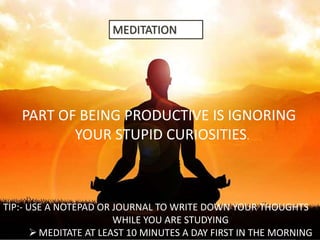
MEDITATION
MEDITATION
PART OF BEING PRODUCTIVE IS IGNORING
YOUR STUPID CURIOSITIES.
TIP:- USE A NOTEPAD OR JOURNAL TO WRITE DOWN YOUR THOUGHTS
WHILE YOU ARE STUDYING
MEDITATE AT LEAST 10 MINUTES A DAY FIRST IN THE MORNING
TIME BLOCKING
STOP BEING AVAILABLE FOR EVERYONE ALL THE TIME
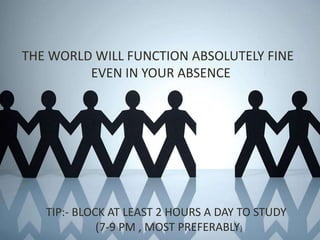
THE WORLD WILL FUNCTION ABSOLUTELY FINE
EVEN IN YOUR ABSENCE
TIP:- BLOCK AT LEAST 2 HOURS A DAY TO STUDY
(7-9 PM , MOST PREFERABLY)
FIND YOUR INSPIRATION
HOW TO BE EFFICIENT AT
STUDIES
• Follow only one book at a time
ATTEND YOUR CLASS
BE ATTENTIVE AT CLASS
Take note in class
Write it yourself;do’t copy from others
Get to know your teachers
• Develop a relationship with your teachers so you feel
comfortable approaching them and asking for help
Teach someone else.
most effective ways of ensuring you understand something is by
explaining it to someone else
Form a Habit of Studying Regularly
Tip:- Never miss your routine for more than two days in a row,
else chances are you ‘ll break your Habit
Do your assignments yourself
CRAMMING FOR EXAMS
Remember that Exams and Tests are not just academic, they are your test,
test of your competency, dedication & hard work.
PREPARATION FOR THE EXAM
1) Know your Syllabus well
2) Practice all types of problem at least
once before the finals.
3) Review all old questions
4) Focus on keywords
( Tip:- Learn by heart each question that is
asked more than once.)
3 Days Preparation
Assess Yourself
1) Your area of competence
2) Stuffs that you know
3) Stuffs that you don’t know at all
• Assess the time required for you to cover 1 & 2,
if you can cover 1 & 2 easily in 2 days , go to 3.
• Else, cover 1 and 2 first and only then attempt
for 3.
Make a Plan
•If you are rightly prepared &
confident, attempt for 80 marks.
• find a balance between subject and time that you feel
comfortable with
Use flow charts and
diagrams
Organize study groups
with friends
Organize your study space
• Make sure you have enough space to spread your textbooks
and notes out. Have you got enough light? Is your chair
comfortable? Are your computer games out of sight?
Prepare old questions
Many people don’t know what that they don’t know
SIT DOWN & STUDY
• TECHNIQUES
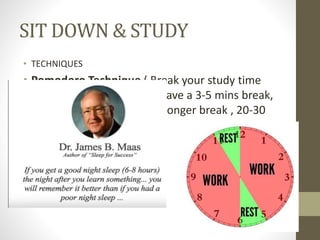
• Pomodoro Technique ( Break your study time
into chunks, 25 mins and have a 3-5 mins break,
repeat 3-4 times & have a longer break , 20-30
mins)
SIT DOWN & STUDY
• Parkinson's Law ( Humans perform better
under pressure)
• Drink plenty of water
MANTRA
EAT-STUDY-REVISE-REPEAT
GETTING GOOD GRADES
• Draw as much marks as you can from
internal evaluation.
• Have a good, neat handwriting or at least
understandable ( increases your marks by
roughly 10%)
• Make plenty of drawings, wherever
necessary & wherever you can ( shows you
have a deeper understanding of the
subject)
GETTING GOOD GRADES
• ATTEMPT ALL THE QUESTIONS
• 1st solve the easiest and questions with less
marks and shorter answers and make sure that
you get 32 out of it. And attempt the rest (all) ,
increases your chance to pass incase you are in
tilting situation
• Leave the page after each question, reduces the
risk of your answers getting skipped by the
examiner. ( makes answers distinct)
GETTING GOOD GRADES
• DONOT PROVOKE THE EXAMINER
• Don’t write anything other than answers in your answer sheet.
• Like ( Sir please pass gardinus) or attaching money in the
answer sheet.
• Chances are the teacher will get provoked and fail you, or
reduce your marks. ( Leaves a bad impression on the
examiner)
PROGRESS= HAPPINESS
THANK YOU
ALL THE BEST FOR YOUR JOURNEY AS A CIVIL ENGINEER
For notes please visit
www.engineeringhelpline.com
www.ioenotes.engineeringhelpline.com
www.acm.engineeringhelpline.com

engineering study tips

  • 1.
  • 2.
  • 3.
    Love your branchand your college • You are just looking at what people are saying • there is equal value of all college :same opportunity to each students in outside world • Do not compare you with anybody
  • 4.
  • 5.
    2) Lack ofAttention Average attention span of Human being is mere 8 seconds, which has decreased from 11 seconds in the past few decades.
  • 6.
    3) TIME MANAGEMENT SocialResponsibilities (Peers) Responsibilities towards Family Responsibilities towards College, Clubs ( Meetings, and programs)
  • 7.
    4) Lack ofInternal Motivation Lack of Purpose & Clear Goals in Life You don’t know why you’re doing what you’re doing.
  • 8.
  • 9.
    MEDITATION MEDITATION PART OF BEINGPRODUCTIVE IS IGNORING YOUR STUPID CURIOSITIES. TIP:- USE A NOTEPAD OR JOURNAL TO WRITE DOWN YOUR THOUGHTS WHILE YOU ARE STUDYING MEDITATE AT LEAST 10 MINUTES A DAY FIRST IN THE MORNING
  • 10.
    TIME BLOCKING STOP BEINGAVAILABLE FOR EVERYONE ALL THE TIME
  • 11.
    THE WORLD WILLFUNCTION ABSOLUTELY FINE EVEN IN YOUR ABSENCE TIP:- BLOCK AT LEAST 2 HOURS A DAY TO STUDY (7-9 PM , MOST PREFERABLY)
  • 12.
  • 13.
    HOW TO BEEFFICIENT AT STUDIES • Follow only one book at a time
  • 14.
    ATTEND YOUR CLASS BEATTENTIVE AT CLASS Take note in class Write it yourself;do’t copy from others
  • 15.
    Get to knowyour teachers • Develop a relationship with your teachers so you feel comfortable approaching them and asking for help Teach someone else. most effective ways of ensuring you understand something is by explaining it to someone else
  • 16.
    Form a Habitof Studying Regularly Tip:- Never miss your routine for more than two days in a row, else chances are you ‘ll break your Habit
  • 17.
  • 18.
    CRAMMING FOR EXAMS Rememberthat Exams and Tests are not just academic, they are your test, test of your competency, dedication & hard work.
  • 19.
    PREPARATION FOR THEEXAM 1) Know your Syllabus well 2) Practice all types of problem at least once before the finals. 3) Review all old questions 4) Focus on keywords ( Tip:- Learn by heart each question that is asked more than once.)
  • 20.
    3 Days Preparation AssessYourself 1) Your area of competence 2) Stuffs that you know 3) Stuffs that you don’t know at all • Assess the time required for you to cover 1 & 2, if you can cover 1 & 2 easily in 2 days , go to 3. • Else, cover 1 and 2 first and only then attempt for 3.
  • 21.
    Make a Plan •Ifyou are rightly prepared & confident, attempt for 80 marks. • find a balance between subject and time that you feel comfortable with Use flow charts and diagrams Organize study groups with friends
  • 22.
    Organize your studyspace • Make sure you have enough space to spread your textbooks and notes out. Have you got enough light? Is your chair comfortable? Are your computer games out of sight? Prepare old questions Many people don’t know what that they don’t know
  • 23.
    SIT DOWN &STUDY • TECHNIQUES • Pomodoro Technique ( Break your study time into chunks, 25 mins and have a 3-5 mins break, repeat 3-4 times & have a longer break , 20-30 mins)
  • 24.
    SIT DOWN &STUDY • Parkinson's Law ( Humans perform better under pressure) • Drink plenty of water MANTRA EAT-STUDY-REVISE-REPEAT
  • 25.
    GETTING GOOD GRADES •Draw as much marks as you can from internal evaluation. • Have a good, neat handwriting or at least understandable ( increases your marks by roughly 10%) • Make plenty of drawings, wherever necessary & wherever you can ( shows you have a deeper understanding of the subject)
  • 26.
    GETTING GOOD GRADES •ATTEMPT ALL THE QUESTIONS • 1st solve the easiest and questions with less marks and shorter answers and make sure that you get 32 out of it. And attempt the rest (all) , increases your chance to pass incase you are in tilting situation • Leave the page after each question, reduces the risk of your answers getting skipped by the examiner. ( makes answers distinct)
  • 27.
    GETTING GOOD GRADES •DONOT PROVOKE THE EXAMINER • Don’t write anything other than answers in your answer sheet. • Like ( Sir please pass gardinus) or attaching money in the answer sheet. • Chances are the teacher will get provoked and fail you, or reduce your marks. ( Leaves a bad impression on the examiner)
  • 28.
  • 29.
    THANK YOU ALL THEBEST FOR YOUR JOURNEY AS A CIVIL ENGINEER
  • 30.
    For notes pleasevisit www.engineeringhelpline.com www.ioenotes.engineeringhelpline.com www.acm.engineeringhelpline.com

Editor's Notes

  • #9 1)Set up Basic Routine , flexible one 2) Practice & Set up positive Habits