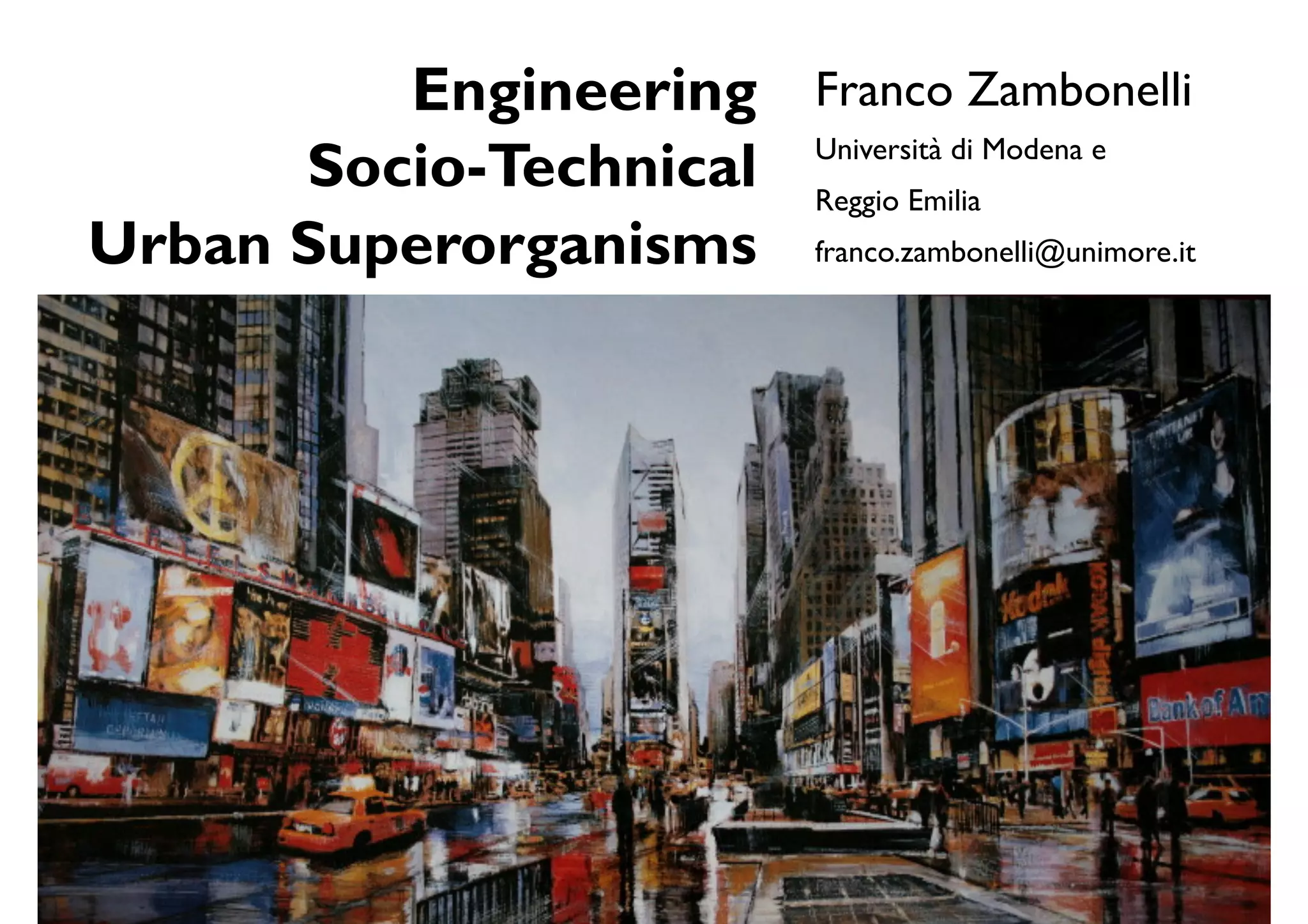
Engineering Franco Zambonelli
      Socio-Technical Reggio Emilia
                      Università di Modena e


Urban Superorganisms franco.zambonelli@unimore.it
E Pluribus Unum
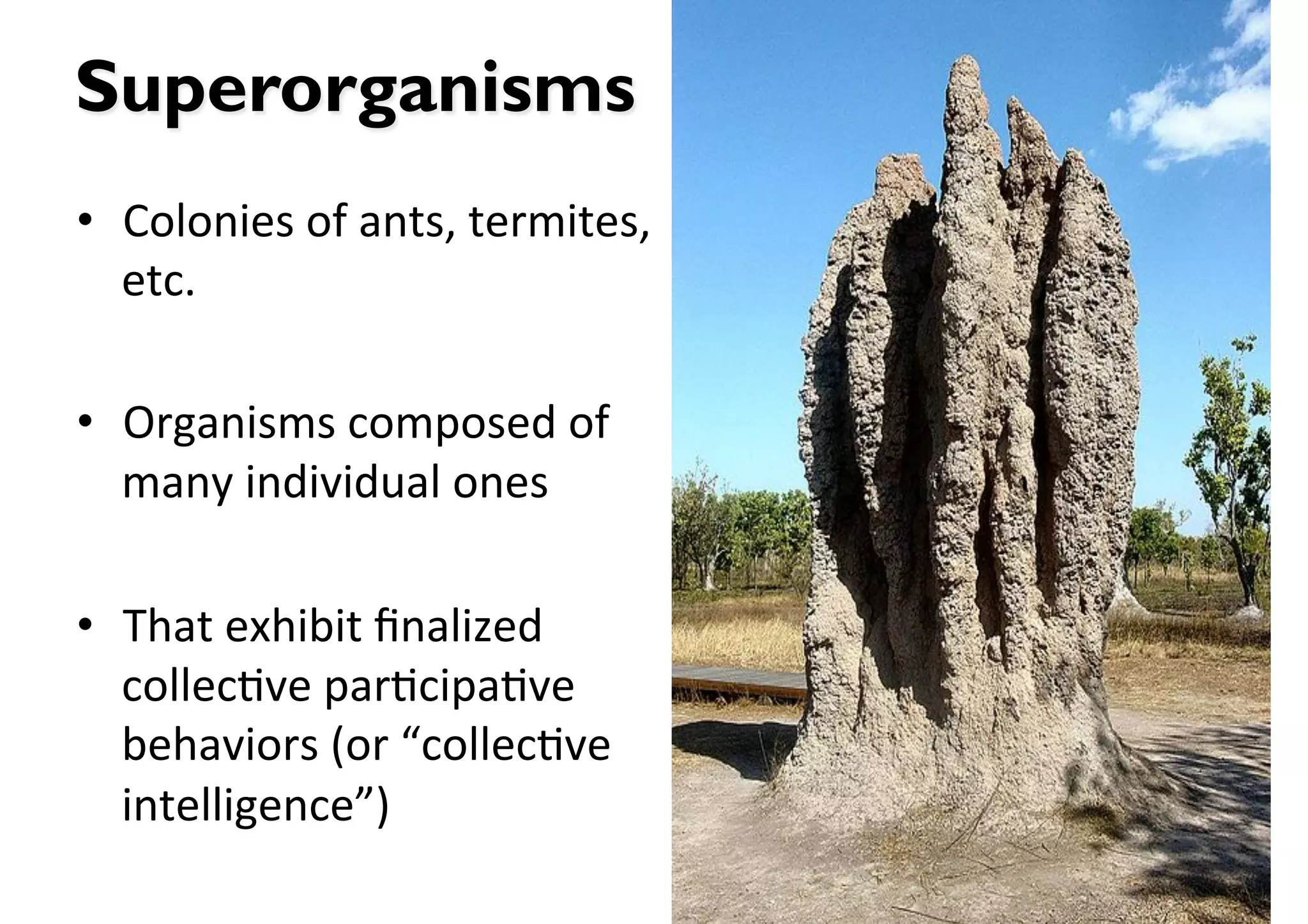
Superorganisms
•  Colonies(of(ants,(termites,(
   etc.(

•  Organisms(composed(of(
   many(individual(ones(

•  That(exhibit(finalized(
   collec>ve(par>cipa>ve(
   behaviors((or(“collec>ve(
   intelligence”)(
Urban
Superorganisms
•  Can(our(urban(
   environments(become(
   superorganisms?(

•  What(could(this(actually(
   mean?(

•  Why(socioEtechnical?(
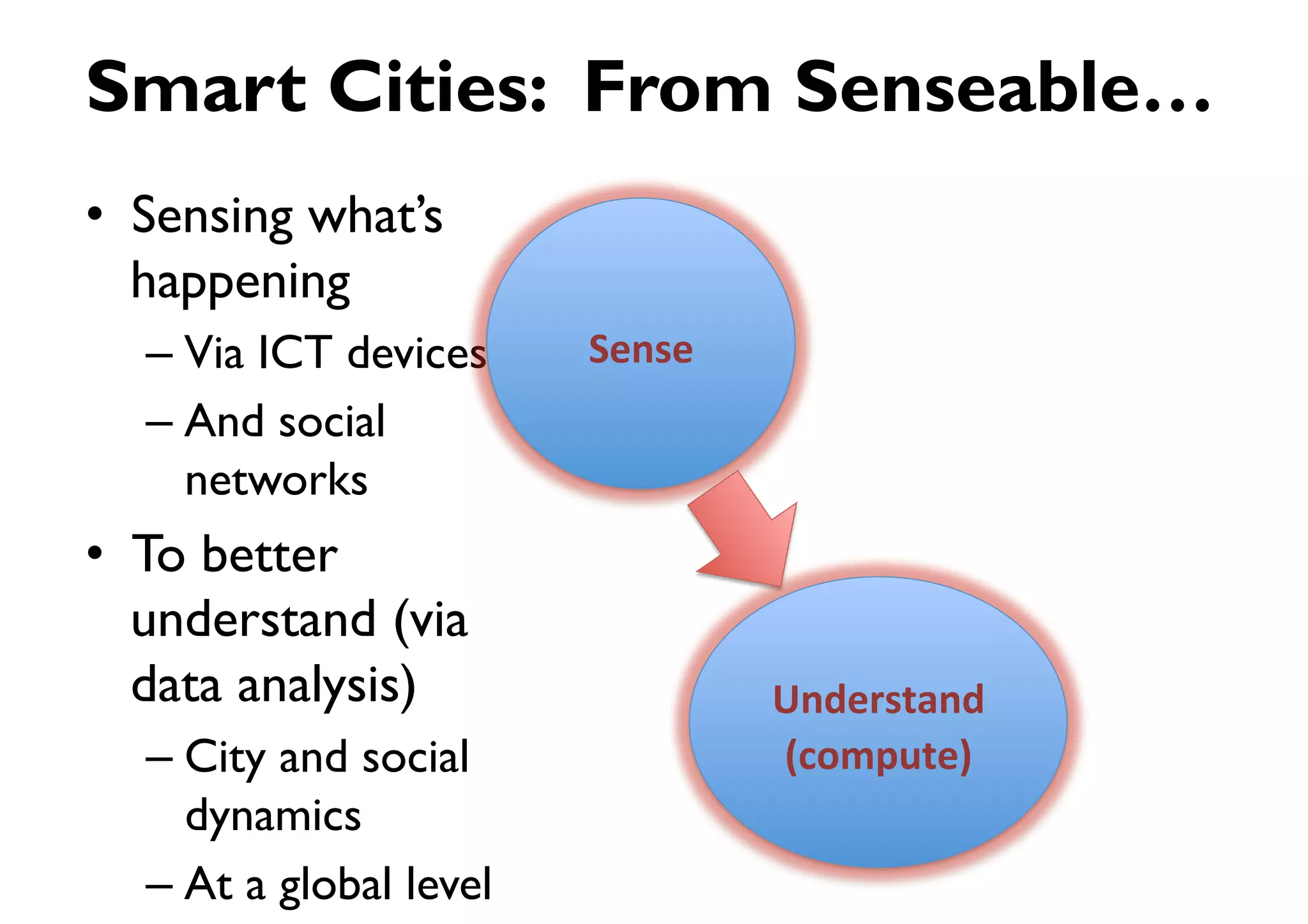
Smart Cities: From Senseable…
•  Sensing what’s
   happening
  –  Via ICT devices     Sense%
  –  And social
     networks
•  To better
   understand (via
   data analysis)                 Understand %
  –  City and social              (compute)%
     dynamics
  –  At a global level
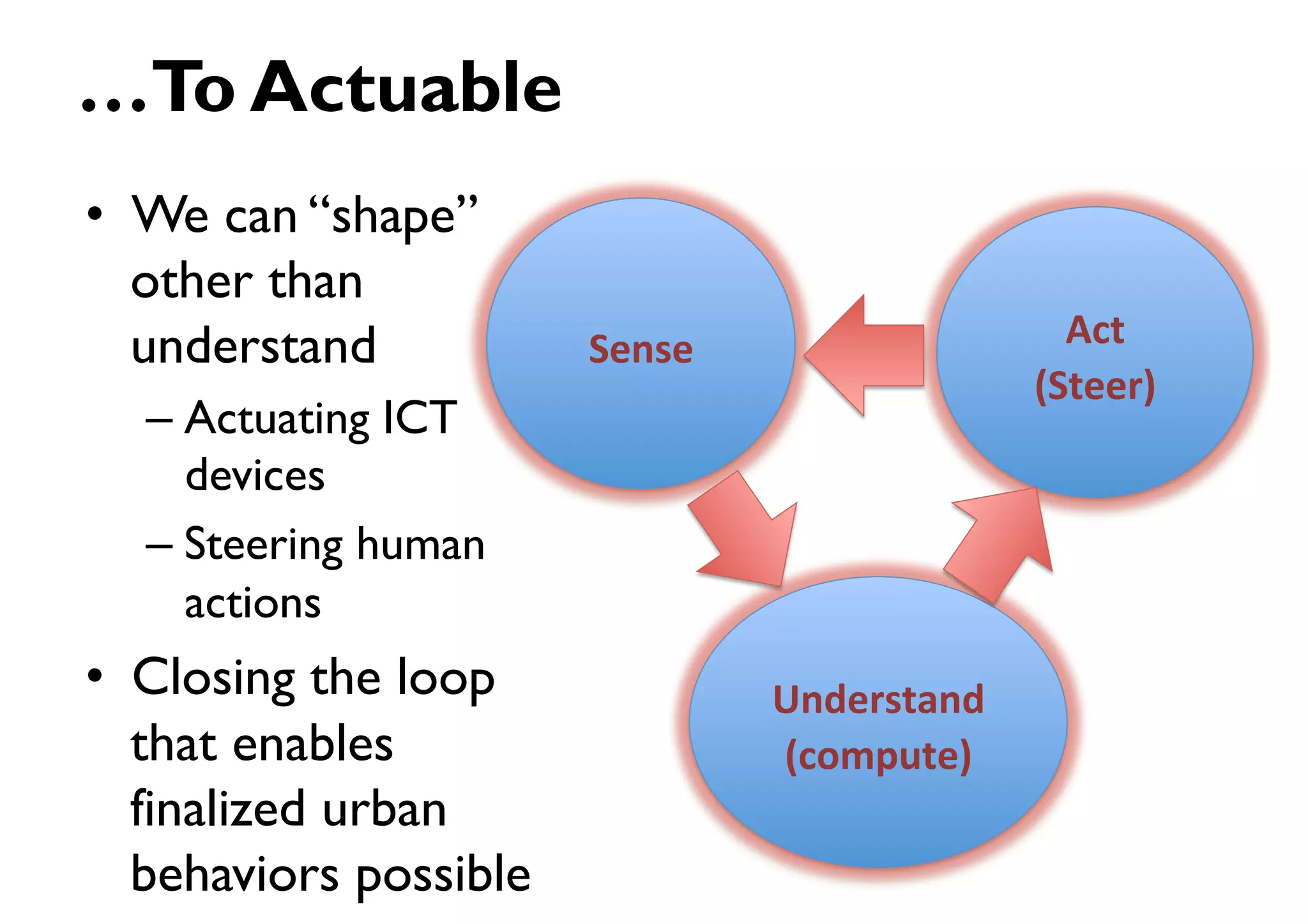
…To Actuable
•  We can “shape”
   other than
   understand           Sense%                    Act
                                                    %
                                                (Steer)
                                                      %
  –  Actuating ICT
     devices
  –  Steering human
     actions
•  Closing the loop              Understand %
   that enables                  (compute)%
   finalized urban
   behaviors possible
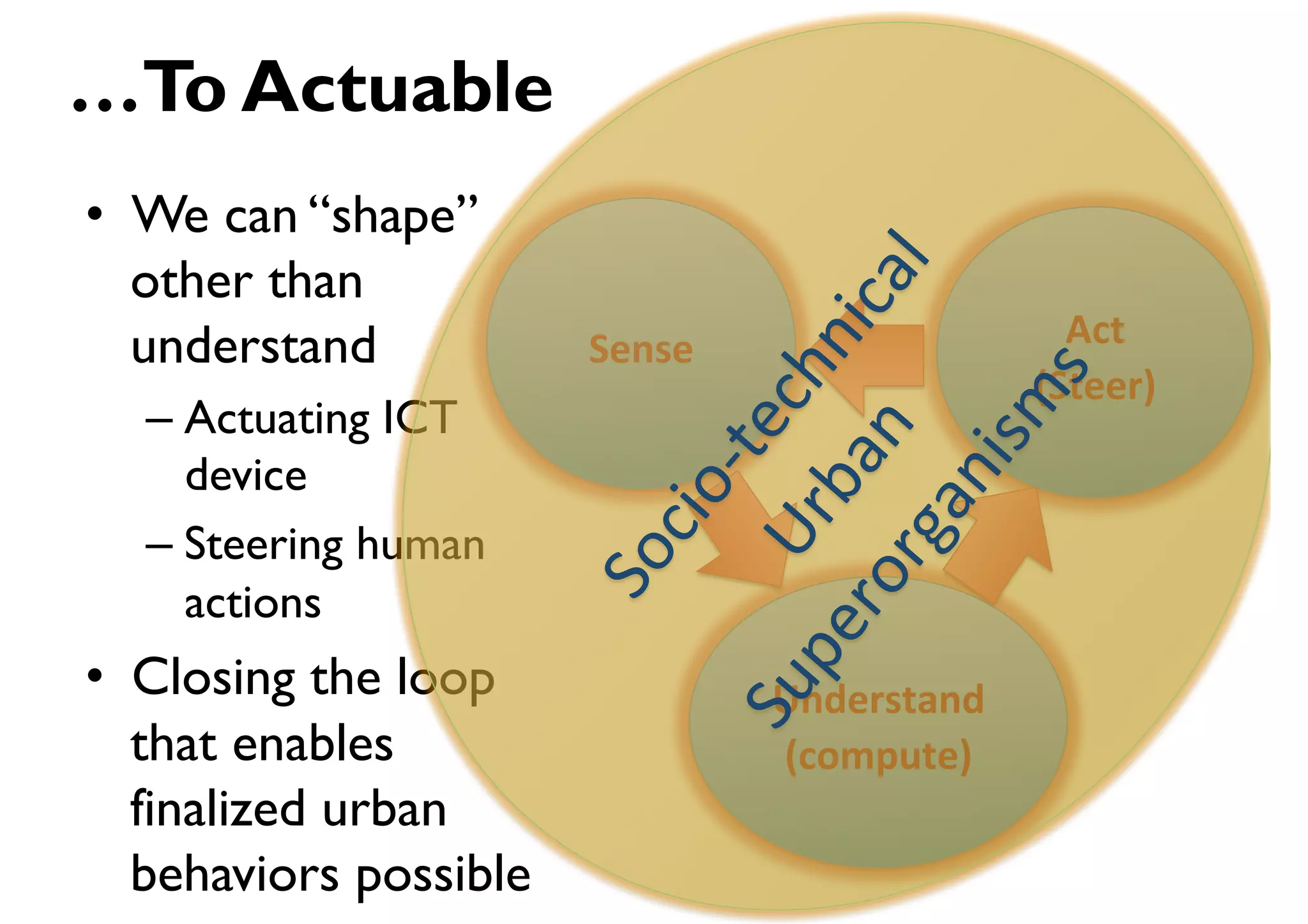
…To Actuable
•  We can “shape”
   other than
   understand           Sense%                    Act
                                                    %
                                                (Steer)
                                                      %
  –  Actuating ICT
     device
  –  Steering human
     actions
•  Closing the loop              Understand %
   that enables                  (compute)%
   finalized urban
   behaviors possible
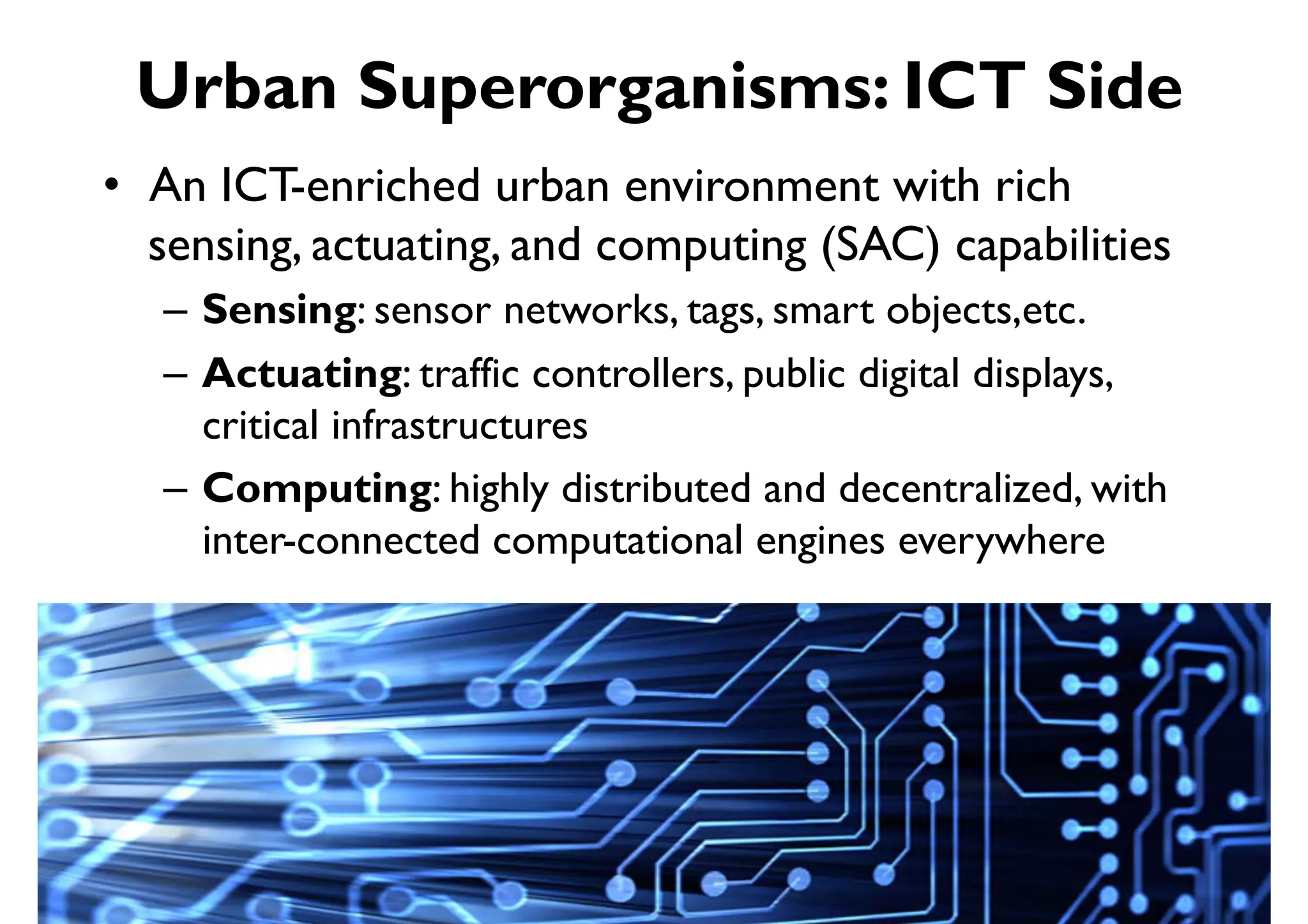
Urban Superorganisms: ICT Side
•  An ICT-enriched urban environment with rich
   sensing, actuating, and computing (SAC) capabilities
   –  Sensing: sensor networks, tags, smart objects,etc.
   –  Actuating: traffic controllers, public digital displays,
      critical infrastructures
   –  Computing: highly distributed and decentralized, with
      inter-connected computational engines everywhere
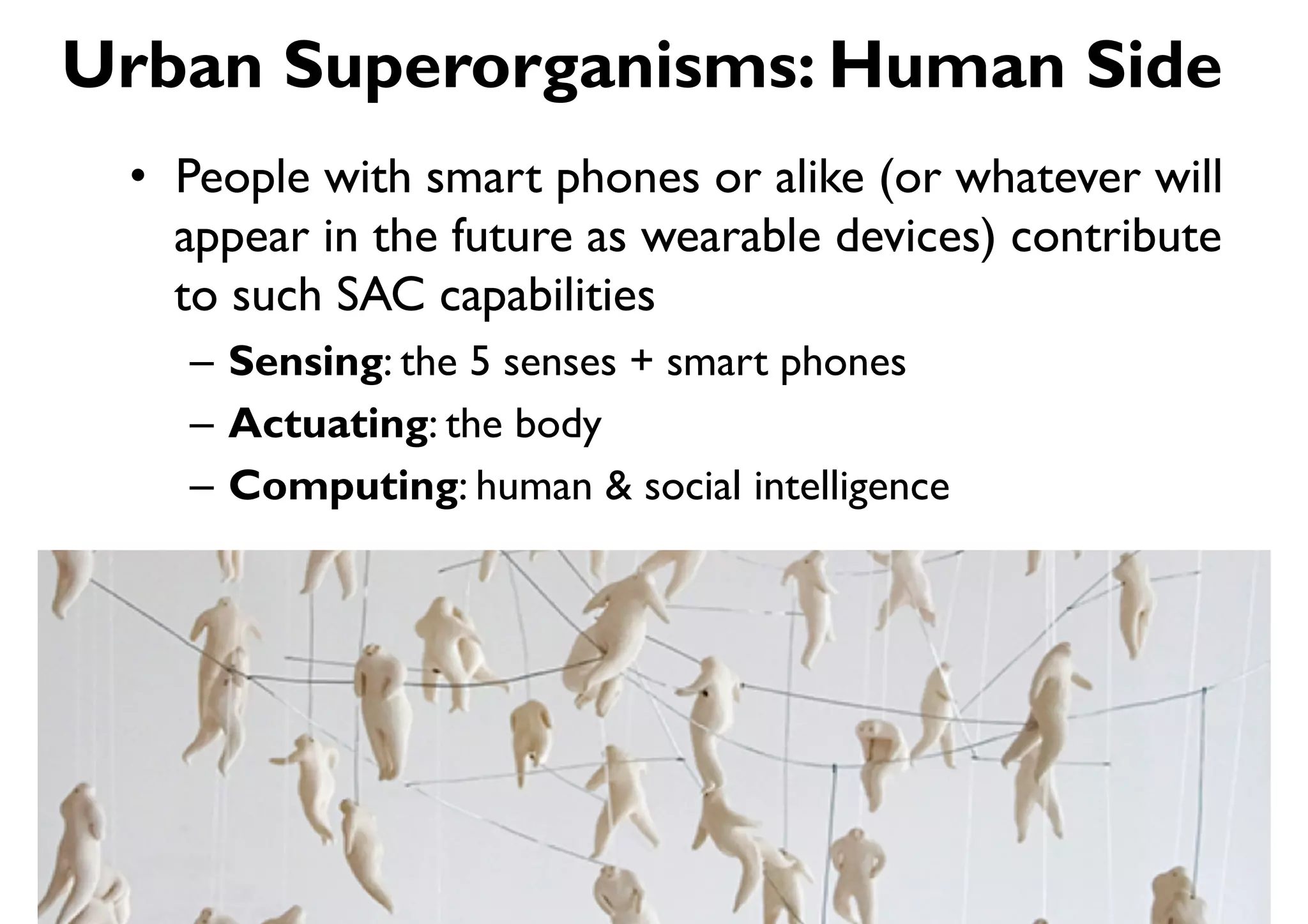
Urban Superorganisms: Human Side
 •  People with smart phones or alike (or whatever will
    appear in the future as wearable devices) contribute
    to such SAC capabilities
    –  Sensing: the 5 senses + smart phones
    –  Actuating: the body
    –  Computing: human & social intelligence
Urban Superorganisms:
 Putting All Together
•  The ICT and Human/Social level
   blurred to the point of invisibility:
•  Complementing each other in a
   process of high value co-creation
•  In the resulting overall “urban
   organism”, we can achieve very
   high-levels of collective
   –  Perception
   –  Awareness
   –  Action
•  Dramatically changing the way we
   move, live, work, and play, in our
   towns
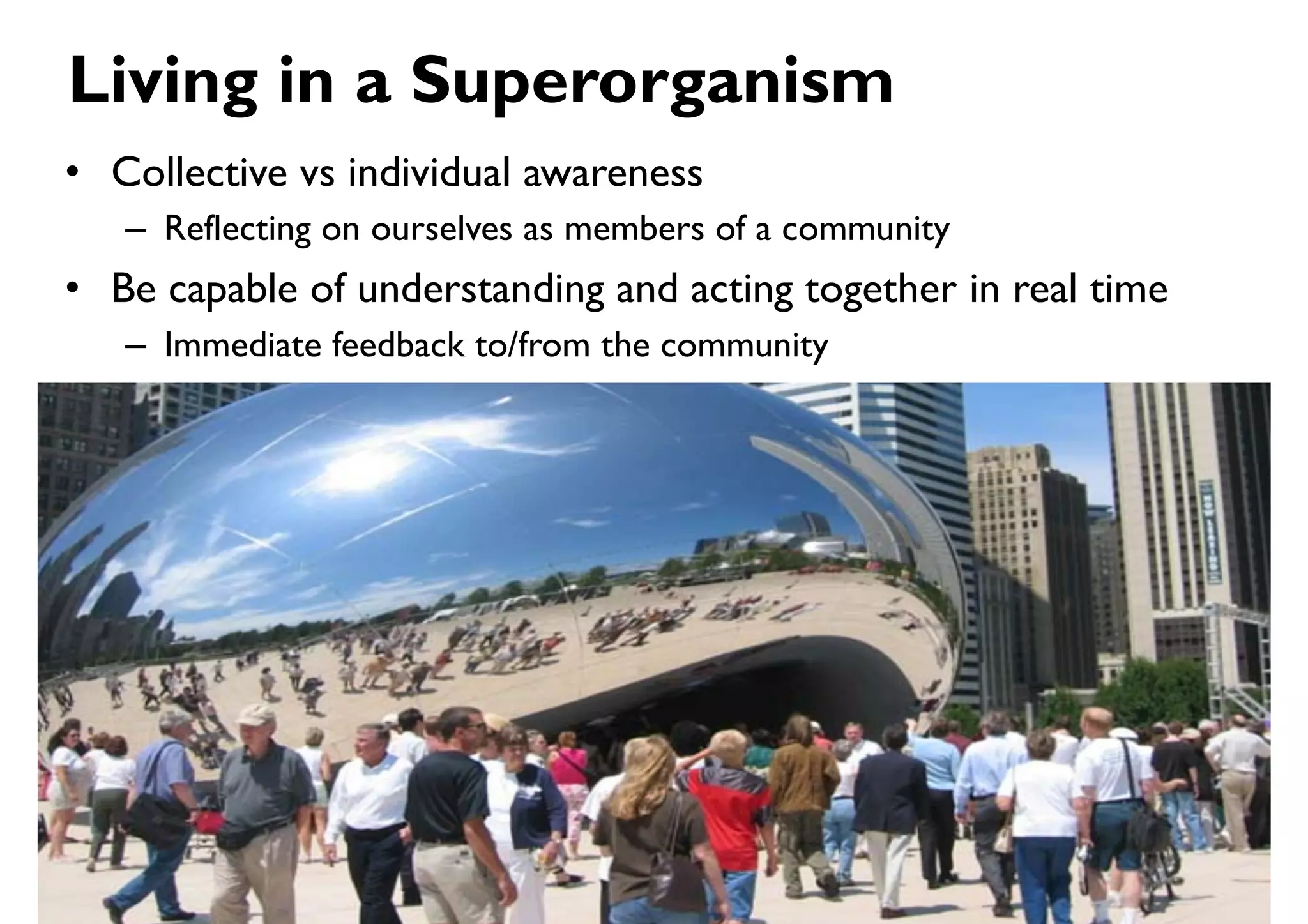
Living in a Superorganism
•  Collective vs individual awareness
   –  Reflecting on ourselves as members of a community
•  Be capable of understanding and acting together in real time
   –  Immediate feedback to/from the community
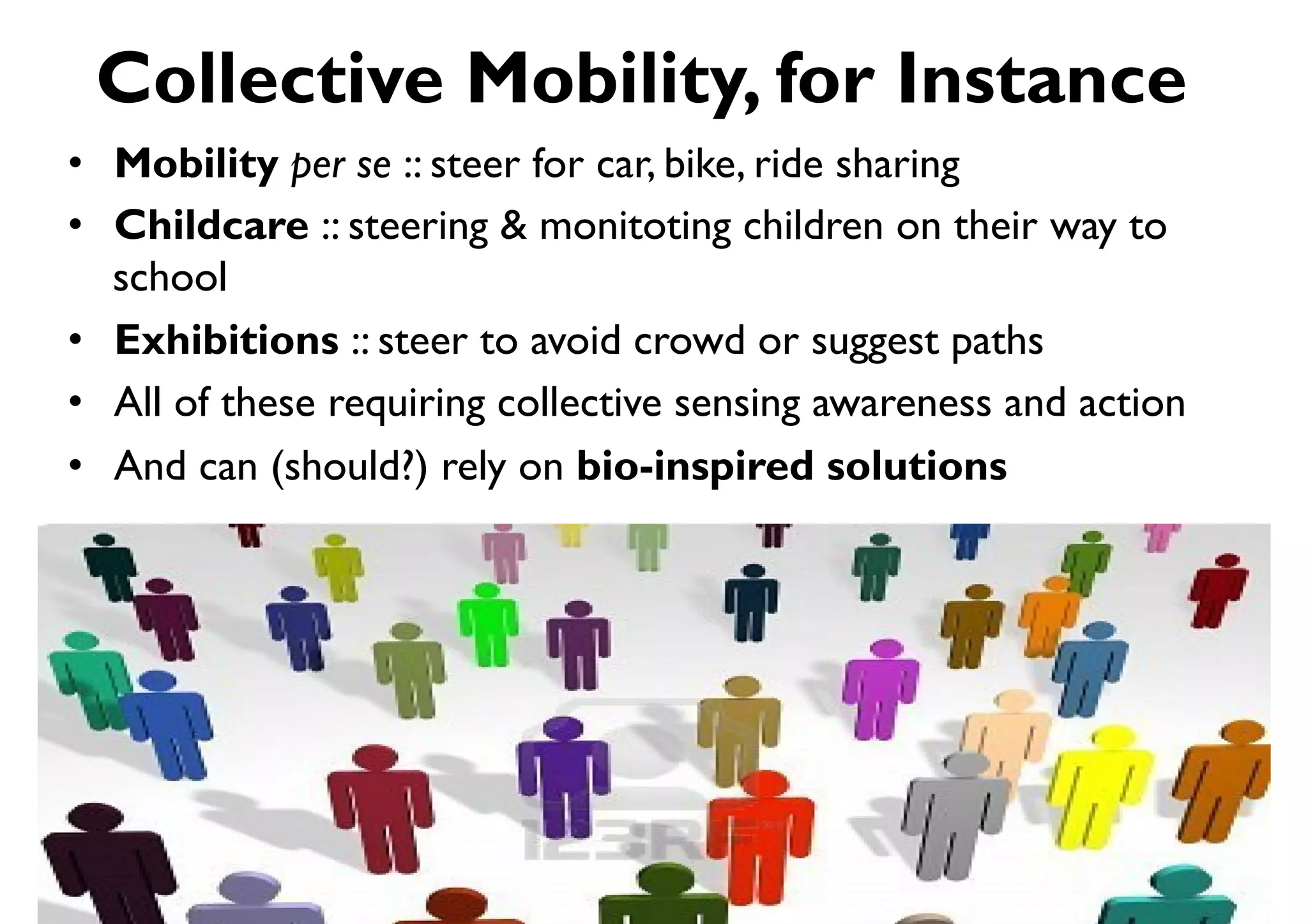
Collective Mobility, for Instance
•  Mobility per se :: steer for car, bike, ride sharing
•  Childcare :: steering & monitoting children on their way to
   school
•  Exhibitions :: steer to avoid crowd or suggest paths
•  All of these requiring collective sensing awareness and action
•  And can (should?) rely on bio-inspired solutions
The SAPERE Project
•  SAPERE Self-aware Pervasive
   Service Ecosystems
  –  EU FP7 FET
  –  Starting October 1st 2010, lasting
     3 years
•  Key Challenges
  –  To define and implement a
     framework for adaptive service
     ecosystems
  –  Models + Middleware
  –  Experience with pervasive urban
     services and pervasive displays
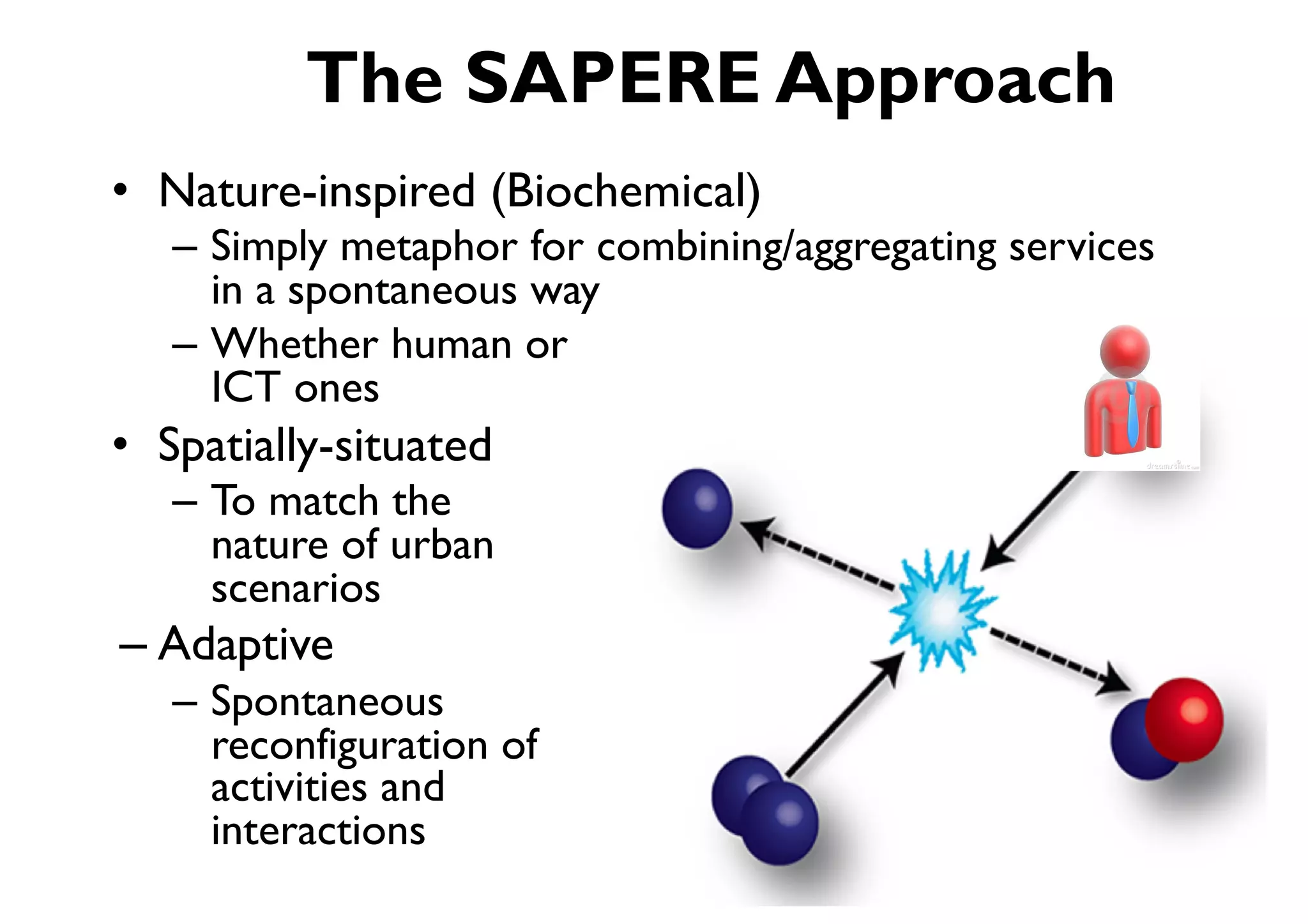
The SAPERE Approach
•  Nature-inspired (Biochemical)
   –  Simply metaphor for combining/aggregating services
      in a spontaneous way
   –  Whether human or
      ICT ones
•  Spatially-situated
   –  To match the
      nature of urban
      scenarios
– Adaptive
   –  Spontaneous
      reconfiguration of
      activities and
      interactions
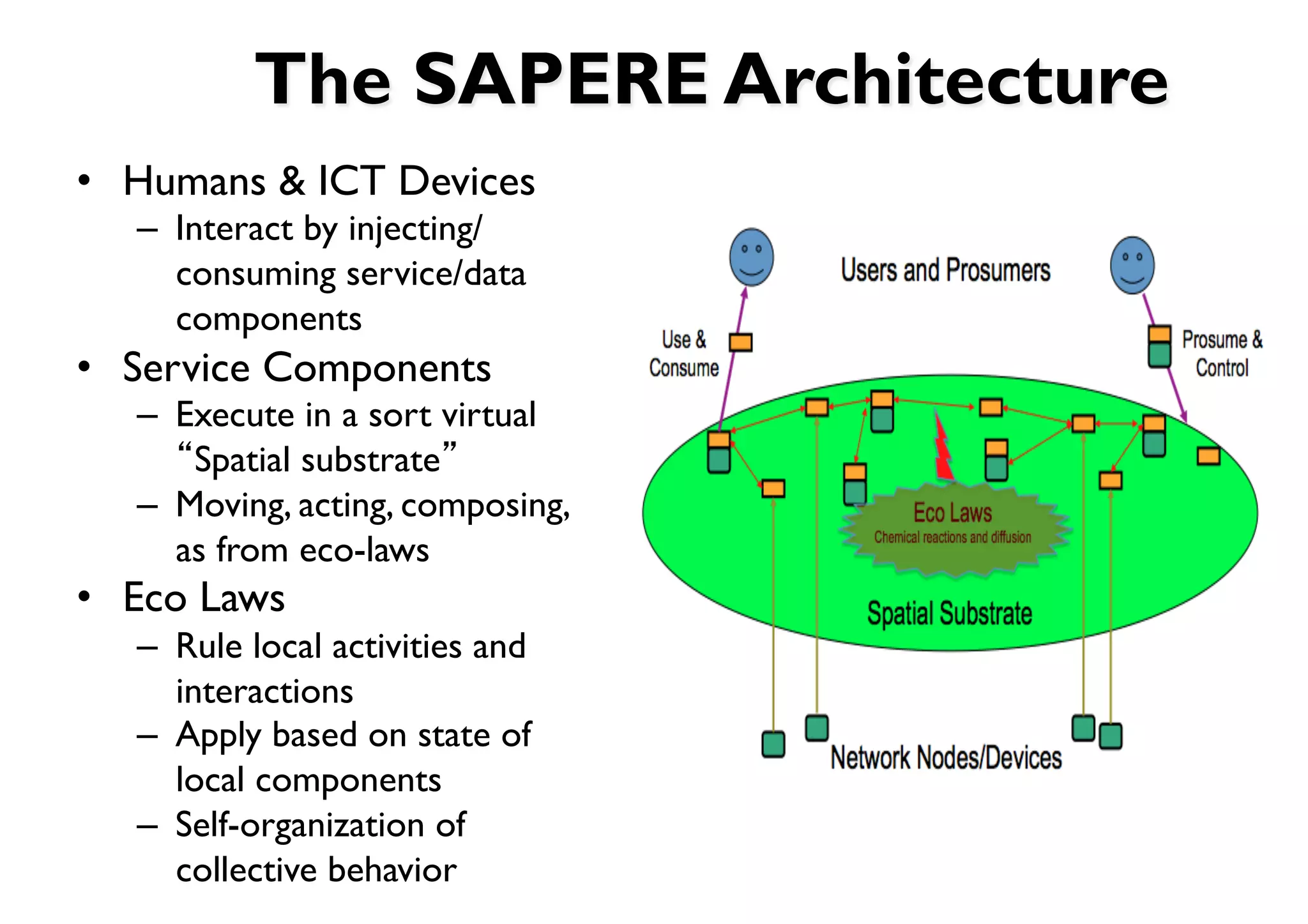
The SAPERE Architecture
•  Humans & ICT Devices
   –  Interact by injecting/
      consuming service/data
      components
•  Service Components
   –  Execute in a sort virtual
       Spatial substrate
   –  Moving, acting, composing,
      as from eco-laws
•  Eco Laws
   –  Rule local activities and
      interactions
   –  Apply based on state of
      local components
   –  Self-organization of
      collective behavior
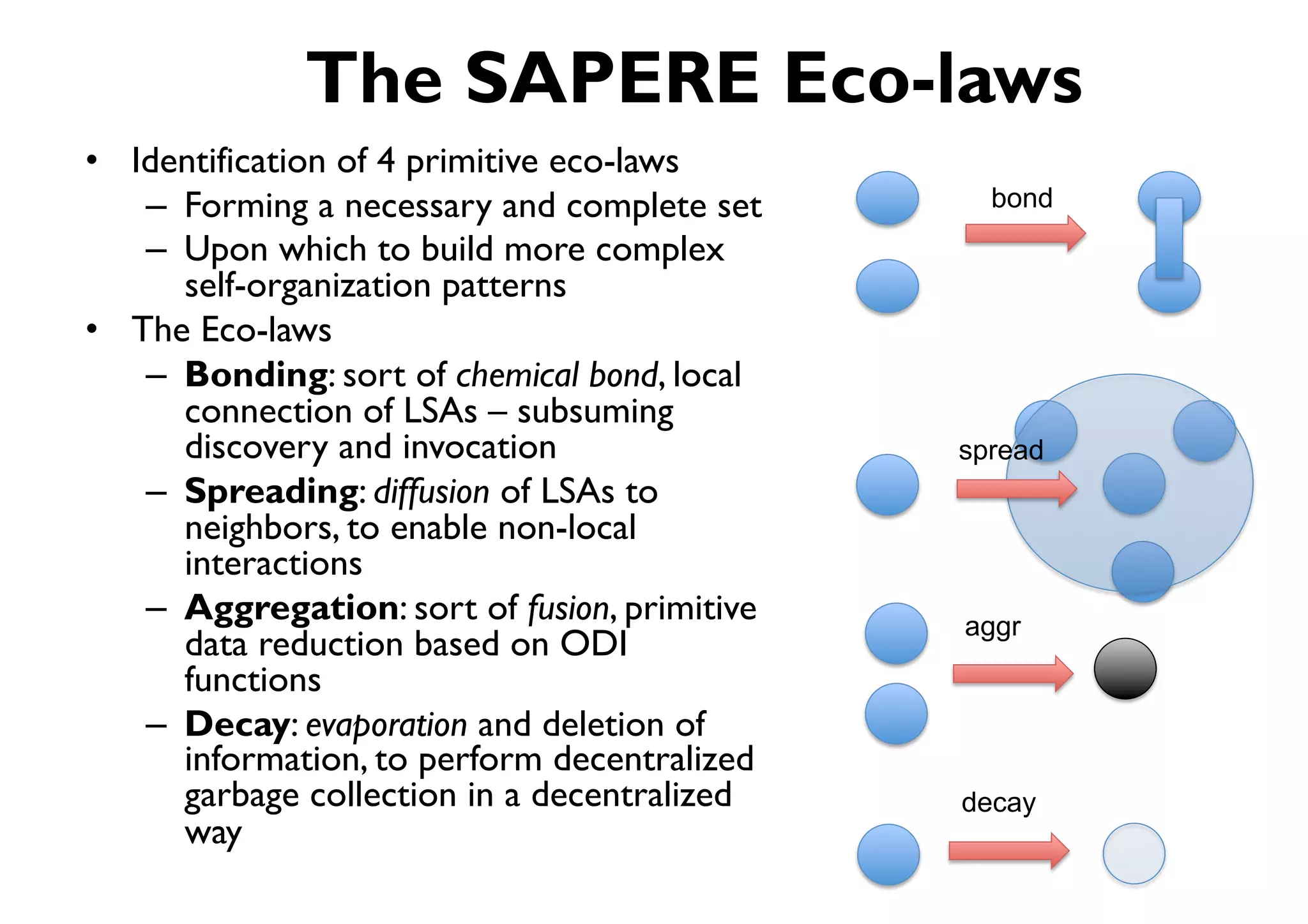
The SAPERE Eco-laws
•  Identification of 4 primitive eco-laws
    –  Forming a necessary and complete set       bond
    –  Upon which to build more complex
       self-organization patterns
•  The Eco-laws
    –  Bonding: sort of chemical bond, local
       connection of LSAs – subsuming
       discovery and invocation                 spread
    –  Spreading: diffusion of LSAs to
       neighbors, to enable non-local
       interactions
    –  Aggregation: sort of fusion, primitive   aggr
       data reduction based on ODI
       functions
    –  Decay: evaporation and deletion of
       information, to perform decentralized
       garbage collection in a decentralized    decay
       way
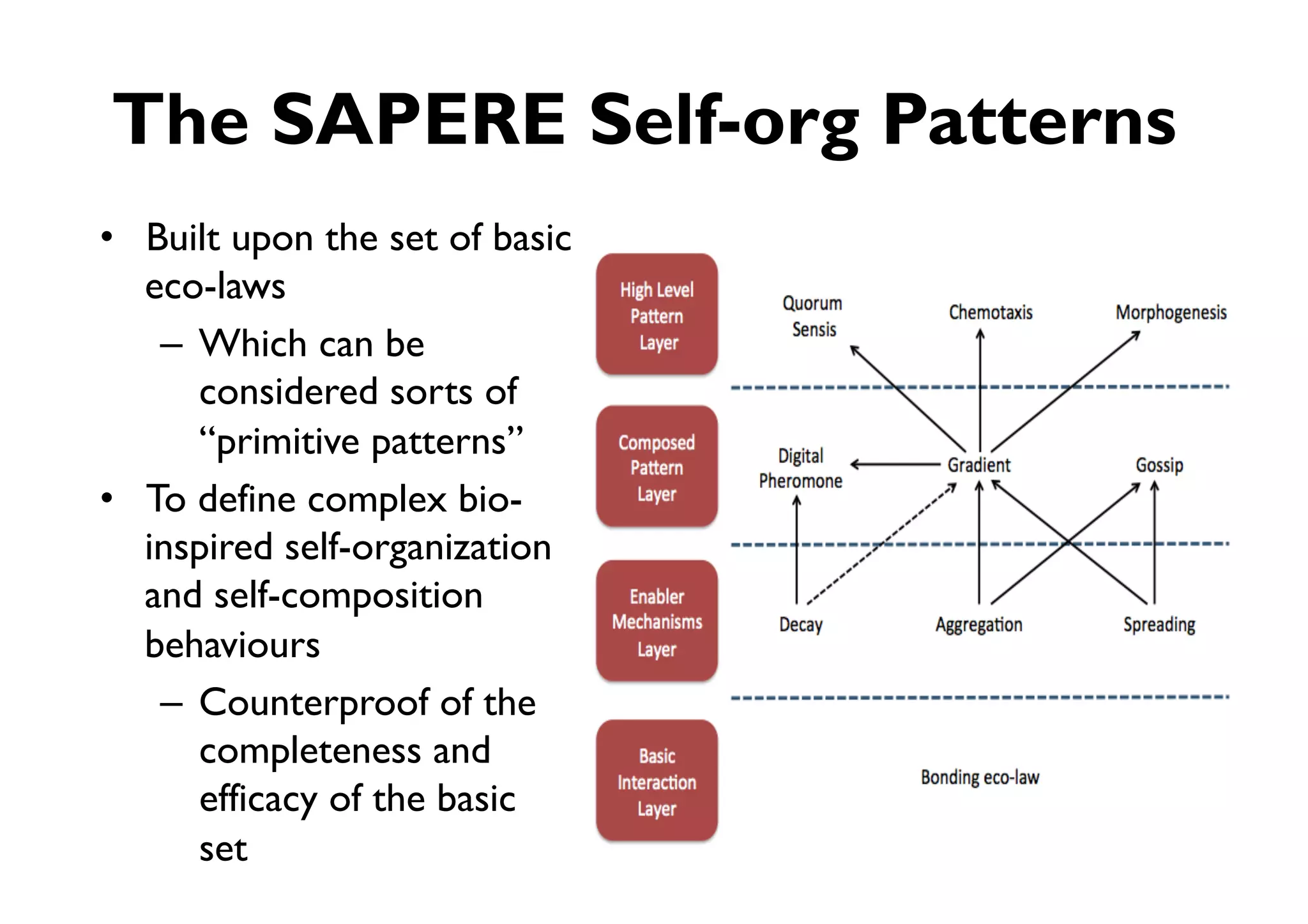
The SAPERE Self-org Patterns
•  Built upon the set of basic
   eco-laws
    –  Which can be
       considered sorts of
       “primitive patterns”
•  To define complex bio-
   inspired self-organization
   and self-composition
   behaviours
    –  Counterproof of the
       completeness and
       efficacy of the basic
       set
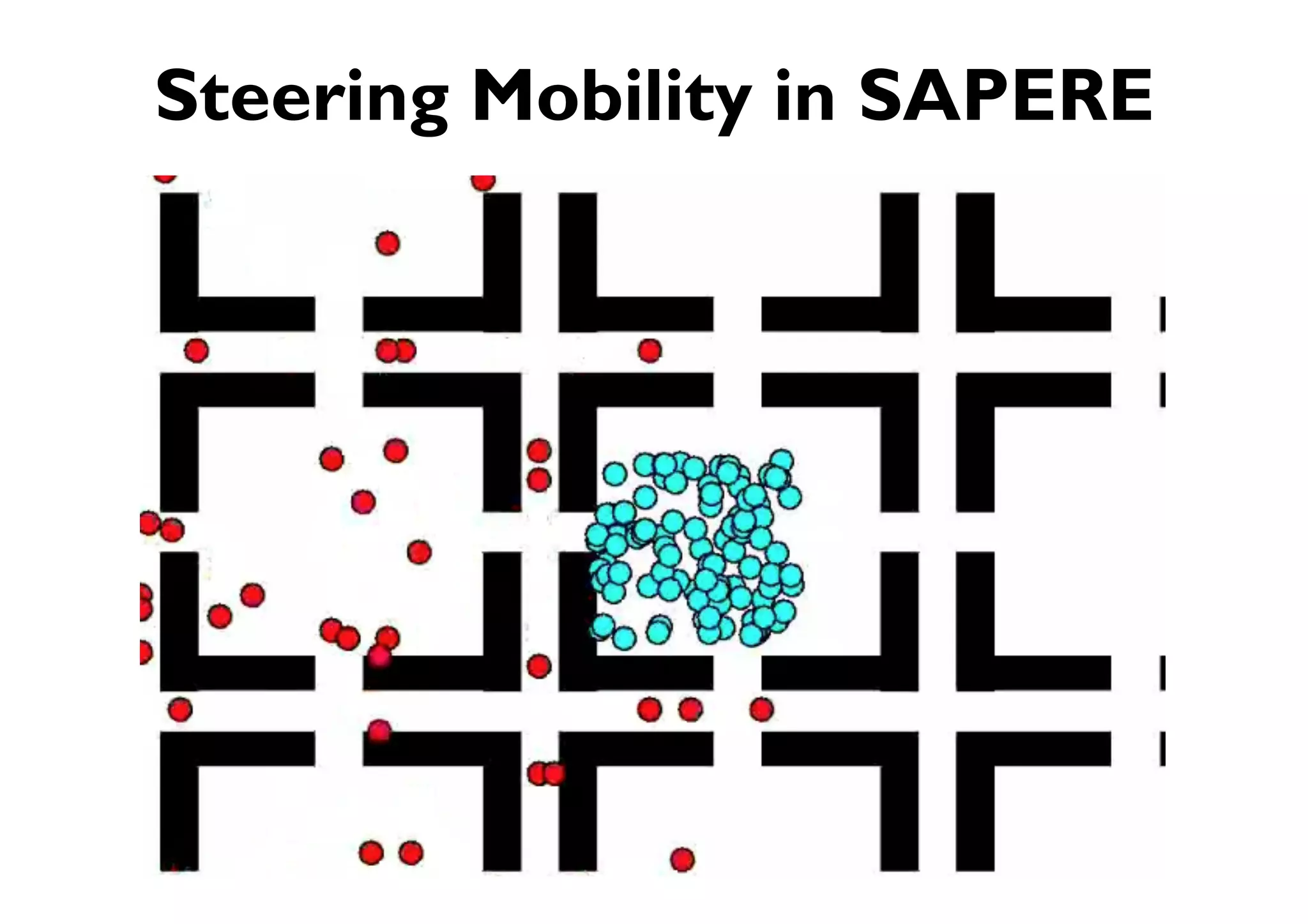
Steering Mobility in SAPERE
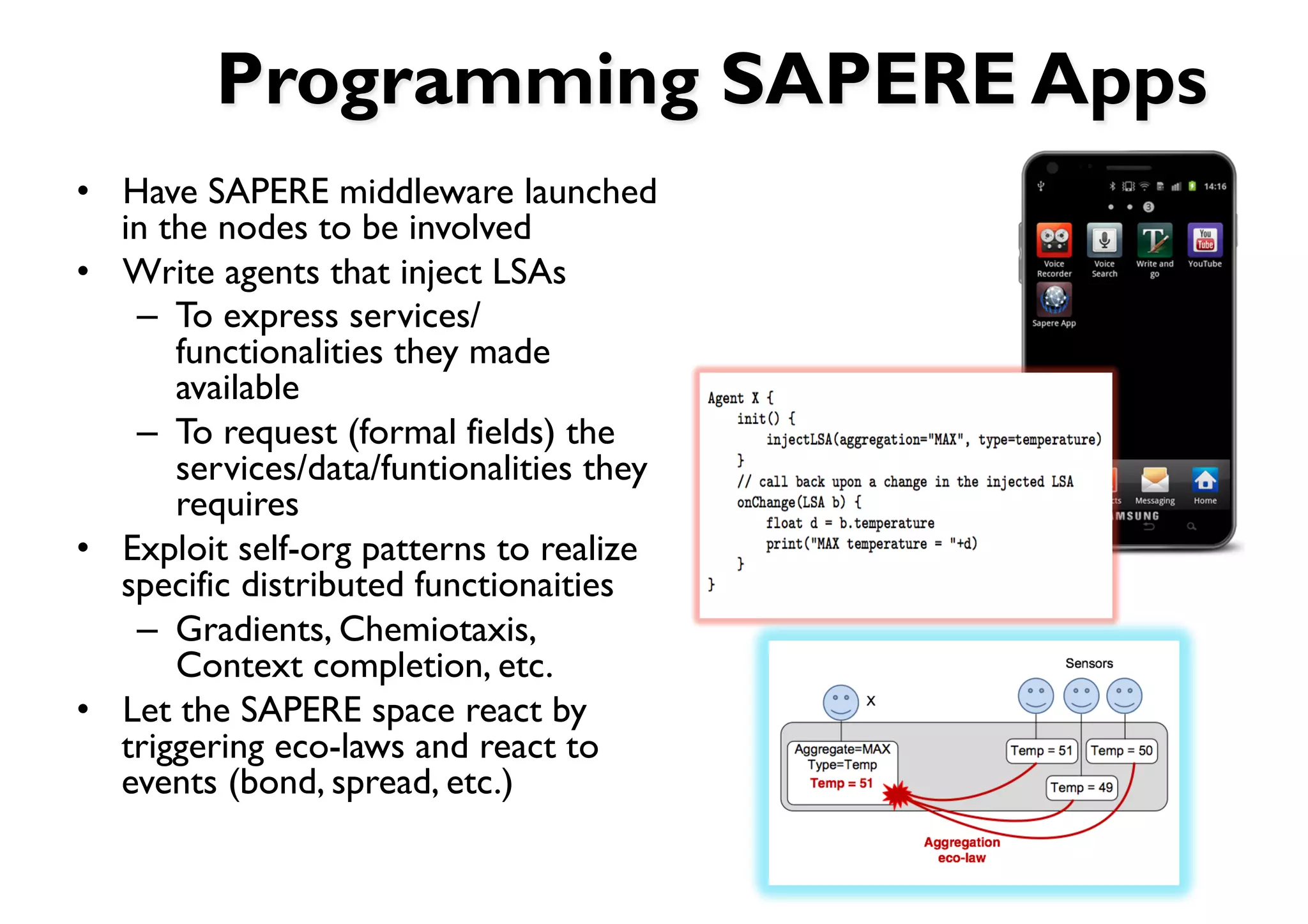
Programming SAPERE Apps
•  Have SAPERE middleware launched
   in the nodes to be involved
•  Write agents that inject LSAs
    –  To express services/
       functionalities they made
       available
    –  To request (formal fields) the
       services/data/funtionalities they
       requires
•  Exploit self-org patterns to realize
   specific distributed functionaities
    –  Gradients, Chemiotaxis,
       Context completion, etc.
•  Let the SAPERE space react by
   triggering eco-laws and react to
   events (bond, spread, etc.)
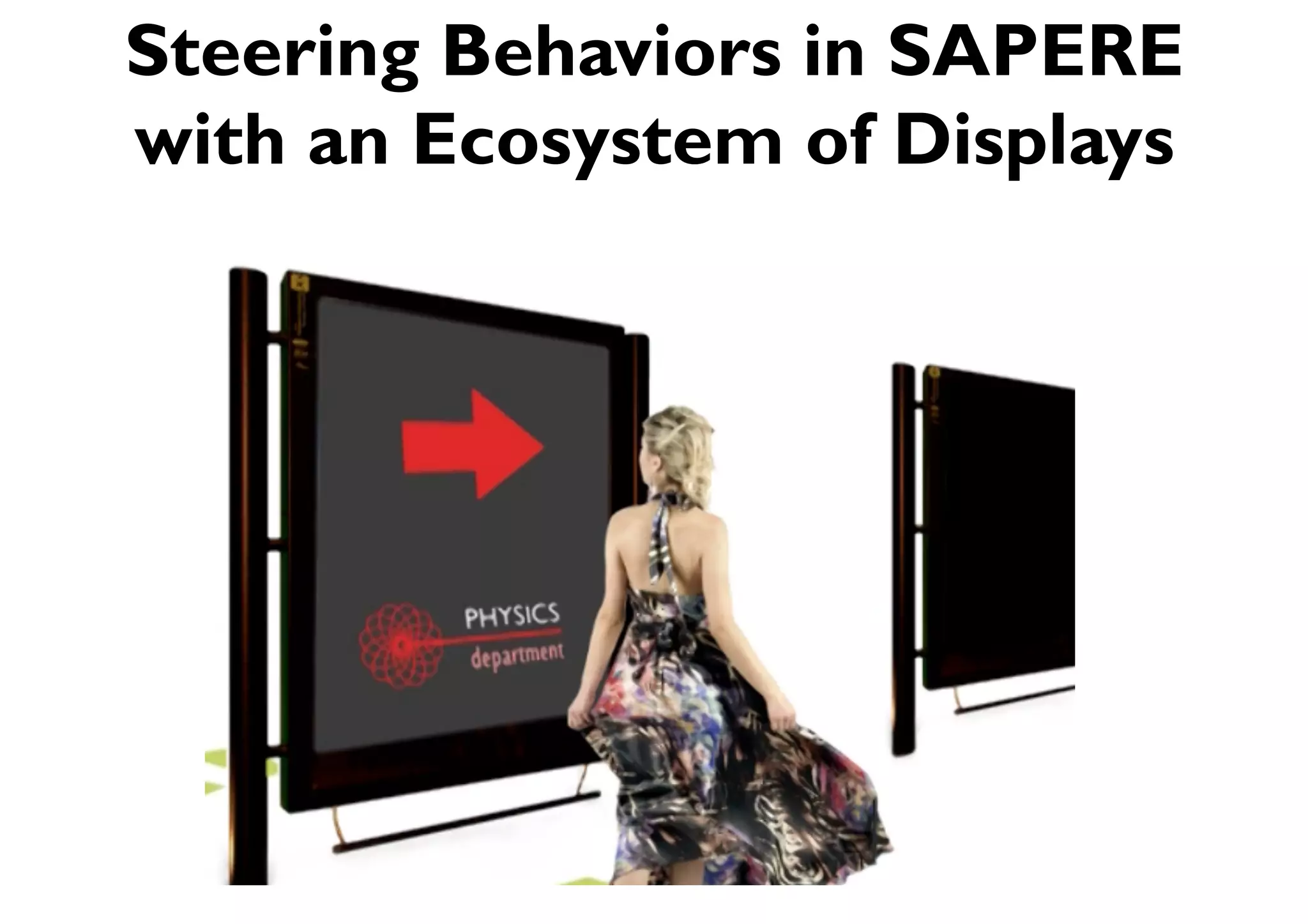
Steering Behaviors in SAPERE
with an Ecosystem of Displays
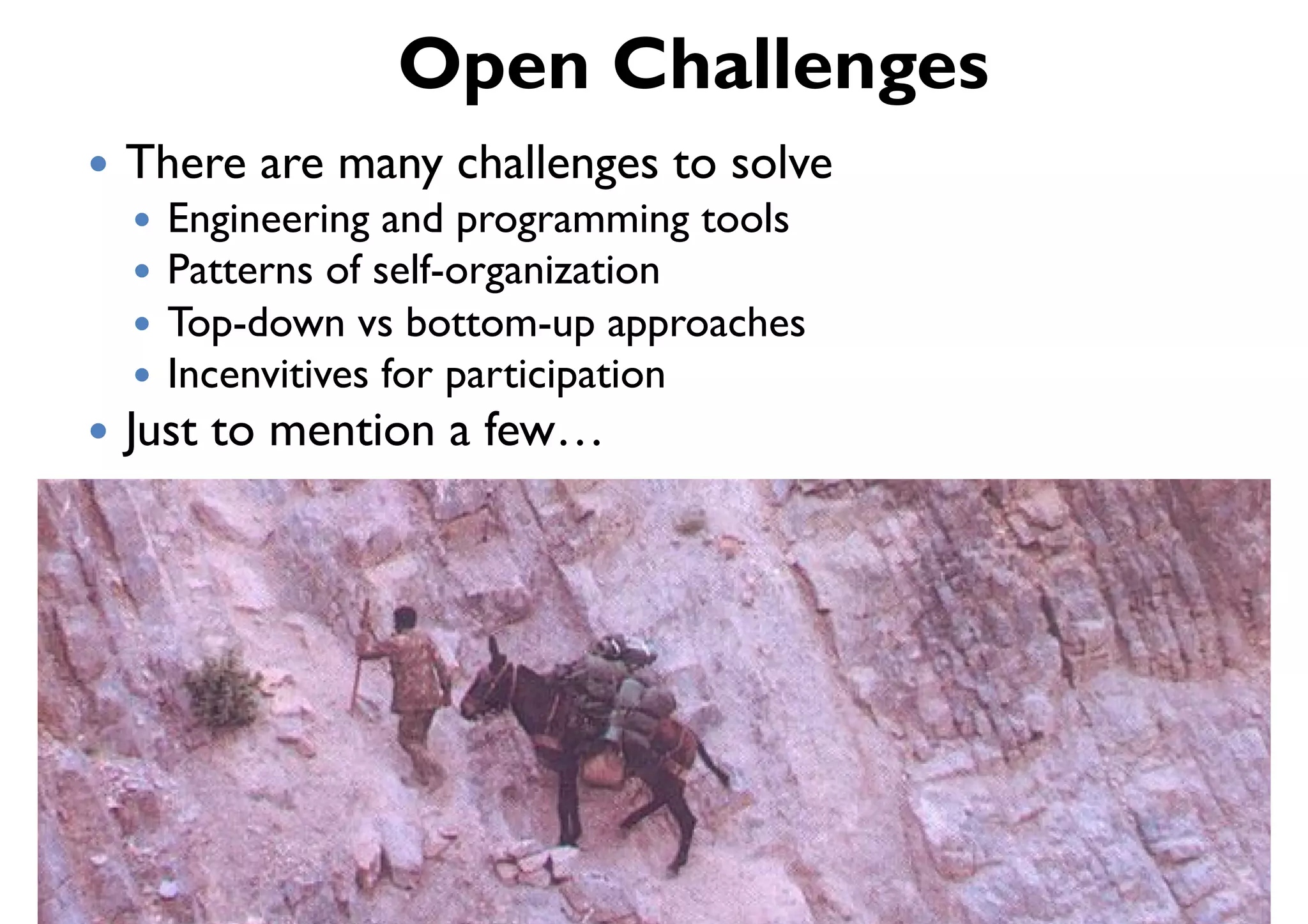
Open Challenges
!  There    are many challenges to solve
  !  Engineering and programming tools
  !  Patterns of self-organization
  !  Top-down vs bottom-up approaches
  !  Incenvitives for participation
!  Just   to mention a few…
Challenge: Engineering Tools
!  Designing
  !  How to represent collective urban situations?
  !  How to turn it into collective awareness?
  !  How to represent urban goals and plan of actions?
  !  Role of existing social networks in future ecosystems?
!  Programming
  !  What programming languages and abstractions?
  !  How to trigger/deploy specific urban behaviors?
  !  How to measure the goodness/badness of behaviors?
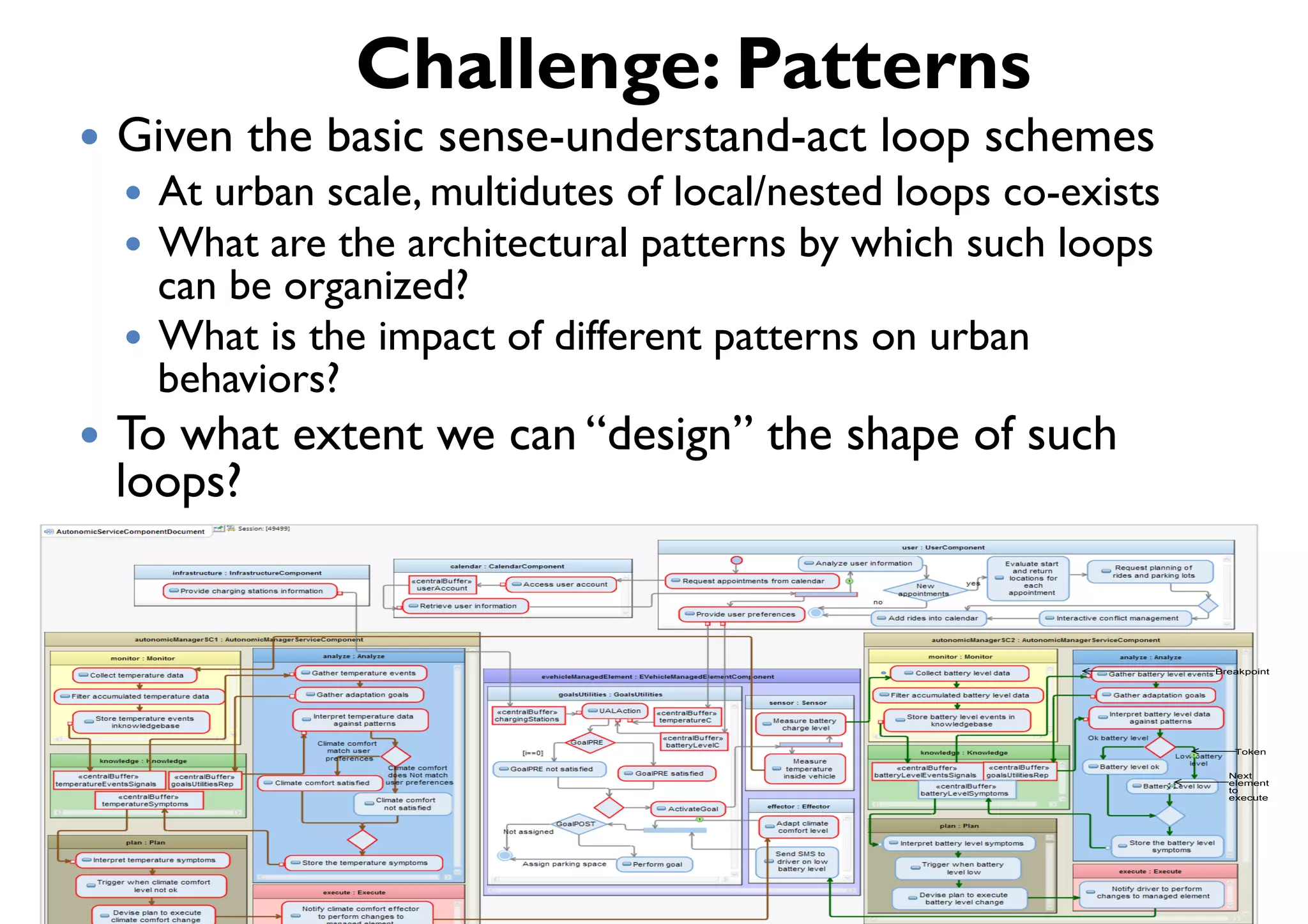
Challenge: Patterns
!  Given   the basic sense-understand-act loop schemes
  !  At urban scale, multidutes of local/nested loops co-exists
  !  What are the architectural patterns by which such loops
     can be organized?
  !  What is the impact of different patterns on urban
     behaviors?
!  Towhat extent we can “design” the shape of such
  loops?


                                                                  Breakpoint


                                                                     Token


                                                                    Next
                                                                    element
                                                                    to
                                                                    execute
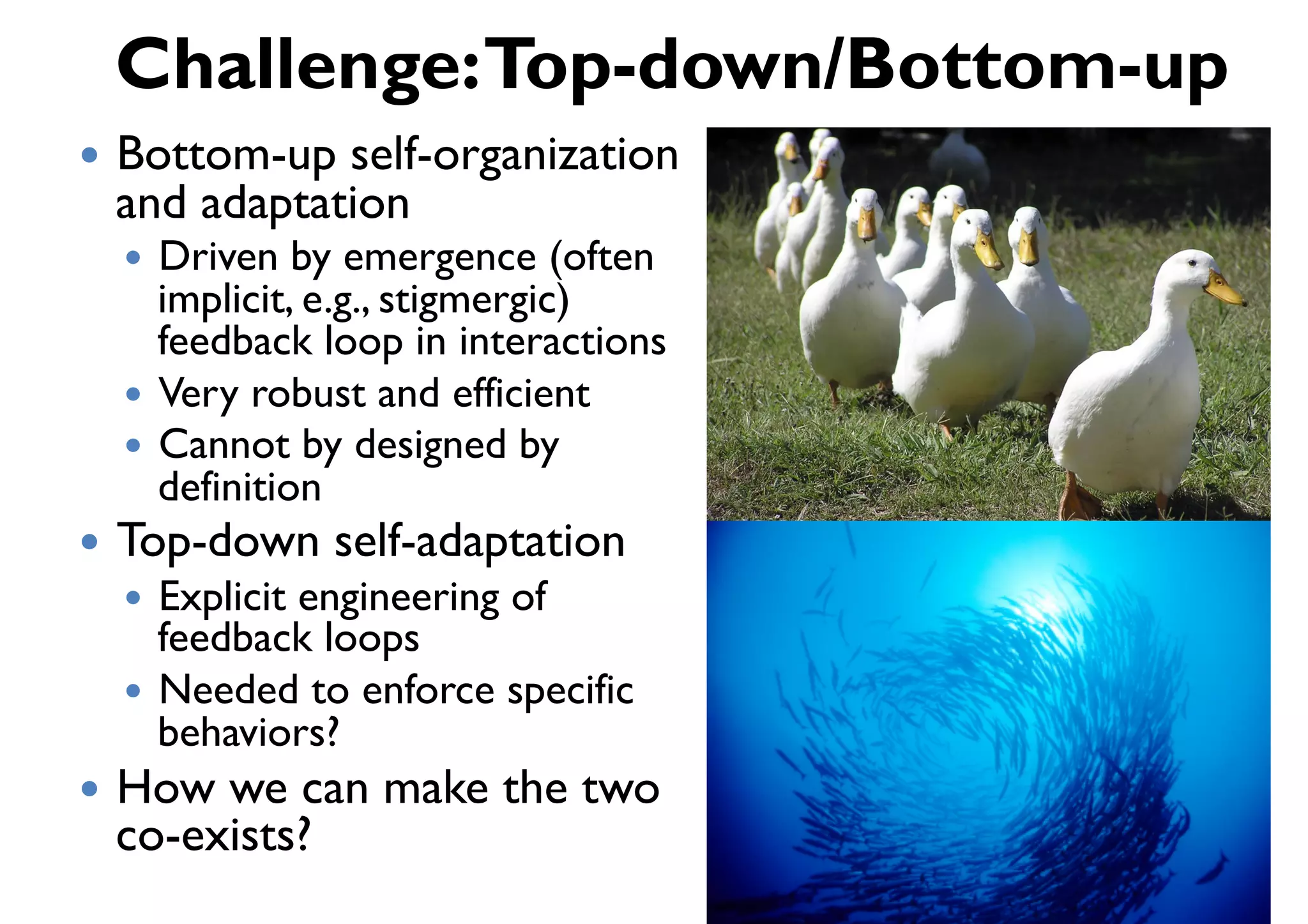
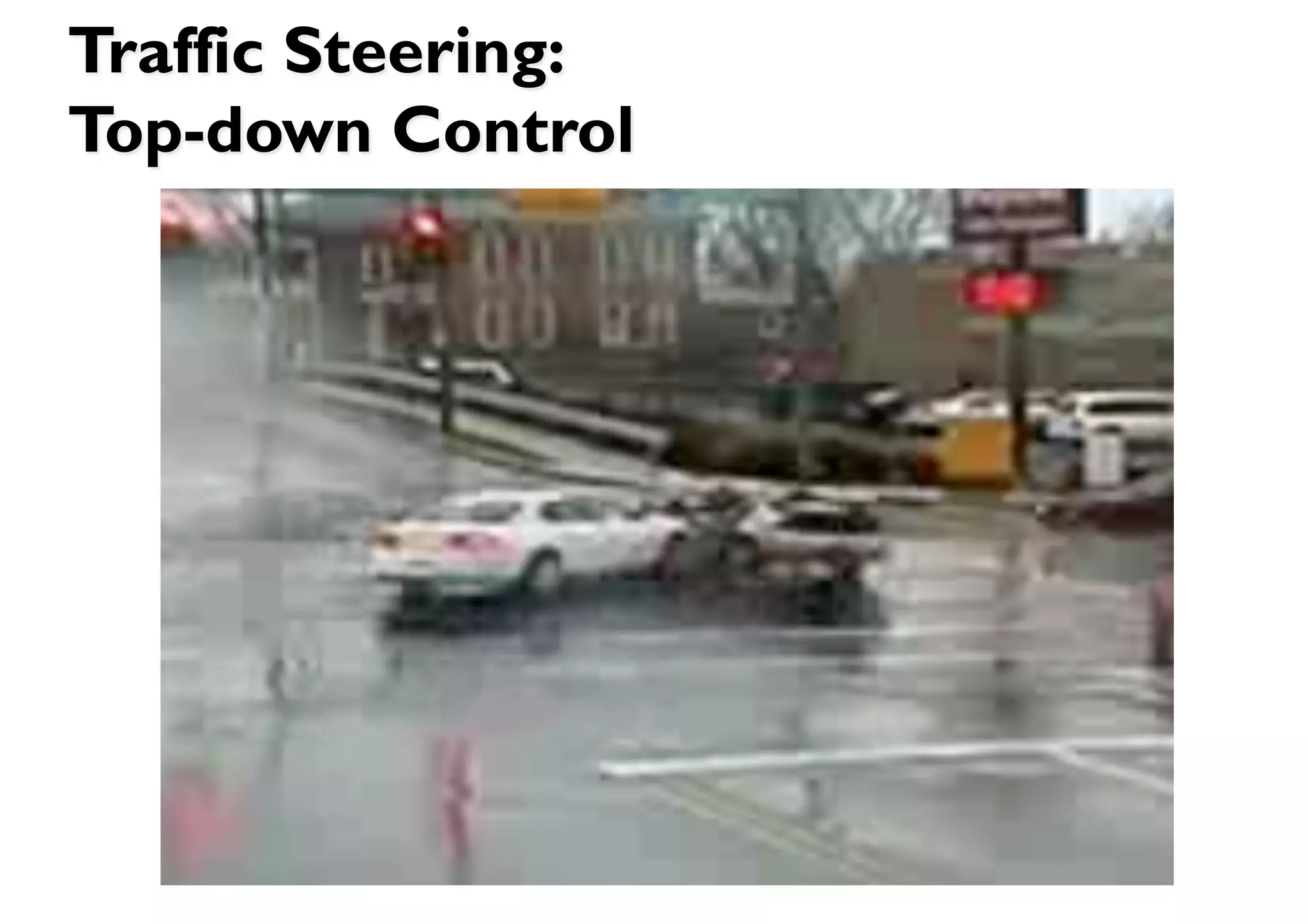
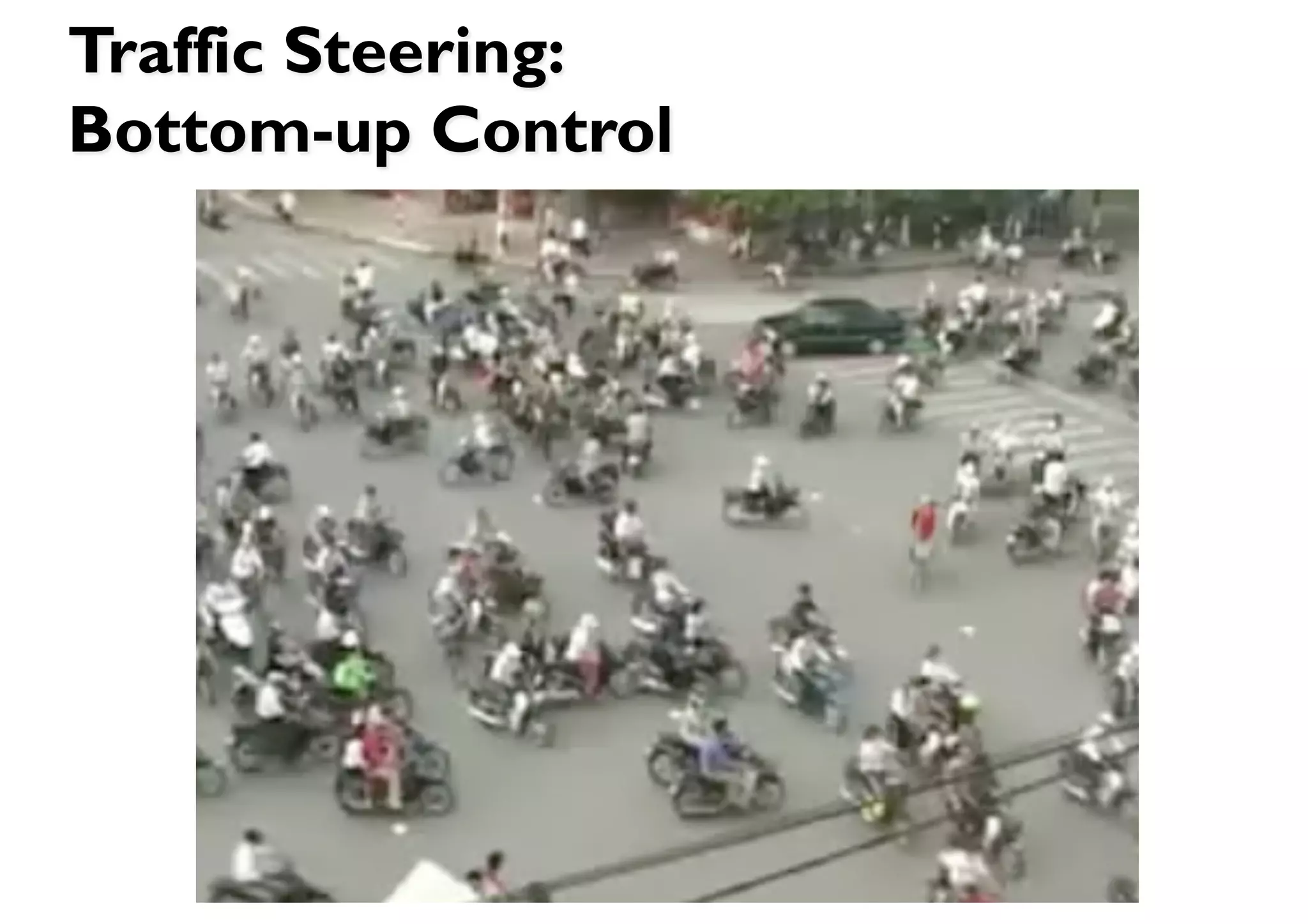
Challenge:Top-down/Bottom-up
!  Bottom-upself-organization
 and adaptation
  !  Driven by emergence (often
     implicit, e.g., stigmergic)
     feedback loop in interactions
  !  Very robust and efficient
  !  Cannot by designed by
     definition
!  Top-down   self-adaptation
  !  Explicit engineering of
     feedback loops
  !  Needed to enforce specific
     behaviors?
!  Howwe can make the two
 co-exists?
Traffic Steering:
Top-down Control
Traffic Steering:
Bottom-up Control


  By Prof. Peter Stone
  @UTA.edu
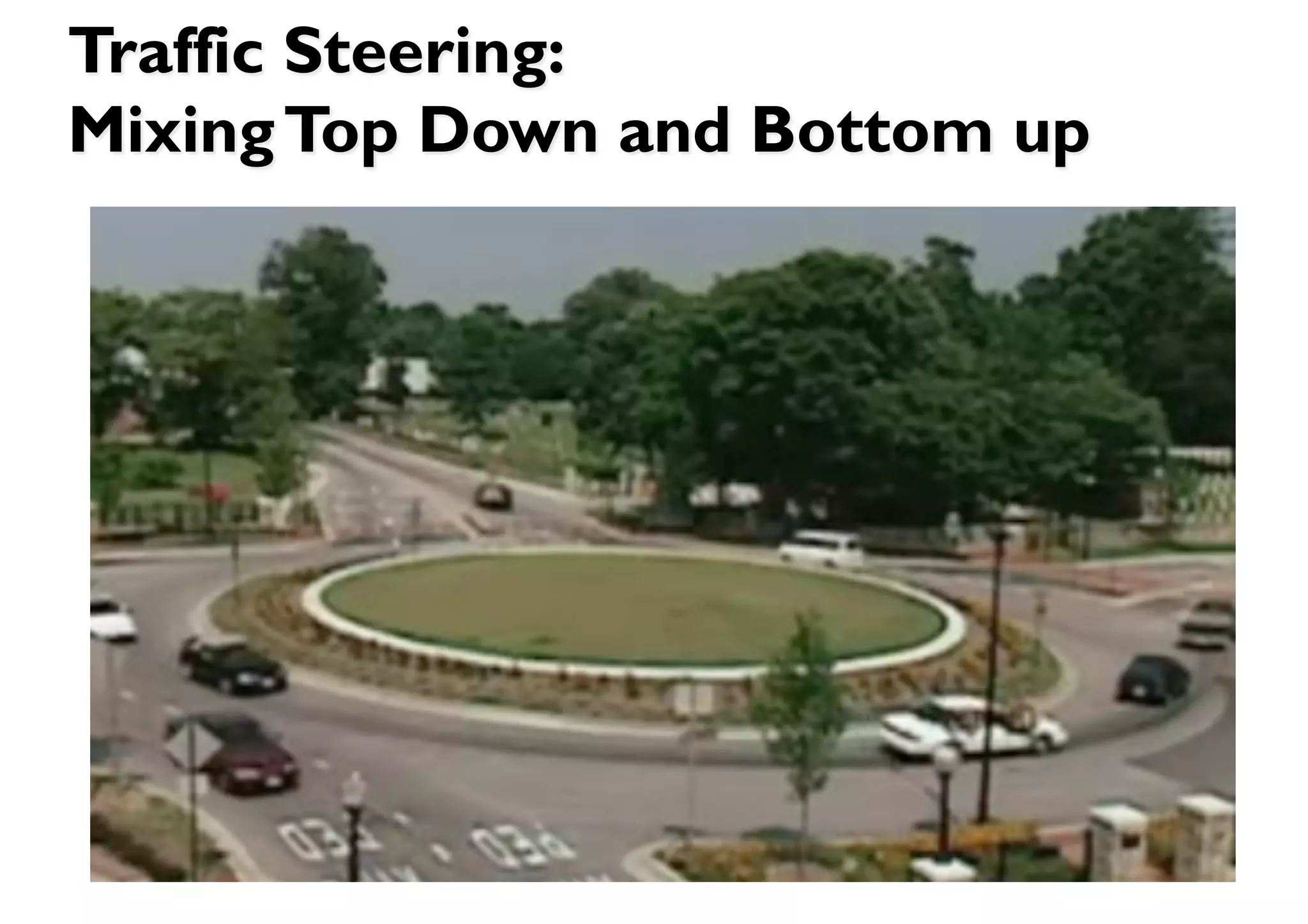
Traffic Steering:
Mixing Top Down and Bottom up
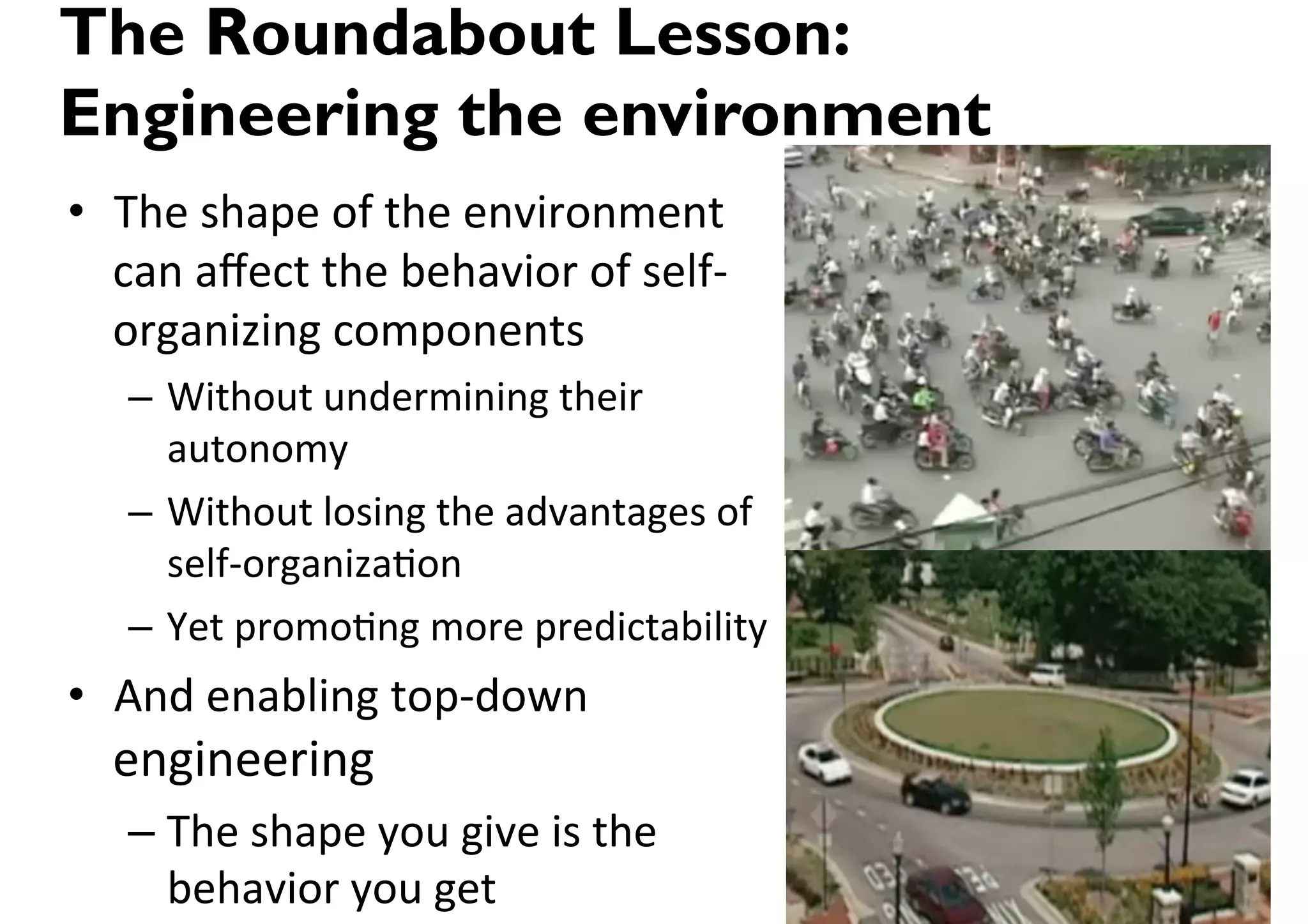
The Roundabout Lesson:
Engineering the environment
•  The(shape(of(the(environment(
   can(affect(the(behavior(of(selfE
   organizing(components(
   –  Without(undermining(their(
      autonomy(
   –  Without(losing(the(advantages(of(
      selfEorganiza>on(
   –  Yet(promo>ng(more(predictability(
•  And(enabling(topEdown(
  engineering(
   –  The(shape(you(give(is(the(
      behavior(you(get(
Engineering the Environment
in SAPERE
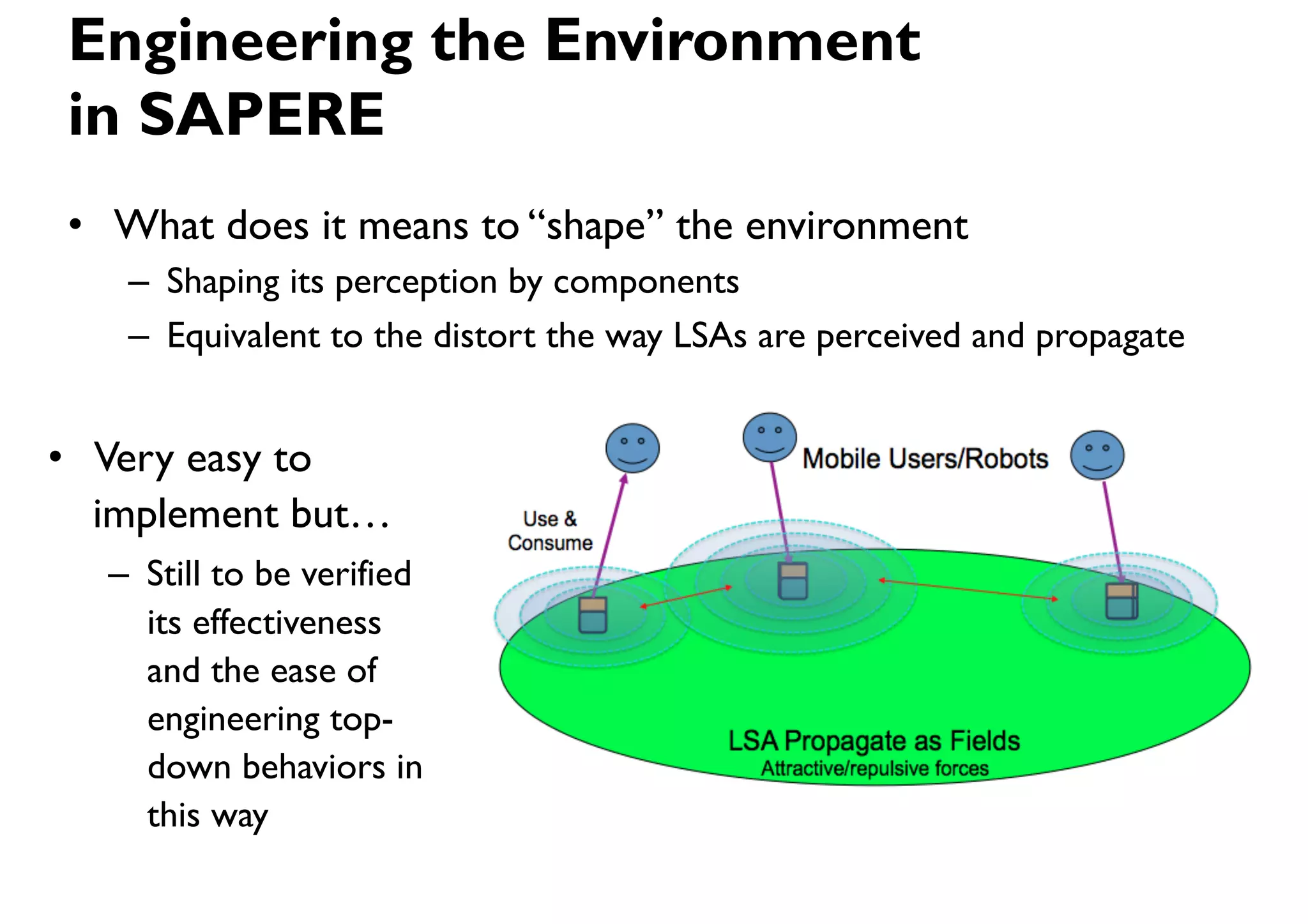
•  What does it means to “shape” the environment
   –  Shaping its perception by components
   –  Equivalent to the distort the way LSAs are perceived and propagate


•  Very easy to
   implement but…
  –  Still to be verified
     its effectiveness
     and the ease of
     engineering top-
     down behaviors in
     this way
Engineering the Environment
in SAPERE
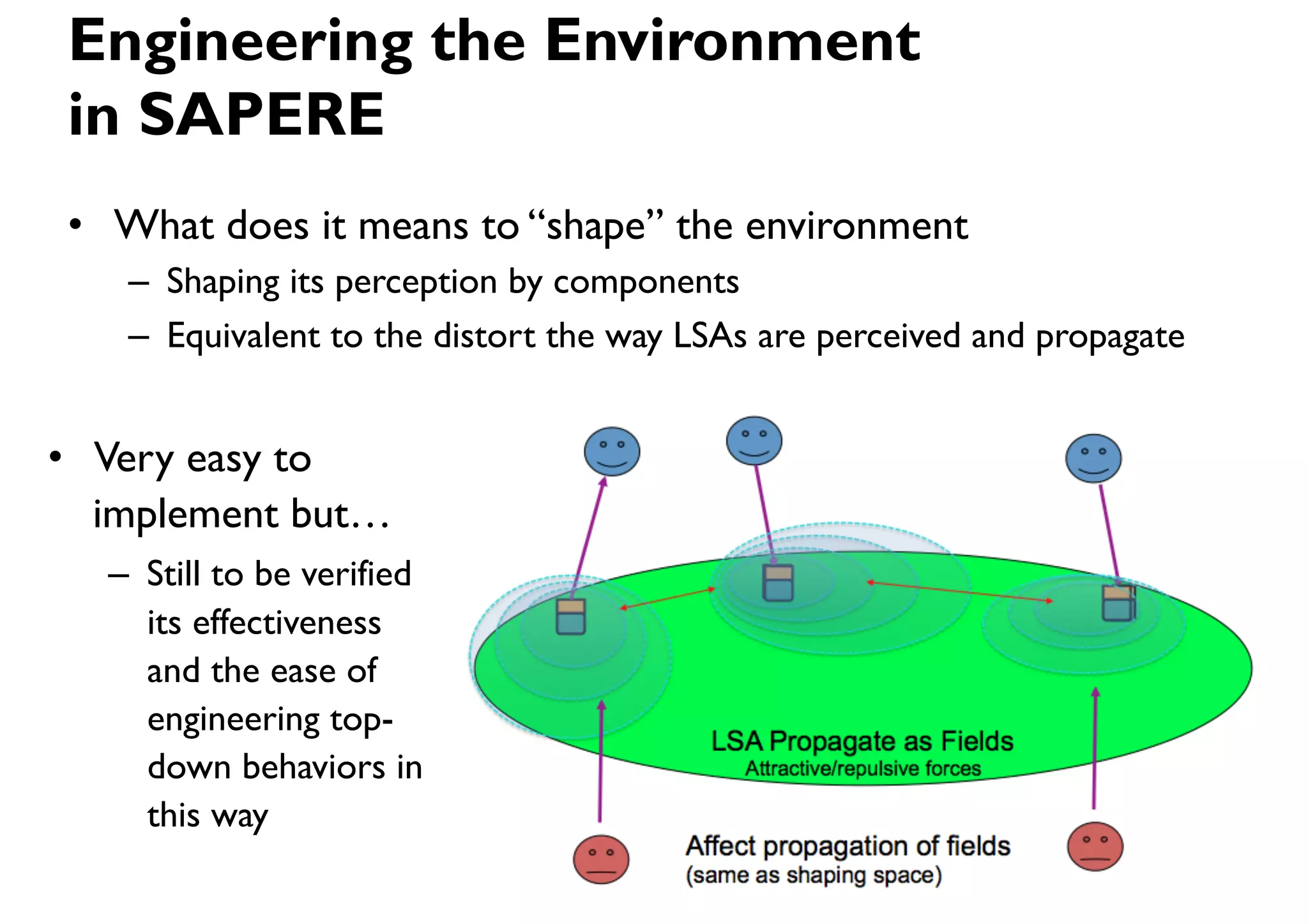
•  What does it means to “shape” the environment
   –  Shaping its perception by components
   –  Equivalent to the distort the way LSAs are perceived and propagate


•  Very easy to
   implement but…
  –  Still to be verified
     its effectiveness
     and the ease of
     engineering top-
     down behaviors in
     this way
Conclusions
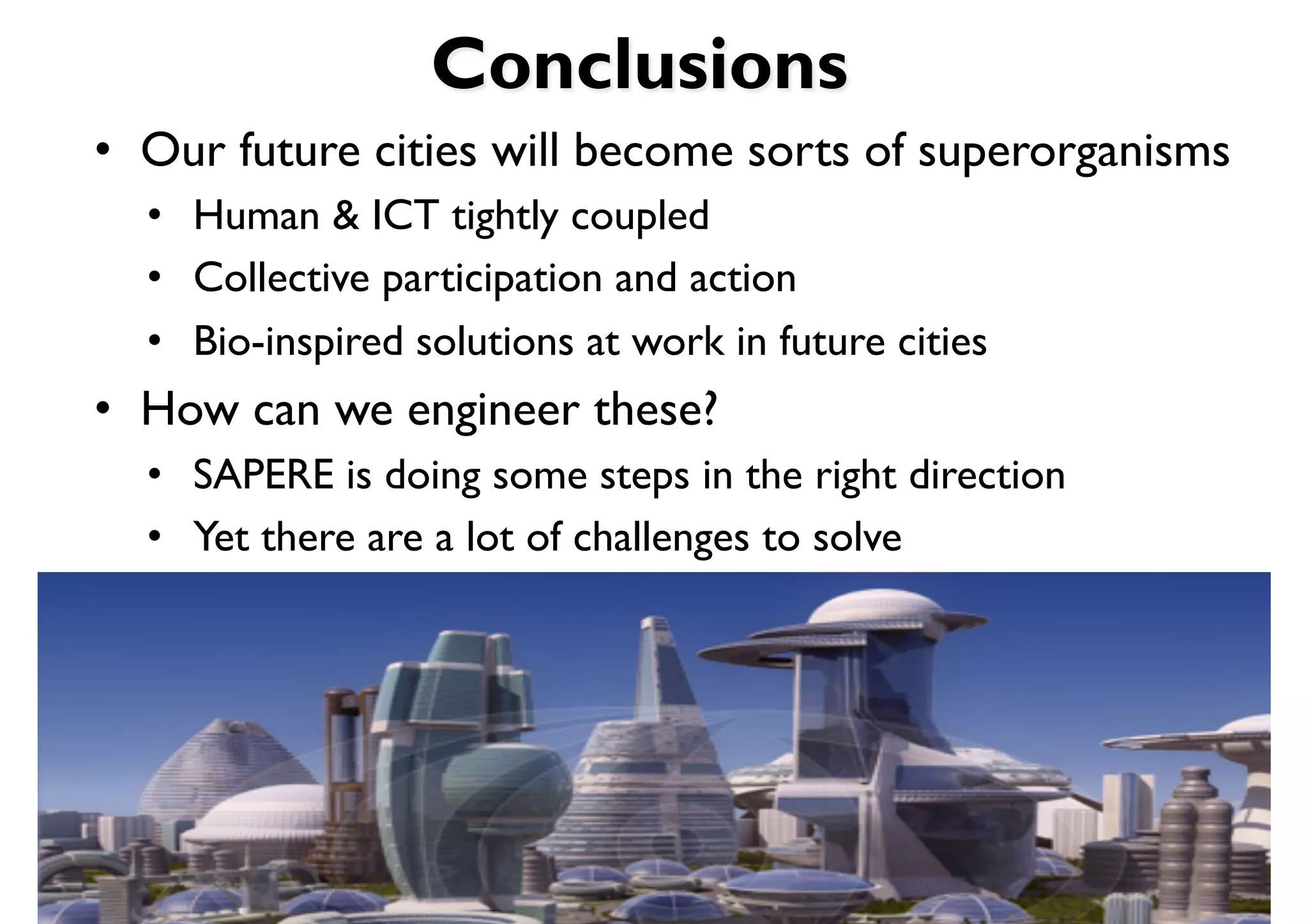
•  Our future cities will become sorts of superorganisms
  •  Human & ICT tightly coupled
  •  Collective participation and action
  •  Bio-inspired solutions at work in future cities
•  How can we engineer these?
  •  SAPERE is doing some steps in the right direction
  •  Yet there are a lot of challenges to solve

Engineering Self-organizing Urban Superorganisms

  • 1.
    Engineering Franco Zambonelli Socio-Technical Reggio Emilia Università di Modena e Urban Superorganisms franco.zambonelli@unimore.it
  • 2.
  • 3.
    Superorganisms •  Colonies(of(ants,(termites,( etc.( •  Organisms(composed(of( many(individual(ones( •  That(exhibit(finalized( collec>ve(par>cipa>ve( behaviors((or(“collec>ve( intelligence”)(
  • 4.
    Urban Superorganisms •  Can(our(urban( environments(become( superorganisms?( •  What(could(this(actually( mean?( •  Why(socioEtechnical?(
  • 5.
    Smart Cities: FromSenseable… •  Sensing what’s happening –  Via ICT devices Sense% –  And social networks •  To better understand (via data analysis) Understand % –  City and social (compute)% dynamics –  At a global level
  • 6.
    …To Actuable •  Wecan “shape” other than understand Sense% Act % (Steer) % –  Actuating ICT devices –  Steering human actions •  Closing the loop Understand % that enables (compute)% finalized urban behaviors possible
  • 7.
    …To Actuable •  Wecan “shape” other than understand Sense% Act % (Steer) % –  Actuating ICT device –  Steering human actions •  Closing the loop Understand % that enables (compute)% finalized urban behaviors possible
  • 8.
    Urban Superorganisms: ICTSide •  An ICT-enriched urban environment with rich sensing, actuating, and computing (SAC) capabilities –  Sensing: sensor networks, tags, smart objects,etc. –  Actuating: traffic controllers, public digital displays, critical infrastructures –  Computing: highly distributed and decentralized, with inter-connected computational engines everywhere
  • 9.
    Urban Superorganisms: HumanSide •  People with smart phones or alike (or whatever will appear in the future as wearable devices) contribute to such SAC capabilities –  Sensing: the 5 senses + smart phones –  Actuating: the body –  Computing: human & social intelligence
  • 10.
    Urban Superorganisms: PuttingAll Together •  The ICT and Human/Social level blurred to the point of invisibility: •  Complementing each other in a process of high value co-creation •  In the resulting overall “urban organism”, we can achieve very high-levels of collective –  Perception –  Awareness –  Action •  Dramatically changing the way we move, live, work, and play, in our towns
  • 11.
    Living in aSuperorganism •  Collective vs individual awareness –  Reflecting on ourselves as members of a community •  Be capable of understanding and acting together in real time –  Immediate feedback to/from the community
  • 12.
    Collective Mobility, forInstance •  Mobility per se :: steer for car, bike, ride sharing •  Childcare :: steering & monitoting children on their way to school •  Exhibitions :: steer to avoid crowd or suggest paths •  All of these requiring collective sensing awareness and action •  And can (should?) rely on bio-inspired solutions
  • 13.
    The SAPERE Project • SAPERE Self-aware Pervasive Service Ecosystems –  EU FP7 FET –  Starting October 1st 2010, lasting 3 years •  Key Challenges –  To define and implement a framework for adaptive service ecosystems –  Models + Middleware –  Experience with pervasive urban services and pervasive displays
  • 14.
    The SAPERE Approach • Nature-inspired (Biochemical) –  Simply metaphor for combining/aggregating services in a spontaneous way –  Whether human or ICT ones •  Spatially-situated –  To match the nature of urban scenarios – Adaptive –  Spontaneous reconfiguration of activities and interactions
  • 15.
    The SAPERE Architecture • Humans & ICT Devices –  Interact by injecting/ consuming service/data components •  Service Components –  Execute in a sort virtual Spatial substrate –  Moving, acting, composing, as from eco-laws •  Eco Laws –  Rule local activities and interactions –  Apply based on state of local components –  Self-organization of collective behavior
  • 16.
    The SAPERE Eco-laws • Identification of 4 primitive eco-laws –  Forming a necessary and complete set bond –  Upon which to build more complex self-organization patterns •  The Eco-laws –  Bonding: sort of chemical bond, local connection of LSAs – subsuming discovery and invocation spread –  Spreading: diffusion of LSAs to neighbors, to enable non-local interactions –  Aggregation: sort of fusion, primitive aggr data reduction based on ODI functions –  Decay: evaporation and deletion of information, to perform decentralized garbage collection in a decentralized decay way
  • 17.
    The SAPERE Self-orgPatterns •  Built upon the set of basic eco-laws –  Which can be considered sorts of “primitive patterns” •  To define complex bio- inspired self-organization and self-composition behaviours –  Counterproof of the completeness and efficacy of the basic set
  • 18.
  • 19.
    Programming SAPERE Apps • Have SAPERE middleware launched in the nodes to be involved •  Write agents that inject LSAs –  To express services/ functionalities they made available –  To request (formal fields) the services/data/funtionalities they requires •  Exploit self-org patterns to realize specific distributed functionaities –  Gradients, Chemiotaxis, Context completion, etc. •  Let the SAPERE space react by triggering eco-laws and react to events (bond, spread, etc.)
  • 20.
    Steering Behaviors inSAPERE with an Ecosystem of Displays
  • 21.
    Open Challenges !  There are many challenges to solve !  Engineering and programming tools !  Patterns of self-organization !  Top-down vs bottom-up approaches !  Incenvitives for participation !  Just to mention a few…
  • 22.
    Challenge: Engineering Tools ! Designing !  How to represent collective urban situations? !  How to turn it into collective awareness? !  How to represent urban goals and plan of actions? !  Role of existing social networks in future ecosystems? !  Programming !  What programming languages and abstractions? !  How to trigger/deploy specific urban behaviors? !  How to measure the goodness/badness of behaviors?
  • 23.
    Challenge: Patterns !  Given the basic sense-understand-act loop schemes !  At urban scale, multidutes of local/nested loops co-exists !  What are the architectural patterns by which such loops can be organized? !  What is the impact of different patterns on urban behaviors? !  Towhat extent we can “design” the shape of such loops? Breakpoint Token Next element to execute
  • 24.
    Challenge:Top-down/Bottom-up !  Bottom-upself-organization andadaptation !  Driven by emergence (often implicit, e.g., stigmergic) feedback loop in interactions !  Very robust and efficient !  Cannot by designed by definition !  Top-down self-adaptation !  Explicit engineering of feedback loops !  Needed to enforce specific behaviors? !  Howwe can make the two co-exists?
  • 25.
  • 26.
    Traffic Steering: Bottom-up Control By Prof. Peter Stone @UTA.edu
  • 27.
    Traffic Steering: Mixing TopDown and Bottom up
  • 28.
    The Roundabout Lesson: Engineeringthe environment •  The(shape(of(the(environment( can(affect(the(behavior(of(selfE organizing(components( –  Without(undermining(their( autonomy( –  Without(losing(the(advantages(of( selfEorganiza>on( –  Yet(promo>ng(more(predictability( •  And(enabling(topEdown( engineering( –  The(shape(you(give(is(the( behavior(you(get(
  • 29.
    Engineering the Environment inSAPERE •  What does it means to “shape” the environment –  Shaping its perception by components –  Equivalent to the distort the way LSAs are perceived and propagate •  Very easy to implement but… –  Still to be verified its effectiveness and the ease of engineering top- down behaviors in this way
  • 30.
    Engineering the Environment inSAPERE •  What does it means to “shape” the environment –  Shaping its perception by components –  Equivalent to the distort the way LSAs are perceived and propagate •  Very easy to implement but… –  Still to be verified its effectiveness and the ease of engineering top- down behaviors in this way
  • 31.
    Conclusions •  Our futurecities will become sorts of superorganisms •  Human & ICT tightly coupled •  Collective participation and action •  Bio-inspired solutions at work in future cities •  How can we engineer these? •  SAPERE is doing some steps in the right direction •  Yet there are a lot of challenges to solve