Decision making is an all encompassing
topic.
 How many decisions have you made
already today?
Should I get out of bed this morning?
Should I shower, brush my teeth, comb my
hair, etc.?
Complex problems – a mixture of
economic, political, and humanistic
When do we use engineering economic
analysis?
Average Unit Cost – cost on a per unit
basis
Variable cost per unit of volume is
constant
As volume increases, fixed cost per unit
decreases
While semi-variable cost changes
slightly
You get the picture. These are mini-
problems (or events that call for
decisions) that we are solving every
minute of every day.
These are what one would call “simple
problems”, that an individual can
solve.
Intermediate problems usually call for
decisions that are economic in nature.
The problem:
1) Is it sufficiently important.
2) Does it require organized thought.
3) Does it have an economic
component.
Capital expenditures – equipment
purchases
Design of new products
Proprietorship – a
business owned by an
individual
Partnership – more
than one owner
Corporation – a legal
entity created by a
state, lots of owners
from stock
(Government – the
ultimate corporation)
There are advantages of each type of business
and engineers are involved in all three types of
busines structures
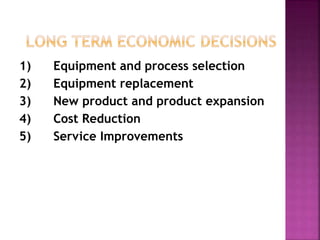
1) Equipment and process selection
2) Equipment replacement
3) New product and product expansion
4) Cost Reduction
5) Service Improvements
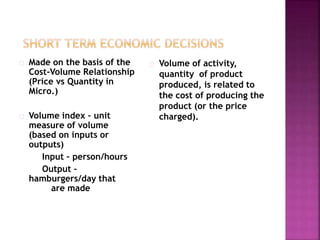
Made on the basis of the
Cost-Volume Relationship
(Price vs Quantity in
Micro.)
Volume index – unit
measure of volume
(based on inputs or
outputs)
Input – person/hours
Output –
hamburgers/day that
are made
Volume of activity,
quantity of product
produced, is related to
the cost of producing the
product (or the price
charged).
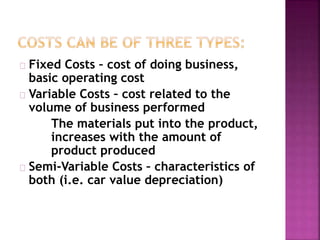
Fixed Costs – cost of doing business,
basic operating cost
Variable Costs – cost related to the
volume of business performed
The materials put into the product,
increases with the amount of
product produced
Semi-Variable Costs – characteristics of
both (i.e. car value depreciation)
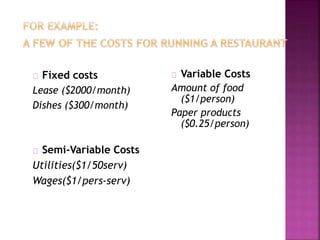
Fixed costs
Lease ($2000/month)
Dishes ($300/month)
Variable Costs
Amount of food
($1/person)
Paper products
($0.25/person)
Semi-Variable Costs
Utilities($1/50serv)
Wages($1/pers-serv)
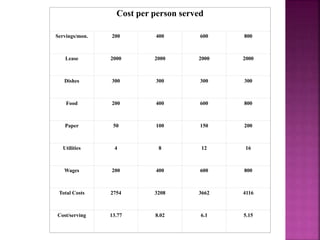
Cost per person served
Servings/mon. 200 400 600 800
Lease 2000 2000 2000 2000
Dishes 300 300 300 300
Food 200 400 600 800
Paper 50 100 150 200
Utilities 4 8 12 16
Wages 200 400 600 800
Total Costs 2754 3208 3662 4116
Cost/serving 13.77 8.02 6.1 5.15
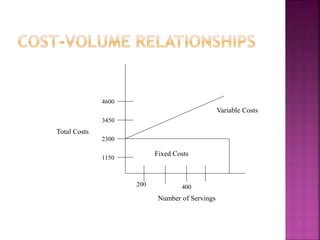
200 400
1150
2300
3450
4600
Number of Servings
Total Costs
Variable Costs
Fixed Costs
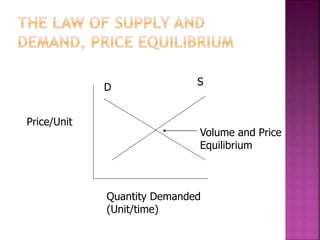
This is the supply side of economic analysis.
The side that determines how much a
business, once doing this analysis will charge
as a price.
The demand side is how much an individual is
willing to pay for a product. As price
increases.
Price/Unit
Quantity Demanded
(Unit/time)
D
S
Volume and Price
Equilibrium

Engineering economy.

  • 2.
    Decision making isan all encompassing topic.  How many decisions have you made already today? Should I get out of bed this morning? Should I shower, brush my teeth, comb my hair, etc.?
  • 3.
    Complex problems –a mixture of economic, political, and humanistic When do we use engineering economic analysis?
  • 4.
    Average Unit Cost– cost on a per unit basis Variable cost per unit of volume is constant As volume increases, fixed cost per unit decreases While semi-variable cost changes slightly
  • 5.
    You get thepicture. These are mini- problems (or events that call for decisions) that we are solving every minute of every day. These are what one would call “simple problems”, that an individual can solve. Intermediate problems usually call for decisions that are economic in nature.
  • 6.
    The problem: 1) Isit sufficiently important. 2) Does it require organized thought. 3) Does it have an economic component.
  • 7.
    Capital expenditures –equipment purchases Design of new products
  • 8.
    Proprietorship – a businessowned by an individual Partnership – more than one owner Corporation – a legal entity created by a state, lots of owners from stock (Government – the ultimate corporation)
  • 9.
    There are advantagesof each type of business and engineers are involved in all three types of busines structures
  • 11.
    1) Equipment andprocess selection 2) Equipment replacement 3) New product and product expansion 4) Cost Reduction 5) Service Improvements
  • 12.
    Made on thebasis of the Cost-Volume Relationship (Price vs Quantity in Micro.) Volume index – unit measure of volume (based on inputs or outputs) Input – person/hours Output – hamburgers/day that are made Volume of activity, quantity of product produced, is related to the cost of producing the product (or the price charged).
  • 13.
    Fixed Costs –cost of doing business, basic operating cost Variable Costs – cost related to the volume of business performed The materials put into the product, increases with the amount of product produced Semi-Variable Costs – characteristics of both (i.e. car value depreciation)
  • 14.
    Fixed costs Lease ($2000/month) Dishes($300/month) Variable Costs Amount of food ($1/person) Paper products ($0.25/person) Semi-Variable Costs Utilities($1/50serv) Wages($1/pers-serv)
  • 15.
    Cost per personserved Servings/mon. 200 400 600 800 Lease 2000 2000 2000 2000 Dishes 300 300 300 300 Food 200 400 600 800 Paper 50 100 150 200 Utilities 4 8 12 16 Wages 200 400 600 800 Total Costs 2754 3208 3662 4116 Cost/serving 13.77 8.02 6.1 5.15
  • 16.
    200 400 1150 2300 3450 4600 Number ofServings Total Costs Variable Costs Fixed Costs
  • 17.
    This is thesupply side of economic analysis. The side that determines how much a business, once doing this analysis will charge as a price. The demand side is how much an individual is willing to pay for a product. As price increases.
  • 18.