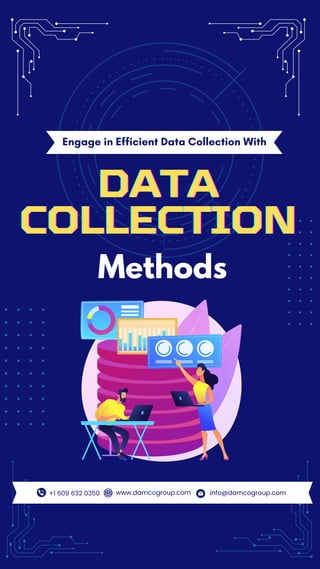
Methods
DATA
DATA
DATA
COLLECTION
COLLECTION
COLLECTION
Engage in Efficient Data Collection With
+1 609 632 0350 info@damcogroup.com
www.damcogroup.com
Introduction
Collecting accurate and relevant data is crucial for making informed decisions in
both personal and professional contexts. Whether you’re planning a vacation or
strategizing for your business, understanding the best data collection methods
can provide valuable insights.
Importance of Data Collection
Data collection helps inform decisions by providing crucial information. For
businesses, it impacts financial planning, market segmentation, and marketing
strategies. In everyday life, it aids in making informed choices, like choosing a
travel destination or managing personal finances.
Key Data Collection Methods
Different objectives and resources call for different data collection methods.
Here are some commonly used approaches:
1. Interviews
Interviews offer deep, qualitative insights through direct interaction. They can
be:
Structured: Following a fixed set of questions.
Semi-Structured: Guided but flexible, allowing exploration of responses.
Unstructured: Open-ended and adaptable to the conversation flow.
2. Closed-Ended Surveys
These surveys provide predefined answers, making them easy to distribute and
analyze. However, they might not capture detailed opinions due to their limited
response options.
3. Open-Ended Surveys
Allowing respondents to answer freely, these surveys gather rich, detailed data.
They can be more time-consuming to analyze but provide deeper insights into
respondents' thoughts and motivations.
4. Analytics Tools
Digital tools like Google Analytics track user behavior on websites or apps. They
provide detailed data on user interactions and trends but often lack context
about the reasons behind user actions.
5. Focus Groups
Small group discussions led by a moderator provide collective feedback on
specific topics. They are more cost-effective than individual interviews and reveal
group dynamics and opinions.
6. Reported Data Collection
Using secondary data collected by others saves time and resources. This method
is faster but may not always perfectly align with your specific needs.
7. Observational Data Collection
Allowing respondents to answer freely, these surveys gather rich, detailed data.
They can be more time-consuming to analyze but provide deeper insights into
respondents' thoughts and motivations.
Conclusion
Choosing the right data collection method depends on your goals and available
resources. Each method has its own benefits and limitations. Whether you opt for
interviews, surveys, or digital tools, the key is to align your method with your
specific needs for the best outcomes.
Contact US
Contact us today to find out how we can help you gather and
analyze the data you need for success.
+1 609 632 0350
www.damcogroup.com
info@damcogroup.com

Engage in Efficient Data Collection With the Best Data Collection Methods

  • 1.
    Methods DATA DATA DATA COLLECTION COLLECTION COLLECTION Engage in EfficientData Collection With +1 609 632 0350 info@damcogroup.com www.damcogroup.com
  • 2.
    Introduction Collecting accurate andrelevant data is crucial for making informed decisions in both personal and professional contexts. Whether you’re planning a vacation or strategizing for your business, understanding the best data collection methods can provide valuable insights. Importance of Data Collection Data collection helps inform decisions by providing crucial information. For businesses, it impacts financial planning, market segmentation, and marketing strategies. In everyday life, it aids in making informed choices, like choosing a travel destination or managing personal finances. Key Data Collection Methods Different objectives and resources call for different data collection methods. Here are some commonly used approaches: 1. Interviews Interviews offer deep, qualitative insights through direct interaction. They can be: Structured: Following a fixed set of questions. Semi-Structured: Guided but flexible, allowing exploration of responses. Unstructured: Open-ended and adaptable to the conversation flow. 2. Closed-Ended Surveys These surveys provide predefined answers, making them easy to distribute and analyze. However, they might not capture detailed opinions due to their limited response options.
  • 3.
    3. Open-Ended Surveys Allowingrespondents to answer freely, these surveys gather rich, detailed data. They can be more time-consuming to analyze but provide deeper insights into respondents' thoughts and motivations. 4. Analytics Tools Digital tools like Google Analytics track user behavior on websites or apps. They provide detailed data on user interactions and trends but often lack context about the reasons behind user actions. 5. Focus Groups Small group discussions led by a moderator provide collective feedback on specific topics. They are more cost-effective than individual interviews and reveal group dynamics and opinions. 6. Reported Data Collection Using secondary data collected by others saves time and resources. This method is faster but may not always perfectly align with your specific needs. 7. Observational Data Collection Allowing respondents to answer freely, these surveys gather rich, detailed data. They can be more time-consuming to analyze but provide deeper insights into respondents' thoughts and motivations. Conclusion Choosing the right data collection method depends on your goals and available resources. Each method has its own benefits and limitations. Whether you opt for interviews, surveys, or digital tools, the key is to align your method with your specific needs for the best outcomes.
  • 4.
    Contact US Contact ustoday to find out how we can help you gather and analyze the data you need for success. +1 609 632 0350 www.damcogroup.com info@damcogroup.com