WEEK 10: FINISHING HAMLET Major themes
THEMES IN HAMLET
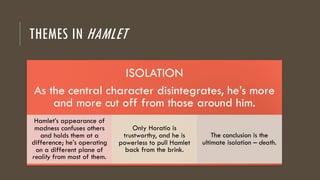
ISOLATION
As the central character disintegrates, he’s more
and more cut off from those around him.
Hamlet’s appearance of
madness confuses others
and holds them at a
difference; he’s operating
on a different plane of
reality from most of them.
Only Horatio is
trustworthy, and he is
powerless to pull Hamlet
back from the brink.
The conclusion is the
ultimate isolation – death.
THEMES IN HAMLET
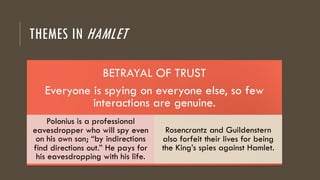
BETRAYAL OF TRUST
Everyone is spying on everyone else, so few
interactions are genuine.
Polonius is a professional
eavesdropper who will spy even
on his own son; “by indirections
find directions out.” He pays for
his eavesdropping with his life.
Rosencrantz and Guildenstern
also forfeit their lives for being
the King’s spies against Hamlet.
THEMES:
ROMANTIC LOVE
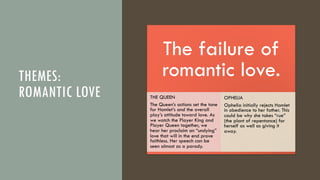
The failure of
romantic love.
THE QUEEN
The Queen’s actions set the tone
for Hamlet’s and the overall
play’s attitude toward love. As
we watch the Player King and
Player Queen together, we
hear her proclaim an “undying”
love that will in the end prove
faithless. Her speech can be
seen almost as a parody.
OPHELIA
Ophelia initially rejects Hamlet
in obedience to her father. This
could be why she takes “rue”
(the plant of repentance) for
herself as well as giving it
away.
THEMES:
APPEARANCE &
DISGUISE
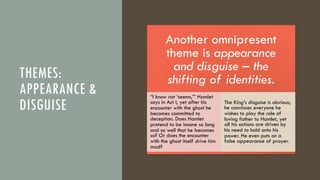
Another omnipresent
theme is appearance
and disguise – the
shifting of identities.
“I know not ‘seems,’” Hamlet
says in Act I, yet after his
encounter with the ghost he
becomes committed to
deception. Does Hamlet
pretend to be insane so long
and so well that he becomes
so? Or does the encounter
with the ghost itself drive him
mad?
The King’s disguise is obvious;
he convinces everyone he
wishes to play the role of
loving father to Hamlet, yet
all his actions are driven by
his need to hold onto his
power. He even puts on a
false appearance of prayer.
THEMES:
APPEARANCE
AND DISGUISE
The ghost refers to his “most seeming-virtuous
queen.” We have no evidence that she was in on the
murder, but she may have been his brother’s lover
before he was dead.
Of all the major characters, only Horatio never
independently puts on a disguise or practices
deception. That’s why it makes sense that he is left
alive at the end of the play to tell Hamlet’s story.
He’s the only one trustworthy enough to get it right.
A new order rises from the ashes of chaos at the
very end, as Fortinbras of Norway takes control.

ENG 203 Week 10 Power Point.pdf

  • 1.
    WEEK 10: FINISHINGHAMLET Major themes
  • 2.
    THEMES IN HAMLET ISOLATION Asthe central character disintegrates, he’s more and more cut off from those around him. Hamlet’s appearance of madness confuses others and holds them at a difference; he’s operating on a different plane of reality from most of them. Only Horatio is trustworthy, and he is powerless to pull Hamlet back from the brink. The conclusion is the ultimate isolation – death.
  • 3.
    THEMES IN HAMLET BETRAYALOF TRUST Everyone is spying on everyone else, so few interactions are genuine. Polonius is a professional eavesdropper who will spy even on his own son; “by indirections find directions out.” He pays for his eavesdropping with his life. Rosencrantz and Guildenstern also forfeit their lives for being the King’s spies against Hamlet.
  • 4.
    THEMES: ROMANTIC LOVE The failureof romantic love. THE QUEEN The Queen’s actions set the tone for Hamlet’s and the overall play’s attitude toward love. As we watch the Player King and Player Queen together, we hear her proclaim an “undying” love that will in the end prove faithless. Her speech can be seen almost as a parody. OPHELIA Ophelia initially rejects Hamlet in obedience to her father. This could be why she takes “rue” (the plant of repentance) for herself as well as giving it away.
  • 5.
    THEMES: APPEARANCE & DISGUISE Another omnipresent themeis appearance and disguise – the shifting of identities. “I know not ‘seems,’” Hamlet says in Act I, yet after his encounter with the ghost he becomes committed to deception. Does Hamlet pretend to be insane so long and so well that he becomes so? Or does the encounter with the ghost itself drive him mad? The King’s disguise is obvious; he convinces everyone he wishes to play the role of loving father to Hamlet, yet all his actions are driven by his need to hold onto his power. He even puts on a false appearance of prayer.
  • 6.
    THEMES: APPEARANCE AND DISGUISE The ghostrefers to his “most seeming-virtuous queen.” We have no evidence that she was in on the murder, but she may have been his brother’s lover before he was dead. Of all the major characters, only Horatio never independently puts on a disguise or practices deception. That’s why it makes sense that he is left alive at the end of the play to tell Hamlet’s story. He’s the only one trustworthy enough to get it right. A new order rises from the ashes of chaos at the very end, as Fortinbras of Norway takes control.