Understanding and
Applying the Critical
Analysis Process
“Home has less to do with a piece of soil than a piece of soul”
ENG 1D1, Module 1, Lesson 3
In this Lesson
We will learn about the Critical Analysis
Process (CAP) and how to apply it in
order to help us assess poetry and art.
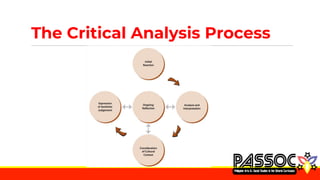
The Critical Analysis Process
Stage 1: Initial Reaction Roles
Are you?
The Blinker: What is your first impression of this work?
The Reminder: What does this work bring to mind?
The Sensitive One: What emotions does this work evoke
within you?
The Riddler: What puzzles you? What questions do you have?
The Connector: What connections can you make between
this work and your own experience or other art forms?
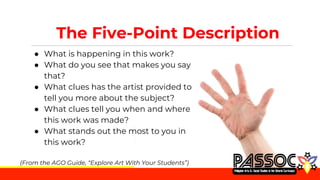
The Five-Point Description
● What is happening in this work?
● What do you see that makes you say
that?
● What clues has the artist provided to
tell you more about the subject?
● What clues tell you when and where
this work was made?
● What stands out the most to you in
this work?
(From the AGO Guide, “Explore Art With Your Students”)
Stage 2: Analyze and Interpret
Author Intent and Vision
● What do you think is the message that the artist is trying
to communicate?
● What do you think is the purpose of this work?
● What do you feel is the artist’s view of the world?
● How does the artist evoke emotions using principles and
elements of design?
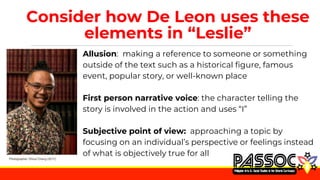
Consider how De Leon uses these
elements in “Leslie”
Allusion: making a reference to someone or something
outside of the text such as a historical figure, famous
event, popular story, or well-known place
First person narrative voice: the character telling the
story is involved in the action and uses “I”
Subjective point of view: approaching a topic by
focusing on an individual’s perspective or feelings instead
of what is objectively true for all
Photographer: Dhoui Chang (2017).
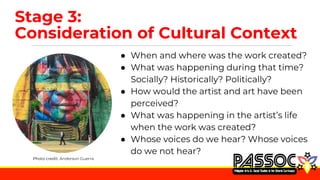
Stage 3:
Consideration of Cultural Context
● When and where was the work created?
● What was happening during that time?
Socially? Historically? Politically?
● How would the artist and art have been
perceived?
● What was happening in the artist’s life
when the work was created?
● Whose voices do we hear? Whose voices
do we not hear?
Photo credit: Anderson Guerra
Stage 4:
Expression of Aesthetic Judgment
● Has your point of view changed from your initial reaction? How
and why?
● What works and what doesn’t work for you? Why?
● How would you change this work if given the opportunity?
Why?
● How does the artist’s view of the world compare with your
own?
● How effective are the artist’s choices in communicating their
intended message?

ENG 1D1_ the critical analysis process

  • 1.
    Understanding and Applying theCritical Analysis Process “Home has less to do with a piece of soil than a piece of soul” ENG 1D1, Module 1, Lesson 3
  • 2.
    In this Lesson Wewill learn about the Critical Analysis Process (CAP) and how to apply it in order to help us assess poetry and art.
  • 3.
  • 4.
    Stage 1: InitialReaction Roles Are you? The Blinker: What is your first impression of this work? The Reminder: What does this work bring to mind? The Sensitive One: What emotions does this work evoke within you? The Riddler: What puzzles you? What questions do you have? The Connector: What connections can you make between this work and your own experience or other art forms?
  • 5.
    The Five-Point Description ●What is happening in this work? ● What do you see that makes you say that? ● What clues has the artist provided to tell you more about the subject? ● What clues tell you when and where this work was made? ● What stands out the most to you in this work? (From the AGO Guide, “Explore Art With Your Students”)
  • 6.
    Stage 2: Analyzeand Interpret Author Intent and Vision ● What do you think is the message that the artist is trying to communicate? ● What do you think is the purpose of this work? ● What do you feel is the artist’s view of the world? ● How does the artist evoke emotions using principles and elements of design?
  • 7.
    Consider how DeLeon uses these elements in “Leslie” Allusion: making a reference to someone or something outside of the text such as a historical figure, famous event, popular story, or well-known place First person narrative voice: the character telling the story is involved in the action and uses “I” Subjective point of view: approaching a topic by focusing on an individual’s perspective or feelings instead of what is objectively true for all Photographer: Dhoui Chang (2017).
  • 8.
    Stage 3: Consideration ofCultural Context ● When and where was the work created? ● What was happening during that time? Socially? Historically? Politically? ● How would the artist and art have been perceived? ● What was happening in the artist’s life when the work was created? ● Whose voices do we hear? Whose voices do we not hear? Photo credit: Anderson Guerra
  • 9.
    Stage 4: Expression ofAesthetic Judgment ● Has your point of view changed from your initial reaction? How and why? ● What works and what doesn’t work for you? Why? ● How would you change this work if given the opportunity? Why? ● How does the artist’s view of the world compare with your own? ● How effective are the artist’s choices in communicating their intended message?