Energy Efficiency Indicators Essentials For
Policy Making Oecd download
https://ebookbell.com/product/energy-efficiency-indicators-
essentials-for-policy-making-oecd-6822970
Explore and download more ebooks at ebookbell.com
Here are some recommended products that we believe you will be
interested in. You can click the link to download.
Energy Efficiency Indicators Fundamentals On Statistics Oecd
https://ebookbell.com/product/energy-efficiency-indicators-
fundamentals-on-statistics-oecd-6822972
Development Of Energy Efficiency Indicators In Russia Iea Energy
Papers Nathalie Trudeau
https://ebookbell.com/product/development-of-energy-efficiency-
indicators-in-russia-iea-energy-papers-nathalie-trudeau-2263680
Energy Efficiency Innovations Driving Prosperity Slashing Emissions
Henry Kelly
https://ebookbell.com/product/energy-efficiency-innovations-driving-
prosperity-slashing-emissions-henry-kelly-46706752
Energy Efficiency 1st Edition Daniel M Martinez Ben W Ebenhack
https://ebookbell.com/product/energy-efficiency-1st-edition-daniel-m-
martinez-ben-w-ebenhack-47234496
Energy Efficiency And Conservation In Metal Industries Swapan Kumar
Dutta
https://ebookbell.com/product/energy-efficiency-and-conservation-in-
metal-industries-swapan-kumar-dutta-49031294
Energy Efficiency Refurbishments Clemens Richarz Christina Schulz
https://ebookbell.com/product/energy-efficiency-refurbishments-
clemens-richarz-christina-schulz-50363366
Energy Efficiency Research 1st Edition David M Bergmann
https://ebookbell.com/product/energy-efficiency-research-1st-edition-
david-m-bergmann-51348868
Energy Efficiency Solutions 1st Edition Richard P Cateland
https://ebookbell.com/product/energy-efficiency-solutions-1st-edition-
richard-p-cateland-51368678
Energyefficiency Upgrades Principles Details Examples 1st Edition
Clemens Richarz Christina Schulz Friedemann Zeitler
https://ebookbell.com/product/energyefficiency-upgrades-principles-
details-examples-1st-edition-clemens-richarz-christina-schulz-
friedemann-zeitler-51373246
Energy Efficiency Indicators:
Essentials for Policy Making
Energy Efficiency Indicators:
Essentials for Policy Making
Energy efficiency is a growing policy priority
for many countries around the world. It is
widely recognised as the most cost-effective
and readily available means to address
numerous energy-related issues, including
energy security, the social and economic
impacts of high energy prices, and concerns
about climate change. At the same time,
energy efficiency increases competitiveness
and promotes consumer welfare.
In this context, it is important to develop
and maintain well-founded indicators to
better inform policy making and help decision
makers formulate policies that are best suited
to domestic and/or international objectives.
Yet, choosing and developing appropriate
indicators to support the development of
policies is not straightforward.
This publication should enable energy analysts
and policy makers to:
n Identify priority areas for the development
of energy efficiency indicators
n Define which sector(s) offer the greatest
potential to further improve energy efficiency
n Select the data and indicators that best
support policy development in these sectors
n Develop a strategy to advance policy
development through the improved use
of indicators to track progress of energy
efficiency policies.
This publication and its companion document,
Energy Efficiency Indicators: Fundamentals
on Statistics, are intended to provide the
necessary tools to initiate and/or further
develop in-depth indicators to support the
decision-making process.
Energy Efficiency Indicators:
Essentials for Policy Making
INTERNATIONAL ENERGY AGENCY
The International Energy Agency (IEA), an autonomous agency, was established in November 1974.
Its primary mandate was – and is – two-fold: to promote energy security amongst its member
countries through collective response to physical disruptions in oil supply, and provide authoritative
research and analysis on ways to ensure reliable, affordable and clean energy for its 29 member
countries and beyond. The IEA carries out a comprehensive programme of energy co-operation among
its member countries, each of which is obliged to hold oil stocks equivalent to 90 days of its net imports.
The Agency’s aims include the following objectives:
n Secure member countries’ access to reliable and ample supplies of all forms of energy; in particular,
through maintaining effective emergency response capabilities in case of oil supply disruptions.
n Promote sustainable energy policies that spur economic growth and environmental protection
in a global context – particularly in terms of reducing greenhouse-gas emissions that contribute
to climate change.
n Improve transparency of international markets through collection and analysis of
energy data.
n Support global collaboration on energy technology to secure future energy supplies
and mitigate their environmental impact, including through improved energy
efficiency and development and deployment of low-carbon technologies.
n Find solutions to global energy challenges through engagement and
dialogue with non-member countries, industry, international
organisations and other stakeholders.
IEA member countries:
Australia
Austria
Belgium
Canada
Czech Republic
Denmark
Estonia
Finland
France
Germany
Greece
Hungary
Ireland
Italy
Japan
Korea (Republic of)
Luxembourg
Netherlands
New Zealand
Norway
Poland
Portugal
Slovak Republic
Spain
Sweden
Switzerland
Turkey
United Kingdom
United States
The European Commission
also participates in
the work of the IEA.
© OECD/IEA, 2014
International Energy Agency
9 rue de la Fédération
75739 Paris Cedex 15, France
www.iea.org
Please note that this publication
is subject to specific restrictions
that limit its use and distribution.
The terms and conditions are available online at
http://www.iea.org/termsandconditionsuseandcopyright/
Secure Sustainable Together
3
Foreword
The International Energy Agency (IEA) has published reports on the impact of improved
energy efficiency trends in end-use energy consumption, otherwise known as energy
efficiency indicators, since 1997. Over this period, the IEA together with other energy
efficiency experts have been leading the development of energy efficiency indicators,
as well as working closely with countries and other key stakeholders to improve the
collection of energy and related end-use data. The IEA Energy Statistics Manual (IEA,
2005), Oil Crises & Climate Challenges: 30 Years of Energy Use in IEA Countries
(IEA, 2004) and Energy Use in the New Millennium (IEA, 2007) are examples of the
results of this collaboration.
As an energy resource, energy efficiency has the unique potential to simultaneously
contribute to long-term energy security, economic growth, and even improved health
and well-being; in particular it is a key means to reduce greenhouse gas emissions.
By reducing or limiting energy demand, energy efficiency measures can increase
resilience against a variety of risks, such as energy price rises and volatility, stress on
energy infrastructure, and disruptions to energy supply systems.
The Energy Efficiency Market Report (IEA, 2013) highlights energy efficiency’s place
as a major energy resource and the critical role it plays in the global energy market.
It concluded that energy efficiency investments delivered reductions in energy
demand that exceed the output of any other fuel source in many IEA countries. This
points to energy efficiency being not just a hidden fuel, but in fact, the “first fuel”.
Energy efficiency indicators are used to quantify just how big this hidden or first fuel
is. To better understand the drivers and potential for energy efficiency, it is important
to develop and maintain well-founded energy efficiency indicators to better inform
the policy process and help decision-makers develop policies that are best suited to
meet domestic and/or international policy objectives. Yet choosing and developing
appropriate indicators to support the development of policies is not straight forward.
The Energy Efficiency Indicators: Essentials for Policy Making and its companion
document Energy Efficiency Indicators: Fundamentals on Statistics (IEA, 2014) aim
to provide the necessary tools to initiate or further develop in-depth indicators to
support the development of effective energy efficiency policies. The Energy Efficiency
Indicators: Fundamentals on Statistics (IEA, 2014) is intended for statisticians and
energy analysts collecting the needed information for the development of energy
efficiency indicators.
The Energy Efficiency Indicators: Essentials for Policy Making is aimed at providing
energy analysts with tools needed to determine the priority areas for the development
of energy efficiency indicators (EEI) and how to select and develop the data and
indicators that will best support energy efficiency policy. The information gained
from these indicators will help policy makers to set energy efficiency targets and
track progress towards these targets.
This report is published under my authority as Executive Director of the IEA.
Maria van der Hoeven
Executive Director
International Energy Agency
©
OECD/IEA,
2014
©
OECD/IEA,
2014
5
Acknowledgements
This publication was prepared by the International Energy Agency’s Directorate of
Sustainable Energy Policy and Technology (SPT). Didier Houssin, Director of SPT;
Jean-Francois Gagne, Head of the Energy Technology Policy Division; and Jean-Yves
Garnier, Head of the Energy Data Center, offered important guidance and input.
Nathalie Trudeau (former IEA colleague) was the project leader and had overall
responsibility for the design and development of the study. Emer Dennehy took
over responsibility for completing this project, overseeing the final drafting and
production process. Other main contributors to this manual include Taejin Park,
Cecilia Tam and Robert Tromop. The work also benefited from the expertise of
many other IEA colleagues, in particular, Nina Campbell, François Cuenot, Davide
D’Ambrosio, Araceli Fernandez, Assen Gasharov, Marc LaFrance, Roberta Quadrelli
and Kira West. Desktop publishing support from Sharon Burghgraeve is also
gratefully acknowledged. Erin Crum copy-edited the manuscript with the support of
Cheryl Haines. Production assistance was provided by the IEA Communication and
Information Office: Astrid Dumond, Muriel Custodio and Bertrand Sadin.
The work was guided by the IEA Committee on Energy Research and Technology.
Inputs and suggestions from the members of this committee and other IEA
government officials are gratefully acknowledged.
A large number of reviewers provided valuable feedback and input to the analysis
presented. These include:
Heidelinde Adensam, Federal Ministry of Economy, Family and Youth, Austria
John Appleby, Natural Resources Canada
Chris Bayliss, International Aluminium Institute
Wolfgang Bittermann, Statistics Austria
Didier Bosseboeuf, ADEME, France
Ann Christin Bøeng, Statistics Norway
Moon-Sun Choi, Korea Energy Economics Institute
Hein Dang, Energy Efficiency and Conservation Authority, New Zealand
Pilar de Arriba Segurado, Institute for Diversification and Saving of Energy, Spain
Albert Dessi, Department of Industry, Australia
Alessandro Federici, Italian National Agency for New Technologies, Energy and
Sustainable Economic Development
Carlos García Barquero, Institute for Diversification and Saving of Energy, Spain
Jesus Pedro Garcia Montes, Institute for Diversification and Saving of Energy, Spain
Géraldine Grosjean, SPW, Belgium
Andreas Haider Mag, Federal Ministry of Economy, Family and Youth, Austria
Rurik Holmberg, Swedish Energy Agency
Sung Moon Jung, International Partnership for Energy Efficiency Cooperation
Richard Longman, Department of Infrastructure and Transport, Australia
©
OECD/IEA,
2014
6
Baya Kieffer, African Energy Commission
Shigeru Kimura, The Institute of Energy Economics, Japan
Ron Knapp, International Aluminium Institute
Tabea Kolbel, Business and Industry Advisory Committee to the OECD
Bruno Lapillonne, Enerdata
Carlos López López, Institute for Diversification and Saving of Energy, Spain
Yuji Matsuo, The Institute of Energy Economics, Japan
Gene McGlynn, Department of Industry, Australia
Roeland Mertens, EuroStat
Gergana Miladinova, European Commission, DG ENER
Nils Olof Nylund, VVT Technical Research Centre of Finland
Stephen Oxley, Department of Energy and Climate Change, United Kingdom
Tabaré Pagliano, Energy Research & Development Institute, Uruguay
Christoph Ploiner, Austrian Energy Agency
Teresa Ponce de Leão, National Laboratory of Energy and Geology, Portugal
Nicola Rega, Confederation of European Pulp and Paper Industries
Hori Shiro, Minister of Economy, Trade and Industry, Japan
Oliver Story, Department of Industry, Australia
Oliver Thunus, STATEC, Luxembourg
Florentine Visser, GIZ International Services
Thibaud Voita, International Partnership for Energy Efficiency Cooperation
Leonie Wilson, Office of Energy Efficiency and Renewable Energy, Australia
Linlin Wu, International Aluminium Institute
Comments and questions are welcome and should be addressed to:
Energy Efficiency Indicators Analysts
Directorate of Sustainable Energy Policy and Technology
International Energy Agency
9, rue de la Fédération
75739 Paris Cedex 15
France
Email: EnergyIndicators@iea.org
©
OECD/IEA,
2014
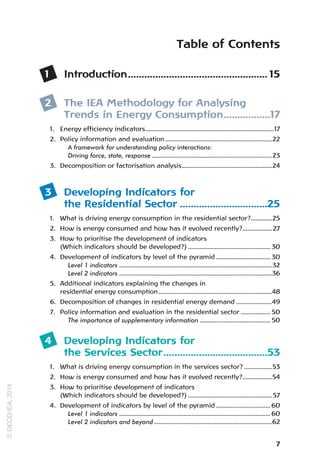
1 Introduction.
................................................... 15
2 The IEA Methodology for Analysing
Trends in Energy Consumption.
.................17
1. Energy efficiency indicators.
..............................................................................17
2. Policy information and evaluation..................................................................22
A framework for understanding policy interactions:
Driving force, state, response..........................................................................23
3. Decomposition or factorisation analysis.
.......................................................24
3 Developing Indicators for
the Residential Sector.................................25
1. What is driving energy consumption in the residential sector?.
.............25
2. How is energy consumed and how has it evolved recently?.
.................. 27
3. How to prioritise the development of indicators
(Which indicators should be developed?)................................................... 30
4. Development of indicators by level of the pyramid.................................. 30
Level 1 indicators..............................................................................................32
Level 2 indicators..............................................................................................36
5. Additional indicators explaining the changes in
residential energy consumption......................................................................48
6. Decomposition of changes in residential energy demand.......................49
7. Policy information and evaluation in the residential sector................... 50
The importance of supplementary information............................................ 50
4 Developing Indicators for
the Services Sector.
......................................53
1. What is driving energy consumption in the services sector?..................53
2. How is energy consumed and how has it evolved recently?.
..................54
3. How to prioritise development of indicators
(Which indicators should be developed?).................................................... 57
4. Development of indicators by level of the pyramid.................................. 60
Level 1 indicators............................................................................................. 60
Level 2 indicators and beyond.
........................................................................62
Table of Contents
7
©
OECD/IEA,
2014
8
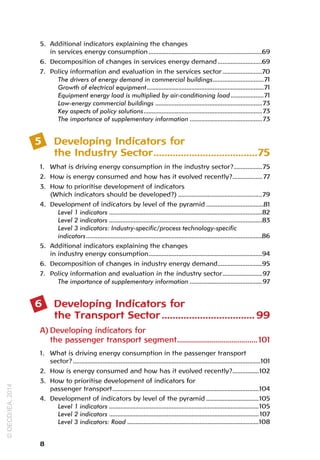
5. Additional indicators explaining the changes
in services energy consumption......................................................................69
6. Decomposition of changes in services energy demand.
...........................69
7. Policy information and evaluation in the services sector.........................70
The drivers of energy demand in commercial buildings.
...............................71
Growth of electrical equipment.
.......................................................................71
Equipment energy load is multiplied by air-conditioning load.
....................71
Low-energy commercial buildings.................................................................. 73
Key aspects of policy solutions.
........................................................................ 73
The importance of supplementary information............................................. 73
5 Developing Indicators for
the Industry Sector.
......................................75
1. What is driving energy consumption in the industry sector?.
................. 75
2. How is energy consumed and how has it evolved recently?.
.................. 77
3. How to prioritise development of indicators
(Which indicators should be developed?)....................................................79
4. Development of indicators by level of the pyramid....................................81
Level 1 indicators..............................................................................................82
Level 2 indicators..............................................................................................83
Level 3 indicators: Industry-specific/process technology-specific
indicators.
...........................................................................................................86
5. Additional indicators explaining the changes
in industry energy consumption.
.....................................................................94
6. Decomposition of changes in industry energy demand.
...........................95
7. Policy information and evaluation in the industry sector.
........................97
The importance of supplementary information.............................................97
6 Developing Indicators for
the Transport Sector.
.................................. 99
A) Developing indicators for
the passenger transport segment.
........................................ 101
1. What is driving energy consumption in the passenger transport
sector?...................................................................................................................101
2. How is energy consumed and how has it evolved recently?.
................102
3. How to prioritise development of indicators for
passenger transport.
.........................................................................................104
4. Development of indicators by level of the pyramid.................................105
Level 1 indicators............................................................................................105
Level 2 indicators............................................................................................ 107
Level 3 indicators: Road.................................................................................108
©
OECD/IEA,
2014
9
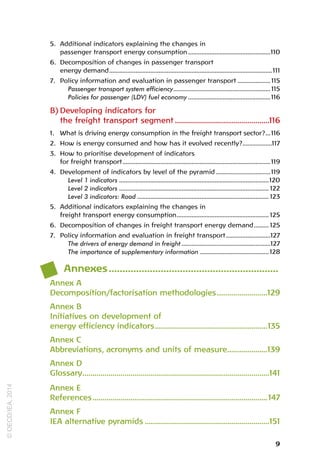
5. Additional indicators explaining the changes in
passenger transport energy consumption...................................................110
6. Decomposition of changes in passenger transport
energy demand.
...................................................................................................111
7. Policy information and evaluation in passenger transport..................... 115
Passenger transport system efficiency.
........................................................... 115
Policies for passenger (LDV) fuel economy...................................................116
B) Developing indicators for
the freight transport segment................................................116
1. What is driving energy consumption in the freight transport sector?.
...116
2. How is energy consumed and how has it evolved recently?.
..................117
3. How to prioritise development of indicators
for freight transport.
..........................................................................................119
4. Development of indicators by level of the pyramid..................................119
Level 1 indicators............................................................................................120
Level 2 indicators............................................................................................ 122
Level 3 indicators: Road................................................................................. 123
5. Additional indicators explaining the changes in
freight transport energy consumption.
........................................................ 125
6. Decomposition of changes in freight transport energy demand.
......... 125
7. Policy information and evaluation in freight transport.
...........................127
The drivers of energy demand in freight.......................................................127
The importance of supplementary information........................................... 128
Annexes.
..............................................................
Annex A
Decomposition/factorisation methodologies.
.........................129
Annex B
Initiatives on development of
energy efficiency indicators.
........................................................135
Annex C
Abbreviations, acronyms and units of measure....................139
Annex D
Glossary.
.............................................................................................141
Annex E
References.
.......................................................................................147
Annex F
IEA alternative pyramids...............................................................151
©
OECD/IEA,
2014
10
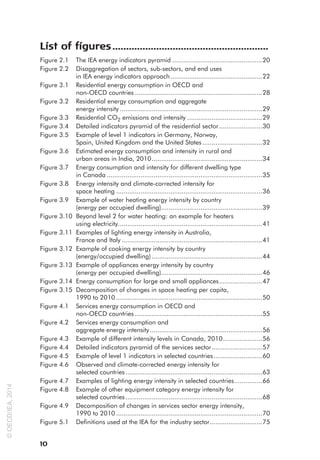
List of figures.
.........................................................
Figure 2.1 The IEA energy indicators pyramid.................................................20
Figure 2.2 Disaggregation of sectors, sub-sectors, and end uses
in IEA energy indicators approach..................................................22
Figure 3.1 Residential energy consumption in OECD and
non-OECD countries.....................................................................28
Figure 3.2 Residential energy consumption and aggregate
energy intensity.............................................................................29
Figure 3.3 Residential CO2 emissions and intensity.........................................29
Figure 3.4 Detailed indicators pyramid of the residential sector........................30
Figure 3.5 Example of level 1 indicators in Germany, Norway,
Spain, United Kingdom and the United States.................................32
Figure 3.6 Estimated energy consumption and intensity in rural and
urban areas in India, 2010.
...........................................................34
Figure 3.7 Energy consumption and intensity for different dwelling type
in Canada....................................................................................35
Figure 3.8 Energy intensity and climate-corrected intensity for
space heating...............................................................................36
Figure 3.9 Example of water heating energy intensity by country
(energy per occupied dwelling).
......................................................39
Figure 3.10 Beyond level 2 for water heating: an example for heaters
using electricity.
.............................................................................41
Figure 3.11 Examples of lighting energy intensity in Australia,
France and Italy............................................................................41
Figure 3.12 Example of cooking energy intensity by country
(energy/occupied dwelling)............................................................44
Figure 3.13 Example of appliances energy intensity by country
(energy per occupied dwelling).
......................................................46
Figure 3.14 Energy consumption for large and small appliances.
.......................47
Figure 3.15 Decomposition of changes in space heating per capita,
1990 to 2010...............................................................................50
Figure 4.1 Services energy consumption in OECD and
non-OECD countries.....................................................................55
Figure 4.2 Services energy consumption and
aggregate energy intensity.............................................................56
Figure 4.3 Example of different intensity levels in Canada, 2010.
.....................56
Figure 4.4 Detailed indicators pyramid of the services sector.
...........................57
Figure 4.5 Example of level 1 indicators in selected countries...........................60
Figure 4.6 Observed and climate-corrected energy intensity for
selected countries..........................................................................63
Figure 4.7 Examples of lighting energy intensity in selected countries.
...............66
Figure 4.8 Example of other equipment category energy intensity for
selected countries..........................................................................68
Figure 4.9 Decomposition of changes in services sector energy intensity,
1990 to 2010...............................................................................70
Figure 5.1 Definitions used at the IEA for the industry sector.
............................75
©
OECD/IEA,
2014
11
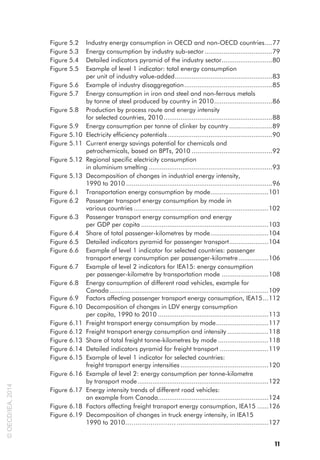
Figure 5.2 Industry energy consumption in OECD and non-OECD countries.
....77
Figure 5.3 Energy consumption by industry sub-sector.....................................79
Figure 5.4 Detailed indicators pyramid of the industry sector.
...........................80
Figure 5.5 Example of level 1 indicator: total energy consumption
per unit of industry value-added.
....................................................83
Figure 5.6 Example of industry disaggregation.
...............................................85
Figure 5.7 Energy consumption in iron and steel and non-ferrous metals
by tonne of steel produced by country in 2010.
...............................86
Figure 5.8 Production by process route and energy intensity
for selected countries, 2010...........................................................88
Figure 5.9 Energy consumption per tonne of clinker by country........................89
Figure 5.10 Electricity efficiency potentials.
........................................................90
Figure 5.11 Current energy savings potential for chemicals and
petrochemicals, based on BPTs, 2010............................................92
Figure 5.12 Regional specific electricity consumption
in aluminium smelting...................................................................93
Figure 5.13 Decomposition of changes in industrial energy intensity,
1990 to 2010...............................................................................96
Figure 6.1 Transportation energy consumption by mode.
...............................101
Figure 6.2 Passenger transport energy consumption by mode in
various countries.........................................................................102
Figure 6.3 Passenger transport energy consumption and energy
per GDP per capita.....................................................................103
Figure 6.4 Share of total passenger-kilometres by mode.
...............................104
Figure 6.5 Detailed indicators pyramid for passenger transport.
.....................104
Figure 6.6 Example of level 1 indicator for selected countries: passenger
transport energy consumption per passenger-kilometre.................106
Figure 6.7 Example of level 2 indicators for IEA15: energy consumption
per passenger-kilometre by transportation mode..........................108
Figure 6.8 Energy consumption of different road vehicles, example for
Canada......................................................................................109
Figure 6.9 Factors affecting passenger transport energy consumption, IEA15....112
Figure 6.10 Decomposition of changes in LDV energy consumption
per capita, 1990 to 2010............................................................113
Figure 6.11 Freight transport energy consumption by mode.
............................117
Figure 6.12 Freight transport energy consumption and intensity.......................118
Figure 6.13 Share of total freight tonne-kilometres by mode............................118
Figure 6.14 Detailed indicators pyramid for freight transport...........................119
Figure 6.15 Example of level 1 indicator for selected countries:
freight transport energy intensities................................................120
Figure 6.16 Example of level 2: energy consumption per tonne-kilometre
by transport mode.
......................................................................122
Figure 6.17 Energy intensity trends of different road vehicles:
an example from Canada.
...........................................................124
Figure 6.18 Factors affecting freight transport energy consumption, IEA15.......126
Figure 6.19 Decomposition of changes in truck energy intensity, in IEA15
1990 to 2010……………………..................................................127
©
OECD/IEA,
2014
12
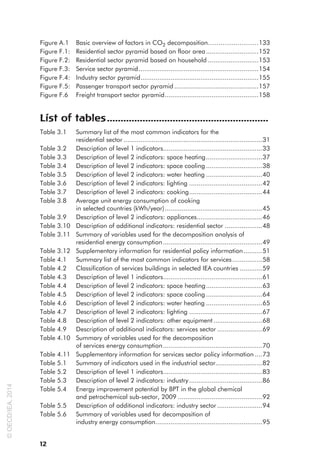
Figure A.1 Basic overview of factors in CO2 decomposition…………………….
133
Figure F.1: Residential sector pyramid based on floor area.............................152
Figure F.2: Residential sector pyramid based on household............................153
Figure F.3: Service sector pyramid.
................................................................154
Figure F.4: Industry sector pyramid.
...............................................................155
Figure F.5: Passenger transport sector pyramid..............................................157
Figure F.6 Freight transport sector pyramid.
..................................................158
List of tables.
...........................................................
Table 3.1 Summary list of the most common indicators for the
residential sector...........................................................................31
Table 3.2 Description of level 1 indicators.
.....................................................33
Table 3.3 Description of level 2 indicators: space heating.
..............................37
Table 3.4 Description of level 2 indicators: space cooling...............................38
Table 3.5 Description of level 2 indicators: water heating...............................40
Table 3.6 Description of level 2 indicators: lighting........................................42
Table 3.7 Description of level 2 indicators: cooking.
.......................................44
Table 3.8 Average unit energy consumption of cooking
in selected countries (kWh/year).....................................................45
Table 3.9 Description of level 2 indicators: appliances.
...................................46
Table 3.10 Description of additional indicators: residential sector.....................48
Table 3.11 Summary of variables used for the decomposition analysis of
residential energy consumption......................................................49
Table 3.12 Supplementary information for residential policy information...........51
Table 4.1 Summary list of the most common indicators for services.................58
Table 4.2 Classification of services buildings in selected IEA countries.............59
Table 4.3 Description of level 1 indicators.
.....................................................61
Table 4.4 Description of level 2 indicators: space heating.
..............................63
Table 4.5 Description of level 2 indicators: space cooling...............................64
Table 4.6 Description of level 2 indicators: water heating...............................65
Table 4.7 Description of level 2 indicators: lighting........................................67
Table 4.8 Description of level 2 indicators: other equipment...........................68
Table 4.9 Description of additional indicators: services sector.........................69
Table 4.10 Summary of variables used for the decomposition
of services energy consumption.
.....................................................70
Table 4.11 Supplementary information for services sector policy information.....73
Table 5.1 Summary of indicators used in the industrial sector.........................82
Table 5.2 Description of level 1 indicators.
.....................................................83
Table 5.3 Description of level 2 indicators: industry........................................86
Table 5.4 Energy improvement potential by BPT in the global chemical
and petrochemical sub-sector, 2009..............................................92
Table 5.5 Description of additional indicators: industry sector.........................94
Table 5.6 Summary of variables used for decomposition of
industry energy consumption.
.........................................................95
©
OECD/IEA,
2014
13
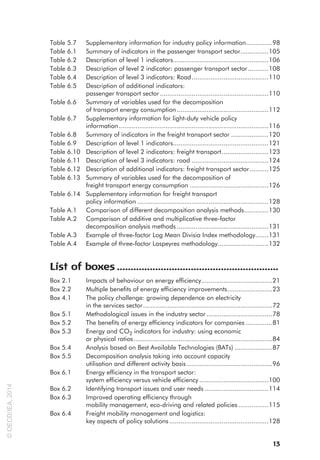
Table 5.7 Supplementary information for industry policy information.
..............98
Table 6.1 Summary of indicators in the passenger transport sector.
...............105
Table 6.2 Description of level 1 indicators.
...................................................106
Table 6.3 Description of level 2 indicator: passenger transport sector............108
Table 6.4 Description of level 3 indicators: Road.
.........................................110
Table 6.5 Description of additional indicators:
passenger transport sector...........................................................110
Table 6.6 Summary of variables used for the decomposition
of transport energy consumption..................................................112
Table 6.7 Supplementary information for light-duty vehicle policy
information.
................................................................................116
Table 6.8 Summary of indicators in the freight transport sector.....................120
Table 6.9 Description of level 1 indicators.
...................................................121
Table 6.10 Description of level 2 indicators: freight transport.
.........................123
Table 6.11 Description of level 3 indicators: road..........................................124
Table 6.12 Description of additional indicators: freight transport sector...........125
Table 6.13 Summary of variables used for the decomposition of
freight transport energy consumption...........................................126
Table 6.14 Supplementary information for freight transport
policy information.......................................................................128
Table A.1 Comparison of different decomposition analysis methods.
.............130
Table A.2 Comparison of additive and multiplicative three-factor
decomposition analysis methods..................................................131
Table A.3 Example of three-factor Log Mean Divisia Index methodology.
.......131
Table A.4 Example of three-factor Laspeyres methodology.
...........................132
List of boxes............................................................
Box 2.1 Impacts of behaviour on energy efficiency......................................21
Box 2.2 Multiple benefits of energy efficiency improvements.
........................23
Box 4.1 The policy challenge: growing dependence on electricity
in the services sector.
.....................................................................72
Box 5.1 Methodological issues in the industry sector....................................78
Box 5.2 The benefits of energy efficiency indicators for companies...............81
Box 5.3 Energy and CO2 indicators for industry: using economic
or physical ratios...........................................................................84
Box 5.4 Analysis based on Best Available Technologies (BATs).....................87
Box 5.5 Decomposition analysis taking into account capacity
utilisation and different activity basis.
..............................................96
Box 6.1 Energy efficiency in the transport sector:
system efficiency versus vehicle efficiency......................................100
Box 6.2 Identifying transport issues and user needs...................................114
Box 6.3 Improved operating efficiency through
mobility management, eco-driving and related policies.................115
Box 6.4 Freight mobility management and logistics:
key aspects of policy solutions......................................................128
©
OECD/IEA,
2014
©
OECD/IEA,
2014
Countries around the world are increasingly aware of the urgent need to transform
the way they use energy. Concern over energy security, the social and economic
impacts of high energy prices, and growing awareness of climate change have led
many countries to put greater emphasis on developing policies and measures that
promote energy efficiency. Two things have become increasingly clear:
■ 
Ensuring better use of global energy resources will require policies that encompass
a wide range of options. There is a growing recognition that improving energy
efficiency is often the most economic, proven and readily available means of
achieving this goal.
■ 
Establishing and maintaining sound policies requires the availability of good-
quality, timely, comparable and detailed data that go well beyond those currently
included in energy balances, and which reflect the distinct characteristics of
economic activity and resources available in each country.
For decades, countries have used the data contained in energy balances as a means
of tracking energy consumption according to type of energy source and by major
sector, and as a way to develop aggregate indicators (such as total energy per
capita). Aggregate indicators have the advantage that they are often readily and
widely available: thus, they reveal high-level developments in energy consumption
in simple terms. However, their usefulness is limited and can generate misleading
results when used inappropriately. For example, it would be incorrect to rank energy
performance according to a country’s total final consumption per gross domestic
product (GDP) or per capita given the many factors (e.g. climate, wealth, economic
structure) influencing this indicator.
As each main sector is influenced by varying underlying factors, different explanatory
data will be needed depending on the sector analysed. Such data are not reported
in energy balances and are currently available for only a few countries. Thus, in
order to develop estimates of overall energy efficiency, detailed data are required
for end-use sectors.
Development of state-of-the-art indicators is not straightforward and requires
financial and human resources to collect detailed data, and analyse the information.
Recent efforts by several countries to collect more detailed end-use data have
helped to develop energy efficiency indicators that provide important information
for understanding past trends, assessing potential for energy savings and enhancing
energy efficiency policies. However, much more still needs to be done. The full
spectrum of detailed indicators cannot be developed within a few years. It is
important for countries to prioritise which sectors – or which segments of a sector
will be prioritised – and then build on the expertise that will be gained.
The goal of this publication is to provide the necessary tools for analysts and policy
makers to prioritise the development of energy efficiency indicators, and build
Introduction
15
©
OECD/IEA,
2014
Exploring the Variety of Random
Documents with Different Content
of the Red Sea; it is here that pilgrims and travellers disembark, and
get their camels to start for Mount Sinai.
I went on shore in the afternoon and bought some provisions at a
Greek store there, and by a most unexpected chance found some of
Fortnum and Mason's preserved soups at this out-of-the-way place;
they had been part of the cargo of a ship that had been wrecked in
the Gulf of Suez. The goods had been bought by some Greeks of the
Suez Bazaar, then sent down to Tur. I went to see the old Russian
gentleman who makes arrangements for all travellers to Mount Sinai.
I bought some tortoiseshell from him, and also purchased a pretty
good collection of coral and Red Sea shells from a Greek who was
hanging about, and who also sold me three beautiful little sponges.
Cordock, the French captain, and I walked out to a grove of date-
palm trees not far off; the mountains in the distance were covered
with a strange purple haze, peculiar to the Red Sea, and afforded a
magnificent appearance. These hills reminded me very much of the
scenery of the background of some of Gustave Doré's illustrations.
April 10.—We weighed anchor at seven o'clock in the morning; but it
was still very rough. The P.  O. ship passed us about five P.M. We
had just enough coal to last us thirty hours, and we had to run one
hundred and twenty-five miles. Thank God! the wind dropped, or I
cannot guess where we should have been. We heard at Tur that an
English ship was on the Zafarina reef. They also told us that it was
blowing so hard that ships' boats could not get ashore from the
vessels lying in the roads at Suez.
April 11.—At last I have arrived at the end of my journey, but more
by good luck than good management. We dropped our anchor at
eight o'clock in the Suez roads, having just got four tons of coal left.
If these had run out we should have had to go back to Jidda for
coal, or else gone ashore in a boat and trudged up to Suez.
Here my Journal ends. And I hope no other unhappy mortal who
may go travelling in search of sport will ever have such a journey
home as mine has been.
FOOTNOTES:
[1] An Indian word for a large square tent.
[2] Earl of Ranfurly, Captain Grenadier Guards, who died at
Souakim, on the Red Sea, May 10, 1875, on board the steamer
which was that day leaving for Suez.
[3] It is not a necessary coincidence that if the back becomes
sore the swelling should come on, as I have seen several cases
where there were no outward signs of soreness, but still where
large swellings were forming.
[4] The courbatch is a whip made of hippopotamus hide, and
used in Egypt and in the provinces belonging to that country. It is
with this whip that malefactors and offenders against the law are
chastised. Every stroke of it, if well laid on, will cut into the flesh.
[5] General Kirkham was formerly a steward in the P. and O.
service. He left the P. and O. ship in China, to join the British
contingent which Colonel Gordon at that time was raising for the
war in China. General Kirkham was terribly wounded both in the
head and shoulder in this war; he came home, and Sir William
Fergusson, the surgeon, cured him. He afterwards went to
Annesley Bay, and, at the time of the Abyssinian expedition, he
was employed by Lord Napier of Magdala to buy bullocks for
commissariat purposes; when the expedition was over he
received leave from Lord Napier to go into Abyssinia. He tendered
his services to the king, and was made a colonel of the Abyssinian
army. Having drilled some Abyssinian soldiers in the English
fashion for the king, in the battle which the king fought against
the rebel Goubasse he gained a well-won reputation, for it was
owing entirely to those men that Johannes the king won this
battle. After this he was made commander-in-chief, which he is
now. It may be remembered by some of my readers that General
Kirkham came home to England on a mission from King
Johannes, to claim protection for Abyssinia from the English
Government. This mission failed, and he returned to Abyssinia.
[6] Value about 4s. 2d.
[7] Sunset is at six P.M.
[8] Her Abyssinian name was Desta, which means happy.
[9] Terramnee means stones in a row. This is a Tigré word, the
name of one of the large divisions or provinces of Abyssinia.
[10] Ballaga is the Amharic for a farmer, or one who cultivates
land The other three classes in Abyssinia are chiefs, soldiers or
followers of chiefs, and merchants.
[11] Chillumchee is an Indian word for a flat-bottomed tin basin.
[12] Cumberbund is an Indian word for a thick scarf which is
wound round and round the waist; it is a great preventive against
sunstroke and chills.
[13] Shum is Amharic for a chief of several villages.
[14] Angareb is an Arabic word for an oblong framework raised
on legs; a network of raw hide is stretched on the frame, and the
whole forms the sort of bed that is used nearly all over the East.
50a, Albemarle Street,
London,
January, 1876.
MR. MURRAY'S
GENERAL LIST OF WORKS.
ALBERT (The) MEMORIAL. A Descriptive and Illustrated
Account of the National Monument erected to the
PRINCE CONSORT at Kensington. Illustrated by
Engravings of its Architecture, Decorations,
Sculptured Groups, Statues, Mosaics, Metalwork, c.
With Descriptive Text. By Doyne C. Bell. With 24
Plates. Folio. 12l. 12s.
—— (Prince) Speeches and Addresses with an
Introduction, giving some outline of his Character.
With Portrait. 8vo. 10s. 6d.; or Popular Edition, Fcap.
8vo. 1s.
ALBERT DURER; his Life and Works. By Dr. Thausing,
Keeper of Archduke Albert's Art Collection at Vienna.
Translated from the German. With Portrait
Illustrations. Medium 8vo.
[In the Press.
ABBOTT'S (Rev. J.) Memoirs of a Church of England
Missionary in the North American Colonies. Post 8vo.
2s.
ABERCROMBIE'S (John) Enquiries concerning the
Intellectual Powers and the Investigation of Truth.
Fcap. 8vo. 3s. 6d.
—— Philosophy of the Moral Feelings. Fcap. 8vo. 2s.
6d.
ACLAND'S (Rev. Charles) Popular Account of the
Manners and Customs of India. Post 8vo. 2s.
ÆSOP'S FABLES. A New Version. With Historical
Preface. By Rev. Thomas James. With 100 Woodcuts,
by Tenniel and Wolf. Post 8vo. 2s. 6d.
AGRICULTURAL (Royal) JOURNAL. (Published half
yearly.)
AIDS TO FAITH: a Series of Theological Essays. 8vo.
9s.
CONTENTS.
Miracles Dean Mansel.
Evidences of Christianity Bishop Fitzgerald.
Prophecy  Mosaic Record
of Creation
Dr. McCaul.
Ideology and Subscription Canon Cook.
The Pentateuch
Canon
Rawlinson.
Inspiration
Bishop Harold
Browne.
Death of Christ
Archbishop
Thomson.
Scripture and its
Interpretation
Bishop Ellicott.
AMBER-WITCH (The). A most interesting Trial for
Witchcraft. Translated by Lady Duff Gordon. Post 8vo.
2s.
ARMY LIST (The). Published Monthly by Authority.
ARTHUR'S (Little) History of England. By Lady Callcott.
New Edition, continued to 1872. With 36 Woodcuts.
Fcap. 8vo. 1s. 6d.
AUSTIN'S (John) Lectures on General Jurisprudence; or,
the Philosophy of Positive Law. Edited by Robert
Campbell. 2 Vols. 8vo. 32s.
—— Student's Edition, compiled from the above work.
Post 8vo. 12s.
ARNOLD'S (Thos.) Ecclesiastical and Secular
Architecture of Scotland: The Abbeys, Churches,
Castles, and Mansions. With Illustrations. Medium
8vo.
[In Preparation.
ADMIRALTY PUBLICATIONS; Issued by direction of the
Lords Commissioners of the Admiralty:—
A MANUAL OF SCIENTIFIC ENQUIRY, for the Use
of Travellers. Fourth Edition. Edited by Robert
Main, M.A. Woodcuts. Post 8vo. 3s. 6d.
GREENWICH ASTRONOMICAL OBSERVATIONS
1841 to 1846, and 1847 to 1871. Royal 4to.
20s. each.
MAGNETICAL AND METEOROLOGICAL
OBSERVATIONS. 1840 to 1847. Royal 4to. 20s.
each.
APPENDICES TO OBSERVATIONS.
1837. Logarithms of Sines and Cosines in
Time. 3s.
1842. Catalogue of 1439 Stars, from
Observations made in 1836 to 1841. 4s.
1845. Longitude of Valentia
(Chronometrical). 3s.
1847. Description of Altazimuth. 3s.
Twelve Years' Catalogue of Stars,
from Observations made in 1836 to
1847. 4s.
Description of Photographic
Apparatus. 2s.
1851. Maskelyne's Ledger of Stars. 3s.
1852. I. Description of the Transit Circle.
3s.
1853. Refraction Tables. 3s.
1854. Description of the Zenith Tube. 3s.
Six Years' Catalogue of Stars, from
Observations. 1848 to 1853. 4s.
1862. Seven Years' Catalogue of Stars,
from Observations. 1854 to 1860. 10s.
Plan of Ground Buildings. 3s.
Longitude of Valentia (Galvanic). 2s.
1864. Moon's Semid. from Occultations. 2s.
Planetary Observations, 1831 to 1835.
2s.
1868. Corrections of Elements of Jupiter
and Saturn. 2s.
Second Seven Years' Catalogue of
2760 Stars for 1861 to 1867. 4s.
Description of the Great Equatorial.
3s.
1856. Descriptive Chronograph. 3s.
1860. Reduction of Deep Thermometer
Observations. 2s.
1871. History and Description of Water
Telescope. 3s.
Cape of Good Hope Observations (Star
Ledgers). 1856 to 1863. 2s.
—— 1856. 5s.
—— Astronomical Results. 1857 to 1858.
5s.
Report on Teneriffe Astronomical
Experiment. 1856. 5s.
Paramatta Catalogue of 7385 Stars. 1822 to
1826. 4s.
ASTRONOMICAL RESULTS. 1847 to 1871. 4to. 3s.
each.
MAGNETICAL AND METEOROLOGICAL RESULTS.
1847 to 1871. 4to. 3s. each.
REDUCTION OF THE OBSERVATIONS OF
PLANETS. 1750 to 1830. Royal 4to. 20s. each.
—— LUNAR OBSERVATIONS. 1750 to 1830. 2
Vols. Royal 4to. 20s. each.
—— 1831 to 1851. 4to. 10s. each.
BERNOULLI'S SEXCENTENARY TABLE. 1779. 4to.
5s.
BESSEL'S AUXILIARY TABLES FOR HIS METHOD
OF CLEARING LUNAR DISTANCES. 8vo. 2s.
ENCKE'S BERLINER JAHRBUCH, for 1830. Berlin,
1828. 8vo. 9s.
HANSEN'S TABLES DE LA LUNE. 4to. 20s.
LAX'S TABLES FOR FINDING THE LATITUDE AND
LONGITUDE. 1821. 8vo. 10s.
LUNAR OBSERVATIONS at GREENWICH. 1783 to
1819. Compared with the Tables, 1821. 4to. 7s.
6d.
MACLEAR ON LACAILLE'S ARC OF MERIDIAN. 2
Vols. 20s. each.
MAYER'S DISTANCES of the MOON'S CENTRE from
the PLANETS. 1822, 3s.; 1823, 4s. 6d. 1824 to
1835. 8vo. 4s. each.
—— TABULÆ MOTUUM SOLIS ET LUNÆ. 1770.
5s.
—— ASTRONOMICAL OBSERVATIONS MADE AT
GOTTINGEN, from 1756 to 1761. 1826. Folio.
7s. 6d.
NAUTICAL ALMANACS, from 1767 to 1877. 2s. 6d.
each.
—— SELECTIONS FROM, up to 1812. 8vo. 5s.
1834-54. 5s.
—— SUPPLEMENTS, 1828 to 1833, 1837 and
1838. 2s. each.
—— TABLE requisite to be used with the N.A.
1781. 8vo. 5s.
SABINE'S PENDULUM EXPERIMENTS to Determine
the Figure of the Earth. 1825. 4to. 40s.
SHEPHERD'S TABLES for Correcting Lunar
Distances. 1772. Royal 4to. 21s.
—— TABLES, GENERAL, of the MOON'S DISTANCE
from the SUN, and 10 STARS. 1787. Folio. 5s.
6d.
TAYLOR'S SEXAGESIMAL TABLE. 1780. 4to. 15s.
—— TABLES OF LOGARITHMS. 4to. 60s.
TIARK'S ASTRONOMICAL OBSERVATIONS for the
Longitude of Madeira. 1822. 4to. 5s.
—— CHRONOMETRICAL OBSERVATIONS for
Differences of Longitude between Dover,
Portsmouth, and Falmouth. 1823. 4to. 5s.
VENUS and JUPITER: Observations of, compared
with the Tables. London, 1822. 4to. 2s.
WALES' AND BAYLY'S ASTRONOMICAL
OBSERVATIONS. 1777. 4to. 21s.
—— REDUCTION OF ASTRONOMICAL
OBSERVATIONS made in the Southern Hemisphere.
1764-1771. 1788. 4to. 10s. 6d.
BARBAULD'S (Mrs.) Hymns in Prose for Children. With
Illustrations. Crown 8vo. 5s.
BARROW'S (Sir John) Autobiographical Memoir, from
Early Life to Advanced Age. Portrait. 8vo. 16s.
—— (John) Life, Exploits, and Voyages of Sir Francis
Drake. Post 8vo. 2s.
BARRY'S (Sir Charles) Life and Works. By Canon Barry.
With Portrait and Illustrations. Medium 8vo. 15s.
BATES' (H. W.) Records of a Naturalist on the River
Amazon during eleven years of Adventure and
Travel. Illustrations. Post 8vo. 7s. 6d.
BAX'S (Captain) Russian Tartary, Eastern Siberia, China,
Japan, and Formosa. A Narrative of a Cruise in the
Eastern Seas. With Map and Illustrations. Crown
8vo. 12s.
BEAUCLERK'S (Lady Diana) Summer and Winter in
Norway. With Illustrations. Small 8vo. 6s.
BELCHER'S (Lady) Account of the Mutineers of the
'Bounty,' and their Descendants; with their
Settlements in Pitcairn and Norfolk Islands. With
Illustrations. Post 8vo. 12s.
BELL'S (Sir Chas.) Familiar Letters. Portrait. Post 8vo.
12s.
BELT'S (Thos.) Naturalist in Nicaragua, including a
Residence at the Gold Mines of Chontales; with
Journeys in the Savannahs and Forests; and
Observations on Animals and Plants. Illustrations.
Post 8vo. 12s.
BERTRAM'S (Jas. G.) Harvest of the Sea: an Account of
British Food Fishes, including sketches of Fisheries
and Fisher Folk. With 50 Illustrations. 8vo. 9s.
BIBLE COMMENTARY. Explanatory and Critical. With a
Revision of the Translation. By BISHOPS and CLERGY
of the ANGLICAN CHURCH. Edited by F. C. Cook,
M.A., Canon of Exeter. Medium 8vo. Vol. I., 30s.
Vols. II. and III., 36s. Vol. IV., 24s. Vol. V., 20s. Vol.
VI., 20s.
Vol. I.
{Genesis.
{Exodus.
{Leviticus.
{Numbers.
{Deuteronomy.
Vols. II. and III.
{Joshua.
{Judges, Ruth, Samuel.
{Kings, Chronicles, Ezra,
{Nehemiah, Esther.
Vol. IV.
{Job.
{Psalms.
{Proverbs.
{Ecclesiastes.
{Song of Solomon.
Vol. V. {Isaiah.
{Jeremiah.
Vol. VI.
{Ezekiel.
{Daniel.
{Minor Prophets.
BIRCH'S (Samuel) History of Ancient Pottery and
Porcelain: Egyptian, Assyrian, Greek, Roman, and
Etruscan. With Coloured Plates and 200 Illustrations.
Medium 8vo. 42s.
BIRD'S (Isabella) Hawaiian Archipelago; or Six Months
Among the Palm Groves, Coral Reefs, and Volcanoes
of the Sandwich Islands. With Illustrations. Crown
8vo. 12s.
BISSET'S (Andrew) History of the Commonwealth of
England, from the Death of Charles I. to the
Expulsion of the Long Parliament by Cromwell.
Chiefly from the MSS. in the State Paper Office. 2
vols. 8vo. 30s.
—— (General) Sport and War in South Africa from 1834
to 1867, with a Narrative of the Duke of Edinburgh's
Visit. With Map and Illustrations. Crown 8vo. 14s.
BLACKSTONE'S COMMENTARIES; adapted to the
Present State of the Law. By R. Malcolm Kerr, LL.D.
Revised Edition, incorporating all the Recent
Changes in the Law. 4 vols. 8vo.
BLUNT'S (Rev. J. J.) Undesigned Coincidences in the
Writings of the Old and New Testaments, an
Argument of their Veracity: containing the Books of
Moses, Historical and Prophetical Scriptures, and the
Gospels and Acts. Post 8vo. 6s.
—— History of the Church in the First Three Centuries.
Post 8vo. 6s.
—— Parish Priest; His Duties, Acquirements and
Obligations. Post 8vo. 6s.
—— Lectures on the Right Use of the Early Fathers.
8vo. 9s.
—— University Sermons. Post 8vo. 6s.
—— Plain Sermons. 2 vols. Post 8vo. 12s.
BLOMFIELD'S (Bishop) Memoir, with Selections from his
Correspondence. By his Son. Portrait, post 8vo. 12s.
BOSWELL'S (James) Life of Samuel Johnson, LL.D.
Including the Tour to the Hebrides. By Mr. Croker.
New Edition. Portraits. 4 vols. 8vo.
[In Preparation.
BRACE'S (C. L.) Manual of Ethnology; or the Races of
the Old World. Post 8vo. 6s.
BOOK OF COMMON PRAYER. Illustrated with Coloured
Borders, Initial Letters, and Woodcuts. 8vo. 18s.
BORROW'S (George) Bible in Spain; or the Journeys,
Adventures, and Imprisonments of an Englishman in
an Attempt to circulate the Scriptures in the
Peninsula. Post 8vo. 5s.
—— Gypsies of Spain; their Manners, Customs,
Religion, and Language. With Portrait. Post 8vo. 5s.
—— Lavengro; The Scholar—The Gypsy—and the
Priest. Post 8vo. 5s.
—— Romany Rye—a Sequel to Lavengro. Post 8vo.
5s.
—— Wild Wales: its People, Language, and Scenery.
Post 8vo. 5s.
—— Romano Lavo-Lil; Word-Book of the Romany, or
English Gypsy Language; with Specimens of their
Poetry, and an account of certain Gypsyries. Post
8vo. 10s. 6d.
BRAY'S (Mrs.) Life of Thomas Stothard, R.A. With
Portrait and 60 Woodcuts. 4to. 21s.
—— Revolt of the Protestants in the Cevennes. With
some Account of the Huguenots in the Seventeenth
Century. Post 8vo. 10s. 6d.
BRITISH ASSOCIATION REPORTS. 8vo.
York and Oxford, 1831-32, 13s. 6d.
Cambridge, 1833, 12s.
Edinburgh, 1834, 15s.
Dublin, 1835, 13s. 6d.
Bristol, 1836, 12s.
Liverpool, 1837, 16s. 6d.
Newcastle, 1838, 15s.
Birmingham, 1839, 13s. 6d.
Glasgow, 1840, 15s.
Plymouth, 1841, 13s. 6d.
Manchester, 1842, 10s. 6d.
Cork, 1843, 12s.
York, 1844, 20s.
Cambridge, 1845, 12s.
Southampton, 1846, 15s.
Oxford, 1847, 18s.
Swansea, 1848, 9s.
Birmingham, 1849, 10s.
Edinburgh, 1850, 15s.
Ipswich, 1851, 16s. 6d.
Belfast, 1852, 15s.
Hull, 1853, 10s. 6d.
Liverpool, 1854, 18s.
Glasgow, 1855, 15s.
Cheltenham, 1856, 18s.
Dublin, 1857, 15s.
Leeds, 1858, 20s.
Aberdeen, 1859, 15s.
Oxford, 1860, 25s.
Manchester, 1861, 15s.
Cambridge, 1862, 20s.
Newcastle, 1863, 25s.
Bath, 1864, 18s.
Birmingham, 1865, 25s.
Nottingham, 1866, 24s.
Dundee, 1867, 26s.
Norwich, 1868, 25s.
Exeter, 1869, 22s.
Liverpool, 1870, 18s.
Edinburgh, 1871, 16s.
Brighton, 1872, 24s.
Bradford, 1873, 25s.
Belfast, 1874.
BROUGHTON'S (Lord) Journey through Albania, Turkey
in Europe and Asia, to Constantinople. Illustrations.
2 Vols. 8vo. 30s.
—— Visits to Italy. 2 Vols. Post 8vo. 18s.
BROWNLOW'S (Lady) Reminiscences of a
Septuagenarian. From the year 1802 to 1815. Post
8vo. 7s. 6d.
BRUGSCH'S (Professor) History of Ancient Egypt.
Derived from Monuments and Inscriptions. New
Edition. Translated by H. Danby Seymour. 8vo.
[In Preparation.
BUCKLEY'S (Arabella B.) Short History of Natural
Science, and the Progress of Discovery from the
time of the Greeks to the present day, for Schools
and young Persons. Illustrations. Post 8vo. 9s.
BURGON'S (Rev. J. W.) Christian Gentleman; or,
Memoir of Patrick Fraser Tytler. Post 8vo. 9s.
—— Letters from Rome. Post 8vo. 12s.
BURN'S (Col.) Dictionary of Naval and Military
Technical Terms, English and French—French and
English. Crown 8vo. 15s.
BURROW'S (Montagu) Constitutional Progress. A Series
of Lectures delivered before the University of Oxford.
Post 8vo. 5s.
BUXTON'S (Charles) Memoirs of Sir Thomas Fowell
Buxton, Bart. With Selections from his
Correspondence. Portrait. 8vo. 16s. Popular Edition.
Fcap. 8vo. 5s.
—— Notes of Thought. With Biographical Sketch. By
Rev. Llewellyn Davies. With Portrait. Crown 8vo. 10s.
6d.
BURCKHARDT'S (Dr. Jacob) Cicerone; or Art Guide to
Painting in Italy. Edited by Rev. Dr. A. Von Zahn, and
Translated from the German by Mrs. A. Clough. Post
8vo. 6s.
BYLES' (Sir John) Foundations of Religion in the Mind
and Heart of Man. Post 8vo. 6s.
BYRON'S (Lord) Life, Letters, and Journals. By Thomas
Moore. Cabinet Edition. Plates, 6 Vols. Fcap. 8vo.
18s.; or One Volume, Portraits. Royal 8vo., 7s. 6d.
—— and Poetical Works. Popular Edition. Portraits. 2
vols. Royal 8vo. 15s.
—— Poetical Works. Library Edition. Portrait. 6 Vols.
8vo. 45s.
———— Cabinet Edition. Plates. 10 Vols. 12mo. 30s.
———— Pocket Edition. 8 Vols. 24mo. 21s. In a case.
———— Popular Edition. Plates. Royal 8vo. 7s. 6d.
———— Pearl Edition. Crown 8vo. 2s. 6d.
—— Childe Harold. With 80 Engravings. Crown 8vo.
12s.
———— 16mo. 2s. 6d.
———— Vignettes. 16mo. 1s.
———— Portrait. 16mo. 6d.
—— Tales and Poems. 24mo. 2s. 6d.
—— Miscellaneous. 2 Vols. 24mo. 5s.
—— Dramas and Plays. 2 Vols. 24mo. 5s.
—— Don Juan and Beppo. 2 Vols. 24mo. 5s.
—— Beauties. Poetry and Prose. Portrait. Fcap. 8vo.
3s. 6d.
BUTTMAN'S Lexilogus; a Critical Examination of the
Meaning of numerous Greek Words, chiefly in Homer
and Hesiod. By Rev. J. R. Fishlake. 8vo. 12s.
—— Irregular Greek Verbs. With all the Tenses extant
—their Formation, Meaning, and Usage, with Notes,
by Rev. J. R. Fishlake. Post 8vo. 6s.
CALLCOTT'S (Lady) Little Arthur's History of England.
New Edition, brought down to 1872. With Woodcuts.
Fcap. 8vo. 1s. 6d.
CARNARVON'S (Lord) Portugal, Gallicia, and the
Basque Provinces. Post 8vo. 3s. 6d.
—— Reminiscences of Athens and the Morea. With
Map. Crown 8vo. 7s. 6d.
—— Recollections of the Druses of Lebanon. With
Notes on their Religion. Post 8vo. 5s. 6d.
CASTLEREAGH (The) Despatches, from the
commencement of the official career of Viscount
Castlereagh to the close of his life. 12 Vols. 8vo. 14s.
each.
CAMPBELL'S (Lord) Lord Chancellors and Keepers of
the Great Seal of England. From the Earliest Times
to the Death of Lord Eldon in 1838. 10 Vols. Crown
8vo. 6s. each.
—— Chief Justices of England. From the Norman
Conquest to the Death of Lord Tenterden. 4 Vols.
Crown 8vo. 6s. each.
—— Lords Lyndhurst and Brougham. 8vo. 16s.
—— Shakspeare's Legal Acquirements. 8vo. 5s. 6d.
—— Lord Bacon. Fcap. 8vo. 2s. 6d.
—— (Sir Neil) Account of Napoleon at Fontainebleau
and Elba. Being a Journal of Occurrences and Notes
of his Conversations, c. Portrait. 8vo. 15s.
—— (Sir George) India as it may be: an Outline of a
proposed Government and Policy. 8vo.
—— (Thos.) Essay on English Poetry. With Short Lives
of the British Poets. Post 8vo. 3s. 6d.
CATHCART'S (Sir George) Commentaries on the War in
Russia and Germany, 1812-13. Plans. 8vo. 14s.
CAVALCASELLE AND CROWE'S History of Painting in
North Italy, from the 14th to the 16th Century. With
Illustrations. 2 Vols. 8vo. 42s.
—— Early Flemish Painters, their Lives and Works.
Illustrations. Post 8vo. 10s. 6d.; or Large Paper, 8vo.
15s.
CHILD'S (G. Chaplin, M.D.) Benedicite; or, Song of the
Three Children; being Illustrations of the Power,
Beneficence, and Design manifested by the Creator
in his works. Post 8vo. 6s.
CHISHOLM'S (Mrs.) Perils of the Polar Seas; True
Stories of Arctic Discovery and Adventure.
Illustrations. Post 8vo. 6s.
CHURTON'S (Archdeacon) Gongora. An Historical Essay
on the Age of Philip III. and IV. of Spain. With
Translations. Portrait. 2 Vols. Small 8vo. 12s.
—— Poetical Remains, Translations and Imitations.
Portrait. Post 8vo. 7s. 6d.
—— New Testament. Edited with a Plain Practical
Commentary for Families and General Readers. With
100 Panoramic and other Views, from Sketches
made on the Spot. 2 vols. 8vo. 2s.
CICERO'S Life and Times. His Character as a Statesman,
Orator, and Friend, with a Selection from his
Correspondence and Orations. By William Forsyth,
M.P. With Illustrations. 8vo. 10s. 6d.
CLARK'S (Sir James) Memoir of Dr. John Conolly.
Comprising a Sketch of the Treatment of the Insane
in Europe and America. With Portrait. Post 8vo. 10s.
6d.
CLIVE'S (Lord) Life. By Rev. G. R. Gleig. Post 8vo. 3s.
6d.
CLODE'S (C. M.) Military Forces of the Crown; their
Administration and Government. 2 Vols. 8vo. 21s.
each.
—— Administration of Justice under Military and
Martial Law, as applicable to the Army, Navy, Marine,
and Auxiliary Forces. 8vo. 12s.
COLCHESTER (The) Papers. The Diary and
Correspondence of Charles Abbott, Lord Colchester,
Speaker of the House of Commons. 1802-1817.
Portrait. 3 Vols. 8vo. 42s.
CHURCH (The)  THE AGE. Essays on the Principles
and Present Position of the Anglican Church. 2 vols.
8vo. 26s. Contents:—
Vol. I.
Anglican Principles.—Dean Hook.
Modern Religious Thought.—Bishop Ellicott.
State, Church, and Synods.—Rev. Dr. Irons.
Religious Use of Taste.—Rev. R. St. John Tyrwhitt.
Place of the Laity.—Professor Burrows.
Parish Priest.—Rev. Walsham How.
Divines of 16th and 17th Centuries.—Rev. A. W.
Haddan.
Liturgies and Ritual, Rev. M. F. Sadler.
Church  Education.—Canon Barry.
Indian Missions.—Sir Bartle Frere.
Church and the People.—Rev. W. D. Maclagan.
Conciliation and Comprehension.—Rev. Dr. Weir.
Vol. II.
Church and Pauperism.—Earl Nelson.
American Church.—Bishop of Western New York.
Church and Science.—Prebendary Clark.
Ecclesiastical Law.—Isambard Brunel.
Church  National Education.—Canon Norris.
Church and Universities.—John G. Talbot.
Toleration.—Dean Cowie.
Eastern Church and Anglican Communion.—Rev.
Geo. Williams.
A Disestablished Church.—Dean of Cashel.
Christian Tradition.—Rev. Dr. Irons.
Dogma.—Rev. Dr. Weir.
Parochial Councils.—Archdeacon Chapman.
COLERIDGE'S (Samuel Taylor) Table-Talk. Portrait.
12mo. 3s. 6d.
COLLINGWOOD'S (Cuthbert) Rambles of a Naturalist on
the Shores and Waters of the China Sea. With
Illustrations. 8vo. 16s.
COLONIAL LIBRARY. [See Home and Colonial Library.]
COOK'S (Canon) Sermons Preached at Lincoln's Inn.
8vo. 9s.
COOKE'S (E. W.) Artist's Portfolio. Being Sketches
made during Tours in Holland, Germany, Italy, Egypt,
c. 50 Plates. Royal 4to.
[In Preparation.
COOKERY (Modern Domestic). Founded on Principles of
Economy and Practical Knowledge, By a Lady.
Woodcuts. Fcap. 8vo. 6s.
COOPER'S (T. T.) Travels of a Pioneer of Commerce on
an Overland Journey from China towards India.
Illustrations. 8vo. 16s.
CORNWALLIS (The) Papers and Correspondence during
the American War,—Administrations in India,—Union
with Ireland, and Peace of Amiens. 3 Vols. 8vo. 63s.
COWPER'S (Countess) Diary while Lady of the
Bedchamber to Caroline, Princess of Wales, 1714-20.
Portrait. 8vo. 10s. 6d.
CRABBE'S (Rev. George) Life and Poetical Works. With
Illustrations. Royal 8vo. 7s.
CRAWFORD  BALCARRE'S (Earl of) Etruscan
Inscriptions. Analyzed, Translated, and Commented
upon. 8vo. 12s.
—— Argo; or the Quest of the Golden Fleece. In Ten
Books. 8vo.
CROKER'S (J. W.) Progressive Geography for Children.
18mo. 1s. 6d.
—— Stories for Children, Selected from the History of
England. Woodcuts. 16mo. 2s. 6d.
—— Boswell's Life of Johnson. Including the Tour to
the Hebrides. New Edition. Portraits. 4 vols. 8vo.
[In Preparation.
—— Early Period of the French Revolution. 8vo. 15s.
—— Historical Essay on the Guillotine. Fcap. 8vo. 1s.
CUMMING'S (R. Gordon) Five Years of a Hunter's Life in
the Far Interior of South Africa. Woodcuts. Post 8vo.
6s.
CROWE'S and CAVALCASELLE'S Lives of the Early
Flemish Painters. Woodcuts. Post 8vo, 10s. 6d.; or
Large Paper, 8vo, 15s.
—— History of Painting in North Italy, from 14th to
16th Century. Derived from Researches into the
Works of Art in that Country. With Illustrations. 2
Vols. 8vo. 42s.
CUNYNGHAME'S (Sir Arthur) Travels in the Eastern
Caucasus, on the Caspian, and Black Seas, in
Daghestan and the Frontiers of Persia and Turkey.
With Map and Illustrations. 8vo. 18s.
CURTIUS' (Professor) Student's Greek Grammar, for the
Upper Forms. Edited by Dr. Wm. Smith. Post 8vo. 6s.
—— Elucidations of the above Grammar. Translated by
Evelyn Abbot. Post 8vo. 7s. 6d.
—— Smaller Greek Grammar for the Middle and Lower
Forms. Abridged from the larger work. 12mo, 3s. 6d.
—— Accidence of the Greek Language. Extracted from
the above work. 12mo. 2s. 6d.
—— Principles of Greek Etymology. Translated by A. S.
Wilkins, M.A., and E. B. England, B.A. Vol. I. 8vo. 15s.
CURZON'S (Hon. Robert) Armenia and Erzeroum. A Year
on the Frontiers of Russia, Turkey, and Persia.
Woodcuts. Post 8vo. 7s. 6d.
—— Visits to the Monasteries of the Levant.
Illustrations. Post 8vo. 7s. 6d.
CUST'S (General) Warriors of the 17th Century—The
Thirty Years' War. 2 Vols. 16s. Civil Wars of France
and England. 2 Vols. 16s. Commanders of Fleets and
Armies. 2 Vols. 18s.
—— Annals of the Wars—18th  19th Century, 1700-
1815. With Maps. 9 Vols. Post 8vo. 5s. each.
DAVIS'S (Nathan) Ruined Cities of Numidia and
Carthaginia. Illustrations. 8vo. 16s.
DAVY'S (Sir Humphry) Consolations in Travel; or, Last
Days of a Philosopher. Woodcuts. Fcap. 8vo. 3s. 6d.
—— Salmonia; or, Days of Fly Fishing. Woodcuts. Fcap.
8vo. 3s. 6d.
DARWIN'S (Charles) Journal of a Naturalist during a
Voyage round the World. Crown 8vo. 9s.
—— Origin of Species by Means of Natural Selection;
or, the Preservation of Favoured Races in the
Struggle for Life. Crown 8vo. 7s. 6d.
—— Variation of Animals and Plants under
Domestication. With Illustrations. 2 Vols. Crown 8vo.
18s.
—— Descent of Man, and Selection in Relation to Sex.
With Illustrations. Crown 8vo. 9s.
—— Expressions of the Emotions in Man and Animals.
With Illustrations. Crown 8vo. 12s.
—— Fertilization of Orchids through Insect Agency, and
as to the good of Intercrossing. Woodcuts. Post 8vo.
9s.
—— Movements and Habits of Climbing Plants.
Woodcuts. Crown 8vo. 6s.
—— Insectivorous Plants. Woodcuts. Crown 8vo. 14s.
—— Fact and Argument for Darwin. By Fritz Muller.
Translated by W. S. Dallas. Woodcuts. Post 8vo. 6s.
DELEPIERRE'S (Octave) History of Flemish Literature.
8vo. 9s.
—— Historic Difficulties  Contested Events. Post 8vo.
6s.
DENISON'S (E. B.) Life of Bishop Lonsdale. With
Selections from his Writings. With Portrait. Crown
8vo. 10s. 6d.
DERBY'S (Earl of) Iliad of Homer rendered into English
Blank Verse. 2 Vols. Post 8vo. 10s.
DE ROS'S (Lord) Young Officer's Companion; or, Essays
on Military Duties and Qualities: with Examples and
Illustrations from History. Post 8vo. 9s.
DEUTSCH'S (Emanuel) Talmud, Islam, The Targums and
other Literary Remains. 8vo. 12s.
DILKE'S (Sir C. W.) Papers of a Critic. Selected from
the Writings of the late Chas. Wentworth Dilke. With
a Biographical Sketch. 2 Vols. 8vo. 24s.
DOG-BREAKING; the Most Expeditious, Certain, and
Easy Method, whether great excellence or only
mediocrity be required. With a Few Hints for those
who Love the Dog and the Gun. By Lieut.-Gen.
Hutchinson. With 40 Woodcuts. Crown 8vo. 9s.
DOMESTIC MODERN COOKERY. Founded on Principles
of Economy and Practical Knowledge, and adapted
for Private Families. Woodcuts. Fcap. 8vo. 5s.
DOUGLAS'S (Sir Howard) Life and Adventures. Portrait.
8vo. 15s.
—— Theory and Practice of Gunnery. Plates. 8vo. 21s.
—— Construction of Bridges and the Passage of Rivers,
in Military Operations. Plates. 8vo. 21s.
—— (Wm.) Horse-Shoeing; As it Is, and As it Should
be. Illustrations. Post 8vo. 7s. 6d.
DRAKE'S (Sir Francis) Life, Voyages, and Exploits, by
Sea and Land. By John Barrow. Post 8vo. 2s.
DRINKWATER'S (John) History of the Siege of Gibraltar,
1779-1783. With a Description and Account of that
Garrison from the Earliest Periods. Post 8vo. 2s.
DUCANGE'S Mediæval Latin-English Dictionary.
Translated by Rev. E. A. Dayman, M.A. Small 4to. [In
preparation.
DU CHAILLU'S (Paul B.) Equatorial Africa, with
Accounts of the Gorilla, the Nest-building Ape,
Chimpanzee, Crocodile, c. Illustrations. 8vo. 21s.
—— Journey to Ashango Land; and Further
Penetration into Equatorial Africa. Illustrations. 8vo.
21s.
DUFFERIN'S (Lord) Letters from High Latitudes; a
Yacht Voyage to Iceland, Jan Mayen, and
Spitzbergen. Woodcuts. Post 8vo. 7s. 6d.
DUNCAN'S (Major) History of the Royal Artillery.
Compiled from the Original Records. With Portraits. 2
Vols. 8vo. 30s.
DYER'S (Thos. H.) History of Modern Europe, from the
taking of Constantinople by the Turks to the close of
the War in the Crimea. With Index. 4 Vols. 8vo. 42s.
EASTLAKE'S (Sir Charles) Contributions to the
Literature of the Fine Arts. With Memoir of the
Author, and Selections from his Correspondence. By
Lady Eastlake. 2 Vols. 8vo. 24s.
EDWARDS' (W. H.) Voyage up the River Amazons,
including a Visit to Para. Post 8vo. 2s.
EIGHT MONTHS AT ROME, during the Vatican Council,
with a Daily Account of the Proceedings. By Pomponio
Leto. Translated from the Original. 8vo.
[Nearly ready.
ELDON'S (Lord) Public and Private Life, with Selections
from his Correspondence and Diaries. By Horace
Twiss. Portrait. 2 Vols. Post 8vo. 21s.
ELGIN'S (Lord) Letters and Journals. Edited by
Theodore Walrond. With Preface by Dean Stanley. 8vo.
14s.
ELLESMERE'S (Lord) Two Sieges of Vienna by the
Turks. Translated from the German. Post 8vo. 2s.
ELLIS'S (W.) Madagascar, including a Journey to the
Capital, with notices of Natural History and the
People. Woodcuts. 8vo. 16s.
—— Madagascar Revisited. Setting forth the
Persecutions and Heroic Sufferings of the Native
Christians. Illustrations. 8vo. 16s.
—— Memoir. By His Son. With his Character and Work.
By Rev. Henry Allon, D.D. Portrait. 8vo. 10s. 6d.
—— (Robinson) Poems and Fragments of Catullus.
16mo. 5s.
ELPHINSTONE'S (Hon. Mountstuart) History of India—
the Hindoo and Mahomedan Periods. Edited by
Professor Cowell. Map. 8vo. 18s.
—— (H. W.) Patterns for Turning; Comprising Elliptical
and other Figures cut on the Lathe without the use
of any Ornamental Chuck. With 70 Illustrations.
Small 4to. 15s.
ENGLAND. See Callcott, Croker, Hume, Markham, Smith,
and Stanhope.
ESSAYS ON CATHEDRALS. With an Introduction. By
Dean Howson. 8vo. 12s.
CONTENTS.
Recollections of a Dean.—Bishop of Carlisle.
Cathedral Canons and their Work.—Canon Norris.
Cathedrals in Ireland, Past and Future.—Dean of
Cashel.
Cathedrals in their Missionary Aspect.—A. J. B.
Beresford Hope.
Cathedral Foundations in Relation to Religious
Thought.—Canon Westcott.
Cathedral Churches of the Old Foundation.—
Edward A. Freeman.
Welsh Cathedrals.—Canon Perowne.
Education of Choristers.—Sir F. Gore Ouseley.
Cathedral Schools.—Canon Durham.
Cathedral Reform.—Chancellor Massingberd.
Relation of the Chapter to the Bishop.—Chancellor
Benson.
Architecture of the Cathedral Churches.—Canon
Venables.
ELZE'S (Karl) Life of Lord Byron. With a Critical Essay
on his Place in Literature. Translated from the
German. With Portrait. 8vo. 16s.
FARRAR'S (A. S.) Critical History of Free Thought in
reference to the Christian Religion. 8vo. 16s.
FERGUSSON'S (James) History of Architecture in all
Countries from the Earliest Times. With 1,600
Illustrations. 4 Vols. Medium 8vo. 31s. 6d. each.
Vol. I.  II. Ancient and Mediæval.
Vol. III. Indian and Eastern.
Vol. IV. Modern.
—— Rude Stone Monuments in all Countries; their Age
and Uses. With 230 Illustrations. Medium 8vo. 24s.
—— Holy Sepulchre and the Temple at Jerusalem.
Woodcuts. 8vo. 7s. 6d.
FLEMING'S (Professor) Student's Manual of Moral
Philosophy. With Quotations and References. Post
8vo. 7s. 6d.
FLOWER GARDEN. By Rev. Thos. James. Fcap. 8vo. 1s.
FORD'S (Richard) Gatherings from Spain. Post 8vo. 3s.
6d.
FORSYTH'S (William) Life and Times of Cicero. With
Selections from his Correspondence and Orations.
Illustrations. 8vo. 10s. 6d.
—— Hortensius; an Historical Essay on the Office and
Duties of an Advocate. Illustrations. 8vo. 12s.
—— History of Ancient Manuscripts. Post 8vo. 2s. 6d.
—— Novels and Novelists of the 18th Century, in
Illustration of the Manners and Morals of the Age.
Post 8vo. 10s. 6d.
FORTUNE'S (Robert) Narrative of Two Visits to the Tea
Countries of China, 1843-52. Woodcuts. 2 Vols. Post
8vo. 18s.
FORSTER'S (John) Life of Jonathan Swift. Vol. I. 1667-
1711. With Portrait. 8vo. 15s.
FOSS' (Edward) Biographia Juridica, or Biographical
Dictionary of the Judges of England, from the
Conquest to the Present Time, 1066-1870. Medium
8vo. 21s.
Welcome to our website – the perfect destination for book lovers and
knowledge seekers. We believe that every book holds a new world,
offering opportunities for learning, discovery, and personal growth.
That’s why we are dedicated to bringing you a diverse collection of
books, ranging from classic literature and specialized publications to
self-development guides and children's books.
More than just a book-buying platform, we strive to be a bridge
connecting you with timeless cultural and intellectual values. With an
elegant, user-friendly interface and a smart search system, you can
quickly find the books that best suit your interests. Additionally,
our special promotions and home delivery services help you save time
and fully enjoy the joy of reading.
Join us on a journey of knowledge exploration, passion nurturing, and
personal growth every day!
ebookbell.com

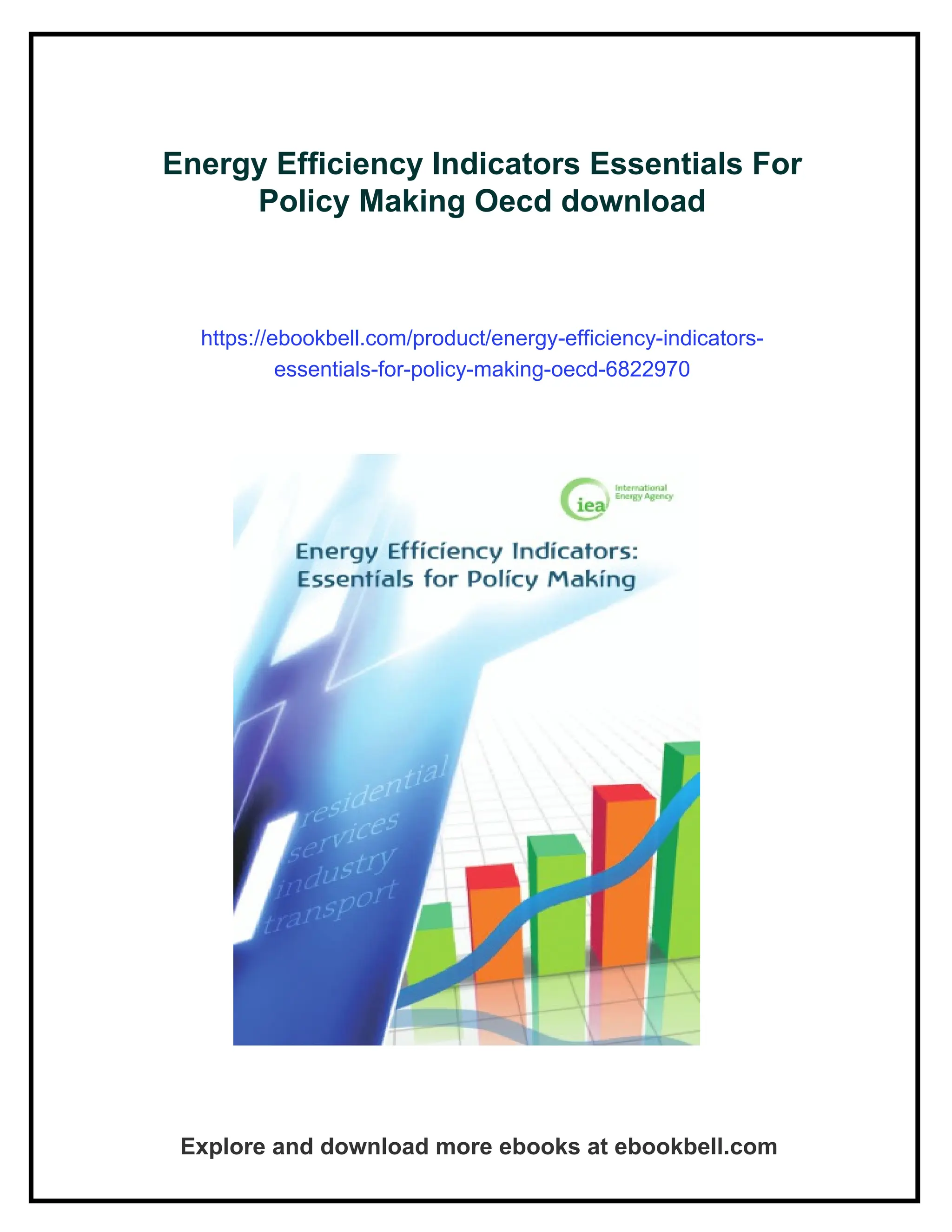
Energy Efficiency Indicators Essentials For Policy Making Oecd

  • 1.
    Energy Efficiency IndicatorsEssentials For Policy Making Oecd download https://ebookbell.com/product/energy-efficiency-indicators- essentials-for-policy-making-oecd-6822970 Explore and download more ebooks at ebookbell.com
  • 2.
    Here are somerecommended products that we believe you will be interested in. You can click the link to download. Energy Efficiency Indicators Fundamentals On Statistics Oecd https://ebookbell.com/product/energy-efficiency-indicators- fundamentals-on-statistics-oecd-6822972 Development Of Energy Efficiency Indicators In Russia Iea Energy Papers Nathalie Trudeau https://ebookbell.com/product/development-of-energy-efficiency- indicators-in-russia-iea-energy-papers-nathalie-trudeau-2263680 Energy Efficiency Innovations Driving Prosperity Slashing Emissions Henry Kelly https://ebookbell.com/product/energy-efficiency-innovations-driving- prosperity-slashing-emissions-henry-kelly-46706752 Energy Efficiency 1st Edition Daniel M Martinez Ben W Ebenhack https://ebookbell.com/product/energy-efficiency-1st-edition-daniel-m- martinez-ben-w-ebenhack-47234496
  • 3.
    Energy Efficiency AndConservation In Metal Industries Swapan Kumar Dutta https://ebookbell.com/product/energy-efficiency-and-conservation-in- metal-industries-swapan-kumar-dutta-49031294 Energy Efficiency Refurbishments Clemens Richarz Christina Schulz https://ebookbell.com/product/energy-efficiency-refurbishments- clemens-richarz-christina-schulz-50363366 Energy Efficiency Research 1st Edition David M Bergmann https://ebookbell.com/product/energy-efficiency-research-1st-edition- david-m-bergmann-51348868 Energy Efficiency Solutions 1st Edition Richard P Cateland https://ebookbell.com/product/energy-efficiency-solutions-1st-edition- richard-p-cateland-51368678 Energyefficiency Upgrades Principles Details Examples 1st Edition Clemens Richarz Christina Schulz Friedemann Zeitler https://ebookbell.com/product/energyefficiency-upgrades-principles- details-examples-1st-edition-clemens-richarz-christina-schulz- friedemann-zeitler-51373246
  • 5.
  • 6.
    Energy Efficiency Indicators: Essentialsfor Policy Making Energy efficiency is a growing policy priority for many countries around the world. It is widely recognised as the most cost-effective and readily available means to address numerous energy-related issues, including energy security, the social and economic impacts of high energy prices, and concerns about climate change. At the same time, energy efficiency increases competitiveness and promotes consumer welfare. In this context, it is important to develop and maintain well-founded indicators to better inform policy making and help decision makers formulate policies that are best suited to domestic and/or international objectives. Yet, choosing and developing appropriate indicators to support the development of policies is not straightforward. This publication should enable energy analysts and policy makers to: n Identify priority areas for the development of energy efficiency indicators n Define which sector(s) offer the greatest potential to further improve energy efficiency n Select the data and indicators that best support policy development in these sectors n Develop a strategy to advance policy development through the improved use of indicators to track progress of energy efficiency policies. This publication and its companion document, Energy Efficiency Indicators: Fundamentals on Statistics, are intended to provide the necessary tools to initiate and/or further develop in-depth indicators to support the decision-making process.
  • 7.
  • 8.
    INTERNATIONAL ENERGY AGENCY TheInternational Energy Agency (IEA), an autonomous agency, was established in November 1974. Its primary mandate was – and is – two-fold: to promote energy security amongst its member countries through collective response to physical disruptions in oil supply, and provide authoritative research and analysis on ways to ensure reliable, affordable and clean energy for its 29 member countries and beyond. The IEA carries out a comprehensive programme of energy co-operation among its member countries, each of which is obliged to hold oil stocks equivalent to 90 days of its net imports. The Agency’s aims include the following objectives: n Secure member countries’ access to reliable and ample supplies of all forms of energy; in particular, through maintaining effective emergency response capabilities in case of oil supply disruptions. n Promote sustainable energy policies that spur economic growth and environmental protection in a global context – particularly in terms of reducing greenhouse-gas emissions that contribute to climate change. n Improve transparency of international markets through collection and analysis of energy data. n Support global collaboration on energy technology to secure future energy supplies and mitigate their environmental impact, including through improved energy efficiency and development and deployment of low-carbon technologies. n Find solutions to global energy challenges through engagement and dialogue with non-member countries, industry, international organisations and other stakeholders. IEA member countries: Australia Austria Belgium Canada Czech Republic Denmark Estonia Finland France Germany Greece Hungary Ireland Italy Japan Korea (Republic of) Luxembourg Netherlands New Zealand Norway Poland Portugal Slovak Republic Spain Sweden Switzerland Turkey United Kingdom United States The European Commission also participates in the work of the IEA. © OECD/IEA, 2014 International Energy Agency 9 rue de la Fédération 75739 Paris Cedex 15, France www.iea.org Please note that this publication is subject to specific restrictions that limit its use and distribution. The terms and conditions are available online at http://www.iea.org/termsandconditionsuseandcopyright/ Secure Sustainable Together
  • 9.
    3 Foreword The International EnergyAgency (IEA) has published reports on the impact of improved energy efficiency trends in end-use energy consumption, otherwise known as energy efficiency indicators, since 1997. Over this period, the IEA together with other energy efficiency experts have been leading the development of energy efficiency indicators, as well as working closely with countries and other key stakeholders to improve the collection of energy and related end-use data. The IEA Energy Statistics Manual (IEA, 2005), Oil Crises & Climate Challenges: 30 Years of Energy Use in IEA Countries (IEA, 2004) and Energy Use in the New Millennium (IEA, 2007) are examples of the results of this collaboration. As an energy resource, energy efficiency has the unique potential to simultaneously contribute to long-term energy security, economic growth, and even improved health and well-being; in particular it is a key means to reduce greenhouse gas emissions. By reducing or limiting energy demand, energy efficiency measures can increase resilience against a variety of risks, such as energy price rises and volatility, stress on energy infrastructure, and disruptions to energy supply systems. The Energy Efficiency Market Report (IEA, 2013) highlights energy efficiency’s place as a major energy resource and the critical role it plays in the global energy market. It concluded that energy efficiency investments delivered reductions in energy demand that exceed the output of any other fuel source in many IEA countries. This points to energy efficiency being not just a hidden fuel, but in fact, the “first fuel”. Energy efficiency indicators are used to quantify just how big this hidden or first fuel is. To better understand the drivers and potential for energy efficiency, it is important to develop and maintain well-founded energy efficiency indicators to better inform the policy process and help decision-makers develop policies that are best suited to meet domestic and/or international policy objectives. Yet choosing and developing appropriate indicators to support the development of policies is not straight forward. The Energy Efficiency Indicators: Essentials for Policy Making and its companion document Energy Efficiency Indicators: Fundamentals on Statistics (IEA, 2014) aim to provide the necessary tools to initiate or further develop in-depth indicators to support the development of effective energy efficiency policies. The Energy Efficiency Indicators: Fundamentals on Statistics (IEA, 2014) is intended for statisticians and energy analysts collecting the needed information for the development of energy efficiency indicators. The Energy Efficiency Indicators: Essentials for Policy Making is aimed at providing energy analysts with tools needed to determine the priority areas for the development of energy efficiency indicators (EEI) and how to select and develop the data and indicators that will best support energy efficiency policy. The information gained from these indicators will help policy makers to set energy efficiency targets and track progress towards these targets. This report is published under my authority as Executive Director of the IEA. Maria van der Hoeven Executive Director International Energy Agency © OECD/IEA, 2014
  • 10.
  • 11.
    5 Acknowledgements This publication wasprepared by the International Energy Agency’s Directorate of Sustainable Energy Policy and Technology (SPT). Didier Houssin, Director of SPT; Jean-Francois Gagne, Head of the Energy Technology Policy Division; and Jean-Yves Garnier, Head of the Energy Data Center, offered important guidance and input. Nathalie Trudeau (former IEA colleague) was the project leader and had overall responsibility for the design and development of the study. Emer Dennehy took over responsibility for completing this project, overseeing the final drafting and production process. Other main contributors to this manual include Taejin Park, Cecilia Tam and Robert Tromop. The work also benefited from the expertise of many other IEA colleagues, in particular, Nina Campbell, François Cuenot, Davide D’Ambrosio, Araceli Fernandez, Assen Gasharov, Marc LaFrance, Roberta Quadrelli and Kira West. Desktop publishing support from Sharon Burghgraeve is also gratefully acknowledged. Erin Crum copy-edited the manuscript with the support of Cheryl Haines. Production assistance was provided by the IEA Communication and Information Office: Astrid Dumond, Muriel Custodio and Bertrand Sadin. The work was guided by the IEA Committee on Energy Research and Technology. Inputs and suggestions from the members of this committee and other IEA government officials are gratefully acknowledged. A large number of reviewers provided valuable feedback and input to the analysis presented. These include: Heidelinde Adensam, Federal Ministry of Economy, Family and Youth, Austria John Appleby, Natural Resources Canada Chris Bayliss, International Aluminium Institute Wolfgang Bittermann, Statistics Austria Didier Bosseboeuf, ADEME, France Ann Christin Bøeng, Statistics Norway Moon-Sun Choi, Korea Energy Economics Institute Hein Dang, Energy Efficiency and Conservation Authority, New Zealand Pilar de Arriba Segurado, Institute for Diversification and Saving of Energy, Spain Albert Dessi, Department of Industry, Australia Alessandro Federici, Italian National Agency for New Technologies, Energy and Sustainable Economic Development Carlos García Barquero, Institute for Diversification and Saving of Energy, Spain Jesus Pedro Garcia Montes, Institute for Diversification and Saving of Energy, Spain Géraldine Grosjean, SPW, Belgium Andreas Haider Mag, Federal Ministry of Economy, Family and Youth, Austria Rurik Holmberg, Swedish Energy Agency Sung Moon Jung, International Partnership for Energy Efficiency Cooperation Richard Longman, Department of Infrastructure and Transport, Australia © OECD/IEA, 2014
  • 12.
    6 Baya Kieffer, AfricanEnergy Commission Shigeru Kimura, The Institute of Energy Economics, Japan Ron Knapp, International Aluminium Institute Tabea Kolbel, Business and Industry Advisory Committee to the OECD Bruno Lapillonne, Enerdata Carlos López López, Institute for Diversification and Saving of Energy, Spain Yuji Matsuo, The Institute of Energy Economics, Japan Gene McGlynn, Department of Industry, Australia Roeland Mertens, EuroStat Gergana Miladinova, European Commission, DG ENER Nils Olof Nylund, VVT Technical Research Centre of Finland Stephen Oxley, Department of Energy and Climate Change, United Kingdom Tabaré Pagliano, Energy Research & Development Institute, Uruguay Christoph Ploiner, Austrian Energy Agency Teresa Ponce de Leão, National Laboratory of Energy and Geology, Portugal Nicola Rega, Confederation of European Pulp and Paper Industries Hori Shiro, Minister of Economy, Trade and Industry, Japan Oliver Story, Department of Industry, Australia Oliver Thunus, STATEC, Luxembourg Florentine Visser, GIZ International Services Thibaud Voita, International Partnership for Energy Efficiency Cooperation Leonie Wilson, Office of Energy Efficiency and Renewable Energy, Australia Linlin Wu, International Aluminium Institute Comments and questions are welcome and should be addressed to: Energy Efficiency Indicators Analysts Directorate of Sustainable Energy Policy and Technology International Energy Agency 9, rue de la Fédération 75739 Paris Cedex 15 France Email: EnergyIndicators@iea.org © OECD/IEA, 2014
  • 13.
    1 Introduction. ................................................... 15 2The IEA Methodology for Analysing Trends in Energy Consumption. .................17 1. Energy efficiency indicators. ..............................................................................17 2. Policy information and evaluation..................................................................22 A framework for understanding policy interactions: Driving force, state, response..........................................................................23 3. Decomposition or factorisation analysis. .......................................................24 3 Developing Indicators for the Residential Sector.................................25 1. What is driving energy consumption in the residential sector?. .............25 2. How is energy consumed and how has it evolved recently?. .................. 27 3. How to prioritise the development of indicators (Which indicators should be developed?)................................................... 30 4. Development of indicators by level of the pyramid.................................. 30 Level 1 indicators..............................................................................................32 Level 2 indicators..............................................................................................36 5. Additional indicators explaining the changes in residential energy consumption......................................................................48 6. Decomposition of changes in residential energy demand.......................49 7. Policy information and evaluation in the residential sector................... 50 The importance of supplementary information............................................ 50 4 Developing Indicators for the Services Sector. ......................................53 1. What is driving energy consumption in the services sector?..................53 2. How is energy consumed and how has it evolved recently?. ..................54 3. How to prioritise development of indicators (Which indicators should be developed?).................................................... 57 4. Development of indicators by level of the pyramid.................................. 60 Level 1 indicators............................................................................................. 60 Level 2 indicators and beyond. ........................................................................62 Table of Contents 7 © OECD/IEA, 2014
  • 14.
    8 5. Additional indicatorsexplaining the changes in services energy consumption......................................................................69 6. Decomposition of changes in services energy demand. ...........................69 7. Policy information and evaluation in the services sector.........................70 The drivers of energy demand in commercial buildings. ...............................71 Growth of electrical equipment. .......................................................................71 Equipment energy load is multiplied by air-conditioning load. ....................71 Low-energy commercial buildings.................................................................. 73 Key aspects of policy solutions. ........................................................................ 73 The importance of supplementary information............................................. 73 5 Developing Indicators for the Industry Sector. ......................................75 1. What is driving energy consumption in the industry sector?. ................. 75 2. How is energy consumed and how has it evolved recently?. .................. 77 3. How to prioritise development of indicators (Which indicators should be developed?)....................................................79 4. Development of indicators by level of the pyramid....................................81 Level 1 indicators..............................................................................................82 Level 2 indicators..............................................................................................83 Level 3 indicators: Industry-specific/process technology-specific indicators. ...........................................................................................................86 5. Additional indicators explaining the changes in industry energy consumption. .....................................................................94 6. Decomposition of changes in industry energy demand. ...........................95 7. Policy information and evaluation in the industry sector. ........................97 The importance of supplementary information.............................................97 6 Developing Indicators for the Transport Sector. .................................. 99 A) Developing indicators for the passenger transport segment. ........................................ 101 1. What is driving energy consumption in the passenger transport sector?...................................................................................................................101 2. How is energy consumed and how has it evolved recently?. ................102 3. How to prioritise development of indicators for passenger transport. .........................................................................................104 4. Development of indicators by level of the pyramid.................................105 Level 1 indicators............................................................................................105 Level 2 indicators............................................................................................ 107 Level 3 indicators: Road.................................................................................108 © OECD/IEA, 2014
  • 15.
    9 5. Additional indicatorsexplaining the changes in passenger transport energy consumption...................................................110 6. Decomposition of changes in passenger transport energy demand. ...................................................................................................111 7. Policy information and evaluation in passenger transport..................... 115 Passenger transport system efficiency. ........................................................... 115 Policies for passenger (LDV) fuel economy...................................................116 B) Developing indicators for the freight transport segment................................................116 1. What is driving energy consumption in the freight transport sector?. ...116 2. How is energy consumed and how has it evolved recently?. ..................117 3. How to prioritise development of indicators for freight transport. ..........................................................................................119 4. Development of indicators by level of the pyramid..................................119 Level 1 indicators............................................................................................120 Level 2 indicators............................................................................................ 122 Level 3 indicators: Road................................................................................. 123 5. Additional indicators explaining the changes in freight transport energy consumption. ........................................................ 125 6. Decomposition of changes in freight transport energy demand. ......... 125 7. Policy information and evaluation in freight transport. ...........................127 The drivers of energy demand in freight.......................................................127 The importance of supplementary information........................................... 128 Annexes. .............................................................. Annex A Decomposition/factorisation methodologies. .........................129 Annex B Initiatives on development of energy efficiency indicators. ........................................................135 Annex C Abbreviations, acronyms and units of measure....................139 Annex D Glossary. .............................................................................................141 Annex E References. .......................................................................................147 Annex F IEA alternative pyramids...............................................................151 © OECD/IEA, 2014
  • 16.
    10 List of figures. ......................................................... Figure2.1 The IEA energy indicators pyramid.................................................20 Figure 2.2 Disaggregation of sectors, sub-sectors, and end uses in IEA energy indicators approach..................................................22 Figure 3.1 Residential energy consumption in OECD and non-OECD countries.....................................................................28 Figure 3.2 Residential energy consumption and aggregate energy intensity.............................................................................29 Figure 3.3 Residential CO2 emissions and intensity.........................................29 Figure 3.4 Detailed indicators pyramid of the residential sector........................30 Figure 3.5 Example of level 1 indicators in Germany, Norway, Spain, United Kingdom and the United States.................................32 Figure 3.6 Estimated energy consumption and intensity in rural and urban areas in India, 2010. ...........................................................34 Figure 3.7 Energy consumption and intensity for different dwelling type in Canada....................................................................................35 Figure 3.8 Energy intensity and climate-corrected intensity for space heating...............................................................................36 Figure 3.9 Example of water heating energy intensity by country (energy per occupied dwelling). ......................................................39 Figure 3.10 Beyond level 2 for water heating: an example for heaters using electricity. .............................................................................41 Figure 3.11 Examples of lighting energy intensity in Australia, France and Italy............................................................................41 Figure 3.12 Example of cooking energy intensity by country (energy/occupied dwelling)............................................................44 Figure 3.13 Example of appliances energy intensity by country (energy per occupied dwelling). ......................................................46 Figure 3.14 Energy consumption for large and small appliances. .......................47 Figure 3.15 Decomposition of changes in space heating per capita, 1990 to 2010...............................................................................50 Figure 4.1 Services energy consumption in OECD and non-OECD countries.....................................................................55 Figure 4.2 Services energy consumption and aggregate energy intensity.............................................................56 Figure 4.3 Example of different intensity levels in Canada, 2010. .....................56 Figure 4.4 Detailed indicators pyramid of the services sector. ...........................57 Figure 4.5 Example of level 1 indicators in selected countries...........................60 Figure 4.6 Observed and climate-corrected energy intensity for selected countries..........................................................................63 Figure 4.7 Examples of lighting energy intensity in selected countries. ...............66 Figure 4.8 Example of other equipment category energy intensity for selected countries..........................................................................68 Figure 4.9 Decomposition of changes in services sector energy intensity, 1990 to 2010...............................................................................70 Figure 5.1 Definitions used at the IEA for the industry sector. ............................75 © OECD/IEA, 2014
  • 17.
    11 Figure 5.2 Industryenergy consumption in OECD and non-OECD countries. ....77 Figure 5.3 Energy consumption by industry sub-sector.....................................79 Figure 5.4 Detailed indicators pyramid of the industry sector. ...........................80 Figure 5.5 Example of level 1 indicator: total energy consumption per unit of industry value-added. ....................................................83 Figure 5.6 Example of industry disaggregation. ...............................................85 Figure 5.7 Energy consumption in iron and steel and non-ferrous metals by tonne of steel produced by country in 2010. ...............................86 Figure 5.8 Production by process route and energy intensity for selected countries, 2010...........................................................88 Figure 5.9 Energy consumption per tonne of clinker by country........................89 Figure 5.10 Electricity efficiency potentials. ........................................................90 Figure 5.11 Current energy savings potential for chemicals and petrochemicals, based on BPTs, 2010............................................92 Figure 5.12 Regional specific electricity consumption in aluminium smelting...................................................................93 Figure 5.13 Decomposition of changes in industrial energy intensity, 1990 to 2010...............................................................................96 Figure 6.1 Transportation energy consumption by mode. ...............................101 Figure 6.2 Passenger transport energy consumption by mode in various countries.........................................................................102 Figure 6.3 Passenger transport energy consumption and energy per GDP per capita.....................................................................103 Figure 6.4 Share of total passenger-kilometres by mode. ...............................104 Figure 6.5 Detailed indicators pyramid for passenger transport. .....................104 Figure 6.6 Example of level 1 indicator for selected countries: passenger transport energy consumption per passenger-kilometre.................106 Figure 6.7 Example of level 2 indicators for IEA15: energy consumption per passenger-kilometre by transportation mode..........................108 Figure 6.8 Energy consumption of different road vehicles, example for Canada......................................................................................109 Figure 6.9 Factors affecting passenger transport energy consumption, IEA15....112 Figure 6.10 Decomposition of changes in LDV energy consumption per capita, 1990 to 2010............................................................113 Figure 6.11 Freight transport energy consumption by mode. ............................117 Figure 6.12 Freight transport energy consumption and intensity.......................118 Figure 6.13 Share of total freight tonne-kilometres by mode............................118 Figure 6.14 Detailed indicators pyramid for freight transport...........................119 Figure 6.15 Example of level 1 indicator for selected countries: freight transport energy intensities................................................120 Figure 6.16 Example of level 2: energy consumption per tonne-kilometre by transport mode. ......................................................................122 Figure 6.17 Energy intensity trends of different road vehicles: an example from Canada. ...........................................................124 Figure 6.18 Factors affecting freight transport energy consumption, IEA15.......126 Figure 6.19 Decomposition of changes in truck energy intensity, in IEA15 1990 to 2010……………………..................................................127 © OECD/IEA, 2014
  • 18.
    12 Figure A.1 Basicoverview of factors in CO2 decomposition……………………. 133 Figure F.1: Residential sector pyramid based on floor area.............................152 Figure F.2: Residential sector pyramid based on household............................153 Figure F.3: Service sector pyramid. ................................................................154 Figure F.4: Industry sector pyramid. ...............................................................155 Figure F.5: Passenger transport sector pyramid..............................................157 Figure F.6 Freight transport sector pyramid. ..................................................158 List of tables. ........................................................... Table 3.1 Summary list of the most common indicators for the residential sector...........................................................................31 Table 3.2 Description of level 1 indicators. .....................................................33 Table 3.3 Description of level 2 indicators: space heating. ..............................37 Table 3.4 Description of level 2 indicators: space cooling...............................38 Table 3.5 Description of level 2 indicators: water heating...............................40 Table 3.6 Description of level 2 indicators: lighting........................................42 Table 3.7 Description of level 2 indicators: cooking. .......................................44 Table 3.8 Average unit energy consumption of cooking in selected countries (kWh/year).....................................................45 Table 3.9 Description of level 2 indicators: appliances. ...................................46 Table 3.10 Description of additional indicators: residential sector.....................48 Table 3.11 Summary of variables used for the decomposition analysis of residential energy consumption......................................................49 Table 3.12 Supplementary information for residential policy information...........51 Table 4.1 Summary list of the most common indicators for services.................58 Table 4.2 Classification of services buildings in selected IEA countries.............59 Table 4.3 Description of level 1 indicators. .....................................................61 Table 4.4 Description of level 2 indicators: space heating. ..............................63 Table 4.5 Description of level 2 indicators: space cooling...............................64 Table 4.6 Description of level 2 indicators: water heating...............................65 Table 4.7 Description of level 2 indicators: lighting........................................67 Table 4.8 Description of level 2 indicators: other equipment...........................68 Table 4.9 Description of additional indicators: services sector.........................69 Table 4.10 Summary of variables used for the decomposition of services energy consumption. .....................................................70 Table 4.11 Supplementary information for services sector policy information.....73 Table 5.1 Summary of indicators used in the industrial sector.........................82 Table 5.2 Description of level 1 indicators. .....................................................83 Table 5.3 Description of level 2 indicators: industry........................................86 Table 5.4 Energy improvement potential by BPT in the global chemical and petrochemical sub-sector, 2009..............................................92 Table 5.5 Description of additional indicators: industry sector.........................94 Table 5.6 Summary of variables used for decomposition of industry energy consumption. .........................................................95 © OECD/IEA, 2014
  • 19.
    13 Table 5.7 Supplementaryinformation for industry policy information. ..............98 Table 6.1 Summary of indicators in the passenger transport sector. ...............105 Table 6.2 Description of level 1 indicators. ...................................................106 Table 6.3 Description of level 2 indicator: passenger transport sector............108 Table 6.4 Description of level 3 indicators: Road. .........................................110 Table 6.5 Description of additional indicators: passenger transport sector...........................................................110 Table 6.6 Summary of variables used for the decomposition of transport energy consumption..................................................112 Table 6.7 Supplementary information for light-duty vehicle policy information. ................................................................................116 Table 6.8 Summary of indicators in the freight transport sector.....................120 Table 6.9 Description of level 1 indicators. ...................................................121 Table 6.10 Description of level 2 indicators: freight transport. .........................123 Table 6.11 Description of level 3 indicators: road..........................................124 Table 6.12 Description of additional indicators: freight transport sector...........125 Table 6.13 Summary of variables used for the decomposition of freight transport energy consumption...........................................126 Table 6.14 Supplementary information for freight transport policy information.......................................................................128 Table A.1 Comparison of different decomposition analysis methods. .............130 Table A.2 Comparison of additive and multiplicative three-factor decomposition analysis methods..................................................131 Table A.3 Example of three-factor Log Mean Divisia Index methodology. .......131 Table A.4 Example of three-factor Laspeyres methodology. ...........................132 List of boxes............................................................ Box 2.1 Impacts of behaviour on energy efficiency......................................21 Box 2.2 Multiple benefits of energy efficiency improvements. ........................23 Box 4.1 The policy challenge: growing dependence on electricity in the services sector. .....................................................................72 Box 5.1 Methodological issues in the industry sector....................................78 Box 5.2 The benefits of energy efficiency indicators for companies...............81 Box 5.3 Energy and CO2 indicators for industry: using economic or physical ratios...........................................................................84 Box 5.4 Analysis based on Best Available Technologies (BATs).....................87 Box 5.5 Decomposition analysis taking into account capacity utilisation and different activity basis. ..............................................96 Box 6.1 Energy efficiency in the transport sector: system efficiency versus vehicle efficiency......................................100 Box 6.2 Identifying transport issues and user needs...................................114 Box 6.3 Improved operating efficiency through mobility management, eco-driving and related policies.................115 Box 6.4 Freight mobility management and logistics: key aspects of policy solutions......................................................128 © OECD/IEA, 2014
  • 20.
  • 21.
    Countries around theworld are increasingly aware of the urgent need to transform the way they use energy. Concern over energy security, the social and economic impacts of high energy prices, and growing awareness of climate change have led many countries to put greater emphasis on developing policies and measures that promote energy efficiency. Two things have become increasingly clear: ■ Ensuring better use of global energy resources will require policies that encompass a wide range of options. There is a growing recognition that improving energy efficiency is often the most economic, proven and readily available means of achieving this goal. ■ Establishing and maintaining sound policies requires the availability of good- quality, timely, comparable and detailed data that go well beyond those currently included in energy balances, and which reflect the distinct characteristics of economic activity and resources available in each country. For decades, countries have used the data contained in energy balances as a means of tracking energy consumption according to type of energy source and by major sector, and as a way to develop aggregate indicators (such as total energy per capita). Aggregate indicators have the advantage that they are often readily and widely available: thus, they reveal high-level developments in energy consumption in simple terms. However, their usefulness is limited and can generate misleading results when used inappropriately. For example, it would be incorrect to rank energy performance according to a country’s total final consumption per gross domestic product (GDP) or per capita given the many factors (e.g. climate, wealth, economic structure) influencing this indicator. As each main sector is influenced by varying underlying factors, different explanatory data will be needed depending on the sector analysed. Such data are not reported in energy balances and are currently available for only a few countries. Thus, in order to develop estimates of overall energy efficiency, detailed data are required for end-use sectors. Development of state-of-the-art indicators is not straightforward and requires financial and human resources to collect detailed data, and analyse the information. Recent efforts by several countries to collect more detailed end-use data have helped to develop energy efficiency indicators that provide important information for understanding past trends, assessing potential for energy savings and enhancing energy efficiency policies. However, much more still needs to be done. The full spectrum of detailed indicators cannot be developed within a few years. It is important for countries to prioritise which sectors – or which segments of a sector will be prioritised – and then build on the expertise that will be gained. The goal of this publication is to provide the necessary tools for analysts and policy makers to prioritise the development of energy efficiency indicators, and build Introduction 15 © OECD/IEA, 2014
  • 22.
    Exploring the Varietyof Random Documents with Different Content
  • 23.
    of the RedSea; it is here that pilgrims and travellers disembark, and get their camels to start for Mount Sinai. I went on shore in the afternoon and bought some provisions at a Greek store there, and by a most unexpected chance found some of Fortnum and Mason's preserved soups at this out-of-the-way place; they had been part of the cargo of a ship that had been wrecked in the Gulf of Suez. The goods had been bought by some Greeks of the Suez Bazaar, then sent down to Tur. I went to see the old Russian gentleman who makes arrangements for all travellers to Mount Sinai. I bought some tortoiseshell from him, and also purchased a pretty good collection of coral and Red Sea shells from a Greek who was hanging about, and who also sold me three beautiful little sponges. Cordock, the French captain, and I walked out to a grove of date- palm trees not far off; the mountains in the distance were covered with a strange purple haze, peculiar to the Red Sea, and afforded a magnificent appearance. These hills reminded me very much of the scenery of the background of some of Gustave Doré's illustrations. April 10.—We weighed anchor at seven o'clock in the morning; but it was still very rough. The P. O. ship passed us about five P.M. We had just enough coal to last us thirty hours, and we had to run one hundred and twenty-five miles. Thank God! the wind dropped, or I cannot guess where we should have been. We heard at Tur that an English ship was on the Zafarina reef. They also told us that it was blowing so hard that ships' boats could not get ashore from the vessels lying in the roads at Suez. April 11.—At last I have arrived at the end of my journey, but more by good luck than good management. We dropped our anchor at eight o'clock in the Suez roads, having just got four tons of coal left. If these had run out we should have had to go back to Jidda for coal, or else gone ashore in a boat and trudged up to Suez. Here my Journal ends. And I hope no other unhappy mortal who may go travelling in search of sport will ever have such a journey home as mine has been.
  • 24.
    FOOTNOTES: [1] An Indianword for a large square tent. [2] Earl of Ranfurly, Captain Grenadier Guards, who died at Souakim, on the Red Sea, May 10, 1875, on board the steamer which was that day leaving for Suez. [3] It is not a necessary coincidence that if the back becomes sore the swelling should come on, as I have seen several cases where there were no outward signs of soreness, but still where large swellings were forming. [4] The courbatch is a whip made of hippopotamus hide, and used in Egypt and in the provinces belonging to that country. It is with this whip that malefactors and offenders against the law are chastised. Every stroke of it, if well laid on, will cut into the flesh. [5] General Kirkham was formerly a steward in the P. and O. service. He left the P. and O. ship in China, to join the British contingent which Colonel Gordon at that time was raising for the war in China. General Kirkham was terribly wounded both in the head and shoulder in this war; he came home, and Sir William Fergusson, the surgeon, cured him. He afterwards went to Annesley Bay, and, at the time of the Abyssinian expedition, he was employed by Lord Napier of Magdala to buy bullocks for commissariat purposes; when the expedition was over he received leave from Lord Napier to go into Abyssinia. He tendered his services to the king, and was made a colonel of the Abyssinian army. Having drilled some Abyssinian soldiers in the English fashion for the king, in the battle which the king fought against the rebel Goubasse he gained a well-won reputation, for it was owing entirely to those men that Johannes the king won this battle. After this he was made commander-in-chief, which he is now. It may be remembered by some of my readers that General
  • 25.
    Kirkham came hometo England on a mission from King Johannes, to claim protection for Abyssinia from the English Government. This mission failed, and he returned to Abyssinia. [6] Value about 4s. 2d. [7] Sunset is at six P.M. [8] Her Abyssinian name was Desta, which means happy. [9] Terramnee means stones in a row. This is a Tigré word, the name of one of the large divisions or provinces of Abyssinia. [10] Ballaga is the Amharic for a farmer, or one who cultivates land The other three classes in Abyssinia are chiefs, soldiers or followers of chiefs, and merchants. [11] Chillumchee is an Indian word for a flat-bottomed tin basin. [12] Cumberbund is an Indian word for a thick scarf which is wound round and round the waist; it is a great preventive against sunstroke and chills. [13] Shum is Amharic for a chief of several villages. [14] Angareb is an Arabic word for an oblong framework raised on legs; a network of raw hide is stretched on the frame, and the whole forms the sort of bed that is used nearly all over the East. 50a, Albemarle Street, London, January, 1876. MR. MURRAY'S GENERAL LIST OF WORKS.
  • 26.
    ALBERT (The) MEMORIAL.A Descriptive and Illustrated Account of the National Monument erected to the PRINCE CONSORT at Kensington. Illustrated by Engravings of its Architecture, Decorations, Sculptured Groups, Statues, Mosaics, Metalwork, c. With Descriptive Text. By Doyne C. Bell. With 24 Plates. Folio. 12l. 12s. —— (Prince) Speeches and Addresses with an Introduction, giving some outline of his Character. With Portrait. 8vo. 10s. 6d.; or Popular Edition, Fcap. 8vo. 1s. ALBERT DURER; his Life and Works. By Dr. Thausing, Keeper of Archduke Albert's Art Collection at Vienna. Translated from the German. With Portrait Illustrations. Medium 8vo. [In the Press. ABBOTT'S (Rev. J.) Memoirs of a Church of England Missionary in the North American Colonies. Post 8vo. 2s. ABERCROMBIE'S (John) Enquiries concerning the Intellectual Powers and the Investigation of Truth. Fcap. 8vo. 3s. 6d. —— Philosophy of the Moral Feelings. Fcap. 8vo. 2s. 6d. ACLAND'S (Rev. Charles) Popular Account of the Manners and Customs of India. Post 8vo. 2s. ÆSOP'S FABLES. A New Version. With Historical Preface. By Rev. Thomas James. With 100 Woodcuts, by Tenniel and Wolf. Post 8vo. 2s. 6d. AGRICULTURAL (Royal) JOURNAL. (Published half yearly.)
  • 27.
    AIDS TO FAITH:a Series of Theological Essays. 8vo. 9s. CONTENTS. Miracles Dean Mansel. Evidences of Christianity Bishop Fitzgerald. Prophecy Mosaic Record of Creation Dr. McCaul. Ideology and Subscription Canon Cook. The Pentateuch Canon Rawlinson. Inspiration Bishop Harold Browne. Death of Christ Archbishop Thomson. Scripture and its Interpretation Bishop Ellicott. AMBER-WITCH (The). A most interesting Trial for Witchcraft. Translated by Lady Duff Gordon. Post 8vo. 2s. ARMY LIST (The). Published Monthly by Authority. ARTHUR'S (Little) History of England. By Lady Callcott. New Edition, continued to 1872. With 36 Woodcuts. Fcap. 8vo. 1s. 6d. AUSTIN'S (John) Lectures on General Jurisprudence; or, the Philosophy of Positive Law. Edited by Robert Campbell. 2 Vols. 8vo. 32s. —— Student's Edition, compiled from the above work. Post 8vo. 12s.
  • 28.
    ARNOLD'S (Thos.) Ecclesiasticaland Secular Architecture of Scotland: The Abbeys, Churches, Castles, and Mansions. With Illustrations. Medium 8vo. [In Preparation. ADMIRALTY PUBLICATIONS; Issued by direction of the Lords Commissioners of the Admiralty:— A MANUAL OF SCIENTIFIC ENQUIRY, for the Use of Travellers. Fourth Edition. Edited by Robert Main, M.A. Woodcuts. Post 8vo. 3s. 6d. GREENWICH ASTRONOMICAL OBSERVATIONS 1841 to 1846, and 1847 to 1871. Royal 4to. 20s. each. MAGNETICAL AND METEOROLOGICAL OBSERVATIONS. 1840 to 1847. Royal 4to. 20s. each. APPENDICES TO OBSERVATIONS. 1837. Logarithms of Sines and Cosines in Time. 3s. 1842. Catalogue of 1439 Stars, from Observations made in 1836 to 1841. 4s. 1845. Longitude of Valentia (Chronometrical). 3s. 1847. Description of Altazimuth. 3s. Twelve Years' Catalogue of Stars, from Observations made in 1836 to 1847. 4s. Description of Photographic Apparatus. 2s. 1851. Maskelyne's Ledger of Stars. 3s. 1852. I. Description of the Transit Circle. 3s. 1853. Refraction Tables. 3s. 1854. Description of the Zenith Tube. 3s.
  • 29.
    Six Years' Catalogueof Stars, from Observations. 1848 to 1853. 4s. 1862. Seven Years' Catalogue of Stars, from Observations. 1854 to 1860. 10s. Plan of Ground Buildings. 3s. Longitude of Valentia (Galvanic). 2s. 1864. Moon's Semid. from Occultations. 2s. Planetary Observations, 1831 to 1835. 2s. 1868. Corrections of Elements of Jupiter and Saturn. 2s. Second Seven Years' Catalogue of 2760 Stars for 1861 to 1867. 4s. Description of the Great Equatorial. 3s. 1856. Descriptive Chronograph. 3s. 1860. Reduction of Deep Thermometer Observations. 2s. 1871. History and Description of Water Telescope. 3s. Cape of Good Hope Observations (Star Ledgers). 1856 to 1863. 2s. —— 1856. 5s. —— Astronomical Results. 1857 to 1858. 5s. Report on Teneriffe Astronomical Experiment. 1856. 5s. Paramatta Catalogue of 7385 Stars. 1822 to 1826. 4s. ASTRONOMICAL RESULTS. 1847 to 1871. 4to. 3s. each. MAGNETICAL AND METEOROLOGICAL RESULTS. 1847 to 1871. 4to. 3s. each. REDUCTION OF THE OBSERVATIONS OF PLANETS. 1750 to 1830. Royal 4to. 20s. each.
  • 30.
    —— LUNAR OBSERVATIONS.1750 to 1830. 2 Vols. Royal 4to. 20s. each. —— 1831 to 1851. 4to. 10s. each. BERNOULLI'S SEXCENTENARY TABLE. 1779. 4to. 5s. BESSEL'S AUXILIARY TABLES FOR HIS METHOD OF CLEARING LUNAR DISTANCES. 8vo. 2s. ENCKE'S BERLINER JAHRBUCH, for 1830. Berlin, 1828. 8vo. 9s. HANSEN'S TABLES DE LA LUNE. 4to. 20s. LAX'S TABLES FOR FINDING THE LATITUDE AND LONGITUDE. 1821. 8vo. 10s. LUNAR OBSERVATIONS at GREENWICH. 1783 to 1819. Compared with the Tables, 1821. 4to. 7s. 6d. MACLEAR ON LACAILLE'S ARC OF MERIDIAN. 2 Vols. 20s. each. MAYER'S DISTANCES of the MOON'S CENTRE from the PLANETS. 1822, 3s.; 1823, 4s. 6d. 1824 to 1835. 8vo. 4s. each. —— TABULÆ MOTUUM SOLIS ET LUNÆ. 1770. 5s. —— ASTRONOMICAL OBSERVATIONS MADE AT GOTTINGEN, from 1756 to 1761. 1826. Folio. 7s. 6d. NAUTICAL ALMANACS, from 1767 to 1877. 2s. 6d. each. —— SELECTIONS FROM, up to 1812. 8vo. 5s. 1834-54. 5s. —— SUPPLEMENTS, 1828 to 1833, 1837 and 1838. 2s. each. —— TABLE requisite to be used with the N.A. 1781. 8vo. 5s. SABINE'S PENDULUM EXPERIMENTS to Determine the Figure of the Earth. 1825. 4to. 40s.
  • 31.
    SHEPHERD'S TABLES forCorrecting Lunar Distances. 1772. Royal 4to. 21s. —— TABLES, GENERAL, of the MOON'S DISTANCE from the SUN, and 10 STARS. 1787. Folio. 5s. 6d. TAYLOR'S SEXAGESIMAL TABLE. 1780. 4to. 15s. —— TABLES OF LOGARITHMS. 4to. 60s. TIARK'S ASTRONOMICAL OBSERVATIONS for the Longitude of Madeira. 1822. 4to. 5s. —— CHRONOMETRICAL OBSERVATIONS for Differences of Longitude between Dover, Portsmouth, and Falmouth. 1823. 4to. 5s. VENUS and JUPITER: Observations of, compared with the Tables. London, 1822. 4to. 2s. WALES' AND BAYLY'S ASTRONOMICAL OBSERVATIONS. 1777. 4to. 21s. —— REDUCTION OF ASTRONOMICAL OBSERVATIONS made in the Southern Hemisphere. 1764-1771. 1788. 4to. 10s. 6d. BARBAULD'S (Mrs.) Hymns in Prose for Children. With Illustrations. Crown 8vo. 5s. BARROW'S (Sir John) Autobiographical Memoir, from Early Life to Advanced Age. Portrait. 8vo. 16s. —— (John) Life, Exploits, and Voyages of Sir Francis Drake. Post 8vo. 2s. BARRY'S (Sir Charles) Life and Works. By Canon Barry. With Portrait and Illustrations. Medium 8vo. 15s. BATES' (H. W.) Records of a Naturalist on the River Amazon during eleven years of Adventure and Travel. Illustrations. Post 8vo. 7s. 6d. BAX'S (Captain) Russian Tartary, Eastern Siberia, China, Japan, and Formosa. A Narrative of a Cruise in the
  • 32.
    Eastern Seas. WithMap and Illustrations. Crown 8vo. 12s. BEAUCLERK'S (Lady Diana) Summer and Winter in Norway. With Illustrations. Small 8vo. 6s. BELCHER'S (Lady) Account of the Mutineers of the 'Bounty,' and their Descendants; with their Settlements in Pitcairn and Norfolk Islands. With Illustrations. Post 8vo. 12s. BELL'S (Sir Chas.) Familiar Letters. Portrait. Post 8vo. 12s. BELT'S (Thos.) Naturalist in Nicaragua, including a Residence at the Gold Mines of Chontales; with Journeys in the Savannahs and Forests; and Observations on Animals and Plants. Illustrations. Post 8vo. 12s. BERTRAM'S (Jas. G.) Harvest of the Sea: an Account of British Food Fishes, including sketches of Fisheries and Fisher Folk. With 50 Illustrations. 8vo. 9s. BIBLE COMMENTARY. Explanatory and Critical. With a Revision of the Translation. By BISHOPS and CLERGY of the ANGLICAN CHURCH. Edited by F. C. Cook, M.A., Canon of Exeter. Medium 8vo. Vol. I., 30s. Vols. II. and III., 36s. Vol. IV., 24s. Vol. V., 20s. Vol. VI., 20s. Vol. I. {Genesis. {Exodus. {Leviticus. {Numbers. {Deuteronomy.
  • 33.
    Vols. II. andIII. {Joshua. {Judges, Ruth, Samuel. {Kings, Chronicles, Ezra, {Nehemiah, Esther. Vol. IV. {Job. {Psalms. {Proverbs. {Ecclesiastes. {Song of Solomon. Vol. V. {Isaiah. {Jeremiah. Vol. VI. {Ezekiel. {Daniel. {Minor Prophets. BIRCH'S (Samuel) History of Ancient Pottery and Porcelain: Egyptian, Assyrian, Greek, Roman, and Etruscan. With Coloured Plates and 200 Illustrations. Medium 8vo. 42s. BIRD'S (Isabella) Hawaiian Archipelago; or Six Months Among the Palm Groves, Coral Reefs, and Volcanoes of the Sandwich Islands. With Illustrations. Crown 8vo. 12s. BISSET'S (Andrew) History of the Commonwealth of England, from the Death of Charles I. to the Expulsion of the Long Parliament by Cromwell. Chiefly from the MSS. in the State Paper Office. 2 vols. 8vo. 30s.
  • 34.
    —— (General) Sportand War in South Africa from 1834 to 1867, with a Narrative of the Duke of Edinburgh's Visit. With Map and Illustrations. Crown 8vo. 14s. BLACKSTONE'S COMMENTARIES; adapted to the Present State of the Law. By R. Malcolm Kerr, LL.D. Revised Edition, incorporating all the Recent Changes in the Law. 4 vols. 8vo. BLUNT'S (Rev. J. J.) Undesigned Coincidences in the Writings of the Old and New Testaments, an Argument of their Veracity: containing the Books of Moses, Historical and Prophetical Scriptures, and the Gospels and Acts. Post 8vo. 6s. —— History of the Church in the First Three Centuries. Post 8vo. 6s. —— Parish Priest; His Duties, Acquirements and Obligations. Post 8vo. 6s. —— Lectures on the Right Use of the Early Fathers. 8vo. 9s. —— University Sermons. Post 8vo. 6s. —— Plain Sermons. 2 vols. Post 8vo. 12s. BLOMFIELD'S (Bishop) Memoir, with Selections from his Correspondence. By his Son. Portrait, post 8vo. 12s. BOSWELL'S (James) Life of Samuel Johnson, LL.D. Including the Tour to the Hebrides. By Mr. Croker. New Edition. Portraits. 4 vols. 8vo. [In Preparation. BRACE'S (C. L.) Manual of Ethnology; or the Races of the Old World. Post 8vo. 6s.
  • 35.
    BOOK OF COMMONPRAYER. Illustrated with Coloured Borders, Initial Letters, and Woodcuts. 8vo. 18s. BORROW'S (George) Bible in Spain; or the Journeys, Adventures, and Imprisonments of an Englishman in an Attempt to circulate the Scriptures in the Peninsula. Post 8vo. 5s. —— Gypsies of Spain; their Manners, Customs, Religion, and Language. With Portrait. Post 8vo. 5s. —— Lavengro; The Scholar—The Gypsy—and the Priest. Post 8vo. 5s. —— Romany Rye—a Sequel to Lavengro. Post 8vo. 5s. —— Wild Wales: its People, Language, and Scenery. Post 8vo. 5s. —— Romano Lavo-Lil; Word-Book of the Romany, or English Gypsy Language; with Specimens of their Poetry, and an account of certain Gypsyries. Post 8vo. 10s. 6d. BRAY'S (Mrs.) Life of Thomas Stothard, R.A. With Portrait and 60 Woodcuts. 4to. 21s. —— Revolt of the Protestants in the Cevennes. With some Account of the Huguenots in the Seventeenth Century. Post 8vo. 10s. 6d. BRITISH ASSOCIATION REPORTS. 8vo. York and Oxford, 1831-32, 13s. 6d. Cambridge, 1833, 12s. Edinburgh, 1834, 15s. Dublin, 1835, 13s. 6d. Bristol, 1836, 12s.
  • 36.
    Liverpool, 1837, 16s.6d. Newcastle, 1838, 15s. Birmingham, 1839, 13s. 6d. Glasgow, 1840, 15s. Plymouth, 1841, 13s. 6d. Manchester, 1842, 10s. 6d. Cork, 1843, 12s. York, 1844, 20s. Cambridge, 1845, 12s. Southampton, 1846, 15s. Oxford, 1847, 18s. Swansea, 1848, 9s. Birmingham, 1849, 10s. Edinburgh, 1850, 15s. Ipswich, 1851, 16s. 6d. Belfast, 1852, 15s. Hull, 1853, 10s. 6d. Liverpool, 1854, 18s. Glasgow, 1855, 15s. Cheltenham, 1856, 18s. Dublin, 1857, 15s. Leeds, 1858, 20s. Aberdeen, 1859, 15s. Oxford, 1860, 25s. Manchester, 1861, 15s. Cambridge, 1862, 20s. Newcastle, 1863, 25s. Bath, 1864, 18s. Birmingham, 1865, 25s. Nottingham, 1866, 24s. Dundee, 1867, 26s. Norwich, 1868, 25s. Exeter, 1869, 22s. Liverpool, 1870, 18s. Edinburgh, 1871, 16s. Brighton, 1872, 24s.
  • 37.
    Bradford, 1873, 25s. Belfast,1874. BROUGHTON'S (Lord) Journey through Albania, Turkey in Europe and Asia, to Constantinople. Illustrations. 2 Vols. 8vo. 30s. —— Visits to Italy. 2 Vols. Post 8vo. 18s. BROWNLOW'S (Lady) Reminiscences of a Septuagenarian. From the year 1802 to 1815. Post 8vo. 7s. 6d. BRUGSCH'S (Professor) History of Ancient Egypt. Derived from Monuments and Inscriptions. New Edition. Translated by H. Danby Seymour. 8vo. [In Preparation. BUCKLEY'S (Arabella B.) Short History of Natural Science, and the Progress of Discovery from the time of the Greeks to the present day, for Schools and young Persons. Illustrations. Post 8vo. 9s. BURGON'S (Rev. J. W.) Christian Gentleman; or, Memoir of Patrick Fraser Tytler. Post 8vo. 9s. —— Letters from Rome. Post 8vo. 12s. BURN'S (Col.) Dictionary of Naval and Military Technical Terms, English and French—French and English. Crown 8vo. 15s. BURROW'S (Montagu) Constitutional Progress. A Series of Lectures delivered before the University of Oxford. Post 8vo. 5s. BUXTON'S (Charles) Memoirs of Sir Thomas Fowell Buxton, Bart. With Selections from his
  • 38.
    Correspondence. Portrait. 8vo.16s. Popular Edition. Fcap. 8vo. 5s. —— Notes of Thought. With Biographical Sketch. By Rev. Llewellyn Davies. With Portrait. Crown 8vo. 10s. 6d. BURCKHARDT'S (Dr. Jacob) Cicerone; or Art Guide to Painting in Italy. Edited by Rev. Dr. A. Von Zahn, and Translated from the German by Mrs. A. Clough. Post 8vo. 6s. BYLES' (Sir John) Foundations of Religion in the Mind and Heart of Man. Post 8vo. 6s. BYRON'S (Lord) Life, Letters, and Journals. By Thomas Moore. Cabinet Edition. Plates, 6 Vols. Fcap. 8vo. 18s.; or One Volume, Portraits. Royal 8vo., 7s. 6d. —— and Poetical Works. Popular Edition. Portraits. 2 vols. Royal 8vo. 15s. —— Poetical Works. Library Edition. Portrait. 6 Vols. 8vo. 45s. ———— Cabinet Edition. Plates. 10 Vols. 12mo. 30s. ———— Pocket Edition. 8 Vols. 24mo. 21s. In a case. ———— Popular Edition. Plates. Royal 8vo. 7s. 6d. ———— Pearl Edition. Crown 8vo. 2s. 6d. —— Childe Harold. With 80 Engravings. Crown 8vo. 12s. ———— 16mo. 2s. 6d. ———— Vignettes. 16mo. 1s. ———— Portrait. 16mo. 6d.
  • 39.
    —— Tales andPoems. 24mo. 2s. 6d. —— Miscellaneous. 2 Vols. 24mo. 5s. —— Dramas and Plays. 2 Vols. 24mo. 5s. —— Don Juan and Beppo. 2 Vols. 24mo. 5s. —— Beauties. Poetry and Prose. Portrait. Fcap. 8vo. 3s. 6d. BUTTMAN'S Lexilogus; a Critical Examination of the Meaning of numerous Greek Words, chiefly in Homer and Hesiod. By Rev. J. R. Fishlake. 8vo. 12s. —— Irregular Greek Verbs. With all the Tenses extant —their Formation, Meaning, and Usage, with Notes, by Rev. J. R. Fishlake. Post 8vo. 6s. CALLCOTT'S (Lady) Little Arthur's History of England. New Edition, brought down to 1872. With Woodcuts. Fcap. 8vo. 1s. 6d. CARNARVON'S (Lord) Portugal, Gallicia, and the Basque Provinces. Post 8vo. 3s. 6d. —— Reminiscences of Athens and the Morea. With Map. Crown 8vo. 7s. 6d. —— Recollections of the Druses of Lebanon. With Notes on their Religion. Post 8vo. 5s. 6d. CASTLEREAGH (The) Despatches, from the commencement of the official career of Viscount Castlereagh to the close of his life. 12 Vols. 8vo. 14s. each. CAMPBELL'S (Lord) Lord Chancellors and Keepers of the Great Seal of England. From the Earliest Times
  • 40.
    to the Deathof Lord Eldon in 1838. 10 Vols. Crown 8vo. 6s. each. —— Chief Justices of England. From the Norman Conquest to the Death of Lord Tenterden. 4 Vols. Crown 8vo. 6s. each. —— Lords Lyndhurst and Brougham. 8vo. 16s. —— Shakspeare's Legal Acquirements. 8vo. 5s. 6d. —— Lord Bacon. Fcap. 8vo. 2s. 6d. —— (Sir Neil) Account of Napoleon at Fontainebleau and Elba. Being a Journal of Occurrences and Notes of his Conversations, c. Portrait. 8vo. 15s. —— (Sir George) India as it may be: an Outline of a proposed Government and Policy. 8vo. —— (Thos.) Essay on English Poetry. With Short Lives of the British Poets. Post 8vo. 3s. 6d. CATHCART'S (Sir George) Commentaries on the War in Russia and Germany, 1812-13. Plans. 8vo. 14s. CAVALCASELLE AND CROWE'S History of Painting in North Italy, from the 14th to the 16th Century. With Illustrations. 2 Vols. 8vo. 42s. —— Early Flemish Painters, their Lives and Works. Illustrations. Post 8vo. 10s. 6d.; or Large Paper, 8vo. 15s. CHILD'S (G. Chaplin, M.D.) Benedicite; or, Song of the Three Children; being Illustrations of the Power, Beneficence, and Design manifested by the Creator in his works. Post 8vo. 6s.
  • 41.
    CHISHOLM'S (Mrs.) Perilsof the Polar Seas; True Stories of Arctic Discovery and Adventure. Illustrations. Post 8vo. 6s. CHURTON'S (Archdeacon) Gongora. An Historical Essay on the Age of Philip III. and IV. of Spain. With Translations. Portrait. 2 Vols. Small 8vo. 12s. —— Poetical Remains, Translations and Imitations. Portrait. Post 8vo. 7s. 6d. —— New Testament. Edited with a Plain Practical Commentary for Families and General Readers. With 100 Panoramic and other Views, from Sketches made on the Spot. 2 vols. 8vo. 2s. CICERO'S Life and Times. His Character as a Statesman, Orator, and Friend, with a Selection from his Correspondence and Orations. By William Forsyth, M.P. With Illustrations. 8vo. 10s. 6d. CLARK'S (Sir James) Memoir of Dr. John Conolly. Comprising a Sketch of the Treatment of the Insane in Europe and America. With Portrait. Post 8vo. 10s. 6d. CLIVE'S (Lord) Life. By Rev. G. R. Gleig. Post 8vo. 3s. 6d. CLODE'S (C. M.) Military Forces of the Crown; their Administration and Government. 2 Vols. 8vo. 21s. each. —— Administration of Justice under Military and Martial Law, as applicable to the Army, Navy, Marine, and Auxiliary Forces. 8vo. 12s. COLCHESTER (The) Papers. The Diary and Correspondence of Charles Abbott, Lord Colchester,
  • 42.
    Speaker of theHouse of Commons. 1802-1817. Portrait. 3 Vols. 8vo. 42s. CHURCH (The) THE AGE. Essays on the Principles and Present Position of the Anglican Church. 2 vols. 8vo. 26s. Contents:— Vol. I. Anglican Principles.—Dean Hook. Modern Religious Thought.—Bishop Ellicott. State, Church, and Synods.—Rev. Dr. Irons. Religious Use of Taste.—Rev. R. St. John Tyrwhitt. Place of the Laity.—Professor Burrows. Parish Priest.—Rev. Walsham How. Divines of 16th and 17th Centuries.—Rev. A. W. Haddan. Liturgies and Ritual, Rev. M. F. Sadler. Church Education.—Canon Barry. Indian Missions.—Sir Bartle Frere. Church and the People.—Rev. W. D. Maclagan. Conciliation and Comprehension.—Rev. Dr. Weir. Vol. II. Church and Pauperism.—Earl Nelson. American Church.—Bishop of Western New York. Church and Science.—Prebendary Clark. Ecclesiastical Law.—Isambard Brunel. Church National Education.—Canon Norris. Church and Universities.—John G. Talbot. Toleration.—Dean Cowie. Eastern Church and Anglican Communion.—Rev. Geo. Williams. A Disestablished Church.—Dean of Cashel. Christian Tradition.—Rev. Dr. Irons. Dogma.—Rev. Dr. Weir.
  • 43.
    Parochial Councils.—Archdeacon Chapman. COLERIDGE'S(Samuel Taylor) Table-Talk. Portrait. 12mo. 3s. 6d. COLLINGWOOD'S (Cuthbert) Rambles of a Naturalist on the Shores and Waters of the China Sea. With Illustrations. 8vo. 16s. COLONIAL LIBRARY. [See Home and Colonial Library.] COOK'S (Canon) Sermons Preached at Lincoln's Inn. 8vo. 9s. COOKE'S (E. W.) Artist's Portfolio. Being Sketches made during Tours in Holland, Germany, Italy, Egypt, c. 50 Plates. Royal 4to. [In Preparation. COOKERY (Modern Domestic). Founded on Principles of Economy and Practical Knowledge, By a Lady. Woodcuts. Fcap. 8vo. 6s. COOPER'S (T. T.) Travels of a Pioneer of Commerce on an Overland Journey from China towards India. Illustrations. 8vo. 16s. CORNWALLIS (The) Papers and Correspondence during the American War,—Administrations in India,—Union with Ireland, and Peace of Amiens. 3 Vols. 8vo. 63s. COWPER'S (Countess) Diary while Lady of the Bedchamber to Caroline, Princess of Wales, 1714-20. Portrait. 8vo. 10s. 6d. CRABBE'S (Rev. George) Life and Poetical Works. With Illustrations. Royal 8vo. 7s.
  • 44.
    CRAWFORD BALCARRE'S(Earl of) Etruscan Inscriptions. Analyzed, Translated, and Commented upon. 8vo. 12s. —— Argo; or the Quest of the Golden Fleece. In Ten Books. 8vo. CROKER'S (J. W.) Progressive Geography for Children. 18mo. 1s. 6d. —— Stories for Children, Selected from the History of England. Woodcuts. 16mo. 2s. 6d. —— Boswell's Life of Johnson. Including the Tour to the Hebrides. New Edition. Portraits. 4 vols. 8vo. [In Preparation. —— Early Period of the French Revolution. 8vo. 15s. —— Historical Essay on the Guillotine. Fcap. 8vo. 1s. CUMMING'S (R. Gordon) Five Years of a Hunter's Life in the Far Interior of South Africa. Woodcuts. Post 8vo. 6s. CROWE'S and CAVALCASELLE'S Lives of the Early Flemish Painters. Woodcuts. Post 8vo, 10s. 6d.; or Large Paper, 8vo, 15s. —— History of Painting in North Italy, from 14th to 16th Century. Derived from Researches into the Works of Art in that Country. With Illustrations. 2 Vols. 8vo. 42s. CUNYNGHAME'S (Sir Arthur) Travels in the Eastern Caucasus, on the Caspian, and Black Seas, in Daghestan and the Frontiers of Persia and Turkey. With Map and Illustrations. 8vo. 18s.
  • 45.
    CURTIUS' (Professor) Student'sGreek Grammar, for the Upper Forms. Edited by Dr. Wm. Smith. Post 8vo. 6s. —— Elucidations of the above Grammar. Translated by Evelyn Abbot. Post 8vo. 7s. 6d. —— Smaller Greek Grammar for the Middle and Lower Forms. Abridged from the larger work. 12mo, 3s. 6d. —— Accidence of the Greek Language. Extracted from the above work. 12mo. 2s. 6d. —— Principles of Greek Etymology. Translated by A. S. Wilkins, M.A., and E. B. England, B.A. Vol. I. 8vo. 15s. CURZON'S (Hon. Robert) Armenia and Erzeroum. A Year on the Frontiers of Russia, Turkey, and Persia. Woodcuts. Post 8vo. 7s. 6d. —— Visits to the Monasteries of the Levant. Illustrations. Post 8vo. 7s. 6d. CUST'S (General) Warriors of the 17th Century—The Thirty Years' War. 2 Vols. 16s. Civil Wars of France and England. 2 Vols. 16s. Commanders of Fleets and Armies. 2 Vols. 18s. —— Annals of the Wars—18th 19th Century, 1700- 1815. With Maps. 9 Vols. Post 8vo. 5s. each. DAVIS'S (Nathan) Ruined Cities of Numidia and Carthaginia. Illustrations. 8vo. 16s. DAVY'S (Sir Humphry) Consolations in Travel; or, Last Days of a Philosopher. Woodcuts. Fcap. 8vo. 3s. 6d. —— Salmonia; or, Days of Fly Fishing. Woodcuts. Fcap. 8vo. 3s. 6d.
  • 46.
    DARWIN'S (Charles) Journalof a Naturalist during a Voyage round the World. Crown 8vo. 9s. —— Origin of Species by Means of Natural Selection; or, the Preservation of Favoured Races in the Struggle for Life. Crown 8vo. 7s. 6d. —— Variation of Animals and Plants under Domestication. With Illustrations. 2 Vols. Crown 8vo. 18s. —— Descent of Man, and Selection in Relation to Sex. With Illustrations. Crown 8vo. 9s. —— Expressions of the Emotions in Man and Animals. With Illustrations. Crown 8vo. 12s. —— Fertilization of Orchids through Insect Agency, and as to the good of Intercrossing. Woodcuts. Post 8vo. 9s. —— Movements and Habits of Climbing Plants. Woodcuts. Crown 8vo. 6s. —— Insectivorous Plants. Woodcuts. Crown 8vo. 14s. —— Fact and Argument for Darwin. By Fritz Muller. Translated by W. S. Dallas. Woodcuts. Post 8vo. 6s. DELEPIERRE'S (Octave) History of Flemish Literature. 8vo. 9s. —— Historic Difficulties Contested Events. Post 8vo. 6s. DENISON'S (E. B.) Life of Bishop Lonsdale. With Selections from his Writings. With Portrait. Crown 8vo. 10s. 6d.
  • 47.
    DERBY'S (Earl of)Iliad of Homer rendered into English Blank Verse. 2 Vols. Post 8vo. 10s. DE ROS'S (Lord) Young Officer's Companion; or, Essays on Military Duties and Qualities: with Examples and Illustrations from History. Post 8vo. 9s. DEUTSCH'S (Emanuel) Talmud, Islam, The Targums and other Literary Remains. 8vo. 12s. DILKE'S (Sir C. W.) Papers of a Critic. Selected from the Writings of the late Chas. Wentworth Dilke. With a Biographical Sketch. 2 Vols. 8vo. 24s. DOG-BREAKING; the Most Expeditious, Certain, and Easy Method, whether great excellence or only mediocrity be required. With a Few Hints for those who Love the Dog and the Gun. By Lieut.-Gen. Hutchinson. With 40 Woodcuts. Crown 8vo. 9s. DOMESTIC MODERN COOKERY. Founded on Principles of Economy and Practical Knowledge, and adapted for Private Families. Woodcuts. Fcap. 8vo. 5s. DOUGLAS'S (Sir Howard) Life and Adventures. Portrait. 8vo. 15s. —— Theory and Practice of Gunnery. Plates. 8vo. 21s. —— Construction of Bridges and the Passage of Rivers, in Military Operations. Plates. 8vo. 21s. —— (Wm.) Horse-Shoeing; As it Is, and As it Should be. Illustrations. Post 8vo. 7s. 6d. DRAKE'S (Sir Francis) Life, Voyages, and Exploits, by Sea and Land. By John Barrow. Post 8vo. 2s. DRINKWATER'S (John) History of the Siege of Gibraltar, 1779-1783. With a Description and Account of that
  • 48.
    Garrison from theEarliest Periods. Post 8vo. 2s. DUCANGE'S Mediæval Latin-English Dictionary. Translated by Rev. E. A. Dayman, M.A. Small 4to. [In preparation. DU CHAILLU'S (Paul B.) Equatorial Africa, with Accounts of the Gorilla, the Nest-building Ape, Chimpanzee, Crocodile, c. Illustrations. 8vo. 21s. —— Journey to Ashango Land; and Further Penetration into Equatorial Africa. Illustrations. 8vo. 21s. DUFFERIN'S (Lord) Letters from High Latitudes; a Yacht Voyage to Iceland, Jan Mayen, and Spitzbergen. Woodcuts. Post 8vo. 7s. 6d. DUNCAN'S (Major) History of the Royal Artillery. Compiled from the Original Records. With Portraits. 2 Vols. 8vo. 30s. DYER'S (Thos. H.) History of Modern Europe, from the taking of Constantinople by the Turks to the close of the War in the Crimea. With Index. 4 Vols. 8vo. 42s. EASTLAKE'S (Sir Charles) Contributions to the Literature of the Fine Arts. With Memoir of the Author, and Selections from his Correspondence. By Lady Eastlake. 2 Vols. 8vo. 24s. EDWARDS' (W. H.) Voyage up the River Amazons, including a Visit to Para. Post 8vo. 2s. EIGHT MONTHS AT ROME, during the Vatican Council, with a Daily Account of the Proceedings. By Pomponio Leto. Translated from the Original. 8vo. [Nearly ready.
  • 49.
    ELDON'S (Lord) Publicand Private Life, with Selections from his Correspondence and Diaries. By Horace Twiss. Portrait. 2 Vols. Post 8vo. 21s. ELGIN'S (Lord) Letters and Journals. Edited by Theodore Walrond. With Preface by Dean Stanley. 8vo. 14s. ELLESMERE'S (Lord) Two Sieges of Vienna by the Turks. Translated from the German. Post 8vo. 2s. ELLIS'S (W.) Madagascar, including a Journey to the Capital, with notices of Natural History and the People. Woodcuts. 8vo. 16s. —— Madagascar Revisited. Setting forth the Persecutions and Heroic Sufferings of the Native Christians. Illustrations. 8vo. 16s. —— Memoir. By His Son. With his Character and Work. By Rev. Henry Allon, D.D. Portrait. 8vo. 10s. 6d. —— (Robinson) Poems and Fragments of Catullus. 16mo. 5s. ELPHINSTONE'S (Hon. Mountstuart) History of India— the Hindoo and Mahomedan Periods. Edited by Professor Cowell. Map. 8vo. 18s. —— (H. W.) Patterns for Turning; Comprising Elliptical and other Figures cut on the Lathe without the use of any Ornamental Chuck. With 70 Illustrations. Small 4to. 15s. ENGLAND. See Callcott, Croker, Hume, Markham, Smith, and Stanhope. ESSAYS ON CATHEDRALS. With an Introduction. By Dean Howson. 8vo. 12s.
  • 50.
    CONTENTS. Recollections of aDean.—Bishop of Carlisle. Cathedral Canons and their Work.—Canon Norris. Cathedrals in Ireland, Past and Future.—Dean of Cashel. Cathedrals in their Missionary Aspect.—A. J. B. Beresford Hope. Cathedral Foundations in Relation to Religious Thought.—Canon Westcott. Cathedral Churches of the Old Foundation.— Edward A. Freeman. Welsh Cathedrals.—Canon Perowne. Education of Choristers.—Sir F. Gore Ouseley. Cathedral Schools.—Canon Durham. Cathedral Reform.—Chancellor Massingberd. Relation of the Chapter to the Bishop.—Chancellor Benson. Architecture of the Cathedral Churches.—Canon Venables. ELZE'S (Karl) Life of Lord Byron. With a Critical Essay on his Place in Literature. Translated from the German. With Portrait. 8vo. 16s. FARRAR'S (A. S.) Critical History of Free Thought in reference to the Christian Religion. 8vo. 16s. FERGUSSON'S (James) History of Architecture in all Countries from the Earliest Times. With 1,600 Illustrations. 4 Vols. Medium 8vo. 31s. 6d. each. Vol. I. II. Ancient and Mediæval. Vol. III. Indian and Eastern. Vol. IV. Modern.
  • 51.
    —— Rude StoneMonuments in all Countries; their Age and Uses. With 230 Illustrations. Medium 8vo. 24s. —— Holy Sepulchre and the Temple at Jerusalem. Woodcuts. 8vo. 7s. 6d. FLEMING'S (Professor) Student's Manual of Moral Philosophy. With Quotations and References. Post 8vo. 7s. 6d. FLOWER GARDEN. By Rev. Thos. James. Fcap. 8vo. 1s. FORD'S (Richard) Gatherings from Spain. Post 8vo. 3s. 6d. FORSYTH'S (William) Life and Times of Cicero. With Selections from his Correspondence and Orations. Illustrations. 8vo. 10s. 6d. —— Hortensius; an Historical Essay on the Office and Duties of an Advocate. Illustrations. 8vo. 12s. —— History of Ancient Manuscripts. Post 8vo. 2s. 6d. —— Novels and Novelists of the 18th Century, in Illustration of the Manners and Morals of the Age. Post 8vo. 10s. 6d. FORTUNE'S (Robert) Narrative of Two Visits to the Tea Countries of China, 1843-52. Woodcuts. 2 Vols. Post 8vo. 18s. FORSTER'S (John) Life of Jonathan Swift. Vol. I. 1667- 1711. With Portrait. 8vo. 15s. FOSS' (Edward) Biographia Juridica, or Biographical Dictionary of the Judges of England, from the Conquest to the Present Time, 1066-1870. Medium 8vo. 21s.
  • 52.
    Welcome to ourwebsite – the perfect destination for book lovers and knowledge seekers. We believe that every book holds a new world, offering opportunities for learning, discovery, and personal growth. That’s why we are dedicated to bringing you a diverse collection of books, ranging from classic literature and specialized publications to self-development guides and children's books. More than just a book-buying platform, we strive to be a bridge connecting you with timeless cultural and intellectual values. With an elegant, user-friendly interface and a smart search system, you can quickly find the books that best suit your interests. Additionally, our special promotions and home delivery services help you save time and fully enjoy the joy of reading. Join us on a journey of knowledge exploration, passion nurturing, and personal growth every day! ebookbell.com