Energy blog
                             The next task in our Comenius Project – HUGES

      Nowadays, we use energy in lots of different activities. Although scientific and
technological advance have allowed a more efficient production, distribution and use of
energy, most countries have increased the amount of energy they are globally using.
      We are also aware of the fact that the kind of energy we use also affects the
environment in general. Environmental problems such as global warming or climate
changes must be quickly solved.
      In the near future we will have to reduce our dependency on non-renewable
energies the sources of which will soon come to an end.
      So reducing the global amount of energy we are now using is essential and it
should be the first step to build a sustainable world as far as energy is concerned.
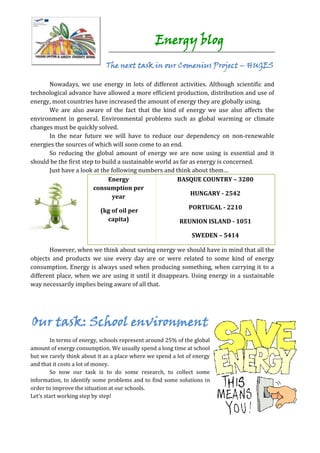
      Just have a look at the following numbers and think about them…
                              Energy                   BASQUE COUNTRY – 3280
                        consumption per
                                                             HUNGARY - 2542
                                year
                                                             PORTUGAL - 2210
                           (kg of oil per
                             capita)                      REUNION ISLAND - 1051

                                                              SWEDEN – 5414

       However, when we think about saving energy we should have in mind that all the
objects and products we use every day are or were related to some kind of energy
consumption. Energy is always used when producing something, when carrying it to a
different place, when we are using it until it disappears. Using energy in a sustainable
way necessarily implies being aware of all that.


Our task: School environment
        In terms of energy, schools represent around 25% of the global
amount of energy consumption. We usually spend a long time at school
but we rarely think about it as a place where we spend a lot of energy
and that it costs a lot of money.
        So now our task is to do some research, to collect some
information, to identify some problems and to find some solutions in
order to improve the situation at our schools.
Let’s start working step by step!
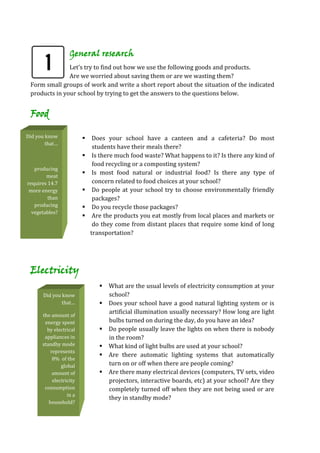
General research
               Let’s try to find out how we use the following goods and products.
               Are we worried about saving them or are we wasting them?
 Form small groups of work and write a short report about the situation of the indicated
 products in your school by trying to get the answers to the questions below.


 Food

Did you know                 Does your school have a canteen and a cafeteria? Do most
        that…
                              students have their meals there?
                             Is there much food waste? What happens to it? Is there any kind of
                              food recycling or a composting system?
   producing
                             Is most food natural or industrial food? Is there any type of
        meat
requires 14.7                 concern related to food choices at your school?
 more energy                 Do people at your school try to choose environmentally friendly
         than                 packages?
   producing                 Do you recycle those packages?
  vegetables?
                             Are the products you eat mostly from local places and markets or
                              do they come from distant places that require some kind of long
                             transportation?


 Electricity
                                 What are the usual levels of electricity consumption at your
       Did you know               school?
               that…             Does your school have a good natural lighting system or is
                                  artificial illumination usually necessary? How long are light
      the amount of
       energy spent               bulbs turned on during the day, do you have an idea?
        by electrical            Do people usually leave the lights on when there is nobody
       appliances in              in the room?
      standby mode               What kind of light bulbs are used at your school?
          represents
                                 Are there automatic lighting systems that automatically
           8% of the
               global             turn on or off when there are people coming?
           amount of             Are there many electrical devices (computers, TV sets, video
           electricity            projectors, interactive boards, etc) at your school? Are they
       consumption                completely turned off when they are not being used or are
                  in a
                                  they in standby mode?
         household?
 Are the household gadgets used at school new or old? Are they energy efficient?

  Paper
    Did you know             How much paper is used by printers and photocopy machines
            that…             in your school?
                             Are there specific places to recycle paper? Where? Do teachers
       for each ton
     of paper that            and students regularly use them?
       we recycle ,          Are photocopies made on both sides of a sheet of paper?
          we avoid           Do you use recycled paper?
     cutting down            Are people wasting paper in the toilets, in the canteen or in the
           14 trees,
                              cafeteria? Can some of those products be replaced by reusable
            wasting
      50000 liters            objects?
      of water and           Can you exchange information and documents through the
    two barrels of            Internet (mail, Moodle, wiki) and this way reduce the amount
                oil ?         of paper you are using? Do you usually use it this way?


  Heating /cooling systems

Did you know             Do you need any kind of heating or cooling system at your school?
        that…
                         What type of heating system is used? What source of energy does it
                          require? Are there any renewable energy systems at your school?
                         How energy efficient are those systems?
about 60% of
                         Is energy consumption related to those systems very high? What’s
   the energy
 coming from              the average temperature in the classroom when the heating system
       heating            is being used?
    systems is           Do people usually close the windows and the doors to avoid losing
      wasted?             energy?
                         Does the school building have a good insulation system? Are there
                          double paned windows?


  Containers – glass, plastic and metal

   Did you know
           that…
                            Do you have much waste related to glass containers and other
       the energy            packages at school?
     you can save           Are there specific places to recycle those packages? How many
    by recycling a
                             are they? Are they enough and in the correct places?
       juice can is
        enough to           Do students usually separate that waste by recycling the
    have a TV set            containers or do they put them in the common bin?
      on for three
           hours?
 Do people at school try to reduce the number of containers they use by choosing
     bigger containers or reusing them?
    Which products do you choose the most? Fresh products or packed products?


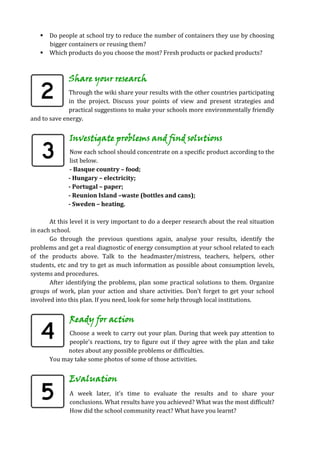
              Share your research
              Through the wiki share your results with the other countries participating
              in the project. Discuss your points of view and present strategies and
              practical suggestions to make your schools more environmentally friendly
and to save energy.


              Investigate problems and find solutions
              Now each school should concentrate on a specific product according to the
              list below.
              - Basque country – food;
              - Hungary – electricity;
              - Portugal – paper;
              - Reunion Island –waste (bottles and cans);
              - Sweden – heating.

       At this level it is very important to do a deeper research about the real situation
in each school.
       Go through the previous questions again, analyse your results, identify the
problems and get a real diagnostic of energy consumption at your school related to each
of the products above. Talk to the headmaster/mistress, teachers, helpers, other
students, etc and try to get as much information as possible about consumption levels,
systems and procedures.
       After identifying the problems, plan some practical solutions to them. Organize
groups of work, plan your action and share activities. Don’t forget to get your school
involved into this plan. If you need, look for some help through local institutions.


              Ready for action
             Choose a week to carry out your plan. During that week pay attention to
             people’s reactions, try to figure out if they agree with the plan and take
             notes about any possible problems or difficulties.
       You may take some photos of some of those activities.


              Evaluation
              A week later, it’s time to evaluate the results and to share your
              conclusions. What results have you achieved? What was the most difficult?
              How did the school community react? What have you learnt?
Create a document (powerpoint presentation, etc) to share all the results and
conclusions related to this energy adventure.

Let’s change the colours of our schools …
                    …Let’s build a green energy school!
January, 2012

Energy blog

  • 1.
    Energy blog The next task in our Comenius Project – HUGES Nowadays, we use energy in lots of different activities. Although scientific and technological advance have allowed a more efficient production, distribution and use of energy, most countries have increased the amount of energy they are globally using. We are also aware of the fact that the kind of energy we use also affects the environment in general. Environmental problems such as global warming or climate changes must be quickly solved. In the near future we will have to reduce our dependency on non-renewable energies the sources of which will soon come to an end. So reducing the global amount of energy we are now using is essential and it should be the first step to build a sustainable world as far as energy is concerned. Just have a look at the following numbers and think about them… Energy BASQUE COUNTRY – 3280 consumption per HUNGARY - 2542 year PORTUGAL - 2210 (kg of oil per capita) REUNION ISLAND - 1051 SWEDEN – 5414 However, when we think about saving energy we should have in mind that all the objects and products we use every day are or were related to some kind of energy consumption. Energy is always used when producing something, when carrying it to a different place, when we are using it until it disappears. Using energy in a sustainable way necessarily implies being aware of all that. Our task: School environment In terms of energy, schools represent around 25% of the global amount of energy consumption. We usually spend a long time at school but we rarely think about it as a place where we spend a lot of energy and that it costs a lot of money. So now our task is to do some research, to collect some information, to identify some problems and to find some solutions in order to improve the situation at our schools. Let’s start working step by step!
  • 2.
    General research Let’s try to find out how we use the following goods and products. Are we worried about saving them or are we wasting them? Form small groups of work and write a short report about the situation of the indicated products in your school by trying to get the answers to the questions below. Food Did you know  Does your school have a canteen and a cafeteria? Do most that… students have their meals there?  Is there much food waste? What happens to it? Is there any kind of food recycling or a composting system? producing  Is most food natural or industrial food? Is there any type of meat requires 14.7 concern related to food choices at your school? more energy  Do people at your school try to choose environmentally friendly than packages? producing  Do you recycle those packages? vegetables?  Are the products you eat mostly from local places and markets or do they come from distant places that require some kind of long transportation? Electricity  What are the usual levels of electricity consumption at your Did you know school? that…  Does your school have a good natural lighting system or is artificial illumination usually necessary? How long are light the amount of energy spent bulbs turned on during the day, do you have an idea? by electrical  Do people usually leave the lights on when there is nobody appliances in in the room? standby mode  What kind of light bulbs are used at your school? represents  Are there automatic lighting systems that automatically 8% of the global turn on or off when there are people coming? amount of  Are there many electrical devices (computers, TV sets, video electricity projectors, interactive boards, etc) at your school? Are they consumption completely turned off when they are not being used or are in a they in standby mode? household?
  • 3.
     Are thehousehold gadgets used at school new or old? Are they energy efficient? Paper Did you know  How much paper is used by printers and photocopy machines that… in your school?  Are there specific places to recycle paper? Where? Do teachers for each ton of paper that and students regularly use them? we recycle ,  Are photocopies made on both sides of a sheet of paper? we avoid  Do you use recycled paper? cutting down  Are people wasting paper in the toilets, in the canteen or in the 14 trees, cafeteria? Can some of those products be replaced by reusable wasting 50000 liters objects? of water and  Can you exchange information and documents through the two barrels of Internet (mail, Moodle, wiki) and this way reduce the amount oil ? of paper you are using? Do you usually use it this way? Heating /cooling systems Did you know  Do you need any kind of heating or cooling system at your school? that…  What type of heating system is used? What source of energy does it require? Are there any renewable energy systems at your school?  How energy efficient are those systems? about 60% of  Is energy consumption related to those systems very high? What’s the energy coming from the average temperature in the classroom when the heating system heating is being used? systems is  Do people usually close the windows and the doors to avoid losing wasted? energy?  Does the school building have a good insulation system? Are there double paned windows? Containers – glass, plastic and metal Did you know that…  Do you have much waste related to glass containers and other the energy packages at school? you can save  Are there specific places to recycle those packages? How many by recycling a are they? Are they enough and in the correct places? juice can is enough to  Do students usually separate that waste by recycling the have a TV set containers or do they put them in the common bin? on for three hours?
  • 4.
     Do peopleat school try to reduce the number of containers they use by choosing bigger containers or reusing them?  Which products do you choose the most? Fresh products or packed products? Share your research Through the wiki share your results with the other countries participating in the project. Discuss your points of view and present strategies and practical suggestions to make your schools more environmentally friendly and to save energy. Investigate problems and find solutions Now each school should concentrate on a specific product according to the list below. - Basque country – food; - Hungary – electricity; - Portugal – paper; - Reunion Island –waste (bottles and cans); - Sweden – heating. At this level it is very important to do a deeper research about the real situation in each school. Go through the previous questions again, analyse your results, identify the problems and get a real diagnostic of energy consumption at your school related to each of the products above. Talk to the headmaster/mistress, teachers, helpers, other students, etc and try to get as much information as possible about consumption levels, systems and procedures. After identifying the problems, plan some practical solutions to them. Organize groups of work, plan your action and share activities. Don’t forget to get your school involved into this plan. If you need, look for some help through local institutions. Ready for action Choose a week to carry out your plan. During that week pay attention to people’s reactions, try to figure out if they agree with the plan and take notes about any possible problems or difficulties. You may take some photos of some of those activities. Evaluation A week later, it’s time to evaluate the results and to share your conclusions. What results have you achieved? What was the most difficult? How did the school community react? What have you learnt?
  • 5.
    Create a document(powerpoint presentation, etc) to share all the results and conclusions related to this energy adventure. Let’s change the colours of our schools … …Let’s build a green energy school! January, 2012