ENDOCYTOSIS
Mona khimsuriya
INTRODUCTION
• In diffusion , dissolved particles (solutes) move down
a concentration gradient.
• Sometimes cells need to move non- dissolved
particles, or large amount of material across the cell
membrane.
• They can do this by two processes : endocytosis and
exocytosis.
WHAT IS ENDOCYTOSIS AND
EXOCYTOSIS
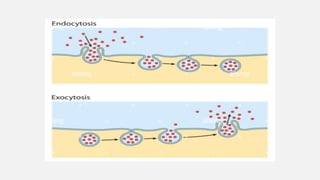
• Endocytosis : endo (within) cytosis (cell)
• The process by which a cell moves large amounts of
material, or non- dissolved particles, into its
cytoplasm from the outside environment.
• Exocytosis : exo ( exit ) cytosis ( cell)
• The process by which large amounts of material or
large non –dissolved particles are moved from the
cell’s cytoplasm to the outside environment.
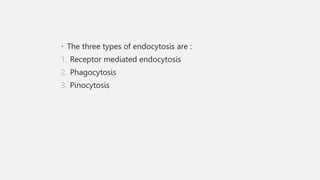
• The three types of endocytosis are :
1. Receptor mediated endocytosis
2. Phagocytosis
3. Pinocytosis
RECEPTOR MEDIATED ENDOCYTOSIS
• Receptor mediated endocytosis (RME) is the type of
endocytosis.
• RME is an endocytotic mechanism in which specific
molecules are ingested into cell.
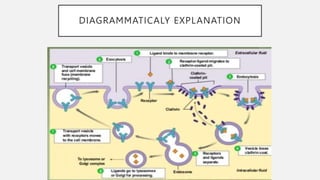
DIAGRAMMATICALY EXPLANATION
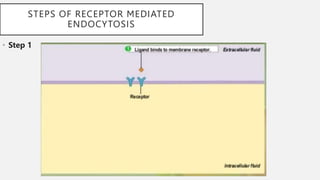
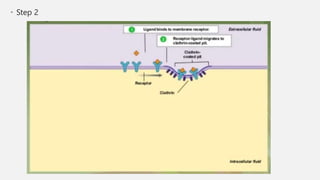
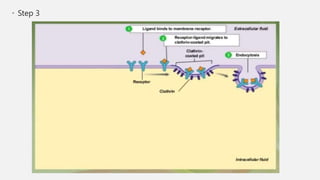
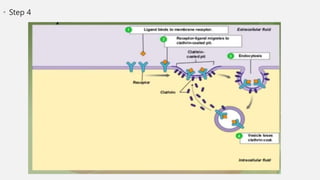
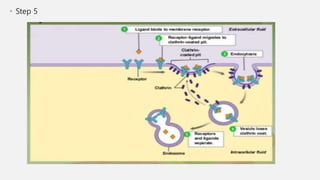
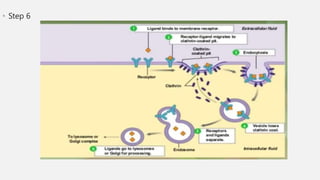
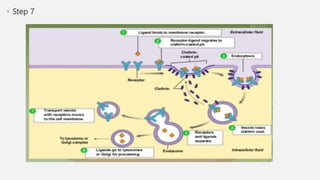
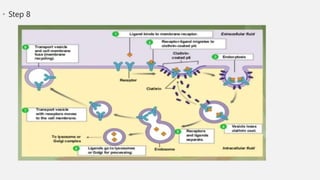
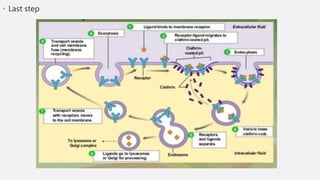
STEPS OF RECEPTOR MEDIATED
ENDOCYTOSIS
• Step 1
• Step 2
• Step 3
• Step 4
• Step 5
• Step 6
• Step 7
• Step 8
• Last step
PHAGOCYTOSIS
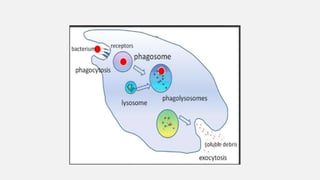
• Phagocytosis is one type of endocytosis that occurs
when a cell uses its membrane to bring non-
dissolved particles solid particles into its cytoplasm.
• In phagocytosis,the cell extends finger – like
projections of its cell membrane called psedopods
around a piece of solid material outside of the cell.
WHO DISCOVERED PHAGOCYTOSIS ?
• Ellie Ilya metchnikoff discovered it in 1882.
• Received nobel prize for the Same in 1906.
• Carl fredrich claus coined the term phagocytosis.
• WBC remove bacteria and cell debris.
• Amoeba engulfs food
EXAMPLES
WHAT ARE THE CELLS INVOLVED IN
PHAGOCYTOSIS?
• Professional phagocytes
1. Neutrophils
2. Monocytes
3. Macrophages
4. Dendritic cells
5. Mast cells
6. Eosinophils
• Non professionals
1. Lymphocytes
2. Nk and LGL cells ( large granular lymphocytes)
3. Epithelial cells
4. Endothelial cells
5. fibroblast
HOW DOES IT WORK ?
1. Entry of the pathogen
2. Recognition & phagocytosis by tissue phagocyte
3. sos signals
4. Recruitment of phagocytes & inflammation.
PINOCYTOSIS
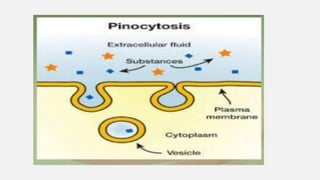
• Pinocytosis is another form of endocytosis in which
small particles are brought into the cell forming an
invagination and then suspended with in small
vesicles and then it breaks down the particles.
phagocytosis is also known as “ cell drinking”.
• Pinocytosis works just like phagocytosis but the only
difference other hand , pinocytosis is when the cell
engulfs already dissolved or broken – down food.
• Example
• Human egg cell taking up nutrients from
surrounding cells.
Thank you

Endocytosis Explained: How Cells Take In and Process External Materials"

  • 1.
  • 2.
    INTRODUCTION • In diffusion, dissolved particles (solutes) move down a concentration gradient. • Sometimes cells need to move non- dissolved particles, or large amount of material across the cell membrane. • They can do this by two processes : endocytosis and exocytosis.
  • 3.
    WHAT IS ENDOCYTOSISAND EXOCYTOSIS • Endocytosis : endo (within) cytosis (cell) • The process by which a cell moves large amounts of material, or non- dissolved particles, into its cytoplasm from the outside environment. • Exocytosis : exo ( exit ) cytosis ( cell) • The process by which large amounts of material or large non –dissolved particles are moved from the cell’s cytoplasm to the outside environment.
  • 5.
    • The threetypes of endocytosis are : 1. Receptor mediated endocytosis 2. Phagocytosis 3. Pinocytosis
  • 6.
  • 7.
    • Receptor mediatedendocytosis (RME) is the type of endocytosis. • RME is an endocytotic mechanism in which specific molecules are ingested into cell.
  • 8.
  • 9.
    STEPS OF RECEPTORMEDIATED ENDOCYTOSIS • Step 1
  • 10.
  • 11.
  • 12.
  • 13.
  • 14.
  • 15.
  • 16.
  • 17.
  • 18.
  • 19.
    • Phagocytosis isone type of endocytosis that occurs when a cell uses its membrane to bring non- dissolved particles solid particles into its cytoplasm. • In phagocytosis,the cell extends finger – like projections of its cell membrane called psedopods around a piece of solid material outside of the cell.
  • 20.
    WHO DISCOVERED PHAGOCYTOSIS? • Ellie Ilya metchnikoff discovered it in 1882. • Received nobel prize for the Same in 1906. • Carl fredrich claus coined the term phagocytosis.
  • 21.
    • WBC removebacteria and cell debris. • Amoeba engulfs food EXAMPLES
  • 22.
    WHAT ARE THECELLS INVOLVED IN PHAGOCYTOSIS? • Professional phagocytes 1. Neutrophils 2. Monocytes 3. Macrophages 4. Dendritic cells 5. Mast cells 6. Eosinophils
  • 23.
    • Non professionals 1.Lymphocytes 2. Nk and LGL cells ( large granular lymphocytes) 3. Epithelial cells 4. Endothelial cells 5. fibroblast
  • 24.
    HOW DOES ITWORK ? 1. Entry of the pathogen 2. Recognition & phagocytosis by tissue phagocyte 3. sos signals 4. Recruitment of phagocytes & inflammation.
  • 26.
  • 27.
    • Pinocytosis isanother form of endocytosis in which small particles are brought into the cell forming an invagination and then suspended with in small vesicles and then it breaks down the particles. phagocytosis is also known as “ cell drinking”. • Pinocytosis works just like phagocytosis but the only difference other hand , pinocytosis is when the cell engulfs already dissolved or broken – down food.
  • 29.
    • Example • Humanegg cell taking up nutrients from surrounding cells.
  • 30.