Endocrine System
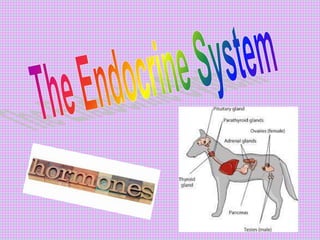
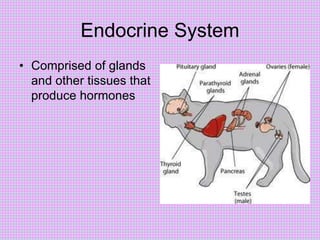
• Comprised of glands
and other tissues that
produce hormones
Endocrine System
• Hormones
– chemicals produced in
response to specific stimuli
that stimulate reactions in
specific body organs and
tissues
– released directly into the
bloodstream, interact with
receptors causing the
target tissue to perform a
specific function
Endocrine System
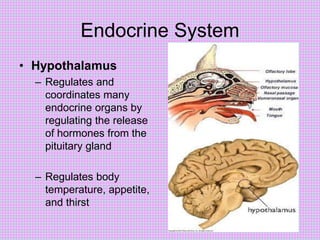
• Hypothalamus
– Regulates and
coordinates many
endocrine organs by
regulating the release
of hormones from the
pituitary gland
– Regulates body
temperature, appetite,
and thirst
Hormones of the Hypothalmus
• Anti-diuretic hormone (ADH): increases water
absorption into the blood by the kidneys
• Corticotropin-releasing hormone (CRH): triggers the
release of corticosteroids, which help regulate
metabolism and immune response
• Gonadotropin-releasing hormone (GnRH): stimulates
the release of follicle stimulating hormone (FSH) and
luteinizing hormone (LH), which work together to ensure
normal functioning of the ovaries and testes
Hormones of the Hypothalmus
• Growth hormone-releasing hormone (GHRH) or growth hormone-
inhibiting hormone (GHIH): triggers the release of growth hormone (GH);
GHIH has the opposite effect . GH is essential to maintaining a healthy body
composition (bone, muscle growth)
• Oxytocin: aids with: ability to trust, body temperature, sleep cycles, and
lactation
• Prolactin-releasing hormone (PRH) or prolactin-inhibiting hormone
(PIH): prompts the production of prolactin for milk production. PIH inhibits
prolactin
• Thyrotropin releasing hormone (TRH): triggers the release of thyroid
stimulating hormone (TSH), which stimulates release of thyroid hormones -
regulate metabolism, energy, and growth and development
Endocrine System
• Pituitary
– Anterior pituitary
– Posterior pituitary
• Important roles in
regulating growth,
metabolism,
reproduction, lactation,
and water balance
Hormones of the Anterior Pituitary
• Adrenocorticotropic hormone (ACTH): ACTH stimulates the adrenal
glands to produce hormones
• Follicle-stimulating hormone (FSH): FSH works with LH to ensure normal
functioning of the ovaries and testes
• Growth hormone (GH): GH is essential in early years to maintaining a
healthy body composition and for growth in children. In adults, it aids
healthy bone and muscle mass and affects fat distribution
• Luteinizing hormone (LH): LH works with FSH to ensure normal
functioning of the ovaries and testes
• Prolactin: Prolactin stimulates breast milk production
• Thyroid-stimulating hormone (TSH): TSH stimulates the thyroid gland to
produce hormones.
Hormones of the Posterior Pituitary
• Anti-diuretic hormone (ADH): prompts
the kidneys to increase water absorption in
the blood
• Oxytocin: contracting the uterus during
childbirth, milk production, trust
Endocrine System
• Thyroid gland
– Thyroxine
• Regulates metabolism,
and calcitonin
– Calcitonin lowers
blood calcium levels
when high by
inhibiting osetoclasts
• Parathyroid gland
– Parathyroid hormone
• Raises blood calcium
levels when low by
stimulating osteoclasts
Endocrine System
• Adrenal glands
– Located on top of
kidneys
– Adrenal cortex
produces cortisol and
sex hormones
– The adrenal medulla
produces epinephrine
and norepinephrine
Endocrine System
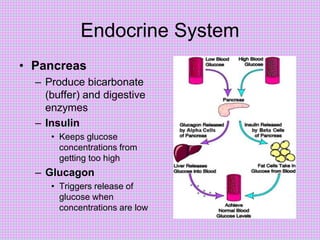
• Pancreas
– Produce bicarbonate
(buffer) and digestive
enzymes
– Insulin
• Keeps glucose
concentrations from
getting too high
– Glucagon
• Triggers release of
glucose when
concentrations are low
Endocrine System
• Ovaries
– Produce estrogens, progesterone
– Prepare the reproductive tract for pregnancy
and are also responsible for female sexual
behavior and mammary gland development
• Testes
– Produce testosterone and estrogens
– Involved in sperm production and maturation
as well as the secondary sex characteristics
of males

Endocrine System presentation general.ppt

  • 2.
    Endocrine System • Comprisedof glands and other tissues that produce hormones
  • 3.
    Endocrine System • Hormones –chemicals produced in response to specific stimuli that stimulate reactions in specific body organs and tissues – released directly into the bloodstream, interact with receptors causing the target tissue to perform a specific function
  • 4.
    Endocrine System • Hypothalamus –Regulates and coordinates many endocrine organs by regulating the release of hormones from the pituitary gland – Regulates body temperature, appetite, and thirst
  • 5.
    Hormones of theHypothalmus • Anti-diuretic hormone (ADH): increases water absorption into the blood by the kidneys • Corticotropin-releasing hormone (CRH): triggers the release of corticosteroids, which help regulate metabolism and immune response • Gonadotropin-releasing hormone (GnRH): stimulates the release of follicle stimulating hormone (FSH) and luteinizing hormone (LH), which work together to ensure normal functioning of the ovaries and testes
  • 6.
    Hormones of theHypothalmus • Growth hormone-releasing hormone (GHRH) or growth hormone- inhibiting hormone (GHIH): triggers the release of growth hormone (GH); GHIH has the opposite effect . GH is essential to maintaining a healthy body composition (bone, muscle growth) • Oxytocin: aids with: ability to trust, body temperature, sleep cycles, and lactation • Prolactin-releasing hormone (PRH) or prolactin-inhibiting hormone (PIH): prompts the production of prolactin for milk production. PIH inhibits prolactin • Thyrotropin releasing hormone (TRH): triggers the release of thyroid stimulating hormone (TSH), which stimulates release of thyroid hormones - regulate metabolism, energy, and growth and development
  • 7.
    Endocrine System • Pituitary –Anterior pituitary – Posterior pituitary • Important roles in regulating growth, metabolism, reproduction, lactation, and water balance
  • 8.
    Hormones of theAnterior Pituitary • Adrenocorticotropic hormone (ACTH): ACTH stimulates the adrenal glands to produce hormones • Follicle-stimulating hormone (FSH): FSH works with LH to ensure normal functioning of the ovaries and testes • Growth hormone (GH): GH is essential in early years to maintaining a healthy body composition and for growth in children. In adults, it aids healthy bone and muscle mass and affects fat distribution • Luteinizing hormone (LH): LH works with FSH to ensure normal functioning of the ovaries and testes • Prolactin: Prolactin stimulates breast milk production • Thyroid-stimulating hormone (TSH): TSH stimulates the thyroid gland to produce hormones.
  • 9.
    Hormones of thePosterior Pituitary • Anti-diuretic hormone (ADH): prompts the kidneys to increase water absorption in the blood • Oxytocin: contracting the uterus during childbirth, milk production, trust
  • 10.
    Endocrine System • Thyroidgland – Thyroxine • Regulates metabolism, and calcitonin – Calcitonin lowers blood calcium levels when high by inhibiting osetoclasts • Parathyroid gland – Parathyroid hormone • Raises blood calcium levels when low by stimulating osteoclasts
  • 11.
    Endocrine System • Adrenalglands – Located on top of kidneys – Adrenal cortex produces cortisol and sex hormones – The adrenal medulla produces epinephrine and norepinephrine
  • 12.
    Endocrine System • Pancreas –Produce bicarbonate (buffer) and digestive enzymes – Insulin • Keeps glucose concentrations from getting too high – Glucagon • Triggers release of glucose when concentrations are low
  • 13.
    Endocrine System • Ovaries –Produce estrogens, progesterone – Prepare the reproductive tract for pregnancy and are also responsible for female sexual behavior and mammary gland development • Testes – Produce testosterone and estrogens – Involved in sperm production and maturation as well as the secondary sex characteristics of males