In partnership with:
End of Module Assessment
Part of the EDA Electrotechnical Product Knowledge Programme
LIGHTING
(INTRODUCTION)
This module is the property of:
Name:
Company:
Branch:
Enrollment Number:
Start date:
Workbook Date
If found please contact the Electrical Distributors’ Association.
Declaration of Authenticity
Before signing please read the guidance for participants.
Guidance for participants
You have been asked to sign this Declaration of Authenticity of your answers in this workbook. It confirms that the answers
that you have submitted for assessment are your own and that you have not copied them from someone else or allowed
another learner to copy them from you. When preparing any coursework it is good practice to undertake research using
information from published sources. If you quote directly from these sources then this must be indicated in your work by
using quotation marks and referencing the document from which the quotation was taken. You must then comment
in your own words on any ideas expressed.
Declaration of Authenticity
I confirm that the answers provided in this workbook are all derived from my own work and do not include any work
completed by anyone other than myself. I have completed the workbook in accordance with EDA/IET instructions.
Signature Date
Name
Manager’s confirmation of authenticity
On behalf of ………………………………………………………… (insert branch name), I confirm that the above
mentioned participant, to the best of my knowledge, is the sole author of the completed workbook.
Signed Date
Name
Title
Published by: The Electrical Distributors’ Association, first published 2018.
©The Electrical Distributors’ Association
This publication is copyright under the Berne Convention and the Universal Copyright Convention.All rights reserved.
Apart from any fair dealing for the purposes of research or private study, or criticism or review, as permitted under the
Copyright, Designs and Patents Act 1988, this publication may be reproduced, stored or transmitted, in any form or by
any means, only with the prior permission in writing of the publishers, or in the case of reprographic reproduction in
accordance with the terms of licences issued by the Copyright Licensing Agency.
3
CONTENTS
1 Introduction 4
2 Multiple-choice questions 6
3 Short questions 10
4 Long questions 16
4
INTRODUCTION
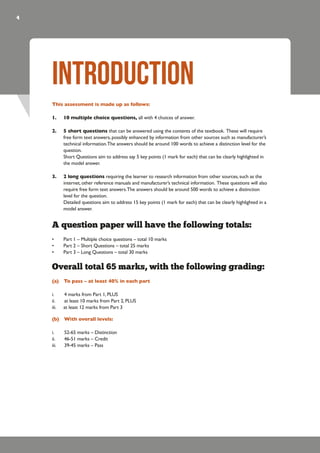
This assessment is made up as follows:
1. 10 multiple choice questions, all with 4 choices of answer.
2. 5 short questions that can be answered using the contents of the textbook. These will require
free form text answers, possibly enhanced by information from other sources such as manufacturer’s
technical information.The answers should be around 100 words to achieve a distinction level for the
question.
Short Questions aim to address say 5 key points (1 mark for each) that can be clearly highlighted in
the model answer.
3. 2 long questions requiring the learner to research information from other sources, such as the
internet, other reference manuals and manufacturer’s technical information. These questions will also
require free form text answers.The answers should be around 500 words to achieve a distinction
level for the question.
Detailed questions aim to address 15 key points (1 mark for each) that can be clearly highlighted in a
model answer.
A question paper will have the following totals:
• Part 1 – Multiple choice questions – total 10 marks
• Part 2 – Short Questions – total 25 marks
• Part 3 – Long Questions – total 30 marks
Overall total 65 marks, with the following grading:
(a) To pass – at least 40% in each part
i. 4 marks from Part 1, PLUS
ii. at least 10 marks from Part 2, PLUS
iii. at least 12 marks from Part 3
(b) With overall levels:
i. 52-65 marks – Distinction
ii. 46-51 marks – Credit
iii. 39-45 marks – Pass
2
MULTIPLE-CHOICE
QUESTIONS
6
6
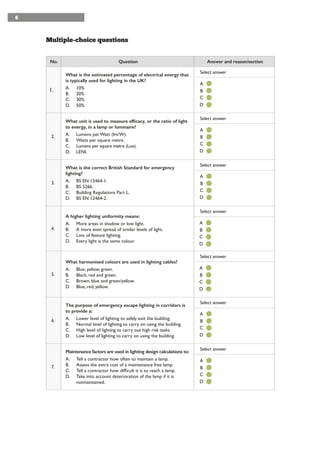
Multiple-choice questions
No. Question Answer and reason/section
1.
What is the estimated percentage of electrical energy that
is typically used for lighting in the UK?
A. 10%
B. 20%
C. 30%
D. 50%
Select answer
2.
What unit is used to measure efficacy, or the ratio of light
to energy, in a lamp or luminaire?
A. Lumens per Watt (lm/W).
B. Watts per square metre.
C. Lumens per square metre (Lux).
D. LENI.
Select answer
3.
What is the correct British Standard for emergency
lighting?
A. BS EN 12464-1.
B. BS 5266.
C. Building Regulations Part L.
D. BS EN 12464-2.
Select answer
4.
A higher lighting uniformity means:
A. More areas in shadow or low light.
B. A more even spread of similar levels of light.
C. Lots of feature lighting.
D. Every light is the same colour.
Select answer
5.
What harmonised colours are used in lighting cables?
A. Blue, yellow, green.
B. Black, red and green.
C. Brown, blue and green/yellow.
D. Blue, red, yellow.
Select answer
6.
The purpose of emergency escape lighting in corridors is
to provide a:
A. Lower level of lighting to safely exit the building.
B. Normal level of lighting to carry on using the building.
C. High level of lighting to carry out high risk tasks.
D. Low level of lighting to carry on using the building.
Select answer
7.
Maintenance factors are used in lighting design calculations to:
A. Tell a contractor how often to maintain a lamp.
B. Assess the extra cost of a maintenance free lamp.
C. Tell a contractor how difficult it is to reach a lamp.
D. Take into account deterioration of the lamp if it is
notmaintained.
Select answer
A
A
A
C
C
C
B
B
B
D
D
D
A
A
C
C
B
B
D
D
A
C
B
D
A
C
B
D
7
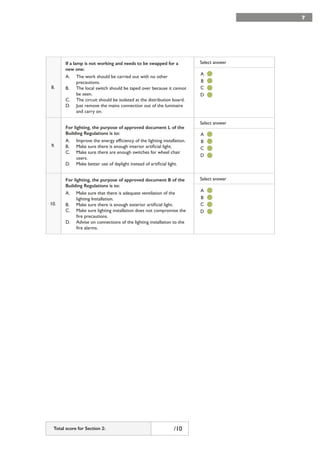
8.
If a lamp is not working and needs to be swapped for a
new one:
A. The work should be carried out with no other
precautions.
B. The local switch should be taped over because it cannot
be seen.
C. The circuit should be isolated at the distribution board.
D. Just remove the mains connection out of the luminaire
and carry on.
Select answer
9.
For lighting, the purpose of approved document L of the
Building Regulations is to:
A. Improve the energy efficiency of the lighting installation.
B. Make sure there is enough interior artificial light.
C. Make sure there are enough switches for wheel chair
users.
D. Make better use of daylight instead of artificial light.
Select answer
10.
For lighting, the purpose of approved document B of the
Building Regulations is to:
A. Make sure that there is adequate ventilation of the
lighting Installation.
B. Make sure there is enough exterior artificial light.
C. Make sure lighting installation does not compromise the
fire precautions.
D. Advise on connections of the lighting installation to the
fire alarms.
Select answer
7
A
A
A
C
C
C
B
B
B
D
D
D
Total score for Section 2: /10
3
SHORT QUESTIONS
10
Short questions
Short Question 1
Explain the main differences between direct light and indirect light.
Answer:
Assessor Comments
10
10
Marks
11
Short Question 2
What are the two main standards that are used to determine the required light levels in a particular commercial,
industrial or public installation?
What is the standard that should be referred to for emergency lighting?
Answer:
Assessor Comments
Marks
12
Short Question 3
To protect a lighting circuit a protective device (MCB) is used at the distribution board. What is the possible outcome
if too many lights are placed on a 6 A Type B MCB?
What are the possible solutions to any problems encountered?
Answer:
Assessor Comments
Marks
13
Short Question 4
When considering the likely lifespan, and the associated lighting performance of a correctly installed and operated
LED luminaire, what does the figure L80 represent? You can assume that the declared lifespan is 50,000 hours.
Answer:
Assessor Comments
Marks
14
Short Question 5
Regarding the Building Regulations, and Approved Document Part B for Fire Safety in particular, what measures
should be considered to ensure a lighting installation does not become the weak link and cause the spread of a fire?
Answer:
Assessor Comments
14
Total score for Section 3: /25
Marks
4
LONG QUESTIONS
16
Long questions
Long Question 1
• What is meant by the ‘uniformity ratio’, what symbol is used and what range of numbers would you expect
for it?
• How is the uniformity ratio calculated and what measurements or values are used to do that?
On a lighting design, two numbers have been calculated for an office – 200 near the edge and 500 towards the
middle.
• What assumptions are reasonable to make about what the readings mean?
• What is the unit of light output for these numbers?
• Based on these numbers, what is the uniformity ratio?
If the uniformity of illuminance in an office is low, what might be done to improve that?
What might be the financial consequences of any suggested action?
Answer:
Assessor Comments
Marks
17
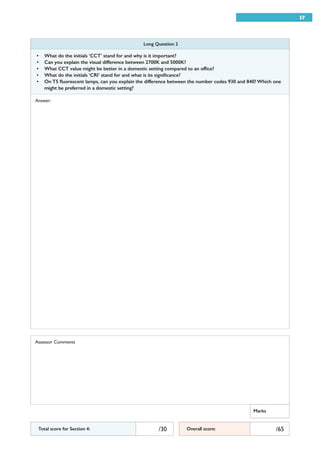
Long Question 2
• What do the initials ‘CCT’ stand for and why is it important?
• Can you explain the visual difference between 2700K and 5000K?
• What CCT value might be better in a domestic setting compared to an office?
• What do the initials ‘CRI’ stand for and what is its significance?
• On T5 fluorescent lamps, can you explain the difference between the number codes 930 and 840?Which one
might be preferred in a domestic setting?
Answer:
Assessor Comments
Marks
Total score for Section 4: Overall score:
/30 /65
End of Module Assessment_Lighting (Introduction) test.pdf

End of Module Assessment_Lighting (Introduction) test.pdf

  • 1.
    In partnership with: Endof Module Assessment Part of the EDA Electrotechnical Product Knowledge Programme LIGHTING (INTRODUCTION) This module is the property of: Name: Company: Branch: Enrollment Number: Start date: Workbook Date If found please contact the Electrical Distributors’ Association.
  • 2.
    Declaration of Authenticity Beforesigning please read the guidance for participants. Guidance for participants You have been asked to sign this Declaration of Authenticity of your answers in this workbook. It confirms that the answers that you have submitted for assessment are your own and that you have not copied them from someone else or allowed another learner to copy them from you. When preparing any coursework it is good practice to undertake research using information from published sources. If you quote directly from these sources then this must be indicated in your work by using quotation marks and referencing the document from which the quotation was taken. You must then comment in your own words on any ideas expressed. Declaration of Authenticity I confirm that the answers provided in this workbook are all derived from my own work and do not include any work completed by anyone other than myself. I have completed the workbook in accordance with EDA/IET instructions. Signature Date Name Manager’s confirmation of authenticity On behalf of ………………………………………………………… (insert branch name), I confirm that the above mentioned participant, to the best of my knowledge, is the sole author of the completed workbook. Signed Date Name Title Published by: The Electrical Distributors’ Association, first published 2018. ©The Electrical Distributors’ Association This publication is copyright under the Berne Convention and the Universal Copyright Convention.All rights reserved. Apart from any fair dealing for the purposes of research or private study, or criticism or review, as permitted under the Copyright, Designs and Patents Act 1988, this publication may be reproduced, stored or transmitted, in any form or by any means, only with the prior permission in writing of the publishers, or in the case of reprographic reproduction in accordance with the terms of licences issued by the Copyright Licensing Agency.
  • 3.
    3 CONTENTS 1 Introduction 4 2Multiple-choice questions 6 3 Short questions 10 4 Long questions 16
  • 4.
    4 INTRODUCTION This assessment ismade up as follows: 1. 10 multiple choice questions, all with 4 choices of answer. 2. 5 short questions that can be answered using the contents of the textbook. These will require free form text answers, possibly enhanced by information from other sources such as manufacturer’s technical information.The answers should be around 100 words to achieve a distinction level for the question. Short Questions aim to address say 5 key points (1 mark for each) that can be clearly highlighted in the model answer. 3. 2 long questions requiring the learner to research information from other sources, such as the internet, other reference manuals and manufacturer’s technical information. These questions will also require free form text answers.The answers should be around 500 words to achieve a distinction level for the question. Detailed questions aim to address 15 key points (1 mark for each) that can be clearly highlighted in a model answer. A question paper will have the following totals: • Part 1 – Multiple choice questions – total 10 marks • Part 2 – Short Questions – total 25 marks • Part 3 – Long Questions – total 30 marks Overall total 65 marks, with the following grading: (a) To pass – at least 40% in each part i. 4 marks from Part 1, PLUS ii. at least 10 marks from Part 2, PLUS iii. at least 12 marks from Part 3 (b) With overall levels: i. 52-65 marks – Distinction ii. 46-51 marks – Credit iii. 39-45 marks – Pass
  • 5.
  • 6.
    6 6 Multiple-choice questions No. QuestionAnswer and reason/section 1. What is the estimated percentage of electrical energy that is typically used for lighting in the UK? A. 10% B. 20% C. 30% D. 50% Select answer 2. What unit is used to measure efficacy, or the ratio of light to energy, in a lamp or luminaire? A. Lumens per Watt (lm/W). B. Watts per square metre. C. Lumens per square metre (Lux). D. LENI. Select answer 3. What is the correct British Standard for emergency lighting? A. BS EN 12464-1. B. BS 5266. C. Building Regulations Part L. D. BS EN 12464-2. Select answer 4. A higher lighting uniformity means: A. More areas in shadow or low light. B. A more even spread of similar levels of light. C. Lots of feature lighting. D. Every light is the same colour. Select answer 5. What harmonised colours are used in lighting cables? A. Blue, yellow, green. B. Black, red and green. C. Brown, blue and green/yellow. D. Blue, red, yellow. Select answer 6. The purpose of emergency escape lighting in corridors is to provide a: A. Lower level of lighting to safely exit the building. B. Normal level of lighting to carry on using the building. C. High level of lighting to carry out high risk tasks. D. Low level of lighting to carry on using the building. Select answer 7. Maintenance factors are used in lighting design calculations to: A. Tell a contractor how often to maintain a lamp. B. Assess the extra cost of a maintenance free lamp. C. Tell a contractor how difficult it is to reach a lamp. D. Take into account deterioration of the lamp if it is notmaintained. Select answer A A A C C C B B B D D D A A C C B B D D A C B D A C B D
  • 7.
    7 8. If a lampis not working and needs to be swapped for a new one: A. The work should be carried out with no other precautions. B. The local switch should be taped over because it cannot be seen. C. The circuit should be isolated at the distribution board. D. Just remove the mains connection out of the luminaire and carry on. Select answer 9. For lighting, the purpose of approved document L of the Building Regulations is to: A. Improve the energy efficiency of the lighting installation. B. Make sure there is enough interior artificial light. C. Make sure there are enough switches for wheel chair users. D. Make better use of daylight instead of artificial light. Select answer 10. For lighting, the purpose of approved document B of the Building Regulations is to: A. Make sure that there is adequate ventilation of the lighting Installation. B. Make sure there is enough exterior artificial light. C. Make sure lighting installation does not compromise the fire precautions. D. Advise on connections of the lighting installation to the fire alarms. Select answer 7 A A A C C C B B B D D D Total score for Section 2: /10
  • 9.
  • 10.
    10 Short questions Short Question1 Explain the main differences between direct light and indirect light. Answer: Assessor Comments 10 10 Marks
  • 11.
    11 Short Question 2 Whatare the two main standards that are used to determine the required light levels in a particular commercial, industrial or public installation? What is the standard that should be referred to for emergency lighting? Answer: Assessor Comments Marks
  • 12.
    12 Short Question 3 Toprotect a lighting circuit a protective device (MCB) is used at the distribution board. What is the possible outcome if too many lights are placed on a 6 A Type B MCB? What are the possible solutions to any problems encountered? Answer: Assessor Comments Marks
  • 13.
    13 Short Question 4 Whenconsidering the likely lifespan, and the associated lighting performance of a correctly installed and operated LED luminaire, what does the figure L80 represent? You can assume that the declared lifespan is 50,000 hours. Answer: Assessor Comments Marks
  • 14.
    14 Short Question 5 Regardingthe Building Regulations, and Approved Document Part B for Fire Safety in particular, what measures should be considered to ensure a lighting installation does not become the weak link and cause the spread of a fire? Answer: Assessor Comments 14 Total score for Section 3: /25 Marks
  • 15.
  • 16.
    16 Long questions Long Question1 • What is meant by the ‘uniformity ratio’, what symbol is used and what range of numbers would you expect for it? • How is the uniformity ratio calculated and what measurements or values are used to do that? On a lighting design, two numbers have been calculated for an office – 200 near the edge and 500 towards the middle. • What assumptions are reasonable to make about what the readings mean? • What is the unit of light output for these numbers? • Based on these numbers, what is the uniformity ratio? If the uniformity of illuminance in an office is low, what might be done to improve that? What might be the financial consequences of any suggested action? Answer: Assessor Comments Marks
  • 17.
    17 Long Question 2 •What do the initials ‘CCT’ stand for and why is it important? • Can you explain the visual difference between 2700K and 5000K? • What CCT value might be better in a domestic setting compared to an office? • What do the initials ‘CRI’ stand for and what is its significance? • On T5 fluorescent lamps, can you explain the difference between the number codes 930 and 840?Which one might be preferred in a domestic setting? Answer: Assessor Comments Marks Total score for Section 4: Overall score: /30 /65