#NeedToKnowBasis Learn more
Encoding
vs
Encryptio
n
vs
Hashing
Learn more
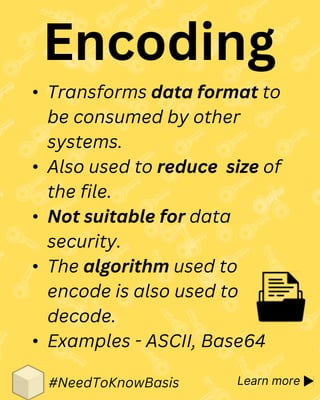
• Transforms data format to
be consumed by other
systems.
• Also used to reduce size of
the file.
• Not suitable for data
security.
• The algorithm used to
encode is also used to
decode.
• Examples - ASCII, Base64
#NeedToKnowBasis
Encoding
Learn more
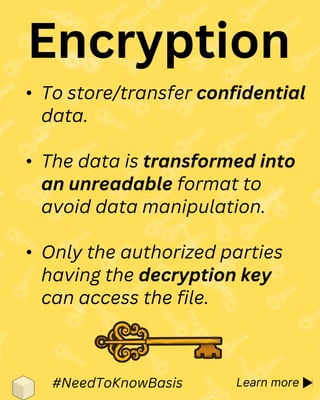
• To store/transfer confidential
data.
• The data is transformed into
an unreadable format to
avoid data manipulation.
• Only the authorized parties
having the decryption key
can access the file.
#NeedToKnowBasis
Encryption
Learn more
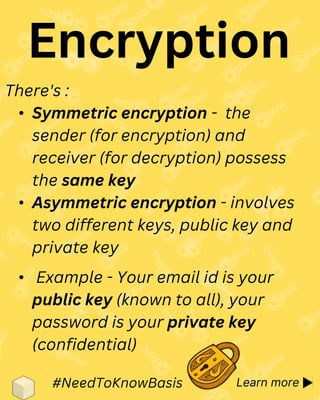
There's :
• Symmetric encryption - the
sender (for encryption) and
receiver (for decryption) possess
the same key
• Asymmetric encryption - involves
two different keys, public key and
private key
• Example - Your email id is your
public key (known to all), your
password is your private key
(confidential)
#NeedToKnowBasis
Encryption
#NeedToKnowBasis Learn more
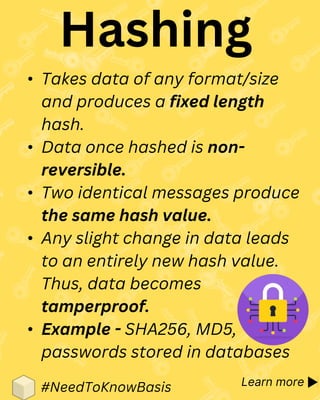
• Takes data of any format/size
and produces a fixed length
hash.
• Data once hashed is non-
reversible.
• Two identical messages produce
the same hash value.
• Any slight change in data leads
to an entirely new hash value.
Thus, data becomes
tamperproof.
• Example - SHA256, MD5,
passwords stored in databases
Hashing
Learn more
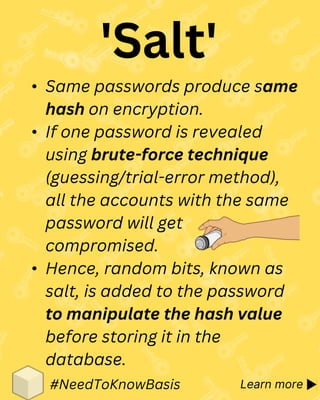
• Same passwords produce same
hash on encryption.
• If one password is revealed
using brute-force technique
(guessing/trial-error method),
all the accounts with the same
password will get
compromised.
• Hence, random bits, known as
salt, is added to the password
to manipulate the hash value
before storing it in the
database.
#NeedToKnowBasis
'Salt'
Thank you
#NeedToKnowBasis
Watch
THE
IMITATIO
N
GAME
World's first computer, invented by Alan Turing to decipher the
German Enigma code during Nazi war.
starring
Benedict Cumberbatch

Encoding vs Encryption vs Hashing.pptx

  • 1.
  • 2.
    Learn more • Transformsdata format to be consumed by other systems. • Also used to reduce size of the file. • Not suitable for data security. • The algorithm used to encode is also used to decode. • Examples - ASCII, Base64 #NeedToKnowBasis Encoding
  • 3.
    Learn more • Tostore/transfer confidential data. • The data is transformed into an unreadable format to avoid data manipulation. • Only the authorized parties having the decryption key can access the file. #NeedToKnowBasis Encryption
  • 4.
    Learn more There's : •Symmetric encryption - the sender (for encryption) and receiver (for decryption) possess the same key • Asymmetric encryption - involves two different keys, public key and private key • Example - Your email id is your public key (known to all), your password is your private key (confidential) #NeedToKnowBasis Encryption
  • 5.
    #NeedToKnowBasis Learn more •Takes data of any format/size and produces a fixed length hash. • Data once hashed is non- reversible. • Two identical messages produce the same hash value. • Any slight change in data leads to an entirely new hash value. Thus, data becomes tamperproof. • Example - SHA256, MD5, passwords stored in databases Hashing
  • 6.
    Learn more • Samepasswords produce same hash on encryption. • If one password is revealed using brute-force technique (guessing/trial-error method), all the accounts with the same password will get compromised. • Hence, random bits, known as salt, is added to the password to manipulate the hash value before storing it in the database. #NeedToKnowBasis 'Salt'
  • 7.
    Thank you #NeedToKnowBasis Watch THE IMITATIO N GAME World's firstcomputer, invented by Alan Turing to decipher the German Enigma code during Nazi war. starring Benedict Cumberbatch