ENCODERS
&
DECODERS
Exploring the components of a circuit
Presented By
Reduan Ahmad: 232-35-016
Abdullah Al Noman: 232-35-003
Asraful Alam: 232-35-214
Mohammad Ali Nayeem: 232-35-022
Section : A
ID : 232-35-016
Reduan Ahmad
Today we’ll Focus
Encoders
Decoders
Importance in digital electronics
What is Encoders & Decoders?
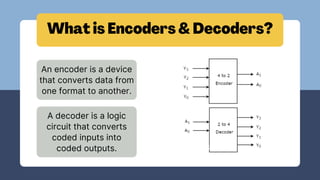
An encoder is a device
that converts data from
one format to another.
A decoder is a logic
circuit that converts
coded inputs into
coded outputs.
Importance in digital
electronics
Digital electronics are more important than analog
electronics because they are more accurate, reliable,
and energy efficient. Digital signals are less capable to
noise and interference, making them more reliable in
transmission mediums like satellite TV and cell phone
networks. Digital data is also more compact and less
likely to be corrupted, making it easier to store and
maintain over time.
Section : A
ID : 232-35-003
Md. Abdullah Al Noman
Encoder’s
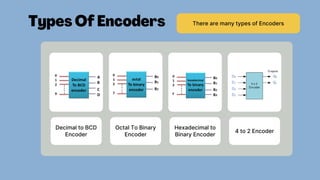
Decimal to BCD
Encoder
There are many types of Encoders
Octal To Binary
Encoder
Hexadecimal to
Binary Encoder
4 to 2 Encoder
Types Of Encoders
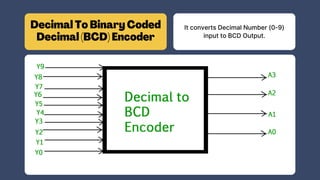
Decimal To Binary Coded
Decimal (BCD) Encoder
It converts Decimal Number (0-9)
input to BCD Output.
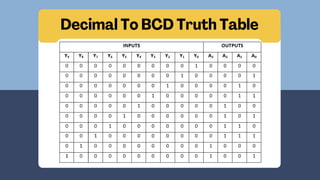
Decimal To BCD Truth Table
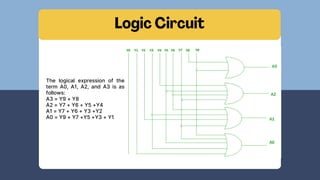
Logic Circuit
The logical expression of the
term A0, A1, A2, and A3 is as
follows:
A3 = Y9 + Y8
A2 = Y7 + Y6 + Y5 +Y4
A1 = Y7 + Y6 + Y3 +Y2
A0 = Y9 + Y7 +Y5 +Y3 + Y1
Section : A
ID : 232-35-214
Asraful Alam
Decoder’s
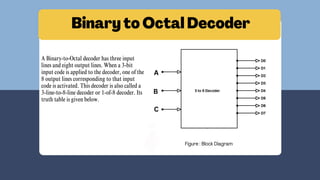
Binary to Octal Decoder
A
B
C
Figure : Block Diagram
A Binary-to-Octal decoder has three input
lines and eight output lines. When a 3-bit
input code is applied to the decoder, one of the
8 output lines corresponding to that input
code is activated. This decoder is also called a
3-line-to-8-line decoder or 1-of-8 decoder. Its
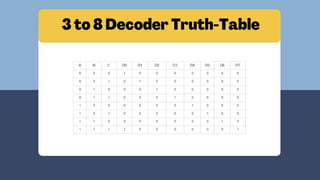
truth table is given below.
3 to 8 Decoder Truth-Table
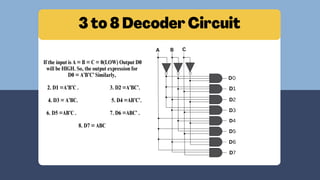
3 to 8 Decoder Circuit
D0
D1
D2
D3
D4
D5
D6
D7
C
A B
If the input is A = B = C = 0(LOW) Output D0
will be HIGH. So, the output expression for
D0 = A’B’C’ Similarly,
2. D1 =A’B’C . 3. D2 =A’BC’.
4. D3 = A’BC. 5. D4 =AB’C’.
6. D5 =AB’C . 7. D6 =ABC’ .
8. D7 = ABC
Section : A
ID : 232-35-022
Mohammad Ali Nayeem
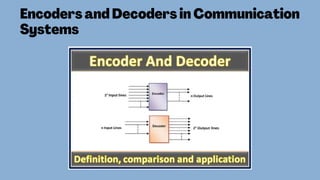
Encoders and Decoders in Communication
Systems
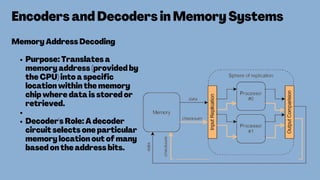
Encoders and Decoders in Memory Systems
Memory Address Decoding
Purpose: Translates a
memory address (provided by
the CPU) into a specific
location within the memory
chip where data is stored or
retrieved.
Decoder's Role: A decoder
circuit selects one particular
memory location out of many
based on the address bits.
RAM and ROM Access Control
Encoders: In some systems, encoders
may be used to generate control
signals that enable or disable access
to specific memory chips or regions.
Decoders: Primarily responsible for
decoding memory addresses, but they
can also be involved in generating
timing and control signals for memory
access.
Conclusion
The Future of Encoders and Decoders
As technology advances, so too will the
complexity and sophistication of the
encoding and decoding schemes
employed.
Look for continued innovation in areas
like error correction, data compression,
and encryption, as we strive to achieve
faster, more reliable, and more secure
communication and data storage
systems.
THANK YOU!
FOR YOUR TIME

ENCODERS & DECODERS - Digital Electronics - diu swe

  • 1.
    ENCODERS & DECODERS Exploring the componentsof a circuit Presented By Reduan Ahmad: 232-35-016 Abdullah Al Noman: 232-35-003 Asraful Alam: 232-35-214 Mohammad Ali Nayeem: 232-35-022
  • 2.
    Section : A ID: 232-35-016 Reduan Ahmad
  • 3.
  • 4.
    What is Encoders& Decoders? An encoder is a device that converts data from one format to another. A decoder is a logic circuit that converts coded inputs into coded outputs.
  • 5.
    Importance in digital electronics Digitalelectronics are more important than analog electronics because they are more accurate, reliable, and energy efficient. Digital signals are less capable to noise and interference, making them more reliable in transmission mediums like satellite TV and cell phone networks. Digital data is also more compact and less likely to be corrupted, making it easier to store and maintain over time.
  • 6.
    Section : A ID: 232-35-003 Md. Abdullah Al Noman
  • 7.
  • 8.
    Decimal to BCD Encoder Thereare many types of Encoders Octal To Binary Encoder Hexadecimal to Binary Encoder 4 to 2 Encoder Types Of Encoders
  • 9.
    Decimal To BinaryCoded Decimal (BCD) Encoder It converts Decimal Number (0-9) input to BCD Output.
  • 10.
    Decimal To BCDTruth Table
  • 11.
    Logic Circuit The logicalexpression of the term A0, A1, A2, and A3 is as follows: A3 = Y9 + Y8 A2 = Y7 + Y6 + Y5 +Y4 A1 = Y7 + Y6 + Y3 +Y2 A0 = Y9 + Y7 +Y5 +Y3 + Y1
  • 12.
    Section : A ID: 232-35-214 Asraful Alam
  • 13.
  • 14.
    Binary to OctalDecoder A B C Figure : Block Diagram A Binary-to-Octal decoder has three input lines and eight output lines. When a 3-bit input code is applied to the decoder, one of the 8 output lines corresponding to that input code is activated. This decoder is also called a 3-line-to-8-line decoder or 1-of-8 decoder. Its truth table is given below.
  • 15.
    3 to 8Decoder Truth-Table
  • 16.
    3 to 8Decoder Circuit D0 D1 D2 D3 D4 D5 D6 D7 C A B If the input is A = B = C = 0(LOW) Output D0 will be HIGH. So, the output expression for D0 = A’B’C’ Similarly, 2. D1 =A’B’C . 3. D2 =A’BC’. 4. D3 = A’BC. 5. D4 =AB’C’. 6. D5 =AB’C . 7. D6 =ABC’ . 8. D7 = ABC
  • 17.
    Section : A ID: 232-35-022 Mohammad Ali Nayeem
  • 18.
    Encoders and Decodersin Communication Systems
  • 19.
    Encoders and Decodersin Memory Systems Memory Address Decoding Purpose: Translates a memory address (provided by the CPU) into a specific location within the memory chip where data is stored or retrieved. Decoder's Role: A decoder circuit selects one particular memory location out of many based on the address bits.
  • 20.
    RAM and ROMAccess Control Encoders: In some systems, encoders may be used to generate control signals that enable or disable access to specific memory chips or regions. Decoders: Primarily responsible for decoding memory addresses, but they can also be involved in generating timing and control signals for memory access.
  • 21.
    Conclusion The Future ofEncoders and Decoders As technology advances, so too will the complexity and sophistication of the encoding and decoding schemes employed. Look for continued innovation in areas like error correction, data compression, and encryption, as we strive to achieve faster, more reliable, and more secure communication and data storage systems.
  • 22.