 Employment is a relationship between two parties, usually 
based on a contract, one being the employer and the other 
being the employee. 
 Employment is an agreement between an employer and an 
employee that the employee will provide certain services on the 
job, and in the employer's designated workplace, to facilitate the 
accomplishment of the employer organization’s goals, in return 
for compensation. 
 Employment can be expressed in number of people working or 
in total working hours. A mixed measure is the number of hours 
divided by standard working hours to give a full-time equivalence 
to jobs. 
 Employment can be called as a platform where employers 
provide some tasks to employments.
 In employment, the employer determines the where, when, 
how, why, and what of the work that is performed by the 
employee. The degree of input, autonomy and self-directedness 
that an employee experiences on the job is a 
by-product of an employer’s philosophy of management 
and employment. 
 An employer is a person or institution that 
hires employees or workers. Employers offer wages or 
a salary to the workers in exchange for the 
worker's work or labor. 
 A legal entity that controls and directs a servant 
or worker under an express or implied contract of 
employment and pays (or is obligated to pay) him or 
her salary or wages in compensation.
 An individual who works part-time or full-time under 
a contract of employment, whether oral or written, express 
or implied, and has recognized rights and duties. 
 An employee is an individual who was hired by 
an employer to do a specific job. The employee is hired by 
the employer after anapplication and interview 
process results in his or her selection as an employee. 
 An employee contributes labor and/or expertise to an 
endeavor of an employer and is usually hired to perform 
specific duties which are packaged into a job. 
 An Employee is a person who is hired to provide services to 
a company on a regular basis in exchange for compensation 
and who does not provide these services as part of an 
independent business.
1) FULL-TIME EMPLOYMENT 
Full-time employment is employment in which 
a person works a minimum number of hours 
defined as such by his/her employer. Full-time 
employment often comes with benefits that are 
not typically offered to part-time, temporary, 
or flexible workers, such as annual leave, sick 
leave, and health insurance. Full-time jobs are 
often considered careers. They generally pay 
more than part-time jobs, and usually carry more 
hours per week.
2) PART-TIME EMPLOYMENT 
Part-time employees usually work on a regular 
ongoing basis. They are paid on a pro rata basis. They 
are entitled to the following: 
 annual, personal, sick leave and carer's leave; 
 to be paid for public holidays falling on days on which 
they would otherwise be working; and 
 long service leave and bereavement leave.
3) CASUAL EMPLOYMENT 
Casual employees are employed on an irregular basis 
as needed. They can work as many hours as agreed 
(between the employer and the employee). They: 
 have no expectation of ongoing employment; 
 are free to refuse offers of work; 
 are paid a loading (a minimum of 20 per cent, but 
some awards provide for a higher loading), but no 
personal or sick leave or annual leave entitlement; 
 are entitled to unpaid bereavement leave; and 
 are entitled to long service leave
4) FIXED-TERM OR CONTRACT 
Fixed term or contract employees are hired for a fixed 
period of time, for example, for a specific project, or to 
replace an employee on sick leave or parental leave. 
You should provide the employee with an agreement 
in writing that sets out the length of the employment 
contract. Fixed term employees are entitled to the 
same annual, personal and other leave entitlements as 
full-time employees, but on a proportional basis for 
the period of their employment.
5) APPRINTICESHIP OR TRAINEESHIP 
Apprentices are generally training to be trades 
people, while trainees are generally learning the skills 
of a non-trade occupation. Both involve: 
 a registered training agreement; 
 practical work; 
 learning skills on and off the job; 
 Both apprenticeships and traineeships lead to a 
nationally recognised qualification.
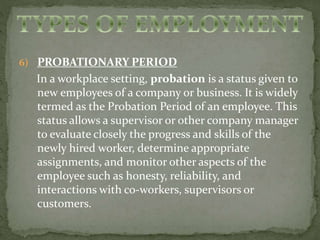
6) PROBATIONARY PERIOD 
In a workplace setting, probation is a status given to 
new employees of a company or business. It is widely 
termed as the Probation Period of an employee. This 
status allows a supervisor or other company manager 
to evaluate closely the progress and skills of the 
newly hired worker, determine appropriate 
assignments, and monitor other aspects of the 
employee such as honesty, reliability, and 
interactions with co-workers, supervisors or 
customers.
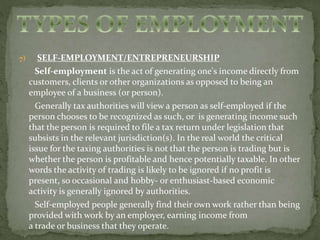
7) SELF-EMPLOYMENT/ENTREPRENEURSHIP 
Self-employment is the act of generating one's income directly from 
customers, clients or other organizations as opposed to being an 
employee of a business (or person). 
Generally tax authorities will view a person as self-employed if the 
person chooses to be recognized as such, or is generating income such 
that the person is required to file a tax return under legislation that 
subsists in the relevant jurisdiction(s). In the real world the critical 
issue for the taxing authorities is not that the person is trading but is 
whether the person is profitable and hence potentially taxable. In other 
words the activity of trading is likely to be ignored if no profit is 
present, so occasional and hobby- or enthusiast-based economic 
activity is generally ignored by authorities. 
Self-employed people generally find their own work rather than being 
provided with work by an employer, earning income from 
a trade or business that they operate.
Employment in INDIA
Employment in INDIA
Employment in INDIA
Employment in INDIA
Employment in INDIA
Employment in INDIA

Employment in INDIA

  • 2.
     Employment isa relationship between two parties, usually based on a contract, one being the employer and the other being the employee.  Employment is an agreement between an employer and an employee that the employee will provide certain services on the job, and in the employer's designated workplace, to facilitate the accomplishment of the employer organization’s goals, in return for compensation.  Employment can be expressed in number of people working or in total working hours. A mixed measure is the number of hours divided by standard working hours to give a full-time equivalence to jobs.  Employment can be called as a platform where employers provide some tasks to employments.
  • 4.
     In employment,the employer determines the where, when, how, why, and what of the work that is performed by the employee. The degree of input, autonomy and self-directedness that an employee experiences on the job is a by-product of an employer’s philosophy of management and employment.  An employer is a person or institution that hires employees or workers. Employers offer wages or a salary to the workers in exchange for the worker's work or labor.  A legal entity that controls and directs a servant or worker under an express or implied contract of employment and pays (or is obligated to pay) him or her salary or wages in compensation.
  • 6.
     An individualwho works part-time or full-time under a contract of employment, whether oral or written, express or implied, and has recognized rights and duties.  An employee is an individual who was hired by an employer to do a specific job. The employee is hired by the employer after anapplication and interview process results in his or her selection as an employee.  An employee contributes labor and/or expertise to an endeavor of an employer and is usually hired to perform specific duties which are packaged into a job.  An Employee is a person who is hired to provide services to a company on a regular basis in exchange for compensation and who does not provide these services as part of an independent business.
  • 8.
    1) FULL-TIME EMPLOYMENT Full-time employment is employment in which a person works a minimum number of hours defined as such by his/her employer. Full-time employment often comes with benefits that are not typically offered to part-time, temporary, or flexible workers, such as annual leave, sick leave, and health insurance. Full-time jobs are often considered careers. They generally pay more than part-time jobs, and usually carry more hours per week.
  • 9.
    2) PART-TIME EMPLOYMENT Part-time employees usually work on a regular ongoing basis. They are paid on a pro rata basis. They are entitled to the following:  annual, personal, sick leave and carer's leave;  to be paid for public holidays falling on days on which they would otherwise be working; and  long service leave and bereavement leave.
  • 10.
    3) CASUAL EMPLOYMENT Casual employees are employed on an irregular basis as needed. They can work as many hours as agreed (between the employer and the employee). They:  have no expectation of ongoing employment;  are free to refuse offers of work;  are paid a loading (a minimum of 20 per cent, but some awards provide for a higher loading), but no personal or sick leave or annual leave entitlement;  are entitled to unpaid bereavement leave; and  are entitled to long service leave
  • 11.
    4) FIXED-TERM ORCONTRACT Fixed term or contract employees are hired for a fixed period of time, for example, for a specific project, or to replace an employee on sick leave or parental leave. You should provide the employee with an agreement in writing that sets out the length of the employment contract. Fixed term employees are entitled to the same annual, personal and other leave entitlements as full-time employees, but on a proportional basis for the period of their employment.
  • 12.
    5) APPRINTICESHIP ORTRAINEESHIP Apprentices are generally training to be trades people, while trainees are generally learning the skills of a non-trade occupation. Both involve:  a registered training agreement;  practical work;  learning skills on and off the job;  Both apprenticeships and traineeships lead to a nationally recognised qualification.
  • 13.
    6) PROBATIONARY PERIOD In a workplace setting, probation is a status given to new employees of a company or business. It is widely termed as the Probation Period of an employee. This status allows a supervisor or other company manager to evaluate closely the progress and skills of the newly hired worker, determine appropriate assignments, and monitor other aspects of the employee such as honesty, reliability, and interactions with co-workers, supervisors or customers.
  • 14.
    7) SELF-EMPLOYMENT/ENTREPRENEURSHIP Self-employmentis the act of generating one's income directly from customers, clients or other organizations as opposed to being an employee of a business (or person). Generally tax authorities will view a person as self-employed if the person chooses to be recognized as such, or is generating income such that the person is required to file a tax return under legislation that subsists in the relevant jurisdiction(s). In the real world the critical issue for the taxing authorities is not that the person is trading but is whether the person is profitable and hence potentially taxable. In other words the activity of trading is likely to be ignored if no profit is present, so occasional and hobby- or enthusiast-based economic activity is generally ignored by authorities. Self-employed people generally find their own work rather than being provided with work by an employer, earning income from a trade or business that they operate.