EMPLOYEE MOTIVATION
HUMAN RESOURCES MANGEMENT_______________________________________
INDEX
• INTRODUCTION
• SCOPE OF THE STUDY
• FACTORS TO ENCOURAGE MOTIVATION
• THEORIES OF MOTIVATION
• OVERVIEW
• CLASSIFYING NEEDS
• MASLOW
• ACQUIRED NEEDS THEORY (MCCLELLAN)
• TWO FACTOR THEORY (HERZBERG)
• IMPORTANCE OF MOTIVATION
• RECOMMENDATONS / SUGGESTIONS
• CONCLUSION
• CASE STUDY
SCOPE OF THE STUDY
• To identify the employees level of satisfaction
upon that job.
• This study is helpful to that organization for
conducting further research.
• It is helpful to identify the employer’s level of
satisfaction towards welfare measure.
• This study is helpful to the organization for
identifying the area of dissatisfaction of job of the
employees.
• This study helps to make a managerial decision to
the company
FACTORS TO ENCOURAGE
____________________
FACTORS TO ENCOURAGE MOTIVATION
• Management and leadership actions
that empower employees,
• Transparent and regular communication about
factors important to employees,
• Treating employees with respect,
• Providing regular employee recognition,
• Feedback and coaching from managers and
leaders,
• Above industry-
average benefits and compensation,
• Providing employee perks and company
activities, and
• Positively managing employees within a
success framework of goals, measurements,
and clear expectations.
THEORIES
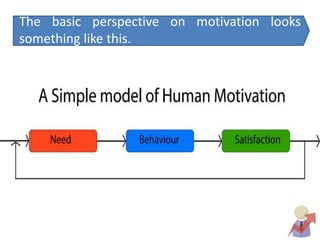
The basic perspective on motivation looks
something like this.
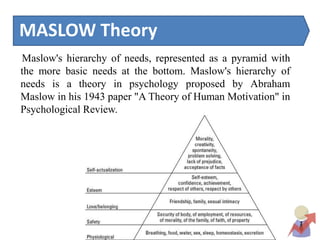
MASLOW Theory
Maslow's hierarchy of needs, represented as a pyramid with
the more basic needs at the bottom. Maslow's hierarchy of
needs is a theory in psychology proposed by Abraham
Maslow in his 1943 paper "A Theory of Human Motivation" in
Psychological Review.
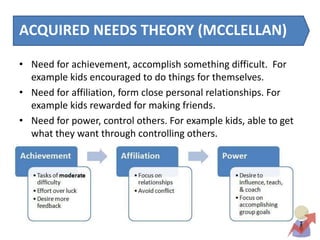
ACQUIRED NEEDS THEORY (MCCLELLAN)
• Need for achievement, accomplish something difficult. For
example kids encouraged to do things for themselves.
• Need for affiliation, form close personal relationships. For
example kids rewarded for making friends.
• Need for power, control others. For example kids, able to get
what they want through controlling others.
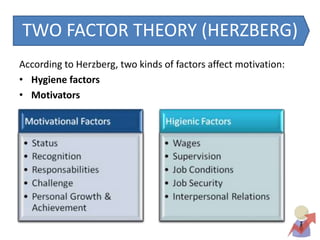
TWO FACTOR THEORY (HERZBERG)
According to Herzberg, two kinds of factors affect motivation:
• Hygiene factors
• Motivators
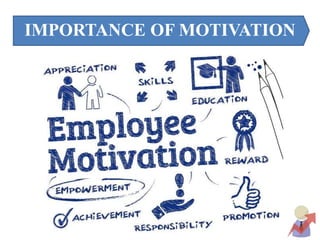
IMPORTANCE OF MOTIVATION
• Motivation coupled with ability leads to performance.
• Motivated employee will do the quality work with more
motivation and by his own will.
• Motivated employee will be more productive than the
apathetic workers.
• Low attrition.
• Low turnover rate.
• The employee will be more loyal towards the organization.
• He will be more comfortable while doing the work in the
office.
• Employee will love his/her job.
cRECOMMENDATONS / SUGGESTIONS
• Thanks personally, timely, often and sincerely.
• Take time to meet and listen to staff.
• Provide feedback.
• Encourage new ideas and initiatives.
• Explain how the employee fits into the organizational
plans.
• Involve employees in the decision making.
• Provide them ownership in their work.
• Recognize, reward and promote based on performance.
• Give chance to learn new skills.
• Celebrate the successes of the employees.
CONCLUSION
• Employees are asset for the company. A strong team
needs individuals who are dedicated to giving their
best work. Highly self-motivated, committed,
ambitious employees give the most to their company
and get the most from their work. But, if there is
lacking of employee motivation in the workplace the
effects can be dramatic. So, Employee motivation is
very necessary to get the profitable results.
CASE STUDY
Summary of case
• Motivation: Starbucks thinks that laborers are not
machines.
• Teamwork: Starbucks do all work in team, they work
effective and efficient.
• Starbucks corporation the most famous chain of retail
coffee shop in the world.
• The Starbucks Corporation achieve success not only
provide quality product they supply but the atmosphere
of corporation and their effective teamwork.
• We learn from Starbucks that a good relationship among
the organization & their customers and the great lead to
success.
Starbucks’ employees can be seen as a formal team as
opposed to an informal team
• Formal Team is those groups which is established by
the organization to perform organizational work. The
formal group is the formal organizational structure of
the company which involves the structure involving
the board of directors, managers and the staff.
• Informal Team have no structure and they do not
focus on specialty. There is no manager/leader; team
members are completely equal in informal teams.
• The Starbucks Company Use Informal team to ensure
that communication has been effective.
A. Three Issues that need to be addressed in the
planning process:
i. Equal Treatment
ii. Listen to the Employees
iii. Good Welfare Measure
B. Three things that Starbucks can do continually to
ensure goals accomplishment are:
i.Motivate Employees
ii. Continue teamwork and communicate properly
iii. Maintain excellent relationship
Starbucks manage to keep good relationships
between their managers and employees
• Promote Understanding of Shared Goals
• Promote Understanding of Task Relevance
• Managers & employees both has access in
giving opinion
• Equal Treatment
• Flexible Working Hours
• Good Welfare Measure
• Treat as important Asset
4 aspects
• Management needs to commit to certain
aspects in order to empower employees,
there are 4 aspects
1. Giving Reward
2. Developing Competency
3. Delegating Tasks
4. Sharing Information
Conclusion
• Starbucks changes the behaviors and viewpoints of
global consumers of coffee, and this successful
example has caught global attention.
• Nowadays it is not only one of the fastest growing
corporation but also an outstanding business model
with low employee turnover rate & high profit
performance.
• The motivation and the teamwork is the key factor of
a company policy, opposite to the principles of
classical management which is only concerned about
production and ignores worker’s idea.
Employee Motivation, HRM, Case study "starbucks"

Employee Motivation, HRM, Case study "starbucks"

  • 2.
    EMPLOYEE MOTIVATION HUMAN RESOURCESMANGEMENT_______________________________________
  • 3.
    INDEX • INTRODUCTION • SCOPEOF THE STUDY • FACTORS TO ENCOURAGE MOTIVATION • THEORIES OF MOTIVATION • OVERVIEW • CLASSIFYING NEEDS • MASLOW • ACQUIRED NEEDS THEORY (MCCLELLAN) • TWO FACTOR THEORY (HERZBERG) • IMPORTANCE OF MOTIVATION • RECOMMENDATONS / SUGGESTIONS • CONCLUSION • CASE STUDY
  • 6.
    SCOPE OF THESTUDY • To identify the employees level of satisfaction upon that job. • This study is helpful to that organization for conducting further research. • It is helpful to identify the employer’s level of satisfaction towards welfare measure. • This study is helpful to the organization for identifying the area of dissatisfaction of job of the employees. • This study helps to make a managerial decision to the company
  • 7.
  • 8.
    FACTORS TO ENCOURAGEMOTIVATION • Management and leadership actions that empower employees, • Transparent and regular communication about factors important to employees, • Treating employees with respect, • Providing regular employee recognition,
  • 9.
    • Feedback andcoaching from managers and leaders, • Above industry- average benefits and compensation, • Providing employee perks and company activities, and • Positively managing employees within a success framework of goals, measurements, and clear expectations.
  • 10.
  • 11.
    The basic perspectiveon motivation looks something like this.
  • 12.
    MASLOW Theory Maslow's hierarchyof needs, represented as a pyramid with the more basic needs at the bottom. Maslow's hierarchy of needs is a theory in psychology proposed by Abraham Maslow in his 1943 paper "A Theory of Human Motivation" in Psychological Review.
  • 13.
    ACQUIRED NEEDS THEORY(MCCLELLAN) • Need for achievement, accomplish something difficult. For example kids encouraged to do things for themselves. • Need for affiliation, form close personal relationships. For example kids rewarded for making friends. • Need for power, control others. For example kids, able to get what they want through controlling others.
  • 14.
    TWO FACTOR THEORY(HERZBERG) According to Herzberg, two kinds of factors affect motivation: • Hygiene factors • Motivators
  • 15.
  • 16.
    IMPORTANCE OF MOTIVATION •Motivation coupled with ability leads to performance. • Motivated employee will do the quality work with more motivation and by his own will. • Motivated employee will be more productive than the apathetic workers. • Low attrition. • Low turnover rate. • The employee will be more loyal towards the organization. • He will be more comfortable while doing the work in the office. • Employee will love his/her job.
  • 17.
    cRECOMMENDATONS / SUGGESTIONS •Thanks personally, timely, often and sincerely. • Take time to meet and listen to staff. • Provide feedback. • Encourage new ideas and initiatives. • Explain how the employee fits into the organizational plans. • Involve employees in the decision making. • Provide them ownership in their work. • Recognize, reward and promote based on performance. • Give chance to learn new skills. • Celebrate the successes of the employees.
  • 18.
    CONCLUSION • Employees areasset for the company. A strong team needs individuals who are dedicated to giving their best work. Highly self-motivated, committed, ambitious employees give the most to their company and get the most from their work. But, if there is lacking of employee motivation in the workplace the effects can be dramatic. So, Employee motivation is very necessary to get the profitable results.
  • 19.
  • 20.
    Summary of case •Motivation: Starbucks thinks that laborers are not machines. • Teamwork: Starbucks do all work in team, they work effective and efficient. • Starbucks corporation the most famous chain of retail coffee shop in the world. • The Starbucks Corporation achieve success not only provide quality product they supply but the atmosphere of corporation and their effective teamwork. • We learn from Starbucks that a good relationship among the organization & their customers and the great lead to success.
  • 21.
    Starbucks’ employees canbe seen as a formal team as opposed to an informal team • Formal Team is those groups which is established by the organization to perform organizational work. The formal group is the formal organizational structure of the company which involves the structure involving the board of directors, managers and the staff. • Informal Team have no structure and they do not focus on specialty. There is no manager/leader; team members are completely equal in informal teams. • The Starbucks Company Use Informal team to ensure that communication has been effective.
  • 22.
    A. Three Issuesthat need to be addressed in the planning process: i. Equal Treatment ii. Listen to the Employees iii. Good Welfare Measure B. Three things that Starbucks can do continually to ensure goals accomplishment are: i.Motivate Employees ii. Continue teamwork and communicate properly iii. Maintain excellent relationship
  • 23.
    Starbucks manage tokeep good relationships between their managers and employees • Promote Understanding of Shared Goals • Promote Understanding of Task Relevance • Managers & employees both has access in giving opinion • Equal Treatment • Flexible Working Hours • Good Welfare Measure • Treat as important Asset
  • 24.
    4 aspects • Managementneeds to commit to certain aspects in order to empower employees, there are 4 aspects 1. Giving Reward 2. Developing Competency 3. Delegating Tasks 4. Sharing Information
  • 25.
    Conclusion • Starbucks changesthe behaviors and viewpoints of global consumers of coffee, and this successful example has caught global attention. • Nowadays it is not only one of the fastest growing corporation but also an outstanding business model with low employee turnover rate & high profit performance. • The motivation and the teamwork is the key factor of a company policy, opposite to the principles of classical management which is only concerned about production and ignores worker’s idea.