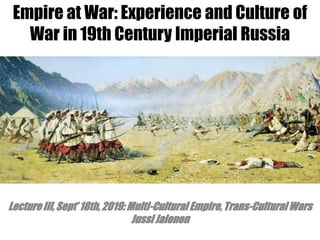
Empire at War: Experience and Culture of
War in 19th Century Imperial Russia
Lecture III, Sept’ 18th, 2019: Multi-Cultural Empire, Trans-Cultural Wars
Jussi Jalonen
FROM ”PEOPLE OF ANOTHER FAITH” TO
”PEOPLE OF ANOTHER RACE”
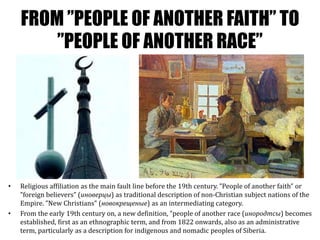
• Religious affiliation as the main fault line before the 19th century. ”People of another faith” or
”foreign believers” (иноверцы) as traditional description of non-Christian subject nations of the
Empire. ”New Christians” (новокрещеные) as an intermediating category.
• From the early 19th century on, a new definition, ”people of another race (инородтсы) becomes
established, first as an ethnographic term, and from 1822 onwards, also as an administrative
term, particularly as a description for indigenous and nomadic peoples of Siberia.
”INCLUSIVE IMPERIALISM” AND NON-RUSSIAN
ELITES IN THE IMPERIAL MILITARY
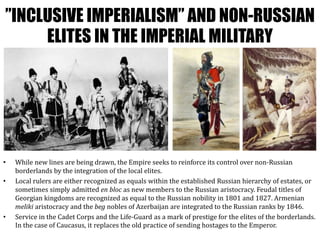
• While new lines are being drawn, the Empire seeks to reinforce its control over non-Russian
borderlands by the integration of the local elites.
• Local rulers are either recognized as equals within the established Russian hierarchy of estates, or
sometimes simply admitted en bloc as new members to the Russian aristocracy. Feudal titles of
Georgian kingdoms are recognized as equal to the Russian nobility in 1801 and 1827. Armenian
meliki aristocracy and the beg nobles of Azerbaijan are integrated to the Russian ranks by 1846.
• Service in the Cadet Corps and the Life-Guard as a mark of prestige for the elites of the borderlands.
In the case of Caucasus, it replaces the old practice of sending hostages to the Emperor.
CAUCASUS: THE MILITARY FRONTIER
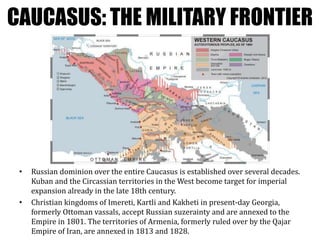
• Russian dominion over the entire Caucasus is established over several decades.
Kuban and the Circassian territories in the West become target for imperial
expansion already in the late 18th century.
• Christian kingdoms of Imereti, Kartli and Kakheti in present-day Georgia,
formerly Ottoman vassals, accept Russian suzerainty and are annexed to the
Empire in 1801. The territories of Armenia, formerly ruled over by the Qajar
Empire of Iran, are annexed in 1813 and 1828.
NOBLES FROM THE CHRISTIAN NATIONS
OF CAUCASUS AS RUSSIAN GENERALS
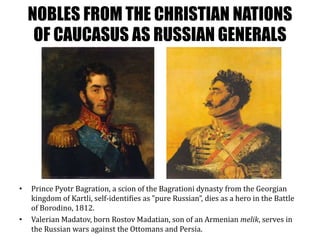
• Prince Pyotr Bagration, a scion of the Bagrationi dynasty from the Georgian
kingdom of Kartli, self-identifies as ”pure Russian”, dies as a hero in the Battle
of Borodino, 1812.
• Valerian Madatov, born Rostov Madatian, son of an Armenian melik, serves in
the Russian wars against the Ottomans and Persia.
CAUCASUS: EXPANSION AND RESISTANCE
• Imperial expansion gains new impetus with the appointment of Aleksei
Petrovich Yermolov as the Russian Commander-in-Chief in the Caucasus in
1816-1827.
• Yermolov commences systematic military policies aimed to subdue the local
”savages”, practicing a policy of divide et impera among the Circassians of
Western Caucasus and the various Highland nations of Eastern Caucasus.
CIRCASSIAN RESISTANCE
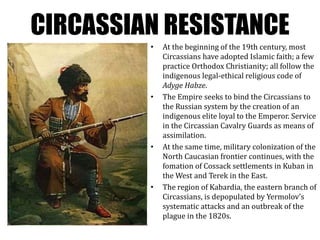
• At the beginning of the 19th century, most
Circassians have adopted Islamic faith; a few
practice Orthodox Christianity; all follow the
indigenous legal-ethical religious code of
Adyge Habze.
• The Empire seeks to bind the Circassians to
the Russian system by the creation of an
indigenous elite loyal to the Emperor. Service
in the Circassian Cavalry Guards as means of
assimilation.
• At the same time, military colonization of the
North Caucasian frontier continues, with the
fomation of Cossack settlements in Kuban in
the West and Terek in the East.
• The region of Kabardia, the eastern branch of
Circassians, is depopulated by Yermolov’s
systematic attacks and an outbreak of the
plague in the 1820s.
DAGESTAN AND CHECHNYA:
SABRES OF PARADISE
• The influence of naqshbandī order of Sufism in Southeastern
Caucasus in the 18th century. Founded by Kurdish Sufi mystic
Khâlid-i Baghdâdî, the movement gathers force among the
Nakh peoples of Dagestan, contested between Russia and Iran.
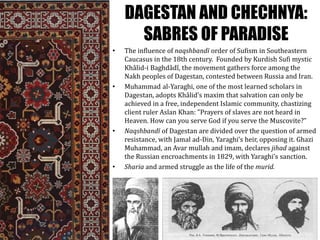
• Muhammad al-Yaraghi, one of the most learned scholars in
Dagestan, adopts Khâlid’s maxim that salvation can only be
achieved in a free, independent Islamic community, chastizing
client ruler Aslan Khan: ”Prayers of slaves are not heard in
Heaven. How can you serve God if you serve the Muscovite?”
• Naqshbandī of Dagestan are divided over the question of armed
resistance, with Jamal ad-Din, Yaraghi’s heir, opposing it. Ghazi
Muhammad, an Avar mullah and imam, declares jihad against
the Russian encroachments in 1829, with Yaraghi’s sanction.
• Sharia and armed struggle as the life of the murid.
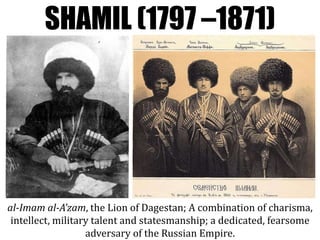
SHAMIL (1797 –1871)
al-Imam al-A’zam, the Lion of Dagestan; A combination of charisma,
intellect, military talent and statesmanship; a dedicated, fearsome
adversary of the Russian Empire.
CONQUEST OF CAUCASUS: SHAMIL’S DEFEAT
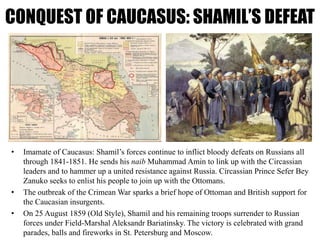
• Imamate of Caucasus: Shamil’s forces continue to inflict bloody defeats on Russians all
through 1841-1851. He sends his naib Muhammad Amin to link up with the Circassian
leaders and to hammer up a united resistance against Russia. Circassian Prince Sefer Bey
Zanuko seeks to enlist his people to join up with the Ottomans.
• The outbreak of the Crimean War sparks a brief hope of Ottoman and British support for
the Caucasian insurgents.
• On 25 August 1859 (Old Style), Shamil and his remaining troops surrender to Russian
forces under Field-Marshal Aleksandr Bariatinsky. The victory is celebrated with grand
parades, balls and fireworks in St. Petersburg and Moscow.
CONQUEST OF CAUCASUS:
CIRCASSIAN GENOCIDE
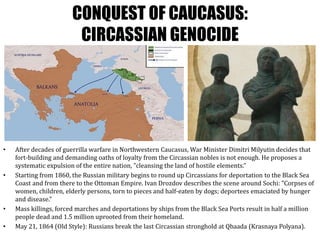
• After decades of guerrilla warfare in Northwestern Caucasus, War Minister Dimitri Milyutin decides that
fort-building and demanding oaths of loyalty from the Circassian nobles is not enough. He proposes a
systematic expulsion of the entire nation, ”cleansing the land of hostile elements.”
• Starting from 1860, the Russian military begins to round up Circassians for deportation to the Black Sea
Coast and from there to the Ottoman Empire. Ivan Drozdov describes the scene around Sochi: ”Corpses of
women, children, elderly persons, torn to pieces and half-eaten by dogs; deportees emaciated by hunger
and disease.”
• Mass killings, forced marches and deportations by ships from the Black Sea Ports result in half a million
people dead and 1.5 million uprooted from their homeland.
• May 21, 1864 (Old Style): Russians break the last Circassian stronghold at Qbaada (Krasnaya Polyana).
COLLATERAL VICTIMS:
THE GREAT HIJRA OF CRIMEAN TATARS
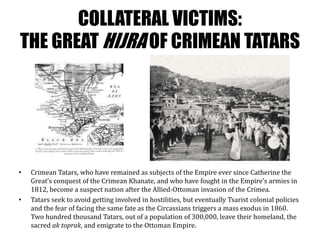
• Crimean Tatars, who have remained as subjects of the Empire ever since Catherine the
Great’s conquest of the Crimean Khanate, and who have fought in the Empire’s armies in
1812, become a suspect nation after the Allied-Ottoman invasion of the Crimea.
• Tatars seek to avoid getting involved in hostilities, but eventually Tsarist colonial policies
and the fear of facing the same fate as the Circassians triggers a mass exodus in 1860.
Two hundred thousand Tatars, out of a population of 300,000, leave their homeland, the
sacred ak toprak, and emigrate to the Ottoman Empire.
THE GREAT STEPPE FRONTIER
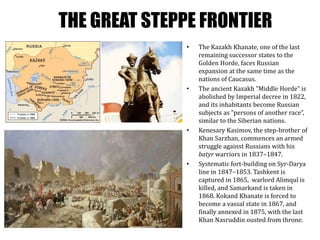
• The Kazakh Khanate, one of the last
remaining successor states to the
Golden Horde, faces Russian
expansion at the same time as the
nations of Caucasus.
• The ancient Kazakh ”Middle Horde” is
abolished by Imperial decree in 1822,
and its inhabitants become Russian
subjects as ”persons of another race”,
similar to the Siberian nations.
• Kenesary Kasimov, the step-brother of
Khan Sarzhan, commences an armed
struggle against Russians with his
batyr warriors in 1837–1847.
• Systematic fort-building on Syr-Darya
line in 1847–1853. Tashkent is
captured in 1865, warlord Alimqul is
killed, and Samarkand is taken in
1868. Kokand Khanate is forced to
become a vassal state in 1867, and
finally annexed in 1875, with the last
Khan Nasruddin ousted from throne.
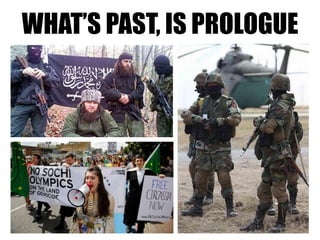
WHAT’S PAST, IS PROLOGUE
Literature
• Michael Khodarkovsky, Bitter Choices; Loyalty and Betrayal in the Russian Conquest of the
Northern Caucasus. Cornell University Press 2011
• Russian Empire: Space, People, Power, 1700–1930. Edited by Jane Burbank, Mark Von
Hagen, Anatolyi Remnev. Indiana University Press 2007.
• Andreas Kappeler, The Russian Empire: A Multi-Ethnic History. Routledge, 2001.
• Paul W. Werth, At the Margins of Orthodoxy: Mission, Governance, and Confessional Politics
in Russia's Volga-Kama Region, 1827–1905. Cornell University 2002.
• Brian Glyn Williams, “Hijra and forced migration from nineteenth century Russia to the
Ottoman Empire. A critical analysis of the Great Tatar emigration of 1860-1861.” Cahiers
du Monde Russe 41/1, 2000.
• Russian-Muslim Confrontation in the Caucasus: Alternative Visions of the Conflict between
Imam Shamil and the Russians, 1830–1859. Edited and translated by Thomas Sanders,
Ernest Tucker and Gary Hamburg. Routledge Curzon 2004.
• Walter Richmond, The Circassian Genocide. Rutgers, 2013.

Empire at-war-iii-7 (1)

  • 1.
    Empire at War:Experience and Culture of War in 19th Century Imperial Russia Lecture III, Sept’ 18th, 2019: Multi-Cultural Empire, Trans-Cultural Wars Jussi Jalonen
  • 2.
    FROM ”PEOPLE OFANOTHER FAITH” TO ”PEOPLE OF ANOTHER RACE” • Religious affiliation as the main fault line before the 19th century. ”People of another faith” or ”foreign believers” (иноверцы) as traditional description of non-Christian subject nations of the Empire. ”New Christians” (новокрещеные) as an intermediating category. • From the early 19th century on, a new definition, ”people of another race (инородтсы) becomes established, first as an ethnographic term, and from 1822 onwards, also as an administrative term, particularly as a description for indigenous and nomadic peoples of Siberia.
  • 3.
    ”INCLUSIVE IMPERIALISM” ANDNON-RUSSIAN ELITES IN THE IMPERIAL MILITARY • While new lines are being drawn, the Empire seeks to reinforce its control over non-Russian borderlands by the integration of the local elites. • Local rulers are either recognized as equals within the established Russian hierarchy of estates, or sometimes simply admitted en bloc as new members to the Russian aristocracy. Feudal titles of Georgian kingdoms are recognized as equal to the Russian nobility in 1801 and 1827. Armenian meliki aristocracy and the beg nobles of Azerbaijan are integrated to the Russian ranks by 1846. • Service in the Cadet Corps and the Life-Guard as a mark of prestige for the elites of the borderlands. In the case of Caucasus, it replaces the old practice of sending hostages to the Emperor.
  • 4.
    CAUCASUS: THE MILITARYFRONTIER • Russian dominion over the entire Caucasus is established over several decades. Kuban and the Circassian territories in the West become target for imperial expansion already in the late 18th century. • Christian kingdoms of Imereti, Kartli and Kakheti in present-day Georgia, formerly Ottoman vassals, accept Russian suzerainty and are annexed to the Empire in 1801. The territories of Armenia, formerly ruled over by the Qajar Empire of Iran, are annexed in 1813 and 1828.
  • 5.
    NOBLES FROM THECHRISTIAN NATIONS OF CAUCASUS AS RUSSIAN GENERALS • Prince Pyotr Bagration, a scion of the Bagrationi dynasty from the Georgian kingdom of Kartli, self-identifies as ”pure Russian”, dies as a hero in the Battle of Borodino, 1812. • Valerian Madatov, born Rostov Madatian, son of an Armenian melik, serves in the Russian wars against the Ottomans and Persia.
  • 6.
    CAUCASUS: EXPANSION ANDRESISTANCE • Imperial expansion gains new impetus with the appointment of Aleksei Petrovich Yermolov as the Russian Commander-in-Chief in the Caucasus in 1816-1827. • Yermolov commences systematic military policies aimed to subdue the local ”savages”, practicing a policy of divide et impera among the Circassians of Western Caucasus and the various Highland nations of Eastern Caucasus.
  • 7.
    CIRCASSIAN RESISTANCE • Atthe beginning of the 19th century, most Circassians have adopted Islamic faith; a few practice Orthodox Christianity; all follow the indigenous legal-ethical religious code of Adyge Habze. • The Empire seeks to bind the Circassians to the Russian system by the creation of an indigenous elite loyal to the Emperor. Service in the Circassian Cavalry Guards as means of assimilation. • At the same time, military colonization of the North Caucasian frontier continues, with the fomation of Cossack settlements in Kuban in the West and Terek in the East. • The region of Kabardia, the eastern branch of Circassians, is depopulated by Yermolov’s systematic attacks and an outbreak of the plague in the 1820s.
  • 8.
    DAGESTAN AND CHECHNYA: SABRESOF PARADISE • The influence of naqshbandī order of Sufism in Southeastern Caucasus in the 18th century. Founded by Kurdish Sufi mystic Khâlid-i Baghdâdî, the movement gathers force among the Nakh peoples of Dagestan, contested between Russia and Iran. • Muhammad al-Yaraghi, one of the most learned scholars in Dagestan, adopts Khâlid’s maxim that salvation can only be achieved in a free, independent Islamic community, chastizing client ruler Aslan Khan: ”Prayers of slaves are not heard in Heaven. How can you serve God if you serve the Muscovite?” • Naqshbandī of Dagestan are divided over the question of armed resistance, with Jamal ad-Din, Yaraghi’s heir, opposing it. Ghazi Muhammad, an Avar mullah and imam, declares jihad against the Russian encroachments in 1829, with Yaraghi’s sanction. • Sharia and armed struggle as the life of the murid.
  • 9.
    SHAMIL (1797 –1871) al-Imamal-A’zam, the Lion of Dagestan; A combination of charisma, intellect, military talent and statesmanship; a dedicated, fearsome adversary of the Russian Empire.
  • 10.
    CONQUEST OF CAUCASUS:SHAMIL’S DEFEAT • Imamate of Caucasus: Shamil’s forces continue to inflict bloody defeats on Russians all through 1841-1851. He sends his naib Muhammad Amin to link up with the Circassian leaders and to hammer up a united resistance against Russia. Circassian Prince Sefer Bey Zanuko seeks to enlist his people to join up with the Ottomans. • The outbreak of the Crimean War sparks a brief hope of Ottoman and British support for the Caucasian insurgents. • On 25 August 1859 (Old Style), Shamil and his remaining troops surrender to Russian forces under Field-Marshal Aleksandr Bariatinsky. The victory is celebrated with grand parades, balls and fireworks in St. Petersburg and Moscow.
  • 11.
    CONQUEST OF CAUCASUS: CIRCASSIANGENOCIDE • After decades of guerrilla warfare in Northwestern Caucasus, War Minister Dimitri Milyutin decides that fort-building and demanding oaths of loyalty from the Circassian nobles is not enough. He proposes a systematic expulsion of the entire nation, ”cleansing the land of hostile elements.” • Starting from 1860, the Russian military begins to round up Circassians for deportation to the Black Sea Coast and from there to the Ottoman Empire. Ivan Drozdov describes the scene around Sochi: ”Corpses of women, children, elderly persons, torn to pieces and half-eaten by dogs; deportees emaciated by hunger and disease.” • Mass killings, forced marches and deportations by ships from the Black Sea Ports result in half a million people dead and 1.5 million uprooted from their homeland. • May 21, 1864 (Old Style): Russians break the last Circassian stronghold at Qbaada (Krasnaya Polyana).
  • 12.
    COLLATERAL VICTIMS: THE GREATHIJRA OF CRIMEAN TATARS • Crimean Tatars, who have remained as subjects of the Empire ever since Catherine the Great’s conquest of the Crimean Khanate, and who have fought in the Empire’s armies in 1812, become a suspect nation after the Allied-Ottoman invasion of the Crimea. • Tatars seek to avoid getting involved in hostilities, but eventually Tsarist colonial policies and the fear of facing the same fate as the Circassians triggers a mass exodus in 1860. Two hundred thousand Tatars, out of a population of 300,000, leave their homeland, the sacred ak toprak, and emigrate to the Ottoman Empire.
  • 13.
    THE GREAT STEPPEFRONTIER • The Kazakh Khanate, one of the last remaining successor states to the Golden Horde, faces Russian expansion at the same time as the nations of Caucasus. • The ancient Kazakh ”Middle Horde” is abolished by Imperial decree in 1822, and its inhabitants become Russian subjects as ”persons of another race”, similar to the Siberian nations. • Kenesary Kasimov, the step-brother of Khan Sarzhan, commences an armed struggle against Russians with his batyr warriors in 1837–1847. • Systematic fort-building on Syr-Darya line in 1847–1853. Tashkent is captured in 1865, warlord Alimqul is killed, and Samarkand is taken in 1868. Kokand Khanate is forced to become a vassal state in 1867, and finally annexed in 1875, with the last Khan Nasruddin ousted from throne.
  • 14.
  • 15.
    Literature • Michael Khodarkovsky,Bitter Choices; Loyalty and Betrayal in the Russian Conquest of the Northern Caucasus. Cornell University Press 2011 • Russian Empire: Space, People, Power, 1700–1930. Edited by Jane Burbank, Mark Von Hagen, Anatolyi Remnev. Indiana University Press 2007. • Andreas Kappeler, The Russian Empire: A Multi-Ethnic History. Routledge, 2001. • Paul W. Werth, At the Margins of Orthodoxy: Mission, Governance, and Confessional Politics in Russia's Volga-Kama Region, 1827–1905. Cornell University 2002. • Brian Glyn Williams, “Hijra and forced migration from nineteenth century Russia to the Ottoman Empire. A critical analysis of the Great Tatar emigration of 1860-1861.” Cahiers du Monde Russe 41/1, 2000. • Russian-Muslim Confrontation in the Caucasus: Alternative Visions of the Conflict between Imam Shamil and the Russians, 1830–1859. Edited and translated by Thomas Sanders, Ernest Tucker and Gary Hamburg. Routledge Curzon 2004. • Walter Richmond, The Circassian Genocide. Rutgers, 2013.