The Underground Railroad

        By: Emily Peeples
 EDU 290 Tuesday/Thursday 11am
Before the Underground Railroad:
• Without the underground railroad, slaves
  instead either stayed at the plantation or they
  just ran. By running away they created some
  of the earliest known paths of the railroad.

• These slaves that ran created secret
  communities in the Virginia Swamps, and the
  Florida Everglades calling themselves
  Maroons.
Before the Underground Railroad:
• During the late 1700’s the Northern States of
  the U.S.A passed laws that abolished slavery.

• In 1793 and 1850 The Fugitive Slave Laws
  were made they “permitted slaves owners to
  reclaim their runaway slaves even if the
  African American had moved to a free state”
  (ohiohistorycentral.org)
Who Started it & Why?

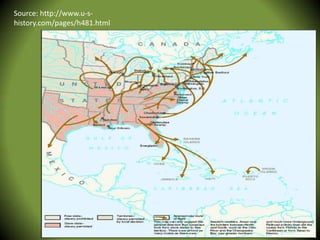
• Started in 1834 by the National Antislavery
  Society, the Underground Railroad was a set of
  safe houses that were located all across the
  U.S to help slaves cross the border into
  freedom.
Source: http://www.u-s-
history.com/pages/h481.html
How did it work?
• Freed blacks sent a field agent; a minister or
  doctor who posed as a salesmen; to gain
  contact and trust with the escaping slave. This
  agent would then guide the slave to a
  conductor, who would then guide the slave to
  the 1st station, which was usually a safe house.
How did it work?
• These stations that the slaves were guided to
  were at least all a days travel apart and the
  heads of these stations were called station
  masters.

• Inside these safe houses the families had
  secret rooms for the slaves where they
  couldn’t be spotted.
How did it work?
• Once at the safe houses they would get
  fed, rested and then given a disguise. These
  disguises were funded by stockholders.

• The best disguise given to a person was to
  dress them up as a white upper class women
  with a white baby.
How did it work?
• Since traveling to freedom took many
  days, months or years many slaves at a certain
  point were told to go out on their own. These
  slaves were given instructions to only travel at
  night, and approach homes that either had a
  lit lantern or another sort of sign
• They were also told to follow the North Star if
  the sky was clear enough to see.
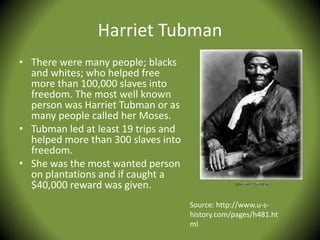
Harriet Tubman
• There were many people; blacks
  and whites; who helped free
  more than 100,000 slaves into
  freedom. The most well known
  person was Harriet Tubman or as
  many people called her Moses.
• Tubman led at least 19 trips and
  helped more than 300 slaves into
  freedom.
• She was the most wanted person
  on plantations and if caught a
  $40,000 reward was given.
                                     Source: http://www.u-s-
                                     history.com/pages/h481.ht
                                     ml
People who helped out:
• Not only did Harriet Tubman help out with the
  Underground Railroad but many other famous
  people helped out like: Frederick Douglas,
  Henry David Thoreau, Susan B. Anthony, and
  many more people.
People who helped out:
• Harriet Tubman wasn’t the only person who
  was wanted for helping out with the
  underground railroad.

• Tubmans friend Thomas Garret, helped out for
  nearly 40 years, and once he was caught and
  arrested he was fined $5,400. This never
  stopped him though from helping out.
Life After Escape:
• No matter where you escaped to it was still
  extremely dangerous. The best place to
  escape to was Canada because the Fugitive
  Slave Laws didn’t apply there.
• Once the slaves got to where they wanted to
  go a vigilance committee would help the
  newly freed slaves start a life.
When it ended & why?
• Lincolns Emaciation Proclamation was in 1863
  and it was hoped by many slaves that this
  would end their suffering but it wasn’t until
  the end of the Civil War in 1865 when the 13th
  amendment was passed that abolished
  slavery.
References:
• http://www.ohiohistorycentral.org/entry.php?
  rec=1518

• http://www.spartacus.schoolnet.co.uk/USASu
  nderground.htm

• http://history.howstuffworks.com/american-
  civil-war/underground-railroad3.htm

Emily Peeples EDU 290 pwrpt 1

  • 1.
    The Underground Railroad By: Emily Peeples EDU 290 Tuesday/Thursday 11am
  • 2.
    Before the UndergroundRailroad: • Without the underground railroad, slaves instead either stayed at the plantation or they just ran. By running away they created some of the earliest known paths of the railroad. • These slaves that ran created secret communities in the Virginia Swamps, and the Florida Everglades calling themselves Maroons.
  • 3.
    Before the UndergroundRailroad: • During the late 1700’s the Northern States of the U.S.A passed laws that abolished slavery. • In 1793 and 1850 The Fugitive Slave Laws were made they “permitted slaves owners to reclaim their runaway slaves even if the African American had moved to a free state” (ohiohistorycentral.org)
  • 4.
    Who Started it& Why? • Started in 1834 by the National Antislavery Society, the Underground Railroad was a set of safe houses that were located all across the U.S to help slaves cross the border into freedom.
  • 5.
  • 6.
    How did itwork? • Freed blacks sent a field agent; a minister or doctor who posed as a salesmen; to gain contact and trust with the escaping slave. This agent would then guide the slave to a conductor, who would then guide the slave to the 1st station, which was usually a safe house.
  • 7.
    How did itwork? • These stations that the slaves were guided to were at least all a days travel apart and the heads of these stations were called station masters. • Inside these safe houses the families had secret rooms for the slaves where they couldn’t be spotted.
  • 8.
    How did itwork? • Once at the safe houses they would get fed, rested and then given a disguise. These disguises were funded by stockholders. • The best disguise given to a person was to dress them up as a white upper class women with a white baby.
  • 9.
    How did itwork? • Since traveling to freedom took many days, months or years many slaves at a certain point were told to go out on their own. These slaves were given instructions to only travel at night, and approach homes that either had a lit lantern or another sort of sign • They were also told to follow the North Star if the sky was clear enough to see.
  • 10.
    Harriet Tubman • Therewere many people; blacks and whites; who helped free more than 100,000 slaves into freedom. The most well known person was Harriet Tubman or as many people called her Moses. • Tubman led at least 19 trips and helped more than 300 slaves into freedom. • She was the most wanted person on plantations and if caught a $40,000 reward was given. Source: http://www.u-s- history.com/pages/h481.ht ml
  • 11.
    People who helpedout: • Not only did Harriet Tubman help out with the Underground Railroad but many other famous people helped out like: Frederick Douglas, Henry David Thoreau, Susan B. Anthony, and many more people.
  • 12.
    People who helpedout: • Harriet Tubman wasn’t the only person who was wanted for helping out with the underground railroad. • Tubmans friend Thomas Garret, helped out for nearly 40 years, and once he was caught and arrested he was fined $5,400. This never stopped him though from helping out.
  • 13.
    Life After Escape: •No matter where you escaped to it was still extremely dangerous. The best place to escape to was Canada because the Fugitive Slave Laws didn’t apply there. • Once the slaves got to where they wanted to go a vigilance committee would help the newly freed slaves start a life.
  • 14.
    When it ended& why? • Lincolns Emaciation Proclamation was in 1863 and it was hoped by many slaves that this would end their suffering but it wasn’t until the end of the Civil War in 1865 when the 13th amendment was passed that abolished slavery.
  • 15.
    References: • http://www.ohiohistorycentral.org/entry.php? rec=1518 • http://www.spartacus.schoolnet.co.uk/USASu nderground.htm • http://history.howstuffworks.com/american- civil-war/underground-railroad3.htm