Tsuyoshi Yokoyama
ENGINEERING DESIGN PORTFOLIO
TSUYOSHI YOKOYAMA
Phone Number:
416-834-4323
Email Address:
tsuyoshi.yokoyama@mail.uto
ronto.ca
Home Address:
Suite 3406, 832 Bay Street,
Toronto, ON, M5S 1Z6
Mechanical Engineering Graduate majoring in Solid Mechanics and
Mechatronics Design. Finished university degree with proven high
proficiency on Computer-Aided Design and Finite Element Analysis skills.
Drove the projects focusing on different field includes manufacturing,
electrical design, product design and programming. Earned reputation for
passionately and diligently working in individual and team-oriented
environment, and exceptional working ethic. Enjoy the process of seeking
for real-world engineering challenges, solving problems with creativity and
continuously making headway on the design till satisfaction. Currently
seeking for a job to apply knowledge and passion on practical engineering
design.
Multidisciplinary Project
1.1 Motor Performance Testing Platform & Prediction Tool
Computer-Aided Design Project
2.1 5-axis CNC Milling Machine Design
2.2 Wine Opener Design Improvement
2.3 Self-motivated CAD Projects
Finite Element Analysis Project
3.1 Tensile Members Design
3.2 Conceptual Fluid Dynamics Analyzation
Mechatronic Design Project
4.1 Robot Toy--PLEO rb programming
4.2 Closed-loop Controlled Quadcopter
TABLE OF CONTENTS
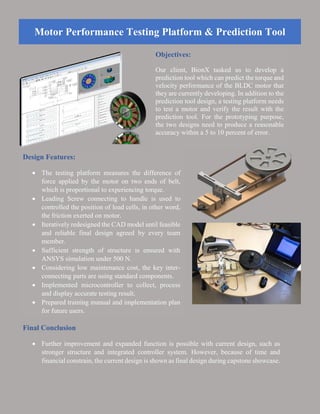
Motor Performance Testing Platform & Prediction Tool
Objectives:
Our client, BionX tasked us to develop a
prediction tool which can predict the torque and
velocity performance of the BLDC motor that
they are currently developing. In addition to the
prediction tool design, a testing platform needs
to test a motor and verify the result with the
prediction tool. For the prototyping purpose,
the two designs need to produce a reasonable
accuracy within a 5 to 10 percent of error.
Design Features:
 The testing platform measures the difference of
force applied by the motor on two ends of belt,
which is proportional to experiencing torque.
 Leading Screw connecting to handle is used to
controlled the position of load cells, in other word,
the friction exerted on motor.
 Iteratively redesigned the CAD model until feasible
and reliable final design agreed by every team
member.
 Sufficient strength of structure is ensured with
ANSYS simulation under 500 N.
 Considering low maintenance cost, the key inter-
connecting parts are using standard components.
 Implemented microcontroller to collect, process
and display accurate testing result.
 Prepared training manual and implementation plan
for future users.
Final Conclusion
 Further improvement and expanded function is possible with current design, such as
stronger structure and integrated controller system. However, because of time and
financial constrain, the current design is shown as final design during capstone showcase.
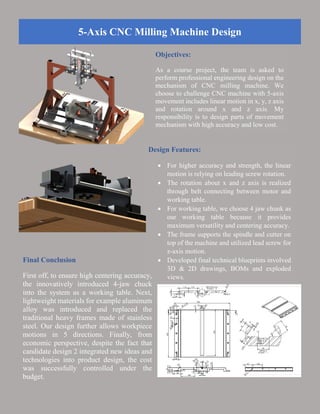
5-Axis CNC Milling Machine Design
Objectives:
As a course project, the team is asked to
perform professional engineering design on the
mechanism of CNC milling machine. We
choose to challenge CNC machine with 5-axis
movement includes linear motion in x, y, z axis
and rotation around x and z axis. My
responsibility is to design parts of movement
mechanism with high accuracy and low cost.
Design Features:
 For higher accuracy and strength, the linear
motion is relying on leading screw rotation.
 The rotation about x and z axis is realized
through belt connecting between motor and
working table.
 For working table, we choose 4 jaw chunk as
our working table because it provides
maximum versatility and centering accuracy.
 The frame supports the spindle and cutter on
top of the machine and utilized lead screw for
z-axis motion.
 Developed final technical blueprints involved
3D & 2D drawings, BOMs and exploded
views.
Final Conclusion
First off, to ensure high centering accuracy,
the innovatively introduced 4-jaw chuck
into the system as a working table. Next,
lightweight materials for example aluminum
alloy was introduced and replaced the
traditional heavy frames made of stainless
steel. Our design further allows workpiece
motions in 5 directions. Finally, from
economic perspective, despite the fact that
candidate design 2 integrated new ideas and
technologies into product design, the cost
was successfully controlled under the
budget.
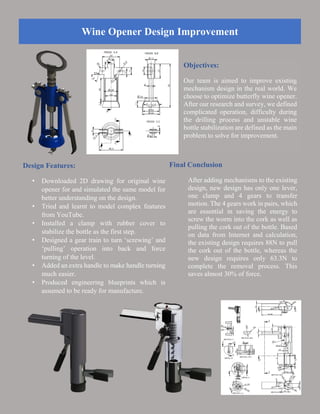
Wine Opener Design Improvement
Objectives:
Our team is aimed to improve existing
mechanism design in the real world. We
choose to optimize butterfly wine opener.
After our research and survey, we defined
complicated operation, difficulty during
the drilling process and unstable wine
bottle stabilization are defined as the main
problem to solve for improvement.
Design Features:
• Downloaded 2D drawing for original wine
opener for and simulated the same model for
better understanding on the design.
• Tried and learnt to model complex features
from YouTube.
• Installed a clamp with rubber cover to
stabilize the bottle as the first step.
• Designed a gear train to turn ‘screwing’ and
‘pulling’ operation into back and force
turning of the level.
• Added an extra handle to make handle turning
much easier.
• Produced engineering blueprints which is
assumed to be ready for manufacture.
Final Conclusion
After adding mechanisms to the existing
design, new design has only one lever,
one clamp and 4 gears to transfer
motion. The 4 gears work in pairs, which
are essential in saving the energy to
screw the worm into the cork as well as
pulling the cork out of the bottle. Based
on data from Internet and calculation,
the existing design requires 88N to pull
the cork out of the bottle, whereas the
new design requires only 63.3N to
complete the removal process. This
saves almost 30% of force.
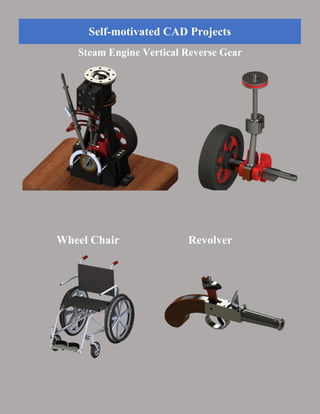
Steam Engine Vertical Reverse Gear
Wheel Chair Revolver
Self-motivated CAD Projects
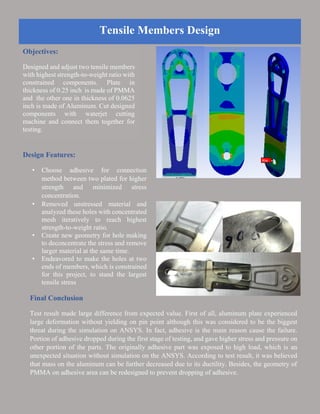
Tensile Members Design
Objectives:
Designed and adjust two tensile members
with highest strength-to-weight ratio with
constrained components. Plate in
thickness of 0.25 inch is made of PMMA
and the other one in thickness of 0.0625
inch is made of Aluminum. Cut designed
components with waterjet cutting
machine and connect them together for
testing.
Design Features:
• Choose adhesive for connection
method between two plated for higher
strength and minimized stress
concentration.
• Removed unstressed material and
analyzed these holes with concentrated
mesh iteratively to reach highest
strength-to-weight ratio.
• Create new geometry for hole making
to deconcentrate the stress and remove
larger material at the same time.
• Endeavored to make the holes at two
ends of members, which is constrained
for this project, to stand the largest
tensile stress
Final Conclusion
Test result made large difference from expected value. First of all, aluminum plate experienced
large deformation without yielding on pin point although this was considered to be the biggest
threat during the simulation on ANSYS. In fact, adhesive is the main reason cause the failure.
Portion of adhesive dropped during the first stage of testing, and gave higher stress and pressure on
other portion of the parts. The originally adhesive part was exposed to high load, which is an
unexpected situation without simulation on the ANSYS. According to test result, it was believed
that mass on the aluminum can be further decreased due to its ductility. Besides, the geometry of
PMMA on adhesive area can be redesigned to prevent dropping of adhesive.
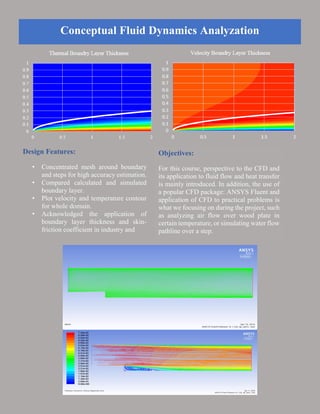
Conceptual Fluid Dynamics Analyzation
Objectives:
For this course, perspective to the CFD and
its application to fluid flow and heat transfer
is mainly introduced. In addition, the use of
a popular CFD package: ANSYS Fluent and
application of CFD to practical problems is
what we focusing on during the project, such
as analyzing air flow over wood plate in
certain temperature, or simulating water flow
pathline over a step.
Estimate
Design Features:
• Concentrated mesh around boundary
and steps for high accuracy estimation.
• Compared calculated and simulated
boundary layer.
• Plot velocity and temperature contour
for whole domain.
• Acknowledged the application of
boundary layer thickness and skin-
friction coefficient in industry and
Robot Toy--PLEO rb programming
Objectives:
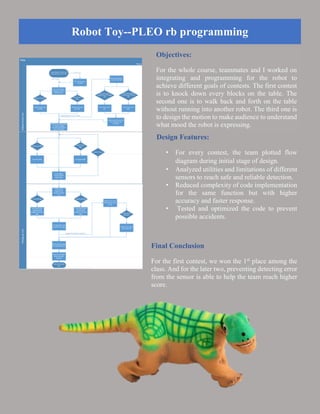
For the whole course, teammates and I worked on
integrating and programming for the robot to
achieve different goals of contests. The first contest
is to knock down every blocks on the table. The
second one is to walk back and forth on the table
without running into another robot. The third one is
to design the motion to make audience to understand
what mood the robot is expressing.
Design Features:
• For every contest, the team plotted flow
diagram during initial stage of design.
• Analyzed utilities and limitations of different
sensors to reach safe and reliable detection.
• Reduced complexity of code implementation
for the same function but with higher
accuracy and faster response.
• Tested and optimized the code to prevent
possible accidents.
Final Conclusion
For the first contest, we won the 1st
place among the
class. And for the later two, preventing detecting error
from the sensor is able to help the team reach higher
score.
Closed-loop Controlled Quadcopter
Objectives:
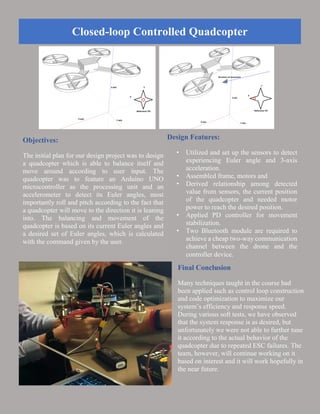
The initial plan for our design project was to design
a quadcopter which is able to balance itself and
move around according to user input. The
quadcopter was to feature an Arduino UNO
microcontroller as the processing unit and an
accelerometer to detect its Euler angles, most
importantly roll and pitch according to the fact that
a quadcopter will move to the direction it is leaning
into. The balancing and movement of the
quadcopter is based on its current Euler angles and
a desired set of Euler angles, which is calculated
with the command given by the user.
Design Features:
• Utilized and set up the sensors to detect
experiencing Euler angle and 3-axis
acceleration.
• Assembled frame, motors and
• Derived relationship among detected
value from sensors, the current position
of the quadcopter and needed motor
power to reach the desired position.
• Applied PD controller for movement
stabilization.
• Two Bluetooth module are required to
achieve a cheap two-way communication
channel between the drone and the
controller device.
Final Conclusion
Many techniques taught in the course had
been applied such as control loop construction
and code optimization to maximize our
system’s efficiency and response speed.
During various soft tests, we have observed
that the system response is as desired, but
unfortunately we were not able to further tune
it according to the actual behavior of the
quadcopter due to repeated ESC failures. The
team, however, will continue working on it
based on interest and it will work hopefully in
the near future.

Emgineering Design Portfolio

  • 1.
    Tsuyoshi Yokoyama ENGINEERING DESIGNPORTFOLIO TSUYOSHI YOKOYAMA Phone Number: 416-834-4323 Email Address: tsuyoshi.yokoyama@mail.uto ronto.ca Home Address: Suite 3406, 832 Bay Street, Toronto, ON, M5S 1Z6 Mechanical Engineering Graduate majoring in Solid Mechanics and Mechatronics Design. Finished university degree with proven high proficiency on Computer-Aided Design and Finite Element Analysis skills. Drove the projects focusing on different field includes manufacturing, electrical design, product design and programming. Earned reputation for passionately and diligently working in individual and team-oriented environment, and exceptional working ethic. Enjoy the process of seeking for real-world engineering challenges, solving problems with creativity and continuously making headway on the design till satisfaction. Currently seeking for a job to apply knowledge and passion on practical engineering design.
  • 2.
    Multidisciplinary Project 1.1 MotorPerformance Testing Platform & Prediction Tool Computer-Aided Design Project 2.1 5-axis CNC Milling Machine Design 2.2 Wine Opener Design Improvement 2.3 Self-motivated CAD Projects Finite Element Analysis Project 3.1 Tensile Members Design 3.2 Conceptual Fluid Dynamics Analyzation Mechatronic Design Project 4.1 Robot Toy--PLEO rb programming 4.2 Closed-loop Controlled Quadcopter TABLE OF CONTENTS
  • 3.
    Motor Performance TestingPlatform & Prediction Tool Objectives: Our client, BionX tasked us to develop a prediction tool which can predict the torque and velocity performance of the BLDC motor that they are currently developing. In addition to the prediction tool design, a testing platform needs to test a motor and verify the result with the prediction tool. For the prototyping purpose, the two designs need to produce a reasonable accuracy within a 5 to 10 percent of error. Design Features:  The testing platform measures the difference of force applied by the motor on two ends of belt, which is proportional to experiencing torque.  Leading Screw connecting to handle is used to controlled the position of load cells, in other word, the friction exerted on motor.  Iteratively redesigned the CAD model until feasible and reliable final design agreed by every team member.  Sufficient strength of structure is ensured with ANSYS simulation under 500 N.  Considering low maintenance cost, the key inter- connecting parts are using standard components.  Implemented microcontroller to collect, process and display accurate testing result.  Prepared training manual and implementation plan for future users. Final Conclusion  Further improvement and expanded function is possible with current design, such as stronger structure and integrated controller system. However, because of time and financial constrain, the current design is shown as final design during capstone showcase.
  • 4.
    5-Axis CNC MillingMachine Design Objectives: As a course project, the team is asked to perform professional engineering design on the mechanism of CNC milling machine. We choose to challenge CNC machine with 5-axis movement includes linear motion in x, y, z axis and rotation around x and z axis. My responsibility is to design parts of movement mechanism with high accuracy and low cost. Design Features:  For higher accuracy and strength, the linear motion is relying on leading screw rotation.  The rotation about x and z axis is realized through belt connecting between motor and working table.  For working table, we choose 4 jaw chunk as our working table because it provides maximum versatility and centering accuracy.  The frame supports the spindle and cutter on top of the machine and utilized lead screw for z-axis motion.  Developed final technical blueprints involved 3D & 2D drawings, BOMs and exploded views. Final Conclusion First off, to ensure high centering accuracy, the innovatively introduced 4-jaw chuck into the system as a working table. Next, lightweight materials for example aluminum alloy was introduced and replaced the traditional heavy frames made of stainless steel. Our design further allows workpiece motions in 5 directions. Finally, from economic perspective, despite the fact that candidate design 2 integrated new ideas and technologies into product design, the cost was successfully controlled under the budget.
  • 5.
    Wine Opener DesignImprovement Objectives: Our team is aimed to improve existing mechanism design in the real world. We choose to optimize butterfly wine opener. After our research and survey, we defined complicated operation, difficulty during the drilling process and unstable wine bottle stabilization are defined as the main problem to solve for improvement. Design Features: • Downloaded 2D drawing for original wine opener for and simulated the same model for better understanding on the design. • Tried and learnt to model complex features from YouTube. • Installed a clamp with rubber cover to stabilize the bottle as the first step. • Designed a gear train to turn ‘screwing’ and ‘pulling’ operation into back and force turning of the level. • Added an extra handle to make handle turning much easier. • Produced engineering blueprints which is assumed to be ready for manufacture. Final Conclusion After adding mechanisms to the existing design, new design has only one lever, one clamp and 4 gears to transfer motion. The 4 gears work in pairs, which are essential in saving the energy to screw the worm into the cork as well as pulling the cork out of the bottle. Based on data from Internet and calculation, the existing design requires 88N to pull the cork out of the bottle, whereas the new design requires only 63.3N to complete the removal process. This saves almost 30% of force.
  • 6.
    Steam Engine VerticalReverse Gear Wheel Chair Revolver Self-motivated CAD Projects
  • 7.
    Tensile Members Design Objectives: Designedand adjust two tensile members with highest strength-to-weight ratio with constrained components. Plate in thickness of 0.25 inch is made of PMMA and the other one in thickness of 0.0625 inch is made of Aluminum. Cut designed components with waterjet cutting machine and connect them together for testing. Design Features: • Choose adhesive for connection method between two plated for higher strength and minimized stress concentration. • Removed unstressed material and analyzed these holes with concentrated mesh iteratively to reach highest strength-to-weight ratio. • Create new geometry for hole making to deconcentrate the stress and remove larger material at the same time. • Endeavored to make the holes at two ends of members, which is constrained for this project, to stand the largest tensile stress Final Conclusion Test result made large difference from expected value. First of all, aluminum plate experienced large deformation without yielding on pin point although this was considered to be the biggest threat during the simulation on ANSYS. In fact, adhesive is the main reason cause the failure. Portion of adhesive dropped during the first stage of testing, and gave higher stress and pressure on other portion of the parts. The originally adhesive part was exposed to high load, which is an unexpected situation without simulation on the ANSYS. According to test result, it was believed that mass on the aluminum can be further decreased due to its ductility. Besides, the geometry of PMMA on adhesive area can be redesigned to prevent dropping of adhesive.
  • 8.
    Conceptual Fluid DynamicsAnalyzation Objectives: For this course, perspective to the CFD and its application to fluid flow and heat transfer is mainly introduced. In addition, the use of a popular CFD package: ANSYS Fluent and application of CFD to practical problems is what we focusing on during the project, such as analyzing air flow over wood plate in certain temperature, or simulating water flow pathline over a step. Estimate Design Features: • Concentrated mesh around boundary and steps for high accuracy estimation. • Compared calculated and simulated boundary layer. • Plot velocity and temperature contour for whole domain. • Acknowledged the application of boundary layer thickness and skin- friction coefficient in industry and
  • 9.
    Robot Toy--PLEO rbprogramming Objectives: For the whole course, teammates and I worked on integrating and programming for the robot to achieve different goals of contests. The first contest is to knock down every blocks on the table. The second one is to walk back and forth on the table without running into another robot. The third one is to design the motion to make audience to understand what mood the robot is expressing. Design Features: • For every contest, the team plotted flow diagram during initial stage of design. • Analyzed utilities and limitations of different sensors to reach safe and reliable detection. • Reduced complexity of code implementation for the same function but with higher accuracy and faster response. • Tested and optimized the code to prevent possible accidents. Final Conclusion For the first contest, we won the 1st place among the class. And for the later two, preventing detecting error from the sensor is able to help the team reach higher score.
  • 10.
    Closed-loop Controlled Quadcopter Objectives: Theinitial plan for our design project was to design a quadcopter which is able to balance itself and move around according to user input. The quadcopter was to feature an Arduino UNO microcontroller as the processing unit and an accelerometer to detect its Euler angles, most importantly roll and pitch according to the fact that a quadcopter will move to the direction it is leaning into. The balancing and movement of the quadcopter is based on its current Euler angles and a desired set of Euler angles, which is calculated with the command given by the user. Design Features: • Utilized and set up the sensors to detect experiencing Euler angle and 3-axis acceleration. • Assembled frame, motors and • Derived relationship among detected value from sensors, the current position of the quadcopter and needed motor power to reach the desired position. • Applied PD controller for movement stabilization. • Two Bluetooth module are required to achieve a cheap two-way communication channel between the drone and the controller device. Final Conclusion Many techniques taught in the course had been applied such as control loop construction and code optimization to maximize our system’s efficiency and response speed. During various soft tests, we have observed that the system response is as desired, but unfortunately we were not able to further tune it according to the actual behavior of the quadcopter due to repeated ESC failures. The team, however, will continue working on it based on interest and it will work hopefully in the near future.