INTRODUCTION
The goal ofthis online training is to give you the tools
you need to respond quickly and safely to
emergencies that are most likely to affect AS spaces.
The training acknowledges the fact that AS is a
student centered organization and that many of AS’s
activities occur after hours.
3.
CAMPUS EMERGENCY RESPONSE
Ina serious emergency situation Campus Police along with Santa Barbara County Sheriff and
Santa Barbara County Fire authorities will be in command. It is critical that you follow their
commands and communicate clearly with them to ensure your safety and that of others.
Communication will be sent out by campus leadership via the UCSB Alert system. For an event
that affects the entire campus, the Campus Emergency Operations Center will be activated.
UCSB Environmental Health and Safety has a fully developed emergency response plan that
supports county, state, and federal agencies, including FEMA. More information can be found at
the EH&S Emergency Preparedness website at: http://emergency.ucsb.edu.
4.
CONTACT NUMBERS
Add toYour Contacts NOW!
Emergency 911
Emergency from campus phone 9-911
Campus police dispatch (805) 893-3446
Campus Emergency Operations Center Information Line (805) 893-3901 (staffed during
emergency)
Campus emergency information (recording) (888) 488-8272 (Toll Free)
Santa Barbara County road conditions (888) 727-6237
KCSB FM 91.9 campus radio station (805) 893-2424 or 3921
5.
EMERGENCY FLIP CHARTS
Mostoffices in AS have a blue Emergency Flip Chart displayed prominently on a
wall. They’re a great resource to review UCSB emergency procedures and
prepare yourself mentally.
The Emergency Flip Chart is available online at:
http://www.ehs.ucsb.edu/files/docs/ep/UCSB_flipchart_English_091613.pdf
6.
EMERGENCY 2-WAY RADIOS
AShas three emergency 2-way radios issued by UCSB Environmental Health and Safety.
They are located in: AS Admin. (Denise’s office), at KCSB, and in the Pardall Center upstairs.
In the case of an evacuation they should be brought to the Emergency Assembly Point (see
below).
7.
EMERGENCY SUPPLIES
Emergency Backpacks:
ŸFirst aid supplies
Ÿ Tools
Ÿ Emergency flipcharts
Ÿ Emergency forms
Ÿ Map
Emergency Supply Bins
Ÿ Food
Ÿ Water
Ÿ Blankets
Ÿ Flashlight
8.
EMERGENCY BACKPACK LOCATIONS
ASMain
AS Admin
Program Board
Ticket Office
Publications
EAB/Food Bank
CAB
KCSB
AS Annex
Bike Shop
Pardall Center Downstairs
IVTU/LRC upstairs at Pardall Center
Backpacks contain first aid supplies and tools. Find out where they are! If evacuating,
take the backpack in your area with you if you can.
9.
EMERGENCY SUPPLY BINLOCATIONS
Bins contain food, water, and blankets. Find out where they are! If
evacuating, take a bin with you if you can.
AS Admin
AS Publications
Pardall Center downstairs
10.
AS EMERGENCY RESPONSECONSIDERATIONS
AS is a multi-site organization, including the AS Main and Admin Offices in the Ucen (MCC
building); Food Bank & EAB UCen 3rd floor; KCSB at Storke Tower; AS Annex in Building 434; Bike
Shop; and the Pardall Center in IV.
Each area has specific features to take into account in case of an emergency. For example: stairs,
off-campus location, broadcast responsibilities, etc.
Each area has an Emergency Assembly Point (EAP) shown below and a variety of emergency
supplies. Know where these are!
11.
EMERGENCY ASSEMBLY POINTS(EAP)
There is a primary and secondary EAP for each AS space (see below)
It’s critical that you know where these are.
EAPs are hubs for first aid and other emergency supplies; radio and other
communications; coordinated response; and making sure everyone is accounted for.
Go there when a fire alarm goes off or the building you’re in is otherwise
compromised.
Wait for emergency personnel to reach you and follow their instructions.
12.
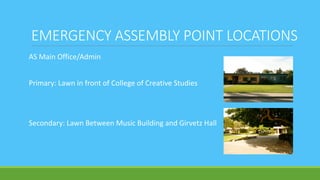
EMERGENCY ASSEMBLY POINTLOCATIONS
AS Main Office/Admin
Primary: Lawn in front of College of Creative Studies
Secondary: Lawn Between Music Building and Girvetz Hall
13.
EMERGENCY ASSEMBLY POINTSCONT.
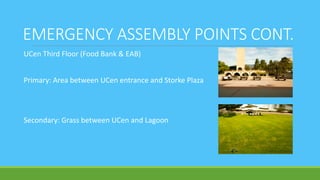
UCen Third Floor (Food Bank & EAB)
Primary: Area between UCen entrance and Storke Plaza
Secondary: Grass between UCen and Lagoon
14.
EMERGENCY ASSEMBLY POINTSCONT.
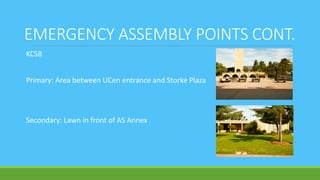
KCSB
Primary: Area between UCen entrance and Storke Plaza
Secondary: Lawn in front of AS Annex
15.
EMERGENCY ASSEMBLY POINTSCONT.
AS Annex
Ÿ Lawn in front of AS Annex
Ÿ Lawn between Music Building and Girvetz Hall
Bike Shop
Ÿ Parking Lot 29 in front of Bike Shop
Ÿ Parking Lot 27 at front entrance to Events Center
Pardall Center
Ÿ Sidewalk in front of Pardall Center
Ÿ Embarcadero Hall patio
16.
RESPONSE BASICS
Prepare mentallybefore anything happens.
Know where exits, first aid kits, fire extinguishers, and other emergency supplies
are.
Take care of yourself first.
Take time to assess situation.
Make sure everyone is accounted for.
Take others’ individual and cultural needs into consideration.
Listen to anyone you are trying to help, so that they can communicate their
specific needs.
17.
SHELTER-IN-PLACE
Shelter-in-place means seekingimmediate shelter inside a building. This may be
the best response to a variety of situations, including active shooter, flooding, a
chemical spill, etc.
To shelter-in-place:
Ÿ Select an interior room to isolate yourself from outside.
Ÿ Shut and seal or barricade doors.
Ÿ Monitor outside communications if possible.
Ÿ If told to evacuate or seek medical treatment by emergency personnel, do
so immediately.
18.
TYPES OF EMERGENCIES
Personof Concern/Crime in Progress
Active Shooter
Bomb Threat
Fire
Earthquake
Tsunami/Flooding
Gas or chemical smell
19.
RESPONSES TO SPECIFICEMERGENCIES
The following slides will cover emergencies most likely to occur in AS spaces. The
intention is to help you plan mentally how you would respond.
Remember: In any emergency you must take care of yourself first so that you don’t
become a victim in need of help. And so that you can help others as much as possible.
20.
PERSON OF CONCERN
Ifyou are in immediate danger call 911.
Student Mental Health Coordination Services (805-893-3030) is a readily accessible single
point of contact for individuals concerned about a student in distress. The coordinators
are available for consultation and appointments during business hours, Monday through
Friday. UCSB provides after-hours phone counseling (805-893-4411) for anyone concerned
about a distressed student during weekends, evenings, or holidays.
For more information, see the UCSB Threat Management Team website at:
www.tmt.ucsb.edu and the Student Affairs Distressed Students website at:
http://www.sa.ucsb.edu/responding-to-distressed-students/welcome.
21.
CRIME IN PROGRESS
Ifyou see a suspicious activity in an AS space, do not intervene or confront the
individuals involved!
Make sure you’re safe, then call 911 immediately.
When talking with the dispatcher, be as specific as you can about what’s happening,
describing the perpetrator, the location, possible threats, and other details.
Campus Police will investigate. For the Pardall Center the County Sheriff’s Office will
investigate.
Report the incident to your staff supervisor as soon as possible.
You may be asked to make a police report.
Your safety is of utmost importance. Do not confront individuals you think may be
committing a crime!
22.
ACTIVE SHOOTER
Focus onyour own survival!
If you can, GET OUT quickly. Warn others if possible. Then call 911 to report what you know.
If you can’t escape, HIDE OUT. Find a space you can lock or barricade, silence electronics, and
remain silent. Get behind something that will protect you from projectiles.
If you can’t flee or hide, prepare to FIGHT IT OUT. Be committed to neutralizing the attacker
by any means possible.
Cooperate with responding police by remaining calm, displaying empty hands, and following
their directions
It’s critical that you unambiguously let police know that you are not a threat!
23.
BOMB THREAT
Bomb threatsusually come by telephone.
Take the caller seriously and stay calm.
Ask questions like When will the bomb explode, location, what will cause it to
explode.
If possible, get a co-worker to call 911.
Notify your supervisor or other staff person.
Campus police will determine if you need to evacuate.
Evacuate to Emergency Assembly Point.
Do not return until police give all clear.
24.
FIRE
Know location ofextinguishers and emergency pull stations. And know how to use them.
For a small fire:
Notify occupants and Fire Department by activating alarm at fire pull station
Have someone call 911 (if someone is available)
Extinguish the fire using the appropriate fire extinguisher.
Aim at the bottom of the fire to suffocate it.
Ensure that Campus Police is aware that the fire is extinguished by calling 911.
If the fire cannot be extinguished with one fire extinguisher, close the door and exit the
building.
Make follow-up call to UCPD at 911.
25.
FIRE CONTINUED
Close doorsand windows as you leave rooms to reduce oxygen.
Stay as close to ground as possible to avoid smoke inhalation.
Do not use elevators.
Warn and help people as you leave.
Activate building alarm system and call 911 if you have not done so already or to
give follow-up information to emergency services.
26.
FIRE CONTINUED
Once outside,move to clear area at least 50 ft. from building.
Go to Emergency Assembly Point.
Wait for instructions.
Re-enter building when fire officials give all clear.
Report all fires, no matter how large, to Campus Police at 911.
27.
EARTHQUAKE
Before quake attachall bookcases and cabinets to wall.
Store all heavy and other items that could cause injury below head level.
When shaking begins, if inside:
◦ Stay away from windows and get under desk or table.
◦ Drop, cover, and hold on.
◦ In hallway, sit against wall and protect your head with your arms.
◦ In auditorium, duck between rows and protect your head.
◦ Take cover until shaking stops, then evacuate to Emergency Assembly Point.
28.
TSUNAMI/FLOODING
Most of campusand IV should not be affected by tsunami except beach and lagoon areas
Walk quickly and calmly to higher ground
Do not use Highway 217 to evacuate, due to its low elevation
Stay away from beaches
Most tsunamis are from earthquakes far out at sea, so there will be time to evacuate
If there is a strong local earthquake in the Santa Barbara Channel a tsunami could arrive in
minutes
Witnesses have reported that an approaching tsunami is preceded by a noticeable fall or rise
in water level at the shore
Don’t wait. Get to high ground!
29.
GAS OR CHEMICALSMELL
If you are concerned about a gas or chemical smell, leave the room or building and call 911, 9-
911 from campus phones.
Do not use any device that might produce a spark, including light switches.
We do sometimes have a gas smell on campus that is produced by undersea sources in the Santa
Barbara Channel. However, better be safe than sorry, so do report if you are concerned!
30.
RECOVERY
Emergencies affect eachof us differently and sometimes unpredictably. It’s
important that we take care of ourselves and each other. There are many
resources on campus to help (see the resource links below). One of the best, a
UCSB website called Pathways to Healing, was created in response to the May
23rd tragedy: www.caps.sa.ucsb.edu/pathways. The information here is quoted
from that site, which also includes other resources.
31.
SELF-CARE
Get adequate sleepand eat healthy foods. Grieving takes a lot of energy and
your body needs nourishment and rest.
Exercise regularly; it helps with anxiety, depression, and sleeplessness.
Even just walking can help.
Don’t isolate yourself from others. Spend time with family and friends who can
provide you with emotional support.
Talk about your feelings with people who care about you and will listen without
judgment.
Seek help from professionals when appropriate.
32.
SELF-CARE CONTINUED
Allow yourselfto cry; crying is a natural part of grief.
Allow yourself to laugh. Don’t underestimate the power of small pleasures and
diversions.
Accept caring and practical support from others and let others know what you need.
Avoid using drugs and alcohol to cope with emotions; they can conceal legitimate
emotions and disturb the grieving process.
Give yourself all the time you need to feel and understand the loss.
Maintain a normal routine and take care of what needs to get done.
Start with smaller tasks and move on to bigger ones in time.
Be kind to yourself!
33.
HELPING SOME ELSE-WAYSTO HELP
Get in touch and stay in touch with the griever; sympathetic company usually is
welcome and is one of the best kinds of support we can offer.
Be yourself—express your natural concern openly.
Be willing to talk about the loss, and encourage talking about it if the griever is
comfortable with it.
Be a good listener—accept, don’t judge, what you hear.
Accept silence or anger; respond by providing emotional support as best you can.
Reassure the griever that grief symptoms such as anger, guilt, and sadness are normal.
34.
HOW TO HELPCONTINUED
Be patient; it takes time for the griever to accept the loss and to deal with the
changes it has caused.
Allow the griever the time and behavior needed to come to terms with the loss.
It may be helpful to say things like:
“The feelings you’re having are understandable.”
“What help do you need right now?”
“I’d like to be with you, if that’s all right.”
“I don’t know what to say, but I care.”
35.
WHAT TO AVOID
Don’tpush a resistant griever to talk about the loss.
Don’t discourage expressions of grief; repetitive accounts of the loss are part of
the healing process for the griever.
Don’t give in to the impulse to talk about your own losses.
Don’t attempt to resolve the griever’s feelings of grief.
36.
WHAT TO AVOIDCONTINUED
It may NOT be helpful to say things like:
“Be strong.”
“It will be better soon.”
“Count your blessings.”
“You’re better off than other people.”
“Keep your chin up.”
“You have to put it behind you and get on with your life.”
“Time will heal.”
These platitudes can alienate and do not help the griever.
37.
ONLINE RESOURCE LINKS
UCSBEnvironmental Health & Safety (EH&S), Emergency website:
http://emergency.ucsb.edu/index.html
Pathways to Healing: http://caps.sa.ucsb.edu/pathways
Campus Police: http://www.police.ucsb.edu
Santa Barbara County Fire Department: http://www.sbcfire.com
American Red Cross Fire Safety Information:
http://www.redcross.org/images/MEDIA_CustomProductCatalog/m4340073_FireS
afety.pdf
38.
CERT TRAINING
CERT standsfor Community Emergency Response Team
The Community Emergency Response Team (CERT) program is available to all
students at no cost. It is designed to help communities prepare for effective
disaster response through training and planning. CERT is a positive and realistic
approach to emergency and disaster situations where citizens will be initially on
their own and their actions can make a difference. With training and
information, individual and community groups can be prepared to serve as a
crucial resource capable of performing many of the emergency functions
needed in the immediate post-disaster period. Through training, citizens can
manage utilities and put out small fires; provide first aid and basic medical aid;
search for and rescue victims safely; and organize themselves and spontaneous
volunteers to be effective.
39.
CERT TRAINING TOPICS
DISASTERPREPAREDNESS
FIRE SUPPRESSION
MEDICAL OPERATIONS
SEARCH AND RESCUE
ORGANIZATION AND DISASTER PSYCHOLOGY
TERRORISM AND HOMELAND DEFENSE
REVIEW AND DISASTER SIMULATION
SUMMARY
Prepare yourself mentallyfor emergency situations.
Ensure your own safety first.
Assess the situation before acting.
Then help others if you can do it safely.
Cooperate and communicate with emergency personnel so that they can take
appropriate action.
Take care of each other.
Be safe!